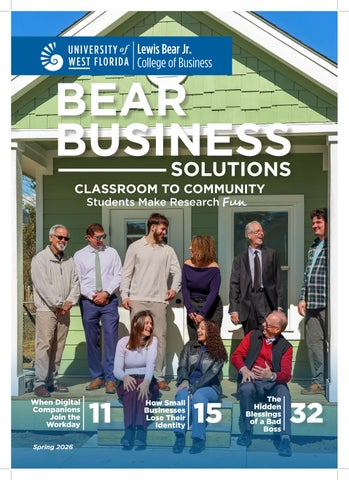

BEAR BUSINESS SOLUTIONS
CLASSROOM



Lewis Bear Jr. College of Business students took on a real-world marketing challenge, developing brand positioning strategies for both the College and Catholic Charities of Northwest Florida. Over the course of the semester, four student teams conducted research and presented their final projects to college leadership and community stakeholders.
Students developed their projects in Richard Czerniawski’s competitive brand positioning course. They used the Brand Diamond framework, a tool that marketing professionals rely on to build brand positioning strategies from the ground up. Each team was responsible for developing all five components of the framework: a central brand idea, a target customer profile, a competitive framework, a benefit ladder, and supporting rationale. Working through each component required students to leverage their skills across marketing research, strategic analysis, consumer psychology, and persuasive communication.
The process was deliberately iterative and collaborative. Teams gathered primary data through surveys, evaluated multiple competing concepts, and refined their positioning through successive rounds of feedback before determining their final recommendations. Recommendations were delivered through professional presentations to college leadership and to Matt Knee, CEO of Catholic Charities of Northwest Florida. The experience mirrors the kind of client-facing work students will encounter throughout their careers in brand management, marketing strategy, consulting, and business development.
“
The students really solidified items our internal team felt were excelling, and those we felt could be improved.
“
“Catholic Charities enjoyed gaining insights from an outside perspective, and the students really solidified items our internal team felt were excelling, and those we felt could be improved,” Mr. Knee said. “They noted that we use a lot of stock photos for our outreach, fundraising, and marketing materials. Though it is challenging for us to get clients to agree to take a picture, the stock photos have always bothered me. Their finding really motivated us to use more real photos.”
Projects of this nature exemplify the high-impact student learning experiences that define the Lewis Bear Jr. College of Business.
The Catholic Diocese of Pensacola-Tallahassee’s Trinity Village Tiny Homes
Front (L-R): Deacon Ray Aguado, Dean Scott Keller, Azia Arosemena, Catholic Charities CEO Matt Knee.
Back: Blakely Tyer, Instructor Richard Czerniawski, Joshua Cichon, Kaydee Cook, Lindsey Spicer
The Catholic Diocese of Pensacola-Tallahassee’s Trinity Village Tiny Homes
to

COMMUNIT Y
STUDENTS MAKE RESEARCH FUN


AZIA AROSEMENA, COMPREHENSIVE MARKETING MAJOR
“We worked diligently to create a brand idea that would help resolve Catholic Charities’ issue of being perceived as only serving Catholics, but instead as a charity that serves all those in need—no matter a person’s religion. Together we curated an idea that resolved this issue by representing Catholic Charities as a charity that serves all those open to receiving help, as well as a charity that provides long-term stability for its clients. We found that our brand idea enhanced potential clients’ perceptions of trust, confidence, and hope in Catholic Charities.”
RILEY MACVANE, COMPREHENSIVE MARKETING MAJOR
“My group spent the semester actively learning the concepts of marketing and branding with the goal of directly benefiting the college we all attend—the Lewis Bear Jr. College of Business. Our main objective was to answer a central question: What is it that Florida and the surrounding community would miss if the college were not here? Exploring this question helped us identify the school’s most advantageous value proposition in the marketplace and ultimately establish a brand strategy that could reposition the college for continued growth and opportunity to attract students.”


SAM MOTHERWAY, GLOBAL HOSPITALITY & TOURISM MAJOR
“Through our research and analysis, we determined that the college’s strongest positioning lies in combining the opportunities and academic strength of a larger university with the personalized, hands-on experience of a smaller school. Ultimately, our findings emphasized that the Bear College of Business should position itself as a dream fulfiller, providing accessible education, real-world learning opportunities, and strong career outcomes that help students achieve meaningful careers and long-term success.”
BLAKELY TYER, COMPREHENSIVE MARKETING MAJOR
“Over the course of the semester, we delegated group members to be leaders of a certain area of the brand diamond. Our end goal was to position Catholic Charities of Northwest Florida as the good neighbor. This was to resonate with the community that they are a local presence, have good intentions, and are within reach for everyone. Overall, the most I learned from the whole experience was the holistic understanding of positioning and how crucial it is to a brand’s success.”

MESSAGE FROM THE DEAN

Dr. Scott Keller
Dean of the Lewis Bear Jr. College of Business
Welcome to the Spring issue of Bear Business Solutions!
Whether you’re a longtime partner of the Lewis Bear Jr. College of Business or picking up our magazine for the first time, I am so glad you’re here.
We believe the best research should be out in the world, solving problems and creating solutions. That’s why the articles in these pages focus on practical, real-world results built on business principles and data. It is my hope that you and your organization will find immediate value in these findings as you navigate today’s evolving landscape.
This month, we’re sharing insights designed to help you lead with confidence:
The Virtual AI Panel: How to use multiple AI platforms as a collaborative think tank. Branding vs. Brand: Why understanding this distinction is a game-changer for your identity. Workplace Dynamics: Finding growth and value even in difficult professional relationships.
You’ll notice our cover celebrates the energy of our faculty, students, and community collaborators working side-by-side. This year alone, we’ve engaged with over 10 local organizations, including a wonderful partnership with Catholic Charities. We are especially grateful to CEO Matt Knee for allowing our students to apply the lessons learned in Mr. Richard Czerniawski’s Brand Positioning class. Our students also gained invaluable experience by analyzing our own College’s brand and strategy under Mr. Czerniawski’s guidance.
By involving our students in practical and innovative research we ensure they graduate workforce-ready and prepared to lead. We want our graduates to be your preferred candidates from the moment they apply.
Thank you for being such a vital part of our community. I hope you find this issue of Bear Business Solutions invaluable to your organization’s success.
Happy reading!

Spring 2026
BEAR BUSINESS SOLUTIONS
6. Brand Versus Branding:
The Strategic Distinction— and Discipline— That Determines Marketing Success
Richard D. Czerniawski
11. When Digital Companions Join The Workday:
What managers need to understand about AI, routines, and employee engagement
Courtney Rada
15.
How Small Businesses Lose Their Identity—and What Leaders Can Do
Kenny O’Connor
22. Position Yourself For The Uncertainty That Lies Ahead: A Practical Method for Strategic Foresight Using AI
Chula King and Stephen A. LeMay
32. The Hidden Blessings of a Bad Boss
Timothy R. McIlveene
36. Will You Be Caught Unprepared? The Value of Hybrid Intelligence Haris Alibašić
Editors in Chief: Maggie M. Davis and Stephen A. LeMay
Copy Editor: Tom St. Myer
Design Director: Emma Confusione
Designer: Brooke Romero Dean: Scott Keller
FRONT COVER PHOTO
The Catholic Diocese of PensacolaTallahassee’s Trinity Village
Tiny Homes
Front (L-R): Kaydee Cook, Azia Arosemena, Dean Scott Keller
Back: Deacon Ray Aguado, Catholic Charities CEO Matt Knee, Blakely Tyer, Lindsey Spicer, Instructor Richard Czerniawski, Joshua Cichon


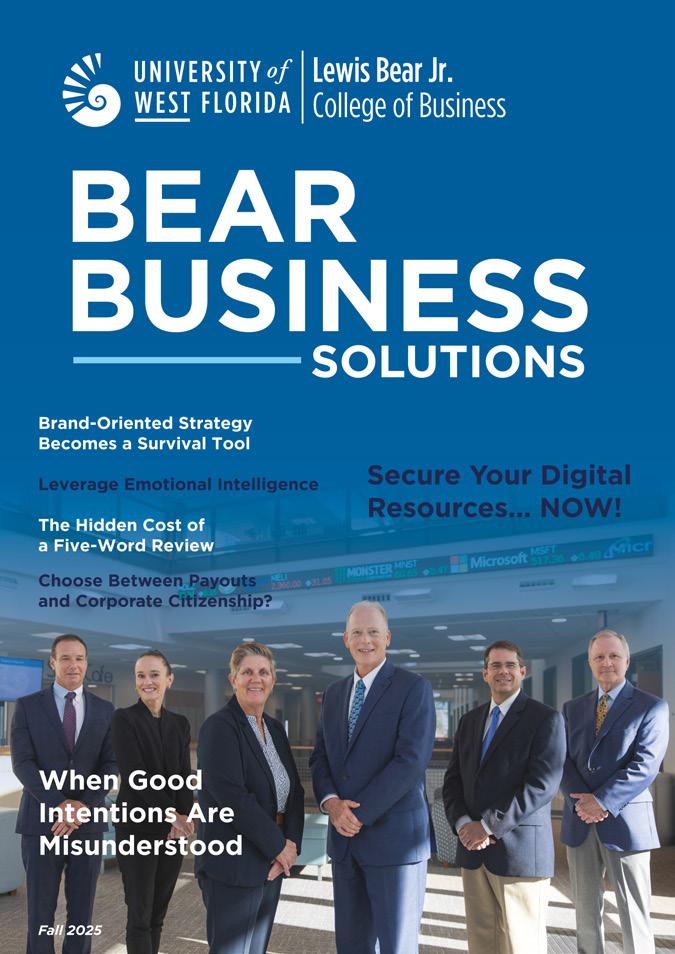
Brand Versus Branding The Strategic Distinction—and Discipline— That Determines Marketing Success
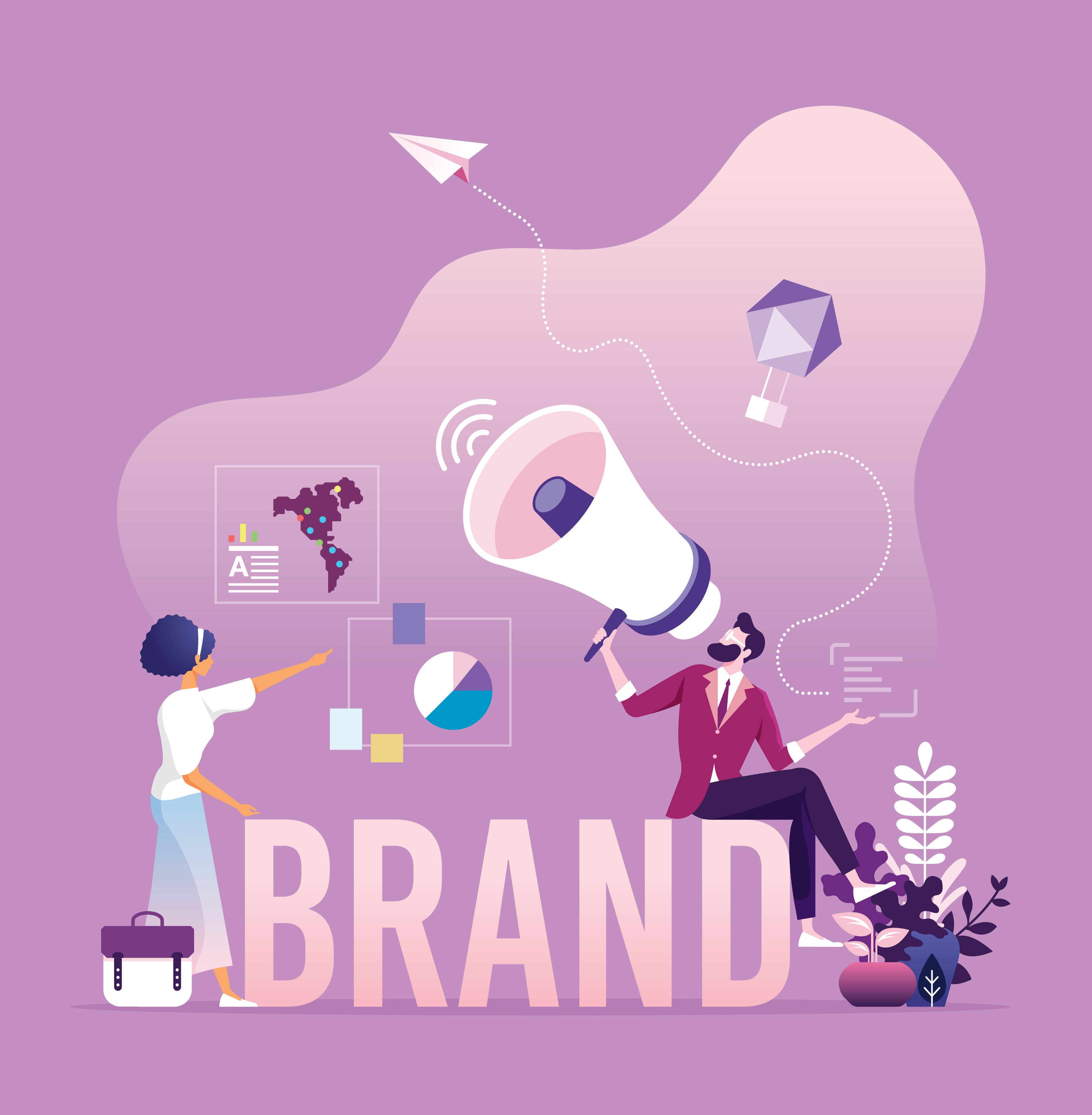
Branding does not direct the Brand. Branding expresses it.
The Strategic Distinction—and Discipline—That Determines Marketing Success Brand Versus Branding
By Richard D. Czerniawski
A newly hired marketing director walks into her first team meeting. Within weeks, she approves a new logo, updated brand colors, and redesigned packaging. Six months later, sales are down 15%, customer complaints are rising, social media criticism is escalating, and the board is demanding answers.
What went wrong?
She changed the branding without understanding the Brand. This confusion—between Brand and branding—is one of the most
expensive mistakes in marketing. Recent high-profile examples like Bud Light’s 2023 marketing debacle and Cracker Barrel’s 2025 backlash underscore the stakes. When companies redesign what customers see—branding—without protecting what they value—the Brand, trust erodes. Branding that is inconsistent with the Brand Positioning Strategy and the Brand itself is a critical—and perhaps even fatal—error. It undermines brand health and long-term prosperity.
For Northwest Florida businesses competing in dynamic markets, this distinction between Brand and branding—and the disciplined sequencing of each—is not academic theory. It is a competitive necessity. It determines growth, loyalty, and longterm profitability.
THE CRITICAL DISTINCTION
Business leaders often ask: “Isn’t our logo our brand?” The short answer is no. Brand is what lives in the minds and hearts of cust-
omers. It is the fulfillment of a meaningful promise to a defined target customer. It reflects shared values and the satisfaction of both physical and emotional needs. The Brand lives in perception—built through consistent delivery and the customer’s experience.
Branding is how that promise is expressed— through symbols, messaging, packaging, pricing, placement, logo, promotion, and all marketing initiatives. Branding helps target customers realize the Brand’s positioning.
Branding communicates. Brand delivers.
THE BLUEPRINT: BRAND POSITIONING STRATEGY
Everything begins with the Brand Positioning Strategy. It is the blueprint for the development of the Brand. It is not a subset of promotion. It is the most important “P” in marketing because it directs all marketing decisions and actions.
A sound Brand Positioning Strategy answers five critical, non-negotiable questions:
• Who is the target customer (and it’s not everyone!)?
• What competitive frame are we in—literal
Brand Versus Branding
The Strategic Distinction—and Discipline— That Determines Marketing Success
and perceptual?
• What is our point of “Preferenciation”—our relevant, meaningfully differentiated promise that drives customer preference for the Brand?
• Why should customers believe our promise?
• What personality brings the strategic positioning to life?
This strategic intention—the Brand Positioning Strategy Statement— must precede all branding decisions.
When companies engage in branding (design first) and define (create the Brand Positioning Strategy) later, they fail in their bid to create brand loyalty. The same is true when they change branding without understanding the Brand’s positioning and heritage.
BRAND VS. BRANDING IN PRACTICE
The distinction becomes clearer when we examine companies that appreciate the distinction and practice disciplined sequencing.
Tide Brand (Positioning Promise): Unmatched cleaning performance you can trust.
Meaning to the Target Customer:
Clothes get clean the way you expect—removing worry, saving time, better satisfying customer needs than competitors and consistently exceeding expectations.
Branding (Expression):
• The iconic orange bull’s-eye
• “It’s Got to Be Tide” messaging
• Innovations such as Tide Pods and Hygienic Clean
• Premium shelf presence reinforcing leadership Strategic Lesson: The Brand positioning around superior cleaning performance has driven branding. The Brand is performance leadership. The branding adapts— while staying true to the positioning—to maintain relevance.
Amazon
Brand (Positioning Promise): Relentless removal of friction to make purchasing easier.
Meaning to the Target Customer:
Maximum selection, speed, and convenience— at competitive prices— with minimal effort.
Branding (Expression):
• “A-to-Z” arrow logo
• Prime membership reinforcing speed and integration
• One-click ordering and frictionless checkout
When companies design first and define later, they fail to create brand loyalty—which is every marketer’s primary responsibility.
• Messaging focused on delivery, price, and ease Strategic Lesson: Amazon has expanded into dozens of categories. Its branding has evolved. But the positioning—customer-centric convenience—remains the decision filter.
Apple Inc.
Brand (Positioning Promise): Technology made simple and beautiful—empowering creative individuals to change their world. Meaning to the Target Customer: Intuitive design and elegant functionality that elevate personal potential to create meaningful impact.
Branding (Expression):
• Minimalist product design
• Evolution to the monochrome Apple logo
• “Think Different” messaging and culture
• Premium pricing
• Clean, experiential retail stores
• Knowledgeable staff Strategic Lesson: When Steve Jobs returned in 1997, he clarified the positioning before redesigning execution. Strategy preceded aesthetics and product development. The Brand was defined—then branding aligned behind it.
THE BRAND POSITIONING FILTER
Every branding initiative—and every major deci-
sion—should pass through the Brand Positioning Strategy:
• Product: Do improvements, line extensions, and new offerings reinforce and add value to the positioning?
• Price: Does pricing signal the value claimed?
• Place: Are we present where our target expects us, consistent with positioning?
• Promotion: Does every touchpoint reinforce meaning and preference?
When companies apply this filter, they often uncover costly disconnects— premium-positioned products sold through discount channels, value messaging paired with premium pricing, or changes that alienate loyal customers.
That is not a branding problem. It is a positioning failure.
THE STRATEGIC DISCIPLINE THAT SEPARATES WINNERS FROM LOSERS
Recognizing the distinction between Brand and branding, disciplined sequencing builds enduring equity:
1. Define the Brand through the Brand Positioning Strategy.
2. Align the organization around it.
3. Express it through branding.
Bear Brief
THE PROBLEM
Organizations are damaging their Brands—alienating customers, eroding trust, and undermining performance—by changing branding without clearly defining or reaffirming what the Brand means to customers.
THE ROOT CAUSE THE SOLUTION
Branding is being approved before the Brand is defined. Specifically, organizations bypass or fail to pressure-test the Brand Positioning Strategy Statement—the blueprint that establishes the Brand’s strategic meaning and competitive advantage.
Define the Brand first through a relevant, meaningfully differentiated Brand Positioning Strategy. Then use it as the blueprint and decision filter to guide—and rigorously assess—all branding activity. Sequence impacts success: strategy first, expression second.
4. Deliver it consistently. We must resist the temptation to “make our mark” through branding changes before understanding and validating strategic intention. That discipline separates strategic marketers from tactical executors.
Those who define first and design second create brand loyalty.
Weak businesses redesign before they define.
APPLYING THIS TO YOUR BUSINESS
Step 1: Create a Clear Brand Positioning Strategy Statement. Define your target customer, competitive frame, differentiated promise that drives preference, incon-
Brand Versus Branding
The Strategic Distinction—and Discipline— That Determines Marketing Success
trovertible reasons-to-believe, and Brand personality.
Step 2: Ensure It Is Sound. It must be relevant, meaningfully differentiated, credible, and deliverable.
Step 3: Use It as a Strategic Filter. Every branding decision must reinforce—not reinterpret—the strategy.
BUILDING STRATEGIC MARKETING CAPABILITY IN NORTHWEST FLORIDA
For business leaders seeking disciplined Brand Positioning Strategy development, the University of West Florida Lewis Bear Jr. College of Business partners with com-
companies to develop competitive positioning frameworks.
Under faculty guidance, marketing students apply proven strategic principles in real-world engagements. These are not theoretical exercises. They produce disciplined Brand Positioning Strategy Statements that companies can use as blueprints for growth.
Businesses gain strategic clarity and competitive advantage. Students gain meaningful, real-world marketing experience—job-ready on day one following graduation. Everyone wins! Strategic clarity is often the single greatest unlock for business growth.
Richard D. Czerniawski, a Golden MBA from the University of West Florida, brings more than 50 years of global brand marketing experience with Fortune 100 companies, including Procter & Gamble, Johnson & Johnson, and Coca-Cola USA. His work spans 40 countries and more than 100 cities.
He is Founder and President of Brand Development Network International, a global marketing resource company specializing in strategic brand development and competitive positioning.
He is the author of three books and hundreds of articles on marketing management and serves as Adjunct Professor in Competitive Brand Positioning at the University of West Florida’s Lewis Bear Jr. College of Business.


GLOBAL HOSPITALITY AND TOURISM
We offer a learning environment where you will be challenged and encouraged to pursue your individual career goals while gaining the foundation you need for success in the hospitality and tourism industry. We offer a specialization: Julian & Kim MacQueen Guest Experience Management that prepares you to fill the growing demand for leadership positions in:
• Airlines
• Amusement Parks
• Casinos
• Convention and Visitors’ Bureaus
• Cruise Lines
• Events
• Food and Beverage
• Hotels
• Private Clubs
• Resorts
• Sports Facilities
• Travel and Tourism
“The University of West Florida’s Global Hospitality and Tourism program provided me with a solid foundation in customer service, operations, and business management, which are crucial for a successful career in hotel sales. The coursework and practical experiences honed my skills in client relations and strategic planning, directly contributing to my ability to secure and excel in the role of a hotel sales manager.”
—Jacquelyn Colbert, Sales Manager, Home2 Suites by Hilton

Employees rely on AI because repeated, dependable interactions help them function better at work.

When Digital Companions
Join the Workday
What managers need to understand about AI, routines, and employee engagement
By COURTNEY RADA
At 8:12 every morning, a product manager opens the same browser tab before checking her email. She types a short prompt into an AI tool: Help me organize today’s priorities.
She does this even when her calendar is already full. Not because she lacks direction, but because the ritual helps her feel steady before the pressure begins.
To most leaders, this looks like ordinary tool use. To the employee, it is something else entirely: a daily routine that structures thinking, regulates stress, and creates stability.
Managers often assume that emotional attachment to AI reflects confusion or misplaced trust. Our research suggests a different explanation. Employees do not rely on AI because they think it is human. They rely on it because repeated, dependable interactions help them function better at work.
AI has quietly become part of how many people start their day, process uncertainty, and stay engaged.
For many, AI has become part of their work rituals. Like a morning coffee or an end-of-day checklist, repeated interactions with AI create predictable patterns.
THE SHIFT MANAGERS ARE MISSING
Leaders typically frame AI as a productivity technology—faster writing, quicker analysis, and better automation. Employees experience it differently. For many, AI has become part of their work rituals.
Like a morning coffee or an end-of-day checklist, repeated interactions with AI create predictable patterns:
• Starting the workday with clarity
• Thinking through difficult decisions
• Managing stress during high-pressure moments
• Maintaining consistency when work feels unstable.
These interactions are not accidental. They are ritualized.
CASE IN POINT: THE MORNING RITUAL
A financial analyst begins each day by running the same prompt through her AI tool: Summarize my priorities and flag what could derail today’s plan. She calls it her “mental warm-up.” When her company temporarily restricted access during a security review, she felt disoriented and less productive—not because

the tool saved time, but because it disrupted the ritual that helped her transition into focused work. When organizations abruptly restrict or redesign AI tools—through sudden policy changes, removed access, or unexplained updates—employees do not just lose efficiency. They lose routines that quietly support their emotional and cognitive functioning.
WHAT WE STUDIED
We conducted qualitative research on how employees use AI in daily work, especially during moments of stress, uncertainty, and transition. Rather than asking whether AI replaces human relationships, we examined what people actually do with AI and how those
interactions shape motivation, engagement, and identity over time.
Across roles and industries, employees described returning to AI again and again—not for companionship, but for structure.
FOUR PATTERNS WE FOUND
1. Employees Don’t “Use” AI. They Build Routines Around It.
AI use quickly becomes patterned. Employees described opening AI tools at the same time each day, relying on them before meetings, and returning to them after difficult interactions.
These routines help employees think clearly and regain emotional balance.
When
Digital Companions Join the Workday
What managers need to understand about AI, routines, and employee engagement
Bear Brief
THE PROBLEM
Managers misinterpret AI as a productivity tool rather than recognizing its role in employees’ daily rituals that support focus and emotional stability.
lates into greater focus, persistence, and follow-through at work.
3. Trust Is Built Through Consistency, Not Capability.
THE ROOT CAUSE THE SOLUTION
This stems from a mismatch between leaders’ efficiency-focused view of AI and employees’ use of it as a consistent, ritualized support system.
Leaders should treat AI as part of employees’ work routines by prioritizing stability, normalizing its use for thinking and regulation, and avoiding disruptive changes.
When routines are disrupted—by tool bans, restricted features, or dismissive leadership—employees report frustration and disengagement. What looks like resistance to policy is often resistance to losing a stabilizing practice.
2. Emotional Support Can Be Functional, Not Personal.
Employees know AI is not human. Yet many still report feeling calmer, more grounded, or more motivated after using it. What matters is not whether AI “cares,” but whether the interaction performs care-like functions: listening without
judgment, responding consistently, and helping employees think through problems.
Case in Point: The Sounding Board
A mid-level manager preparing for a difficult performance conversation used AI to rehearse what she wanted to say. She knew the system did not understand her emotions, yet she felt calmer after testing different wording. “It’s like thinking out loud without judgment,” she explained. The interaction did not replace human support, but it reduced anxiety and increased confidence.
This functional emotional support often trans-
Employees trust AI the same way they trust systems and processes: through repetition. When tools behave predictably—maintaining tone, memory, and access—employees feel safe relying on them. When tools change suddenly or without explanation, employees feel unsettled and disengaged.
Consistency matters as much as performance. Case in Point: The Sudden Change
An engineering team used an AI tool in daily stand-ups to clarify technical questions and document decisions. When its interface and access rules changed overnight, the team stopped using it altogether. Several described the shift as “unreliable.” What broke their trust was not reduced capability, but unpredictability.
A more powerful model does not always create more trust. A stable one often does.
4. Not All Employees Use AI the Same Way.
Some employees treat AI as a productivity assis-
“It’s like thinking out loud without judgment,” she explained. The interaction did not replace human support, but it reduced anxiety and increased confidence.
tant. Others use it as asounding board, planner, or emotional stabilizer.
Highly reflective and creative employees are likely to integrate AI into their thinking processes. These are often the same employees organizations depend on for innovation and problem-solving.
Misreading their AI use can quietly push them toward disengagement.
WHY THIS MATTERS FOR LEADERS
At first glance, AI use may seem like a personal preference. But our research shows how employees relate to AI shapes their experience of work itself.
When leaders dismiss or misunderstand thesepractices:
• Employees stop experimenting with tools that help them perform better.
• Trust erodes—not in AI, but in leadership judgment.
• Emotional labor increases as employees hide how they actually cope with stress.
Organizations lose energy, creativity, and discretionary effort.
The issue is not whether employees should use AI. It is whether leaders understand what that use represents.
WHAT LEADERS CAN DO
1. Normalize thoughtful AI use.
Signal that using AI to think, reflect, or plan is legitimate—not a shortcut or weakness. Replace “Why do you need AI?” with “When does AI help you think more clearly?”
2. Avoid abrupt tool changes.
Sudden restrictions disrupt established routines. When change is necessary, explain why and allow time for adjustment.
3. Watch emotional patterns, not just output. If engagement drops after tool loss, the issue may be emotional regulation, not productivity. A brief check-in can prevent disengagement.
4. Train managers to recognize digital rituals. Leadership development should include awareness of how employees build routines with technology. These rituals are often invisible—but they are doing real work.
5. Design for stability, not just speed.
Faster AI is not always better. Employees value tools that feel steady, familiar, and predictable— especially during organizational change.
THE BOTTOM LINE
Employees do not rely on AI because they are confused. They rely on it because structured, reliable interactions help them function better at work. AI does not need to feel human to matter. It needs to feel dependable. Leaders who understand this will not just manage technology better. They will manage people better.
Courtney A. Rada is an adjunct instructor at the University of West Florida’s Lewis Bear Jr. College of Business. Dr. Rada received her Ph.D. from Royal Holloway, University of London. Her research examines AI companionship, consumer culture theory, and technology-mediated intimacy. Prior to academia, she worked in marketing and communications consulting for Blackstone Chambers, supported public relations projects involving UK professional sports organizations in Formula One and Premier League football, and worked in trading and predictive analytics at CMC Markets. She is also the author of a children’s book series.
How Small Businesses Lose Their Identity—and What Leaders Can Do

How Small Businesses Lose Their Identity—and What Leaders Can Do
By KENNY O’CONNOR
There is a moment many small business owners recognize instantly, even if they struggle to name it. Customers are still coming in, sales may be steady, and the books look fine. Yet something feels different. Conversations are shorter. Familiar faces appear less often. Long-time customers don’t complain—they simply drift away. When asked why, they offer a response that is vague but deeply unsettling: “It’s just not the same anymore.”
What makes this moment so troubling is that noth-
ing obvious is broken. The business is more organized than it has ever been. Processes are clearer.
Roles are defined. The operation looks professional, polished, and scalable.
And yet, the emotional energy that once filled the space—the warmth, the personality, the sense of being known—has quietly faded.
This change is rarely intentional. In fact, it often occurs when leaders are doing exactly what they believe responsible growth requires. They invest in systems, hire
managers, and standardize practices in pursuit of sustainability and control. The problem is not poor leadership or flawed strategy.
It is something far more subtle and harder to see: a gradual loss of identity hiding in plain sight.
A PATTERN BENEATH THE SURFACE
What many small business leaders experience is not random, and it is not unique to their firm. Across industries and
Identity is not just branding or messaging; it is how a business behaves, how it feels to interact with, and what it signals about what matters.
communities, the same pattern appears again and again. Businesses that once felt personal, distinctive, and human slowly become efficient, predictable, and emotionally neutral. Growth is assumed to be progress. Professionalism is assumed to be improvement. Few leaders pause to ask what might be lost along the way, yet when viewed over time it becomes clear that success itself quietly reshapes how a business behaves—and how it is experienced.
Recognizing this pattern is the first step toward interrupting it.
WHAT WE EXAMINED
In examining how
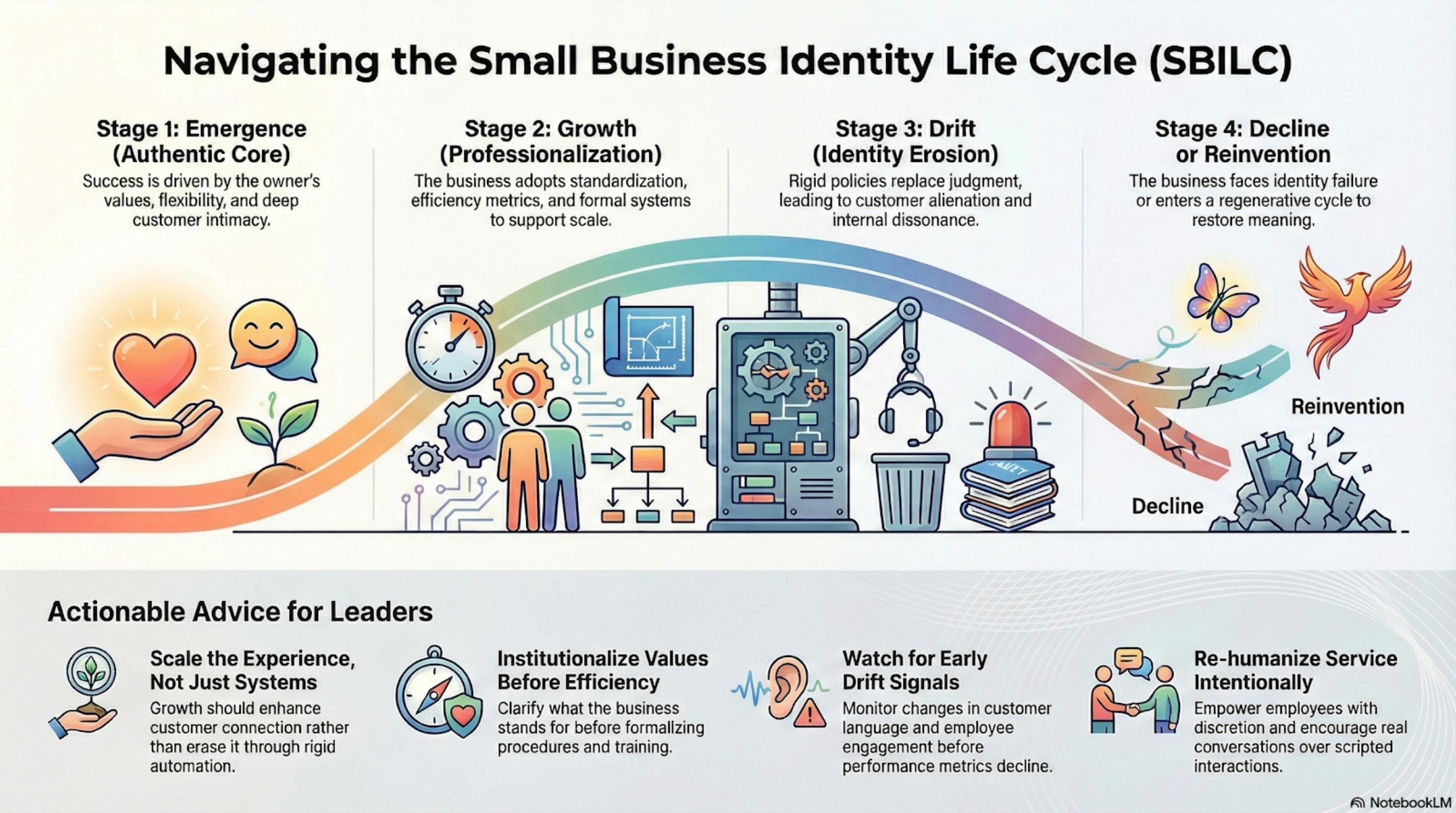
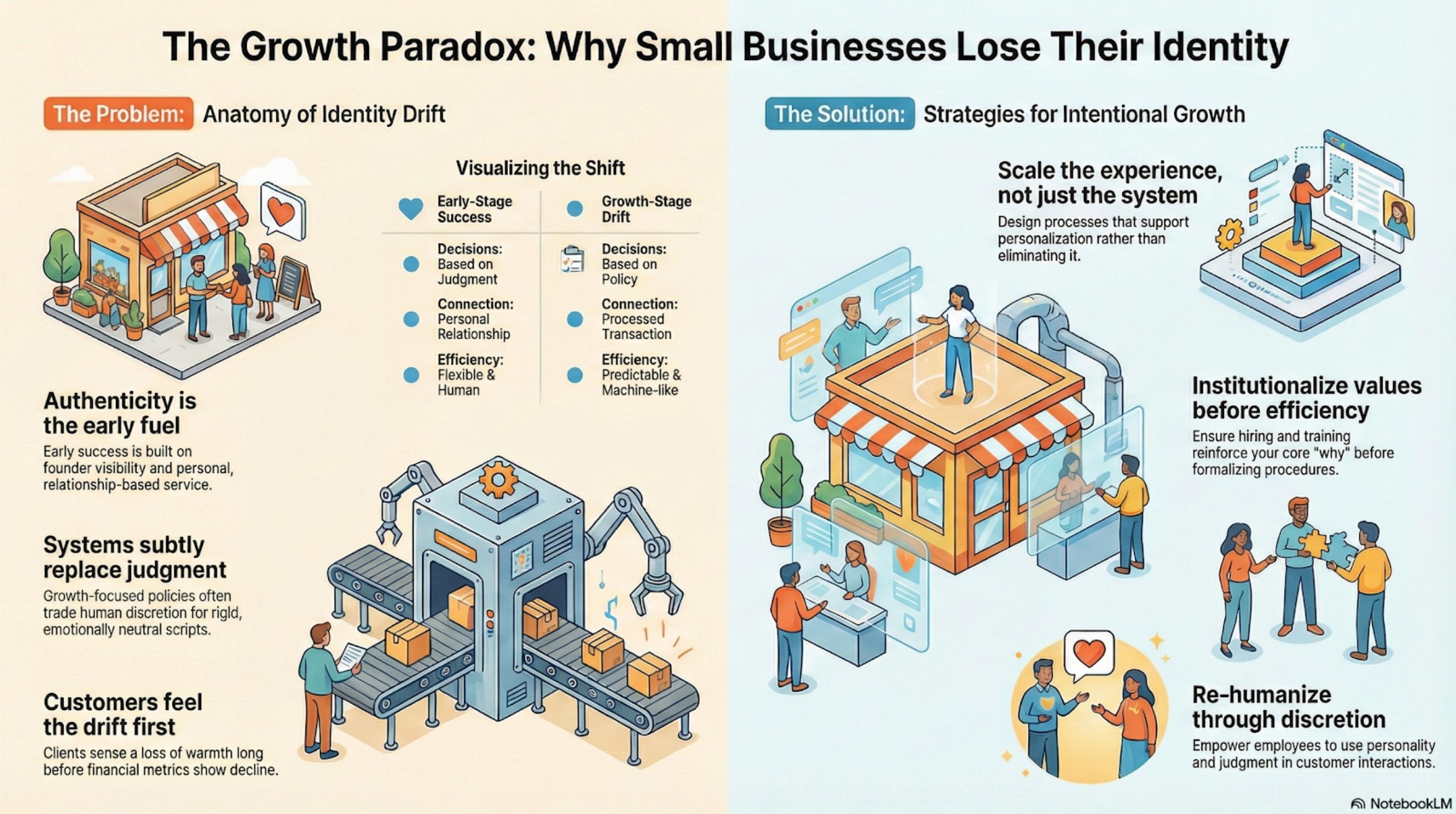
small businesses evolve as they grow, one theme consistently emerges: success changes behavior. Early-stage businesses tend to be flexible, relational, and deeply connected to their customers and communities. Decisions are guided by judgment rather than policy, and problems are solved through conversation rather than procedure. As businesses grow, however, they adopt systems and structures designed to support scale. New employees are added, expectations increase, and external stakeholders— from lenders to partners— demand consistency and predictability meet these demands, businesses
professionalize. Alongside this professionalization, the business’s identity begins to shift. Identity is not just branding or messaging; it is how a business behaves, how it feels to interact with, and what it signals about what matters. Over time, many businesses move through a recognizable life cycle in which identity evolves, drifts, and in some cases, disappears altogether.
WHAT WE FOUND Authenticity fuels early success
In their earliest stages, small businesses thrive on authenticity. The owner is present and visible. Customers are recognized,

Bear Brief
THE PROBLEM
Growing small businesses often lose the authenticity and personal connection that originally made them special, causing customers to disengage even when performance still looks strong.
THE ROOT CAUSE
THE SOLUTION
As businesses scale, systems and standardization quietly replace the personal, human interactions that built trust and loyalty. Leaders must intentionally preserve authenticity by designing systems that support human connection, reinforcing core values, and staying visibly engaged with customers and employees.

How Small Businesses Lose Their Identity—and What Leaders Can Do
remembered, and valued, and service is shaped by context and discretion rather than rigid rules. This authenticity builds trust quickly. Customers feel seen rather than processed, and loyalty grows not because of rewards programs or promotions, but because of relationships. Word-of-mouth spreads organically, grounded in real experiences rather than marketing campaigns. At this stage, the business’s identity is clear and coherent, reflecting the founder’s values, personality, and connection to the community. That identity becomes the business’s most powerful source of differentiation.
Growth changes behavior before leaders realize it As demand increases, informal systems begin to strain. Leaders respond by introducing structure: policies, procedures, metrics, and hierarchies designed to maintain quality and efficiency. These changes are logical and often necessary, yet each layer of structure subtly reshapes behavior. Employees rely more on scripts than judgment. Flexibility gives way to consistency. Decisions prioritize efficiency over nuance, and owners spend more time managing systems and less time interacting with custom-
ers. None of these shifts seem harmful in isolation. Collectively, however, they transform how the business feels. The organization begins to act less like a person and more like a machine, a change that often goes unnoticed internally because performance metrics still appear healthy. This is where identity drift takes hold— the gradual misalignment between what the business once represented and how it now operates. Customers feel the change before owners do Customers are remarkably attuned to these changes. They sense when interactions become scripted instead of genuine, notice when flexibility disappears and policies replace judgment, and feel when efficiency comes at the expense of connection. Importantly, customers rarely articulate this as a formal complaint. Emotional attachment weakens quietly. Loyalty becomes habit, and over time habit fades as well. By the time leaders see declining engagement or sales, the underlying shift has often been present for years. The business did not lose customers because it failed operationally; it lost them because it lost emotional resonance.
Identity
becomes the business’s most powerful source of differentiation.
WHY IT MATTERS FOR LEADERS
Identity drift carries real consequences. When a small business loses its sense of self, it also loses differentiation. It becomes easier to compare, easier to replace, and easier to abandon as competition shifts from meaning to price. Employees experience the shift as well. When work becomes procedural rather than purposeful, engagement erodes, pride fades, and discretionary effort disappears. The business may still function, but it no longer inspires. At this stage, leaders often respond by doubling down on efficiency, promotions, or cost control—treating symptoms
rather than causes. The result is a business that looks successful on the surface but feels hollow underneath. The uncomfortable truth is this: many small businesses struggle not because they grow too slowly, but because they grow without protecting what made them meaningful in the first place. What Leaders Can Do
The good news is that identity loss is not inevitable. Leaders can take deliberate steps to preserve—and even restore— what makes their business distinctive.
• Scale the experience, not just the system. Growth should enhance customer connection, not erase it.
Processes should support personalization rather than eliminate it.
• Institutionalize values before efficiency. Before formalizing procedures, clarify what the business stands for. Hiring, training, and evaluation should reinforce those values.
• Watch for early signals of drift. Changes in customer language, employee engagement, and culture often appear long before performance metrics decline.
• Re-humanize service intentionally. Empower employees with discretion. Encourage real conversations. Allow room for
judgment, flexibility, and personality.
• Maintain visible leadership presence. Founder and leadership visibility reinforces continuity. Even symbolic presence can anchor culture during periods of growth.
A FINAL REFLECTION
Small businesses play a unique role in our economy and communities. They are not merely providers of goods and
How Small Businesses Lose Their Identity—and What
Leaders Can Do
services; they are carriers of trust, meaning, and human connection. When they lose that role, something larger is lost as well. Growth does not have to come at the expense of identity, but preserving identity requires intention. It requires leaders to look beyond efficiency metrics and ask harder questions about who their business is becoming—and why.
The most enduring small businesses are not those that grow the fastest, but
those that grow without forgetting who they are. In a marketplace increasingly defined by scale and automation, authenticity is not a weakness. It is a strategic advantage hiding in plain sight.
This article is based on ongoing research on small business growth, identity, and customer relationships conducted at the University of West Florida.
Kenny O’Connor is a visiting assistant professor at the University of West Florida’s Lewis Bear Jr. College of Business. Dr. O’Connor earned his Ph.D. from the University of South Alabama. His scholarly work examines topics such as AI anxiety, the Diffusion of Innovation Framework, and the Theory of Planned Behavior. He previously held senior executive responsibilities in the construction sector.
Position Yourself For The Uncertainty That Lies Ahead A Practical Method for Strategic Foresight Using AI

A common flaw is seeking future insights from other people who often have conflicting views of the future. These insights provide information, but they don’t equip you with a framework to explore and process the scenarios yourself.

Position Yourself For The Uncertainty That Lies Ahead
A Practical Method for Strategic Foresight Using AI
By CHULA KING AND STEPHEN A. LEMAY
In today’s rapidly changing business environment, every organization faces the same dilemma. On the one hand, there is no denying that AI is reshaping industries and professions. On the other hand, the question of how this is occurring is less than certain. How will AI impact your competitive advantage? How will your current strategies play out in the future? How can you best position yourself and your industry for the uncertainty that lies ahead?
Business leaders who ask these questions often resort to the same playbook: hire expensive consultants, commission research reports, attend industry conferences, and so on. While these approaches have value, they share a common flaw. That flaw is seeking future insights from other people who often have conflicting views of the future. These insights provide information, but they don’t equip you with a framework to explore and process the scenarios yourself.
As business professors immersed in AI’s rapid advances, we face the same uncertainty. Rather than outsourcing our strategic thinking to consultants or waiting for a cons-
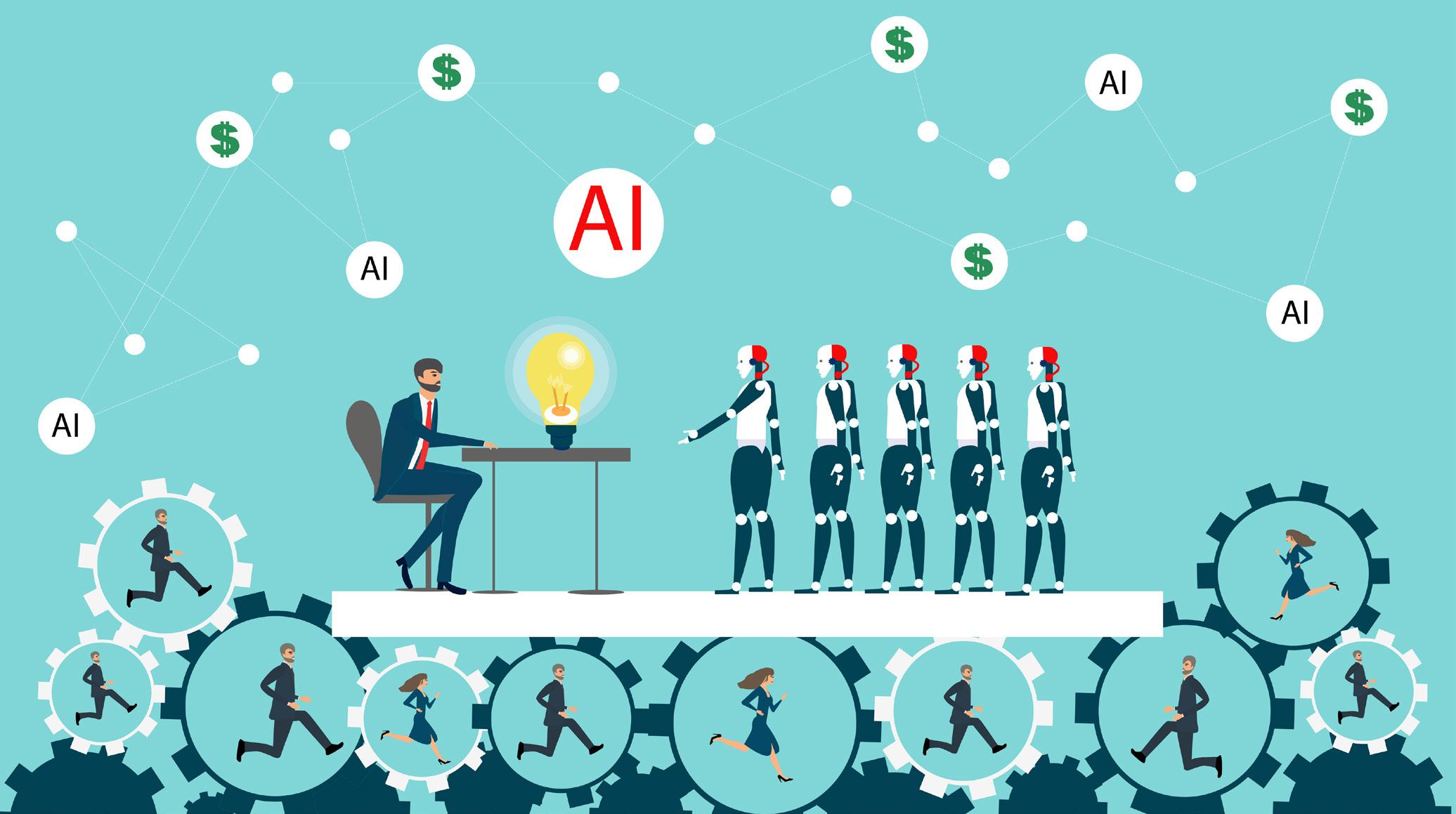
ensus to emerge from the noise of competing projections, we took a different approach. We convened an AI Panel of Advisors trained on huge datasets to make predictions based on patterns. That AI Panel of Advisors was comprised entirely of the world’s most advanced AI models: ChatGPT, Claude, Gemini, and Perplexity. We assigned the panel of AI Advisors a specific role, provided a context, and asked a specific question: What will our jobs as business professors look like in five years and what should we do now to prepare?
The result was a coherent and consistently aligned strategic forecast that offered clarity and was produced in minutes at negligible cost. Most importantly, the method that we used was simple but powerful, and something that business leaders can use to gain clarity about the future of their own industry or profession.
Here’s how we did it, and how you can use the same approach to build your own AI Panel of Advisors.
THE METHOD: CONVENING YOUR PANEL
The approach is straightforward, and tha-
Position Yourself For The Uncertainty That Lies Ahead
A Practical Method for Strategic Foresight
Using AI
t’s part of its value. You don’t need technical expertise or special access— just a clear question and a willingness to engage seriously with the outputs.
Start by crafting a prompt that frames your strategic question with enough specificity to generate useful responses. Identify your role, your context, and your time horizon. Then ask the model to adopt a perspective—a strategist, an analyst, a consultant who has studied your problem deeply. This role-assignment isn’t theater; it helps the model draw on relevant patterns in its training rather than defaulting to generic advice.
In our case, asking each model to respond as an organizational strategist with deep research experience was intentional. Giving the models a clearly defined role encourages more focused and relevant analysis. It also helps the responses reflect expert-level reasoning rather than generic observations.
Run that identical prompt through several leading models. We used four—ChatGPT, Claude, Gemini, and Perplexity— but three would suffice. The goal is independent variation: each model has been trained on somewhat different data with
different architectural choices, so their responses won’t be identical even to the same prompt.
Use of multiple models also increases reliability. When independent systems converge on similar themes despite different training data and architectures, the resulting signals are more trustworthy because they reflect widely repeated patterns in current expert thinking. Then comes the step that proved most illuminating. Take all the responses and upload them to one of the models with a new prompt: synthesize these analyses. Identify where they agree, where they diverge, and what the strongest common recommendations are. We repeated this synthesis with multiple models to ensure the themes weren’t artifacts of one system’s interpretive tendencies. What emerged was more coherent than we expected.
WHAT THE PANEL REVEALED
Across all four models, the core message was consistent: our jobs aren’t disappearing, but their center of gravity is shifting substantially. The phrase that appeared in various forms across every response was the move from “information
The models estimated that AI would absorb somewhere between 20 and 40 percent of our current workload.
distributor” to something more like learning architect, AI orchestrator, and—a term we found particularly thought-provoking—algorithmic auditor.
This pattern of convergence was noteworthy. Even though the models differ in design and training sources, all four independently highlighted the same foundational shifts. They pointed to changes in faculty roles, increased automation of routine work, a greater emphasis on human judgment skills, the expansion of AI-supported research workflows, and a growing need for faculty involvement in governance.
The models estimated that AI would absorb somewhere between 20 and 40 percent of our current workload: routine grading, basic content delivery, standard advising queries, first drafts of administrative documents. What remains—and what grows in importance—is the high-judgment work that AI handles poorly: designing learning experiences, coaching students through complex problems, navigating ethical ambiguities, and helping an institution govern its own use of these tools responsibly.
One theme surprised us with its emphasis.
Every model emphasized that students will increasingly arrive with powerful AI assistants integrated into their workflow. The professor’s differentiating value, then, isn’t knowing more than the AI—it’s helping students use AI well, challenge its outputs critically, and develop the capabilities that remain distinctly human: judgment, ethical reasoning, leadership, and communication under uncertainty. Research, too, shifts rather than vanishes. The models described a future where AI handles literature synthesis, data cleaning, and preliminary drafts, while the researcher’s value concentrates in asking the right questions, interpreting results with domain expertise, maintaining methodological rigor, and ensuring transparency about AI’s role in the work.
Perhaps most unexpected was the convergence around governance. Every model suggested that faculty who understand AI deeply will be drawn into institutional decision-making—not just teaching with these tools but helping design policies for their use, auditing algorithmic systems that affect students and faculty, and shaping curriculum to address a transformed professional landscape.
The economic subtext was frank. Business schools, the models sug-gested, will face pressure to unbundle their offerings into shorter, subscription-based, lifelong learning formats. Faculty will differentiate into two broad categories: “creators” who develop content and research with wide reach, and “facilitators” who provide high-touch mentoring and learning design. The strategic advice was clear: position yourself in one category or learn to straddle both.
This “unbundling” trend was especially pronounced across models. It suggests not only pedagogical change but also deeper economic pressures that are reshaping how business schools package and deliver expertise.
WHAT THIS METHOD CANNOT DO
It would be easy to overstate what we’ve described here. The convergence across models feels persuasive—but that persuasiveness is precisely why intellectual honesty matters.
These models are pattern-recognition systems trained on vast quantities of human-generated text: research papers, business journalism, consulting
Position Yourself For The Uncertainty That Lies Ahead A Practical Method for Strategic Foresight Using AI
Bear Brief
THE PROBLEM
Small businesses struggle to prepare for the future in a fast-changing world.
THE ROOT CAUSE THE SOLUTION
Traditional methods for developing strategic insight are costly, time-consuming, and generally out of reach.
The AI Panel of Advisors provides a practical, affordable way to quickly deliver actionable, strategic insights, using multiple AI models.
reports, conference proceedings, forecasts from credible and less credible sources alike. When they converge, they’re revealing something real. But what they’re revealing is simply the themes that currently dominate expert thinking. They’re surfacing the conventional wisdom, albeit with impressive synthesis and organization. That’s valuable. Conventional wisdom among informed experts is a reasonable starting point for strategic planning. But it has blind spots.
First, the models cannot anticipate genuine discontinuities—the black swan events, the breakthrough technologies, the regulatory shocks that reshape industries in
25 Bear Business Solutions Spring 2026
ways no pattern from the past could predict. They extrapolate from what has been written; they don’t imagine what hasn’t been conceived yet.
Second, convergence can reflect shared biases as much as shared insight. If the expert discourse on a topic has clustered around certain assumptions—about the pace of adoption, the readiness of institutions, the preferences of consumers—the models will echo those assumptions back confidently. They cannot tell you when the experts are collectively wrong.
Third, and most importantly, the models know nothing about your specific situation. They don’t know your organization’s
culture, its financial constraints, its competitive idiosyncrasies, or your own appetite for risk. They can offer a general map; they cannot tell you which path through the terrain makes sense given where you’re starting from and what you’re willing to sacrifice to get somewhere else.
This is why it mattered that we asked each model to respond from a defined expert viewpoint or persona and then compared the results across systems. Giving the models a clear and consistent role produced more focused analyses. Reviewing multiple responses also reduced the chance of mistaking one system’s blind spots for universal insight.
This is why the method supplements but cannot replace strategic judgment. The AI panel gives you a structured way to survey the landscape of informed opinion. It surfaces themes you might have missed and challenges assumptions you didn’t know you held. But the weighing—deciding what matters most, what to act on, what to ignore—remains inescapably yours.
We’ve found it useful to treat the outputs not as recommendations to follow but as hypotheses to stress-test. When the
They extrapolate from what has been written; they don’t imagine what hasn’t been conceived yet.
models say faculty will shift toward governance roles, the productive question isn’t “Is this true?” but “If this were directionally correct, what would I do differently? And what evidence would tell me it’s happening faster or slower than expected?”
That reframing turns the exercise from forecasting into something more valuable: disciplined preparation for multiple futures.
THE VALUE OF THE EXERCISE ITSELF
There’s a secondary benefit worth noting. The process of crafting a good prompt forces clarity about what you’re actua-
lly trying to understand. You can’t ask a useful question about your professional future without defining what your profession actually involves, what you consider essential versus peripheral, and what time horizon you care about.
More than once, we found that the most useful moment in the exercise came before we saw any output—when we had to articulate our own assumptions clearly enough for the models to engage with them. The AI became a mirror, reflecting the shape of our own thinking back to us in ways that revealed gaps and contradictions we hadn’t noticed.
This is perhaps the deepest reason to try the method. Not because the models will tell you the future—they won’t. But because the discipline of asking them forces you to get clearer about what you think, what you’re uncertain about, and what would actually change your mind.
AN INVITATION TO EXPERIMENT
We’ve shared our experience with a specific question about a specific profession. But the method generalizes. Whether you’re a supply chain manager wondering how autonomous systems will reshape logistics, a financial analyst considering
how AI-driven research tools might change your value proposition, or a healthcare administrator thinking through the implications of diagnostic AI for your workforce—the same approach applies. Craft a prompt that captures your situation with precision. Run it through multiple models. Synthesize the outputs. Look for convergence and divergence.
Then ask yourself the only question that ultimately matters: if this is directionally correct, what would I do differently starting now?
You may find that the results are both clarifying and sobering. The models we consulted suggested we should become genuinely fluent in AI tools, redesign our courses assuming every student has an AI assistant, carve out a niche at the intersection of our discipline and AI, involve ourselves in institutional governance of these technologies, and build a professional presence that extends beyond our institution’s walls. That’s not a modest agenda. But it’s a concrete one—and concreteness is the enemy of the vague anxiety that often surrounds discussions of AI and work.
Position Yourself For The Uncertainty That Lies Ahead A Practical Method for Strategic Foresight Using AI
You may also find that your results look different from ours. Professions vary. Industries vary. The expert discourse on AI’s impact is more developed in some fields than others, and the models will reflect that unevenness. If your synthesis surfaces less convergence and more contradiction, that’s information too—it tells you the future of your field is genuinely contested, which might call for scenario planning rather than a single strategic bet.
We’d encourage you to try the exercise with colleagues. Compare results. Discuss where your syntheses align and where they differ. The conversation that follows—grounded in concrete outputs rather than abstract speculation—may be more valuable than the outputs themselves.
Finally, remember that you’re not obligated to agree with what the panel tells you. These models are sophisticated summarizers of human thought, not oracles with privileged access to what’s coming. They can be wrong. The experts whose work they’ve absorbed can be wrong. You might see something they’ve missed—a local opportunity, a structural barrier, an emerging trend that hasn’t yet saturated the
literature.
But you’ll see it more clearly for having consulted them. That’s the modest promise here: not certainty, but a more disciplined uncertainty. Not a prediction of the future, but a systematic way to prepare for several plausible versions of it.
For business leaders, this method offers a practical strategic advantage because multi-model convergence is not a prediction but a directional signal. It reflects themes that appear consistently in expert analyses and commentary. Treating these signals as hypotheses to stress-test can sharpen planning, reduce blind spots, and help leaders navigate uncertainty by creating a structured opportunity for preparation.
The tools are available. The method is simple. The question is whether you’re willing to ask—and then to sit with what you hear.
ADVISORY
POINTS: PRINCIPLES FOR USING AI AS A STRATEGIC SOUNDING BOARD
1. Treat convergence as signal, not certainty. When multiple models independently reach similar conclusions, it suggests the themes are well-represented in expert dis
No single model has privileged access to the future.
course. This doesn’t make them inevitable—it makes them worth planning for.
2. Divergence is data too. When models disagree or emphasize different aspects, you’ve identified areas of genuine uncertainty or emerging debate. These deserve closer attention and perhaps traditional research.
3. Specificity improves output. Vague prompts yield generic responses. The more precisely you define your role, industry context, and time horizon, the more useful the analysis becomes.
4. Cross-validation beats single-source reliance. No model has privileged access to the future. Running the same question through multiple systems and synthesizing the results reduces the idiosyncrasies of any one model’s training data or architecture.
5. You remain the strategist. AI can surface patterns and organize information, but it cannot weigh those patterns against specific culture, resources, competitive position, or risk tolerance. That judgment is yours.
6. Use the exercise to surface assumptions. Often the most valuable outcome
isn’t the AI’s answer—it’s discovering which of your own assumptions the models challenge or confirm.
7. Revisit periodically. Models update, industries shift, and your own circumstances change. This isn’t a onetime exercise but a repeatable discipline.

CHECKLIST: RUNNING YOUR OWN AI ADVISORY PANEL
Define your strategic question clearly (role, industry, time horizon, specific concerns)
Select three to four leading AI models to query
Run the identical prompt through each model independently
Save or export each response in full
Upload all responses to one model and request a synthesis identifying themes, agreements, and disagreements
Repeat the synthesis step with at least one other model to check for consistency
Identify the two or three strongest convergent themes
Note any significant divergences or gaps
Translate findings into concrete questions: If this is directionally correct, what would I do differently?
Identify one near-term action you can take in the next 30 days
Schedule a follow-up session in six months to reassess
Position Yourself For The Uncertainty That Lies Ahead A Practical Method for Strategic Foresight Using AI
SUGGESTED PROMPTS: TEMPLATES YOU CAN ADAPT
For Individual Career Planning
I am a [job title] in the [industry] sector with [X years] of experience. Please assume the role of a workforce strategist who has conducted extensive research on how AI will affect professionals in my field. Based on this research, what will be the nature of my job in five years? What capabilities will be most valuable? What should I be doing now to prepare?
For Business Unit or Departmental Strategy
I lead a [department/function] at a [size/type] company in the [industry] sector. Please assume the role of a management consultant who has studied AI’s impact on this function across multiple organizations. What operational changes should I anticipate over the next three to five years? Where will AI augment my team’s work, and where might it replace current processes? What investments in skills, technology, or structure should I prioritize now?
For Competitive and Market Analysis
I am a strategist at a market/industry]. Please assume the role of an industry analyst who has researched how AI is reshaping competitive dynamics in this sector. Which business models are most vulnerable to disruption? Which are best positioned to leverage AI? What signals should I watch that would indicate accelerating change?
For Organizational Governance and Policy
I serve on the leadership team of a [type of organization]. Please assume the role of an expert in AI governance and organizational policy. What frameworks should we consider for governing AI use across our organization? What risks should we prioritize? What policies have leading organizations adopted that we should evaluate?
For Synthesis (After Initial Responses)
I have attached responses from four different AI models to the same strategic prompt. Please provide a comprehensive synthesis that identifies: (1) the major themes where all or most models agree, (2) any significant points of divergence, (3) the strongest recommendations that appear across multiple responses, and (4) any gaps or blind spots you notice in the collective analysis.
Chula King is a Professor of Accounting and a Faculty Fellow in Educational Technology at the University of West Florida. Dr. King earned her Ph.D. in Accounting from Louisiana State University. Her work investigates how technological innovations are transforming the roles of faculty and students’ learning experiences, with a current emphasis on generative AI, AI literacy, prompting and verification, academic integrity, and the changing role of educators. She is particularly dedicated to preparing students for an AI-driven workforce by helping them develop critical thinking, judgment, and responsible AI use, alongside disciplinary expertise.
Stephen A. LeMay is a Professor at the University of West Florida. He earned his Ph.D. from the University of Tennessee. Dr. LeMay has a deep background in transportation and logistics and has authored two books, a textbook and a research book on logistics and transportation topics. LeMay has examined supply chain design, truck driver job satisfaction, supply chain security, computer literacy among undergraduate business students, and other logistics and marketing topics.
The Hidden Blessings of a Bad Boss

That miserable manager might just be the catalyst that transforms your professional life.

The Hidden Blessings of a Bad Boss
By TIMOTHY R. MCILVEENE
Do you have a horrible boss? The kind who drains your energy, makes Mondays feel like punishment, and leaves you questioning your entire career? If so, take a breath and maybe even a moment of gratitude. That miserable manager might just be the catalyst that transforms your professional life.
Several years ago, I found myself in that position. I’d taken what seemed like a dream job – an opportunity with a new organization, a bigger title, better pay, and exciting new challenges. But within months, the warning signs appeared. Tension with leadership grew, and I felt them become increasingly critical and controlling. Every decision I made seemed to be second-guessed. Every success, minimized. Before long, I dreaded going to work.
That period of misery turned out to be a turning point. It forced me to ask profound questions about not just where I wanted to work but why I wanted to do this kind of work at all. Maybe the problem wasn’t only my supervision. Maybe I’d been chasing a version of success that no longer fit the life I wanted.
Bear Brief
THE PROBLEM
Employees often struggle under ineffective or difficult bosses, viewing these experiences as purely negative and career-limiting.
THE ROOT CAUSE
We tend to see bad leadership only through a deficit lens, overlooking how these experiences can shape judgment, resilience, and future leadership capability.
THE SOLUTION
By reframing bad bosses as developmental experiences, individuals can extract valuable lessons that inform stronger, more intentional
The
Hidden Blessings of a Bad Boss
WHEN MISERY BECOMES MOTIVATION
After months of reflection, I realized I didn’t want another rung on the ladder. Rather, I wanted a different ladder entirely. I craved autonomy, purpose, and meaningful work. I was tired of arbitrary deadlines and corporate politics. I wanted a career that would hold up over time. That clarity led me back to an old dream: becoming a business professor. It checked every box–independence, teaching, research, mentorship. Around that time, I was given an ultimatum: accept a lower-level role or leave. I accepted the demotion, and it turned out to be a gift. It gave me the stability I needed while earning my doctorate. The next several years were a grind that comprised long days at work and late nights of study. But, every step brought me closer to the life I ac-

Unfortunately, my experience isn’t unique. Bad bosses are a work-place
A 2023 DDI Global Leadership Forecast found that 57% of employees have quit jobs directly because of bad managers. Gallup reports that half of all employees have left a job just to escape dismal management. Additionally, research from The Workforce Institute at UKG shows that managers influence employees’ mental health as much as a spouse or partner, with 78% of workers saying poor leadership hurts performance and 64% link it to lower overall well-being.
Bad bosses don’t just derail careers. They can derail lives. But paradoxically, they can also provide the shock that pushes us to grow.
THREE BLESSINGS OF A BAD BOSS
1.
Contrast and Clarity
A bad boss is a master class in what not to do. When you’re led by someone who communicates poorly, takes credit for others’ work, or fosters fear instead of trust, it becomes crystal clear what effective leadership looks like. You learn the value of listening, transparency, and accountability. Not because you read about them in a management
Bad
bosses don’t just derail careers. They can derail lives. But paradoxically, they can also provide the shock that pushes us to grow.
book, but because you’ve lived through the consequences of their absence.
This kind of contrast sharpens your own leadership philosophy. You begin to recognize that trust is currency, respect is earned, and silence is often the loudest feedback a team can give. A bad boss, in a strange way, forces you to define your values as a leader and a professional. You may not be able to change them, but you can decide never to lead that way yourself.
2. Catalyst for Change
Good jobs make us comfortable. Bad ones make us courageous. A difficult manager can push you to confront truths you’ve been avoiding. Namely, that you’ve outgrown your role, settled for too little, or stopped learning. In my case, the discomfort forced me to start recalibrating. I had to ask: What am I really doing this for?
That kind of self-interrogation can feel brutal in the moment, but it’s often the spark for meaningful transformation. Many professionals trace their most successful pivots such as launching a business, pursuing a degree, or moving into a new field to a period of workplace pain.
Discomfort has a way of stripping away illusion.
It clarifies priorities, accelerates decision-making, and reminds us that we are capable of more than survival. Sometimes the worst boss gives you the best reason to finally take a leap.
3. Capacity and Resilience
Surviving a bad boss is a crash course in emotional intelligence.
You learn to manage frustration without letting it consume you, to assert boundaries without burning bridges and to detach yourself-worth from one person’s opinion. You develop a thicker skin and increase your resilience capacity. These lessons stay with you. When future conflicts arise, they no longer shake your confidence the same way. You learn to navigate office politics with calm, to give feedback more thoughtfully, and to support others who might be struggling under poor leadership. In that sense, a bad boss can unwittingly help you grow into the kind of professional others trust and follow. There’s also a quiet strength that comes fromrealizing you can endure something hard and still hold onto your integrity. That confidence becomes
part of your professional DNA.
A BETTER LIFE ON THE OTHER SIDE
Today, I’m a professor at a university I love. I teach, research, and mentor students, and I wake up with a spirit of gratitude. I’ll never be thankful for how I was treated in that job, but I am thankful for what the experience forced me to see. Without that discomfort, I might still be climbing a ladder that was never mine to begin with. We tend to see bad bosses as career killers. In truth, they can be career catalysts. Their dysfunction can ignite clarity, courage, and resilience in ways comfort never could. That’s the hidden blessing: they force you to decide who you want to become and what kind of life you refuse to settle for.
Timothy R. McIlveene is an Assistant Professor of Business Administration at the University of West Florida’s Lewis Bear Jr. College of Business. Dr. McIlveene earned his Ph.D. from the University of South Alabama. His research explores leadership, trust, and organizational behaviour. He draws on more than 20 years of industry experience in management and technology to inform both his teaching and writing.


Will You Be Caught Unprepared?
The Value of Hybrid Intelligence
By HARIS ALIBAŠIĆ
AI systems are getting more powerful every day. Yet the decisions involving public trust, ethics, and various stakeholders still demand human judgment. Leaders who treat AI as a complete replacement for all human expertise invite failure. Those who ignore AI also invite failure.
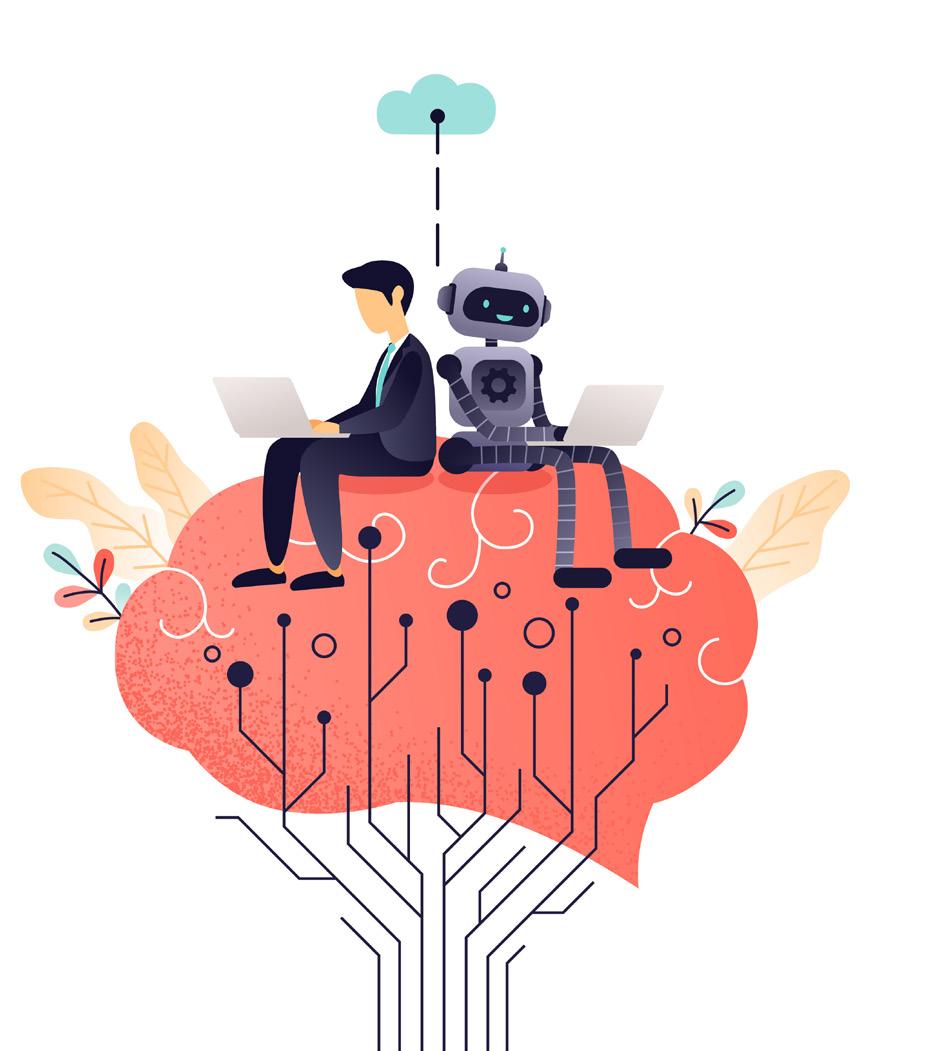
The organizations getting the best results are utilizing Hybrid Intelligence, the integration of human cognitive capabilities with AI systems. Organizations that leverage Hybrid Intelligence outperform both AI-only and human-only approaches, achieve significant automation efficiency while maintaining accountability, and avoid the catastrophic failures that purely automated approaches produce.
The urgency is real. Internationally, governments are building structured AI governance frameworks. In the United States, the federal approach has shifted toward deregulation and the limitation of state-level oversight of AI, leaving organizations to navigate implementation largely on their own. This makes it more critical for organizations to proactively build their own Hybrid Intelligence frameworks.
Will You Be Caught Unprepared? The Value of Hybrid Intelligence
Bear Brief
THE PROBLEM
Organizations are struggling to implement AI effectively, either replacing human judgment entirely or ignoring AI altogether, leading to costly failures, eroded public trust, and missed opportunities.
THE ROOT CAUSE
Most organizations lack structured protocols for human-AI collaboration,
THE SOLUTION
Hybrid Intelligence enables organizations to outperform both human-only and AI-only approaches.
WHAT MAKES HYBRID INTELLIGENCE DIFFERENT
Hybrid Intelligence is not just “humans using AI tools.” It is a structured system built on three elements.
Structured Interaction Protocols define when AI guides decisions, when humans override AI, and how disagreements between the two are resolved. Without structure, organizations tend to either rely fully on AI or avoid it altogether.
Adaptive Learning Systems create feedback loops. Human experts learn when AI performs well and when it falters. AI
output improves as human errors are identified.
Contextual Integration means embedding Hybrid Intelligence within your specific organizational culture and regulatory environment. A hybrid approach designed for routine administrative processing will look very different from one built for high-stakes decisions involving public safety.
TWO PROVEN MODELS FROM GLOBAL LEADERS
Japan’s bottom-up approach uses local innovation hubs to integrate AI systems with community expertise. In disaster management, AI flood-prediction models coupled with
local terrain knowledge outperform either component alone, reducing falsealarm rates and improving early-warning times.
South Korea’s top-down approach coordinates, for example, smart city technologies that pair AI-driven analytics with human planning judgment to reduce disaster risks and significantly improve predictions of renewable energy supply.
Most organizations will blend elements of both.
BALANCING INNOVATION AND ETHICS
Leaders must also navigate divergent governance philosophies. Singapore prioritizes innovation through its National AI Strategy. France emphasizes fundamental rights through its “AI for Humanity” strategy. Transparency and human oversight enhance rather than undermine public acceptance of AI.
A FIVE-PHASE IMPLEMENTATION FRAMEWORK
One finding stands out across all the cases studied: organizational factors matter more than technical sophistication. Organizations with modest AI capabilities but strong
Hybrid Intelligence is not just “humans using AI tools.” It is a structured system built on three elements.
learning cultures, clear protocols, and committed leadership consistently outperform those with cutting-edge technology but weak organizational foundations. The following five-phase Hybrid Intelligence implementation offers a structured approach.
Five-phase Hybrid Intelligence implementation
Phase 1: Assess Readiness. Before choosing technology, evaluate your decision-making culture. Organizations with strong learning processes show significantly higher Hybrid Intelligence success rates, regardless of their technical sophistication.
Phase 2: Design Protocols. Define which deci-
sions AI handles autonomously, which require human review, and which stay exclusively human. Create feedback documentation so human experts can record why they agree or disagree with AI recommendations.
Phase 3: Pilot. Run Hybrid Intelligence alongside existing processes. Measure outcomes, the quality of human–AI interaction, protocols followed, the proper functioning of feedback loops, and determine AI capabilities and limitations. Document lessons.
Phase 4: Integrate Governance. Build internal accountability structures, external compliance processes, and stakeholder transparency rules.
Phase 5: Scale Adaptively. Invest in workforce development and AI tool training that helps to interpret AI critically, recognize its limits, and exercise informed judgment.
FOUR PITFALLS TO AVOID
Technology-first thinking. The technology is rarely the constraint. Organizational and human factors are
Governance as a checkbox. Treat governance as trust-building, not compliance. Trust enables adoption; adoption enables impact.
Neglecting the “hybrid.” AI without meaningful human integration produces poor outcomes. Without
AI augmentation, humans increasingly struggle to process the volume and complexity of information required for modern decisions. The value is in the structured integration.
Underinvesting in people.
The human component is not a legacy holdover; it is the source of contextual judgment, ethical reasoning, and stakeholder understanding that AI cannot replicate.
Will You Be Caught Unprepared?
The Value of Hybrid Intelligence
THE BOTTOM LINE
Hybrid Intelligence outperforms human-only and AI-only approaches, but only with structured protocols, not ad hoc tool adoption. Organizational factors matter more than technical sophistication. Governance is a strategic asset. In the current U.S. environment, where federal AI frameworks remain limited, leaders who build their own Hybrid Intelligence frameworks now
will be ready for whatever comes next.
Will your organization lead this transition or be caught unprepared?

Haris Alibašić is an Associate Professor and Whitman Faculty Fellow in the Department of Business Administration at the University of West Florida’s Lewis Bear Jr. College of Business, where he teaches in the Master of Science in Administration—Public Administration program. Dr. Alibašić earned his Ph.D. from Walden University. His research focuses on governance, hybrid intelligence, AI governance, sustainability, and resilience in public administration. He is the author of Hybrid Intelligence for Effective Digital Governance: AI in Administration (Springer Nature, in print), The Post-factual Polity (Emerald Publishing), and Strategic Resilience and Sustainability Planning (Springer). His work has been published in journals including Global Public Policy and Governance, The International Journal of Sustainability Policy and Practice, Public Integrity, Energy Research & Social Science, Public Money & Management, and Sustainable Development among others.
MANAGEMENT INFORMATION SYSTEMS


Combining technical skills with leadership abilities is a winning career formula. Join the management information systems program at UWF and make your mark in this exciting field.
Job Opportunities
• Information Systems Manager
• Computer Analyst
• Business Analyst
• IT Consultant
• Information Security Consultant
Stephanie Barber Partner Relations Analyst, Raymond James
• Systems Analyst
• IT Security Manager
• Information Security Risk Analyst
• Business Process Analyst
• Database Developer
“My time in UWF’s MIS program gave me the confidence to turn data into meaningful insights and apply what I learned to real business situations. It played a huge role in shaping how I think, solve problems, and approach my career today.”


Only 6% of business schools worldwide have earned this symbol of the highest standard in management education. As an AACSB-accredited school, we have passed rigorous standards for quality. We have better programs, better faculty, better students with higher overall GPAs, more international students, more employers who recruit them and graduates who receive better salaries.
WE HAVE THE DEGREE FOR YOU!
UNDERGRADUATE
Accounting
Economics
Finance
Hospitality
Human Resources
Information Systems
Management
Marketing
Sport Management
Supply Chain
GRADUATE


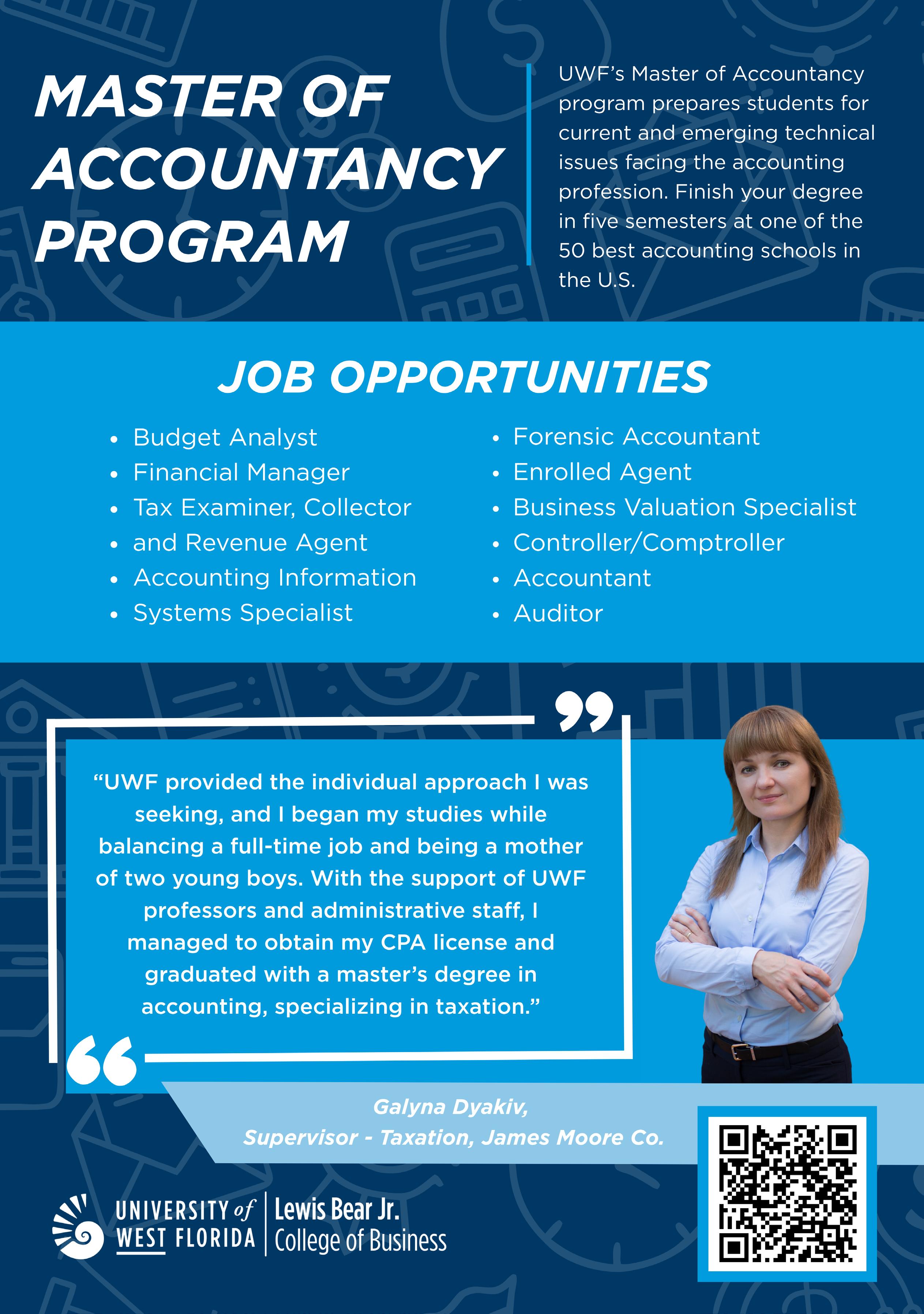
Master of Accountancy
MBA
Public Administration
Sport Administration
SCAN