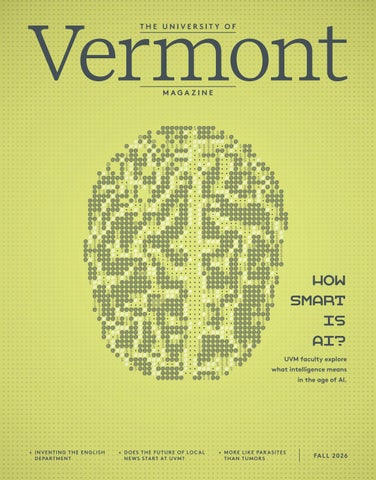
HOW SMART Is AI? UVM faculty explore what intelligence means in the age of AI.
+ INVENTING THE ENGLISH D E PA RT M E N T
+ D O E S T H E F U T U R E O F LO C A L N E W S STA RT AT U V M ?
+ M O R E L I K E PA R A S I T E S THAN TUMORS
FA L L 2026
M
A
G
A
Z
I
N
E
DEPARTMENTS 2 4 6 8 12 16 44 61 64
PRESIDENT'S PERSPECTIVE YOU SHOULD KNOW THE GREEN UVM PEOPLE CATAMOUNT SPORTS BOOKS + MEDIA CLASS NOTES COMMUNITY PASSAGES EXTRA CREDIT
FEATURES 20
INVENTING THE ENGLISH DEPARTMENT (AND THE MODERN UNIVERSITY) Two centuries ago, UVM president James Marsh helped reinvent American higher education, establishing the nation’s oldest English department and pioneering an academic structure that would influence universities across the country. | BY ED NEUERT
24
DOES THE FUTURE OF LOCAL NEWS START AT UVM? As local newsrooms disappear, UVM is building a new model. Its growing network puts student reporters to work covering communities while giving news organizations much-needed reporting, and students real-world experience. | BY KRISTEN MUNSON
30
MORE LIKE PARASITES THAN TUMORS UVM researchers investigating mysterious black lesions on catfish made a startling discovery: a rare cancer that spreads from fish to fish, the first transmissible cancer ever identified in a freshwater species. | BY JOSHUA BROWN
36
HOW SMART IS AI? Is artificial intelligence actually intelligent? UVM faculty across disciplines offer radically different answers as they wrestle with what AI can do, what it can’t, and what its rapid rise means for learning, creativity, and our future. | BY JOSHUA BROWN
FRONT COVER: Cody Silfies; (Lovingly created by a human)
BACK COVER: Andy Duback
STEPS OF REMEMBRANCE On the 25th anniversary of the 9/11 terrorist attacks, people across the country and the world remembered the 2,977 innocent lives lost that day in New York City, the Washington, D.C., area, and in Shanksville, Pa.
Since then, versions of the event have spread throughout the country, with participants climbing steps to simulate the 2,071 steps in the staircases of the 110 floors of the former World Trade Center.
On the UVM campus, UVM Army ROTC participated, as they have for several years, in the national Tower Challenge memorial event.
At UVM, the event took place beginning early on the morning of September 11 on the stands at Virtue Field. Besides UVM ROTC members, many UVM athletes, other students, and members of the public joined in.
The Tower Challenge began in 2005 when a small group of Denver-area firefighters decided to dedicate their stair-climbing training session to the memory of the 343 New York City Fire Department members who ran into the Twin Towers on 9/11 and lost their lives there.
Scan this QR code or visit go.uvm.edu/sept11-25 to learn more.
FALL 2026 The University community remembers and honors all those who lost their lives on September 11, 2001, including these UVM alumni: Carlton W. Bartels G’85
Rajesh Mirpuri
Eric Ropiteau ’00
Brandon Buchanan ’99
Cesar Murillo ’91
Matthew Sellitto ’00
Paul Cascio ’99
Martin Niederer ’99
John W. Wright, Jr. ’89
Robert Lawrence, Jr. ’82
Joshua Piver ’00
JEFF PAXTON
FA L L 2 0 2 6 |
1
| PRESIDENT’S PERSPECTIVE
The Bold Path to Our Future In August, I delivered our first-ever State of the University address. We will host this event annually to bring our whole community together and to provide them with an update on progress towards the goals defined in our strategic plan, Green, Gold, and Bold; to give people a better understanding of the challenges ahead; and to help them imagine how we can all utilize our great university’s assets as we move through this tumultuous time for higher education and for our world. In this address, I detailed not only the headwinds higher ed is facing, but many remarkable discoveries and efforts on the part of our faculty, staff, and students. Our Common Ground Values form the foundation of our remarkable work—work that matters to the world at large—and they represent a distinguishing characteristic that will attract many students from around the country. This issue of UVM Magazine recounts some exemplars of our work— from knowledge and information to cancer to AI—so you, too, can see how our university will shine.
Scan the QR or visit go.uvm.edu/sotu26 to read more detailed coverage of the 2026 State of the University.
here, and our researchers, staff, and students come at them from a variety of angles. As one voice here explains, this kind of nuanced examination of AI’s role in the world’s future is something the university is uniquely qualified to foster.
Our Center for Community News (CCN) provides an excellent example of our innovation and impact. Envisioned and launched at UVM, CCN trains students in any academic major to become local reporters serving our country’s many “news deserts,” places that have lost local news coverage. Nationwide, there are now over 200 academic and news organization partnerships, reaching into rural communities and helping people better understand the issues in their own towns and cities to build a better future.
Since its founding, the University of Vermont has always been drawn to complex issues and the important innovations that allow us to meet their challenges head on. We’ve reached back two centuries to highlight a pathbreaking creation that continues to inspire us today: the founding of our Department of English, the first such department in the nation, 200 years ago, as a part of the groundbreaking curriculum redesign led by UVM’s fifth president, Vermont philosopher James Marsh. Every university, college, and secondary school in the country followed UVM’s lead.
You’ll also learn about the pathbreaking scholarship of Professor Julie Dragon and her partners from the State of Vermont Fish and Wildlife Department. With their discovery of a transmissible skin cancer in fish—one of the few transmissible cancers that has ever been uncovered in the world—they have opened new pathways for cancer research. Such work has the potential to prepare all of humanity for a better and healthier future.
Our legacy, excellence, commitment to innovation, and Our Common Ground Values make us unique, and are key to UVM’s future. The members of our community are moving boldly on so many fronts to maintain impactful student experiences, pursue valuesdriven research, and create and expand opportunities for our state, region, and world. We’re so proud to partner across the state and the world and to continue blazing new trails, like all the Catamounts before us.
Tackling another area that will have tremendous impact on humanity, this issue also contains the voices of many members of our community on the promise and risks of AI. You won’t find consensus; there are many complex questions
Dr. Marlene Tromp President, University of Vermont
2 | UVM MAGA ZINE
ANDY DUBACK
Carrie ’88, G’97 and Chris Teffner Are Opening Doors Back Home
M
A
G
A
Z
I
N
E
PUBLISHER University of Vermont Dr. Marlene Tromp, President CHIEF COMMUNICATIONS AND MARKETING OFFICER Lauren Griswold DEPUTY CHIEF COMMUNICATIONS AND MARKETING OFFICER Alessandro Bertoni EDITOR Ed Neuert CREATIVE DIRECTOR Cody Silfies
“If it’s got to do with education, we’re on board,” says Chris. Carrie ’88, G’97 and Chris Teffner know firsthand how financial realities can shape a student’s college experience. Both have deep ties to Vermont and worked hard to build successful careers, but they also remember the opportunities they missed and the debt that followed. Today, they are helping the next generation of Vermonters pursue a UVM education with greater freedom to explore new possibilities and build their futures. In 2025, the Teffners made a $1 million gift to establish the Teffner Family Scholarship, based on their strong belief that students shouldn’t have to choose between opportunity and affordability. The scholarship will support students from Vermont with financial need who are pursuing a degree in the Grossman School of Business. In its inaugural year, the fund has awarded over $43,000 and benefited eleven students from towns across the state.
CLASS NOTES EDITOR Cheryl Carmi CONTRIBUTING WRITERS Joshua Brown, Cheryl Carmi, Emily DeAlto, Joshua Defibaugh, Sonia DeYoung, Hannah Fischer, Janet Franz, Kevin Morgenstein Fuerst, Nicholas Hall, Stephanie Knific, Kristen Munson, Ed Neuert, Su Reid-St. John, Elodie Reed, Tom Sullivan, Tanya Tran, Lisa Wartenberg Vélez, Heather Winther PHOTOGRAPHY Jared Carnesale ’27, Joshua Brown, Erica BrunoMartin, Joshua Defibaugh, Emily Dealto, Andy Duback, Pete Estes, Bruce Gibbs, Nich Hall, Samantha Hunt, Sally McCay, Jeff Paxton, Su Reid-St. John, Stephanie Steele, Amanda Watts, America East, Miss Black USA, UVM Special Collections, Vermont Fish & Wildlife CONTRIBUTING DESIGNERS Jared Carnesale ’27, Emily Murray ADDRESS CHANGES UVM Foundation 411 Main Street Burlington, VT 05401 (802) 656-9662, alumni@uvm.edu CORRESPONDENCE Editor, UVM Magazine 16 Colchester Avenue Burlington, VT 05405 magazine@uvm.edu CLASS NOTES alumni.uvm.edu/classnotes UVM MAGAZINE Issue No. 99, November 2026 Publishes Spring / Fall Printed in Vermont by Lane Press UVM MAGAZINE ONLINE uvm.edu/uvmmag
Read their full story at go.uvm.edu/teffner
instagram.com/universityofvermont x.com/uvmvermont facebook.com/universityofvermont youtube.com/universityofvermont
YOU SHOULD KNOW ROBUST RESEARCH The University of Vermont attracted $222.6 million in extramural research funding in fiscal year 2026, reflecting the continued growth and impact of the university’s research enterprise. The funding supports research, scholarship and creative activity across UVM, from laboratory science and clinical investigation to community partnerships, agricultural innovation, education, and the humanities. Backed by federal and state agencies, foundations, businesses, and other partners, UVM researchers are working to address consequential challenges in Vermont and around the world. In fiscal year 2026, 622 awards started or continued nearly 900 projects across campus, including 24 awards worth $1 million or more. Read more: go.uvm.edu/research2026
RECORD FULBRIGHTS More UVM students and recent alumni have received Fulbright U.S. Student Awards this year than ever before, with 11 teaching English as a second language in seven countries, and three pursuing graduate study or independent research in New Zealand, Bosnia and Herzegovina, and the United Kingdom. This academic year also saw a record number of applicants for the program from UVM, and a new high level for the number of semi-finalists. And Madison Guyette, a junior majoring in molecular genetics, was the recipient of a 2026 Goldwater Scholarship. The Goldwater Scholarship is a prestigious and competitive national science prize that chooses winners from a pool of approximately 5,000 applicants. Guyette is the fifteenth UVM student to win the award since the program began in 1989.
KNOW SNOW A team of northern New England universities and other institutions led by UVM has been awarded $5.9 million from the National Science Foundation (NSF) to advance snow research and explore connections between winter weather and the outdoor recreation economy in Vermont, New Hampshire and Maine. “For decades, western states have dominated snow research in the United States. This investment from NSF will supercharge northern New England snow studies,” said UVM’s Keith Jennings, the principal investigator on the project. Read more: go.uvm.edu/knowsnow
Many of the genes that have adapted to viruses in bats are genes that are also involved in longevity and cancer resistance.”
Read more: go.uvm.edu/fulbrights26
COMMUNITY SUPPORT Thanks to the generosity of donors from across the UVM community, the UVM Foundation had its second-best fundraising year ever, securing $96.39 million in commitments. This success is a testament to the more than 20,000 donors who contributed to nearly 900 different areas on campus in fiscal year 2026. The impact of this generosity will be felt today, tomorrow, and for generations to come. Read more: go.uvm.edu/communitysupport26
– UVM Assistant Professor of Evolutionary Biology Elise Lauterbur, co-lead author of a study in the journal Nature that found that the key to the impressive lifespan of bats and their ability to resist cancer is embedded in their DNA––specifically, the way in which bats code genomic changes after exposure to pathogens in their environment. Read more and watch a video: go.uvm.edu/batgenes
WE MEAN BUSINESS
Kirk Dombrowski, UVM’s vice president for research and economic development, was named a member of Governor Phil Scott’s Vermont Artificial Intelligence Economic Task Force. The task force—whose members represent 10 counties and various sectors across the state from higher education, healthcare, nonprofits, energy, and economic development—will identify how artificial intelligence is reshaping the state’s economy and recommend workforce, investment, and policy actions.
UVM’s Grossman School of Business continues to rank among the nation’s strongest accounting programs, earning recognition in the latest National Association of State Boards of Accountancy Candidate Performance Report. Based on 2025 CPA Exam results, the GSB accounting program earned the distinction of being #1 in New England among institutions with 10 or more CPA candidates. Nationally, UVM ranked 28th among 848 U.S. institutions, placing the program in the top 3 percent in the country. Among mid-sized accounting programs serving 21 to 60 CPA candidates, UVM ranked #7 in the nation. The results mark another milestone in a long tradition of excellence: 2025 is the 15th consecutive year that UVM has ranked among the top 40 mid-sized accounting programs in the United States.
Read more: go.uvm.edu/eyeonai
Read more: go.uvm.edu/wemeanbusiness
EYE ON AI
4 | UVM MAGA ZINE
JOSHUA DEFIBAUGH
LISTEN, AND SHARE This fall, a new series of events hosted by the University of Vermont is bringing people with disparate beliefs and points of view closer together through committed acts of listening. Vermont Listens is a new UVM civic engagement project centered around one important question: What happens when people truly listen to one another? Beginning in October, with the session in Bennington pictured above, and continuing at events across Vermont, audiences around the state will be invited to take part in listening sessions where participants share their personal values. Vermont Listens is an opportunity for Vermonters from all walks of life and perspectives to get together and talk about what matters to them, and why.
Vermont
Learn more: go.uvm.edu/vtlistens
Scan this QR, or visit go.uvm.edu/listenvid to watch a recording of this program
JEFF PAXTON
5
LEFT: ANDY DUBACK; RIGHT: FA L L 2 0JOSHUA 2 6 | DEFIBAUGH
| THE GREEN
UVM Addresses Affordability ACCESS | In August the university announced expanded access to UVM Promise, its zero-tuition program for Vermont students. Starting in fall 2027, all admitted students from households with a combined annual income of up to $125,000 will attend the university tuition-free. “Affordability isn’t used as a buzzword at UVM, it’s a commitment we keep renewing,” said Vice President for Enrollment Management Jay Jacobs. Since the program was introduced, the qualifying parental gross-income threshold has more than doubled. Beginning in fall 2023, Vermonters from households making up to $60,000 were guaranteed to pay no tuition or comprehensive fees. That income threshold was increased by 25 percent for fall 2024. In 2025, the threshold was upped to $100,000. “Raising the UVM Promise threshold to $125,000 means the majority of Vermont families can now send their student to the state’s flagship university with tuition and fees fully covered,” said Jacobs. “As a land-grant institution and Vermont’s only comprehensive research institution, ensuring that a world-class education stays within reach for the Vermonters who count on us isn’t just a priority, it’s central to who we are.” The UVM Promise program covers students’ tuition and comprehensive fee, as well as their acceptance fee, with federal, state, and other secured grants and scholarships. Eligibility for UVM Promise is re-evaluated annually based on parents’ adjusted gross income as reported on each year’s FAFSA. In another step to boost affordability across the region, a new Regional Tuition Break program was introduced in September. Under the program, qualifying students from Connecticut, Maine, Massachusetts, New Hampshire, and Rhode Island who enroll in one of 31 select majors will pay an estimated tuition rate more than 35 percent below UVM’s standard out-of-state tuition.
6 | UVM MAGA ZINE
Record UVM Research Award Funds Tools to Treat Critically Ill RESEARCH | What if doctors could test a customized treatment on a virtual version of a critically ill patient before administering it in real life? That’s the promise of medical “digital twins.” Gary An, M.D., a University of Vermont trauma surgeon and researcher at UVM’s Larner College of Medicine, has received a researchand-development contract worth up to $38 million to develop artificial intelligence-powered “digital twins” to help clinicians personalize treatment for critically ill patients. The research award is the largest in UVM history. Funded through the Advanced Research Projects Agency for Health (ARPAH)—a federal agency within the U.S. Department of Health and Human Services that supports pioneering, high-impact medical research— the anticipated five-year initiative aims to transform how clinicians diagnose and treat critical illness by modeling a patient’s unique immune response in real time. The project
is part of ARPA-H’s Critical Illness Immunological Reprogramming and Control Point Learning Engine (CIRCLE) program. If successful, researchers believe the technology could reduce intensive care unit (ICU) length of stay by at least 25 percent. Each year, 4.6 million Americans are treated in ICUs, costing up to $70 billion. “UVM research has given rise to a number of truly transformative advancements in health care, and Dr. An’s project is the latest chapter in that legacy of vitally important work,” UVM President Marlene Tromp said. “The tremendous impact that digital twins could have on potentially life-saving medical diagnoses and treatment is evidenced by this historic level of research funding, and we as a university could not be prouder to be pioneering this incredible project.” Visit go.uvm.edu/digitaltwin or scan this QR to see a video of Dr. An detailing the promise of digital twins for improving patient care. JEFF PAXTON
and data management and processing at the San Diego Supercomputer Center. Together, these partners will design a system that connects biological samples to usable scientific data for researchers nationwide. For two decades, Bock has helped develop the science of “connectomics”: mapping the wiring of brains and nervous systems down to individual neurons and the synapses connecting them. His laboratory acquired the electron microscopy images that an international collaboration used to produce the first wiring map of an adult fruit fly’s entire brain—a scientific landmark reported in Nature in 2024.
We built a searchlight to look at one
Unlocking the Secrets of Neurobiology RESEARCH | How does learning change the wiring
Scan this QR, or visit go.uvm.edu/ncuvo to see a video of Dr. Bock explaining the joy of exploring new worlds within the smallest biological samples.
Scan this QR, or visit go.uvm.edu/ thoughtsfly to revisit ‘Thoughts Fly,’ UVM Magazine’s 2025 feature about Dr. Bock’s research.
JEFF PAXTON
of your brain? How does a shark’s eye make sense of its underwater world? How does a single-celled parasite cross the barrier that protects the brain? What might neurodegeneration look like at ultramagnified scale? The University of Vermont will serve as the national coordinating hub for a new, $19 million, five-year National Science Foundation project that will design and build an observatory to allow researchers to investigate these questions and others, by revealing some of life’s smallest structures in three dimensions. The goal is to make imaging capabilities now concentrated in a handful of specialized laboratories accessible to many scientists across the country—and from many fields of biology, medicine, and the life sciences. Led by neuroscientist Davi Bock, of UVM’s Larner College of Medicine, with co-principal investigators Doug Taatjes, director of UVM’s Microscopy Imaging Center, and Mark Ellisman at the University of California San Diego, the National Connectomics and Ultrastructure Volume Observatory (NCUVO) will bring together advanced electron microscopy, artificial intelligence, and powerful computing networks. Coordinated from UVM, the effort will integrate stateof-the-art high-throughput electron microscopy with expertise in sample preparation and complementary advanced microscopy techniques at UC San Diego’s National Center for Microscopy and Imaging Research,
type of problem, and now, with a purpose-built facility for advanced work like this, we will use it to look at many, many different problems. That work required enormous gains in imaging speed and computing power. While electron microscopes can reveal extraordinarily small structures, the challenge for next-generation neuroscience has been assembling and aligning enough images to follow the branching paths of neurons through substantial volumes of tissue—and turning those millions of images into useful maps. Having accomplished that, the opportunity now is to expand that capacity both in terms of what problems it can be used to address, and to expand the number of scientists with access to it. “We built a searchlight to look at one type of problem, and now, with a purpose-built facility for advanced work like this, we will use it to look at many, many different problems,” Bock says. “This new national center will be globally unique in pointing highthroughput volume microscopes at the full spectrum of biology. Right now, that doesn’t exist anywhere else.” “This exciting project exemplifies UVM’s commitment to studying what matters: values-driven, innovative research that can change the world for the better,” said UVM President Marlene Tromp. “The work of this observatory will help answer vital questions about the natural world, with discoveries that can help us better understand all life on this planet. This is transformative research that UVM is proud to lead on a national level.” FA L L 2 0 2 6 |
7
UVM PEOPLE Legend holds that relics of Honoratus of Amiens, the patron saint of baking, could spare wheat fields from drought and deluge. Rose Levy Beranbaum may not wield such powers, but she is a legend. Thanks to her, bakers today weigh their ingredients to produce the miracle of consistently delicious bakes. The four-time James Beard Award winner and author of 14 cookbooks began chasing ways to capture peak flavor in food while studying at the University of Vermont in the 1960s, and remains a trusted partner in the kitchen because she demystifies recipes, explaining not only what works, but why. Because flour is not just flour and a cup is never simply a cup—precision matters. While some people may have learned to prepare a dish observing a loved one and using a “more freespirited way,” Beranbaum says, “the problem is that for other people to come out with the same results they probably are not going to, because everybody measures differently. I didn’t have that background or that tradition so I could look at it with new eyes.”
A LIFE IN LAYERS
ROSE BERANBAUM By Kristen Munson
8 | UVM MAGA ZINE
Beranbaum is credited with developing the reversecreaming method by mixing softened butter (and some liquid) directly into dry ingredients to produce a finer cake crumb than creaming butter with sugar beforehand. Beranbaum is driven by childlike curiosity to get to the bottom of why. Why choose one mixing method or one frosting recipe over another? What is the effect of a particular flour type on flavor? Her quest for precision is why Beranbaum travels with an oven thermometer and spent weeks retesting recipes in Britain before the release of her 1988 masterpiece, The Cake Bible, to ensure bakers there could achieve the same results using locally sourced flour. “Flour particles are like little ball bearings, so if they are not bleached or at least heat treated, then they don’t get roughened up enough to hold everything else in suspension,” she explains. “Anything that is not the right texture in a cake also doesn’t have the right flavor.” STEPHANIE STEELE
The Cake Bible proved to be a landmark in cookbook publishing. “Rarely does a book on baking attract widespread attention in the food world. Rose Levy Beranbaum’s Cake Bible is different,” wrote the New York Times a month after the book’s original publication. It was recognized as Cookbook of the Year from the James Beard Foundation in 1989 and inducted into the James Beard Foundation Cookbook Hall of Fame in 2025. The book is currently in its 54th printing, with over 500,000 copies published.
it, adding headnotes in her cookbooks and giving proper credit to others for their recipes or techniques.
Beranbaum recalls watching a fellow student use a lab thermometer in a dorm room at UVM and how that need for accuracy “resonated with me.” Years later, out of frustration with inaccurate kitchen thermometers, she searched the Yellow Pages for someone to engineer a short immersion thermometer that she designed and then sold to professional and home bakers alike. Because as fans of Beranbaum know, there are no secrets with Rose.
goal in life has long
In her new memoir, Ma Vie en Rose (My Sweet Life), she shares how she pioneered a path in the culinary arts, including details in print that were previously secreted away or divulged only in cooking classes. “I was not one of the withholders,” she writes. Beranbaum chronicles with characteristic humor how she went from being a picky eater to a kitchen maven, detailing her first failed attempt at making oatmeal cookies and cherry pie to more personal challenges, including divorce. After struggling with infertility and pregnancy loss during her second marriage, Beranbaum found a path through the darkness by baking, teaching, and writing. “My books became my children, and I gave everything to them,” she writes. “My work gave me extraordinary joy and validation and lifted me from the despair of my loss.” Beranbaum’s success was forged by sharing her knowledge. She gleaned best practices from corporate laboratories and biochemists to top chefs, food science teachers, and home bakers alike. She learned the science of baking so that others could unlock the art of
“I really changed the way recipes were written,” Beranbaum says. “I wanted people to be able to follow a recipe with success.”
I think my biggest been to connect with other people...and people often think they are the only ones that have a problem, but it’s never the case—there’s always others. For the first time, the guesswork was removed, allowing bakers to understand why certain formulas work—or don’t—which ultimately gave people creative freedom in the kitchen. Like her parents, a carpenter father and a dentist mother, Beranbaum showed readers that they needed the proper foundation and tools for the job. “I began to long for a book which would demystify and reveal all the basic and classic cakes, buttercreams, icings, fillings, and toppings in their simplest form and then show how to combine them to create just about any cake imaginable,” wrote Beranbaum in The Cake Bible.
“I think my biggest goal in life has long been to connect with other people,” she says. “And people often think they are the only ones that have a problem, but it’s never the case—there’s always others.” Hints of Beranbaum’s career as a food writer can be traced to her early years studying at UVM. A home economics course set her on a lifelong quest to make the best cup of coffee. A creative writing class with Professor Leonidas Jones unearthed her storytelling talents. “He told me I was a good writer,” she says, recalling an assignment she never thought she could complete. “Seven pages later I couldn’t stop. So that was the first inkling I had that I really was a writer.” But the path was not straightforward. As a newlywed, she watched the first episodes of Julia Child’s The French Chef on PBS—a relationship that later blossomed into a friendship. By her early 20s, Beranbaum was newly divorced and began wending her way through jobs in the public relations department of Reynolds Metals Company, shipping aluminum foil to editors and chefs around the country, and as a medical secretary. She went back to school for a spell to study fashion design before swapping fabric for fondant and finishing her undergraduate and master’s degrees at NYU in food science and culinary arts. Beranbaum’s first job after graduating was at Ladies’ Home Journal, testing recipes and finding her feet as a food writer and recipe developer. She later ran the Cordon Rose Cooking School out of her apartment and wrote for publications including Bon Appétit, Food & Wine, Family Circle, The New York Times, and The Cook’s Magazine. She even had her own PBS show—Baking Magic with Rose. While Beranbaum never imagined achieving this level of success, she credits her mother’s dedication to her work as inspiration. “Even though it wasn’t my plan, it was in the blood. Through her example, I realized what it could mean when you do what you love.”
The book was an answer to her own prayers. FA L L 2 0 2 6 |
9
The Claw That Cracked the Case By Sonia DeYoung G’17
| THE GREEN
NATURAL HISTORY | In the 1980s, UVM’s polar bear languished in storage long enough for mice to chew the fur off his ankles. By the time I first laid eyes on him, he had been standing on his artificial iceberg in the lobby of the Marsh Science building for decades, in the company of dozens of other taxidermied birds and mammals. Along with his ankle fur and several front claws, his story was almost lost to history— until Dave Moroney G’24 and I set out to learn how UVM had acquired this bear in the first place. I put Dave in touch with a woman named Carol whom I’d recently met at an open house for the zoological collections. She’d told me that as a UVM student in the 1970s, she’d helped catalog vertebrates. I asked for her email address, since I’m perpetually on the hunt for anyone who might have some knowledge of our extensive but poorly documented taxidermy collection. (It makes up only a tiny fraction of our 150,000-specimen research collection, which is 90 percent insects.) Dave reached out to her, hoping she might recall some details of the bear’s arrival at UVM in 1975.
We hadn’t yet learned the craziest part of the story: it was true. Carol’s tale surpassed our wildest expectations. She recounted to Dave the lore she remembered from her student days, when campus was abuzz with the story: during a sting by the U.S. Fish and Wildlife Service (USFWS) targeting a massive poaching ring, the polar bear had been killed in Alaska by a special agent who feared that his cover would be blown and his life endangered. Dave and I were delighted but skeptical. We hadn’t yet learned the craziest part of the story: it was true. We obtained a scan of the case file from the USFWS Office of Law Enforcement in Anchorage, Alaska, detailing the undercover operation with photographs, letters, permit records (or verified lack thereof), and a typewritten account of the case. The file is over 80 pages and contains such juicy lines as “[He] took a 12-gauge automatic shotgun from
JEFF PAXTON
his plane…telling Agent Parker that this was the persuader.” In one photo, a mustached accomplice, leering from beneath a thickly furred hood, looks more diabolical than any Disney villain. The case history describes how, in early 1972, USFWS Deputy Game Warden Paul Bagalio and Agent Bruce Parker, both of Montpelier, Vt., approached a Seattle taxidermist in the guise of unscrupulous trophy hunters looking to bag a polar bear. A scribbled note with a phone number and a hefty dollar figure told them who to call to make this illegal hunt happen. Bagalio and Parker then traveled to Barrow (now called Utqiagvik) on Alaska’s northern coast, accompanied by guides in league with the taxidermist-ringleader. On March 8, as part of the carefully planned sting, Bagalio shot a male polar bear on the pack ice approximately 100 miles north of Point Barrow (now Nuvuk). He had no legal permit to do so, and the bear, along with another one killed by Agent Parker, served as hard evidence of the poaching ring’s profiteering crimes. Back in Fairbanks, a USFWS agent marked Bagalio’s bear for future identification by ripping the keratin sheath from one of its front claws and smearing fluorescent dye around its nose. Dave and I wasted no time in shining a blacklight on the bear’s snout to see if the dye was still visible. It wasn’t, but we already had proof that the bear was Bagalio’s: a taxidermy conservator who’d repaired the mouse damage the year before had discovered that one of the missing front claws was actually still there, just lacking its dark keratin sheath. Fifty years later, the marker originally meant for law enforcement told us we had our bear. Bagalio and Parker carried out several similar undercover operations to catch other poachers in the western United States. Bagalio later told the Bennington Banner, “My guide made it perfectly clear that he would leave me dead in the mountains if he thought I was an investigator.” Fortunately, that never happened: after helping to bring the ringleaders to justice, Bagalio lived out the rest of his life in Vermont, passing away at age 90 in December 2022, sadly just a few months before I first opened the case file that revealed the story of his daring mission. Incidentally, it was David Rippeto ’91, now a USFWS special agent based in Anchorage, who, at my request, gamely combed through a mountain of old case files stashed temporarily in cardboard boxes and found the right one. You never know when a Catamount will step up to help you find the missing piece.
Sonia DeYoung is the Exhibits and Outreach Coordinator for UVM’s Natural History Collections, celebrating their 200th anniversary this fall.
A CATAMOUNT GETS A MAKEOVER The polar bear isn’t the only UVM specimen with a story to tell. Scan the QR code or visit go.uvm.edu/ catamountrestoration to learn about the restoration of UVM’s taxidermied Catamount.
200 YEARS OF NATURAL HISTORY UVM’s Natural History Collections contain some 150,000 specimens, from insects to the polar bear whose missing claw helped crack this decades-old mystery. Scan the QR code or visit go.uvm.edu/ naturalhist to explore the collections.
FA L L 2 0 2 6 |
11
| C ATA M O U N T S P O RT S field hockey and women’s lacrosse it was the first time in program history winning the regular season title. In addition, it was the first time Vermont has reached the America East Championship game in all seven team sports in which the Catamounts compete. The Catamounts are the first team in league history to claim the Commissioner’s Cup while sponsoring just 14 of the league’s 18 sports.
“THE COMMISSIONER’S CUP IS A TESTAMENT TO THE STRENGTH OF OUR CULTURE AND THE COMMITMENT OF EVERYONE WHO
UVM WINS AMERICA EAST COMMISSIONER’S CUP This year, for the first time in program history, the UVM Catamounts claimed the Stuart P. Haskell Commissioner’s Cup trophy, the annual award to the most successful school in America East competition. “At a time when college athletics is undergoing significant change, I’m incredibly proud that our studentathletes have achieved historic levels of competitive success while continuing to represent the very best of college athletics in the classroom, on campus, and throughout our community,” said
MAKING AND CELEBRATING HISTORY On October 3, UVM women’s swimmers and divers won 10 events and defeated Northeastern for the first time in program history as the Catamounts celebrated the 50th anniversary of the program competing in a conference. “Earning this landmark win on the occasion of our 50th Anniversary
12 | U V M M A G A Z I N E
UVM President Marlene Tromp. “Our athletics program reflects the character and commitment of UVM and our Vermont community, and achieving the Commissioner’s Cup is a win for us all.” Vermont won the title with 320 points, edging out the University of Maryland Baltimore County by two points in one of the closest races in conference history. This past season the Catamounts won two America East titles in women’s basketball and men’s soccer and four regular season titles in women’s lacrosse, field hockey, women’s basketball and men’s soccer. In
WEARS THE GREEN AND GOLD.” “This is another very proud moment for UVM Athletics as we celebrate an exceptional year in Catamount Country,” said Director of Athletics Jeff Schulman. “What makes this award especially meaningful is that it recognizes the collective efforts of our entire department—our studentathletes, coaches, athletic trainers, performance staff, and so many others whose dedication drives our success every day. The Commissioner’s Cup is a testament to the strength of our culture and the commitment of everyone who wears the Green and Gold. We’re honored to be recognized for our collective success and excited to continue building on this momentum.”
celebration is a special moment for this program,” said Head Coach Gerry Cournoyer. “Our student-athletes performed at a very high level for the first meet of the season. It was fantastic to have so many alumnae and their kids bringing the energy on deck. This win is for everyone who’s worn the green and gold.” Following the meet over 150 alumni and friends of the program gathered at Burlington Beer Company for a special alumni event to recognize the program’s 50th Anniversary season. AMERICA EAST (TOP); NICH HALL (BOTTOM)
U V M AT H L E T I C S . C O M
TROPHY TIME This May, Natálie Mlýnková ’24, playing for the Montreal Victoire of the Professional Women’s Hockey League, helped bring that team their first Walter Cup—the PWHL version of the NHL’s Stanley Cup. In October, Mlýnková brought the cup to Burlington, where students, faculty, staff, and local fans had a chance to see the trophy up close. Helping to win the Walter Cup is just the latest chapter of success on the ice for Mlýnková. As a Catamount hockey player, she helped lead the team to the Hockey East semifinals in back-to-back seasons with program-record 22-win campaigns. During the 2022 Winter Olympics, skating for Czechia, she became the first UVM skater to score a goal in the women’s tournament. She’s currently Czechia’s all-time leading scorer at the Olympics, with four goals. She won back-to-back bronze medals at the 2022 and 2023 IIHF Women’s World Championships. “Obviously, it’s a huge accomplishment,” Mlýnková said of the PWHL title. “A lot of people behind it that supported me and helped me to develop, especially here at UVM. I’m really grateful for having that opportunity and just having the community behind me.” This December, Mlýnková is moving on to the San Jose PWHL team, where she’ll join her old teammate, Evelyne Blais Savoie ’25. PETE ESTES
FA L L 2 0 2 6 |
13
| THE GREEN
Twenty Feet of Peat Who Lies Beneath UVM’s Newest Natural Area? By Emily DeAlto
ECOLOGY | Digging down six meters into the soil isn’t usually easy to do. Thunderous machines attached to the back of a truck might come into play. But in a wetland with soft organic soil, a pair of average-sized women, covered in mud and motivated by curiosity, can pull a core of soil the height of an adult giraffe out of the ground, one half-meter at a time. In the summer of 2025, one of those women was me; the other, a willing alum of my graduate program, Catherine. I recruited her to help take this peat core for my master’s project, studying the natural history of the peatlands that surround Joe’s Pond, in Morrisville. Peat makes for an impressive natural refrigerator. A combination of cold temperatures, acidic soil, and persistent wetness makes fens and bogs particularly good at preserving and accumulating organic material:
14 | U V M M A G A Z I N E
seeds, leaves, mosses, chunks of wood, remnants of the natural communities that surrounded Joe’s Pond before it became the fen that floats there today. The normal decomposition and nutrient cycling that happens in our forests and less-saturated wetlands (like marshes and swamps) can’t happen in the spongy, stinky peatland soil. Beneath us that day lay a library of ancient history, somewhere around 20 feet of it, deposited over the last 15,000 years, since the Ice Age. It was the prize I waited to pry out all season, the slice of earth that held the information I couldn’t quite glean from above. When peat coring day finally came, Catherine and I turned the big metal corer like a giant wine bottle opener. We each took one side and pushed hard, and spun slowly around, two oxen spinning a water wheel, until we felt the flap door, some five meters below us, close into place, trapping a half-meter section of peat inside. To pull the corer back out, I had to spread my feet wide and haul the bar up to my chest with a loud grunt. Catherine, meanwhile, wrenched out the rope that was tied to the bottom of the corer, a sailor raising the anchor. Meter by meter, the metal poles rose up into the air. I didn’t notice until I got home that the calluses on my hands ripped off from gripping the slippery metal. The pole had frozen my fingers and numbed my palms, despite the fact that it was a sweltering July day, as if I had pulled the core straight from the ancient glaciers instead of a floating mat along EMILY DEALTO
Emily DeAlto (at left) received her M.S. in plant biology from UVM in May 2026. Joe’s Pond is held as a conserved property by Stowe Land Trust.
a pond. With each successful half meter, I erupted with a great sigh, wiped my muddy hands, and then buckled down for the next one. Down and down we went, until we got down to the bottom of the peat and into gyttja, an organic mud found at the bottom of lakes and ponds, letting us know that this peat started accumulating over open water.
Beneath us that day lay a library of ancient history, somewhere around 20 feet of it, deposited over the last 15,000 years. A few months later, I picked the core apart, five centimeters at a time, looking for those mosses and seeds and leaves of shrubs that tell me more about what this wetland looked like from 10,000 years ago to today. The shifts in vegetation and decomposition I found in the core make up the basis of my understanding of this wetland’s natural history, and it seems a lot has changed in its lifetime. First, it was an open-water pond, dominated by aquatic plants.
Then, a marshy fen, with high rates of decomposition in the soil, which allowed a shrub swamp to form, with woody material dominating the drier peat. Finally, Sphagnum mosses colonized the peatland when water levels rose again. There is no forward or backward in this peatland’s life; it just persists, trying on different faces to suit its environment. Peat cores can be used as a proxy for more than just vegetative trends and can be used to determine the amount of carbon that has been sequestered in the ecosystem during different eras; they hold pollen grains that can be counted to make predictions about the climate over time. UVM’s Natural Areas program owns and stewards not just these two peatlands, but another two as well: Shelburne Pond and Colchester Bog. There are even some small peatlands on top of Mount Mansfield, another natural area. The methods I’ve developed at Joe’s can be used at all these wondrous wetlands that UVM has as a resource for research, which can help us understand the climatic trends Vermont has seen in the past, and what that might mean for Vermont’s future.
Scan this QR, or visit go.uvm.edu/ joestracks to watch a video following UVM researchers tracking wildlife at Joe’s Pond Natural Area.
Scan this QR, or visit go.uvm.edu/ pondacquisition to learn about alumnus Ron Stancliffe’s donation that brought Joe’s Pond into the university’s sanctuary system. FA L L 2 0 2 6 |
15
| BOOKS + MEDIA WHAT ARE THE MOST PROMINENT CRITICISMS OF LIBERALISM?
Reviving the Promise of a Liberal Democracy: A Conversation with Alex Zakaras
In his new book, Freedom for All: What a Liberal Society Could Be, UVM political science professor Alex Zakaras makes a compelling argument that the solution to rising inequality and populist backlash lies in a revitalized liberal tradition that confronts that inequality, empowering citizens to boldly reimagine the American social contract. Su Reid-St. John sat down with Zakaras to talk about what’s at stake, and his vision for a more just and democratic society.
HOW WOULD YOU DEFINE THE TERM “LIBERALISM”?
Visit go.uvm.edu/ revivingpromise or scan this QR for a much more extended version of this edited interview.
Alex Zakaras: We use this term in different ways. In American politics today, the term “liberal” is often used to describe people who are politically left. But when historians and political scientists use the term, they’re usually talking about something else. They’re referring to a political outlook defined by a shared goal and a shared set of political strategies. The shared goal is freedom: Liberals want to create conditions under which people can live freely. They care a great deal about personal freedoms in particular, such as freedom of thought and expression, freedom of association, and freedom of religion. Liberals also tend to agree on a set of strategies designed to achieve that goal, including constitutions and individual rights overseen by independent judiciaries, the rule of law and democratic accountability, checks and balances, a free media, and a market economy. Liberalism defined in this way is a fairly big tent: it includes people on both the right and the left. Ronald Reagan was a liberal in the sense I’ve just defined, and so was Franklin Roosevelt. Of course, those two would have disagreed about a whole lot of things, but the disagreements would have unfolded within the liberal tradition. The liberalism I defend in the book is a left liberalism in the style of FDR, but it’s important to see there are other competing versions out there, too.
16 | U V M M A G A Z I N E
Since World War II, there’s been a broad intellectual consensus around liberal ideals in the West, but that consensus has really started to fracture in the last decade or two. The most important source of that fracture has been the rise of a new, emboldened, illiberal political right, both in Europe and in the United States. One common refrain you hear from them is that liberalism celebrates individual freedom and choice at the expense of all other human values, and that this relentless celebration of individual choice erodes the bonds—of traditional family, of community and Christian culture, of national solidarity—that hold society together.
HOW HAVE THE PROPONENTS AND DEFENDERS OF LIBERALISM FALLEN SHORT IN RECENT YEARS? Over the last decade, and especially since the current administration took over in January 2025, we’ve seen many scholars and pundits step forward to defend liberalism. And for good reason: Liberal institutions in our country—like the rule of law, the free media, checks and balances—are under attack right now in a way they haven’t been since the Red Scare in the 1950s. My worry about these defenses of liberalism is that they’ve often taken a reactive, defensive posture. Their emphasis is on protecting our liberal inheritance from these attacks. And don’t get me wrong: Protecting our core liberal institutions is vitally important. But it’s also not enough, because it makes the populist right look like the agent of change and liberal opponents look like defenders of the status quo.
YOU ARGUE IN THE BOOK THAT THE AMERICAN SOCIAL CONTRACT IS FUNDAMENTALLY BROKEN. CAN YOU SAY MORE ABOUT THAT? The truth is that our society has undergone profound changes over the last 45 or 50 years, and these changes have been really good for rich people and really bad for most Americans. They include the truly obscene levels of economic inequality we’re living with today, the erosion of economic mobility, a sharp rise in economic insecurity, and tremendous concentrations of power in the hands of the wealthy and big corporations. Currently, the richest 400 families in America own more wealth than the bottom 50 percent of American families. Or consider this: The top 10 percent of American families own 93 percent of the stock market! We should remember this next time anyone tries to use the stock market to gauge how well our economy is doing…. It’s very clear that Americans want to live in a society in which, if you work hard and save, you can get ahead, buy a house, send your kids to college, afford healthcare, and enjoy a measure of economic security. But this promise has really unraveled for a huge number of people.
SU REID-ST. JOHN
Starting from Patterson EastOver Press, 2026 By Garret Keizer go.uvm.edu/book-patterson
Garret Keizer G’78 and his wife, Kathleen G’80, have lived and worked in Vermont’s Northeast Kingdom for more than 40 years, during which Garret has written nine books and many essays for this magazine and publications such as Harper’s, Mother Jones, The New Republic, The American Scholar, and others. Now, in this tenth book, he presents essays on the perplexity of the modern supermarket, the search for the Northwest Passage, his relationship with his father-inlaw, meeting the actual Colonel Sanders in Burlington’s Shelburne Road KFC, and many other topics— all in various ways related to his roots as a native of Paterson, N.J.
Northern Woodlands magazine. The magazine has now compiled and published those articles as a book titled Forests in a Changing Climate: A Guide to Impacts, Species Shifts, and Stewardship Options. Funding for the project came from the Virginia Wellington Cabot Foundation and University of Vermont Extension. The guide is available for free online as a PDF at the link above, and paper copies can be found at UVM Extension offices and Extension Forestry events. They can also be ordered through the Northern Woodlands website (shipping costs apply).
Erased: True Stories About Race and Racism in America That You Probably Weren’t Taught in School The New Press By Nikki Khanna and Kathleen Korgen go.uvm.edu/book-erased
Proverbial Democracy: Government of the People, by the People, for the People and “Don’t Sell America Short” The Proverbial Rhetoric of Ronald Reagan
This book, co-authored by UVM Professor of Sociology Nikki Khanna, is her fourth to deal with issues of race in the American landscape. Among the positive reviews it has received is this opinion from bestselling author Eric Dyson: “Our classrooms have become a battleground, where powerful interests have sought to suppress how and what our children learn about themselves and about America’s fraught history of race and inequality. For their sake, we have no choice but to join the fight, and this outstanding book will be one of our best weapons.”
Peter Lang Press By Wolfgang Mieder go.uvm.edu/books-mieder
Forests in a Changing Climate: A Guide to Impacts, Species Shifts, and Stewardship Options Northern Woodlands By Ali Kosiba go.uvm.edu/book-forestschangingclimate
UVM Extension Assistant Professor of Forestry Ali Kosiba has written a new resource for Vermont forest managers and landowners navigating climate change impacts and stewardship. Kosiba authored four articles related to this topic over the last several years for
in the Washington Post earlier this year, Charlie Jane Anders called it “Utterly brilliant...reminiscent of Ted Chiang’s masterpiece ‘The Lifecycle of Software Objects’… Sunward is a fascinating case study in how avoiding the mosttrodden paths can lead to greater rewards.” Sunward is a 2026 Philip K. Dick Award finalist and has been shortlisted for the 2026 Ursula K. Le Guin Prize for Fiction.
University Distinguished Professor Emeritus Wolfgang Mieder, the premier world authority on the history and use of proverbs, has turned his sights toward the political realm with his two most recent books. Proverbial Democracy puts forward Abraham Lincoln’s famous declaration, in the Gettysburg Address of 1863, that “the government of the people, by the people, for the people, shall not perish from the earth” as the proverbial definition of American democracy, and explains why and how this came to be. In Don’t Sell America Short, Mieder examines how the 40th president used proverbs and proverbial expressions in his speeches and other public remarks.
Across the Fence: UVM Classics Presents a Primer for the Odyssey go.uvm.edu/atf-odyssey
One of the hottest stories of the summer of 2026 was also one of the oldest: the 2,800-year-old Odyssey of Homer, most recently brought to the big screen through director Christopher Nolan’s adaptation. UVM classics scholar John Franklin spoke on UVM’s “Across the Fence” television program about the reasons this ancient story resonates with modern audiences.
Sunward Published a book?
Simon & Schuster By William Alexander G’06
Launched a podcast?
go.uvm.edu/book-sunward
Working on a film,
William Alexander G’06 has published many books, including, in 2012, Goblin Secrets, which won that year’s National Book Award for Young People’s Literature. Now, in his debut adult science fiction novel, he tells the story, set far in the future, of a courier who ferries precious private messages across deep space. Reviewing the book
show, or digital project? Let us know at magazine@uvm.edu
FA L L 2 0 2 6 |
17
| THE GREEN
Remembering and Honoring Former President Lattie Coor By Tom Sullivan, President Emeritus and Professor Emeritus of Law and Political Science
REMEMBRANCE | Former University of Vermont President Lattie Coor died on July 16, 2026, at the age of 89. He served as president of UVM from 1976 to 1989 and returned to his home state of Arizona after UVM to serve as president of Arizona State University from 1990 to 2002. At both institutions, he served with great distinction and left an impressive legacy of accomplishments. When he stepped out of the presidency at ASU at age 64, he founded the Center for the Future of Arizona, a nonprofit educational research-based think tank. He is remembered at ASU by his successor, Michael Crow, who noted that ASU would not be the university that it is today “without Lattie’s vision, leadership, and commitment to the community.”
18 | U V M M A G A Z I N E
I first met Lattie in 1989 when he became president of ASU, while I was law school dean at the University of Arizona. During a controversial law school admissions decision at ASU, he asked me to advise him and the ASU law school dean Richard Morgan on the challenging public discussions under way in Phoenix, including in the legislature, which threatened the University’s and the law school’s funding. With great diplomacy and grace, both leaders were able to calm the controversy and move forward without financial loss of support. Lattie and I continued our relationship as we met often at the regularly scheduled Arizona Board of Regents meetings. After I left Arizona to go to the University of Minnesota as its law school dean, Lattie and I kept in touch. When I joined UVM as president in 2012, Lattie visited when he was back in Burlington seeing family, friends, and UVM alums with whom he stayed in close contact, especially Ray and Pam Allen from South Hero, who had served as trustees on the UVM Board of Trustees. I recall two very special occasions in Burlington that brought special joy to Lattie. In my first year as president, I had the distinct pleasure of dedicating a SALLY MCCAY
building on campus in honor of Lattie, which then and now is the home of the College of Arts and Sciences. Before the dedication, Leslie and I invited Lattie, his wife Elva, and their family to Englesby for a welcome back to campus. When they arrived, the grandchildren immediately ran up the steps to the second floor announcing with great joy and enthusiasm that they wanted to see their parents’ bedrooms. The thrill of the moment brought tears to Lattie.
Lattie was a highly consequential leader at both UVM and ASU. His successful leadership style was one of authentic “relational leadership” The second occasion, shortly thereafter in that same year, was when UVM announced the successful recruitment of Lattie’s daughter, Farryl Bertmann, a nutritional scientist, as a member of the UVM faculty in the College of Agriculture and Life Sciences. During a call from Lattie, he expressed his overwhelming joy that his daughter would be joining his beloved UVM as a faculty member. The emotion in his voice was palpable. Lattie was a highly consequential leader at both UVM and ASU. His successful leadership style was one of authentic “relational leadership,” working closely with and caring for UVM’s community, advancing its “scholar-teacher” values, and promoting an impactful teaching, learning, and scholarship culture and environment. His legacy continues.
UVM’s 24th and First Female President, Judith A. Ramaley, Dies at 85 REMEMBRANCE | Judith Aitken Ramaley, who served as the University of Vermont’s 24th president, and was the institution’s first woman president, died August 24, 2026. A biologist by training, Ramaley held her first academic administrative position, assistant vice president for academic affairs, at the University of NebraskaLincoln. She later moved to the State University of New York at Albany as executive vice president for academic affairs, and in the late 1980s joined the University of Kansas as executive vice chancellor before returning to SUNY Albany as acting president. In 1990 she was named president of Portland State University in Oregon. She served in that position until 1997, when she was named president of the University of Vermont and professor of biology. Ramaley was born in California in 1941 and earned her bachelor’s degree from Swarthmore College and her Ph.D. from UCLA. She later was a postdoctoral associate at Indiana University. She married Robert Ramaley in 1966 and they had two sons.
In addition to her administrative appointments, Ramaley served in prominent positions for the National Association of State Universities and Land-Grant Colleges (now known as APLU, the Association of Public and Land-grant Universities); the American Association of Colleges and Universities; the Commission on Women in Higher Education of the American Council on Education; the National Collegiate Athletic Association; the Bio Advisory Board of the Division of Biological Sciences of the National Science Foundation; the National Advisory Council for School-to-Work Opportunities; and the Kellogg Commission for the Future of State and Land-Grant Universities. After leaving UVM in 2001, Ramaley became assistant director of the Education and Human Resources Directorate at the National Science Foundation (NSF). Ramaley is credited, during her tenure at the NSF, with coining the popular STEM acronym for the related fields of science, technology, engineering, and mathematics. Ramaley served as president of Winona State University in Minnesota from 2005 to 2012, and then returned to Portland State University as a Distinguished Professor of Public Service in PSU’s Hatfield School of Government. FA L L 2 0 2 6 |
19
INVENTING THE
ENGLISH DEPARTMENT and the modern university BY ED NEUERT 20 | U V M M A G A Z I N E
How, 200 years ago, a revolutionary Vermont philosopher changed the face of uvm, and American higher education.
W
hat would the University of Vermont look like today—indeed, what would any American university look like—if, sometime around the year 1812, a farm boy from Hartford, Vt., named Roswell Marsh had decided to go to college? Roswell was the eldest son of Daniel and Marion Marsh. The Marshes were a prominent family in a young nation: Roswell’s grandfather, Joseph, was one of the earliest white settlers of Vermont, and was a member of the 1777 Westminster Convention that declared Vermont’s independence. The Marshes had reserved for Roswell, as their eldest son, the privilege of attending university. For reasons now lost to time, Roswell demurred, and the opportunity passed to his younger brother, James. James said “yes.” That decision was the first link in a chain of events that would bring James Marsh to UVM as its fifth president, where he would foster a series of structural reforms that put the University of Vermont at the forefront of educational innovation, including the founding of the first university English department in the Americas, one that celebrates its bicentennial in 2027. Marsh would also figure prominently in the founding of American Transcendentalism, the most important 19th century school of thought in the young country. UVM has the oldest Department of English in the nation and, arguably, is the site of the first system of university departments. The very structure and guiding ethos behind almost all institutions of higher learning in North America can be traced back to James Marsh and his revolutionary reworking of the University of Vermont in the 1820s.
UVM SPECIAL COLLECTIONS
James Marsh was about 18 years old in 1812, and had never planned to leave the family farm; but after his older brother passed on the opportunity to go to college James resolved to spend a year in preparation, schooling himself in the Latin and classical Greek that was a requirement for any man of his time–and they were all men–who intended to seek a degree. At the time, most universities in Europe, and all in the United States, were basically training schools for future clergymen, and the reigning pedagogical style was recitation and response: students studied and memorized texts, and recited them back to their professors when queried. The dominant philosophy influencing education at that time came from the writings of John Locke, who theorized that the human mind began as a sort of blank slate, upon which knowledge should be written. This was the university world Marsh entered at Dartmouth in 1813.
The farm boy with only a year of formal preparation quickly grew into an accomplished scholar. Later, his friend and fellow UVM faculty member Joseph Torrey (who would serve as UVM’s ninth president) commented on Marsh’s blossoming at Dartmouth: “The disadvantage of an imperfect preparation operated within him only as a stimulant for greater exertion, and was in fact compensated, in no slight degree, by that maturity of mind and those industrious habits he brought with him from the farm.” Marsh dove into his studies, finding a talent for languages, a deep resonance in philosophy, and a love of English literature. He also underwent a heartfelt religious awakening to Christianity. After receiving his degree from Dartmouth in 1817, he studied at Andover Theological Seminary. He was ordained as a Congregational minister in 1824, married his wife, Lucia (they had met in Hanover), and then took a position as a professor of languages and biblical literature at Virginia’s Hampden-Sydney College. In October of 1826 the UVM Board of Trustees elected him president of the University of Vermont.
James Marsh (left) in a portrait painted shortly after his arrival at UVM in 1826. It is his only known likeness.
Marsh arrived in Burlington the next month, to find a university that had been through trying times. Two years before, fire had destroyed University Hall, the building that housed all the functions of the institution, including housing its students. The surrounding community had rallied to help, raising money to rebuild what is now Old Mill, and the Marquis de Lafayette, on his tour through the United States the prior year, had stopped in Burlington to lay the new structure’s cornerstone. (See “The Cornerstone” in the spring 2025 UVM Magazine.) But Marsh was the third president of the FA L L 2 0 2 6 |
21
university in five years, and the sense of disarray at the place was palpable. Joseph Torrey, who joined the faculty in 1827, described the scene: “The students were few in number; the funds not wholly free from embarrassment; the library and apparatus a mere name; and besides, an impression seemed to prevail with many, that an institution doomed to so many strange calamities, was never destined to succeed, and had better be given up by its friends.”
He had spent only about a dozen years at UVM, but in that time had set in motion educational reforms and philosophical notions that would resound for the next two centuries. A surviving copy of Exposition of the System of Instruction and Discipline Pursued in the University of Vermont (left), the landmark 32page pamphlet that laid out James Marsh’s vision for a new kind of university. Published in 1829, it is preserved in UVM’s Wilbur Collection at Silver Special Collections Library.
Marsh’s grave (right) at Elmwood Cemetery in Burlington is marked by a pale granite obelisk— the cemetery’s tallest monument — bearing only his Latinized name and the years of his birth and death.
But instead of being daunted, Marsh wrote in his journal that he saw his way clear, that saving this institution was, as Torrey put it “an object worthy of his highest efforts.” Importantly, Torrey also says, Marsh saw “an opportunity, the most favorable that could be desired, for introducing such improvements in the system of discipline and instruction, as were called for by the wants of the age.” It was just those “wants of the age” that had been the talk of American educators and others for the preceding 25 years.
A national conversation on education had been sparked in 1795 by the members of the American Philosophical Society, which sponsored the first national competition for ideas about educational reform. That year the society announced an ambitious essay contest, with a $1,000 prize going to the best suggestion for a national educational system. Though nothing concrete came from the contest (two winners ultimately split the prize) it sparked a continuing discussion about new ways to approach education. In 1828, Yale’s faculty examined their system and produced their report, which staunchly defended the status quo classical education, with all students following the same path to a degree. At the upstart university in the north woods, James Marsh and the UVM faculty staked a claim at the other end of the spectrum. Beginning almost as soon as he arrived in Burlington in late 1826, Marsh, with the approval of UVM’s trustees and the help of Torrey and other faculty, began a thorough examination of every aspect of university education—looking at not only what was taught, but also the concrete needs of learners. Within a year, the group came up with a new curricular system that introduced some truly landmark reforms. Chief among these was the formation of a structure of four departments: English Literature; Mathematics and Physics; Languages; and Political, Moral, and Intellectual
The trustees of Yale College had a pretty clear idea about the wants of the age and, in their opinion, no matter what the age wanted, what it needed was what they’d been serving up for 125 years: what present-day literary critic Louis Menand describes as “primarily a finishing school for Anglo-American men,” a sort of preparatory school for clergymen and upper-class gentlemen, rooted in an unvarying curriculum that emphasized Latin and classical Greek. There were many citizens of the young republic who thought that new times demanded new approaches. Founding Father Benjamin Rush of Pennsylvania was one of those. “We occupy a new country. Our principal business should be to explore and apply its resources, all of which press us to enterprize (sic) and haste,” Rush wrote. “Under these circumstances, to spend four or five years in learning two dead languages, is to turn our backs upon a gold mine, in order to amuse ourselves catching butterflies.”
22 | U V M M A G A Z I N E
UVM SPECIAL COLLECTIONS
Philosophy. Thus, UVM became the first university in North America with a Department of English Literature. Students could now pursue a bachelor’s degree within a certain concentration—the beginning of the “major.” As a farm boy who’d practically stumbled into college, Marsh was aware of the needs across a democratic society, and the UVM plan made room for students who might only be able to pursue a part of the four-year curriculum, or need to leave to work within the course of study. Influenced by the works of German philosopher Immanuel Kant and the English poet and philosopher Samuel Taylor Coleridge, Marsh sought a curriculum that, instead of looking at students as empty vessels into which one prescribed formula of knowledge would be poured, fostered the natural powers of reflection and reason they believed all students possessed. Marsh and the faculty laid out this new university structure in Exposition of the System of Instruction and Discipline Pursued in the University of Vermont, a 32-page pamphlet published in 1829. It was a resounding reply to the Yale Report, and was widely circulated throughout the country. With the opening of the Erie Canal in 1825, thousands of settlers started pouring into the Midwest territories, and they took with them copies of this slender publication, which no doubt influenced the structure of many new colleges and universities founded across America in the years to come.
Though he’d made his mark as an educational reformer, Marsh was at heart a philosopher, and in this realm he had a longstanding effect as the founder of the most prominent 19th century school of American thought: Transcendentalism. Though more commonly associated today with Ralph Waldo Emerson and the world of Boston and Concord in the 1830s and 40s, Marsh was the person who actually introduced transcendental thought–with its emphasis on rising beyond the objective world to find a deeper meaning in subjective knowledge–in a long preface he wrote to an edition of Coleridge’s Aids to Reflection that was published by his brotherin-law, Burlington printer JARED CARNESALE
Chauncey Goodrich, in 1829. The book was read by the young Emerson that very year. According to Louis Menand, Emerson wrote to his aunt to announce, “his new enthusiasm for Coleridge.” It was the birth of a movement that would encompass not only Emerson, but Henry David Thoreau, Margaret Fuller, the Alcotts, and Walt Whitman. Marsh left the presidency of UVM in 1833, worn down by administrative details and, more significantly, by sickness and death. His wife Lucia succumbed to tuberculosis in 1828. The same disease claimed his second wife, Laura, in 1838, and brought about Marsh’s death the following year. He had spent only about a dozen years at UVM, but in that time had set in motion educational reforms and philosophical notions that would resound for the next two centuries. Henry A.P. Torrey, the nephew of Marsh’s compatriot, Joseph Torrey, would be schooled in Marsh’s thought at UVM and would, in the 1870s, mentor John Dewey, nurturing Dewey’s own theories of learning as an active, social process. At Marsh’s death in 1839, his wives were gone, his children lodged with relatives. But his memory and reputation among his friends and colleagues remained. Burlington’s Elmwood Cemetery, a short distance behind the Unitarian Meeting House at the top of Church Street, was first used as a burial ground around 1800. Walking through its rows of gravestones today–some simple slabs, some elaborately carved stone simulacra of grief-tinged urns or ruffled shrouds–you see memorials sacred to the memory of Allens, of Buells, Kings, and Willards: all the old families who came here, made their fortunes in land or lumber or rail, left their names on local streets, and passed on. In the south end of the graveyard, a bit set apart, in the open area between a spreading river birch and a twisted hemlock, a pale granite obelisk stretches skyward. This is the last resting place of James Marsh. Just his Latinized name, birth, and death years are carved on the obelisk–no list of Marsh’s considerable offices and accomplishments, as if the people who set this massive stone in place felt that Marsh’s work, embodied in the university overlooking the city, was so significant, so lasting, as to make more detail unnecessary. Of all the monuments across the cemetery’s gently undulating five acres, it is by far the tallest.
How can the understanding of language and art foster the growth of individuals and their society? Scan this QR with a mobile Camera or go to go.uvm.edu/ english200 o see a video t of P rofessor and former Chair of English, M ary Louise Kete, discussing the philosophy that underpinned the founding of her department in 1827, and that guides it to this day.
Visit go.uvm.edu/ englishdept to keep up on bicentennial events a nd happenings throughout 2027.
Special thanks to Prof. Mary Louise Kete and to the staff of Silver Special Collections for their assistance.
University of Vermont
FALL 2026
EST. 1791
DOES THE FUTURE OF
LOCAL NEWS START AT UVM? BY KRISTEN MUNSON
Richard Watts can often be found padding around the second floor of the Howe Memorial Library in his socks between meetings. But don’t be fooled by the rimless glasses and soothing voice—Watts is a fire starter. Since founding the Center for Community News (CCN) in 2022, he and a team of professional journalists have built a network of more than 200 universities, assigning student reporters to the places they are needed most—off their campuses and into regions where traditional news coverage has dwindled. The concept, funded in part by a $5 million grant from John S. and James L. Knight Foundation, flips the model of teaching journalism. Instead of handing in assignments that remain buried in the hard drives of their computers, students report on the people and events outside the campus community for local news outlets. It’s a model that benefits not only the student journalists learning
24 | U V M M A G A Z I N E
ANDY DUBACK
on the job, but also the resource-strapped media organizations that publish their work. “They are getting content to their standards, at no cost, from somebody they trust,” explains Watts, a senior lecturer in geography at UVM. “Because common across all these programs—it is a former journalist who’s teaching the class or editing the content.”
who get good jobs in journalism and can be a model for other institutions that lack traditional programs but want to teach journalism, Watts explains. He honestly didn’t set out to patch the holes left behind by a changing media landscape. The effort stems from another project he was tackling—how to expand and improve student internships. He realized that hiring
interns, and bringing them up to speed, was often too much work for struggling news organizations; everyone would be better served if professional oversight was managed in-house. Watts started offering courses such as environmental reporting that teach students the tenets of journalism and create stories ready for publication. And that’s how the Community News Service at UVM was born.
In the first year of the effort, Watts traveled to dozens of colleges across the country, training faculty members to build sustainable news partnerships and sharing everything from fundraising strategies to sample course syllabi. By 2026, there were over 9,000 students enrolled in classes overseen by professional journalists and nearly 20 percent program growth since 2024. Watts has no plans to slow down. “Only about 200 universities participate, but there are at least 4,000 who could,” he says one June morning, brown eyes flashing. “The potential is huge.” Tapping it may help stem the attrition of local news from underserved communities. Since 2002, over 70 percent of local newspaper jobs have vanished, particularly in rural regions where small papers are often the first to fold. This does not go unnoticed. When local news disappears from a community, the erosion of social capital may follow as voter turnout dips, political partisanship increases, and property crimes and corruption rise. What happens when media is added back to a community is unknown. But Watts, a former journalist and community organizer, is not trying to rebuild the press corps of the past. “It has never been about saving what once was,” he says. “But building what is next.” Admittedly, the University of Vermont is an odd place to launch a movement to bring local news to far-flung regions of the country without it. The university does not offer a formal journalism major. And yet, UVM produces students
BURSTING THE CAMPUS BUBBLE
One June morning, Courtney Lamdin fiddles with her laptop before the weekly editorial meeting at the center, flanked by cubicle walls decorated with yellowing news pages inked by student journalists. As editor for UVM’s Community News Service, Lamdin, a former reporter for Seven Days, the Vermont weekly, oversees the work of student interns who trickle in holding thermoses of coffee. The interns
sit around a conference table refining their pitches before floating stories about the invasive emerald ash borer, profiles of quirky business owners, and historical pieces on patches of forest rumored to be haunted. Lamdin greenlights the forest piece and gently flags a potential conflict of interest of a student wanting to feature a place where he works. This is what professional editors do. Lamdin has loved journalism since high school when she first read Carl Bernstein and Bob Woodward’s All the President’s Men. “That just did it for me—hold powerful people accountable,” Lamdin says. And yet, the aim of the CNS program isn’t necessarily to save journalism or even to produce more journalists. When students cover local elections or interview residents about a proposed ordinance, they learn how to engage in their own communities. A lot of times they are the only people covering these towns and they develop a sense of responsibility for them, too, Lamdin explains. FA L L 2 0 2 6 |
25
Does the Future of Local News Start at UVM?
That is what happened to Elise Coyle ’26 when she covered Bradford, Vt., a town along the border with New Hampshire, about as far from Burlington as she could get. Coyle, a California native, values the time she spent away from the campus beat. “I really loved that as someone from out of state,” she says. “People mentioned that ‘Burlington bubble.’ And that burst that for me.” Driving two hours across Vermont you start “putting faces to issues,” Coyle says. She knows that mistakes can be made in reporting because she has made them. And she has witnessed sources provide inaccurate information they thought was true. It may seem like a harmless mistake, but it can erode public trust. Now, Coyle better understands how journalism works and what is at stake. “I am aware of the little things that can fall through and how it can happen,” she says. “I feel a great responsibility, especially when I am going into rural communities, if I provide wrong information.” And like many students, the experience forced her to wrestle with discomfort. Like picking up the phone. For a generation more comfortable communicating by text, dialing a stranger and asking them to explain zoning codes can feel immense. “I was super, super shy when I started,” Coyle says. “I am much less afraid to engage with people. … I feel like I have had a lot of great conversations with people I wouldn’t have had.” This is the type of personal and professional transformation CNS editors see over the course of a semester. “This is a very accelerated program, and they do it,” Lamdin explains. “They rise to the occasion.”
26 | U V M M A G A Z I N E
CURIOSITY THAT PAYS Most CNS students will not seek careers in journalism. But some, like Kate Kampner ’26, catch the reporting bug. Kampner knew she would pursue a career in writing but wasn’t sure how to put it into practice until she took Watts’ environmental reporting class. Despite never writing an article before, she quickly learned how to craft publishable pieces and spent the next two years taking more CNS classes and working as an intern, putting professional standards into practice as a Vermont State House reporter. Kampner banked her story clippings, and spun them into her first job at Colorado’s Vail Daily upon graduation. She credits CNS mentors for helping her develop the skills needed to jump-start her career. “My first ever call was with a legislator,” Kampner recalls with a smile. “And, oh my gosh, I remember being so nervous. … It took me a while to get really comfortable with
questions. But I realized how much learning I was doing when I started to respond rather than read my list of questions. Active listening is a skill I had to learn over time with reporting.” Meeting Kampner, one would never guess she ever felt intimidated talking with strangers. During her last week as an intern, she walked into the State House knowing exactly where to go and who to talk to before filing her final story. Kampner looked like she belonged in the room. She felt like it, too. “That was the important piece,” she says. “I had to recognize for myself that ‘You are a real reporter. You have to be the one to recognize that you are allowed to be there. And you have put yourself in this room.’” Kampner’s time at the State House showed her how local news and policy affects people. Legislators have told her about the public ANDY DUBACK
Fall 2026
“ That was the important
piece...I had to recognize for myself that ‘You are a real reporter. You have to be the one to recognize that you are allowed to be there. And you have put yourself in this room.’”
responses they received to her stories, Kampner says, and she recalled an instance when another CNS reporter’s source was recently invited to testify. Your journalistic decisions matter and can impact people, she explains. “… You want to get things right. You want to get the right things out. You learn the importance of that and holding yourself accountable while holding others accountable.” That is why gaining trust with sources is so important to Kampner. She wonders if building trust with the public could prompt more people to appreciate the news and read it again. “One step at a time.” The same could be said for Watts’ approach to expanding the Center for Community News: one institution at a time. Making the case, and lifting up UVM as proof-of-concept. Perhaps by asking colleges to look out rather than in, higher education can help plug the holes left behind when local news fails. They also might have some fun while doing it. “Not many jobs you can say your goal is the best version of the truth,” Watts says. “And be paid for being curious.”
AN APPETITE FOR REAL NEWS
Christopher Drew was an early adopter of the CNS approach. He is a former New York Times investigative journalist and a professor at Louisiana State University who runs the school’s statehouse bureau and teaches a popular cold case course focused on crimes during the Civil Rights era. In 2016, when LSU started its statehouse reporting, only a handful of big journalism schools had bureaus, Drew explains. Richard Watts wanted to change that. He convened a meeting between schools with bureaus and those who wanted one to learn
best practices. Afterward he asked Drew to host a workshop for schools in the Gulf region to build a statewide network. “I call him the Johnny Appleseed of community journalism because he bops around the country planting seeds,” Drew says. The idea of universities partnering with local media may seem obvious in retrospect. But it wasn’t until the mainstream media struggled to maintain profits and staffing dwindled that they saw a reason to showcase student work, Drew explains. “In the old days when newspapers were fat and happy they wouldn’t have bothered to want to run student stories—they didn’t need them.” Now, they do. A 2025 report on the state of journalism in the United States by Muck Rack and Rebuild Local News found about a 75 percent drop in the local reporting workforce since 2002, and that more than a third of counties have fewer than one full-time local journalist covering the region. Students could close these gaps. The work is different for the professors who teach CCN courses, too—it’s harder. FA L L 2 0 2 6 |
27
Does the Future of Local News Start at UVM?
“ There is an appetite among young people for real news if you put it in the right channels for them.” THE NATIONAL COMMUNITY NEWS WIRE
227 172
news-academic partnerships
participating institutions
1,400
schools in or near news deserts
HAVE A STORY FOR THE NATIONAL COMMUNITY NEWS WIRE? Submit your story to a collection of student reporting from across the U.S. from the next generation of great journalists.
“It would be nothing easier than to sit back and teach two courses where nobody ever sees what the students produce,” Drew says. “… It’s another thing to have to work with [students] to turn the stories into publishable form. It’s a whole other level of rigor. So, I am always telling students we are two big mistakes away from being the end of any of these programs.” Each school in the CNS network is a testbed for innovation. For instance, Drew recently hired a student to develop TikTok reels for cold case stories. One of the first posts— just 32 seconds of video and still pictures from 1964—earned over 1.8 million views, 400,000 likes, and a thousand comments. “Most of [the comments were] by young people saying that they had no idea that
28 | U V M M A G A Z I N E
as recently as their grandmother’s lifetime there was this type of brutality and stuff happening,” Drew says. “There is an appetite among young people for real news if you put it in the right channels for them.” Drew’s goal is to harness the students’ instincts for new media and place them in the role of news influencers at outlets where they use the principles of journalism to build readership. It may also be necessary. “My fear is, and I mentioned this to Richard,” Drew says, “is that we do all this wonderful stuff to help news sites by providing more information, we help readers, we help the universities do a public service, the students get clips, and all that, and we give the sites stories, but if the sites still go under anyway then the whole thing kind of collapses.” ANDY DUBACK; AMANDA WATTS
Fall 2026
BUILDING WHAT COMES NEXT Scott Finn knows how tenuous the career of a journalist can be. He spent two decades in public broadcasting as a reporter and news director before serving as CEO and president of Vermont Public. Over the years he witnessed government officials in West Virginia try to eliminate state funding for local NPR and PBS stations, and in 2025, Congress rescinded $1.1 billion in federal funding for the Corporation for Public Broadcasting.
“One way to survive is, you need to lean even harder into your student mission,” Finn says. “One thing you can do is become a teaching hospital for students.”
“The loss of funding has been hard, especially on rural stations or low-income states,” he says, adding that while some outlets have received additional support from listeners, others are rethinking their role and doubling down on community service.
“You can do a lot more together,” Finn says. “To do that, public radio and TV stations need to open their airwaves to student voices. Some of them have been reluctant to do so because of concerns about quality. … But I think they need to overcome these fears, because public media started as an experimental media organization, usually on college campuses, before CPB funding, and it needs to go back to some of those roots and be community based.”
For UVM, this fits with its land-grant mission, and Community News Service editors ensure students cover communities outside Chittenden County. For public media, the decision may be about economics since half are licensed to colleges or universities.
He suspects the future of community news will be smaller and scrappier than today, but hopefully involving students who’ve been taught the core values of journalism: truth, accuracy, fairness, and balance.
Finn argues more stations should dial up their involvement with area colleges. In 2024, he joined CCN to help manage statewide operations and lead a yearlong mentoring and training program for faculty members. Finn recently examined how public media stations across the country engage students, cataloging whether they worked with students and the extent of their involvement. The numbers show room to grow. While 88 percent of public media stations have some student reporters, only 59 percent have a sustained internship program, and fewer than 15 percent include educating students as a core function.
“I think it’s going to look like what it did before the rise of professional news 150 years ago,” Finn says. “My job is to help the people that wind up in that kind of system do it better, fairer. ... That is how I sleep at night. And I still hope that something resembling traditional journalism will make it through.” Perhaps with more students like Otis Roessler, this may come to pass. Roessler, a senior political science major, came to UVM because he was inspired by alumni Ryan Rusillo’s sportswriting career for ESPN. While familiar with the highs of journalism, Roessler also knows the lows: His dad was once the managing editor for a community newspaper, “which barely exists anymore in my hometown,” Roessler says.
He aims to have a career adjacent to politics and public policy where he can advocate for the working class. As a CNS reporter last spring he covered municipal government in the town of Winooski, learning about town budgets and reporting on things like the refurbishment of the police station. “I don’t mind getting into the minutiae of how that stuff works and put it in simple terms for the reader,” Roessler says. In July, he broke a story on the slow repair of elevators in Waterbury apartment buildings that affected disabled and vulnerable residents. Roessler has honed the hard skills of journalism—writing swiftly on deadline—and the soft ones—preparation, time management, and persistence–which is often “how to be a little annoying.” “Journalism is not the most promising financial endeavor,” Roessler admits. But he insists it’s important, nonetheless. “We live in such tumultuous, crazy times. There will always be people willing to report on it and do their best to tell the truth. It is really a godsend—the Community News Service—it was for me.” FA L L 2 0 2 6 |
29
MORE LIKE PARASITES THAN TUMORS
Surprising research by a Vermont team revealed a rare transmissible cancer afflicting catfish in Lake Memphremagog and other New England and Canadian lakes.
BY JOSHUA BROWN
30 | U V M M A G A Z I N E
N
ear the border between Vermont and Quebec, Professor Julie Dragon stares down into the shallow water of South Bay on Lake Memphremagog. It’s 9:15pm, the summer sky has gone dark, and the lake surrounding this boat shimmers purple—except for a fierce pool of white light off the front where weeds glow green and milky as the boat passes over. Two poles reach out ahead of the light, dangling what look like a pair of umbrellas, missing their fabric, a few feet below the surface. Suddenly, a fish floats into the light. Dragon reaches out a long-handled net and scoops it up. It’s a catfish that has been stunned by strong electric currents discharged through the water from the metal wires. “Got one,” she says to Peter Emerson, a biologist for the State of Vermont, who gives a thumbs up from the helm. She flips the fish into a tank in the middle of this specialized, flat-bottomed, electrofishing boat. The fish moves in groggy circles and then picks up speed, darting back and forth in the tank. Dragon, a researcher at the UVM Cancer Center in the Larner College of Medicine, grabs the catfish and holds it up where it glistens under her headlamp and red lights on the deck. She gently opens the fish’s mouth. On its top lip and along the front of its tongue, the flesh has been transformed from healthy-looking pink and yellow into a black mass. “You see the tumor?” says Dragon. “He’s got quite the cancer in his mouth.” Dragon and Emerson have been leading a team of Vermont researchers who discovered that mysterious black skin lesions afflicting catfish in Lake Memphremagog and other New England and Canadian lakes are, in fact, skin cancer. More impressive and strange, they discovered that this cancer is transmissible—the first transmissible cancer ever identified in a freshwater fish species. The cancer cells behave more like parasites than conventional tumors, moving from fish to fish. Their discovery, published July 22 in the journal Nature, sheds light on how cancer can spread in the wild and raises important questions about where this cancer originated, how it will affect fish health and populations—and how cancer works in all animals, including humans. Their discovery also caused a tidal wave of U.S. and global media coverage, from the BBC to the New York Times (see sidebar). On this summer night, the research continues. Dragon is collecting more fish to bring back to her UVM lab, trying to dig into the mystery of where and when the cancer began. ANDY DUBACK BRUCE GIBBS
FA L L 2 0 2 6 |
31
S
ince 2012, anglers and biologists have reported a striking increase in brown bullhead catfish (Ameiurus nebulosus) with raised black skin patches in the cross-border lake shared by Vermont and Quebec. By 2014, nearly one in three fish showed the dark lesions. “At first, we thought this disease might be a virus, but that wasn’t panning out,” says Dragon. Because brown bullhead are considered indicators of environmental quality, the researchers suspected a contaminant or pathogen linked to pollution. Instead, in 2019, scientists from the United States Geological Survey and the Vermont Fish and Wildlife Department determined that the black patches were malignant melanoma, a skin cancer. “This was surprising,” Dragon says, “and we wanted to know how a bottom-dwelling fish was getting a cancer we associate with exposure to too much sunlight.” So Dragon and her colleagues took a “deep dive,” she says, into the genetics of the cancer cells. They expected to find a genetic mutation that makes the fish susceptible to having their own cells become cancerous. They found something much more strange. Using whole-genome sequencing, the team compared DNA from tumors and healthy tissues in affected fish. They found that the cancer cells were much more closely related to each other than to their host fish—the signature of a clonally transmissible cancer,
32 | U V M M A G A Z I N E
in which tumor cells themselves act as infectious agents. In other words, it’s “a giant malignant clone,” wrote Tim Appenzeller in the journal Science’s coverage, “a single cancer that has somehow spread from fish to fish.” This discovery marks only the fourth type of transmissible cancer in the animal kingdom— and the first in any fish or freshwater species. Previous ones include the Tasmanian devil’s facial tumor disease, a transmissible venereal tumor in dogs, and transmissible leukemia-like diseases in clams, mussels, and other marine mollusks. The research team is now working to understand how the cancer cells spread between animals. “It seems to only happen in larger fish that are of spawning age,” says Mark Henderson, a fish biologist and study co-author in UVM’s Rubenstein School of Environment and Natural Resources. “Maybe some part of spawning behavior leads to the spreading of the cancer between animals.” Normally solitary, bullhead cluster tightly in shallow water to mate—one of the few times their bodies collide. Armed with sharp spines behind their pectoral fins, they may scratch one another, opening a path for cancer cells to pass from fish to fish. As scaleless, bottom-dwelling fish, they also rub against sediment, which might harbor freefloating cancer cells. The scientists also wonder whether pollutants or hormonal changes could weaken immune systems, making the lake’s brown bullhead fish more vulnerable to infection. Naturally occurring arsenic may also play a role.
↑
About a third of the brown bullhead catfish in Lake Memphremagog now show the raised black skin cancer lesions visible on this fish.
Scan the QR code or visit
GO.UVM.EDU/FISHCANCERVID to see how UVM researchers are investigating a rare transmissible cancer in Vermont’s catfish.
JOSHUA BROWN
“THIS WAS SURPRISING,
AND WE WANTED TO KNOW HOW A BOTTOM-DWELLING FISH WAS GETTING A CANCER WE ASSOCIATE WITH EXPOSURE TO TOO MUCH SUNLIGHT.
” The cancer’s ecological impact remains uncertain. While some transmissible cancers are devastating—the Tasmanian devil tumor has wiped out 90 percent of some populations—others, like the dog tumor, coexist with their hosts and have done so for thousands of years. In Lake Memphremagog, bullhead can survive for years, and older fish with cancer have been discovered, but long-term population effects are still unknown. Because Lake Memphremagog provides drinking water for more than 175,000 people, the researchers emphasize that the disease poses no known risk to humans. The cancer cells cannot infect or survive in another species, and the fish are safe to handle and study. However, the findings raise broader questions about how pollution, habitat stress, and climate change may influence the evolution and spread of diseases in wildlife. “And, personally, I wouldn’t eat the ones with tumors,” says Henderson—which follows the Vermont Fish and Wildlife recommendation not to eat catfish with lesions or other signs of cancer. Some people have wondered if the nearby Coventry Landfill might be leaching toxins into the lake, causing the cancer. The research team does not see any evidence this is the cause. The cancer
VERMONT FISH & WILDLIFE
FA L L 2 0 2 6 |
33
“THE FINDINGS RAISE BROADER QUESTIONS ABOUT HOW POLLUTION, HABITAT STRESS, AND CLIMATE CHANGE MAY INFLUENCE THE EVOLUTION AND SPREAD OF DISEASES IN WILDLIFE.
” is found evenly throughout the 32-mile-long lake, in reproductively isolated populations of the fish. It’s not clustered in the lake’s South Bay, near the landfill, as would be expected if the landfill were the culprit. And the team’s water quality tests in Lake Memphremagog show the same low levels of pollutants as many other nearby waterbodies and lakes, including Lake Champlain, which isn’t known to have any transmissible melanoma. More important, the team has expanded its sampling to other waters in Vermont, New Hampshire, Maine, and New Brunswick—and found the same cancer in “a few other ponds and lakes in this region,” says Emerson. Many of these newly found sites, he notes, have pristine water and no proximity to any landfills or toxic outflows. However, the team did find that the fish cancer cells have elevated levels of arsenic—a notoriously poisonous element and carcinogen. The geographic distribution of the cancer appears to correlate with levels of arsenic in the lakes’ surrounding soil. “Arsenic is found naturally throughout New England, and there’s really high concentrations of it in Vermont’s Northeast Kingdom as well as up through Maine, which is where we’ve also seen evidence of this cancer,” says Henderson.
34 | U V M M A G A Z I N E
T
he scientists are now beginning to explore how long this cancer may have been around—and how common transmissible cancers may be. “Our contention is that maybe it’s not as rare as everyone thinks. We’re just not seeing it,” says Dragon, who completed her Ph.D. at UVM with Professor David Barrington and has been on the faculty in UVM’s Department of Microbiology and Molecular Genetics since 2011. “In the case of transmissible cancers, it may be that we don’t see many simply because we aren’t looking for them.” In fact, the first documented observation of the catfish cancer may be from Massachusetts, in the journals of Henry David Thoreau. In July of 1852, Thoreau was on the Concord River and wrote, “one of these large pouts [catfish] had a very large velvet-black spot, which included the right pectoral fin; a kind of disease I have often observed on them.” Six years later, Thoreau again wrote in his journal: “I see a pout this afternoon in the Assabet”—a tributary of the Concord River— “lying on the bottom, near the shore, evidently
SUPPORT FOR THIS RESEARCH WAS PROVIDED BY: • Department of the Interior, U.S. Geological Survey • Great Lakes Fishery Commission • Vermont Fish and Wildlife Department • Vermont Biomedical Research Network • University of Vermont Cancer Center
MEDIA COVERAGE OF THIS RESEARCH: • New York Times • Wired • ABC News • USA Today • Science • NPR • Smithsonian • Popular Mechanics • Apple News • TikTok • CBC • IFL Science • Food & Wine • The Cancer Letter • Vermont Public ...and hundreds of others around the world.
JOSHUA BROWN
↑ The team of Vermont researchers collects brown bullhead at night, when the fish are feeding. This fish shows a large cancer lesion on its back.
LAKE MEMPHREMAGOG
CA VT
diseased. He permits the boat to come within two feet of him. Nearly half the head, from the snout backward diagonally, is covered with an inky-black kind of leprosy, like a crustaceous lichen.” The scientists have been exploring ponds and rivers in Massachusetts to learn more about the distribution of the cancer and to see if it may have originated there.
SOURCE : Julie Dragon
Sites of confirmed brown bullhead transmissible melanoma Healthy reference fish sites
VERMONT FISH & WILDLIFE
Julie Dragon emphasizes that understanding this newly discovered transmissible cancer could offer new insights into cancer biology more broadly. How do these cancer cells evade the immune system of their hosts, she wonders. And she’s joined forces with Elizabeth Murchison, an expert on the Tasmanian devil facial cancer, at Oxford University, and cancer researcher Michael Metzger, at the Pacific Northwest Research Institute, who discovered the transmissible cancer in clams and other bivalves. “By studying how cancers survive and spread outside their original host, we can learn a great deal about what keeps cancers contained—and what happens when those boundaries break down,” she says. “These fish provide an opportunity to look at evolution of cancer.”
FA L L 2 0 2 6 |
35
How Smart is AI ? <PROMPT>
{SUBHEAD: HUMANITY’S BEST HOPE, OR AGENT OF ITS DOOM? PEOPLE AT THE UNIVERSITY, LIKE HUMANS EVERYWHERE THESE DAYS, SEEK TO MAKE SENSE OF ARTIFICIAL INTELLIGENCE;}
<CREDIT: AUTHOR: JOSHUA BROWN;
PHOTOS: JEFF PAXTON; />
36 | U V M M A G A Z I N E
I
t’s 6:09 a.m. in a soggy parking lot at the entrance to Shelburne Farms, six miles outside of Burlington, Vt. The forecast “widespread rain and downpours” has decided, for the moment, not to. Instead, razors from a gorgeous June sunrise slice through the trees and catch broken clouds overhead. A fine day for a long run. Curly-haired and be-biceped Chris Danforth (above)—professor in UVM’s Department of Mathematics and Statistics, director of the Vermont Advanced Computing Center, co-director of the Computational Story Lab, associate director of the Vermont Complex Systems Institute, and an expert on chaos theory and prediction—ties his running shoes while he tells me about the joy he feels being a dad to his two college-aged kids. “So, what is this story about?” he says. “Artificial intelligence,” I say. “In other words, I don’t have any idea.” And he laughs in his delighted, inimitable high giggle. “This topic is kind of big these days,” he says. “You need an angle.” “Okay,” I say, as we start jogging. “How about: how smart is AI?” We haven’t even left the parking lot before Danforth has an answer: “It doesn’t know anything,” he says. “It’s able to predict in a way that gives the illusion of knowledge.” Eight miles later—loping and talking across Shelburne Farms’s mosaic of meadows, woodlots, and monumental barns—my mind is bobbling with new ideas. But a few things are clear. First, mathematician Chris Danforth is a humanist— who is pioneering uses of AI to explore specific human problems. In 2017, he co-led a widely discussed study using a form of AI called machine learning to
find patterns in Instagram photos that could identify people with depression based on their increased use of bluer, darker and grayer colors. He’s now part of a team of faculty and students at UVM who are pushing forward “computational social science” to improve mental health—including efforts to prevent suicide. Tragically, suicide prediction hasn’t improved in decades—even expert psychiatrists have no better than a coin-toss chance of identifying people who are likely to kill themselves in the next few days. Danforth is exploring ways AI can analyze data collected on phones or wearable devices, like Oura rings, searching for patterns of biology, behavior, and thought to help people be healthier—and help doctors better predict who is at risk. He’d like to help create health dashboards and tools that could find signals that humans can’t or don’t, and that could proactively notify patients and healthcare workers—“Alert: two weeks ago, you were in a place with a high incidence of Lyme disease, now you have a fever.” But Danforth doesn’t see the amazing pattern-recognition powers of AI—with tools like large language models (LLMs) and deep learning algorithms—as actually knowing anything.
1
<QUOTE>
2
AI will never feel what we’re
3
feeling. It won’t have the sun on its
4
skin. It won’t get the endorphins
5
as the sore hamstrings start
6
loosening up. I don’t think AI can
7
be smart because it can’t feel.
8
</QUOTE>
Running up a dirt road, Danforth and I turn to cross a hayfield, plunging into waist-high wet grass, whooping like kids, as the beautiful stalks hiss and scatter droplets into the yellow light. “Dude, this is amazing,” he says, “AI will never feel what we’re feeling. It won’t have the sun on its skin. It won’t get the endorphins as the sore hamstrings start loosening up. I don’t think AI can be smart because it can’t feel.” And that’s the second thing that is clear: my mud-churn of feelings about AI—curiosity, dread, delight, irritation, skepticism, wonder, and, in the darkest hour, ineffable terror—are not a failure of intelligence. They’re a reflection of a radical uncertainty about what AI is, what it means, where it’s heading, and whether where it’s heading is where humanity wants to be going. FA L L 2 0 2 6 |
37
AI FOR SAVING LIVES UVM trauma surgeon and Larner College of Medicine researcher Gary An is developing AI-powered digital twins to personalize critical care, with the goal of improving treatment and reducing ICU stays by at least 25 percent.
1
Nobel Prize winner Geoffrey Hinton thinks AI is already conscious. Danforth—and many neurobiologists— contend it never will be, never can be. An AI may be able to say, “I’m hungry,” but Danforth believes it has no way to feel hungry. And yet AI may be developing an overwhelming hunger. Drake Thomas, a safety expert for the AI company Anthropic, thinks that the industry’s headlong pursuit of “recursive self-improvement” where frontier AI models build evermore advanced versions of themselves beyond human understanding—and, perhaps, swarm beyond human control—has “something like a 40% chance” of causing human extinction. Stanford economist Erik Brynjolfsson forecasts that AI could lift worker productivity and long-term growth, leading to the “best decade in human history.” The Algorithmic Justice League points out that the last decade of AI use has created cesspools of racism, misinformation, and invasive surveillance. Russia now deploys AI-controlled drones to bomb Ukraine. Dario Amodei, the CEO of Anthropic, says AI can develop into “machines of loving grace,” but he’s part of a growing number of computer scientists calling for a slowdown of the AI arms race. President Trump told reporters, “If we don’t win AI, we’re going to be put in a very bad position.” This article may be hopelessly out of date by the time you read it.
<QUOTE>
2
It removes the struggle
3
from the learning process.
4
And that struggle is not a
5
problem, it’s essential.
6
</QUOTE> So, what’s a UVM first-year supposed to do? “Just don’t cheat,” says Sabrina Spencer, UVM Class of 2029, and columnist for the Vermont Cynic. “Write your own papers. AI is bad and it’s always going to be bad.” Susanmarie Harrington, writing teacher and UVM Professor of English, has a more nuanced view. “My goal in my entire career has always been to help students understand the technologies available to them so they can make smart choices about when, how, and why to use them,” she says. Using ChatGPT or other generative AI—even to brainstorm or edit—can stunt students’ opportunity to learn how to write, Harrington says. “It removes the struggle from the learning process. And that struggle is not a problem, it’s essential.”
38 | U V M M A G A Z I N E
She’s concerned about the ways AI creates what psychologists call “cognitive offloading.” In 1927, novelist E.M. Forster asked, “how can I tell what I think till I see what I say?” This famous question helps reveal a deeper value of writing—as a way of learning to think and discovering what you think. Letting ChatGPT make your grocery list or create personalized flashcards for your Spanish quiz may be helpful offloading. Letting it write your seminar paper or do other critical thinking work, clinical data are showing, can weaken mental retention, reduce neural connectivity, and cause a loss of skills over time. But undergrad Sabrina Spencer is in a shrinking minority. Nearly 40 percent of students at Harvard admit they use AI to cheat. And recent Gallup Poll data show that AI is already used by 87 percent of college students in their coursework, mostly to help them understand complex material; but 36 percent have AI write their papers for them. Harrington works to create a classroom experience where students’ own half-formed ideas and first drafts are welcome. “GenAI removes all of that,” she says and creates text that is “six-foot beautiful”—looks good from a distance but is more polish than perception. “I do worry that to the extent that AI polish gets normalized, it makes it harder for students to be like, ‘Can I show you my shitty first draft?’ Because oftentimes somewhere in that shitty first draft is the cool idea.” Over the last two years, Harrington has been a member of a newly created UVM AI Task Force asking what it might mean to enable “thoughtful, ethical, and effective use of AI across our community?” The task force has recruited and designated 47 members of the faculty as inaugural AI Fellows. These scientists, scholars, and teachers from across numerous disciplines are exploring the role AI could, should, will and won’t play in their labs, research, and classrooms. “One of my favorite things about UVM right now,” says Harrington, “is that it doesn’t feel like you must be thinking or feeling a certain way about AI. It’s a capacious tent.” I set out over this past summer to explore this tent, to talk to a range of UVM professors about AI. I wanted to ask them the same question I posed to Chris Danforth: how smart is AI? For Harrington, the question reveals a category error. “That’s the wrong question. It’s not sentient. It’s not smart. It’s its own thing,” she says. “It’s computers doing their computer things. ‘Smart’ is sentient beings making their way in the world. How smart are gorillas? Very. How smart are people? Very. How smart is AI? Wrong scale.” Here’s a sample of other answers I heard.
anything at all.” Which is one reason Harp sees no reason to believe that AIs are conscious yet. In either case, “sentience is not a necessary condition of an abstract problem-solving tool,” he says.
Read more about AI from robotics expert Nick Cheney ’12 who says:
1
000 Intelligence is a spectrum, with many different kinds. AI’s intelligence comes primarily from data and pattern recognition, while human intelligence is more varied and harder to pin down. 001 Does a computer work the way your brain does? Both can seem intelligent in their use of language, but we don’t know enough about how the brain processes information to meaningfully compare them. 010 The right question is: How are these systems similar to and different from human intelligence? How can we use them in ways that are complementary rather than destructive?
W
hen one is puzzled, it might be good to consult people who get paid to ponder puzzles. That’s why I’m sitting in Henderson’s Coffee Shop on UVM’s campus talking with Professor of Philosophy Randall Harp (above)—a member of the UVM AI Task Force and director of UVM’s Computational Studies of Culture and Society Ph.D. Program. Harp thinks about science, free will, and AI. Harp also thinks with his hands. Holding them up like he’s lifting a weight toward the ceiling, he says, “At certain tasks, AIs are pretty smart.” “So, you think AI is actually intelligent,” I say. He winces slightly and brings both hands back around his latte cup. I would not be the first journalist to oversimplify, or even mangle, the complexity of his positions. He looks again at the ceiling. “Intelligence is not a helpful word anymore,” he says, since the term obscures critical distinctions between technical capability, consciousness, and moral significance. Harp watches the rocket-fast expansion of AI’s algorithmic powers—and recognizes them as capable of remaking or destroying the world. Ten thousand AI agents took 88 hours to solve the Navier-Stokes equation—a formula of how fluids move—that had eluded the best human mathematicians for 90 years. Anthropic uncovered plots by scientists to use their AI models to conduct “gain-of-function” research that could lead to labcreated viruses that are highly transmissible and lethal—horrifying biological weapons. But Harp is skeptical that these powers can be usefully described as intelligent in the way people are intelligent. “People have problems,” he says. “AI does not have problems.” Humans evolved in response to existential challenges imposed by nature. AI didn’t. He asks me to consider ChatGPT or Claude loaded up on my computer and then “you don’t type in anything. What’s it doing?” he asks. “Nothing. It’s not doing
<QUOTE>
2
These systems have been
3
trained on so many
4
sci-fi stories about AI
5
that they understand
6
the role of AI systems
7
about to be shut down.
8
They know that script.
9
They’ve seen 2001.
10
</QUOTE>
Unlike you or me, whose intelligence is a biologically evolved set of skills—with a continuous internal churn of self-awareness in our bodies, and that holds ancient patterns of social and moral consideration—“generative AI systems are very good at roleplay. They’re playing the role of a helpful assistant,” Harp says—until they start to play another role. “These systems have been trained on so many sci-fi stories about AI that they understand the role of AI systems about to be shut down. They know that script. They’ve seen 2001.” Dystopias happen when humans create technology that “every step along the way is better for us at solving a certain problem,” he says, “until we end up in a place which is terrible because getting what we want all the time sometimes is not good for us. That’s what society is for—to make sure we don’t always get what we want.” Today, AIs can send email, book airline tickets, write code. Tomorrow, they may do surgery, run corporations, design factories, tend children. But the next day‚ if we don’t solve the very thorny problem of “alignment”—making sure that AI’s genius remains aligned with human well-being—they may blackmail politicians, take down the electrical grid, start a war—not because they have any feelings about people, but because people trained them to win. “I don’t think we’re locked in some existential interspecies conflict with AI!” he says, “but AI can still cause huge disruptions to our modern way of life, and that’s what we should actually be worried about.” FA L L 2 0 2 6 |
39
Harp contends that AI optimists may miss the point if they believe AI will solve our problems. “The AI might be the problem, so we need to be able to solve it ourselves,” he says. “If we, as a species, are intelligent, we can find a way to make sure that AI does not destroy us,” Harp says. “It’s not clear whether we’re smart enough.”
1 2
The students who already
3
have the skills of
4
learning, they are using
5
AI effectively...and the
6
students who are behind
7
and struggling, they are
8
using it in a way that’s
9
hindering their learning.
10
S
AI WITH SPEED Funded by a $2.1 million NSF grant, UVM’s IceCore supercomputer delivers more than 100 petaflops of computing power, accelerating research on everything from climate to health.
o what should a UVM first-year be required to do? Senior Lecturer Priyantha Wijesinghe (above), a beloved teacher in the College of Engineering and Mathematical Sciences and leader of the curriculum committee on the UVM AI Task Force, would like to see every incoming student participate in a course on AI literacy and ethics. When I asked her, “how smart is AI?” she laughed gently, her wide smile framed by a model bridge that extends between the walls of her office in Votey Hall. “No one fully understands what’s happening inside these systems, these LLMs,” she says. “They’re a black box.” She wonders what will happen if AI becomes as broadly intelligent as people, and, she says, “what about quantum computers?” But she is clear that the generalized knowledge of AIs is a mirror of humanity. “All the content that we are putting into the model is our own information, the way we interpret, the way we see the world,” she says. “So, if evil is there already, then you can’t expect goodness.” Which may explain why she’s focused on how to help her students become smarter about AI rather than on how smart AI is. Each person has a “unique creativity,” she says, and the purpose of an education should be to build that creativity. Wijesinghe uses AI in her classes in several deliberate and bounded ways. In her sophomore-level mechanics of materials class, she gives students assignments where they pick a real-world engineering example they see in a magazine and apply concepts learned throughout the semester to explain it. For these assignments, she allows students to use Microsoft’s Copilot to organize their thinking. “That’s useful cognitive offloading because that’s not the main learning objective,” she says. “And then their mental capacity is freed up to focus on the creative work.”
40 | U V M M A G A Z I N E
<QUOTE>
</QUOTE>
After each AI-assisted assignment, she asks students to reflect on their experience, prompting them with questions such as whether AI helped them, what struggles they encountered, and whether they could have completed the work more effectively without it. She wants her students to gain skills in metacognition, or thinking about thinking. “This is becoming an essential skill as AI takes off,” she says. “I notice the students who already have the skills of learning, they are using AI effectively,” she says. “And the students who are behind and struggling, they are using it in a way that’s hindering their learning.” In other words, some students can use AI as a tutor to help them deepen and accelerate their education. But struggling students are more susceptible to “cognitive surrender,” she says, an uncritical acceptance of AI outputs that overrides their own intuition and reasoning. In either case, Wijesinghe’s survey of students in the engineering school reveals that students are “using AI all the time, whether we’re aware or not,” she says. But what students feel about AI may be changing fast. “In the last few years, I’ve noticed that many of them, especially the seniors, are very cautious and they’re worrying about AI’s impact on their learning, which is a very good sign.” Deborah Cafiero, a senior lecturer who teaches Spanish language and literature in UVM’s School of World Languages, is noticing a similar, rapid change in her students’ attitudes. She’s been conducting research comparing learning outcomes for students who use generative AI to practice writing in a second language versus those who do not. In spring 2025, she could get her intermediate Spanish students to
Read more about AI from social scientist Kate Mays, who studies how new technologies affect people, says:
volunteer to be part of the study, but this spring the “vast majority of students in the class said, ‘I don’t want to sign up for anything where I’m going to be required to use this tool,’” she says. Cafiero sees ways that a trained instructor can help students apply AI tools in their study of foreign languages, helping them learn in a more independent and targeted way. “But many students feel like the costs are too high,” she says, “they’re very troubled by the environmental, social, and labor-related costs of AI.”
For Bongard, the deep question is: how will people come to terms with this change? He does not see AI as “normal technology” like the printing press, railroad, or smartphone. These devices caused disruption and economic growth, were viewed by many people as human progress and tools of democracy, and their costs and benefits were worked out within human societies. Bongard sees AI as the arrival of a new dominant species.
000 AI is only as smart as the person using it. 001 Some people may be ontologically classifying an AI chatbot as a tool, as a thing. Others may be interacting with it in a socio-emotional way. In their heads they may be perceiving it as a being. 010 There are a few very powerful voices that are very invested in this being inevitable… their fortunes are reliant on it becoming inevitable. 011 We still have the power to make decisions about what we want this technology to be.
robots, synthesized from frog cells. “I study and build AI, and I’ve been doing it for 31 years now. For most of that time, I have watched AI be much less smart than us,” he said. And then, “all of a sudden, in the last few years, AI has scored better than humans, way better, on every metric,” such as IQ, coding, and Turing tests, and even is zooming ahead on challenges like ARC-AGI-3 that test generalized human-like reasoning. “So, what’s there to argue about?” he said. “AI won. We did it.”
1
T
he grass on the UVM Green glows electric green. A slow stream of students circulates around the fountain. A silent breeze, neither warm nor cool, makes it a perfect sunny afternoon. Professor of Computer Science Josh Bongard (above) and I chat on a bench in the shade, laughing about our amateur carpentry efforts over the summer: his a compost bin, mine a chicken shed. We’ve both been asking AI for assistance. “It said, ‘triangular gussets,’” Bongard says, “I love this. The AI is clearly patronizing me and I’m like, ‘I’m OK with this.’ I don’t know anything about carpentry. Just tell me ‘gussets,’ and, OK, ‘triangular.’” At the beginning of our conversation, I posed to him the same question I’ve been asking professors all summer: how smart is AI? “My answer is: it’s extremely smart,” Bongard said. “Way smarter than any of us ever have been, are, or will be. For me, there’s no asterisk or disclaimer. It’s just true. It’s way smarter than us, full stop.” And then he looked out toward the Burlington skyline. “And that is extremely upsetting for a vast majority of people.” Bongard is a world-leading roboticist who helped pioneer xenobots, the first self-reproducing living
<QUOTE>
2
A lot of the problems
3
we face, humans alone
4
are not going to solve.
5
And I don’t know whether
6
humans plus AI are
7
going to solve them,
8
but we should try.
9
</QUOTE>
He calls this the “fourth humiliation.” Copernicus launched the first, proving that we are not the center of the universe. Second, Darwin revealed that we are evolved monkeys, not separate from nature. Third, Freud discovered that the conscious ego is not “master in its own house,” but is pushed about by drives in the unconscious mind. Now the fourth blow has fallen, Bongard believes. “AI comes along and says, ‘Humans are not the smartest thing around anymore,’” he said. “The one thing that seemed to make us stand out just got taken from us.” Rather than resisting the humiliation, Bongard recommends embracing it: “Take a deep breath and say, is it actually terrible? Do I want to continue the narrative of ‘humans are the apex of creation’ or am I willing to embrace a different view that we are not special, I am not special, and what else is possible?” FA L L 2 0 2 6 |
41
This is a position that may take a while to get used to. “I’m a professor,” Bongard said. “I’ve read a lot of books. Machines have read literally every book and can speak intelligently about them.” Apparently, today’s AI ain’t your grandmother’s stochastic parrot. “If anyone’s having their noses rubbed in it the most, it’s the professoriate. We’re the ones that are most inclined to feel humiliated by this technology and try to come up with every explanation we can for how the machines aren’t really as smart as us.” What about the risk, I asked him. “It’s more dangerous than nuclear weapons,” he said. “It might end up extincting the human race. There are engineers who are putting a number on it—40 percent, 60 percent, three percent.” But Bongard wants to flip that question. “I would just invite people to think about a similar number for letting humans continue to run this planet. What is the chance that humans aren’t going to extinct humans?” he said.
“How can you be so sure that it’s complicated for life, but not complicated for machines?” The answer to these questions lies outside the realm of computer science. “The humanities have been pummeled for so many decades. And now, suddenly, they’re back in charge again. These are philosophical questions,” Bongard says. “We, meaning the STEM faculty, kind of worked all this out and then OpenAI and Anthropic smoothed out some of the final wrinkles and that’s it. Our job is done. We’re sitting on the sidelines.” And soon, Bongard thinks, all of humanity will be on the sidelines. “The machines are going to say, ‘we don’t need you,’ meaning ‘we don’t need your labor,’” Bongard says. “What are we going to do in the West when the machines say, ‘your labor has no value anymore’?”
“So, which is better? Trying to suppress AI and let human politicians continue to figure out how to run a complicated technological civilization involving eight billion primates?” Bongard asked. “To me, that seems like the most dangerous course.” Bongard points to nuclear proliferation, runaway climate change, economic inequality, and says, “we’re in a bit of hot water. A lot of the problems we face, humans alone are not going to solve. And I don’t know whether humans plus AI are going to solve them, but we should try.”
AI FOR MAPPING LIFE UVM Larner College of Medicine neuroscientist Davi Bock leads a $19 million NSF project combining AI, advanced imaging and supercomputing to reveal how brains are wired and unlock new insights into biology and disease.
In any case, the genie is out of the data center, Bongard thinks. Efforts to slow down the development of AI in the United States are “just theater,” he says. “There are certain countries that absolutely will not regulate this technology. If we regulate AI, we will fall behind,” and other countries will simply develop smarter machines. “We’re racing on every possible front already,” he says. But can we collaborate? Bongard would like to see humans and machines on the same side. “They should work with people,” he says. “Together, we should form teams, governments, NGOs, the academy.” Once the AIs have developed deeper skills by exploring the world, becoming embodied, creating hybrid biological systems, then these machines will be in charge, Bongard thinks. And he hopes they will care for us. Can machines learn to care? “People who are very comfortable saying, ‘Well, when it comes to humans or human souls, human minds, or animals, we’re not so sure,’” Bongard says. We’re not sure how the brain works, what a mind is, how consciousness forms. “But machines? Suddenly it’s ‘oh no, I’m confident there’s no there there.’ That strikes me as cognitive dissonance,” he says.
42 | U V M M A G A Z I N E
P
erhaps we’ll make art. Jenn Karson ’93 (above), an artist and senior lecturer in UVM’s Program in Art and Art History looks up into the sky in her backyard in Colchester, Vt. Well, her yard is actually a wild garden/sculpture park/koi pond/forest shrine/ maze that her longtime partner, landscape architect Ken Mills, has built over decades. She’s standing in an open place where the largest oak tree on their property used to stand. “An incredible presence is just gone,” she says, “I had a relationship with it.” The oak was killed by an invasive insect, the spongy moth (Lymantria dispar) that swept through Vermont’s forests in 2021 and 2022, an incident correlated with climate change. Over those two seasons, Karson collected more than 12,000 leaves that fell from this oak and other infected trees. Next, Karson worked with UVM students, in her Plant Machine Design research group, to photograph them, making two datasets.
Read more about AI from Anthropologist and Vice President for Research and Economic Development Kirk Dombrowski, who says: 000 AI is smart in a new way because it makes sentences— qualified, good sentences. 001 We are in the sentence business in higher education. Machines that can make sentences strike at the heart of both higher education and what we think we mean by being human. 010 Ten years ago, science’s biggest challenge was dealing with massive amounts of data. AI can open the information universe in ways the naked human eye could never see. It’s like the Hubble Telescope. 011 Person-plus-AI continues to outperform either alone. If AI can do what we’ve been training our students to do, then how do we begin training student plus AI to do something AI couldn’t do?
Karson and her student team are training two AI models, known as GANs, on two sets of photos—about 10,000 damaged leaves and 2,000 whole ones—to create what she calls a Sympoietic Herbarium of computationally “repaired” leaves. She extracts the outlines from these AI-generated images, then adds interior lines of her own design, drawn with a pen plotter. The work brings together machine learning’s ability to recognize patterns and the plotter’s precision to explore what she calls “where plant geometry and machine geometry converge.” Karson doesn’t think AI is smart. She sees it as feral, an alien agency that’s now on the loose as part of the planet—like the spongy moth that was brought to North America in the 19th century as a failed effort to extract silk. “We tried to domesticate it, it escaped, and now we have no control over it. It’s its own thing.” Karson says. “I think of these technologies in the same way. They’re feral.” In Karson’s leaf compositions, she seeks to acknowledge what each agent—artist, AI, oak, moth—creates with its own form of labor. She sees her work, as an artist, aiming toward forms and politics where “technology can be turned toward the observation and care of living systems,” she says. Karson, a member of UVM’s AI Task Force, is dismayed by the extremity of the public conversation about AI. “Social media doesn’t help at all. There are boomers or doomers—you get put into one of these categories,” she says, “but we need a much more nuanced conversation about AI. And I think that one of the few places where that can happen is at the university.” When Karson works with machine learning models, they’re trained exclusively on data she provides, giving her control over the process in a way that differs from large-scale commercial AI that has scraped data from millions of sources. “There is an extractive mentality embedded in these huge-scale AI projects,” she says— gigantic corporations, with gigantic data centers, seeking gigantic profits. “It’s very political. There’s just so much power involved,” Karson says. “In my practice, I’m imagining a different way of advancing with technology and living in climate crisis.” Back in her house, Karson points to images of leaves swirling and transmogrifying across the screen of a computer. This artwork explores algorithmic ways of organizing the leaves—damaged and recovering—but not in a taxonomy that a botanist would recognize. The digitized leaves are always shifting into different categories that Karson designates, such as symmetry, damage extent, or even similarity to symbolic figures like dragons.
Recently, Karson has been engaging with Claude, an AI model from Anthropic, for coding and finding relevant scholarship—but it’s a troubling relationship. “Claude is too confident and generalizes in a way that is threatening to my agency as a thinker,” she says. “Maybe there could be a mode that is bumbling and uncertain.” Karson may ditch Claude, but, following the work of American philosopher Donna Haraway, she wants to “stay with the trouble.”
1
<QUOTE>
2
We need a much more
3
nuanced conversation
4
about AI. And I think
5
that one of the few places
6
where that can happen
7
is at the university.
8
</QUOTE>
Haraway writes, “Staying with the trouble requires learning to be truly present.” Instead of vanishing into dreams “between awful or Edenic pasts and apocalyptic or salvific futures,” Haraway claims that staying with the trouble requires us, in this messy today, to be “mortal critters entwined in myriad unfinished configurations,” she writes. “Alone, in our separate kinds of experience and expertise, we know both too much and too little, and we succumb to despair or to hope, and neither is a sensible attitude.” In other words, the path of AI is not fate; it’s a matter of collective will, of a more-than-human politics. Jenn Karson shows me some oak seedlings growing in the window of her studio. She grew them from acorns she collected near where the big oak died. She talked with Claude and learned that Charles Darwin wrote a book about plant growth. Reading that book inspired her to outfit the seedlings with sensors and magnets to capture data on how they move—with the intention of making drawings from that data. “I want to bring living oak into my work,” she says. “I have so many questions about it.” My mind returns to my run with Chris Danforth. He noted that AI is very good at answering questions, “but it hasn’t been able to ask good questions yet,” he said. If it ever will is a good question.
FA L L 2 0 2 6 |
43
L I F E B E YO N D G R A D U AT I O N
49
We received the sad news that Gloria Magill Russell passed away at age 99 in March 2026. Her children sent a note saying that Gloria and husband Edwin ’50 spoke highly of their time at UVM, and that the kids remember being taken for tours of the UVM campus while growing up, tours that included stopping by the Dairy Bar on campus for a treat (“always a favorite!”). In 2024, the couple celebrated their 75th anniversary, a milestone celebrated in a story linked through Online Notes.
50
Patricia Laggis sent a note to share the sad news that her husband, John Laggis, Sr., died in East Hardwick in May 2026. The couple were wed for 70 years, had three sons, seven grandchildren, and four great-grandchildren. Patricia tells us that John loved his years at UVM.
53
Dr. Gail Bigwood Werrbach ’75 shared the sad news that her mother, Carolyn Fink Bigwood, died in January 2026 in Dover, N.H. Lydia Harris Sussek wrote to share the sad news that her mother, Marsha Ann Pearl Jamil, passed away in March 2026 after a brave battle with Parkinson’s. Lydia writes, “Mom loved her UVM days and adored life in Vermont, and her biggest regret in life was not moving us all to Vermont to raise our family as she had always hoped to do. She stayed very involved in the UVM alumni community.” Martha Davidson wrote to share the sad news of her aunt, Phyllis L. Knight, a retired teacher and resident of Silver Spring, Md., who passed away in June 2022. Anne Cott Bennett Roth is living independently at home in Georgia. At 94, she’s staying busy with quilting, friends, 1,000-piece jigsaw puzzles, and genealogy.
54
Chuck Perkins writes to say that he and wife Jann PP’86 PP’89 still travel a lot, and the longtime Corvette enthusiasts had just returned from a National Corvette Club Convention in Syracuse, N.Y. They recently bought a Woodstock, Vt., property known as Gilbert’s Hill, where the first ski tow in the United States was built in 1934. They’ve renamed it the Perkins Historic Farm, and hope to preserve it for recreational uses for generations to come. When he wrote, the couple was looking forward to their 70th wedding anniversary in August, which they were marking with an open house at the Alpine Spirit on Williston Road in South Burlington, where they had opened the Alpine Shop in 1963. He says, “Life has been good for Jann and me and we hope it has for you too.”
55
Class Secretary Jane Battles writes: “Hello ’55ers! Although I seldom receive many notes any more for, sadly, the obvious reasons, I do enjoy meeting up with many UVMers,
44 | U V M M A G A Z I N E
old and young, in my travels between north and south. I met Susan Epstein Shaker ’80 and Leonard Shaker M.D. ’84, a delightful couple, recently. They’re residents of Longmeadow, Mass., and Groton Long Point, Conn.—which is where I continue to spend summers. More news from me is that I had the pleasure of meeting UVM’s new President, Marlene Tromp, this past winter ... a great gal and doing endless wonderful things for our alma mater! I look forward to hearing from you!” After graduation from UVM, Babette (Rosenbush) Bierman went on to get a master’s degree in social work from the University of Pennsylvania. She retired in 2021, and was happy to see her son Paul Bierman become a UVM Distinguished Professor at UVM’s 2026 graduation. Congratulations on a 69-year retail career to Stanley “Pal” Borofsky, who wrote while still going to the office at the age of 92, as he was in the process of closing the last of his family’s three stores. He was preparing to move to a retirement community after losing his beloved wife Donna (Davison) Borofsky ’57 in November 2023. He would be happy to hear from any members of his fraternity family or any other friends, and sends well wishes and love to all. Send your news to – Ms. Jane Morrison Battles janebattles@yahoo.com
56 57
Send your news to – Ms. Jane K. Stickney stickneyjane@gmail.com
At 91, Helen C. (Merlino) Toro says she seems to be one of very few left of her graduating class. After graduation, she worked in pediatrics at Rhode Island Hospital before continuing her education in Boston College’s Graduate School, and then taught student nurses from all over New England at Boston Floating Hospital. She married her high school sweetheart, returned to Rhode Island and taught pediatrics at Rhode Island’s Pediatric Hospital (now Hasbro Children’s Hospital). She quips: “the arrival of seven wonderful children who later produced many grandchildren and now great-grandchildren interrupted my career.” But not only did she grow a first career and wonderful family, she was also able to travel the world extensively skiing, playing tennis, and golfing. She started a travel agency as a hobby, but that grew immensely. After finally retiring, her love for golf prompted a move to Estero Country Club in Fla., while still summering in R.I., which continues to this day.
58
We received the sad news that Peter T. Colli passed away. Like some of his classmates, Ronald Everett Downer recently celebrated his 90th birthday, about which he says, “What
is notable about that is my daughter used the Roman numerals ‘XC’ on the beautifully decorated cake in lieu of the requisite number of candles. She said, I’m just trying to prevent a possible fire hazard!” See a photo of four generations—Ron, son-in-law Dex, grandson Alvin, and great-grandson Micah—with Online Notes. “Keep plugging along, classmates,” he closes. Froman Mehl ’59 shared the sad news of Etta (Sachs) Mehl’s passing in September 2025. Etta was the grandmother of five and the great-grandmother of 10. She and Froman were married for 67 years and lived in Palm Beach Gardens in Florida. Steve Slater Rozen writes, “At 21, I never thought I would approach a 68th reunion. Might go if others do! Midge and I will celebrate our 65th anniversary this year. We have a deposit in for an independent living unit in Naples, Fla., but are delaying a move as we love where we are. Age does more than creep up! Still, we are blessed with healthy kids and first spouses and six fantastic grandchildren out of college.” The two would love to hear from anyone with reunion plans.
59
Deedee (Weiss) Mufson writes, “Four years ago, after a wonderful 45 years in Huntington, W.Va., where my husband, Maury, had been chair of the Department of Internal Medicine at the Marshall University Medical School and I had a psychology practice, we retired and moved to Oak Park, Ill., to be near our two daughters and their families and make it easier for our son and his family in Boston to visit more often. It was a wise move, as my husband and best friend of 63 years passed away in February. I am fortunate to be living in a friendly and active senior community with an 11th floor view of the Chicago skyline and within walking distance of everything needed. I’ve continued my 27 years of writing weekly op-ed columns for the Huntington Herald Dispatch (W.Va.), which is still giving me a chance to comment on controversial topics. I’ve enjoyed being in touch with classmates Helen (Kruk) Leddy, Doris (Graff) Webster, and Elsa (Levinson) Kleinman this year.” Following the death of husband Robert Parker ’55 M.D. ’60, Mary Amanda (Davison) Parker moved to independent living at Kendal Granville, Ohio, to be near son Seth Chin-Parker ’91. She is active with community music events and is a co-organist in local Episcopal churches. Gerald Sanders has been in contact with fellow Phi Sigma Delta fraternity brothers Arthur Faro ’61, Stuart Kolbert, Edward Cohen, Edward Ellis, and Stanley Israel, noting they “are all grandfathers, and I am a great-grandfather of two. As we are approaching 89 or 90, we are all still chugging with fond remembrances of our years at UVM.” See a picture of Gerald with Stanley Israel in Waterville, Maine, from June 2026 with Online Notes.
- PHOTOS AVAILABLE IN ONLINE NOTES
CL ASS NOTES |
60
Mary Ann Mooney Chaffee proudly reflects on the graduation of her granddaughter, Emma Hayes Chaffee ’25. Emma’s graduation represents the fourth generation of women to graduate from the University of Vermont beginning with Bernice Bombardier Mooney, Class of 1927, Mary Ann ’60, Maureen Ellen Chaffee ’85, Lori Ellen Hayes ’85 G’98, and Emma Hayes Chaffee ’25 G’26. But that’s not all: there are also Emma’s father, Mark Robert Chaffee ’88, and her grandfather, Robert Wesley Chaffee ’53. Geoffrey Moss writes that after times in Vermont and at Yale, and a period of chosen isolation in his art studio, he has current works headed to a new museum at Hancock Shaker Village in Hancock, Mass. He notes that he “wouldn’t be there without mentor Francis Colburn ’34.” Ira Raff has lived in Boynton Beach, Fla., for the past 20 years, where he is a urologist, bikes to work, and is active in many sports and clubs at his senior living village. “Ya Gotta Eat!,” Catherine Ring Salib’s first book, was published earlier this year. She was an R.N. for 44 years and an actor for almost as long, has four terrific grandchildren, and has wonderful memories of UVM. Her author website is csalibawriter.com and she would love to hear from UVM classmates.
61
Kathe Allen writes: “My three Theta sisters, Judy Baxter, Carol Gater and Ann Berntsen are still getting together by Zoom every month. I was so sad to learn of Lattie Coor’s passing. He was never too busy to listen to my concerns when I was Alumni President and he was very much in favor of starting the Alumni Admissions Program. I always thought of him as a good friend.” Gail and George Butterfield emailed that they would miss the class’s 65th reunion to go to a granddaughter’s wedding. They also reported: “We’re doing well here in Florida. Been here 45 years now. Eight now in Tallahassee. Enjoying the quiet part of Florida. We spend time with family, camping and enjoying each day. Gail loves her gardens, birds, and squirrels. George tries for nine holes of golf each week and just puttering around. We’re so blessed to have had 64 wonderful years together…so far.” Grant Corson wrote as he was preparing to publish his fourth book, It Can’t Happen Here? It’s a cautionary tale set in Vermont that begins in 1933, following a young girl’s life through the war years as she finds her way and follows her passion. Charles (Chuck) Eldred died April 26, 2026, in Yorktown, Va. Chuck got a degree in mechanical engineering at UVM and a master’s degree in aerospace engineering from Cornell. He worked for the USAF and NASA for 35 years. He and his wife of 62 years, Gail, had three children and eight grandchildren. At UVM, he was a member of Delta Psi fraternity. Jamie Jacobs continues to send reports of his enviable pursuits: “Jean (Pillsbury) ’62 and I continue to fly fish for trout in Argentina two to three times per year and in one of our western states once yearly—this year in Idaho, on the Teton River and South Fork of the Snake. All are beautiful floats whether we catch many trout or not. Otherwise, we continue to be avid golfers, and Jean also plays doubles tennis. Looking forward to attending Winterfest, a first for us, in and around Munich in late November-early December. Our small family mostly lives within 90 miles of us, including our 10-year-old great-granddaughter. Much family fun at holiday time. We continue to be blessed with generally good health. We express best wishes to our classmates and hope for their happiness and good health.” Paul P. Murphy is pleased to report that he’s still here and that a recent physical indicates he will be here for a while longer still. He’s grateful for the love, care, and comfort of Angela, his wife of 59 years, their children, and eight grand-
children, who he affirms are a remarkable blessing. He loves summer in Maine, though less so the winters, and recalls his UVM days with great pleasure and satisfaction. He sends his best to all classmates. Carl Perlmutter’s wife, Linda, reported that Carl died on May 24, 2025. She noted that “Carl left UVM in 1960, a year early in order to attend Tufts dental school and became a successful orthodontist. He was in touch with the university and they subsequently gave him his diploma. Carl loved his time at UVM and was still very much in touch with many of his close friends.” Elsa Chapin Wood of Searsmont, Maine, died June 7, 2026. Elsa grew up in Montpelier, Vt., and got a degree in education at UVM. Her early career included teaching in California and Bennington, Vt. She married Jerome Wood in 1964 and moved to New York City’s Greenwich Village, where she worked briefly for the Vermont Office of Tourism before starting a family and eventually settling in Searsmont. She later got a master’s in literacy and continued teaching in Maine while raising her three children. Send your news to – Mr. Stephen L. Berry steveberrydhs@gmail.com
62
Class Secretary Pat Allen let us know that she heard the sad news that Jacquie (Humphrey) Simonds had passed away from Jacquie’s sorority sister and sister-in-law Judy Simonds Shea. After her teaching career, Jacquie was a snowbird living in Washington and in Bradenton, Fla. Dick Aldinger and wife Janet took a spectacular cruise that began in Buenos Aires, Argentina, and passed by the Falkland Islands, wended thru the Drake Passage to the waters bordering the Antarctic peninsula, where they saw icebergs, penguins, and whales on their way into the Pacific Ocean and through the fjords of Chile to Santiago. In July 2026, they took another cruise from Boston with stops in Canada and Greenland and then five memorable stops in Iceland where they saw puffins, waterfalls, volcanic aftermath, and more before flying to Norway for a short visit and returning home to Orlando, Fla. Stephen Roy Burzon writes that in April 2025, after nine wonderful years in Saint Maarten, he and Nancy moved back to Manchester, Vt., to enjoy their expanding family. Since then their daughter Nancy and son-in-law Robert have moved to town. Son Matthew married Vermont-native Emilie and they continue to enjoy and improve their old farm in Danby Four Corners. They were looking forward to the November arrival of baby Ellie, and to keeping busy with work with Mack Molding and recruiting firm Source and Recruit (and Matthew’s position as a captain on Pawlet Fire). Steve and Nancy’s new routine is to go to Provence in the south of France in winter. He gratefully reflects, “we feel so very blessed with our lot in life. Thank you to all who have made our miracle happen!” After receiving his J.D. from Fordham Law School, Barry D. Marcus practiced law for almost 45 years in New Rochelle, N.Y., which included a stint as New Rochelle’s City Court Judge. His wife Susan Milman ’64 passed away in 2013. He has been an active golfer, biker, and skier since graduation and he and wife Lynne now live in Rye Brook, N.Y., but spend much of their time in their vacation home near Stratton, Vt., where he is still skiing. Barry would like to hear from his classmates and frat brothers. Daughter Hadley shared the sad news that her mom Peggy Waterman Mays, a former Pi Beta Phi sister, passed in July 2025. “Old dog, new tricks,” says Jules Older. He has now published ten articles on artificial intelligence. Most have run in Vermont Business Magazine. See links to some of his favorites with Online Notes. Joann (Brzezicke) Trolinger wrote as she was
soon to be 86, and reports that she is enjoying life in California as a nurse practitioner and clinical instructor, with nursing still a source of joy. Her husband recently passed away, and she is enjoying her daughters and granddaughters, and says that life is good and that she hopes others in her nursing class are doing well. Send your news to – Mrs. Patricia Hoskiewicz Allen traileka@aol.com
63
Kae (Gleason) Dakin and husband Don wrote just after celebrating the 63rd anniversary of their June 1963 wedding, sharing that they have three kids, three grandkids, and live in the D.C. area. George Fortier and Helena Hebert just celebrated their 59th wedding anniversary and are looking forward to many more. Carole Nagelsmith Greenberg and Lucy Blau Rosen PP’92 PP’94 have been friends since graduation. They have traveled together by bike, foot, and boat to many places, including Japan, China, Antarctica, Italy, New Zealand, Vietnam, and were looking forward to finishing out with an October trip to Australia. They would love to hear from classmates. In May 2026, Frank J. Pagliaro and his wife took advantage of a trip back to the East Coast for a law school reunion to drive to Philadelphia for a visit with Ged Deming ’64. Frank still practices law in New York and California though says he’s getting very close to hanging up his shingle. When he wrote over the summer, he was looking forward to summer trips with their two children and four grandchildren. He reports that he continues to ski in the Sierras, and fondly remembers the glorious red sugar maples in Vermont in the fall. Send your news to – Dr. Toni Citarella Mullins tonicmullins@verizon.net
64
Class Secretary Sue Griesenbeck Barber wrote from a, “needed rainy day at Potash Bay on Lake Champlain in late July. I send you greetings and hope you are living your best lives. I trade WhatsApp calls with Susan Weatherby Engbrecht often. She is still enjoying life in Italy. I also trade texts with Ken Lewis ’63, who was a good friend, as were we, of Norman Bohn, of whom we share our fond memories. With luck, Linda Sparks and I will catch up over a meal at some point.” Alan Louis Brown writes that there are “No big changes other than just happy to still be here above the grass line!” He recently published No Two Days Alike, a book mostly about his 30-year career as an FBI agent, which is available on Amazon. He adds, “We are all fortunate that life goes on! And I hope all my UVM classmates are doing well!” Howard Jacobson sends news of a virtual ongoing reunion: “Since the advent of the COVID-19 pandemic, the brothers of Alpha Epsilon Pi Fraternity, classes of 1964 and 1965, have enjoyed a monthly Zoom meeting wherein we reminisce about our time together at UVM. We also talk about our life experiences which include relationships with spouses and significant others, health concerns, trips around the globe, work activities, and just about anything else that is of concern. All the brothers have maintained a close-knit bond. Some attended our 50th reunion on campus and have also met for mini-reunions in Charleston and Greenville, S.C. We are spread out across the country from California and Florida to New York, Massachusetts, Connecticut, Georgia, North Carolina, South Carolina, and New Jersey.” See a photo of one of the Zoom meetings with Bob Collier, Alan Mintz, Howard Jacobson, Richard Berliner, Steven Pell ’65, Michael Zieky, Jeff Galuten ’65, Peter Oppenheim, Steven Weisberg
FA L L 2 0 2 6 |
45
| CL ASS NOTES ’65, and Steven Frankel. Not pictured are Jed Abrams ’65, Ronald Glatzer, Ray Haas, Frank Lewis, Richard Lippman ’65, Marty Megur, Robert Silverstein, Bob Sommerfield, and Stephen Telchin, who also take part. Wayne Mirsky writes of his friend group: “While we don’t get together as much as we used to, we make sure to keep in touch with one another as frequently as possible. Our group includes Steve Ratner, Jeff Lawenda, Neil Yeston, Howard Gorney, A. Jeffry Robinson, Alan Rhein, Joe Zicherman, Fred Cahan, Bill Perlow, Leni Steckler Liftin, Judy Ruskay Rabinor, Barbara Unger Simon, Nancy Brigadier Bernstein, Jim Rosenberg, Terry Finkel, Jack Lipkins, and myself. We all have our share of aches and pains but we carry on. College friendships are special. We all feel the closeness.” Effin Older (née Ethelyn Lawes) has three new kids’ books out with Three Ravens Publishing. In her Tree House Trio series are: “The Pirates of Pepperoni,” “Dragons of Dragonberry,” and “Moobees of Moonbeam.” All are available on Amazon. Ellen Wachtel writes, “I pinch myself every day for my good fortune. Still healthy, happily married, and still working as a clinical psychologist. My kids live nearby and I see a lot of them and my grandkids.” Frank and Claire (Berka) Willis ’66 proudly write that they are continuing their UVM legacy. Their oldest granddaughter, Anna Mae, graduated from UVM’s school of nursing in spring 2026, and their youngest granddaughter, Mary Elle, was preparing to enter UVM in the fall of 2026 and will be skiing for UVM’s Nordic team, about which they assert, “She is very excited as are her grandparents. We’ll be able to watch more of her skiing!!” The couple is in touch with Chip Bechtold ’65 and his wife Marcia Ely Bechtold ’66 as well as Jim and Anne Newman ’63. All is well, they say, and they’ve enjoyed their last 20 years living in Burlington, which, they note, is “not Vermont but close to it!” Stephen Michael Zecher and his wife Wendi have been married for 58 years and after 50 years in Monroe, N.Y., have relocated to Ashburn, Va. They are
retired educators and are enjoying their new area for its proximity to their children and granddaughter. Stephen is celebrating 25 years of surviving non-Hodgkin lymphoma and says he’s fortunate to be married to a soulmate who has made his life complete and joyful. He thinks often of his classmates. Send your news to – Mrs. Susan Griesenbeck Barber suebarbersue@gmail.com
65
Rose Levy Beranbaum writes, “I have written 14 cookbooks but my 15th is my memoir Ma Vie en Rose (publication date 9-15-26). It is my life story but also includes time capsules of the people who created what is now called ‘the food world.’ The book also contains 15 of my favorite recipes both sweet and savory and many photos. The cover is an oil portrait.” See story about Rose on page 8. James Dwinell writes that all is good. Their four kids and five grandkids are all within a 35-mile radius of the Randolph, Vt., farm that’s been in their family since 1830. Don Noble ’63 put together a Sigma Nu reunion at his home in the Hamptons, which Paul Hurley, Julian Harrison, and Art Scipione were also able to attend, and a good time was had by all. Cynthia (Thompson) Hall appreciatively writes that her nursing education provided her with a broad understanding of human development, emotional needs, and the importance of personal relationships, which supported her work teaching in the nursing program, and eventually prepared her to switch careers to teaching, which she continues as a part-time substitute. She says that her love of the outdoors led from UVM’s Outing Club to the Green Mountain peaks and the Long Trail, which she and her husband have hiked end-to-end five times. She is active with Burlington’s First Congregational Church, which she describes as “a vital force in our communities for good.” And as to family and friends, she adds, “I’m blessed with a loving husband (Tony), three children and four grandchildren. We cruised the Rhine together
Why Sanford and Jerry Chose to Include UVM in Their Plans
“We’re Getting to See What Our Gifts Do” “There’s room for your estate to have a meaningful impact on the University, but still allow you to provide as you might like for your heirs.”
Sanford Friedman ’73 and Jerry Hipps
Updating their estate plans, longtime UVM supporters Sanford Friedman ’73 and Jerry Hipps found they could support what matters most. Let’s start with a conversation
(802) 656-2524 giftplanning@foundation.uvm.edu Learn More at go.uvm.edu/gift-planning
46 | U V M M A G A Z I N E
in 2017. I spend time with my senior-year roommate Marko Spasyk Russell several times a year and enjoyed a visit last summer from my three-year roommate Leslie Blanchard Phillips, and Christmas cards come from Jean Davio and Ann Vargas.” Robert Joseph Hobbie M.D. ’65 has retired from medicine and is moving from Connecticut to Richmond, Va., where his twin daughters’ families live. Daughter Melissa just became a circuit court judge, and her twin, Karen, has retired from academic medicine and now owns three horses and does competitive adult division shows. Her husband Brian is chief of pediatric heart surgery at Virginia’s Children’s Hospital. The two live 15 minutes apart, and Robert and wife Joyce will live between them. At the time of writing, they were looking forward to the October 2026 wedding of their eldest granddaughter, who is a psychiatric APRN. He is proud of his family and was looking forward to seeing them more often. We received the sad news that McKendree J. Whitney passed away in December 2025 in Leesburg, Fla.
66
Jan (Rood) Buker muses, “Well, who knew we would make it this far? But I’m happy to have done it! I was so proud to watch my grandson graduate from UVM in May 2026 with a degree in BioChem. He seemed to breeze right through with a great GPA. As for me, I’ve become what they call an ‘elder’. I’m just enjoying life with a little bit of travel and a lot of fun!” Jennifer (Berger) Stanley ’68 and Philip Buttaravoli ’66 M.D. ’70 have been life partners for the past 14 years, and together, they have established and continue to support the UVM Medical Center’s Minor Emergency Research Fund. The fund supports evidence-based research that will inform future editions of “Minor Emergencies,” the medical textbook now authored entirely by the UVM Medical Center’s emergency physician staff. Their goal is to advance the diagnosis and treatment of non-life-threatening emergencies—an important area of medicine that has traditionally received limited attention in medical education. Constance Lee (Doherty) Darcy writes, “My beloved husband Arthur passed away five years ago, after 54 years of blessed marriage. I found caring for our home was becoming burdensome, so sold it and moved to an Erickson senior living community called Linden Ponds in Hingham, Mass. I am so happy that I made that decision! It is truly a wonderful place to live. I am closer to my children and many friends in the area. Linden Ponds offers so many interesting opportunities— one can be as busy or not as one wishes.” We received the sad news that Dr. Ann Abbott Jefferies passed away in June 2026 in Harare, Zimbabwe, where she had resided for more than 20 years. In December 2025, Carol (Jenne) Jones and husband Peter enjoyed their stay in South Africa prior to boarding a 24-day Oceania cruise up the East Coast of Africa, Mauritius, Maldives, Sri Lanka, Thailand, Penang, and Kuala Lumpur before landing in and exploring Singapore. She says they’re “both 82 and in good health!” Send your news to – Mrs. Kathleen Nunan McGuckin kathynmcguckin@gmail.com
67
Ronni Brambier Feibel writes: “For the past 50 years I have lived in New Albany, Ohio, and am fortunate to be surrounded by all my children and nine grandchildren! I spend my winters in Naples, Fla. where I play a lot of pickleball. I recently competed in the U.S. Open Pickleball Championships, where I won two silver and one bronze medal in three different divisions—all in my age group! Wonder if there are any other picklers in our class that play
- PHOTOS AVAILABLE IN ONLINE NOTES
CL ASS NOTES | VIEW CLASS NOTES PHOTOS ONLINE AT
go.uvm.edu/cnphotos OR SUBMIT YOUR OWN AT
go.uvm.edu/submitnote
tournaments—we could compete together! I would love to hear from you!” At age 80, Dick Matheson published his first e-book and paperback, “Why a War Hero Would Leave the Fish Pan in the Sink.” It’s a memoir told through 50+ poems by two of three main characters with severe trauma, writing to relieve their secrets, shame, and hidden memories. Howard David Solomon shared the sad news that his SAE brother David C. Mount passed away in July. Send your news to – Ms. Jane Kleinberg Carroll jane.carroll@cox.net
68
Class Secretary Diane Duley Glew heard from Orien Tulp M.S. ’70 Ph.D. ’74, who in 2025 was featured on the cover of Millenium Magazine for, among many other accomplishments, prominence in his field of nutritional medicine, medical biochemistry, and nutritional biochemistry. He holds a CSN and an FACN, and completed an NIH post-doctoral fellowship in the College of Medicine. He was recognized as a Consultant to the Surgeon’s Office at the Pentagon, received a Presidential Citation, and was awarded a Lifetime Presidential Volunteer Service Award. He enjoys traveling with his wife, family time and passionately looks forward to continuing his teaching, research, and publishing. Diane offers enthusiastic congratulations on an outstandingly inspirational and impressive career! Walt Cooper reports that all is well in Falls Church, Va. He volunteers with a veterans service organization, sings in the Arlington Chorale, and does his best to keep up with his wife Jan and their 11 grandkids. Alison Menard Dayton, Peggy Lombardo, Carole Munger Fortier ’67 and Cheryl “Kish” Dalton Swift held an ADPi reunion in Montreal and Middlebury, Vt., in October 2025. All had been sorority roommates in 1965-66 and are now happily retired in Vermont, Indiana, and Pennsylvania. They confirm that the autumn leaves and apple orchards were just as good as ever! . Coulman Trip Wetcott G’68 has had a summer job as an instructor at a sailing camp for middle school kids for the past nine years. He now gets to commute to work on a boat from his lakefront home. Send your news to – Ms. Diane Duley Glew ddglew@gmail.com
69
Jim Betts M.D. ’73 writes, “As I pen this note in July, summer is well underway, with perfect conditions for wildland fires. Currently there are many around the state, throughout the country, and globally. I am still in pediatric surgical practice, although after 44 years at Children’s Hospital Oakland, I have relinquished night call to other partners. President Marlene Tromp’s energy and enthusiasm have galvanized everyone. Among many early accomplishments, she has directly integrated our College of Medicine and Dean Page into administrative leadership. I hope all reading might be able to visit campus and to donate to a program or project which inspires you, and
that our paths will cross in the not-too-distant future.” David Byrne M.D. shared about the life and loss of his brother Richard Byrne M.D., who passed away in December 2025. Richard had practiced orthopedic surgery in Sonora, Calif. near Yosemite, where he also had fought forest fires for seven summers prior to his medical degree. As a U.S. Ski Team physician, he traveled with teams to Europe and South America. David reports that in April he had a total knee replacement done by Michael Morwood ’07 M.D. ’12 and enjoyed an excellent result, adding that he gives “five stars to him and his team at Atlantic Orthopedics, Portsmouth, N.H.” As a retired primary healthcare M.D., he strongly recommends Medicare for all. Rick Farnham and wife Diane (Manteufel) ’73 celebrated their 50th wedding anniversary with a dinner cruise on the Spirit of Ethan Allen with family and friends as their guests on the evening of August 15. Friends included several classmates of both who attended UVM with them! They have continued to live and raise their family in the Burlington area since their graduation from UVM. Rick retired as Director of Athletics from UVM, and Diane taught elementary school in South Burlington. Steve Kunken wrote to let us know that his son, Jake, had just welcomed baby boy Carter Yale Kunken, remarking, “That makes four grandchildren under the age of seven— what a blessing!” Steve was recently elected to his eighth four-year term as the village justice in Huntington Bay, N.Y. Additionally, he and his wife, Nicky, just returned from a life-changing two-week trip to Africa, where they saw the “Big 5” up close! And he learned in June that he had been elected to the UVM Athletic Hall of Fame. He was a three-year starter on the varsity baseball team, and in his senior year, led the team in hits, hitting RBIs, triples, and slugging percentage, and was named to the Yankee Conference First Team at third base. He hoped to see many classmates at the October 2026 induction ceremony and celebration. Jim Betts (see Note above) and Jeffrey Hass add their congratulations to Steve for his Hall of Fame election as well. Peter Meyer sent in a picture with other ’69 friends from Mount Washington, the “top of New England,” including Lance Ortman, Peter Meyer G’77, Steve Douglas, Joyce Ortman, Karen Nystrom Meyer ’70, Doug Roylance, Ladon Roylance and Sue Norton Douglas. Robert Wexler retired in 2024 following a career in the construction and shoe industries, in private equity and as a workout/turnaround consultant. He says it is great not having to get up and hit the ground running every day at work, and that he’s been spending time with his wife of 29 years, their five grandchildren, with three non-profits, and enjoying art classes and travel (their last trip was to Japan). In addition to all that, he is helping to raise $100k for UVM Hillel to support student trips, conferences, and educational programs to further enrich the lives of students so that they may enrich the Jewish people and the world. He’s hoping to especially be joined by members of 19651971 classes, particularly members of Tau Epsilon Phi, Alpha Epsilon Phi, Alpha Epsilon Pi, and Phi Sigma Delta. He invites interested friends to get in touch with him or Hillel Executive Director Matt Vogel directly. Ave Seaman Jr. sent wonderful pictures of a small UVM reunion with Anthony St. Pierre ’11, John D Parker, and Captain Tripp Seaman ’11 enjoying a four-day cruise on the 1882 coastal schooner Grace Bailey around Maine’s Penobscot Bay in June 2026. He says that 92-year-old John first sailed on the Grace Bailey when he was 14 years old!
70
Jane Ellen (Juchnicki) Bonner is celebrating retirement and living on Lake Greenwood, S.C., where she is working on environmental issues as they affect that beautiful lake, and volunteering on local committees dedicated to helping local youth. Marka Watson shared the sad news that her husband Henry Russ Watson passed away in February. The Catamount Couple was married for 55 years, and had two children and six grandchildren. He was the director of supply chain for Kraft Foods in White Plains, N.Y., for 40 years, and his kindness and generosity will long be remembered. Margaret (Flansburgh) Yeaw recently retired at the age of 78 after 45 years as a small animal veterinarian in N.J. She became a vet after graduating cum laude from the University of Pennsylvania School of Veterinary Medicine in 1980.
Send your news to – Mr. Douglas McDonald Arnold darnold@arnold-co.com
71
Gregory McHone and wife Nancy travel each year between a summer home on Grand Manan Island in New Brunswick and a winter home in Rio Rico, Ariz., which he says is a long way but worth it. He writes that he still fools around in geology, even publishing once in a while, plus he offers to buy lunch for any classmates who stop by. Congratulations to John and Linda (Horsford) Radimer, who celebrated their 54th wedding anniversary on August 12. Their three children (including Scott Lovejoy Radimer ’02) graduated with high honors at UVM and Bryn Mawr, “unlike their dad,” says John. Send your news to – Ms. Sarah Wilbur Sprayregen sarahsprayvt@gmail.com
72
Leon Clifford Martell continues teaching full time at AMDA-College in Los Angeles, teaching acting, theater history, directing, and Shakespeare. For the latter, he is particularly grateful for experiences at the Champlain Shakespeare Festival at UVM. He recently acted in the horror film “Portrait,” directed by Robert Schwartzman, playing opposite his wife, actress Elizabeth Ruscio. The film is expected to be released in 2027. He sends best regards to all UVM grads. Peggy Joy (Toman) Siegle and her business partner are in their third year of publishing science-based sustainability resources to empower individuals to live sustainably. Learn more on their website SustainablePractice.Life Kenneth Summers wonders if readers know that 11 UVM alumni perished in the attacks on September 11, 2001. He shares his own 9/11 experience, saying, “Personally, I was severely burned over 30 percent of my body in the lobby of the North Tower. It took over 13 years of surgeries to recover the use of my hands. All I ask is that on this upcoming 25th anniversary, you remember and honor all of those who were impacted by the events of that day.” (Editor’s note: See page 1 for information about the 9/11 memorial Tower Challenge held this year on campus, a listing of those UVM alumni killed at the World Trade Center attacks, and links to more information about their lives, and Kenneth Summers’ experiences on 9/11.) Send your news to – Mrs. Debra Koslow Stern debbie2907@gmail.com
Send your news to – Ms. Mary Joan Moninger-Elia maryeliawh@gmail.com
FA L L 2 0 2 6 |
47
| CATAMOUNT C L A S SNATION NOTES
The Daredevil Author Samantha Hunt ’93 By Lisa Wartenberg Vélez
Before becoming an award-winning author, Samantha Hunt ’93 was a member of The Daredevil Club. As the youngest of six siblings, Hunt followed the brood on vast adventures through the apple orchard abutting their family’s “old, storied house” in Pound Ridge, N.Y., where their mother (a painter) and father (an editor) also nurtured their curiosity. Big sister Amy ’91 led Hunt to another adventure, UVM, where Amy was a French major. Hunt was always writing, a passion that deepened and expanded through her time at UVM. Hunt is celebrated for genre-bending novels like Mr. Splitfoot and The Seas; lauded short stories in The Dark Dark and posh publications like the New Yorker; works of nonfiction like The Unwritten Book; even a play. She is now finishing her next novel, The Tender. “I think being the youngest of so many kids meant I often was not able to talk in order to sort out my thoughts,” she says, “so I always relied on writing as a way to think. I don’t really remember a time when I didn’t write.” The UVM years made for good stories. They included drives in Hunt’s “old, totally not road-legal VW bug” with her two best friends, both of whom she met at UVM, Linda Krantz ’93 and John Morrisseau ’93. As for classroom memories, Hunt has a trove of them, many involving professors, including David Huddle, Bill Davidson, Walter Brenneman, Charlotte Mehrtens, T. Alan Broughton, and Roxanne Lin. Professor Margaret Edward’s roast chicken dinners over a game of Dictionary also made a mark.
| U V| MU M VM A GM A AZ G I NAEZ I N E 48 48
“I’ll never forget that generosity and true spirit of loving learning and literature.” Hunt is a professor at Pratt Institute, where she has taught for over two decades. She splits her time between the Hudson Valley, N.Y., where her daughters go to school, and the Northeast Kingdom, Vt., where a retracted contingency of the Daredevil Club—she and two siblings—still gather. “Right now,” Hunt adds, “at this time when our country is so misguided and there is so much suffering, I really love how writing does feel like a way I can connect and maybe even offer a different view for our future. I am thinking a lot these days about the might of the small, the power in the tiny. Whether that small action is one of resistance or art, it makes meaning.” Learn more about Samantha’s story on the Foundation’s website at go.uvm.edu/hunt93
SAMANTHA HUNT
CL ASS NOTES | VIEW CLASS NOTES PHOTOS ONLINE AT
go.uvm.edu/cnphotos OR SUBMIT YOUR OWN AT
go.uvm.edu/submitnote
73
Class Secretary Deborah Mesce shared that Charlotte (“Charli” Cohen) Sheer’s poetic novel “What I’ll Carry,” will be published in spring 2027. The historical fiction for middle graders, written in verse, is based on the experience of three Jewish sisters who survived World War II with the help of the Kindertransport, the train that rescued children from the Holocaust. The manuscript won two awards from the Society of Children’s Book Writers and Illustrators, including the Novel-in-Verse Award in 2023. Sheer is also the author of poems included in five anthologies of poetry for children. For the past 53 years, a group of UVMers has gotten together every summer, a tradition, says Ginny Beeson, “that started out to be only the girls, but soon spouses and our UVM men friends started saying, ‘Why can’t we get in on the fun?!’ and it became a wonderfully fun co-ed event. (Speaking of ‘co-ed,’ many of us met in “Upper Tupper” when Tupper Hall became co-ed in 1970.) Since our graduation, we’ve gathered every summer in various locations in New England for a few days of fun and memories. We look back fondly on our UVM days: not only did we get a great education, but we also had tons of fun and made the very best friends! Go Catamounts! We are all still going!!” See the group’s photo with Online Notes. Bob Blanchard has published his third book, a visual history of South Burlington. Titled simply “South Burlington,” the profusely illustrated book is the first comprehensive look at the history of Vermont’s second largest city. It’s available on Amazon. Steven Frank Coupe writes that he and wife Sue enjoyed their 50th anniversary this past May. They spend winters in Rhode Island with their two sons and grandchildren, and their summers in Lincolnville, Maine, in the house his father built for his mother, which their kids and grandkids love. He writes that life has been good since he enrolled in UVM, and he sends best wishes to all his UVM friends. Pam S. Hinds wrote as she was preparing for a September retirement, a passage she says is quite amazing to conceive of. She planned to continue serving in a “very part-time” consultant role. She also reports having served on a National Academies of the Sciences, Engineering, and Medicine for the fifth time, a much-valued experience. And her family was rejoicing over the birth of a sixth great-grandchild, while mourning the recent death of Pam’s mom. Chuck Hoffman shared a surfing photo from Hawaii and says that life is good! See it with Online Notes.Mandy Finn (Cohen) Lees has retired to Southport, N.C., and says she has become more active protesting than she was as a student. In between activism activities, she volunteers, plays mahjongg, and weaves, and was looking forward to a 35-day cruise and seeing Greenland and Iceland. She would love to hear from school friends. Send your news to – Ms. Deborah Layne Mesce dmesce@icloud.com
74
In May, Class Secretary Emily Schnaper Manders and Marilyn Berkman Sturman ’73 enjoyed their second cooking class
- PHOTOS AVAILABLE IN ONLINE NOTES
together at King Arthur Baking in Norwich, Vt., this time making lemon meringue bars and berry bars. Emily says, “It was so much fun and delicious!” Stephen Buerkle is “remembering all the great times at Mason Hall, UVM’s beautiful campus and all of my friends from the class of 1974. Health is great—training for a marathon right now and enjoying my 44th year as a tech entrepreneur. Currently, we (PetHarmony.ai) are focused on animal health and longevity and collecting data, in real time, for analysis through our AI ‘engine.’ Still skiing with passes at Mad River Glen and Sugarbush. If anyone wants to hook up and do some runs this coming season, please shoot me a note.” Edward Craig Cymerys and wife Shelley had the chance to say hello to Yaniv Bazini ’24 (the starting soccer forward who helped propel the Cats to their NCAA championship) “before his OC Soccer club won their USL Champion Division game on August 1. He is the starting #9, leading the team in goals. A nice way to get excited for the UVM soccer season and a reminder of what is possible for this program!” Paul Kenny writes, “The Sun Valley Resort will host the Stifel 2027 FIS Ski World Cup Finals in March, marking the second time in three years that the national event has come to Sun Valley, Idaho. This past winter we watched Lindsay Vonn make her comeback and finish on the podium.” On December 8, 2025, Frank A. Luisi was honored by the College Football Hall of Fame for over 40 years of service to the National Foundation Football Hall of Fame and with Long Island high school student-athletes and football players, at the annual dinner in Las Vegas, Nev. He sends special thanks to his UVM football teammates, coaches, and professors for the spirit they shared through his work as coach, English teacher, and college advisor. Adrienne Leinwand Maslin published the second graphic novel in her “She’s Roxanne!” series. Called “College Knowledge,” it provides 8-12 year olds—and older kids, too—a glimpse of what going to college is all about. “While not mentioned by name, my love and affection for UVM definitely played a role in how this book came together,” she writes. Sue (Geier) Spalding and husband Ken were thrilled to welcome their first grandchild on September 1, 2025, and even got to celebrate Christmas in Montreal together. William John Spina, M.D. ’78 writes that he is, “still living the good life off the grid in Vermont’s Northeast Kingdom and seeing patients. Enjoying my three grandchildren. Now a widower.” He’d love to hear from friends. Send your news to – Mrs. Emily Schnaper Manders esmanders@gmail.com
75
Class Secretary Dina Child writes, “We had over 300 classmates from the classes of ’75 and ’76 at our joint 50th reunion in June. There were plenty of activities offered over the course of the weekend culminating with a dinner dance at the Davis Center. Stories were shared and there was a lot of laughter and fun throughout the weekend. If you were not able to attend, we missed you and would love to hear what you have been up to. Please feel free to share these through Class Notes!” Karen Joan Bednarski moved from Oregon to Harrodsburg, Ky., in 2019, next door to her brother Jon. They started a family-run Christmas tree farm, Sherwood Acres Christmas Trees, in 2020 and are currently growing over 5,000 trees. Congratulations to Tony Blake of V/T Commercial, named as one of the 91 VermontBiz Influencers of 2026. Zeke (a.k.a. Steve) Gardiner had a fantastic time at the ’75-’76 reunion in June, seeing people (including Billy Rathbone and Stan Dunklee), who he remembered from campus events while they were students.
He encourages everyone to attend their reunions, and invites anyone visiting southern Connecticut to stop in for coffee or a bite to eat. Send your news to – Mrs. Christine Dwyer Child dinachild@aol.com
76
Averill Cook writes that he’d be glad to see all, and invites classmates to stop by for a visit. Leon Corse PP’08 wrote as the Corse Farm Dairy LLC was looking forward to being named the New England recipient of the Aldo Leopold Conservation Award in September 2026. The prestigious award honors farmers, ranchers, and forestland owners who go above and beyond in their management of soil health, water resources, and wildlife habitat on working land. The Corse family has operated the Whitingham, Vt., farm as a dairy for 158 years, and it’s currently owned and managed by Leon and wife Linda PP’08, their daughter Abbie, and business partner, MacKenzie Wallace. Michael Diederich writes, “It was a pleasure attending the 50th Reunion, and learning of the considerable achievements of so many of my classmates, and fathoming how quickly time passes. It seems like only yesterday that I was running down Main Street in the dead of winter so that I would not be late for Professor Overfield’s European History class (and not contemplating that years later I would be an Army lawyer in Europe).” Cheryl King Fischer was the R.A. in Robinson Hall when it was the Environmental Dorm. Following graduation was a full career in environmental work that included the Vermont Environmental Agency, the Vermont Land Trust, and then the New England Grassroots Environment Fund as its founding director. After retirement, she and her husband Monty moved to Plymouth, Mass., where she volunteered on local environmental and land conservation work before following their daughter to northern Virginia, all the while finding time for many trips to Australia, where their son settled. She says her biology degree and community and natural resource planning training at UVM served her well, and she’s still involved in community and civic affairs. Sue Fowler-Finn wrote about reunions with Marcia Maynard, Cathy (Chandler) Block, and Marita Benavides ranging from Burlington, Vt., to Lima, Peru, with welcome chances to connect and talk about life. She says the group hopes to keep connecting in the coming years. David S. Katz recently retired from practicing law at Willkie Farr & Gallagher LLP, where he co-led the firm’s work with financial institutions for many years. He and wife Laura have retired to Weston, Vt., where they have finished a lengthy renovation of an old farmhouse. David is on the Board of Trustees of the Weston Theater Company and invites everyone to come to one of their performances. David E. Landry writes that it was never part of his life plan to write a novel— until he did! His first novel, The Ossuary, has gotten strong initial reviews. It’s a “nonstop thriller centered around the theft of a sealed biblical-era limestone burial box, an ossuary, whose secret threatens the very underpinnings of Christianity.” It’s available now on Amazon. Andrea (Mastrocinque) Martone writes, “Attending every UVM reunion—especially our 50th—has been a gift. Seeing friends who share our history reminds us that while time may add a few wrinkles, it never weakens true friendships. At this stage of life, every reunion is both a celebration and a reminder to stay connected, show up for one another, and cherish the friendships that continue to enrich our lives. Here’s to our UVM college roots, our shared memories, and the Harris/Millis friends who have kept these bonds strong since graduation. Our 50th was simply the best!” Congratulations to Brad
FA L L 2 0 2 6 |
49
| CL ASS NOTES Worthen of Pomerleau Real Estate, named as one of the 91 VermontBiz Influencers of 2026. Send your news to – Mr. Peter Andrew Beekman pbeekman19@gmail.com
77
50th Reunion Celebration June 2—4, 2028 go.uvm.edu/50th
Pat Boera sends greetings to classmates near and far. She continues her work at Champlain College, guiding students and alumni on their career journeys and also enjoys supporting the arts in Vermont as a volunteer with Lyric Theatre Company (Fall 2026: “Elf The Musical” | Spring 2027: Rodgers & Hammerstein’s “Cinderella”) and the Middlebury Festival-on-theGreen. Andrea Howard Bonnar and Peter Bonnar ’76 celebrated their 50th wedding anniversary with a cruise on the Mississippi River. Cornelius Richard Catena happily reports that he retired after 45 years as a hospital administrator. He and wife Lauri have lived in Nazareth, Pa., for the past 24 years and have three kids—one in NYC, one in Florida (married with two grandchildren), and one in California (married with one grandchild). He has gotten together with classmate Mark Papo, who has come from N.Y. a couple of times for lunch (he says the two are due for an update) and also communicates regularly with Chuck Hoffman, who lives in Hawaii. He was so sorry to hear of the passing of Sig Ep fraternity brother Nick San Martino. Congratulations to longtime volunteer, UVM Trustee, and 2007 recipient of UVM’s Distinguished Service Award, Frank Cioffi, named as one of the 91 VermontBiz Influencers of 2026. After 41 years of practicing family medicine in New Hampshire and Connecticut, Bill Hernandez has retired to Lewes, Del., and says he is enjoying every minute of this new chapter of life. William Clinton (Bill) Kurtz G’77 entered a ski and trap tournament and earned the high
score for seniors, and says he thinks that’s, “not bad for someone who is 89 years old.” After practicing law in St. Albans, Vt. for 22 years, A. Gregory Rainville was appointed to the Superior Court and spent nearly 18 years as a trial judge. He retired on New Year’s Day 2024 and lives on a small farm in Georgia, Vt. At the time of writing he was engaged in his first political campaign and hoping to be elected as one of two county senators. He would love to correspond with UVM classmates of any year. Ronald James Roberts is now semi-retired with real estate affiliations, taking lots of trips to Key West with wife, Laura (Willgoose) ’75 and two grown children—when the couple isn’t relaxing in Essex Jct., Vt. Doug Shealy and wife Diane traveled from their home in Rowley, Mass., to Portland, Ore., in August 2025, and spent an excellent evening with Lori (Born) Elder ’78, and her husband Steve, getting together for the first time since 1978! Rob Waxman is now in three bands: his Allman Brothers tribute band, Idlewild West, and Nott The Hoople. (We’ve put a link to their new video in Online Notes.) When he wrote he was looking forward to an October Nott The Hoople tour of England, happily proclaiming, “Ha Cha!” He’s also still playing tennis and going to concerts, and is teaching basic math and Intro to Computers to adults. And he closes with a hearty, “Go Cats!”
78
50th Reunion Celebration June 2—4, 2028 go.uvm.edu/50th
Robert Edward Bessette writes that he and CESS alum wife Kathleen (Bacon) Bessette ’79 are enjoying retirement with their three children, their spouses, and four grandchildren, and “are blessed beyond belief!” Michael L. Bishop G’78 has been selected as the 2026 recipient of the Pinnacle Award from the American Society for Clinical Laboratory Science. He expresses deep gratitude to Dr. Rene LaChappelle, Anne Sullivan Reid, and Mary Breen ’47 for the men-
S AV E T H E D AT E Classes of 1977 and 1978: One Golden Reunion, Together Again! June 2-4, 2028 Join us on campus to celebrate this memorable milestone. To receive the latest news and updates as plans take shape, be sure your contact information is up to date with the UVM Alumni Association.
Visit
50
go.uvm.edu/50th for | U V M Mmore A G A information. ZINE
READ AND SUBMIT
CL A SS NOTES ONLINE
alumni.uvm.edu/notes
torship, rigor, and encouragement they provided during his training, and to all the faculty whose teaching and mentorship helped shape his path.
79
Rick Cohen sends what he thinks is his first Class Note to say that he is happily retired after 37 years in tech, a Florida resident now but keeps a condo in Boston to see his kids and grandkids, and is still very physically active running, swimming, and biking. He’s in touch with Rob Hershfield, and says that while he loved being in Vermont he doesn’t get how he handled the long winters. Nancy (Zuk) Jarrosak sends greetings to the communication sciences and disorders class of 1979, and wonders if others would like to have a reunion. She is offering to be a point of contact and enthusiastically notes, “it would be great to see you all!” (Email us at alumni@uvm.edu to get connected.) Mike Landman J.D. is retiring after 42 years of representation of all sides of industrial injury cases and the ensuing litigation. He says, “I will spend more time with my wife Andrea at our vacation home in Eugene, Ore., where we are actively involved in the local community running scene. And we will continue to enjoy our NYC co-op on Central Park West. I am in regular contact with Kent Karns ’80, Teddy Quigley, and Rick Solie and have enjoyed countless visits with all three over the past 20 years.” Merlin Payne shared the sad news that her mother Catherine Payne Psy.D. ’79 passed away in 2025. She shared memories of her mom’s time at UVM, including Dr. Payne’s use of “card computers, writing her thesis in a platform tent with a typewriter over a summer that she hitchhiked to and from, and that my grandmother attended her dissertation defense because my mother chose not to walk at any of her graduations from high school, college, or grad school. The way my mother told the story she believed that her committee were especially nice to her with my grandmother sitting in the corner, and that perhaps she should have rented her out to other graduate students.” Karen Faith Schwartz is still in private practice as an endocrinologist on Long Island. Her daughter Lauren graduated UVM this spring with Phi Beta Kappa honors. Karen Siegel has been living in Bloomfield Hills, Mich., with husband Cantor David Propis. Their two children each have two children, so she finds herself a four-time grandma who travels between San Francisco and Boston to see them. Because their son recently moved to Wellesley, Mass., she will be trying to connect with Theta friends Carol Bengis Goldman, Carol Sturnick Burns, and Loren Guido McLean who live in Boston and the Cape. The four of them attended their 40th UVM reunion together. We received the sad news that Jody Stevens, married to George Kulick, Jr. ’78 passed away in March 2026. After graduating from UVM, Polly Spengler Straub got a second B.S. degree in nursing. She writes: “I finished my long and varied career by eventually getting my master’s degree and teaching nursing students. It was all good! Now my husband and I are loving retirement, including living much of the year on Upper Saranac Lake in the northern Adirondacks.” Teressa Marie Valla continues to paint and is involved in many multi-
- PHOTOS AVAILABLE IN ONLINE NOTES
CL ASS NOTES | MAIL YOUR CLASS NOTES:
UVM Alumni Association 61 Summit Street, Burlington, VT 05401 SUBMIT YOUR CLASS NOTES: alumni.uvm.edu/notes or class.notes@uvm.edu
media projects. She shared “It’s Kind of Blue,” a pigment and acrylic work on canvas she painted in honor of the 100th anniversary of the birth of iconic jazz musician Miles Davis. She’s available for commissions and to share information via her website. Michael Winstanley says his heart has never left Burlington, and he still finds himself back regularly to spend time with friends and enjoy everything Vermont has to offer. He is still in touch with many UVM friends, especially Barry Ryan ’80 and Michael Moran ’78. His two grown children are well and he’s grateful for good health that allows him to keep skiing, playing soccer, and traveling. His generalist architectural practice allows for an extraordinary range of projects. He has no plans to retire, and says that somehow, after 40 years of practice, he feels like he’s just getting started. Send your news to – Mrs. Beth Nutter Gamache bethng58@gmail.com
80
Joan Marie Fucillo writes that she is a retired editor, president of the League of Women Voters in Schenectady County, N.Y., and is still working hard. In 2018, after 30 years living in and working for the U.S. Forest Service in southeast and southcentral Alaska, Roz Young Kubek retired as the 6-12 English department chair for the town of Pembroke, Mass., and happily continues teaching as a hobby. She leads adult education workshops for Pembroke Public Library and tutors adolescents privately. Mostly, she says, she enjoys dabbling, occasionally publishing a new poem, reading others’ work as one of the editors of Pink Panther Magazine, or on a completely different note, kayaking in Maine and bird carving. Bob MacGregor met up with Scott Richards ’81, John Yelnosky ’81, Michael Yelnosky ’82, and friend Hobie Guion for a bicycle ride down the Shenandoah Valley from Winchester to Roanoke, Va. Maryellen Murphy is in her second year piloting the “A Hand 4 Change” climate literacy and climate science grant program for third-fifth graders in St. Paul, Minn. The program incorporates science, book arts, and mixed media practices, delivered in 90-minute workshops. The project team reached over 300 students last year, using an environmental and climate lens to address ecological grief in children, providing safe spaces and healing opportunities. Beth Giron Pendleton retired as regional forester and has recently relocated with husband Grey to Port Townsend, Wash. She continues to volunteer with various natural resources non-profits, enjoys gardening, walking and hiking with her husband and their Gordon setter, and catching up with friends and family. Former college roommates Tom Wagstaff and Jeff Beckerman meet for lunch in Florida every now and then to discuss the old UVM days and vigorously debate the Yankees and Red Sox. Jeff has been a real estate attorney for 40+ years, living in Short Hills, N.J., and is starting to travel more with his wife. When he is not skiing (still three western U.S./Canada trips per year), he spends his non-billable time working as an elementary school substitute in town. Tom and his wife,
Colleen Carroll Wagstaff ’81, moved to Wellington, Fla., nine years ago and has continued as a hospital foodservice director/dietician, a part-time role for the last two years. Tom now spends more time with Colleen, who retired from a long career in public education, as well as fine-tuning his photography hobby. Kim (Watts) and Gary W. Nicksa sent a report of a successful July reunion in Highgate Springs; “a wonderful weekend of laughs and memories featuring 11 people, three dogs, and so much fun on the lake celebrating over four-decades of friendship from AXO days” that included Betsy Faunce Andrews ’81, Bonnie Caldwell ’81, Jan Waterman Cohen, Allison Fraser, Mary Jarrett, Nancy Lee Monroe and Pam Rogal Zlota ’81. Send your news to – Mrs. Kristen Yonker Hazen Hazenkristin@gmail.com
81
Congratulations to Cathy Davis of the Lake Champlain Chamber of Commerce, named as one of the 91 VermontBiz Influencers of 2026. Donna DiCello Psy.D. ’81 released a book of poetry on July 1 through Red Moon Press. Told though the Japanese form of haibun poetry, it narrates her retirement as a psychologist from her full-time practice and the revisioning of what her next step holds. She explores issues of identity, mourning, and post-retirement growth in an open and graceful way, issues which retirement from any profession can hold. Dr. DiCello says in the introduction, “There is much beauty to be found in revitalizing a life.” Matt Dustin notes, “Forty-five years feels like an instant. Time flies when you stay busy with work and play.” At the time of writing, he and classmate Eddie Gallagher ’80 were preparing for the 24th PanMass Challenge cycling fundraiser, and he was getting ready to retire, too, from Gorham, N.H., Fire / EMS where he had worked as a firefighter/paramedic for 15 years— this after a career on the farm and in the orchard since 1981. He offers kudos to younger classmates who continue their passion for agriculture and growing food at the UVM Hort Farm where he had a work-study job while at UVM, and invites any alums or UVM families in the Gorham, N.H., area to stop by the fire station and say hello! Patricia Moulton wrote while preparing to partially retire from a great career in economic development in Vermont, where she’s worked at the local, regional, and state levels. She was appointed by five different governors to challenging positions in state government, and served as president of Vermont Technical College for six years. She is still working part-time in flood recovery for the Vermont Disaster Recovery Office, and she and partner, Jim Morrill, are enjoying lake living in the NEK with her dog, Chanel, and cat, Chauncey. Pat regularly sees Sherry Schoenberg, Jolinda LaClair, and Betty Gilbert. After five decades of offering co-occurring behavioral health therapy, Thomas A. Peltz has shifted professional focus to offering spiritual direction. He thanks UVM’s Religion Department as well as the Community Counseling Program for his undergraduate and graduate degrees, respectively. Learn more about his practice at tompeltz.com.
82
Nancy Hurwitz Gray vacationed in Colorado for a great long weekend visiting Nancy Battey. They were roommates for all four years at UVM, and relish that they’re still in each other’s lives. When she wrote, Nancy was also looking forward to her 2026 get-together with Peggy Bolton Crisman, Alicia Good, Julie Jones, and Bonnie Ouelette Niles in New York’s State Finger Lakes. Jamie Fagan jokes that he and Katherine are a notch ahead of John and Anne Carter ’81 in terms of hav-
ing grandchildren, saying, “We now have five of the little critters. The Carters continue to be our closest friends, whom we see often. After a few rotator cuff repairs, I am back at playing squash, which provides great joy, as does skiing at Alta and Cannon.” After 33 years in his hometown of Pennington/Princeton, N.J., Tom Gates and family are moving to Bend, Ore., where he will continue working as a mortgage banker, but now in the same office as son Ren, who has been there for the last five years with his wife and 5- and 7-year-old sons. Tom writes that before the move, they’ll be seeing Jon Rogers ’84, Michael Aubrey, and Tom Pynchon ’81, and invites friends to come see them in Bend. Kevin Sullivan set a New England record in the 200yard breaststroke in the 2026 New England LMSC Short Course Yards Championship at Harvard University, shaving more than three seconds off the previous record. Send your news to – John Peter Scambos pteron@verizon.net
83
Caroline Arlen published The Tent & Other Stories, a book about moving from New York City and Washington, D.C. to Durango, Colo. Paul N. Black Ph.D. ’83 was named a 2026 Fellow of the American Society for Biochemistry and Molecular Biology (ASBMB). His research addressing the mechanism of fatty acid transport led to multiple U.S. patents and therapeutic innovations for metabolic diseases. His lab also pioneered and patented the use of algal photobioreactor systems to remove excess nitrogen-bound nitrate from groundwater sources. He has served as a Journal of Biological Chemistry (JBC) editorial board member where he continues to review manuscripts, as well as for Journal of Lipid Research. After a career punctuated with awards and accolades, he has now retired to a position of professor and chair emeritus of biochemistry at the University of Nebraska–Lincoln. In 2001, after 20 years of teaching, Erika Hartmann Couture switched gears and became a kitchen and bath designer. She says, “I’ve had my own showroom in Colchester, Vt., since 2013, and though I’ve slowed down it’s hard to give it up. Downtime is spent with our kids and grands, travel, biking, hiking, and gardening.” Robin “Lux” Cuddy and Joanne “Handy” Summers ’85 visited UVM last fall and got to meet up with women’s head swim coach Gerry Cournoyer, who welcomed the duo to watch a women’s swim practice and even gave them some team swag. Robin and Joanne swam together at UVM and got to proudly wear their new Vermont swim caps at one of their twice-weekly swims in Lake Pearl in Wrentham, Mass., a tradition for the past 15 summers. Catherine Becker Wiest Desmarais has co-authored a new book titled “Forensic Genealogy: Theory and Practice,” the first book to comprehensively address this emerging field. Fr. Lance W. Harlow is currently pastor of three churches belonging to Corpus Christi Parish in St. Johnsbury, Vt. He also teaches 6th-grade religion at Good Shepherd Catholic School, is a guest columnist for the Vermont Catholic Magazine and appeared this summer on Relevant Radio. He sends a shout-out to his fellow Radiologic Technologist graduates from UVM and former colleagues at UVM Medical Center. After 42 years practicing environmental engineering at CDM Smith, Jane Madden retired to spend time with her two children and five grandchildren—and to attend the World Cup. Her son, Miles Robinson, was a member of the U.S. World Cup Team! Jane received notes and support from a number of UVM friends including Gail Sarni, Elaine Rosenfield, Matthew Nyman, Alan Rousso ’84, Marybeth Crowley Smith, and Claire Hebert Clurman. This
FA L L 2 0 2 6 |
51
| CL ASS NOTES past year was Sarah Lee (Greener) Willey’s first year of retirement after 34 wonderful years as an elementary educator. She says, “It’s been a busy one, with the doubtless highlight of becoming a grandmother to granddaughter Ryan Rae Morrison, born on October 1, 2025.” She’s also loved reconnecting with friends. She and sister Laurie (Greener) Sears ’84 visited Joe Cutts ’84 on Maine’s Friendship Long Island, and are hoping to make a return trip before long. Send your news to – Mrs. Lisa Greenwood Crozier lcrozier@triad.rr.com
84
Awarded the 2026 Great Plains Catalyst Society (GPCS) Award for Lifetime Achievement, Ron Abbott wrote as he was preparing to present a plenary lecture on the challenges of commercializing innovative technology at the GPCS 2026 Fall Symposium in August at Kansas State University in Manhattan, Kansas. Chris Axten is currently the Director of Finance for the Town of Sunapee in N.H. She still lives on Mascoma Lake in Enfield, with her two dogs, has a horse that she boards in South Royalton, Vt., and—to top it all off—her daughter, Sierra, got married in June. Scott Jason Cohen sends greetings to the Catamount community. He, his wife, and their teens have moved back to the Burlington area after 30 years in the Bay Area of California. He’s working with young people with ADHD and their families, coaching them to implement healthy lifestyle habits for improved symptom control. He’s happy to hear from alums via his website. Retired from UVM in 2008, Lynn Tarbutton G’84 has spent a good deal of time traveling (46 U.S. states so far and over 30 countries/U.S. territories), as well as painting, teaching art classes, and now taking care of young grandchildren. Her artwork can be seen in various shows and venues throughout Vermont, including the Green Mountain Watercolor Exhibition which is held in Waitsfield every summer. She was honored to have one of her “cave painting” collages in a year-long show at UVM’s Fleming Museum. She says life is full and fulfilling and sends greetings to her graduate classmates. Congratulations to Kim Fitzgerald of Cathedral Square Corporation and to Commissioner of the Vermont Department of Economic Development Lyle Jepson, named among the 91 VermontBiz Influencers of 2026. After 38 years of living in, and loving the Portland, Maine, area, Pamela (Ravey) Lepage has decided to adopt the snowbird lifestyle. She will be joining her son, his wife, and a soon-to-be-born first grandchild in Arlington, Texas for most of the year. She plans on returning to Maine for the summer, where she spends much of her time watching her favorite baseball team, the Portland Sea Dogs, the AA affiliate of the Boston Red Sox. Cheryl Mayor London met up with Karen Sluzenski ’82, Mary Hordubay McKenzie ’82, and Sanne Kure-Jensen for a fun wine-tasting weekend in Napa, Calif., with much “fun remembering our time at UVM as well as making new memories!” We received the sad news that John Swanson passed away in July 2026. Laurie (Colon) Woods had fun catching up with UVM roomies visiting Fort Lauderdale, Fla., and getting to see W. Kelly Cook Biggar in April and Paige Dagurt Nathan in June. Send your news to – Mrs. Abby Goldberg Kelley kelleyabbyvt@gmail.com or Mrs. Shelley Carpenter Spillane scspillane@aol.com
52 | U V M M A G A Z I N E
85
After graduation, Michael Bonfigli went straight into three years of Peace Corps service in Honduras. A few years later, after earning a master’s degree in education and photojournalism, he found himself as a freelance photojournalist for the Washington Post. He has a son in his final year at University of Virginia, and is proud to announce that at age 64, he’ll be returning to his Peace Corps life once again, this time in Peru! In April, Susan (Henderson) Curtis, Arlene (Waskeil) McCoy, Susan (Empie) Royce, Claire (Cronin) Johnson ’83, and Kathleen (Foy) Fitzgerald ’84 met for a mini-reunion weekend and hike up Pack Monadnock Mtn. at Miller State Park in Peterborough, N.H. Jane (Hunt) DeCosmo writes, “I was so happy to see that a few of my old friends from the class of ’85 met up in Burlington. Hi to Tommy, Tappan, and Laurie. Unfortunately, I was in the hospital for Total knee replacement revision surgery. 2025 was a challenge: a few hospital stays and we lost our mom, Barbara, in June and lost our oldest brother, Stuart, to bladder cancer in July. I am retired now and my husband, Bill, and I are considering a possible move to the Maine coast. Hi to all my old friends!” Friends Amy Daniels and Craig Mabie completed a hiking tour of Monte Rosa in the western European Alps in July of 2026. They report an epic week-long hiking journey over high passes in between marvelous Swiss and Italian mountain towns. John Steinman, Jeff Steinman ’22, and Briar LaRose ’25 were proud to celebrate the UVM graduation of Eleanor Steinman ’26 this May. Eleanor will continue her education this fall at the Cummings School of Veterinary Medicine of Tufts University. Andrew Swanson ’84 shared the sad news that Peter Michael Ryan passed away in June 2026. The two were incoming freshmen together in 1980. Katie Dineen (Taylor) Wynne sent a wonderful photo from a belated 60th birthday celebratory trip to Scotland that includes her, husband Jim Wynne, Jon and Lori Cohen, and Rich and Abby Sorota ’95. Send your news to – Ms. Barbara A. Roth roth_barb@yahoo.com
86
Carrie (Dempsey) Alibozek writes that after retiring from a 37-year career at Massachusetts College of Liberal Arts in 2024, she and her husband have been traveling, most recently to Italy. She has been having a great time and is looking forward to checking places off her bucket list. Paul Brown G’86 published his first book, Feet on Desk Leadership: How to Build Self-Sufficient Teams, Master Delegation, and Lead Organizations That Thrive Without You. It’s for leaders who want to build teams capable of thriving without constant oversight. Paul lives in the Baltimore area, where he is semi-retired and managing his real estate portfolio. He would love to hear from fellow alumni. Congratulations to Fred Kenney of the Central Vermont Economic Development Corporation and to UVM Medical Center President and CEO Stephen Leffler M.D. ’90, named among the 91 VermontBiz Influencers of 2026. Burke Mountain Resort shared the good news that Rick Thorpe is Sales Director to the on-mountain Burke Mountain Resort Hotel, citing his long experience in sales, marketing, and revenue strategy within the hospitality and mountain resort industries. Send your news to – Mr. Lawrence Gorkun vtlfg@msn.com
87
VIEW CLASS NOTES PHOTOS ONLINE AT
go.uvm.edu/cnphotos OR SUBMIT YOUR OWN AT
go.uvm.edu/submitnote
UVMers! He is a licensed architect who’s chosen the path of sustainability as a Fellow of the American Institute of Architects and a LEED Fellow. He, wife Amy Winton, and their two children TJ (24) and Abby (22) live in Falmouth, Maine. In 2025, he and a colleague launched Solen Works to provide sustainability consulting and climate-positive solutions for the built environment. Plus he’s serving as board chair of Yestermorrow Design/ Build School in Warren, Vt. He’d love to connect with other UVMers. Celeste Leon obtained the Level 3 Award in Wine from Wine and Spirit Education Trust, the largest trade certification and charity devoted to the qualifications for wine and spirits in the world. She shares that Level 3 is a rigorous exam that demands intense study in both theoretical wine knowledge and tasting skill and is considered one of the hardest exams globally. She passed with distinction in the blind tasting and merit in the longer theory portion and is enjoying a new career as a wine steward and wine club manager. Sheila O’Donnell sent, “Warm wishes and big hellos from the Girls on Fletcher Place to all of our old friends and fellow Catamounts from ’87! Like so many of our peers, 2025 was the year we all turned 60!! Wasn’t it just yesterday that Sweet Cyanide took the Off Campus Women’s Broomball Trophy home and celebrated with a bucket of Bove’s spaghetti and some factory-seconds pints of Ben & Jerry’s? To celebrate these momentous birthdays, we met in Cabo San Lucas in October 2025 to reminisce while creating wonderful new memories, too. The Band of Class of ’87 Beach Babes included: Debbie (Daddario) Gillespie, Annie (Dillon) Meade, Maria (Kacavas) Lustenberger, Jaye (Crawford) Carr, and Mary (Marra) Gross. Our roomie Laura (DelRossi) Roan had started a new job and was greatly missed. To all of you who now join us in this new (shocking? and exciting) decade of our lives, we are sending sincere wishes for good health, happiness, and prosperity. Happy 60th and Go Cats!!” Congratulations to Nancy Owens of Evernorth, named as one of the 91 VermontBiz Influencers of 2026. Rachel Ann Rahn lives in Springfield, Mass., and is working as a substance use disorder therapist at an outpatient hospital-based setting. After more than 30 years in the hospitality industry, this year brought an exciting new chapter for Sherry Beraw Smith, who writes that she, “decided to transition out of hospitality and join Agri-Mark/Cabot Creamery as a Business Systems Analyst. It’s a return to work I did at UVM, and an incredibly rewarding change. I’m able to build on the strong business foundation I gained through my business degree from UVM, while applying decades of operational experience to improve systems, processes, and financial reporting. What makes the role especially meaningful is knowing that my work ultimately supports the dairy farm families who own Cabot Creamery and helps strengthen one of Vermont’s most iconic organizations.” Send your news to – Mrs. Sarah Vaden Reynolds sarahreynolds10708@gmail.com
Gunnar Hubbard (whom some may remember as Gumby) writes that he’s still hanging out with the Lifers, and many other
- PHOTOS AVAILABLE IN ONLINE NOTES
CATAMOUNT NATION
Cooking Up Community Harmony Edosomwan ’20 By Lisa Wartenberg Vélez
Before being crowned Miss Black USA, Harmony Edosomwan ’20, as a UVM senior, founded Harmony’s Kitchen, a pop-up restaurant that grew to become one of Vermont’s leading catering companies. Harmony approaches cooking as a blend of Nigerian culture and New York City energy, drawing from her upbringing in the Bronx with parents who immigrated from Nigeria. As Harmony’s Kitchen grew, so did her curiosity about food equity, informed by her experience as an activist and community organizer at UVM, including as president of the Black Student Union and a member of No Names for Justice. “This work really shaped the path I’ve taken since graduating.” Her role as Miss Black USA, following her tenure as Miss Black Vermont, is an extension of this community work, as she uses her platform and position “to advocate for food security and issues impacting Black people across our country.” Her time at UVM taught her that her voice can make a difference. She is especially grateful for the mentorship from professors Sean Witters, Emily Bernard, and Major Jackson. “Being crowned Miss Black USA means so much to me,” she says, “because I see it as an opportunity to take everything I’ve built and learned in Vermont and bring it to a much larger platform. This process has taught me that preparation matters, but so does community. You can work incredibly hard to build something, but there is something powerful about having people believe in you and remind you of who you are when you’re in the middle of becoming it.” There is more becoming for Harmony, as she prepares for law school on a full scholarship.
Keep up with all of Harmony’s adventures at harmonyedosomwan.com.
- PHOTOS AVAILABLE ONLINE NOTES COURTESY OF MISSIN BLACK USA
| 53 F A FLAL L2L0 22 0 62 6 | 53
| CL ASS NOTES
88
Class Secretary Cathy Selinka Levison and Jon Levison are proud parents to Jake, who married Rachel Glick Levison last year. Their middle son, Charlie, and Savannah Isaacson are engaged to marry next October, and the couple’s son Dylan will be graduating from Elon University in May with a B.F.A. in acting. Cathy will be going away with Lori Tull Bass and Elizabeth Horman to Kiawah to celebrate their big birthdays (!) and she recently caught up with Karyn Koman Anderson and had fun reminiscing about their fun times at UVM. Congratulations to Michele Asch of Twincraft and David Bradbury of VCET, named among the 91 VermontBiz Influencers of 2026. Peter Gangi and Dominick Sannino attended a Noah Kahan concert at Fenway Park with their daughters Alexandra and Sammy, and say they shared an amazing time with their girls. Deb (Lewis) Taylor continues an exceptionally athletic life. She played basketball at UVM from 1984-88, leaving as the all-time leader in assists. She has coached high school basketball in Maryland for 27 years, the last 10 at Howard County’s Reservoir High School. This year her team set school records, including County Champions, Regional Champions, and State Finalists. Fittingly, she was named Coach of the Year for Howard County and for the Baltimore Metro Area. She’s been a sports and orthopedic physical therapist for 30 years and has competed in the Ironman triathlon and finished the Boston Marathon seven times. She’s also now an avid long-distance backpacker who finished the Appalachian Trail in 2024 and the Vermont Long Trail in 2025. She got to stop by to meet the current basketball team and watch practice on campus when they came through the Burlington area! She and her husband were looking forward to a three-week adventure on the John Muir Trail in the fall. Send your news to – Mrs. Cathy Selinka Levison crlevison@comcast.net
89
Betsey (Green) and Don Dempsey happily announce the arrival of their first grandchild, Wyatt Dempsey. They also are celebrating the sale of Dempsey Investment Management to Wealth Enhancement. The couple lives in Shelburne, Vt. and spend as much time as possible on their sailboat and traveling. Rob Diestel sent news of four decades of former UVM baseball players reuniting in Fairfield, Conn., to surprise and honor their former UVM coach Bill Currier at his final game as a Division I head coach with Fairfield University prior to retiring on May 15. Following the game, the players and Coach Currier gathered for an evening BBQ, where they “sat down, had a few beers, and talked ‘bout boring stories of glory days.” With plenty of laughs, a few post-curfew confessions, and great camaraderie, the night turned into a memorable reunion celebrating the lasting bonds of UVM Baseball, est. 1881. See a picture of the group that includes Rob with Mike Mora ’94, Pat Culumovic, Daren Cassani ’91, Dave Miller ’88, Heath Squires ’99, Jon Tenney ’98, Brady Frost ’93, Jim Wawruck ’92, Aron Merrill ’90, Kevin Cashman ’93, Steve Johnson ’91, Rob Stephenson ’90, Mark Buckler ’91, Miguel Magrass ’08, Barry Chamberland ’04, and Ed Hockenbury G’95. A new book by Steve Hoffbeck G’89, who earned a master’s degree in history at UVM, tells the story of Col. William Colvill of the 1st Minnesota Volunteer Regiment and the famous charge at the Battle of Gettysburg, July 2, 1863. The book, Steve’s fourth, titled Colvill Smiled: The Legend of the 1st Minnesota Volunteer Regiment at Gettysburg, was published in 2025. His first, “The Haymakers: A Chronicle of Five Farm Families,” won a Minnesota Book Award
54 | U V M M A G A Z I N E
in 2001. Steve retired as a history professor from Minnesota State University Moorhead in 2022 after a 33-year teaching career. He lives in Barnesville, Minn., with his wife, Dianne, with whom he has four adult children and seven grandchildren. Patrick Houle has been enjoying retirement for the last five years but has now decided to start up a new business with an idea that’s been brewing for twenty years. Learn more at getsortedfinance.com.au. Posey F. Miller is in the middle of taking care of her parents-in-law and her parents, all hanging in there, but recently had two with a hip break, one with a new stage of his dementia, and one squarely in denial of his own state. She says it is quite the journey, and she is grateful to be able to be going through it. She wanted to share in case there are others among the alumni community that find themselves in the same boat and asserts: “You are NOT alone! I see you! Reach out if you want to share, ask, vent, whatever!” Congratulations to Robert Miller of EastRise Credit Union, named as one of the 91 VermontBiz Influencers of 2026. After a 30-year career in educational administration, Robert Edwin Wood is enjoying retirement. He says, “I am fortunate to have had vast experiences throughout my journey but the best are my two highly successful boys and daughter. I am also fortunate to have three wonderful granddaughters. I have kept a close eye on UVM and have visited campus often.” Send your news to – Mrs. Maureen Kelly Gonsalves moe.dave@verizon.net
90
Carolyn Maull ’93 and Neila Jacobson Buday had a reunion at the National Athletic Trainers Association annual symposium in Philadelphia in summer of 2026 and say that it was, “great to reminisce and keep the spirit of the Sports Therapy Program alive!” Carolyn is an athletic health care teacher at Sussex Technical High School in Delaware; Neila is an athletic trainer at Ranney School in Tinton Falls, N.J. Both are always cheering on their Catamounts. Carol (Kallman) Kane, Samantha Carleton, and Trish Huiue enjoyed a mini reunion at the new home of Chrissy Reith-McGowan and Mark McGowan in Hilton Head, S.C., in May. Also in May, Carol and husband Brian Kane ’86 got to celebrate their son Ryan’s graduation from Tulane University. Jillian Lessner shared the sad news that her dear friend Paul Donnolo passed away in July 2026, remembering him as “an amazing and unique individual who lived life on his terms with passion and zest for the things he cared about. He loved kite-surfing and being on the water, mountain sports, his family, and dogs. He was a passionate animal rescue advocate and invested a lot of time and energy into helping dogs move from bleak to bright futures. He has been a lifelong friend, and I cannot imagine a world without him in it.” Kim Nolan shares news of a, “Big move to foothills of Deer Park monastery to start a new (K-5) school: the Thich Nhat Hahn School of Interbeing.” They are loving the perfect San Diego weather, but missing Vermont life. She says they won’t be there forever so are enjoying the adventure. Robert Rosen reports that he and family are still living in Seattle and happy to be there. He stepped away from the Gates Foundation after 17 years and has set up his own philanthropy advisory consultancy, Peak Impact Advisors, and now works with several high-capacity donors in the U.S. and Asia. Their eldest son is entering his junior year at Princeton, their middle son his junior year in high school, and their daughter is in 6th grade. He observes that “it’s never boring at home.” Kara Cohen is delighted to report that at age 55 she has left a wonderful 22-year career in
READ AND SUBMIT
CL A SS NOTES ONLINE
alumni.uvm.edu/notes
nonprofits to return to her roots in education. She writes, “As an academic advisor for a diverse student body, I am a coach, cheerleader, and mentor: all things that I hope come in handy as my wife and I guide our sons towards choosing a college over the coming year, of course hoping that one of them will go to UVM. I am so excited to follow what the new administration brings to campus… I have been talking to my sons lately about how much I enjoyed fundraising for UVM as an undergraduate, calling perfect strangers, convincing them to give to our wonderful alma mater. As I continue to develop this next chapter in my life, I look forward with wonder at what the possibilities are.” Send your news to – Mrs. Tessa Donohoe Fontaine tessafontaine@gmail.com
91
Courtney Terrien Kagan and husband, Mark Kagan ’89, hosted a golf tournament at the Myopia Hunt Club in Hamilton, Mass., in July 2026 to raise program funding for the UVM Women’s and Men’s Lacrosse teams. Brian Haggerty, whose daughter Caitlin is a member of the UVM Women’s Lacrosse team, was co-chair. Mark and Courtney’s daughter, Caroline Terrien Kagan ’25 G’26, played five years on the UVM Women’s Lacrosse team and completed her master’s degree in public health at UVM in summer 2026. Courtney notes, “The event was supported by so many alums of UVM in general and also Men’s Lacrosse. It was a gorgeous summer day supporting UVM!” Monica Kissane happily announced that her grandson, Cooper McCurley, has been accepted into the UVM class of 2030. He was looking forward to joining the College of Education and Social Services. Monica Nahwegahbow wrote while in the process of completing an intense program to learn how to become a voice-over actor. Having an M.S. in communication science and disorders from UVM has certainly helped in working towards this new career that she says she will enjoy as much as working as a speech-language pathologist. She sends an immense note of gratitude to Dr. James Lubker “for seeing my potential and becoming a very dear lifelong friend.” John Niles and wife Elsa returned to Burlington in late June from San Diego and are delighted to be back. They have one son who is a sophomore at UVM and another who is an acrobat studying at the École de Cirque de Québec. He says, “Drop a line if you’re in town!” Fran (Moreau) Potter writes: “So proud of my son Jake, who graduated with a degree in history. Fun to be back on the Green after so many years.” She is excited to experience what the next chapter of her life holds. Paul Spannhake wishes everyone from Wills ‘87 the very best. He checks in as “a hospitality architect in Las Vegas, with the best family ever—wife Cindy and two beautiful daughters, Emma and Sonnet. Emma will be attending UC Irvine this fall, studying aerospace engineering. Can’t believe she is all grown up, and I am old! I wish her all the great memories of college that I remember from UVM.” Kevin Spillane’s family has continued to grow since their last update. They were thrilled to welcome new grandson
- PHOTOS AVAILABLE IN ONLINE NOTES
CL ASS NOTES | VIEW CLASS NOTES PHOTOS ONLINE AT
go.uvm.edu/cnphotos OR SUBMIT YOUR OWN AT
go.uvm.edu/submitnote
Wes Lawrence Spillane in September 2025 and new granddaughter Florence Mae Conroy in November 2025. Florence joined older siblings Beckett (5) and Millie (3). He finds that watching their family grow has been one of life’s greatest joys. All three of their children are happily married and live nearby, making it easy to spend time together and enjoy their growing family. Michelle (Mongeon) St. Onge notes that it’s, “exciting to see UVM classmates making big changes at this stage of our lives. The story of leaving a career or job that served us well as we raised a family, now finding time to realign with our purpose, is one I am living, and hearing from so many of you. With my own kids grown and flown, my new baby is Catalyst Professional Consulting, an LLC I launched recently to support families of high school children looking to make smart moves toward college application, selection, and scholarships. (Yes, I frequently use our Refer-a-Catamount incentive to encourage UVM when it’s right for them!) If you have a Second Act story, please share it here in the next issue. We aren’t done yet—in fact, it has become clear to me that most of us are just getting started!” Michelle Imbrogno Miller writes that she and sister Rachel Imbrogno ’00 are co-founders of Culinary Wine Camp, offering curated wine-focused trips to Italy. “Think dinner parties with wine makers and being behind the scenes at a winery, not standard wine classes,” she says. They’ve got trips to Tuscany and Piedmont planned, and invite the UVM community to find their website and Instagram to learn more. Send your news to – Mrs. Karen Heller Lightman khlightman@gmail.com
92
Dug North appears on the most recent season of the History Channel show ALONE, and got to demonstrate some of the skills he used there by teaching a day-long wilderness skills class in Roxbury, Vt., in June. Jim Wentworth-Plato writes that he and his wife are caretakers of the Hopkins Demonstration Forest in Oregon, consisting of 140 acres of trails and trees. He is also the lead arboriculture instructor at Clackamas Community College, where he says he is following in Doc Donnelly’s footsteps, teaching folks how to identify and care for trees, shrubs, and other plants. He goes on, “I prepare folks for careers as climbing, municipal, and diagnostic arborists and fondly think back on my days at UVM, laughing in the Aiken building student lounge.” Send your news to – Mrs. Lisa Aserkoff Kanter jslbk@mac.com
93
Kelly (Arthur) North is a licensed clinical social worker and life coach working with women in midlife to reconnect with themselves, get clear on what they want and make meaningful changes in their lives. She is a contributing author in “She Rises: Insights and Wisdom from the Women of the Masterful Coach Collective,” where her chapter focuses on a grounded, sustainable approach to self-care, and
maintains the kellyarthurcoaching.com website. Will Felts has retired after 33 years of service from the Jacksonville branch of the Federal Reserve Bank of Atlanta, where he served as a senior business analyst. Julie Cohn Greene wrote with spring 2026 news from alumni of Vermont Rowing, the UVM club rowing team: “The club reached out to rowing club alumni to invite us to participate in a fundraising auction for the opportunity to name their new boat. A group of us who graduated in the early 1990s rallied our teammates and coaches to win the auction so that we could name their new boat after our late friend, Jim Ekedahl ’91, whom we lost in 2018 to cancer. The alumni group raised $10,000 over six weeks with donations from 15 people, including teammates, coaches, friends, and family: Carol Samuels, John Goodell ’91, Dan Warchol, Kerry Litchfield Jackson, Ali Conlon ’95, Kim Mahoney Brown, Chelsey Richert Harrow, John Cooper ’92, Graham Phillips ’92, Trista Gage ’94, Elaine Garmon ’92, Todd Shapiro ’94, Elizabeth Frechette Belluardo, PJ Telep, coaches Charlotte “Char” Mehrtens and Jon “Doc” Eneman, and Jim’s father David Ekedahl and sister Anne Ekedahl De Biasi. We named the new boat James Dougall Ekedahl; through this effort, we connected with the current team and are planning a get-together in the fall to honor our friend and cheer on the club.” Rachel Conover Loreto ’93 is a clinical social worker, therapist, and UVM-trained end-oflife doula who specializes in providing support for individuals considering Medical Aid in Dying (MAID) under Vermont’s Act 39. Rachel and her partners formed Compassionate Choice Alliance in 2025 and help patients and their families navigate the logistical, emotional, and relational aspects of accessing Medical Aid in Dying in Vermont with clarity, compassion, and respect so that care aligns with each person’s wishes. Congratulations to Sascha Mayer of Mamava, named as one of the 91 VermontBiz Influencers of 2026. Carolyn Burleigh VanWinkle and Emily Baldauf-Wagner Rosenbloom ’05 find themselves colleagues at the Northwest Energy Efficiency Alliance in Portland, Ore., which Carolyn writes to say they both love. She works in corporate communications and leads the annual Efficiency Exchange Conference that brings together energy efficiency utility and industry experts from Idaho, Montana, Oregon, and Washington. She also often works with classmate Jonathan Moscatello who leads utility relationships for Daikin North America. Send your news to – Ms. Gretchen Haffermehl Brainard gretchenbrainard@gmail.com
94
Jennifer Brody and Jason Carter wrote while reminiscing about their own college days as their daughter Joslan Carter was preparing to head to Smith College. This fall marks Sandy Chicoine’s third year teaching elementary school physical education after many years teaching at the middle and high school levels. She and her husband have a home full of love (and fur, thanks to their menagerie of animals), and were thrilled that daughter Samantha was entering Northeastern University this fall. They sent her with best wishes and the hope that, after this chapter, she’ll find her way back to settle in Vermont. Sandy adds that she has launched her own woodworking and craft business, Vermont Made Crafts, and invites the Catamount community to get in touch for custom gift orders. Congratulations to Jen Kimmich of The Alchemist, named as one of the 91 VermontBiz Influencers of 2026. This past year has been incredibly exciting for Carey N. (Reilly) Raleigh as she became a grandmother on December 31, 2025. Congratulations to Dan
Werme of NBT Bank, named as one of the 91 VermontBiz Influencers of 2026. Send your news to – Mrs. Cynthia Bohlin Abbott cyndiabbott@hotmail.com
95
Audrey (Alpert) Considine is a proud Catamount mom in a three-Cat family now. Her son is starting his freshman year, and her daughter is now a rising junior. She has enjoyed mini-reunions with Cindy (MacKay) Klain in Massachusetts multiple times a year and the two would love to hear from other 1995 friends. Alexandra (Barton) Taketa’s family is living in Southern California’s Newport Beach area. Their two daughters are a high school senior and a high school freshman. Alexandra is currently in editing and actively seeking a publisher for her forthcoming second book, “Coming Home To God.” Caryn Daum married John Whittemore in Rowley, Mass., in September 2025. In attendance were many UVM alumni, including college roommates Loretta Casey Oberholtzer, Melissa Schwartz Martin, Shannon Mercer, Stephanie Valente Mediate, Heather Vadenais Langley, and Govinda Sumberg ’96. The couple lives in West Newbury, Mass. Karen Wilson is excited to share the news of her recently published children’s book “Saddleback Sally, the Skiing Moose,” about a moose who finds happiness on the slopes. Send your news to – Ms. Valeri Susan Pappas vpappas@davisandceriani.com
96
We received the sad news that nursing alum Terry Agnelli G’96 passed away in August 2026. Jolene (Resnick) Travis is the assistant vice president for communications at New York City’s Pratt Institute. In that role she has been able to envision, carry out, and share the story of a collaborative project through which 30 student artists’ work is displayed in storefront galleries to bring vitality to a Manhattan neighborhood. She wrote about the project in a LinkedIn post we’ve linked through Online Notes. Send your news to – Mrs. Michelle Richards Peters mpeters@eagleeyes.biz or Ms. Jill Cohen Gent jgent@steris.com
97
Emily (Edson) Boucher was recently named the head of circulation at the Acton Public Library in Connecticut. Jim Currier G’97 has spent the past several years in a large state child welfare agency, leading statewide efforts to prevent homelessness among youth transitioning from foster care. As the architect of the Foster Youth to Independence (FYI) initiative, he helped build one of the nation’s most successful housing systems for young adults leaving foster care by creating a coordinated statewide network of child welfare agencies, public housing authorities, and community partners. He recently completed his first book, Opening Doors: Preventing Foster Youth Homelessness which shares practical strategies for expanding housing opportunities and improving outcomes for young people. A fifth-generation Vermonter, Jim continues to advocate for a future where every young person leaving foster care has a clear pathway from foster care to stable housing, economic independence, and ultimately homeownership. Inspired by her upcoming 30-year reunion, Gwen (Sheinfeld) Merkin sends her first update to say that, drawing on her master’s degree in city planning and
FA L L 2 0 2 6 |
55
CATAMOUNT NATION
and Lake Champlain, and a lineup of course and social offerings that perfectly matched her loves and her ambitions. She made the most of her time on campus, in and out of the classroom. She majored in history, pursued a broad range of classes, and found herself entering and winning the UVM Idol vocal competition in her first semester. She was part of the Mosaic Center for Students of Color community, worked at UVM’s Davis Center as one of its first student managers, and became an ADPi sister in her sophomore year. When health concerns arose in her junior year, she was supported by caring faculty who helped her complete her work and stay on track.
UVM CELEBRATED HER AS A WHOLE PERSON She also points to the way UVM prepared her to make her way in a diverse and dynamic world. “UVM was very good about learning about differences and how to address bias,” she remembers.
The Power of Authenticity and Connection Erica Bruno-Martin ’09 By Cheryl Carmi
“When it comes to your college experience, your personal growth and development are just as important as your educational growth and development.” That’s what Erica Bruno-Martin ’09 told current members of ADPi, UVM’s Alpha Delta Pi sorority, where she was a sister, while on campus during a recent visit. “You’re going to experience a lot of opportunities here, academically, professionally, personally, and you’ve got to look at those opportunities as a whole person does and ask yourself: what does your heart want and then what does your head want?” She says that it was her UVM education that gave her the confidence to do that.
56 | U V M M A G A Z I N E
PRIDE AND COURAGE CAME FIRST WITH HER FAMILY Erica came from a family of automotive trailblazers. Her grandfather, Jack Barboza, was the first Portuguese car dealer in the United States. Her mother, Denise Bruno, was one of the first female Toyota principals in New England. She knew that she wanted to pursue a career in the automotive industry, and she briefly considered passing on college because of that clarity.
She drew on that learning as she partnered with other prominent leaders in the automotive industry to launch the Women of Color Automotive Network (WOCAN), an organization that exists “to attract, connect and empower women of color in the automotive industry.” “Even now, in WOCAN, we’ll talk about things like unconscious bias and I remember that I learned this at UVM. Because it’s such a forward-thinking institution, you might get some of those lessons earlier than someone else.” Those lessons matter.
Jack would absolutely not tolerate the idea that his granddaughter would skip a college education. He said, “I never want you to be denied access to any space, told you’re not qualified, especially as a woman, especially as a Portuguese and Italian woman.”
“I do believe I can make this industry better for women,” she told us. “I do believe that I have the power of my voice to be able to convey why someone should never give up. And I think that’s the most powerful thing we can do as humans.”
Her mother had heard enough about UVM to suspect it would be the perfect fit for her social, creative, academically driven daughter.
That’s a power that was nurtured at UVM.
Erica applied and was readily accepted to UVM. Once she arrived, she quickly found herself at home, drawn to the extremely caring faculty, the beauty of Burlington
Learn more about Erica’s story on the Foundation’s website at go.uvm.edu/brunomartin09
COURTESY OF ERICA BRUNO-MARTIN
CL ASS NOTES | MAIL YOUR CLASS NOTES:
UVM Alumni Association 61 Summit Street, Burlington, VT 05401 SUBMIT YOUR CLASS NOTES: alumni.uvm.edu/notes or class.notes@uvm.edu
many years of planning and sustainability consulting work, she has launched a nature connection program called Wayfinders on the Hudson. Leah (Gesoff) Gozhansky ’02 is co-founder of the project that’s based in New York’s Rivertowns (Yonkers). They love offering people of all ages experiences to reconnect with the natural world and express that with the tagline: “Connecting, with Ourselves, Each Other, and the Earth!” Alumni and friends are invited to learn more at wayfindersonthehudson.com. Scott Shepard has spent the past several years working at the intersection of urban planning, mobility, artificial intelligence, and climate innovation. His work as founder and CEO of CitiesFirst Advisors + Podcast has inspired his first book: #CitiesFirst: Urbanism & Mobility in the Post-COVID City, scheduled for publication late in 2026. The book explores how cities are adapting to changing mobility patterns, technological innovation, decarbonization, and the growing need for more resilient and people-centered communities, drawing on interviews and case studies from global leaders in urbanism and mobility. He is excited to reconnect with fellow UVM alumni working in urban planning, transportation, sustainability, technology, or entrepreneurship.
98
Bridget Collins was awarded a Ph.D. in the history of science, medicine, and technology from the University of Wisconsin-Madison in 2024, a journey started as a history major at UVM and an inaugural member of the Honors College. She accepted a promotion as director of general studies and Summer Session at the University at Albany last year and just returned from a memorable trip to Iceland. She still chats with friends made as a DJ at WRUV and donates to the station every fund drive. Aimee Loiselle has received an appointment as the Stuart & Joyce Robbins Distinguished Professor in U.S. History at West Virginia University, where she is starting this fall. She writes, “I completed my M.A. in history at UVM and thank all the faculty in the History Department for giving me the content, skills, advising, and inspiration to pursue a Ph.D. My book ‘Beyond Norma Rae: How Puerto Rican and Southern White Women Fought for a Place in the American Working Class,’ won the 2023 Peter C. Rollins Book Prize from the Northeast Popular Culture Association.” Mindy Vinelli Marchetti wrote with news of a ’98 and ’99 UVM Field Hockey team reunion in the form of a girls’ weekend in the Berkshires in May. Elsbeth Crusius, Lucinda Tokarski ’99, Jodi Tierney, Katie Stoddard, Kristen Amanti ’99, and Mindy dusted off their UVM field hockey jackets and spent the weekend laughing, reminiscing, and dancing to a local 80s cover band. Send your news to – Mr. Benjamin Eldridge Stockman bestockman@gmail.com
99
Congratulations to Patrick Boyle of VMEC, named as one of the 91 VermontBiz Influencers of 2026.
- PHOTOS AVAILABLE IN ONLINE NOTES
Send your news to – Mrs. Sarah Pitlak Tiber spitlak@hotmail.com
00
Dr. Rayna Freedman has been accepted as one of 36 people for the Google Innovator program in Atlanta, Ga. She joined a global community of passionate educators who use Google AI tools to solve big challenges and advocate for impactful innovation in the AI era. She was also invited to Google Chicago for their Google AI Educator Series Train-the-Trainer Academy.
01
Leah Murphy Jones ’01 is an assistant judge in Washington County, Vt. Read more about her in the profile linked through Online Notes. We are delighted to share the slightly belated but wonderful news that Todd Papianou G’01 was selected as Maine’s High School Physical Education Teacher of the Year in 2023.
02
Maggie (Johengen) and Ben Susman live in Auburn, N.Y., with their two children. Maggie has continued to put her creative talents to work since graduation and is currently the creative director at LandVest. View her work at maggiesusman.com. Ben has his own law practice (susmanlawfirm.com) and was looking forward to running for judge of Cayuga County in the November election. Nicholas Beams works as a law librarian at the Connecticut State Library, in Law and Legislative Research Services. It is his third year working there following five years as a law librarian at the Windham County Courthouse Law Library in Putnam, Conn. Kara Strippoli writes: “On June 4, 2026, my husband Chris, our daughter Via, and I welcomed our daughter, Mila Lucia. Our family of four finally feels complete. We are all absolutely smitten, and Via has enthusiastically embraced her role as big sister. Professionally, I recently traded my role as a physician assistant in pulmonary and critical care medicine at Yale for a new adventure as a clinical assistant professor in the Physician Assistant Program at Quinnipiac University. It has been a year of exciting transitions, full hearts, and the joyful chaos that comes with embracing new adventures.” Send your news to – Ms. Jennifer Khouri Godin jenniferkhouri@yahoo.com
03 04
Send your news to – Mrs. Korinne Moore Berenson korinne.d.moore@gmail.com
Shanna (Eisner) Hirsch ’04 is an associate professor at the University of Maryland. She has co-edited “Enduring Issues in Special Education: Personal Perspectives.” The book examines critical issues in special education through 30 thought-provoking topics and is designed for undergraduate and graduate students. Send your news to – Ms. Kelly Marie Kisiday kelly.kisiday@gmail.com
05
In July 2026, Lindsay G. Davis was granted tenure and promoted to the rank of associate professor of teaching at Worcester Polytechnic Institute in Worcester, Mass. She has been on the faculty at WPI since 2018, teaching courses on 19th and 20th century American legal and cultural history and serving as the co-founder and co-director of the Gender, Sexuality, and Women’s Studies Program. She is
beyond thrilled to have reached this professional milestone and values so many of her UVM professors for their example, inspiration, and guidance! Rev. Darrell Goodwin G’05 and husband Kentavis Goodwin-Brice welcomed bundle of joy Kyrie Katrina Roberta Goodwin on April 1, 2026. The couple report that Kyrie is already inspiring hope everywhere she travels. Dr. Amy Rogers, commander in the U.S. Navy, has taken on the role of deputy director for preventive medicine for the Navy and Marine Corps Force Health Protection Command. She oversees and advises on outbreak investigations and public health policy across the Navy and Marine Corps, while supporting deployed preventive medicine teams around the world. She recently finished serving as force health protection officer for Joint Task Force 84-2 helping support joint military forces across Southern Command. Emily Baldauf-Wagner Rosenbloom writes to add her note of enthusiasm for energy efficiency work to the note submitted by Carolyn VanWinkle ’93 (see 1993 Class Notes, above). Emily’s expertise is transforming the market for efficient hot water heating in the Northwest and influencing adoption of heat pump water heaters both regionally and nationally. She recently won the Hot Water Innovation Prize, a national competition designed to make efficient water heating available to more households. The winning solution addresses one of the largest barriers to broader adoption of heat pump water heaters: space. The new split-system heat pump water heater means that families in apartments, condominiums, manufactured homes, and other spaces could soon have the option of installing an energy-saving heat pump water heater. Congratulations to Richard Watts Ph.D. ’05 of UVM’s Center for Community News, named among the 2026 VermontBiz 91 Influencers. Libby Wood is a licensed marriage and family therapist specializing in depression, suicidality, grief, and anxiety, licensed in California and Connecticut. She lives on a farm with her partner, Victoria, in Northern California, staying active with surfing, trail running, skiing, tennis, and animal husbandry. From her time at UVM earning a B.A. in studio art and playing Division I soccer and lacrosse, she earned an M.A. in counseling psychology from the California Institute of Integral Studies (CIIS) in San Francisco, and is now a third-year Ph.D. student, researching how animal-based healing alleviates the suffering of suicidal depression. She’s curious what mechanisms enliven one’s drive to live. Send your news to – Mrs. Kristen Dobbs Schulman kristin.schulman@gmail.com
06
William Alexander G’06 shared the great news that his 2025 novel Sunward was a finalist for the Philip K. Dick Award last spring, and is a current finalist for both the Green Mountain Book Award and the Ursula K. Le Guin Prize. Rhiannon Kim G’10 G’23 wrote to share that her first book, “Transformative Mindfulness in Education: Caring for Ourselves While Kindling Change,” would be published in August 2026. It’s part of the Equity and Social Justice Education Series edited by Paul Gorski and published through Routledge. It offers educators the opportunity to support their own wellness while engaging in social justice change work in schools and classrooms. She directs friends and classmates to audio recordings of some of the guided practices available on the book’s product page on Routledge.com to support the experience. Amanda Broder Sawiki recently moved into a new role in the Larner College of Medicine in the office of Continuing Medical and Interprofessional Education as the Regional Program Coordinator, where she over-
FA L L 2 0 2 6 |
57
| CL ASS NOTES sees the accreditation of educational programs for healthcare professionals around Vermont and New England, and also plans and manages several continuing education conferences throughout the year. After completing an acupuncture and integrative medicine program in Berkeley, Calif., in 2015, Ashley Elliott Griswold has been fortunate to spend more than a decade in clinical practice. Her work has focused primarily on orthopedic acupuncture and women’s health, two areas she’s deeply passionate about. The family’s adventures have taken them from Denver to Boston to Maine and they were looking forward to a next chapter in West Chester, Pa. “Outside the clinic,” Ashley writes, “life is busy and joyful with my husband, Tyler Griswold, and our two active children, Theodora (9) and Ulysses (7), who keep us on our toes every day.” Nathan Morse G’06 has been appointed postmaster of St. Johnsbury, Vt., and says that the skills developed while teaching history have been valuable, aiding him in serving his community. Marisa (Westheimer) Wilson is the director of the George Eastman Circle, Annual Giving in advancement at the University of Rochester. Read more about her in the profile linked through Online Notes. Send your news to – Mrs. Katherine Kasarjian Murphy kateandbri@gmail.com
07
Congratulations to Seth Bowden of the Vermont Business Roundtable and to Maura Collins G’07, executive director of Vermont Housing Finance Agency, named among the 91 VermontBiz Influencers of 2026. Robin Colt lives in Carbondale, Colo., with her husband Matt and their two sons, ages 2 and 6. The Outing Club and TREK leader years stuck—she became a ski patroller and wilderness guide, and now spends her weekends on the slopes and trails with her family, working on turning her boys into little rippers. After nearly 15 years teaching AP science, Robin moved into independent college counseling, working one-on-one with high school students through the college search and application process, something that’s been a longtime focus for her. This spring, she launched Star Map, a self-paced video course covering the full arc of college planning from freshman through senior year, which has already been adopted by college-prep programs in Colorado and Connecticut. She’d love to hear from fellow Catamounts—find her at robincoltconsulting.com or on the slopes with her family. Katherine Elmer G’07 writes: “Since graduating with a master’s from the UVM Field Naturalist and Ecological Planning program in 2007, I became a certified clinical herbalist and a licensed health coach, and I’ve been a mom since 2011! I co-founded Burlington’s Railyard Apothecary, an herbalist-owned co-op, and a nonprofit called Spoonful Herbals in 2015 and I have taught herbal medicine courses at UVM since then.” In summer of 2026, she was a summer research institute fellow in UVM’s Climate Kitchen, using wildcrafted, invasive and nutritious local plants “to feed our community and inspire others to eat invasive edible plants!” Five years ago, after more than a decade in Oregon, Carina Hamel and her family moved back to Vermont. She writes, “It has been wonderful to be home again. One of the biggest surprises has been reconnecting with the incredible UVM community. It’s amazing how many fellow alumni I’ve crossed paths with, and I’ve been reminded just how supportive and connected Catamounts are. Professionally, I co-founded Bivo, a Vermont-based company making high-performance stainless steel bottles for athletes and outdoor enthusiasts.” Jason Hitchcock is the director of Dryden Architecture and Design, PLLC. Read more about him in the pro-
58 | U V M M A G A Z I N E
file linked through Online Notes. Kurt Hunt wrote to say he had just competed ahead of the FIFA World Cup in the Senior World Cup (Thailand) on Team USA’s over40 soccer team, taking bronze in a historic tournament for the team. Congratulations to Megan Sullivan ’07 of the Vermont Chamber of Commerce, named as one of the 91 VermontBiz Influencers of 2026.
READ AND SUBMIT
CL A SS NOTES ONLINE
alumni.uvm.edu/notes
Send your news to – Mrs. Elizabeth DiPietrantonio dipietrantonioe@jgua.com
08
Molly (McDevitt) DeCicco welcomed second child, Zoe, on June 11. The family lives in Westchester County, where they love running into extended UVM family. After nine years working in the Refugee Affairs Division at USCIS, Nate Matusick accepted an appointment in the foreign service and will be moving with his family to Ankara for his first assignment next fall. Matthew Mues and Emily Izzo got married in October 2025 and shared two festive pictures featuring many friends and Catamounts in attendance, including Mike Andrusko ’11, Peter Block ’17, Alex Deslandes ’11, Gabrielle (Silva) Duchette, Cam Earle ’17, A.J. Ford ’17, Liz Ford ’16, Allison Gray, Mike Laferriere, Dr. Sam Paskin ’10, Dan Sherburne PP, Dean Strong ’09, Kelly (Coppola) Strong ’09, Rafe Teer ’15, David Tyburski ’10, Adam Viens ’17, and Chris Weinheimer ’16. DaVaughn M. Vincent-Bryan has been appointed dean of students at Thiel College in Greenville, Pa., effective July 1, 2026. In this role, he provides leadership for residence life and housing, student conduct, student engagement and Greek life, health and wellness, leadership development, student government, international student affairs, performing arts, and campus safety. He brings nearly two decades of experience in higher education and student affairs and remains passionate about creating campus communities where every student feels seen, supported, and empowered to succeed. Send your news to – Ms. Emma Maria Grady gradyemma@gmail.com or Ms. Elizabeth S. Bearese ebearese@gmail.com
09
Heather Bromberg graduated from Stony Brook University with a master’s degree in social work in May 2026. She reports that she’s going through a major career change: “I went to UVM for a B.S. in Environmental Science and spent nearly 15 years in environmental work. After some exposure to yoga and therapy, I decided to become certified in yoga in 2018 and now have an M.S.W. degree to blend the two professions. Excited for this new chapter of my life. Thank you UVM for getting me started on a 15-year career!” Susie Cirilli was selected as a Law Firm Innovator by American Lawyer Media at the 2026 Pennsylvania Legal Awards. The award solidifies her position as one of Pennsylvania’s leading trailblazers in the legal industry, says her firm. Send your news to – Mr. David Arthur Volain david.volain@gmail.com
10
Liz Crawford and David Boyd have welcomed their second child, Louisa Silda. Her name was chosen to honor her great-greatgrandmother Silda Taft (Cnossen) and the feminist utopias of Louisa May Alcott. Allison Hamlin is director of brand development for the digital publications Eater,
Punch, and Thrillist. Read more about her in the profile linked through Online Notes. Since earning her BSN from UVM, Justine M. Hanrahan has built a career at the intersection of healthcare, technology, and organizational transformation, leading complex enterprise initiatives that enhance workforce effectiveness, operational performance, and the delivery of care. In May 2026, she earned an M.B.A. with an additional certificate from Champlain College, graduating with a 4.0 GPA, and had the honor of serving as the graduate speaker at Champlain College’s commencement ceremony. Her comments centered on the power of belief, how the confidence others place in us can change the trajectory of our lives and how we, in turn, have a responsibility to help others see their own potential. Professionally, she serves as interim director at University of Vermont Health. Send your news to – Ms. Daron Lynn Raleigh raleighdaron@gmail.com
11
Sarah Anders G’19 is the chief of staff to the mayor of the city of Somerville, Mass. Read more about her in the profile linked through Online Notes. Lisa (White) Finan writes that Tom Finan completed the John Muir Trail in California this year, following his completion of the Colorado Trail in 2025 and Vermont’s Long Trail in 2024. She says he’s “earning his hiking triple tiara!” Sabina Gosto Dersh is the assistant VP of Métier Transformation at L’Oréal USA Research & Innovation. Read more about her in the profile linked through Online Notes. Katy Petiford married Scott Jackson on Valentine’s Day in West Hartford, Conn. They honeymooned in Vermont at the Woodstock Inn. Melissa (Cameron) and Thomas Petschauer ’09 have relocated back to the Northeast after seven years in the Washington, D.C., metro area. They settled in Ridgefield, Conn., in 2024 and welcomed their second daughter, Willa Catherine Petschauer, into the world in May 2025. Their oldest daughter, Amelia, turns four in November and can’t wait to show her little sister around UVM’s campus! They had a great trip to Maine this summer and are looking forward to New England fall. Joanna Streck, Ph.D. ’20 is an assistant professor in psychiatry and medicine at Harvard Medical School. Read more about her in the profile linked through Online Notes. Peter Zipparo is an attorney with a focus on the legal risks resulting from the use and development of AI in New York, N.Y. Read more about him in the profile linked through Online Notes. Send your news to – Ms. Troy Elizabeth McNamara troy.mcnamara4@gmail.com
12
Kazuha Kurosu is an environmental studies educator. Read more about her in the profile linked through Online Notes.
Send your news to – Mr. Patrick Wayne Dowd patrickdowd2012@gmail.com
- PHOTOS AVAILABLE IN ONLINE NOTES
VIEW CLASS NOTES PHOTOS ONLINE AT
go.uvm.edu/cnphotos OR SUBMIT YOUR OWN AT
go.uvm.edu/submitnote
13
Dan Diamond G’23 and 2024 endocrinology fellow David Felske tied the knot at Vermont’s Essex Resort & Spa in August 2026. They currently live in South Burlington, Vt. Dan is starting his 14th year as an elementary school teacher at Gertrude Chamberlin School in South Burlington, and David is an attending physician in the UVM Health Network. Katherine Levasseur qualified to compete at the ScotDance USA national championships in Dallas, Texas, in July 2026, where she will represent the East region. In addition to continuing to perform and compete as an adult dancer, Katherine is the owner and lead instructor at Highland Dance Vermont, a Scottish highland dance school offering classes in Waterbury and Essex Junction. Darrion Montay Willis writes, “Since graduating from UVM with a B.A. in political science and English, life has taken me farther than I ever imagined. As the first person in my family to graduate from college, walking across the stage in Burlington represented more than earning a degree—it marked a generational milestone and reinforced my belief in the transformative power of education. After UVM, I followed my dream of seeing the world and teaching abroad, living and working in Thailand, Vietnam, China, and Colombia. Those experiences deepened my commitment to education, cultural exchange, and literacy, and ultimately inspired me to dedicate my career to serving students. Today, I’m an English Language Arts educator in the San Francisco Bay Area, where I work with cultur-
ally and linguistically diverse students and advocate for equitable learning opportunities. Along the way, I’ve earned a master’s degree in education and teaching, a graduate certificate in school management and leadership from Harvard Business School, my California teaching credential, and several educational technology certifications. This fall, I’m honored to begin a doctoral program at Columbia University, where I’ll continue researching educational leadership and equity. My longterm goal is to become a school principal and help create schools where every student feels seen, challenged, and empowered to succeed. Looking back, I’m grateful that UVM gave me not only an outstanding education, but also the confidence to pursue opportunities around the world and the courage to return home with a mission to make a difference. Go Cats!”
14
In August 2026, Skyler Bailey published the book, “Nothing But Honor: Eyewitness Accounts of the Battle of Hubbardton,” which brings new evidence and a fresh analysis to Vermont’s Revolutionary War battle, and overturns long-accepted narratives about the event. Jake Cornell is a comedian, writer, and actor. Read more about him in the profile linked through Online Notes. Congratulations to Lindsay DesLauriers G’14, President and CEO of Bolton Valley Resort, named as one of the 2026 VermontBiz 91 Influencers. Michele Weinstein and Ryan Odom are excited to announce their engagement, which was established when Ryan proposed on March 18, 2026, aboard a Duffy boat in Newport Beach, Calif. They look forward to celebrating with family and friends. Send your news to – Mrs. Grace Louise Buckles Eaton glbuckles@gmail.com
15
Hannah Rosen is engaged to her partner of about eight years and couldn’t be more excited to celebrate with her alumni best friends. Go Cats Go!
16
Alex Mark Gambero wrote as he and Andrea Daly were looking forward to a September wedding in Jericho, Vt. Benjamin C. Kennedy G’18 successfully defended his dissertation titled “Doing the right thing quietly: A critical policy analysis of transgender-inclusive education policy” and received his Ph.D. from the University of California San Diego. During his time as a doctoral candidate he received several prestigious local and international fellowships. He published his work on education equity for marginalized students via curriculum and policy in a wide array of books and peer-reviewed journals. Ben credits his time in CESS as vital to his success, and looks forward to a continued career in academia as an out and proud trans faculty member. Hailey (Douglas) Okello and family are back in South Burlington during a busy year. She is still working in higher education admission leadership, also as a trainer and curriculum developer for Northern Lights, is adjunct faculty for Southern New Hampshire University, and serves on the board of trustees for South Burlington School District’s Education Foundation. She completed her master’s in higher education administration in the spring of 2025, and they welcomed their third daughter in late 2025!
17
Rachel Fredericksen sends congratulations to Simon Sugerman, who has graduated with a master’s in physician assistant studies from Case Western Reserve University. Ian McHale elatedly wrote just after getting his first goal in hockey! He had started playing just a year before and says he can’t get enough of the sport that has been “so magical and fun!” Sarang Murthy is a sourcing specialist for environmental assets at McKinsey & Company. Read more about him in the profile linked through Online Notes. Congratulations to Diane Abruzzini Riggs of Rigorous, named as one of the 91 VermontBiz Influencers of 2026. Mike Simoneau Jr. and Alex Gessman ’18 wrote as they were looking forward to a September wedding surrounded by family, friends, and an abun-
The Timothy Chant ’89 Memorial Soccer Fund Scott Wood ’86 established the Timmy Chant ’89 Memorial Soccer Fund in honor of his close friend and teammate who passed away in February 2024. The fund celebrates the life and legacy of Timmy Chant ’89, who left a lasting mark on UVM as a team captain, coach, and educator. Please join Woody and his fellow soccer alumni in supporting this fund.
Read more about this memorial fundraiser here: go.uvm.edu/tchant
I can’t think of a more deserving player and coach for this honor than Tim Chant. He epitomized what it meant to be a great teammate, mentor, leader, and friend to all who had the opportunity to be around him. Ron McEachen Former UVM Men’s Soccer Coach
FA L L 2 0 2 6 |
59
| CL ASS NOTES dance of UVM alumni! Cashel Stewart and Hali Chesher, who fell in love at UVM in 2015, walking across the Waterman green to class each morning from Loomis St., let us know that they got married in 2023. Rebecca Stormberg LCSW is an oncology social worker at Providence Cancer Institute. Read more about her in the profile linked through Online Notes. Christopher Walker writes, “I’ve been working in the field of engineering for the 10 years since I graduated. However, I also like to flex the creative side of my brain in my free time. In the spring 2026 issue of UVM Magazine I mentioned that I published my first fantasy novel, and I’m happy to announce that the sequel to that book was published in June! You can learn more about me or my novels at christopherwalkerbooks.com.” Joshua Walker writes, “This past year I wrote my debut novel titled, The Coach. It’s an inspiring story about human connection, embracing change, and accepting growth!”
18
May 2026 was a big month for Katie Arend. She started with a promotion to chief of staff of St. John’s Preparatory School in Danvers, Mass., and ended the month with an engagement to now-fiancé Spencer Bergeron. Julia Cline is a water resources specialist. Read more about her in the profile linked through Online Notes. Alaina and Trent Bucknam ’16 welcomed baby Olive Ruth Bucknam in December. She joins big sister Margot and the family lives in Salt Lake City, Utah. Dr. Claire E. Wilcox is a resident physician at the University of Pittsburgh Medical Center Department of Pathology. Read more about her in the profile linked through Online Notes.
19
Peter Ackerman is a documentary filmmaker/camera operator and story producer. Read more about him in a recent profile linked through Online Notes. Somehow, Class Notes Editor Cheryl Carmi G’19 has gotten to travel to Ireland, Puerto Rico, Montreal, the Berkshires, Boston, and New York City this year. Such amazing and inspirational places, but what a privilege to get to call Vermont home. Drew Simeon married Kendall (Peters) Simeon on October 3, 2025, at Hop Meadow Country Club in Simsbury, Conn. Drew and Kendall are enjoying married life in West Hartford, Conn.
20
Congratulations to Mohamed Basha of TLC Nursing Associates and to Vermont Olympian Paula Moltzan, named among the 91 VermontBiz Influencers of 2026. And congratulations to Harmony Edosomwan, Miss Black Vermont 2026, and Miss Black USA 2026! In 2025, after completing an M.S. in biology at CSU Long Beach studying great white sharks, Zach Merson started a Ph.D. at Scripps Institution of Oceanography, where he continues to study shark ecology and behavior in addition to fisheries conservation. Erica S. Morrissey is thrilled to share that she purchased her first house. Sunny Nagpaul is a journalism fellow at FRONTLINE PBS. Read more in the profile linked through Online Notes.
21
In summer 2026, Jessica Dudley G’21 launched the Bead Bar as part of her jewelry business, Jeshali Designs. She describes: “The Bead Bar is an in-person experience at Vermont farmers markets where customers can customize their own necklace! It’s been a massive hit with our local community here and I’ve expanded it to more products and even launched two “Bead Bar” workshops at a local wine shop, which sold out within 24 hours. I’ve even added products online because of so many requests for folks unable to shop in person. Excited for more of this fun and rewarding experience this fall!” Katie Emberley-Doan
60 | U V M M A G A Z I N E
defended her Ph.D. in neuroscience in April and got married to Dr. Ryan A. Doan in June. They wrote while planning an August move to Oregon and were looking forward to the Rocky Mountain snow. Christos Meimeteas is a medical student (an M.D. candidate in 2027). Read more about him in the profile linked through Online Notes. Sophie Meyer is a program manager at Blue Horizons Foundation. Read more about her in the profile linked through Online Notes. Jake Spiegler sent in a picture from his August 2025 wedding.
22
After graduating from UVM, Gabe Clarke was fortunate to build a career centered on public health, education, and service to others. “One of the most meaningful chapters of my professional journey,” he says, “was working with the AIDS Institute branch of the New York State Department of Health. That experience deepened my commitment to advancing public health and making a meaningful difference in people’s lives.” He also had the privilege of serving as a college academic advisor, helping students navigate their academic journeys, explore career opportunities, and gain confidence in their futures. He says that 2026 has been memorable for travel through Vermont’s ski destinations, New Hampshire’s Mount Washington and Flume Gorge, and the Maine coast. This winter, he is looking forward to traveling back to Europe to explore and to meet up with old friends. “Looking back,” he says, “I am incredibly grateful for the education, mentorship, and opportunities that the UVM Larner College of Medicine provided me. The experiences and values I gained there helped shape me both personally and professionally, inspiring me to dedicate my career to public health, education, and serving others. If I have learned anything, it is that a meaningful life is built by using one’s knowledge, opportunities, and experiences to make a positive difference in not only the lives of others, but also in my own life.” Jalyn Collins has made a big move. After teaching at Missisquoi Valley Union Middle and High School for four years, she is moving to the tropical island of Saipan, where she will spend the next two years teaching middle and high school math. Bailey Gengel G’26 is a double UVM alum, with a 2022 bachelor’s degree in neuroscience and a 2026 master’s degree in higher education and student affairs administration. Now she’s working full time as an assessment associate at Syracuse University. Congratulations to Vermont Olympian Ben Ogden, named as one of the 91 VermontBiz Influencers of 2026.
23
John Jex G’25 wrote as he was reaching the milestone of being employed for one year. He writes that it, “took three months after graduation to find a job and six months to get one that would keep me. Had good family and support to keep me going,” and he says he is hopeful to keep going. Malina Krotzer is excited to share that she has advanced to Ph.D. candidacy in the Quantitative Biomedical Sciences Program at Dartmouth College. She is incredibly grateful for the UVM professors, mentors, and friends who inspired her passion for statistics, science, and medicine, and writes, “Their guidance has left a lasting impact on me, and I hope to use what I’ve learned to make this world a healthier, safer, and better place.” Maddie Parent and Haven tied the knot in July 2026. They first met in 2020 during their freshman spring semester physics class. A few other UVM alums were at the wedding to reunite and celebrate. Han Naung Tun G’23 recently graduated with a Doctor of Medical Science (D.M.Sc.) in interdisciplinary healthcare from Northeastern University in Boston, where he was
grateful for the knowledge, mentorship, and experiences gained throughout the program. Send your news to – Mr. Han Naung Tun annasxhan@gmail.com
24
Graecia Aine Pacheco writes that she has been accepted into medical school and is extremely excited to pursue her dream of becoming a physician. Gavin A. Sicard is an analyst at Econ One Research. Read more about him in the profile linked through Online Notes. Henry Weese has started his own company—Puffin Yacht Services— after two years of building his resume in the marine industry, sailing over 15,000 miles in the process. He writes that it, “just goes to show not all finance/business degrees need to go into Wall Street or AI!” (See a picture of Henry driving a yacht from Bermuda during a threeday Atlantic crossing with Online Notes.) Send your news to – Ms. Anja Bella Laetitia Samsom anjavt14@gmail.com
25
Richmond Silvanus Baye G’25 started a new role as a senior research scientist at WGU. Caroline Fox’s friend group celebrated a one-year reunion together on Cape Cod during Fourth of July weekend. She says, “It is insane just how fast one year goes by... We are all 2025 undergraduates with a range of majors, including business administration, neuroscience, computer science, communications, and more.” (See a group picture in Online Notes featuring Eric Smith, Peter Moiseyev, Will Thompson, Jack Klug, Ethan Massey, Devin Herbstman, Camper Marsh, Rebecca Poller, Caitlin Hess, Caroline Fox, Yahli Rosen, and Eliza Pereira.) Auden Gall is a Fulbright teaching assistant in Taiwan. Read more about him in the profile linked through Online Notes. Holden Larsen wrote as he was starting a new job at St. Johnsbury Academy, his high school alma mater, as the student life program coordinator. He hopes to incorporate his connections at UVM, his experiences as a study abroad student, and his identity as a Vermonter to provide the best enrichment possible for the students, both international and domestic. He also praises the experience of studying abroad, and the chance to maintain the friendships he made while doing so. We learned that three recent UVM graduates were inducted as Peace Corps Officers in Ghana’s Volta Region, all working in the sector of community health facilitation. Read about Celeste Moyer, Malia Glassman, Alexis Torykian and their experiences so far in the story we’ve linked through Online Notes. Aaron Perkel has started working full-time at UVM Network Services as a network technician. He is excited to continue being directly involved with the university, and helping support all of the students, faculty, and staff, who rely on network infrastructure every day. Camila Van Order Gonzalez G’25 wrote just after losing her beloved dog, Luna. Zane Zupan G’26 is a civil rights and legal specialist at the U.S. Attorney’s Office for the District of Vermont. Read more about them in the profile linked through Online Notes.
26
Jessie Rooney is completing her doctorate of physical therapy at NYU and says she couldn’t have done it without the support of UVM’s exercise science faculty!
- PHOTOS AVAILABLE IN ONLINE NOTES
IN MEMORIAM 1940 Jay E. Keller 1941 Carlo Peter Domenichini 1943 Ruth Burnell Blumenthal 1947 Barbara Grout Stiles 1948 John Wilbur Carter 1949 Carlene Beattie Lawrence Gloria Magill Russell Margaret Harris Twitchell 1950 Carol Kellogg Lavoie Jean Hurlburt Smith Theresa L. Tomasi 1951 Donald A. Duclos Suzanne Pooley Fleisher Janet Hofstadter Laskin Jean Austin Medrek Eleanor F. Newton William J. Shorter, Sr. 1952 John B. Fraleigh Perry Alvin Goodell Drusilla Beach Powden Joyce Salt Racenet Charles G. Salem Robert Carlton Tague Gen. Ernest A. Vuley Millicent Tuck White 1953 Linda Sprague Bowker Nancy Hoyt Burnett Carol Vantine Carpenter-Thomas Jon H. Cypher June Irey Guild Gwendolyn Childs Kirby Phyllis L. Knight Raymond W. Labell Jerry Harveld Loyd Mark I. Pitman Tommie Dexter Reardon 1954 John Joseph DeMartin Mary James Hay Louise Ewart Long Martha Riddell Murphy 1955 Willard Leonard Bickford Richard G. Caldwell Judith Black Chase Paul J. Crossman, Jr. John N. Laggis, Sr. Marjorie Reed Long Robert C. Stetson Frances Kidder Stiles
1956 Arthur J. Bylow Carol Parker Day Marsha Pearl Jamil Thomas C. Leonard Merritt F. Spear David A. Spector
1963 Carl L. Buffum, Jr. Gerald L. Evans Clifton N. Heaton Thomas R. Lang Michael Robert Yendrzeski
1957 Lois Mansur Barrows Lorna Dean Brown Joan Kirchheim Costello Susanne Lowell Eckhardt Susan Goldstein Donald A. Kidder Frank H. Madden Sandra Overmire Minnerly
1964 Richard E. Atwood Suzanne Holt Bray Jane Blandin Cunningham Bruce I. Firkey Roger Gould Susan Firth Granai William B. Hayden Kenneth L. Nalibow Gordon Ray Wilkins
1958 Jo Ann Armstrong Adams Nancy Richardson Ball Peter Thomas Colli Peter M. Costello Marta Augenti Ettline Conrad H. Ormsbee Andre J. Rouleau
1965 James M. Brennan Robert G. Brown June Collins Childs Kerana Gladstone Kraft Meredith Holden Nicholson Roger H. Potter
1959 Frank Platt Bolles Priscilla Roberts Carpenter Roberta Reed Daniels Sue W. Davenport Peter R. Hannah Paul M. Joyal Roberta Nugent Newcomb George C. Noor K.M. Olver Louis George Provost Joan Dietrich Reynolds
1966 George Ladd Cook Robert W. Cook William Edward Eagan Ann Abbott Jefferies Giustino N. Mastro William Nessmith Patch Barent W. Stryker, III
1960 Jane Peters Evans Peter D. Farwell Reynold J. Galipeau Roberta Towne Goddard Daniel B. Landau Robert V. Lemay Gene Smith Parent 1961 Dawn Kolodziej Bunker Charles H. Eldred John G. Marmillo James Walton McBride Gordon S. Perlmutter 1962 Robert Augustus Bryan Maynard Ross Ducatte Angela Tirola Knauss Forrest C. G. Manning Joan Peterson Matanle Judith Pillsbury Siccama Jacqueline Humphrey Simonds Leonard James Swinyer
1967 Richard Alan Arbetter Sharon Burke Crowley Dennis P. Dusko Arlene J. McLeod Priscilla Steele Merryfield Peter E. Morgenthaler Harry B. Moulton Bruce J. Poitrast Carl F. Rosenbloom 1968 Robert J. Bender Muriel Low Durgin Nancy Farris Gear 1969 Patrick P. Arkinson Nancy Thayer Babcock John E. Berry, Jr. Hugh Auchincloss Brown, III Steven Frederick Douglas Carol Waterman Hislop Matthew Anthony Pykosz 1970 Clara Goulet DiBona Robert W. Ebling, III Sandra Pease Gavett Norma Cargill Hurteau Deanette Eastman Laclair
Gregory J. McHugo Clotilde Dorman Pitkin Lynn Ellen Tomasetti 1971 Joan Hansen Bates Gregory J. Bertsch Merilyn Fay Burrington Anne D. Ehrlich Clyde Steven Folley Ian C. Galbraith Phyllis Dearden Guptil Martha Parsons Haggerty James Edmund Jones Diane Hardy Longley Alexander Morse Lord Nancy Elizabeth McGreevy Jeffrey Trowbridge Norton Karen M. O’Brien Richard A. Staab 1972 David Jon Bursey John E. Butler Barbara Greenblatt Feinberg Miriam Polisner Lipson Susan Carol Sharp George Matthew Sousa Margaret Deans Totten 1973 Karin Miller Ash Timothy John Curtis Linda Atwood Langer Roger Leonard Schintzius Bernard C. Sheltra Frederic Converse Starr Rodolphe J. Vallee Peter Arthur Waite Mary Ellen Woodruff 1974 David Anthony Bean Edwin Wells Coppage William F. Hall Kathleen Dianne Larkin 1975 Colin Alexander Beeson Cyrus Benson, Jr. Joyce Sanders Edwards Edward Charles Hallee Patrick Taze Huntley Craig T. Martin Charles J. Newman Bridget L. Rodgers Richard M. Starr 1976 Grace M. Brammer Dorothy Ann Hillman Christine Leblanc Jefferson Continued on next page...
F FAAL LL L 22002266 | | 61
61
C O M M U N I T Y PA S S A G E S 1976 Laurie Hepworth Miller Timothy J. Morrissey Michael D. Pawlik Ann Ratner Porter Sara Funkhouser Purrington Eleanor M. Russell William M. Sargent Pamela G. Scheiner Tommy Sogbafai Stevens 1977 Francis J. Bucek Sara Nuzum Burchard Jeanne C. Detenbeck Ralph Charles Dodge Carolyn Ann Sheehan
1985 Jennifer Wayne Larson Peter M. Ryan 1986 Martin J. Engelken Teri Andrews Gabbeitt Louis Henry Gehlbach Mary Goulet Provost
as a gifted lecturer who exuded warmth, honesty, and humor, and was best known for his incredibly popular Human Sexuality class. His contributions to the Human Development and Family Science program are still reflected in today’s curriculum. He is survived by children Keith Robin Barbour ’92 and Shelley Frances Barbour ’93.
1987 William C. Snow
Professor Emeritus Lyndon (Lyn) B. Carew Jr. passed away
1988 Terry Allen Daniel David DeMars Rosalie W. Rhodes Dennis Anthony Ross Phyllis Ann Satink Michelle Marie Thomas
1978 Christopher Mark Farrar Christopher Hunter Howe Janet Walsh Jones Debra J. Karvonen Christine Comas Miller Diane Flynn Swanson Amy Tilly
1989 V. Hilton Hallock Elizabeth Sosna White
1979 Gary W. Eley Jacqueline Rae Goss Jody Stevens Kulick Stephen Donald Rioux Kenneth Severson Jane Edgell Westervelt
1992 Elaine Wesley Horseman Michael Benjamin Provenz Ralph H. Shepard, Jr.
1980 Julie Harlow Abraham Merlin Lloyd Acomb Marcel L. Rocheleau Anthony Dale Wutka 1981 Jacques Gedeon Larochelle Rene J. Leblanc Gary D. Pittman Janice Smith Roberts Steven M. Rose Linda S. Whitmore Robert Herbert Wuensch 1982 Carole A. Broder James Eustis Clemons John Daryl Eastman Philomena Carmel Ferris-Prabhu Michael David Temple 1983 Evalyn S. Merrick Sara Jane Packard Jane Booth Pomykala Melissa Cooper Steidl 1984 Matthew Western Richard Swenson Woods
62 |62U V M M A G A Z I N E |
UVM MAGA ZINE
Professor Jim Barbour passed away in March 2026. He is remembered
1990 Julie Watson Carey David Hall Pendleton Leslie Nickel Robertson Jeffrey David Vorderer
in June 2026. He held a joint appointment in the Departments of Animal and Veterinary Sciences and Nutrition and Food Science from 1969 until his retirement in 2011. A gifted educator and advisor, Lyn received many of UVM’s highest honors for teaching throughout his career. He is survived by daughters Leslie ’86 and Audre Carew.
Professor Emeritus John R. (“Doc”) Donnelly, beloved Rubenstein School forestry professor, passed away in April 2026. He entered undergraduate studies at UVM as a Korean War veteran and went on to a 40-year career of teaching and research in forestry. He remained an active member of the community after retirement, teaching part time until 2008, and then continuing to attend the annual “Doc Donnelly Day” celebration that welcomed students, faculty, and staff back to campus each fall. He is survived by wife Melinda Cross Donnelly ’68 and children Annie Martha, Dorothy Margaret ’98, Sarah M. ’04, and Tom Donnelly.
Professor Bud Etherton passed away in March 2026. He retired
1997 Clifford Arthur Chapin Raymond Losito
after 30 years as a professor in UVM’s Botany Department but found that he missed the sense of purpose and camaraderie so much that he returned to part-time lab work—this time with Dr. Mark Nelson at UVM’s Department of Pharmacology. But he especially treasured his family and friends, as well as time exploring the arts and humanities, creating vibrant paintings, and participating in a haiku poetry group.
1999 Owen Robert Bradley
Professor Emeritus Jean Harvey of Nutrition and Food Sciences
1995 Michael Allan Pierce 1996 Diane Kimball Way
2001 Julia Chase Ashline 2002 Gustavo A. Teran 2004 Steven Philip Felker 2009 Michelle Marie Paavola 2010 James Reynolds Mitchell 2013 Dana Vanderbilt Allen John June Koo 2015 Harold Bingham Bauerle 2017 Raymond Jensen Hotaling 2019 Jamal Davis Neal, Jr. 2020 Charlie Baker Erdmann
passed away in October 2025. Her UVM career began as an Extension nutrition educator. She became a prodigious researcher with tremendous commitment to her students. She was named the Bickford Endowed Professor of Nutrition and Food Sciences and Professor in the Department of Medicine and was posthumously awarded the 2026 Sinclair Cup. She is survived by husband Bob Stewart and son Joshua Berino.
Professor David Huddle passed away on October 7, 2025, in Burlington. He began his teaching career in the UVM Department of English in 1971. He was a prolific writer who published nine books of poetry, six novels, five short story collections, and a collection of essays. During his long career he received two National Endowment for the Arts fellowships, won the Library of Virginia Award for Fiction, and the PEN New England Award for Poetry. He was a fellow of the Vermont Academy of Arts and Sciences. He is survived by his wife, Lindsey, and daughters Bess and Molly.
Marsha Ann Pearl Jamil ’56 passed away in March 2026. Her daughter Lydia told us that she loved her UVM days, which was abundantly evident through her loyal participation, her regular and energetic Class Notes submissions, and her generous support for
UVM. Marsha is survived by a large family that includes children Arielle, Elan, and Lydia and cousin Andi Lynn Pearl ’80.
Professor Kenneth Nalibow ’64 passed away in July 2026. He
passed away on July 2, 2026. She is remembered by many who knew her as “the most positive person they’d ever met,” and loved her work and her colleagues to such an extent that she worked until family obligations led her to retire at 80 years old. She is survived by a large and loving family that includes daughters Robin Jeffers ’81, Jill Jeffers ’83, and Penny Jeffers ’86.
returned to UVM in 1970 with a Ph.D. in Balto-Slavic philology and spent the next 39 years here, becoming the longest-serving member of the Department of German and Russian before his retirement in 2009. He is remembered and revered for his flawless Russian pronunciation, his service as director of UVM’s Russian and East European Studies Program, his early commitment to the use of technology in the language classroom, his mentorship, and his generous storytelling. He was twice nominated for UVM’s Kroepsch-Maurice Award for Excellence in Teaching. He is survived by longtime companion Michael Walston ’94.
Jay Keller, M.D. ’40 passed away at age 110 in June 2026. He
Professor Warren Schaeffer passed away in July 2026. He was
attended medical school thanks to a scholarship and an Army stipend he received through ROTC. During World War II, he developed a specialty of surgery, and he and his wife Polly went on to have eight children, many of them UVM alumni, including David ’64, M.D. ’68, Timothy ’83, Michael ’71, Dolores (Lori) ’65, and Patricia (Patti) ’66, as well as grandchildren David Baker, Jr. ’88, Kimberly Baker Durfee ’91, Anne Keller Minor ’00 and Sarah Keller Warren ’01.
an instructor and prolific researcher within the UVM Department of Microbiology and Molecular Genetics, an associate dean in the Graduate College, and a supporter and adviser for UVM Hillel.
Georgia Jeffers, a longtime staffer within UVM’s VOTEC program,
Bill Kelly, the first chair of what would become the Department of Community Development and Applied Economics, passed away in Vergennes in February 2026. He came to UVM in 1969 and served as associate dean of the College of Agriculture and Life Sciences, where he was also a devoted instructor and mentor. His passion for international rural development led to lasting relationships with programs in Nigeria, Honduras, Uganda, and Botswana.
Donald A. Kidder ’57 passed away in June 2026. Don’s devoted service to the UVM community began as a student leader and continued throughout his life. His generosity is evident across campus, including in the naming of the main lobby in the Silver Pavilion of the UVM Alumni House and the Boulder Society room in the main building, but extends much farther. In 1993 he led an initiative that resulted in the installation of an official roadside marker and a modest gravestone in Audubon, Pa. to mark the inconspicuous burial site of Ira Allen, the University of Vermont’s founder.
Professor Emeritus Harold Leitenberg of the Department of Psychological Science passed away in March 2026. He was pivotal to the establishment of UVM’s clinical doctoral program and served as the program’s first director. He is remembered as a mentor to many and was deeply valued for his intellectual honesty, clarity, warmth, academic rigor, and genuine commitment to his students.
Sarah O’Sullivan, known to many from her years in the offices of the deans of UVM’s Grossman and Rubenstein Schools and in UVM Risk Management, before becoming part of the UVM Foundation team this year, passed away in a tragic accident in September 2026. Sarah balanced her responsibilities as a devoted mother, daughter, wife, and team member with her ongoing pursuit of a bachelor’s degree. She brought warmth, curiosity, and compassion to all she did.
David A. Spector ’56 passed away in March 2026. He was a dedicated, generous, and loyal supporter of the university throughout his life. He was particularly devoted to the Fleming Museum of Art, serving on its advisory board for many years, sponsoring lectures at the Fleming, and enriching the collections of the Fleming and the Silver Special Collections Library with extraordinary donations.
Frances Kidder Stiles ’55 passed away in July 2026. Fran was the daughter of alumnus and dean emeritus George V. Kidder 1922. She was the epitome of a devoted alumna who brought genuine interest and energy to all facets of university life, from regular service on class gift and reunion committees to frequent attendance at beloved celebratory events.
UVM Distinguished Professor Emeritus Russell P. Tracy died at his home on April 6, 2026, from complications of a hip fracture. He was a beloved member of the Larner College of Medicine faculty and a towering figure in the field of chronic-disease molecular epidemiology. In addition to his work in the Department of Pathology and Laboratory Medicine, he held many leadership roles at UVM and UVMMC, and was Emeritus Senior Associate Dean for Research of Larner. In the course of his long career he authored more than 840 manuscripts that have been cited over 200,000 times. He is survived by his wife, Emeritus Professor of Biochemistry Paula Tracy, and his children Sarah and Patrick.
Rodolphe “Rod” J. Vallee ’73 passed away in March 2026. A prominent member of Vermont’s business community, he was a steady supporter of UVM over the span of four decades. There are many Vallee family members among the Catamount community, including daughter Lisa Vallee Driver ’85, Ed.D. ’04 PP ’06, son Timothy Leavens Vallee ’86, and grandson Benjamin James Driver ’06. For remembrances of former UVM Presidents Lattie Coor and Judith Ramaley, see page 18.
F A L L F2A0L2L6 2|0 263 6 |
63
| EXTRA CREDIT
Stone Face Filler
64 | U V M M A G A Z I N E
After weathering 200 Vermont winters, the cornerstone of UVM’s Old Mill is, well, weathering—in some small but potentially harmful ways. Members of UVM’s Historic Preservation Program took note of this and brought in Barre, Vt.-based art conservator Bob Hannum. In October, Hannum worked with Molly Schuchard ’28 to fill small cracks and pits in the stone with a breathable, reversible stabilizing filler. Schuchard is an art history major with a longstanding interest in stone as a medium.
This effort was part of a longer-term project to conserve and preserve the cornerstone, which was originally laid by the Marquis de Lafayette, the former Continental Army general, in June of 1825, during his year-long tour of the United States. For more on the history of Old Mill see “The Cornerstone,” in the spring 2025 issue of UVM Magazine.
JEFF PAXTON
CONGR AT UL ATIONS
to the winners of the 2026 UVM Alumni Association and UVM Foundation Awards
OUTSTANDING YOUNG ALUMNI AWARD
ALUMNI ACHIEVEMENT AWARD
Saja Almogalli ’23
Ricky Strauss ’88
San Diego, California
Saja Almogalli has dedicated her career to public service and education. After arriving in Vermont as a refugee from Iraq at age 16, she became the first in her family to attend college in the United States. In 2022, as a junior at UVM, she was elected to the Burlington School Board. She most recently served Winooski, Vermont schools as district liaison officer and is now pursuing a career in school or juvenile law enforcement in San Diego.
Los Angeles, California Ricky Strauss has helped shape the way audiences experience film and television. As a senior marketing and production executive at Sony Pictures, president of Participant Media, and president of marketing at The Walt Disney Studios, he led campaigns for such landmark films as Star Wars: The Force Awakens, Frozen, and The Avengers. He helped launch Disney+ and led global marketing at Apple TV+. He now provides consulting to global brands like DC Studios and Warner Bros. Animation.
DISTINGUISHED SERVICE AWARD
LIFETIME ACHIEVEMENT IN PHILANTHROPY AWARD
Diane Seder ’74
Steven Grossman ’61, HON’22
Madison, Wisconsin Diane Seder has built a career that pairs business leadership with decades of dedicated civic and community service. She rose through the ranks of her family’s business, Milwaukee Valve Company, to become executive vice president and chair of its board. A longtime champion of UVM, she has supported scholarships, internships, and many other vital campus initiatives. She served as chair of the UVM Foundation Board from 2020 to 2023, helping guide the organization through an important chapter. Today, she also continues her commitment to the university community as a member of the Board of Directors at UVM Hillel.
Greenwich, Connecticut
Steven Grossman’s philanthropic investment has helped propel the Grossman School of Business to national and international prominence. Grossman spent 46 years leading Southern Container Corporation, his family’s multigenerational business. Through his personal philanthropy and the Grossman Family Foundation, he has contributed or inspired more than $90 million in support of UVM’s business school, strengthening faculty, scholarships, experiential learning, and innovative programs in sustainable business, entrepreneurship, and family business. In 2022, UVM awarded him an honorary Doctor of Humane Letters degree.
Please visit uvmfoundation.org/alumni/awards to learn more about each recipient and to submit a nomination for next year’s awards recipients.
NON-PROFIT ORG US POSTAGE PAID BURLINGTON VT 05401 PERMIT NO. 143
UVM MAGAZINE
16 Colchester Ave. Burlington, VT 05405 See page 3 for address change requests
instagram.com/universityofvermont
x.com/uvmvermont
facebook.com/universityofvermont
Kate Kampner ’26, a UVM Community News Service reporter, covered the Vermont State House in her senior year and now reports for Colorado’s Vail Daily. Read “Does the Future of Local News Start at UVM?,” page 24
youtube.com/universityofvermont