The Red Wheelbarrow THE 2025 UVM L ARNER COLLEGE OF MEDICINE LITERARY AND ARTS MAGA ZINE
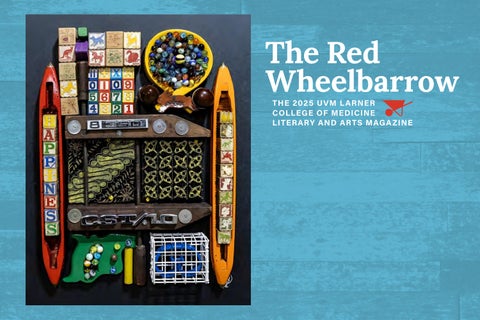
COVER: MEL WOLK, M.D.’60 Kayak Artist Statement: I am interested in found objects and utilizing them in my pieces. This form of expressionism takes throw away objects and puts them to new use. The overall image is much more than its individual parts. I am a believer in high color and structural pieces for my work. I am a follower of fauvism. 2
The Red Wheelbarrow THE 2025 UVM L ARNER COLLEGE OF MEDICINE LITERARY AND ARTS MAGA ZINE
1
so much depends upon a red wheel barrow glazed with rain water beside the white chickens “ THE RED WHEELBARROW” William Carlos Williams, M.D. Published in Spring and All (1923)
3
Mission The Red Wheelbarrow is the student-run magazine for the literary and visual arts at The Robert Larner, M.D. College of Medicine at the University of Vermont. Named after physician-writer William Carlos Williams’ poem, “The Red Wheelbarrow,” our publication aims to capture, cultivate, and explore the creative endeavors of the medical and scientific communities—past and present—here at UVM and its clinical education partners. The Red Wheelbarrow encourages submissions related to the medical humanities—an interdisciplinary field that strives to contextualize and interpret topics including, but not limited to, the medical profession and education, and human health and disease; however, our publication remains inclusive of all ideas and artistic pursuits outside the scope of the medical humanities. The Red Wheelbarrow is published annually, and welcomes submissions from all members of the Larner College of Medicine, UVM graduate health sciences and biomedical programs, and our clinical affiliates.
Contents Editors’ Note . . . . . . . . . . . . . . . . . . . . . . . . . . . . . . . . . . . . . . . . 6 LITERARY ARTS Gray . . . . . . . . . . . . . . . . . . . . . . . . . . . . . . . . . . . . . . . . . . . . . . . 8 6 Northeast . . . . . . . . . . . . . . . . . . . . . . . . . . . . . . . . . . . . . . . . . 10 stitches can’t mend the soul . . . . . . . . . . . . . . . . . . . . . . . . . . 13 Comments on the Human Design . . . . . . . . . . . . . . . . . . . . . 14 Eleanor Vance in: The Conjuring . . . . . . . . . . . . . . . . . . . . . 16 Me . . . . . . . . . . . . . . . . . . . . . . . . . . . . . . . . . . . . . . . . . . . . . . . . . . 18 Oregon and Alaska . . . . . . . . . . . . . . . . . . . . . . . . . . . . . . . . . . 19 Poetic Operation . . . . . . . . . . . . . . . . . . . . . . . . . . . . . . . . . . . . 20 The Weight . . . . . . . . . . . . . . . . . . . . . . . . . . . . . . . . . . . . . . . . . . 21 Home? . . . . . . . . . . . . . . . . . . . . . . . . . . . . . . . . . . . . . . . . . . . . . 22 Grippy Socks . . . . . . . . . . . . . . . . . . . . . . . . . . . . . . . . . . . . . . . 23 A Dichotomic Pair: Uterine Fibroids and Refugees in Maine . . . . . . . . . . . . . . 24 Our House . . . . . . . . . . . . . . . . . . . . . . . . . . . . . . . . . . . . . . . . . . 31 The farewell . . . . . . . . . . . . . . . . . . . . . . . . . . . . . . . . . . . . . . . 32 Sweetness . . . . . . . . . . . . . . . . . . . . . . . . . . . . . . . . . . . . . . . . . 35 Privilege . . . . . . . . . . . . . . . . . . . . . . . . . . . . . . . . . . . . . . . . . . . 38 Precipice . . . . . . . . . . . . . . . . . . . . . . . . . . . . . . . . . . . . . . . . . . . 40 Smile . . . . . . . . . . . . . . . . . . . . . . . . . . . . . . . . . . . . . . . . . . . . . . 42 Better . . . . . . . . . . . . . . . . . . . . . . . . . . . . . . . . . . . . . . . . . . . . . . 43 Too much red . . . . . . . . . . . . . . . . . . . . . . . . . . . . . . . . . . . . . . . 44
VISUAL ARTS Drive . . . . . . . . . . . . . . . . . . . . . . . . . . . . . . . . . . . . . . . . . . . . . . . 9 Kind Man Joe, My Dad . . . . . . . . . . . . . . . . . . . . . . . . . . . . . . . 12 Sit Still Vol. 2 . . . . . . . . . . . . . . . . . . . . . . . . . . . . . . . . . . . . . . . . 15 From Ashes/Afterglow . . . . . . . . . . . . . . . . . . . . . . . . . . . . . 25 Games, Migraine . . . . . . . . . . . . . . . . . . . . . . . . . . . . . . . . . . . 26 Ballbreaker . . . . . . . . . . . . . . . . . . . . . . . . . . . . . . . . . . . . . . . . . 27 Night Out . . . . . . . . . . . . . . . . . . . . . . . . . . . . . . . . . . . . . . . . . . 28 Sunflower . . . . . . . . . . . . . . . . . . . . . . . . . . . . . . . . . . . . . . . . . . 29 Three Clamps . . . . . . . . . . . . . . . . . . . . . . . . . . . . . . . . . . . . . . 30 Sweetness . . . . . . . . . . . . . . . . . . . . . . . . . . . . . . . . . . . . . . . . . 34 Frog Pond, January . . . . . . . . . . . . . . . . . . . . . . . . . . . . . . . . . 37 Contemplation . . . . . . . . . . . . . . . . . . . . . . . . . . . . . . . . . . . . . . 41 Too much red . . . . . . . . . . . . . . . . . . . . . . . . . . . . . . . . . . . . . . 45 PERFORMANCE ARTS To view The Red Wheelbarrow online, including performance arts, visit go.uvm.edu/redwheel2025 or scan this QR code.
Staff EDITORS Ryan Marawala ’27 Joseph Du ’27 Emily Hovan ’28 Liv Velasquez ’28 FACULT Y ADVISOR Sakshi Jasra, M.D., She/Her Professionalism, Communication, and Reflection (PCR) Course Director Assistant Professor of Medicine, UVM Larner College of Medicine PRODUCTION Office of Medical Communications, UVM Larner College of Medicine CONTACT redwheelbarrowuvm@gmail.com
Editors’ Note Medicine begins with storytelling. We notice it when we walk into an exam room to collect a patient’s history and when we sit by the bedside to learn more about our patient’s lives. Perhaps for this reason, the field of medicine attracts so many who value channeling their artistic sides to tell the stories of themselves and those around them. The time we get to express our creativity outside of the academic or clinical setting is special; not just for relaxation, but for developing a greater appreciation of the world around us and how we fit within it. Year after year, The Red Wheelbarrow reminds us within the Larner community of how important it is to make time for creative expression. Larner is unique in that creativity is a significant part of our extracurricular choices: one can jam with the Music Student Interest Group (SIG for short), write with the Narrative Medicine SIG, juggle at Performing Arts Night, sing along in the hospital with the Musical Brain Initiative, or even paint histology slides with the Pathology SIG. Though our magazine comes out just once a year, trust that the imaginative minds at Larner are keeping themselves plenty busy.
This year’s physical edition of the magazine features 33 written and visual works, with additional audio and visual artworks to be found on our dedicated Red Wheelbarrow website. We showcase voices of all types, including first-year medical students, administrative employees, and alumni as far back as the Class of 1960. Our mission is to showcase as many voices as we can, which is also made easier by the fact that we receive so many high-quality submissions each year. We are exceedingly grateful to our contributors for putting themselves out there this year—and we think you’ll feel the same once you turn the page.
P.S. A special thank you to Sakshi Jasra, M.D., Ann Howard and John Turner for helping make this magazine possible, as well as to Sarah Yang ’26 (former editor of The Red Wheelbarrow) for creating and running our social media page (@theredwheelbarrowuvm on Instagram). Please visit the page at your convenience to see lovely works from previous editions!
With all that being said, please enjoy this year’s edition of The Red Wheelbarrow. Sincerely, Ryan Marawala ’27 Joseph Du ’27 Emily Hovan ’28 Liv Velasquez ’28 Co-Editors, The Red Wheelbarrow
7
My hair was braided Tightly I came into your room, Helped you with your shoes Chaperoned you down the hallway And although we both stood five feet (small things), I couldn’t help but stand straighter, willing myself to be taller, bigger (if it meant you didn’t worry about someone holding you steady) And before I left, you fingered your hair and murmured, “It’s a mess.” You lost your hairbrush And just like that Just like that, I was scouring the room, Looking through the little pouches of your walker When I found something – close enough – I shifted And took your silver hair in my hands Years I was holding years in my hands I was holding time passed It reached just below your chin And I, having dyed my hair to look like yours, couldn’t help but stare
8
And stare There were knots in your hair And it was easy Easy to stand there, detangling As you told me about your daughter, Your COPD I got tangled up in how pretty the light fell, how pretty your hair fell You got tangled up in the cords winding, forming little river valleys on your bed You laughed at the alert buttons proudly, annoyingly chirping away And I combed And I combed And I loved just Standing there Tucking the final strands behind your ears Combing your hair It was easy
Gray CHRIS FRIAS Class of 2028, She/Her
SOPHIA MOKHTARIAN Class of 2028, She/Her Drive
9
6 Northeast GRACE FLEMING Class of 2028, She/Her
The first patient I vividly remember was not ever really my patient. My mom came home at 21:30 after a 12-hour shift on the oncology floor of a children’s hospital located 100 miles away. It was the following morning when I found her lingering in bed, lost in thought. There was a sixteen-year-old boy who had been cancerfree for the last three, blissful years. He found his way back into a doctor’s office from some bone pain during practice, the PET scan lit up. That’s where my mother found him, newly admitted to the same unit he had escaped from with his life three years earlier, with a whole new diagnosis of metastasis to…everywhere, it seemed. He held it together, surprisingly, for someone who knew just how short his life was; months, the doctors predicted. His mother reported that he took it in stride, and seemed to be a constant, unwavering force while she and his girlfriend were beside themselves. During his third week on the unit, he was sent down to radiology, alone for the first time in weeks, to do staging scans. He broke down. For the hour he waited for the scans with my mother, his nurse for the day, he sobbed and apologized, “I don’t want my mom to see me cry, I don’t want her to worry about me.”
10
It’s hard to talk about this, mostly because it never felt like my story to tell, but I thought about him constantly throughout the following months. How could I not, I suppose—when your parent comes home with stories of dying children in hospital beds and breaking families, they all begin to carry the same thread of devastation. But his story stuck with me. I thought for weeks about his fragile strength, about how lonely he must feel, and what he must be doing. I felt like I had to do something, what, I wasn’t sure, but something to help him feel less alone. I am not sure if it was seeing so much of myself in him, close in age at the time, or if it was his loneliness and strength that spoke to me, but I felt, intimately, that I needed to do something, anything, to ease his suffering.
argue that stories, and how we respond to them, can be just as impactful and introspective as direct experiences themselves. When writing a personal statement, I wish I felt like it was enough to say that his story, the one that still moves me to tears on some days, is enough of a reason to be in medical school. I am reminded of his story, especially during my summer working with oropharyngeal cancer patients, as I hear their stories and how the providers who made the largest impact were the ones who made them feel less alone.
When asked why I wanted to pursue medicine, stories like his were always ones I reflected on, but I never felt like I could tell them because they weren’t mine to tell. I had no role in it, and it didn’t feel right to write about them. But stories are powerful, even if they aren’t your own; enough to convince a fifteen-year-old to pursue a career in medicine. We all hold anthologies of stories told to us, that move us, that stay with us. I suppose I would
11
NICOLAS CIMINO Class of 2029, He/Him Kind Man Joe, My Dad 12
stitches can’t mend the soul HIBA HUSSAIN Class of 2028, She/Her
what does it mean to heal someone? is it dragging a scalpel on mottled skin as blood drips on linoleum tile? is it cauterizing blood vessels in the name of obliterating old connections? is it sawing into a vertebral body, and sculpting bone like michelangelo?
once a child, then mother, now wife. narrates him through memories lost to war, anchors him in nights clouded by a brain mass. therapy does not avail a schizophrenic but living with grandma protects him from months counted in broken beer bottles and years disoriented in shadowy voices.
possessing healing hands doesn’t mean you are healing hearts.
The patient in room 110 needs surgery today to fix her spine.
stitches can’t mend the soul. pills will not cure the 18-year-old child who moved across the lake in a beat-up van– a trunk bursting with high school memories while a miniature casket trembles in the backseat.
but what is supposed to heal the child the wife the mother the grandma the caretaker for everyone except herself?
wrapping a wound does not soothe a vietnam veteran– yet the gentle voice of the young woman:
stitches can’t mend her soul but i know her stories can.
13
Comments on the Human Design JORDAN MCGUIRE Class of 2028, She/Her
14
Punting Tiktaalik Back into the Sea Evolution should allow us to decline How we stand hurts our knees, hips, and spine If I got my wish We’d go back to fish Scrap the whole bad bipedal design
Stop Washing Your Hands Dear worms: we miss you intruding Our bodies have now been concluding When we’re without you We’re the enemy too Now my petty cells have taken to feuding
9-5 at the Problem Factory ‘Ol gallbladder clocks in for his shift Pretty stones he’ll give as a gift They churn to and fro And you say oh no Could a whole organ be considered a grift?
Friday Night Head pain? I have your solution! One quick fix to ease your contusion Just a poke to the skull You’ll be feeling less full A handy ice pick resolution
NOAH BURNS Administrative Assistant, Office of Intercultural Excellence, He/They Sit Still Vol. 2 Risograph Zine 15
Eleanor Vance in: The Conjuring RAE REVILLA Class of 2029
Here’s the thing—as much of a scaredy cat as I am, the ghosts comfort me. I was never the bravest kid. I was too scared to leap off the swingset like my friends did, too anxious I would be caught climbing the fence into the park that neighbored our playground. I made up for it (at least to myself) with the late nights I spent with a flashlight under my covers, savoring the fourth Goosebumps book I’d checked out that week. Afraid as I was, I couldn’t look away. Ghost stories fascinated me: the way they follow you. Always watching. Even now, I find them romantic, almost. They just want to be where you are. –– We are taught in the first week of medical school about trauma and the way it haunts the body as it does the mind. The stress enters the body and is converted into a cocktail of hormones. With a high enough dose, this response becomes permanent. To borrow Shirley Jackson’s conceptualization of it in The Haunting of Hill House, trauma clings as a shadow does. You open the door to the patient; behind them slip in their ghosts.
16
The disclosure of trauma is one power we try our utmost to preserve for our patients. Our job, then, is to position ourselves as receptacles who can be trusted to believe them should they decide to disclose that trauma. The physician acts not as the exorcist, but as the confessional. Except, the confessional is aged and weathered, creaking around the words whispered through the slats. Your patient puts a name to their trauma, and something inside you stirs. Cortisol and adrenaline. There are ghosts here, too. Reflection makes one a better physician. This is especially true for trauma-informed care. Still, it is one thing to name your trauma, and another entirely to untangle it from your cells. How wretched and beautiful that the clearest way out is through. Recent psychotherapeutic approaches to trauma include its identification through one’s collection of maladaptive schemas: patterns of thought that develop in childhood and persist, proliferate, in the adult. The self, reconstructed in a smaller body. Of all my ghosts, I know her best.
–– One of my biggest worries before starting medical school was whether or not I was going to make friends. I am grateful to now be free from that. I’ve heard that the friends you make in medical school are ones you will have for life, and I pray that that holds true. They’re the kinds of friends who would have sat with me on the swings or given me a boost up over the fence. I joke with one of them that we must have been separated as kids through divine intervention; that if we had met at those fragile crossroads of our lives, we would have become an unstoppable force. She laughs and agrees, and the little girl in my shadow laughs along with her. For a moment, I am possessed. I am whole.
17
ARMAN GREWAL Class of 2026, He/Him Me
18
Oregon and Alaska MITRA KARDESTUNCER Class of 2029, She/Her
I remember the first time I traveled overseas alone. I sat in a Scandinavian Airlines aisle seat, a blonde mother and blonder daughter to my left. The two were quick to ask where I was coming from, where I was going to. My answer inspired itineraries hinged on sleeper trains and spirit, coupons and time. They had been all over the world together, but their favorite place was Alaska. If you go far enough up north in September, they told me, you’ll catch the foliage before everyone else. They scrolled through endless pictures posing underneath the reddest trees I’ve ever seen. That’s all I really know about Alaska. I’m embarrassed to admit that I know even less about Oregon. I’ve heard of Portland rain – more drizzle than downpour, mostly October through May. It seems like the state is perpetually washing things away, the bad hand in hand with the good, though. I’m sorry that’s all I can offer, but the 48 states you’ve seen over your 70 years of life didn’t count for nothing like you think they did. In fact, while I was looking out your hospital window as the nurse helped you sit up in bed, I saw a canopy of Burlington trees glistening redder than ever from yesterday’s rain. That counts as 50 to me.
19
Poetic Operation PATRICK PAYNE Class of 2029, He/They
Pages of a notebook lack the sterility of cold steel tables, shining under the operation of bright lights; as pen is pit against the scalpel wield by the most trained and certified. Paper and ink being tasked with the impossible task of peeling aside the lithic layers of a psyche, in exploration: searching for the source of grief, of frustration, of ennui within the recesses of memory-laden tissues as a soul hemorrhages out to the world. Gordian knots of the World’s burdens loosened through psycholysis as words of future tense relax the winding of gears whose mental machinations ground your soul to a pulp from which you can be reformed.
20
Tears tearing more holes in the fabric of your patchword, quilted mind, soaking the stitches and pooling in the sulcus, where your soul once took shelter. Now fit to drown in a sorrow unrelenting, so with liquid threads of black or blue sutures do pour from within the mind and a simple centesis of cathartic tears pulls forth an exorcised spirit fit for an agonal gasp of fresh air diffusing without despair. At times the rolling ball of a pen is not so deftly drawn as inks fail to find their mark, as the wrong pieces are removed or become a tripsy of memories – pulverized in place. So lying on the page you’ve pulled at strings that connect to the beating heart who asks you to stop. Tells you that the surgery is not the answer that feels right. Labeling it therapy, you wait for time to fray those strings that tied up your surgical pen.
The Weight ANNA BENVENUTO, M.D.’08 She/Her
When I dreamt of being a doctor, I didn’t dream of this. I envisioned family meetings long discussions about goals of care thoughtful and tear-filled end of life decision-making I never envisioned walking into the trauma bay of the hospital where I trained your leg filleted open a chest tube draining blood lines and drains enveloping you small and quiet at the center of a resuscitation I never envisioned contemplating should they amputate to save your life? how do I know when it’s futile? did I do the right thing? I never envisioned watching monitors with your vital signs worsening ultrasound images of your heart slowing and stopping the faces of colleagues when I said “no compressions” the team pause to honor you and then solemnly file out
I never envisioned calling my mother – your wife of 55 years my sisters who then had to tell their children my husband whom you welcomed as your own I never envisioned saying over and over “He died” and feeling the weight of responsibility the guilt of being the last of us to be with you the loneliness of standing with you in the trauma bay after it was over stroking your beard and your hair kissing your face repeating “I love you” and “I’m so sorry” I never envisioned being alone with your body after your death having to ask the question, “When do I leave?” I never envisioned experiencing weeks of flashbacks grief stuck in my body the unmoored feeling of navigating loss a deep sense of my own naivete When I dreamt of being a doctor, I didn’t dream of this but perhaps you did. 21
Home? PATRICK PAYNE Class of 2029, He/They
As inspired by: Bob Bingham, in collaboration with The Fabric Workshop and Museum, Philadelphia Urban Survival Equipment (installation view), 1986. Pigment on cotton canvas, armature. 36 x 42 x 76 inches City of Grants Pass v. Johnson US Supreme Court 2024 Ruling: cities can now enforce laws outlawing sleeping or camping in public spaces even if one is homeless and without any alternative shelter The pig is now a big bad wolf, who learned that blowing tents down is much easier than houses, but instead they issued tickets. The pigs papered the living places those tucked within sparse trees or among urban caves with pigeons booing. Maybe as folks slept or couldn’t in fear of what was outside those thin walls in silhouette by dilating florescent streetlight.
22
Those papers piled – as tent-bound lips exhort: Can’t pay – No home – Begging – Pleading – Breathing Gasping for the soul’s right to breath – for liberty but the papers don’t’ let the air in, papers written in triplicate . One paper joined the leaves tumbling with its siblings prancing amidst the weeds and grasses, with neighbors, pretending to be deer in the headlights. Unhoused and getting the car instead. The second to the white marble columns that huffs and puffs wouldn’t blow down where the pig is a wolf and says it is Just…us. What justice is the ruling in Scales weighted down, scales weighted down, scales weighted down in triplicate too. Supreme decisions: those people can be blown away Not up… yet.
Grippy Socks The third into the vinyl-sided homes where sheeted rocks block the winds, maybe the draft finds its way in. The Living room quite, on mute, the screen could scream those five seconds of fame as that last slip is captured in the News – a tired, old story out in the streetlights. next time… we will build brick tents
PATRICK PAYNE Class of 2029, He/They
Barren except for a bed with a fitted sheet and my new uniform, likely washed thousands of times but the socks – crisp, new – in an unopened package. Socks certainly knit by a monstrous machine, not held by tender hands; grey tubes adorned with white vinyl – at least I wouldn’t slip again, I wouldn’t need to walk in someone else’s shoes. Belongings placed in a storage bag, unsure when… or if… they will reunite. As the new fashion is drawn on one can’t help but wonder: who was here last? what did they wear on their feet? 23
A Dichotomic Pair: Uterine Fibroids and Refugees in Maine JASMINE BAZINET-PHILLIPS Class of 2026, She/Her
Thirty miles inland from the rugged coast of Maine, if you follow the languid lines of the Androscoggin River, you will stumble upon a New England city, as complex and eroded as the Maine coastline. In this stupor, you will find people blissfully gulping in the stench and others repulsed by the smell only to be seen in the city during working hours. But, there is a new horizon in this city – refugees from across the sea. The stagnant water, as still and wallowing as the truth of the community it cuts across, is a tepid social mix of refugees and those who settled this land centuries ago. When she entered the hospital, on her second day in America, she had a hemoglobin of 2.5. On imaging, the treatment team concluded that she had a “massive fibroid uterus.”
24
Filled with the hope that fueled her long journey from the porcelain-colored sandy shores of Africa, at 38-yearsold she shared that she desired a pregnancy in the future. Her words were absorbed by her practitioners like the surface runoff on the murky river. Next to the virtual translator, the resident held a whiteboard. We had to start from the beginning. “What is a uterus? Where is it located?” We had to explain the strength of this wave that had overcome her and landed her in the hospital in an unknown place with unfamiliar people and language. We pushed against the stagnancy in the air with our pauses for the medical translator. But how can truncated words capture the severity of a removal so complete.
HEATHER CROWLEY, M.D. Pathologist, She/Her From Ashes/Afterglow 25
MEL WOLK, M.D.’60 (left to right) Games, Migraine, Ballbreaker (opposite) 26
27
28
MEL WOLK, M.D.’60 Homage to Van Gogh and His Famous Sunflower Night Out (opposite)
29
MEL WOLK, M.D.’60 Alphabet Clamps 30
Our House EMILY HOVAN Class of 2028, She/Her
Ms. L sat closest to the doorway. From her chair, she looked out the window at the newly-turned autumn leaves. If we were on a floor or two higher, maybe we would have been able to have a clearer view of Lake Champlain and the Adirondacks. Instead, our eyes settled on the art supplies and board games stacked along the hospital windowsill. That afternoon, a medical-student-run hospital music program brought Ms. L and me together. While singing with our group, I noticed that Ms. L’s gaze fixated on the window, and I could not help but wonder what it felt like to be outside on this autumn day, too. Before finishing our setlist, we asked if anyone had song requests. And that’s when Ms. L leaned in and asked if we could sing “Our House” by Crosby, Stills, Nash, & Young. It was a song our music group had never rehearsed together before. I trailed closely behind the guitarist’s lead, timidly searching for the next chord. Although I was unfamiliar with the lyrics, the chorus led me to a familiar feeling: connection and home. The chorus goes, “Our house is a very, very, very fine house / with two cats in the yard / life used to be so hard / now everything is easy ‘cause of you.”
For me, this song stirred up memories of all the homes I’ve lived in before and united them with that moment. As Ms. L’s gaze met mine, I tried to see if she was thinking of her home, too. After we finished singing “Our House,” it felt like the room brightened. Huddled around the guitar, seated beside one another, Ms. L began to tell us about her time at the Woodstock music festival, her marriage, and her youth. We learned about her home, her family, and her love for playing loud rock and roll music. I find it remarkable that music can unlock these stories—how it can bring strangers together through just a few chords and verses. It has been a few months since we sang this song together, and I often find myself returning to its melody. Whether I am studying at my desk late at night, walking to the bus stop on a rainy morning, or cooking dinner with friends, I hum the chorus and am transported back to that Sunday afternoon with Ms. L. The time we shared together in song helps me reflect on the new home I’ve built in Vermont, my budding identity as a future physician, and a cherished connection with a patient. I will carry this feeling with me, hand-in-hand with the lyrics I’ve since learned, to help bring feelings of home to the hospital. 31
The farewell VIRGINIA RAMIREZ Class of 2025
A photograph, vibrant and weathered, rests beside you— a snapshot before you became the parents of me. It captures the sway of palm trees, the wide embrace of the Caribbean, the clear sky above like a blue that never fades, and the sun, its golden fingers lighting up faces full of joy and youth. What seemed like a simple family portrait now pulses with the weight of everything lost: a piece of home forever tied to that moment, the heavy price of immigration felt in the today’s absence of most of the faces in that photograph. Now, the image stands in stark contrast to this new life. Miami’s streets stretched wide, but we were crowded in a small, damp apartment— no money, three kids, fighting for breath in a city that swallows hope and spits out exhaustion. Your hands, once used to the rhythm of the land, now strained under the weight of unfamiliar labor. The broken English you spoke felt like a barrier that kept the world at arm’s length. The car became our home for some time, it creaked and coughed its way through every journey as we waited for a chance to belong.
32
The nights were long, and yet, you held on. You held on, because you were not just surviving— you’re giving us a future, a future that once seemed impossible on that distant island, under that sun-drenched sky. You hold on to your memories with a nostalgic heaviness you speak of them fondly yet have no desire to return to Cuba as the Cuba you knew and loved no longer exists. There is a speck of light in your eye and a tone of desperate faith in your voice.
We then started your expedition in the Cuban forests along Rio Toa with your girlfriend (mi mama) and a friend through campos full of indígenas, roasting pigs and eating chicharrón i can’t help but yearn for an experience like that, knowing I won’t ever have it As I observe you, I ponder: This is the cost of love; that you still love them after you lose them. This is the gift of love; that you still love them after you lose them.
I want to know more about your life before me, tell me more about your infamous excursion through El Rio Toa, I say. I watch your mind transport itself to the place you left behind. The story-teller in you bringing me along for the ride We visited your childhood home, the aroma of your abuelas famous “fricase de pollo” luring the family to the dining table, (the same fricase de pollo I now know and love).
33
JOSEPH DU Class of 2027, He/Him Sweetness
34
Sweetness JOSEPH DU Class of 2027, He/Him
There is no combination of words in the English language to describe how much I hate working with flour. It clumps. It sticks. It gets into crevices that are impossible to clean. Prior to medical school, I’d try my hardest to avoid it altogether. Never would I imagine getting into dessert baking, much less making my own pie crusts. Midway through my first year of medical school, I had the opportunity to sit for an extended period of time and chat with a patient about anything but medicine. We bonded over our mutual love of food, the details of her chronic illness unimportant. Her favorite food to make: pies. She had a secret trick to making crusts, something that set hers far and away above the competition. For the end deliverable of this conversation, my presentation for Humanism in Medicine was a blueberry pie, made to specification exactly like she would have. It should go without saying that patients have as much to teach us as we can teach them. They are our neighbors, our friends, our family. In my case, I’ve picked up a new hobby, or addiction if you could see how many pies I have
made since. I’ve made great strides since learning, and have been able to get experimental with the fillings and crust. I’ve even (mostly) gotten over my disdain for flour, though my complaints still stand. Pictured here is a blackberry mint pie with an all butter crust. Would you have eaten it, you would taste the aforementioned ingredients, alongside light notes of almond, vanilla, and bourbon. The crust itself is simultaneously flaky, yet with just enough crunch to provide structure and a stimulating textural experience. It pairs quite well with vanilla ice cream, garnished of course with the one mint leaf I didn’t include in the filling. It is served on a paper plate and eaten with a plastic spoon, incredibly elevated table settings. At this point, you’ve sat through the story of how the recipe came to be and indulged your eyes on quite an appetizing slice of pie. You must be wondering: what actually is the secret to the pies? Sadly, it wouldn’t be my place to share. Perhaps the next patient you talk to will show you instead.
35
WHITNEY FEININGER Administration, Division of Hematology and Oncology, She/Her Frog Pond, January 36
37
Privilege ANASTASIA ARVIN-DIBLASIO Class of 2027, She/Her
I swore as I read the chart. The cancer I knew about, and I had seen the wedding ring on Jane’s finger. But the chart confirmed what I had hoped wasn’t true: Children. Children who would most likely know what it was like to live without a mother before they knew what it was like to vote. Jane’s family visited her often, and I’m sure she loved every moment. But her children compounded her story’s tragedy for me. It wouldn’t touch just them, but their friends, their future partners, any children of their own. Exponential ripples due to a few rogue cells. Jane’s care focused on figuring out the cause of her acute dysphagia, which we hoped wasn’t her cancer again. She couldn’t eat or swallow liquids. Talking made her cough and spit. We did a CT, then an MRI: No changes to the cancer we already knew was lurking.
38
Reporting these findings to Jane didn’t feel like much. The only answer I had was that we didn’t have one. And of course, there was the possibility that whatever was happening was so small that scans couldn’t see it. Next step: an LP. Even if the cancer could hide from imaging, it couldn’t hide from the lab. My attending asked me to discuss anxiety medication for the procedure with Jane. I had been surprised earlier in the rotation at how often I ended up being the first one to tell patients news about their care, before the doctor was able to finish rounds. I started by asking Jane if she knew what an LP was. She said that the nurse had explained it to her briefly, and she “kind of freaked out.” I asked her if she wanted me to explain it more. She nodded emphatically. I didn’t want to sugarcoat anything and have reality sneak up on her, so I tried to be realistic, although not scary. I tried to give her choices, like if she
wanted a mirror to watch, or if she’d rather not look. I assured her that doctors did this regularly, and while it was a big deal to her, it was business as usual for them. I described the drip of CSF like sap in sugaring season and got a small, tired smile. I asked her if she had any more questions. She said no. I finished the interview, then told her I would see her tomorrow. My dad says I grew up in Disney World, meaning privileged. He isn’t wrong. As a white, cis woman in America, I have been showered with a near never-ending stream of privilege. But my conversation with Jane was different. Softer, but deeper. She wrapped all her fear, confusion, and hope in a package and put it in the hands of a person she had just met, who talked about the needle we would put in her back to see if cancer was eating her brain. Jane trusted me. There is no greater privilege than that.
39
Precipice JONATHAN L. WEKER, M.D. Psychiatrist
He wasn’t even twenty. To look at him–tall, slender, handsome face, piercing blue eyes– and to know his privileged background, know the intelligent parents and the comfortable home, one would think the world was his oyster. But then there was his diffidence, his anxious glances, his stumbling speech, the awkwardness that set him apart from his peers. And I knew, before his family knew, before he possibly could have known, that he was marked with schizophrenia, this altering but ultimately unalterable disease. And for that moment I sat with them, silently, stunned by the awareness and the awfulness of what they were about to hear, of how his future and theirs would never again be what it always had been and still was at this last, fleeting moment.
SARAH YANG Class of 2026, She/Her Contemplation 40
41
Smile WILLIAM HSU Class of 2025
They say to smile To share your story and fill the gaps To show that you are grateful and happy But how do you explain The dull ache of not having a home Of standing in the crowded streets Unseen, unheard, unnoticed between cultures I raise my head and smile as wide as I can Hoping that my crooked stained smile can help me fit in With the perfect white half-moons around me I speak to a psychiatrist I tell her about my childhood She smiles, eyes full of pity But what I said was normal Was it not normal? How is it not normal? I smile and apologize I never go back I call home My mother tongue now foreign and strange on my lips My family laughs “You now have a Western accent” I smile and laugh with them I sit alone after the call 42
I finally succeeded I am in medical school I will become a doctor I smile in relief When I first step into the patient room I hear “Annyeong haseyo? Ni Hao? Konnichiwa?” in quick succession I am none of those languages, not fully anymore I reply “How are you today?” The patient gasps “You speak English very well” I smile awkwardly Let the words wash over me Push me away again In the emergency room I see patient after patient They laugh at my slight bows when I introduce myself They ask when the doctor is coming to see them Despite the badge that shouts in all caps “PHYSICIAN” I smile and reassure them that I am the doctor caring for them I walk home that evening A man stops me on the street He yells at me to go back home to where I come from I look at him in bafflement I take in his closely shaven face His mouth contorted in anger I smile and walk away How long do I need to keep on smiling?
Better LIV VELASQUEZ Class of 2028, She/Her
I wrote this while working at an eating disorders program for young women. The courage of each patient that walked through the door continuously inspired me. Through physical discomfort, through depression, anxiety, financial concerns, all in the name of feeling better in some way. I thought a lot about what this meant, and had many conversations with patients about what “better” would mean for them.
“Better” is such a relative term Brushstrokes of progress Life lessons to learn It signifies more Than a number on the scale Hard to quantify Seemingly easy to fail Patterns pursued Addictions strengthened Coping mechanisms, A habit, lengthened To cope with trauma When no one seems to listen What doesn’t get better, A chronic condition That can only persist, That is likely to worsen A diagnosis dehumanizing A patient, once person.
Are you feeling better? Better than what? Than yesterday’s trials? Than its darkest thoughts? Why is it worth it? Why even try? To find less destructive Ways through a hard life They said because progress May be pain at first glance But there’s hope it can lessen If “better” gets a chance Because they have a dream Of a career to help others Because they need to feel stronger To be a friend, sibling, mother “Better” might seem Impossible, elusive But however defined Progress worth it, If you choose it
43
Too much red JAMES WOLCOTT, M.D.’85 He/Him
Why do paintings matter? Why do abstract paintings matter? Why do emotions matter? According to a lifelong friend, who owns and operates a large and very successful commercial art gallery, paintings, abstract or otherwise, matter only as decorations. And, they truly only matter insofar as they “go with “ the sofa and the rug. This strongly held belief was his basis for admitting to me that he would never be able to sell my paintings. My paintings simply had “too much red” thus, in his world they had little if any value. I love red. So many shades: scarlet, crimson, rose, maroon, vermilion. So many emotions: love, passion, desire, anger, aggression, danger. I cannot imagine painting abstractly without these emotions. I cannot imagine painting without red. The sofa be damned!
44
JAMES WOLCOTT, M.D.’85 He/Him Too much red
The Red Wheelbarrow THE 2025 UVM L ARNER COLLEGE OF MEDICINE LITERARY AND ARTS MAGA ZINE
4