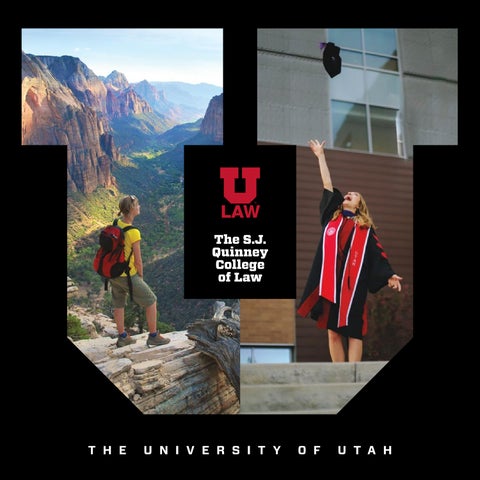
The S.J. Quinney College of Law
T H E
U N I V E R S I T Y
O F
U T A H
The Right Environment Produces the Best Lawyers.
SALT LAKE CITY IS HOME TO A SIGNIFICANT AND GROWING NUMBER OF LAW FIRMS—RANGING FROM BIG LAW TO SMALL LOCAL FIRMS
A WALKABLE, BIKEFRIENDLY CITY— RANKED IN THE TOP 5 HEALTHIEST CITIES IN THE COUNTRY (WALLETHUB 2026)
Salt Lake City is a dynamic, growing hub for legal practice, tech, health care and other industries.
A BURGEONING RESTAURANT SCENE, PLUS YEAR-ROUND FARMERS’ MARKETS
Love getting outside? Utah’s outdoor recreation is legendary—and easily accessible from campus. The S.J. Quinney College of Law is located in Salt Lake City, a progressive state capital and regional economic epicenter that perennially ranks among the hottest job markets in the U.S.
SUMMER MUSIC FESTIVALS, OKTOBERFEST, AND OTHER SEASONAL EVENTS YEAR-ROUND
Resting in the foothills of the Wasatch Mountains, the College of Law serves as a gateway to campus. The University of Utah is a Tier-1 Research Institution, member of the elite Association of American Universities, and home to top-tier athletics. It’s a dynamic campus that features leading genetics and medical research, biotechnology, business, and all the variety in academic excellence you’d expect from a flagship university.
SCAN TO EXPLORE SALT LAKE CITY
1
The University of Utah
AWARD-WINNING LIGHT RAIL AND REGIONAL COMMUTER RAIL SYSTEMS
WORLD-CLASS SKIING AND WINTER SPORTS AT SEVEN NEARBY RESORTS
WORLD-CLASS OUTDOOR RECREATION 15 MINUTES FROM CAMPUS
HOME OF MAJOR LEAGUE BASKETBALL, HOCKEY, AND MEN’S AND WOMEN’S SOCCER TEAMS
S.J. Quinney College of Law S.J. Quinney College of Law
2 2
Why Utah Law? From our highly engaged faculty to our unparalleled setting, there are abundant reasons the S.J. Quinney College of Law is the perfect fit for you. AN UNMATCHED LOCATION. No other law school has such easy access to both a booming metro area and the adventure of a lifetime. Utah Law is just 10 minutes from downtown Salt Lake City, and 15 minutes from Utah’s world-renowned outdoor recreation. A WELCOMING ENVIRONMENT. Utah Law stands apart thanks to its small size and tight-knit student body. Our students consistently say the community they find here is unique—and helps them become better lawyers after graduating. There’s a range of resources to help students maximize their time in law school, from our Academic Success Program to a dedicated in-house mental health counselor. A COMMUNITY OF TRAILBLAZERS. I am proud to be the first woman and first Native American to serve as dean of Utah Law, and I’m in good company: Utah Law’s alumni change the world. Our graduates have broken race and gender barriers in the judiciary, they lead innovative companies improving the world, and they develop initiatives to strengthen communities around the globe. AN INCREDIBLE FACULTY. Some law schools have faculty who focus on research. Others are strong in teaching. At Utah Law, you’ll find both in abundance. Our students rave about the professors here, who are talented teachers and accessible mentors—in addition to being among the top scholars in their fields.
I hope you’ll visit us to see for yourself. Our Admissions team is also ready to answer questions and help you explore everything Utah Law has to offer.
Elizabeth Kronk Warner Dean of the S.J. Quinney College of Law
On top of this, Utah Law is #8 among public law schools in ultimate bar passage rate. It all means there are countless reasons why we’re an excellent place to launch your legal career.
3
The University of Utah
LEARN MORE ABOUT DEAN KRONK WARNER
Join a Tight-Knit Community With one of the lowest student-to-faculty ratios in the country, you’ll get to know your professors and classmates.
S.J. Quinney College of Law
4
Learn from Leading Professors The expertise of our faculty is vast, and the course topics they teach are varied. Our faculty have argued before the U.S. Supreme Court, testified before Congress, and served as high-ranking government officials. They have written leading law textbooks, served as U.S. Supreme Court clerks, and drafted regulation and policy. As practicing lawyers, our faculty have worked in nationally recognized law firms. They serve in public interest organizations and actively engage in pro bono services. As recognized experts, they regularly discuss law and policy in major media outlets like The New York Times, The Wall Street Journal, NPR and CNN.
2025 ABA Standard 509 Information Report:
38
45%
16%
65
full-time faculty
full-time faculty of color
full-time female faculty
adjunct faculty
Our faculty have rich and varied real-world law experience. They embrace differences of opinion and encourage thoughtful discourse. LEARN MORE ABOUT OUR FACULTY
5
The University of Utah
S.J. Quinney College of Law
6
Meet our Faculty
5.1: 1
student-to-faculty ratio
Utah Law’s faculty are internationally recognized experts in their fields—and supportive, talented teachers in the classroom. Our small class sizes mean students have easy access to their professors and ample opportunities for mentorship and research. Here are just a few of the top-notch faculty you’ll work with at Utah Law.
U.S. News & World Report 2026 Best Law Schools
“The opportunity to work with Professor Anghie was invaluable. What made the experience second-to-none was the genuine care, compassion and guidance he offers to students.” —Austin Edens JD’25
RONNELL ANDERSEN JONES
LINCOLN DAVIES
TENEILLE BROWN
ANTONY ANGHIE
•
•
Prof. Davies is a nationally recognized expert in energy law who focuses on the transition to renewable energy.
•
•
•
Has published articles in Stanford Law Review Online, Ecology Law Quarterly, and other high-profile journals.
Prof. Brown is a widely cited scholar on law and the biosciences, with special focus on genetics, neuroscience and cognitive psychology.
Prof. Anghie is a renowned scholar in international law. He was one of the pioneers of Third World Approaches to International Law, an influential movement in international law scholarship.
•
•
Co-director of the Wallace Stegner Center for Land, Resources and the Environment, which is home to nationally recognized scholars in environmental law.
Serves as director of the Center for Law and Biomedical Sciences (LABS), which offers opportunities for student research at the intersection of medicine, technology and the law.
Authored the book Imperialism, Sovereignty and International Law, a widely-cited book in international law scholarship.
•
•
Has taught courses including Energy Law, Civil Procedure, and Administrative Law in past years.
Has authored articles in Stanford Law Review, Science, and other top research journals.
Has taught courses including International Law, International Business Transactions, and Human Rights, Aliens, Migrants and Refugees in past years.
•
Has taught courses including Torts and Evidence in past years.
•
7
Prof. Jones is a high-profile expert on the First Amendment. She researches legal issues affecting the press and the intersection between media and the courts. Regularly appears in national media outlets such as the New York Times, CNN and the Washington Post, providing perspective on top stories involving the media.
•
Clerked for Supreme Court Justice Sandra Day O’Connor.
•
Has taught courses including Constitutional Law, the First Amendment, and Speech & Press Freedom in past years.
The University of Utah
•
•
S.J. Quinney College of Law
8
A Curriculum Built for Your Future
9
The University of Utah
FIRST-YEAR CURRICULUM
FALL FIRST-YEAR COURSES
SPRING FIRST-YEAR COURSES
Our students learn in intimate settings throughout their time in the College of Law. Our Legal Methods program also gives students intensive writing experience and one-on-one meetings with faculty. First-year classes teach students the basics of the law and legal system, while giving them early practical training they will need to be effective lawyers.
Civil Procedure
Constitutional Law I
Contracts
Property
Torts
Criminal Law
Legal Methods
Legal Methods
Legal Research
UPPER DIVISION AREAS OF FOCUS INCLUDE
UPPER DIVISION CURRICULUM
Business, Real Estate, and Tax
A longstanding strength of the College of Law is our careful balance between doctrine, theory, and practice. Students have extensive courses they can choose from in their second and third years. These include specialty courses ranging from trademark to family law, numerous skills courses such as appellate practice and real estate drafting, and field placements in virtually every area of the law. Students can also cross-train through our experiential opportunities from international law to new ventures, our six dual degree programs, and our research centers. The depth in curriculum supports seven specialized proficiency programs, where students can earn a certificate of specialized legal study.
Criminal Law Entrepreneurship Environmental, Energy, and Natural Resources Family Law Gender/Sexuality and LGBTQ Law Health Law International Law Intellectual Property Litigation and Alternative Dispute Resolution Public Interest Law Experiential Education (Clinics, Field Placements, and Simulations)
SEE GENERAL COURSE LISTINGS
SEE A DETAILED LIST OF COURSE OFFERINGS IN LEGAL SPECIALTIES
S.J. Quinney College of Law
10
Degree Programs J.D. To earn a J.D., students must complete a minimum of 88 semester hours and graduate with a GPA of at least 2.5. J.D. graduates are eligible to sit for a bar exam in any U.S. jurisdiction.
J.D. CERTIFICATES IN SPECIALIZED STUDY Business Law Criminal Law Environmental and Natural Resources Law Intellectual Property Law International Law Litigation and Dispute Resolution Public Interest Law and Policy
DUAL DEGREE PROGRAMS The College of Law offers a number of unique interdisciplinary educational opportunities. Dual degree programs with other graduate schools at the university include: J.D./Master of Business Administration
LL.M. IN ENVIRONMENTAL AND NATURAL RESOURCES LAW The College of Law offers a specialized Master of Laws (LL.M.) degree in environmental and natural resources law. The LL.M. is a one-year full-time program requiring 24 credits. Upon request, you may petition for a part-time option.
M.L.S. The one-year, 30-credit Master of Legal Studies program requires an undergraduate degree but no prior legal training or entrance exam. The M.L.S. program is offered in two formats: fully online, and in person at the University of Utah campus. The M.L.S. program meets the educational requirement for graduates to sit for the Licensed Paralegal Practitioner examination in the state of Utah. To learn more, visit law.utah.edu/mls.
UNDERGRADUATE MAJOR AND MINOR IN LEGAL STUDIES The Major and Minor in Legal Studies explore the central role of law in society, providing undergraduate students with an in-depth understanding of the U.S. legal system.
J.D./Master of City & Metropolitan Planning J.D./Master of Public Administration J.D./Master of Public Policy J.D./Master of Real Estate Development J.D./Master of Social Work For more information on dual degree and other program requirements, visit law.utah.edu/jd-program.
11
The University of Utah
LEARN MORE ABOUT OUR DEGREE PROGRAMS
S.J. Quinney College of Law
12
Research Centers and Programs Our centers and programs offer opportunities for students and faculty to collaborate on specialized research and community engagement, and to study in niche areas of expertise. Students can gain invaluable insight into specialized areas of legal practice, helping them network and plan for their future legal careers. THE WALLACE STEGNER CENTER FOR LAND, RESOURCES AND THE ENVIRONMENT
THE CENTER FOR LAW AND BIOMEDICAL SCIENCES (LABS)
The Stegner Center offers students one of the top environmental law programs in the nation. Educational opportunities include a J.D. certificate in environmental and natural resources law, in-house clinics in environmental justice and environmental law policy, and numerous substantive law courses. Other opportunities include an LL.M. degree, a research fellows program, and a variety of public events and speakers.
LABS is an interdisciplinary group of faculty and students engaged in cutting-edge research and teaching on issues at the intersection of law and biomedical sciences. We’re committed to explaining and improving the law in rapidly evolving fields to help overcome the critical health challenges of our times.
The Stegner Center boasts a talented and diverse team of faculty who are working to shape environmental law and policy, and who are committed to involving students in their work. Our faculty members serve on local and national NGO boards and advisory committees, collaborate with state and federal government officials to improve environmental policies, and advocate in the courtroom and legislative chambers.
Environmental law program ranked
8
#
Overall U.S. News & World Report 2026 Best Law Schools
13
The University of Utah
Our faculty are experts in bioethics, biotechnology regulation, disability law, evidence, food and drug law, intellectual property, neuroscience, public health law, and many other areas of law.
“I’ve enjoyed knowing that the work I did will end with actual resources that the public and local governments can use to push climate and environmental justice policy further at the local level.” Natalie Merline JD’25 landed a summer research associate position doing research on climate and environmental justice policy in California.
Recent course offerings include health law, FDA law, genetics and medicine, and law and neuroscience. Students can also earn a J.D. certificate in IP law; get hands-on experience through field placements in health law, IP law, and law and the biosciences; and attend our annual colloquium with prominent speakers from around the nation.
15
Health law program ranked
#
Among public law schools U.S. News & World Report 2026 Best Law Schools
“My faculty mentor never treated me like ‘just a student’—from day one, he’s treated me like a colleague. He’s pushed me to find my voice as a writer and has been a constant cheerleader for my success.” Alannah Trombetta JD’26 served as a research assistant for a LABS professor and co-authored a paper with him that was published in a peer-reviewed journal.
S.J. Quinney College of Law
14
Research Centers and Programs
Students can complete field placements with companies in Silicon Slopes, Utah’s tech hub near Salt Lake City.
Judges volunteer their time to serve on a moot court panel.
THE PROGRAM IN CRIMINAL LAW
THE PROGRAM IN IP AND TECHNOLOGY LAW The Program in Intellectual Property and Technology Law seeks to advance our understanding of IP law, how it affects innovation and markets, and how IP law practices can be improved. The program offers a J.D. certificate in IP law, as well as opportunities to engage in field placements and research in IP law and related fields such as innovation theory and science and technology policy. IP courses include core topics such as copyright, patent and trademark law, IP transactions, and law and biomedicine. Specialized courses include antitrust, health law, bankruptcy, taxation, data privacy, entrepreneurship law, and art, entertainment and sports law. Students can participate in competitions including the AIPLA Giles S. Rich Moot Court Competition and the National Patent Application Drafting Competition.
9
IP law program ranked
#
Among public law schools U.S. News & World Report 2026 Best Law Schools
15
The University of Utah
“The IP program prioritizes practical learning—through opportunities like patent drafting courses, the IP Clinic, and competitions— to ensure students are developing and applying the skills we need.” Ashley Fink JD’26 applied the practical skills from her experiential courses to a summer position at an IP firm in Salt Lake City.
Our Program in Criminal Law offers a full range of criminal law courses, as well as a J.D. certificate in criminal law. Our faculty are engaged in innovative research, policy work, and community engagement in areas such as prosecution, crime victims’ rights, violent crimes, and more. Students have opportunities to get involved with faculty research and policy projects, and to co-author publications with faculty. Course offerings include foundational topics such as criminal law, criminal procedure, evidence, and criminal process, as well as specialized topics like crimmigration and environmental crime. Students can also participate in experiential learning opportunities such as the Post-Conviction Clinic; the annual counterterrorism simulation; and a variety of field placements, including at local prosecutors’ and public defenders’ offices, the Utah Crime Victims Legal Clinic, and more.
13
Criminal law program ranked
#
Among public law schools U.S. News & World Report 2026 Best Law Schools
“Working at the Salt Lake County District Attorney’s Office allowed me to get real experience in court, including participating in four felony jury trials. I can’t wait to keep making positive changes in both victims’ and defendants’ lives.” Hayley Robertson JD’25 participated in the Criminal Process externship, a one-year field placement in a prosecutor’s or public defender’s office.
S.J. Quinney College of Law
16
Real-World Experience
PRO BONO INITIATIVE
Get involved with the community, tackle real-world challenges, and refine your skills with guidance and support from faculty and legal professionals. Hands-on experience also lets you identify which areas of law interest you, helping you hit the ground running in your new legal career.
PBI provides opportunities to engage and serve the community while building lawyering skills, and students who graduate with 50 or more hours of pro bono service receive a certificate of service and wear honors cords during commencement. PBI also offers paid student director and fellowship opportunities for students dedicated to pro bono service.
EXPERIENTIAL EDUCATION
Post-Conviction Clinic
Experiential education is a critical component of training at Utah Law, providing hands-on experience that bridges the gap between the classroom and real-world lawyering. Learn more at law.utah.edu/experiential-education.
Assist with investigating and litigating cases in which convicted clients claim that they are innocent or that their constitutional rights have been violated by the criminal justice system.
IN-HOUSE CLINICS
Represent refugees and other immigrants who are seeking protection from persecution in their country of origin. Students assist clients with accessing resettlement benefits, applications for asylum, and other humanitarian forms of protection.
Environmental Justice Clinic Partner with low-income and Indigenous communities to design and implement advocacy strategies that build community power. Students develop and apply skills in fact-finding, community engagement, and grassroots organizing.
Students can volunteer at a range of legal advice sites, which focus on areas including: • Civil matters at the Utah State Correctional Facility
Refugee Law Clinic
• Expungement and justice law • Family law Global Perspectives on Counterterrorism simulation
SIMULATIONS
Develop legal and policy analysis to assist policymakers confronting environmental challenges, such as water conservation and the shrinking Great Salt Lake.
Simulation courses engage students in dynamic, real-world lawyering tasks based on hypothetical scenarios. You’ll build concrete skills to be ready for practice through simulation courses such as Trade Secrets, Global Perspectives on Counterterrorism, Negotiation and Mediation, and Leadership and Law.
Intellectual Property Clinic
FIELD PLACEMENTS
Environmental Policy Accelerator
Work with entrepreneurs, nonprofits, small businesses and others on intellectual property issues, including filing trademark and patent applications. International Law Clinic Address issues of foreign, comparative, and international law by providing community partners with research assistance and advocacy tools tailored to meet their needs. Mental Health Legal Clinic Assist in providing legal services to clients at the University of Utah’s Mental Health Crisis Care Center, focusing on health-harming legal needs in areas such as housing, public benefits and family law.
17
Beginning their first year, students are eligible to volunteer with the Pro Bono Initiative (PBI)—one of the most extensive in-house pro bono programs in the nation.
The University of Utah
“The International Law Clinic has been amazing. No other class has provided me such ample opportunities to forge relationships with impacted communities or provide value for real people.” Josh Sudekum JD’26 delivered a presentation at the United Nations General Assembly in New York City together with other students in the International Law Clinic.
Earn academic credit while you gain practical skills and training under licensed attorneys in the field. Utah Law has field placements in over 100 different settings across more than a dozen areas of law, and new placements are developed every semester.
LEARN MORE ABOUT EXPERIENTIAL EDUCATION
• Immigration law • Rainbow law • Street law (including landlord/tenant law, employment, debt and small claims) • Legal services for veterans • Wills and estates Visit law.utah.edu/pbi for more information.
“It is my favorite thing to see a visibly stressed client leave the pro bono clinic feeling optimistic and with an understanding of how to fix their problem.” —Christopher Smith, JD’26
S.J. Quinney College of Law
18
Learning Through Experience
Our Top Priority: Your Success Beginning in your first year at Utah Law, you’ll receive support and advising to help you reach your academic and career goals.
MOOT COURT AND PRACTICE-ORIENTED COMPETITIONS
CAREER DEVELOPMENT OFFICE The Career Development Office (CDO) helps students launch rewarding careers. Through seminars, programs, and individualized counseling, the CDO helps students navigate the job search process, prepare winning resumes, and hone interviewing skills. The CDO hosts on-campus recruiting sessions, mentoring programs, job fairs, and the popular “firm crawl,” where students visit law firms in downtown Salt Lake City. Visit law.utah.edu/cdo for more information.
Our award-winning moot court and competition programs allow students to work closely with faculty to develop legal skills in real-world situations. Our teams are nationally competitive, and regularly advance or win awards in prestigious competitions such as the Jeffrey G. Miller National Environmental Law Moot Court Competition or the Giles S. Rich IP Moot Court Competition. We also host the annual Traynor Moot Court Competition for Utah Law students, with winners advancing to the National Moot Court Competition.
JUDICIAL CLERKSHIP COMMITTEE
We offer a wide array of competition opportunities, including in: • Appellate advocacy
• Business law
• Trial advocacy
• Federal Indian law
• Environmental law
• Intellectual property law
Gloria Aquino JD’26, winner of the 2025 Traynor Moot Court Competition at Utah Law
• International law
STUDENT SUPPORT
“Competing in tournaments pushed me to improve, and I can genuinely see the progress. You have to think on your feet, respond to questions you didn’t anticipate, and be coherent under pressure.” —Gloria Aquino JD’26
19
The University of Utah
The CDO is also engaged with the Judicial Clerkship Committee, which is composed of faculty members who have had prominent clerkships—including with members of the U.S. Supreme Court. The committee’s goal is to support students in the competitive process of pursuing clerkships.
Through student-centered programs and services, the Office of Student Affairs works to create a welcoming community for Utah Law students. The office offers academic advising, registration and graduation-related support, counseling services, ADA support, and student activities focused on wellness and belonging.
98.8
%
Ultimate bar passage rate
92.5
%
of students received scholarship or fellowship awards in 2025-2026
SCHOLARSHIPS AND FELLOWSHIPS Utah Law works to keep tuition low and provide generous financial assistance. All admitted candidates are considered for merit-onentrance scholarships based on the contents of their application. Fellowships and scholarships are also available for second- and third-year students. For more information, visit law.utah.edu/ financial-aid.
STUDENT ORGANIZATIONS The College of Law supports a wide array of student organizations, which empower students to broaden their law school experience. This includes a range of judicial philosophies and practice areas, as well as student associations focused on various affinity groups. For a full list of opportunities, visit law.utah.edu/student-orgs.
ACADEMIC SUCCESS PROGRAM In the 1L year, our Academic Success Program (ASP) helps students develop the analytical skills necessary for success in law school. This includes skills-based workshops to practice these skills with guidance and feedback, a series of seminars on studying and exams, a practice midterm, and a practice final exam. The college also provides a bar exam preparation program that guides and mentors students as they prepare to take the bar exam.
Class of 2023 (Most recent data available)
S.J. Quinney College of Law
20
LEED Platinum Designation
Sustainable design. Built for student success.
Building features include: • 24/7 building access • Student activity center • Recreational support spaces including cardio room, showers, bike storage, basketball court, and meditation room • Accessible design incorporated throughout building • Lockers for every student • Student kitchenettes on many floors • Dedicated office suite for law review editorial staff
ROOFTOP TERRACE SHADED BY SOLAR PANELS
• Locally owned café in building
SUNLIT CENTRAL ATRIUM
MOOT COURTROOM
1
#
Best Law School Building PreLaw Magazine, 2026
CLASSROOMS FEATURING CUTTING-EDGE TECHNOLOGY
21
The University of Utah
TOUR OUR BUILDING VIRTUALLY
S.J. Quinney College of Law
22
5
Bryce Canyon National Park
Metropolis Meets the Mountains
National parks in Utah Wasatch Mountains
Not only is the Mountain West one of the hottest areas in the nation for legal jobs, but U.S. News & World Report rates Utah the best state in the nation (2025) and calls Salt Lake City one of the best places to live. Utah is a mecca for students and young professionals, as well as outdoor recreation enthusiasts.
within a five-hour drive of campus.
Salt Lake City Arches, 232 miles, 3.5 hours Canyonlands, 244 miles, 4 hours
EXPLORE UTAH IN MORE DETAIL
2.7
Capitol Reef, 220 miles, 3.5 hours
M
population in Wasatch Front area
Bryce Canyon, 270 miles, 4 hours Zion, 310 miles, 4.5 hours
Canyonlands National Park Park City
Zion National Park
46 state parks Seven ski resorts within 30 minutes of campus World-class hiking, skiing, biking, fishing, and endless opportunities for other outdoor recreation Home to the 2002 and 2034 Winter Olympics and other prominent international outdoor sports competitions 23
The University of Utah
S.J. Quinney College of Law
24
Location is everything.
NOTICE: The information in this bulletin is current as of the time of publication but is subject to change without notice. The University of Utah S.J. Quinney College of Law Bulletin is not a contract between the University of Utah and any person or entity. The S.J. Quinney College of Law is approved by the Council of the Section of Legal Education and Admission to the Bar of the American Bar Association. The address and telephone number for the Council are: American Bar Association, 321 N. Clark Street, 21st Floor, Chicago, IL 60654. (312) 988-6738.
Utah Law is just 10 minutes from downtown Salt Lake City—the economic and cultural epicenter of the Mountain West. Here you’ll find multinational and local law firms next to Fortune 500 companies and federal and state government (not to mention the incredible landscape right next door). Light rail and buses link Utah Law to downtown and the greater metro area. A HIGH CONCENTRATION OF LAW FIRMS 10 MINUTES TO SALT LAKE CITY INTERNATIONAL AIRPORT
THE GREAT SALT LAKE AND ANTELOPE ISLAND STATE PARK
UTAH STATE CAPITOL
The Family Educational Rights and Privacy Act guarantees to University of Utah students certain rights regarding their official records maintained in the Office of the University Registrar, 250 Student Services Building. Additional records are maintained at the S.J. Quinney College of Law. The act requires that the University forbid the release of personally identifiable student educational records or files, or of personal information contained in those files, without the written consent of the student, except in certain specified situations. The S.J. Quinney College of Law also extends this policy to applicants and applicant records. For additional information regarding the privacy rights of students and applicants or access to student and applicant records, consult the dean’s office at the S.J. Quinney College of Law. The University of Utah strongly endorses the Student Right-to-Know and Campus Security Act. On the University of Utah campus, state laws are enforced at all times and adjudicated in a court of law. Infractions of the University of Utah Student Standards of Academic Performance and Standards of Behavior should be referred to the Office of the Dean of Students.
FEDERAL DISTRICT COURT
The University of Utah is committed to providing a supportive learning environment and fostering safe, healthy relationships among our students. To do so, the University will immediately and appropriately respond to reports of sexual misconduct, including the offenses of dating violence, domestic violence, sexual assault, or stalking.
UTAH COURTS 20 MINUTES TO THE WASATCH MOUNTAINS AND UTAH’S FAMOUS SKI SLOPES SALT LAKE CITY AND COUNTY BUILDING
30 MINUTES TO SILICON SLOPES, UTAH’S BOOMING TECH DISTRICT
25
The University of Utah
Title IX makes it clear that violence and harassment based on sex and gender are the most egregious forms of sex discrimination. University policy also prohibits discrimination based upon sexual orientation, gender identity and gender expression. These offenses are subject to the same accountability standards as offenses against individuals in any protected class and the same kinds of support are available. When OEO receives a report of sexual misconduct, the university will respond by providing information about support and resources on campus and will also explain options for addressing the behavior including filing a Formal Complaint with the OEO under university policy and/or reporting to law enforcement. Supportive Measures are available to those who experience Sexual Misconduct, whether or not you choose to file a Formal Complaint or report to law enforcement. If you or someone you know has experienced sexual misconduct including sexual harassment, we encourage you to report it to the Office of Equal Opportunity, Affirmative Action, and Title IX: Jess Morrison Director & Title IX Coordinator Office of Equal Opportunity, Affirmative Action, and Title IX (OEO) 383 South University Street, Salt Lake City, UT 84112 801-581-8365 oeo@utah.edu Online reports may be submitted at oeo.utah.edu. More information about the University policies can be found at our website at oeo.utah.edu. Relevant University of Utah’s policies can be found at: regulations.utah.edu/general/1-012.php regulations.utah.edu/general/1-011.php
Office of Admissions 383 S. University Street Salt Lake City, UT 84112 (801) 581-7479 law.utah.edu/admissions admissions@law.utah.edu STAY CONNECTED! Facebook.com/sjquinney Linkedin.com/school/sjquinney Instagram.com/sjquinney
VISIT OUR WEBSITE