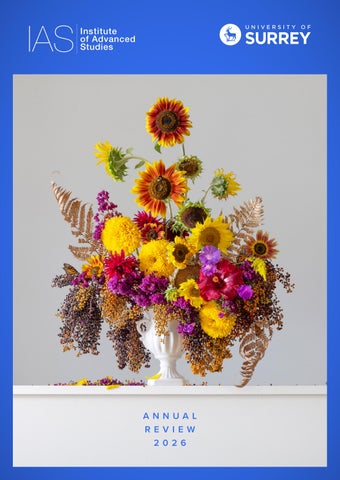
ANNUAL REVIEW 2026
Contents
Contents Key stats 2025-26
4
About the Institute
22
Shaona Barik
6
Welcome
24
Anastasia Tzirides
7
Advisory Board 2025-26
25
Chaithra Puttaswamy
26
Oyetunde Oyeyemi
27
Steven Ongena
ias.surrey.ac.uk
Workshops
02
Fellowships
3
8
Flower power
28
Anthony Halog
10
Reduction (f)or reproduction
30
Bryan Khan
11
Social isolation, discrimination and accessing care
31
Mohammed Elsadek
32
Hengyun Li
33
Marta Prandelli
34
Juraj Majcin
36
Artist-in-residence: Katrina Porteous
12
Coping with parental brain injuries
13
Active futures
14
Preparing for the new space age
15
Spotlight on a speaker: Emma Bass
16
Making and breaking sustainability habits
38
Workshop outcomes
18
Local action, global impact
40
Fellowship outcomes
19
Electrochemistry for a sustainable future
42
IAS Fellows 2026–27
20
Humans and machines in conversation
44
Advisory Board 2026–27
45
Competition 2026–27
Front cover image: Emma Bass, The Floral Effect Project (see pages 8–9)
Key Stats 2025-26
Key Stats 2025-26
ATTENDEES
WORKSHOPS
New Zealand Australia
India
Finland Croatia Czech Republic Denmark UK Belgium Ireland Brazil
Canada USA
Slovenia Slovakia Israel Poland Hungary Germany Switzerland Austria France Netherlands Italy Portugal Spain
COUNTRIES TALKS AND WORKSHOPS FELLOWSHIPS
COUNTRIES
345
10
10
22
12
26 WORKSHOPS
FELLOWSHIPS
Australia
China
India
Belgium UK
Ireland
Trinidad and Tobago
USA
IAS Annual Review 2026
Switzerland
Nigeria
03
About the Institute
About the Institute ias.surrey.ac.uk
Since its inception in 2004, the Institute of Advanced Studies (IAS) has brought people together to explore interdisciplinary research that tackles today’s global challenges. Each year, international scholars, artists, entrepreneurs and public servants visit Surrey as IAS Fellows or to attend workshops, to focus on pioneering research in science, engineering, social science and the humanities. These events and visits have resulted in many research grants, new collaborations, journal articles and books, as well as many happy memories of their time in Surrey. We thank the University of Surrey for its continued support in helping us build a richer research culture with scholars from around the world. The Institute is a member of the UK Consortium of Institutes of Advanced Study and the international Consortium of Humanities Centers and Institutes.
Nigel Gilbert DIRECTOR
Nigel Gilbert has a Distinguished Chair in Computational Social Science at the University of Surrey. He read for a first degree in engineering and obtained his doctorate on the sociology of scientific knowledge from the University of Cambridge. His main research interests are processual theories of social phenomena, the development of computational sociology, and the methodology of computer simulation, especially agent-based modelling. As Director of the University’s Institute of Advanced Studies, he is responsible for its development as a centre for international intellectual interchange.
n.gilbert@surrey.ac.uk
Mirela Dumić
COORDINATOR Mirela is responsible for the overall management of the Institute, including its annual grant competition and the Fellowship scheme. She supports the IAS Director in strategic activities and liaises with the Institute’s Advisory Board, the University’s academic community, external Fellows and similar institutes in the UK and abroad. She is also responsible for the Institute’s publicity and dissemination of outcomes from events and Fellowships.
m.dumic@surrey.ac.uk
Louise Jones
ias.surrey.ac.uk
ADMINISTRATOR
04
Louise provides general administrative support to the Institute with a particular focus on the workshops that run each year following the annual grant competition. She is the main point of contact for workshop organisers and their administrators, providing support and assistance as required. Louise is also a school administrator for the School of Social Sciences and is the primary point of contact for Sociology.
l.jones@surrey.ac.uk
About the Institute
We thank the University of Surrey for its continued support in helping us build a richer research culture with scholars from around the world.
IAS Annual Review 2026 05
Welcome
Welcome To the IAS Annual Review 2026
Our Fellowships and workshops are at the heart of the Institute and this review reflects the breadth and value of the work they have produced. As always, there are some common themes – this year, sustainability, health and the applications of AI.
ias.surrey.ac.uk
Professor Nigel Gilbert
06
The past year at the Institute has once again shown how bringing together researchers and practitioners from different disciplines, institutions and countries can lead to collaborations that challenge established assumptions and develop new approaches to important research questions. Our Fellowships and workshops are at the heart of the Institute and this review reflects the breadth and value of the work they have produced. As always, there are some common themes – this year, sustainability, health and the applications of AI. These took many forms. For example, one workshop brought together interdisciplinary participants to discuss how humans respond to flowers and their effects on emotion, behaviour and wellbeing. Another explored the challenges of sleeping for those travelling in space. One of our Fellows focused on the psychological benefits of urban parks and street trees and how these can influence policy. And another Fellow explored how Generative AI can be used effectively in hotel marketing. This year we welcomed a record 12 Fellows to the Institute. They came from across the globe – India, Nigeria, China and Australia were only some of the countries represented. The value of these visits extends beyond their time at the University. Our Fellows have contributed to seminars and discussions, while their collaborations with hosts have led to joint publications, research proposals and wider networking opportunities. Almost as importantly, our Fellows have sparked informal conversations and unexpected connections that conventional research structures may miss out on. Throughout the year, Surrey PhD students have benefited from working alongside our Fellows, getting involved in discussions and activities that have furthered their own research interests. Thank you to all our Fellows, partners and colleagues who have been part of IAS this past year. The IAS team (Mirela, Louise and myself) are very grateful to you for sharing your knowledge and enthusiasm. This Annual Review celebrates the partnerships, research and future possibilities of the past year. It reflects the energy and ambition that characterise our Institute and shows how bringing people together across disciplinary and geographical boundaries can enrich research and create lasting opportunities for collaboration. Professor Nigel Gilbert, IAS Director
Advisory Board 2025-26
Advisory Board 2025-26 The IAS Advisory Board’s members are senior members of the University faculty, including the Associate Deans of Research and Innovation from the three faculties, two Surrey Future Fellows and an external member. The Institute’s Advisory Board advises on the strategy of the Institute and reviews and recommends which bids should be funded in the annual competition.
University faculty
EMILY CORRIGAN-KAVANAGH
DERK-JAN DIJK
MARIALAURA DI DOMENICO
Surrey Future Fellow in Faculty of Engineering and Physical Sciences
Professor of Sleep and Physiology
Professor of Entrepreneurship, Work and Organization
DEBORAH DUNN-WALTERS
PROFESSOR NOPHAR GEIFMAN
NIGEL GILBERT
Professor of Immunology (Associate Dean Research and Innovation, Faculty of Health and Medical Sciences)
Professor of Health and Biomedical Informatics
Professor of Sociology (IAS Director)
JOSEF KITTLER
CATHERINE MCNAMARA
GLENN PARRY
Professor of Machine Intelligence
Head of Guildford School of Acting (GSA)
Professor of Digital Transformation (Associate Dean Research and Innovation, FABSS)
JUSTIN READ
EMMA TAYLOR
JIN XUAN
Professor of Astrophysics
Surrey Future Fellow in Faculty of Health and Medical Sciences
Professor of Sustainable Processes (Associate Dean, Research and Innovation, FEPS)
External Member
Academic and Technical Consultant
IAS Annual Review 2026
PROFESSOR RAO BHAMIDIMARRI
07
Workshops
Health and wellbeing for all… wherever you are Emerging issues across health and wellbeing were explored in six of our workshops. These multidisciplinary workshops brought together diverse perspectives and expertise that considered the wider social, psychological and environmental factors that influence people’s health both on Earth and in space.
Flower power How people perceive, experience and respond to flowers The organisers
Dr Heber Rodrigues (School of Psychology), Professor Monique Raats (School of Psychology), Professor Lada Timotijevic (School of Psychology) and Dr Jill Timms (School of Social Sciences)
Flowers hold unique significance as biological, aesthetic and cultural artefacts that shape many aspects of our lives. They are central to art, wellbeing, ritual and environmental sustainability, and various academic disciplines contribute a range of important perspectives to their analysis. Yet they remain scientifically underexplored within a shared framework.
ias.surrey.ac.uk
Exploring flowers as multisensory experiences
08
Not only was this a fascinating learning experience that challenged each of us to stretch our usual disciplinary frames, but it also allowed us to find new points of connection and different perspectives on our own research. Our plan now is for a future where we can be designing truly transdisciplinary research together. Dr Jill Timms
Dr Heber Rodrigues, Professor Monique Raats and Professor Lada Timotijevic, from our School of Psychology, and Dr Jill Timms, from our School of Social Sciences (Sociology), brought together an international and multidisciplinary community including researchers, practitioners, healthcare professionals and artists to address this gap. The Research on Humans’ Response to Flowers workshop looked to explore the many ways flowers shape the human experience. Jill says: “My research on floriculture started over two decades ago, originally focused on the rights of workers in flower supply chains and the environmental impacts of the industry. However, as a sociologist I have become fascinated by how unique flowers are, for example as a consumer product – needing to get from field to vase within hours, or as part of worship in so many faiths worldwide.” She adds: “Exploring our response to flowers is vital to understanding so many aspects of humanity and our interaction with nature.” The workshop aimed to launch a new multidisciplinary research network exploring human responses to flowers, while fostering collaboration, supporting
early career researchers and encouraging international participation. This approach reflected the recognition that floral experience can’t be understood through a single discipline or methodology.
scent, texture and context. Flowers were discussed as important carriers of identity and memory, particularly in cultural rituals and celebrations. Floral scent emerged as a particularly important yet under-researched issue.
It was agreed that to understand flowers properly, attention should be drawn to their biological and ecological characteristics, as well as the sensory experience, cultural meaning, aesthetics, food and flavour, design, environmental sustainability and the social contexts in which flowers are grown, exchanged and encountered.
The third theme focused on flowers, wellbeing and sustainable futures. Discussions highlighted evidence that flowers can contribute to mood, stress reduction, social connection and quality of life in various settings. Edible flowers provided another interdisciplinary connection, linking horticulture, sensory science, nutrition, consumer research and health.
The workshop attendees identified several emerging themes. Firstly, the opportunity to build a more integrated science of flowers, bringing together the fragmented knowledge across disciplines. This will enable researchers to develop shared concepts, terminology and methodologies. It was also concluded that stronger research infrastructure, such as evidence mapping and combining laboratory studies with field research, was required. Secondly, the complexity of human responses to flowers. Participants explored flowers as multisensory experiences, involving colour, form,
Jill reflects, “I would have to say the highlight was the time we spent at a flower farm in the Surrey Hills. Not only did we learn about the sustainable growing methods for seasonal flowers – a great example of how the industry needs to transform its carbon footprint and impact on communities – but we were able to slow down and have conversations wandering amongst the flowers together literally until the sun set.” The workshop, Jill says, “started something special.” Connections are now being built to create a global network of academics working on flowers in different disciplines. This will enable knowledge sharing and collaboration on future projects. Jill adds: “We already have plans to apply for funding to establish this, to run subsequent events to achieve our aims, to continue the friendships that have begun and importantly, to support early career researchers in this ‘growing field’ – if you’ll forgive the pun!”
IAS Annual Review 2026
Attendees at Plantpasssion, a flower farm in the Surrey Hills
Participants considered floriculture supply chains and sustainable cultivation, emphasising the need to understand the benefits of flowers alongside the environmental implications of their production and use. This workshop therefore positioned floral research within wider conversations about sustainable horticulture, environmental responsibility and human wellbeing.
09
Workshops
Reduction (f)or reproduction The effects of weight-loss medication on reproductive health 21–22 May 2026
The organisers
• It was agreed that more research and support for those
The participants
• More evidence is needed about maternal, foetal
Dr Kathryn Hart (School of Bioscience), Professor Jill Shawe (University of Plymouth) and Professor Roland Devlieger (KU Leuven, Belgium)
International experts working in the fields of conception care, fertility, obstetrics nutrition and pharmacy.
The challenge
Infertility and complications in pregnancy are increased by obesity. New surgical and pharmaceutical weight-loss procedures produce effective results, but the effects on reproductive health are unclear. Identifying the gaps in knowledge and the related research priorities are essential to improving patient-centred care and multi-generational wellbeing.
Talking points
• How we can collate and use existing data better and
the steps required to standardise this data and increase population coverage were considered.
on weight-loss medication is required specifically when they stop the medications pre-pregnancy. Both weight regain and poor glycaemic control may affect fertility and maternal and foetal health. and infant nutritional status during and after exposure to weight-loss medications.
Next steps
• The network will be expanded to fully represent the field and stakeholders, alongside a regular online meeting schedule.
• A standardised collection of routine data
across a wider geographical and clinical area will be coordinated.
• New publications focused on specific groups and outcomes will be developed.
• There will be presentations at targeted events to promote the group’s work.
• It was noted that many healthcare professionals lack
knowledge and confidence when it comes to medical weight-loss procedures and the relationship with conception, pregnancy and lactation. Therefore, practical guides for using weight-loss medications focusing on these areas are in demand.
• Participants discussed the challenges of researching medical
ias.surrey.ac.uk
weight-loss approaches during lactation and the complexity of designing a study to explore the knowledge gaps.
10
A very useful workshop for discussing what is known, the gaps, and planning for future research in this area. The networking helped with generating realistic ideas for moving forward. Delegate feedback
Workshops
Social isolation, discrimination and accessing care Responding to the needs of older LGBTQIA+ people 2 July 2026
The organisers
Dr Richard Green (School of Health Sciences and Surrey Institute for People-Centred AI), Dr Milton Crenitte (University of São Paulo), Dr Sarah Combes (School of Health Sciences), Dr Ashok Jammigumpula (Manipal Academy of Higher Education) and Dr Frances Sanders (University of Surrey)
The participants
International researchers, health and social care practitioners and LGBTQIA+ community representatives.
The challenge
Older LGBTQIA+ adults represent a growing and diverse group whose needs may differ from those of their younger counterparts. These challenges include social isolation, mental health inequalities, discrimination and barriers to accessing care. Drawing on international perspectives, this workshop explored how these distinct needs are defined and measured across different national and cultural contexts, and identified gaps in research, policy and practice.
Talking points
• It was noted that chosen (rather than biological)
family and non-biological carers should be recognised, while considering the legal and cultural context.
• Data collection is challenging since standardised
categories reflect Western definitions of identity. By opening self-description, one may get better data but it makes comparison more difficult. In addition, participants considered how country-specific legal and administrative barriers that are affected by the lack of basic identity recognition restrict access to healthcare, welfare and pensions.
• Increasing policy rollbacks in some countries were
discussed, while also stressing that experiences vary widely across legal and cultural contexts. Participants emphasised the need to address structural and political influences on wellbeing, strengthen international collaboration and improve ongoing LGBTQIA+ education and training across healthcare.
• The cumulative impact of minority stress underpins the need for mental health support that is designed with and for older LGBTQIA+ people, not just made more accessible to them.
• There was a call for research and action that better
addresses the diverse needs of older LGBTQIA+ people while recognising both barriers and sources of resilience, using community-led, inclusive and innovative approaches.
Next steps
• The workshop has informed a current piece
of ongoing work which is reporting on existing evidence concerning the needs of older LGBTQIA+ people, to be published in 2027.
Delegate feedback
IAS Annual Review 2026
The presentations and workshop discussion showed a shared appetite to advance research, advocacy and community engagement in relation to the needs of older LGBTQIA+ people.
11
Workshops
Coping with parental brain injuries Delivering effective support for affected families 24 July 2026
The organisers
Dr Hannah Frith (School of Psychology), Dr Sara da Silva Ramos (Brainkind), Dr Freddie Byrne (Living with ABI Ltd) and Professor Charlotte Whiffin (University of Derby)
The participants
Next steps
• A network of multidisciplinary researchers,
health and social care professionals, community organisations and experts by experience will be established to support the wellbeing of children and young people affected by ABI.
Thirty-eight participants attended, including researchers, professionals working in neuro-rehabilitation (such as nurses, occupational therapists, psychologists and social workers) and those with lived experience.
• A lived-experience commentary on the workshop
The challenge
• Images from an artist’s live scribing during the
The leading cause of death and disability among those aged under 40 in the UK is acquired brain injury (ABI). Not only can this be life-altering for the injured person, but it also has a huge impact on the lives of family members, including children and young people. Stress, anxiety, grief – the impact can lead to mental health difficulties, poor school performance and trouble with social relationships. This workshop explored the challenges of developing and delivering effective support for affected families.
and its key themes is to be developed to support future funding applications and publicity. workshop will be generated to capture the key messages and shared to raise visibility.
• The workshop’s messages will be shared with the
Neurorehabilitation Times to reach multidisciplinary professionals.
• A grant application to the NIHR Research for Social Care programme is to be submitted.
Talking points
• Participants discussed what the key challenges
experienced by children and young people and their families are. What barriers are there in delivering the right support? What existing practices are working? And what are the priorities and opportunities for developing practical strategies and enhancing the existing research evidence-base?
• It was recognised that a parent’s brain injury can have
both immediate and long-term effects on children and young people. It can influence education, employment, relationships and wellbeing into adulthood. Support, however, is inconsistent and fragmented.
• Upskilling services and practitioners may help integrate child-focused care into existing healthcare pathways and services.
• Participants agreed that high-quality and easily accessible
ias.surrey.ac.uk
resources are required to help children understand and cope with parental brain injury, and acknowledged that at present support varies considerably by location.
12
• It was clear from the workshop that further research
is needed to develop effective approaches to support affected families. Close collaboration between practitioners, researchers, third-sector organisations, policymakers and those with lived experience is required.
The content of each of the presentations was motivating and accessible, however, what was most valuable for me were the discussions in small groups around the challenges and the opportunities in working with a family system around ABI; and the possibility of beginning even in a very small way. Delegate feedback
Workshops
Active futures How youth clubs and sport can help marginalised young people 28 July 2026
The organisers
Dr Hannah Hammond (School of Psychology)
The participants
Academics, young co-researchers, practitioners, third sector organisations and statutory partners.
The challenge
How do we support young people from marginalised communities to abstain from crime? Can sport-based positive youth development programmes improve health and prevent criminal behaviour? And how do we build successful and sustainable programmes? This workshop focused on how best to encourage young people from different backgrounds to engage with sport-based programmes, influencing their wellbeing and pathways away from offending.
Talking points
• Participants agreed that safe, consistent relationships based on trust build engagement and sustained participation.
• Discussions were had about how keeping sport fun helps
build autonomy, identity and confidence among participants and is key to long-term engagement.
• It was recognised that youth development programmes
must reflect the local context and be co-designed with communities, while also being responsive to practical barriers such as cost, travel time and other responsibilities.
• Attendees discussed how important a skilled and supported
coaching workforce is to building relationships with young people and delivering sustainable and impactful programmes.
• It was agreed that clearer pathways, better collaboration
Next steps
• Strengthened connections between local
government, sport-for-development organisations, national governing bodies and community sport organisations are planned.
• A webinar will be hosted to share workshop
findings and present the developing research and impact agenda. Future priorities and research collaborations will be informed by insights from this webinar.
• A peer-reviewed article on youth sport, youth clubs, health and justice outcomes will be submitted.
and stronger follow-ups are needed to keep young people engaged in the programmes.
The Active Futures Workshop identified a clear national need and brought a cross-discipline approach to finding a solution. IAS Annual Review 2026
Delegate feedback
13
Workshops
Preparing for the new space age Sleep and health in space 24 July 2026
The organisers
Professor Simon Archer, Professor Steven Lockley and Professor Derk-Jan Dijk (Surrey Sleep Research Centre)
The participants
Participants represented ten organisations from academia, government, and public and private space agencies.
The challenge
As space tourism and longer space missions become more common, people will spend extended periods of time in challenging environments such as low gravity, isolation and unusual light–dark cycles. These conditions can disrupt sleep, body rhythms and mental and physical health. We do not fully understand these effects or how best to manage them, especially for non-professional astronauts. This workshop aimed to develop a roadmap for effective training, technologies and treatments to prevent and manage sleep and circadian disruption during space travel.
Next steps
• An industry white paper is planned, translating the
workshop’s insights into a roadmap to identify future key research and policy areas to inform human long-duration space flight and space ‘tourism’.
• There have been initial meetings to discuss
closer collaboration with other UK academics and government representatives. One potential outcome discussed could be the formation of a new research and policy organisation focusing on the interests of the UK Space Biology community.
• As a result of the workshop, discussions
are ongoing between academia, industry and government.
Talking points
• Participants considered the challenges of unusual light–
dark cycles, microgravity, noise, temperature, confinement and the disruption of sleep and circadian rhythms, and their implications for performance, crew safety and wider physiological functions.
• It was noted that although some research does exist,
the latest evidence on lighting, sleep, circadian modelling, hypoxia and brain function has not been fully integrated into training and operational standards.
• Participants discussed the requirements and provision
of psychological and physical training necessary for space travel. They broadly agreed that training standards should be established and formalised, and delivered by academic or industry groups, or at a central UK hub for space-related training and education.
ias.surrey.ac.uk
• The workshop highlighted the debate around terms
14
such as ‘space tourist’, which may understate the training and risks involved. The terms ‘astronaut’ or ‘pioneer’ may be considered more appropriate.
It was a valuable opportunity to connect sleep and circadian science with the operational and translational challenges of future spaceflight … it was a real honour to meet people with such extensive experience in their fields. Dr Nina Rzechorzek MRC Clinician Scientist, Cambridge
Workshops
Spotlight on a speaker with Emma Bass, floral artist
New Zealand-based artist Emma Bass is a co-collaborator on The Floral Effect Project – design-led research into the psychosocial impacts of floral art in care environments. Emma spoke about the project at our ‘Research on Humans’ Response to Flowers’ workshop in June 2026 (see pages 8–9). We asked Emma about her work and how it has been influenced by the workshop.
What did you find most interesting or useful about your participation in the workshop? Will it influence your future work and, if so, how? The most interesting aspect of the workshop was being exposed to the varied scholars involved in aspects of the same questions, yet never having occupied the same room. There were people present who had spent decades studying the biochemistry of why roses smell the way they do sharing the room with floral artists and those with a distinctly entrepreneurial emphasis. I returned to Auckland with a much clearer sense of where design-led research fits within the broader scientific conversation, and a stronger conviction that the specific decisions we make about floral photography in clinical spaces, such as species, colour, scale and placement, are real questions worth pursuing rigorously.
How do your decisions about flower choice, colour and scale affect the experience of people encountering your work in clinical spaces? Do you adapt your choices according to the space? Emma’s artwork ‘Poppies’ in situ at the maternal health ward at Auckland City Hospital
Absolutely, and this is at the heart of what we intend to research. Until recently, intuition has driven these decisions, and it is a reliable intuition too. Certain flowers, however, carry associations that matter in specific contexts. Others feel too formal, too celebratory or too fragile. How and why do we know this to be the case, why do certain colour combinations or degrees of complexity and scale produce differentiated effects? The workshop reinforced that these questions are not only individual aesthetic preferences but design decisions with potentially measurable effects.
What have you learnt from the responses of patients, families and clinical staff to your work?
The effects of flowers on people are real, consistent and patterned, yet they often go unspoken because people don’t have the language or platform for this. Part of what drives The Floral Effect Project is the desire to give those moments more enduring impact and reach, so that what happens intuitively in practice can be understood, shared and built upon to improve environments and human wellbeing. Emma’s artwork ‘Primavera’ in situ at Auckland City Hospital
IAS Annual Review 2026
Over 15 years of placing work in clinical environments, the responses that have stayed with me most are the ones nobody planned for – a woman with stage four cancer, in her final chemotherapy session, who sat with one of my works in the waiting room and told me it gave her hope in her darkest hour.
15
Workshops
Collaborating for a sustainable future As the climate crisis continues to have an undeniable impact on our lives, research and collaboration is essential to developing strategies and solutions to tackle the issue. We hosted three workshops this year that covered various sustainability themes, exploring achievable solutions for a greener future.
Making and breaking sustainability habits Applying behavioural insights to encourage sustainable tourist behaviour 29 April 2026
ias.surrey.ac.uk
As an early career researcher, the most valuable part of the workshop was seeing directly how my research can translate into real change in industry, and through that contribute to environmental outcomes that matter.
16
Safina Naz, PhD researcher, University of Surrey
The organisers
Dr Marion Karl, Professor Benjamin Gardner, Professor Xavier Font, Dr Pablo Pereira Doel, Dr Philippa Lally and Sofie Voss (Surrey Hospitality and Tourism Management and the School of Psychology)
The participants
The workshop brought together academics specialising in tourism and psychology alongside representatives from 20 organisations spanning hotels, tour operators, certification bodies, sustainability consultancies and technology providers.
The challenge
Tourism and hospitality businesses invest significantly in sustainability initiatives, yet behaviour change is often limited because guests and staff act through habits and routines rather than conscious decisions. The workshop considered opportunities to apply behaviour change and habit theories to design interventions that encourage lasting sustainable practices.
as part of a wider system of cues, routines and defaults. Mapping behaviours and their context helped replace broad aims like ‘save energy’ with specific behaviours that could be identified and improved.
• Practical ideas to make sustainable behaviours the easy,
everyday choice and discourage less sustainable ones were discussed. The strongest ideas focused on changing the environment, defaults, prompts and routines that shape behaviour, rather than expecting guests or staff to be more motivated.
• These ideas were translated into practical experiments,
applying a structured framework in small-scale, real-world settings and assessing factors such as feasibility, cost, acceptability and unintended effects, so that they could identify what works before scaling up.
Talking points
• Participants discussed the sustainability behaviours
they most wanted to change, noting that many guests deliberately behave differently on holiday, treating it as a break from normal routine and habits. Sustainability may be considered a burden attached to ‘real’ work.
• What counts as ‘sustainable’ across brands and standards is not consistent.
• Many interventions rely on information, signage, awareness
• Professor Benjamin Gardner’s presentation on habit theory explored how sustainability behaviour is best understood
• An industry white paper translating the workshop’s
insights into practical guidance that can be applied by tourism and hospitality organisations.
• An academic publication on habit theory in tourism to be submitted to Annals of Tourism Research.
• Further collaboration between academia and the
sector to co-design and test pilots in the real world, based on the behaviour challenges identified at the workshop.
IAS Annual Review 2026
campaigns or appeal to motivation. These do little when the target behaviour is automatic, fast or embedded in a busy operation. Guests and staff may fully intend to act sustainably yet revert to familiar routines whenever the environment makes the unsustainable option easier, quicker or more obvious.
Next steps
17
Workshops
Local action, global impact Exploring a way towards decentralised environmental governance
At a time when climate and environmental challenges increasingly require coordinated action across levels of government, this workshop provided a unique platform to bridge research, policy and practice.
16 June 2026
Delegate feedback
The organisers
Professor Sarmistha Pal (Surrey Business School) and Jean-Paul Faguet (London School of Economics)
The participants
Academics and practitioners with backgrounds in economics, development studies, political science, environmental policy and the design of decentralised governance frameworks.
The challenge
ias.surrey.ac.uk
With the worsening environmental crisis, environmental governance is key to how societies respond. How can decentralised environmental governance translate global climate ambitions into effective local action? By exploring the complex relationship between national governments and subnational authorities, this workshop highlighted the need for stronger multilevel governance and coordination between national and local governments in shaping climate and environmental outcomes.
18
Talking points
• Fiscal autonomy for local governments was discussed, including greater own-source revenue, better access to climate finance and the importance of expanding local environmental expenditure to strengthen conservation efforts.
• A presentation about a Nepalese community forestry
study showed that empowering local communities through participation in forest governance and community ownership supported effective conservation and resource management.
• Improved monitoring, enforcement and compliance makes environmental enforcement more effective. Evidence from Brazil suggests that environmental sanctions can reduce deforestation, encourage forest restoration and generate positive effects on neighbouring landowners.
• Incentive-based conservation approaches were proposed, linking property rights to conservation performance, creating outcomes where conservation also improves local livelihoods.
• Technology to improve environmental monitoring alongside evidence-based evaluation were highlighted as crucial to an integrated approach.
Next steps
• A journal special issue for World Development,
compiling the workshop presentations alongside invited papers, is planned.
Workshops
Electrochemistry for a sustainable future New approaches to resource recovery and environmental protection 15–16 June 2026
The organisers
Dr Daniel Commandeur and Dr Hui Luo, co-chairs of the Surrey Electrochemistry Network
The participants
Around 60 participants, including academics and postgraduate researchers from the disciplines of chemistry, biology, engineering and materials science.
The challenge
As we transition to a more sustainable future, electrochemistry is emerging as one of the crucial technologies in providing practical solutions to the environmental and technological challenges we face. Its applications include carbon capture, green hydrogen production, healthcare diagnostics and robotics. What are the challenges and opportunities arising from the latest scientific advances in this rapidly evolving field?
Talking points
• Electrochemical technologies for environmental monitoring, healthcare and water treatment are moving beyond the laboratory and into real-world applications. This includes biomarker technologies for early detection of ovarian cancer, and pathogen detection in clinical and environmental settings.
I particularly enjoyed the broad range of electrochemistry topics represented at the workshop … It was especially encouraging to see such strong participation from early career researchers, which created a vibrant and collaborative atmosphere. Dr Mengnan Wang, Exeter University
Next steps
• Two review papers in collaboration with the Surrey Electrochemistry Network and the speakers of the conference, bringing together the themes from the workshop are being assembled.
• Several smaller, targeted working groups
to develop a future grant proposal, with the potential themes of electrosynthesis and water treatment are being formed.
• Bids with new academic collaborators and industrial partners were proposed.
• Participants heard how microbial fuel cells can be used to treat wastewater to generate renewable electricity and improve sanitation.
• New sodium-ion battery materials, innovative recycling
methods and multifunctional electrochemical capacitors were discussed, highlighting ways towards more efficient, circular and sustainable energy storage.
• The final session of the workshop demonstrated how
electrochemistry is enabling cleaner chemical manufacturing and green hydrogen production through recyclable catalysts and renewable electricity. IAS Annual Review 2026 19
Workshops
Humans and machines in conversation Investigating the human dimensions of conversational AI
It was amazing being able to speak to experts across disciplines, and to be able to see how human-centric approaches are being applied to AI and language technology. I plan to apply much of what I learned about pragmatics and HRI into my future studies. Delegate feedback
As generative AI and large language models are rapidly transforming how humans interact with technology, how do we design language technologies to better understand and support the people who use them? The Humans and Machines in Conversation (HUMIC) workshop proved a timely opportunity to focus on the human dimensions of systems such as chatbots, voice assistants and conversational agents through linguistic, social and relational perspectives.
ias.surrey.ac.uk
Organised by Surrey’s Dr Doris Dippold, the workshop brought together experts from a range of academic disciplines – such as linguistics, psychology, marketing and computer sciences – and industry to discuss how humans and machines talk to each other. The workshop also considered how conversational AI tools such as chatbots can be developed to be ethical, accessible and trustworthy. Doris says, “The main challenge is to make human– machine conversations more empathetic and less robotic, but without making them deceptively human. In the next few
20
years, more of the everyday interactions we now have with public services, health services and in the commercial world will be taken over by machines, such as chatbots and voice assistants. But many of these interactions are not neutral transactions for people; in fact, they can be very emotionally loaded. The trick will be to encode these machines with empathy while making sure that they don’t replace the human touch – and for people to always know they are interacting with machines.”
The highlight of the workshop generally was just to bring people from so many different disciplines, as well as practitioners together. So often we work in disciplinary silos that don’t speak to each other, because our terminological toolset is just so different. But during the workshop, there were a lot of moments where I thought, ‘Oh, this presenter is actually talking about the same issue that I am also interested in, just with different words. med by Vice-Chancellor, Participants were welco Professor Stephen Jarvis
these features help maintain meaningful information about uncertainty and social relationships. Keeping these details can help conversational systems respond more naturally, especially where trust and effective communication are essential. Questions of identity, fairness and inclusion were raised, and how many existing conversational AI systems favour dominant languages and standard styles of speech, which could exclude or misrepresent large groups of people. Participants of the workshop agreed that building fair and trustworthy AI requires greater linguistic diversity within datasets as well as meaningful engagement with the communities these technologies are designed to serve. Addressing bias is not simply a technical challenge but a social responsibility. Fundamentally, HUMIC emphasised the central role of language in these interactions if they are to be ethical and empathetic. The workshop demonstrated that any technical choices must be underpinned by research on language and social interaction and an understanding of human communication. Technologies should be designed that respond to people as individuals rather than assuming an ‘average’ user. The overwhelmingly positive feedback from participants reflected the success of this approach. Every survey respondent agreed that the workshop met their expectations, with many highlighting the value of engaging with experts from different disciplines and sectors. Looking to the future, Doris said, “I am tentatively thinking about HUMIC 2! After the workshop, I hosted another on campus – Convoclub IRL. This second workshop shifted the emphasis even more from research to practice, as it was a convention for conversation designers. In HUMIC 2, I hope to merge the two workshops into one to bring the academic and practitioner communities even closer.”
IAS Annual Review 2026
The participants agreed that while conversational AI has made great progress, many challenges remain. Currently, the systems often struggle with the subtleties of human communication, such as interpreting intentions, recognising social cues, expressing empathy and navigating complex conversational contexts. The interdisciplinary group at the workshop shared academic and practitioner perspectives to support the development of more inclusive systems in health and public services and in educational and commercial contexts Some important themes emerged throughout the workshop’s presentations and discussions. Empathy was highlighted as a critical component of successful conversational AI, in particular in healthcare and clinical settings where interactions can have a significant impact on users’ wellbeing. Participants emphasised that truly empathetic AI requires much more than carefully generated responses. As Doris says, “AI cannot be truly empathetic. It’s a machine, and we should never forget this! But AI tools can be developed to at least simulate empathy.” Systems must be informed by authentic, context-rich data that reflect the diverse social and cognitive needs of different users. There was also a focus on how we define conversation itself when interacting with AI. As modern AI systems increasingly perform complex tasks, the traditional concept of conversation may no longer fully capture the nature of these interactions. Different users approach AI with different expectations and communication styles, highlighting the importance of understanding not only the language people use but also how they perceive their interaction with intelligent systems. Preserving the richness of conversation was discussed, so rather than simplifying spoken language by removing any hesitations or interruptions for example, retaining
Dr Doris Dippold
21
Fellowships
Victorian mesmerism and the movement of ideas, objects and people between Britain and India Dr Shaona Barik, Visva-Bharati University, India Surrey host: Dr Charlotte Mathieson, Literature and Languages
ias.surrey.ac.uk
The Victorians’ fascination with mesmerism – the belief in an invisible natural force capable of influencing and healing bodies – is not simply a cultural curiosity. It is a powerful lens through which we can understand mobility, knowledge exchange and cultural negotiation in the nineteenth century. Shaona Barik’s Fellowship at IAS looked deeply into Victorian-era mesmerism as a cross-cultural exchange between Britain and India, shaping the movement of people and goods, and how these were entangled with questions of race, class and gender.
22
Shaona explains that the Victorians’ fascination with mesmerism stemmed in part from its perceived medical benefits. “It promised to offer alternative forms of cure and claimed to have healing potential. Before the invention of chloroform or proper knowledge about the techniques of its application, mesmerism was often deployed by doctors to perform painless surgeries.” The practice intersected with spiritualism, séances and planchette practices that promised communication with the dead. In an era marked by religious uncertainty and the intellectual debates brought about by evolutionary theory, such practices offered alternative ways of understanding life and death. A key contribution of Dr Barik’s Fellowship has been to trace how these practices travelled between Britain and India. Her work reveals how mesmerism facilitated not only the movement of ideas but also of objects, texts and people, often mediated through elite social spaces where British and Indian participants engaged in shared occult practices. This transnational perspective was brought vividly to life through a series of activities during her Fellowship. Shaona organised two workshops at Surrey that combined research-led discussion with innovative forms of engagement. The first took the form of a curated mini-exhibition, originally developed at Visva-Bharati University. Featuring artefacts
the Being Shaona’s exhibition at Gallery tts Wa at l Human Festiva
such as multilingual planchette boards and printed materials from spiritualist organisations, the exhibition demonstrated the material culture of mesmerism and highlighted the role of print in sustaining India–Britain connections. The second workshop explored literary representations of mesmerism, fostering interdisciplinary discussions between staff, postgraduate researchers and students. In addition to these events, Shaona delivered a research talk on ‘Mesmerism in Colonial Bengal (1860–1940)’, presented case studies of séances, healing practices and performances, and contributed to undergraduate teaching. Her participation in classes on Victorian literature, including discussions of Cranford and The Moonstone, enabled a productive exchange of pedagogical approaches between the UK and India. These experiences have already begun to inform her teaching practice at Visva-Bharati, particularly in incorporating more global and comparative perspectives into literary studies. Shaona also played an active role in public engagement. Working with colleagues in Literature and Languages, she helped prepare materials for the Being Human Festival, ‘Between Realms: Material and Spiritual’, held at Watts Gallery. The exhibition highlighted the interconnected histories of mesmerism and spiritualism across continents, contributing to ongoing conversations about the decolonisation of museum
Shaona visiting Cambridge
A planchette board, used by the Victorians to enable automatic writing, in the hope of ‘talking to the dead’
The occult was often used as an essential tool to voice resilience, question normative ideas and express repressed desires, so the occult will never lose its importance. Dr Shaona Barik
IAS Annual Review 2026
spaces. Shaona says, “Museum spaces need to be perceived in such light where the dominance of Western knowledge needs to be questioned.” During her Fellowship, Shaona consulted collections at major institutions including the British Library, the Wellcome Collection and the Centre for South Asian Studies in Cambridge. She also explored the archives at Marsh’s Library and Trinity College, Dublin. These visits have been instrumental in advancing her forthcoming book on European encounters with the occult in colonial India, as well as gathering materials to enhance her exhibition at Watts Gallery. In addition, the visit to Ireland provided opportunities to explore future fellowships, develop ideas for public heritage outreach inspired by the Irish Famine Trail, and gain insights into the responses towards theosophy through the Dublin Theosophical Society. Her Fellowship has also generated further collaborations. Institutional links between the University of Surrey and Visva-Bharati University have been strengthened, with plans for joint publications, funding applications and future events already underway. These include a collaborative workshop with Charlotte on the broader theme of the mobilities of occult objects between India and England in the nineteenth century, and Shaona will be editing a book about Jane Austen and other women authors, based on an online conference held in partnership with the University of Surrey in November 2025. Reflecting on her experience, Shaona says, “Collaboration with the faculty members at the University of Surrey opened new possibilities and helped me to devise new teaching methods at my institutions.”
23
Fellowships
Using GenAI in learning design Exploring a way towards decentralised environmental governance 16 June 2026 Dr Anastasia Tzirides, University of Illinois, USA Surrey host: Dr Vily Papageorgiou, Surrey Institute of Education Generative AI (GenAI) is an evolving technology that could, with appropriate guidance, transform educational practices in higher education. But universities have so far been focusing on student-centred guidance for the ethical use of GenAI, and less on how academic staff can use it to support learning design practices. Building on a prior collaboration with the Surrey Institute of Education’s Dr Vily Papageorgiou, Anastasia’s Fellowship brought together expertise in learning design, AI literacy and human-centred AI to explore how GenAI can address this gap and enhance teaching practices while supporting transparency, ethics and educational quality. A major feature of the Fellowship was the delivery of a research seminar and a series of research activities that engaged academic staff and postgraduate researchers from across the University. Anastasia delivered a seminar introducing participants to current developments in AI literacy learning, AI-supported feedback and human–AI collaboration, stimulating interdisciplinary discussion on the opportunities and challenges presented by GenAI in higher education. This was
Dr Anastasia Tzirides introducing the workshop
complemented by interactive workshops in which participants gained hands-on experience using the CyberScholar AI-powered learning and assessment platform. The workshops and follow-up focus groups generated great feedback on educators’ experiences of integrating AI into learning design. Participants raised concerns around questions of trust, critical thinking and transparency, and yet reported an increased confidence and understanding of the use and limitations of GenAI within higher education. These insights will inform future research. Anastasia was able to create new interdisciplinary relationships with Surrey colleagues and the wider research community, establishing a strong platform for future collaborative research, international funding opportunities and ongoing knowledge exchange between the University of Surrey and the University of Illinois. Looking ahead, the data collected through the Fellowship will be used to develop peer-reviewed journal publications, practical guidance for educators, and scholarly contributions on human-centred approaches to AI in education.
These interactions were made possible by being embedded within the University of Surrey community and provided opportunities for collaboration and knowledge exchange that would have been difficult to achieve through remote engagement alone. ias.surrey.ac.uk
Dr Anastasia Tzirides
24
Fellowships
How does grammar grow? The growth of complex predicates in Dravidian languages Dr Chaithra Puttaswamy, Indian Institute of Technology Kanpur, India Surrey host: Dr Oliver Bond, Surrey Morphology Group (SMG)
amy Dr Chaithra Puttasw Dr Oliver Bond and inar sem rch ea s during a res lead the discussion
How do grammatical systems become more complex over time? This question was at the centre of Chaithra Puttaswamy’s Fellowship, where she worked with Dr Oliver Bond and Dr David Gyorfi to investigate the evolution of complex predicates in Dravidian languages, focusing particularly on Kannada. Complex predicates are multi-word structures that behave like a single verb. The Dravidian languages of southern India are of particular interest for the extent and complexity of these systems, yet the processes that drive their evolution has not been extensively studied. Chaithra’s Fellowship therefore addressed two central questions: how do complex predicate systems evolve, and what conditions enable them to expand to such proportions? The research tested the idea that speakers recognise patterns in their language and extend them by analogy. This could help explain why Old Turkic, for example, had just four verbal complex predicates, while its modern descendent, Tuvan, has developed 33.
During her Fellowship, Chaithra selected and adapted data on Dravidian languages to include in a cross-linguistic dataset, coding the data for a typological database, and creating synchronic and diachronic models of how complex predicates evolve. These models are being compared with evidence from Turkic and Australian languages as part of their wider project, ‘Analogical growth of grammatical systems’.
The collaboration has identified two areas for future research: an exhaustive description of simple co-headed verbs in Kannada, and an analysis of stacked co-headed verbs. Research articles will be submitted to Morphology and Linguistic Typology. Beyond these tangible outputs, Chaithra’s Fellowship has established a foundation for broader comparative research across Dravidian languages, and strengthened an international collaboration aimed at understanding not simply how languages change, but how grammar itself grows.
I have gained a lot of knowledge and experience through my discussions with the experts at SMG. I was introduced to state-of-the-art analytical tools such as Multi Correspondence Analysis and its applications like the visualisation of overlapping structures. The work environment and positive approach to research in linguistics has left a lasting impression on me. Dr Chaithra Puttaswamy
IAS Annual Review 2026
Chaithra brought her specialist knowledge of Dravidian languages to the Fellowship, collaborating with her hosts’ expertise in linguistic typology. The collaboration centred particularly on Kannada co-headed verbs, including cases where several delexicalised verbs (such as ‘have’, ‘take’ and ‘do’) are stacked together to add successive layers of grammatical meaning.
Their findings and working hypotheses were presented to colleagues and researchers at Surrey Morphology Group, where feedback from attendees will be incorporated into a research paper to be presented at the International Conference of the Linguistic Society of India.
25
Fellowships
AI-driven approaches to a malaria-free world Professor Oyetunde Oyeyemi, University of Medical Sciences, Nigeria Surrey host: Dr Joaquin Prada, School of Veterinary Medicine
Malaria is the most significant parasitic disease in the tropics. Forty-seven African countries take the largest impact, with 95% of global cases and 96% of malaria-related deaths. Developing sustainable interventions and informing public health policy is critical.
ted An academic workshop, hos yemi by Professor Oyetunde Oye
The visit significantly advanced my research programme in infectious disease epidemiology and strengthened international collaborations focused on malaria, schistosomiasis and other neglected tropical diseases (NTDs) in sub-Saharan Africa.
ias.surrey.ac.uk
Professor Oyetunde Oyeyemi
26
Oyetunde’s Fellowship at IAS focused on an ambitious challenge – to develop AI-driven approaches to assess malaria interventions and identify the most effective control policies for Nigeria, the most affected country globally. While malaria remained the central focus, the collaboration with his Surrey host, Joaquin, also included looking at schistosomiasis and other neglected tropical diseases (NTDs), highlighting the potential of interdisciplinary research to tackle interconnected health problems. During the Fellowship, Oyetunde investigated epidemiological modelling frameworks capable of evaluating malaria intervention strategies in complex real-world settings. By combining AI with disease transmission models, policymakers can be provided with stronger evidence for designing targeted, cost-effective control programmes. A key aspect of the Fellowship was Oyetunde’s active collaboration with Surrey’s research community through academic workshops, seminars and conferences. This included a seminar on the multidimensional epidemiology of malaria and co-endemic infections in Nigeria, highlighting how environmental factors, co-infections and public health interventions interact to influence malaria transmission. The seminar emphasised the need for integrated, locally tailored disease-control strategies and highlighted the value of combining epidemiological research with AI-driven modelling approaches. Oyetunde also participated in the British Society for Parasitology Spring Meeting at the University of Glasgow. Here, he presented findings on improving non-invasive diagnostic tools for schistosomiasis in low-resource settings. Beyond immediate research outputs, the Fellowship established new international partnerships and laid the groundwork for future collaborative funding applications and joint publications. It has generated new knowledge and contributed to improved health outcomes in regions where infectious diseases continue to have a profound impact.
Fellowships
Community banks Advancing research and academic networks Professor Steven Ongena, University of Zurich, Switzerland Surrey host: Dr Vasileios Pappas, Accounting and Finance
Community banks offer personalised financial services and support small businesses within a small geographical area; profits are reinvested back into the community rather than distributed to shareholders. They are playing an increasingly vital role in advancing economic mobility and financial inclusion, making them a growing focus of research. Professor Steven Ongena’s Fellowship at IAS centred on advancing work in community banking, strengthening interdisciplinary research networks and enriching the academic environment for staff and students at Surrey. Working with host, Dr Vasileios Pappas, Steven further strengthened their long-term research partnership. Steven brought together staff and students from Surrey’s Accounting and Finance Department for a series of events. A round-table discussion fostered interdisciplinary debate on banking regulation and credit markets, while a research seminar on global banks’ expectations and lending behaviour sparked lively exchanges. His visit also made a lasting impression on early career researchers. Through one-to-one mentoring, PhD students gained tailored guidance on their projects and publishing strategies. Steven’s Fellowship is also shaping Surrey’s teaching offering. His insights are informing the development of new MSc Banking and Finance curriculum content, ensuring it reflects the latest academic thinking and real-world relevance.
Steven’s Fellowship has generated stronger international partnerships, a pipeline of high-quality research, and a tangible impact on both student experience and academic development, demonstrating the value of IAS’s place in advancing research and education.
A seminar for staff and students
I was genuinely impressed with the focus, breadth and dynamism of the activities I got involved with at Surrey. It energised me further to work on our shared research. Professor Steven Ongena
IAS Annual Review 2026
The Fellowship has made significant research progress. One co-authored paper has been published in the Journal of Financial Stability, with further studies nearing submission. This growing body of research is helping to deepen understanding of how community banks influence financial stability, efficiency and credit outcomes.
27
Fellowships
Smarter energy for a net-zero future: transforming green hydrogen production through AI
Dr Anthony Halog
Dr Anthony Halog, University of Queensland, Australia Surrey host: Dr Lei Xing, School of Chemistry and Chemical Engineering
ias.surrey.ac.uk
Can we harness clean and efficient energy systems to produce green hydrogen? Dr Anthony Halog’s Fellowship explored how artificial intelligence (AI) and digital tools can make green hydrogen production more efficient, affordable and sustainable. His work brought together the disciplines of engineering, environmental science, business and policy, offering a glimpse into the future of smart, circular energy systems.
28
A highlight of the Fellowship was developing the digital twin concept into something tangible and impactful. Seeing ideas come together into a coherent framework was incredibly rewarding. Dr Anthony Halog
strategies in a virtual environment, exploring different scenarios before committing resources. This could help answer critical questions such as where to build hydrogen facilities, how to design infrastructure, and how policy changes might affect costs and emissions. In this way, the project acts as a bridge between scientific innovation and real-world action. The Fellowship has already sparked new collaborations between the University of Surrey and international partners, including the University of Queensland. Plans are underway for joint research projects, funding proposals and further development of AI-driven tools for sustainable energy. The Fellowship has also contributed to Surrey’s growing reputation as a leader in digital sustainability, aligning with its strategic focus on AI, clean energy and the circular economy.
Dr Lei Xing and Dr Anthony Halog
As the world moves towards net-zero, the need for smarter, more connected energy systems is becoming increasingly urgent. AI and digital tools like digital twins could play a central role – helping us design systems that are not only efficient, but adaptable and resilient. Combined with circular economy thinking, they offer a powerful way to reduce waste, cut emissions and make better use of limited resources. Anthony sums up his Fellowship, “The Fellowship allowed me to step back, think deeply and connect with experts in new ways. Most importantly, it showed how powerful interdisciplinary work can be in solving global challenges like climate change. It’s an experience that doesn’t just advance research – it reshapes how you think about it.”
IAS Annual Review 2026
Green hydrogen is widely seen as a key player in the transition to net-zero emissions. It’s produced by splitting water into hydrogen and oxygen using renewable electricity, such as wind or solar power. Unlike fossil fuels, it generates little to no greenhouse gas emissions. But there’s a catch. Currently, producing green hydrogen is expensive and resourceintensive. It requires large amounts of electricity and water, and integrating it into existing energy systems is complex. In short, the challenge isn’t producing hydrogen, it’s making the entire system work efficiently at scale. This is where AI and circular economy thinking come in. AI can analyse data, predict demand and adjust operations in real time to improve efficiency, while circular economy principles focus on reducing waste and making better use of resources. Anthony’s interdisciplinary approach made the research far more real and impactful. He says, “Instead of looking at hydrogen purely as an engineering problem, we brought together expertise from AI, sustainability, business and policy. This meant we could ask bigger questions: Will industries adopt this? What policies are needed? How do we make it economically viable? By working across disciplines, we developed solutions that don’t just work technically but also make sense socially and economically. That’s the key to real-world impact.” One of the essential features of the project was the development of a ‘digital twin’, a simulation of a real-world hydrogen production plant. Using AI, the digital twin simulated how a hydrogen system behaves under different conditions. What happens if energy supply fluctuates? How can costs be reduced? What changes will cut emissions most effectively? These questions can be tested in the virtual model before making decisions in the real world. For Anthony, the Fellowship was as much about people as it was about technology. Through seminars, workshops and discussions, researchers from different fields came together to share ideas and challenge assumptions. He reflects, “The seminars were incredibly engaging and energising. What stood out was the diversity of the audience – engineers, business experts, sustainability researchers and early career scholars all in one room.” Anthony’s research goes far beyond academia. The digital twin model that is being developed in collaboration with researchers from Surrey has the potential to become a practical decision-making tool for industry, investors and policymakers. Instead of relying on guesswork, they can test
29
Fellowships
Who owns the sound in a room? Intellectual property and physical spaces Dr Bryan Khan, independent academic, Trinidad and Tobago Surrey host: Dr Randall Ali, Music and Media Dr Bryan Khan presenting to students and researchers
Consider how different your voice sounds in a bedroom compared to an empty church hall. Much like a fingerprint, every room has a distinct acoustic identity. These data can be captured using modern digital audio signal processing techniques and are widely used in audio technology applications such as virtual reality systems, intelligent hearing aids, video games and music production. Yet, despite their growing importance, the legal status of such data has remained largely unexamined. Bringing together their expertise in law and acoustic science, Dr Bryan Khan worked with Dr Randall Ali from Surrey’s Music and Media to explore how intellectual property law applies specifically to room impulse responses, highly detailed acoustic measurements that capture how sound behaves in a space. Through a combination of literature reviews, fieldwork and interviews with researchers and industry professionals, the collaboration began to uncover a key challenge: the way scientists understand and use audio data does not always align with how copyright law defines and protects it. Bridging this divide is essential as audio technologies continue to evolve. Bryan’s Fellowship created opportunities for wider engagement. He delivered talks and workshops for students and researchers, translating complex legal ideas into practical guidance for those working in music and audio production. From navigating co-writing credits to understanding how royalties are secured, these sessions highlighted the real-world impact of copyright in a rapidly changing digital landscape.
ias.surrey.ac.uk
Looking ahead, Bryan and Randall are compiling their findings into a technical academic paper, and have identified further areas for continued collaboration, in particular the growing importance of digital copyright law for the field of music and audio production.
30
The workshop gave full exposure to the real-world practicalities of getting your music onto radio and streaming platforms in a way that is both legally sound and properly monetised. It was also a fantastic space for music and media students – engineers, producers and songwriters alike – to ask questions and build rapport through shared knowledge. Alice Suppiah, 1st year music student
Through their research, the collaborators have begun to map key challenges arising from the mismatch between the perceptions and practices of audio researchers and the principles of copyright law, where both communities treat sound recordings and scientific data in very specific ways.
Fellowships
Nature-based solutions to the climate crisis Acceptance and benefits Dr Mohamed Elsadek, Tongji University, China Surrey host: Dr Melissa Marselle, School of Psychology
ek Dr Mohamed Elsad r delivering a semina
By 2050, it is expected that 70% of the world’s population will live in cities. This rapid urbanisation will exacerbate biodiversity loss, climate change effects and health problems, so understanding how urban ecosystems can contribute towards a solution is an increasingly important area of research. Mohamed’s Fellowship explored the acceptance and psychological benefits of nature-based solutions – such as biodiverse urban parks, green walls and street trees – in the UK and China, and how these can influence approaches to urban planning policy and improve quality of life for urban communities. The Fellowship strengthened existing links between Surrey’s School of Psychology and Tongji University’s Department of Landscape Architecture. Mohamed and his host, Melissa, achieved this through research collaboration, the development of a new experimental study and a series of seminars. Mohamed’s seminars focused on understanding the links between ecological systems and human behaviour. Lively discussions among participants explored how access to urban green and blue spaces influences wellbeing, how communities engage with environmental initiatives, and how policy can support more equitable access to nature in cities. Mohamed also used his time at Surrey to engage in fruitful discussions with our academics and doctoral researchers, leading him to identify intersections between their respective research programmes. The Fellowship laid the groundwork for future collaboration. Plans were developed for conducting and analysing the dataset of the experimental study, as well as joint publications and future funding applications. Longer-term collaborations, alongside mentorships with Surrey’s postgraduate researchers, are also planned. As we seek sustainable pathways to the future, this emerging network is well positioned to generate research and ideas that can inform urban policy and practice.
Dr Mohamed Elsadek
IAS Annual Review 2026
The visit was an exceptionally productive and intellectually stimulating period that advanced my ongoing research into the relationships between urban nature, human health and wellbeing.
31
Fellowships
Revolutionising hotel marketing GenAI and the human experience Associate Professor Hengyun Li, The Hong Kong Polytechnic University, China Surrey host: Professor Gang Li, Surrey Hospitality and Tourism Management
Hotel marketing can be enhanced using Generative AI (GenAI) by generating original content in response to a user’s request. However, understanding the human experience is essential to using this emerging technology effectively. Comprehending this human-AI fusion was the ambition of Associate Professor Hengyun Li’s Fellowship. He drew on the strength of a decade-long partnership between Surrey Hospitality and Tourism Management (SHTM) and The Hong Kong Polytechnic University (PolyU) to accelerate an established research programme on GenAI in hospitality. Hosted by Professor Gang Li, the visit combined research exchange, collaborative research and networking, in order to explore GenAI’s role in hotel marketing and offer evidence-based recommendations on the effective use of this emerging technology. Hengyun’s research seminar, ‘Seeing beyond bias with role-playing AI agents: multi-view human-AI fusion for robust hotel revenue prediction’, brought together an interdisciplinary audience, sparking lively discussion about the potential of AI agents in hotel marketing and revenue management.
or Hengyun Li Associate Profess
Collaboration between the institutions was strengthened, as Hengyun and Gang held regular research meetings and co-supervised dual-PhD students. This enabled them to have insightful discussions and analyse the progress of their joint project. Hengyun also actively engaged with SHTM PhD students in informal settings to exchange ideas on emerging technologies and research methods. Face-to-face discussions with colleagues across SHTM and the Surrey Business School explored both emerging trends in digital marketing and tourist decision-making, and future research collaboration opportunities. The Fellowship has already had tangible results. The research has been published in a paper in Tourism Management, examining AI-generated tourism videos and tourist decision-making. Other joint work has reached major international conferences, including the 2026 ICHRIE Conference in Las Vegas and APacCHRIE in Japan. A further journal paper is also in development.
ias.surrey.ac.uk
The Fellowship momentum continues, with Hengyun and his Surrey colleagues agreeing to expand joint research and grant applications, organise future seminars, strengthen PhD co-supervision and explore student exchange opportunities.
32
This Fellowship has not only shaped research in human-AI collaboration in the hospitality industry, but also strengthened an international partnership.
Fellowships
What’s in an acronym? The ‘I’ in LGBTQIA+ Dr Marta Prandelli, Dublin City University, Ireland Surrey host: Dr David Griffiths, School of Social Sciences What does it mean to include intersex within the LGBTQIA+ acronym? This question sits at the heart of a growing debate about the recognition, representation and distinctive needs of intersex people. Dr Marta Prandelli’s Fellowship explored these tensions while turning an existing collaboration with her host, Dr David Griffiths, into a sustained research partnership. Intersex is increasingly represented by the ‘I’ in LGBTQIA+, but the association is not straightforward. Activists and academics have questioned whether including intersex into a broader LGBTQIA+ framework risks obscuring issues specific to intersex people. Marta’s empirical research and David’s historical and theoretical expertise offered complementary perspectives through which to examine these complexities. An online seminar introduced Marta’s work to Surrey’s Sex, Gender and Sexualities Research Centre and the wider University community. Further visits to Surrey provided Marta with space for collaboration, alongside seminars, research meetings and networking opportunities with students and community organisations, generating a wide-ranging exchange of ideas. Marta joined Surrey’s Inequalities and Diversities Research Cluster, presented research on the politics of inclusion within LGBTQI+ frameworks, and contributed to discussions with a national network of intersex studies experts. She also participated in a social justice event at Guildford Action and presented emerging research at the Association of European Qualitative Researchers in Psychology Congress in Lyon. The Fellowship culminated in an ‘Acronym Trouble: LGBTQIA+ Research Day’ at Surrey. Bringing together researchers, activists and community members, the event examined the experiences and politics associated with the identities represented within the acronym. Keynotes explored butch identity, asexuality and bisexuality, while a World Café session encouraged participants to develop new questions and research directions.
By connecting empirical research, historical analysis and community perspectives, Marta’s Fellowship has opened new avenues for understanding intersex representation and strengthened an international partnership.
This fellowship has been a significant step in building a shared research agenda with real potential for impact in intersex studies and LGBTQIA+ politics. Dr Marta Prandelli
IAS Annual Review 2026
The Fellowship’s outcomes are now taking shape. Marta and David have developed a co-authored article examining the social, historical and political dynamics of intersex inclusion within LGBTQIA+ frameworks, with submission to a high-impact social science journal planned. Their collaboration has also contributed to the development of a major grant proposal.
33
Fellowships
Strengthening links between research and policy for a safer Europe Juraj Majcin, European Policy Centre, Belgium Surrey host: Professor Amelia Hadfield, Centre for Britain and Europe
Hadfield Professor Amelia Juraj Majcin and
Europe is facing a rapidly changing security environment. Russia’s war against Ukraine, increasingly uncertain transatlantic relations, the need for Europeans to take greater responsibility for their own defence – what are the implications for NATO and effective EU–UK cooperation in security and defence? To address these issues, there is a need to develop a strong collaboration between academic and professional networks.
ias.surrey.ac.uk
Thus, this Fellowship built upon an existing relationship between Surrey and the European Policy Centre (EPC) in Belgium. Juraj Majcin works for the EPC as a policy analyst and is well placed to connect policy-oriented work with academic research and teaching at Surrey. Through a programme of visits and activities, he worked closely with Surrey’s Department of Politics and the Centre for Britain and Europe (CBE) to advance research, develop new policy-focused initiatives and encourage debate on European security issues.
34
Creating opportunities for interdisciplinary exchange was key to the success of this Fellowship. Juraj engaged with researchers and students whose interests span politics, international relations, security studies and public policy. This collaboration generated fresh approaches to understanding contemporary security challenges.
A feature of Juraj’s Fellowship was his work with students and early career researchers at the University of Surrey. He provided students an excellent opportunity to gain firsthand insight into the realities of contemporary European policymaking, security cooperation and international diplomacy. He gave a series of guest lectures, with subjects including the history and evolution of NATO, and the impact of Russia’s war against Ukraine on European security and defence policy. Seminars and informal discussions with undergraduate, postgraduate and doctoral students also took place. PhD students enjoyed a masterclass on the role of think tanks and their relationship with academia. They explored how doctoral research can inform policy debates and how think tanks can help translate academic findings into accessible and actionable recommendations.
One of the student attendees, Margaryta Khvostova, reflected on the masterclass: “The meeting provided a great opportunity to discuss potential collaboration with think tanks, drawing on Juraj’s personal experience, which was extremely valuable for me. As my research focuses on the practical implications for European security, I have been considering writing for think tanks, and this meeting encouraged me to explore this further as a complement to my academic research.” Juraj’s Fellowship culminated in a panel debate on the Europeanisation of NATO hosted in London. Focusing on how European allies can assume greater operational, financial and political responsibility within NATO while preserving the credibility of the transatlantic alliance, these conversations helped bridge the gap between academia and policymaking, reflecting the importance of research informing responses to contemporary geopolitical challenges. Throughout his Fellowship, Juraj was able to create an environment where students could play an active role in discussions, questioning assumptions and exploring how academic ideas translate into practical policy decisions. His interactions with Surrey students not only enriched their understanding of European security and governance but also inspired many to consider how they might contribute to shaping policy in the future. Juraj’s host, Professor Amelia Hadfield, says: “Juraj’s Fellowship exemplified the value of bringing public policy practitioners into academic spaces. His expertise fostered intellectually rich dialogue across research, teaching and
The exchange worked in both directions. The questions, perspectives and research interests of students and colleagues gave me new ideas and helped me return to my work in Brussels with a refreshed sense of engagement. Juraj Majcin
policy communities, while creating meaningful cross-sector connections. By bridging Brussels policymaking with scholarly inquiry, the Fellowship delivered fresh perspectives, practical insights and lasting collaborative impact.” As a result of this Fellowship, a joint paper by the EPC and the CBE on Russia–China relations and their implications for the European Union and NATO is in the pipeline. As geopolitical challenges are evolving, another important outcome is the strengthening of EPC–CBE cooperation, which will make a valuable contribution to future debates on EU–UK security, European defence and the transatlantic alliance.
IAS Annual Review 2026
Professor Amelia Hadfield speaking at the Europeanisation of NATO panel debate
35
Fellowships
Preserving the legacy of a music pioneer Katrina Porteous Surrey host: Dr Tom Hall, Music and Media
ias.surrey.ac.uk
An exciting creative partnership between an award-winning poet and an influential electronic music pioneer was the subject of this Fellowship hosted by Music and Media. Katrina Porteous, a celebrated poet whose poetry collection was shortlisted for the 2024 T. S. Eliot Prize, worked alongside Surrey’s Dr Tom Hall to create definitive archive recordings of the work she and Peter Zinovieff had developed together.
36
Zinovieff is one of the most influential figures in British electronic music. He co-founded EMS, the synthesiser company whose instruments were used by many artists, including Pink Floyd. As a pioneer of computer music, his impact on contemporary sounds is significant. Katrina collaborated with Zinovieff between 2011 and his death in 2021, yet no final recordings of their works were ever produced. Her Fellowship ensured that his artistic legacy is preserved for the future and laid foundations for future research. The Fellowship exceeded expectations. Katrina and Tom completed stereo archive mixes of three major works – ‘Ice’, ‘Horse’ and ‘The Long Line’ – and have plans to master them for public release and to continue working on the remaining compositions. The Fellowship also inspired a new composition. A nine-minute multichannel work dedicated to Zinovieff’s memory was produced, called ‘The Analytical Engine’. Combining archive recordings of Zinovieff’s voice, Tom’s newly composed electronic music and words from Katrina’s poem ‘A Museum Piece’, the piece was showcased at a public concert celebrating the past and future of electronic composition. Tom described this as a “milestone and an inflection point” on a long journey to archiving Katrina’s work with Zinovieff.
Peter Zinovieff. Image credit: Jenny Zinovieff
As well as these creative outputs, Katrina delivered a guest lecture to Surrey students on words and music, and she and Tom have discussed the processes behind the works to inform his musicological research. For Katrina, the Fellowship offered more than time to create. Having access to Surrey’s music and media facilities, alongside Tom’s expertise and the opportunity to become part of the University community proved invaluable. And there are more projects planned for the future.
Katrina Porteous
Katrina Porteous performing at the public concert
IAS Annual Review 2026
I’m so grateful to the Institute of Advanced Studies and University of Surrey Music and Media, for this wonderful year-long Fellowship. It has enabled me to advance professionally, working on my project with Dr Tom Hall, and to create new work together. I’ve thoroughly enjoyed visiting Surrey’s beautiful campus, and being part of the community, meeting staff and students. This has been a particular pleasure for a writer who often works in isolation.
37
Workshop Outcomes
Rethinking how we measure depression How we measure depression was the focus of Dr Lydia Poole’s (School of Psychology) workshop held in 2025. She brought together an interdisciplinary group of experts alongside early career researchers, clinicians and those with lived experience to investigate the challenges and solutions to accurately measuring depression. The workshop was key to shaping the development and interpretation of the findings revealed in two papers, published in The British Journal of Psychiatry and BMJ Mental Health, both focused on detecting depression in ethnic minority groups.
Integrated approaches to Neglected Tropical Disease control Dr Joaquin Prada from the School of Veterinary Medicine hosted a workshop in 2024 looking at collaborative approaches for controlling and eliminating Neglected Tropical Diseases (NTDs) by 2030, a goal set by the World Health Organization.
ias.surrey.ac.uk
The workshop brought together students, early career researchers and academics to hear from high-level speakers and focused on a One Health approach. As a result, an article has now been published in Acta Tropica – ‘Do we have a match? Calculating the potential for integrating neglected tropical disease control programmes for sustainable public health policy’.
38
Workshop Outcomes
Making international tax fair In 2022, Dr Ira Lindsay (School of Law) and his co-organiser Benita Mathew (Surrey Business School) hosted a workshop examining fairness in current international taxation policy, which focuses on ensuring that all corporate income is appropriately taxed and that the resulting tax revenues are distributed fairly among nations. The workshop brought together academics in law, tax theory, political philosophy and political theory to discuss drafts of the chapters in Fairness in International Taxation. Ira said, “Two days of intensive discussion identified both common themes and points of disagreement, allowed authors to test their arguments before other tax theory experts and enabled the editors to structure the volume.” In February 2025, Ira and Benita’s Fairness in International Taxation was published by Bloomsbury, exploring the issues raised by the changing landscape of international tax policy.
Beyond ‘just say no’ A successful workshop on image-based sexual abuse (IBSA) among young people in February 2025 brought together an interdisciplinary group of participants to discuss the nature and prevalence of ‘sextortion’ and ‘deepfakes’ and the possibility of a research, policy and practice agenda. Sexualities 1–16 2026, Vol. 0(0) ) 2026 © The Author(s
Commentary
say no’: Safe Beyond ‘just and rethinking Uncertainty image-based responses to among young sexual abuse people 1
Emily Setty
: Article reuse guidelines als-permissions sagepub.com/journ 3634607261467872 DOI: 10.1177/1 m/home/sex journals.sagepub.co
2
and Jonny Hunt
of pervasive form and increasingly fragmented, is an evolving Abstract abuse (IBSA) t responses remain rence and Image-based sexual ’s digital lives. In England, curren ion, legal incohe re people by moralistic educat critical literatu harm in young , we synthesise ineffective, shaped and punitive and often es. In this we review ed, rights-based practic -inform arding trauma and a te e how risk-averse safegu compassiona insights to examin more coherent, as a and stakeholder ed framework can support ‘safe uncertainty’ We propose ses to IBSA. ecologically ground t. Safe uncertainty respon contex d in les t attune gs and suppor developmentally for operationalising these princip resist binary framin ch as a te complexity, practical approa By framing IBSA red way to naviga sional judgement. more provides a structu t-sensitive profes model offers a foundation for nal and contex arding and justice ded harm, this ethical, relatio structurally embed ntions across education, safegu and nal relatio centred interve responsive, youthsystems. rding, education,
s, safegua digital sexual culture Keywords abuse, adolescent uncertainty image-based sexual ed, rights, safe , trauma-inform consent, gender
1
d, UK ty of Surrey, Guildfor shire, Luton, UK Criminology, Universi Studies, University of Bedford Youth Childhood and
2
d, Surrey GU2
03, Guildfor g author: of Surrey, 11 AD Correspondin logy, University Emily Setty, Crimino rey.ac.uk tty@sur Email: emily.se
7XH, UK.
IAS Annual Review 2026
Since then, organisers Associate Professor Emily Setty from the School of Social Sciences and Jonny Hunt (University of Bedfordshire) have published a paper in the journal, Sexualities. In it, they propose practical approaches to responsive, rights-based interventions across education, safeguarding and justice systems.
39
Fellowship Outcomes
Smarter object recognition In 2025, Associate Professor Bingfeng Zhang, from China University of Petroleum (East China), used his Fellowship to develop intelligent computer systems that can recognise and understand different objects in images with little training for every new type of object. Working with his host, Professor Wenwu Wong from the Centre for Vision, Speech and Signal Processing, his time at Surrey included leading a seminar for staff and students. The seminar generated lively discussions and provided an opportunity to exchange ideas about the latest developments in AI and computer vision.
ias.surrey.ac.uk
The collaboration continued after the Fellowship. Their joint research paper, ‘The Power of Prior: Training-Free Open-Vocabulary Semantic Segmentation with LLaVA’, was accepted by CVPR 2026, one of the leading international conferences in computer vision.
40
Fellowship Outcomes
AI’s influence on decision-making Information Systems Frontiers -1 https://doi.org/10.1007/s10796-026-10727
en Financial Decision Making The Role of Explainability In AI-Driv 1
Athina Ioannou
1
· M. Mahdi Tavalaei · Dorthea
Received: 2 December 2025 / Accepted: © The Author(s) 2026
2
Vatn2 · Patrick Mikalef
22 March 2026
the expertise to judge Abstract services, yet many users lack a growing role in consumer financial s how explanation qualArtificial intelligence is playing The present study investigate ations. Building rely on the explanations provided. AI-generated advice and therefore and adoption of financial recommend risk jointly shape users’ evaluation information quality, ity, advisor type, and decision we propose a framework where literature, AI explainable a controlled and Model on the Information Adoption intentions to follow advice. Conducting trust, and perceived risk influence low-explainability information usefulness, perceived differ across advisor types (human, usefulness, how these relationships may examine information of also we , effects the that experiment online Results show decision risk levels (low, high). clarity, and decision risk level. explanation type, AI, high-explainability AI) and advisor on differ systematically depending al, relational, and contextual trust, and information quality the interaction of information information adoption arises from more effective AI–human financial Our findings demonstrate that and offering insights for designing Model Adoption factors, extending the Information advisory systems. adoption · Financial services · Explainability · Risk · Information Keywords Artificial intelligence s AI-generated outputs. Reguinformation that accompanie surveys highlight widespread latory reports and consumer d advice is reliable, uncertainty about whether AI-mediate and when such recommenhow risks should be interpreted, 2020; Bansal et al., 2021); (Rai, followed be dations should salient in financial contexts, particularly is uncertainty such become increasingly intein their underlying risk and Artificial intelligence (AI) has where decisions differ markedly services, where algorithmic consequences. grated into consumer financial may carry significant personal recommendations traditionbodies have emphasised systems now offer investment Policymakers and regulatory Yet, this rapid growth of AIunderstandable explanations ally provided by human experts. the need for transparent and finance has introduced Yet, it remains unclear ations. recommend d driven advisory systems in consumer for AI-generate users in evaluDigital banking platforms, explanations genuinely assist such substantial societal challenges. whether y applications increasingl Prior research indicates robo-advisors, and investment ating the information they receive. ations that influence users’ may influence individuals’ perprovide automated recommend that explanation mechanisms 2022; al., et Belanche 2021; et al., 2021; Kizilcec, al., financial decisions (Gan. et ceptions of system outputs (Mohseni consumers lack the mixed. Earlier many remain However, findings 2023). Luo et al., 2023); however, empirical independently evaluate such effects of explanation clarity domain expertise required to studies have reported positive on the explanatory 2021; Buçinca et al., 2021), advice, creating a growing dependence on user understanding (Shin, limited or inconsistent while other studies have shown in complex domains where behavioural impact, especially (Poursabzi-Sangdeh et al., users must assess uncertainty Athina Ioannou a result, the societal need for a.ioannou@surrey.ac.uk 2021; Alufaisan et al., 2021). As is not aligned with our current design explanation UK effective of Surrey, Guildford, 1 explanation quality affects Surrey Business School, University empirical understanding of how of
All Authors declare that they
have no conflict of interest.
1 Introduction
2
Norwegian University Department of Computer Science, Norway Science and Technology, Trondheim,
13
Professor Patrick Mikalef from the Norwegian University of Science and Technology, spent his 2025 Fellowship exploring how Gen AI technologies, such as ChatGPT, can add value to an organisation. Along with his host, Dr Athina Ioannou (Business Analytics and Operations), he looked at the influence of AI on stakeholder trust and how it affects the overall performance of an organisation. As a result of the work carried out during this Fellowship, they have now published an article in Information Systems Frontiers about the effect of AI in consumer financial services and how users’ decisions are influenced by the technology.
Planning urban parks for a climate-resilient future In 2023, Associate Professor Sebastian Pfautsch from Western Sydney University, Australia, collaborated with Surrey’s Professor Prashant Kumar to develop the Global Centre for Clean Air Research’s Heat-Cool project. The focus of this project is to help school children understand the relationship between heat and climate change impacts in cities.
IAS Annual Review 2026
As a result of the work that they developed during Sebastian’s Fellowship, a joint article has now been published in the City and Environment Interactions journal. The article focuses on the key role urban parks play in mitigating heat, air and noise pollution and how this should be taken into consideration when planning for a climate-resilient future.
41
IAS Fellows 2026-27
IAS Fellows 2026-27
ias.surrey.ac.uk
FELLOWSHIP FOR EXTERNAL ACADEMICS
42
DR ERIK TOLLERUD
PROFESSOR TEUN-TEUN KIM
DR JOSHUA GELLERS
Space Telescope Science Institute, USA
University of Ulsan, Republic of Korea
University of North Florida, USA
Surrey host: Dr Denis Erkal,
Surrey host: Dr Youngchan Kim,
Surrey host: Dr Feja Lesniewska,
School of Mathematics and Physics
School of Biosciences
Surrey Law School
Fellowship focus: Exploring new
Fellowship focus: Investigating quantum
Fellowship focus: Exploring posthuman
constraints on the nature of dark matter.
coherence in fluorescent proteins.
law for Earth-space governance.
DR SASHA WILMOTH
DR BOBBY DU
PROFESSOR KENNETH HIMMA
University of Melbourne, Australia
Griffith University, Australia
Universidad Iberoamerica Ciudad
Surrey host: Professor Erich Round,
Surrey host: Dr Jason Chen,
de Mexico, Mexico
Surrey Morphology Group
Hospitality and Tourism
Surrey host: Professor Kenneth
Fellowship focus: Tracing the evolution
Fellowship focus: Investigating the role
Ehrenberg, Surrey Law School
of verb forms in Western Desert
of electric ‘air taxis’ in transforming tourist
Fellowship focus: A conceptual analysis
languages of Australia.
mobility and destination accessibility.
of law and authority.
DR PRADEEP KUMAR DAMMALA
PROFESSOR BING PAN
DR DAVID MARTINEZ-DELGADO
Indian Institute of Technology
Pennsylvania State University, USA
Centro de Estudios de Fisica
Jodhpur, India
Surrey host: Professor Gang Li,
del Cosmos de Aragon, Spain
Surrey host: Dr Liang Cui,
Hospitality and Tourism
Surrey host: Dr Jason Hunt,
School of Engineering
Fellowship focus: Investigating the
School of Mathematics and Physics
Fellowship focus: Enhancing
psycho-behavioural dynamics of crisis
risk-assessment tools for offshore
response in tourists.
Fellowship focus: Exploring galaxy
wind turbines.
formation at the smallest scale and understanding dark matter.
DR SEYED HOSSEIN HOSSEINI
DR HAB. ANNA STACHNIUK
University of Sydney, Australia
Medical University of Lublin, Poland
Surrey host: Dr Masoud Fakhimi,
Surrey host: Dr Lorenzo Santorelli,
Surrey Business School
School of Bioscience
Fellowship focus: Using generative
Fellowship focus: Enhancing food
AI to advance system dynamics modelling
safety through proteomic authentication
in healthcare.
of meat products.
PROFESSOR PHILIP DEMOKRITOU
DR TANJA BEER
Rutgers University, USA
Queensland College of Art and Design,
Surrey host: Professor Prashant Kumar,
Griffith University, Australia
Global Centre for Clean Air Research
Surrey host: Kathryn Downton,
(GCARE)
Guildford School of Acting (GSA)
Fellowship focus: Understanding the
Fellowship focus: Re-thinking traditional
potential health risks of micro-nanoplastics
design practices by integrating ecological
to humans and developing effective
principles into scenographic thinking
mitigation solutions.
and production.
FELLOWSHIP FOR ARTISTS IN RESIDENCE DR MATTEO GEMOLO Independent artist-scholar, Belgium Surrey host: Dr Tom Armstrong, Fellowship focus: Historical technologies in the digital age: music for traverso and analogue synthesisers.
IAS Annual Review 2026
Music and Media
43
Advisory Board 2026-27
Advisory Board 2026-27 The IAS Advisory Board’s members are senior members of the University faculty, including the Associate Deans of Research and Innovation from the three faculties, two Surrey Future Fellows and an external member. The Institute’s Advisory Board advises on the strategy of the Institute and reviews and recommends which bids should be funded in the annual competition.
University faculty
EMILY CORRIGAN-KAVANAGH
DERK-JAN DIJK
MARIALAURA DI DOMENICO
Surrey Future Fellow in Faculty of Engineering and Physical Sciences
Professor of Sleep and Physiology
Professor of Entrepreneurship, Work and Organization
PROFESSOR NOPHAR GEIFMAN
NIGEL GILBERT
DR RICHARD GREEN
Professor of Health and Biomedical Informatics
Professor of Sociology (IAS Director)
Surrey Future Fellow, FHMS
JOSEF KITTLER
CATHERINE MCNAMARA
GLENN PARRY
Professor of Machine Intelligence
Head of Guildford School of Acting (GSA)
Professor of Digital Transformation (Associate Dean Research and Innovation, FABSS)
JUSTIN READ
EMMA REAM
JIN XUAN
Professor of Astrophysics
Professor of Supportive Cancer Care (Associate Dean Research and Innovation, FHMS)
Professor of Sustainable Processes (Associate Dean, Research and Innovation, FEPS)
External Member
PROFESSOR RAO BHAMIDIMARRI Academic and Technical Consultant
IAS Annual Workshop and Fellowship Grant Competition Academic year 2027–28 Deadline: 15 October 2027 See full application details: ias.surrey.ac.uk
UNIVERSITY OF SURREY Guildford, Surrey GU2 7XH, UK For more information please contact ias@surrey.ac.uk ias.surrey.ac.uk @IAS_SurreyUni