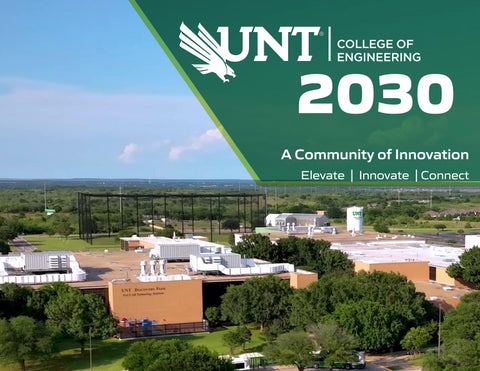
A Community of Innovation Elevate | Innovate | Connect
WELCOME TO UNT ENGINEERING 2030 In 2020—just 17 years after its founding—the College of Engineering launched the UNT Engineering 2025 plan to accelerate growth and expand impact. The results were remarkable: enrollment nearly doubled to almost 8,000 students, research expenditures climbed to $30.2M, and faculty grew 49% to 149 members, including several National Academy of Engineering Distinguished Research Faculty. We also added new programs in Construction Management, Cybersecurity, and Artificial Intelligence. Riding this momentum, we began shaping our next strategic plan in Spring 2024, aligning with the university’s Look North: UNT 2030 plan unveiled in November 2025. Through faculty and staff listening sessions, student input, feedback from the college Board of Councilors, and extensive committee work, we assessed our position and charted our direction for the next five years. The landscape ahead is dynamic: stronger regional competition, rapid advances in automation, AI, and advanced manufacturing, and shifting student recruitment and federal funding. Our own growth has created pressing needs for additional space and staffing. But these pressures also open powerful opportunities. UNT’s location in one of the nation’s fastest growing innovation corridors positions us to deepen industry partnerships, expand commercialization of our research innovations, and become a go to source for engineering talent and applied research. Rising demand for interdisciplinary skills and hands on learning aligns with our strengths and fuels expansion of programs that prepare WHERE WE BEGIN students for emerging careers. Enhanced marketing, Located at Denton’s Discovery Park, the UNT College of outreach, and partnerships can further elevate our visibility Engineering features a high-density ecosystem designed and impact across North Texas and beyond. for rapid cross-disciplinary breakthroughs. This collaborative Pulling together our collective input and targeting environment prepares career-ready students to meet critical recognized opportunities, we have prepared an ambitious, industry needs while advancing strategic research in applied future-focused roadmap for the years ahead. With artificial intelligence, advanced manufacturing and materials, presidential approval, I am proud to present the UNT healthcare innovations, and autonomous systems. Engineering 2030 strategic plan. The college offers a comprehensive selection of five doctoral, 11 master’s, and 12 bachelor’s programs. Spanning a diverse spectrum of technology and innovation — from computer science to biomedical, computer, construction, electrical, materials, and mechanical engineering — these fields are laser-focused on preparing graduates to compete effectively in today’s global Paul S. Krueger, Ph.D., P.E. market. Professor and Dean College of Engineering
2
Contents Welcome to UNT Engineering 2030
2
Elevate | Innovate | Connect
4
Elevate
6
The Engineer in Action Initiative
6
The Agile Engineer Curricular Framework
7
Innovate
8
Strengthening Research Productivity & Collaboration
8
Expanding Innovation
9
Connect
10
Enhancing College Visibility & Community Engagement
10
Reinforcing Student Retention & Development
11
Join Our Journey
12
Look North 2030 Metric Alignment
14
3
ELEVATE | INNOVATE | CONNECT Three Themes. Six Goals. One Community of Innovation. VISION We cultivate a community where every person is empowered to rise, inspired to innovate, and united in purpose to engineer a better world.
MISSION UNT’s College of Engineering advances our distinctive community through excellence in accessible education, transformative research, and collaborative partnerships, preparing professionals for productive careers and service to society.
Together, our mission and vision describe a Community of Innovation — working together in the college and with our partners to develop our students, spark innovation, amplify our collective strengths, and celebrate our shared successes.
ELEVATE We elevate our students with real-world experience, interdisciplinary agility, and professional preparation, equipping them to thrive in their future careers. With the rapid growth of automation, digital tools, IoT, big data, and AI, our students need the flexibility to gain breadth across technical fields alongside depth in their major. Breadth supports both innovation and adaptability to future technology trends. Practical, applied experience is equally essential to solidify theoretical concepts and prepare students for their careers. While elements of these principles already exist across the college, we must be intentional about strengthening them to address future challenges, without adding an unnecessary financial burden to students. Elevate is supported by the following goals: • The Engineer in Action Initiative • The Agile Engineer Curricular Framework
4
Elevate advances Look North 2030 by modernizing our curriculum and expanding career-aligned experiences. Through The Engineer in Action Initiative and The Agile Engineer Curricular Framework, Elevate equips students to Develop through flexible degree pathways, Discover solutions through expanded student research, and Drive regional progress by powering future-ready talent alongside industry partners.
INNOVATE We foster a culture of innovation that accelerates discovery and commercialization. A collaborative academic environment gives our faculty and students the freedom to explore, ask ‘what if,’ and pursue innovations — the first step on the ladder of technological advancement that sustains economic growth for our society. Realizing this requires targeted resources to build and sustain research initiatives, foster collaboration, train the next generation of innovators, and build partnerships that support the development and commercialization of new technologies. Innovate is supported by the following goals: • Strengthening Research Productivity & Collaboration • Expanding Innovation Innovate fuels Look North 2030 by boosting research productivity and expanding strategic industry partnerships. Through targeted faculty growth and collaborative research clusters, Innovate empowers faculty and students to Develop as next-generation problem solvers, Discover breakthroughs in key Texas challenge areas, and Drive market-ready solutions by accelerating technology commercialization.
CONNECT We purposefully connect our college to the world around us while building a thriving, supportive community within. Great endeavors are never accomplished alone. As Isaac Newton wrote to fellow scientist Robert Hooke in 1675, “If I have seen further, it is by standing on the shoulders of giants”. Encouraging, recognizing, and rewarding our campus and supporting our surrounding community helps us all thrive, see a little further, and reach our full potential. This requires strategic efforts to support student success throughout their academic journey and deepen our engagement with community and alumni partners. Connect is supported by the following goals: • Enhancing College Visibility & Community Engagement • Reinforcing Student Retention & Development Connect empowers Look North 2030 by deepening engagement and cultivating integrated support networks. Through expanded student mentoring, new scholarships, and a college Alumni Board, Connect supports students to Drive regional progress by powering transformative education and industry relationships and Develop through comprehensive advising and culture.
5
The Engineer in Action Initiative
80%
of graduating students complete a high-impact experiential learning activity
80% of graduating undergraduate and graduate engineering students will have completed at least one high-impact experiential learning activity (e.g. internship, co-op, faculty-mentored research, service learning, study abroad, or industry-based/interdisciplinary micro-research course project). The duration of the activity is a minimum of 10-weeks (length of the summer term). For undergraduate students, the high-impact experiential learning activity is in addition to the required undergraduate capstone.
Key Strategies • Expand service learning, study abroad, and micro-design project opportunities • Establish a UNT Engineering co-op consortium
Key Metric • Percentage of graduating undergraduate and graduate engineering students who have completed at least one high-impact experiential learning activity
6
REAL-WORLD EXPERIENCE | INTERDISCIPLINA
E L E VAT E
The Agile Engineer Curricular Framework
20%
interdisciplinary elective flexibility and modernize degree pathways including expanded online options
Modernize degree pathways to provide 20% interdisciplinary elective flexibility, strengthen cross-disciplinary and career readiness, improve time-to-degree, and expand online options for all learners, including working professionals.
Key Strategies • Broaden access to interdisciplinary electives • Expand online course offerings • Streamline pre-requisite chains • Reduce required credit hours to 120 SCH in baseline degree plans • Create interdisciplinary “Grand Challenge” elective courses
Key Metric • Percentage of curricular flexibility in college programs, measured in terms of program electives for interdisciplinary opportunities
Elevate Metrics Rationale Student Career Preparation and Experience | Engineering is both practical and inherently interdisciplinary. To ensure student preparation for their future careers, we measure interdisciplinary outcomes and practical experiences. We track the percentage of curricular flexibility in college programs, measured in terms of program electives for interdisciplinary opportunities. We also track the number of experiential learning activities in which our students participate.
ARY AGILITY | PROFESSIONAL PREPARATION
7
Strengthening Research Productivity & Collaboration
$50M
in annual research expenditures
Enhance faculty research productivity through expanded research support and growth in both interdisciplinary collaborative activities and strategic research areas to achieve annual research expenditures of $50 million.
Key Strategies • Add new faculty lines (35 – 50) in strategic research clusters • Grow military-related research funding • Expand collaborative research centers college-wide • Promote best practices for faculty and staff wellbeing
Key Metrics • Number of collaborative research projects • Total annual external research expenditures • Total annual external research expenditures per tenured or tenure-track (T/TT) faculty member
8
A CULTURE OF INNOVATION THAT ACCELERAT
I N N OVAT E
Expanding Innovation
2x
industry funding, plus growth in national lab partnerships
Strengthen and expand research and development relationships with national labs and industry in Dallas-Ft. Worth and beyond, doubling our annual funding from industry support (including SBIR and STTR grants) and increasing support from national lab partnerships through congressional plus-up funding and other opportunities.
Key Strategies • Establish the College Industry Graduate Research Fellowship • Launch an Innovation and Commercialization Council • Showcase research achievements through industry outreach
Key Metric • Funding from industry support (including SBIR and STTR grants) and support from national lab partnerships
Innovate Metrics Rationale Research and Technology Innovation | Research is critical for the educational development of our students and for generating the technology of the future. In support of these efforts, we track both total expenditures and expenditures per tenured or tenure-track (T/TT) faculty member. We also track funding from industry support (including SBIR and STTR grants) and support from national lab partnerships, which help to transition research from the laboratory into the marketplace.
ATES DISCOVERY AND COMMERCIALIZATION.
9
Enhancing College Visibility & Community Engagement
50%
growth in community partnerships and engagement activities
Increase the college’s visibility as a hub of innovation and excellence to strengthen engagement by expanding community partnerships and engagement activities by 50%, developing targeted marketing of our academic programs, and establishing a college alumni board to support deeper engagement with our alumni.
Key Strategies • Expand partnerships with schools, nonprofits, and companies • Deepen alumni engagement via a new College Alumni Board
Key Metrics • Number of community partnerships and engagement activities • Expenditures on marketing of academic programs and number of programs marketed
Connect Metrics Rationale Support of Student Success | We support student success in several specific ways that track support of students: number of STEM Smart mentors and number of students mentored, number of peer mentors and number of students mentored, and number of student scholarships. Because teaching and mentoring require specific skills, we also track faculty and staff development opportunities supporting student instruction and mentoring. Community Engagement | The applied nature of engineering, the important role it plays in our economy, and student interest in engineering careers leads us to track the number of community partnerships and engagement activities.
10
CONNECTING OUR COLLEGE TO THE WORLD WH
C O N N E C T
Reinforcing Student Retention & Development
60
new scholarships
2x
peer and STEM Smart mentors
Support retention and development of all students through early intervention, engaging learning environments, and expanded mentoring activities including: (a) doubling both peer mentors and STEM Smart mentors, (b) adding at least 60 new scholarships, and (c) supporting staff and faculty development in best practices for instruction and student mentoring.
Key Strategies • Expand student mentoring • Increase student scholarships and fellowships • Foster a unified mentoring culture across the college • Strengthen faculty and staff development in mentoring • Promote best practices in student wellbeing
Key Metrics • Number of STEM Smart mentors and number of students mentored • Number of peer mentors and number of students mentored • Number of student scholarships • Faculty and staff development opportunities supporting student instruction and mentoring
HILE BUILDING A THRIVING COMMUNITY WITHIN.
11
JOIN OUR JOURNEY PERSONAL PURPOSE
• Provide funding for Scholarships • Support the College Student Emergency Fund • Support Experiential Learning and Instructional Labs • Engage with Our Faculty » Lab Enhancement » Graduate Research Fellowships
FUEL THE ROUTE AHEAD
one.unt.edu/giving/college-of-engineering
12
DESTINATION: INDUSTRY IMPACT
engineering.unt.edu/connect/industry
PA R T N E R POWER
• Sponsor Senior Design Projects • Engage with Our Faculty » Research Support • Become a STEM Smart Mentor
Have a BIGGER Idea? Contact ceng.development@unt.edu
13
LOOK NORTH 2030 METRIC ALIGNMENT Complementing the metrics established within our six strategic goals, the following additional performance indicators illustrate how UNT Engineering 2030 aligns with and advances the vision of Look North 2030.
UNT Baseline
UNT Target
(2024/25)
(2030)
1st to 2nd year retention
77%
90%
76.4%
90%
4-year graduation rate
42%
65%
25.4%
65%
6-year graduation rate
61%
80%
51.8%
80%
Annual R&D expenditures
$124M
$250M
$40.8M
$80M HERD expenditures*
Doctoral degrees awarded
286
300
40
50
6 years
Decrease time for programs over median
3 years (median)
3 years (median)
Metric
Time to value
Engineering Target Engineering Baseline (2024/25) (2030)
*HERD expenditures include research expenditures as a component, and the goal for the College of Engineering is selected to correspond with the research expenditures goal under ‘Strengthening Research Productivity & Collaboration.’
For More Information on Look North 2030 and the College of Engineering’s role visit strategicplan.unt.edu/implementation/college-engineering 14
Discover What Happens When You LOOK NORTH
15
A Community of Innovation Elevate | Innovate | Connect
@UNTEngineering Discovery Park | 3940 North Elm Street | Denton, TX 76207 engineering.unt.edu