GUJOURNAL
INDEPENDENT STAFF MAGAZINE AT THE UNIVERSITY OF GOTHENBURG #3 OCTOBER 2026 NEWS
Stressed doctoral students NEWS
Seeking EU quality award THEME
EU-funding
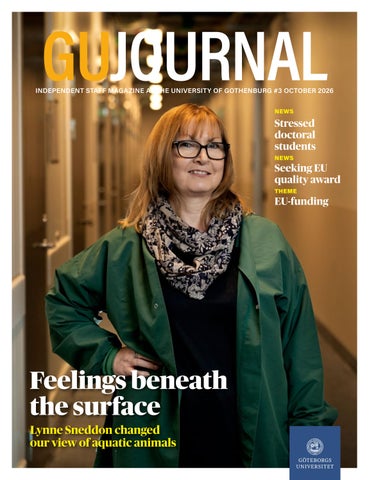
Feelings beneath the surface Lynne Sneddon changed our view of aquatic animals
12 The funding game..
4
Helena Rohdén
GU JOURNAL
The GU Journal has a free and indepen dent position, is made according to journalistic principles. Editor-in-chief: Eva Lundgren, Phone: 070-969 10 14, e-mail: eva.lundgren@gu.se Editor: Allan Eriksson Phone: 070-872 91 42 e-mail: allan.eriksson@gu.se Photograper: Johan Wingborg phone: 070-595 38 01, e-mail: johan.wingborg@gu.se Layout: Newsroom AB Address: GU Journal, University of Gothen burg, Box 100, 405 30, Gothenburg, Sweden e-mail: gu-journalen@gu.se Circulation: 4 000 ISSN: 1402-9626 Translation: Språkservice
8
Researching emotions of fish.
Contents
News 04–07 04 Stress and anxiety among PhD Students.. 06 GU applies for quality seal.
Profile 08–11 08 Lynne Sneddon researches emotions of fish.
2
GUJOURNAL OCTOBER 2026
Theme EU-funding: 12–17 12 15 16
Hoping for more EU-support. Faculty of social sciences offers EU-workshops. Better support leads to more applications.
17
Apprentice in granting system.
People 18–19 18 19
GU-researcher gets UN-assignment. Lise Meitner Award.
Vice-Chancellor
Masthead
Major focus on public education
A long-term perspective in changing times recently returned from Brussels, where
I joined fellow university vice-chancellors from the Nordic countries to discuss research and higher education ahead of the negotiations on the EU’s next long-term budget. One thing became particularly clear. Knowledge-related issues have moved high up the European agenda. Research, innovation, education and skills are seen as crucial to Europe’s competitiveness and its ability to respond to an increasingly uncertain world. This prompted me to reflect further on a paradox: the faster the world changes, the more important the university’s long-term perspective becomes. We do not know which research questions will be crucial ten years from now, how AI will transform the labour market, or what skills society will need by then. That is pre-
cisely why we need to safeguard academic freedom, breadth of knowledge and education that gives people the ability to think critically, learn new things and deal with the unexpected.
But taking a long-term perspective must not mean resisting change. We, too, need to change when circumstances require it. New demands are emerging at a time when we cannot assume that continued expansion will be possible. We need to prioritise, make better use of our shared resources and, at times, do things differently from how we do them today. For me, adaptation is therefore primarily about creating room for manoeuvre – developing the capacity to respond to needs and opportunities that we cannot yet foresee. The University’s fundamental mission remains unchanged. But our organisation, working methods, systems and premises are tools for fulfilling that mission, not ends in themselves. We need to take care of what lies at the heart of the University – while being prepared to change the structures we have built around it. This is a balance we need to achieve together: maintaining a long-term perspective while remaining ready to adapt. We cannot know what the future will de-
mand of the University of Gothenburg. But we can make sure that we have the capacity to meet it.
ublic education was one of the themes of this year’s Gothenburg Book Fair. Together with Folkuniversitetet and a number of partner organisations, the University of Gothenburg made a major contribution, with events on the Public Education Stage, on other stages, and at the special stand shared by the University and Folkuniversitetet. An initiative of this scale naturally involves an enormous amount of work – and the collaboration is set to continue next year. Among other things, the discussions revealed different views on what public education actually means. In the seminar What Is the Cost of an (Un)educated Population? philosopher Jonna Bornemark argued that education and cultivation form a fundamental basis through which we develop in relation not only to other people, but also to animals and even to matter – for example, when we shape our world through crafts. Ola Olsson, Professor of Economics at the University of Gothenburg, pointed out that perhaps we do not need every citizen to be highly educated. – But we do need to be able to engage in informed and thoughtful discussions about the major issues facing society. One such major issue is a sus-
tainable environment. Read about Bethanie Carney Almroth, who has been appointed to a UN mandate examining environmental issues from a human rights perspective. And about Lynne Sneddon, who reminds us that other living creatures also have feelings and should be treated humanely.
Enjoy your reading! Vice-Chancellor MALIN BROBERG
The Editorial Team
GUJOURNAL OCTOBER 2026
3
News
Good supervisors, but tough conditions for PhD students A large majority of Sweden’s PhD students have a good relationship with their supervisor. At the same time, many experience stress, discrimination and harassment. These are some of the findings of the report How are doctoral students doing? published by the Swedish Union of Civil Servants (ST) and the Swedish National Union of Students (SFS). – What is most striking is how little has changed since 2020, when we published the previous survey, says Sandra Hellstrand, who coordinated the working group. THE SURVEY IS divided into
a main report and a separate report on international PhD students, who make up approximately one third of doctoral students at Swedish higher education institutions. Both reports highlight a number of positive findings, not least regarding supervision. As many as 93 per cent of respondents say that they have a good relationship with their supervisor: 73 per cent to a great extent and 20 per cent to some extent. And the supervisor is, of course, an extremely impor-
tant person for a PhD student, points out Helena Rohdén, a member of the local ST board at the University of Gothenburg. – But it is also a complicated relationship, in terms of research and finances as well as because of the close collaboration involved. PhD students are highly dependent on their supervisors, and if the relationship does not work well, it can become very problematic. Just over three quarters of respondents agree, to a great or some extent, that they are
→
Facts: The report How are the doctoral students doing? and the supplementary report How are international doctoral students doing were produced by the Swedish Union of Civil Serv ants (ST) and the SFS Doctoral Committee. Among the findings: • 1 in 3 experiences work-related sleep problems at least once a week. Women are affected to a greater extent. • 1 in 3 works overtime several days a week, with men doing so to a greater extent. • Almost 2 in 3 are hesitant about pursuing an academic career because of uncertain employment conditions. • 22 per cent of women and 11 per cent of men report having experienced harassment or discrimination. The survey is based on responses from 1,511 PhD students at nine Swedish higher education institutions: the universities of Gothenburg, Linköping, Lund, Stockholm, Umeå and Uppsala, as well as Karolinska Institutet, Luleå University of Technology and the Swedish University of Agricultural Sciences. The response rate was approximately 40 per cent. The working group consisted of Sandra Hellstrand, Uppsala University; Helena Rohdén, University of Gothenburg; Marika Vesterberg, Luleå University of Technology; and Reyhane Falanji, Linköping University. Read more at st.org and sfs.se.
4
GUJOURNAL OCTOBER 2026
satisfied with the introduction they received and that they were informed about their rights and obligations. However, just over 20 per cent disagree with these statements. Opinions are even more divided regarding the Individual Study Plan (ISP): 58 per cent say it is too bureaucratic or time-consuming, while 54 per cent say that it is rarely used in practice. – However, the ISP is more appreciated by PhD students from countries outside the EU/ EEA. Regular follow-ups involving people other than the supervisor may make them feel more visible. After all, the survey shows that this is a group that is more vulnerable than other PhD students. ONE QUESTION INCLUDED for
the first time in this survey concerns whether PhD students are planning to pursue an academic career, Helena Rohdén explains. – Uncertain employment conditions mean that almost two thirds of respondents are hesitant about staying in academia. PhD graduates are, of course, also expected to move into other sectors of society, so there is nothing wrong with choosing another career. But the reason should not be poor working conditions at the university. Many PhD students are uncertain about the condi-
Marika Vesterberg.
Sandra Hellstrand. tions of their employment. For example, 26 per cent of Swedish PhD students, 44 per cent of those from the EU/EEA and as many as 54 per cent of those from countries outside the EU/EEA believe that their supervisor is responsible for their employment. There is also uncertainty surrounding extensions of PhD employment, for example in cases of sick leave, parental leave, positions of trust or departmental duties. Marika Vesterberg, chair of the local ST section at Luleå University of Technology, explains: – The rules are applied differently and procedures vary between universities, and sometimes even within the same university. It can be difficult for PhD students
News
dressed in concrete ways, for example by offering specially adapted language courses during working hours. Departments could also organise more social activities so that international PhD students in particular feel included.
»Uncertain employment conditions mean that almost two thirds of respondents are hesitant about staying in academia.« Helena Rohdén
to predict how much of an extension they will receive. The working group therefore proposes more consistent rules and calculation models, at least within each university. AMONG INTERNATIONAL PhD
students, those from countries outside the EU/EEA face particular difficulties. These include uncertainty regarding permanent residence permits as well as limited knowledge of Swedish. – Approximately 24 per cent of PhD students from the EU/EEA and 29 per cent of those from countries outside the EU/EEA have experienced some form of discrimination or harassment. A considerably larger proportion of international than Swedish PhD students say that when they do report an incident – which most do not – it is not taken seriously. The situation is particularly difficult for PhD students from outside the EU/ EEA because they may also be uncertain about what rules and rights actually apply in Sweden. International PhD students, particularly those from outside the EU/EEA, are generally unclear about what rights they have and where to turn if problems arise, says Marika Vesterberg.
– It is, of course, the employer’s responsibility to provide information about rights and obligations. But trade unions and student unions can also help, not least by making themselves visible in different contexts. Sandra Hellstrand, a member of the local ST board at Uppsala University, coordinated the work on the report. She is particularly concerned that as many as 17 per cent of PhD students have experienced discrimination or harassment and argues that universities need to focus their efforts on groups that are especially vulnerable, particularly female PhD students from countries outside the EU/EEA.
– PhD students whose funding has run out are also particularly vulnerable. I think we have an oversimplified picture of what happens to these PhD students and that we need to investigate this further. Another important area is providing international PhD students with support in learning Swedish. – We have known for a long time that good language skills are important for a good working environment. This is also something that can be ad-
THIS YEAR’S REPORT shows relatively few improvements compared with the 2021 survey, Sandra Hellstrand explains. – PhD students’ experience of the quality of supervision has improved, and it has also become more common for them to take the annual leave to which they are entitled, although as many as 33 per cent still do not. But there are several concrete things that can be done to improve conditions for PhD students: make sure they receive information about their rights and obligations, support those who have experienced discrimination or harassment so that they proceed with a formal report, and organise more social activities so that more PhD students feel included. Text: Eva Lundgren Photo: Johan Wingborg
What is your view of the report, Ghita Regasse, board member of the doctoral student union at the University of Gothenburg?
– The overall picture is the most important finding. One in three PhD students works overtime several times a week, the same proportion experiences recurring sleep problems, and more than 60 per cent report work-related stress. This shows that stress cannot simply be seen as an individ ual problem – we also need to address workload and working conditions. – Particularly vulnerable are PhD students whose funding has run out and international PhD students, who also face language barriers and uncertainty over residence permits. At the same time, there are positive signs: more PhD students are taking their annual leave, and more are satisfied with their supervision than in 2021. We need to build on what works and make the sup port available to PhD students more visible. GUJOURNALEN OKTOBER 2026
5
News
University of Gothenburg seeks european quality award Since the beginning of the year, the University of Gothenburg has been preparing an application to the European Commission for the HR Excellence in Research Award. The award is granted to research organisations that demonstrate a long-term, systematic commitment to developing their practices in line with the principles of the European Charter for Researchers. THE AWARD IS OPEN to all
organisations engaged in research, not only universities but also, for example, research institutes and companies. Organisations outside the EU may also apply. – The award is based on the European Charter for Researchers, which was first adopted by the European Commission in 2005 and has since been revised, most recently in 2023. The Charter provides the framework for the Human Resources Strategy for Researchers and contains 20 principles that applicant organisations must demon-
strate a commitment to following. These include ethics, gender equality and career development, says Rangnar Nilsson, Research Adviser at the Research and Innovation Office (FIK). She is one of the FIK representatives in the group that has been working on the application since February. The group also includes staff from the Human Resources Unit, and the project is led by Per Åberg, Professor of Marine Ecology. – We also have the support of a reference group comprising around twenty research-
→
Facts: The HR Excellence in Research Award is a voluntary review process developed by the European Commission for organisations with a long-term commitment to the 20 princi ples of the European Charter for Researchers. These include ethics, integrity, gender equality, career development, working conditions and working practices. The HR Award process consists of three phases: The initial phase, which leads to the award of the HR Excel lence in Research Award. This is the phase the University of Gothenburg is currently in. Among other things, the University must produce four documents: a process description, a gap analysis, an action plan and an OTM-R checklist (Open, Trans parent and Merit-based Recruitment). The interim phase, which includes monitoring and evaluating the initial action plan and developing a revised plan. The renewal phases, which follow a three-year cycle in which the award can be renewed following site visits and remote evaluations. More than 700 European universities and research institutes currently hold the award.
6
GUJOURNAL OCTOBER 2026
ers at different career stages from all faculties, he says. The group has contributed a wide range of perspectives. We have also held discussions with other groups, including the Vice-Chancellor’s Strategic Council, the University Management Council and the Research Board, and gathered material from faculties and departments. A survey has also been sent to the University’s researchers to give everyone an opportunity to contribute their perspectives. In the initial phase, which is where we are now, we need to produce four documents: a process description, a gap analysis, an action plan and an OTM-R checklist. THE PROCESS INVOLVES exam-
ining the organisation itself and assessing where it stands in relation to the standards set out by the HR award. – Many of the principles are already established in Swedish legislation, which we must of course comply with, says Andreea Maris, Project Coordinator at FIK. Others are set out in the University’s own policy documents. Among other things, we have examined governance at central level and sent surveys to faculties and departments to find out how they work and to ensure that our work is anchored throughout the organisation. Being granted the HR Excellence in Research Award, however, is only the first step in a long-term process. To retain the award, an organisation must be able to demonstrate every three years what work has been carried out and submit new action plans based on feedback and
»The award therefore involves an ongoing process in which the research organisation must continually demonstrate that it continues to meet the requirements« Sandra Engdahl
dialogue with representatives of the European Commission. The Commission also expects researchers and other relevant groups to have opportunities to influence the planning and implementation of the work. – THE AWARD THEREFORE in-
volves an ongoing process in which the research organisation must continually demonstrate that it continues to meet the requirements, says Sandra Engdahl, HR Specialist at the Human Resources Unit. Every stage of a researcher’s career is included, from their first position and throughout their working life. And the evaluation does not concern research alone, but also all the other work researchers do, such as teaching, mentoring, project management and much more. Researchers are classified into four categories – R1 to R4 – depending on whether they are doctoral or early-stage researchers, recognised researchers, established researchers or leading researchers. – The classification is intended to ensure that all groups are covered by the process. Sweden is somewhat unusual in this respect because our doctoral students are employees, which is un-
News
Andreea Maris, Per Åberg, Sandra Engdahl and Rangnar Nilsson.
common internationally, says Rangnar Nilsson. ALTHOUGH THE UNIVERSITY of
Gothenburg would, of course, like to receive the HR award, obtaining the award is not really the main objective of the work. – The real value lies in using the European Charter as a mirror for our own organisation, Sandra Engdahl explains. It gives us an opportunity to systematically review our processes, identify what we already do well, but also be
honest about where we can improve. The next step will be to turn these insights into concrete improvements and follow up on what actually makes a difference for researchers. So, it is not about demonstrating that we are perfect, but about identifying areas for improvement and doing something about them. For the University of Gothenburg, this is above all an opportunity to systematically demonstrate how we take responsibility for researchers’ working conditions and career
»So, it is not about demonstrating that we are perfect, but about identifying areas for improvement and doing something about them.« Sandra Engdahl
development throughout their careers, says Pro-Vice-Chancellor Carina Mallard. – An HR Excellence Award would highlight what we already do well. But equally important is that the process provides us with an external perspective and helps us identify where we need to improve. The real value lies in the long-term work to continuously develop and improve our practices. Text: Eva Lundgren Photo: Johan Wingborg GUJOURNAL OCTOBER 2026
7
Profile
Giving fish a voice Why do different marine animals behave the way they do? This is something that has fascinated Lynne Sneddon ever since she watched Jacques Cousteau’s films about unknown underwater worlds. In 2002 she was the world’s first researcher to show that fish, just like mammals, can feel pain. → Text: Eva Lundgren Photo: Johan Wingborg
8
GUJOURNAL OCTOBER 2026
GUJOURNAL OCTOBER 2026
9
Profile
uring Lynne Sneddon’s childhood in central Scotland though, she rarely saw the sea. – But when I was seventeen and started studying biology at the University of Liverpool, I focused on marine invertebrates. The nudibranch in particular, sometimes called the butterfly of the aquatic world, fascinated me. Following her M.A. in marine biology and biological oceanography Lynne Sneddon started working for a healthcare provider. – But after a year there I wanted to do something more challenging, so I became a doctoral student at the university in Glasgow. She started researching crustaceans, fascinating creatures with interesting behaviours. – For example, the mating behaviour of the shore crab is very interesting. Like with so many animals the males go mad when they fight over the females. Once a male has won his fight, he needs to be sure he will fertilize his partner. So, he will carry her below his body until she sloughs her shell. Because it is only when their shell is soft that the crabs can mate. After mating, the male and the female go their separate ways. Lynne Sneddon defended her thesis in 1998 and subsequently worked for three years at the Michael J. Gentle Laboratory at the Roslin Institute, University of Edinburgh. The time at the institute meant a lot to her. – Michael was well-known for his studies into pain in poultry. He identified nociceptors – or sensory neurons – which react to potential harmful stimuli, and which are similar to those we find in mammals. This was an important discovery that had an impact on how we treat birds. But I started thinking about how this applied to fish and other marine creatures. The first fish Lynne Sneddon studied was the rainbow trout. The experiments investigated whether the fish responded to three different types of potentially harmful stimuli: pressure or other physical stimulation, heat at 40 degrees Celsius, and acetic acid injected into the lips. – The fish responded in ways that actually resemble human behaviour: they showed fear of objects associated with pain and became less attentive. The fish injected with acetic acid rubbed themselves against the walls of the tank, stayed near the bottom and refused to eat. When the acid-exposed fish were given morphine, their behaviour became more normal, which we interpreted as evidence that the morphine had relieved their pain. The findings were important because the prevailing view in 2002, when Lynne Sneddon presented her results, was that fish lacked pain receptors. – You might think it is obvious that fish can feel pain – otherwise, why would they avoid danger? But
10
GUJOURNAL OCTOBER 2026
»The fish responded in ways that actually resemble human behaviour: they showed fear of objects associated with pain and became less attentive. « LYNNE SNEDDON
we humans find it difficult to identify with animals with which we have no relationship. Most people only encounter fish on their plate, ready to eat. My husband, for example, is very fond of fish dishes, whereas I cannot bring myself to eat the animals I study. Fishing is also a hobby for many people. – It can be difficult to realise that something as innocent-seeming as sitting on a jetty with a fishing rod can cause suffering to other creatures. But my report received a great deal of publicity and sparked debate, and public opinion began to grow in favour of treating these animals as humanely as possible. After her years at the Roslin Institute, Lynne Sneddon returned to the University of Liverpool, where she continued her research. In 2013, for example, she began studying pain and pain relief in zebrafish – knowledge that is particularly important within academia, since zebrafish are among the most commonly used laboratory animals. In 2020, after 18 years at the University of Liverpool, Lynne Sneddon and her husband left the UK and moved to Gothenburg. – The university management had suddenly closed the aquarium because they wanted to focus on medical research instead. That made it impossible for me to continue working there. I had already visited Gothenburg five times and knew several colleagues here, so when we were given the opportunity to come here, we took it.
At the University of Gothenburg, Lynne Sneddon
has continued to conduct research that has attracted considerable attention. Here, she has returned to the crustaceans she first studied as a PhD student. – Among other things, my group has investigated humane ways of killing lobsters, for example using electrical stunning. Putting them alive into boiling water, on the other hand, causes a painful death. Different marine animals respond differently to pain and methods of pain relief. Each species therefore
needs to be studied individually to determine how it should be handled. – It is no stranger than the fact that cows and rabbits need to be treated differently. Knowledge that crustaceans can also feel pain has led, for example, to Switzerland requiring them to be stunned before they are killed. Similar regulations are being developed in the UK, but not in Sweden as far as I know.
Besides her work, Lynne Sneddon enjoys travelling,
both professionally and privately. Among other things, she collaborates with Chinese researchers on improved methods in aquaculture and research. Animal rights is a relatively unfamiliar concept there. – Animal welfare therefore needs to be discussed in other ways, for example by showing that animals that are healthy and doing well both grow better and taste better than animals in poor condition. When meeting people from other cultures and traditions, you have to be respectful and not assume that you know so much more. And China has a great deal to teach us, not least when it comes to technological advances, such as robots that can feed fish underwater and underwater cameras. Lynne Sneddon has received several awards over the years. In 2023, for example, she received the Johns Hopkins CAAT and Charles River Excellence in Refinement Award for her work to reduce suffering in laboratory animals. Her work has also attracted attention in more popular contexts. In 2003, her research was ranked number 22 on Discover Magazine’s list of the year’s top 100 scientific studies. She has also appeared on the American online publication Vox’s list of fifty people around the world who have contributed most to creating a better future. Her findings have even made their way into the board game Trivial Pursuit. One of the questions in the game asks: “Which animal feels pain, according to a 2003 report?” The answer: “Fish.”
LYNNE SNEDDON Facts: Professor of zoophysiology. She is also an advisor to the Aquatic Life Institute, the Fish Welfare Initiative, the Scottish Parliament, the British Veterinary Society and Den Danske Dyrlægeforening (the Danish Veterinary Association) Family: Husband and two labradors. Hobbies: Besides spending time with family and friends, travelling, horror films and classic rock, among others Guns N' Roses.
Lynne Sneddon is not only interested in researching
animals; she also enjoys spending time with all kinds of living creatures. – My husband and I have two black Labrador puppies who are very affectionate. Besides spending time with the dogs, family and friends, I am also interested in classic rock music and horror films. My husband and I recently saw Resident Evil at the cinema – it was actually funny rather than frightening, with a kind of slapstick humour reminiscent of Laurel and Hardy. Gothenburg is a lovely city and Sweden is very beautiful, Lynne Sneddon says. – But of course I miss my family and friends in the UK, as well as the special pub culture we have there. I think it is probably unique in the world.
GUJOURNAL OCTOBER 2026
11
THEME: EU-funding
The funding game – how to win more EU research funding
12
GUJOURNAL OCTOBER 2026
THEME: EU-funding
The University of Gothenburg should be able to attract considerably more research funding from the European Research Council’s framework programme, Horizon Europe. There are currently discussions being held at several university-wide forums about how to make it happen. Text: Eva Lundgren Photo: Johan Wingborg Illustration: Amanda Åkerman
T
Henrik Lindskog is head of the Grants Office at FIK.
here are several reasons for the university
wanting to stimulate greater participation in Horizon Europe. One reason is that Sweden has set a target of increasing all granted funds from 3.4 to 3.7 percent. Another is that the University of Gothenburg receives a smaller piece of the pie in terms of EU funding compared to other grants, such as from VR and Formas, compared to other major Swedish universities. Since the framework programme was launched in 2021, the University of Gothenburg has received 90 million euro which lands it in seventh place among the country’s universities and colleges. Leading the pack is Lund University, which has received 208 million euro from the European Union. – But there are other reasons for increasing our participation in Horizon Europe, explains Henrik Lindskog, head of the Grants Office at
the Grants and Innovation Office (FIK). For example, contributions from Swedish financiers of research have not kept up with increasing costs; something simply must be done. In addition, the ability to attract EU funding is now an indicator for the allocation of direct government funding. Compared to how we succeed with other forms of external funding the university is underachieving; we should have been able to attract an additional 40–50 million krona. This in spite of the fact that we have comprehensive joint financing that aims to stimulate applications to and receiving EU projects. But it also a tool for strengthening the university’s position, influence and impact in the European and global research landscape. However the trend is positive. The number of EU applications from the University of Gothenburg has almost doubled in five
EU supports cutting-edge research in a range of fields.
»Compared to how we succeed with other forms of external funding the university is under achieving; we should have been able to attract an additional 40–50 million krona. « HENRIK LINDSKOG
GUJOURNAL OCTOBER 2026
13
THEME: EU-funding
The funding game
Facts: Horizon Europe The European Research Council's framework pro gramme for research and innovation is applicable for the period 2021–2027. The programme is based on three pillars, aimed at
years, from 137 in 2021 to 254 in 2025, but we also see the same trend in many other Swedish universities.
Horizon Europe is divided into three pillars: Pillar 1 concerns scientific excellence. An individual researcher with a strong concept can apply for these. Pillar 2 is focused on societal challenges, such as within health and climate, and involves international consortiums where both universities, businesses and other organisations can participate. Pillar 3 is focused on innovation. – Around 75 percent of the university’s EU funding stems from Pillar 1, says research advisor Annika Wahlström. This is not unusual for a large comprehensive university. But Pillar 2 constitutes a significantly larger share of the total budget of Horizon Europe, and there is great potential for the university to increase its EU funding. The different pillars require different strategies. A researcher who is in the running for an ERC grant is not necessarily the right person to head a complicated consortium. One reason why relatively few researchers apply for EU funding is that the application process is seen as complicated and time consuming. A researcher who already have grants from Swedish financiers might feel that it is easier to continue along the more familiar path. – Making applying for EU funding a natural part of the process will require a major cultural shift, Henrik Lindskog concludes. It is about not putting all your eggs in one basket; the more financiers you apply to, the greater the chance of receiving funding. And yes, an EU application may seem complicated but there is
»Around 75 percent of the university’s EU funding stems from Pillar 1« ANNIKA WAHLSTRÖM
14
GUJOURNAL OCTOBER 2026
• scientific excellence (individ ual ERC grants to outstanding junior and senior researchers, the Marie Sklodowska-Curie Actions as well as investments in European infrastructure).
Annika Wahlström explains that Pillar 2 accounts for a significantly larger share of the Horizon Europe budget than Pillar 1.
help available. Researchers who have already been granted funding can provide advice and recommendations. But there are also research advisors at FIK, with solid expertise in the field and an ability to provide qualified support that is of the highest national quality. The University of Gothenburg hosts a lot of strong research projects and have an excellent opportunity to take up more space in European scientific collaborations, explains Pro-Vice-Chancellor Carina Mallard. – This is why we need to encourage more researchers to apply for EU funding as well as ensuring that they get the right support in order to succeed. It is not solely about financing, but also about strengthening our international partnerships and our impact as a university. Working on these issues is a strategic, high-priority area for the university.
• global challenges and Europe an industrial competitiveness divided into six clusters: health; culture, creativity and inclusive societies; civil security; digital matters, industry and space; climate, energy and mobility as well as food, bioeconomy, nat ural resources, agriculture and the environment. • the innovative Europe that will stimulate market-making breakthroughs and ecosystems that facilitate innovation. The budget is 75.9 billion euros. The Faculty of Science and Tech nology has received around half of the university’s EU funding so far, around 40 million euros.
THEME: EU-funding
Finding the funding – workshops show the way to EU grants Research fields relevant to our societies and prominent re searchers, these are precisely what the EU commission wants to support. Therefore, the Fac ulty of Social Sciences should attract much more EU funding than they currently do. For this reason, the faculty management launched a series of workshops in 2025. The aim is to increase awareness of how to apply for EU grants and, at the same time, debunk a number of myths about how it works. Pro-Dean Isabell Schierenbeck, Pro-
fessor of Political Science, initiated these workshops. The first series, launched in 2025, concerned writing applications to Pillar 2 within Horizon Europe. This concerns funding to international consortiums that do research into major societal challenges identified by the European commission. – One reason why we do not have more researchers applying for EU funding is probably the many rumours about the applications being exceedingly complicated, says Isabell Schierenbeck. Some of these notion may have been correct in the past but they no hold longer true, others may still be correct, but are not impossible to overcome. Anne Laure Humbert and Sofia Strid, researchers at the Department of Sociology and Work Science, ran the workshops. Both have received funding under Pillar 2. Representatives from the Grant and Innovation Office (FIK) were also invited, says Isabell Schierenbeck. – In order to optimise the workshops we asked the pro-deans to send invitations to a number of researchers who already have ongoing projects or well-developed ideas that would be appropriate for an EU application. This
enabled Anne and Sofia to go through, step by step, the different parts of the application. One important aspect for the applicant is to understand what is really required for the application, so that you answer the right questions.
For example, a crucial part of the application involves explaining the proposed project’s excellence, i.e. demonstrating the project’s quality, degree of innovation and level of ambition. It is about highlighting the unique aspects and explaining how the project aligns with the political priorities of the EU. The workshops also included how to draw up a budget and draft a plan of operation, says Isabell Schierenbeck. – In the final workshop, the participants had to take on the role as reviewers and critically assess their colleagues’ proposals. This year’s workshops have focused on Pillar 1, which involves individual contributions. The participants met with researchers who were successful in applying for EU funding but who could also tell them about projects that did not make it through. The participants also had an opportunity to discuss their applications in groups of three or four and with representatives from FIK who provided suggestions for improvement. – But the aim of these workshops was not only to develop strong research applications. It was also about letting researchers from different departments get to know one another and forming networks. One piece of advice given to the
participants was not to give up, Isabell Schierenbeck tells us. – If your application is rejected it is important to submit a new one. This is particularly important if the application was highly rated but still did not receive funding. Receiving EU funding EU lends a certain status to both the department and the researchers, but it mainly provides significant resources for the researcher to be able to employ doctoral students and post-docs. EU funding is
Isabell Schierenbeck.
simply an amazing opportunity to conduct interesting scientific research. Patience is a virtue for anyone applying for EU grants. – Applying and not getting a grant does not constitute failure – and if you do not apply you will never get any of course. What is important is to get over that first hurdle and then be persistent. There is a lot of help available, make sure you avail of it!
Facts: The Faculty of Social Sciences has invested in two series of workshops to increase the awareness and interest in EU funding. The first series took place in 2025 and concerned Pillar 2 and the sec ond series, taking place in 2026, concerns Pillar 1. A new series of workshops will be initiated in No vember in partnership with FIK, fo cusing on both Pillar 1 and 2.
GUJOURNAL OCTOBER 2026
15
THEME: EU-funding
Right resources key as competition intensifies The University of Gothenburg could receive far more research funding from the European Union than it currently does. But it will require a long-term strategy and support that is adapted to different types of applications, argues Fredrik Bäckhed, Professor of Molecular Medicine. – Other universities have entire departments working on EU applications. It is difficult to compete with that. For ERC Starting Grants the grant rate in 2025 was 12 percent and for ERC Consolidator it was 11 percent. The best countries at getting grants in both categories were Great Britain and Germany. So competition is fierce and seems to be getting fiercer. – EU funding is about so much more than money, says Fredrik Bäckhed. It is also a badge of quality for the researcher, the research environment as well as the entire university. This is one of the reasons why so many major universities invest considerable resources into producing really good applications. The individual researcher only writes the scientific part while a special group of hired consultants do the rest of the work. An officer who is familiar with all the requirements and the special language required for an EU application will do a much better job in less time than a researcher who may only be submitting one application every five years. According to the government’s latest
research bill, Sweden should seek to increase its share of EU grants. And the University of Gothenburg should receive more contributions. But for this to be possible, the university management must be much clearer concerning what they want, and invest more resources, Fredrik argues Bäckhed. Fredrik Bäckhed.
16
GUJOURNAL OCTOBER 2026
– Different contributions require different strategies. Within Pillar 1 we find the personal ERC contributions to researchers at various levels. For those, it the researcher’s own history that counts. Providing training in how to be interviewed is one way of supporting these grants. Pillar 1 also includes the Marie Skłodowska-Curie Actions (MSCA) which is an investment to promote the career path for doctoral students and post-docs. – A doctoral student or post-doc at another university apply to MSCA together with a supervisor and their research environment. The doctoral student or post-doc can only submit one application but the hosting environment may submit several. Recently, my lab applied for three MSCA grants, of which we had one approved. Pillar 2 is a completely different animal. – It revolves around major research consortiums with perhaps ten stakeholders and involves research that is on the cusp of utilization. So, those who head up such a collaboration must be able to demonstrate how the project will be coordinated and the budget will be managed, as well as being able to handle all the admin and so on, which will require special support and expertise.
What the university needs to do to
increase the number of EU applications is partly to decide which grants to prioritise, and partly to invest the necessary resources, Fredrik Bäckhed argues. – Do they want to support post-docs before senior researchers, individuals before major consortiums? The answer will determine how the support is allocated. For example, perhaps the university
Facts: Within Horizon Europe’s Pillar 1 we find the following grants: Starting Grant, Consolidator Grant, Advanced Grant, Synergy Grant and Proof of Concept. And also the Marie Skłodowska-Curie Actions which aims to support researchers’ career development and interna tional mobility, and which finances doctoral education and post-doc research projects.
should identify the researchers who have a realistic chance of receiving grants? The university could also create a shared database where you collate all the information from previous applications. And researchers could also receive more support regarding when to submit an application. – Anyone who applied for an ERC grant but not received it must wait for 1–2 years before submitting a new one. So is it better to wait until you are able to submit some excellent material or should you apply as soon as possible, while the material is still relevant? It is about striking a balance. Something that the researcher may need to discuss with colleagues who are knowledgeable about EU funding.
But an ERC application that is not
granted is not a waste of time. The material can be used in another context, such as an application for a Research Council application, Fredrik Bäckhed explains. – ERC and MSCA applications that have been assessed as excellent but were not granted EU funding have in some cases received support from Swedish research funders. So they have used the EU quality assessment when allocating funds. And this makes it even more interesting to apply for EU funds of course. Getting more EU grants requires endurance and a long-term strategy, Fredrik Bäckhed summarises. – It is also good to volunteer to review applications in order to get an idea of what constitutes a strong or weak application. Why did this one work, but not that other one? The Grants and Innovation Office is very good but it also requires greater investments from the university.
THEME: EU-funding
Strong research proposals require thorough preparation There is no formal training in how to apply for major research grants. Instead, researchers largely have to work out for themselves how it is done. Sofia Strid, Professor of Sociology and Associate Professor of Gender Studies, began learning the process while she was still a PhD student. – It has been a long process. I started out as a kind of appren tice and then gradually took on more and more responsibility. Sofia Strid has received no fewer than
nineteen EU grants, ten of them under Pillar II, which focuses on building large research projects and consortia around major societal challenges. She considers herself fortunate to have become involved in major EU projects while still a doctoral student. – I had the opportunity to learn how it works from the ground up and was gradually given more responsibility: first as a PhD student, then as a work package leader, followed by scientific lead and finally as a coordinator. Unlike applications to, for example, the Swedish Research Council or Formas, an EU application for the same project cannot be submitted twice. However, that does not mean that all the work put into an unsuccessful application has been wasted. – A researcher cannot prepare a Pillar II application alone. You need to build a group of people you can return to the next time you apply for funding. My colleague Anne Laure Humbert and I have created a small core group with a handful of colleagues who are experts in our field, as well as a larger European network that we can draw on when we need particular expertise. It is the core group that carries much of the responsibility. – The core group needs to be involved at every stage of both the application and
implementation processes. It is about checking in regularly and identifying early on if something is not working, before the application is completed and, eventually, the project is implemented. When the core group works intensively together, we become very close. Building relationships based on trust is important in this kind of research context.
It takes approximately a year to
develop a strong research proposal for Horizon Europe. – The call text in the European Commission’s work programme has often been negotiated for several years between different parties in all the EU Member States. Some may have had to give up things they considered important, while others may at least have managed to get a particular sentence included. Every word in the call is therefore significant, so the text has to be read very carefully. Among the questions the project needs to answer are: Why this particular consortium? Why can this particular project deliver solutions to an already defined problem? And what will improve if this particular project receives funding? This is difficult to achieve if researchers are already fully occupied with teaching, administration or other duties. – Someone who has only 15 per cent research time cannot necessarily be expected both to publish articles and lead an EU proposal, although they can participate in one. To do that, you need contacts. To build a core group and a wider network, researchers also need greater opportunities to attend conferences, network and develop ideas, even if this does not immediately result in new projects. The university’s goal should not be to submit as many applications as possible, but to produce applications of the highest possible quality.
Much of what needs to be included in an application is far removed from researchers’ usual work, such as establishing a budget, assessing risks and explaining how the project will contribute to open science.
– Applying for funding from the EU, for example, involves a great deal of work. But you also have enormous freedom and the opportunity to discuss exciting questions with colleagues who, Sofia through close collaboStrid. ration, sometimes become close friends. Applying for an EU grant is a learning process, Sofia Strid explains. – You should perhaps not expect to receive funding the first time you apply, although it does happen. But you can talk to successful colleagues, ask them how they approached the process and gradually learn more. It is also important to study the conditions of each call very carefully. Since a Horizon Europe proposal requires a great deal of administrative and scientific paperwork, there needs to be a clear division of responsibilities so that everyone knows what they are expected to do. Writing an application takes time, Sofia Strid points out. – You have to enjoy writing proposals – and make it a priority.
Facts: Horizon Europe’s Pillar II focuses on global challenges and European industrial competitiveness and provides funding for larger consortia. Funding is awarded within six clusters: Health; Culture, Creativity and Inclusive Society; Civil Security for Society; Digital, Industry and Space; Climate, Energy and Mobility; and Food, Bioeconomy, Natural Resources, Agriculture and Environment.
GUJOURNAL OCTOBER 2026
17
People
Professor appointed to be a UN Special Rapporteur On August 26 Bethanie Carney Almroth, Professor of Eco-toxicology, accepted the position as UN Special Rapporteur on toxics and human rights. This involves her acting as an independent international expert to highlight when toxins become not only an environmental problem but also a matter of fundamental human rights.
»I am hoping to be able to link my research to the assignment and thus create a reasonable work situation.« Bethanie Carney Almroth
SHE HAS ALREADY held her
first speech before the UN Human Rights Council in Geneva. The UN mandate has been in place since 1995 and its first holder was Fatma-Zohra Ouhachi-Vesely from Algeria. – Since then the assignment has been given to male attorneys, so I am a fairly unusual choice, Bethanie Carney Almroth explains. This is not the first time she is involved in environmental affairs on behalf of the UN. She participated in the negotiations around a global agreement on curtailing plastic pollution by the network Scientists’ Coalition for an Effective Plastics Treaty.
THE REMIT INVOLVES investigating how toxic materials impact human rights throughout their life cycle, from extraction and production to usage and final disposal. – I will be meeting with governments, businesses, organisations and different groups representing young people, women, indigenous peoples and many others. I will be working with them to gather evidence of how environmental toxins affect their lives and their health. I will also be visiting one selected country, to meet with their government
18
GUJOURNAL OCTOBER 2026
and different groups and to write a report. Bethanie Carney Almroth will also be investigating one special problem that she is free to pick of her own accord. – My predecessor, Marcos Orellana, was very much engaged in “forever chemicals”, PFAS, that are being spread globally through emissions, trade and transport. But there are also many other issues, such as mercury, lead and pesticides as well as new challenges, for example the energy and water use linked to AI developments. ON SEPTEMBER 14 Bethanie Carney Almroth was in Geneva to speak before the UN Human Rights Council. – It is a somewhat special situation when you find yourself speaking in front of delegates from around fifty countries and then be
given six minutes to answer questions. I pointed out that we live in societies that use around 140,000 substances, of which we are only aware of the toxicity in around a thousand. We also lack knowledge of chemical combinations and the effects of long-term exposure to low doses of harmful substances. Meanwhile, we fail to act in cases where do we have knowledge; politicians are slow to react. The assignment as a FN Rapporteur is unpaid; UN only reimburses travel and per diem, says Bethanie Carney Almroth. – I am hoping to be able to link my research to the assignment and thus create a reasonable work situation. And if I could get a research assistant, it would be of tremendous help. The former rapporteurs that I have spoken with say that the assignment will
require perhaps 40 percent of your time so I am expecting to do a lot of work. The mandate as a UN rapporteur runs for three plus three years. Text: Eva Lundgren Photo: Johan Wingborg
→
Facts: Special Rapporteur on the implications for human rights of the environmentally sound management and disposal of hazardous substances and wastes is an independent expert appointed by the UN Human Rights Council. The position was created in 1995 and involves investigating how hazardous substances, pollution and waste impact human rights. The special rapporteur will submit reports and recommendations to the UN.
People
The moment
Photo: Anna-Lena Lundqvist
What? Who? When? • Annual presentation of the Lise Meitner Award. • Masato Sagawa is congratulated by dean Göran Hilmersson. • Thursday September 10 at Kollektorn, MC2, Chalmers.
Short description Masato Sagawa is this year’s recipient of the Gothenburg Lise Meitner Award. Masato Sagawa’s major breakthrough happened in 1982. Until that point the strongest permanent magnets were primarily based on samarium and cobalt. Masato Sagawa demonstrated that you could create even stronger magnets from mainly iron, together with neodymium and a small amount of boron. Masato Sagawa also developed a method that made it possible to manufacture the new magnets on an industrial scale. So-called NdFeB magnets are currently used in devices such
as electric motors, electric vehicles, wind turbines, robots and hard drives. As they are incredibly strong in relation to their size, they have made possible the development of smaller, lighter and more energy-efficient motors and generators. For this reason, they play an important role in our electrification. The award is presented by the Gothenburg Physics Centre to a researcher who has made a ground-breaking discovery in physics. Lise Meitner was one of the leading nuclear physicist of her time. She was born in Vienna in 1878, passed away in Cambridge in 1968, and from 1938–1960 she worked in Sweden.
GUJOURNAL OCTOBER 2026
19