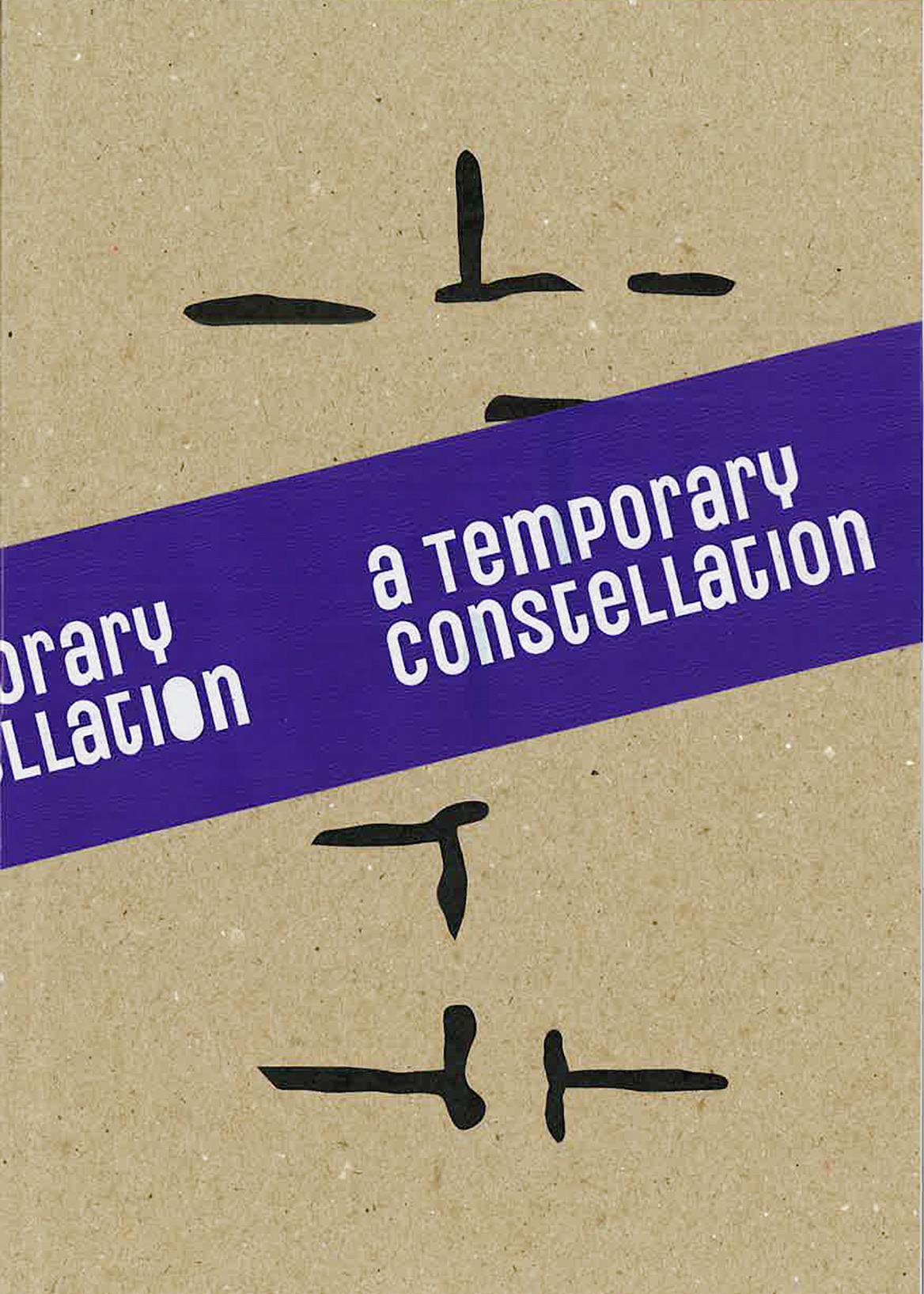
a Temporary Constellation
With contributions from: Alexandra Bittarová, Maria del Mar D’Amato, Silas Lilo Jensen, Daniel Jewesbury, Nils Karlsson, Catalina Gómez Rueda, Johan Sandler and Fey Tewedros.
Table of Contents
Introduction 4
DANIEL JEWESBURY
Stillness, Beauty, and the Body Under Pressure 8
MARIA DEL MAR D’AMATO
Listening (to) Bodies: (Neuroqueer) Sonic Resistance 14
SILAS LILO JENSEN
In a State of Becoming 22
ALEXANDRA BITTAROVÁ
Stages of an Attempt 28
NILS KARLSSON
Meta, Meta-, Meta 34
CATALINA GÓMEZ RUEDA
Uranium Mining vs Nuclear Art 44
JOHAN SANDLER
After Relation / Break(ing) Earth 52
FEY TEWEDROS
Introduction DANIEL JEWESBURY
Gazing into space, we perceive the heavens as a dome, each of the stars imprinted upon it, or maybe pricked through it, always in the same positions in relation to one another. Our ancestors, looking at the same skies, divined constellations, patterns that prevailed from one year to the next without fail, their regular transit across the sky proceeding as if on celestial tram tracks. We experience only small changes in this nocturnal lighting plan, whenever we travel some great distance; new illuminations appear, but not new arrangements. The stars have their permanent neighbours. The constellations are fxed, for as long as our position in the cosmos stays the same, as long as the stars themselves survive.
The students on the Master’s programme in Fine Arts decided on the name A Temporary Constellation for their degree exhibition and publication, as do our students every year. What can we take from this name? Firstly that these artists see their education, and their careers, as a journey, across distances of space and time and between difering standpoints or viewpoints. Their viewing position will change sufciently that the constellations themselves will change. They will look out and fnd themselves in new relationships to the world around them, professionally and personally, as they progress on their journey. They will perceive themselves in diferent patterns; colleagues they have worked alongside will move further away, as others ‘swim into their ken’, to borrow from John Keats’s ‘watcher of the skies’. But such is the nature of education like this, and such the shared experience of studious intensity, that however their careers and lives diverge, they will become like satellites: their orbits swinging them back into proximity every now and then, even years from now. “Oh, I know her, we did our Master’s together”.
The majority of Master’s students are already artists, unless they have chosen to retrain from some other discipline (a transition that this programme strives to facilitate whenever it’s practical). Nearly all Master’s students will have practised and exhibited professionally before coming into the course, some of them for decades. As lecturers on this programme, we do not teach
the basics of artistic practice or technique, and it is not us who bestows the title of ‘artist’ upon them. Our focus is elsewhere: on how these artists become more critical, self-sufcient practitioners. Graduates from our programme have learned to be methodical: how to better apply their methods, and to have a better overview of what they’re trying to do. They will also know how to test processes before committing to an outcome, to re-evaluate their aims based on initial results, and to assimilate their failures in those evaluations, when they come, as they will do. In short, they have become a little more like experimental scientists, trying to fgure something out, and to fgure out how to fgure it out.
Some of these will stay in Gothenburg, while some will move on; their journeys will take them in diferent directions. The constituents of the constellation already have trajectories that will pull them away from each other. But they were here, and this book is the proof of that.
I would like to thank all the students for their commitment and dedication to their work, and all my colleagues on the MFA team, in particular Ann-Charlotte Glasberg Blomqvist and Kjell Caminha who helped to make this publication, and Jesper Norda, Cathryn Klasto, Jason Bowman, Maddie Leach, and Gloria Lopez Cleries.
Daniel Jewesbury Senior Lecturer in Fine Art
Stillness, Beauty, and the Body Under Pressure
MARIA DEL MAR D’AMATO
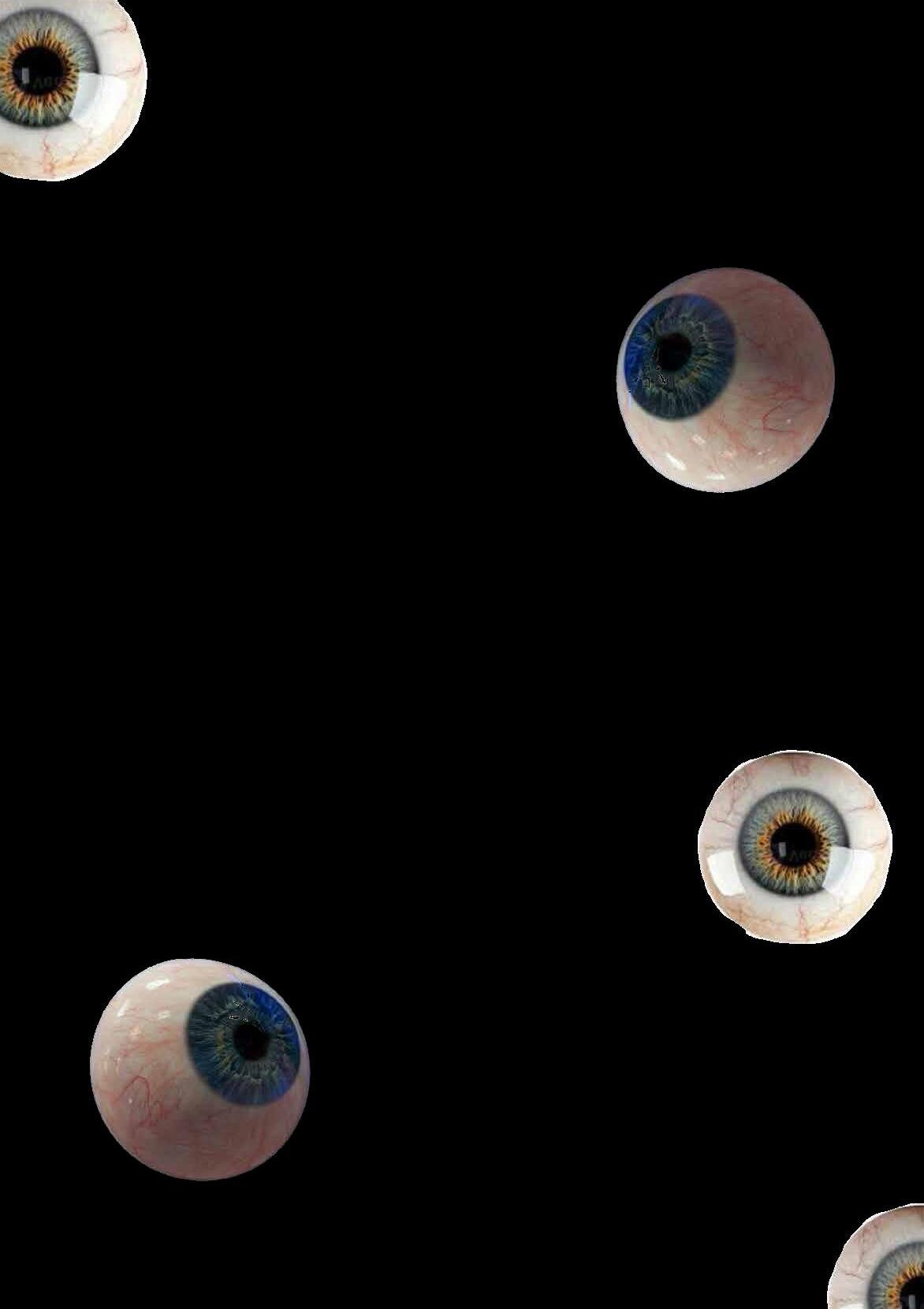
Maria del Mar D’Amato is a Colombian artist who studied Fine Art at the Accademia di Belle Arti di Roma. Her practice moves between installation, object crafting and performance. Her work focuses on repetition, how we move, how we present ourselves, how we keep adjusting. These patterns are easily disguised as self-improvement, discipline, or self-care, depending on what makes them easier to live with. Rather than ofering alternatives or solutions, she stays with these habits and shifts them out of place, holding them long enough to become uncomfortable. If something feels of, it probably already was.
What can happen when we pause within routines that are designed to keep us moving?
Over the past year, I have been investigating beauty and selfcare rituals not as neutral acts of care, but as highly structured performances. Shaving, moisturizing, painting nails, arranging hair, adjusting posture: these gestures are repetitive, learned, and socially reinforced. They promise improvement, discipline, purpose, self-optimization and a sense of fulfllment.
Rather than rejecting these rituals, my work aims to question and slow them down. I isolate and exaggerate familiar objects and create environments where the body cannot smoothly move through what it already knows. At the core of this project is the concept of stillness as a resistance from the constant demand to continue rather than the physical act of not moving.
As RuPaul famously states 1, “we are all born naked, and the rest is drag”. Gender is not something we are, but something we repeatedly do. Judith Butler2 argues that gender is constructed through repeated acts such as gestures, thoughts and movements that defne over time what is “natural”. Beauty routines can be understood as part of this repetition.
If gender is performed, then beauty rituals are rehearsals where the body is trained to occupy space in a controlled, efcient and aesthetically pleasing way. By introducing non-intuitive objects, garments and awkward spaces, I aim to disrupt that fuency. The body must hesitate, and in that hesitation, the labour normally hidden inside “efortless” femininity can be exposed.
The project also engages with the political dimensions of care and bodily maintenance. The routines I focus on, often repetitive and taken for granted, actually require continuous attention and labour. They are embedded in everyday life and become almost invisible while still demanding time and discipline. Within these gestures, the body becomes something to be endlessly maintained, improved and monitored.
In this repetition, care and control begin to blur and what feels natural or necessary is revealed to be something learnt and maintained.
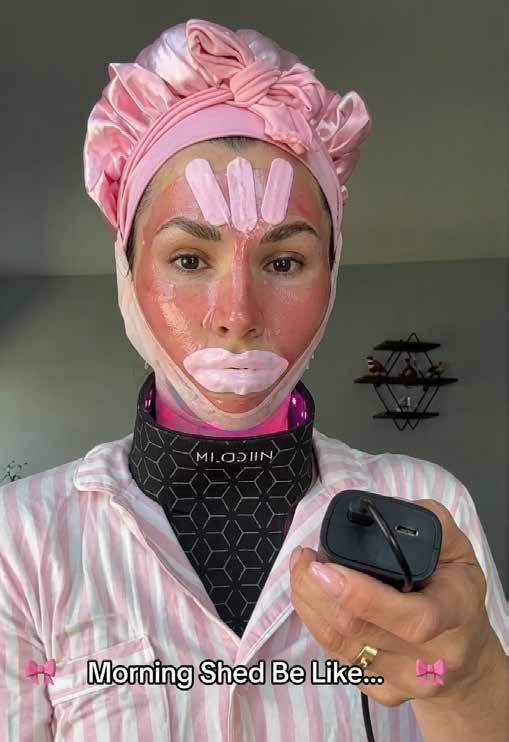
Meanwhile, the wellness industry increasingly packages rest and stillness as purchasable experiences with retreats, spa days and wellness apps, making what should be a basic human need, into a commodity, transforming even rest into another form of productivity.
We live in a time structured by speed: short-form content, rapid trend cycles and constant demand for self-improvement. Beauty routines circulate online as tutorials and time-lapses, compressing hours of preparation into seconds of visual entertainment.
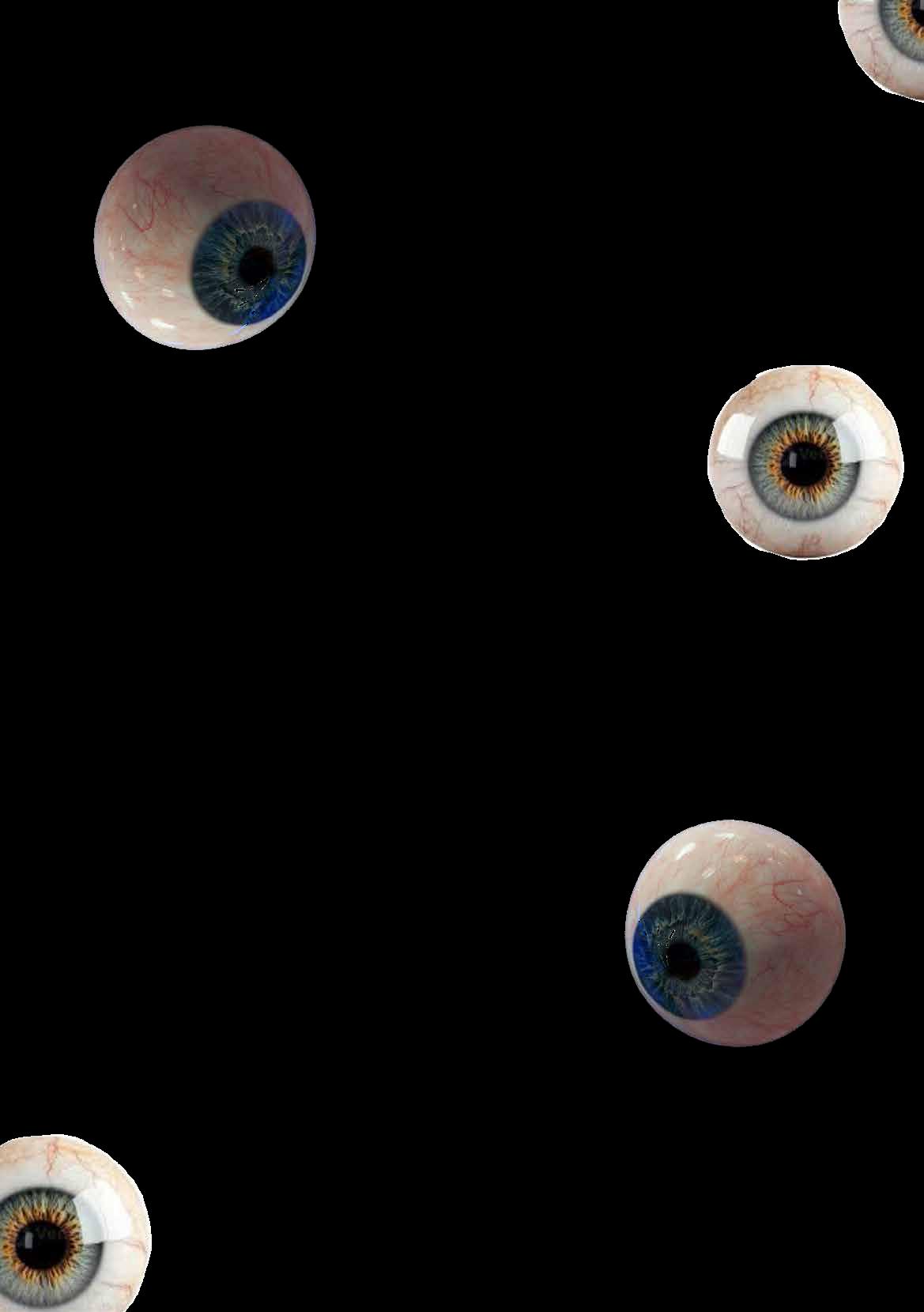
Stillness struggles to survive in such environments.
Sara Ahmed writes about orientation 3; she speaks about how bodies are directed in space by norms and expectations. My project attempts to reorient that space: what if the mirror did not demand correction? What if the garment didn’t prioritize comfort or easy movement?
By slowing down gestures and amplifying physical presence, I attempt to carve out micro-moments of attention that are not immediately absorbed into productivity. These moments are not entirely outside the systems they interrupt, they are still quite fragile and temporary. Stillness here is not made with the purpose of ofering an escape but instead it exists to introduce some friction, a slight misalignment with the fow of the routine.
Several contemporary artists have infuenced my thinking about the body, gesture, and repetition. Mierle Laderman Ukeles reframed maintenance work as art, exposing the invisible labour that sustains everyday life. In her Maintenance Art Manifesto (1969)4 she proposed to treat acts of upkeep, cleaning, sustaining and caring as artistic practice rather than as background activity. By bringing attention to maintenance as a continuous necessary and often undermined act, her work challenges what is valued and what is overlooked.
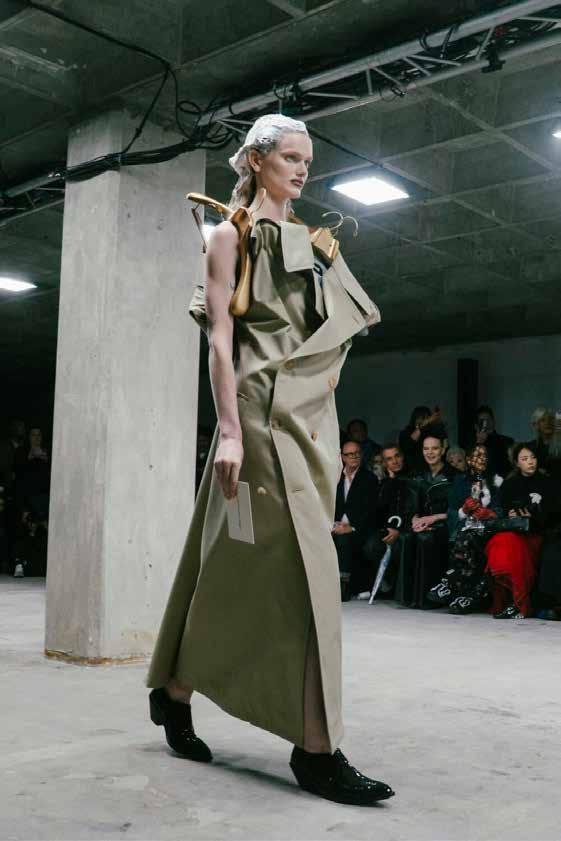
I am also infuenced by designers and artists who approach clothing sculpturally, such as Junya Watanabe 5, whose garments don’t work simply as fashion, but as structures that reorganize the body’s relationship to space, to itself, and to others.
His designs often alter movement, restrict, exaggerate, and redirect how the body can act. He creates conditions for the wearer to become more aware of gestures that would otherwise feel natural or automatic. This resonates with my own use of garments and objects as devices that interrupt habitual movement. Rather than supporting the body, they complicate it, introducing friction in the small gap between intention and action.
END NOTES
1. RuPaul, Lettin It All Hang Out: An Autobiography (New York: Hyperion, 1995).
2. Judith Butler. Gender Trouble: Feminism and the Subversion of Identity. (New York: Routledge, 1990).
3. Sara Ahmed, Queer Phenomenology: Orientations, Objects, Others (Durham, NC: Duke University Press, 2006).
4. Mierle Laderman Ukeles. “Maintenance Art Manifesto 1969!” In Mierle Laderman Ukeles: Maintenance Art, edited by Patricia C. Phillips (Munich: Prestel, 2016), 1-5.
5. Junya Watanabe. Junya Watanabe: Ready-To-Wear SS26.
Listening (to) Bodies: (Neuroqueer) Sonic Resistance
SILAS LILO JENSEN
Silas Lilo Jensen (they/them) is a sound artist working from a neuroqueer position. With a background in gender studies and music production, their practice investigates body politics, healthcare systems, as well as trans and queer life. Through embodied listening and sonic interventions, they explore how the body resists regulatory narratives and creates alternative ways of knowing.
Wait. You have to wait. One. Two. Five years.
Historically, queer and trans individuals have been relegated to the margins, defned by societal norms as “other.” In the Swedish trans healthcare system, this exclusion manifests as a precarious reality: waiting times stretch for years, and eligibility for genderafrming care hinges on a performance of “intelligibility”. One must trace a straight, normative line of life events to be recognized as ‘real’ 1 . Deviating from these lines, in a way that is interpreted as unintelligible 2 or as having a body that does not ft measurement models like BMI 3 , or ideas of mental healthiness, can result in being deemed illegible and denied care.4
My artistic practice emerges from this friction. Working from a neuroqueer position, simultaneously subverting neuronormativity and heteronormativity/cisnormativity 5 – I investigate how the body can become a site of resistance against these regulatory processes. Connecting with artist Sam Metz, I employ a practice of neuroqueering: a way of mapping experiences ignored by neurotypical understandings of how the body relates to its external world 6 . I map by re-visiting; returning to audio recordings of healthcare encounters, to the body, and its memory of these interactions.
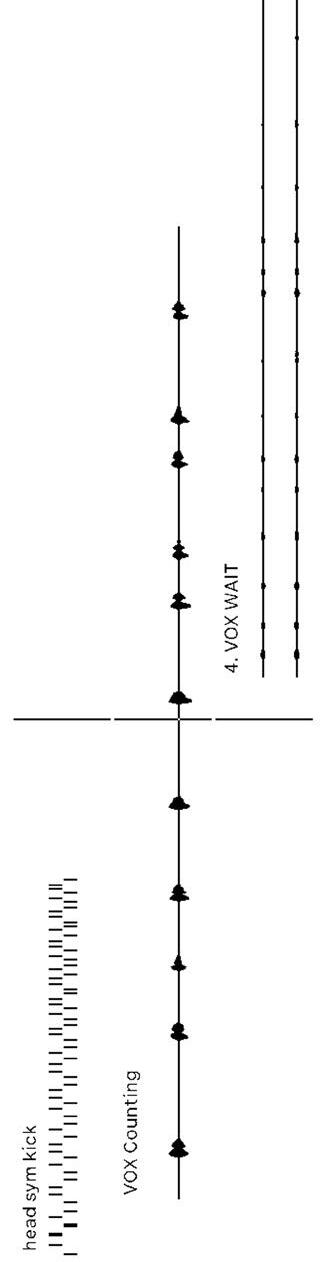
The sound piece WAIT/WEIGHT recalls healthcare encounters where I simultaneously engaged in internal counting, looping melodic sequences, and subtle rhythmic movements (stimming). I translated these gestures, such as moving feet in sequences, into sound.
I’m exploring the body’s processes on the body’s own terms, presenting an exploration of movement and sounding, refusing the coherent narrative required for care. Instead I ask:
What else goes on in our bodies as we navigate this system? What stories and nuances are put aside so as not to risk losing care?
I tap my feet in a sequence:
right left left right
left right right left
left right right left
right left left right
left right right left
right left left right
right left left right
left right right left
Then repeat starting from the left:
L R R L
R L L R
R L L R
L R R L
R L L R
L R R L
L R R L
R L L R
This sequence never reaches equilibrium; no matter how long it continues, it cannot even out the fact that it starts on either left or right. It ofers itself as a loophole: a portal to that which is also here, always available to me.
I assigned the pitch of a healthcare employee’s voice, as they stated the legitimacy of the protocol they were performing, to steps on a keyboard. Each key triggered a specifc recording. Every time the pitch changed, a diferent audio sample started - from gender clinic visits, demonstrations and stimming sequences. The result is a fragmentation of the institutional voice, interlaced with the “noise” of the body. Drawing on theorist and artist Eva Hayward’s framework, I treat these movements as “transpositions” 7 : sensory shifts that unsettle and discompose fxed arrangements, refuting the system’s language by presenting the bodily knowledge pushed aside.

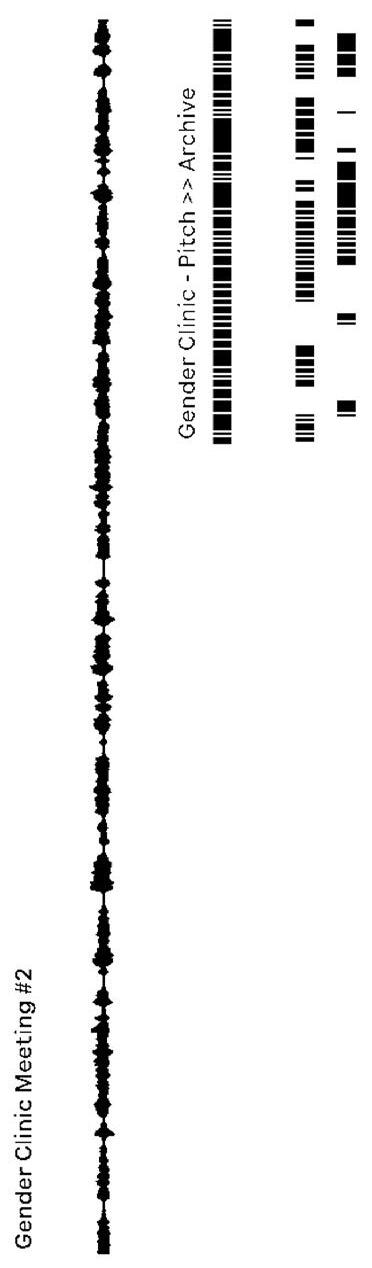
In PASSAGGIO, I explore voice as a site of resistance. As a nonbinary trans* singer currently taking testosterone, my voice is shifting registers, cracking, creating a loss of control and an unfamiliar sonic landscape. In professional singing, the transition between chest and head voice (passaggio) is expected to be smooth and undetectable. However, in PASSAGGIO, I insist on the break, refusing to apply control; recording my voice cracking repeatedly assembling a “choir of breakage.”
vocal breakage chest chest chest
chest
Thinking along with writer and philosopher Paul B. Preciado, who in Can the Monster Speak resists settling into a recognized gender identity that requires holding one’s tongue and hiding a dissident history 8 , I do not want to smooth over the dissonance of experience. Having received a “pass” for gender afrming care, I am (for now) in a position where I can explore my dissidence. Following Preciado’s resistance to the “smooth” transition into a recognizable gender, I embrace the voice cracking as a movement against the demands for linearity, and the notion of life and transition as a unidirectional movement from A to B.
With these sound works, the intention has been to create a space where messiness is allowed. Not controlling our voices and bodies can be risky - a matter of life and death; here I insist on the right to crack, loop, to ‘not make sense’, and to exist non-linearly. This aligns with dancer and writer Julian Carter’s emphasis on the body as a site of creating change: “Through our actions the trans promise: what we do with our bodies changes worlds.” 9
head head head head vocal breakage
Considering somatic attention a necessary political intervention, I invite audiences to listen, to feel, and ultimately to imagine alternative confgurations of body and care. I ask if, by insisting on attending to our bodies, by staying with the crack and tremor, we might materialize conditions for inhabiting the world more fercely? Can an artistic practice that foregrounds the body’s experience and resonance change the temporal and spatial boundaries of the trans healthcare system?
END NOTES
1. Judith Butler, “Performativity, Precarity, and Sexual Politics”, AIBR. Revista de Antropología Iberoamericana 4, no. 3 (2009): 1–13, https://aries.aibr.org/storage/antropologia/04v03/ criticos/040301b.pdf.
2. Signe Bremer, Kroppslinjer: Kön, transsexualism och kropp i berättelser om könskorrigering (Malmö: Makadam Förlag, 2011), 224.
3. Sebastian Lönnlöv, “BMI -gränser slår hårt mot transpersoner”, Ottar, March 6, 2019, https://www.ottar.se/bmi-gr-nser-sl-r-hrt-mot-transpersoner/.
4. Ida Linander, Marcus Lauri, Erika Alm, and Isabel Goicolea, “Two Steps Forward, One Step Back: A Policy Analysis of the Swedish Guidelines for Trans‑Specifc Healthcare”, Sexuality Research and Social Policy (2020), https://doi.org/10.1007/ s13178-020-00459-5.
5. The term “neuroqueer” was coined by Nick Walker in 2008 and originally defned as the simultaneous subversion (queering) of neuronormativity and heteronormativity. Here, I expand the neuroqueer position to include cisnormativity, using this expanded framework to understand and subvert how the trans healthcare system constructs and defnes normalcy related to gender. Nick Walker, “NeuroQueer: An Introduction”, NeuroQueer, accessed March 25, 2026, https://neuroqueer. com/neuroqueer-an-introduction/.
6. Sam Metz, “Stimming as a Form of Autistic Aesthetic Experience”, Neuroqueering Landscape, Ought: The Journal of Autistic Culture 5, no. 2 (Spring 2024): 132.
7. Eva Hayward, “Spiderwomen: Notes on Transpositions”, in The Bodies, Borders, and Politics of Transition (New York: Taylor & Francis, 2012).
8. Paul B. Preciado, Can the Monster Speak? A Report to an Academy of Psychoanalysts, trans. Frank Wynne (London: Fitzcarraldo Editions, 2021), accessed March 25, 2026, https:// transreads.org/wp-content/uploads/2024/10/2024-1015_670dc9b2c9191_Can_the_Monster_Speak_A_Report_to_ an_Academy_of_Psychoanalysts_Paul_B._Preciado_Frank_ Wynne_translation_Z-Library.pdf, 14.
9. Julian Carter, Dances of Time and Tenderness (New York: Nightboat Books, 2024), 6.
In a State of Becoming ALEXANDRA BITTAROVÁ

Alexandra Bittarová is a Slovak visual artist with background in painting and sculpture. Her practice is concerned with impermanence, absence and the life of materials, on how things form, change, and leave traces of their own duration.

The oyster shells were my starting point. I received them as a byproduct and felt bad about trashing them, thinking that, as an artist, I have a responsibility to make something ‘beautiful’ out of them. After reading Gaston Bachelard’s Poetics of Space, I started thinking of a shell as an abandoned place, a home, an absence.1 It is a structure formed slowly over time, a protective casing built layer by layer around a soft interior. I am interested in its duality: shell as shelter and shell as vacant space. In my sculptural works, I combine them with wax, a material that changes its form quickly compared to how a shell is formed through the years of an oyster’s life.
Under heat, the wax softens, melts and transforms, but the shell remains as it was. What has drawn me to using wax is its reusability; it functions as a material loop. The sculptures are all made from the same material and from one another. Does that mean the work is ephemeral, or does it get to last forever? The red heat lamps activate this process, causing gradual changes and keeping the works in a constant state of becoming, no longer needing the artist’s help, intervention, or presence. The heat’s impact varies as it’s combined with diferent distances and time spans; the heat transforms each sculpture at a diferent pace. I see this work as an invitation; the viewer is welcome to return to see how it has transformed over time, or take a moment to ponder as the wax creates melted rivers of forms. Once we take a closer look, small details become worlds that we get to observe. The viewer encounters this tension, the anticipation of change in the temporary form.
Historical & Artistic context
There is a history of artists working with the instability rather than against it. Eva Hesse worked with latex and fbreglass. These materials droop, change colour, and fall apart; it is not despite their instability but because of it. Her sculptures kept changing after she was done with them, as if the material had its own course. 2 Similarly, Maria Bartuszová flled balloons with wet plaster and let gravity create the form, trusting the fall and
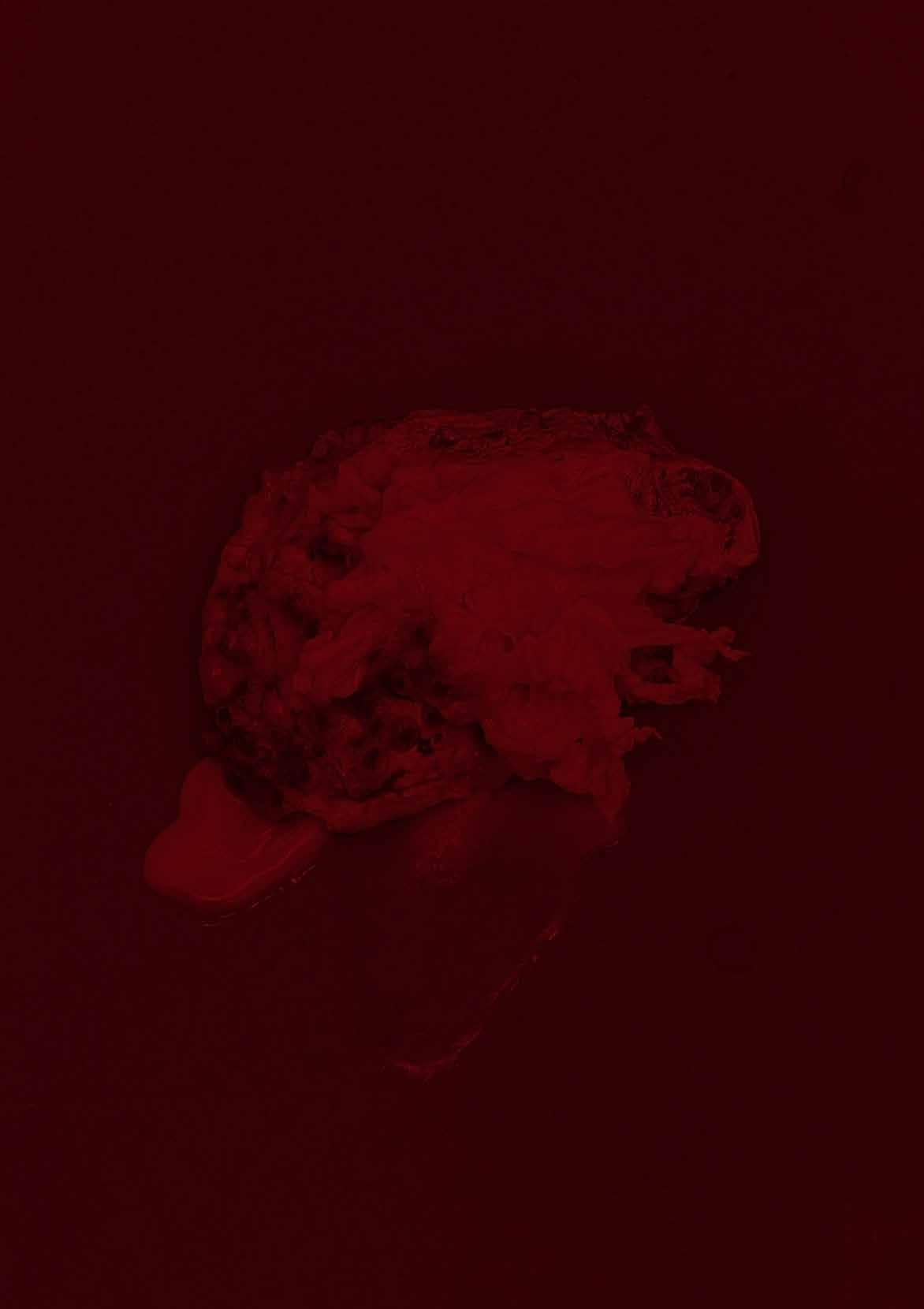
the pressure to make something she couldn’t have pre-designed. 3 Both artists have inspired me because of their willingness to step aside. Not to fully disappear, but to share the authorship with something that isn’t human. My oyster shells and wax sculptures come from a similar place of interest in what happens when you set something in motion and then let go. The work continues without the artist’s hand and lets us think beyond the tangibility of sculpture that isn’t simply grounded in material objects but responds to circumstances and the outer world. The sculptures exist somewhere between forming and unforming.
On the photographs
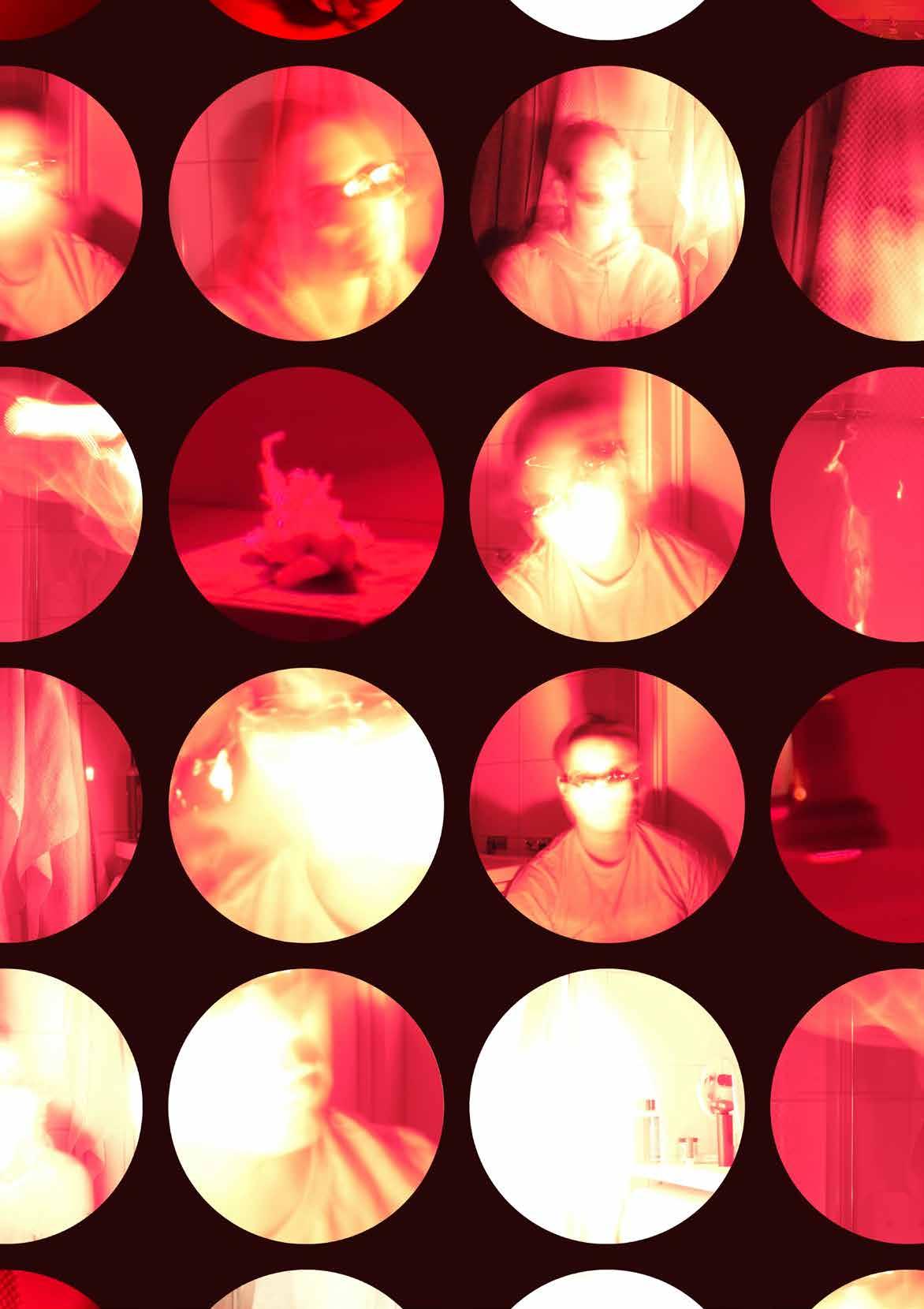
The photographs came out of spending so much time around the red lamps. They transform everything around them, not only the sculptures but the atmosphere and the way we feel when we are facing them. When I turn it on, my room looks diferent; I look diferent. Shooting with a slow shutter speed meant letting more time and light into the image. It is both a frozen moment yet accumulation of minutes in one picture. The long exposure feels related to the sculptures: both are about duration and leaving a mark.
On the red lamps
The red lamps came from a personal memory: my grandmother would place one in front of me if I had gotten sick, convinced it would cure me. There was something about that object that required belief, as if it only worked if you trusted it. It had a slightly otherworldly feel; sitting in a red room, the heat becoming unbearable after a while, the impossibility of keeping your eyes open, the instruction not to look directly into the light. It carried an entity-like presence. This quality was what eventually brought it into the work, as I was looking for something that could transform the sculptures gradually in front of the viewer. However, it also requires the viewer to slow down their body, to wait and adjust to the light. The lamp already knows how to demand patience from us.


ENDNOTES
1. Gaston Bachelard, The Poetics of Space, trans. Maria Jolas (Boston: Beacon Press, 1964), 105.
2. Briony Fer, “Sub-objects and studio work: Eva Hesse and Maria Bartuszová”, in Maria Bartuszová: Provisional Forms, exhibition catalogue, curated by Marta Dziewańska and Gabriela Garlatyová (Warsaw: Museum of Modern Art in Warsaw, 2015), 123–137.
3. Christine Macel, “Maria Bartuszová: Her times, her age”, essay in Maria Bartuszová: Provisional Forms, exhibition catalogue, curated by Marta Dziewańska and Gabriela Garlatyová (Warsaw: Museum of Modern Art in Warsaw, 2015), 153–166.
Stages of an Attempt NILS KARLSSON
Nils Karlsson is a painter, engineer and, researcher. In 2010, he began an artistic enquiry, now entitled An Enquiry into Elsewheres, which revolves around methodology, painting, phenomenology, spatiality, temporality, and transcendence. He holds a Bachelor of Fine Arts from Konstfack, Stockholm. He is currently studying his fnal year of the master’s program in fne arts at HDK-Valand.
My work is concerned with elsewheres, a concept I have developed to describe experiences of time and space that deviate from the everyday. My main approach is to research elsewheres by experiencing them. The methodology for this experiential mode is centred around a particular kind of attempting that I develop along with my understanding of elsewheres. In my case, they are painterly attempts. These appear as non-fgurative and are made with oil paint on canvas or panel, occasionally on a wall or window. However, I would assert that these attempts can be based in any practice and media.
I think of elsewheres as a response to global societal structures that are simultaneously fattening and fragmenting human lives. Flattening, in that their mechanisms reduce the range of experiences and agency humans can have. Fragmenting, in how they break down social, political, and ecological relationships. These tendencies are hard to grasp as they work on diferent scales and localities. On a larger (and more worrisome) scale, I see what social ecologist Luis Suarez-Villa calls a technology oligopoly capitalism – a supra-structure of societal control through socio-economic-technological systems made up of online platforms, apps, sensors, and machine intelligence.1 These systems not only consume their users’ time, but they also change their perceptions, understandings and behaviours. 2 This regime has an immense infuence, reorganising our perceptions and our sense of time. I think my practice of elsewheres can ofer some kind of resistance. My painterly attempts achieve this by creating conditions for time and sense-making to slow down and form a somewhat coherent patchwork.
I have found that attempts for elsewheres are distinguished from other attempts that have a clear objective, such as climbing a mountain or making a paddock. While attempts for elsewheres are highly intentional too, their aim is inherently indeterminate. How would one know the direction to elsewheres from here?
I turn to art for clues 3 and fnd some guidance in the attempts of artist Bruce Nauman, especially in the now iconic performance
Failing to Levitate in the Studio. 4 A s the title suggests, the intention to start hovering above the two chairs that he was lying on was destined to fail. Levitating in this case is obviously not the goal – it is impossible, which is also proven by him falling exhausted to the foor.
Attempts are often talked about as either failures or successes. It might seem like I am deliberately trying to fail, the impossible setup of reaching elsewheres being reminiscent of Nauman’s attempts. And yes, I do think it is inherent that my attempts will collapse. Neither will they escape the conditions they are trying to break away from. What I think Nauman gestures to is that the artists’ failed attempts and their equally unsuccessful private lives are things that have been and are still romanticised and displayed. Philosopher Maurice Merleau-Ponty gives an account of the painterly attempts of artist Paul Cézanne:
of the stages of an attempt.
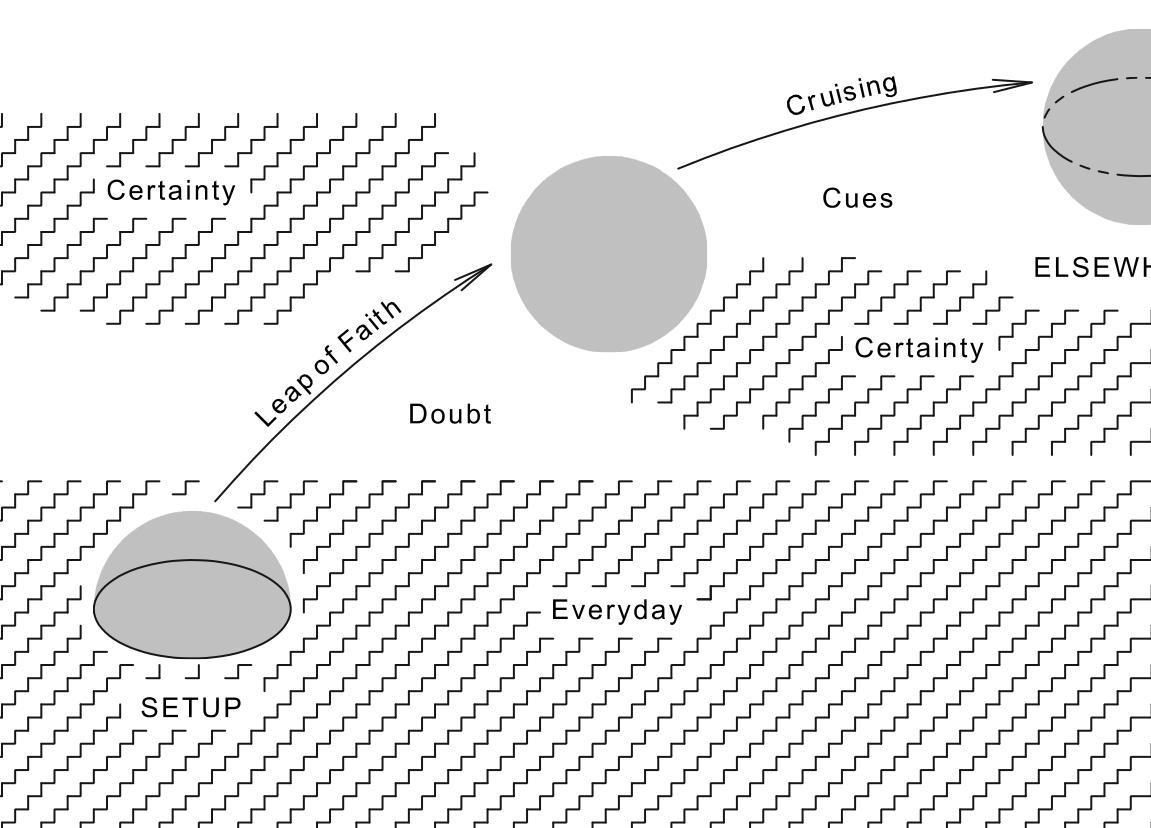
Diagram
“...he was never at the center of himself: nine days out of ten all he saw around him was the wretchedness of his empirical life and of his unsuccessful attempts, the debris of an unknown celebration.” 5 When I frst read this quote, I ended up with an interpretation of an idealised artistic life, the misunderstood one whose success is overlooked. However, when I look at these two examples again –at Nauman’s attempts for levitation and Cézanne’s obsession with making his perceptions visible, instead, what stays with me is the absurdity.
For philosopher Søren Kierkegaard, faith works on the strength of the absurd in that when something is given up in unconditional trust in the face of the impossible, it is given back in a transformed manner. 6 For an onlooker, the endeavour of fnding elsewheres might seem absurd. However, as an attempter, there is a leap of
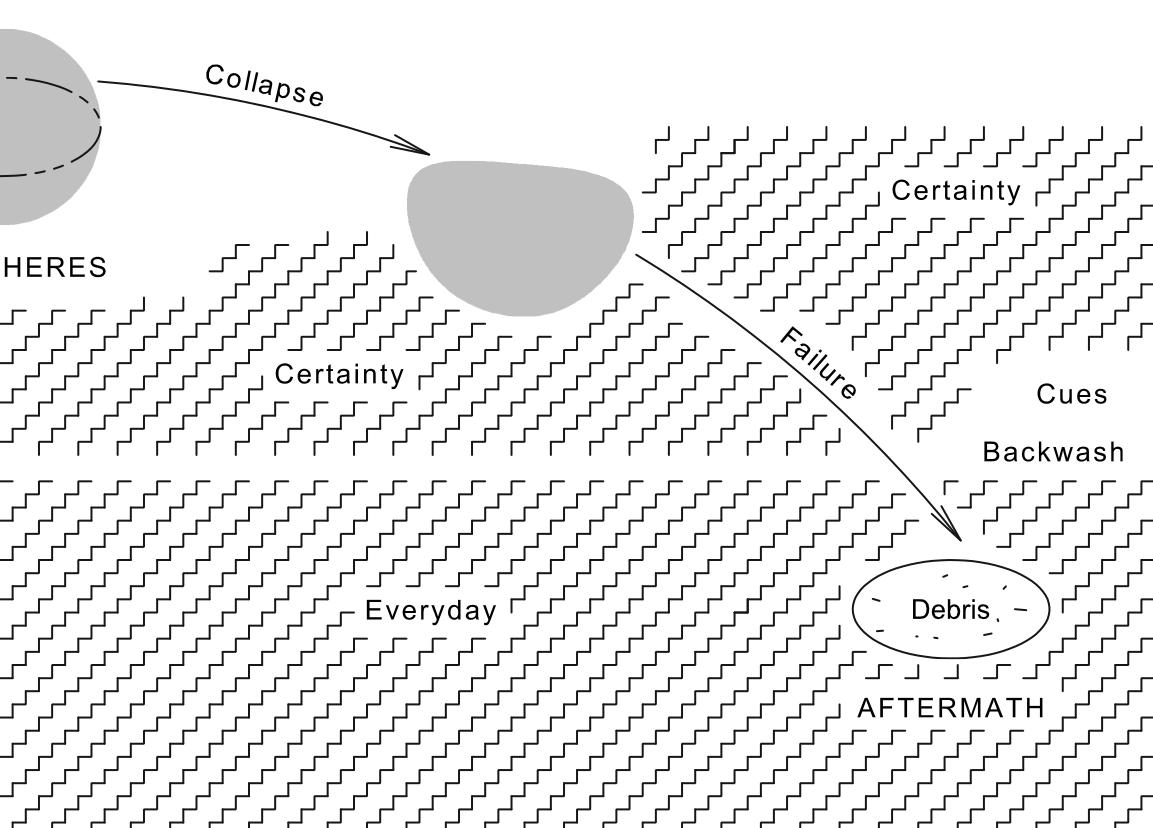
faith in the moment when I put the trust in it, to make it take of (or nosedive). Perhaps some faith is necessary to encounter elsewheres? Instead of immediately seeking certainty or knowledge, one can rest in it and what is unknown, thus letting the directions fnd the attempter. As for what is impossible or possible, a failure, or a success: I will just keep attempting, knowing that there are other priorities (and celebrations).
Disclaimer
Elsewheres is a particular practice of experiencing time and space that deviates from the everyday. This practice is not intended to be a substitute for societal change. Elsewheres are not to be seen as representations of an alternative society, nor will attempting for elsewheres create one. The information in this publication is intended to be a tool for the reader’s thinking and sense-making, and does not constitute a basis for political action. Working with elsewheres requires a careful consideration of the specifc ethical context where possible attempts are made.
ENDNOTES
1. Luis Suarez-Villa, Technology and Oligopoly Capitalism (New York: Routledge, 2023), 368-69.
2. Suarez-Villa, 152; Shoshana Zuboff, The Age of Surveillance Capitalism: The Fight for a Human Future at the New Frontier of Power (London: Profle Books, 2019), 8.
3. After all, art, like science, is a feld known to encourage testing and experimenting.
4. Bruce Nauman, Failing to Levitate in the Studio, 1966, photography, video.
5. Maurice Merleau-Ponty, “Cezanne’s Doubt,” in The MerleauPonty Aesthetics Reader: Philosophy and Painting, ed. Galen A. Johnson (Evanston, IL: Northwestern University Press, 1993), 75.
6. John Lippitt, Routledge Philosophy Guidebook to Kierkegaard and Fear and Trembling (London: Routledge, 2003), 49.
META, META-, META CATALINA GÓMEZ RUEDA
META, META-, META
In these two years, I have been told several times that my work ‘is very meta’. The frst time I was told that, I had to go to the dictionary and found an interesting situation that I think is a good starting point for this text: In English, the term meta describes something self-referential; the Greek prefx meta (μετά-) means after, with, alongside, between, or beyond; while in Spanish, meta is an end or purpose one aims to achieve. I like this anecdote because it perfectly summarizes the nature of my refections since I crossed the Atlantic from Colombia to come study and work in Sweden. A word can be much more than the meaning we think it has, depending on where you look at it from, in what tone it is said, and what other words accompany it. To anyone who decides to stay and follow these lines, I invite you to cross these three diferent notions of meta with my current research-creation processes.
My master’s thesis has a self-referential dimension, in which I seek to understand who I am, what I do and why I do what I do; another, oscillating in the between; between the familiar and the unknown, between knowing and not knowing, between the Andean tropics and the Scandinavian north, between Spanish and English, between the institutional and the informal, between the private and the public, between word and image, between chaos and order; and an aspirational and more pragmatic one: to learn things, to achieve learning objectives, to advance in a curriculum and obtain a European university degree that helps improve my working conditions and those of the people I share with.
META adjective uk /´met. ə/ us /´met. ə/ (of something that is written or performed) referring to itself or to something of its own type:
“It’s a meta joke. It’s sort of a joke about jokes.”
“I am standing at my desk typing this about the media right now. It feels very meta.” 1
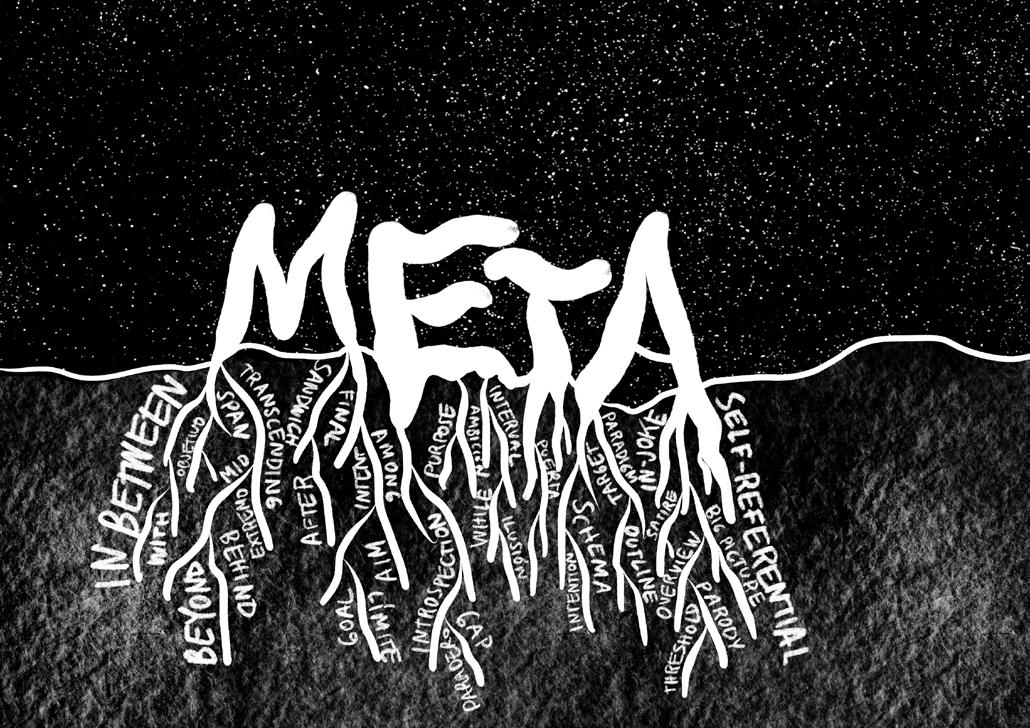
The question with which my research process began revolved around identities: how one’s own identity and that of a collective are confgured, and how contexts shape them. One of the factors that has most infuenced the construction of what I believe I am is the fgure of the house, the home, the nest. Since I was little, I have moved from house to house; I have lived alone, with diferent relatives and friends who have taken me in at diferent times. I can’t count how many times I have moved, but I suspect that so much moving has made my habits fexible and changed my ideas about the world and who I am.
This time the change of base was radical and brought me to this territory extremely diferent from everything I knew. The decisions I have made during my project have to do with a feeling of uncertainty, uprooting, and disorientation that migration implies. Amidst the privilege of being able to think about it and make the academic and economic migratory experience an object of research in itself. To have the time, spaces, resources, and networks to observe not only my journey, but also that of many others I have encountered along the way who inhabit this same volatile situation from unequal positions, among diverse constellations that determine people’s well-being and the rights each one has access to depending on origin, race, sexual orientation, class, abilities, and ideology.
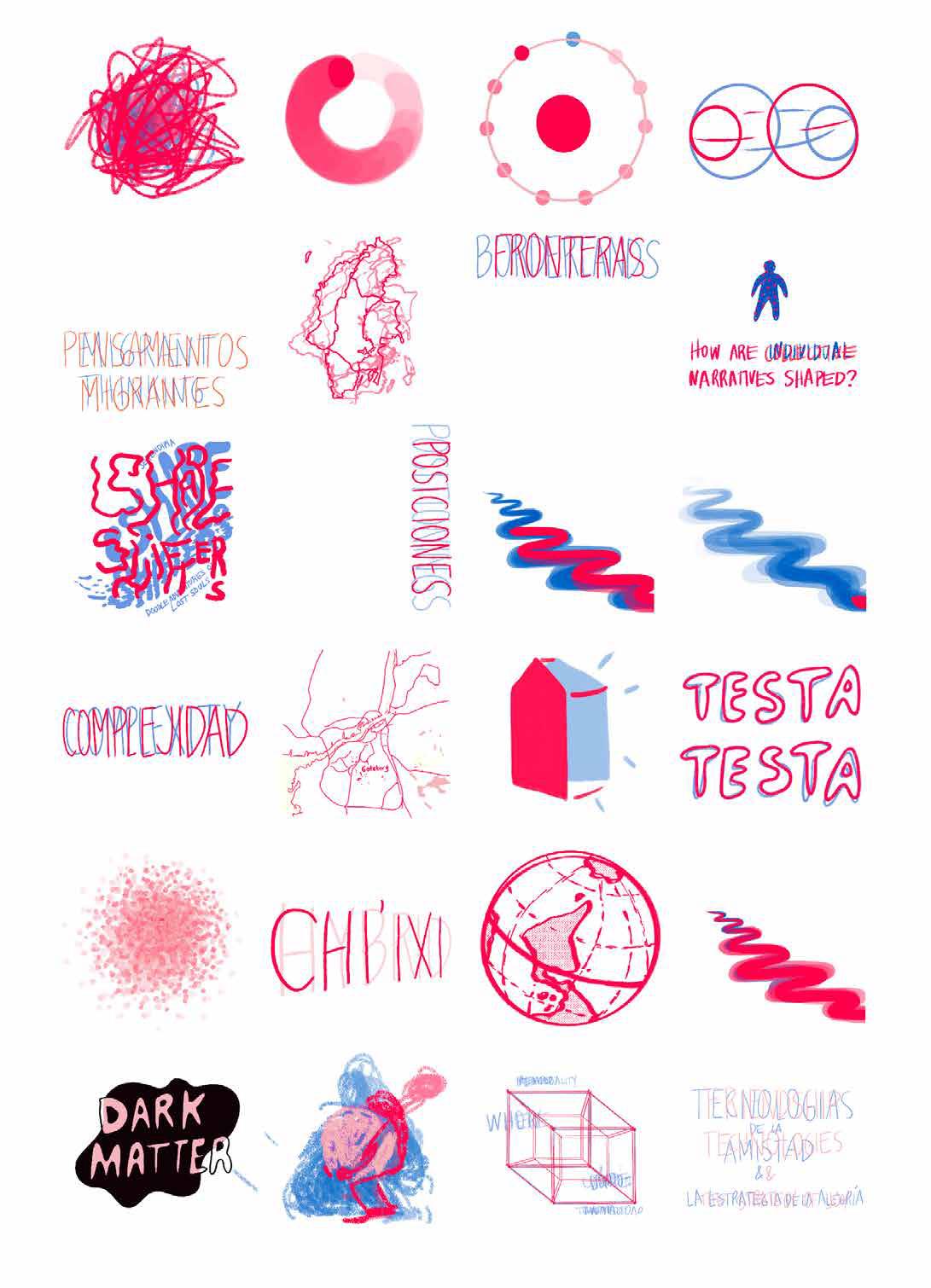
The research maps these intersections: my own and others’ existential displacements, which are reconfgured and problematized when crossing geographical, cultural, and institutional borders. I’m exploring, through this arts program, the implications of academic mobility on my own body in relation to other bodies and the spaces I have had access to. I make drawings, prints, lists of synonyms, conceptual maps, pop-up structures, and projections with which I try both to capture feeting impressions of what I see and to ruminate on things I don’t understand. I have facilitated collective creation workshops with children and adults where we have shared music, food, materials, ideas, and images. Doing things with others, somehow, allows the emergence of the familiar within what seems distant and strange.
META–
word-forming element of Greek origin meaning 1. after, behind; among, between 2. changed, altered 3. higher, beyond; from Greek meta (prep.) in the midst of; in common with; by means of; between; in pursuit or quest of; after, next after, behind, in compounds most often meaning ‘change’ of place, condition, etc.
This is from PIE \me- ‘in the middle’ (source also of German mit, Gothic miþ, Old English mið ‘with, together with, among’).
The notion of ‘changing places with’ probably led to the senses of ‘change of place, order, or nature’, which was a principal meaning of the Greek word when used as a prefx (but it also denoted ‘community, participation; in common with; pursuing’).2
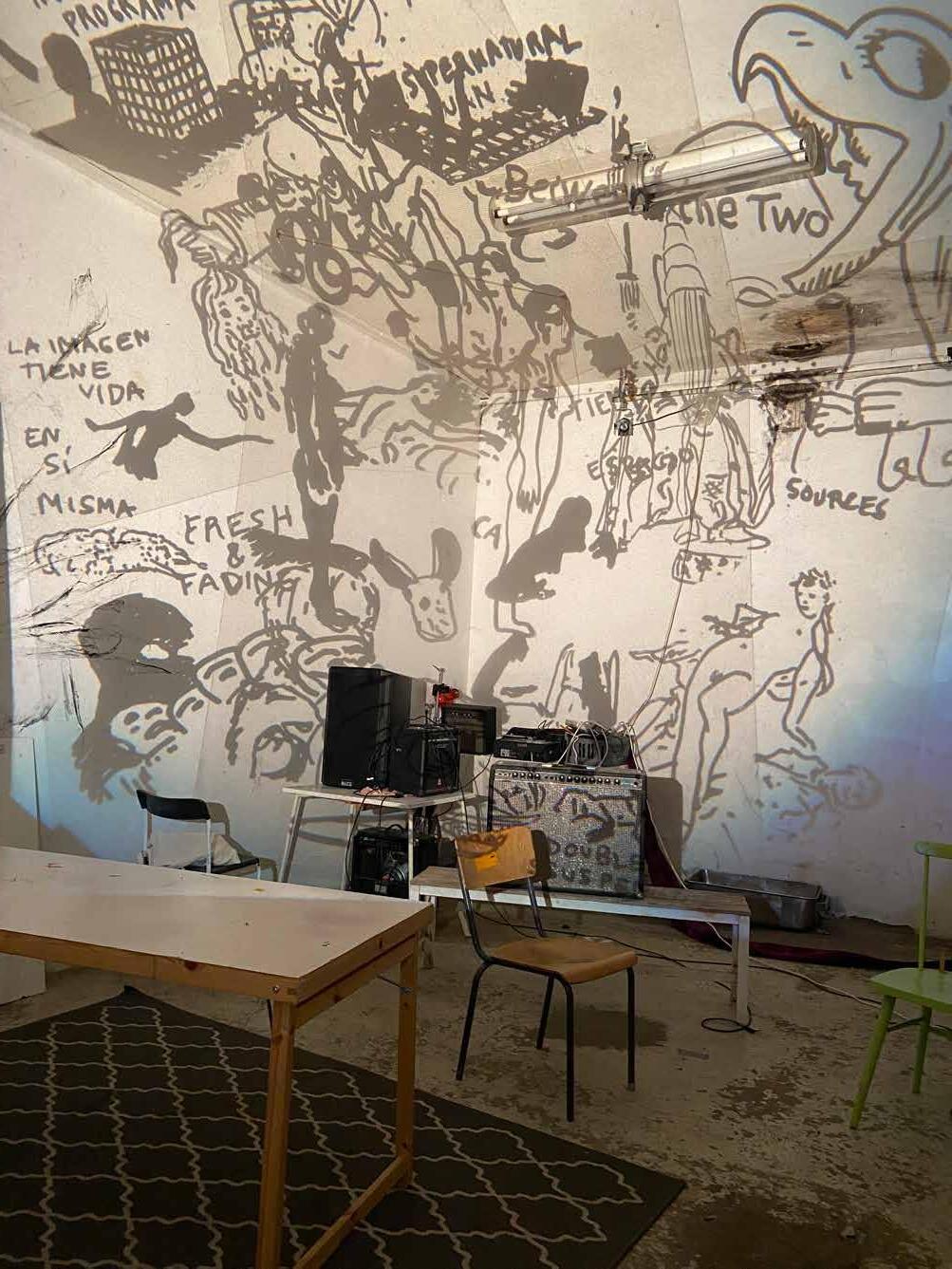
Since I arrived in this city, I have had to move seven times, most of them between Bergsjön and Kortedala. I have experienced life here from these neighborhoods, and the relationships I have woven in the northwestern area have profoundly infuenced the way I navigate the master’s curriculum. My home, in this case, has been Longest Night, a screen-printing workshop and space for noise and gathering, where I found kindred spirits. My way of researching has prioritized connections over products. I operate from an afective logic of interconnection that considers the ideas of ‘technologies of friendship’ and the ‘strategy of joy’ from Argentine sociologist and artist Roberto Jacoby. In the face of fear, joy; and in the face of defeat, the urgent weaving of social ties. In times when the planet explodes to the rhythm of the capitalist, colonial, and genocidal mandates of powerful people, companies, and countries, it is necessary to critically review how these violences are reproduced in the piece of the world we know. To seek ways to (re)exist and, through artistic practices, (re)think ourselves, (re)name ourselves, and (re)confgure ourselves together.
META
From Lat. meta.
1. f. Goal or line marking the end of a race.
Syn.: fnish line, fnal, taina [archaic or colloquial for goal].
2. f. End towards which a person’s actions or desires are directed. Syn.: objective, aim, purpose, ambition, dream, aspiration, intention. 3. f. In the Roman circus, a conical pillar that marked each of the two ends of the spina (central barrier).
4. f.Sports. In soccer and other games, goal.
Syn.: goal, net, target. 3
The race is almost over. Running feels exhausting, especially when the track is unfamiliar terrain. Leaving the tropics feels like running through the seasons, with limited time, without that kind of balance that the certainty of the sun’s regular and consistent appearance throughout the year generates in tropical life. Running the curriculum in a wintry darkness that feels eternal has been like walking blind. Improvising with attention to the things that come up, then refecting on the decisions I make and their efects on reality.
Although there is a clear starting point and a fnish line when you go through a program like this, my retrospective vision is blurry, fexible. I think I have lived this structure from an indeterminate position, from temporalities in confict and forms of knowledge in tension. I learned that experiences often confront the distortions of our expectations, ambitions, aversions, and desires. And I believe that any refection I make now will fall short in the face of the understanding that only comes with the passage of time. I read this short story and this paragraph seems like a good set of lines to walk through… “Hunger, thirst, heat, pain, cold. As soon as Marcial reduced his perception to these essential realities, he renounced the light that was already accessory to him. He ignored his name. Stripped of baptism, with its disagreeable salt, he no longer wanted smell, nor hearing, nor even sight. His hands brushed against pleasurable forms. He was a wholly sensible and tactile being.
The universe entered him through every pore. Then he closed his eyes, which could only make out nebulous giants, and penetrated a warm, humid body, full of darkness, that was dying. The body, feeling itself wrapped in its own substance, slipped towards life.” 4
END NOTES
1. Cambridge Dictionary, s.v. “meta,” accessed March 22, 2026, https://dictionary.cambridge.org/dictionary/english/meta.
2. Cambridge Dictionary, s.v. “meta,” accessed March 22, 2026, https://dictionary.cambridge.org/dictionary/english/meta.
3. Real Academia Española. “meta.” In Diccionario de la lengua española, versión 23.8 en línea. Accessed March 22, 2026. https://dle.rae.es/meta. (Author’s translation.)
4. Alejo Carpentier, “Viaje a la Semilla”, Viaje a la semilla y otros relatos. (Santiago, Chile: Editorial Nascimento, 1971).
Uranium Mining vs Nuclear Art
JOHAN SANDLER
Johan Sandler is a trained architect and a student at HDKValand’s Master’s Programme in Fine Art. Using participatory and site-responsive sculptures, or rather structures, he explores how artistic methods and strategies can engage with various issues and, if possible, have some form of impact.
Once again, Sweden is considering nuclear power as a future energy source. In November 2025, the proposal to lift the ban on uranium mining permits in Sweden was voted through Parliament. This means that it became legal to mine uranium from January 1, 2026.1
Allowing uranium mining has created great hopes for nuclear power and Sweden’s electricity supply, but also strong concerns for the environment, plant and animal life, and the impact on residents in the afected areas. Opposition occurs, but at a limited level, often locally linked to the sites of new reactors, fnal disposal or uranium extraction. An issue that should be a national or even a global concern is reduced to a local problem.
Resistance can arise from sources other than just political. In my artistic practice I examine the possibilities for artistic engagement with the issue: initially on a local level in Oviken, a site of great interest for potential uranium mining, but with the overall aim of achieving a broader engagement that can extend beyond the local.
My initiatives have been guided by the question:
How can artistic strategies and methods help to create historical consciousness and narrative around uranium mining?
Ranstadsverket in Västra Götaland is part of the Swedish historical nuclear landscape. After the end of World War II, work began on The Swedish Line, an idea that Sweden would become self-sufcient in nuclear power for use in civil nuclear power and for the production of Swedish atomic bombs. A rapid approach to the issue was emphasized. Uranium resources were discovered in alum shales and, after rushed parliamentary decisions, construction of Ranstadsverket began. However, uranium mining was not successful and instead led to major economic setbacks. The plant was closed in 1969, four years after opening. Proposals to reopen Ranstadsverket were put forward in the 1970s, but signifcant public objections terminated the
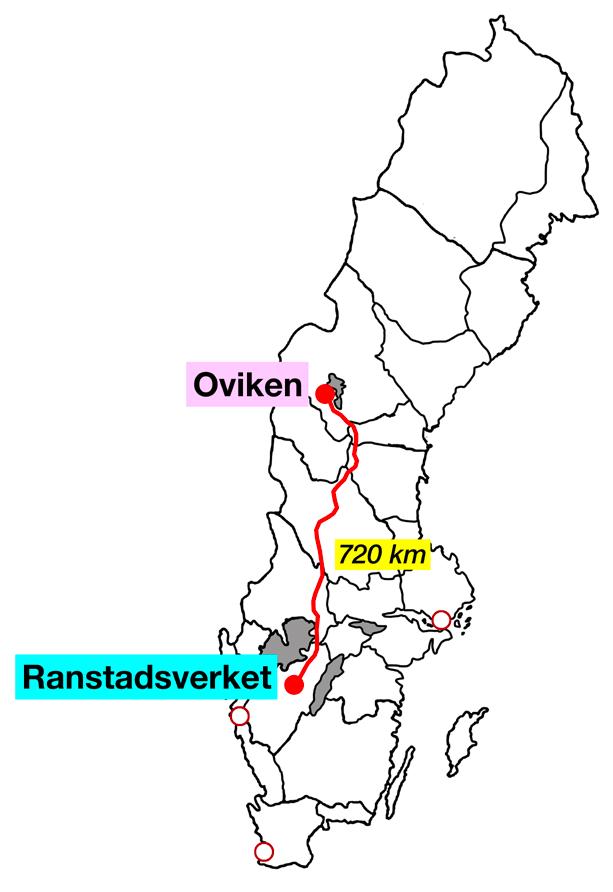
plans. After a referendum, it was decided that Sweden would implement a gradual phase-out and be nuclear-free by 2010. A consequence of the operations was signifcant environmental problems. The site has been remediated for 30 years, until 2020, and is still classifed as an environmental risk area.
An area in Jämtland around the village of Oviken has been found to contain large amounts of uranium. Currently, there is no safe way to extract the uranium as proposed, leaching from low-grade alum shales. 2 The risks are signifcant and in addition to potential accidents, daily operations would involve large releases of contaminants into the groundwater. Establishing a
mine in Oviken, under geological conditions similar to those in Ranstad, would mean major impact to the landscape and profoundly afect the lives of people living nearby. Addressing this artistically could increase historical consciousness of uranium mining but also of the landscape itself and its signifcance to the local population.
Narrative is a way of understanding and relating to the world around us, it “unifes and strengthens people’s empathetic capacity.” 3 Narrative can move back and forth over time, explaining events, provide perspective, meaning, and context. Without perspective or the possibility of context, it is difcult to perform any type of resistance. Today’s discussions and narratives around uranium mining should not only be about growth, progress, and green energy, but also about refecting on what we already know. History can be used to provide guidance on the issue. I am convinced that we need narratives that explain the causal relationships, that is, what uranium mining means and what consequences it can have. I am also convinced that we need narratives in which people’s power to create change becomes visible. For example, the demolition of Ranstadsverket in 1991, which became a strong symbol of Sweden’s phasing out of nuclear power.
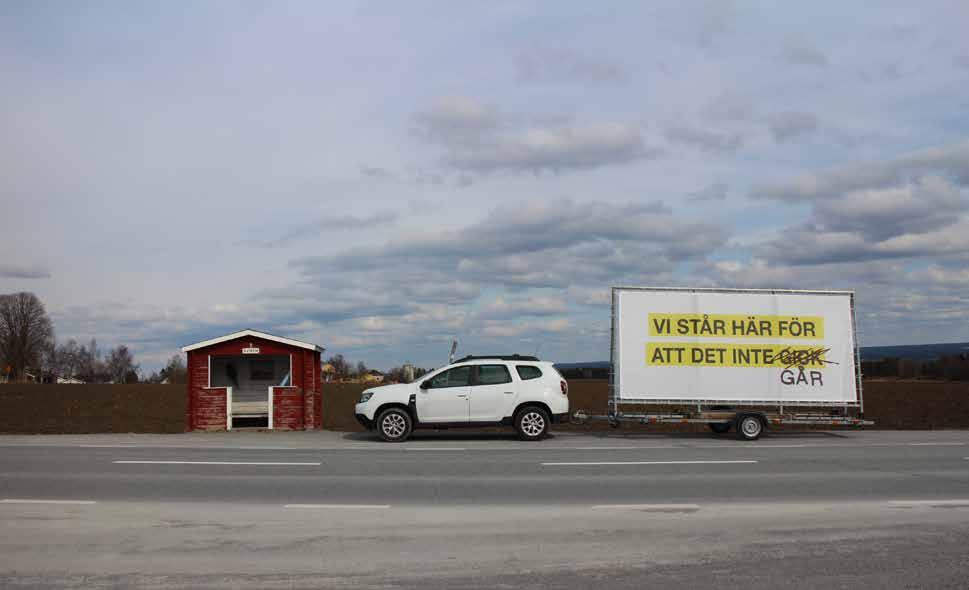
To contribute to historical consciousness and narrative around the issue, I drove a billboard trailer from the remains of Ranstadsverket to the potential mining sites in Oviken, a distance of 630 km. The journey took several days and included several stops to have the opportunity to meet the recipients of the message. The very similar yet diferent texts on the billboards move across diferent tenses and connect the past with the present in a way that provides perspective on the future. This ambulating manifestation with a simple message, accessible to a signifcant broad audience, connects the two sites in time and space. It situates Oviken and the local population in a context of signifcance from a Swedish historical uranium mining perspective. This is nuclear art, in the form of a campaign, a political stance.
I hold the view that artistic strategies and methods can have signifcant impact. However, major changes are not carried out by individuals but arise from “complex processes in which various forces and actors are involved.” 4 Uranium mining is ultimately political, and to have any real impact, artistic strategies and methods should interact with economic interests, legal processes, and political and local opposition. This manifestation is just one part of commitments being carried out on multiple fronts and levels.
ENDNOTES
1. ”Förbudet mot utvinning av uran tas bort,” Sveriges Riksdag, accessed January 8, 2026, https://www.riksdagen.se/sv/ dokument-och-lagar/dokument/betankande/forbudet-motutvinning-av-uran-tas-bort_hd01nu7/
2. ”Promemoria - Att åter möjliggöra utvinning av uran,” Länsstyrelsen Jämtlands län, accessed January 8, 2026, chrome-extension://efaidnbmnnnibpcajpcglclefndmkaj/ https://www.regeringen.se/contentassets/ e931e211ffd943dd82655556a8e21930/lansstyrelsen-jamtlandslan.pdf
3. Byung-Chul Han, The Crisis of Narration (John Wiley and Sons LTD, 2024), 14.
4. Han, 11.
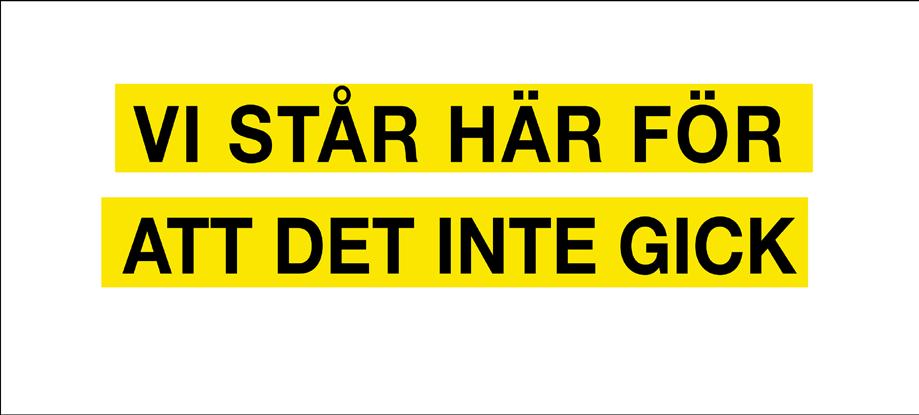
Translation of text: ’WE STAND HERE BECAUSE IT DIDN`T WORK’.
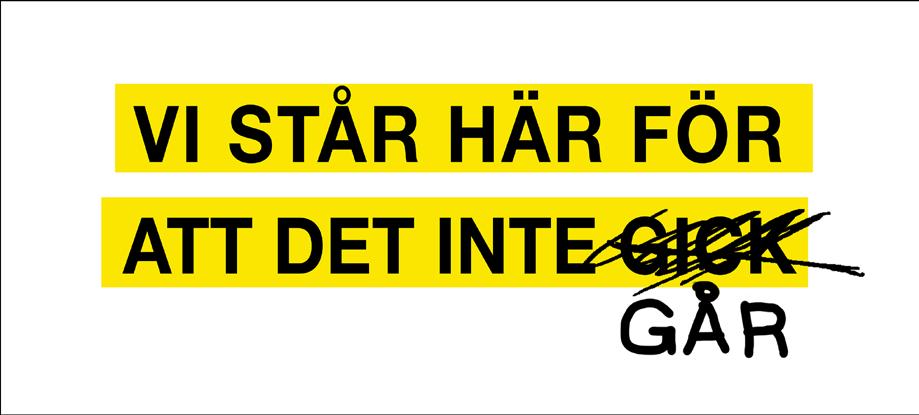
Translation of text: ’WE STAND HERE BECAUSE IT WON’T WORK’.
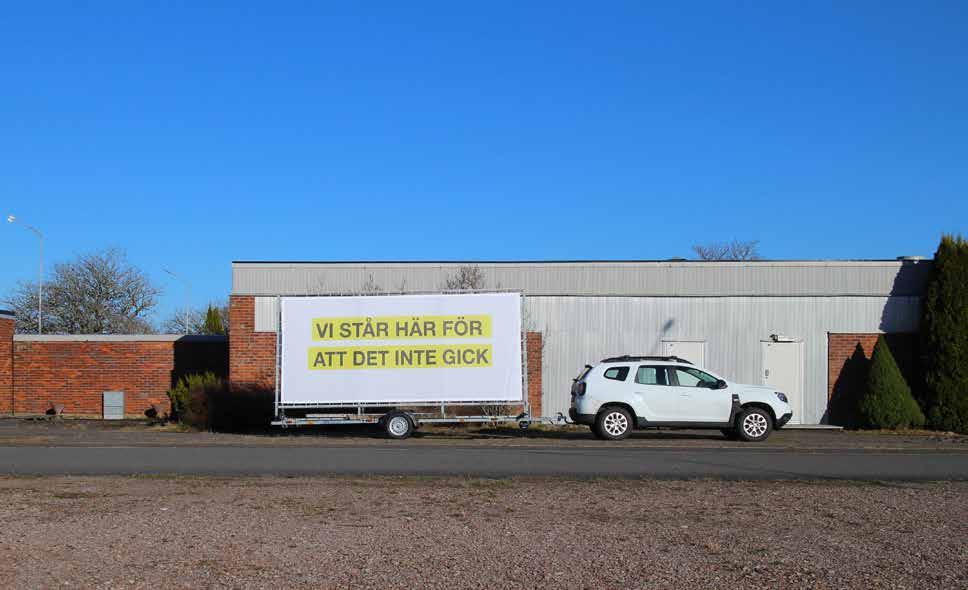
Ranstadsverket
Oviken
After Relation / Break(ing) Earth
FEY TEWEDROS
Fey Tewedros works with video, ruins, and texts that accumulate without resolving what gathers them together, placing the breakdown of relations. Collections collide in engagement with Black presence without being fxed into coherence. Disjunctions speak, pressing onto one another, foregrounding adjacency rather than closure.
By the time anything is seen, its terms have already been decided. In Even Love and Death is Headquartered (video work, 7:14), the montage of footage and archival material is not organised by saying meaning. Adjacency displaces explanation, joy is alongside violence, beauty does not cancel terror. A kinetic density drawn from Black aesthetic, elements pressed until they break. Arthur Jafa compiles sequences in his flm Love Is the Message, The Message Is Death in ways that exceed explanation, using embodiment to generate afect, rhythm, and juxtaposition. In doing so, he demonstrates how placing an artifact within a space acts upon that space. None of this is achieved through saying anything.
I work with disjunction¹, cutting and placing footage through its Black presence across archival material. This is not a method of resolving contradiction, but of working within it. Images placed in tension; gaps are not flled. I organise around conditions of display that do not require coherence as a condition for legibility. What appears as practice is the exposure of instability as condition rather than choice. Unknowingness is not posture or technique, it is the absence of stabilisable position within the present. Space, time, and geospatial material do not encounter one another as variables to be adjusted, but as already overdetermined arrangements that do not yield resolution. A Black body held in circulation without stabilising narrative does not produce “density” as efect, it indexes the impossibility of narrative stabilisation within a colonially structured white viewing space. The cartographic imagination of the surveyor distributes authority over territory. Indigenous fgures are incorporated into discovery narratives of viewing, serving as guides or instruments of traversal—the action of travelling across or through borders. In contrast, Black individuals are positioned as slaves, objects, and excesses of geology.
As Kathryn Yusof writes in A Billion Black Anthropocenes or None, the universal “Human” is produced through the erasure of racialised hierarchies and the abstraction of land and life,
securing white subjectivity as the ground of geology and history. This abstraction renders Black and Blackened geographies absent from presence while centering Man as the primary agent of meaning and earth. Kathryn Yusof’s concept of rift zones 2 describes spaces of dispossession where Blackness is cast as “not here” from the assumed stability of the plateau. In Lynne Gbodjrou Kouassi’s Anointing 3 , the lilac and green of the institutional foor is not a backdrop but part of the spatial and chromatic ordering through which neutrality is presented as given. I work with materials within this surface rather than resolving it.
ii.
Even progressive claims of presence—“you are here” i.e. within a universal cosmos, echo colonial discovery narratives that underpin geographical reason. In this frame, earth becomes property, knowable, available, and owned through colonial practices of surveying, naming, and ordering. What counts as “here” is produced through inherited colonial ways of seeing, where knowledge does not simply describe the world but actively constitutes what becomes visible.
As Saidiya Hartman writes, “the fungibility of the commodity, specifcally its abstractness and immateriality, enabled the black body or blackface mask to serve as the vehicle of white self-exploration, renunciation, and enjoyment”.4 A black body becoming a property not only through labour and violence, but also through enjoyment and afective consumption, where it is repeatedly made to disappear, erased through the very optics that draw and render it visible. Even those discourses that would dislodge domination appear unable to relinquish a prior commitment to ground—to a scene of legibility that presumes a stable beneath.
Kant’s delineation of the limits of knowledge is not simply an Enlightenment inquiry into the conditions of understanding, but a geographic and racial ordering of the world that naturalizes those limits as universal. These epistemic boundaries are not innocent; they are spatial practices that render certain bodies and ways of
knowing as excess, unintelligible, or inhuman. What exceeds the human subject 5 is therefore not an abstract outside, but a materially produced elsewhere. Blackness, for instance, cast as both unknowable and overdetermined. This anxiety around the non-human, then, is less a philosophical problem than a racial one, a fear structured through the displacement and containment of Black life, what Public Enemy names a Fear of a Black Planet. 6 What is called “Black people” comes to mark, in the American grammar, the vestibular limit of civil recognition, the point at which the promise of rights both announces and withdraws itself. This is not a demographic observation but a structural one: an inscription at the level of the fesh that precedes and exceeds the liberal subject of rights-bearing personhood. The law’s address falters here, not by accident, but by design.
Karl Marx would stage revolution as a drama of verticality, an uprising from below that secures depth as originary site and surface as the scene of arrival. The proletariat, fgured here as a kind of volcanic force, erupts into visibility, but only by way of a prior commitment to a ground that can hold, contain, and fnally release. Such a confguration does not simply describe movement; it installs a grammar, one in which “below” must signify latency and “above” its resolution. Michel Foucault, for his part, tries to disperse power across stratifed layers, locating its operations within the sedimented intervals of the iterative Human body and its institutional surround through soil.7 Yet these analytic manoeuvres, for all their diference, share a reliance on a geological imaginary, depth, surface, foundation layers that secure the very terms of intelligibility. What such fgures cannot quite apprehend is that, for the captive body, there is no stable ground to begin with. The “under” is not a resource, nor the “surface” a guarantee of emergence. Instead, encountering a radical ungrounding, where the Black body—reduced to fesh—is neither layered nor anchored, but exposed to a grammar of capture that refuses the coherence these metaphors require. In this sense, the question is not how to excavate or to rise, but how to account for a subject-position that has been rendered, from the outset, unmoored from the very ground of the Human.
iii.
In Black feminist theory, Saidiya Hartman, in the chapter “The Subject of Freedom” in Scenes of Subjection, theorises fungibility and violence, a notation of accumulation and dispossession as structuring Black life as both hyper-visible and disposable, and fgures the womb abyss. 8 The hold is not confned to the ship as a historical site but persists as a structuring condition of Black life outside the terms of personhood. Christina Sharpe reads the ship, the hold, and the birth canal together to trace the ongoing negation of Black maternity. Under partus9, which legalized the matrilineal transmission of slave status, the birth canal becomes a site through which captivity is extended, what she describes as “another domestic Middle Passage.” 10 Building on Hortense Spillers’ account of how chattel slavery disrupts embodiment, gender, and kinship11, Sharpe shows that categories such as motherhood and childhood do not stabilize, but instead remain unsettled within a condition where the structuring logic of the hold is reiterated across time. In Katherine McKittrick’s spatial theory, this repetition is not only historical but geographic, where space itself is produced as a racial technology of capture and ordering.12 Blackness is neither inside nor outside “the world,” but where relationality breaks.13 What I refuse is not placement within this grammar, but the assumption that grammar is negotiable. Whiteness is not one fgure among others, but the condition of the viewing scene itself, where place becomes legible through the naturalisation of time as development and value as unfolding progress through myth to territory.
In the work of Sun Ra as articulated through archival appearances such as the Detroit Black Journal interview, he is not concerned with the Human of freedom, justice, and truth, which he frames as already implicated in death, nor with His-stories 14 , but instead invokes the fgure of the Angel, not in a Christian sense. The Angel operates as precision and discipline oriented toward Black futurity, including the reconstitution of erased musical formations such as Fletcher Henderson. Myth here does not function as escape but as structure. The reconfguration of
the Human as a failed construct opens onto a broader question of worldhood itself. If belief in the Human depends on the exclusion of Black and Blackened geographies, then the question is not what the world is—what material and spatial regimes produce the conditions under which “world” becomes thinkable at all. Is the world producing thought, or is it thought that stabilises the fction of worldhood?
Thank you to the teachers who shaped and infuenced attention before it had direction.
A warm thank you to Jason Bowman and Cathryn Klasto, who, through their training, enabled this thinking otherwise, and sustained this way of thinking beyond what was already given. Through presence and example, they trained me through these processes. A sincere thank you to Jesper Norda, Daniel Jewesbury, Ann-Charlotte Glasberg Blomqvist, Maddie Leach, Mattias “Mappe” Persson, Ram Krishna Ranjan, Nils Karlsson, Gloria López Cleries, Nina, Kjell Caminha, Daniel Terres and MarieLouise Richards.
And my dear sister, with love.
ENDNOTES
1. Arthur Jafa, Love Is the Message, The Message Is Death, 2016. Film. 8 min.
2. Kathryn Yusoff, “Geologies of Race,” lecture, Queen Mary University of London, n.d.
3. Lynne Gbodjrou Kouassi, Salbung (Anointing), Helmhaus: Zurich. Installation, 2026.
4. Saidiya Hartman, Scenes of Subjection: Terror, Slavery, and Self-Making in Nineteenth-Century America. (Oxford: Oxford University Press, 1997), 26.
5. Immanuel Kant, Critique of Pure Reason, ed. & trans. Paul Guyer
and Allen W. Wood. (Cambridge: Cambridge University Press, 1998).
6. Public Enemy, Fear of a Black Planet. Album, 1990.
7. Stratifed, arranged in rock layers (strata), as a sedimented ordering shaped by extraction and power.
8. Hartman, 218.
9. Under the ‘partus’ rule, an enslaved woman’s child would also automatically be born enslaved.
10. Christina Sharpe, In the Wake: An American Grammar Book. (Durham, NC: Duke University Press: 2016). 74.
11. Hortense Spillers, “Mama’s Baby, Papas Maybe” Diacritics 17, no. 2. 64-80.
12. Katherine McKittrick, Demonic Grounds: Black Women and the Cartographies of Struggle (Minneapolis: University of Minnesota Press, 2006). 10.
13. Frank B. Wilderson III, Afropessimism (New York: Liveright Publishing Corporation, 2020).
14. Sun Ra, “Interview,” Detroit Black Journal, n.d. https://youtu. be/mNgwzY0KzlM?si=0kG7Fot5ycMEu7Xd
A Temporary Constellation
16–31 May 2026
University of Gothenburg
HDK-Valand, Academy of Art and Design
Kristinelundsgatan 6-8
SE-411 37 Gothenburg
Legally responsible publisher: Klara Björk
Editors: Ann-Charlotte Glasberg Blomqvist and Daniel Jewesbury
Design and editorial coordination: Kjell Caminha
Copyright © 2026. All rights reserved to respective authors and artists. All material courtesy of the contributors. No part of this publication may be reproduced in any form or by any means without prior permission in writing from the publisher.
Edition of 250 copies
ISBN: 978-91-989-5460-9
www.hdk-valand.gu.se