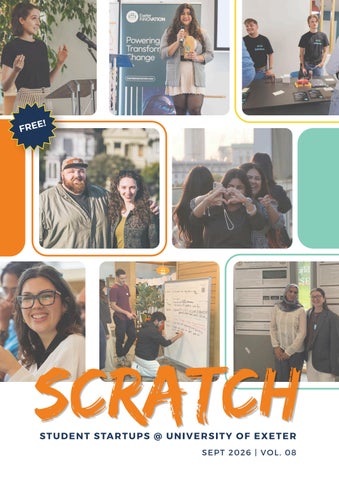
SCRATCH S T U D E N T S TA R T U P S @ U N I V E R S I T Y O F E X E T E R
SEPT 2026 | VOL. 08
ALUMNI STORIES
CONTENTS
05
FROM STUDENT FOUNDER TO A CAREER AT OPENAI
08
DREAM BIGGER, BUILD SMARTER: MEET TOM CHARMAN
12
FROM EXETER TO FORBES’ FINEST
14
MEET GRENADE CO-FOUNDER JULIET BARRATT
16
FULL CIRCLE MOMENT: Y1 X REDBIRD
08
STUDENT STARTUPS 18
TRANSFORMING MENTAL HEALTH, BUILDING COMMUNITY
22
LAW STUDENT TO STARTUP FOUNDER: MEET ORIANA
24
NETWORKING REIMAGINED: INTRODUCING LINKTWOS
26
GO GREEN: BUILDING A SUSTAINABLE STARTUP
MEET TECH ENTREPRENEUR TOM CHARMAN
EVENTS & COMPETITIONS 28
FIND YOUR CO-FOUNDER
31
PITCH PERFECT: EXETER’S ELEVATE COMPETITION
34
SANTANDER ACCELERATE
SKILLS & EMPLOYABILITY 38
FROM GRAND CHALLENGES TO STUDENT STARTUPS
40
SAMEH’S INTERNSHIP JOURNEY
14
GRENADE CO-FOUNDER JULIET BARRATT
NETWORKS & SPACES 42
DISCOVER THE EXETER INNOVATION HUB
44
OPENING DOORS TO BIOTECH
46
NETWORKS & SPACES IN EXETER & CORNWALL
38
GRAND CHALLENGES TO STUDENT STARTUPS
University of Exeter Student Startup team Photo: Emily Appleton
WELCOME Welcome to the eighth edition of the Student Startups SCRATCH magazine, which celebrates the entrepreneurial talent, innovation and ambition of students and graduates across the University of Exeter. Every year, we support a diverse community of students and graduates who are tackling realworld challenges, creating innovative products and services, and building ventures that contribute to their communities, industries and society. This magazine showcases some of the remarkable people and ventures we have had the privilege to work with over the past year. In this edition, we catch-up with Exeter alumnus Tom Charman who is busy raising VC investment to scale his latest venture 'Seldon' - the future of product development in the era of frontier AI. Grenade Co-Founder and Honorary Professor Juliet Barratt, shares her top tips for aspiring entrepreneurs. We meet students who are building inclusive communities to support mental health, foster belonging, and encourage meaningful social connection. And we spotlight networks, spaces and communities in Exeter & Penryn, through which to access support and build your professional network. All this and so much more. This really is a bumper edition! We hope you enjoy exploring this edition of Scratch as much as we enjoyed putting it together over the summer. A huge thank you to all who contributed content. 3
what is
STUDENT STARTUPS? The Student Startups Incubator Programme enables student founders to take their ideas from concept to launch. Across three practical phases, you will explore real customer needs, test your assumptions, shape your business model, and discover how to bring your idea to market. Along the way, you'll gain expert support, valuable feedback, access to funding and the confidence to take action. The Student Startups programme is open to all students from all disciplines, and recent graduates (up to 2 years out of university). PHASE 1: STARTUP FOUNDATIONS
1
Develop the mindset, skills, and confidence needed to think like an entrepreneur, to validate your ideas and shape a compelling value proposition. Develop your idea into a viable venture Learn entrepreneurial skills Pitch for market validation funding
PHASE 2: STARTUP VALIDATION
2
Test your idea in the real world and build evidence that customers actually want what you're creating. Test your idea with real customers Gather feedback and market insights Grow your network
PHASE 3: STARTUP LAUNCH
3 4
Develop the skills and knowledge required to take your venture to market and build the foundations for sustainable growth. Take your venture to market Attract customers and drive growth Pitch for a Startup Grant FIND PROGRAMME DATES AND APPLY: EXETER.AC.UK/STUDENTSTARTUPS
FROM STUDENT FOUNDER TO A CAREER AT OPENAI meet max greenbury BY EMILY DAVIES Max
Greenbury
graduated
from
the
I’d say there have been two.
University of Exeter with a BSc in Economics & Finance. While at university, he founded
The first was starting MG Vintage while I was
MG Vintage, a subscription based second
at university. Being a founder teaches you
hand clothing startup. Since graduating, he
extreme ownership very quickly. Particularly
has built a career at the intersection of
at an early stage company where you’re
technology, AI and startups, working at AWS
responsible for everything (sales, finance,
and Google before joining OpenAI. His
marketing, operations etc.) and have to learn
experience spans both sides of the startup
what works in each.
ecosystem,
as
a
founder
himself
and
through working closely with founders to
I
couldn’t
recommend
trying
to
start
help ambitious technology companies grow.
something as a student highly enough. The opportunity cost is relatively low, so in many
Looking back on your career so far, what
ways you get a free hit to experiment.
I
have been the most defining moments that
probably learnt more from building the
shaped your professional direction?
company than I did from my degree and it 5
me
the
chance
to
travel,
meet
interesting people and experience the highs
carry the same mindset into every company I’ve worked for since.
and lows of entrepreneurship first hand. Over
time,
being
someone
who
It also gave me a lot of founder empathy.
communicates clearly, follows through and
Having sat on the other side of the table, I
can
understand how much founders have riding
colleagues start to trust you with bigger
on their companies. That’s a quality we
responsibilities and eventually they become
actively look for when hiring into the Startup
advocates for you. That’s one of the most
team at OpenAI (most of us are ex-founders
valuable forms of personal brand you can
or have had some experience operating at a
build, being known as someone who gets
startup). Having that empathy helps you
things done, and it will open up future
build genuine relationships with founders
opportunities.
be
relied
upon
compounds.
Your
and those relationships help you create partnerships
that
genuinely
move
the
needle for them.
Did your experience of start-up MG Vintage as a student help in securing your first graduate role? If so, how? If not, what gave you the
The second was joining AWS. It taught me
edge when trying to secure graduate roles in
the rigour of running a sales process and
such a competitive market?
gave me responsibility for running seven and eight figure deals relatively early in my
Yes, although interestingly, I think it helped
career. I was also fortunate enough to start
as much by showing me which companies
working with some of the first European
I’d want to work for as it did by helping me
companies training foundation models in
get hired.
early 2022, around 9 months before ChatGPT launched, when most people still hadn’t
I
heard of the term Large Language Model
internships and graduate roles and didn’t get
(LLM). Getting exposure to generative AI
them. My experience was that those firms
that
didn’t place as much value on having started
early,
alongside
some
incredibly
talented founders and colleagues, gave me
applied
for
a
number
of
consulting
a company as technology companies did.
the chance to build domain expertise before it became the hottest area in technology. If you could identify one mindset that has contributed most to your success, what would it be? Ownership. If you say you’re going to do something, do it. Don’t make promises you aren’t going to keep. Starting
a
company
taught
me
that
mentality because, as a founder, ultimately everything comes back to you. I’ve tried to 6
I couldn’t recommend trying to start something as a student highly enough...you get a free hit to experiment.
ALUMNI STORIES
gave
When
the
use the tools and build things anyway. The
experience resonated much more strongly.
I
interviewed
at
Amazon,
barrier has never been lower and spiky
Starting a business had forced me to
generalists are very valuable!
demonstrate many of the qualities they were looking for - ownership, curiosity, bias
I studied Economics and Finance and was
for action and the willingness to move
never going to become a great software
quickly without having perfect information.
engineer, but I deliberately spent time learning python, building applications and
So in hindsight, my startup experience
understanding
helped me self-select into an industry and
made
culture that was probably a much better fit
engineers and researchers and ultimately
for me anyway.
gave me a more rounded skill set. Today
me
technical
much
more
concepts.
That
credible
with
tools like Codex make it dramatically easier What are you most proud of at this point in
to experiment. Agency and curiosity are
your career?
becoming more and more important and they are traits that employers (particularly in
I’m probably most proud of the people I’ve
tech) are looking for.
worked with who have subsequently been willing to advocate for me.
2. Curate your information diet. There is an enormous amount of noise,
Job titles and individual deals are obviously
particularly in AI, and nobody can keep up
nice
with everything, even people working at
milestones,
colleagues,
but
having
managers,
former
customers
and
frontier AI labs. Find a relatively small
founders willing to put their name behind
number of high signal people, podcasts and
you feels much more meaningful. Referrals
blogs to follow for the areas you care about
and recommendations are ultimately a
rather than trying to consume everything.
reflection of the trust you’ve built with people over time.
3. Invest in your network and your personal brand early.
I think if you finish a job with a group of
Go to meet-ups, hackathons and events and
people who would genuinely want to work
surround yourself with ambitious people
with
doing interesting things. And think about
you
again,
you’ve
probably
done
something right.
your personal brand in the broadest sense, not just what you post on LinkedIn or X, but
What advice would you give to current
what people who work with you believe
students looking to build a career in the
you’re good at. Are you seen as reliable,
innovation
commercial, deeply technical? Are you the
/
start-up
ecosystem
post-
person your friends go to with questions
graduation?
about GTM (go-to-market) or a particular 1. Lean into your natural strengths, but don’t
engineering domain?
box yourself into being either “technical” or “non-technical”.
If you consistently help people and become
If you study computer science, learn how to
known
speak
their
opportunities tend to compound in ways
problems and develop commercial instincts.
you can’t predict at the beginning of your
Equally, if your background is non-technical,
career.
to
customers,
understand
for
something
valuable,
7
DREAM BIGGER, BUILD SMARTER: MEET TECH ENTREPRENEUR TOM CHARMAN BY EMILY DAVIES Tom Charman is a University of Exeter
build an actual company. At that point, the
graduate, entrepreneur and data scientist
idea of going and getting a conventional job
based in San Francisco. His entrepreneurial
became increasingly difficult to imagine.
journey began while studying at Exeter, where he became actively involved in the
Your first ventures began long before Seldon.
student
startup
co-
What were the biggest lessons you learned
founding
travel
startup
from those early startups, and how have they
ecosystem.
After
technology
KOMPAS, he went on to build and lead several
technology
expertise behavioural
in
ventures,
artificial
modelling
influenced your approach today?
developing intelligence,
and
product
innovation. Today, he is the co-founder of
Being right about the future isn't enough. Timing, distribution, and execution matter just as much.
Seldon, an AI startup helping companies simulate user behaviour and make better
I've built companies where I think the
product decisions before launching new
underlying thesis was right, but we were too
features.
early, approached the market in the wrong way, or simply didn't execute well enough.
What
first
sparked
your
interest
in
entrepreneurship, and was there a particular
Those experiences are painful, but they're incredibly useful.
moment when you realised you wanted to build companies rather than work for one? I don't think there was one lightbulb moment where I decided I wanted to be an entrepreneur. I was always building things and trying things, and Exeter gave me an environment where I could take that a bit more seriously. I got very involved in the entrepreneurship community, and what I loved was being surrounded by people who were willing to turn an idea into something real. We started building KOMPAS while we were students and suddenly found ourselves raising money, hiring people and trying to 8
You don't need to begin by "starting a company". Build something. Put it in front of five people. See if anybody cares. If they do, put it in front of fifty.
We'd
to the thing you've built. Founders naturally
suddenly
built
a
fall in love with their product. Customers
overnight. I had to sit at home and tell
don't care about your product - they care
people I'd worked alongside, cared about,
about whether you solve a problem for
and felt responsible for that they no longer
them.
had jobs - and because it was COVID, I had
the
company world
together,
changed
and
almost
to do it all over video calls. With Seldon, we're much more obsessive about that. We spend a huge amount of
It was brutal. As a founder, you get used to
time with customers, watching how they
uncertainty affecting you personally. What's
use the technology and understanding
much harder is when decisions you're
where it creates genuine value rather than
making affect the livelihoods of people who
where we think it should create value.
trusted you enough to join your company.
Many students have ideas but never take the
It changed my perspective on leadership
leap. What gave you the confidence to turn
quite significantly. You realise that resilience
ideas into real businesses?
isn't just about your ability to keep going when things are difficult. It's also about
I'm not sure it was confidence.
being willing to make incredibly painful decisions when the circumstances demand
I think there's a misconception that people
them,
who
decisions, and then finding a way forward.
start
eliminated
companies the
have
uncertainty
somehow
before
taking
responsibility
for
those
they
begin. Usually, they haven't. They just start
I don't think experiences like that need to
anyway.
be reframed as somehow being positive. It was awful, and I'd never want to repeat it.
You don't need to begin by "starting a
But it gave me a much deeper appreciation
company". Build something. Put it in front of
for the responsibility you take on when you
five people. See if anybody cares. If they do,
build a company and ask people to come
put it in front of fifty.
and build it with you.
The first version of almost everything I've built has been fairly terrible. That's fine. The important thing is creating a feedback loop with the real world as quickly as possible. Confidence tends to arrive after you've started, not before. Entrepreneurship is rarely a straight line. What has been the most challenging period in your career, and what did it teach you about resilience? The hardest thing I've ever had to do professionally was lay off my entire team in the middle of COVID.
Exeter taught me to start with what I had. San Francisco has taught me to think much bigger about where it could go.
ALUMNI STORIES
I've also learned not to become too attached
What problem did you see in the market
trust, what they ignore, what they do next.
that led you to co-found Seldon, and why did
And that idea extends much further than
you believe it was the right moment to
product
tackle it?
applying the same underlying technology to
research.
We're
increasingly
software testing, cybersecurity and more Software is still largely built backwards.
complex decision environments in defence.
We design something, build it, ship it, and
You've moved from Exeter to the global
then observe what humans do with it. We
technology ecosystem of San Francisco.
run user research, A/B tests, analytics, QA,
What have been the biggest differences
security testing - all trying to understand the
between those startup environments, and
consequences of decisions we've already
what have you learned from each?
made. The biggest difference is probably the The question behind Seldon was: what if you could
understand
some
of
default level of ambition.
those
consequences before you shipped anything?
In San Francisco, you can tell someone you're trying to build a company that could
We're building technology that can simulate
fundamentally change an industry and
human behaviour. You can give Seldon a
they'll normally ask how you're going to do it
product, an interface or an environment and
rather than why you think you're qualified to
have populations of simulated users interact
try.
with it - where they get confused, what they 10
That sounds like a small cultural difference,
people
studying
but it's incredibly powerful.
science,
psychology,
engineering,
computer
economics,
design,
biology, and dozens of other subjects. Some There's also an extraordinary density here.
of those people could become your co-
Investors,
founders, employees, customers, or investors.
founders,
researchers
and
engineers are all within a relatively small geographical
area.
You
can
have
And a
conversation over coffee that completely
don't
optimise
too
early
to
look
successful. Some of the most useful things I've done looked like failures at the time.
changes the direction of your company. If I could tell 20-year-old Tom one thing, it But Exeter gave me something equally
would probably be to think bigger - but take
important: the ability to start without any of
the first step much sooner.
that. When you reflect on your journey from Exeter We weren't in Silicon Valley. We didn't have a
student entrepreneur to leading a high-
huge network. We were students trying to
growth AI company, what achievement are
work things out. That forces you to be
you most proud of and why?
resourceful. Probably the people I've been able to bring I think the combination is valuable. Exeter
together.
taught me to start with what I had. San Francisco has taught me to think much
Companies change. Products change. Some
bigger about where it could go.
things work and some don't. I've become much less interested in individual milestones
For current Exeter students who dream of
as I've got older.
building a successful startup one day, what advice would you give them, and what do
What I'm proudest of with Seldon is looking
you wish you had known when you were
around the room and seeing incredibly
starting out?
talented people - engineers, researchers, scientists and operators - who could work
Start now.
almost
anywhere,
choosing
to
spend
a
meaningful part of their lives trying to build Don't spend two years learning how to
this with us.
become an entrepreneur. Don't wait until you've found the perfect co-founder, raised
We started with an idea about whether
money or come up with an idea nobody has
human behaviour could be simulated well
ever thought of before.
enough to make better decisions before things happen in the real world. Watching
Find a problem you find interesting and
that turn from an idea into technology that
build the smallest possible thing that might
major organisations are actually using is
solve it. Then find someone who has that
incredibly exciting.
problem and show it to them. But I still feel much more like we're at the I'd also tell students to take advantage of
beginning than the end. The thing I'd
how
ultimately like to be proudest of is what we
unusual
a
university
is.
You're
surrounded by thousands of intelligent
build from here. 11
From Exeter to Forbes’ finest
BY RUSSELL PARTON University of Exeter alumni have been singled out by Forbes for the huge impact they are making in their young careers. Six alumni were included in the annual Forbes 30 Under 30 lists, which highlights the “most dynamic young innovators, entrepreneurs and changemakers” under the age of 30 across various industries. 12
co-founder
entrepreneurs who are providing innovative
management service which has grown into
of
Vectare,
a
transport
solutions in volunteering, climate action,
one of East Anglia’s largest bus operators,
transport and education, the founder of a
and Minnie Royden (Politics, 2019), the
London fashion brand, and a theatre and
founder and director of Minka Dink London,
screen director.
a fashion brand that grew out of a Covid lockdown sewing project, was included on
Molly
Bevan
Finance,
(Business,
2019)
and
Economics George
and
the Retail and Ecommerce list.
Wade
(Geography, 2020) made the list for Social
There was also success for Holly Reddaway
Impact. Molly is the founder of Impactic,
(Drama, 2018) an award-winning voice and
which curates tailored volunteering days for
performance director who made the 30
companies that match a team’s skills with a
Under 30 list for Games. Holly’s credits
charity’s needs, while George is the co-
include Baldur’s Gate 3, Alan Wake 2, Lies of
founder
P,
of
Zevero,
management London,
a
platform
Tokyo
and
global with
carbon
offices
Singapore,
in
Park
Beyond,
Zombieland
VR
and
Assassin’s Creed.
helping
organisations measure, reduce and report on their emissions. There was also recognition for self-described ‘serial
entrepreneur’
Lara
Acosta
(MSc
Digital Marketing, 2023), who made the 30 Under 30 list in the Media and Marketing
Professor Alexandra Gerbasi,
category.
Lara’s
achievements
include
Pro-Vice Chancellor of the
founding
Literally
Academy,
online
Faculty for Environment,
education business focusing on Linkedin
Science and Economics at
and B2B lead generation, and Kleo, an AI
the University of Exeter said:
writing tool focused on thought leader
“From pioneering climate
content for experts who want to build
solutions to building
personal brands on Linkedin. She dedicated
innovative businesses and
her inclusion on the list to her course
creative careers, our alumni
director at Exeter, Emma Wood, who she
continue to demonstrate the
said gave her the “courage to keep going
ambition, ingenuity and
throughout my masters” and “empowered
social purpose that define
me to push beyond my limits.”
the University of Exeter. We
an
are immensely proud to see Molly, George and Lara all accessed start-up
these exceptional graduates
support from the University during the early
recognised in the Forbes 30
days of their ventures, including the Student
Under 30 lists. Each one is a
Startups Incubator and Exeter Innovation
testament to the power of
Accelerator.
an Exeter education to inspire meaningful impact
Dominic Kalantary (Economics and Politics,
on a global stage.”
2018) made the 30 Under 30 list in the Manufacturing and Industry category as the 13
ALUMNI STORIES
Exeter alumni who made the cut include
How to build a stand-out business Meet Grenade Co-Founder Juliet Barratt
When
Juliet
Barratt
co-founded
sports
nutrition brand Grenade in 2010, she set out to disrupt a market crowded with products
Having recently joined the Student Startup
that all looked and sounded the same.
team at The Deck for an inspiring fireside chat event, she is keen to support the next
More than a decade later, the company is
generation
one of the UK's best-known sports nutrition
mentoring and by sharing the lessons she
brands, famous not only for its products but
has learned from building a business from
also for its bold marketing. One of its most
the ground up.
of
entrepreneurs
through
memorable publicity stunts saw a tank driven down London's Oxford Street to build
"It's great to hear about what the University
brand awareness.
of
Exeter
offers
student
entrepreneurs
through the Student Startup Team, the Now Juliet is bringing that entrepreneurial
Centre for Entrepreneurship and spaces
experience back to the University of Exeter
such as the Creative Quadrant and Skydeck
as the Business School's newest Honorary
and I'm really looking forward to spending
Professor.
more time there," she says.
14
Original article by Russell Parton; adapted by Julia Mackay
sake of it. We cared about what we were doing and I think because we were really genuine, that helped, because people don’t like being sold to.” A first round of private equity in 2014 valued the business at £18 million. Then in 2017 investment from Lion Capital valued the business at £72 million. It was bought by Mondelēz International in 2021 for £200 "It's such an encouraging environment for
million, with Juliet selling her remaining
those students that do want to start their
stake.
own business, whether they're studying history, computer studies or whatever else."
“I know it sounds cheesy, but it was never about money,” Juliet insists. “We genuinely
business
loved what we were doing and focused on
partner Alan started Grenade back in 2010
the business, having fun and building the
after experiencing some of the generic
brand, and we knew the numbers would
sports food offerings in gyms and health
come.”
Juliet
and
her
husband
and
clubs and thinking they could easily make Drawing on her experience of building
something more distinctive.
Grenade, Juliet has shared five top tips for “We wanted to be the Red Bull of sports
aspiring entrepreneurs.
nutrition and make products that did what they said on the tin. Our first product was a
1. Research your market thoroughly.
fat-burner, packaged in a grenade-shaped
Before launching a product or service,
container, which really stood out on the
understand whether there is a genuine
shelves. A lot of the other products at the
need for it, identify who else is operating
time had scientific names and were sold in
in the space and consider why an
sensible white tubs.”
apparent gap in the market may exist. 2. Trust your instincts. Whether it's
In the early days, Juliet remembers, “it was
branding, employing people or raising
just me, Alan and our four cats”, but the
money, pay attention to what feels right
timing
and what feels wrong.
was
right.
“Social
media
was
growing, the protein market was getting
3. Focus on your own journey. Be aware
bigger. People wanted to look good and
of competitors, but don't become
were going to the gym so it was a great
consumed by what they're doing.
time for sports nutrition.”
4. Learn from mistakes. Things won't always go to plan, but setbacks are part
Hard work and attention to detail also
of the journey. Take the lesson, move on
played a key role in the brand’s success.
and don't give up.
“When we launched our protein bar in 2015
5. Commit fully. Before starting a
we’d gone through 27 different varieties to
business, ask yourself whether you have
get to the product that we were happy
the time, energy and determination to
with,” she says.
give it your best shot. 15
ALUMNI STORIES
“So we never launched anything just for the
FULL CIRCLE MOMENT:
Y1 x REDBIRD BY RACHEL O’ROURKE Two businesses founded by University of
Exeter graduates Chris Rea and his co-
Exeter graduates have come together in a
founders - an example of what was possible
seven-figure acquisition, highlighting the
for young entrepreneurs.
University’s
growing
reputation
for
producing ambitious entrepreneurs and
After watching Y1’s appearance on BBC’s
high-growth companies.
Dragons’ Den, the pair were inspired to believe they could build a national business
Y1 Group has acquired university clothing
of their own.
specialist Redbird Apparel in a deal that brings together two businesses founded at
Today, that business has become part of the
Exeter, eight years apart, in what both sets
company that first inspired them.
of founders describe as a remarkable fullcircle moment.
Since launching while still students, Guy and Laurence have grown Redbird Apparel
While studying at the University of Exeter,
into one of the UK’s leading providers of
Redbird founders Guy Brown and Laurence
premium
Snow looked to Y1 Group - founded by fellow
merchandise, fulfilling more than 200,000
16
university
clothing
and
recognise so much of ourselves in their
clubs and student societies across the UK,
journey.
including Oxford and Cambridge. “When we started Y1, we simply wanted to Guy Brown said: “When we were students at
build something meaningful. We never
Exeter, Y1 were the founders everyone talked
imagined that our story might encourage
about. Seeing them on Dragons’ Den made
other Exeter students to pursue businesses
building a business like this feel achievable.
of their own.”
They proved that a student idea could become a nationally recognised company.”
“That’s what makes this acquisition so special. It’s not just two companies coming
“Exeter gave us the confidence to think
together
bigger,
entrepreneurial culture that exists at Exeter
surrounded
us
with
ambitious
-
people and provided an environment where
and
entrepreneurship
University creates.”
felt
genuinely
the
it’s
a
lasting
reminder
connections
of
the
that
the
encouraged. Looking back, it’s hard to imagine
Redbird
existing
without
that
experience.“
“Universities don’t just educate people; they bring
together
future
co-founders,
collaborators and lifelong networks. Exeter “To now see our business continue its
played that role for both of our businesses,
journey with the company that inspired us
and this partnership is a wonderful example
from the beginning feels incredibly special.”
of what can grow from that environment.”
Laurence Snow added: “We started Redbird
The
with a simple goal - to create university
growing
clothing people actually wanted to wear. We
businesses emerging from UK universities.
never imagined that one day we’d become
Together, Y1 Group and Redbird Apparel
part
now serve schools, universities, sports clubs
of
the
business
we
admired
as
students.“
acquisition
also
impact
demonstrates
of
the
graduate-founded
and organisations across the UK, creating premium
bespoke
“This feels like a full-circle moment, not just
communities
for us personally, but as a reminder of how
belonging.
apparel
celebrate
that
helps
identity
and
one generation of Exeter entrepreneurs can inspire the next.”
Alongside its commercial success, Redbird has also partnered with the Pahar Trust
Y1 Group was founded by University of
Nepal
Exeter graduates in 2013 before gaining
children in Nepal, helping improve access to
national
education.
recognition
following
its
to
provide
school
uniforms
for
appearance on BBC’s Dragons’ Den. Since then, the company has grown into one of
For everyone involved, the deal is about
the UK’s leading premium sports and
much more than business growth. It is the
custom apparel businesses.
story of two companies that began with ideas developed at the University of Exeter,
Chris Rea, Co-Founder of Y1 Group, said: “It’s
following different entrepreneurial journeys
incredibly rewarding to welcome Guy and
before ultimately coming together to shape
Laurence into the business because we
the future of one industry. 17
ALUMNI STORIES
orders and supplying universities, sports
transforming mental health, building community
BY SAMA SHOUKRY In today’s busy and fast-moving world, it has never been more important to prioritise wellbeing and bring people together. Let’s
an environment. When she was nominated
meet Tara, Sanjam and Mahek, who are all
for several awards, she kept noticing the
building inclusive communities to support
same women appearing across those award
mental
categories. Rather than there being any
health,
foster
belonging,
and
competition, there was coffee - and the rest,
encourage meaningful social connection.
as they say, is history. THE BROWN GIRL LEAGUE The three of them connected immediately, Tara is pursuing an MBA at the University of
bonding over shared cultural and corporate
Exeter, sponsored by her employer.
experiences. That connection sparked a thought: if they were able to find each other, to
surely there were more women looking for
pursuing an MBA at the University of Exeter.
the same connection. Dinners and activities
Tara found herself navigating the corporate
followed, an Instagram and LinkedIn page
world in London as an ethnic minority
was created, and The Brown Girl League was
woman and the first in her family in such
born.
Through
18
the
apprenticeship
route
What started as a small get-together quickly took on a community of its own. The Brown Girl League reached over 15,000 women, including sign-ups from as far as Japan. They expanded to over 11 university societies, landed
radio
appearances,
attracted
corporate partnerships, and hosted a launch party with over 100 people. Since Tara and her co-founder Jaina were already building a name for themselves professionally, growing their initial following came naturally, and from there, word spread fast. Their offerings grew too. Companies began giving free event tickets to members. A book club launched, featuring ethnic minority authors,
with
members
getting
SAMADHI
the
opportunity to discuss books directly with
Sanjam was already a trained yoga teacher
the writers themselves. All of this, entirely
from India when she arrived in Exeter in
free of charge.
2024 to study psychology. She came with a clear vision: to blend Eastern yogic wisdom
What Tara is most proud of are the genuine
with modern psychological practice. Having
friendships The Brown Girl League has
experienced firsthand the impact yoga had
created: from meeting for the first time at
on her own mental health, she saw a gap
events to becoming flatmates, close friends,
that
and travel partners. In a world dominated by
acknowledge - the separation between the
screens, lasting connections is what she
mind and body in how we approach health
values most. She is also committed to
and wellness.
the
world
was
only
starting
to
making alternative career pathways more visible,
particularly
for
ethnic
minority
After
completing
women whose families often view success
studies,
Sanjam
as "university or failure." Having taken the
world,
apprenticeship route herself rather than
misaligned with who she was. That made
university and now finishing a master's
her soul-search, leading her into a yoga
degree debt-free, Tara is proof that success
studio. As a complete beginner attending
does not have to look the same for everyone.
three sessions a week, the changes she
only
to
her
entered find
it
undergraduate the
corporate
unfulfilling
and
experienced were so significant that she The Brown Girl League has already opened
began recommending yoga to everyone
doors
around her.
to
meaningful
opportunities,
including discussions with the NHS around health issues that disproportionately affect
Luckily, she was able to discover the Student
South Asian women. Tara is keen to expand
Startups programme, the missing piece that
into projects that support ethnic minority
brought everything together. Seeing her
women
world,
vision translated from her mind onto paper
creating safe spaces for conversations that
and into real action, she knew she was
can feel difficult to have elsewhere.
exactly where she needed to be.
beyond
the
corporate
FIND THE BROWN GIRL LEAGUE ON LINKEDIN AND INSTAGRAM
19
Sanjam's short-term goal is to build a strong
wellness
foundation
practice
that
integrates
yogic
locally
in
Exeter:
growing
wisdom with psychology, exploring the
community-based
yoga
classes,
making
interconnectedness of the body, nervous
them
to
beginners
system, and mind. Rather than treating
intermediates, and filling the gap between
physical and mental health as separate
yoga as an exclusive fitness pursuit and yoga
concerns,
Samadhi
takes
a
as a mindful, whole-body practice. Feedback
approach,
tackling
stress,
anxiety,
and
from her classes has consistently reflected
bottom-up
accessible
and
mental
health
challenges
through
one
this: attendees come in expecting a fitness
unified
wellness
practice.
Sanjam
even
class
dedicated her dissertation to exploring how
and
leave
having
experienced
something far more nourishing.
yoga can support people with mental health-related issues, grounding her venture
Longer term, her vision for Samadhi is to
in academic research as well as lived
become a full wellness ecosystem: one that
experience.
gathers real data on how holistic yoga and psychology practices support people across
One of Sanjam's standout achievements
a range of conditions, from anxiety and
was
ADHD to trauma.
self-organising
a
10
to
12-week
wellbeing programme for university staff, entirely
bootstrapped,
with
no
formal
MENTIVO
university support. Noticing that students had plenty of opportunities and events
Mahek is currently completing her Masters
available to them, she wanted to give
in Marketing with an Industrial Placement
something back to the staff. The feedback
in Exeter. Her venture, Mentivo, is a peer skill
far exceeded anything she anticipated, and
exchange platform built exclusively for
she now has a loyal base of clients who keep
university students. The concept is simple:
coming back.
students sign up with their university email, list a skill they can teach, anything from Excel to cooking to a new language, and list one they want to learn. They earn tokens by teaching and spend those tokens to learn from someone else. No mentors, no tutors, just students helping each other out. And the real outcome? Not just the skills, but the friendships and connections that come with it. The thought came straight from her own experience. Moving countries to study in Exeter, Mahek arrived with a long list of things she wanted to learn and people she wanted to meet. Within three weeks, that list had quietly disappeared, replaced by the same routine, the same flatmates, the same familiar faces. Looking around, she realised everyone else was doing the same thing.
20
LINKEDIN: SANJAM KAUR INSTAGRAM: @SAMADHBYSANJAM
S T U D E N T S TA R T U P S
The name of her venture is Samadhi, a
After some research, she found that around
Photo: Emily Appleton
79% of UK students experience loneliness at university. There had to be a better way to actually connect with so many exceptional people around you. Mahek's
immediate
focus
is
market
When Mahek started building Mentivo, the
validation, starting with Freshers' Week, the
focus was heavily on skills and learning. But
perfect opportunity to reach a cohort of new
through conversations with programme
students and find out whether Mentivo is
facilitators
Julia
and
more
something they would truly want. From
important
angle
emerged:
community.
there, the plan is to build a simple working
Jasmine,
a
Tackling student loneliness and wellbeing,
version
of
the
platform,
grow
rather than just skill-sharing, became the
community
at
Exeter,
heart of the platform. In her words, "this is
conversations with nearby universities such
not just a skill app, it's a way to make new
as Bristol and Plymouth. She also wants to
friends." It was a turning point that shaped
connect with university wellbeing teams,
everything Mentivo has become since.
whose direct understanding of student
and
the begin
experiences will be invaluable. The programme also delivered some early wins. Mahek received market validation
Longer term, the vision is to scale nationally
grant funding and took home the Health
and eventually internationally, expanding
and Wellbeing Student Startups Award for
into universities through a subscription or
her student-focused solution to tackling
white label model, and embedding Mentivo
loneliness at university.
into university culture. 21
LAW STUDENT TO STARTUP FOUNDER MEET ORIANA BY SAMA SHOUKRY
Oriana's
venture,
Menava,
is
a
legal
operations platform helping startups set up their legal structure for their specific needs.
Photo: Emily Appleton
Currently focused on the education sector, Menava
targets
a
relevant
issue:
the
procurement process - the number of
pulled between building a business and surviving exam season!
barriers that prevent small startups from securing larger clients and enterprise deals.
Then there was the market. She started out
By
wanting to focus on data protection, only to
automating
this
process,
Menava
removes the need for startups to pay out for
discover that, unfortunately, nobody cared
expensive lawyers throughout the process.
enough about it to pay for it. So she shifted, had more conversations, and eventually
Inspired
by
her
brother,
a
serial
entrepreneur who has a habit of diving
landed on procurement in the education sector - a year well spent!
headfirst into business ideas, Oriana found herself constantly wondering, "but is this
She is most proud of not giving up. Most of
actually legal?" With a legal brain wired by
the time as a solo founder, she is building
her law degree, she decided to stop asking
and figuring things out on her own. She
questions and start solving it.
describes days where the idea feels terrible, nobody seems to want it, and the only
It has been a full year in the making, and for
logical response is to go cry in her room.
good reason. Menava is knowledge-heavy,
Apparently, that is every other day. But she
requiring extensive research into how the
has not dropped it yet, and that, for her, is
law actually works before anything could be
what really matters. In her words, if it does
built. On top of that, Oriana was navigating
not work out, her conscience is good with
her final year of her law degree, which
that, because she gave it everything she
meant her attention was constantly being
had.
22
S T U D E N T S TA R T U P S
She is the first to admit she thought when starting out she would be making money within three months. Reality, almost always, had other plans. She is still working on getting in front of the right people and unlocking
the
right
rooms.
But
her
perspective on this is worth noting, as she put it, "it's not your ego, it's not yours, it's the market's idea, and you are going to execute it." What has helped throughout this process is the community at Exeter. Every conversation has
come
through
warm introductions
rather than cold outreach. That said, walking into rooms full of highly experienced people, as a graduate, a woman, and an immigrant, is
still
intimidating.
Her
Oriana pitching on the startup programme
solution?
Oriana's current goal is converting interest
Confidence. Real or otherwise. Half the time
into paid pilots and building credibility
it is fake it till you make it: "Oh yeah, I can do
through strategic partnerships. She has
that for you," followed by figuring out exactly
unlocked the entrepreneurial community in
how to do that for them the very next
Exeter, now she needs Bristol, Bath, and
morning.
London. For a business operating in a regulated market, credibility is everything,
The biggest challenge was positioning and
and building it means getting introduced to
messaging. It sounds technical, but the
the right people through the right channels.
truth was nobody understood what she was
No cold emails, no cold calls, just warm
selling. Legal operations is a complex topic,
introductions, events, and mentors who
and translating it into something that
open doors to other mentors.
speaks to someone who is not a legal expert, and who does not yet know they have a
Longer term, Menava is not built to be big. It
problem, is definitely hard. Oriana was
is built to be boutique, small, focused, and
trying to solve too many problems at once,
highly revenue-generating. The aim is to
speaking in a language only she understood.
make it a habit-forming, subscription-based
As she put it, when you are working
product
independently, there is nobody to tell you
workflow of her customers.
that
fits
seamlessly
into
the
"that doesn't make any sense, try again." You are just marking your own work and giving
Oriana can’t imagine another time in her
yourself A's.
life where the stakes are this low and the safety net - university, a startup programme,
The fix was specificity. Narrowing down
a community - is this strong. Her advice: use
from "all startups" to the education sector,
that sandbox before the real world gets to
and
to
you. And do not try to learn it all from a
procurement alone. Once she had that
book alone. You need people to pressure-
clarity, she could clearly talk about it, and
test your ideas, challenge your thinking, and
people could clearly understand her.
push you to pitch.
from
"all
legal
operations"
FIND OUT MORE: MENAVA.CO.UK
23
networking reimagined: introducing linktwos BY SAMA SHOUKRY
Tom, a recent law graduate, co-founded Linktwos a few months ago with his cofounder Dan, a computer science graduate. Together they are building the future of professional networking, a chatbot that helps people find exactly who or what they're looking for. The product has two modes: a general networking mode for everyday users, and a dedicated conference mode
built
specifically
for
organisers.
Attendees log in with a code, get matched based on what they're looking for, and walk away
with
valuable
contacts,
while
organisers walk away with useful data. HOW LINKTWOS CAME TO BE Tom and Dan started looking to build a business together a little over a year ago. After
two
attempts,
they
landed
on
Linktwos. While developing the idea, they joined Student Startups, where they spent a significant
time
talking
to
potential
customers,
asking
what
would
actually
make the app useful to them. Through that process, Linktwos evolved into something shaped not just by what Tom and Dan wanted, but by what their users needed too. HIGHLIGHTS ALONG THE WAY The pair took part in a student incubator with Canopy Community, UNiDAYS, and Simon Squibb, and were named in the Top 100 UK Startups, a major milestone for the team. They were also shortlisted for an award at the Student Entrepreneurship Awards, where they got to exhibit at the event Expo. As two founders who are used to working behind the scenes, stepping out to talk directly to people at networking events was
a
new
experience.
Tom
found
it
genuinely useful, saying it was "nice being able to speak to people and understand their opinions of the product," and the feedback helped shape the app further.
THE BIGGEST CHALLENGE
Tom and Dan had a few other ideas before
With Tom balancing Linktwos with another
this one, and the more they worked through
business on the side, alongside his degree,
them, the clearer it became that the same
led to an intense few months. He found it
thing kept surfacing in all of them. What
pushed him to learn how to allocate his time
they really wanted to build, underneath
properly,
every idea on the table, was something that
business all-in means making sacrifices.
connected people. Both had run into the
Despite the pressure, he feels he managed
same shortfall in the networking options
to strike the right balance between work
already out there, and both arrived at the
and personal life.
and
accept
that
building
a
same conclusion, that there was a better way to do it.
TOM'S ADVICE FOR FUTURE FOUNDERS:
The product has changed a lot since then.
Work out how much money you have
Every time Tom and Dan sat down together,
and how much you're willing to put in,
they would find new ways to improve it, a
and factor in a buffer for unexpected
real reflection of how unpredictable building
costs.
a startup can be. Recently, they have put a
The Student Startups programme is a
big focus toward conferences, pushing them
great resource, but understand your
into a new and unfamiliar sector. Tom sees it
costs before you start.
as a valuable learning experience, even if the
Talk to as many people as possible,
business has ended up different from what
regardless of whether you think they'll be
they originally planned. As he put it, "it's
useful, networking events are a great
quite nice to see something come together."
way to assess real interest in your idea before it exists. Showing people a product is far more effective than just describing it.
WHAT TOM WOULD DO DIFFERENTLY In a nutshell, his advice comes down to Looking back, Tom says he would talk to
networking.
customers earlier, getting people interested and even securing a letter of intent before
WHAT'S NEXT
the product is fully ready. He would start gathering feedback as soon as he had a
Linktwos' set goal is growing its business
rough idea, rather than waiting. As he
customer base and expanding the network
reflected, "I suppose there's never too long,
of companies using the product. Longer
as long as you're doing it." He also wishes he
term, Tom would love to take LinkTwos
and Dan had found a mentor sooner,
international, believing the app has strong
someone to turn to for guidance on the
potential across Europe and America. For
things they didn't know how to navigate.
now, the focus is on visibility, attending
And he says he would have identified his
conferences,
own
getting more people talking about Linktwos.
strengths
and
weaknesses
earlier.
building
a
presence,
and
Marketing, for instance, is not his strong suit, and knowing that sooner might have meant
Stay tuned for the launch! Sign up to the
bringing in extra help earlier on.
waitlist! FIND LINKTWOS ON LINKEDIN AND INSTAGRAM OR VISIT: LINKTWOS.COM
25
S T U D E N T S TA R T U P S
AN EVOLVING IDEA
BY PRIYAL PAJWANI Most
impactful
innovations
begin
by
While
these
undoubtedly
encourage
challenging ideas that people have simply
innovation,
accepted as the way they have always been.
challenge is convincing more people to care
Entrepreneurs recognise these problems
about sustainability when, in reality, many
and ask whether there is a better way of
aspiring entrepreneurs already do.
doing things and sustainability requires exactly the same mindset. Many of today’s
they
assume
the
primary
SUSTAINABILITY TIPS FOR FOUNDERS
environmental and social challenges persist because the systems surrounding us often
1. BUILD THE RIGHT NETWORK EARLY
make unsustainable choices cheaper, easier or more convenient than sustainable ones.
Seek out suppliers, investors and partners
As sustainability has become an increasingly
who share your sustainability goals and
important business priority, this presents a
understand longer-term growth.
significant opportunity for entrepreneurs to rethink
those
placing
greater
businesses,
systems. value
Consumers on
governments
are
2. CHOOSE SUPPORTIVE ECOSYSTEMS
responsible continue
to
Look
for
incubators,
accelerators
and
strengthen climate policies, and investors
programmes that recognise the realities of
are placing greater emphasis on long term
sustainable
resilience alongside financial performance.
focus solely on rapid scaling.
Given
these
developments,
sustainable
entrepreneurship
and
don't
3. MEASURE WHAT MATTERS
entrepreneurship should be entering one of its
most
promising
periods.
Yet
many
Track sustainability metrics such as energy
founders continue to face a very different
use, materials consumption and emissions
reality as sustainable ventures often require
alongside financial performance.
greater upfront investment and longer timeframes to demonstrate commercial viability, while investors frequently prioritise
4. EMBED SUSTAINABILITY INTO DAILY DECISIONS
rapid growth and early market traction. As a
Don't
result,
reporting exercise. Make it part of routine
sustainable
expected
to
success
and
ventures
deliver
both
measurable
are
often
treat
commercial
business
environmental
reviews.
sustainability
planning
and
as
a
yearly
performance
impact while navigating a system that was largely designed to evaluate traditional
5. BALANCE PATIENCE WITH AMBITION
businesses. Efforts to bridge this gap often focus
on
raising
awareness
through
Meaningful
environmental
and
social
sustainability competitions, impact focused
impact takes time. Focus on steady growth
programmes and purpose driven initiatives.
that stays true to your values.
26
S T U D E N T S TA R T U P S
Go Green: Building a sustainable startup
materials across surfboards, wetsuits and other equipment. A few years before I discovered surfing, during my second year at Exeter, I was part of the Urban Mushroom Company with Enactus Exeter where we turned 127 kg of waste coffee grounds into grow at home oyster
mushroom
kits,
helping
reduce
around 1,400 kg of CO₂ emissions, and sold them at Exeter Farmers Market and the University’s Christmas markets. When I later came across the sustainability problem within surfing, I drew on that experience and
began
thinking
about
how
an
environmental problem could become the starting point for creating a product that was less harmful to the environment while still reflecting surfers’ connection to nature.
MEET PRIYAL
I had the idea, but the Student Startups PreIncubator was where it started becoming a real plan. Working through a different part of the business each week gave me a structure to develop the idea without feeling overwhelmed by everything that
I moved to Exeter at 17 to study BSc
comes with starting a business. As a result,
Business Analytics with Entrepreneurship,
I’m now developing a surfboard that aims to
and I'm now finishing my MSc in Business
reduce
Analytics and AI at Imperial College London.
petroleum based materials while retaining
My interest in sustainability really started
the performance and experience surfers
with something much simpler: growing up
expect.
caring about nature and animal welfare, shaped by the cultural values I was raised with and which continue to influence how I see the world.
I’ve always enjoyed trying things outside my comfort zone, which is how I ended up learning to surf in Thailand. It was there that I started noticing the contradiction between surfing’s connection to nature and how commercialised the industry around it has become, contributing to plastic waste in the ocean and a reliance on petroleum based
the
reliance
on
conventional
FIND YOUR CO-FOUNDER BY JASMINE HAMMOND
This year Student Startups hosted our first after-hours Find your Co-Founder Networking Event, in celebration of Global Entrepreneurship Week, and it was fantastic to see The Deck so full of excitement and discussion! Student Founders came along, added their name, skills they were searching for, skills they could swap, then went off to find their people. The event was a huge success, so if you are on the lookout for a Co-Founder, keep your eyes peeled for future events and be prepared with our ‘find your Co-Founder' tips!
1
SHOW UP WITH PURPOSE
Your time is finite and so is theirs. General networking is great, but start each conversation with clarity on what you’re searching for; a well structured and practiced elevator pitch is key here! Once you find out whether the contact is going to help your reach that purpose, you can decide on your next move. And never forget, when connecting, follow up properly, not just a blank LinkedIn request, but “we met at X, we talked about Y, when are you available to continue our discussion?’’
2
COMPLEMENT, DON’T CLONE
Two people with identical skills don't make a team, they clash. If you're the technical one, your co-founder
doesn't
have
to
have the technical skill – that is what you bring. Building a product only to find you both hate
pitching...uh
oh!
Find
someone who understands the product technicalities enough to talk about it and sell it, they don’t
need
to
have
the
technical skill to create it. You need a person who can do the bits you can’t. 28
FRIEND OR CO-FOUNDER?
Plenty of businesses have been built by friends and family, it can absolutely work, but choosing your mate because it feels most comfortable, is also often where it most often goes wrong. Friendships fade, fall out, or drift apart. People graduate, move cities, countries, and end up with prioritise that no longer align. With family or romantic relationships, it can be very awkward when personal and business dynamics start crossing over. Have you ever wondered who would keep next years early bird concert tickets in the breakup? It’s like that, but it’s your logo, your brand, your livelihood. The moment business is attached, that is when things get messy. Pick a Co-Founder, not a comfort blanket, and whatever you do, get it in writing and treat it like business! Which brings me on to...
4
INK BEATS TRUST Whoever your Co-Founder is (and also when any work, free or paid is done within your business), get it in writing. Who owns what, who’s responsible for what, and who has the right to take the idea forward if it falls apart between you. It
sounds
uncomfortable
and
unromantic, especially at a time you're romanticising a new venture, however romanticising business is exactly how you risk heartbreak. Clear ownership from the start saves pain and confusion on both sides. Equity is one thing, but also decide who has the final call when you disagree. You can split that by business area or give one person the overall say - just get it down in writing. Photo: Emily Appleton
5
INTERVIEW PEOPLE, EVEN THE ONES YOU KNOW!
What do they actually want out of this opportunity? Connections, Money, Experience? What can they bring, and how does it complement what you've got? What is their commitment to this venture? Enthusiasm is free, so what will they actually commit too, regularly and reliably. What can you hold them accountable for and how will you decide what happens if they don't show up? 29
EVENTS & COMPETITIONS
3
6
TEST BEFORE YOU TRUST
Anyone can be lovely when they are filled with excitement and a new opportunity! But what are they like under pressure, or when it all goes wrong? A small trial project shows you how they can handle deadlines, disagreements, setbacks and failures. Those are the times you need a Co-Founder the most.
7
TAP INTO YOUR NETWORK
Put a call out on LinkedIn or through the Student Startups bulletin, and ask around for recommendations. Exeter’s entrepreneurial community is thriving, so get out and talk to people! Ask questions the same way you would reference check for a new hire. A quick coffee with someone who has worked with them tells you a lot about whether they are a good fit. 30
pitch perfect: exeter’s elevate competition BY AMBER STRONG You have six minutes to convince a room of judges that your idea deserves backing. What is your approach? This year, 67 students across 41 teams rose to the challenge! The annual ELEVATE Engineering and Sciences in Business Fellowship (ESBF) Competition returned to Exeter this year, and once again it delivered a week of sharp pitches and bold ideas. Open to budding entrepreneurs from across engineering, mathematics, sciences, medicine and computer sciences, the competition is sponsored by the Sainsbury Management Fellows Charity and forms part of a wider national initiative under the ESBF, supporting similar showcases at universities up and down the country. From pre-flight safety platforms to phage therapy, this year's line-up was diverse and focused on tackling real-world problems.
Engineering Category winners
Photos: Emily Appleton
31
the
podium
was
5th - ForeSite (£250): A predictive
safety
and
maintenance and site safety monitoring
readiness verification platform created by
tool from Shivanka K-C, Sarah Habib and
Engineering and Management students
Can Usar.
David Cooper and Thomas Malins. Their idea
6th - r.e.s.e.t (£100): Anya Morris's digital
took home first place and a £1,200 prize.
mental health platform, built to support
ClearedToGo,
Engineering a
pre-flight
emotional resilience. Close behind in second was Monks Mobile Autocare,
an
on-demand
mobile
car
servicing and repair service from Mechanical Engineering students Jeremiah Elliot and
sciences Category winners
Tyler Monk, receiving £700. Monks Mobile Autocare is expanding and on the look-out
The
for more Exeter students with mechanic
HypnoSurge, an inventive idea from PhD
skills – a great part-time work opportunity.
Biomedical Toth
Sciences
category
Sciences
(pictured),
who
was
student is
led
by
Ana-Maria
exploring
how
Third place went to Tact, a social enterprise
hypnotherapy might reduce post-surgery
built around fidget toys made from durable,
delirium and, with it, the associated cost
sustainable
burden on the NHS. The idea claimed first
materials,
pitched
by
Engineering and Entrepreneurship students
place and £1,500.
Toby Brockway, Jake Bridgman and Joe Hole, earning them £450. Also placing and taking a share of the prize pot: 4th - Paradrone (£300): Luc Rudman, Jamie Whickens and Charles Bruce (pictured), who pitched an autonomous drone system designed for emergency medical deployment.
Taking second place and a £700 prize was UltraClean, developed by Lefty Armelinos (BSc Biological and Medicinal Chemistry), a compact
biofilm
cleaning
system
that
brings together two technologies in one innovative device.
EVENTS & COMPETITIONS
Topping
Third went to PhageLink Therapeutics,
judge’s verdict
PhD Biological Sciences student Liam BootHandford's pitch for targeted phage therapy offering a predictable, cost-effective route to
Amber
Strong,
Boyden
tackling antibiotic resistance, winning £400.
Enhancement Manager (Engineering and Entrepreneurship),
Also recognised:
Programme
oversaw
the
competition and didn't envy the judging
4th - SurgeMed (£250): Medical student
panel's task this year. "The judges really had
Theo Mitik pitched a 3D interactive
their work cut out because all the students
anatomy learning app complete with
who
gamified features.
revolutionising their industries and solving
5th - SwipeBite (£100): Natural Sciences
problems faced by so many people, from
students Aaron Vas, Bence Farago and
futuristic concepts to practical solutions,"
Josh Stacey (pictured), pitched a recipe-
she said. "Congratulations to all our winners.
sharing and food-saving app aimed at
We
students and communities.
entrepreneurial journeys take you next!"
took
can't
Emily
part
wait
are
to
Davies,
Entrepreneurship
passionate
see
about
where
your
Head
of
at
University
the
Student of
Exeter, praised the calibre of this year's competitors: "The entries for this year's ELEVATE
pitching
competition
were
outstanding and highlight the innovative and entrepreneurial spirit of our university's student community." Exeter's ELEVATE teams will spend the summer sharpening their pitches ahead of applying to make the shortlist for the national ESBF Champion of Champions Competition in London, where they'll go head-to-head
with
entrepreneurs
from
across the country for a share of a £16,500 prize pool, and, of course, the unforgettable experience of pitching on the Champion of Champions stage.
SANTANDER
ACCELERATE
Santander Universities UK are a longstanding partner of the University of Exeter and over the last 17 years, they have donated over £2million in philanthropic funding – supporting a range of different initiatives, including
international
mobility,
scholarships
and
student
supporting
enterprise. The Student Startups team have been recipients of some of this generous philanthropic support, enabling us to create Grant awards to fund many hundreds of early-stage ideas. In 2018, an additional Grant award from Santander enabled the redesign and refit of our space, The Deck, in the Innovation Centre – transforming it from
a
conference
University’s
room
first
into
the
dedicated
entrepreneurship space. This year, Santander Universities UK enabled us to create three £5000 Accelerate grants to award to incorporated graduate ventures, demonstrating strong growth potential and
LISA HOERNING ACT APP
creating real-world impact aligned with the University of Exeter’s Greener, Healthier Fairer Strategy. Act App is an app that gives people, After shortlisting applications, we held the
particularly young people, the power to see
Santander Accelerate Final, where seven
the real impact of collective action. Every
founders pitched their businesses to our
day, everyone using the app receives the
expert guest panel. The team, judging panel
same small task to complete, and at the end
and student audience were blown away by
of the day a collective impact report shows
the quality of the pitches, and the progress
just how much that single action added up
these founders have made during and since
to across the world, measured in things like
their time at university.
carbon emissions saved and plastic avoided, as well as social impact such as acts of
Let’s meet our three winners of the
kindness shared. The idea grew out of my
Santander Accelerate Grants...
experience working with environmental
Business magazine 34
If successful in the UK, my plan is to expand
that only big business, corporates, and
internationally and develop an Android
government could drive real change. Act
version alongside the current iOS app.
App pushes back on that narrative, showing
Longer term, Act App aims to build out
individuals the influence they have when
social and competitive features such as
everyone acts together, and building a
community leaderboards for schools and
community around it through features like
businesses,
leaderboards for schools and businesses.
prospective
creating
tools
that
students
environmentally
active
compete
let
choose
schools to
EVENTS & COMPETITIONS
charities, where young people were told
and
improve
let
The funding will go primarily towards
businesses
getting Act App launched and live on the
environmental
App Store for iOS. A large part of it is
membership model. Personally, I hope to
earmarked for original illustration work,
continue building Act App full-time after
created with an illustrator rather than AI-
university.
initiatives
their
through
a
generated, to bring the app's visual identity to life. It will also support the legal work to make
the
terms
safeguarding-compliant
and for
conditions an
under-18
audience, and IP protection for the app. Beyond development, funding will support
JAKE KEAST VITOVA
outreach and launch activity with schools, including
workshops
and
presentations,
building on contacts made at events like the Young Green Britain competition, ahead of a planned September rollout with pilot
VITOVA is a digital health venture
schools.
developing
a
platform
to
help
healthcare and exercise professionals provide
safer,
more
personalised
exercise support. The platform LISA HOERNING considers factors such as long-term ACT APP health conditions, medications, functional ability, and individual goals to support people who may not be well
served
by
programmes. working
generic
exercise
are
currently
We
with
the
NHS
and
community providers to test how the platform
can
support
real-world
exercise referral pathways. The £5,000 Santander award from the University
of
Exeter
will
help
us
strengthen the safety, evidence, and usability of the platform. Funding will support
NHS
regulatory
and
cybersecurity compliance work, 35
helping us continue trials and partnerships with NHS providers through 2027. It will also fund specialist exercise and medical review
FLORENCE SARGENT RED-SCUE
of the clinical databases underpinning our safety logic, alongside developer time to implement feedback from our current pilot and improve the product’s usability and acceptability. RED-Scue is a carbohydrate-first sports Our next step is to complete our current
nutrition brand creating the first sports
pilots, expand on the adaptive algorithm
energy bars using cassava and plantain as
developed
device
the foundation. I created RED-Scue to give
registration to implement), demonstrate
athletes a real-food, gut-friendly alternative
that the platform is safe and practical within
to
clinical pathways, and develop a scalable
carbohydrate mixes, bringing fuelling back
service for NHS and community exercise-
to
referral providers. Longer term, we aim to
carbohydrates.
(requiring
medical
protein its
bars,
oat
roots
bars,
through
gels
and
whole-food
expand into areas such as fitness for surgery, cardiac rehabilitation, and weight-
My journey began as a national-level track
management services, while continuing to
and field athlete in Spain, where an Achilles
strengthen
injury
the
clinical
evidence
and
and
gut
health
challenges
regulatory foundations needed for wider
transformed my understanding of training,
NHS adoption.
recovery and nutrition. Inspired by the benefits I experienced from fuelling with cassava and plantain while competing in Andalucía, I set out to create a new type of sports energy bar. I also founded Global RED-S Awareness Day on November 21st to advance athlete voices and educate athletes, parents and coaches. Today, RED-Scue supports runners, cyclists, endurance athletes and team sports players, working with GB sporting communities and ambassadors. I
will
use
the
manufacturing,
funding increase
to
scale
production
capacity and prepare RED-Scue for wider retail growth while maintaining the quality and
food-first
approach
behind
the
products. The
funding
partnerships,
will events,
support trade
shows,
communities and education around 36
athlete run
carbohydrate fuelling. Following Bread & Jam Fest, I have four major trade shows planned, athletes,
alongside
collaborations
influencers
and
with
sporting
organisations, including a national Parkrun fuelling tour. I will continue working with athletes and GB sporting
communities
to
show
that
carbohydrates are not something to fear. They are essential fuel for training, recovery and long-term performance. My vision is for RED-Scue to become a leading sports nutrition brand available through gyms, retail and supermarkets. The next
stage
is
focused
on
scaling
manufacturing, expanding distribution and making
carbohydrate-first,
food-based
fuelling accessible to athletes at every level.
FIND OUT MORE ABOUT OUR S A N TA N D E R A C C E L E R AT E WINNERS HERE...
ACT APP (LISA HOERNING)
VITOVA (JAKE KEAST)
RED-SCUE (FLORENCE SARGENT) Business magazine
37
From Grand Challenges to Student Startups Introducing Roots in Medicine BY SAMA SHOUKRY Zaynab
and
Grace
created
Roots
in
Medicine, a social enterprise that educates school-age students about the diverse, often overlooked history of medicine and the importance of equity in healthcare. The idea grew
out
of
their
university
module
"Decolonising Medicine," which explored how medicine has become Eurocentric and westernised,
despite
its
much
broader
global origins. When they learned the module was being discontinued, Zaynab and Grace began brainstorming with students from other disciplines. Their question was simple: why wait until university to teach this? If the module wouldn't continue at that level, why not
introduce
embedding
the
it
topic
into
much
school
earlier,
education
instead? That question became the seed of Roots in Medicine.
To
address
this,
they
designed
age-
appropriate resources: GRAND CHALLENGES Primary school: explorer journals with The Grand Challenges project gave them
colouring, word searches, and prompts
the space to develop this idea properly.
(e.g., "If you were a doctor, what would
Researching
you put in your clinic, and how would
further,
they
noticed
a
consistent pattern: conversations around
you welcome patients?") to build critical
medical history routinely sidelined non-
thinking at an early age.
European
scientific
and
Secondary school: Top Trumps-style
cultural
perspectives,
the
cards profiling key figures and events in
Eurocentric
narrative
contributions treating as
the
default
medical history, paired with fact files
standard with little room for alternative
and Kahoot quizzes. These also
voices.
challenged students' own biases. For
38
but
Where Grand Challenges had given them a
persistent belief that white patients feel
problem to explore freely within a themed
more pain than Black patients.
focus
Sixth
examining
form:
debate
the
false
cards
for
self-
group,
Student
Startups
worked
differently: they arrived with an idea already
reflection and extracurricular use, aimed
formed
especially
considering
strengthen and scale it. The programme
medicine as a career, to help them
pushed them to think about sustainability,
confront these biases before entering
long-term impact, and business strategy,
the field.
while exposing them to people with very
at
students
and
were
guided
on
how
to
different perspectives, which challenged By the end of Grand Challenges, they had a
their
assumptions
clear concept, early products, and a sense of
thinking.
and
reshaped
their
mission, but, as Zaynab put it, they "lacked the execution" to take it further.
WHAT’S NEXT? Roots in Medicine is still early-stage but has a developed concept, branding, and a set of resources schools have responded well to. Their current challenge is piloting at scale: schools want resources that are highly informative for students but low-effort for teachers to deliver, so they're exploring group-led
formats
that
reduce
teacher
workload. They've also begun discussions with Penryn's healthcare department about introducing
the
material
into
medical
lectures, and are considering a website and podcast to extend their reach to older students and young adults.
Photo: Emily Appleton
STUDENT STARTUPS That gap is what led them to the Student Startups programme. Initially, they were hesitant, assuming it was built for business students
and
feeling
uneasy
about
"profiting" from the idea, which is what pushed them toward the social enterprise model instead. 39
SKILLS & EMPLOYABILITY
instance,
My internship journey: Meet Sameh
The University of Exeter's Student Campus Partnership (SCP) scheme provides students
Photo: Emily Appleton
with valuable work experience by offering paid internship opportunities exclusively for Exeter
students
across
the
University's
Exeter and Penryn campuses.
The Student Startups team recruited an SCP intern for 6 months to support the delivery and marketing of our programmes. Sameh
Through SCP roles, students can work
Uz-Zaman
alongside
professional
Startup Pre-Incubator, giving him first-hand
range
of
insight into our programmes, before being
valuable
successfully selected for the role. Let’s hear
services
academic teams
meaningful
on
and a
projects,
wide gaining
insight into the workplace while continuing
had
recently
completed
the
Sameh’s reflections on his experience.
their studies. Opportunities span areas such as
marketing,
management,
IT,
communications, students
apply
and their
more,
project
“Joining the Student Startups Programme is
analytics,
the best decision I made at university. It
allowing
gave me the knowledge and funding I
a
needed to progress my startup, Interview
professional setting and build transferable
Helper - an AI tool designed to give students
skills for the future.
a competitive advantage in preparing for job
40
to
research,
learning
in
advice
for
anyone
applying
for
internships or jobs: read every line of the Job Description
and
list
every
experience,
project and skill that aligns with it, then rebuild your CV around that. Before the interview, know the company and yourself inside
out.
through
Show
company
recent
knowledge
achievements
and
examples. Show yourself through stories that's the easiest way to connect with interviewers.” We
caught
up
Employment
with
Andrea
Hodges,
Schemes
Manager
at
the
University of Exeter. She said: “Sameh's experience perfectly demonstrates the value of the Student interviews. When I saw the opportunity to become a Student Startups Assistant, I immediately applied because I wanted to give back to the community that had given me so much support.
startup
ecosystem
from
the
programme leader's perspective, helping me understand how the team identifies talent and nurtures startup growth. My role included admin tasks, but what excited me most was marketing the programmes to students. A
highlight
Partnership
scheme.
Through
meaningful paid internships, students have the opportunity to gain practical workplace experience
while
developing
the
confidence, skills and professional networks that will support their future careers. By
This role gave me the chance to see the student
Campus
taking
on
real
responsibilities
and
contributing to impactful projects, students can apply their learning in practice, build resilience
and
discover
what
they
are
capable of achieving. Sameh's willingness to step outside his comfort zone, embrace new challenges
and
make
such
a
positive
contribution to the Student Startups team is exactly the kind of growth and development
was
promoting
the
guest
speaker event featuring Juliet Barratt, co-
we
hope
to
inspire
through
these
opportunities.”
founder of Grenade. I pushed myself out of my comfort zone by running a stand in the forum, cold approaching students on their way to lectures. In the beginning I faced many rejections - to the point I was questioning my decisions - but I kept going until the rejections stopped affecting me. By the three-hour mark I had 90+ signups against a target of 40. It was the hardest yet most rewarding thing I did in this role, and it
Find out more about the SCP scheme
Join the Internships Bulletin
grew my confidence. LINKEDIN: SAMEH UZ-ZAMAN
41
SKILLS & EMPLOYABILITY
My
Step beyond campus:
Discover the Exeter Innovation Hub BY HARRY NEILL For every student founder, the moment
Throughout the year, it hosts a wide range
they are ready to take their idea beyond
of
campus will be different. You might be
opportunities
building a network, finding collaborators,
collaboration
speaking
to
or
Whether you're exploring a new idea,
exploring
what
entrepreneurial
looking to grow a startup or simply curious
community
potential has
Exeter's to
customers
offer.
The
events,
workshops
and
designed and
support
networking to
inspire
innovation.
Exeter
about entrepreneurship, the Hub offers a
Innovation Hub is a place to do all of those
welcoming space to meet like-minded
things and more; a stepping stone that
people, learn from others and take your next
helps entrepreneurs take their ideas into a
step.
wider ecosystem, opening the door to new opportunities.
What happens there?
What is the Exeter Innovation Hub?
We bring the Exeter Innovation Hub to life by running a range of workshops, events
The Exeter Innovation Hub is the University's
and
drop-ins
ourselves,
while
also
home in the heart of the city and a place
welcoming partners to deliver their own
where students, researchers, founders and
activity in the space. As a small team,
local businesses come together to share
working alongside organisations such as the
ideas and create opportunities. Sitting on
Devon Chamber of Commerce, Tech Exeter
the edge of Princesshay, the Hub acts as a
and colleagues from across the University
bridge between the University and Exeter's
means we can offer a wider range of
thriving innovation community, making it
opportunities than we could alone.
easier than ever to connect with people beyond campus. 42
The result is a vibrant space where students LINKEDIN: INNOVATION HUB EXETER
can hear directly from founders who have built
businesses,
connect
with
local
employers, meet potential collaborators and discover opportunities they might never have come across on campus. Whatever stage you're at in your entrepreneurial journey – whether you're exploring a new idea or already growing a startup – there's something here for you. Recent events have included our two-day Entrepreneurs Workout, where founders work on developing their business models, identifying customer segments and testing their assumptions. By bringing together people from different backgrounds and at journey,
the
workshop
creates
an
How can you get involved?
environment where founders can challenge one another's thinking, share experiences
Join us for Demo Night. Whether you'd
and work through problems together.
like to present your idea or come along as an audience member, Demo Night is
We've also hosted Demo Night, where
a fantastic opportunity to hear what
founders pitch their ideas to an audience of
others are working on, offer your insights
entrepreneurs and members of Exeter's
and make valuable new connections
innovation
within Exeter's entrepreneurial
community.
Each
presenter
comes with an "ask" – whether that's
community.
feedback, introductions or advice – giving the audience a chance to help move ideas
Come along to Tech Exeter Breakfast
forward
Networking. If technology plays a role in
while
connections. founders
At have
creating both
valuable events,
worked
new
student alongside
your business - or you're simply interested in the local tech scene - this
experienced entrepreneurs, gaining honest
monthly networking event is a great way
feedback, expanding their networks and
to meet founders, professionals and
leaving with fresh ideas, confidence and
innovators over coffee and a pastry on
opportunities they may not have found
the first Thursday of every month.
elsewhere. Drop into the Hub. We're open for dropins from Tuesday to Thursday, and there's always someone on hand to answer your questions, offer guidance and point you towards opportunities in Exeter's innovation ecosystem. Whether you have a business idea to discuss or are just curious to find out more, we'd love to welcome you to the Hub. 43
NETWORKS & SPACES
different stages of their entrepreneurial
OPENING DOORS TO BIOTECH
BY JULIA MACKAY The
Southwest
Biotech
Network
was
building an informal network of academics,
launched this year by University of Exeter
researchers
student Harvey Mitchell after he recognised
Along the way, he met experts whose work
a gap between academic learning and real-
deserved a wider audience and realised that
world application. While biology and STEM
many students could benefit from hearing
students
their
develop
extensive
technical
and
stories
industry
and
learning
professionals.
from
their
knowledge through their studies, many are
experiences. The network became a way to
left wondering how those skills can be
bring these connections together and share
applied
them with fellow students, while serving an
beyond
the
classroom.
Harvey
wanted to create a space where students
underrepresented niche.
could explore the practical side of science, from
careers
in
industry
to
Harvey's
involvement
in
the
Student
entrepreneurship, start-ups and university
Startups
programme
also
spinouts.
important role in shaping the initiative.
played
an
Having explored his own venture ideas, Another challenge Harvey identified was the
including work related to biohydrogen, he
perception
developed
that
biotechnology
is
an
a
strong
interest
in
inaccessible field reserved for specialists. As
entrepreneurship and community-building.
one of the fastest-growing areas of science
Rather than focusing solely on launching a
and innovation, biotech can often appear
business,
intimidating to those without a highly
opportunity to develop practical skills while
specialised
creating value for others.
background.
Through
the
he
saw
the
network
as
an
Southwest Biotech Network, Harvey hopes to
make
enabling
the
sector
students,
professionals
from
more
accessible,
academics a
wider
range
As Harvey explains, "Growing communities
and
is a great way to build. It's a low-stakes way
of
to learn how to translate ideas into impactful
disciplines to engage with emerging ideas
outputs."
For
him,
community-building
and technologies.
offers a lower-risk environment in which to experiment, develop leadership skills and
Drawing
on
his
own
entrepreneurial
experiences, Harvey had already spent time 44
learn from challenges. At the same time, it creates opportunities for other students to
make connections, discover new possibilities and gain insights that could shape their own future careers. The network has held three successful events to date, welcoming guest speakers from
organisations
including
Singer
Instruments, Volt Entrepreneurs, the Living Systems Institute, University of Exeter spinout Senisca, ARIA and the NHS. Attendance has remained strong and consistent across successfully bring together students from
secured
Regional
different disciplines around shared ideas
Development Fund and the University's
and experiences. Harvey also appreciates
Clinical
funding and
department. events
to
through
the
Biomedical
Sciences
the
This
support
has
allowed
particular, for helping him to think about
remain
free
attend
to
and
accessible to all students.
Student
Startup
Programme
in
how to translate his highly technical ideas into
commercially
viable
projects
-
a
mindset which has proved invaluable in At the first two events, Harvey connected
building the network.
with Computer Sciences student Wiktor Wiejak, who has since become co-organiser
Harvey
of the initiative. Harvey said: "As a Computer
appreciate having experts who are willing to
Sciences student, Wiktor is the perfect
advise and impart their own knowledge
example of how somebody from a non-
which has really helped my personal growth.
biology background can engage with the
Engaging with the Startups team beyond
network." Wiktor is now applying both his
the programme has been invaluable. The
technical
open culture they promote is admirable and
expertise
and
entrepreneurial
mindset to help grow the network alongside
said:
"Being
neurodivergent,
I
inspired what I want to build in biotech".
Harvey and develop future events. Looking ahead, funding is secured for a new Wiktor said: “Partnering up with Harvey has
series of events next year. He is also hoping
been the most symbiotic event organising
to
experience
We
Science Creates and Volt Entrepreneurs to
explored bringing bio-tech closer to the
reach a younger audience, inspiring children
southwest ecosystem through organising
and teenagers to explore biology, STEMM
talk-style
and
of
my
events
academic
which
year.
sparked
deep
partner
with
organisations
entrepreneurship.
He
such
aims
as
to
thought conversations and the signature
strengthen
panel event that brought over 50 very cool
undergraduates by creating opportunities
people together!”
for Exeter students to give back, drawing
engagement
with
inspiration from other successful initiatives Reflecting on the experience so far, Harvey
such as the iGEM competition and the
says he has drawn inspiration from his
Translational Research Exchange. Through
experiences in committees, internships and
these experiences, students can inspire the
programmes like Grand Challenges and the
next generation while developing valuable
Global Leaders Experience, which
skills of their own. FIND OUT MORE: SWBIOTECH.CO.UK
45
NETWORKS & SPACES
all three events, and Harvey successfully
NETWORKS & spaces TechExeter Looking to grow your professional network or learn more about the tech and digital sector? TechExeter brings together people from across Devon’s thriving technology community through regular events, workshops, meetups,
NextGen As students, we have these resources right on our doorstep in Exeter and Cornwall. Whether you're searching for inspiration, professional connections, or a supportive community, here are some of the spaces and organisations worth exploring:
in their careers. Through networking events and development opportunities it provides a platform for young
entrepreneurship, leadership, or
professional, a student, or
expanding your professional
simply curious about the
network, NextGen offers a
industry, TechExeter creates an
welcoming community where
inclusive environment where
another's development.
helping them take the next step
Whether you're interested in
Whether you're an experienced
connections, and support one
empowering young people and
voices to be heard and valued.
and mentoring opportunities.
people can share ideas, build
NextGen is all about
EXETER EXETER
early-career professionals can connect, learn, and grow together.
Exeter Innovation Hub
Exeter City of Literature
InExeter
The Exeter Innovation Hub is the
Exeter has a rich literary heritage,
InExeter champions the city’s
University's home in the heart of
and Exeter City of Literature
business community, working to
the city and a place where
exists to celebrate and build
ensure Exeter remains a vibrant,
students, researchers, founders
upon it. The organisation
welcoming, and prosperous place
and local businesses come
promotes the power of
to live, work, study, and visit.
together to share ideas and create
storytelling by supporting writers,
Acting as a collective voice for
opportunities. Throughout the
readers, and literary projects
businesses, the organisation
year, it hosts a wide range of
across the region. Through
advocates for the city centre while
events, workshops and
events, partnerships, and
supporting initiatives that
networking opportunities
community programmes, it
enhance the local economy,
designed to inspire collaboration
encourages people of all
celebrate arts and culture, and
and support innovation. Whether
backgrounds to engage with
create cleaner, greener public
you're exploring a new idea,
literature and creative expression.
spaces. Its vision is to help shape a
looking to grow a startup or
Its work is centred around three
city that can be enjoyed by
simply curious about
key themes: talent development,
everyone, throughout the day and
entrepreneurship, the Hub offers
place-shaping, and wellbeing,
into the evening, while supporting
a welcoming space to meet like-
helping to make literature
long-term growth and success.
minded people, learn from others
accessible, inclusive, and
and take your next step.
inspiring for everyone.
46
The Hub Co-working spaces
Cornwall has its own thriving business community, offering plenty of ways to build connections and find inspiration through networks and events.
Beyond the campuses the Penryn and Falmouth area has plenty of options for entrepreneurs looking for co-working and hotdesking space. The Work/Shop is a space in Cornwall has its own thriving Penryn comprising a cafe, bar and business community, offering delicatessen with co-working, plenty of ways to build meeting and event spaces for connections and find inspiration beyondlocal yourbusinesses. through networks Falmouth Bookseller and events. – above Falmouth’s high-street Cornwall home to two independentisbookshop you will University of Exeter campuses: find a co-working space with desk
Cornwall is home to two University of Exeter campuses:
The Knowledge Spa On the site of the Royal Cornwall Hospital in Truro, the Knowledge Spa is part of the
space for hire.
University of Exeter Medical
100 acres of countryside, just
venues. Recent meetups include a coastal walk along the cliffs near Porthtowan, as well as events at Dynamite Valley Taproom in Penryn and Skinners Brewery. Check out their LinkedIn page for details of upcoming events.
TecWomen
creative digital industries. Their
across Devon and Cornwall to
The Penryn Campus is set in
speaker events at different
technology, engineering and
studying in different locations
The Penryn Campus
hosting networking and guest
work (or want to work) in
spend a portion of their degree
environments.
and professionals in Cornwall
community for women who
medical students who will
clinical and academic
community for young founders
TecWomen offers training, and
School and serves as a base for
experiencing a diverse range of
The Hub is a networking
support includes skills
CORNWALL CORNWALL
mentoring opportunities in areas
Cornwall Chamber
professional connections.
Cornwall Chamber aims to
Check out tecwomen.co.uk for
champion business and
details of what’s coming up.
outside the coastal town of Falmouth. The University of Exeter shares the campus with Falmouth University.
development programmes, networking events and including AI, cybersecurity, coding, and digital technologies, while building confidence and
innovation in Cornwall, and ensure the voices of those leading businesses and charities in the
Business Cornwall is a print and online magazine covering business news, with articles, interviews and opinion pieces relevant to a local audience. The website has a handy calendar with details of upcoming events, including their own monthly meet-up. Look up businesscornwall.co.uk to find out more.
NETWORKS & SPACES
region are heard. The Chamber hosts the annual ‘Cornwall’s 30 under 30’ awards to celebrate young business talent, the Cornwall Business Fair – which is free to attend and the ‘Planet C Conference’, as well as monthly breakfast events. Find details of upcoming events at: cornwallchamber.co.uk
The Cornwall Innovation Centres The three Innovation Centres in Cornwall are situated on Penryn Campus, in Truro and in Pool. As well as offering office and coworking spaces these centres host events and networking, more details can be found on their website and by subscribing to their newsletter: cornwallinnovation.co.uk
47
Got an idea? Let's make it happen. Whether you're developing a new app, launching a social enterprise, creating an innovative product, or bringing a creative project to life, the Student Startups team are here to help you take the next step. Our programmes enable student founders take their ideas from concept to launch. Across three practical phases, you will explore real customer needs, test your assumptions, shape your business model, and discover how to bring your idea to market. Find out more: exeter.ac.uk/studentstartups