In 1997, a magical mix of partners—universities and health systems, developers and merchants, community members and civic groups—formed University City District (UCD) and imagined a future filled with development, vitality and growth.
The fruit of their labors, and of the work of those who followed, is a University City that’s an economic powerhouse.
Over the past three years alone, we’ve seen:
w 5.1 million square feet of new and soon-to-be completed construction;
w More than 27 acres of new green space;
w $3 billion in total new real estate project value;
w $3 billion in R&D expenditures;
w Nearly half of all National Institutes of Health investments in the entire state of Pennsylvania;
w And a 15% increase in full service restaurants.
The concentration of economic activity here is unmatched in all but a few communities in the country. And UCD, built on the modest but indispensable foundation of clean and safe at its founding, has steered its work to match the vision of our partners, and to create new possibilities for this neighborhood.
In the pages that follow, we pay brief homage to UCD’s past on the occasion of our fifteenth anniversary. We focus on a University City in 2012 that’s marked by transformation and opportunity. And—much like our founders—we imagine the next fifteen years for University City.
In 2.4 square miles bursting with 70,000 jobs, with institutions and businesses genuinely committed to community and to growth, and with a collective vision for density and dynamism, University City can help shape the destiny of an entire region.
Please enjoy The State of University City, and join us to create its future.
Sincerely,
Matt Bergheiser Executive Director
University City District
THE FIRST FIFTEEN YEARS
In 1997, University City District was born of parallel crises of crime and disinvestment. Today, our partnership of institutions, businesses and residents is grounded in opportunity and sealed by a sense that what happens in University City matters considerably to the future of Philadelphia and to the entire region.
WE’VE COME A LONG WAY
In fifteen short years, University City has blossomed in unimaginable ways:
w The young and educated have flocked here and population growth has substantially outpaced that of the city: residents aged 20-34 increased by nearly 21% since 2000; and more than 54% of residents have a Bachelor’s Degree or higher, representing an increase of nearly 41% since 2000.
w Median home prices have more than tripled in ten years and held their value despite the national housing downturn.
w The quality of life has been transformed—indicators such as dumping and vandalism have reached new lows, and the rate of serious crime has dropped dramatically.
w Walnut Street, once dotted with surface parking lots and garages, is a magnet for national retailers—a symbol of the elevated stature of University City’s retail market.
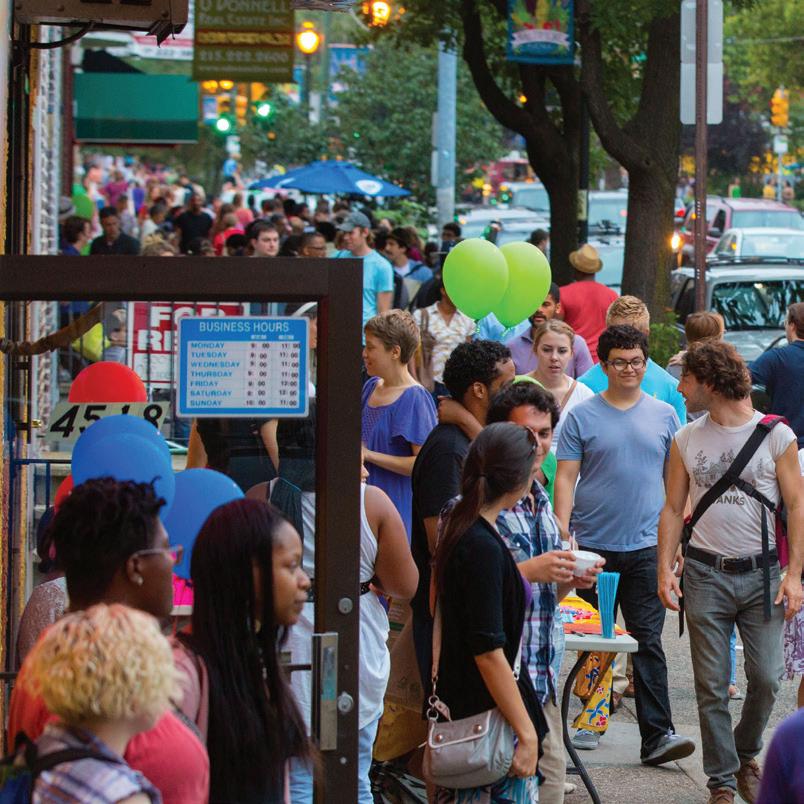
w Retail growth has spurred sidewalk vitality—40th Street is now home to celebrity chefs, and Baltimore Avenue pedestrian traffic has skyrocketed by 99% over five years.
w Once a victim of neglect and vandalism, Clark Park is now one of the city’s great jewels and home to one of the most successful farmers’ market in the city, drawing thousands every Saturday.
w University City is now the hub of the nation’s only intercity high speed rail line, further improving the transit connections in a neighborhood where 66% of residents commute by walking, public transit, or bicycle, compared to 36% in Philadelphia overall and 8% nationally.
w The office market continues to be among the strongest in the region with a vacancy rate of 8.8%, third lowest among 29 regional submarkets.
w Universities here have increased their R&D expenditures in science and engineering by 83% in the last 10 years and by 316% in the last 20 years.
University City and University City District have become national models—prototypes for partnerships across institutions and among neighbors, and exemplars for an urban ideal where campus and community drive a virtuous cycle of new amenities and new opportunities.
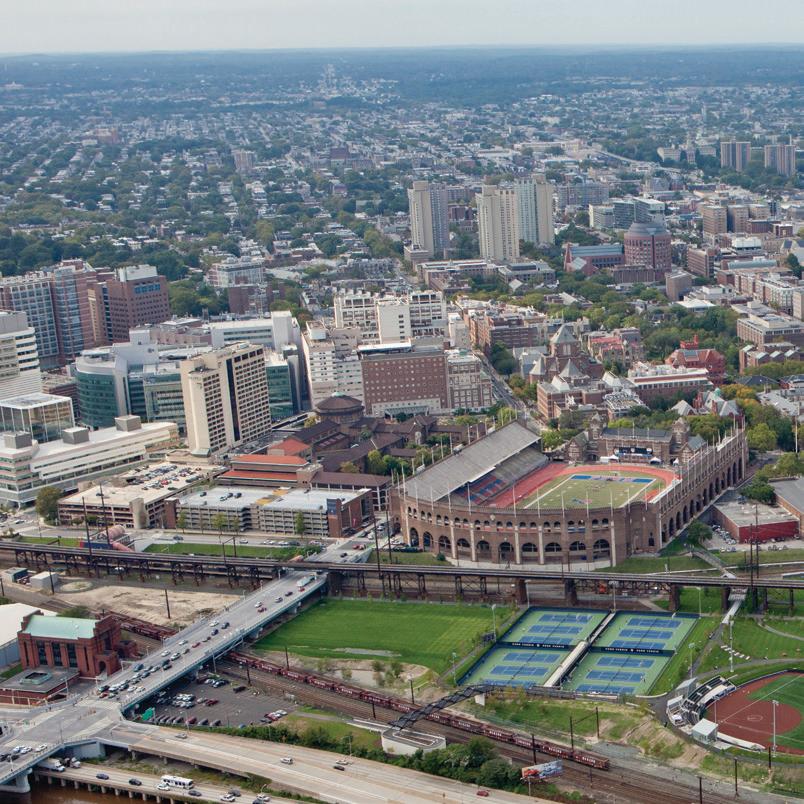
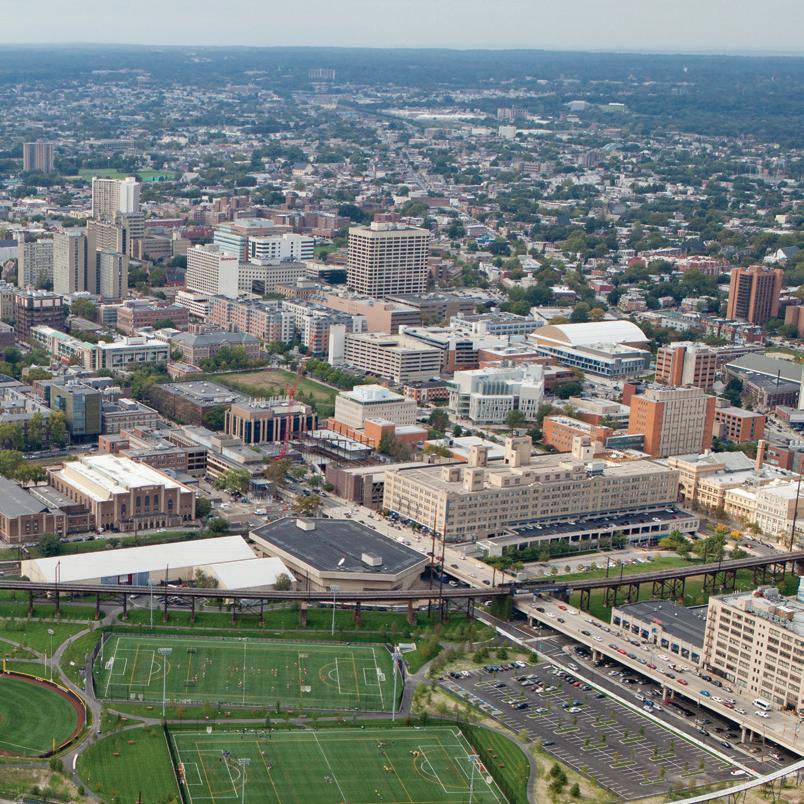
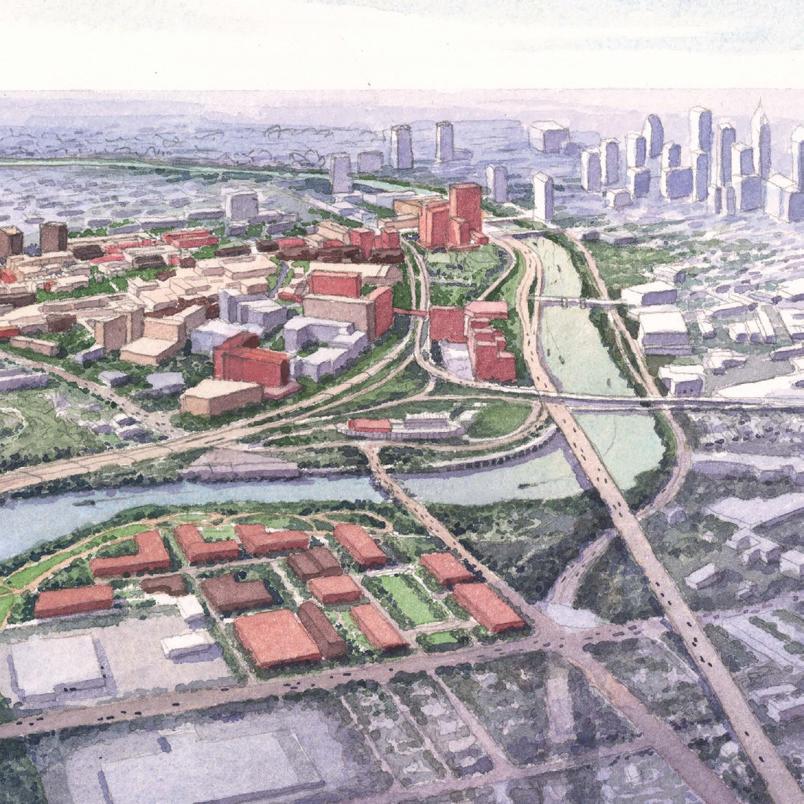
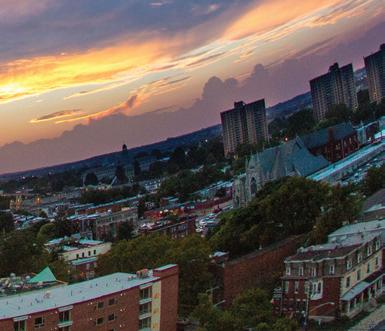
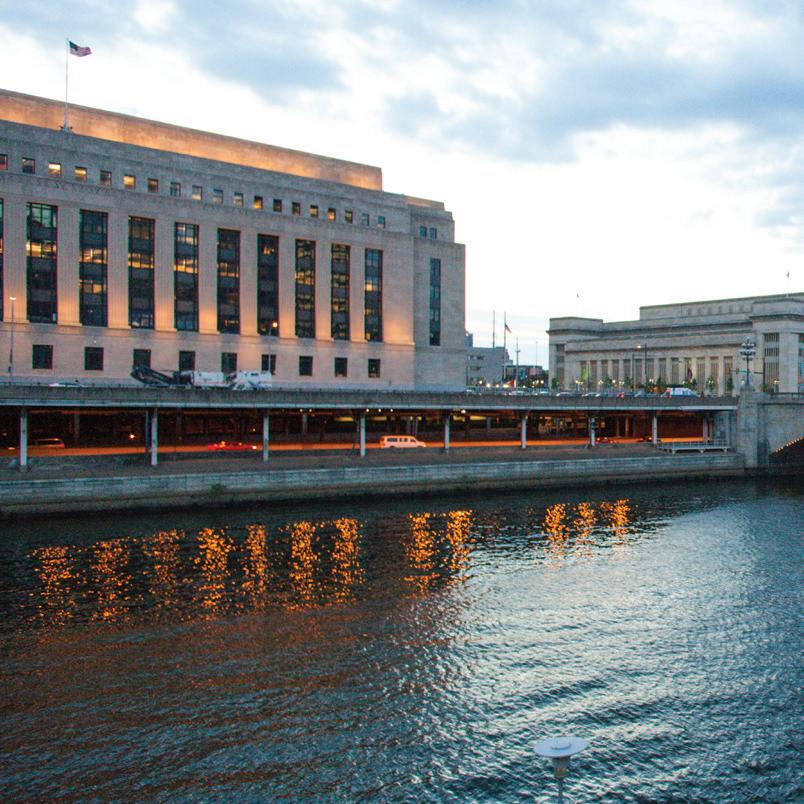
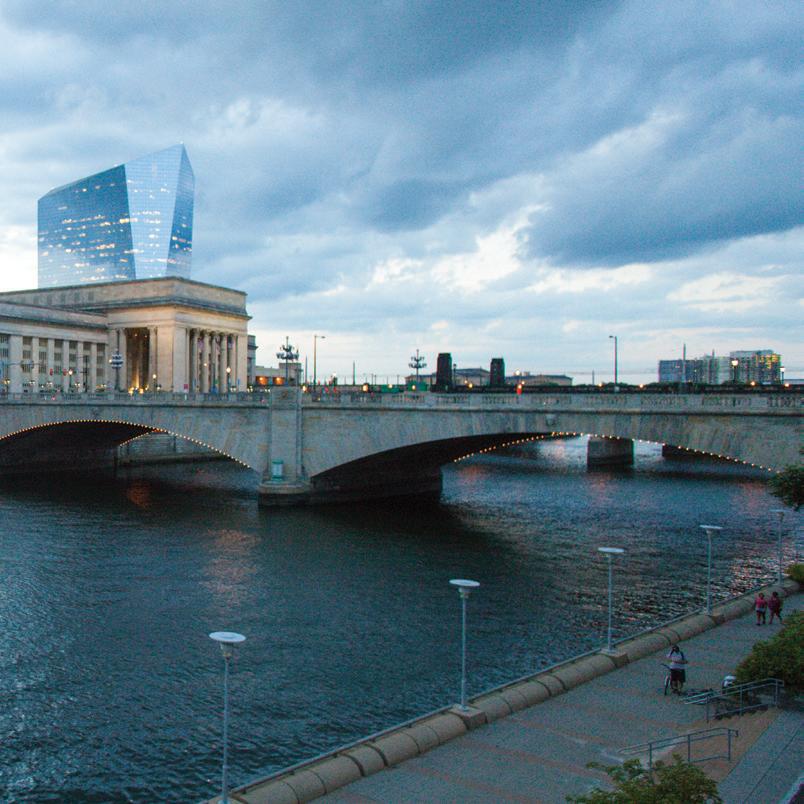
The view of University City from across the Schuylkill River in 2004.
REAL ESTATE DEVELOPMENT
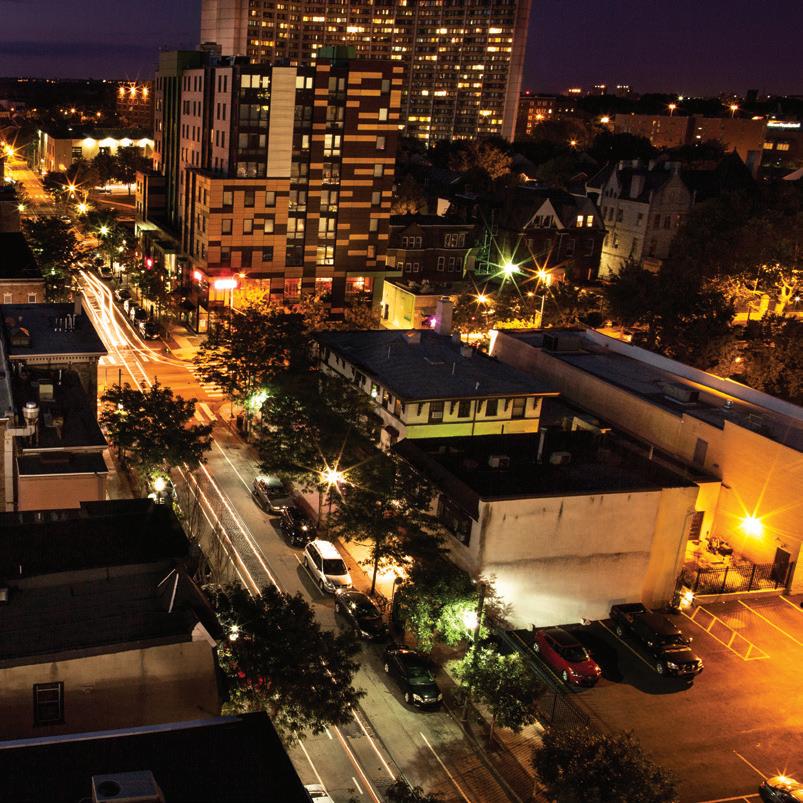
Rapid transformation and sustained growth continue to define University City. Twenty-four new development projects were recently advanced or were completed, representing more than 5 million sq. ft. of new office, research, residential, academic and medical facilities in addition to nearly 30 acres of public green space. What follows is an overview of the projects that continue to remake the University City experience.
5.
6.
8.
3. Campus Commerce Center
4. URBN Center
23.
1. Constantine N. Papadakis Integrated Sciences Building
2. Penn Park
The Center for Culinary Enterprises
Shoemaker Green 7. 4240 Market Street
Central City Toyota
9. Spruce Street Plaza
10. Golkin Hall
11. The Nicholas and Athena Karabots Pediatric Care Center
12. 2.0 University Place
13. Chestnut Square Development
14. LeBow College of Business
15. Krishna P. Singh Center for Nanotechnology
16. USciences Science and Technology Center Complex (expansion)
17. The ARCH
18. Penn Medicine South Pavilion (Extension)
19. 3737 Market Street
20. The Wistar Institute Research Building Expansion and Renovation
21. Croydon Hall Apartments
22. 38th & Chestnut Apartments & The Philadelphia Episcopal Cathedral Office Complex
Cira Centre South
24. Ambulatory Care Center
25. South Bank Redevelopment
1. CONSTANTINE N. PAPADAKIS
INTEGRATED SCIENCES BUILDING
Developer: Drexel University // Completion date: July 2011
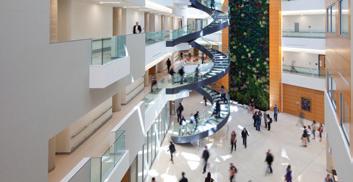
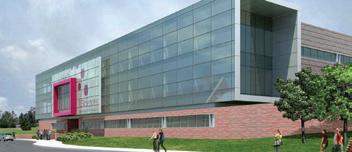
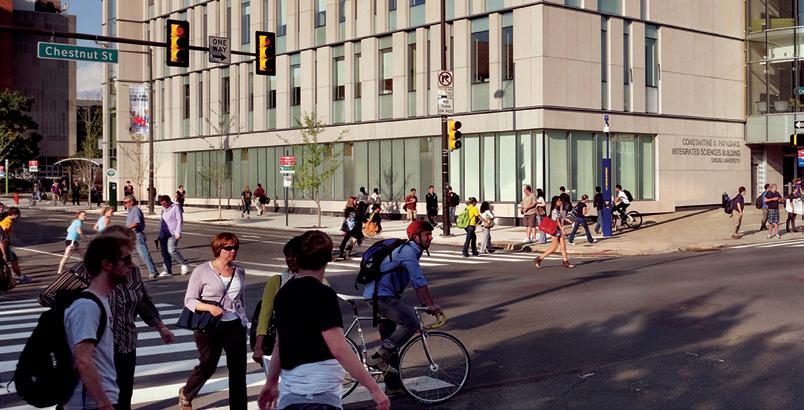
This distinctive, $69.1 million five story building designed by Diamond and Schmitt in association with H2L2 is the flagship for Drexel University’s College of Arts and Sciences. Housing state-of-the-art laboratories, an auditorium, seminar classrooms and a café, this dynamic teaching facility is the first academic building in the U.S. to have a five-story biofilter wall and is being evaluated for Gold LEED certification.
Location: 33rd and Chestnut streets
Use: Academic Size: 133,447 sq. ft.
3. CAMPUS COMMERCE CENTER
Developer: Campus Apartments // Completion date: May 2012 (phase 1)
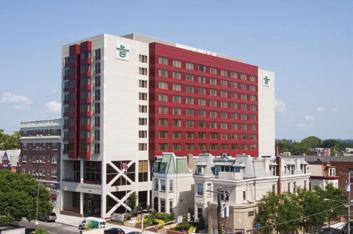
Phase one of the Campus Commerce Center is a 136 room extendedstay Homewood Suites hotel. Phase two will include 150,000 square feet of Class “A” office space partially occupied by Campus Apartments, headquartered in University City and one of the largest privately owned student housing companies in the nation.
Location: 41st and Walnut streets
Use: Hotel/Office Size: 110,000 sq. ft. (Phase 1)
2. PENN PARK
Developer: University of Pennsylvania // Completion date: Fall 2011
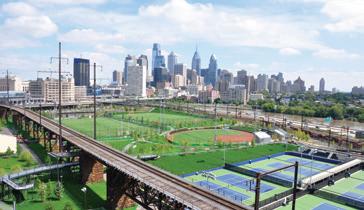
A shining example of Penn’s commitment to engagement with the local community, and a hallmark of sustainable design, Penn Park is the centerpiece of the Penn Connects campus development plan. The park transforms neglected land along the Schuylkill River into an urban oasis, dramatically opening and connecting the Penn campus with University City and the region, offering welcoming public walkways, casual picnic spaces, athletic fields, and spectacular views of Center City.
Location: West of the Schuylkill River between Walnut and South streets
Use: Recreational and athletic space
Size: 24 acres
4. URBN CENTER
Developer: Drexel University // Completion date: September 2012
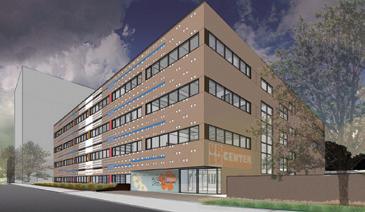
This architecturally significant complex, designed by Robert Venturi, will become home to Drexel’s Antoinette Westphal College of Media Arts & Design. The $46 million project designed by architectural firm Meyer, Scherer & Rockcastle will include light-filled studios, exhibition areas, and performance spaces that will foster student and faculty collaborations across the College’s varied disciplines.
Location: 3501 Market Street and 3401 Filbert Street
Use: Academic Size: 162,000 sq. ft.
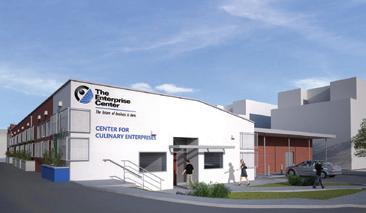
5. THE CENTER FOR CULINARY ENTERPRISES
Developer: The Enterprise Center Community Development Corporation
Completion date: September 2012
The Center for Culinary Enterprises is an innovative multi-use commercial kitchen center designed as an engine for creating food-related jobs and businesses, and to provide resources to emerging food entrepreneurs. It includes four state-of-the-art commercial kitchens for rent to culinary entrepreneurs, a multimedia learning center, support spaces for clients, and three new retail businesses.
Location: 310-18 S. 48th Street
Use: Food business incubator
Size: 13,000 sq. ft.
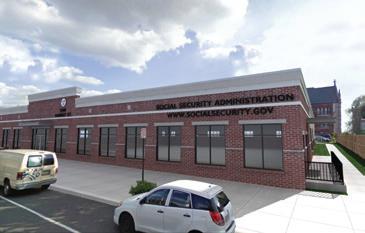
7. 4240 MARKET STREET
Developers: Jason Winig, Richard Kassoway, Howard Winig, Eric Kassoway
Completion date: October 2012
4240 Market Street is a single-story, single-tenant office building to be occupied by the Social Security Administration, which will consolidate two existing offices. The project includes an underground stormwater retention system to mitigate runoff.
Location: 4240 Market Street
Use: Office
Size: 14,550 sq. ft.
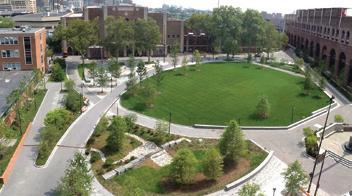
6. SHOEMAKER GREEN
Developer: University of Pennsylvania
Completion date: September 2012
A new public commons, this welcoming open space of lawns, treelined walkways, and sitting areas will be both a destination and a pedestrian route from the core of campus to the historic buildings surrounding the space, and further eastward to Penn Park. Sustainable site management will improve water quality and minimize runoff, reduce the urban heat island effect, restore biomass on site, and increase local biodiversity.
Location: 33rd Street, between
Walnut and Spruce streets
Use: Green space
Size: 2.75 acres
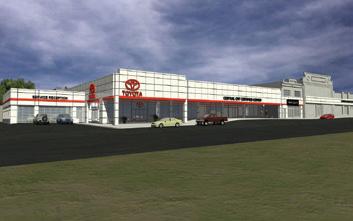
8. CENTRAL CITY TOYOTA
Developer: Central City Toyota // Completion date: Late 2012
The Paul family has been a part of West Philadelphia since 1908 and Central City Toyota has been on 48th and Chestnut streets since 1969. This new building will house a Toyota Dealership consisting of Service, Parts, Certified Toyotas & Collision center and will receive LEED Silver Certification, setting a new standard in its field for efficiency and design.
Location: 48th & Chestnut streets
Use: Vehicle dealership
Size: 45,000 sq. ft.
9. SPRUCE STREET PLAZA
Developer: University of Pennsylvania
Completion date: December 2012
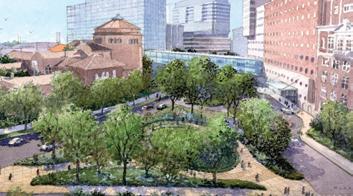
At a site that currently accommodates surface parking and food cart vendors, this plaza will create a popular new open space at an important gateway intersection to the University of Pennsylvania. Vendors will be relocated to the adjacent fresh air food plaza at 33rd and Spruce Streets, and a new mid-block crossing will provide improved pedestrian safety between the Hospital of the University of Pennsylvania, Penn Museum, and the University City SEPTA Station.
Location: Triangle bounded by 33rd Street, 34th Street, and Spruce Street
Use: Green space
Size: 0.5 acres
10. GOLKIN HALL
Developer: University of Pennsylvania // Completion date: January 2012
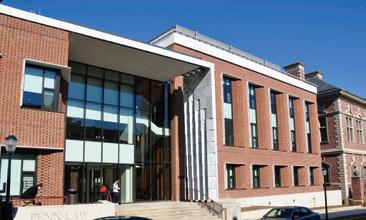
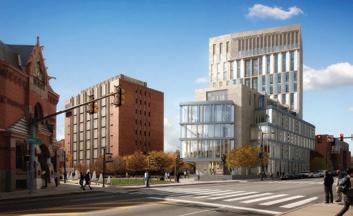
From its rooftop garden, state-of-the-art moot court room and 350-seat auditorium, to its interior glass walls and a grand, two-story atrium, the new Penn Law School building physically connects Penn Law’s signature, 110 year old, Georgian-style Silverman Hall to the east with its 16-yearold contemporary Tannenbaum Hall to the west, while respecting the historical three-story row homes across Sansom Street.
11. THE NICHOLAS AND ATHENA KARABOTS
PEDIATRIC
CARE CENTER
Developer: The Children’s Hospital of Philadelphia
Completion date: Late 2012
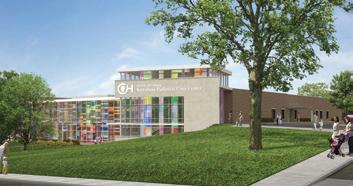
The Nicholas and Athena Karabots Pediatric Care Center will provide pediatric care as well as access for families to Children’s Hospital’s community programs. Existing Pediatric and Adolescent Care Centers will merge to form this new center that will provide primary and preventive health care services to underserved children in the West Philadelphia area.
Location: 48th and Market Street
Use: Medical Size: 52,000 sq. ft.
Location: 3400 Sansom Street Use: Academic Size: 38,000 sq. ft.
12. 2.0 UNIVERSITY PLACE
Developer: University Place Associates, LLC // Completion date: April 2013
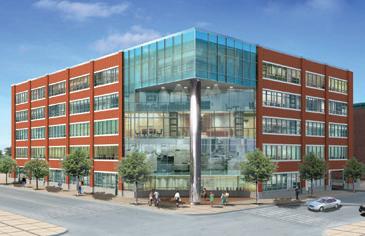
2.0 University Place is a $31 million LEED Platinum Office Building that will be occupied in part by the US Citizenship and Immigration Services. Among others, sustainable features will include a rooftop garden, stormwater management facilities, and common-areas that will use wind and solar-generated energy.
Location: 30 N. 41st Street
Use: Office
Size: 105,000 sq. ft.
13. CHESTNUT SQUARE DEVELOPMENT
Developer: American Campus Communities
Completion date: September 2013
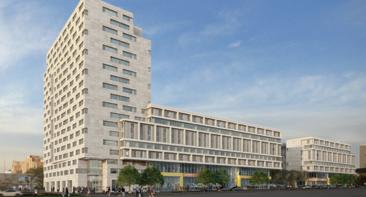
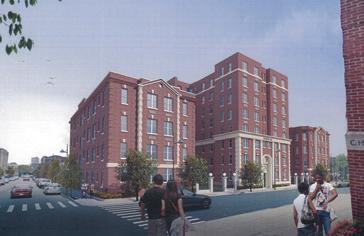
American Campus Communities is developing this $97 million student housing community and mixed-use project on Drexel’s campus through a ground lease agreement. Designed by Robert A.M. Stern Architects in conjunction with Voith & Mactavish Architects, the project consists of a 19-story residential tower at the corner of Chestnut and 32nd streets and two eight-story buildings that front Chestnut Street, together adding 865 student beds and 25,000 sq. ft. of new retail space on Chestnut Street.
Location: Chestnut Street between 32nd and 33rd
Use: Mixed use
Size: 361,200 sq. ft.
14. LEBOW COLLEGE OF BUSINESS
Developer: Drexel University // Completion date: September 2013
Designed by Robert A.M. Stern in conjunction with Voith & Mactavish Architects, this $87.5 million, project will house all the LeBow College of Business programs, replacing the 1960s-era Matheson Hall building. The 12-story business center at the heart of the Drexel University campus will unite the College’s various constituencies around a fivestory-high atrium ringed by classrooms, student lounges, events spaces, and offices.
15. KRISHNA P. SINGH CENTER FOR NANOTECHNOLOGY
Developer: University of Pennsylvania // Completion date: October 2013
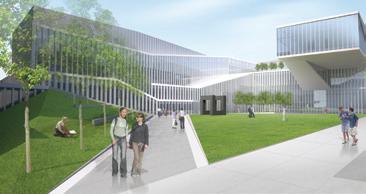
This new multi-level facility will bring together researchers from disciplines of engineering, medicine, and the sciences through lab and vibrant public spaces, including the quadrangle, public galleria, forum space and conference rooms. The building is adjacent to a major approach to the University, providing an iconic and welcoming new gateway between campus and city and will facilitate interaction between faculty and students, researchers and industry, the University and the city, and the region.
Location: 32nd and Market streets
Use: Academic
Size: 177,500 sq. ft.
Location: 3200 Walnut Street
Use: Academic Size: 80,000 sq. ft.
16. USCIENCES SCIENCE AND TECHNOLOGY CENTER COMPLEX (EXPANSION)
Developer: The University of the Sciences in Philadelphia
Completion date: Fall 2013
The $20 million expansion of the Science and Technology Center Complex will house USciences’ two new health professional programs, the Graduate Physician Assistant Program and the SpeechLanguage Pathology Program, and provide sufficient space for a simulation laboratory and interdisciplinary teaching environment. The expansion will connect to the Samson College of Health Sciences complex and target Green Globe certification by including features such as a green roof and the integration of materials manufactured with recycled content.
Location: 43rd Street and Woodland Avenue
Use: Academic
Size: 57,905 sq. ft.
17. THE ARCH
Developer: University of Pennsylvania // Completion date: January 2014
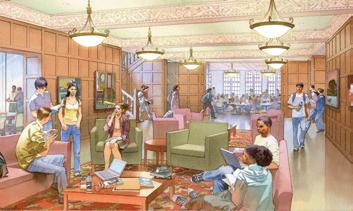
The Arts, Research and Culture House will undergo renovations to serve as a center of campus life, providing a robust cultural, intellectual, and social environment open to all of the University community. Plans include a lounge, gallery, conference and group study rooms with state of the art technology, expanded office space, an outdoor terrace and indoor café, an auditorium for lectures, performances, or receptions, and restoration of historic architectural features.
Location: 36th Street and Locust Walk
Use: Multipurpose
Size: 29,500 sq. ft.
19. 3737 MARKET STREET
Developer: University City Science Center & Wexford Science + Technology
Completion date: June 2014
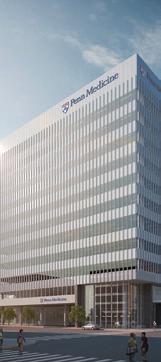
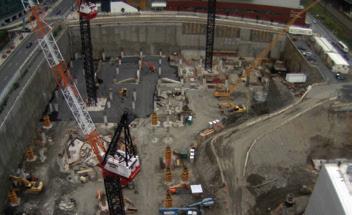
An 11-story building, 3737 Market Street will include space for outpatient medical facilities for Penn Presbyterian Medical Center and Good Shepherd Penn Partners, ground floor retail, and office and lab space for start-up and growing companies, expanding the capacity of the Science Center’s research park and furthering its efforts to transform its campus into a world class innovation center. Construction commenced in September 2012 on this project which was designed by the internationally renowned architecture firm of Zimmer, Gunsul Frasca Architects in cooperation with UJMN Architects + Designers with the goal of receiving LEED silver certification.
18. SOUTH PAVILION EXTENSION
Developer: Penn Medicine // Completion date: Early 2014
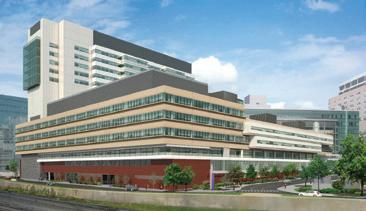
The South Pavilion Extension will add five floors of outpatient care totaling an additional 200,000 square feet to the Perelman Center for Advanced Medicine, further co-locating campus outpatient services at the Center to improve the patient experience. The new facility, which will aim for the same LEED Silver certification achieved by the Perelman Center, will have a direct link to the Center’s core atrium, and enjoy views of the Center City skyline.
Location: Health Sciences Drive
Use: Medical
Size: 200,000 sq. ft.
Location: 38th and Market streets
Use: Medical/Research/ Office
Size: 272,700 sq. ft.
20. THE WISTAR INSTITUTE RESEARCH BUILDING EXPANSION AND RENOVATION
Developer: The Wistar Institute Completion date: Spring 2014
The Wistar Institute broke ground in September 2011 on a new in-fill laboratory research building. This transformative project will provide the Institute with five floors of new laboratory space, a large auditorium and central atrium, and a new public entrance on Spruce Street. The project also includes construction of a replacement vivarium and installation of more energy efficient mechanical, electrical and plumbing systems throughout much of the complex.
Location: 3601 Spruce Street
Use: Biomedical research and training
Size: 89,700 sq. ft.
21. CROYDON HALL APARTMENTS
Developer: Orens Development, Inc., Hillel Tsarfati and Kfir Binnfeld
Completion Date: June 2014
Croydon Hall is an 8-story center core building, with two 4-story wings, that has been vacant for over 10 years, but is structurally sound. The property will be completely renovated into 127 one, two and three bedroom apartments with occupancy projected to begin in September 2013.
Location: 241 S. 49th Street
Use: Residential
Size: 100,000 sq. ft.
22. 38TH & CHESTNUT APARTMENTS & THE PHILADELPHIA EPISCOPAL CATHEDRAL OFFICE COMPLEX
Developer: Radnor Property Group, LLC
Completion date: Summer 2014
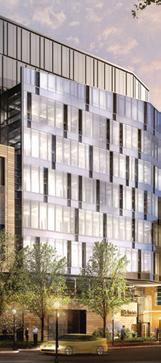
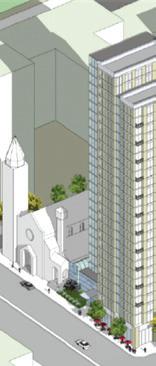
This mixed-use development consists of a 25-story residential tower with 283 apartments, ground floor retail, a health club and underground parking. Adjacent, the Philadelphia Episcopal Cathedral will add a new 3-story office building, a children’s early learning center, and ancillary space.
Location: 38th and Chestnut streets
Use: Mixed use
Size: 338,000 sq. ft.
23. CIRA CENTRE SOUTH
Developer: Brandywine Realty Trust
Completion date: Late 2014
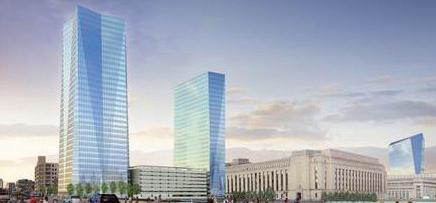
Cira Centre South is a proposed mixed-use development consisting of two towers on 30th Street, bookending the recently constructed 1,662car parking garage. The Walnut Street tower will have approximately 400,000 sq. ft. of office space, 350,000 sq. ft. of residential space, and 15,000 sq. ft. of retail and restaurant space. The Chestnut Street tower will have approximately 300,000 sq. ft. of residential space and 15,000 sq. ft. of retail space. The project is being developed within the Keystone Opportunity Improvement Zone, which affords qualified tenants an abatement of most city and state taxes.
Location: 30th Street, between Walnut and Chestnut streets
Use: Mixed use
Size: 1.6 million sq. ft.
24. AMBULATORY CARE CENTER
Developer: The Children’s Hospital of Philadelphia
Completion date: 2015
The Children’s Hospital of Philadelphia is expanding its facilities on its South Campus, where the LEED certified ACC will consolidate and expand many of its outpatient services. The public and patient spaces that can benefit the most from daylight and a connection to nature have been placed facing the 2+ acre landscaped plaza which will connect the ground floor with the Colket Translational Research Building.
Location: Civic Center Boulevard
Use: Medical Size: 1.3 million sq. ft.
UNIVERSITY CITY IS BURSTING AT THE SEAMS
No matter which direction one looks, development plans just outside of University City are revitalizing adjacent neighborhoods and bringing Philadelphia closer together. To the north, the Philadelphia Police are planning the monumental relocation of their headquarters; to the south, Penn’s footprint is set to grow by an additional 23 acres; to the east, CHOP’s campus will soon occupy both banks of the Schuylkill River; and to the west, a derelict warehouse is being transformed into luxury lofts. If Philadelphia is an economic engine for the region, University City is at its core.
25. SOUTH BANK REDEVELOPMENT
Developer: University of Pennsylvania
Completion date: Ongoing
Location: 34th Street & Grays Ferry Avenue
Use: Mixed
The acquisition of 23 acres of land just south of the University Avenue Bridge—the former DuPont Marshall Labs site—has yielded an important area to accommodate campus growth as well as free up valuable core space. Penn’s South Bank will support a dynamic campus environment that drives technologyled economic development, fosters broadbased collaboration with Penn’s leading researchers, supports business innovation, and promotes the development, transfer, and commercialization of cutting-edge research.
COMMERCIAL VITALITY
Dozens of new stores and restaurants open every year in University City. Retail occupancy rates and pedestrian counts continue to climb. Amid this continual growth, UCD’s signature events such as University City Dining Days presented by Wells Fargo, the Baltimore Avenue Dollar Stroll and the 40th Street Summer Series enliven our corridors and neighborhood, vastly improving sales at our establishments. And with the promise of tens of thousands of square feet of new retail space throughout University City over the next 12 months, the commercial sector is sure to continue its remarkable ascent.
THE DISTRITO EFFECT
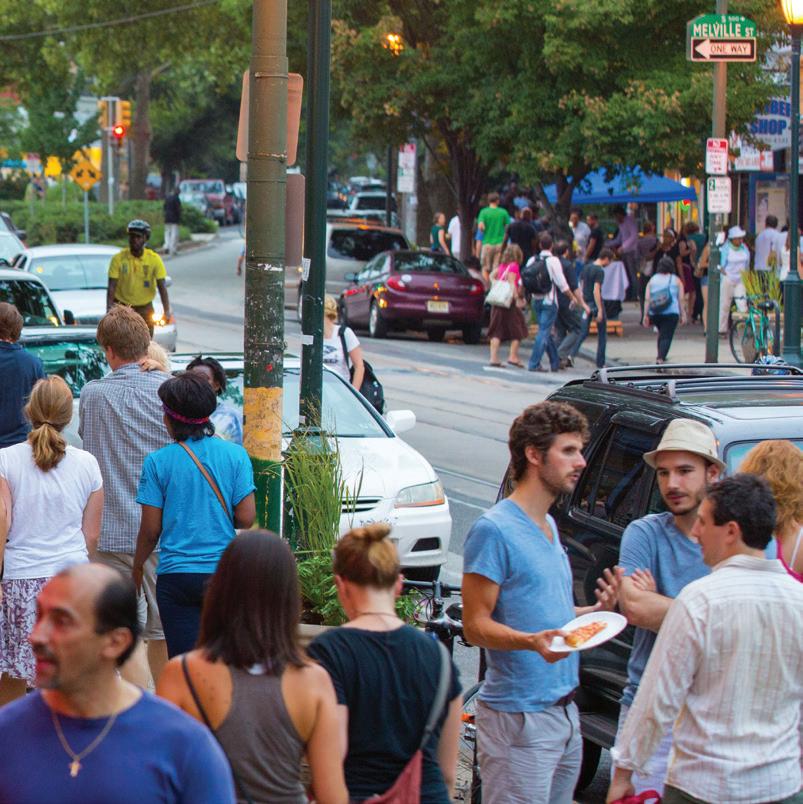
Iron Chef Jose Garces’ Distrito, located on 40th Street between Chestnut and Ludlow Streets, is a great example of the impact that new businesses are having on the vitality of their immediate surroundings. In the years since Distrito opened, a steady stream of customers has packed its tables on weekday and weekend evenings, having a demonstrable effect on pedestrian traffic on the block overall, and spilling over onto surrounding streets and leading the way for exciting new businesses.
We’re all familiar with Baltimore Avenue’s story of success, marked by the opening of an impressive 10 new full-service restaurants and the doubling of foot traffic in just five years. This year we welcomed the Mariposa Food Co-op move and expansion which transformed the avenue overnight. Baltimore Avenue, however, is just one of the remarkable examples of how momentum is facilitating the emergence of commercial clusters— not just commercial corridors—all around University City. At UCD we’re excited to begin looking beyond the corridor.
45th Street near Walnut—where you might hear any of the more than 35 languages spoken—features a new density of Pakistani, Ethiopian, Lebanese and other restaurants. Little Lebanon, as many are now calling it, is experiencing impressive increases in pedestrian activity across all time periods—clearly a result of the area’s unique intersection of diversity and amenities.
Similarly, 44th Street above Spruce has quickly emerged as one of University City’s hottest onestop destinations. With Local 44, Honest Tom’s Taco Shop, Lil’ Pop Shop and other homegrown businesses, large groups of hip, young friends bring the quaint 44th Street to life every evening.
Sidewalk vitality truly can be impacted by a small number of destination businesses, a pattern you can expect to see repeated in University City in coming years. With that in mind, it’s exhilarating to watch the remaking unfold along Chestnut Street, around 30th Street Station as well as 34th Street. Commercial momentum continues to define University City.
NEW STORES & RESTAURANTS
Business owners know that University City is a smart choice, opening more than three dozen new businesses in 2011. In the last 18 months, branches of some of Philadelphia’s most successful establishments have opened, including Keswick Cycles, Han Dynasty, Doc Magrogan’s and Sabrina’s Café.
Despite the slow national economy from 2009–11, new stores and restaurants continued to flourish in University City.
Weekend Pedestrian Counts on Baltimore Avenue Continue to Climb
After 5pm, and on weekends, Baltimore Avenue comes alive as residents and visitors descend on its shops, restaurants, and nightspots. With an impressive 10 new full service restaurants opening on Baltimore Avenue in the last five years, pedestrian counts have seen a steady increase.
Source: UCD (Sum of hourly counts between 11am and 1pm on the 4500, 4700 and 4900 blocks of Baltimore Avenue)
Anchor Businesses Have Had a Marked Impact on Pedestrian Traffic
Evening foot traffic on 40th Street (Chestnut to Ludlow)
Distrito opens in 2008
Source: UCD
Pedestrian Traffic in University City and Center City*
Pedestrian Traffic at Busy University City Locations is Comparable to Center City*
Walnut St. (Broad–15th)
Market St. (10th–11th)
Market St. (13th–Juniper)
Broad St. (Walnut–Locust)
Chestnut St. (19th–20th)
Walnut St. (10th–11th)
10th St. (Arch–Cherry)
Chestnut (16th–17th)
13th St. (Chestnut–Sansom)
Market St. (Schuylkill–30th)
Walnut St. (11th–12th)
34th St. (Walnut–Chestnut)
Walnut St. (36th–37th)
34th St. (Spruce–Convention)
Chestnut St. (7th–8th)
40th St. (Locust–Walnut)
Sansom St. (15th–16th)
40th St. (Chestnut–Ludlow)
Market St. (36th–37th)
*Lunchtime average weekday counts
Source: UCD 2011 pedestrian counts, Center City District Pedestrian Count Report Detail 2011
Pedestrian Counts* per hour, Monday–Friday
* Vehicle counts available on request
Source: UCD, 2011
Discoveries flowing out of University City institutions continue to change our world while contributing billions of dollars to the region’s economy. It’s clear why great minds from around the globe are drawn to University City.
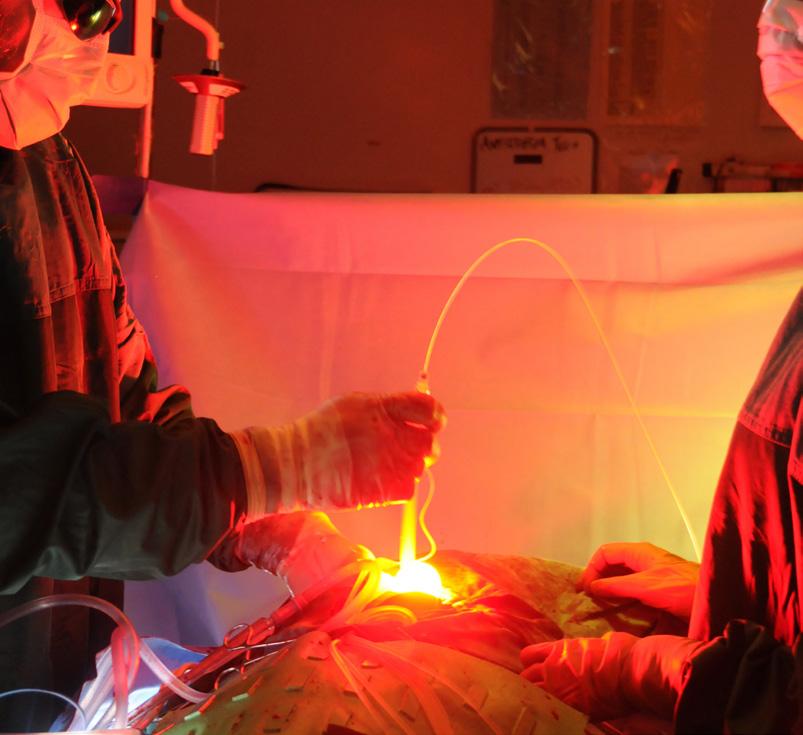
Penn Medicine doctors use photodynamic therapy (PDT) on a patient with malignant mesothelioma. PDT aims to eradicate remaining microscopic cancer but also seems to trigger the patient’s own immune system.
Photo by Sabina Pierce Photography
ROBOTIC DINOSAURS ON THE WAY
ResearchersatDrexelarebringingthelatesttechnological advancements in 3-D printing to the study of ancient life.
DRIVING
WITHOUT A BLIND SPOT MAY BE CLOSER THAN IT APPEARS
THE NEXT GENERATION OF BODY ARMOR
The subtly curved mirror, invented by Drexel mathematics professor Dr. R. Andrew Hicks, increases drivers’ field of view.
AND BATTERIES
Drexel engineers recently presented their work with a sophisticated weave of carbon nanotubes in ACS Nano.
INTERFERON THERAPY REDUCES HIV RESERVES
A Wistar-led study provides the first clinical evidence for a means of reducing the persistent amount of HIV in patients and the ability to control HIV without continued antiretroviral therapy.
GROUNDBREAKING CANCER TREATMENT
Among patients with malignant pleural mesothelioma, treatment with lung-sparing surgery in combination with photodynamic therapy yielded unusually long survival rates. Penn is the only medical center in the country using this approach.
GENETICALLY MODIFIED T CELLS
OBLITERATE TUMORS*
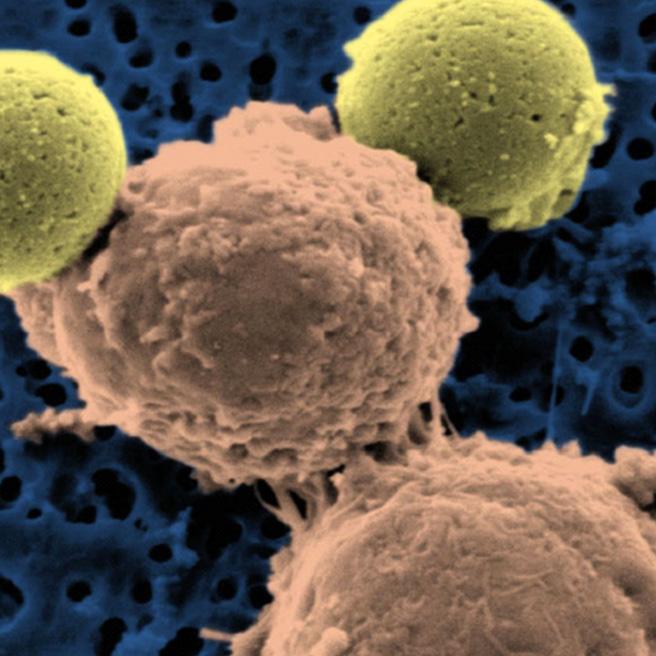
In a cancer treatment breakthrough twenty years in the making, researchers have shown sustained remissions of up to a year among a group of advanced chronic lymphocytic leukemia patients treated with genetically engineered versions of their own T cells.
FIGHTING CHILDREN’S LYMPHOMA
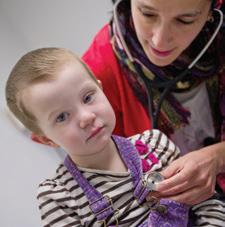
A pill designed to zero-in on abnormal genes that drive specific cancers has produced encouraging early results in children with an uncommon but aggressive type of lymphoma.
2012 PHILADELPHIA LIFE SCIENCES STARTUP OF THE YEAR
Named2012PhiladelphiaLifeSciences startup of the year, Optofluidics, Inc. is developing microfluidic and biophotonic nanomanipulation technologies for biological, material science, and pharmaceutical applications.
INFRASCAN DIAGNOSING TRAUMATIC BRAIN INJURY
Infrascan received clearance from the FDA in December to begin marketing the Infrascanner Model 1000 which diagnoses traumatic brain injury.
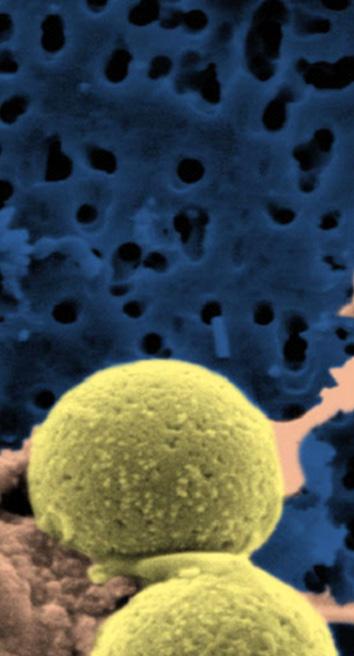
*Background image: Magnetic beads (yellow) are used to force the patients’ modified T cells (orange) to divide before they are infused back into the patient.
Photo courtesy of the University of Pennsylvania
A GAME CHANGER FOR UNIVERSITY CITY
EARLY-STAGE BREAST CANCER STUDIES
New research from University of the Sciences’ Mayes College of Healthcare Business and Policy suggests that MammaPrint—a gene expression profiling (GEP) test used to identify whetherefitwomenwithearly-stagebreastcancerwouldbenfrom chemotherapy—is the more cost-effective and clinically-useful test than the most frequently used GEP in practice in the United States today. The findings have strong implications for healthpolicymakersandhealthinsurancereimbursement decisions, as well as, for health providers and patient outcomes.
HISTORIC SEA LEVEL RISE LINKED TO CLIMATE CHANGE
An international research team has shown that the rate of sealevel rise along the U.S. Atlantic coast is greater now than at any time in the past 2,000 years and that there is a consistent link between changes in global mean surface temperature and sea level.
6–9-MONTH-OLDS UNDERSTAND THE MEANING OF MANY SPOKEN WORDS
Psychologists Elika Bergelson and Daniel Swingley demonstrated that infants learned the meanings of words for foods and body parts through their daily experience with language.
PRINTING 3D BLOOD VESSEL NETWORKS OUT OF SUGAR
Researchers are hopeful that new advances in tissue engineering and regenerative medicine could one day make a replacement liver from a patient’s own cells, or animal muscle tissue that could be cut into steaks without ever being inside a cow.
GREENED VACANT LOTS RESULT IN RESIDENTS FEELING SAFER
Greening vacant lots may make neighborhood residents feel safer and may be associated with reductions in certain gun crimes.
“First Round Capital is thrilled to move our headquarters into University City. We’ve seen a real surge in the number of companies that were founded by students at Penn and Drexel—and are looking forward to helping the next generation of entrepreneurs get their start.” — Josh Kopelman
First Round Capital, one of the nation’s most active early-stage venture capital firms, led by investor and Half.com founder Josh Kopelman, moved its headquarters to 40th and Locust streets this year, signaling a new era of entrepreneurship, investment and job-making in University City.
Academic Funding for Research and Development Continues to Climb Dramatically
University City researchers received more than 44% of all NIH funding distributed statewide.
Note: Data reflect R&D expenditures in science and engineering only at University of Pennsylvania, Drexel University and University of the Sciences in Philadelphia Source: NSF
PLACEMAKING
University City is not just a collection of people but of places of beauty, bonding and innovation. At University City District we strive—often through experimental and iterative ways—towards making those places memorable, vibrant and representative of local identity. UCD’s creative placemaking practices contribute to our neighborhood’s competitiveness and livability, and play a catalytic role in community revitalization.
THE PORCH AT 30TH STREET STATION
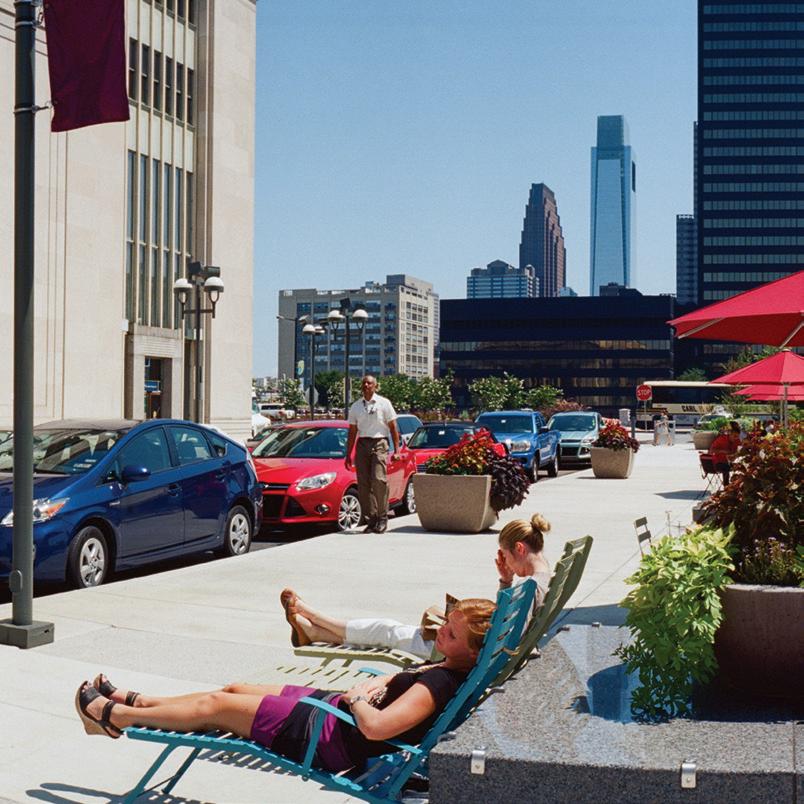
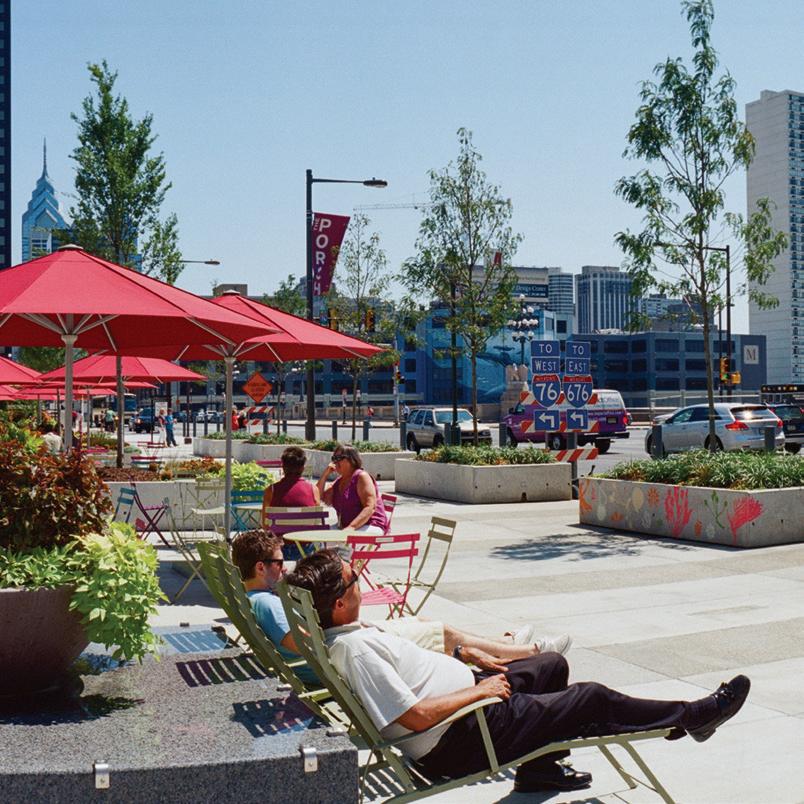
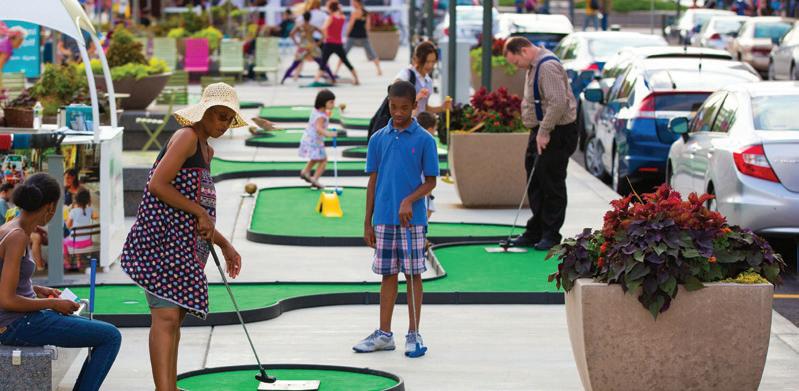
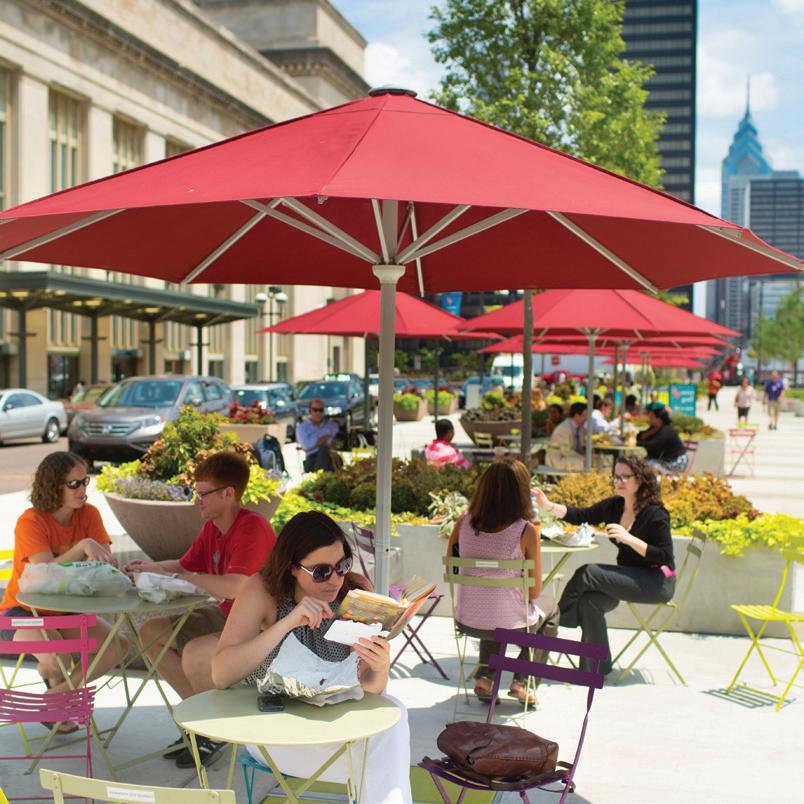
In November 2011, UCD with significant support from the William Penn Foundation opened The Porch at 30th Street Station, a transformative new urban open space. Adjacent to the second busiest train station in the country, between two magnificent historic buildings and within a short walk of over 16,000 jobs, The Porch is a key gateway to the region. Once a congested parking lane and bland, barren sidewalk, The Porch has quickly become one of the most animated public places in Philadelphia, with amenities such as abundant seating, vibrant seasonal plantings, ongoing performances, a weekly farmers’ market, yoga classes and a variety of special events such as The Porch Beer Garden and mini-golf.
PUBLIC ART AT THE PORCH
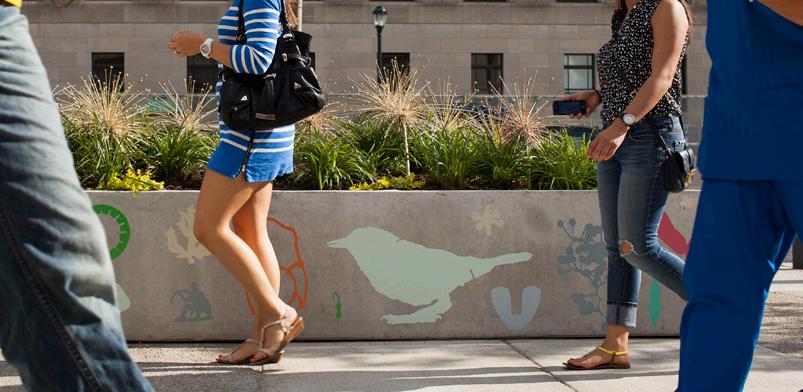
Thanks to recent grants from the Knight Foundation and ArtPlace, UCD will invite exceptional artists to engage creatively with The Porch, with our audiences, and within our neighborhood context. Art will bring beauty, reflection and delight to The Porch, as the site continues its evolution. Below, Pew Fellow Nami Yamamoto’s Hakoniwa installation responds to The Porch’s concrete planters, creating a “garden” that extends the reach of the colorful forms within each planter.
PARKLETS
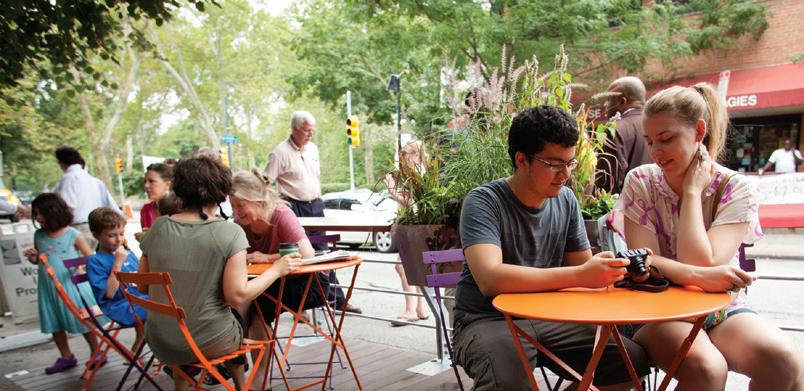
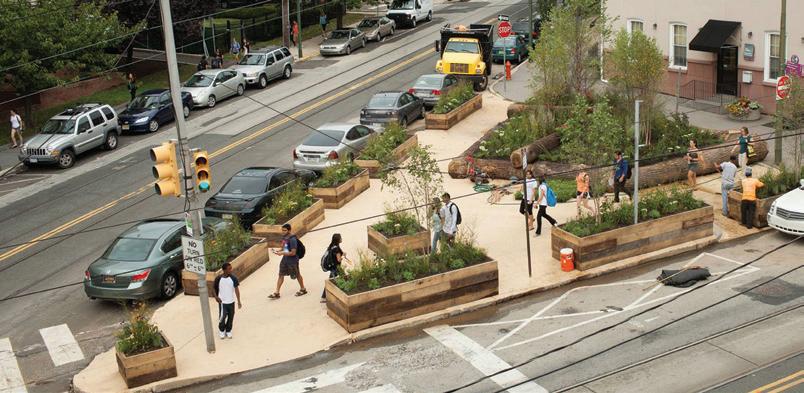
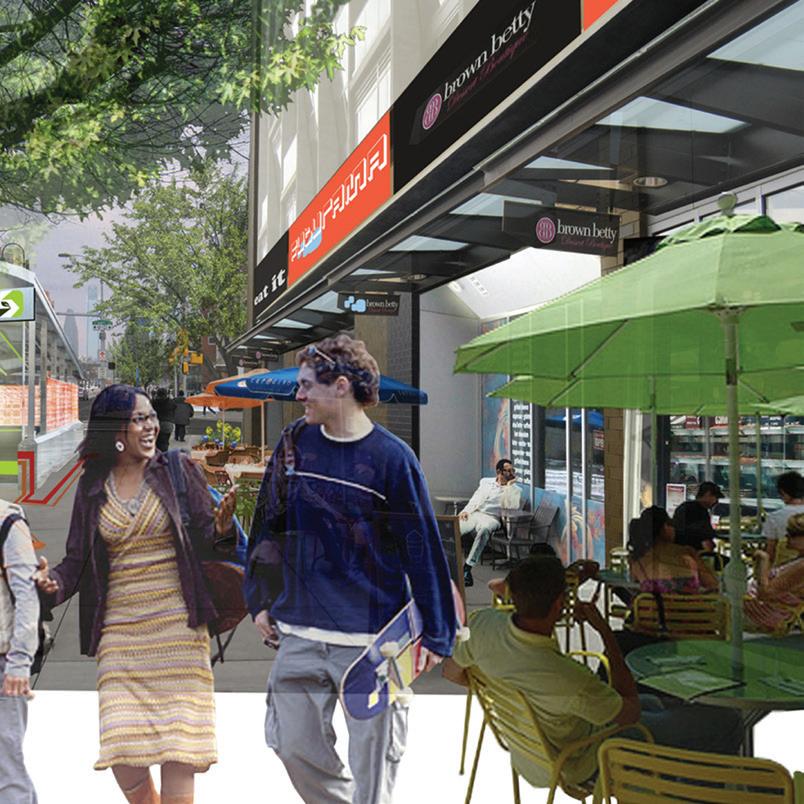
With University City pedestrian counts continually growing, UCD sees the addition of Parklets—which transform parking spaces into outdoor cafes—as a simple and low-cost solution to the growing demand for the infrastructure of walkability.
WOODLAND GREEN
UCD partnered with the Mayor’s Office of Transportation and Utilities and the Philadelphia Streets Department to transform a lifeless traffic island and a redundant stretch of street into a verdant oasis with reclaimed trees, planters, bistro tables and umbrellas.
40TH STREET SUMMER SERIES
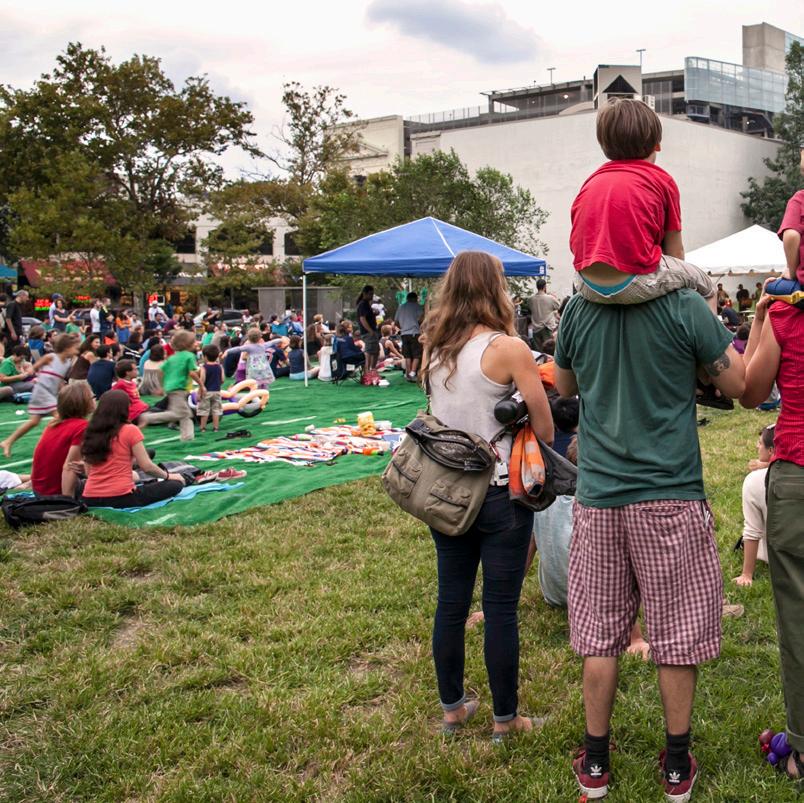
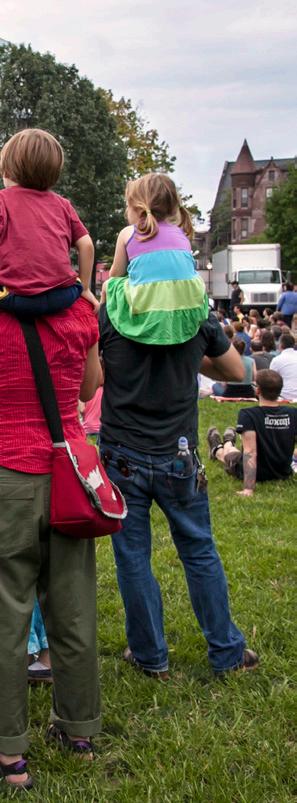
Each summer UCD, Penn and The Rotunda invite internationallyacclaimed ensembles—such as the Sun Ra Arkestra and Slavic Soul Party—to play free outdoor concerts at the field at 40th and Walnut streets.
HEART & SOUL
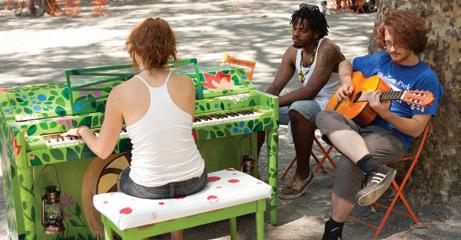
In June, UCD organized Heart & Soul: The University City Public Piano Project, an interactive public art exhibition featuring eight artist-decorated pianos on sidewalks and in parks and public spaces throughout University City. Combining visual art and random performance, Heart & Soul enlivened our connection to the spaces we share.
LOOK!
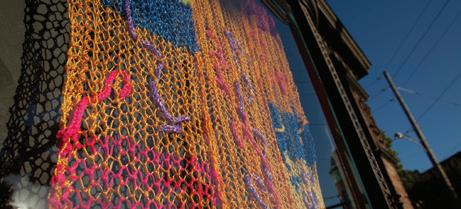
Drexel University, in partnership with UCD, the People’s Emergency Center and Powelton Village and Mantua arts groups organized the unique public art project LOOK! on Lancaster Avenue. LOOK! transformed 13 vacant Lancaster Avenue storefronts and windows with site-specific visual art installations. The project served as an accelerant for business and culture along Lancaster Avenue.
ENSURING A CLEAN AND SAFE COMMUNITY
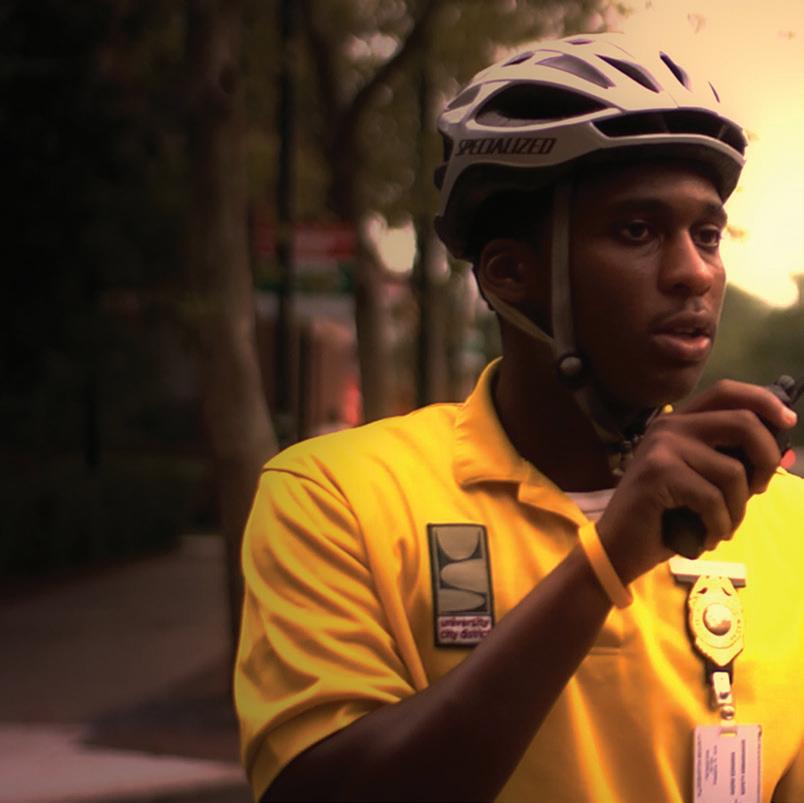
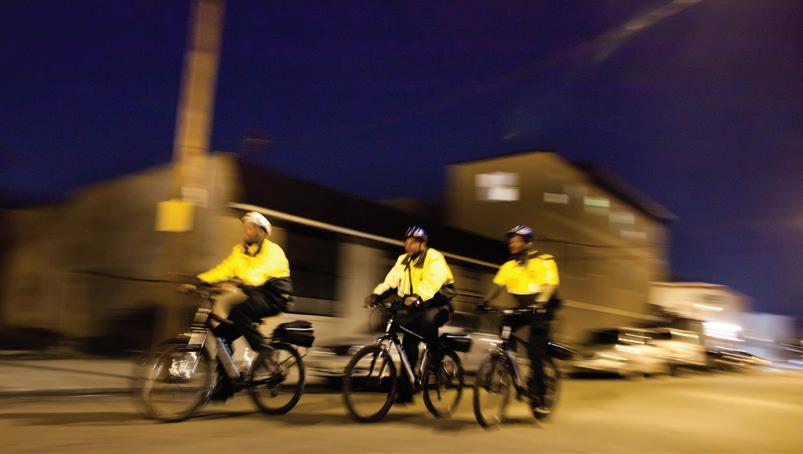
University City District’s foundational focus is on the physical world, and we work to maintain clean and safe streets. Our 55 Public Safety Ambassadors serve as a highly visible deterrent to crime, patrolling University City streets each day in cooperation with the Philadelphia Police and the public safety departments of University of Pennsylvania, Drexel University, and the University of the Sciences in Philadelphia. Our 22 Public Space Maintenance (PSM) employees work seven days a week to clean and enhance more than 160 commercial and residential blocks, including the maintenance of nearly 150 public trash cans. Together, our clean and safe staff provide a secure, welcoming University City for residents, employees, students and visitors.
SERVING OUR NEIGHBORHOOD
Whether we’re connecting residents to professional opportunities, enhancing University City streets through our clean and safe programs, promoting sustainable practices or reversing the state of long-neglected properties, UCD is fueling the foundation of prosperity.
Beginning in January of 2011, UCD was contracted by Drexel University to provide fourteen Safety Ambassadors to patrol sixty blocks in the Mantua neighborhood from 10am to 2am, seven days a week. Since, we’ve seen marked decreases in serious crime.
PROJECT REHAB
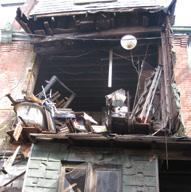
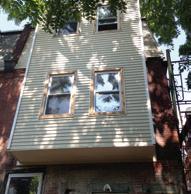
This year UCD established Project Rehab, in partnership with the City of Philadelphia’s Licenses and Inspections department, which provides comprehensive assistance to property owners—moving derelict properties from demolition threat to neighborhood asset while saving taxpayer dollars in the process.
A property on S. 49th Street is one of the dozens of properties saved from demolition. UCD assisted the property owner through the rigors of navigating local agencies and provided vital and comprehensive consultation. Thanks to Project Rehab, the owner has begun the process of rehabilitating the property into a beautiful and usable space that will allow the owner and the entire neighborhood to finally capitalize on its resurgence.
Before and after of property on S. 49th Street
THE DIRT FACTORY
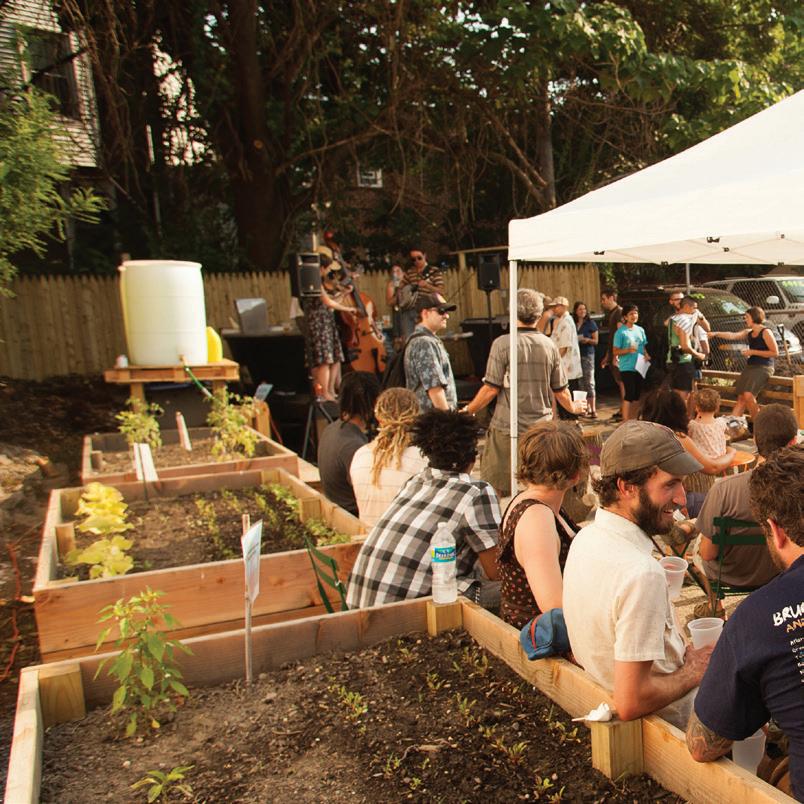
The Dirt Factory is a new community composting facility that is turning University City’s organic waste into nutrient rich material for use in the neighborhood’s gardens. Closing the loop on waste, this unique facility combines the fallen leaves collected from our streets with food scraps produced by neighborhood residents and businesses to generate compost that is distributed to residents and community gardens helping to keep literally tons of material out of our landfills. The site also functions as an education center, hosting workshops, compost bins, and raised bed gardens to demonstrate the ease and value of composting.
CONNECTING TO OPPORTUNITIES
In University City sit some of the largest and most respected employers in the city and region, while economic disconnection is still prevalent in the broader community. With this in mind, UCD’s West Philadelphia Skills Initiative (WPSI) brings together universities and health systems, linking anchor institutions to community residents and focusing on career-ladder job opportunities. We endeavor to connect neighbors living just blocks away from anchor employers, and bridge the skills gap that makes this distance seem unconquerable.
In 2012, WPSI partnered with Drexel College of Medicine to change the lives and career trajectories of unemployed West Philadelphians previously trained as medical assistants; with Penn Medicine to introduce unemployed West Philadelphians to true jobs of the future - information technology positions at the forefront of a data-driven healthcare revolution; and, with USciences, the National Board of Medical Examiners, Penn Law and others to expose area high school students to some of the best workplaces in the country.
ABOUT UNIVERSITY CITY
In recent years many cities and downtowns have experienced an influx of well educated, younger residents, and University City is leading that trend. The neighborhood’s population continues to swell, and average incomes are rising, at the same time that University City is among the most diverse parts of the city. Growth in employment has shown similar strength, with “eds and meds” continuing to withstand the slow economic recovery, and contributing to University City’s increasingly central role in the regional economy. One reason those jobs continue to flow here is the strength of our transportation network, easing commutes and travel both locally and regionally.
University City by the Numbers
* Data from 2010. Excludes Federal Civilian Employees, Uniformed Military, Self-Employed Workers, and Informally Employed Workers
Source: U.S. Census, American Community Survey, LEHD (OnTheMap), UCD, Newmark Grubb Knight Frank
Age of University City Residents
Population Growth in University City Compared to Philadelphia
Source: U.S. Census, ESRI
Source: U.S. Census, ESRI
University City is One of the Most Diverse Neighborhoods in Philadelphia
Over the last 10 years, University City and its surrounding area have become increasingly diverse, as illustrated by the Diversity Index. This measure reflects the probability that any two residents are of different races.
Source: U.S. Census
Race of University City Residents
Average Household Income*
Source: U.S. Census
*Inflation adjusted 2010 dollars
Source: ESRI, U.S. Census, American Community Survey
Median Home Sale Price*
*Prices in inflation adjusted 2011 dollars
Source: Realist, 1995-2002; TREND
Educational Attainment in University City for the Population Aged 25 and Over
Enrollment at University City’s Universities
Source: U.S. Census, American Community Survey
*Excludes distance learning students
Source: UCD
Photo courtesy of Drexel University
*includes 1,940 students on co-op experience and 5,064 distance learning students.
**includes credit and non-credit students who took classes at the West Regional Center
Source: UCD
University City is a Hub for Employment
University City’s Largest Employers
Employees based in University City
Line widths are proportional to employee flows
Source: U.S. Census (LEHD, OnTheMap). Excludes Federal Civilian Employees, Uniformed Military, Self-Employed Workers, and Informally Employed Workers
Percent of Philadelphia Employment in University City
Source: U.S. Census (LEHD, OnTheMap). Excludes Federal Civilian Employees, Uniformed Military, Self-Employed Workers, and Informally Employed Workers
* The total employee count for Penn Medicine in 2012 is 21,069
† Excludes student employees, temps, casuals, Queen Lane Medical and Center City Hahnemann campuses. Includes nursing and public health employees at the center city campus and other locations
Source: UCD
University City Office Space Inventory and Occupancy
Note: rent, inventory, and occupancy data exclude Cira Centre. Source: Newmark Grubb Knight Frank Regional Office Vacancy Rates
University City continues to have among the lowest office vacancy rates among 29 regional submarkets.
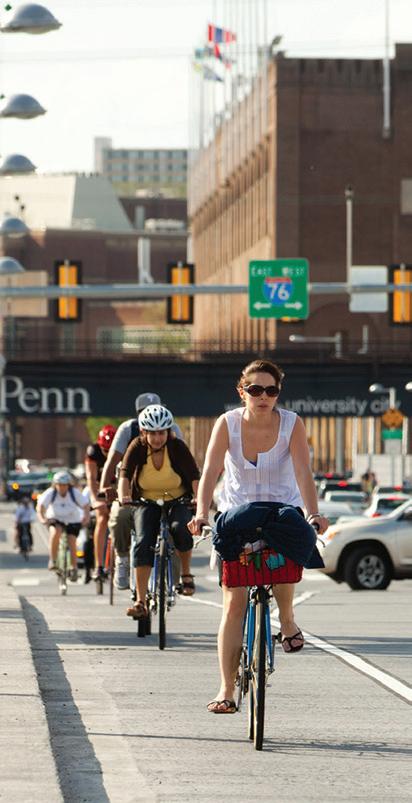
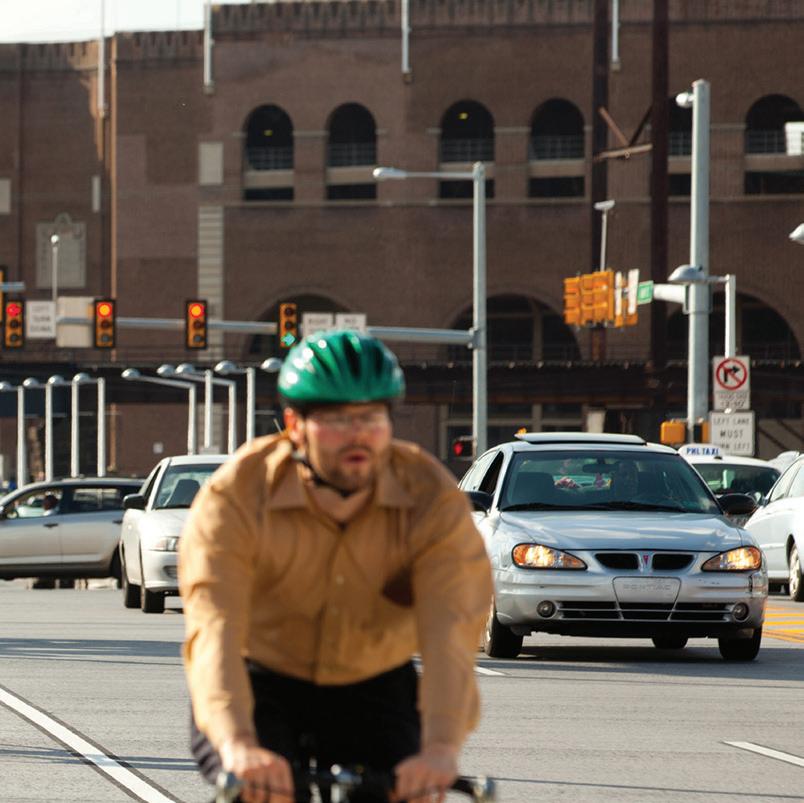
Thanks to employment and residential density, excellent public transit service, and extensive network of bicycle lanes, University City residents overwhelmingly commute without using private vehicles, in stark contrast to the city or nation overall.
Rail Ridership in University City on SEPTA and Amtrak Trains
Source: SEPTA, Amtrak
Note: 2009 and 2011 are the two most recent years for which complete data are available for all Regional Rail and Market Frankford Line stations in University City
Bicycle Ridership in University City
Resident Commute Mode
Source: Bicycle Coalition of Greater Philadelphia
Source: U.S. Census, American Community Survey
IMAGINE: THE NEXT FIFTEEN YEARS
Imagine if we experience the same exponential progress in University City’s next fifteen years as we did in its first fifteen. On the building blocks of the past combined with the present picture in University City, we ask ourselves, “What’s next?”
Over the next few pages, we invite you to imagine with us—and to imagine boldly—the great possibilities in University City over the next fifteen years . . .
Rendering by Andropogon Associates
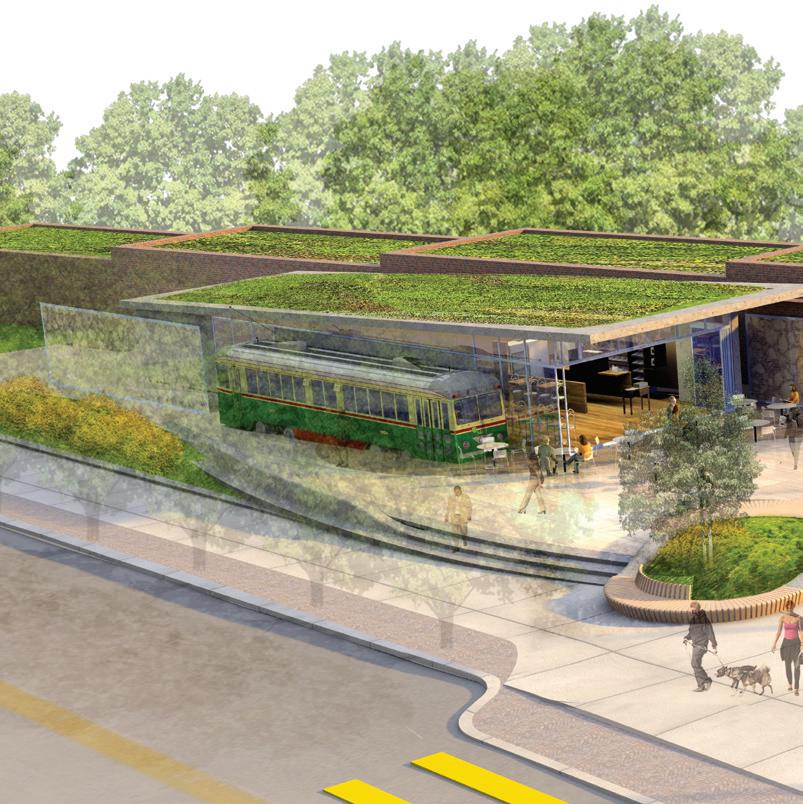
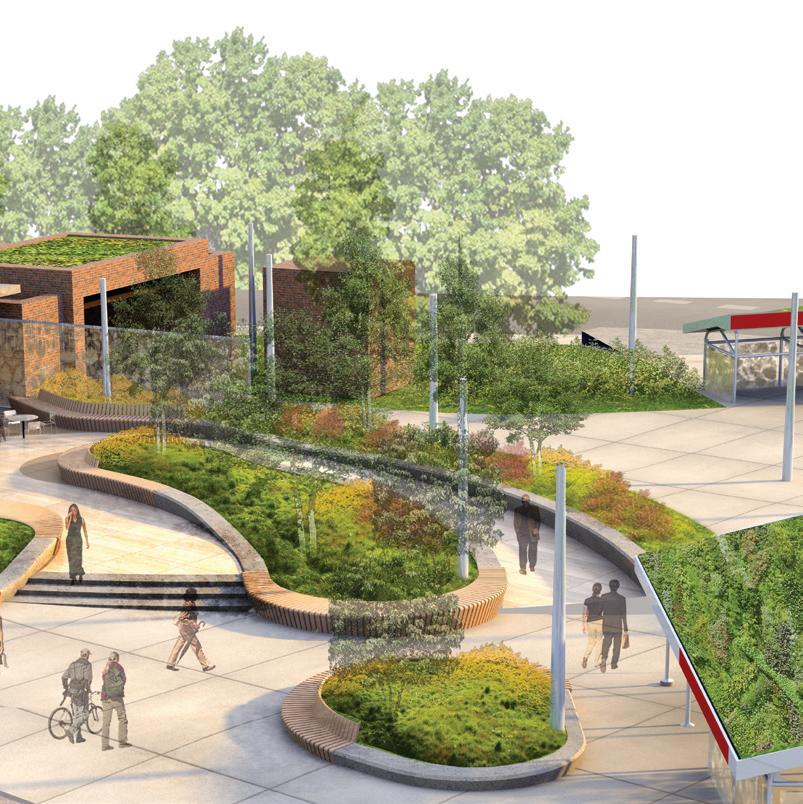
40TH STREET TROLLEY PORTAL
Over the last year, University City District partnered with SEPTA and a group of neighbors to develop a concept for improvements to the 40th Street Trolley Portal. This scheme, developed with Andropogon Associates, would create a beautiful and lively gateway to the neighborhood, implement sustainability measures on a site that is currently bleak and predominantly concrete, improve safety for pedestrians by rationalizing pedestrian circulation patterns, and increase security by adding active uses and “eyes on the street.”
A 30TH STREET
NEIGHBORHOOD EMERGES
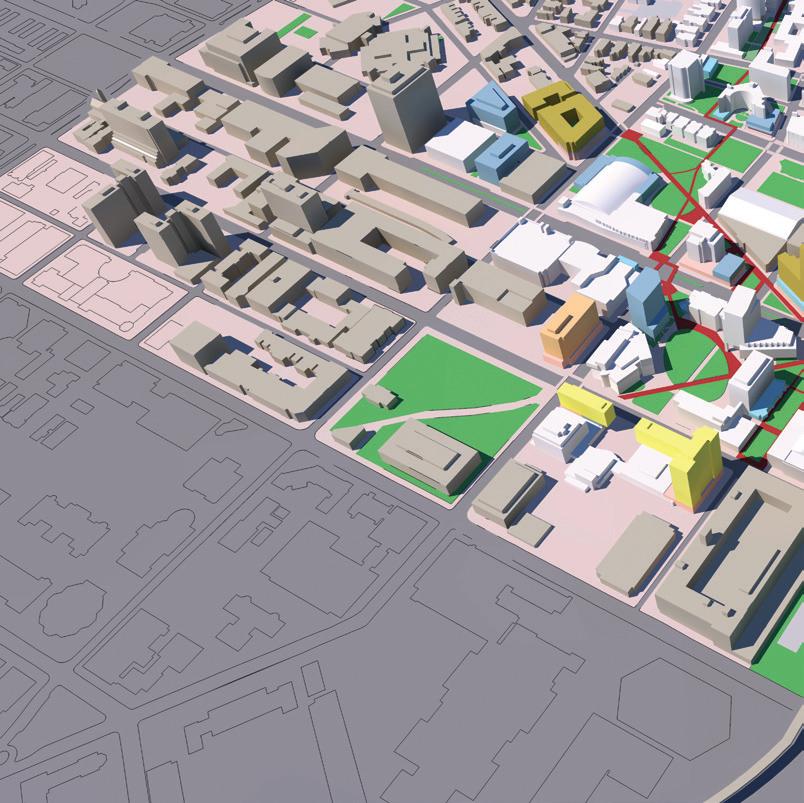
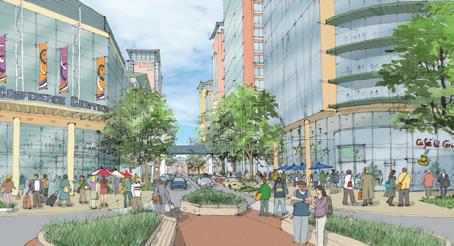
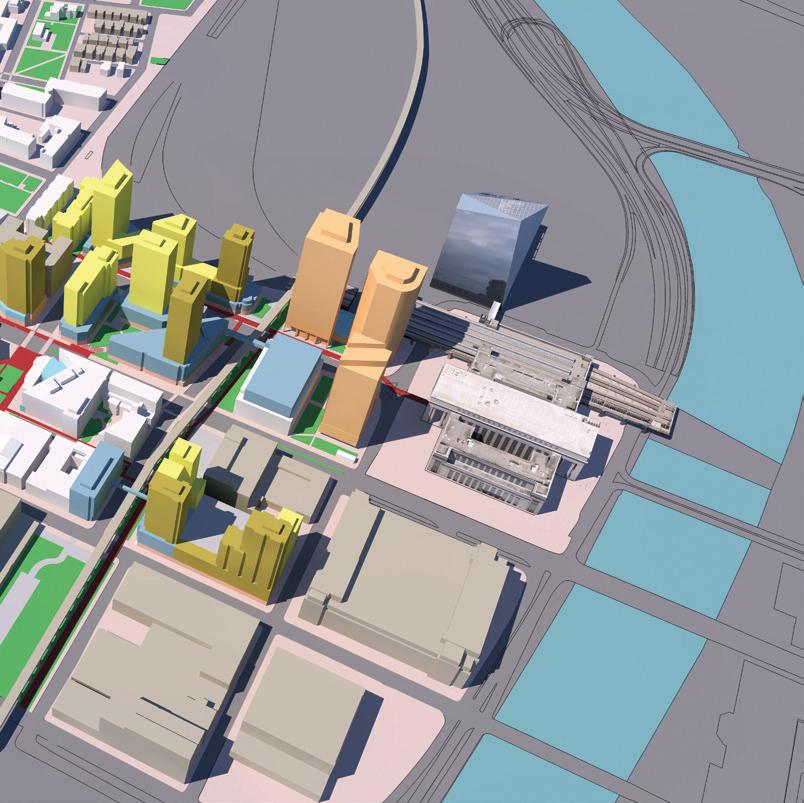
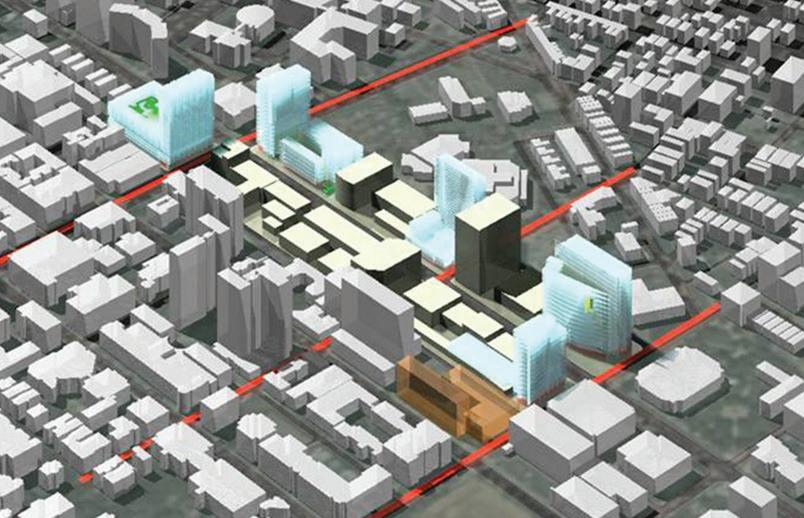
Over the next fifteen years, the area around 30th Street Station will transform into a vibrant and walkable new neighborhood, linking University City, 30th Street Station, and Center City. Within 0.25 miles of the station, there are 9 acres of surface parking, a rare opportunity to create a new and truly transit-oriented neighborhood from scratch. The vast majority of the vacant land is now controlled by Drexel University, which, this year, released bold plans to develop approximately 6,000,000 sq. ft. of new construction here. The massing study depicted here shows potential new buildings in color. In addition, Brandywine Realty Trust plans two additional Cira towers. It is expected that active ground floors, mixed uses, attractive streetscapes, public space including future improvements to The Porch, and pedestrian linkages, will create a new gateway district for University City.
High-density future development adjacent to 30th Street Station will reinforce Philadelphia’s status as one of the most walkable cities in America.
Renderings by Goody Clancy
KEYSTONE INNOVATION ZONE
Market Street between 34th Street and 39th Street has the capacity to accommodate significant additional development. Rendering by Adam Glaser for Kling Stubbins
Rendering by Interface Studio LLC
GREATER MARKET STREET
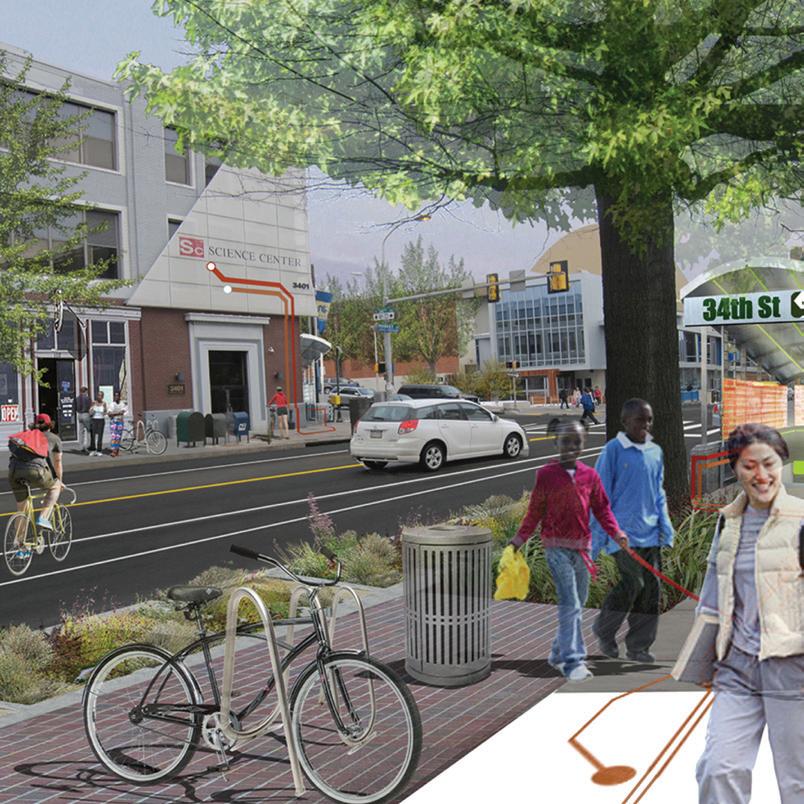
Market Street, anchored by the Science Center, will continue to grow and thrive as a center for innovation in the regional economy. A few factors will enhance its development. First, the University City Keystone Innovation Zone, a valuable State program designed to foster entrepreneurship and innovation through tax credits, has expanded to include information technologies companies in addition to life sciences companies. This measure will help balance a more vibrant entrepreneurial ecosystem. In addition, a recent University City District retail study showed an unmet demand for approximately 100,000 sq. ft. of retail space along Market Street; a dramatic change in ground floor land uses throughout the corridor will improve the sense of place as well as provide desirable amenities for innovation-based businesses.
University City District is a partnership of world-renowned anchor institutions, small businesses and residents that creates opportunity, improves economic vitality and quality of life in the University City area of West Philadelphia. Our primary mission is community revitalization. We work within a place-based, data-driven framework to invest in world-class public spaces, address crime and public safety, bring life to commercial corridors, connect low-income residents to careers, and promote job growth and innovation.
WWW.UNIVERSITYCITY.ORG
Early this year, University City District re-launched universitycity.org. The new site—with its clean and modern design, stunning images, informative blog, events calendar and easy-to-navigate tools for neighbors and visitors alike—showcases University City as much more than just a neighborhood. UCD is pleased to announce that universitycity.org is now mobile. Smart phones users can now browse the neighborhood’s acclaimed international dining, world-class cultural activities and much more with great ease.
Photography credits: Jim Abbot (pp.4–5, 22-23, 50–51), Greg Benson Photo (pp.2–3), Ryan Collerd (pp. 24 (bottom), 25, 27, 31, 32–33), Conrad Erb Photography (front and back covers, pp.14–15, 24 (top), 30 (top), 40, 34, 36, 43), Sabina Pierce Photography (p.19), Steve Thorne (pp. 28–29) Ben Tran (pp.16, 26, 41)
UNIVERSITY CITY DISTRICT BOARD OF DIRECTORS
Craig Carnaroli, Chairman
Executive Vice President
University of Pennsylvania
David J. Adelman, Vice Chairman
President
Campus Apartments
James R. Tucker, Vice Chairman
Senior Vice President for Student Life & Administrative Services
Drexel University
Maureen Rush, Secretary
Vice President for Public Safety
University of Pennsylvania
Joseph Trainor, Treasurer
Senior Vice President for Finance & Chief Financial Officer
University of the Sciences in Philadelphia
Madeline Bell
President & Chief Operating Officer
The Children’s Hospital of Philadelphia
Dorothy Welch Berlind
Community Representative
Cedar Park Neighbors
Della Clark
President
The Enterprise Center
Barry Grossbach
Community Representative
Spruce Hill Community Association
Curtis M. Hess
Senior Vice President of Real Estate
University City Science Center
Lindsay Johnston
President
Common Ground Realtors
A very special thanks to our State of University
Michael Jones
Community Representative
Powelton Village Civic Association
Daniel Liberatoscioli
President
The Restaurant School at Walnut Hill
Donald E. Melnick, MD
President
National Board of Medical Examiners
Mark Mendenhall
Community Representative
Garden Court Community Association
Christopher Montello
Chief Operating Officer
ProMed Property Management
Brad Paul
Co-Owner
Central City Toyota
Susan E. Phillips
Senior Vice President & Chief of Staff
University of Pennsylvania Health System
Anthony Rimikis
Senior Vice President of Development
Brandywine Realty Trust
Nelson J. Shaffer
Chief Administrative Officer
Pennoni Associates, Inc.
William Schwartz
Co-Founder
INTECH Construction, Inc.
Douglas R. Smith
Vice President—External Affairs
Verizon Pennsylvania
Tanya Steinberg
Executive Director
International House
Earl Williams
Community Representative
Walnut Hill Community Association
UNIVERSITY CITY DISTRICT STAFF
Matt Bergheiser
Executive Director
Brian Anders Dispatcher / Receptionist
Lori Klein Brennan Director, Marketing and Communications
Dexter Bryant Operations Manager, Public Space Maintenance Program
Seth Budick Manager of Policy and Research
Mark Christman
Communications Manager
Alan Garry
Operations Manager, Ambassador Program
Prema Gupta
Director, Planning and Economic Development
Katie Holeman
Graphic Design and Web Development Manager
Nate Hommel
Capital Projects Manager
Sheila Ireland
Director, West Philadelphia Skills Initiative
Charles Jones
Superintendent
Maggie Langdon
Executive Assistant
Lt. Brian McBride
Commanding Officer
UCD Philadelphia Police Substation
Ann Mintz
Director, Strategy and Development
Rebecca Smith
Center Manager, West Philadelphia Skills Initiative
Ryan Spak Manager, Project Rehab
Sharon Thompsonowak
Program Manager, West Philadelphia Skills Initiative
Steve Walsh Director, Community and Business Services
Homewood Suites by Hilton®, The Lighting Practice, Narducci Electric, Swirling Silks