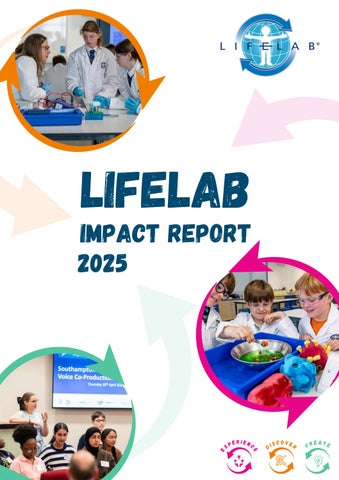
LIFELAB
XP
ERIENC
E
E
impact report 2025
DI
SCOVER
CR
EATE
foreword As we reflect on the year, we're delighted to share not just what LifeLab has achieved, but how we achieve it. This year's report introduces our 'spiral approach', a framework for engaging children and young people throughout their educational journey. From early years to young adulthood, from classroom learning to leading research, from local schools to national stages, LifeLab offers multiple entry points and pathways. The spiral captures how young people can engage with us in different ways and at different times – discovering, learning, teaching, creating, researching, informing policy and practice, and shaping the future of health and education itself. Working across the University of Southampton's triple helix of Education, Research, and Knowledge Exchange and Enterprise, 2025 has been a year of recognition and growth. It has included a Royal Garden Party, ministerial visits, our Co-Production Assembly, "The Feeling" theatre production, work experience placements, and policy contributions. Each of these reflects our commitment to expanding what is possible whilst staying rooted in what matters most – meaningful partnerships with young people, teachers, and communities. Thank you to everyone who forms part of LifeLab's spiral – you are shaping not just individual futures, but the future of how we understand health, education, and young people's power to create change.
Lisa B ag LifeLa ust b Sec ondar
y Sch
ool Le
nsend s -T o w r d o o c to nW a th r y e Dire P rof K P rogra m m b LifeLa
Donna Lovelock LifeLab Primary Schoo l Lea
d
ad
CONTENTS 3
LifeLab’s Mission
8
LifeLab
16
Influencing policy
4
2025 in numbers
9
Peer-to-Peer education
18
Theatre for life
5
Educational journey
10
Developing talent
20
Going global
6
Early LifeLab
15
College and beyond
22
Meet the team
2
our mission Change the beginning and you can change the whole story Our mission is to empower children and young people through scientific discovery to make positive lifestyle choices for their physical and mental health, wellbeing and resilience - now and in the future, and for their future children. Through our activities, we want to: reverse the trend of rising rates of unhealthy behaviours and lifestyles for children and young people in the UK. address the link between health, educational attainment and disadvantage to reduce social and health disparities. co-create with children and young people an environment to allow their voices to be heard, to advocate for change, and to enable them to flourish, building resilience for a changing world. build the evidence base for ways of enabling behaviour change in children and young people. support and empower teachers to encourage behaviour change with their students. broaden horizons and aspirations, enabling young people to invest in their futures and build pathways to making them a reality.
Experience
Discover
Create
Experience-led EDUCATION with emphasis on hands-on self-discovery, access to inspiring STEM practioners and exploration events
Leading innovative RESEARCH at the interface of Education and Public Health
Working in partnership with children, young people and stakeholders to EXCHANGE and TRANSFER expertise to co-create brighter futures
3
2025 in numbers
IMD - Index of Multiple Deprivation
4
Step by STEP LifeLab exists to help children and young people understand the power of their choices for their health and wellbeing. The LifeLab model is built on the principle of spiral learning revisiting and building on health science themes across the educational journey, from primary school through to college, deepening understanding with every encounter. Our programmes combine teacher professional development with curriculum-aligned lessons that use authentic, real-world content to make health science relevant and meaningful. Experiential learning is at the heart of everything we do, and looks different at every stage. Primary school students get hands-on science brought directly to their classroom through our LifeLab flight cases. Secondary students visit our unique hospital-based laboratory for a series of activities that bring their classroom learning to life - from health measurements to exploring their own DNA, and college students carry out cutting-edge laboratory techniques that are rarely accessible in a college setting. “The key benefit of LifeLab is the improved understanding of what health means and the tangible changes an individual can make, including the epigenetic factors.” – Secondary School Teacher “Children had a better understanding of the impact of healthy habits on our bodies and they were more engaged in lessons with the exciting resources they got to use.” – Primary School Teacher
5
Early Lifelab 4-11 year olds Our comprehensive, hands-on learning resources support Key Stage 1 and 2 teachers to engage children with the science behind healthy life choices. Children are encouraged to use their understanding of themselves and their bodies to support their decisions about nutrition, exercise and sleep. Our Early LifeLab programme has now reached more than 12,000 primary school children. This year alone, we reached more than 5,000 children from 22 schools, five of which were new schools to the programme. Each school has delivered our Health Warrior modules, with Buddy, Ace, Crunch, Q, Wizz and Snooze introducing the lessons covering all aspects of healthy living linked to the fun learning activities. At the end of each module, the children use what they have learned about what it means to be healthy to make their health warrior promise, just one small thing they could try and do to have a positive impact on their health. Our two new mini modules for Year 4 about digestion and teeth have been really well received too!
In Southampton, our Early LifeLab programmes are funded by Southampton City Council, as part of their commitment to tackle obesity among primary school children in the city. Dr Debbie Chase, Director of Public Health at Southampton City Council, said: “Programmes like this are essential in helping our community recover from the pandemic and build positive outcomes for the future.”
6
evaluating early lifelab For many years, we have evaluated LifeLab through randomised controlled trials and now it is Early LifeLab’s turn. Meet Morgan Mason, our PhD student, who is investigating whether our Early LifeLab programmes support primary school children to make healthy choices. Funded by the NIHR Southampton Biomedical Research Centre, Morgan is evaluating whether this approach works. She visits schools before and after children use the activities to measure the impact. Meaningful evaluation with this age group is challenging, as most methods are designed for adults and don't work well with young children. Part of Morgan's PhD has been to test different questionnaire approaches, examining the language used and how children of different ages respond, while also adapting and developing techniques better suited to primary school children. One method is a 'story completion' task, where children complete an unfinished story about a character called Remy. They answer prompting questions such as 'What kinds of foods might Remy eat to feel good?' Morgan has adapted this into a comic strip format, allowing children to draw their answers instead of writing. In 2025, 13 schools and over 250 children took part.
See Early LifeLab in action. Scan this QR code and watch our video.
7
lifelab 12-14 years Our curriculum-linked, hospital-based programme welcomed more than 1,700 students from 21 schools this year. Nearly half came from beyond Southampton, including two new schools: Ferndown Upper School in Dorset and Glenwood School in Emsworth. The programme combines professional development for teachers, pre-visit lessons, the authentic laboratory experience, and post-visit activities to embed learning.
Whe n as k Life Lab ed w ha t we , s tu r den t s s a e th e k ey b id : That e ne if f it s of t in th I were to a k in e sta c hang g pa ge of r t in adole e my diet scenc it wo e uldn't I am To ea in an t mor d my be too lat e hea quali e lifest lthily ty of yle ca to espec , as i ia life b n be gran t c bette lly u a t also n im dchil r. pr dr th
en, g reat g at of you ove not o nly y r chi rand ldren child our ren t , oo.
You rl bein ife choi c es g.
See LifeLab in action. Scan this QR code and watch our vid eo .
will d
e fin
it el y
chan g
e yo
ur f
ut u r
e we
ll-
re than In total, mo n dary 18,000 seco en t s school stud part in have taken LifeLab.
royal seal of approval LifeLab received Royal recognition after Professor Kath Woods-Townsend and Lisa Bagust attended one of the King and Queen's garden parties. The Buckingham Palace event, which was also attended by Education Secretary Bridget Phillipson, saw 7,000 representatives from various educational fields celebrated for the work they do in the education and skills sector. Kath Woods-Townsend was invited by the Department of Education for the outstanding work LifeLab does with children and young people. Garden parties have been a tradition since the 1860s, serving as a way for the British monarch to recognise outstanding community members for their contribution to society.
8
E
ERIENC
E
When life gives you lemons
XP
Working with the LifeLab team, Cara Black, a PhD student at the University of Southampton, has developed a board game that teaches young people key life lessons in a fun way. ‘Lemonade... when life gives you lemons’ encourages young people to consider balance in their lives, promoting healthy living and positive attitudes towards their future. The game mimics reality, giving young people a less intimidating way to think about what lies ahead. Players work as partners, showing how working with those around you can help achieve your goals. Wellness and Money tokens act as currency, helping players move past obstacles. Increasingly difficult Obstacle cards teach resilience, showing that while hardships are unavoidable, they can be overcome. Players also choose between Risk and Opportunity cards, illustrating the balance between adventure and comfort. The team tested multiple versions in schools across the UK. The response was very positive, with young people engaging well and understanding the core messages quickly. Cara aims to share it with at least 40 schools, to promote aspiration among young people.
peer-to-peer
13-18 years This summer, 15 students gained their Royal Society for Public Health Young Health Activists Level 2 Award. These young people have taken part in various programmes we offer, brought together to gain this additional qualification. It enables learners to understand the factors that can influence the health and wellbeing of young people, the resources and assets that are available to improve health and wellbeing and to develop the key tools and skills to deliver health improvement messages to young people.
9
developing talent 14-18 years LifeLab extends beyond the classroom. As well as encouraging the next generation to be healthier, we are supporting them to reach their full potential. Hundreds of teenagers take part in opportunities throughout the year to develop the skills and confidence they need for further education, future careers and to support them finding and reaching their aspirations: summer schools and work experience placements provide opportunities to explore potential futures and develop new skills, while our Youth Panel and NxtGen researcher programme position young people as genuine partners, contributing valuable insight.
giving young people a voice The NxtGen researcher programme positions young people as genuine researchers, training them in research skills as they develop and conduct their own projects on issues that matter to them. In 2025, 16 young people took part in a project, commissioned by Southampton City Council, to produce recommendations for a Southampton Youth Voice Service. They developed their own research questions about what this service should and could look like, using surveys, questionnaires, interviews, and focus groups with peers, patients and professionals. At a co-production assembly, they worked alongside council representatives, NHS staff and regional charities and community groups to co-create recommendations. These recommendations addressed issues from improving school communication with parents to the need for diverse sports and cultural activities.
10
DI e I was is programm “Through th empowered uipped and enabled, eq that ht on things lig a e in sh to unity, own comm outside my od…” lly understo nobody rea archer NxtGen rese
SCOVER
Place Developm ent Lead, Ener gise Me, after attendin g the co-produ ction assembly:
“These Young Re searchers have blown me away with their confidence, unde rstanding of complex socia l issues and ab ility to articulate their recommendatio ns to decision-maker s. We’re alread y working to action their findi ngs in the com munity, and we hope other partners will se e this as a building block fo r meaningful ac tion.”
But our vision for the NxtGen programme extends beyond the young people who participate directly - we're now building capacity for community-led research at scale.
train the trainer We train teachers, practitioners and community partners to deliver the NxtGen Researcher programme in their own settings. In 2025, 26 people completed the training and now have the capacity to run NxtGen researcher programmes with their own communities. This included teachers from schools across Hampshire, Isle of Wight, Portsmouth and Southampton as part of the #BeeWell programme, enabling school students to conduct research using their school's own wellbeing survey data. We’re also working with colleagues in Norway who are establishing their own youth researcher programmes.
nextgen academy Following completion of the training programme, NxtGen researchers are invited to join the NxtGen Academy, which provides access to ongoing opportunities and professional development. Academy members can be commissioned and employed on research projects. In 2025, Academy researchers worked on two projects: exploring local food systems, obesity and climate change through participatory methodologies, and investigating young people's use of convenience stores on school routes, including mystery shopping tasks and thematic analysis of focus group data. There are 59 members of the Academy. What have we discovered so far? Young people find convenience stores can be important social spaces, where low-cost items, particularly energy drinks and branded snacks are appealing. These purchases can be influenced by the promotions, product placement and attractive advertising. Our young researchers found that 'healthier' products tended to be "hidden", more expensive and inconvenient for on-the-go snacking. While young people express the ability to differentiate healthy produces based on nutrition labels, they are limited by the local convenience store food environment.
11
CR
EATE
The lifelab youth panel Since 2022, young people have been employed on LifeLab Youth Panels on projects shaped and inspired by them. It is a safe space for young people to discuss issues that concern them and to actively create and implement solutions.
helping teenagers #beewell #BeeWell is a youth-centred programme that is making the wellbeing of young people everybody’s business. The #BeeWell survey started in Manchester and in 2023 expanded to Hampshire, Isle of Wight, Portsmouth and Southampton. More than 42,000 young people in 103 secondary schools across our area have completed the #BeeWell survey. Using the survey data, our Spring Youth Panel, attended by six young people, identified areas which affect them, their peers and our region. They presented their findings to assemblies and tutor groups at their schools with the aim of informing and encouraging people to take part in the survey.
ultra processed foods Seven young people took part in our Summer Youth Panel, working alongside Caroline Anderson, Lead Paediatric Renal Clinical Academic Dietitian, at University Hospital Southampton, exploring the knowledge and awareness young people have about ultra processed foods (UFPs).
l ely fee it in f e “I d t in nfiden o c e r mo d eas an id y m g o sharin ple wh o e p h g wit workin t ifferen e.” have d from m s t s e r inte Panel - Youth er memb
The group researched the clinical impact of UPFs on health, how to navigate food labelling, and the specific marketing tactics companies use to sell these products to us. In response, the group co-produced awareness campaign concepts and draft education materials designed specifically for schools and healthcare environments. These resources include educational games, lesson activities, and social media campaigns that focus on identifying UPFs and suggesting healthier food swaps. The Youth Panel’s work has directly informed Caroline’s research project, ‘REducing ultra processed foods to improve Children and young peoples’ Health (REACH)’, funded by Wessex Health Partners.
12
DI
British Science Festival
SCOVER
In September 2026, thousands of people will come to Southampton for the British Science Festival. More than 100 free events, including workshops, performances, and art installations, will take place across the city. To ensure a young person's perspective is included in the preparations, six people formed the Autumn term youth panel to give constructive feedback on what activities will appeal to younger audiences. The team were part of the judging panel for the University of Southampton calls for interest, and they designed posters to advertise the event to young people.
“The younger generation feels like their opinions are forced upon them and unheard, but since I have joined the Youth Panel, I feel urged to help my community and speak up for myself.” - Youth Panel member
Experience medicine with lifelab Thirty-nine aspiring medics attended LifeLab's annual summer school, gaining hands-on experience to support their university applications. Experience Medicine with LifeLab is a two-day course for students in years 9 to 11 interested in studying medicine at university. Attendees practised clinical skills including venesection, cannulation, suturing, blood pressure and urine testing, supported by medical student ambassadors. Paramedics trained them to respond to trauma scenarios, and they worked through patient case studies as 'medical detectives'.
13
Students also toured the NIHR Southampton Clinical Research Facility and the Acute Medical Unit, learning about medical research and patient care. They heard from current medical students who shared their experiences, and the admissions team offered advice on applications. One student said: "I have never had the opportunity to experience these things. It really showed me that medicine was the correct route for me." In 2025, 40 young people also took part in our new Experience Medicine with LifeLab online course. Over six weeks, students in Years 10 to 13 got a taste of what a career in medicine could be like through live sessions with clinical staff. 29 girls and 10 boys attended our summer schools. They covered everything from medical ethics to hands-on clinical skills to debating real medical scenarios. They also explored anatomy case studies and questioned healthcare professionals about life on the wards.
work experience
Nine students were funded by burseries. 11 different nationalities took part.
Traditional work experience can be challenging to organise. Risk assessments, safeguarding paperwork, and a full week of supervision can be overwhelming for busy researchers. It can also create inequalities, as students with family connections in research often find it easier to secure placements. At LifeLab, we've developed a fairer, more manageable approach. For any young person who has taken part in one of our programmes, we act as the host for their work experience week. We handle all risk assessments, insurance, and safeguarding.
Researchers commit to one or two days, giving students a meaningful glimpse into their work. Each student experiences five different placements across the week, perhaps a day in a cancer research lab, a session on health communications, or time in the Biomedical Imaging Unit. This gives students breadth and researchers flexibility. At age 14 to 16 years, most young people don't yet know what kind of science excites them. Experiencing different disciplines helps them discover new possibilities. Feedback from students has been uniformly positive. In 2025, we arranged 104 work experience placements, both online and in-person. Everyone rated their experience 4 or 5 out of 5, and many say it’s changed how they see their future, encouraging them to think about careers in healthcare professions and research.
14
E
ERIENC
E
helping scientists engage
XP
Our experienced researchers, lab managers, technicians, PhD students, and statisticians have the power and the ability to inspire the next generation of scientists. Our Meet the Scientist sessions are a popular part of school visits to LifeLab. In these short, informal sessions, small groups of students meet professionals who use science or research in their work. They help challenge misconceptions about scientists. As one student said: “I thought all scientists did similar things but they all did very different things.” To enable our researchers to confidently engage with younger audiences, LifeLab provides training sessions, so they can put their complex work into accessible formats. More than 500 scientists have now taken part. Recognising that research involving children and young people forms a significant part of many researchers' work, we have created a new Continuing Professional Development course to support this activity and in response to the frequent requests for advice and support the team receives. We’re delighted that the Faculty of Medicine funded delivery of this course to researchers across the Faculty.
college and beyond 16-19+ years We offer post-16 opportunities for ALevel biology students to experience a Genetics Day at LifeLab with their college. Students get to experience health and genetics education at our bespoke facility with hands-on experiments including: gel electrophoresis, PCR and DNA extraction, as well as an insight into the cutting-edge research in the field of epigenetics.
15
influencing policy Welcoming the Minister for Early Education Everyone at LifeLab was pleased to welcome Stephen Morgan, the Minister for Early Education, alongside Satvir Kaur, MP for Southampton Test. They spent time speaking with students from King’s Academy Bay House School, who were exploring how factors such as diet, physical activity and sleep can affect their health and wellbeing. They had a special tour around our bespoke LifeLab facility at University Hospital Southampton and spoke with our teams who deliver the programme. Minister Morgan said: “It’s been brilliant to see the impact of the innovative work to improve child health being driven by the university.”
Urging MPs to include young voices in future vaping policies Our LifeLab team, together with the young people we’ve worked with, attended Westminster to urge MPs to consider young people’s views when making policies about vaping. Vaping rose sharply among young people between 2021 and 2023, with a quarter of 11 to 15-year-olds using a vape in 2024. Young people are attracted to the fruity flavours, bright colours, and child-focused branding. However, many young people are concerned about how easily they can access vapes and the marketing tactics used. At the 2025 Evidence Week in Parliament, Professor Kath WoodsTownsend, Professor John Holloway, Associate Vice President of Interdisciplinary Research at the University of Southampton, Maddie Harris, 19, and Eva Morrill, 17, spoke with several MPs to encourage policymakers to make young people active partners in addressing the vaping crisis. They presented the range of education resources we’ve developed to help schools and youth organisations speak with young people about the dangers of vaping.
16
E
ERIENC
E
Evidence to the Women’s and Equalities Committee
XP
We were proud to contribute evidence to the UK Parliament Women and Equalities Committee's inquiry into reproductive health for girls and young women. Our written report drew on two of our projects: From Puberty to Menopause: Creative Focus-Groups Study, which explored how girls and women experience reproductive health using arts-based methods, and Audience Perspectives on The Feeling, which evaluated a verbatim theatre production weaving together testimonies from the focus groups (see page 18). Our evidence highlighted key barriers, including gaps in school education, the normalisation of pain, and patients’ feelings dismissed by healthcare professionals. It recommended improving reproductive health education in schools, training healthcare providers in listening skills, and using creative methods such as verbatim theatre to incorporate lived experience into health policy development. LifeLab is not just about what happens in the classroom - we're proud to play a role in shaping policy that could improve reproductive health outcomes for girls and young women.
Presenting to the Department for Education Milly Bird’s PhD explores the food choices of young people in secondary schools using a mixed‑methods approach. She links canteen purchasing data with demographic characteristics to understand students’ purchasing behaviours, and she has developed a method to assess school‑level compliance with the School Food Standards, which led to a meeting with the Department for Education. “I presented my findings to the school food team and discussed how this method could support monitoring compliance across schools. It was incredibly insightful. It’s exciting to see this study demonstrating meaningful real‑world impact, and even more encouraging to know it has attracted interest at the government level.”
17
theatre for life For the past four years, we’ve been working with Theatre for Life to combine arts, theatre and science to shine a light on health and wellbeing issues, particularly for young people. This year, we explored how ‘verbatim theatre’ can start conversations, share experiences and influence policy decisions related to people’s health. Verbatim theatre is a form of documentary theatre where plays are created using the exact words spoken by people in real-life interviews or documented sources. Theatre for Life’s performance ‘The Feeling’ (of knowing something is wrong, but it isn't), at Mayflower MAST Studios, explored female hormonal health and gender identity experiences. It was created using voices from focus groups taking part in a University of Southampton research project, ‘From Puberty to Menopause’. Participants were at different stages of their hormonal lifecourse (puberty, motherhood, infertility, and menopause), and discussions with LGBTQIA+ people, with the perspectives of teenage boys and men also included. Participants shared their experiences and how they’ve shaped their lives and identities.
“The res ponse fr om all o people w f our yo as brillia ung nt – they the show really en and love joyed d the wa was told y the sto . The mu ry sic and s mention inging w ed a lot e re – this wa highligh s a real t for som e studen to hear ts. It wa them en s lovely thusing about it .” - Emily B ridges, H ead of E Upper S nglish a hirley Hig t h.
18
At its core, the play is a cry for help from a community of voices who have felt silenced. The performance aimed to increase understanding of female reproductive health care and LGBTQIA+ health care inequities, and to generate discussion about the language we use to make healthcare in Southampton and England not just accessible, but equal to all. After the performance, policy makers, healthcare professionals, the cast and the audience discussed the topics raised and how they can be used to tackle health issues in Southampton and across the south. Among the audience were students from Upper Shirley High School, some of whom had never been to the theatre before. Michelle Smith, Artistic Director and Founder of Theatre for Life, added: “Our goal is to empower young audiences by creating connections to their own and others' experiences through authentic theatre and creative exploration. We want to support young people and staff in accessing real experiences related to hormonal milestones, inspiring future generations on their journey from puberty to menopause. “We are very grateful to everyone who gave their time and spoke so openly about their experiences, which have shaped our performance and to the people who came to see the show and gave their honest feedback. We hope it will help spark more conversations and push the health agenda forward that is inclusive and accessible to all.”
me lped nd he on a g mazin flect erwas a aker, to re y a gend l p o t m e y d h es te “T olic ser vic s rela cal p e h c lo t l n a a e s as xperie en’s h . There wa le’s e wom ly d l s n a l peop c a a e do lo ssion d car profe helped could base e e r w a t c ha lth me. It hy I and w about hea d with e ew t e t a o n ind m eso a qu r m e r ly l rea and which ergise me n e to redo.” f hat I ctor o do w e Dire ships at t ia c , Asso rtner ed White nd Pa t Integrat a n n a r io h t -F a ig v W , Inno le of Policy ire and Is psh Ham d Boar Care
Photo credit: James Henderson
19
going global LifeLab started in Southampton, but we are now making an impact around the world! We’re working with other schools and institutions in countries as far away as Australia to deliver LifeLab programmes that will help young people be more informed about their health choices. In 2025, three international LifeLab sites made significant progress in both programme delivery and research. A two-year ethics-approved study by LifeLab Sydney completed data collection. It involved 684 Year 8 students across seven schools and is now moving into a structured three-phase consultation and co-design process aimed at launching a refreshed LifeLab 3.0 by the end of 2025. LifeLab Soweto has completed its formative research phase, engaging teachers, curriculum experts, adolescents, and parents and is preparing to pilot the programme with approximately 300 Grade 8 and 9 learners across two Soweto schools in 2026. Meanwhile, LifeLab Dublin has had a strong year, engaging over 500 young people in its core programme with promising health literacy outcomes, piloting a 'LifeLab Light' model for national reach, and preparing to launch a randomised controlled trial this autumn, which will be a major milestone for the site. LifeLa b is a really peop g le in S oweto ood idea f accom or yo , beca moda ung use it tes di learn ffere ing te nt sty chniq fresh les an ues a air fo d n d b r rings the le do no a a t only rners breat . They h of have using t k o now t their learn h m ey sitting inds, aroun but th down d and e a y can be ac – Sow tive. also m nd eto T o ve eache r
20
Publications This year, we’re proud to have published the following academic papers: Jenner S, Barker M, Strömmer S, Shaw S, Khawaja L, Barrett M, Woods-Townsend K, Lovelock D, Bagust L, Leonard N, Lawrence W, Lambrick D, Varkonyi-Sepp J, Homatash H, Coakley P, Vogel C, Morrison L, Horsfall MC, Inskip H, Baird J. Mixed-methods process evaluation of the EACH-B intervention in UK secondary schools: Delivery fidelity, stakeholder responses and contextual influences. BMJ Public Health. 2025 Oct 21;3(2):e002491. doi: 10.1136/ bmjph-2024-002491. PMID: 41141311; PMCID: PMC12551551. Taheem R, Woods-Townsend K, Lawrence W, Baird J, Godfrey KM, Hanson MA. Accountability for tackling childhood obesity: insights from local councillors in England. J Public Health Policy. 2025 Dec;46(4):749-761. doi: 10.1057/s41271-025-00573-x. Epub 2025 Jul 25. PMID: 40715437; PMCID: PMC12586169. Mason M, Shaw SC, Baird J, Barrett M, Lovelock D, Woods-Townsend K, Godfrey KM, Vogel CA, Crozier SR. Development of two short FFQ to assess diet quality in UK pre-school and primary school-aged children based on National Diet and Nutrition Survey data. Br J Nutr. 2025 May 14;133(9):1287-1296. doi: 10.1017/S0007114525103449. Epub 2025 May 19. PMID: 40383982; PMCID: PMC12229983. Taheem R, Woods-Townsend K, Lawrence W, Baird J, Godfrey KM, Chase D, Hanson MA. The Role of the Public Health Workforce in Securing Political Commitment for Tackling Childhood Obesity in Local Government. Health Promot Pract. 2025 Sep;26(5):891-901. doi: 10.1177/15248399241294231. Epub 2024 Nov 18. PMID: 39556031; PMCID: PMC12332212.
in the news
21
people of lifelab Our staff and young people work collectively to make LifeLab what it is today.
Kathryn Woods-Townsend Programme Director
Rachel Gagen Early LifeLab Teaching Fellow
Henry
Hena Geona
Elizabeth Gill LifeLab Technical Lead
Lisa Bagust Secondary LifeLab Programme Manager
Alexa ChiChi
Amelia
Claire Colbain LifeLab Technical Lead
Donna Lovelock Early LifeLab Programme Manager
Esme Gemma
Natasha Green Early LifeLab Teaching Fellow
Eddie
Kate Bartlett Developing Talent Lead
Olivia Sophie Abi
Nikhil Mistry NxtGen Researcher
Morgan Mason Early LifeLab PhD Student
Meriel
Programme Lead
Vishaan
Zeke
OUR DIRECTORS
Jack
Aananya
Professor Kathryn
Professor Mary
Professor Keith
Woods-Townsend
Barker
Godfrey
Rosie
Maia Evan Maddie
Professor Mark
Professor Hazel
Hanson
Inskip
James
Jayden
And not forgetting: Oscar, David, and Tanisha.
22
our valued partners and supporters:
Keep in touch...
LifeLab, University of Southampton @Lifelabsoton.bsky.social @lifelabsouthampton @lifelab_soton @lifelab www.lifelabonline.org lifelab@soton.ac.uk 023 8120 8979