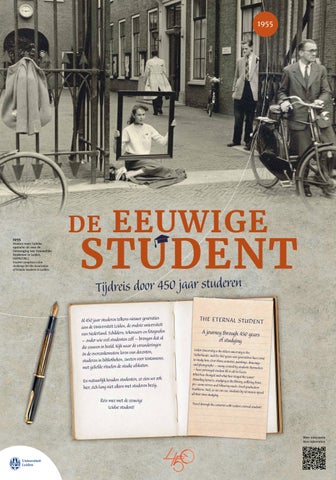
1955
1955 Student voert ludieke opdracht uit voor de Vereeniging van Vrouwelijke Studenten te Leiden. (AHM/UBL) Student completes a fun challenge for the Association of Female Students in Leiden.
DE EEUWIGE
STUDENT 0 jaar studeren Tijdreis door 45
s tie ra ne ge e w eu ni s en lk te en er ud st ar Al 450 ja it te si er iv un te ds ou de , en id Le it ite rs ve ni U aan de en af gr to fo en s ar na ke te s, er ld hi Sc . nd la er ed van N al t da n ge en br – lf ze n te en ud st el ve ie w r de – on n ge in er nd ra ve de ar na ijk K d. el be in en uw ee die , en nt ce do n va n re le : en st om nk ee er ov de én s, en am nt te or vo en et zw , en ek th io bl bi in en er ud st met geliefde rituelen de studie afsluiten. k oo e w en zi zo n, te en ud st en ud ho k lij En natuur g. zi be en er ud st et m en le al et ni ng la hier, zich
Reis mee met de eeuwige Leidse student!
TH E E T E R NAL S T UD E N T A journey through 450 years of studying Leiden University is the oldest univ ersity in the Netherlands, and for 450 years new generations have come to study here. Over those centuries, paintings, drawings and photographs – many created by students themselves – have portrayed student life in all its facets. What has changed and what has st ayed the same? Attending lectures, studying in the library, suffering from pre-exam nerves and following muc h-loved graduation traditions. And, as we can see, stud ents by no means spend all their time studying. Travel through the centuries with Le id
en’s eternal student!
Meer informatie More information
Welke studie wordt het?
What subject to study?
De geboorte van een universiteitsstad
The birth of a university city
1575
1776
Terug naar 1575: Willem van Oranje leidt de Nederlandse Opstand tegen Spanje en er woedt een bloedige strijd tussen protestanten en katholieken. Er zijn predikanten en geleerde mannen nodig voor de opstandige gewesten, maar de Katholieke Universiteit Leuven is dan de enige universiteit in de Nederlanden. Daarom sticht de prins in 1575 een protestantse universiteit in Leiden dat standhield tegen de Spaanse troepen en net bevrijd is. Zo wordt de lakenstad een stad vol geleerden en studenten die overal hun sporen nalaten.
De universiteit heeft in de beginjaren vier faculteiten. Studenten volgen eerst vakken bij de voorbereidende faculteit Artes (vrije kunsten) zoals filosofie, letteren, wiskunde en astronomie. Hierna studeren ze Theologie, Rechten of Medicijnen. Nu kiezen studenten tussen Leiden en Den Haag, zeven faculteiten en tientallen opleidingen. En voor wie ‘eeuwig’ wil studeren: er zijn ruim honderd opleidingen voor professionals.
2024
Back in 1575, William of Orange led the Dutch Revolt against Spain and a bloody conflict raged between Protestants and Catholics. Church ministers were needed as were learned men to govern the rebellious regions, but the Catholic University of Leuven was the only university in the Low Countries. This prompted William to found a Protestant university in the town of Leiden, which had just been liberated from the Spanish. Leiden, city of cloth, became a city of scholars and students, who all left their mark on the town.
In its early years, the university had four faculties. Students first took foundational subjects such as philosophy, literature, mathematics and astronomy at the Faculty of Arts before progressing to theology, law or medicine. Today, students can opt for Leiden or The Hague and choose from seven faculties and dozens of programmes. And for aspiring eternal students, there are over a hundred programmes for professionals.
1776 Met zwaard en weegschaal wordt de rechtenfaculteit verbeeld in de prent Sledevaart. (Simon Fokke/UBL) The law faculty is depicted with a sword and scales in the print Sleigh Parade.
1948 Eerstejaars melden zich aan voor een studie bij het Bureau Inschrijvingen. (A. van Vliet/Erfgoed Leiden en Omstreken, ELO) First-years enrol on a programme at the Student Registry.
1575 De universiteit wordt ingewijd met een optocht met geleerden en Leidenaren als goden verkleed. Ca. 1779. (anoniem/Rijksmuseum) Scholars and Leideners dressed as gods at the university’s foundation parade. Ca. 1779.
2024 Een studiekiezer laat zich informeren op de open dag van de faculteit Sociale Wetenschappen. (Suédy Mauricio) A prospective student at the Faculty of Social and Behavioural Sciences open day.
2018 Ook in de 21e eeuw vieren we de universitaire verjaardag met een optocht van hoogleraren. (Hielco Kuipers) The university still celebrates its anniversary with a procession of professors.
2018
1948
Studeren in de Universiteitsbibliotheek
Studying in the University Library
Wie zijn de studenten?
Who are the students?
1610
2024
1910 Studenten zijn lange tijd alleen mannen en meestal welgesteld. Maar er zijn uitzonderingen: ook bedienden en schilders als Rembrandt schrijven zich in, wellicht ook vanwege de vrijstelling van belastingen. In de 17e eeuw komt bijna de helft van de studenten uit het buitenland, nu is dat 1 op de 5. Pas sinds eind 19e eeuw mogen ook vrouwen studeren en wordt studeren langzamerhand minder elitair.
Boeken lezen en bronnen bestuderen doen studenten al kort na de oprichting in de Universiteitsbibliotheek. Het is de eerste publieke bibliotheek van Nederland, maar de kostbare handschriften liggen lange tijd aan een ketting. Tegenwoordig maken over de hele wereld belangstellenden digitaal gebruik van de kilometerslange Leidse collecties boeken, prenten, foto’s en andere bronnen.
For much of the university’s history, only male students were admitted and they were generally from wealthy backgrounds. But there were exceptions: servants and artists such as Rembrandt enrolled, perhaps also because students were exempt from taxes. In the 17th century, almost half of the students came from outside the Netherlands, compared to today’s one in five. It was not until the end of the 19th century that women were allowed access to the university, and studying gradually became less elitist.
Soon after the university was founded, students could come to the library to read books and consult sources. This was the first public library in the Netherlands. For a long time, the valuable manuscripts were secured by a chain. Today, people from all over the world have online access to Leiden’s kilometres of books, prints, photos and other sources.
1599
2024 Digitaal inzoomen op een oud handschrift uit de Universiteitsbibliotheek. (Marc de Haan) Zooming in on an ancient manuscript from the University Library.
1910 Een gezelschap deels verklede studenten poseert voor het Rapenburg. (Anoniem/ELO) A group of students, some in fancy dress, pose on the Rapenburg canal.
2010 Een groep studenten poseert op de jaarlijkse togaparty van hun vereniging Quintus. (Taco van der Eb) Students pose at the annual Quintus student association toga party.
1610 In de eerste universiteitsbibliotheek liggen boeken aan een ketting. (Prent Woudanus/UBL) The books were attached to chains in the first university library.
2010
1948 Samen studeren in de universiteitsbibliotheek aan het Rapenburg. (A. van Vliet/ELO) Studying in the university library on the Rapenburg canal.
1599 Op zijn 15e voltooit Hugo de Groot zijn rechtenstudie. Hier is hij 16. (Jan van Ravensteyn/FC) Hugo de Groot completed his law degree at the age of 15. He is 16 here.
1948
2023
2024
Teaching comes in all shapes and sizes. In 1830, statesman Johan Rudolf Thorbecke gave lectures on government in his summerhouse on Leiden’s Garenmarkt. Other lecturers, such as theologian Kornelis Miskotte, taught in the Academy Building. During the Covid pandemic, teachers found themselves in empty lecture halls, while students watched on their laptops at home. Now many lectures are both online and offline, and lecturers post knowledge clips on YouTube.
1948
Met extreem lage temperaturen maakt natuurkundige Heike Kamerlingh Onnes voor het eerst helium vloeibaar. Ook ontdekt hij supergeleiding: sommige materialen verliezen hun elektrische weerstand onder extreme temperaturen. Hij voert zijn experimenten uit met hulp van universitaire studenten (in stropdas) en dankzij studenten van de Leidse instrumentenmakers School – LiS – (in overall) die de instrumenten maken. Die goede samenwerking met het LiS is er nog altijd.
Physicist Heike Kamerlingh Onnes was the first to liquefy helium at extremely low temperatures. He also discovered superconductivity: where some materials lose their electrical resistance under extreme temperatures. He carried out his experiments assisted by university students (wearing ties) and with the help of students (wearing overalls) from the Leiden Instrument Makers School (LiS) who made the highprecision instruments needed. This close collaboration with the LiS continues to the present.
2020
Theoloog Kornelis Miskotte geeft college in de Gewelfkamer van het Academiegebouw. (A. van Vliet/ELO) Theologian Kornelis Miskotte teaches in the vaulted Gewelfkamer in the Academy Building.
2024 Prof. Sense Jan van der Molen (zittend) met (LiS)studenten en onderzoekers in het nieuwe natuurkundelab. (Marc de Haan) Prof. Sense Jan van der Molen (seated) with students and researchers in the new physics lab.
2023 Psycholoog Marjolein Fokkema maakt voor haar colleges videoclips over algoritmes. Psychologist Marjolein Fokkema makes video clips about algorithms for her classes.
Ca. 1922 Prof. Heike Kamerlingh Onnes (zittend) met (LiS) studenten en onderzoekers bij het heliumtoestel. (LEI) Prof. Heike Kamerlingh Onnes (seated) with LiS and university students and researchers at the helium device.
2020 In een lege zaal geeft informaticus Rudy van Vliet college aan zijn studenten die thuis zitten. (Monique Shaw) In an empty hall, computer scientist Rudy van Vliet teaches his students while they sit at home.
Pionieren in het lab
Pioneering work in the lab
Colleges in alle soorten
Teaching in all shapes and sizes
Colleges zijn er in allerlei soorten. In zijn eigen Leidse tuinhuis aan de Garenmarkt geeft staatkundige Johan Rudolf Thorbecke in 1830 college over het landsbestuur. Anderen doceren in het Academiegebouw zoals theoloog Kornelis Miskotte. In coronatijd staan docenten voor lege zalen, terwijl studenten thuis achter hun laptop zitten. Inmiddels zijn veel colleges zowel digitaal als fysiek en zetten docenten kennisclips op YouTube.
1948
ca. 1922
Sterren en planeten
Stars and planets
Op veldonderzoek
Learning in the field
2003
1939
1948 Het verleden opgraven, sporen onderzoeken of gedrag observeren. Vanaf de jaren 1860 beginnen meer onderzoekers en hun studenten op veldonderzoek te gaan. Dat doen ze dichtbij huis in Nederland of ver weg zoals in Kenia waar biologiestudenten leeuwenpopulaties bestuderen.
Dankzij een observatorium op het Academiegebouw observeren studenten en onderzoekers al sinds 1633 sterren en planeten. In 1861 laat astronoom Frederik Kaiser een nieuwe sterrenwacht aan de Witte Singel bouwen. Tegenwoordig gebruiken Leidse studenten en onderzoekers vooral data van ’s werelds krachtigste telescopen in Chili en La Palma.
2010
Digging up the past, discovering traces or observing behaviour. From the 1860s, it became more common for researchers and their students to carry out field studies. These could be close to home in the Netherlands or in distant countries like Kenya, where today’s biology students study lion populations.
Students and researchers have viewed stars and planets since 1633 – first from an observatory on the roof of the Academy Building and then from a new observatory built on the Witte Singel in 1861 by astronomer Frederik Kaiser. Today, Leiden students and researchers rely on data from the world’s most powerful telescopes in Chile and La Palma.
ca. 1860
2020
1948 2003 Archeologiestudenten doen ervaring op met veldwerk bij een opgraving in Schipluiden. (Marc de Haan) Archaeology students gain fieldwork experience at a dig in Schipluiden.
1939 Irak, 1939. Prof. Frans de Liagre Böhl maakt foto van gevonden stenen hoofd van godin of priesteres. (NINO) Iraq, 1939. Prof. Frans de Liagre Böhl takes a photo of the head of a goddess or priestess.
2010 Biologiestudent Rémon Visser helpt mee met genetisch onderzoek bij een verdoofde leeuw. (Lana Müller) Biology student Rémon Visser helps collect data for genetic research from a sedated lion.
Een medewerker demonstreert de werking van de telescoop. (A. van Vliet/ELO) A staff member from the Leiden Observatory shows how a telescope works. (A. van Vliet/ELO)
Ca.1860 Antieke foto met observatorium op het dak van het Academiegebouw. (Adolphe Braun/ELO) Old photo with the observatory on the Academy Building roof.
2020 La Silla Observatory in Chili. (B. Tafreshi/ESO) La Silla Observatory in Chile.
1948
Door toe te kijken bij het ontleden van lichamen leren studenten de anatomie kennen. Geneeskundige Herman Boerhaave is begin 18e eeuw de eerste die met studenten aan het bed van patiënten gaat staan om goede diagnoses te kunnen stellen. Dankzij VR-brillen oefenen studenten tegenwoordig operaties zonder risico voor echte patiënten.
2022
Students learn about anatomy by observing the dissection of cadavers. At the start of the 18th century, physician Herman Boerhaave was the first to have students join him in making diagnoses at the patient’s bedside. Thanks to VR headsets, students today can practise surgery without risk to actual patients.
Studeren in de Hortus
Studying in the Hortus botanicus
Medisch onderwijs
Medical training
1609
In 1590 begint de Hortus botanicus als een kruidentuin voor de studie van geneeskrachtige planten uit de hele wereld. Nog altijd doen studenten en wetenschappers op deze plek onderzoek naar de eigenschappen en genetische samenstelling van planten. Daarnaast is de Hortus een geliefde tuin voor alle Leidenaren en bezoekers van ver daarbuiten.
The Hortus botanicus started in 1590 as a herb garden for studying medicinal plants from all around the world. Students and researchers still conduct research here on plant characteristics and genetics. The Hortus is also a much-loved green space for Leiden residents and visitors from far and wide.
1948
1948 Plantenresten bestuderen tijdens botanisch practicum in het P.J. Vethgebouw. (A. van Vliet/ ELO) Studying plant remains in a botany practical in the P.J. Veth building.
2022 Waar zijn ze? Promovendus Sam Boerlijst doet met studenten onderzoek naar muggen. (Tim Boerlijst) Where are they? PhD candidate Sam Boerlijst studies mosquitoes with students.
1609 Snijles in het anatomisch theater. (Prent (mogelijk) Dolendo naar tekening Woudanus/Rijksmuseum) Lesson in the anatomical theatre.
1610
1948 College heelkunde met patiënt in de collegezaal. (A. van Vliet/ELO) Surgery lesson with patient in the lecture hall.
1610
2019 Studenten leren virtueel het menselijk lichaam extra goed kennen. (LEI) Virtual reality helps students learn all about the human body.
2019
De Hortus begon als medicinale kruidentuin voor medici en studenten geneeskunde. (Prent Woudanus/ Swanenburg/Noord-Hollands Archief) The Hortus began as a medicinal herb garden for doctors and medical students.
1640
Op kamers of nog op zoek
Finding a room
Van uniek tot interdisciplinair
From unique to interdisciplinary
2e eeuw v. Chr.
1993
Sommige academische studies kun je in Nederland alleen in Leiden volgen. Dat geldt bijvoorbeeld voor Egyptologie, Koreastudies en Chinastudies. Vanaf de jaren ’60 van de vorige eeuw groeit de interesse in het bestuderen van samenlevingen en (groeps)gedrag en worden de sociale wetenschappen populair. Veel studies zijn de laatste jaren meer interdisciplinair, zoals bij Psychologie waar studenten de relatie tussen lichaam en geest leren onderzoeken.
In vroegere eeuwen wonen studenten vaak bij hun professor of hospita in huis maar dat is verleden tijd. Een goede en betaalbare kamer vinden, valt niet mee. Wordt het een studentenflat, een historisch pand, tijdelijke onderhuur of voorlopig nog het ouderlijk huis?
In previous centuries, students often lodged with their professors or rented rooms from a landlady, but that is now a thing of the past. Finding a suitable and affordable room can be a challenge. What’s it to be? A student flat, a room in a historic building, a temporary sublet or living with the parents for now?
2020
Leiden is the only place in the Netherlands where you can take certain degree programmes, such as Egyptology, Korean Studies and China Studies. From the 1960s there was a growing interest in studying societies and behaviour, and the social sciences became popular. Many programmes have in recent years become more interdisciplinary, including psychology, where students learn to explore the relationship between body and mind.
1972 1640 Jongeman in een studeerkamer. Schilderij van de Leidse schilder Adriaen van Gaesbeeck. (Rijksmuseum) Young Man in a Study. Painting by Leiden painter Adriaen van Gaesbeeck.
2 eeuw v.Chr. / 2 BC e
Gedenksteen met offerscène. In Leiden zijn oude Egyptische bronnen binnen handbereik. (Rijksmuseum van Oudheden) Commemorative stone with offering scene. Egyptian sources are close to hand in Leiden.
1993 Bijna 70 jaar lang was Rie Schild huishoudster in studentenhuis ’t Heerenhoeckje. (Marc de Haan) Rie Schild cleaned at the ’t Heerenhoeckje student house for almost 70 years.
1972 ‘Gebruik kunstmest’. Chinese propagandaposters zijn studie materiaal. (Chinesposters.net/ Landsberger collection/Internationaal Instituut voor Sociale Geschiedenis) ‘Use fertiliser’. Chinese propaganda posters are study materials.
2003 Wie krijgt de kamer? Hospiteeravond in een studentenhuis. (Marc de Haan) Who will get the room? Choosing a new housemate.
2020 Hersenscans geven informatie over processen in het brein. Fusiebeeld van MRI- en MRA-scan. (Suphachai) Brain scans provide information about brain processes.
2003
Studentenprotesten
Student protests
De wereld komt langs
Visitors from across the globe
2024
1999
2020 Politieke leiders komen geregeld langs op de campus in Leiden of Den Haag. Zo ontmoeten studenten onder andere de Britse premier Churchill, de Zuid-Afrikaanse oud-president Mandela en de Amerikaanse president Bush. De Oekraïense president Zelensky houdt studenten in een online gastcollege voor: ‘Kijk buiten je bubbel om te zien wat er in de wereld gebeurt!’
Protesteren doen studenten al kort na de oprichting van de universiteit. Zoals eind 16e eeuw tegen de strenge leefregels van het Statencollege voor theologiestudenten en later protesteren zij bijvoorbeeld voor meer universitaire democratie. Ook demonstreren studenten en medewerkers tegen banden met landen in oorlog en de fossiele industrie. En bijna ieder kabinet zijn er protesten tegen het landelijke onderwijsbeleid en pijnlijke bezuinigingen.
Political leaders regularly visit the university in Leiden or The Hague. Students have met such dignitaries as British Prime Minister Churchill, former South African President Mandela and American President Bush. Ukrainian President Zelensky told students in an online guest lecture: ‘Look outside your bubble to see what’s going on in the world!’
Students were already staging protests soon after the university was founded. At the end of the 16th century, for example, when they protested against the strict rules of the State College for theology students. Later, they held demonstrations calling for greater democracy at the university. More recently, students and staff have protested against links with the fossil industry and with countries engaged in wars. And with almost every new government there are protests against severe cutbacks.
1989
2024 Grote demonstratie in Den Haag tegen drastische bezuinigingen op onderzoek en onderwijs. (Danique ter Horst) Mass protest in The Hague against cuts to research and education.
1999 Honderden Leidenaren, waaronder veel studenten, verwelkomen eredoctor Nelson Mandela. (Frank van Beek/ANP) Hundreds of Leideners, among them many students, welcome honorary doctor Nelson Mandela.
2020 In het hart van het Academiegebouw eisen demonstranten drastische klimaatmaatregelen. (Marc de Haan) Demonstrators demand drastic climate action in the heart of the Academy Building.
2023
1985
1989
Studenten protesteren tegen bezuinigingsplan van minister Deetman op studiefinanciering. (Fred Rohde) Students protest against Minister Deetman’s planned cuts to student funding.
President Bush komt tijdens een staatsbezoek ook langs bij de Universiteit Leiden. (Rob Croes/Anefo) President Bush comes to Leiden University during a state visit.
2023 De Oekraïense president Volodymyr Zelensky spreekt studenten bij een online ontmoeting. (Robert Heezen) Ukrainian President Volodymyr Zelensky speaks to students in an online meeting.
1985
Sporen van het koloniale verleden
The colonial legacy
Student in oorlogstijd
Students in times of war
1945
1937
1831 De universiteit is opgericht tijdens de Tachtigjarige Oorlog met Spanje. Door de eeuwen heen raken diverse oorlogen ook de Leidse studenten en medewerkers. In de Tweede Wereldoorlog gaat de universiteit jarenlang dicht na protesten van hoogleraren en een staking van studenten. Vandaag de dag studeren hier studenten uit alle delen van de wereld die op de vlucht zijn voor oorlog in hun land.
The university was founded during the Eighty Years War with Spain. Throughout the centuries, war has had an impact on Leiden students and staff. In the Second World War, the university was closed down for years following protests by professors and a student strike. Today, there are students in Leiden who have fled conflicts all over the world.
1945 2021
Het koloniale en slavernijverleden is een belangrijk thema in het onderwijs en onderzoek. Wetenschappers en studenten reflecteren ook kritisch op de rol van de universiteit. Een Indologieopleiding leidde lange tijd op voor werk in de koloniën. Studiemateriaal zoals Aziatische handschriften is verzameld in de koloniale tijd. Ook discussiëren studenten en docenten of de handboeken wel inclusief genoeg zijn.
The legacy of colonialism and slavery is an important theme in the university’s research and teaching, with academics and students reflecting critically on the university’s role. For many years, an Indology programme trained students to work in the colonies. Study materials such as Asian manuscripts were amassed in the colonial period. Now students and teaching staff question whether textbooks are inclusive enough.
1945 Eerst Nederland bevrijden, dan Indonesië. Veel Indonesische studenten waren actief in het verzet. (Beeldbank WO2 - Verzetsmuseum Amsterdam) First liberate the Netherlands, then Indonesia. Many Indonesian students were active in the resistance.
1937 De Joodse student Herta Mohr ontvlucht Wenen en studeert in Leiden. In 1945 komt ze om in Bergen-Belsen. (NINO) Jewish student Herta Mohr flees Vienna to study in Leiden. She dies in Bergen Belsen in 1945.
1945 Verzetsstrijders Peter Tazelaar, Rie Stokvis, oud-rechtenstudent Erik Hazelhoff Roelfzema – Soldaat van Oranje. (Anefo) Three resistance fighters: Peter Tazelaar, Rie Stokvis and former law student Erik Hazelhoff Roelfzema – Soldier of Orange.
1831 Manuscript over de Javaanse leider Diponegoro die de opstand leidde tegen het koloniale bewind. (UBL) Manuscript about Javanese leader Diponegoro, who led the revolt against the colonial regime.
2021 Aline-Priscillia, van Safe Space to Talk About Race, pleit voor dekolonisatie van onderwijs. (Monique Shaw) Aline-Priscillia, from Safe Space to Talk About Race, calls for decolonisation of education.
2020
2018
1641
Stop met duelleren, hard ontgroenen of al te beschonken feesten. Oproepen aan studenten om zich te gedragen, worden de eerste tijd gespijkerd aan de deur van het Academiegebouw. Tot 1815 schakelt de universiteit bij wangedrag de eigen rechtbank in. Tegenwoordig maken bestuurders met studenten afspraken, zoals in een convenant Kennismakingstijd of waarschuwen ze in coronatijd via een tweet.
Studentenleven
Student life
Studentenleven
Student life
1989
1610
Hard studeren, hard feesten. Lange tijd ontmoeten studenten elkaar in verenigingen die gebaseerd zijn op hun geografische afkomst. Nu varieert het aanbod van sportverenigingen tot traditioneel corps of vrijblijvender verbanden. In de 16e en 17e eeuw houden studenten van schermen en kaatsen. Later wordt roeien een echte studentensport en tegenwoordig komen sport en glamour samen in studentikoze kickboksgala’s.
No duelling, alcoholic excesses or rough introduction rituals. Warnings exhorting students to behave were posted on the door of the Academy Building in the university’s early days. And the university had its own tribunal to deal with misconduct until 1815. Today, the university makes agreements with students in the form of covenants on behaviour during the introduction weeks, or issues warnings in tweets as it did during the Covid pandemic.
Study hard, party hard. Students used to get together in associations based on their geographical origin. Today these associations vary from sports clubs to traditional fraternities and more informal groups. In the 16th and 17th centuries, fencing and hand tennis were popular among students. Later, rowing became a true student sport, and today sport and glamour come together in student kickboxing galas.
2018 Op veel verenigingen gebruiken leden overdag hun pand als studieplek, zoals bij Catena. (Marius Roos) Members of associations like Catena study in their buildings in the daytime.
1641 Duels tussen studenten en Leidenaren liepen uit de hand. Dit plakkaat verbiedt zulke duels. (UBL) Duels between students and townspeople got out of hand. This poster bans such duels.
1989
1610
Verboden: badkleding of topless zonnen in de Hortus. (Jan Holvast/ELO) No swimwear or topless sunbathing in the Hortus.
1997
Prent schermschool. (Woudanus/UBL) Print fencing school.
Ontgroening tijdens de Raprace. In 1997 stopt Minerva met ontgroening in het openbaar. (Marc de Haan) Initiation during Rapenburg Race. Minerva stops public initiations in 1997.
2020 Toenmalig rector Carel Stolker twittert en vlogt in coronatijd om contact te houden met studenten. Former Rector, Carel Stolker, kept in touch with students during the pandemic with tweets and vlogs.
2019 Sport en glamour komen samen op studentikoze kickboksgala’s zoals die van Quintus. (Taco van der Eb) Sport and glamour come together at student kickboxing galas like this Quintus one.
1970 Volgens een enquête in 1970 wil 76% van de studenten seksuele voorlichting van de universiteit. (Jan Holvast/Historische Vereniging Oud Leiden) In a survey in 1970, 76% of students say they want sex ed at the university.
1970
1997
2019
2018
1990
Geslaagd! Met een handtekening in het Zweetkamertje sluiten studenten en ook promovendi hun studie ritueel af. Die geliefde tradities zijn niet zo oud als de universiteit. Het Zweetkamertje was lange tijd een turfhok en massaal de barets in de lucht gooien wordt pas vanaf de 21e eeuw populair in navolging van Amerikaanse universiteiten.
Passed! Master’s and doctoral graduates celebrate the conclusion of their studies by signing their name in the Sweat Room but these much-loved rites of passage have a shorter history than the university. The Sweat Room used to be a turf store and throwing your graduation cap into the air only became popular in the 21st century, following the example of American universities.
It was common practice until well into the 20th century for exams to be taken orally at the professor’s home. With student numbers growing, large-scale exams at large venues became commonplace. In Groenoordhallen, for example – where the stench of manure was a reminder of the cattle markets that also took place there. With the advent of tools like ChatGPT, lecturers now look more critically at the authenticity of written assignments.
2015
2018 Met hun baret in de lucht vieren studenten International Studies hun afstuderen. (Chris Gorzeman) International Studies students throw their caps in the air at graduation.
1839 Met de handen in het haar een tentamen voorbereiden. (Illustratie O. Veralby in Klikspaans Studentenschetsen/UBL) Revising for exams, hands in hair.
1650 Al eeuwenlang verzamelen feestelijke gezelschappen zich voor het Academiegebouw. (Hendrik van der Burgh/Rijksmuseum) For centuries, groups have met in front of the Academy Building for graduation ceremonies.
1990 Van veemarkt tot tentamenplek: duizenden studenten maken hun tentamens in de Groenoordhallen. (Marc de Haan) From cattle market to exam hall: thousands of students sit exams in Groenoordhallen.
2019 Na zijn promotie zet Francis Lesilau zijn handtekening in het Zweetkamertje. (Taco van der Eb) Francis Lesilau signs his name in the Sweat Room.
2015 Ook in de historische Pieterskerk maken veel studenten hun tentamens. (Monique Shaw) Students take exams in the historic Pieterskerk.
Afstudeerrituelen
1839
Tot ver in de 20e eeuw is het gebruikelijk om thuis bij de professor mondeling examen af te leggen. Vanwege de groei van het aantal studenten maken ze vanaf de jaren ’80 massaal samen tentamens op grote locaties. Zoals in de Groenoordhallen waar door veemarkten een indringende mestgeur hangt. Door de komst van hulpmiddelen als ChatGPT controleren docenten nu extra kritisch de originaliteit van schriftelijke opdrachten.
Graduation rituals
Zweten voor tentamens
Pre-exam nerves
1650
2019
17
1
Nooit uitgeleerd
17 Merijn Tinga, Biologie (1996), plastic soup surfer 18 Jiska Ogier, Rechten (2021), jurist, adviseur 19 Herman Boerhaave, Wiskunde, Filosofie, Geneeskunde (1690), arts, botanicus 20 Lizzy van Dorp, Nederlands, Geschiedenis, Rechten (1901), econoom 21 Prinses Beatrix, Sociologie, Rechten (1961) 22 Jacobus Capitein, Theologie (1742), predikant 23 Evi Dijcks, Nederlands (2021), masterstudent 24 Aniek Moonen, Governance, Economics and Development (2019), klimaatactivist 25 Hugo de Groot, Rechten (1598), rechtsgeleerde, schrijver 26 Kathleen Ferrier, Spaans, Portugees (1984), bestuurder 27 Niko Tinbergen, Biologie (1930), hoogleraar, Nobelprijswinnaar 28 Christiaan Huygens, Wiskunde, Rechten (1647), Natuur- sterrenkundige, uitvinder 29 Lilian Gonçalves-Ho Kang You, Rechten (1970), jurist, Cleveringahoogleraar
Never stop learning
Nooit uitgeleerd
Never stop learning
Alumni door de eeuwen heen met jaar van afstuderen of laatste jaar studie. Alumni through the centuries with year of graduation or last year of study. 1 Sharon Diamant, Sterrenkunde (2023), promovendus 2 Armin van Buuren, Rechten (2003), DJ 3 Rembrandt van Rijn, Letteren (ca.1622), schilder 4 Koning Willem-Alexander, Geschiedenis (1993) 5 Nicolaes Tulp, Geneeskunde (1614), arts 6 Jon van Rood, Geneeskunde (1950), pionier orgaantransplantatie 7 Mariska Kret, Psychologie (2007), hoogleraar 8 Hoesein Djajadiningrat, Oosterse talen (1910), hoogleraar 9 Mark Rutte, Geschiedenis (1992), secretaris-generaal NAVO 10 Martijn van der Helm, Rechten (2022), consultant 11 Anonieme honoursstudent met VR-bril 12 Caspar Reuvens, Rechten, Klassieke talen (1810), hoogleraar Archeologie 13 John Quincy Adams, Talen, Geneeskunde, Rechten (1782), president VS 14 François Haverschmidt (Piet Paaltjens), Theologie (1858), auteur, predikant 15 Raneem Ibrahim, Biofarmaceutische wetenschappen (2023), masterstudent 16 Constantijn Huygens, Rechten (1617), diplomaat, dichter
1575-2025 Een collage van alumni door de eeuwen heen. Herken jij ze? (Danique ter Horst) A collage of alumni through the centuries. Do you recognise them?
Na hun studie geven alumni hun kennis en inzichten door en leren weer verder in de praktijk. Zo ontstaat een kringloop van kennis en zijn we allemaal met elkaar verbonden. Sommige alumni worden zelf docent, onderzoeker of bijvoorbeeld arts. Anderen kiezen na hun studie een heel eigen pad. Eén ding staat vast: niemand raakt uitgeleerd. We zijn allemaal eeuwige studenten!
3
20
Colofon
6 2
4
Samenstelling en tekst/Curation and texts: Linda van Putten, Corrie van Maris, Pieter Slaman
19
18
7 5
8
24
21
9
11
After graduating, alumni pass on their knowledge and insights, and continue to learn in the outside world. This creates a knowledge cycle that connects us all. Some alumni become teachers, researchers or doctors, while others follow their own path. One thing is certain: none of us ever stops learning. We are all eternal students!
(Beeld)redactie/Text and image editing: Dagmar Aarts, Danique ter Horst, Rob Dorresteijn Vertaling/Translation: Marianne Orchard, Marilyn Hedges
10
22
Vormgeving/Design: Engelen & de Vrind
23
Doe mee/Take part Wat is jouw favoriete beeld van 450 jaar studeren? Dat mag ook een foto zijn uit je eigen studententijd! Mail je suggestie naar 450@leidenuniv.nl en bouw mee aan de Top 450. What is your favourite image of 450 years of studying at Leiden University? It can also be a photo of your own student days! Mail your suggestion to 450@leidenuniv. nl and help build the Top 450.
25 12
13
14
26
28 15
27
Woord van dank/Word of thanks De expositie is een ode aan alle studenten, docenten en iedereen die onderwijs mogelijk maakt. Wij bedanken ook alle fotografen, schilders, tekenaars, beeldarchieven en de Hortus botanicus. The exhibition is a tribute to all students, teachers and everyone who makes education possible. Thanks also go to all the photographers, painters, illustrators, image archives and the Hortus botanicus. (More about the exhibition)
Meer over de expositie More about the exhibition
16
29