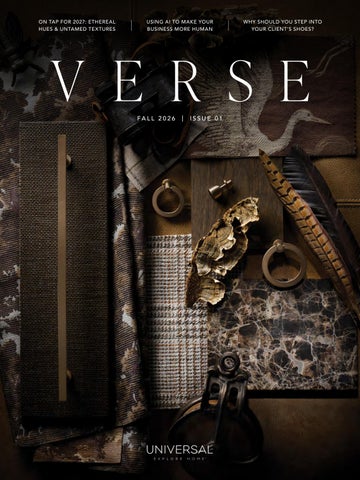
ON TAP FOR 2027: ETHEREAL HUES & UNTAMED TEXTURES
USING AI TO MAKE YOUR BUSINESS MORE HUMAN
FA L L 2 0 26
|
ISSUE 01
WHY SHOULD YOU STEP INTO YOUR CLIENT’S SHOES?
MODERN: MIST & VEIL COLLECTION Blossom Credenza, Quartz Dining Table and Sola Pouf
welcome to
V E R S E C E L E B R AT I N G T H E A R T A N D B U S I N E S S O F I N T E R I O R D E S I G N
U
niversal Furniture started 2026 with a singular focus: elevate. That meant better products, better service, better operations, better digital experience and, most important, a better experience for our customers. Verse magazine is a tangible artifact of our desire to elevate everything we do at Universal. Rooted in the concept of being deeply versed in design, technique and craft, the name Verse captures the essence of our new direction: a celebration of the interior design community. This new magazine represents our commitment to be a source of business development education, design inspiration and community with other designers. We kick off the inaugural issue of Verse with a pair of project profiles juxtaposing design firms from the sunny coast of Florida and the windswept high desert of New Mexico. The diversity of these two projects — one imbued with rich color and texture, the other filled with a breezy beach aesthetic — demonstrates Universal’s ability to meet diverse design needs. Our new upholstery facility (pages 52–55) in Hildebran, North Carolina — and the committed artisans who build frames, spring up, sew and upholster — demonstrates our commitment to bench-made upholstery, customization, choice
and service. We want to give designers the creative freedom they’re looking for and the confidence that comes from doing business with a company that has the resources and scale to support them. Universal strives to be one of the easiest companies in the industry with which to do business, both for the attention to detail of our furniture and our unwavering focus on genuine relationships. You’ll see how that comes to life with our concierge team (pages 48–51), which acts as an extension of our trade partners to assist with sourcing and meeting tight deadlines. Whether it‘s behind-the-scenes assistance to meet a deadline or business education at our Learning Center, Universal is your steadfast supporter. We’re here to lift you up as you develop your design practice and create spaces where your clients can thrive. Thank you for your continued partnership, and I look forward to seeing you at Market. See you in High Point!
SEAN O’CONNOR
President, Universal Furniture
V E R S E |
01
02
04
08
16
30
32
38
52
56
64
V E R S E FA LL 2 026
|
ISSUE 01
BY DESIGN
A R R I VA L S
0 4 The 2027 Outlook: Inside the
38
Next Wave of Design 08
wo Studios, Two Horizons, T One Singular Passion
he Velora Collection T Creates Quiet Elegance
T R A D E PA R T N E R P R O G R A M 4 8 Steady Hands: Behind the Scenes With
the Concierge Team A R R I VA L S 16
The Fenwick Collection Evokes Old-World Architecture
C R E AT I N G O P P O R T U N I T Y 26
A I as Your New Hire
2 8 The Easy Button for CAD Drawings
5 0 The Seamless Partnership: How the
UF Concierge Elevates the Everyday
WITHIN 52
The New Home of American Craft
5 6 The Geometry of Comfort:
Inside the Master Upholsterer’s Studio TOUCHSTONE 30
Designing With Emotional Intelligence
IN YOUR WORDS 64
What’s Your Micro-Obsession?
MARKET PREVIEW 32
Refuel and Reconnect: High Point Market’s Best-Kept Secrets
36
M ind Your Business: Should you outsource your design firm’s bookkeeping?
37
Learning Center Opportunities
UniversalFurniture.com 03
BY DESIGN
THE 2027 OUTLOOK: INSIDE THE NEXT WAVE OF DESIGN
04
R
esidential interiors are undergoing a quiet
change. Homeowners are no longer treating their living spaces as static showcases optimized for online life; instead, they are reframing the home as a vital tool for personal well-being and ritual. This shift is driven by a growing need for stillness and for the home to be an intentional retreat from the constant connectivity and sensory overload of daily life. To decode the behaviors shaping our spaces and the interiors that result, we spoke with Kristen Moonjian and Jaye Anna Mize of the global trend forecasting agency Future Snoops, alongside Universal Furniture’s VPs of product development, Rick Lovegrove and Shannon Lookabill. Collectively, these experts revealed a design landscape defined by deep emotional resonance and a joyful rebellion against the “sea of sameness.”
V E R S E |
05
THE SHIFT TOWAR D STILLNESS & LINGER ABILITY “Consumers are exhausted,” said Jaye Anna Mize, VP of advisory and partnerships at Future Snoops. “We are seeing a massive backlash against the data-driven flattening of design, which has stripped away ornate features and flooded retail with cookie-cutter looks.” This desire to break free from social media-fueled perfection has sparked a movement toward the collected, highly personalized home.
“ Today’s consumers are meticulously selecting furnishings to create a home that reflects who they are and what they have experienced.” SHANNON LOOK ABILL VP of Product Development (Casegoods)
Universal Furniture VP of Upholstery Rick Lovegrove has seen this reality unfold directly on the retail floor. “There is a major shift away from matching, prepackaged room sets,” Lovegrove said. “Homeowners are enthusiastically mixing eras, combining vintage and thrifted elements with a core, well-made piece they know will last for twenty-five years.” At the heart of this personalized retreat is what Future Snoops calls “lingerability,” or designing spaces that invite people to slow down and connect. Nowhere is this more apparent than the kitchen, which Future Snoops Director of Home and Lifestyles Kristen Moonjian identifies as the home’s ultimate multifunctional hub. “The kitchen is evolving into a soft, upholstered space,” Moonjian said. “We are seeing breakfast benches that look and feel like sofas, kitchen islands styled as elegant dressers and plush living room lounge chairs replacing rigid dining sets.” Shannon Lookabill, Universal Furniture VP of Casegoods, agreed that simplifying and softening these traditional boundaries is key to capturing the next generation: “Our goal is to pare down classic, traditional silhouettes to create everyday livable collections that offer a soothing respite from a hyper-connected world.”
06
ETHER EAL HUES & UNTA MED TEXTUR ES As homes soften, the color and material palettes of 2027 are taking a highly atmospheric, nature-derived turn. While classic neutrals remain a baseline, Future Snoops tracks a rising demand for grounded, “cocooning” palettes. “We are seeing sophisticated purples — smoky lavenders, shadowy purple-browns and rich, muted aubergines — replace stark, cold backdrops,” Moonjian explained. “Warm, living metals with patina, such as pewter and brushed aluminum, are similarly overtaking high-shine chrome to emphasize a sense of hand-crafted heritage.” On the upholstery front, Moonjian said that the long-standing reign of white bouclé is finally yielding to softer, more organic fabrics. Lovegrove also reported a surge in natural cottons, washed linens and tailored, prewashed slipcovers that offer a soft, lived-in feel right from the start. “Texture is still everywhere, but it’s becoming more tactile and natural,” he said. This raw materiality culminates in what Future Snoops describes as “untamed nature.” Rather than manicured or highly polished surfaces, designers are embracing irregular slub yarns, layered weaves and renewable fibers such as nettle and abaca that evoke weathered, eroded landscapes. It is an aesthetic of beautiful imperfection — one that is deeply emotional, highly tactile and built to stand the test of time.
AESTHETIC MOVEMENTS ON THE R ISE Grounded in a shared cultural craving for slow living and emotional connection, these home shifts concepted by Future Snoops translate psychological needs into material palettes and interior atmospheres.
COMBE (SPRING/SUMMER)
An ethereal, light-filled narrative showcasing a subtle wave of surrealism. It introduces a touch of whimsical, feminine fantasy while remaining completely livable.
ARCANA (FALL / WINTER)
A darker, ritualistic take on bohemian design. Grounded in spirituality and ancestral memory, it features antique wood tones, patina metals, hand-carved details and symbolic, talisman-like accents.
07
08
French & French Photography: ©Jenna Peffley/OTTO Studio M Photography: Penlight Media – Chris Restrepo
BY DESIGN
TWO STUDIOS, TWO HOR IZONS, ONE SINGULAR PASSION
THE PHILOSOPHY & DI A LOGUE On the sun-drenched Florida coast, Michelle Wiebe of Studio M in Tampa (right) translates white sand beaches and Caribbean art into light-filled, breezy sanctuaries. Across the country in Santa Fe, New Mexico, Heather and Matt French of French & French Interiors (left) embrace high-desert architecture, layering organic textures and saturated earth tones into adobe spaces. We sat down with both design studios to discuss how regional influences, client lifestyles and local landscapes define their work.
V E R S E |
09
How does designing for your region influence your work in ways someone outside the area might not expect? MICHELLE WIEBE
Florida living is about abundant natural light, Gulf breezes and natural textures and materials. Inspiration from the environment is translated into our color palettes — creamy beiges and whites, coquina shell blush and clear blue-greens evoke the beauty of our powdery sand beaches, shells and water, while pinks, corals and even purples are inspired by our brilliant coastal sunsets. We also have strong Cuban and Caribbean influences in Tampa, which we sometimes bring into fabrics and artwork, depending on the concept. Sourcing here is all about capturing that coastal spirit without feeling kitschy. H E AT H E R F R E N C H
Although we’re also inspired by the environment, Santa Fe’s high-desert landscape demands a completely different tactile relationship. We look to local natural materials and bring those raw elements inside — think thick adobe walls, brick floors and exposed overhead latillas. Our palettes are grounded in muddy earth tones, but we layer in bold, unexpected pops of color and folk art sourced from local artisans. It is a confident aesthetic that reflects the rugged beauty of New Mexico.
Every designer develops deep instincts over decades of practice. What core principles do you lean on to structure a room, and how do you decide when to push boundaries?
H E AT H E R F R E N C H
Our approach is about expression and intuition. Matt and I love patternon-pattern styling, and we actively push past traditional rules of color coordination. For us, designing is about creating a rich, layered tapestry that feels found and authentic. However, we also believe in restraint. It takes experience to know when to pull back so the final composition feels sophisticated rather than chaotic.
What do you hope your clients feel when they step into their completed home, and how does your design philosophy shape your selections? MICHELLE WIEBE
I call our team “design biographers.” We spend considerable time learning about our clients’ lives, children and routines to build a space that feels like an exact, loving reflection of who they are. During our full-home installations and grand reveals, my ultimate goal is to have our clients feel instantly at home. Most even have tears of happiness! H E AT H E R F R E N C H
We want our clients to feel energized, inspired and deeply supported by their surroundings. To us, poor design is when a house doesn’t look good when messy. Our style is rooted in sophisticated, lived-in luxury that embraces color, character and the real lives of our clients.
MICHELLE WIEBE
I’m a firm believer in symmetry, scale and proportion. For symmetry, the kitchen is our true anchor — we align custom hoods, sinks and window placements to establish order. In large rooms with 15-to-20-foot ceilings, scale is everything. Appropriately sized furnishings must be intentional. Lastly, not everything in the room can be the superstar. Designate your focal point. Once that structural balance is locked in, I play with patterns and textures.
EX PER IENCE THE CR EATI V E V ISION The following pages provide a photo essay of Wiebe’s and French & French’s work through the lens of a single project. See how regional influences — from landscapes and sunlight to art and architecture — take shape in unique spaces crafted to nurture their clients.
10
“ I love the Montego Arm Chairs around the dining table. Their natural woven texture grounds the bold red kitchen cabinetry beside them.” H E AT H E R F R E N C H
“Our Mesa Project sits atop a finger mesa, and the architecture mimics the landscape around it. Itʼs a relatively small home, but itʼs packed with beauty and joy.” MONTEGO ARM CHAIR Weekender Coastal Living Home Collection 11
“ In the living room, I paired a green velvet sofa with two Maria Swivel Glider Recliners in navy velvet. I donʼt often source recliners, but since this is a second home and it was a must-have for the clients, I made the exception — and you can barely tell theyʼre recliners, which is exactly how I like it.” H E AT H E R F R E N C H
MARIA SWIVEL GLIDER RECLINER Special Order 12
“The recliners are comfortable without reading as the classic oversized recliner.”
13
“ These classic pieces provide a crisp, architectural foundation for guest rooms that offers an approachable luxury value.” MICHELLE WIEBE
SAUGATUCK NIGHTSTAND AND SURF CITY HEADBOARD Weekender Coastal Living Home Collection 14
“This entire home was inspired by the beach — the beautiful different colors the Gulf can take on depending on the season and the weather, the shades of the white powdery sand, and the seashells, and just having a beachside home that lets you enjoy all that Florida has to offer.” MICHELLE WIEBE
HONOLUA BAY DINING TABLE (above) Coastal Living Outdoor Collection CHELSEA NIGHTSTAND (left) Love. Joy. Bliss. — Miranda Kerr Home Collection 15
THE
FEN W ICK COLLECTION E VOK E S OL D -WOR L D A RC H I T E C T U R E
16
A R R I VA L S
This is a collection for your client who loves tradition with a lighter point of view and a home that feels collected and enduring, but never overly formal. Fenwick brings the familiarity of traditional design into a more reserved, simplified aesthetic. Classic details give each piece a sense of timelessness, while clean lines and a transitional approach make the collection easy to layer into both traditional and more modern interiors. Fenwick pieces fit well in traditional homes with classic details but are versatile enough to be mixed with modern or transitional styles.
Photography: MB Productions Styled by: Linden Creek V E R S E |
17
18
TIMELESS S T Y L E
19
C O N F I D E N T, COMPOSED,
20
I M P E C C A B LY FINISHED
21
DEEP A ND
L AY E R E D F I N I S H E S
22
W R O U G H T- I R O N W I N D OW G R I LL The hall chest features an overlaid fret pattern on its doors inspired by a hand-forged wrought-iron grill seen on a storefront in Paris’s 1st arrondissement.
23
ARCHES The arches from the Ponte Pietra bridge in Verona, Italy, inspired the design of the cocktail table and console.
C AT H E D R A L W I N D O W The profile and wide molding of a stained glass window of Notre-Dame Cathedral inspired the shape of the embossed end tables.
24
25
26
C R E AT I N G O P P O R T U N I T Y
M
ary Beth Chau grew up on jobsites with a builder father and designer mother, but it wasn’t until she and her software engineer husband gut-renovated a 500-square-foot New York apartment that the lightbulb went off. Realizing how scattered communication between trades and clients created chaos, they co-founded Materio to offer a unified project delivery platform. Chau applies that same practical problem-solving to artificial intelligence. As AI rapidly enters everyday business, designers often feel caught between caution and curiosity. According to Chau, the secret to adopting AI effectively is accurately framing its purpose: Treat it like a new team member, not a magic fix. “If you hired a junior designer today, you wouldn’t just hand over the keys to your client’s home on day one,” Chau points out. “We need to think about this from a role perspective — from the jobs to be done.”
Rather than expecting one tool to handle entire workflows, assign AI a narrow, single task. Whether reading order acknowledgments or quickly rendering custom upholstery fabrics for a presentation, start small before expanding its responsibilities. Chau warns designers against two common missteps: “Make sure that you have a strong process before you apply a tool,” Chau said, adding that applying AI to an unorganized system only accelerates confusion. The first step is to identify bottlenecks and whether these tasks are genuine obstacles in your firm before automating them, she said. Focus AI on tedious, data-heavy work rather than essential creative tasks. Delegating administrative-heavy tasks frees designers to focus on artistry, in-person relationships and business growth. Ultimately, Chau believes technology shouldn’t threaten creative practice. “I really believe we’re moving in a direction where AI is actually going to push all of us to be more human,” she said. ♦
JOIN THE CONVERSATION AT FA LL M A R K ET Mary Beth Chau will moderate a panel discussion featuring industry leaders Dalia Soles, with The Designers Agency, and Elissa Coughlin, of Matchpointe by Elissa, at 2 p.m., Oct. 19, in the Universal Furniture Learning Center. This session will explore actionable ways to integrate AI into your workflow without losing the human touch.
MONDAY, OCTOBER 19 2 PM
AI Is Your New Employee
MARY BETH CHAU
DALIA SOLES
ELISSA COUGHLIN
V E R S E |
27
C R E AT I N G O P P O R T U N I T Y
THE EASY BUTTON FOR CAD DRAWINGS
28
V
acation Rental Designers co-founder Jessica Duce has a few repeat phrases, one of them being, “Designers always look for the easy button.” The “Easy Button,” coined by a Staples ad campaign more than 20 years ago, became synonymous with effortless business practices and processes, purportedly achieved by using the retailer’s services. “The ability to shorten a process and achieve the same outcome is something we all look for in business,” Duce said. “When I discovered Twindo back in 2017, it definitely met the ‘Easy Button’ criteria, and I’ve been recommending it ever since.” Twindo is a software service for designers and builders that quickly turns scans and plans into accurate, editable, design-ready CAD files in software like SketchUp, Revit and Chief Architect.
HOW IT WOR KS
“Instead of spending hours measuring a room by hand, a designer scans it with an iPhone Pro or iPad Pro, and we deliver an accurate, editable as-built,” said Ben Petuchowski, head of brand and growth marketing for Twindo. “It removes the extra site visits, frustration and guesswork that usually come with measuring and drawing existing conditions.”
– Scan the space with an iPhone Pro or iPad Pro.
“Twindo has absolutely saved me money and time,” said Duce.
– A few days later, Twindo delivers the files. Smaller spaces (under 1,000 square feet) often turn around in two business days, with an additional day for every 1,000-square-foot increase.
As with most smartphone apps, Twindo has changed in function and name over the past decade. Its breakthrough came with the addition to Apple Pro models of a LiDAR — Light Detection and Ranging — sensor that uses rapid laser pulses to measure distances. Apple’s 2020 keynote featured Twindo to demonstrate how LiDAR provides up to 99% accurate 3D depth data. Duce considers Twindo a business enabler: “I have used this program so many times I don’t count anymore. Literally all my projects have a Twindo file. It allows me to easily work all across the country. I fly in and scan or my client scans for me.” That’s right; it’s easy enough for clients to scan their space. The latest Twindo update — Invite to Capture — enables a designer to tag a homeowner, contractor or field team member to do the scanning. “It is cheaper to use Twindo than sending a professional measurer to a project,” Duce said. Although she considers it a miracle worker, Duce advises designers to spend some time exploring the software. “There is a learning curve for ways to create flow with your drawings and what you should and should not add. For example, the first time I scanned the whole house and sent it in for drawings. I actually did not need the whole house, so I paid for areas I did not need to. You can just do rooms and connect them later.” ♦
TRY IT OUT TWINDO IS FREE TO DOWNLOAD
– Choose a file type (SketchUp, Revit, Chief Architect and more) and submit it to Twindo.
W H AT IT COSTS Twindo charges by the square foot, based on the floor area of the model delivered. For a roughly 3,000-square-foot home: – $660–$780 for a full 3D CAD model – $420–$540 for a 2D floor plan You can also submit individual rooms if your project is more targeted. Users receive an estimate to approve before committing to an order.
FA LL M A R K ET MUST-SEE Get an in-person Twindo demo at the Universal Designer’s Lounge, Friday through Sunday.
– Designers can scan up to two spaces per month at no cost. – You pay only if you order a converted CAD or BIM file. – Designers who meet with the sales team for a demo may earn up to $250 off their first order. – Reach the sales team at hello@twindo.com. V E R S E |
29
DESIGNING WITH EMOTIONAL INTELLIGENCE E
very interior designer has a story about a frustrating client: The couple with starkly different style preferences. The person who had a meltdown
when asked to narrow their color preferences. Or the client who resented budget constraints.
Tracee Murphy, aka the Design Biz Therapist, believes that one of the biggest misconceptions among interior designers is that difficult clients are the problem: “In my experience, most challenges come down to human behavior. Miscommunication, unrealistic expectations, indecision and boundary issues are all rooted in psychology. Many of those challenges aren‘t really design problems; they‘re emotional intelligence challenges.” Murphy earned a bachelor’s degree in psychology, but while working as a behavioral health specialist, she turned to interior design as a creative outlet and respite from her emotionally demanding day job. But pivoting professionally didn’t mean she left psychology behind. “I draw on both disciplines every day, not only to create spaces that better support the people who live in them but also to help designers and brands understand the psychology behind client relationships, communication, decision-making and business growth,” said Murphy, owner and principal designer of Trade Mark Interiors. “I truly believe that understanding people is just as important as understanding design.” After more than 25 years leading an interior design firm, Murphy founded The Designer Launch in fall 2024. She provides continuing education courses, thought leadership and workshops that teach interior designers how to tap into human psychology to elevate their business.
30
“Psychology and emotional intelligence help designers understand what‘s happening beneath a client‘s words or reactions,” Murphy said. “When you can recognize fear, uncertainty, stress or a need for control — and manage your own emotional response in return — you can approach difficult conversations with empathy instead of defensiveness.” Murphy adds that whether it’s budgets, timelines, changing expectations or conflict, emotional intelligence helps build the trust that carries a project through its most challenging moments. It also helps designers hit their clients’ sweet spot. She cites an example from her own portfolio where she designed a second home in Florida for a Midwestern couple whose daughter was attending college in the Sunshine State. The home needed to be conducive to studying but also be a place for the family to gather and entertain. “Through our discovery process, we uncovered that they weren‘t simply looking for a beautiful vacation home,” Murphy said. “They wanted a place that felt welcoming, joyful and connected, where family and friends would naturally want to spend time together.” That understanding shaped every design decision: a calming foundation with warm neutrals and natural textures, functional spaces that felt effortless to live in, and vibrant moments such as a custom martini
Ryan Gamma Photography
TOUCHSTONE
TR ACEE MURPHY Design Biz Therapist and Leading Voice in Design and Psychology
corner that encouraged conversation and celebration. “When you understand the emotions and experiences your clients want to create, you‘re designing far more than a beautiful space; you‘re designing how they want to live,” Murphy added. Stepping into your client’s shoes is one technique she advises every interior designer to adopt. “We live and breathe this work every day, but for most clients, it is an emotional, unfamiliar and often overwhelming process. “When you lead with curiosity instead of assumptions — asking thoughtful questions, listening for what lies beneath a client’s concerns and communicating with empathy — you create a better experience and ultimately achieve stronger design outcomes,” she said. And for emerging interior designers, she has a simple piece of advice:
“ Spend as much time learning about people as you do learning about design. At the end of the day, we’re not just designing homes; we’re helping people create spaces that support the way they want to live.” ♦ WARDROBE Coalesce Collection V E R S E |
31
MARKET PREVIEW
R EFUEL & R ECON NECT L ayer Up
P ost-Show P our
Sneakers Are e Nonnegotiabl
MyMarket A pp
The No-Fuss Drip
H I G H
32
P O I N T
M A R K E T ’ S
B E S T - K E P T
S E C R E T S
H
igh Point Market is more than your standard trade show; it is a living city of design. Twice a year, the small North Carolina town swells with over 70,000 visitors, turning its streets into the “fashion week of furniture.”
For Jane Dagmi, managing director of High Point x Design, the secret to a successful Market is simple: “Don‘t sweat it.” She reminds attendees that they don‘t have to conquer everything in a single visit. “High Point is always here,” Dagmi said, referencing the 50 to 60 showrooms HPxD keeps accessible to designers year-round. But during the high-energy rush of the biannual event, the secret lies in discovering the spaces that keep your creativity fueled.
FUELING UP The game plan begins with morning coffee, and knowing where to find a quick, quality cup is essential. For a straightforward drip with no fuss, Dagmi’s ultimate insider tip is surprisingly close to home: the Universal Furniture cafeteria. “Go to Universal, half and half, regular drip — you‘re done,” she advises. When you need an off-campus escape and a barista-crafted espresso, High Point locals head to Lil‘s at Congdon Yards or Joy Bar right on Main Street.
R ESTOR ATI V E SPACES To combat sensory overload, stepping outside to breathe fresh air is nonnegotiable. Just three minutes from the downtown core is COHAB.Space, a creative workforce nonprofit housed in a former hosiery mill that serves up live construction, craft, coffee and cocktails. Spacious and natural light-filled, the campus includes an art gallery, an outdoor courtyard, artisanal small-batch makers and more — along with the chance to pet local dogs.
Photo: Bill Green for COHAB.Space
“ High Point is a city of design — a place where you walk from showroom to showroom, breathe the fresh air and find your next creative obsession.” J A N E D A G M I (center) Managing Director of High Point x Design
V E R S E |
33
34
THE INSIDER’S M A R K ET TRANSIT TIP Use the Go-Anywhere Shuttle to move within the Market District and its environs or take Dolly the Trolley for the outlying showroom loop.
THE WARDROBE BELL CURVE Market fashion peaks on the weekend. Thursday and Friday call for chic comfort — think elevated tracksuits, jeans and premium, comfortable sneakers for running around. By Saturday and Sunday, the cameras are out for panel discussions, so lean into high-fashion tailoring. Fall weather is unpredictable, so always pack layers for crisp North Carolina mornings and evenings.
U N S P O K E N E T I Q U E T T E After a long panel discussion, respect the speakers’ time with a quick thank-you. They have just been under intense focus and likely need a break.
THE CENTER OF COM MU NITY Universal Furniture‘s Designer‘s Lounge emerges as the ultimate destination for design community connection. Recognized as “the place to be” since its early iterations, the lounge is a curated haven to exchange ideas, debrief on the day‘s discoveries and enjoy a warm personal welcome from Universal’s leadership.
T H E A P P A D VA N TA G E The free MyMarket app allows visitors to search exhibitors by location, style and pricing, plus browse seminars and social events. Visitors find the interactive maps especially useful for navigating within and between buildings.
A FTER-HOUR S CON NECTION When the showrooms close, the energy shifts into town. For post-show drinks and networking, Dagmi recommends Nomad Wine Works for a relaxed vibe, Brown Truck Brewery for great music, Earl’s Landing for excellent people-watching or Blue Water Grille for an upscale bar scene.
Scan the QR code to download the free MyMarket app.
If you are hosting a large team or client dinner, Print Works at the Proximity Hotel in neighboring Greensboro is the ultimate destination for group reservations and for those looking to keep the party going. No matter where you network, Dagmi emphasizes essential professional courtesy: Be patient with the crowds and smile at the staff opening doors. “Thank people for their hospitality,” she said. “It takes a lot to put on Market.” ♦
35
MARKET PREVIEW
MIND YOUR BUSINESS S HOU L D YOU OU T S OU RC E YOU R
DESIGN FIR M’S BOOK K EEPING?
B
lair Ryan’s home office tells a visual story about her connection to the interior design industry. The senior director of financial services at The Dove Agency is surrounded by art, some of which belonged to her grandmother, who was an interior designer. “I love working with creative people,” Ryan said. “I like bridging the left-sided brain with the right-sided brain, and trying to make bookkeeping understandable for everyone.” Interior design school prepares you to master spatial awareness, color theory and sourcing, but rarely does it prepare you to manage job costing, reconcile bank accounts or track monthly sales tax. For many firm owners, financial management can feel overwhelming. Yet, establishing robust financial systems is just as vital to a firm’s longevity as delivering beautiful interiors. We sat down with Ryan to understand the fundamental questions interior designers should ask themselves when it comes to managing their firm’s finances. Our conversation has been edited for length and clarity.
36
What should designers consider when deciding to do their own books versus hiring it out? Every hour spent categorizing transactions or chasing down invoices is an hour not billed to a design client. Unless financial administration genuinely energizes you, spending nonbillable hours on bookkeeping can quietly undercut your firm‘s revenue potential.
When should a firm hire an in-house bookkeeper? Bringing in a full-time in-house bookkeeper requires a significant volume of work. For most small to midsize design firms, pure bookkeeping doesn‘t take 40 hours a week, meaning you‘ll need to supplement the role with other administrative tasks. Outsourcing, by contrast, allows you to scale financial support precisely to your firm‘s size.
What do a firm’s books tell you? Bookkeeping is inherently historical, but that history provides the data needed to make sound forward-looking decisions. Without clean historical reporting, setting accurate flat fees, estimating shipping fees or forecasting yearly salary budgets becomes guesswork.
LEARNING CENTER OPPORTUNITIES
JOIN US AT FA LL HIGH POINT M A R K ET Ready to gain clarity on your firm’s numbers and decide which financial setup best fits your business? Blair Ryan will join Michelle Lynne of ML Interiors Group and The Design Bakehouse, and Birgit Klein of Birgit Klein Interiors during the fall High Point Market for a panel discussion moderated by Cindy Hodnett of Furniture Today in the Universal Furniture Learning Center. Be sure to add this session to your High Point Market schedule and set your business up for sustainable financial success!
SATUR DAY, OCTOBER 17 4 PM
Bookkeeping Essentials: Building a Financial Foundation for Your Business Universal Furniture Learning Center
FR IDAY, OCTOBER 16 10 AM Creating the Soulful Home Margo Roth, House of Margo Cate Gutter, CWG Design Ann Sargent, Sargent Design Company Ben Ashby, Cottage Journal, Moderator 2 PM
he Psychology of Luxury: T Why Clients Buy, Resist & Say Yes Tracee Murphy, Design Biz Therapist
4 PM
hy Underpricing Kills Design: W How to Command What You’re Worth Discussion & Book Signings Johnathan Miller, Jsquared Interior Staging & Design Jessica Duce, JDuce Design
SATUR DAY, OCTOBER 17 10 AM Double Your Revenue Without Doubling Your Hours: The 3 Profit Shifts That Turn Busy Design Firms Into Highly Profitable Businesses Melissa Galt, Design Business Coach 2 PM Why Color Is Back — and What’s Driving It Rachel Fasciani, Design News Now
B L A I R R YA N
M I C H E L L E LY N N E
BIRGIT KLEIN
What are the hidden costs that designers often overlook? There are two areas that commonly come up as surprises when we bring on a new client: UNRECONCILED PRICE CHANGES Relying on initial quotes without
auditing actual vendor invoices leaves money on the table when freight surcharges or tariffs shift. SUBSCRIPTION CREEP Small, recurring monthly software charges
easily slip under the radar. Unchecked, unused tools can drain thousands of dollars from your profit margins each year. ♦
4 PM Bookkeeping Essentials: Building a Financial Foundation for Your Business Blair Ryan, The Dove Agency Cindy Hodnett, Designers Today, Moderator Birgit Klein, Birgit Klein Interiors Michelle Lynne, ML Interiors Group
SUNDAY, OCTOBER 18 10 AM Construction Management: Your New Revenue Stream Renée Biery, deVignier design, inc. 2 PM Luxury Meets Intelligence: How Smart Designers Are Using AI to Attract, Convert & Nurture Their Best Clients Gail Doby, The Pearl Collective 4 PM Workshop: Future-Proof Your Design Firm for AI Search Jen Smiga, ultraviolet Agency
MONDAY, OCTOBER 19
WAT C H PA S T U N I V E R S A L L E A R N I N G C E N T E R P R E S E N TAT I O N S O N O U R YOUTUBE CHANNEL . @Universal_Furniture
10 AM The 3 Secrets to Pricing Furniture for Success Heather McManus, The Designers Collaborative 2 PM AI Is Your New Employee Mary Beth Chau, Materio Dalia Soles, The Designers Agency Elissa Coughlin, Matchpointe by Elissa V E R S E |
37
THE VELOR A COLLECTION
Creates Quiet Elegance
38
A R R I VA L S
The home has become an emotional refuge from a chaotic world. Velora draws on that sentiment with curved, rounded contours reminiscent of rolling hills, foliage and clouds. Developed as a response to cold modernism, this collection has a welcoming aesthetic that invites people to relax and unwind. Because contemporary projects rarely call for matching full-room sets, Velora pieces are ideal for mixing alongside furnishings that share a similar neutral palette and texture story. This design versatility allows interior designers to specify the collection across diverse project types, ranging from glass-walled high-rise condominiums where soft curves balance hard architectural lines to traditional homes seeking an elevated, calm and approachable update.
Photography: MB Productions Styled by: Linden Creek V E R S E |
39
SCULPTUR AL SH A PES
40
41
42
STRUC T U R A L SOF T N E SS
43
C U RV E S AND TEXTURES
44
TAC T I L E C O N T R A S T Fine reed texture artfully juxtaposed with a wire-brushed oak finish provides depth and visual interest.
ARTISAN TOUCH Three-way mitered corners create softness.
45
E L E VAT E D S TA N C E 45-degree flared feet on the case pieces add a touch of understated elegance.
SCULPTURAL RELIEF A hewn-stone texture on a credenza front offers a moment of layered softness.
46
47
48
T R A D E PA R T N E R P R O G R A M
Steady Hands
BEHIND THE SCENES WITH THE CONCIERGE TE AM
W
hen a custom upholstery order for country music legend Hank Williams Jr.‘s home appeared destined to miss its summer installation deadline, Universal Furniture Designer Concierge Amanda Edwards wasn‘t ready to deliver bad news. Instead, she picked up the phone. “I got on the phone with our factory management team and told them, ‘Okay, this is for Hank Williams Jr. We need to figure it out,‘” she recalled. Working alongside fellow Designer Concierge Kim Traver, Edwards relied on years of relationships built across Universal‘s manufacturing and operations teams to coordinate a solution. The custom pieces shipped four weeks ahead of schedule. “A lot of times we can make it happen,” Edwards said. “Our designers are so grateful when we pull off a miracle.” It‘s the kind of behind-the-scenes problem-solving that defines the work of Universal‘s two-person Designer Concierge team. Together, Edwards and Traver manage the company‘s Universal To The Trade program, supporting a network of more than 12,000 interior designers across the country. Whether tracking down inventory, finding alternatives to backordered pieces or navigating tight installation deadlines, they serve as a direct connection between designers and the people throughout Universal who help bring every project to life.
“A lot of people think we have a large team, but it‘s just Amanda and me,” Traver remarked. As designer concierges, their mission is to guide Universal Furniture designer partners seamlessly from introduction to the brand through finished projects. This end-to-end support means Edwards and Traver do a little bit of everything: setting up trade accounts, sending out fabric and finish samples, processing credit card payments, checking order statuses, and leading personal showroom tours. When tight client deadlines clash with backordered items, they dive into the catalog to suggest in-stock alternatives that preserve both the designer‘s vision and their timeline. This relentless focus on solutions is powered by a unique partnership chemistry. Edwards, a self-proclaimed fashion lover, brings a vibrant, vocal energy to the team. Traver serves as the steady, reliable anchor. “Kim’s a great design partner for me,” Edwards said. “She and I are normally thinking the same thing. I’m just usually the one to say it out loud.” This perfect alignment ensures seamless coverage in the event that one takes time away from the office. “There is never a gap in communication or service on our part to our design channel,” Traver notes. Ultimately, their daily work is guided by one of Universal’s foundational promises: supporting designers in making their process easier, faster and more inspiring. ♦
V E R S E |
49
T R A D E PA R T N E R P R O G R A M
T H E S E A M L E S S PA R T N E R S H I P
H O W T H E U F CONC I E RGE E L E VAT E S T H E E V E RY DAY
S
isters Barbara Elliott and Jennifer Ward-Woods of The Sisters and Company in Stone Mountain, Georgia, have come to rely on Universal Furniture Designer Concierge Amanda Edwards for her ability to solve logistics problems and offer design insights. For nearly three decades, Elliott and WardWoods have been reimagining Southern residential interiors. Specializing in what they call “livable luxury,” the sisters are masters of color and glamour, guiding clients to embrace patterns and textures they never thought possible. “We are intentional in creating timeless designs that are very elevated. We want our clients to experience homes that are beautiful and luxurious, but also very livable,” Ward-Woods said. Behind the effortless beauty of a finished space lies a high-stakes, stressful reality of sourcing, administrative tasks and complex logistics that often take valuable time away from the sisters’ creative capacity. “Sourcing is probably the biggest challenge with any design,” Elliott explained. Establishing strong vendor partnerships is essential. For more than 15 years, Universal Furniture has been a go-to name on the list. Edwards is the secret weapon in this long-term relationship. Elliott and Ward-Woods say they can always count on Edwards to go the extra mile to make things work. “She is like having your own personal design assistant, an extension of our team without having to put that person on payroll,” Elliott notes.
When asked why the sisters joined the Universal To The Trade Program, Elliott answered directly: “It would be foolish not to use it. It’s like trying to eat your food without using a fork.” She said the Designer Concierge services allow designers to spend more time focusing on bigger projects by cutting out the intermediary between designer and manufacturer.
Edwards provides immediate behind-thescenes insights, coordinates fast shipping for urgent deadlines and helps source finish and fabric samples for critical client presentations. Access to real-time human feedback enables the sisters to accelerate their processes. Because Edwards has a keen eye for design trends, she can also collaborate on color palettes and suggest creative fabric alternatives.
“It feels like more than just purchasing furniture,” Ward-Woods said. “It’s like you have a trusted partner who really cares about your projects and whether or not they succeed.” ♦
“ She is like having your own personal design assistant, an extension of our team without having to put that person on payroll.” BARBAR A ELLIOT T The Sisters and Company
In fact, because of Edwards’ reliability, they often first look to Universal Furniture when faced with a tight deadline project. “Amanda is wonderful, and she is here when we need her,” said Ward-Woods. A recent testament to this came last spring when the sisters were working to complete a design project before their client’s graduation party. They knew who to call after receiving notification of a manufacturing delay on their sofa order. Without hesitation, Edwards jumped in to get the order back on track. Cat Harper Photography
CHANEL SOFA Special Order, No Longer Available (top left) DAYBREAK BED Special Order (bottom) 50
Photography: Scott Johnson
51
V E R S E |
52
WITHIN
THE NEW HOME OF
AMERICAN CRAFT W
hen Universal Furniture transitioned its domestic manufacturing from its aging, split-level Conover, North Carolina, facility to a newly modernized, single-level linear plant in nearby Hildebran, it was not only a logistical upgrade. It was a reinvestment in American manufacturing, creating a workspace designed to help master artisans do their best work while positioning the company in the heart of the nation’s furniture and textile industry. By centering operations in Burke County, Universal continues to draw from a rich, multigenerational pool of skilled craftspeople whose expertise cannot be replicated by automation. While the sunlit factory features dedicated walking paths for visitor tours, it is designed foremost to inspire its employees. “We wanted to exceed the standard, not just change it,” said General Manager Gary Grogan. “When people walk into a clean, freshly painted environment with nice facilities, they feel that their workplace is deeply personal.”
The physical flow of a furniture factory also directly dictates the quality of the craft within its walls. “The old layout split our production between two floors, with all the framing relegated to the basement,” said Logistics and Order Processing Manager Ryan Burleson. “Here, everything moves on a single, continuous level. It streamlines travel time, eliminates physical bottlenecks and lets our people work in a space that truly respects their craft.” To support these working hands, Universal prioritized investments in technology, doubling its framing capacity with a second computer numerical control router and introducing a brand new automated fabric cutting machine. “Automation handles the repetitive tasks and makes us self-sufficient, but a machine can only cut a part,” Burleson explained. “It still takes a human hand to do the assembly and establish structural integrity.”
V E R S E |
53
S U S TA I N A B L E M A N U FAC T U R I N G PR AC T I CE S
– Wood scraps and sawdust are collected in massive silos and burned on-site, creating a 100% sustainable loop that heats the entire building.
– The plant donates large fabric and leather scraps to local community colleges for arts and manufacturing programs.
– Small fabric and leather scraps are shredded for use in fill for other products.
54
This balance of technology and hand artistry is critical, given that 95% of the factory‘s output consists of special orders. In the high-stakes Customer’s Own Material program, designers send in textiles, which can sometimes be rare or expensive, to be applied to custom frames. “With COM and premium leather cowhides, you only get one chance,” Burleson said. “We treat every roll of fabric as if it were our own. It is completely hand-cut, hand-aligned and handmade.”
“ We treat every roll of fabric as if it were our own. It is completely hand-cut, hand-aligned and handmade.” R YA N B U R L E S O N Logistics and Order Processing Manager
To ensure absolute aesthetic consistency across these bespoke pieces, Burleson revolutionized the sewing floor by introducing a “full-cover sewing” methodology. Rather than dividing a single sofa pattern among multiple operators, one highly skilled cover sewer is responsible for the entire piece. “If the person sewing does the whole thing, the tension and stitch lines are perfectly consistent throughout,” he noted. In the near future, this standard of personal accountability will culminate in physical signatures on each piece of furniture. A collaboration of five artisans — the frame builder, spring-up specialist, sewer, upholsterer and inspector — will own the piece’s journey down the factory‘s quarter-mile line, with their names personally signed on the final product before it ships. For interior designers, the business case for domestic production is clear: better quality control, absolute flexibility for customization and faster lead times. But the emotional core of Hildebran remains the preservation of heritage trades that cannot be automated. “Sewing is easy to do decently, but incredibly difficult to master,” Grogan said. “And upholstery takes years of muscle memory to develop the perfect ‘pull’ and tension of fabric. We aren’t running an assembly line; we are crafting one-of-a-kind pieces of art. This is why we always reiterate and make sure it’s known that our people are our greatest asset.” ♦
55
WITHIN
THE GEOME TRY OF COMFORT INSIDE THE M ASTER UPHOLSTER ER’S STUDIO
56
W
e all know the experience of settling into a chair or sofa and feeling immediately at ease. This reaction isn’t just a response to soft fabric. Exceptional comfort is a result of hidden craftsmanship built from the inside out. At Universal Furniture’s new upholstery factory in Hildebran, North Carolina, a team of master artisans
puts these skills to work day in and day out — crafting furniture designed to become heirlooms, thanks to their own precision dedication to quality. But what is it about these pieces that sets them apart? We spoke to three master upholstery artisans at Hildebran — highly skilled craftspeople with over a decade of on-the-job training — to understand quality, comfort and craft.
V E R S E |
57
58
THE A RCHITECTUR E OF THE BONES “What sets a quality chair apart is how well the frame is built,” explains Braeden Southers, inside upholsterer at the Hildebran factory. “The frame is the foundation of a great piece of furniture.”
“ The frame is the foundation of a great piece of furniture.” BRAEDEN SOUTHERS Upholsterer
59
“ When someone sits down and notices that a chair is comfortable, they’re experiencing the quality of the frame and springs.” THOMAS CROOKS Frame Builder/Spring-Up Specialist
That foundation takes shape in the spring-up department, where Thomas Crooks, frame builder/ spring-up specialist, installs the support system beneath each seat. Different furniture requires different construction, from durable webbing for casual seating to no-sag springs that provide lasting support for lounge chairs. Before any upholstery begins, Crooks also verifies that every frame is complete and structurally sound. “When someone sits down and notices that a chair is comfortable, they’re experiencing the quality of the frame and springs,” Crooks said.
60
THE SCIENCE OF SE ATING COR ES Once the foundation is complete, attention turns to the cushions. Southers said achieving the right level of comfort requires balancing cushion materials to provide both support and softness. Upholstery foam is available in a range of densities and firmness, each influencing how a seat compresses, rebounds and retains its shape. Selecting the right combination allows craftspeople to fine-tune the sitting experience for each furniture style.
61
62
THE INTR ICATE PUZZLE OF THE COV ER Before those fabrics reach the frame, they pass through the sewing room, where Som Langsy, full cover sewer, assembles dozens of individual pieces into a finished cover. “From a sewing perspective, what would surprise people the most is the amount of time and focus needed to put the puzzle-like pieces together to create a piece of furniture,” Langsy said. For an experienced upholsterer, precision is measured in details most people never notice. Complex fabrics, especially plaids and other four-way patterns, must align perfectly across every surface. Additionally, curved seams are among the most challenging details to execute consistently. However, Langsy approaches every project with the same philosophy: “I strive to exceed the customer’s expectations and sew it as if it were going to be in my own home.” Along the way, she checks every cover for loose stitches and subtle fabric defects before it reaches final inspection.
“ I strive to exceed the customer’s expectations and sew it as if it were going to be in my own home.” SOM LANGSY Full Cover Sewer
THE A NATOMY OF A N HEIR LOOM Luxury comfort is defined by unseen details: a well-sewn cover, high-quality cushioning and strong springs. By combining premium materials with generations of local craftsmanship, the artisans in Universal Furniture’s Hildebran facility create seating built to endure. As Langsy observes, “Furniture brands that are known for their consistent attention to high quality, like Universal, end up producing great heirloom pieces.” ♦
63
64
IN YOUR WORDS
WHAT’S YOUR MICRO-OBSESSION? Great design thrives on a healthy dose of obsession. For Kristen Moonjian, director of home and lifestyles at Future Snoops, her latest creative fascination is the untamed, unmanicured side of nature. “I am personally obsessed with finishes and materials inspired by erosion, crystallization and algae,” Moonjian said. “They are not necessarily traditionally pretty, but they are deeply intriguing. They feel as though they are alive.” From irregular, living ceramic glazes to organic slub textiles, she’s tracking artisans who embrace nature’s beautifully unpolished imperfections.
Now, we want to hear from you. What design detail is occupying your thoughts lately? A specific silhouette? A saturated color? An unexpected material? Share your latest “micro-obsession” with us at social@universalfurniture.com — use “Verse Micro-Obsession” as the subject line — and we just might feature your perspective in the next issue of Verse.
UniversalFurniture.com
101 South Hamilton St. High Point, NC 27260
DESIGNED TO INSPIRE, BUILT TO SIMPLIFY. EXPLORE THE NEW UNIVERSALFURNITURE.COM.