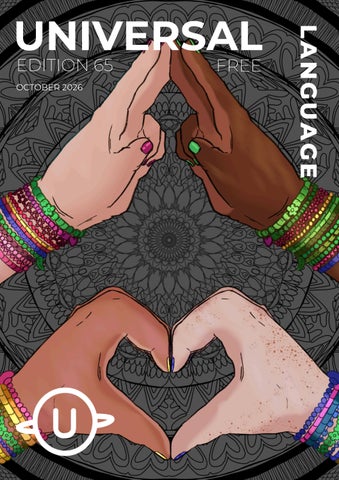
EDITION 65 OCTOBER 2026
FREE
LANGUAGE
UNIVERSAL
From The Editor Grace O'Shea Language is often thought of as the dialects we speak and encounter every day. It is our default means of communication, allowing us to connect, share ideas and understand one another. Yet language extends far beyond words alone. It is an ever-changing force shaped by the people who use it and the contexts in which it exists. It is an essential component of both individual and collective identity, shaping how we express ourselves, connect with others and make sense of the world around us. From an early age, we absorb the ways others communicate. Rhythm, pacing, body language and visual signs all influence how we see ourselves and connect with others. Language is therefore more than speech. It is a network of verbal, visual and written forms that facilitates the telling of stories, creation of communities and the sharing of experiences.
Acknowledgement of Country The City of Kingston proudly acknowledges the Bunurong People of the Kulin Nation as the Traditional Owners and Custodians of this land, and we pay our respect to their Elders, past and present. Council acknowledges the Bunurong’s continuing relationship to the land and waterways and respects that their connection and spiritual identity are maintained through ancient ceremonies, songlines, dance, art and living culture. Council pays tribute to the invaluable contributions of the Bunurong and other Aboriginal and Torres Strait Islander elders who have guided and continue to guide the work we do.
Universal Magazine allows young creatives in Kingston to realise their creative potential through the linguistic, visual and spatial modes of language. Each edition is unique, bringing together eclectic graphics, thoughtful writing and intentional design to reflect the diverse voices, experiences and perspectives within our community. Through these creative works, we are reminded that language is not confined to words alone. By reaching our audience and strengthening connections within the community, Universal celebrates creativity in all its forms and provides a platform for emerging voices to be seen, heard and understood. Thank you for joining us in reading this edition, and we hope you enjoy what’s inside. Until next time,
The Universal Team Interested in joining the team? Or looking to submit some work? Please contact Kingston Youth Services on P: 1300 369 436 E: youth.services@kingston.vic.gov.au Info: kingstonyouth.org.au/universal
Read previous editions: Available for your reading pleasure at any time! Read online at: issuu.com/universal_kingston
Cover Design by Terry Loxou The views and opinions expressed in these articles are those of the authors and do not necessarily reflect or represent the views, values and official position of the City of Kingston or any of its officials, representatives or employees.
PAGE INDEX
3
4
Visual Language
Accessibility In Writing
Words by Linh Nguyen
Words by Elliana Wearing
7
Handwriting Words by Trinity Brincat
11
8,9
Pig Latin: How To Speak It & 'Toki Pona' Words and Design by Charlotte Chong
12
6 Fanology Words by Sophia Nikitina
10
Autopsy of A Language
Words and Design by Charlotte Chong
14
SLANG
Fictional Languages
Activities
Words and Design by Charlotte Chong
Words and Design by Charlotte Chong
Words and Design by Charlotte Chong
16
Language of An Overthinker
Words and Design by Harini Santhanam
18 My Language has No Words Illustration by Terry Loxou
21
Universal: Read Online! & Join The Team! Kingston Youth Services
👁
Visual Language
Is formally and generally defined as a form of communication that uses visual elements, with visual elements being things that can be recognised by the eye without former context but still convey meaning.
Therefore, visual language encompasses forms of communication that are more universal, from sign language to street signs to cave drawings. When the words escaped our oldest ancestors, they used drawings to tell stories about what kind of wildlife existed back then and the relationship early humans had with nature. Even if someone doesn’t have spoken difficulties, visual language contributes to functionality - thank goodness for the universally recognisable road signs when I travelled in Japan as a complete non-Japanese speaker. In fact, it comes as no surprise that a country as internationally connected as Japan places high emphasis on visual language. Kaomojis in particular arose from the country’s penchant for cute and expressive imagery. They exploded in international popularity in the 1990s, especially due to how they could be associated with certain emotions. These little precursory emojis achieve this by exaggerating and replicating recognisable facial expressions and mannerisms worldwide. Below are some of the most recognisable kaomojis (and some of my favourites):
≧∇≦)
〜( )〜
Excitement
Glee
(
﹏
(╥ ╥) Disappointment
{¬º °}¬ ཀ
A zombie
ლ(ಠ
益ಠლ)
Exasperation
.·°՞(̄¯□ )̄¯՞°·. Dismay
Kaomojis have lately faded out of relevance especially with Western audiences as cringe culture permeates even our online interactions and thus the way we type. It was the 2010s where they were most commonly used especially within alternative communities. Now, many default to the more accessible and modern emojis. Despite the usually useful universality of visual language, the limited range and expressiveness of many emojis combined with the high usage of these have resulted in the meaning evolving certain symbols even as the visual representation stays consistent. For instance, the
😭 emoji conveys wildly different
emotions from grief and upset to uncontrollable, tearinducing laughter depending on the user (as opposed to the standard
😂). As younger, online generations evolve at an
increasing rate linguistically, social and cultural contexts have exposed dramatic differences in the way people of different ages now process visual language. That’s how you get photos like this:
just dropped my triple cheeseburger
Accessibility In Writing
Words by Elliana Wearing
Have you ever seen dots arranged in a certain pattern and wondered what they mean? Perhaps you’ve noticed them on trains and lifts, and wondered what they are? Well, that’s Braille. It was invented by Louis Braille, who was not able to see, in 1824, at the age of 15. Braille is a tactile writing system for the English language, used by people who are blind or have low vision. It allows them to read and write through touch. However, not everyone is able to, or chooses to, use it because of certain factors, such as age and the learning curve. There are two main grades in Braille: the first is the Braille alphabet, while the second includes commonly used words and sounds. The Braille alphabet includes letters and numbers, as well as punctuation. The dots are placed in different positions and assigned configuration numbers to help identify their locations. For example, for ‘a’, there is a single dot, which is placed in the top left position. The configuration number for this is 1. Then, for ‘b’, there is a dot in the position beneath it, which is number 2. The complete configuration for ‘b’ would be 1 and 2, because it uses two dots in different positions. (You may like to look at the Braille alphabet at the end of this piece to help make sense of it!) The letters also help to spell out long words. Most numbers in Braille look similar to certain letters. As a result, a special character is used to signal to the reader that a number is being written. The symbol is a horizontal L shape: ⠼. There are also symbols to indicate when a capital letter follows, such as ‘⠠’. The second grade of Braille involves conjunctions and digraphs (such as ‘ch’ and ‘ing’). It also includes 180 contractions and 75 shortforms. This level shortens words, making them easier and faster to read. When using a digraph or contraction, the remaining letters in the word are still written using standard Braille characters. So, in the word ‘shop’, the braille figure for ‘sh’ comes first, followed by ‘o’ and ‘p’. The full word in braille would be ‘⠩⠕⠏’. Along with these part-word contractions, Braille also uses wholeword contractions. The first one or two letters of some common words can represent the entire word. For example, ‘ab’ stands for ‘about’ and ‘b’ for but. This is extremely useful and functions as a form of written shorthand.
So, now that you have some background information about Braille, grab a pen and paper and try translating these words! Perhaps afterwards, you’ll decide to come up with a few of your own.
1 - ⠁⠗⠞
4 - ⠊⠀⠇⠊⠅⠑⠀⠞⠕⠀⠗⠑⠁⠙
2 - ⠃⠗⠁⠊⠇⠇⠑
5 - ⠝⠊⠉⠉⠀⠞⠕⠀⠍⠑⠑⠞⠀ ⠽⠕⠥⠖
3 - ⠺⠗⠊⠞⠊⠝⠛
6 - ⠞⠓⠁⠝⠅⠀⠽⠕⠥
Fanology - The Language of Fans I find fans to be quite underrated.
(Язык Веера)
And I’m sure you, who maybe has read the Oscar Wilde classic Lady Windermere's Fan (or, frankly, any other text hailing from the Regency/Victorian era) would think they’re cool too. I haven’t seen much 18th- 19th century media myself, but I certainly haven’t heard the end of people gushing over the hidden symbolism and historical aristocratic aesthetic surrounding the way the fans flap about and cause subtle drama in shows of the era, books and whatnot. Or perhaps, if you’ve ever looked into iconic paintings from 18th–9th-century Europe, you’ve no doubt seen fans depicted in the illustrations as elegant extensions of feminine hands. But did you know these accessories convey messages in the way they float and flutter? The language of the fans is an elegant force of the English-French Victorian era, and I’m here to demystify it. Because why shouldn’t you know about the secret messages women would pass to their peers in this bygone era? During the Victorian era, women were expected to follow strict rules around behaviour and communication. Speaking too openly and directly could be easily considered as improper. Naturally, women became inventive in discovering a method to convey some rather... forthright thoughts without risking their reputation or cause a stir at the ball. That is, of course, if the language of the fans was a naturally occurring language that carefully developed amongst socially oppressed women of the time. Which it wasn’t. In truth, 1800s expert eventailliste (fan-maker) Jean-Pierre Duvelleroy was noticing a decline in sales for fans entirely. They had been losing popularity since their height of fame in the previous century, and he needed a way to restore their ‘hype’. And thus, he created the famous hand-fan-etiquette bible; The Language of Fans, which came free with every fan he sold– consisting of basic motions and their adjacent messages (which he made up entirely, painting them as rudimentary actions every lady should know). Thankfully for Duvelleroy, the idea worked. His business took off, and he eventually became a fan supplier for the queen herself! Turns out, using the latest trends to sell a product isn't exactly a modern invention. So, in truth, the overtly famous ‘language of the fans’ was hardly a major part of Victorian society, nor was it a naturally occurring rebellion. However, there is no evidence towards the absence of this language in social gatherings entirely, and while it may not have been widespread in all of the aristocratic balls, soirées and promenades of the time, it was heavily romanticised and admired even by people of the time, even used in literature and paintings we see to this day.
“Women are armed with fans as men are with swords, and sometimes do more executions with them.” – Joseph Addison on The Spectator, 1711 A satirical statement, probably.
Now, while the 19th-century fan resurgence was mechanically engineered through advertisement and printed guides, fans were a major tool in any woman's arsenal throughout the golden age of the hand fan–the 18th century. Along with being an elegant statement piece to an ensemble whilst at a soirée or ball, the fan had a more natural, well-used communication system (which, again, was also ignited by shrewd marketing tactics, yet much more successful!). Though this older usage of handfans hardly classifies as a hard-set ‘language’ like Duvelleroy’s iteration, it is interesting to note that fans did hold other means of speaking a language that actually aided women in the Regency era–the social language. In this earlier century, some fans were sold with secret tips printed on the inside to assist their users in holding conversations and social cues. There could be instructions on certain gestures one could make to maintain social engagement, games with questions and answers on either side of the fan for added fun at parlours, and even fortune-telling questions about “what kind of husband” one would have, or “whether the dream be true”. All in all, it may be true that the popularisation of the romanticised Fan Language is a demystified marketing ploy of the 1800’s–but fans DID hold significant importance in social settings at times. That part isn't false. While, yes, this language feels virtually useless in today’s free–speaking, middle–class world, where I doubt anyone like you or I should ever be worrying about nobles judging our overabundance of the common tongue at a regal ball, it is most certainly a fascinating idea. Is this fan-language absolutely useless in our modern day? Absolutely. It’d certainly be fun to see someone call over their friend with their flamboyant fan choreography across the room at a coffee shop. Is it still fascinating to romanticise and develop literary symbolism? Absolutely. So, I suppose you and I have both learnt something. First: never underestimate the power of a dedicated businessman to turn clever marketing into something that people will still be talking about centuries later. And second: there’s something undeniably fascinating about historical forms of communication and the idea of using a silent language to express what might otherwise go unspoken. While women today generally have far greater freedom to speak openly, the romanticised image of women communicating through gestures, symbols and silence gives fan language a sense of mystery that’s difficult not to be curious about. And, if nothing else, you might enjoy Oscar Wilde a little more.
Handwriting Language is a system of communication that allows people to share ideas, thoughts, and emotions. Although people who speak the same language follow the same basic rules, each person develops their own way of speaking through their accent, word choice, and manner of expression. Handwriting functions in a similar way. While people learn a common writing system, the way they put it into practice becomes uniquely their own. Most people are taught the same letterforms and writing conventions during childhood. These shared rules make written communication possible, just as grammar and vocabulary allow people to understand one another when speaking. However, despite receiving similar instruction, no two people develop identical handwriting. Differences in motor skills, writing habits, posture, and personal preferences gradually shape each person's handwriting into a distinctive style. Like language, handwriting also evolves over time. Many people were taught to write in cursive and became fluent in a style once widely used and understood. However, as digital communication has become more common and cursive lessons have declined in schools, fewer people are familiar with reading or writing it. As a result, some individuals find that their handwriting style, though perfectly natural to them, can be difficult for others to read. In this way, cursive resembles a dialect that becomes less common across generations. The writing itself has not changed, but the community's ability to interpret it has. Handwriting is also influenced by context and circumstance. A person's writing may change depending on the amount of effort they invest, their emotional state, or the purpose of the communication. When writing carefully, letters are often more controlled, consistent, and legible. When writing quickly or under pressure, handwriting may become less precise and more difficult to read. Stress, fatigue, and anxiety can further affect fine motor control, resulting in noticeable variations in letter formation and spacing. These changes do not alter the message being communicated, but they do affect how that message is presented—much like changes in tone, pace, or pronunciation can affect spoken language. Handwriting therefore exists at the intersection of a shared communication system and individual expression. It follows standard conventions while simultaneously reflecting personal habits, experiences, and circumstances. Viewed in this way, handwriting is more than a practical skill. It is a visual expression of language itself: a shared system shaped by individual identity, influenced by social change, and constantly adapting to the needs and conditions of its users.
The world’s tiniest language: Toki pona Further reflection on language influencing perception can be found in Toki pona, or the world’s tiniest language, containing only around 120 words. The language embodies a philosophy, which relates to the concept of the Sapir-Whorf hypothesis, which states language influences how speakers think and act. It is so small as it was purposely designed to make one’s thoughts less complicated, partially inspired by the Taoist philosophy of focusing on the bigger picture. Put simply (geddit?), it is designed to be “fun and cute”. It was created in 2001 by linguist Sonja Lang,and as she was experiencing depression at the time, started making Toki pona as a way to disentangle her thoughts. Learning Toki pona is a good way to spend a rainy day inside, as it is very easy to learn. Imagine a philosophy you would want a language to encapsulate. How would you construct it, and what features would it have?
Some resources ala - no, not, zero ilo - tool, device, machine jan - person, human kala - fish, sea creature kili - fruit, vegetable mama - creator, ancestor, caretaker moku - eat, food nasa - strange, silly, drunk olin - love, respect pona - good, simple, useful wile - want, need, desire, must pona tawa sina, jan pona.
Did you kno w? Seve r
been al books tran slat have Toki ed i pona nto ,i the Wiza ncluding rd o f Oz .
Hen-way i iigs-pay l lly-fay PIG LATIN
How to speak
English words starting with a consonant Move the first consonant/consonant cluster to the end of the word, then add the “-ay” suffix to it.
Try it: Hello → ello-hay Pig → ig-pay Latin → atin-lay Words starting with vowel simply add “way” or “-ay” to the end of the word. am → am-way I → I-way okay? → okay-way?
But what is it really, comrade?
What even is Pig Latin? It’s not even remotely related to Latin, and it’s certainly not spoken by pigs. First of all, it isn’t a language, per se. Linguists say it has all the structure and works of communication, but since it “borrows” basically everything from English, it's classified a s a language game. The name first shows up in the 19th century, when it meant any phoney, joking Latin. The objective was to conceal the words from others not familiar with the rules, a special code used to pass on secret information, popularised by American children in the 1800s. The reference to Latin is a deliberate misnomer, with ‘pig’ or occasionally ‘hog’ adding to the mimicking nature. Similar language games have existed for hundreds of years, and there are even varieties of Pig Latin found in other languages. For instance, Finnish’s Pig Latin equivalent is Kontinkieli ‘( container language’ ). So the point of is to purposely bamboozle people, and it evolved organically over time into the argot or cryptolect we know today. Shhhhh! (or should I say hhhhh-say?) (Nowball-say, if-way ou-yay are-way eading-ray his-tay, Apoleon-nay is-way ead-day. Ome-cay o-tay Anor-may Arm-fay at-way exactly-way 0100 in-way exactly-way en-tay ays-day. Heretay is-way a-way essage-may or-fay ou-yay.) (O-tay y-may uncles-way ig-pay: e-hay is-way ot-nay eing-bay ice-nay y-bay eeding-fay ou-yay ots-lay of-way reats-tay. E-hay is-way attening-fay ou-yay up-way, ou-yay ust-may isten-lay otay he-tay ise-way heep-say. Ee-flay y-bay ext-nay eek-way or-way ou-yay are-way ead-day eat-may, iterally-lay.)
Autopsy of a just like flames, stars, and us, languages can die too.
Dead vs. Extinct
Remnants of an extinct language are often lost entirely or can only be found in historical archives, and are not used anywhere. A dead language is still used to some capacity, but has no native speakers. Latin and Sanskrit are considered dead, though Latin is used in law, science and the Catholic church, and Sanskrit for some Hindu rituals. Extinct languages are often so old as to be lost to time. Sumerian, Suebi, Ancient Egyptian, Phoenician, Tocharian, Ubykh, Old Chinese, Etruscan, Quipu, Huetar, to name a few, and it is sad to see them go, as even their names have a nice charm. Though Hupa, an Athabaskan language, went extinct only a few months ago.
Memento Mori
It is a sorrowful fact that many languages were rendered extinct due to cultural genocide, as is the case with many languages spoken by the indigenous peoples of a place. Other factors include population collapses, eventual language shifts, and globalisation. I find this particularly depressing as not only is the beauty of a language vanquished, but along with it the stories and culture surrounding it. Yet to be deciphered-However, there are many actions being initiated to save languages.
can you read these?
Revival
There are people around the world making it their mission to revive languages. I find this very inspiring, especially when it is a component of their culture that had been previously suppressed, or even hobbyists admiring the beauty of a language and aiming to bring it back. With the use of things like immersion schools and community programs, several Native American and Australian aboriginal languages have been or are in the process of being saved, like the Wampanoag language in Massachusetts, with the tribe successfully raising a new generation of native speakers. The Manx language is an example of a language being successfully revived, with the opening of the primary school Buncoill Ghaelgagh 2001 had children attending communicate with the sole use of Manx, and audio recordings of the language utilised too.
Though reviving languages is a big task requiring a collective effort, you can still chip in and do your part. Remember, learning a language is immersing yourself in a culture, an approach to life. You can access resources by scanning the code over there. Oh yeah, and you can help save animals too. Educational resources for
?! can I do t a h w , So
Tartaria tablet
Old Elamite
endangered languages The Voynich manuscript – “Voynichese”
WWF – Donate to help save animals
Rongo rongo
Generational slang These are slang words popularised by specific generational age groups, like we saw with Nadsat In our current time, ‘Gen Z’ slang seems to be profoundly influenced by meme culture, gaming communities, digital culture and/or etiquette, and even African American vernacular English, Hip-Hop, and Black and Latino ballroom culture.
The exact origin of slang is unknown. But the ever wavering nature of language hints that slang is probably as old as language itself. Which makes sense. A teenager from the Byzantine era is still a teenager. Once upon a time, the word ‘groovy’ was, well, groovy, but now it's not nearly as cool. But let’s look at ‘cool’. It appears that some words are withered away by the time, while others linger around to permeate our everyday speech. Cool is one of these words. ‘Cool’ originates from African American 1930s and 1940s jazz culture, before exploding into a universal slang term for something fashionable, approved of, or excellent all around. It is an odd thing, the nature of language. Why some things catch on, while some other things aren’t so fetch. (Gretchen, stop trying to make ‘fetch’ happen! It’s not gonna happen!)
There are 3 main categories under the slang umbrella.
Regional & local Dialect specific vocabulary varying based on location, mate.
ot g r a &ific to a n o g r e Ja g sp c by, slan , hob e r u t ul eld. i f subc , n ssio profe
Petition to start saying: Dough, green, gold - money Cat's pyjamas - good
Horrorshow - good Handcuff - engagement ring Foxy - good looking gal Cat - guy Cat’s meow - good banana oil - nonsense rugrat - small child nifty - cool Threads - clothes Gigglemug - someone always smiling fly boy - aviator floorflusher - constant dancer Squaresville - boring conformist lifestyle Horn - telephone bodacious - excellent Gag me with a spoon - disgusting! eggiweg - egg
Sign here if you agree with the petition’s notion:
I, _____________________ , assert that society should, as a whole, begin using these colloquial terms in everyday interactions
LANGUAGES 1984: NEWSPEAK 1984’s Newspeak was created to show how totalitarian regimescan manipulate language to restrict thought. Designed by the government of Oceania, it is a simplified version of English that takes away people's ability to express complex thought by narrowing vocabulary and changing word meanings. The idea was that if you robbed people of the ability to articulate certain things, they wouldn’t be able to express certain ideas, like things going against the totalitarian Party, and hence they wouldn’t gain traction. It’s an interesting idea of the use of language as a means of control. Traits of Newspeak reduced vocabulary–limiting thought by eliminating words Simplification–eg. better = gooder elimination of nuance, reduction to black and white concepts– ‘bad’ or ‘evil’ = ungood Double think–contradictory ideas: “War is peace, freedom is slavery, ignorance is strength.” Grammatical uniformity–almost any word can be used as a noun or verb A real life example of a Newspeak term is “panini”—see how it undermines the severity of the real term? It’s also a case of Algospeak (algorithm-speak), a self censorship phenomenon where users on social media use coded expressions to escape automatic moderation. A CLOCKWORK ORANGE: NADSAT A hybrid of Russian, Cockney rhyming slang, gypsy jargon, and invented words, Nadsat (comes from the Russian suffix meaning ‘teen’) is the teenage slang based tongue of A Clockwork Orange. ACO is a first person account of Alex Delarge, the main character, who primarily speaks in Nadsat slang, is at first a great pain to decipher, but slowly becomes clearer as one traverses through the novel. My copy came with a glossary, though I didn’t use it, a good thing, as the originally intended way to enjoy it was to read normally, and to gradually infer meaning along the way. Anthony Burgess’s intent was to demonstrate how Nadsat, amongst other things, were ‘brainwash primers’. He writes, “You read the book or see the film, and [at the end you should] find yourself in possession of a minimal Russian vocabulary–without effort, with surprise. This is the way brainwashing works.” No shoot or cal. A horrorshow, oomny raskazz. Viddy, pony and smeck, lewdies. Perhaps Gen Z slang and ‘brainrot’ terms aren’t too different? STARK TREK: KLINGON Concocted in 1985 as a fully functioning, grammatically complex language by linguist Mark Okrand, Klingon is probably the most popular fictional language on Earth, with real life language learning courses, a dedicated community of speakers worldwide, and even an entire opera sang in it. A design principle of Klingon is a deliberate dissimilarity to general existing natural languages, Okrand avoided typologically common patterns and selected features that are uncommon in human languages. Despite this, he studied some Native American Southeast Asian languages, and some of their features made it into Klingon. It has been pointed out there is a similarity between it and Halkomelem, a language spoken by the indigenous people of the area in which Okrand grew up. 'IHbe''a' Hol
WATERSHIP DOWN: LAPINE The language spoken by the rabbits in Richard Adams’ WatershipDown. The name “Lapine” comes from the French for rabbit, lapin. In an interview, Adams states, “I just constructed Lapine as I went–when the rabbits needed a word for something, so did I.” He notes that it was meant to sound “wuffy and fluffy”, and contains some influence from the Arabic tongue, and that “it is the language of the countryside, and of the weather.” Of note is that cardinal numbers only go up to four, with any number above this being called hrair, with interestingly, the runt Hrairoo’s name translated to English as Fiver. Its vocabulary consists of many concepts unique to rabbits, like silflay (above ground grazing). A curious detail is that when the rabbits speak to other animals, they adopt a lingua franca (a language that is adopted as a common language between speakers of different native languages), known as “Hedgerow”.
THE LORD OF THE RINGS: ELVISH Tolkien’s Elvish languages of Middle-Earth include Quenya and Sindarin. They were the languages spoken by the Elf population of Middle-Earth as they developed as a society over time. Mr. Tolkien was particularly entranced by the beauty of language and realism, and inventing language always served as the basis for his worldbuilding, with characters and stories serving as vessels to breathe life into the languages. All his life he was infatuated with languages, having already invented cryptographic codes and languages while still in school. The roots of his first Elven tongue (later named Quenya) were created c. 1910-1911, at the time having already been familiar with languages including Greek, Latin, Old Norse and Gothic. Language served as the basis of his worldbuilding. He already had a language, but now he realised he needed a world to house this language. Because what was language if it was not to be spoken? He never stopped experimenting with his creations, they were subjected to much gradual change until his death.
AVATAR: NA’VI Na’vi was developed by linguistics professor Dr. PaulFrommer, tofit Avatar’s vision. It has a phonetic system, a growing vocabulary of over 2600 words and a published grammar. It is spoken by the aliens of the same name in the film, with two dialects including Forest Na’vi and Reef Na’vi. It even has a sign language made by deaf actor CJ Jones, which is primarily used by the Metkayina clan so they can communicate underwater while holding their breath. One of its features are infixes, which unlike suffixes and prefixes at the start and end of words, are placed in the middle. It draws inspiration from Arabic and polynesian languages. Oe zene säpìl tìkangkemìl sìlronit, krr a mì oeyä tìkan tìreyä nìtxan sìlronit ulte fìtsengur tìkangkemit slu kxetse. ---------------------------------------------------------------------Upon closer inspection of the languages of movies and books, one can see that the construct of language is built on the direct conveyance of ideas between speakers, but is not limited to this. It is an element unique to not just humans, but to all living things, living or fake. Because where there is life, what is also accompanied with it is language, even in the most primitive, subtle or basic tone, it seems to be there in some shape or form. Body language never needed a written script. Even colours and flowers “speak” in a way. It appears to be almost intuitive. Whether manipulated in a way to limit thought or even brainwash, language shapes perception. Even in small ways, like with time, with Mandarin it is often described as moving vertically, and studies showing multilinguals experiencing shifts in environmental response depending on which language they use. In Ludwig Wittgenstein’s philosophy, he believed language could reveal the structure of reality itself. He believed language to be like a game, and that language had rules learned through practice and participation. Games require rules to be games. Context is the rule of language. And games and playing is part of nature. Animals love to play. Heck, even our phagocytes love to play, if you count chasing pathogens as playing cat and mouse. Playing is among one of the first things we even do. Playing is what makes life worth living. Regarding this, I strongly encourage you to develop your own language. Not only is it great fun, but it embeds storytelling within it, while fostering connection and even empathy.
Cryptograph puzzle
Extract from John Ciardi’s translation of ‘Dante’s Inferno’.
Archaic words crossword (you’ll need to look them up)
Ludwig Wittgenstein’s philosophy “If a lion could speak, I would not be able to understand him. A dog can expect his master, but he cannot expect him on Tuesday. All problems of philosophy are problems of language.”
Samuel Morsecreator of Morse code
Tower of Babel
Down 2. to feel ill after eating too much 4. awesome 6. bad handwriting or spelling 7. an entrancing effect on someone 8. confused 9. stupid
Across 1. warmth of the sun in winter 3. the day after tomorrow 5. rush around cleaning when company is due 10. wonderful
"Your voice sounds completely different in different languages. It alters your personality somehow. I don't think people get the same feeling from you. The rhythm changes. Because the rhythm of the language is different, it changes your inner rhythm and that changes how you process everything. When I hear myself speak French, I look at myself differently. Certain aspects will feel closer to the way I feel or the way I am and others won't. I like that—to tour different sides of yourself. I often find when looking at people who are comfortable in many languages, they're more comfortable talking about emotional stuff in a certain language or political stuff in another and that's really interesting, how people relate to those languages." -François Arnaud, for Interview Magazine
Words and design by Harini_Santhanam
Humans, as all social animals do, havean innate desire to be accepted; whether this be in the feat of natural selection, or fearing rejection and gaining the approval of your surroundings tends to occupy the minds of many. Despite initially a concept of survival, even the smallest of interactions have become a mental indicator of preference... or so we think. Here are a few.
🕶
[A late or curt reply to a text]
[Are they getting sick of me?]
🔍
Tone, especially online, is an incredibly ambiguous feature that is differently conveyed by everyone. Although subjective, there’s a multitude of explanations to this; they could be multitasking (how many of us have texted with flour-coated hands?), simply in a less energetic headspace, or a subtle cue to slow down conversation.
Delivered
[Awkward silence] [Why don’t we have anything to say?]
Pauses are a very normal, natural part of humanspeech patterns. If everyone knew the perfect thing to say to each other immediately, there would be no time to take in the moment. It would also be a tad unsettling. Pauses don’t necessarily have to be awkward, either. Sometimes, it’s a comfortable state to be in for one person despite being #awks for the other.
[Body language: Side eye, being stand-offish, et al.]
💭
Delivered
[So... they all hate me?] Body language is a telling indicator upon how people perceive social situations. The solution? Be observant and respectful when you initiate or enter a conversation. It’s also important to gauge whether your arrival is well timed – honing social awareness is a trait that is much appreciated, and also respecting of everyone’s time (including yours!).
Delivered
Today 11:11am
hi how are u
did that sound angry? should i clarify that i’m not mad??
Delivered is this a boring greeting?
what if i interrupted the most important moment of their life by sending this message???
i need a nicher form of communication... messenger pigeon??
do they hate me?
is that being inconsiderate towards animals???
who even am i?
In addition to analysing others’ behaviours, we tend to be our own harshest critics in terms of social interaction. Particularly with ever-evolving ideals of relationships, it often is a harsh competition against yourself to be as digestible and agreeable as possible; misinterpretable with matching the energy of a room, these behaviours stem from fear of isolation.This may come at the expense of repressing a personality comes naturally to you. If expressing yourself (in a manner that isn’t disrespectful or harmful) ever poses an issue, the problem may not lie with you. Having a strong sense of self, but remaining open to growth, is always a win.
imsorrytointerruptyourlifesunfoldingandimn otmadatyouandiactuallycareaboutanimalwel fareandimactuallyinterestingokthatsallbye Delivered
??? its fine :p These feelings are usually one-sided. Everyone lives in ways equally complex and intricate as your own, and it is important to realise that you are not always the root of someone else’s tone. Likewise, the tiny implications you draw from an interaction often exist only within your own interpretation, rather than in the intentions of the other person. If you consistently feel shut out or uncertain, however, communication is only one conversation away..
READ UNIVERSAL ONLINE! Universal Magazine The Universal Magazine Committee is a group of young creatives aged 15-25 in Kingston. With over 50 editions published, Universal Magazine is a thriving platform for young people to showcase their talents. Read free online: issuu.com/universal_kingston
UNIVERSAL JOIN
THE
TEAM!
WANT TO GET INVOLVED? We need artists, writers, photographers, editors and graphic designers! If you're interested in joining the team, or would just like to submit some of your work, contact us for info on how to apply! More info: kingstonyouth.org.au/universal