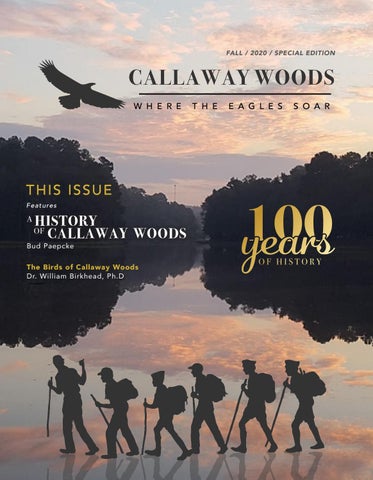
FALL / 2020 / SPECIAL EDITION
CALLAWAY WOODS W H E R E
T H E
E A G L E S
TH I S I S S UE F e atures
HISTORY CALLAWAY WOODS
Bud Paepcke
FULL PAGE AD
The Birds of Callaway Woods Dr. William Birkhead, Ph.D
$500
S O A R
FULL PAGE AD $500
ASK YOUR DOCTOR FOR A PRESCRIPTION Driving is not just about getting from one place to another; often, it is about how we conduct our lives. Losing the ability to drive or choosing to limit where we drive can mean losing more than just transportation. It can mean losing our independence. Older drivers may consider using CODE for any of the following reasons: • • •
Family, friends, doctors, or others have told you that you shouldn’t be driving Change in your vision, cognitive, or a physical condition Recently moved into a new city or most recently have become the primary driver
KEY COMPONENTS OF EVALUATION • HEALTH QUESTIONAIRE • CLINICAL EVALUATION • MEDICATION REVIEW
• ON-ROAD EVALUATION • FEEDBACK SESSION • WRITTEN COMPREHENSIVE REPORT
The CODE-Certified Older Driver Evaluation’s final report is one you, your family and doctor can rely on!
A PARTNERSHIP
BETWEEN ST. FRANCES EMORY / HPRC
COLUMBUS EAST ALABAMA MEDICAL CENTER/ REHAB WORKS
COLUMBUS AUBURN/OPELIKA
3 Reasons to Call Today Brings peace among, family, physician and driver CODE is a comprehensive driver evaluation Majority of older drivers pass 3709 Gentian Blvd. - Suite 5 Columbus, Georgia 31907 706-561-2509 www.BarbersDrivingSchool.com
C O M M U N I T Y
C O M M U N I T Y
WHEN EXPERIENCE
COUNTS
35 Years Full Time REALTOR In Listing and Selling Homes
VIKKI TRAYWICK RE/MAX Champions Realty
(706) 888-6973
President of Columbus Board of REALTORS 2020 CRS-Certified Residential Specialist ABR-Accredited Buyer's Representative SRS-Seller's Residential Specialist GRI-Graduate Realtor Institute SFR-Short Sales & Foreclosure Resources MRC-Military Relocation Certification e-Pro Certification C2EX-Commitment to Excellence
Your Neighbor in
CALLAWAY WOODS
The Best Electricians & Electrical Contractors In Your Community ⚫ Residential ⚫ Commercial
⚫ ⚫
Industrial Institutional
metropower.com ⚫ 1443 6th Ave., Columbus, GA ⚫ 706-221-6510
YOUR TRUSTED ADVISOR At AJK, we believe that accounting and tax counsel isn’t just an annual destination. It’s a year-round journey, where we serve as your proactive and trusted advisor, partner and guide as you explore all options on the path to your FINANCIAL SUCCESS.
CERTIFIED PUBLIC A C C O U N TA N T S
1200 Brookstone Centre Parkway - Suite 105 Columbus, GA 31904 (706) 571-9288
Tax Preparation • Payroll Outsourcing • Trust & Estate Planning • Accounting • Compilation, Review & Audits • Financial Planning
A J K C PA S . C O M
Service and Protection for your Family and Business
5510 Veterans Parkway - Suite 102 Columbus, Georgia 31904
706-221-8566 c ulpepperinsur ance.net
NOT HAPPY WITH YOUR BANK?
SWITCH TO BANKING THE WAY IT SHOULD BE!
Experience the personal service of true community banking. At Southern States Bank, we believe the most important thing is our relationships with our customers. In each of the communities we serve, we pride ourselves on our people and their ability to understand your banking needs. Visit your local branch today and experience great customer service from people you know and trust.
www.southernstatesbank.net NMLS #410611
EQUAL HOUSING
LENDER
Doing Your Lawn The Old Fashioned Way
Old Timer’s Landscape LLC Commercial and Residential Lawn Maintenance
(706) 326-7969
MESSAGE FROM THE
CALLAWAY WOODS PRESIDENT
F
or the last three years, I have had the privilege of serving as president of the Callaway Woods and Lakeside Homeowners Association. I can honestly say that participating in our community HOA has allowed me to develop new and wonderful friendships with so many of my neighbors. In addition to making new friends, we have discovered that when we work together, we can accomplish just about anything we want, making our neighborhood a better place to live in. For this reason, the board of directors of Callaway Woods would like to share with you this special publication entitled Where the Eagles Soar, the rich history of our community, and the magnificent love for nature and outdoor activities we share. Sincerely,
Reyna & Al Barber C a l l a wa y W o o d s - Wh e r e T h e Eag le s S o a r
12
Callaway Woods Officers & Directors Chairman of Board & President Al B arb e r
Vice Chairman of Board & Vice President Rand y B u r t
Treasurer & Board Member D al e Ask i n s
Secretary & Board Member
TABLE OF CONTENTS 15
A History of Callaway Woods b y B u d Pa e p c k e
33 Callaway Woods Lodge Renovation
C aro l H il le r
Board Member C el ia B an k s
Board Member
P at D iaz-Ve r s o n
Board Member
J o hn C u nnin gh a m
Chairman Emeritus J ay Stel zenm u lle r
b y J a y St e l zen m u ller
36 Burnt Hickory Farms & Refuge b y J a y St e l zen m u ller
40 Callaway Woods Healthy Life Style
Advertisers Alligator Point Marina
b y D r . A n d y D ick en s, M.D .
Barber’s Driving School
41 Fishing at Mobley Lake
Publix
by Randy Burt
Vikki Trayvick Realtor
43 Pavilion & Pool by Celia Brooks
45 Our Multigenerational Homeowners b y G a r y & D ian e Or r & C ar o l H iller
AJK Culpepper Insurance Metro Power
46 Living Life to the Fullest
Old Timer’s Landscape LLC
48 Birds of Callaway Woods
The Jersey Shop
with Family & Friends
Southern States Bank
b y D r . W i l liam Bir k h ead , P h .D
Published By The Callaway Woods & Lakeside Homeowners Association Publisher Al Barber, CWHOA President Editor Dr. Gordon, Ph.D Graphic Designer Braelen Hill
Contributing Writers: Bud Paepcke Jay Stefanmuller Randy Burt Dr. Andy Dickens, M.D. Celia Brooks Dr. William Birkhead, Ph.D Gary & Diane Orr Carol Hiller
FULL PAGE AD $500
HISTORY CALLAWAY WOODS by Bud Paepcke
R
esearching the history of Callaway Woods was quite enjoyable. It was like opening up an amazing door to discover our past. Hopefully, all neighborhood residents will also find it enjoyable to read about this early history and they will each gain a better personal appreciation for the uniqueness of this bit of paradise. Just about a mile north of the Muscogee County line in southern Harris County is Callaway Woods. It is one of the most scenic residential neighborhoods in west central Georgia. An abundance of wildlife lives within its boundaries, including geese, cranes, owls, turkeys, hawks, and countless species of melodious songbirds. There have also been sightings of the majestic American Bald Eagle, the living symbol of our freedom. The deer, fox, opossum, raccoon, armadillo, coyote, and many of God’s other wild creatures also appear quite comfortable roaming the area, seemingly unafraid of humankind’s presence.
Bald Eagle flying over Mobley Lake January 11, 2014
Trees of various varieties including oak, hickory, pine, cedar, maple, poplar, dogwood, sweetgum, and beech families beautifully and colorfully cover the landscape. Many of these luscious trees, both evergreens and deciduous, are old growth and have thick trunks, indicating that they have been here for a very long time, providing a canopy for fascinating sights and sounds. The grand and spacious homes of this residential neighborhood are all carefully situated on large, nicely groomed lots dotting the area’s gently rolling hills. Every resident has access to both a private swimming pool and an attractive clubhouse looking out over a large, picturesque lake, which is well stocked with several types of fish and is fun for boating and canoeing. What a wonderful blessing it is to live in this beautiful country place and still to have all the modern conveniences for personal comfort.
C a l l a wa y W o o d s - Wh e r e T h e Eag le s S o a r
A His t ory of C allaway Woods
15
T
his land was not always envisioned as a formal residential development with an exclusive lifestyle. Many ages ago, a simpler and less affluent people inhabited this land while enjoying God’s creation and specifically utilizing the plentiful resources found here, helping them to raise their families in perfect harmony with nature. During those early days, the inhabitants most likely considered this land an earthly paradise, just as the residents of Callaway Woods feel today about this neighborhood. Long after those first inhabitants departed these woods, this land became a training site for a special group of young Americans. Utilizing the training they received, most of those special Americans went out into the wider world and positively affected the lives of thousands (maybe millions) of people who never had the good fortune to experience this special land. One senior resident has actually referred to Callaway Woods as hallowed ground, for its uniquely rich history most certainly makes it so. Almost 60 years ago, in November 1961, Frank T. Schnell, Sr. and Billy Romeo, two amateur archaeologists, did some very careful digging somewhere along Standing Boy Creek on a specific, welldefined plot of ground that is now part of Callaway Woods. What they found at that site proved that this land was a home for some early Native Americans. The marvelous things they discovered included pieces of old pottery, flint chips, and small arrowheads. Professional archaeological experts further examined the assorted pottery. Those experts unequivocally determined that the earlier inhabitants of this neighborhood were people of the Swift Creek Culture, who were mound builders and non-sedentary nomads. These Indians were already known to have occupied other areas of western
Georgia, including the mounds at the Kolomoki site in southern Georgia. What makes this discovery even more interesting is that these early Americans were probably here at the same time as Jesus Christ walked the earth. Some of these Indians might have even lived here as late as 900 A.D. With respect to the chalked flint chips and crude chipped blades that Schnell and Romeo also found in deeper earth near the banks of the creek, the archaeological experts also speculated that these items were probably associated with even earlier Native Americans. Joe Skinner, a Muscogee County science teacher, reported on the Schnell/Romeo excavations, stating that “Standing Boy Creek [would have satisfied] the Indian’s need for fresh water and possibly pan fish with which he supplemented his [daily] diet. Without a doubt, the rocky hills and forests in the immediate [area] offered both game animals for [Indian] hunters, and berries, nuts and herbs for [Indian] women and children to gather when [they lived here].” Though no items that would have been characteristic of later American Indian cultures were found at the Standing Boy Creek site, Schnell and Romeo did no archaeological digging anywhere else in the neighborhood, so it is quite possible that later Indian cultures might also have visited or lived in Callaway Woods. The Muskogee Creek people occupied areas of the Chattahoochee River Valley, on land that is now Fort Benning, so members of that same tribe could easily have traveled the 20 miles north and taken advantage of the fruits of this land of promise along the wide neighborhood creek.
Figure 3 - Swift Creek Indian Pottery
C a l l a wa y W o o d s - Wh e r e T h e Eag le s S o a r
A His t ory of C allaway Woods
16
Figure 4 - 1948 Boy Scout Handbook
Order of the Arrow Sash
B
and always demonstrating an extra appreciation for the uniqueness of American Indian customs.
In fact, Ernest Thompson Seton, one of the BSA’s founders and the BSA’s first Chief Scout, incorporated elements of American Indian culture into the Boy Scout program, and his interest in Indian lore and Indian ceremonies influenced the founders of the Order of the Arrow (OA), the exclusive brotherhood within the Boy Scouts of America. OA members still pledge to provide cheerful service to others in their community, while respecting God’s outdoor creation
Words from an earlier edition of the BSA’s Handbook for Boys also remind us of the strong connection between Scouts and Indians. “Have you ever dreamed of hiking the wilderness trails that were worn down under moccasin feet hundreds of years ago? … [You know] you can follow those trails … wherever you live, [for] you are not too far from the woods … the country where once the Indians roamed.” Because of the Schnell and Romeo discoveries, there is no question that Indians freely moved about this land that is now called Callaway Woods, and perhaps the soul of the red man still resides here, for he could have considered it a happy hunting ground.
ecause Schnell and Romeo were actively involved as volunteer adult leaders with the Boy Scouts of America (BSA), which has had a close kinship with American Indian traditions, they were especially interested in Indian lore and extremely excited about what they discovered along the creek.
C a l l a wa y W o o d s - Wh e r e T h e Eag le s S o a r
A His t ory of C allaway Woods
17
CAMP M c KENZIE Mack McKenzie at Camp
McKenzie & Schomburg with Camp Leader
O
f course, it was not until the early 20th Century that the incomparable spirit of the Boy Scouts actually began to blow through these same tall, lush trees under which Indians once lived, but that spirit did eventually touch and come to rest on this beautiful land. The idea of establishing a Boy Scout camp in these woods on either side of Standing Boy Creek was initially born and nurtured in Columbus several years after the BSA was first founded in 1910. Scouting was a program to promote the ability of boys to do things for themselves and others. The very first Boy Scout troops in Columbus began to meet at Rose Hill Baptist Church in 1912 and at First Presbyterian Church in 1916, but as the number of scouts and the number of troops grew each year in and around the city, the need for an outdoor camping site away from the city where they could learn valuable skills for life became more important. The dream of constructing a local area camp finally became a reality in 1921, when Camp McKenzie was legally incorporated under the leadership of two Columbus, Georgia residents, William W. “Mack� McKenzie, a widower and sales manager for an insurance company, and Fred Schomburg, Sr., a father and local jeweler. Since McKenzie seems to have been the first person to call for a scout camp, and he owned a little land that was adjacent to the new camp, the camp was named in his honor. As a youngster, Fred Schomburg had been an outdoor adventurer and experienced camper long before the Boy Scout movement came to America, and he became a big supporter of Troop 2 at the First Presbyterian Church, where he worshiped. Members of his family still like to tell about the canoe trips he took down the Chattahoochee River, sometimes leaving his canoe on the river bank to be hauled back to Columbus on the old paddle-wheel steamboats that connected Columbus to the rest of the world for at least a century. Fred would surely have been an active Boy Scout, had there been such a youth program when he was a boy.
C a l l a wa y W o o d s - Wh e r e T h e Eag le s S o a r
A His t ory of C allaway Woods
18
that McKenzie prepared for them on that bank of the creek, “and we decided to buy the property … and began figuring on how to make that happen. [We] listed 18 names, including Mr. Mack and [me]. The price of the property was $1,800, and we collected $100 each from those on the list.” But they did not stop with just the purchase of the land; they went further. “Mr. Mack and I plotted the camp. [Then] I went to [Fort] Benning and secured a blueprint of their wooden mess halls.… Mack supervised the building [of the mess hall] with volunteer help and some laborers. [The] B. H. Hardaway Company constructed the cement dams [on Standing Boy Creek and also created the camp’s lake].” Where were the Boy Scouts going to sleep at the new camp? “I went to Fort McPherson in Atlanta to attend a salvage sale and bought 40 pyramid tents at $10 each. This was the start of Camp McKenzie.”
Figure 5 - Fred Schomburg in later years
S
chomburg was approached about helping McKenzie’s dream of a camp come true, and he quickly agreed. Though their ages differed by almost 20 years, these two men were truly kindred spirits and good citizens, as they focused their joint efforts on a mission to benefit the youth of their community. In his memoirs Schomburg recalled what happened when he and McKenzie discovered some land for sale just over the Muscogee County line, and thinking it might be a good location for their camp, “Mr. Mack … and I went to the site in Mr. Mack’s car. The road was wild and rugged down to the old grist mill [on Standing Boy Creek]. We sat on the rocks below the mill, and Mr. Mack had [brought] sausage, cornmeal and [his] frying pan.” After starting a hot, cooking fire, they enjoyed the scout-like meal C a l l a wa y W o o d s - Wh e r e T h e Eag le s S o a r
Others who were actively involved in developing the historic scout camp venture included some very familiar Columbus names: J. Homer Dimon, an office supply dealer, James B. Key, a banker, and Dan Joseph, an automobile dealer, J. Dupont Kirven, a department store owner, H. B. Crowell, another banker, and J. A. Thomas, a local pastor, all joined the McKenzie/Schomburg parade to make Camp McKenzie a big success. The fundraising for this venture was actually led by insurance broker Frank G. Lumpkin, Sr. and early Scoutmaster Sidney Colquitt, who surprisingly lived to 100. (Lumpkin’s son, who was a member of Colquitt’s troop, was one of the first Eagle Scouts in this area and served on General Patton’s staff in WWII. His great-grandson was one of the Eagle Scouts who more recently completed his Leadership Service Project in Callaway Woods to benefit this community.)
A His t ory of C allaway Woods
19
A
s money became available donations for the Figure 7 Early Scoutsfromwith Army Tents
camp project, the Boy Scouts acquired the desired property, piece by piece. As Fred Schomburg indicated in his memoirs, the initial land was purchased for approximately $1,800, and it totaled 206 acres. County deed records show it consisted of 156 acres from J. D. Wadkins for $1,092, 40 acres from Hezekiah Land for $400, and 10 acres from P. W. Richardson for $300. In 1923, another 149 acres was purchased from J. D. Wadkins for $1,500.
As money became available from donations for the camp project, the Boy Scouts acquired the desired area property, piece by piece. As Fred Schomburg indicated in his memoirs, the initial land was Mack McKenzie would regularly drive out on Whitesville purchased for approximately $1,800, and it Road to his cabin near the camp to spend his free time with his Boy Scouts. As he had no children of his own, the Boy totaled 206 acres. County deed records show it Scouts became his adopted sons, and he freely expressed his personal pride in his boys, as they grew into fine consisted of 156 acres from J. D. Wadkins for young men while just having fun in the woods. Bill Storey, a local scout historian, recently said that Mack’s heart and $1,092, 40 acres from Hezekiah Land for $400 and soul were Camp McKenzie, but after supporting the local scouts for almost 20 years, his heart stopped beating and 10 acres from P. W. Richardson for $300. In 1923, he died in 1938. His land and his cabin had been so much aanother part of Camp McKenzie that the Boy Scouts purchased 149 acres was purchased from J. D. them from his estate for $200, increasing the camp size to about 360 acres. McKenzie’s historic cabin was always Wadkins for $1,500. known as Mack’s Cabin, and the Boy Scouts used it for Figure 6 - Mack’s Cabin
many years. It is specifically remembered as a gathering place for adult scout leaders. Though the cabin is now gone, the old dirt road leading to the cabin site is now the driveway of the first private residence on the left side of Whitesville Road, just west of Troop Drive. Figure 7 - Early Scouts with Army tents
C a l l a wa y W o o d s - Wh e r e T h e Eag le s S o a r
A His t ory of C allaway Woods
20
Figure 8 - Outdoor Amphitheater
C
amp McKenzie’s eventual development included several tent campsites, as well as sites for wooden or concrete block, 3-sided, Adirondack shelters, rustic latrines, picnic tables, and a wooden Mess Hall. The mess hall would have been located in the area of what is now the paved cul-de-sac at the end of Troop Drive. Gray Lake, a small boating lake, was built down the hill from the mess hall, and it is still behind #307 Troop Drive. A scout is clean, so community shower facilities were also installed in the area of Gray Lake.
recently related a vivid and proud memory of when his troop planned and presented a delightful program in that same amphitheater on a pleasant spring night in 1990. All the troop’s family members crowded into the amphitheater to face a warm and blazing campfire that had been mysteriously lit with a little help from the Great Spirit. Certainly, other scouts and scouters will remember similar nights here in Callaway Woods, as they shared fellowship around other bright and cheerful campfires.
An outdoor amphitheater was built on the slope that led down to the edge of the lake, and campfire programs were often held there. One scoutmaster
C a l l a wa y W o o d s - Wh e r e T h e Eag le s S o a r
A His t ory of C allaway Woods
21
S
tanding Boy Creek was also dammed to make it deeper and more suitable for aquatic activities. Scouts at Camp McKenzie were able to participate in swimming, canoeing, boating, and fishing on both bodies of water. Some remnants of the old waterfront facility, which was built by the Boy Scouts on the east side of the creek, are still present behind private property at #220 Troop Drive. That waterfront area can still be seen by residents from the neighborhood’s walking trail on the west side of the creek. Several sessions of Summer Camp were held here each summer for over 70 years, though the site was available for camping at other times during the school year as well. (Girl Scouts, Campfire Girls, and residents of the Girls Orphan’s Home also utilized Camp McKenzie in the early years.) In 1935, during the Great Depression, the cost for a scout to attend a 2-week session of camp was just $1.00 a day (a total of $14 for the session). In a printed promotional brochure about Camp McKenzie, the aim and purpose of camp was explained for the benefit of parents who might be considering sending their boys to camp. It read, “to give your boys a worthwhile camping experience that builds character and trains for citizenship … to make the boys … more self-purposing, self-directing, [and] personalityrespecting individuals.” In short, Scouting could and would change lives for the better. It was Will Rogers, the famous American cowboy philosopher, who once said that the trouble with the Boy Scouts is that there are not enough of them, and he was certainly right about that. However, the principles of Scouting are best taught in the outdoors, and Camp McKenzie provided a perfect environment for that exceptional training. The old grist mill that had been operated on the creek near the Boy Scout dam, which was mentioned in Fred Schomburg’s memoirs, is now gone, but it was there in the beginning, and some old scouts still remember seeing the large grinding stones from the mill lying near the creek. All the land near the dam and the grist mill, on both sides of the creek, is now private property.
Old waterfront on creek
Figure 9 - Aditondacks at McKenzie
C a l l a wa y W o o d s - Wh e r e T h e Eag le s S o a r
A His t ory of C allaway Woods
22
Figure 10 - Early Scout below dam
Figure 11 - Clark Dining Hall - Heath Lodge - Trading Post
I
n 1967, the Simon Schwob Memorial (outdoor) Chapel was built in the woods, not far down the hill from Clarke Hall, and it allowed scouts to worship giving reverence to the Creator, for a scout is reverent. (Schwob was a tailor in Columbus for over 40 years, his Schwobilt clothing business was located in what is now the Columbus Ledger-Enquirer newspaper, and both the library and School of Music at Columbus State University are also named for him.) The chapel is still standing in the woods behind what is now #183 Troop Drive (just south of Troop Court, though now on private property and not open to the public. Scouting enthusiasts are pleased that the owner of that property has honorably maintained the chapel in the interest of historic Boy Scout preservation). In the early 1950s, a more modern hall, Clarke Hall, replaced the old Mess Hall and it was constructed on land that is now #167 Troop Drive. Though utilized for a few years as a storage building, the old Mess Hall was later destroyed by fire.
Figure 12 - Washing up Campsise latrine
Figure 13 - Old Crist Mill on left in 1922
C a l l a wa y W o o d s - Wh e r e T h e Eag le s S o a r
A His t ory of C allaway Woods
23
Figure 15 - Suspension bridge over Standing Boy Creek
Figure 14 -Camp McKenzie Parade Grounds
C
amp McKenzie’s main entrance turned left (and south) off Whitesville Road and went across ground where there are now two private residences, #11589 Whitesville Road and #43 Troop Drive. Troop Drive, which was named by Callaway Woods developers to commemorate the Boy Scout history here, was not an entrance to Camp McKenzie when the camp was operating. The camp ranger’s house and his camp warehouse were both on the land that now encompasses #11531 and #11589 Whitesville Road. The large open area at the end of Troop Drive, where several homes are now standing, was once the camp’s parade ground and athletic field. Troop Court was also named to perpetuate the memory of the Scouting activities that took place here for over 70 years. A large cable suspension bridge was eventually constructed over Standing Boy Creek near the old waterfront in 1960, which permitted scouts to cross the creek safely to reach the new Wilson Hill campsite and to access a lovely nature trail that was also developed and ran along the far west side of the creek from the dam to Whitesville Road. Zack Adams, a carpenter and scout parent from Troop #1, took charge of assets from Fort Benning and completed the bridge project. A sign once designated it as C a l l a wa y W o o d s - Wh e r e T h e Eag le s S o a r
Figure 16 - Schwob Memorial Chapel
Zack Adams’s bridge. At times, the bridge was also used in Cub Scout ceremonies symbolically for Cubs to cross over to the Boy Scout program. Residents can also view the site of the old cable bridge and the remnants of the old Wilson Hill campsite from the Callaway Woods Walking Trail. A large suspension, cable bridge was eventually constructed over Standing Boy Creek near the old waterfront in 1960, which permitted scouts to safely cross the creek in order to reach the new Wilson Hill campsite and to access a lovely nature trail that was also developed and ran along the far west side of the creek from the dam to Whitesville Road. “Zack” Adams, a carpenter and scout parent from Troop #1, took charge of assets from Fort Benning, and completed the project. A sign once designated it as “Zack Adams” bridge. At times, the bridge was also effectively used in Cub Scout ceremonies to symbolically “cross-over” Cubs to the Boy Scout program. Residents can also view the site of the old cable bridge and the remnants of the old Wilson Hill campsite from the Callaway Woods Walking Trail.
A His t ory of C allaway Woods
24
CAMP CALLAWAY
I
n 1943, while Camp McKenzie was successfully functioning along both sides of Standing Boy Creek and on the south side of Whitesville Road, Columbus businessman S. Douglas Mobley purchased a large tract of adjacent land on the north side of Whitesville Road and developed it for his family’s private use. He built a large lake through which Standing Boy Creek ran, along with a large, two-story, stone and wooden family lodge on the edge of that lake. Friends of the Mobley family still recall the great fun they had when visiting Mobley Lodge in the early 1940s and swimming with the Mobley children on Mobley Lake. When Doug Mobley died in Columbus in 1961, his family showed little interest in maintaining the property and presented the Boy Scouts a fresh opportunity to expand the size of their camp. Of course, money was needed to pay for that expansion, and in 1965, Cason Callaway, Jr., along with five other area men, graciously provided the funds for the Boy Scouts to purchase the Mobley land. In April 1966, almost 200 acres were purchased from the Mobley estate for over $45,000 by the GeorgiaAlabama Council, Inc. of the BSA, but scout officials claim that at least 350 acres were eventually acquired from the estate for scout use. The new land became known as Camp Callaway to honor the Boy Scouts’ main area benefactor. (Cason Callaway, Jr. was the elder brother of former Georgia Congressman and one-time Army Secretary Bo Callaway and the son of Cason Callaway, Sr., the founder of Callaway Gardens.) After the additional land was acquired, scouts immediately began utilizing the new acreage for primitive camping purposes, but it was not until special development of the property by the C a l l a wa y W o o d s - Wh e r e T h e Eag le s S o a r
Georgia National Guard, some Naval Reserve Seabees from Wyoming and Colorado, and the 36th Engineers from Fort Benning, that the first summer camp was allowed to take place there in 1979. The improvement involved extensive road building, the drilling of a new water well, reconstruction of the Mobley Lake dam, construction of some new camp buildings and waterfront facilities on the lake, and renovation of the cable suspension bridge at Camp McKenzie. General Omar Bradley, who at times had been assigned to nearby Fort Benning, had this to say about the Boy Scouts: “Scouting gives a boy independence, teaches him how to do things on his own. Above all, it helps develop leadership, which our country always needs. Perhaps that’s why Army soldiers from Fort Benning gave so much of their support to the Boy Scouts here in Callaway Woods for so many years.”
Figure 17 - Fort Benning’s Commanding General visits camp
A His t ory of C allaway Woods
25
M
entioned previously is the walking trail that the Callaway Woods Homeowners Association (HOA) presently owns or has legal easement access to on the west side of Standing Boy Creek. It was part of a more extensive trails system that Boy Scouts hiked when they were camping at the two camps. The beautiful, half-mile, trail has been rediscovered and refurbished for the community by several scouts from two Columbus Boy Scout troops in more recent years. The Eagle Scout Leadership Service Projects that were completed by scouts from Troop 24 and Troop 35 now allow Callaway Woods residents to enjoy the trail at any time. Residents can enter the trail near the west side of the Standing Boy Creek bridge on Whitesville Road and legally cross some private property, through two locked metal gates, before getting to the part of the trail that is actually owned by the HOA. (The combination to the two gate locks can be obtained from any HOA board member.) Along this naturally beautiful trail, residents can learn about the Scouting history of the neighborhood by reading the historical markers that were erected by local Eagle Scouts. One sign marks the beginning of the trail, another gives history near a bridge on the trail, while
another marks Injun Joe’s Cave, and still another marks the end of the trail. The markers were only part of more comprehensive Eagle projects to benefit the community. At about the time the Boys Scouts acquired the new land north of Whitesville Road, the Georgia-Alabama Council officially changed its name to the Chattahoochee Council, and the two camps, Camp McKenzie and Camp Callaway, were then together known as the Chattahoochee Scout Reservation, ultimately consisting of approximately 600 acres. Clarke Hall continued to feed the scouts most of the time at Camp McKenzie, but all the aquatic activities were moved from the lower creek to Mobley Lake at Camp Callaway. A buddy tag board for swimming safety was installed near the new swimming pier below Mobley Lodge, and canoe and rowboat racks were installed near the edge of the lake. Any scout can explain how a buddy tag kept him safe at camp.
Figure 18 - Injun Joe’s scout plaque
C a l l a wa y W o o d s - Wh e r e T h e Eag le s S o a r
A His t ory of C allaway Woods
26
B
oth Mobley Lodge and the pier are still standing on Mobley Lake, but both are now on private property at #368 Burnt Hickory Way. Mobley Lodge was used for many different scout activities over the years, but it was specifically used as living quarters for the camp staff during annual summer camp sessions.
Figure 19 - Cub Scouts check out the “buddy tag� board
Sailing on Mobley Lake
Figure 20 - Mobley Lodge
Figure 21 - Figure 20 Cub Scouts and Boy Scouts at Mobley Lake
Ready, Set, Go!
C a l l a wa y W o o d s - Wh e r e T h e Eag le s S o a r
A His t ory of C allaway Woods
27
Figure 22 - Army ambulance in background
E
xtensive residential development of the old camp land, which included regrading all the paved streets of Callaway Woods, made it difficult to pinpoint the exact locations of all of the various buildings, activity sites, and campsites at Camp McKenzie and Camp Callaway. However, after a timeconsuming and meticulous comparison of some old camp maps with more recent Google satellite maps of the neighborhood, it was possible to make some good, calculated guesses as to the general location of things. Individual Callaway Woods residents might enjoy thinking about how the Boy Scouts utilized their respective properties when the two camps were in operation here. The Camp McKenzie sites that have not already been mentioned were probably located at the following specific Callaway Woods addresses: • Water Tower – #124 Troop Drive • La Hoop La Campsite - #247 Troop Drive • Rock Bottom Campsite - #220 Troop Drive • Baden Powell Campsite – #310 Troop Drive • Dan Beard Campsite - #304 Troop Drive • James E. West Campsite - #67 Troop Court • Arrowhead Campsite – #198 Pleasant Valley Drive
Figure 23 - Hungry Scouts lined up for dinner
C a l l a wa y W o o d s - Wh e r e T h e Eag le s S o a r
• Trails End Campsite - #158 Pleasant Valley Drive • Eagles Nest Campsite - #11133 Whitesville Road • Pop Lieder Campsite – (behind) #11589 Whitesville Road • Wagon Wheel Campsite, Rifle Range & Archery Range (Doflunkie Flats)–#11755 Whitesville Rd.
The Camp Callaway sites that have not already been mentioned were probably located at the following specific Callaway Woods addresses: • Campsite #1 - #107 Twin Oaks Court • Campsite #2 - #96 Twin Oaks Court • Campsite #3 - #378 Burnt Hickory Way • Campsite #4 - #264 Burnt Hickory Way • Amphitheater - #298 Burnt Hickory Way (near the lake) • Campsite #5 - #225 Dakota Trail • Campsite #6 - #19 Grizzly Lane • Campsite #7 - #378 Dakota Trail • Archery Range - #249 Kodiak Trail (near the lake) • Rifle Range - #160 Kodiak Trail • Campsite #8 - #269 Kodiak Trail • Campsite #9 - #329 Kodiak Trail • Campsite #10 - #405 Kodiak Trail (near the lake) • Trading Post (store) - #182 Burnt Hickory Way • Camp Office - #15 Dakota Trail
The main road from Mobley Lodge ran south across Twin Oaks Court to the top of the hill and came out onto Whitesville Road near #32 Creekwood Court. The stone gateway for the old main Camp Callaway entrance is still there on private property. The camp had a second entrance on Whitesville Road where the Lakeside area entrance is now located, but that entrance was usually blocked with a locked gate to help to keep trespassers out of the camp.
A His t ory of C allaway Woods
28
Author with some of his scouts & Bill Hillcourt (1990)
Indian totem pole with water tower in background
T
Figure 24 - William “Bill” Hillcourt
Figure 25 - “Nemo” by Frank Schnell
C a l l a wa y W o o d s - Wh e r e T h e Eag le s S o a r
hough real Indians lived in Callaway Woods long ago, two legendary Indians also became part of this land and lived here in the hearts and minds of all the Boy Scouts who came here to camp. One of them was Injun Joe, about whom countless tales were told and which superstitiously referred to his cave on the west bank of Standing Boy Creek. The other Indian who came to live here was the imaginary camp mascot, Nemo, who appeared on the scene in 1954 and remained a big part of scout lore in Callaway Woods while the two camps were operating. Frank Schnell, one of the men who discovered evidence that real Indians had been here, was also a talented artist. He hand-carved a wooden statue of Nemo and presented it to Fred Schomburg in honor of his long service to the Boy Scouts and their wonder-filled camps. In October 1990, a Scout event of international historical significance took place in Callaway Woods. At that time, a special camporee was convened here at Camp McKenzie and Camp Callaway, and it pulled together hundreds of area scouts to compete in outdoor scoutcraft activities and to meet one of Scouting’s early heroes. The camporee was commemorated as a Rendezvous with History because William Hillcourt, a personal friend and younger protégé of Lord Baden Powell, the founder of the world Boy Scout Movement, was invited to visit the two local camps. Hillcourt was long known to all American scouts and scouters as Green Bar Bill because of his involvement in the development of the BSA’s leadership program. For generations, troop leaders (both boys and adults) have worn leadership patches on the left sleeves of their uniform shirts that have identified them as leaders, and those patches have contained green-colored strips or green bars. A His t ory of C allaway Woods
29
Camp Callaway’s Trading Post (1987)
H
illcourt also had a good knowledge of American Indian lore and actually wrote three editions of the Boy Scout Handbook for the BSA, which were utilized by scouts in the United States for decades. While here in Callaway Woods, he shook so many hands and autographed so many patrol flags and books for both boys and leaders that his hand probably hurt for a week. At a closing campfire program held near Mobley Lodge, troops performed comical skits, and Bill Hillcourt led the singing. Bill was 90 years old when he came here, and it turned out that his visit was one of his final public appearances with scouts and scouters, for he died just two years later at the age of 92. When one considers all the scout history that has taken place on this land, it is indeed regrettable for Scouting that in 1992 the Boy Scouts began to curtail their use of Camp McKenzie and Camp Callaway for their summer camp programs. They started utilizing long-term camping facilities elsewhere and seriously considered selling the camp’s land. It was not until 1997 that the property was finally sold, and the Scouting chapter of this neighborhood’s history ended. At that time, Cason Callaway, Jr., one of Camp Callaway’s earlier benefactors, actually paid the Boy Scouts $1 million for all the land, with plans of developing it into what is now Callaway Woods. With Cason Callaway’s money, along with other sizable donations from Frank G. Lumpkin, Jr. and the Callaway Foundation (Cason Callaway’s cousins), the BSA was able to build a splendid new camp, named Camp Frank G. Lumpkin, on leased U.S. Army Corps of Engineers land that borders West Point Lake, near LaGrange. Camp Lumpkin was opened for the first summer camp in 1999. A newly developed waterfront facility at that camp has been appropriately named in honor of Fred Schomburg’s old friend, Mack McKenzie. Mack loved the Boy Scouts, and he and Fred found a lovely place here in Callaway Woods for the scouts to camp for a while. Each of these men should be remembered for what they did for the area’s youth. C a l l a wa y W o o d s - Wh e r e T h e Eag le s S o a r
Figure 26 - William “Bill” Hillcourt at Lake Mobley
Figure 27 - 1990 Commemorative Coffee Mug
A His t ory of C allaway Woods
30
Figure 28 - Callaway Woods “Where the Eagles Soar”
e of Christ are long hose early Indians from the time of Christ are long gone T from the banks Boy Creek, andof Standing Boy Creek, and most of the Boy Scouts who tramped the trails and woodlands and swam the lakes and streams of Callaway Woods have also passed away, but maybe ped the trails and some of their spirits still live here, or perhaps just visit this special land from time to time, for the memories of their unforgettable nd streams of life experiences here will surely never die. Certainly the many descendants of those scouts, wherever they might now call home, d away, but maybe were also positively affected by the principles that were learned and practiced here at Callaway Woods by several generations of or perhaps scouts, like thejust numerous ripples that are caused by just one small pebble that is dropped at the edge of a lake. o time, for the Perhaps the present residents of Callaway Woods will still find some physical evidence of those earlier times where they now ife experiences live, but there is also a sincere hope that they might periodically something from the branches of the old trees that could also nly thehear many remind them of this land’s early history. Maybe they will hear a few echoes—echoes that may sound like shouts of excitement erevermuffled they might or cries of delight from some of the Swift Creek Indian people or from a few of the Boy Scouts who were once here. One could ely affected by the also imagine seeing an Indian hunter in the woods raising his bow and accurately firing an arrow at a game animal he needed for his practiced here at resident might also envision a family’s supper. A neighborhood couple of scouts noisily paddling an aluminum canoe across the rations of scouts, shimmering lake. The imagination of such things could surely enhance the enjoyment of living in this serene and beautiful neighborhood. Cason Callaway, Jr. died in 2011 at the age of e caused by just 86, but the residential neighborhood that is named for him will to live on at thecontinue edge ofresiliently, a as long as people choose to live here and desire to be a part of this land’s marvelous history.
[Author’s notes: This story could not have been written without the very able and generous assistance of three former Boy Scouts who knew and loved this land and its history so well. Joe Skinner (a well-respected Columbus teacher and long-time scoutmaster of Boy Scout Troop 6), Bill Storey (a man who for many years has dedicated his life to watching Eagle Scouts take flight and fly high into our world) and Ricky Schomburg (an exceptionable jeweler and the grandson of Fred Schomburg) all helped me immeasurably to gather lots of valuable information, accurate maps, and wonderfully interesting photographs to tell the Callaway Woods story. I will forever be indebted to each of them. I also appreciate Judy Morrow Paepcke, my lady love, who was not only very patient with me while I was putting this history together, but as a teacher was also invaluable as my personal editor. I wish to thank Burton Keller, an observant neighborhood resident who spotted the Bald Eagle over Mobley Lake and thoughtfully took a picture of it. I think everyone would agree that a real, high-flying eagle is an appropriate symbol to include with this story.]
By Carl “Bud” Paepcke (2020)
Callaway Woods nce of those earlier
C a l l a wa y W o o d s - Wh e r e T h e Eag le s S o a r
A His t ory of C allaway Woods
31
ABOUT THE AUTHOR Carl “Bud” Paepcke
ud was born in 1943 on what is now the campus of the University B of Alabama in Tuscaloosa, and as a teenager he was a neighbor of legendary Coach Paul Bear Bryant. He graduated from Holt High School, where he led his high-school band as drum major.
He graduated from Alabama College in Montevallo, Alabama, with a Bachelor of Arts (BA) degree in History and was commissioned as a Second Lieutenant in the United States Marine Corps. As a combat engineer, Bud served with the 7th Engineer Battalion in Vietnam from 1966 to 1967 and he left the corps with the rank of captain. In 1968, FBI Director J. Edgar Hoover appointed Bud as a special agent. He conducted investigations for the FBI in New York and Delaware, before being assigned to Columbus, Georgia, where he became the FBI’s Senior Resident Agent in 1984. Bud retired in 2000, after over 32 years of service, and then worked in the bank security field for 10 years. Active in the Presbyterian Church for over 60 years, he was an elder in Columbus at Edgewood Presbyterian Church (2001) and at First Presbyterian Church (2007). Bud inherited his love of Scouting from his father, a 1948 Silver Beaver Award recipient in Tuscaloosa who served the BSA for over 50 years. Involved in Scouting for almost 50 years in Alabama, Delaware, and Georgia, Bud spent 26 of those years as Scoutmaster. His troop in Georgia produced 68 Eagle Scouts. From the Boy Scouts, BUD received the Heroism Award (1989), God & Service Award (1991), Scoutmaster of the Year Award (1991), District Award of Merit (2000), Silver Beaver Award (2001), and Lifetime Scout Spirit Award (2014). He was married to the former Frances Catherine Washe until her death in 2015 and he has been married to the former Julia May Morrow since 2018. He has four children, all of whom are graduates of Hardaway High and the University of Georgia. Two daughters are teachers, one is a Marine officer, and his son (an Eagle Scout) is a television journalist. He has eight grandchildren. In addition to Scouting, his hobbies include bottle collecting, bayonet collecting, electric trains, story writing, and genealogy.
C a l l a wa y W o o d s - Wh e r e T h e Eag le s S o a r
A His t ory of C allaway Woods
32
CALLAWAY WOODS LODGE RENOVATION by Jay Stelzenmuller
Mobley Lake Dam roadway
T
he original Mobley Lodge was constructed in 1938 by Douglas Mobley who resided in Columbus, Georgia. According to his nephew, Dr. Phillip Schley, Uncle Doug (which is what he wanted to be called) was born in 1900, the same year that Dr. Schley’s father was born. He would have been approximately 38 years old when he bought the property and constructed Mobley Lodge and Lake Mobley. The lodge was always a country place, and Mr. Mobley entertained there regularly. There were many Georgia-Auburn parties when the game took place in Columbus. Dr. Schley remembers going to the property to visit Uncle Doug when he was young and spending weekends there. Douglas Mobley passed away in 1961, and the family decided to sell the property. Cason J. Callaway, Jr., along with several other businessmen, facilitated the purchase of 320 acres from Mr. Mobley’s estate and donated it to the Boy Scouts. This included the lodge and the lake. For the next 30 years, the Boy Scouts owned the property, and in 1997 or thereabouts, Cason J. Callaway, Jr. bought it to develop Callaway Woods. Unfortunately, Mr. Callaway’s health would not permit him to continue the development, and he sold the remaining property to Lake Mobley estates, a joint venture of the W.C. Bradley Company and George C. Woodruff. At that time, Lake Mobley estates consisted of approximately 664 acres. I became aware of Camp Callaway in 1985 when a friend, Colonel Harold (Hal) van Meter asked me to sponsor
Old and original counselor’s cabin with adjacent flower beds
C a l l a wa y W o o d s - Wh e r e T h e Eag le s S o a r
a physical development and training course for the Scouts in an area that is now just off Dakota Trail. In celebration of the course opening given in memory of my deceased father, James G. Stelzenmuller, Jr., my family was invited to dinner at the lodge. My friends George Jeter and Hal were gracious hosts, and they presented a plaque I still have today commemorating the dedication. In 2003, I called Leah Braxton of the W.C. Bradley Company, as my wife Patsy and I were interested in moving from our home in Columbus and were looking at some land near Troop Court. Leah asked me if I had seen the lodge, and I replied I did not
Mobley Lake Dam
Mobley Lodge 3 (2003)
The C allaway Wood s Lod ge Ren ovation
33
know it was for sale. She, Patsy, and I met to look at it shortly thereafter. Even though it was in a bad state of repair, it had lots of history and charm. I asked Patsy what she thought, and she told me, “Buy it.� So, in 2003, we became the new owners of the lodge. Shortly after buying the lodge, which included 13 acres, we were able to purchase another 112 acres from Lake Mobley Estates. This property is across the lake, and it has remained undeveloped. In 2004, we began renovations to the lodge, employing Jack Pease Jenkins as architect and Hal Averett as general contractor. The renovations focused on keeping the lodge as it originally was and only changing things that needed changing, like the great hall ceiling, which was then Celotex. We also added a 3-car garage, a room for model trains, and a swimming pool. The renovations took over a year to complete, and at the same time we added an equipment room and a storage barn nearby. We love calling the lodge home, and we greatly enjoy the peace and quiet that is Callaway Woods. According to an article I just read in the Harris County Journal, 40 years ago there was 60% more wildlife than today. Unfortunately, humans have continued to encroach on existing animal habitat, reducing the available space for wild animals such as deer, wild turkey, quail, and even rabbits. With less land available, predators have become more of a problem, especially coyotes, which adapt readily to confined areas, even
C a l l a wa y W o o d s - Wh e r e T h e Eag le s S o a r
The C allaway Wood s Lod ge Ren ovation
34
living in cities and towns across America. It is estimated that coyotes kill as much as 75% of the fawns born annually in some areas. They also kill wild turkeys, and they have decimated the quail population in Harris County. While organizations such as Ducks Unlimited, Quail Unlimited, and the National Wild Turkey Federation have helped to create habitat, the development of farm and wetland areas for residential housing has outpaced their efforts. What were once farms and fields are now residential subdivisions, so the animals are pushed further and further into smaller spaces. Thousands of trees and shrubs have disappeared due to the push for more technologically advanced farming. The Longleaf Pine has become a somewhat rare species because tree planters get better production from different varieties. These different varieties can product a crop of harvestable timber in 20 years, so it is more profitable to plant them than the longleaf variety. When we moved to Callaway Woods, we were very pleased at the beauty that surrounded us and all the animals that visited us regularly. There were deer, wild turkey, lots of squirrels, and an occasion rabbit. However, there were no quail to be heard. My wife Patsy and I have loved wildlife for many years, so when we moved from Averett Woods in town, we wanted to do something to support their habitat. We began acquiring small tracts of land as it became available with the idea of amassing sufficient acreage to create a refuge of some proportion one day. Our first purchase was 112 acres from Lake Mobley Estates. This is the land across Lake Mobley. It was originally scheduled to be twenty home sites, as the developer’s plat indicates. To build these homesites, Lake Mobley Estates would have had to build a substantial bridge across the lake or a road through our property. I met with George Woodruff, and we agreed that I would buy the tract. Thereafter, we acquired an additional 40 acres from Mike Moon, who also envisioned building homes on the site. This site was not contiguous to ours, and it was used at the time as a hunting camp for Mr. Moon’s family.
C a l l a wa y W o o d s - Wh e r e T h e Eag le s S o a r
Over the years, we bought several more tracts, from 16 to 49 acres each, until in 2019 we were able to secure a 600-acre tract from Synovus Trust for the benefit of the Saunders Family members. We bought this as it intertwined with our existing property and it provided the core for our dream refuge. All this Saunders land was on a long-term timber lease to what was originally the Georgia Kraft Company. As a part of the lease, Georgia Kraft and most recently Wells Timberlands II had the hunting rights, which they leased out. When we closed the purchase, the timber leases and the hunting rights were canceled. We have now amassed over 900 acres for the refuge in a company named Burnt Hickory Farms and Refuge. This land borders Standing Boy Creek to the east, Whitesville Road to the west, Callaway Woods to the south, and several independently owned small tracts with homes to the north. There are a few small tracts that border the refuge; however, these are owned by like-minded people who love wildlife and do not hunt. The plans for our refuge include harvesting existent merchantable timber and replanting with Longleaf Pine. Longleaf Pine is a much more conducive tree for supporting wildlife than the other varieties now on the land. We will also plant native trees for mast such as persimmon, pecan, walnut, and chestnuts. In addition, we will make food plots throughout the property, planting pottage peas and native grasses that support quail and dove populations. Our plans are to reintroduce quail to the property in hopes they will prosper and multiply along with rabbits and fox squirrels. There are several ponds and wetlands, which will be planted to attract waterfowl for viewing. Some areas of the property are conducive to make new lakes and ponds as well. It is our intent that this will be a refuge, and no hunting will be permitted except for coyotes should that become necessary. This is a dream for us, and we will guaranty that native animals have a home both now and in the future. It will also ensure that no further development takes place in Callaway Woods east of Whitesville Road.
The C allaway Wood s Lod ge Ren ovation
35
BURNT HICKORY FARMS REFUGE by Jay Stelzenmuller
A
ccording to an article I just read in the Harris County Journal, 40 years ago there was 60% more wildlife than today. Unfortunately, man has continued to encroach on existing animal habitat, reducing the available space for wild animals such as deer, wild turkey, quail and even rabbits. With less land available, predators have become more of a problem, especially coyotes who adapt readily to confined areas, even living in cities and towns across America. It is estimated that Coyotes kill as much as 75% of the fawns born C a l l a wa y W o o d s - Wh e r e T h e Eag le s S o a r
annually in some areas. They also kill wild turkeys, and have decimated the quail population in Harris County. While organizations such as Ducks Unlimited, Quail Unlimited, and the National Wild Turkey Federation have helped create habitat, the development of farm and wetland areas for residential housing has outpaced their efforts. What were once farms and fields are now residential subdivisions so the animals are pushed further and further into smaller B urnt Hickory F arm s & R ef u g e
36
spaces. Thousands of trees and shrubs have disappeared due to the push for more technologically advanced farming. The Longleaf pine has become a somewhat rare species because tree planters get better production from different varieties. These different varieties can product a crop of harvestable timber in 20 years so it is more profitable to plant them versus the Longleaf variety. When we moved to Callaway Woods we were very pleased at the beauty that surrounded us and all the animals that visited us regularly. There were deer, wild turkey, lots of squirrels, and an occasion rabbit. However, there were no quail to be heard. My wife Patsy and I have loved wildlife for many years so when we moved from Averett Woods in town, we
wanted to do something to support their habitat. We began acquiring small tracts of land as it became available with the idea of amassing sufficient acreage to one day create a refuge of some proportion. Our first purchase was 112 acres from Lake Mobley Estates, this is the land across Lake Mobley. It was originally scheduled to be Twenty home sites as the developer’s plat indicates. In order to build these homesites, Lake Mobley Estates would have had to build a substantial bridge across
Mobley Lake in Autumn
C a l l a wa y W o o d s - Wh e r e T h e Eag le s S o a r
B urnt Hickory F arm s & R ef u g e
37
Pine is a much more conducive tree for supporting wildlife than other varieties now on the land. We will also plant native trees for mast such as persimmon, pecan, walnut, and chestnuts. In addition, we will make food plots throughout the property planting pottage peas, and native grasses that support quail and dove populations. Our plans are to reintroduce quail to the property in hopes they will prosper and multiply along with rabbits and Fox squirrels. There are several ponds and wetlands which will be planted to attract waterfowl for viewing. Some areas of the property are conducive to make new lakes and ponds as well. It is our intent that this be a refuge and no hunting will be permitted except for Coyotes should that become necessary. This is a dream for us and will guaranty that native animals have a home both now and in the future. It will also ensure that no further development takes place in Callaway Woods, East of Whitesville Road.
Original Camp Callaway/McKenzie Map
the lake or would have had to build a road through our property. I met with George Woodruff and we agreed that I would buy the tract. Thereafter, we acquired an additional 40 acres from Mike Moon who also envisioned the building of homes on the site. This site was not contiguous to us and was used at the time as a hunting camp for Mr. Moon’s family. Over the years , we bought several more tracts, from 16 to 49 acres each until in 2019 we were able to secure a 600 acre tract from Synovus Trust FBO the Saunders Family members. We bought this as it intertwined with our existing property and provided the core for our dream refuge. All this Saunders land was on a long term timber lease to what was originally Georgia Kraft Company. As a part of the lease, Georgia Kraft and most recently Wells Timberlands II had the hunting rights which they leased out. When we consummated the purchase, the timber leases were canceled as well as the hunting rights. We have now amassed over 900 acres for the refuge in a company named Burnt Hickory Farms and Refuge. This land borders on Standing Boy Creek to the East, Whitesville Road to the West, Callaway Woods to the South and Several independently owned small tracts with homes to the North. There are a few small tracts which border the Refuge, however these are owned by like minded people who love wildlife and do not hunt. The plans for our Refuge include the harvesting of existent merchantable timber and the replanting with Longleaf pine. Longleaf
C a l l a wa y W o o d s - Wh e r e T h e Eag le s S o a r
Camp McKenzie marker
B urnt Hickory F arm s & R ef u g e
38
ABOUT THE AUTHOR Jay Stelzenmuller
J
ay Stelzenmuller and his wife Patsy are lifelong residents of Columbus. Jay grew up on Forest Avenue, near St. Paul Church and attended St. Paul as a young man. He went to St. Elmo School and then to Columbus High School. He also attended Columbus College as it was then called. Patsy grew up in Upatoi, Georgia and graduated from Jordan High School. She attended Upatoi Methodist Church, where she played the organ for over 20 years. Patsy and Jay have two children, Jay IV, who resides in Atlanta, and Bonnie, who lives at Alligator Point, Florida. Jay, IV is in the real estate business and Bonnie owns a farm and refuge on the Wakulla River. She raises goats, chickens, and donkeys as a hobby. Jay and Patsy married 17 years old and raised their family in Columbus. Jay’s first job was as a Fuller Brush Man, and then he went to work for Kinnett’s Dairies for several years. While he worked at Kinnett’s he attended Columbus College in the afternoons and evenings. In 1967, he joined CIT Financial Corporation and eventually became district manager of the Middle Georgia area including Macon and Vidalia. He was with CIT for 12 years, leaving to join Avco Financial Services Leasing Company of Newport Beach, California. At Avco, his principal duties were to arrange single investor tax-oriented leases, and his clients included AFLAC, Pet Dairies, Georgia Kraft Company, M. & M. Mars Candies,
C a l l a wa y W o o d s - Wh e r e T h e Eag le s S o a r
and many more fine companies. In 1983, Jay left Avco to enter the automobile business. On January 17, 1984, he and his father, with the help and guidance of Mr. Gene Miller, opened Jay Pontiac at 1408 Fourth Avenue in Columbus. Over the years, additional franchises were added, including GMC Trucks, Buick, Audi, Saab, Chrysler, Plymouth and Dodge, Mazda, Mitsubishi, Saturn, Volvo, and Subaru. In early 2000, some of these franchises were relocated to Jay Auto Mall on Whittlesey Road. In 2013, Jay decided it was time to retire and sold his businesses to Group One Automotive of Houston, Texas, a large public company. So, on December 9th, 2013, which was his birthday, he officially retired. He now owns properties throughout the southeast and leases them on a net-net-net basis. His tenants include CVS Health, Aldi Supermarkets, Hardee’s, Taco Bell, Bojangles, Dollar General, Jack’s Family Restaurants, Dairy Queen, Ashley Furniture, Best Buy, and Hobby Lobby. Patsy is also retired; she and Jay’s mother Dee Dee operated a lady’s boutique that originally began as St. Elmo Children’s Shop in 1954. The lady’s boutique was started in 1970 when she and Dee Dee bought Dee Dee’s of Columbus from Henry W. Swift. Over the years, the name charged to the St. Elmo Collection, which operated until 2014. Nowadays, Jay and Patsy divide their time between homes at Alligator Point, Florida, Ellijay, Georgia, and of course, Fortson at Burnt Hickory Lodge.
B urnt Hickory F arm s & R ef u g e
39
CALLAWAY WOODS HEALTHY LIFE STYLE by Dr. Andy Dickens, M.D.
W
Anot her Benefit of Callaway Woods…Keeping Physically Fit!
hen my wife, Ruth, and I moved our family into Callaway Woods in the summer of 2010 with our four teenagers and too many dogs, we instantly fell in love with the neighborhood’s beauty, peacefulness, and seclusion. Happily, it did not take us long to discover the opportunities to exercise and remain fit, including walking the streets, bike riding, and walking or running on the south side of Mobley’s Lake. The Callaway Woods and Lakeside area is blessed with numerous quiet roads for walking or running. It is not unusual to find a dozen or more people in the cool of each summer morning walking alone, in pairs, or in larger groups, along Burnt Hickory Way and Dakota Trail, Kodiak Trail, the Troop Drive area, or Pleasant Valley Drive. Many in the neighborhood also take advantage of the wide, soft, mostly grassy 0.6-mile trail that runs beside the lake from the neighborhood pool area and across two short bridges to the culde-sac at the far end of Dakota Trail. It is here that I and my two 5-year-old, very energetic Labrador Retrievers, Strider (black male) and Harley Quinn (chocolate female) go to burn calories, relieve stress, enjoy the beauty of the lake area, and keep our eyes open for wood ducks, blue heron, egrets, squirrels, turtles, Canadian geese, and (if we are lucky) an occasional bald eagle. As I am 57 years old, my running days are behind me. So, the dogs and I make our way up and down the lake a few times, running/jogging for a couple of minutes and then walking a bit. Then we repeat the process. We get our exercise AND I keep from injuring myself so I can live to fight another day.
C a l l a wa y W o o d s - Wh e r e T h e Eag le s S o a r
Happily, this time spent exercising is beneficial for the body and mental health in numerous ways. Specifically, exercise: • Helps with weight control and weight loss. • Reduces one’s risk of heart and vascular disease as it strengthens the heart and improves circulation. It also helps to lower blood pressure, triglyceride levels, and cholesterol levels. • Helps the body to manage blood sugar and insulin levels, lowering blood sugar. This can minimize the risk, or help in the treatment of, metabolic syndrome or Type 2 diabetes. • Reduces the risks of some cancers (colon, breast, uterine, and lung). Strengthens bones and muscles, maintaining bone density during aging. • Reduces the risk of falling in older adults, as balance and muscle strength are maintained. Can help with relaxation and improve sleep quality and length. • Improves mental health and mood, helping one to deal with stress and reducing the risk of depression. Taking advantage of the exercise opportunities at Callaway Woods is easy to do and it can help you feel great, look better, and live longer. Andy Dickens and his wife, Ruth, have lived at 378 Dakota Trail since 2010. Andy is a local physician who has practiced at St. Francis Hospital since 1997. C allaway Wood s He alt hy Lif e Style
40
FISHING at MOBLEY LAKE by Randy Burt
M
obley Lake is one of the finest trophy lakes in the area. We are fortunate as home owners to be able to enjoy not only the beauty our lake provides, but also the rich fishery, where anyone from the most experienced angler to the first-time novice can land a trophy. The waters supplied by the flow of Standing Boy Creek are teeming with largemouth bass, catfish, crappy, and bream. Adults and children alike will find the 41-acre lake one of the most memorable expeditions in their angling portfolio. Whether you are fishing from a small boat or a canoe or simply casting from our dock or bank, there is a strong likelihood you may find yourself in the freshwater fishing fight of your lifetime. The best fishing is from the spring through the summer, but many have caught fish during all months of the year. We are hopeful that you and your family will enjoy this natural beauty for years to come and we all appreciate the benefit of this incredible resource, all because we live in Callaway Woods and Lakeside. Happy Fishing!
1. Please release all bass to proliferate the species. You may keep bream, crappy, and catfish. 2. Please do not leave your boat at the common area, dock, or anywhere along the shore of the lake unless it is in front of your home and you have a lakefront lot. 3. No gasoline powered engines are permitted on Lake Mobley. 4. Only residents, their families, and their guests may fish in the lake. A homeowner must be present. Anyone fishing from a boat must obtain a homeowner’s boat sticker.
C a l l a wa y W o o d s - Wh e r e T h e Eag le s S o a r
F is hing at Mobley Lake
41
LIKE THE SCOUTS OF
PAST TIMES
T H E C H I L DR E N & GR A N D C H I L DR E N OF C A L L AWAY WO OD S
Boating on Lake Mobley, Jon Boats, Paddle Boats, Canoes. Kayaks can all be seen on Lake Mobley.
Caise Barber regularly catches nice Catfish from the banks of Lake Mobley
Caden and Caise Barber enjoying a day boating with Grandfather Al Barber on Lake Mobley
Buster Barber with Nieces Caroline and Laurel Fink Al Barber’s son and granddaughters
Braylen Askins, grandson of Dale & Pam Askins, with a nice largemouth bass that he caught on our lake
C a l l a wa y W o o d s - Wh e r e T h e Eag le s S o a r
The C hild re n & Grand child re n of C allaway Woods
42
POOL PAVILION by Celia Brooks
T
he pavilion, pool, and lake area brings serenity to the residents of Callaway Woods. This is the perfect spot to relax on the weekend for those who enjoy fishing and kayaking in the lake, or swimming and relaxing by the pool. The pavilion area has a men’s and women’s bathroom, kitchen, and resting area with a fireplace for small gatherings. This area has been enjoyed by families celebrating birthdays, graduations, holidays, and other social gatherings. The lake has a trail and bridges along
C a l l a wa y W o o d s - Wh e r e T h e Eag le s S o a r
one side for lake access and exercise. This beautiful area has even been the backdrop for many family photos celebrating holidays and milestones such as graduations and engagements. The pool and lake are accessible until sundown. The pool is open during the summer months only. Small nonmotorized boats and kayaks are allowed in the lake, but they require a Callaway Woods boat sticker.
Pool & Pavilion
43
THE CHILDREN AND GRANDCHILDREN OF
CALLAWAY WOODS
Trent, (grandson or son?) of Tony Latham, catching a fish.
Grandchildren of Tom & Carol Hiller
Madison, Brennan and Nathaniel Markham
Madison, Brennan, Nathaniel and father Thomas Markham
Madison with her mom Teresa Markham
Grandchildren of Bud & Judy Paepcke
C a l l a wa y W o o d s - Wh e r e T h e Eag le s S o a r
The C hild re n & Grand child re n of C allaway Woods
44
OUR MULTIGENERATIONAL
HOMEOWNERS
For the Love of Family and Community
Our Family Journey to Callaway Woods at Lakeside by Gary and Diane Orr
y wife and I approached our retirement years and decided it was M time to move out of the hustle and bustle of city life. We love nature and wildlife. At the same time, we wanted the convenience of shopping, restaurants and activities nearby. After an extensive search we found our “forever home” in Callaway Woods. It is a great place to fish, swim, explore nature, and ride bikes and golf carts.
Shortly after we moved to our new home, our daughter Jennifer, and her family fell in love with Callaway Woods also. It was not long after, they purchased the lot behind us and built their new home. Some might say it was luck but we choose to say God’s will when the home next door came on the market. Our son, Matt and his family bought the home. Today our families live next to each other where cousins grow up with cousins. Even though paths connect the wooded backyards we still maintain our privacy while knowing we are together if needed. It sure makes it easier if we decide on a family meal with fishing and kayaking at the lake. One of the special places for us is in the center of the three properties. Years ago, at Easter, I built a cross that represents all of us being grounded in Faith and Family. We are evidence that God puts you where He wants you to be.
by Carol Hiller
I
n 2003, we purchased several lots in Callaway Woods and soon built our home. Being such a close-knit family, we always hoped our children would someday join us after completing their educations and settling down with families. We were blessed when our son, Tommy, and his family, built a home nearby, and recently our daughter, Heather, and her family, built a home around the corner. We all love being able to walk to each other’s homes to help one another, borrow things, or eat meals. Our four grandchildren play, go to school, and enjoy the amenities together. We love the unique convenience of living close to one another while still maintaining privacy in our own forever homes! Tom, Carol & grandchildren C a l l a wa y W o o d s - Wh e r e T h e Eag le s S o a r
O ur Mult ige ne rat ional Ho m eown ers
45
LIVING LIFE TO THE FULLEST FAMILY & FRIENDS John Cunningham originally from Texas graduated from West Point, met his wife Marlies while stationed in Germany. When I was sent to Vietnam, Marlies moved to my home town Baytown Texas where I taught her to drive before heading off for a year to beautiful Southeast Asia. After completing my Army career, we moved to Austin, Texas where Marlies helped put me through law school at the University of Texas. Worked in utility law for the state of Texas, then for Virginia Power as an attorney and a controller before moving to Atlanta with Price Waterhouse then bought the Columbus Harley-Davidson dealership in 2000 when we moved to Callaway Woods. Sold the dealership this past December after 20 years.
John & Marlies Cunningham
“We are fortunate that two of our children and one of our three grandchildren live in the area so we see them often. We are also looking forward to doing some traveling.”
Rick and Gwen Newton have lived in Callaway Woods for 15 years. After 38 years, Gwen retired from teaching in Muscogee County. Rick retired from Westlaw after 20 years. Living in Callaway Woods is a dream that has come true for us. Our neighbors are friendly and caring. We enjoy fishing and taking walks around the lake with our grandchildren. Feeding multiple hummingbirds, observing a doe care for her twin fawns, and admiring wild turkeys parade across our driveway are a few of the reasons we enjoy this natural environment. Our property gives us the opportunity to grow many varieties of beautiful flowers and fruit trees. “Callaway Woods is peaceful and quiet, but not far from the city. It is the perfect place for us.”
Rick and Gwen Newton
Ronald Barnes (retired from Total System Service) and Betty Barnes (retired from Synovus) have lived in Callaway Woods for seventeen years. Over the years, we have enjoyed our home and the Callaway Woods community. We love our neighbors and have made many long term friends. Our community watches out for each other and willingly helps when called upon. Callaway Woods offers many enjoyable activities such as walking trails, fishing, swimming, along with an abundance of wildlife including deer, foxes, turkey, and a multitude of birds. We have enjoyed gardening in our yard each year and have harvested a multitude of vegetables which we have thoroughly enjoyed and shared with our friends. Callaway Woods is a wonderful place to live in. You will be hard-pressed to find a better community.
Ronnie & Betty Barnes
Jim is a native of Columbus and I (Bonnie) came here as an “Army Brat” in the early 60’s. After Jim served several years in the Navy we met and married in 1969. Jim began his 41 year career with IBM in 1970 and over the years we lived in Austin, TX, Albany, GA and Germantown, MD. Then in 2002 we decided it was time to come home to Columbus to be near family and find our retirement home. Jim wanted to be on, or at least near, water to indulge his love of fishing and I wanted enough land to have my dream garden. After and exhaustive 9 month search we found the perfect lot to build our dream home in Callaway Woods. It has given us the peace and privacy of the country life and the friendliness and comfort of a neighborhood all within easy reach of town. We have lived happily in our Callaway Woods home for 16 years.
C a l l a wa y W o o d s - Wh e r e T h e Eag le s S o a r
Jim & Bonnie Compton
46
We bought the house just prior to retiring from the U.S. Army in 2003. We purchased the second home sold in Lakeside. Over the next few years we watched as the neighborhood expanded—in fact we probably walked through most of the houses while under construction. We enjoy our time here because it’s peaceful and quiet. We have great neighbors that will help out with anything. Our favorite thing is to catch a full moon rising over the lake from the pool and walking through all of Callaway/Lakeside.
Eddie & Debi Davis
Judy and I were both born and raised in small towns in PA. My family actually lived across the street from Judy’s grandparents, but we never dated until I came home from active duty with the Navy. Judy was still in college working on her education degree. We married in 1962, had our daughter Kathleen, and bought our first house in 1965. We had our son Brad, in 1967. I was working for Philco Ford and was temporally sent to Sugar Grove, WV to work as a purchasing agent at a secretive radar site. Judy was a stay at home Mom and a substitute teacher. We had a Volkswagen camper and took our family to Disney World the year it opened. What fun!! In 1974 I received a call from my cousin, John B. Amos, asking me to come to Georgia and work with him at American Family Life Assurance . We said yes, and headed south! I set up a security department for the tower, and then went on to head up the personnel department,,the purchasing Dept., and the facilities Dept. During this time I became a Vice President. I retired after 25 years. Judy got her MS in Early Child Education, and taught 25 years at Waddell El. School. We have traveled all over the USA and only need to visit 3 more states. Hopefully when this virus is gone we can do that as we love to travel! We moved to Callaway Woods on Dec. 31,1999 because we were looking for a home where we could enjoy nature and be surrounded by Woods,Water and Wildlife, and still not be too far from town. We were one of the first families to move here and we have had some wonderful neighbors and made good friends. Our 4 grandchildren loved to come and explore the woods and play in our little creek and go to the pool. They spent hours playing in the front yard too. We are so blessed they and our children all still live near
Bill & Judy Mullins
Burton and Gina are life-long Columbus residents and have lived in Callaway Woods since 2005. Burton is semi-retired from Delta Data, a local software company he co-founded in 1985. You can usually see Burton most mornings out walking their Goldendoodle. Gina is one of 13 children and her great, great, great grandfather was the first mayor of Columbus in 1828. They have three children and eight grandchildren who all live in the area and can usually be found at their pool most weekends during the summer. Asked what they enjoy most about living in Callaway Woods, they said “there are so many things, it is hard to choose. We really love living on the lake and seeing all the wildlife and enjoy the peace and quiet. It is a beautiful, safe neighborhood and all our neighbors are all very nice. It would be hard to find another neighborhood that offers the benefits of living in the country and yet be so close to the city.”
Burton, Gina Keller & Family
Living Life wit h F amily a n d Frien ds
47
BIRDS CALLAWAY WOODS by Dr. William Birkhead, Ph.D
C a l l a wa y W o o d s - Wh e r e T h e Eag le s S o a r
The B ird s of C allaway Woods
48
Contrary to popular belief, Ben Franklin did not vote against our national bird (although it won over the wild turkey by just one vote). However, he did not like the fact that it was a scavenger, and it bullied smaller birds for their food.
BALD EAGLE
Wades in the shallows where it captures and feeds in small vertebrates that it spears, orients head-first, and then swallows.
GREAT BLUE HERON
This is distinguished from the Black Vulture (which is also common) by its dihedral (a shallow V) wingspan, dark underwing coverts, and its more soaring (as opposed to more flapping) flight.
TURKEY VULTURE C a l l a wa y W o o d s - Wh e r e T h e Eag le s S o a r
The B ird s of C allaway Woods
49
This is one of the few birds that is herbivorous (plant-eating); hence the messes left on grassy areas.
CANADA GOOSE
This is one of the few ducks that nests in trees. Its young tumble out of the nest when they are ready (sometimes from heights of 15 feet).
WOOD DUCK
This is one of the most common ducks. It can thrive in the proximity of humans (parks, etc.).
MALLARD C a l l a wa y W o o d s - Wh e r e T h e Eag le s S o a r
The B ird s of C allaway Woods
50
This is responsible for the founding of the Audubon Society, which commemorates a federal warden killed in the act of protecting this, and other wading birds, from milliners, who used their plumes on ladies’ hats.
GREAT EGRET
This is a diving duck. It must run on the water before taking off, because its legs are further back than those of “puddle” ducks. This anatomical adaptation facilitates diving.
RING-NECKED DUCK
What differences do you between this species and previous one?
see the
LESSER SCAUP C a l l a wa y W o o d s - Wh e r e T h e Eag le s S o a r
The B ird s of C allaway Woods
51
This is a duck. Its bill is serrated to hold fish. Note the crest that can be raised and lowered.
HOODED MERGANSER
This is the most common hawk. One sees it perched on telephone poles and lines next to highways. (The similar Red-shouldered hawk is more of a woodland dweller.)
RED TAILED HAWK
Although this is considered a shorebird, it is often found inland. Adults will sometimes feign a broken wing to lead a potential predator away from their young.
KILLDEER C a l l a wa y W o o d s - Wh e r e T h e Eag le s S o a r
The B ird s of C allaway Woods
52
This is a declining species because mega farms now plow to the edges of fields. (Hence, no hedgerows.)
NORTHERN BOBWHITE
This is called a Mourning Dove because of its plaintive call. It flies quickly.
MOURNING DOVE
This is the most common, large owl. It utters eight hoots (it is easily imitated, and it should answer back).
BARRED OWL C a l l a wa y W o o d s - Wh e r e T h e Eag le s S o a r
The B ird s of C allaway Woods
53
These birds are relatively long tailed considering their maneuverability. They eat other, usually small, birds. New adult birds sometimes talon off more than they can bill. For this reason, they sometimes hang around bird feeders for an easy meal.
SHARP-SHINNED HAWK
This is a common woodland hawk that is usually heard rather than seen (except during mating displays in late Winter/early Spring).
RED-SHOULDERED HAWK
This is frequently seen on communication lines over water, where it has a vantage point to detect aquatic prey. Its rattling call is distinctive.
BELTED KINGFISHER C a l l a wa y W o o d s - Wh e r e T h e Eag le s S o a r
The B ird s of C allaway Woods
54
This species is by far the most common species of woodpecker. Like most woodpeckers, it has a long, protrusible tongue that it uses to extract insect larvae (usually beetles) from the wood.
RED-BELLIED WOODPECKER
This is a small, common woodpecker that is easily seen as it hitches its way up a tree with the aid of its zygodactylous (yolktoed) feet and stiff rectrices (tail feathers).
DOWNY WOODPECKER
Like most woodpeckers, the hairy has a long protrusible tongue, that is spiny at the end, which it uses to extract beetle (usually) larvae from the wood.
HAIRY WOODPECKER C a l l a wa y W o o d s - Wh e r e T h e Eag le s S o a r
The B ird s of C allaway Woods
55
This woodpecker spends more time on the ground, where it can find the ants it likes to eat.
NORTHERN FLICKER
This bird spends more time on the ground than most woodpeckers, where it can find ants to eat.
PILEATED WOODPECKER
This is a flycatcher; thus, it sits upright and sallies (flies off its perch to catch passing/flying insects, then returns to its perch or one nearby) to feed.
EASTERN PHOEBE C a l l a wa y W o o d s - Wh e r e T h e Eag le s S o a r
The B ird s of C allaway Woods
56
This is the only vireo that is a winter resident. It moves more deliberately than warblers while in trees.
BLUE HEADED VIREO
The family of birds to which this species belongs is reputed to be the most intelligent. It eats a wide variety of foods. It is here all year.
BLUE JAY
Nearly everyone recognizes this bird and its caw as well. It is also a year-round resident.
AMERICAN CROW C a l l a wa y W o o d s - Wh e r e T h e Eag le s S o a r
The B ird s of C allaway Woods
57
This is one of the most common year-round residents of woodlands. It also frequents feeders.
CAROLINA CHICKADEE
This often accompanies the previous species. See the earlier comments.
TUFTED TITMOUSE
This sounds like a squeaky toy. It usually stays near the top of mature pines. It is also a permanent resident.
BROWN HEADED NUTHATCH C a l l a wa y W o o d s - Wh e r e T h e Eag le s S o a r
The B ird s of C allaway Woods
58
An uncommon winter visitor. Finds food in the crevasses of bark.
BROWN CREEPER
This is a neotropical spring and fall migrant. It has a bubbly call.
HOUSE WREN
This is the most frequently heard permanent resident in the understory of woodlands. It has a variety of calls, among which “teakettle, teakettle, and teakettle� is the most common. Like most wrens, its tail is often tipped up.
CAROLINA WREN C a l l a wa y W o o d s - Wh e r e T h e Eag le s S o a r
The B ird s of C allaway Woods
59
Uncommon in damp shaded areas of wooded areas where it climbs around fallen logs
WINTER WREN
This species is usually heard high in pine trees in winter. Its call consists of three notes in succession.
GOLDEN CROWNED KINGLET
This is also a winter resident. It sounds like a miniature machine gun. It usually hides in shrubby undergrowth.
RUBY CROWNED KINGLET C a l l a wa y W o o d s - Wh e r e T h e Eag le s S o a r
The B ird s of C allaway Woods
60
The population of this bird took a dip when hollow trees in orchards were removed. Its recovery was due to its use of human-placed bluebird boxes.
EASTERN BLUEBIRD
This is an oddity in that it is the only thrush that overwinters here. It is related to a robin.
HERMIT THRUSH
This bird mostly feeds on earthworms in the warmer months and berries in the winter. It is also a thrush.
AMERICAN ROBIN C a l l a wa y W o o d s - Wh e r e T h e Eag le s S o a r
The B ird s of C allaway Woods
61
This is one of the mimic thrushes. It imitates other birds. It is a common bird that frequents yards with scattered trees and shrubs.
NORTHERN MOCKINGBIRD
Also, a mimic thrush like the above species, except phrases are repeated.
BROWN THRASHER
This is an irruptive (moves around quite a lot), flocking species. It is difficult to count unless a flock is seen. Its call is soft, not unlike that of a tiny kitten. It is mostly herbivorous (berries, etc.).
CEDAR WAXWING C a l l a wa y W o o d s - Wh e r e T h e Eag le s S o a r
The B ird s of C allaway Woods
62
This is one of the few warbler species that spends its winters and springs here because it can switch from eating insects to eating the berries of the Wax Myrtle in the Winter. In fact, it was formerly called the Myrtle Warbler. It sounds like a canary or chipping sparrow. Its yellow rump is often inconspicuous.
YELLOW RUMPED WARBLER
Unlike the previous species, this warbler is a permanent resident here. Its song is a rapid trill, like that of a chipping sparrow, but shorter and more musical. It sometimes forages on the ground.
PINE WARBLER
Common in a variety of brushy and/ or weedy habitats. A permanent resident. Song distinctive-3 to 5 syllable phrases that sound like “witchy, witchy,� etc.
COMMON YELLOW THROAT C a l l a wa y W o o d s - Wh e r e T h e Eag le s S o a r
The B ird s of C allaway Woods
63
This is really a large sparrow. Southerners call it the jor-ree bird. It is a permanent resident.
EASTERN TOWHEE
This is a small sparrow with a rusty cap. Its call is a simple, mechanical trill. It is a permanent resident, but it is more common in the cooler months.
CHIPPING SPARROW
This is common in weedy fields with scattered bushes and trees. It is a permanent resident, but like the above species, it is more common in the cooler months. Its pink bill is diagnostic.
FIELD SPARROW C a l l a wa y W o o d s - Wh e r e T h e Eag le s S o a r
The B ird s of C allaway Woods
64
This is really a large sparrow. Southerners call it the jor-ree bird. It is a permanent resident.
FOX SPARROW
Common in a variety of habitats. Heavily streaked breast with stripes coalescing into a spot in upper chest. Song rather complex. A winter resident.
SONG SPARROW
This is common in wet marshes or on pond edges. It usually lives in dense vegetation (i.e., cattails). Like most sparrows, it is more common in the cooler months.
SWAMP SPARROW C a l l a wa y W o o d s - Wh e r e T h e Eag le s S o a r
The B ird s of C allaway Woods
65
Always show a contrast between grayish breast and white throat. Once again, it is more common during the cooler months.
WHITE THROATED SPARROW
This is a winter resident. It forages (looks for food) on open ground. It is gray overall with a dark head and eyes (hence its name).
DARK-EYED JUNCO
The male is nearly all red (except for base of its bill), while the female has reddish wings, tail, and bill. I occasionally confuse its song with that of a Carolina Wren. It is a permanent resident.
NORTHERN CARDINAL C a l l a wa y W o o d s - Wh e r e T h e Eag le s S o a r
The B ird s of C allaway Woods
66
This is common and widespread. It nests and roosts in wet, marshy habitats. It forages for seeds and invertebrates in fields. It is a permanent resident.
RED WINGED BLACKBIRD
This is a winter resident. It forages (looks for food) on open ground. It is gray overall with a dark head and eyes (hence its name).
DARK-EYED JUNCO
A flocking species. I usually hear them as they fly overhead. A winter resident.
AMERICAN GOLDFINCH
Dives to feed on fish. In Japan, a snare is tied around the throat. The bird is released overboard, then pulled back on board so larger fishes can be retrieved.
DOUBLE CRESTED CORMORANT
C a l l a wa y W o o d s - Wh e r e T h e Eag le s S o a r
The B ird s of C allaway Woods
67
Bill & Faith Birkhead
ABOUT THE AUTHOR Dr. William Birkhead, Ph.D
s the author of Birds of Callaway. Dr. Birkhead counted birds for over 40 years at Mobley Lake for the National A Audubon Society, and these are some of the birds he spotted year after year. Bill grew up catching fish, snakes, and turtles, wrestling alligators and chasing birds….come to think of it, that is still what he’s doing! All that have had classes
with him will understand that every stream must be seigned, all snakes must be caught (including the venomous ones) and alligators of a certain size are fair game. Being in the field with Birkhead is an experience, you never know what you are going to find, see, touch, smell , or be asked to be a participant in for the greater good of the class. Birkhead joined the CSU faculty members (then Columbus College) in 1978 as an Assistant Professor in Biology. Five years later he was promoted to Associate Professor and then to full Professor five years after that. He served the Biology department as Assistant Chair from 1997-2003 at which time he took the position of Department Chair for the next six years. His knowledge and extensive history at the university and in the University System of Georgia was vital through the transition years of a new president and vice-president/provost. He was a thoughtful and passionate leader who cared deeply about the faculty members and students in biology but truly hated paperwork. The increasing demands of an administrative appointment took him away from the things that make him tick…catching fish, snakes and turtle, wrestling alligators (although we see less of this) and chasing birds! Birkhead was fundamental in the success of our vibrant international program. We worked together to develop a variety of international ecology courses that allow students exposure to different environments and cultures. Each site was carefully selected based on an intact ecosystem and the biodiversity found in the area. Dr. Birkhead is a retired Chair of the Biology Department at Columbus State University.
C a l l a wa y W o o d s - Wh e r e T h e Eag le s S o a r
The B ird s of C allaway Woods
68
SCREENPRINTING DIRECT TOGARMENT PRINTING EMBROIDERY HTV VINYL BLANK APPAREL
430 11 TH STREET COLUMBUS, GA. 31901
(706) 565-4245