ARE THE CHILDREN WELL? A Report on the Movement to Support the Well-being of McLennan County’s Children and Families
Child well-being is a lens through which we talk about the overall health, wellness, and preparedness of our children, and ultimately our community. We know that a child’s potential to succeed as an adult begins very early on in these formative years. Therefore, United Way has set out to understand if systems in McLennan County exist to adequately support our youngest residents. We individually interviewed, convened group discussions, and surveyed over 600 residents and parents. And, we paired that insight with a Child Well-being Index rooted in local data. Below is a snapshot of what we learned. For the full report, visit www.unitedwaywaco.org.
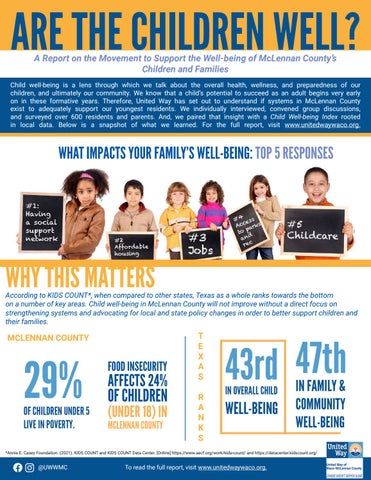
WHAT IMPACTS YOUR FAMILY’S WELL-BEING: TOP 5 RESPONSES
WHY THIS MATTERS
According to KIDS COUNT*, when compared to other states, Texas as a whole ranks towards the bottom on a number of key areas. Child well-being in McLennan County will not improve without a direct focus on strengthening systems and advocating for local and state policy changes in order to better support children and their families.
MCLENNAN COUNTY
T E X A S R A N K S
*Annie E. Casey Foundation. (2021). KIDS COUNT and KIDS COUNT Data Center. [Online] https://www.aecf.org/work/kids-count/ and https://datacenter.kidscount.org/
@UWWMC
To read the full report, visit www.unitedwaywaco.org.
KEY THEMES 1
EMBRACE AN APPROACH THAT VALUES THE WHOLE CHILD.
We must approach the issue in a two-generational way, inclusive of the whole child and their family, and also the variety of community and environmental factors that can lead to positive experience in a child’s life.
2
ENSURE ACCESS TO HIGH-QUALITY CHILDCARE AND EDUCATIONAL OPPORTUNITIES.
We heard about a range of issues including equitable access; hours of operation and affordability; the presence of quality learning opportunities and trained staff; and, cleanliness and safety. All of these factors must be included in our definition of high-quality childcare.
3
MEET THE BASIC NEEDS OF CHILDREN AND FAMILIES.
COVID-19 has shattered an already fragile foundation for families that can only be rebuilt by ensuring access to a livable wage, housing affordability, healthcare, and food insecurity.
4
INCREASE ACCESS TO RESOURCES.
Access means more than getting to a physical location; it also means making it easier for residents to learn about, enroll in, and engage with available resources and services, while also ensuring that no one is being left out, especially non-English speakers.
5
ADDRESS THE RACIAL AND SOCIOECONOMIC DIVIDE.
Differences abound depending on where you live in McLennan County. In our conversations, we found this to be a welldocumented and openly discussed fact.
6
1
ELEVATE AND ENGAGE OUR COMMUNITY MEMBERS.
We, as a community, will create an action plan that includes a shared vision, with unified goals and measures of success.
2
FOCUS EXPLICITLY ON EQUITY AND INTERSECTIONALITY.
We, as a community, will keep a clear focus on the impact of intersectionality of gender, race, and zip codes to improve our decisionmaking and make our investments more equitable and strategic moving forward.
3
EMPHASIZE A TWO-GENERATION APPROACH TO SUPPORT FAMILIES.
We, as a community, must address the needs of multiple generations and whole families as it relates to education, health, and financial stability.
CREATE MORE CONNECTEDNESS.
Parents want to live in a community that offers greater connection to a network of social supports and is conducive to their family’s safety and well-being.
7
CALL TO ACTION
TAKE ACTION.
No matter title, position, or location, people agree that it’s time for our community to move past the “let’s talk about it” phase and get started on the difficult work ahead of making impactful change for children and families.
4
BE INTENTIONAL ABOUT CROSSSECTOR COMMUNITY INVOLVEMENT.
We, as a community, need to create a more deliberate environment of public-private partnerships and interagency collaboration to achieve and sustain change.