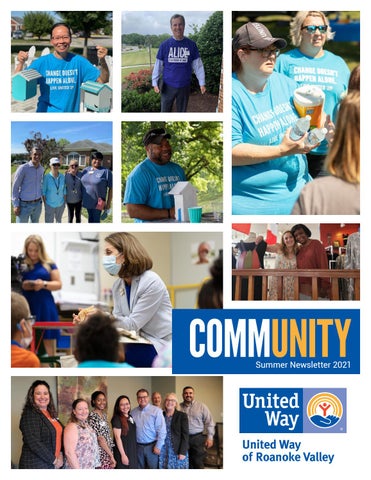
COMMUNITY Summer Newsletter 2021
Dear Friends, I continue to be in awe seeing so many neighbors and community partners step up and come together to support the Roanoke Valley through the pandemic and into recovery and resilience. Just in the last few months, volunteers worked alongside United Way and so many local organizations to help address food insecurity, equip support networks to address trauma, increase access to mental health services, facilitate equitable vaccine distribution, and strengthen pathways for economic recovery for families and businesses across the region. There are thousands of beautiful stories of hope, courage and resilience from the past year that have been made possible because of your support and partnership with United Way. These victories were bright spots during such a challenging year, and we are so grateful to all of you for that! Data from the COVID regional impact survey highlighted in this newsletter give us a real-time glimpse of what households in our area need, and where collective action is required. This knowledge is a powerful tool to inform planning, partnerships and future investments across our region. As we build on current collaboration and explore future opportunities, we are committed to seeing transformative alignment that maximizes resources, taps into the strengths and assets within our region, engages communities in solutions and focuses efforts to lift up families and our entire community towards healing, recovery and resilience for the long-term. This is the intention and action behind the challenge to LIVE UNITED. This is the kind of impact you can expect from our work together. Our staff and Board of Directors extend heartfelt thanks to the members of this caring community as we wrap up the fiscal year and begin the next. We made it through stronger despite the challenges, and we are energized and inspired by the possibilities knowing you will stand alongside us to face them. We look forward to making more life-changing opportunities happen in the coming year. United with you in service,
Abby Hamilton President and CEO
THE ECONOMIC IMPACT OF COVID-19 IN OUR REGION When COVID-19 hit, 44% of all households in the Roanoke Valley region were already struggling to make ends meet - a 10-year record high - setting the stage for the unprecedented impact of the pandemic. This includes households below the Federal Poverty Level (FPL) and households that are ALICE: Asset Limited, Income Constrained, Employed. With income above the poverty level, ALICE households earn too much to qualify as “poor” but still can’t cover the basics of housing, child care, food, transportation, health care and technology. In February 2021, United Way of Roanoke Valley collected a survey of 2,428 residents on the effects of COVID-19 on their households.
HOUSEHOLD CONCERNS DURING THE PANDEMIC Survey respondents were asked to select which of the following concerns their households were facing during the pandemic.
76%
49%
Contracting COVID-19
Mental Health Issues
26%
22%
18%
17%
7%
Paying Housing Expenses
Reduction of Hours/Wages
Having Enough Food
Loss of Jobs
Other
47%
27%
Child Care/Education Paying Off Debts
26% Non-COVID-19 Medical Issues
KEY FINDINGS When respondents were asked their biggest concern, worries about household members contracting COVID-19 remained the primary concern. But respondents below the ALICE threshold were significantly more likely than those above the ALICE threshold to say they were concerned about childcare, paying housing expenses and bills, and putting food on the table.
ABOVE ALICE THRESHOLD VS. BELOW ABOVE
BELOW
Child care/education
43%
54%
Paying household expenses
13%
50%
Paying off debts, car payments, credit cards
20%
40%
Providing enough food for the household
7%
39%
Reduction of hours/wages for those working
18%
32%
Medical issues other than COVID-19
23%
31%
Loss of one or more jobs
13%
26%
More than 40% of respondents with children said child care issues impacted household members’ ability to work during the pandemic. Of respondents with children under the age of 18 in the household, 82% said they have had concerns related to child care and education during the pandemic.
HOW PEOPLE COPED When asked what their household was doing to get by during the pandemic, about one-third of total respondents said they had taken money out of a savings account (31%), followed by the next most common action of increasing the balance on a credit card (23%). The figure below notes the top ten actions:
31%
23%
17%
14%
Took Money Out of Savings
Increased Credit Card Balance
Applied for Unemployment
Sold Belongings for Cash
14%
12%
10%
Found New Ways to Make Money
Borrowed from Family or Friends
Took Money Out of Retirement
10%
9%
8%
Received Food From Food Pantry/Food Bank
Applied For Government Assistance Program
Took Out A Personal Loan/Car Loan
Respondents below the ALICE threshold were significantly more likely than respondents above the ALICE Threshold to say they had taken money out of savings (42% vs. 24%), increased a credit card balance (30% vs. 18%), applied for unemployment (26% vs. 11%) borrowed from family/friends (24% vs. 5%), sold belongings for cash (23% vs. 9%), received food from a food bank (22% vs. 1%), or found a new way to make money (19% vs. 10%).
“The unexpected child care cost is really hard on our family. The choice we have to make is to not save. This will impact our future… it is a slippery slope to not being financially secure all due to unexpected childcare costs.”
HOW UNITED WAY HELPS: UWRV mobilized its nationally-recognized, innovative Smart2Start childcare enrollment system during the pandemic to help parents secure access to childcare, after school support and virtual learning opportunities, making it easier for families to continue working. UWRV utilized ALICE data to successfully advocate for state-level policy changes to expand eligibility to childcare subsidies and supported childcare providers to help them safely and consistently serve local families.
Nearly half of respondents said mental health issues were their biggest concern.
Of those respondents falling below the ALICE threshold, 44% were concerned about providing enough food for the household. Also for households with children, a significant trend emerged about housing issues, providing enough food, and concerns about paying off debts, as shown in the table below. In each case, the largest differences were between households with children above and below the ALICE threshold.
HOUSEHOLDS
PAYING HOUSING PROVIDING ENOUGH FOOD PAYING OFF FOR THE HOUSEHOLD DEBTS EXPENSES
With Children, Below ALICE Threshold
52%
44%
42%
With Children, All
31%
23%
30%
Without Children, All
18%
9%
22%
With Children, Above ALICE Threshold
13%
7%
21%
HOW UNITED WAY HELPS:
UWRV’s ALICE data is helping to inform the expansion of eligibility for resources made available through the CARES Act and the new American Rescue Plan Act (ARPA). These acts help accommodate the growing number of families in need of rental assistance, transportation, stimulus payments, job training, and educational and legal assistance. Several community feeding programs were supported such as “Take Out Hunger,” which used donations from businesses and individuals to support local restaurants providing food to people in need.
“Every time I’ve applied to receive help from the government, like food stamps, heating help, Medicaid, etc. I was told I “made too much.” Even though I lost my job due to COVID, I didn’t receive the extra unemployment that everyone else received, and when I got a new job, I took a huge pay cut. There’s no way I made/make “too much” to receive help. My family and I are struggling.”
Of the 707 respondents who reported using a resource, the most-used resources were mental health services and supports such as counseling, peer support, or helplines, which were used by 65% of respondents. Respondents who live with someone in the household who had a serious health issue or disability were particularly worried about mental health issues like depression or anxiety (53%).
HOW UNITED WAY HELPS: Streamlining and expanding access to mental health and substance abuse services is a continuing regional priority. UWRV has partnered with several agencies, including Family Service of Roanoke Valley, to support direct patient care. Our Healthy Roanoke Valley initiative created a public service campaign offering connections to organizations and self-care practices to help those suffering with depression, anxiety and addiction.
Of those looking for work, nearly half reported being unable to find a job that provides a sufficient income. Participants were asked how the pandemic had impacted employment for household members since March 1, 2020. The majority of respondents (59%) said employment hadn’t changed for any household members in that period, however, those below the ALICE Threshold were significantly more likely to say that someone in their household lost a job during the pandemic (24% vs 9%), was temporarily laid off (19% vs 9%), or got an additional job (15% vs 10%).
HOW UNITED WAY HELPS: UWRV is working closely with groups like TAP - OnRamp, Western Virginia Workforce Development Board and Roanoke Regional Partnership to support recruitment, retention, job training and certifications in high-demand industries to create pathways to self-sufficiency.
Each year, Day of Action invites volunteers from all over the community to rally together around important issues. This June, as part of a grassroots movement to engage people in fighting food insecurities, volunteers have built, installed and stocked 5 Little Free Pantries. The pantries were installed at the following locations: • Boys and Girls Club • Morningside Farms • Glade Hill Rescue Squad • George Washington Carver Garden • Hustle Haven Little Free Pantries are not a solution to food insecurity or food deserts, but they do provide easy, anonymous access to food and basic need products. In another Day of Action project, volunteers painted and installed birdhouses* at two senior living facilities, Richfield Living and South Roanoke Nursing & Rehabilitation, as part of an effort to bring joy to older residents. Feeding and watching colorful, active birds can be especially calming for seniors, offering connection with the outside world. *Birdhouse have been temporarily removed per guidance from the Southwest Virginia Wildlife Center, as a bird illness is being investigated in several states.
A SPECIAL THANKS TO THESE SPONSORS & PARTNERS REGIONAL COVID-19 SURVEY PARTNERS • Alleghany County • Alpha Kappa Alpha Sorority, Inc. • Beta Chi Omega Chapter • Botetourt County Public Schools • Botetourt County Social Services • Carilion Clinic • City of Roanoke • City of Roanoke Department of Social Services • Community Foundation Serving Southwest Virginia • Craig County Public Schools • FarmBurguesa • Feeding Southwest Virginia • Franklin County • Franklin County Department of Social Services • Franklin County Public Schools • Goodwill Industries of the Valleys • Junior League of Roanoke Valley • Latinas Network – Roanoke and New River Valley • Macaroni Kid Roanoke • Marsh & McLennan • New Horizons Healthcare
• Nuestro Comercio Latino Roanoke • RGC Resources, Inc./Roanoke Gas Company • Roanoke City Public Schools • Roanoke County • Roanoke County – Salem Department of Social Services • Roanoke County Public Schools • Roanoke Regional Chamber of Commerce • Roanoke Regional Partnership • Roanoke Valley-Alleghany Regional Commission • Salem City Public Schools • Salem-Roanoke County Chamber of Commerce • Sisters of Change • Total Action for Progress • Town of Vinton • Virginia Department of Health – Roanoke City and Alleghany Health Districts • Western Virginia Workforce Development Board/ VA Career Works – Blue Ridge Region • Western Virginia Water Authority
REGIONAL COVID-19 SURVEY SPONSORS We are grateful to our sponsors, Marsh & McLennan Agency, Virginia Career Works, and FarmBurguesa.
DAY OF ACTION 2021 PARTNERS & SPONSORS Thank you to these generous Day of Action 2021 Sponsors: • Boys and Girls Club • Carilion Morningside Gardens • Creekside Deli • Franklin News-Post • George Washington Carver Garden • Glade Hill Fire Department • Home Depot • Hustle Haven • Kroger
• Lionberger Construction • Lowes • Richfield Living • Rotary Club of Rocky Mount • Sheetz • South Roanoke Nursing & Rehabilitation • Utz • Western Virginia Water Authority
HELLO my name is I am a hard worker. I live paycheck to paycheck. I struggle to make ends meet. I make tough choices daily. I am ALICE. Learn how COVID-19 impacted me.
325 Campbell Avenue, S.W. Roanoke, VA 24016 540.777.4200
THANK YOU FOR YOUR CONTINUED SUPPORT AND LIVING UNITED!