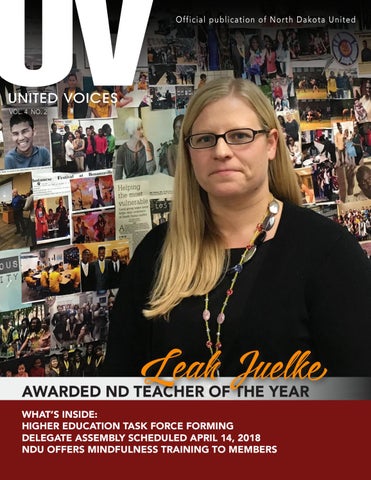
Leah Juelke AWARDED ND TEACHER OF THE YEAR WHAT’S INSIDE: HIGHER EDUCATION TASK FORCE FORMING DELEGATE ASSEMBLY SCHEDULED APRIL 14, 2018 NDU OFFERS MINDFULNESS TRAINING TO MEMBERS ndunited.org
1
G
N
R
E
BL I C EDUC AT I
O
T A
PU
R
E
IC
E
G A
T
PU
E BLIC S
R
3 4
V
8 16
DECEMBER 2017 United Voices is the official publication of North Dakota United, 301 N 4th Street, Bismarck, ND 58501. Contact Us 701.223.0450 comments@ndunited.org Postmaster, send address changes to: North Dakota United 301 N 4th Street Bismarck, ND 58501 Kelly Hagen Director of Communications Tom Gerhardt Director of Public Affairs Image Printing Design/Publisher
2
18 20 26
PRESIDENT’S POST
As I write this, the Senate is poised to pass a disgraceful tax reform bill that is horrible for higher education, horrible for public employees, horrible for K-12 teachers, and horrible for the entire middle class of North Dakota.
AT THE CUTTING ED OF INNOVATION
North Dakota United has entered exciting, new territory in digital audio recently, with the launch of our new podcast, called “The Cutting Ed: What North Dakota Schools Can Be.”
LEAH JUELKE AWARDED ND TEACHER OF THE YEAR
For the 2018 North Dakota Teacher of the Year, Leah Juelke, an English Learner language arts teacher at Fargo South High School, the education she has learned from her travels across the globe, are the same lessons she can now give to her students, who come to her classroom from points all around the planet.
HIGHER ED TASK FORCE FORMING
On Tuesday, Nov. 7, 2017, Gov. Doug Burgum made an important announcement about the future of higher education in North Dakota, at a press conference in the Memorial Hall of the state Capitol. He was signing an executive order that day, to set up a task force for assessment of the existing governance structure in North Dakota’s system of higher education, and to “determine if changes are needed to ensure the system meets the state’s educational and workforce needs in the 21st century.”
GOLD STAR LEADER
To accomplish at such a high level, the NDSU Bison need the right kind of soundtrack. Only one band can lead the green and the gold onto the field of battle. The band is the Gold Star Marching Band, also known as “The Pride of North Dakota.” And only one person could lead a band of such stature. He is Dr. Sigurd Johnson, the director of athletic bands for NDSU, professor of percussion and North Dakota United member.
THE IMPORTANCE OF A LIBERAL ARTS EDUCATION
I discovered the arts and humanities during my childhood, although at the time I was not able to use those terms to describe these creative and insightful experiences. I had a childhood of adversity, and the arts and humanities were key to my “survival” and successful launch into adulthood.
ACHIEVING MINDFULNESS
Members of North Dakota United, the union of 11,500 public educators and employees statewide, are talking about the increased anxiety they are feeling, and are looking for assistance. Some level of relief is available to our members across the state, we are happy to report. NDU has partnered with Heidi Demars of Mindful You, Mindful Me, to present seminars on mindfulness in cities across North Dakota.
ND United Voices
President’s Post
WE RISE TO THE CHALLENGE
NDU members will not falter in the face of coming threats The trouble with writing a column for a print magazine like United Voices is that our world moves so fast that what I write today may not be as relevant when it is finally read. So, as I write this on Dec. 1, 2017, the Senate is poised to pass a disgraceful tax reform bill that is horrible for higher education, horrible for public employees, horrible for K-12 teachers, and horrible for the entire middle class of North Dakota.
By Nick Archuleta NDU President
“
We work together, we help each other, we care about
our neighbors and our communities, and we don’t quit!”
I could spend the bulk of this article telling you how wrong it is to tax graduate students; how wrong it is to disallow the state and local tax (SALT) deduction that so many middle income Americans utilize; how wrong it is to eliminate the $250 tax deduction for teachers who spend their own money on classroom supplies; how wrong it is to deny healthcare to 13 million Americans; and how wrong it is to ensure that by 2027, families making $40,000 to $50,000 will be paying a combined $5.3 billion more in taxes, while the those making more than $1 million will pay $5.8 billion less. And I could tell you how wrong it is that this all is happening faster than the “regular order,” for what is supposed to be our nation’s most deliberate body. It is happening without one Senate hearing, without one expert testifying and without anyone actually reading the entire bill. But, as I’ve said, this will all be old news by the time you read it. What will not be old news is that every constituency group in our ND United family will face serious challenges in the months ahead. Some will be external challenges, and some will be internal challenges. As I see it, the most prominent external challenges will be: • A negative ruling in the Janus v. AFSCME case in the Supreme Court. The expected ruling in Janus will be a serious setback for public sector unions, and undermine the strength of working people here and across the country. • A legislative session in 2019 that likely will include attacks on our ability to negotiate contracts. • A legislative session in 2019 that, unless there is an unforeseen and significant improvement in revenues, will feature more cuts to vital services and the employees that provide them. • An election in 2018 that will have serious consequences for all of us if we don’t elect champions of public education and public service. In my view, our most significant internal challenges are related to the external challenges: • Pivoting from identifying the challenges in our locals and chapters to realizing the solutions to those challenges. • Building the capacity to organize and take action in our locals and chapters; • Developing the next generation of leaders in our locals and increasing our member activism. • Growing ND United in both numbers and influence. To solve these challenges, we are going to need your help and we are going to have to work together. To that end, right after the first of the year, NDU Executive Director Chad Oban, select staff and I will be hosting a series of meetings on our 2018 Listening Tour across the state. I fully expect to hear your thoughts on the challenges I’ve outlined above as well as on a variety of matters you bring to the table. From you we want to collect as much data as possible. This information will help to form our collective vision and inform our actions on your behalf. We have already let the local and chapter leaders know when we will be in their communities, and we will announce the Listening Tour schedule soon after the holidays, once we’ve arranged for all the venues, so please watch for it on our website, www.ndunited.org! A wise person once said that if we don’t rise together, we will fall apart. Well, we are not going to fall apart, not as long as we remain committed to the principles that have made our organization strong. We work together, we help each other, we care about our neighbors and our communities, and we don’t quit!
ndunited.org
YOU are NDU, and I wish you all a very happy holiday season!
3
AT THE CUTTING ED OF INNOVATION
ND United excited to announce the launch of our education-focused podcast By Tom Gerhardt, tom.gerhardt@ndunited.org
North Dakota United has entered exciting, new territory in digital audio recently, with the launch of our new podcast, called “The Cutting Ed: What North Dakota Schools Can Be.” Two months ago, the idea wasn’t even on our radar. But thanks to the vision and passion of innovative education specialist Ted Dintersmith and a partnership with the North Dakota Department of Public Instruction and Prairie Public Education Services, several episodes are already available for you to listen to on our website at www.ndunited.org/thecuttinged. What is The Cutting Ed? It’s a weekly podcast designed for teachers, decision makers, students and parents to help spark conversations about innovative education in North Dakota including K-12 and higher ed. New episodes will be posted every Tuesday. Dintersmith first came to North Dakota two years ago to promote his awardwinning documentary, “Most Likely to Succeed.” He’s traveled to all 50 states, but says he was blown away by North Dakota’s commitment to education. This fall, he brought up the idea of collaborating on a podcast to help spread the word on all of the extraordinary things happening in our state. “I’ve now been to North Dakota eight times in a little over two years,” he said. “Each time, I am inspired by the strength of your teaching force, the vision of your leaders, and your ability to work collaboratively to achieve big things. I’m sensing a real opportunity here to make North Dakota’s education system the very best in the world, for the sake of your children but also to show the way forward for others across our country.” The Cutting Ed debuted Nov. 21, 2017, with Gov. Doug Burgum as the first guest. Future conversations will focus on celebrating great teaching practices, interesting 4
ND United Voices
innovations and diving into an innovation playlist (www. ndplaylist.org) that Dintersmith has pulled together with impressive national partners to support our teaching force. Listeners will hear one-to-one conversations with our skilled educators, K-12 teachers, professors, school support staff, administrators, business people, elected officials, parents and students. “This is a terrific example of what collaboration around and dedication to innovative teaching can be,” said Nick Archuleta, president of North Dakota United. “Special thanks to filmmaker and visionary Ted Dintersmith for providing the inspiration and resources to make this podcast possible. Thanks, too, to Superintendent Kirsten Baesler for her leadership at the Department of Public Instruction and promotion of innovative teaching. In addition, thanks to Tom Gerhardt and Kelly Hagen in the NDU communications shop for their exceptional efforts in taking this podcast off the drawing board and making it a reality. All of us at NDU hope you enjoy The Cutting Ed.”
for North Dakota. Visit us online at www.ndunited.org/ thecuttinged. You can contact us any time with your story ideas at comments@ndunited.org. We want to tell your stories, about who you are and the valuable work you do on behalf of students every day. If you’re doing innovative things on the cutting edge in your classroom, in pre-K, K-12 schools or higher education, let us know! Our podcast can come to you, and we will record our conversation in your community, at your school or worksite. You can find The Cutting Ed on social media, too. Visit us on Facebook at www.facebook.com/thecuttinged, and on Twitter at www.twitter.com/thecuttinged. The Cutting Ed is available for streaming and download on iTunes, at SoundCloud.com/ndunited, NDUnited.tumblr. com, Google Play or wherever you listen to your favorite podcasts. Just search for “The Cutting Ed,” and we hope you enjoy the conversation.
I will serve as moderator and host of the podcast, every week. After over two decades in front of a camera in TV news, podcasts are a great medium to produce authentic conversations. We know your time is valuable, so we plan to keep the podcasts to under 20 minutes. Listen on your way to work and on the way home. “America faces a daunting challenge of transforming its education system to prepare our children for a dynamic, innovative world. It’s a time when we need real leadership in taking on this mission, and I’m convinced that North Dakotans are ready to work collectively to lead the way,” Dintersmith said. Please join the conversation online and – as Dintersmith compels us – to work collectively to build a brighter future ndunited.org
5
AT THE CUTTING ED OF INNOVATION
ND United excited to announce the launch of our education-focused podcast By Tom Gerhardt, tom.gerhardt@ndunited.org
North Dakota United has entered exciting, new territory in digital audio recently, with the launch of our new podcast, called “The Cutting Ed: What North Dakota Schools Can Be.” Two months ago, the idea wasn’t even on our radar. But thanks to the vision and passion of innovative education specialist Ted Dintersmith and a partnership with the North Dakota Department of Public Instruction and Prairie Public Education Services, several episodes are already available for you to listen to on our website at www.ndunited.org/thecuttinged. What is The Cutting Ed? It’s a weekly podcast designed for teachers, decision makers, students and parents to help spark conversations about innovative education in North Dakota including K-12 and higher ed. New episodes will be posted every Tuesday. Dintersmith first came to North Dakota two years ago to promote his awardwinning documentary, “Most Likely to Succeed.” He’s traveled to all 50 states, but says he was blown away by North Dakota’s commitment to education. This fall, he brought up the idea of collaborating on a podcast to help spread the word on all of the extraordinary things happening in our state. “I’ve now been to North Dakota eight times in a little over two years,” he said. “Each time, I am inspired by the strength of your teaching force, the vision of your leaders, and your ability to work collaboratively to achieve big things. I’m sensing a real opportunity here to make North Dakota’s education system the very best in the world, for the sake of your children but also to show the way forward for others across our country.” The Cutting Ed debuted Nov. 21, 2017, with Gov. Doug Burgum as the first guest. Future conversations will focus on celebrating great teaching practices, interesting 4
ND United Voices
innovations and diving into an innovation playlist (www. ndplaylist.org) that Dintersmith has pulled together with impressive national partners to support our teaching force. Listeners will hear one-to-one conversations with our skilled educators, K-12 teachers, professors, school support staff, administrators, business people, elected officials, parents and students. “This is a terrific example of what collaboration around and dedication to innovative teaching can be,” said Nick Archuleta, president of North Dakota United. “Special thanks to filmmaker and visionary Ted Dintersmith for providing the inspiration and resources to make this podcast possible. Thanks, too, to Superintendent Kirsten Baesler for her leadership at the Department of Public Instruction and promotion of innovative teaching. In addition, thanks to Tom Gerhardt and Kelly Hagen in the NDU communications shop for their exceptional efforts in taking this podcast off the drawing board and making it a reality. All of us at NDU hope you enjoy The Cutting Ed.”
for North Dakota. Visit us online at www.ndunited.org/ thecuttinged. You can contact us any time with your story ideas at comments@ndunited.org. We want to tell your stories, about who you are and the valuable work you do on behalf of students every day. If you’re doing innovative things on the cutting edge in your classroom, in pre-K, K-12 schools or higher education, let us know! Our podcast can come to you, and we will record our conversation in your community, at your school or worksite. You can find The Cutting Ed on social media, too. Visit us on Facebook at www.facebook.com/thecuttinged, and on Twitter at www.twitter.com/thecuttinged. The Cutting Ed is available for streaming and download on iTunes, at SoundCloud.com/ndunited, NDUnited.tumblr. com, Google Play or wherever you listen to your favorite podcasts. Just search for “The Cutting Ed,” and we hope you enjoy the conversation.
I will serve as moderator and host of the podcast, every week. After over two decades in front of a camera in TV news, podcasts are a great medium to produce authentic conversations. We know your time is valuable, so we plan to keep the podcasts to under 20 minutes. Listen on your way to work and on the way home. “America faces a daunting challenge of transforming its education system to prepare our children for a dynamic, innovative world. It’s a time when we need real leadership in taking on this mission, and I’m convinced that North Dakotans are ready to work collectively to lead the way,” Dintersmith said. Please join the conversation online and – as Dintersmith compels us – to work collectively to build a brighter future ndunited.org
5
Education Perspectives
PROTECT TEACHER TAX DEDUCTION
$250 is a drop in the bucket of how much educators really spend
Scrolling through Facebook, I came across an advertisement for this outfit. AH HA! This is the reason teachers spend their time and money in their classrooms! It is all about the students! Really, this is not news to educators.
By Karen Christensen Vice President of Education
“
An investment in knowledge pays the best interest.” Benjamin Franklin
Each year as I review my class list, I consider the needs of my incoming students. What does my classroom need to meet their needs? How do I accommodate their learning styles and personalities? With all the considerations of the new class in mind, my shopping list is developed. It may include pencils, crayons, pens, highlighters, notebooks, planners, stools for reading centers and supplies for art projects. The need for the students outweighs the thought of personal expense. My students need me to be prepared, organized and have a learning environment ready to meet their every need. The final price tag ranges between $200 to $400 by the time the year is complete. After visiting with several members of our staff, I was unable to find one colleague that didn’t dig into their personal budget to fund their classroom. It disappoints me to learn that the small deduction I can use at tax time may be dissolved with the new tax bill. $250 doesn’t seem like a large amount at face value, but educators are already struggling to meet personal obligations, with salaries lagging behind other professions. Educators understand tight budgets, but most do not believe budget shortfalls should be solved at the expense of the students. Educators are actively involved in fundraisers, classroom support projects and creative activities to give students the resources they need to receive the best education that can possibly be provided. Box Top Coordinators, GoFundMe pages and personal classroom projects consume the time of educators to provide supplies and materials for a productive classroom. Communities show their support by getting involved in the local projects. Educator frustration is exemplified when our lawmakers vote to cut the small benefits, like the tax deduction. This is not a show of support for education. Our members of Congress need to understand the commitment that educators have for their students. It is not too late to drop an email, letter or call to our congressional delegation to tell your story. Go to http://bit.ly/NDUtaxcutmath to send a note directly to our congressional delegation. Their message is not positive. The decision to eliminate the deduction degrades the profession.
6
ND United Voices
TAX CUTS WILL LESSEN PUBLIC SERVICES
Public Service Perspectives
Public employees, educators will be stung by bills in Congress
It’s a fact that most Americans, including most North Dakotans, dislike paying taxes. But without tax revenue, quality public services and public education cannot be provided. Over the past couple of months, Congress has been working on tax-reform bills that Republicans say will reduce the taxes of the middle class, and Democrats say are a giant giveaway to the richest 1 percent of individuals and corporations. I’ve been studying bills and analyzing my own situation to see what the effects will be for me and my family. Will I be a winner or loser? How will it affect public services? The sausage-making in Congress is continuing, but what we know so far is that, in the House and Senate bills, the standard deduction is nearly being doubled for single and married filers, while at the same time eliminating the personal exemption of $4,050 that is allowed for each person being claimed on the federal return. The losers are families with three or more children, since the exemptions they are losing are greater than the doubling of the standard deduction that is being proposed. If you are someone who usually itemizes your deductions instead of claiming the standard deduction, there are many changes that will limit your deductions. An example of the deductions being eliminated are medical expenses, state and local income taxes, student loan interest, the $250 deduction for teachers who buy supplies for use in the their classroom, and union dues, to name a few. It’s been estimated that for those who itemize their federal taxes, they will see an increase of $6,000. The Institute on Taxation and Economic Policy estimates that under the tax reform plan, middle class families in North Dakota on average for 2018 will see the following federal tax increases: • 4 percent of households would see a $1,130 increase. • 6 percent of households making $43,900 to $75,600 would see an increase of $400. • 2 percent of households making $75,600 to $113,100 would see an increase of $840. When looking at changes to the tax code, the devil is in the details and that is where we learn about the winners and losers of the changes being considered. To pay for the changes to the tax code, the bill significantly reduces the funding for Medicaid, Medicare, education and food stamps over the next 10 years and puts financial assistance to college students, including Pell Grants and other financial aid, at risk.
By Gary Feist Vice President of Public Employees
“
It’s time to become politically active. Write or call our North Dakota congressional delegation and let them know the tax reform package is unacceptable.”
North Dakota gets 18 percent of its general revenues from the federal government, so if the state is getting less federal money, the North Dakota Legislature will be tasked with balancing the state’s budget by increasing taxes or making further cuts to K-12 education, higher education and state services. Based on prior history, it’s unlikely taxes will be increased. I believe most of us are losers under the current tax reform proposal. Even if we get a small reduction in our federal income taxes that we pay, we will be seeing a reduction in resources needed to recruit and retain quality employees, providing great education and public services to the citizens of North Dakota each and every day. It’s time to become politically active. Write or call our North Dakota congressional delegation and let them know the tax reform package is unacceptable. Work on political campaigns that will elect candidates that support education, public services and working families. Have you had enough of losing? Get involved and be active! ndunited.org
7
She did her first year at North Dakota State University as a nursing major, and then joined the Army. “I took a semester off and went into the Minnesota Army National Guard,” she said. Juelke’s unit eventually got called up to go overseas, and she stayed back stateside, and started training new recruits on CPR and medical practices. She realized that she loved teaching the soldiers that were coming in. “It was very clear at that moment,” she said. “I love the medical part of the Army, but I love the teaching more.” She continued school and received her bachelor’s degree in English Education and ELL from NDSU, as well as a master’s degree in Curriculum and Instruction. After college, she went out to see the world. Starting as an instructor at a boarding school in Taiwan, she also taught in Ecuador, and traveled to China, Costa Rica, Oxford, England, and across Europe. “After teaching in other countries, it really put me in a place where I had to figure things out for myself,” she said. “I was new to their culture, wherever I was. I went through language issues, where I couldn’t explain what I wanted to the person at the bank, and I had to use my little book or rely on someone else. I think that really helps me as a teacher, teaching the population I teach, to empathize with them and understand where they’re coming from when certain situations happen.”
Leah Juelke AWARDED ND TEACHER OF THE YEAR
Fargo South ELL educator inspires her immigrant students, helps them to tell their stories By Kelly Hagen, kelly.hagen@ndunited.org
For the 2018 North Dakota Teacher of the Year, Leah Juelke, an English Learner Language Arts teacher at Fargo South High School, the education she has learned from her travels across the globe, are the lessons she can now give to her students, who come to her classroom from points all around the planet. “One of the things I do on the first day of school is we have a teambuilding exercise,” Juelke said. “We go outside, and we do relay races. I tie their feet together, and they do races together with their partners. And one of the first things I ask the students on that day is: What’s the first thing you’re going to bring to class? They’ll say, ‘A pencil!’ and I say, ‘Yes. Please bring a pencil. But that’s not it. The first thing you’re going to bring is a positive attitude and respect, … And that has made such a difference, because they know that this classroom is kind of like a family. And we work together.” Juelke was chosen for this year’s honor from a list of five finalists, which included: Sandra Evenson, a sixth-grade science teacher at Cheney Middle School in West Fargo; Heather Tomlin-Rohr, a kindergarten teacher from Louis L’Amour Elementary School in
8
Jamestown; Lynae Holmen, a special-needs teacher at Longfellow Elementary in Minot; and Thomas Klapp, a science teacher from Northern Cass High School in Hunter. Juelke was presented with the Teacher of the Year award on Sept. 28 by Gov. Doug Burgum and Superintendent Kirsten Baesler at a special ceremony at Fargo South and attended by all five finalists. All five finalists for Teacher of the Year are members of North Dakota United. For Juelke, receiving this award at Fargo South was especially personal as it’s where she grew up, having graduated there in 2001. She knew then that she wanted to pursue a career in assisting people, but initially she thought that path would be through nursing. “My mom was an art teacher, and in the back of my head I was always thinking it would be fun to be a teacher,” Juelke said. “The helpingpeople aspect was always there, but I was focused on nursing because I’d been a CNA during high school and a little bit during college. And I thought that was where it would take me.”
ND United Voices
In her time as an EL instructor at Fargo South, she has implemented a great deal of innovative projects and practices, including helping to coordinate the EL curriculum across disciplines, so that the students can fast-track their English skills. “So, in science, they will be doing prepositions at the same time that I’m doing prepositions in my English class,” she said. “Social studies and math will be doing the same.” Also, for the past three years, Juelke has put together anthologies of narratives, written by her students, about their journeys to America. “The first year I did it, it was just an assignment in class,” she said. “After I read them, I just kept thinking, wow, other people have to read these. I kept sharing them with the other EL teachers. And then I started thinking, why can’t we produce something?” She launched her “Journey to America” narrative writing project during the 2014–15 school year, and received a grant in 2015, and every year since, that allowed her to publish hard copies of the stories as well as bring in John Bul Dau, a Lost Boy of Sudan, to Fargo South to speak in front of the entire school and help her students in crafting their narratives. “He started telling the students, don’t be ashamed about your story,” Juelke said. “Don’t be shy. Look at me. I drank urine and I am now a CEO of my own company. I’m not embarrassed to tell my own story.” Juelke also partnered with the surrounding universities in Fargo and Moorhead to bring in college students to help the students with the technical writing during the project. At the end of the project, students celebrate with a public reading of the stories at NDSU. A pair of narratives from two sisters were the impetus of one of the most remarkable transformations that Juelke has ever seen in her students. “It was two sisters who wrote about how they were running away from their village, and they turned around and their dad wasn’t there,” Juelke said. “He had been shot, and they ran back to him. The rebels had poured gasoline on him and lit him on fire, right in front of his 8- and 9-year-old daughters. “One of the girls, Aline, she ended up going to Bismarck and she testified against that refugee bill they had last year (in the Legislature). She went there, and she told them how she was going to be a productive member of society, and she told them, ‘This is my story, and you cannot say that refugees are not going to be productive and good.’”
ndunited.org
Aline and Esperance wrote their narratives of their family’s story in “Journey to America.” Esperance also had her story featured in “Green Card Youth Voices: Immigration Stories from a Fargo High School.” “I connected with the director of the organization, Green Card Voices, in the summer of 2016,” Juelke said. “The organization came to South in the fall and interviewed 31 Fargo South EL students, of varying English levels. I helped to transcribe the interviews, and by the spring, the stories were published in this book. Along with a traveling exhibit and online interviews, the book is now used as curriculum around the U.S., and at local Fargo-Moorhead universities and high schools, to help teach about diversity. The students are now doing book readings around North Dakota.” All of these students’ accounts of traveling to Fargo, and the adversity they had to overcome to get there, will both warm and break your heart. Esperance’s story is particularly harrowing. “They were calling to the people in the camp to come out so that they could shoot them,” she said. “So many people were burned alive that day, including my father, who one of the killers took and burned after he saw us going towards him. … After debating with one of his friends, one of the killers decided to let us live, since they thought that we couldn’t get far in life because both of our parents were dead.” Juelke says that the sisters’ stories have affected her, as a teacher and as a person. “Every time I hear their stories, tears still fill my eyes,” she said. This past summer, the two sisters sent Juelke an invitation to a memorial service for their father. “I was the only non-African there, and it was 100 people from all over the state that knew them. I talked to Aline afterwards, and I asked, ‘Why now? It’s been nine years since your dad passed away.’ And she said, ‘It’s because of you. Before we wrote the story, before we talked about it in class, we never talked about my dad. Every time I read it, I feel better. Sometimes I cry, but I feel better.’ That’s a teacher moment where I felt like I made an impact.” Winning these awards for Teacher of the Year from Fargo Public Schools and the state of North Dakota would be enough to fill anyone’s resume, but Juelke has accomplished a lot during a relatively short teaching career. She was also named the Communications, Speech and Theater of North Dakota (CSTAND) Debate Coach of the Year in 2017, and their Outstanding Teacher of the Year. “I love coaching debate and student congress,” she said. “It is great to see the amazing young talent that we have all over the state of North Dakota. My students continue to make me proud every tournament, with their hard work and dedication.” Her students admire her as much as she does them. “I’m glad that I have Ms. Juelke,” said Lucia Rushikana, a senior. “Whenever you need help with anything, you can just go to her and tell her all your problems.” “Ms. Juelke is the best of the best teachers I’ve ever had,” said Therese Lusamba, a junior. “She’s like a mother to us!” said Diane Mutumukeye, a senior. “We respect her, we love her. … She’s the best.” Two students who are working on writing their own narratives of their journeys to America in Juelke’s class this year, wanted to express their gratitude to her for helping them to bring out their stories. “She helps us to make the story easier,” said Narayan Sanyasi, a junior. “She asks us the things we need to do, and tells us to just write one page today, and another page tomorrow ...” “It’s kind of really hard to think back then and write about all of it,” admits Muqsin Hussein, a senior. “But she helps us out. She can ask us the questions, and helps put it together so it makes sense. She’s a really great teacher. Teacher of the year!”
9
She did her first year at North Dakota State University as a nursing major, and then joined the Army. “I took a semester off and went into the Minnesota Army National Guard,” she said. Juelke’s unit eventually got called up to go overseas, and she stayed back stateside, and started training new recruits on CPR and medical practices. She realized that she loved teaching the soldiers that were coming in. “It was very clear at that moment,” she said. “I love the medical part of the Army, but I love the teaching more.” She continued school and received her bachelor’s degree in English Education and ELL from NDSU, as well as a master’s degree in Curriculum and Instruction. After college, she went out to see the world. Starting as an instructor at a boarding school in Taiwan, she also taught in Ecuador, and traveled to China, Costa Rica, Oxford, England, and across Europe. “After teaching in other countries, it really put me in a place where I had to figure things out for myself,” she said. “I was new to their culture, wherever I was. I went through language issues, where I couldn’t explain what I wanted to the person at the bank, and I had to use my little book or rely on someone else. I think that really helps me as a teacher, teaching the population I teach, to empathize with them and understand where they’re coming from when certain situations happen.”
Leah Juelke AWARDED ND TEACHER OF THE YEAR
Fargo South ELL educator inspires her immigrant students, helps them to tell their stories By Kelly Hagen, kelly.hagen@ndunited.org
For the 2018 North Dakota Teacher of the Year, Leah Juelke, an English Learner Language Arts teacher at Fargo South High School, the education she has learned from her travels across the globe, are the lessons she can now give to her students, who come to her classroom from points all around the planet. “One of the things I do on the first day of school is we have a teambuilding exercise,” Juelke said. “We go outside, and we do relay races. I tie their feet together, and they do races together with their partners. And one of the first things I ask the students on that day is: What’s the first thing you’re going to bring to class? They’ll say, ‘A pencil!’ and I say, ‘Yes. Please bring a pencil. But that’s not it. The first thing you’re going to bring is a positive attitude and respect, … And that has made such a difference, because they know that this classroom is kind of like a family. And we work together.” Juelke was chosen for this year’s honor from a list of five finalists, which included: Sandra Evenson, a sixth-grade science teacher at Cheney Middle School in West Fargo; Heather Tomlin-Rohr, a kindergarten teacher from Louis L’Amour Elementary School in
8
Jamestown; Lynae Holmen, a special-needs teacher at Longfellow Elementary in Minot; and Thomas Klapp, a science teacher from Northern Cass High School in Hunter. Juelke was presented with the Teacher of the Year award on Sept. 28 by Gov. Doug Burgum and Superintendent Kirsten Baesler at a special ceremony at Fargo South and attended by all five finalists. All five finalists for Teacher of the Year are members of North Dakota United. For Juelke, receiving this award at Fargo South was especially personal as it’s where she grew up, having graduated there in 2001. She knew then that she wanted to pursue a career in assisting people, but initially she thought that path would be through nursing. “My mom was an art teacher, and in the back of my head I was always thinking it would be fun to be a teacher,” Juelke said. “The helpingpeople aspect was always there, but I was focused on nursing because I’d been a CNA during high school and a little bit during college. And I thought that was where it would take me.”
ND United Voices
In her time as an EL instructor at Fargo South, she has implemented a great deal of innovative projects and practices, including helping to coordinate the EL curriculum across disciplines, so that the students can fast-track their English skills. “So, in science, they will be doing prepositions at the same time that I’m doing prepositions in my English class,” she said. “Social studies and math will be doing the same.” Also, for the past three years, Juelke has put together anthologies of narratives, written by her students, about their journeys to America. “The first year I did it, it was just an assignment in class,” she said. “After I read them, I just kept thinking, wow, other people have to read these. I kept sharing them with the other EL teachers. And then I started thinking, why can’t we produce something?” She launched her “Journey to America” narrative writing project during the 2014–15 school year, and received a grant in 2015, and every year since, that allowed her to publish hard copies of the stories as well as bring in John Bul Dau, a Lost Boy of Sudan, to Fargo South to speak in front of the entire school and help her students in crafting their narratives. “He started telling the students, don’t be ashamed about your story,” Juelke said. “Don’t be shy. Look at me. I drank urine and I am now a CEO of my own company. I’m not embarrassed to tell my own story.” Juelke also partnered with the surrounding universities in Fargo and Moorhead to bring in college students to help the students with the technical writing during the project. At the end of the project, students celebrate with a public reading of the stories at NDSU. A pair of narratives from two sisters were the impetus of one of the most remarkable transformations that Juelke has ever seen in her students. “It was two sisters who wrote about how they were running away from their village, and they turned around and their dad wasn’t there,” Juelke said. “He had been shot, and they ran back to him. The rebels had poured gasoline on him and lit him on fire, right in front of his 8- and 9-year-old daughters. “One of the girls, Aline, she ended up going to Bismarck and she testified against that refugee bill they had last year (in the Legislature). She went there, and she told them how she was going to be a productive member of society, and she told them, ‘This is my story, and you cannot say that refugees are not going to be productive and good.’”
ndunited.org
Aline and Esperance wrote their narratives of their family’s story in “Journey to America.” Esperance also had her story featured in “Green Card Youth Voices: Immigration Stories from a Fargo High School.” “I connected with the director of the organization, Green Card Voices, in the summer of 2016,” Juelke said. “The organization came to South in the fall and interviewed 31 Fargo South EL students, of varying English levels. I helped to transcribe the interviews, and by the spring, the stories were published in this book. Along with a traveling exhibit and online interviews, the book is now used as curriculum around the U.S., and at local Fargo-Moorhead universities and high schools, to help teach about diversity. The students are now doing book readings around North Dakota.” All of these students’ accounts of traveling to Fargo, and the adversity they had to overcome to get there, will both warm and break your heart. Esperance’s story is particularly harrowing. “They were calling to the people in the camp to come out so that they could shoot them,” she said. “So many people were burned alive that day, including my father, who one of the killers took and burned after he saw us going towards him. … After debating with one of his friends, one of the killers decided to let us live, since they thought that we couldn’t get far in life because both of our parents were dead.” Juelke says that the sisters’ stories have affected her, as a teacher and as a person. “Every time I hear their stories, tears still fill my eyes,” she said. This past summer, the two sisters sent Juelke an invitation to a memorial service for their father. “I was the only non-African there, and it was 100 people from all over the state that knew them. I talked to Aline afterwards, and I asked, ‘Why now? It’s been nine years since your dad passed away.’ And she said, ‘It’s because of you. Before we wrote the story, before we talked about it in class, we never talked about my dad. Every time I read it, I feel better. Sometimes I cry, but I feel better.’ That’s a teacher moment where I felt like I made an impact.” Winning these awards for Teacher of the Year from Fargo Public Schools and the state of North Dakota would be enough to fill anyone’s resume, but Juelke has accomplished a lot during a relatively short teaching career. She was also named the Communications, Speech and Theater of North Dakota (CSTAND) Debate Coach of the Year in 2017, and their Outstanding Teacher of the Year. “I love coaching debate and student congress,” she said. “It is great to see the amazing young talent that we have all over the state of North Dakota. My students continue to make me proud every tournament, with their hard work and dedication.” Her students admire her as much as she does them. “I’m glad that I have Ms. Juelke,” said Lucia Rushikana, a senior. “Whenever you need help with anything, you can just go to her and tell her all your problems.” “Ms. Juelke is the best of the best teachers I’ve ever had,” said Therese Lusamba, a junior. “She’s like a mother to us!” said Diane Mutumukeye, a senior. “We respect her, we love her. … She’s the best.” Two students who are working on writing their own narratives of their journeys to America in Juelke’s class this year, wanted to express their gratitude to her for helping them to bring out their stories. “She helps us to make the story easier,” said Narayan Sanyasi, a junior. “She asks us the things we need to do, and tells us to just write one page today, and another page tomorrow ...” “It’s kind of really hard to think back then and write about all of it,” admits Muqsin Hussein, a senior. “But she helps us out. She can ask us the questions, and helps put it together so it makes sense. She’s a really great teacher. Teacher of the year!”
9
A LESSON IN CLASSROOM INNOVATION Northern Cass teacher sets the example as finalist for North Dakota Teacher of the Year By Kelly Hagen, kelly.hagen@ndunited.org teaching, and key to finding a place for science in teenagers’ oftenbusy schedule. “I use a lot of formative assessments to ensure all students are achieving at a high level,” he said. “We do a lot selfgrading, self-evaluation and self-reflection in my classes that allows students to track their own progress as they continue to strive to master the learning targets.”
Tom Klapp
Science Teacher, Northern Cass Public School Out on the prairie, near the small town of Hunter, sits Northern Cass Public School. Despite its fairly remote location, it sets right on the cutting edge of technology and innovation in education. When Senate Bill 2186, the Teacher Innovation Bill, passed through the Legislature this past year, and was signed into law, Northern Cass school district was one of the first ones out of the gate, looking at ways it can change the system of education. Their district drafted a proposal that would “assign instructors in different disciplines to work in the same classroom, and student progress would be measured by their proficiency in subjects, rather than by grades,” according to a news release from the North Dakota Department of Public Instruction. Central to Northern Cass’ efforts in transforming education has been Tom Klapp, their high school science teacher, and a finalist for the 2018 North Dakota Teacher of the Year award. Klapp is an 11-year veteran of the Northern Cass school district, having started in 2006 teaching life sciences, biology and earth science. Currently he teaches physics, chemistry and Advanced Placement chemistry. “At Northern Cass our diversity comes in the form of students at different academic levels but in the same grade,” Klapp said about his school’s efforts to innovate. “In the past, these students, regardless of ability, were placed in a class because of age. We are now shifting toward a model where students are in classes because they are ready for them and the content is at their level, only moving once when they have achieved mastery. This shift holds students accountable for their learning. It has been a difficult shift, and we are not there yet, but we are making strides to achieving this goal. These efforts have been positive as each student will see success and will have fewer and smaller gaps in their education.” Klapp says time management is central to his philosophy of
10
In addition to his work in the classroom, he keeps himself busy outside of those walls with a multitude of activities, organizations and committees. “I have been a part of the good-to-great team, the staff advisory council, the capstone project group, book studies and the Teacher Leadership Academy at Northern Cass,” he said. “I also coach volleyball and baseball, and have presented at many conferences on teaching and coaching. I have had four student teachers work with me and possibly a fifth starting this winter.” Klapp is an active member of his local association, the Northern Cass Education Association, as a negotiator and advocate for the teaching profession. He urges his new co-workers to join their local, state and national associations, and be active. “The NEA provides teachers with resources and contacts that are so valuable,” he said. “One of the greatest gifts teachers can get is the sharing of information, and the NEA and its affiliates provide opportunities for teachers to get together and share information. I would try to convince young educators to get involved and attend conferences and seek out these opportunities. I try to lead by example and take them with me, when I go and have opportunities to share information.” Representing teachers in his school and throughout the state is important to Klapp. “I try to be an advocate for the profession in everything I do, and look for ways to share what our school is doing,” he said. “Whether it be presenting at conferences or doing radio and media releases for sports, I try to represent the profession as best I can.” At the end of every busy day at school, Klapp measures his success by the relationships he forges with his students. “I work relentlessly, trying to build relationships with my students and being a positive influence in their lives,” he said. “I never know how much of an impact I have on them, but once and a while something happens that reminds me it is working. I have a student that really struggled through AP Chemistry and had a tough year in general. When it came time to the take the AP test, she was a mess. When I talked to her later, she said, ‘I never would have taken the test, but I didn’t want to let you down.’ It meant so much to me that she was willing to push herself and try things despite her troubles. It was validation for me and for my relationship with this student.”
ND United Voices
CHANGING PATHS MAKES A DIFFERENCE West Fargo Teacher of the Year finalist started in elementary, transitioned to science By Kelly Hagen, kelly.hagen@ndunited.org a
Sandra Evenson
Science Teacher, Cheney Middle School It’s never too late to make a change. “I began my career at L.E. Berger Elementary, teaching kindergarten,” Sandra Evenson said. “I also taught first, second and fourth grade. Each grade level I moved to, taught me new and exciting things about students of those ages and brought new colleagues into my life. For years, I had a desire to teach at the middle school level. However, the bonds between students, families and colleagues kept me at the elementary level.” While she was teaching fourth grade, though, she piloted a STEM science unit, which awoke a curiosity in her. “I loved the STEM approach and realized that I needed to look at my ‘bucket list’ and my desire to teach at the middle school level.” So she applied for a science teacher opening at Cheney Middle School in 2016, and got the job. After 24 years teaching at the elementary level, she started anew as a middle school science teacher. “I am very thankful to be a part of Cheney Middle School,” she said. “I am blessed with strong administration, and welcoming colleagues. The sixth-grade students that I have had the privilege to work with, have brought excitement into teaching each day. By acknowledging my bucket list and embracing change, I am able to focus my attention on science while working with amazing science co-workers.”
with, and the parents of the many students she’s had to privilege to instruct. “I provide a classroom that is structured, where students know what their expectations are, and what to expect from class each day,” Evenson said. “I call students by name, and take time to visit with them. You will see smiles and hear laughter throughout the school week in my classroom. I’m very proud of that.” Evenson has been an inspiration to all the students who have passed through her classrooms over the year. For one of her students, Evenson made enough of an impact to inspire her to go on to become a fourth-grade teacher, too. Nicole Eisenzimmer, from South Elementary School in West Fargo, thanks Evenson for fostering a love of learning into her life. “Some of my favorite memories include doing handwriting, getting to correct my own spelling tests, class read-alouds and Camp Learned a Lot,” Eisenzimmer said. “I hope to continue to pass this on with my students.” Evenson would like to pass on some of the lessons she’s learned to the upcoming generations of teachers to come. “Teaching is more than just the lessons you present to students from the textbooks,” she said. “It is constantly trying to improve yourself, in an ever-changing world, while focusing on individual student needs. The atmosphere you set in your classroom on a daily basis, the ways that you make students feel while in your classroom, will be something that students remember for years to come. “Remember that each day is a golden opportunity to touch the life of a child,” she said, in closing. “Things that we do each day, on a regular basis, no matter how big or small, can leave life-long memories for a student.”
The results of Evenson’s career change have been nothing less than remarkable. In her second year at Cheney, she was named the West Fargo School District professional staff member of the year and was one of five finalists selected from a competitive field of nominees for the 2018 North Dakota Teacher of the Year award. She said that she shares these honors with all of her partners in education, including her co-workers in teaching, the support staff at all of the schools in West Fargo, administrators she has worked ndunited.org
11
MAKING A REAL ‘SPLASH’
Minot Teacher of the Year finalist shares her blessings with everyone By Kelly Hagen, kelly.hagen@ndunited.org
Lynae Holmen
Special Eduction Teacher, Longfellow Elementary School Not all of our state’s students come into our schools on equal footing. Poverty, learning disabilities, ethnic and cultural differences can make the educational process more difficult. It requires a very special person who can breach those divides, and reach kids where they are. Lynae Holmen is special, even among these special educators. She is a special education teacher, specializing in deaf and hard-ofhearing students, for Longfellow Elementary School in Minot. And she loves what she does. “I think I have just been so blessed,” she said, about her job. “I mean I can’t remember waking up one day in the past 35 years and saying, ‘Well, I wish I didn’t have to go to work today.’ When my feet hit the floor, I am ready to come to work. And part of that is, you know, a testimony to Minot Public Schools and the people that I work with.” At the beginning of the 2017-18 school year, Holmen was named the Minot Education Association Teacher of the Year at a public assembly, in front of students and her colleagues. It was an honor well-earned, but also somewhat uncomfortable for Holmen. “It’s really not me,” she said. “I have worked as support staff all these years. I’m used to being in the background, not in the limelight. And so it was really hard for me, and overwhelming, and very humbling.” She was then selected as one of five finalists for the North Dakota Teacher of the Year award. Holmen says that she is honored by these individual achievements, but views them as a tribute to the teams she is a part of, at Longfellow Elementary and throughout the Minot public school district. “When I did my speech for Minot Public School employees, I went off my favorite quote, which is ‘Blessings are meant to splash.’ And I talked about how much, in the past 34 years of teaching, I have been splashed by people who I work with and that whole community of staff.” 12
Holmen’s path to teaching began in Great Falls, Mont., where she grew up. “Both of my parents were teachers,” she said. “My mom was in elementary, and my dad was a middle school-high school social studies teacher. And so I grew up living the teacher’s schedule, watching them correcting papers every night, going to school with them, when they did their work at school.” She said their house was close to the School for the Deaf and the Blind, and that she grew up in, and learned a lot from, that community. “We had deaf neighbors,” Holmen said. “I had a friend who was hearing but had deaf parents. So I grew up with that deaf culture around me. So when I got into high school, they offered sign language as a foreign language. I took that and then I ended up helping as a student assistant in that class. And then my senior year, I went to school half days, and the other half day I volunteered at the School of the Deaf and the Blind. I had a really good mentor there, and I really knew that’s what I wanted to do.” Her desire to work with the hard-of-hearing is what brought her to Minot. “I landed at Minot State because, at the time, Montana didn’t have any schools with programs for deaf education. So when I got to Minot State, I took the dual track on elementary education and deaf education.” The technology used for communicating with hard-of-hearing students has changed a lot during Holmen’s years as a teacher. She said she used to wear a microphone that fed input into receiver boxes that the students wore, strapped to their chests, with cords that plugged into their ears. And they used typewriter boxes that they called “TTD.” “You take the phone and put it on the box, and then you have to type to each other through the phone lines,” she said. “It was just a pain.” Now, most of her students have cochlear implants and highly technical hearing aids that allow them to hear. “Amplification’s changed so much,” she said. “It’s so much better. … I have students right now at this school who are implanted, and it makes such a huge difference. And the way that they can program even just regular hearing aids now, it gives kids so much more input into speech.” She sees her role, as a teacher, as similar to these technologies. She is a resource that allows her students to connect to the world around them, and to interact with the people surrounding them. And the best way to do that is to “splash” the blessings we receive to everyone who surrounds us, every day. “We work hard to splash our students, and we work hard to take care of each other, splash each other,” she said. “We have to now work hard to splash those who come behind us, because they’re walking into a job that, I believe, is tougher maybe than it’s ever been. If we don’t take care of them and build them up and give them that sense of community so that they can do that for the people who then come behind them, they’ll be in real trouble. We have to take care of each other.” ND United Voices
BOOSTING UP BRAINS
Jamestown kindergarten teacher is two-time finalist for Teacher of the Year By Kelly Hagen, kelly.hagen@ndunited.org
at her church, and teaching farm safety through Future Farmers of America (FFA). She received her degree in early childhood and elementary education from the University of Jamestown. And was hired at Louis L’Amour in 2002 as a kindergarten teacher. “I always thought I wanted to teach first grade, and I’m like, well, kindergarten can’t be that different than first grade,” she said. “So that was a big eye opener. It’s a lot different, and I love it. I’m so blessed, and I’m thankful that that was the opportunity I got. I’ve been in kindergarten for 16 years, and it’s been fantastic.”
Heather Tomlin-Rohr
Kindergarten Teacher, Louis L’Amour Elementary School Kindergarten teacher Heather Tomlin-Rohr is often the first teacher in her students’ lives. She doesn’t take that responsibility lightly. “Kindergarten is such a unique grade,” Tomlin-Rohr said. “You have some kids coming in that maybe have preschool experience, and you have those kids who had no school experience. The goal is, by the end of the year, how can we get them ready to be successful for first grade? Kindergarten is that unique opportunity where we get to teach them what school is about. Some kindergarten classrooms have taken the play out of kindergarten. But I feel that my co-workers here in Jamestown and I, we’ve figured out how to keep the play in kindergarten and still have academics and let the children have success.” Tomlin-Rohr, a 14-year teacher at Louis L’Amour Elementary School in Jamestown and member of North Dakota United, was one of five finalists for the 2018 Teacher of the Year award. “I’m so honored to be one of the five,” she said. “There are so many wonderful teachers and educators across our state. And I feel blessed that I’m one of the finalists. It’s really a humbling experience. The whole interview process, I think that’s such an eye opener to me. You really reflect on where have you come as a teacher and how you have grown and changed as a professional over the years.” Tomlin-Rohr grew up outside of Jamestown, on a small-grain farm. She said she worked on her family’s farm while growing up, and this instilled a strong work ethic in her. “You work hard on the farm, and you don’t ever get to get tired,” she said, with a smile. “You’ve just got to keep going.” She said she was inspired to teach by her grandmother, who taught in a small, rural school on the prairie. “She would tell me all the stories of having a class in a one-room schoolhouse, and the challenges with the different age levels,” Tomlin-Rohr said. “But she found it so rewarding. And it just made me want to pursue education.” She got involved in education by teaching Sunday school ndunited.org
Tomlin-Rohr is a two-time finalist for Teacher of the Year, this year and in 2015, primarily because of her innovative approach to teaching and learning, through the application of technology and muscle movement. “My favorite one I’d want to talk about is Brain Boost Up,” she said. “A few years ago, a colleague of mine, Sandy Strom, and I attended the Minnesota state kindergarten conference, and a gal there was showing stations that she has her kids run through and the brain research of doing these different activities. For example, jumping on a rebounder – which is a trampoline but we call it a rebounder – while reading your letters or your sight words from the bottom up, because then it’s putting in your long-term memory. Sandy and I came back to Jamestown and we contacted the company, A Chance to Learn and Grow, and we ordered their manuals and we just kind of jumped into it ourselves. We’ve been doing this now for four years.” Tomlin-Rohr’s students go through different stations in her room, combining movement and learning. “The first thing we do in the morning is our Brain Boost Up stations,” she said. “So they may be jumping on rebounders, reading our sight words from the bottom up. They may be using the Stick Scotch here on the carpet, going through, twisting their bodies different ways because we’re trying to build those dendrite connections in their brain that they still at their age have the ability to build, and getting those connections to connect. Other things that we do are some vision-training activities. They’re tracing a pathway, like a color wheel, with their fingers. Another station that we’re doing is something called Alligator Crawl. They’re down on the ground, crawling on my mat, like an alligator. And they’re slapping words as they’re crawling.” She said the results of her Brain Boost Up program have been amazing. “I’ve seen the academic gains,” she said. “My test scores have just improved continuously. And they love coming into the class. You know those kids that used to be hesitant, like they’re not sure if they want to come this morning, or they’re missing their moms and dads? Now with this program, they can’t wait to get in here.”
13
Looking Forward to Retirement
brackets to get a credit on their taxes of 50 percent, 20 percent or 10 percent on the amount they contribute.
When we are young, retirement seems to be a distant possibility. When we are older, retirement is no longer a distant possibility but rather an event that is closing in fast. So, when we are first starting our careers in public employment, or we are closer to the finish line, what should we be thinking about when we are looking forward to retirement?
Supplemental savings are important to a financially sound retirement.
When we are young, we need to think about the following:
1. Employment. When looking for a job, we should
A FAREWELL TO SPARB
Long-time exec of state employee retirement system retires By Kelly Hagen, kelly.hagen@ndunited.org
For the past 28 years, the members of North Dakota United had a solid resource to turn to, on the subject of retirement and health insurance, right within their ranks. Sparb Collins, executive director of the North Dakota Public Employees Retirement System, and member of NDU, announced his retirement from public service, effective Oct. 31, 2017.
Sparb Collins Retired Executive Director of the North Dakota Public Employees Retirement System
“It is impossible to overstate the contributions Sparb has made to the quality of the lives of public employees across the state,” said North Dakota United President Nick Archuleta. “Sparb has had his hand on the tiller of our pension plan and has guided it through some very tough waters over the years. His concern for public employees, his deft shepherding of key legislation that has strengthened our pensions, and his integrity are all hallmarks of his leadership. Though a man of diminutive stature, Sparb Collins leaves big shoes to fill.” NDPERS and its Board are currently in the process of finding a new executive director. While that process is happening, Sharon Schiermeister, the chief operating officer of NDPERS, will also be taking on the role of interim director. She can be contacted at 701328-3902 or sschierm@nd.gov. We couldn’t let Sparb go off into his well-earned retirement, though, without asking for his sage wisdom one last time. And so, Sparb very graciously put together the following guidelines, for both new and veteran staff in public employment, on what they should be doing to prepare for their own retirement. Without any further ado, here are Sparb’s tips for Looking Forward to Retirement.
14
ND United Voices
consider not only the salary paid but also the type of retirement benefits an employer offers. Salary is the amount you are paid for current service, whereas the retirement benefit is what you earn for your future salary in retirement. For those of us working in public employment, we are fortunate that we have definedbenefit (DB) plans that will provide a predictable fixed income in retirement. Generally, the higher the multiplier, the higher the benefit (in the state plan & TFFR it is “2”). Another type of retirement plan offered by employers is the defined-contribution (DC) plan. For DC plans, the amount the employer contributes, combined with the employee contribution, plus earnings is the amount you will have to retire. Generally, in these plans the higher the contribution, the better your retirement benefit. Having employment that provides a good retirement plan is one of the major elements to having a successful retirement.
2. Supplemental savings (to help pay health premiums
and out of pocket expenses). These types of plans are called 457 or 403 plans, and they allow for saving for retirement on a pretax basis. Other individual plans available are IRAs or a Roth IRA. To be successful in these plans, the most important step is starting at a young age. Don’t worry about starting with a large contribution; the key is to just start. In the state plan, you can start at $25 per month. With the state plan, you will also vest in the employer contribution to the defined benefit plan at the level of your contribution, up to 4 percent of your salary. This means that if you do not stay with the state and go to other employment, you can take more of your employer contribution with you. Also, the federal government offers what is called the saver credit. This allows individuals in certain income
ndunited.org
3. Investing. It is important to invest your money wisely,
since the earnings will be a significant amount of funds in retirement. To get the best results, you should work with an advisor. In the state plan and many employer plans, retirement counselors are provided for the members without additional charge to assist. Take advantage of this resource so you can invest wisely.
When you are older, and closer to retirement age, you can think about the following:
1. Start the above. If you did not start a supplemental savings plan when you were younger, start now. It is never too late to begin.
2. Wait for Medicare. If you can, wait to retire until you
are eligible for Medicare (age 65). Your total health premiums will be lower, and you will not need to expend your savings to pay the higher premium required by retiring early.
3. Wait for Social Security. If you retire early (age 62) and take Social Security, your retirement benefit is reduced. If you wait, your benefit increases by approximately 8 percent a year until age 70. Delaying retirement by three years, from age 62 to 65, can increase your monthly benefit for the remainder of your life by up to 24 percent. If you were unable to start a supplemental savings plan when you were younger or did not have retirement in some of your previous employment, you may want to consider working longer to increase your Social Security retirement monthly benefit.
You need to start “Looking Forward to Retirement” at the beginning of your working career, if possible. In summary:
1. Look for jobs that not only have a good salary but also a good retirement benefit.
2. Start saving early, even if it is small amount. 3. Don’t leave money behind by not taking advantage of incentives.
4. Make sure you have a good investment plan that will create earnings for your retirement.
5. Avoid retiring too early. 15
Looking Forward to Retirement
brackets to get a credit on their taxes of 50 percent, 20 percent or 10 percent on the amount they contribute.
When we are young, retirement seems to be a distant possibility. When we are older, retirement is no longer a distant possibility but rather an event that is closing in fast. So, when we are first starting our careers in public employment, or we are closer to the finish line, what should we be thinking about when we are looking forward to retirement?
Supplemental savings are important to a financially sound retirement.
When we are young, we need to think about the following:
1. Employment. When looking for a job, we should
A FAREWELL TO SPARB
Long-time exec of state employee retirement system retires By Kelly Hagen, kelly.hagen@ndunited.org
For the past 28 years, the members of North Dakota United had a solid resource to turn to, on the subject of retirement and health insurance, right within their ranks. Sparb Collins, executive director of the North Dakota Public Employees Retirement System, and member of NDU, announced his retirement from public service, effective Oct. 31, 2017.
Sparb Collins Retired Executive Director of the North Dakota Public Employees Retirement System
“It is impossible to overstate the contributions Sparb has made to the quality of the lives of public employees across the state,” said North Dakota United President Nick Archuleta. “Sparb has had his hand on the tiller of our pension plan and has guided it through some very tough waters over the years. His concern for public employees, his deft shepherding of key legislation that has strengthened our pensions, and his integrity are all hallmarks of his leadership. Though a man of diminutive stature, Sparb Collins leaves big shoes to fill.” NDPERS and its Board are currently in the process of finding a new executive director. While that process is happening, Sharon Schiermeister, the chief operating officer of NDPERS, will also be taking on the role of interim director. She can be contacted at 701328-3902 or sschierm@nd.gov. We couldn’t let Sparb go off into his well-earned retirement, though, without asking for his sage wisdom one last time. And so, Sparb very graciously put together the following guidelines, for both new and veteran staff in public employment, on what they should be doing to prepare for their own retirement. Without any further ado, here are Sparb’s tips for Looking Forward to Retirement.
14
ND United Voices
consider not only the salary paid but also the type of retirement benefits an employer offers. Salary is the amount you are paid for current service, whereas the retirement benefit is what you earn for your future salary in retirement. For those of us working in public employment, we are fortunate that we have definedbenefit (DB) plans that will provide a predictable fixed income in retirement. Generally, the higher the multiplier, the higher the benefit (in the state plan & TFFR it is “2”). Another type of retirement plan offered by employers is the defined-contribution (DC) plan. For DC plans, the amount the employer contributes, combined with the employee contribution, plus earnings is the amount you will have to retire. Generally, in these plans the higher the contribution, the better your retirement benefit. Having employment that provides a good retirement plan is one of the major elements to having a successful retirement.
2. Supplemental savings (to help pay health premiums
and out of pocket expenses). These types of plans are called 457 or 403 plans, and they allow for saving for retirement on a pretax basis. Other individual plans available are IRAs or a Roth IRA. To be successful in these plans, the most important step is starting at a young age. Don’t worry about starting with a large contribution; the key is to just start. In the state plan, you can start at $25 per month. With the state plan, you will also vest in the employer contribution to the defined benefit plan at the level of your contribution, up to 4 percent of your salary. This means that if you do not stay with the state and go to other employment, you can take more of your employer contribution with you. Also, the federal government offers what is called the saver credit. This allows individuals in certain income
ndunited.org
3. Investing. It is important to invest your money wisely,
since the earnings will be a significant amount of funds in retirement. To get the best results, you should work with an advisor. In the state plan and many employer plans, retirement counselors are provided for the members without additional charge to assist. Take advantage of this resource so you can invest wisely.
When you are older, and closer to retirement age, you can think about the following:
1. Start the above. If you did not start a supplemental savings plan when you were younger, start now. It is never too late to begin.
2. Wait for Medicare. If you can, wait to retire until you
are eligible for Medicare (age 65). Your total health premiums will be lower, and you will not need to expend your savings to pay the higher premium required by retiring early.
3. Wait for Social Security. If you retire early (age 62) and take Social Security, your retirement benefit is reduced. If you wait, your benefit increases by approximately 8 percent a year until age 70. Delaying retirement by three years, from age 62 to 65, can increase your monthly benefit for the remainder of your life by up to 24 percent. If you were unable to start a supplemental savings plan when you were younger or did not have retirement in some of your previous employment, you may want to consider working longer to increase your Social Security retirement monthly benefit.
You need to start “Looking Forward to Retirement” at the beginning of your working career, if possible. In summary:
1. Look for jobs that not only have a good salary but also a good retirement benefit.
2. Start saving early, even if it is small amount. 3. Don’t leave money behind by not taking advantage of incentives.
4. Make sure you have a good investment plan that will create earnings for your retirement.
5. Avoid retiring too early. 15
HIGHER ED TASK FORCE FORMING
Governor announces intention to rearrange governance model By Kelly Hagen, kelly.hagen@ndunited.org
On Tuesday, Nov. 7, 2017, Gov. Doug Burgum made an important announcement about the future of higher education in North Dakota, at a press conference in the Memorial Hall of the state Capitol. He was signing an executive order that day, to set up a task force for assessment of the existing governance structure in North Dakota’s system of higher education, and to “determine if changes are needed to ensure the system meets the state’s educational and workforce needs in the 21st century.” “Building a 21st century workforce and economy requires us to examine our current approach to higher education, including how our 11 public colleges and universities are being governed and whether the system is operating to its fullest potential,” Burgum said. “This task force will determine whether our current higher education governance structure – now nearly 80 years old – is best able to meet North Dakota’s growing educational and workforce needs.” Burgum will chair the Task Force for Higher Education Governance, and will select its 15 members, which his office said will represent “the interests of students, faculty, the business community and all branches of state government.” When asked at the press conference about how many members of the task force would be reserved for faculty, Governor Burgum said there wasn’t a specific number under the executive order. “So, it could be all faculty?” he was asked, and he agreed. “It could be all faculty, yeah. They’ll be represented in the process.” ND United member Birgit Pruess, a microbiology professor at North Dakota State University, spoke at the press conference, on behalf of faculty and staff in higher education. “I believe in shared governance,” Pruess said. “We are the ones closest to the students and, aside from the students, themselves, we probably know best what the students need. … What I’m hoping is that what we can come up with is a system in which all of our students can thrive. The ones who want to do distant ed, and the ones who want to do face-to-face; the ones who want a three-month certificate, and the ones who want a Ph.D.” Just after the press conference, North Dakota United President Nick Archuleta sent an e-mail to all of our members in higher education, urging them to apply for a spot on the task force. “Clearly, with only 15 seats, this body will not accept all applicants,” Archuleta said. “Still it is important for the Governor, legislators and the public to know of your deep concern for the future of higher education. Even if you
16
are not selected, your voice can still be heard. I am encouraging our higher education community to write letters, send e-mails, attend the public meetings of this task force, and generally make your voices heard.” After the deadline for applications passed, on Nov. 30, it was announced that 233 people had applied for the task force. Mike Nowatzki, Burgum’s communications director, said that the high number of applicants shows “the intense interest in higher education in North Dakota.” What is also demonstrative of the increased interest in what changes this task force may be signaling for higher education has been a noticeable increase in activism by ND United members on campuses across the state. At an NDSU chapter meeting of NDU members not long after the announcement, every seat was filled, and the room was abuzz with talk about how important it will be that faculty and staff voices are heard in this process. “There’s this disconnect between what they want, and how you get there,” said Bruce Maylath, an NDSU professor of English and member of the NDU chapter leadership council, about the Governor’s stated preference for online education, while also fondly recalling his experiences on the campus of NDSU as student president. “How did he become that government leader without that experience of being a government leader, here?” Maylath asked. “With the use of technology and things like project-based learning, a lot of that is already happening,” Maylath said. “We need to make clear to the Governor that it’s not the way things were when he was here. There are a lot of the developments of the sort that he’d like to see. He might just not be aware of it.” There has likely not been a more pertinent time than now for our higher education members to be active and vocal about the important work you do each day, and the vital services you provide to students and the communities in which you live. As President Archuleta encouraged you to do, make your voices heard during this process. Even if you aren’t on the Task Force for Higher Education Governance, you can still influence the recommendations this group makes by speaking up, loudly and clearly, with your comments and concerns.
UNITED, WE CAN MAKE A DIFFERENCE. ND United Voices
Awards and Honors Seehafer named president of state Delta Kappa Gamma
HIGHER ED TASK FORCE FORMING
Governor announces intention to rearrange governance model By Kelly Hagen, kelly.hagen@ndunited.org
On Tuesday, Nov. 7, 2017, Gov. Doug Burgum made an important announcement about the future of higher education in North Dakota, at a press conference in the Memorial Hall of the state Capitol. He was signing an executive order that day, to set up a task force for assessment of the existing governance structure in North Dakota’s system of higher education, and to “determine if changes are needed to ensure the system meets the state’s educational and workforce needs in the 21st century.” “Building a 21st century workforce and economy requires us to examine our current approach to higher education, including how our 11 public colleges and universities are being governed and whether the system is operating to its fullest potential,” Burgum said. “This task force will determine whether our current higher education governance structure – now nearly 80 years old – is best able to meet North Dakota’s growing educational and workforce needs.” Burgum will chair the Task Force for Higher Education Governance, and will select its 15 members, which his office said will represent “the interests of students, faculty, the business community and all branches of state government.” When asked at the press conference about how many members of the task force would be reserved for faculty, Governor Burgum said there wasn’t a specific number under the executive order. “So, it could be all faculty?” he was asked, and he agreed. “It could be all faculty, yeah. They’ll be represented in the process.” ND United member Birgit Pruess, a microbiology professor at North Dakota State University, spoke at the press conference, on behalf of faculty and staff in higher education. “I believe in shared governance,” Pruess said. “We are the ones closest to the students and, aside from the students, themselves, we probably know best what the students need. … What I’m hoping is that what we can come up with is a system in which all of our students can thrive. The ones who want to do distant ed, and the ones who want to do face-to-face; the ones who want a three-month certificate, and the ones who want a Ph.D.” Just after the press conference, North Dakota United President Nick Archuleta sent an e-mail to all of our members in higher education, urging them to apply for a spot on the task force. “Clearly, with only 15 seats, this body will not accept all applicants,” Archuleta said. “Still it is important for the Governor, legislators and the public to know of your deep concern for the future of higher education. Even if you
16
are not selected, your voice can still be heard. I am encouraging our higher education community to write letters, send e-mails, attend the public meetings of this task force, and generally make your voices heard.” After the deadline for applications passed, on Nov. 30, it was announced that 233 people had applied for the task force. Mike Nowatzki, Burgum’s communications director, said that the high number of applicants shows “the intense interest in higher education in North Dakota.” What is also demonstrative of the increased interest in what changes this task force may be signaling for higher education has been a noticeable increase in activism by ND United members on campuses across the state. At an NDSU chapter meeting of NDU members not long after the announcement, every seat was filled, and the room was abuzz with talk about how important it will be that faculty and staff voices are heard in this process. “There’s this disconnect between what they want, and how you get there,” said Bruce Maylath, an NDSU professor of English and member of the NDU chapter leadership council, about the Governor’s stated preference for online education, while also fondly recalling his experiences on the campus of NDSU as student president. “How did he become that government leader without that experience of being a government leader, here?” Maylath asked. “With the use of technology and things like project-based learning, a lot of that is already happening,” Maylath said. “We need to make clear to the Governor that it’s not the way things were when he was here. There are a lot of the developments of the sort that he’d like to see. He might just not be aware of it.” There has likely not been a more pertinent time than now for our higher education members to be active and vocal about the important work you do each day, and the vital services you provide to students and the communities in which you live. As President Archuleta encouraged you to do, make your voices heard during this process. Even if you aren’t on the Task Force for Higher Education Governance, you can still influence the recommendations this group makes by speaking up, loudly and clearly, with your comments and concerns.
UNITED, WE CAN MAKE A DIFFERENCE. ND United Voices
Brenda Seehafer, a Title I teacher from Rolla and member of the North Dakota United Board of Directors, has been elected as president of the North Dakota Delta Kappa Gamma organization. This organization involves women educators doing things at the local, state and national levels to provide and promote educational excellence in various areas. Any female involved in education is eligible for membership. “Professionally, it’s more networking with different people and getting more ideas and sharing out,” Seehafer said. “It’s another group that may look at education differently. For me, I like how my local does it. You’re supposed to have a topic or a speaker at every meeting. We do it where one meeting is more professional, and then the next meeting might be something more fun. We still do our meeting, but also do some socializing.” Seehafer has previously served as first vice president and second vice president of N.D. Delta Kappa Gamma. She is past-president, and has also served as president, president-elect and vice president of the North Dakota Reading Association. And she served on the Education Standards and Practices Board (ESPB) Program Approval Advisory Committee, which approves college programs for the state colleges and universities. She is the president of her local association, the Rolla Education Association, and has served as bargainer. She says she is proud of the activities that her local has been a part of, inside her community. “What greater way to be involved, network with others, become a better leader and learn more about the education profession than to be a part of events that impact me every day?” Seehafer said.
Anderson coaches Richardton speech team to national title
Susan Anderson, a 40-year educator in Richardton and 40-year member of North Dakota United, was named the National Speech and Debate Association Coach of the Year. In her career, she’s built Richardton-Taylor into a powerhouse, winning 11 state speech titles, including six straight, from 2007 to 2012. Even more impressive, her students have won 17 Student Congress (debate) titles, competing against Class A schools. More than all the banners that hang in the gym and the hardware that fills the trophy case, Anderson says it’s the kids that have kept her going. “Sometimes you see a little seventh- or eighth-grader coming down the hall that looks just lost, and one of the students told me he’d never forget that finger, pointing him into my room, because it changed his life,” she said. “He ended up going to a national tournament three times and had
ndunited.org
an opportunity to be away from the farm, did a lot of traveling across the country, and it opened up an entirely different world for him.” Grand Forks educator named
co-English Teacher of the Year
Missy Miedema, a 16-year teacher and North Dakota United member, was named a co-recipient of the 2017 Teacher of the Year award this summer by the North Dakota Council of Teachers of English. Heather Woods of Wahpeton High School was the other winner this year. The award came as a complete surprise to Miedema. “My friends lied to me and told me that one of my other friends and colleagues was getting this award,” she said. “It turned out to be months of deceit, actually, so when it happened I was completely shell-shocked. I don’t know if I actually said words that meant anything, but it is so unexpected, yet so, so meaningful.” “I love, not only reading and writing and communicating, but also working with other people,” she said. “Looking at teaching seemed to be this merger of all the things that I loved to do. So I tried it and loved the classes, and here I am now!”
Educator from Wahpeton wins co-English Teacher of the Year
There was never a question about what Wahpeton English teacher Heather Woods wanted to do when she grew up. “I can’t think of ever wanting to be anything else, and I attribute a lot of that to my own parents, they were not teachers but education was always important in our house. I just felt like, even though they weren’t in that profession, they helped push me toward where I ended up,” Woods said. It turns out, Woods made the right choice. She has been in the classroom since 2003 and currently teaches juniors and seniors. This summer she was awarded the 2017 North Dakota Council of Teachers of English Teacher of the Year, an award she shared with Missy Miedema of Grand Forks Central. “I think humor is a big part of it,” she said. “I have a dry sense of humor, and I think that relates to students. I can make fun of myself, too, so I like to bring that in. I try to be a little bit funny; I was in theatre in college so I always feel like I’m on stage when I’m teaching, and I try to keep that in mind that my own facial expressions and words and tone set the tone for my classroom.” (Have you received an award or honor professionally that you’d like to see recognized in United Voices? Send a notice to comments@ndunited.org, and we’ll publish it in Awards & Honors.)
17
Member Profile
and we do a lot of movie selections,” he said. “Right now, the students are working on a show that’s going to have ‘Pirates of the Caribbean,’ ‘Harry Potter’ and stuff like that. As much as I love what we would call classical music, Tchaikovsky, Beethoven and all of that, we don’t do shows like that. We know that the FargoDome crowd on a Saturday, watching a Bison football game, they would rather hear Bon Jovi than Beethoven.” That appreciation for a wide swath of music started early for Johnson, growing up in Northfield, Minn., in a musically inclined family. “My father was the band director at St. Olaf College for 37 years,” he said. “My mother was a theater-English type of person, and my siblings are both involved in the arts. My sister is a music therapist, and my brother is a creative arts director for a church in the Twin Cities area. So we’ve all gone through that creative process.” Dr. Sigurd Johnson, Director of NDSU marching bamds
GOLD STAR LEADER
Director of NDSU marching bands is proud member of ND United By Kelly Hagen, kelly.hagen@ndunited.org
The North Dakota State Bison football team has put our state on the map in the past decade. Having won five straight national championships between the years of 2011-15, the Bison are the only football team on the NCAA level to have done so. To accomplish at such a high level, the Bison need the right kind of soundtrack. Only one band can lead the green and gold out onto the field of battle. That band is the Gold Star Marching Band, also known as “The Pride of North Dakota.” And only one person could lead a band of such stature. He is Dr. Sigurd Johnson, the director of athletic bands for NDSU, professor of percussion and North Dakota United member. “We’re there to support the team by keeping the crowd in it, and by entertaining the crowd at halftime,” Johnson said. “And so, we keep the energy, and the kids know that. We play when we get a first down and, of course, when we get touchdowns. We play ‘Wipeout’ for all of the students when we kick off to the other team, and you get 5,000 students up there, dancing to ‘Wipeout’ that the band is playing. That’s a really important part of the game-day experience.” Johnson proudly calls his group a “blue-collar band,” and says that song selection is key to keeping the energy high at any NDSU sporting event. “We do a lot of rock ’n roll songs, 18
ND United Voices
He received his undergraduate degree at Concordia College in Moorhead, Minn., as an English major. “It’s interesting,” he said, “with the English degree, I looked at my undergraduate degree as my last chance, really, to do something and really get into something I really loved. I love to read, and I used to love to write more. I just love literature. So I didn’t look at my undergrad as a real, I’m going to do this job. I looked at it like, I’m going to do all these things and use that opportunity, and then I’m going to be a musician somehow.” He then received his master’s degree in percussion performance from Northwestern University in Evanston, Ill., and his doctorate in percussion performance from the University of Memphis. He said an important part of his background is his connection to Norway. “I lived there for four years, and I did a lot of teaching and playing,” he said. “I had a band program over there and still have good, strong connections with the Norwegian music community. I’m actually going over to Sweden to teach in February for a week. They have very strong music programs, and I think that’s important part of what I do or what my family does, too.” He is in his 24th year in higher education, after having spent five years teaching at a historically black college in Mississippi, and then moving to the position of director of bands at Valley City State University in 2000. “I was there for eight years,” he said, “I really enjoyed my time there. It’s obviously a much smaller program and school, but I really liked it. And my wife, Rooth ndunited.org
Varland, got a job here at NDSU right away. She’s in the theater program here, and she’s also a member (of NDU). She’s actually been at NDSU for 18 years. She’s the costume designer and a theater professor.” In 2007, an opportunity opened up at NDSU, as then-president Joe Chapman wanted to create a higher profile marching band to go along with their athletics program, particularly for football. “He made it possible for this, the marching band or the athletic band side of the job,” Johnson said. “At that time, they had been having an adjunct percussion teacher here. There was never a full-time percussion teacher. They kind of cobbled that job together, and I applied for it and I got that job.” The members of the marching band are able to receive class credit for their participation. “It’s a regular class,” Johnson said. “We meet three days a week, and we play regular season games. We try to get away for an away game, if we can. This year, there wasn’t anything that worked out for us to go travel with the team. So we did a couple of fun day trips. We went down and marched at the Minnesota State Fair, which is a blast. And then we also participated in a huge high school marching band competition festival at U.S. Bank Stadium, where the Minnesota Vikings play. And we were an exhibition band for that.” It’s playoff season for the Bison football team, and Dr. Johnson and the Gold Star Marching Band are prepared to go all the way, in support of their team. “We will, if the team goes to the national championship, our President Dean Buschani has said the band’s going,” he said. “If we were to go, it would be once again going down to Frisco, Texas. If it happened, it would be number six for us.” For each of their national championships, Johnson has been fortunate enough to receive the same mementos as the players and coaches get. “I get the championship bling, too,” he said, with a laugh. “I’ve got three rings and a trophy and a watch. It’s really nice that they do that. It’d be cool if they could give to the whole band, but as representative of the band, I get the championship bling, too, and I show that off. I have always accepted on behalf of all the kids who have really put in the work.” As physical representatives of the hard work he has put into building up the band program at NDSU, Dr. Johnson proudly displays his bling in his campus office. “I mean they’re ridiculous,” he said, “but they’re fun ridiculous.” 19
Member Profile
and we do a lot of movie selections,” he said. “Right now, the students are working on a show that’s going to have ‘Pirates of the Caribbean,’ ‘Harry Potter’ and stuff like that. As much as I love what we would call classical music, Tchaikovsky, Beethoven and all of that, we don’t do shows like that. We know that the FargoDome crowd on a Saturday, watching a Bison football game, they would rather hear Bon Jovi than Beethoven.” That appreciation for a wide swath of music started early for Johnson, growing up in Northfield, Minn., in a musically inclined family. “My father was the band director at St. Olaf College for 37 years,” he said. “My mother was a theater-English type of person, and my siblings are both involved in the arts. My sister is a music therapist, and my brother is a creative arts director for a church in the Twin Cities area. So we’ve all gone through that creative process.” Dr. Sigurd Johnson, Director of NDSU marching bamds
GOLD STAR LEADER
Director of NDSU marching bands is proud member of ND United By Kelly Hagen, kelly.hagen@ndunited.org
The North Dakota State Bison football team has put our state on the map in the past decade. Having won five straight national championships between the years of 2011-15, the Bison are the only football team on the NCAA level to have done so. To accomplish at such a high level, the Bison need the right kind of soundtrack. Only one band can lead the green and gold out onto the field of battle. That band is the Gold Star Marching Band, also known as “The Pride of North Dakota.” And only one person could lead a band of such stature. He is Dr. Sigurd Johnson, the director of athletic bands for NDSU, professor of percussion and North Dakota United member. “We’re there to support the team by keeping the crowd in it, and by entertaining the crowd at halftime,” Johnson said. “And so, we keep the energy, and the kids know that. We play when we get a first down and, of course, when we get touchdowns. We play ‘Wipeout’ for all of the students when we kick off to the other team, and you get 5,000 students up there, dancing to ‘Wipeout’ that the band is playing. That’s a really important part of the game-day experience.” Johnson proudly calls his group a “blue-collar band,” and says that song selection is key to keeping the energy high at any NDSU sporting event. “We do a lot of rock ’n roll songs, 18
ND United Voices
He received his undergraduate degree at Concordia College in Moorhead, Minn., as an English major. “It’s interesting,” he said, “with the English degree, I looked at my undergraduate degree as my last chance, really, to do something and really get into something I really loved. I love to read, and I used to love to write more. I just love literature. So I didn’t look at my undergrad as a real, I’m going to do this job. I looked at it like, I’m going to do all these things and use that opportunity, and then I’m going to be a musician somehow.” He then received his master’s degree in percussion performance from Northwestern University in Evanston, Ill., and his doctorate in percussion performance from the University of Memphis. He said an important part of his background is his connection to Norway. “I lived there for four years, and I did a lot of teaching and playing,” he said. “I had a band program over there and still have good, strong connections with the Norwegian music community. I’m actually going over to Sweden to teach in February for a week. They have very strong music programs, and I think that’s important part of what I do or what my family does, too.” He is in his 24th year in higher education, after having spent five years teaching at a historically black college in Mississippi, and then moving to the position of director of bands at Valley City State University in 2000. “I was there for eight years,” he said, “I really enjoyed my time there. It’s obviously a much smaller program and school, but I really liked it. And my wife, Rooth ndunited.org
Varland, got a job here at NDSU right away. She’s in the theater program here, and she’s also a member (of NDU). She’s actually been at NDSU for 18 years. She’s the costume designer and a theater professor.” In 2007, an opportunity opened up at NDSU, as then-president Joe Chapman wanted to create a higher profile marching band to go along with their athletics program, particularly for football. “He made it possible for this, the marching band or the athletic band side of the job,” Johnson said. “At that time, they had been having an adjunct percussion teacher here. There was never a full-time percussion teacher. They kind of cobbled that job together, and I applied for it and I got that job.” The members of the marching band are able to receive class credit for their participation. “It’s a regular class,” Johnson said. “We meet three days a week, and we play regular season games. We try to get away for an away game, if we can. This year, there wasn’t anything that worked out for us to go travel with the team. So we did a couple of fun day trips. We went down and marched at the Minnesota State Fair, which is a blast. And then we also participated in a huge high school marching band competition festival at U.S. Bank Stadium, where the Minnesota Vikings play. And we were an exhibition band for that.” It’s playoff season for the Bison football team, and Dr. Johnson and the Gold Star Marching Band are prepared to go all the way, in support of their team. “We will, if the team goes to the national championship, our President Dean Buschani has said the band’s going,” he said. “If we were to go, it would be once again going down to Frisco, Texas. If it happened, it would be number six for us.” For each of their national championships, Johnson has been fortunate enough to receive the same mementos as the players and coaches get. “I get the championship bling, too,” he said, with a laugh. “I’ve got three rings and a trophy and a watch. It’s really nice that they do that. It’d be cool if they could give to the whole band, but as representative of the band, I get the championship bling, too, and I show that off. I have always accepted on behalf of all the kids who have really put in the work.” As physical representatives of the hard work he has put into building up the band program at NDSU, Dr. Johnson proudly displays his bling in his campus office. “I mean they’re ridiculous,” he said, “but they’re fun ridiculous.” 19
How do we get there — instilling the good life and fostering significant cooperation? This aspirational goal is consonant with living well in a diverse and inclusive community fostered by simple considerations and acts of kindness. Other times, our support for a diverse and inclusive community requires extraordinary moral courage. As educators and administrators, we start by stepping forward and leading by example. We welcome and embrace all individuals and rise to the challenge because we value alternative and diverse expression of the human spirit; and this is key to understanding the relevance of the arts and humanities.
THE IMPORTANCE OF A LIBERAL ARTS EDUCATION By Dr. Paul Markel, paul.markel@ndunited.org
I discovered the arts and humanities during my childhood, although at the time I was not able to use those terms to describe these creative and insightful experiences. I had a childhood of adversity, and the arts and humanities were key to my “survival” and successful launch into adulthood. For example, I learned to express myself through my viola, the piano and my passion for drawing, design and painting; and I also discovered a love and talent for languages in high school — inspired in part by my heritage — that has followed me into adulthood. Thus, I had discovered different worlds into which I could escape until I was able to be on my own. Leaving home for college, I engaged with professors who sparked in me a durable and eclectic interest in philosophy and literature. My undergraduate career culminated with a presentation at a regional theological conference where I delivered my first academic paper that brought together the works of Pierre Teilhard de Chardin, Jean Piaget and Lev Vygotsky. As a professor — and global citizen — I am convinced that the relevance of a liberal education in the arts and humanities is discovered in the general question, “What is our biggest challenge?” I suggest for discussion that our biggest challenge is achieving significant cooperation among individuals representing diverse experiences so that we can address humanity’s most pressing concerns. Thus, I think that the goal of education is not only to develop the ability to recognize and live the good life on a personal level, but more importantly, to increase our capacity for cooperation for the greater good of all. In fact, I think that the latter is a prerequisite for the former. 20
ND United Voices
Directly addressing the challenge of achieving significant cooperation among people of diverse experiences and perspectives, a liberal education in the arts and humanities is relevant because variety in language, philosophy, literature, as well as the visual and performing arts conveys the breadth and depth of the human experience, providing space and points of reference in which we are immersed, where we share with others, now and across the generations. John Dewey, an American philosopher and psychologist, understood this when he wrote “Art as Experience.” Dewey argues that works of art do not exist simply for the beauty of the object itself, but instead, works of art give a participant the opportunity to experience emotions and thoughts that are new, different, and perhaps beautiful, thus providing the potential for experiences that draw the individual out of an otherwise isolated existence, and furthermore, connect that person with the experiences of others. How can we support diversity and inclusion in higher education, building communities of people with variety in experiences, a place where these individuals are valued and supported in their participation? Verna Myers, writing for the American Bar Association, suggests that “diversity is being invited to the party; inclusion is being asked to dance.” How appropriate — with inclusion we celebrate our collective strength and curiosity. On the university campus and extending into the larger community, we promote and live a culture where people feel safe and can be authentic; we connect people through academic experiences across disciplines, with the resources and networks of professional societies, and by thoughtful collaboration with members of the community — in a steadfast desire for cooperation, we seek, welcome, and engage the diverse experiences and perspectives of a variety of individuals. ndunited.org
I am trained as a scientist, working as a research psychologist for over two decades; nevertheless, my participation in the arts and humanities is an essential part of who I am and includes musical expression, broad productivity in the visual arts, the study of languages, writing novels, and other creative endeavors. The effort that I have put into these activities over the years (which at times has been exhausting and humbling) resonates with my ability to connect with people representing many points of views. With this perspective in mind, I argue that the need for a liberal education in the arts and humanities is not only relevant, but also necessary for us to achieve significant cooperation to address humanity’s most pressing concerns. The spirit of this goal is exemplified in a quote by Martin Luther King, Jr. which I read on a wall in the lobby of the Center for Civil and Human Rights in Atlanta: “No, no we are not satisfied and we will not be satisfied until justice rolls down like water and righteousness like a mighty stream.” How do we work towards this goal for everyone, giving each person voice and dignity so we can achieve remarkable cooperation? Specifically, moving away from that which is comfortable and familiar, we share in moral courage and a sense of urgency to explore our world through a liberal education, learning from each other a variety of skills in personal expression and sharing opportunities to experience different points of view and ideas that span history, places, emotions, aspirations and cultures. Thus, the broadly educated person has an appreciation of aesthetic qualities, possesses a fundamental ability for logical reasoning, and when called for employs the scientific method to answer questions and solve problems. This person is well prepared to experience the richness of life and seizes opportunities as they emerge across a broad scale. While possessing manifold means of self-expression, this person is curious and will go a greater distance in creatively helping others express themselves. Such a person is compassionate, appropriately deferential, as well as cognizant and accepting of individual, cultural, and global diversity — indeed, this person celebrates diversity and understands that it is the source of wisdom and strength that contributes directly to significant cooperation, the foundation for justice on behalf of many. (Dr. Paul Markel is the Higher Education, Four-Year Institutions, representative on the North Dakota United Board of Directors.) 21
How do we get there — instilling the good life and fostering significant cooperation? This aspirational goal is consonant with living well in a diverse and inclusive community fostered by simple considerations and acts of kindness. Other times, our support for a diverse and inclusive community requires extraordinary moral courage. As educators and administrators, we start by stepping forward and leading by example. We welcome and embrace all individuals and rise to the challenge because we value alternative and diverse expression of the human spirit; and this is key to understanding the relevance of the arts and humanities.
THE IMPORTANCE OF A LIBERAL ARTS EDUCATION By Dr. Paul Markel, paul.markel@ndunited.org
I discovered the arts and humanities during my childhood, although at the time I was not able to use those terms to describe these creative and insightful experiences. I had a childhood of adversity, and the arts and humanities were key to my “survival” and successful launch into adulthood. For example, I learned to express myself through my viola, the piano and my passion for drawing, design and painting; and I also discovered a love and talent for languages in high school — inspired in part by my heritage — that has followed me into adulthood. Thus, I had discovered different worlds into which I could escape until I was able to be on my own. Leaving home for college, I engaged with professors who sparked in me a durable and eclectic interest in philosophy and literature. My undergraduate career culminated with a presentation at a regional theological conference where I delivered my first academic paper that brought together the works of Pierre Teilhard de Chardin, Jean Piaget and Lev Vygotsky. As a professor — and global citizen — I am convinced that the relevance of a liberal education in the arts and humanities is discovered in the general question, “What is our biggest challenge?” I suggest for discussion that our biggest challenge is achieving significant cooperation among individuals representing diverse experiences so that we can address humanity’s most pressing concerns. Thus, I think that the goal of education is not only to develop the ability to recognize and live the good life on a personal level, but more importantly, to increase our capacity for cooperation for the greater good of all. In fact, I think that the latter is a prerequisite for the former. 20
ND United Voices
Directly addressing the challenge of achieving significant cooperation among people of diverse experiences and perspectives, a liberal education in the arts and humanities is relevant because variety in language, philosophy, literature, as well as the visual and performing arts conveys the breadth and depth of the human experience, providing space and points of reference in which we are immersed, where we share with others, now and across the generations. John Dewey, an American philosopher and psychologist, understood this when he wrote “Art as Experience.” Dewey argues that works of art do not exist simply for the beauty of the object itself, but instead, works of art give a participant the opportunity to experience emotions and thoughts that are new, different, and perhaps beautiful, thus providing the potential for experiences that draw the individual out of an otherwise isolated existence, and furthermore, connect that person with the experiences of others. How can we support diversity and inclusion in higher education, building communities of people with variety in experiences, a place where these individuals are valued and supported in their participation? Verna Myers, writing for the American Bar Association, suggests that “diversity is being invited to the party; inclusion is being asked to dance.” How appropriate — with inclusion we celebrate our collective strength and curiosity. On the university campus and extending into the larger community, we promote and live a culture where people feel safe and can be authentic; we connect people through academic experiences across disciplines, with the resources and networks of professional societies, and by thoughtful collaboration with members of the community — in a steadfast desire for cooperation, we seek, welcome, and engage the diverse experiences and perspectives of a variety of individuals. ndunited.org
I am trained as a scientist, working as a research psychologist for over two decades; nevertheless, my participation in the arts and humanities is an essential part of who I am and includes musical expression, broad productivity in the visual arts, the study of languages, writing novels, and other creative endeavors. The effort that I have put into these activities over the years (which at times has been exhausting and humbling) resonates with my ability to connect with people representing many points of views. With this perspective in mind, I argue that the need for a liberal education in the arts and humanities is not only relevant, but also necessary for us to achieve significant cooperation to address humanity’s most pressing concerns. The spirit of this goal is exemplified in a quote by Martin Luther King, Jr. which I read on a wall in the lobby of the Center for Civil and Human Rights in Atlanta: “No, no we are not satisfied and we will not be satisfied until justice rolls down like water and righteousness like a mighty stream.” How do we work towards this goal for everyone, giving each person voice and dignity so we can achieve remarkable cooperation? Specifically, moving away from that which is comfortable and familiar, we share in moral courage and a sense of urgency to explore our world through a liberal education, learning from each other a variety of skills in personal expression and sharing opportunities to experience different points of view and ideas that span history, places, emotions, aspirations and cultures. Thus, the broadly educated person has an appreciation of aesthetic qualities, possesses a fundamental ability for logical reasoning, and when called for employs the scientific method to answer questions and solve problems. This person is well prepared to experience the richness of life and seizes opportunities as they emerge across a broad scale. While possessing manifold means of self-expression, this person is curious and will go a greater distance in creatively helping others express themselves. Such a person is compassionate, appropriately deferential, as well as cognizant and accepting of individual, cultural, and global diversity — indeed, this person celebrates diversity and understands that it is the source of wisdom and strength that contributes directly to significant cooperation, the foundation for justice on behalf of many. (Dr. Paul Markel is the Higher Education, Four-Year Institutions, representative on the North Dakota United Board of Directors.) 21
By Kelly Hagen Director of Communications
“
Just place a message on every bulletin board that says, ‘U Have a Union! Visit www. ndunited.org for more information.’ It’s a message so short, you can fit it on Twitter. Twice.”
22
No
You probably have a bulletin board at work. Most likely, it’s in the break room, or lounge, or whatever you call it. It’s the place where you go to escape, for a little bit. Or eat your lunch, or a snack. The place that John Kasich doesn’t want you to go (Google “John Kasich teachers’ lounges” sometime, in order to get that reference). It’s the place where we go to communicate with our co-workers. Here at the Communications Corner, we actively want you to be communicating in your break room. You don’t have to get our permission, of course. Just know that we’re rooting for you. Because, too often, with our busy schedules, that’s the only place you get to sit down and talk to your co-workers. I say, do it. Don’t let John Kasich tell you otherwise. Talk it up. Real talk, small talk, double talk, shop talk, straight talk, talk radio, talk and walk, talk, talk, talk! If I could ask one small favor, however … talk about your union, every now and again. That’s a big request, so it comes with a few provisos, and a commitment from NDU Communications, too. First off, you don’t have to talk about North Dakota United, each and every time you open your mouth in the break room. That’d get kind of obnoxious, if you did. We just want to be a category, on the Jeopardy board of your professional life. Right up there with the weather and Christmas decorations: when is it OK to put them up/take them down? Secondly, optimism and North Dakota United go hand in hand. What we all do professionally, whether we’re public employees, higher education faculty or staff, K-12 teachers and school support staff, students and retired workers, is all fantastically positive! You’re literally changing lives, and North Dakota United is your resource to help you do that. As to the commitment from your NDU communications professionals? That’s where we return to the bulletin board. Do you have a bulletin board in your break room? Is there space on it to post a flyer or a poster? We’ll help fill that space, if you like! The story of NDU is too big to fit on any one bulletin board, though. So, here’s a bonus recommendation: Send them to our website! We are committed to putting that whole story online, at www.ndunited.org, if you promise to talk to people about the existence of www.ndunited.org. And take advantage of those bulletin boards! They can be telling people about North Dakota United and our website (www.ndunited.org) during those times when you’re not in the room to do that. And they don’t have to say much. Just place a message on every bulletin board that says, “U Have a Union! Visit www.ndunited.org for more information.” It’s a message so short, you can fit it on Twitter. Twice. Our website will be taking on a new look, in the midst of January 2018. Easier to use! Sleeker! Cleaner! Better! Look for it, and let us know what you think. Better yet, just tell your friends/co-workers about our website. In the break room. Or post something on the bulletin board, and enjoy the rest of your break with the glowing confidence that comes with doing communications well. ND United Voices
8
ar
01
m
s
Let them work together to get the word out about NDU
DELEGATE ASSEMBLY Bi
WEBSITES AND BULLETIN BOARDS CAN BE BEST FRIENDS
ed
Communications Corner
akota U ni hD t t r
ck
, ND
-
A p ril
14
,2
2018 ND United Delegate Assembly
Saturday, April 14, 2018
Bismarck State College National Energy Center of Excellence (NECE) ANNUAL BUSINESS MEETING ELECTION OF NDU BOARD MEMBERS AND DELEGATES TO THE NEA RA AND AFT CONVENTION EXCITING, IMPORTANT SPEAKERS/GUESTS NDU FRIEND OF EDUCATION AND FRIEND OF PUBLIC EMPLOYEES AWARDS DELEGATE ALLOCATION: Delegates to the Delegate Assembly shall be allocated to each local based on the ratio of one delegate for each 50 active members or major fraction thereof, with a minimum of one delegate for each local. Each year the number of delegates to which a local is entitled will be based on its membership on file with NDU as of Aug. 31 prior to the Delegate Assembly. ELECTION INFORMATION: The slots open on the NDU Board of Directors include: · Northeast Region · Northwest Region · Southwest Region · K-12 District (Less Than 600 Students) · K-12 District (More Than 600 Students) · Public Employee · Education Support Professional · Higher Education Support Professional · Higher Education (Two-Year Institution) · Higher Education (Four-Year Institution) · Ethnic Director The student and retired positions are elected by their respective groups. All new board members take office July 15, 2018. Petitions for these positions must be filed by Feb. 15, 2018, with 50 signatures from active members in good standing. Please contact Ellie Sharbono at ellie.sharbono@ndunited.org to request petitions. ndunited.org
ELECTION OF DELEGATES TO THE NEA REPRESENTATIVE ASSEMBLY Six state delegate slots are open for the 2018 NEA Representative Assembly (RA) which will be held June 29 (travel day) – July 6, 2018 (travel day) in Minneapolis. Petitions for the state-paid delegate slots can be found at www. ndunited.org. Members running for a delegate position must obtain 50 signatures from active members of NDU. The student and retired positions are elected by their constituencies. Completed petitions with the 50 signatures, along with a short bio and head shot, must be returned to ND United, 301 N 4th Street, Bismarck, ND 58501, by Feb. 15, 2018. The delegates will be elected at the NDU Delegate Assembly. LOCAL ASSOCIATION DELEGATE ELECTIONS Presidents of locals of 76 or more members will receive an email from NEA in late January with the allocated number of delegates for their local for the 2018 NEA Representative Assembly. Local associations are allocated one delegate for each 150 active and educational support NEA members or major fraction thereof. Locals with fewer than 76 members may cluster to form delegate units. NDU’S AFFIRMATIVE ACTION PLAN NDU’s affirmative action plan commits the Association to elect two minority delegates to the NEA Representative Assembly each year. Ethnic minorities may be nominated for state delegate positions in the same manner as others: by submitting a petition signed by 50 active members to ND United, 301 N 4th Street, Bismarck, ND 58501 by Feb. 15, 2018. Questions? Contact Ellie at ellie.sharbono@ndunited.org. If you would like to purchase an ad in United Voices for your candidacy, contact Kelly Hagen at kelly.hagen@ndunited.org for more information.
23
By Kelly Hagen Director of Communications
“
Just place a message on every bulletin board that says, ‘U Have a Union! Visit www. ndunited.org for more information.’ It’s a message so short, you can fit it on Twitter. Twice.”
22
No
You probably have a bulletin board at work. Most likely, it’s in the break room, or lounge, or whatever you call it. It’s the place where you go to escape, for a little bit. Or eat your lunch, or a snack. The place that John Kasich doesn’t want you to go (Google “John Kasich teachers’ lounges” sometime, in order to get that reference). It’s the place where we go to communicate with our co-workers. Here at the Communications Corner, we actively want you to be communicating in your break room. You don’t have to get our permission, of course. Just know that we’re rooting for you. Because, too often, with our busy schedules, that’s the only place you get to sit down and talk to your co-workers. I say, do it. Don’t let John Kasich tell you otherwise. Talk it up. Real talk, small talk, double talk, shop talk, straight talk, talk radio, talk and walk, talk, talk, talk! If I could ask one small favor, however … talk about your union, every now and again. That’s a big request, so it comes with a few provisos, and a commitment from NDU Communications, too. First off, you don’t have to talk about North Dakota United, each and every time you open your mouth in the break room. That’d get kind of obnoxious, if you did. We just want to be a category, on the Jeopardy board of your professional life. Right up there with the weather and Christmas decorations: when is it OK to put them up/take them down? Secondly, optimism and North Dakota United go hand in hand. What we all do professionally, whether we’re public employees, higher education faculty or staff, K-12 teachers and school support staff, students and retired workers, is all fantastically positive! You’re literally changing lives, and North Dakota United is your resource to help you do that. As to the commitment from your NDU communications professionals? That’s where we return to the bulletin board. Do you have a bulletin board in your break room? Is there space on it to post a flyer or a poster? We’ll help fill that space, if you like! The story of NDU is too big to fit on any one bulletin board, though. So, here’s a bonus recommendation: Send them to our website! We are committed to putting that whole story online, at www.ndunited.org, if you promise to talk to people about the existence of www.ndunited.org. And take advantage of those bulletin boards! They can be telling people about North Dakota United and our website (www.ndunited.org) during those times when you’re not in the room to do that. And they don’t have to say much. Just place a message on every bulletin board that says, “U Have a Union! Visit www.ndunited.org for more information.” It’s a message so short, you can fit it on Twitter. Twice. Our website will be taking on a new look, in the midst of January 2018. Easier to use! Sleeker! Cleaner! Better! Look for it, and let us know what you think. Better yet, just tell your friends/co-workers about our website. In the break room. Or post something on the bulletin board, and enjoy the rest of your break with the glowing confidence that comes with doing communications well. ND United Voices
8
ar
01
m
s
Let them work together to get the word out about NDU
DELEGATE ASSEMBLY Bi
WEBSITES AND BULLETIN BOARDS CAN BE BEST FRIENDS
ed
Communications Corner
akota U ni hD t t r
ck
, ND
-
A p ril
14
,2
2018 ND United Delegate Assembly
Saturday, April 14, 2018
Bismarck State College National Energy Center of Excellence (NECE) ANNUAL BUSINESS MEETING ELECTION OF NDU BOARD MEMBERS AND DELEGATES TO THE NEA RA AND AFT CONVENTION EXCITING, IMPORTANT SPEAKERS/GUESTS NDU FRIEND OF EDUCATION AND FRIEND OF PUBLIC EMPLOYEES AWARDS DELEGATE ALLOCATION: Delegates to the Delegate Assembly shall be allocated to each local based on the ratio of one delegate for each 50 active members or major fraction thereof, with a minimum of one delegate for each local. Each year the number of delegates to which a local is entitled will be based on its membership on file with NDU as of Aug. 31 prior to the Delegate Assembly. ELECTION INFORMATION: The slots open on the NDU Board of Directors include: · Northeast Region · Northwest Region · Southwest Region · K-12 District (Less Than 600 Students) · K-12 District (More Than 600 Students) · Public Employee · Education Support Professional · Higher Education Support Professional · Higher Education (Two-Year Institution) · Higher Education (Four-Year Institution) · Ethnic Director The student and retired positions are elected by their respective groups. All new board members take office July 15, 2018. Petitions for these positions must be filed by Feb. 15, 2018, with 50 signatures from active members in good standing. Please contact Ellie Sharbono at ellie.sharbono@ndunited.org to request petitions. ndunited.org
ELECTION OF DELEGATES TO THE NEA REPRESENTATIVE ASSEMBLY Six state delegate slots are open for the 2018 NEA Representative Assembly (RA) which will be held June 29 (travel day) – July 6, 2018 (travel day) in Minneapolis. Petitions for the state-paid delegate slots can be found at www. ndunited.org. Members running for a delegate position must obtain 50 signatures from active members of NDU. The student and retired positions are elected by their constituencies. Completed petitions with the 50 signatures, along with a short bio and head shot, must be returned to ND United, 301 N 4th Street, Bismarck, ND 58501, by Feb. 15, 2018. The delegates will be elected at the NDU Delegate Assembly. LOCAL ASSOCIATION DELEGATE ELECTIONS Presidents of locals of 76 or more members will receive an email from NEA in late January with the allocated number of delegates for their local for the 2018 NEA Representative Assembly. Local associations are allocated one delegate for each 150 active and educational support NEA members or major fraction thereof. Locals with fewer than 76 members may cluster to form delegate units. NDU’S AFFIRMATIVE ACTION PLAN NDU’s affirmative action plan commits the Association to elect two minority delegates to the NEA Representative Assembly each year. Ethnic minorities may be nominated for state delegate positions in the same manner as others: by submitting a petition signed by 50 active members to ND United, 301 N 4th Street, Bismarck, ND 58501 by Feb. 15, 2018. Questions? Contact Ellie at ellie.sharbono@ndunited.org. If you would like to purchase an ad in United Voices for your candidacy, contact Kelly Hagen at kelly.hagen@ndunited.org for more information.
23
DSU BISMARCK STUDENTS LEND A HAND SNDU chapter sets up Little Free Library for Lincoln By Kelly Hagen, kelly.hagen@ndunited.org
For centuries, the definition of what a library is didn’t change much. It was the building in which communities housed their resources of information and knowledge, i.e. books. As time has gone on, other materials have come and gone, including periodicals, magazines, newspapers, manuscripts, CDs, DVDs, films, microfilm, cassette tapes, video tapes, Blu-ray discs, e-books, databases, etc. But a library is known for its books; always has been, and (hopefully) always will be. Like other resources, libraries have been made smaller and more portable. Beginning in 2009, the nonprofit organization, Little Free Library, has registered more than 50,000 Little Free Libraries, in all 50 states and in 70 countries, worldwide. The concept is simple: “Stewards” purchase a library box from littlefreelibrary.org, or build their own, and register it online. They set up their library box out in the community, and stock it with books. Anyone can take books from the box, or give books they no longer want back into the box. The members of the Student-North Dakota United (SNDU) chapter at the Bismarck campus of Dickinson State University were looking for a way to help serve their community, and to promote an appreciation for literacy. Little Free Libraries was the perfect idea for them. “We had the idea of getting one of them to test it out,” said Kayla Helbling, their outgoing president. “We tried contacting schools to see which school would be most interested, and the one that really expressed an interest was Lincoln Elementary. And from what 24
ND United Voices
ndunited.org
we've seen on the map, they didn’t have one out there, so it's a pretty decent place to have it. The entire community can use it.” Helbling said that they were able to put together their Little Free Library for a relatively low cost of $550, including paint, supplies and shipping costs for the Library box. “It's a light gray color, and then we just have a pop of blue because Lincoln’s colors are pretty much the same as DSU's colors,” she said. “And then I had my Uncle Tim at Corral Sales print me off some stickers of the Lincoln logo and the DSU Bismarck SEA logo to put on the sides.” They raised funds for this project by hosting an event at Station West Bar & Grill this past summer. “We got $1,400 from that,” Helbling said, “and we used part of the money for teacher appreciation gifts.” She said they are planning to have another Station West fundraiser on Feb. 17, to raise funds to purchase school supplies for students. “We had a really good turnout (last time),” Helbling said. “There was a girls hockey tournament in Mandan that day, so there was like a whole bunch of people who went there.” Their chapter installed its Little Free Library with a public event at Lincoln Elementary School on Saturday, Sept. 9. This event is part of their chapter’s efforts to increase participation by members. “There's a lot of people in the teaching program,” Helbling said. “We try to tell them, we do portfolios, we have test standards, this will help for all of that. Even if you really don't like to do community outreach, this will help you become a teacher. This will help you get a job. This will help you be better.”
25
DSU BISMARCK STUDENTS LEND A HAND SNDU chapter sets up Little Free Library for Lincoln By Kelly Hagen, kelly.hagen@ndunited.org
For centuries, the definition of what a library is didn’t change much. It was the building in which communities housed their resources of information and knowledge, i.e. books. As time has gone on, other materials have come and gone, including periodicals, magazines, newspapers, manuscripts, CDs, DVDs, films, microfilm, cassette tapes, video tapes, Blu-ray discs, e-books, databases, etc. But a library is known for its books; always has been, and (hopefully) always will be. Like other resources, libraries have been made smaller and more portable. Beginning in 2009, the nonprofit organization, Little Free Library, has registered more than 50,000 Little Free Libraries, in all 50 states and in 70 countries, worldwide. The concept is simple: “Stewards” purchase a library box from littlefreelibrary.org, or build their own, and register it online. They set up their library box out in the community, and stock it with books. Anyone can take books from the box, or give books they no longer want back into the box. The members of the Student-North Dakota United (SNDU) chapter at the Bismarck campus of Dickinson State University were looking for a way to help serve their community, and to promote an appreciation for literacy. Little Free Libraries was the perfect idea for them. “We had the idea of getting one of them to test it out,” said Kayla Helbling, their outgoing president. “We tried contacting schools to see which school would be most interested, and the one that really expressed an interest was Lincoln Elementary. And from what 24
ND United Voices
ndunited.org
we've seen on the map, they didn’t have one out there, so it's a pretty decent place to have it. The entire community can use it.” Helbling said that they were able to put together their Little Free Library for a relatively low cost of $550, including paint, supplies and shipping costs for the Library box. “It's a light gray color, and then we just have a pop of blue because Lincoln’s colors are pretty much the same as DSU's colors,” she said. “And then I had my Uncle Tim at Corral Sales print me off some stickers of the Lincoln logo and the DSU Bismarck SEA logo to put on the sides.” They raised funds for this project by hosting an event at Station West Bar & Grill this past summer. “We got $1,400 from that,” Helbling said, “and we used part of the money for teacher appreciation gifts.” She said they are planning to have another Station West fundraiser on Feb. 17, to raise funds to purchase school supplies for students. “We had a really good turnout (last time),” Helbling said. “There was a girls hockey tournament in Mandan that day, so there was like a whole bunch of people who went there.” Their chapter installed its Little Free Library with a public event at Lincoln Elementary School on Saturday, Sept. 9. This event is part of their chapter’s efforts to increase participation by members. “There's a lot of people in the teaching program,” Helbling said. “We try to tell them, we do portfolios, we have test standards, this will help for all of that. Even if you really don't like to do community outreach, this will help you become a teacher. This will help you get a job. This will help you be better.”
25
serenity onto students. All educators are welcome. North Dakota United members can attend for free, and can receive one credit for $50. Non-members will be charged $200 for one credit. More information about dates, locations and registration is available at pd.ndunited.org. “I think teaching is an emotional career,” Demars said, “and so when you look at the (AFT) study, and how that connects to mindfulness, teachers are given some concrete tools and skills they can use during the day to be able to recognize what they’re feeling with present-moment awareness. A lot of what I provide is breathing tools that can be used throughout the day, ways to check in with yourself. And they’re very practical. I know teachers have limited time the way it is, so it’s not just one more thing to add to their to-do list.”
ACHIEVING MINDFULNESS
Demars has her Bachelor of Science degree in Interdisciplinary Studies, with a minor in Nonprofit Leadership, as well as an Associate of Applied Science degree in Occupational Therapy. She first started practicing mindfulness and mediation in 2014, and found in its practice “a place of inner resourcefulness and true healing.” She is certified through Mindful Schools, and now shares what she has learned about mindfulness to “create more resilient, inclusive, empathetic and compassionate people and places.”
By Kelly Hagen, kelly.hagen@ndunited.org
“I feel like once they can embody mindfulness and begin to practice that in little ways throughout their day, subtle changes start to show up over time,” Demars said. “I worked as an occupational therapist in the schools for years, and I recognized that kids needed some coping skills. I realized that if teachers can have some of these coping skills and practices to share with their students, that it’d be a win-win.”
NDU teams up with Mindful You, Mindful Me for professional development
A recent survey commissioned by the American Federation of Teachers has some troubling news about the mental health of our education professionals in America. More than half of the educators in a survey of nearly 5,000 respondents say that their mental health is an issue: 58 percent said their mental health was “not good” for seven or more of the previous 30 days. A survey from 2015 had found just 34 percent of educators felt that way. The survey also found that 61 percent of teachers and education support professionals say that their work is “always” or “often” stressful. This is affecting their sleep patterns, with only 18 percent of respondents reporting that they get eight or more hours of sleep per night. Most (78 percent) say they only manage five to seven hours per night. Heidi Demars Mindful You, Mindful Me
Members of North Dakota United, the union of 11,500 public educators and employees statewide, are talking about the increased anxiety they are feeling, and are looking for assistance. Some level of relief is available to our members across the state, we are happy to report. NDU has partnered with Heidi Demars of Mindful You, Mindful Me, to present seminars on mindfulness in cities across North Dakota.
Bismarck Education Association members filled the room for mindfulness training.
PEACE BEGINS WITHIN.
Demars and NDU have started a statewide tour of local seminars, in order to teach participants about attaining mindfulness in themselves and transmitting that sense of ND United Voices
Each course is divided into two sections, with the first part devoted to being a mindful teacher, and the second part offering suggestions for creating a mindful classroom. After the in-person course is completed, attendees will take part in a book study, which can be completed online, with a one- or two-credit option. Go to pd.ndunited.org/classes for information on upcoming trainings on mindfulness and ethics from NDU, and visit www. mindfulyoumindfulme.org for more information about Heidi Demars and Mindful You, Mindful Me.
Demars said her goal is “to help teachers cultivate the skills needed to promote calm, kind and cooperative learning spaces.” She does this be teaching mindful awareness and providing tools and resources that will: • Improve their quality of attention • Reduce burnout by cultivating their inner resources for resiliency • Cope with the modern-day stressors of being a teacher • Create greater peace and productivity.
“Every day, North Dakota United members are instilling in our children a lifelong love of learning while preparing our students to be ‘choice ready’ for their lives after school,” said NDU President Nick Archuleta. “Teachers and education support professionals in our public schools have witnessed an increase in workplace pressures and stagnant wages. It is not surprising, then, that we have seen an increase in job-related stress and anxiety. ND United knows that for education professionals to do their best, they must feel their best. To that end, ND United has chosen Heidi Demars of Mindful You, Mindful Me, to assist and inspire our members as they work to overcome the stress and lead healthier lives.”
26
For Bismarck educator Christine Job, who is a member of North Dakota United, the mindfulness seminar was the perfect opportunity for her to gather with colleagues and learn what they can do for their own mental health and to benefit the students they teach. “There was a group of teachers from my school who attended the mindfulness training courses offered by NDU,” Job said. “We signed up together to learn how mindful practices could help our students. This training helped us to build positive learning communities within our classrooms where students are calm and focused on their learning. Our students are using mindful practices to build self-awareness and self-management, as well as better relationships with other students.”
MINDFUL YOU — MINDFUL ME ndunited.org
27
serenity onto students. All educators are welcome. North Dakota United members can attend for free, and can receive one credit for $50. Non-members will be charged $200 for one credit. More information about dates, locations and registration is available at pd.ndunited.org. “I think teaching is an emotional career,” Demars said, “and so when you look at the (AFT) study, and how that connects to mindfulness, teachers are given some concrete tools and skills they can use during the day to be able to recognize what they’re feeling with present-moment awareness. A lot of what I provide is breathing tools that can be used throughout the day, ways to check in with yourself. And they’re very practical. I know teachers have limited time the way it is, so it’s not just one more thing to add to their to-do list.”
ACHIEVING MINDFULNESS
Demars has her Bachelor of Science degree in Interdisciplinary Studies, with a minor in Nonprofit Leadership, as well as an Associate of Applied Science degree in Occupational Therapy. She first started practicing mindfulness and mediation in 2014, and found in its practice “a place of inner resourcefulness and true healing.” She is certified through Mindful Schools, and now shares what she has learned about mindfulness to “create more resilient, inclusive, empathetic and compassionate people and places.”
By Kelly Hagen, kelly.hagen@ndunited.org
“I feel like once they can embody mindfulness and begin to practice that in little ways throughout their day, subtle changes start to show up over time,” Demars said. “I worked as an occupational therapist in the schools for years, and I recognized that kids needed some coping skills. I realized that if teachers can have some of these coping skills and practices to share with their students, that it’d be a win-win.”
NDU teams up with Mindful You, Mindful Me for professional development
A recent survey commissioned by the American Federation of Teachers has some troubling news about the mental health of our education professionals in America. More than half of the educators in a survey of nearly 5,000 respondents say that their mental health is an issue: 58 percent said their mental health was “not good” for seven or more of the previous 30 days. A survey from 2015 had found just 34 percent of educators felt that way. The survey also found that 61 percent of teachers and education support professionals say that their work is “always” or “often” stressful. This is affecting their sleep patterns, with only 18 percent of respondents reporting that they get eight or more hours of sleep per night. Most (78 percent) say they only manage five to seven hours per night. Heidi Demars Mindful You, Mindful Me
Members of North Dakota United, the union of 11,500 public educators and employees statewide, are talking about the increased anxiety they are feeling, and are looking for assistance. Some level of relief is available to our members across the state, we are happy to report. NDU has partnered with Heidi Demars of Mindful You, Mindful Me, to present seminars on mindfulness in cities across North Dakota.
Bismarck Education Association members filled the room for mindfulness training.
PEACE BEGINS WITHIN.
Demars and NDU have started a statewide tour of local seminars, in order to teach participants about attaining mindfulness in themselves and transmitting that sense of ND United Voices
Each course is divided into two sections, with the first part devoted to being a mindful teacher, and the second part offering suggestions for creating a mindful classroom. After the in-person course is completed, attendees will take part in a book study, which can be completed online, with a one- or two-credit option. Go to pd.ndunited.org/classes for information on upcoming trainings on mindfulness and ethics from NDU, and visit www. mindfulyoumindfulme.org for more information about Heidi Demars and Mindful You, Mindful Me.
Demars said her goal is “to help teachers cultivate the skills needed to promote calm, kind and cooperative learning spaces.” She does this be teaching mindful awareness and providing tools and resources that will: • Improve their quality of attention • Reduce burnout by cultivating their inner resources for resiliency • Cope with the modern-day stressors of being a teacher • Create greater peace and productivity.
“Every day, North Dakota United members are instilling in our children a lifelong love of learning while preparing our students to be ‘choice ready’ for their lives after school,” said NDU President Nick Archuleta. “Teachers and education support professionals in our public schools have witnessed an increase in workplace pressures and stagnant wages. It is not surprising, then, that we have seen an increase in job-related stress and anxiety. ND United knows that for education professionals to do their best, they must feel their best. To that end, ND United has chosen Heidi Demars of Mindful You, Mindful Me, to assist and inspire our members as they work to overcome the stress and lead healthier lives.”
26
For Bismarck educator Christine Job, who is a member of North Dakota United, the mindfulness seminar was the perfect opportunity for her to gather with colleagues and learn what they can do for their own mental health and to benefit the students they teach. “There was a group of teachers from my school who attended the mindfulness training courses offered by NDU,” Job said. “We signed up together to learn how mindful practices could help our students. This training helped us to build positive learning communities within our classrooms where students are calm and focused on their learning. Our students are using mindful practices to build self-awareness and self-management, as well as better relationships with other students.”
MINDFUL YOU — MINDFUL ME ndunited.org
27
UPCOMING NDU
PROFESSIONAL COURSES North Dakota United is proud to announce the following Professional Development opportunities for Spring 2018. To register, please visit pd.ndunited.org. Mindful You, Mindful Me Part 1:
Three Levels of Leadership Book Study:
Mindful You, Mindful Me Part 2:
Educator Ethics:
This course focuses on self-care, as essential part of the work of teachers and school support staff. The Mindfulness training tools to reduce stress, frustration, and burnout by combining movement, breath work, mindful awareness, and deep relaxation techniques. This is a blended learning course using in-person sessions, online work, and a book study. Member Cost: $0 (no credit) or $50 (1 credit) Non-member cost: $200 (1 credit) Available for 1 credit through the University of North Dakota Course dates: Mandan: Jan. 7 – Feb. 27, 2018 Fargo: Jan. 20 – Feb. 28, 2018 This course is a continuation of the skills acquired through Mindful You, Mindful Me Part 1 into the creation of a mindful classroom. Self-care is an essential part of the work of teachers and can contribute to a more positive school environment and better outcomes for students. This is a blended learning course using in-person sessions, online work, and a book study. Member Cost: $0 (no credit) or $50 (1 credit) Non-member cost: $200 (1 credit) Available for 1 graduate credit through the University of North Dakota Course dates: Bismarck: Jan. 8 – March 23, 2018 Fargo: Feb. 24 – April 30, 2018 Mandan: Feb. 28 – April 30, 2018 Grand Forks: Feb. 10 – April 30, 2018
High Expectations Teaching Book Study:
This online book study focuses on the missing details of how to convince our discouraged and underperforming students that “smart is something you can get”. Author Jon Saphier reveals evidence, once and for all, that the bell curve of ability is plain wrong – that ability is something that can be grown significantly if we can first help students to believe in themselves. Member Cost: $0 (no credit) or $50 (1 credit) Non-member cost: $100 (no credit) or $200 (1 credit) Available for 1 credit through the University of North Dakota Course dates: Jan. 8 – March 2, 2018
28
This online book study focuses on the one key element consistently missing from books on leadership skills – the leader’s psychology. Author James Scouller sets out a compact model for successful leadership based on an understanding of the hidden psychological challenges faced by all leaders. It is the shortest, clearest, most complete and yet practical guide to leadership you’ll find. Member Cost: $0 (no credit) or $50 (1 credit) Non-member cost: $100 (no credit) or $200 (1 credit) Available for 1 credit through the University of North Dakota Course dates: Feb. 26 – June 1, 2018 This course reviews ethics as defined by the ND Educational Standards and Practices Board. Participants examine various ethical situations along with actual cases that the Board has addressed including: technology do’s and don’ts; contracts and resignations; relationships with students, parents, and colleagues, and; the dichotomy of a school employee’s life. It includes decision-making methodologies and is a highly interactive course. Member Cost: $35 (no credit), $50 (1 credit), or $100 (2 credits) Non-member cost: $100 (no credit), $200 (1 credit), or $400 (2 credits) Available for 1 or 2 credits through the University of North Dakota Course dates: Bismarck/Mandan: March 3–April 9, 2018 Fargo: March 9 – April 10, 2018 Minot: April 20 – May 20, 2018
Collaborative Leadership Book Study:
This online book study looks at the advantages in applying a holistic angle to one’s leadership practice that includes all stakeholders – an approach known as collaborative leadership. Author Peter DeWitt unpacks six factors framed through John Hattie’s research while painting a powerful scheme: meet stakeholders where they are; motivate stakeholders to strive for improvement, and; model how to do it. Member Cost: $0 (no credit) or $50 (1 credit) Non-member cost: $100 (no credit) or $200 (1 credit) Available for 1 credit through the University of North Dakota Course dates: March 5 – June 1, 2018
ND United Voices
Save the Date! The 2018 Professional Growth Institute focused on
“Working 4 North Dakota� will be held June 4-6, 2018, at the CanadInn in Grand Forks.
We need YOUR help! North Dakota United is currently soliciting proposals for our Professional Growth Institute in an effort to expand access and opportunity for high quality, relevant professional development to our members, by our members. NDU recognizes that our members have a large knowledge and experience base that we want you to share with other educators, public employees, and higher education personnel across North Dakota. To solicit a proposal, please contact Director of Professional Development Patty Barrette at patty.barrette@ndunited.org or 701-223-0450.
June 4-6, 2018 ndunited.org
29
NEA CLICK & SAVEÂŽ PRESENTS
Holiday Fair Savings The holidays have officially started! Visit NEA Click & Save at neamb.com/holidayfair to browse the best selection from your favorite stores and take advantage of holiday savings now!
Up-to-date information on merchant discounts, shipping terms and WOWPoints appears on the NEA Click & Save Web page at neamb.com/clickandsave and may change at any time. NEA, NEA Member Benefits and the NEA Member Benefits logo are registered service marks of NEA’s Member Benefits Corporation. DT371217
NDU-Retired
YOU ARE NOT ALONE
NDU-Retired allows you the opportunity to get involved, reduce stress Heading into the holidays, are you feeling a little stressed? If so, you are not alone. Is all this political chaos causing you to worry? If so, you are not alone. Are you being bombarded with conflicting stories on the nightly news, newspaper, Facebook and Twitter? If so, you are not alone. Are you tired of the election hype and it’s not even close to November 2018? If so, you are not alone.
By Nancy Peterson NDU-Retired President
Do you walk into a restaurant, hotel or other large venue and check where the exits are? If so, you are not alone. A friend of mine recently posted this thought: “Now what? How do we follow up social statements with action?” I believe we are an organization that prides itself on how we serve our members. We offer services that continue to enhance our unified professions. Can this be done the same way as it always has been done? Absolutely not. Why not, you ask? If it was good enough for my folks, me and my children, so why not continue? The simple answer is that the world our current students live in is much more complex world than ever before. Additionally, our public employees are asked to do more with fewer staff, materials and support. Why? Because the general public demands that they receive the same or better service than ever before. Lastly, we are evolving, and as retired members, we must keep up with these changes. If you aren’t already, become involved in your community and this organization. Your skill set is valuable and you are a great resource for us to draw organizational knowledge from. Can you do one thing new this year that can help our association out? We are always looking for people who can enhance our organization. Please look around and help out by doing one thing that could reduce the stress for someone else. Any help you can provide to members will be greatly appreciated and hopefully reduce the stress around them and enhance the spirit of this season. Be a part of the conversation and keep this organization growing. You are the KEY to make this happen.
YES, SIGN ME UP NOW IN NDU/NEA/AFT-RETIRED Complete and mail with your check today to NDU-Retired, 301 N 4th St, Bismarck, ND 58501-4020 Name: _________________________________________________________
Social Security Number: ______________________
Address: ____________________________________________________________________________________________________ City: ______________________________________________________________ State: ______________ Zip: ________________ Phone: _________________________________________
E-mail: ___________________________________________________
Local Association: _______________________ Signature: ___________________________________________Date: ____________ _______ I wish to join as Annual Retired and pay $54 per year. Mail this form and your check to NDU, 301 N 4th Street, Bismarck, ND 58501-4020. (NDU membership year is from Sept. 1 to August 31.) _______ I wish to pay a one-time payment of $459 for Lifetime Retired. _____ Expected Date of Retirement ___________ (month/year) _______ I wish to pay one payment of $51 and have 8 (eight) electronic transfers of $51 from my bank account for Lifetime Retired. ndunited.org
31
B LI C E D U C
AT I
G
RE
PU
N O
T A
R
E
IC
E
G
A
T
PU
E BLIC S
R
V
PRSRT STD U.S. POSTAGE
PAID
BISMARCK, ND PERMIT NO. 433
North Dakota United 301 N 4th St Bismarck, ND 58501-4020
32
ND United Voices