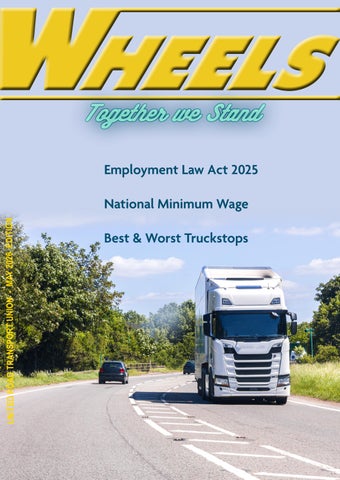
TUC - Public overwelmingly support higher minimum wage
TUC hails landmark day as 9.6 million set to benefit from stronger sick pay from today
TUC calls for 'national misssion' to rid workplaces of asbestos Union Benefits
Injury
Worst and the Best Truckstop in the UK
In the last edition of our Union’s journal ‘Wheels’, I highlighted a logistics conference that had recently taken place. Delegates at the conference heard of the well documented health risks associated with individuals whom drive professionally. In this edition of ‘Wheels’ you can read about the best/worst truckstops in the UK, as highlighted by ‘Fleetgo.com’. The worst undoubtedly contribute to the stress level of professional drivers, with poor parking, inadequate sanitary provision and limited healthy food options. ‘Transport Focus’, which is a non-departmental public body sponsored by the Department for Transport, in their latest survey, reported that roadside facilities appeared to show concerns expressed by professional drivers “….deepening rather than improving”.
Professional drivers consistently identified four priority areas for improvement namely parking capacity, safety and security for both drivers and vehicle, quality of services provided and a welcoming environment. Having worked in our industry for over forty years, these problems never appear to be addressed quickly enough to move with the pace of growth within our industry. Facilities continue to remain poor.
In addition to the above, I also highlighted in the last edition of our Union’s journal ‘Wheels’, the impact ‘Artificial Intelligence’ (‘AI’) was having within our industry. Unfortunately, whilst ‘AI’ is indeed ‘fast moving’, employment law is not. This edition of ‘Wheels’ highlights the timeline associated with the introduction into law of the recently enacted Employment Rights Act 2025, with certain sections of the Act taking literally years or more to be implemented into law. The obvious problem with these delays is that employment law is not designed for algorithms. Workers rights risk being left behind in the digital dust. ‘AI’ systems are already transforming employment relationships operating, as they do, outside the bounds of meaningful regulation. This is the central danger of ‘AI’ in the employment relationship. When employment law matters are determined by algorithms, it can produce decisions that is legally impactful, but functionally unacceptable. To be clear, I am not arguing against ‘AI’ but against its unregulated, unilateral deployment in workplaces where power is already uneven.
Having undertaken international work in the past, I was interested to recently read that the new restrictions on the number of days professional drivers can spend within Europe’s Schengen Area threaten the future of the UK’s international haulage industry. The so called ‘90/180 Rule’, dictates that UK nationals can only spend 90 out of every 180 days within the Schengen Area, comprising of 25 European Union (‘EU’) member states. If this wasn’t bad enough, under the post-Brexit UK-EU Trade and Co-operation Agreement (‘TCA’), British registered trucks can only make limited stops within the ‘EU’ before returning back to the UK. Under post Brexit rules, it would appear that skilled international professional driving jobs are very likely to be a thing of the past within the UK.
Until next time…. drive safely.
National Minimum Wage
The Government has announced National Minimum Wage rates for 2026, including the National Living Wage. The new rates which will come into force from 1 April 2026 are as follows:
• New polling shows huge public support in every constituency for increasing the minimum wage
• TUC says the increase is a “vital lifeline” in the face of “Trumpflation” crisis
• Minimum wage will rise for millions of workers today
The TUC today (Wednesday) described the increase in the minimum wage as a ‘vital lifeline’ for millions of workers – with a host of living costs set to rise as a result of Trump's illegal war.
The union body highlighted the strong support for raising the minimum wage to a real living wage.
The TUC cited a huge poll of more than 40,000 voters, which shows that:
• More than 8 in 10 (86%) people across the country support making sure the minimum wage is a real living wage people can live on. This includes 84% of voters who say they would vote for Reform if a general election were tomorrow.
• Support amongst other party voters is also very high: Labour (88%), Green (90%), Lib Dem (89%), Conservative (82%)
• Nearly 9 in 10 voters in Nigel Farage’s constituency of Clacton (86%) and in Kemi Badenoch’s constituency of North West Essex (88%) support it
• A similar level of support also exists in Keir Starmer’s constituency of Holborn and St Pancras (86%) and Ed Davey’s constituency of Kingston and Surbiton (87%)
TUC General Secretary Paul Nowak said:
“With bills set to rise as a result of Trumplation, the case for a higher minimum wage has never been more important
For millions, today’s increase isn’t just a nice-to-have - it’s a vital lifeline in the face of mounting costs
Making work pay isn’t just fair, it’s fundamental to a strong economy. If we want real growth, we need working people with money in their pockets, spending on their high streets and supporting local businesses.
Of course, there will always be some who cry doom and scaremonger. They are the same voices who opposed the introduction of the minimum wage.
They were wrong then, and they are wrong now.”
On the need to equalise youth rates, Paul said:
"Young workers face the same cost of living pressures as everybody else
That’s why today’s rise – which narrows the gap with adult workers – is so needed
It’s only right that young people get a fair day’s pay for a fair day’s work
Most employers recognise and already pay staff under 21 the full adult rate.”
UC hails landmark day as 9.6 million set to benefit from stronger sick pay from today T
Stronger sick pay and parental leave from today as first tranche of Employment Rights Act rights come into force
1.2 million workers - the majority low-paid women are set to get access to statutory sick pay for the first time 8.4 million set to benefit from sick pay paid from the first day of illness
Tens of thousands will get access to day one paternity leave
Up to 9.6 million workers are set to benefit from stronger statutory sick pay from today (Monday), according to new analysis published by the TUC.
From today, 1.2 million workers will be entitled to statutory sick pay for the first time after statutory sick pay is made available to all.
Previously, workers who earned below threshold of £125 a week known as the “lower earnings limit” weren’t eligible for statutory sick pay.
This change is set to disproportionately benefit low-paid women, who are significantly more likely than men to be earning under the threshold of £125 per week. It will also disproportionately benefit disabled workers and young and old workers.
The analysis also reveals that around 8.4 million workers who are reliant on Statutory Sick Pay will get sick pay from the first day of illness from April - instead of having to wait four days.
TUC polling shows this is hugely popular. More than three-quarters (76%) of the public support workers having sick pay from day one.
Among 2024 Labour voters who have switched to Reform, support increases to 82%. And among 2024 Labour voters who have switched to the Greens support increases to 89%
Boost for workers and economy
The TUC says for too long low paid workers especially women have missed out on any form of sick pay.
Even those eligible for statutory had to wait until four days before being able to access it.
This has meant workers have been left with no choice but to go into work when they are ill, with the risk of spreading and prolonging their illness, or facing a financial hit.
Independent analysis undertaken for the TUC has shown that as a result the benefits of day one sick pay for the economy will be worth five times the costs.
Parental leave
As well as stronger sick pay, dads and partners will – from today - have a day one right to paternity leave and all parents will gain the day one right to unpaid parental leave.
The TUC says this is an important first step but says much more needs to be done to ensure families have access to adequate support.
The union body is calling for the government to ensure the parental leave review delivers increased access to paid parental leave so that mums and dads can better share care.
Years of campaigning
The TUC says this first tranche of rights being delivered through the Employment Rights Act represents a “landmark day” for workers.
This comes after years of campaigning from union and workers for stronger sick pay and parental rights.
The TUC says it is vital the government now gets on and implements the other new rights in the Employment Rights Act in full so workers can start to feel the benefits up and down the country.
To read the full article visit: https://www.tuc.org.uk/ news/tuc-hails-landmark-day-96-million-set-benefitstronger-sick-pay-today
TUC calls for “national mission” to rid workplaces of asbestos
• At a union event to mark International Workers’ Memorial Day, Nowak will call for government-led programme to remove asbestos from schools and hospitals needed
• TUC general secretary Paul Nowak will separately lay a wreath at the Health and Safety Executive headquarters
The TUC general secretary Paul Nowak will today (Tuesday) call for a national mission to rid workplaces of asbestos at a union event in Liverpool marking IWMD.
The union leader will warn the country needs a government programme of removal of asbestos from public buildings and workplaces like schools and hospitals.
Asbestos is the biggest occupational killer in Britain, and the country has the highest rate of asbestos cancers in the world.
Separately, Paul Nowak will be laying a wreath at an event held at the HSE headquarters in Liverpool today to mark International Workers’ Memorial Day.
On the need to tackle asbestos in workplaces, TUC General Secretary Paul Nowak will say:
“We have to be honest about the scale of the challenge we face. And none is bigger than asbestos.
It remains the biggest occupational killer in Britain. And we have the highest rate of asbestos cancers in the world.
Each year, more than 5,000 people die because of asbestos. That cannot be allowed to stand.
We know that workers in our schools, hospitals and other public buildings are still being exposed to this lethal substance, every day.
And that’s why the TUC is clear we need a fully funded, government-led programme to remove asbestos from every school and every hospital.
A national mission to rid our workplaces of this deadly material once and for all.
“This is not just a policy ask it is a public health necessity. Because prevention must mean elimination of risk, not just management of it.”
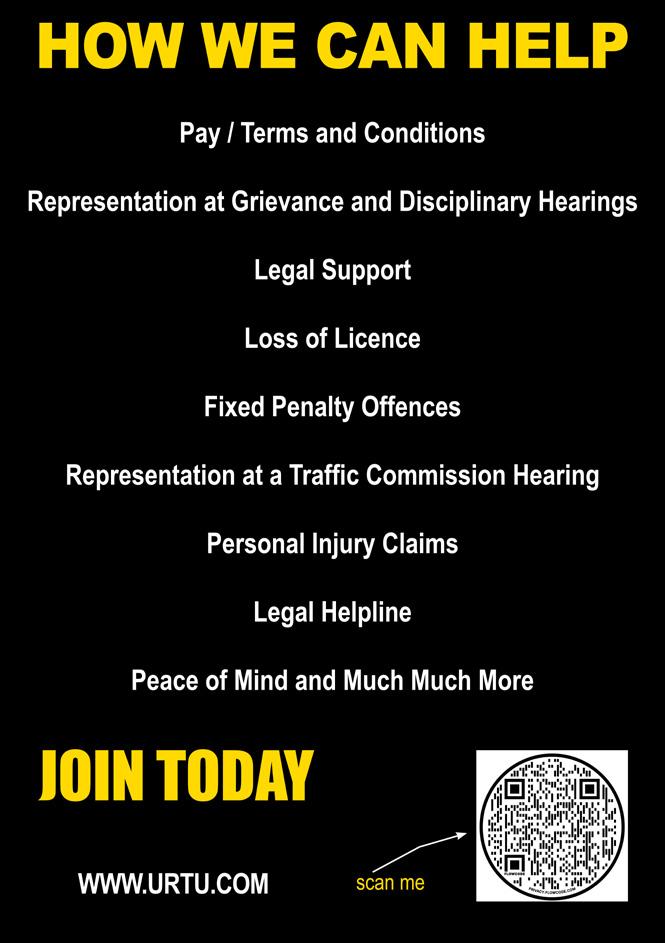
nion Benefit Guidelines U
Here is a guide to two benefits our Union offers its members. Full details and links can be found within the Members area of our Union's website.
Personal Injury
The Union may provide Personal Injury Legal Assistance to Members and their Families. To take advantage of this benefit you will need:
• A valid fully paid up to date membership
• Be paying either the Driver or non-Driver full time contribution rates
To use this service members need to visit the Members Area of the website and choose the 'Personal Injury' page. On this page they will find the telephone number for our dedicated Personal Injury Solicitors.
To make a claim the member or family member:
• Must be a member of the Union at the time of the Accident and remain a member of the Union throughout the case.
• Whilst claims can only be made within 3 years of an accident, in order to ensure that a case can be supported, a claim through our Union should be made within 2 years of the accident where possible.
You will receive 100% of your compensation. There will be no deductions for legal fees. Please note that the Solicitor’s conclusion in all cases is final.
Personal Injury claims can be made if you have an accident at or away from work, or on holiday. It should be noted that our Union's Personal Injury Solicitors are unable to assist Family members with work related injuries.
Employment Law Cases
The Union may provide an Employment Law Solicitor to Members whom have paid 'up to date' membership and by quoting their membership number.
You will need to speak in the first instance to your Regional Officer. They are likely to request paperwork. Therefore, please remember to keep copies of all paperwork associated with your complaint.
Your Regional Officer will assess your case. If it merits a referral to the Union's Solicitors, your case will likely be passed to a solicitor whom will determine whether your case will be supported. If appropriate the solicitor will be instructed to provide Legal support.
T
Truckstops
Here are some of the best and worst-ranked Truckstops in the UK. These are rated against their access, facilities, security, and services.
Best Truckstops
1. Chippenham Pit Stop
located just off Junction 17 of the M4 Motorway. The truck stop has a filling station and a lorry park with 87 parking bays. Parking spaces are large enough to accommodate the largest HGVs and are free for the first hour. Truck drivers also have access to hot showers and clean, modern toilets at the truck stop. The restaurants provide a range of food options, from locally sourced delicacies to fast food venues.
2. Route 47 Truck Stop
located in Lesmahagow, around 26 miles south of Glasgow, in South Lanarkshire, Scotland. The truck stop is along Junction 10 of the M74 and mainly caters to heavy goods vehicles. Drivers can find various amenities, from car wash facilities and toilets to showers open 24 hours. The parking facility is large and can accommodate up to 150 trucks.
3. Tebay Services
located in Perinth, off Junction 38, on the M6. It’s a family-owned truck stop with amazing facilities for truck drivers and the general public. With 24-hour CCTV and a patrolling warden, you can safely park heavy goods vehicles in this compound. Truck drivers also enjoy waste disposal and electric charging services at the truck stop. The kitchen here serves fresh, homemade food; other facilities include fuelling stations and showers.
4. Ashford Truck Stop
Off Junction 10 on the M20, Ashford Truck Stop has impressive security, including motion sensors, CCTV cameras, barbed wire fences, and security patrolling the area. Drivers can access over 389 parking spaces, but they need to book online. On-site accommodation can be included in the parking fee, and drivers also have access to a laundrette and shower facilities. The restaurants serve various delicacies, and the convenience shop is available for 24-hour shopping.
5. Formula Services
In Ellesmere Port, M53 is the best example of a modern truck stop with the best facilities. The parking facility provides parking spaces for 110 vehicles. The 24-hour manned patrol and camera make the place secure. Getting an overnight parking ticket gives drivers full access to the site’s facilities. Drivers can find all the necessities, from showers and toilets to truck wash and fuel stations. They can also find leisure facilities, like game rooms, free massage chairs, and a fitness suite. Trucks with mechanical problems can be serviced at the facility before drivers leave.
Taken from Fleetgo.com - https://fleetgo.com/kb/t/truck-stop/#Top_7_Truck_Stops_in_the_UK
Worst Truckstops
Leeming Bar Services (A1-M, Nottinghamshire): Ranked the worst in a 2025 survey by Breakwells Transport due to poor HGV parking and high prices.
Bridgewater Motor Services (M5, Somerset): Frequently criticized for being cramped and dirty, with poor, low-quality toilet facilities.
Hartshead Moor East (M62): Previously identified as one of the lowest-ranked stations for overall satisfaction by Transport Focus.
Barton Park & Markham Vale: Named among the bottom three in recent HGV industry rankings.
Hilton Park (M6): Often cited for poor, outdated amenities and poor shower conditions. Taken from google search. Have your say: Send in your reviews to: info@urtu.com Titled with the name and location of the Truckstop. Review the rest stop agains the following categories, giving a score out of 10 for each category. • Location
What is a Reasonable Request
Author: Joanna Richards Regional Officer
I have come across a significant number of cases where members have faced disciplinary proceedings for allegedly refusing a reasonable management request
Drivers are often unsure what is actually “ reasonable ,” what falls within their rights to refuse, and where the legal line sits, particularly when it comes to vehicle safety and compliance.
This guidance is intended as an educational overview to help drivers understand their position.
Refusing a Reasonable Request – What It Means in the HGV Industry
In the HGV sector, the phrase “ refusing a reasonable management request ” is frequently cited in disciplinary processes. However, the concept of reasonableness is not absolute. It is shaped by safety law, transport regulations, contractual terms, and the professional obligations placed on vocational drivers.
Understanding what is and is not reasonable is critical, not only to protect your licence and livelihood but also to safeguard public safety.
1. What Is a “ Reasonable Request ”?
A reasonable request is an instruction from management that:
• Falls within your contractual duties
• Is lawful
• Is safe to carry out
• Complies with transport regulations
• Does not place you or the public at risk
• Is practically achievable within drivers’ hours and working time rules
In simple terms: if the task is safe, legal, and within your role, refusal may constitute misconduct.
2. Examples of Reasonable Requests in the HGV World
The following would typically be considered reasonable:
Operational Duties
• Completing scheduled deliveries/collections
• Following allocated routes (unless unsafe or illegal)
This demonstrates cooperation, not insubordination.
8. Consequences of Not Challenging Unsafe Requests
Failing to raise concerns can result in:
• DVSA fines
• Driver CPC action
• Operator licence investigations
• Personal prosecution
• Dismissal following incidents
• Civil liability after collisions
Silence transfers risk onto the driver.
9. Trade Union Perspective
From a union standpoint, refusal cases often hinge on documentation.
Where drivers lose cases, it is commonly due to:
• No written defect raised
• No follow-up email
• No photographic evidence
• Verbal-only objections
Evidence converts opinion into fact.
10. Key Takeaways
• Not all management requests are reasonable
• Safety and legality override instruction
• You are personally liable for vehicle compliance
• You have a legal right to refuse unsafe work
• Always document concerns in writing
• Evidence protects your job and licence
Final Position
Professional drivers operate under dual accountability to their employer and to the law.
A reasonable driver is not one who says yes to everything, but one who operates safely, lawfully, and with documented diligence.
Refusing an unreasonable request is not misconduct. Failing to challenge can be career-ending.
Information taken from various sources.
The Employment Rights Act 2025 - timeline
Morrish Solicitors
IER
27 Feb 2026| News
Published on the IER website, Morrish Solicitors has produced a handy guide to all the changes, arranged chronologically. The Act is being delivered across 2026 to late 2027. Consisting of nearly 30 different parts, it can be confusing, not least because whilst most changes will come in on either 6 April or 1 October each year, as you can see below, some will come in on other dates.
Also, its reach is not uniform across the UK, as most will not apply in Northern Ireland, where employment law is devolved, and separate legislation is being developed.
However, for unions, employees, and workers, it is overwhelmingly positive news. It promises enhanced protections, and over 18 million working people are estimated to benefit. It’s a Labour project with Reform promising to revoke most of it if they win power. Once all is in place, the UK is expected to move up from near the bottom of the OECD ranking of international employment law protections to closer to the average. UK annual employment costs are expected to rise by 0.01% but still increase UK GDP overall by 0.04% — a gain.
This guide is intended to show a chronological list of all the changes. As above, given that some of the dates for implementation have shifted, please check the precise implementation date before you rely on it, as it may move again.
8 February 2026
• The 12-week limit for protection against unfair dismissal for taking industrial action was scrapped, extending unfair dismissal protection indefinitely for individuals.
• There has been a near-total rollback of the draconian Trade Union Act 2016, and also the
entirety of the Strikes (Minimum Service Levels) Act 2023 has been totally repealed, thereby simplifying requirements on trade unions with the extra staffing and burden for a 40% minimum support in important public services scrapped (minimum service levels, etc.).
• Note that the minimum 50% turnout for industrial action ballot is still needed (expected repeal in August 2026).
• The time needed to give notice of industrial action has been reduced to 10 days, instead of 14 days.
• Picket supervisors are no longer required.
• Industrial action mandates will last for 12 months, instead of 6 months. Note that the 12 months cannot be extended by agreement, so a union will need a re-ballot to go beyond 12 months.
• Industrial action and ballot notices have been simplified (e.g., removal of the summary of matters in issue in the trade dispute, less information about breakdowns of affected employees, etc.).
• Removes the 10-year ballot requirement for trade union political funds and introduces an opt-in system.
• Removes the Certification Officer enhanced investigatory (e.g., for reporting on industrial action, expenditure on Political Fund above £2,000, etc.) and penalty powers, and is in effect a reversion to the pre-Trade Union Act 2016 position.
• Removes the requirement for public sector employers to publish information relating to time off for trade union officials for trade union duties.
1 April 2026
Certification Office annual levy on trade unions is expected to be repealed.
6 April 2026
Pay and hourly rates
• National Living Wage and National Minimum Wage increase as usual (NLW to £12.71).
Statutory Sick Pay (SSP)
• SSP increases from around £118.75 to £123.25 per week (or 80% of earnings whichever is lower).
• SSP will be payable from day one of an employee’s sickness absence, removing the current 3-day waiting period.
• The earnings threshold (Lower Earnings Limit) will be abolished making it available to all employees.
• This is estimated to benefit up to 1.3 million of the lowest paid employees that were previously unprotected.
Family leave and parental rights
• Paternity leave and ordinary unpaid parental leave will become day one rights for all employees, replacing the previous 26-weeks’ qualifying service period required (and with a temporary reduced notice period of 28 days for those who apply for leave from 6 April 2026).
• Other family-related statutory pay also increases (maternity, adoption, shared parental, neonatal care, and bereavement pay) to £194.32 per week (or 90% of earnings if lower), but the 26-week qualifying period for Paternity Pay is unchanged.
• Ordinary parental leave will also become a day-one right, replacing the previous one-year period qualifying service to be eligible.
• The restriction on taking paternity leave after shared parental leave will be removed.
• Bereaved Partners’ Paternity Leave will enable bereaved fathers and partners to take up to 52 weeks of paternity leave if the mother or primary adopter dies within the first year of the child’s life.
Redundancy and consultation awards
• The maximum protective award (the remedy for failure to consult on collective redundancies) will double from 90 to 180 days’ pay as a deterrent to employers who avoid their collective consultation obligations. We expect more employers to comply with the requirements, and fewer will try to ‘buy out’ the long 180-day period of collective consultation.
Whistleblowing and harassment
• Making a disclosure about sexual harassment will be expressly added to the whistleblowing legislation as a ‘qualifying disclosure’, meaning that (subject to the other requirements being satisfied, including the disclosure needing to be in the public interest) the complainant will now have protection against detriment and unfair dismissal.
Trade Union changes
• The statutory recognition scheme for trade unions will be simplified, including removing the 40% support threshold for recognition ballots and the requirement for trade unions to demonstrate majority support for recognition.
Gender pay gap and menopause action plans
• New menopause guidance will take effect.
• Employers will need to create action plans around menopause and gender pay gaps.
• These will be voluntary from 6 April 2026 and will become mandatory sometime in 2027.
7 April 2026
Creation of the Fair Work Agency (FWA)
• Responsible for enforcing SSP, holiday pay, national minimum wage, licensing standards for gangmasters, and certain aspects of the Modern Slavery Act 2015.
• Having a set of powers to investigate and take action against businesses that do not comply with the law, using civil penalties, civil proceedings, and the power to inspect workplaces.
In the meantime, many required government consultations close in April and May 2026 including fire and re-hire, tipping, trade union recognition and e-balloting, and umbrella companies/agency workers.
October 2026
Tips and Gratuities
• Tipping law will be tightened so as to require the employer to consult the worker (via trade union reps or elected/worker reps, or directly with workers if none exist) on their tipping policy, review the policy every 3 years, and upon review, again consult the workers.
• A new Code of Practice on fair and transparent distribution of tips will be issued.
• This is estimated to benefit workers with around £200million worth of tips each year that was previously retained by employers.
Harassment duties
• There will be a new stronger duty on employers to take ‘all reasonable steps’ to prevent harassment in the workplace.
• A duty not to permit harassment by third parties such as clients or customers.
• A power will be introduced to enable regulations to specify steps that are to be regarded as ‘reasonable’, to determine whether an employer has taken all reasonable steps to prevent sexual harassment.
Employment Tribunal time limits
• The time limit for bringing tribunal claims will increase from 3 to 6 months for most claims including unfair dismissal, discrimination, and whistleblowing (but not for breach of contract claims).
Public Sector Outsourcing (Protection of Workers)
• Reinstates and strengthens the two-tier Code to try to prevent a two-tier workforce where private sector employees working on an outsourced public sector service contract have worse terms and conditions than those employees who were transferred to work on it from the public sector.
New Adult Social Care Negotiating Body
• Establishment of a new Fair Pay Agreement Adult Social Care Negotiating Body to enable sector-wide negotiations on Fair Pay Agreements, setting legally enforceable minimum standards on pay (and potentially other terms) across adult social care.
Trade Union changes
• Employers will be required to give workers a written statement advising of their right to join a trade union at the same time as providing their section 1 statement of written particulars.
• Qualifying unions will be given the right of physical and digital access to workplaces. A new Code of Practice is to be issued. Where unsuccessful, the Central Arbitration Committee (CAC) can impose access terms.
• Existing rights for union representatives to receive paid time off (facility time) to carry out their duties, and to be provided with access to facilities (e.g., office space, meeting spaces, internet, etc.) to do so to be strengthened. A new Code of Practice is to be issued.
• Union equality representatives to be given new rights to time off and access to facilities, in order to promote equality in the workplace.
• Union members to gain protection from detriment on the grounds of industrial action.
• Regulation of ‘unfair practices’ in the trade union recognition process.
December 2026
Mandatory Seafarers’ Charter
• To protect the working conditions of seafarers aboard ships operating regular services from UK ports with higher standards around health and safety, pay, job security, and rest breaks to be implemented.
January 2027
Unfair dismissal
• The length of service required to claim ‘ordinary’ unfair dismissal will be reduced from 2 years to 6 months and will come into force on 1 January 2027, which means those who start employment on 31 July 2026 will be entitled to be fairly dismissed from 1 January 2027.
• The qualifying period for an employee’s right to
request written reasons for dismissal will reduce from 2 years to 6 months (where the dismissal takes place during pregnancy, maternity leave, or adoption leave, it is a day one right).
• The qualifying period will be protected by only being able to be amended by the primary legislation.
• This is estimated to benefit around 6.3 million employees.
• The removal of the current unfair dismissal cap of the lower of annual salary or £118,223 as compensation for unfair dismissal is to be removed entirely, creating uncapped exposure for employers
Fire and Rehire
• Stricter limits on “fire and rehire” practices will be implemented so that, where employees are dismissed for failing to agree to a change in their contract of employment, or if the employer dismissed the employee to replace, or to re-engage them on varied contractual terms, those dismissals will be treated as automatically unfair unless the employer can show:
• Evidence of financial difficulties that were affecting, or were likely to affect, their viability.
• The changes were to eliminate, prevent, significantly reduce or significantly mitigate the effect of those financial difficulties; and
• The need to make that change in contractual terms was unavoidable.
• If the employer can meet that test, an ET will still have to assess whether the dismissal was fair in the circumstances (e.g., whether the employer consulted with the employee, trade union, or other employee representatives, etc).
Date TBC in 2027 Other ERA changes
• Changes to the collective consultation threshold from the current ‘trigger’ of a proposal to dismiss as redundant 20 or more employees at one establishment within a period of 90 days or less, to possibly an organisation-wide threshold.
• A day one right to bereavement leave.
• Zero-hours and “low-hours” protections, with a right to guaranteed hours, reasonable notice of shifts, and payment for shifts cancelled, curtailed, or moved at short notice. Given that the UK has a record high number of workers on zero-hour contracts (reportedly 1.23 million in December 2025, a rise of 91,000 from the previous year, driven by young workers).• Enhanced dismissal protections for pregnant women and those returning from maternity leave.
• Enhanced flexible working rights – a test of reasonableness to be introduced, making it harder for an employer to refuse a request.
• Non-Disclosure Agreements – preventing an NDA from stopping an employee or worker from speaking out about harassment or discrimination.
• Equality Action Plans for large employers (250+ employees) and an extension of pay gap reporting to outsourced workforces.
• Regulation of ‘umbrella companies’ under the Conduct Regulations, ensuring that people who work through them have comparable protections to their counterparts who work directly through an employment business, and other possible Agency Worker Regulations changes.
• Working time recording (for annual leave) requirements for 6 years placed on employers.
• Action plans on gender equality and mandatory support of employees through menopause.
• Specifying what steps that are to be regarded as ‘reasonable’, to determine whether an employer has taken all reasonable steps to prevent sexual harassment.
Trade Union changes
• Strengthening blacklisting protections for union members to protect against AI and third-party blacklists.
• Electronic and workplace balloting for recognition and derecognition.
Sector-specific changes
• Closing the maritime redundancy notification loophole ensuring that operators providing regular services to British ports aboard ships
registered outside of Great Britain (entering a port 120 or more times per year) cannot avoid the collective redundancy notification requirement.
• Establishing the School Support Staff Negotiating Body to provide school staff in England with a sector specific voice for pay, conditions, training etc and the same statutory minimum terms.
• Providing for the establishment of Fair Pay Agreements in the adult social care sector in England and social care sectors in Scotland and Wales.
Other non-ERA employment law changes to keep an eye on
• More equality changes under the Equality (Race and Disability) Act.
• Providing for the establishment of Fair Pay Agreements in the adult social care sector in England and social care sectors in Scotland and Wales.
• Changes to non-compete clauses in employment contracts, such as reducing the length by law
• Changes to ET practice and procedure including ET1s and ET3s, applications and other procedural changes.
Tuc - 8 in 10 workers have experienced abuse at work
TUC news
• New TUC survey findings reveal 8 in 10 workers have experienced abuse at work in the past year
• 45% of surveyed workers have experienced threats of physical harm in the last 12 months
• TUC General Secretary Paul Nowak says “ ministers must prioritise HSE funding to keep workers safe ”
• A new survey published by the TUC today (Friday) shows 8 in 10 surveyed workers have experienced some form of abuse at work in the last year.
The findings, based on a survey of 5,004 workers, show that in the last 12 months:
• 1 in 5 (19.4%) have experienced physical assault
• 1 in 10 (9.9%) have experienced sexual harassment or sexual violence at work
• 8 in 10 (79.1%) have experienced verbal abuse such as shouting, insults or threats at work
• 4 in 10 (44.9%) have experienced threats of physical harm
The report is published as the TUC holds its Violence at Work conference today, established following concerns from unions about violence and abuse against public-facing workers.
More than 8 in 10 (84.1 %) of respondents said their roles are public facing.
The report finds:
• 11.8% work in education
• 38.9% work in transport
• 9.9% work in prisons or secure facilities
• 4.9% work in health and social care
• 14.9% work in central or local government
• When asked how regularly they experience violence or abuse at work, more than half of workers (51.4%) said they experience violence or abuse weekly or more, while 17.1% said they experienced violence or abuse on a monthly basis.
When asked who is responsible for the violence and/ or abuse workers have experienced:
• 45.9% said customers were the perpetrators
• 36.4% said passengers
• 15.2% said other members of the public
• 10.9% said pupils or students
• 9.2% said colleagues
• 8.5% said managers
When asked about the impact of the most severe incidents they have experienced, 48.7%% said they feared for their safety, 13.9% said they experienced physical injury, 8.9% required medical treatment, 26.2% required police involvement, 16.8% had to take time off work, while 32.8% experienced mental trauma.
More than half (51.9%) of those who did not report it said it was because violence is seen as “ part of the job ”, while 33.7% said they felt it would not be taken seriously.
Health and Safety Executive
The TUC says employers have a legal duty to keep staff safe at work and all employers must assess the health and safety risks in their workplaces.
The Health and Safety Executive (HSE) can prosecute employers who do not manage the risks of violence.
HSE inspectors play a vital role in keeping workplaces safe.
But the TUC says the HSE has been left “ struggling to operate ” due to the “devastating” impact of cuts under the Tory government.
The HSE - the country’s main workplace health and safety regulator - has seen its funding cut by more than 50% since 2010.
As a result, inspector numbers, inspections, and employer sanctions are at an all-time low – putting workers at risk.
Full article can be read at: https://www.tuc.org.uk/ news/8-10-workers-have-experienced-abuse-work-pastyear
MEMBERS LETTERS
Dear URTU Team,
I just wanted to send a message to say thank you following the conclusion of my recent matter.
Over what turned into a very long and difficult period for me, Ne il Hunter represented and supported me throughout, and I honestly cannot speak highly enough of him. From start to finish, he was steady, knowledgeable, professional, and easy to deal with. When things were stressful, uncertain, or dragging on, he was always calm and grounded, and that made a real differ ence.
One of the biggest things for me was that Neil never made me feel like just another case on a pile. He listened, understood the issues properly, and gave me clear, sensible guidance throughout. He knew when to be firm, when to be patient, and how to handle matters in a way that kept things measured and constructive.
It is hard to overstate how much that support mattered over the course of such a drawn-out process. Having someone reliable and experienced in your corner gives you a lot of reassurance when you are dealing with something that is stressful and personal.
The matter has now concluded, and I wanted to make sure URTU knew how much I appreciated the help I received. Neil was excellent throughout, and I am very grateful for everything he did on my behalf.
Please do pass on my thanks to him.
Hi,
My name is Andy, and over the last couple of months, I have needed the help of the URTU. I contacted Neil Hunter in a text message he got back to me the next working day. He went above and beyond to help me out to get a resolution to my problem. I can not thank him enough when I say how much he has done for my mental health. THANK YOU, Neil.
Andy (West Yorkshire).
nion Sickness Benefit U
The Union offers a Sickness Benefit to members who are on the 'A+ BF' and 'A' scales. Below is a brief overview of the benefit and how to claim.
• A member has to be fully paid up for a minimum of 26 weeks to be able to claim the benefit.
• The Union requires copies of sick notes for the entirety of the sickness period.
• A member can only make and receive sickness benefit once within a 12 month period. Once a sickness period has ended, the member has to pay Union contributions for 49 weeks before a new sickness claim can be submitted.
• There is an initial three week 'waiting period' at the start of a sick claim. Your Union does require sick notes to cover this period.
• The Sickness Benefit entitles the claimant to £15 per week, for a maximum of 12 weeks.
• Sick notes also cover a member's contributions. After the full £180 Sickness Benefit has been paid out, if a member is still off sick they need to contin ue to send in copies of their sick notes. This is to ensure that they do not pay contributions whilst absent from work through sickness.
• A refund of contributions cannot be backdated. Refunds of contributions start from when the first sick note is received into the Union's Head Office, but will be reimbursed from receipt of the second sick note.
• To receive a refund of contributions a member has to have paid contributions 'up to' date.
• Sick notes can be sent through the membership area of the Union's Website or by e-mailing the Union's Head Office.
• Members are responsible for sending or ensuring that their own sick notes are forwarded to our Union's Head Office.
Duolingo Language Club in Your Workplace
A group of drivers at the Warburtons depot in Port Talbot has got together to study languages using Duolingo. Duolingo is a free language-learning program perfect for people on the go. Its website and mobile apps are available to anyone with an internet connection, plus a computer, tablet, or smartphone. You can practise speaking, reading, listening, and writing, play games, answer questions, and complete short lessons every day.
Steve Gardner has been learning Welsh and has been instrumental in setting up the group. Steve said:
"Several of us expressed an interest in studying another language, although, as always, time constraints meant that it was quite impractical. However, with Duolingo, it enables people with hectic lifestyles and full-time jobs to study in short, sharp bursts when the opportunity arises. Word of mouth and conversations with the WULF Project Manager put us on the right track to begin studying.
What made us join is the fact that we were all keen to learn something very accessible, instead of through the usual channels, which would prove to be more difficult considering our busy work/life schedules.
We find it convenient that any downtime or waiting period at work can mean we can quickly open the app and start a lesson. The format it uses and the prompts it gives us throughout the day can be beneficial, especially if you want to keep up a learning streak. I have even found myself completing a lesson at the pub while waiting for food!
All of us feel that we would recommend this method of learning to others, as the pros outweigh the cons, thanks to the format of the app. However busy you may be, there is no excuse not to complete a daily 10-minute lesson.
We have all experienced days when it’s been so hectic that we’ve hardly had time to look at our phones. Thankfully, with the reminders you get through the app, we often get to do at least some studying, which keeps the learning streak going.
There are many benefits of learning as a group with your work colleagues, as we all tend to chat about the course and often exchange “pleasantries” in the languages we are learning. As the group has a scoreboard, it gives that element of competition in a light-hearted manner."
To find out how to set up a language club in your workplace or use Duolingo to learn another language, please contact URTU Learning HERE.
Basic Shop Steward
The course has been designed to enable our Shop Stewards to develop and improve their skills and knowledge. The course identifies ways in which improvements can be implemented to make the Union more effective at a local level.
Course aims:
• Ensure you understand your role within the Union and your responsibilities toward the members.
• Learn essential skills to assist you in representation at disciplinary and grievance meetings.
• Develop your communication skills.
• Give you a clearer understanding of relevant legislation.
• Consolidate your negotiating skills.
• Give you an understanding of the importance of recruitment and retention.
• Develop your recruitment skills.
• Increase your confidence as a Shop Steward.
Advanced Shop Steward
The course has been designed for our Shop Stewards who have previously attended the Basic Shop Steward course.
Course aims:
• Develop your knowledge of Disciplinary and Grievance procedures.
• Develop your knowledge of Collective Consultation and TUPE.
• Improve your negotiating skills.
• Develop your understanding of the UK legal system.
• Gain an understanding of current Employment Law.
• Develop your understanding of the Working Time Regulations.
Basic Health & Safety
The course has been designed to equip our Health & Safety Representatives with the knowledge of the role and the trade union approach to Health and Safety.
Course aims:
• Ensure you can handle Health & Safety issues and develop an appropriate response to both members and management.
• Demonstrate your understanding of the updated SRSc Regulations.
• Ensure you know how to conduct effective workplace inspections, including all accidents and near misses.
• Develop your skills to identify, obtain, order, and summarise relevant Health & Safety information.
Advanced Health & Safety
The course has been designed for our Health & Safety Representatives who have previously attended the Basic Health & Safety course.
Course aims:
• Ensure you enhance your Health & Safety skills.
• Demonstrate your knowledge to enable you to function in a professional and confident manner within the confines of Health & Safety legislation.
• Develop your understanding of current European Health & Safety legislation.
• Develop your understanding of the constituent parts of the major pieces of this legislation.
• Develop your understanding of the Union’s approach to Health & Safety legislation.
courses
Course Dates
Union Representatives play a vital role within the Union, helping members within their branches, and recruiting. To support them your Union hosts a number of courses throughout the year. These courses are designed to give the Representative the skills they need to undertake their role and are specifically tailored to the Logistics sector.
Below is a list of upcoming course dates. These are held at the Quorn Grange Hotel and are Monday to Thursday residential course.
To book your place on one of these courses, please contact your Union's Head Office on 0161 486 2100 or freephone 0800 526 639. You can also e-mail them at admin@urtu.com
We are here to support you.
We are here to help, advise and support with any issues, problems or concerns you may have with your employment.
We are not politically affiliated.
United Road Transport Union is not affiliated to any political party.
Your membership.
Your employer does not need to know if you are in a union.
If you move jobs you can take your membership with you.
Pay Terms and Conditions.
If we don’t negotiate on your behalf for better working conditions, who will?
Value for Money.
.Legal Support .Hardship grants .Personal Injury .Peace of Mind & More
Benefits.
We have a wide range of benefits available to you, many of which can extend to your family and friends.