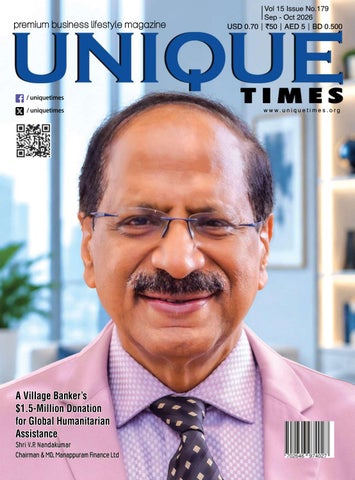
Vol 15 Issue No.179 Sep - Oct 2026 USD 0.70`50AED 5BD 0.500
A Village Banker’s $1.5-Million Donation for Global Humanitarian Assistance Shri V.P. Nandakumar Chairman & MD, Manappuram Finance Ltd
One World. One Ecosystem. Endless Possibilities.
58,500
Digital Wallet for International Travellers Connecting Individuals to and from India Open & Regulated Ecosystem Personal & Enterprise Solutions
Seamless Wallet Payments in India DOWNLOAD NOW
Chief Mentor Mr. V.P. Nandakumar Director & CEO Jebitha Ajit Editor Ajit Ravi Legal Advisor Latha Anand B.S.Krishnan Associates bskrishnanassociates@gmail.com Sub-Editor Athulya Pradip Associate Editor Ravi Saini Anusha Varghese Correspondents Dr. Thomas Nechupadam Vivek Venugopal- Quarter Mile R L Morris Creative Design PEGASUS Photography PEGASUS Marketing USA 725, burning tree lane, punta gorda Florida-33982 Mob: +1 (863) 558-5234 UAE Jolly Tel: +971 50 307 1125 Vineeth Nair Shaji N Palakkal 415, Building 23, Al Khail Gate, Al Quoz-2, Dubai, UAE Tel: +9714 4511075 Maharashtra Jayasankar M a/101, New Prathamesh Niwas, OPP. Laxmi Park, Thakurli East, Dombivli post, Thane District, 421201 Mob: +91 9820708662 Tamil Nadu Sheelan Thangavelu Tamilnadu Director Mob: +91 7825-077770 Sri Shakthi Institute of Engineering and Technology, L&T- bypass, Chinniyapalayam, Coimbatore-62 Karnataka, Telangana, Andhrapradesh PEGASUS Ph: 09288800999 Sunilkumar NN Vice President Ambalika Saikia, Ambalika_saikia@yahoo.com Vice President V Suresh Kumar Public Relations
Published at Pegasus Global Pvt. Ltd. L5-106, Changampuzha Nagar Kalamassery, Ernakulam-682 033 e-mail: editor@uniquetimes.org uniquetimesindia@gmail.com Ph:0484 2532040, 2532080, Mob:9288800999
Editorial
“T
he greatest use of a life is to spend it on something that will outlast it.” – William James Philanthropy finds its deepest meaning when prosperity becomes a source of dignity, opportunity and hope. Lion V. P. Nandakumar’s US$1.5-million contribution to the Lions Clubs International Foundation reflects a philosophy shaped by decades of service and rooted in Valapad. His initiatives across healthcare, housing, education, disability support and livelihoods demonstrate how purposeful giving can create lasting social impact. His journey connects local responsibility with global humanitarian action, reminding us that true growth is measured by how deeply an organisation serves society. This edition’s cover story features Lion V. P. Nandakumar, visionary leader of Manappuram Finance Ltd, whose journey embodies resilience, compassion and meaningful social change. Adding to this edition is a thoughtfully curated selection of stories spanning sports, travel and tourism, finance, entrepreneurship and business success. Through remarkable journeys and insightful perspectives from prominent industry leaders, these pages seek to inform, inspire and engage. As Malorie Blackman reminds us, “Reading is an exercise in empathy; an exercise in walking in someone else’s shoes for a while.” May this issue inspire new ideas, broaden perspectives and offer journeys of discovery.
Wishing you an enriching and joyful reading experience!
Cover Photograph Shri V.P. Nandakumar Chairman & MD, Manappuram Finance Ltd
Printer & publisher Pegasus Global Pvt. Ltd. Cochin (682033) on behalf of Ajit Ravi. Printed at S.T.Reddiar & Sons, P.B. No: 3627, Veekshanam Road, Cochin-18.
Years of Trust
Delivering World-Class Healthcare, Globally
Maradu I Nettoor P.O I Kochi | Kerala - 682040 +91 9961 640 000 - www.vpslakeshorehospital.com
CONTENTS 14
14
A Village Banker's $1.5-Million Donation for Global Humanitarian Assistance
20
20
BUSINESS
South India’s Next Growth Story: Why A Unified Regional Roadmap Can Create A Global Economic Powerhouse
24
Overthinking: The Silent Brain Destroyer – The Science Behind a Mind That Never Stops Thinking
26
New India - Connecting & Engaging Youth
HEALTH
24
CONTENTS FINANCE
52
32
MOTIVATION
32
Time and Truth: Twin Supreme Court Rulings Rein in GST Notices Under Section 74
52
From Spark To Stewardship
58
Glass Skin vs. Healthy Skin: Has the Beauty Industry Gone Too Far?
TRAVELOGUE
BEAUTY
58
60
60
Noong Nooch Gardens: A Tropical Paradise
UNIQUE DIARY
VW Seeks Local Indian Partner To Drive Scale And Share Investment Risks
V
olkswagen (VW) Group expects to finalize a partnership with a local Indian company this year as it seeks to expand in the world’s third-largest auto market and share investment risks. Skoda CEO Klaus Zellmer said a strong local partner could provide additional capital and support the launch of clean-energy vehicles ahead of stricter emission norms in 2027. While Zellmer did not identify the potential partner, VW is reportedly in talks with JSW Group over a joint venture, with sources saying JSW is seeking a majority stake and VW is open to giving up control of its Indian operations. The move follows an unsuccessful partnership attempt with Mahindra in 2022. VW is also facing a $1.4 billion Indian tax demand, which it is contesting in court. Globally, the automaker faces slowing sales in China, rising competition from Chinese brands, trade pressures and investor demands to cut costs and improve competitiveness.
Medicover India Hospitals Target Profitability In 18 Months
“The secret of business is to know something that nobody else knows.” Aristotle Onassis
8
Sep - Oct 2026
S
wedish healthcare provider Medicover expects all 25 of its hospitals in India to become profitable within the next 18 months, driven by improving occupancy and rising demand for specialised healthcare. Currently, 19 hospitals in its network are profitable, while the company aims to increase its core profit margin from 14% to 20–25% over the next 12 to 18 months. Medicover India operates around 6,000 beds and plans to increase occupancy to about 4,000 beds during the period. The company will use funds from KKR’s €1.2 billion acquisition of its India business to expand and strengthen existing facilities, including adding more operational beds. The business is expected to receive a new name following regulatory approvals. KKR’s investment reflects growing private-equity interest in India’s healthcare sector, supported by rising demand, chronic diseases and broader insurance coverage. Major players such as Apollo Hospitals and Manipal are also expanding, intensifying competition.
LUXURY YOU CAN WEAR
CRAFTED IN EXTREME EXCLUSIVITY-A SINGLE MODEL, LIMITED TO JUST SIX PIECES WORLDWIDE www.alcazarwatches.com
UNIQUE DIARY
Godrej Industries Group To Invest $2 Billion In Haryana
G
odrej Industries Group has signed an agreement with the Haryana government to invest `200 billion ($2.09 billion) in the state, expanding its presence and creating around 40,000 jobs. The group, which operates across consumer goods, real estate and financial services, has already invested about `120 billion in Haryana and employs nearly 9,000 people. Godrej Properties will account for a major share of the new investment, planning to deploy `160 billion by fiscal 2028. Meanwhile, Godrej Ventures, the group’s real estate private equity arm, plans to invest `35 billion in office infrastructure in Gurugram. The proposed projects are expected to generate more than 30,000 direct and indirect jobs, further boosting economic activity in the region. The investment highlights the group’s long-term commitment to Haryana and its growing role as an important market for Godrej’s real estate and business expansion plans.
Tamil Nadu Drops `274-Billion Chennai Second Airport Plan
“If you really look closely, most overnight successes took a long time.” Steve Jobs
10
Sep - Oct 2026
T
amil Nadu Chief Minister Joseph Vijay has announced that the state will drop plans to build a second airport at Parandur near Chennai, a project estimated to cost `274 billion ($2.86 billion), after facing strong opposition from farmers concerned about the impact on agricultural land. Although the proposal had received civil aviation clearance, the government is now considering alternative locations that would have a significantly lower impact on farmland. Industry leaders have urged authorities to finalise a new site quickly, citing the need for greater aviation capacity to support Chennai’s expanding manufacturing, logistics and services sectors. Meanwhile, Tamil Nadu plans to expand Chennai’s existing airport capacity from around 30 million passengers annually to 55 million. The state accounts for about 15% of India’s factories and manufacturing employment and has recently signed nearly 100 investment agreements worth `674.52 billion, highlighting the growing need for improved infrastructure to support future economic and industrial expansion.
AI Reshapes India’s IT Services Industry
A
rtificial intelligence is rapidly transforming India’s $315-billion IT services industry, forcing major outsourcing companies to rethink pricing, contracts and hiring. Firms such as TCS, Infosys, Wipro, HCLTech and Cognizant are increasingly moving away from traditional billable-hour models toward contracts linked to measurable business outcomes. Clients are demanding lower costs, faster delivery and greater productivity, while some are bringing AI-driven tasks in-house. The shift is also creating opportunities for mid-sized technology companies, as AI reduces the competitive advantage once provided by large employee bases. Firms such as Persistent Systems and Coforge have recorded stronger growth than several larger rivals by offering specialised expertise, flexible pricing and faster deployment. However, aggressive pricing and higher productivity expectations are putting pressure on margins, with some companies rejecting deals that are no longer profitable. AI is also reducing demand for traditional entry-level coding roles, pushing India’s IT sector toward AI-enabled engineers and higher-value skills.
Swiggy Plans Instamart Model Shift To Boost Margins
“Play by the rules, but be ferocious.” Phil Knight
S
wiggy’s quick-commerce arm Instamart is preparing to shift from a marketplace model to an inventory-led model after receiving shareholder approval for Indian-owned and controlled status. The move would allow Instamart to hold inventory directly, giving it greater control over pricing, product selection and supply chains while helping it compete more effectively with market leader Blinkit. Swiggy expects the transition to improve Instamart’s contribution margin by around 80 basis points, equivalent to roughly `4–5 per order. Bulk purchasing and reduced wastage could provide additional profitability benefits, although the new model will require greater working capital to purchase and manage inventory. Swiggy remains unprofitable and is targeting positive earnings per share by fiscal 2031. The company is also focusing on higher-margin products and private-label goods as competition intensifies across India’s quick-commerce market, with players including Blinkit, Zepto, Amazon India, Flipkart and Reliance competing for consumers.
Sep - Oct 2026
11
Germany’s VDMA Urges Europe To Accelerate Humanoid Robotics Amid China’s Surge
G
ermany’s VDMA engineering association has urged European policymakers to make humanoid robotics and physical AI a top priority as China rapidly expands its presence in the sector. The association warned that Europe must strengthen domestic manufacturing and build resilient supply chains for critical components to maintain technological sovereignty. Global humanoid robot shipments nearly quadrupled in the first half of the year to 19,100 units, with Chinese manufacturers driving much of the growth. China’s rising influence has intensified concerns that Europe could fall behind in the emerging robotics race, which is increasingly linked to broader technological competition between China and the United States. VDMA called for Europe to develop a complete, end-to-end value chain, including local production of key physical AI components. Such efforts could help protect European industries from supply disruptions, strengthen technological independence and enable the region to compete more effectively in the rapidly growing global humanoid robotics market.
Alibaba Shares Slide After $10.2 Billion AI Share Sale
A
libaba shares fell sharply in Hong Kong after the Chinese technology giant launched a $10.2 billion share sale to fund its expanding artificial intelligence ambitions. The company priced 710 million new shares at HK$112.70 each, an 8.4% discount to the previous closing price, raising concerns about shareholder dilution and the risks associated with heavy AI investment. Despite the discount, the offering attracted strong demand, with orders reportedly reaching $28 billion, while about 40% of the shares are expected to be allocated to long-term and sovereign investors. Alibaba Chairman Joe Tsai and CEO Eddie Wu also participated in the share purchase, signaling confidence in the company’s strategy. As e-commerce growth slows, Alibaba is increasingly focusing on AI and has committed nearly half of its 380-billion-yuan threeyear capital spending plan to the technology. However, AI spending contributed to a 75% annual decline in quarterly net profit. Alibaba expects its AI investments to break even within three years.
12
Sep - Oct 2026
Norway Expands Arctic Brigade As NATO Strengthens Northern Defences
N
orway has expanded its Finnmark Brigade as the NATO member strengthens its military presence in the Arctic following Russia’s invasion of Ukraine. The brigade, headquartered in northern Norway, was established last year as the country’s second military brigade and the first created since the end of the Cold War. The latest expansion adds an artillery battalion, an air defence battery and a communications company, strengthening the force’s ability to conduct long-range operations and coordinate with Norwegian and NATO aircraft and naval units. The brigade also monitors and patrols Norway’s 198-kilometre border with Russia. Norway has significantly increased defence spending in recent years, with NATO estimating military expenditure will reach 3.17% of GDP in 2026, compared with 1.5% in 2014. Norwegian officials say the expanded Arctic presence will improve the country’s ability to respond to potential threats and strengthen NATO’s northern defences, while Russia has previously denied posing a threat to the alliance.
France Fines Boohoo €2.3 Million Over Fake Discounts
F
rance’s consumer watchdog has fined British fast-fashion retailer Boohoo €2.3 million for misleading discount and product-labeling practices on its website. The DGCCRF found that 40% of the promotions it reviewed did not represent genuine price reductions, while 7% offered smaller discounts than advertised. In 48% of cases, the prices were actually higher, potentially giving customers a false impression of the savings available. The regulator also found that Boohoo used terms such as “leather” and “suede” for synthetic products, breaching French labeling rules. Boohoo said the issues occurred between October 2023 and February 2024 under its previous management and have since been addressed. The company said it cooperated with the regulator and continues to review its pricing and product-labeling practices. Following the announcement, shares in Boohoo’s parent company, Debenhams, fell 2.4% on 20th August, 2026, highlighting the potential financial and reputational impact of the regulatory action.
For more info: europetimes.co
Sep - Oct 2026
13
COVERSTORY
A Village Banker's $1.5-Million Donation for Global Humanitarian Assistance A village-born financier, a global Lions gift and the long argument that prosperity must enrich the soil beneath it.
V
alapad, Thrissur — In July 2026, Lion V. P. Nandakumar, Chairman and Managing Director of Manappuram Finance Ltd, was recognised on a global stage for a contribution of US$1.5 million to the Lions Clubs International Foundation (LCIF), the charitable arm of Lions International and one of the world's largest humanitarian service organisations. The recognition came at the Lions International Convention in Hong Kong, where he and his wife, Lion Sushma Nandakumar, were honoured for exceptional humanitarian service. The gift will underwrite LCIF programmes in education, healthcare, disaster relief, youth empowerment, vision care and community development. Speaking in Hong Kong, Lion Nandakumar said: "Giving back to society has always been at the heart of everything we do. Through this contribution to the Lions Clubs International Foundation, we hope to strengthen humanitarian initiatives that create sustainable and meaningful change in people's lives across communities. Together, we can build a more compassionate and inclusive future." The Donation is not a one-
14
Sep - Oct 2026
off gesture. It is the latest and most international expression of an association with the Lions movement that stretches back more than four decades. Lion Nandakumar's ties to Lions Clubs International began in 1981, when he joined the Triprayar Lions Club. He later served as Multiple District Council Chairperson, as a board appointee and as a member of the LCIF Corporate, Foundation and Government Gifts Committee. In July 2019, at the association's 102nd International Convention in Milan, he was elected International Director. He is now a Past International Director and has received the International President's Leadership Award, the International President's Award and the Ambassador of Good Will Award — the highest honour the association confers on its members. That long association has a practical counterpart at home. In partnership with Lions clubs across Kerala, the Manappuram Foundation runs a housing programme for the homeless and the severely disabled; by late 2025 the collaboration had completed more than 550 houses, with further dwellings under
construction. The handover of the 550th home went to a differentlyabled beneficiary in Edathiruthy village in Thrissur district. The Lions connection, in this record, is not a ceremonial affiliation. It is the network through which a village trust learned to build at scale — houses, hospital units, flood relief, school kits — without abandoning the local flavour of the original gospel. The US$1.5 million gift to LCIF is the same partnership written in a larger hand.
The Roots Beneath The Reach That donation is not an exception from Lion Nandakumar's record. It is the most international expression yet of a philanthropy that still answers to a coastal village called Valapad in Thrissur district, Kerala. Manappuram Finance was founded in 1949 by Lion Nandakumar's father, Mr V. C. Padmanabhan, in Valapad. From a modest pawnbroking concern it has grown into a non-banking financial company with more than 5000 branches across India. Lion Nandakumar took charge in 1986. He remains Managing Trustee of the Manappuram Foundation, the group's charitable arm, and has long set aside a substantial share of
Gopu Nandilath embarked on his business journey by opening a modest 2,000 sq ft showroom on Kuruppam Road in Thrissur, the cultural capital of Kerala. The store dealt in televisions and electronic goods. What appeared to be a modest beginning would eventually become the foundation of a formidable consumer durables empire.
Sep - Oct 2026
15
COVERSTORY
When an organisation grows, its prosperity should trickle down to the poor in such a way that it helps create goodwill and brand value among the local populace. profit for public purpose. Charity, in his telling, is not an ornament on the business. It is part of the firm's original bond with the community that first sustained it. When Lion Nandakumar speaks of giving, the language is local before it is global. His "Gospel of Giving" is rooted in the wellbeing of the neighbourhood: the fishing hamlets, panchayats and small towns around Valapad. The corporate headquarters has never left that village. He has declined to shift it, arguing that proximity is obligation rather than nostalgia. The prosperity of people
around the company's birthplace, he maintains, is a first duty. Beyond that circle lies a wider claim: the poor and the infirm, wherever they are found, deserve organised care. He has put the idea in the form of a parable. "When a tree grows, its roots will also grow deeper and wider to give it a firm footing. Similarly, when an organisation grows, its prosperity should trickle down to the poor in such a way that it helps create goodwill and brand value among the local populace. Essentially, it provides the company a strong grip on the ground." An institution's eco-
nomic progress, in this view, must register in the neighbourhood as wellbeing, dignity and social harmony.
Before The Statute, A Trust Soon after he took the helm, Lion Nandakumar concluded that goodwill alone was insufficient. Meaningful intervention required a dedicated instrument. The Manappuram Foundation was constituted in October 2009 as a charitable trust — four years before the Companies Act made CSR spending mandatory for large Indian firms. The vision was concise: healthy, educated and
A CSR initiative implemented by Manappuram Foundation in association with LCIF was inaugurated by Lion Gudrun Yngvadottir, LCIF Chairperson, in the presence of V.P. Nandakumar.
16
Sep - Oct 2026
V.P. Nandakumar pictured alongside Lion A.P. Singh, International President; Lion Sangeeta Jatia, Board Appointee; and Lion Saju Antony Pathadan, Past Multiple Council Chairperson, Lions International.
happy communities. The first major project was not a ceremonial donation. It was an attempt to close a gap that official schemes had left open. Many below-poverty-line families in the coastal belt of Thrissur were either unaware of existing government health insurance, or unable to pay even the nominal premium. In 2010 the Foundation rolled out the Janaraksha Manappuram Free Health Insurance Scheme. It extended cover of up to Rs 60,000 per family to about 20,000 BPL households — roughly one lakh people — across seven panchayats in the Nattika belt, including Valapad. Over seven years the scheme reimbursed nearly Rs 11 crore in treatment costs, with no age restriction and a wide range of medical procedures. The model predated the Union government's Ayushman Bharat programme of 2018. It also set the Foundation's subsequent
pattern: identify a local failure of access, fund it properly and stay long enough for the benefit to become visible.
Lives Restored, Not Merely Assisted Each year the Foundation, drawing on the company's CSR outlay, attempts to convert that design into individual recoveries. Gopan's case is one such instance. Bedridden for years after spinal injuries, he left his household in deep distress. With the Foundation's support he regained his health and now sustains his family through a small business. The episode is typical of the work the Medical Treatment Fund is meant to do: intervene when a medical bill would otherwise collapse a household. Similar interventions recur across the Foundation's case files — dialysis support, assistive devices, scholarships, houses for the landless and the disabled, and seed cap-
ital for women who can run a trade if they are given a first chance. The method is unglamorous: identify the person, pay what the system will not, and follow through until the beneficiary can stand without the grant.
The Scale Of The Purse In FY 2024–25 Manappuram Finance spent more than Rs 46 crore on CSR, meeting and slightly exceeding its statutory obligation. The programmes cut across education, skill development, childcare, art and culture, sports, sustainable livelihood, drinking water and sanitation, digital access, and support for women entrepreneurs. The largest concentrations of money and effort remain healthcare, education and mobility. Healthcare programmes have reached more than 1.24 lakh people through clinical services, diagnostic infrastructure and community outreach. Education spending
Sep - Oct 2026
17
COVERSTORY
Million Dollar Donor V.P. Nandakumar stands alongside other distinguished donors honoured on stage at the Lions International Convention held in Hong Kong.
has gone into school and academy infrastructure and into scholarships for students from economically weaker families. Under community and environmental heads the Foundation has backed solar installations and waste-management projects. The Chikitsa Sahaya Padhathi, or Medical Treatment Fund, has become the flagship of direct aid. In a single recent year it extended financial assistance to more
than 300 patients from BPL and economically weaker households. The wider health brief also covers children with cancer and Type-1 diabetes, persons with intellectual disabilities, burn survivors, the physically challenged and members of the transgender community, as well as palliative care, emergency ambulance services, counselling and psychotherapy, and yoga. Mobility is treated as a right
rather than a concession. The "Wings on Wheels" programme supplies customised three-wheeler scooters to differently-abled beneficiaries; 75 such vehicles were donated in FY 2024–25 alone, at a cost of about Rs 81 lakh. Parallel drives under names such as Sahayathraku Snehasparshamayi have distributed electric wheelchairs to persons with muscular dystrophy and other disabilities. The premise
Fabrício Oliveira, Chairperson of the Lions Clubs International Foundation (LCIF), honors Million Dollar Donor V.P. Nandakumar and his spouse Sushama Nandakumar at the Lions International Convention held in Hong Kong.
18
Sep - Oct 2026
is simple: without movement there is no livelihood, and without livelihood charity becomes a recurring bill rather than a restoration of independence.
Grip On The Ground In May 2025 Lion Nandakumar received the EdelGive Hurun India Award for Exemplary Leadership in Corporate Social Responsibility. Accepting it, he said that making a difference in even one person's life is a success in itself. The remark sits beside the tree he likes to describe. The canopy
is now a listed NBFC with a national branch network that has made a seven-figure gift to one of the world's principal humanitarian foundations. The roots are still in Valapad: a health card in a coastal household, a scooter that takes a disabled worker to a shop, a house whose key is handed over by a Lions officer and a Foundation trustee, both standing on the same dais. That is the argument his philanthropy makes, and the standard against which it asks to be judged.
Growth that does not thicken the soil beneath it is, in this telling, only height. The work of the Manappuram Foundation — and the Hong Kong recognition that now travels with the Lions movement — is an attempt to prove the contrary: that a firm can rise, give across continents and still keep its footing among the people who first gave it ground. The landmark donation will continue to support and nature global humanitarian assistance for the needy
Sep - Oct 2026
19
BUSINESS
Rajesh Nair Partner, Ernst & Young LLP
The global race to build resilient semiconductor supply chains has created a historic opportunity for India. South India is uniquely positioned to capitalize on it.
South India’s Next Growth Story: Why A Unified Regional Roadmap Can Create A Global Economic Powerhouse
A
s India aspires to become a developed economy over the coming decades, much of that journey will be powered by its states. Among them, South India stands out as a region with extraordinary economic strengths, world-class talent, robust infrastructure, and a proven track record of innovation. Yet, despite sharing geography, culture, trade linkages, and complementary industrial capabilities, the southern states largely continue to pursue their growth strategies independently.
What if South India were to think and act as a coordinated economic region? A consolidated South India roadmap—bringing together Andhra Pradesh, Telangana, Karnataka, Tamil Nadu, Kerala, and Puducherry— has the potential to unlock growth far beyond what each state can achieve individually. By building on their respective strengths and creating integrated value chains across sectors, the region can emerge as one of the world's most competitive economic corridors, rivaling leading global clusters in East Asia, Europe, and North America. The opportunity is not about
20
Sep - Oct 2026
creating a single administrative structure or diluting state identities. Rather, it is about leveraging collaboration where it creates mutual advantage and ensuring that the collective value generated is significantly greater than the sum of individual contributions. South India already possesses many of the ingredients required for such a transformation. Karnataka is India's technology and innovation capital. Tamil Nadu has built one of the country's strongest manufacturing ecosystems. Telangana has emerged as a leader in pharmaceuticals, life sciences, and digital services. Andhra Pradesh offers strategic ports, industrial land, and logistics advantages. Kerala has distinguished itself through human development, healthcare, tourism, and service-sector excellence. Viewed individually, these are impressive strengths. Viewed together, they represent an integrated economic engine capable of competing on a global scale. Consider the technology sector. Bengaluru has established itself as one of the world's leading technology hubs, while Hyderabad has become a major center for software servic-
es, digital innovation, and emerging technologies. Tamil Nadu has developed strong electronics manufacturing capabilities, while Kerala has built a growing startup ecosystem and a reputation for digital governance. Andhra Pradesh continues to invest in technology infrastructure and industrial development. Instead of functioning as isolated centers, these capabilities could be linked into a South India Digital Corridor. Research and product development could happen in Bengaluru and Hyderabad, manufacturing could scale in Tamil Nadu and Andhra Pradesh, and service delivery and digital operations could leverage talent across the region. Such an ecosystem would provide investors with a complete innovation-tomarket value chain within a single geographic region, making South India one of the most attractive destinations globally for technology investments. A similar opportunity exists in semiconductors and electronics. The global race to build resilient semiconductor supply chains has created a historic opportunity for India. South India is uniquely positioned to capitalize on it. Karnataka's strength
in chip design, Telangana's focus on semiconductor innovation, Tamil Nadu's electronics manufacturing ecosystem, and Andhra Pradesh's port connectivity can together form an integrated semiconductor value chain. Rather than competing for the same investments, states could collaborate to develop specialized roles within a common ecosystem. Such a model would increase efficiency, attract larger investments, and accelerate the creation of a globally competitive semiconductor industry. Manufacturing presents perhaps the strongest case for regional collaboration. Tamil Nadu's automotive and engineering industries, Karnataka's aerospace capabilities, Telangana's pharmaceutical manufacturing base, Andhra Pradesh's industrial corridors, and Kerala's strengths in food processing and marine exports
are highly complementary. An integrated manufacturing strategy could create interconnected industrial clusters where components, assembly, testing, packaging, and exports occur across multiple states. Businesses would benefit from larger supplier networks, better logistics, and reduced costs, while states would benefit from increased economic activity and employment. Such collaboration would help position South India as Asia's preferred destination for advanced manufacturing. The electric vehicle sector offers another compelling example. Tamil Nadu is already a major automotive manufacturing center. Karnataka is emerging as a hub for electric mobility innovation and software development. Telangana is investing in battery technologies, while Andhra Pradesh offers strategic locations for
industrial expansion and exports. A coordinated EV ecosystem would allow each state to focus on its comparative advantage while contributing to a larger regional value chain. Research, battery development, vehicle manufacturing, software integration, charging infrastructure, and exports could all be distributed across the region. This would create economies of scale and help South India become a global leader in sustainable mobility. Healthcare and life sciences also present immense opportunities for collaboration. Hyderabad's pharmaceutical industry, Bengaluru's biotechnology ecosystem, Tamil Nadu's healthcare infrastructure, and Kerala's expertise in wellness and preventive healthcare could together form one of the world's most comprehensive healthcare clusters. Such an ecosystem could sup-
Sep - Oct 2026
21
BUSINESS
port everything from drug discovery and clinical research to manufacturing, healthcare delivery, and medical tourism. The result would be highervalue exports, increased innovation, and improved healthcare outcomes across the region. Tourism is another sector where collaboration can create disproportionate benefits. Each South Indian state offers distinct experiences: Kerala's backwaters and wellness tourism, Tamil Nadu's temple architecture and heritage sites, Karnataka's historical landmarks and natural attractions, Andhra Pradesh's religious destinations and coastline, and Telangana's cultural heritage. Today, many tourists visit one state at a time. A unified South India tourism strategy could encourage visitors to explore multiple destinations through curated regional circuits. Heritage trails, temple circuits, wellness journeys, coastal tourism routes, and eco-tourism experiences could significantly increase visitor stay duration and spending. Internationally, a unified South India brand would have far greater visibility than individual state campaigns.
22
Sep - Oct 2026
Infrastructure and logistics are equally important areas for cooperation. South India possesses some of India's most important ports, airports, industrial corridors, and transport networks. Yet planning often occurs at the state level rather than from a regional perspective. A coordinated logistics strategy could optimize cargo movement across ports such as Chennai, Cochin, Tuticorin, Vizag, Krishnapatnam, and Kakinada. Integrated freight corridors, multimodal logistics hubs, and harmonized infrastructure planning would reduce costs and improve supply chain efficiency. This would strengthen South India's position as India's gateway to global trade. The renewable energy sector provides perhaps the clearest example of shared opportunity. Tamil Nadu's leadership in wind energy, Andhra Pradesh's solar potential, Karnataka's renewable capacity, Telangana's solar expansion, and Kerala's sustainability initiatives could be integrated into a regional green energy ecosystem. A South India renewable energy
grid could improve energy security, reduce costs, and support the development of emerging industries such as green hydrogen and energy storage. This would not only support industrial growth but also position the region as a leader in sustainable development. Underlying all these sectors is South India's greatest competitive advantage: its people. The region hosts some of India's best universities, engineering institutions, research centers, and skilled workforce pools. A coordinated approach to skill development could align educational outcomes with industry needs, facilitate talent mobility across states, and create specialized centers of excellence in areas such as artificial intelligence, semiconductors, biotechnology, advanced manufacturing, and renewable energy.
The collective talent pool would become one of the strongest investment attractions in the world. Perhaps the most significant benefit of a consolidated roadmap would be stronger global positioning.
Instead of presenting six separate investment propositions, South India could market itself as a single economic region of more than 250 million people, with world-class talent, advanced infrastructure, diversified industries, and extensive export capabilities. For multinational companies making long-term investment decisions, such a proposition is far more compelling than evaluating individual states in isolation. Realizing this vision will require institutional mechanisms for collaboration. A South India Economic Council comprising state governments, industry leaders, academia, and infrastructure agencies could provide a platform for joint planning, investment promotion, policy alignment, and regional infrastruc-
ture development. The goal would not be uniformity but coordination—allowing each state to retain its unique strengths while contributing to a larger regional strategy. The future of economic competitiveness increasingly belongs to integrated regions rather than isolated jurisdictions. Around the world, the most successful economic clusters thrive because cities, states, and industries collaborate within interconnected ecosystems. South India already possesses the foundations of such an ecosystem. What remains is to unlock the synergies that exist across state boundaries. If Karnataka's innovation, Tamil Nadu's manufacturing excellence, Telangana's life sciences leadership,
Andhra Pradesh's logistics advantages, and Kerala's human development strengths can be strategically connected, South India can evolve from a collection of successful states into one of the world's most dynamic economic regions. The prize is substantial: higher growth, stronger exports, greater innovation, more jobs, enhanced global competitiveness, and a more resilient economy. Most importantly, it offers an opportunity to demonstrate how regional collaboration can accelerate national progress. The next chapter of South India's success story may not be written by any one state alone. It may be written by all of them together. That is how the whole can truly become greater than the sum of its parts
Sep - Oct 2026
23
HEALTH
Dr Arun Oommen MBBS, MS ( Gen Surg), Mch( Neurosurgery),MRCS Ed (UK) , MBA, DMS( Hospital Administration) ENLS, D Litt(H), Phd(H), D Sc(H) Neuro Endoscopy Fellow Senior Consultant Neurosurgeon VPS Lakeshore Hospital, Kochi, India. Honorary Secretary Neurological Society of India- Kerala Chapter UN Representative
Millions of people mistake overthinking for problem-solving. But neuroscience tells us they are very different. Problem-solving finds answers. Overthinking keeps searching for problems.
www.arunoommen.com
Overthinking: The Silent Brain Destroyer – The Science Behind a Mind That Never Stops Thinking
"A
problem that deserves ten minutes of thinking can steal ten years of peace—if our brain never learns when to stop." Have we ever replayed the same conversation hundreds of times, wondering, "Should I have said something different?" Have we ever lain awake at 2 a.m., creating imaginary problems that never actually happened? Worried so much about tomorrow that we forgot to enjoy today? If the answer is "yes," you are not alone. Millions of people mistake overthinking for problem-solving. But neuroscience tells us they are very different. Problem-solving finds answers. Overthinking keeps searching for problems. Our brain is the most extraordinary creation ever built by nature.. It has helped humanity build civilizations, discover medicines and explore space. Yet this same incredible brain can also become trapped inside an endless loop of fear, doubt and worry. The most dangerous prison is often the one we build inside our own
24
Sep - Oct 2026
minds.
When The Brain Refuses To Switch Off
Our brain was designed to protect us. Thousands of years ago, constantly scanning for danger helped our ancestors survive predators and harsh environments. Today, the predators have changed. Instead of wild animals, our brain worries about career, money, relationships, health, examinations, social media, children's future and what other people think about us. The brain, however, reacts to many imagined threats almost as if they were real. Every anxious thought presses the brain's internal alarm system.
The Brain Under Siege
Deep within the brain lies a small almond-shaped structure called the 'Amygdala'. Think of it as our emotional smoke detector. Whenever it senses danger—real or imagined—it sounds the alarm. When overthinking becomes a habit, the amygdala remains unusually active. The brain begins releasing stress hormones such as cortisol and
adrenaline. Our heart beats faster. Muscles tighten. Sleep becomes lighter. Digestion suffers. Concentration declines. Ironically, the very brain we are trying to use to solve a problem becomes less efficient because it is overwhelmed by stress. Meanwhile, the prefrontal cortex—the part responsible for logical thinking, planning and sound decision-making—finds it harder to function when stress remains high. It becomes a vicious cycle. The more we overthink... the more stressed your brain becomes. The more stressed your brain becomes...the harder it is to think clearly.
Our Brain Believes What We Repeat
One of the most fascinating discoveries in neuroscience is neuroplasticity—the brain's ability to rewire itself according to repeated experiences. Every thought is like walking through a forest. Think the same thought once, and the path is faint. Think it every day, and the path becomes a road.
"What if everything goes wrong?" Ask, "What evidence do I have that it will?" Instead of replaying yesterday, focus on today's next meaningful action. Go for a walk. Exercise. Read. Pray or meditate. Spend time with people who bring peace rather than panic. Sleep well. Limit endless scrolling on our phone. Every healthy habit tells our brain, "We are safe." And a brain that feels safe thinks more clearly, loves more deeply and lives more fully.
Our Thoughts Are Building Our Tomorrow
Eventually, our brain chooses that road automatically. This is why people who repeatedly think, "I'm not good enough," or "Something bad is going to happen," often find those thoughts appearing effortlessly. Our brain is simply strengthening the pathways we use most often. Fortunately, the opposite is also true. -Healthy thoughts create healthy pathways. -Hope grows stronger when it is practised. -Confidence grows stronger when it is repeated. -Calmness can also become a habit.
It steals confidence. It steals creativity. It steals relationships. It steals the joy hidden inside ordinary moments. Many people are physically present with their family while mentally trapped inside tomorrow's worries. Children notice it. Spouses feel it. Friends sense it. Life quietly passes while the mind remains busy rehearsing disasters that may never happen. Perhaps the saddest truth is this: Most of the things we worry about never actually occur. Yet our brain pays the emotional price as though they already have.
The Hidden Cost Of Overthinking
Teach Our Brain A Better Habit
Overthinking steals far more than time. It steals sleep.
The brain can learn. That is its greatest strength. Instead of asking ourself,
We can see how delicate and extraordinary the human brain truly is. We cannot always control the challenges life brings, but we can gradually train our brain to respond differently. Remember, our brain is always learning from what we repeatedly think. Feed it fear every day, and it becomes an expert in fear. Feed it hope, courage and purpose, and it slowly becomes an expert in resilience.
A Thought To Leave Us With
Overthinking never changes the past. It rarely predicts the future. But it can quietly steal the only moment that truly belongs to us—the present. Tonight, before you go to bed, ask yourself just one question: "Did my thoughts make me stronger today—or did they simply make me more afraid?" Because every thought we repeat becomes a lesson our brain remembers. Choose our thoughts wisely. Our brain is listening... and our future is being shaped by every conversation we have with ourself
Sep - Oct 2026
25
GROWTH CATALYST
Ravi Saini Associate Editor, Unique Times & CEO, RSW (Resetting Sustainable Wealth) Group
A reactive generation waits for circumstances to change before responding to them. A responsive generation understands its responsibility towards society and actively participates in creating those circumstances.
New India - Connecting & Engaging Youth
T
ransforming Youth to become Responsive from Reactive - India is often described as the world’s youngest major economy, and rightly so. But a young population by itself does not guarantee a young nation. Demography provides an opportunity; it is the quality of education, employment, values, entrepreneurship and social participation that determines whether that opportunity becomes a dividend or a demographic challenge. At a time when India is aspiring to become a developed nation, the real question is not simply whether our youth are employable, but whether they are prepared to become responsible stakeholders in India’s transformation. The distinction is important. A reactive generation waits for circumstances to change before responding to them. A responsive generation understands its responsibility towards society and actively participates in creating those circumstances. For years, we have told our youth to be responsible. We expect them to respect institutions, work hard,
26
Sep - Oct 2026
build careers, support families, contribute to society and become good citizens. Yet responsibility cannot be demanded in isolation. It has to be supported by opportunity, purpose and an environment in which young people can see a meaningful future for themselves. If a young person grows up in a village where quality education, healthcare, employment, sports infrastructure and entrepreneurial opportunities are limited, it is entirely natural for that person to look towards a city. The problem, therefore, is not the aspiration of our youth. The problem is that our development model has often made migration the default route to fulfil that aspiration. This is where India needs to think about Youth, Rural Economy and the Case for Vaidik Villages The next phase of India’s development should not merely be about building bigger cities. It should also be about creating better villages— villages where modern economic opportunities, technology, education, healthcare, sports, wellness, culture and sustainability converge.
This is the larger idea behind Vaidik Villages. The concept should not be misunderstood as an attempt to recreate an ancient society or take India backwards. On the contrary, a modern Vaidik Village can represent one of the most forward-looking models of rural development: a community rooted in India’s civilisational wisdom but equipped with contemporary technology, modern infrastructure and global economic connectivity. The word Vaidik carries a deeper meaning than simply referring to an ancient period. At its philosophical core is the idea of harmony—between human beings and nature, between individual prosperity and collective welfare, between knowledge and responsibility, and between material development and inner well-being. These principles have enormous relevance in a world struggling with climate change, urban congestion, lifestyle pressures, social fragmentation and increasing pressure on natural resources. India has an opportunity to reinterpret these principles for the 21st century
and demonstrate that development does not necessarily have to mean abandoning the village for the city. For decades, rural migration has been considered almost inevitable. A talented young person leaves the village for a nearby town, then perhaps moves to a metropolitan city, and eventually builds a career far away from the community in which he or she was raised. Families have often celebrated this journey because it represents progress. There is nothing inherently wrong with migration. Mobility is an important part of economic development. But the question India should now ask is whether migration should remain the only pathway to aspiration. What if a young engineer could work for a global company while living in a sustainable village? What if an entrepreneur could build a technology company from a rural innovation centre? What if a doctor could establish a modern healthcare and wellness practice in a village? What if an agricultural family could transform itself from a producer of raw commodities into a branded food-processing enterprise serving national and international markets? And what if a young person could build an entire career through sports
and yoga without having to leave the village? This question deserves far greater attention.
Sports and Yoga: From Recreation to Career For generations, sports in India have often been treated as an extracurricular activity rather than a serious career pathway. Parents have traditionally encouraged children to concentrate on academics, while sport has been regarded as something to pursue after studies. Yoga, despite being one of India’s greatest civilisational contributions to the world, has similarly remained underutilised as a structured career and economic opportunity. That mindset needs to change. The modern sports economy extends far beyond becoming a professional athlete. It includes coaching, sports science, physiotherapy, nutrition, fitness training, sports psychology, sports management, event management, broadcasting, digital content, equipment manufacturing, sports tourism, rehabilitation, performance analytics and entrepreneurship. Yoga similarly offers opportunities in teaching, wellness, preventive health, education, corporate wellness, tourism, research, digital platforms and international
programmes. A Vaidik Village can bring these opportunities together and make Sports & Yoga a genuine career choice for rural youth and active people. Imagine a village with a professionally designed sports academy, yoga and wellness centre, athletics facilities, football and cricket grounds, indoor sports, traditional Indian sports, fitness and rehabilitation facilities, and spaces for sports science and performance training. Young people from surrounding villages and districts could train there without having to migrate to a metropolitan city. Talented athletes could be identified at an early age, while others could build careers as coaches, trainers, physiotherapists, nutritionists, referees, sports managers and entrepreneurs. Yoga could form the second pillar of this ecosystem. A young person with an aptitude for yoga should not be told that it is merely a hobby. With appropriate training and certification, yoga can become a profession with local, national and international opportunities. A Vaidik Village could develop yoga teachers, wellness practitioners, instructors, researchers and entrepreneurs who
Sep - Oct 2026
27
serve both the domestic market and the rapidly expanding global wellness economy. This would also create an important bridge between sports, yoga and wellness. Sports develop physical strength, discipline, teamwork and resilience. Yoga develops balance, concentration, flexibility, awareness and inner stability. Together, they can create a powerful framework for youth development. The objective should not be to produce only champions. It should be to produce healthier, more disciplined, confident and responsible citizens. This is precisely where the concept of responsive youth becomes meaningful. A young athlete learns that talent without discipline is insufficient. A young yoga practitioner learns that physical capability must be accompanied by mental balance. A young coach learns responsibility towards others. A sports entrepreneur learns how to create employment. A community learns that physical activity is not merely entertainment but an investment in human capital.
A young person who may otherwise migrate to a city to become a fitness trainer could build a career locally. A talented footballer could train locally while pursuing education. A yoga instructor could teach both Indian and international clients through digital platforms. A physiotherapist could serve athletes and the wider community. A nutritionist could develop locally sourced wellness programmes. A sports entrepreneur could create an academy serving multiple districts.
The Vaidik Village as a Sports and Wellness Hub
• Simply telling young people to return to villages will not work. • Romanticising rural India cannot reverse migration. • There must be an economic and aspirational reason. Youth will return when the village offers dignity, opportunity and quality of life. A successful Vaidik Village could therefore integrate sustainable housing, renewable energy, water conservation, modern agriculture, digital connectivity, quality education, healthcare, sports, yoga, wellness, entrepreneurship and community life within a single development model. Instead of treating housing, education, healthcare, employment and the environment as separate schemes or private projects, they can be planned together around the needs of the community. The village
A Vaidik Village should therefore not simply have a playground attached to it. Sports and yoga should be integrated into the economic and educational architecture of the community. The village could potentially become a district-level Sports, Yoga and Wellness Hub, attracting students, athletes, coaches, wellness seekers and visitors. Training camps could generate local hospitality demand. Sports events could bring visitors. Yoga retreats could create international tourism opportunities. Local youth could find employment in coaching, hospitality, fitness, nutrition, event management and facility operations.
This can create an economic multiplier.
28
Sep - Oct 2026
The village becomes an ecosystem of opportunity. This is particularly important because the future workforce will increasingly demand multiple career pathways. Not every young person needs to become an engineer, doctor, lawyer or government employee. India needs coaches, designers, athletes, fitness professionals, wellness practitioners, entrepreneurs, creators, technicians, managers and skilled specialists of every kind. Sports and Yoga can help expand the definition of a successful career.
Reverse Migration Needs a Reason
then becomes more than a residential settlement. It becomes an economic and social ecosystem. The technology to make much of this possible already exists. What is missing is integration. A Vaidik Village can provide precisely that integration. It can combine renewable energy with sustainable housing, precision agriculture with food processing, digital connectivity with remote employment, education with vocational skills, sports with professional training, yoga with wellness, and local culture with tourism. The result is a village that is simultaneously productive, healthy, educated, connected and aspirational.
The Village as a Living Campus Perhaps the most powerful way to imagine a Vaidik Village is not as a rural settlement, but as a living campus. A campus where life itself becomes education. A young person can learn agriculture in the morning, attend an AI-enabled classroom in the afternoon, train in a sports academy or yoga centre, work on a digital enterprise in the evening and participate in cultural or community activities at night. Such a model can also create intergenerational learning. • The farmer teaches the entrepreneur about soil. • The entrepreneur teaches the farmer about markets. • The technologist brings digital tools. • The athlete brings discipline. • The yoga practitioner brings balance. • The artisan preserves traditional knowledge. • The teacher develops young minds. • The senior citizen contributes experience. • The young person brings energy. • Everyone becomes a stakeholder. • That is the essence of a responsive society.
India Cannot Urbanise Its Way Out of Every Problem India needs world-class cities. But India cannot build its future exclusively through megacities. Over-concentration creates its own costs: expensive housing, traffic congestion, pollution, pressure on infrastructure, social isolation and escalating living costs. Meanwhile, villages often possess underutilised land, natural resources, cultural capital and human potential. The opportunity is to connect these two Indias rather than choosing one over the other. Smart cities and smart villages should become complementary—not competing—visions. A young professional should not have to choose between ambition and roots. A family should not have to choose between a good lifestyle and rural surroundings. A child should not have to leave the village to receive quality education. A farmer should not have to depend solely on raw agricultural production. And a young athlete should not have to migrate simply because the nearest serious sports infrastructure is hundreds of kilometres away. The objective should not necessarily be to stop migration. The objective should be to create choice.
From Migration to
Circulation India needs a system of circular economic opportunity in which knowledge, capital and talent move in both directions. Young Indians may study in cities and return to villages. Professionals may work for global companies while living in rural communities. Entrepreneurs may establish their headquarters in villages while serving customers across the world. Urban investors may invest in rural enterprises. Universities may establish rural innovation centres. Sports academies may create district-level talent pipelines. Yoga and wellness centres may connect local practitioners with international audiences. This creates a new concept:
Reverse migration not as a retreat, but as progression. A young person returning to the village with a degree in sports science is bringing knowledge home. A yoga instructor returning after international exposure is bringing a global market home. An entrepreneur establishing a sports academy is bringing opportunity home. The village becomes a platform rather than a limitation. The New Definition of Success For decades, Indian parents encouraged their children to leave the village. “Go to the city. Build a career.
Make something of yourself.” Perhaps the next generation can hear a different message: “Build something here—and take it to the world.” That is a profound change. The village should no longer represent where one came from. It can represent where one chose to build. The young entrepreneur who creates 50 jobs in his village should be celebrated as much as the professional who joins a multinational. The farmer who builds a successful sustainable food brand should be recognised as an entrepreneur. The coach who develops national-level athletes should be recognised as a nation-builder. The yoga teacher who takes India’s wellness knowledge to global audiences should be recognised as an ambassador of Indian knowledge. The doctor who establishes a preventive wellness centre should be recognised as a community leader. And the young person who returns home after acquiring knowledge elsewhere should not be viewed as having failed to make it in the city. He or she may actually be bringing the future home.
From Reactive Youth to Responsive India India’s demographic dividend will not automatically become an economic dividend. Young people
need opportunity. But opportunity alone is not enough. They need purpose. They need environments where responsibility becomes rewarding and where contribution becomes aspirational. That is why the idea of Vaidik Villages deserves serious consideration—not as a cultural experiment, but as a potential development model for 21st-century India. The objective is not to take young Indians backwards. It is to give them a reason to move forward without having to leave their roots behind. • A village powered by clean energy. • A school powered by knowledge. • A farm powered by technology. • A sports academy powered by talent. • A yoga centre powered by India’s civilisational wisdom. • A healthcare system powered by prevention. • An economy powered by entrepreneurship. • And a community powered by responsibility.
That could be the Vaidik Village of tomorrow.
30
Sep - Oct 2026
Perhaps the greatest success of such a village will not be measured by how many houses are constructed or how many facilities are established. It will be measured by how many young people who once felt compelled to leave eventually decide that they can build their future there. That will be the true meaning of reverse migration. Not a return to the past.
A Return With Purpose India’s demographic dividend will become meaningful when young people become creators of opportunity rather than passive seekers of it; when they become custodians of their communities rather than temporary residents; and when their aspirations become aligned with the larger aspirations of the nation. The journey from Reactive Youth to Responsive Youth therefore represents much more than a change in attitude. It represents a new development philosophy. One where the village is not the place from which India’s youth must escape, but one of the places where India’s future
can be built. •One where technology does not erase tradition, but strengthens it. •One where modernity does not demand cultural disconnection. •One where sports and yoga are not merely extracurricular activities, but legitimate and respected career choices. •One where wellness becomes an economic opportunity. •One where young people can build globally relevant careers while remaining locally rooted. •And one where sustainable wealth is created not just for individuals, but for generations. The next great migration of India’s youth may not be from villages to cities. It may be from opportunity-seeking to opportunity-creating—and, for many, back to the villages they once left behind. Reactive Youth — Responsive Youth. Rural Migration — Reverse Migration. Sports & Yoga — Careers & Livelihoods. Ancient Wisdom — Modern Innovation. Sustainable Wealth — A Stronger Bharat
FINANCE
Adv Sherry Samuel Oommen: This article is authored by Adv Sherry Samuel Oommen. He specialises in the Constitution, tax and corporate laws and has also cleared the final exams of the Institute of Chartered Accountants of India, the Institute of Cost Accountants of India and the Institute of Company Secretaries of India. He has also completed his Masters's Degree in Commerce, apart from obtaining a Post Graduate Diploma in Business and Corporate Laws from Symbiosis, Pune. The views expressly are personal and should not be construed as a legal opinion. sherryoommen@nashcp.com.
Time and Truth: Twin Supreme Court Rulings Rein in GST Notices Under Section 74
I
n two rulings delivered within days of each other, the Hon’ble Supreme Court has decisively addressed two recurring fault lines in GST adjudication: limitation for issuing show cause notices, and the evidentiary threshold for invoking the extended period under Section 74 of the Central Goods and Services Tax Act, 2017. In Tata Steel Ltd. v. Union of India [2026] 189 taxmann.com 520 (SC), decided on 25 August 2026, a Bench of K. Vinod Chandran and J.B. Pardiwala, JJ. reversed the Jharkhand High Court and set aside both the show cause notice (“SCN”) and the consequential Order-inOriginal, while granting the Department a narrow window to proceed afresh. Days earlier, the same Bench, in G.R. Infra Projects Ltd. v. State of Madhya Pradesh [2026] 189 taxmann.com 764 (SC), decided on 19 August 2026, reversed the Madhya Pradesh High Court on strikingly similar facts, setting aside a timebarred SCN founded on an equally vague allegation of fraud, without any liberty to proceed afresh.
A. BACKGROUND The dispute concerned an SCN dated 13.06.2025, issued to Tata
32
Sep - Oct 2026
Steel for the financial years 20182019 to 2020-2021, arising from a CAG audit alleging mismatch of input tax credit and short payment of tax. The notice invoked Section 74, which permits a five-year limitation period where fraud, wilful misstatement, or suppression of facts is alleged, as opposed to the ordinary three-year period under Section 73. The assessee's case was twofold: first, that the notice was time-barred even reckoning the extended period; and second, that there was no genuine allegation of fraud or suppression to justify invoking Section 74 at all. Notably, the reference to suppression being a mechanical formula deployed only to escape limitation. G.R. Infra presented a narrower but parallel dispute. The State issued an SCN dated 13.06.2025 to the assessee for the financial year 20182019 alone, following an inspection and recorded statements initiated by summons dated 03.03.2025 covering the years 2017-2018 to 2020-2021. The notice invoked Section 74 on a bland assertion of "fraud or concealment of facts", without particulars. When the assessee challenged the notice as time-barred and unsupported by any foundational allegation
of fraud or suppression, the State sought to justify the invocation by elaborating the allegations through its counter affidavit before the High Court, which upheld the SCN.
B. THE LIMITATION ANALYSIS The Court undertook a granular computation of limitation. Under Section 73(10), the Proper Officer must issue an order within three years from the due date for furnishing the annual return, and Section 73(2) requires the notice to precede that outer limit by at least three months. Read with Section 44 and Rule 80, and after accounting for successive notifications extending the annual return due dates to 31.12.2020, 31.03.2021 and 28.02.2022 for the three years in question, the ordinary threeyear limitation would have expired on 31.12.2023, 31.03.2024 and 28.02.2025 respectively. Factoring in the Supreme Court's own suo motu COVID-19 limitation extension (exclusion of 15.03.2020 to 28.02.2022), the Court found that for 2018-2019 and 2019-2020, the extended limitation converged at 28.02.2025, while for 2020-2021 it remained unaffected at the same date since the limitation clock had
not even started running during the excluded period. The upshot was that the outer limit to pass an order under Section 73 for all three years fell on 28.02.2025 — and since a notice must precede the order by three months, the SCN issued on 13.06.2025 was hopelessly timebarred, even measured against the ordinary period. The Department's audit communications and document requisitions through 2024 did not toll or extend these statutory timelines. The Court reached an identical computation in G.R. Infra for the 2018-2019 year, holding that the extended limitation converged on the same date of 28.02.2025, confirming that the annual return due date and the COVID exclusion apply uniformly under Section 73 regardless of the State administering the levy.
C. SECTION 74 CANNOT BE A REFUGE OF CONVENIENCE The more consequential holding concerns the Department's attempt
to salvage the notice by invoking Section 74's extended five-year period. The Revenue argued that Explanation 2 to Section 74 — which treated even non-declaration of information as "suppression" — supported the notice, and that proceedings had, in substance, commenced before the Section 73 limitation expired. The Court rejected both contentions. Explanation 2 stood omitted from the statute with effect from 01.11.2024, and could not be resurrected to sustain a notice issued thereafter. Equally, the argument conflated the timeline for issuing a notice with that for passing an order.In G.R. Infra, the Revenue similarly sought refuge in an amplified affidavit, attempting to substantiate the fraud allegation through material never disclosed in the notice itself. More fundamentally, the Court held that invocation of Section 73 or Section 74 presupposes independent satisfaction by the Assessing Officer — not merely the reproduction of an audit objection. For Section 74
specifically, that satisfaction must extend beyond the existence of an ITC mismatch or short payment to a considered view that fraud, wilful misstatement, or suppression caused it. Tellingly, the very fact that the Department had referred the audit objection to the Public Accounts Committee indicated an absence of such satisfaction at the departmental level. The SCN itself contained only a "bland statement" that ITC had been availed "without documentary evidence and suppress the facts", devoid of any foundational facts explaining how or why suppression was inferred. The Court was emphatic that extended limitation is not attracted by mechanical recitation of statutory language; the notice must disclose, on its face, the factual matrix supporting an inference of deliberate evasion.G.R. Infra applied an identical standard in emphatic terms: the notice's use of the disjunctive "fraud or concealment of facts" betrayed the assessing officer's own uncertainty as to which species
Sep - Oct 2026
33
FINANCE of misconduct was alleged, and the Court refused even to look at the State's counter affidavit, holding that the validity of a notice must be found within its four corners and cannot be supplemented by pleadings filed later in litigation. The Court also disapproved of the Department's practice of transferring the SCN to the "call book" — effectively holding it in abeyance — and subsequently reviving it with a "protective demand" merely because limitation was closing in, a concept the Court described as "alien to the GST regime".
D. RELIEF AND LIMITED LIBERTY While setting aside both the SCN and the Order-in-Original, the Court did not shut the door entirely. Noting
34
Sep - Oct 2026
that the extended five-year period under Section 74 had not yet lapsed, it granted the Department liberty to initiate fresh proceedings — provided the new notice discloses proper foundational facts — with an order to be passed before 28.02.2027.G.R. Infra reached a sterner result: having set aside the SCN and the High Court's judgment, the Court simply directed the State to desist from any further proceedings pursuant to that notice, without granting liberty to issue a fresh one.
E. SIGNIFICANCE Together, the two rulings reinforce two important disciplines for GST administration: strict, mathematically precise adherence to statutory limitation computed from the annual return due date rather
than from audit correspondence or summons, and a substantive rather than formulaic standard for invoking the extended period. That the same Bench delivered both rulings within days of each other, reversing High Courts in two different States, signals that these are not fact-specific outcomes but a settled position of law. Audit- or inspectiondriven notices that recite "fraud" or "suppression" — or, worse, hedge between the two with a disjunctive "or" — without demonstrating the underlying facts will not survive judicial scrutiny, protecting assessees from limitation being circumvented through boilerplate allegations while leaving a residual avenue, calibrated to the facts of each case, for genuine instances of evasion
luxury you can wear
TSHIRT
ASSET ALERT
CA Sreejith Kuniyil Founder, PravasiTax & True Legacy
Without a Will, your assets don't automatically pass to your child alone. They pass according to the personal law of succession that ap plies to you, and in most cases, that means your spouse and possibly your own parents also become legal heirs alongside your child.
If You Have Only One Child, Do You Still Need A Will?
A
lot of parents with one child assume the question of inheritance answers itself. There's only one heir, so everything will go to them anyway, Will or no Will. It's a reasonable-sounding assumption. It's also wrong, and it can end up costing your child years of avoidable difficulty at the worst possible time. Having a single child doesn't simplify succession planning. In some ways, it makes a Will more important, not less. "It'll all go to my child anyway, will it? Without a Will, your assets don't automatically pass to your child alone. They pass according to the personal law of succession that applies to you, and in most cases, that means your spouse and possibly your own parents also become legal heirs alongside your child. Your child may end up owning your house jointly with your spouse and grandparents, rather than outright. Every joint owner then has a say in how that property is used, sold, or transferred. A Will lets you decide, in your own words, who gets what. Without
36
Sep - Oct 2026
one, the law decides, and the law doesn't know your family, your intentions, or your child.
The problem nobody thinks about: what if your child is still a minor? This is where single-child families face a risk that often gets overlooked. If something happens to you while your child is under 18, that child cannot legally hold, manage, or operate assets in their own name. Someone else has to step in. If you haven't named a guardian in a Will, the court will decide who that is. It could be your spouse, a grandparent, a sibling, but now it will be decided by a judge. Courtappointed guardianship also takes time, and during that gap, bank accounts, property, and investments can sit frozen or become difficult to access. A Will lets you name a guardian yourself, someone you know will raise your child the way you'd want and manage their inheritance responsibly until they're old enough to do it themselves.
Minors and Money: A Dangerous Combination
Even when guardianship is settled, there's a second problem. What happens the day your child turns 18 and suddenly becomes entitled to a large sum of money, a property, or an investment portfolio all at once, with no experience managing any of it? It happens more often than people think: a young adult inherits a significant asset overnight, with no structure around it. Sudden access to money at that age, without guidance, can lead to poor decisions, mismanagement, or exploitation by people who don't have the young person's best interests at heart.
This is exactly what a trust is designed to solve A Will can do more than just name who inherits what, it can also set up a trust, which controls how and when your child actually receives it. Instead of your child getting everything in one lump sum at 18, a trust allows you to structure the release of assets in stages, a portion at 21, more at 25, the rest at 30, for instance. Until then, a trustee you've chosen manages the assets on your child's behalf: paying for education,
healthcare, and reasonable living expenses, while protecting the bulk of the inheritance from being spent unwisely too early. This isn't about not trusting your child. It’s about ensuring they have the financial maturity to handle significant wealth responsibly. A Will with a trust provision can provide that structure, even when you’re not there to guide them.
Banks Won’t Just Hand Over Your Assets Here's a practical reality many families discover the hard way: banks, insurance companies, and government offices don't release funds or transfer property simply because someone says they're the rightful heir. Without a Will, your family will need to obtain a succession certificate, letters of administration, or a legal heirship certificate from a court. These processes can take months, sometimes longer, and often requires legal fees, court appearances, and paperwork most families aren't prepared for. All at a
time when they are already dealing with the loss of a loved one. A registered Will, gives your child (or their guardian) a clear, recognised document to present to any bank or institution. It says, clearly and legally, who is authorised to act. That single document can be the difference between your child accessing what's rightfully theirs within weeks, or being tied up in procedural delays for a year or more.
A Simple Document, an Outsized Difference None of this requires a complicated estate plan. A well-drafted Will for a single-child family typically needs to cover: Guardianship- who raises your child if you're not there, until they're 18. Asset distribution- what your child (and possibly your spouse) inherits, and in what shares. A trust structure- if the inheritance is significant, to release assets responsibly as your child matures. An executor- someone who ensures your wishes are actually car-
ried out, and who deals with banks, registrars, and other institutions on your family's behalf. Drafting this while you're healthy and have time to think it through is far easier and far cheaper than your family trying to sort it out later without your guidance.
Conclusion Having only one child may seem to make succession simple. In reality, it can bring its own challenges, who will care for your child, how they will manage an inheritance, and how their assets will be transferred without unnecessary delays. A Will can help address these concerns. A Will is not just for the wealthy or the elderly. It is for any parent who wants to make sure that, if the unexpected happens, their child is cared for by the right people, receives what is meant for them, and is not given more financial responsibility than they are ready to handle. A Will doesn’t just decide what happens to what you leave behind. It protects the person you leave it to
Sep - Oct 2026
37
LEADERSHIP INSIGHTS
M R Rajesh Kumar
As businesses grow, many family enterprises unknowingly become founder-dependent, where decisionmaking, customer relationships, and organisational performance remain closely tied to the founder's daily involvement
Lead - Partner, GatewaysGlobal Family Business Advisory. www.gatewaysglobal.com
Building the Right Leadership Team: The Missing Link in Family Business Growth Why sustainable growth requires more than family commitment— it requires professional leadership. A Familiar Story When Mr. Anand Rai founded his food processing business thirtyfive years ago, he knew every customer by name. Every major decision—from purchasing machinery to approving leave requests—passed through his desk. The company grew steadily, earning a reputation for quality and trust. As demand increased, the business expanded into new markets. Sales doubled. New factories were established. The workforce grew from 50 employees to more than 500. Yet, despite the growth, the way the business was managed remained unchanged. Every department head waited for Mr. Anand's approval before making important decisions. Managers hesitated to take ownership. Employees believed that only the founder could solve problems.
38
Sep - Oct 2026
His daughter, Aditi, who had recently joined the business after completing her MBA and working with a multinational company, recognized the challenge. "We need a leadership team," she suggested. Her father agreed. Within a few months, the company hired an experienced Chief Operating Officer from a reputed corporate organization. Everyone expected immediate improvements. Instead, confusion began. The new executive wasn't sure who had the authority to make decisions. Senior employees continued approaching the founder directly. Family members occasionally overruled operational decisions. Responsibilities overlapped. Long-serving employees viewed the new leader with suspicion. Within eight months, the executive resigned.
The founder was disappointed. The family was frustrated. Longserving employees quietly concluded that bringing outsiders into the business had been a mistake. The family concluded that professional managers simply couldn't work in family businesses. The resignation was not the failure of the executive. It was the failure of the organisation to prepare for professional leadership. The business had hired a leader—but had not prepared the organization to be led.
Growth Demands Leadership Evolution In the early stages, founder-centric management often works well. Decisions are quick, communication is informal, and relationships drive performance. As businesses grow, many family enterprises unknowingly become
founder-dependent, where decisionmaking, customer relationships, and organisational performance remain closely tied to the founder's daily involvement. As the business expands, complexity increases, new markets, multiple business units, larger workforces, and increasing customer expectations require faster decisionmaking and specialized expertise. At this stage, the business must evolve from owner-managed to leadership-led. Growth is not only about increasing revenue. It is about building an organization that can perform consistently without depending on one individual.
The Three Systems Must Grow Together Every family business consists of three interconnected systems: • The Family • The Ownership
• The Business As these systems become larger and more complex, their roles must become clearer. Family members should focus on preserving relationships and shared values. Owners should provide strategic direction and governance. The business should be managed by capable leaders with the authority and accountability to deliver results. When these boundaries are unclear, even highly capable professionals struggle to succeed.
Why Leadership Hiring Often Fails Many family businesses recognize the need for professional leadership but rush into recruitment without preparing the organization.
Common mistakes include: • Hiring before defining the role. • Lack of alignment among fam-
ily members. • Expecting immediate transformation without structured onboarding. • Giving responsibility without authority. • Comparing the new leader with long-serving loyal employees. • Failing to communicate the purpose of the new appointment. In many cases, the professional leaves within a year—not because of capability, but because the environment was never designed for success. One unsuccessful hiring experience often discourages the family from recruiting external leaders again, delaying professionalisation for years.
Building a Leadership Team That Succeeds Successful family businesses
Sep - Oct 2026
39
LEADERSHIP INSIGHTS view leadership hiring as a strategic transformation rather than a recruitment exercise.
Some key practices include: • Define the Role Before Hiring Clearly specify responsibilities, decision-making authority, reporting relationships, and expected outcomes. A well-defined role prevents confusion and reduces the risk of overlapping responsibilities, particularly when family members and professional managers share decisionmaking. It also establishes a clear foundation for the new leader to take ownership and deliver results. • Build Family Alignment Before interviewing candidates, ensure that all key family members agree on why the role exists and what success will look like. Alignment among family members creates consistency in expectations and reduces the possibility of conflicting instructions. It also signals to the incoming leader that the family is united in supporting the appointment. • Communicate with Existing Team members Long-serving employees should
40
Sep - Oct 2026
understand how the new leader will support the business rather than replace existing relationships. Early communication can reduce uncertainty and resistance among employees who have worked closely with the founder or existing leadership. It also helps employees understand the purpose of the appointment and see the new leader as a partner in the business's next stage of growth. • Hire for Cultural Fit, Not Just Capability Technical expertise matters but understanding founder-led organizations and family business dynamics is equally important. A leader may possess strong professional experience yet struggle if they do not understand the values, relationships, and informal dynamics of a family enterprise. The right fit combines professional competence with theability to work respectfully within the family's culture and the organisation's established relationships. • Assess Leadership Objectively Structured interviews, psychometric assessments, leadership simulations, and independent evalu-
ations help reduce bias and improve hiring decisions. Objective assessment is particularly important in family businesses, where family relationships and personal preferences can sometimes influence leadership decisions. A consistent evaluation framework helps ensure that appointments are based on demonstrated capability and the organisation's leadership needs. • Design a Structured Transition The first ninety days determine long-term success. Introduce stakeholders gradually, clarify expectations, define early priorities, and provide regular feedback throughout the transition. A structured transition allows the new leader to understand the business, its people, and its family dynamics before making major changes. It also gives family members, employees, and the new leader time to build trust and establish effective working relationships. • Provide Coaching and Mentoring Assigning a mentor, executive
coach, or family business advisor helps new leaders understand both the business and the family's culture. External guidance can help leaders navigate sensitive family dynamics while maintaining professional boundaries. It also provides a structured opportunity to reflect on challenges, build confidence, and strengthen leadership effectiveness during the transition. • Blend Experience with Fresh Thinking Professional leaders should complement—not replace—the knowledge of loyal employees. Sustainable transformation happens when institutional knowledge and external expertise work together. Long-serving employees often hold valuable knowledge about customers, suppliers, processes, and organisational history. Combining this knowledge
with fresh perspectives allows the business to modernise without losing the strengths and relationships that contributed to its success. • Accept That Learning Is Part of the Journey Not every leadership appointment will be perfect. Rather than abandoning professionalisation after one unsuccessful hire, organizations should learn from the experience and strengthen their hiring process. Professionalisation is a journey that requires continuous learning, adjustment, and refinement. Each leadership experience can provide valuable insights for improving future appointments and building a stronger organisation.
The GatewaysGlobal Perspective At GatewaysGlobal, we believe that building a leadership team is
not merely a recruitment decision— it is an organizational transformation journey. We help families move from founder-dependent organisations to professionally led enterprises by aligning family stakeholders, defining leadership roles, assessing senior professionals through structured interviews and psychometric assessments, designing comprehensive transition programmes, and coaching leaders through the transition period. The objective is not simply to fill a leadership position, but to build a leadership team capable of sustaining growth across generations. Because businesses do not become scalable when founders work harder. They become scalable when capable leaders are empowered to lead. We ensure legacy sustain
HEALTH & FITNESS
Rajiv Ambat
Lifestyle Disorders Coach & Founder - SOLVEMyHealth Rajiv Ambat is a well-known speaker and the author of the best-selling book ‘The Midriff Crisis’. As a lifestyle expert, Rajiv leads the team at SOLVEMyHealth, which includes experienced dieticians, exercise specialists, and medical doctors. Together, they help clients manage a wide range of health concerns through structured, scientific, and personalised lifestyle interventions. The team specialises in treating and managing lifestyle-related conditions such as obesity, diabetes, high cholesterol, fatty liver, and PCOS through customised diet and exercise plans tailored to each individual’s needs.
Understanding Food Beyond Calories
I
n the Instagram algorithm day that we live in, we have been told to look at food through a very important number - ‘CALORIES’. Almost every health influencer would talk about calories and how they matter. A packet tells us how many calories it contains. A fitness app tells us how many we have eaten. A smartwatch tells us how many we have burned. And when we want to lose weight, one of the first pieces of advice we hear is - eat fewer calories. There is truth to this. Calories matter. They represent the energy we obtain from food, and the balance between energy consumed and energy used plays an important role in body weight. But there is a problem with reducing food to a number, because food is far more complicated than just calories! Consider two meals that contain roughly the same amount of calories. One might contain vegetables, lentils, whole grains and protein, providing fibre, vitamins, minerals and a lasting sense of fullness. The other might be highly processed, high in inflammatory trans-fat, low in fibre. Even though, both the options are of the same calories, the former can make you healthier, while the latter can make you unhealthy. Here, we
42
Sep - Oct 2026
took care of the quantity of calories, but missed the quality aspect! This doesn't mean calories don't matter, or that we should stop paying attention to them. For example, the healthier option of whole grain, lean protein, fibre and other nutrients, if consumed in excess, and end up in calorie surplus, you are not going to become healthy. Instead, the reverse would happen - your triglyceride levels could increase, visceral obesity, fatty liver and more! In this example, we took care of the quality of calories, but we entirely missed the quantity aspect This means we need to look at the whole picture, and that is where understanding food and calories begin!
Calories 101: Where Does the Energy in Food Come From? What exactly is a calorie? And where does it come from?? A calorie is a unit of energy. More precisely, the calories we see on food labels are kilocalories (kcal) - a measure of how much energy our body can obtain from that food. Our bodies constantly need this energy to run all the activities - keep the heart beating, the brain functioning, the body warm, the muscles moving. We need to spend this calorie to even
digest and process the food we eat, to extract more calories from it. The food we eat gives us nutrients - macro and micro! The macro nutrients, names protein, fat and carbohydrates is where we get our calories from. We need them in relatively larger amounts. Water is also required, and is often considered alongside the macronutrients, although it provides zero calories Carbohydrates and protein provide approximately 4 kcal per gram, while fat provides approximately 9 kcal per gram. Interestingly, there is one more nutrient, though very harmful to the body but still gives energy - ie. alcohol! Alcohol provides approximately 7 kcal per gram. But not every nutrient we consume provides calories. While macro-nutrients give us energy, micronutrients are vitamins and minerals that do not carry calories to run the body. However, they are crucial for normal functioning. For example, our body requires the minerals Iron and Iodine to produce blood and also the thyroid hormones. We need calcium to form bones, potassium to control fluid balance, zinc for immunity, and so on and so forth. Similarly, vitamins, yet another type of vitamins are important but carry no calories. Eg - Vit D, Vit C, Vit B12 etc.
Fibre is another interesting case. It is a type of carbohydrate, but unlike most digestible carbohydrates, much of it passes through the digestive system without being broken down and absorbed as glucose. Depending on the type of fibre and how it is metabolised by gut bacteria, fibre may contribute a very small amount of energy - but generally far lesser than the 4 kcal per gram associated with digestible carbohydrate! Fibre’s role goes well beyond calories - it can contribute to fullness, healthy bowel function, blood glucose regulation and a healthy gut microbiome. This means - calories tell us about energy, but they don't tell us everything about nutrition. A food can be calorie-rich but nutrient-poor. Another can provide very few calories while supplying vitamins, minerals, water and fibre. And some foods, such as alcohol can provide substantial calories without supplying the essential nutrients our bodies need. So, let me reiterate - the calorie number is only one piece of the puzzle!
Where We Often Go Wrong The Energy Density! While calories are certainly not the whole story, they still matter when it comes to body weight. If we
consistently consume more energy than our body uses, the excess energy has to go somewhere, and over time, this can contribute to weight gain. This is particularly relevant in Kerala, a state increasingly dominated by metabolic diseases such as obesity, diabetes and cardiovascular disease. In this environment, understanding where our calories come from and how easily we can consume them becomes especially important. One of the simplest ways to understand this is to look at the calorie content of the three major macronutrients. As discussed earlier, both carbohydrates and protein provide about 4 kcal per gram, whereas fat provides about 9 kcal pergram. i.e., gram for gram, fat contains more than twice the calories of carbohydrate or protein.
But the story doesn't end there! Food isn't made up of macronutrients alone. A large proportion of many foods is actually water. Consider chicken breast. In roughly 100 grams of chicken breast, you may find around 25 grams of protein and approximately 3 - 5 grams of fat. So what makes up much of the remaining weight? Water! (Remember, water has ZERO calories!). Similarly, take approximately one
tablespoon of cooked rice, which weighs roughly 15 grams. The exact composition varies depending on the type of rice and how it is cooked, but much of that weight is water, with only a few grams of carbohydrate. At around 4 kcal per gram of carbohydrate, the calorie contribution is relatively modest - nearly 10 calories in a table spoon of rice. Now compare that with one tablespoon of cooking oil, which may weigh around the same 15 grams. Unlike cooked rice, virtually all of that weight is fat because fat is hydrophobic - it does not get mixed with water. This allows fat to exist in foods in a much more concentrated form. At approximately 9 kcal per gram, that one tablespoon oil can provide around 9 x 15 = 135 kcal. So, despite having a very similar weight, the two foods can deliver dramatically different amounts of energy: ~15 g cooked rice — roughly 10 kcal ~14 g cooking oil — roughly 135 kcal That's more than 13 times as many calories by weight. This is why foods with a highwater content can occupy a lot of space while providing relatively few calories, whereas oils and other concentrated fats can deliver a large amount of energy in a surprisingly small volume.
Sep - Oct 2026
43
HEALTH & FITNESS
And this has an important practical implication: the margin for error can be much smaller with caloriedense fats. A generous drizzle of oil, an extra spoonful of ghee, a handful of nuts, or an additional serving of a fat-rich food can add a significant number of calories without making the meal look dramatically larger. This doesn't make fat “bad.” Dietary fat is essential for health and plays important roles in cell membranes, hormones and the absorption of fat-soluble vitamins. The point is simply that fat carries a lot of energy in a small package. Understanding this distinction can change the way we look at food. Instead of thinking only in terms of “How many grams did I eat?”, it is useful to ask: “How much of that weight is actually calorie-providing macronutrient? And how much is water, fibre and other components? Apart from the quantity of calories, was the quality of calories equally good?”
Understanding Alcohol Calories Alcohol is an interesting calorie source because the same volume of different drinks can contain very different amounts of alcohol. Alcoholic beverages mostly contain carbs & alcohol only - not protein or fats. In India, a pint of beer = 330 ml of beer. Assuming a 5% ABV beer, it has nearly 5% of 330 = 16.5 gm of alcohol, which corresponds to 16.5 x 7 = 116 calories. A pint of beer
44
Sep - Oct 2026
will also have ~ 15 gm of carbs. i.e, 15 x 4 = 60 calories (This will vary slightly brand to brand). This means, beer Calories per pint = 116 + 60 = 180 calories (roughly) Coming to Whiskey, a 30 ml serving (known as 'a small' colloquially), which typically has an alcohol content of around 40% ABV (Alcohol by Volume), has approximately 12 grams of alcohol. This would contribute to 12 x 7 = 84 calories, with negligible carb content in it. Brandy & Vodka also has roughly similar calories for the same quantity. Alcohol is unhealthy and toxic to the body whether it comes from beer or whiskey. But, which of these two is less toxic? Whiskey has higher alcohol density content as compared to beer and thus higher risk of alcohol toxicity and related health issues. However, in terms of calories, 2 small pegs of whiskey without any aerated sugary drinks mixed to it, has lesser calories, as compared to 2 pints of beer! When it comes to alcohol, the quantity of alcohol, the total calories, the sugar drinks you mixed with it, the deep-fried oil-rich sides consumed along with it - all of them matter! As a general practice, keep the total calories and alcohol calories low. Avoid deep-fried meat and switch to spicy green veg salads instead. Drink in moderation (it’s always best to avoid alcohol), reduce calories, fatty food etc. during the day and consume an extra 1 litre of water after the booze. These meas-
ures can at least limit the ill effects of alcohol if not completely avoid them.
The Approach! So, does all this mean that we should weigh and measure everything we eat? ABSOLUTELY NOT! Personally, I am not a fan of measuring every single thing we eat in grams, day after day. There is very little joy in turning every meal into a mathematical exercise. Food is not simply a collection of calories and nutrients. It is emotional, social and cultural. We show love through food. We cook for people to make them feel welcome. We serve food to show respect. We even celebrate with food - our festivals, birthdays, weddings and family gatherings are often built around food. So, what is the point of knowing calories if it means being afraid of a piece of cake on your daughter's birthday, or feeling guilty about having a glass of payasam during Onam Sadhya? The goal is not to eliminate these foods - it is to understand them. Once you understand the basics of food - which foods are more calorie-dense, which are more filling, what reasonable portions look like, and what you can substitute them with, then managing your overall intake becomes much easier. Had an extra serving of rice at lunch? Fine. You don't need to feel guilty about it. You can simply un-
derstand that you have eaten a little more energy than usual and make a lighter choice at your next meal. Had a glass of payasam at a family celebration? Enjoy it. Had a piece of cake on someone's birthday? Enjoy that too! The important thing is not what happens at one meal, but what happens repeatedly over weeks, months and years. And this is where I believe measuring food can actually be useful - at least in the beginning. I remember weighing my cooked rice and chicken many years ago. Today, I don't need to. I can look at a portion of rice on my plate and have a reasonably good idea of how much it weighs and approximately how many calories it contains. The same applies to a piece of chicken from a curry. It reminds me of watching my daughter learn to write. When children first learn handwriting, they practise in a four-line notebook carefully crossing their t's and dotting their i's, learning where every letter should sit. Eventually, they move to an unruled notebook, and they no longer need the lines to tell them where to write. The structure
has become internalized!
Understanding food works very much the same way. You may start by measuring your rice, weighing your chicken and looking at food labels. Do it for a week or two, or long enough to develop a sense of proportion. You might learn what 150 grams of cooked rice actually looks like on your plate, or what 100 grams of chicken looks like when it comes from your usual chicken curry. Once you have that visual reference, you may no longer need the weighing scale. The objective of learning is to eventually make the measurement unnecessary. That, to me, is one of the foundations of sustainable healthy eating! Because the single most important question when it comes to nutrition is not - How perfect is this diet? It is - Can I live this way for the rest of my life? We already live in a stressful environment. There is career stress, financial stress, family stress, social stress and the everyday stress of simply keeping upwith life. And the last thing we need is to make eating healthy another source of stress.
This is why I have never been particularly fond of the word ‘diet’. For many people, the word itself implies restriction, rules and punishment - something we start and eventually stop. I prefer the word ‘nutrition’ instead of ‘diet’. A diet can sound like something you are putting yourself through. Nutrition is about something you are giving your body. The difference may seem like semantics, but perception matters. And our perception of food is shaped by what we know. When you understand calories, portions, protein, fibre, food density and simple substitutions, food becomes less frightening and far more manageable. You don't need to avoid everything you enjoy. You simply learn how to navigate it. That is the real purpose of understanding food beyond calories! It is not to make us count forever, but to teach us enough that we eventually don't have to. Because healthy eating should not be a punishment we endure for a few months. It should be a way of nourishing ourselves that we can happily live with for life
SPORT INSIGHT
Rohit is known to possess one of the finest cricketing brains in world cricket. His value to the Indian team extends well beyond his runs. Anup V Menon Sports Analyst and Knowledge Partner
Rohit Sharma: Let The Bat Decide When The Story Ends
R
ohit Sharma, of all people, being kept in the dark regarding his chances of making India’s 2027 ODI World Cup squad is perhaps the worst thing the BCCI can do to a living legend of the sport. Rohit has been scoring runs, striking at a healthy rate and contributing to winning games. More importantly, he has been consistent. His cricketing acumen is second to none, and having Rohit and Virat Kohli together can only strengthen India’s chances in the 2027 World Cup. All these talks of retaining Kohli while bidding goodbye to Rohit need to be put to rest. Such uncertainty can easily tinker with a player’s confidence, especially when that player has done little wrong on the field. Rohit turning 40 by the time of the 2027 World Cup should not be the primary factor in deciding his place. His performance with the bat and his fitness should be the key parameters. It goes without saying, pick the player, not the date of birth. Having said that, Rohit’s inclusion cannot and should not be based on past laurels or what he has achieved over the years. It has to be
46
Sep - Oct 2026
based solely on his current form, his fitness, his passion for the game and what he can bring to the table. And this principle should apply to every player hoping to make the cut. Rohit would know better than anyone else that he needs to keep performing to cement his place in the side. Of late, his bat has been very vocal and doing all the talking. That, ultimately, should be the most important criterion when his chances are assessed. And if Rohit himself feels that he no longer fits the bill, I have little doubt that he will be the first one to walk away. But until that happens, why close the door? Rohit is known to possess one of the finest cricketing brains in world cricket. His value to the Indian team extends well beyond his runs. At the top of the order, his explosive and swashbuckling style can force opposition teams to rethink their strategies from the very beginning. I have rarely seen players who had the courage to go all out with such a selfless approach as an opener and captain. Rohit has been one of them. He is also a proven big match player, with a wealth of experience accumulated over years at the
highest level. And perhaps his biggest value in the next phase could be as a leader and mentor. India will inevitably have to navigate a transition. Shubman Gill and the next generation will carry much of that responsibility. But transitions need not mean abruptly discarding proven match winners before they have reached the end of their journey. Rohit can be of immense help to Gill when India have to navigate difficult situations. His understanding of the game, reading of conditions, tactical awareness and experience in high pressure matches are assets that cannot simply be replicated in an academy or a dressing room overnight. There is a wealth of knowledge and wisdom in Rohit’s cricketing brain that any youngster coming into the Indian team can benefit from. That is why the real talking point should not be whether Rohit is too old for the 2027 World Cup. It should be whether he remains good enough for it. If he stays fit and continues to perform at the level he has shown recently, there is absolutely no reason for the Indian think tank to over-
look him. The BCCI would do well to plan the transition with Rohit rather than planning it around his absence. Both Rohit and Kohli have made it clear through their cricket that the 2027 World Cup remains a target. If they continue to perform, both should have a genuine opportunity to be on that flight to South Africa, Zimbabwe and Namibia. Kohli’s inclusion being viewed as almost certain while Rohit’s future remains surrounded by uncertainty is difficult to comprehend. If anything, Rohit should be afforded the same opportunity. Continue performing, remain fit and let the cricket decide. I firmly believe Rohit is as integral to India’s chances in the 2027 World Cup as Kohli, provided his form and fitness continue to justify that belief. Cricket history is filled with stalwarts who were moved aside prematurely, before they had actually
reached their finish line. There is a lesson here for Indian cricket. The greatest injustice that can be done to a champion is to decide that he is no longer good enough before he has actually stopped being good enough. Players who have played this game would understand this better than anyone. The core of India’s 2027 World Cup squad needs to start taking shape now. There has to be a definite strategy, a clear succession plan and, most importantly, proper communication with the players who are part of that plan. Based on his current form, I would certainly have Rohit in that conversation. Succession planning is important. But succession does not necessarily mean replacement. India have only one more year before the World Cup. Unless there is a significant decline in Rohit’s form or fitness, why disrupt a successful combination now? Why bring
in someone completely new when you have a player of Rohit’s experience, cricketing intelligence and artistry still performing at the highest level? Let the next generation learn from the best while they still can. And most importantly, I sincerely hope the 2027 World Cup is never treated as a retirement platform for Rohit Sharma. Don't select him because of what he has done. Don't exclude him because of his age. Keep the door open as long as he keeps scoring, keeps contributing and keeps himself fit. At the end of the day, Rohit Sharma or any player who has given his sweat and blood to Indian cricket deserves nothing more and nothing less than a fair chance to prove that he still belongs. Let the bat decide when the story ends. Because Rohit Sharma’s story, for now, is still unfinished
Sep - Oct 2026
47
KSHETRA VISHESHA
This shrine has earned the name Simsa Mata Temple due to the fact that many devotees come here to sleep in the temple to have visions from gods. Dr. Suresh Nair, Educationist | Former Principal & Advisor, Vivek Education Society
Simsa Mata Temple, Mandi, Himachal Pradesh
S
imsa Mata Temple is a unique religious shrine that can be found in the serene valleys of Himachal Pradesh. The uniqueness of this shrine, as compared to any other place of worship, lies in the fact that it features a unique nighttime practice of devotion and belief alone. This shrine has earned the name Simsa Mata Temple due to the fact that many devotees come here to sleep in the temple to have visions from gods. The shrine sits on a hilltop off the Mandi–Ladbharol road, Simsa Village in the Lad-Bharol tehsil of Mandi district in Himachal Pradesh, a short climb from where the vehicle track ends. On a ridge above the village of Simsa, wrapped in deodar forest and looking out over the folds of Mandi district, stands a shrine that couples have climbed to for close to 400 years. The temple is about 25 kilometers from Baijnath and about 50 kilometers from Jogindernagar, making it accessible from multiple points in the district. A short walking trail from the road-head leads up to the
48
Sep - Oct 2026
temple courtyard, which is situated roughly 3,000 feet above the base. The Kangra Valley narrow-gauge line's Jogindernagar station is the closest railhead about 55 km from the temple. Kullu-Manali Airport (Bhuntar) is the nearest airfield (about 65 km), connected to Delhi and Chandigarh by seasonal flights. Devotees, especially childless women who desire the happiness of becoming mothers, sleep on the temple floor to get a prophetic dream directly from Goddess Simsa. The belief is that the Goddess appears in her devotees' dreams either in human form or in a symbol to indicate whether their wish for a child will be granted. Fruit, vegetables, and flowers in one's dream indicate that the woman or man is blessed with a baby. For instance, dreaming about guava fruit or an apple indicates that the woman is blessed with a boy child, whereas a lady finger or lychee indicates the presence of a girl child. If the devotee dreams of metals, wood, or stones, then it means that the devotee will not be blessed with a child at this time. The
local belief states that if the woman does not leave the place after having an omen in her dream, then she will start experiencing an intense itch or rashes on her skin. Sallindara means “dream” in the local Pahadi tongue. It is the heart of why couples travel here - a night spent on the temple floor, and a dream the Goddess is believed to send in answer. A couple lights a jyoti of til (sesame) oil before the Goddess and stays through the night at the temple, sleeping on its floor as generations before them have done. It is believed Maa Simsa appears in a dream and offers a fruit or vegetable - a sign that the prayer has been heard. Whatever is shown in the dream, tradition asks that the couple neither hear nor touch that thing again until the blessing is fulfilled. The overnight stay at Simsa Mata Temple is highly symbolic, involving purification, humility, and faith. In the ritual, the devotees go for physical fasting, where they do not eat any kind of solid food, particularly grains, to purify their body and soul and be in a pure state to be filled with divine
powers. The devotees lie down directly on the courtyard of the temple or the floor of the temple hall. This practice of lying down on the floor shows the humility of devotees before the goddess. During the whole night, the devotees wait for prophetic dreams. Devotees call her generally by Maa Simsa, however, she is also known as Sharada Devi - her principal identity, Santan Datri - giver of children and Jagjanani Devi - mother of the world. She is approached, above all, as Santan Datri: the one who gives children to those who have waited long for them. Families arrive from across Himachal and beyond, not for a quick darshan, but to stay — to light a lamp, to sit through the night, and to ask. The temple’s rhythm follows the older rhythm of the hills mornings begin with the aarti as
mist still sits in the valley, and the courtyard fills fastest in the nine nights of Navratri, when the goddess is said to be closest to those who ask. The temple is very famous throughout the whole world because of the ceremony. People worship the Goddess Sharada, who is important in mythology. It differs from other temple pilgrimages since pilgrims need to stay one night in the temple. The temple is at its fullest during the nine nights of Navratri, when the Sallindara ritual draws the largest crowds of the year couples fill the courtyard, and many stay through the night. A second, shorter fair is held over two days each summer, when the hillside around the temple turns into a gathering of pilgrims and traders from neighbouring villages. A few things that make the
climb, and the darshan easier especially in Navratri crowds: As the final approach to the temple is a hillside walking trail, wear sturdy footwear. If you are planning to perform the Sallindara ritual, carry your own sesame (til) oil and a small lamp. As the courtyard and overnight space fill quickly after sundown, during Navratri, try to arrive early. Carry water and shawl or jacket, the hilltop is noticeably cooler than Mandi town, even in summer. Photography inside the sanctum is generally discouraged. Simsa Mata Temple is an example of how strong faith and old customs can be in the region of the Himalayas. The most favourable time for visiting and taking part in the night-long ceremony is during the Navratri festivals, which are observed twice a year during Chaitra and Sharad Navratri
Sep - Oct 2026
49
SPECIAL FEATURE
Dr. Joseph K. Joseph MD Specialist in Internal Medicine Right Health Clinics – Karama & Burjuman
The world's first once-weekly basal insulin was launched in India, called Awiqli, which means that a patient has to inject basal insulin only once a week. This is convenient for those who take basal insulin daily.
From Daily Insulin to OnceWeekly Therapy: The Changing Face of Diabetes Care
I
n the year 2017, when I was working at VPS Lakeshore Hospital, Kochi, as a Consultant in Internal Medicine, I was among the earliest clinicians to embrace older incretins like Victoza and Trulicity (the world's first once-a-week agonist), to use in cases of high post-prandial sugars and to reduce weight through appetite suppression that induces weight loss in obese cases. Many Omani and local patients benefited from this new molecule, as well as from newer drugs like degludec insulin and SGLT2 inhibitors. Cut to 2023, when I relocated to Dubai, where I was exposed to newer incretins like Ozempic and
50
Sep - Oct 2026
Mounjaro, which induce 12 percent weight loss by suppressing appetite. The second injection is a GLP-1 and GIP-1 agonist that induces more weight loss and helps to overcome insulin resistance by reducing obesity and reducing the units of insulin a patient uses to control sugars. For example, a patient may have uncontrolled sugars requiring 100 units of insulin, but if we introduce an incretin, the units of insulin can be reduced gradually, achieving good glycemic control and weight loss. In the UAE, we now have the latest oral weight-loss pills, Foundayo 0.8 mg and Wegovy pill 1.5 mg, which are designed to cause
20 percent weight loss! This class of therapy is now approved both in the USA and UK to treat early stages of fatty liver by reversing hepatic steatosis before it reaches more than 9 on the Pascal score, which is a marker of liver fibrosis. Recently, the world's first onceweekly basal insulin was launched in India, called Awiqli, which means that a patient has to inject basal insulin only once a week. This is convenient for those who take basal insulin daily. Diabetes care has been completely transformed during the past 8 years, and I am happy that my expertise has benefited patients both in Kerala and now in Dubai
MOTIVATION
Dolly Neena FOUNDER - GROUND DHARMA
E
From Spark To Stewardship
very company is a frozen thought. Long before an enterprise possesses balance sheets, office space, or product-market fit, it exists entirely as a fragile synaptic pulse—a quiet realization that something in the world is broken, inefficient, or absent, and that you might be the person to fix it. Yet, few founders realize at the outset that in building a venture, they are signing an unwritten contract to rebuild themselves. The journey from an initial spark to an enterprise that leaves a meaningful mark on the world is not merely a path of business execution; it is an intense, forced evolution of human character.
Phase 1: The Incubation of a Vision The birth of a company rarely begins with a 50-page business plan. It starts with an itch—an obsession that refuses to be ignored. In the initial stage, the founder functions as a dream-architect. You see a gap in the world, and your mind instinctively fills it. During this phase, optimism is
52
The journey from an initial spark to an enterprise that leaves a meaningful mark on the world is not merely a path of business execution; it is an intense, forced evolution of human character.
Sep - Oct 2026
your primary currency. You operate on raw conviction, synthesizing market gaps, personal observations, and speculative solutions into a coherent narrative. The psychological high of inception is potent, but it carries an inherent trap: confusing the beauty of an idea with the reality of its execution. "Vision without execution is hallucination." --Thomas Edison At this crossroads, the emerging founder faces their first quiet evolution. You must transition from a passive admirer of ideas to an active builder. The initial excitement must give way to rigorous intellectual honesty. You begin testing assumptions, talking to early prospective users, and discovering that the real world rarely aligns perfectly with your initial diagram. The mind of the founder begins to shift from ideation to validation.
Phase 2: The Valley of Early Friction Once the idea moves from whiteboards to real-world deployment, the romantic era of entrepreneurship ends abruptly. Welcome to the valley of early friction—the phase defined
by resource constraints, initial rejections, product bugs, and the quiet weight of responsibility. In this stage, challenges arrive in rapid succession: The Capital Paradox: Needing resources to prove your concept, but needing a proven concept to secure resources. The Talent Puzzle: Convincing high-caliber early teammates to leave comfortable careers for an unproven promise. The Signal-to-Noise Problem: Discerning genuine customer feedback from polite disinterest or outlier demands. This is where most potential ventures perish, not because the underlying idea was flawed, but because the psychological toll overwhelms the builder. The founder’s task here is survival—maintaining momentum when external validation is scarce. During this crucible, the founder undergoes their most dramatic personal transformation. You learn that resilience is not a passive capacity to endure pain, but an active discipline of adjusting tactics while keeping the long-term vision intact. You transi-
tion from an architect to an operator, learning to embrace ambiguity, manage cash flow with precision, and view rejection simply as data.
Phase 3: Scaling, Systems, and the Art of Letting Go If your venture survives the valley, it enters the phase of operational expansion. The product finds traction, revenue moves from erratic to predictable, and the team expands beyond the original room. Paradoxically, early success introduces a subtle new crisis for the founder. The very skills that got the company off the ground—hands-on involvement in every detail, rapid unvetted decision-making, and heroic individual effort—become the exact bottlenecks holding the organization back. "It is not the strongest of the species that survives, nor the most intelligent that survives. It is the one that is most adaptable to change." — Charles Darwin To scale the business, a founder
must fundamentally scale their own leadership style, which requires navigating a deep shift in how they operate day to day. In the early phase, your primary focus is personal execution and raw speed; you survive by doing everything yourself and making rapid, intuitive decisions on the fly. You conserve cash obsessively and hold tight control over every detail. As you transition into the growth phase, however, your focus must shift entirely toward building scalable systems and establishing a resilient company culture. Your key capability transforms from doing the work yourself to finding and empowering people who are smarter than you. Decision-making becomes delegated and data-informed rather than purely centralized, and resource management shifts from basic cash conservation to strategic capital deployment. The internal shift required here is profound. You must transition
from doing the work to creating the environment where the work can be done at excellence without you. You learn the hard art of delegation, trusting others with the entity you built from scratch as your role evolves from a hands-on operator to an architect of enduring systems.
Phase 4: The Transcendence to Purpose-Driven Value As an enterprise stabilizes and grows, a foundational question eventually surfaces: What is all this actually for? Profitability and market share are essential engine fuels, but they are poor ultimate destinations. The ventures that endure across generations—and leave the world demonstrably better than they found it— are those that anchor themselves in a vision beyond pure extraction. When a founder aligns their business model with genuine human or environmental benefit, a powerful synthesis occurs:
Sep - Oct 2026
53
Cultural Alignment: High-value talent is drawn to purpose. A compelling vision turns employees into stewards. Long-Term Resilience: Companies that solve real societal problems build deep trust with their ecosystem, shielding them during market downturns. Founder Longevity: A vision rooted in positive impact provides an infinite well of motivation when routine operational fatigue sets in. "The purpose of a business is to create and keep a customer... but the ultimate measure of an enterprise is the value it adds to human life." — Peter Drucker In this final phase of the founder’s arc, the mental model
54
Sep - Oct 2026
transforms completely. You realize that the company is not just a commercial vehicle, but a force multiplier for your values. Success is no longer measured solely by exit multiples or growth metrics, but by systemic contribution—how many livelihoods were enriched, how much friction was permanently removed from human effort, and what standard of integrity was established.
The Mirror of Entrepreneurship If you are currently somewhere on this path—whether sitting with a fresh sketch in a notebook, navigating the quiet anxiety of early execution, or managing the complexities of a growing team—it is worth
stepping back to examine the mirror. The venture you are building is a reflection of your own clarity, discipline, and emotional maturity. Every roadblock in the organization points back to a lesson the founder has yet to master. When the company feels stuck, it is usually an invitation for the builder to evolve. The ultimate reward of the entrepreneurial journey isn't merely the destination, the recognition, or the enterprise itself. It is the person you were forced to become along the way: someone who can take a quiet thought, carry it through uncertainty, build a community around it, and leave behind a lasting structure that serves the world
WANDER LENS
Dr Jolly Antony Chairman, Vibe Munnar Resort & Spa Managing Director, The Fog Resort & Spa, Munnar Chairman, Alsafina Travel Group (UAE & India) Chairman, Growvia.biz
For hotels, resorts, airlines, restaurants and destinationmanagement organisations, influencers are no longer merely promotional guests. They can become part of the marketing strategy itself.
Influencer Tourism: When Social Media Becomes a Business Driver
A
destination once needed glossy brochures, television commercials and travel agents to attract visitors. Today, a 30-second video filmed on a smartphone can do the same job— sometimes with far greater impact. From hidden beaches and boutique hotels to street-food stalls and mountain villages, travel influencers are transforming the way people discover, evaluate and ultimately choose destinations. What began as a lifestyle trend has evolved into a serious commercial force, making social media an increasingly important business driver for the tourism industry. Recent research reinforces this shift. A 2026 systematic review of 304 studies found that influencer marketing is increasingly connected with tourists’ attitudes, intentions and actual behaviour.
From Inspiration to Itinerary The power of an influencer lies
56
Sep - Oct 2026
in making a destination feel personal. A conventional advertisement might tell travellers that a place is beautiful. An influencer shows them what it feels like to wake up there, what the local breakfast tastes like, where to watch the sunset and even what a hotel room looks like before booking.
That intimacy can turn passive scrolling into active planning. A traveller may discover a destination on Instagram, save a Reel on TikTok, search for the hotel featured in it, check flight prices and make a booking—all within the same digital journey. Research published in 2026 suggests that influencer impact on travel intention works largely through engagement and trust. In other words, followers do not simply respond to attractive pictures; they respond to creators they feel connected to and believe.
This is particularly valuable in tourism, where the product cannot be experienced before purchase.
The New Tourism Marketing Team For hotels, resorts, airlines, restaurants and destination-management organisations, influencers are no longer merely promotional guests. They can become part of the marketing strategy itself. A successful creator can generate several kinds of value at once: destination awareness, user-generated content, social engagement, online conversations and potentially direct bookings. The strategy is also becoming more sophisticated. Instead of automatically choosing celebrities with millions of followers, tourism businesses are increasingly looking at niche and micro-influencers whose audiences may be smaller but more relevant and engaged. Current industry thinking is moving toward credibility, cultural relevance and
meaningful audience relationships rather than follower numbers alone. For a boutique resort, for example, a creator specialising in luxury escapes may deliver more valuable customers than a general celebrity whose followers have little interest in travel.
The Rise of the “Instagrammable” Economy Influencer tourism has also changed what businesses consider worth promoting. A picturesque café, rooftop restaurant, colourful street, unusual homestay or scenic train journey can become a tourism asset when it becomes visually compelling online. This creates opportunities for smaller businesses that may never have had the budget for traditional advertising. A local restaurant can reach international audiences through a single viral video. A family-run homestay can compete for attention with large hotel chains. A previously overlooked village can suddenly appear on thousands of travel wish lists. In this sense, influencer tourism can democratise destination marketing—allowing smaller players to participate in a global tourism conversation.
But Virality Has a Price The same attention that creates opportunity can also create problems. When a hidden location goes viral, visitor numbers can rise dramatically, putting pressure on
infrastructure, local communities and fragile ecosystems. The result can be overcrowding, environmental damage and a loss of the very authenticity that attracted travellers in the first place. This concern is particularly relevant in India. A 2026 study examining Indian millennials found that influencer exposure, credibility, social-media engagement and FOMO can influence travel behaviour, while raising questions about whether influencer-driven tourism contributes to overtourism or encourages more sustainable alternatives.
There is another challenge: authenticity. Followers increasingly understand that many influencer trips are sponsored. If every destination is presented as “perfect” and every hotel as “amazing,” audiences may eventually question whether the recommendation is genuine. For tourism brands, transparency is therefore becoming part of credibility.
Beyond Followers: Measuring Real Business The biggest question for tourism companies is no longer simply, “How many people saw our post?” It is: What did those views actually generate? Businesses are beginning to look beyond likes and follower counts toward website visits, enquiries, bookings, occupancy, average spending and repeat visits. That shift matters because tour-
ism is ultimately a business of conversion. Awareness is useful, but a viral video that generates millions of views without attracting visitors or bookings may have limited commercial value. Influencer campaigns are consequently becoming more strategic, with businesses choosing creators based on audience fit, content quality, trust and measurable outcomes.
The Future Is More Than a Pretty Picture Influencer tourism is entering a more mature phase. The creator is no longer simply someone who photographs a destination; they can function as storyteller, marketer, cultural interpreter and even business partner. The opportunity for tourism businesses is enormous—but so is the responsibility. The most successful campaigns will likely be those that balance aspiration with honesty, promotion with sustainability and reach with relevance. Instead of sending thousands of people toward the same viral landmark, smart tourism marketing can use creators to introduce travellers to local communities, lesser-known attractions and responsible experiences. Social media has changed the question from “Where should I travel?” to “Where did I just see someone like me travelling?” And increasingly, that answer is becoming a business decision—for the traveller, the influencer and the destination alike
Sep - Oct 2026
57
BEAUTY
The glass-skin trend, popularised by Korean beauty culture and amplified by social media, has trans formed the way people think about skincare. Vikas VKS Managing Partner, VKS Beauty and Bridal Lounge
Glass Skin vs. Healthy Skin: Has the Beauty Industry Gone Too Far?
F
or years, “glass skin” has been held up as the ultimate beauty goal: a complexion so smooth, clear, luminous and poreless that it appears almost translucent. Social media feeds are filled with dewy faces, elaborate 10-step routines and shelves crowded with serums, essences, masks and creams promising the same flawless finish. But there is a question worth asking: Are we chasing healthy skin, or simply chasing an image? The glass-skin trend, popularised by Korean beauty culture and amplified by social media, has transformed the way people think about skincare. Radiant, hydrated skin is certainly not a bad goal. In fact, hydration and a strong skin barrier are important indicators of healthy skin. The problem begins when a naturally textured, living organ is expected to look like polished glass.
The Myth of Poreless Skin
Human skin has pores, fine lines, pigmentation, facial hair and varying textures. These are normal. Even people who appear to have impossibly smooth complexions online
58
Sep - Oct 2026
may be benefiting from professional lighting, makeup, carefully chosen camera angles and digital editing. Yet the constant exposure to highly curated images can make ordinary skin appear inadequate. A few visible pores or a breakout can suddenly feel like a problem that needs fixing rather than a normal part of having skin. This has also created a booming market for products promising instant transformation. Consumers can easily find exfoliating acids, retinoids, brightening agents, overnight masks and numerous “glow” products. Used appropriately, many of these ingredients can be beneficial. But more products do not automatically mean better skin.
When Skincare Becomes Too Much
The desire for flawless skin can encourage people to layer multiple active ingredients without understanding how they interact. Excessive exfoliation, overuse of strong actives or constantly switching products can irritate the skin barrier. Ironically, the pursuit of glass
skin can then produce the opposite result: redness, dryness, sensitivity, irritation and breakouts. Dermatologists increasingly emphasise a simpler principle: healthy skin does not need to be perfect skin. A routine built around cleansing, moisturising and daily sun protection may provide a stronger foundation than an overflowing bathroom shelf.
Healthy Skin Looks Different
Healthy skin isn't necessarily poreless or completely blemish-free. It can have freckles, scars, pigmentation, wrinkles and occasional acne. What matters more is whether the skin is comfortable, adequately hydrated and functioning properly as a protective barrier. This represents an important shift in the beauty conversation. Instead of asking, “How can I make my skin look flawless?” perhaps we should ask, “How can I keep my skin healthy?” That distinction matters because beauty standards are constantly changing. Matte skin was once fash-
ionable; then came intense contouring, followed by glass skin, cloud skin and barely-there makeup. Each trend creates a new version of what supposedly counts as beautiful. Healthy skin, however, doesn't need to follow a trend.
The New Luxury: Skin That Feels Good
The future of skincare may not be about owning the longest routine or achieving an impossible glow. It may be about un-
derstanding what our individual skin actually needs. That could mean fewer products, gentler formulations, consistent sunscreen use, adequate hydration and professional advice when persistent problems arise. It also means accepting that skin is dynamic. It changes with age, hormones, weather, stress and countless other factors. Perhaps the real beauty revolution is recognising that radi-
ance and perfection are not the same thing. Glass skin can be an aesthetic. Healthy skin is a biological reality. There is nothing wrong with enjoying a dewy complexion, but when the pursuit of that look begins to damage the very skin we are trying to perfect, it may be time to put the glass aside. After all, healthy skin doesn't have to look like glass. It just has to be your skin at its healthiest
Sep - Oct 2026
59
TRAVELOGUE
Aruna Rathod Feature Writer | Travel, Food & Lifestyle
60
Sep - Oct 2026
Well-organised, signboards in English and Thai, allow you to proceed easily in this 520 acres garden. Buzzing with activity, Nong Nooch gardens are popular with Thai locals and school children who visit it on excursions and picnics.
Noong Nooch Gardens: A Tropical Paradise Nong Nooch Gardens in Thailand is a tropical paradise with exotic trees, flowers and plenty of greenery
I
decided to include Nong Nooch Gardens in my trip to Thailand after I had heard about it from a group of plant lovers who were visiting gardens in South East Asia to study the flora and fauna. A short drive from Pattaya (18 kms) and one is at Nong Nooch. A stately entrance and a few kilometers drive down the road, dotted with innumerable palms alongside takes you to the gates. Buy an entry ticket and explore! Well-organised, signboards in English and Thai, allow you to proceed easily in this 520 acres garden. Buzzing with activity, Nong Nooch gardens are popular with Thai locals and school children who visit it on
excursions and picnics. Busloads of tourists reach the spot by noon, so if you want to enjoy the gardens in cool climes try and reach early (opening hours 8 am upto 6 pm) Walk around if possible but if you want to conserve your energy and avoid the heat, then the buggy is a good bet, which takes about 20 minutes to show you gardens. The buggy driver doubles up as a guide and takes you around the fantastic, landscaped gardens with two stops only of five minutes each. For enthusiasts, a skywalk allows you to soak in the tropical garden to the fullest and examine every aspect. With so much to see, you wonder whether to look on the left or
right and try to include as much as possible into your range of vision. Tall trees, manicured lawns, topiary sculptures, stone sculptures, the landscape is pleasant and the blue sky in the background makes the scale of the garden seem like paradise. Don’t be surprised to see an elephant strolling around with a couple on its back. There is an extensive use of tropical creepers and climbers, displayed on upright pergola structures with green sign boards, that adorn the main avenue, bisecting the gardens’ main boulevards.
A Ride Into the Gardens The first stop on the buggy is the cacti garden wherein you can see all
Sep - Oct 2026
61
TRAVELOGUE
shapes, sizes, colours of the cacti. A few steps away are the European gardens, and manicured, curated landscape designs from all over South East and the buggy driver is at stop two: a Thai pavilion placed at height so that you can get a panoramic view of the entire gardens from the centre. Cycads, bromeliads, orchids, bonsai and cacti are all neatly segregated to their own zones. After soaking in the entire expanse of the gardens, you can proceed to the cultural show. For a nominal fee, make it your one stop for absorbing Thai culture. Dances performed by graceful, beautiful women dressed in traditional thai
62
Sep - Oct 2026
attire, followed by a demo of Thai kickboxing and then the elephant show where you can feed them yellow bananas as reward for their intelligent feats. The thrilling part is the mini zoo with a tiger whom you can pat, deer whom you can feed, pythons in enclosures that add to the attractions. At the end of the excursion, you can even have an Indian Thali at the recreation area.
How Nong Nooch Gardens Happened The garden, spread over 520 acres, is entirely the enterprise of Thai nationals Pisit and Nongnooch Tansacha who acquired the land, which was initially to be-
come a fruit plantation. However, Mrs Nongnooch, while traveling in Europe and other countries, was inspired and decided to use the land to turn it into a tropical garden of ornamental flowers and plants. You name it and Nong Nooch has it. Cycads, bromeliads, heliconias, orchids, bonsai and cacti are all neatly segregated to their own zones. An aerial walkway, more like a skywalk, is a novel way of appreciating the landscape. Some of the styles incorporated in Nong Nooch are: the European gardens, South East Asian gardens with sculptures and Asian artifacts dotting the landscape
BOOK REVIEW
The Phone Swap Author Price
: Lia Louis : `3,044 (Hardcover)
T
he Phone Swap is a charming and easy-going romance that turns an unexpected phone mix-up into an entertaining modern meet-cute. Lia Louis creates an appealing dynamic between Allie, an ambitious scientist, and Milo, a famous actor, as they gradually move from suspicion to trust through messages and video calls. Their growing connection feels sweet and engaging, particularly in the first half, when the unusual circumstances allow their relationship to develop naturally. The contrast between their professional worlds adds another enjoyable layer to the story, while the digital connection offers a fresh take on romantic chemistry. Although the later misunderstandings add some drama, the novel remains a light, accessible read with plenty of warmth and heart. With its fun premise, likeable leads, and contemporary approach to romance, The Phone Swap is a pleasant choice for readers looking for a quick, feel-good escape.
The Unknown Author Price
T
: Riley Sager : `2,673 (Hardcover)
he Unknown is a gripping mystery that combines Hollywood drama, eerie secrets, and supernatural suspense into an entertaining read. Riley Sager creates an atmospheric setting on New Avalon, where the haunting history of five women who disappeared after a séance immediately draws readers into the story. Marin’s excitement about landing a major film role soon turns into unease as strange incidents begin affecting the cast and crew. The disappearance of a castmate raises the stakes, leaving everyone questioning whether a human culprit is behind the chaos or something far more sinister. Sager keeps the tension building with clever twists, unsettling moments, and a strong sense of mystery. The contrast between filmmaking and the island’s dark past adds an intriguing layer to the narrative. With its cinematic feel, suspenseful storytelling, and chilling atmosphere, The Unknown is an enjoyable choice for fans of psychological thrillers and supernatural mysteries.
64
Sep - Oct 2026
Sep - Oct 2026
65
BOOK REVIEW
The Secrets We Hide Author Price
: Karin Slaughter : `2,836 (Hardcover)
T
he Secrets We Hide is a compelling and atmospheric crime thriller that showcases Karin Slaughter’s talent for creating complex characters and deeply layered mysteries. Set in the familiar town of North Falls, the story quickly draws readers in with the shocking murder of Allison Vickery and the brutal attack on her teenage daughter. Sheriff Emmy Clifton and her sister, former federal agent Jude Archer, make a fascinating investigative team, bringing different perspectives and personal history to the case. As they dig deeper, long-standing rumours and carefully guarded family secrets begin to surface, revealing how little people truly know about those closest to them. Slaughter maintains a gripping pace while exploring themes of trust, family, trauma, and hidden truths. With its suspenseful plot, emotional depth, and intriguing twists, The Secrets We Hide is a satisfying read for fans of intelligent and character-driven crime fiction.
Under the Falls Author Price
U
: Richard Russo : `2,586 (Hardcover)
nder the Falls is a richly atmospheric and emotionally engaging story about homecoming, friendship, regret, and the lasting influence of the past. Richard Russo brings Stone Mountain vividly to life, creating a setting where old memories and unresolved tensions feel impossible to escape. Tyler Sinclair’s return after eighteen years sets the stage for a compelling exploration of relationships that have changed but never truly healed. His reunion with childhood friend Curt and former girlfriend Freddi adds emotional complexity, while the simmering resentment surrounding his return keeps the narrative tense. When tragedy strikes, the story takes on an even more powerful dimension, forcing its characters to confront choices and consequences they have carried for years. Russo’s thoughtful characterisation and nuanced storytelling make the novel especially absorbing. Under the Falls is a poignant and satisfying read for anyone drawn to literary fiction with mystery, emotional depth, and unforgettable characters.
66
Sep - Oct 2026
A Luxury Redefined Brand
Buy Online
www.dqueworld.com - Oct 2026 India 67 Available at: SAJ EARTH RESORT, Kochi, MANAPPURAM RITI JEWELLERY, AllSep over South
Printed On 09/ 09/ 2026
RNI Reg No. KERENG/2011/42633