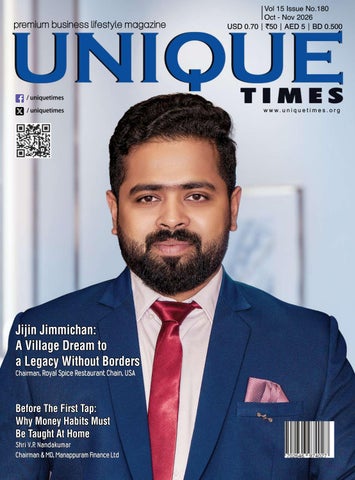
Vol 15 Issue No.180 Oct - Nov 2026 USD 0.70`50AED 5BD 0.500
Jijin Jimmichan: A Village Dream to a Legacy Without Borders Chairman, Royal Spice Restaurant Chain, USA
Before The First Tap: Why Money Habits Must Be Taught At Home Shri V.P. Nandakumar Chairman & MD, Manappuram Finance Ltd
LUXURY YOU CAN WEAR
CRAFTED IN EXTREME EXCLUSIVITY-A SINGLE MODEL, LIMITED TO JUST SIX PIECES WORLDWIDE www.alcazarwatches.com
Regd. & Corporate Office, Chennai- 24
KERALA TAMILNADU PUDUCHERRY KARNATAKA ANDHRA PRADESH TELANGANA MAHARASHTRA NEW DELHI HARYANA RAJASTHAN
Chief Mentor Mr. V.P. Nandakumar Director & CEO Jebitha Ajit Editor Ajit Ravi Legal Advisor Latha Anand B.S.Krishnan Associates bskrishnanassociates@gmail.com Sub-Editor Athulya Pradip Associate Editor Ravi Saini Anusha Varghese Correspondents Dr. Thomas Nechupadam Vivek Venugopal- Quarter Mile R L Morris Creative Design PEGASUS Photography PEGASUS Marketing USA 725, burning tree lane, punta gorda Florida-33982 Mob: +1 (863) 558-5234 UAE Jolly Tel: +971 50 307 1125 Vineeth Nair Shaji N Palakkal 415, Building 23, Al Khail Gate, Al Quoz-2, Dubai, UAE Tel: +9714 4511075 Maharashtra Jayasankar M a/101, New Prathamesh Niwas, OPP. Laxmi Park, Thakurli East, Dombivli post, Thane District, 421201 Mob: +91 9820708662 Tamil Nadu Sheelan Thangavelu Tamilnadu Director Mob: +91 7825-077770 Sri Shakthi Institute of Engineering and Technology, L&T- bypass, Chinniyapalayam, Coimbatore-62 Karnataka, Telangana, Andhrapradesh PEGASUS Ph: 09288800999 Sunilkumar NN Vice President Ambalika Saikia, Ambalika_saikia@yahoo.com Vice President V Suresh Kumar Public Relations
Published at Pegasus Global Pvt. Ltd. L5-106, Changampuzha Nagar Kalamassery, Ernakulam-682 033 e-mail: editor@uniquetimes.org uniquetimesindia@gmail.com Ph:0484 2532040, 2532080, Mob:9288800999
Editorial
“W
hen everything seems to be going against you, remember that the airplane takes off against the wind, not with it.” – Henry Ford Some journeys begin with a dream, shaped by humble beginnings and strengthened by the courage to step beyond surroundings. Over time, that dream can cross borders, embrace new cultures, overcome challenges and evolve into something greater than imagined. True entrepreneurship means recognising opportunities, adapting to change, creating experiences, and opening doors for others. From the flavours of Kerala to international ventures spanning hospitality, tourism, retail, facility management and sports, one journey reflects ambition, resilience and evolution. At its heart is Jijin Jimmichan, whose vision continues to grow beyond borders. This edition’s cover story explores his evolution from a village dreamer to an entrepreneur with a vision. This edition features an article by V. P. Nandakumar, Chairman & Managing Director of Manappuram Finance Limited, titled “Before the First Tap: Why Money Habits Must Be Taught at Home.” He highlights the importance of nurturing financial awareness and how habits formed at home can shape financial decisions. Enriching this issue is a selection of content spanning travel and tourism, finance, business stories, lifestyle and perspectives from leaders. “Books are lighthouses erected in the sea of time.” —E.P. Whipple
Happy Reading!
Cover Photograph Jijin Jimmichan, Chairman, Royal Spice Restaurant Chain, USA
Printer & publisher Pegasus Global Pvt. Ltd. Cochin (682033) on behalf of Ajit Ravi. Printed at S.T.Reddiar & Sons, P.B. No: 3627, Veekshanam Road, Cochin-18.
Years of Trust
Delivering World-Class Healthcare, Globally
Maradu I Nettoor P.O I Kochi | Kerala - 682040 +91 9961 640 000 - www.vpslakeshorehospital.com
CONTENTS 14
14
Jijin Jimmichan: A Village Dream to a Legacy Without Borders
22
22
BUSINESS
Before The First Tap: Why Money Habits Must Be Taught At Home
24
Scaling Leadership Through Systems & Platforms
28
The Science Of Spirituality: The Hidden Brain Power That Could Transform Our Life
BUSINESS
24
CONTENTS FINANCE
52
32
MOTIVATION
32
Prompt. Plead. Proceed. But Who Answers When Justice Is Questioned
52
The Unseen Shackles Of Enterprise, And The Sacred Pursuit Of Inner Peace
58
BEAUTY
Beauty Sleep Is Real: What Happens to Your Skin While You Sleep
TRAVELOGUE
58
60
60
Reliving The Fairy Tales In Germany
UNIQUE DIARY
Semicon 2.0 Targets 200 Chip Design Startups in India
I
ndia is expanding its semiconductor ambitions through Semicon 2.0, with the government targeting at least 200 chip-design startups and companies to strengthen the country’s domestic chip ecosystem. Announced by Union Minister Ashwini Vaishnaw at SEMICON India 2026, the programme has an outlay of `1.27 lakh crore and focuses on six key areas: chip design, machinery and materials, fabrication, advanced packaging, research and development, and talent development. The government also aims to develop 1 lakh skilled semiconductor technicians and factory-floor workers to meet the industry’s growing workforce needs. Under the earlier phase, more than 105 startups attempted chip design, with around 20 securing venture capital funding of approximately `800 crore. Semicon 2.0 aims to build on this progress by expanding capabilities across the wider semiconductor value chain, including equipment, materials, fabs, packaging and industry-led research, helping India develop a stronger and more self-reliant semiconductor industry.
Satya Nadella Highlights India’s AI Talent, Sees Huge Developer Community by 2030
“The way to get started is to quit talking and begin doing.” Walt Disney
8
Oct - Nov 2026
M
icrosoft CEO Satya Nadella has highlighted India’s growing technology talent and its potential to become a major force in artificial intelligence, suggesting that the country could have the world’s largest developer community by 2030. Speaking at the IDEAS4INDIA technology leaders’ forum in Seattle, Nadella emphasised the importance of India’s expanding pool of skilled professionals in driving AI growth. The forum, organised by the Consulate General of India in Seattle, brought together more than 40 Indian-origin CEOs and CTOs from leading technology and industrial companies. Discussions covered AI infrastructure, data centres, semiconductors, quantum technology, talent development, aerospace and advanced manufacturing. The event also highlighted major investments in India, including Microsoft’s planned $17.5 billion investment between 2026 and 2029 and Amazon’s $48 billion investment between 2026 and 2030. Leaders also discussed strengthening India-US cooperation across AI, semiconductors, quantum technology, space, telecom and biotechnology.
UNIQUE DIARY
Anthropic Says Claude Now Leads 26% of Its AI R&D Work
A
nthropic says its AI model Claude now leads 26% of the company’s measured AI research and development work, a major increase from less than 1% in February 2026. The company reports that more than 90% of its AI R&D work now involves AI in some collaborative capacity, although Claude has not achieved full autonomy in any measured area. Under Anthropic’s R&D Automation Index, Claude reached AL4, or “leads,” meaning it can complete most of a task from a high-level prompt while remaining under human supervision. Anthropic is also tracking around 30,000 AI agents operating simultaneously on its internal platform and analysed more than 1 billion decisions made by research and engineering agents in August. The company also reported that about 6% of AI R&D computing resources during one week in July were dedicated to safety work. Anthropic says sharing these measurements could help the industry understand the rapid evolution of AI-assisted development.
Tata Group Firms Lose $4 Billion in Market Value Amid Holding Company Dispute
“Success is not final; failure is not fatal: it is the courage to continue that counts.” Winston Churchill
10
Oct - Nov 2026
S
hares of several listed Tata Group companies fell sharply on 18th September, 2026, wiping out around $4 billion in combined market value as investors reacted to uncertainty surrounding the future listing and leadership of holding company Tata Sons. The developments followed Tata Sons’ decision to reappoint N. Chandrasekaran as chairman for another five years and move toward compliance with RBI rules that could require the company to list. The situation has also intensified differences between Tata Trusts, which holds a 66% stake in Tata Sons, and the company over governance, succession and the potential listing. Tata Trusts has opposed the listing and challenged Chandrasekaran’s reappointment, while the Shapoorji Pallonji Group, the second-largest shareholder, has supported a possible listing. Among the major decliners, Tata Consultancy Services fell 3.88%, Tata Chemicals 11.04%, and Tata Motors Passenger Vehicles 3.4%. Overall, about `383.61 billion ($4 billion) was erased from the market value of listed Tata companies.
Apple Pay Eyes India Launch With Axis Bank Partnership
A
pple is reportedly preparing to launch Apple Pay in India next month, initially with Axis Bank credit cards, according to three sources familiar with the matter. The move would mark Apple Pay’s entry into India’s rapidly growing digital payments market, where the service is currently unavailable. Apple has also held discussions with HDFC Bank and ICICI Bank, though agreements with the two lenders have not yet been finalised. The company is expected to gradually expand Apple Pay support through partnerships with individual banks. Apple Pay enables iPhone users to make contactless payments using tokenised card details securely stored on their devices. Apple’s smartphone market share in India has reportedly doubled to 8% since 2022, while UPI accounts for 84% of digital payment volume. The RBI’s approval of biometric authentication for card payments could also help Apple Pay work with Indian bank cards through Face ID and Touch ID, potentially expanding Apple’s digital payment services in the country.
India Finds Nestlé Baby Food Sample Substandard, Takes Legal Action
“If you really look closely, most overnight successes took a long time.” Steve Jobs
I
ndia’s food safety regulator FSSAI has found a sample of Nestlé’s infant follow-up formula to be substandard for its biotin content and has initiated legal action against the company. A re-analysis of the sample reportedly found that it did not meet the biotin requirements prescribed under Indian regulations. FSSAI has also filed separate cases concerning two Nestlé baby food products, NAN Excella Pro Stage 1 and Lactogen Pro 1, over alleged misleading claims on their labels, bringing the total to three adjudication cases against the company. The regulator has not stated whether the affected product will be recalled. Nestlé India said its products comply with applicable regulations and that it is cooperating with authorities. The company also maintained that the label statements were factual, supported by scientific literature and approved by an FSSAI expert committee. The regulatory action comes amid increased scrutiny of food safety practices in India and recalls the company’s earlier 2015 Maggi controversy.
Oct - Nov 2026
11
Cohere and Aleph Alpha Merge to Target Enterprise AI Market
C
ohere, a Canadian artificial intelligence company, and Germany’s Aleph Alpha have signed a definitive agreement to merge, creating a larger enterprise AI company focused on serving businesses and governments. The combined company will operate under the Cohere name, with headquarters in Toronto and Berlin, while Aleph Alpha’s Heidelberg office will concentrate on research. Aleph Alpha co-chief Ilhan Scheer will become Cohere’s chief operating officer. The companies said the merger aims to address growing demand for AI systems that can operate within organizations’ own infrastructure while complying with local regulations. Schwarz Group, which owns Lidl, will invest €500 million in the combined company and provide computing capacity through its cloud unit, StackIT. Schwarz is also investing up to €13 billion in a German data-centre campus. The merger remains subject to regulatory approval, while updated financial terms were not disclosed.
AfD Surge Raises Concerns Among Immigrants in Eastern Germany
T
he rise of Germany’s Alternative for Germany (AfD) party in the country’s eastern states is causing growing concern among some immigrant communities. Migrants in Rostock and Schwerin have reported increased anti-immigrant hostility, including verbal abuse and demands to leave Germany. The concerns have emerged ahead of the Mecklenburg-Western Pomerania state election, where polling indicated strong support for the AfD. The party has advocated stricter immigration policies and used the term “remigration” in its political messaging. Some migrants say they may consider leaving the region if hostility continues, although many who have established lives there hope to stay. The issue also highlights economic challenges facing eastern Germany, where an ageing population and low birth rates are contributing to labour shortages. Around 50,000 people with a migration background work in Mecklenburg-Western Pomerania, making migrant workers an important part of the region’s workforce.
12
Oct - Nov 2026
Spanish Police Launch Operation to Clear Migrants From Ceuta Beaches
S
panish riot police and military personnel launched an operation to relocate thousands of migrants from beaches in Ceuta, a Spanish enclave in North Africa. Authorities said around 10,000 migrants remained in the territory after more than 72,000 people crossed from Morocco during a major border rush in late July. Migrants were moved from beaches to temporary accommodation near the port, although tensions arose over limited shelter space. Reuters footage showed police using batons and firing rubber bullets into the air before the situation calmed. A temporary facility can accommodate around 1,700 adult men, while minors are being housed separately. Humanitarian organisations said thousands were still sleeping outdoors due to a lack of adequate accommodation, with one NGO estimating around 4,000 people remained on beaches and pavements. NGO representatives criticised the authorities for being slow to provide sufficient shelter, while officials reportedly expect some migrants to return voluntarily to Morocco.
EU Plans Social Media Restrictions for Under-15s
T
he European Commission has proposed the EU KIDS Act, aimed at introducing EU-wide restrictions on children’s access to social media and other online services. Under the proposal, children under 13 would be prohibited from accessing social media platforms, while those aged 13 and 14 could use supervised “mini accounts” with limited features and time restrictions. The proposal would establish 15 as the minimum age for creating an independent social media account and would also cover video-sharing platforms, online games and AI chatbots. Online platforms would be expected to demonstrate that their services are designed with children’s safety in mind. Companies that violate the proposed rules could face fines of up to 6% of their global annual turnover. However, the measures are not yet law and must receive approval from EU member states and the European Parliament before they can take effect.
For more info: europetimes.co
Oct - Nov 2026
13
COVERSTORY
Jijin Jimmichan: A Village Dream to a Legacy Without Borders How a young dream from Palakkayam travelled across continents, found its expression in Indian cuisine, survived a global crisis and evolved into a larger vision for entrepreneurship
S
ome dreams begin with a business plan. Others begin with a childhood belief that one day, somehow, something bigger is possible. For Jijin Jimmichan, it began in a small village called Palakkayam in Kerala's Palakkad district. Born on February 20, 1990, Jijin grew up in a world far removed from the international business landscape he would eventually enter. His childhood was simple, shaped by family, familiar faces, and a close-knit community where relationships mattered deeply. Hard work, humility, and strong religious faith were part of everyday life, forming the values that would continue to influence him throughout his journey. There was no grand entrepreneurial blueprint waiting for him. There was simply a dream. From a young age, Jijin wanted to become a businessman. He wanted to build something of his own, create opportunities and prove that an idea backed by determination could become reality. Today, his journey stretches across hospitality, restaurants, tourism, facility management, retail and sports, connecting Kerala with the United States, the United Arab Emirates and wider international op-
14
Oct - Nov 2026
portunities. Yet perhaps the most interesting part of Jijin's story is not how far he has travelled. It is how his definition of success has changed along the way. The boy who once dreamed of becoming a businessman now dreams of building a legacy that can create opportunities for others.
The Roots of a Dream
Long before Jijin Jimmichan entered the world of business, the foundations of his entrepreneurial journey were being shaped in Palakkayam, a small village in Palakkad, Kerala. Growing up in a close-knit community taught him the importance of family, humility, hard work, perseverance and meaningful relationships. It was also during these early years that he developed a strong connection with food and the traditions surrounding it. Kerala’s cuisine became an important part of his childhood memories. Traditional spices, family meals, seafood, fish and banana-leaf fry preparations and the distinctive flavours of the region were more than everyday food; they were closely connected to his family, village and upbringing. Years later, when he found himself thousands of kilometres away from Kerala, these familiar flavours would become a source of in-
spiration for his professional journey. Before turning that connection with food into a business, Jijin chose to understand the world of hospitality. After completing his schooling, he pursued a B.Sc. in Hotel Management and Culinary Services at Yuvakshetra Institute of Management Studies in Palakkad, where he gained knowledge in culinary preparation, hotel management, hospitality operations and customer service. The experience gave him more than technical knowledge. It shaped his understanding that hospitality goes beyond preparing food or serving guests. At its heart, it is about creating an experience—one that makes people feel welcomed, valued and connected. That understanding would later become an important part of the businesses he went on to build.
When Kerala Met America
After completing his education and training, Jijin moved to the United States in pursuit of greater professional opportunities and international experience. Leaving behind the familiarity of his village in Kerala and stepping into a new country marked a significant turning point in his life. He had to adapt to a different culture, environment and way of doing business, experiences that gradually made him more
Gopu Nandilath embarked on his business journey by opening a modest 2,000 sq ft showroom on Kuruppam Road in Thrissur, the cultural capital of Kerala. The store dealt in televisions and electronic goods. What appeared to be a modest beginning would eventually become the foundation of a formidable consumer durables empire.
Oct - Nov 2026
15
COVERSTORY independent, confident and willing to take risks. Living away from home also changed the way he looked at his own roots. The food, flavours and traditions that had always been part of everyday life in Kerala began to feel distinctive in a new environment. The spices, seafood, traditional preparations and warmth of Indian hospitality carried a sense of familiarity that he realised could also introduce others to a different side of Indian culture. Over time, the idea of combining his hospitality education, professional experience and connection to Indian cuisine began to take shape. Jijin wanted to build something of his own—not simply a restaurant, but a business through which he could share the flavours and traditions he had grown up with while creating a welcoming experience for people from different backgrounds. That vision eventually led him into the restaurant business in 2019, marking the beginning of a new chapter in his entrepreneurial journey and laying the foundation for what would later become Royal Spice Fine Indian Cuisine.
The Royal Spice Story: Royal Spice Fine Indian Cuisine
The creation of Royal Spice Fine Indian Cuisine became one of the defining chapters of Jijin’s entrepreneurial journey. Jijin shared a deep ambition to create an Indian dining destination that could connect authentic culinary traditions with the diverse American community. He chose Orange, Connecticut, a community enriched by people from different cultural and social backgrounds. To Jijin, that diversity represented an opportunity—a chance to introduce people to the richness of Indian cuisine while creating a space where cultures could come together. His vision was to create a restaurant where diners could discover Indian food not merely as a cuisine, but as a cultural experience—one that celebrated tradition, flavor, hospitality, and connection. And the name he chose captured that philosophy.
16
Oct - Nov 2026
Royal Spice. Spices have occupied a special place in India's history. They shaped culinary traditions, travelled across continents and played an important role in international trade. For Jijin, spices also represent something personal.They connect his present with the memories of his childhood. They represent the traditions that travelled with him from Kerala to America. And they embody the idea behind Royal Spice—to preserve the essence of Indian cuisine while presenting it in an environment that feels contemporary, welcoming and memorable.
More Than What's on the Plate
For Jijin, food has always carried a story. At Royal Spice, some of the dishes closest to his heart are inspired by the flavours he grew up with in Kerala—from fish fries on banana leaves and Malabar-style preparations to the traditional use of aromatic spices. These flavours are closely connected to memories of home, family and the food he experienced during his childhood. Through Royal Spice, Jijin wanted to bring that sense of Indian culinary diversity to diners in Connecticut. The menu brings together vegetarian and non-vegetarian dishes, seafood, biryanis, breads, curries, North Indian favourites, South Indian influences and traditional Indian desserts, offering guests an opportunity to explore different flavours and regional traditions. For Jijin, preserving the character of Indian cuisine while making it welcoming to a diverse audience is an important part of the experience. Whether a guest is already familiar with Indian food or is trying it for the first time, the intention is to create a dining experience that feels inviting while offering a genuine taste of the traditions behind the food. In that sense, Royal Spice is about more than what arrives on the plate. It is about bringing together food, memories, heritage and hospitality, allowing Jijin to share a part of the culture that shaped him with a community thousands of kilometres from where his journey began.
A New Beginning in Orange
The vision took a significant step forward when Royal Spice officially celebrated its grand opening on January 30, 2025. For Jijin, the event marked the beginning of a new chapter and the realisation of an idea they had worked towards for years. The opening also reflected the restaurant’s growing connection with the local community. What had once been a dormant storefront was transformed into a welcoming space centred around Indian food and hospitality. The Orange Chamber of Commerce recognised the restaurant and its owners, while the opening also received recognition from the Connecticut State General Assembly, adding to the significance of the occasion. For Jijin, the grand opening was only the beginning. Building a restaurant is an ongoing process shaped by every meal served, every conversation shared and every customer who walks through the door. Through Royal Spice, he continue to build those connections one experience at a time, creating a space where food and hospitality can bring people together.
When the World Stood Still
The entrepreneurial journey, however, had already taught Jijin one of its toughest lessons. COVID-19. The pandemic created extraordinary challenges for restaurants and hospitality businesses around the world. Restrictions, uncertainty, changing customer behaviour and operational difficulties placed enormous pressure on the industry. For an entrepreneur, such a period can fundamentally change the meaning of risk. Jijin faced that uncertainty without abandoning his original ambition. The experience tested his patience and determination, but it also strengthened qualities that would become essential to his later ventures. Resilience. Adaptability. Discipline. The pandemic taught him that entrepreneurship is not only about knowing how to grow when the
For Jijin, preserving the character of Indian cuisine while making it welcoming to a diverse audience is an important part of the experience.
Oct - Nov 2026
17
COVERSTORY economy is favourable. It is about knowing how to continue when circumstances are beyond your control. The crisis became a reminder that setbacks can change a route without necessarily changing the destination.
Beyond Royal Spice
The pandemic taught him that entrepreneurship is not only about knowing how to grow when the economy is favourable. It is about knowing how to continue when circumstances are beyond your control.
18
Oct - Nov 2026
As Jijin’s experience and professional confidence developed, his career interests expanded beyond a single restaurant environment. During this period, he gained valuable experience through his involvement with Royal Spice Fine Dining, Curry Mango Fine Dining, and Vedas Indian Cuisine. His exposure to these establishments, including chain restaurant operations, enabled him to develop a broader understanding of restaurant management, hospitality operations, customer service, team coordination, and business development. These experiences played an important role in broadening his professional perspective and developing his confidence in the hospitality and restaurant industry. His interest in hospitality also extended into tourism.As Director of Vibe Resort and Spa in Munnar, Jijin gained experience in resort management, guest services and the wider tourism ecosystem. The move from restaurants to resorts broadened his understanding of hospitality. A restaurant may create an experience over a few hours; a resort has the responsibility of shaping an entire stay. His professional journey also extended into facility management through his association with TRANA Facility Management Services Pvt. Ltd. in Kochi, including security services and operational planning. His association with Fortune Shopping Mall in Kanjikode provided exposure to commercial and retail operations. And his international experience continued through his association with Kadavu Restaurant and Sports Bar in Dubai, adding another perspective to his understanding of hospitality and multicultural business environments. Each venture added another piece to the larger picture. Jijin was no longer simply pursuing the dream of becoming a businessman. He was building an under-
Jijin Jimmichan with wife Dona
standing of how different businesses work, how people interact with them and how leadership changes across industries.
Where Business Meets Sport
Another interesting dimension of Jijin's professional journey is his involvement in sports. He has taken on leadership responsibilities with TEZ Sports and the Liège Red Lions European League Club, bringing together his interests in sports, organisation, management and business development. For Jijin, the connection between sport and entrepreneurship is natural. Both demand discipline. Both require teamwork. Both involve strategy.
And both teach people how to deal with setbacks. A business leader, much like a team leader, cannot succeed by focusing only on individual performance. People, systems and a shared objective all have to work together. His involvement in sports therefore represents more than an additional professional interest. It is another platform through which he continues to explore leadership and team building.
The Entrepreneur Who Doesn't Like Standing Still
Ask Jijin about his life today and one theme emerges clearly. He does not like standing still. Business ideas, meetings, operations, new opportunities and future plans keep him occupied. For him, productivity is closely
connected to purpose. He believes that staying engaged helps maintain focus and motivation. At the same time, he recognises that an entrepreneur's ability to keep moving depends on maintaining physical and mental well-being. The philosophy is simple: ambition should not come at the expense of balance. Success is not merely about building a business. It is also about having the energy, clarity and discipline to continue building.
From Building Businesses to Building People
Perhaps the most significant evolution in Jijin's journey is happening now. His ambition is gradually moving beyond his own businesses.
Oct - Nov 2026
19
Jijin Jimmichan with his parents Jimmichan and Marykutty, wife Dona, sons Johan and Jion.
He wants to create opportunities for the next generation. Having experienced the challenges of starting from a relatively modest background, moving to another country, adapting to unfamiliar environments and building businesses, Jijin understands the value of mentorship and connections. He believes that young entrepreneurs need more than funding. They need people who have already travelled the road. They need mentors who can share experience. They need access to business leaders. They need networks. They need encouragement when an idea is still too young to look like a success. And sometimes, they simply need someone to say, keep going. This is the legacy Jijin wants to build. An ecosystem where fresh ideas can meet experience, where technology can meet traditional business knowledge, and where young
20
Oct - Nov 2026
founders can find the relationships and guidance necessary to turn possibilities into enterprises.
A Future Driven by Innovation
Jijin's vision for the future is closely connected with innovation. The business landscape is changing rapidly. Artificial intelligence, digital platforms, changing consumer behaviour and new business models are creating opportunities that previous generations could not have imagined. He believes young entrepreneurs should not be afraid of that change. They should understand technology, embrace innovation and be willing to take calculated risks. At the same time, the lessons of the past should not be discarded. Jijin's own journey is proof of that. The technology and markets may change. The values remain. Hard work. Relationships. Perseverance.
Humility. And the courage to begin.
A Dream That Became Bigger
When Jijin looks back, the journey can be traced almost like a map. Palakkayam. Palakkad. America. Connecticut. Dubai. Munnar. Kochi. And the many business and professional relationships formed along the way. But the most important journey is not measured in kilometres. It is measured in ambition. A young boy from a small Kerala village wanted to become a businessman. He pursued education in hospitality. He moved across continents. He entered the restaurant industry. He built Royal Spice. He faced one of the most difficult periods the hospitality industry
had ever experienced. He expanded his professional horizons across restaurants, resorts, facility management, retail and sports. And somewhere along the way, the original dream changed. He no longer wants success only for himself. He wants to create possibilities for people who are still standing at the beginning of their own journeys. That is what makes Jijin Jimmichan's story more than an entrepreneurial profile. It is a story about evolution. About taking something from your childhood and carrying it into a completely different world. About turning food into a bridge between cultures. About turning adversity into experience.
And ultimately, about turning personal ambition into a larger purpose. Royal Spice may have begun as a restaurant, but for Jijin, the journey has become much bigger than a dining room in Connecticut. It is about what happens when a dream crosses borders. It is about what happens when heritage becomes an opportunity. And it is about what happens when an entrepreneur begins to ask a different question—not What can I build for myself? but What can I
build that continues to create opportunities after me? The answer is still being written. And perhaps that is the most exciting part of Jijin Jimmichan's story. The dream began in Palakkayam. It crossed an ocean, found a home in America and became a business. Now, Jijin is looking beyond business itself—to build something that lasts. From a village dream to a vision without borders, his journey is no longer just about where he came from. It is about how many others he can help move forward
The dream began in Palakkayam. It crossed an ocean, found a home in America and became a business. Now, Jijin is looking beyond business itself—to build something that lasts.
Oct - Nov 2026
21
BUSINESS
2013 University of Cambridge study for the UK's Money Advice Service found that core money habits, such as planning ahead and delaying gratification, are largely formed by about the age of seven.
Shri V.P.Nandakumar Chairman & MD Manappuram Finance Ltd
Before The First Tap: Why Money Habits Must Be Taught At Home
I
ndia has built world-class financial infrastructure faster than it has built the habits to use it well. That lesson begins with parents. Every generation of Indian parents has taught its children about money in its own way. Mine learnt it by watching elders count coins at the end of the day, weigh each purchase, and put something aside, however small, for a bad season. The lessons were rarely spoken. They were simply visible. That visibility is disappearing. A child today watches a parent scan a QR code at the vegetable stall, order dinner on an app, and top up a mobile game in seconds. Money no longer changes hands; it vanishes with a tap. At the same time, credit has never been easier to obtain. Instant loans and buy-now-pay-later
22
Oct - Nov 2026
offers arrive on the same phone that carries a teenager's homework and games. India's financial infrastructure has advanced faster than most of the world's advance countries. Our financial habits have not kept pace. Past surveys have found that only about one in four adults meets its benchmark for financial literacy. Today, we have given our citizens powerful tools without always teaching them how to handle them. In my years in the business of lending, I have learned that financial distress does not always begin with a lack of money. More often, it begins with a decision taken without understanding: a loan whose true cost was not read, a scheme that promised too much, a repayment date forgotten. These are not failures of intelligence. They are failures of habit,
and habits are formed early. The evidence supports this. A 2013 University of Cambridge study for the UK's Money Advice Service found that core money habits, such as planning ahead and delaying gratification, are largely formed by about the age of seven. By the time most of us encounter a formal lesson on interest rates, the foundations have already been laid down. I must add a note of honesty. Research on formal financial education is mixed, and classroom lessons on their own often fade. What endures is practice: small, regular decisions with real consequences, made while the stakes are low. That is why I believe the most important financial educator in any child's life is not a teacher or a regulator, but a parent.
What Can Parents Do?
For the youngest children, be-
tween three and seven, money must be made real again. Letting a child pay cash for a small purchase and count the change teaches that money is finite. Speaking choices aloud ("we can buy this today, or save for something better next month") teaches that every rupee spent is a rupee that cannot be spent elsewhere. Between eight and twelve, children are ready for goals and patience. A fixed, regular allowance that the child manages, mistakes included, is a better teacher than any lecture. From the age of ten, RBI rules permit minors to open and operate a savings account independently, within limits set by the bank. Teenagers need the truth about the system they are entering. They should know how a bank account, a
debit card and UPI work, and how credit card interest and late fees accumulate. They should understand compounding, and why starting to save at twenty rather than thirty makes a large difference. They should understand inflation, and why idle cash quietly loses value. They should learn the basics of insurance and of not placing every egg in one basket. Above all, they must learn caution: never to share an OTP or PIN, never to approve a UPI request that claims to "send" them money, and to treat investment tips from socialmedia personalities with healthy scepticism. The attraction of ingame purchases deserves an honest conversation too. Parents can also save for their children in ways that double as les-
sons: a minor's savings account or recurring deposit, a Public Provident Fund account opened in the child's name, or the Sukanya Samriddhi Yojana for a daughter. Reviewing the statements together turns a passbook into a classroom. None of this guarantees wise choices. No upbringing can. But I am convinced that a child who has handled money early, made small mistakes while little was at stake, and watched the adults around them live within their means will be far better prepared for a world in which borrowing, spending and investing are only a tap away. Our parents taught us by example, often without a word. Our children will need both the example and the words. The conversation should begin before that first tap
Oct - Nov 2026
23
BUSINESS
Rajesh Nair Partner, Ernst & Young LLP
Decisions accumulate around a few individuals, institutional knowledge remains concentrated at the top, and organisational velocity becomes dependent on the availability of key leaders.
Scaling Leadership Through Systems & Platforms Moving Beyond Heroic Leadership to Institutional Leadership We have always been enamoured with Heroic leadership – often one man who changed everything. But as institutions mature it is about distributed leadership, delegation, shared vision, execution culture not just in the C-suite or the junior rungs but that thread which runs through the organisation. In the early stages of an enterprise, leadership is often synonymous with the founder. Vision, energy, conviction and personal influence drive progress, shape culture and inspire teams to achieve what may initially seem impossible. Yet as organisations grow, the very traits that fuelled early success can become constraints. Decisions accumulate around a few individuals, institutional knowledge remains concentrated at the top, and organisational velocity becomes dependent on the availability of key leaders. The challenge of scaling is therefore not simply about growing revenue, headcount or market presence. It is about scaling leadership itself. The most successful founders and executives recognize that enduring organisations are built not on
24
Oct - Nov 2026
the strength of individual personalities, but on systems, platforms and organisational structures that continuously reproduce sound judgement, quality decision-making and desired behaviours. Their objective is not merely to lead people directly, but to create mechanisms through which leadership principles operate consistently across the enterprise. Leadership, in this context, evolves from a personal capability into an organisational asset.
The Leadership Scalability Challenge Charisma is often a powerful catalyst during a company's formative years. Founders inspire confidence, make rapid decisions and personally influence every critical outcome. However, charisma has a natural limitation: it does not scale linearly with organisational growth. As the organisation expands: • Decision-making begins to bottleneck around senior leaders. • Teams become hesitant to act without approval. • Knowledge and context remain centralised. • Innovation slows due to excessive dependence on leadership intervention. • Organisational agility becomes
constrained by leadership bandwidth. This is not a leadership failure. It is a design challenge. When an organisation depends excessively on individual leaders, it inadvertently creates concentration risk. Sustainable enterprises, by contrast, build leadership capacity into their operating model, ensuring that good decisions can be made consistently at every level. The shift from "being the leader" to "designing leadership into the organisation" represents one of the most important transitions in executive maturity.
Embedding Leadership into Processes One of the most effective ways to scale leadership is through process excellence. A well-designed process is more than a sequence of activities. It is a codified expression of leadership thinking. Every process captures a set of principles, priorities and decision criteria that can be applied repeatedly without direct executive involvement. Consider critical business functions: Talent Acquisition High-performing organisations
do not leave hiring quality to individual judgement alone. They institutionalise leadership expectations through: • Structured interview frameworks • Competency-based assessment models • Clearly defined cultural attributes • Standardised evaluation criteria The result is consistency, fairness and quality at scale. Customer Experience Management Organisations that excel in customer service document escalation pathways, response protocols and service standards that reflect leadership's commitment to customer success. Rather than depending on exceptional employees to rescue every
situation, they create systems that consistently deliver excellence.
Capital and Resource Allocation Investment decisions, pricing exceptions and strategic prioritisation should not require executive intervention every time. Clearly articulated decision frameworks empower teams to make choices aligned with organisational objectives while maintaining governance. The goal is not bureaucracy. The goal is institutionalised judgement. The most effective processes reduce friction, eliminate ambiguity and increase speed, allowing leaders to focus their attention on strategic questions rather than repetitive operational decisions.
Technology as Leadership Infrastructure Modern organisations often
view technology as a productivity tool. High-performing organisations treat technology as leadership infrastructure. The true value of a platform lies not in digitising activities but in reinforcing desired behaviours. Technology should make the right actions intuitive, visible and repeatable. For example: Decision Intelligence Decision logs that capture both outcomes and rationale transform individual knowledge into institutional knowledge. Future teams gain access to historical context, reducing repetition and improving organisational learning. Performance Transparency Well-designed project management and collaboration platforms create visibility without creating surveillance. Teams gain clarity on
Oct - Nov 2026
25
BUSINESS
priorities, dependencies and outcomes while reducing reliance on status-update meetings. Outcome-Based Management Performance management systems that emphasise business outcomes over activity levels communicate a powerful cultural message: results matter more than busyness. Knowledge Democratisation Digital platforms that provide easy access to policies, best practices and expertise reduce dependency on informal networks and accelerate decision-making across the enterprise. The strategic role of technology is therefore not merely automation. Its higher purpose is behavioural reinforcement. When systems are intentionally configured around leadership principles, technology becomes a silent multiplier of executive influence.
Organisational Design as a Force Multiplier If strategy determines where a company intends to go, organisational design determines how effectively it gets there.
26
Oct - Nov 2026
Structure shapes behaviour. Roles, responsibilities, governance mechanisms and decision rights collectively define how leadership is distributed throughout the organisation. High-growth enterprises deliberately design for empowered execution by establishing: Clear Accountability Every strategic objective should have a clearly identified owner with defined authority and measurable outcomes. Distributed Decision Rights Decisions should be made at the lowest competent level, ensuring speed, accountability and responsiveness. Transparent Information Flows Access to timely and relevant information enables better decisions and reduces unnecessary escalation. Feedback Mechanisms Structured feedback loops ensure that learning is continuously embedded into processes, products and operations. Such organisations become less dependent on individual leaders because leadership capability has been
replicated throughout the system. This is not delegation. It is leadership multiplication.
Turning Culture Into an Operating System Culture is often described as "how things get done around here." Yet culture is rarely shaped by speeches, town halls or value statements alone. Culture emerges from what organisations consistently reward, measure and reinforce. Every operating mechanism sends signals: • Promotion criteria communicate what success looks like. • Performance metrics influence behaviour. • Meeting structures determine how decisions are made. • Expense policies reveal priorities. • Information access reflects trust levels. Collectively, these mechanisms form the organisation's cultural operating system. When systems, incentives and platforms align with stated values, culture becomes self-sustaining.
When they do not, culture remains aspirational rather than operational. Great leaders understand that culture scales only when values are embedded into the day-to-day mechanics of the enterprise.
A Leadership Scalability Blueprint Executives seeking to institutionalise leadership should focus on five practical actions: 1. Identify Leadership Bottlenecks Track decisions requiring personal intervention over a two-week period. Patterns quickly reveal where excessive dependence exists and where systems can be strengthened. 2. Codify High-Impact Decisions Document the principles driving recurring decisions such as hiring, pricing, investments and customer recovery. Consistency follows clarity.
3. Build Organisational Resilience Assess which processes would fail if key leaders were unavailable. Strengthen governance, documentation and knowledge-sharing mechanisms to reduce concentration risk. 4. Engineer Preferred Behaviours Use platforms, metrics and workflows to make desired behaviours easy, visible and repeatable. 5. Simplify Relentlessly Complexity is the hidden tax of scale. Regularly review systems and processes to eliminate redundancy and maintain institutional agility.
From Decision Maker to System Architect The highest-performing executives eventually undergo a profound shift in mindset. They stop measuring their value by the number of decisions they make and start measuring it by the quality of decisions made without
them. Their objective is no longer to remain at the centre of every conversation. Instead, they architect environments where sound judgement, accountability and execution occur consistently across the organisation. In doing so, they transform leadership from a finite resource into an enterprise-wide capability. Personal charisma may ignite growth. Vision may create momentum. But lasting scale is achieved when leadership is embedded into the operating fabric of the organisation through systems, platforms and deliberate organisational design. The organisations that endure are not those led by exceptional individuals alone. They are the ones where leadership itself has been institutionalised, making excellence repeatable, resilient and scalable long after any single leader steps away from the centre stage
Oct - Nov 2026
27
HEALTH
Dr Arun Oommen MBBS, MS ( Gen Surg), Mch( Neurosurgery),MRCS Ed (UK) , MBA, DMS( Hospital Administration) ENLS, D Litt(H), Phd(H), D Sc(H) Neuro Endoscopy Fellow Senior Consultant Neurosurgeon VPS Lakeshore Hospital, Kochi, India. Honorary Secretary Neurological Society of India- Kerala Chapter UN Representative
Modern brain imaging suggests that long-term spiritual practices— such as meditation, mindfulness, prayer, gratitude and compassion ate reflection—are associated with measurable hanges in brain function.
www.arunoommen.com
The Science Of Spirituality: The Hidden Brain Power That Could Transform Our Life
C
ould Spirituality Be the Secret Behind a Healthier Brain, Emotional Resilience and True Success? Imagine two people facing the same devastating crisis—a serious illness, the loss of a loved one, or financial ruin. One crumbles under the weight of suffering. The other, though equally hurt, somehow finds meaning, hope and inner strength. What makes the difference? Surprisingly, neuroscience suggests that one answer may lie in spirituality. And the most fascinating part: "We do not have to belong to any religion to be spiritual."
Spirituality Is Not the Same as Religion Many people use these words interchangeably, but they are different. Religiosity usually refers to fol-
28
Oct - Nov 2026
lowing an organized faith—its beliefs, rituals, traditions and places of worship. Spirituality is broader. It is the search for meaning, purpose, connection, compassion and inner peace. It asks questions such as: Why am I here? What gives my life meaning? How can I live with kindness and wisdom? How am I connected to other people and to nature? A deeply religious person may also be deeply spiritual. But a person can be spiritual without following any religion.
Can Spirituality Physically Change the Brain? Modern brain imaging suggests that long-term spiritual practices— such as meditation, mindfulness, prayer, gratitude and compassion-
ate reflection—are associated with measurable changes in brain function. Studies have shown that these practices may: -Strengthen the prefrontal cortex, helping with emotional control and wiser decision-making. -Reduce overactivity of the amygdala, the brain's fear and stress centre. -Improve attention, self-awareness and emotional resilience. -Promote healthier social connections and empathy. In other words, spirituality is not simply about beliefs—it can influence how the brain processes emotions and relationships.
How Spiritually Mature People Often Think Differently Spiritually evolved people share
some special Brain Traits. They are not necessarily more intelligent. Instead, they often demonstrate qualities such as: - Remaining calm during adversity. - Responding instead of reacting. - Finding purpose even in suffering. - Forgiving more easily. - Showing greater compassion. - Feeling connected rather than isolated. - Being guided by values instead of impulses. These qualities can strengthen relationships, improve mental wellbeing and help people navigate life's inevitable challenges.
Spiritual Quotient (SQ): Could This Be an Important Intelligence of the AI Era? For decades, we believed that
IQ (Intelligence Quotient) was the ultimate predictor of success. Later, the world realized that EQ (Emotional Intelligence) now matter a lot in building relationships, leadership and resilience. But is there another form of intelligence that is even more deep. Many psychologists and researchers now speak about Spiritual Quotient (SQ)— as a way of describing our ability to live with meaning, purpose, wisdom, self-awareness and compassion. A person with a high SQ doesn't simply ask, "Can I do this?" or "Will this make me successful?" Instead, they pause and ask deeper questions: "Should I do this?" "Will this make my life meaningful?" "Will this decision make the
world a little better because I was here?" That is the quiet power of Spiritual Intelligence. In an age where artificial intelligence can solve problems in seconds, SQ reminds us that the greatest decisions in life are not made by knowledge alone, but by wisdom, values and humanity. Perhaps the future may not belong to those with the highest IQ or the greatest technical skills, but to those who combine intelligence with compassion, success with purpose, and achievement with a deep sense of meaning.
Can an Atheist Be Deeply Spiritual? Yes. Of course Perhaps one of the greatest misconceptions of our time is that spirituality belongs only to religion.
Oct - Nov 2026
29
HEALTH
It does not. An atheist may never enter a place of worship, yet live a life filled with compassion, integrity, humility, gratitude and selfless service. They may stand in silent awe beneath a sky full of stars, find profound meaning in the wonders of nature, devote themselves to relieving human suffering, and spend a lifetime searching for truth. If these experiences awaken wisdom, purpose and deep human connection, they reflect a form of spirituality. At the same time, a person may faithfully perform every religious ritual, recite every prayer and observe every tradition, yet still struggle with anger, hatred, greed, arrogance or the inability to forgive. This is why spirituality and religiosity are not always the same. Religion may provide a path to spirituality, but walking that path is a personal journey. Ultimately, spirituality is not measured by how often we pray, but by how we treat people who can do nothing
30
Oct - Nov 2026
for us. It is seen not in the symbols we wear, but in the compassion we show, the integrity we uphold, the peace we carry within ourselves, and the hope we bring into the lives of others. Perhaps the truest test of spirituality is not what we believe, but who we become because of what we believe—or even without belief.
When Artificial Intelligence Becomes Smarter, What Will Make Humans Truly Great? Artificial intelligence is becoming faster. Machines can analyse data, generate content and solve complex problems in seconds. But they cannot genuinely experience love, forgiveness, gratitude, moral responsibility or the search for meaning. The future may therefore belong not only to people with high IQ, but also to those with strong EQ and deep SQ—individuals who can combine knowledge with wisdom, technology with compassion and success with humanity.
As technology grows more powerful, these human qualities may become even more valuable.
The Greatest Journey Is Not Around the World—It Is Into our Own Mind The greatest journey in life may not be to another country, another career or another achievement. It may be the journey inward. The human brain is one of the most extraordinary creations in nature. Yet perhaps its highest purpose is not simply to think faster, remember more or earn more—but to become wiser, kinder and more deeply connected. Whether we find that path through prayer, meditation, nature, service, philosophy or quiet reflection matters less than where it leads. Because in the end, people rarely remember us for our wealth or our titles. They remember how we made them feel. And perhaps that is the truest measure of a spiritually evolved brain
luxury you can wear
TSHIRT
FINANCE
Adv Sherry Samuel Oommen: This article is authored by Adv Sherry Samuel Oommen. He specialises in the Constitution, tax and corporate laws and has also cleared the final exams of the Institute of Chartered Accountants of India, the Institute of Cost Accountants of India and the Institute of Company Secretaries of India. He has also completed his Masters's Degree in Commerce, apart from obtaining a Post Graduate Diploma in Business and Corporate Laws from Symbiosis, Pune. The views expressly are personal and should not be construed as a legal opinion. sherryoommen@nashcp.com.
Prompt. Plead. Proceed. But Who Answers When Justice Is Questioned
E
arlier, a legal problem usually began with a lawyer. Often it begins today, with a prompt. “My landlord hasn’t returned my deposit. What remedies do I have?” “Should I file a 498A case?”” “Write a good legal notice. "Give me Supreme Court decisions that support my case.” In the blink of an eye there is an answer. It is neat, legal sounding, trustworthy and full of sections, case names and legalisms. Looks very convincing enough. And somehow along the way we seem to have acquired a new kind of personalized lawyer, the one sitting inside almost every Indian's phone. There is something genuinely useful in this. Law has consistently posed a language challenge. Statutes, judgements and procedures aren't exactly written for the ordinary man. Artificial Intelligence (“AI”) has made it easier for people to understand a notice, read a provision or even initiate the right questions. You don’t intend to discount that part. But there is a very important distinction that exists between understanding the law and understanding a legal problem. A machine can often help with the first. The second requires much more than an answer in seconds.
32
Oct - Nov 2026
The issue starts when a wellwritten answer becomes mixed up with a correct answer. Those who have actually practiced law know how often the answer to a legal question begins with, “It depends. Depends on the facts. Depends on document. It is an inquiry of what happened prior to the litigation reached court. It could be a limitation, evidence, standard procedure, jurisdiction or a judgement that appears irrelevant until you have read it properly. AI has an innate desire to just tidy all of the uncertainty away. Give it a complicated argument and it will effortlessly give you five headings and an outcome. The problem is the law is rarely so simple. The Indian system of justice, in particular, cannot be considered as a mathematical exercise. It really matters not if the person making the inquiry is sympathetic or the circumstances are unusual. If a mathematical problem is done precisely, the answer is uniform. The courts deal with people, and people don’t always come in neat compact packages. Two cases may pertain to the same provision but nevertheless come to different conclusions because the proof presented is different, the conduct of the parties
is distinct or the procedure implemented in one case was fundamentally unfair. A judge is not merely asking what Section X actually says. The court wants to know what happened, has it been proved, had it been heard on both sides, does the previous precedent actually apply, what consequence should the law confer in those particular circumstances? That is where principles of natural justice, fairness, equality and judicial discretion come into play. You don’t exclusively include these variables into a prompt. The concern becomes much more serious when the system starts delivering authorities which do not exist. It’s not a hypothetical possibility anymore. The Supreme Court, in Pooja Ramesh Singh v. Jammu and Kashmir Bank Ltd. AIR 2026 SC 3247 examined the dilemma of AI-generated and hallucinated legal authorities engaging in the adjudicatory process. Automated language models are not legitimately accountable for creating legal precedents in court filings; the legal professional bears the ultimate responsibility. Therefore, AI support is no excuse for misrepresenting legal authorities to the courts. PreNCLT authorities cited and relied upon were non-existent, wrongly
cited or not consistent with actual judgements. The decisions of the NCLT and NCLAT were ultimately quashed. What makes the case particularly important is not just that an AI system got a parameter wrong. It is that something generated by a machine was presented as law and made its way into a judicial decision-making process. The Supreme Court’s solution was not toss out to technology in toto. It was to stress verification and personal accountability. That seems an appropriate line to draw: use the equipment, but refrain from trying to outsource the judgment. Which ultimately leads to a probing question. Who pays for an AI mistake? The machine, definitely not. It does not look to the Bench when the judge asks the origin of a particular judgment. This doesn’t explain why a case that has no existence appeared in writing. It has no professional consequences. The user does. Apologies but "ChatGPT told me so" is not a professional de-
fense pertaining to placing wrong law before a court. Technology can tell you how the error occurred. It doesn’t automatically carry over the obligation for the error. There is another issue that may become more apparent as AI becomes part of everyday litigation. With AI it is incredibly easy to produce legal materials. It now takes less time for a person to draft a long petition, list dozens of grounds, quote provisions and generate case citations than it would have taken previously to start researching the issue. But the court still has to read the stuff. The thirty pages were produced in thirty seconds, so a judge can’t verify thirty pages in thirty seconds. Somebody has to separate the wheat from the chaff, vet the authorities and find out what the real dispute is. If this is prevalent, there is a substantial chance that some of the duties, that traditionally fell on lawyers in preparation and verification of legal material, will shift toward the judiciary. A court should
settle disputes. It should not have to waste time determining whether the instances cited in a pleading even exist. This is also why the phrase “AI lawyer” is somewhat misleading. A lawyer is not just someone who knows the rules and can write a convincing paragraph. The lawyer reads the documents, examines the facts, knows the procedural history, evaluates the evidence, anticipates the other side and, most significantly, takes responsibility for the advice given. Sometimes the most beneficial thing a lawyer can do for a client is not to say “Here are ten grounds to file a case”, but “Don't file this case; your evidence does not support it.” Sometimes the real issue is not the law at all. It is a missing document, an unreliable witness, limitation or one inconvenient fact that changes everything. You can't measure that kind of judgment by how competent the answer looks on a screen. Then there’s the data we give out.
Oct - Nov 2026
33
FINANCE
Matrimonial disputes, criminal complaints, medical records and children’s details are precisely the kind of information where unauthorised processing, a breach or a cross-border transfer can cause real and lasting harm, yet the Act does not carve out a distinct, higher-protection category for such information in the way earlier data protection frameworks attempted to. When a person tells an AI to "analyse my case" they are rarely presenting a hypothetical problem. They can upload divorce petition, Aadhaar card, medical records, WhatsApp conversations, bank statements, photographs, employment records, children’s details or an entire bundle of correspondence. That may amount with years of an individual's private life in a family dispute. In a criminal matter it may comprise statements, captures and medical material. In an employment dispute, it could include salary details, internal communications as well as individual records. This is where the Digital Personal Data Protection Act, 2023 (“the Act”) comes into play for the discussion. The Act lays down a framework for processing electronic personal data and imposes obligations on such processing. The point of it in relation to AI is not just to say “don’t put your personal information in AI”. The issue in question is more elementary. As more people use AI for things they would traditionally talk to a lawyer about, they are also incorporating more and more sensitive information into electronic systems. Hence the legal question is not exhausted by the answer the machine gives. And behind that there is another question: what happens to that information that was used to produce that answer. Under the Act, an entity that collects and processes such information ordinarily functions as a “Data Fiduciary” and is required to process per-
34
Oct - Nov 2026
sonal data only for a lawful purpose for which the individual has given free, specific and informed consent, and to collect no more data than is necessary for that purpose. In practice, a user who uploads an entire case file, medical record or set of WhatsApp chats to a chatbot rarely receives any meaningful notice of what is collected, how long it is retained, whether it feeds into training the underlying model, or with whom it may be shared. A generic terms-ofservice click is a poor substitute for the kind of informed, purpose-specific consent the Act contemplates. The average person who asks an AI to be their attorney probably isn’t going to read a privacy policy first. They are worried about the divorce, the familial property dispute, the employment termination or the police complaint in front of them. They want an immediate answer. That is precisely why the question of privacy deserves utmost attention to detail. We have spent years and ages telling people that lawyers have professional obligations when handling confidential information. We now need to ask whether the same person understands what happens when that information is moved from the lawyer's office to an AI platform. The question, therefore, is no longer only, “Is the answer legally correct?” It is also, “What happened to the information I gave you in order to get that answer?” There is also no equivalent of legal professional privilege once information leaves a lawyer’s hands
and enters an AI platform. Communications with a lawyer are protected as confidential; the same information typed into a chatbot enjoys no such protection, and may be stored on servers located outside India, processed by entities not readily amenable to Indian jurisdiction, and potentially retained even after the conversation ends. Matrimonial disputes, criminal complaints, medical records and children’s details are precisely the kind of information where unauthorised processing, a breach or a cross-border transfer can cause real and lasting harm, yet the Act does not carve out a distinct, higher-protection category for such information in the way earlier data protection frameworks attempted to. Until the position is tested, users would be well advised to redact identifying details before relying on AI tools for anything resembling legal advice. Here the discussion about Artificial Intelligence goes beyond legal research. It becomes a conversation about privacy, autonomy and the control that an individual has over the most intimate information about their own life. That’s not to say AI has no place in the justice system. Not in the least. It can be a great help if used with care. It can help make legal material more accessible, help with translation, help sort through large volumes of material and allow people to ask questions they might otherwise be too intimidated to ask. For the person who who’s never been in
court before, that can make a system that’s otherwise terrifying just a little bit less out of reach. And that’s a real value. But the line should be drawn between the legal literacy of AIassisted and the legal judgment of AI-substituted. The distinction is important because the basis for our system of justice is human nature itself. The concept of natural justice is not a mere formality. A fair hearing cannot be simply a formality. Equal treatment cannot always be the same treatment. Sometimes the court must consider the context of the dispute before it determines the legal requirements. Sometimes the court will have to consider whether there was really a hearing, whether the process was just, whether a specific remedy should be provided, or whether the application of a certain rule would lead to an unfair outcome. Thus, perhaps the question should not be whether AI will take the place of lawyers but rather whether we can figure out how to use AI without becoming convinced that AI has made us lawyers. With the ability of all of us to
produce a legal notice, a petition, and citations to twenty cases, the skill of producing legal language loses its importance. The skill becomes crucial when you know which judgement to apply, what fact changes your case, what argument to make, when the law cannot rescue the evidence and what argument to drop, when the evidence is stronger than the law. And sometimes, simply knowing when to say, “I don't know. Let me check.” That may turn out to be one of the most important professional skills of the AI era. As the Indian judiciary system was not designed as a machine which will receive facts and deliver judgments. It is a human institution, handling human conflicts, and striving hard to deliver justice as best as possible. Technology will definitely help the Indian judicial system. Technology will make the lawyer’s job easier and information available more easily. However, speed cannot be the standard of justice, and an answer cannot be substituted for a judgment. A citation does not equal an
argument; an argument does not equal evidence; evidence does not mean truth; and even a legally correct proposition may not be the end of the matter. The law is not all about reaching an answer but about deciding what the law requires when human beings are involved in a case. Therefore, perhaps the true danger is not that everyone now has a lawyer in their phone. It is rather that everyone will soon think that they have one. A prompt can spark a debate. An algorithm can formulate a lawsuit. A database can uncover a verdict. But when the doors of the courtroom close and two human beings stand on opposite sides, none of those things can carry the responsibility of deciding what is fair. AI can process the law. Justice still has to be judged. Prompt. Plead. Proceed. But never forget who has to answer when the question finally becomes: Was justice done?
Oct - Nov 2026
35
ASSET ALERT
CA Sreejith Kuniyil Founder, PravasiTax & True Legacy
Ownership refers to the legal ownership of the business interest, for example, shares in a company or an interest in another business structure.
You Built The Business. But Who Will Run It Next?
R
ecent developments surrounding Tata Sons have brought an important aspect of business succession into public focus: Who owns the business? Who controls it? Who runs it? The Tata group offers an important illustration of this distinction. Tata Sons, the principal investment holding company and promoter of the Tata companies, has a unique ownership and governance structure, with philanthropic trusts holding a substantial majority of its equity. Its operating companies are governed through their respective boards. The Tata group is, of course, vastly different from a family-run business. But the underlying question is the same. We can take the example of a smaller family business: A father owns the company. His son has
36
Oct - Nov 2026
worked in the business for fifteen years and runs its day-to-day operations. His daughter has built her career elsewhere and has never been involved in the company. The father dies unexpectedly. The son knows the customers, suppliers and employees. He has been running the business for years. But his sister has an equal interest in their father's estate. The family must now answer questions that should ideally have been settled while the founder was alive: • Should the son continue running the business? • Who should own the shares? • Should ownership be divided equally among the children? • Should one child take the business while the others receive different assets? • Should the business be sold, or should a professional manager take over?
• How will the value of the business be weighed when the family's other assets are divided? These are not merely business questions. They are family wealth and estate-planning questions.
OWNERSHIP, CONTROL AND MANAGEMENT Understanding the difference between these three concepts is fundamental to business succession. Ownership refers to the legal ownership of the business interest, for example, shares in a company or an interest in another business structure. In a family business, the founder is often at the center of everything. Control concerns the ability to influence or determine important decisions through voting rights, governance arrangements and the company's constitutional framework. The father who owns most
or all of the business, makes the major decisions. Management concerns the dayto-day running of the business, like dealing with employees, customers, suppliers, operations and commercial decisions. Father may rely on one child to handle its day-to-day affairs. Hence, the founder may continue to own the company while a son or daughter manages it. Other family members may have an economic interest in the founder's estate without having any role in the business. This distinction becomes critical when the founder dies, because when the father dies, the person who has been managing the business does not automatically become the sole owner simply because he has been running it. Succession will then be determined by default personal laws like Hindu
Succession Act, 1956, Indian Succession Act, 1925 or Muslim Personal Shariya Laws.
INHERITING THE BUSINESS DOES NOT MEAN INHERITING THE JOB One of the most common assumptions in family businesses is: "My son runs the business, so he will inherit the business." That is not how succession works. If you don't plan it, the law will make that choice for you and the law does not ask who has been running the business or who deserves to take the lead. A person can be the manager for a business without being the only person entitled to inherit the founder's wealth. Equally, someone may inherit an ownership interest without wanting anything to do with running the company. Involve-
ment and entitlement are separate questions and treating them as the same one is where many succession plans go wrong.
WHEN SUCCESSION IS LEFT UNPLANNED The difficulty begins when ownership, control and management have never been clearly considered together. Fragmented ownership — If a business interest passes to several heirs, ownership may become divided among people with different expectations and different levels of involvement. Unclear management — The person who inherits an interest in the business may not have the experience, inclination or ability to manage its operations. Conversely, the person who has been managing it informally for years may not hold the ownership or governance
Oct - Nov 2026
37
ASSET ALERT
authority needed to keep making decisions. Disagreement over control — Family members may differ on who should set strategic direction, appoint management, or determine the company's future. Valuation and wealth-division issues — Where the business represents a substantial part of the family's wealth, valuing it and balancing it against other assets can become a significant point of dispute and can pull the entire estate into the argument, not just the business.
THE QUESTION EVERY FAMILY BUSINESS OWNER SHOULD ASK A family business may take decades to build, but succession decisions are often postponed because they feel difficult or uncomfortable to confront. A business owner doesn't need to decide everything at once, but three questions are worth asking while there
38
Oct - Nov 2026
is still time to plan: Who should own the business? Who should control it? Who should run it? The answers may point to the same person, or to three different people. What matters is that the distinction is understood and deliberately planned for, rather than left for the family to work out later. A family business carries more than financial value. It carries the founder's time, reputation, relationships, knowledge and hopes for the next generation. The person running it today may be only one part of that story. When the founder steps away either through retirement, incapacity or death, the business should not have to wait for the family to decide what happens next. A Will can address what happens to the owner's assets after death. Shareholder and governance arrangements can address
how the business is controlled and managed. Where appropriate, structures such as a family trust may also form part of a wider succession plan. What matters is that these arrangements work together and reflect the same underlying intention. If one child is expected to continue running the business while the family's wealth is shared among several children, that should not be left to be figured out after the founder is gone. The plan should be clear while the founder is still able to make it. And succession planning is not only about death. It can also prepare the family and the business for retirement, incapacity or the founder's decision to step away. Because the real question is not simply who will inherit the business. It is whether the family has planned who will own it, who will control it and who will carry it forward
LEADERSHIP INSIGHTS
M R Rajesh Kumar Lead - Partner, GatewaysGlobal Family Business Advisory. www.gatewaysglobal.com
One of the most significant reasons is cognitive dissonance— a psychological tension that arises when a professional’s beliefs, expectations, and identity conflict with the realities of working in a family-managed environment. This phenomenon is especially visible in first- and second-generation family businesses, where professional systems and familydriven decision-making often collide.
Cognitive Dissonance in Family-Owned & FamilyManaged Businesses
A
cross the globe, many of the world’s most notable business entities are family-owned. Yet, a recurring question persists: Why do successful professionals from professionally managed organizations hesitate to join family-owned and family-managed businesses— even when compensation and benefits are attractive? Equally important is another question: What reduces the career longevity of professionals who do join such businesses? One of the most significant reasons is cognitive dissonance— a psychological tension that arises when a professional’s beliefs, expectations, and identity conflict with the realities of working in a family-managed environment. This phenomenon is especially visible in first- and second-generation family businesses, where professional systems and family-
40
Oct - Nov 2026
driven decision-making often collide. In my interactions with leaders across industries, I have repeatedly observed the presence of cognitive dissonance. Many feel uncomfortable acknowledging it, believing it reflects poorly on their integrity or career choices. Others fail to identify it altogether. Understanding this discomfort is the first step toward addressing it.
What Is Cognitive Dissonance? The Cambridge English Dictionary defines cognitive dissonance as “an uncomfortable feeling that comes from believing or thinking two different things that cannot both be right.” Wikipedia describes it as “the mental discomfort (psychological stress) experienced by a person who simultaneously holds two or more contradictory beliefs, ideas, or values.”
Leon Festinger, in A Theory of Cognitive Dissonance (1957), proposed that human beings strive for internal psychological consistency. When inconsistency arises, individuals attempt to reduce the discomfort by altering beliefs, justifying actions, or avoiding situations that intensify the conflict.
How Cognitive Dissonance Manifests in Family Businesses A common scenario in family businesses is the mismatch between what is promised and what is practiced. A Business Head hired with the designation of COO was assured complete autonomy. Yet, when he selected a candidate for the finance head role, the owner overruled the decision and removed the hire. Initially, the leader assumed it was a judgment error. But as similar incidents re-
peated, he understood the true meaning of “autonomy” in that organization. This repeated contradiction between promised empowerment and actual control creates dissonance, forcing professionals to constantly adjust their beliefs and actions. Over time, this can lead to: • Loss of identity • Emotional fatigue • Reduced motivation • Dysfunctional behavior • Eventual resignation Both the organization and the individual lose—credibility, talent, engagement, and peace of mind.
Case: Cognitive Dissonance in a Second-Generation Family Business The Professional CFO vs. The Family’s “Traditional
Wisdom” A second-generation manufacturing business hired a highly experienced CFO from a multinational company. The mandate was clear: modernize financial governance, strengthen compliance, and prepare the company for external investment. However, within months, contradictions emerged: • The CFO recommended phasing out cash-based vendor payments to improve transparency. The founder insisted, “This is how we’ve always done it. Changing it will upset our long-term partners.” • The CFO proposed implementing a formal budgeting process. The second-generation successor countered, “We don’t need rigid budgets. We know our
business intuitively.” • The CFO highlighted risks in related-party transactions. The family dismissed the concerns, saying, “These are internal matters. No outsider needs to question them.” The CFO’s professional identity—rooted in compliance, governance, and transparency— clashed with the family’s informal, relationship-driven approach. The dissonance grew: • He felt responsible for improving systems but powerless to implement them. • He believed in professional ethics but was asked to overlook practices he found risky. • He valued long-term sustainability but was pressured to prioritize short-term convenience. Within a year, the CFO re-
Oct - Nov 2026
41
LEADERSHIP INSIGHTS signed, citing “cultural misalignment.” The family lost a capable leader, and the CFO left with emotional exhaustion. This is cognitive dissonance at its peak.
How Cognitive Dissonance Affects Professionals Cognitive dissonance in family businesses often progresses through stages: 1. Initial Confusion “Maybe I misunderstood the expectations.” 2. Rationalization “This is temporary. Things will improve.” 3. Internal Conflict “Why am I being asked to compromise my
42
Oct - Nov 2026
professional standards?” 4. Identity Strain “Am I becoming someone I don’t recognize?” 5. Dysfunction s Withdrawal Reduced engagement, frustration, negativity. 6. Exit The resignation zone— either the professional or the organization makes the tough choice. Cognitive dissonance is not a flaw—it is a natural psychological response to conflicting expectations. In family-owned and family-managed businesses, it often emerges when professional systems collide with traditional family-driven practices.
The key is early identification, structured alignment, and guided transition. With the right support, especially through GatewaysGlobal’s integrated advisory and coaching solutions, both professionals and family businesses can transform dissonance into clarity, collaboration, and long-term success. GatewaysGlobal LLP, with its deep expertise in Family Business Advisory, Organisational Performance Enhancement, and Executive Coaching, is uniquely positioned to help both professionals and family businesses navigate and reduce cognitive dissonance
An initiative by FICF
Federal International Chamber Forum
LEADERS BEYOND BORDERS
Leaders United for Social Impact
HEALTH & FITNESS
Rajiv Ambat
Lifestyle Disorders Coach & Founder - SOLVEMyHealth Rajiv Ambat is a well-known speaker and the author of the best-selling book ‘The Midriff Crisis’. As a lifestyle expert, Rajiv leads the team at SOLVEMyHealth, which includes experienced dieticians, exercise specialists, and medical doctors. Together, they help clients manage a wide range of health concerns through structured, scientific, and personalised lifestyle interventions. The team specialises in treating and managing lifestyle-related conditions such as obesity, diabetes, high cholesterol, fatty liver, and PCOS through customised diet and exercise plans tailored to each individual’s needs.
The Easiest Exercise I
am often asked this question: “What is the best and easiest exercise to lose weight?” Frankly, I understand why people ask this. We all want something simple, convenient and, ideally, easy enough to fit into our already busy lives. If there is an exercise that can help us lose weight without leaving us exhausted, why would we choose anything harder? But whenever someone asks me about the easiest exercise, my answer is - the easier an activity becomes, the less it becomes an exercise.
Activity Vs Exercise Debate The World Health Organization defines physical activity as any bodily movement produced by skeletal muscles that requires energy expenditure. Walking to the kitchen, climbing a flight of stairs, cleaning the house, playing with your children, dancing, going to the gym, doing yoga, running are all physical activities. Exercise is a subset of physical activity. In other words, every exercise is a physical activity, but not every physical activity qualifies as an exercise. According to WHO, exercise is a ‘planned, structured, repetitive and purposeful physical activity
44
Oct - Nov 2026
performed with the objective of improving or maintaining one or more components of physical fitness’. There are two ideas in this definition. First, it has to be planned, structured and repetitive, and second, it has to be performed with the objective of improving physical fitness. A school teacher that takes classes every day morning at 10 a.m is certainly doing a planned activity. It is structured, repetitive and purposeful. But can we call that an exercise? Well No! It certainly qualifies the first part of the definition, but not the second. This particular activity, even though it burns calories, is not going to improve her strength, cardiovascular endurance or any other component of physical fitness. And this is why I often correct people when they tell me, “Walking is my exercise.” I’m not against walking; it is an amazing activity. But it is an ‘activity’ and not an exercise. Brisk walking, however, can qualify as the simplest and lowest-intensity form of exercise. If we think of exercise as a spectrum, at the lower end is brisk walking. As intensity increases, the training stimulus, adaptations of our body
and the benefits also increase. I have noticed many people who are physically capable of doing considerably more, but consider a comfortable stroll sufficient simply because they have labelled it as an “exercise.” I certainly don't want them to stop walking - it is an excellent habit. But if the goal is to improve fitness, the body needs far better and appropriate stimulus.
Let me explain this with a simple example. Imagine two identical twins Person A & B. They are of the same height, the same weight - both are overweight, and both have type 2 diabetes with similar levels of glycaemic control. Both decide to get healthier and are now following the same caloriecontrolled diet with adequate protein. Person A chooses to take a lowintensity morning walk for an hour every day. Person B, on the other hand, follows a structured exercise programme that combines cardiovascular exercise with resistance training. To keep the comparison fair, let’s assume that Person B exercises for a shorter duration but at a higher intensity, resulting in a similar amount of energy expenditure to Person A’s one-hour walk. Quite logically, if Person A walks for an hour,
Person B may need only around 30 minutes of more intensive exercise to expend a similar number of calories. Person B is exposing the body to progressive resistance and achieving better body adaptations, as compared to Person A. Resistance training will increase or preserve muscle mass and strength for Person B. That muscle is metabolically important skeletal muscles are one of the body's major sites for glucose disposal. Muscle also spends far higher amounts of energy than other tissues in our body. This means his metabolic rate is improved, and so has his body’s ability to utilise glucose. He is now less susceptible to gain weight again as compared to Person A. Further, he is also less prone to other metabolic diseases and has a better shot at managing diabetes in future as compared to person A So while both people can improve their health, they are not necessarily creating the same adaptations. If my grandmother in her seventies could carry buckets of water from a well, grind dosa batter on an aattu-kallu, or make coconut chutney using an ammi-kallu, I would certainly argue that most of us in
our thirties and forties are capable of much more than simply going for an easy walk.
Where Do All Those Calories Go? The calories we burn during our workout are only one part of the total daily energy expenditure. Broadly, we can think of total daily energy expenditure (TDEE) as having four components: basal metabolic rate (BMR), the thermic effect of food (TEF), non-exercise activity thermogenesis (NEAT), and exercise activity thermogenesis (EAT). BMR is the amount of energy our body spends simply to sustain life. Even if we were to lie completely still, in a shavaasana, and do absolutely nothing, our heart would still have to beat, the lungs would have to expand and contract, kidneys and liver would have to keep working, and billions of cells would continue carrying out their functions. Nutrients and electrolytes would still need to be transported across cells and tissues; hormones would need to be produced; proteins would need to be synthesised and broken down; DNA would need to be repaired; and countless biochemical reactions
would continue every second. All of these processes require energy! So, even in a state of complete physical rest, our body is still spending energy. The amount of energy my body requires to sustain these basic physiological processes at rest is the basal metabolic rate, or BMR. TEF, or the thermic effect of food, is the next component and it is the energy my body spends digesting, absorbing and processing the food I eat. Then come the two remaining components that are relevant to our discussion - NEAT and EAT. EAT (Exercise Activity Thermogenesis) is the energy I expend during deliberate exercise. My gym session, a planned run, cycling workout, swimming session or structured sportstraining session would contribute to EAT. NEAT (Non-Exercise Activity Thermogenesis) is the energy I expend through physical activity that isn't exercise. Walking around the office, taking the stairs, giving a lecture to students, standing instead of sitting, cooking, cleaning the house, doing household chores, shopping, gardening and even small movements such as fidgeting can all con-
Oct - Nov 2026
45
HEALTH & FITNESS
tribute to NEAT. It is important to note that BMR alone accounts for nearly 60 - 70% of a person’s total daily energy expenditure (TDEE). The thermic effect of food (TEF) accounts for approximately 8 - 10%, while deliberate exercise typically contributes around 5 - 10% of total energy expenditure. Non-exercise activity thermogenesis (NEAT), which includes the energy spent
46
Oct - Nov 2026
through everyday movement and activities outside formal exercise, contributes roughly 15 - 25% of TDEE. It is important to remember, however, that these are approximate ranges, not fixed physiological percentages. NEAT, in particular, can vary enormously between individuals depending on their occupation, lifestyle, body size and how much they naturally move throughout the day.
Exercise contributes only a relatively small proportion of the total energy we expend in a day - often around 5 - 10%. I am emphasising this because I have heard people say, “I have to exercise and burn every calorie that I ate today!” Exercise is only one component of the much larger energy expenditure happening throughout the day. You don't exercise away every calorie you eat. You don't have to. Your body is spending energy every minute of the day. Exercise simply adds another, relatively smaller, component to that total.
Fitness Bands - How Reliable Are The Numbers? I have also seen people eat a plate of biryani and then proudly announce, “I went for a 30 mins brisk walk, and my watch says I burned 300 calories - so I've burned it off!” These devices can tell us how many steps we have taken, our heart rate, distance travelled, calories supposedly burned and much more. They are incredibly useful tools. But there is an important distinction we need to remember: The calorie number on your fitness band is an estimate, not a measurement. And the error may not be small. According to a comparison study of various wrist-worn activity trackers, the energy-expenditure estimates could be off by around 30–50%, depending on the device and the activity being performed. Your watch is actually using information such as your age, sex, height, weight, heart rate, movement and, in some cases, GPS data, and feeding these into their software algorithms to estimate energy expenditure. These algorithms will also vary from company to company, which is why if you wear a Samsung and Apple device at the same time, both may give you different results for the same activity. I'm not saying, these estimates are entirely useless. It will definitely tell us if we are more or less active as
compared to the last few days. And that is indeed useful information to track. However, just make sure these numbers are not treated like an audited financial statement.
The Science of Weight Loss At its most fundamental level, weight loss comes down to energy balance. If the body consistently spends more energy than it receives from food and drink, it has to make up the difference by drawing on stored energy, primarily from body tissues. In other words, a sustained calorie deficit leads to weight loss. There are two ways to create such a calorie deficit: you have to either consume fewer calories, or spend more calories. We can restrict calorie intake by eating less energy-dense food, reducing portion sizes or otherwise lowering our daily calorie intake. Alternatively, we can increase the amount of calories we spend, through activity and exercise. Of course, in real life, the most sustainable approach often involves some combination of both rather than relying entirely on one side of the equation. For example, I could reduce my calorie intake by 250 kcal per day while increasing my energy expenditure by an additional 250 kcal per day through physical activity and exercise. Together, these would create a total daily calorie deficit of 500 kcal, which, when sustained over time, would lead to weight loss. But remember the four components of total daily energy expenditure we just discussed: BMR, TEF, NEAT and EAT. If I want to increase my energy expenditure, can I simply increase all four? Not really! BMR accounts for the largest share of our daily energy expenditure, but it isn't something we can dramatically increase overnight. It is influenced by factors such as body size, muscle mass, age and sex. Building more muscle can increase
resting energy expenditure, but that is a gradual process and certainly not a quick way to burn hundreds of additional calories. In other words, yes, we can influence BMR - but it takes time. TEF, the thermic effect of food, also changes depending on how much and what I eat. Protein, for example, requires more energy to process than fat or carbohydrate. But deliberately eating more simply to increase TEF would obviously defeat the purpose of creating a calorie deficit. That leaves us with the two components we can influence much more directly: NEAT and EAT. I can increase NEAT by simply moving more throughout the day - walking more, standing more, taking the stairs instead of elevator, doing household work and generally reducing the amount of time I spend sitting. And I can increase my EAT through exercises - running, cycling, swimming, resistance training or any other structured exercise. So, when we talk about “burning more calories,” the practical levers are fairly simple: we can increase our everyday movement or deliberately exercise. The other components of energy expenditure are either relatively fixed or far less amenable to immediate manipulation.
The Gym Does Not Cancel the Couch I have noticed this among some of my clients - they go to the gym every morning, work out hard for an hour, come home drenched in sweat, and then spend the rest of the day sitting/working at a desk, watching television or lying on the couch. In their mind, they have already “done their exercise” for the day, so perhaps they feel they are done for the day! But physiologically, the body doesn't give us a gold star for completing a workout. That one hour of exercise is only
one component of the day's total energy expenditure. For the remaining 23 hours, what I do, or don't do still matters. If I spend the rest of my day sitting, my NEAT can remain surprisingly low. And remember, NEAT can account for roughly 15–25% of total daily energy expenditure, and that is not a trivial amount. There is an interesting behavioural phenomenon - a kind of “licensing effect bias” - the feeling that because we have done something healthy, we have earned permission to compensate elsewhere. For example - “I went to the gym this morning, so I can relax for the rest of the day.” Or, “I burned 400 calories, so I can have that dessert.” Our body, unfortunately, doesn't operate on such accounting principles. Exercise doesn't cancel out prolonged inactivity, and the calories burned during a workout can be partly offset by what happens afterwards - junk calorie dense food, less movement, or eating more.
Now flip the situation around. I have also seen people who never go to a gym. But they may be spending their entire day on their feet - climbing stairs, moving around at work, carrying things, cooking, cleaning, shopping, taking care of children, and rarely sit down for long. Such a person’s NEAT can be substantial. Such a person therefore may be spending considerably more calories than someone who completes a one-hour workout and remains sedentary for the rest of the day. What I’m coming to isn't that exercise doesn't matter. It matters enormously - for cardiovascular fitness, muscle, bone, improving metabolic health and much more. But exercise is only one part of the energy-expenditure equation. The thing to remember here is workout or activity - our body counts both!
Oct - Nov 2026
47
KSHETRA VISHESHA
Dr. Suresh Nair, Educationist | Former Principal & Advisor, Vivek Education Society
K
KANAKA DURGA TEMPLE, VIJAYAWADA
anaka Durga Temple, officially known as Sri Durga Malleswara Swamyvarla Devasthanam, is a Hindu temple dedicated to Kanaka Durga. The deity in this temple is also popularly referred to as Kanaka Durga. The temple is located in Vijayawada, Andhra Pradesh on the Indrakeeladri hill on the banks of Krishna River. Kaalika Purana, Durgaa Sapthashati and other Vedic literature have mentioned about Kanaka Durga on the Indrakeelaadri and have described the deity as Swayambhu, (self-manifested) in Triteeya Kalpa. Located in the heart of Vijayawada city, the temple is just a 10 minutes’ drive from the railway station (about 4 km) and Bus stand and about 20 km from the Vijayawada airport. Temple buses are available at bus stands and railway stations every 20 minutes. Vijayawada is a major railway junction with connections to Chennai, Hyderabad, Visakhapatnam, Kolkata, Delhi, and Mumbai. Vijayawada is located 275 kilometers from Hyderabad. The temple of Kanaka Durga the Goddess of power, riches and benevolence and the presiding deity of Vijayawada, is thronged by lakhs of pilgrims for worship during the
48
The temple of Kanaka Durga the Goddess of power, riches and benevolence and the presiding deity of Vijayawada, is thronged by lakhs of pilgrims for worship during the “Navarathri” festival which is celebrated with Religious fervor, pomp and festivity.
Oct - Nov 2026
“Navarathri” festival which is celebrated with Religious fervor, pomp and festivity. The ancient temple of Kanaka Durga, atop the Indrakeeladri hill on the banks of the Sacred river Krishna in Vijayawada, abounds with legends of historical interest. Indrakeeladri is unique in that it has been the chosen abode of Kanaka Durga and Malleswara as Swayambhu (the self-existent one). Here Durga is on the right side of Malleswara as against the tradition of Goddesses taking their position on the left of their consorts. This shows that Shakthi is predominant on the Indrakeeladri. Specialties of Indrakeeladri Kanakadurga: The goddess is looking towards the north-east with a cool smile and bliss. Because of which the devotees are blessed with whatever they pray for. This is only temple in the world where the main deity (moola varlu) are decorated in forms of Sri Saraswati, Sri Maha Lakshmi, Sri Bala Tripura Sundari, Sri Rajarajeswari, Sri Mahishasura mardini, Sri Durga devi, Sri Annapurna devi, Sri Gayatri, Sri Lalitha Tripura Sundari will overflow. According to the central legend, a Yaksha named Keela performed
intense penance to please Goddess Durga, and asked for a boon: that she would reside in his heart forever. The Goddess granted this wish by transforming Keela himself into the very hill on which the temple now stands — meaning the hill is not simply a location chosen by the goddess, but the literal body of a devotee who became inseparable from his own devotion. Later, when Durga slew the buffalo demon Mahishasura — the central event of the Devi Mahatmya and the origin of the Navratri festival across all of India — she chose to make this same hill (now Keela’s transformed body) her permanent abode. Lord Indra and the other celestial deities then came to this hill to worship and thank her for ridding the world of Mahishasura. Their visits added “Indra” to the hill’s name — giving us Indra + Keela + Adri = Indrakeeladri. Indra (the king of the gods) + Keela (a Yaksha, a semidivine being) + Adri (hill). There is a small detail in the Kanaka Durga legend that most visitors never hear, and it may be the most intimate piece of mythology attached to any major temple in South India. According to local tradi-
tion, Goddess Durga once borrowed her nose ring (mukku pudaka) from the River Krishna, which flows directly below the Indrakeeladri hill where the temple stands. She never returned it. This is why, to this day, the nose ring of the Kanaka Durga idol is never removed — not for any ritual, not for any cleaning, not ever. The ornament stays permanently on the goddess’s face, a small daily reminder of an ancient debt between a river and a deity who have shared this hill and this water for longer than anyone can date. It is the kind of detail that tells you something about how the people of Vijayawada relate to their goddess — not as a distant, untouchable power, but as someone close enough to borrow jewelry from a river and simply… keep it. Kanaka Durga Temple holds a distinction that may be unmatched by any other single temple in India: the Goddess is worshipped here in nine distinct forms across the nine nights of Navratri, each with its own elaborate alankaram (decoration) and ritual significance: Sri Saraswati Devi — Goddess of knowledge and
the arts, Sri Maha Lakshmi Devi — Goddess of wealth and prosperity, Sri Bala Tripura Sundari — the youthful, radiant form, Sri Rajarajeswari Devi — the supreme sovereign form, Sri Mahishasura Mardini — the demon-slaying warrior form, Sri Durga Devi — the fierce protector, Sri Annapurna Devi — the goddess of nourishment and food, Sri Gayatri Devi — embodiment of the sacred Gayatri mantra and Sri Lalitha Tripura Sundari — the supreme beautiful form of cosmic consciousness. This sequence is theologically comprehensive — it moves the devotee through nearly every major aspect of the divine feminine recognized in Hindu tradition, from knowledge to wealth to nourishment to cosmic sovereignty to martial power. Few temples anywhere attempt to complete a presentation across a single festival. Sub-shrines: Other than Kanaka Durga, more deities are housed within the temple complex. Those deities include Malleswara Swamy, Nataraja and Kartikeya, Valli and Devasena. Malleswara and Nata-
raja Swamy's shrines are located at the northeast corner of the temple, while Subramanya, Valli, and Devasena are located on the north side of the main temple. Hanuman is the kshetrapalaka (guardian) of the temple, and behind him, there is Aparajitha Devi. Both are located on the temple's backside and in the direction facing Devi. When you go up the hill, there will be Shrines of Abhaya Anjaneya and Kamadhenu Devi. The annual Sakambhari festival is celebrated in Ashadha month with deep piety and ceremonies. During the three-day-long festival, Kanaka Durga assumes the form of Sakambhari or Banashankari Amma of the Banashankari Amma Temple, wherein prayers are offered to the Goddess to bless all vegetables, agriculture, and food so that they are plentiful and capable of nourishing the multitude. Sakambari festival is celebrated from Sukla Paksha Thrayodashi to Purnima, of Ashadha month every year. Goddess Sakambhari temple is situated in Shivalik Mountain range near to Saharanpur in Uttar Pradesh
Oct - Nov 2026
49
HEALTH & WELLNESS
Protein, Not Just for Athletes: Rethinking Everyday Nutrition
I
magine starting your day with a cup of tea and toast, grabbing a quick lunch between meetings, and ending the evening with a simple dinner. You may be eating enough to feel full, but are you giving your body the nutrients it needs to stay strong, active and healthy? One nutrient that often gets overlooked in our everyday meals is protein. For years, protein has been associated with bodybuilders, gym enthusiasts and athletes sipping postworkout shakes. But protein isn't just for building muscles or achieving fitness goals. It is an essential part of everyday nutrition, supporting everything from tissue repair and
50
Oct - Nov 2026
immunity to strength and healthy ageing. The truth is, you don't need to be a fitness enthusiast to need protein. You just need a body that deserves to be nourished.
The Everyday Power of Protein Think of protein as one of the body's essential building blocks. Every day, our bodies work continuously to repair tissues, maintain muscles and produce enzymes and hormones. Protein helps make these processes possible. It also plays an important role in maintaining muscle strength, which becomes particularly valuable as we grow older. For children, it supports
growth and development. For working professionals, parents and older adults, it helps maintain strength and supports overall well-being. In simple terms, protein isn't just about how your body looks. It's about how well your body works.
Your Kitchen Is Already a Protein Pantry Here's the good news: eating more protein doesn't necessarily mean buying expensive supplements or changing your entire diet. Some of the best sources of protein may already be sitting in your kitchen. Eggs, milk, curd, fish, chicken, lentils, chickpeas, beans, soybeans, nuts and seeds can all contribute to your daily protein in-
take. Indian cuisine offers plenty of opportunities to make protein a regular part of meals. A bowl of dal with rice, curd alongside lunch, a handful of roasted chickpeas or eggs at breakfast can all make a difference. The trick is to stop thinking of protein as something to add only after a workout. Instead, make it a natural part of breakfast, lunch and dinner. Small, consistent choices can help you build a more balanced diet without making mealtimes complicated.
How Much Is Enough? Is there such a thing as too much protein? Absolutely. Protein requirements vary depending on age, body weight, physical activity and individual health conditions. While ath-
letes and people with higher physical demands may need more, most people can meet their requirements through a balanced diet. More protein does not automatically translate into better health. A diet that focuses excessively on protein while neglecting fruits, vegetables, whole grains and healthy fats may miss the bigger picture of good nutrition. Protein supplements may be helpful for certain individuals, but they are not a necessity for everyone. For those with specific medical conditions, particularly kidney disease, personalised dietary advice from a qualified healthcare professional is important.
A Small Change, A Lasting Impact
Healthy eating doesn't have to begin with a dramatic diet overhaul. Sometimes, it starts with a simple question at the dining table: Where is my protein? Adding curd to breakfast, including dal in lunch or choosing a protein-rich snack instead of a highly processed alternative are small steps that can gradually improve everyday nutrition. Ultimately, protein deserves a place on everyone's plate, not just in a bodybuilder's shaker. It is not a passing fitness trend, but a lifelong nutritional necessity. Because good nutrition isn't about eating more of one thing. It's about giving your body what it needs to live stronger, healthier and better — one meal at a time
Oct - Nov 2026
51
MOTIVATION
Dolly Neena FOUNDER - GROUND DHARMA
Standard institutional training conditions people to seek safety in conformity, equate self-worth with visible achievement, and view failure as a catastrophic personal defect rather than an informative data point.
The Unseen Shackles Of Enterprise, And The Sacred Pursuit Of Inner Peace
E
ntrepreneurship is frequently celebrated as the ultimate expression of human autonomy, creative daring, and financial liberty. Yet, beneath the polished exterior of pitch decks, venture capital valuations, and public acclaim lies a quiet, pervasive crisis of human spirit. A substantial majority of founders find themselves bound by invisible, psychological chains long before they face their first market challenge. They enter the business arena carrying the heavy baggage of subconscious societal conditioning, unexamined generational money trauma, and unhealed internal wounds. When these hidden forces remain unexamined, they subvert strategy, cloud judgment, and turn what should be a journey of self-actualization into an agonizing mental prison. To build an enduring, high-impact enterprise without destroying the creator in the process, we must look beyond external tactics and dismantle the inner architecture of human conditioning. True entrepre-
52
Oct - Nov 2026
neurial mastery is not merely a triumph of market timing or technical capability; it is a profound journey of psychological liberation, emotional purification, and spiritual alignment.
1. The Perils of Societal Conditioning and Inherited Scripts From early childhood, individuals are systematically indoctrinated with societal scripts designed to enforce predictability and compliance. Standard institutional training conditions people to seek safety in conformity, equate self-worth with visible achievement, and view failure as a catastrophic personal defect rather than an informative data point. When an individual steps out of this conventional structure to build something new, they cut ties with the external validation mechanisms that previously guided them, yet they rarely shed the internal operating system that craves that approval. This internal friction creates a toxic dynamic. Many founders do not launch companies out of genuine vision or intrinsic joy; rather, they are
subconsciously driven by a desperate need to prove their value to parents, peers, or a judgmental society. When an enterprise is anchored in a motivation to compensate for deep-seated inadequacy, every business choice becomes burdened with existential anxiety. A delayed product launch is no longer just an operational hurdle; it feels like an existential rejection. A lost pitch isn't merely a commercial bump; it feels like proof of personal worthlessness. This misaligned foundation creates an exhausting cycle where the founder works relentlessly not to build something wonderful, but to outrun a haunting sense of inadequacy.
2. Financial Taboos and Invisible Wealth Wiring Equally destructive is the tangled web of financial taboos and toxic wealth conditioning that most individuals inherit. Money is rarely discussed with emotional clarity or neutral objectivity. Instead, it is laden with moral judgments, fear, guilt, and scarcity. Many growing up in traditional households receive deeply conflicting messages about
money: on one hand, it is held up as the ultimate measure of success; on the other, it is quietly vilified as corrupting, unspiritual, or dirty. When entrepreneurs carry unexamined scarcity wiring into the marketplace, the fallout is swift and severe. An entrepreneur who subconsciously believes that money is scarce will consistently underprice their products, hesitate during highstakes sales negotiations, or fail to ask for the equity they deserve. Conversely, a founder who associates money with personal validation will engage in reckless capital burn, over-hiring, and ostentatious spending to project an image of success long before achieving true product-market fit. Furthermore, taboos around discussing cash flow, personal compensation, and financial distress prevent leaders from seeking timely advice. They suffer in silence, paralyzed by guilt, while avoidable financial problems spiral into existential company threats.
3. The Internal Crucible: How Inner Psychology Sabotages Strategy An enterprise is fundamentally a direct extension of its founder's mind. The unresolved psychological patterns, boundary issues, and unhealed traumas of a leader will inevitably materialize as systemic operational issues within the organization. A leader who harbors a deep fear of abandonment will struggle to delegate, micromanaging every detail until the executive team is paralyzed and top talent walks away. A leader who internalizes an intense fear of confrontation will tolerate toxic behavior, avoid difficult conversations, and allow organizational friction to fester under the guise of maintaining harmony. When the internal psychological landscape is chaotic, strategic decision-making suffers deeply. Chronic stress shifts the brain from long-term reflective thinking to short-term survival instincts. In this reactive state,
founders make desperate, ill-advised pivots, betray core values for quick revenue, and confuse constant activity with actual progress. The enterprise becomes an unpredictable environment reflecting the leader's chaotic internal world, exhausting employees, alienating partners, and burning out the founder. "He who conquers others is strong; He who conquers himself is mighty." — Lao Tzu
4. Metacognition, SelfAwareness, and Evolutionary Transformation At the center of this internal evolution lies the faculty of metacognition—the profound ability to observe, analyze, and regulate one's own thought processes. Most founders live fully reactive lives, entirely consumed by their immediate emotional states, fleeting thoughts, and external events. Metacognition builds a crucial buffer between stimulus and response, allowing a leader to step back and ask: "Why am I re-
Oct - Nov 2026
53
MOTIVATION acting with such anger to this board feedback? Is this decision driven by strategic insight or unexamined fear? Am I holding onto this failing project out of wisdom, or purely to protect my ego?" This high level of self-awareness is the key driver of true personal transformation. In an era marked by rapid technological shifts, macroeconomic uncertainty, and constant market disruption, rigid leaders inevitably break. The modern era demands continuous internal adaptation. A founder cannot solve today's complex problems using the same mental frameworks, ego dynamics, and survival strategies that brought them past success. When entrepreneurs commit to continuous self-inquiry, metacognitive reflection, and psychological evolution, they undergo a profound transformation. They evolve from stressed, reactive operators into wise, resilient stewards of capital and culture. They learn to navigate extreme uncertainty with calm, lead teams with deep empathy, and build organizations that generate lasting value without sacrificing human well-being. Ultimately, the greatest asset an entrepreneur brings to their business is not their capital, technical skill, or strategic vision—it is the clarity, peace, and elevated awareness of their own mind.
5. The Absolute Imperative of
54
Oct - Nov 2026
Inner Peace in Leadership In high-stakes business environments, inner peace is far from a soft luxury or a passive state of detachment; it is the ultimate strategic advantage. Inner peace represents an unshakeable ground of internal stability that remains untouched by external market fluctuations, economic downturns, or temporary setbacks. When a leader operates from genuine tranquility, their cognitive capacity expands exponentially. Peaceful minds possess spatial awareness, emotional clarity, and high situational awareness. They observe market shifts without panic, process complex inputs without overwhelm, and make tough decisions with surgical precision. A tranquil leader projects an atmosphere of calm authority that stabilizes an entire organization during moments of crisis. Moreover, peace decouples the founder's core identity from the daily rollercoaster of business outcomes. When success does not make you arrogant and failure does not destroy your self-worth, you become truly formidable in the marketplace.
6. Practical and Spiritual Pathways to Sustainable Peace Achieving this level of internal composure requires a deliberate, disciplined blend of practical operational hygiene and deep spiritual practice. On a practical level, founders
must establish rigid boundaries between work and personal life. The toxic glorification of non-stop hustle must be discarded in favor of sustainable operational rhythms. This includes setting firm digital sunset hours, protecting daily periods for quiet uninterrupted deep work, and building a professional support system of mentors, peers, and therapists who provide objective perspectives. Financially, it requires developing transparent, rational money habits—separating personal self-worth from corporate balance sheets and conducting unemotional, regular reviews of financial metrics. On a spiritual level, the entrepreneur must cultivate practices that anchor their identity beyond the material world. Daily meditation, contemplative stillness, and breathwork help regulate the nervous system, training the mind to remain calm amidst external chaos. Cultivating a deep philosophy of surrender—understanding that one can control efforts but never guarantee exact outcomes—liberates the leader from chronic anxiety. By viewing the entrepreneurial journey not as an arena for validation, but as a crucible for personal refinement and service, work transforms into a meaningful spiritual discipline. "Until you make the unconscious conscious, it will direct your life and you will call it fate." — Carl Jung
WANDER LENS
Dr Jolly Antony Chairman, Vibe Munnar Resort & Spa Managing Director, The Fog Resort & Spa, Munnar Chairman, Alsafina Travel Group (UAE & India) Chairman, Growvia.biz
From peaceful forest lodges to remote beachside villas, travel destinations are increasingly offering experiences that encourage guests to slow down and unplug.
Digital Detox Holidays: The New Meaning of Getting Away
I
magine waking up to the sound of birds instead of an alarm, enjoying your morning coffee without checking WhatsApp, and watching a beautiful sunset without feeling the urge to capture it for Instagram. Sounds refreshing, doesn't it? In a world where we are constantly connected, the idea of a holiday without screens is becoming an appealing new luxury. Today, a holiday is no longer just about visiting a beautiful destination, staying in a luxurious resort or ticking places off a travel bucket list. It is also about giving the mind a much-needed break. Welcome to the world of digital detox holidays, where switching off your devices can help you reconnect with what truly matters.
When a Holiday Needs a Holiday Think about your typical day. You wake up and check your phone. You scroll through messages during breakfast, respond to work emails
56
Oct - Nov 2026
between activities and browse social media before going to bed. Even on vacation, the habit follows you. You may be sitting beside a breathtaking beach, but your attention is fixed on a screen. This is where digital detox holidays make a difference. They encourage travellers to take a conscious break from smartphones, laptops, social media and the endless stream of notifications. Instead of being available to everyone all the time, you get the chance to be fully present in your own life. For busy professionals, entrepreneurs and corporate leaders, this can be especially valuable. When work follows you everywhere, the opportunity to disconnect, even for a few days, can feel like a genuine luxury.
The New Luxury Is Being Unreachable Luxury travel has traditionally been associated with five-star accommodation, personalised ser-
vices, private pools and spectacular views. But a new kind of luxury is gaining attention: the freedom to be unreachable. Imagine spending a weekend in a secluded mountain retreat, surrounded by misty hills, with no pressure to answer emails or check notifications. Picture a wellness resort where mornings begin with yoga, afternoons are spent exploring nature, and evenings end with a good book instead of endless scrolling. From peaceful forest lodges to remote beachside villas, travel destinations are increasingly offering experiences that encourage guests to slow down and unplug. Some retreats provide phone-free spaces or invite guests to hand over their devices during their stay. The real attraction? Having the freedom to enjoy a moment without feeling the need to document, share or respond to it.
Rediscovering the Joy of Doing Nothing
One of the most beautiful things about a digital detox holiday is that it allows you to rediscover the little joys that everyday life often pushes aside. Remember the pleasure of having a long conversation without interruptions? Or sitting quietly, enjoying the rain, without reaching for your phone? These simple experiences can feel surprisingly refreshing when we make room for them. Digital-free travel also opens the door to more meaningful experiences. Travellers can explore local cultures, learn traditional cooking, go hiking, try pottery or simply spend time enjoying the natural beauty around them. And here's the best part: not every moment needs a plan. Sometimes, the most memorable holiday experiences happen when you have absolutely nothing on your schedule.
A Refreshing Escape for the Mind Digital detox holidays are not
just about putting phones away. They are also about giving the mind some breathing space. Constant notifications, online conversations and digital multitasking can leave us mentally exhausted. Taking a break from screens may help reduce distractions, support better sleep habits and create more opportunities for relaxation and reflection. Many wellness retreats now combine digital detox experiences with meditation, yoga, nature walks and mindful activities. The goal is not to transform your life overnight, but to help you return home feeling refreshed, calmer and more connected to yourself. After all, a holiday should leave you feeling rejuvenated, not as though you need another holiday to recover from it.
Disconnect to Reconnect Of course, going completely offline may not be practical for everyone. Business owners may need to remain available, parents may want to stay connected with their
children, and travellers may rely on their phones for navigation or emergencies. The good news is that a digital detox does not have to mean giving up technology entirely. Even small changes can make a difference. You could switch off non-essential notifications, avoid checking work emails during leisure hours, keep your phone away during meals or dedicate a few hours each day to being completely screen-free. The idea is to make technology work for you, rather than allowing it to take over your time. As travel continues to evolve, digital detox holidays reflect a deeper shift in what people seek from their journeys. The most meaningful escape may not be the one that takes us the farthest, but the one that helps us feel more connected to ourselves and the world around us. Because sometimes, the best way to explore the world is to put your phone down, look up and experience it for yourself
Oct - Nov 2026
57
BEAUTY
Vikas VKS Managing Partner, VKS Beauty and Bridal Lounge
One of the most important jobs your skin performs is maintaining its barrier — the outer layer that helps keep moisture inside while protecting against irritants and environ mental threats.
Beauty Sleep Is Real: What Happens to Your Skin While You Sleep
T
here is a reason a good night’s sleep can leave you looking noticeably different the next morning. Brighter eyes, fresher skin and that elusive healthy glow are not simply the result of feeling well-rested. While you sleep, your skin enters a different biological mode — one focused on repair, renewal and recovery. We often think of skincare as something that happens in front of the mirror: cleansing, moisturising, applying serums and sunscreen. But some of the most important work happens when the lights are off and the day is finally over.
The Night Shift Begins Your skin is not passive while you sleep. During the night, it undergoes processes that help repair some of the damage accumulated throughout the day. Daytime exposes skin to ultraviolet radiation, pollution, temperature changes and other environmental stressors. At night, the body can redirect energy towards maintenance and recovery. Cellular repair and re-
58
Oct - Nov 2026
newal continue, while the skin works to restore its protective functions. Sleep is also closely connected to the body's circadian rhythm — an internal biological clock that influences everything from hormone production to skin function. Research suggests that several aspects of skin physiology, including barrier function and blood flow, follow daily rhythms. This is why a disrupted sleep schedule can sometimes show up on your face before you even realise how tired you are.
Your Skin Barrier Gets to Work One of the most important jobs your skin performs is maintaining its barrier — the outer layer that helps keep moisture inside while protecting against irritants and environmental threats. During the night, changes in skin temperature, blood flow and barrier activity create conditions associated with recovery. When sleep is consistently inadequate, studies have linked poor sleep with impaired skin-barrier function and reduced
recovery from environmental stress. The result? Skin may feel drier, look duller or become more reactive. A healthy skin barrier is therefore not just about having the right moisturiser. Your daily habits, including sleep, can influence how effectively your skin maintains itself.
Collagen, Repair and the Ageing Question Collagen gives skin much of its structure and resilience. As we age, collagen production naturally changes, contributing to the appearance of fine lines and loss of firmness. Sleep itself is not a magic antiageing treatment, but adequate, consistent sleep supports the body's normal repair processes. Chronic sleep deprivation, on the other hand, has been associated with increased signs of intrinsic ageing and poorer skin recovery. Think of sleep as part of the foundation rather than a miracle product. A serum can deliver an active ingredient to the skin, but it cannot replace the body's need for adequate rest.
Why Your Eyes Look Tired
The eyes are often the first place to reveal a bad night. After insufficient sleep, blood vessels beneath the thin skin around the eyes can become more visible, contributing to a darker appearance. Fluid distribution can also change, producing temporary puffiness. That is why you may wake up with under-eye circles or swollen eyelids after a late night. While sleep can influence these concerns, genetics, pigmentation, allergies, ageing and facial anatomy also play major roles. Not every dark circle is a sleep problem.
The Hormone Connection Sleep and hormones are closely intertwined. During normal sleep, the body follows rhythms involving hormones that influence growth, metabolism, stress and tissue maintenance. Cortisol, commonly known as the stress hormone, follows a daily pattern. Chronic stress and poor sleep can disrupt this balance, potentially affecting the skin. For some people, prolonged
stress and inadequate sleep may contribute to inflammation or worsen existing skin concerns such as acne or sensitivity. In other words, skincare does not stop at the jawline. What happens inside the body can influence what appears on the surface.
Can You Actually Sleep Your Way to Better Skin? Yes — but with an important qualification. Sleep is one piece of the beauty puzzle, not the entire puzzle. Genetics, age, nutrition, sun exposure, skincare, hormones and overall health all influence how skin looks and behaves. Still, improving sleep is one of the simplest habits that can support your skin without requiring another expensive product. Aim for a consistent sleep schedule and enough sleep for your individual needs. Keep your bedroom cool, dark and comfortable. Reduce bright screens and stimulating activities before bedtime when possible. And give your skin a simple nighttime routine: cleanse gently, use appropriate treatments if
needed, and moisturise to support the barrier. Most importantly, don't underestimate consistency.
The Beauty Treatment That Costs Nothing The beauty industry can offer sophisticated creams, serums, devices and treatments, but there is one "treatment" that has been available every night for free. Sleep does not erase wrinkles overnight or guarantee flawless skin by morning. What it does is give your body and skin time to carry out their normal maintenance and recovery processes. So the next time someone tells you to "get your beauty sleep," take it literally. Your nighttime routine may begin with a cleanser and moisturiser — but the most important step could simply be turning off the light, putting down the phone and letting your body do what it has been designed to do. Sometimes, the most effective beauty ritual is the one that happens while you are doing absolutely nothing
Oct - Nov 2026
59
TRAVELOGUE
Aruna Rathod Feature Writer | Travel, Food & Lifestyle
60
Oct - Nov 2026
The German Fairy Tale Route begins in the Brothers Grimm city of Hanau, their birthplace. Its of ficial starting point is the imposing monument to Jacob and Wilhelm on the market square Neustädter Marktplatz.
Reliving The Fairy Tales In Germany The Fairy Tale route is an enchanting route that covers parts of Germany over 600 kilometres, through forests, castles, meadows and museums.
I
n Germany, on 11 April 1975, representatives of around 40 towns and communities between the Main River and the North Sea launched the Fairy Tale Route - a joint project to invite people from all over the world to experience the tales. It is one of the most popular holiday destinations and for a leisurely holiday, keep about a week to enjoy the wonders of the German Fairy Tale Route. The easiest way is to fly to Frankfurt Airport, rent a car and drive all the way to Bremen. This route is called the
'Fairy Tale route' takes visitors to the towns where Red Riding Hood walked, Puss in Boots lived, King Thrushbeard reigned and where Rapunzel let her hair down for the prince among other fairy tale locations. The German Fairy Tale Route begins in the Brothers Grimm city of Hanau, their birthplace. Its official starting point is the imposing monument to Jacob and Wilhelm on the market square Neustädter Marktplatz. The Grimm Brothers are at the heart and soul of the Fairy
Tale Route. Their early life story hardly resembles a fairy tale. They were eight brothers in all and a sister. Dorothea Grimm, their mother died when she was 52 (1808) and Jacob had to take up a position as a librarian at Kassel, to support the family and Wilhelm joined soon after. Both Jacob and Wilhelm are referred to the Grimm brothers. The Brothers Grimm collected fairy tales, they did not invent them, but adapted them slightly by changing places, characters and settings.
Halts On the Route
Oct - Nov 2026
61
TRAVELOGUE
mous tower that inspired the Grimm brothers, is open to visitors.
A Modern Pied Piper
The route covers around 600 kilometres from their birthplace of the Grimm Brothers in Hanau to Bremen, the home of the famous four-legged town musicians. The cities included in the route are Bremen, which is a UNESCO World Heritage Site with its statue of the Bremen Town Musicians at the town hall, Ebergötzen with its Wilhelm Busch Mill; Hamelin with its famous Pied Piper, Hanau with a National Memorial to the Brothers Grimm, Philippsruhe Palace, Hofgeismar: Sababurg Castle, Schönburg Castle, Schwalmstadt with the Witches' Tower (Hexenturm), museums, land of Little Red Riding Hood; Steinau the place where the Brothers Grimm House still exists and the Trendelburg: Castle in the Reinhardswald forest. The German Fairy Tale Route starts in Hanau, the birthplace of the Brothers Grimm. It then continues with Steinau where you can visit the childhood home of the two brothers Jacob and Wilhelm. The route includes a halt in the medieval town of Alsfeld to relive the story of Little Red Riding Hood. The Fairy Tale House and the House of
62
Oct - Nov 2026
Little Red Riding Hood are located in this charming town. The area stretching from Alsfeld to Fritzlar is known as Little Red Riding Hood land and with its beautiful forests and lakes. Crystallizing the entire story is a museum in Bad Wildungen - Snow White’s village.
Kassel’s Tales This city is where the Brothers Grimm lived and studied. A modern museum called Grimmwelt, dedicated to the Grimm brothers, opened in 2015, in Kassel. During their stay in Kassel, the Brothers Grimm worked on the fairy tales including Sleeping Beauty, Little Red Riding Hood, Cinderella, Hänsel and Gretel. Many of the fairy tales are set in the forest of Reinhardswald, where the Sababurg Castle is located. It is said to have housed Sleeping Beauty during her long sleep. This medieval castle is open to visitors. Trendelburg’s Raiponces Castle is home to the castle where Rapunzel was locked up. Rapunzen was kidnapped by a witch and could only get out of her tower thanks to her long hair. , Today the castle has been converted into a hotel, but the fa-
The last leg of this road trip on the German Fairy Tale Route is between Fürstenberg and Bremen. The most famous destination on the way is Hamelin where the story of The Pied Piper of Hamelin takes place. Hamelin is the town where the Pied Piper lived. For visitors who are curious about the tale, there are tours conducted by none other than the ‘Pied Piper’. Michael Boyer plays the role of the piper and relives the entire story. He is an American who joined the US army and chose Germany to be stationed. After his stint was done he returned to Germany. His talent got him into the role of the Piper in 1994 and ever since he is the piper taking visitors all over town in his pointed shoes and colourful dress with a hat and a very interesting commentary. After a point, tourists can hop on to an E-scooter and explore the story further. Bremen is famous for its musicians around the world. In the town’s central square, the statue of the Bremen Musicians, the animal heroes from one of the Grimm brothers’ fairy tales The Musicians of Bremen is a landmark. The Bremen Town Musicians are without doubt the pride and joy of the Hanseatic city. A bronze statue created by Gerhard Marcks in 1953 stands in the heart of Bremen as a tribute to the popular fairytale by the Brothers Grimm. According to the story, a donkey, a dog, a cat and a rooster set off on a journey to Bremen in search of a better life. Once you have found the Bremen Town Musicians’ sculpture, you will notice the donkey’s shiny front legs. Make sure that you touch the donkey’s legs with both hands as touching them is meant to bring good luck
BOOK REVIEW
The Pirate Queen Author Price
: Ariel Lawhon : `2,315 (Hardcover)
A
riel Lawhon’s The Pirate Queen is a captivating historical novel that brings the extraordinary life of Grace O’Malley to vivid life. Inspired by an Irish legend, the story follows a fearless woman who challenges societal expectations and carves her own path in a world dominated by men. Lawhon beautifully captures Grace’s resilience, ambition and determination as she navigates a difficult marriage, political alliances and the turbulent seas of sixteenth-century Ireland. The narrative is rich in historical detail, adventure and emotional depth, making it an engaging read for lovers of historical fiction. Grace’s transformation into a formidable sea captain is both inspiring and empowering. With compelling storytelling, memorable characters and a powerful portrayal of courage and independence, The Pirate Queen is a rewarding literary voyage that celebrates a remarkable woman’s legacy.
Exit Party Author Price
E
: Emily St. John Mandel : `2,108 (Hardcover)
mily St. John Mandel’s Exit Party is a gripping and thought-provoking novel that blends mystery, suspense and speculative fiction into a compelling exploration of a fractured America. Set in 2031, the story draws readers into a world shaped by civil war, surveillance and the fragile promise of peace. Through Ari Waker’s journey to uncover a mysterious disappearance, Mandel creates an atmosphere filled with intrigue, unexpected revelations and emotional depth. The novel’s greatest strength lies in its ability to balance a thrilling mystery with meaningful reflections on freedom, security and human resilience. Its richly imagined setting and engaging narrative encourage readers to reflect on the delicate balance between safety and personal liberty. Intelligent, immersive and deeply relevant, Exit Party offers a memorable reading experience that lingers long after the final page.
64
Oct - Nov 2026
BOOK REVIEW
Taipei Story Author Price
: R. F. Kuang : `494 (Paperback)
R
. F. Kuang’s Taipei Story is a heartfelt and engaging novel that beautifully explores identity, family, and the search for belonging. Through Lily Chen’s summer in Taipei, Kuang captures the excitement and challenges of reconnecting with one’s cultural roots while navigating the uncertainties of young adulthood. The intensive language programme, colourful student dynamics and everyday struggles add warmth and authenticity to the narrative. Lily’s journey takes on greater emotional depth following her grandfather’s death, as her search for family history becomes a meaningful exploration of heritage, memory and self-discovery. The story’s relatable protagonist and thoughtful reflections make it especially appealing to readers who have ever felt caught between cultures. With its evocative setting, emotional resonance and compelling comingof-age themes, Taipei Story offers a touching and memorable literary journey that lingers beyond the final page.
The Strangers Author Price
N
: Naomi Alderman : `2,227 (Hardcover)
aomi Alderman’s The Strangers is a fascinating blend of memoir and speculative fiction that transforms an extraordinary premise into a deeply moving reading experience. The mysterious arrival of the mimmoths creates an intriguing narrative filled with wonder, suspense and unexpected discoveries. Alderman skillfully weaves her personal journey through grief into a larger exploration of humanity’s relationship with nature, the unknown and the world around us. The intelligent, elusive creatures add a captivating layer of mystery, while the unfolding conspiracy theories and international power struggles keep readers curious. What makes the novel particularly engaging is its emotional depth and imaginative storytelling, offering both an intimate reflection on loss and a thought-provoking look at human behaviour. Original, atmospheric and beautifully layered, The Strangers is a memorable read that inspires curiosity and reflection.
66
Oct - Nov 2026
A Luxury Redefined Brand
Buy Online
www.dqueworld.com Available at: SAJ EARTH RESORT, Kochi, MANAPPURAM RITI JEWELLERY, All over South India
Printed On 09/ 10/ 2026
RNI Reg No. KERENG/2011/42633