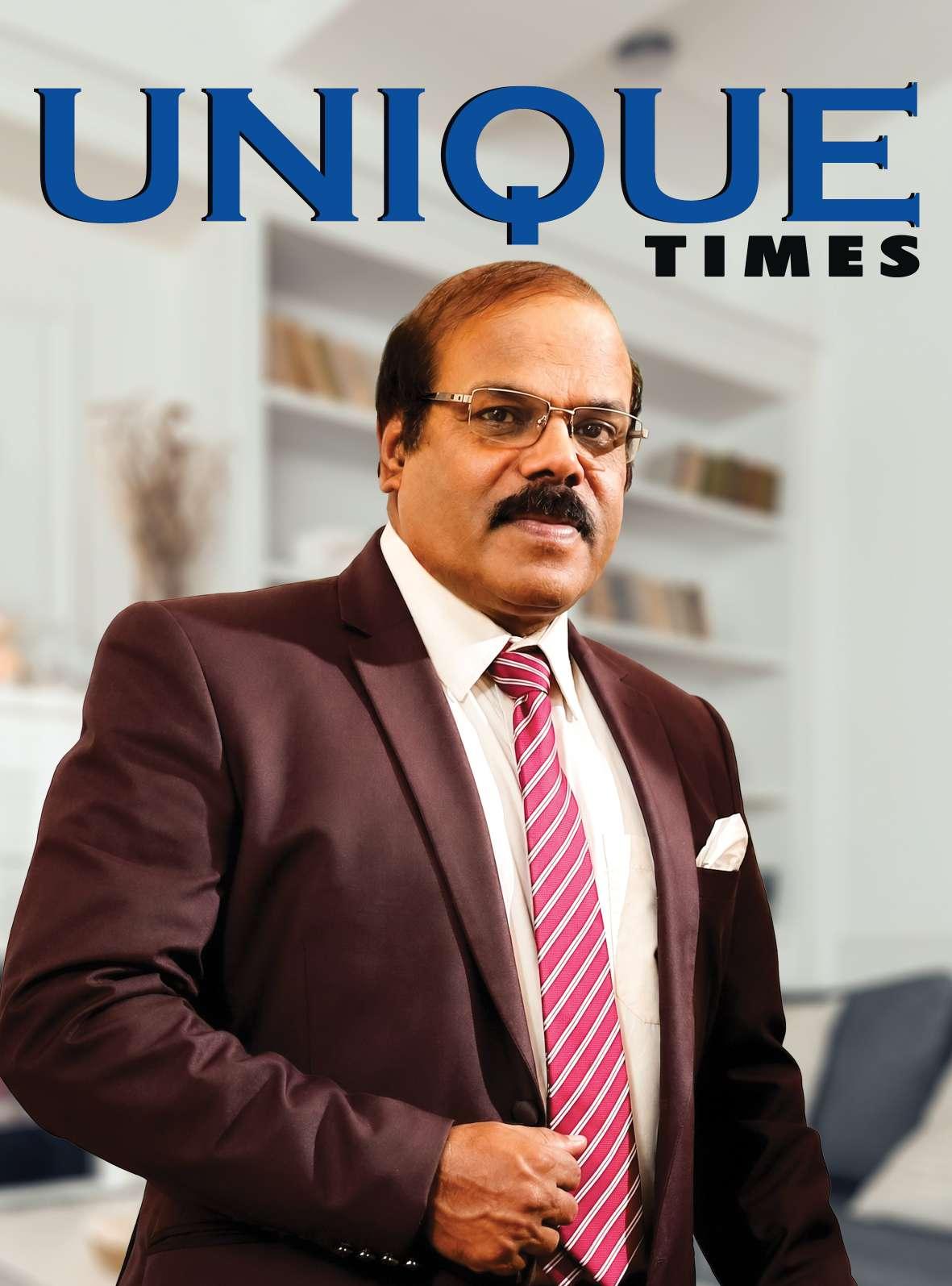
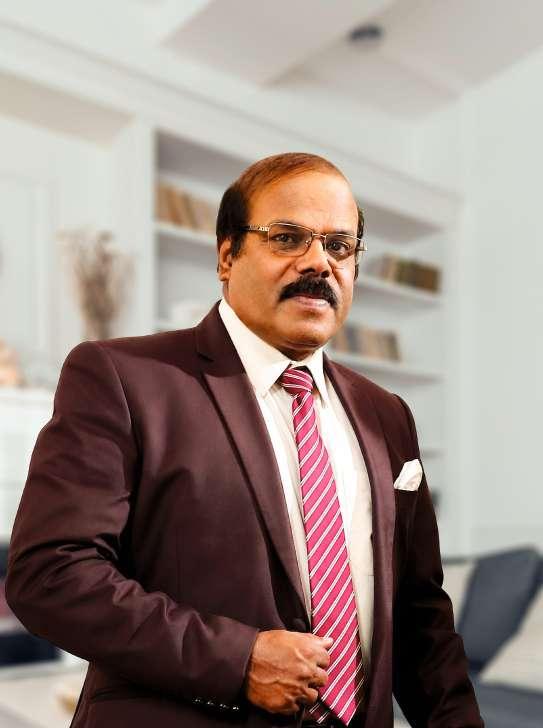
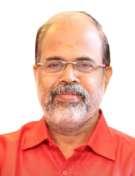
“It is not the size of your business that matters; it’s the size of your dedication and determination.” – Dhirubhai Ambani Leadership becomes meaningful when success extends beyond business and creates lasting impact on communities and lives. Those who leave a true legacy are often individuals who balance enterprise with ethics, growth with compassion, and vision with responsibility. This month’s cover story highlights the inspiring journey of a personality whose contributions span global trade, food industries, governance, philanthropy, literature, music, and cinema. From strengthening the international presence of Indian food brands to leading transformative humanitarian initiatives in healthcare and education, his work reflects both purpose and scale. This edition proudly features Dr. Varghese Moolan, Chairman of the Varghese Moolans Group, and his remarkable multidimensional journey.
This month’s issue features insightful perspectives from V. P. Nandakumar on the timely theme, “India’s Green Transition Will Be Financed on the Ground — and NBFCs Hold the Key.”
The edition also brings readers a rich mix of engaging content, including travel and tourism features, financial insights, inspiring business stories, and the introduction of Kshetra Vishesha—a new series exploring the cultural, spiritual, and historical significance of remarkable destinations and traditions.
“The man who does not read good books is no better than the man who can’t.” - Mark Twain
Happy Reading!
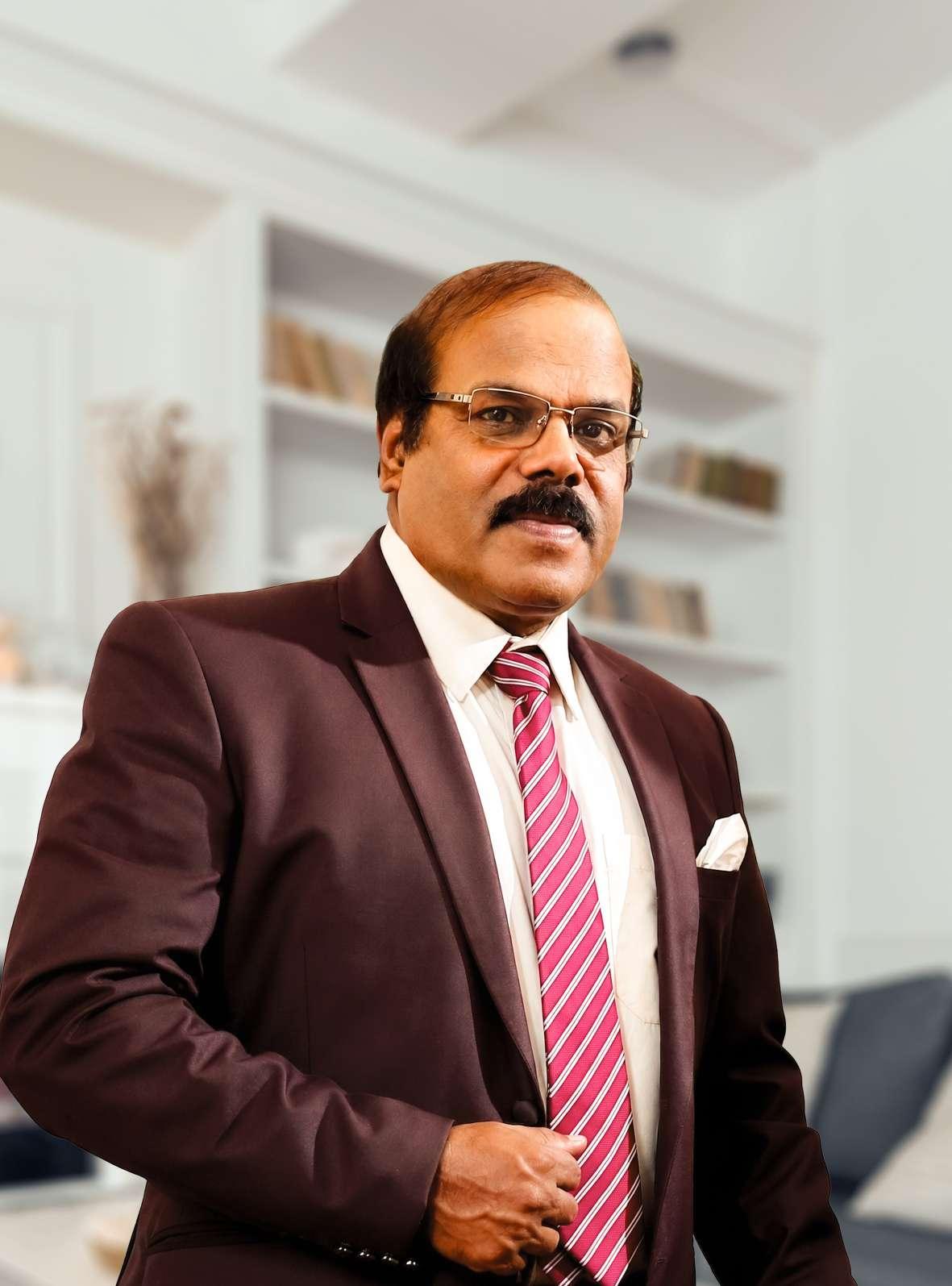
Cover Photograph
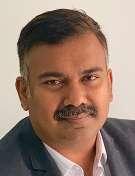
DR. VARGHESE
Chairman, Varghese Moolans Group
MOOLAN
L&T Signs Long-Term Green Ammonia Supply Deal with ITOCHU
Indian infrastructure major Larsen & Toubro announced that its green energy arm has signed an agreement with Japanese trading firm ITOCHU Corporation for the long-term supply of 300,000 tonnes of green ammonia annually. Under the deal, L&T Energy GreenTech will produce and export green ammonia from a planned facility in Gujarat, marking a major step in expanding India’s role in the global clean energy supply chain. Green ammonia is emerging as a key fuel for decarbonising the shipping industry, supporting global efforts to cut maritime emissions. ITOCHU plans to use the supply to develop a worldwide green ammonia distribution network across major shipping routes, including Singapore. The partnership highlights rising international demand for Indian green energy exports and aligns with India’s goal of producing around 5 million tonnes of green hydrogen and derivatives by 2030 with policy and incentive support.
Germany Nears $8B Submarine Deal With India, Says Defence Minister
"Success is often achieved by those who don’t know that failure is inevitable."
Boris Pistorius said in Kiel that Germany expects to sign a final agreement with India soon on a major submarine cooperation deal worth about $8 billion. He expressed strong confidence the agreement could be concluded within the next three months, signalling steady progress in negotiations. The project has been under discussion for months as part of broader defence-industrial cooperation between India and Germany aimed at strengthening naval capabilities and expanding strategic defence ties. It is expected to enhance local manufacturing and technology transfer while supporting India’s submarine modernisation programme and reinforcing long-term defence collaboration between the two countries. Officials indicated that signing could take place within the next three months as both sides work through final technical and commercial details of the agreement, marking a major milestone in bilateral defence cooperation between India and Germany relations.
Coco Chanel
Mercedes-Benz India Sees Strong Demand for CLA BEV Ahead of Launch
Mercedes-Benz
India has received around 400 bookings for its upcoming electric sedan, the CLA BEV, even before its official launch. The model is the brand’s first next-generation electric vehicle in India based on the Mercedes Modular Architecture (MMA) platform and will be offered in three variants to suit different performance and range requirements. The entry-level CLA 200 provides a range of over 500 km, while the higher-end CLA 250+ variants can achieve up to 792 km on a single charge. With fast-charging capability, the vehicle can gain significant range in about 20 minutes. Deliveries for the base variant are scheduled to begin in June 2026, with higher trims arriving earlier. The CLA BEV also introduces the MB.OS system in India, featuring AI-powered infotainment, overthe-air updates, a virtual assistant, NVIDIA-based driver assistance, and a battery health reporting system to improve transparency and customer confidence in electric mobility.
"Most great people have attained their greatest success just one step beyond their greatest failure."
Napoleon Hill
`
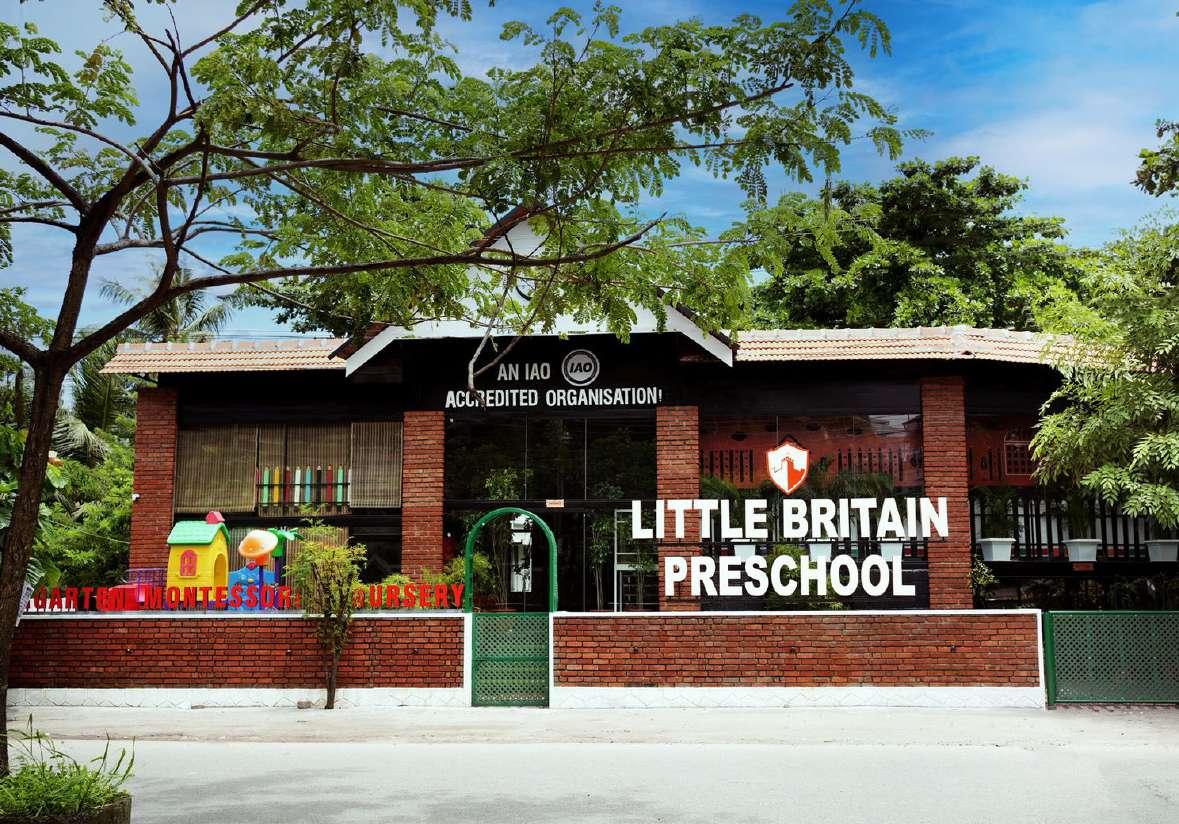
2.72 Lakh Kindergarten Fee Sparks Outrage Across India
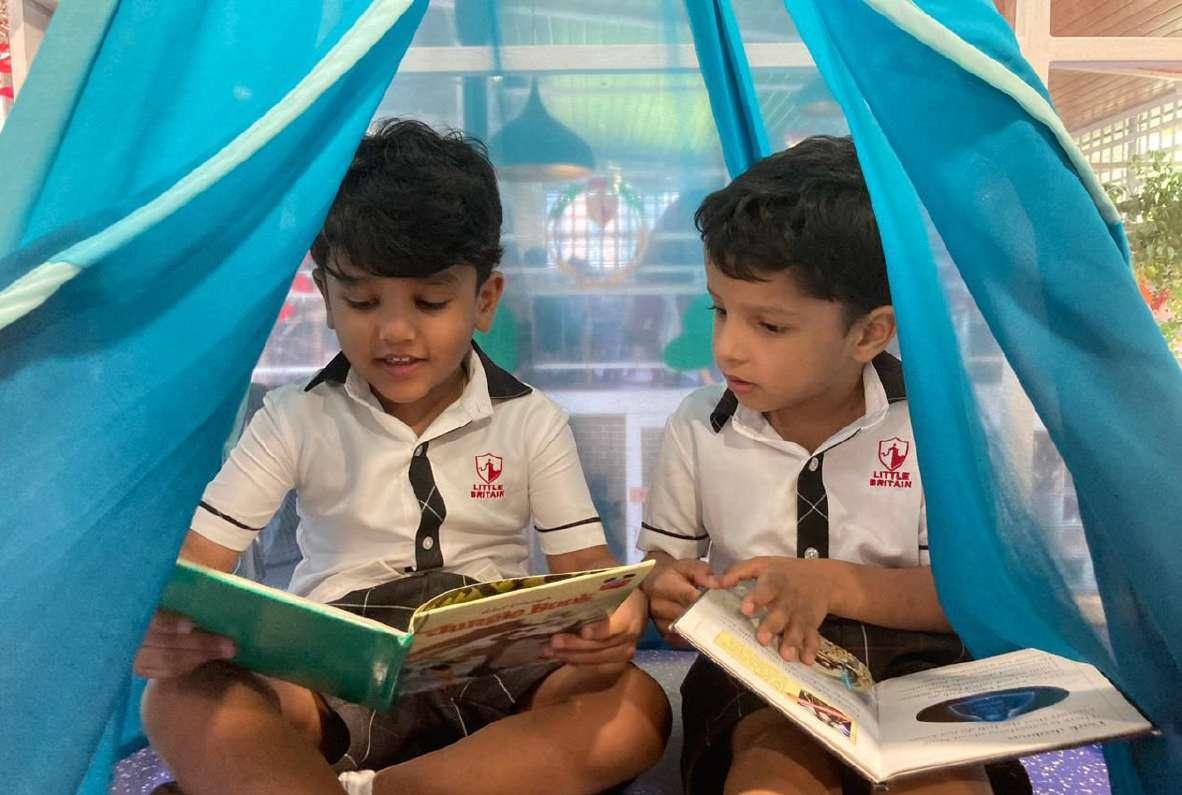
Aviral fee slip showing an annual kindergarten admission cost of `2.72 lakh has sparked widespread debate across India over rising education expenses. The breakdown includes a `48,000 one-time admission fee—split into non-refundable and refundable components—along with annual charges exceeding `2.24 lakh covering tuition, library services, and other facilities. Additional costs such as transport, uniforms, and cafeteria use could push the total even higher, increasing the financial burden on parents. The figures have led to concern about the lack of regulation in private school fee structures, with many questioning whether such pricing is justified. While some argue that premium schools offer advanced infrastructure, modern teaching methods, and extracurricular opportunities, others feel high fees do not always guarantee better education quality. The controversy has reignited discussions on affordability and access, especially for middle-class families, as rising living costs make early education increasingly expensive and raise concerns about schooling becoming a luxury rather than a basic necessity.
Govt Tightens Online Gaming Rules, Empowers Banks to Block Transactions
The Central government has introduced the Online Gaming Rules, 2026, empowering regulators to direct banks and financial intermediaries to suspend transactions linked to certain online games. Overseen by the Ministry of Electronics and Information Technology (MeitY), the framework mandates “user safety features” including age verification, time limits, parental controls, grievance redress systems, and counselling support, tailored to the risk level of each platform. A key provision allows the Online Gaming Authority to instruct banks and payment systems to immediately halt or block transactions involving non-compliant real-money gaming services, with financial intermediaries required to comply and share relevant data. MeitY Secretary S. Krishnan stated that entities facilitating such transactions could face legal consequences. The rules also introduce a “litmus test” to classify real-money games based on entry fees, rewards, and cash convertibility, while registered platforms will receive certificates valid up to 10 years, and violators may face strict operational and financial restrictions.
Amazon India to Invest `2,800 Crore to Boost Logistics, Worker Welfare
"Power should be reserved for weightlifting and boats, and leadership really involves responsibility."
AmazonIndia announced an investment of over `2,800 crore to strengthen its logistics network, improve worker safety, and enhance the financial well-being of its workforce. The funds will be used to expand and upgrade fulfilment centres, sortation hubs, and last-mile delivery stations across India, supporting the company’s growing e-commerce operations. The investment is part of Amazon’s broader plan to invest over $35 billion in India by 2030, focusing on AI-driven digitisation, exports, and job creation. In 2025, the company invested `2,000 crore to set up new fulfilment centres, sortation hubs, and delivery stations, while scaling its quick commerce service, Amazon Now, across major cities. Alongside infrastructure growth, Amazon is introducing worker-focused initiatives such as climate-controlled facilities, better ventilation, rest areas, and healthcare support. It is also using AI tools for safety and efficiency, including route optimisation and fatigue alerts, while competing with players like Flipkart, Blinkit, and Zepto in India’s fast-growing delivery market.
Herb Kelleher
TikTok Plans Second €1B Data Centre in Finland
TikTok will invest €1 billion to build a second data centre in Finland, expanding its efforts to store European user data locally and strengthen privacy protections. The new facility in Lahti will start with a capacity of 50 megawatts and could scale up to 128 MW, forming part of a wider €12 billion initiative aimed at safeguarding data for more than 200 million European users. Finland has become a preferred destination for such projects due to its cool climate, low-cost and low-carbon energy, and stable regulatory environment, helping companies reduce energy consumption and meet sustainability targets. Despite continued scrutiny over data security and transparency concerns linked to its Chinese parent company, ByteDance, Finnish authorities have welcomed the investment for its economic benefits, with the data centre expected to be completed and operational by 2027.
Europe Likely to Face Jet Fuel Crunch Amid Middle East Supply Disruption
Europe may face a serious jet fuel shortage within weeks as disruptions to Middle East supply chains intensify, according to the International Energy Agency. The closure of the Strait of Hormuz has significantly reduced exports, driving prices to record highs and raising concerns that fuel stocks could reach critical levels by June if alternative sources are not secured. Although shipments from countries such as the US and Nigeria are increasing, they may replace only just over half of the lost supply, leaving a substantial gap. Europe typically depends on the Middle East for about 75% of its jet fuel, meaning shortages could soon affect airports and lead to flight cancellations, particularly during the busy summer travel season. While officials say there is no immediate disruption, they acknowledge rising risks, with airlines and governments exploring contingency measures as costs climb and smaller airports potentially face the greatest impact.
Turkish Grand Prix to Return to Formula 1 Calendar in 2027
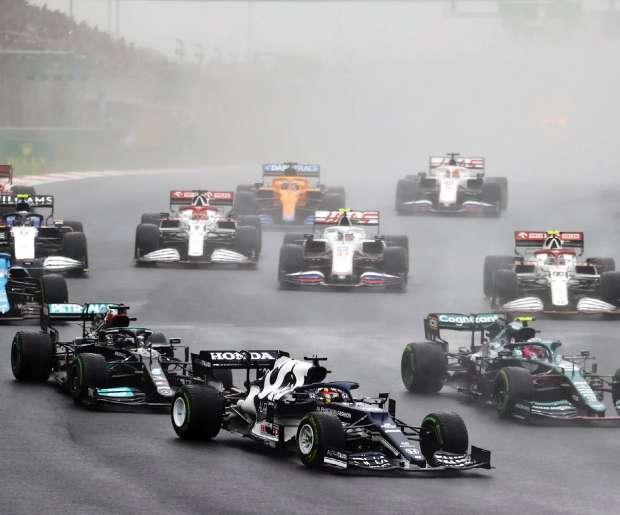
Formula 1 will return to Turkey in 2027, marking the comeback of the Turkish Grand Prix after a six-year absence. The race will be held at Istanbul Park under a deal running until at least 2031, bringing back one of the sport’s most challenging and popular circuits. Turkey previously hosted races from 2005 to 2011 and briefly returned during the COVID-19 pandemic in 2020 and 2021, including a memorable 2020 race where Lewis Hamilton secured his seventh world championship title in wet conditions. The event’s reintroduction will not expand the current 24-race calendar but will rotate with other venues. Officials highlighted Turkey’s strong fan base and infrastructure, while Stefano Domenicali praised Istanbul as a unique global destination for motorsport fans worldwide.
FIFA Rules Out Italy Replacing Iran at 2026 World Cup Amid Political Debate
FIFA has rejected proposals to replace Iran with Italy at the 2026 World Cup, despite a suggestion from U.S. envoy Paolo Zampolli linked to geopolitical tensions involving the U.S. and Israel. FIFA president Gianni Infantino confirmed that Iran will remain in the tournament, stressing that qualification is based on sporting merit and must be respected. The proposal drew criticism from Iran’s embassy, which described it as politically motivated, while Italian officials also rejected the idea, stating that World Cup participation must be earned on the pitch. Italy, a four-time world champion, failed to qualify after losing in the play-offs, making it the highest-ranked team absent from the competition. The 2026 World Cup, hosted by the United States, Canada, and Mexico, begins on June 11, with FIFA reiterating that football should remain separate from political disputes.
DR. VARGHESE MOOLAN: A LIFE ENGINEERED ACROSS ENTERPRISE, ETHICS, AND EXPRESSION
Some careers evolve in a straight line. Others expand outward layer by layer absorbing experiences, disciplines, and responsibilities along with the trajectory. Dr. Varghese Moolan’s expedition belongs to the latter, shaped not by a single ambition but by a constant pursuit of scale, meaning, impact and spiritual gracefulness.
At a glance, he is a global entrepreneur, the Chairman of the Varghese Moolans Group, and a maven in the international spices and food industry. Look closer, and a far more intricate portrait emerges—of a policy influencer, a cultural thinker, a film producer, a writer, a philanthropist and a spiritual activist whose work touches lives across the spacetime fabric. What distinguishes him is not just the diversity of the roles he juggles with panache, but the coherence of his vision.
Early Life and Formative Influences
Before he became a global entrepreneur, Varghese Moolan’s journey began in the town of Angamaly in Kerala, where he was raised in an environment that combined traditional values with a strong emphasis on education, based on charity and discipline.
His academic path reflected both curiosity and versatility. He completed his schooling at St. Joseph’s High School, Angamaly, pursued his PreDegree studies at Sacred Heart College, Thevara, and later graduated in Zoology, Botany, and Chemistry
from Sree Sankara College, Kalady. During his college years, he was not only academically engaged but also actively involved in extracurricular leadership—serving as the college basketball captain and as the Ernakulam District Secretary of the All India Catholic University Federation.
What set his early years apart, however, was his inclination toward writing and exploration towards the unseen. As a student, he authored novels and contributed articles to contemporary publications, reflecting a deep engagement with social and philosophical ideas. His travels across India in his early professional life further expanded his worldview, exposing him to the cultural, economic, and social realities of the country.
These formative experiences— blending education, leadership, travel, and creative expression—played a crucial role in shaping his later approach to business, governance, and philanthropy. They instilled in him not only ambition, but also a lasting awareness of diversity, inequality, and the need for meaningful esoteric impact.
Rewriting the Narrative of Indian Food Brands
When Varghese Moolan entered the Middle Eastern market, Indian food products were not held in high regard particularly. Quality inconsistencies and lack of standardisation had created a trust deficit among consumers. Instead of becoming complacent and adjusting to that scenario, he chose to swim against
the tide.
His early ventures in retail and distribution soon evolved into a larger strategy—one that emphasised control over quality, packaging, and supply chains. By establishing manufacturing operations in India and exporting under his own brands, he ensured that every product carried the stamp of consistency and perfection. This shift was not immediate, but it was decisive. Over time, the Varghese Moolans Group expanded its footprint across more than two dozen countries, building a reputation rooted in reliability and authenticity.
Among the brands that emerged from this strategy was Vijay, Jay and Butterfly Masalas & Foods, developed as part of the group’s effort to standardise Indian spice products for international markets. The brand reflected his emphasis on quality assurance, consistent flavour profiles, and modern packaging—helping strengthen consumer confidence in Indian-origin food products and making them hot favourites in retail shelves around the globe.
The transformation he ignited went beyond business success. It helped reposition of Indian spices and food products in global markets—not as alternatives, but as preferred choices.
Scaling with Structure and Strategy
The growth of the Varghese Moolans Group was never accidental. It was the result of deliberate decisions—each aligned with long-
The growth of the Varghese Moolans Group was never accidental. It was the result of deliberate decisions each aligned with long-term sustainability.
One of the more distinctive aspects of Varghese Moolan’s journey is his ability to identify gaps not just in markets, but in systems. His introduction of margin-free supermarket chains first in Saudi Arabia, then in Kerala was a direct response to consumer exploitation in pricing. By standardising costs and reducing excessive margins, he created a retail model that prioritised fairness.
term sustainability.
His company diversified steadily, introducing a wide range of products that catered to both domestic and international markets. From spices and curry powders to ready-to-cook mixes, grains, oils, and packaged foods, the brand portfolio expanded in response to evolving consumer needs.
Behind this expansion was a disciplined approach:
• Maintaining international standards in production and packaging
• Building strong distribution networks across regions
•Ensuring timely delivery and consistent availability
• Investing in market-specific strategies for global reach
This combination of operational rigour and market insight allowed the group to scale without compromising its core values.
It also established Varghese Moolan as a leader who understands that growth is not just about expansion—it is about sustaining trust and integration at every stage.
A Voice in Governance and Trade
Parallel to his entrepreneurial journey, Varghese Moolan has played a significant role in shaping conversations around trade, policy, and ethics.
His positions—including India–Commonwealth Trade Commissioner, Chairman of the Anti-Corruption Foundation of India, and leadership roles within the Spices Board and
Food Corporation of India—reflect a career that intersects with governance at multiple levels. These roles are not merely honorary. They demand insight into global trade dynamics, regulatory frameworks, and the complexities of modern economies.
His contributions in these capacities underline a consistent belief: economic growth must be guided by integrity and accountability.
In a realm often challenged by ethical dilemmas, his involvement in anti-corruption initiatives reinforces his commitment to transparent systems.
Retail Innovation with Social Intent
One of the more distinctive aspects of Varghese Moolan’s journey is his ability to identify gaps not just in markets, but in systems. His introduction of margin-free supermarket chains first in Saudi Arabia, then in Kerala was a direct response to consumer exploitation in pricing. By standardising costs and reducing excessive margins, he created a retail model that prioritised fairness.
This initiative was not just commercially viable—it was socially relevant.
At the same time, his expansion into organic farming through Moolans Organic Gardens reflected an early recognition of sustainability as a business imperative. By cultivating crops used in his own production processes, he ensured both quality control and environmental responsibility.
This integration of agriculture and industry represents a forwardthinking approach—one that aligns economic activity with ecological balance.
Philanthropy as a System, Not an Afterthought
For Varghese Moolan, philanthropy is not an extension of success—it is an integral part of it.
Through the Varghese Moolans Foundation, he has built a structured framework for social impact, addressing critical areas such as healthcare, education, housing, and community welfare.
Among its most impactful initiatives is Touch-A-Heart, a project that provides free cardiac surgeries to underprivileged children. By 2025, the initiative is expected to have supported over 306 young patients, offering them not just treatment, but a second chance at life.
Complementing this are programs like:
• Kindle-A-Candle, offering financial assistance for medical and personal needs
•Fly-The-Firefly, supporting students with scholarships and learning tools; along with supporting school buildings and playgrounds.
•Home-Sweet-Home, building dozens of houses for the homeless.
• Nanma Maram, encouraging communities to share food and clothing
•Moolans Medicare – facilitating medical tourism to India by connecting international patients with leading hospitals, while also organising
medical camps and promoting affordable healthcare access.
What makes these initiatives significant is their continuity. They are not one-time efforts, but ongoing systems designed to create lasting change.
During periods of crisis—whether natural disasters or public health emergencies—the foundation has consistently responded with scale and urgency, reaching thousands of families in need.
Connecting a Global Community
Varghese Moolan’s vision extends beyond industries into communities.
As the Founder Chairman of the Global Malayalee Council, he has created a platform that connects Indians across the world, fostering collaboration in business, education, and cultural exchange.
With a presence in over 24 countries, the council operates as a bridge—linking the aspirations of the diaspora with opportunities in India.
Its initiatives range from busi-
ness forums and cultural programs to charitable projects; all aimed at strengthening the relationship between resident and non-resident Indians. This effort reflects a broader understanding of globalization—not just as an economic phenomenon, but as a human network.
The Creative Dimension
Amidst his extensive professional and philanthropic commitments, Varghese Moolan has consistently nurtured his creative instincts. He is the author of multiple literary works, including novels that explore philosophical and social themes. His writing reflects introspection and a deep engagement with human experiences.
As a lyricist and music composer, he has also contributed to devotional music, with the album “Dheiveekam” showcasing his artistic sensibilities. These pursuits reveal a different dimension of his personality—one that values expression, reflection, and cultural continuity. His musical journey continues
with spiritually resonant works such as ‘Agathanakaname Nadha’, reinforcing his ability to connect faith, emotion, and artistic expression through music.
They also highlight an important truth: Creativity and leadership are not separate—they often enrich each other.
Cinema as a Medium of Truth
Varghese Moolan’s entry into cinema represents yet another evolution in his journey.
As the producer of “Rocketry: The Nambi Effect”, he took on the challenge of bringing a complex and sensitive story to the screen. The film, based on the life of scientist Nambi Narayanan, sought to correct a historical injustice and present a narrative rooted in truth.
Its reception was both critical and global:
•Showcased at the Cannes Film Festival
•Released in over 70 countries
•Honoured with the National
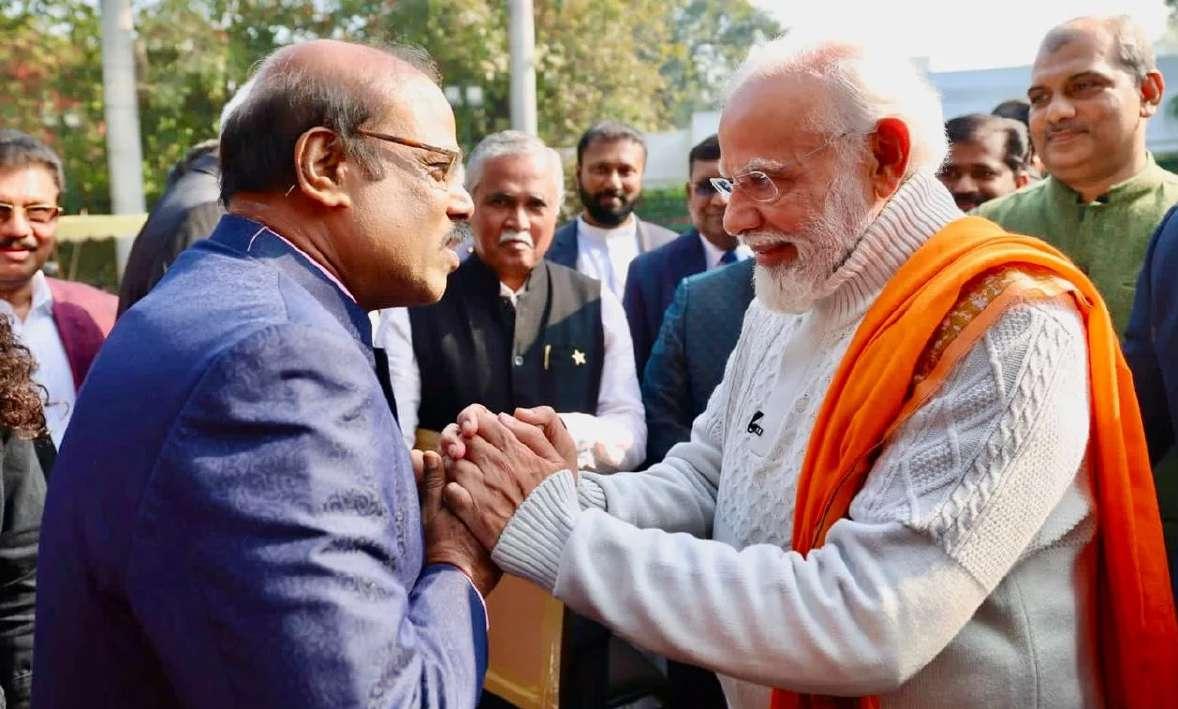
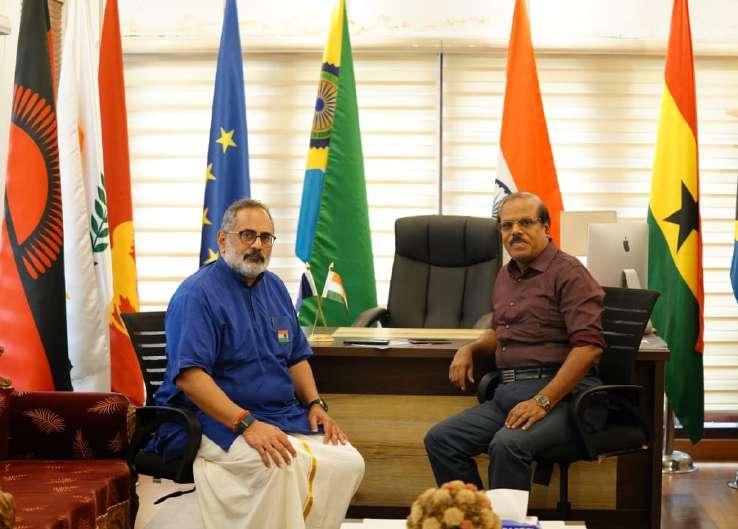
Dr. Varghese Moolan with Prime Minister Narendra Modi.
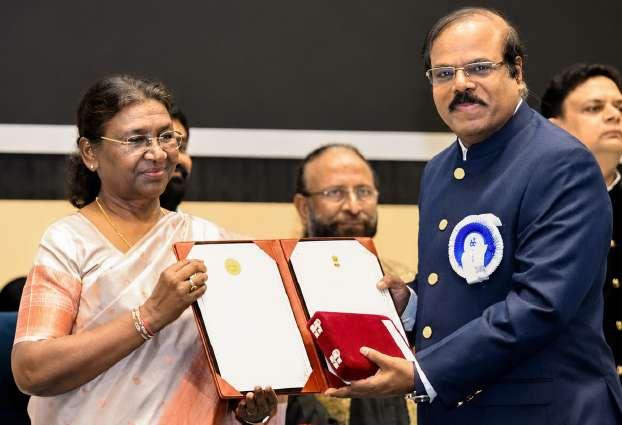
Dr. Varghese Moolan receiving a national award from the President of India, Droupadi Murmu.
Film Award for Best Feature Film (2023)
This achievement underscores his ability to extend his vision into storytelling—using cinema not just as entertainment, but as a platform for awareness and justice. Extending his engagement with meaningful storytelling, he is also associated with the upcoming film GDN, further reflecting his commitment to cinema that carries strong social and emotional narratives.
Recognition that Mirrors
Contribution
Over the years, Varghese Moolan’s work has been acknowledged through numerous awards and honours across business, social service, and cultural domains. From international business excellence awards to national recognitions and honorary doctorates, these accolades reflect the breadth of his contributions. His recognition at global platforms, including institutions like the British Parliament, further reinforces his in-
Dr. Varghese Moolan with Rajeev Chandrasekhar, BJP Kerala State President and MLA, Nemom.
fluence beyond national boundaries.
Among the notable recognitions are:
• National Film Award (2023) for producing Rocketry: The Nambi Effect
• International Golden Book Award (2025) for Dimensional Progressive Theory
•Bharat Jyothi Award (2006) for contributions to national development
• Export Excellence Award (2008, USA)
•Pravasi Bharati (Kerala) Award (2009) for social impact
•International Business Excellence Award (2010, Kuala Lumpur)
• Saudi Business Excellence Award (2014, Riyadh)
•Order of Golden Peace Maker (2017, Russia) for global philanthropy
• Honorary Doctor of Letters (D.Litt.), conferred by Kings University (2019), in recognition of his outstanding contributions to marketing and the global food industry
In addition to these, he has received numerous other national and international recognitions across diverse fields. Yet, what stands out is not the number of awards, but what they represent—a career built on consistency, credibility, and impact. Expanding Thought Leadership: Dimensional Progressive Theory
Beyond enterprise, governance, and philanthropy, Dr. Varghese Moolan’s journey also extends into the realm of original thought leadership. His Dimensional Progressive Theory reflects a culmination of his lived experiences across industries, cultures, and systems.
He presented this theory at the British Parliament in 2024 before an audience comprising experts from more than 60 countries. The theory was later published at the Sharjah Book Festival by Sheikh Mohammed Abdullah Al Marsooqi, bringing it to an international audience.
In 2025, the theory was honoured with the prestigious International Golden Book Award. In previous years, this award has been conferred upon globally respected figures such as Sadhguru and Dalai Lama.
An Enduring Philosophy
At the core of Dr. Varghese Moolan’s journey lies a simple but powerful idea: progress must be shared.
This philosophy is evident in every aspect of his work—whether it is building businesses that create employment, designing systems that ensure fairness, or initiating projects that uplift communities.
It is a perspective that transforms success into responsibility.
Family and Personal Life
Beyond his expansive professional journey, Varghese Moolan remains deeply anchored in family—an influence that has quietly shaped both his values and his vision.
At the centre of this foundation is his wife, Margaret, a postgraduate in Economics and a former college lecturer, who continues to play an active role within the Varghese Mool-
ans Group. Her presence reflects a partnership that extends beyond personal life into shared responsibility and stewardship.
This sense of continuity is carried forward by the next generation. His son, Vijay Varghese Moolan, serves as the group’s CEO, leading operations across India and the Middle East. His daughter-in-law, Kashmeera, with a background in Computer Science, is also involved in managing aspects of the family’s business activities.
His daughter, Dr. Jaisree Varghese Moolan, has pursued a distinguished career in medicine and is based in Australia. Her husband, Dr. Kiran Suresh, a practicing psychiatrist, reflects the family’s engagement with professional excellence beyond business.
Extending into the next generation, his grandchildren—Shreya Kiran and Mantra Vijay Moolan— symbolise the continuity of a legacy that spans across geographies and generations.
Together, the family represents a blend of entrepreneurship, intellect,
and shared values, forming an integral part of a journey that continues to evolve.
Continuing Forward
Even today, his journey shows no signs of slowing down. New ventures, expanding philanthropic initiatives, and evolving creative pursuits continue to define his path.
What makes his story particularly relevant is its adaptability. It reflects a mindset that is open to change, responsive to challenges, and committed to growth.
The Larger Picture
Dr. Varghese Moolan’s life cannot be confined to a single narrative. It is a convergence of enterprise, ethics, creativity, and compassion.
He represents a model of leadership that is increasingly essential in today’s world—one that understands scale but values substance, that pursues success but prioritizes impact.
In tracing his journey, one does not just encounter a successful individual, but a framework for what meaningful success can look like.
And that, perhaps, is what makes his story truly compelling
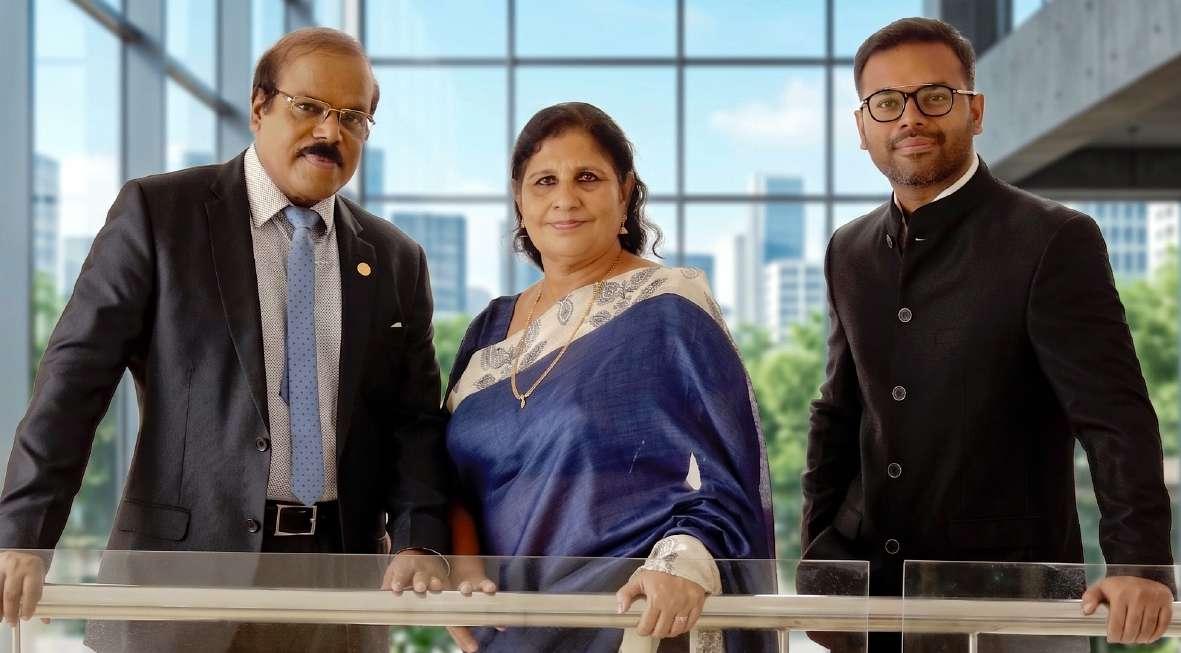
Dr. Varghese Moolan with wife Margaret and son Vijay Varghese Moolan
India's climate commitments are capital-intensive by nature. But the problem isn't just about raising large amounts of money. It's about getting that money to the right borrowers — small, often informal, often first-time — who don't fit neatly into the banking system's comfort zone. NBFCs have spent years building exactly this kind of reach.
India’s Green Transition Will Be Financed on the Ground - and NBFCs Hold the Key
India's green transition gets talked about mostly in terms of big infrastructure — solar parks, hydrogen missions, metro expansions. These matter, but they're only part of the story. The other part, which doesn't get nearly as much attention, is what happens at the ground level. Electric two-wheelers in small towns. Rooftop solar for households. Energy-efficient equipment in small workshops. This is where the real volume of the transition plays out, and it's also where NBFCs have a genuine role to play. India's climate commitments are capital-intensive by nature. But the problem isn't just about raising large amounts of money. It's about getting that money to the right borrowers — small, often informal, often first-time — who don't fit neatly into the banking system's comfort zone. NBFCs have spent years building exactly this kind of reach. Their presence in semi-urban and rural markets, combined with more
flexible underwriting — rooted in relationship-based lending, proximity to borrower cash flows, and lighter regulatory constraints relative to scheduled banks — gives them an advantage that larger banks simply aren't in a position to replicate. Take electric mobility. Policy incentives have done their part on the supply side, but financing is still the real bottleneck for adoption. A delivery rider in a tier-2 city or a small fleet operator isn't going to walk into a bank and come out with a loan easily. NBFCs can underwrite these borrowers and structure products around their actual cash flows. The same applies to rooftop solar — households and small businesses need customised solutions, not offthe-shelf loan products.
There's also a funding angle that's easy to miss. Green finance opens up access to global capital pools. International investors are increasingly looking for credible, sustainable assets in emerging markets,
and India is increasingly prominent in that conversation. NBFCs that build genuine ground-level green portfolios — however granular — are not operating in isolation. Aggregated, these portfolios represent exactly the kind of impact-at-scale that institutional green investors seek. Those that can show genuine impact, proper measurement, and alignment with recognised frameworks can tap into green bonds, sustainability-linked loans, and concessional lines from development finance institutions. In a sector where borrowing costs directly affect margins, this isn't a small thing.
That said, it's not a straightforward path. EV financing, for instance, requires an understanding of residual values, battery degradation, and what the secondary market actually looks like — none of which traditional underwriting models were designed for. Rooftop solar and energy efficiency upgrades have their own evaluation challenges. And
without a clear national green taxonomy, the risk of greenwashing — reputational and regulatory — is real.
Building capability will take time and deliberate investment.
Sector-specific underwriting, partnerships with OEMs and technology providers, stronger ESG reporting — these aren't things that happen overnight. Regulatory clarity on disclosure norms and risk frameworks will help, but NBFCs can't wait for that to arrive before getting started. In the interim, there is meaningful ground to cover independently: developing internal green classification frameworks aligned to international standards such as the Climate Bonds Taxonomy, investing in borrower-level data collection to enable impact reporting, and engaging with peer institutions to establish shared benchmarks. Several NBFCs have already
begun this work quietly, and their early experience will shape how the broader sector approaches the opportunity. The institutions that invest in this infrastructure now will be better positioned — both operationally and reputationally — when formal regulatory standards eventually arrive.
The broader point is this: large infrastructure projects define the scale of the transition, but the actual outcomes depend on millions of smaller decisions. Switching to an EV. Putting up a solar panel. Replacing an old machine with something more efficient. NBFCs are better placed than most to finance those decisions — and in doing so, they're not just lending, they're enabling a shift in behaviour at a scale that matters.
The green transition is a real business opportunity. For NBFCs willing to build the right capa -
bilities, it's one worth moving on quickly. This is also, ultimately, a fiscal policy question. India's green transition cannot be financed by public expenditure alone — the fiscal space simply isn't there. Strategic imperatives for reimagining India's fiscal framework must therefore include creating the conditions under which private capital, channelled through institutions like NBFCs, can do the work that government balance sheets cannot. That means green taxonomy development, targeted credit guarantees, tax treatment of green instruments, and blended finance structures that de-risk first-mover institutions. When fiscal policy is designed with this in mind — not just as a revenue and expenditure exercise, but as an enabler of directed private capital — the transition becomes both faster and more fiscally sustainable
Rajesh Nair Partner, Ernst & Young LLP
The leader who closes a deal wins a transaction. The leader who opens a door wins a relationship, a future, a legacy.
Leaders Don't Just Close Deals. They Open Doors. The Difference Is Vital
There is a dangerous myth in the world of business — one that has quietly shaped how we hire, promote, and celebrate people for decades. The myth is this: the best leaders are the best closers. We glorify the hard-charging executive who walks into the room, commands attention, and seals the deal. We build cultures around "always be closing." Remember Alec Baldwin’s iconic spiel in the fascinating movie Glengarry Glen Ross? We measure leadership in quarterly numbers and conversion rates.
But here's the uncomfortable truth: closing is a finite act. Opening is an infinite one. The leader who closes a deal wins a transaction. The leader who opens a door wins a relationship, a future, a legacy. And in a world where trust is the new currency and long-term value outpaces short-term wins, the difference between closing and opening isn't just philosophical — it's everything. The Closing Mindset: Why It Falls Short
Let's be honest — closing feels good. There's a rush of adrenaline
when the signature hits the paper, when the handshake seals the agreement, when the numbers land. Closers are celebrated in every sales floor across the world. Their names are on leaderboards. Their stories become legends.
But let's look more carefully at what closing actually means.
To close something is, by definition, to end it. You close a chapter. You close a case. You close a door. The very language reveals the limitation. When a leader is obsessed with closing, their focus narrows to one singular moment — the finish line. Everything becomes a means to that end. Conversations become pitches. Relationships become pipelines. People become prospects.
And what happens after the close? Unfortunately, and often, a lack of the same spirit at the sale. The energy evaporates. The attention shifts to the next target. The person on the other side of the deal — the client, the partner, the employee — is left wondering: "Was I just a number?"
This is the fatal flaw of the clos-
ing mindset. It optimizes for transactions at the expense of transformation. It wins the battle but slowly, silently, loses the war.
The Opening Mindset: A Different Kind of Power
Now consider the leader who opens doors. This leader doesn't walk into a room asking, "How do I get what I want?" They walk in asking, "How do I create possibilities that didn't exist before?" Their measure of success isn't the signature on a contract — it's the relationship that outlasts the contract. It's the opportunity they created for someone else. It's the door they held open, even when there was no immediate benefit to walking through it themselves. Opening doors is fundamentally different from closing deals because it operates on a completely different set of principles:
1. Generosity Over Scarcity Closers hoard opportunities. They see every deal as a zero-sum game — someone wins, someone loses. Door-openers operate from abundance. They believe that creating value for others ultimately creates value for everyone, including
themselves. They make introductions they don't have to make. They share insights they could have kept. They invest in people who may never directly "pay off."
2. Curiosity Over Certainty
Closers come armed with answers, scripts, and objection-handling techniques. They've rehearsed every scenario. Door-openers come armed with questions. They are genuinely curious about the people they serve — what keeps them up at night, what their real challenges are, what success looks like in their world. This curiosity builds something no script ever could: authentic understanding.
3. Trust Over Pressure
Closing often involves urgency, artificial deadlines, and subtle manipulation — "This offer expires Friday."Opening doors involves patience. It involves showing up consistently, delivering value before asking for anything in return, and trusting that when the timing is right, the opportunity will come.
Trust is slow. But trust is unbreakable.
4. Legacy Over Transaction
A closed deal lives on a spreadsheet. An opened door lives in someone's memory. The leader who gave you your first chance. The mentor who connected you with the person who changed your career. The CEO who picked up the phone when they didn't have to. These are the leaders people follow into fire — not because of what they closed, but because of what they opened.
The Paradox: Door-Openers
Actually Close More
Here's the irony that the closingobsessed world doesn't want to hear: leaders who focus on opening doors inevitably close more deals than those who focus on closing.
Why? Because when you open doors for people — when you create genuine value, build real trust, and invest in long-term relationships — people don't just buy from you. They advocate for you. They refer you. They come back again and again.
They become partners, not just customers.
What This Looks Like in Practice
This isn't abstract philosophy. It shows up in the smallest moments of leadership every single day.
In Sales Conversations:
Instead of pushing for the close, the door-opening leader, at times does not hesitate to say - "I'm not sure we're the right fit for you — but let me connect you with someone who might be. "Counterintuitive? Absolutely. Powerful? Immeasurably. That prospect will remember you. And when the right opportunity comes, they'll come back.
In Team Leadership:
Instead of micromanaging toward quarterly targets, the dooropening leader invests in their people's growth. They ask, where do you want to be in three years, and how can I help you get there?" They open doors to mentorship, stretch assignments, and visibility — even when it means their best people might
eventually move on. **And paradoxically, that's exactly why the best people stay.
In Partnerships and Networking:
Instead of collecting business cards and LinkedIn connections like trophies, the door-opening leader asks after every meeting: *"Who can I introduce this person to? What value can I add to their journey?" They become known as connectors, not collectors. And connectors always sit at the center of the most valuable networks.
In Negotiation:
Instead of fighting for every last percentage point, the door-opening leader asks, "How do we structure this so both sides walk away excited to work together again?" They understand that a deal where one party feels squeezed is a door that closes permanently. A deal where both parties feel valued is a door that stays open forever.
The Leaders We Remember
Think about the leaders who
have shaped your life — not just your career, but your actual life. The ones whose names you speak with reverence. The ones you'd pick up the phone for at midnight.
Were they closers? Did they impress you with their negotiation tactics or their ability to hit quota?
Or were they door-openers? Did they see something in you before you saw it in yourself? Did they create an opportunity you didn't deserve yet? Did they make an introduction that changed everything? Did they believe in you when the numbers said they shouldn't?
I already know your answer.
The leaders we remember, admire, and follow are never the ones who closed the most deals. They are the ones who opened the most doors. They understood something that spreadsheets can never capture: that leadership is not about extraction — it's about expansion. It's not about what you get from people. It's about what you make possible for them.
The difference is vital
"Close" and "open" are just words. Five letters each. But the philosophy behind them creates two radically different kinds of leaders, two radically different kinds of organizations, and two radically different kinds of legacies.
The closer asks: "What did I gain today?"
The opener asks: "What did I make possible today?"
The closer counts deals.
The opener counts relationships.
The closer builds a career.
The opener builds a legacy.
In a world drowning in transactions, the leaders who rise above the noise are not the ones with the sharpest closing techniques. They are the ones with the most generous spirits, the deepest curiosity, and the courage to invest in people and possibilities without demanding an immediate return.
The world has enough closers. What it needs is more leaders who open doors — and then have the grace to let others walk through first
Dr Arun Oommen MBBS, MS (General surgery), Mch (Neurosurgery, MRCS Ed (UK), MBA (Hospital administration). D Litt(h), DSc(h), PhD(h), ENLS. DMS
State Secretary. Neurological society of IndiaKerala Chapter www.arunoommen.com
The human brain is divided into two hemispheres—left and right— connected by a thick bundle of nerve fibers known as the corpus callosum. This structure allows communication between the two sides, enabling integration of different cognitive processes.
The Science of Right Brain Dominance: The Creative and Emotional Mind
For many years, the idea of “Right-brain dominance” has captured popular imagination. It conjures images of artists, musicians, innovators, and emotionally intuitive individuals who seem to perceive the world differently—more holistically, more creatively, and more deeply. While modern neuroscience has refined and, in some cases, challenged the simplistic notion that people are either “left-brained” or “rightbrained,” there is still meaningful scientific insight into how the right hemisphere of the brain contributes to creativity, emotional intelligence, and intuitive thinking.
Let’s explore the science behind right-brain functioning, its role in shaping human cognition and emotion, and how understanding this dimension of the brain can enhance personal and professional development.
Understanding Brain Lateralisation
The human brain is divided into two hemispheres—left and right— connected by a thick bundle of nerve fibers known as the corpus callosum. This structure allows communication between the two sides, enabling integration of different cognitive processes.
Historically, researchers identified certain functional specialisations within each hemisphere. The left hemisphere became associated with logical reasoning, language, and analytical thinking, while the right hemisphere was linked to spatial awareness, creativity, and emotional processing.
However, modern neuroscience emphasises that both hemispheres work together continuously. Rather than strict dominance, individuals may show functional preferences— patterns of neural activity that favour certain modes of thinking. What Is Right-Brain Dominance?
Right-brain dominance refers
to a tendency for individuals to rely more heavily on the cognitive and emotional processes associated with the right hemisphere. These include:
•Holistic thinking (seeing the “big picture”)
• Creativity and imagination
• Emotional awareness and empathy
• Intuition and insight
• Visual and spatial processing
• Artistic expression
It is important to clarify that no person uses only one side of their brain. Instead, right-brain dominance reflects a cognitive style, not a biological exclusivity.
The Neuroscience of Creativity
Creativity is one of the most celebrated functions associated with the right hemisphere. Neuroimaging studies have shown that creative thinking involves a network of brain regions, including:
• The right prefrontal cortex, in-
volved in abstract thinking and idea generation
• The default mode network (DMN), active during mind-wandering and imagination
• The right temporal lobe, linked to insight and novel associations.
The right hemisphere excels at making distant connections—linking unrelated concepts to generate new ideas. This ability underlies artistic creativity, innovation, and problemsolving in complex environments. Interestingly, creativity is not confined to the right hemisphere alone. It emerges from the interaction between spontaneous idea generation (right brain) and critical evaluation (left brain). However, individuals with a stronger right-brain orientation may experience more fluid idea generation and imaginative thinking.
Emotional Intelligence and the Right Brain
The right hemisphere plays a crucial role in processing emotions— both our own and those of others.
Key functions include:
• Recognising facial expressions
• Interpreting tone of voice and body language
• Understanding emotional context
• Generating empathy
Neuroscientific research shows that the right hemisphere is dominant in affective processing, particularly in decoding nonverbal emotional cues. This makes rightbrain-oriented individuals more attuned to subtle emotional dynamics in social interactions. Damage to the right hemisphere can impair emotional recognition, even when language abilities remain intact—highlighting its importance in emotional intelligence.
Intuition: The Silent Intelligence
One of the most fascinating aspects of right brain function is intuition—the ability to understand something immediately without conscious reasoning. Intuition is not
mystical; it is rooted in rapid, unconscious pattern recognition. The right hemisphere integrates vast amounts of sensory and experiential data to generate “gut feelings” or insights. For example:
• A doctor making a quick clinical judgment
• An artist sensing balance in a composition
• A leader reading the mood of a room.
These are not random guesses but highly refined cognitive processes operating below conscious awareness.
Visual and Spatial Processing
The right brain is particularly adept at visual and spatial tasks. It helps us:
• Navigate environments
• Understand maps and spatial relationships
• Recognise faces
• Interpret visual art
This specialisation is why individuals with strong right-brain ten-
Although cognitive tendencies are partly innate, the brain is highly plastic. Right-brain abilities can be strengthened through deliberate practice.
dencies often excel in fields such as architecture, design, surgery, and visual arts.
In neurosurgery, for instance, spatial awareness and three-dimensional visualisation—functions linked to right hemisphere processing—are critical for precision and success.
The Role of the Right Brain in Music and Art
Music and art are quintessential expressions of right-brain activity. The right hemisphere is involved in:
• Melody and pitch recognition
• Rhythm and timing
• Emotional interpretation of music
• Artistic composition
While the left hemisphere processes technical aspects (such as musical notation), the right hemisphere brings emotion, expression, and creativity to the experience.
This explains why music can evoke powerful emotions even without lyrics—it directly engages rightbrain pathways.
Myth vs Reality: Are People Truly Right-Brained?
The popular idea that people are strictly “right-brained” or “leftbrained” is an oversimplification. Scientific evidence shows that:
• Both hemispheres are involved in almost all cognitive tasks
• Brain activity is highly integrated and dynamic
• Individual differences are more about network efficiency than strict dominance.
However, the concept of rightbrain dominance remains useful as
a psychological framework to understand differences in thinking styles. Some individuals naturally lean toward:
• Creativity over analysis
• Emotion over logic
• Intuition over structured reasoning
These tendencies reflect patterns of neural engagement rather than fixed anatomical dominance. Right Brain
Dominance in Everyday Life
People with strong right-brain tendencies often exhibit the following characteristics:
• Strong imagination and creativity
• Emotional sensitivity and empathy
• Preference for visual learning
• Ability to think in metaphors and symbols
• Comfort with ambiguity and uncertainty
• Holistic problem-solving approach
They may thrive in professions such as:
• Arts and design
• Music and performing arts
• Psychology and counseling
• Medicine (especially fields requiring intuition and spatial skills)
• Entrepreneurship and innovation
The Balance Between Logic and Creativity
While right-brain traits are valuable, optimal functioning requires balance between both hemispheres. For example:
Creativity without structure can
lead to chaos.
Logic without creativity can lead to rigidity.
The most successful individuals—whether in science, medicine, or business—integrate:
Right-brain imagination with Left-brain execution
This integration allows ideas to be not only generated but also implemented effectively.
Enhancing Right Brain Function
Although cognitive tendencies are partly innate, the brain is highly plastic. Right-brain abilities can be strengthened through deliberate practice.
1. Engage in Creative Activities
Painting, music, writing, and design stimulate right-hemisphere networks.
2. Practice Mindfulness and Meditation
These practices activate the default mode network and enhance intuitive awareness.
3. Use Visualisation Techniques
Imagining scenarios strengthens spatial and creative processing.
4. Develop Emotional Awareness
Journaling, therapy, and reflective practices improve emotional intelligence.
5. Explore New Experiences
Travel, art exposure, and cultural immersion broaden perceptual frameworks.
6. Limit Over-Reliance on Linear Thinking
Encourage brainstorming without immediate judgment to allow
creative flow.
Clinical and Neurological Insights
From a clinical perspective, understanding right-brain function has profound implications:
Stroke patients with right hemisphere damage may struggle with emotional perception and spatial awareness
Neurodegenerative diseases can affect creativity and emotional processing
Mental health conditions often involve imbalances in emotional regulation networks
In neurology and neurosurgery, appreciating the functional nuances of the right hemisphere is essential for preserving quality of life—not just survival.
The Future of Brain Science
Advances in neuroimaging and artificial intelligence are reshaping our understanding of brain function. Emerging research suggests that:
• Creativity arises from network interactions, not isolated regions
• Emotional intelligence is a distributed brain function
• Brain lateralisation is more flexible than previously thought
The future lies in understanding the brain as an integrated system, where right and left hemispheres collaborate dynamically. Peroration
The concept of right brain dominance, while often simplified, opens a valuable window into the
creative and emotional dimensions of human cognition. The right hemisphere plays a vital role in shaping how we imagine, feel, connect, and innovate. In a world increasingly driven by data and logic, the importance of right-brain qualities— creativity, empathy, intuition—has never been greater. These are the traits that drive innovation, deepen human connection, and give meaning to our experiences.
Ultimately, the goal is not to be “right-brained” or “left-brained,” but to cultivate a harmonious integration of both—a mind that can think critically, feel deeply, and create boldly.
Such a mind is not only scientifically fascinating but profoundly human
Adv Sherry Samuel Oommen: This article is authored by Adv Sherry Samuel Oommen. He specialises in the Constitution, tax and corporate laws and has also cleared the final exams of the Institute of Chartered Accountants of India, the Institute of Cost Accountants of India and the Institute of Company Secretaries of India. He has also completed his Masters's Degree in Commerce, apart from obtaining a Post Graduate Diploma in Business and Corporate Laws from Symbiosis, Pune. The views expressly are personal and should not be construed as a legal opinion. sherryoommen@nashcp.com.
The 2026 IBC Overhaul: Redefining Corporate Recovery and Liquidation in India
The passing of the Insolvency and Bankruptcy Code (Amendment) Act, 2026 marks a transformative milestone in India’s economic legislation. This is not merely a technical refinement; it is a structural overhaul designed to address the "Three Ds" that have historically plagued the IBC: Delay, Deterioration of asset value, and Disjointed litigation. By shifting toward a more digital, creditor-supervised, and groupcentric model, the 2026 Act aims to restore the IBC's status as a high-velocity resolution tool. Below is an exhaustive elaboration on the key pillars of the Amendment Act, tailored for both professionals navigating the technicalities and non-professionals seeking to understand the broader impact. This article should not in any manner be construed as a le-
gal opinion in any form or manner whatsoever.
1. The Reconceptualization of Security Interests
One of the most debated aspects of the original 2016 Code was the hierarchy of claims, particularly regarding government dues. The 2026 Act provides a decisive clarification through the amendment of Section 3(31).
Statutory vs. Contractual Charges
Previously, various tax authorities claimed "secured creditor" status based on charges created by tax laws (statutory charges). The Amendment Act now clarifies that a "Security Interest" must be the result of a specific agreement or arrangement between parties—such as a mortgage, hypothecation, or a pledge.
• The Impact: Government
dues arising from tax penalties or arrears will no longer bypass the waterfall mechanism by claiming to be secured. This protects the priority of financial institutions and ensures that the "waterfall" under Section 53 remains predictable for investors.
2. The Era of "Group Insolvency" (Chapter VA)
Large corporate failures in India (such as those in the infrastructure and telecom sectors) often involve complex webs of parent companies, subsidiaries, and special purpose vehicles (SPVs). Historically, the IBC treated these as isolated legal entities, leading to fragmented resolutions where the parent was sold to one bidder and the subsidiary to another, destroying synergistic value.
Coordinating Multi-Entity Failures
The introduction of Section 59A
Large corporate failures in India (such as those in the infrastructure and telecom sectors) often involve complex webs of parent companies, subsidiaries, and special purpose vehicles (SPVs). Historically, the IBC treated these as isolated legal entities, leading to fragmented resolutions where the parent was sold to one bidder and the subsidiary to another, destroying synergistic value.
allows for the coordination and cooperation of insolvency proceedings across a corporate group.
•Coordination over Consolidation: While it doesn’t necessarily merge the assets of all companies, it allows for a "Group Resolution Professional" and synchronized timelines. This ensures that a bidder can propose a plan for the entire group, maximizing the enterprise value rather than selling it off piece-bypiece.
3. Creditor-Initiated Resolution: The Out-ofCourt "Hybrid"
The NCLT has long been the bottleneck of the IBC process. To alleviate this, the 2026 Act introduces the Creditor-Initiated Insolvency Resolution Process (Sections 58A to 58K).
How the New Mechanism Works:
1. Notice and Initiation: Financial creditors can issue a notice to a corporate debtor. If the debt is
undisputed and meets prescribed conditions, the creditor can initiate resolution without waiting for an upfront NCLT admission order.
2. Professional Appointment: The creditor directly appoints the Resolution Professional (RP).
3. Minimal Disruption: The management often stays with the Board of Directors, but under the strict oversight of the RP, who has the power to veto resolutions that might harm creditors.
• Strategic Goal: This mimics "Pre-packaged" insolvency but is driven by creditors. It aims to resolve genuine business failures quickly and with minimal judicial friction, leaving the NCLT to handle only the most contentious cases.
4. Reinventing the Liquidation Framework
The 2026 Act acknowledges that once a company moves into liquidation, the goal must be rapid asset monetization to prevent "value leakage."
Shift to CoC Supervision (Section 35)
In the previous regime, the Committee of Creditors (CoC) largely became defunct once liquidation was ordered, leaving the Liquidator to operate with high autonomy. The Amendment Act changes this:
• Ongoing Oversight: The CoC now supervises the conduct of the liquidation process. This ensures that the commercial wisdom of the lenders continues to guide the sale of assets.
• Claims Continuity: A major cause of delay was the Liquidator re-verifying claims that had already been verified during the resolution (CIRP) stage. Sections 38–42 have been omitted. The Liquidator will now simply maintain and update the claims list from the CIRP stage, significantly accelerating the distribution of proceeds.
The "Dissolution without Liquidation" Option
Under Section 33, the Adjudicat-
Proceedings for fraudulent trading, preferential transactions, or undervalued transfers are now independent. They can continue even after the company has been sold or dissolved. Any money recovered from these actions will be distributed according to the resolution plan or to the creditors, ensuring that "fraud does not pay."
ing Authority (“AA”) can now order the immediate dissolution of a corporate debtor if it is clear the company has no meaningful assets. This prevents the wasteful expenditure of time and administrative costs on a "hollow" entity.
5. The "Clean Slate" Doctrine and Immunities
To attract high-quality bidders, the Act strengthens the legal shield provided to the "resolved" company under Section 31.
Fresh Start (Section 31(6))
All prior claims, including those from government departments and regulatory bodies, are extinguished once the resolution plan is approved. This ensures the new owner isn't blindsided by past liabilities.
Protection of Grants and Licenses (Section 31(5))
The Act mandates that essential business licenses, permits, and registration quotas cannot be terminated or suspended due to the insolvency process. They must continue for their remaining term, ensuring that the company remains operational and valuable to the buyer.
6. Curbing Frivolous Litigation and Delays
Delay is often used as a weapon by defaulting promoters to retain control. The 2026 Act introduces several deterrents:
• Financial Penalties: New Sections 64A and 183A empower the AA to impose penalties up to `2 crore on parties who initiate "frivolous or vexatious" proceedings.
• Mandatory Timelines: For
Financial Creditors (Section 7), the AA is directed to admit applications within 14 days solely based on the record of default from Information Utilities. If the AA fails to meet this deadline, it must record the reasons for the delay in writing—a measure designed to increase judicial accountability.
7. Advanced Recovery: Avoidance and Fraudulent Trading
The Act sharpens the tools available to recover assets that were illegally moved out of the company before the insolvency began.
Independent Proceedings (Section 26)
One of the biggest flaws in the old system was that "avoidance" applications (to recover undervalued or fraudulent transfers) often died out once the main resolution process ended.
• The Change: Proceedings for fraudulent trading, preferential transactions, or undervalued transfers are now independent. They can continue even after the company has been sold or dissolved. Any money recovered from these actions will be distributed according to the resolution plan or to the creditors, ensuring that "fraud does not pay."
Extended "Look-Back" Periods
The thresholds for identifying suspicious transactions have been adjusted (Sections 43, 46, and 50). The "look-back" period now counts from the date of initiation rather than the date of admission, catch-
ing manipulations that occur while the application is pending in court.
8. Technology and Global Integration
The 2026 Act prepares the IBC for a digital-first future and international cooperation.
•Electronic Portal (Section 240B): The Act mandates the creation of a centralized electronic portal for all IBC procedures. This will host public announcements, claim filings, and progress reports, bringing unprecedented transparency to the process.
• Cross-Border Insolvency (Section 240C): For the first time, a formal enabling provision allows the Central Government to make rules for administering cross-border proceedings. This is vital for pursuing assets located outside India and coordinating with foreign courts when a multinational corporation fails.
9. Expanded Roles for Service Providers
The definition of "Service Provider" (Section 3(31A)) now formally includes Insolvency Professionals (IPs), Agencies (IPAs), and Information Utilities (IUs).
•Disciplinary Oversight: Sections 217–220 have been revamped to allow the IBBI to conduct investigations and impose penalties—including disgorgement of ill-gotten gains—against service providers who fail in their fiduciary duties. This ensures that the professionals running the system are held to the highest ethical standards.
10. Summary Table: Then vs. Now
Feature
Asset Sales
Liquidation Authority
Admission of Default
Group Entities
Fraud Recovery
Statutory Dues
A Strategic Leap Forward
The Insolvency and Bankruptcy Code (Amendment) Act, 2026 represents the maturation of India’s credit culture. By shifting the focus from "procedure" to "value," the Act recognizes that the ultimate goal of insolvency law is to put productive assets back into
IBC 2016 (Old Regime)
IBC Amendment Act 2026
Focused on "Whole Company" resolution. Allows "Piece-meal" or assetspecific resolution plans.
Liquidator held most administrative power.
Often required prolonged hearings on "merit."
Each entity resolved individually.
Often tied to the CIRP timeline.
Ambiguity over "Secured" status.
the hands of efficient managers as quickly as possible.
For creditors, it offers a faster route to recovery and more control over the liquidation process. For investors, it offers the security of a "Clean Slate" and the ability to buy specific business divisions. For the economy at large, it promises
CoC supervises and can replace the Liquidator by 66% vote.
Deemed admission based on Information Utility records.
Framework for coordinated Group Insolvency.
Independent proceedings that survive dissolution.
Strictly excluded from "Security Interest" definition.
to reduce the "deadweight loss" of stalled companies and endless litigation. As the implementation begins, the success of these amendments will depend on the robust rollout of the Electronic Portal and the continued "commercial wisdom" of the Committees of Creditors
CA Sreejith Kuniyil Founder, PravasiTax & True Legacy
Setting time aside every few years to review your Will may seem like a small step, but it plays a crucial role in ensuring that your wishes remain accurate and effective.
When Life Changes, But Your Will Doesn’t
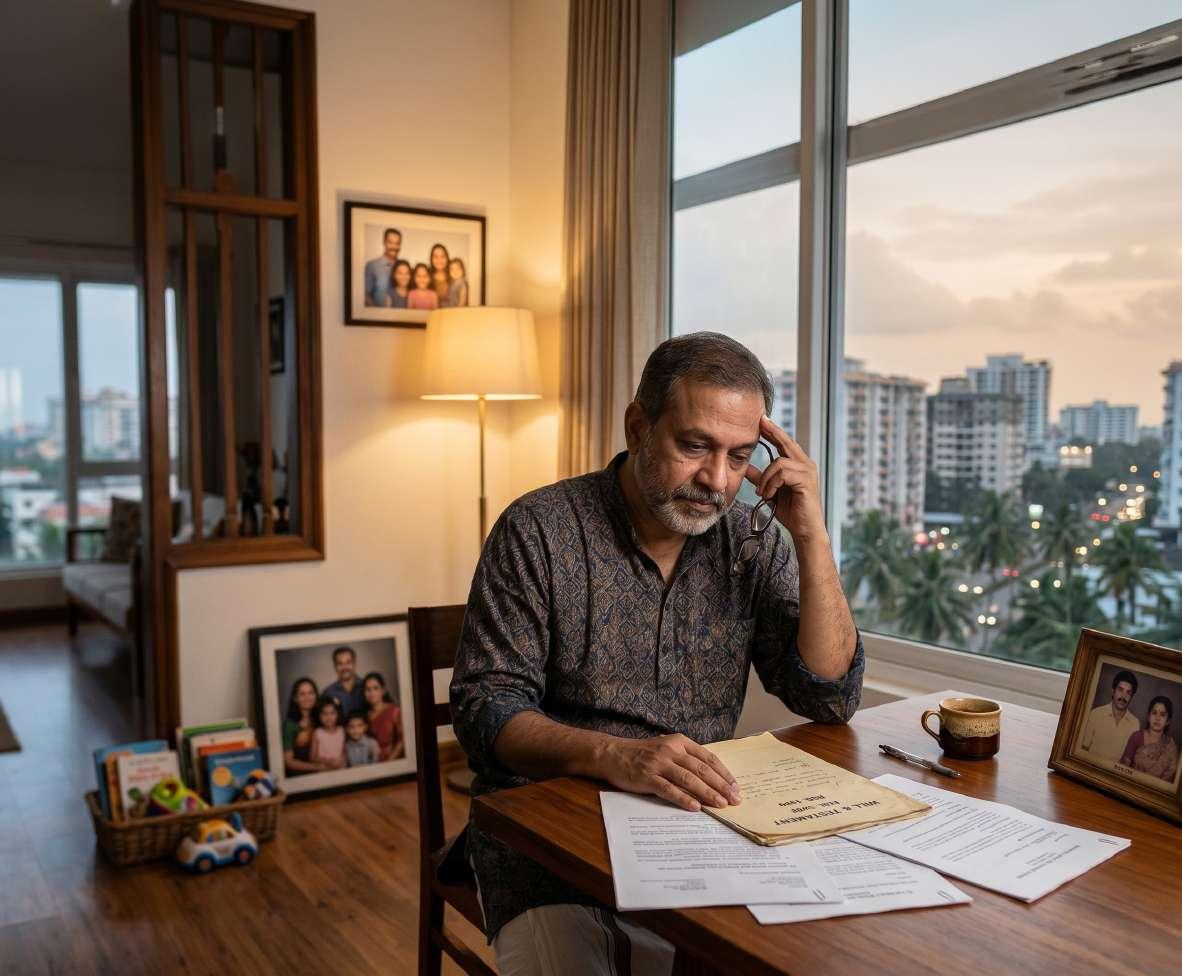
Early in life, when everything seems settled, a person draws up a Will, carefully outlining how his assets should be shared among his family. At that moment, it reflects his circumstances and intentions perfectly. But as time passes, life unfolds in unexpected ways, he may remarry, move across borders, build new assets, take on new responsibilities, or see his family grow in ways he had not once imagined. Despite these significant changes, his Will remains untouched, continuing to reflect a life that has since moved on.
After his passing, the family he built in his later years naturally expects his security. However, the law does not consider what he may have intended later; it only follows what is written. Since the Will was never updated, his new family is left without any legal claim, and the estate is distributed strictly according to an outdated document.
Situations like this are more common than one might think. A Will is not a one-time exercise; it captures your wishes at a particular point in time. If it is not reviewed
and updated as life evolves, it can fail to reflect your true intentions often leading to unintended and difficult consequences for those you care about most.
When Does a Will Become Outdated?
A Will can become outdated in several common situations:
• Changes in Family Structure: Marriage, remarriage, divorce, or the birth of children can significantly impact how you would want your assets distributed.
• Death of a Beneficiary or Executor: If someone named in your Will is no longer alive, it can create confusion or gaps in execution.
• Acquisition of New Assets: Over time, you may purchase property, grow investments, or acquire wealth that is not accounted for in your existing Will.
• Changes in Relationships: Personal relationships evolve. Someone you once intended to benefit from may no longer be part of your life.
• Changes in Intentions or Priorities: As you grow older, your perspective on financial distribution, or dependents may change. Review Your Will Every Few
Years
Setting time aside every few years to review your Will may seem like a small step, but it plays a crucial role in ensuring that your wishes remain accurate and effective.
Over time, many changes can occur, even if they are not immediately obvious. A periodic review gives you the opportunity to step back and ask a simple but important question: “If something were to happen to me today, does my Will truly reflect what I want?”
This review does not always require major changes. Sometimes, it simply confirms that everything is still in order. However, in many cases, it helps identify small gaps such as an asset not included, a beneficiary who should be added, or an executor who may no longer be the right choice. Addressing these issues early helps prevent confusion later. Why Reviewing Will is Important
The importance of reviewing your Will regularly becomes clear when we look at how disputes arise.
In Tarachandra v. Bhawarlal & Anr., the Supreme Court observed that when the validity of a Will is
questioned, the issue must be decided by a competent civil court. Until then, the rights of the parties remain uncertain. This means that if a Will appears outdated or unclear, your family may have to go through a prolonged legal process to establish what you intended.
Similarly, in Babu R v. State of Kerala, the Kerala High Court noted that once a Will is contested, its validity must be proved before a civil court.
What often leads to such disputes is not fraud or wrongdoing, but simply the fact that the Will no longer reflects the person’s later life. When family circumstances
change but the document does not, it creates doubt and in law, doubt is often enough to trigger litigation.
Keeping Your Will Aligned with Your Life
At its core, a Will is meant to speak for you when you are no longer there. However, it can only do so effectively if it reflects your life as it stands today not as it did years ago.
As seen from the scenario above, the real issue is not the absence of a Will, but the failure to keep it aligned with changing circumstances. Life moves forward, families grow, relationships evolve, and responsibilities shift. When a
Will remains unchanged despite these developments, it can create a gap between what you truly intend and what is legally enforced.
Reviewing your Will every few years helps to bridge that gap. It ensures that your document continues to represent your current family structure, your assets, and your intentions. It also reduces the chances of confusion, disputes, and delays for your loved ones.
An updated Will brings clarity where there might otherwise be uncertainty. It allows your wishes to be carried out smoothly and ensures that the people you care about are protected in the way you intended
M R Rajeshkumar Lead - Partner, GatewaysGlobal Family Business Advisory. www.gatewaysglobal.com
A widely discussed observation in family business research suggests that only a limited proportion of family businesses successfully continue beyond the third generation. The reasons for this are rarely related to lack of commitment from the next generation. Instead, the underlying challenge is often the absence of structured preparation for leadership.
Building Capabilities in Next-Generation Family Business Leaders
The Role of Executive Coaching in Strengthening Leadership Transitions
When Arjun returned to India after completing his management studies abroad, his family believed the future of their manufacturing business was secure. The company had been built by his grandfather and later expanded steadily under the leadership of the second generation. For years, the business had grown through trusted relationships, stable markets, and the experience of senior family members who were deeply involved in every major decision.
However, the business environment had changed dramatically. New competitors were entering the market, technology was advancing rapidly, and customer expectations were evolving. Within a few years of Arjun joining the company, the organisation began facing serious challenges, including declining sales,
outdated technology, and limited capital available for innovation.
While the family had expected the third generation to lead the business into the future, Arjun soon realised that stepping into leadership was far more complicated than anticipated. He had joined the company without a clearly defined role. Responsibilities were not clearly demarcated among family members, and strategic decisions continued to remain concentrated with the senior generation. Despite his education and enthusiasm, Arjun found himself navigating an organisation where leadership expectations existed, but the preparation for those responsibilities had never been systematically designed.
The Reality of Next-Generation Leadership
Situations like Arjun’s are not uncommon in family enterprises. Across the world, family businesses play a critical role in economic de-
velopment and long-term wealth creation. Yet leadership transition across generations remains one of their most complex challenges.
A widely discussed observation in family business research suggests that only a limited proportion of family businesses successfully continue beyond the third generation. The reasons for this are rarely related to lack of commitment from the next generation. Instead, the underlying challenge is often the absence of structured preparation for leadership.
In many family enterprises, next-generation members enter the business with strong academic backgrounds and global exposure. However, they often face practical challenges such as lack of role clarity, unclear demarcation of responsibilities, and limited exposure to the operational and technical aspects of the business. Without structured mentoring, leadership coaching, and
gradual leadership development, the transition from learning to leading becomes difficult.
Another common factor is the protective approach adopted by the senior generation. Founders and second-generation leaders often remain deeply involved in decision-making, sometimes unintentionally limiting opportunities for the next generation to develop independent leadership capabilities. In the absence of structured mentoring and “hand- holding,” younger leaders may struggle to build confidence in navigating complex business decisions. Moving from Entitlement to Capability
These challenges highlight an important distinction within family businesses - the difference between entitlement and capability. Leadership positions within family enter-
prises cannot rely solely on family identity. They must be supported by experience, preparation, and leadership development.
Successful family businesses therefore focus on building capability early. Preparing the next generation begins long before formal succession takes place. Many families introduce younger members to the business environment at an early stage, allowing them to observe operations and gradually understand the organisational culture.
Structured systems also play an important role. Forward-looking family enterprises increasingly create formal induction and training programmes for family members, helping them understand governance frameworks and operational processes. Carefully designed career progression plans allow next-genera-
tion members to develop experience across multiple functions of the business before assuming leadership responsibilities.
Participation in board meetings or family governance discussions as observers can provide valuable exposure to strategic decision-making. Similarly, involving next-generation members in specific business projects allows them to develop practical business insight while building credibility within the organisation.
Global advisory research supports these practices. Studies from organisations such as KPMG and EY suggest that family businesses with structured governance systems, mentoring frameworks, leadership coaching, and leadership development initiatives are significantly more likely to sustain themselves across generations.
The Growing Role of Executive Coaching
In recent years, many family enterprises have begun recognising the value of Executive coaching as a powerful tool in developing nextgeneration leaders.
Unlike traditional mentoring, Executive coaching provides a structured environment for reflection, leadership development, and strategic thinking. An experienced coach can act as a neutral thought partner, helping next-generation leaders navigate organisational complexities and family dynamics.
Through Executive coaching, emerging leaders gain greater clarity about their leadership roles, recognise their strengths and developmental areas, and develop the confidence required to make strategic decisions. Coaching also helps them navigate ambiguity, manage organisational challenges, and build leadership maturity in a structured manner.
For family businesses, this external perspective is particularly valuable. Family members often operate within long-standing relational dynamics, and an independent coach
can help create space for objective reflection and growth. In regions where family enterprises are growing rapidly, the demand for Executive coaching in Kerala is also increasing as organisations seek structured leadership development support.
Choosing the Right Executive Coach
Selecting the right coach is an important step for families investing in leadership development. Professional coaching credentials, such as certifications from the International Coaching Federation (ICF), including PCC or ACC accreditation, are often considered key indicators of quality. Equally important is the coach’s experience working with family enterprises, as the dynamics of family businesses are often very different from those of multinational corporations.
A coach who understands both organisational systems and family relationships can help bridge the gap between family expectations and professional leadership development through Executive coaching and structured leadership coaching support.
The GatewaysGlobal Per-
spective
At GatewaysGlobal, we work closely with family enterprises to support leadership continuity through structured advisory frameworks and Executive coaching programmes. Our work focuses on helping family businesses strengthen governance systems, develop nextgeneration leadership capabilities, and create pathways for sustainable intergenerational transitions.
Through specialised Executive coaching in Kerala, GatewaysGlobal supports organisations and family enterprises in building stronger leadership pipelines. By combining Executive coaching and leadership coaching with strategic advisory support, GatewaysGlobal partners with families to ensure that the next generation is not only ready to inherit the business but also prepared to lead it with confidence and responsibility.
Preparing the next generation is not simply about succession planning. It is about building capable leaders who can guide family enterprises through an increasingly complex and competitive business environment
Rajiv Ambat is a well-known speaker and the author of the best-selling book ‘The Midriff Crisis’. As a lifestyle expert, Rajiv leads the team at SOLVEMyHealth, which includes experienced dieticians, exercise specialists, and medical doctors. Together, they help clients manage a wide range of health concerns through structured, scientific, and personalised lifestyle interventions. The team specialises in treating and managing lifestyle-related conditions such as obesity, diabetes, high cholesterol, fatty liver, and PCOS through customised diet and exercise plans tailored to each individual’s needs.
IS YOUR BRAIN QUIETLY WORKING AGAINST YOUR HEALTH?
Most people already know what a healthy lifestyle looks like - eat better, exercise regularly, sleep well, and manage stress. Yet, despite knowing all this, many people struggle to follow it consistently. If the problem isn’t lack of knowledge, then what is?
Take Kerala as an example. We have one of the highest literacy rates in India and ranks high on the Human Development Index. Awareness about health, diet, and disease is relatively better compared to most parts of the country. And yet, Kerala has one of the highest rates of diabetes - more than double the national average. Almost every Malayali with diabetes knows what to do - reduce sugar, control portions, exercise regularly, lose weight. But the problem still persists, and worse - it continues to grow!
This clearly tells us that the issue goes beyond genetics or just a predisposition of the population. If it were only genetics and lack of knowledge, awareness and education should have slowed things down. But that hasn’t happened.
The real issue lies in how our mind works. Our daily health deci-
sions are not purely logical; they are influenced by automatic patterns, biases, beliefs, emotional triggers, and habits that operate quietly in the background. These patterns shape what we eat, whether we exercise, how we respond to stress, and how consistent we are over time. The human brain is often wired to prioritise immediate comfort over long-term benefit. It prefers convenience over effort, reward over discipline, and familiarity over change. In today’s environment where unhealthy choices are easily available, this wiring of our brain often works against us. That is why even informed, well-meaning people struggle to follow through on healthy habits.
Cognitive Biases: When Your Thinking Misleads You
Most of us believe our decisions are logical- that we weigh pros and cons and act accordingly. But in reality, many choices are shaped by hidden mental shortcuts, known as cognitive biases. These are not flaws; they are part of how the brain works. While useful for quick decisions, they often work against us when it comes to long-term health.
• One of the most common is present bias - our tendency to pri-
oritise what feels good right now over what benefits us later. This is why choosing a tasty, unhealthy meal feels easier than sticking to a balanced diet, or why skipping a workout today feels justified, even when we know it matters in the long run. The brain values immediate reward more than delayed outcomes, and health is almost always a delayed investment.
• Then there is optimism biasthe belief that serious consequences are unlikely to happen to us. A person may know the risks of high blood sugar or weight gain, but still feel that things are “under control” or can be managed later. This delays action until the problem becomes harder to reverse.
• We also see normalcy bias at play, especially in environments where unhealthy habits are common. When everyone around us eats poorly, sleeps less, and avoids exercise, it starts to feel normal. Over time, this shifts our baseline of what we consider acceptable behaviour.
• Another powerful influence is confirmation bias - our tendency to look for information that supports what we already believe. For example, someone who lived long despite
unhealthy habits can feel more convincing than years of scientific evidence.
• And then, there is the planning fallacy, where we overestimate our ability to follow through on ambitious plans. Many people set unrealistic goals - strict diets, intense workout routines, sudden lifestyle changes, only to struggle within a few days. When expectations are not met, it often leads to frustration and loss of confidence.
Rationalisations: The Stories That Keep
Us Stuck
If cognitive biases are automatic, rationalisations are more deliberate. They are the stories we tell ourselves to justify choices that do not align with what we already know is right, and over time, they become a major barrier to consistency.
• A common one is the “I deserve this” mindset. After a stressful day, rewarding ourselves with food
or skipping a workout feels justified. The intention is understandable, but when relief consistently comes from unhealthy choices, the pattern gets reinforced.
• Then there is “I’ll start tomorrow.” It sounds like planning, but is often just postponing discomfort. The issue isn’t delay once in a while, it’s the repeated cycle of delay without action.
• “I don’t have time” is another familiar explanation. While modern life is busy, this is often less about time and more about energy and priorities. When sleep is poor and stress is high, even simple actions feel difficult, and health gets pushed aside.
• “I’ll compensate later” follows a similar pattern of overdoing today with the intention of fixing it tomorrow. In reality, this leads to inconsistency rather than progress. And “just this once,” repeated often enough, quietly becomes the norm.
Emotional Drivers: When Feelings Override Logic
Not all health decisions are logical - many are driven by how we feel in the moment. Stress, boredom, fatigue, and frustration often influence behaviour more than knowledge or intention.
• A common example is stress eating. After a demanding day, food becomes a quick way to feel better. Over time, this creates a link between stress and eating, where the behaviour is less about hunger and more about coping. Emotional eating works similarly. Food is used to manage boredom, frustration, or loneliness, while the underlying issue remains.
• Another pattern is the guilt–avoidance loop. After overeating or skipping workouts, people feel guilty and then avoid tracking or restarting. Instead of correcting the behaviour, they disengage, which prolongs
the problem.
The gap between knowing and doing is one of the most overlooked aspects of health. Knowledge operates at a logical level, but behaviour is shaped by emotions, habits, environment, and ingrained mental patterns. Simply knowing what is right does not automatically override these influences
• All-or-nothing thinking adds to this. A small deviation in your diet is seen as failure. “I have already broken it”, leading to further slipups instead of simply getting back on track.
Identity & Beliefs: The Invisible Limits We Set
Beyond thoughts and emotions, something deeper shapes behaviour - our identity and the beliefs we hold about ourselves. Most people don’t realise this, but we rarely act against who we believe we are.
• Statements like “I’m not a fitness person” or “I don’t have discipline” may sound casual, but over time they become self-imposed limits. Behaviour tends to fall back in line with these beliefs. This is reinforced by a fixed mindset, a concept popularised by Carol Dweck, where abilities are seen as fixed. In this view, setbacks are taken as proof that change isn’t possible, rather than acknowledging that setbacks are part of the process.
• Repeated failures can also lead to low self-efficacy - the belief that “I can’t stick to anything”, which reduces effort even before starting.
• There is also the issue of priority. Many people value health, but in practice it comes after work, family, and daily pressures. The belief becomes “I’ll focus on it later,” and that “later” keeps getting postponed. The Language in Your Head: How Self-Talk Shapes Your Health
There is a quiet, ongoing conver-
sation in your mind that most people rarely notice. It shows up in how you think about food, exercise, your body, and your ability to change, and over time, it has a direct influence on behaviour. Consider a simple example: “I should not eat ice cream” versus “I cannot eat ice cream.” Both may lead to the same action, but the experience is very different. The first reflects choice and control, and is a self-empowered decision. The second statement feels like a restriction imposed by another person.
Self-talk also shapes identity. Statements like “I’m not a fitness person” or “I can’t stick to a routine” can become self-imposed limits, while blaming genetics or comparing with others can justify inaction. These thoughts feel like facts, but they are often interpretations. Small shifts in language from “I can’t” to “I’m choosing not to” can gradually change behaviour, because the way you speak to yourself doesn’t just reflect your actions, it shapes them. The Knowledge–Action Gap: When Knowing Doesn’t Translate Into Doing
The gap between knowing and doing is one of the most overlooked aspects of health. Knowledge operates at a logical level, but behaviour is shaped by emotions, habits, environment, and ingrained mental patterns. Simply knowing what is right does not automatically override these influences.
In my career as a health and lifestyle coach, I have seen many who feel a sense of progress because they
are reading a book about health, watching videos, or discussing it with someone. It can feel like progress, but without action, nothing really changes. Remember - ‘knowing’ is not doing, ‘doing’ is doing!
At SOLVEMyHealth, I often hear some of our clients say they’ll start next month, when work is lighter, when they are more at home and when life is less hectic. I usually tell them two things. First, even if you start now and manage only 60–70%, that is still progress; health doesn’t require perfection. An all-ornothing approach is one of the biggest barriers to growth - not just in health, but in any area. Second, if your life is usually busy, waiting for free time doesn’t help. You need to learn to build health into your existing routine amid work, travel, and responsibilities. If you cannot follow a behaviour for the rest of your life within your busy work and personal life, then you will not sustain it! When Systems, Surroundings, and Habits Work Against You
A large part of unhealthy behaviour is driven by our habits, our environment, and our daily lifestyle and choices. Much of this happens automatically, without conscious effort and at the centre of this is habit formation. The brain prefers efficiency, so repeated behaviours become automatic over time. Actions that provide immediate reward like eating processed foods, avoiding effort, get reinforced and repeated. Over time, these behaviours are triggered
by cues such as stress, boredom, or even specific times of the day, making them feel almost automatic. The challenge is that unhealthy habits have immediate gratification, whereas healthy behaviours require effort and come with delayed gratification. Our environment further amplifies this pattern. Today, unhealthy options are easily accessible, convenient, and socially accepted, while movement and exercise require planning. Behaviour is very easily formed in the path of least resistance. If unhealthy choices are easier and constantly visible, they become the default. This is why willpower alone is often not enough, because the surroundings are constantly nudging behaviour in a certain direction. Social pressure to conform further exacerbates this!
Finally, the absence of structure makes consistency difficult. Without routines, healthy actions get pushed aside by urgent tasks. Decision fatigue, poor sleep, and lack of accountability further reduce the ability to make good choices consistently. Many people rely on motivation, but motivation fluctuates and is not an infinite ‘akshaya-pathram’.
Awareness Is the First Step, Action Is The Next!
If you look at all these patterns - biases, rationalisations, emotions, habits, environment, and expectations, one thing becomes clear! Struggling with a healthy lifestyle is not a lack of discipline; it is the result of predictable psychological patterns.
The real problem is not knowing what to do, but knowing what is in-
fluencing your decisions. When you begin to recognise these patterns, you will feel empowered to choose differently. It is important to not stop at just being aware about these patterns, but what action we perform about it is equally important and defines the outcome.
The goal is not to eliminate these patterns, but to work around them. Make healthy choices easier, reduce daily decisions, build simple routines, and shape your environment to support you. Long-term health is not built on motivation, but on systems. And it starts with one simple understanding: if you don’t recognise these patterns, they will quietly guide your behaviour. And once you recognise these patterns, change your behaviour smartly!
Ravi Saini Associate Editor, Unique Times & CEO, RSW (Resetting Sustainable Wealth) Group
India’s middle class today stands at a critical crossroads. Aspirations are rising faster than ever before, but the economic system is struggling to support them.
MIDDLE CLASS CRISIS –THE INDUSTRIAL REVOLUTION INDIA NEEDS
Ramesh Sharma, a 38-yearold working professional in Delhi, begins his day before sunrise. With a stable job, a respectable salary, and dreams for his children’s future, he represents the ambition of India’s middle class. On paper, his life looks secure. But every month tells a different story.
His salary has inched up over the years, yet his expenses have surged ahead—school fees, fuel costs, groceries, and EMIs. The same basket of essentials now costs significantly more. Vacations have been postponed indefinitely. Dining out has become occasional. Savings, once a priority, have turned into a struggle. Ramesh is not alone. Millions of families across India live this quiet contradiction—earning, but not progressing; working harder, yet feeling financially stuck. Their demand for a better life is rising, but the supply of affordable opportunities is not keeping pace.
This is the real face of India’s middle-class crisis—not loud, not
visible in headlines, but deeply felt in households.
The Silent Squeeze: Crisis of Higher Demand and Lower Supply
India’s middle class today stands at a critical crossroads. Aspirations are rising faster than ever before, but the economic system is struggling to support them. This imbalance can be best understood as a crisis of higher demand and lower supply.
On one side, there is a surge in demand—better housing, quality education, healthcare, mobility, and lifestyle improvements. On the other side, the supply of affordable goods, stable jobs, and scalable industries has not expanded at the same pace. The result is inevitable: inflation and financial stress.
When demand outpaces supply, prices rise. The depreciation of the rupee further amplifies this issue by making imports—fuel, electronics, raw materials—more expensive. This reduces supply in critical sectors and pushes costs onto consumers.
At the same time, job creation has not kept pace with the growing workforce. While opportunities exist, many are either low-paying, unstable, or mismatched with skills. The outcome is underemployment, stagnant wages, and rising uncertainty.
This is not just an economic slowdown—it is a structural supplyside weakness.
“When demand rises faster than supply, the middle class pays the price.”
Why Rupee Devaluation is a Blessing in Disguise
A weakening rupee is often viewed with concern. It makes imports expensive and adds pressure on household budgets. But this is only one side of the story. The other side reveals opportunity.
A depreciating rupee makes Indian goods and services more competitive globally. What becomes expensive domestically can become attractive internationally. This creates a powerful incentive to produce more within India and export more
to the world. The key lies in building domestic supply, and one of the most promising sectors to achieve this is food processing.
India is one of the world’s largest producers of agricultural commodities—fruits, vegetables, grains, dairy, and spices. Yet a significant portion of this output is either wasted or exported in raw form with minimal value addition.
By investing in food processing industries, India can:
• Convert raw produce into highvalue, export-ready products
• Reduce wastage and improve supply efficiency
• Increase farmers’ incomes
• Generate large-scale rural and urban employment
At the same time, global demand for affordable, high-quality food products is rising. A weaker rupee makes Indian processed food even more competitive in international markets.
Food processing, therefore, becomes more than an industry—it becomes a bridge between India’s supply potential and global consumption needs.
“A weak currency pushes a strong nation to produce more.” The Industrial Revolution
India Needs
To resolve the crisis of higher demand and lower supply, India must undergo a new industrial revolution—one focused on expanding supply capacity across sectors.
This transformation must go beyond traditional manufacturing and include high-impact industries like food processing, renewable energy, MSMEs, and decentralised production ecosystems. The goal is simple yet powerful:
Increase supply to match aspirations.
Key pillars of this revolution include:
1. Expanding Production Capacity
India must scale up industries that can meet both domestic and global demand.
2. Strengthening Supply Chains
Better infrastructure, logistics, and storage systems are essential to reduce inefficiencies and wastage.
3. Encouraging Entrepreneurship
Local manufacturing and small businesses must be empowered as engines of growth.
4. Skill Alignment
Education must shift from theoretical learning to practical, industry-relevant skills.
5. Collaborative Ecosystems
Investors, entrepreneurs, policymakers, and communities must work together to create inclusive growth.
A strong production ecosystem will not only stabilise prices but also create jobs, boost incomes, and restore confidence in the middle class.
“Supply creation is the real solution to inflation and unemployment.”
From Consumption to Crea-
tion
The middle-class crisis is not a dead end—it is a signal. A signal that India must rebalance its economic model. At its core, the issue is clear:
Demand is rising, but supply is not keeping up.
Rupee depreciation, instead of being feared, should be understood as a trigger for transformation. It is nudging India towards self-reliance, export growth, and industrial expansion.
By focusing on sectors like food processing, horticulture with animal husbandry and manufacturing, India can:
• Bridge the demand-supply gap
• Empower its middle class
• Reduce import dependence
• Strengthen its global position
The way ahead is not complicated—it is decisive:
Produce more. Waste less. Compete globally.
India stands at a defining moment. The choice is clear - to remain a nation that consumes, or to become a nation that creates.
“The future of the middle class and the nation depends on that choice.”
Dr. Suresh Nair, Educationist | Former Principal & Advisor, Vivek Education Society
The temple is renowned for its architectural beauty, featuring Dravidian features, with three concentric walls and three gopurams, including a five-tiered main entrance tower and a central sanctum housing the image of Lord Shiva. The temple offers solace for those seeking relief from Saturn’s influence and is a popular destination for devotees from all over India.
Tirunallar Shani Temple, also known as the Dharbaranyeswarar Temple, is a significant shrine located in Tirunallar village, Karaikal district, Puducherry. It is also known as the Tirunallar Saneeswaran Temple. This spiritual sanctuary is a Navagraha temple dedicated to Lord Shani (Saturn), believed to relieve devotees from Shani Dosha and bring prosperity. The temple is about 6 km from Karaikal railway station and 145 km from Tiruchirappalli International Airport. By road, one can reach here from Chennai, Puducherry or Trichy. It is also known as Dharbaranyeswarar Temple after the original forest of dharba grass where it was established. Dharba is a sacred grass that is used for garlands in temples as well as poojas. Aranyam means a forest.
This temple was visited by
Saint Tirugnana Sambandar in the 7th century CE who sang padigams (decadal verses) in praise of the Lord Siva. Likewise, his contemporary Saint Thirunavukkarasu and later, Saint Sundarar (9th century CE.) had visited the shrine and sung padigams extolling the Lord. It is believed that Saint Arunagirinathar (15th century) had also visited it and sang hymns included in his monumental work Thiruppugazh. The temple is renowned for its architectural beauty, featuring Dravidian features, with three concentric walls and three gopurams, including a five-tiered main entrance tower and a central sanctum housing the image of Lord Shiva. The temple offers solace for those seeking relief from Saturn’s influence and is a popular destination for devotees from all over India. The temple’s history is deeply rooted in leg-
ends, with stories of King Nala and Queen Damayanthi seeking relief from the malefic effects of Saturn.
The temple is considered as a transformative spiritual centre, where devotees seek relief from hardships, misfortunes, and planetary afflictions, making it one of the most revered Navagraha temples in India.
The presiding deity is Lord Shiva as Dharbaranyeswarar, enshrined in a lingam covered with dharba grass. Lord Shani (Saneeswaran) is worshipped in a separate sanctum as the doorkeeper of the shrine, depicted with a sword, arrow, and daggers, riding a buffalo. Another deity in this temple is Goddess Parvati, known as Praneswari Amman, the consort of Lord Shiva. Nala Theertham, is the holy pond, where devotees take a dip to cleanse their sins and mitigate
the malefic effects of Saturn.
The temple is renowned for the legend of King Nala, who was afflicted by Sani Dosham. After bathing in Nala Theertham and praying to Lord Shiva, he was relieved of his afflictions, establishing the temple as a centre for Saturn related remedies. Devotees believe that worshipping here, offering oil, black cloth, black sesame seeds, and taking a dip in the sacred can reduce the negative effects of Saturn (Sani) and bring prosperity.
The temple follows six daily poojas: Ushathkalam, Kalasanthi, Uchikalam, Sayarakshai, Irandamkalam, and Ardha Jamam. Special rituals of Lord Shani include: Sani Archana, Sani Homam, Til abhishekam and oil lamp Offerings.
Tirunallar Temple is renowned for its vibrant religious festivals, with Sani Peyarchi and Brahmotsavam being the most significant celebrations, drawing thousands of devotees annually. Sani Peyarchi (Saturn Transit Festival) occurs every two and half years, marking the planet’s transit from one zodiac sign to another. This festival involves special abhishekams (ritual ablution), homams (fire sacrifices), and poojas dedicated to Lord Saneeswaran. Other festivals include Maha Shivratri, Aadi Amavasi, and Thai Amavasi. Brahmotsavam Festival is celebrated during the Tamil month of Vaikasi (May-June) over 18 days, featuring grand processions and rituals. This festival highlights temple idol processions,
cultural performances and community gatherings, with significant participation from devotees and chieftain representatives.
Natyanjali Dance Festival is a four-day classical dance festival held around Maha Shivratri, dedicated to Lord Siva and performed in the temple premises. Artistes from across India perform Bharatanatyam and other classical dances as an offering to the deity. The festival combines devotional and cultural experiences, with performances sometimes held in temple auditoriums.
The temple opens at 6.00 am and closes at 12.30 pm and opens at 4.00 pm and closes at 9.00 pm. Traditional attire is recommended for devotees and shorts and sleeveless tops are to be avoided
Healing Hearts, Shaping Futures
How Euphie K Paul and Dr Rishi George are redefining healthcare, education, and compassionate leadership through Welmont Hospital and Little Britain Preschool
Some people build businesses while some others build institutions. And then there are others who belong to the rare tribe who construct something far more enduring that carries trust, purpose, and meaningful impact. For power couple Euphie K Paul and Dr Rishi George, success has never been measured merely by titles or achievements, but by the lives they touch and the communities they nurture. Across healthcare, education, and entrepreneurship, their journey reflects a vision rooted in compassion, innovation, and genuine human connection.
From the patient-focused excellence of Welmont Hospital to the nurturing learning environment of Little Britain Preschool, the duo has created spaces that seamlessly blend care with purpose. At the heart of their story lies a simple yet powerful belief: when people feel valued, supported, and inspired, transformation naturally follows.
The Visionary Behind the Transformation
Euphie is a name that resonates with dynamism, creativity, and purpose-driven leadership. An attentive listener, strategic thinker, and natural leader, her journey began early. From serving as a class leader during her school years to consistently tak-
ing on leadership roles throughout her academic and professional life, she has always displayed an innate ability to guide teams and inspire excellence.
Today, as the Managing Director of Welmont Hospital, she plays a pivotal role in shaping the institution’s culture, operational efficiency, branding, and people management strategies. Her academic credentials reflect her multidimensional personality — an MBA with dual specialisations in Human Resources and Project Management from Liverpool John Moores University, UK, along with qualifications in Information Technology and Journalism. Adding another dimension to her profile is her certification as a trained Montessorian, which later laid the foundation for her revolutionary contributions to early childhood education.
What makes Euphie’s leadership style unique is her ability to merge analytical thinking with emotional intelligence. Having worked with renowned organisations including Mahindra & Mahindra, Prestige Group, and Sobha Developers, she gained extensive expertise in administration, communication, customer engagement, and strategic management. These experiences sharpened her understanding of how organisations thrive when people, processes,
and purpose align seamlessly.
At Welmont Hospital, her influence is visible in every detail — from operational systems and patient experience to staff culture and interior aesthetics. Her research-driven approach to management, combined with her eye for design and functionality, has transformed Welmont into a healthcare destination that feels warm, reassuring, and humancentred.
Welmont Hospital: A NewAge Healthcare Destination
Healthcare today demands far more than medical expertise alone. Patients seek empathy, trust, comfort, transparency, and holistic care. Welmont Hospital was envisioned precisely around these values.
Under the leadership of Dr Rishi and Euphie, Welmont Hospital has emerged as a benchmark for patient-focused healthcare in Kochi. The institution reflects a modern healthcare philosophy where advanced medicine coexists with compassionate treatment and preventive wellness.
Dr. Rishi, the Chairman, is an accomplished Internist, Diabetologist, and Metabolic Physician whose passion for healing has earned him widespread recognition and respect. With specialised training from globally reputed institutions such as
CMC Vellore, Johns Hopkins Baltimore, and the Royal College of Physicians London, he brings a worldclass perspective to patient care and medical management.
His academic achievements are equally impressive. Alongside his medical qualifications, he pursued an MBA in Hospital Management to better understand the evolving dynamics of healthcare systems and administration. This rare combination of clinical expertise and managerial insight enables him to approach healthcare not only as a doctor but also as a visionary healthcare architect.
Dr Rishi is particularly recognized for his expertise in Diabetes Management, Obesity Care, Preventive Cardiology, and Metabolic Health. His work emphasises protocol-based treatment combined with personalised patient counselling — a model that empowers patients to actively participate in their healing
journeys.
One of his major focus areas has been cardiac rehabilitation, a critical yet often overlooked aspect of healthcare in India. Recognising the urgent need for structured rehabilitation programmes, he has dedicated significant efforts toward building internationally benchmarked cardiac rehabilitation systems aimed at improving long-term heart health outcomes.
His pioneering work in Diabetes Reversal and Age Reversal programmes has also benefited numerous individuals seeking sustainable lifestyle transformation rather than temporary symptomatic treatment.
What further distinguishes Dr Rishi is his forward-thinking embrace of technology and innovation. He is currently involved in the development of advanced AI-driven healthcare solutions designed to improve accessibility, diagnosis, and treatment outcomes for both com-
municable and non-communicable diseases. His vision reflects the future of healthcare — data-driven, patient-centric, preventive, and deeply humane.
Over the years, his contributions have been recognised through several prestigious honours, including the Chikitsa Samman Puraskar, Global Healthcare Excellence Award, Healthcare Excellence Award in Diabetology, and Utkrisht Seva Samman. Yet, beyond awards and accolades, it is his unwavering dedication to patient welfare that truly defines his legacy.
Little Britain Preschool:
Where Childhood is Cherished
While Welmont Hospital focusses on healing lives, Little Britain Preschool aims to shape them from the very beginning.
Founded by Euphie in 2018, Little Britain Preschool was born out of a deeply personal vision to cre-
ate a nurturing educational space where children are treated with love, patience, dignity, and individual attention. Located in Kaloor and Kakkanad, the institution has rapidly earned a reputation as one of Kochi’s most thoughtful and progressive early childhood education centres.
At Little Britain, education goes far beyond textbooks and rote learning. The institution follows a carefully curated blend of Montessori, Kindergarten, and Nursery methodologies designed to support emotional, social, intellectual, and creative development simultaneously.
The philosophy is simple yet profound: every child is unique and deserves to feel seen, heard, safe, and celebrated. Parents often describe Little Britain as a second home — a space where children develop confidence, communication skills, emotional security, and a genuine love for learning from an early age.
Unlike conventional systems that often prioritise academic pressure too early, Little Britain believes in nurturing curiosity, confidence, communication skills, empathy, and self-expression. The classrooms are intentionally designed to encourage exploration, interaction, and experiential learning.
Children are gently introduced to concepts through storytelling, sensory activities, music, movement, play-based learning, and hands-on experiences. Equal importance is given to discipline, emotional wellbeing, creativity, hygiene, social interaction, and communication skills.
A defining strength of Little Britain is its highly personalised approach. By maintaining optimal teacher-student ratios, the institution ensures that every child receives individualised care and guidance. The result is an environment where children not only learn but truly flourish.
The campuses themselves reflect Euphie’s design sensibilities and child-centric philosophy. Every corner is thoughtfully crafted to feel warm, secure, stimulating, and joyful. From interactive learning spaces to safe play zones, the atmosphere encourages children to discover the world with confidence and excitement.
Beyond preschool education, Little Britain also offers daycare services and after-school activities, creating a comprehensive support system for modern families seeking a safe and enriching environment for their children.
A Legacy Built on Purpose
What makes the journey of Euphie and Dr Rishi truly extraordinary is their ability to build ventures that are rooted not merely in business ambition, but in social purpose and human connection.
Their work reflects a deep understanding of two of society’s most vital
foundations — health and education. Through Welmont Hospital, they strive to create healthier lives. Through Little Britain Preschool, they nurture brighter futures.
Euphie’s entrepreneurial spirit extends even further through ventures such as Madam’s Academy of Montessori Education, dedicated to training future educators, and ABOE, a premium food and beverage consultancy firm. Her latest venture, Mamma Kunji, an organic and sustainable clothing brand, reflects her commitment toward conscious living and sustainability.
Yet, despite the diversity of her ventures, one common thread runs through all her work — the desire to create value with authenticity, empathy, and excellence.
Similarly, Dr Rishi continues to bridge the gap between modern medicine and compassionate care. His dedication to patient coun -
selling, preventive healthcare, research, and technological innovation demonstrates a progressive vision for the future of Indian healthcare.
Together, they represent a new generation of leaders who understand that institutions are not built merely with infrastructure and investments, but with vision, integrity, and heart.
Building More Than Institutions
The remarkable strength of Euphie and Dr. Rishi lies in the seamless way they blend contrasting perspectives, creating a partnership driven by vision, balance, and shared purpose.. One world revolves around advanced healthcare, medical precision, and patient recovery; the other revolves around crayons, curiosity, and the emotional development of children. Yet both are connected by the same
philosophy — creating environments where people genuinely feel cared for.
As Welmont Hospital continues to evolve with modern healthcare innovations and Little Britain Preschool expand its child-centric learning approach, the duo is steadily shaping a larger ecosystem driven by empathy, quality, and purposeful leadership. Their story is not just about managing successful ventures; it is about reimagining how hospitals should feel, how education should begin, and how meaningful institutions are built from the inside out.
In a world increasingly driven by speed and competition, Welmont Hospital and Little Britain Preschool stand as reminders that true progress begins with compassion, trust, and the courage to care deeply for people at every stage of life
Dolly Neena
FOUNDER - GROUND DHARMA
The psychological and social programming we inherit is a complex web of "shoulds" and "musts" designed for industrial efficiency rather than human or cosmic coherence.
THE ARCHITECTURE OF ‘THE ROOT’ AND ‘THE REACH’
In the vast tapestry of existence, the boundary between the individual and the cosmos is an illusion born of limited perception. We are not merely observers of the universe; we are its local expression, a biological aperture through which the cosmos experiences itself. This connection is not metaphorical or poetic—it is a fundamental reality rooted in the same laws of physics and biology that govern the spiralling of galaxies and the blooming of a wildflower. For the entrepreneur, this realization is the cornerstone of sustainable success. The modern business world often teaches us to operate as if we are machines, separate from the rhythms of nature, yet the entrepreneurial journey is perhaps the most visceral mirror of universal cycles. To lead, to create, and to build is to participate in the act of cosmic expansion, and doing so effectively requires a deep align-
ment with the natural laws of ebb and flow, death and rebirth. The human body is composed of the very same elements forged in the hearts of dying stars. We carry the iron of ancient supernovas in our blood and the calcium of cosmic dust in our bones. This physical link ensures that we are subject to the same systemic principles as the rest of the natural world. Nature does not exist in a state of constant, linear growth; it breathes. There are seasons of frantic expansion and seasons of profound stillness. For an entrepreneur, the failure to recognize these cycles often leads to burnout and strategic blindness. We are conditioned by a social and psychological program that demands "infinite summer"—constant scaling, perpetual productivity, and quarterly growth that never dips. This conditioning is a form of collective amnesia that forgets the necessity of the
"Winter" and the "Void."
The psychological and social programming we inherit is a complex web of "shoulds" and "musts" designed for industrial efficiency rather than human or cosmic coherence. From a young age, we are taught that stillness is synonymous with stagnation and that a lack of visible progress is a sign of failure. This programming creates a rigid internal architecture that resists the natural contraction of life. When an entrepreneur hits a plateau, or when a venture enters a period of silence—the Void—the old conditioning triggers an alarm response. We mistake the silence for an ending rather than a transition. We react by forcing movement, wasting precious energy on "busy work" that lacks soul, or by falling into a spiral of selfcritique. This is the first hurdle of the journey: unlearning the habit of constant external validation and rec-
ognizing that the Void is not empty. It is a space of potentiality, much like a seed beneath the snow, organizing its internal structure before it can break the soil.
Handling the Winter and the Void requires a radical shift in perspective. In nature, Winter is a period of consolidation. It is when the energy of the tree retreats from the leaves and branches back into the roots. For an entrepreneur, Winter may look like a dip in revenue, a loss of a major partner, or a personal period of creative exhaustion. The key to surviving this season is not to fight it, but to move into the roots. This is the time for internal audits—not just of spreadsheets, but of the psyche. It is the time to ask: What foundations are no longer strong enough to support the next level of growth? What parts of the business or the self were built on the shaky ground of ego or outdated conditioning? The Void is a teacher that demands presence. By sitting in the stillness of the Void
without rushing to fill it with noise, the entrepreneur allows for a higher level of coherence to form. This is where the most profound insights are born, often arriving as whispers rather than shouts.
Heeding the signs is an art of synchronization. The universe communicates through synchronicity, intuition, and the feedback loops of our environment. When we are out of alignment, the signs are usually friction, exhaustion, and a sense of "pushing a boulder uphill." When we are in coherence, the signs are "green lights" and "flow states." An entrepreneur must become an expert tracker of these subtle indicators. If every door is closing, the lesson might not be to "try harder," but to "look elsewhere" or "wait." The old conditioning tells us that "winners never quit," but wisdom tells us that the wise never ignore the wind. Learning the lessons of the Winter means accepting that certain aspects of your identity or your
business model must die so that a more evolved version can emerge. This "ego death" is the most difficult part of the entrepreneurial path, yet it is the only way to avoid becoming a relic of your own past success.
Surviving the Winter successfully is about conservation and preparation. It is about protecting your "inner fire" through practices that ground the nervous system—meditation, time in nature, and silence. It is about ensuring that the core of the business remains lean and resilient. When you stop resisting the Winter, the energy you used for struggle becomes available for deep reflection. This creates a state of internal coherence, where your thoughts, emotions, and actions are aligned with the reality of the present moment rather than a projected fantasy of where you "should" be. This coherence is the magnetic force that eventually draws the Spring toward you.
As the frost thaws and the first signs of Spring appear, the challenge
shifts from survival to sustainability. Spring is an explosion of energy, but it can also be chaotic. After a long Winter, there is a temptation to rush, to over-extend, and to say yes to every opportunity out of a fear of returning to the Void. However, to sustain the Spring with coherence, the entrepreneur must carry the lessons of the Winter forward. This means growing with intention rather than impulse. Coherence in growth means ensuring that every new branch added to the business is supported by the strengthened root system developed during the dormant phase. It means maintaining the practices of stillness even when the world is calling you to move at light speed.
For the entrepreneur manoeuvring this journey, I suggest viewing
your business as a living organism rather than a machine. A machine is depreciated over time; an organism evolves. To facilitate this evolution, you must cultivate "biophilia"—a love of life and its natural processes. Surround yourself with people who understand the value of the pause. In your strategic planning, build in "fallow periods" where no new projects are started, allowing the current ones to integrate. Most importantly, learn to trust your biology. Your gut feelings, your energy levels, and your dreams are all data points from a universe that is intimately connected to your success.
The ultimate goal is to achieve a state of "dynamic equilibrium," where you are sensitive enough to feel the change in seasons before they arrive and robust enough to
weather them when they do. This is the path of the conscious entrepreneur. By shedding the skin of social programming and embracing the cosmic rhythm, you stop being a victim of circumstance and start being a co-creator with the universe. You begin to see that the Void was never your enemy, but your womb; the Winter was not a punishment, but a sanctuary; and the Spring is not a destination, but a celebration of the resilience you cultivated in the dark. In this alignment, success is no longer a frantic chase, but a natural flowering of a welltended soul. You are the universe, entrepreneur. Trust the process, respect the silence, and when the light returns, bloom with the fierce authority of one who has mastered the shadows
Dr. Sandeep K. Krishnan
CEO & Partner, People Business | Leadership Expert | Author & IIM-A Faculty
Most organisations are busy doing AI things: pilots, task forces, tool subscriptions and sometime without anyone really lead ing the AI agenda.
5 Levels of AI Leadership: Where Do You Stand?
Walk into any leadership meeting in India today and sooner or later someone will ask: "So what's our AI story?" Most organisations are busy doing AI things: pilots, task forces, tool subscriptions and sometime without anyone really leading the AI agenda.
Level 1: The Spectator "Let's wait and watch."
This leader is not clueless. They read the news and have probably attended an AI conference or two. They know it's important but, in their heart, they believe the smart move is to sit tight and let things settle before committing.
In their organisation, AI is entirely the IT team's problem. The leader's own workday in terms of how they make decisions, how they prepare for meetings, how they think about strategy has changed very little.
The thing is, waiting feels safe but isn't. While you're watching, your
competitors are moving. Their teams are building habits. Their customers are getting used to smarter experiences. You won't feel the pain today, but the gap quietly widens.
To move up: Pick one real problem you deal with daily and spend 30 minutes using an AI tool on it. Curiosity is the first step.
Level 2: The Experimenter
"We've got some pilots going."
Good news is that this leader has started moving. There's a chatbot in action, a data dashboard that uses A or maybe an AI tool the HR team is trialling. There's energy and a genuine sense that things are happening.
However, at this level, most of these pilots don't talk to each other and they live in silos. When you ask what business outcome they're driving, the answer gets a little fuzzy.
It's a bit like getting gym memberships. The intention is great. The results, not so much.
The bigger issue is that the leader
hasn't yet asked the harder question: If AI can now do so many things at scale, does our business model still make sense? That conversation hasn't happened. And without it, all the pilots in the world won't add up to transformation.
To move up: Pick your top three AI bets, the ones that could genuinely change your competitive position. Bring the business model question into the room yourself.
Level 3: The Integrator
"AI is starting to change how we actually work."
This is where things get interesting. AI isn't just an add-on anymore and it's starting to show up inside real decisions and real workflows. The leader is personally using it to think better: testing assumptions, exploring angles they might have missed, asking sharper questions.
I write in my book about a CEO who did something that stuck with me. Three months after ChatGPT
launched, he took his freshly approved 3-year strategy and put it through the tool. It came back with two scenarios his team hadn't considered and a few priorities they'd underweighted. He didn't throw the strategy out but he pushed it harder. That's what Level 3 looks like.
Here I have evolved the SISD model. The SISD Model is a framework for how AI-augmented leaders think — across four stages: Sense, Interpret, Simulate, and Decide. AI acts as a strategic radar in the Sense stage, continuously scanning markets, competitors, and operations far beyond what any quarterly report can capture. In the Interpret and Simulate stages, AI clusters complexity, surfaces hidden patterns, and runs "what-if" scenarios while human judgment determines what actually matters. At the Decide stage, the final call always stays with the leader, but it is sharper, faster, and better informed than ever be-
fore.
The challenge here is that it's still a bit patchy. AI is working well in some parts of the business, barely touched in others. The CEO is often the only real champion. Governance is improvised. There's no system yet.
To move up: Shift from being the lone champion to building the infrastructure. That means investing in data, getting governance on the boardroom agenda before something goes wrong, and measuring whether your people are actually building AI capability and not just using tools.
Level 4: The Transformer
"We're rethinking what our business actually is."
Level 4 is a different conversation entirely. These leaders aren't asking "how do we use AI to do what we already do better?" They're asking "if we were building this company today, would we build it the same way?"
That's a harder and braver ques-
tion.
The shift here is in the business model itself. Think of John Deere. They don't just sell tractors anymore. They offer AI-powered farming systems that get smarter every season. The tractor is just the starting point. The real value is in the ongoing relationship with data and intelligence. That's a fundamentally different business.
In India, HDFC Bank is a good example of this thinking. Using AI not just to speed up banking, but to change how credit decisions get made and how customers experience the bank.
At this level, governance also becomes serious. When AI is influencing real decisions about people and money, the risks of bias, bad data, and accountability gaps are real. The Level 4 leader gets ahead of that. As Nandan Nilekani has said: scale without trust eventually collapses. The best leaders at this level build
trust before they need to.
To move up: Stop thinking of yourself as an AI champion and start thinking like an institution builder. What will AI leadership look like in your organisation five years from now and are you building toward that?
Level 5: The AI-Native Leader
"This is just how we think now. Level 5 leaders are rare. They're easy to recognise once you know what to look for.
They use AI the way a good leader uses a trusted advisor. Not to rubber-stamp what they already believe, but to genuinely challenge it. They're faster, sharper, and more comfortable with uncertainty because they've built intelligence into how they think and decide.
What sets Level 5 apart most is that this capability isn't just at the top. It runs through the whole organisation. Unilever is a good example. They didn't just launch AI projects. They moved from doing digital to being digital, building AI literacy across every function, every level. R&D, supply chain, marketing, HR — all of it. People weren't just handed tools. They were expected to understand how AI works, when to trust it, and when to push back on it.
At Level 5, the big question isn't "how do we use AI?" It's "what do we need to become in a world where intelligence is no longer scarce?"
And responsible AI at this level isn't a box-ticking exercise and it's actually a business advantage.
Customers trust companies that are transparent. Employees work harder when systems are fair. Which level are you?
If you're honest with yourself, most leaders reading this are somewhere between Level 2 and Level 3. That's okay. It's actually where most good, thoughtful organisations sit right now. What matters is what you do next.
AI won't replace you as a leader. Leaders who understand AI: who use it to think better, decide faster, and build smarter organisations will have a real edge over those who don't. Not because they're more technically brilliant but they're more willing to grow.
The AI era rewards the adaptive, not just the ambitious
Dr Jolly Antony
Chairman, Vibe Munnar Resort & Spa
Managing Director, The Fog Resort & Spa, Munnar Chairman, Alsafina Travel Group (UAE & India)
Chairman, Growvia.biz
The rise of offbeat tourism is closely linked to growing awareness about sustainability. Over-tourism in major destinations has led to environmental degradation, cultural dilution, and strained local resources. In response, travelers are actively seeking alternatives that allow them to explore responsibly.
OFFBEAT DESTINATIONS SURGE: RISE OF THE ROAD LESS TRAVELLED
For decades, global tourism revolved around a familiar checklist—iconic cities, postcard landmarks, and bucketlist attractions. From the romance of Paris to the buzzing streets of New York City, travelers once flocked to the same celebrated hotspots. But today, a quiet revolution is underway. Modern explorers are stepping off the beaten path, seeking experiences that feel authentic, uncrowded, and deeply personal.
This shift toward offbeat destinations is not just a passing trend—it’s transforming how, where, and why people travel. Hidden villages, remote islands, and lesser-known cultural hubs are no longer overlooked; they are becoming the new stars of global tourism.
The Desire for Authenticity: Travel Beyond the Surface
At the heart of this shift lies a growing desire for authenticity. Travelers today are less interested in ticking boxes and more invested in meaningful experiences. Instead of standing in long queues for famous landmarks, they are choosing to immerse themselves in local culture,
traditions, and everyday life.
Destinations like Luang Prabang or Chefchaouen offer something that major cities often cannot—an intimate connection with place and people. Whether it’s participating in traditional ceremonies, exploring untouched landscapes, or simply enjoying a slower pace of life, these experiences resonate deeply with modern travelers.
The shift reflects a broader change in mindset: travel is no longer about seeing more, but about experiencing better.
The Social Media Effect: Discovery in the Digital Age
Social media has played a powerful role in bringing offbeat destinations into the spotlight. Platforms like Instagram and TikTok have become virtual travel guides, showcasing hidden gems that were once known only to locals.
A single viral post can transform an unknown location into a mustvisit destination overnight. Scenic spots, unique cultural experiences, and lesser-known landscapes are now reaching global audiences instantly.
However, this digital exposure comes with a paradox. While it helps diversify tourism and reduce pressure on overcrowded cities, it can also lead to sudden surges in visitor numbers—challenging the very authenticity that made these places appealing in the first place.
Sustainability Matters: A Shift Toward Responsible Travel
The rise of offbeat tourism is closely linked to growing awareness about sustainability. Over-tourism in major destinations has led to environmental degradation, cultural dilution, and strained local resources. In response, travelers are actively seeking alternatives that allow them to explore responsibly.
Lesser-known destinations often offer opportunities for eco-tourism, community-based travel, and lowimpact experiences. Remote regions, when managed thoughtfully, can benefit economically from tourism while preserving their natural and cultural heritage.
Governments and tourism boards are also encouraging this shift by promoting secondary cities
and rural areas, distributing visitor traffic more evenly and reducing the burden on overcrowded hotspots.
Economic Ripple Effects:
New Opportunities for Local Communities
As tourism flows shift, so do economic opportunities. Offbeat destinations are experiencing a surge in demand for accommodations, local guides, handicrafts, and culinary experiences. This creates new income streams for communities that were previously outside the tourism map.
For small towns and rural regions, tourism can be transformative—supporting livelihoods, preserving traditional crafts, and encouraging infrastructure development. Unlike mass tourism, which often benefits large corporations, offbeat travel tends to have a more direct and positive impact on local economies.
However, this growth must be managed carefully. Without proper planning, rapid tourism expansion can strain resources and disrupt local ways of life.
Changing Traveler Profiles: Who Is Driving This Trend?
The rise of offbeat destinations is being fueled largely by younger, experience-driven travelers. Millen-
nials and Gen Z, in particular, prioritize uniqueness, storytelling, and cultural depth over conventional luxury.
Digital nomads, solo travelers, and adventure seekers are also contributing to this shift. With flexible work arrangements and improved connectivity, more people are exploring remote locations for extended stays.
These travelers value experiences like hiking in unexplored terrains, staying in eco-lodges, or discovering hidden culinary traditions. Their preferences are reshaping the tourism industry, encouraging businesses to move beyond standardized offerings and embrace creativity.
The
Double-Edged Sword:
Popularity vs Preservation
While the rise of offbeat destinations brings many benefits, it also presents challenges. Increased visibility can lead to over-tourism in places that are not equipped to handle large crowds. Fragile ecosystems, limited infrastructure, and cultural sensitivities require careful management.
Destinations that were once peaceful retreats risk losing their charm if tourism grows unchecked. The key lies in sustainable plan-
ning—limiting visitor numbers, promoting responsible behavior, and involving local communities in decision-making.
Travelers, too, have a role to play. Respecting local customs, minimizing environmental impact, and supporting local businesses can help preserve the essence of these destinations.
A New Map of the World
The surge in offbeat travel is more than a trend—it’s a redefinition of global tourism. As travelers seek deeper connections and more meaningful experiences, the spotlight is shifting from crowded icons to hidden treasures.
This transformation offers a unique opportunity to create a more balanced, inclusive, and sustainable tourism landscape. Lesser-known destinations are no longer just alternatives; they are becoming the future of travel.
In the end, the journey is no longer about following the crowd— it’s about discovering your own path. And as more travelers choose the road less travelled, the world map of tourism continues to evolve, revealing stories, cultures, and experiences that were once waiting quietly in the shadows
Just like your skin, your hair is vulnerable to UV rays. Prolonged sun exposure can weaken the hair shaft, strip away natural oils, and fade both natural and colored hair. The result? Brittle strands, split ends, and a dull, lifeless appearance.
Sun, Salt & Strands: Protecting Your Hair This Summer
There’s something undeniably magical about summer—the golden sun, beach escapes, spontaneous swims, and long breezy evenings. But while your soul soaks in the season, your hair often tells a different story. Beneath those sunkissed moments lies a silent struggle: dryness, frizz, breakage, and color fade. The same elements that make summer irresistible—sun, saltwater, and chlorine—can wreak havoc on your strands if left unchecked. The good news? With the right care, your hair can thrive just as beautifully as your summer plans. Here’s how to protect, nourish, and flaunt healthy, radiant hair all season long.
The Hidden Damage of Sun Exposure
Just like your skin, your hair is vulnerable to UV rays. Prolonged sun exposure can weaken the hair
shaft, strip away natural oils, and fade both natural and colored hair. The result? Brittle strands, split ends, and a dull, lifeless appearance. To combat this, think of haircare as skincare. Invest in hair products that offer UV protection or wear a stylish hat or scarf when stepping out in peak sunlight. Not only will you elevate your summer look, but you’ll also shield your strands from unnecessary damage.
Saltwater & Chlorine: Double Trouble
A dip in the ocean or pool may feel refreshing, but your hair might disagree. Saltwater draws moisture out of your hair, leaving it dry and tangled, while chlorine can strip away natural oils and even alter hair color—especially for chemically treated hair.
Before swimming, rinse your hair with clean water. This simple
step helps reduce the amount of salt or chlorine your hair absorbs. Applying a leave-in conditioner or a light oil can also create a protective barrier. After your swim, always rinse thoroughly and follow up with a gentle, hydrating shampoo.
Hydration: Your Hair’s Summer Lifeline
If there’s one word to remember for summer haircare, it’s hydration. Heat and humidity can deplete your hair’s moisture levels, making it prone to frizz and breakage.
Incorporate deep conditioning treatments into your routine at least once a week. Look for ingredients like aloe vera, coconut oil, argan oil, or shea butter—nature’s hydration heroes. Leave-in conditioners and hair serums can also help lock in moisture and keep your hair smooth and manageable throughout the day.
Taming the Frizz Factor
Vikas VKS Managing Partner, VKS Beauty and Bridal Lounge
Humidity is often the biggest culprit behind frizzy, unmanageable hair. When moisture in the air penetrates the hair shaft, it disrupts its structure, leading to that dreaded puffiness.
To keep frizz in check, avoid over-washing your hair, as it strips away natural oils. Opt for sulfatefree shampoos and finish with a cool rinse to seal the hair cuticle. Lightweight anti-frizz serums or creams can also work wonders without weighing your hair down.
Heat Styling: Less Is More
Summer is not the time to double down on heat styling. Your hair is already exposed to natural heat, so adding curling irons or straighteners can intensify the
damage.
Embrace your natural texture. Beach waves, messy buns, and braids are not only trendy but also minimize heat exposure. If you must style your hair, always use a heat protectant spray to reduce damage.
Trim, Protect, Repeat
Regular trims are essential during summer to keep split ends at bay. Even a small trim every 6–8 weeks can make a noticeable difference in maintaining healthylooking hair.
Protective hairstyles like braids or loose buns can also reduce exposure to harsh elements. However, avoid overly tight styles that can stress your roots and lead to breakage.
Let Your Hair Shine as Bright as Your Summer
Summer doesn’t have to be a battle between beauty and damage. With mindful care and a few simple adjustments, your hair can remain as vibrant and lively as your seasonal adventures. Think of it as a balance—protect when needed, nourish consistently, and embrace effortless styles that celebrate your natural beauty. After all, the true essence of summer beauty lies not in perfection, but in confidence, ease, and a radiant glow—from head to toe. Let your hair tell a story this summer—one of strength, shine, and undeniable vitality
Aruna Rathod
Feature Writer | Travel, Food & Lifestyle
To think that at one time St. Moritz was only a summer destination, till a local hotelier Johannes Badrutt invited a bunch of Englishmen at the onset of winter and offering to host them for free till Easter. The Englishmen went back ecstatic and ever since there has been no looking back for St. Moritz.
St. Moritz: A Slice of Heaven in Switzerland
With rejuvenating springs, breathtaking Alps, superb cuisines and sporting activities, St. Moritz is the ultimate Swiss destination, finds Aruna Rathod
If Switzerland is beautiful, St. Moritz is heaven. With sunny, clear blue skies, St. Moritz, the favourite getaway of the rich and famous is still referred to as a village, because it has a population of just 5000 people! To think that at one time St. Moritz was only a summer destination, till a local hotelier Johannes Badrutt invited a bunch of Englishmen at the onset of winter and offering to host them for free till Easter. The Englishmen went back ecstatic and ever since there has been no looking back for St. Moritz. Over the years, its winter sports have become a huge attraction, luring everyone from Hollywood celebrities to European business magnates, to set up homes here. And befittingly enough, the world’s biggest brand have a store in St. Moritz – right from Hermes and Cartier to the Pradas and Jimmy Choos. Driving around the peaceful town, I came across some of the most amazing natural sights - beautiful green mountains with traces of snow, tranquil lakes, mountain goats and thermal springs that promise to keep you forever young. This part of Switzerland offers sunlight 365 days a year!
Getting There
It takes about a couple of hours to reach St. Moritz from Zurich. After boarding the train at Zurich main station, I changed the train at Landquart to take the UNESCO World Heritage railway route to reach St. Moritz. As the train leaves Landquart, the beauty begins on
the route itself as the train winds through curves, high valleys and mountains capped with snow. The Bernina landscape is part of the prestigious UNESCO sites, allowing travelers access to high-Alpine regions and is among the most spectacular narrow- gauge railways in the world.
Nature at its Best
On the way to the hotel, I spotted a large lake, which later I got to know freezes in winter serving as a spot for winter sports, and during summers it is a great spot for sailing and fishing. After reaching the hotel, I walked across to the health resort of St. Moritz which has iron rich spring waters flowing for more than 3000 years. In earlier days, kings and religious leaders used to travel to St. Moritz to drink this revitalizing water. A fountain with four taps allows visitors to drink the water for free and yes, be ready to taste the real iron in it.
St. Moritz is blessed with snow for most part of the year and ever since the turn of the 19th century, it has been the hub of Alpine tourism. An interesting bob run track runs along the steep hill and through the village, with traces of ice still visible even at the onset of summer. St. Moritz has organised two Winter Olympic Games (1928 and 1948) so far, and the Olympia bob run track is a live memorial to the games. Zipping through the steep slope, the bob sled ride must definitely be a thriller, especially
since one can take a partner along. The St. Moritz bob run is the only natural ice track in the world that still hosts World Cup races and is a legend in itself.
Exquisite Bites
The historic Hauser chocolatier stands proudly in the middle of the town square - dishing out a variety of chocolates, cakes and coffee. Another interesting store is the exclusive tea-and-caviar store with wild caviar; some exclusives are the Beluga from Iran - the costliest, selling for 700 CHF for a small tin – that’s about Rs 42,000. Italian diners and specialty Swiss restaurants also dot the market area offering fondues, pastas, pizzas and thinly sliced paper thin dried meats.
Up in the Alps
On day two, we drove through the picturesque Pointresina village, spotted mountain goats en route, and took a pit stop to catch the stunning view of the Diavolezza Mountain draped in snow, before reaching the base station of the cable car.
The cable car begins smoothly and then from 1700 meters, it ascends to 3500 meters in a matter of less than ten minutes – transporting me from a lush green landscape to a snow-white blinding one.
Once off the cable car, I stepped out carefully on the snow, watching every step, wary about sinking or slipping on the cush-
ion of ice. But at the same time, didn’t want to miss any of the sheer magnificence of the gigantic mountains. The restaurant up in the Alps called Diavolezza Stubli serves typical Swiss cuisine among others, including a handful of Indian dishes, given the regular flow of well-heeled Indians.
The cosy confines of the restaurant with its huge transparent glass windows is a great way to enjoy the sight of the snow and tracing the mountaineers, who appear like tiny dots in the snow, skiing their way down from the peak. The waitress tells me that the mountaineers begin their climb up the mountains early in the day and while some climbers return before nightfall, others camp in the hills overnight. On the way back, most of the climbers ski down the slopes, reaching the base much faster.
After eating the Gnocchi and Risotto, washed down with a steaming cup of coffee, we came down in the cable car. On the way down, I saw a frozen lake and spotted a couple who had gone up to ski and were walking back to their car - exhausted.
Back to the hotel, a walk around the lake is a great idea to spend the evening. People walk their pets, children cycle along with their parents while a few others sail on the lake and after a soup and dinner, it’s time to soak in the serenity of St. Moritz before retiring for the night