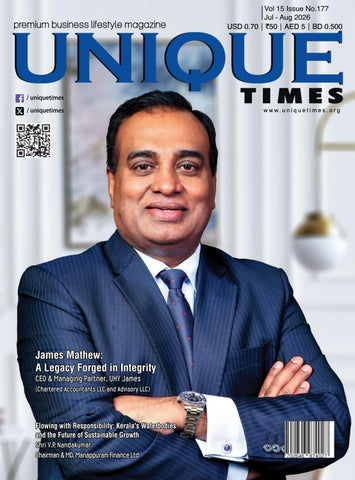
Vol 15 Issue No.177 Jul - Aug 2026 USD 0.70`50AED 5BD 0.500
James Mathew: A Legacy Forged in Integrity CEO & Managing Partner, UHY James
(Chartered Accountants LLC and Advisory LLC)
Flowing with Responsibility: Kerala's Waterbodies and the Future of Sustainable Growth Shri V.P. Nandakumar Chairman & MD, Manappuram Finance Ltd
LUXURY YOU CAN WEAR
CRAFTED IN EXTREME EXCLUSIVITY-A SINGLE MODEL, LIMITED TO JUST SIX PIECES WORLDWIDE www.alcazarwatches.com
Regd. & Corporate Office, Chennai- 24
KERALA TAMILNADU PUDUCHERRY KARNATAKA ANDHRA PRADESH TELANGANA MAHARASHTRA NEW DELHI HARYANA RAJASTHAN
Editorial
Chief Mentor Mr. V.P. Nandakumar Director & CEO Jebitha Ajit isk more than others think is Editor Ajit Ravi safe. Dream more than othLegal Advisor Latha Anand ers think is practical.” — Howard B.S.Krishnan Associates Schultz bskrishnanassociates@gmail.com Great businesses are built on viSub-Editor Athulya Pradip sion, but enduring legacies are built Associate Editor Ravi Saini on trust. In today's rapidly evolving Anusha Varghese global economy, where innovation, Correspondents Dr. Thomas Nechupadam compliance, and strategic foresight Vivek Venugopal- Quarter Mile shape the future of enterprises, R L Morris leadership demands far more than Creative Design PEGASUS technical expertise. It calls for resilience, integrity, adaptability, and an unwavering commitment to creating lasting Photography PEGASUS value. The leaders who make the greatest impact are those Marketing USA who inspire confidence, embrace change, and empower busi 725, burning tree lane, nesses to grow with purpose. In this edition, we explore the punta gorda Florida-33982 inspiring journey of James Mathew, CEO & Managing Partner Mob: +1 (863) 558-5234 of UHY James (Chartered Accountants LLC and Advisory UAE LLC), whose remarkable career reflects purpose-driven leadJolly ership, entrepreneurial vision, and a steadfast commitment to Tel: +971 50 307 1125 helping businesses thrive in an ever-changing world. Vineeth Nair This month's edition also features an exclusive article by Shaji N Palakkal V.P. Nandakumar, Chairman & Managing Director of Manap 415, Building 23, Al Khail Gate, puram Finance Limited, titled "Flowing with Responsibility: Al Quoz-2, Dubai, UAE Kerala's Waterbodies and the Future of Sustainable Growth," Tel: +9714 4511075 where he shares his insights on environmental stewardship Maharashtra and sustainable development. Jayasankar M Alongside this, the issue offers an engaging collection of a/101, New Prathamesh Niwas, your favorite sections, including sports, travel and tourism, OPP. Laxmi Park, Thakurli East, finance, inspiring business success stories, and thought-pro Dombivli post, Thane District, 421201 voking articles from industry leaders. “Books have a unique way of stopping time in a particular Mob: +91 9820708662 moment and saying: Let’s not forget this.” – Dave Eggers Tamil Nadu Happy Reading! Sheelan Thangavelu Tamilnadu Director Mob: +91 7825-077770 Sri Shakthi Institute of Engineering and Technology, L&T- bypass, Chinniyapalayam, Coimbatore-62 Karnataka, Telangana, Andhrapradesh PEGASUS Ph: 09288800999 Sunilkumar NN Vice President Ambalika Saikia, Ambalika_saikia@yahoo.com Vice President V Suresh Kumar Public Relations
Published at Pegasus Global Pvt. Ltd. L5-106, Changampuzha Nagar Kalamassery, Ernakulam-682 033 e-mail: editor@uniquetimes.org uniquetimesindia@gmail.com Ph:0484 2532040, 2532080, Mob:9288800999
“R
Cover Photograph James Mathew: CEO & Managing Partner, UHY James (Chartered Accountants LLC and Advisory LLC)
Printer & publisher Pegasus Global Pvt. Ltd. Cochin (682033) on behalf of Ajit Ravi. Printed at S.T.Reddiar & Sons, P.B. No: 3627, Veekshanam Road, Cochin-18.
Maradu I Nettoor P.O I Kochi | Kerala - 682040
CONTENTS 14
14
James Mathew: A Legacy Forged in Integrity
20
BUSINESS
20
Flowing with Responsibility: Kerala's Waterbodies and the Future of Sustainable Growth
22
Changing Phase Of Business Development In Professional Services Firms
26
The Neuroscience of Success: Why Some People Achieve More Than Others
BUSINESS
22
CONTENTS FINANCE
58
32
MOTIVATION
32
Indian Knowledge System
58
Dismantling Programmed Limits for Entrepreneurial Excellence
62
Redefining Beauty After 50: Age Is No Longer the Limit
TRAVELOGUE
BEAUTY
62
64
64
Hampi: Where Every Stone Tells a Story
UNIQUE DIARY
Modi Govt Approves 7 New Bullet Train Corridors to Expand High-Speed Rail Network
T
he Government of India has approved seven new high-speed rail corridors to expand the nation’s bullet train network beyond the Mumbai–Ahmedabad project currently under construction. The proposed routes include Mumbai–Pune, Pune–Hyderabad, Hyderabad–Bengaluru, Hyderabad–Chennai, Chennai–Bengaluru, Delhi–Varanasi, and Varanasi–Siliguri corridors, aimed at connecting major economic, industrial, technology, and tourism hubs across the country. These projects are expected to significantly reduce travel time between cities and improve regional connectivity while supporting economic growth and urban development. Each corridor will undergo detailed feasibility studies, regulatory approvals, funding arrangements, and land acquisition processes before construction begins. The initiative reflects India’s long-term vision to develop a modern, efficient, and sustainable high-speed transportation system that enhances mobility and strengthens intercity connectivity across regions. Once implemented, the network is expected to transform domestic travel, boost investment opportunities, enhance connectivity between metros and emerging cities, and position India among global leaders in high-speed rail infrastructure development and sector growth.
Capri Global Plans Debut $300–500 Million Dollar Bond Issue
“Don’t be afraid to give up the good to go for the great.” John D. Rockefeller
8
Jul - Aug 2026
C
apri Global Capital is planning its debut US dollar-denominated bond issue to raise between $300 million and $500 million, marking a significant step in its international funding strategy. The Indian non-banking financial company is expected to issue threeyear-and-three-month maturity bonds and will begin investor meetings shortly to gauge demand from global investors. Pricing is likely to be finalised by the end of the week, depending on market response. The fundraising move comes as Capri Global continues to strengthen its presence in capital markets and diversify its borrowing sources. Earlier this year, the company raised `5 billion through a domestic debt issuance. It is now aiming to increase its reliance on market borrowings to 40–50% of its total funding base, up from around 20% currently. The planned dollar bond issue highlights growing confidence in international investors’ appetite for Indian financial sector credit and supports the company’s broader expansion and liquidity strategy.
UNIQUE DIARY
India Launches Anti-Dumping Probe Into Steel Imports From China, Japan and Russia
I
ndia has launched an anti-dumping investigation into hot-rolled steel imports from China, Japan, and Russia following complaints from domestic steel producers over the impact of low-priced imports on the local industry. The probe, initiated by the Directorate General of Trade Remedies (DGTR) under the Ministry of Commerce, was triggered by applications from major steelmakers including JSW Steel, JSW Vijaynagar Metallics Limited, and Jindal Steel and Power. The investigation focuses on hot-rolled flat products of alloy and non-alloy steel with a thickness of up to 25 mm, with authorities examining whether these imports are being sold at unfairly low prices that are causing material injury to domestic manufacturers. The move comes amid a sharp rise in Chinese steel shipments to India, with exports reportedly more than doubling in April to around 232,000 metric tonnes, the highest in two years.
Jamco to Invest $150 Million in India to Expand Aircraft Cabin Operations
“Success usually comes to those who are too busy to be looking for it.” Henry David Thoreau
10
Jul - Aug 2026
J
amco Corporation Interiors plans a major global expansion, with India set to become a key hub in its engineering, manufacturing, and supply chain operations. The company aims to increase its overall capacity by two-and-a-half times over the next five years and will invest around $150 million in India as part of this strategy. It also plans to expand its workforce in the country sixfold, reaching about 600 employees by 2031. Jamco, a supplier of premium cabin interiors for Boeing and Airbus wide-body aircraft, has already established an engineering centre in Bengaluru and is working to position India as a full-scale aircraft cabin design hub rather than just a low-cost support base. The company is transferring full design authority for its Boeing 787 galleys and lavatories to its India operations, reflecting growing confidence in local talent. It is also expanding its supplier base by evaluating Indian vendors amid global aerospace supply chain pressures.
Adani Airports to Invest $2.1 Billion in Airport City Developments Across India
A
dani Airports Holdings Limited, a unit of the Adani Group, has announced plans to invest over $2.1 billion (`200 billion) to develop airport-linked commercial districts across six major locations in India. The project will span airports in Mumbai, Navi Mumbai, Ahmedabad, Lucknow, Jaipur, and Guwahati, covering more than 655 acres of land and transforming them into integrated airport cities. Nearly 70% of the investment will be concentrated in Mumbai and Navi Mumbai, reflecting their importance as major financial and commercial hubs. The planned developments will include hotels, retail spaces, office complexes, entertainment zones, and business districts designed to function as fully connected urban ecosystems around airport infrastructure. Inspired by global models such as Singapore, Dubai, Amsterdam, and Seoul, the initiative aims to enhance passenger experience while boosting real estate and commercial activity. The company has already partnered with InterContinental Hotels Group for five hotels and is in discussions with additional partners in food, beverage, and entertainment sectors to support large-scale development.
Tata Motors Targets Revenue and Sales Surge by 2031
“Start where you are. Use what you have. Do what you can.” Arthur Ashe
T
ata Motors Passenger Vehicles Limited has announced ambitious growth plans, aiming to nearly double its revenue and vehicle sales by FY2031. The company expects revenue to rise above `6 trillion, up from `3.36 trillion in FY2026, while annual sales volumes are projected to exceed 1.2 million units compared to around 640,000 currently. It is also targeting a 20% share of India’s passenger vehicle market. A key focus of the strategy is expanding its electric and gas-powered vehicle portfolio as competition intensifies from rivals such as Mahindra & Mahindra Limited and JSW MG Motor India. To support this expansion, Tata Motors plans to invest `330–350 billion in its passenger vehicle and EV businesses through FY2030 and raise annual production capacity to 1.3 million units. The company also aims to achieve a 10% EBIT margin. Despite cost pressures and challenges at Jaguar Land Rover, Tata remains confident about long-term growth and strong demand in the Indian automotive sector.
Jul - Aug 2026
11
Kristina Kuralenok from Russia crowned as SAJ DQ Watches Miss Glam World 2026
K
ristina Kuralenok from Russia was crowned SAJ Group Hotels & Resorts and DQ Watches Miss Glam World 2026 by reigning queen Alina Farkhutdinova at the grand finale held on June 23 at Gokulam Park Hotel & Convention Centre, Kochi. Pournami Murali of India was crowned First Runner-Up by Sajan Varghese, CMD of SAJ Group of Hotels & Resorts, while Ana Carolina Henrich Lucatelli of Brazil, the Second Runner-Up, was crowned by Mini Sajan, CEO of SAJ Group. Garaikhanova Elina of Bashkortostan, the Third Runner-Up, was crowned by Annie Varghese, Director of SAJ Group, along with Dr. Ajit Ravi, Chairman of Pegasus Global Pvt. Ltd. Organised by Pegasus Global Pvt. Ltd., the pageant featured international contestants judged by Ashwaria Ullas, Rita Mathan, Alina Farkhutdinova, Maeva Balan, and Ambika S. Nair, with subtitle awards and continental titles recognizing excellence while promoting beauty, talent, confidence, cultural diversity, women’s empowerment, and global unity.
Saltwater Intrusion Threatens Italy’s Po River Farms Amid Severe Heatwave
T
he Po River in northern Italy has experienced a sharp decline in water flow during an intense European heatwave, allowing seawater from the Adriatic Sea to intrude up to 18 km inland. Discharge levels have fallen from about 1,000 cubic metres per second to below 300, triggering a “salt wedge” effect in the delta. This intrusion is disrupting agriculture and fragile wetlands, forcing irrigation canals to close to protect crops like maize, rice, soybeans, and sunflowers from salt damage. Farmers report worsening conditions earlier than in past droughts, raising concerns about crop survival during a critical growing period. Experts warn that increasing frequency and intensity of heatwaves are overwhelming existing water management systems and pushing river levels below safe thresholds, heightening risks for farming communities across the region.
12
Jul - Aug 2026
Volkswagen’s Unique Ownership Structure Faces Fresh Scrutiny Amid Restructuring Plans
V
olkswagen’s complex ownership and governance structure is facing renewed scrutiny as the company prepares a major restructuring that could include plant closures and up to 100,000 job cuts. Labour unions have strongly opposed the move, while the automaker’s unique legal framework gives significant influence to both worker representatives and the German state of Lower Saxony. Under the Volkswagen Law of 1960, Lower Saxony holds a 20% voting stake and can block key shareholder decisions, while worker representatives on the supervisory board also have veto power over major factory changes. Additionally, Porsche SE controls a majority of voting rights despite owning less than one-third of total equity, a structure long criticised by investors for limiting governance reforms. Amid falling share prices, leadership challenges, and pressure to adapt to the evolving automotive industry, critics argue this arrangement adds complexity and slows decisive restructuring.
Shrika Satheeshan from the UAE Crowned SAJ DQ Watches Teen Glam World 2026
S
hrika Satheeshan from the UAE was crowned SAJ Group Hotels & Resorts and DQ Watches Teen Glam World 2026 by reigning queen Bellefontaine Marie and Sajan Varghese, CMD of SAJ Group of Hotels & Resorts, at the grand finale on June 23 at Gokulam Park Hotel & Convention Centre, Kochi. Alona Angel James of India was crowned First Runner-Up by Preethi Parakkat, Managing Director of Parakkat Jewels, while Sarah Vanderdonckt of France, the Second Runner-Up, was crowned by Vijayakumar, Chairman, and Deepthi Vijayakumar, Managing Director of Aiswaria Advertising. Kapshik Kira of Russia, the Third Runner-Up, was crowned by Dr Jolly Antony and Dr Ajit Ravi. Organised by Pegasus Global Pvt. Ltd., the pageant featured contestants aged 13–18, judged by Ashwaria Ullas, Rita Mathan, Alina Farkhutdinova, Maeva Balan, and Ambika S. Nair, with subtitle awards, a Parakkat Jewels crown, and a focus on youth, confidence, cultural exchange, tourism, and personal excellence.
For more info: europetimes.co
Jul - Aug 2026
13
COVERSTORY
James Mathew:
A Legacy Forged in Integrity Vision. Integrity. Possibility. These three principles have shaped James Mathew's distinguished career for more than three decades. As a respected financial leader, entrepreneur, and trusted advisor, he continues to redefine the role of modern accounting by helping businesses navigate complexity, inspire confidence, and achieve sustainable success.
S
ome careers evolve with the times. Others help shape them. James Mathew belongs firmly to the latter category. When he arrived in Dubai in 1992 as a young auditor, the city was only beginning to emerge as a regional commercial centre. Three decades later, today, Dubai has established itself as one of the world’s leading business destinations and James has built a distinguished career as an entrepreneur, trusted advisor as CEO & Managing Partner of UHY James (Chartered Accountants LLC and Advisory LLC). Few professionals have witnessed and contributed to this transformation as closely as he has. His journey mirrors the evolution of the UAE itself: from a rapidly growing economy focused on commerce to a sophisticated global marketplace built on governance, innovation, and investor confidence. Throughout his career, one belief has remained constant: businesses should not merely survive they should thrive. That philosophy has become the cornerstone of UHY James and is reflected in its guiding motto, “Connect to Possibility.”
business environment is vastly different. The introduction of VAT, Corporate Tax, Ultimate Beneficial Ownership (UBO) regulations, GoAML reporting, stronger anti-money laundering frameworks, and enhanced corporate governance has fundamentally reshaped how organisations operate in the UAE. James sees this transformation as one of the country’s greatest strengths. Rather than viewing regulation as an obstacle, he believes robust compliance creates transparency, strengthens investor confidence, improves access to finance, and ultimately makes businesses more resilient. In his view, governance is no longer about meeting regulatory expectations rather it has become a competitive advantage that enables sustainable growth. Having advised businesses through every stage of this evolution, James has helped organisations adapt, not only to changing regulations but also to changing expectations from investors, lenders, regulators, and customers.
Growing with Dubai
James' entrepreneurial journey in the UAE is defined by bold vision, resilience, and an unwavering commitment to excellence. His first entrepreneurial stint spanned over
When James entered the profession, audit and accounting were primarily centred on financial reporting and statutory compliance. Today’s
14
Jul - Aug 2026
The Entrepreneurial Leap
25 years as he established himself as one of the region's most respected leaders. His leadership saw him appointed Group CEO for the UAE and Oman in 2017, followed by election to the global Board in 2018 and 2019. This was testament to the trust and influence he had earned across the international network. In December 2019, driven by a clear long-term vision, James took a defining entrepreneurial leap by partnering with UK-headquartered UHY International to establish UHY James as an independent member firm in the UAE. Within months, the COVID-19 pandemic brought global business to a standstill. Transitioning and building the business as UHY James, during one of the most uncertain periods in modern history demanded conviction, resilience, and a willingness to embrace calculated risk. While many businesses delayed expansion plans, James remained focused on a long-term vision of building an audit and advisory firm that combined international expertise with entrepreneurial agility. Ironically, the pandemic reinforced that vision. Businesses were no longer looking only for auditors to review historical financial statements. They needed advisors who could help them preserve cash flow, strength-
James' entrepreneurial journey in the UAE is defined by bold vision, resilience, and an unwavering commitment to excellence. His first entrepreneurial stint spanned over 25 years as he established himself as one of the region's most respected leaders.
Jul - Aug 2026
15
COVERSTORY en governance, manage uncertainty, navigate regulatory change, and identify new opportunities. That period became a defining chapter in the growth of UHY James.
Connecting Clients to Possibility For James, advisory is about far more than interpreting financial statements. He believes that businesses rarely fail because opportunities do not exist. More often, they fail because those opportunities remain hidden behind operational challenges, weak financial visibility, or an inability to adapt quickly enough. Accordingly, every client engagement begins with a simple question: Where do you want your business to be? From that starting point, his teams help clients unlock growth through strategic planning, tax and regulatory advisory, capital structuring, digital transformation, operational improvement, market expansion, and stronger governance. This forward-looking approach has enabled UHY James to evolve beyond a traditional audit practice into a multidisciplinary audit and advisory firm supporting organisations
across every stage of their business lifecycle. Whether working with entrepreneurs launching their first venture, established family businesses planning succession, or multinational corporations expanding into the region, the firm’s objective remains consistent: helping clients convert uncertainty into opportunity.
From Survival to Sustainable Growth James often observes that many businesses spend years managing problems instead of building the future. Weak cash flow management, delayed receivables, fragmented reporting systems, limited working capital, and reactive decision-making frequently prevent otherwise successful organisations from reaching their full potential. Addressing these challenges requires much more than accurate accounting. It demands better governance, stronger financial discipline, meaningful management information, and strategic decision-making. By helping clients strengthen these foundations, UHY James enables organisations to move beyond short-term survival and build busi-
nesses capable of creating sustainable long-term value. For James, growth is rarely accidental. It is the outcome of disciplined execution, informed leadership, and a clear strategic vision.
Leadership Built on Trust If one word defines James Mathew’s leadership philosophy, it is trust. Whether advising multinational corporations, owner-managed businesses, regulators, financial institutions, or entrepreneurs, he believes every successful professional relationship begins with credibility and integrity. Clients often seek advice during periods of uncertainty, be it restructuring operations, expanding internationally, managing succession, responding to new regulations, or navigating financial stress. In those moments, technical knowledge alone is insufficient. Business leaders need advisors who understand not only financial statements but also the people, ambitions, and challenges behind them. That ability to combine technical excellence with practical business judgement has earned James the confidence of clients across the James Mathew with Shah Rukh Khan
16
Jul - Aug 2026
UAE and beyond, creating relationships that have endured for decades.
Lessons from Sainik School Long before boardrooms, client meetings, and corporate advisory became part of his daily life, James Mathew was a student at Sainik School. The institution instilled qualities that continue to define his leadership today - discipline, resilience, perseverance, teamwork, and the courage to perform under pressure. An accomplished athlete during his school years, he learned early that lasting success is rarely the result of talent alone. It is built through preparation, consistency, and the determination to improve every day. Those lessons have remained constant throughout his professional journey. Markets fluctuate, economies evolve, and regulations change, but integrity remains non-negotiable. James believes professional reputations are built patiently over decades and can be lost in a moment. That conviction continues to guide every decision he makes.
Preparing the Profession for the Future Technology is reshaping every aspect of business, and the accounting profession is no exception. Artificial intelligence, automation, predictive analytics, blockchain, and advanced data analytics are changing how financial information is generated, analysed, and interpreted. James believes these developments are enhancing and not replacing the role of professional accountants. Tomorrow’s auditors, he believes, must become strategic advisors who combine financial expertise with technological competence, commercial judgement, and intellectual curiosity. While technology can process vast amounts of data, it cannot replace professional scepticism, ethical judgement, or the ability to under-
stand the commercial realities behind the numbers. Recognising this shift, James actively mentors young Chartered Accountants and encourages continuous learning, believing that the future of the profession depends on professionals who embrace innovation while remaining grounded in the principles of integrity and independence.
A Partnership Built on Shared Values Behind James’ professional journey stands another enduring partnership—that with his wife, Bindu. For more than three decades, they have successfully balanced family life with building a growing professional enterprise. Their relationship is founded on mutual trust, respect, and an appreciation of each other’s strengths. Rather than competing for leadership, they have created complementary roles that allow both to contribute meaningfully while supporting one another through every stage of the firm’s growth. For James, this personal stability has been one of the strongest foundations of his professional success.
Embracing Sustainability James believes sustainability will
become one of the defining priorities of modern business. As Environmental, Social and Governance (ESG) reporting continues to gain momentum globally, the UAE is steadily strengthening its sustainability agenda. Organisations are increasingly expected to demonstrate not only financial performance but also responsible governance, environmental stewardship, and social impact. UHY James is expanding its advisory capabilities to help clients integrate ESG into long-term business strategy and governance frameworks. The subject also carries personal significance. His daughters have built successful international careers in ESG and Technology in London and New York respectively, reflecting a new generation of professionals helping shape the future of responsible business.
A Career of Leadership and Service In his 35-year-long career, James Mathew has built a distinguished reputation in the accounting and advisory profession. His commitment to the profession extends well beyond client service. He served as Chairman of
Jul - Aug 2026
17
James Mathew with KVS Manian, MD & CEO, Federal Bank
the Dubai Chapter of the Institute of Chartered Accountants of India (ICAI), helping strengthen one of its largest overseas chapters, and later as Secretary General of the Indian Business and Professional Council (IBPC), Dubai. Throughout his career, he has contributed to numerous professional bodies, advisory committees, and industry initiatives that have supported the growth of the UAE’s business community. His contributions have been recognised through several prestigious honours, including the Dubai Appreciation Award for Continuous Business Excellence. Yet, when asked about his proudest achievement, James is more likely to speak about the businesses he has helped build, the entrepreneurs he has mentored, and the professionals whose careers have flourished under his guidance than the awards he has received.
Leading with Purpose Today’s business environment demands far more than technical expertise.
James Mathew with Shri.Narendra Modi- Prime Minster of India
Rapid advances in artificial intelligence, increasingly sophisticated regulatory frameworks, geopolitical uncertainty, and changing investor expectations require advisors who can connect finance with strategy, governance with innovation, compliance with value creation, and risk with opportunity. James believes the role of the modern advisor is no longer limited to explaining the past but about helping organisations prepare for the future. That philosophy has shaped both his career and the culture of UHY James - a firm committed to combining technical excellence with practical business insight to help clients make informed decisions with confidence.
The Road Ahead More than three decades after arriving in Dubai, James Mathew remains as committed to the profession as ever. His focus today extends beyond building a successful firm. He continues to invest in digital transformation, strengthen advisory capa-
bilities, support businesses as they navigate an evolving regulatory landscape, and mentor the next generation of finance professionals. For James, success has never been measured solely by financial growth but it is reflected in the confidence clients place in his advice, the resilience of the organisations he has helped strengthen, and the opportunities he has created for colleagues, entrepreneurs, and future leaders. As Dubai continues its remarkable journey towards becoming one of the world’s foremost business destinations, professionals like James Mathew will continue to play an important role in shaping its future. His story is ultimately not just about audit, tax, or compliance. It is about building trust, creating lasting value, and helping businesses unlock their full potential. True to the philosophy that has guided his career, James Mathew continues to connect people, businesses, and ideas to possibility
James Mathew as Panelist at Gulf News and Ajman Freezone hosted Rise and Reset event
18
Jul - Aug 2026
luxury you can wear
TSHIRT
BUSINESS
Kerala's waterbodies have always been the silent engine of its prosperity. Since the spice trade era, rivers and canals carried goods — spices, rice, coconut products, timber and coir — from inland areas to coastal ports. Today, fisherfolk depend on these waters for their livelihoods.
Shri V.P.Nandakumar Chairman & MD Manappuram Finance Ltd
Flowing with Responsibility: Kerala's Waterbodies and the Future of Sustainable Growth
T
here is a particular kind of sadness and grief that comes from watching something irreplaceable disappear slowly. That is what I feel when I think about what is happening to Kerala's waterbodies — the rivers, backwaters, lakes and wetlands that have sustained this land and its people for centuries. Kerala, whose very name derives from kera (coconut) and alam (land), is a state defined by water as much as by its legendary greenery. Its 44 rivers crisscross the terrain, feeding into serene lagoons, backwaters and wetlands of extraordinary ecological richness. Vembanad Lake is not merely a geographic landmark; it is a living ecosystem, a cultural inheritance and an economic lifeline. So too is Kuttanad, that remarkable stretch where farmers have cultivated rice below sea level for over 150 years, a practice so unique that
20
Jul - Aug 2026
global organisations have recognised it as an important agricultural heritage system. These are not assets we can afford to squander.
The Wealth We Are Losing Kerala's waterbodies have always been the silent engine of its prosperity. Since the spice trade era, rivers and canals carried goods — spices, rice, coconut products, timber and coir — from inland areas to coastal ports. Today, fisherfolk depend on these waters for their livelihoods. Houseboat tourism built around the traditional kettuvallam generates crores in annual revenue. Inland waterways connect islands and interiors to the mainland. These are not romantic memories of a bygone era. They are active, functioning economic systems — and they are under threat.
A Purple Menace One of the gravest threats is also one of the most deceptively beauti-
ful. Water hyacinth, introduced to India during the British colonial period as an ornamental plant, has since become an ecological catastrophe. Beneath those vast carpets of purple flowers lies destruction. The plant blocks sunlight, strips oxygen and nutrients from the water, and devastates fish populations and native aquatic life. Fishing nets get entangled and torn. Irrigation canals are jammed. Houseboat operators find their routes cluttered, their motors damaged. But the most alarming consequence is one that is largely invisible. When water hyacinth decomposes, it releases methane — a greenhouse gas approximately 28 times more potent than carbon dioxide over a 100-year period. Scientific research has further established that when the plant is rooted in shallow sediment, it actively transports methane from the underwater sediments
through its stems into the atmosphere. Something that appears as a harmless ornamental plant is, in reality, an invisible contributor to climate change — choking our waterbodies and warming our planet simultaneously.
The Larger Crisis Water hyacinth does not act alone. Untreated wastewater, agricultural drainage laden with fertiliser runoff and unregulated land development trigger eutrophication — a process that enriches water with excessive nutrients, further fuelling weed growth. Meanwhile, our wetlands and mangrove forests, which once acted as nature's sponges against floodwaters, are being illegally encroached upon at
an alarming rate. The consequence is a state that swings between devastating floods and severe summer droughts — a cycle that is becoming grimly familiar.
The Path Forward I believe Kerala can reverse this decline, but it demands decisive, coordinated action. The water hyacinth crisis, for instance, is not without opportunity. The plant can be converted into biogas, recycled paper and handicrafts, transforming an ecological burden into a livelihood resource for local communities. Comprehensive eco-restoration plans — covering flood-affected areas, wetland revival, drainage improvement and rainwater harvesting — are not as-
pirational ideas. They are practical necessities. Most importantly, this cannot be the concern of government alone. Businesses, local communities, civil society organisations and individual citizens must all be active participants. Kerala's waterbodies have sustained generations. They have shaped our economy, our culture and our identity. The responsibility of protecting them belongs to all of us equally. I began by speaking of sadness and grief. But grief, when it is shared and channelled, can become resolve. That resolve is what Kerala's waterbodies need from us — urgently, and without further delay
Jul - Aug 2026
21
BUSINESS
A C-suite executive often knows more about our firm — our recent thought leadership, our talent moves, our regulatory missteps than our junior team knows about her company
Rajesh Nair Partner, Ernst & Young LLP
CHANGING PHASE OF BUSINESS DEVELOPMENT IN PROFESSIONAL SERVICES FIRMS
I
still remember my first week in a consulting firm in the late 1990s. A senior in the organisation who could close a deal over a single lunch — handed me a leather-bound Rolodex and said, "This is your career." Cold calls, lunch appointments, and a well-timed dinner, were the currency of trust. We sold
and likely has an AI tool summarizing our last proposal. By the time we meet, the relationship has either already begun — or it never will. It is the most exciting inflection point our profession has faced in the last several decades. Let me elucidate the change with a table emanating from a recent conversation.
The decade
Broad Descriptor
Key focuses in consulting
80s- 90s
Access to clients
Networks, pedigree, exclusivity
2000s
Core expertise
Frameworks, methodologies, IP
2010s
Insights on business
Data, benchmarks, foresight
2020s ongoing
Ecosystem
Co-creation, outcomes
Each decade didn't erase the previous one — it absorbed it. The consultant who wins today still needs access and expertise. But those are now table stakes, not differentiators.
The true change is essentially three revolutions.
1. The Client Now Researches You Before You Research
22
expertise. Clients bought certainty. That world is gone. Perhaps a good riddance. Today, a CFO doesn't take a cold call from when sees ‘SPAM’ against a new number. She's already read three of our white papers, listened to our podcast on the drive in, watched our colleague debate AI governance on LinkedIn,
Jul - Aug 2026
Them A decade ago, our business development teams spent weeks building dossiers on prospective clients. Today, the asymmetry has reversed. A C-suite executive often knows more about our firm — our recent thought leadership, our talent moves, our regulatory missteps — than our junior team knows about her company.
art
of
the
possible,
The implication is profound: The first meeting is no longer a first impression. It is a verdict on their experience and the public image 2. Trust Has Become Algorithmic Before It Becomes Personal A board member doesn't decide to engage us in a single conversation. They decide across dozens of microtouchpoints: the article one of our
leader writes, a podcast appearance, a thoughtful LinkedIn comment, a peer's recommendation in a WhatsApp group of CHROs. By the time we walk into the room, the algorithm of trust has already rendered a soft verdict. We have moved from moments of trust to patterns of trust. 3. The Buyer Is No Longer a Single Person Twenty years ago, a transformation engagement was sold to a promoter/ owner or CEO. Today, it is sold to a coalition: the CFO who controls the budget, the CIO who controls the architecture, the CHRO who controls adoption and change management , the Chief Sustainability Officer who controls the narrative, and increasingly, the procurement head watching the fee from the wings. Winning one relationship is no longer enough. We must build relationship constellations.
What Truly Works Today: The New Trust Architecture
After two decades of watching what wins and what falls flat, here is what I tell our business leaders inthe-making: 1. Be useful Before You Are Hired The single greatest shift is this: clients now expect value before the engagement letter is signed. A 20-minute conversation in which you genuinely help a CIO reframe a board question is worth more than ten dinners. Generosity, not gatekeeping, is the new opening move. 2. Build in social media The partners winning today are not the ones with the thickest book of business cards of prospects they have met - they are the ones writing, speaking, and shaping the discourse in their domain. A consistent voice on AI risk, supply chain resilience, or workforce transformation is now a more reliable lead generator than any business development team. This is uncomfortable for our profession. We were trained in confidentiality. We must now learn the discipline of discreet visibility - be-
ing publicly insightful without being indiscreet. 3. Earn the Right to Challenge C-suite leaders are surrounded by people who agree with them. The advisor who earns the C-suite bond is the one who, having built credibility, can say: "I think you're solving the wrong problem." This is not contrarianism for its own sake — it is the highest form of respect. But it requires a foundation of trust deep enough to bear the weight of disagreement. 4. Move from Transactions to Transformations to Translations Our role has evolved in three stages: • We used to transact - deliver a project, send an invoice. • We learned to transform - reshape an operating model, embed new capabilities. • We must now co-create - help leaders navigate between worlds: the technologist's logic and the regulator's concern, the activist investor's
Jul - Aug 2026
23
BUSINESS - Talent ecosystems - where we partner with universities, public agencies, and competitors to address workforce gaps no single firm can close. - Climate transition pathways where our role is not advising one company on Scope 3 emissions but helping an entire value chain rearchitect itself. - Trust infrastructure for emerging technologies — convening regulators, civil society, and industry to set the rules before crises set them for us. This is not pro bono work dressed up as strategy. It is the highest form of business development - because the firm that shapes the ecosystem earns the right to advise within it.
The Leaders of Consulting Firms of 2030
demand and the workforce's anxiety, the AI's recommendation and the human's judgment. The advisor as a co-creator is the role of the next decade. 5. Cultivate the Ecosystem, Not Just the Client Here is where I believe our profession is most underprepared. The modern CEO doesn't operate inside her company — she operates inside an ecosystem of regulators, suppliers, talent platforms, climate coalitions, AI labs, and civic institutions. If we serve only her organization, we serve only half her reality. Playing important and leadership roles in bodies like CII , FICCI , TiE , NASSCOM and other industry bodies is critical The leaders I most admire today are those who convene — bringing
24
Jul - Aug 2026
together a banking CEO, a fintech founder, a central bank advisor, and a privacy regulator for a conversation no one of them could have organized alone. That convening power is the new partnership.
Transforming the Ecosystem, Not Just the Client
This is the deepest shift, and the one our profession is still catching up to. When we transform a client, we change one organization. When we transform an ecosystem, we change the conditions under which all organizations operate. A few examples of what I see leading firms doing — and what I believe must become the norm: - Industry coalitions on AI governance, where we facilitate dialogue rather than sell solutions.
So, what does the leader of 2030 look like? She is less a salesperson and more a public intellectual with operational depth. She doesn't chase logos; she shapes conversations that clients want to join. She is fluent in technology but rooted in human judgment. She builds her practice through writing, convening, and generosity — not through entertaining. She measures success not just in revenue, but in the durability of the relationships and the health of the ecosystems she helps create. And critically: she understands that the C-suite bond is no longer the destination of the journey. It is the byproduct of being genuinely, visibly, and persistently useful to a system far larger than any single client.
A Closing Reflection
When I look at the leather card holder still sitting in my drawer — yes, I kept it — I don't feel nostalgia. I feel gratitude. It taught me that consulting was always, at its heart, a relationship business. What has changed is not the centrality of relationships, but their geometry. We have moved from one-to-one to many-to-many. From private dinners to public discourse. From selling certainty to navigating ambiguity together. The cold call is dead. Long live the warm ecosystem
HEALTH
Dr Arun Oommen MBBS, MS ( Gen Surg), Mch( Neurosurgery),MRCS Ed (UK) , MBA, DMS( Hospital Administration) ENLS, D Litt(H), Phd(H), D Sc(H) Neuro Endoscopy Fellow Senior Consultant Neurosurgeon VPS Lakeshore Hospital, Kochi, India. Honorary Secretary Neurological Society of India- Kerala Chapter UN Representative
Studies consistently show that highly successful individuals tend to have stronger executive functioning abilities.
www.arunoommen.com
The Neuroscience of Success: Why Some People Achieve More Than Others
I
“The Surprising Truth Success Is Not Just About Intelligence”
magine two children sitting in the same classroom. One becomes a world-renowned scientist. The other struggles to keep a steady job. Both had similar teachers. Similar opportunities. Similar intelligence. So what made the difference? For decades, people believed that success was largely determined by IQ. But modern neuroscience tells a far more fascinating story. The most successful people are not necessarily the smartest. They are often the individuals whose brains have developed certain powerful neural traits—focus, resilience, emotional regulation, delayed gratification, adaptability, and perseverance. Success, it turns out, is deeply rooted in how the brain works. And the good news? Many of these brain circuits can be strengthened.
The Brain's CEO: The Prefrontal Cortex
If the human brain were a corporation, the prefrontal cortex would be the CEO. Located just behind the forehead, this region helps us:
26
Jul - Aug 2026
• Plan for the future • Control impulses • Make decisions • Stay focused • Resist distractions • Persist toward long-term goals Studies consistently show that highly successful individuals tend to have stronger executive functioning abilities. They can say "no" to immediate pleasure in order to achieve a larger future reward. While others quit when things become difficult, they stay the course. Their brains are constantly asking: "What will help me most five years from now?" instead of "What feels good right now?"
The Marshmallow Experiment: A Study That Shocked the World
One of the most famous psychological experiments was conducted by psychologist Walter Mischel on delayed gratification. Children were offered a simple choice: Eat one marshmallow now. Or wait a few minutes and receive two marshmallows.
The fascinating part came years later. Researchers found that the children who delayed gratification tended to have better academic performance, healthier lifestyles, and greater career success later in life. The ability to wait for a larger reward reflected stronger self-control circuits within the brain. Success wasn't about intelligence. It was about impulse control.
Why Some People Never Give Up
Every successful person experiences failure. The difference is that their brains respond differently to setbacks. Neuroscientists have discovered that resilient individuals show greater activity in brain networks involved in emotional regulation. When faced with failure, they do not interpret it as: "I am a failure." Instead they think: "This is feedback." This mindset keeps stress hormones from overwhelming the brain. Repeatedly overcoming challenges strengthens neural pathways associated with perseverance.
People who can inspire others often achieve far more than those who rely solely on technical knowledge. History repeatedly demonstrates this principle. Leaders change nations. Innovators build companies. Visionaries inspire movements. None succeed alone. The social brain is one of humanity's greatest evolutionary advantages. Like muscles, resilience grows through use. Every obstacle becomes a training session for the brain.
The Dopamine Myth
Most people think dopamine is the "pleasure chemical." That is only partially true. Dopamine is actually more closely related to motivation and pursuit. It is the molecule that makes us chase goals. The most successful people often learn how to use dopamine wisely. Instead of seeking constant short-term rewards from social media, endless scrolling, junk food, or instant entertainment, they train their brains to derive satisfaction from progress itself. Every small achievement triggers dopamine release. A completed chapter. A finished workout. A solved problem. A business milestone. Over time, their brains become addicted not to comfort—but to growth.
The Dangerous Age of Distraction
Never in human history has the brain faced so many distractions. Notifications. Short videos. Endless scrolling. Instant entertainment. Every interruption pulls attention away from deep thinking. Neuroscience shows that constantly switching tasks reduces productivity and increases mental fatigue. Multitasking and attention research from Stanford University found that heavy multitaskers often perform worse on tasks requiring concentration. Ironically, people who
try to do everything simultaneously often accomplish less. The world's highest achievers tend to protect their attention fiercely. They understand a simple truth: Attention is the currency of success. Where attention goes, achievement follows.
The Growth Mindset Brain
Why do some people thrive after failure while others collapse? Growth Mindset research by Carol Dweck, psychologist provides an answer. People with a "fixed mindset" believe abilities are largely predetermined. People with a "growth mindset" believe skills can improve through effort and learning. Brain imaging studies suggest that individuals with a growth mindset show greater engagement with mistakes. Their brains literally pay more attention to learning opportunities. This creates a powerful cycle: Mistake - Learning - Improvement - Confidence - Greater Success The brain becomes a self-improving machine.
The Hidden Power of Emotional Intelligence
Many brilliant individuals never reach their potential. Why? Because success requires more than intelligence. It requires emotional intelligence. The ability to understand emotions, communicate effectively, manage conflict, and build relationships activates neural systems that are essential for leadership.
The London Taxi Driver Study
One of the most remarkable neuroscience studies involved London's taxi drivers -The Driver hippocampal neuroplasticity study led by Eleanor Maguire To obtain a taxi license, drivers must memorize thousands of streets and landmarks. Researchers discovered that these drivers had enlarged regions within the hippocampus— the brain's memory center. Their brains physically changed in response to intense training. This finding revealed something revolutionary: The brain is not fixed. It rewires itself according to how it is used. This phenomenon, known as neuroplasticity, is one of the most important discoveries in neuroscience. Your brain today is not your brain five years from now. It is constantly being shaped by your habits.
Daily Habits That Rewire the Brain for Success
Neuroscience suggests several habits consistently strengthen success-related brain networks: 1.Deep Focus Spend uninterrupted periods working on meaningful goals. 2.Regular Exercise Exercise increases blood flow to the brain and promotes neural growth. 3.Quality Sleep During sleep, the brain consolidates memories and clears metabolic waste. 4.Lifelong Learning Learning new skills stimulates neuroplasticity. 5.Reading Books train sustained attention in a way that social media cannot. 6.Meditation
Jul - Aug 2026
27
HEALTH Even a few minutes daily can strengthen attention and emotional regulation circuits. 7. Meaningful Relationships Positive social connections improve mental resilience and longterm wellbeing.
Three Real Stories of the Neuroscience of Success
1.The Boy Who Was Told He Was "Too Slow" When Thomas Edison was a child, his teachers reportedly considered him difficult to teach. He struggled in the traditional classroom environment and was often viewed as slow. Most people would have accepted that label. Edison didn't. Neither did his mother. Instead of allowing a temporary setback to define his future, he became relentlessly curious. He spent countless hours experimenting, failing, and trying again. Years later, after thousands of unsuccessful attempts to develop a practical light bulb, a journalist asked him about his failures. Edison famously replied that he had not failed thousands of times; he had discovered thousands of ways that would not work. This is a perfect example of what neuroscientists now call a growth mindset. Every failed experiment strengthened learning circuits in his brain. Rather than interpreting failure as defeat, he viewed it as information. The lesson? The brain grows strongest not when everything goes right, but when we repeatedly learn from what goes wrong. 2.The Basketball Player Nobody Wanted Before becoming one of the greatest athletes in history, Michael Jordan experienced a crushing disappointment. As a teenager, he was cut from his high school's varsity basketball team. Imagine that. The man many consider the greatest basketball player ever was once told he wasn't good enough. Most people would have quit. Jordan did the opposite. The rejection became fuel.
28
Jul - Aug 2026
He practiced relentlessly, often before school and long after others had gone home. Years later he reflected: "I've failed over and over and over again in my life. And that is why I succeed." Modern neuroscience explains why. Each time Jordan pushed through discomfort, he strengthened neural pathways associated with perseverance, discipline, and delayed gratification. Talent may have opened the door. But it was thousands of hours of focused practice that transformed his brain into that of a champion. 3.The Single Mother Rejected Again and Again Before the world knew her as a literary phenomenon, J K Rowling was a struggling single mother living on limited means. She had written a manuscript about a young wizard named Harry Potter. Publisher after publisher rejected it. One rejection. Then another. Then another. Twelve publishers reportedly turned the manuscript down. Most aspiring authors would have stopped there. Rowling didn't. She continued because she believed in her story even when nobody else did. Eventually one publisher took a chance on the book. The result was one of the most successful literary franchises in history. From a neuroscience perspective, Rowling demonstrated remarkable emotional resilience. Instead of allowing repeated rejection to trigger surrender, she kept her long-term goal alive. Her story reminds us that success often belongs not to the person with the fewest setbacks, but to the person who survives the most of them.
What These Three Stories Have in Common
At first glance, an inventor, a basketball player, and an author seem to have little in common. Yet their brains displayed the same powerful characteristics:
They tolerated failure. They delayed gratification. They persisted when others quit. They continued learning despite setbacks. They refused to let temporary circumstances define their future. The neuroscience of success suggests that these qualities matter more than raw talent alone. Edison was not remembered for his failures. Jordan was not remembered for being cut from a team. Rowling was not remembered for her rejection letters. They are remembered because they trained their brains to keep moving forward when moving forward was hardest.
The Most Important Discovery of All
Perhaps the most encouraging finding from modern neuroscience is this: Success is not reserved for a lucky few. The brain remains adaptable throughout life. Every day you strengthen certain neural pathways and weaken others. Every choice is a vote for the person you are becoming. The student who studies despite distractions. The athlete who trains despite fatigue. The entrepreneur who persists despite failure. The artist who continues despite criticism. They are all performing the same act. They are rewiring their brains. The neuroscience of success ultimately reveals a profound truth: Extraordinary achievement is rarely the result of extraordinary talent alone. More often, it is the result of ordinary people repeatedly strengthening the neural circuits that support focus, perseverance, learning, and resilience. Success is not merely something we achieve. It is something we build—one neural connection at a time. It’s rarely determined by what happens to us. It is determined by how our brains respond to what happens to us
Presents
Aug 09th 2026 @ Le Méridien Kochi
Powered by
Manappuram VPN IBE Awards 2026 Celebrates Visionaries Who Are Shaping the Future
T
he Manappuram VPN IBE Awards 2026 brought together some of the country's most accomplished personalities for an evening celebrating excellence, innovation, and leadership. Held on June 23 at the Gokulam Park Hotel & Convention Centre, Kochi, the prestigious ceremony honoured distinguished individuals whose contributions have made a lasting impact across business, technology, retail, innovation, and Indian cinema. The awards were presented by Shri V. P. Nandakumar, Chairman and Managing Director of Manappuram Finance Ltd., along with Dr. Ajit Ravi, Chairman of Pegasus. Hosted by Dr. Ajit Ravi, the event witnessed the presence of eminent business leaders, entrepreneurs, dignitaries, and invited guests, further strengthening its reputation as a distinguished platform for recognising excellence.
30
Jul - Aug 2026
One of the evening's highest honours, the Global Technology Leadership Award, was presented to Dr. Jehangir, Chairman and Managing Director of NeST Group of Companies, for his exceptional contribution to the global technology industry. In his absence, the award was received by Sajan David, President – New Initiatives. The Retail Industry Icon Award was conferred on Shri Gopu Nandilath in recognition of his visionary leadership and outstanding contribution to South India's retail sector. The Global Business Excellence and Innovation Award was presented to Dr. Viju Jacob, Executive Chairman of Synthite Industries Limited, honouring his achievements in business growth, innovation, and industry leadership. Celebrated Padma Shri awardee Shri Balachandra Menon received the Lifetime Achievement Award for his remarkable contri-
bution to Indian cinema. His distinguished journey as a filmmaker, actor, and screenwriter was warmly applauded by the audience. The VPN IBE Awards continue to honour individuals whose achievements extend beyond commercial success, recognising those who have made meaningful contributions to society and their respective industries. The 2026 edition upheld this legacy by celebrating leaders whose vision, innovation, and commitment continue to inspire future generations. The evening concluded with the felicitation of the awardees in the presence of industry veterans, corporate leaders, and distinguished guests. Once again, the Manappuram VPN IBE Awards reinforced their position as a prestigious platform celebrating visionary leadership, lifelong achievement, and excellence across diverse fields
Dr Yogesh Lakhani Honoured with 21st MBA Award
T
he 21st Manappuram Multibillionaire Business Achiever (MBA) Award was presented to Dr Yogesh Lakhani, Chairman and Managing Director of Bright Outdoor Media Limited, at a grand ceremony held on June 23 at the Gokulam Park Hotel & Convention Centre, Kochi. The award was presented by Shri V P Nandakumar, Chairman and Managing Director of Manappuram Finance Ltd., Shri Gokulam Gopalan, Founder and Chairman of Sree Gokulam Group and Chairman of the Federal International Chamber Forum (FICF), and Dr Viju Jacob, Executive Chairman of Synthite Industries Limited and recipient of the 11th MBA Award, in the presence of Dr Ajit Ravi, Founder of Pegasus Global Pvt. Ltd., the MBA Award, and FICF. Instituted to honour visionary entrepreneurs who combine outstanding business success with social commitment, the MBA Award has evolved into one of India's most respected business recognitions. It celebrates leadership, innovation, integrity, ethical business practices,
and lasting contributions to society. Recipients are selected not only for commercial excellence but also for their commitment to nation-building and corporate social responsibility. Dr Yogesh was recognised for his remarkable contribution to India's media and advertising industry. Under his leadership, Bright Outdoor Media Limited has grown into one of the country's leading outdoor advertising companies. The company became the first outdoor advertising firm in India to be listed on the Bombay Stock Exchange (BSE) and earned a Guinness World Record for installing the largest number of solar panels on a single billboard in Mumbai. Today, Bright Outdoor Media is a leading 360-degree media and advertising company serving many of India's premier brands and major events. With this honour, Dr Lakhani also becomes a member of the Federal International Chamber Forum (FICF), an exclusive forum comprising distinguished business leaders with assets exceeding `1,000 crore who have demonstrated exceptional
entrepreneurial leadership and social responsibility. The forum brings together eminent industrialists and corporate leaders committed to advancing industry and society. Over the past two decades, the MBA Award has honoured an illustrious group of business icons, including Shri V P Nandakumar, Shri Joy Alukkas, Shri M A Yusuff Ali, Shri T S Kalyanaraman, Shri P N C Menon, Shri Gokulam Gopalan, Dr Ravi Pillai, Shri M P Ramachandran, Shri Kochouseph Chittilappilly, Shri Sabu M Jacob, Dr Viju Jacob, Dr A V Anoop, Dr Varghese Kurian, Adv. P Krishnadas, Dr Hafeez Rahman, Shri Soundararajan Bangarusamy, Shri V R Muthu, Shri V C Praveen, Dr Arun N Palaniswami, Shri C K Kumaravel, Shri T K Chandiran, Sir Sohan Roy S K, Dr Vijay Sankeshwar, and Dr Siddeek Ahmed. By honouring Dr Yogesh Lakhani, the MBA Award continues its enduring legacy of recognising visionary entrepreneurs whose leadership, innovation, and commitment to responsible business inspire future generations while strengthening India's entrepreneurial landscape
Jul - Aug 2026
31
GROWTH CATALYST
Ravi Saini Associate Editor, Unique Times & CEO, RSW (Resetting Sustainable Wealth) Group
The real success of IKS will be measured by its ability to improve the lives of farmers, labourers, students, women, entrepreneurs, and ordinary citizens.
Indian Knowledge System
A National Asset for Every Citizen, Not Just the Privileged: Why the Indian Knowledge System Must Empower the Last Citizen First
I
ndia stands at a defining moment in its journey towards becoming a developed nation. Economic growth has accelerated, technological capabilities are expanding, and India is increasingly recognised as a global leader. Yet, a fundamental question remains:
Who Should Benefit from India’s Progress? The Indian Knowledge System (IKS) represents one of the world’s oldest and richest civilisational traditions. It encompasses education, ethics, governance, science, medicine, agriculture, architecture, philosophy, mathematics, environmental stewardship, and social responsibility. However, if IKS remains confined to academic institutions or becomes a privilege available only to policymakers, industrialists, or elite institutions, its true purpose will remain unfulfilled. The real success of IKS will be measured by its ability to improve the lives of farmers, labourers, students, women, entrepreneurs, and
32
Jul - Aug 2026
ordinary citizens. Knowledge should become a national equaliser rather than another exclusive advantage.
The Need for Inclusive Development India’s greatest strength lies in its people. Every election reminds us that governments derive their authority from citizens. Likewise, every economy survives because consumers sustain production and demand. Policies that focus exclusively on capital creation without equal attention to human development risk widening inequality. Economic prosperity cannot be considered complete if millions continue to lack access to quality education, skill development, healthcare, and opportunities for personal growth. The Indian Knowledge System should therefore become the foundation of inclusive nation-building, where economic development and character development progress together.
Character Before Career One of the most urgent reforms India requires is the reintroduction
of structured character education. Academic excellence alone cannot produce responsible citizens. Integrity, discipline, empathy, respect for the Constitution, environmental responsibility, financial literacy, teamwork, and civic duty should become integral components of school education.
Daily activities may include: • Yoga and meditation • Physical fitness and endurance training • Community service • Leadership exercises • Disaster management awareness • Environmental conservation • Financial responsibility • Digital ethics • Constitutional values • Respect for diversity and national unity A nation becomes strong when its citizens possess both competence and character.
Armed Forces-Inspired School Governance India’s Armed Forces are ad-
mired worldwide for discipline, leadership, teamwork, and commitment to national service. Schools need not become military institutions, but they can adopt proven principles of organised leadership and accountability. Such a model could include: • Morning assemblies focused on leadership and national values. • Student leadership houses with clearly defined responsibilities. • Uniform standards of punctuality and discipline. • Team-based projects that encourage cooperation rather than unhealthy competition. • Physical fitness programmes suitable for every age group. • Emergency preparedness and disaster response training. • Regular community service initiatives. These practices would develop confident, responsible, and resilient young citizens while strengthening respect for democratic institutions.
Free Education up to Class XII Education should never become a privilege determined by family income. India should progressively work towards ensuring free education up to Class XII for every child. This objective may be achieved
through a partnership involving: • Government funding • Corporate Social Responsibility (CSR) • Philanthropic foundations • Public-Private Partnerships • Community participation CSR funds can support: • School infrastructure • Digital classrooms • Science laboratories • Libraries • Sports facilities • Scholarships • Teacher training • Nutrition programmes Such investment is not charity— it is nation-building.
Framework for National Development A development model built upon five pillars: 1. Universal Quality Education accessible to every child. 2. Character Building through ethics, discipline, and civic responsibility. 3. Skill Development aligned with future industries and entrepreneurship. 4. Community Participation involving government, industry, civil society, and educational institutions. 5. Sustainable Wealth Creation where prosperity reaches every sec-
tion of society. This approach reflects the principle that national wealth should include educated citizens, healthy communities, ethical leadership, and social harmony—not merely financial indicators.
Expanding Access Through Evening Colleges and Universal Education Finance One of India’s greatest educational challenges is not the absence of talent but the limited availability of opportunities. Every year, lakhs of deserving students fail to secure admission to their preferred colleges due to capacity constraints, cut-off criteria, financial limitations, or personal responsibilities. Many never return to higher education, resulting in a significant loss of human potential. To address this gap, Indian universities should consider expanding accredited Evening Colleges or evening undergraduate programmes. Such institutions would provide a second opportunity for students who could not secure admission during the regular admission cycle, while also serving working professionals, entrepreneurs, women with family responsibilities, defence personnel, athletes, and individuals seeking to upgrade their qualifications.
Jul - Aug 2026
33
Evening colleges would make better use of existing university infrastructure by extending academic hours, thereby increasing enrolment capacity without proportionately increasing capital expenditure Evening colleges would make better use of existing university infrastructure by extending academic hours, thereby increasing enrolment capacity without proportionately increasing capital expenditure. This approach can improve the utilisation of classrooms, laboratories, libraries, and faculty resources while reducing pressure on creating entirely new campuses. At the same time, financial barriers remain one of the leading causes of higher education dropouts. A national policy providing 100% education loans for undergraduate programmes, subject to transparent eligibility criteria and academic progress, could ensure that no deserving student abandons higher education solely because of financial hardship. To strengthen employability and improve loan repayment capacity, undergraduate programmes should incorporate structured internships, apprenticeships, or industry attachments as a compulsory component of the curriculum. Exposure to real workplaces enables students to acquire practical skills, professional discipline, and industry experience while building networks that improve employment prospects after graduation. This integrated approach offers multiple advantages: • Increased Gross Enrolment Ratio (GER) in higher education. • Reduced student dropouts due to financial constraints. • Better utilisation of university infrastructure through evening pro-
34
Jul - Aug 2026
grammes. • Stronger industry-academia collaboration. • Enhanced employability through practical work experience. • A more skilled workforce aligned with India’s economic and industrial priorities. • Improved repayment capacity for education loans through higher employment outcomes. Education should not be limited by admission timing or family income. A flexible higher education system—supported by evening colleges, universal access to education finance, and compulsory internships—would ensure that talent is nurtured rather than lost. Such reforms would contribute to a more inclusive, productive, and knowledge-driven India, fully aligned with the aspirations of a developed nation.
A Call to Government and Industry Government, educational institutions, industries, and civil society must work together to ensure that the Indian Knowledge System becomes a practical framework for national transformation. Industrialists and investors have an essential role as partners by contributing innovation, employment, technology, and CSR resources. However, the ultimate beneficiaries must remain the citizens of India. A developed India cannot be built by economic growth alone. It must also be built through educated minds, disciplined youth, ethical leadership, and empowered communities.
Conclusion India possesses one of the richest knowledge traditions in human history. The challenge before us is not only preserving that heritage, but also applying it to contemporary national development. If we combine the wisdom of the Indian Knowledge System with universal education, character building, disciplined school governance, and inclusive economic participation, India can create a development model that inspires the world. The future of India should not belong only to those who possess capital. It should belong equally to every child who dreams, every farmer who feeds the nation, every worker who builds it, every teacher who shapes its future, and every citizen who believes that knowledge must serve humanity. Only then will the Indian Knowledge System fulfil its true purpose—Knowledge for All, Development for All, and Prosperity for All. A nation is ultimately measured not only by the size of its economy, but by the quality of its citizens. When knowledge is accessible to every child, opportunity reaches every family, and character becomes the foundation of leadership, India can emerge as a truly developed nation—economically prosperous, socially just, ethically strong, and globally respected. The true success of the Indian Knowledge System will not be measured by the number of policies written or institutions established, but by the number of lives transformed
FINANCE
Adv Sherry Samuel Oommen: This article is authored by Adv Sherry Samuel Oommen. He specialises in the Constitution, tax and corporate laws and has also cleared the final exams of the Institute of Chartered Accountants of India, the Institute of Cost Accountants of India and the Institute of Company Secretaries of India. He has also completed his Masters's Degree in Commerce, apart from obtaining a Post Graduate Diploma in Business and Corporate Laws from Symbiosis, Pune. The views expressly are personal and should not be construed as a legal opinion. sherryoommen@nashcp.com.
Electronic Evidence And Its Admissibility In Tax And Corporate Matters: Legal Framework, Judicial Trends, And Practical Guidance A. Introduction
The accelerating digitalisation of Indian business and commerce has fundamentally transformed the way evidence is created, stored, and presented in legal proceedings. Documents that were once maintained exclusively in physical form, for instance, accounting records, corporate communications, tax returns, board resolutions, shareholder agreements, and regulatory filings, are now predominantly generated, executed, and preserved in electronic form. This shift is not merely technological; it carries profound legal consequences. As a result, courts, tribunals, the Income Tax Appellate Tribunal (ITAT), the National Company Law Tribunal (NCLT), the Securities and Exchange Board of India (SEBI), and other regulatory authorities are increasingly required to assess the admissibility and evidentiary value of digital materials, including emails, WhatsApp and SMS communications, electronic ledgers, cloud-stored records, ERPgenerated data, and computer-generated documents, in proceedings that carry significant financial and reputational stakes for businesses and individuals alike. Recognising this shift, Indian law has progressively evolved to accommodate electronic records within its evidentiary framework through a series of targeted legislative interventions. The Information Technology Act, 2000 ("IT Act") marked a
36
Jul - Aug 2026
foundational step in this direction by conferring legal recognition on electronic records under Section 5 and validating contracts formed through electronic means under Section 10A. Subsequent amendments to the Indian Evidence Act, 1872 introduced Sections 65A and 65B , which established a specialised mechanism for proving the contents of electronic records and laid down the precise conditions including system reliability, regularity of use, and proper functioning of the computer during the relevant period under which computer-generated information could be admitted before a court. More recently, the Bharatiya Sakshya Adhiniyam, 2023 ("BSA"), which came into force on 1 July 2024 and substantially replaced the Indian Evidence Act, has refined and consolidated this legislative trajectory. Sections 57 to 63 of the BSA modernise the framework for electronic evidence, reaffirm the legal recognition of electronic records, and introduce clarificatory provisions including the significant Explanation 5 to Section 57, intended to address uncertainties that had arisen under the earlier statutory regime. The growing dependence on digital evidence has, however, also generated complex legal and practical challenges that courts and practitioners across India are still navigating. Unlike traditional documents, electronic records can be altered, duplicated, transmitted
across jurisdictions, or manipulated with relative ease often without leaving visible traces raising acute concerns about their authenticity and integrity. In the Indian context, these concerns are compounded by inconsistent digital infrastructure, the prevalence of legacy accounting systems, and limited forensic capacity at the level of revenue authorities and lower tribunals . Courts are therefore required to strike a careful balance between embracing technological advancements and safeguarding the fairness of adjudicatory processes. Consequently, judicial discourse has increasingly focused not only on the threshold question of admissibility, but also on a range of procedural and technical sub-issues: the sufficiency of the certification requirement, chain-of-custody documentation, metadata preservation, source system reliability, and the competence of the certifier. The Supreme Court's landmark ruling in Arjun Panditrao Khotkar v. Kailash Kushanrao Gorantyal, (2020) 7 SCC 1, which conclusively resolved the controversy over the mandatory nature of the Section 65B certificate, has been pivotal in shaping this discourse.
B. Statutory Framework Governing Electronic Evidence: From The It Act, 2000 To The Bharatiya Sakshya Adhiniyam, 2023
The recognition of electronic re-
cords within Indian evidentiary law was decisively strengthened by the IT Act, which inserted Sections 65A and 65B into the Indian Evidence Act, 1872 by way of amendment. Together, these provisions created the first specialised statutory framework in India for determining the admissibility of electronic evidence. Section 65A operated as an overarching enabling provision, clarifying that the contents of electronic records may be proved in accordance with Section 65B. Section 65B, in turn, laid down the substantive and procedural conditions that must be satisfied for a computer output to be admitted before a court as evidence of those contents. The legislature's approach reflected a clear recognition that electronic records are fundamentally different from conventional paper documents: they exist in a medium that is inherently susceptible to alteration, metadata manipulation, and system-level error, and accordingly require additional statutory safeguards to assure their authenticity and reliability. Importantly, the Supreme Court in Anvar P.V. v. P.K. Basheer (2014) 10 SCC 473, the foundational ruling on the scope of Section 65B held that electronic evidence must be produced strictly in accordance with Section 65B, and that the general framework under Sections 62 to 65 of the In-
dian Evidence Act has no application to electronic records. This decision marked a significant departure from earlier practice that had permitted electronic evidence to be proved through oral testimony alone. Section 65B(1) provides that a computer output may be treated as a document and admitted in evidence without production of the original electronic record, provided the four cumulative requirements under Section 65B(2) are fulfilled. These four cumulative requirements are designed to establish the overall reliability of the computer-generated record: (a) that the computer was regularly used to store or process information for the relevant activities during the material period; (b) that information of the kind contained in the record was regularly fed into the computer in the ordinary course of those activities; (c) that the computer was operating properly throughout the relevant period, or, if there was a malfunction, that it did not affect the accuracy of the electronic record produced; and (d) that the information in the electronic record is derived from information supplied to the computer in the ordinary course of those activities. To further safeguard the integrity of electronic evidence, Section 65B(4) requires a certificate ordinarily issued by a responsible official
who managed the operation of the relevant computer or device, identifying the electronic record, describing the manner in which it was produced, and confirming compliance with all Section 65B(2) conditions. As the Supreme Court confirmed in Arjun Panditrao Khotkar v. Kailash Kushanrao Gorantyal, (2020) 7 SCC 1, this certificate is mandatory (not merely directory) when a secondary electronic record is sought to be admitted in evidence, overruling the contrary view in Tomaso Bruno v. State of U.P (2015) 7 SCC 178. The Court also held that if the concerned party cannot obtain the certificate, it may apply to the court, which has the power to compel its production. Under the BSA, the certificate requirement under Section 63 broadly mirrors this position, and Section 57 provides the overarching recognition of electronic records as a form of documentary evidence. This framework reflects the judiciary's continuing effort to balance two competing imperatives: facilitating the practical use of electronic records in legal proceedings, while ensuring that such records carry sufficient guarantees of authenticity and integrity to be treated as reliable evidence. This tension is acutely felt in the Indian context. Tax authorities, including the Income Tax Department, the GST authorities, and
Jul - Aug 2026
37
FINANCE the Enforcement Directorate increasingly rely on electronic records seized during search and survey operations under the Income Tax Act, 1961 and the CGST Act, 2017. Corporate regulators such as SEBI and the Registrar of Companies similarly depend on electronically maintained records to investigate fraud, insider trading, and financial irregularities. As digital records increasingly form the basis of tax investigations, corporate disputes, and regulatory proceedings, the principles governing their admissibility have assumed critical practical significance. The BSA's consolidation of electronic evidence provisions into Sections 57 to 63 accompanied by definitional clarifications for key terms such as "electronic record" and "computer", represents a step towards a more coherent framework, though its practical interpretation awaits a developed body of case law.
C. Admissibility Of Electronic Evidence In Tax Matters: Search Operations, Digital Records, And Evidentiary Challenges
Electronic storage devices including hard disks, pen drives, laptops, mobile phones, and cloudlinked devices frequently constitute the most significant sources of evidence during search and seizure operations conducted under Sections 132 and 132A of the Income Tax Act, 1961. Such devices often contain accounting records, financial statements, spreadsheets, emails, WhatsApp chats, transaction ledgers, and other business-related information directly relevant to the determination of undisclosed income, bogus expenditure claims, or
38
Jul - Aug 2026
unexplained transactions. The proliferation of Tally-based accounting systems, GST-compliant software, and cloud-based ERP platforms has meant that, in the overwhelming majority of tax searches today, the most probative evidence is electronic rather than paper-based. Revenue authorities are therefore increasingly required to seize, forensically image, and analyse digital devices, a process that generates its own evidentiary and procedural complexities, particularly regarding chain of custody and the integrity of copied data. Practitioners should note that the Central Board of Direct Taxes (“CBDT”) has issued procedural guidelines on the handling of electronic data during search operations, and non-compliance with those guidelines may be relevant to the evidentiary weight accorded to seized material before the ITAT or courts. In the context of tax investigations, electronic data seized from a hard disk, mobile phone, or other storage device is typically copied or forensically imaged onto another medium for analysis and subsequent production during assessment or appellate proceedings. The imaging process typically involving a hashverified bit-by-bit copy of the original storage device is critical to preserving the integrity of the data. Where such copied or imaged material is relied upon as electronic evidence, the principles governing the proof of electronic records, as explained by the Supreme Court in Arjun Panditrao Khotkar v. Kailash Kushanrao Gorantyal (2020) 7 SCC 1 become relevant. The Hon’ble Supreme Court in Arjun Panditrao Khotkar (supra)
drew a critical distinction; where the original electronic device itself is produced and inspected, the requirement of a Section 65B(4) certificate may not arise, as the court can satisfy itself of the record's authenticity from the device directly. However, where electronic data is extracted or copied to another medium, the certificate under Section 65B(4) of the Indian Evidence Act (now Section 63 of the BSA) is mandatory not merely important. Failure to produce the certificate in such cases will ordinarily render electronic evidence inadmissible, notwithstanding the potential relevance of its contents. Tax practitioners should therefore advise clients, at the earliest stage of a search operation, to document all seizures through a signed panchnama and to formally request the Section 63 certificate as soon as it becomes apparent that copied data will be relied upon in proceedings. Although tax authorities conducting assessment and search proceedings under the Income Tax Act, 1961 are not strictly bound by the procedural requirements of the Evidence Act or the BSA these statutes not being, in terms, applicable to proceedings before the Assessing Officer, compliance with the underlying evidentiary safeguards is nonetheless strongly advisable. Courts and tribunals, including the ITAT and the High Courts, have consistently recognised that while the technical requirements of the Evidence Act need not be strictly followed in income tax proceedings, the fundamental requirement of reliability and authenticity of evidence cannot be dispensed with. Conversely, where the authenticity of copied electronic records is disputed before the ITAT or a High Court, the absence of appropriate certification or the inability to demonstrate the reliability of the source computer system and the integrity of the copied data may materially weaken the revenue's case. Taxpayers' counsel have successfully argued before the ITAT that electronic data obtained without a proper panchnama, without hash verification, or without a certificate satisfying the Section 65B(4) condi-
tions should be accorded little or no evidentiary weight. Emails recovered from computers, mobile devices, or electronic mail servers constitute some of the most compelling evidence in Indian tax investigations. Corporate email threads between promoters and related parties, communications discussing the routing of funds through shell companies, or exchanges with bankers about undisclosed transactions have featured prominently in major income tax search cases across India. As electronic records, emails are governed by the legal principles applicable to the proof of electronic evidence under Section 63 of the BSA (formerly Section 65B of the Indian Evidence Act). In Babu Ram Aggarwal v. Krishan Kumar Bhatnagar 2013 SCC Online Del 324, the Hon’ble Delhi High Court emphasised the importance of establishing compliance with the statutory requirements governing electronic evidence where data copied from a hard disk was sought to be proved through another electronic medium. The Court's reasoning underscores the need to demonstrate both the authenticity of the electronic record and the reliability of the computer system from which it originated principles that apply with equal force when revenue authorities seek to rely on emails extracted from seized devices during a search operation. WhatsApp and other instant messaging communications stored on seized mobile phones pose an additional layer of complexity: unlike server-based emails, these communications may not be independently verifiable through the service provider, and their admissibility may depend entirely on the manner in which the device was seized, forensically imaged, and certified. Electronic spreadsheets, accounting software databases (such as Tally or SAP), and cloud-based financial records present evidentiary considerations that are both similar to, and in some respects more complex than, those arising in relation to emails and digital communications. Where such records are produced directly from the original electronic
system, for example, where the Assessing Officer inspects the taxpayer's accounting software on its original server during a search operation, different considerations may arise from cases where copies, exports, or printouts of those records are relied upon in assessment or appellate proceedings. In the latter situation, the statutory requirements governing the proof of secondary electronic evidence ordinarily become relevant. As explained in Arjun Panditrao Khotkar (supra), a printout or copied electronic record produced as secondary evidence cannot ordinarily be proved merely through oral testimony and should be supported by the statutory requirements governing electronic evidence. The increasing use of cloudbased accounting platforms and remote data storage presents additional practical challenges. Electronic records maintained on third-party servers may not always remain within the direct control of the taxpayer or the revenue authorities, making it necessary to establish the authenticity and integrity of such records through appropriate technical or documentary evidence. These considerations reinforce the importance of preserving electronic records in a manner that enables their reliability to be demonstrated whenever their authenticity is questioned.
D. Admissibility Of Electronic Evidence In Corporate Matters
Corporate governance in contemporary India is conducted predominantly through electronic means. Board resolutions are circulated by email, minutes of board and committee meetings are maintained electronically, financial records are stored in enterprise resource planning (ERP) systems, audit reports and compliance certifications are transmitted digitally, and commercial transactions generate extensive repositories of electronic communications. Consequently, electronic records have become central to corporate governance disputes, insolvency proceedings, and regulatory investigations. Section 28 of the Bharatiya Sakshya Adhiniyam, 2023 (“BSA”) (cor-
responding to Section 34 of the Indian Evidence Act, 1872) recognises entries in books of account, including those maintained in electronic form, as relevant evidence. Similarly, Section 29 (corresponding to Section 35 of the Indian Evidence Act) recognises electronic public and official records maintained in the discharge of official duties. While these provisions establish the relevance of electronically maintained corporate records, the manner in which such records are proved continues to be governed by the provisions relating to electronic evidence under Sections 57 and 63 of the BSA. The precise interaction between these provisions, particularly following the introduction of Explanation 5 to Section 57, is yet to receive authoritative judicial interpretation. Email correspondence between directors, between a company and its auditors, and among parties to commercial transactions frequently forms an important source of evidence in corporate disputes. Such communications constitute electronic records and are therefore subject to the admissibility requirements prescribed under Section 63 of the BSA (formerly Section 65B of the Indian Evidence Act). Following the decision of the Supreme Court in Arjun Panditrao Khotkar (supra), an email may ordinarily be proved either by producing the original electronic record before the court or by producing a copy accompanied by the certificate prescribed under Section 63(4) of the BSA. The certificate serves a dual function: it is intended to establish both the authenticity of the electronic record itself and the operational reliability of the computer system or server from which the record was generated or retrieved. In practice, this means that a party seeking to rely upon an email in litigation, whether in income tax reassessment proceedings, a shareholder dispute before the NCLT, or a contractual claim before a civil court, must ensure that the certifying individual has sufficient knowledge of, and responsibility for, the relevant system. The Supreme Court's insistence in Arjun Panditrao Khotkar (supra)
that the certificate is a condition precedent to admissibility (and not merely a procedural formality) makes this an area requiring careful advance planning by corporate legal teams and tax advisers. In practice, establishing compliance with Section 63 generally requires demonstrating four key elements: first, that the computer system or email server was regularly used in the ordinary course of business during the relevant period; second, that the information contained in the electronic record was supplied to the computer in the ordinary course of those activities; third, that the system was functioning properly during the relevant period or, if not, that any malfunction did not affect the production or accuracy of the record; and fourth, that the electronic record accurately reproduces the original information. These requirements, which replicate the conditions under the erstwhile Section 65B of the Indian Evidence Act, 1872 as interpreted in Anvar P.V. v. P.K. Basheer (2014) 10 SCC 473, are not merely technical formalities but substantive safeguards against the manipulation or fabrication of digital records. In corporate litigation, these requirements are often established through evidence provided by an information technology officer or another person occupying a responsible official position in relation to the operation or management of the relevant computer system. In tax disputes, particularly proceedings before the Income Tax Appellate Tribunal (ITAT) or in transfer pricing assessments where electronic correspondence forms the evidentiary backbone, it is equally important to identify and brief the appropriate certifying officer at the earliest stage. A failure to do so can result in the exclusion of critical documentary evidence, as has been observed in several ITAT decisions where electronic records were rejected for non-compliance with certification requirements. The BSA also extends its evidentiary framework to electronic records generated or stored through communication devices and systems connected through intermediaries.
40
Jul - Aug 2026
This assumes particular significance in the context of cloud-based email platforms such as Microsoft Exchange Online and Google Workspace, and enterprise resource planning (ERP) systems such as SAP or Oracle hosted on third-party cloud infrastructure, where electronic data may remain under the control of overseas or domestic third-party service providers. In such situations, obtaining the certificate contemplated under Section 63(4) may present practical difficulties, particularly where the litigating party does not exercise direct control over the relevant system. A company that stores its financial or commercial records on a cloud platform operated by a foreign entity may face significant obstacles in procuring a compliant Section 63(4) certificate, since the foreign service provider may be unwilling or unable to issue one, and Indian courts have not yet authoritatively resolved whether a certificate issued by an overseas custodian satisfies the statutory requirements. Businesses operating in India are therefore strongly advised to negotiate contractual provisions in their cloud services and data processing agreements that expressly require service providers to cooperate in furnishing Section 63(4) certificates upon request, thereby pre-empting potential admissibility challenges at the time of litigation. Proceedings under the Insolvency and Bankruptcy Code, 2016 (IBC) 9involve extensive reliance upon electronically maintained financial and operational records. Resolution Professionals and Committees of Creditors regularly examine electronic books of account, bank statements, GST returns, ERP-generated financial reports, and digital transaction records while assessing the financial position of the corporate debtor and evaluating the claims of creditors. In high-profile IBC proceedings, such as those involving IL&FS, Videocon Industries, or Jet Airways, the integrity of electronic financial records has proven critical to determining the true extent of liabilities, tracing preferential or fraudulent transactions under
Sections 43 to 51 of the IBC, and adjudicating contested claims before the NCLT. Electronic evidence also plays a decisive role in avoidance applications, where the evidentiary burden of establishing the nature and timing of pre-insolvency transactions frequently rests on digital records alone. The Bharatiya Sakshya Adhiniyam introduces an important development through Explanation 5 to Section 57, which recognises certain electronic records maintained in proper custody as primary evidence, a significant departure from the prior position under the Indian Evidence Act, 1872, which treated electronic records primarily as secondary evidence requiring certification. This provision has the potential to reduce the practical burden of certification in cases involving institutional records, such as electronically maintained share registers, SEBI-mandated disclosures filed through stock exchange platforms, or GST returns filed through the GSTN portal. Although this provision may reduce the practical need for a certificate under Section 63(4) in some situations involving institutional electronic records, its precise scope including what constitutes "proper custody" in a digital environment and its interaction with the certification requirements under Section 63 have not yet been authoritatively interpreted by the courts. Accordingly, the admissibility of such records must continue to be assessed in light of both statutory provisions and future judicial developments. Until authoritative guidance is available, practitioners would be prudent to comply with both Section 57 and Section 63 in parallel, rather than relying solely on Explanation 5 as a substitute for the Section 63(4) certificate particularly in contested proceedings where technical admissibility challenges are foreseeable. Digital audit trails including system-generated timestamps, access logs, user activity records, version histories, and modification logs are particularly valuable in cases involving allegations of fraud, financial irregularities, or operational mismanagement. In corporate fraud
investigations, audit trail data from an ERP system can reveal whether accounting entries were altered after approval, whether access controls were circumvented, or whether transactions were backdated, all of which are critical issues in proceedings under the Companies Act, 2013 or before the Serious Fraud Investigation Office (SFIO). Similarly, in indirect tax disputes, GST audit trails can expose discrepancies between internally recorded sales figures and returns filed with tax authorities, giving rise to allegations of suppression or misstatement. Since these records are ordinarily generated automatically during the routine functioning of accounting or enterprise systems, they are generally more likely to satisfy the statutory requirements governing electronic evidence, provided their integrity and chain of custody remain intact. However, chain of custody is not a matter that can be assumed particularly where records have been migrated between systems, backed up to external storage, or accessed by multiple users over time. In income tax search and seizure operations conducted under Section 132 of the Income Tax Act, 1961, for example, the Income Tax Department routinely creates forensic images of seized computers and electronic devices and records hash values at the time of seizure to preserve the integrity of the data. Taxpayers and their advisers should be aware that any subsequent discrepancy between the seized data and the forensic image whether arising from system errors, improper handling, or deliberate alteration may be raised as a ground of challenge to the admissibility or
reliability of the evidence, and that contemporaneous documentation of the chain of custody is therefore essential from the moment of seizure. Regulatory proceedings before the Securities and Exchange Board of India (SEBI), the Competition Commission of India (CCI), and the National Company Law Tribunal (NCLT) frequently depend upon electronic evidence. Such evidence includes trading records, surveillance reports, electronic filings, email and instant messaging communications, compliance documentation, and digital transaction data. The growing use of messaging platforms such as WhatsApp and Bloomberg Chat in financial markets has brought mobile and applicationbased communications squarely within the ambit of electronic evidence in securities law enforcement. In particular, SEBI relies extensively on sophisticated electronic surveillance systems including its Integrated Market Surveillance System (IMSS) to detect and investigate insider trading, front-running, market manipulation, and other securities law violations. In landmark cases such as the NSE co-location matter, electronic records including server logs, algorithmic trading data, and internal email communications formed the primary evidentiary basis for the regulatory findings. The CCI similarly relies heavily on electronic evidence including internal documents and digital communications obtained during dawn raids on company premises in cartel investigations and abuse of dominance proceedings, making early legal advice on evidence preservation critical for businesses subject to regulatory
scrutiny. Where an electronic record is generated and maintained by the regulatory authority's own computer systems, the certificate contemplated under Section 63(4), where required, would ordinarily be issued by an officer responsible for the operation or management of those systems. Greater complexity may arise where the regulator relies upon electronic records obtained from third parties, such as recognised stock exchanges, depositories, clearing corporations, or other market intermediaries. In such circumstances, ensuring compliance with the statutory requirements relating to the chain of custody and certification assumes greater significance in establishing the admissibility of the evidence. For regulated entities and their counsel, this underscores the importance of proactively mapping how their electronic records are generated, stored, and certifiable and of identifying potential evidentiary gaps before a regulatory investigation commences, rather than attempting to address them reactively. Respondents in SEBI or CCI proceedings should also carefully examine whether applicable certification and chain of custody requirements have been satisfied by the regulator, as technical non-compliance may provide a legitimate basis for challenging the admissibility of electronically sourced evidence. The statutory requirements governing the admissibility of electronic evidence significantly influence litigation strategy in corporate disputes. At an early stage of any potential dispute, prudent corporate litigants should take appropriate measures to preserve relevant electronic evidence. These measures may include placing litigation holds on relevant email accounts and document management systems to suspend automatic deletion routines; creating verified forensic images of relevant devices, servers, and cloud repositories; recording SHA-256 or equivalent hash values to establish and verify data integrity at the point of preservation; identifying the individuals competent to issue certificates under Section 63(4)
Jul - Aug 2026
41
Where applicable, the BSA's requirement of an expert certificate relating to the integrity or hash value of electronic records may impose an additional evidentiary burden. of the BSA, and maintaining a clear chain of custody for all electronic records. These steps are particularly important in GST disputes, income tax assessments under Sections 143(3) or 144 of the Income Tax Act, 1961, and NCLT proceedings, where electronic records routinely form the primary evidentiary basis and where technical admissibility challenges are increasingly common. Proper evidence preservation at the outset not only reduces the risk of challenges to the admissibility or authenticity of electronic evidence during subsequent proceedings but also strengthens the overall credibility of the party's evidentiary case before the tribunal or court. Where applicable, the BSA's requirement of an expert certificate relating to the integrity or hash value of electronic records may impose an additional evidentiary burden. Consequently, corporate legal teams may increasingly need to work alongside empanelled digital forensic specialists including those accredited by bodies such as the Data Security Council of India (DSCI) or operating under internationally recognised forensic examination standards not only to preserve electronic evidence but also to prepare the technical certificates and expert opinions required to satisfy the statutory admissibility requirements. This reflects the growing integration of legal, technological, and forensic expertise that is now indispensable in the preparation and presentation of electronic evidence in Indian corporate litigation, regulatory proceedings, and tax disputes. Companies and their legal advisers would be well advised to establish pre-existing relationships with reputable digital forensic firms and to define clear internal protocols for evidence preservation, certi-
42
Jul - Aug 2026
fication, and escalation so that these resources can be deployed promptly when a dispute or investigation arises, rather than being engaged reactively and under time pressure once proceedings have commenced.
E. Conclusion
The increasing reliance on electronic records has fundamentally transformed the manner in which evidence is presented and evaluated in tax and corporate proceedings in India. As financial transactions, corporate governance, regulatory compliance, and commercial communications are increasingly conducted through digital platforms, electronic evidence has become not merely useful but indispensable in modern legal adjudication. The quality of a party's electronic evidence strategy can, in many cases, determine the outcome of a dispute before a tribunal or court even begins to consider the substantive merits of the case. The legal framework governing such evidence has evolved from Sections 65A and 65B of the Indian Evidence Act, 1872 to the more comprehensive provisions of the Bharatiya Sakshya Adhiniyam, 2023. Judicial decisions, particularly Anvar P.V (Supra), which established the mandatory nature of the Section 65B certificate, and Arjun Panditrao Khotkar (supra), which affirmed that such a certificate is a condition precedent to admissibility and not merely a procedural formality, have reinforced the importance of complying with statutory requirements to ensure the authenticity and reliability of electronic records. While the BSA introduces important developments, including provisions relating to electronic records maintained in proper custody, the scope of certain provisions, particularly Explanation 5 to Section 57, remains to be clarified through future
judicial interpretation. In both tax and corporate matters, the evidentiary value of electronic records depends not only on their relevance but also on proper preservation, maintenance of the chain of custody, and meticulous compliance with the statutory requirements governing admissibility. For legal practitioners and businesses operating in India, the practical takeaway is clear: electronic evidence management should be treated not as a litigation afterthought but as a core component of legal risk management, embedded in standard operating procedures, contractual arrangements with technology vendors, and dispute readiness protocols well before any dispute or regulatory investigation materializes. As digital technologies including artificial intelligence, blockchainbased record-keeping, and advanced data analytics continue to reshape commercial and regulatory practice in India, the legal framework governing electronic evidence will itself need to evolve to remain fit for purpose. The BSA provides a more modern and coherent framework for addressing these challenges than its predecessor statute, while leaving substantial room for the courts to develop the law in response to technologies, from cloud computing and encrypted communications to artificial intelligence-generated records that neither the legislature nor the judiciary has yet had occasion to address authoritatively in the evidentiary context. Practitioners who remain attentive to these evolving legal and technological developments will be best placed to advise their clients and to navigate the complex and rapidly changing landscape of electronic evidence in Indian tax and corporate proceedings
ASSET ALERT
CA Sreejith Kuniyil Founder, PravasiTax & True Legacy
Income tax works on the principle of self-assessment. Taxpayers are expected to voluntarily report what they earn.
Do NRIs Need to File Income Tax Returns in India?
A
sk any Non-Resident Indian whether they need to file a tax return in India, and the answer is almost always a confident “No.” The reasoning often sounds familiar: “I hold an NRE account, so I'm not taxed in India”, “The bank already deducts TDS, so my job is done” or simply “I earn my income abroad, so Indian tax laws don't apply to me”. These beliefs are common, deeply held, and for many NRIs, have become accepted as fact. Yet, in a growing number of cases, this assumption is wrong. As India's tax administration becomes more datadriven, the gap between what NRIs assume and what the law actually requires is proving to be an expensive one to discover the hard way. The real answer is more precise: residence outside India has nothing to do with whether you must file a return. What matters is the nature and amount of your Indian source income, and, increasingly, certain specified transactions you carry out in India, regardless of how small your taxable income is. In some cases, even when your taxable income is minimal, or even nil, these transactions can trigger a filing requirement under the Income-tax Act.
44
Jul - Aug 2026
A Much Smaller Circle Than You'd Think
tions are specifically flagged: property purchases above INR 30 lakhs, mutual fund purchases above INR 10 lakhs, cash deposits above INR 10 lakhs a year, and NRE term deposits or renewals above INR 10 lakhs in aggregate, among others. Since April 2025, even purchases of luxury goods like watches, handbags, sunglasses, home theatres, high-end motor vehicles above INR 10 lakhs attract a 1% TCS and get reported. In short, the department's focus has quietly shifted from tracking income to tracking expenditure and investment. If your lifestyle or your asset base does not match the income you have declared or have not declared at all, that mismatch is precisely what shows up first.
Why the Tax Department Already Knows More Than You Think
Busting the Myths
Of India's population of roughly 143 crores, only about 7.65 crore people file tax returns, and just 2.23 crore actually pay income tax - barely 1.5% of the country’s population. For years, this narrow base has been the government's central concern. Over the years, initiatives such as demonetisation, the introduction of the Annual Information Statement (AIS), and data-driven programmes like Project Insight have all been designed to improve transparency and bring more taxpayers into the compliance framework. NRIs with their Indian investments, real estate and bank accounts, occupy a unique position in this widening net.
Income tax works on the principle of self-assessment. Taxpayers are expected to voluntarily report what they earn. But the department no longer relies on voluntary disclosure alone. It now draws on a wide pool of data from banks, post offices, stock exchanges, and financial institutions in India, alongside its Foreign Asset Investigation Unit for information from overseas. High-value transac-
“I hold an NRE account, so I'm an NRI and don't need to file.” - Holding an NRE account does not determine your residential status for tax purposes. Your tax residency is based solely on the number of days you spend in India during the relevant financial year and the conditions prescribed under the Incometax Act. “NRE interest is exempt, so there's nothing to report.” - That exemption applies only for as long
What Filing Actually Gets You
as you genuinely qualify as an NRI, and only to that specific NRE interest. It does not extend to other Indian-sourced income such as rent, capital gains, or business income, which may still require you to file a tax return. “TDS has already been deducted, so I'm compliant.” - Tax Deducted at Source (TDS) is only a mechanism for collecting tax in advance, not a substitute for filing an Income Tax Return. In many cases, TDS is deducted at rates higher than the actual tax liability. Filing a return is the only way to compute the correct tax, claim eligible deductions and exemptions, and obtain a refund of any excess tax deducted. The one rule that cuts through all these misconceptions: income arising from Indian sources including rent, capital gains, business profits, salary earned in India, interest on NRO bank accounts is taxable in India regardless of your residential status. Being an NRI does entitle you to certain specific exemptions and concessions, but it does not place your Indian-source income outside the ambit of Indian taxation. It merely determines the scope of income that is taxable and the eligibility for particular exemptions under the law.
When Filing Becomes Mandatory
For Financial Year 2025-26, an NRI is required to file an income tax return if their total taxable income
in India exceeds the basic exemption limit, which is: `4 lakhs under the new tax regime (the default regime), following the increase from `3 lakhs announced in the Union Budget 2025. `2.5 lakh under the old tax regime, if the taxpayer chooses to opt for it. Even if your Indian income sits comfortably below the exemption limit, you can still be legally required to file a tax return in India, because certain financial transactions carry an independent filing obligation, irrespective of income. Filing becomes mandatory if, during the year, you: Deposit exceeds INR 50 lakhs, in aggregate, in one or more savings bank accounts Tax Deducted at Source (TDS) or Tax Collected at Source (TCS) exceeding `25,000 during the year. Electricity expenditure exceeding `1 lakh. Foreign travel expenditure exceeding `2 lakhs. One important distinction that many NRIs overlook is that the tax rebates available to resident individuals are not available to nonresidents. While resident taxpayers may effectively pay no tax on income up to `7 lakhs under the old regime or `12 lakhs under the new regime (subject to the applicable rebate provisions), NRIs are not eligible for these rebates, irrespective of their income level.
Filing isn't only about staying out of trouble, it comes with tangible benefits: claiming back excess TDS or TCS, carrying forward losses for future set-off, smoother visa processing for countries like the US, UK, and Canada, easier access to bank loans and NRI-quota education admissions, cleaner documentation for large-ticket purchases such as property or life insurance, and, perhaps most importantly, a lower likelihood of ever receiving a show-cause notice in the first place. A consistent filing history is, in effect, your best evidence when questions eventually arise, and given how the department's data systems now work, they usually do.
Key Dates for Financial Year 2025-26
31 July 2026 - Due date for most individuals required to file an Income Tax Return. 31 August 2026 - Due date for taxpayers having business or professional income not requiring an audit. 31 October 2026 - Due date for taxpayers whose accounts are required to be audited under the Income-tax Act. 31 December 2026 - Due date for filing a belated return, though this comes with a late fee, interest on any tax due, and the loss of the right to carry forward losses. The last practical chance to ensure TDS refunds for FY 2025-26 are claimed without unnecessary delay.
The Bottom Line
For most NRIs, the question was never really whether to file, but whether anyone would notice if they didn't. That question has already been answered by the data the tax department now routinely collects and cross-checks. The safer, simpler, and ultimately cheaper approach is to treat filing as a routine annual discipline, not a response triggered by a notice. Understanding what counts as Indian-source income, keeping documentation for at least five years, and filing on time remain the most reliable ways for any NRI to stay firmly on the right side of the law, while also unlocking the very real financial benefits that come with it
Jul - Aug 2026
45
LEADERSHIP INSIGHTS
M R Rajeshkumar
In family businesses, succession involves transferring the management and ownership of the business to the next generation of the family or, in certain cases, to external (non-family) professionals.
Lead - Partner, GatewaysGlobal Family Business Advisory. www.gatewaysglobal.com
Generation to Generation: Ensuring Family Business Survival Through Effective Succession Planning
F
amily-owned businesses form the core of India's economic structure. However, they face an invisible threat that could eventually lead to their business closure—the lack of succession planning. According to the 10th Global Family Business Survey carried out by PwC, 55% of Indian family businesses have some form of governance, whereas only 20% have adequate succession planning. The statistics paint a very clear picture. Nearly 70% of family firms lack any form of succession planning, while 47% of family business owners who expect to retire within the next five years do not have successors. Furthermore, nearly 70% of family businesses fail to make the transition to the second generation. By the third generation, only 12% continue to survive, and by the fourth generation, as many as 88% cease to exist (Generation to Generation, Harvard Business School Press, 1997). These statistics cannot simply be viewed as numbers on paper. They
46
Jul - Aug 2026
represent years of back-breaking labour and family traditions that are lost. The question, therefore, is: Why do some family-owned businesses continue to shy away from succession planning?
Understanding Succession Succession involves recruiting the right person into the appropriate position to replace an existing position holder. The successor is the person who is expected to take over a particular role in the organisation, while the successee is the person who is willing to hand over that responsibility over a period of time. In family businesses, succession involves transferring the management and ownership of the business to the next generation of the family or, in certain cases, to external (non-family) professionals.
Succession in family businesses has two important dimensions. The first is Management Succession, where the Family Board decides who will succeed the current leader in the executive role within
the organisation. The successor may be a family member, an existing nonfamily professional from within the business, or a professional from outside the organisation. The second is Ownership Succession, which involves the transfer of ownership or shares and generally takes place within the family. In some cases, both transitions take place simultaneously.
Effective Succession Planning An effective transition cannot happen instantly. It requires time, careful planning, and preparedness from the successee, the successor, the family, and the organisation. The process begins with identifying the right successor. This is perhaps the most crucial stage and, at the same time, the most emotionally difficult. The right successor is not necessarily the eldest child of the founder or the one who shows greater interest than anyone else. The family and the organisation must employ appropriate methods and assessments to identify the right
successor. The Family Board should clearly identify the behavioural attributes and skills that need to be considered while selecting the successor. Once the right person has been identified, the focus shifts to developing the required skills through on-the-job training and mentoring. Successor development should follow a gradual learning process: • Stage 1: I will do, you observe. • Stage 2: I will do, you do it with me. • Stage 3: You do it, I will support you. • Stage 4: You do it, I'll keep quiet. This progressive approach enables the successor to develop the confidence and competence required to assume future leadership responsibilities. The next stage is the gradual transfer of responsibility. This enables the successor to gain the confidence and respect of employees, clients, and other stakeholders while continuing to benefit from the guidance of the outgoing leader. At the same time, space should be provided for learning through experience, including failures during the transition process.
Even after the transfer of responsibility has been completed, the knowledge and experience of the outgoing leader continue to remain valuable. Most successful families therefore identify executive coaches to work with both the successee and the successor throughout the transition process.
Why Succession Planning Often Fails Despite recognising its importance, many family businesses find succession planning difficult to implement. Based on our research, we have identified various reasons for the failure of succession planning. While every family business has its own unique circumstances, certain challenges continue to recur across organisations and generations. One of the most significant challenges is the absence of clearly defined "rules of the game." Without proper governance systems, decision-making often becomes informal, leading to misunderstandings, conflict, and infighting within the family. A clearly defined family constitution brings greater clarity, particularly with regard to the roles and responsibilities associated with each position held by family mem-
bers. Such clarity helps create a structured approach to leadership transition and reduces the possibility of future disputes. Another challenge arises from the loss of status and control experienced by founders and family business leaders. For many of them, the business represents a lifetime of commitment, and relinquishing leadership is often viewed as a personal loss. Giving up authority and status may therefore become emotionally difficult, making it challenging to initiate or complete the succession process. To address this concern, the family board should clearly define the transition plan by specifying the role of the outgoing leader after the transfer of responsibility. The interest of the next generation also plays an important role in succession planning. The present generation often has different interests and aspirations and may not always wish to associate themselves with the family business. Exposure to global education and professional opportunities further influences their career choices, making leadership continuity a greater challenge for business families.
Jul - Aug 2026
47
LEADERSHIP INSIGHTS opportunity to learn directly from the experience of the existing leader. The final stage involves passing over the business to the successor. At this point, the successor assumes complete responsibility for the organisation and becomes its leader. The successor is provided with the freedom to manage the organisation and make decisions independently while carrying forward the responsibility of leading the family business.
Looking Beyond Succession
A further challenge relates to differences in working styles. Transitioning from the traditional management approach of the founding patriarch to a more professional style of management requires considerable effort and patience. Differences in perspectives, decision-making approaches, and expectations between generations can make the transition process more complex. In addition to these challenges, family businesses also encounter other obstacles that affect succession planning. These include the unwillingness of the family leader to engage in the succession process and the difficulty of selecting the most suitable person from within the family to assume future leadership.
Moving from Intentions to Action Effective succession planning requires more than good intentions. Successful family businesses follow a number of established practices that support leadership transitions and strengthen both the family and the organisation over time. The process begins with creating the right environment for transition. A culture of support and growth is
48
Jul - Aug 2026
essential for effective succession planning. Every member of the family should be involved in the transition process, even if only at an emotional level. Such involvement helps create a sense of shared responsibility and commitment towards the future of both the family and the business. Equally important is identifying the right successor and bridging the gap between the capabilities of the current leader and those of the future leader. Family businesses should identify suitable successors, assess their competencies, and analyse the gap between the two individuals. Various capacity enhancement techniques can then be adopted to bridge this gap and prepare the successor for future leadership responsibilities. The active involvement of the existing leader is another important element of successful succession planning. Working together with the successor throughout the development process enables valuable skills, competencies, and organisational knowledge to be transferred in a structured manner. This period also provides the successor with the
As the adage says, "Nothing succeeds like success." In the case of family businesses, however, success is not defined solely by profitability or market share. Success also lies in the ability to sustain the business, adapt to changing circumstances, and pass on the family legacy from one generation to the next. The transition of leadership is neither a matter of happenstance nor inevitability. It is a process that must be deliberately planned, systematically implemented, and consistently practised. Family businesses that invest time and effort in succession planning are better positioned to ensure continuity of leadership, preserve family values, and build organisations capable of sustaining themselves across generations.
The GatewaysGlobal Perspective GatewaysGlobal LLP is a professional service firm providing solutions to family businesses in the areas of Executive Coaching, Family Business Management, and Organisational Performance Enhancement. Through our consulting and coaching interventions, we assist family businesses in addressing critical issues related to succession planning, governance, leadership development, and business sustainability. Our approach enables family businesses to align their business goals with their family vision, helping them build a sustainable family business structure that supports continuity across future generations
HEALTH & FITNESS
Rajiv Ambat
Lifestyle Disorders Coach & Founder - SOLVEMyHealth Rajiv Ambat is a well-known speaker and the author of the best-selling book ‘The Midriff Crisis’. As a lifestyle expert, Rajiv leads the team at SOLVEMyHealth, which includes experienced dieticians, exercise specialists, and medical doctors. Together, they help clients manage a wide range of health concerns through structured, scientific, and personalised lifestyle interventions. The team specialises in treating and managing lifestyle-related conditions such as obesity, diabetes, high cholesterol, fatty liver, and PCOS through customised diet and exercise plans tailored to each individual’s needs.
Your Heart Has Five Gears!
W
hen someone says they're "going to exercise," what comes to mind? For many, it's a brisk walk, a jog in the park, or an hour on the treadmill. Others may picture lifting weights in the gym or rolling out a yoga mat. The truth is, exercise isn't a single activity, it encompasses different forms of movement, each offering unique and complementary health benefits. Broadly speaking, exercise can be grouped into 3 major categories: cardiovascular (cardio) training, strength (resistance) training, and flexibility & mind-body training, which includes yoga and mobility exercises. Cardio strengthens the heart and lungs, improves endurance, and enhances overall cardiovascular health. Strength training builds muscle, preserves bone density, boosts metabolism, and supports healthy ageing. Yoga and mobility exercises improve flexibility, balance, posture, breathing, and mental well-being. A truly healthy lifestyle includes all three. Among these, cardio training is perhaps the most misunderstood! Many people believe that the harder they exercise, the greater the benefits. Others assume that simply breaking a sweat means they're
50
Jul - Aug 2026
burning more fat or becoming fitter. In reality, effective cardio isn't just about how long you exercise or what kind of cardio you choose - it's about how smartly you exercise and at what intensity!
Your Heart Has Five Gears Imagine driving a car. You wouldn't use first gear on a highway, nor would you keep the car in fifth gear while crawling through city traffic. Each gear has a specific purpose, helping the engine perform efficiently under different conditions. Your heart works in much the same way, and it has 5 gears (known as zones) As the intensity of your exercise increases, your heart shifts through different "gears," known as heart rate zones. Each zone places a different demand on your cardiovascular system, muscles, and metabolism, producing unique physiological changes in your body. Some gears (zones) are ideal for recovery, others help build endurance and are better for fat metabolism, while the certain gears (zones) are designed to enhance speed, power, and athletic performance. Many people make the mistake of believing that every workout should be as intense as possible. In reality, spending all your time in the
highest gear is like driving your car with the accelerator floored. It isn't efficient, isn't sustainable, and can eventually lead to breakdown. On the other hand, staying only in the lowest gear may not provide enough stimulus for your body to improve. The secret to effective cardio training isn't exercising harder - it's knowing when to shift gears. By understanding these five heart rate zones, you can match your training intensity to your goals, whether it’s improving heart health, losing weight, building endurance, enhancing athletic performance, or simply staying active for life. Maximum Heart Rate (MHR): Your heart rate is simply the number of times your heart beats in one minute (beats per minute or bpm). As you exercise, your muscles demand more oxygen, prompting your heart to beat faster and pump more blood throughout the body. The fastest your heart can safely beat during maximal effort is called your Maximum Heart Rate (MHR). Although MHR varies from person to person, a simple estimate is 220 minus your age. MHR = 220 - Age (Eg - 180 is the MHR for a 40-year-old person)
Zone 1 – The Recovery Gear
(50–60% of MHR) Zone 1 is the easiest of the five cardio zones and is often referred to as the recovery zone (Heart rate in the range 90 to 108 beats per min, for a 40 year old person). At this intensity, your breathing remains comfortable, you can easily hold a conversation, and the exercise feels effortless. Activities such as a leisurely walk, gentle cycling, or a relaxed swim typically fall into this zone. Zone 1 plays an important role in improving blood circulation, promoting recovery after strenuous exercise, and preparing the body before more intense training. This zone is ideal for beginners, older adults, individuals recovering from illness or injury, and anyone looking to stay active without placing excessive stress on the heart and joints. It is also the perfect intensity for warming up before exercise and cooling down afterward. Zone 1 alone will not significantly improve endurance or cardiovascular fitness in healthy individuals. However, it forms the foundation of a safe and sustainable exercise routine and helps reduce muscle soreness while accelerating recovery between work-
outs.
Zone 2 – The Endurance & Fat-Burning Gear (60–70% of MHR) Zone 2 is the sweet spot of cardio training (Heart rate in the range 108 to 126 beats per min, for a 40 year old person). At this intensity, your breathing becomes slightly deeper, but you can still carry on a conversation without much difficulty. This is the pace you can comfortably sustain for an extended period, making it ideal for brisk walking, light jogging, cycling, or swimming. In this zone, your body relies predominantly on fat as its primary fuel source, while simultaneously improving the efficiency of your heart, lungs, and muscles. Regular training in Zone 2 enhances your aerobic capacity, increases the number and function of mitochondria - the "powerhouses" of your cells. It also improves your body's ability to utilise oxygen efficiently and helps in improving insulin sensitivity, supporting weight management, reducing the risk of cardiovascular disease, and building the endurance needed for higherintensity exercise. For most people
seeking better health, longevity, and metabolic fitness, Zone 2 should form the cornerstone of their cardio routine.
Zone 3 – The Performance Gear (70–80% of Maximum Heart Rate) Zone 3 is where exercise begins to feel noticeably more challenging (Heart rate in the range 126 to 144 beats per min, for a 40 year old person). Your breathing becomes heavier, holding a conversation is possible only in short sentences, and your heart is working at a moderate to vigorous intensity. Activities such as a steady run, brisk uphill walking, fast cycling, or a vigorous swim often place you in this zone. It serves as the bridge between comfortable endurance training and high-intensity exercise. Training in Zone 3 improves cardiovascular fitness, increases stamina, and enables you to sustain moderate to vigorous activity for longer periods. It also helps prepare the body for more demanding workouts by improving the efficiency with which oxygen is delivered to working muscles. However, many recreational exercisers unknowingly spend
Jul - Aug 2026
51
HEALTH & FITNESS most of their workouts in this "middle zone" - too hard to reap the full endurance benefits of Zone 2, yet not hard enough to maximise the performance gains of the higher zones. While Zone 3 certainly has its place in a balanced training programme, it should complement, rather than replace, training across the other heart rate zones.
Zone 4 – The High-Intensity Gear (80–90% of Maximum Heart Rate) Zone 4 is where your body is pushed close to its limits (Heart rate in the range 144 to 162 beats per min, for a 40 year old person). Your breathing becomes rapid and laboured, speaking more than a few words is difficult, and sustaining this intensity for long periods is challenging. This zone is commonly reached during interval training, hill sprints, fast cycling, competitive sports, or high-intensity circuit workouts. Because of the significant physiological stress it places on the body, Zone 4 workouts are typically performed in short bouts interspersed with periods of recovery. Regular training in Zone 4 increases your lactate threshold - the point at which fatigue begins to set in, allowing you to exercise harder for longer. It also improves cardiovascular fitness, speed, power, and overall athletic performance. However, this
52
intensity demands adequate recovery and should be approached gradually, especially by beginners or individuals with underlying medical conditions. If performed excessively or without proper rest, Zone 4 training can increase the risk of overtraining, injury, and burnout.
als with a good fitness base or under professional supervision. Beginners, older adults, and people with cardiovascular disease or other significant medical conditions should exercise caution, as frequent or unsupervised training at this intensity may increase the risk of adverse events.
Zone 5 – The Maximum Effort Gear (90–100% of Maximum Heart Rate)
Which Zone Should You Train In?
Zone 5 represents your highest level of exertion, where your heart is working at or near its maximum capacity (Heart rate in the range 162 to 180 beats per min, for a 40-yearold person). Breathing is extremely rapid, conversation is virtually impossible, and this intensity can typically be sustained only for a few seconds to a couple of minutes. Sprinting, all-out cycling, high-intensity interval training (HIIT), or explosive sports such as football or basketball can briefly push you into this zone. Because of its demanding nature, Zone 5 is reserved for short bursts of effort followed by adequate recovery. Training in Zone 5 helps improve VO2 max - the maximum amount of oxygen your body can utilise during exercise, and is one of the strongest indicators of cardiovascular fitness. It also enhances speed, power, and agility. However, this zone is not suitable for everyone and should be attempted only by healthy individu-
A common question is, "Which cardio zone is the best?" The answer is none of them, and all of them. Each heart rate zone serves a different purpose, and the right one depends on your age, fitness level, medical condition, and goals. Just as every gear in a car has a purpose, every cardio zone has its place in a well-rounded training programme. For general health, longevity, and weight management, Zone 2 should form the foundation of your cardio routine, supported by regular strength training. Those aiming to improve endurance should primarily train in Zone 2 while incorporating some Zone 3 and Zone 4. Competitive athletes benefit from structured training across all five zones, whereas beginners, older adults, and those returning after illness should start with Zones 1 and 2 before gradually progressing. The key isn't to spend every workout at maximum intensity, it's to train in the right zone at the right time.
Zone
% of MHR
Effort Level
Talk Test
Primary Benefits
Typical Activities
Zone 1
50 60%
Very Easy
Can talk comfortably
Recovery, improved circulation, warm-up, cool-down
Leisurely walking, gentle cycling, easy swimming
Zone 2
60 70%
Easy to Moderate
Can hold a Fat burning, improved conversation endurance, better insulin sensitivity, mitochondrial health, heart health
Fat burning, improved endurance, better insulin sensitivity, mitochondrial health, heart health
Zone 3
7080%
Moderate to Hard
Can speak only short sentences
Improves aerobic fitness, stamina and exercise capacity
Steady running, uphill walking, faster cycling, rowing
Zone 4
80 90%
Hard
Difficult to speak more than a few words
Raises lactate threshold, improves speed, power and cardiovascular performance
Interval training, hill sprints, vigorous cycling, HIIT
Zone 5
Abov e 90%
Maximum Effort
Conversatio n impossible
Increases VO₂ max, enhances speed, power and peak athletic performance
Sprinting, maximal intervals, explosive sports, all-out cycling
Jul - Aug 2026
Cardio exercise is one of the most effective ways to improve your health, but like any form of exercise, it should be approached with care and common sense.
Training Smart & Staying Safe Cardio exercise is one of the most effective ways to improve your health, but like any form of exercise, it should be approached with care and common sense. Every workout should begin with a few minutes of warming up to prepare the muscles and heart for increased activity, and end with a cool-down to help the body gradually return to its resting state. Progress should always be gradual - whether you are increasing speed, duration, or intensity. Staying hydrated, wearing appropriate footwear, allowing adequate recovery between intense sessions, and combining cardio with strength training and
flexibility exercises are all essential for long-term fitness. It is equally important to recognise when extra caution is needed. Individuals with heart disease, uncontrolled hypertension, diabetes, asthma, obesity, arthritis, or those recovering from surgery or a prolonged illness should seek expert advice before starting a new exercise programme, particularly one involving high-intensity training. Pregnant women and older adults can also benefit immensely from regular cardio, although the type and intensity of exercise may need to be modified. Those taking medications such as beta-blockers should remember that these drugs can lower the heart rate,
making heart rate zones less reliable; in such cases, exercising according to perceived effort rather than heart rate may be more appropriate. Finally, always pay attention to your body's warning signals. Exercise should be stopped immediately if you experience chest pain or tightness, severe breathlessness, dizziness, fainting, palpitations, pain radiating to the arm, jaw or back, or unusual weakness that doesn't improve with rest. While these symptoms are uncommon, they should never be ignored. The objective of cardio training isn't simply to exercise harder, it's to exercise safely, consistently, and intelligently so that the benefits can be enjoyed for a lifetime
Jul - Aug 2026
53
SPORT INSIGHT
Today's T20 cricket often revolves around relentless aggression from the very first ball, but we sometimes forget that quality deliveries deserve respect. Anup V Menon Sports Analyst and Knowledge Partner
Ireland's Reality Check: What Lies Ahead For Team India
T
he Indian team got off to a far from ideal start as they resumed their T20 campaign with a two-match series against Ireland. The Men in Blue were humbled by a spirited Irish side that outplayed them with both bat and ball. Fresh off a glorious World Cup triumph, Indian cricket entered a new era. With Shreyas Iyer taking over the captaincy from Suryakumar Yadav, the team also ushered in a host of exciting young faces. The most anticipated among them was Vaibhav Suryavanshi, the latest Indian wonder kid. After his exploits in the IPL, it was only a matter of time before he
54
Jul - Aug 2026
donned the Indian colours. He is yet to get game time though as he was seen warming the benches in Ireland. However, things did not go according to plan in Ireland. India looked completely out of sorts in both matches. To begin with, I believe the team was guilty of overconfidence and underestimated the Irish challenge. The world champions perhaps forgot that they were stepping into unfamiliar conditions against a home side that was far better prepared to exploit them. The game has undoubtedly evolved at a breath-taking pace. Yet, I firmly believe that playing according to the situation still holds immense
value, even in the shortest format. Today's T20 cricket often revolves around relentless aggression from the very first ball, but we sometimes forget that quality deliveries deserve respect. Not every ball has to disappear into the stands. Equally important is the ability to respond proactively to difficult match situations. Waiting for things to happen rarely works in T20 cricket. India's inability to adapt was in my opinion, one of the biggest reasons behind this disappointing series.
What led to this thrashing? India's struggle to adapt to seaming pitches and expansive outfields was glaringly evident. The slow outfields
and swirling winds only compounded their problems. As mentioned earlier, none of the Indian batters showed the determination to grind it out when conditions demanded it. Instead, they seemed intent on replicating the high risk, boundary hitting approach that works so often in the IPL. In the process, wickets were thrown away cheaply, making the batting line-up look surprisingly fragile. The champions were swiftly brought back down to earth by an Irish side that few would have backed before the series began. Shreyas Iyer, leading India for the first time, looked far less assured than he has during his successful IPL captaincy stints with Kolkata Knight Riders and Punjab Kings. His tactical awareness appeared wanting on occasions, and his own batting form did little to inspire confidence. Ireland, meanwhile, seized every key moment of the contest. Whenever India slipped, they capitalised without hesitation. Talent has never been India's concern. What was lacking was adaptability, decision making, tactical awareness and ex-
ecution. India will need to snap out of this slumber quickly as they prepare for a far sterner challenge against England. The rub of the green will not always be in our favour if these shortcomings remain unaddressed. An IPL style approach simply will not guarantee success in overseas conditions. There is no doubt that this Indian side possesses the talent to compete with the very best in the world. Having said that, the management must continue to back this young team. It would be unfair to judge a new captain-coach combination on the basis of one disappointing series. Building a successful team is a process, and it will naturally take a series or two before the leadership group identifies the right combinations. Going forward, India must improve its tactical awareness, learn to read pitches better, and adjust its batting tempo according to conditions. Preconceived plans do not always work, and both the batters and bowlers must be willing to adapt
quickly. The batting approach needs refinement, with greater emphasis on game awareness rather than blind aggression. Fielding standards must improve considerably, as they remain a decisive factor in modern T20 cricket. The selectors and the team management should persist with this transition and continue investing in young talent. More importantly, they must give this core group sufficient time to grow together. Ireland should be viewed as a valuable lesson rather than an unfortunate anomaly. This is very much a work in progress. The potential within this Indian team is undeniable, and I have little doubt that they can once again become world beaters. It is simply a matter of time. The FIFA World Cup fever is beginning to reach its crescendo as the tournament heads into the business end. Watch this space. An exciting deep dive into the magic, drama and defining moments of the FIFA World Cup is just around the corner. Until next time. Ciao!
Jul - Aug 2026
55
KSHETRA VISHESHA
Dr. Suresh Nair, Educationist | Former Principal & Advisor, Vivek Education Society
Somnath is not merely a temple; it is a living symbol of faith, sacrifice, resilience and national resurgence. It has been reconstructed several times, because of the Islamic invasions.
SHREE SOMNATH JYOTHIRLINGAM TEMPLE, VERAVAL, GUJARAT
S
hree Somnath Temple is the first amongst the twelve Aadi Jyothirlingams, and it is found on the Western Coast of Gujarat in the city of Prabhas Patan, Veraval, Saurashtra peninsula. It is located at the confluence of three rivers—Hiran, Kapila, and Saraswati—known as the Triveni Sangamam. Somnath is not merely a temple; it is a living symbol of faith, sacrifice, resilience and national resurgence. It has been reconstructed several times, because of the Islamic invasions. Lord Shiva is also called Somnath, which denotes the Lord of the Moon, as Lord Chandra built a shrine for Lord Shiva in gold. Lord Krishna built a shrine for Lord Shiva in sandalwood, and King Ravana erected a silver shrine for Lord Shiva. Supposedly, Lord Shiva appeared as a fiery column. The current shrine was completed in May 1951. It was started on the
56
Jul - Aug 2026
orders of then Home Minister of India, Mr. Vallabhbhai Patel. The temple was completed after his death. This is an important pilgrim centre of Gujarat, and a lot of devotees come to worship in this shrine. The nearest international airport is Diu Airport, which is just 63 kilometres away from the temple. The nearest railway station is the Veraval railway station, which is almost seven kilometres from the Somnath Temple. People can take local transport from the railway station to the temple. The city of Prabhas is well connected to most of the cities. The city offers frequent bus services and is connected to most of the important cities. The research based on ancient Indian classical texts show that first Somnath Jyotirlingam Pran-Pratistha was done on the auspicious third day of brighter half of Shravan month during the tenth Treta Yug of Vaivswat Man-
vantar. Swami Shri Gajananand Saraswatiji, Chairman of Shrimad Aadhya Jagadguru Shankaracharya Vedic Shodh Sansthan, Varanasi, suggested that the said first temple was built 7,99,25,105 years ago as derived from the traditions of Prabhas Khand of Skand Puran. Thus, this temple is a perennial source of inspiration for millions of Hindus since time immemorial. The current shrine is located where there is no land in a straight line between the Somnath seashore until Antarctica. The nearest land towards South Pole is about 9,936 km. away. This is a wonderful indicator of the ancient Indian wisdom of geography and strategic location of the Jyotirlingam. The original temple of Somnath was built during preVedic times by Lord Krishna himself with sandalwood. The second temple was built in the same spot by the "Yadava kings" of Vallabhi. The main spire (Shikhara) rises
to a height of 155 feet, adorned with a 10-ton stone vessel (Kalash) at the top. The Dhwajdand is 27 feet tall and one foot in circumference. It is constructed in the Chaulukya style of architecture or Kailash Mahameru Prasad style, which reflects the skills of Gujarat artisans. The temple was attacked and plundered multiple times, most notably by Mahmud of Ghazni in 1024 AD, followed by subsequent destructions by the Delhi Sultanate and Mughal emperor Aurangzeb. Following India’s independence, the Iron Man of India, Sardar Vallabhbhai Patel, took a solemn resolve to reconstruct the temple. The modern temple was completed, and the idol was consecrated on May 11, 1951, by Dr Rajendra Prasad, the first President of India. The temple features the Garbhagriha (sanctum sanctorum), Sabha Mandap (assembly hall), and Nritya Mandap. A famous pillar (Baan stambh or arrow pillar) on the seaprotection wall indicates a straight line to the South Pole, with no landmass between the temple shore and Antarctica. As the first Jyotirlinga, it is a primary centre for Shaivism and a focal point of faith for millions of Sanatan Hindus globally. The Prime Minister described the temple as a living symbol of the nation’s resolve, proving that the ideological and spiritual strength of India cannot be erased by invaders. The temple of Somnath occupies an important position among the pilgrim sites across the world and is highly important for the Saiva sect. It is found on the banks of Triveni Sangamam, where three rivers confluence. During the Islamic invasion, the Muslim invaders broke the idol of the Lord and plundered the wealth of the temple. They also killed many Hindus. The blood bath and the gory history of Somnath are still remembered by millions of people. The temple was the constant target of Islamic invasions and was rebuilt several times. The temple has a close connection with Lord Chandra, who was cursed by Daksha, his father-in-law. Chandra married the twenty-seven daughters of King Daksha, but he
was close only with Rohini and neglected his other consorts. The enraged Daksha cursed the Moon to lose his luminescence. Lord Chandra requested Lord Brahma for a remedy. He was told to go to the town of Prabhas, and take a holy dip in the Prabhas Teertham, and meditate on Lord Shiva with great piety. Lord Chandra obeyed the words of Lord Brahma and performed severe penance. As the fruit of his devotion, he gained back his lustre and radiance, but only for part of the month. Thus, the waxing and waning of the Moon are because of his blessings from Lord Shiva. Hari Har Tirthdham in Somnath is the holy place of Lord Shri Krishna's Neejdham Prasthan Leela. The place where Lord Shri Krishna was hit by an arrow of a poacher is known as Bhalka Tirth. After being hit by the arrow, Lord Shri Krishna arrived at the holy confluence of Hiran, Kapila and Saraswati and their Sangam with the ocean. He performed his divine Neejdham Prasthan Leela at the sacred and peaceful banks of river Hiran. The Geetamandir is built here where the divine message of Shrimad Bhagavat Geeta is carved on 18 marble pillars. Shri Lakshminarayan Mandir is near Geetamandir. The Balramji Cave is the place from where Lord Shrikrishna's elder brother Balramji took journey to his Neejdham-patal. Here is the Parshuram Tapobhumi,
where Bhagvan Parshuramji carried out penance and he was relieved from the sin of Kshatriya killings. The Pandavas have said to have visited this place and taken holy bath in the Jalprabhas and built five Shiv temples. Other spots in the temple are Shri Kapardi Vinayak and Shri Hanuman Temple in addition to Vallabhghat. Vallabhghat is a beautiful sunset point. The temple is illuminated every evening. Similarly, the Sound & Light Show “Jay Somnath” is also displayed every night at 7.45 to 8.45, which allows the pilgrims an ethereal experience in the backdrop of grand Somnath temple and the holy wave sounds of the Ocean. The places of visit near the Somnath temple are Bhalka Tirth, Dehotsarg Tirth, Prachi Tirth etc. There are many festivals celebrated in this temple. Among them, Shivaratri and Navaratri are highly celebrated, where all the ten days are filled with a lot of celebrations. Lord Shiva blesses his devotees with a greater level of spirituality. He helps them to attain a problem-free life. He helps his devotees to achieve greater success in life. People with challenges in job, family, and children pray to the Lord to resolve them and lead a happy life. Timing for Darshan at Somnath Temple is from 6:00 a.m. to 10:00 p.m. Timing for Aarti: 7:00 a.m., 12:00 Noon and 7:00 p.m
Jul - Aug 2026
57
MOTIVATION
Dolly Neena FOUNDER - GROUND DHARMA
True self-awareness for an entrepreneur is the ability to observe oneself objectively in real-time, completely stripped of ego or defensive rationalisation.
Dismantling Programmed Limits for Entrepreneurial Excellence
T
he ultimate bottleneck of any business venture is never the market, the capital, or the product; it is the psychology of the founder. Entrepreneurs routinely spend thousands of hours optimising workflows, refining brand strategies, and auditing financial statements, yet they frequently leave their most critical asset—their own mind—completely unexamined. To build an enterprise that thrives independently, you must first master the art of self-governance. The transition from a chaotic operator to a sovereign visionary requires a ruthless commitment to self-awareness, systematic self-analysis, and the deliberate eradication of conditioned limitations. When an entrepreneur masters their inner architecture, the external business naturally aligns into a model of high-performance and unstoppable momentum. True self-awareness for an entrepreneur is the ability to observe oneself objectively in real-time, completely stripped of ego or defensive rationalisation. It is the practice of becoming an impartial witness to your own psychological triggers, emotional reactive patterns, and operational biases. Most leaders confuse self-awareness with intellectualising their flaws, but knowing you have a tendency to micromanage is entirely different from pausing
58
Jul - Aug 2026
mid-sentence to choose a better operational approach. Cultivating this level of awareness requires treating your mind as a complex laboratory. You must begin by auditing your energetic leaks and emotional spikes throughout the day. When a deal falls through or a critical communication breakdown occurs, the unaware entrepreneur reacts with blame or anxiety. The self-aware entrepreneur, however, monitors their internal physiological response, identifies the underlying fear fuelling the tension, and consciously chooses a strategic response over a visceral reaction. This radical lucidity transforms every business crisis into an invaluable data point for personal evolution. To institutionalise this awareness, a founder must transition from passive observation to rigorous, data-driven self-analysis. As the renowned psychoanalyst Carl Jung wisely observed, “Until you make the unconscious conscious, it will direct your life and you will call it fate.” For an entrepreneur, this means auditing your behavioural history with the same clinical precision an external consultant brings to an underperforming balance sheet. To self-analyse effectively, you must maintain a dedicated cadence of retrospection. This is best achieved through a daily and weekly deep-
dive review process. Every evening, document not just what you accomplished, but how you decided, where you hesitated, and when you permitted distractions to breach your focus. Look for repeating loops in your professional relationships and strategic execution. If you consistently find yourself rescued from the brink of operational failure, or if you repeatedly attract collaborative partners who drain your organisational energy, recognise that these are not external coincidences. They are reflections of your internal blueprint. By documenting these patterns, you extract the raw data necessary to rewrite your operational code. Dismantling the destructive programming that hinders this evolution requires a deliberate war on your default conditioning. Most aspiring builders enter the market carrying the heavy baggage of societal expectations, scarcity mindsets, and old corporate paradigms designed for compliance rather than absolute autonomy. Erasing this obsolete software requires implementing aggressive psychological boundaries. The first and most vital habit to cultivate is the practice of cognitive fasting— the intentional, systematic isolation from low-signal noise, industry echo chambers, and the frantic opinions of unaligned peers. When you constantly consume the strategies of
others, you inadvertently run their programming. To overwrite these patterns, you must intentionally replace them with a hyper-tailored environment that forces a new selfimage. This means curating a pristine circle of influence, consuming only high-level conceptual frameworks, and engaging in visualisation exercises that concrete your future corporate state as an already existing reality. You cannot build a pioneering empire while operating on the survival mechanics of your past. To bridge the gap between this newly deprogrammed self and operational excellence, you must install reliable systems of execution. True excellence is never a product of fleeting motivation; it is the inevitable byproduct of pristine operational habits. This reality is captured perfectly by the ancient philosopher Aristotle, who noted, “We are what we repeatedly do. Excellence, then, is not an act, but a habit.” For the modern creator and founder, this means designing an unshakeable daily routine centred around deep work and high-leverage outputs. The most effective method to inculcate these productive behaviours is environmental design and strict rulebased scheduling. Instead of relying on willpower to resist the pull of reactive fire-fighting, structure your physical and digital environments to make focus the path of least resist-
ance. Block out the first four hours of your workday exclusively for creative synthesis, strategic architecture, or content creation, keeping communication channels entirely dark. Utilise habit stacking by anchoring a challenging new professional routine directly onto an already established behaviour. By automating the foundational mechanics of your day, you preserve your cognitive energy for high-stakes decision-making and creative breakthroughs. The ultimate destination of this evolutionary journey is absolute sovereignty—the state of total selfpossession, uncompromised creative freedom, and complete ownership of your strategic trajectory. Sovereignty means that your professional vision is entirely self-validated, wholly decoupled from the validation, permission, or approval of outside entities. To achieve and sustain this state, an entrepreneur must develop an absolute intolerance for misaligned partnerships, compromised values, and energetic drains. True sovereignty requires the courage to walk away from deals, individuals, or long-term associates the moment their operational patterns reveal a lack of integrity or a divergence in fundamental vision. It means understanding that keeping an unaligned asset or relationship out of sentimentality or fear is a direct compromise of your leadership authority. As an independent
builder, your ultimate loyalty must belong to the mission and the truth of the entity you are bringing to life. To fortify this sovereign posture, you must implement strict tips for personal and professional governance. First, master the discipline of strategic refusal by learning to say an uncompromising “no” to opportunities that are lucrative but fundamentally misaligned with your long-term roadmap. Every shiny distraction you entertain is a direct tax on your primary vision. Second, establish clear separation between your personal identity and your corporate entity; your self-worth must never fluctuate based on the volatile metrics of a product launch or a quarterly performance review. When you are detached from the outcome, you can execute with a cold, clear, and lethal efficiency. Finally, prioritise absolute financial and operational self-reliance. Build capital reserves that allow you to make strategic decisions based entirely on vision rather than immediate survival. As the transcendentalist essayist Ralph Waldo Emerson wrote, “Nothing is at last sacred but the integrity of your own mind.” When an entrepreneur protects that inner sanctity above all else, their business ceases to be a mere job and becomes a profound expression of their personal mastery. Ultimately, the journey of building a company is an intensive, mirror-like crucible that reflects your true state of being back at you with unrelenting clarity. Every operational bottleneck, cultural fracture, or strategic stagnation within your organisation is merely an external symptom of an internal block. By committing to radical self-awareness, implementing ruthless systems of self-analysis, erasing conditioned limitations, and standing firmly in your absolute sovereignty, you transform yourself into the type of leader capable of sustaining massive scale. You shift from a reactive participant in the market to a deliberate architect of reality. Guard your focus, optimise your internal infrastructure, and recognise that the empire you build externally will only ever be as vast, resilient, and profound as the empire you have first conquered within yourself
Jul - Aug 2026
59
WANDER LENS
Dr Jolly Antony Chairman, Vibe Munnar Resort & Spa Managing Director, The Fog Resort & Spa, Munnar Chairman, Alsafina Travel Group (UAE & India) Chairman, Growvia.biz
Modern tourists are no longer satisfied with checking famous landmarks off a bucket list. Instead, they seek meaningful experiences that connect them with local com munities, cuisine, nature, and culture.
Emerging Markets in Tourism: Where the Next Big Growth Is Coming From
F
or decades, the world's tourism map revolved around a familiar list of destinations— Paris, London, New York, Rome, Bangkok, and Dubai. While these iconic cities continue to attract millions of visitors, a significant shift is taking place in the global travel industry. Today's travelers are increasingly seeking authentic experiences, lesser-known destinations, and immersive cultural encounters. As a result, emerging tourism markets are becoming the driving force behind the industry's next phase of growth. These destinations are no longer competing merely on affordability. Instead, they are investing in infrastructure, sustainability, digital innovation, and unique visitor experiences that appeal to a new generation of global travelers.
The Rise of Untapped Destinations
Countries that were once overlooked are now finding themselves on international travel wish lists. Improved air connectivity, simplified visa procedures, and strategic tourism campaigns have transformed
60
Jul - Aug 2026
destinations across Southeast Asia, Central Asia, Eastern Europe, Latin America, and Africa into attractive alternatives to traditional tourist hotspots. Nations such as Albania, Georgia, Uzbekistan, Rwanda, and Saudi Arabia have invested heavily in tourism infrastructure while preserving their cultural identity. Their appeal lies in offering travelers something increasingly rare—authenticity without overwhelming crowds. Visitors can explore ancient heritage sites, untouched landscapes, and local traditions that remain relatively undiscovered by mass tourism.
Changing Traveler Preferences
Modern tourists are no longer satisfied with checking famous landmarks off a bucket list. Instead, they seek meaningful experiences that connect them with local communities, cuisine, nature, and culture. Experiential travel has become one of the strongest drivers behind emerging tourism markets. Adventure tourism, wellness retreats, eco-tourism, culinary jour-
neys, cultural festivals, and rural tourism are attracting visitors looking for deeper engagement rather than conventional sightseeing. Social media has accelerated this trend by exposing hidden destinations to global audiences, inspiring travelers to venture beyond the usual itineraries.
Infrastructure Creates Opportunity
Tourism growth depends heavily on accessibility. Governments in emerging markets understand that airports, highways, public transport, hotels, digital connectivity, and visitor services are essential for attracting international tourists. Large-scale investments in aviation networks, modern airports, high-speed rail systems, and hospitality infrastructure have dramatically improved the competitiveness of many developing destinations. International hotel brands are expanding into secondary cities, while boutique accommodations and eco-lodges are creating unique lodging experiences that reflect local culture. Digital infrastructure has be-
and user-generated content now influence travel decisions as much as traditional advertising campaigns. Artificial intelligence is helping tourism boards personalize marketing campaigns based on traveler interests and behavior. Data analytics enables governments and tourism operators to identify promising source markets, forecast visitor demand, and improve visitor experiences. A destination that was virtually unknown a decade ago can now gain worldwide recognition through compelling digital storytelling and strategic online promotion.
Challenges on the Road Ahead
come equally important. Mobile payment systems, online visa applications, multilingual tourism platforms, and smart travel apps make destinations easier to navigate and more appealing to international visitors.
The Economic Power of Tourism
For many emerging economies, tourism is more than a leisure industry—it is a powerful engine of economic development. Every tourist creates demand for transportation, accommodation, restaurants, retail, entertainment, handicrafts, and local services. The tourism sector generates employment across multiple industries, benefiting both urban centers and rural communities. Unlike many industries concentrated in metropolitan regions, tourism spreads economic opportunities to remote villages, heritage sites, coastal regions, and mountain communities. Many governments now recognize tourism as a strategic investment capable of attracting foreign exchange, encouraging entrepreneurship, and supporting small and medium-sized businesses.
Sustainability as a Competitive Advantage
Emerging destinations have an opportunity that many established tourist hubs no longer possess: the ability to develop tourism sustainably from the outset. Instead of repeating the mistakes of overcrowding and environmental degradation experienced by popular destinations, many countries are incorporating sustainability into their tourism strategies. Protected national parks, responsible wildlife tourism, renewable energy-powered resorts, plastic reduction initiatives, and community-based tourism projects are becoming defining features of these destinations. Travelers are increasingly choosing destinations that demonstrate environmental responsibility and support local communities, making sustainability not only an ethical commitment but also a competitive advantage.
Technology Is Reshaping Destination Marketing
Digital platforms have fundamentally changed how emerging destinations reach international audiences. Social media influencers, travel creators, virtual tours,
Despite enormous potential, emerging tourism markets face several challenges. Political stability, climate change, public health preparedness, environmental conservation, and workforce development remain critical concerns. Rapid tourism growth also requires careful planning to prevent overdevelopment, preserve cultural heritage, and ensure that local communities genuinely benefit from increased visitor numbers. Long-term success will depend on balancing economic growth with responsible destination management.
The Future Belongs to the Bold
The future of global tourism is no longer confined to traditional destinations. Travelers are becoming more adventurous, governments are investing more strategically, and technology is making the world increasingly accessible. Emerging markets are not simply adding new destinations to the global tourism map—they are redefining what travel means in the twenty-first century. The next great tourism success stories are likely to emerge from places that combine authentic experiences, modern infrastructure, sustainable development, and innovative destination management. As the global travel landscape continues to evolve, these rising destinations are poised to become the new stars of international tourism, shaping the industry's future while offering travelers fresh perspectives and unforgettable experiences
Jul - Aug 2026
61
BEAUTY
Fine lines are no longer viewed as imperfections to hide but as reminders of laughter, resilience, and life experiences. Vikas VKS Managing Partner, VKS Beauty and Bridal Lounge
Redefining Beauty After 50: Age Is No Longer the Limit
N
ot long ago, turning 50 was often viewed as the point where beauty began to fade. Magazine covers celebrated youthful faces, advertisements promised to erase every wrinkle, and conversations around ageing revolved around hiding it. Growing older was portrayed as something to fight rather than embrace.
Today, that narrative is changing—and changing fast. From global fashion campaigns featuring silver-haired models to successful entrepreneurs launching beauty brands in their 60s, the world is witnessing a quiet revolution. The definition of beauty is expanding beyond youth, proving that elegance, confidence, and charisma have no expiration date.
Beauty Is No Longer Measured by Age For decades, the beauty industry convinced consumers that younger automatically meant more beautiful. Anti-ageing creams, miracle serums,
62
Jul - Aug 2026
and cosmetic treatments promised to "turn back the clock". But modern consumers are asking a different question: Why should beauty have an age limit at all? Instead of chasing impossible perfection, people are embracing authenticity. Fine lines are no longer viewed as imperfections to hide but as reminders of laughter, resilience, and life experiences. Beauty today is increasingly defined by health, vitality, and confidence rather than flawless skin alone. The result is a refreshing cultural shift—one that celebrates individuality instead of unrealistic ideals.
The Science Behind Healthy Ageing Ageing is inevitable, but how we age is influenced by far more than genetics. Dermatologists now emphasise that daily habits often matter more than expensive products. Consistent sun protection, a balanced diet rich in antioxidants, regular exercise, quality sleep, proper hydration, and effective stress management all contribute to healthier
skin. While collagen production naturally slows after the age of 30, modern skincare focuses on supporting the skin's natural function rather than masking every visible sign of ageing. In other words, healthy skin is becoming more desirable than perfect skin.
Confidence: The Most Powerful Beauty Product Perhaps the biggest transformation after 50 isn't visible in the mirror—it's found in the mind. By this stage of life, many people have learned lessons that youth simply cannot teach. They are less concerned with impressing others and more focused on living authentically. That confidence creates a unique kind of beauty that no cosmetic treatment can replicate. A genuine smile, steady eye contact, emotional maturity, and selfassurance often leave a stronger impression than flawless makeup or youthful features. Confidence has become the new luxury, and it only grows richer with age.
The Beauty Industry Is Finally Catching Up Brands are beginning to recognise what consumers have understood all along: beauty is not exclusive to the young. Luxury fashion houses are increasingly featuring mature models. Cosmetic companies are introducing skincare specifically designed to support ageing skin instead of promising unrealistic transformations. Advertising campaigns are celebrating diversity in age alongside diversity in ethnicity, body type, and lifestyle. This shift isn't simply about marketing. It reflects a growing recognition that millions of consumers over 50 are active, influential, and increasingly unwilling to be overlooked.
Technology Meets Timeless Beauty Innovation is also redefining the future of beauty. Artificial intelligence can now analyse skin conditions with re-
markable precision, while personalised skincare routines are replacing one-size-fits-all solutions. Advances in dermatology and regenerative aesthetic medicine focus on maintaining skin quality, restoring balance, and enhancing natural features rather than dramatically altering appearance. The philosophy has evolved from looking younger to looking healthier—a subtle but significant transformation in the world of beauty.
Beauty That Comes From Living Fully Perhaps the most inspiring aspect of beauty after 50 has little to do with skincare at all. Many people use this stage of life to reinvent themselves. Some start businesses. Others pursue higher education, travel the world, volunteer, or rediscover passions that had long been placed on hold. Their faces reflect stories of perseverance, love, success, failure, and growth. These experiences create a
presence that cannot be manufactured. They bring warmth to a smile, strength to a gaze, and authenticity to every expression. That is the kind of beauty that never goes out of style.
A New Definition for a New Generation The greatest beauty revolution of our time is not the invention of a miracle cream or the launch of another cosmetic trend. It is the realisation that ageing is not something to fear. Beauty does not disappear after 50—it evolves. It becomes richer, deeper, and more meaningful. Every silver strand tells a story. Every laugh line speaks of joy. Every year adds character rather than taking it away. The mirror no longer asks, "How young do you look?" Instead, it asks a far more powerful question: How fully have you lived? And perhaps that is the most beautiful definition of all
Jul - Aug 2026
63
TRAVELOGUE
Aruna Rathod Feature Writer | Travel, Food & Lifestyle
64
Jul - Aug 2026
The most visited temple in Maharashtra, it is the main centre of worship for Vitthal, believed to be a form of Lord Krishna or Vishnu and his consort Rakhumai.
Hampi: Where Every Stone Tells a Story A road trip that covered Mughal history and the glory of the Vijayanagar empire at Hampi in Karnataka
C
uriosity sparked by my son’s college trip to Hampi, I decided to drive down to experience the majesty of this vast kingdom in Karnataka that goes back to 1500 AD. We mapped the 700 km road trip from Mumbai, and decided to take an overnight stopover; visit the famous Vithoba temple at Pandharpur; stay over at Sholapur before proceeding to Northern Karnataka to do a bit of Bijapur before the final halt at Hampi. At the crack of dawn, we hit the expressway to reach Pune, and head
towards the highway for Satara. But after the Katraj tunnel one of the really long ones almost 1.5km long, make sure you ask around after the food malls, and take the correct left turn which takes you to Pandharpur. It’s a state highway and full of scenic spots – large lakes, with cattle grazing, local shepherds in bright pink turbans manning the sheep, fields of crops and rustic farm houses, it’s another world altogether – watching them as we drive by, it sets the mood for the rest of the holiday.
Temple and Monuments Our first halt was the Vithoba
temple at Pandharpur. Parking the car at a distance from the temple, we walked through the lanes flanked with tiny colourful stores that sold malas, sindoor, Prasad, idols, bells, and a variety of puja items. The most visited temple in Maharashtra, it is the main centre of worship for Vitthal, believed to be a form of Lord Krishna or Vishnu and his consort Rakhumai. Once done with the temple visit, we decided to take a break and stay over at Sholapur. There are decent hotels with reasonable tariffs. Next morning, after breakfast, it was
Jul - Aug 2026
65
TRAVELOGUE
a smooth drive to the Karnataka border where we entered to reach Bijapur. The roads were laden with bright cheerful sunflowers. We headed towards the Ibrahim Rouza monument, shrouded in mystery and history. It was built in 1580 and completed in 1627, and consists of his tomb and mosque. An architectural wonder it has many elements that balance and define the structure. You can hire a guide for just Rs 200 and he takes you through both the majestic structure and narrates the story of Imbrahim Rouza. Our next stop was the Gol Gumbaz, another architectural marvel from times gone by. The mausoleum of Mohammed Adil Shah, Sultan of Bijapur; this mammoth structure famous for its majestic dome was completed in 1656 by architect Yaqut of Dabul. Post lunch, we started for Hampi. The highway stretched into the horizon, smooth and easy, picture perfect with the blue skies above, the sunflower fields appearing at intervals and the pink rocks and boulders appeared – the first sign of Hampi! Since it was almost evening, we drive straight to our hotel –
66
Jul - Aug 2026
located in the Vidyanagar complex. After checking in, we had dinner and were ready to explore Hampi the next morning. The friendly staff hotel informed us to have a look at Kaladham, open till late evenings, a precursor to the glory of Hampi. It was the best thing we could have done that night - an interactive tour at Kaladham, a dedicated gallery that’s the work of a quarter of a century of chronicling the sights at the site.
The Glory of Hampi Unfolds Since we had an idea about how to manage the vast kingdom, we started, drove down past the Daroji Bear Sanctuary, taking the right from Kamalanagar, to our first site of Hampi – the Vitthal Mandir. The Jain temple at the beginning of the route was a first feel of the historic city lying in ruins today. After parking the car, we proceeded in an electric buggy – manned by young, uniform-clad local women – on a one kilometre ride to the entrance of Vitthal Mandir. And there it was, the grand chariot, exquisitely carved in stone and standing the ravages of time, looking stunning and impressive even after centuries.
After walking around the complex, taking in the sheer scale and grandeur of the place, we walked down to the Tungabhadra right behind the Vitthal mandir, where coracle rides ply on busy days and warning boards of crocodiles and tricky undercurrents spell the dangers of the river to the visitors. After a breather on the riverside, we drove down to the other side and started with the string of earmarked sites that are just a few minutes apart – and the best part is you can pretty much drive right up to the gate of all the sites in Hampi. Having the car is a great way to cover Hampi’s historic monuments. From the Lotus Temple and Elephant stables to Ganesha Temples and Shiv Ling-Narsimha statues; from the stepped water tank with its own purification system to the Queen’s Palace, and finally the Virupaksha temple that is the sole live temple with its idols intact and where puja is conducted with enthusiastic participation by the visiting hordes. Hampi stays with you long after you leave. The glory of the kingdom and the grandeur now visible in its ruins
A Luxury Redefined Brand
Buy Online
www.dqueworld.com Available at: SAJ EARTH RESORT, Kochi, MANAPPURAM RITI JEWELLERY, All over South India
Printed On 09/ 07/ 2026
RNI Reg No. KERENG/2011/42633