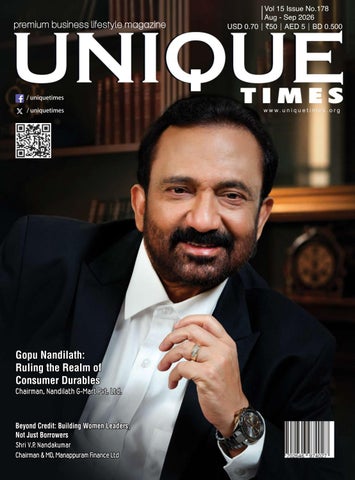
Vol 15 Issue No.178 Aug - Sep 2026 USD 0.70`50AED 5BD 0.500
Gopu Nandilath: Ruling the Realm of Consumer Durables
Chairman, Nandilath G-Mart Pvt. Ltd.
Beyond Credit: Building Women Leaders, Not Just Borrowers Shri V.P. Nandakumar Chairman & MD, Manappuram Finance Ltd
LUXURY YOU CAN WEAR
CRAFTED IN EXTREME EXCLUSIVITY-A SINGLE MODEL, LIMITED TO JUST SIX PIECES WORLDWIDE www.alcazarwatches.com
Regd. & Corporate Office, Chennai- 24
KERALA TAMILNADU PUDUCHERRY KARNATAKA ANDHRA PRADESH TELANGANA MAHARASHTRA NEW DELHI HARYANA RAJASTHAN
Editorial
Chief Mentor Mr. V.P. Nandakumar Director & CEO Jebitha Ajit here’s no shortage of reEditor Ajit Ravi markable ideas, what’s Legal Advisor Latha Anand missing is the will to execute B.S.Krishnan Associates them.” – Seth Godin bskrishnanassociates@gmail.com In a world where consumer Sub-Editor Athulya Pradip preferences shift rapidly and Associate Editor Ravi Saini technology continually reshapes Anusha Varghese the marketplace; enduring sucCorrespondents Dr. Thomas Nechupadam cess belongs to those who can an Vivek Venugopal- Quarter Mile ticipate change and turn it into R L Morris opportunity. Building a trusted Creative Design PEGASUS brand requires vision, adaptability, consistency, and, above all, an understanding of what people truly value. Over the Photography Ashkar Ali Hamza years, a few entrepreneurs have gone beyond simply sellMarketing USA ing products to creating experiences and relationships that 725, burning tree lane, span generations. This edition’s cover story features Gopu punta gorda Florida-33982 Nandilath, the visionary behind Gopu Nandilath G-Mart, Mob: +1 (863) 558-5234 whose entrepreneurial journey reflects foresight, innova UAE tion, customer trust, and an unwavering pursuit of excelJolly lence. Tel: +971 50 307 1125 This edition brings an exclusive article by V. P. Nanda Vineeth Nair kumar, Chairman & Managing Director of Manappuram Shaji N Palakkal Finance Limited, titled “Beyond Credit: Building Women 415, Building 23, Al Khail Gate, Leaders, Not Just Borrowers.” Through this insightful Al Quoz-2, Dubai, UAE piece, he explores the importance of empowering women Tel: +9714 4511075 as leaders while highlighting the broader need for environMaharashtra mental responsibility and sustainable development. Jayasankar M Adding to the richness of this issue is a diverse mix a/101, New Prathamesh Niwas, of engaging content, featuring sports, travel and tourism, OPP. Laxmi Park, Thakurli East, finance, inspiring business success stories, and thought Dombivli post, Thane District, 421201 provoking perspectives from prominent industry leaders. “Between the pages of a book, there is always some Mob: +91 9820708662 thing waiting to be discovered.” Tamil Nadu Joyful Reading! Sheelan Thangavelu Tamilnadu Director Mob: +91 7825-077770 Sri Shakthi Institute of Engineering and Technology, L&T- bypass, Chinniyapalayam, Coimbatore-62 Karnataka, Telangana, Andhrapradesh PEGASUS Ph: 09288800999 Sunilkumar NN Vice President Ambalika Saikia, Ambalika_saikia@yahoo.com Vice President V Suresh Kumar Public Relations
Published at Pegasus Global Pvt. Ltd. L5-106, Changampuzha Nagar Kalamassery, Ernakulam-682 033 e-mail: editor@uniquetimes.org uniquetimesindia@gmail.com Ph:0484 2532040, 2532080, Mob:9288800999
“T
Cover Photograph Mr. Gopu Nandilath Chairman, Nandilath G-Mart Pvt. Ltd.
Printer & publisher Pegasus Global Pvt. Ltd. Cochin (682033) on behalf of Ajit Ravi. Printed at S.T.Reddiar & Sons, P.B. No: 3627, Veekshanam Road, Cochin-18.
Healthy Gut Happy Onam Celebrate Every Feast Not the Digestive Problems ONAM GUT HEALTH CHECK Special Onam Price
900 2,570
Our Onam Gut Health Check includes a comprehensive digestive health assessment covering over 50 screening parameters, along with complimentary registration and a specialist gastroenterology consultation—thoughtfully designed to help you savour every festive moment with comfort and peace of mind.
A Healthier Celebration Begins with a Healthier Gut
9961640000
Maradu I Nettoor P.O I Kochi | Kerala - 682040 www.vpslakeshorehospital.com
Conditions apply*
Call
CONTENTS 14
14
Gopu Nandilath: Ruling the Realm of Consumer Durables
22
BUSINESS
22
Beyond Credit: Building Women Leaders, Not Just Borrowers
24
A Contemporary Playbook For Business Development Professionals
28
The Billionaire Brain: Neuroscience Behind The Extraordinarily Powerful Entrepreneurs' Brain
BUSINESS
24
CONTENTS FINANCE
56
34
MOTIVATION
34
Hearing Before Cognizance Under BNSS – A Right, Not A Ritual
56
Heal the Hidden Saboteurs of Scale and Build a Legacy That Lasts
60
Beauty from Within-The Role of Nutrition in Healthy Skin and Hair
TRAVELOGUE
BEAUTY
60
62
62
A Scandinavian Holiday
UNIQUE DIARY
India Approves `1.28 Lakh Crore Semiconductor Push, Expands Mobile Manufacturing Incentives
I
ndia’s Union Cabinet has approved a major `1.28 lakh crore semiconductor expansion programme to accelerate the country’s ambitions of becoming a global electronics manufacturing hub. The investment will strengthen chip manufacturing by supporting new semiconductor fabrication plants, research and development, intellectual property creation, and semiconductor design, while reducing dependence on imports. The announcement builds on the $10 billion semiconductor incentive scheme launched in 2021, under which 12 semiconductor manufacturing units and 24 chip design projects have already received approval. Alongside the semiconductor push, the Cabinet has also sanctioned `62,500 crore for a five-year mobile phone manufacturing programme. The scheme provides production-linked incentives ranging from 2.25% to 5% on eligible sales, with an additional incentive of up to 1.5% for manufacturers that source key components domestically. The government expects the initiative to create around 60,000 direct jobs, boost local value addition, attract fresh investments, and further strengthen India’s position as a leading global smartphone manufacturing and export destination.
FM Says Budget Can Handle Inflation Risks
“Do not be embarrassed by your failures, learn from them and start again." Richard Branson
8
Aug - Sept 2026
F
inance Minister Nirmala Sitharaman has stated that there is no immediate need to revise the Union Budget despite concerns over erratic monsoon conditions and rising global oil prices. She said the government has built sufficient financial buffers to absorb potential economic shocks and remains confident in its current fiscal strategy. Sitharaman noted that inflation is being driven by both global factors and unpredictable weather patterns, with the possible impact of El Niño posing risks to crop irrigation, agricultural output, and drinking water availability, which could lead to higher food prices. However, she emphasised that the government is well prepared to tackle these challenges and does not anticipate making any changes to the budget at this stage. The Finance Minister expressed confidence that the existing fiscal provisions are adequate to manage inflationary pressures and support the economy if risks materialise in the coming months.
UNIQUE DIARY
Education Minister Resigns Amid NEET Protests
U
nion Education Minister Dharmendra Pradhan resigned on 25th July, after weeks of nationwide protests over the alleged NEET examination paper leak, a move widely seen as a significant victory for youth-led demonstrators. In his resignation statement, Pradhan said he stepped down to prevent “anti-national forces” from exploiting the situation and reaffirmed his respect for the aspirations of India’s youth. The protests, spearheaded by the Cockroach Janta Party (CJP), intensified following allegations that exam paper leaks affected nearly two million medical aspirants. Protesters gathered at New Delhi’s Jantar Mantar to celebrate the resignation, describing it as a win for peaceful protest and accountability, while activist Sonam Wangchuk hailed it as a triumph of patience and perseverance. The agitation has emerged as one of the biggest challenges for Prime Minister Narendra Modi’s government, with opposition parties extending support and the demonstrations drawing attention to wider issues including youth unemployment, corruption, and government accountability amid heightened security in the capital.
Dabur Partners with GreenLine to Introduce LNG Trucks for Greener Logistics
"It's fine to celebrate success, but it is more important to heed the lessons of failure." Bill Gates
10
Aug - Sept 2026
D
abur India has partnered with GreenLine Mobility Solutions to introduce LNG-powered trucks across its logistics network, reinforcing its commitment to reducing carbon emissions and building a more sustainable supply chain. While the financial terms of the agreement have not been disclosed, the initiative is expected to lower emissions from long-distance freight transport without compromising operational efficiency or reliability. GreenLine currently operates a fleet of more than 1,000 LNG and electric heavy-duty trucks serving industries including consumer goods, steel, and mining, supported by an expanding network of LNG refuelling stations. Dabur said the collaboration aligns with its long-term sustainability strategy by integrating cleaner transportation solutions into its logistics operations. The partnership also reflects a growing trend among Indian companies to adopt low-emission technologies as the country accelerates efforts to achieve its net-zero emissions target by 2070, while promoting greener and more environmentally responsible supply chain practices.
Volkswagen in Talks to Sell Stake in India Unit to JSW
V
olkswagen AG is reportedly in advanced talks to sell a stake in its India business to the JSW Group, a move that could bring fresh capital into Skoda Auto Volkswagen India Pvt and strengthen the company’s presence in one of the world’s fastest-growing automobile markets. According to a Bloomberg News report, both companies are aiming to finalise the deal in the coming weeks. While Skoda, which manages Volkswagen’s operations in India, declined to comment on the reported negotiations, it confirmed that it is exploring new business opportunities to support its long-term growth strategy in the country. JSW has not yet issued an official statement on the matter. India has become a key expansion market for the Volkswagen Group as it seeks to diversify beyond Europe following its exit from Russia and a reduced presence in China. Skoda CEO Klaus Zellmer has previously said the company is prepared to continue investing in India even without a local strategic partner.
India to Ban Imports Made With Forced Labour
"Chase the vision, not the money; the money will end up following you." Tony Hsieh
I
ndia has announced a ban on the import of goods produced using forced labour, introducing a new trade measure aimed at strengthening import regulations and aligning with international labour standards. Under a notification issued by the Ministry of Commerce, the central government will have the authority to prohibit the import of products found to be manufactured wholly or partly through forced labour. India’s foreign trade authority will investigate suspected cases and, if sufficient evidence is established, recommend import bans after consultations with the government. The new framework will come into effect 30 days after the notification is issued. The decision comes as the United States considers imposing higher tariffs on several countries, including India, over concerns related to forced labour and industrial practices.
Aug - Sept 2026
11
France Cuts 2026 Economic Growth Forecast to 0.7%
F
rance has revised its 2026 economic growth forecast down to 0.7% from the previously projected 0.9%, reflecting weaker-than-expected economic performance during the first half of the year. The updated outlook was presented by the Finance Ministry in its mid-year public finance review to lawmakers. Finance Minister Roland Lescure attributed the downgrade to a slower start to the year, partly caused by the effects of special budget legislation, as well as an increasingly challenging global environment. He noted that continued instability stemming from the conflict in the Middle East has added pressure to France’s economic outlook. The revised forecast underscores the challenges facing Europe’s second-largest economy as it balances domestic fiscal priorities with external geopolitical risks. The French government said it will continue to closely monitor economic conditions and adjust its fiscal strategy where necessary to support growth, safeguard public finances, and maintain overall economic stability in the months ahead.
NATO Selects Saab GlobalEye Aircraft in $4.5 Billion Early-Warning Deal
N
ATO has announced plans to acquire up to 10 Saab GlobalEye airborne early-warning and surveillance aircraft in a deal worth approximately $4.5 billion, selecting the Swedish-made system over Boeing’s E-7 Wedgetail to modernise its ageing AWACS fleet. The GlobalEye platform, built on Bombardier Global 6500 business jets, will strengthen NATO’s surveillance and early-warning capabilities against emerging threats, including drone swarms and evolving battlefield challenges. NATO Secretary-General Mark Rutte said the programme represents a multinational effort involving European, Canadian, and U.S. industries. Saab stated that deliveries could begin as early as 2030 if contract negotiations are completed soon, with each aircraft expected to cost between $400 million and $450 million. The alliance’s decision comes as member nations continue increasing defence spending in response to heightened security concerns across Europe. Although the initial aircraft will not feature air-to-air refuelling capability, NATO expects to introduce the upgrade in future, reinforcing its long-term strategy to enhance airborne surveillance and defence readiness.
12
Aug - Sept 2026
Germany’s Sick Leave Debate Highlights Workplace Stress
G
ermany’s proposed plan to tighten sick leave rules has sparked criticism from researchers, who argue that rising absenteeism is driven by worsening workplace conditions rather than abuse of the system. The government believes stricter sick-note requirements could improve productivity, but experts say mental health challenges, staff shortages, and high workplace stress are the main reasons behind increasing sick leave. Sectors such as healthcare, education, and social services have recorded the highest absence rates, with chronic understaffing, low wages, emotional pressure, and burnout identified as key contributing factors. Although mental health-related sick leave has increased significantly over the past decade, it still represents a relatively small share of overall illnesses. Researchers also found little evidence that Germany’s generous sick-pay system or telephone sick notes are being widely misused. Instead, they attribute the rise in recorded absences to improved electronic reporting and recurring respiratory illnesses, arguing that better working conditions—not stricter regulations—are the most effective solution to reducing long-term absenteeism.
Volkswagen Plans Deeper Cuts Amid Rising Chinese Competition
V
olkswagen has announced plans to intensify its cost-cutting efforts as Chinese automakers expand rapidly across Europe, increasing pressure on the German carmaker. CEO Oliver Blume said the company is facing fierce competition from more than 150 Chinese brands, along with the impact of tariffs and weaker demand in China, prompting a major restructuring drive. Volkswagen has proposed raising planned job cuts to 100,000 and warned that up to four German plants could face closure after 2030. Although the company’s second-quarter operating profit fell 9.5% to €3.5 billion, analysts pointed to signs of stabilisation, supported by stronger-than-expected revenue and solid cash flow. Negotiations with labour unions over the restructuring remain ongoing. While Volkswagen has maintained its full-year profit margin forecast, it has lowered its revenue outlook, warning that sales could decline by up to 3% in 2026 as Chinese manufacturers, including BYD and Geely, continue expanding their European production and electric vehicle operations.
For more info: europetimes.co
Aug - Sept 2026
13
COVERSTORY
Gopu Nandilath: Ruling the Realm of Consumer Durables With extraordinary foresight, relentless drive and an instinctive understanding of consumer aspirations, Gopu Nandilath has transformed a modest 3,000 sq ft electronics store into an expansive retail empire. Today, Gopu Nandilath G-Mart commands a formidable presence with 66 outlets across Kerala, redefining the way the state shops for consumer durables while earning an enduring place in the hearts of generations of customers.
W
alk into almost any home in Kerala and chances are high that one will find a television, refrigerator, washing machine, mobile phone or another electronic appliance purchased from Gopu Nandilath G-Mart. From Kasaragod in the north to Thiruvananthapuram in the south, the name has become synonymous with quality, choice, value and trust. Behind this remarkable retail phenomenon is a man whose entrepreneurial instincts have consistently anticipated the changing aspirations of Kerala’s consumers. Meet Gopu Nandilath, the visionary entrepreneur from Thrissur whose ability to read the market, embrace transformation and turn opportunity into enterprise has scripted an extraordinary business story. More than four decades after he took his first steps into the world of consumer electronics, his passion remains undiminished. In a candid conversation with R L Morris, the business leader looks back on his remarkable journey, the principles that shaped his success, his vision for the future and the passions that add colour to his life beyond business.
Sub Inspector in the Kerala Police Department, and Malathi Govindan, a homemaker, Gopu Nandilath was fascinated by electronics from an early age. His ambitions, too, were far bigger than his circumstances. After completing his schooling at Tharakan’s High School in Aranattukara, he travelled to Delhi to pursue a Diploma in Electronics. After completing his schooling at Tharakan’s High School in Aranattukara, he went to Delhi to pursue a Diploma in Electronics. “I completed my Diploma programme in Delhi,” said Gopu. After completing his studies, he joined the electronics business, which involved the manufacture and sale of television accessories such as antennae, boosters, stabilisers and cables. It was a fascinating period in India’s consumer history. Television was gradually moving beyond the realm of privilege and entering the homes of the expanding middle class. Gopu was not merely witnessing the change; he was learning to understand it.
A Modest Beginning
The 1982 Asian Games in New Delhi proved to be a defining moment in India’s television story. The
Born the seventh among the eight children of N P Govindan, a
14
Aug - Sept 2026
A Correct Prediction and the Birth of an Entrepreneur
live telecast on Doordarshan fuelled an unprecedented appetite for television sets, particularly black-andwhite models, and Kerala was quick to embrace the new phenomenon. As television sets began finding their way into Malayali homes, Gopu Nandilath was already studying the transformation taking place around him. He recognised that the growing fascination with electronics was not a passing trend but the beginning of a profound shift in consumer behaviour. As television showrooms multiplied across Kerala, he decided to take the entrepreneurial plunge. In 1984, Gopu Nandilath embarked on his business journey by opening a modest 2,000 sq ft showroom on Kuruppam Road in Thrissur, the cultural capital of Kerala. The store dealt in televisions and electronic goods. What appeared to be a modest beginning would eventually become the foundation of a formidable consumer durables empire.
From 3,000 Sq Ft to 30,000 Sq Ft
Once he established his presence in Thrissur, Gopu’s entrepreneurial instincts came to the fore. Expansion followed swiftly, with Gopu Nandilath Agencies opening
Gopu Nandilath embarked on his business journey by opening a modest 2,000 sq ft showroom on Kuruppam Road in Thrissur, the cultural capital of Kerala. The store dealt in televisions and electronic goods. What appeared to be a modest beginning would eventually become the foundation of a formidable consumer durables empire.
Aug - Sept 2026
15
COVERSTORY outlets in Irinjalakuda, Vadanappally, Pattambi, Perinthalmanna, and Mannarkkad. “We began with electronic items such as television sets, washing machines and refrigerators from prominent brands manufactured in India,” he recalls. Then came the winds of economic liberalisation in the early 1990s. India began moving towards a more open economy, paving the way for the entry of global brands across various sectors. The transformation was dramatic. International names entered virtually every segment of consumer life, from automobiles and personal care products to televisions, washing machines and refrigerators. For an entrepreneur who had built his career by reading market signals, this was an opportunity rather than a challenge. Gopu responded decisively. Gopu Nandilath Agencies began bringing prestigious international brands such as Whirlpool, Samsung, LG and Bosch into its fold. The company was no longer simply selling appliances; it was becoming a gateway through which Kerala consumers could experience a new world of products and possibilities.
2004: The Year That Rewrote Consumer Choices
If the early years established the foundation, 2004 marked a transformational chapter in the history of the enterprise. As technology began reshaping everyday life, Gopu realised that the conventional showroom model needed to evolve. He embarked on an ambitious revamp, culminating in the launch of the first hi-tech showroom at Poonkunnam in Thrissur. Spread across 20,000 sq ft, the showroom represented an entirely new retail experience. The brand was rechristened Gopu Nandilath G-Mart, and the Gopu Nandilath G-Mart Home Appliances Plaza emerged as one of the largest establishments of its kind at the time. The response was extraordinary. Customers from across Kerala travelled to Thrissur to experience the vast selection, competitive pricing and attractive offers. Until then, consumers were accustomed to vis-
16
Aug - Sept 2026
iting smaller outlets where choices were often limited to a handful of brands. G-Mart transformed that experience into something closer to a destination. A wide range of premium Indian and international brands was brought together under one roof, turning appliance shopping into an engaging retail experience. “We can proudly say that it was through Gopu Nandilath G-Mart that Kerala consumers gained greater exposure to international brands. We were able to bring a whole range of global electronic brands to the Indian market after the opening of the economy,” says Gopu. The success of the Poonkunnam model became a catalyst for the group’s expansion across Kerala.
“Change Is Key to Survival”
For Gopu Nandilath, standing still has never been an option. Asked about the secret of surviving changing market conditions, his answer is immediate: “Change is essential for survival.” He remembers that when he began his journey, the electronics boom led to the mushrooming of numerous small outlets. Many have disappeared over the years, he says, because they failed to respond to changing market realities. “Nandilath was fortunate enough because we embraced innovation. It is my policy to upgrade or bring in changes every five years. We have to grow with technological advancements. That is the key to survival,” he says. That philosophy continues to define G-Mart. From the early days of televisions and refrigerators to the era of smart appliances and artificial intelligence, the organisation has consistently adapted to the changing technological landscape. Today, even as AI reshapes the consumer electronics industry, Gopu Nandilath is already showcasing products that harness its potential. His belief is simple: innovation keeps a brand relevant, while reinvention keeps it ahead.
Earning a Place in People’s Hearts
For all the emphasis on technology, expansion and business strategy,
Gopu believes that the most valuable asset a company can possess is customer trust. “Our trust in our customers keeps growing. Since its inception more than four decades ago, Gopu Nandilath G-Mart has been able to maintain a loyal customer base that runs into three generations,” he says. The reasons are clear. Competitive pricing, a wide selection, reputed global and Indian brands, dependable after-sales service and attractive offers have combined to create a retail experience that consumers repeatedly return to. “In fact, anyone can walk into our showroom and buy a product at a very convenient price, with the assurance that it is of premium quality. Customer satisfaction and happiness have been key ingredients of our success. We have earned a place in people’s hearts and the trust factor has transcended generations,” he says. Another defining feature of the business model is the absence of middlemen. Products are sourced directly from manufacturers, enabling G-Mart to operate efficiently while passing a substantial part of the benefit to customers through discounts, special offers and gifts. The Onam season, for instance, brings a spectacular array of incentives. The group’s lucky draw offers include 25 Maruti Suzuki Baleno cars, 100 one-gram gold coins, 100 ten-gram silver coins, 100 LED televisions and 100 washing machines, besides special discounts running into crores of rupees.
Always No. 1
Gopu Nandilath takes considerable pride in the position G-Mart has carved out in Kerala’s consumer durables market. “I can say with pride that Gopu Nandilath G-Mart has occupied the Number One position among consumer durables in Kerala for several years in succession,” he says. The scale of the group’s showrooms reflects the ambition behind the brand. Many of its outlets span between 10,000 and 35,000 sq ft, with several more on the expansion map. “This Onam, three more out-
lets are going to be opened. By December, five new showrooms will be there,” he says. Having established a strong presence in Kerala with 66 showrooms, the company is now setting its sights on 100 outlets across the state, while also exploring opportunities beyond Kerala, with Karnataka emerging as the first step in this expansion. Despite the scale of the business, Gopu has always placed strong emphasis on maintaining close control over his operations. His approach
is rooted in accessibility, customer service and the ability to give every outlet the attention it deserves. “Wherever you travel in Kerala, there should be a Gopu Nandilath showroom every 30 kilometres. That is our vision,” he explains. It is a strategy that has served him well. By maintaining a strong presence across the state and keeping a close watch on each outlet, Gopu has built a network that has continued to grow without a single showroom being closed down over
the years.
Planning Ahead, Maintaining Momentum
Gopu Nandilath is a strategist who prefers to think several moves ahead. “I have already laid out the blueprint for the next five years,” he says. The group is also strengthening its online presence, recognising that modern consumers increasingly value convenience and seamless shopping experiences. For him, the future of retail lies
Aug - Sept 2026
17
COVERSTORY in combining choice, technology, service and convenience. Businesses that understand their customers and respond quickly to their needs will remain relevant, he believes. At G-Mart, understanding the customer is a structured exercise. A dedicated team studies markets extensively before strategies are formulated. Even the location of a new showroom is selected after analysing population patterns, spending behaviour and other economic indicators. “We even check the CIBIL indices before zeroing in on a new location,” he reveals. Managing a large enterprise while continuously exploring new opportunities is no small feat. Yet Gopu remains as energetic and hands-on as ever. He continues to closely monitor consumer behaviour, motivate employees and identify emerging categories. The group’s entry into laptops and smartphones is another example of that forward-looking approach,
adding new dimensions to an already extensive consumer electronics portfolio. For Gopu, entrepreneurship demands perpetual alertness. A successful entrepreneur must remain sensitive to market fluctuations, anticipate what consumers will need next and introduce products and experiences before competitors do.
Family and Next-Gen Entrepreneurs
Behind every enduring entrepreneurial journey is often a strong support system, and Gopu Nandilath readily acknowledges the role played by his wife, Shiny Gopu. A partner in the enterprise as well as in life, Shiny has remained a steadfast presence throughout his journey. The next generation, too, has already stepped into the business, bringing fresh perspectives and new-age expertise. Their daughter, Aishwarya Nandilath, pursued an MBA after completing her Engineering degree and is involved in Sales, Online Mar-
keting and Social Media. Their son, Arjun, completed his MBA in the UK and is responsible for Sales and Marketing in the Mobile and Laptop Division. Both have taken on their responsibilities with confidence, demonstrating that the entrepreneurial legacy is already in capable hands. Gopu’s advice to his children when they entered the business was characteristically practical. “Business is not easy like a bed of roses. But once you enter, it will become a passion,” he told them. He also impressed upon them the importance of discipline and completing every task without delay. “Procrastination can prove detrimental to any business as the backlog just keeps piling up. Time will never wait for us. So, we ought to complete all tasks on a daily basis without keeping them for tomorrow.” He believes that a business has to be nurtured with constant care and attention. Aishwarya and Arjun are now steadily taking the reins of
Gopu Nandilath presenting an elephant sculpture to Pope Francis during his visit to the Vatican.
18
Aug - Sept 2026
Gopu Nandilath with his wife, Shiny Gopu.
the business, carrying forward the legacy built by their father. “This is what I told them. They have successfully undergone the training and are excelling in what they are doing. I place full confidence in them,” he says with evident pride. More than the business itself, Gopu hopes to pass on the values that have guided his journey — honest, ethical and responsible leadership — so that the next generation can take the company forward with the same commit-
ment and integrity.
In Love with the Beautiful Game
Away from boardrooms, expansion strategies and sales figures, Gopu Nandilath has another enduring passion: football. His love for the beautiful game dates back to childhood. As a schoolboy, he would eagerly seize every opportunity to play football with friends. The passion has remained undiminished.
He considers himself fortunate to have watched the semi-finals and finals of eight FIFA World Cups, including the latest edition held in the United States. A passionate admirer of Lionel Messi, Gopu continues to experience the same excitement every time he watches the Argentine maestro in action. Cristiano Ronaldo and Kylian Mbappé are among the other stars whose performances he follows closely.
Aug - Sept 2026
19
COVERSTORY
Arjun Nandilath with his wife, Ashvika Arjun, and their son, Adhrith Nandilath For a man whose professional life revolves around strategy and competition, football perhaps offers another form of the same thrill: the unpredictability of the game and the exhilaration of staying ahead.
On a Globe-Trotting Spree
Gopu Nandilath is also an enthusiastic traveller who has visited more than 60 countries. His travels have combined business, curiosity and leisure, allowing him to observe different cultures and, importantly, study retail trends around the world. The United States is among the countries he has visited several times, while New Zealand and Switzerland remain particular favourites.
“There is zero pollution in those two countries and the natural beauty is simply outstanding. That is why I wish to visit them again and again,” he says. His first international trips took place in 1988, when he travelled to Singapore, Malaysia and the United States. India was still years away from economic liberalisation, and foreign exchange restrictions made overseas travel a very different experience. For Gopu, travel is more than recreation. It is also research. “Whenever I visit a country, I invariably visit electronic gadget showrooms there and try to keep abreast
of the latest technology and changes, which I implement when I return,” he says. The habit perfectly captures his entrepreneurial personality: even while travelling, he is observing, learning and searching for the next idea.
A Blessed Encounter
Among his many journeys, one particular experience holds a special place in Gopu’s heart. In October 2024, during a visit to the Vatican, he was selected by the Sree Narayana Trust of Sivagiri to be part of a delegation attending a global inter-religious meeting hosted by the Vatican.
Gopu Nandilath is also an enthusiastic traveller who has visited more than 60 countries. His travels have combined business, curiosity and leisure, allowing him to observe different cultures and, importantly, study retail trends around the world. 20
Aug - Sept 2026
The occasion offered him the rare opportunity to spend a few moments with Pope Francis, the spiritual leader of more than a billion Catholics worldwide. Gopu presented the pontiff with a sculpture of an elephant and received his blessing. The memory remains a treasured one, preserved in a photograph of the encounter that occupies a prominent place in the elegant parlour of his residence in Thrissur. For a man accustomed to meeting business leaders and navigating boardrooms, the encounter represented something altogether different: a deeply personal and spiritual moment that continues to resonate with him.
A Craze of Elephantine Proportions
Like many proud sons of Thrissur, Gopu Nandilath shares a deep fascination with elephants and the grandeur of traditional elephant pageantry. At one point, he owned 11 tuskers. Three were donated to Guruvayur Temple, while three others passed away. Today, three remain.
Among them is ‘Nandilath Gopalakrishnan’, regarded as the biggest tusker in Kerala and a magnificent presence whenever he takes part in a procession. His love for animals extends beyond elephants. For more than two decades, Gopu has maintained a sprawling seven-acre farm at Kundannoor in Wadakkanchery. The property houses around 200 cows of different breeds, more than 100 goats, poultry, canines and exotic birds. The farm grows grass for the cattle, and the cows collectively produce around 800 litres of milk every day, which is supplied to Milma. “I have loved animals from a tender age and that is one reason why I wanted to have a farm. We also used to raise cows at our house when I was a child,” he says. The entrepreneur’s passions do not end with animals. He is equally fond of premium automobiles, with an impressive collection adding another distinctive touch to his lifestyle. With an instinct for opportu-
nity, an appetite for innovation and an unwavering commitment to his customers, Gopu Nandilath has built much more than a chain of consumer durables stores. He has created a retail legacy that has evolved alongside Kerala itself. From a 3,000 sq ft showroom in Thrissur to a statewide network of 66 outlets, his journey is a compelling study in foresight, resilience and reinvention. Yet perhaps the most remarkable aspect of Gopu Nandilath’s story is that, even after more than four decades at the helm, the hunger to evolve remains undiminished. His empire may have grown from one showroom to a formidable retail network, but the philosophy at its heart remains unchanged: understand the customer, anticipate the future, embrace change and never stop moving forward. And so, with integrity as his foundation, vision as his compass and an extraordinary zest for life as his driving force, Gopu Nandilath continues his winning streak—one showroom, one innovation and one customer at a time
Gopu Nandilath with his wife, Shiny Gopu, and daughter, Aishwarya Nandilath
Aug - Sept 2026
21
BUSINESS
Training women in budgeting, savings discipline, interest calculations, and digital payments does more than cultivate reliable borrowers; it builds confident decision-makers who no longer need to route every financial transaction through a husband, brother, or moneylender.
Shri V.P.Nandakumar Chairman & MD Manappuram Finance Ltd
Beyond Credit: Building Women Leaders, Not Just Borrowers
F
or decades, the story of financial inclusion in India was told in the language of access: how many bank accounts were opened, how many loans were disbursed, and how many first-time borrowers were brought into the formal fold. It was a necessary beginning. Yet, traditional banks struggled to serve a significant segment of low-income Indians — particularly women — for whom servicing small-ticket loans made little commercial sense. Microfinance institutions emerged precisely to close this gap. Using community-based models, streamlined paperwork, and micro-lending, they brought millions of rural and semi-urban borrowers into the formal financial system for the first time. That story, while impressive,
22
Aug - Sept 2026
remains incomplete. A loan, however well-designed, is only the first rung of a much longer ladder. It can fund a sewing machine, a kirana shop, or a dairy unit, but it cannot by itself teach a woman how to price her product, negotiate with suppliers, or confidently manage her household budget. Access to credit and the capacity to use it effectively are two very different things — and for too long, our sector assumed that solving the first automatically resolved the second. This is why forward-looking microfinance institutions are quietly redefining their purpose — moving from credit providers to enablers of holistic empowerment. The shift begins with something deceptively simple: financial literacy. Training women in budgeting, savings discipline, interest
calculations, and digital payments does more than cultivate reliable borrowers; it builds confident decision-makers who no longer need to route every financial transaction through a husband, brother, or moneylender. It marks the difference between a woman who merely repays a loan and one who manages financial strategy. Financial literacy, however, is only the entry point. The institutions excelling at this transformation are going further — building negotiation skills, encouraging peer discussions on business challenges, and instilling entrepreneurial thinking early so women learn to anticipate market dynamics rather than react to them. The result is a visible transition from "borrower" to leader: a woman who not only runs an enterprise, but is recognized within
her family and community as someone whose judgment carries weight. Nowhere is this shift clearer than in the community platforms that have grown around the microfinance movement — Self-Help Groups (SHGs), Joint Liability Groups (JLGs), and federated collectives. By rotating leadership, practicing collective decisionmaking, and resolving operational disputes routinely, these groups function as grassroots leadership incubators. Programs like Kerala's Kudumbashree (spanning over 45 lakh women) and Maharashtra's MAVIM demonstrate what structured community organization can achieve — women who began as loan recipients now govern local councils, run large
federations, and mentor emerging entrepreneurs. This impact extends far beyond individual households. A woman who gains a business skill or the confidence to trade rarely keeps that knowledge to herself; she mentors her neighbor, who in turn guides another, compounding the benefit across the community. Empowered women prioritize education for their children, advocate for better local healthcare and sanitation, and step into public leadership. This is the multiplier effect that no disbursement statement can capture, yet it is arguably the most consequential outcome of our work. None of this diminishes the importance of credit — it remains the
essential foundation. But responsible NBFCs and MFIs increasingly recognize that their duty cannot end at disbursement. It must extend to financial education, ethical lending practices, and genuine investment in the long-term capability of borrowers, rather than just their repayment capacity. Done well, this is where financial inclusion and meaningful social impact converge. The future of microfinance will not be measured solely by the volume of capital deployed. It will be measured by how many women — once simple borrowers — become the primary drivers of progress in their homes, businesses, and communities. That is the real balance sheet our sector must build toward
Aug - Sept 2026
23
BUSINESS
Rajesh Nair Partner, Ernst & Young LLP
By analysing digital footprints, company announcements, industry developments, funding patterns, and customer behaviour, AI can identify highpotential prospects with remarkable accuracy.
A Contemporary Playbook For Business Development Professionals From Cold Calls to Smart Calls: How AI is Redefining the Art and Science of Growth
I
n every decade of business, there emerges a force that fundamentally changes how organisations compete, grow, and create value. The steam engine transformed industry, the internet revolutionised communication, and today, Artificial Intelligence (AI) is reshaping the landscape of business development. For professionals operating across both Business-toBusiness (B2B) and Business-toConsumer (B2C) sectors, AI has evolved from a technological curiosity into a strategic necessity. It is no longer a question of whether businesses should embrace AI, but rather how quickly they can integrate it into their growth strategy. The modern business development professional faces unprecedented challenges. Markets are more competitive, customers are more informed, and decision-making cycles are increasingly complex. Yet, despite these pressures, many organisations continue to rely on traditional methods of prospecting, customer engagement, and fore-
24
Aug - Sept 2026
casting. This is akin to attempting to navigate a Formula One race in a horse-drawn carriage—admirable in spirit but painfully inefficient in execution. AI offers a more intelligent route forward, providing speed, precision, and insight that were previously unimaginable. One of the most significant advantages of AI lies in its ability to transform prospecting and lead generation. Historically, identifying potential customers was a labourintensive exercise involving extensive research, cold outreach, and a considerable amount of guesswork. Business developers frequently found themselves searching for opportunities in vast marketplaces with limited visibility. AI changes this paradigm entirely. By analysing digital footprints, company announcements, industry developments, funding patterns, and customer behaviour, AI can identify highpotential prospects with remarkable accuracy. In the B2B environment, AI enables sales teams to focus their ef-
forts on organisations demonstrating strong purchase intent. Rather than casting a wide net and hoping for results, professionals can concentrate on opportunities that exhibit real buying signals. In the B2C sector, AI leverages behavioural analytics to identify consumers most likely to respond positively to specific products or campaigns. In essence, AI turns prospecting from an exercise in hope into an exercise in science. As the saying goes, "Stop hunting for needles in haystacks; let AI bring you the magnet." Beyond prospecting, AI has revolutionised the concept of personalisation. Modern customers expect businesses to understand their needs, preferences, and challenges. Generic communication is increasingly ineffective in a world where relevance drives engagement. AI empowers business development professionals to deliver personalised experiences at scale, something that would be practically impossible through manual effort alone. For B2B professionals, AI can
analyse company reports, executive communications, market movements, and stakeholder priorities to help craft highly tailored proposals and outreach strategies. A sales representative entering a meeting armed with AI-generated insights resembles a skilled chess player who has already studied several moves ahead. They understand the customer's context, anticipate concerns, and deliver value from the very first interaction. In the B2C world, personalisation has become a competitive differentiator. Recommendation engines, tailored promotions, and customised digital experiences all rely heavily on AI. Companies such as Amazon and Netflix have demonstrated that consumers are more likely to engage when offerings align closely with their interests. Customers do not necessarily expect businesses to read their minds, but they certainly appreciate businesses that appear to understand them exceptionally well. Content creation represents another area where AI delivers extraordinary value. Today's business development professionals are expected to function as educators, influencers, marketers, and thought
leaders in addition to being salespeople. Maintaining a consistent flow of high-quality content across multiple channels can be challenging, particularly when time is limited. AI acts as a powerful content multiplier, enabling professionals to create, refine, and distribute content more efficiently than ever before. A single customer success story can be transformed into a blog article, a social media campaign, a presentation, and a proposal. A webinar can generate dozens of marketing assets. The process resembles planting one seed and watching an entire orchard emerge. Naturally, human oversight remains essential. AI provides speed and scale, while humans provide authenticity, creativity, and emotional intelligence. Together, they form a formidable partnership. Perhaps the greatest strength of AI lies in its ability to unlock the hidden value of data. Organisations today possess vast quantities of information, yet many struggle to convert that information into actionable insight. Data often accumulates like books in an enormous library— valuable, but difficult to navigate. AI serves as the master librarian, organising information, identifying patterns, and revealing opportuni-
ties that might otherwise remain hidden. For B2B organisations, AI can identify dormant accounts, highlight pipeline risks, and uncover expansion opportunities. It can determine which customer engagements are most likely to result in revenue growth and which relationships require immediate attention. In B2C markets, AI helps predict customer churn, discover cross-selling opportunities, and optimise marketing performance. Instead of reacting to events after they occur, businesses can anticipate outcomes before they happen. The application of AI extends equally to relationship management and negotiation. Contrary to popular fears, AI will not replace the human element within business development. Trust, empathy, and genuine connection remain distinctly human qualities. However, AI significantly enhances the ability of professionals to cultivate those relationships effectively. Before an important customer engagement, AI can summarise previous conversations, identify stakeholder interests, suggest relevant discussion topics, and anticipate potential objections. Such preparation
Aug - Sept 2026
25
BUSINESS
transforms meetings from routine conversations into strategic engagements. Entering a negotiation without AI support today is rather like attempting to compete in a marathon whilst carrying unnecessary baggage. The destination remains achievable, but the journey becomes significantly more difficult. Forecasting and planning represent another domain where AI is creating a profound impact. Traditional forecasting methods often relied on historical trends, managerial judgement, and a healthy dose of optimism. Unfortunately, optimism has never appeared on a balance sheet. AI introduces analytical rigour by examining numerous variables simultaneously, generating insights that improve decisionmaking and resource allocation. For B2B organisations, AI enhances pipeline forecasting, revenue prediction, and account planning. For B2C businesses, it optimises inventory management, campaign effectiveness, and demand forecasting. Leaders gain greater confidence in strategic decisions because those decisions are informed by evidence rather than intuition alone. In a business environment where uncertainty has
26
Aug - Sept 2026
become the norm, clarity is a valuable competitive advantage. Despite its transformative capabilities, the true power of AI lies not in replacing human expertise but in amplifying it. Business development remains fundamentally about relationships, trust, and value creation. AI may identify a prospect, but it cannot build rapport. AI may analyse sentiment, but it cannot demonstrate genuine empathy. AI may recommend the next best action, but it cannot inspire confidence in the same way a skilled professional can. The most successful business developers of the future will therefore be those who embrace a philosophy of collaboration with AI. They will use technology to augment their strengths, eliminate routine tasks, and free themselves to focus on activities that create meaningful customer relationships. In doing so, they will achieve levels of productivity, effectiveness, and influence that were previously unattainable. In conclusion, Artificial Intelligence represents one of the most significant opportunities in the history of business development. Across both B2B and B2C sec-
tors, it empowers professionals to identify opportunities with greater precision, engage customers more effectively, create content more efficiently, analyse data more intelligently, negotiate more confidently, and forecast more accurately. Like a master conductor directing a world-class orchestra, AI enables organisations to harmonise information, people, and strategy into a powerful engine of growth. The future will not belong to businesses that merely adopt AI; it will belong to those that integrate it thoughtfully and strategically. The winning formula is neither human intelligence alone nor artificial intelligence alone. It is the combination of both. As modern business developers chart their path forward, they would do well to remember a simple yet powerful mantra: "Let AI do the searching, analysing, and predicting. Let humans do the connecting, persuading, and closing." For in the age of intelligent growth, success belongs not to those who work harder, but to those who work smarter—and no partner in that journey is proving more valuable than Artificial Intelligence
luxury you can wear
TSHIRT
HEALTH
Dr Arun Oommen MBBS, MS ( Gen Surg), Mch( Neurosurgery),MRCS Ed (UK) , MBA, DMS( Hospital Administration) ENLS, D Litt(H), Phd(H), D Sc(H) Neuro Endoscopy Fellow Senior Consultant Neurosurgeon VPS Lakeshore Hospital, Kochi, India. Honorary Secretary Neurological Society of India- Kerala Chapter UN Representative
Most people interpret failure as the end. Entrepreneurs possess the remarkable capability to interpret failure as an information.
www.arunoommen.com
The Billionaire Brain: Neuroscience Behind The Extraordinarily Powerful Entrepreneurs' Brain
"E
very skyscraper, every billion-dollar company, every life-changing invention was born in complete silence—inside a single human brain. Before the world believed, one person dared to believe alone." That is perhaps the loneliest and the most courageous place in the world. History remembers entrepreneurs for the empires they built. Neuroscience remembers them for something even more extraordinary—the remarkable way their powerful brains work. As a neurosurgeon, I have often wondered why certain individuals repeatedly see opportunities where as everyone else sees impossibilities. Why do some people risk everything to pursue an uncertain future while others choose the comfort of certainty? The answer lies not merely in intelligence, but in mindset. An entrepreneurial brain is wired differently.
The Power of Seeing What Others Cannot
In 2008, during one of the worst financial crises in history, investors
28
Aug - Sept 2026
advised a young entrepreneur to abandon his dream of electric cars and reusable rockets. They believed both companies would collapse.
That entrepreneur was Mr Elon Musk
Instead of choosing one company to save, he invested almost every remaining dollar he had into both. Friends thought he had lost his mind. Today, Tesla transformed the electric vehicle industry, while SpaceX revolutionised space travel. Most people saw bankruptcy. His brain saw the future. That is the entrepreneurial mind at work.
Failure Is Elementary
Imagine creating company worth millions and later to be thrown out of it! That happened to Mr Steve Jobs. Being fired from Apple which he cofounded was one of the most humiliating moments of his life. Years later he admitted that it became the best thing that ever happened to him. Instead of surrendering, he founded NeXT and acquired Pixar. He eventually returned to Apple and lead it to one of the greatest corpo-
rate companies in history. Most people interpret failure as the end. Entrepreneurs possess the remarkable capability to interpret failure as an information. Their brains recover, adapt and evolve. Neuroscientists call this resilience.
The Courage to Dream Bigger Than Circumstances
There was a young boy in Gujarat who sold snacks to support his family. He had no elite education. No wealthy background. No influential contacts. That boy grew up to become the iconic Mr Dhirubhai Ambani the founder of the Reliance Empire. His greatest asset wasn't money. It was his extraordinary vision. He imagined industries and Corporates long before India was even ready for them. Great entrepreneurs often see tomorrow while everyone else is trapped in today.
Rejection Never Defines Them
Before building one of Asia's largest technology companies, Mr Jack Ma faced rejections after rejections. He failed his university entrance examination multiple times. He ap-
self with ambitious, optimistic people who challenge your thinking. Prioritise quality sleep, regular exercise and mindfulness, as a healthy brain makes better decisions under pressure. Finally, never stop learning. The world's greatest entrepreneurs remain lifelong students, constantly adapting to change. Remember, entrepreneurs are rarely born—they are built. Every new skill, every challenge overcome and every bold decision strengthens the neural pathways that transform ordinary thinking into extraordinary vision.
The Final Thought
plied for dozens of jobs. Even when a fast-food restaurant hired 23 applicants, he alone was rejected. Most people would have accepted defeat. But instead, he built Alibaba and now he is the richest man in China and millions of people earn their livelihoods through Alibaba. Entrepreneurs don't avoid rejection. They outlast it.
Curiosity Changes the World
When Jeff Bezos left a highly paid Wall Street career, almost everyone believed he was making a terrible mistake. Who would buy books over the internet? His answer was simple. "What if they do?" That simple question eventually transformed retail, cloud computing and global logistics and now the Amazon founder is one of the richest men on earth. Every revolutionary company begins with curiosity. Every innovation starts with someone asking "Why not?"
The Brain That Loves Problems
Where most people complain. Entrepreneurs investigate. Where people see inconvenience. Entrepreneurs see opportunity. The entrepreneurial brain constantly scans the environment for unmet needs. Every traffic jam,
every hospital waiting line, every complicated process represents a possible solution waiting to be built. Problems become possibilities.
Emotional Intelligence Creates Great Leaders
Building a business isn't merely about creating products. It is about inspiring people. Employees don't follow salaries alone. Investors don't back spreadsheets alone. Customers don't remain loyal to products alone. People follow trust. Successful entrepreneurs possess remarkable emotional intelligence. They communicate hope during uncertainty, confidence during crisis and purpose during adversity.
Can We Train Our Brain to Think Like an Entrepreneur?
Answer is Yes! Absolutely. The most exciting discovery in modern neuroscience is that the brain is not fixed—it is constantly rewiring itself, a phenomenon known as neuroplasticity. This means an entrepreneurial mindset can be cultivated, regardless of age or background. Start by developing relentless curiosity. Read beyond your profession, ask "Why?" and "What if?" every day, and seek problems worth solving instead of waiting for opportunities to appear. Step outside your comfort zone, take calculated risks, and view every failure as feedback rather than defeat. Surround your-
People often believe entrepreneurs create companies. In reality they first create themselves. Every successful entrepreneur trains the brain to embrace uncertainty, remain curious, recover from failure, inspire others and never stop learning. Extraordinary entrepreneurs possess capabilities beyond intelligence—they combine a unique set of brain capabilities that transform ideas into reality. They have vision to imagine opportunities others cannot see, creativity to connect unrelated ideas, cognitive flexibility to adapt rapidly to changing circumstances, and resilience to recover from repeated failures. Strong executive function enables sound planning, disciplined decision-making and strategic risk-taking. High emotional intelligence helps them inspire teams, negotiate effectively and build lasting relationships. Above all, they possess relentless curiosity, a growth mindset, and an exceptional tolerance for uncertainty. Together, these abilities create a brain wired not just to succeed, but to innovate, lead and change the world. Money builds businesses. Mindset builds empires. Perhaps the world's greatest investment has never been in stocks, real estate or technology. It has always been in the limitless potential of the human brain. And somewhere in the world even today, in a tiny room, a garage, a hostel, or a small village, another extraordinary brain is quietly imagining an idea that may change the world forever
Aug - Sept 2026
29
GROWTH CATALYST
Ravi Saini Associate Editor, Unique Times & CEO, RSW (Resetting Sustainable Wealth) Group
Economic growth is built on confidence. Infrastructure, technology and capital are essential, but institutional trust is the foundation upon which they succeed.
Trust-Based Governance “From Fear-Based Administration to Rule-Based Excellence” “A nation’s strength is measured not by the fear its institutions command, but by the confidence they inspire.”
E
very nation is governed by laws, but every society is shaped by how those laws are experienced. Throughout history, governance has evolved through two distinct approaches— one that relies on fear to secure compliance, and another that earns respect through transparency, consistency and accountability. While fear may produce temporary obedience, only trust creates lasting prosperity. Fear-based governance is rarely about harsh laws alone; it is often born from uncertainty. When rules are open to interpretation, approvals are unpredictable, and procedures become excessively complex, citizens and businesses begin to fear the system rather than respect it. Honest entrepreneurs spend more time managing regulatory risks than creating value, investors hesitate before committing capital, and innovation gives way to caution. Rule-based governance follows a different philosophy. It ensures that
30
Aug - Sept 2026
laws are clear, institutions are accountable, and decisions are predictable. Compliance becomes voluntary because citizens trust the system's fairness. Businesses compete in the marketplace rather than against bureaucracy, while governments become facilitators of growth instead of custodians of procedural control. This distinction is not merely philosophical—it directly influences economic performance. Economic growth is built on confidence. Infrastructure, technology and capital are essential, but institutional trust is the foundation upon which they succeed. Investors seek policy stability, entrepreneurs seek regulatory clarity and citizens seek fairness. When governance provides these assurances, productivity rises, innovation accelerates, and investment naturally follows. India has made remarkable progress in infrastructure, digital transformation and financial inclusion over the past decade. These achievements have strengthened
its position as one of the world’s fastest-growing economies. Yet, the next phase of national development will depend equally on strengthening institutional confidence. In a globally competitive environment, governance itself has become a strategic economic advantage. Unfortunately, uncertainty continues to impose hidden costs. Delayed approvals increase project expenses, overlapping regulations discourage entrepreneurship, and frequent procedural changes complicate long-term planning. Small and medium enterprises, which generate the majority of employment, often face the greatest burden because they lack the resources to navigate administrative complexity. The impact extends beyond economics. Fear discourages initiative. Professionals become overly cautious, businesses delay expansion, and young innovators choose safer paths instead of pursuing bold ideas. A culture of risk avoidance gradually replaces a culture of innovation.
The solution is not more regulation, but better governance. The transition towards trust-based governance begins with one fundamental principle—systems must become stronger than individuals. Decisions should be guided by clearly defined standards rather than discretionary interpretation. Transparent timelines, digital audit trails and measurable accountability should become the norm across every public institution. Technology offers India an unprecedented opportunity to accelerate this transformation. Artificial intelligence can improve regulatory consistency, blockchain can strengthen transparency, and integrated digital platforms can eliminate duplication while reducing human intervention. Technology should simplify governance, not complicate it, enabling citizens to interact with institutions efficiently and confidently. However, technology alone cannot build trust. Ethical leadership,
institutional integrity and timely grievance redressal remain equally important. A transparent decision, even if unfavourable, is more acceptable than an uncertain one. Trust grows when institutions communicate openly, act consistently and remain accountable for their decisions. Judicial efficiency is another cornerstone of trust-based governance. Investors and businesses commit resources only when contracts are enforceable and disputes are resolved within reasonable timeframes. Faster commercial justice, greater use of mediation and technology-enabled courts will significantly improve both investor confidence and ease of doing business. Regulatory simplification must become an ongoing national objective. Governance should distinguish between genuine violations and procedural lapses, allowing authorities to focus enforcement where public interest is greatest. Risk-based regulation reduces unnecessary compliance while strengthening account-
ability where it truly matters. Equally important is fostering a culture of responsible citizenship. Governments cannot build trust alone. Businesses must uphold ethical practices, professionals must maintain integrity, and citizens must recognise that compliance is a shared responsibility. Sustainable governance emerges when accountability flows in every direction. As India moves towards becoming a developed nation, the conversation should no longer be about whether governance is strict or lenient. The real question is whether governance is fair, predictable and trusted. Strong institutions are not those that inspire fear—they are those that inspire confidence. History consistently shows that nations prosper when rules are respected because they are just, transparent and consistently applied. Trust attracts investment, encourages innovation and strengthens democracy. Fear may enforce compliance for a moment; trust builds
Aug - Sept 2026
31
nations for generations. India possesses all the ingredients required for this transformation—a vibrant democracy, technological capability, entrepreneurial energy and global ambition. By strengthening institutional transparency, simplifying regulations and embedding accountability into governance, the country can create an ecosystem where enterprise flourishes, innovation thrives, and citizens become confident partners in nation-building. The journey from fear-based administration to trust-based governance is therefore not simply an administrative reform. It is an economic necessity, a democratic
32
Aug - Sept 2026
responsibility and perhaps India’s greatest opportunity for the decades ahead. “One undeniable reality is that the present Government enjoys a massive and unprecedented public mandate. Such a mandate is far more than an electoral victory—it is a national responsibility and a historic opportunity. It provides the leadership with the authority, institutional strength, resources and political will to undertake transformative governance reforms. The expectations of over a billion citizens are equally unprecedented. By shifting decisively from fear-based administration to trust-based, ruledriven governance, India has the
opportunity not merely to meet those expectations, but to establish a global benchmark for transparent, accountable and citizen-centric governance in the twenty-first century.” Every Indian believes sustainable prosperity begins with sustainable governance. Wealth is created where institutions are trusted, regulations are predictable, and accountability is universal. India’s next competitive advantage will not be defined solely by its markets or demographics, but by the confidence its governance inspires. When trust becomes the foundation of public administration, economic growth becomes faster, more inclusive and truly sustainable
FINANCE
Adv Sherry Samuel Oommen: This article is authored by Adv Sherry Samuel Oommen. He specialises in the Constitution, tax and corporate laws and has also cleared the final exams of the Institute of Chartered Accountants of India, the Institute of Cost Accountants of India and the Institute of Company Secretaries of India. He has also completed his Masters's Degree in Commerce, apart from obtaining a Post Graduate Diploma in Business and Corporate Laws from Symbiosis, Pune. The views expressly are personal and should not be construed as a legal opinion. sherryoommen@nashcp.com.
Hearing Before Cognizance Under BNSS – A Right, Not A Ritual I. Introduction
The recent decision of the Hon’ble Supreme Court in Parvinder Singh v. Directorate of Enforcement 2026 KHC Online 6383 brings into sharp focus the transformative impact of the Bharatiya Nagarik Suraksha Sanhita, 2023 (“BNSS”) on the criminal process, particularly at the pre-trial stage of taking cognizance on a complaint. The controversy arose in a prosecution under the Prevention of Money Laundering Act, 2002 (“PMLA”), where the complaint was filed prior to the BNSS coming into force, but cognizance was taken thereafter, without hearing the accused. The Court was called upon to decide whether the first proviso to Section 223(1) of the BNSS mandating an opportunity of hearing to the accused before cognizance applied, and whether the saving clause in Section 531(2)(a) of BNSS insulated the proceedings from the new procedural requirement. The judgment is particularly notable for the way it uses a seemingly technical question of transitional application to articulate a broader vision of BNSS as a citizen-centric, rights-enhancing code, rather than a merely updated version of the CrPC. By treating the new hearing requirement as a substantive right and insisting that ministerial preBNSS steps cannot freeze accused
34
Aug - Sept 2026
persons out of this benefit, the Court invites a re-examination of how procedural reforms ought to operate in ongoing proceedings and how deeply fair trial values must penetrate pretrial stages. The judgment offers a detailed account of several BNSS provisions, namely, Sections 2(1)(k), 4, 5, 210, 213, 223 and 531, while simultaneously characterizing the first proviso to Section 223(1) as conferring a substantive right whose denial vitiates cognizance. The Court’s reasoning situates the BNSS as a citizen-centric procedural code, but one that also carefully calibrates its interface with special statutes through its saving and transitional clauses.
II. BNSS As A Successor Procedural Code
The Court describes the BNSS as an “improved version” of the Code of Criminal Procedure, 1973 (“CrPC”), conceptualized as a procedural code to guide stakeholders in the criminal justice system. While it retains several provisions of the CrPC, its design is expressly characterized as “citizen-centric”, with an endeavor to balance the facilitation of investigative agencies and courts with enhanced protections for individuals. This framing is important for understanding the interpretive stance adopted by the Court. The BNSS
is not viewed as a mere re-enactment but as a code that consciously strengthens procedural safeguards. By reading later provisions, particularly Section 223 through the lens of fair trial under Article 21 of the Constitution, the Court emphasizes that the BNSS must be applied in a manner that advances its protective objectives, unless expressly excluded. In this sense, Parvinder Singh does more than map old CrPC provisions onto their BNSS counterparts. It uses the language of improvement and citizen-centrism as a normative compass for interpreting the new code, signaling that where two readings of a BNSS provision are possible, the one that better vindicates fair trial rights and participatory safeguards is to be preferred.
III. Section 4 Of BNSS – Applicability To Offences Under Other Laws
Section 4 of BNSS lays down the fundamental rule governing its field of operation. Sub-section (1) provides that all offences under the Bharatiya Nyaya Sanhita, 2023 (“BNS”) shall be investigated, inquired into, tried and otherwise dealt with according to the BNSS. More crucially for special statutes, Section 4(2) provides that all offences under “any other law” shall likewise be processed in ac-
cordance with the BNSS, but “subject to any enactment for the time being in force regulating the manner or place” of dealing with such offences. The Supreme Court reads this provision as analogous to the PMLA’s own Section 65, which applies CrPC (now BNSS) provisions to PMLA proceedings insofar as they are not inconsistent with the PMLA. Section 4(2) of BNSS therefore operates as a general gateway: BNSS procedures apply to special law offences unless there is a contrary procedural regime in the special statute. In the absence of any inconsistency between BNSS provisions governing complaints and the PMLA framework, the Court holds that the complaint procedure under Sections 223–228 of BNSS applies to PMLA complaints filed before Special Courts. Read in conjunction with the Court’s emphasis on citizen-centricity, Section 4(2) becomes a vehicle through which BNSS safeguards, including the hearing right under Section 223(1), reach deep into the terrain of special statutes that have often been associated with stringent, prosecution-friendly frameworks.
IV. Section 5 Of BNSS – Saving Of Special And Local Laws
Section 5 of BNSS provides that nothing in the BNSS shall affect any special or local law, or special jurisdiction or procedure, “in the absence of a specific provision to the contrary.” The Court underscores that this saving provision protects special statutes only where the BNSS does not expressly or by necessary implication override them. Applied to the PMLA, this means
that while PMLA retains primacy where there is inconsistency (reinforced separately by Section 71 of PMLA), BNSS provisions that supplement or reinforce fair trial rights without contradicting PMLA are not excluded. It is in this space that the first proviso to Section 223(1) of BNSS is located: as a superadded protection that does not conflict with, but rather operates within, the procedural framework envisaged by PMLA and recognized through Sections 4 and 5 of BNSS. This reading of Section 5 carries real normative weight. Instead of allowing special statutes to become enclaves where new procedural rights are presumptively excluded, the Court suggests that the BNSS is to be read as permeating such regimes wherever it can do so without textual conflict. In doctrinal terms, the default is inclusion of BNSS safeguards, not their exclusion. Recently, the Bombay High Court in the case of Neville Tuli Vs SEBI reported in (2026) 188 Taxmann.com 563 upheld the right of hearing having regard to the provisions of Section 223 of BNSS in respect of offences punishable under the SEBI Act, 1992.
V. The Concept Of “Inquiry” In BNSS – Section 2(1)(K) – A Brief Analysis
Section 2(1)(k) BNSS defines “inquiry” as “every inquiry, other than a trial, conducted under this Sanhita by a Magistrate or Court.” The Court treats this definition as both exhaustive and inclusive in scope, but stresses that an inquiry is a judicial act requiring application of judicial mind, reflected in the
Court’s recording. It is characterised as a “positive and conscious act” by a judicial authority, as opposed to ministerial or administrative steps. This conceptual clarity becomes critical for the operation of Section 531(2)(a) of BNSS. The Court holds that merely directing registration of a complaint as a miscellaneous case and posting it for hearing on cognizance is a ministerial act and does not amount to commencement of an “inquiry” within Section 2(1)(k). Until the Court applies its judicial mind to the allegations and materials placed before it, an inquiry does not begin. Relying on Hardeep Singh v. State of Punjab (2014) 3 SCC 92, the Court further reinforces that even compliance with committalrelated provisions in the CrPC (now BNSS counterparts) does not, by itself, amount to “inquiry” because there is no judicial application of mind at that stage. This doctrinal position permits the Court to keep Section 531(2)(a) from freezing the pre-cognizance stage under the old CrPC where only ministerial steps have occurred. The interpretive move here is subtle but consequential: by insisting on a robust, judicially engaged conception of “inquiry”, the Court prevents purely administrative acts from denying accused persons the benefit of new procedural rights under the BNSS. Section 2(1)(k) thus becomes central to deciding who can claim the temporal benefit of BNSS safeguards.
VI. The Scheme Of Cognizance In BNSS
Section 210 of BNSS governs cognizance of offences by a Magistrate. Under Section 210(1)(a), a Magistrate of the first class (and, in certain cases, a specially empowered Magistrate of the second class) may take cognizance upon receiving a complaint, including complaints filed by a person authorised under any special law. This express reference to complaints under special laws is central to the Court’s conclusion that complaints under PMLA fall within the complaint procedure under Chapter XVI of the BNSS. Section 213 of BNSS, in turn,
Aug - Sept 2026
35
FINANCE provides that no Court of Session shall take cognizance of an offence as a court of original jurisdiction unless the case has been committed to it by a Magistrate, “except as otherwise expressly provided” by the BNSS or any other law in force. It is this qualifying clause that allows direct cognizance by Special Courts under PMLA, which are deemed to be Courts of Session but are specifically empowered by PMLA’s Section 44(1)(b) to take cognizance on a complaint without committal. The Court harmonizes Section 213 of BNSS with the PMLA scheme by holding that, once such a complaint is filed under a special statute, the procedural provisions governing complaints—now Sections 223–228 of BNSS apply to the Special Court, absent inconsistency. This interpretive move is fortified by the BNSS’s own structure and the PMLA’s crossreference to the CrPC/BNSS for procedural matters. Structurally, then, Sections 210 and 213 of BNSS frame the jurisdictional gateways, while Sections 223– 228 fill in the procedural content. Parvinder Singh uses this structure to argue that a Special Court exercising original criminal jurisdiction under a special law remains bound by the BNSS complaint architecture, including its newly added safeguards.
VII. Section 223 – Examination Of The Complainant And The New Right Of Hearing
Section 223 of BNSS, which is situated in Chapter XVI, deals with examination of the complainant. Sub-section (1) substantially reenacts the earlier CrPC position by requiring the Magistrate, when taking cognizance on a complaint, to examine the complainant and any present witnesses on oath, with the substance of such examination reduced to writing and signed. However, the first proviso marks a significant departure. It states in categorical terms that “no cognizance of an offence shall be taken by the Magistrate without giving the accused an opportunity of being heard.” The Supreme Court treats this as the fulcrum of the case. It
36
Aug - Sept 2026
describes the proviso as conferring a right on the accused to be heard before cognizance—a right which is explicitly linked to the broader right to a fair trial under Article 21. Significantly, the Court characterizes this proviso as “substantive in nature”, notwithstanding its placement in a chapter generally regarded as procedural. It reasons that the proviso does not merely regulate courtroom mechanics but creates an enforceable entitlement that conditions the court’s power to take cognizance. The use of the word “shall” is interpreted as mandatory, failure of compliance rendering the cognizance order “void ab initio.” Moreover, the Court makes clear that such non-compliance is not a mere irregularity curable under provisions akin to Sections 506 or 511 of BNSS, but an illegality that vitiates the very proceedings. This doctrinal stance greatly elevates the status of the Section 223(1) first proviso within the BNSS architecture. This reading carries significant implications. If a pre-cognizance hearing is a substantive, mandatory right, then the BNSS envisions a participatory threshold at which the accused can seek to persuade the court that no case is made out even before process issues. Parvinder Singh thus signals a potentially significant shift in how the boundary between investigation, cognizance and trial is understood under the new code.
VIII. Section 531 Of BNSS – Repeal, Savings And Transitional Application
Section 531 of BNSS repeals the CrPC but contains saving provisions. Section 531(2)(a) stipulates that appeals, applications, trials, inquiries or investigations pending immediately before BNSS commencement shall continue to be dealt with under the CrPC as if the BNSS had not come into force. The Court identifies the provision’s purpose as avoiding “piecemeal application” of CrPC and BNSS to the same proceeding and securing prospectivity of BNSS in ordinary cases. At the same time, the Court draws a critical distinction between proceedings already covered by Sec-
tion 531(2)(a) and situations where none of the enumerated categories— appeal, application, investigation, inquiry or trial—has commenced under the CrPC. In the latter class, a “substantive right” conferred by the BNSS is held to enure to the benefit of the accused. The Court therefore refuses to treat Section 531(2)(a) as a blanket exclusion of BNSS at all stages where any procedural step had occurred under the CrPC. Instead, it looks to the nature and timing of the proceeding. Since, in the case at hand, only a ministerial direction to number the complaint and post it for cognizance had been issued before BNSS commencement—and no “inquiry” had begun within Section 2(1)(k)—the Court holds that Section 531(2)(a) does not prevent the accused from invoking the Section 223(1) hearing right once BNSS came into force. By tying the availability of BNSS rights to the commencement of “inquiry” in this specific sense, the judgment poses a broader question: to what extent should newly enacted procedural rights benefit those who stand on the cusp of critical criminal process stages? Parvinder Singh answers in favour of inclusion, at least where only ministerial acts have taken place, thereby nudging transitional doctrine towards rightsmaximizing outcomes.
IX. The Complaint Procedure And Its Application To Special Courts
The judgment also clarifies, in light of earlier precedents, that the BNSS complaint provisions in Sections 223–228 apply to complaints filed before Special Courts under special enactments, including PMLA. The Court reaffirms that the complaint procedure formerly contained in Sections 200–205 CrPC, now recast as Sections 223–228 of BNSS, governs complaints under Section 44(1)(b) PMLA, since no inconsistency exists between these provisions and the PMLA scheme. In particular, the Court endorses the view that, once a complaint is filed, the Special Court must apply its mind to whether a prima facie case is made out (mirroring Section
203–204 CrPC functions), and that the ancillary powers embedded in the complaint provisions—such as dismissing the complaint for lack of material, postponing or issuing process, and dispensing with personal appearance—are available to the Special Court. By explicitly tying these functions to the BNSS equivalents (Sections 223–228), the Court makes clear that the newly introduced first proviso to Section 223(1)—requiring a pre-cognizance hearing—is likewise attracted to such complaints. Indeed, in an earlier decision cited in the judgment, the Court had already held that where a complaint is filed after 1 July 2024, Section 223 of BNSS applies and failure to hear the accused before cognizance is sufficient, by itself, to invalidate the order. This reasoning suggests that as more special courts begin to operate under the BNSS regime, the combined effect of Sections 4, 5 and 223 may gradually reshape the complaint stage from a largely ex parte threshold to a more dialogic, rights-sensitive interface between prosecution and accused.
X. Consequences Of Non-Compliance
In applying these doctrinal conclusions to the facts, the Court notes that while the prosecution complaint was filed prior to BNSS coming into force, cognizance was taken on 2 July 2024, after the commencement of BNSS, without hearing the accused, even though he was produced from judicial custody. It rejects the argument that the accused must demonstrate prejudice, holding instead that denial of the Section 223(1) hearing right is an illegality striking at the root of the proceedings. Accordingly, the Court sets aside both the High Court’s judgment and the order taking cognizance and remands the matter to the Special Court to proceed afresh from the stage of taking cognizance, this time after affording the accused an opportunity of hearing in terms of Section 223(1) of BNSS. The direction underscores that the BNSS’s citizen-centric orientation is not
merely aspirational but is to be enforced through robust judicial remedies where statutory safeguards are breached. This approach raises interesting questions about how far courts should go in treating new procedural rights as jurisdictional thresholds rather than curable irregularities. Parvinder Singh answers by locating Section 223(1)’s proviso on the jurisdictional side of the line, suggesting that under the BNSS, certain procedural guarantees are so central to the fair trial project that their violation nullifies the very act of taking cognizance.
XI. Conclusion
The judgment in Parvinder Singh offers a compact yet far-reaching exposition of the BNSS, particularly in its interface with special statutes and transitional situations. First, it situates the BNSS as a successor procedural code that is expressly citizen-centric, with provisions like Section 223(1) designed to strengthen fair trial guarantees. Second, it clarifies that Section 4(2) and Section 5 of BNSS permit the code to operate alongside special statutes except where there is express or implied inconsistency, thereby enabling BNSS safeguards to complement special-law regimes such as PMLA. Third, the decision gives precise content to “inquiry” under Section 2(1)(k), insisting on judicial appli-
cation of mind as the touchstone, and uses this to cabin the scope of Section 531(2)(a)’s savings clause. Ministerial acts before BNSS commencement do not suffice to exempt later stages from the BNSS, especially where substantive rights are at stake. Most significantly, the Court elevates the first proviso to Section 223(1) of BNSS to the status of a substantive, mandatory right. No court may now take cognizance on a complaint—whether under the BNS or a special law—without first giving the accused an opportunity of being heard, where the BNSS applies. Cognizance orders passed in disregard of this mandate are void ab initio and liable to be set aside, as demonstrated in the outcome of the case. In this manner, Parvinder Singh lays down the doctrinal contours of key BNSS provisions and signals that courts will be exacting in ensuring adherence to the new code’s enhanced procedural protections, particularly at the crucial threshold stage of cognizance on complaint. At the same time, it opens a wider conversation about whether the BNSS should be read, case by case, as a vehicle for deepening participatory rights at all pre-trial stages, and how far this rights-centered reading can extend across the mosaic of special criminal statutes that now populate India’s legal landscape
Aug - Sept 2026
37
ASSET ALERT
CA Sreejith Kuniyil Founder, PravasiTax & True Legacy
While the reforms do not fundamentally change the way wealth is transferred on death, they have important implications for Wills, private trusts, gifts and estate administration.
Estate Planning After The 2026 Reforms: What Every Family Should Know
E
state planning in India has entered a new phase. With the Income-tax Act, 2025 that came into force on 01 April 2026, and significant changes to succession law, individuals and families should revisit their estate planning strategies to ensure they remain legally robust and tax-efficient. While the reforms do not fundamentally change the way wealth is transferred on death, they have important implications for Wills, private trusts, gifts and estate administration. More importantly, they reinforce the need to treat estate planning as an ongoing process rather than a one-time exercise.
The New Income-tax Act, 2025: What Has Changed?
The Income-tax Act, 2025 replaces the Income-tax Act, 1961 with a modernised and simplified legislative framework. Although many substantive tax principles continue under the new law, estate planning documents drafted under the previous regime should be reviewed to ensure that they remain current and effective. One aspect that continues to
38
Aug - Sept 2026
provide certainty is that India has not reintroduced inheritance tax or estate duty. Assets inherited through a Will or under the applicable succession laws are therefore not taxed merely because they pass on to the legal heirs. However, this should not be confused with complete tax exemption. Once an inherited asset begins generating income, whether through rent, dividends, interest or a subsequent sale, that income will be taxable in accordance with the provisions of the Income-tax Act, 2025. Accordingly, tax planning should not end with the transfer of wealth; it should also consider the tax implications for the beneficiaries after they inherit the assets.
The Removal of Mandatory Probate
An equally significant development is the removal of the mandatory probate requirement under Section 213 of the Indian Succession Act, 1925. Historically, probate was compulsory for certain classes of Wills executed within specified jurisdictions. The removal of this requirement is expected to simplify estate adminis-
tration and reduce both the time and cost involved in transferring assets to beneficiaries. That said, probate has not become irrelevant. In estates involving substantial assets, competing claims or the possibility of future disputes, obtaining probate may still provide greater legal certainty. Financial institutions and other asset-holding entities may also continue to request probate in particular cases as part of their internal compliance procedures. The practical implication is that probate is no longer a mandatory legal requirement, but rather a strategic decision based on the facts of each estate.
Existing Wills Should Be Reviewed
Many people assume that a Will remains effective indefinitely once it has been executed. While a validly executed Will continues to remain legally enforceable, it should be reviewed periodically to ensure that it accurately reflects the person’s current intentions and financial circumstances. The 2026 legal changes provide an appropriate opportunity to
review existing Wills, particularly where they contain references to the Income-tax Act, 1961 or where there have been significant changes in family circumstances or asset ownership. A review should also consider whether the appointed executors, guardians and beneficiaries remain appropriate, and whether the Will adequately addresses newly acquired assets, digital assets and overseas investments. Estate planning is most effective when it evolves alongside the family's financial and personal circumstances.
The Growing Importance of Private Family Trusts
Private family trusts continue to play an increasingly important role in succession planning, particularly for families with substantial or complex asset portfolios. Unlike a Will, which operates only upon the death of the testator, a trust allows assets to be managed and administered during the settlor's lifetime and after their demise in accordance with clearly defined objectives. Trusts are particularly beneficial where there are family businesses, multiple immovable properties, vulnerable beneficiaries, minor children or beneficiaries residing outside India. From a tax perspective, families should also review existing trust structures under the Income-tax Act, 2025 to ensure that the trust continues to achieve the intended tax and succession outcomes. The distinction between specific and discretionary trusts remains an important consideration while designing an efficient estate planning structure.
Lifetime Gifting Requires Careful Planning
Lifetime gifting has long been an effective succession planning tool, allowing individuals to transfer wealth during their lifetime rather than upon death. The Income-tax Act, 2025 broadly continues the existing framework relating to gifts. Transfers made to specified relatives continue to enjoy favourable tax treatment, while gifts
received from non-relatives beyond the prescribed threshold may attract tax, subject to applicable exemptions. However, gifting should not be viewed solely as a tax-saving mechanism. Before transferring immovable property, business interests or highvalue investments, families should carefully evaluate the legal, commercial and succession implications. Once ownership is transferred, the owner permanently loses control over the asset. Accordingly, gifting decisions should always form part of a broader estate planning strategy rather than being undertaken in isolation.
Review Your Estate Plan
Estate Planning Extends Beyond a Will
The 2026 reforms do not require every individual to rewrite their Will or restructure their estate plan. However, they do present an important opportunity to reassess existing arrangements. Individuals should consider reviewing: • Existing Wills and codicils. • Private trust deeds. • Gift planning strategies. • Nominations for financial assets. • Powers of Attorney. • Succession plans for business interests and family-owned assets. Regular reviews are particularly important following major life events such as marriage, divorce, the birth of children, acquisition of significant assets or changes in tax legislation.
A Timely Opportunity to
The introduction of the Incometax Act, 2025 and the recent amendments to succession law represent an important milestone in India's evolving legal framework. While the fundamental principles of estate planning remain unchanged, the reforms underscore the importance of periodically reviewing succession structures to ensure they continue to meet both legal and commercial objectives. Estate planning is not just about distributing assets after your lifetime. It is about protecting your family's interests, ensuring a smooth transfer of wealth, and avoiding unnecessary legal complications. With the legal and tax landscape continuing to evolve, a periodic review of your estate plan is one of the most effective ways to safeguard your legacy for future generations
One of the most common misconceptions is that estate planning begins and ends with the preparation of a Will. In reality, an effective estate plan involves several interconnected elements, including nominations, joint ownership arrangements, powers of attorney, trusts and beneficiary designations. It is not uncommon to find situations where nominations in bank accounts, insurance policies or investment portfolios do not align with the provisions of a Will. Such inconsistencies frequently become the source of avoidable family disputes and delays in estate administration. A comprehensive review should therefore ensure that all estate planning documents operate harmoniously and accurately reflect the individual's succession objectives.
Conclusion
Aug - Sept 2026
39
SPECIAL FEATURE
Mr. Adeeb K T Chief Manager, Corporate & Institutional Credit in a Leading Public Sector Bank. Dy. General Manager (Projects), Housing and Urban Development Corporation Limited (HUDCO) Corporate Office
A Public-Private Partnership is a contractual arrangement between a government entity and a private sector organization for the design, financing, construction, operation, maintenance, or management of public infrastructure and services.
Opportunities for Corporates in Public Infrastructure Development Through Public-Private Partnership
T
he convergence of rapid urbanization, industrial expansion, and climate imperatives is reshaping infrastructure priorities, making investment in high-quality public infrastructure more important than ever before. Roads, airports, ports, metro systems, renewable energy projects, water supply networks, healthcare facilities, digital infrastructure, and smart cities require investments that often exceed the financial and operational capacity of governments alone. The Public-Private Partnership (PPP) model has emerged as a powerful mechanism to bridge this gap. By combining the strengths of the public and private sectors, PPPs enable governments to deliver infrastructure efficiently while creating sustainable business opportunities for corporates. Rather than viewing infrastructure projects solely as public obligations, businesses increasingly recognize them as long-term strategic investments that generate economic value while contributing to national development.
40
Aug - Sept 2026
Understanding the PPP Model
A Public-Private Partnership is a contractual arrangement between a government entity and a private sector organization for the design, financing, construction, operation, maintenance, or management of public infrastructure and services. Under this framework, risks and rewards are allocated between the partners according to their capabilities. Depending on the project, the private partner may finance the infrastructure, operate it for a specified concession period, recover investments through user charges or government payments and eventually transfer the asset back to the public authority. Common PPP structures include Build-Operate-Transfer (BOT), Design-Build-Finance-Operate-Transfer(DBFOT), BuildOwn-Operate-Transfer (BOOT), Hybrid Annuity Model (HAM), and Operate-Maintain-Transfer (OMT).
Why PPPs Matter Today
Governments worldwide face
increasing fiscal pressures while infrastructure demand continues to rise. At the same time, corporations seek stable long-term investment opportunities with predictable returns. PPPs create a mutually beneficial framework where public objectives align with private sector efficiency, innovation, and financial discipline. The model encourages timely project delivery, proper asset management, technology adoption, and improved service quality. It also promotes accountability through performance-based contracts and measurable service standards.
Urban Challenge Fund (UCF): A New Era of Opportunities for Corporates
One of the most significant recent policy initiatives reshaping India's urban infrastructure landscape is the Government of India's Urban Challenge Fund (UCF). Announced in the Union Budget 2025–26 and subsequently approved by the Union Cabinet. The UCF marks a strategic shift from traditional grant-based funding to a market-linked financing
model that actively encourages private sector participation. The Fund provides `1 lakh crore of Central Assistance and is expected to catalyse nearly `4 lakh crore of urban infrastructure investment over the next five years by leveraging market finance and Public-Private Partnerships (PPPs). Unlike earlier urban development schemes that relied predominantly on government funding, the UCF is designed around a blended financing framework. Central Assistance is limited to 25% of the project cost, while at least 50% of project financing must be mobilised through market sources, including municipal bonds, bank loans and PPPs. This financing architecture significantly expands the role of private capital, making corporates indispensable partners in India's next generation of urban infrastructure development.
Partnering in India's Urban Future
The Urban Challenge Fund represents more than another government programme, it signals a structural transformation in urban infrastructure financing. UCF creates a predictable pipeline of bankable infrastructure projects with long-term investment potential. Corporates that develop integrated capabilities in urban planning, engineering, digital technologies, ESG compliance and asset management will be well positioned to become preferred partners in India's urban transformation. The Urban Challenge Fund thus offers an unprecedented opportunity for businesses
to combine commercial success with nation-building, contributing to the development of resilient, competitive and sustainable cities while generating stable, long-term returns.
Strategic Benefits for Corporates
Participating in PPP projects offers several long-term advantages. Stable Revenue Streams: Infrastructure assets often generate predictable cash flows over concession periods spanning 15 to 30 years or more. Portfolio Diversification: PPP investments provide diversification beyond traditional business segments and can reduce dependence on cyclical markets. Enhanced Corporate Reputation: Delivering socially impactful infrastructure strengthens environmental, social, and governance (ESG) credentials and enhances stakeholder trust. Innovation Opportunities: Infrastructure projects encourage the deployment of advanced construction methods, digital technologies, artificial intelligence, Internet of Things (IoT) solutions, and predictive maintenance systems. Long-Term Partnerships: Successful PPP participation fosters enduring relationships with governments, development finance institutions, multilateral agencies, and international investors.
Sustainability at the Core
Modern PPP projects increasingly integrate sustainability into every stage of development. Corporates are expected to adopt environ-
mentally responsible construction practices, minimize carbon emissions, improve resource efficiency, and incorporate climate resilience into infrastructure design. Sustainable infrastructure not only addresses environmental challenges but also enhances long-term asset performance, investor confidence, and public acceptance.
Looking Ahead
The future of infrastructure development lies in stronger collaboration between governments and the private sector. As economies pursue ambitious development agendas, PPPs will continue to play a central role in delivering resilient, inclusive, and sustainable infrastructure. For corporates, the opportunity extends well beyond construction. It encompasses innovation, technology leadership, operational excellence, sustainable finance, and long-term value creation. Organizations that build capabilities in project development, risk management, digital transformation, and stakeholder engagement will be well positioned to lead the next generation of infrastructure growth. Public infrastructure is no longer solely a government responsibility, it is a shared enterprise. Through well-structured Public-Private Partnerships, corporates can help to shape modern economies while creating enduring business value. In an era where sustainable development and economic competitiveness go hand in hand, PPPs represent one of the most compelling avenues for responsible corporate investment and nation-building
Aug - Sept 2026
41
LEADERSHIP INSIGHTS
M R Rajesh Kumar
As businesses transition from one generation to another, differences naturally emerge. The founding generation often values stability, relationships, and intuition developed through decades of experience.
Lead - Partner, GatewaysGlobal Family Business Advisory. www.gatewaysglobal.com
When Two Generations Lead Together: Managing Intergenerational Conflict in Family Businesses Why disagreement between founders and successors is not a threat—but an opportunity for business renewal. A Familiar Story When Rohan returned to India after completing his Master's degree in the United Kingdom, his family welcomed him with pride. After graduation, he had spent nearly five years working with a leading engineering company in London, where he was exposed to global management practices, digital transformation, data-driven decision-making, and professional governance. Returning to his family's manufacturing business felt like coming home. His father, Mr. Sharma, had spent more than thirty years building the company from a modest workshop into one of the region's respected enterprises. Employees admired him. Customers trusted him. Suppliers remained loyal for decades. Initially, everything appeared smooth. Rohan began introducing ideas
42
Aug - Sept 2026
he believed would prepare the business for the future. He suggested investing in automation, implementing ERP systems, using performance dashboards, recruiting experienced professionals from outside the family, and introducing Key Performance Indicators (KPIs) for every department. His father wasn't convinced. "We've built this business on relationships, not software," he would often say. Rohan believed decisions should be supported by data. His father believed experience was the best guide. Rohan wanted professional managers to occupy leadership positions. His father trusted employees who had stood beside the business for twenty-five years. Rohan wanted merit-based promotions. His father believed loyalty deserved recognition.
Boardroom discussions gradually became arguments. Operational meetings became tense. Simple business decisions turned into emotional debates. Neither generation intended to create conflict. Both wanted the same thing—to see the business succeed. Yet they differed fundamentally on how success should be achieved.
Conflict Is Not the Problem Stories like Rohan's are common across family businesses. As businesses transition from one generation to another, differences naturally emerge. The founding generation often values stability, relationships, and intuition developed through decades of experience. The next generation typically brings new knowledge, global exposure, technology, and a desire for professionalization. These differences are not signs
of failure. They are signs that two different leadership experiences are attempting to shape the same future. Research on family businesses consistently shows that conflict itself does not destroy businesses. What creates long-term damage is poorly managed conflict, where disagreements become personal, communication breaks down, and decisions become driven by emotion rather than shared purpose.
Understanding Intergenerational Conflict Family business scholars and leadership experts suggest that intergenerational conflicts generally fall into several categories. 1. Ideological Conflict The senior generation often believes in preserving what has worked for decades. The next generation believes the business must evolve rapidly to remain competitive. Typical disagreements include: • Expansion versus consolidation • Risk-taking versus cautious growth • Traditional markets versus digital opportunities
• Long-term relationships versus data-driven strategies Neither approach is inherently right or wrong. The challenge lies in balancing continuity with innovation. 2. Operational Conflict Daily management styles often differ significantly. The founder may prefer quick decisions based on experience. The successor may advocate structured systems, documented processes, dashboards, and measurable performance indicators. Questions such as • Should every decision require approval? • How much authority should managers receive? • Should technology replace manual processes? often become recurring sources of disagreement. 3. People Conflict: Loyalty versus Merit Perhaps the most sensitive conflict concerns people. Founders often feel a deep sense of responsibility towards employees who stood beside them during difficult years. The next generation, however, may argue that future growth re-
quires recruiting professionals based on capability and performance. Questions frequently arise: • Should promotions reward loyalty? • Should leadership positions be earned through competence? • How should long-serving employees adapt to changing expectations? Balancing respect for loyalty while creating a merit-based culture is one of the defining leadership challenges in family enterprises. 4. Decision-Making Conflict Another common tension concerns authority. The senior generation may continue making most strategic decisions, while the next generation expects greater autonomy. Without clearly defined decision rights, both generations often experience frustration. Leadership research published in Harvard Business Review highlights that productive conflict can improve decision quality when it focuses on ideas rather than personalities.
HBR distinguishes between: Task Conflict -: Healthy disagreement about strategies, priorities, in-
Aug - Sept 2026
43
LEADERSHIP INSIGHTS vestments, or business decisions. When managed respectfully, this improves innovation and leads to better business outcomes. Relationship Conflict-: Personal disagreements driven by emotions, ego, assumptions, or mistrust. Unlike task conflict, relationship conflict reduces collaboration, weakens trust, and often spreads across both the family and the business. Successful family enterprises encourage robust discussion about business decisions while preventing disagreements from becoming personal.
Moving from Conflict to Collaboration Managing intergenerational conflict requires structure—not simply goodwill. 1. Create Formal Communication Channels Many family businesses discuss business only when problems arise. Instead, establish regular communication forums such as: • Weekly operational meetings • Monthly leadership meetings •Quarterly family council meetings • Annual strategic retreats A sperate space for Family Board Meeting and Business Board Meeting is also followed in some of the successful families. Formal conversations create space for disagreement before conflicts become emotional. Informal family gatherings re-
44
Aug - Sept 2026
main valuable for strengthening relationships, but major business decisions should occur within structured forums. 2. Clearly Define Roles Across Generations Many conflicts arise because responsibilities overlap. Clearly define: • Strategic responsibilities • Operational responsibilities • Financial authority • People management responsibilities • Decision rights Role clarity reduces duplication and prevents unnecessary interference in each other's work. 3. Introduce a Responsibility Matrix (RACI) One practical governance tool is the RACI Matrix, which clarifies accountability for every major decision. Each activity identifies who is: • Responsible – performs the work • Accountable – owns the final decision • Consulted – provides input • Informed – kept updated When responsibilities are transparent, ambiguity—and therefore conflict—reduces significantly. 4. Seek External Perspectives Families often become deeply invested in their own viewpoints. Independent support from experienced professionals can help conversations become objective. This
may include: • Family business advisors • Independent board members • Executive coaches • Former business leaders • Governance experts An external facilitator does not make decisions for the family but helps create constructive dialogue, align expectations, and guide difficult conversations.
The GatewaysGlobal Perspective At GatewaysGlobal, we believe that intergenerational conflict is not a sign that a family business is failing—it is often evidence that the business is entering a new phase of growth. Our advisory approach helps families transform conflict into collaboration by establishing structured governance systems, succession planning , facilitating family and business communication forums, defining clear roles and responsibilities, implementing practical governance tools such as RACI matrices, and supporting families through leadership transitions. We also work alongside founders and next-generation leaders to create alignment, strengthen decision-making, and build trust across generations. When families learn to manage differences constructively, they create stronger businesses, healthier relationships, and a more sustainable legacy
HEALTH & FITNESS
Rajiv Ambat
Lifestyle Disorders Coach & Founder - SOLVEMyHealth Rajiv Ambat is a well-known speaker and the author of the best-selling book ‘The Midriff Crisis’. As a lifestyle expert, Rajiv leads the team at SOLVEMyHealth, which includes experienced dieticians, exercise specialists, and medical doctors. Together, they help clients manage a wide range of health concerns through structured, scientific, and personalised lifestyle interventions. The team specialises in treating and managing lifestyle-related conditions such as obesity, diabetes, high cholesterol, fatty liver, and PCOS through customised diet and exercise plans tailored to each individual’s needs.
Love Handles, Belly Fat & Exercise Myths
W
alk into any gym or scroll through fitness insta pages, and you will find countless workouts promising to "burn belly fat," "melt love handles," or "shrink your waist in just a few weeks." From endless crunches, side bends, and twisting exercises, such flat tummy workouts have become incredibly popular among people trying to lose weight and improve their appearance - and understandably so! Belly fat is often the most noticeable and stubborn area of fat accumulation, and many people naturally assume that exercising the muscles underneath it will help burn the fat covering them. It seems logical - if you want slimmer arms, exercise your arms; if you want a flatter stomach, exercise your abs.
Unfortunately, the human body doesn't work that way! Abdominal and oblique exercises strengthen the muscles of that area; they do not selectively burn fat from the stomach or the sides of the waist! In my experience, many people spend excessive time performing repetitive belly fat exercises and end up with neck pain, back pain, disc bulge and sciatic nerve pain! The aspects that truly influence body fat are in fact balanced nutrition, resistance training, regular physical
46
Aug - Sept 2026
activity, adequate sleep, and stress management. I don’t mean to say that abdominal or core exercises are useless - I myself do them once a week in the gym. A strong core plays a vital role in posture, spinal stability, balance, breathing, athletic performance, and injury prevention. The problem arises when these exercises are performed excessively, or incorrectly and marketed as a shortcut to losing belly fat!
You Cannot Burn Fat from One Specific Area One of the biggest misconceptions in fitness is the belief that exercising a specific body part will burn the fat covering that area. This is known as spot reduction, and despite its popularity, scientific evidence does not support it. Abdominal exercises strengthen your core muscles, but they do not selectively burn the fat over your stomach or love handles. Fat loss occurs only when your body is in a sustained calorie deficit - that is, when you consistently burn more calories than you consume. Without a calorie deficit, no amount of crunches, planks, side bends or twisting exercises will reduce body fat. Where your body loses fat first is largely determined by genetics, hormones and individual physiology,
and not by the muscles you exercise. For many people, fat tends to disappear earlier from the face, neck and upper back, while fat around the abdomen and love handles is often more resistant and therefore among the last to reduce. This is because different fat stores respond differently to the hormonal signals that trigger fat mobilisation. As a result, it is entirely possible to perform only abdominal exercises and notice fat loss in your face before seeing any change around your waist! The opposite is also true. You may not perform even a single crunch, yet if you follow a balanced exercise programme, train large muscle groups, remain physically active, and maintain a calorie deficit, your body will gradually reduce fat from various regions, and eventually the belly fat also. Belly fat is not lost because you trained your abs; it is lost because your overall body fat has decreased over time.
The Risk of Injury One of the biggest mistakes beginners make is jumping straight into abdominal workouts without first developing a foundation of strength and movement. This is particularly common among people who are overweight, have a large amount of abdominal fat, low muscle mass, or have been physically inactive for
years. The risk is even greater after the age of 40, when muscle strength, joint resilience and tissue recovery gradually decline. Consider a person weighing 100 kg. Roughly 60–70% of the body's weight lies above the hips. During a crunch or sit-up, the abdominal muscles are expected to lift and control much of this upper body mass against gravity. For someone with weak core muscles, excess body weight and poor conditioning, this can be an enormous mechanical challenge. Rather than the abdominal muscles doing all the work, the hip flexors, lower back and neck often compensate. If the individual already has a weakened spinal disc, an early disc bulge or underlying degenerative changes, repeated spinal flexion may aggravate symptoms and, in susceptible individuals, contribute to worsening back pain or nerve irritation. Neck pain is another common consequence of poor technique. Instead of lifting the torso by contracting the abdominal muscles, many people instinctively pull on their head and neck with their hands. This places repeated stress on the muscles, ligaments and joints of the cervical spine, leading to neck
pain, stiffness and headaches. While crunches themselves do not cause cervical spondylosis, repeatedly performing them with poor technique can aggravate existing cervical problems and make symptoms worse. Side bends and twisting machines are equally popular among people trying to get rid of love handles. Unfortunately, neither exercise burns the fat around the waist. Heavy side bends repeatedly load the spine in lateral flexion, while twisting machines rotate the trunk under resistance, placing additional stress on the lumbar spine (lower back). Although the lumbar spine is capable of a small amount of rotation, its primary role is to provide stability rather than large rotational movements. In total, the lumbar spine allows only about 10 - 15 degrees of rotation. Repeated or forceful twisting beyond this natural range, especially when performed under load can increase stress on the intervertebral discs, facet joints and surrounding ligaments. This is particularly concerning in individuals with poor mobility, weak core muscles, excess body weight or pre-existing lower back problems. Over time, such repetitive loading may aggravate existing symptoms or increase the risk of injury in
susceptible individuals. Most trunk rotation should occur at the thoracic spine (mid-back) and the hips, not the lower back. The thoracic spine is structurally designed for much greater rotation, contributing approximately 30 - 35 degrees of rotation to each side. In everyday activities, such as turning to look behind you while keeping your feet planted, the majority of the movement should come from the thoracic spine, with only a small contribution from the lumbar spine. Training should respect this natural movement pattern rather than repeatedly forcing excessive rotation through the lower back. Another overlooked issue is muscle imbalance. Many people spend considerable time training the "mirror muscles" - the rectus abdominis (6 pack) and obliques, while neglecting the deeper core stabilisers, gluteal muscles, back extensors and hip muscles. Over time, this creates an imbalance between the muscles that produce movement and those responsible for stabilising the spine. A healthy core is not simply about strong abdominal muscles; it is about coordinated strength and stability throughout the entire trunk and pelvis.
Aug - Sept 2026
47
HEALTH & FITNESS
I have seen many people chasing belly fat with endless crunches, side bends and twisting exercises, only to end up with neck pain, lower back pain or muscle imbalances, while their waistline remains largely unchanged.
What Actually Works! The best exercise programme is not the one that leaves you exhausted or sore - it is the one that helps you become stronger, healthier and more resilient while minimising the risk of injury. If your goal is to reduce belly fat and love handles, choosing the right exercises is often more important than simply doing more exercises. One simple thumb rule is to choose movements that are functional. Functional exercises mimic the way our bodies naturally move in everyday life - lifting, carrying, pushing, pulling, squatting, walking, climbing stairs and maintaining balance. If an exercise forces your body into an unnatural movement that you would rarely perform in daily
48
Aug - Sept 2026
life, especially under heavy resistance, it deserves closer scrutiny! While not every gym exercise needs to mimic a daily activity, functional movements generally train multiple muscle groups together, improve coordination and reduce the risk of overuse injuries. Instead of repeatedly performing exercises that place unnecessary stress on the spine, choose movements that build a stronger core while keeping the spine relatively stable. Instead of relying on high-risk exercises such as endless crunches, heavy side bends and twisting machines, consider safer and more functional alternatives that strengthen the core while placing less stress on the spine. Many of these, including front planks, side planks, Pallof presses, dead bugs, and bird-dogs rely on isometric contractions, where the muscles generate force without repeatedly bending or twisting the spine. Rather than producing movement, the primary role of the core is to resist unwanted movement and
stabilise the trunk during everyday activities. Training the core this way improves spinal stability, posture, balance and functional strength, while reducing unnecessary stress on the neck, lower back and intervertebral discs. For beginners, older adults, overweight individuals and those with a history of back pain, these exercises are often a safer and more effective way to develop a strong, resilient core. At the same time, don't let the search for the "perfect" abdominal exercise distract you from the exercises that make the biggest difference. Compound movements such as squats, lunges, rows, push-ups, overhead presses and deadlifts engage the core naturally while training large muscle groups and burning significantly more energy than isolated abdominal exercises. Combined with regular walking, adequate protein intake and a sustained calorie deficit, these exercises are far more effective for improving body composition. Finally, remember that not everything about your body can be changed through exercise. Genetics largely determine your bone structure, body proportions and where you naturally store fat. Some people are born with broader hips, wider waists, larger thighs or a naturally thicker rib cage. Others have slimmer frames. Exercise can reduce body fat, build muscle and improve your health, but it cannot change your skeletal structure or completely alter your natural body shape. The goal should never be to chase someone else's physique; it should be to become the healthiest, strongest version of your own body. The real secret to losing belly fat isn't finding better abdominal exercises. It's building a stronger body, creating a sustainable calorie deficit, staying physically active, and choosing exercises that improve your health rather than increase your risk of injury
SPORT INSIGHT
Anup V Menon Sports Analyst and Knowledge Partner
The 2026 edition was a tournament of contrasts from record at tendances and worthy champions to emerging footballing nations, unexpected disappointments and, above all, the debate surrounding the expanded 48 team format.
The World Cup That Changed The Game
A
s an ardent sports enthusiast, football has always been a game very close to my heart. From Europe's elite club competitions to international spectacles like the Copa América, the UEFA European Championship and, above all, the FIFA World Cup, I have watched the beautiful game evolve at a breathtaking pace constantly introducing new dimensions that have kept my interest intact. Yet, above them all stands the FIFA World Cup, held once every four years. For millions of fans across the world, it is more than just a tournament, it is a carnival of emotions, ecstasy and euphoria. The recently concluded World Cup was no different, leaving behind a defining image of its own. While Qatar 2022 will forever be remembered for Lionel Messi finally lifting the trophy for Argentina, perhaps the only honour that had eluded his glittering career, the 2026 USA– Canada–Mexico World Cup offered a glimpse into what the future of football's greatest spectacle could look like.
50
Aug - Sept 2026
The 2026 edition was a tournament of contrasts from record attendances and worthy champions to emerging footballing nations, unexpected disappointments and, above all, the debate surrounding the expanded 48 team format. Personally, I welcomed the expansion. It gave several lesser-known nations the opportunity to test themselves against the very best, and in doing so, showcased football's growing global footprint. There were many aspects of this World Cup that I thoroughly enjoyed. Spain's meticulous execution of their game plan from the opening match to the final was a joy to watch. They were worthy champions in every sense. Rodri's command of midfield was nothing short of masterful, while the immensely gifted Lamine Yamal announced himself as football's next global superstar. Messi, in what was expected to be his final World Cup, showed little sign of slowing down and was the driving force behind Argentina's march to the final. He remained one of the standout performers of the tourna-
ment. Kylian Mbappé and Erling Haaland once again demonstrated why they are among the finest players of this generation. Cape Verde, a nation unfamiliar to many football followers before this tournament, captured hearts with its fearless and spirited performances. Morocco reaffirmed that their exploits in recent years were no coincidence, once again proving they belong among football's elite by overcoming some of the sport's traditional heavyweights. Along with Curaçao and Paraguay, they demonstrated that the gap between football's established giants and emerging nations is narrowing rapidly. The knockout rounds, which arrived much earlier in the expanded format, injected excitement and intensity into the tournament. More importantly, this World Cup reinforced the fact that football is becoming truly global, steadily extending its reach beyond its traditional powerhouses in Europe and South America. My assessment of the expanded
World Cup format is that it brought with it both positives and negatives. Greater representation and opportunities for smaller nations will undoubtedly contribute to the sport's growth across newer regions, and that is unquestionably a positive. However, there were also noticeable drawbacks. The quality of several group stage matches was uneven, while the larger number of qualifying teams reduced the sense of urgency that has traditionally defined the group stage. The 48 team format undoubtedly made the World Cup more inclusive and global, yet inclusivity came at the expense of exclusivity. While the tournament unearthed new stories and fresh heroes, it sacrificed some of the intensity that has always made every World Cup match feel significant. The gamble may have worked commercially, but from a footballing perspective, the verdict remains divided. This World Cup certainly had no shortage of heroes. Lamine Yamal, Messi, Rodri, Mbappé, Haaland and Achraf Hakimi all showcased their immense class and quality. Spain's collective brilliance made them deserved champions, while Morocco's consistency across successive World Cups confirmed their place among the world's elite. Cape Verde was undoubtedly the fairy tale story of the
tournament. The goalkeepers who excelled in penalty shootouts added further drama, while the coaches of emerging nations maximised limited resources to produce memorable performances. Above all, the fans with their colourful support across three host nations created an atmosphere that made the tournament a truly unforgettable celebration of football. Having said that, as with every World Cup, there were disappointments. Brazil, hampered by injuries and questionable tactics, failed to live up to expectations. Portugal followed closely behind. What many expected to be a heroic swansong for Cristiano Ronaldo ultimately turned into a campaign of frustration. Ronaldo himself would probably be the first to admit that Portugal simply wasn’t good enough. VAR and refereeing also remained major talking points throughout the tournament. While technology exists to eliminate obvious errors, it’s inconsistent application left players, managers and supporters frustrated. More often than not, VAR debates overshadowed the football itself and took some of the sheen off otherwise memorable contests. Tactically, this World Cup highlighted several evolving trends. High pressing has become almost universal among elite teams, while midfield
control increasingly outweighed individual brilliance. Equally encouraging was the emergence of a new generation of young stars, who took centre stage with remarkable confidence and maturity. For me, the match of the tournament was Argentina versus Egypt. It was one of the greatest comeback stories of the World Cup. Had it not been for some contentious refereeing decisions, the game could have produced an even more nerve-racking finish. Nevertheless, it remains my standout match of the tournament. Was this the greatest World Cup ever? Certainly not. Was it a failure? Absolutely not. It was a tournament that successfully opened football's doors wider than ever before. The football was good, occasionally brilliant, though perhaps not consistently unforgettable. Yet history may well remember the 2026 World Cup as the tournament that changed the competition forever. This World Cup has undoubtedly accelerated football's global expansion. If FIFA can learn from the shortcomings of this edition while preserving its spirit of inclusivity, future tournaments will become even richer spectacles. The beautiful game has never stopped evolving, and if 2026 is any indication, its future promises to be even brighter.
Until next time, CIAO
Aug - Sept 2026
51
KSHETRA VISHESHA
Dr. Suresh Nair, Educationist | Former Principal & Advisor, Vivek Education Society
The Karni Mata temple is a destination where the pedestrian pilgrims commune with rats. In the temple, worshipers encourage the rats to run across their feet, as it is considered a good omen that bestows fortune to the worshiper.
KARNI MATA TEMPLE (RAT TEMPLE) - BIKANER RAJASTHAN Karni Mata temple, also known as the Nari Mata Temple, is a unique rat temple, near Bikaner, Rajasthan. The holy shrine is also internationally known as the ‘Temple of Rats’, as the people pay respect to them. It is more than 600 years old and situated in Deshnok, about 30 km towards south of Bikaner. The nearest airport is Bikaner Airport, which is about 40-45 km away, however, the Deshnoke Railway station is just one km away. From Bikaner, you can easily reach the temple in Deshnok by taking a local bus, sharing a jeep, or hiring a private taxi. Various stories are associated with the temple, the exact history is still unknown. It has become the most important pilgrimage site for devotees of Charani sagatis after access to Hinglaj was restricted following the partition of India.The deity is said to be an avtar of Maa Durga. It is firmly believed that she had laid the foundation stones of the
52
Aug - Sept 2026
two forts in Rajputana, as well as the many temples, which are dedicated in her name. The attraction of this temple is not the architecture or location, but the approximately 20,000 black rats who are worshipped daily. The devotees thrive at this place to get a view of the rats and the food which is eaten by them is believed to be holy and later on served as ‘Prasad’. These black rats are called ‘Kabbas’. The temple was originally constituted around 1530, after the mahaprayan of Karni Mata. It initially began with the inner sanctum covered by the dome and grew with constructions being added by the devotees through the following centuries. The architecture has the Moghul effect, as it was constructed during that era. The building was completed in its current form in the early 20th century in the Rajput style by Maharaja Ganga Singh of Bikaner. In front of the temple is a beauti-
ful marble facade, which has solid silver doors built by Maharaja Ganga Singh. Across the doorway are more silver doors with panels depicting the various legends of the Goddess. The image of the Goddess is enshrined in the inner sanctum. Though some do think it is a myth, it is the fact that black rats are worshipped religiously. Moreover, a few white rats are also there amongst the black ones and are worshipped similarly. The rats do not bother the devotees, but scampers around the idol of the Goddess, while nibbling on food and drinking milk. During the evening, Bhajans and Kirtans are sung, while narrating the story of Karni Mata. The Karni Mata temple is a destination where the pedestrian pilgrims commune with rats. In the temple, worshipers encourage the rats to run across their feet, as it is considered a good omen that bestows fortune to the worshiper. Also to eat food and drink water that has been previously
sampled by a rat is also considered pious. The temple draws visitors from across the country for blessings, as well as curious tourists from around the world. According to the legend, Karni Mata was an embodiment of Shakti and remained celibate; she married her younger sister to her husband, Depaji, for the continuation of his line. With her, Depaji had four sons, the youngest of whom was Lakshman. Karniji cared for them as her own children. One day, Lakshman drowned in Kapil Sarovar in nearby Kolayat while bathing. Her younger sister pleaded to Karni Mata to bring Lakshman back to life. Thus, Karni Mata lifted the boy's body with her hands and brought it to where the murti (inner sanctum) is now, closed the doors, and said not to open them. She went to Yamraj, the god of death, and demanded for Lakshman to be returned to life. Then Yamraj asked, "if so, how will the cycle of rebirth work? By what law will it move?" Karni Mata thus declared that her family will not come to Yamraj anymore. "Wherever I live,
they will live. When they die, they will stay with me. Then, Karni Mata chose the embodied form of the kaba (rat), so that when human Charanas from her lineage die, they will be reborn as kaba and live near her within the temple, and when kaba die, they will again be reborn as human Charanas. In this way, Charan transmigration differs from this general understanding of Hindu transmigration. In the temple complex reside approximately 20,000 kaba who are cared for by the temple's staff and workers who consider them as kin. The kaba reside and move in spaces throughout the inner temple complex, including within the main temple, the kitchen, near the massive iron pots used to make halwa, in the various side rooms, and on the rooftop. In each space, there are different food items available to the kaba. Those nearest to the murti of Karni Mata feed on the various forms of prasad offered to the goddess such as laddu, nuts, coconut, and sugar crystals as well as milk, roti, grains, fruits, vegetables, and
even liquor. For the kaba on the rooftop and near the iron pots, their diet consists mainly of grains, fruits, vegetables, roti, and water. The kaba of Deshnoke temple have access to a rich variety of resources and are provided protection from predators (cats, etc.) by their human Charan kinsmen. It is observed that kaba have become habituated to human interaction and touch; they scurry across and lie in the devotees' laps or perch on their shoulders while they are sitting in the temple. They eat from the hands of visitors and from the same thali (plate) as the Charan workers in the kitchen. Eating food that has been nibbled on by the kaba is a "high honour". Temple rules state that if you accidentally step on one of the rats and kill it, you must replace it with a rat made of solid silver or gold. Of the thousands of kaba rats in the temple, there are a few white kaba, which are especially holy. They are believed to be the manifestations of Karni Mata herself and her four nephews. Sighting them is consid-
Aug - Sept 2026
53
ered a special blessing and visitors put in extensive efforts to bring them forth, offering prasad, a sweet holy food. The main presiding body administering the temple complex is Shri Karani Mandir Nij Pranyas. The trust consists of an elected committee and is the predominant landholding institution in Deshnoke. It governs several dharmshalas, two museums dedicated to the history of Karni Mata, and two large gaushalas, which produce dairy and other products that derive from the bovines kept there. Besides the temple complex, the trust also governs several gaushalas and sponsors annual gaukatha. The temple administration also enforces the ban on the cutting
54
Aug - Sept 2026
of trees in Deshnoke. The largest Charan lineage in Deshnoke is of the Depavats, of whom there are more than 500 families altogether. Baridari refers to the current Head Priest who is chosen from the lineage of Karni Mata, i.e. a Depavat. He is elected to serve the duty determined through a rotating list held by the temple administration. He is the only individual who can enter the innermost sanctum (garbhagriha) where Karni Mata's murti is housed and is unable to leave the temple boundaries during their month-long role as baridari. During his tenure, the baridari stays day and night in the temple with the kaba. The temple is open to the pub-
lic early in the morning at 04:00 till 10.00 p.m. The priests perform Mangla-Aarti and offer bhog (special food) in worship. Devotees make offerings to the rats, which roam about the temple in large numbers and are considered auspicious. Offerings include cheese and sweets. There are also bowls of milk around the temple for the rats to enjoy. There are two kinds of offerings made: the 'dwar bhent' is attributed to the priests and the workers, while the 'kalash bhent' is utilized for the temple maintenance and development. Many worshipers believe the rats' saliva has healing properties and will share food and milk with the rats. Karni Mata Fair is held twice a year at Deshnoke - The first and larger fair is held in March–April during the Navratras from Chaitra Shukla Ekam to Chaitra Shukla Dashmi and the second fair is held in September–October, also during the Navratras, from Ashvin Shukla to Ashwin Shukla Dashmi. During Navratri thousands of people make pilgrimage to the temple by foot. The Oran of Deshnoke, established by Karni Mata herself, is a 42 km stretch marked as sacrosanct by the deity where no being is to be harmed or any tree-wood to be cut for use as fuel. The Oran Parikrama in the Navratras usually attracts tens of thousands of people. The temple has been featured across media such as the National Geographic, various documentaries, Indian tourism sites and literature. The temple appeared on the first season of the American reality television series The Amazing Race. Because of its revered rat population, the temple was featured in the 2016 documentary film Rats, directed by Morgan Spurlock. The Temple was also featured in Season 2, Episode 3 of Mighty Trains as a stop on the week-long train route of the Maharajas' Express
MOTIVATION
Dolly Neena FOUNDER - GROUND DHARMA
Most founders do not fail because they lack ambition, technical skills, or capital; they fail because they are fighting battles against subtle psychological blind spots, energetic leaks, and systemic misunderstandings that no standard business playbook ever prepares them for.
Heal the Hidden Saboteurs of Scale and Build a Legacy That Lasts
I
n a culture obsessed with hyper-velocity, overnight scale, and frictionless execution, the modern entrepreneur is quietly collapsing under the weight of an invisible burden. We have built a business ecosystem that celebrates the loud, high-energy launch while completely ignoring the quiet, heavy terrain of long-term sustainability. Most founders do not fail because they lack ambition, technical skills, or capital; they fail because they are fighting battles against subtle psychological blind spots, energetic leaks, and systemic misunderstandings that no standard business playbook ever prepares them for. They run furiously on a hamster wheel of reactive hustle, unaware that the very strategies that created their initial breakthrough are often the exact cages holding them back from their next evolution. To survive and thrive in the uncharted landscape ahead, today’s builder must learn to step back from the frantic noise of the marketplace, audit the unseen architecture of their operations, and integrate timeless wisdom into the daily reality of their business. The first major crisis most founders face is an addiction to the initial, electric high of creation. When an idea is born, everything feels loud, fast, and cosmic. You hunt for external signs, chase market valida-
56
Aug - Sept 2026
tion, and ride a wave of high-voltage adrenaline. But inevitably, the initial fireworks fade, and the business drops into what can only be called the quiet void—a plateau where old methods of forcing momentum no longer work, but the next phase of scale has not yet erupted. In this quiet season, the untrained entrepreneur panics. Mistaking stillness for stagnation, they launch unnecessary pivots, fire key team members, or force chaotic product iterations just to make themselves feel useful again. Their nervous system, forged in the fires of early survival mode, misinterprets peace as danger and manufactures a crisis just to get a hit of familiar adrenaline. They fail to realise that this quiet, heavy pressure is not a system failure; it is tectonic stabilization. Just as a mountain range is formed through millions of years of silent, invisible friction beneath the Earth’s surface, a sustainable company requires periods of deep, unsexy integration to support the structural weight of its future growth. As the ancient Chinese philosopher Lao Tzu famously noted, “Nature does not hurry, yet everything is accomplished.” When founders learn to honour the fallow seasons of their business instead of forcing endless, unnatural summer, they stop burning out their soil and begin building true, unshakeable re-
silience. Another quiet trap that destroys promising ventures is the urge to outsource strategic authority to external gurus, high-ticket masterminds, or rigid industry templates. When an entrepreneur hits an operational wall, the ego’s default reaction is self-abandonment. They search for a pre-packaged saviour and attempt to copy someone else’s funnel, pricing model, or content strategy line for line. But reasoning by analogy—doing things simply because that is how the industry operates—creates fragile, second-hand companies built on top of unexamined assumptions. When market conditions shift or algorithms evolve, these template-driven businesses crumble because the founder never understood the underlying physics of their own craft. Furthermore, by constantly flooding their minds with digital noise, competitor updates, and simulated consensus, founders lose touch with their unique internal radar. They fall into the trap of solving synthetic demand—building loud, trend-chasing offers in an already oversaturated echo chamber— rather than listening to the quiet, unexpressed gaps that real humans are actually struggling with. The solution is to strip the business down to its absolute first principles. Founders must ask themselves what fun-
damental value they exist to deliver and what the cleanest, most direct line is to place that value in a human being’s hands. When you stop imitating someone else’s formula and build from the roots up, your strategy becomes clean, effortless, and unassailable. Simultaneously, entrepreneurs must confront the heavy, invisible toll of psychological debt. Just as financial debt carries compounding interest, every hard decision an entrepreneur avoids—the toxic client contract they refuse to cancel, the underperforming employee they delay firing, or the dead-end project sitting at eighty percent complete—drains massive cognitive bandwidth in the background. Founders often find themselves utterly exhausted by mid-afternoon, assuming they are overworked, when in reality their brain is bleeding energy from carrying dozens of open, unresolved loops. Unfinished projects and avoided conversations live in a state of suspended animation, taking up vital psychic space and blocking fresh creative momentum from entering the business. To break free from this paralysis, the founder must execute a ruthless audit of their internal ledger. A single imperfect asset shipped out into the world carries infinite more power than ten brilliant ideas rotting in a draft folder. Pay the short-
term price of emotional discomfort today to buy back your long-term mental freedom, because courage in business is simply the swift execution of what you already know needs to be done. Perhaps the most profound realisation a leader can have is that a company is an uncompromising mirror of its founder’s inner state. If you carry unhealed subconscious wounds around self-worth, your pricing models will reflect it. If you struggle with personal boundaries, you will inevitably attract draining, high-maintenance clients who cross them. Every operational bottleneck in a business is usually just a personal block in disguise. Founders often try to fix these issues by working longer hours or tweaking surface-level tactics, but trying to fix a business without addressing the internal frequency of the leader is like cleaning a mirror expecting the reflection to change. Business is the ultimate crucible for personal evolution. When a launch falls flat or a partnership fails, the sovereign leader reframes the disaster not as a victimhood story, but as customtailored feedback highlighting exactly where their personal boundaries and awareness need to evolve next. By treating the company not as a tool for ego validation, but as a sacred vehicle for self-mastery, the entire game transforms.
Ultimately, steering a company safely through the turbulent markets of tomorrow requires a total shift in how we define success and scale. We have been conditioned by startup culture to worship infinite linear growth, turning “scale” into a hungry ghost that eats our health, our relationships, and our original vision, yet is never satisfied. True strategic intelligence lies in knowing your optimum size—understanding when your vessel is full, stable, and deeply serving its purpose without spilling over. It requires learning to see administrative systems, legal frameworks, and financial pipelines not as soul-crushing chores, but as the physical chalice designed to hold the wine of your creative vision. Marcus Aurelius captured this imperative of grounded selfmastery when he wrote, “You have power over your mind—not outside events. Realise this, and you will find strength.” When you disconnect your core self-worth from your daily spreadsheets and step into the seat of the calm, conscious observer, you gain the freedom to play the game of business with joy, clarity, and absolute sovereignty. You stop trying to force the river to move, learn to read the natural currents of the moment, and build an enterprise that doesn’t just survive tomorrow, but nourishes the world for generations to come
Aug - Sept 2026
57
WANDER LENS
Dr Jolly Antony Chairman, Vibe Munnar Resort & Spa Managing Director, The Fog Resort & Spa, Munnar Chairman, Alsafina Travel Group (UAE & India) Chairman, Growvia.biz
Luxury cruises, river cruises, coastal cruises, and adventure cruises are gaining popularity among travelers seeking unique experiences beyond traditional tourism.
Business of Cruise Tourism in India: Sailing Towards a New Economic Horizon
I
magine waking up to the sight of the Arabian Sea, enjoying breakfast on a luxurious deck, and arriving at a new destination by sunset. Cruise tourism is no longer a distant dream for Indian travelers; it is rapidly becoming one of the country's most promising tourism sectors. Combining luxury, adventure, and convenience, the cruise industry is transforming the way people explore destinations while creating significant business opportunities. India, with its 7,500-kilometre coastline and numerous ports, possesses immense potential to become a global cruise hub. From Mumbai and Kochi to Goa and Chennai, cruise tourism is opening new doors for economic growth, employment, and investment.
Why Cruise Tourism Matters Cruise tourism is much more than a leisure activity. It is a powerful economic engine that supports
58
Aug - Sept 2026
multiple industries, including hospitality, transportation, retail, entertainment, and local handicrafts. Every cruise passenger contributes to the local economy by spending on accommodation, shopping, food, sightseeing, and cultural experiences. According to industry estimates, a single cruise ship carrying thousands of passengers can generate substantial revenue for port cities. Moreover, the sector creates employment opportunities for tour operators, travel agents, chefs, entertainers, guides, logistics companies, and small businesses. As the demand for cruise vacations grows, so does the need for skilled professionals in the tourism and hospitality sectors.
the pristine beaches of Goa and the backwaters of Kerala to the cultural heritage of Gujarat and the tropical beauty of the Andaman and Nicobar Islands. The government has recognized this potential and has introduced several initiatives to strengthen cruise infrastructure. Modern cruise terminals, simplified visa procedures, and improved port facilities are encouraging both domestic and international cruise companies to expand their operations in India. Luxury cruises, river cruises, coastal cruises, and adventure cruises are gaining popularity among travelers seeking unique experiences beyond traditional tourism.
India's Untapped Potential
For many people, cruise tourism is synonymous with luxury, but today's cruise industry caters to a wide range of travelers. Families, honeymooners, senior citizens, and young adventurers can all find experiences
India's strategic location between Europe and Southeast Asia makes it an attractive destination for international cruise operators. The country offers diverse experiences, from
Beyond Luxury: A New Travel Experience
tailored to their interests. Passengers can enjoy live entertainment, fine dining, wellness centers, adventure sports, and cultural performances—all while traveling to multiple destinations without the hassle of repeated packing and transportation. Interactive activities such as cooking workshops, cultural shows, water sports, and guided city tours have transformed cruises into floating entertainment hubs. This shift has broadened the customer base and increased the commercial appeal of the industry.
environmental concerns, and seasonal fluctuations continue to affect growth. There is also a need for greater awareness among Indian travelers, many of whom still perceive cruises as exclusive luxury products. Affordable packages and better marketing strategies can help attract middleclass tourists and expand the customer base. Sustainability is another crucial issue. Cruise operators must adopt eco-friendly practices, reduce waste, and protect marine ecosystems to ensure long-term growth.
Challenges on the Horizon
The Future of Cruise Tourism in India
Despite its enormous potential, India's cruise tourism sector faces several challenges. High operational costs, limited port infrastructure,
The future of cruise tourism in India looks promising. Rising disposable incomes, changing travel pref-
erences, and increased government support are expected to accelerate the industry's growth in the coming years. Experts believe that cruise tourism can become a major contributor to India's economy, boosting coastal development and creating thousands of jobs. As infrastructure improves and new routes emerge, India has the potential to establish itself as one of Asia's leading cruise destinations. The next time you look at the vast Indian coastline, imagine not just ships sailing across the horizon, but an entire industry steering the nation toward economic prosperity. Cruise tourism is not merely about travel—it's about business, culture, and the exciting journey toward a brighter future
Aug - Sept 2026
59
BEAUTY
While creams and serums can enhance your appearance temporarily, proper nutrition nourishes your body from within, creating a foundation for natural beauty that lasts Vikas VKS Managing Partner, VKS Beauty and Bridal Lounge
Beauty from Within The Role of Nutrition in Healthy Skin and Hair
W
e often spend a fortune on skincare products, salon treatments, and beauty routines in pursuit of glowing skin and healthy hair. But what if the secret to lasting beauty lies not in a bottle, but on your plate? The truth is that healthy skin and strong hair are reflections of what is happening inside your body. While creams and serums can enhance your appearance temporarily, proper nutrition nourishes your body from within, creating a foundation for natural beauty that lasts. So, before you invest in the next miracle product, ask yourself: are you feeding your skin and hair the nutrients they truly need?
Feed Your Skin, Fuel Your Glow
Your skin is the largest organ in your body, and it requires a steady supply of vitamins, minerals, and antioxidants to stay healthy and radiant. Vitamin C, found in citrus fruits, strawberries, and bell peppers, plays a crucial role in collagen production,
60
Aug - Sept 2026
which keeps the skin firm and youthful. Vitamin E, present in almonds, sunflower seeds, and avocados, helps protect the skin from environmental damage. Antioxidant-rich foods such as blueberries, tomatoes, spinach, and green tea combat free radicals, reducing premature aging and promoting a natural glow. The next time you prepare a meal, think of it as skincare from the inside out.
The Secret to Strong and Shiny Hair
Hair health is closely linked to nutrition. A lack of essential nutrients can lead to hair thinning, dryness, and excessive hair fall. Protein is the building block of hair. Including eggs, fish, legumes, dairy products, and nuts in your diet can strengthen hair strands and promote growth. Iron-rich foods such as spinach, lentils, and lean meats improve blood circulation to the scalp, ensuring that hair follicles receive the oxygen they need. Omega-3 fatty acids, found in walnuts, flaxseeds, and fatty fish like
salmon, nourish the scalp and add shine to your hair. If your hair could talk, it would probably ask for a balanced meal rather than another styling product.
Hydration: The Beauty Essential We Often Forget
How often do we remember to drink enough water? Hydration is one of the simplest yet most powerful beauty habits. Water helps flush out toxins, maintains skin elasticity, and prevents dryness. Dehydration can make the skin appear dull and tired, while adequate water intake contributes to a fresher and healthier appearance. Experts recommend drinking enough fluids throughout the day and complementing them with water-rich foods such as cucumbers, watermelon, and oranges. Sometimes, the secret to glowing skin is as simple as reaching for a glass of water.
Gut Health and Beauty: The Surprising Connection
The health of your digestive system has a significant impact on your skin and hair. An unhealthy gut can
contribute to inflammation, acne, and other skin issues. Foods rich in probiotics, such as yogurt, kefir, and fermented vegetables, support healthy digestion and improve nutrient absorption. Fiberrich foods, including fruits, vegetables, and whole grains, help maintain a balanced gut microbiome. When your gut is healthy, your skin often reflects that balance.
Beauty Is a Lifestyle, Not a Shortcut
There is no magic food that guarantees perfect skin or flawless hair. True beauty is the result of consistent, healthy choices made every day. A colorful plate filled with fruits and vegetables, adequate protein, healthy fats, and proper hydration can do wonders not only for your appearance but also for your overall
well-being. The next time you admire glowing skin or lustrous hair, remember that beauty is more than makeup and cosmetics—it is a reflection of the care you give your body from within. After all, the most powerful beauty treatment begins with the choices you make at the dining table
Aug - Sept 2026
61
TRAVELOGUE
Aruna Rathod Feature Writer | Travel, Food & Lifestyle
62
Aug - Sept 2026
The Norwegian Museum of Cultural History has re-created homes and lifestyles of Norwegian life. The Stave Church is unique to Norway and built totally out of wood.
A Scandinavian Holiday Oslo, Stockholm and Copenhagen make for an absolutely refreshing holiday with their similarities of being Scandinavian yet each capital is distinctly different
I
t took quite a while for me to decide which of the Scandinavian capitals I should visit first. After checking out various combinations, I decided to land in Oslo, travel to Stockholm and fly back from Copenhagen. As for travelling from one country to another, I decided to take the train from Oslo, the capital of Norway, to Stockholm and on the third and final leg, from the Swedish capital to Denmark’s Copenhagen (this involved getting off at Malmo, which is the border of Sweden, before the Oresund Strait, a waterway that connects the Baltic Sea to the Atlantic Ocean and separates the two countries). It was a good time to visit Scandinavia as the days stretched up to 11 pm or more and sunrise was around 4 am, giv-
ing plenty of daylight to explore the three capitals. With temperatures varying from 9 degrees Celsius to 20 during the day, it was ideal weather. After a smooth flight, I boarded the local subway for National Theatre where my hotel apartment Frogner House was located; I did a self check-in and relaxed in my apartment for a bit before heading out. I am glad I chose Frogner House Apartments as it’s a very central location, extremely close to most of the action.
Awesome Oslo
From Frogner House Apartments, it was a 10-minute leisurely walk to Aker Bryge, a lively area with shopping streets and restaurants facing the sea. Refreshed with the cool breeze, I strolled around to the As-
trup Fearnley Museum of Modern Art, a building that cannot be missed because of its fantastic architecture. In an around Aker Bryge is the National Theatre, an important landmark in the capital for performances and it was built as early as 1899; the Nobel Peace Centre, an interactive museum that tells all about Alfred Nobel and other prize winners. Located in the vicinity is the Oslo City Hall, constructed in 1931, it houses all the administrative functions. I spent almost half a day around this area before having a quick lunch. Vigeland Park deserves a visit and it’s best to go there first thing in the morning, before the tourist buses arrive. The obelisk stands out against the sky, and the way to it is flanked by around 200 sculptures by
Aug - Sept 2026
63
TRAVELOGUE
a single sculptor Gustave Vigeland. Closer to National Theatre, is the Parliament House and further down the Palace. On a good day it’s wonderful to relax in the park opposite the Parliament house. Urban architecture is absolutely stunning and concentrated in the capital, a large component being the Bar Code buildings that have sophisticated facades, and a new area is being developed exactly opposite. Further down the road, closer to Oslo Central Station is the Opera House, absolutely stunning in white. If you have the stamina walk up the sloping roof for a view of the harbour. Another place to just relax and soak in nature is the Akerhaus Fortress. It’s a short climb and very close to Aker Bryge. Visit the fortress, the museum and just sit on a bench for another fantastic view of the harbour. In other observations, I noticed that parenting is a serious job in Scandinavia. Fathers are as involved
64
Aug - Sept 2026
in parenting as mothers and it was a pleasant sight to see young fathers taking their babies for a stroll in the pram. Credit cards are king in Oslo as in the rest of Scandinavia. Little irritants are the Romanian gypsies who are out begging in crowded shopping areas. Eating in fancy restaurants is expensive but you could check out the local chains for a quick sandwich and coffee on the go. The Bygdoy Island is dedicated to museums and can take an entire day. Begin early so that you can cover some of them, if not all. The Norwegian Museum of Cultural History has re-created homes and lifestyles of Norwegian life. The Stave Church is unique to Norway and built totally out of wood. A few metres away are the Kontiki Museum and the Viking Ship Museum - a must-visit, to get a peek into Norwegian sea-faring history. Besides navigating sailors through the seas, these more than 1000-year-old ships were used as graves.
Stylish Stockholm
Between enjoying endless cups of coffee as part of the first class train ticket and a few naps, after the five-hour journey, I reached Stockholm Central Station. The wisest thing to do is to take a day- pass to travel across all modes of transport without having to spend at every journey. My hotel, Sky Hotel Apartments, was located a bit away from the city centre, and this gave me an opportunity to explore the residential areas. A well-equipped apartment done up in Swedish style was a pleasure to be in for two nights. People in Stockholm are extremely friendly and approachable, so don’t hesitate to ask for directions. Stockholm is on every European’s list of to-see! So expect tourists everywhere. Cruise liners make a halt at Stockholm for 24-hours or less for the tourists to explore the city on their own and be back in time before the ship sails to the next port. So for these tourists the best way is
cover the city through the hopon hop-off buses and boat tours. Since I didn’t have much time, I decided that I should use that option too. Sweden has numerous islands, some are uninhabited and the main ones in the capital are all connected by bridges – some old and some new. Bang at 10 am, I reached the Opera House to board the bus and after me were about 30 tourists from a cruise liner that had just docked. So my tryst with the crowds began. With an interesting narrative in my ears, the bus manoeuvred the narrow streets full of history and the most amazing sights were the museums – the Vasa Museum, a ship that sunk in its maiden voyage and restored beautifully, the Skansen – an open air museum, the ABBA Museum. With time on hand, one can spend an entire day on this island. Gamla Stan is a must visit inner-city island. It has cobbled stone paths that go up and down, tiny stores, cafes, pubs and eateries. The main square called the Stororget has colourful buildings. It’s the best place to pick up souvenirs that are handmade. Style and functionality is inbuilt in Swedish design. In an attempt to showcase their sense of design, IKEA has a free bus during the week to its outlet in south Stockholm, which is about a 40-minute drive. When in Stockholm, food is always an indulgence with cuisines ranging from Spanish tapas, American burgers, Turkish kebabs, Thai curries to Indian cuisine. Don’t’ miss a meal of Swedish meat balls served in sauce, accompanied by
66
Aug - Sept 2026
lingonberry jam and mashed potatoes. Eaten with butter and bread, it’s a filling meal.
Cultural Copenhagen
Red-brick structures and pale yellow brick facades are the hallmark of Copenhagen. It’s easy to just stand and admire the buildings and canals, to capture a frame for photos. But beware; you could get knocked down by a cyclist. Cycling, push scooters and skateboards are the preferred modes of transport in Copenhagen. The push scooters in Scandinavia can be rented with the swipe of a credit card, used for as long as needed and then parked anywhere for the next user. Make sure you are not strolling in their lanes as they speed to work especially during the peak hours. Most of the Danish citizens own a bicycle. The main station is a quaint building with a high roof and services like small kiosks selling food and coffee, to a large supermarket. Opposite the station is the famous Tivoli garden amusement park. I took the bus to Nyhaven (new harbour), to finally see the place I had seen umpteen images of. It was a grey day, with some rain and Nyhaven was deserted making it easy for me to take photos. But I missed the blue skies. The author of the Fairy Tales Hans Christian Anderson stayed in this locality. Adding to the glamour are the stylish cafes and large wooden boats docked on both sides of the narrow waterway. Most of the old important buildings can be done on foot in Copenhagen. The City Palace, Royal Library, The Stock Exchange, The Round Tower and Observatory are all within few metres
from each other. The Little Mermaid from the Fairy Tales is a huge draw, though the sculpture is quite small. She’s very graceful and perched on a rock in the harbour at Langelinie. She is called Den Lille Havfrue in Danish. The Chinese love the Mermaid after the Mandarin translations in 1918. The Copenhagen City Council used her as the centrepiece of a pavilion at the 2010 World Expo in Shanghai. The Danish pavilion, where the mermaid was housed in a blue lagoon, was second in popularity only to that of the Chinese pavilion, and during the course of her March-to-November stay, some 5.5 million people visited the little fishgirl there. A canal tour is an entertaining ride that begins from two places – the Nyhaven and the Gammel Strand. With interesting anecdotes from the conductor, the canal takes about an hour and goes below more than 15 really low bridges, that you have to make sure you are seated in the open air boat, and offers fantastic views of the architecture and city. If you want a place to unwind after an entire day of touring, make sure you visit the Botanical Gardens located in the heart of the city. You can grab a meal at the Torvehallerne market, close to the Norreport bus stop and subway station. It’s a beautiful open market for groceries and some of the food stalls are located indoors. With an absolutely stunning display of smorgasbord (open faced sandwiches with a variety of fish including salmon) that it becomes difficult to choose your meal!
A Luxury Redefined Brand
Buy Online
www.dqueworld.com Available at: SAJ EARTH RESORT, Kochi, MANAPPURAM RITI JEWELLERY, All over South India
Printed On 09/ 08/ 2026
RNI Reg No. KERENG/2011/42633