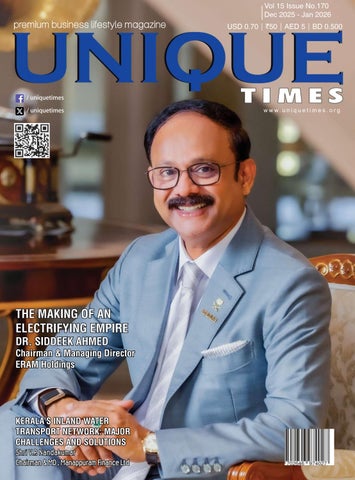
Vol 15 Issue No.170 Dec 2025 - Jan 2026 USD 0.70`50AED 5BD 0.500
THE MAKING OF AN ELECTRIFYING EMPIRE DR. SIDDEEK AHMED
Chairman & Managing Director ERAM Holdings
KERALA’S INLAND WATER TRANSPORT NETWORK: MAJOR CHALLENGES AND SOLUTIONS Shri V.P. Nandakumar Chairman & MD , Manappuram Finance Ltd
COMING SOON
LUXURY YOU CAN WEAR
CRAFTED IN EXTREME EXCLUSIVITY-A SINGLE MODEL, LIMITED TO JUST SIX PIECES WORLDWIDE www.alcazarwatches.com
Chief Mentor Mr. V.P. Nandakumar Director & CEO Jebitha Ajit Editor Ajit Ravi Legal Advisor Latha Anand B.S.Krishnan Associates bskrishnanassociates@gmail.com Sub-Editor Athulya Pradip Associate Editor Ravi Saini Anusha Varghese Correspondents Dr. Thomas Nechupadam Vivek Venugopal- Quarter Mile R L Morris Creative Design PEGASUS Photography PEGASUS Marketing USA 725, burning tree lane, punta gorda Florida-33982 Mob: +1 (863) 558-5234 UAE Jolly Tel: +971 50 307 1125 Vineeth Nair Shaji N Palakkal 415, Building 23, Al Khail Gate, Al Quoz-2, Dubai, UAE Tel: +9714 4511075 Maharashtra Jayasankar M a/101, New Prathamesh Niwas, OPP. Laxmi Park, Thakurli East, Dombivli post, Thane District, 421201 Mob: +91 9820708662 Tamil Nadu Sheelan Thangavelu Tamilnadu Director Mob: +91 7825-077770 Sri Shakthi Institute of Engineering and Technology, L&T- bypass, Chinniyapalayam, Coimbatore-62 Karnataka, Telangana, Andhrapradesh PEGASUS Ph: 09288800999 Sunilkumar NN Vice President Ambalika Saikia, Ambalika_saikia@yahoo.com Vice President V Suresh Kumar Public Relations
Published at Pegasus Global Pvt. Ltd. L5-106, Changampuzha Nagar Kalamassery, Ernakulam-682 033 e-mail: editor@uniquetimes.org uniquetimesindia@gmail.com Ph:0484 2532040, 2532080, Mob:9288800999
Editorial
“I
f you focus on results, you will never change. If you focus on change, you will get results.” – Jack Dixon At a time when progress is redefined daily, the true measure of leadership lies in how one adapts, innovates, and uplifts. Few embody this better than Siddeek Ahmed, whose journey reflects the quiet strength of continual reinvention. Rising from humble beginnings to leading a global enterprise that supports industries and empowers communities, his success stems from embracing challenges, learning from disruptions, and pursuing innovation with purpose. This month’s cover story highlights the resilience, vision, and far-reaching impact of changemaker Siddeek Ahmed, Chairman and Managing Director of ERAM Holdings, whose unwavering conviction demonstrates that meaningful transformation does more than deliver results—it shapes lasting legacies. In this month’s edition, V.P. Nandakumar, Chairman & MD of Manappuram Finance Limited, shares his expert insights on ‘Kerala’s Inland Water Transport Network: Key Challenges and the Way Forward.’ This issue also brings you all your favourite segments— from travel features and beauty tips to an engaging book review and a thoughtfully curated collection of inspiring business stories. “Reading is important. If you know how to read, then the whole world opens up to you.” – Barack Obama Have a joyful reading!
Cover Photograph Dr. Siddeek Ahmed Chairman & Managing Director, ERAM Holdings
Printer & publisher Pegasus Global Pvt. Ltd. Cochin (682033) on behalf of Ajit Ravi. Printed at S.T.Reddiar & Sons, P.B. No: 3627, Veekshanam Road, Cochin-18.
CONTENTS 14
14
Dr. Siddeek Ahmed: The Making Of An Electrifying Empire
22
BUSINESS
22
Kerala’s Inland Water Transport Network: Major Challenges And Solutions
24
Learning Management From The Concept Of ‘Unreasonable Hospitality’
28
Causative Factors And Early Warning Signs Of Brain Tumours
BUSINESS
24
CONTENTS FINANCE
50
30
MOTIVATION
30
The Unending Tussle: Supreme Court Strikes Down Tribunal Reforms Act, 2021 In Defence Of Judicial Independence
50
The Inner Revolution: The Unavoidable Journey From Shadow To Sovereignty
TRAVELOGUE
BEAUTY
60
58
58
Neem: The Ancient Green Warrior Redefined By Modern Science
60
Abode Of Peace
UNIQUE DIARY
HP Plans Major AI-Driven Restructuring, to Cut Up to 6,000 Jobs by 2028
H
P Inc. will lay off up to 6,000 employees worldwide by 2028 as part of an aggressive AI-driven overhaul aimed at automating operations, speeding up product development, and enhancing customer support, with CEO Enrique Lores estimating $1 billion in savings over three years. The move expands on layoffs announced in February, when 1,000–2,000 positions were cut under its ongoing restructuring strategy. The company is also dealing with rising component costs linked to soaring global demand for AI infrastructure, with analysts warning that higher DRAM and NAND prices could strain PC-maker profits. Lores noted that expenses will increase in the second half of fiscal 2026 despite sufficient early-year inventory. Financially, HP issued a cautious profit outlook for fiscal 2026 but exceeded expectations in Q4 with $14.64 billion in revenue.
Mahindra Launches XEV 9S Seven-Seater EV to Accelerate Expansion in India’s Electric SUV Market
"Growth is never by mere chance; it is the result of forces working together." James Cash Penney
8
Dec 2025 - Jan 2026
M
ahindra has unveiled its new seven-seater electric SUV, the XEV 9S, starting at around `20 lakh ($22,409), strengthening its push into India’s rapidly expanding EV market led by Tata Motors. The launch comes as EV sales in India surge past 100,000 units this year, a steep rise from just over 23,000 last year. Mahindra will invest an additional `20 billion in the XEV 9S and the updated BE 6, contributing to a `160 billion EV plan through fiscal 2027. Offered in six variants with a top-end 500 km range, the model opens for bookings on January 14. Analysts expect annual sales of 5,000–10,000 units due to limited seven-seater EV options. With EVs targeted to form 20% of Mahindra’s SUV sales by 2027, the company continues to expand capacity and attract new buyers amid intensifying competition.
EXPERT CARE AT YOUR DOORSTEP VPS Lakeshore brings specialised home-visit services to you
Services Offered Doctor & Nursing care at home
Pain & Palliative care
Home care for bedridden patients
Physiotherapy at home
Chronic pain management
Home sample collection
Regular check-ups & clinical assessments
Wound care, injections & tube management
Family counselling & support
Ambulance service
For more details 7594001208, 7592022082
Maradu I Nettoor P.O I Kochi | Kerala - 682040 +91 9961 640 000 - www.vpslakeshorehospital.com
UNIQUE DIARY
India’s Food Services Market to Hit $125 Billion by 2030, Led by Rapid Organised Sector Growth
I
ndia’s food services market is expected to grow from $78 billion to $125 billion by 2030, driven primarily by the fast-expanding organised segment, according to Swiggy’s “How India Eats” report with Kearney. While unorganised players still hold over half the market, organised food services are set to contribute more than 60% of future growth, expanding at twice the pace. Despite its size, the sector contributes just 1.9% to GDP—far lower than China and Brazil—leaving vast room for expansion fuelled by rising incomes, digital adoption and convenience demands. Swiggy CEO Rohit Kapoor noted the rise of ultra-fast services like Bolt, now 10% of orders, and strong growth in non-metro hubs. Key trends include surging latenight orders, rising demand for healthy meals, booming hyper-regional and global cuisines, and rapid expansion of QSRs and cloud kitchens.
OpenAI Launches Global Group Chats, Turning ChatGPT into a Collaborative Multi-User Workspace
"In the business world, the rearview mirror is always clearer than the windshield." Warren Buffett
10
Dec 2025 - Jan 2026
O
penAI has launched its new Group Chats feature globally for all ChatGPT users—Free, Go, Plus and Pro—shifting the platform from a one-to-one assistant to a shared collaborative space. After regional tests in countries like Japan and New Zealand, the feature now allows up to 20 participants to join a single chat through invitations or shared links. Users can create groups via the people icon and set brief profiles, while personal settings and memory remain private. ChatGPT can join discussions when tagged or provide summaries and suggestions as needed. OpenAI views this update as a significant step toward making ChatGPT more social, supporting teamwork, research, planning and debate. The rollout follows the introduction of GPT 5.1 in Instant and Thinking modes and Sora, an app for creating AI-powered short videos, reinforcing ChatGPT’s growing role in real-time collaboration.
Apple Challenges India’s Global Turnover Penalty Rule in Delhi High Court
A
pple Inc. has filed a writ petition in the Delhi High Court contesting provisions of India’s Competition Act that permit penalties to be based on a company’s global turnover. Scheduled for hearing on December 3, the petition argues that calculating fines using worldwide revenue violates Articles 14 and 21 of the Constitution, as penalties should reflect only the “relevant turnover” linked to the specific product or service under investigation. Apple has challenged the amended Section 27(b), which defines turnover as global and empowers the CCI to consider all products and services when imposing penalties. It also seeks to quash elements of the CCI’s confidentiality ring order and Penalty Guidelines. Citing the Supreme Court’s Excel Crop Care ruling, Apple contends that using global turnover for localised violations is disproportionate and legally unsound.
Google, Accel Partner to Fund Early-Stage AI Startups in India
"You don’t build a business, you build people, then people build the business." Zig Ziglar
A
lphabet’s Google and venture capital firm Accel have launched a new partnership to fund at least 10 early-stage AI startups in India, marking Google’s first co-investment initiative of this kind. Through the programme, Google’s AI Futures Fund and Accel will jointly invest up to $2 million per startup, targeting sectors such as entertainment, creativity, workplace productivity and coding. The initiative follows Google’s recent $15 billion commitment to build a major AI data centre in Andhra Pradesh, its largest investment in India so far. Google’s AI Futures Fund has already backed more than 30 global startups, including India’s Toonsutra, and collaborated with Jio to offer free Gemini AI to over 505 million users. Executives say Indian founders will significantly shape global tech, as India’s AI market heads toward $17 billion by 2027 amid surging worldwide AI spending.
Dec 2025 - Jan 2026
11
Legendary Italian Singer and ‘Ocean’s Twelve’ Voice Ornella Vanoni Dies at 91
L
egendary Italian singer Ornella Vanoni, whose timeless hit “L’appuntamento” gained global recognition after featuring in Ocean’s Twelve, has died at 91 at her home in Milan. Italian media reports say she passed away on 21st November, due to cardiac arrest. Born in 1934, Vanoni began her artistic career in theatre before rising to fame in the early 1960s as a singer. Over a remarkable 70-year career, she released around 40 studio albums and sold more than 55 million records, becoming one of Italy’s most enduring musical icons. Known for her emotional performances, distinctive voice and bold personality, Vanoni explored themes of love, heartbreak and social struggles in her music. Even in her later years, she remained active on talk shows and continued collaborating with younger artists.
Germany Sees Slight Lift in Consumer Sentiment Ahead of Christmas
G
ermany’s consumer sentiment is expected to improve slightly in December, supported by a rise in households’ willingness to spend on Christmas shopping despite ongoing worries over future income. The GfK and NIM consumer climate index increased to -23.2 from -24.1, reflecting a second consecutive month of stronger buying interest and reduced saving intentions. However, retailers remain cautious. An Ifo survey shows that one in four retailers expects weak Christmas sales, with only 10% anticipating strong results. The retail association HDE forecasts holiday season sales of €126.2 billion, signalling only modest growth. Despite the small improvement in spending sentiment, households remain uncertain about the future. Economic expectations fell again, with Germany’s GDP projected to grow just 0.2% in 2025 after two years of contraction. Toy retailers are among the most pessimistic, with half expecting worse sales than last year.
12
Dec 2025 - Jan 2026
Von der Leyen Says Russia Lacks “Real Intent” for Peace as EU Pushes for Stronger Role
E
uropean Commission President Ursula von der Leyen warned that Russia shows “no real intent” to pursue peace in Ukraine, calling the conflict “volatile” and “dangerous” during her address to the European Parliament. Her remarks came as the Kremlin labelled ongoing peace-deal discussions “premature,” even while the US ramps up mediation efforts in Geneva and Abu Dhabi. Ukraine has accepted the “essence” of a revised peace proposal, though major points of contention with Russia remain. Von der Leyen reaffirmed Europe’s strong backing for Ukraine and urged firm security guarantees to prevent future aggression. She also addressed debates over reallocating €210bn in frozen Russian assets, arguing legal concerns should not override political responsibility. EU leaders will decide later in December. Meanwhile, European governments expressed frustration at being excluded from recent US-led peace initiatives, which some say favour Russia.
Finland Remains World’s Happiest Country Despite Economic Struggles
F
inland has been named the world’s happiest country for the eighth year in a row, according to the World Happiness Report, even as it faces mounting economic challenges. Rising unemployment, slow growth, and pressure on public finances have strained the Nordic nation, but many citizens remain resilient. One example is 33-year-old Juho-Pekka Palomaa, unemployed for over 1,000 days, who credits Finland’s strong social safety net for helping him cope despite recent cuts to some welfare benefits. The country’s economy has struggled since Nokia’s decline in 2014, and further weakened due to Russia sanctions, disrupted trade, and reduced tourism. Growth is expected to reach only 0.3% this year, with unemployment near 10% and youth unemployment at 21.2%. Despite these challenges, protected pensions and a strong collaborative culture help maintain national well-being, supporting Finland’s consistent top ranking in global happiness.
For more info: europetimes.co
Dec 2025 - Jan 2026
13
COVER STORY COVERSTORY
DR. SIDDEEK AHMED: THE MAKING OF AN ELECTRIFYING EMPIRE A visionary entrepreneur’s journey from Kerala’s heartland to building one of the Middle East’s most dynamic power technology brands
I
n a world driven by innovation and the constant pursuit of progress, few leaders manage to balance business success with human purpose quite like Dr. Siddeek Ahmed, Chairman and Managing Director of ERAM Holdings. From a modest beginning in Kerala, India to leading a multi-billion-dollar conglomerate with over 40+ businesses across 9 verticals and operating in 16 countries, Dr. Siddeek’s story is not just about corporate growth — it’s about vision, resilience, and the power of believing that technology and humanity can progress hand in hand. He is also a passionate philanthropist, treating this facet of his life with the same dedication and drive that fuel his business pursuits. At the heart of this empire lies one of his most remarkable achievements - ERAM Power Electronics Company (EPEC) - a name that has quietly, yet powerfully, revolutionised the energy landscape across the Middle East, Africa & South Asia.
The Genesis of a Powerhouse It all began with a conviction. When Dr. Siddeek blended entrepreneurial foresight and industrial excellence to establish ERAM Group in 1990's, he wasn’t merely building another conglomerate; he was laying the foundation for a group that would merge innovation with impact. Over the years, the Group
14
Dec 2025 - Jan 2026
diversified into sectors such as Human Capital Management, Travel & Tourism, Automotive Dealerships, Manufacturing Research & Development, Healthcare Services, Industrial Support Services, Real Estate & Investments, Information Technology and Training & Skills Development; each contributing to his larger vision of localised excellence and global reach. Today, this legacy has evolved into ERAM Holdings, a globally respected organization driven by purpose, progress and transformative vision becoming a multi-billiondollar enterprise. However, 2011 marked a pivotal year. Driven by the desire to reduce dependency on imported technology and strengthen the Middle East’s self-reliance, Dr. Siddeek founded ERAM Power Electronics Company (EPEC) in Saudi Arabia, a company formerly known as, Arabian Power Electronics Company. What began as a regional initiative soon became a symbol of reliability and engineering mastery. “Our goal was clear - to create capability, not dependency,” he often says. “EPEC represents our belief that the future of energy lies in designing smarter, more resilient solutions for an evolving world.” Today, EPEC is not just a company, it’s an ecosystem of innovation. Its technologies power key sectors, including oil and gas facilities, airports, telecom networks, and utility
services. EPEC’s products stand the test of time and terrain.
ERAM Power Electronics: Engineering the Future (KSA & India) Amongst several success stories, ERAM Power Electronics Company (EPEC) stands out as a symbol of reliability and engineering mastery. Founded in 2011 in Saudi Arabia, EPEC was born from Dr. Siddeek’s vision to reduce dependence on imported technologies and enhance regional self-reliance. From industrial battery chargers and UPS systems to frequency converters and lithium batteries, EPEC’s products power vital infrastructure - oil and gas facilities, airports, telecoms, defense bases, and utilities - across the Middle East, Africa, and South Asia. EPEC is the first ‘Made in Saudi’ brand in power electronics with full localization capabilities, marking a significant milestone in the Kingdom’s industrial landscape. Saudi Arabia remains its strategic hub, where the company’s rugged, outdoor-rated chargers have set industry benchmarks. Meanwhile, EPEC’s CellWatt Lithium Batteries power more than 40,000 traffic cameras across Saudi Arabia, ensuring uninterrupted surveillance and safety. EPEC’s India operations in Pune serves as the Manufacturing Hub; and Bengaluru functioning as the
One of the most striking aspects of Ar. Aravind’s work is his ability to bring together elements that might seem contradictory. He embraces traditional Indian principles such as Vastu and divine proportions, while also incorporating the latest innovations in material technology, sustainability, and climate-sensitive design.
Today, EPEC is not just a company, it’s an ecosystem of innovation. Its technologies power key sectors, including oil and gas facilities, airports, telecom networks, and utility services. EPEC’s products stand the test of time and terrain.
Dec 2025 - Jan 2026
15
COVER STORY COVERSTORY Research & Development Center, continue to drive research, innovation, and advanced production. The Indian operations of EPEC are built on fully indigenous technology and the use of locally sourced materials. This ensures that every product delivered by EPEC India is a genuine and proud representation of the ‘Make in India’ initiative. The Center of Excellence is formally certified to the EN 9100:2018 aerospace quality standard (equivalent to AS9100D), as evidenced & certified by TÜV Rheinland, Germany. This recognition reflects an unwavering commitment to worldclass quality, safety, and reliability across all processes. The certification demonstrates full compliance with internationally established best practices in the design, development, manufacture, installation, and commissioning of power electronics solutions for commercial, industrial, defence, military, and aerospace applications. This prestigious benchmark further strengthens EPEC’s global credibility and reinforces the trust placed by customers and partners worldwide. EPEC collaborates with ISRO, DRDO, and RRCAT to develop mission-critical systems for space, nuclear, and defense applications. Recent breakthroughs include AI-integrated power systems and next-generation converters using SiC and Gallium Nitride semiconductors, reinforcing its global leadership in power technology.
Automotive Excellence: ERAM Motors (India) In Kerala, ERAM Motors reflects Dr. Siddeek’s dynamic vision for the automotive industry. As Kerala’s No.1 Mahindra & Mahindra vehicle dealer, ERAM Motors operates 32 touch points across North Kerala—from Thrissur to Kasaragod—employing over 1,500 professionals. The brand stands out for its strong market presence,
16
Dec 2025 - Jan 2026
customer-centric approach, and commitment to delivering industryleading service standards.
Driving Skill Development and Women Empowerment Complementing his contributions to the automotive sector, Dr. Siddeek has championed several impactful skill development initiatives aimed at empowering youth and women across Kerala. A notable example is the ‘Naari Chakra’ program, launched in collaboration with ASAP Kerala, ERAM Technologies, and Mahindra & Mahindra. This pioneering 60-day training initiative, inaugurated by Kerala’s Higher Education Minister Dr. R. Bindu, equips women aged 18–35 with specialized automotive skills and ensures 100% placement. The program represents a major step forward in fostering gender inclusion and creating new opportunities in the auto industry.
Engineering Trust: A Legacy of Quality Every EPEC product is a promise - designed to deliver uninterrupted power, tested to withstand real-world extremes, and certified to international standards. The company’s ISO 17025-accredited laboratory ensures each system meets rigorous performance criteria before it ever reaches a client site. Whether it’s a UPS in a hospital or a converter in a fighter jet hangar, failure is not an option. ‘Reliability is our DNA,’ says Jacob Thomas, CEO of ERAM Power Electronics. “At EPEC, we engineer not just power systems, but trust. Every circuit, every wire, every weld reflects a commitment to perfection. Our vision is to redefine what uninterrupted power means, empowering industries, defense, and infrastructure to operate without limits.” That commitment has earned EPEC partnerships and projects across Saudi Arabia, UAE, Qatar, Bahrain, Oman, Kuwait, India
Healing Lives: Dar As Sihha Medical Center (KSA) Under the leaders h i p o f D r. S i d d e e k ’ s son, Rizwan Ahamed, Vice Chairman of the Board and Executive Director of ERAM Holdings, Dar As Sihha Medical Center stands as one of the region’s largest healthcare networks. With clinics in Dammam & Al Khobar, it caters to over 1,500 - 2,000 outpatients daily, supported by 350 - 400 health care professionals. Dar As Sihha is an approved training center accredited by the Saudi Heart Association and the American Heart Association to provide First Aid/Heart Saver training and Basic Life Support training. What sets Dar As Sihha apart is its specialised license to operate remote site medical units in critical oil & gas zones - a privilege held by very few institutions, including those approved by Johns Hopkins Aramco Healthcare accredited medical centres. These units include doctors, paramedics, ambulances, pharmacies, medical equipment and supplies, medical waste disposal services, and remote area clinic audit services, ensuring comprehensive on-site healthcare for industrial sectors across Saudi Arabia.
and Africa, firmly establishing it as a global name in intelligent power solutions.
A Global Vision Anchored in Local Values Beyond business success, what makes ERAM Holdings truly extraordinary is its commitment to people - a principle that Dr. Siddeek carries deeply. Aligned with Saudi Vision 2030, India’s ‘Make in India’ initiative, and the UAE’s National ICV Programme,
ERAM Holdings’ core philosophy is simple yet powerful - “localisation with global excellence.” This vision has led to the creation of over 12,000 jobs across 20 nationalities and established manufacturing and training facilities that strengthen local economies. ERAM’s ventures are not just profit-driven, they are purpose-driven.
Empowering Minds: The ERAM Skill Academy (India)
Back in his home state of Kerala, Dr. Siddeek’s vision takes a more human form through the ERAM Skill Academy - a world-class technical training institution designed to bridge the gap between education and employability. Recognised as a Centre of Excellence by the Kerala Academy for Skills Excellence (KASE) and accredited by the National Skill Development Corporation (NSDC), ERAM Skill Academy is a premier
Dec 2025 - Jan 2026
17
COVER STORY COVERSTORY
Making Each Journey A Memorable Experience : ITL World ERAM’s Travel Division ITL World is among the top rated & award winning travel management companies in the GCC, offering a diverse portfolio across its parent and sub-brands. Established in the early 1990s on the Indian Subcontinent, ITL World expanded into the GCC with its first office in Dubai in 2006 and later into Saudi Arabia in 2008 with rapid growth across various verticals including business travel, holidays, MICE (meetings, incentives, conferences & exhibitions). Today ITL World manages a strong client network across various industries along with its global partner – CTM (Corporate Travel Management) whom ITL World represents across the GCC for the last decade. In June 2024, the company entered a collaboration with Explora Journeys to offer luxury cruise experiences. Its educational travel brand, EduVoyage, conducts expeditions to NASA and other international global centres of excellence, inspiring young minds through global exposure and experiential learning. institution in advanced technical training, further strengthened by certifications from the STED Council and CPD (UK) that ensure global standards in vocational education. Situated on a 50,000 sq. ft. stateof-the-art campus, the Academy features cutting-edge simulation labs, industry-grade machinery, specialised safety training zones, and modern, technology-enabled classrooms that replicate real industrial environments - providing students with immersive, hands-on learning and equipping them to excel confidently in the global workforce from day one. It is also aligned with Saudi Arabia’s approved Skill Verification Program (SVP), offering internationally recognised certifications that strengthen employability and
support career advancement. The Academy’s social impact is profound—reaching communities that need support the most. Through government partnerships, it provides free and subsidised training programs, helping underprivileged youth build sustainable livelihoods. For Dr. Siddeek, this initiative is all about empowerment. “Empowerment starts with opportunity,” he says. “When one person gains a skill, a family gains stability. When communities gain skills, nations thrive.”
The WHO Collaboration: Saving Lives through Skills Furthering his mission of empowerment, Dr. Siddeek has expanded his charitable initiatives into the field of health education. Through the ERAM Educational &
An inside view of the EPEC facility in Saudi Arabia
18
Dec 2025 - Jan 2026
Welfare Trust, in collaboration with the WHO Collaborating Centre for Emergency & Trauma Care (WHO CCET) at AIIMS, New Delhi, the Trust launched SATYAM (Student Augmented Training for Youth Amplification)—a transformative programme designed to equip students with essential first aid, CPR, and emergency response skills. By enabling young people to act confidently during time-critical situations, SATYAM plays a key role in building safer, more resilient communities. The pilot programme conducted in Kanjikode, Palakkad, successfully trained over 200 students from tribal and local schools, all of whom received certificates bearing the WHO logo. This initiative
Mariyumma Memorial Public School
Foodco Delicacies India Pvt. Ltd.: Whetting the Palate Established in 2005 in Kerala, Foodco Delicacies India Pvt. Ltd., a venture of ERAM Holdings, is a multifaceted exporter of frozen foods, vegetables & seafood, and ready-toeat Indian ethnic delicacies. With coveted certifications - including FDA, and European Union licenses - the company exports premium products to markets in America, Europe and Asia, aiming at becoming one of India’s most trusted food exporters. strengthens community health and emergency preparedness across Kerala, while directly contributing to global development priorities. It supports SDG 3 by helping reduce preventable deaths through timely first response, reinforces SDG 11 by fostering emergency-ready and safer communities, and advances SDG 17 through strong local partnerships that enable sustainable impact. In simple words, we empower citizens to save lives.
Healing the Earth: The Water Warrior of Palakkad Beyond boardrooms and factories, Dr. Siddeek’s compassion flows into the rivers and wells of his homeland. In Palakkad, Kerala, he has led large-scale water conservation projects that have transformed thousands of lives. When the Bharathappuzha River (Nila) - Kerala’s second-longest, began drying up, Dr. Siddeek stepped
in. Under his leadership, ERAM Holdings replaced damaged river shutters with durable iron structures, renovated 100+ wells, and revived 141 ponds across five rural governing bodies. The results were dramatic: improved irrigation for farmers, restored groundwater, and rejuvenated ecosystems. Over 5,000 families benefited directly. The initiative, executed with Mahatma Gandhi National Rural Employment Guarantee Scheme (MGNREGS) and local communities, has become a model for sustainable CSR in India. His campaign, ‘Save Water, Save Earth’ now inspires environmental efforts across the region. ERAM Holdings even produced a documentary, ‘H2O - Human to Ocean’, which is being screened in educational institutions to raise awareness about water conservation
among youth.
The Man Behind the Mission Despite the scale of his empire, Dr. Siddeek remains grounded in humility. A graduate of the Owner / President Management Program at Harvard Business School, he combines academic precision with intuitive leadership. He serves as Co-Chair of the FICCI Arab Council, representing India on global economic platforms. He has been honoured with the Pravasi Bharatiya Samman Award (2021)—the highest recognition for overseas Indians—and consistently features among Forbes Middle East’s Top 20 Business Leaders in the Arab World. His relentless determination and commitment to social upliftment continue to earn him global recognition. Yet, those who know him describe him as a listener first, leader
Dec 2025 - Jan 2026
19
Indian Ambassador Dr. Ausaf Sayeed presents the award to Eram Group Chairman Dr. Siddeek Ahmed (center) in Riyadh. On the left is Dr. Ahmed’s wife Nushaiba.
second. His leadership philosophy revolves around trust, empowerment, and authenticity. “A true leader,” he says, “is one who builds more leaders.” He attributes much of his strength to his family, his spouse, Nushaiba, and their three children Rizana Mariyam, Rizwi Mariyam & Rizwan Ahamed - who continue to inspire his sense of balance between ambition & empathy. Dr. Siddeek’s dedication to education extends through five institutions nurturing over 3,000 students, including Mariyumma Memorial Public School, Higher Secondary School, Teachers Training Institute and ERAM Academy for Sports and Excellence (EASE). These schools embody his vision of holistic education that shapes both intellect and character. Named in memory of his late mother, Mariyumma, they stand as a lasting tribute to his roots and values.
The Road Ahead As the world races toward renewable energy and intelligent automation, ERAM Power Electronics
20
Dec 2025 - Jan 2026
is poised for exponential growth. Its upcoming innovations include next-generation converters based on cutting-edge semiconductor materials. ERAM Power Electronics continues to strengthen its culture of unity and shared purpose through flagship events like the Annual Day & Power Conference 2025. The gathering celebrates teamwork, innovation and collective achievements under the theme ‘One Team, One Energy’. Such events embody the company’s commitment to fostering collaboration and recognising the people who power its growth. EPEC also plans to expand manufacturing and integration facilities in India to cater to the South Asian market, while continuing to strengthen its GCC operations. The company also envisions new collaborations in defense and aerospace - further cementing its reputation as a trusted energy partner worldwide. For Dr. Siddeek, however, the destination is not dominance but difference. “Our goal is not just to
ERAM Power Electronics continues to strengthen its culture of unity and shared purpose through flagship events like the Annual Day & Power Conference 2025. The gathering celebrates teamwork, innovation and collective achievements under the theme ‘One Team, One Energy’.
create technology, but to create capability,” he says. “To empower nations, industries and communities through innovation and reliability.” In a world that often measures success in profits, Dr. Siddeek measures it in progress - in the youth trained, the rivers revived and the power systems that keep the world moving.
A Legacy of Purpose From a small town in Kerala to the global stage, Dr. Siddeek Ahmed’s journey is a masterclass in leadership - not the loud, commanding kind, but the purposeful, compassionate kind that quietly changes lives. ERAM Power Electronics may deal in energy systems, but its true strength lies in something far more powerful - human energy - the belief that progress is meaningful only when it uplifts people and preserves the planet. And as the lights of EPEC’s innovation glow across continents, one truth shines brighter than ever: Real power isn’t in what you create, it’s in how many lives it empowers
BUSINESS
Kerala’s extremely high population density makes expansion of the existing road network a formidable challenge. National Highways Authority of India (NHAI) widening projects frequently face delays arising from land acquisition costs and displacement concerns. Although conditions have improved marginally in recent years, road expansion remains a major bottleneck. Shri V.P.Nandakumar Chairman & MD Manappuram Finance Ltd
KERALA’S INLAND WATER TRANSPORT NETWORK: MAJOR CHALLENGES AND SOLUTIONS
K
erala enjoys the unique advantage of a 590-km coastline and nearly 1,687 km of inland water transport (IWT) routes. The network comprises the main arterial West Coast Canal (WCC) and several feeder canals. The Kovalam–Bekal WCC, which forms part of National Waterway-3, connects Kasaragod in the north to Kovalam in the south, covering approximately 616 km as per current alignment plans. Kerala’s IWT system includes rivers, canals, and backwaters. Historically, these waterways played a pivotal role in the state’s trade and commerce, carrying people and goods from the hilly regions to the western coast. The mode offered natural advantages over early road
22
Dec 2025 - Jan 2026
and rail systems. Even today, IWT remains the most energy- and costefficient means of transport, ideally suited for cargo movement and, in many regions, for human mobility. The network continues to hold immense potential for passenger services, tourism, and freight operations. Its backbone comprises 41 west-flowing rivers originating in the Western Ghats and feeding into extensive backwaters. Navigable rivers constitute roughly half of Kerala’s total waterways, which are further interlinked through inland canals.
Why Water Transport Matters Now More Than Ever Kerala’s extremely high population density makes expansion of the existing road network a formidable challenge. National Highways Au-
thority of India (NHAI) widening projects frequently face delays arising from land acquisition costs and displacement concerns. Although conditions have improved marginally in recent years, road expansion remains a major bottleneck. Compounding this is Kerala’s unusually high automobile density—particularly two-wheelers and light motor vehicles. As a consumption-driven economy, the state has witnessed consistent year-on-year growth in vehicle sales. The combination of high population, high vehicle ownership, and traffic congestion leaves limited scope for further road widening. Railway development faces similar constraints. Land availability and resettlement challenges slow down
expansion plans and make new alignments difficult to execute. Against this backdrop, water transport emerges as a compelling solution to ease congestion on both road and rail. Water-based mobility has two components—inland water transport and coastal shipping. When integrated, both offer safe, green, and economical alternatives for moving people and cargo. The success of the Kochi Water Metro stands as a strong example.
Progress and Persistent Gaps The perspective plans of the Kerala Government have outlined a long-term roadmap for developing the IWT system. While notable progress has been achieved—such as upgrading canal stretches, modernising the fleet, establishing the State Maritime Board, and setting up training centres—several critical gaps remain. These include the expansion of feeder canals, systematic dredging, and the revival of old
ports and terminals. Customs clearance facilities envisaged for inland ports and terminals have yet to be realised.
Infrastructure Bottlenecks along the Waterways Many feeder canals suffer from navigational constraints such as shallow depths, narrow summer channels, siltation, bank erosion, and inadequate terminal infrastructure. The WCC itself is not fully operational owing to such bottlenecks. There are, however, promising developments. The Akkulam–Chettuva stretch of the WCC is expected to become operational by December 2025 or early 2026, supported by an investment of about `300 crore to ensure navigability. Phase II—focused primarily on land acquisition and rehabilitation—is progressing. Kerala hosts two major ports, at Vallarpadam (Kochi) and Vizhinjam (Thiruvananthapuram), along with 16 non-major ports. With the
commissioning of the Vizhinjam International Seaport, the relevance of inland waterways has increased substantially. Kerala also possesses several all-weather canals that remain navigable even during summer, providing excellent continuity for year-round operations.
The Way Forward: Funding and Sustainability For Kerala’s IWT system to evolve into a fully functional, commercially viable mode of transport, the network must first be developed to a threshold level through public investment, which will in turn attract private capital. Innovative financing options—such as KIIFB and foreign investment—can be effectively leveraged. Importantly, IWT projects qualify for green funding, as they reduce the carbon footprint by shifting portions of passenger and freight movement from fuel-intensive road and rail networks to environmentally friendly waterways
Dec 2025 - Jan 2026
23
BUSINESS
Rajesh Nair Partner, Ernst & Young LLP
For managers, students, and entrepreneurs, Will Guidara’s idea is not about random theatrics; it is a sys tematic way to build teams, design experiences, and run operations so that emotional connection becomes a deliberate competitive advantage.
LEARNING MANAGEMENT FROM THE CONCEPT OF ‘UNREASONABLE HOSPITALITY’
U
nreasonable hospitality is the discipline of giving people far more care, attention, and personalisation than they expect, so they feel profoundly seen and valued as human beings, not just as “customers.” For managers, students, and entrepreneurs, Will Guidara’s idea is not about random theatrics; it is a systematic way to build teams, design experiences, and run operations so that emotional connection becomes a deliberate competitive advantage.
From Service to Hospitality • Guidara distinguishes “service” as doing things right and “hospitality” as making people feel right. Service is about accuracy and efficiency; hospitality is about emotion, memory, and meaning. • In a world where products and processes can be copied, he argues that unreasonable hospitality becomes the new battleground for differentiation, loyalty, and word of mouth growth. For leaders outside restaurants, this means reframing your business as being in “the business of creating happiness,” regardless of industry, and treating every interaction as an
24
Dec 2025 - Jan 2026
opportunity to create a story people will retell.
tation process emerges that leaders can adapt to any business:
Core Principles of Unreasonable Hospitality
1. Clarify the Hospitality Intent
Several recurring principles from Guidara’s work are highly relevant to managers and entrepreneurs: • Go beyond expectations: The goal is not to meet stated needs but to surprise people with thoughtful, context specific gestures that feel “unreasonably” personal. • Treat people as unique individuals: This requires curiosity, noticing small details, and tailoring experiences instead of delivering generic scripted service. • Create memorable “wow” moments: Guidara recommends designing simple but emotionally powerful moments that guests will remember and share, often costing far less than their perceived value. He also stresses that hospitality must start with employees: teams that feel seen, trusted, and cared for are far more likely to extend the same generosity to customers.
• Define your non negotiable values and make hospitality explicit within them, as he did with simple core values like hospitality, excellence, education, and passion. • Translate these into a simple promise (for example, “we create moments people will talk about”), so every team member understands the true goal beyond revenue or efficiency.
The Process: How Will Recommends You Do It While Guidara tells stories more than frameworks, a clear implemen-
2. Be Present and Practice Radical Observation • Guidara argues that the first skill of unreasonable hospitality is presence: caring so much about the person in front of you that you stop being distracted by everything else. • Leaders should train teams to observe micro signals—preferences, comments, frustrations—and to treat them as design inputs for small, tailored gestures rather than noise.
3. Systematise “Wow” Moments • At Eleven Madison Park he used tools like a “wow file” to collect ideas and examples of special
touches that could be repurposed in new contexts. • For managers, this translates into designing a playbook of scalable, on brand gestures for key moments in the customer and employee journey (onboarding, renewals, escalations, project milestones, etc.).
4. Empower Teams to Say “Yes”
mentation. • Leaders are expected to “take care of employees the way you want them to care for customers,” with recognition, growth, and empathy built into the operating cadence, not treated as extras.
6. Obsess Over Details and the “Last Inch”
5. Make Hospitality a Management System
• Guidara describes a “one inch rule”: the last inch of any experience (for example, how a plate is set down, how a project debrief is closed, how a bill is presented) often defines how the entire interaction is remembered. • For management professionals, this means designing and rehearsing the closing beats of meetings, presentations, hand offs, and support interactions so they land with clarity and warmth, not just efficiency.
• He links hospitality to daily leadership: pre-shift huddles, feedback rituals, and coaching moments are used to reinforce stories of great hospitality and to normalize experi-
• For management professionals: Unreasonable hospitality becomes a
• Unreasonable hospitality only works if frontline people have permission and budget to act without asking for multiple approvals. • Guidara is famous for the “95/5 rule”: manage 95% of costs down to the penny, but reserve about 5% to spend “foolishly” on gestures that create disproportionate emotional impact.
Implications for Managers, Students, and Entrepreneurs
lens for account management, stakeholder engagement, and internal leadership—turning routine touchpoints into trust building moments that differentiate you in crowded markets like consulting or professional services. • For management students: It reframes leadership as a human, not just analytical, discipline, where emotional intelligence, curiosity, and generosity are as important as models and metrics. • For entrepreneurs: It offers a practical strategy to compete with larger players by building a hospitality first culture that wins on loyalty, advocacy, and brand love rather than pure price or product features. Ultimately, Guidara’s message is that “unreasonable” care is not soft; it is a rigorous, teachable management practice that, when embedded into values, systems, and budgets, can transform both the experience you deliver and the economics of your business.
Dec 2025 - Jan 2026
25
BUSINESS Seven practical steps to inculcate unreasonable hospitality in a team are: anchor it in values, start with your people, teach presence and observation, build rituals, empower “yes,” normalise feedback, and celebrate unreasonable moments. These steps translate Will Guidara’s philosophy into a repeatable operating system rather than one off stunts.
1. Codify the Hospitality Standard • Co create 3–5 core values with your team that explicitly include hospitality (e.g., hospitality, excellence, education, passion) so everyone knows that making others feel seen is non negotiable, not optional “nice to have.” • Translate these values into simple behavioural rules of thumb (for example, “every interaction should leave the other person better than we found them”) and use them in hiring, promotions, and per-
26
Dec 2025 - Jan 2026
formance reviews.
surprise and delight.
2. Start With Your Own Team
4. Design Simple Daily Rituals
• Unreasonable hospitality externally requires unreasonable care internally, so focus first on how leaders listen to, recognise, and support employees. • Build small internal rituals— personalized onboarding, regular appreciation, checking in before burnout—that model the level of attention you want people to extend to customers.
• Introduce a short daily or per shift huddle to align on guests, clients, or stakeholders for the day, share hospitality stories, and set one small “surprise and delight” intention per person. • Use these huddles to reinforce standards, preview potential friction points, and assign ownership of critical touchpoints along the customer journey.
3. Train Presence and Radical Observation
5. Empower People to Say “Yes”
• Teach people to slow down, be present, and notice details about colleagues and customers—unspoken needs, offhand comments, emotional cues—because every “wow” moment starts with observation. • In team meetings, debrief specific examples of needs that were anticipated (or missed) so the team learns to scan for opportunities to
• Give clear permission and modest budget for frontline staff to make on the spot decisions that elevate the experience (a version of Guidara’s idea of reserving a small percentage of costs for “unreasonable” gestures). • Remove bureaucratic hurdles: define thresholds under which no approval is needed, and explicitly
While most of the elements of hospitality seems build around the restaurants and hotels, anticipating requirements and exciting clients is fundamental to what management principles focus on.
praise calculated risks taken in the spirit of hospitality, even if they are imperfect.
6. Normalize Real Time Feedback and Coaching • Make feedback a natural, frequent practice: praise in public, coach in private, criticize behaviours not people, and be willing as a leader to admit mistakes and apologize. • Use feedback sessions to tune behaviours toward the hospitality standard—highlight micro
moments where someone made another person feel especially seen, and dissect what made it work.
7. Capture, Celebrate, and Scale “Unreasonable” Moments • Create a visible “wow file” or shared log where team members document stories of above and beyond gestures for both customers and colleagues. • Regularly review these stories in huddles and town halls to
celebrate contributors, extract patterns, and turn the best ideas into repeatable plays at key customer journey touchpoints. While most of the elements of hospitality seems build around the restaurants and hotels, anticipating requirements and exciting clients is fundamental to what management principles focus on. These are foundational to what mindsets we inculcate as management professionals and what we strive for
Dec 2025 - Jan 2026
27
HEALTH
Dr Arun Oommen MBBS, MS (General surgery), Mch (Neurosurgery, MRCS Ed (UK), MBA (Hospital administration). D Litt(h), DSc(h), PhD(h), ENLS. DMS Senior Consultant Neurosurgeon VPS Lakeshore Hospital. Kochi
The best known environmental risk factor for brain tumours is radiation exposure, most often from radiation therapy to treat some other condition, for e.g. leukemia.
State Secretary. Neurological society of IndiaKerala Chapter www.arunoommen.com
CAUSATIVE FACTORS AND EARLY WARNING SIGNS OF BRAIN TUMOURS
M
ost brain tumours are not linked with any known risk factors and have no obvious cause. But there are a few factors that can raise the risk of brain tumours.
Radiation Exposure The best known environmental risk factor for brain tumours is radiation exposure, most often from radiation therapy to treat some other condition, for e.g. leukemia. These brain tumours usually develop around 10 to 15 years after the radiation. Radiation-induced tumours are still fairly rare. The possible risk from exposure to imaging tests, such as X-rays or CT scans, is not known for sure. However the risk is negligibly small.
Immune System Disorders and Drug Induced People with impaired immune
28
Dec 2025 - Jan 2026
systems have an increased risk of developing lymphomas (cancers of lymphocytes ) of the brain or spinal cord. Giving the cancer drug methotrexate into the fluid around the spinal cord (intrathecal methotrexate) for the treatment of leukemia has been shown to marginally increase the risk of brain tumours. Post-menopausal women who are taking hormone replacement therapy (HRT) or oral contraceptives may have a slightly increased risk of developing meningioma, but more research is needed to confirm this.
Family History In rare cases (5%) brain cancers run in families and usually occur first when they are young. Some of these include Neurofibromatosis, Tuberous sclerosis, Von Hippel-Lindau disease etc.
Other Factors Environmental factors such as exposure to solvents, pesticides, oil products, rubber, or vinyl chloride (a chemical used to manufacture plastics), petroleum products, and certain other chemicals have been linked with an increased risk of brain tumours. Exposure to aspartame (a sugar substitute) and infection with certain viruses (EB virus, human CMV, polyoma virus) have been suggested as possible risk factors.
Factors With Uncertain, Controversial, or Unproven Effects on Brain Tumour Risk Cell Phone Use Cell phones give off radiofrequency (RF) rays, a form of energy on the electromagnetic spectrum between FM radio waves and those
used in microwave ovens, radar, and satellite stations. RF rays have not been proved to induce cancer. And at the same time, RF rays have not been proved to be absolutely safe. Cell phones do not give off ionising radiation, the type that can cause cancer by damaging the DNA. In 2011, the International Agency for Research on Cancer (IARC) classified mobile phone radiation as Group 2B - possibly carcinogenic. That means that they should be used with caution. So additional research needs to be conducted.
Diet, Smoking and Alcohol Dietary N-nitroso compounds may raise the risk of both childhood and adult brain tumours. Dietary N-nitroso compounds are formed
in the body from nitrites or nitrates found in some cured meats, cigarette smoke, and cosmetics. Drinking alcohol doesn't seem to affect risk.
Warning Signals Tumours produce symptoms either due to compression or irritation of brain 1. Headache occurring in later onset of life and gradually increasing in intensity. There can be a constant aching pain without any pain-free period in between. Usually, Headache is maximum in the morning and the victim wakes up with severe headache. 2. Projectile vomiting mostly on waking up in the morning. Here the vomiting will not be preceded by
nausea. Vomiting offers temporary relief to the headache. 3. New onset seizures can be focal seizures (More significant) involving only part of the body or it can be generalised seizures. 4. Weakness or numbness progressively increasing and can involve only one limb or one side of the body. 5. Visual problems especially when it involves the optic nerve (nerve of vision) or pituitary gland. 6. Cognitive problems occurring suddenly like memory problems, behavioral changes, language problems, confusions etc. 7. Difficulty in speech, sudden Gait disturbances, imbalance in coordination or weakness of facial muscles
Dec 2025 - Jan 2026
29
FINANCE
Adv Sherry Samuel Oommen: This article is authored by Adv Sherry Samuel Oommen. He specialises in the Constitution, tax and corporate laws and has also cleared the final exams of the Institute of Chartered Accountants of India, the Institute of Cost Accountants of India and the Institute of Company Secretaries of India. He has also completed his Masters's Degree in Commerce, apart from obtaining a Post Graduate Diploma in Business and Corporate Laws from Symbiosis, Pune. The views expressly are personal and should not be construed as a legal opinion. sherryoommen@nashcp.com.
THE UNENDING TUSSLE: SUPREME COURT STRIKES DOWN TRIBUNAL REFORMS ACT, 2021 IN DEFENCE OF JUDICIAL INDEPENDENCE Introduction In a landmark judgment delivered on November 19, 2025, a Supreme Court Bench comprising Chief Justice of India B.R. Gavai and Justice K. Vinod Chandran struck down the Tribunals Reforms Act, 2021 (the "Impugned Act") as unconstitutional. The case of Madras Bar Association v. Union of India, 2025 SCC OnLine SC 2498, represents the latest, and perhaps most definitive, chapter in a protracted constitutional dialogue spanning over three decades concerning the independence, structure, and functioning of tribunals in India. The Court’s decision reaffirms a foundational principle of Indian constitutionalism: the supremacy of
the Constitution over all organs of the State. The judgment is a stern reprimand to the legislature for its repeated attempts to nullify judicial directives through legislative re-enactment, a practice the Court condemned as an "impermissible legislative override." Justice Chandran’s pithy concurring opinion— "old wine in a new bottle, the wine whets not the judicial palette, but the bottle merely dazzle"—perfectly encapsulates the Court’s view of the Impugned Act as a mere repackaging of provisions previously declared unconstitutional. This article delves into the background of the case, the contentions of the parties, the Court’s detailed reasoning, and the profound impli-
cations of this judgment for the doctrine of separation of powers and the rule of law in India.
The Backdrop: A Long Line of Jurisprudence To fully grasp the profound significance of the 2025 judgment, one must embark on a journey through the long and intricate evolutionary arc of the Supreme Court’s tribunals jurisprudence, a narrative meticulously chronicled in the Court's own opinion. This story begins with the introduction of tribunals into the Indian legal framework via the 42nd Constitutional Amendment in 1976, which added Part XIV-A to the Constitution. The stated goal was to ensure specialized, efficient adjudication and the speedy resolution of
The judgment is a stern reprimand to the legislature for its repeated attempts to nullify judicial directives through legislative re-enactment, a practice the Court condemned as an "impermissible legislative override."
30
Dec 2025 - Jan 2026
disputes. However, this initial optimism soon gave way to a series of constitutional challenges that would shape the core principles of tribunal independence over the ensuing decades. The foundational stone was laid in S.P. Sampath Kumar v. Union of India (1987) 1 SCC 124. In this case, the Court, while upholding the constitutional validity of administrative tribunals, issued a crucial caveat: a tribunal must be a "real substitute" for the High Court, not just in form but in content and actual practice. The Court expressed deep skepticism about short tenures, observing that a term of only five years would act as a deterrent to attracting competent candidates, particularly from younger age groups, and would hinder the development of expertise. The journey continued with the seminal seven-judge bench decision in L. Chandra Kumar v. Union of India (1997) 3 SCC 261, which constituted a critical corrective. The
Court decisively held that the power of judicial superintendence vested in High Courts under Articles 226 and 227 of the Constitution is part of its basic structure. Consequently, it struck down statutory provisions that entirely excluded the jurisdiction of the High Courts over tribunals. This judgment also planted the seed for a major structural reform by suggesting the creation of an independent "umbrella organization" to oversee the administration of tribunals, thereby insulating them from the control of their parent ministries. The jurisprudence matured significantly with the Constitution Bench ruling in Union of India v. R. Gandhi, President, Madras Bar Association (2010) 11 SCC 1, commonly known as MBA (I). This judgment delivered a powerful critique of the executive's pervasive influence, underscoring that tribunals could not function as independent quasi-judicial bodies if they remained dependent on their "sponsoring department"
for infrastructure, funding, and appointments. The Court warned that without comprehensive reform ensuring structural independence, Indian tribunals would remain quasi-executive bodies, incapable of fulfilling their constitutional purpose. The confrontation intensified in Rojer Mathew v. South Indian Bank (2020) 6 SCC 1, where another Constitution Bench scrutinized the Tribunals Rules, 2017. The Court struck down these rules for enabling excessive executive control, particularly through selection committees dominated by government nominees. The majority emphatically declared that the independence of tribunals is an inviolable feature of the basic structure of the Constitution, a principle that Justice D.Y. Chandrachud, in his concurring opinion, powerfully anchored to the doctrine of constitutional supremacy. This line of reasoning culminated in the comprehensive directives issued in Madras Bar Association v.
Dec 2025 - Jan 2026
31
FINANCE
The Court’s jurisprudence from Sampath Kumar to MBA (V) has evolved specific constitutional benchmarks for tribunals, which are as enforceable as any explicit fundamental right. Union of India (2021) 7 SCC 369, or MBA (IV). Here, the Court, exasperated by the government's persistent non-compliance, laid down a detailed blueprint for tribunal independence. Its directions mandated a five-year tenure for members (or until they attained the age of sixty-seven or seventy), ensured judicial dominance in the Searchcum-Selection Committees (SCSCs) by granting the CJI's nominee a casting vote, made advocates with ten years of experience eligible for appointment as judicial members, stipulated enhanced House Rent Allowance (HRA) to attract qualified candidates, and reiterated the urgent need to establish a National Tribunals Commission. However, in a move that the Supreme Court would later characterize as defiant, the government responded to MBA (IV) not with compliance, but with the Tribunal Reforms Ordinance, 2021. This
32
Dec 2025 - Jan 2026
ordinance brazenly reintroduced the very provisions the Court had rejected: a truncated four-year tenure, a minimum age of fifty for appointment, and a requirement for the SCSC to recommend a panel of two names, thereby granting the executive a choice. This Ordinance was promptly struck down in MBA (V) (2022) for being an "impermissible legislative override." Unyielding, Parliament then enacted the Tribunal Reforms Act, 2021, which contained provisions virtually identical to the stricken Ordinance, setting the stage for the final, decisive confrontation in the present 2025 judgment.
The Court’s Reasoning: A Resounding Reaffirmation of Constitutional Supremacy The Supreme Court systematically rejected the Union's arguments and provided a robust exposition of constitutional principles.
1. Constitutional Supremacy, Not Parliamentary Sovereignty: The Court firmly rejected the notion of unqualified parliamentary sovereignty. It reiterated that the Indian Constitution establishes a system of constitutional supremacy. Quoting from Kesavananda Bharati and other precedents, the Court held that every organ of the State, including Parliament, derives its authority from the Constitution and must operate within its limits. The power to determine these limits is vested in the judiciary through judicial review, a basic feature of the Constitution. 2. The Permissible Limits of Legislative Response: The Court clarified that while Parliament cannot be compelled to legislate, any law it enacts is subject to judicial review. Crucially, the Court distinguished between a permissible "curative legislation" and an
impermissible "legislative override." • Permissible: Parliament can cure the defect identified by the Court by altering the law to remove its unconstitutionality. • Impermissible: Parliament cannot simply re-enact the same or substantially similar provision to nullify a judicial decision without curing the underlying defect. This amounts to a "colourable legislation" and violates the separation of powers. 3. Structural Principles are Not 'Abstract': The Court emphatically rejected the argument that separation of powers and judicial independence are vague concepts. It held that these are concrete, justiciable principles embedded in the Constitution's text and spirit, particularly in Articles 32, 136, 226, and 227. Since tribunals discharge judicial functions, their design must ensure the same standards of independence, impartiality, and competence as the traditional judiciary. The Court’s jurisprudence from Sampath Kumar to MBA (V)
has evolved specific constitutional benchmarks for tribunals, which are as enforceable as any explicit fundamental right. 4. The Impugned Act: An "Old Wine in a New Bottle": The Court conducted a clauseby-clause comparison of the 2021 Ordinance (struck down in MBA (V)) and the Impugned Act. It found that the offending provisions were reproduced verbatim or with insignificant changes: • Section 3(1): Reintroduced the minimum age of 50. • Section 3(7): Mandated a panel of two names for each vacancy. • Section 5: Prescribed a truncated four-year tenure. • Section 7(1): Pegged allowances to those of equivalent Central Government officers. The Court held that merely shifting these provisions from an Ordinance to a standalone Act, while defiantly using "notwithstanding any judgment" clauses, did not cure their constitutional infirmity. It was a de-
liberate attempt to defy the Court, not to engage with its reasoning.
The Holdings and Directions Based on this reasoning, the Supreme Court: 1. Struck Down the Tribunals Reforms Act, 2021 as unconstitutional, specifically declaring Sections 3(1) (minimum age), 3(7) (panel of two names), 5 (four-year tenure), and 7(1) (allowances) as void. 2. Rejected the Attorney General’s plea to refer the case to a larger bench, finding no new substantial question of law. 3. Directed that appointments made on the recommendations of SCSCs before the Impugned Act would be governed by the parent statutes and the conditions laid down in MBA (IV) and MBA (V). Specifically, it protected the tenure of ITAT members appointed in 2021, ensuring they serve under the "old Act and old Rules." 4. Held that the principles and directions in MBA (IV) and MBA (V)
Dec 2025 - Jan 2026
33
FINANCE
The judgment is a powerful indictment of the government's persistent efforts to erode judicial independence through legislative evasion.
shall continue to govern tribunal appointments, tenure, and service conditions until Parliament enacts a law that faithfully complies with these constitutional standards. 5. Directed the Union of India to establish a National Tribunals Commission within four months as an independent nodal body to oversee appointments and administration, freeing tribunals from the control of their parent ministries.
Conclusion: A Defining Moment for Constitutional Governance The Supreme Court’s judgment in Madras Bar Association (2025) is a defining moment for Indian constitu-
34
Dec 2025 - Jan 2026
tional law. It goes beyond the specific issue of tribunals to reaffirm the very architecture of India’s democratic state. The Court has drawn a red line, asserting that the Constitution is the supreme law, and its interpretation by the judiciary is binding on all. The judgment is a powerful indictment of the government's persistent efforts to erode judicial independence through legislative evasion. By quoting Dr. B.R. Ambedkar’s warning that the Constitution can be perverted "without changing its form by merely changing the form of the administration," the Court highlighted the perils of the execu-
tive and legislature’s approach. This ruling is not a victory of the judiciary over the legislature; it is a victory for the Constitution itself. It underscores that in a system of checks and balances, no organ is supreme, but all are subordinate to the constitutional text and spirit. The hope now is that this judgment will finally conclude this long-running saga, allowing for the establishment of a robust, independent, and efficient tribunal system that truly serves the cause of access to justice and upholds the rule of law. The ball is now firmly in Parliament’s court to enact a law that cures the defects, not one that defiantly repeats them
ASSET ALERT
CA Sreejith Kuniyil Founder, PravasiTax & True Legacy
A Digital Will has many forms, from being a Will drafted and stored as an electronic document such as a PDF or Word document, to being a Will signed using digital signatures or a Will executed with remote witnesses using audio or video links and it also encompasses digital records such as emails, video recordings and voice notes asserting the testamentary intent of a person.
DIGITAL WILLS: VALIDITY AND RISKS
W
ills are one of the most important documents a person might sign in their life. It is a primary mechanism through which a person can determine how their assets are to be distributed after their death and it is only in the absence of a Will that the respective succession laws shall come into effect. Freedom to make a Will is one of the basic principles of common law. Recently, the concept of “Digital Wills” or “E-Wills” are increasing in popularity. “Digital Wills” are Wills that are created, signed, attested or stored in electronic form. They offer convenience but there are concerns of its
36
Dec 2025 - Jan 2026
legal and evidentiary value. This article explains the current legal position, key risks and compares how India and other common law jurisdictions deal with electronic Wills.
to make Will comes with certain legal restrictions, only when the legal formalities are satisfied does a Will truly become valid.
What is a Digital Will?
There are only two valid ways to make a Will in India: 1. Traditional Physical Will This is a Will written or typed on paper, signed by the person making the Will, and witnessed by two people who are physically present. The witnesses also sign the Will in the presence of the testator. This method is the most trusted and legally recognized under Indian law. Under Section 63 of the Indian Succession Act, every Will
A Digital Will has many forms, from being a Will drafted and stored as an electronic document such as a PDF or Word document, to being a Will signed using digital signatures or a Will executed with remote witnesses using audio or video links and it also encompasses digital records such as emails, video recordings and voice notes asserting the testamentary intent of a person. But not all these formats are legally valid in all jurisdictions. Freedom
How Can You Make a Legally Valid Will in India?
must be: •In writing, •Signed by the testator (i.e., the person writing the Will), and •Attested by at least two witnesses, each signing in the presence of the testator. 2. Online-Drafted Will with Physical Execution You can draft your Will using online platforms or software for convenience. However, for the Will to be legally valid, it must be printed out, physically signed by the testator, and witnessed by two individuals present during signing. Simply creating a Will online or signing it digitally is not enough for it to be valid in India.
The Current Position in India Indian law requires the traditional formalities. As stated above Section 63 of the Indian Succession Act, 1925, requires a Will to be signed by the testator and attested by two or
more witnesses who have seen the testator sign. Indian courts have repeatedly held that these formalities are mandatory; electronic-only execution and remote witnessing do not presently satisfy them. As a result, Wills created, signed and stored entirely in electronic form (without meeting the statutory attestation requirements in physical presence) may be at risk of being disregarded on probate. Hence, digital or electronic Wills are not recognized under this Act until it is amended. Drafting and storage of the drafts on computers or cloud backups are commonly used, however, the execution should follow statutory formalities to ensure that the Wills are valid.
VVideo Recording of Wills and Its Validity in India While digital only Wills are not recognized, Indian courts
have accepted video recordings of the execution of a Will as supplementary evidence of genuineness. In Sayar Kumari v. State & Ors. (Delhi High Court, 09.10.2009), Justice S. Muralidhar considered a probate petition under Section 222 of the Indian Succession Act, 1925. The testatrix’s last Will was video recorded during execution, with attesting witnesses present one of whom was a physician competent to certify her sound mind. The Court held that the making of the video of the execution of the last Will has made the task of the Court easier in arriving at its conclusion as to its genuineness.
Main Legal and Practical Risks with Digital Wills 1. Legal invalidity: If the Will does not follow the required legal rules for signing and witnessing, the Court may refuse to
Dec 2025 - Jan 2026
37
accept it at the time of probate. India still does not fully recognize video or digital Wills. 2. Risk of tampering: Digital files can be altered without leaving obvious traces. Tools like timestamps, secure storage, and digital signatures may help, but only if the law recognizes them. 3. Fraud or undue influence: Remote witnessing raises concerns that witnesses did not independently verify capacity or voluntariness. That is why many reform proposals often require strong identity checks and secure witnessing procedures. 4. Cross-jurisdiction issues: A digital Will that is valid in one place may not be accepted in another. It is important to choose the right jurisdiction for the Will and for probate.
Practical Guidance In countries like India, ensure the person making the Will signs in the physical presence of two witnesses (or follow the precise statutory procedure). You can prepare or store the Will electronically, but the actual execution must meet legal requirements.
Conclusion Digital Wills bring convenience, but the law has not evolved at the same pace. In India, a Will is legally valid only when physically signed and attested by two witnesses. Purely electronic or video-recorded Wills still face a high risk of rejection in probate. Other jurisdictions like the U.S. and UK are moving towards legally recognizing e-Wills with safeguards. Until Indian law is updated, digital tools may be used only for drafting and storage, but not for execution. For now, the safest way to protect your assets is to follow traditional execution while leveraging technology carefully
38
Dec 2025 - Jan 2026
HEALTH & FITNESS
Rajiv Ambat
Lifestyle Disorders Coach & Founder - SOLVEMyHealth Rajiv Ambat is a well-known speaker and the author of the best-selling book ‘The Midriff Crisis’. As a lifestyle expert, Rajiv leads the team at SOLVEMyHealth, which includes experienced dieticians, exercise specialists, and medical doctors. Together, they help clients manage a wide range of health concerns through structured, scientific, and personalised lifestyle interventions. The team specialises in treating and managing lifestyle-related conditions such as obesity, diabetes, high cholesterol, fatty liver, and PCOS through customised diet and exercise plans tailored to each individual’s needs.
Exercise: Brain Gains > Muscle Gains
M
ost people begin exercising to improve their body, to lose weight, build muscle, or get fitter. Weight loss, toned muscles, six-pack abs, or improved stamina are usually the biggest motivators. But what many of us don’t realise is that a transformation begins inside the brain long before it shows on the outside. Long before the body starts showing results, the mind becomes calmer, mood improves, and everyday stress becomes easier to handle. I would even say that the brain gains from exercise are often faster and more meaningful than the muscle gains! And I’m saying this from my own personal experience. At the start of my entrepreneurship journey as a health and wellness coach, I went through a tough phase where my mood was constantly low. I wouldn’t call it clinical depression - it was not clinically diagnosed, as I did not seek medical help then, but I personally felt I was heading in that direction. Anyway, as per a friend’s suggestion, I started working out just to feel better mentally - and thank God, I did that. I was surprised by how quickly it helped.
40
Dec 2025 - Jan 2026
Today, I can say, if there is one thing that kept my sanity intact during those years of tumultuous journey as an entrepreneur, it was exercise. Workouts became the most reliable tool to stabilise my mood, clear my head, and keep me mentally strong. I often tell the clients we coach - “In your 30s, you think exercise is mainly for physical fitness. But by your 40s, you realise it is equally, if not more, for mental health”. Once you begin to look at exercise as daily therapy for the brain, consistency becomes easier. Because every time you move, you’re not just training your muscles - you are protecting your mind.
What Happens Minutes After Exercising The first psychological effects of exercise appear within minutes of starting physical activity. As heart rate increases and blood circulation improves, the brain receives a higher supply of oxygen and glucose - its primary fuel sources. This leads to immediate improvement in alertness and mental clarity. Simultaneously, several neurotransmitters, called happy hormones, associated with mood regu-
lation are released: •Endorphins - reduces the perception of stress and discomfort •Dopamine - improves motivation, reward response, and sense of achievement •Serotonin - supports emotional stability and reduces irritability and anxiety Because of these biochemical changes, many people report a noticeable improvement in mood shortly after a workout - even after low-intensity sessions like brisk walking or cycling. It’s important to understand that the so-called “happy hormones” don’t all increase in the same way when we exercise. Endorphins rise very quickly during a workout and make you feel good immediately, but this effect is short-lived and goes back to normal in a few hours. Dopamine also increases when you exercise, and with weeks of regular training, the body starts maintaining a higher baseline. This is why people who exercise consistently feel more motivated, confident, and energetic in daily life. Serotonin shows the strongest long-term improvement. With regular workouts over several weeks, serotonin levels become more
stable, leading to better mood control, reduced anxiety, and emotional balance.
In short: •Endorphins - fast and shortterm mood boost •Dopamine - motivation and confidence with regular exercise •Serotonin - long-term mood stability and reduced anxiety This is why exercise makes you feel good immediately and keeps your mental health stronger over time. Exercise also temporarily reduces amygdala activity, the brain region responsible for fear and emotional reactivity. As a result, the mind becomes calmer and decision-making improves. This explains why individuals often describe being able to “think more clearly” after a workout. Another important response is the activation of the parasympa-
thetic nervous system post-exercise, which counteracts the body’s stress response. This is why people feel more relaxed shortly after finishing a workout. In summary, the mood boost from exercise is not psychological “motivation” alone - it is a predictable neurological response. The brain chemistry shifts within the same session, making exercise one of the fastest non-pharmacological methods to improve emotional well-being.
Brain Performance & Exercise Beyond mood improvement, exercise has direct effects on cognitive performance. During physical activity, cerebral blood flow increases, supplying the brain with more oxygen and nutrients. This enhanced circulation improves neuronal function and supports efficient communication between brain regions.
A key mechanism involved during the exercise is the release of Brain-Derived Neurotrophic Factor (BDNF). It is a protein produced in the brain and nervous system that plays a key role in the growth, maintenance, and survival of nerve cells (neurons). It helps the brain function efficiently and adapt over time. BDNF also promotes: • Growth of new neurons (neurogenesis) • Strengthening of existing neural connections (synaptic plasticity) • Protection of brain cells from degeneration BDNF is hence also known as the ‘Brain fertilizer’; higher BDNF levels are consistently associated with better learning ability, memory retention, and faster processing speed. Regular exercise increases baseline BDNF levels over time. Exercise also improves the func-
Dec 2025 - Jan 2026
41
HEALTH & FITNESS
tioning of the prefrontal cortex, the brain area responsible for executive functions such as focus, planning, impulse control, decision-making, and problem-solving. This results in better cognitive performance in both professional and academic environments. Another impact on improved cognitive health, albeit indirectly, is improved insulin sensitivity leading to stable blood glucose levels. This helps in improving mental energy, reduces mental fatigue, and ensures consistent cognitive output throughout the day. Habitual physical activity is also linked to reduced accumulation of beta-amyloid plaques and better vascular health in the brain. These two factors are protective against long-term cognitive decline, including dementia. Regular exercise also helps control cortisol, the body’s primary stress hormone. When cortisol stays high for too long, it affects mood, sleep, focus, and overall mental health. Physical activity brings cortisol down to a healthier range and prevents it from staying elevated throughout the day. Exercise also improves the balance between the sympathetic nervous system (stress response) and the parasympathetic nervous system (relaxation and recovery). Because of this, people
42
Dec 2025 - Jan 2026
who work out regularly are less reactive to stress and recover faster from pressure or emotional triggers. Overall, exercise enhances brain performance in three major ways: • Short-term - better concentration and mental clarity immediately after workouts • Medium-term - improved productivity, learning, and memory with regular training • Long-term - protection against age-related cognitive decline
What Kind of Exercise Is Best for the Brain? When it comes to supporting brain health, it is not about choosing one “best” type of exercise. Different forms of training affect the brain through different mechanisms, and all three - cardio, strength training, and yoga, have unique benefits. Cardio (brisk walking, running, cycling, swimming) increases heart rate and blood flow, which quickly boosts dopamine, serotonin, and endorphins. This improves mood, focus, sleep quality, and mental energy. Cardio also increases BDNF, which supports learning, memory, and overall brain performance. Strength training or weight training also influences the brain positively, but through a slightly different pathway. It raises dopamine and endorphins, improving motiva-
tion and mood during and after the session. In addition, the visible and measurable progress in strength, repetitions, and physique improves confidence, self-esteem, and emotional resilience. Strength training also reduces inflammation and supports hormonal balance, which contributes to reduced anxiety and better long-term mental health. Yoga and mind–body practices directly regulate the nervous system. They lower cortisol, activate the parasympathetic (relaxation) response, and improve emotional control. Breathing and slow, controlled movement improve interoception - awareness of the body and mind, which helps reduce stress and prevent emotional overload. Just like the brain needs good sleep and proper nutrition, it also needs regular exercise. Movement is not only for physical fitness - it is a requirement for stable mood, mental clarity, emotional balance, and long-term brain health. Exercise activates the neurotransmitters and brain mechanisms that no supplement or medication can fully replace. When workouts become a routine, the brain becomes more resilient, stress becomes easier to manage, and day-to-day life feels mentally lighter. In simple terms, a healthy brain is not possible without consistent physical activity
SPORT INSIGHT
Anup V Menon Sports Analyst and Knowledge Partner
Many players now enter the Test arena straight from the IPL, carrying white ball instincts but lacking the temperament, grit, and endurance that the red ball demands.
THE RED-BALL RECESSION
A
midst all the white-ball heroics of Team India, our red-ball fortunes have taken a worrying nosedive. Test performances, especially on home soil have fallen off a cliff. Ever since that humbling defeat to New Zealand, the famed home-turf advantage we boasted about for years has steadily eroded. Visiting teams once called India their “final frontier” because of our invincible run of home series victories. Not anymore. Now, teams are eager to tour India. The 0–2 loss to South Africa feels like the final nail in the coffin. The pride and honour once associated with wearing the blue cap in Test cricket seems to be fading within this current group. Where exactly have things gone wrong? The reasons are many, but a pattern is clearly visible. Our over-reliance on spin-friendly pitches is perhaps the biggest culprit. For years, the formula was plain and simple. Prepare rank turners at home and blow teams away with our world class spinners. But times
44
Dec 2025 - Jan 2026
have changed. Opponents now arrive better prepared, technically sound, and are increasingly confident. Their ability to counter spin has improved drastically. Meanwhile, our spinners lack consistency, discipline, and crucially, support from underprepared surfaces. There is a noticeable decline in bowling partnerships. The dominance once enjoyed by Indian spin has not been matched in recent years. The famed Ashwin- Jadeja combo running teams over seems like a scene from the distant past. Ironically, our batting against spin at home has also regressed. Indian batting, once the golden template on turning tracks, now looks shaky and unsure. Technical issues, poor footwork, impatience, and limited exposure to long format domestic cricket have contributed to this downfall. We are not producing Test ready batters. Many players now enter the Test arena straight from the IPL, carrying white ball instincts but lacking the temperament, grit, and
endurance that the red ball demands. Constant chopping and changing hasn’t helped either. A lack of stability has dissipated the rhythm and confidence. Since the departures of Kohli, Pujara, and Rahane from the core of the middle order, we have struggled to find consistency. Gambhir’s aggressive experimentation has only added confusion disguised as innovation. The handling of Rohit and Kohli’s exit from the Test set up was also poorly managed, both in timing and approach. The transition lacked clarity and structure. Team combinations have often been imbalanced, with either too many spinners or too many allrounders, leading to a lack of depth in both batting and bowling. Add to this the flawed belief that spin-friendly pitches alone guarantee victory— those days are gone. The formula for winning at home remains unchanged, build big firstinnings totals. Grind it out. Wear down the opposition under harsh
conditions. But our batters have struggled to show the discipline and resilience required. With Bazball pushing teams worldwide to play faster, the temptation to accelerate is understandable, but Test cricket still rewards patience, adaptability, and situational awareness. Balance is key. A case in example being the way Aussies play their test cricket. Grind for long periods and go all guns blazing when you have to. The IPL mindset creeping into
Test cricket is a worrying trend. Modern players are coached for “intent,” but not for patience, the golden virtue of the longest format. Risk management is missing. Shot selection is loose. The art of absorbing pressure is fading away. How do we climb out of this dubious hole? Only through deep introspection and honest course correction. Acknowledge this as a collective failure. Learn from it. Build from it. White-ball success cannot
mask the realities of Test decline. This break in the Test calendar is the ideal time to create a clear framework. Prepare pitches that genuinely aid spin, and have batters spend time mastering tough conditions again. Without this, home losses will become the norm, and every team will fancy touring India. We have a serious problem at hand, the sooner we face it, the better. Until next time, Adios Amigos!
Dec 2025 - Jan 2026
45
SPECIAL FEATURE
M R Rajeshkumar Lead - Partner, GatewaysGlobal Family Business Advisory. www.gatewaysglobal.com
Many family businesses assume that strong financial performance and market reputation are enough to sustain their growth. However, as the organisation grows, informal de cision-making, unclear responsibili ties, and reliance on long-standing conventions begin to create bottle necks.
PROFESSIONALISING FAMILY BUSINESS PROFESSIONALISING THE BUSINESS
W
hen a mid-sized company decided to professionalize its business, the results were transformational. This familyrun business began modestly but steadily built systems, processes, and leadership structures that allowed it to scale globally. The family understood that legacy alone wasn’t enough. Growth required discipline, clarity, and a structured approach to management. By establishing clear roles, transparent decision-making processes, and a professional leadership team, the company was able to attract top talent, innovate, and compete on an international level. The company’s journey shows that
46
Dec 2025 - Jan 2026
professionalizing the business isn’t about replacing the family-it’s about enabling the family and the business to thrive together.
Why Professionalising the Business Matters Many family businesses assume that strong financial performance and market reputation are enough to sustain their growth. However, as the organisation grows, informal decision-making, unclear responsibilities, and reliance on long-standing conventions begin to create bottlenecks. Early wins built on the founder’s vision and relationships often start to plateau. The business may face operational inefficiencies, talent attrition, and slow decision-making,
all because the business is running on informal structures rather than formal systems. Professionalising a business ensures clarity, accountability, and continuity. It allows families to focus on strategy and vision, while processes, people, and governance support execution. Crucially, it reduces friction, builds trust, and positions the organisation for sustainable growth across generations.
Stages of Professionalisation Professionalising a business is more than hiring a CEO. In fact, bringing in an external leader without proper preparation often leads to early failure. Success comes from a
structured, phased approach. 1. Defining Vision, Mission, and Core Values Professionalisation begins with clarity on the long-term goals. Family members and senior professionals must collaborate to articulate the vision, which defines where the business aims to be in five, ten, or twenty years. The mission defines the concrete steps to achieve this vision, while the core values guide decision-making and behaviour. Often, the family’s values, developed during professionalisation of the family, are extended to the business. However, the business may require additional operational or market-focused value to guide performance, customer relationships, and innovation. 2. Structuring the Organisation Once the destination is clear, the organisation must be structured to achieve it. This involves defining roles, hierarchies, and reporting lines often through job banding and
position creation. Decisions must be made about whether leadership roles will be filled by family members, internal professionals, or external talent. A RACI matrix(Responsible, Accountable, Consulted, Informed) is a powerful tool to clarify accountability, prevent overlaps, and eliminate ambiguity. 3. Building Systems and Processes Systems are the backbone of a professional business. Policies on performance evaluation, career progression, incentives, travel, procurement, and operational procedures must be documented and communicated clearly. Periodic measurement of targets, structured reviews, and transparent reward mechanisms ensure that employees at all levels understand expectations and can deliver consistently. By reducing reliance on informal conventions, the business becomes resilient to challenges and scalable. 4. Establishing Communication
Platforms Communication is often the weakest link in family businesses. Conversations that happen at the dining table or in informal discussions rarely suffice in a growing business. Professionalisation requires formal platforms for communication – huddle meetings, weekly reviews, and monthly leadership meetings – which create transparency and alignment. Clear channels prevent misunderstandings and ensure everyone is aware of business priorities, decisions, and progress.
People and Professionalisation Hiring the right leader is crucial, but it is only one part of professionalising the business. External leaders often fail, not because of incompetence, but due to cultural misalignment. Family businesses have unique cultures shaped by history, relationships, and informal norms. Bringing in professionals from other environments without preparing
Dec 2025 - Jan 2026
47
SPECIAL FEATURE the business for integration often results in frustration and attrition. Professionalisation, therefore, involves preparing both internal teams and family members for the transition. Families must clearly define the role of the professional and be willing to delegate authority while maintaining oversight. Employees must understand the new structures, expectations, and processes, and adapt to a systemized environment. This dual alignment is essential for sustainable transformation.
Challenges in Professionalising a Business Even with a roadmap, professionalisation is rarely smooth. Common challenges include: •Resistance to Change – Family members and long-tenured employees may feel threatened by new systems or leadership, slowing adoption. •Cultural Misalignment – External professionals may struggle to fit into the family-driven organisational culture. •Ambiguity in Roles – With-
48
Dec 2025 - Jan 2026
out clearly defined responsibilities, conflicts and overlaps arise, leading to inefficiency. •Fear of Loss of Control – Families may hesitate to delegate authority, creating bottlenecks and undermining professional leadership.
•Periodic Review and Adaptation – Systems, policies, and structures should be revisited and updated regularly to accommodate growth and evolving business needs.
Overcoming Challenges
Professionalising a business is the natural extension of professionalising the self and the family. While self-discipline and family governance lay the foundation, structured processes, capable leadership, and clear communication enable the business to scale sustainably. Family businesses that approach professionalisation systematically can grow their enterprise while preserving the legacy that defines them. Professionalisation transforms a family business from an operation dependent on personal relationships and conventions into an organisation capable of enduring growth. It creates clarity, minimizes conflict, and ensures continuity, all while protecting the values and vision that the family has built over generations
These challenges can be mitigated through deliberate strategies: •Preparation Before HiringDefine roles, responsibilities, and reporting structures clearly before bringing in external professionals. •System First, People Second – Establish systems and processes to support professionalisation, ensuring that leadership transitions are anchored in clarity. •Align Family and Business Values – Ensure that family values resonate in business operations, providing a common framework for decision making. •Transparent Communication – Develop formal communication channels to reduce ambiguity and ensure alignment across all levels.
The Impact of Professionalisation
luxury you can wear
TSHIRT
MOTIVATION
Dolly Nina Dolly Nina is the founder of THE IGNIST, a training company born out of a noble cause and spirit. She has a decade-long experience being a passionate mentor and entrepreneur.
The comeback begins the moment we cease projecting the Shadow outward and begin the painful, beautiful process of integration.
THE INNER REVOLUTION: THE UNAVOIDABLE JOURNEY FROM SHADOW TO SOVEREIGNTY
T
he greatest comeback an individual will ever execute is not a pivot in their career, a rebound from financial ruin, or a dramatic public victory; it is the unavoidable journey inward—the pilgrimage to the self that confronts the Shadow. We live in a world obsessed with light, positivity, and external achievement, yet the true, lasting power of a person is forged in the crucible of what they have consistently and successfully avoided: their fears, their shame, their unresolved traumas, and their so-called "dark self." This confronting, integrating phase of understanding and meeting who you truly are is the genesis of all genuine and sustained success. The Shadow, a term popularised
50
Dec 2025 - Jan 2026
by the Swiss psychiatrist Carl Jung, is not inherently evil. It is, more accurately, the sum of all unlived life, disowned traits, and repressed energies deemed unacceptable by the ego and societal norms. If you were taught as a child that anger was wrong, that energy of self-assertion, defiance, and boundary-setting was repressed, becoming part of your Shadow. If you were taught that wealth was corrupt, the drive for abundance and financial power was disowned. When we deny these parts, they do not disappear; they gain autonomy and power, governing our lives from the subconscious depths. They manifest as the inexplicable self-sabotage, the chronic procrastination right before a major launch, the sudden surge of anxiety
before success, or the persistent inner critic that whispers "you are not worthy." The Shadow is the invisible ceiling on every ambition. The comeback begins the moment we cease projecting the Shadow outward and begin the painful, beautiful process of integration. Projection is the psychological mechanism that makes the universe our mirror: we resent the boss who is controlling because we fear our own capacity for control; we are intensely jealous of the friend who is fearless because we have denied our own courage. By reversing the gaze and asking, "Where do I own that quality?" the external conflict dissolves, and the raw, unintegrated power of that trait is reclaimed. The controlling energy, once projected onto the
boss, becomes the internal discipline needed to structure an enterprise. The repressed creativity, once admired only in artists, becomes the innovative force behind a new business model. This act of reclaiming is the first act of sovereignty. Unprocessed trauma triggers the sympathetic nervous system (fight-or-flight) during high-stakes financial discussions, leading to poor negotiation, poor judgment, or an immediate need to flee from opportunity. By integrating the Shadow and performing the emotional purge, the founder heals the trauma-response loop. They become less reactive and more resilient. The fear of loss—a massive psychological block—is diminished when one realizes that one's self-worth is not tied
to the market outcome. Research in cognitive neuroscience shows that increased self-awareness directly improves executive function, which includes skills crucial for entrepreneurship: attentional control, impulse inhibition, and working memory. An entrepreneur who is aware of their financial anxiety (a money script) is less likely to make an impulsive, fear-driven business decision (e.g., cutting prices unnecessarily). To safely execute this internal revolution, one must first cultivate metacognition—the capacity for thinking about thinking. This is the development of the "Observer Self," the neutral, non-judgmental witness that can observe the thoughts, the fears, and the emotional surges without becoming them. The moment an
entrepreneur/founder can observe their financial anxiety ("I am noticing the thought that I might fail") instead of being consumed by it ("I am failing"), they establish a critical distance. This distance is the space where choice replaces reaction. This capacity is scientifically proven to improve executive function, leading to clearer strategy and reduced impulsive, fear-driven decisions. Without this foundational awareness, all attempts at transformation are temporary, quickly overridden by the subconscious programming. Following awareness, the Shadow work demands a purge—a somatic and emotional release. Trauma and repressed emotion are not held as memories in the mind; they are held as frozen energy in the nervous
Dec 2025 - Jan 2026
51
MOTIVATION system. The tension in the jaw, the constriction in the chest, the chronic restlessness—this is the physical manifestation of the Shadow's unmet needs. This is why mere talk therapy is often insufficient. True release requires somatic work: breathwork that tones the Vagal nerve to shift the body from fight-or-flight to rest-and-digest; movement or shaking that discharges stagnant energy; and safe, ritualized emotional expression to allow repressed grief or anger to finally pass out of the body. When the body is cleansed of this energetic residue, the nervous system becomes resilient, capable of holding the immense pressure and influx of energy that accompanies genuine success and wealth. The entrepreneur can then negotiate a million-dollar deal without their heart rate sabotaging their posture or their confidence. The journey culminates in realisation and grounding. The realization is the unshakeable inner knowing: wholeness is not perfection; it is integration. The sovereign individual is not someone without fear or darkness; they are someone who knows their darkness intimately and has enlisted it in the service of their highest purpose (Dharma). They have found the gift hidden in their Shadow: the aggressive drive to achieve, the intense focus, the deep capacity for empathy born from past pain. This alignment with one's total self is the source of authenticity, which is the most potent magnet for success. Finally, the work must be anchored through grounding. High consciousness and purged emotion must be integrated into stable, physical reality. Grounding builds somatic resilience, ensuring the leader remains present, calm, and rooted when the inevitable external storms hit. A leader who is not emotionally anchored introduces their internal chaos into the organisation; a leader who is grounded becomes an island
52
Dec 2025 - Jan 2026
The journey culminates in realisation and grounding. The realization is the unshakeable inner knowing: wholeness is not perfection; it is integration. The sovereign individual is not someone without fear or darkness; they are someone who knows their darkness intimately and has enlisted it in the service of their highest purpose (Dharma).
of stability, a non-anxious presence that allows the entire system to thrive. "It’s fine to celebrate success but it is more important to heed the lessons of failure." – Bill Gates. The true comeback is not the acquisition of new power, but the reclamation of the power that was always youars. It is the journey from the frightened ego, driven by fear and the opinions of others, to the Sovereign Self, whole, authentic, and utterly unshakeable. By choosing to face the Shadow, the entrepreneur not only unlocks their next level of financial and professional success but simultaneously fulfills their deepest spiritual calling: the courageous realisation of their complete human potential. This is the Inner Revolution that precedes every external empire
Dec 2025 - Jan 2026
53
HEALTH
PRESSED TO IMPRESS: THE HEALTH SECRETS BEHIND EVERYDAY COOKING OILS
W
hen it comes to cooking, we often focus on ingredients like vegetables, grains, or spices—but what about the oil we use? It might surprise you to know that the type of oil you choose can significantly impact your health. From traditional staples like coconut oil to Mediterranean favourites like olive oil, each variety offers unique nutritional benefits. Understanding these oils helps you cook not just for taste, but for long-term wellness.
Coconut Oil – A Traditional Treasure
Coconut oil has been used for centuries, especially in south India and Southeast Asia. It is rich in medium-chain triglycerides (MCTs), which are fats known to support metabolism and may even help with brain function. Its antimicrobial and antioxidant properties make it a common choice not just for cooking, but also for hair and skin care. Thanks to its high saturated fat content, however,
it should be used in moderation. While it’s excellent for high-heat cooking and baking, balance it out with oils richer in unsaturated fats.
Sunflower Oil – The Light and Heart-Friendly Option
Sunflower oil is a common household staple due to its neutral flavour and affordability. It's a great source of vitamin E and low in saturated fat, making it a heartfriendly choice. High-oleic sunflower oil varieties are particularly beneficial, containing more stable monounsaturated fats that withstand heat better. This oil is ideal for frying, sautéing, and general cooking, but it’s wise to choose cold-pressed or minimally refined versions when possible to retain its natural nutrients.
Groundnut Oil – The Stable Kitchen Star
Also known as peanut oil, groundnut oil is a long-standing favourite in many Indian kitchens. With its high smoke point and nutty flavour, it's especially
well-suited for deep frying and roasting. This oil is rich in monounsaturated fats, which are linked to reduced levels of bad cholesterol and improved heart health. Groundnut oil also contains vitamin E and antioxidants, adding a subtle health boost to your everyday meals. As with other oils, go for cold-pressed options to get the most out of its benefits.
Olive Oil – The Mediterranean Marvel
If there’s one oil globally acclaimed for its health benefits, it’s olive oil—especially the extra virgin variety. A cornerstone of the Mediterranean diet, it’s loaded with monounsaturated fats and powerful antioxidants called polyphenols. These compounds are known to reduce inflammation, support cardiovascular health, and even promote longevity. Extra virgin olive oil has a rich, fruity flavour, perfect for salad dressings, light sautéing, and drizzling over cooked dishes. However, it’s not ideal for deep frying due to its low smoke point, so reserve it for low-
Coconut oil has been used for centuries, especially in south India and Southeast Asia. It is rich in medium-chain triglycerides (MCTs), which are fats known to support metabolism and may even help with brain function.
54
Dec 2025 - Jan 2026
heat applications or cold use.
Almond Oil – Nourishment Inside and Out
Often associated with beauty routines, almond oil is also an underrated culinary ingredient. It’s high in vitamin E and monounsaturated fats, both of which contribute to heart and skin health. Its subtle sweetness makes it suitable for baking, dressing salads, and lightly sautéed recipes. Almond oil is also considered helpful for improving complexion and hair texture when consumed in small amounts daily, reflecting its dual value in both diet and skincare.
Choosing the Right Oil for Your Kitchen
While every oil has its strengths, the healthiest approach is to diversify. Rotating between different oils ensures you get a mix of essential fatty acids and antioxidants. Consider your cooking method before choosing an oil—use oils with high smoke points for frying, and reserve delicate oils like extra virgin olive or almond oil for raw or low-heat preparations. Always look for coldpressed or unrefined versions, as they retain more nutrients and avoid the chemical processing common in refined oils.
A Balanced Approach to Fats
Remember, even the healthiest oil is still a fat—concentrated in calories. Portion control is key. Use oils thoughtfully, balancing flavour, function, and health benefits. Whether you're sautéing vegetables, tossing a salad, or baking your favourite treats, the oil you choose can quietly support your wellness goals every day. By understanding what each oil brings to the table, you can take a simple kitchen staple and turn it into a powerful tool for healthier living
Dec 2025 - Jan 2026
55
CORPORATE CONDUCT
HOW TO CHOOSE THE BEST CORPORATE GIFTS RL Morris
I
f you are in the corporate sector, you should be careful about several aspects, such as grooming, communication, and presentation. Often, one tends to overlook or trivialise corporate gifting. However, it is important to bear in mind that choosing the perfect gift for your client is essential to forge strong, lasting ties and to making a good impression. Exercising judiciousness in picking the right gift will convey to your clients that you value their company and relationship, and each memorabilia serves as a strong testaments of gratitude. They also serve as a subtle marketing strategy. Experts say that clients are more likely to interact with the brand more frequently if they receive a well-thought-out and useful gift.
Therefore, one has to exercise care while choosing the right gift for your esteemed clients. Bear in mind that each client is unique, and so a one-size-fitsall gift for everyone is not advisable. If you have good observation skills, you can easily find out the tastes and preferences of your clients. You can also see what their hobbies and interests are. For instance, if the client is fond of travelling, then choose an excellent travel accessory. If the person is fond of fiction, you can opt for one of the latest bestsellers. If he or she is passionate about grooming, gifting branded toiletries is a good choice. If you are looking at something not too specific, then choose one that suits their industry. Having a good understanding of their sec-
tor will help you settle on a gift that matches their ideals and ambience. Do not compromise on the quality, as each gift comes with a chance to forge a long-lasting partnership. Giving someone a high-quality gift will definitely reflect on your brand. Another way to establish a personal connection that is worth a thousand words is customization. Most firms that specialise in corporate gifts offer customisation choices. You can spare a thought for engraving, monogramming or embossing the name of your client on the gift. Also, adding a handwritten note goes a long way in explaining how much you esteem the client.
Always be Creative Think out of the box instead
Do not compromise on the quality, as each gift comes with a chance to forge a long-lasting partnership. Giving someone a high-quality gift will definitely reflect on your brand.
56
Dec 2025 - Jan 2026
of choosing the usual gifts such as water bottles and stationery items. Most people would love a well-done portrait or caricature of themselves. When it is paired with a good quality and attractive frame, it becomes simply irresistible. Similarly, if your
client is an art aficionado, an eye-catching table-top sculpture or wall painting is ideal. If the person handles a stressful position, then a healthy snack kit will be greatly appreciated. Another good option is a basket of dry fruits. Another innovative way
of gifting is offering tickets to a concert, a play or an allexpense-paid outing. If your customer is a gourmet aficionado, then provide him or her something to pamper their palate, such as a wine-tasting opportunity or a chocolate experience
Dec 2025 - Jan 2026
57
BEAUTY
NEEM: THE ANCIENT GREEN WARRIOR REDEFINED BY MODERN SCIENCE Why this Ayurvedic leaf remains a global powerhouse in skin and scalp health
F
or over 5,000 years, neem has been celebrated in Ayurveda as “Sarva Roga Nivarini”—the healer of all diseases. While this reputation may sound mythical, modern dermatological research is steadily proving what ancient texts always claimed: neem leaves hold extraordinary biochemical properties that make them potent allies against acne, dandruff, and several skin–scalp disorders. Today, as the global beauty industry shifts toward cleaner, plant-powered solutions, neem is re-emerging as a scientifically validated hero. But what exactly makes this bitter green leaf so powerful? And why are skincare experts, trichologists, and cosmetic chemists taking renewed interest? Let’s explore.
The Biochemical Intelligence of Neem Leaves Neem leaves are a rare botanical treasure trove containing over 140 biologically active compounds. Unlike synthetic chemicals that target
only one symptom, neem works in multidimensional ways—antibacterial, anti-inflammatory, antioxidant, and antifungal—making it uniquely effective for complex skin and scalp concerns. 1. Azadirachtin: The Strong Antimicrobial Guardian This compound is neem’s most researched molecule. It disrupts the growth and activity of harmful microorganisms, particularly Propionibacterium acnes, the bacteria linked to acne formation. What sets azadirachtin apart is its selective antimicrobial action—it combats harmful bacteria without disturbing the skin’s beneficial microbiota. 2. Nimbidin: The Inflammation Regulator Inflammation is at the root of both acne flare-ups and dandruff patches. Nimbidin exhibits strong anti-inflammatory and analgesic activity, calming redness, swelling, and sensitivity.
Studies show it reduces the enzymes responsible for inflammatory reactions, helping the skin recover faster. 3. Quercetin: The Skin-Repairing Antioxidant Quercetin is a flavonoid known in dermatology for its ability to neutralize free radicals, improve elasticity, and reduce pigmentation. In acne-prone skin, it helps prevent post-inflammatory dark spots and supports quicker healing. 4. Gedunin & Nimbin: The Antifungal Shields These compounds work specifically against Malassezia, the fungus responsible for most dandruff conditions. Their antifungal activity is so potent that neem is increasingly studied as a natural alternative to chemical-based anti-dandruff agents. Together, these bioactive molecules make neem one of the few natural ingredients that provide a complete defense system for skin
Dr. Elizabath Chacko, MD-Kalpana International
Mob: 9388618112
58
Dec 2025 - Jan 2026
and scalp health.
Neem & Acne: A Holistic Skin Solution Acne is not just a bacterial condition—it's a complex interplay of oil imbalance, inflammation, clogged pores, and microbial activity. Neem addresses all four. • Controls microbial growth without damaging the skin barrier • Reduces redness and swelling thanks to anti-inflammatory compounds • Prevents oxidative stress, a hidden trigger for recurring acne • Supports healing and prevents dark spots post-breakout Dermatologists note that neem’s advantage lies in its ability to treat acne at multiple levels rather than suppressing one symptom. This makes it beneficial for chronic, hormonal, and sensitive-skin acne.
Neem & Hair: A Scientific Approach to Dandruff and Scalp Health
Dandruff is no longer seen as just a dryness issue. Most cases stem from scalp microbiome imbalance, fungal overgrowth, or inflammatory reactions. Neem contributes to scalp health in ways modern treatments often cannot. Expert-backed benefits include: 1. Antifungal Efficiency Gedunin and nimbin target dandruff-causing fungi with precision, reducing flakes and irritation. 2. Scalp Microbiome Stability Neem helps maintain a balanced microbial environment, preventing recurrence—a major limitation of chemical-based dandruff treatments. 3. Reduced Scalp Inflammation Its soothing action helps with redness, itchiness, and conditions like mild dermatitis. 4. Strengthened Follicles By improving scalp circulation
and reducing infections, neem indirectly supports stronger roots and reduces hair fall triggered by inflammation. This makes neem not just a dandruff remedy but an overall scalp-health enhancer.
Ancient Wisdom Meets Modern Validation From Ayurvedic physicians to global cosmetic formulators, neem is now recognised not just as a traditional remedy but as a plant with formidable pharmacological potential. Skincare brands are incorporating neem extracts into serums, cleansers, and scalp tonics, while researchers continue to explore its role in microbiome-based therapies. In a beauty world saturated with quick fixes and chemical-heavy solutions, neem stands out as a timeless ingredient—one that heals deeply, works gently, and brings together the best of nature and science
Dec 2025 - Jan 2026
59
TRAVELOGUE
Aruna Rathod Feature Writer | Travel, Food & Lifestyle
On weekends, Shanti Niketan is teeming with tourists from all over West Bengal, mainly Kolkata, while during the week, the place is very quiet.
ABODE OF PEACE A visit to Shanti Niketan in West Bengal is truly peaceful, highly artistic and enriching.
M
y memory of Shanti Niketan was revived when a friend from Mumbai decided to relocate there. I recalled the history text book, where we had studied about Rabindranath Tagore’ s school with classrooms under trees, in West Bengal. That’s all I knew about the place. Almost forty years later, curiosity led me there. From Howrah Station, there are a good number of trains to Bolpur (the train stop for Shanti Niketan). Some trains take three-and-a-half hours, while the express trains take two hours. I decided to take the Shatabdi Express at 2.15 pm, and was pleasantly surprised at the wholesome lunch served on the train.
Serenity Abounds Shanti Niketan is situated just three kilometres away from Bolpur Station. While pulling out of the station in an electric rickshaw (called Totos), I see a modern two storey building called Gitanjali. This is a museum dedicated to Rabindranath Tagore, featuring rare photographs,
60
Dec 2025 - Jan 2026
his family's property papers among other historical artefacts. The special railway coach is also preserved in which he was transported to Kolkata from Shanti Niketan before he passed away. It is also known as the Gitanjali Rail Museum. Going through narrow lanes flanked by huge trees, we reach the Vishwa Bharati. The area around the campus is very peaceful, with huge sports grounds (I later got to know that the famous Poush mela is held here). Large plots of land measuring two acres and more were given to the professors of Vishwa Bharati who built their individual bungalows, and indulged in gardening in the sprawling space around. Some bungalows are looked after by caretakers, while others are given on rent. A great place for walking in the mornings and evenings, I get to know that most women use a cycle to get around, very comfortably even in sarees. On weekends, Shanti Niketan is teeming with tourists from all over West Bengal, mainly Kolkata, while during the week, the place is very
quiet. Huge trees lend a lot of shade, mud roads in most residential areas, local markets lend a rustic yet peaceful ambience to the place. One can spend three days exploring the place. One day, preferably a week day is good to absorb the Uttarayan complex that houses the Rabindra Bhavan museum and a couple of buildings. Closed on Monday, it is best to avoid Sundays. After purchasing the entry ticket, I proceeded to the museum. No photography is allowed the museum, that traces the life of Rabindranath Tagore, The first floor is air-conditioned and has plenty of photographs and even a reproduction of the Nobel Prize he won. Three smaller buildings, just a storey each, are well-preserved and the complex has a lot of interesting sculptures and landscaped gardens all around. It takes about a couple of hours to soak in the information on the Nobel Laureate. Enriched by the life of Tagore, I walk out of the museum and cross the road. Opposite the museum, is the ashram complex which houses the original building –
Shanti Niketan – a ground plus one structure in yellow. Across this building is one of the most striking sights is the Glass House – an artistic small structure with glass panels in various colours is visible from the road. It is also called the prayer hall and is open on Wednesdays when prayers and meditation are done inside. As I walk on the picturesque complex, the trees and yellow low rise buildings, that house classrooms, make the entire complex seem ideal for learning. A huge
banyan tree that is really old, with a trunk that is almost five feet wide is a landmark, as Tagore used to teach under this tree. Another landmark is the Chatim tree, where the Tagore held his spiritual discourses, preserved in an enclosure. The Vishwa Bharati campus set up in 1921 is located next to the heritage complex, with small modern buildings – the Kala Bhavan – the art college, the Sangeet Bhavan – the music college are truly artistic. Other departments include the
Vidya Bhavan, The Institute Of Humanities, Shiksha Bhavana: The Institute Of Science, Vinaya Bhavana: Institute Of Education, Rabindra Bhavana, Institute Of Tagore Studies And Research, Palli-Samgathana Vibhaga: Institute Of Rural Reconstruction, And Palli Shiksha Bhavana: Institute Of Agricultural Sciences among a few other departments.
Around Shanti Niketan Make sure you spend one Saturday in Shanti Niketan as every Saturday afternoon there is a weekly haat called the Sanibarer
Dec 2025 - Jan 2026
61
TRAVELOGUE
Kantha dupattas and sarees in intricate designs, paintings done by tribals on hand made paper, or terracotta, masks carved in wood, the artistic quotient of this state is mind boggling.
Haat (Saturday haat). People from as far as Kolkata visit the weekly haat – a shopper’s delight - that has three markets with at least a 100 stalls, where artisans sit on the red mud with a mat or bedcover to display their wares. This ethnic haat is an amazing with a range of ceramics, wood carvings, woven artefacts and lots more. Earthy and exotic is the only expression for the amazing crafts, arts and handiwork of the
62
Dec 2025 - Jan 2026
humble artisans. Choose from reasonably priced jewellery, kantha embroidered sarees and dupattas, fabric bags with appliqué work, paintings with fish motifs –the range is wonderful and the humility of the artisans is endearing. If you are up to it, a visit to the Vishwa Bangla Haat is a must, where local artisans sell their wares, but only in the evenings. Kantha dupattas and sarees in intricate designs,
paintings done by tribals on handmade paper, or terracotta, masks carved in wood, the artistic quotient of this state is mind boggling. Indulge in a variety of the famous Bengali sweets – sandesh, rossogolla, patishapta and many more that are really affordable and don’t forget to have the famous kasha mangsho – a mutton dish with lipsmacking gravy with steamed rice or fluffy puris!
Presents
Powered By
Sheela Kochouseph Founder & CMD (V-Star Creations Pvt.Ltd)
Excellence in Business Expansion & Brand Building
Sherly Regimon
Founder & Creative Lead (Milan Design)
Excellence in Boutique Innovation
Aishwarya Nandilath Director (Nandilath Gmart)
Excellence in Next-Gen Business Innovation
Adv Maneesha Radhakrishnan
Excellence in Social Impact Media & Legal Awareness
Dr Gigi Samsheer
Founder (Dr. Gigi's Clinic for Women)
Excellence in Women’s Healthcare
Lakshmi Nakshathra
Excellence in Television & Digital Innovation
BOOK REVIEW
Cursed Daughters Author Price
: Oyinkan Braithwaite : `1,889 (Hardcover)
C
ursed Daughters by Oyinkan Braithwaite is a haunting, beautifully crafted story that blends generational trauma, superstition, and hope into a deeply moving narrative. Eniiyi’s struggle to define her identity beyond the shadow of her cousin Monife’s tragic death is both heartbreaking and inspiring, especially as she fights against a family curse that has shaped three generations of women. Braithwaite paints the Lagos household with rich emotional texture, capturing the weight of inherited beliefs while highlighting the fierce love and resilience that bind the women together. Eniiyi’s tender, transformative romance with the boy she saves from drowning adds a luminous thread of possibility, making her determination to break the cycle all the more powerful. Poignant, atmospheric, and full of heart, this novel lingers long after the last page.
An Academic Affair Author Price
A
: Jodi McAlister : `499 (Paperback)
n Academic Affair by Jodi McAlister is a delightful, slow-burn academic romance that shines with wit, tension, and heart. Sadie and Jonah’s long-standing rivalry creates the perfect foundation for their hilarious and unexpectedly emotional fake marriage scheme. As they navigate their competing ambitions and the pressures of academia, their sharp banter softens into genuine connection, and watching them realize how deeply they fit together is immensely satisfying. McAlister balances humour, warmth, and smart commentary on academic life with a compelling enemies-to-lovers arc that feels fresh and authentic. Sadie and Jonah are wonderfully flawed, charming, and easy to root for, making their journey from rivals to partners both believable and deeply enjoyable. This is a thoughtful, engaging romance that leaves readers smiling.
64
Dec 2025 - Jan 2026
BOOK REVIEW
Lightbreakers Author Price
: Aja Gabel : `1,886 (Paperback)
L
ightbreakers by Aja Gabel is a luminous, emotionally charged novel that beautifully intertwines science, grief, and the fragile threads of human connection. Maya and Noah’s marriage feels tender and deeply lived-in, making their separate journeys—Noah’s desperate attempt to glimpse his lost daughter through a risky time-travel experiment and Maya’s reckoning with a past love—both gripping and heart-breaking. Gabel masterfully balances the speculative element with raw emotional truth, exploring how far people will go to heal old wounds and what it means to hold on to love while confronting impossible choices. The unfolding mystery behind the experiments adds simmering tension, while the intimate character work keeps the story grounded. Thoughtful, haunting, and beautifully written, Lightbreakers lingers long after its final page.
What They Don’t Teach You About Indian Management Style Author Price
W
: Anand Kumar R.S. : ` 428 (Hardcover)
hat They Don’t Teach You About Indian Management Style by Anand Kumar R.S. is a timely and insightful examination of what truly defines India’s unique approach to management. Kumar skillfully places Indian management in context by first outlining Japanese and American styles, then exploring India’s rich tapestry of regional business traditions—from Gujarati and Marwari to Parsi and Chettiar. His analysis feels authentic and accessible, strengthened by real corporate examples and engaging personal anecdotes drawn from his extensive experience in Indian, Japanese, and American multinationals. Particularly compelling is his breakdown of the modern “Desi Manager,” capturing the rising global influence of Indian leadership. Written in clear, lucid prose, this book fills a long-standing gap in management literature and serves as an invaluable resource for students, professionals, and international readers eager to understand India’s distinct managerial ethos.
66
Dec 2025 - Jan 2026
A Luxury Redefined Brand
Buy Online
www.dqueworld.com Available at: SAJ EARTH RESORT, Kochi, MANAPPURAM RITI JEWELLERY, All over South India
Printed On 09/ 12/ 2025
RNI Reg No. KERENG/2011/42633