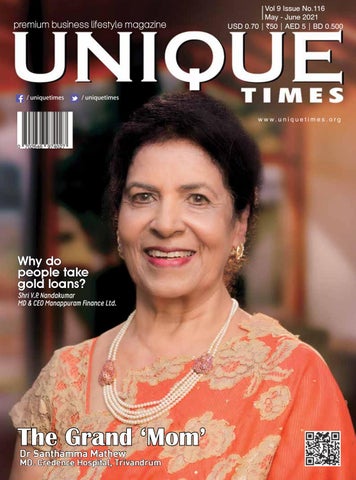
Vol 9 Issue No.116 May - June 2021 USD 0.70`50AED 5BD 0.500
Why do people take gold loans? Shri V.P. Nandakumar MD & CEO Manappuram Finance Ltd.
The Grand ‘Mom’ Dr Santhamma Mathew
MD. Credence Hospital, Trivandrum
Jebitha Ajit Director & CEO Editor Jebitha Ajit Legal Advisor Latha Anand B.S.Krishnan Associates he age of a woman doesn’t mean a thing. The bskrishnanassociates@gmail.com best tunes are played on the oldest fiddles” Sub-Editor Anusha Varghese – Ralph Waldo Emerson Consulting Editor Sujit Chandra Kumar In this edition, we have an exclusive interview Associate Editor Ravi Saini with Dr Santhamma Mathew, one of Kerala’s lead Rajeev Kumar Director and special editor kollur ing and highly acclaimed infertility specialists. Her Correspondents Dr. Thomas Nechupadam personal as well as professional career is worthy of Vivek Venugopal- Quarter Mile emulating. A true role model, her tale is bound to Amrutha V Kumar be inspirational for all the women out there who Creative Design PEGASUS are on a quest to achieve their dreams and lead a Cover Photographer PEGASUS life of happiness. Marketing UAE This time, Manappuram Finance Limited MD Phygicart.com and CEO V P Nandakumar shares with our read P.O. Box: 92546, Al Karama Dubai ers, for the first time, his valuable opinion on ‘why Mr. Anish K Joy do people take gold loans’? Mob: +971528946999 This edition’s travel piece can gift a truly info@phygicart.com unique experience to our readers. This month’s Plot No 19A, 9th Floor, holiday destination is Frankfurt, a city in Germany. Green Building, Film City, In this edition, our auto expert introduces us Sector - 16A, Noida - 201301 to, Volvo S6. The expert takes us through the variMaharashtra ous features of this amazing car. Jayasankar M, a/101, Apart from these offerings, the edition has all New Prathamesh Niwas, our regular features from beauty, movie reviews OPP. Laxmi Park, Thakurli East, and book reviews to motivation tips and business Dombivli post, Thane District, 421201 mantras. Mob: 9820708662 As Stephen King said, “Books are a uniquely Chennai portable magic.” Hariharan Unique Times, No.6/31, So let’s create magic! Arunachalam main road, Happy Reading! Saligramam, Chennai – 600093 Thank You Mob: 9840018929 Sd/Karnataka Jebitha Ajit Paperback Publishing 3218/A, 6th C Main, 13th Cross, HAL 2nd stage, Indiranagar Bengaluru 560038 Andhrapradesh PEGASUS Ph: 09288800999 Sunilkumar NN Your wing Vineeth Nair Director Ambalika Saikia, Ambalika_saikia@yahoo.com
Editorial “T
Printed at St. Reddiar & Sons, P.B. No: 3627, Veekshanam Road, Cochin Published at Pegasus Global Pvt. Ltd. L5-106, Changampuzha Nagar Kalamassery, Ernakulam-682 033 e-mail: editor@uniquetimes.org uniquetimesindia@gmail.com Ph:0484 2532040, 2532080 Mob:9288800999
Cover Photograph Dr Santhamma Mathew MD. Credence Hospital, Trivandrum
Printer & publisher Pegasus Global Pvt. Ltd. Cochin (682033) on behalf of Ajit Ravi. Printed at S.T.Reddiar & Sons, Cochin-18.
20
CONTENTS
14
24
The grand ‘Mom’
14
Why do people take gold loans?
20
Search for the ‘Next Big Idea’ Needs to Continue in the New Normal
24
Techniques to Boost Your Memory
30
Justice Mohan Shantanagoudar – a short memoir
36
30
52
50
48
58
48
Gadgets
50
Home Remedies To Get Rid of Dark Elbows and Knees
52 58
Frankfurt One of Germany’s rare Gems Volvo S60 Sophisticated yet simple
UNIQUE DIARY
Renault India Joins Hands with Vehicle Recycling Company CERO
A
utomaker Renault India has joined hands with the country’s first scrap vehicle recycling company CERO and has launched a vehicle scrapping programme. It has rolled out its programme for its customers in six locations including Delhi NCR, Chennai, Mumbai, Pune and Bangalore. According to the automaker, its dealership with CERO Recycling will be to take care of the entire process from vehicle evaluation to official deregistration at the RTO and will also take care of handling the official certificate of deposit/destruction of old vehicles providing a hassle-free experience to the customers. They will also be offering an exclusive channel for scrapping old two-wheeler vehicles.
StanPlus Expands its Offerings to Bengaluru; To Arrive Within 15 Minutes
“Business opportunities are like buses, there's always another one coming.” Richard Branson
T
he private patient logistics and medical response company StanPlus is about to enter the Bengaluru market with a Red Ambulance service. Through this platform, StanPlus says it uses technology that offers a premium quality medical response to patients and can reduce the response time for an ambulance within 15 minutes. The cost of each ambulance will be around Rs 30 lakh. To make deep inroads within its new market, it has already tied up with hospitals like Sakra World Hospital, Columbia Asia Hospital, Ramaiah Memorial Hospital and Fortis Hospital, among others. These hospitals have already outsourced their ambulance services to StanPlus.
8
May - June 2021
UNIQUE DIARY
Flipkart Set to Acquire Cleartrip in Distress Sale
W
allmart owned Flipkart is all set to achieve online travel solutions provider Cleartrip, which has been termed by several media outlets as a distress sale. As per the reports, the Flipkart-Cleartrip deal may be sealed very soon, wherein it is likely to value Cleartrip at around $40 million. The deal has been put forward at a time when the travel and hospitality industry has been going through a massive lull in the wake of the Covid-19 pandemic. Meanwhile, Flipkart has been focusing on enhancing customer experiences through many investments.
Franklin Templeton’s Sanjay Sapre: No Plans to Exit India Business
“There’s no shortage of remarkable ideas, what’s missing is the will to execute them.” Seth Godin
10
May - June 2021
F
ranklin Templeton, a US-headquartered global asset manager with over $1.5 trillion in assets, stated that there are no plans to exit its operations in India as per a letter issued by its president Sanjay Sapre. Some media reports had earlier indicated that Franklin Templeton had requested discussions with the Indian Ambassador to the US over the Securities and Exchange Board of India (SEBI) investigating into six of its shut schemes. As per the reports, Franklin Templeton had even threatened to exit India if it was not given a fair hearing. The letter stated, “We were early entrants in the Indian mutual fund industry and have remained a part of the industry even while many other global asset managers decided to leave. Please let me assure you, we have no plans to exit our India business. Any speculation suggesting otherwise, or any rumours around the sale of our business in India are incorrect and simply that – rumours.”
Practo Launches Online Consultations in 15 Indian Languages
T
he leading digital healthcare platform, Practo, has now introduced 15 vernacular languages for its tele-consultation services. This will now allow users to choose a doctor who can speak in their preferred languages including Hindi, Marathi, Tamil, Kannada, Bengali and with more to be added soon. The company has stated that 9 out of 10 new Internet users in India being native language speakers, an initiative like this will be sufficient in bridging the digital divide and overcoming language barriers. The vernacular language support feature will be made available both on the Practo app and websites. The company is also looking ahead to introduce new interface capabilities making doctor-patient interactions more seamless and engaging.
RBI’s Deputy Governor Retires After Completing One-Year Extension
“There are no secrets to success. It is the result of preparation, hard work and learning from failure.” Colin Powell
S
enior-most deputy governor BP Kanungo will be retiring from the Reserve Bank (RBI) after completing his one-year extension. He had joined the RBI in 1982 and was given charge of currency management, external investments, operations, payment, and settlement system, during his four-year term as the deputy governor which started in April 2017. His retirement comes at a time when the Cryptocurrency and Regulation of Official Digital Currency Bill, 2021, is about to get introduced in the Parliament. Apart from Kanungo, the other deputy governors of RBI are Rajeshwar Rao, M.K. Jain, and Michael Patra.
May - June 2021
11
Legendary Formula One Commentator Murray Walker Dies At 97
T
he legendary Formula 1 broadcasting commentator, Murray Walker, who died recently at the ripe age of 97 years, was loved by millions across the world for his high-energy motorsport commentary style, peppered with amusing mistakes. The errors have curiously made him famous, and his effervescent enthusiasm had led the audience to find charm in his commentary. His secret was that he was genuinely in love with the sport and he was always on track and never lost the child-like joy that he felt while commentating on it. He was born on October 10, 1923, and after leaving school he fought in World War II as a tank commander.
Climate Change: EU Target to Cut Carbon Emissions by At Least 55% Disappoints Experts
T
he new EU target of 55% reduction in carbon emissions by 2030 has been described to be a farce by environmental experts, after which it was agreed in Brussels on the eve of Joe Biden’s climate summit for the world leaders. The EU leaders, after a 14-hour deliberation, have agreed on a more ambitious goal for cutting greenhouse gases by 55% by 2030 rather than 40%. Meanwhile, Australia has said it will achieve its 2030 emissions pledge, made under the Paris deal without resorting to using old carbon credits.
12
May - June 2021
Qatar World Cup: Netherlands Joins Germany and Norway in the Qatar Human Rights Protest
T
he Netherlands has joined Germany and Norway in protesting against Qatar’s human rights record ahead of their World Cup qualifiers. They took this stance against the 2022 World Cup hosts for their alleged violations against migrants in the Gulf nation. It has been reported that at least 6,500 migrants have lost their lives since Qatar was awarded a World Cup a decade ago. During the qualifying matches, the Dutch players wore t-shirts emblazoned with the words ‘Football Supports Change’. Norway and Germany’s players took a similar stance in their own World Cup qualifying matches on Wednesday and Thursday, wherein the German team had lined up in black t-shirts, each with one letter to spell out ‘Human Rights’.
Disneyland Paris to Open Mass Covid-19 Vaccine Site urope’s biggest tourist attraction, Disneyland
E
Paris, will be hosting a mass Covid-19 vaccination site at its convention centre as France is trying to speed up its inoculation drive, the officials announced. The amusement park has been remaining closed since October 30, when non-essential businesses were asked to close amid a surge in infections, putting its 17,000 employees out of work. Later it had plans to re-admit visitors on April 2, but the conditions kept worsening, forcing it to postpone. The vaccination site will be conducted outside the amusement park proper at its Newport Bay Club, a convention centre near its hotel complex. As per the reports, it will be run by local authorities and the regional ARS health centre service and will be functioning only on weekends. Its goal is to give shots to at least 10,000 people a day, wherein France aims to give at least one jab to 20 million people by mid-May.
For more info: europetimes.co
May - June 2021
13
COVER STORY COVERSTORY
Dr Santhamma Mathew’s life-story and trail-blazing career as the pioneering specialist is not just one of determination and grit alone, but also one of empathy and devotion and is inspirational.
14
April - May 2021
THE GRAND
‘MOM’ A
s one of the leading and acclaimed infertility specialists of Kerala, Dr Santhamma Mathew has touched the lives of tens of thousands of women in ways beyond imagination. Long before infertility treatment options became available in Kerala, an 18-year-old Muslim girl, who had tumours in her ovaries, came to meet the renowned obstetriciangynaecologist, Dr Santhamma Mathew. Removal of the ovaries was the seemingly easier option, but it would have affected the fertility of the young girl. However, though it made the surgery more difficult and tedious, Dr Santhamma took care to leave behind some of the healthy ovarian tissue from both ovaries during the surgery. She then prescribed her contraceptive pills until her marriage, to prevent exhaustion of production of her eggs. Two years later, a teary-eyed girl, then already married, came to see Dr Santhamma, to share with her the joyous news of her pregnancy. This is merely one of the several gratifying experiences Dr Santhamma has to share in her journey as a doctor. Dr. Santhamma Mathew’s life-
story and trail-blazing career as the pioneering specialist is not just one of determination and grit alone, but also one of empathy and devotion and is inspirational. In the context of the International Mothers’ Day, which falls on May 9th, Dr Santhamma spoke to Unique Times about her 52-yearlong and continuing career at Sree Avittam Thirunal (SAT) Hospital, Thiruvananthapuram, and subsequently as managing director and chief consultant of Credence Hospital, Thiruvananthapuram, during which she had personally performed several tens of thousands of deliveries, gynaecological surgeries and treated hundreds of thousands of patients in her out-patient department, a rare and unique feat for a woman who handled her role as a mother and grandmother with the same élan. Bringing a touch of humaneness into her profession comes naturally for Dr Santhamma. When quizzed about the reason for her success and why she was loved by multitudes of her patients, she had this to say: “I see only my mother or my sisters in my patients, probably the reason why
May - June 2021
15
COVER STORY COVERSTORY
Dr Santhamma believes in giving the best in everything she does. This is evident from her much popular, simple but elegant and impeccable style of dressing to the way she shaped her career.
they trusted me and why many still continue to seek my second opinion and care, when they are recommended surgeries.” By the time she retired from the Medical College Hospital in 1999, Dr Santhamma had earned a reputation as one of the fastest and most perfect surgeons in her profession. Defying her age, this doctor still carries the same enthusiasm she had when she performed the first surgery under the guidance of the then SAT hospital superintendent, Dr Susan George. Dr Santhamma had made a striking impression right from her very first closure of a surgical wound, a skill which soon earned her wide praise and acclaim in her career. “I would check whether my students and junior doctors had done the suturing of the surgical incisions well. I was never satisfied until they had done it perfectly. Most of them became experts too,” said Dr Santhamma with a smile. Dr Santhamma believes in giving the best in everything she does. This is evident from her much popular, simple but elegant and impeccable style of dressing to the way she shaped her career. She began her career as a tutor at Government Medical College Thiruvananthapuram in 1970 and retired in 1999 as a
16
May - June 2021
professor with 30 years of service. However, in contrast to convention, retirement from government services for Dr Santhamma, was only the beginning of yet another unique and fruitful journey. It was her husband Mr K. J. John's brainwave to start the Centre for Reproductive Medicine in 2001 which was subsequently upgraded to a superspeciality Women's Health Institute and Research Centre in 2006. Both were named 'Credence' by Mr John, as the couple believed that ‘trust’ was of paramount importance in health-care services. A former engineer of ISRO, Mr John’s vision, and managerial acumen helped in effectively shaping Credence Hospital as a trustworthy and acclaimed hospital in Kerala, which drew patients from across the state and abroad. In fact, Dr Santhamma readily shares the credit of her success with her husband, who, according to her, has always adjusted to her odd work schedules. Though Mr John wanted Dr Santhamma to pursue her higher studies in England, she preferred to stay with her family. “Besides, the immense experience I gained from Medical College Hospital was on par with any foreign education,” she said. Dr Santhamma did her specialty courses in laparoscopy (key-hole surgery) and In-Vitro
Fertilization (IVF), long before they became popular in Kerala. Trained in IVF as early as 1991, from Singapore, Dr Santhamma was initially a bit sceptical to start an IVF centre due to the huge cost involved in setting up a state-of-the-art IVF lab. It was then that Dr Santhamma happened to re-visit the lines of the poem ‘The Road Not Taken’ by Robert Frost: “Two roads diverged in a wood, and I - I took the one less traveled by, And that has made all the difference.” Inspired by these words she decided to take the ‘unbeaten’ path which eventually paved way for her to be the reason for bringing happiness in the lives of tens of thousands of erstwhile childless couples. Though the launch of Credence IVF in August 2001, which now celebrates its 20th anniversary, was a low-key event, it gained instant popularity as a landmark centre of excellence, by word of mouth. A 42-yearold lady was the first to be blessed at Credence, to realise her long-pending desire to be a mother, and made instant news. Dr Santhamma is credited for successfully using testicular sperm aspiration and intra-cytoplasmic sperm injection techniques for the first time in South Kerala. The first baby born using frozen embryo
technology in South Kerala too is a testimonial to her unique initiatives and achievements. In the subsequent years, Dr Santhamma treated ten thousands of childless couples and thousands of them were blessed with babies conceived through infertility treatment performed under her expertise. Dr Santhamma said that IVF was, however, only the last resort in the management of infertility patients and not all patients actually required it. "We would evaluate both the husband and wife for causes for the lack of conception, based on which a decision on the method of
treatment would be made. Many of them conceived with proper counselling, while some conceived with medications or laparoscopic surgery and some found success with intrauterine insemination (IUI) or other methods and only the remaining actually needed IVF treatment,” she opined.
The Mother
Long before spending ‘quality time with children’ became a fad, Dr Santhamma used to advocate the same. To effectively spend time with her two children, she would categorise the responsibilities into two: those that a mother alone could
perform and those that another person could be delegated to take care of and she ensured that she never neglected the former. She also encouraged her children to read books and would carefully select good books for them. She also took care to be part of their laughter as well as their concerns and always encouraged them to explore their creative side. Making Mr John and Dr Santhamma proud, their two children are now eminent doctors with the elder son, Dr Binoy John practising as an interventional cardiologist in Chennai, and the younger son Dr Bimal John being the chief laparo-
May - June 2021
17
COVER STORY COVERSTORY
scopic surgeon and IVF specialist at Credence Hospital.
Educator, Managing Director, Champion of Women Empowerment and Philanthropist
As a hardworking and dedicated doctor, Dr Santhamma's popularity surged during her career at the Medical College Hospital. Dr Santhamma was a popular speaker and educator on ‘Akashavani’ (All India Radio, Thiruvanathapuram) in the times when the radio was the main-stream medium and also on ‘Doordarshan’ in the early 1980s when TV channels came into vogue and subsequently on a host of private television channels. However, instead of using the media for her own career advancement, Dr Santhamma voiced her opinions unflinchingly on social issues and helped shatter deep-rooted prejudices against women. She spoke on a variety of issues including how the gender of a child was unrelated to the mother and how it was the male or father’s chromosome that contributed to gender determination of the child, as also abortion, virginity and a host of other topics which many shied away from speaking about in those times. She was also a sought out speaker in colleges, enlightening young women on topics such as menstrual issues, pregnancy and childbirth and infertility. On the topic of women’s health, Dr Santhamma was a regular author for various magazines and newspapers. Amidst her tight work schedule, she also found time to author educational books for women. 'Vandhyathayude Vazhiyile Kaivilakkukal' (Leading lights in the path of infertility), 'Garbhadharanam Muthal Prasavam Vare' (From conception to delivery), and 'Sthree Rogangal' (Diseases in women) were popular books amongst women readers. Through her widely acclaimed autobiography 'Nakshatrangal Akaleyalla' (The stars are not afar),
18
April - May 2021
Dr Santhamma laid bare her childhood, career, and her personality, shaped by a deep-rooted devotion to the creator, humility and self-respect. The renowned poet Padmavibhushan Shri O.N.V. Kurup wrote the foreword for the autobiography, which was released jointly by the then Union Minister Shri Dr Shashi Tharoor and Chief Minister of Kerala Shri Oommen Chandy in 2013. Post-retirement, when she donned the mantle of the managing director of Credence Hospital, she found happiness in that she could facilitate the employment of 250-odd staff in her institution and thus give something back to Thiruvananthapuram, the city that nurtured her success. She also expressed joy that in this role she was able to extend her services in helping the less privileged by being able to give concessions and waive off expensive treatment costs, at her discretion.
families she served. Dr Santhamma always had a pleasant and friendly demeanor and never the hurried face of an otherwise busy doctor. Amid her hectic schedule, she never shied away from having warm conversations with her patients and colleagues. Being a quick decisionmaker, Dr Santhamma would ensure that she completed all her work on time. Even now, as the pandemic rages, Dr Santhamma has adopted the telemedicine system and continues to conduct her out-patient consultation at Credence from morning to late afternoon, along with an experienced team and her son managing daily patient care. A typical day for Dr Santhamma begins with her prayers followed by yoga and other exercises. She has always followed a healthy lifestyle with a focus on a healthy diet and regular workouts.
Time Manager
Born into the ancient Anjilumoottil family in Haripad, Dr Santhamma was the youngest of four girls of T.M. Mathew and Deenamma Mathew. Dr Santhamma had imbibed all the qualities of the pious family, which groomed the four girls as hardworking individuals. “My parents never discriminated against us based on our gender but raised us as confident individuals. They insisted that we remained neat and well dressed and nurtured a noble character, which I continue to follow. They taught us to work for the happiness of others besides our own satisfaction and told us money and fame should not be our priority but those would always follow hard work and a helpful nature, which was true,” said Dr Santhamma.
Dr Santhamma Mathew never complained about a lack of time, even while maintaining the busiest of schedules. She always found time for family, educational activities, and for pursuing her passions. She had the practice of waking up as early as 4 am so that she could read without disturbing her husband and children. “If I had something important to do, I would plan ahead, wake up early and do the work on time,” she said. “The lines from the poem of the 15th-century poet Kabir Das, ‘Kal Kare So Aaj Kar, Aaj Kare So Ab’ (Do today what needs to be completed tomorrow; Do now what needs to be done today) are my inspiration.” she added. Though she couldn’t devote more time for her family, Dr Santhamma says that the sacrifice of her family time for her patients would have earned her and her family an abundance of blessings by finding a place in the love and prayers of the many thousands of
Early Life
Divine Presence
“We see God in you.” Dr Santhamma has heard these words from innumerable patients and their families. Then, she would intervene gently to give all credit to the divine power which guides
her. She would cite both The Bible and The Bhagawat Gita to illustrate the importance of God in our lives. Dr Santhamma is a firm believer in God’s power and explains how it was God who helped the young David to bring down the giant and powerful Goliath with the precision of his sling in single combat and free the people of Israel and she quotes Romans 8.31: “If God is with us, who can be against us?” She then refers to The Bhagawat Gita on how when the Pandavas and Kauravas were given the choice between Lord Krishna’s powerful army and himself, that it was the Pandavas’ choice and faith in Lord Krishna that paved the way for their ultimate victory. Thus a run through Dr Santhamma Mathew’s illustrious career, life and journey on the ‘unbeaten’ path makes it evident how it is her sheer dedication and commitment to hard work, humane nature, a core value to do good for others, and above all her faith in God, that has made her an exemplary doctor and a Grand ‘Mom’ to innumerable people. While celebrating International Mother’s day, Unique Times is certain that Dr Santhamma Mathew’s life and lessons will be a leading light and inspiration for the younger generations to learn from, adopt and emulate. Unique Times also wishes Dr Santhamma Mathew good health in her continued service to humanity
April - May 2021
19
BUSINESS
In 2012, when the RBI set up the Rao committee to undertake a thorough analysis of the gold loan business, the committee members expressed their frustration that almost no data or reliable information was available about this age-old business.
Shri V.P.Nandakumar MD & CEO Manappuram Finance Ltd.
Why do people take gold loans? W hen Manappuram Finance Ltd. first entered the gold loans market in the latter half of the nineties, it also became the first NBFC in India to get into gold loans. Till then, this business was the preserve of the unorganised sector, the pawnbrokers and moneylenders who operated in lanes and by lanes across the country away from the oversight of regulators and policy makers. Indeed, India’s regulatory and policy making establishment (as also decision makers in the banking sector) were largely uninformed about gold loans and why it mattered to so many ordinary Indians. After all, there were no academic papers or studies about the share of gold loans in India’s credit market, and there was little awareness about what made people resort to gold loans. Consequently, in those early days, we found it difficult to con-
20
May - June 2021
vince bankers about the viability of the gold loan business in a corporate setting and getting them to extend loans to us was not easy. Of course, things changed once we had demonstrated by example how a business overlooked by the mainstream financiers could be so relevant to India’s macro economy. Since those early days, gold loans have come a long way but we continued to face a dearth of verifiable data-backed understanding of gold loan customers. The main reason for the lack of representative information is that the gold loan industry is fragmented and dominated by the unorganised and unregulated lenders like moneylenders and pawnbrokers. To this day, less than a third of the estimated gold loan market in India is conducted via banks, nonbanks and other registered entities. Over these years, we have tried our best to do what we can to rectify
the situation. In the year 2009, we commissioned a study through the ICRA Management Consulting Services Limited (IMaCS) which was published with the title “Gold Loans Market in India, 2009” to become the first serious study of the gold loans sector. We followed this up in 2011 with a survey and study of our own gold loan customers conducted by a senior economist affiliated to the University of Kerala, Thiruvananthapuram. In 2012, when the RBI set up the Rao committee to undertake a thorough analysis of the gold loan business, the committee members expressed their frustration that almost no data or reliable information was available about this age-old business. It was true that most of the existing research was based on anecdotal evidence, without hard numbers to back up the conclusions. Accordingly, we had forwarded
a copy of our 2011 study of our gold loan customers to the RBI. We understand that it was relied upon during committee deliberations, and it helped establish the positive impact of gold loans on the lives of the masses. It became clear to the committee that gold loans were no longer a distress product, having evolved into a lifestyle credit product. Customers were as comfortable monetising their gold jewellery to meet short-term cash flow mismatches as they were in availing a home loan or an auto loan. The view gained ground that if the gold loan sector is not handled with judicious policy initiatives, people may head back to the unorganised sector dealing a body blow to the cause of social and financial inclusion. The Rao Committee report on India’s Gold Loans sector commissioned by the RBI came out in 2013. Since then, IMaCS has been putting out periodic updates to its original 2009 study. However, there is a perceptible lack of updated studies focused on the gold loan customer. As things stand, much of our understanding of the typical borrower's profile, requirements etc. is based on our own experience gathered over the years. This has a weakness in that bias can creep in, and one’s presumptions can continue to drive
the business unmindful of the reality of an ever-changing socio-economic backdrop. After all, customer preferences change, their requirements change, competitive landscapes change and, most importantly, people change!
A new study in collaboration with the Gokhale Institute, Pune
It is, therefore, of utmost importance to update our understanding of the market, customers, competing products, and the wider socio-economic dynamics. Several studies and reports are available for most of the micro-markets and credit segments, but rarely do we come across a serious, painstaking study about the business of lending against household gold jewellery. That’s why in late 2019, Manappuram engaged the Gokhale Institute of Politics and Economics (Pune), a renowned economic research institution, to conduct a fresh study of its gold loan customers. Established in 1930, the Gokhale Institute is the oldest economic research and training institute in India. It is reputed for its initiatives in qualitative research in diverse areas of economic theory and practice. Its founding director, Shri D.R. Gadgil was a member of the first National Income Committee and the Deputy
Chairman of the Planning Commission, the highest bureaucratic position in the Indian economic sector with the rank of a cabinet minister. He is well known as the author of the Gadgil formula which served as the basis for allocation of central assistance to states during the fourth and fifth Five Year Plans. The Institute is credited with pioneering contributions by way of surveys, research, informed debate, analyses and critiques, which have shaped the public discourse on major socio-economic initiatives. It developed a methodology for data collection which is still used by National Sample Survey Organisation (NSSO). On the policy front, the institute designed the institutional framework for NABARD, formulated the Employment Guarantee Scheme and Agricultural Insurance Scheme. It is indeed an honour for Manappuram to be associated with the Gokhale Institute for such an important study. However, no sooner had the spadework for the study commenced that the world was struck by the Covid-19 pandemic. We realised that this event had the potential to alter the course of the future. The customer’s behaviour, perspectives, and preferences related to gold and other credit products must be reassessed.
May - June 2021
21
BUSINESS
The exercise required undertaking a baseline survey of, and data collection from, gold loan customers. While any researcher would have preferred to have a broad sample for collecting a representative dataset, we had to restrict the data collection to our own customer base on account of customer confidentiality. The fact is, other gold loan lenders would not be comfortable in sharing their customer information with external researchers. The larger purpose of the study was to analyse customer behaviour (using actual transaction data) to make actionable policy recommendations. For this, the study needed to understand the service delivery process, the benefits accruing from gold loan availability, as well as the costs of non-availability. Afterall, unless we understand how customers are likely to behave in the absence of the institutional gold loan, we may miss out on the prospective policy changes required to shift the bulk of the unbanked and underbanked to the institutionalised lending framework.
Finetuning the methodology
Much of the secondary information concerning the gold loan industry is based on small and fragmented data points. Manappuram has over 25 lakh active customers and a network of nearly 3,500 gold loan branches spread across 28 states/ UTs of the country. The target sample was designed using a stratified sampling method for a representative sample and to arrive at an unbiased understanding of the gold loan customers at the national level.
22
May - June 2021
We conducted a few pilot sample surveys to fine-tune the questionnaire to make it easier to grasp and derive appropriate responses. As the survey was to be conducted over telephone, it had to be short, yet detailed enough to draw a relevant response. The questionnaire focused on the customer’s experience with gold loans and other loans, experience with institutional (Banks/ NBFC etc.) and non-institutional lenders (moneylenders/ pawnbrokers etc.), their perspective on satisfaction derived from the gold loan, benefits and costs associated with availability and non-availability of gold loan, the changes they desired in the product design, and their preferences regarding ease, cost, tenure etc. As the survey was conducted across India with most respondents belonging to the bottom of the pyramid, we conducted all interactions in their regional language using translated survey questionnaires. We faced many connectivity challenges, often requiring repeated calling to complete all the questions in the survey. The questionnaire took approximately 15 minutes to administer. We managed to generate responses from 3,582 customers who completed the telephonic survey (partial responses were not considered in the study for uniformity). The respondents belonged to 357 districts of 27 states and union territories, giving us a representative allIndia sample for better understanding of the role played by gold loans in fulfilling the objectives of responsible lending, including the economic, so-
cial, and governance (ESG) agenda of our institutional lenders.
Summing up
To summarise, a survey study of gold loan customers across India was conducted in early 2020 by the Gokhale Institute of Political Economy, Pune. The study utilised the customer base of Manappuram for collecting borrower responses to the survey questionnaire and the same was matched with their transaction data to undertake a comprehensive analysis of observed customer behaviour. The objective of the survey study was to understand the behavioural and economic aspects of the customers, the purpose and tenure of these borrowings, the factors influencing the decision from where to borrow (banks, non-banks or unorganised), why customers rely on gold loan (cost-benefit vs other alternatives available to them), and the effects of its availability on their lives. In comparison to a survey-only method, this approach of combining it with actual transaction data offers a unique validation of the responses, providing us with a holistic view of the role played by gold loans in their day to day lives. We aim to publish the detailed survey report, its findings, and recommendations (for the lending institutions, regulators and policy makers) in due course. I intend to write more about it once the report is published (Shri V.P. Nandakumar is MD & CEO of Manappuram Finance Ltd. Views are personal.)
BUSINESS
Rajesh Nair Associate Partner, Ernst & Young LLP
24
April - May 2021
A formal group or panel needs to be tasked with specifically looking for creative ideas that might lead to a competitive advantage, projects where some preliminary experimental work has already been completed, and projects for which resources are required from both within and outside
Search for the ‘Next Big Idea’ Needs to Continue in the New Normal
W
e normally look at the future as a logical extension of the past. Our surmises and conjectures are often based on incremental changes in technology. Then came the pandemic! With the tectonic impact of exponential and combinatorial events, the future could be a lot different from what we see from the drawing board today. The core of most of these changes can be looked at from the prism of Moore’s Law – a concept from the 70s which simply suggested that the processing speed of a computer chip that we can buy for $1000 roughly doubles every 18 to 24 months. And this is not just engineering technology, but even biological sciences see these effects – the dramatic cost decline in human genome sequencing from the whopping US $10 Million in 2008 to around US $800 today. It also explains the need for organisations to constantly look inward and see potential disruptions much ahead of the curve down the road. It is now official – Innovation has been acknowledged as one of the key drivers of success in organisations. We respect the word by putting it on a pedestal reserved only for ‘strategy’ in the past. Entrepreneurs swear by this word and credit innovation for the impressive acceleration they have achieved with literally no favourable economic tailwind in the past five years. Even when the successful entrepreneurs of today politely attribute a bulk of their success to ‘luck and good fortune’, we refuse to buy it. As a management observer for two decades now, I have never been convinced that success is always because of being at the right place and right time. True, companies do run into fair weather. But more often than not, it is also their ability to use innovative ideas of their teams and the exceptional capability and speed with which they implement these ideas that help them bask in glory. If one sepa-
May - June 2021
25
BUSINESS rates the wheat from the chaff, one of the emerging themes is – there are companies that have benefitted from a corporate culture of fearlessly value-adding to their products and constantly challenging the utilities of the current portfolio of products. In a phrase – it is about inculcating a culture of innovation in the organisation. The continuous quest for innovation also helps in leveraging a seemingly abstract concept like serendipity. The English lexicon defines serendipity as ‘an aptitude for
26
May - June 2021
making desirable discoveries by accident’. Newton postulating gravity after an apple fell on his head is a great example of serendipity. What is interesting is the array of successful products which have come from failed experiments. Coca-Cola, one of the world’s most popular brands, was originally invented as an alternative to morphine addiction, and to treat headaches and relieve anxiety. Coke’s inventor, John Pemberton, a veteran of the Civil War who himself suffered from a morphine addiction — first invented a sweet, alcoholic
drink infused with coca leaves for an extra kick. He called it Pemberton’s French Wine Coca. It would be another two decades before that recipe was honed, sweetened, carbonated and, eventually, marketed into what it is today: the most popular soda in the world. The other example is Brandy. Brandy, the caramel-colored after-dinner drink, started off as a byproduct of transporting wine. About 900 years ago, merchants would essentially boil the water off of large quantities of wine in order to both transport it more easily and
Back in the 1970s, 3M scientists Spencer Silver and Arthur Fry were toying around with possible uses for an adhesive that Silver had discovered. The invention eventually resulted in the groundbreaking product that 3M launched in 1980 and which has since become an office and household staple.
save on customs taxes, which were levied by volume. After a while, a few of these merchants bored perhaps after a long day on the road, dipped into their inventory and discovered that the concentrated, or distilled, wine actually tasted really good. Voila! Brandy was born – a product which consumer product analysts say is drank more by Malayalis than the rest of India put together! The myth which can never be a rule is that – youth is a guarantee of innovation or young companies are the true innovation hubs. This cannot be rebuked instantaneously but we can’t ignore the larger companies. When we talk of products that came out of the typical innovative organisations, we get reminded of large organisations like 3M, Sony, or Pfizer. Take 3M’s Post-it Note, for example. Back in the 1970s, 3M scientists Spencer Silver and Arthur Fry were toying around with possible uses for an adhesive that Silver had discovered. The invention eventually resulted in the groundbreaking product that 3M launched in 1980 and which has since become an office and household staple. Or take the Sony PlayStation, launched in 1994. Originally a pass-time project for Sony Sound Engineer Ken Kutaragi — one that nearly got him fired — the gaming system eventually received the blessing of then-CEO Norio Ohga and became the best-selling game console of all time. Viagra, or Sildenafil, as it's officially known, was originally conceived as a treatment for hypertension, angina, and other symptoms of heart disease. But initial clinical trials revealed that while the drug wasn’t great at treating what it was supposed to treat, male test subjects were experiencing a rather unexpected side effect: erections. A few years later, in 1998, the drug took US markets by storm as a treatment for penile dysfunction and became an overnight success. It now rakes in an estimated $1.9 billion a year. An important point to note is that – the winners are not just the inventors. These are interesting outputs of collective discussions of innovative employees who were encouraged by a company culture that helped them
May - June 2021
27
BUSINESS
see these disproportionately large dividends. This is an important concept. In the face of vigorous competition from all corners of the globe, now is the time to focus on renewed innovation — to kick into high gear the entrepreneurial fervour that got your organisation to where it is today. And the best way to do that is to draw on resources you already have: your own employees. The following are some interesting practices I have seen in an organisation that has embarked on this quest.
Organisation Structure Needs to Facilitate Innovation
You have to give people enough time away from their “day jobs” to work on creative ideas. The processes need to not only focus on the ideation but also put in place systems to make sure that these ideas are tried out and get implemented. A formal group or panel needs to be tasked with specifically looking
28
May - June 2021
A synergistic team helps in fleshing out the idea and thinking through risks and other practical impediments. Traditional metrics still do not instill and reward this important trait. Constant celebration of the innovating team and not the innovators helps foster this aspect.
for creative ideas that might lead to a competitive advantage, projects where some preliminary experimental work has already been completed, and projects for which resources are required from both within and outside.
Diversity of Profiles and Thinking is Vital
Diversity is not just fashionable or corporate social responsibility hyperbole. It improves performance. Diversity can improve an organisation’s performance by enhancing creativity or team problem-solving. Organisational behaviour scientists keep harping on the fact that that by “stirring the pot” and by adding the right ingredient and spices, we
can improve innovation by leaps and bounds. Diversity also encourages intellectual debate and conflict that lead to innovation.
Seeking Ideas from your Teams
It is important to tap the knowledge base of your own employees. This can be done using traditional techniques, such as ratings and feedback on R&D projects or a physical/ virtual suggestion box. Or it can take a radically different approach, such as creating an “idea exchange” or “market for innovation.” Idea exchange is a meeting of the ideators and the idea implementors/sponsors. The latter is a technique for evaluating the quality of ideas and predicting which are most likely to work and therefore deserve backing.
Design a Career Path for your Innovators
It is vitally important not only to make room for innovators in your organisation but also to provide in-
centives for them to stay, including a welldefined career path. They need to have the technical and marketing infrastructure of a large company at their disposal. You need to also encourage experimentation and foster a culture of tolerating mistakes but creating a learning system to avoid similar mistakes. You need to also give them challenges and mix them up. A lot of these innovators, by their own admission, are ‘unemployable’. It is not in the sense that companies don’t want them, but that companies cannot contain them.
Incentive to Build on Ideas
Every idea need not be a radically different brainwave. There is immense value in building on each other’s ideas. Often the originator of the idea tends to think in a particular pattern and easily overlooks the broader picture. A synergistic team helps in fleshing out the idea and thinking through risks and other practical impediments. Traditional metrics still do not instill and reward this important trait. Constant celebration of the innovating team and not the innovators helps foster this aspect.
You need to have a learning plan
This is useful for the earliest, most difficult, and ambiguous stages of experimentation. By explicitly recognising those innovators who proceed on the basis of assumptions rather than facts, this approach can save projects from being rejected during the review stage. It’s also helpful to use activity-based metrics that are linked to innovation rather than outcomes because they reflect the inherently experimental nature of the process. For instance, a company committed to radical innovation might develop metrics that assess whether the enterprise is extending its networks and getting into new arenas. Innovators should be encouraged to document their learnings for posterity to benefit from. Don’t be discouraged because there really isn’t anything totally new out there in your industry. Many entrepreneurial successes have happened because someone found new uses for an old product, like the earlier examples, and chanced upon discovery or ventured into new industries or geographies. It’s hard to always keep thinking about the Next Big Idea, especially if your company is already the industry leader, but it’s a definite way to rekindle the entrepreneurial spirit. Remember, that’s what propelled your company to the top, and it’s what’s going to keep it there. And believe that the ‘happy accident’ is just around the corner!
May - June 2021
29
HEALTH
Dr Arun Oommen
MBBS, MS (Gen Surg), Mch( Neurosurgery), MRCSEd, MBA ConsultantNeurosurgeon, VPS Lakeshore Hospital Kochi, India
Physical exercise helps your brain stay sharp. It increases oxygen to your brain and reduces the risk for disorders that lead to memory loss, such as diabetes and cardiovascular disease.
Techniques to Boost Your Memory
A
strong memory depends on the health and vitality of our brain. There are lots we can do to improve our memory and enhance mental performance as much as possible. It is possible to preserve and revitalise our grey matter as we age. The human brain has an astonishing ability to adapt and changeeven into old age. This ability is known as neuroplasticity. With the right stimulation, our brain can form new neural pathways, alter existing connections, and adapt and react in ever-changing ways. The brain’s incredible ability to reshape itself holds true when it comes to learning and memory. We can harness the natural power of neuroplasticity to increase our cognitive abilities, enhance our ability to learn new information, and improve our memory at any age.
1. Brain Workouts
By adulthood, our brain has al-
30
May - June 2021
ready developed millions of neural pathways that help us process and recall information quickly, solve familiar problems, and execute habitual tasks with minimal mental effort. But if we always stick to these well-worn paths, we aren’t giving our brain the stimulation it needs to keep growing and developing. The more we work out our brain, the better we’ll be able to process and remember information. But not all activities are equal. The best brain exercises break our routine and challenge us to use and develop new brain pathways. Four Key Elements of a Good Brain Workout: A. It teaches us something new. To strengthen the brain, we need to keep learning and developing new skills. In other words, do something that’s unfamiliar and out of our comfort zone. B. It’s challenging. It must be
something that requires good mental effort. Demands our full and close attention. C. A skill that can stretch our capabilities. When a previously difficult level starts to feel comfortable, that means it’s time to tackle the next level of performance. D. It’s rewarding. Enjoyable and satisfying tasks enhance the brain’s learning process.
2. Eat a Brain-Boosting Diet
Breakfast is the most important meal of the day. Those who have a well-balanced breakfast with the right amount of protein, carbohydrates, fresh fruit, and vegetables show improved memory, creativity, focus, and overall performance. To keep your blood sugar levels stable and your brain supplied with fuel, aim to eat three small meals a day with a couple of healthy snacks in between. A heavy meal late at night can disrupt your sleep, so try to eat
at least three hours before going to bed. This will help your body digest your food before sleep. The brain uses only glucose for fuel. It consumes around five grams an hour, but can’t store it. That is why the brain has to be regularly supplied with glucose via the circulatory system. The most difficult task within intellectual performance - the capacity to memorise - depends on the blood level of glucose. The complex sugars and those, which have
a low glycaemic index, are crucial. Brown rice, bread, pasta and pulses are full of these complex sugars, and their glycemic index are among the lowest. It really allows the regulation of glucose in the blood and supplies the brain without creating a reaction of hyperglycemia. Vitamin E is necessary for brain health because it works as an antioxidant. This vitamin occurs to be one of the most powerful antioxidants and protects the
brain’s fatty tissues from ageing. Research has shown that Vitamin E delays the onset of Alzheimer’s disease. Eat leafy green vegetables, and nuts to increase intake of this vital nutrient. The vitamin E and magnesium in almonds will keep our brain at top-working capacity. Avocado is rich in Vitamin E. Research has shown that absorption of two key carotenoid antioxidants, beta carotene and lycopene, increases significantly when fresh avocado or avocado
May - June 2021
31
HEALTH
oil is added to any salads. Blueberries in particular can increase concentration and memory. Blueberries are one of the most potent antioxidant foods on the planet. These powerful nutrients are able to stimulate the flow of blood and oxygen to our brain which results in sharper focus. Blueberries help maintain healthy cognitive function and smoothly working nerve cells. Blueberries have been shown to actually reverse some of the ageing processes that occur in the brain. Other small, darkly coloured berries, like cherries, raspberries, gooseberries, and mulberries provide similar health benefits. All edible berries are also a rich source of Vitamin C. Together, they not only strengthen blood capillaries and improve circulation, which enables the best oxygenation of the brain, but also fight against free radicals which can affect nerve cells, especially brain cells. People who consume more vitamin C perform better in tests for recall, memory, and attention. Protein is able to stimulate orex-
32
May - June 2021
in neurons, the cells in our brain responsible for keeping us awake. All animal by-products such as fish, meats, dairy, and eggs are packed with protein. Eggs are rich in amino acids, vital in the production of the principal neurotransmitters. Eggs contain phospholipids and lecithin, integral to build up the membrane of brain cells. A synthesis made from serine and methionine is used in the process of memorisation, while noradrenalin, stimulating learning, and its production rely on the presence of tyrosine and phenylalanine, all of which are found in eggs’ proteins. Eating cold-water fatty fish, such as salmon not only helps us improve memory retention but can also protect us from degenerative mental diseases such as dementia. That is because they contain high levels of essential fatty acids called DHA. Brain cells need a good supply of oxygen. Lack of enough iron in our diet can reduce our blood’s ability to carry oxygen, reducing the amount delivered to our brain. Not getting enough iron can also cause problems
such as poor concentration, lack of energy, and tiredness. Low-fat meat is an excellent source of iron. It contains iron and zinc which are important minerals for the cognitive function of the brain. Other good sources of iron include egg yolks, pulses such as red kidney beans and lentils, dried apricots, fortified breakfast cereals, broccoli, wholegrain cereals, and wholemeal bread. If our brain doesn’t get enough fluid, we’ll feel tired and be more likely to suffer from headaches. Aim to drink 6-8 glasses of fluid a day. Water is the healthiest choice but fruit juice, fruit smoothies, and milk also count towards our fluid intake. Food rich in B vitamins, such as chicken, potatoes, and bananas, can help improve our memory and keep our brain healthy. Magnesium is an essential mineral in the transmission of nervous impulses. Bananas are a source of Vitamin B6 and magnesium. B6 vitamin is not only involved in the assimilation of magnesium, but also in the metabolism of amino acids and the functioning of the
nervous system through producing certain neurotransmitters, notably gamma-aminobutyric acid and serotonin. Both of them create the right state of mind for prudent, calm, and measured behaviour. All leafy vegetables are rich in Vitamin B9 (folates), which is thought to play an active role in the development of a fetus’ nervous tissue and also in the renewal of blood cells. Spinach, lettuce, watercress, broccoli, iceberg lettuce, or different types of herbs are rich in this type of vitamin. Among these veggies, rosemary is worth noting as it has certain flavonoids notably apigenin that have stimulating properties that influence memory and concentration through encouraging cerebral blood flow. The flavonol in dark chocolate boosts the circulatory system, increasing the amount of blood that reaches your brain. Hence it is found useful during an exam. Ginkgo biloba increases the blood flow to the brain to increase short-term memory, improve focus, and reduce
dementia. Tea also has protective effects on the brain. Besides the wellknown high antioxidant content which helps fight free radicals and boost the brain’s activity, tea drinkers do better on tests on memory and information processing. Nutritional tips that help reduce your risk of dementia: Have adequate omega-3 FA. Limit calories and saturated fat. Eat more fruit and vegetables. Packed with antioxidants, these help protect your brain cells from damage. Drink green tea. Green tea contains polyphenols, powerful antioxidants that protect against free radicals that can damage brain cells. Drink wine (or grape juice). Taken in moderation, (Around 1 glass a day for women; 2 for men) it may actually improve memory and cognition. Red wine appears to be the best option, as it is rich in resveratrol, a flavonoid that boosts blood flow in the brain and reduces the risk of Alzheimer’s disease. Other resver-
atrol-packed options include grape juice, cranberry juice, fresh grapes, berries, and peanuts.
3. Proper Physical Exercise
Physical exercise helps your brain stay sharp. It increases oxygen to your brain and reduces the risk for disorders that lead to memory loss, such as diabetes and cardiovascular disease. Exercise also enhances the effects of helpful brain chemicals and reduces stress hormones. It also plays an important role in neuroplasticity by boosting growth factors and stimulating new neuronal connections. Aerobic exercise is particularly good for the brain, so choose activities that keep your blood pumping. Physical activities that require handeye coordination or complex motor skills are particularly beneficial for brain building. Regular aerobic exercises improve the functioning of the hippocampus and reduce the onset of age-related hippocampal atrophy. Hippocampus is a part of the limbic system and plays important role in
May - June 2021
33
HEALTH spatial memory and cognitive functions. It plays a vital role in consolidating recent memory to long-term memory.
4. Proper Sleep
An adult needs around 7-9 hours of proper sleep. Sleep deprivation drastically affects memory, creativity, problem-solving abilities, and critical thinking skills. Proper sleep is critical to learning new things and improving memory. Research shows that sleep is necessary for memory consolidation, with the memory-enhancing activity occurring during the deepest stages of sleep. The blue light emitted by TVs, tablets, phones, and computers triggers wakefulness and suppresses hormones such as melatonin that induces sleep.
5. Devote Time for Socialising
Healthy relationships can be considered a very good brain booster. A life full of friends and fun comes with a lot of cognitive benefits. Interacting with others stimulates the brain and provides good quality brain exercises. Research shows that having meaningful friendships and a strong support system is vital not only to emotional health but also to brain health and people with the most active social lives had the slowest rate of memory decline. Good friendship comes with a lot of laughter. Unlike emotional responses, which are limited to specific areas of the brain, laughter engages multiple regions across the whole brain. Jokes and working out punch lines activate areas of the brain vital to learning and creativity. Laughter seems to help people think more broadly and associate more freely.
34
May - June 2021
6. Keeping Stress Under Control
Chronic stress can damage the brain cells and the hippocampus, the region of the brain involved in the formation of new memories and the retrieval of old ones. Studies have linked stress to memory loss. Learning proper stress-relieving techniques is vital in enhancing cognitive functions and proper memory. Meditation is highly stress-busting and is a memory booster too. Meditation can improve focus, concentration, creativity, memory, and learning and reasoning skills. It helps improve many different types of conditions, including depression, anxiety, chronic pain, diabetes, and high blood pressure. Meditation works its ‘magic’ by changing the actual brain. Brain images show that regular meditators have more activity in the left prefrontal cortex, an area of the brain associated with feelings of joy and equanimity. Meditation also increases the thickness of the cerebral cortex and encourages more connections between brain cells—all of which increases mental sharpness and memory ability.
7. Identify and Treat Health Problems
It’s not just dementia or Alzheimer’s disease that causes memory loss. There are many diseases, mental health disorders, and medications that can interfere with memory: Cardiac diseases-Cardiovascular disease and its risk factors, including high cholesterol and high blood pressure, have been linked to mild cognitive impairment. Diabetes-People with diabetes experience far greater cognitive decline than those who don’t suffer from the
disease. Hormone imbalance- Women going through menopause often experience memory problems when their estrogen dips. In men, low testosterone can cause issues. Thyroid imbalances can also cause forgetfulness, sluggish thinking, or confusion. Medications- Many prescriptions and over-the-counter medications can get in the way of memory and clear thinking. Common culprits include cold and allergy medications, sleep aids, and antidepressants. Depression- mental sluggishness, difficulty in concentrating, and forgetfulness are common symptoms of depression. The memory issues can be particularly bad in older people and are sometimes mistaken for dementia. Properly treated depression can help regain memory.
8. Learn Practical Steps to Support Learning and Memory
Pay attention- We can’t learn something (encode it into our brain) if we don’t pay enough attention to it. It takes about eight seconds of intense focus to process a piece of information into our memory. Involve as many senses as possible- Try to relate information to colours, textures, smells, and tastes. The physical act of rewriting information or reading aloud can help imprint it onto our brain. Relate information to what you already know. Rehearse information we’ve already learned- This “spaced rehearsal” is more effective than cramming, especially for retaining what we’ve learned. Use mnemonic devices to make memorisation easier
FINANCE
Adv Sherry Samuel Oommen This article is authored by Adv Sherry Samuel Oommen. Adv Oommen, who specializes in constitution, tax and corporate laws has also cleared the final exams of the Institute of Chartered Accountants of India, the Institute of Cost Accountants of India and the Institute of Company Secretaries of India. He has also completed his Masters Degree in Commerce, apart from obtaining a Post Graduate Diploma in Business and Corporate Laws from Symbiosis Pune. The views expressly are personal and should not be construed as a legal opinion.sherryoommen@nashcp.com.
36
May - June 2021
It is well-settled that in case of any ambiguity in the construction of a penal statute, the judgment pointed out, the courts must favour the interpretation which leans towards protecting the rights of the accused, given the ubiquitous power disparity between the individual accused and the State machinery.
W
hen Supreme Court Judge, Justice Mohan M Shantanagoudar, passed away recently at a private hospital in Gurgaon after a prolonged illness, the nation lost a gem, an individual who was unwavering in his principles, yet extremely pleasant and humble. Born on May 5, 1958, his illustrious career started when he enrolled as an advocate on September 5, 1980. After serving the Bar for more than two decades, he was appointed as an Additional Judge of the Karnataka High Court on May 12, 2003, and later became a Permanent Judge of the Karnataka High Court in September 2004. He was later transferred to the Kerala High Court where he assumed charge as the Acting Chief Justice on August 1, 2016. He thereafter became the Chief Justice of the Kerala High Court on September 22, 2016 before being elevated to the Supreme Court on February 17, 2017. Justice Mohan Shantanagoudar will be remembered for the various landmark judgments that he has penned. In the judgment of the Hon’ble Supreme Court in the Indore Development Authority Vs Shailendra (2018) 3 SCC 412, Justice Mohan Shantanagoudar dissented from the majority views authored by Justice Arun Mishra holding that it was not proper for a Bench of coordinate strength to comment on the discretion exercised or judgment of another coordinate Bench of the
same court. His Lordship observed as under: “A coordinate Bench cannot comment upon the discretion exercised or judgment rendered by another coordinate Bench of the same court. The rule of precedent is binding for the reason that there is a desire to secure uniformity and certainty in the law. Thus, in judicial administration precedents which enunciate the rules of law form the foundation of the administration of justice under our system. Therefore, it has always been insisted that the decision of a coordinate Bench must be followed. (Vide Tribhovandas Purshottamdas Thakkar v. Ratilal Motilal Patel [TribhovandasPurshottamdas Thakkar v. Ratilal Motilal Patel, AIR 1968 SC 372], Sub-Committee of Judicial Accountability v. Union of India [SubCommittee of Judicial Accountability v. Union of India, (1992) 4 SCC 97] and State of Tripura v. Tripura Bar Assn. [State of Tripura v. Tripura Bar Assn., (1998) 5 SCC 637 : 1998 SCC (L&S) 1426] ) In Rajasthan Public Service Commission v. Harish Kumar Purohit [Rajasthan Public Service Commission v. Harish Kumar Purohit, (2003) 5 SCC 480: 2003 SCC (L&S) 703] this Court held that a Bench must follow the decision of a coordinate Bench and take the same view as has been taken earlier. The earlier decision of the coordinate Bench is binding upon any latter coordinate Bench deciding the same or similar issues. If the latter Bench wants to
JUSTICE MOHAN SHANTANAGOUDAR – A SHORT MEMOIR take a different view than taken by the earlier Bench, the proper course is for it to refer the matter to a larger Bench.” In the context of the right to bail under section 167(2) of the Criminal Procedure Code, 1973, His Lordship authored a leading judgment holding that the Courts should inform the accused of his right to “Default Bail”, once it accrues. This was also based on the Statement of Objects and Reasons whilst drafting the Code of Criminal Procedure 1970, based on the recommendations of the Law Commission which held that every effort should be made to ensure that an accused person should get a fair trial in accordance with the accepted principles of natural justice and to avoid delay in investigation and trial which is harmful not only to the individuals involved but also to the society. It is well-settled that in case of any ambiguity in the construction of a penal statute, the judgment pointed out, the courts must favour the interpretation which leans towards protecting the rights of the accused, given the ubiquitous power disparity between the individual accused and the State machinery. This is applicable not only in the case of substantive penal statutes but also in the case of procedures providing for the curtailment of the liberty of the accused. Here are some extracts from M Ravindran Vs Directorate of Revenue Intelligence (2021) 2 SCC 485: “It was in this backdrop that
May - June 2021
37
FINANCE
Section 167(2) was enacted within the present-day CrPC, providing for time-limits on the period of remand of the accused, proportionate to the seriousness of the offence committed, failing which the accused acquires the indefeasible right to bail. As is evident from the recommendations of the Law Commission mentioned supra, the intent of the legislature was to balance the need for sufficient timelimits to complete the investigation with the need to protect the civil liberties of the accused. Section 167(2) provides for a clear mandate that the investigative agency must collect the required evidence within the prescribed time period, failing which the accused can no longer be detained. This ensures that the investigating officers are compelled to act swiftly and efficiently without misusing the prospect of further remand. This also ensures that the court takes cognizance of the case without any undue delay from the date of giving information of the offence, so that society at large does not lose faith and develop cynicism towards the criminal justice system. “We agree with the view expressed in Rakesh Kumar Paul [Rakesh Kumar Paul v. the State of Assam, (2017) 15 SCC 67 : (2018) 1 SCC (Cri) 401] that as a cautionary measure, the counsel for the accused as well as the Magistrate ought to inform the accused of the availability of the indefeasible right under Section 167(2) once it accrues to him, without any delay.
38
May - June 2021
This is especially where the accused is from an underprivileged section of society and is unlikely to have access to information about his legal rights. Such knowledge sharing by Magistrates will thwart any dilatory tactics by the prosecution and also ensure that the obligations spelled out under Article 21 of the Constitution and the Statement of Objects and Reasons of the CrPC are upheld. His Lordship’s care and concern for the marginalised sections and those pitted against the high and the mighty was always evident in his judgments. In a leading judgment of the Hon’ble Supreme Court in Taj Mahal Hotel Vs United India Insurance Company Limited (2020) 2 SCC 224, he held that the hotel owner is presumed to be liable for loss or damage to the vehicle of the guest on the failure to return the same. His Lordship held as under: “Though there has been a shift away from the common law insurer's rule with respect to vehicles of guests, this has not meant that legislatures have completely absolved hotel owners of liability. Instead, they have adopted an approach where the hotel owner/proprietor is held responsible only for those losses that occur as a result of his negligence. Under this rule, the hotel owner is presumed to be liable for loss or damage to the vehicle of the guest upon his failure to return the same. However, he has an opportunity to exonerate himself by proving that the loss did not arise due to negligence or fault on his part
or that of his servants. The rationale for adopting this approach is wellexplained in Laird v. Eichold [Laird v. Eichold, (1858) 10 Ind 212: 71 Am Dec 323] Innkeepers, on grounds of public policy, are held to strict accountability for the goods of their guests. The interests of the public, we think, are sufficiently subserved, by holding the innkeeper prima facie liable for the loss or injury of the goods of his guest; thus throwing the burden of proof upon him, to show that the injury or loss happened without any default whatever on his part and that he exercised the strictest care and diligence. And it is more in accordance with the principles of natural justice, to permit him to exonerate himself by making such proof than to shut the door against him and hold him responsible for an accident happening entirely without his default, and against which strict care and prudence would not guard.” We are now going through a phase where the Country needs bold judges who would stand firm on their constitutional oath. As an eminent jurist, Nani Palkhivala wrote “An independent judiciary is the very heart of a republic. The foundation of democracy, the source of its perennial vitality, the condition for its growth, and the hope for its welfare – all lie in that great institution, an independent judiciary.”Truly, Justice Mohan Shantanagoudar will be remembered forever through his judgments
MOTIVATION
Dolly Neena Dolly Neena is founder of THE IGNIST, a training company born out of a noble cause and spirit. She holds a decade long experience being a passionate mentor and entrepreneur.
Work-life balance is a skillful art. Now that we are doing it sitting at home itself, it calls for more focus. Work with your peers as a team to determine the best frequency and purpose of meetings to set everyone up for success.
Work from home but rework your life
Y
es, it is harder than it looks. Seeing and hearing very unpleasant news constantly for more than a year now, and living in uncertainty wondering when all this will end. Burnout has worsened in 2021. Even though we talk about the lockdown and being homebound, the responsibilities have only increased I feel. You need to work from home, manage the household, find time to go out for the necessities, take care of the children and get involved in their studies as well; you really don’t get your me-time which you used to when your kids were at school. Above all, the stress that the pandemic has inflicted on you on all fronts, i.e, financially, physically, socially and emotionally, is unprecedented. Have our thoughts and conversations taken a negative turn? We have even started hoping for our status to be “negative”, well, at least
40
May - June 2021
on Covid tests. Last year, around this time we freaked out and regaining the sense of control is paramount. If this pandemic is draining you out of positivity and energy or making you cynical, you definitely have some ways to stop it which we will discuss later on the page. One of the recent surveys conducted shows that the ‘emotional and other effects of pandemic-related burnout were worse for female faculty members: 75% of women reported feeling stressed, compared with 59% of men. By contrast, in 2019, that number was 34% for female respondents. Around eight out of ten women also indicated that their workload had increased as a result of the pandemic, compared with seven out of ten men. Almost threequarters of female faculty members reported that their work-life balance deteriorated in 2020, compared with just less than two-thirds of male re-
spondents. The Harvard Business Review recently conducted an extensive survey of burnout and wellbeing under Covid. Amongst their findings: *85% say their well-being has declined during the past year, *62% are struggling to meet their workload and to balance work with other responsibilities, *Many report difficulty maintaining strong connections with others, *Exhaustion and cynicism are on the rise, *Burnout levels are highest among Millennials. The unpredictable stress is overtaking us unknowingly in the form of brain fog and overall languishes. The burnout is manifesting as feelings of being overextended, feeling emotionally drained, having trouble sleeping, getting sick more often, lack of engagement, indifferent attitude, struggling to concentrate, paranoia, etc. Let’s start with work. This is also a time to reframe, restructure,
rethink about and re-organise your goals, your purpose and the way you approach it. So you are restricted to your location, you cannot venture out like before and meet people as and when you like. You are entirely in a new territory mentally. Even though we might have thought that we would get more time working from home than being at the office, the reality could be very different. Time management could be one of the most common concerns, while all the chaos is happening around you and in the world. You need to keep yourself safe as well as your loved ones also. Amidst all this pandemonium, you need to effectively handle time. The workforce productivity has accelerated to somewhere between 12 to 15% in the first weeks of work from home. Set a routine and stick to it. You need
to divide work and specifically slot it for the day and week. It is more important to draw the boundaries to your pets and other members of the family while you are working. Make a dedicated workspace. Work-life balance is a skillful art. Now that we are doing it sitting at home itself, it calls for more focus. Work with your peers as a team to determine the best frequency and purpose of meetings to set everyone up for success. Your energy is another priority – being confined to a place and also a cozy place like a home might get you laidback. Hence prioritising energy management effectively is also extremely vital. Do one thing at a time. Manage your energy, mind, emotions, focus, and priorities more than time. When you are in your comfort zone of home and no one to monitor, it tends to
get messy – you may get distracted and multitask. However, the preferred way is to focus on one task. If you are helping your child with her homework or her online class, please finish that and get it into your calendar schedule. Always remember to take breaks. Delete and avoid whatever you find unnecessary; do not entertain negativity. Let’s get inside our minds now -- It is the time to understand and empathise with people during these stressful times. You need to reflect compassion. Everyone has a lot on their plates these days – it is not only work. From economic crisis to emotional, people are juggling with what they have never experienced and witnessed. Hence your actions should portray more meaning, kindness, and empowerment to the outer world, whether it be your colleagues,
May - June 2021
41
MOTIVATION
42
April - May 2021
Make time to socialise virtually. We might feel alienated from the usual crowd. But we need to make it a point to reach out and actively involve ourselves in positive communications. Human interactions are a very important contributing factor to our well-being.
neighbours, society, or family. Spend time for yourself, and be kind to yourself. You need to reassure yourself that you and your loved ones are safe. The more you expose yourself to news, you might get panicky; and that will affect your entire physical immunity system. Do not attempt to do too much. Seek help if things go beyond your reach. De-stressing is the key. Managing our wellbeing matters during anytime but now that the Covid stress has crept in, it becomes important more than ever to take care of your emotional, mental and physical health. It won’t come as easy as we speak about this – but you need to give it your best shot. We all are kept distant from our office team, business clubs, pleasure meets and other social gatherings, in a bit to prevent the spread of the virus. However, we can very well keep in touch with everyone via phone and other online methods like Zoom. Make time to socialise virtually. We might feel alienated from the usual crowd. But we need to make it a point to reach out and actively involve ourselves in positive communications. Human interactions are a very important contributing factor to our well-being. Even though we are facing a very critical situation, we need to find ways to laugh. If you don’t lighten up, what is after all the whole point of being alive! Being happy and content can add a lot of difference to your well being, health, and immunity. Focus on your approach, your perspective on the happenings around you, and how you respond to your thoughts. Resetting yourself is definitely a lengthy process, however it is not impossible. By reading this article, you have already taken a step forward. Keep moving ahead. Even an end has an end – nothing is permanent, the pandemic is no exception. We will step back into a clean, fresh world once again. Let’s keep up our spirits! Hope can be a powerful force!
May - June 2021
43
Gokulam Kerala FC Revives the State’s Football Legacy By Winning the I-League
44
April - May 2021
T
he journey of Gokulam Kerala FC has been a fascinating one. The club was formed only four years ago as an I-League team when everyone associated with Indian football was enamored by the glitz and glamour of the Indian Super League. There were several eyebrows raised when Gokulam Group of Companies decided to invest in the I-League because at that time all the connoisseurs of Indian football believed the Indian Super League is the only way forward for Indian football. But Gokulam Kerala FC, fondly known as Malabarians, dispelled those myths in its four years of existence and even became the first team from India to become the defending champions of men’s and women’s football in the country at the same time. Envisaged by VC Praveen and under the aegis of business stalwart Gokulam Gopalan, the club from Kozhikode has disrupted the current Indian football ecosystem and has proven that with unmatched passion, there will be a success. Or else, it would not have been possible for the club to be in the limelight for all four years of its ex-
istence. The club has been rewriting and creating history in Indian football all these years. In its first major triumph, the club brought back the 132-year-old Durand Cup to Kerala after a gap of 24 years. The same year Malabarians became the first club from Kerala to win the Indian Women’s League, and the first I-League club in the country to do so. The same year the club completed another feat by becoming the first-ever club from Kerala to take part in an AFC level tournament by participating in the Sheikh Kamal International Club Competition held in Chittagong in Bangladesh. The Malabarians reached the semifinals of the tournament and received a lot of applauds for their performance. But the major and the most important achievement was yet up for grabs and in the 2020-21 season the club did the unthinkable by winning the I-League, another first by a Kerala club. By winning the league, the club has also qualified for the AFC CUP, again creating history. VC Praveen, the club president, attributes the reason for the success to a word – Passion. “Several people have asked me why we have
to start a football club. Several people advised me that there will not be a success and it is unlike other businesses. But the truth is that I have never seen this as a business opportunity,” he says. “We are not seeing football as an opportunity to grow our business. The club is run on the passion for the beautiful sport. Our chairman Gokulam Gopalan is very passionate about the game. He is very nostalgic about the sport. He was one of the directors of Viva Kerala, now-defunct club,” he said. Praveen believes that the biggest achievement of the club is not the trophies that they have won but developing a football ecosystem in Kerala that was still sleeping in the glories of yesteryears. “We are successful in developing several players in the area. Even after the advent of the ISL, there were only a few Kerala players. But we won these trophies with ten to eleven Kerala players. This shows the commitment of the club towards football. We have shown that there are football gems in Kerala and those gems can also be cut,” he explains. That viewpoint is in line with the philosophy of the club and it is practiced in reality too. Even
May - June 2021
45
Gokulam Kerala FC’s head coach, the Italian who won the I-League, reflected the same ideology after extending his contract for another season. “I will work closely with the Kerala players to develop them into true professionals. I have already identified several young players who can be in my squad next year,” said the Italian. The I-League winning team had eleven Kerala players and nine of them from the Malabar region – an important point worth highlighting. Several of these Kerala players, such as Emil Benny who won the emerging player awards, are the epitome of the founding philosophy of the club. “We have always tried to find and nurture young talents. While the
46
May - June 2021
ISL clubs shunned Kerala talents, we embraced them and they helped us to land trophies. I am glad that the project is working perfectly and in the coming years we will refine it,” he added. The disruptive model the team has brought is also evident in other areas. When most of the I-League and Indian Super League teams shunned women’s football in the country, the Malabarians became the only club to participate in the Indian Women’s League. The club has not only participated in all the editions of the league but is also the current reigning champions. “We as a club believe in equal opportunity for men and women. We are giving equal opportunity to women in our other businesses also. So in football also we don’t have to discriminate against women. So we thought about spending a few more lakhs on women’s football also,” says
VC Praveen. The disruptive and aggressive philosophy of the club is also seen on-field. During the title-winning season, the Italian coach employed an all-out attacking style of football, which was a drastic change from the usual defense focused style of Indian football. With the football set to grow in leaps in the coming years in the country, Gokulam Kerala FC has already made a name of it with its distinct approach. Even as the biggest business houses in the country such as the Reliance Industries, the JSW, and the Tata Group have already bitten the football pie, Gokulam Group of Companies have become a beacon of hope for Kerala with its successful endeavor
GADGETS
OPPO F19
Rs 18,990 (Approximately) Android v11 6.43 inches (16.33 cm) Display 48 MP + 2 MP + 2 MP Primary Cameras 16 MP Front Camera 6 GB RAM 128 GB Internal Storage 5000 mAh Battery Capacity
Samsung Galaxy S20 FE
Rs 36,250 (Approximately) Android v10 (Q) 6.5 inches (16.51 cm) Display 12 MP + 8 MP + 12 MP Primary Camera 32 MP Front Camera 8 GB RAM 128 GB Internal Storage 4500 mAh Battery Capacity
48
May - June 2021
Xiaomi Mi 11
Rs 65,790 (Approximately) Android v11 6.81 inches (17.3 cm) Display 108 MP + 13 MP + 5 MP Primary Camera 20 MP Front Camera 8 GB RAM 128 GB Internal Storage 4600 mAh Battery Capacity
OPPO F21 Pro
Rs 25,990 (Approximately) Android v10 (Q) 6.5 inches (16.51 cm) Display 64 MP + 8 MP + 5 MP + 2 MP Primary Camera 32 MP Front Camera 8 GB RAM 128 GB Internal Storage 4500 mAh Battery Capacity
May - June 2021
49
BEAUTY
Home Remedies To Get Rid of Dark Elbows and Knees
H
ome remedies are the most pocketfriendly way of taking care of our skin and hair. Besides, they don’t have the side effects that medicated products subject us to. Medicated products can affect any part of your skin, especially elbows and knees which are perhaps more vulnerable due to lack of attention and care compared to other prominent parts of your body, such as the face. Dark elbows and knees are always an unresolved skin problem that many of us possess. These parts of our body don’t contain any oil glands and it’s important to protect them from dryness through proper care and hygiene. In this edition, we will discuss certain highly effective natural home
remedies to get rid of dark elbows and knees.
Cucumber
Cucumber treatment is among the most effective ways to get rid of dark elbows and knees due to its bleaching properties. It removes dead skin cells and keeps your skin moisturised. Vitamins A and C that are present in cucumbers keep the skin beautiful and fresh. Gently rub thick slices of cucumber over your elbows and knees for 15 minutes. Leave it on for another five minutes and then rinse it off with cold water.
Baking soda and Lemon
Lemon is an excellent skin-lightening ingredient. It’s packed with antioxidants and Vitamin C which promote skin regeneration and improves skin
Dr. Elizabath Chacko, MD-Kalpana International
Mob: 9388618112
50
May - June 2021
complexion. Baking soda acts as a gentle and effective cleanser for whitening dark areas of skin. Take a lemon and cut it into 2 halves. Sprinkle 1 tbsp of baking soda on top of the lemon. Rub your elbows and knees for 1 minute. Let it sit for 15 minutes and then wash off with warm water. Repeat thrice a week for a good result.
Potato
Rich catecholase enzymes in potatoes can naturally lighten your skin tone. Daily usage of potatoes will soften your skin and help you get rid of dark areas. Grate the potato, squeeze out the juice, and apply it on your elbows and knees. Leave it for 15 minutes, then rinse it with water. Apply a moisturizer. You can also rub your elbows and knees with a potato cut into slices for about 10-15 minutes and then wash it off.
Oatmeal and Yogurt
Both oatmeal and yogurt have soothing qualities that can add extra moisture to dry skin. Like bak-
ing soda, these two ingredients work best as a mask. Combine equal parts of oatmeal and yogurt until mixed well, then apply to your elbows and knees. Leave it on for up to 20 minutes at a time. It plays the role of a scrub.
Turmeric
Turmeric is the most natural remedy to remove impurities and dead skin cells from your knees and elbows without any side effects. It contains a compound called curcumin which reduces and regulates the excess production of melanin responsible for dark complexions. Mix the turmeric powder with 1 tsp of milk, and then apply directly to the elbows and knees. Leave it on for up to 10 minutes and then rinse off with warm water. Instead of milk, honey can also be used for better effect. Following the aforesaid home remedies can easily make us gain flawless skin without any side effects. Stay Healthy, Stay Beautiful!
May - June 2021
51
TRAVELOGUE
The best time to visit Frankfurt is April through September. This is when the city enjoys mild temperatures and sunny days along with the numerous parks that get packed in full green glory.
52
April - May 2021
Frankfurt One of Germany’s rare Gems
A
re you interested in sightseeing and experiencing the beautiful skylines and the busiest German airport? Then make your way to Frankfurt! A major city in Germany, a transport hub, and an industrial economic powerhouse, Frankfurt no doubt is a prominent German destination. This old imperial city on the River Main -- hence its full name, Frankfurt am Main -has been an important commercial and economic hub for long. Frankfurt is known to be
Germany’s financial hub, featuring international offices, towering skyscrapers, and a multicultural population. History buffs can get amazed at 15th-century buildings and sculptures, whereas fans of classic literature can marvel at the footsteps of the renowned German writer, Johann Wolfgang Goethe. The best time to visit Frankfurt is April through September. This is when the city enjoys mild temperatures and sunny days along with the numerous parks that get packed
in full green glory. Throughout the year, the temperature varies from 30 to 77 degrees Fahrenheit, and rarely drops below 1 degree or rises above 88 degrees Fahrenheit. On crisp fall days, the trees shed their leaves on the street, giving the city a golden hue and making it really magnificent to view. Having a picturesque snow-covered city in mind? Then December would be the best bet. It is during this time, that the city hosts one of Germany’s largest Christmas markets. Whatever the time
April - May 2021
53
TRAVELOGUE
of year, locals will be out there in full force on weekends determinedly strolling through the parks and the riverfront walkways. Frankfurt was initially a Protestant-dominated city. However, during the 19th century, an increasing number of Catholics settled there. Due to the growing immigration of people from Muslim countries during the 1960s, Frankfurt even has a large Muslim community. With a population of 732,688 within its administrative boundaries, Frankfurt is the fifth-largest city in Germany after Berlin, Hamburg, Munich, and Cologne. This place offers a variety of restaurants, bars, pubs, and clubs. Some of their culinary specialties include the apfelwein which is the apple wine that has an alcohol content of 5.5-7% and a tart, sour taste. The Frankfurter Wurstchen is another main specialty which is the small sausage that is made of smoked pork. They are similar to hot dogs. The name Frankfurter Wurstchen has been trademarked since 1860. For a city as multicultural as Frankfurt, its markets have dozens of places to pick up Turkish, Spanish, and Italian specialties. Make a lunchtime visit for tapas, panini, oysters, bratwurst,
54
May - June 2021
and much more. If Germany is known for the efficiency, speed, and reliability of transport systems, Frankfurt is not far behind either. Navigating the metro, tram, and bus lines that make up the Rhine-Main Transport Association (RMV) transport network is straightforward and faster too. For a day trip inside the city, the state-run rail network Deutsche Bahn is wellconnected to Frankfurt via several long-distance rail stations, in addition to its main station, Frankfurt Hauptbahnhof which is more familiarly known as the Frankfurt HBF. Frankfurt airport is the main international airport serving the region. Known to be the busiest airport in Germany and the fourth busiest in Europe, it has connections to most parts of the world -- Beijing, Delhi, Paris, Tokyo, Hong Kong, Portland, Doha, New York, Cairo,etc. Home to the European Central Bank, Frankfurt is as impressive as expected with long clean streets punctuated by the odd shiny black limousine and eye-catching skyscraper which gleams in the bright rays of sunshine. Whether one goes there for business or vacation, certain things shouldn’t be missed out like Romerberg, Museumsufer, Main
tower, Goethe House, St. Bartholomew’s, Hauptwache, etc. A visit to Frankfurt would be incomplete without stepping into this place! Yes, Romerberg which is Frankfurt’s old town centre. The heart of the city square has a cluster of irregularly shaped buildings, giving off a beautiful vibe. The square is one of the illustrious sites and is always full of pedestrians. One of the main highlights of this place is the open-fronted shops, that still exude the old world charm. Other notable buildings here include the New Town Hall (NeuesRathaus) from 1908; the 14th-century Gothic Church of St. Leonhard; and St. Nicholas Church with its carillon. Next comes the Frankfurt’s Museum District known as the Museumsufer. This is located on the south and north banks of the main river and is one of the first-rate collections of some 16 museums, with many of them having an international standing. However, the piece-de-resistance is the excellent Museum of World Cultures – Museum der Weltkulture which is regarded as one of Europe’s top ethnological museums. Also worth visiting is the Icon Museum known as the Ikonen-Museum der Stadt Frankfurt am Main which
This place offers a variety of restaurants, bars, pubs, and clubs. Some of their culinary specialties include the apfelwein which is the apple wine that has an alcohol content of 5.5-7% and a tart, sour taste. The Frankfurter Wurstchen is another main specialty which is the small sausage that is made of smoked pork.
May - June 2021
55
TRAVELOGUE
At Frankfurt’s geographical centre and a busy transport hub is the Hauptwache. It is a 6-minute walk from the city centre. This pedestrian-only area has lots to offer from shopping to eating. The word ‘Hauptwache’ literally means the ‘Main Guard’.
56
May - June 2021
is a rare place housing a treasury of more than a thousand Christan Orthodox images from all over the Orthodox Diaspora. As is well known, Frankfurt was the birthplace of Germany’s great writer, Johann Wolfgang von Goethe. Goethe House, where he was born on August 28, 1749, and lived until 1765, shows exactly how he along with his family had lived there. From the sumptuously decorated dining room on the main floor to Goethe’s writing room on the top floor, everything can be viewed in this place. Next to it is the Goethe Museum which is a 14-room gallery that showcases artworks from his time, which includes masterpieces of the Late Baroque and Romantic periods. Apart from these, there’s the Goethestrasse that testifies to the writer’s fame and importance. It is a high-end shopping place that includes many fine boutiques, art galleries, and cafes. At Frankfurt’s geographical centre and a busy transport hub is the Hauptwache. It is a 6-minute walk from the city centre. This pedestrian-only area has lots to offer from shopping to eating. The word ‘Hauptwache’ literally means the ‘Main Guard’. It is an impeccable mixture of modern and historic architectures. During the earlier times i.e. in 1730, this place was an army base, later it housed a prison, and after that a police station. Now it has become one of the busiest cafés and a favourite meeting point and hangout area for youngsters. The next place that is worth a visit is the Roman Catholic Frankfurt Cathedral or the St. Bartholomew’s Cathedral. This certainly stands out for its lovely colour. This 95-metre-tall tower was built of red sandstone in Gothic style between the 13th and 15th centuries. This cathedral still stands out in this city of skyscrapers. This is one of only a handful of churches in Germany to be designated as an Imperial Cathedral. Beneath the tower is the magnificent Crucifixion by Hans Backoffen, which was sculptured in 1509. Another highlight in this place is the graveslab of King Gunther von Schwarzburg who died in Frankfurt in 1349. The cathedral’s most vital relic is the skullcap of St Bartholomew which is kept in the Late Romanesque Bartholomew’s Choir. In addition to the great sights mentioned above, there are lots of other things of beauty waiting to be appreciated in Frankfurt. From stunning landscapes to charming attractions, this place has everything to offer. What are you waiting for? Make a note of it now and book the tickets as soon as the opportunity presents itself
May - June 2021
57
AUTO REVIEW
Vivek Venugopal is one of India’s top automotivewriterswithover a decade’s experience in road-testing and reviewing cars. He is currently the Editor of Quarter Mile magazine and a columnist in several leading magazines and newspapers. He is also a highly sought after consulting engineer and market analyst for many automobile manufacturers.
58
May - June 2021
The rear is dominated by ‘C’ shaped tail lights slightly different from its big brother. Simple 18-inch multi-spoke alloy wheels complete the exterior. An R Design model with aggressive styling will look even better when it arrives later.
Volvo S60 Sophisticated yet simple
F
or a country that gave us Spotify, H&M, and ABBA, Sweden is an understated nation. The Swedes are well known for their elegant and simplistic approach to design. Take IKEA’s modular furniture range for instance. Their minimalist look and simplicity are appreciated all over the world. Volvo – Sweden’s bestselling car brand for the world – has similar traits of being modern and
stylish. Unlike most other European luxury cars, these attract their own clientele. These customers are sophisticated yet simple, much like the new S60. If the S90 is to be seen as the sedan equivalent of Volvo’s flagship XC90 SUV, then it’s easy to liken the S60 to its crossover sibling, the XC60. For all intents and purposes, it is a scaled-down version of the S90. The horizontal LED bar in
Thor’s hammer extends out from the headlight, like in the XC60. The radiator grille is typical Volvo with vertical slats in concave form. The side profile is very stately and in my opinion, it is one of the best to proportion in its segment. The rear is dominated by ‘C’ shaped tail lights slightly different from its big brother. Simple 18-inch multi-spoke alloy wheels complete the exterior. An R Design model with aggressive
May - June 2021
59
AUTO REVIEW
The driving dynamics have come a long way from old Volvos, but it is no match for the others in its class. The steering lacks the connected feel and the car feels lazy to change directions when driven hard.
60
May - June 2021
styling will look even better when it arrives later. Interior is pure Volvo, with its signature dash design and vertical multi-media touch interface. It has minimal switches, a smoothly operating touch system, good quality graphics, and reversing camera. The quality of materials used is of the highest quality and lifts the ambiance considerably. The Harman/ Kardon sound system performs better than in most other cars. Seats are comfortable, like in most Volvos and you will love the angle of the head restraint. The rear seat is supportive and roomy but is best suited for two. The boot is deep and has space for a space saver wheel, and is accessible via a small hatch in the centre of the backrest – good for long
objects. The engine is a 2.0L petrol, inline 4 cyl with 190bhp and 300Nm. It has enough grunt to propel the S60 in a smart way, but this car is at its best when driven in a gentle manner. The engine feels strained after 5000rpm and the gearbox isn’t very eager to shift up or down when you are in a hurry. 0-100kph takes a leisurely 9.4 seconds and like all new Volvos, top speed is limited to 180kmph. If you want better performance, all its rivals are faster and more fun. The driving dynamics have come a long way from old Volvos, but it is no match for the others in its class. The steering lacks the connected feel and the car feels lazy to change directions when driven hard. There
is too much body roll, but it isn’t because the suspension is too soft. There is a hint of firmness in the ride which improves as speeds rise. Like most Volvos, the Lane-keeping assist (on roads with proper marking) and collision avoidance perform as expected. It may not be the best to drive, but if you aren’t looking at it as a sports sedan, the S60 has a lot to offer. It has a big car feel inside, very comfortable front seats, high-quality interiors and comes loaded with tech that none of the rivals offer. It feels sophisticated and looks much better with sharp lines that will age well. If you want something different from the German trio (A4, 3 series, C class) and the only Brit (Jag XE), the Volvo S60 is the one for you
May - June 2021
61
MOVIE REVIEW
In the Earth
I
n the Earth is a horror movie revolving around a scientist and a park scout venturing into the deep woods. But as the night falls, their journey becomes a terrifying voyage through the heart of darkness as the forest comes to life around them. In The Earth's bleak variegated of horror is a meditation on the residual pandemic fears that haunt humanity. The film is directed by Ben Wheatley starring Joel Fry, Reece Shearsmith, Hayley Squires, Ellora Torchia, John Hollingworth, and Mark Monero in pivotal roles. Ben Wheatley’s fun, gnarly, and resourceful microbudget move clearly defines what it means to commune with nature. This movie might not run deep enough to grow roots, but it’s the first Covid movie that dares to think beyond what it can see in front of its face and venture into the world outside.
The Box
T
he Box is a Korean musical road film about an aspiring singer and a washed-up music producer and their musical journey. The film is directed by Yang JungWoong and it stars Jo Dal-hwan and Kpop boy band EXO's main rapper Park Chanyeol in the main lead. The Box gives off that feelgood vibes through its entirety, and the OST of the film are soothing to hear. This movie is all about facing your fears and taking a leap of faith in what you’re suffering from. It is a jukebox musical that contains familiar popular songs from world music such as Coldplay, Billie Eilish, Chet Baker, etc.
62
May - June 2021
Joji
A
brilliant Dileesh Pothan and an inform Fahadh Faasil make “Joji” a must-watch. Joji is inspired by William Shakespeare’s Macbeth. The story is indisputably centered around Fahadh’s character. It’s an exaggerated story about the darkness in a man’s heart. The story is about Joji, whose greed to become superfluously rich crosses the boundaries and ends up shattering the entire family. Besides Fahadh, the film stars Baburaj, Shammi Thilakan, and Unnimaya Prasad in prominent roles. This movie lives up to the reputation that Dileesh Pothan and Fahadh Faasil have built for themselves with their detailing, acute observation powers, and marvelous sense of humor.
Seobok
S
eobok is a South Korean Sci-fi action movie directed by Lee-YongJu. The film revolves around a former intelligence agent Ki-Heon played Gong Yoo who gets involved with the first human clone, Seo Bok. The good and evil sides were easily switched and played out perfectly by the actors. It is a perfect movie for those who love philosophy, technology, and psychological movies. This movie is not only about the Sci-fi actions which run the audiences’ adrenaline, it also tries to touch the heart of the audiences who watch it. It starts with an intense plot, gets into the middle which swings the audiences’ emotions, and then ends the movie with a twist yet reasonable to watch.
May - June 2021
63
BOOK REVIEW
Finding Ashley Author Price
: Danielle Steel : Rs.2140 (Hardcover)
F
inding Ashley is a deeply moving novel written by the number one bestseller Danielle Steel. The story revolves around two estranged sisters who get the chance to reconnect and right the wrongs of the past. It’s a contemporary drama telling the gripping story of the human spirit to chase an impossible dream. Much as the plot may seem to be fairly simple and straightforward, the complexities in the relationships are well portrayed so expect it to have plenty of teary moments. Finding Ashley is a powerful love story of two strong, and brave women turning their loss into reconnection, and family reunited.
Sooley: A Novel Author Price
S
: John Grisham : Rs 2138 (Hardcover)
ooley written by the best-selling author John Grisham takes you to a different kind of court in his first basketball novel. Samuel “Sooley” Sooleymon is a raw, young talent with big hoop dreams and even bigger challenges off the court. This gripping and moving story showcases John Grisham’s unparalleled storytelling power in a whole new light. The author is a master storyteller, wherein he has his way of bringing his characters to life with his words. The main character Sooley’s love of the basketball game shines through in this emotional novel that will break the readers’ hearts- just heart-gripping and wonderful. If you are a basketball fan you can surely go for it.
64
May - June 2021
BOOK REVIEW
When the Stars Go Dark Author Price
: Paula McClain : Rs 2068 (Hardcover)
W
hen the Stars Go Dark penned by Paula McClain is a nerve-wracking crime-detective story seen through the wounded soul of 35-year old narrator Anna Hart whose life comes to a full circle as she tries to outrun her past. This is a haunting, intelligent novel for the discerning reader telling a story of fate, necessary redemption, and what it takes, when the worst happens, to reclaim our lives and our faith in one another. This is written in full intensity in such a powerful, moving, and thoughtprovoking tone. Paula McLain’s fans will recognize her luscious writing, which is gorgeous. It is a muted yet thrilling multi-layered mystery that is enriched by keen psychological and emotional insight.
A Gambling Man Author Price
A
: David Baldacci : Rs. 1477 (Hardcover)
Gambling Man by No.1 New York Times bestselling author David Baldacci is a crime fiction novel. The story revolves around the life of Aloysius Archer who is on his way to start a new job with a renowned Private Investigator in Bay Town. From a casino, he meets an aspiring actress, Liberty Callahan. Together, they head west on a journey filled with danger and surprises. The story unveils the secrets through the skill of Archer. This book is set in the very late 1940s with a great insight into the life of the Private Investigator and how murders were investigated during those times. It gives the brilliant vibe of 40’s sensibilities but with an edge that shows that even then, women were not willing to be simply the victims.
66
May - June 2021
Printed On 09/ 05/ 2021
RNI Reg No. KERENG/2011/42633