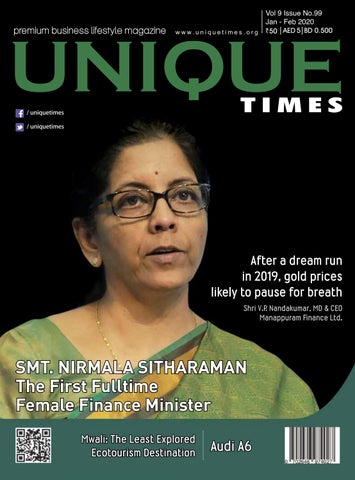
Vol 9 Issue No.99 Jan - Feb 2020
After a dream run in 2019, gold prices likely to pause for breath Shri V.P. Nandakumar, MD & CEO Manappuram Finance Ltd.
SMT. NIRMALA SITHARAMAN The First Fulltime Female Finance Minister Mwali: The Least Explored Ecotourism Destination
Audi A6
B S V I M O D E L AVA I L A B L E
Editorial
Chief Mentor Mr. V.P. Nandakumar Director & CEO Jebitha Ajit Editor Jebitha Ajit Legal Advisor Latha Anand famous Chinese proverb goes like B.S.Krishnan Associates this: “The gem cannot be polished bskrishnanassociates@gmail.com without friction; nor man perfected Sub-Editor Vignesh S.G without trials”. Associate Editor Ravi Saini The life of Nirmala Sitharaman, Rajeev Kumar the India Finance Minister, is destined Director and special editor kollur to be shaped by challenges. Getting a Correspondents Dr. Thomas Nechupadam seat in the JNU was a challenge for her; finding a Vivek Venugopal- Quarter Mile good job in Europe, forming a responsible NGO, Amrutha V Kumar and getting into politics and life as a Defence MinCreative Design PEGASUS ister…all were her challenges in the past. At preCover Photographer Ashique Hassan sent, she is preparing for her next big challenge Marketing UAE - to present a flawless budget! Our Cover Story Phygicart.com reveals more about this highly respected politician. P.O. Box: 92546, Al Karama Dubai V.P. Nandakumar, the CEO and MD of ManapMr. Anish K Joy puram Finance, analyses about the unprecedent Mob: +971528946999 ed spike in the gold price which has risen 23.9 per info@phygicart.com cent against the backdrop of falling interest rates, Plot No 19A, 9th Floor, economic uncertainty and geopolitical tensions. Green Building, Film City, Our Auto expert team gives a first-hand test Sector - 16A, Noida - 201301 drive report on the new Audi 6 which says VolkMaharashtra swagen’s luxury car is a jack of all trades car, Jayasankar M, a/101, something you can live with every day, and will do New Prathamesh Niwas, its luxury car duties as well. OPP. Laxmi Park, Thakurli East, Discover new reading experiences by leafing Dombivli post, Thane District, 421201 through Travel, Movie, Beauty, Books & Gadgets, Mob: 9820708662 Cookery, and Motivation stories. Hariharan Enjoy reading! chennai, Mob: 9840018929 Unique Times, No.6/31, Arunachalam main road, Saligramam, Chennai – 600093 Karnataka Paperback Publishing Jebitha Ajit 3218/A, 6th C Main, 13th Cross, HAL 2nd stage, Indiranagar Bengaluru 560038 Andhrapradesh PEGASUS Ph: 09288800999 Sunilkumar NN Your wing Dr. Susan S Sunny Director Ambalika Saikia, Ambalika_saikia@yahoo.com Shwetha Menon
A
Printed at St. Reddiar & Sons, P.B. No: 3627, Veekshanam Road, Cochin Published at Pegasus Global Pvt. Ltd. L5-106, Changampuzha Nagar Kalamassery, Ernakulam-682 033 e-mail: editor@uniquetimes.org uniquetimesindia@gmail.com Ph:0484 2532040, 2532080 Mob:+91 98460 50283, 94470 50283
Cover Photograph Smt. Nirmala Sitharaman Minister of Finance and Corporate Affairs
Printer & publisher Pegasus Global Pvt. Ltd. Kalamassery, Ernakulam on behalf of Ajit Ravi. Printed at S.T.Reddiar & Sons, Cochin-18.
20
CONTENTS
12
16
After a dream run in 2019, gold prices likely to pause for breath
12
Converting the ‘ability to learn’ into a strategic advantage
16
Smt Nirmala Sitharaman: The First Fulltime Female Finance Minister
20
Goods and Services TaxKey Developments
24
Meaningful connections that make your business
34
42
44
50
52
58
42
Gadgets
44
Recipes
50
Natural ways to remove pimple marks
52
Mwali: The Least Explored Eco-tourism Destination
58
Audi A6
UNIQUE DIARY
Govt constitutes new cabinet committee to boost growth
T
he central government has constituted a new cabinet committee, named the Cabinet Committee on Investment and Growth, to discuss how the Indian economy can be brought back to its glorious past. The committee is headed by Prime Minister Narendra Modi. Apart from the PM, the CCIG has at least four other members: Home Minister Amit Shah, Highways and MSME Minister Nitin Gadkari, Finance Minister Nirmala Sitharaman, and Commerce and Railways Minister Piyush Goyal. The first meeting of the committee has taken place recently under the chairmanship of the Prime Minister. The committee is expected to contribute enormously to get the country’s economy back to the track of growth.
Govt. moves NCLAT seeking modification in Tata Sons ruling
“There’s no shortage of remarkable ideas, what’s missing is the will to execute them.” Seth Godin
8
January-February 2020
T
he central government, particularly the Corporate Affairs Ministry, has moved the National Company Law Appellate Tribunal, seeking some modifications in its ruling on the case of Tata Sons. It has requested the tribunal to delete the word ‘illegal’ from the order. Earlier, the tribunal questioned the conversion of Tata Sons from a public company to a private company, calling the conversion ‘illegal’. In the appeal made by the Register of Companies to the tribunal, it has denied doing anything ‘illegal’ in the conversion of the company to a private company from a public company. It has even quoted the relevant provisions in the Companies Act to justify its argument.
Mumbai real estate sector struggles due to stressed assets
A
t least 25 per cent of the total loan provided to real estate developers in the Mumbai Metropolitan Region is under severe stress, as per a research conducted by Anarock, the highly respected research group which possesses in depth knowledge about the sector. The real estate developers in the region have received a huge sum of $35 billion as loan. Of this amount, at least $8.7 billion are in the red alert category. The Mumbai region’s stressed assets rate is almost double than that of its counterparts in the Delhi region, which the number stands at $4.3 billion. Meanwhile, the situation in the Bangalore region is far better than that of both the Mumbai and Delhi regions; in the region, the rate of stressed assets is just one per cent of the total loan amount.
Aadhaar authentication to be made mandatory to weed out fake GST dealers
“If you really look closely, most overnight successes took a long time.” Steve Jobs
T
he latest GST meeting has decided to make the process of Aadhaar authentication mandatory to bring down the number of fake GST dealers. The big announcement has been made by Bihar Deputy Chief Minister Sushil Kumar Modi, who has headed the latest Group of Ministers on Integrated Goods and Services TAX meeting. He who is not willing to present his Aadhaar details will have to undergo a physical verification process. The new decision to make Aadhaar mandatory has been presented as a method to curb fraud, as the government has found several fake activities in connection with the GST filing. So far, at least 24.86 fake dealers have been identified.
January-February 2020
9
UNIQUE DIARY
Govt. to inject Rs. 4,360 cr into IOB
T
he central government is set to inject a huge sum of Rs. 4,360 crore into the Indian Overseas Bank, which is at present under a serious financial crisis, in order to help the bank recover from the crisis. It is the second time a financial assistance has been extended to the loss making bank. With the latest infusion, the government’s stake on the bank has increased to more than 95 per cent. Recently, a huge sum of Rs. 3,857 crore was injected into the bank similarly by the central government to prevent the bank from falling into the pit of trouble. At present, the centre holds around 94.56 per cent of the company’s total share.
Vistara to become first domestic carrier to provide mobile data service on board
“The way to get started is to quit talking and begin doing.” Walt Disney
P
opular domestic carrier Vistara is set to become the first domestic carrier to prove its passengers with the facility to use mobile data services on board. The carrier has reached a deal with Nelco in connection with the matter. The company has secured the assent of the Department of Telecom in this matter. Actually, the carrier conglomerate is the first company that has received the approval of the department to provide the said facility. What is unclear at this moment is when the service will be launched by the carrier. The company has not yet made any announcement regarding the new plan so far.
10
January-February 2020
BUSINESS
Shri V.P.Nandakumar MD & CEO Manappuram Finance Ltd.
In December 2019, the US Federal Reserve Bank announced new term operations totalling $365 billion (over the two months upto January 2020), which involves ramping up the amount of temporary liquidity injections into the overnight lending markets. The Fed is to offer a total of $490 billion in liquidity via repo operations, including the $75 billion that it has already pumped in through three earlier term actions.
After a dream run in 2019, gold prices likely to pause for breath
F
or all the scientific and technological progress the world has made, people continue to value gold for the feeling of safety and security that it provides. Even today, most retail buyers of gold would trust it more than the currencies of their home countries. In fact, 75% of retail investors in India trust gold more than the rupee1. In the last calendar year, the price of gold in India has risen 23.9%2 against a backdrop of falling interest rates, economic uncertainty and geopolitical tensions. The international price of gold went up by 18.9%. Typically, a bull market in gold develops during times of global currency crises, a bull market in bonds (i.e.falling interest rates), a commodities bull market, or a combination of all three.
12
January-February 2020
The weak growth outlook for global economies has helped boost gold prices. Also, the reduction in interest rates effected by the US Federal Reserve and other advanced economies, and gold purchases by central banks in the emerging market economies, have also helped support gold prices. Recently, the Asian Development Bank lowered the growth forecast for China and other major Asian economies including India. Notably, China and India are among the two largest consumers of gold in the world. At the same time, recent reports suggest that the ongoing US vs. China trade war may ease somewhat as the US has approved the phase -one of the trade deal, which could reduce the uncertainty around global trade policies. The US has reportedly agreed to halve the tariffs on products worth $110 billion from 15% to 7.5%. Should this lead to optimism and a fresh wave of global risk-on trade, it can potentially weigh down on traditional safe-haven assets, including gold. However, sensitive issues such as indirect state subsidies, intellectual property and the Chinese ambition to dominate tech markets remain unresolved. Further, the upcoming 2020 presi-
dential election is another uncertainty factor impacting policy risk.
US Fed’s balance sheet expansion
In December 2019, the US Federal Reserve Bank announced new term operations totalling $365 billion (over the two months upto January 2020), which involves ramping up the amount of temporary liquidity injections into the overnight lending markets. The Fed is to offer a total of $490 billion in liquidity via repo operations, including the $75 billion that it has already pumped in through three earlier term actions. Historically, the Fed’s balance sheet expansion programs have boded well for gold. For instance,
the initial expansion of the Fed’s balance sheet began in 2009 in response to the sub-prime crisis. At that time, the Fed’s balance sheet was below $1 trillion, but by 2014, it had increased to $4.5 trillion. From 2008 to 2011, the Fed bought $2.3 trillion of debt, sending gold prices to a record high. In fact, during this period, gold rose from $800 per ounce to $1,200, and peaked at a record high of $1,921 in September 2011. Note that prices fell from highs above $1,600 to $1,200 in the first six months of 2013 due to expectations that the US Fed would unwind its policy of monetary easing (the so called “taper tantrum”). All in all, there is a strong reason to
anticipate a near term bullish move in gold on the back of Fed’s balance sheet expansion.
Pricing of Gold
In some respects, gold is somewhat like a super-sovereign, zerocoupon bond. It has an intrinsic val-
January-February 2020
13
ue, and it is highly liquid, carries no risk of default and provides no yield. As such, the returns generated by gold depend on its underlying value rising over time. Much like bonds, the price rises as yields fall, a trend that was particularly evident during the two big US debt crises of the past 100 years, the Great Depression in 1929 and the Subprime Crisis in 2008. The US authorities dealt with both crises in a similar fashion: they reduced short-term interest rates to around zero, thereby injecting liquidity into the financial system and depreciating the dollar against major currencies. Gold benefited from this policy on two counts. Firstly, as gold is priced and traded primarily in dollars, its purchasing power increased as the US currency weakened. Secondly, as interest rates fall, bond yields fell in sync. All this effectively reduces the opportunity cost of investing in gold which is a non-income-bearing asset. To understand the relationship between the price of gold in US dollars and the US interest rate and inflation, one can think of gold as if it were a bond. Gold, in this sense, is like a zero-coupon bond (pays no interest), long duration (lasts forev-
14
er), inflation-linked (demonstrated by historical purchasing power) and has zero credit risk (like a supersovereign). Charlie Morris, Head of MultiAsset Atlantic House Fund Management created a gold valuation model3, to value gold in US dollars, as a model of a hypothetical zero-coupon inflation-adjusted asset:
expect further reduction. There is even speculation in some quarters about more quantitative easing which would provoke another round of dollar depreciation. Bullion climbed to a six-year high in September 2019 as the Federal Reserve cut borrowing costs and the total pile of debt yielding less than zero rose to a record $17 trillion, boosting the appeal of non-interest-bearing gold.
The number 4 is the calibration with the best fit using a regression model, and the 20-year duration derives from a volatility match. Gold’s long-term average volatility has been similar to 20-year US Treasuries. It is more volatile than the 10-year but less so than the 30-year. He overlaid the results of this calculation on top of the gold price and it seemed to explain the trend, fair value and medium-term movements.
The question may now be asked, what is the outlook for gold in 2020? Here are the views of some important players in the market. Citigroup believes that gold has got more room to rally as there’s little possibility of the Fed raising interest rates in 2020. With the risks to global growth tilted to the downside, with inflation still undershooting, and with trade tensions likely to persist through 2020, they believe the bar to cut rates and going back to policy easing is lower. Citigroup expects Gold Futures to average about
Forecasts for Gold Price
The US Fed has cut short-term interest rates and most observers
January-February 2020
$1,575 an ounce in 2020, with an upside bias. They do not expect the US policy rate to move higher, rather, the Fed is seen capping the rise in real as well as nominal mediumterm yields, thereby reducing the opportunity costs of holding gold. All these factors should be supportive of gold price in the medium term. The most significant risk to gold prices in the near term is a surprise trade deal between the U.S and China and a substantial rollback of tariffs. Goldman Sachs Group Inc. and UBS Group AG see prices climbing to $1,600 an ounce (a level last seen in 2013). Gold is likely to have specific periods of outperformance when the market goes risk-off (i.e. when negative sentiments dominate and inhibit risk-taking). While most see a prolonged pause from the Fed, there are dissenters too. BNP Paribas SA expects another two rate cuts in the first half of 2020. The low-yield environment, along with the anticipated weakening of the dollar and easy money policies, will continue to support gold. Bullion buying by governments has emerged as a major pillar of demand, and this includes purchases by China. Goldman Sachs says the case for diversifying into Gold is ‘as strong as ever’ as central banks are consuming a fifth of the global supply of gold, marking a shift away from the dollar that’s bolstering the case for owning bullion.
Demand for gold from central banks is the highest since the Nixon era (i.e. early seventies). Investors are therefore being advised to diversify their long-term bond holdings by including gold because of “fear-driven demand” for the metal. BNP Paribas SA expects gold to surge above $1,600 an ounce as the Fed embarks on a quartet of interest rate cuts to combat slowing U.S. growth, the fallout from the trade war with China, and diminished prospects for any significant pick-up in inflation in the coming months. It expects the US Fed to opt for four 25 basis point cuts between now and June 2020. As nominal yields fall with each reduction, real rates will head towards negative territory, increasing the appeal of holding gold. On the other side, Morgan Stanley believes that a rollback in the tariffs imposed by the U.S. and China against each other could see gold prices falling toward their bear case forecast of $1,394 an ounce in the first half of 2020. Further, Chinese consumers are shunning gold as they grapple with the slowest economic growth since the early 1990s. China’s imports of non-monetary gold in October 2019 slumped to the lowest level since January 2017. Demand in India is also relatively depressed, and was unusually weak during the Diwali festival that otherwise sees a bump in imports. Accordingly, there
is little reason to expect a rebound in consumer demand for gold anytime soon, and should investment demand begin to wane too, the continuation of the gold bull run will be at risk. To sum up, there is no way one can confidently predict what the price of gold would be in 2020. Analysts can, at best, try and predict the likely reaction of gold price in case specific events occurs. There is no denying that the global economy is yet to recover fully from the financial crisis of 2008-09. While the US is showing signs of strength, Brexit can possibly set off fresh tremors across global markets. The yield on more than one-third of global debt is in negative territory. The trade war is far from over, and with US presidential elections in November 2020, there is more uncertainty to come. In a nutshell, while gold prices may see some easing in 2020, a sharp correction is less than likely. Moreover, there are several known unknowns that may nudge markets towards risk-off leading to the continuation of the gold bull run. At the end of the day, however, your guess is as good as mine. (V.P. Nandakumar is MD & CEO of Manappuram Finance Ltd. Views are personal.)
1. World Gold Council: Gold retail market insights, 2019 2. Price of 22K gold (IBJA 916) increased 23.9% from `2,900 (1-Jan-2019) to `3,594 (31-Dec-2019). Whereas prices increased 18.9% in USD/ounce terms, differences in performance is on account of changes in tax rate and currency (INR/USD) depreciation. INR depreciated by 2.34% against USD in the year 2019, from 69.71 to 71.35. 3. Source: https://www.gold.org/ goldhub/research/gold-investor/how-ivalue-gold
BUSINESS
Rajesh Nair Associate Partner, Ernst & Young LLP
Learning is also not easy. It is an intellectual nightmare as what we have learnt in our past experiences, school and college are often taken as definitions and agreed upon. It is also psychologically difficult because learning points to uncomfortable truths at times. As Peter Thiel, the legendary venture capitalist says ‘brilliant thinking is rare but courage is in shorter supply’.
Converting the ‘ability to learn’ into a strategic advantage
A
s early stage investors, we often ask entrepreneurs to get on with the task rather than languishing for long hours in fine tuning a business plan or perfecting the business powerpoint presentation. This is not to chide or belittle the importance of a robust business plan but to focus on execution and more importantly find the crucible of issues where one may need to learn or to pivot. The word ‘pivot’ is a relatively new ‘jargon’, and it simply means to reorient focus and change the core business fundamentals and objectives that an entrepreneur begins with. It is of high imperative because of all the winds of change – technology, business outlook, reach, new products etc. It is also because today’s business can be deciphered better using first principles rather than formula driven approaches. We
16
January-February 2020
are not often presented a cosmic menu of business directions but the need to rewrite the original plans we began with. Data, diligent analysis and a prescient business framework for thinking and thinking through options provide a helpful structure for planning. All these need an open mind and the ability to learn. Learnability is often underrated or taken as granted – ‘of course the ability to learn and change is important’, but we do not see as a strategic advantage. This is relevant equally for professionals as much as for organisations. We often rely completely on existing data. While it is important, there are often trajectories which are new, and you will not always find numbers which will help us conjure the story. Imagination is equally important. Imagination is not dreaming our new contexts but learning from trends and ques-
tioning the direction which we often take. C.S Lewis famously said – Imagination is the organ of meaning! A learning mindset also helps you summarise what you see – putting the schoolboy framework at work! What we learn in school is best retained and leveraged when we connect all of it into structures. Benedict Carey in his seminal book ‘How We Learn: The Surprising Truth About When, Where, and Why It Happens’ explains that retention and application of what we learn happens when we connect what we learn to our existing knowledge structures in our mind. For example, digital transformation or simply automation is fairly cyclical a phenomenon. From time immemorial, we have been seen miracle technologies. Suddenly, regular tasks have been transformed with new technologies and these have allowed us to do
more with less, ratcheting our fundamental capabilities to a different level. Learning and keeping an inquisitive mindset also help us simplify tasks in our mind. The famous Occam’s Razor philosophy ‘the answer to the complex questions are usually the simplest’ deserves a mention here. Consider again the example of digital transformations. Most of the innovations we see on a daily basis are basically around data and connectivity – on how we can leverage the two to transform customer in-
teractions and experiences or to redefine products and services which builds better customer interactions. These seem like over-simplifications but leaning back to the first principles helps you clarify and demystify your service offerings. All of this also relevant for professionals. Your basic education is nothing more than a fundamental baseline for you to add more from experience and embellish by thinking and creativity. The ability to think and reflect is the key to leverage whatever we have learned, and
the mind has to often work like an orchestra. It needs to maintain the symphony by extracting the right ‘notes’ from every subject we know and condensing it to a meaningful series of information which can then be used to take decisions. This is not a factor of age of a person – youth is no guarantee of innovation and fast thinking while seniority in age is not indicator of well catalogued experience. We often get counters of words like ‘serendipity’, the play of luck/ change and God’s dice. Well, some of these are purely connections, and
January-February 2020
17
they happen when we are more ‘mindful’ and aware. The Latin phrase ‘Amat Victoria Curram’ means victory loves preparation and it is a necessary condition. A constant learner can deliver crisp, relevant and clear messages in a steady cadence using the relevant formats and modes of communication. These are also important to communicate the long term orientation of people and firms which is a necessary counter balance when we constantly have pressures of short term financial targets to mete out our goals. These messages need to constantly use the prism of learning to converge relationships, data and information into actions to meet customer goals.
18
January-February 2020
Learning is also not easy. It is an intellectual nightmare as what we have learnt in our past experiences, school and college are often taken as definitions and agreed upon. It is also psychologically difficult because learning points to uncomfortable truths at times. As Peter Thiel, the legendary venture capitalist says ‘brilliant thinking is rare but courage is in shorter supply’. It is also interesting to note what Henry Hazlitt writes in ‘Economics in One lesson’ that many of the ides which now pass for brilliant innovations and advances are in fact revivals of ancient errors!’ It also is necessary to reflect on experiences of others, and the popular ‘my stories’ of entrepreneurs. Firstly, many of the successes are
seminal when we look at it on the rear view mirror. Secondly, success stories are highly subjective and equally contextual. They are events of a singular nature like the act of creation. Thirdly, management flukes are often more attractive than the rule base truths. Converting learning into a suite of strength is extremely important. The underlying sense of purpose, relentless drive and ambition, and optimism – even under dire and grave circumstances – will make learners an unique breed of achievers. In the constant endeavour of learning and unlearning, let us build new structures of ideas, focus on inclusion and create an interesting future!
BE PAMPERED IN LUXURY
Indulge in luxurious stay, exquisite dining, relaxation and rejuvenation while in God’s Own Country, at the contemporary and chic Crowne Plaza Kochi. Ease of access from the International airport and central location amidst city centre make Crowne Plaza Kochi a preferred destination. The premium facilities and attractions of the hotel, make way for a comfortable and elegant stay in Kochi. Picturesque backwaters | Ayurvedic Spa therapies | Yacht cruise | Health club | Jacuzzi & Sauna | Swimming pool | Authentic culinary outlets | Leisure activities | Shopping experience FOOD AND BEVERAGE OUTLETS
XI 641A Kundanoor Junction, NH Bypass, Maradu, Ernakulam, Kerala, India - 682304 T : +91 484 2865 000 | F : +91 484 2865 111 | www.crowneplaza.com
Her non-political career is as eventful as her political career. She was an assistant to Economist in the Agricultural Engineers Association in the United Kingdom. She also served as a senior manager in R&D. She was even a part of the BBC World Service team.
20
T
he NDA second’s first budget is just a month away. At present, all eyes are on a single person. That person is none other than the first fulltime female finance minister, Nirmala Sitharaman. Her first budget was exceptional. The magic is expected to be repeated in the upcoming February also. This time, the biggest challenge before her is economic slowdown. When she assumed the charge of the Finance Ministry, the Indian economy was at its weakest point. The induction was, thus, a huge challenge. Despite the pressure imposed by the struggling economy, she presented a people-friendly budget. The common people – especially those in the salaried class whose income is less than Rs. 5 lakh – benefitted hugely from the budget. Though the focus was more on the common people, the needs of other classes were not left unattended; that too was also rightly addressed. Notably, even the measures required to boost the inflow of foreign investments were there in the budget. In her first year in the office as
January-February 2020
the FM, she was very keen to serve the interest of the common people. The GST rates for certain items like housing, vehicles and hotel rooms were reversed several times in this period. As the FM is preparing to come up with her new budget, the expectation remains at its peak. The country very well knows nothing lower than an extra-ordinary budget can be expected from the talented economist who holds a JNU M Phil degree in the subject of Economics. Nirmala Sitharaman, who hails from the Indian state of Tamil Nadu, is a member of the Upper House of the Indian Parliament – Rajya Sabha. She represents the state of Karnataka. Her life as a social worker formally commenced when she was appointed as a member of National Commission for Women in the year 2003 by the Atal Bihari Vajpayee government; in fact, informally it began much earlier. Her formal political career started when she joined the BJP in the year 2006. Within a short span of less than four years, she raised to the rank of the official spokesperson
Smt Nirmala Sitharaman: The First Fulltime Female Finance Minister
This Madurai-born woman is not less than an inspiration. Whether it be her academic qualifications; be her contributions as a political leader; be her activities as a social worker, all are worth admirable.
January-February 2020
21
of the party. Her political growth was swift, yet impressive. It was from the state of Andhra Pradesh she was initially elected to the Rajya Sabha. In the first NDA government, she was a, not-so-popular, junior minister. It was her hard work and dedication that helped her to leave the junior minister status for the highly respected Defence Minister status; she is the first fulltime female defence minister. When the second NDA government was inducted, she was awarded the most coveted Finance Ministry. It was a perfect recognition for her contribution as an efficient cabinet minister in the first NDA government. Her performance as a lawmaker is also commendable. She is an active participant in the lawmaking house. She has dedicatedly participated in several important discussions, presenting her views about the discussion topics fearlessly. She has often crossed the limitations, posed by her political affiliation, to pay complete justice to the topics that have been presented to her in the house for her views. While mentioning her care towards the people of the country, the ‘Ockhi’ incident needs a mention.
22
She flew to Trivandrum, when the Cyclone Ockhi brought disaster to the coastal regions of the district. Her arrival was a great emotional support to the affected people. She unhesitatingly addressed the frustrated crowd, when no government representative was ready to face them due to the fear of unwelcoming emotional outburst from the part of the affected. Her non-political career is as eventful as her political career. She was an assistant to Economist in the Agricultural Engineers Association in the United Kingdom. She also served as a senior manager in R&D. She was even a part of the BBC World Service team. This Madurai-born woman is not less than an inspiration. Whether it be her academic qualifications; be her contributions as a political leader; be her activities as a social worker, all are worth admirable. This lady is one of the founding directors of a Hyderabad-based Non-Governmental Organisation, Pranava. There is no wonder that she holds a place in the list of one hundred most powerful women in the world prepared by Forbes. Nirmala Sitharaman is married to renowned economist Parakala
January-February 2020
Prabhakar, whom she met during her JNU days. The couple has a daughter. The FM’s life story speaks volumes about how to lead a meaningful life. At present, what is before her is a challenging task. She is not new to challenges. The journey she began as a BA Economics student in Seethalakshmi Ramaswami College still continues steadily. Getting a seat in the JNU was a challenge; finding a good job in Europe was a challenge; forming a responsible NGO was a challenge; establishing a sound political career was a challenge; presenting a flawless budget was a challenge. Every time, her confidence and determination have emerged victorious.. The trend may remain unchallenged in the future also. It will not be a surprise if this lady will manage to become the face of the saffron party in the near future. At present, if any woman leader has the calibre to make such a huge leap, it is only Nirmala Sitharaman. She has the required charisma, as well as the needed leadership quality. If any lady has ever occupied the coveted positions like the Defence Minister and Finance Minister other than the FM, she is Indira Gandhi,
Photo Courtesy: Google
the Iron Lady of India. That comparison itself is enough to understand where Nirmala Sitharaman stands in the Indian political hemisphere. “It took over 55 years for the Indian Economy to reach 1 trillion dollar but when the country and her people’s hearts are filled with ‘aasha’, ‘vishwas’ and ‘aakansha’ that is, when hearts are filled with hope, trust and aspirations, we, in 5 years, added 1 trillion dollar. Today we are nearing a 3 trillion dollar level. So when we aspire to reach a 5 trillion dollar level, many wonder if it is possible. If we can appreciate our citizens’ ‘purusharth’ or their goals of human pursuit filled with their inherent desire to progress led by the dedicated leadership present in this House, the target is eminently achievable.”-Nirmala Sitharaman
January-February 2020
23
FINANCE
Adv Sherry Samuel Oommen is a practising lawyer at High Court of Kerala who specialises in tax and Corporate Laws. Presently he heads the tax and corporate law practice of Nash Capital Partners. Apart from being a qualified lawyer, he is also a chartered accountant, cost accountant and a company secretary. He is currently pursuing his Doctorate Degree and is reachable at sherryoommen@nashcp.com.
The message of the government is now indeed loud and clear that strict action would be taken against all defaulters. It would indeed augur well for trade to ensure compliance with the provisions of law rather than to face the wrath of the Department. As evidenced above, the Standard Operating Procedure would indeed go a far way in the matter of best judgment assessment and deciding the fate of non-filers of various returns.
Goods and Services TaxKey Developments
T
he GST Council in its 38th meeting held on 18.12.2020, which was conducted under the Chairmanship of Union Minister for Finance & Corporate Affairs Smt. Nirmala Sitharaman has made a series of recommendations, particularly regarding the procedural related aspects. In this article, I wish to deliberate on some of the recommendations of the Council emanating from the 38th meeting.
Constitution of Grievance Redressal Committee Grievance Redressal Committees (GRC) will be constituted at Zonal or State level with both CGST and SGST
24
January-February 2020
officers and including representatives of trade and industry and other GST stakeholders (GST practitioners and GSTN etc.). These committees will address grievances of specific or general nature of taxpayers at the Zonal or State level.
Measures to improve filing of GSTR 1 (ie, return capturing outward supplies of a dealer) With a view to improve filing of GSTR 1, the Council has decided to waive late fee to be given to all taxpayers in respect of all pending FORM GSTR-1 from July 2017 to November 2019, provided the same is filed by 10.01.2020. The Council has also de-
cided that an assessee would not be in a position to generate an E-way Bill, if he has not filed GSTR 1 for two tax periods.
Prescription of a Standard Operating Procedure for return non-filers The Council noted that divergent practices are being adopted by departmental officials whilst dealing with non-filers of returns. With a view to ensure uniformity and clarify the issues regarding the implementation of the provisions of the law across field formations, the Council decided to prescribe
a Standard Operating Procedure which would need to be followed by all tax officers whilst dealing with cases regarding non-filing of FORM GSTR 3B returns. Broadly, the Standard Operating Procedure has now been prescribed vide Circular 129/48/2019 dated 24.12.2019, which is as follows: 1. A system generated message would be sent to all the registered persons at least 3 days before the due date to nudge them about filing of the return for the tax period by the due date. 2. Once the due date for fur-
nishing the return under section 39 is over, a system generated mail or message would be sent to all the defaulters immediately after the due date to the effect that the said registered person has not furnished his return for the said tax period; the said mail or message is to be sent to the authorized signatory as well as the proprietor or partner or director or karta, etc. 3. Around five days after the due date of furnishing the return, a notice in FORM GSTR-3A under section 46 of the Central Goods & Services Tax Act, 2017 (“CGST
January-February 2020
25
Act”) read with rule 68 of the Central Goods and Services Tax Rules, 2017 (“CGST Rules”) shall be issued electronically to such registered person who fails to furnish return under section 39, requiring him to furnish such return within the timeframe of fifteen days. 4. In case the said return is still not filed by the defaulter within the prescribed period of the said notice, the proper officer may proceed to assess the tax liability of the said person under section 62 of the CGST Act, to the best of his judgement taking into account all the relevant material which is available or which he has gathered and would issue order under rule 100 of the CGST Rules in FORM GST ASMT-13. The proper
26
In my view, while the objective is ensuring that there is compliance from all sections concerned, the denial of full tax input to a bonafide purchaser is arbitrary and unjustifiable. officer would then be required to upload the summary thereof in FORM GST DRC-07. 5. For the purpose of assessment of tax liability under section 62 of the CGST Act, the proper officer may take into account the details of outward supplies available in the statement furnished under sec-
January-February 2020
tion 37 (FORM GSTR-1), details of supplies auto-populated in FORM GSTR-2A, information available from e-way bills, or any other information available from any other source, including from inspection under section 71. 6. In case the defaulter furnishes a valid return within thirty days of the service of assessment order in FORM GST ASMT-13, the said assessment order shall be deemed to have been withdrawn in terms of provision of sub-section (2) of section 62 of the CGST Act. However, if the said return remains unfurnished within the statutory period of 30 days from issuance of order in FORM ASMT-13, then proper officer may initiate proceedings under sec-
TM
BUY ONLINE
Available at: CHUNGATH JEWELLERY, K PCC Junction, Mahatma Gandhi Road, Ernakulam, Kerala 682011
SAJ EARTH RESORT, Kochi MANAPPURAM RITI JEWELLERY, All over South India
tion 78 and recovery under section 79 of the CGST Act. 7. Further, in deserving cases, provisional attachment could be ordered by the Commissioner under section 83 of the CGST Act before issuance of the order in FORM ASMT-13. 8. Additionally, in cases of nonfilers, the department would also initiate for cancellation of the registration.
Measures relating to input tax The Council has also decided that credit in respect of input tax available to a recipient in respect of invoices or debit notes that are not reflected in his FORM GSTR-2A shall be restricted to around 10 per cent of the eligible credit available in respect of invoices or debit notes reflected in his FORM GSTR-2A.
28
January-February 2020
In my view, while the objective is ensuring that there is compliance from all sections concerned, the denial of full tax input to a bonafide purchaser is arbitrary and unjustifiable. In a recent judgment, the Delhi High Court in the case of Arise India Limited and others (TS-314HC-2017) has held that Section 9(2)(g) of the Delhi VAT Act to the extent it disallows input tax credit to a bonafide purchaser due to default of selling dealer in depositing tax, as violative of Articles 14 and 19(1)(g) of the Constitution of India. The appeal filed by the department against the said judgment before the Hon’ble Supreme Court has also been dismissed. In the said judgment, the court noted that in the event the selling dealer fails to deposit the tax collected by
him from the purchasing dealer, the remedy for the department would be to proceed against the selling dealer for recovery of such tax, and not to deny the bonafide purchaser, the right to full input tax credit. In my view, the said proposition would also apply in the context of the CGST Act.
CONCLUSION The message of the government is now indeed loud and clear that strict action would be taken against all defaulters. It would indeed augur well for trade to ensure compliance with the provisions of law rather than to face the wrath of the Department. As evidenced above, the Standard Operating Procedure would indeed go a far way in the matter of best judgment assessment and deciding the fate of non-filers of various returns
January-February 2020
29
HEALTH
Dr Arun Oommen MBBS, MS (Gen Surg), Mch( Neurosurgery), MRCSEd, MBA Consultant Neurosurgeon, VPS Lakeshore Hospital Kochi, India
Down syndrome (trisomy of chromosome 21) is the most common chromosome abnormality in humans occurring in about one per 1000 babies born each year. It is typically associated with physical growth delay, characteristic facial and physical features, mild to moderate intellectual disability and poor immune function.
Facts about Down's syndrome
A
38 year old man, Bhandari, and his 34 year old wife, Shelly, came to the NS OP with their 3 month old son whom they got after over 2 years of courtship. Obviously, their marriage was a late marriage. They were really apprehensive and filled with doubt about their son a rather floppy baby with small nose, almond eyes with epicanthal folds and small mouth with protruding tongue. During pregnancy, various tests and ultrasound scanning had revealed few abnormalities, but the couple were reluctant to terminate the baby as they were already worried about the late conceiving plus the trauma of terminating the pregnancy. They decided to continue the
30
January-February 2020
pregnancy. The child was diagnosed with Down's syndrome leaving the hapless parents with a bunch of questions and apprehension about his future. How did it happen to us? Is it due to any environmental factors or any genetic defect in any of the parents? What will be the future of this child? Will the subsequent sibling be the same? Down syndrome (trisomy of chromosome 21) is the most common chromosome abnormality in humans occurring in about one per 1000 babies born each year. It is typically associated with physical growth delay, characteristic facial and physical features, mild to moderate intellectual disability and poor immune function. It increases the risk
of a number of other health problems including congenital heart disease, leukemia, thyroid disorders, and mental illness.
Risk factors for Down's syndrome include:
• Advancing maternal age is the main risk. A woman's chances of giving birth to a child with Down syndrome increase with age because older eggs have a greater risk of improper chromosome division. By age 35, a woman's risk of conceiving a child with Down syndrome is about 1 in 350. By age 40, the risk is nearly 1 in 100, and by age 45, the risk is around 1 in 30. • Having had one child with Down syndrome the risk for next child with Down's syndrome is about 1 in 100.
• Mothers who have Down syndrome themselves are 50% more likely to give birth to a child with this condition. • Being carriers of the genetic translocation for Down syndrome, parents can pass down a chromosomal abnormality called balanced translocation, which contributes to Translocation Down syndrome. In this instance, the parent does not have signs of Down syndrome, but has genetic material "bal-
anced" between chromosome 21 and another chromosome, posing an increased risk for the child if that material attaches to the other chromosome when the cell divides. • Folate metabolism is abnormal in mothers of children with Down syndrome and that this may be explained, in part, by a mutation in the MTHFR gene. Physical features include a short stature, small chin, slanted
eyes, poor muscle tone, a flat nasal bridge, a single crease of the palm, a protruding tongue due to a small mouth and large tongue, a flat and wide face, a short neck, excessive joint flexibility, extra space between big toe and second toe, abnormal patterns on the fingertips and short fingers. Neurological features include mild (IQ: 50–70) or moderate (IQ: 35–50) intellectual disability. Many developmental milestones are de-
January-February 2020
31
layed. As they age, people with Down syndrome typically perform less well compared to their same-age peers. Commonly, individuals with Down syndrome have better language understanding than ability to speak. Many have either a stutter or rapid and irregular speech, making it difficult to understand them. They typically do fairly well with social skills. Behavior problems are not generally as great an issue as in other syndromes associated with intellectual disability. In children with Down syndrome, mental illness occurs in nearly 30%, with autism occurring in 5–10%. People with Down syndrome experience a wide range of emotions. While generally happy, symptoms of depression and anxiety may develop in early adulthood. People with Down syndrome are at increased risk of epileptic seizures which occur in 5–10% of children and up to 50% of adults. Many who live 40 years or longer develop dementia of the Alzheimer's type. Visual problems include refractive errors, strabismus, Cataracts Keratoconus and glaucoma. Hearing problems are otitis media with effusion and chronic ear infections due to poor eustachian tube function. Excessive ear wax can also cause hearing loss due to obstruction of the outer ear canal. Age-related hearing loss of the sensorineural type occurs at a much earlier age and affects 10–70% of people with Down syndrome. Congenital Heart Diseases in Down syndrome include atrioventricular septal defect, ventricular septal defect, tetralogy of Fallot and patent ductus arteriosus. Mitral valve problems become common as people age, Risk of leukemia and testicular cancer is increased and risk of solid cancers is reduced. Solid cancers are believed to be less common due to increased expression of tumor suppressor genes present on chromosome 21. Cancers of the blood are 10 to 15 times more common in children with Down syndrome; in particular, acute lymphoblastic leukemia is 20 times more common and the megakaryoblastic form of acute
32
myelogenous leukemia is 500 times more common. Thyroid problems can be due to a poorly or nonfunctioning thyroid at birth (known as congenital hypothyroidism) or due to an attack on the thyroid by the immune system resulting in Graves disease or autoimmune hypothyroidism. Type 1 diabetes mellitus is also more common. GIT problems like Constipation occur in nearly half of people with Down syndrome. Other congenital problems include duodenal atresia, pyloric stenosis, Meckel diverticulum, imperforate anus, Celiac disease and gastroesophageal reflux disease. Males with Down syndrome usually do not father children, while females have lower rates of fertility. It is said that fertility is estimated to be present in 30–50% of women. Menopause typically occurs at an earlier age. The poor fertility in men is thought to be due to problems with sperm development; however, it may also be related to not being sexually active. Three instances of males with Down syndrome fathering children and around 26 cases of women having children have been reported.
Diagnosis before birth
Several blood markers can be measured to predict the risk of Down syndrome during the first or second trimester. Testing in both trimesters is sometimes recommended and test results are often combined with ultrasound results. In the second trimester, often two or three tests are used in combination with two or three of α-fetoprotein, unconjugated estriol, total hCG and free βhCG detecting about 60–70% of cases. Testing of the mother's blood for fetal DNA is being studied and appears promising in the first trimester. The International Society for Prenatal Diagnosis considers it a reasonable screening option for those women whose pregnancies are at a high risk for trisomy 21. Accuracy has been reported at 98.6% in the first trimester of pregnancy. Confirmatory testing by invasive techniques (amniocentesis and chorionic villus sampling) is still required to confirm
January-February 2020
the screening result. USG Findings that indicate increased risk when seen at 14 to 24 weeks of gestation include a small or no nasal bone, large ventricles, nuchal fold thickness, and an abnormal right subclavian artery. Increased fetal nuchal translucency (NT) indicates an increased risk of Down syndrome picking up 75–80% of cases.
Diagnosis after birth
The diagnosis can often be suspected based on the child's physical appearance at birth. An analysis of the child's chromosomes is needed to confirm the diagnosis, and to determine if a translocation is present, as this may help determine the risk of the child's parents having further children with Down syndrome.
Managing a child with Down's Syndrome
Efforts such as early childhood intervention, screening for common problems, medical treatment, a good family environment and work-related training can improve the development of children with Down syndrome. Education and proper care can improve quality of life. Raising a child with Down syndrome is more work for parents than raising a normal child. Typical childhood vaccinations are recommended. A number of health organizations have issued recommendations for screening those with Down syndrome for particular diseases. This is recommended to be done systematically. At birth, all children should get an electrocardiogram and ultrasound of the heart. Surgical repair of heart problems may be required as early as three months of age. Heart valve problems may occur in young adults, and further ultrasound evaluation may be needed in adolescents and in early adulthood. Due to the elevated risk of testicular cancer, some recommend checking the person's testicles yearly.
Cognitive development
Hearing aids or other amplification devices can be useful for language learning in those with hearing loss. Speech therapy may be useful and is recommended to be started
around 9 months of age. As those with Down syndrome typically have good hand-eye coordination, learning sign language may be possible. Augmentative and alternative communication methods, such as pointing, body language, objects, or pictures, are often used to help with communication. Behavioral issues and mental illness are typically managed with counseling and/or medications. Education programs before reaching school age may be useful. Schoolage children with Down syndrome may benefit from inclusive education (whereby students of differing abilities are placed in classes with their peers of the same age), provided some adjustments are made to the curriculum.
Others
Tympanostomy tubes are often needed and often more than one set during the person's childhood. Tonsillectomy is also often done to help with sleep apnea and throat infections. Surgery, however, does not always address the sleep apnea and a continuous positive airway pressure (CPAP) machine may be useful. Physical therapy and participation in physical education may improve motor skills. Efforts to prevent respiratory syncytial virus (RSV) infection with human monoclonal antibodies should be considered, especially in those with heart problems. Plastic surgery has been suggested as a method of improving the appearance and thus the acceptance of people with Down syndrome. It has also been proposed as a way to improve speech. Many alternative medical techniques are used in Down syndrome include: dietary changes, massage, chiropractics and naturopathy.
Future prospects
Efforts are underway to determine how the extra chromosome 21 material causes Down syndrome, as currently this is unknown, and to develop treatments to improve intelligence in those with the syndrome. One hope is to use stem cells. Other methods being studied include the use of antioxidants, gamma secretase inhibition, adrenergic agonists and memantine
January-February 2020
33
MOTIVATION
Customer is the king in any business. They are the one who decide whether you should stay in business or not. Customers pay your salaries, through the business they do with you. Keeping them happy and delighted, hence, becomes the prime priority when it comes to sustaining a business.
Dolly Neena Dolly Neena is founder of Your Wing, a training company born out of a noble cause and spirit. She holds a decade long experience being a passionate mentor and entrepreneur.
Z
igZiglar said: “If they like you, they will listen to you. If they trust you, they will do business with you.” Building up a profitable bottom line is definitely one of the priority calls to success of a business; however, there is more to what the eyes see. Building meaningful relationships is what make a business tick longer, undoubtedly. Cultivating emotional genuine relationships with your vendors, customers, associations and employees helps build sustenance, authenticity, loyalty and longevity. It is all about relationships. Lasting business relationships happen with conscious consistent efforts, definitely strategized. Every company will have their vision and values set; there would be a distinctive culture every other company follows. Your relationship with the clients definitely relies on those core values you set for your own company, which eventually your employees follow. Your employees are your first customers. Hence the efforts should be to reinforce employee loyalty and passion within the company. Make sure the relationship to and between the employees is strong and loyal. Integrity towards the vision is significant here. Right training on building passion for work will help re-adhere strong relationship bonds between peers. Identify shared goals and oneness, at the same time respecting individuality
34
should become a culture. For making meaningful connections, the employees should make complimenting a habit. The company may bring up systems to reward and award best practices, set up Hall of Fame, plan events/trips/activities to have fun together and increase bonding. Scheduling opportunities to have bonding outside the workplace will indeed help them refresh their minds; it is a psychological way of inducing better absorption into hearts and minds. Arrange daily/weekly huddles that help employees open up more. Even though there should be control over sharing personal matters around an office space, understanding conflicts or concerns and temperaments should be encouraged. Annual events which entertain employees’ families can increase the bonding the employees have with their companies. An employee should be motivated to be devoted to the success of the organization. The level of company or employer loyalty in turn is very important to seek the mutual response from the otherside. It is a consciously developed mutual feeling with deliberately strategized efforts. Communication lines should be thrown open. There should be transparency in the exchanges. People managers can be effectively utilized for the same to incorporate effective strategies in interest of the team, which in turn enhance positive exchanges and in-
January-February 2020
MEANINGFUL CONNECTIONS THAT MAKE YOUR BUSINESS
teractions between employees and towards the company. Employees should feel excited about the goals set, and ideally work towards it with much enthusiasm. Get them believe in your mission. Engaging your employee lot in your CSR activities is yet another way to build meaningful relationships together. Employees will feel elated about themselves and the organization when they see that the company they are working
for genuinely cares for the society and moves cards to get things done for the deprived. Empower your employees. Customer is the king in any business. They are the one who decide whether you should stay in business or not. Customers pay your salaries, through the business they do with you. Keeping them happy and delighted, hence, becomes the prime priority when it comes to sustaining a business. First things first – Communicate effectively. How you communicate with your customer is a key deciding factor. It is a key primary factor to retaining any good relationship afterall. There should be aggressive efforts to understand your customer pulse – listening to them keenly is important here. Regular feedbacks should be taken, and measures to rectify complaints should be done regular-
36
January-February 2020
ly. Ask questions that means value to them. When a customer decides to choose your product or service, there would be certain expectations he/she has about you. The onus lies on your to do the expectation management then. It is important to make sure you deliver what you projected. In case of a discrepancy, assertively apologise and take productive measures to nullify the dissatisfaction, if any. Keep in regular contact with your customer in order to make them happy; this will assure them that you genuinely are concerned about keeping up with their satisfaction. Do CSAT surveys on a regular basis to keep a check on the same. Under promising and over-delivering should become a habit. Appreciate the customer for choosing you through sending them cards or gifts or offers. Regularly update them with newsletters. Selling
should not be the only focus; your existing customers should feel how trustworthy you are in catering to their needs - connecting deeply with your customer is a sure shot way to make them stay loyal to your products and services. Customers spread their voices of satisfaction across. This will in turn help keep away your competitors far down in the game. Eventually, thank your customers to stay in business with you. This spreads the right messages about you, emphasizes your customer-centric orientation toward business and helps build reputation in turn. Remember! “We cannot live only for ourselves. A thousand fibers connect us with our fellow men; and among those fibers, as sympathetic threads, our actions run as causes, and they come back to us as effects.”
Vignesh S.G Sub-Editor, Kochi, India
I
ndia is a growing economy. Definitely, its abundant labour force is its strength. The country is comparatively younger than the rest of the countries in the world. That reality speaks a lot about the country’s potential. The future of the country largely relies on the level of hard work the Indian workforce is ready to exert. There is no way a country like India can progress with an unhappy workforce. The Indian workforce can be broadly categorised as: the organised workforce and the unorganised workforce. The situation of
38
January-February 2020
When it is discussed about the topic of labour environment, only the organised sector is taken into consideration often. What is left unattended usually is the unorganised sector in which the majority of the labour population of the country resides.
the former is far better than the latter. When the organised workforce grabs whatever they want with the power of their collective bargain capability, the unorganised workforce struggles to protect even their basic rights like the right to minimum wage, the right to job security, the right to social security and the right to health insurance. The big question that emerges at this point is how much secure the country’s informal workforce is. This is the most irrelevant question to be asked to a country which is mired almost completely
in the concept of free market. In this juncture, the labour laws that the country is supposed to nourish are seen as hindrances to the country’s growth as a free market. The country remains happily in the tight embrace of globalisation. It is less likely to break that hug any time soon. The longer it stays the shorter its commitment towards its labour population becomes, as the process of the dilution of the labour laws is seen as an inevitable sacrifice to be made to protect the longevity of the, so called, sweet embrace. The December 8 accident – in
The Plight of Unorganised Workforce
which at least 40 poor workers living in an industrial unit-cum-residence in Delhi were charred to death – is an eye-opener. The country can no longer remain insensitive about the shortcomings of its labour environment. It is its duty to serve the interest of its labour population. No blame game can help the country escape that responsibility. When it is discussed about the topic of labour environment, only the organised sector is taken into consideration often. What is left unattended usually is the unorganised sector in which the majority of the labour population of the country
resides. What the incident like the aforesaid accident indicates is that in a considerable number of establishments – especially micro, small and medium – the regulation of labour conditions is almost nonexistent. Any talk towards the need of improving the work environment of those in the unorganised sector is often silenced with the argument of ‘ease of doing business’. It is wrongly propagated that the expansion of the rights of the unorganised sector contributes to the shrinking of the easiness enjoyed by the business community. The argu-
ment is even justified, pointing at the case of the organised workforce. What is purposefully hidden is the fact that the case of the organised workforce and that of the unorganised workforce is entirely different. The former is a privileged workforce in all senses, while the latter is its exact opposite – an underprivileged workforce. Notably, a considerable number of the labour population in the unorganised sector does not even have the luxury of minimum wage; in fact, many of them struggle hard even to survive with the mere they earn. Often, in the unorganised sec-
January-February 2020
39
tor, the wide gap between what an unorganised worker earns and what he is supposed to earn goes unquestioned, in contrary to what is usually seen in the organised sector. The evil of exploitation is rife in the unorganised sector. The degree of exploitation varies according to many factors like the place of origin of labour, the educational qualification of labour, the gender of labour and the caste of labour. The continuing dilution of the labour laws, the lack of proper political mobilisation activities and the existence of erring officials are those stand as hindrances towards the path of betterment. In the year 1991, India formally entered into the path of globalisation (thus, in the path of free market). The country’s opening up has improved the strength of its economy. Since then, several changes have been brought into the country to increase its ease of doing business. The shift in the attitude of the country has also reflected in the labour environment. In some places, it has come to visible in the form of low wage; in others, in many other forms such as the lack of job security. In a labour intensive market like India, labour is not a thing of high demand. It is the opposite in reality. The aforesaid fact makes its workforce – especially the unorganised
40
workforce – highly susceptible to the evil of exploitation. In the country, the majority of its workforce (more than seventy per cent) stands out of the security of the organised sector. Sadly, the political class it seems are less bothered about the plight of the country's workforce - especially the plight of its unorganised workforce. Thus, it indirectly serves the interest of the capital class. The miseries of the workforce – especially the unorganised workforce – can be easily alleviated through the effective interference of the political class. The ruling class can find a solution to the presence of erring officials in the system without much difficulty. If the officials responsible to take care of the workforce work efficiently, a part of the problem can be solved – at least it can be assured that whatever little legal protection remains is efficiently implemented. It is high time to create a platform to listen to the plight of Indian unorganised sector. At least it can help the concerned to understand the mind of its actual workforce. The unorganised workforce needs to be very careful. Following the path of the organised workforce may turn counterproductive, as blindly copying the working style of the privileged workforce – especially
January-February 2020
its disruptive attitude – may make the capital class’ crooked plan of branding the political mobilisation of the unorganised workforce as a hindrance to the growth of the economy (thus, a threat to free market) achievable. For the mobilisation of the unorganised workforce, a new path needs to be created. If it expects the support of the establishment; if it really wants to be less harmful to the economy; and if its emphasise is effectiveness, it should follow the path of non-disruption – the exact opposite to the path through with the organised workforce now moves. This generation’s strength of innovation can be used to develop a new path for the unorganised sector to achieve its goal of maximising its collective bargain capacity. What is expected to achieve from the suggested non-disruptive mobilisation is the strength of collective bargain. Once it is achieved, the rest will follow. “Labour is prior to, and independent of, capital. Capital is only the fruit of labour, and could never have existed if labour had not first existed. Labour is superior of capital, and deserves much the higher consideration.” - Abraham Lincoln, the sixteenth President of the world most powerful country of the United States of America
EEEEE BB
II AAAAAAAAAAA WWWW
PPPPPPPP
Miss South India 2020 18th Edition
o n 1 8 t h o f J a n u a r y, S a t u r d a y
Luxotica International Convention Centre, Kannur POWERED BY
EARTH RESORT & CONVENTION CENTER
MMMMMMMM PPPPPPP
MMMMMMMM PPPPPPP
OOOOOOO PPPPPPP
DDDDDDD PPPPPPP
HHHH MMMMMM PPPPPPP
CCCCC PPPPPPP
GADGETS
Vivo Y11
` 8,990 (approximately) Android v9.0 (Pie) OS 6.35 inches Display 13 MP + 2 MP Dual Primary Cameras 8 MP Secondary Camera 3 GB RAM 32 GB Internal Memory 256 GB Expandable Memory 5000 mAh Battery Capacity
Xiaomi Mi Note 10
` 43,290 (approximately) Android v9.0 (Pie) OS 6.47 inches Display 108 MP + 5 MP + 12 MP + 20 MP Quad Primary Cameras 32 MP Secondary Camera 6 GB RAM 128 GB Internal Memory 5260 mAh Battery Capacity
42
January-February 2020
Nokia 2.3
` 8,199 (approximately) Android v9.0 OS 6.2 inches Display 13 MP + 2 MP Dual Primary Cameras 5 MP Secondary Camera 2 GB RAM 32 GB Internal Memory 512 GB Expandable Memory 4000 mAh Battery Capacity
Vivo S1 Pro
` 19,990 (approximately) Android v9.0 (Pie) OS 6.38 inches Display 48 MP + 8 MP + 2 MP + 2 MP Quad Primary Cameras 32 MP Secondary Camera 8 GB RAM 128 GB Internal Memory 256 GB Expandable Memory 4500 mAh Battery Capacity
January-February 2020
43
COOKERY
Toshma Biju
Bread Pudding Ingredients
• • • • • • • • • •
44
Bread (cut into cubes) - 10 slices Margarine (melted) - 1/4 cup Raisins - 1/2 cup Ground cinnamon - 1 teaspoon Eggs – 6 nos White sugar - 3/4 cup Vanilla extract - 2 teaspoons Salt - 1/2 teaspoon Hot milk - 3 cups Nutmeg - 1 pinch
January-February 2020
Method
Heat oven to 190 degrees C. In a large bowl, combine bread cubes, melted margarine, raisins, and cinnamon and mix well, and transfer to a 2 quart baking dish. Use the same bowl to beat the eggs. Stir in sugar, vanilla, and salt until sugar is dissolved. Slowly whisk in the hot milk. Pour egg mixture over bread cubes, sprinkle with nutmeg, and set it aside to soak for 5 minutes. Bake in preheated oven for 25 to 30 minutes, or until a knife inserted into the center comes out clean.
Chocolate Pudding Ingredients
• • • • •
White sugar - 1/2 cup Unsweetened cocoa powder - 1/3 cup Cornstarch - 3 tablespoons Milk - 2 cups Vanilla extract - 2 teaspoons
Method
In a microwave-safe bowl, whisk together the sugar, cocoa and cornstarch. Whisk in milk a little at a time so the mixture does not have any dry lumps. Place in the microwave, and cook for 3 minutes on high. Stir, then cook at 1 minute intervals, stirring between cooking times for 2 to 4 minutes. Place a piece of plastic wrap directly on the surface of the pudding to prevent a skin from forming, and chill in the refrigerator. Serve cold.
January-February 2020
45
Custard Pudding Ingredients
• • • • • •
46
Granulated Sugar - 4 tablespoons Water - 1 tablespoon Hot water - 1 ½ - 2 tablespoons Eggs - 2 nos Milk - 250 ml Unsalted Butter – as much as needed
January-February 2020
Method
Let’s make the caramel sauce for custard pudding. Coat the inner surface of the custard cups with unsalted butter. Put the sugar and water in the pot. Heat the pot at medium heat. Let it sit until the surface becomes lightly-colored. Swirl the pot and even out the sugar liquid. Caramelize the sugar and remove the pot from the heat. Quickly add the hot water in 2 to 3 steps with a longhandled ladle. Tilt the pot away from you to avoid hot caramel sauce splashing and burning your hand. Swirl the pot and even out the hot caramel. Quickly add the hot water in 2 to 3 steps with a long-handled ladle. Pour the caramel evenly into the custard cups. Crack the two eggs into a bowl. Lightly beat the egg with a balloon whisk. Don’t let the tip of the whisk leave the bottom of the bowl to avoid creating too much foam. Add the milk and sugar in a pot. Turn on the burner. Stir with a spatula until all the sugar is dissolved. Add the milk to the beaten egg while whisking the mixture. Sieve the egg mixture with a fine mesh strainer. Scrape off the bottom of the strainer with a spatula. Remove any foam on the surface with a spoon. Pour the egg mixture into an easy-to-pour container. Let’s steam the egg mixture. Gently fill the custard cups with the egg mixture. Cover each cup with aluminum foil. The foil will prevent the surface from getting dry. It will also help steam the pudding evenly. Heat water in a pan and gently place the cups in it. The kitchen towel will soften the heat at the bottom. There should be enough hot water to cover the bottom half of the cups. Put the lid on. Keep the water temperature just below. Do not bring the water to boil otherwise the smooth texture of the pudding will be lost. Put kitchen gloves on and remove the custard cups. When they become cool, store them in the fridge. Serve the pudding on a plate.
TM
apply now for
Mrs Glam
World
ww.mrsglamworld.com
It’s
your turn
to pick the
glory up
Banana Pudding Ingredients
• • • • • • •
48
Milk - 1 1/2 cup Instant vanilla pudding mix - 1 package Sweetened condensed milk - 1 can Heavy cream - 1 cup Vanilla extract - 1 teaspoon Bananas (Sliced) - 4 nos Sugar - 2 teaspoons
January-February 2020
Method
In a large mixing bowl, combine milk, vanilla pudding mix and sweetened condensed milk. Whisk thoroughly, breaking up any lumps, and refrigerate for at least 5 minutes, or until set. In another large bowl, combine heavy cream and vanilla. Beat until stiff peaks form, 2 to 3 minutes. Set aside half of the mixture for topping the dish. Fold remaining half into the pudding mixture. Cover the bottom of a 3-quart trifle dish with vanilla wafers. Top with one-third of the pudding mixture. Cover with another layer of the wafer cookies — you may want to also stand some cookies up vertically, so you see the full circle along the edge of the trifle dish. Top with an even layer of banana slices. Continue layering the pudding, wafer cookies and banana slices until you reach the top, ending with a final layer of banana pudding. Refrigerate for at least 3 hours, or up to overnight
VAAN MOBILITY. WE MOVE PEOPLE. WE DRIVE CHANGE
www.facebook.com/VAAN-Mobility-109590713874183
www.linkedin.com/company/vaan-moto
www.youtube.com/channel/UCGwxrpdP58j44V1lv2yLqNg
BEAUTY
Natural ways to remove pimple marks
P
imple mark is a nightmare for most of us. It can even affect our confidence. We all want a clear face free of pimples and pimple marks. We believe that our facial beauty largely depends up on the clearness of our face. The skin condition of pimple mark is natural. There are many reasons for this condition. Some even experience this condition due to hormonal changes. We often are less bothered about why have we suffered this skin condition. Only the thing that worries us is how this condition can be eliminated. Sometimes, even skin peelers are used to get rid of this condition as early as possible, out of frustration, without knowing how dangerous the usage of skin peelers is. People cannot be blamed. For most of us, a single pimple mark is enough to spoil our confidence and even to push us into the pit of depression. People with oily skin are more vulnerable to this condition. Another group which is vulnerable is teenagers.
Dr. Elizabath Chacko, MD-Kalpana International
Mob: 9388618112
50
January-February 2020
As per a recent study, this skin condition is one of the reasons for the cause of frustration among teenagers. Actually, in the case of teenagers, there is nothing to worry. Pimples and pimple marks in teenagers are natural. It is due to hormonal changes. No medication is needed in this case. Meanwhile, there are some conditions which need the support of a skin specialist. It is important to seek the advice of a professional skin expert to identify what the reason for your specific skin condition exactly is. If your skin condition is indentified as natural by the specialist you have consulted, then you can try some amazing natural remedies to bring this condition under your control. If you are interested to know what those remedies are, this article will guide you. Continue reading patiently!
Orange
For our job, we do not need the fruit. Instead, we use its peel. Orange peel
is the rich source of citric acid, which possesses the ability to diminish pimple marks. Take a spoon of powdered orange peel. Mix it finely with a spoon of honey. Apply it on your face. Let in rest on your face for at least ten to fifteen minutes. Remove it with lukewarm water. Repeat it every day until the condition is totally cured.
Gram Flour
It is a highly effective method. It is not only suitable for removing pimple marks but also applicable for lightening skin. Gram Flour is a perfect skin cleanser. It helps to maintain pH balance. Actually, it is alkaline in character. Take a spoon of gram flour. Pour few drops of rose water and lime juice into the flour. Mix them until it is perfectly blended together. Apply the mixture on your face. Let it rest on your face for few minutes. Wash it off with lukewarm water. Try this method at least twice a week.
Coconut
It is really a gifted substance. It possesses anti-inflammatory
property, as well as anti-bacterial property. It is also a rich source of vitamins, such as vitamin E, and anti-oxidants. Take a spoon of coconut oil. Gently apply the oil on your face, concentrating more on the pimple mark-affected regions. For better result, leave it overnight. Wash it off with lukewarm water. Try this method at least twice or thrice a week.
Aloe Vera
It is needless to say how much beneficial aloe vera is. It is a magical plant. It has many skin care properties. It is not only good for pimple marks, but also perfect
solution for scars and even skin infections. It possesses strong antioxidant and anti-inflammatory properties. Take a small scoop of aloe vera gel. Apply the gel on your face, concentrating more on the pimple mark-affected areas. Leave the gel overnight for better result. Wash it off with lukewarm water.
Lemon
What makes this method special is the fact that lemon is easily available and is extremely cheap compared to the above suggested items. As you all know, lemon is a rich source of citric acid. It is also a perfect bleaching agent.
Take a spoon of fresh lemon juice. Apply it gently on the pimple mark-affected areas with a small ball of clean cotton. Let it rest on your face for few minutes – at least fifteen to twenty minutes. Wash it off with lukewarm water. The article is incomplete without mentioning the fact that it is wrong to connect facial beauty with confidence. The untold secret is that the less you are worried about your physical beauty the more confident you becomes. He who knows this secret is wise. Stay Beautiful! Stay Healthy! Stay Confident!
January-February 2020
51
TRAVELOGUE
Mwali: The Least Explored Eco-tourism Destination
Gifted with eye-catching greenery, peaceful beaches, cheerful villages and impressive art and culture, Mwali possesses everything a fine tourist destination needs.
52
January-February 2020
T
he more you travel, the more intelligent you become. Like reading, travelling is an important way to gain knowledge. There is no best teacher in this world than nature. Her biggest strength is her patience. Her way of teaching is extremely different from the way an ordinary teacher teaches. She never forces her students to learn. Instead, she encourages her students to develop their own questions and answers themselves. This method differs from the conventional method for many reasons including its high effectiveness. A good traveller is he who knows the ability of travelling to impart knowledge. A search for a perfect ecotourism destination is what that has led this writer to an autonomous Island
January-February 2020
53
in Africa, Mwali. What makes the Island different is the fact that this region is one of the least explored regions in Africa. Africa is a mysterious continent. It stands out from the rest of the continents in the world for its rawness. It has an innocence which the others lack. It is needless to say how beautiful Mwali is. If Africa is the least explored continent, Mwali is the least explored Island in this least explored continent. Gifted with eye-catching greenery, peaceful beaches, cheerful villages and impressive art and culture, Mwali possesses everything a fine tourist destination needs. Like the rest of Africa, this region also has a disturbing past. It has gone though many hardships to become what the Island is now. From an independent Kingdome to an autonomous Island, the journey has been not easy. It has fallen into the pit of total destruction several times. And, each time it has climbed up from the pit with more determination than the previous time. For the Island, each escape has been an experience. The Island was once part of the great Ndzuwani Sultanate. Later, the Sultanate of Mwali was created. At a point of time in the past, it was even made to survive under the direct control of France.
54
January-February 2020
Nioumachoua is the second largest city in the Island. It is known for its Islets, which are situated in front of the city. The Islets of Nioumachoua are popular for their white sand beaches.
The people of the Island fought for freedom. They were not ready to settle for anything less. They were not even ready to tolerate the attempt to tie the Island with the shackle of Comoros, in the name of helping the Island escape from the clutches of its colonial master. Their fight for freedom ended only when the region was awarded independence with an autonomous status. Like many other Islands in the continent, Mwali is also not stable in terms of economy. A considerable number of the people in the Island live a primitive life. In fact, they cannot afford anything more. The rapid rise of the tourism sec-
January-February 2020
55
tor in the region proves the hope for the growth is not completely nonexistent. Fomboni, Nioumachoua, Hamavouna and Hoani are the main tourist destinations in the Island country of Mwali. Fomboni is the capital city of Mwali. Here is where all the major government buildings in the Island are situated. It is the most developed region in the Island. Here is where at least one-third of the Island’s total population of 38,000 people lives. It is the largest, as well as the most populous city, in the Island. An old market and a boat jetty are the main attractions in this city. Nioumachoua is the second largest city in the Island. It is known for its Islets, which are situated in front of the city. The Islets of Nioumach-
56
oua are popular for their white sand beaches. The city is the best place to experience whale watching. The city offers boating, sailing and hiking experiences. It is home to several traditional villages. This part of the Island is where some of the finest artisans in the Island can be found. Hamavouna is a magnificent village surrounded by amazing mountains. The village offers a rare opportunity to see a beautiful sea turtle nest. Apart from the nest, there are two other important attractions in the village: one is an estuarine lake; and the other is a mountainous lake. Though the region is the most poorest region in the Island in terms of its economy, it is in fact the most richest region in terms of its natural beauty. It is truly a blessed land. Hoani is the most friendly vil-
January-February 2020
lage in the region. If one wants to know how environment should be protected, he/she should visit this village. This village is the best place to learn the preliminary lessons of community living and environment protection. Apart from its natural beauty, the village is known for its gifted artisans. It is the best place to buy handicrafts. The Mwali cuisine is different. It is strange, yet tasty. It is slightly different from what is served in Comoros. Its coastal influence gives it more life. The Island is not properly connected at present. Its medical infrastructure is also not that great. Nonetheless, the Island is worth exploring. Let’s explore this unexplored!
AUTO REVIEW
Vivek Venugopal is one of India’s top automotive writers with over a decade’s experience in road-testing and reviewing cars. He is currently the Editor of Quarter Mile magazine and a columnist in several leading magazines and newspapers. He is also a highly sought after consulting engineer and market analyst for many automobile manufacturers.
The new Audi A6 is the jack of all trades car, something you can live with every day, and will do its luxury car duties quite well. It is comfortable, it looks good and although, you don’t get another engine option, the one it comes with, works adequately well.
58
T
he coveted luxury arm of the German automobile giant Volkswagen, has been in India for the better part of a decade now. Starting off by selling imports in small quantities, the brand rose to popularity and was the leader in luxury car sales in 2012-13 period. The brand had then gone silent with no new mainstream model launches since the Q5 in Jan 2018. Audi India isn’t at the best performance in terms of sales right now, but they are hoping this new A6 would get them back in the game. Called the C8, this fifth generation of the A6 came out globally in 2018 and it took Audi its sweet time to bring it to our shores. Unlike the E class, which is only available as the long wheelbase variant (except in the E63 AMG guise), what we get is the standard wheelbase of the car. It is dimensionally very similar to the outgoing model with 7mm, 12mm and 2mm added to the length, width and height respectively, with another 12mm stretch in the wheelbase department. To the uninitiated, it might look like a facelift of the old car, with similar proportions. But, look closely and you appreciate the details. The front end looks sharper, and the lines are all much more pronounced. The body has more creases and the lighting elements have more details inside them. The characteristic front end
January-February 2020
has a new larger grille that extends all the way to the lower bumper. The rear has a more elongated look to it. It doesn’t have the purposeful stance of the older car and now sits higher on slightly thinner tyres. Inside, you notice the changes are much more profound. It gets a new layered dashboard with the new Audi MMI interface with twin touch screens in addition to the digital instrument cluster. The interface is all new and the infotainment system is very intuitive to use. It has haptic feedback to help you along, but using the lower screen while driving isn’t easy. The steering looks good and is great to hold, and so are the controls around it. Quality levels are good, but these days, with equally good competition, this don’t feel exquisite like it did in past Audis when they came out. What Audi does best, is the digital driver’s display which can show a multitude of information including maps, and that is easily the best in the segment. The boot capacity is 530 litres and unlike competition, Audi has its space saver spare wheel neatly tucked underneath the boot floor. The seats are comfortable, although we would have liked a bit more back rest angle at the rear. There is a prominent transmission hump, which means a third passenger wouldn’t be very comfortable in the middle. The front seats don’t get ventilation although you get
Audi A6
January-February 2020
59
four zone climate control. The rear sun blinds on the doors are manually operated and you don’t get 360 degree cameras, features that the competition does offer. It might seem that Audi has taken a step back in the driving department too. To begin with, you only get a four cylinder petrol engine, the air suspension with their dynamic dampers is gone and so is the quattro all wheel drive system. You also get thinner 225/55 R18 tyres in place of the wider 245/45 R18 tyres in the older car. There is only one petrol engine on offer, and there isn’t a diesel. Called the 45TSI, which is Audi speak for a medium level performance trim, this 2.0 direct injection four cylinder turbo petrol has 245bhp and 370Nm. The engine is a willing performer although in this segment, you would wish for a six cylinder or even a torquey diesel. It is easy to drive around town, has impeccable refinement at low revs and builds up speed quite well given its size. The 7 speed dual clutch automatic gearbox is quick to respond, although it feels it has been made to shift a bit smoother than in other applications. The switch to steel springs isn’t as bad as it sounds, though. There
60
January-February 2020
is less complexity, less risk of things to go wrong considering how much the suspension has to work overtime given our bad roads. The springs and dampers are well chosen and the car has a good balance between a comfy ride and handling. The ride quality is very good and it takes a lot to unsettle the A6. Grip, on the other hand, is much lower because of the switch to front wheel drive and thinner tyres. The steering and ESP are better than before, but it is not a car you want to drive fast. Switching between driving modes, doesn’t make much difference either, now that it doesn’t have dynamic suspension to stiffen up. Audis never had the steering feel to match, but the outgoing A6 with the 3.0TDI, complete with air suspension and Quattro was on another planet.
The new Audi A6 is the jack of all trades car, something you can live with every day, and will do its luxury car duties quite well. It is comfortable, it looks good and although, you don’t get another engine option, the one it comes with, works adequately well. Still, you get the feeling that Audi hasn’t quite done its best with it. It is not the technological leap forward as we would have hoped and in fact, it has gone the other way for us. And while it all works, we can’t get our head round the fact that it has lost out on many things that made the older car special. Two extra screens on the dash won’t do it for us, what good proper mechanical hardware can give on the road. Give us back the V6, all-wheel drive, dynamic dampers and wider tyres
MOVIE REVIEW
Chhapaak
I
t is a beautiful film directed by renowned writer-cum-filmmaker Meghna Gulzar. The film tells the story of an acid attack survivor. It shows how she rebuilds her life from the depressing state to which the brutal attack has brought her. It has a clear social message. Deepika Padukone plays the role of the survivor. The film is produced by the actress herself. Apart from the actress, Vikrant Massey, Ankit Bisht and Delzad Hiwale appear in the lead roles. All actors deserves special appreciation for the effort they has put. The film is emotional, yet impressive. It can appeal all kinds of audience.
Tanhaji
I
t is a historic movie directed by renowned filmmaker Om Raut, who is known for his film, ‘Lokmanya: EK Yug Purush’. The film tells the story of an unsung soldier, who was the closest aid of great Maratha emperor Chattrapati Shivaji. It shows the unsung solder’s last successful battle. The film has the answer to why he is revered across the Maratha region even today. Ajay Devgn plays the role of the unsung solider. Her wife, Kajol, also appears as a prominent character. Apart from the couple, Saif Ali Khan also acts in the film as an important character. Sharad Kelkar and Neha Sharma are the other main actors who appear in the film.
62
January-February 2020
The Grudge
I
t is a horror movie directed by popular American filmmaker Nicolas Pesce, who is known for his horror films, such as The Eyes of My Mother and Piercing. The film has an interesting story. It takes us though the point of view of a detective and a single mother who commences an investigation about a mother who has murdered her family in her house. The investigation leads the duo to the haunted house, where a deadly ghost resides. Lin Shaye, Andrea Riseborough, John Cho, Betty Gilpin, and Demian Bichir appear in the lead roles. There are several breathtaking horror sequences in the film.
The Gentlemen
I
t is a crime thriller directed by talented British filmmaker Guy Ritchie, who is known for his British gangster films. This film is not different form his previous ones. It also speaks a gangster story. It revolves around Mickey Pearson, the American who leads a marijuana empire in the UK capital of London. The moment the news about his departure is out, the power struggle for his fortune begins. The screenplay of the film is done by its director itself. Charlie Hunnam, Matthew McConaughey, Henry Golding, Michelle Dockery and Hugh Grant appear in the lead roles. There are several stunning action sequences in the film.
January-February 2020
63
BOOK REVIEW
The New Rules of Business: Get Ahead or Get Left Behind Author Price
: Rajesh Srivastava : Rs. 265 (paperback)
T
he world of business has changed a lot. Along with that, the rules of business have also undergone a tremendous change. From the experience of several new age conglomerates, it can be assumed that the new rules are far more effective than the old ones. In the new world, the business community is less reluctant to take up risk. The community even shows enormous enthusiasm to deviate from the traditional path. The book offers a deep insight about this new world. In short, it discusses in detail the new rules of business. It can excite all kind of audience, but is highly suitable for a business enthusiast.
Excellence Has No Borders: How A Doctorpreneur Created A World-Class Cancer Hospital Chain Author Price
N
: Dr. B S Ajaikumar : Rs. 628 (hardcover)
ot all people have the courage to follow their dreams. Only those who have dared to show that courage have done some good with their life. The book takes its readers to the life of an oncologist, Dr. B S Ajaikumar. In the beginning of his career, as a doctor, Mr. Ajaikumar had many options before him. His decision to take up the toughest of the options offered to him is what that has made him who he is now. He now runs a chain of world-class cancer hospitals across India. He is guided by his dream of making the cancer treatment accessible and affordable to all in his country.
64
January-February 2020
BOOK REVIEW
Gandhi’s Hinduism the Struggle against Jinnah’s Islam Author Price
: M J Akbar : Rs. 539 (hardcover)
T
he political confrontation between M K Gandhi, the devout Hindu who was not a fan of the idea of political religion, and M A Jinnah, the political Muslim who was a propagator of the concept of political religion, is an important part of the modern history of the world’ largest democratic country of India. Acclaimed journalist M J Akbar explores the unexplored layers of this confrontation. This book has everything needed to know about the sensitive political developments – especially the political blunders – led to the formation of a nation on the basis of religion from the secular land of India during the final years of the colonial rule in the country.
Ambedkar’s Preamble: A Secret History of the Constitution of India Author Price
D
: Aakash Singh Rathore : Rs. 539 (hardcover)
r. B R Ambedkar is the greatest intellectual who has ever born in India. He was a political icon, an academician, a thinker, a visionary, a social scientist, a writer, a journalist and many more. One of his greatest contributions to his country, the world’s largest democratic country, is its constitution. He was the chairman of the draft committee of the constitution. Importantly, he singlehandedly developed the preamble of the constitution, the backbone of the constitution. The book explores the political thoughts of the legendary Dalit leader. It discusses the origin of six key concepts such as justice, liberty, equality, fraternity, dignity and nation which make an important part of the preamble.
66
January-February 2020
Printed On 09/ 01/ 2020
RNI Reg No. KERENG/2011/42633