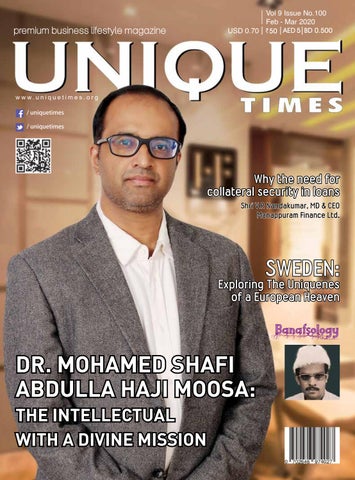
Vol 9 Issue No.100 Feb - Mar 2020
Why the need for collateral security in loans Shri V.P. Nandakumar, MD & CEO Manappuram Finance Ltd.
SWEDEN:
Exploring The Uniquenes of a European Heaven
DR. MOHAMED SHAFI ABDULLA HAJI MOOSA: THE INTELLECTUAL WITH A DIVINE MISSION
Editorial
Chief Mentor Mr. V.P. Nandakumar Director & CEO Jebitha Ajit oubt you the stars are fire Editor Jebitha Ajit Doubt that the Sun do move Legal Advisor Latha Anand Doubt truth to be a liar But never B.S.Krishnan Associates doubt I love’. In ‘Hamlet’, writer bskrishnanassociates@gmail.com Shakespeare hails the eternity of Sub-Editor Vignesh S.G Love. In these days of doubt, ValenAssociate Editor Ravi Saini tine’s Day comes as a solace. Rajeev Kumar Dr. Mohammed Shafi Abdulla Director and special editor kollur Haji Moosa’s exotic terminologies Correspondents Dr. Thomas Nechupadam like Banafsology, Miacro Points Econometrics, Techknow Vivek Venugopal- Quarter Mile Process (TKP) etc may baffle you…But this businessman Amrutha V Kumar from Gulf is ahead of our time and now on a mission to Creative Design PEGASUS establish tech parks in Kannur and Trivandrum where Cover Photographer Ashique Hassan he believes quantum scientists from around the world Marketing UAE will come and work. Internet of Things, IXGT and Quan Phygicart.com tum process will be the main focus of these parks. He P.O. Box: 92546, Al Karama Dubai Mr. Anish K Joy also focuses on innovation of energy, technology, produc Mob: +971528946999 tion of goods etc....Meet this futuristic computer scientist info@phygicart.com and entrepreneur in our Cover Story. Plot No 19A, 9th Floor, The major crisis of Indian banking sector is the grow Green Building, Film City, ing rate of NPAs or the non-performing assets. The fu Sector - 16A, Noida - 201301 ture of Banking sector and India’s economic recovery lies Maharashtra in the considerable reduction of NPAs. Chairman and Jayasankar M, a/101, Managing Director of Manappuram Finance V.P. Nanda New Prathamesh Niwas, kumar, in his regular column, suggests a possible way to OPP. Laxmi Park, Thakurli East, avoid NPAs by making ‘margin buffer value’ higher. What Dombivli post, Thane District, 421201 is the buffer value? To know, read the insightful article. Mob: 9820708662 Our auto team introduces Kia’s new offer- Carnival, Hariharan the big car that our big family needs. Another fresh is chennai, Mob: 9840018929 sue is here with all regular writings on the stock market, Unique Times, No.6/31, gadgets, banking, beauty, movie review, and book review Arunachalam main road, etc. Hope you enjoy the read! Saligramam, Chennai – 600093 Karnataka Paperback Publishing 3218/A, 6th C Main, Jebitha Ajit 13th Cross, HAL 2nd stage, Indiranagar Bengaluru 560038 Andhrapradesh PEGASUS Ph: 09288800999 Sunilkumar NN Your wing Vineeth Nair Director Ambalika Saikia, Ambalika_saikia@yahoo.com
‘D
Printed at St. Reddiar & Sons, P.B. No: 3627, Veekshanam Road, Cochin Published at Pegasus Global Pvt. Ltd. L5-106, Changampuzha Nagar Kalamassery, Ernakulam-682 033 e-mail: editor@uniquetimes.org uniquetimesindia@gmail.com Ph:0484 2532040, 2532080 Mob:+91 98460 50283, 94470 50283
Cover Photograph Dr. Mohamed Shafi Abdulla Haji Moosa
Printer & publisher Pegasus Global Pvt. Ltd. Kalamassery, Ernakulam on behalf of Ajit Ravi. Printed at S.T.Reddiar & Sons, Cochin-18.
20
CONTENTS
12
22
Dr. Mohamed Shafi Abdulla Haji Moosa: the intellectual with a divine mission
12
Why the need for collateral security in loans
20
The Power of Networking
22
Restrictions in input tax credit - is it justified a brief analysis of rule 36(4)
32
Carpal tunnel syndrome
36
46
48
52
54
58
46
Gadgets
48
Recipes
52
Natural ways to fight oily skin
54
Sweden: Exploring The Uniquenes of a European Heaven
58
Kia Carnival
UNIQUE DIARY
Samsung Display to open up factory in India
S
amsung Display, the flat screen maker based in South Korea, is preparing to open up a factory in the Asian country of India. The initiative will enable Samsung to secure local alternative for its most expensive component. The smartphone manufacturer faces tough competition in India, especially from its Chinese rivals like Xiaomi, Vivo and Realme. In the recent past, the market share of the company has fallen to less than 20 per cent from around 25 per cent. Samsung aims to boost its smartphone production in the country. The company, which commenced its production in the country in the year 2018, has been constantly increasing its potential since then.
Indian economic slowdown to impact insurance sector
"The successful warrior is the average man, with laser-like focus." Bruce Lee
T
he economic slowdown, which the country experiences at this juncture, may negatively impact the insurance sector, according to a report released by Moody’s Investors Service. The report predicts an issue in the area of premium growth. The same report also says that the sector can overcome the crisis with the support of certain measures adopted by the government and the Insurance Regulatory Development Authority of India. The report highlights the removal of the limit on foreign ownership in Indian insurance intermediaries as such a relevant measure. The Indian economy is at a very bad state at this moment. This state of economy not only hurts the aforesaid sector but also all other main sectors alike.
8
February-March 2020
UNIQUE DIARY
KMF to step up production
K
arnataka Milk Federation has articulated an ambitious plan to increase its milk output to at least 1 crore litres per day. The country’s second largest milk co-operative has decided to give more concentration to its value-added products. Excited by the success it has achieved in Singapore, it has commenced talks with other Asian markets to expand its presence across the continent. The co-operative may also take adequate steps to explore the United Arab Empire market. The present turnover of the highly successful milk co-operative is around 15,000 crore. The company aims to increase the turnover to not less than 25,000 crore.
Tata not to change policy on diesel cars
"In order to succeed, we must first believe that we can." Nikos Kazantzakis
T
ata Motors Ltd. has decided not to discontinue the sales of its diesel cars in favour of its petrol cars. The giant automobile manufacturing company has defended its stand with the ‘choice freedom’ argument. It is not ready to take away the freedom of its customers to decide on whether they want a diesel model or a petrol model. Many automobile conglomerates have recently taken a stand against the promotion of its diesel cars. The statement of the Tata is in a sense an indirect attack on its main rivals who have arbitrarily taken away a right of its customers.
10
February-March 2020
IKEA opens second showroom in Pune
I
KEA, the popular home furnishings retailer company based in the European country of Sweden, has launched its second showroom in the Indian city of Pune. Initially, the company had only online presence in the country. Later, it started a showroom in Mumbai. The company’s business in the country is rapidly expanding. It may mark its presence in each and every city in the country in the near future itself. It considers the country as an extremely potential market. The company is primarily concentrated in the affordable house furnishings sector, unlike many of its counterparts which aim to establish their presence in the competitive market.
Clarks to expand operations in India
"Successful people do what unsuccessful people are not willing to do. Don't wish it were easier; wish you were better." Jim Rohn
I
mpressed by the tremendous growth Clarks Future Footwear Private Ltd. has achieved in the year 2019, the shoemaker giant has decided to expand its operations in the Indian market. The company has achieved an impressive growth of at least 45 per cent in the year 2019, compared to the year 2018. In its best year, the company has sold at least 9 lakh pairs; that is at least 3.5 lakh pair more than its 2018’s sales. It views the expansion of ecommerce in the country as a big opportunity. At present, the ecommerce platform accounts for at least 10 to 15 per cent of its total sales. In the coming days, that is likely to increase for the better.
February-March 2020
11
DR. MOHAMED SHAFI ABDULLA HAJI MOOSA:
THE INTELLECTUAL WITH A DIVINE MISSION
Dr. Mohamed Shafi Abdulla Haji Moosa is a successful businessman who has taken leaps and bounds in various facets of business such as telecommunication, IT, network, security, software and business process management, trading, interior design and architecture, healthcare, oil, gas, energy, education, defence, critical service providers and aviation. This legendary businessman has been researching and investing in technology for human transformation what is called TechKnowProcess. As he believes that the time has come for an epochal intervention in changing the paradigm of the world for good, Dr. Shafi speaks about his latest offering to the world: Banafsology and Sustainable Econometrics Processes (SEP).
What is Banafsology?
Banafsology is a Benefunctionology process that I have revived after taking up deep research for the last 3 decades whose goal is to revive the process required for human development. In the year 1498, this country, especially Malabar, held with itself the secret of human progress. This disappeared when Portuguese came to our shores in the aforesaid year.
12
February-March 2020
The prosperity factor was not just because of trade but due to various other nuances which the world today is unaware of. Banafsology, is something which I have revived after receiving some of the secrets from my father who went to the Gulf in 1952 and laid the foundation for TCN International Commerce.
What is the aim of Banafso-
logy?
It is the path and the parameter revived by us to create economy, employment, engagement, engineering and effectivity. It uses the process which we call as C4MP Miacro Points of Econometrics. As an advances computer engineer who has been leading the transformation of both telecom and computer technology, through intense research by em-
It is the path and the parameter revived by us to create economy effectivity, employment, engagement and engineering effectivity. It uses the process which we call as Miacro Points of Econometrics. February-March 2020
13
ploying analyst we have developed this process.
What is Miacro Points Econometrics?
The world always gets attached to binaries. There is micro and macro. We have found by investing time, money and effort in this subject, there are many more dimensions. We call this dimension as Miacro Points Econometrics. This holds the key to future. It can eradicate world hunger for good. Our forefathers had this amazing Human Cultural TechKnowProcess HCT . This is pioneered by India. So I also call it Hindustan Cultural TechKnowProcess . Through these processes, human potential, direction and result can be optimised. I wouldn’t want to explain how we do it as it is complicate. But, in the last thirty years, every subsidiary company that we have created, 50 % of the time of each of the people are invested in this process. This is also the secret of prosperity and growth of our company into various fields.
14
February-March 2020
Can you still scalp the surface of this and give us an idea?
Human behaviour is coded in DNA and at the same time it is also created with exposure to various fields. I call this by the term Psoloud. Psoloud is effected by genetics as well as the nature of our first breath. There are 28 types of winds in the world. These winds can change people and their mannerisms. The philosophy of acquiring knowledge is called i8netics epistemology. Now, these factors make up the individual. So, as a family business chairman who has employed over 2000 people, it is important for me to understand each human potential. By understanding I can tap the potential and direct in best contribution to the productivity of the company and create C4P Connectivity4Productivity.
In an age where computers are taking over humans, you think it is important?
Handling computers are easy. Computer has an architecture pro-
tocol. Human thought process is all based on million reasons. It varies. This is why, if the technic behind operationalising maximum human potential is unveiled, it can transform the world. This can only be done with the readiness of the person. That’s the only setback. Our research has found that psoloud exist for four years and its transition happened every four years. By 16 years, it gets cognised into full. It sounds complicated. It does. But there is no easier way to say this. A knowledge base takes minimum 32 years to even get acceptance, according to our findings. It can go in its multiples only of up to 128 years. I found quantum process between 1998 and 2003. Yet it took me to create formulas five more years to give it structure.
You also spoke on teleology as a basis of your research. Could you explain?
Teleology or finality is a reason or explanation for something as a function of its end, purpose, or goal
and integrated onject. For instance, Aristotle claimed that an acorn's intrinsic telos is to become a fully grown oak tree, the doctrine of design and purpose in the material world. If teleology is identified, harnessing human potential for good is possible. Not just teleology, a person potential is also connected with his connection to topics such as anthropology, deontology—science of morals and manners among others. I have used 28 such logics to cognise the principle of miacro econometrics. I can share this: Teleology movement on earth is the ultimate power which is controlling the organic system and organised system. Yet, we have developed scales to map every individual possibility.
How exactly your technology works?
Throughout the person’s life, the kind of knowledge
and information the person is reading, processing and digesting decides the categorisation of the person. I have classified all these people into various categories (such as O, omega, alpha, beta and gama) and by understanding the person, the type of job that can be provided to the person can be decided. This in turn will improve efficiency. Similarly, a group pattern can be determined. Basically, the research that we have done for the last 30 years will help create prosperity by understanding individual needs and aspiration. How much a human being is connected to these logics can be derived through our processes. For they may be connected to 4 logic while some may be 8. Based on their connectivity, work and tasks can be assigned. And these are not merely theories. In all my compa-
February-March 2020
15
16
February-March 2020
ny, these parameters are being used. This application can create a strong human foundation which has a vision. Positive Policy Planning Pillars is what I call this (4P).
How do you plan to use it in Kerala?
We are setting up a state of the art tech park based in Kannur called TechKnowProcess (TKP) AIT . This campus will be futuristic. As we foresee it, quantum scientists from around the world will come and work here, and create great research findings that can bring growth. Our goal of this park which will also come up in Thiruvananthapuram
KVAHMSF PSR Personal Social Responsibility PACT Productivity Architecture Change TechKnowProcess
is it will bring Economy, Employement, Engagement and Effective Engineering, through Banafsology Econometrics; a) SRC Smart Rural Centres b) SRC Sustainability Resources Care c) TSS Tourism Support Services park d) SRC TCZ 21C Citty Project e) MSAT TSS adbc Park with 5 Star Hotel, Tourist Commercial Networks f) ODC One Day Care for tourists, denizen and citizens g) Knowledge Resort R4MP h) IOT_21C_TCN = IXGT Inter-
net Of Things to 21C Transformation Community Needs i) Phonology Lab Pxi8 DVI ixi8 We are creating an academy of research and quantum process in Kannur, Thiruvananthapuram and in Wayanad. This will help create humans that can come up with positive ideas and create a sustainable ecology. This will be state of the innovation lab which will teach on IoT, AI and RPA Robotics Process and DSM8 Data Science Magnatizing with Demand & Supply Matrix, beside observation on TMP TeleMegnatizingProtocol . The innovations lab in Kerala will feed the
February-March 2020
17
implementation lab in Hyderabad and outside India such GCC, Malaysia ,CIS, Africa , Bangladesh. We have agreed about some 100+ acres in different places. This will be a quantum process park. People from around the world will come to Kannur and Thiruvananthapuram to join the research. Miacro Points econometrics through the quantum process it can bring possibility of a connection between quantum physics, organizations, individuals and the enneagram, and began to explore how the application and implementation of the enneagram in organizations might change. Internet of Things, Internet of Every Thing, IXGT and quantum process will be the main focus in these parks. Different firms have been created. There are different business units that come up with
18
February-March 2020
innovations on energy, technology, production of goods as well as various other trades. There are centres that will focus to create Smart Rural Centre and SUSTAINABILITY RESOURCE CARE. Similar parks will also come up in GCC, Canada, Bangaladesh and the UK.
Do you think this is practical?
See, for centuries man has been studying algebra, equations and other theories, yet people kept asking what is the practical need of such things. Aren’t these basic formulas of mathematics backbone of greatest architecture and even computers? Similarly, Miacro Points econometrics is the big contribution of this millennium. It is going to transform humans.
Will it transform all hu-
mans?
We are tracking human movement and its nature. We create analyst to track demand and supply. Thus, this analysis can bring prosperity when transferred to people.
Can’t this be done through AI?
This can also be transferred to a computer. But a tri-logic system only ensures sustainability and computer is based on monologic.
Why is this human culturing important?
The states of mind of employees of organisations are very important. Usually, an employee is engaged, disengaged or actively disengaged. The sad truth is that about 25 % of the employees are actually engaged with the vision of the company. Our techno programs are designed to encourage employees to be engaged
Master Strategy Architecture TechKnowProcess (MSAT) TSS R4MP Blockchain C4MP Miacro Points of Econometrics
February-March 2020
19
BUSINESS
Shri V.P.Nandakumar MD & CEO Manappuram Finance Ltd.
In real life, it often happens that the recovery value of the collateral is less than its deterrent value. The difference, i.e. deterrent value - recovery value, is the “margin buffer” or the extra comfort a lender gets. The higher the difference, the higher the buffer, as the loan amount is mostly lower than the recovery value of the collateral.
Why the need for collateral security in loans
A
question that banks and NBFCs (or others in the business of lending money) often get asked is, why do they require collateral? In the context of finance, collateral is a property or any other asset that a borrower offers to the lender to secure the loan. If the borrower defaults on the loan repayments, the lender can take possession of, and sell off, the collateral to make good the losses. Collateral serves two primary purposes. The first is to act as a deterrent to the borrower against defaulting on his promised repayments (i.e. deterrent value). The second is to help the lender with the recovery of the dues (i.e. recovery value). In real life, it often happens that the recovery value of the collateral is less than its deterrent value. The difference, i.e. deterrent value – re-
20
February-March 2020
covery value, is the “margin buffer” or the extra comfort a lender gets. The higher the difference, the higher the buffer, as the loan amount is mostly lower than the recovery value of the collateral. Of course, in some cases, the actual recovery amount could turn out to be less than the collateral’s assessed recovery value. Such variances can arise either due to faulty assessment or changes in market conditions. Accordingly, lenders aim to have a larger “margin buffer” to serve as a cushion in such a scenario. For example, if a customer borrows against gold jewellery, the resale value of the jewellery (or the value of its gold content) is the recovery value. However, the deterrent value is much more and would be the sum of the recovery value, the making charges paid to the jeweller, the taxes paid to
the government, the retailer’s margin, and also the emotional connect or attachment the borrower and his family would have towards that piece of family gold jewellery. In this case, the buyer would have paid much more than the value of the gold metal constituting the jewellery, and it adds to the lender’s buffer. Likewise, a piece of jewellery which attracts higher making charges would provide a better margin buffer, and if the emotional value of the jewellery is higher (e.g. with a mangal sutra or jewellery in the nature of family heirloom etc.), it adds even more to the buffer. It is important to understand the “deterrent value” of the collateral from the customer’s perspective. If he were to default on his loan when the deterrent value is significantly higher than the recovery value,
which in turn is more than the loan outstanding (including interest), then the customer is likely to make all-out efforts to keep the loan in order. Here, the Deterrent Value > Recovery Value > Loan Outstanding and this implies “margin buffer.” This deterrent value is the reason why a borrower may choose to default on one loan, and yet keep on servicing another loan. Indeed, there are several forms in which this kind of “deterrent value” becomes available to the lender. It is present not only in collateralised debts but also in cases of unsecured debt, such as in the form of a “personal guarantee” executed in favour of the lender, credit bureau scores that would suffer downgrade in the
event of default (making it more difficult to avail loans in future), or the recourse to legal proceedings with all the hassles it entails for the borrower. Besides, the fear of loss of social standing also acts as a deterrent. Some lenders even choose to name and shame the borrower into nudging them towards honouring their obligations. When it comes to a personal guarantee, a personal guarantee from the borrower’s spouse may have more substantial deterrent value than one from the borrower. In the event of default, the lender could enforce the spouse’s guarantee, which borrowers would like to avoid at all costs. Similarly, lenders derive higher deterrent value from a
residential property self-occupied by the borrower and family, rather than from a vacant house or one that is given out on rent. To sum up, the thumb rule is, the higher the buffer, the lower the likelihood of default. The borrower not only loses the collateral (recovery value) but also incurs an opportunity cost (deterrent value) over and above the recovery value of the collateral. For lenders then, the lesson is that they can effectively reduce the default rates, or NPAs, by maximising the deterrent value (V.P. Nandakumar is MD & CEO of Manappuram Finance Ltd. Views are personal.)
February-March 2020
21
BUSINESS
Rajesh Nair Associate Partner, Ernst & Young LLP
22
An interesting idea is to involve students in social network projects in schools and colleges. Humans are wired to socially connect. Connections are not just starting a venture but a way a thinking and a way of life. It is the constant quest to do better, to doggedly follow improvements and develop the keenness to make a difference.
February-March 2020
The Power of
Networking W
e live in an age where there is a surfeit of information. For every topic under the sun, there is information and snippets available on the internet and often well catalogued. From normal daily habits to the workplace, we are facing new ways of working and living, in every aspect of life. When we pause and look at the welter of change around us, the scenario which stares back to us is that of massive flux. It does not require us to dig deep to the roots of change to see that technology is the primary disruptor of our times. The quotient of change also requires us to be far more creative and proactive than the yesteryears. It is not just enough to be great problem solvers, today, we need to be pre-empting and finding potential problems. While the thinking capacity to master new technologies will be key, these critical skills need to also be buttressed with aggressive pace and nimbleness. Most of the information that we have around us needs to be synthesised into byte sized knowledge and connected with what we know and have learned in the past. This also brings in paradigm changes in the way we think, work and live. Add to the demographic dimension, there is also the massive advent of technology that we have to negotiate with. The laptops, the constantly flickering smart phones are an extension of the human body for today’s professional. Very simply, the average knowledge worker of today has these massive
distractions whether she is at her work place or at home and trading casual banter in a coffee shop! This brings in the modified managerial mind. Today, you need to focus on multiple things at the same time. A deep thought is often fighting for mind space with a phone call, an email, a social media notification and the like. This is not just a ‘youth’ phenomenon. The middle aged and the senior citizens also have all these multiple distractions, and a retired employee grapples with the same sort of challenges. The time and intent to focus on a task is becoming more and more ephemeral and this leads to what the management guru’s call – the light touch! This is not the subtle management scholarship of deftly manoeuvring but the complete inability to ‘think through’. The less we do this, we also mentally teach ourselves to focus less. A lot of our development professionally happens with the multifarious interactions we have at the workplace. This is not just through the valuable confines of work but also comes from the what cooler discussions and the pebbles of organisational culture you unconsciously pick up in your time with organisations. While culture itself is like the vitals of an organisation, professionals gain a lot from it and embrace maturity through it. You will need to foster avenues for these conversations and fellow experts. This can happen through industry or sector networking forums like TiE, CII, FICCI, KMA etc.
February-March 2020
23
The charters of all these societies / clubs / forums are with the best intentions and with the verve to provide a platform for all likeminded people who can contribute to a large common good. What eventually happens, at times, is that these groups become more an extended business or career networking platform and the basic ethos of the very idea of formation dissipates with time. Another cardinal mistake some of them make is to seek new members ‘who are like them’ – similar profiles, similar younger people – brining in a diversity gap, which becomes a deficient component to generate the best of good ideas. An interesting idea is to involve students in social network projects in schools and colleges. Humans are wired to socially connect. Connections are not just starting a venture but a way a thinking and a way of life. It is the constant quest to do better, to doggedly follow improvements and develop the keenness to make a difference. He regularly sees jobs being the end of creativity and people become just a ‘pair of hands’ doing things without thinking and without the zest to make a difference. One gets worried when educated creative young people say that they can’t find employment, when just opening your eyes can open you to a panorama of problems for you to solve and create a business out of. As business professionals, our connections are the pulse of what we have achieved and what we are capable of. How do these connections come about? It comes from giving. When we are helpful to the environment around us, when we never hesitate to help someone in need, it creates a good will that is inexplicable nor is it part of some complicated array of strategic moves. It needs to be a sheer act of wanting to help. This is what we could call ‘collaboration commerce’ – business getting created and done through collaboration. It is important to have a network of connected ‘smiles’ around you. It brings happiness and confidence in our abilities and a sound fulfilment of being ‘good’. Always remember-often a win-win situation turns into a situation where we are secretly following up to make sure that the other person has not got more than we have from the deal. That perhaps is akin to keeping score and constantly looking at the scoreboard of achievements. We cannot create great relationships in business or in life by keeping track in such a manner. It cannot be a fifty – fifty proposition, it needs to be a
24
February-March 2020
100 % winning proposition of the other person. Focus completely on the success of the other person and go with focus and intention to help them achieve what they want. You will walk out in a successful deal having created a personal ambassador, who will respect and like you for life. Any success is often more than ninety five percent, the victory of a human interaction. And that results from being your genuine self. This comes from the skill of always being ‘you’. You can modulate and synchronise your behaviour with timely principles of human nature, but it is not the ‘wrapping’ people care for – it is the core product inside the wrapping – YOU. When you genuinely want the other person to succeed, you will find meaning in the transaction and understand the
value of being authentic. It is important to remember that giving is not part of a roadmap or a strategy or seeding to create a future success. It is also not about developing undue influence by pushing. Gravity always works when you create a pull. You will literally find it impossible to keep pushing. How far can you push a piece of rope? Is not easier pulling it? It is never about how much push you have on someone but the pull you have on them. Always remember, people always buy from someone whom they love and trust, given all other hygiene factors are similar. Your ability to sell improves by quantum by putting the needs of the other person foremost. It is the most fundamental rule of life – TO NETWORK YOU NEED TO GIVE!
February-March 2020
25
THE DIVINE TOUCH OF ALMIGHTY I ndia is ambitiously marching towards the target of five trillion dollar economy. It may reach there in the near future. The country cannot turn its back towards the privileged class. The attitude is evident in the latest budget. The restructured income tax framework is a perfect example. Sadly, the plight of the underprivileged is often given less attention. The tribal community of the country is the most underprivileged of the underprivileged. When the progress attained by the tribal community is analysed closely,
26
February-March 2020
the important question that emerges is: how much progress does the community has made since the independence of the country. Needless to emphasise, the aforesaid community is the only community which has been left out completely from the march of the country from an underdeveloped country to a developing country. Now, what the country attempts to attain is a developed status – a position among the superpowers such as the US, Russia, Germany and China. Unfortunately, this time also, the tribal
The HRDS INDIA is a Non-Governmental Organisation based in the Indian state of Kerala. Since its inception in the year 1997, it has launched several programs to alleviate the plight of the underprivileged population - especially the tribal population.
February-March 2020
27
community stands nowhere near its priority list, though the country boasts of its ambitious tribal betterment policies. This scenario increases the necessity of socially committed NGOs. Their existence serves to reduce the unjust gap. In this edition, one such NGO is introduced. The HRDS INDIA is a NonGovernmental Organisation based in the Indian state of Kerala. Since its inception in the year 1997, it has launched several programs to alleviate the plight of the underprivileged population – especially the tribal population. Sadhgraha, the housing scheme launched for the tribal community by the HRDS INDIA, is one such program. It aims to find a permanent solution to the biggest question the community confronts at this juncture – that is, the question of shelter. The organisation targets to complete at least one million houses this decade. Apart from the aforesaid pro-
28
February-March 2020
grams, Deen Dayal Upadhyaya Grameen Kaushalya Yojana, Karshaka, Niramaya, Jwalamukhi and Silk Village are the other important programs launched by the NGO. DDU-GKY is an exceptional skill development program intentioned to make the youth population from the socially backward society – especially those aged between 15 and 35 – independent. Karshaka is another income generation program. It explores the potential of the tribal land to become the backbone of the medicinal plant cultivation sector of the country. The organisation does not limit its potential in the area of social services alone. It does venture into other possibilities too. With Niramaya, it explores its research potential. Under the program, the organisation conducts research in the area of traditional Indian medicine. Jwalamukhi is another ambitious program conceptualised by the NGO. Its main force area is
the empowerment of women. Under the scheme, the steps necessary to turn the deprived women financially independent through the formation of Self Help Groups are taken. The potential of sericulture is enormous. Silk Village is a project aimed to use this potential for the betterment of the tribal population of the country. The employment generation potential of this sector is enormous. The program, like several other programs initiated by the NGO, targets to bring a radical change in the standard of living of the tribal community. The noble force that takes these divine missions forward is the hard work and commitment of three visionaries: Atma Nambi, the spiritual leader who guides this extra-ordinary organisation, former Union Minister Dr. S Krishnakumar IAS (Retd), the proven leader who presides over the organisation, and Aji Krishnan, the committed social worker who is the Founder-Secretary of HRDS INDIA.
These persons truly deserve serious appreciation. The force they exert to run these divine missions is akin to the energy force that the almighty exerts to do good to the world. There is a saying that the almighty cannot come down to do good to his people, but he can send someone to get the job done for him. The aforesaid saying is the first thing that comes to mind when the admirable story of the HRDS INDIA is discussed. In a different sense, what the NGO exposes is the existence of the wide gap between what the government provides to its citizens and what its citizens actually want from their government. The best part is: not only does it expose the gap, but also it shows what can be done to reduce that gap.
The noble force that takes these divine missions forward is the hard work and commitment of three visionaries: Atma Nambi, the spiritual leader who guides this extra-ordinary organisation, former Union Minister Dr. S Krishnakumar IAS (Retd), the proven leader who presides over the organisation, and Aji Krishnan, the committed social worker who is the Founder-Secretary of HRDS INDIA.
February-March 2020
29
The NGOs like HRDS INDIA are an asset to the nation. Their existence is a reminder that the quality of empathy has not yet diminished completely from this society. The personalities like Mr. Krishnan are a true inspiration to the youngsters of the country. What they show is a different possibility – how useful a life can be if it is used in a right manner. For HRDS INDIA, it is just the beginning. They know clear-
30
February-March 2020
ly that they have several miles to go. They have no intention to limit its potential inside the boundaries of the country. They have already launched its plan to go global. Africa is their initial destination. This organisation has the potential to emerge as a reputed International Non-Governmental Organisation. In this era of civil societies, the NGOs like HRDS INDIA are of great importance.
Shrinking states and expanding civil societies are the reality of this generation. HRDS INDIA stays close to this reality. As the concept of realism gains momentum, the strengthening of civil society becomes the necessity of the time. In that sense, it is the duty of the society to make sure that the socially committed organisation of HRDS INDIA with several noble missions continues its journey
FINANCE
Adv Sherry Samuel Oommen is a practising lawyer at High Court of Kerala who specialises in tax and Corporate Laws. Presently he heads the tax and corporate law practice of Nash Capital Partners. Apart from being a qualified lawyer, he is also a chartered accountant, cost accountant and a company secretary. He is currently pursuing his Doctorate Degree and is reachable at sherryoommen@nashcp.com.
Where a substantive unreasonableness is found in a taxing statute, it may have to be declared unconstitutional. It is also equally notable that taxation law is no exception to the doctrine of equal protection. Whether restriction of credit to the bonafide purchasing dealer for non-compliance by selling dealer is justified or not, would now be decided by the Courts.
RESTRICTIONS IN INPUT TAX CREDIT – IS IT JUSTIFIED a brief analysis of rule 36(4)
G
ST laws are ever evolving and the Government has been keen to plug revenue leakages by bringing in some key amendments in the GST Act and Rules. One such amendment was the introduction of new provisions vide Rule 36(4) of the CGST Rules, 2017. CBIC notified Central Goods and Services Tax (Sixth Amendment) Rules, 2019 vide Notification No. 49/2019 - Central Tax dated 09-10-2019 and made some important changes relating to Input Tax Credit (ITC) availment by inserting new sub rule (4) under rule 36 of the CGST Rules, 2017, stating that provisional credit can be claimed in GSTR 3 Bonly to the ex-
32
February-March 2020
tent of 20% of eligible ITC reflected in the GSTR 2A. GST Council in its 38th meeting has reduced the provisional credit to 10% of the eligible credit reflected in GSTR2A with effect from 01.01.2020. This has created a lot of hue and cry amongst the tax payers, on the score that it effects a bonafide purchaser who has made a legitimate purchase, being denied the benefit of input tax credit despite having paid the consideration in full.
GST Law Relating to Availment of credit
Section 16(2)(c) of the CGST Act, 2017 states that a registered person can avail the input tax credit if the tax charged in respect of the
subject supply has been actually paid to the account of the Government. Section 43A empowers to limit ITC in respect of ITC not showing in GSTR- 2A to 20% of ITC reflecting in GSTR-2A. The procedure for availing input tax credit in respect of outward supplies not furnished under sub-section (3) shall be such as may be prescribed and such procedure may include the maximum amount of the input tax credit which can be so availed, not exceeding ten per cent of the input tax credit available, on the basis of details furnished by the suppliers under the said subsection. Rule 36(4) has been inserted in the CGST Rules, 2017- "Input tax
credit to be availed by a registered person in respect of invoices or debit notes, the details of which have not been uploaded by the suppliers in their GSTR-1 under section 37(1), shall not exceed 10 per cent of the eligible credit available in respect of invoices or debit notes the details of which have been uploaded by the suppliers under section 37(1)" On a combined reading of all these provisions, the input tax credit availed by a registered person shall be restricted to the eligible ITC actually reflecting in GSTR 2A of receiver as on due date of filing GSTR 1.
Implications
Before insertion of Rule 36(4), the taxpayer claimed ITC on a selfdeclaration basis in GSTR-3B and a strict matching with credit reflecting in GSTR 2A was never emphasised. Even if the GSTR 2A reflected less ITC than books of account, taxpayers could still make their ITC claim in full in the GSTR 3B, and the unreflected amount was treated as provisional credit. After the implementation of
the Rule 36(4), the provisional ITC amount will be restricted only the extent of 10% of eligible ITC value reflected in the GSTR 2A for that period. In nutshell, the input tax credit availed by a registered person shall comprise of eligible credit as uploaded by supplier and reflected in its GSTR 2A. Furthermore, in all such cases where the creditis not reflected in GSTR 2A, such recipient can at maximum avail input tax credit up to 10% of eligible credit as reflected in its GSTR 2A. It is important to note here that, the calculation of 10% would be based on only those invoices which are otherwise eligible for ITC. Accordingly, those invoices on which ITC is not available under any of the provision (say under section 17(5)) would not be considered for calculating 10 % of the eligible credit available. Although government was contemplating to curb the menace of illegitimate credit through issuance of fake invoices, the new rule has cre-
ated additional burden and immense pressure on the legitimate tax payers as it becomes vital for business to regularly reconcile. This rule creates a stress on the working capital of the taxpayers since they would be required to pay the liability in cash despite having eligible ITC on payment of taxes to their suppliers, unless the invoices get reflected in GSTR 2A.
Legality & Challenges
Recently, the Hon’ble Supreme Court in the case of Commissioner of Trade & Taxes, Delhi and others Vs Arise India Limited and others [TS-2-SC-2018-VAT], has dismissed the Special Leave Petition filed by the Revenue against the decision of the Hon’ble High Court of Delhi in the case of Arise India Limited and others Vs Commissioner of Trade & Taxes, Delhi and others [TS-314HC-2017(Del)-VAT] (“Arise India case”). The Hon’ble High Court of Delhi held that Section 9(2)(g) of Delhi VAT Act to the extent it disallows Input tax credit (ITC) to purchaser due to default of selling deal-
February-March 2020
33
er in depositing tax, as violative of Articles 14 and 19(1)(g) of the Constitution of India. In our view, the said dictum could also be extended in the scheme of GST as well. Tax payers have now started challenging the provisions of the GST Law curbing input tax credit. For instance, the Delhi High Court in the case of Bharati Telemedia Ltd. Vs UOI in WPC 6293/2019 has admitted the writ petition where the legality and vires of validity of certain key restrictions have been challenged. In view of the recent amendments on the ITC front, the following are some of the key challenges that arise in front of taxpayers while ensuring compliance: Regular follow-up with suppliers to minimize loss or delay in availment of ITC; Archival of GSTR-2A and its reconciliation in order to evidence compliance of the newly inserted sub rule; Dealing with suppliers who are filing quarterly returns - this may also impact business of small
34
February-March 2020
and medium enterprises as big corporate may have reluctance to work with dealers who file their GSTR-1 on a quarterly basis.
Moot Questions
Although GST was contemplated to be a simplistic law subsuming several existing laws, it has never been a simple one. Irrespective of its perception of success, GST has undoubtedly changed the tax policy outlook of India, and it’s been a very challenging journey so far. Legal validity of Rule 36(4) in the absence of notifying Section 43A is questionable. Rules cannot override the provisions of Act, and a rule cannot override a Section. Subordinate legislation cannot exceed the powers delegated under the Act as they must be in harmony with the provisions of Constitution and other laws. Rules cannot override provisions of Act, as was held in case of CIT Vs Taj Mahal Hotel (1971) 82 ITR 44. Thus, one could argue that the existence of Rule 36(4) without the legal validity of Section 43A is totally
unreasonable and unconstitutional. The new provisions would indeed result in genuine hardship to businesses as it poses clear deprivation of right to carry on business freely. A legislation offends guarantee of equal protection if it confers the administrative authority an unguided, uncontrolled discretionary power in the manner of application of the law even though it does not contain any provision which is directly discriminatory. Where a substantive unreasonableness is found in a taxing statute, it may have to be declared unconstitutional. It is also equally notable that taxation law is no exception to the doctrine of equal protection. Whether restriction of credit to the bonafide purchasing dealer for noncompliance by selling dealer is justified or not, would now be decided by the Courts. In my view, with the advent of technology, in the interest of Ease of Doing Business, it would augur well, if the Government could reconsider its decision of introducing Rule 36(4)
BE PAMPERED IN LUXURY
Indulge in luxurious stay, exquisite dining, relaxation and rejuvenation while in God’s Own Country, at the contemporary and chic Crowne Plaza Kochi. Ease of access from the International airport and central location amidst city centre make Crowne Plaza Kochi a preferred destination. The premium facilities and attractions of the hotel, make way for a comfortable and elegant stay in Kochi. Picturesque backwaters | Ayurvedic Spa therapies | Yacht cruise | Health club | Jacuzzi & Sauna | Swimming pool | Authentic culinary outlets | Leisure activities | Shopping experience FOOD AND BEVERAGE OUTLETS
XI 641A Kundanoor Junction, NH Bypass, Maradu, Ernakulam, Kerala, India - 682304 T : +91 484 2865 000 | F : +91 484 2865 111 | www.crowneplaza.com
HEALTH
Most cases of CTS are of unknown causes (idiopathic). Carpal Tunnel Syndrome can be associated with any condition that causes pressure on the median nerve at the wrist which include obesity, oral contraceptives, hypothyroidism, arthritis, diabetes and trauma. Occupational risk factors of repetitive tasks (continuous use of computer), force, posture, and vibration have been cited.
Dr Arun Oommen MBBS, MS (Gen Surg), Mch( Neurosurgery), MRCSEd, MBA Consultant Neurosurgeon, VPS Lakeshore Hospital Kochi, India
CarpAl tunnel syndrome A 42 year old lady is suffering from recurrent numbness and tingling of the middle, index and thumb of the right hand. It gets aggravated especially when using computers for long periods. Medicines gave only temporary relief. Recently, doctors advised surgery to relieve the problem. How useful is surgery? Carpal tunnel syndrome
36
February-March 2020
is a very common problem faced. The carpal tunnel is an anatomical compartment located at the base of the palm. Tendons and a nerve called the median nerve pass through the carpal. The median nerve provides feeling or sensation to the thumb, index finger, long finger, and half of the ring finger. The median nerve can be compressed by a decrease in the size of the canal, an increase
in the size of the contents (such as the swelling of lubrication tissue around the flexor tendons), or both. Patients experience numbness, tingling or burning sensations in the thumb, index, middle, and radial half of the ring fingers (median nerve distribution) which is the hallmark neuropathic symptoms (NS) of carpal tunnel entrapment
syndrome. Weakness and atrophy of the thenar muscles may occur if the condition remains untreated. Most cases of CTS are of unknown causes (idiopathic). Carpal Tunnel Syndrome can be associated with any condition that causes pressure on the median nerve at the wrist which include obesity, oral contraceptives, hypothyroidism, arthritis, diabetes and trauma. Occupational risk factors of repetitive tasks (continuous use of computer), force, posture, and vibration have been cited. If history and physical examination suggest CTS, patients can be tested electrodiagnostically with nerve conduction studies and electromyography. Electrodiagnos-
tic testing is to compare the speed of conduction in the median nerve with conduction in other nerves supplying the hand. When the median nerve is compressed, as in CTS, it will conduct more slowly than normal and more slowly than other nerves. Generally accepted treatments include: steroids either orally or injected locally, splinting and surgical release of the transverse carpal ligament. Predisposing illness like diabetes mellitus, coexistent cervical radiculopathy, hypothyroidism, polyneuropathy and rheumatoid arthritis has to be tackled. Surgery is recommended that when there is static (constant, not just intermittent) numbness,
muscle weakness, or atrophy, and when night-splinting no longer controls intermittent symptoms. Release of the transverse carpal ligament is known as "carpal tunnel release" surgery. The success rate for Carpal tunnel release if done correctly on time is more than 95%. Suggested healthy habits such as avoiding repetitive stress, work modification through use of ergonomic equipment (wrist rest, mouse pad), taking proper breaks, using keyboard alternatives (digital pen, voice recognition, and dictation), and drugs like omega-3 fatty acids, and B vitamins have been proposed as methods to help prevent carpal tunnel syndrome
February-March 2020
37
KERALA BUDGET: TEARS AND JOY
38
February-March 2020
Nandakumar Kadappal
O
verall, in terms of modern economics, a budget is a political document which notifies the strategy of a government in the means of economics. Kerala budget for the fiscal of 2020-2021 tabled by Dr. T.M. Thomas Issac, the celebrated Marxist Economist turned finance minister of the state, coins a counter approach to the Neo-Liberal approch. We understand that the budget for the year 2020-2021 presented by Dr. Issac absolutely as a new edition of the renowned Kerala Model. “The Budget presents an appealing and rewarding list of schemes and projects backed up by robust measures of revenue mobilization. With maneuverable fiscal space of states fast shrinking, expenditure rationalization from top to bottom non-tax revenue collections needs to be ruthlessly taped. Resourceful Kerala need not behave like a beggar sitting on a bench of gold, especially because it has to forge ahead for a new model.” Mr. M.A. Oommen, Former Chairman of State Finance Commission writes (The Hindu/08 February 2020). Economists and financial experts are very much interested on the Dr. Issacs new approach. Analysts, playing political cards have nothing to highlight, but they have something political elements there, is quite natural. Dr. Issac’s main focus is to protect the existing social achievements at its best. He is also on the move to gain goals in Industrial and Agricultural sector. He is not ready to cut short the developmental and welfare expenditures. The overall focus of budget is to strengthen the economy and fiscal position of the state. Hence, he is working on to mobilize the non-tax revenue in the tune of Rs 1103 Crores extra in the coming financial year. This is to enhance the
pattern of the existing welfare pensions and other developmental activities. He earmarks Rs. 200 crores to the A-double Plus NBFI of the state, the KFC to provide sufficient credit support to the new entrepreneurs in connection with the state’s efforts for the mobilization of small and medium level industries. The KIIFB continues to be the growth engine of the Government. The Budget reaffirming the Government’s commitment for bettering the lot of indigent sections, accelerating recourse mopping, enhancing expenditure efficacy and containing splurge. Anticipating a shortfall of Rs. 10,113 Crore in tax income, the Budget lays accent on scaling up expenditure for developing infrastructure facilities, stepping up power generation and creating more jobs to ward off the chilling impact of economic slowdown. Kudumbashree will start She Lodge enterprises in all cities in the state in the 2020-21 financial year. Projects for Rs. 1550 crore have been announced for the Kudumbashree. Besides a budgetary allocation of Rs. 250 crore will be made available to Kudumbashree from Rebuild Kerala Mission for livelihood ventures. Including the assistance from the local self-government institutions, the total outlay for Kudumbashree comes to Rs. 600 crore. Centrally sponsored schemes for urban areas amounting to Rs. 950 crore are also being implemented through Kudumbashree. With an increased outlay of Rs. 135 crore and steps to support to private processors, the budget definitely brings in some cheer to the crisis-hit state’s cashew sector. The allocation is expected to empower an intensive drive to revive the industry and reopen nearly 500 factories that had shutdown their doors due to heavy losses. Around Rs. 20 crore has
been set aside as compensation for the owners of the factories that were taken over in 1970s, Rs. 20 crore has been earmarked as interest subsidy. NRI welfare also finds appropriate space in the budget. Amid concerns of a downturn in the Gulf economy and the resultant threat of return of expatriates, the budget provides some relief for the rehabilitation of the NRKs returness. Dr. Issac has earmarked Rs. 90 crore for NRKs welfare, a significant jump from the allocation Rs. 30 crore last fiscal. An additional of Rs. 36 crore had already been allotted for NORKA. A proposal is under consideration of the government to merge the pension scheme monitored by the Pravasi Welfare Fund Board. The budget had earmarked an amount of Rs. 112 crore for the coir sector. Apart from this, an amount of Rs. 130 crore was intended to be spent through the NCDC assistance. A sum of Rs. 25 crore was additionally earmarked for a scheme to settle the loans outstanding of the pro-
February-March 2020
39
ducers. Around 400 mechanised coir mills will be established in the coming financial year. Around 2000 automatic coir spinning machines and 200 automatic geo-textile looms will also be set up. An amount of Rs. 20 crore earmarked for the river rejuvanation projects. By the end of the 202021, canals for a combined length of 50, 000 KM will be cleaned. A proposal for the recharge of 50, 000 wells and digging of 25, 000 ponds are also there in the budget. The government will sanction 60 new-generation courses for the best performing colleges in the state to usher in a much needed modernization of the higher education sector. The courses are meant to be allocated for colleges that are graded A plus by NAAC, the stipulation will be relaxed for government-run institutions. The plan outlay for the higher education sector is Rs. 493 crore and for the technical education sector, it is 210 crore.
40
February-March 2020
An amount of Rs. 12, 074 crore is earmarked for Local Self Government institutions. Apart from this, Rs 6285 crore would also be made available to LSGIs through Central and State sponsored schemes. Dr. Issac proposes the cleanliness status in Solid Waste Management in 500 panchayaths and 50 towns including Thiruvananthapuram city. Kuttanad, the rice bowl of Kerala, has plenty of schemes to cheer about in the budget. Dr. Issac said the Planning Board had prepared a package of Rs. 2400 crores for Kuttanad. The second Kuttanad package would be implemented considering the experiences learned from the deluge with eco restoration of Vembanad Wetland eco system, farming, development and flood mitigation high on the government’s agenda. The budget proposes to get Vembanad Lake rid of plastic waste with the help of fisher folk. Besides, the absorption capacity of the back waters will be
enhanced by mechanized lifting of muddy sludge from the backwater swamp. A sum of Rs. 10 crore has been earmarked for the purpose. The declared policy of LDF, on PSUs is pleasantly illuminates the budget, as it is providing a strong financial support to the states Navaratnas. An outlay of Rs. 468 crore has been allocated for medium and large scale units. The KSIDC will be mobalized with a grant of Rs. 109 crore and the KINFRA will be empowered with an outlay of Rs. 92 crore. The budget has assured a word that the state will be given loans worth Rs. 300 crore from the KFC and the state will pay the interest on the loan amount. The cash-strapped KSRTC that was finding it difficult to make both ends meet for the past few months has got the required relief with Dr. Issac providing a special assistance of Rs. 1000 crore in the budget. The State Budget for 2020-21 offers a solution to many issues the state now faces
TM
BUY ONLINE
Available at: CHUNGATH JEWELLERY, K PCC Junction, Mahatma Gandhi Road, Ernakulam, Kerala 682011
SAJ EARTH RESORT, Kochi MANAPPURAM RITI JEWELLERY, All over South India
Vignesh S.G, Athulya Pradip Nambiar
“I
f farmers become weak the country loses selfreliance but if they are strong, freedom also becomes strong. If we do not maintain our progress in agriculture, poverty cannot be eliminated from India. But our biggest poverty alleviation programme is to improve the living standard of our farmers. The thrust of our poverty alleviation programme is on the uplift of the farmers.” Rajiv Gandhi The aforesaid quote of a former Prime Minster is more than enough to understand how much attention the country gives to its agriculture community. The article is being written at the time the loan waiver and the income support schemes stand as the prime focus of the country’s agriculture policy. Since the year 2014, at least ten states, including Andhra Pradesh, Telangana, Tamil Nadu, Maharashtra, Punjab, Uttar Pradesh, Karnataka and Madhya Pradesh, have announced their own farm loan waiver schemes. The policy costs at least 2,63,260 Rs crore. AP alone has
42
February-March 2020
spent 12,731 Rs crore towards that till now, and is yet to pay 11,269 Rs crore. The case of other states is not different. Similarly, at least six states, not excluding West Bengal, Odisha and Jharkhand, have offered income support schemes, in addition to the one announced by the central government by the name of Pradhan Mantri Kisan Samman Nidhi – which assures an income support of Rs. 6,000 per year to all farmer families. The one announced in Andhra Pradesh is YSR Rythu Bharosa – which promises an investment support of Rs. 7,500 per year to all farmers. The scheme costs at least 8,750 Rs crore – that is, at least 43 % of the total amount allocated by the state for the agriculture sector. In Jharkhand, a similar scheme consumes more than 40 % of the total allocation for the sector. In Haryana, it is 33 %; Odisha 43 %; Telangana 42 %; and West Bengal 31 %. Needless to say, in all these aforesaid states, the agriculture population forms an important part of the electorate. Thus, the political
element is not vague here. The political class may have over one thousands things to benefit from the aforesaid policies. The vital question is not whether the political community is benefitted from these; but whether the policies – which appear colourful from distance – are in anyway beneficial to the section for which these have been designed. Unfortunately, no such question has been raised so far. Definitely, that negligence is not good for the sector. Over 70% of the rural households of the country rely entirely on the agriculture sector for their livelihood. Of this, at least 82% are marginal and small. It is not practical for the better performing sectors of the country to absorb this agriculture community completely from the low performing sector of agriculture. It is even suicidal, when it is viewed through the prism of food security. The alternative is simple: continue the momentum the country has achieved with the emergence of Green Revolution. The Green Revo-
lution is the product of certain institutional reforms such as land, irrigation and infrastructure, and technical advancement. Despite its downside such as its neglect towards the small and marginal farming community – which forms the major part of the rural farming community, what it has set is an applicable model. Public investment has a crucial relation with that revolution. If observed carefully, it is understood that the moment the public investment on agriculture starts a descending motion the sector commences its journey towards destruction. Contrary to the expectation, the Liberalisation, Privatisation and Globalisation policy – which the country adopted during the early 1990s – has done little good to the agriculture sector. Sadly, the sector has embraced the negative sides of the LPG, ignoring the opportunity to explore the positive sides. It is not the end. Actually, the country’s agriculture sector has enormous potential. Labour, topography, natural resources, technology and weather still favour the sector, despite the challenge posed by the climate change.
Public investment has a crucial relation with the Green Revolution. If observed carefully, it is understood that the moment the public investment on agriculture starts a descending motion the sector commences its journey towards destruction. What prevents the country from making the maximum utilisation of its positives is the lack of enthusiasm from the part of the system to address the negatives. More work is to be done in certain areas such as resource, infrastructure, policy and technology. For sustainable agricultural development, it is pertinent to work on natural resources, capital resources, institutional resources and human resources. Technology is the best tool the country holds at this moment. When used properly, it can bring in a radical change in the agricultural sector. The longer the country’s agricultural sector takes to realise the potential of its export market, the lesser its ability to make benefit from that opportunity becomes.
Low yield and poor quality can no longer be left unattended. According to a report published in the year 2004-05, though the country accounted for at least 21.8% of the global paddy production, its yield per hectare was less than that of Korea and Japan – its prime regional competitors. The aforesaid areas are where the assistance of technology is urgently needed. More researches are to be done. And, moreover, the outcomes of the researches are to be communicated to the agriculture community in a timely manner; it is where the relevance of the information centres emerges. It is not that the threat posed by the same technology is to be ignored. No hesitation to be shown from erecting stronger walls against the evils of Intellectual Property Rights and Genetically Modified Organisms. These are the by-products of LGP. They can’t be fully obstructed from crawling into the country. It is not that there is no solution. Sometimes, simple steps do wonders. Establishing local seed centres is such a simple initiative. Nothing can be done without the support of public investment. Though the LGP means more private investment towards all
February-March 2020
43
sectors including agriculture, such an investment always comes with a risk factor. That implies such an investment is not trustworthy. Water management, soil management, infrastructure, technology and marketing are the areas which need an urgent support in the form of public investment. As per the recent budget proposal, the target of the agriculture credit has been raised by around 11% to Rs 15 lakh crore in 2020-21. It has also put forth a new innovation of special rail and flight services to transport farm products as a part of a 16 point action plan for the agriculture sector. The railway is to set up the Kisan Rail programme through the model of public and private
44
February-March 2020
partnership to build a seamless national cold supply chain for perishables, including milk, meat and fish. India has the capacity to produce the food grains which can make vast difference in the Indian economy. To achieve the target marked by the government, it is needed to provide support in many forms. Our policy must bring soil health into sharp focus, research indigenous models that work, and also educate farmers on scientific approaches. Codifying and transforming appropriate technologies into entrepreneurial activities at farmers’ level may add to their incomes. There is no dispute on the fact that what the agriculture sector needs urgently is a farmer-oriented development
framework. The issue of decreasing public investment in the agriculture sector is not less a serious problem. When the present scenario is thoroughly evaluated, it is understood that the effort to hide the downsides of the problems, created to the sector due to the steady reduction of public investment, with the inclusion of the, so called, welfare schemes has failed to make any long lasting impact either on the life of the farmers or on the agriculture sector. “Let us not forget that the cultivation of the earth is the most important labour of the earth. When tillage begins, other arts will follow. The farmers, therefore, are the founders of civilization.” - Daniel Webster
GADGETS
Xiaomi Poco X2
` 28,990 (approximately) Android v10 (Q) OS 6.7 inches Display 48 MP + 8 MP + 2 MP + 2 MP Quad Primary Cameras 6 GB RAM 128 GB Internal Memory 256 GB Expandable Memory 4500 mAh Battery Capacity
Oppo Reno 3 Pro
` 40,790 (approximately) Android v10 (Q) OS 6.5 inches Display 48 MP + 13 MP + 8 MP + 2 MP Quad Primary Cameras 32 MP Secondary Camera 8 GB RAM 128 GB Internal Memory 4020 mAh Battery Capacity
46
February-March 2020
Samsung Galaxy Fold 2
` 1,74,999 (approximately) Android v9.0 (Pie) OS 7.3 inches Display 13 MP + 13 MP + 16 MP Triple Primary Cameras 10 MP + 8 MP Dual Secondary Cameras 12 GB RAM 512 GB Internal Memory 4500 mAh Battery Capacity
Xiaomi Redmi K30
` 16,190 (approximately) Android v10 (Q) OS 6.67 inches Display 64 MP + 8 MP + 2 MP + 2 MP Quad Primary Cameras 20 MP + 2 MP Dual Secondary Cameras 6 GB RAM 64 GB Internal Memory 256 GB Expandable Memory 4500 mAh Battery Capacity
February-March 2020
47
COOKERY
Toshma Biju
Chicken Sandwich Ingredients
• • • • • • • • •
48
Boneless Chicken - 200gm Garlic (chopped) - 1 teaspoon Salt - to taste Cream - 1/2 cup Black pepper (crushed) - 1/2 teaspoon Carrot (chopped) - 1/2 cup Spring onion (chopped) - 1/2 cup Bread slice – 10 nos Butter - to spread over the bread slices
February-March 2020
Method
Add 2 cups of water, chicken pieces, salt and chopped garlic and boil the chicken till it cooked enough. Drain the cooked chicken and keep it aside. Now, beat cream, add black pepper and mix well. Now, add the chicken to the cream mixture with a fork. Stir the mixture for around 2-3 minutes to mix well altogether. Add the chopped carrot and spring onion to the chicken mixture. Now, lightly toast the bread slices on pan or toaster, apply butter or margarine on both sides, put 2 tablespoons of the chicken mixture on one toasted slice, and cover with another. Cut the sandwiches diagonally and serve.
Capsicum Toast Sandwich Ingredients
• • • • • • • • • •
Bread slices - 8 to 10 nos Onion (finely chopped) - 2 tablespoons Tomato (chopped) - 3 tablespoons Capsicum (finely chopped) - ¼ cup Garlic paste - 1 teaspoon Cheese (grated) - ½ cup Black pepper powder - ¼ teaspoon Dry oregano - 1 teaspoon Dry corriander leaves - 1 teaspoon Salt and Butter - As much as required
Method
Add finely chopped onions and tomatoes and chopped capsicum into a bowl. To this add grated cheese. Add the seasonings, black pepper powder, dry oregano, coriander leaves and mix everything after adding desired amount of salt. On the bread slices, spread butter. Paste the capsicum - tomato filling on half of the slices and put the other slice above. Grill or toast the sandwiches in an electric grill or on toaster till golden and crisp. Put some butter on top the sandwiches and serve.
February-March 2020
49
Spinach-Mushroom Casserole Ingredients
• • • • • • • • • •
50
Spinach - 1kg Butter - 3 tablespoons Onion (grated) - 3 tablespoons Mushroom (chopped) - ½ kg Maida - 3 tablespoons Common salt - 1 teaspoon Pepper - 1/4 teaspoon Nutmeg powder - 1/4 teaspoon Light cream - 2 cups Cheese (grated) - 4 tablespoons
February-March 2020
Method
Preheat oven to 325 degrees. Wash and drain spinach well and chop coarsely. Melt butter in a saucepan, saute onion and mushrooms for 5 minutes. Blend Maida, salt, pepper and nutmeg. Gradually add cream, stirring steadily to boiling and cook over low heat for around 5 minutes. Arrange layers of spinach and sauce in a buttered casserole ending with sauce. Sprinkle with cheese and place in a shallow pan of hot water. Bake for around 45 minutes.
Broccoli-Mushroom Casserole Ingredients
• • • • • • • • • • • • • •
Broccoli florets - 5 cups Olive oil - 1 tablespoon Small onion (thinly sliced) - 1 Cloves and garlic (minced) - 3 each Mushroom (sliced) - 1 cup Red pepper (crushed) - 1/4 teaspoon Butter (unsalted) - 3 tablespoons Maida - 2 tablespoons Milk - 1 ¼ cups Mustard - 1 teaspoon Bread crumbs - 1/4 cup Cheese (grated) - 2 tablespoons Salt - as much as needed Pepper - as much as needed
Method
Preheat oven to 180 C. Greese a baking dish with cooking spray. Bring a pot of salted water to a boil. Add broccoli, cook for 4 minutes and rinse it with cold water after draining. Dry it and transfer to baking dish. Warm oil in a skillet over medium heat. Sauté onion for around 3 minutes. Add garlic and mushrooms to this and sauté for 2 minutes. Increasing the temperature to high, sauté for 3 minutes. Add to baking dish and season mixture with salt, pepper and red pepper. Return to medium heat. Melt 2 tablespoon butter and then add Maida. Cook, stirring, until smooth, 2 minutes. Whisk in milk and bring to a boil. Whisk for 5 minutes, until thickened. Add mustard and add salt and pepper. Drizzle over broccoli mixture by spreading Melt remaining 1 tablespoon butter. Combine bread crumbs and cheese. Stir in melted butter. Sprinkle mixture over casserole. Bake for 30 to 35 minutes, until bubbly and golden brown. Keep for 5 minutes and serve.
February-March 2020
51
BEAUTY
Natural ways to
fight oily skin O
ily skin is a matter of worry for many. It is a common skin condition. It is the outcome of the excess production of sebum from sebaceous glands. Actually, the overproduction of this element is not a bad thing. It is good for the health of skin and hair. Nevertheless, many are scared of oily skin. It is because this type of skin is vulnerable to certain skin conditions such as acne and pimple. Certain natural methods are available to contain this skin condition. If used properly, these methods can be an effective substitute to a chemical solution.
Honey
It is a well-known fact that honey is a gifted substance. This substance is known for its anti-bacterial and anti-septic properties. What is discussed less is its humectant property – which enables the substance to keep the skin moist but not oily.
Take a spoon of fresh honey. Apply it gently on your skin. Let it rest there for at least ten minutes. Wash it off with lukewarm water. Repeat the procedure at least twice or thrice a week for better result.
Cosmetic clay
This clay serves our purpose for its exceptional absorbing capability. French green clay is the best cosmetic clay available in the market. It is sold in a powdered form. Take a spoon of French green clay. Mix it with a few drops of rose water or water. Apply the mixture on your face. Let the mixture sit there until it is perfectly dried. Remove it gently with water. Repeat the procedure at least once in a week.
Oats
This product is very popular nowadays. Oats porridge is an ‘easy to cook’ breakfast. It is really a boon to the working population. It is not only an ‘easy to cook’ item, but also a storehouse of numerous nutrients, minerals and
dietary fibre. What makes it suitable for our purpose is its anti-inflammation and absorption properties. Take around two or three spoon oats. Pour a few drops of warm water into the oats. Transform the mixture into a fine paste. Add a drop of honey into the paste. Apply the paste on your face gently. Let it rest there for at least 10 to 15 minutes. Remove the mixture with slightly warm water. Repeat the procedure at least once a week for better result.
Almonds
This method is a bid more expensive than the others, as almond is a very expensive item, tough nowadays it is not difficult to purchase compared to the past. It acts as a perfect face scrub. It not only exfoliates your skin, but also removes its impurities and oil. Take around two or three spoons of grinded almonds. Pour few drops of fresh honey into the almond powder. Transform the
Dr. Elizabath Chacko, MD-Kalpana International
Mob: 9388618112
52
February-March 2020
mixture into a perfect paste. Gently scrub your face with the paste in a circular motion. Remove the paste with lukewarm water. Repeat the procedure at least once a week for better result. These natural remedies are just a suggestion. There are certain skin conditions which are not possible to be treated with the aforesaid methods. It is always good to consult a skin specialist before the commencement of any treatment plan. These methods cannot be an alternative to a skin condition which requires an urgent medical intervention. Anyway, oily skin is far more better than dry skin. Though both have its own positives and negatives, oily skin is generally seen as a healthy skin type. Those with oily skin should give immense attention to their skin. They should wash their skin at least twice a day – but, at the same time should not overdo the cleaning. Stay Healthy! Stay Beautiful!
February-March 2020
53
TRAVELOGUE
Sweden is a true heaven. What it represents is peace, growth, stability, positivity, kindness, sustainability and courage. It imparts a positive lesson to the world, which is at present mired deeply in the negative politics of realism.
54
February-March 2020
Sweden:
Exploring The Uniquenes of a European Heaven
T
ravelling is a rejuvenating experience. It can cleanse soul. Each land is unique in its own way. Travelling in a sense means exploring that uniqueness. Sweden is not less than heaven. It is special in many ways. It is abundantly blessed with numerous natural beauties. The country owns beautiful Islands, stunning coastlines, attractive mountains, fetching lakes and impressive forests. Apart from its geography, its climate is the most appealing ele-
ment. The country experiences a temperate climatic condition. This European country gives utmost importance to peace. The country is, thus, a right example to the world – which nowadays considers peace as a matter of no relevance. Though it was an active political entity, it remained as a silent spectator during the period of disturbance in the continent of Europe – that is, during the period from the commencement of the First World War to the conclusion of the Cold
War. Sweden is one of the European countries where the average cost of living is far higher than normal. The standard of living of this country is very high. Likewise, the average per capita income of the country is far higher than the European average. A Scandinavian country, Sweden, in many ways, stands out from Denmark and Norway – other Scandinavian countries. This heaven is not small, and is the fifth largest country in
February-March 2020
55
the continent – the largest in the Northern Europe and the third largest in the European Union. The population of the country is a bit more than 10.3 million. The country deserves a special appreciation for its positive attitude towards refugees and migrants. Of the 10.3 million people, at least 2.5 million have a foreign connection. The kind-heartedness that the country showed to the thousands who fled the Nazi invasion by offering a secure shelter insider its territory defying the threat posed by the Nazi Germany has a message to the present Europe, which stands with an unwelcoming gesture towards the global refugee crisis. The country still considers its neutral foreign policy highly valuable. It is a member of the United Nations as well as the European Union. Meanwhile, it maintains a safe distance from the North Atlantic Treaty Organisation and the Eurozone. It has a good reason for that distance too.
56
February-March 2020
Situated adjacent to Norway, Finland and Denmark, the Kingdom of Sweden is advanced in all sense. In terms of Gross Domestic Product, it is the sixteenth richest country in the world. Iron, timber and hydropower are the main resources of the country. Agriculture is the true backbone of this country – at least two per cent of the total Gross Domestic Product of the country is contributed by this sector. The strong agriculture sector makes the country less reliant on other countries for its food security. Interestingly, the country, which is respected for its commitment towards peace, is the ninth largest arms exporter in the world. Sweden is known for its respect towards its citizens. It gives enormous importance to the welfare of its citizens. It offers universal health care and free tertiary education. The country’s commitment towards its citizens reflects in its wage policy also. Moreover, every Swedish citizen is entitled to at least one national pension. Some are eligible to
avail a combination of two or more pensions. This kingdom is a constitutional monarchy, whose legislative power rests solely on the 349-member unicameral parliament. The country is divided into at least 21 counties for the sack of administration, and is further subdivided into at least 290 municipalities. The European power follows an effective decentralised administrative system, which encourages the deep involvement of the population of the country in the administrative process. The country’ commitment towards gender equality is also commendable. Its human right standard and freedom of peace and expression standard are also appreciable. Sweden is a true heaven. What it represents is peace, growth, stability, positivity, kindness, sustainability and courage. It imparts a positive lesson to the world, which is at present mired deeply in the negative politics of realism. Stockholm, Gotland, Gothen-
Stockholm, Gotland, Gothenburg, Swedish Lapland and Uppsala are the main tourist destinations in the European country of Sweden.
burg, Swedish Lapland and Uppsala are the main tourist destinations in the European country of Sweden. Stockholm is the capital city of Sweden. It is comprised of at least fourteen islands. It is where the annual Nobel Prize ceremony is conducted. The thirteenth century city is special for many reasons. Primarily, it is one of the largest as well as advanced cities in the region of Scandinavia. The city is the heart of the country. It is the epicentre of economic activity. It is home to several important official buildings, business centres, museums and many more valuables. The Vasa Museum, Royal Palace, Modern Art Museum and City Hall are the prime attractions in this part of the world. The largest Island of the country, Gotland, is a favourite destination of sun seekers. The Island ex-
periences more sunlight a year than other regions in the country. It is in the Baltic Sea. Hanseatic town is the main attraction here. The Island is home to several medieval churches and historic ruins. Gothenburg means happiness (though not its verbal meaning, the first thing that emerges when the memories of this city is recalled is happiness). This green city is full of parks; notably, many of them are more than a century or more old. Kungsparken is the most prominent among the parks. The city hosts numerous festivals, such as music and film festivals. It is where the region’s largest film festival is conducted. Swedish Lapland, located in the northern region, is the best place to go adventurous. It is apt for hikers and canoers. The region, which is scarcely populated, is also home to an indigenous community, named
Sami. The 359 km long Wilderness Way for the canoeing center at Stromsund to the terminus at Vilhelmina via Fatmomakke is the best way to explore the region to its extreme. Uppsala is the twenty century religious center situated in the north of Stockholm. The Uppsala Cathedral is the main tourist attraction in this part of the world. The region is home to one of the old universities; the Uppsala University is several centuries old. The presence of the Fyris River enhances the beauty of the city. The Uppsala castle is another popular attraction here. The city is the birthplace of eighteenth century botanist Carl Linnaeus. An attractive botanical garden is situated adjacent to the castle. Visit this heaven at least once
February-March 2020
57
AUTO REVIEW
Vivek Venugopal is one of India’s top automotive writers with over a decade’s experience in road-testing and reviewing cars. He is currently the Editor of Quarter Mile magazine and a columnist in several leading magazines and newspapers. He is also a highly sought after consulting engineer and market analyst for many automobile manufacturers.
This is something that we were missing in the Indian Car Industry but we never knew. It is obvious to compare it to the Innova Crysta which was the closest we ever had to such a thing. But the two can’t be more different.
58
February-March 2020
K
ia has shown us how best to launch a new brand in SUV-loving India, with the Seltos. It’s been just six months since the Seltos came out and they aren’t resting on their laurels but giving us an allnew luxury MPV proposition – the Carnival. This is something that we were missing in the Indian Car Industry but we never knew. It is obvious to compare it to the Innova Crysta which was the closest we ever had to such a thing. But the two can’t be more different. The Carnival has a transverse engine monocoque chassis that is front wheel drive, whereas the Innova is built on a body on frame that is rear wheel drive and has an engine sitting longitudinally. It is much longer and wider at
5115mm and 1985mm, while the Innova Crysta measures 4735mm and 1830mm respectively. The dimensions of the Carnival are much more in line with the Mercedes V class and Toyota Velfire although they are much taller vans. Because it is lower, the Carnival feels so long and wide on the outside. The styling is pleasing with the large Kia grille taking centre stage with long headlamps and muscular bumper underneath. The 18 inch chrome wheels are too bling to our tastes, but buyers in this category wouldn’t mind. The rear is very conservative in style and like the rest of the car looks classy enough. The generous dimensions mean, there is a lot of room inside. The Carnival comes in seven seater (2+2+3), eight
Kia
Carnival seater (2+3+3) and nine seater (2+2+2+3) configurations. That’s right. The nine seater variant has four rows of seating! What we tested was the top spec Limousine seven seater variant, which has two big individual seats in the middle row. This is the place to be, in a Carnival. You get all sort of stuff you find in luxury cars, plus a lot more. There is a second sunroof, manual sun blinds, your own climate control panel, a 220V power outlet for your laptop etc. You also get two 10.1inch touch screen tablets with
USB, HDMI, screen mirroring and internet capability to keep yourself entertained while on the move. The manually adjustable seats are clad with Nappa leather and can recline, slide back and forth, move inward and outward and have fold out calf supports that extend for length. Your feet touches the seat in front when you have it folded out though, so it kind of defeats the point of having that in full extension. The last row is comfortable with the middle row moved a bit forward to liberate some extra room, but you
still sit with your knees up. Getting into the last row is fairly easy with the VIP seats moved inwards or the seats raised up vertically - what Kia calls are ‘stand up’ seats. The entry is via big sliding doors that are electrically operated, either via buttons on the door handle, or the overhead controls at the front or via the remote. The boot is fairly huge and so deep it can take big suitcases and a couple of travel bags with ease. The third row folds flat in 60:40 layout to maximize luggage space even further but with all rows in place,
February-March 2020
59
AUTO REVIEW
60
capacity is still massive at 540litres! General cabin quality is excellent. The plastics are top grade and the controls feel like they came out of a luxury sedan. The buttons are well finished and the knobs have a knurled finish around them. There is an 8 inch Harmon Kardon touch screen infotainment system upfront and dual zone climate control for the front. The car also gets 10 way electrically adjustable driver
at 2.2 tonnes, and so performance is best described as adequate. The car gets to speed in a relaxed manner and the transmission while not very quick, gets its job done. It feels smooth and is at home whether in the city or on the highway. The engine is very refined and is very relaxed at highway speeds too, thanks to the 8 speed gearbox. The ride quality is good for the most part. The big wheels and
some respect to be had when tackling fast corners or calling for quick direction changes because it’s a big, heavy, softly sprung MPV at the end of the day. The Carnival is everything that a big family needs but something they didn’t know they were missing until now. It is a full size MPV that is a cut above the current champion – the Innova. Kia has struck the right chord by offering the Car-
seat, ventilated front seats, dual sunroofs, cruise control, wireless charging, auto headlamps, air purifier, rear camera, hill start assist, hands free tail gate, front and rear parking sensors etc. You also get all the UVO connected car features from the Seltos with an extra layer of functionality added in with a new smart watch app. The Carnival is powered by a 2.2 litre turbo diesel with 200bhp and 440Nm and the only transmission on offer is an 8 speed automatic. The Carnival is a heavy car
soft suspension means, it absorbs bumps and potholes with ease. It does get a little unsettled on certain sections of the road and a bit more fine-tuning with the suspension would have gone a long way here. The Carnival doesn’t feel as big once you get behind the wheel and that’s down to the high seating position and overall great visibility. The highway manners of the Carnival are good too. It feels planted on the road, the steering is well weighted and the 235/60 R18 tyres give it good amount of grip. There is
nival in different seating configurations. It is perfect for the chauffeur driven who likes to sit higher than in most sedans, or hotels who want their VIP guests picked up in comfort and style or for those fleet operators who want the most number of seats in the 9 seater configuration. The 2.2 litre diesel is efficient and comes with an automatic. It also comes loaded with features and is an easy car to live with on a daily basis. It seems Kia has another winner in its hands, and it all boils down to how they price it
February-March 2020
TM
apply now for
Mrs Glam
World
ww.mrsglamworld.com
It’s
your turn
to pick the
glory up
MOVIE REVIEW
Love Aaj Kal
O
n this valentine’s month of February, with this movie, what Bollywood gifts is a beautiful love experience. This directorial venture of Imtiaz Ali is special in many ways – especially for its romantic element. Sara Ali Khan and Kartik Aaryan appear as the central characters in the movie. Apart from these two exceptional actors, Randeep Hooda, Arushi Sharma and Shweta Padda act in the movie. What the film offers is a new experience. The film can not only attract youngsters but also excite other kind of audience. Its songs, which are the contribution of Pritam Chakraborty and Ishaan Chhabra, have already won several positive reviews.
Malang
I
t is a thriller directed by young filmmaker Mohit Suri, who is known for his romantic movies like Aashiqui 2. The movie speaks the story of a couple and a bad cop. Disha Patani, Aditya Roy Kapur and Anil Kapoor appear in the lead roles. Apart from these quintessential actors, Kunal Khemu, Amruta Khanvilkar, Elli Avram, Vatsal Sheth, Keith Sequeira and Mehak Manwani act in the movie. There are several thrilling sequences in the movie. The director deserves special appreciation for the effort he has put to bring out the best from all those who have worked with him in the movie. The movie has received mixed review.
62
February-March 2020
The Turning
I
t is an exceptional horror movie directed by renowned CanadianItalian woman filmmaker Floria Sigismondi. Its screenplay is the best part of the movie. It is done by Carey W Hayes, Chad Hayes and Jade Bartlett. The film is produced by Roy Lee and Scott Bernstein. The storyline of the story is simple, but interesting: a nanny, named Kate Mandell, comes to a mysterious mansion, situated in an isolated countryside, to take care of two children, named Miles and Flora. Finn Wolfhard, Mackenzie Davis, Brooklynn Prince, Denna Thomsen, Joely Richardson, Barbara Marten, Niall Greig, Mark Huberman and Kim Adis appear in the lead roles.
Like a Boss
I
t is a comedy movie directed by renowned Puerto Rican filmmaker Miguel Arteta, who is known for his comedy movies like Beatriz at Dinner. Tiffany Haddish, Salma Hayek, Rose Byrne, Billy Porter and Jennifer Coolidge appear in the lead roles. There are several exceptional comedy sequences in the movie. The film is a story of two close friends, who ventures into the challenging field of cosmetics. The film shows how these friends survive the crisis thrown towards them by their business. Whether their friendship survives the test of the tough time is the big question that the film answers. The film has received several positive reviews.
February-March 2020
63
BOOK REVIEW
Death; An Inside Story: A Book for all Those Who Shall Die Author Price
: Sadhguru : Rs. 224 (Paperback)
D
eath is a mysterious truth. None of us has a clear idea on what it really is. It is an unavoidable end for many. For some, it is an entry towards a new possibility. Sadly, the topic is often neglected. There is a taboo attached to this topic. People fear to discuss this topic openly. With this book, Sadhguru, the charismatic spiritual leader based in India, makes an attempt to address this topic in a sensible manner. Like what the title of the book explains, this book is suitable for all those who shall die; it does not matter whether you are a believer or an atheist.
Sixteen Stormy Days: The Story of the First Amendment of the Constitution of India
Author Price
W
: Tripurdaman Singh : Rs. 514 (Hardcover)
hen the first copy of the Indian constitution was released, it was liberal in nature. The first major attack on that nature was the first amendment. It brought certain changes to some fundamental rights like the Right to Property, the Right against Discrimination and the Right to Speech and Freedom of Expression. It was introduced by Jawaharlal Nehru, the then Prime Minister. The amendment faced serious opposition in the parliament. The book analyses the amendment from an academic point of view. It covers those sixteen days the amendment was discussed in the parliament. It exposes several hidden aspects of the amendment.
64
February-March 2020
BOOK REVIEW
The Pyramid Principle: Logic in Writing and Thinking (Third Edition) Author Price
: Barbara Minto : Rs. 384 (Paperback)
C
ommunication is an important tool of business. If that tool is not rightly used, what can be expected normally is disaster. He who excels in the art of communication often finds it easy to convey his ideas to others. If looked closely, it can be observed that almost all successful businessmen are efficient communicators too. What this book offers is an easy method to transform into an excellent communicator – thus, a successful businessman. The book shares a unique communication theory: The Pyramid Principle. The theory is applied on the area of imagination, not merely in the area of writing and reading.
Stop Reading the News: A Manifesto for a Happier, Calmer and Wiser Lifea Author Price
R
: Rolf Dobelli : Rs. 359 (Hardcover)
eading newspaper is regarded as a good quality. Those with this quality are considered as wise. Rolf Dobelli was a different person. In the year 2013, he left the world stunned by publically admitting his hatred towards reading newspaper. Shockingly, the announcement was made inside a press conference hall full of journalists. Then, it triggered severe discussions and deliberations across the world. Anyway, it is always good to have a different perspective. In this book, he explains the rationale behind his controversial statement against reading newspaper. The writer of the book is the author of bestselling book The Art of Thinking Clearly.
66
February-March 2020
Printed On 09/ 02/ 2020
RNI Reg No. KERENG/2011/42633