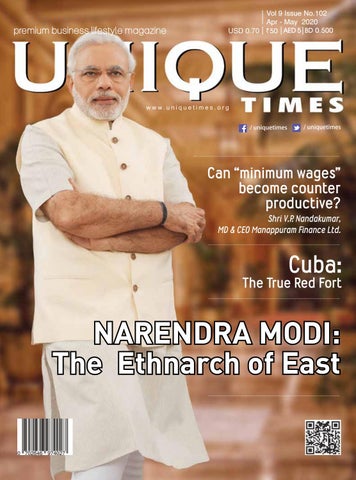
Vol 9 Issue No.102 Apr - May 2020
Can “minimum wages” become counter productive? Shri V.P. Nandakumar, MD & CEO Manappuram Finance Ltd.
Cuba:
The True Red Fort
NARENDRA MODI: The Ethnarch of East
Chief Mentor Mr. V.P. Nandakumar Director & CEO Jebitha Ajit Editor Jebitha Ajit Legal Advisor Latha Anand B.S.Krishnan Associates leader is one who knows the bskrishnanassociates@gmail.com way, goes the way, and shows Sub-Editor Vignesh S.G the way," says American speaker and Associate Editor Ravi Saini author John C. Maxwell. The story Rajeev Kumar of India’s extraordinary leader of ex Director and special editor kollur traordinary time, Narendra DhamCorrespondents Dr. Thomas Nechupadam odardas Modi is not different. What Martin Luther Vivek Venugopal- Quarter Mile King Jr said was true in Modi’s case: “A genuine Amrutha V Kumar leader is not a searcher for consensus, but a molder Creative Design PEGASUS of consensus”. Cover Photographer Ashique Hassan Read our cover story that captures this Indian Marketing UAE Prime Minister of common men with uncommon Phygicart.com agenda. P.O. Box: 92546, Al Karama Dubai Chairman and Managing Director of ManapMr. Anish K Joy puram Finance, V.P. Nandakumar in his regular Mob: +971528946999 column explains about the shift in the concept of info@phygicart.com ‘minimum wages’. The concept of minimum wages Plot No 19A, 9th Floor, is no longer a minimum standard of living for low Green Building, Film City, income workers, but more like a “fair” wage that Sector - 16A, Noida - 201301 would ensure comforts of life, he opines. Maharashtra While in Auto, our experts introduce updated Jayasankar M, a/101, petrol-version of Brezza with its BS6 standard. This New Prathamesh Niwas, edition ‘Travel’ unravels the red fort- Cuba, a coun OPP. Laxmi Park, Thakurli East, try, with its hard work, has surmounted all odds. Dombivli post, Thane District, 421201 Stories on beauty, stock market, gadgets, banking, Mob: 9820708662 success, movie, and books are there. I sincerely Hariharan hope you find as much joy in the issue as it brings chennai, Mob: 9840018929 me. Unique Times, No.6/31, Arunachalam main road, Saligramam, Chennai – 600093 Karnataka Paperback Publishing Jebitha Ajit 3218/A, 6th C Main, 13th Cross, HAL 2nd stage, Indiranagar Bengaluru 560038 Andhrapradesh PEGASUS Ph: 09288800999 Sunilkumar NN Your wing Vineeth Nair Director Ambalika Saikia, Ambalika_saikia@yahoo.com
Editorial “A
Printed at St. Reddiar & Sons, P.B. No: 3627, Veekshanam Road, Cochin Published at Pegasus Global Pvt. Ltd. L5-106, Changampuzha Nagar Kalamassery, Ernakulam-682 033 e-mail: editor@uniquetimes.org uniquetimesindia@gmail.com Ph:0484 2532040, 2532080 Mob:+91 98460 50283, 94470 50283
Cover Photograph Indian Prime Minister Narendra Modi
Printer & publisher Pegasus Global Pvt. Ltd. Kalamassery, Ernakulam on behalf of Ajit Ravi. Printed at S.T.Reddiar & Sons, Cochin-18.
16
CONTENTS
12
20
Shri Narendra Modi: The Ethnarch of East
12
Can “minimum wages� become counter productive?
16
The mechanics of working from home
20
Fr. Joy Koothur: The Lovable Touch of Kindness
26
Force majeure - what it means in the wake of the covid 19 pandemic?
32
26
48
50
52
58
38
This lockdown, unlock the Real You!
48
Gadgets
50
Natural ways to fight aging skin
52
Cuba: The True Red Fort
58
Maruti Suzuki Brezza - Petrol
UNIQUE DIARY
Coronavirus outbreak brings deep trouble to world
A
s several countries, including India, are struggling to overcome the threat, posed by the coronavirus outbreak – originated in the Asian country of China, the world economy, which was on a task to attain a rapid growth, remains heavily injured. The virus outbreak has brought trouble to both developed countries, like the US, Italy, Spain and the UK, and developing countries, such as India and Iran, alike. Some countries, particularly the US, have introduced certain economic boosters in order to save their economy from falling to the clutches of disaster. It is high time to launch a global plan to save the world economy.
India introduces 21-day national-wide lockdown to fight coronavirus outbreak
“Nothing works better than just improving your product.” Joel Spolsky
T
he Asian country of India has declared a 21-day national-wide lockdown to reduce the threat of the spreading of coronavirus. While making the announcement, Indian Prime Minister Narendra Modi has explained his people why his people should work to make the lockdown a huge success. The PM has advised his people to remain where they were patiently. He has also pointed out how the outbreak has crushed even certain developed countries. Days before the formal introduction of the lockdown, the country tested the applicability of the lockdown with a kind of mock lockdown; and, that was a great success. Some states in the country like Kerala launched the lockdown at least two days before the introduction of the measure by the centre.
8
April-May 2020
UNIQUE DIARY
Unorganised workforce, especially daily wage workers, heavily affected
T
he 21-day lockdown has injured the unorganised workforce of the county heavily. The daily wage workers of the country have been left with only few options. Many migrant daily wage workers have chosen to walk to their hometowns located kilometres away from their workplaces, as they have felt the option to remain in their workplaces with no jobs or wages would be suicidal. The exodus has prompted the opposition to criticise the measure, introduced to help the country overcome the health crisis, as an ill-planned one. Some states have taken certain humanitarian measures to support the affected, by offering them with transportation facilities. What the exodus triggers is an important question why the centre and states have not foreseen this crisis.
Coronavirus outbreak: Centre announces Rs.1.7 lakh cr. package
“Ideas are easy. Implementation is hard.� Guy Kawasaki
T
he central government has introduced a huge relief package, worth at least Rs. 1.7 lakh crore, to overcome the crisis of the coronavirus outbreak. The announcement has been made by Union Finance Minister Nirmala Sitharaman. As part of the package, the food grain rations for at least 80 crore poor citizens are to be double for the next three months. The package assures Rs. 50 lakh medical insurance cover for around 22 lakh health workers in government hospitals for the next three months. It also promises an increase in the MGNREGA wages for as many as 13.62 crore families from Rs. 182 a day to Rs. 202.
10
April-May 2020
RBI announces certain measures to fight the economic impact of lockdown
T
he Reserve Bank of India has announced certain measures to fight the economic impact of the 21-day lockdown announced by the central government to prevent the spread of the coronavirus outbreak in the country. It has brought down the interest rate by around 75 bps. It has also permitted EMIs (Equated Monthly Instalments) to be deferred by around three months. It has reduced the reverse repo rate by 90 bps, aimed to encourage banks to lend more than to keep their excess liquidity with it. While announcing the measures adopted by the RBI, RBI Governor Shaktikanta Das has described the present situation as unprecedented.
Kerala launches Rs. 20,000 crore economic package
“Diligence is the mother of good luck.� Benjamin Franklin
T
he Indian state of Kerala has launched a huge economic package, worth Rs. 20,000 crore, to help its economy overcome the threat posed by the measures taken to prevent the spread of the coronavirus outbreak. The package assures two months of welfare pensions in advance to the pension beneficiaries. It also offers Rs. 1,000 per family from the BPL and Antyodaya sections. The package provides Rs. 100 crore to provide free food grains to families in need and Rs. 50 crore to provide subsidised meals at Rs. 20 per meal. It offers nearly Rs. 500 crore for a comprehensive health package. It also gives at least Rs. 2,000 each to the Kudumbashree Mission and to the expansion of the employment guarantee scheme. To clear all the arrears till April 2020, the package offers a huge sum of Rs. 14,000 crore.
April-May 2020
11
COVERSTORY
SHRI Narendra Modi:
The Ethnarch of East I
ndia is at present at a crucial juncture. Not any time in its nearest history, the country has come to this point. The coronavirus outbreak, which originated in China, is what that bothers the country – and the world – at this moment. As its proper solution is nowhere near, the ray of hope is still unclear. Even in this situation, Indians have a confidence that many others across the world lack. It is that they are governed by a powerful and visionary Prime Minister. The people of the world’s largest democratic country admire the confidence shown by their PM to take the bold step of lockdown to contain the spread of coronavirus. Though the 21-day lockdown was a shock to many, most experts, inside the country and abroad the world, consider the decision as inevitable. If the spread of the virus is not contained in this stage, it may not be possible in future. India is at present in the right track. If the things progress in this direction, the country will see the emergence of the ray of hope soon. The central government, under the leadership of Prime Minister Narendra Modi, is working day and night tirelessly to help the country overcome the present cri-
12
April-May 2020
sis. It deserves special appreciation for the dedication it shows to support its people. A country like India, with a not-soadvanced health infrastructure, is highly vulnerable. Its vast population is another threat. The country, however, proves that with a dedicated leadership at the helm the country is powerful enough to confront any crisis. Within hours after the announcement of the lockdown plan, a Rs.1.7 lakh crore lockdown package was rolled out. The central leadership’s care for the poorest of the poor and the most vulnerable of the vulnerable of the country is commendable. The package offers an insurance cover worth Rs. 50 lakh per person for government medical workers, a food support of 5 kg rice or wheat per family every month for next three months for 80 crore poor people, a hike in the MGNREGA wage, and many more. It is his leadership experience which gives the PM confidence to handle this crisis. The country is very fortunate to have such a person at the helm at this situation. Even certain world leaders have recognised and appreciated Indian PM’s effort to reach out to the world with support to tackle the virus outbreak.
April-May 2020
13
COVERSTORY
It is his leadership experience which gives the PM confidence to handle this crisis. The country is very fortunate to have such a person at the helm at this situation. Importantly, almost all South Asian countries have welcomed India’s emergence as the leader of the region in its effort to weed out the threat of this virus from the region. It is the perfect movement to recall how correct the decision taken by the country during the 2019 general election – in which the PM’s party, BJP, was voted to power with an overwhelming majority - was. There is no wonder that Mr. Modi is the first Prime Minister outside the Indian National Congress – which had been a dominant party in the country until the year 2014 – to win two consecutive terms with a comfortable majority. Mr. Modi began his political career as an RSS activist. It was with the blessings of the right-wing organisation he joined the BJP. It took not many years for the leader to rise to the top of the political party. He was the Chief Minister of Gujarat. He ruled the state from 2001 to 2014. It was considered as a glorious period of the state. The state achieved a huge economic growth during the period. His government received serious appreciation for the economic growth it achieved. When he was projected as the Prime Ministerial candidate of the BJP during the 2014 general election, there was no surprise. As expected, under his leadership, the BJP uprooted the INC – which was struggling to escape from its tainted image. His first tenure as the PM was eventful. He initiated several revolutionary steps – especially in the economic front. The demonetisation of the higher denomination banknotes of Rs. 1,000 and Rs. 500 and
14
April-May 2020
the introduction of the Goods and Services Tax were some of them. His return to power for the second consecutive term was rather impressive than the first. It was made even simple by the infightings between the opposition parties. In the 2019 general election, he retained his seat of power and increased his party’s majority in the lower house of the parliament considerably. Just a year has passed since the commencement of the second term. It is still premature to evaluate the second term of the Modi government.
The cancellation of the special status offered to the Jammu and Kashmir and the introduction of the Citizenship Amendment Act are the two major steps taken in this term. Both have attracted mixed responses. Since the year 2014, India has achieved several commendable progresses – especially in terms of its relation with certain foreign powers like the US. It has improved its image as a promising global power. In the economic front as well as in the defence front, the world’s second most populated country is now an unavoidable power.
It now plays a leadership role in certain multilateral organisations based in the Asian region like SAARC and BIMSTEC. It is at present not less than a regional hegemon. It is also an active member in various forums for global leaders like G20. Indians owe its top leader for the successes their country has achieved since the year 2014 – since the BJP was inducted to the seat of power. Extraordinary times demand extraordinary leaders. “A genuine leader is not a searcher for consensus, but a molder of consensus” – Martin Luther King Jr
April-May 2020
15
BUSINESS
Shri V.P.Nandakumar MD & CEO Manappuram Finance Ltd.
New Zealand was the first country to implement a minimum wage in 1894, followed by the Australian state of Victoria in 1896, and the United Kingdom in 1909. In 1938, the US under President Roosevelt instituted a federal minimum wage. After the Second World War, the number of countries with minimum wages expanded.
Can “minimum wages” become counter productive?
H
igher minimum wages are becoming the norm in many countries, including India. Even as a minimum wage policy aims to ensure a certain minimum standard of living, it also gives rise to unintended consequences that may undermine its objective. There is considerable evidence that the wage gains from minimum wage increases are offset, at least for some workers, by fewer available jobs in the market. The major case for a state prescribed “minimum wage” is that it gives poor households the bare minimum to support the family and take care of basic needs. However, the potential downside is that it may
16
April-May 2020
discourage employers from deploying low-wage, low-skill workers. This may happen by increased automation. For example, in the past, the period of sustained increase in rural and agricultural wages after introduction of the NREGA in India was accompanied by a surge in the sale of tractors. If minimum wages reduce employment opportunities for low-skill workers, winners and losers will emerge. Clearly, the effect on jobs is a critical aspect of this debate as any evidence that higher minimum wage does not lead to job losses will be welcomed by governments who will then see this as an effortless and painless way to reduce poverty. Labour economists have
therefore long studied whether minimum wages reduce employment or not. The impact on employment has long been at the centre of minimum wage research, with much debate over whether (and how) minimum wages affect jobs and hours worked. If minimum wages at progressively higher levels lead to job loss for many of those same people, serious questions would arise with respect to its relative benefits and costs.
History
New Zealand was the first country to implement a minimum wage in 1894, followed by the Australian state of Victoria in 1896, and the United Kingdom in 1909. In 1938,
the US under President Roosevelt instituted a federal minimum wage. After the Second World War, the number of countries with minimum wages expanded. Newly independent countries such as India (1948) and Pakistan (1961) were among those adopting minimum wages. The legal coverage of minimum wage laws was progressively expanded as it was increasingly felt that all workers, as a matter of right, should receive protection against unduly low wages. Nationally applied minimum wages appeared in the Netherlands (1969), France (1970) and Spain (1980). In the United States, coverage expanded from about 20 per cent of the workforce in the early years to nearly 80 per cent in 1970. The United Kingdom introduced a new statutory minimum wage with national coverage in 1999. Since the early 1990s eight other members of the Organisation for Economic Cooperation and Development (OECD) have adopted a statutory minimum wage, Most of those OECD countries without a statutory minimum wage have legal floors set through
collective agreements, such as in Denmark, Finland, Norway or Switzerland. As a result, minimum wages exist in one form or other in all European countries. Many developing and emerging economies also established or strengthened minimum wages. China adopted a minimum wage in 1994 and strengthened it in 2004 while South Africa established a system of minimum wages after the end of apartheid in 1997.
Effect on employment
There is increasing evidence that beyond a point higher minimum wage levels may lead to fewer jobs. Research studies that focused on the least-skilled workers have found the strongest link between high minimum wages and fewer jobs. Firstly, because a higher minimum wage discourages employers from using the very low-wage, low-skill workers that minimum wage laws are intended to help. As minimum wages increase the cost of labour above the marginal productivity of low-paid workers, they would find themselves priced out of the market. Also, because these jobs require low
skill, they are more easily replaced by machines. For example, if the government were to prescribe high minimum wages for private security guards (currently a good source of employment for able-bodied but low skilled workers), it will almost certainly hasten the adoption of esecurity systems which would make most security guards redundant. Secondly, minimum wage rules do a bad job of targeting poor and low-income families. Minimum wage laws prioritise high wages for low-productivity workers rather than seeking to increase the earnings (and productivity) of low-income families. Research from the US generally has failed to find evidence that minimum wages help the poor, although some subgroups may be helped when minimum wages are combined with a subsidy programme, like a targeted tax credit. Accordingly, it may be concluded that minimum wage is a relatively ineffective policy tool for helping poor and low-income families. More effective policies would be those that increase the incentives to work for
April-May 2020
17
BUSINESS
18
April-May 2020
Lastly, like with many other good ideas implemented by governments across the world, the idea of a minimum wage is also subject to “mission creep.” This is defined as “the gradual or incremental expansion of an intervention, project or mission, beyond its original scope, focus or goals” after meeting with initial success and often resulting in an unplanned long-term commitment. members of poor and low-income families. Of course, there are other theories suggesting that up to a certain level, the cost of minimum wages can be absorbed through a combination of lower wage increases for more highly paid workers, lower profit margins, higher productivity, and/ or lower employee turnover. Further, Keynesian macroeconomic theories hold that employment may increase if minimum wages lead to higher domestic consumption and aggregate demand.
The Indian experience
India introduced a Minimum Wage Act in 1948 to enable national and local governments to set and revise minimum wages for a specific set of employment categories. These employment categories are referred to as ‘scheduled employments’ and consist of unorganised, non-unionised industries with limited bargaining power. This minimum wage is set at the regional level and is allowed to vary between sectors and occupations. A region can only include an activity in the list of ‘scheduled employments’ if it has over 1,000 employees engaged in that activity. The number of ‘scheduled employments’ was originally set at 13, but now varies considerably between the regions, ranging from one in Mizoram to 104 in Assam, with a total of 372 defined types. Further, different minimum wages may be set for young workers and apprentices. Piece-rate workers also have their own minimum wages, while disabled workers are excluded from the purview. As a consequence of the significant regional variation and the fact that minimum wage
rates may vary across occupations and ages, there are over 1,000 minimum wage rates in India. In order to reduce the regional disparities in minimum wage levels, a non-binding national wage floor was introduced in 1996, whose value is established by the central government and revised at irregular intervals. Unfortunately, there exists virtually no research on the effect of minimum wage legislation on employment in India. This is likely due to the complexity of the minimum wage system and its relatively limited coverage and enforcement.
Final word
The debate about the effect that increases in the minimum wage have on employment is ongoing. Some studies find either no effect or only a small effect, while others report significant impact. A study recently published in the American Economic Review provides new evidence that increases in the minimum wage reduce employment in the long run. In terms of magnitude, they find that a 1% increase in wages leads to a 0.3% to 1% decrease in the employment rate depending on whether wages increase citywide or in only one industry. Importantly, the study finds that most of the negative employment effects that result from wage increases (which are cost increases) are due to firms closing down rather than firms laying off workers. Since more firm closures and fewer openings take longer to show up in the data than less hiring and more firing, it suggests that the long-term negative effects of wage increases on employment are larger
than the short term effects. The idea that higher wages affect employment via firm closings is also consistent with a study that finds lower quality restaurants are more likely to close following a minimum wage increase. These results don’t necessarily mean that increasing minimum wages is always bad policy. However, they do support the notion that higher minimum wages have a cost, namely fewer employment opportunities for lower-skill workers. And it’s critical that we acknowledge this cost in any discussion about minimum wage policy. Lastly, like with many other good ideas implemented by governments across the world, the idea of a minimum wage is also subject to “mission creep.” This is defined as “the gradual or incremental expansion of an intervention, project or mission, beyond its original scope, focus or goals” after meeting with initial success and often resulting in an unplanned long-term commitment. The concept of minimum wages began as a humanitarian quest to extend a minimum standard of living for low-income workers. But these days, the concept of “minimum” has expanded into something subjective, more like a “fair” wage that would ensure not just the necessities of life but also its comforts. Occasionally, it is also a tool in the hands of welfare-minded governments to shift the burden of social expenditure on to private enterprise
(V.P. Nandakumar is MD & CEO of Manappuram Finance Ltd. Views are personal.)
April-May 2020
19
BUSINESS
Rajesh Nair Associate Partner, Ernst & Young LLP
20
April-May 2020
It is an interesting juncture to ‘jobcraft’ your tasks at your own interests and priorities. You may find a lot of meaning in your work, ability to choose what you want to do and also aggrandize the sort of experiences you need in your repertoire! Most importantly, if you have a vision what you work life should be, here is an opportunity to create it!
The mechanics of working from home
T
he recent COVID -19 situation has forced companies to reorient their work plans, and shift the work landscape to home. Professionals today, login from the confines of their homes, work to their organisational goals largely using online access, instruments like mobile or a laptop, and try to bring in productivity working from a place , which most of them have not associated with work – Home! While the initial reaction was incredulity and the sheer impossibility of such work models, we seem to be learning and slowly making the most of it. There are some clear negatives – how does one interact with colleagues and customer? Will we lose the personal touch in our interaction? Even a face to face conversation over a video conference is not ‘personal’ enough, and, then, the time lags, phased out conversations where replies come well after the queries. But, these are easing out slowly and our focus
on making these tools work, is accelerating our ability to acclimatise quickly. Some of the industries like consulting and IT/ITES have some experience of this because we are used to working with cross-border teams and multi-skilled task forces are often composed of professionals working from different countries. Here are some interesting learnings one could build on.
Where do we get the emotional security of a workplace?
Most of us need the structures of a workplace to direct our efficiencies and thoughts. We also need the learning environment that a work place provides and the emotional security of being part of a larger team/group. Loyalty to an organisation and a sense of belonging are often needed to for us to work with mental pressures. But, if you have the drive to learn and initiative to embark on tasks on your own, and have a keen focus on your learning and development, work from
April-May 2020
21
BUSINESS
home is for you. Much like consultants, you can accelerate your learning trajectory through not just interactions but budgeting adequate time each day for personal development. This is not easy and also requires tremendous discipline and relentless focus on the work tasks at hand. You also need to be driven by actively engaging in work, and have to develop the ability to certify the completion of your work. For the casual chats, it is necessary you build platforms for informal chats – whether it be a group chat, a group mail or a group
22
April-May 2020
video conference.
Where do you work from?
A lot of professionals need the cubicle/cabin structure to enhance their productivity. While most surveys on workplaces say that ‘working from home’ is the most comfortable, this is easier thought than done. A slew of corporate lawyers once averred than it is difficult to work unless they are in suits with spotless shirts and ties cinched to their necks. Even when some of them embarked in the journey of working from home, they continued wearing their suits
even when operating out of their basements, garages or co-working spaces. The increasing spurt of coworking spaces also serves the same purpose of building a workplace to your comfort and specification, and has the right blend of casualness and formality. You need to find a place where you are at your productive best – whether it is your house or even your bed!
Where do you find the conversations and interactions?
A lot of our development professionally happens with the multifari-
The sense of power you derive in organisations is also positional and this will disappear in a freelancing. But, if you can straddle these obstacles, you are in for a very interesting time.
ous interactions we have at the workplace. This is not just through the valuable confines of work but also comes from the cooler discussions and the pebbles of organisational culture you unconsciously pick up in your time with organisations. While culture itself is like the vitals of an organisation, professionals gain a lot from it and embrace maturity through it. You will need to foster avenues of these conversations and fellow experts. To make up for the interac-
tions and handshakes in normal work life, it may also be interesting to attend online conferences, connect to interesting professionals over LinkedIn or other social networking sites. A lot of such avenues are being opened up by industry or sector networking and webinar forums like TiE, CII, FICCI, KMA etc.
Where do you find the routine?
Workplace discipline like punching or clocking time or the biometric sensors which
unobtrusively take timings and instil discipline are all directive mechanisms. But, they have their benefits when it comes to time management and the ability to budget and allocate time to various priorities at work and in the personal domain. Regular routines are also catalysts to efficiency and productivity. It also calls for tremendous drive and motivation to make it work. Lot of structures and support functions are always taken for granted. So, when
April-May 2020
23
BUSINESS
you become your own boss, there is also the need to make sure that you are a great ‘employee’ to yourself too. The freedom of working from home also comes with tremendous difficulties of coordinating work. Little supports which enhance your productive time are mostly absent when you are freelancing. Then, there is a mountain of little issues which were solved in a jiffy with a team but seems unsurmountable when you tackle it alone. The sense of power you derive in organisations
24
April-May 2020
is also positional and this will disappear in a freelancing. But, if you can straddle these obstacles, you are in for a very interesting time.
Is this the way forward?
This is a much-mooted question. Will this change working models, forever? I think it will. Organisations will increasingly evaluate whether there are functions where employees can be given the work from home option. We would have also mastered the online tools and perhaps this will also reduce the need to physically do meetings, create a case for travelling
less. The travel time between places itself could lead to larger productive gains and organisations will seriously evaluate the need for a lot of casual and unnecessary movement. It is an interesting juncture to ‘jobcraft’ your tasks at your own interests and priorities. You may find a lot of meaning in your work, ability to choose what you want to do and also aggrandize the sort of experiences you need in your repertoire! Most importantly, if you have a vision what you work life should be, here is an opportunity to create it!
SPECIAL STORY
It is the first of this kind of thought in this part of the world. It is the first palliative care hospital in the country. It is a no-bill hospital. There is no place for religious boundaries in this organisation.
26
April-May 2020
Fr. Joy Koothur: The Lovable Touch of Kindness “Your value lies in not who you are, but in what you give to others.” This is the easiest way to describe the story of Father Joy Koothur in simple words. He is a true man of kindness. Let’s read an interview done by Sheeja Nair with this legend.
Please say few words about the origin of Shanthibhavan
It was a humble beginning. It was in the year 2014 to offer care to some bedridden patients in a remote village in Thrissur that the palliative care service was originally commenced. At that time, we never expected that this would grow this large. Our team consists of priests, social workers, doctors and nurses specialised in the area of palliative care. Initially, we went to houses Sheeja Nair
April-May 2020
27
SPECIAL STORY
as a team. That time, our service was limited to the normal working hours – between 9 am and 4 pm. Gradually, we recognised the urgent need to increase the potential of the service, as we were exposed to several realities during our visits to houses: the importance of hospital care, the necessity of 24 hours care and the failure of the system to recognise the importance of palliative care. We reached a conclusion that it was important to open up a hospital with all the necessary facilities to serve bedridden patients. On the light of that, we brought a five and half acer plot in Pallissery, and erected a hospital for palliative care service – Shanthibhavan Palliative Hospital, Mountain of Mercy, Pallissery (Thrissur).
What are those things that keep this hospital different from others
It is the first of this kind of thought in this part of the world. It is the first palliative care hospital in the country. It is a no-bill hospital. There is no place for religious boundaries in this organisation. It is an organisation run by people for
28
April-May 2020
the people. The organisation owes the wholehearted support of people for the uninterrupted free service it offers. It is our trustworthiness that keeps people close to this divine mission. The organisation does not have a planned path. It simply responds genuinely to the call for help of people. The organisation has at least fifteen regional centres in Thrissur, Ernakulam and Trivandrum. Apart from the palliative care service, these centres offer fee medical consultation, fee physiotherapy, low cost medicine distribution and low cost lab service. In these labs, the sugar testing cost is as low as Rs. 4 and the total cholesterol testing cost is as low as Rs. 20. These centres are also a big support to many ailing patients as they deliver all kinds of medicines – even the costly medicines prescribed to kidney patients - at their door steps at company cost.
What are the plans of this organisation for the year 2020
In addition to Kanyakumari district, the organisation plans to erect its hospitals in all the fourteen districts in Kerala.
The effort to built hospitals in Ernakulam and Trivandrum has already started. The organisation also aims to start at least 50 regional centres in every district. At present, Thrissur has thirteen, and Ernakulam and Trivandrum have one each. The efforts are underway to take the count of Thrissur to at least fifty. It is the high price that keeps people away from lab service. The organisation aims to expand its non-profitable lab service considerably. If cancer and kidney ailments are detected at the early stage, it is easy to cure them. The organisation also plans to organise early detection camps in association with local self governments to make sure no person is denied the service because of the lack of money.
April-May 2020
29
SPECIAL STORY service and free mobile freezer for poor are also available. In all the regional centres, non profit pharmacies and non profit labs do operate. In addition to the palliative care, physiotherapy and doctor consultation are also free services.
Please elaborate about Devedayam elder village
The hospital has helped many to return back to their normal life. It is some who has gotten their health and happiness back because of the hospital and the atmosphere it provides are those who has presented the idea of permanent home.
What is Devadayam
It is an apartment complex designed for elders to live without any headache of normal life. Elders can buy or rent apartments and rooms in this complex. This is erected inside the compound of the hospital. Each apartment is loaded with all facilities – even those necessary to accommodate bedridden patients. Each and every apartment is connected to a centralised oxygen system.
How can one buy an apartment in this elderly village
“By The People, For The People� - How the phrase is going to aid the organisation in its journey
It is the basement on which the organisation stands. The organisation offers free service. It is the support of people that enables the organisation to take up the challenge of this huge financial burden. Our fellowship members are the ones who hold the organisation afloat with the contributions they make every month. Among them, there are businesspeople, government and private employees and even normal people. Fortunately, the activities of
30
April-May 2020
the organisation enjoy tremendous support from the society.
Apart from the palliative care service, what are the services the organisation offers
Apart from the palliative care service offered in the hospital, the palliative care home service is offered through all the fifteen regional centres. Ventilator facility, ICU and centralised oxygen system are available. The hospital offers free food to patients as well as their bystanders. Physiotherapy, fluid tapping, ultrasound scanning and dialysis are offered at free of cost. Free ambulance
An apartment of 485 sqft costs at least Rs. 25 lakh as advance payment. One can pay a booking payment of Rs. 10 lakh and the rest as three instalment of Rs. 5 lakh each. The apartment is handed over within the timeframe of eighteen months from the date of booking. Those who are in urgent need can own their apartments immediately by making the full payment of the advance payment of Rs. 25 lakh for each apartment. Once the lifetime of an occupant of the apartment and his partner is over, the advance payment is returned in full to his nominee. Our policy is guided by our strict adherence to the stand that the organisation always stays away from any possibility of profit-making. The concept is envisaged to offer world class service to elderly people.
What are the facilities the village offers
Free palliative care, free emergency service, 24 hours medical support, quality restaurant with take away facility, room service, physi-
Mar Andrews Thazhath Chief Patron
Rev. Sr Maria Chiara FSC Co-Founder
otherapy service and common exercise facility are the services the village assures. All apartments are furnished and have modern kitchens. A common library and television room are offered. Ambulance service and transportation service are also a part of the facilities. Pharmacy that offers medicines at company price, non profit lab and scanning facility are other attractions. Internet and video calling facility are other important services on offer.
Live well rooms
This room with attached bathroom facility, which is suitable for two persons, costs Rs. 12 lakh as advance payment. This room are also available for rent. Its monthly rent costs around Rs. 16,000, in addition to an advance payment of Rs.48,000 – equivalent to the total payment of three months of rent. Bystander service is also available. It is offered by a social organisation, named Touching Hands. To avail the service, a sum of Rs. 15,000 is needed to be paid.
Don’t you feel that the unprecedented rise in the number of NGOs in the name of charity is a matter of concern
Like any sector, this sector is also not immune to exploitation. But, fortunately, our country has a powerful legal framework to prevent exploitation. This organi-
Davis edakkalathur Patron
Rev. Fr.Joy Koothur CEO & Co-Founder
frjoyktr@gmail.com, +91 97443 42009
Rev. Sr. Beatrice Scalinci FSC Co-Founder
sation always stands with the government and respects the legal framework of the country. Our activities are regularly subjected to the transparent process of social auditing. If others follow this path, they may not fall in trouble. We believe in action not in words.
Who all are those visionaries who lead this noble organisation
The Shanthibhavan Palliative Care hospital operates under the leadership of Franciscan Sisters of St. Clare Congregation, in association with Thrissur Diocese. Franciscan Sisters of St. Clare Congregation Mother General Sr. Maria Chiara and Sr. Biatrice Scalinci are the CoFounders of the hospital. Ft. Joy Koothur is the Chief Executive Officer and Co-Founder. Metropolitan Archbishop of Thrissur Mar Thazhath Andrew is the chief patron. Dr. Monson Maavungal, Dr. Mohan Thomas and Davis Edakkalathur are the patrons of the organisation. Thankam Mohan is the goodwill ambassador.
“The Service to Poor is The Service to God”
Dr. Mohan Thomas Dr. Monson Maavungal Patron Patron
April-May 2020
31
FINANCE
Adv Sherry Samuel Oommen is a practising lawyer at High Court of Kerala who specialises in tax and Corporate Laws. Presently he heads the tax and corporate law practice of Nash Capital Partners. Apart from being a qualified lawyer, he is also a chartered accountant, cost accountant and a company secretary. He is currently pursuing his Doctorate Degree and is reachable at sherryoommen@nashcp.com.
I
must admit that ever since the lockdown was announced by the Hon’ble Prime Minister on 24 March 2020, I have received various queries on whether the “lockdown” in the wake of the COVID-19 pandemic would qualify as a “Force Majeure”. In this article, I intend to pen down some of my views on the interpretation of the term “Force Majeure”. As a matter of caution, please note that these views are entirely personal and should not be construed as a legal opinion. The term “Force Majeure” implying an “act of God” or “superior force” which means an unforeseen event or condition which occurs beyond the control of the parties to a contract, and because of which the parties are prevented from performing their obligations. Such events typically refer to unforeseen events such as war, terrorism, civil unrest, or other acts of God which are beyond the control of the contracting parties and therefore have an unprecedented effect in the performance of the contract. As a generic principle, it has been upheld
32
April-May 2020
One would also be careful to note that Courts do not generally allow claims of force majeure and frustration of contracts, where there has only been a mere inconvenience or difficulty in performing the contract, where the performance of the contract has become expensive or where there exists a valid and practical alternative for the performance of the contract.
that courts have no general power to absolve a party from the performance of his part of the contract merely because its performance has become onerous on account of an unforeseen turn of events. Thus, the term “force majeure” and its implication on the contractual obligations would need to be interpreted in a strict fashion. From a commercial law perspective, it is not necessary that contracts have clauses regarding “force majeure”. In such scenario where a contract is silent on the clause governing “force majeure”, the consequences of a force majeure event on a contract and the obligations under it will have to be examined to understand whether the contract has been ‘frustrated’ or rendered ‘impossible’ under the law governing contracts. The “doctrine of frustration” as upheld by the Hon’ble Supreme Court in the case of Satyabrata Ghose 1954 SCR 310 would imply that the performance of the contract has become “impracticable” and “useless” from the point of view of the object and purpose of the parties, though
the performance may not be literally impossible. In the said judgment, the Hon’ble Supreme Court held that the action by a military at the time of a war could not result in the contract being “frustrated” as the performance of the same could be completed after the war. Thus, one would need to evaluate whether the related “force majeure” event would totally upset the commercially objective with which the parties entered into a contract. Notably, the Hon’ble Supreme Court in the case of Sushila Devi AIR 1971 SC 1756 held as under: “The impossibility contemplated by Section 56 of the Contract Act is not confined to something which is not humanly possible. If the performance, of a contract becomes impracticable or useless having regard to the object and purpose the parties had in view then it must be held that the performance of the contract has become, impossible.” It may however be noted that where a contract has a specific “force majeure” clause, the determination of what constitutes a
FORCE MAJEURE-
What it means in the wake of the COVID 19 pandemic? “force majeure” event and its related implications would need to be determined from the prism of the related verbiage and not on the basis of the generic principles outlined above. The said proposition has been recently upheld by the Hon’ble Supreme Court in the case of Energy Watchdog (2017) 14 SCC 80. In the said judgment, the Hon’ble Supreme Court held that a force majeure clause would not apply if alternative modes of performance are available. A related extract from the judgment is provided below: “We are, therefore, of the view that neither was the fundamental basis of the contract dislodged nor was any frustrating event, except for a rise in the price of coal, excluded by Clause 12.4, pointed out. Alternative modes of performance were available, albeit at a higher price. This does not lead to the contract, as a whole, being frustrated.”
One would also be careful to note that Courts do not generally allow claims of force majeure and frustration of contracts, where there has only been a mere inconvenience or difficulty in performing the contract, where the performance of the contract has become expensive or where there exists a valid and practical alternative for the performance of the contract. Thus, in summary, in my view, the lock-down would not ex-facie/ automatically constitute a “force majeure”. The determination of the same would be entirely fact based depending on the nature of the contracts, the related contractual covenants/obligations, and whether the performance of the contract is impossible or impractical, which one needs to carefully qui-vive. In light of the COVID-19 pandemic, in my view, contracting parties would also need to establish that the outbreak
and its effects have had unforeseeable consequences on the performance of their contractual obligations. In conclusion, if assuming that the COVID-19 pandemic constitutes a “force majeure” event, the consequences would include: a. Suspension of the performance of the obligations until the force majeure event ceases to affect performance; or b. Termination of the contract; or c. An option to mutually renegotiate the contract. Force majeure clauses also typically set out obligations on the affected parties to notify the counterparties of the occurrence of a force majeure event and its effect on the performance of the contract. The affected parties may also be required to take all possible and feasible steps to mitigate the effect of such force majeure event
April-May 2020
33
HEALTH
Dr Arun Oommen MBBS, MS (Gen Surg), Mch( Neurosurgery), MRCSEd, MBA Consultant Neurosurgeon, VPS Lakeshore Hospital Kochi, India
T
he IQ of an individual is multi-factorial, and is determined by a multitude of factors. Nature and nurture work together in determining human intelligence. Human IQ is characterised by a high level of heritability. However, various modifiable environmental factors, like education, premature birth, nutrition, pollution, drug and alcohol abuse, mental illnesses and diseases, can have an influence on an individual’s IQ by reinforcing or weakening genetic susceptibility.
34
April-May 2020
We may be genetically predisposed to a certain brain volume, structure and pathways - a certain level of intelligence set by our biology - but how much we achieve isn't based in biology alone. The type of life we lead also affects intelligence.
Although IQ attempts to measure some notion of intelligence, it may fail to act as an accurate measure of "intelligence". IQ tests only examine particular areas of "intelligence", failing to account for certain areas which are also associated with "intelligence", such as creativity or emotional intelligence. Genetics accounts for around 50% as per many studies and increasing with age. Shared and nonshared environment account for 25% and 20%, respectively and the latter 5% being represented by errors
in the evaluation of the cognitive abilities. However, the role played by genetics and environment does not remain the same during the entire lifetime. People with high IQ genotypes pick stimulating environments and end up with high IQ. When we’re kids the brain is still growing and developing so there’s the chance for environment (mental stimulation and nutrition) to affect its development, but by the time we’re adults the brain has peaked, so environment can no longer affect it very much. Ronald Wilson presented the
Factors that can improve Intelligence Quotient first clear and compelling evidence that the heritability of IQ increases with age (Wilson effect). During brain aging, several environmental insults can produce a neuronal damage by inducing oxidative stress and inflammation. Neurons protection and repair play a crucial role in order to prevent neuronal damage. These defence and repair processes are genetically determined. However, there is still so much limitations of our current knowledge about the particular genes involved in determining IQ.
Factors that affect IQ Genetic Different studies have placed the genetic component at different levels ranging from 30-80%, but it is noted that the level of genetic influence increases with age, at least from childhood through to early adulthood. Twin studies show that identical twins’ IQ's are more similar than those of fraternal twins. Our brain structure and functionality contribute to our level of in-
telligence. Specific features that may affect IQ include the size and shape of the frontal lobes, the amount of blood and chemical activity in the frontal lobes, the total amount of gray matter in the brain, the overall thickness of the cortex and the glucose metabolic rate. Well-functioning pathways correlate to better brain functioning, brain efficiency and information processing, which all point to better IQ scores. It should be noted that the correlation with brain size is not simple. Autism is also correlated with brain size in ways that are likely controlled by genes, although there are of course disturbed neuronal pathways in autism. Environmental factors We may be genetically predisposed to a certain brain volume, structure and pathways - a certain level of intelligence set by our biology - but how much we achieve isn't based in biology alone. The type of life we lead also affects intelligence. Researchers theorize that if intelligence is purely biological, identi-
cal twins separated at birth should still have equal IQs. But that's not always the case, they find. Genetic effects cause bright children to seek out more stimulating environments that further increase IQ. Programs aiming to increase IQ would be most likely to produce long-term IQ gains if they caused children to persist in seeking out cognitively demanding experiences. Recent studies have shown that training in using one's working memory may increase IQ. But, it is not clear how long improvements persist after training stops. Improvements in nutritional policy, have been implicated in worldwide increase in IQ. Prenatal and early nutrition are linked to brain structure, behaviour and intelligence. There is evidence that providing a high nutrient diet to very premature babies, particularly males, can help to reduce the loss of brain size and IQ often experienced by these babies. Zinc, Iron, folate, iodine, B12 and protein deficiency can also result in low IQ.
April-May 2020
35
HEALTH
Breast feeding may have some small effect on IQ but the effect may be explained by confounding factors including maternal intelligence. The association is conflicted by studies reporting positive and null effects. More research would be needed to confirm this. Supplementation with creatine significantly increased intelligence in the elderly rather than young adults. However, it should be noted that there is a question mark over the safety of long term creatinine supplementation. In adults, there is a positive correlation between musical training and IQ, but it is not evident that musical training has a positive effect on emotional intelligence and has been shown to positively influence linguistic abilities. Musically-trained kids showed greater improvement in finger motor skills and auditory discrimination skills, spatial-navigational reasoning, visual form analysis, numerical discrimination, and receptive vocabulary. They showed structural brain differences in regions linked with motor and auditory processing, and various frontal areas, the left posterior peri-cingulate and a left middle occipital region, but this may relate to the brain's need to integrate information from various
36
April-May 2020
modalities (visual, motor and auditory). It can be concluded that the effects of music on IQ may be small or negligible, transient, and probably confined to spatial intelligence. Several factors can lead to significant cognitive impairment, particularly if they occur during pregnancy and childhood when the brain is growing and the blood–brain barrier is less effective. It includes pollutants (e.g. lead, mercury, and
organochlorides), alcohol, smoking and drugs (marijuana, cannabis and cochaine) head injuries and mental illnesses. Mozart effect Frances Rauscher and Gorden Shaw reported that college students who listened to 10 minutes of Mozart's Sonata for Two Pianos, showed an increase in IQ of 8 to 9 points on the spatial subtest on the StanfordBinet Intelligence Scale. The phenomenon was coined the Mozart Effect. However, the phenomenon is temporary and is due to short-term improvement on the performance of certain kinds of mental tasks known as "spatial-temporal reasoningâ€?. Flynn effect The Flynn effect is defined as the sustained increase in the raw intelligence of human over time. IQ test scores have been rising at an average rate of around three IQ points per decade. Attempted explanations have included improved nutrition, a trend toward smaller families, better education, greater environmental complexity, and heterosis (the occurrence of genetically superior offspring from mixing the genes of its parents). Another proposition is the gradual spread of test-taking skills. The Flynn effect has been too rapid for genetic selection to be the causeď Ź
MOTIVATION
Dolly Neena Dolly Neena is founder of Your Wing, a training company born out of a noble cause and spirit. She holds a decade long experience being a passionate mentor and entrepreneur.
This is a time you can productively utilize to scan through what you’ve been doing in the past - retrospect and introspect. Analyse where you have been going right and wrong. Note down the areas you want to make improvements on, and those areas you want to keep on strengthening.
“Keep your face to the sunshine and you cannot see the shadow.” - Helen Keller.
H
ave you noticed it is more easier to worry about the past and future rather than to enjoy the present? How much ever hard it could be, or how much ever you despise them being in your life, trials and low-points are ought to happen in your life. Life never is consistent, it always poses some or the other challenges onto you. The key is in finding your peace amidst the storm. Like they always say, the storm will pass, however it is on you to survive the storm and emerge victorious. Your future depends on how you handle your current struggles and difficulties. Remaining positive and constructive during turbulent times can be quite a toll on you; however, that is how a winner is born. A silent smooth sea never made a skilled sailor; similarly mediocre-experienced life never made a legend. You need to widen your perspectives, reach out the horizons of your comfort zones and walk past it. Stretch yourself so that you feel the pain – the pain to change for good. This lockdown might drag your spirits down; it will challenge your formed habits. Especially, when we are confined to seeing the same walls with no entertainment or stress relief, it is normal and easy that you start running the cycle of negativity
38
April-May 2020
inside your mind. So, when you are in this quarantine and if you are feeling stuck and bored, ask yourself a question - what are the good things about this situation and how can I make this time productive for me?
Being Positive
Positivity is a mental condition. This is something that you evolve onto in a matter of time. There needs long deliberate efforts to stay up in a positive state of mind. And, once you master that art, you will pleasantly realize that life becomes more smoother and productive for you. As I always say, the man with no problems is the man in the grave. Listen to motivating audios, speeches; watch inspiring videos of successful people who have crossed hurdles. Talk to people who hold a broader outlook for life. Perspective is the key – understand that nothing lasts forever, this lockdown too. If interested, keep a journal where you can scribble down whatever comes into your mind and reckon. Be always mindful of your surroundings; don’t get carried away by the naysayers and pessimists. It’s imperative to analyse what you can control and what you cannot. And focus only on the possibilities and ‘controllables’. Use positive affirmations at least twice a day. Prioritise on your self-care, look deep down into yourself and feel your soul. Meet the real you who’ve been unfamiliar amidst frantically running this hysterical rut called life. Unwind
This lockdown, unlock the Real You!
your ‘self ’. Have a really elevating memory or read before you fall into slumber.
Health is Wealth
Like the very old adage says and what Corona has just reminded us – health is everything. Immunity can save you from a lot of unexpected virus that can hit you without notice. Having a healthy diet is extremely important. It is a world of fast food – people have no time to stop and hence we had been habitually consumers of unhealthy lifestyle and food. In this quarantine time, have a
good look on yourself and boil down on a good diet for you. Daily workouts and exercises are also extremely important to keep you fit and happy. Hence, schedule a fixed time every day to do workouts the way you like it – listen to music while you are on it, or switch on the TV to follow a fitness instructor, or step out into your backyard to enjoy some fresh air while you sweat it out. If you have not been a person who wasn’t able to follow this religiously up, this is the exact time you can build a habit. They say it takes 21 to 60 days to
form a habit and there you have it now! Make sure you take time out to do yoga or simple meditations to calm your mind. Unwind listening to your favourite music.
Unlearn and Relearn
This is a time you can productively utilize to scan through what you’ve been doing in the past - retrospect and introspect. Analyse where you have been going right and wrong. Note down the areas you want to make improvements on, and those areas you want to keep on strengthening. Subscribe to online learn-
April-May 2020
39
MOTIVATION
ing. There are thousands of online courses which can take you to the next level of knowledge and learning. Make use of this time to brush up you skills or hobbies or crafts. Sharpen your axe – refine your skills. You may flaunt it on social media as well, which would fetch you due appreciations and recognitions. Reading is one habit which will never go in vain. It, indeed, is a brain stimulating activity, induces self-discipline as well. Utilise this time to make high-level strategies for future – revisit your goals, think how to save money through the coming months, where to invest or how to increase the sales revenue of your company. Take time out to de-clutter your wardrobe, room,
40
April-May 2020
home, office, mobile, laptop and life. Tidy up things around you as it attracts more positivity and prosperity.
Family Love
This is a great and rare time you get to spend with your family. They are the ones who stood for you unconditionally through the thick and thin, ups and downs of life. They have been extremely patient with you when you were globe-trotting making excuses being a workaholic and having no time. Today, in this Quarantine, you have all the time in the world – to show and prove how much you care and love them. Your kids might not have had enough quality time with you – play with them, teach them crafts, and take
them through informative sights and help them instill new learnings and habits in them. Reminisce your childhood memories with them. Take them through your interesting past – let them hear how the world looked like decades before, and let them feel privileged to own whatever they have now. It is an apt time to take out the culinary skills in you, and let your family indulge and relish on your dishes and creativity. Come together for a family time play carroms, chess, monopoly or ludo – keeps you challenged and entertained. Half the battle is fought inside your mind. Perspective is the key - perpetual optimism is a force multiplier!
The Questionable Callousness
ď ŹVignesh S.G
O
n 24th March, 2020, unexpectedly, the central government announced a 21-day nationalwide lockdown, bringing the country to the point of standstill completely. It was justified as an unavoidable measure. Considering the experience of several countries particularly those in the west like the US, Italy, Spain, there were many reasons to believe the argument projected to defend the policy adopted by the authority. Unsurprisingly, the lockdown has exposed a depress-
42
April-May 2020
ing, often neglected, reality: the existence of inequality in the society. A privileged person can survive if the country demands him to stay inside his home, wash his hand frequently and maintain adequate social distance. Can an underprivileged survive, when some of those mentioned above are still luxury for him? When a policy like this is considered, its makers should make sure it does not contradict the social realities of the society for which that policy is formulated.
Had the policy makers and political class of the country possessed any clue about the lives of the millions of migrants who rely on daily wages for their living, the nation would not have witnessed the depressing scene of the exodus of poor daily wage workers in search of food and shelter in some parts of the country in the immediate aftermath of the formal announcement of the 21-day national-wide lockdown by the central government. Food, shelter and clothing are basic needs. No matter
what the present circumstance is, those basic needs cannot be denied to anyone. From the testimonies some of those workers have given to media personals, it can be assumed that they would not have chosen this extreme step if they were provided with their basic needs promptly. There is no point to blame a single office alone. Every policymaker who sits in a responsible position is answerable. Both the central government and state governments are at the wrong side. India is a country where millions still live in slums or similar living standard; where millions still do not have adequate access to fresh water; where millions still survive with the little they earn on a daily basis; where millions still do not enjoy the luxury of health insurance; where
millions still lack nutritious diet. It is not that the government has done nothing to help the needy. It has offered a giant package, which includes an additional 5 kg grain a month each for underprivileged under the Public Distribution System for the next three months and an amount of Rs. 500 a month each for women with Jan Dhan Yojana accounts for the next three months. Many who are aware about the social realities of the country have questioned the inadequacy of the package. It is hoped that in the coming days the government will come up with many more to correct the shortcomings of the present package. The exodus is a perfect example to show what will happen if a policymaker forgets to evaluate whether
his policy is consistent with the social realities of the society for which the policy is made. It is also a right opportunity to understand how far the country has to travel to surmount the evil of inequality and what all are needed to be done to achieve that ideal society – which was the main dream of the makers of the country. Now, the country is working to develop a proper exit plan. It has asked all the states to sent their suggestions. It is a great opportunity. From the previous experiences, it cannot be wrong to assume that India holds some of the excellent brains in the area of policymaking. A right policy can shadow the shortcomings of the past and can provide right impetus for the future – which is still bright as a young nationď Ź
April-May 2020
43
The Mani I Knew...
I
t is not easy for me to write about Sri. K M Mani. For it never is easy to write about a person who is a famous public figure and is at the same time a close relative. There would be difficulties in reconciling that person you have known in private, with the figure the public sees. There could be contradictions between his public image and the private one, I know. I have another additional difficulty too. Mani was not only my father in law, but for years he was a Minister in many UDF Governments while I was an IAS officer in the state. There was this superiorsubordinate relationship between him and me. And an associated difficulty when he sat with the UDF in the opposition. I would be then suspect in the eyes of a LDF government. For no one was quite sure where my loyalties lay.
44
April-May 2020
But as I begin to write this, I find that these are hardly impediments when it is about writing about the Mani I knew. Firstly the Mani I saw at home, was the same Mani that the public saw. Even at home he was almost always dressed in an impeccable dothi and shirt. He was very careful about his image and appearance, in public and private. He would change his snow-white mundu and jubba more than a dozen times daily, every time it got a bit dirty or even a bit crumbled. He was highly conscious of his clean image. And it broke his heart to see that clean image tarnished in any way. He was a people’s person. People filled him with energy. His joy was to be amongst them. He could be ill and feeling awful and looking terrible. But the moment he stepped out, and was among the public, he would
be filled with an unknown energy. That same energy filled him when he stood in front of a mike or a camera. From looking and feeling ill and terrible he would transform into the public figure we know, if a camera or a mike was put in front of him. They were his means of communicating to his people. He was a great communicator. He would meet hundreds of people every day. And each of them would feel that he or she was the most important person for him. That was an uncanny ability. He would be all edgy and uneasy on days like the Bandh when there were fewer people to meet him. In a way then, it is good that he did not live to see this COVID lock down. It would have broken his heart to have to sit around at home unable to meet anyone. He knew almost everyone in Pala
by name. But even he could forget a name occasionally. There is this story that someone told me of the time, he forgot the name of a distinguished looking middle-aged woman who was walking towards him. He quickly asked staff who she was. They said she was Eliamma, wife of Siby from near Kottaramattom. When Eliamma walked upto him, he was ready, ‘Eliamma chedathy, enthokke undu visesham? Why, just last week I saw Siby Chettan; but could not speak to him though.’ Suddenly there was an embarrassed silence. One of his personal staff quickly came upto him and whispered in his ear, ‘Sir, Siby Chettan is no more. He died a many years ago.’ There was awkwardness. But only for a moment. Turing to Eliamma, he nonchalantly added ‘Athe, athe. That is what I said. I saw Siby Chettan in my dream last week. That is why I could not speak to him. He seemed very happy. He is the with Lord, I am sure. He is in heaven with the Lord.’ Eliamma Chedathy could not have been more pleased. He was a heavy smoker till about 35 years ago. He stopped smoking when his first grandchild was born and since then did not ever touch a cigarette. But the early smoking had taken a bad toll on his lungs had reduced his lung capacity considerably. In the last couple of years of his life he had difficulty in breathing and was often in and out of the Lake Shore Hospital. That breathing difficulty made him unable to talk for long. But put a mike or a camera in front of him, all such complications would melt away. His breathing would become normal and he could talk and make his point forcefully, with wit and wisdom. And talk for hours on end if needed. Even when in the hospital and in the ICU, his calling did not leave him. He would be admitted to the hospital on a Thursday or Friday and spend the weekend in the ICU. But by about 4 O clock on Monday morning, he would be up, bathed and dressed and would have reached
the Kerala Assembly by eight. Watching him speaking in the Assembly on TV, no one – not even I - could believe that he had only that morning woken up in an ICU, and had travelled from Ernakulam to Trivandrum. And he would repeat that the next weekend too. Many have asked me if his public image as a steadfast believer in Christ and the Church was real. Indeed it was. His belief was unassailable and so was his loyalty to Church. It was faith that led him on. That
was unshakable. It defined him. Very few of us Christians take Christ’s message to love their enemies seriously. But Mani lived and practiced that teaching every day. If someone who abused him or his party and vilified and crucified him, went upto him the next day with a request, Mani would go out of his way to his get that work done. If he had a fault, it was then at such times, he would forget even his friends and those who had stood with him, and use his power and his influence to get that work done for
April-May 2020
45
his enemy. He gained a lot of friends because thereby. But he lost even more friends because of it, friends who could not comprehend why he was helping those that had abused him and the party only yesterday. But that was the way he was made. He was a true Christian. Even more, I have been asked if his great love of Kuttiamma was a show. It certainly was not. His relationship with Kuttiamma was special. In the nearly 40 years I have known him as a son in law, I have never seen either of them ever say a word in anger to each other. He and she made a whole. When he was away from home, he would phone her every hour or so. And Kuttiamma would call him back every 15 minutes. It was an unreal relationship, that was very real. That two people could live together for 60 years without ever a quarrel or an argument is not quite believable. But believe it or not, it is true. It is extremely easy for me then to reconcile his private and public images. The two faces of Mani did not contradict each other. They were like two congruous triangles that we have learnt about in our school mathematics. One fitted fully with the other. And how did I an IAS Officer in Kerala, reconcile to my father in law being a Minister and head of a party? A week or so into our marriage, he took me in his Kerala State Car with that Red Number Plate Kerala 5, from my house in Ernakulam to Pala. I had never been to Pala before; for at the time of our marriage he was Finance Minister, and was living in Trivandrum, in that house named Prasanth within the Cliff House compound. I still vividly remember that drive to Pala. It was already well into the night, and I sat with him in the back seat of that white Ambassador car. I am from Ernakulam, actually a place called Valluvally en route from Varapuzha to Parur. But I spent a lot of my childhood in Ollur, near Trissur. My mother was from Ollur, an only child of a widow.
46
April-May 2020
In the Trissur and Ernakulam of those days, we grew up hearing horror stories of Pala and Palakars. The south (Thekku) and the people there (Thekkaru) were the worst of the earth, or so we were told. They were untrustworthy and brutal, people who would beat each other up and even kill at the slightest provocation, or just for fun. So that first drive to Pala was for me a drive into the unknown. But Pala then turned out to be a nice quiet town with swaying rubber estates everywhere and even lovelier people. But that is another story, which I will tell later. That car journey was memorable. I sat beside him, nervous and unsure of myself. In my mind I was
His advice was simple. Play by the rules and do everything you can to help a person. But if it was against rules, then do not do it, whatever be the pressure, even if the pressure came from him.
not his son in law. I was just a very junior IAS officer, only into my first posting as Sub Collector Trissur, sitting in a State Car with a very powerful Minister. . It was during that drive that he gave me my first piece of fatherly official advice. I remember his words so well. He said, Joemon-e – I am called Joemon at home – you are an IAS Officer and I am a politician. So people will come to me with many requests to ask you to do this or that. I will call you then and ask you to do what is possible for them. For as a politician I must do that. That is my
job, my duty. But whatever I may ask you to do, you must do it only if the rules and law permit it. You must do only things that the rules allow. Just because I am asking you to do so, you must not do anything against the rules. Your duty is to go by the rules. That is your job. And then he went on, ‘But if it is something that can be done and a person can be helped thereby, then you must do it. If it is right, you must do it whatever the odds. His advice was simple. Play by the rules and do everything you can to help a person. But if it was against rules, then do not do it, whatever be the pressure, even if the pressure came from him. That the precept has helped me stay my course during all times. Even when I had to pay a price for it. But that is another story which I will dwell more on in the book ‘Charitrathinoru Drikshakshi’ that I have begun to write this lock down. Finally, how difficult was it to for me to work when the LDF was in power and he was in the opposition? The UDF Ministry of Sri. K Karunakaran posted me as Labour Commissioner in 1986. In the next elections in 1987, the LDF came to power with Sri. Nayanar as the Chief Minister and Sri. Pankajakshan of the RSP as the Labour Minister. That was the time when the CITU was ruling the roost in Kerala, and perhaps even ruling the party and the state by proxy. For the CITU, the post of Labour Commissioner was very crucial. I knew that I would be one of the first IAS Officers to be transferred out to some very innocuous post, perhaps as Deputy Secretary Printing and Stationary or something or the other. Therefore, when a couple of days later, Labour Minister Pankajakshan called me to his office, I was sure, I was being replaced with someone the CITU and the CPM had more faith in. I had never met Pankajakshan before. I therefore entered his room with trepidation. Pankajakshan was sitting behind his Ministerial desk chewing pan (vettila muruki). He did not as much even look at me but waved at
me nonchalantly to sit down. I sat down on the chair on the right side of his table that is usually reserved for officials. There were a lot of party men in the room. Soon they left, leaving me alone with him in the huge room. He looked sideways at me, took a kolambi and spat out the pan and said, ‘LC alle…..’ LC being short for Labour Commissioner. It was more a statement than a question. ‘Maanisarinte marumakan ……..’. Again, more a statement than a question. I kept quiet, hoping that my nervousness did not show on my face. Then he went on, ‘I have the greatest respect for Maani Saar. I disagree with him strongly politically. But I respect him equally strongly as a leader, politician and as an
administrator.’ I got up the courage to nod. He continued, ‘My party men have asked me to transfer you, because you are Mani saar’s son in law.’ The sword was falling. He then again took that kolambi, put his middle and forefinger with a small gap between them on his lips, and spat out the rest of the Murukkan in a nice log red arc. Then he added slowly but very deliberately, ‘For me your being Mani Sar’s son in law is not a disqualification. It is a qualification. My view is clear. As Labour Commissioner you must implement our government’s policies and rules. Do what is right and correct and refuse to do what is against the rules. And I have no reason to transfer you.’ I sat there transfixed. That was exactly what Mani Sir had
advised me many years ago. I continued as Labour Commissioner for that entire 5-year term of the LDF, making me the longest serving Labour Commissioner of the state. I also became the only IAS officer in the state not to have been transferred for the entire 5-year term of the LDF Ministry. I left the job only during the next Karunakaran led UDF Ministry, when I went to the UK for doing an M.Sc in Human Resources Development. It was a privilege to be Mani Sir’s son in law whether he was a Minister or in the opposition
(The author M P Joseph, a former IAS Officer and an International Civil Servant of the UN can be contacted on mpjoseph@hotmail. co.uk or on WhatsApp on +91 95 2685 8024)
April-May 2020
47
GADGETS
Oppo Find X2 Pro
` 74,890 (approximately) Android v10 (Q) OS 6.7 inches Display 48 MP + 48 MP + 13 MP Main Cameras 32 MP Front Camera 12 GB RAM 512 GB Internal Memory 4260 mAh Battery Capacity
Vivo Nex 3 5G
` N/A Android v9.0 (Pie) OS 6.89 inches Display 64 MP + 13 MP + 13 MP Main Cameras 16 MP Front Camera 8 GB RAM 256 GB Internal Memory 4500 mAh Battery Capacity
48
April-May 2020
Huawei P40 Pro Plus
` 1,17,490 (approximately) Android v10 (Q) OS 6.58 inches Display 50 MP + 40 MP + 8 MP + 8 MP Quad Main Cameras 32 MP Front Camera 8 GB RAM 512 GB Internal Memory 256 GB Expandable Memory 4200 mAh Battery Capacity
Nubia Red Magic 5G
` 40,290 (approximately) Android v10 (Q) OS 6.65 inches Display 64 MP + 8 MP + 2 MP Triple Main Cameras 12 MP Front Camera 8 GB RAM 128 GB Internal Memory 4500 mAh Battery Capacity
April-May 2020
49
BEAUTY
Natural ways to
fight aging skin
A
ging is inevitable. It is natural. Still, it is a nightmare for many. Most hate the signs it leaves on their skin. Some spend hours doing makeup to hide these signs. Each day a new antiaging chemical hits the market, as the demand for these chemicals increases day by day. Unfortunately, some are too harmful that they do more harm than good. Nonetheless, the love of people towards these chemicals shows no sign of reduction. It is terrible that not many show interest in exploring the potential of nature. Actually, there are several natural ways available to fight aging skin. In this edition, some of them are discussed in details. Please enjoy!
Ginger
It is a common kitchen ingredient. It is available in every kitchen – especially in every Indian kitchen. It is the only source of a highly effective anti-oxidant, called
gingerol. The presence of this anti-oxidant in this ingredient makes it suitable for the purpose of fighting aging skin. Boil a cup of water. Add a small amount of crushed ginger into the water. Drink the water once its temperature comes down to a drinkable range. Repeat the procedure every day. It is better if it is treated as the first thing in every morning.
Green Tea
This ingredient is known for its ability to help metabolism. What is discussed less is its anti-oxidant property. This is the only source of an important anti-oxidant, known as EGCG. It helps to reduce wrinkles. Boil a cup of water. Add a spoon of green tea into the water. Drink the water once its temperature comes down to a drinkable range. Repeat the procedure every day.
Olive Oil
Why it is said that this oil is suitable to fight aging skin is that it contains polyphenols and oleic acid. It is also
a source of Vitamin B and D. Take a spoon of olive oil. Add a spoon of lemon juice into the oil. Mix them well. Apply the mix gently on skin. Leave it there for at least ten minutes. Wash it off with lukewarm water. Try this at least once a week.
Avocado
This exceptional fruit is a source of Vitamin A, D and E. It has an amazing property that it helps skin retain moisture. It is commonly called as skin lubricator. Include this fruit in daily diet.
Orange
It is a rich source of Vitamin C. It is the presence of this element in this fruit that makes it highly suitable for the purpose of fighting aging skin. It is also useful to remove toxins and other impurities that can damage skin. It is good to drink a glass of orange juice every day. Take a clean cotton ball. Sock it with orange juice. Rub it
Dr. Elizabath Chacko, MD-Kalpana International
Mob: 9388618112
50
April-May 2020
gently on skin. Let it rest there for few minutes. Wash it off with lukewarm water. Try this procedure at least twice a week for better result. It is important to remember that aging is natural. None of them can give a permanent solution to aging. They can only make it a bit slower. Stay Healthy! Stay Beautiful!
April-May 2020
51
TRAVELOGUE
Cuba is not a financially powerful country. Its main wealth, apart from its tourism sector, is its skilled labour force - especially its doctors. Considering the service this small country gives to the world at this time of crisis, it is pertinent to give them something back as a token of gratitude.
52
April-May 2020
Cuba: The True Red Fort H
ealth care is an important sector. The present coronavirus crisis shows clearly how much relevance this sector has. ‘Health is wealth’ is not an irrelevant slogan. It really has a serious message. Brilliant is those who invest in health. Cuba is one such visionary. Its prime focus areas are education and health. Now, the world benefits from the policy of this true red fort. At this moment, many countries across the world enjoy the support of doctors from this Caribbean country. These doctors remain as strong pillars of support for these countries in their fight against the dangerous virus outbreak. These countries owe Cuba for the successful defence they have put forth against the virus outbreak. Cuba is not a financially powerful country. Its main wealth, apart from its tour-
ism sector, is its skilled labour force – especially its doctors. Considering the service this small country gives to the world at this time of crisis, it is pertinent to give them something back as a token of gratitude. In this edition, this interesting Latin American country is explored. The article attempts to see this country through a prism - different from what has been used to view this country till this date. Let’s see how it looks through this! Cuba has a not-so-impressive past. Like any Latin American country, it has gone through several ups and downs. The colonisation by Spain, the SpanishAmerican war, the protectorate rule by the US and the dictatorship by Fulgencio Batista are some of the downs. The fortune of the country changed forever when the red star emerged in its sky
in the year 1959 through the 26th of July Movement. The Communist Party of Cuba, under the leadership of Fidel Castro – one of the most powerful political leaders the world has ever seen, assumed the seat of power of the country in the aforesaid year. The Communist Party rule was also not easy. It faced several threats from its neighbour, the US – which is the apostle of the ideology of Capitalism. The Cuban Missile crisis was the severest of those threats. It was the time when the world lived under the fear of the possible escalation of a deadly nuclear war between the USSR and the US. The country, with its hard work, has surmounted all odds including the one of economic, and emerged as a promising power. Now, it is a member of the United Nations and
April-May 2020
53
TRAVELOGUE
several other International organisations, like the G77 and the NonAligned Movement. It is also a member of several regional organisations, such as the African, Caribbean and Pacific Group of States and the Organisation of American States. Its Human Development Index score is very high. It stands as a good example to the rest of the world. It shows how a perfect society can be built with the support of the art of planning. Currently, it is the only planned economy in the world. The small country in the Latin American region – close to the North American country of the US (which many see as a true heaven) – has many things to show to the world. Let’s see how the Cuban tourism sector looks like. Cuba comprises of the island of Cuba, Isla de la Juventud and sever-
54
April-May 2020
Old Havana is a UNESCO World Heritage Site. It is a city founded by the colonial Spain. There are several colonial buildings in this town. al other small and big archipelagos. This not-so-wealthy Latin American country has everything necessary to emerge as a promising tourism destination. Havana, Varadero, Trinidad and Old Havana are the popular tourist destinations in this Latin American country. Havana is the capital city of the
country. Apart from numerous government buildings, there are several Spanish colonial structures in this part of the country. Castillo de la Real Fuerza is the most attractive among them. It is the best place to enjoy the country’s rich art and culture. Museo Nacional de Bellas Artes, which displays Cuban art, and Gran Teatro, which presents ballets and theatres, are the best spots to experiences those elements. Varadero is a popular beach town. There are several luxury resorts in this region. It also offers diving and snorkelling opportunities. Varadero Golf Club is the most popular golf club in this part of the world. This 18-hole course is situated adjacent to a 1930 villa, Mansion Xanadu. Reserva Ecologica Varahicacos and Parque Josone are the popular tourist spots in this town.
TRAVELOGUE Trinidad is a town located in the central part of Cuba. The town is popular for its cobblestone streets and colonial old town. There are several colonial buildings in this part of the country. Palacio Brunet mansion and Museo de Arquitectural Colonial are some of them. To understand the rich colonial past of the region, Plaza Mayor, the main square surrounded by numerous colonial buildings, needs to be visited. Like many other Cuban towns, this region also has some excellent beaches. Old Havana is a UNESCO World Heritage Site. It is a city founded by the colonial Spain. There are several colonial buildings in this town. Malecon, Paseo del Prado, Castillo del Morro, La Cabana, San Salvador de la Punta Fortress, Castillo de la Real Fuerza, Catedral de San Cristobal, Plaza de Armas and San Francisco de la Habana Basilica are the main attractions in this town. Don’t you think that this country deserves a place in your bucket list?ď Ź
56
April-May 2020
AUTO REVIEW
Vivek Venugopal is one of India’s top automotive writers with over a decade’s experience in road-testing and reviewing cars. He is currently the Editor of Quarter Mile magazine and a columnist in several leading magazines and newspapers. He is also a highly sought after consulting engineer and market analyst for many automobile manufacturers.
W Four years since its introduction, the Brezza was due for an update along with a petrol version. We wish the facelift was more comprehensive and it had better interiors. The introduction of petrol will draw in some new buyers although the lack of diesel will drive away some.
58
April-May 2020
hen the Brezza came out in 2016, that diesel engine was one of the main reasons to buy it. It was available only as a diesel and people were happy with it, but how times have changed. Today, more people are switching away from diesels and not having a petrol option was taking its toll on the sales. What’s more with the new BS6 emissions, it was also time to say good bye to the faithful old 1.3 Multijet diesel. The result is the updated Brezza with a 1.5 litre petrol. Since it is 1500cc, the Brezza no longer qualifies for the excise benefits of the sub 4 metre segment and that is reflected in the prices too. But, does the rest of the car add up to it?
The big changes on the front are the new headlamps, grille and front bumper. The thick slab of chrome on the grille got bigger and has four slots on it. The bumper has been updated to look more purposeful with larger fog lamp surrounds. The headlamps, though similar in shape to the old ones, are new too. They have dual LED projector elements inside and a larger DRL element that helps identify the car from distance. The big change on the sides is the new black diamond cut alloy wheels, but we preferred the classic wheel design of the older car. The rear gets new LED tail lamps that jut out a bit more in the corners. We wish the facelift was a bit more comprehensive especially in the
Maruti Suzuki Brezza - Petrol interiors where the Brezza is showing its age. The switch to all black plastic midway through its life improved things, but it still warrants a new design and better materials and this would have been the perfect time to do it. Nothing has changed here except for the new infotainment system which replaces the old Bosch unit. It can connect to your phone for music streaming, live map
updates, restaurant suggestions etc. while supporting Android Auto and Apple Car Play. The high seating position with great visibility which is one of the highlights remains, as does the very supportive front seats. The rear seats are good too, but the presence of Li-ion battery under the front seat limits legroom for the left passenger. The Brezza continues to be one of the safest Maruti cars, if
April-May 2020
59
AUTO REVIEW
the Global NCAP crash tests are anything to go by. The Brezza petrol is powered by the same K15B 1.5 litre petrol engine as the Ciaz, Ertiga and XL6. It produces 105bhp and 138Nm torque. The engine is surprisingly refined and easy to drive around town. The clutch is light and the gearshifts are very smooth. Where this engine feels let down is in the mid-range especially after the turbo diesel Brezza. It feels laboured on the way to 6000rpm but it sounds nice doing it. A downshift is in order for a quick overtake but you can cruise very well at high speeds with this one. This isn’t a slow car and 0-100kmph comes up in 11.7 seconds - less than half a second slower than the Venue turbo petrol. There is also a torque convertor automatic on offer and if you are buying one for city use, do have a look at it as well. It may only be a
60
April-May 2020
four speed auto, but in real world and for driving around town, it isn’t so bad. There is plenty of low down power, with the torque convertor playing its part and you can drive around with minimum hassle. It upshifts quickly and gives decent fuel efficiency at normal speeds. It gets occasionally confused between second and third gear, depending on how much throttle is being used. And when you demand quick acceleration, there is some delay to be expected. Choose a relaxed driving style and the Brezza auto does play along. It must be noted that only the Brezza Automatic gets the mild hybrid tech and hence has a better fuel efficiency figure in ARAI tests. The car also feels different in the way it drives. It has lost a bit of the handling and grip it used to have. You feel slightly disconnected when driving it fast than you did in the diesel. And we don’t know why,
but the steering feels a tad lighter and less communicative than before. On the good side, the suspension does feel softer and you feel less of the road imperfections now. It has become a lot more comfortable and that’s what most people would notice and appreciate. Four years since its introduction, the Brezza was due for an update along with a petrol version. We wish the facelift was more comprehensive and it had better interiors. The introduction of petrol will draw in some new buyers although the lack of diesel will drive away some. That it doesn’t qualify for the small car benefits has partly to do with it, but it should have been a lot cheaper. You will appreciate the new found refinement of the petrol and that engine will be adequate for most people. It continues to be dependable, easy to drive, and easy to own, now even more so, with a petrol
MOVIE REVIEW
The Invisible Man
I
t is a science fiction movie directed by renowned Australian filmmaker Leigh Whannell, who is known for his screenwriting skill. The film tells the story of a scientist, who finds a way to turn invisible. The film depicts how his ex-lover overcomes the threat when he enters into a crooked mission to ruin her life. The film is a thriller also. There are several mind blowing thriller sequences in the film. Elisabeth Moss, Oliver Jackson, Aldis Hodge, Storm Reid and Harriet Dyer appear in the lead roles. Ms. Elisabeth deserves special appreciation for her performance as the ex-lover of the invisible man. The film has received mixed reviews.
Brahms: The Boy ll
I
t is a horror movie directed by popular American filmmaker William Brent Bell, who is respected for his screenwriting skills. Like his previous films like The Devil Inside, this film is also a total horror movie. There are several breathtaking horror sequences in the movie. The film tells the story of a young boy and a doll he discovers accidentally. Katie Holmes, Christopher Convery, Owain Yeoman, Anjali Jay and Ralph Ineson act in the film as the main characters. Mr. Convery deserves special appreciation for his extra-ordinary performance. This film is the latest from the film series Boy. The film has received mixed responses.
62
April-May 2020
83
I
t is an upcoming sports drama directed by acclaimed filmmaker Kabir Khan, who is known for his cinematography skill. In the film, actor Ranveer Singh plays the role of cricketer Kapil Dev. The film tells the story of the historic victory India achieved in the 1983 World Cup happened in England. Apart from Mr. Singh, Deepika Padukone, Tahir Bhasin, Hardy Sandhu, Jiiva, Ammy Virk, Saqib Saleem, Aditi Arya, Chirag Patil, Pankaj Tripathi, Adinath Kothare, Neena Gupta, Jatin Sarna and Boman Irani appear in the lead roles. This exceptional film is produced jointly by Ms. Deepika, Mr. Khan and Sajid Nadiadwala.
Sooryavanshi
I
t is an action movie directed by young filmmaker Rohit Shetty, who is known for the Golmaal film series and the Singham film series. The film comes loaded with three giant stars Akshay Kumar, Ajay Devgn and Ranveer Singh. Mr. Kumar plays the role of DCP Veer Sooryavanshi, while Mr. Devgn and Mr. Singh reprise their roles as DCP Bajirao Singham (from Sigham) and Inspector Sangram Bhalerao (from Simmba) respectively. The film tells how the team of three extra-ordinary police officials derails a terror group’s plan to attack Mumbai. Apart from the three superstars, Katrina Kaif, Niharica Raizada, Abimanyu Singh, Gulshan Grover, Haelyn Shastri and Jackie Shroff appear in the lead roles.
April-May 2020
63
BOOK REVIEW
The Room Where It Happened: A White House Memoir Author Price
: John Bolton : Rs. 535 (approximately)
I
nternational Relations is a challenging field. Its potential has not been completely explored to its fullest till date. John Bolton, the former National Security Advisor of the United States, is an experienced IR expert. He served as the IR advisor of several powerful Presidents including the present President, Donald Trump. This book gives a rare opportunity to understand how it is like to sit in the chair of the National Security Advisor of the world’s most powerful country in terms of its economic strength as well as its military might. The book is suitable to all types of readers, but is recommended for IR enthusiasts.
Bureaucracy, Work, and Violence: The Reich Ministry of Labour in Nazi Germany
Author Price
T
: Alexander Nutzenadel, and Alex Skinner : Rs. 4,746 (approximately)
he Nazi ideology, though a failed ideology, have many fans. Even today some admire certain gains the ideology gifted to the country in its economic front, ignoring the actual cost that was paid by tens of thousands of innocents for that. Labour was a central element of the inhuman ideology that engulfed the European country of German during the 1930s – rightly speaking after the end of the First World War. This book explores the National Socialist Work Doctrine which was the central element of the Nazi ideology. The writers deserve serious appreciation for the research they have put to make this material as fool proof as possible. The book can excite all types of readers.
64
April-May 2020
BOOK REVIEW
Grocery Activism: The Radical History of Food Cooperatives in Minnesota Author Price
: Craig B Upright : Rs. 1,984 (approximately)
The term Grocery Activism is new to most of us. It is not like that in the United States. There, it is the other name of a big revolution which commenced in Minnesota decades back. This book explains in detail the possibilities of Grocery Activism. It puts forth the case of Minnesota to preach how powerful this activism is. In short, this work is a detailed case study on how a group of activists successfully intervened in a capitalcontrolled market to bring a remarkable social change. This book encourages people to think out of box. What happened in Minnesota is a true revolution. It is not right to remain unaware about that great step.
What’s Wrong with Economics? A Primer for the Perplexed Author Price
T
: Robert Skidelsky : Rs. 2,002 (approximately)
he author is a renowned economic thinker. In this book, he points out the urgent necessity of a new approach to the subject of economic. Through his book, he criticises the flawed prism through which the subject is viewed at present. He calls for the return to the old approach that an economic should be a mathematician, philosopher, historian, politician and many more. The book advocates the need of merging the subject with politics, history, philosophy and sociology. The writer is actually a fierce critic of the present approach towards the subject of economics. The book encourages serious critical thinking. It is suitable to all kinds of readers – even to those who have only little idea about economics.
66
April-May 2020
Printed On 09/ 04/ 2020
RNI Reg No. KERENG/2011/42633