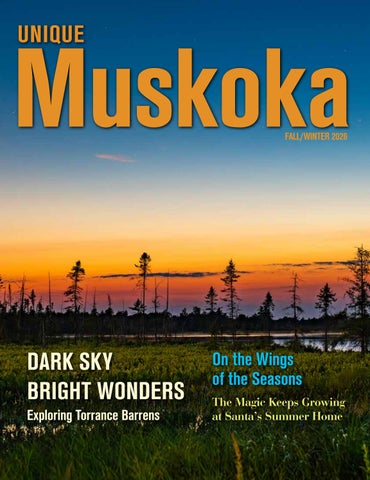
FALL/WINTER 2026
DARK SKY BRIGHT WONDERS Exploring Torrance Barrens
On the Wings of the Seasons The Magic Keeps Growing at Santa’s Summer Home
brownsappliances.com (705) 765-5700 108 Maple Street, Port Carling, ON
MUSKOKA LOOKS GOOD in every season.
EXPERIENCE THE BEAUTY WITH A LOCAL EXPERT
CHELSEY PENRICE
YOUR BEST INTEREST IS MY BOTTOM LINE. WWW.CHELSEYPENRICE.CA 705.205.2726
@MUSKOKALUXURYPROPERTIES
[18]
...telling the Muskoka story
Features [12]
22
Rooted in Faith — Lake Joseph Community Church Article by J. Patrick Boyer
12
Take a Hike — Torrance Barrens Article by John Challis Photography by Andy Zeltkalns Created by the Province of Ontario in 1997, Torrance Barrens Conservation and Dark Sky Reserve is a 1,907-hectare landscape of bedrock, bogs, ponds and scrub forest. Two years later, it was declared the world’s first Dark Sky Reserve and continues to delight stargazers today.
Lake Joseph Community Church in Minett, like many small lakeside churches throughout Muskoka, has known both prosperity and adversity. Although the Great Depression nearly brought the quaint lakeside church to an end, devoted community members ensured services continued and helped secure its designation as a Muskoka Lakes Heritage Property.
[22]
28
With a Paddle — Gibson River Article and Photography by Andy Zeltkalns
18
Finding a Way — Mara Hallman Article by Andy Zeltkalns Port Sydney resident Mara Hallman embarked on an ambitious personal challenge this summer: swimming 125 km across Algonquin Park, from the Kiosk Campground to Canoe Lake, as a fundraiser in support of Water First, a non-profit program created to ensure access to clean drinking water for Indigenous communities.
2 UNIQUE MUSKOKA Fall/Winter 2026
The Gibson River offers a memorable adventure full of discovery. Beginning as the narrow, shallow Upper Gibson, this 24 km section gives way to the more popular Lower Gibson, where paddlers can explore a series of lakes and eventually reach Georgian Bay.
32
From the Classroom to the Canvas Article by Bronwyn Boyer Photography by Josianne Masseau [32]
Following a three-decade career in education, Caroline Pattison embraced her artistic talent in the next phase of her life. Through study, mentorship, constructive critique and practice, Pattison has honed her craft, driven by a lasting love of the work.
Fall/Winter 2026 UNIQUE MUSKOKA 3
Eavestrough and Gutter Protection
Lose the leaves... get Clearwater
Make your eavestroughs maintenance free. Repel leaves, sticks and branches, no rusting, chipping or peeling.
Alu-rex
Protects your eavestroughs from damage caused by snow and ice.
Our Selection of Rainware Products will Help your Home or Cottage Weather the Storm
Embrace Your Exterior! Siding • Roofing • Soffit • Fascia • Decking • Eavestrough • Gutter Protection
www.norstarexteriors.com SERVING THE MUSKOKA, PARRY SOUND & HALIBURTON REGIONS
Fall Booking Booking Specials Spring Specialson onNow! Now! T: 705-645-8404 4 UNIQUE MUSKOKA Fall/Winter 2026
T/F: 800-732-0158
F: 705.645.7263
38
River of Birds — The Marvel of Migration Article by John Challis
FALL/WINTER 2026
Migration is no brief event; it can take up to half the year. Spring brings a full-on rush to the nesting grounds, while fall migration is more sporadic and spread out for many bird species. In every season, the journey to and from Muskoka is an incredible one.
DARK SKY BRIGHT WONDERS
46
Exploring Torrance Barrens
Santa’s Ever-Expanding Summer Home Article by J. Patrick Boyer Santa’s Village, known as Santa’s summer home, has drawn crowds to its magical environment since its inception 70 years ago. Year after year, its rides, attractions and special features have evolved to keep pace with growing visitor expectations, advancing technologies and an ongoing concern for safety.
On the Wings of the Seasons The Magic Keeps Growing at Santa’s Summer Home
Our Cover
Photograph by Andy Zeltkalns Torrance Barrens Conservation and Dark Sky Reserve presents incredible viewing for unique landscapes, rare wildlife, stunning sunsets and exceptional stargazing.
[46]
Departments
Opinion
52
9
64
By Meghan Taylor
By Beverly Earley
What’s Happening Article by Matt Driscoll Events abound this fall and winter, from the Rosseau Pumpkin Festival, Bala Cranberry Festival, Muskoka: Home of the Stars and The Great Pumpkin Trail to holiday markets in Bracebridge, Gravenhurst and Huntsville. The Port Carling arena renovation has been approved to proceed, along with work on the former Carnegie Library in Bracebridge. Meanwhile, the Silver Bridge rehabilitation project in Bracebridge nears completion, FlixBus expands to year-round services, and the Northlander trundles toward operation by the end of 2026.
56 Cottage Country Cuisine Article by K.M. Wehrstein Photography by Brittany Clark Chefs from across Muskoka share hearty meals to warm the soul on cold nights. From chicken soup and braised beef to orange brown butter financier (the dessert, not the banking kind), these creative, comforting dishes are sure to please the crowd at your table.
Muskoka Insights
Muskoka Moments
11
From an Artist’s Perspective By Lori Knowles
[56]
• Specializing in Sourdough • Fine Artisan Breads Daily • Assorted Baked Goods • Made in House Desserts
…telling the Muskoka story Unique Muskoka is published six times per year by Unique Publishing Inc. Meghan Taylor Publisher/Editor Donna Ansley Sales Lisa Brazier Marianne Dawson Design
BIG RIVER BAKING COMPANY
705-394-4499 info@bigriverbakingco.com
FOLLOW US ON INSTAGRAM @bigriverbakingco for updates, daily bread lists and our weekly cheesecake special!
OPEN YEAR ROUND — TUESDAY TO SATURDAY 11A TAYLOR ROAD, BRACEBRIDGE
The new Sportage HEV
Susan Smith Administration Bronwyn Boyer J. Patrick Boyer John Challis Brittany Clark Matt Driscoll Beverly Earley Michael Hatton Lori Knowles Josianne Masseau Lauren Todd K.M. Wehrstein Andy Zeltkalns Contributors Annual Subscription Rates: (including HST where applicable) In Ontario $30.00 All Other Provinces $36.00 HST: 773172721 Canada Post Publications Mail Agreement Number: 43268016 Copyright © 2026 Unique Publishing Inc. No content published in Unique Muskoka can be reproduced without the written permission of the publisher.
MUSKOKA KIA
21 Robert Dollar Dr, Bracebridge, ON P1L 1P9
705-645-6575 muskokakia.ca
6 UNIQUE MUSKOKA Fall/Winter 2026
Mailing Address Box 616, Bracebridge ON P1L 1T9 www.uniquemuskoka.com info@uniquemuskoka.com 705-637-0204
©Muskoka Lumber
Taking the complexity out of hiring the right company. MUSKOKA BUILDERS’ ASSOCIATION IS THE PLACE TO START.
Enjoy Peace of Mind in Muskoka Our mission is to continuously support our members by providing timely education, training, and information tailored to their needs. We promote a collaborative culture rooted in strong business ethics, enhancing the effectiveness and success of the building industry in Muskoka. By fostering teamwork and shared values, we ensure our members are part of a community dedicated to excellence and ethical practices. Our members bring knowledge, experience, and peace of mind to your project, with deep familiarity of the local area and its unique
building challenges. All our members, from suppliers through to trades, have a strong working relationship. They are wellequipped to handle lake and island projects, and offer ongoing support and warranty services. We simplify the process of choosing a contractor with an easy-to-use directory on our website.
Fall/Winter 2026 UNIQUE MUSKOKA 7 (705) 645 3008 • MUSKOKABUILDERS.COM
FURNISHINGS AND DESIGN SERVICES
Muskoka’s Most Beautiful Store Step into our breathtaking 35,000 sq ft showroom, featuring curated bedroom, living, dining, office, and outdoor furniture, plus an expanded rug area. Work with our designer Laura to create your perfect home, explore fine Canadian furnishings, and shop our in-store Veranda Outlet. With ample parking, and easy access, we can’t wait to welcome you!
OW N E R & O P E R AT O R
FURNISHINGS • DESIGN SERVICES RUGS • ART • LIGHTING OUTDOOR LIVING
505 HWY 118 WEST, BRACEBRIDGE • 705 645 6451 • VERANDACOLLECTION.CA
8 UNIQUE MUSKOKA Fall/Winter 2026
Muskoka Insights would be easier to stay home. Joy grows sturdier when it is shared. That does not mean ignoring the heaviness fall can carry. The shorter days can feel abrupt, the return to responsibility can feel overwhelming, and winter can seem close before the first frost. But choosing joy now is not a denial of what is difficult. It is a way of strengthening ourselves for it, a practice of paying attention to what is still beautiful, still warm, still possible. That same spirit runs through this edition of Unique Muskoka, where we experience the joy, magic and history of Santa’s Village. Regular contributor Patrick Boyer highlights the intrepid townsfolk who gathered around an idea and made it a reality. Contributor John Challis explores the migration habits of bird species across Muskoka. Bird watchers delight in seeing feathered friends arrive or depart for the season, much like our summer crowds. And because cooler evenings have their own comfort, this edition’s Cottage Country Cuisine features local chefs sharing go-to hearty meals for the season. Whether shared around a full table or enjoyed quietly at home, these recipes are worth trying – including a bonus recipe of a local fall favourite. So, this autumn, before the season disappears into lists and logistics, maybe we can give ourselves permission to look for joy on purpose. Not as another task, but as a posture. Notice the golden light. Take the scenic route. Call the friend to join you for a cider. Stand still beneath the changing trees. Let the season remind us that endings can be generous, transitions can be tender, and there is still so much to gather before the snow comes. Happy reading! Photograph: MacKenzie Taylor
Recently, I felt the collective exhale around me as summer transitioned into the routine of fall. Somehow, fall feels like its own sort of fresh start – not the bright, ambitious beginning we associate with January or Spring, but a gentler reset. It arrives with cooler mornings, earlier sunsets, and the familiar pull back toward structure. After months of long weekends, late dinners, lake swims, and loosened schedules, fall asks us to return, but not necessarily to rush. There is a plan to gather and prepare before the kids go back to school, before closing the cottage, before pulling sweaters from storage and hunkering down for winter. There are lunches to pack, calendars to fill, woodpiles to stack, gardens to tidy, and routines to remember. It can be tempting to see this as the end of ease, as if joy belongs only to the warmer months and must be packed away with the beach towels. But I am trying to resist that idea. Fall, in its quiet way, may be one of the best seasons for noticing what still brings us alive. The colours demand that we look up. The air invites us to breathe deeply. The harvest table reminds us abundance does not always arrive as something grand. Sometimes it is a pot of soup shared on a Sunday evening, a mug warming both hands, or a walk under trees that seem to be giving everything they have before letting go. That is why the simple idea to find joy and share it feels like both an invitation and a responsibility this time of year. It does not have to be complicated. A concert with friends, a hike to a favourite lookout, a visit to main street shops and fall markets without truly needing something – these are not extravagant acts, but they matter. They remind us how joy often lives in the ordinary places we pass by when we are too busy bracing for what comes next. And once we notice it, joy has a way of becoming generous. We can invite someone for a walk, pick up apples for a friend, send the sunset photo, make the soup, host the small gathering, or say yes to an excursion when it
Inspired byNature w w w. b r a c k e n r i g . c o m 705-765-5565 info@brackenrig.com
Fall/Winter 2026 UNIQUE MUSKOKA 9
NOVEMBER 13–15
THE INTERNATIONAL CENTRE, MISSISSAUGA
KICK-START YOUR TO-DO LIST FRIDAY AL NIGHT DE
SUNDALYY FAMI GE PACKA
TO FALL INNGS SAVI
HALF-PRICE TICKETS! $7.50 EACH
Valid Friday after 4pm. General Admission only (ages 18+) Minimum quantity two.
GREAT VALUE FOR A FAMILY DAY OUT! $35
Includes 2 General Admission, up to 4 Child & Youth tickets. Sunday only, online exclusive.
PROMO CODE: UNIQUE26 GET $3 OFF
Valid on General Admission only. Enter UNIQUE26 at checkout. Online exclusive.
10SHOWS.COTTAGELIFE.COM UNIQUE MUSKOKA Fall/Winter 2026
Prices valid until November 12, 2026 at 11:59 PM EST
From an Artist’s Perspective My Golden Life
Zeltkalns
promising to be attractive and useful that cost more than my first car in 1988? Next, I got busy gauging when or where I would use any of these swanky items considering my own Muskoka life isn’t quite so swanky. Last week there was a bat in the chimney and a mouse chewing the lifejackets. The dock is sagging. The septic needs pumping. And there’s a porcupine under the cottage waking me up at three a.m. by sawing his teeth on the cement footings beneath. Oh, and let’s not forget that my boat literally sank this summer thanks to some faulty, underwater fishing apparatus I didn’t know I owned. I bailed and bailed and bailed, but sadly I couldn’t bail fast enough. Would the leather sandals ($1,070) promising to be attractive and
Photograph: Andy
I’ve fallen into a trap – a social media trap – of appearing online as if my life is golden. Sparkly boat rides. Rosy sunsets. Friends and family smiling by the lake next to ice cold mojitos muddled expertly with lime juice, sugar, rum and fresh mint. It sounds wonderful. It is wonderful. My Muskoka life is golden – but not in the ways Instagram would have you think. Social media is essential for any artist. It’s a handy tool to help display and advertise our work. Artists in Muskoka showcase their paintings and pottery, their studios, their sculptures, their woodwork. Authors like me might reveal a book cover, or hint at a story we’re working on. Landscapists might show a woodsy scene they’re rendering – we see the painting come alive before our eyes, step by step. As a millennial might say, it’s all good. But then, last August, on a foggy morning while sipping coffee and waiting for the mist to burn off above the lake, it wasn’t all good. I came across a post that made me stop my scroll on Instagram. Hold on! Hitch up! Reverse! A colourful carousel displayed items every cottager needs to fit into Muskoka life. “Fit in?” a little voice inside me asked. “Oh my goodness, do I own any of this stuff?” There they were in full colour – all the lusty things I lack. A burlap tote bag sporting a designer label ($90). A pair of Persol sunglasses ($575). A set of leather sandals promising to be “attractive and useful” ($1,070). A shiny black “clutch bag” by an Italian designer ($2,600) that “suggests you have your life together,” which I most definitely do not. My brain was spinning as I stared at my screen. Who are these people? I was thinking, what kind of Muskoka life are they living? How have I been missing out? My burlap totes were bought at the grocery, and I misplaced my dime-store sunglasses yesterday – they’re around here somewhere, probably stuffed into my $40 Winners purse. And do I really need leather sandals
Photograph: Muskoka Tourism
Article by Lori Knowles
useful help me out in my boat-sinking debacle? Probably not. On the dock, in the morning August fog, I resumed my scroll in disgust. But then a thought occurred to me. Once again, I hitched up. I took a peek at my own profile page. Maybe, just maybe, I am guilty of suggesting ridiculous ways to fit in to swanky Muskoka life. Sure enough, I am. My feed is filled with photos and reels and stories of sparkly water, and pretty women waterskiing, and the moon shining brightly over the lake. There are no bats or toothy porcupines or sagging docks. Gasp! There are no boats sinking in the lake. Because the truth is, social media isn’t real. It’s fun and aspirational, even dreamy sometimes… but it’s also a trap. My life as an artist is golden here in Muskoka. Just not in the ways Instagram would have you think.
Lori Knowles is a journalist and author of Summers with Miss Elizabeth, a Muskoka novel. The second book in the series, Summers with Gin, is coming soon. In this column, Lori explores what it’s like to live and work as an artist in Muskoka. www.loriknowles.com @loriknowles_author
Fall/Winter 2026 UNIQUE MUSKOKA 11
Torrance Barrens Conservation and Dark Sky Reserve Length: 3.5 km to 7.5 km loops Difficulty: Challenging Suitable for: Walking, Running, Mountain Biking, Snowshoeing, Camping, Stargazing Operation: Year-round
12 UNIQUE MUSKOKA Fall/Winter 2026
To get there: From Gravenhurst take Muskoka Road 169 for 21 km to Torrance and turn left on Southwood Road (Muskoka Road 13). About 9 km along Southwood Road a sign for the roadside parking lot will be visible.
Article by John Challis / Photography by Andy Zeltkalns
T
hink of Muskoka trails and the images arise of sun-dappled lakes, climbs over hills, and fragrant pine forest. Torrance Barrens upends that stereotype. Here, the forest has no foothold: bedrock scoured by glaciers into elongated, bald ridges dotted with stunted oak. Lower areas are filled with acidic bog, peatland, multiple ponds, tangled scrub thickets, and where thin soil
deposits exist, small forests providing a bit of shade. It may be called barren in comparison to the usual Muskoka landscape, but it holds a wealth of beauty. Created by the province in 1997, the 1,907-hectare Torrance Barrens Conservation and Dark Sky Reserve adjoins Hardy Lake Provincial Park and two more reserves to the south, creating a vast protected corridor from Lake Muskoka to the Severn River. For all its sparse, forbidding
appearance, it is filled with features that draw enthusiasts all year. Blueberry hunters – including bears – scour the bushes in late July and August. It’s ideal habitat for turtles, frogs and snakes. Rare Atlantic Coastal Plain flora fills the wetlands, and 166 bird species have been recorded as sighted in the reserve. In 1999, Torrance Barrens was declared the world’s first Dark Sky Preserve, creating a night sky paradise for stargazers. Two main loop trails total about 7.5 km,
The first of its kind in the world, Torrance Barrens Conservation and Dark Sky Reserve is a night sky paradise for stargazers.
Fall/Winter 2026 UNIQUE MUSKOKA 13
Throughout Torrance Barrens Conservation and Dark Sky Reserve, rare Atlantic Coastal Plain flora fills the wetlands. It’s ideal habitat for turtles, frogs and snakes and 166 bird species have been recorded as sighted in the reserve. and an additional out-and-back trail leads to three remote designated campsites. The trails are challenging to navigate. White trail blazes are not always evident; they’re often painted on bedrock. Lower areas are usually buggy, muddy and sometimes downright soggy. The area has been used by hunters for generations, and
their many paths could mislead a novice visitor. The Main Trail, the most frequently used, is a 3.5 km loop around Highland Pond. From the parking lot, it heads east through some scrub oak woods, passes around a wetland and rises up a steep incline onto a ridge leading west. The ridge provides views
Signage from Parks Ontario at Torrance Barrens Conservation and Dark Sky Reserve provides details about the trails, activities, approved camping areas and rules for use. 14 UNIQUE MUSKOKA Fall/Winter 2026
over wetlands and long, striated ridges and swales extending almost to Lake Muskoka. Past the ridge, the trail skirts a starkly beautiful bog-marsh complex. It then turns south to cross Southwood Road, through hardwood forest, before crossing the road again to return to the parking lot. Experienced hikers can add another four kilometres by taking the less travelled Barrens Extension. It’s a loop that heads beyond the westernmost extent of the Main Trail along more wetlands. Again, the route can be challenging to navigate – and it involves wet, swampy terrain and a tricky crossing over an active beaver dam. It’s currently best to avoid the Pine Ridge loop, which used to be a northern extension of the Main Trail. Pine Ridge Trail has been plagued by rotted boardwalks for some years. Parks Ontario is alleged to have completed some work, but recent users report finding no way to cross the wetland. Nighttime excursions are often arranged by astronomy groups. It’s even worth staying at dusk to hear the songs of whip-poor-wills
705 765 7474 redcanoegallery.com 33 years in Muskoka
100% Canadian Artists / Bala, Muskoka
red canoe gallery
The Main Trail’s loop winds through scrub oak forest, skirts wetlands, and climbs to a ridge overlooking Highland Pond, offering a glimpse of the area’s diverse landscape.
Autumn 48 x 48” 48, Carola Grimm Muskoka WaterGlow, Fall, 48” Paul Garbett
Fall/Winter 2026 UNIQUE MUSKOKA 15
and the startling booming of nighthawks. Booming is a display created when the birds dive towards a mate or young, flexing wing feathers to generate a loud “voom.” Six or seven years ago, Guardians of the Dark Sky and Barrens launched a huge community effort to combat the overuse, and misuse, of the Barrens. Garbage, broken glass and campfire residue had accumulated, left by less than conscientious outdoor enthusiasts. Cleanups took place through the
pandemic and have continued annually since. Greg Knight, who co-ordinates the cleanups, says conditions are much improved. Only a handful of volunteers are needed now, and only three garbage bags were filled this summer. New signage along Southwood Road controls parking, and the six designated campsites, with notable orange signs, were created to limit the impact of camping. The Guardians group has created effective maps of the trails and campsites on the website torrancebarrens.com.
What to take: Good water-repellent hiking boots are highly recommended. Wear long-sleeved, loose-fitting clothing and a sunhat. Take sunscreen and bug repellent, especially during the spring and early summer. Carry snacks and more water than you think you need. Most importantly, bring maps, since these are difficult trails to navigate. Downloadable maps from apps like AllTrails will help where cell signal cuts out. Good old paper topographical maps are useful, too, along with a compass.
Bedrock scoured by glaciers creates much of the trail terrain at Torrance Barrens Conservation and Dark Sky Reserve. The trails can be challenging to navigate as the white trail blazes are not always evident; they’re often painted on the bedrock.
16 UNIQUE MUSKOKA Fall/Winter 2026
SERVING MUSKOKA & PARRY SOUND FOR OVER 70 YEARS
For all its sparse, forbidding appearance, Torrance Barrens Conservation and Dark Sky Reserve is filled with features that draw enthusiasts all year. From wildlife to vegetation to rock formations, Torrance Barrens is unique.
Six or seven years ago, Guardians of the Dark Sky and Barrens launched a huge community effort to combat the overuse, and misuse, of the Torrance Barrens. Whether hiking or camping, ensure all garbage is removed and camp only on designated spaces.
Sales & Service of Major Propane Appliances (refrigerators, ranges, fireplaces, furnaces & more) Safe & reliable No electricity required Bulk propane delivery to your home or cottage
705.645.4294 TF: 866.645.4294 STORE: 228 TAYLOR RD., BRACEBRIDGE OFFICE: 1646 WINHARA RD., GRAVENHURST
Fall/Winter 2026 UNIQUE MUSKOKA 17
What began as a simple idea became “Swim Algonquin” — a 125 kilometre fundraising challenge that saw Mara Hallman swim across Algonquin Park from Kiosk Campground to Canoe Lake. 18 UNIQUE MUSKOKA Fall/Winter 2026
Photograph: Andy Zeltkalns Photograph: Mara Hallman
In 2025, Mara Hallman began training for a self-supported swim across Algonquin Park towing all her camping and portaging gear in a specially designed raft, much like a solo canoe expedition.
Article by Andy Zeltkalns
P
ort Sydney resident Mara Hallman has always been an active person with a love for the outdoors. Beginning as a competitive swimmer on her high school swim team, Hallman evolved into a multidisciplined athlete pursuing sports such as paddling and Nordic skiing. Time spent at a family cottage on Canoe Lake in Algonquin Park, working at the park’s Portage Store, and numerous paddling expeditions exploring Algonquin’s endless waterways helped Hallman forge a
powerful connection to this wilderness treasure. It also gave her a deeper appreciation for water – not only for its vital role within the park and across the Muskoka watershed, but for the privilege of having access to fresh, clean water, something many of us too easily take for granted. Swimming in a pool was a familiar process for Hallman but for years open water swimming, which had an element of the unknown, brought with it a certain level of anxiety.
Fall/Winter 2026 UNIQUE MUSKOKA 19
Photograph: Andy Zeltkalns
During her “Swim Algonquin” campaign, Mara Hallman also collected garbage to clean up Algonquin Park and support Algonquin Outfitters’ “Pack-it-Out” program. She was sobered by the amount of garbage she encountered in the park, especially microplastics. “I enjoyed the swimming, but I had a love hate relationship with open water,” explains Hallman. While living in Australia during 2019 she had the chance to experience ocean swimming which was both exhilarating and intimidating. The fear of riptides, strong currents, and creatures like sharks and jellyfish often fuelled her anxiety, but confronting those fears ultimately gave her an improved sense of confidence. The following year, while swimming in Canoe Lake at her cottage one day, Hallman felt a shift. “It was like a flip of the switch,” she explains. “My fear gave way to curiosity as I realized, unlike Australia, there’s nothing in these waters that can really harm me.” Raising awareness for the importance of water protection and preservation became a goal for Hallman. Using her increased comfort level for open water swimming
20 UNIQUE MUSKOKA Fall/Winter 2026
combined with her love of canoeing, she began developing a project that would meet her objectives. She also wanted to raise money towards Water First – a non-profit program created to ensure access to clean drinking water for Indigenous communities. What started as a mere idea eventually morphed into “Swim Algonquin” – a fundraiser and personal challenge to swim 125 kilometres across Algonquin Park from the Kiosk Campground to Canoe Lake. Her plan was also to help clean up the park as part of Algonquin Outfitters’ “Pack-it-Out” program, picking up garbage along the way. Hallman not only wanted to swim across the park, but she wanted to do it selfsupported while camping, portaging, and pulling all her own gear, not unlike a canoe trip. In 2025 Hallman started training for the event. Eventually, she purchased a raft that could accommodate gear for an extended trip
and was designed to be towed behind a swimmer. She also started to spend time training in Algonquin Park which included portaging and staying overnight with her equipment. In the winter of 2026, relying on maps and her familiarity with Algonquin Park’s many waterways, Hallman created a route that suited her challenge. It was at this time she sent out a mass email for support boats that could accompany her for reasons of safety and was pleasantly surprised at the positive response. She divided her route into three different sections based on access for the support boats and for each leg she would have a different support crew available. Hallman named each leg, Friends, Mentor, and Family with the people on those legs corresponding to each category. The support people would also resupply her food and help pack out the
larger items of garbage Hallman was finding on the way. Starting on July 13, 2026, Hallman set out on her epic swim. By the time she was done 19 days later, she had covered 29 lakes, 29 portages and multiple sections of river. “Every day was different,” shares Hallman. There were days when strong winds and current slowed her down. Other days hidden hazards such as logs and rocks, or swimming through weeds, affected her pace. Nevertheless, she managed to average about five hours of swimming each day, usually covering around 7 kilometres, including portages. Her longest day stretched over 10 kilometres. The middle leg of her journey proved to be the toughest where she faced the worst weather and numerous carries, including a two kilometre stretch she describes as “brutal.” No matter what obstacles Hallman encountered, she relied on the concept “water always finds a way” to inspire her to keep moving forward. By completing her epic swim, Hallman has achieved an important personal goal and
gained a deep sense of accomplishment. Overall success for Hallman was defined not only by her finish but the entire journey itself. “My idea of what was swimmable has changed,” says Hallman. She notes she has gained a new level of confidence. In the end, Hallman believes “Swim Algonquin” has helped strengthen her message regarding the importance of freshwater protection and access in Canada. She was sobered by the amount of garbage she encountered in the park, especially microplastics. Going forward she wants to continue promoting the principle of “leaveno-trace” while camping, and picking up after each other, to ensure the park remains a wilderness gem for all to enjoy. Hallman is grateful for the tremendous support she received from family and friends along the way and appreciates the positive feedback and inspirational stories from others. As a result of her project, Hallman has already surpassed her goal of raising $8,000 for Water First but would be thankful if people continued supporting this important cause. Donations can be made to waterfirst.ngo
EXPERIENCE YOU CAN TRUST Experienced drilling & blasting for roads, ditches, foundations and septic systems. Exceptional service and top-quality results.
Photograph: Mara Hallman
FREE ESTIMATES
During the toughest stretch of her journey, Mara Hallman pushed through harsh weather and demanding portages, drawing inspiration from the belief that “water always finds a way” to keep moving forward. Overall success for Hallman was defined not only by her finish but the entire journey itself. Fall/Winter 2026 UNIQUE MUSKOKA 21
Article by J. Patrick Boyer
O
n the bright Sunday morning of August 9, 1903, more than 250 worshippers thronged the justcompleted Lake Joseph Presbyterian Church’s auspicious inaugural service, another of the District of Muskoka’ small lakeside churches opening for cottagers. As William Gray notes in Lake Joseph 1860-1910, this section of Muskoka was largely settled by homesteaders and cottagers along denominational lines – Anglicans there, Presbyterians here, Methodists next along. Staking out free-grant land this way was not happenstance but express ecclesiastical intent to colonize the north. In 1891, the Presbyterian Church sent 20-year-old Ontario theological student Hugh Thompson Kerr to Lake Joseph as a missionary. His work in the district continued into the new century, followed by other ministry
22 UNIQUE MUSKOKA Fall/Winter 2026
students making visitations to recruit more Presbyterians. Since 1878 there had been a Presbyterian Church in Port Carling, but journeying with the family down to it and back led Presbyterians up the Peninsula to strike out on their own. Buying a scenic stretch of Lake Joseph shoreline from Toronto’s L.K. Martin for $150, as H.S. Hunnisett notes in his compilation of the church’s story, men cleared a worksite for the Mackenzie brothers from Foot’s Bay and G.M. Henry of Minett to row over and complete the basswood-panelled church by August 1903.
The opening service was a gala affair, suited to the era’s version of Muskoka. “Many families came in their chauffeured Ditchburn launches,” ran one report. “Dress was anything but informal, ladies in pretty summer dresses with hats, some with gloves, and men in well-tailored summer suits.” The August 12 Presbyterian magazine recorded, “Muskoka was at its best, with weather all that could be desired. By 10:30 a.m., rowboats, canoes, and launches began to assemble. At 10:45, the steamer Islander, most popular ship on the lakes, appeared with
Photograph: Barry Peacock, Chair, Lake Joseph Community Church
The rugged hinterland sense of place was maintained for summertime at Lake Joseph Presbyterian Church, with dead trees left standing and grounds in nature’s untended state. Jesus Saviour Pilot Me, continuing homeward with hymns associated with life-ending episodes, including Abide with Me and God Be with You Until We Meet Again, most echoing and re-echoing from the passing mainland and islands. That night’s passion for giving
voice to old favourites inspired a tradition at the Lake Joseph Church of congregational hymn-singing in advance of Sunday morning services. By 1925, when the Presbyterian, Methodist, and Congregationalist churches merged into the United Church of Canada, the congregation declared
Frank Micklethwaite’s panoramic photograph of Lake Joseph Church captures the sense of adventure intrinsic to boating to church in Muskoka’s early settlement era, a century and a quarter ago.
Fall/Winter 2026 UNIQUE MUSKOKA 23
Photograph: Barry Peacock, Chair, Lake Joseph Community Church
decks jammed. Soon the wharf and hillside were thronged. By 11:00 a.m. the church was crowded to the doors for the service conducted by Rev. Dr. Carlyle of Pittsburgh, vacationing with friends near Beaumaris and arriving over Lake Muskoka by stylish launch, and Rev. Donald Mackay of Bala, a recent Knox graduate.” That evening, with word of the doings having spread around the lakes, still more people arrived to join another religious assembly, taxing the Islander to her limit. A hundred of them, unable to enter the crammed church or even make out the stentorian voice of Rev. Dr. Grant of Orillia officiating, could enjoy the clear rich voices of Torontonians Miss Pearl Davis, soprano soloist, and Miss Clara Clarke, alto, both from the city’s Central Presbyterian Church. “Miss Davis sang the beautiful sacred solo Face to Face with such vigour and expression,” noted the Presbyterian, “that her earnest and sympathetic manner won the affection of all who heard her.” After the evening service, the over-crowded low-riding Islander moved off into open water under full moonlight. Some 250 passengers, seeking divine reinforcement beyond the skills of her captain, united in mirthful singing of
Photograph: Barry Peacock, Chair, Lake Joseph Community Church
Rev. Tim Bruneau, minister of St. Giles Kingsway Presbyterian Church, Toronto, photographed with his family at the lakeside entrance to Lake Joseph Community Church.
their church “interdenominational” and renamed it the Lake Joseph Community Church, as it’s been known since. Through the Roaring Twenties, the Community Church and its stylish members remained cohesive worshippers, readily drawn on summer Sundays to hear impressive preachers and top musicians. The immense talent pool of notables vacationing in Muskoka meant many were pleased to be recognized and to perform in the famed district. One such preacher was the now renowned Dr. Rev. Hugh Thompson Kerr, first in Muskoka as a divinity student in 1891. Ordained in 1897, Kerr had become pastor of Pittsburgh’s Shadyside Presbyterian Church, moderator of the American Presbyterian Church and a pre-eminent theologian. He took the pulpit at the Lake Joseph Community Church and other district lakeside summer churches when joyously vacationing back in Muskoka. The 1929 stock market crash in New York ushered in dire economic depression which reached even to the Community Church’s door. As Hunnisett recounted, Dr. Thomas Winslow, whose family had supported the
Muskoka's Largest Home Service Company!
No job is too big or too small! www.GBScontracting.com 705.687.9143 1082 Beaumont Farm Rd., Bracebridge
24 UNIQUE MUSKOKA Fall/Winter 2026
Photograph: Barry Peacock, Chair, Lake Joseph Community Church
church for 35 years, inherited the job of running the place in the 1930s. It had too many problems and, ruining his vacations, Winslow wanted relief from the chore. Rev. John McNeil, who for years dutifully arranged for the preachers, was ill and could no longer help, leaving Winslow the challenge of getting guest ministers. The few attending services were friends the doctor invited personally. With bad weather, sometimes nobody came. The roof leaked, windowsills were rotten, the dock so badly wrecked that any boat moored to it was often damaged. With $92.43 in its bank account, funds were lacking for church repairs. Through 1933 and 1934 the doctor held no services, then in despair he sought to close the church and sell the property. However, this bleak fate did not materialize. A few with nostalgic heart-tugs and desiring more than ever to worship through dire times, stepped into the void and organized services for 1935. Eight were held, Sunday collections rose from $17 to $20, and ministers were paid $15. By this grim stage of the Great Depression, that counted as movement in the right direction.
A woodsy welcome up flagstone steps to the front of Lake Joseph Community Church signals that everyone is welcome to its 10:30 Sunday morning interdenominational worship.
HARDWOOD | LAMINATE | VINYL PLANK & TILE | CARPET CERAMIC | NATURAL STONE …AND MORE!
MODERN HOME CARPET ONE
350 Ecclestone Drive • Bracebridge
705.645.2443 carpetonebracebridge.ca
TAYLOR CARPET ONE
30 Cairns Crescent • Huntsville
705.789.9259
taylorcarpetonehuntsville.com
Fall/Winter 2026 UNIQUE MUSKOKA 25
Photograph: Barry Peacock, Chair, Lake Joseph Community Church
Paul Doddington, a seasonal Muskokan highly knowledgeable about district history, boats, music and mechanical operations, reaches Lake Joseph Community Church by well-tuned disappearing propeller boat or in his immaculate antique Ford. For a church on the brink of becoming another Depression-era victim, sustained efforts over decades by individuals rooted in faith more than turned the tide. The 70th
anniversary service in 1973 drew 155 people – the largest congregation since 1903’s opening day. Then, in August 2003, for the church’s centennial service, over 500 people thronged
to hear Rev. Dr. Andrew Stirling preach, to witness Ontario’s Lieutenant-Governor James Bartleman, raised in this part of Muskoka, dedicate a permanent memorial plaque, and to applaud as Muskoka Lakes mayor Susan Pryke, who’d grown up working at her family’s Sparrow Lake summer resort, unveiled a plaque designating Lake Joseph Community Church as a Muskoka Lakes Heritage Property. Two decades on, for the church’s 120th anniversary, Barry Peacock, chair of the church board, chronicled the changes and progress of Lake Joseph Community Church through time, drawing on Hunnisett’s material. Of necessity, the dock was expanded and upgraded many times, the parking lot doubled and redoubled in size, a Sunday school started when more attention to children resulted in their increased church attendance. Upgrades in organ music and changes to the hymnary were central to the revival, church music being what it is. The building was expanded, electric lights installed, a lakeside patio built for congregants to mingle, and two lakeside gazebos added. Repairs to facilities included
LOWER OVERHEAD FOR US MEANS
LOWER PRICES FOR YOU
Come check out our new Warehouse Showroom Pricing!
WE HAVE MOVED! VISIT OUR NEW WAREHOUSE SHOWROOM
61 Keith Road, Bracebridge Call anytime
705-645-8183
Store hours 9-5, Wednesday through to Saturday Browse our extensive website at muskokafurniture.net
26 UNIQUE MUSKOKA Fall/Winter 2026
Photograph: Barry Peacock, Chair, Lake Joseph Community Church
Muskoka Barging
Photograph: Barry Peacock, Chair, Lake Joseph Community Church
The unique role embodied by Muskoka’s lakeside summer churches has been recognized by heritage organizations and district municipalities, as exemplified by official plaques presented to Lake Joseph Community Church.
replacement of the roof. A welcoming arch marking a footpath entrance to the church from Peninsula Road was relocated to the path leading from the lake. Because Mr. Peacock gave an instalment of this church history each Sunday during the 2023 anniversary, with informative asides and entertaining tales, many Muskokans around Lake Joseph became more educated on this important part of their heritage. Two episodes out of hundreds help illustrate what a community church is. First, the only fundraising appeal ever made by the Lake Joseph Community Church was for essential major dock work, preserving a special way to reach church. The ask was for $20,000. More than $42,000 poured in. The second was when the end of Elgin House as a summer resort hotel meant deconsecrating its unique lakeside stone chapel. It was decided the pulpit should be gifted to Rev. Dr. Hugh Kerr, who’d manned it on many special occasions, including weddings. The received gift was, in turn, donated by Kerr to Lake Joseph Community Church where it is now installed – symbolizing both changing times and the treasuring of heritage.
Family run construction company with over 35 years experience operating in the Muskoka Lakes area. No job is too small or too big.
705-764-0765 | muskokabarging.com | 1163 Milford Bay Rd, Milford Bay ON
BARGING ● STEEL & CRIB DOCKS ● SEPTIC SYSTEMS ● LANDSCAPING
Fall/Winter 2026 UNIQUE MUSKOKA 27
Article and Photography by Andy Zeltkalns
W
hether you’re a casual paddler out to experience some of Muskoka’s charm, or a seasoned outdoor enthusiast with a spirit for adventure, Muskoka offers a seemingly endless number of possibilities to explore the area by water and connect with nature. Each river covered in our paddling series has its own personality, changing throughout its journey while revealing the region’s natural diversity and contrasting landscapes. The Gibson River, the final route in our series, is no exception, offering a memorable adventure full of discovery. The Gibson River, named for Thomas Gibson, a late 19th century Ontario
28 UNIQUE MUSKOKA Fall/Winter 2026
politician, starts as a narrow and shallow channel from the southeast end of Nine Mile Lake near Torrance. For 24 kilometres this section of the river, referred to as the Upper Gibson, weaves its way through a mix of forests and wetlands that are punctuated by a series of lakes and small ponds before emptying into the south end of Gibson Lake. Travelling farther northwest by about six kilometres, the river exits Gibson Lake and continues for another seven kilometres before joining the Musquash River, which flows in from the north via Go Home Lake. From this convergence, the river descends gradually for three and a half kilometres over rocky, rugged terrain before emptying into the Musquash
Channel on Georgian Bay. This wider portion of river east of Gibson Lake, with its large expanses of exposed bedrock, is commonly known as the Lower Gibson and has a distinctly different character than the upper section. Whether you choose to explore the entire length of the Gibson River, or tackle it one section at a time, you are sure to come away with a satisfying experience. The Lower Gibson River is the most popular section for exploring and can be experienced via a two-day 40 kilometre loop that includes a series of lakes and Georgian Bay, or, through a shorter out-and-back journey. If the loop appeals to you, there are
Looking east along the rugged shoreline of the Lower Gibson River gives a glimpse of the paddling experiences ahead. With small and large lake crossings, rapids and portages, the Gibson River is diverse adventure. three convenient places to begin. You can start at the McCrae Lake car park, just off Highway 400 near Crooked Bay Road, or at the public boat launch on Six Mile Lake, about a three-minute drive east. Another option is Wawautosa Marina, just north of the boat launch, which offers paid parking. The advantage of these starting locations is they put the halfway part of the trip within the seven-kilometre stretch of river that is both scenic and on Crown land
with opportunities for camping. Aside from this stretch, the route passes through mostly private land with limited places to pitch a tent. This loop introduces adventurers to a diversity of paddling experiences such as traversing nine portages of various lengths and the chance to run rapids if water levels allow. River travel, in addition to small and large lake crossings, and a six-kilometre stretch along the inner coastline of Georgian Bay, adds variety to the route. Whatever starting point you choose, you want to follow the loop counterclockwise with the aim of reaching the south end of Gibson Lake via Hungry Creek at the north end of Six Mile Lake. This portion of the route entails a few short portages but nothing too demanding. Once on Gibson Lake, a five kilometre paddle northwest will connect you to the Lower Gibson River which then flows under Highway 400 and onwards to Georgian Bay. After passing under the highway the first kilometre
Fall/Winter 2026 UNIQUE MUSKOKA 29
Both the upper and lower portions of the Gibson River provide their own distinctly different paddling experiences. One of the many obstacles on the Upper Gibson River, between Nine Mile Lake and Gibson Lake, is the challenge of traversing a beaver dam. of river shoreline is private and dotted with cottages. Beyond here however the feel of the river begins to change as you transition into
a corridor of the Gibson where two-billionyear-old Canadian Shield bedrock dominates the shoreline. The geologic features here, with
Paddlers on the Gibson River are rewarded with rugged wilderness scenery after navigating the route’s challenging twists, turns and demanding stretches of backcountry water. 30 UNIQUE MUSKOKA Fall/Winter 2026
their fascinating shapes, textures, and colours, together with a mosaic of moss, low lying vegetation, wind swept pines, and scrubby red oak, create eye-catching scenery. Along this stretch, five kilometres of the river flows through the Gibson River Provincial Nature Reserve which protects the fragile bedrock ecosystem, wetlands, and rare regional plant and animal species in the area. Before reaching Georgian Bay, you will encounter four different portages and a variety of nice locations to camp. Your first obstacle will be Bottleneck Rapids, a narrow channel requiring a steep 200-metre portage on the left-hand side of the river. A little farther, the picturesque Three Rock Chute needs to be bypassed using another steep and rugged portage roughly 400 metres long. A set of rapids just below the chute are runnable in certain water conditions and this can shorten the portage to half the distance. The final two portages are much shorter and easier with the final one optional if you want to run the rapids when water levels permit. Ensure you are confident with your whitewater skills and scout the river in advance before attempting any rapids. Leaving the river behind, the route heads southeast for six kilometres along the Musquash Channel, taking you between Bone Island and the inner Georgian Bay coastline before reaching narrow rapids and a short lift into the ruggedly beautiful McCrae Lake. After entering McCrae Lake, a three-kilometre paddle followed by a 250-metre portage puts you into McDonald Lake and close to the end of your journey if you started here, or onwards to Six Mile Lake if that is your end point. If an out-and-back adventure suits you instead, you can start your trip from Go Home Lake Marina. A three-kilometre paddle southwest will bring you to the Musquash River dam and a portage into the Gibson River where you can enjoy the best of what this waterway offers. For a different experience that includes a more demanding route, paddling the Upper Gibson from Nine Mile Lake to Gibson Lake over a two-day period is a challenge worth considering. Starting at Nine Mile Lake Marina, a three-kilometre paddle to the southeast end of the lake will bring you to a tiny dam, which is the starting point of
Considering renting your cottage? LET’S CONNECT.
Sunsets along the Gibson River are a backcountry camper’s reward, painting the landscape in vibrant colours after a day of challenging paddling through diverse and scenic wilderness. the river. For the next five kilometres, the meandering waterway, which is more like a creek, will lead you past about a dozen obstacles including beaver dams, shallow and rocky sections that narrow to a few metres wide, and places where the river abruptly descends, before entering Woodland Lake. Most of these can be overcome by either pushing or pulling your watercraft and getting your feet wet, but some will require portaging as well. From here, seven kilometres of lake paddling heading northeast will take you to the end of Brotherson’s Lake and back onto the narrow course of the river again. A few camping spots, which can be found on these narrow backcountry lakes, are a great place to set up your tent and enjoy some true wilderness solitude. Once back on the river, approximately 12 kilometres of paddling remains before reaching Gibson Lake and leaving the wilderness behind. This last stretch of river is physically demanding with numerous obstacles and a couple of challenging portages over steep, rugged, and often overgrown
terrain. The flip side is you get to experience High Falls and Long Falls, two very striking waterfalls, and gorgeous scenery as the river guides you through some of Muskoka’s last remaining wilderness. Once back on Gibson Lake, be prepared for culture shock as jet skis and boats become part of the environment. From the river mouth about a one a half kilometre paddle will take you to a public boat launch on the west side of the lake where a car can be left waiting for your return. If you want to turn this into an extended adventure, tack on the Lower Gibson for a full river experience. Navigating portions of these routes can prove challenging, so having a good map, compass or GPS will make your adventure more enjoyable. The topographic Series 1:50,000 31D/13 map covers the entire route and is a useful companion. Whatever way you choose to explore the Gibson River you’re sure to be rewarded with an enriching paddling experience. Remember to stay safe and practice “leave-no-trace” camping, so that others can continue to enjoy the beauty of Muskoka’s wilderness.
• • • • • • •
Inquiries & Reservations Marketing 24/7 Guest Support Checking and Assessing Detailed Cottage Listing Professional Photography Cleaning & Check-Ups
Full Service 4-Season waterfront cottage rental management agency
Find Us
1-877-788-1809
newowners@OntarioCottageRentals.com
Fall/Winter 2026 UNIQUE MUSKOKA 31
Caroline Pattison believes playfulness and risk taking are as vital to artistic growth as process, a philosophy she continues to embrace in her own work.
32 UNIQUE MUSKOKA Fall/Winter 2026
Article Bronwyn Boyer / Photography by Josianne Masseau
M
uskoka is where the lakes mirror the sky and the wind through the pines whispers stories of ancient mysteries. Naturally, that’s where painter Caroline Pattison calls home. Taken off the backburner after many years, her artistic career has flourished into something meaningful, even without the benefit of formal training. Although Pattison was only one year old when her family immigrated to Canada from Scotland, the connection remains. “I’ve been drawn back there a few times,” she says. “I don’t really have any growing-up memories of it, but it’s a beautiful place.”
Growing up mainly in Cambridge, Ontario, Pattison’s early life was shaped by the everyday experiences of a young girl with a pencil and a boundless imagination. “Ever since I was a child, I drew all the time,” she recalls. She especially loved drawing faces and people, which remains evident in her work today. Pattison earned a bachelor of arts from the University of Waterloo, and went to Windsor to complete her bachelor of education, where she met her husband and discovered her new home. “At that time, we had family who had moved up to Muskoka,” she says. “We visited
a few times and just fell in love with the place. We knew when I was finished school and we were ready, that’s where we wanted to end up, and we’ve never looked back.” Pattison’s career in education spanned three decades. She taught Grades 7 and 8 at Glen Orchard Public School, then became a special needs consultant. After that, she was principal of Monck Public School. While guiding young minds was fulfilling, her creative drive simmered quietly beneath the surface. When Pattison retired from education, she was able to embrace the idea that her artistic talent could be a second career.
Fall/Winter 2026 UNIQUE MUSKOKA 33
Deciding when a piece is finished can be one of the most challenging aspects of Caroline Pattison’s process. Her perfectionist approach often means stepping away from a painting and returning with fresh eyes, carefully deciding whether it needs another layer or the final touch. “Drawing was just something I always did for enjoyment,” she explains. “Even when I took a week-long watercolour class at Fleming College’s Haliburton campus, which was amazing. But after I retired, I was invited by my sister-in-law to a painting class at the Washago Art Club. That’s when it finally felt like it could be more than just a hobby.” Pattison immersed herself in learning a
wide range of skills. Her mentors, Doug Cooper of Washago and Richard Vander Meer of Orillia, became instrumental in developing her skills, especially in acrylics, oils, and charcoal. Pattison honed her skills through a blend of study, both independently and through mentorship, along with lots of practice driven by her love of the craft. Constructive critique has also been integral in refining Pattison’s work. “Feedback is really important,” she emphasizes. “Sometimes you get so immersed in a painting or a project, and you don’t know how to move forward with it because it’s hard to be
objective. So that part has been great.” Pattison’s artistic identity is rooted in community and connection and inspired by the endless muse of nature, wildlife, and the people immersed in it. She is an active member of the Washago Art Club, Muskoka North Studio Tour, and the Huntsville Art Society, all groups that provide vital support, encouragement, and opportunities to showcase her art. Pattison also credits her inspiration and development to her mentors and the relationships she has built with fellow artists, many of whom she has met through local studio tours and galleries. Pattison’s participation in the Muskoka North Studio Tour has been especially rewarding. “It’s been really exciting to work with Nancy McKinnon and Karen Gray,” she says. The tour has become a platform for artists to connect with the community, and Pattison revels in the interactions with visitors. “I really enjoy chatting with people about what I do, how I go about creating,” she shares. “The highest compliment is when someone resonates with a painting enough to want to have it in their home.” Pattison’s versatility is one of her defining traits. She works across a variety of mediums; oil, watercolour, charcoal, pastel, each chosen deliberately based on the effect she seeks. “It depends on what I want the painting to look like,” she explains. “Soft, delicate effects might call for watercolour or pastel, while detailed reflections and vibrant colours are better suited to oils.” Pattison’s process usually begins with sketches from photographs. Each composition, size, choice of medium, and colour palette is meticulously planned before diving into the canvas. Her layered approach to oil painting involves underpainting, blocking in colours, and refining details over several layers. This means it often takes weeks or months to complete a single piece.
Caroline Pattison’s paintings begin with carefully planned sketches and evolve through multiple layers of oil paints, blocking in colours, and refining details over several layers. Her multistep process means it often takes weeks or months to complete a single piece.
34 UNIQUE MUSKOKA Fall/Winter 2026
Through independent study, mentorship, dedicated practice and constructive feedback, Caroline Pattison has steadily refined the artistic skills that define her work today. Sizes vary from small six by six inch pieces challenging. “Sometimes I want to keep encourages in her teaching workshops for to large four by three foot commissions. “I tweaking a painting even when it’s displayed children, where fun and experimentation are like doing series of smaller paintings,” she for sale,” she confesses. “That’s why I often prioritized. She believes that playfulness and says, noting her recent work with roosters and step back, take a break, and revisit it with risk taking are vital to artistic growth, a THE RIOBEL MOMENTI™ COLLECTION whales, which have found homes in many fresh eyes after a few weeks. I’ll leave them to philosophy she continues to embrace in her AVAILABL E AT KNOWLES PLUMBING! collectors’ spaces. “My favourite medium dry entirely and then come back to them to own work. right now is oil, though I also love charcoal decide whether to add more layers or final Pattison’s engagement with her community for its expressive qualities.” touches.” extends beyond her studio. She is involved in As a perfectionist, Pattison admits that This perfectionism is balanced by Pattison’s organizing local art shows, most notably the knowing when a painting is finished can be love of O the O process, BAT H & KI TC H E N SH OW R M which is an approach she Washago Art Gallery’s seasonal displays and DESIGN. INSTALLATION. REPAIR S E RVING ALL OF MU SKOKA 279 MA N ITOBA ST, B R AC EBR ID G E
70 5 . 6 45.2 67 1
K NOWLESP LUMBI N G .COM @MUSKOKA BATH
Muskoka’s Bath & Plumbing Centre
BATH & KITCHEN SHOWROOM SALES • INSTALLATION • REPAIR SERVING ALL OF MUSKOKA
279 Manitoba Street, Bracebridge
705.645.2671 @knowlesplumbing knowlesplumbing.com Fall/Winter 2026 UNIQUE MUSKOKA 35
Based out of Port Sydney, Caroline Pattison’s studio serves as both a creative workspace and a welcoming gallery, where she connects with visitors while sharing artwork designed to inspire and evoke emotion.
As an artist, Caroline Pattison’s versatility shines through with her use of oil, watercolour, charcoal and paste.
the Muskoka North Studio Tour. She’s hoping more aspiring artists will join the latter, which she describes as a wonderful opportunity for upcoming artists to showcase their work and connect with the public. Pattison’s studio in Port Sydney is a hub of creativity and a welcoming space for visitors to view her latest pieces or discuss commissions. She values the personal connections that come with sharing her art and finds joy in knowing her paintings can evoke feelings in others.
simple. “Art keeps me happy,” Pattison concludes. “It’s the best way to be busy.” Pattison’s latest pieces will be on display at the Washago Art Gallery through the end of September. From October 7, 2026 to January 5, 2027 she plans to participate in a new Muskoka North Studio Tour exhibition at the Town of Huntsville’s Canada Summit Centre. “Our applications to artists will be open October 1 to November 30 on our website,” she says. “So, if there are any artists out there who’d like to be included, that’s their chance to get in on it.” Patrons can also look for Pattison’s work at the Washago Art Club Holiday Market in November, as well as the Snatched Off The Easel show at Partner’s Hall at the Algonquin Theatre later this year. She also invites people to contact her through her social media platforms to arrange a studio visit. Although most artists tend towards introversion and Pattison is no exception, her love of interacting with her audience is palpable. “Art is my way of celebrating life’s beauty and sharing it with others,” she reflects. “Every painting is a story I feel grateful to tell.”
Caroline Pattison’s artistic identity is rooted in community and connection and inspired by the endless muse of nature, wildlife, and the people immersed in it. 36 UNIQUE MUSKOKA Fall/Winter 2026
“Art is not just something I create,” she explains. “It’s a bridge that connects hearts and memories. Showing my paintings in my own space allows me to see myself through others’ stories, so that my work will resonate on an emotional level.” Looking ahead, Pattison is eager to explore new mediums. She’d like to try pottery, stained glass, and mixed media in her quest to capture the beauty of Muskoka and the places she visits. “The possibilities are endless, and that’s what excites me most,” she reflects. “There’s always something new to discover and create.” Pattison’s work is an example of how formal training is not a prerequisite for creating meaningful art. “What matters most is an innate curiosity, a willingness to learn, and an openness to feedback from the community,” she states. This is the secret formula that keeps the spark lit and allows her to share it with others. And what is shared is a life of exploration, wonder, and a celebration of wild beauty. But as deep and philosophical as the nature of self expression can get, it’s also very
Fall/Winter 2026 UNIQUE MUSKOKA 37
Photograph: Michael Hatton
Article by John Challis
38 UNIQUE MUSKOKA Fall/Winter 2026
weather radar often mistakes them for cloud cover. Between four and six billion birds – 300 species or more – migrate back and forth across the length of North and South America, twice a year. The yellow warbler (Setophaga aestiva), one of Muskoka’s most
common songbirds, has a population of some 50 million in Canada. There are 35 million eastern phoebes (Sayornis phoebe), cheerful little flycatchers that call their name through spring and summer. Migration is no brief event; it takes up half the year. Spring is a full-on rush to the nesting grounds; the birds’ hormones
Photograph: Michael Hatton
O
nce the summer nights are growing longer, put on a sweater and go outside while the stars are out. Find a place where highway and town noises disappear. Then listen carefully. Soft calls reach out from the star-filled darkness. Small peeps, some raspy, some short and pure, sporadic but continuing above the trees. It’s the sound of migrating birds. Many species migrate in the dark, when the weather is more stable, the predators fewer. They fill the skies. Millions, following an ancient command to move. They’re in numbers so great that
Despite weighing just three grams, rubythroated hummingbirds (Archilochus colubris) undertake remarkable migrations of nearly 4,000 kilometres.
Photograph: Lauren Todd
Common loons (Gavia immer) remain on Muskoka’s lakes until freeze-up nears, relying on open water to gain the speed needed for takeoff. Muskoka is, however, home to many of its own migrating species that we can enjoy throughout the spring and summer before they begin the trek south. Traditionally, an American robin (Turdus migratorius) is considered the first sign of spring, and certainly their musical morning song is a welcome sign that warm weather is arriving. But they’re not actually the first arrivals. Weeks before the robins, the one spring song that avid birders yearn for is the squeaky “conk-er-lee” of the redwinged
Male red-winged blackbirds (Agelaius phoeniceus) are among the first signs of spring, arriving as early as February to establish territories and display their bright red and yellow shoulder patches before the females return.
blackbird (Agelaius phoeniceus). They’re males, displaying their bright red and yellow shoulder patches. They arrive as early as the third week of February. The male red-winged blackbirds arrive to establish territory several weeks before the more drably plumaged females. Another early arrival is the killdeer (Charadrius vociferus), calling its name repeatedly day and night, sometimes as early as the end of February. Killdeer, related to wading shorebirds called plovers, have adjusted to human presence and will nest on rooftops, gravel driveways, or empty fields. Killdeer aren’t
particularly concerned about migration deadlines. They may delay arrival till mid-May
Photograph: Michael Hatton
charged with the imperative to breed. Fall migration is, for many species, more sporadic and spread out. The lesser yellowlegs (Tringa flavipes) will pass through Muskoka by mid-May headed for the muskegs of the boreal north, spending just six weeks there. Barb Taylor, a local birding enthusiast, has reported seeing lesser yellowlegs and female Wilson’s phalarope (Phalaropus tricolor) stopping at the Bracebridge wastewater lagoons on their way southbound by July 1 and 4, respectively. Yes, sewage lagoons: Taylor has been watching the birds that frequent the lagoons for years. It’s a local birders’ hotspot, especially during migration. Shorebirds and ducks rest and gorge on the plants and invertebrates there before continuing their journeys. Muskoka is situated in what’s known as the Eastern Flyway, one of three or four migratory corridors across the continent. Many species pass through Muskoka, to and from nesting grounds in the northern boreal forest and the Arctic tundra. Those northern birds are only fleeting passersby.
Fall/Winter 2026 UNIQUE MUSKOKA 39
Photograph: Michael Hatton
The spectacle of bird migration inspires awe, but it also highlights a sobering reality: an estimated three billion fewer birds are migrating today than they were 50 years ago.
The ovenbird (Seiurus aurocapilla), a small forest warbler known for its loud “teacherteacher-teacher” song, nests on the forest floor in Muskoka before migrating south to the Caribbean between mid-August and midSeptember. 40 UNIQUE MUSKOKA Fall/Winter 2026
to fly arises. They’ll fly 1,200 to 1,400 kilometres, primarily to the central U.S., the Gulf Coast and northern Florida. Robins are among the last to leave. Some may stay right through to late January, then overwinter in huge flocks in southern, central and eastern U.S. Many birds that migrate in flocks have similarly fluctuating schedules. Common loons (Gavia immer) time their departure at least in part on whether lakes are freezing over, because their streamlined bodies, designed for diving, can only take off over open water. Sandhill cranes (Antigone canadensis) gather by the thousands in open fields in September until as late as January, if conditions allow. The tall, elegantly grey sandhill crane is a new migrant in Muskoka. Once scarce in Ontario, its numbers in eastern Canada have risen by more than 700 per cent since 1982. David and Regan Goodyear, part of the local co-ordinating team for a survey called the Ontario Breeding
Bird Atlas, feel the cranes are now established nesters in Muskoka. “They are now more or less expected wherever there is suitable wetland habitat,” the Goodyears note. In migration these cranes are unmistakable, announcing their presence with raucous, trumpeted calls, their necks and legs dangling front and back, yet gliding gracefully. Our songbirds tend to be more punctual. Cindy Rusak, one of a family of bird watchers and researchers, says that between 2022 and 2026, rose-breasted grosbeaks (Pheucticus ludovicianus) arrived around her home within the same four-day window, from May 5 to 8. The song of a
Photograph: Michael Hatton
Photograph: Michael Hatton
and fall migration can stretch between July and late August. Red-winged blackbirds, too, may leave as late as the end of November, gathering in great noisy hordes until the urge
The American robin (Turdus migratorius) is one of the most familiar signs of spring, its cheerful morning song signaling the return of warmer days.
Photograph: Lauren Todd
Blue jays (Cyanocitta cristata) add a flash of colour to Muskoka’s winter landscape, though about 20 per cent of the population migrates south each year. Birds that stay in Muskoka through the winter can survive based on specialized food supplies and physiological adaptations for cold weather. Preparing for migration involves a remarkable transformation. Many birds eat twice their weight in a matter of a few weeks before they take off. Flying takes a lot of energy, and fat is an efficient energy storehouse – much needed, because migrants
will fly without a break for food or water for days. High levels of blood sugar, and wing and breast muscle dense with blood vessels give them stamina. A migratory bird’s entire metabolism is built for using energy efficiently for flight over long distances.
Photograph: Michael Hatton
rose-breasted grosbeak is that of a robin that took singing lessons. Ovenbirds (Seiurus aurocapilla), she said, arrived from May 6 to May 12 over the same number of years. The ovenbird, an olive-brown bird with a striped breast and an orange cap, is one of about two dozen warblers in Muskoka. In the fall, they depart between mid-August and mid-September, headed for the Caribbean islands. You’re more likely to hear than see this ground-nesting bird. Its song is a loud “teacher-teacher-teacher,” ringing out from deep forests. Hawks, too, tend to be consistent with their migration. Al Sinclair, one of the founders of the Muskoka Field Naturalists, says broad-winged hawks promptly arrive the week after April 15. The migration of the broad-winged hawk (Buteo platypterus), our most common hawk, is a spectacular event. Thousands can often be seen together in “kettles,” catching thermals, soaring in winding circles as they pass by. Hawk watches are eagerly followed spring and fall events at hot spots across southern Ontario and the U.S.
Eastern phoebes (Sayornis phoebe) are among the migratory songbirds that return to Muskoka each year, their distinctive “phoebe” calls echoing through the landscape throughout the warmer months. Fall/Winter 2026 UNIQUE MUSKOKA 41
Photograph: Michael Hatton
Songbirds, like the rose-breasted grosbeaks (Pheucticus ludovicianus) are remarkably consistent migrants, often returning to the same area within just a few days of their arrival dates year after year
42 UNIQUE MUSKOKA Fall/Winter 2026
Photograph: Michael Hatton
Broad-winged hawks (Buteo platypterus) migrate in spectacular numbers, soaring on rising thermals in swirling “kettles” that can contain thousands of birds during their spring and fall journeys. The change in daylight hours triggers hormonal changes that in turn alter the birds physiologically. In fall, birds’ reproductive organs shrink. The heart, lungs, and wing muscles bulk up. The area of the brain responsible for song atrophies. They become excitable, especially in the evening. Birds in flocks vocalize, bicker and fidget for days before suddenly bursting to the sky in unison. There’s even a word for it: zugunruhe is a German term adopted for the restlessness that birds demonstrate before departure. It was assumed that birds navigate using the stars, but the key may truly lie in the earth’s magnetic fields. New research published this spring showed iron in the livers of homing pigeons might allow them to orient based on magnetic fields. More studies are being conducted into a protein in birds’ eyes. The science is complicated, but the protein reacts to magnetic fields in ways that one article excitedly described as “quantum physics,” giving birds an internal compass tucked inside their eyes. Despite the research, it’s still hard to
Canadian Fine Craft & Artwork
Photograph: Michael Hatton
grasp how ruby-throated hummingbirds (Archilochus colubris) weighing three grams can flap their wings 80 times a second for nearly 4,000 kilometres – some opting for a non-stop crossing over the Gulf of Mexico – to the west coast of Costa Rica. Small wonder early philosophers decided hummingbirds rode on the backs of geese. Muskoka isn’t completely barren of birds in winter. The black-capped chickadee (Poecile atricapillus) is more than welcome company through the coldest months. Ruffed grouse (Bonasa umbellus) and many of the woodpecker Killdeer (Charadrius vociferus) are among the early species stay around. Great-horned owls (Bubo virginianus) mate and raise young spring arrivals, calling day and night as they settle into surprisingly varied nesting sites, from gravel in late winter, the nest often cloaked in driveways and rooftops to open fields. snow. Blue jays’ (Cyanocitta cristata) brilliant plumage brightens the drear of
Robert Cathcart Northern Bog oil on canvas 40" x 40" (plus frame) Marina Babic Calla Lilies sterling silver, 18K, freshwater pearls
1073 Fox Point Road, Dwight, 705.635.1602
oxtonguecraftcabin.com
New *240kW* Fast Charger Site
Hwy 60 near Algonquin Park
Photograph: Michael Hatton
nd the corner! rou
Rely on us ~ we're just a
Situated along the Eastern Flyway, Muskoka serves as an important migration corridor, welcoming a remarkable variety of bird species, including Wilson’s phalarope (Phalaropus tricolor), each spring and summer before they continue their journeys south.
Tolearn learn more more scan QRQR code To scanthe the code visitlakelandEVcharging.ca lakelandEVcharging.ca ororvisit
Fall/Winter 2026 UNIQUE MUSKOKA 43
Photograph: Michael Hatton
The yellow warbler (Setophaga aestiva), one of Muskoka’s most common songbirds, is part of the vast migration of billions of birds that travel between North and South America each year.
catkins and buds from a number of shrubs and trees. Grouse will dig themselves into soft snow overnight, using the cover for insulation. It’s a heart-stopping surprise if you’re snowshoeing, when a grouse explodes from the snow in a noisy burst of wings. Chickadees delight in oil-rich sunflower seeds, but they were around long before humans started putting out feeders for them. They know where the food is. They’re often found flitting from tree to tree, poking under
Photograph: Michael Hatton
winter – although an estimated 20 per cent of the jay population will migrate. Our winter birds stay here because they’ve specialized in food supply available throughout the winter. Plus, they have physiologically adapted to deal with the cold. Woodpeckers continue to do what they do in the summer; crack away at trees, listening or feeling for the grubs beneath the bark that will provide a fatty meal. Ruffed grouse feed on fruits, seeds, or
Sandhill cranes (Antigone canadensis), a relatively recent migrant to Muskoka, gather by the thousands in open fields each fall, sometimes lingering into January when conditions permit. 44 UNIQUE MUSKOKA Fall/Winter 2026
flakes of bark searching for insects, larvae, spiders, or insect eggs. Insects make up half their food in winter; the other half comes from seeds and berries. Chickadees are bustling balls of energy, constantly searching for food to maintain their metabolism. At night, though, they survive by going into a state of torpor known as “regulated hypothermia.” They find a hollow in a tree or bird box, and curl into a ball of fluffed out feathers. Body temperature drops by 10 to 12 degrees, and the heart rate drops in half. With the first hint of warmth from the morning sun, they uncurl and are back up and bustling before your coffee has brewed. Migration is a mysterious phenomenon that inspires and fascinates. It’s also an indicator of the fragility of our bird populations. Although migration numbers are staggering, the estimate is there are three billion fewer birds migrating than 50 years ago. Losing the rest of our birds is unthinkable. We are more closely connected with birds than we might think. They’re part of culture and folklore. There are studies showing bird songs relieve anxiety. It’s why there are many conservation and research groups focused on birds. Birds Canada, Boreal Conservation, Ontario Nature, and many more exist out of the passion to preserve the songs, the magic of migration, and the simple beauty of the feathered world.
Muskoka is more than a place to visit. Help build a Muskoka where everyone has a place to call home.
Donate. Build locally. Change lives.
Fall/Winter 2026 UNIQUE MUSKOKA 45
Photograph: Henry Fry, Gary Long Collection
Although Santa’s sleigh stood idle without snow at Santa’s Village, he found it a happy place to greet people and have his picture taken with them.
Article by J. Patrick Boyer
S
eventy years ago, Santa’s Village by the Muskoka River began fulfilling a town vision: a family attraction that would keep visitors coming through Bracebridge. Today, Santa’s summer home still draws people like a magnet. Thousands are firsttime visitors, joined by second, third and fourth-generation families returning to rekindle memories and discover what is new. The Village remains true to its origins, even as it continues to change. Santa Claus, his elves and reindeer retain their magnetic presence amid surroundings that keep expanding. The belief in Santa Claus materializing from imagination into a physical place still holds, as it did seven decades ago in the Fabulous Fifties. Back then, riding the prosperity that followed the Second World War, more families owned automobiles and
46 UNIQUE MUSKOKA Fall/Winter 2026
adventurously toured new destinations on their own timetables. Highway 11, starting at Lake Ontario and running ever farther north, was not only Ontario’s transportation spine but also the main street of many communities. Traffic moved through open countryside on single lanes in each direction, then congested and backed up in towns. Of Canada’s three million passenger cars, Ontarians drove more than half a million, joined by thousands from the Maritimes and the U.S. Bracebridge’s main street resembled a summer-long parking lot. Wives and restless youngsters got out and walked, buying necessities and souvenirs before climbing back in a few blocks later, where dad still sat fuming in the snarl of motionless traffic. The Ontario government under Premier Leslie Frost, while balancing the budget, was
spending money on new schools, hospitals and highways, including a bypass east of Bracebridge that would ease the congestion by keeping traffic moving. The two-lane roadway – known as Cedar Lane today after another bypass was built farther east since then – pleased many locals. Yet those who looked ahead, including bank managers and newspaper editors, saw a new dilemma: far fewer tourists, the lifeblood of the town’s economy, would enter Bracebridge to enjoy its charms and amenities if they kept speeding north. Bank manager Yorke Murphy and newspaper editor Robert Boyer suggested a major tourist attraction west of town might keep visitors coming through Bracebridge rather than bypassing it. Other business owners who relied on tourists and cottagers agreed that something appealing west of town
Photograph: Daisy Murphy Scrapbook, Santa’s Village Archives
publisher Robert Boyer, contractor Clarence Green and main street merchant Wilbur Anderson. Thirty miles north of Montreal in the Laurentian Mountains, each man studied the parts of the operation closest to his own interest: accommodation, publicity and programming, construction, and retailing. Back in Bracebridge, following a debriefing on the two Santa parks, the pro-attraction group agreed to create a Santa’s Village. An ideal 11 and a half acre site was purchased from Wilf Scholey down river and, so far, as with their fact-finding journey, the true believers were pooling their personal funds. Neither Bracebridge’s chamber of commerce nor its town council wanted a fantasy park, believing the highway bypass posed no risk to the community. “Bracebridge is fine just as it stands!” was the prevailing view. That response seriously disappointed two proponents of the concept, respected councillors Ted Reid and Doug Wells. The chamber and council also declined to support Santa’s Village because, although it would be reached through Bracebridge from Highway 11, the site was in Monck Township. Reid advised Murphy and Boyer to proceed on their own if they still saw a way forward. Boyer convened a meeting where Bracebridge lawyer E.P. Lee explained how to incorporate the business, leading the group to establish Santa’s Village Ltd. in 1954. Murphy, unable under Bank of Nova Scotia rules to hold office
Many filmmakers shot rolls of celluloid at Santa’s Village on opening day, so Santa’s team gathered them for the Giaschi Family, strong supporters of the much-needed tourist attraction, to screen at their Norwood Theatre.
Photograph: Ed Thatcher, Gary Long Collection
was imperative. At a 1954 New Year’s Eve party at the home of Helen and Doug Smith, manager of the town arena, conversation turned naturally to the year ahead and the kind of attraction Bracebridge needed. Phyllis and Ted Reid described a North Pole attraction called Santa’s Workshop they had visited on a motor tour in New York state, near Lake Placid, at a hamlet named North Pole. The Reids told the group the attraction had operated for about five years and featured family-friendly amusements rather than thrill rides. Highlights included a year-round ice North Pole, a reindeer petting barn, a steam train ride, a Christmas-themed carousel and live demonstrations by toymakers, bakers and other craftspeople. Visitors could also mail letters and postcards bearing an authentic North Pole, N.Y., postmark. Convinced of its appeal and potential for Muskoka, the group raised their glasses in a toast to its success in 1954. Yorke and Daisy Murphy were convinced the plan had potential. He began making inquiries. Through his banker’s network, he discovered that in addition to Santa’s Workshop at Lake Placid, a similar attraction had just opened in 1953 at Val-David in Québec. “Le Village du Père Noël” – or Santa’s Village – had been inspired by the Lake Placid attraction’s water games, farm animals, and chance to meet Santa. Motelier Doug Wells organized a fact-finding expedition to Val-David with Muskoka Herald
This unposed shot of the Toonerville Trolley shows the scale of its operations, through the forested Santa’s Village, including the passenger loading area. In the mid-1950s black and white postcards of images like this sold just as well as those in colour, as photographer Ed Thatcher’s records documented. Fall/Winter 2026 UNIQUE MUSKOKA 47
Photograph: Gary Long Collection
Automobiles were getting bigger and bigger through the ’50s and, despite the Highway 11 Bracebridge bypass, many kept coming into town so they could visit Santa’s Village. Parking continues to be a main focus for the operation’s success today.
48 UNIQUE MUSKOKA Fall/Winter 2026
and coverage. Marilyn Bell, newly famous as the first person to swim across Lake Ontario, agreed to swim down the Muskoka River to the Village. Premier Leslie Frost added political prominence and more media attention during his spring election tour. The official opening on May 24, 1955, a sun-drenched Tuesday, drew an estimated 8,000 to 10,000 people. Thousands of Marilyn Bell fans cheered as she dove into the Muskoka River at its forks in Bracebridge, then applauded and called greetings from both banks while she stroked downstream with trainers Gus Ryder and Cliff Lumsden
Photograph: Santa’s Village Archives
in a private corporation, used his influence instead to secure a substantial line of credit for the unproven company, with its Monck Township land as collateral. The new company, with authorized capital of $150,000, began selling $50 shares to locals eager to join a private business with public importance. Several carpenters took shares instead of cash, Clarence Green directed construction, and local pines were felled, debarked and assembled into the village’s log cabin structures. The founders acquired rides, planned entertainment, ordered costumes and mapped the visitor experience from arrival to departure. They designed food outlets and washrooms, pens for reindeer and colourful chicks, and rides on trains, boats, swings and merry-go-rounds. Because Santa was make-believe, the Village also welcomed storybook figures children knew, from nursery-rhyme characters to Alice in Wonderland and Robin Hood. The sloping, pine-covered site became part of the fantasy, with Santa’s Chapel on a hillside later serving as the setting for several small weddings. The spring 1955 opening gave the builders a deadline and the organizers a publicity challenge. Local planners stoked anticipation months earlier by sending Santa and his elves to Toronto’s Malton Airport to deliver gifts to children, creating a seasonal news event for the new Ontario attraction. Two guests ensured opening-day crowds
Marilyn Bell, after completing her Muskoka swim, is greeted by Ontario’s Premier Leslie Frost on the podium. Santa’s Village president Robert Boyer radiates his sheer joy at everything this moment represents.
rowing alongside, as they had during her Lake Ontario crossing. At the end of her three mile swim, she climbed onto the crowded, newly built Santa’s Village dock and passed through a corridor opened for her by thronging admirers, hundreds of them teenage girls. Ceremonies shifted to a hillside podium beneath the pines, with Santa, Bell and Frost before the crowd. Bell cut a ceremonial holly-and-evergreen banner, Frost declared Santa’s Village officially open and thousands moved through the gates into a place where make-believe felt real. The Fabulous Fifties gave robust approval to family theme parks grounded in fantasy. Whether the central figure was Donald Duck or Santa Claus, adults embraced fictional characters with escapist enthusiasm, reconnecting with their younger selves, keeping children’s storybook friends alive and turning attention to fun and wonder while holding their youngsters’ hands or taking indelibly sweet photographs. These links were more than notional. In 1955, Santa’s Village hired John E. Ricketts as manager after his 13 years as director of Walt Disney’s British Isles organization. At Santa’s Village, year-after-year, the steady progression of rides, attractions, and special features kept pace with the evergrowing number of visitors’ changing expectations, advancing technologies, and concern for safety. A partial list of early rides includes horse-drawn covered wagon rides in summer and sleigh rides in snow season, a
Photograph: Santa’s Village Archives
miniature railway, a modest Ferris wheel and gently moving merry-go-round, paddle boats in the form of swans, peddle scooters, and passenger boats. In the mid-1980s, Santa’s Village underwent a major overhaul. Rides were updated, and the park shifted from its earlier storybook elements to a more contemporary approach after 30 years. Robin Hood was gone from the Enchanted Forest, but high in the pines, ziplines and aerial obstacle courses were beginning to engage adventurous youngsters. Santa’s Village also began buying higher-calibre rides from Italy, where the Zamperla Company manufactures custombuilt attractions. Bruce Evans, a director working closely with Village president P.D. Murphy, opened business channels to Zamperla. This whole-family make-believe culture advanced on two strong legs: rides that engaged children and adults, and overnight accommodation that let families turn a day at Santa’s Village into a Muskoka stay. Whispering Pines began when a local entrepreneur recognized some families wanted more than a daytrip to see Santa and
Civic leaders of Bracebridge incorporated Santa’s Village Ltd. in 1954 to have business freedom in running the needed tourist attraction to the west of town and discovered many supporters wanted the company’s $50 par value shares. opened camping space with a few cabins across Santa’s Village Road. The campground soon became a natural extension of the Village experience.
When Santa’s Village bought the campsite for parking, managers discovered they had also acquired a thriving camping business. Sarah North-Harris, later joined by husband Kevin, helped expand and modernize Santa’s Village Whispering Pines with renovated cabins, larger family units, new camper hookups, yurts and accessible washrooms. North-Harris added nightly programming for the campground community, from scavenger hunts to after-hours visits to Santa’s Splash Pad. Whispering Pines’ success and the need for more camping space later led Santa’s Village to acquire Muskoka Ridge Campgrounds across the river, supporting visitors who came too far for a single-day trip. Santa’s Village today is vastly larger, in many ways, than it was in 1955. With land acquisition it is now, all-in, 160 acres, matching the size of 1955’s Disneyland. Since new owners Brad and Sarah Dunkley acquired Santa’s Village in 2016, the park has undergone heavy modernization and sustained expansion, adding family rides, new coasters and upgraded attractions while continuing to build on its 1950s roots. A new custom-built miniature train
Give back to the community you love with a legacy gift to Hospice Muskoka. Whether through a bequest in your will, a donation of securities, or naming Hospice Muskoka as a life insurance beneficiary, your gift ensures our compassionate care will be here for your loved ones when it’s needed most. You’ll also receive a charitable receipt to help offset capital gains and reduce income tax.
For details, contact your financial advisor, or visit: hospicemuskoka.com/legacy-giving
Fall/Winter 2026 UNIQUE MUSKOKA 49
Photograph: J. Patrick Boyer
Each year, current owners Sarah and Brad Dunkley visit amusement parks across North America to track industry trends and visitor expectations, helping guide new family-friendly attractions at Santa’s Village in Bracebridge.
50 UNIQUE MUSKOKA Fall/Winter 2026
first met in the high school cafeteria line. Married for 25 years, two of their three children have now worked summer jobs at the Village, with the youngest on deck. Ten years ago, as parents of young children, the Dunkleys had “a feeling about what families wanted for fun adventure they could share together.” As a successful business couple, they saw the full potential of Santa’s Village and became its owners. “The first year we put in the Peppermint Penguin Coaster and renovated the washrooms,” Brad recalls about taking charge. “We knew that if it didn’t grow, the park wouldn't survive. We’re working to get the Village back to its heyday 1950s and 1960s attendance levels, while putting in place a governance and management structure that ensures Santa will be here 100 years from now.” In that first year, he notes, “We were still using cash registers purchased from Costco.” That changed, but in the bigger picture, “We still have a lot of opportunity to use Photograph: J. Patrick Boyer
replaced the aging Candy Cane Express, while older swan boats gave way to more interactive water adventures. Santa’s Farmyard Tractor Tour lets children take the wheel of miniature tractors on tracks running alongside the petting zoo. For Yorke Murphy, one of the driving forces behind Santa’s Village, job creation was central to the park’s purpose. The community leader who almost single-handedly persuaded Corning Glass to open a manufacturing plant in Bracebridge also ensured the park would provide substantial seasonal employment. It was not nepotism that led owners’ children to work at the park. The arrangement benefited parents running the place, young people earning their first real wages and visitors served by employees with a personal stake in the Village. Yorke and Daisy Murphy’s son Philip, known by his initials P.D., later served for many years as Santa’s Village’s innovative president. As general manager, Jamie Hopkins forged strong new links between the Village and the Muskoka community while expanding winter activity. Over the past decade, new construction and programming have had to meet the standard of being “winter capable.” Jamie and Noelle Hopkins’ children also worked at the Village. Around Muskoka and beyond, experience at the Village became a gold-star recommendation for anyone seeking employment. Current owners Brad and Sarah Dunkley, attending Park Street Collegiate in Orillia,
technology that can make customers’ experience easier.” Anyone returning after a couple decades immediately notices more locations of convenient washrooms, additional food locations including licensed Riverside Rotisserie and Yule Lodge, and level access facilitating use of strollers and wheelchairs. “We’ve done a good job keeping the park accessible to children,” Brad says. “Unlike some parks, we don’t have hour-long waits for rides. We don’t charge for parking, and we don’t have fast passes. We introduced season passes and really promote them.” In addition, the park launched successful marketing to reach newer Canadians, many of whom do not have two or three generations of family history with Santa’s Village. Each year, Sarah and Brad visit other entertainment parks to track changing operations and visitor expectations. New
Admission at Santa’s Village is based on height rather than age, helping ensure ride safety while allowing families to enjoy unlimited attractions with minimal wait times.
amusement park rules also pushed the Village to replace older rides with attractions designed for adults and children to enjoy together. Some changes are obvious: the 1950s gatehouse has been replaced by a spacious timber-frame entrance, and the parking area is larger than ever. Others are below ground, including new municipal water and sewer systems that will support future expansion. Modern rides also changed admission pricing from age to height, reflecting safety rules that allow some children to ride alone, require others to ride with adults and keep the smallest visitors off certain attractions. Once inside, all rides are included and lines move quickly. Keenness in using the most advanced technology does not mean jettisoning the past. When replica replacements have been possible, this has been done. Brad publicizes the heritage of Santa’s Village – commissioning a documentary film, installing period photographs around the grounds, adding a plaque to P.D. Murphy beside Santa’s home. The success of Santa’s Village has been the ability to evolve with advances in technology and accommodate cultural differences while preserving the appeal of a place for makebelieve adventure. Sherry Searle, head of guest experience, says visitors’ feedback shows how strongly families value the park’s generational pull, Christmas atmosphere, waterfront setting and childfriendly attractions. Its child-centred focus, Searle says, also draws parents and grandparents into the experience. Families appreciate a place where younger children can share a full day of attractions with siblings and adults, rather than being sidelined by thrill rides for older visitors. Continuity and change became twin hallmarks of Santa’s Village. Santa’s summer place in Muskoka has continued its ascendancy, now in harmony with contemporary 2026 society as it first meshed with the 1950s culture and practices that created it. The numbers speak for themselves. Over the past 70 years, Santa’s Village has employed more than 10,000 people, welcomed more than 10.5 million visitors through its gates and brought more than a half-billion dollars into Muskoka’s economy.
Luxur M Luxury Motor otor Coaches Coac es C arter Bus Bus Services Services Charter Executive Vans Executive ans
Airport Transfers Transfers Airport
D r ii v eenn BB y FFamil D amily a and nd C Com mm mun nii ttyy SSince ince 1 1944 944
...telling the Muskoka story
www.uniquemuskoka.com
Celebrating 10 years
Read our archives online
DAY TRIPS MULTI DAY TOURS INTERNATIONAL TOURS
TRAVEL More
WWW HAMMONDTOURS CA WWW.HAMMONDTOURS.CA . . ®
DIP. DRIP. DRENCH.
Taste & Shop
1 Crescent Rd., Huntsville muskokagourmet.com Fall/Winter 2026 UNIQUE MUSKOKA 51
Photograph: Rosseau Pumpkin Festival
Whats’ Happening
The annual Rosseau Pumpkin Festival returns on Saturday, October 10 at Rosseau Waterfront Park.
The annual Rosseau Pumpkin Festival is set to return to Rosseau Waterfront Park, located at 5 Short Street in Rosseau, on Thanksgiving weekend. The festival will take place Saturday, October 10, from 10 a.m. to 3 p.m. at the waterfront, with a range of activities planned for families and visitors. Activities will include pumpkin decorating, face painting, inflatables and an exotic animal display. Local vendors will also be on site, along with food and refreshments. Musician Jeff Young is scheduled to provide live entertainment during the event. A shuttle service will operate throughout the day between the village of Rosseau and the waterfront. The festival is part of the community’s annual fall programming and takes place during one of Muskoka’s busiest autumn weekends. The event is free to attend.
Bala Cranberry Festival returns October 16 to 18
The Bala Cranberry Festival returns October 16 to 18, continuing one of Muskoka’s largest and most beloved autumn traditions. Festival hours are 10 a.m. to 5 p.m. Friday, 9 a.m. to 5 p.m. Saturday and 9 a.m. to 3 p.m. Sunday. The event is dog-friendly, with welltrained, leashed dogs welcome in outdoor areas. Pre-registered shuttle buses will run between the festival and the Muskoka Discovery Centre in Gravenhurst. The festival features more than 200 vendors, street performers, live music, an art exhibition and a kids’ zone with a trackless train. At the
Photograph: Bala Cranberry Festival
Rosseau Waterfront Park hosts annual Pumpkin Festival
The collaborative dark-sky celebration will take place across all six Muskoka municipalities – Huntsville, Gravenhurst, Muskoka Lakes, Bracebridge, Georgian Bay and Lake of Bays – with 22 expert-guided celestial experiences planned. Huntsville will host a number of stargazing events at Deerhurst Adventure Park and Arrowhead Provincial Park. The guided experiences begin at 8 p.m. and cost $10 per person. Events are scheduled at Deerhurst Adventure Park on October 16, 23 and 24, as well as November 6. Arrowhead Provincial Park will
host events on October 17, 30 and 31, and November 7. The series will also feature an Astronomy in Action Orion Dome at Deerhurst Resort on October 17 from 3 to 6 p.m. The mobile planetarium offers an immersive, 360-degree experience exploring planets, constellations, galaxies and other deep-space phenomena. Organizers say the events provide opportunities for both newcomers and experienced astronomy enthusiasts to explore Muskoka’s dark skies and learn more about the night sky. The full “Muskoka: Home of the Stars” schedule includes events throughout the region during the three-week celebration.
Muskoka: Home of the Stars brings stargazing events to region
Muskoka will look to the night sky this fall as “Muskoka: Home of the Stars” brings a series of astro-tourism events to the region from October 16 to November 7.
52 UNIQUE MUSKOKA Fall/Winter 2026
Continuing a tradition for over 35 years, the Bala Cranberry Festival returns October 16 to 18. The event features more than 200 vendors, live music, performers and more.
Great Pumpkin Trail returns to Huntsville for Halloween tradition
The Township of Muskoka Lakes is moving forward with plans to renovate the Port Carling Arena, with council selecting a preferred design concept valued between $6 million and $7 million. building to building while collecting treats along the way. Organizers aim to create a fun Halloween experience for families, with decorations and themes that offer some spooky atmosphere without being overly frightening for younger children. The event has been a Huntsville tradition for 37 years. Its future was uncertain for 2026 after organizers announced the event would be paused because of challenges finding enough businesses and volunteers to participate. Following community support and additional commitments from local businesses, the event was reinstated. The Great Pumpkin Trail will be held at Muskoka Heritage Place, located at 88 Brunel Rd. in Huntsville.
Photograph: The Town of Huntsville
The Great Pumpkin Trail is returning to Huntsville this Halloween, continuing a tradition that has been part of the community for more than three decades. The family-friendly event will take place Saturday, October 31, from 4:30 to 7:30 p.m. at Muskoka Heritage Place, with last admission at 7 p.m. The traffic-free trick-or-treating experience transforms the Pioneer Village into a Halloween trail, with historic buildings decorated by local businesses, community groups and volunteers. Children can follow the illuminated trail from
Photograph: The Township of Muskoka Lakes
Muskoka Lakes Farm & Winery, visitors can take part in the Cranberry Plunge, wagon tours, wine tastings and shop for cranberries and seasonal products. Advance adult single-day admission is $11.30, compared with $15 at the gate. Threeday adult passes are $16.95 in advance and $20 at the gate. Children aged five and up are $5 for a single day and $8 for the weekend, with Friday admission free for children. Over 35 years, the festival estimates more than half a million visitors have attended. It has supported hundreds of community groups, awarded more than $150,000 in scholarships and received a Festivals and Events Ontario Top 100 Event designation.
Following community support and additional commitments from local businesses, the Great Pumpkin Trail will be held once again at Muskoka Heritage Place in Huntsville on Saturday, October 31.
Port Carling Arena renovation moves forward
The Township of Muskoka Lakes is moving ahead with plans to renovate the Port Carling Arena, with the General Committee selecting a $6 million to $7 million concept as its preferred option. Corey Moore, the Township’s manager of parks, recreation and facilities, presented five potential renovation concepts to the committee September 16. The options, prepared by architectural firm Barry Bryan Associates, range from basic rehabilitation to major expansion. Option 1, estimated at $4 million to $5 million, would focus on replacing or upgrading major components, including the roof and arena floor or ice slab, along with mechanical, electrical and plumbing systems. Option 2, at $5 million to $6 million, would add an upgraded entrance, expanded Zamboni room, parks storage, larger lobby and self-serve canteen. The selected Option 3, estimated at $6 million to $7 million, includes those improvements along with two additional dressing rooms, an expanded lobby and new washrooms. The concept is intended to increase capacity for tournaments, user groups and programming. More extensive options ranged from $8 million to $12 million and included multipurpose community halls for recreation, events, meetings and rentals. The committee directed staff to consult local stakeholders on Option 3 before returning with a schematic design and Class D cost estimate. The Township’s 10-year capital plan includes more than $11 million for rehabilitation work at the Port Carling and Bala arenas.
Fall/Winter 2026 UNIQUE MUSKOKA 53
Carnegie Library renovation moves ahead in Bracebridge
Bracebridge is moving ahead with a $2.5-million renovation of the historic Carnegie Library building at 94 Manitoba Street. Town Council has approved a contract with W.S. Morgan Construction Limited for the interior renovation of the former Bracebridge Library. The project will transform the 1906 heritage building into a centralized hub for municipal and business support services. The renovated facility will house the Town’s Planning and Development Department and
54 UNIQUE MUSKOKA Fall/Winter 2026
The historic Carnegie Library building at 94 Manitoba Street in Bracebridge is set for a $2.5-million renovation that will transform the former library into a centralized hub for municipal and business support services. a new Bracebridge Business Development Centre. The centre will bring together the Muskoka Small Business Centre, Downtown Bracebridge Business Improvement Area, Bracebridge Chamber of Commerce and Visitor Information Centre. The Town says bringing the organizations together in one downtown location will create opportunities for collaboration and provide businesses, entrepreneurs and visitors with easier access to economic development and support services. The project is also intended to give the heritage building a new purpose following the relocation of the Bracebridge Library to the Muskoka Lumber Community Centre in 2024. A heritage consultant has been involved
Silver Bridge project on track for reopening
Work on the Silver Bridge in Bracebridge is continuing, with the District of Muskoka maintaining its target of reopening the bridge by the end of 2026. The bridge has been closed to vehicles and pedestrians since January 2025, when an inspection identified deformation in several structural members of the bridge’s truss. Recently crews continued repairs to the bridge’s permanent structural steel. Workers also installed dowels and wire mesh in preparation for concrete work and formed another section of concrete refacing along the Ecclestone Drive retaining wall. The latest work follows the removal of structural steel components that are being replaced. Crews have also been cleaning, sandblasting and priming steel components that will remain part of the structure.
Photograph: The District of Muskoka
Muskoka will get into the holiday spirit this fall with several Christmas and holiday markets planned across the region. The holiday season gets an early start in Bracebridge, with a Holiday Market at the Canadian Raceboat Hall of Fame and The Venue on November 7. The market will feature handcrafted items and seasonal goods from local vendors. Also on November 7, the Salvation Army in Huntsville will host its Christmas Craft Market and Café from 9:30 a.m. to 2:30 p.m., offering Christmas crafts, gifts and baked goods. The Muskoka Arts & Crafts Holiday Market will run from November 12 to December 20 at MAC On Main in downtown Bracebridge. The market will feature handmade works from local artists and makers throughout the holiday season. On November 28 and 29, the Muskoka Discovery Centre in Gravenhurst will host its annual Christmas Market at the Muskoka Wharf, bringing together local artisans and creators along with family activities and Santa. Also on November 28, downtown Huntsville will be transformed for the Muskoka Market: Holiday Edition. More than 60 vendors will take part, alongside Christmas movies, train rides, fire pits, carollers and visits with Santa. At the Muskoka Lumber Community Centre in Bracebridge, the Holiday Market will run on November 28 from 10 a.m. to 3 p.m. with over 80 vendors to visit.
Photograph: Matt Driscoll
Muskoka holiday markets bring festive shopping across region
in the design to help ensure significant heritage features are preserved. Two councillors, Don Smith and Barb McMurray, voted against proceeding, with concerns including the project’s cost and the Town’s broader capital needs. Construction is expected to begin before the end of 2026, with completion planned for spring 2027. Occupancy is expected later in 2027.
Rehabilitation work continues on Bracebridge’s Silver Bridge, with the District of Muskoka aiming to reopen the historic crossing by the end of 2026 after structural issues prompted its closure in January 2025.
Photograph: Ontario Northland
Earlier in the summer, temporary steel reinforcement and a specialized jacking and support system were installed to stabilize the bridge while damaged structural components were removed and replaced. The rehabilitation is being carried out by Clearwater Construction. The District has identified the fourth quarter of 2026 as the target for reopening. The bridge remains closed, with detours in place for motorists and pedestrians travelling to and from the downtown area.
Northlander work continues on Muskoka stops
Work continues at Northlander stations across Muskoka as Ontario Northland prepares to restore passenger rail service, reconnecting communities from Toronto to Timmins with stops in Washago, Gravenhurst, Bracebridge and Huntsville by the end of 2026. services at the Huntsville, Bracebridge, Gravenhurst and Washago shelters. While Ontario Northland has said the Northlander will return later in 2026, a specific first day of passenger service has not been announced yet. With the major rail upgrades nearing completion and Muskoka stop work progressing, attention is now turning to the final preparations before trains begin carrying passengers again.
FlixBus expands Muskoka service to year-round route
FlixBus is expanding its service between Toronto and communities across Ontario’s
Photograph: FlixBus
Work continues at Northlander stops across Muskoka as Ontario prepares to return passenger rail service to the region later this year. The restored service will connect Toronto’s Union Station to Timmins, with trains stopping at Washago, Gravenhurst, Bracebridge and Huntsville. Ontario says more than $100 million in rail infrastructure work is nearing completion, including track improvements, curve adjustments and upgrades to railway crossings and warning systems. Closer to home, construction is continuing at the Muskoka stops. Ontario Northland says work includes improvements to platforms, parking areas and pathways, along with lighting, CCTV, bike racks, Wi-Fi and wayfinding signage. Recent work in Gravenhurst includes construction of a new Northlander platform near the existing railway station. Crews began preparing the site in late August. Ontario Northland has also recently sought a contractor to provide property maintenance
Following a successful pilot season, FlixBus is expanding its service between Toronto and communities across Ontario’s cottage country, including Gravenhurst, Bracebridge, Huntsville and South River, to year-round operation.
cottage country, extending a route that includes Gravenhurst, Bracebridge, Huntsville and South River to year-round operation. The expansion follows a seasonal pilot developed in partnership with Explorers’ Edge, the regional tourism organization. The route also provides onward service to North Bay. Explorers’ Edge CEO James Murphy said the move to year-round service demonstrates the potential for improved transportation access to support tourism outside the traditional summer season. The organization has also entered into a corporate client agreement with FlixBus, allowing it to purchase tickets for travellers participating in tourism programs offered through its TICO-licensed travel service, The Great Canadian Wilderness. The agreement is intended to make it easier for visitors to combine transportation with accommodations and experiences, including Indigenous tourism, golf, cycling, culinary activities and outdoor attractions. FlixBus said the expanded service responds to demand and provides visitors with an alternative to travelling by personal vehicle. The year-round route will also provide further information about demand for intercity transportation during the fall, winter and spring. Explorers’ Edge and FlixBus plan to continue promoting the service and exploring opportunities to connect bus transportation with bookable tourism experiences throughout the region.
Feature by Matt Driscoll Fall/Winter 2026 UNIQUE MUSKOKA 55
Steaming dishes to warm your heart on a cold day Article by K.M. Wehrstein / Photography by Brittany Clark As the cold months approach, let us help you stack your recipe collection just as full as your firewood supply, with dishes sure to add a needed shot of heat against the cold. Some of these are fancy and involved: think special occasions, like Christmas! First, we will mush our way on our dogsled to The Stove, the new incarnation of the iconic Huntsville restaurant 3 Guys and a Stove, under new ownership since chef Jeff Suddaby retired. The executive chef is now Emmett Craymer.
Executive chef Emmett Craymer of The Stove in Huntsville provides the recipes for a beautifully rich and tender meal of braised beef, potato gratin and accompaniments.
56 UNIQUE MUSKOKA Fall/Winter 2026
Originally from Port Sydney, Craymer has since worked in many locales, starting in his teens at the Riverside Inn in Bracebridge where his uncle was executive chef, continuing to Crossroads in Rosseau at age 18 (“they’re really open to hiring young people and teaching them”). Heading south to Toronto, he cooked at Sassafraz in Yorkville and El Catrin in the Distillery District; as a private chef he stepped into the film world, serving the tastes of stars such as Nicolas Cage (same
meals every day) and Avril Lavigne (lots of variety and everything organic). He even served time – as an employee, that is – in the minimum-security prison Beaver Creek, cooking and teaching inmates how to cook. “The atmosphere is not the best in the world,” he quips. Returning to Muskoka about 10 years ago, he worked at 3 Guys and a Stove under Jeff Suddaby for two years. “I did get the privilege of understanding a lot of his recipes and his way of cooking,” Craymer
Manuk Tinola - Arlina Keough
Ingredients 2 lbs dark chicken meat, skinned, bone in 2 Tbsp avocado or canola oil 1 thumb ginger, julienned 5 cloves garlic, crushed 1 onion, sliced 2 Tbsp Thai fish sauce 1 small papaya 1 small opo squash (aka calabash, bottle gourd, long melon) Alternative: 2 chayote Salt and pepper to taste, if desired.
Method 1. Sauté ginger, garlic and onions in oil until onions are translucent. Add fish
sauce, mix in. 2. Add chicken, brown on both sides, approximately 2 minutes each. 3. Add enough water to cover chicken, bring to a boil then lower heat to simmer. Simmer until chicken is done, approx. 20-30 minutes. 4. Add papaya, squash and sweet pepper, cook for approx. 5 minutes 5. Add spinach for just long enough to wilt. 6. Serve hot with a bowl of steamed rice. Yield: four portions.
Arlina Keough, owner of My Neighbour’s Kitchen located in Bracebridge, shares a family recipe for manok tinola – a type of chicken soup from the Philippines.
Fall/Winter 2026 UNIQUE MUSKOKA 57
Briased Beef with Potato Gratin, Dual-Cooked Vegetables, Squash Puree and Crème Fraiche Squash Puree
- Emmett Craymer
Ingredients
Braised Beef
1 butternut squash, peeled and diced 2 Tbsp honey 1 tsp allspice 2 sprigs’ worth of thyme leaves (remove from stems) 300ml heavy cream ¼ cup dry white wine Olive oil for cooking ½ medium-size red onion, diced Salt and pepper to taste
Ingredients 2 lbs full chuck beef, cut into 3-inch cubes 1 sprig rosemary 1 cup red cooking wine 2 cups beef broth (either purchased or make your own) 3 cloves garlic, minced 1 medium-sized red onion, sliced fine Salt and pepper to taste Potato Gratin
Method 1. Preheat a rondeau or braising pot, then sear the chuck on two sides thoroughly. 2. Add red onion and garlic. Once onion is transparent and sticking to the pan, deglaze with wine. 3. Add sprig of rosemary and broth, set heat to medium low and braise for approximately 2 hours.
The potato gratin from executive chef Emmett Craymer of The Stove has an exceptional texture and flavour. 58 UNIQUE MUSKOKA Fall/Winter 2026
Ingredients 4 medium-size Yukon Gold potatoes, peeled 3 sprigs thyme 1 cup unsalted butter 2 cloves garlic, crushed Salt and pepper to taste
Method 1. Using a mandolin, slice potatoes to kettle chip width (1/32 inch), and place in bowl. 2. On medium heat, cook butter in small pot until clear (it’ll froth like maple syrup and clarify). 3. Add thyme and garlic, cook for about 1 minute, then strain butter into the bowl with potato and mix thoroughly. 4. Line a 6 x 6 square baking pan with parchment paper and place potato slices in layers, drizzling with salt and pepper every few layers, to about 1½ inch deep. 5. Cover and cook in a 400° F oven for 1½ hours. 6. Uncover and refrigerate for a minimum of 6 hours, up to 12 (everything will set). 7. Cut into cubes and sear all sides until golden brown.
Method 1. Toss squash in honey, allspice, thyme leaves, salt and pepper. 2. Roast in a 375° F oven until edges are golden brown and texture is soft (about 20 minutes). 3. In a separate pot, sauté onions in oil until translucent and slightly sticking, then deglaze with wine. 4. Add cream to onions and reduce slightly (about 5 minutes), then add squash. 5. With a blender, blend until texture is smooth. (For velvety-smooth texture, pass through a fine strainer.)
Vegetables
Ingredients Olive oil for cooking Half a head of cauliflower About 16 Brussels sprouts Salt and pepper to taste
Method 1. Cut cauliflower into bite-sized pieces, each with one flat side. 2. Trim off ends of sprouts and cut in half. 3. On medium high heat, sear one side of each piece of vegetable for about a minute, then place in a 375° F oven until tender (about 10 minutes) 4. Sprinkle with salt and pepper.
Crème Fraiche
Ingredients 1 cup heavy cream 4 Tbsp buttermilk Pinch of salt 1 Tbsp fresh-grated horseradish 1 squeeze of lime juice (from fresh lime)
Method 1. Combine all ingredients in a glass jar, cover with cheesecloth or kitchen towel and secure with an elastic band. 2. Let sit at 75-80° F for 8-10 hours (Chef ’s tip: put on top of stove while you’re cooking). 3. Remove cheesecloth, seal with a lid, and refrigerate overnight (12 hours).
Assembly Plate all six components artistically and garnish with microgreens. Yield: Portions for four hungry people.
Wine Pairing “Port would go well; 10 years, not 20. Or a Cabernet Sauvignon or Baco Noir. Red for sure, full-bodied and sweet, not high acidity, to freshen up all those rich flavours.”
Originally from Port Sydney, executive chef Emmett Craymer has worked in many locales, now landed at The Stove in Huntsville.
The six components of executive chef Emmett Craymer's braised beef dish can be artistically arranged and garnished.
Fall/Winter 2026 UNIQUE MUSKOKA 59
Orange Brown Butter Financier with Cranberry Compote, Crème Anglaise, Almond Mascarpone Whip and Candied Pecans 8. Pour the mixture into baking pan and level it. 9. Bake for 18-25 minutes until a skewer comes out clean or with a few moist crumbs (start checking at 18 minutes). 10. Cut into 8 portions. Serve warm.
Spiced Cranberry Apple Compote
Ingredients - Anna Suurdt
Orange Brown Butter Financier
Ingredients 186 g unsalted butter 164 g powdered/icing sugar 137 g all-purpose flour 1.6 g (¼ tsp) kosher salt 164 g egg whites (5-6 whites) Zest of 1½ to 2 oranges 1.1 g (¼ tsp) almond extract 4.4 g (1 tsp) vanilla extract 16 g honey
Method 1. Preheat oven to 350° F. 2. Line an 8 x 8 baking pan with parchment paper and grease with cooking spray or butter. 3. Add butter to a small pot and simmer on low heat until milk solids float and become brown and nutty. Set aside to cool. 4. Add salt to a large bowl, then sift in icing sugar and flour and mix. 5. In a separate bowl, mix together egg whites, orange zest, vanilla, almond and honey. 6. Create a well in your flour bowl and mix in your wet ingredients just until combined. 7. Add in your brown butter unstrained (leave in milk solids) once cool or room temperature.
60 UNIQUE MUSKOKA Fall/Winter 2026
300 g fresh or frozen cranberries 120 g granulated sugar 120 ml apple juice 1.5–2 g (½ tsp) ground cinnamon Pinch of salt 2.5 g (½ tsp) vanilla extract 9 ml lemon juice
add too fast!” 2. In a separate bowl, combine the yolks with sugar until smooth. 3. Temper (add a little at a time and mix) the warm cream mixture into the yolks until all is mixed. 4. Place mixture in a pot and bring up to 82-84C (requires thermometer), stirring constantly, or the eggs will cook at the bottom. 5. Remove from heat, then stir in orange juice and salt. 6. Strain through a fine strainer and cover flush with plastic wrap (wrap is touching mix) to avoid any skins forming. Almond Mascarpone Whip
Ingredients Method 1. Combine all ingredients except vanilla and lemon juice into a saucepan. 2, Bring to a boil, then lower heat to simmer until thick. 3. Remove from heat, then stir in vanilla and lemon juice.
120 g cold mascarpone (this is a stabilizer, so your whip doesn’t fall when you pipe it, and adds a little flavour) 24 g icing sugar 1.2 g almond extract 1.2 g vanilla extract 1 small pinch fine salt 150 g heavy cream, chilled
Orange Crème Anglaise
Ingredients 150 ml heavy cream 75 ml whole milk Zest of 1 orange 2.5 g (½ tsp) vanilla extract 42 g egg yolks (around 2 to 2 ½ yolks) 36 g granulated sugar 18 ml fresh orange juice Small pinch salt
Method 1. On low heat, warm the cream, milk, orange zest and vanilla until steaming but not simmering (no bubbles, or else the yolks will turn to scrambled when added). “Keep the heat low, and don’t
Method 1. Sift icing sugar into a small bowl. 2. Add mascarpone, almond extract, vanilla and salt together in a mixing bowl. 3. Mix on low until smooth. 4. Slowly add the cold cream, then whip on medium-high until stiff peaks form. Candied Pecans
Ingredients 75 g whole pecans 30 g granulated sugar 12 g maple syrup 6 g water
5 g unsalted butter 1 small pinch salt 1 tiny pinch allspice – the tiniest amount you could (optional)
Method 1. Heat oven to 325° F and line a sheet pan with parchment paper. 2. Combine sugar, syrup and water into a small pan. 3. Cook on medium-low until sugar dissolves and liquid thickens (around 5 minutes) 4. Add butter, salt and allspice if using. 5. Immediately toss in pecans and stir gently until all pecans are evenly coated. 6. Spread onto lined sheet pan, keeping each piece separate. 7. Bake for 6-8 minutes until toasted and slightly bubbling. 8. Allow to cool completely.
Assembly Place all components together artistically on a warmed plate – warm except the crème and whip. Add some orange zest as garnish. Total yield: 8 servings.
says. He’s worked at The Stove since March and also runs a catering business. His heartwarming dish combines beautifully rich and tender braised beef with a potato element whose texture is nothing less than stunning, vegetables that combine the virtues of frying and roasting, and two gently cooling elements kissed to perfection with soupçons of aromatics. You’ll feel like a movie star eating this. In icy weather, might the cuisine of a hot country rescue us? Let’s jump on a plane to the Philippines, whose cuisine,
The elegant dessert from junior sous-chef Anna Suurdt of Bartlett Lodge layers a traditional financier (French teacake) with tart cranberry compote, crème anglaise, mascarpone whip and candied pecans, balancing warm, nutty flavours with bright seasonal notes and satisfying crunch. as far as we know, can only be had in one Muskoka location: the food truck My Neighbour’s Kitchen in Bracebridge. Owner Arlina Keough’s family moved to Canada from the Philippines when she was 10. “There are wet and dry seasons there,” she says. “In the wet season, when there was lots of rain and the roof would get blown around, or we were sick, my mom would make us manok (chicken) tinola (untranslatable – the name of the dish).” This soup is perfection in simplicity. It makes use of the classic South Asian
trifecta of garlic, ginger and onions (warming in and of themselves), but adds Thai fish sauce, which is like soy sauce but multidimensional in flavour, and vegetables savoury or sweet, whichever is your preference. Papaya goes from green to red on the inside as it ripens and sweetens – but either way works in this dish. The traditional green leaves used are moringa, which grows wild all over the Philippines; Keough’s job as a child was to harvest the leaves from the stems. So, try this if you can find it. Pepper leaves will work also.
Fall/Winter 2026 UNIQUE MUSKOKA 61
Traditionally a whole chicken is used. “You can use fish too,” she says. “It’s my mom’s recipe, tweaked by availability. My granddaughter Mya loves this dish and can eat it every night.” Arguably the ginger makes it, with a side benefit: “Ginger is good for your throat,” Keough recommends. “That’s why there are lots of good singers from the Philippines.” For a warming dessert, we’ll get on the boat to Bartlett Lodge in Algonquin Park and meet junior sous-chef Anna Suurdt. Originally from Frankford, Ontario, this talented young cook studied hospitality in high school and excelled at it, going on to a co-op placement in a Trenton restaurant, which hired her as a manager as soon as she graduated. From there she studied cuisine at Loyalist College in Belleville and worked kitchen and, more rarely, front-of-house jobs in the Prince Edward County region, for a few years. “I decided this was what I wanted to do,” she says. “There’s always something new, it’s exciting, it’s a way you can be creative. There’s a lot of art in food.” Suurdt arrived at Bartlett in May 2025 to train under executive chef Rob Huff. “Growing as a cook takes a lot longer than you think it will,” she advises aspiring chefs. “You have to keep going no matter how many plates you mess up, just keep going until you become confident. You meet a lot of people who teach you things, because everyone has different techniques and styles. Even the teenager pushing the cart has something for you to learn.” The recipe she has shared was conceived the night before our visit to the Lodge and is really five recipes in one. “I think it’s important for desserts to have multiple components,” she explains. “Each element brings something to the dish.” The financier, a rich almond teacake named after wealthy French bankers among whom it first became popular – so bakers shaped it like gold bars – provides warmth, nuttiness and citrus. The cranberry compote brings tartness, spice and a seasonal flair. Crème anglaise and mascarpone whip are the cool elements for contrast and brightness, and the candied pecans lend crunch and toastiness. These are all
62 UNIQUE MUSKOKA Fall/Winter 2026
DIRECTORY YOUR GUIDE TO SERVICES AND RESOURCES
YOUR FURNITURE, CUSTOM UPHOLSTERY & DRAPERY SPECIALISTS
Call Curt and Paula Today! 705.784.0906
muskokauph@gmail.com • MuskokaUpholstery.com
We’ll take care of your propane needs for your home, cottage, or business.
Serving Muskoka • Haliburton • Simcoe County • Kawartha • York Region www.budgetpropaneontario.com
Budget Propane Sales & Service
Toll Free 1.888.405.7777
JOHNSON LOG HOME RESTORATIONS Staining Chinking Log Repairs Sandblasting Timber Frames Renovation Log Wash Custom Builds LogHomeRestore.ca
705-738-7831 jcd.johnson@hotmail.com
Suurdt’s words, but your palate will concur entirely. The unity of the dish is in citrus and in almond, both featured in multiple components. And absolutely nothing is stopping you from using any of these recipes in combination or by itself. And finally – a bonus recipe! When The Stove removed Chef Craymer’s slightly tweaked version of the 3 Guys classic Pumpkin Sweet Potato Curry Soup from its menu in September, they soon learned by popular demand that they should put it back on and did. And we have the recipe. Thank you all for another wonderful year of Cottage Country Cuisine. We’ll see you in 2027! As ever: bon appetit.
Bonus Recipe Pumpkin Sweet Potato Curry Soup – Emmett Craymer Ingredients
...telling ..telling the Muskoka story
Olive oil for cooking 1 medium red onion diced 1 medium sweet potato diced 1 pinch dried oregano 1 pinch dried basil 2 Tbsp curry powder 500 ml canned pumpkin puree 500 ml vegetable stock 75 ml pure honey Salt to taste 300 ml heavy cream
Method 1. In a pot with olive oil, sauté diced onion and sweet potato until semisoft.
2. Add spices and simmer for 3 minutes to activate. 3. Add pumpkin and vegetable stock and simmer for an hour. 4. Add salt and honey.
5. Whisk in heavy cream and serve.
www.uniquemuskoka.com
Yield: about 2 litres.
Fall/Winter 2026 UNIQUE MUSKOKA 63
Muskoka Moments An Ode to the Seasons Muskoka feels like many things as the seasons change. No matter the time of year, there is always sunshine. The sun is my happy place. Any time it’s shining, it’s where I want to be. Gardens occupy me in the summer. Flowers take turns blooming, showing off their colours, waving in the breeze. Johnnyjump-ups, poke their heads up first, welcoming sunshine. Daffodils and bearded iris follow. I love the purples and yellows best. They keep me smiling, and if I pile enough mulch on the garden beds, I don’t even need to weed. But I will! Because I like to get my hands in the soil, to edge the beds, to breathe in the plants’ lovely scents; some strong, others offer only a soft hint of aroma. Clematis and honeysuckle drape the rail fence, calling me over. The rain comes and keeps everything growing. Unless it doesn’t. Then I hook up the river pump and set the garden sprinkler to the neediest section, moving it along until everyone has had a good long drink. As I work, play, and read in the yard, I also jump into the river to cool off. The water nourishes me as nothing else can. Being in or on the water soothes my spirit. As water temperatures rise in July, I search for that cool current. Submerging, then floating, relaxes me, body and mind. When I want a break, I choose any one of the many local water bodies to explore here in Muskoka. I can go by kayak, canoe, or paddleboard. Small lakes, big lakes, or rivers are all available within a short distance. Paddling away, I have many opportunities to see a wide variety of wildlife. Moose, loons, deer, otters, beavers, herons, ducks, geese, and swans make their homes around these waterways. We need to remember that they were here first; we are the interlopers. Where would I be without sun, water, and Muskoka? They sustain my well-being. When I’m ready to leave the water, I go
64 UNIQUE MUSKOKA Fall/Winter 2026
Photograph: Beverly Earley
Article by Beverly Earley
hiking. Forests, parks, and trails are everywhere, and if I plan it right, I can also experience waterfalls at the same time. There are trails of many different levels. If I want to push myself, I choose hills with rugged paths through forests, but if I’m on bike trails, I’d better watch out for those two-wheeled wonders coming at me with speed. When in a gentler mood, I choose walking trails; smooth, well-travelled, even groomed. At least I am outdoors, breathing fresh air, getting exercise. Frisbee golf courses are all the rage now. The challenge is to throw that disc and hit baskets, not trees! I have a problem with that, so end up climbing uphill or descending into gullies to retrieve the disc. It’s all fun. Some trails, like Huckleberry Rock Lookout, have fantastic vistas known for their exquisite sunsets; others for sunrises. Muskoka offers all those same trails for snowshoeing in the winter, with plenty more for skiing. Gliding along the paths, snowflakes landing on my face, sun poking through the snow-filled boughs is an experience everyone should enjoy. I am lucky
to live here, where I can enjoy that. Polar dipping is how I enjoy water in the winter. Yes, it’s cold for the first thirty seconds, but then it feels warm. As long as I keep relaxing, I can enjoy the refreshing water and cold air while my body is rejuvenating. But, of all the seasons, I love spring the best. It is fresh, a new beginning. A time to be grateful, to plan for the year, or at least the summer. Because I live in Muskoka, I know I will entertain visitors who also want to enjoy everything Muskoka has to offer. As we know, property taxes are high here in Muskoka, and affordable waterfront properties are few. So, if my bank account doesn’t allow me to live on the water, I must find friends who do.
Beverly Earley is a Muskoka writer who finds inspiration in nature, but also in memories. Her writing blends humour and heart, drawing on the places, people, and experiences that have shaped her life. Her first book is currently in publication. Becoming Me is a collection of poetry and prose.
FULL SERVICE INTERIOR DESIGN
Innovative. Inspired by nature. Infused with tradition.
RETAIL STORE
705.732.4040
HILLTOPINTERIORS.COM
1150 HIGHWAY 141, ROSSEAU, ON P0C 1J0