THE OPPENHEIM GROUP PRESENTS
LOS CABOS LIVING extraordinary lifestyle and real estate insights
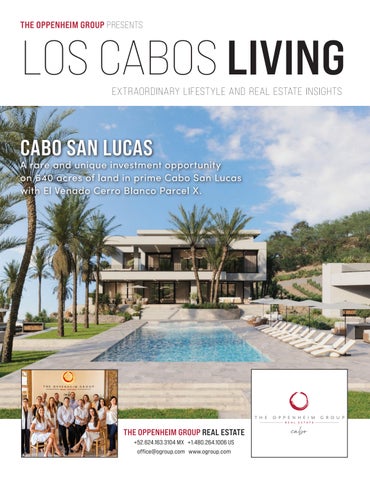
CABO SAN LUCAS
A rare and unique investment opportunity on 640 acres of land in prime Cabo San Lucas with El Venado Cerro Blanco Parcel X.
THE OPPENHEIM GROUP REAL ESTATE +52.624.163.3104 MX +1.480.264.1006 US office@ogroup.com www.ogroup.com
Oppenheim OFC.indd 1
11/18/26 2:00 PM
WELCOME TO THE WORLD OF
EXTRAORDINARY LIVING Luxury isn’t about a price tag on a possession. It’s about feeling secure in one’s choices and self-assured in one’s judgment. Confidence projects to the world: I know who I am, and I don’t have to prove anything. This winter’s magazine theme of Confidence evokes an expression of quiet power. In this issue, we celebrate self-possession, authority and presence in all aspects of life. In our Architecture feature, we explore the hidden discipline of dramatically cantilevered residences from Los
ALEN FABJAN
THE OPPENHEIM GROUP REAL ESTATE
Angeles to Spain. They look effortless, but they are carefully engineered and anchored. The sensation of being suspended in mid-air works because of our confidence in the foundation. Our Discoveries piece on the restraint of quiet luxury
Managing Broker
interiors reveals why, when you know your value, you don’t
+1.480.264.1006
need to announce it. Materials, craftsmanship and thoughtful
+52.984.169.7592
proportions can say more than logos, excess or trendy
alen@ogroupcabo.com
choices.
DRE# RAPIBCS-0418
In this issue’s Food article, we profile three of the world’s best chefs, who hold a diversity of perspectives and experiences. Yet they all seem to agree on a certain fundamental: their professional confidence stems from having put in the work. Deep preparation, repetition and mastery of skills are all critical elements of learning to trust one’s judgment and find professional clarity. Finally, in our Green article, we examine the adaptive reuse of unique residences around the world: castles, lighthouses and barns, to name a few. We see how personal confidence can be rooted in history, and how allowing the imperfections of the past to take precedence over shiny new updates is a way to prioritize authenticity over performance. These and other stories delve into themes of confidence and trusting in one’s judgment and choices. Mastery that provides clarity. Deep consideration that offers security. We hope you enjoy this issue.
Alen Fabjan
Oppenheim IFC.indd 1
11/18/26 2:02 PM
COURTESY OF SHUTTERSTOCK
Confidence
THE HIGH END | 1
Theme Image Page.indd 1
11/6/26 10:47 AM
4 ARCHITECTURE Living On The Edge
17 LIFESTYLE Engineered for Purity
8 DISCOVERIES When Quality Speaks for Itself
20 FOOD Culinary Convictions
10 TRENDING An Intentional Atmosphere
24 TREASURES Confident Couture
12 GREEN Storied Structures
26 PASSPORT Cruising Without Compromise
14 DECOR Bed, Bath and Way Beyond
30 RELAX The Art of the Reset
IMAGE COURTESY OF KAA DESIGN GROUP | PHOTO CREDIT: MANOLO LANGIS
FEATURES
Volume 16, Number 4
2 | THE HIGH END
TOC 002-003_49128_16_4.indd 2
04 11/12/26 12:00 PM
26
MANAGING EDITOR Kelsey Stamey ART DIRECTOR Dimitri Vaughan SENIOR EDITORIAL & ADVERTISING MANAGER Jamie Yoos DIGITAL ADVERTISING & OPERATIONS Nicole Echevarria EDITORIAL OFFICE 609.688.1110 uhproduction@uniquehomes.com ADVERTISING The High End is published by Unique Homes Media, Inc. If you would like to use The High End in your marketing plans, contact one of our representatives.
Emma Gahagan, 704.247.7723 emma@uniquehomes.com PRESIDENT Ramses Meijer, 609.688.1110 ramses@uniquehomes.com
08
30 26
PHOTO CREDIT-TOM GRIFFITHS
PHOTO CREDIT: FRANK FRANCES
PHOTO COURTESY CASTIGLION DEL BOSCO
Copyright 2026 © Unique Homes Media, Inc. All rights reserved. Reproduction in whole or part without permission is prohibited. THE HIGH END is a trademark owned by Unique Homes Media, Inc. UNIQUE HOMES is a registered trademark of © Chalk Digital, Inc. PRINTED IN THE U.S.A. For more information on THE HIGH END, please contact us at 877.688.1110. THE HIGH END is for entertainment purposes only. This magazine is not intended to solicit other brokers’ listings. If you are currently working with or in contract with another broker, please disregard this information.
THE HIGH END | 3
TOC 002-003_49128_16_4.indd 3
11/12/26 12:00 PM
ARCHITECTURE LIVING ON THE
Edge
By Roger Grody
Residential architects are experimenting with cantilevered forms, delivering visual impact while heightening the living experience.
IMAGE COURTESY OF KAA DESIGN GROUP PHOTO CREDIT: MANOLO LANGIS
4 | THE HIGH END
Architecture_4pg- Cantilevered Homes.indd 4
11/12/26 11:37 AM
F
ew residential design elements rival the aesthetic drama of cantilevering, through which structures float above ground with no visible supports. Seemingly defying gravity, cantilevered elements represent an unadulterated expression of architectural confidence. A Modernist Heritage While cantilevering dates back centuries, the introduction of structural steel and reinforced concrete has made it more prevalent in 20th and 21st century design. As modern residential architecture gained acceptance, use of the technique has exploded. Frank Lloyd Wright transformed this engineering achievement into fine art at his iconic Fallingwater residence in Pennsylvania, and Los Angeles mid-century modernists like Richard Neutra and John Lautner used cantilevered forms to extend glass-clad living spaces into scenic canyons. Paying homage to Southern California’s rich residential design heritage is a contemporary Hollywood Hills residence designed by L.A.based KAA Design Group. Its glass-ensconced, cantilevered living and dining pavilion, appearing to float amid panoramic views, echoes Pierre Koenig’s Stahl House (aka Case Study House
No. 22), a home famously memorialized in black-and-white images by revered mid-century photographer Julius Shulman. “The home reaches out over the hillside to dissolve the boundary between architecture and landscape,” says KAA Founding Partner Grant C. Kirkpatrick. He maintains cantilevers are more about extending the immersive experience of the site than simply extending the building. “A cantilever should never exist simply for spectacle,” the designer cautions, arguing the technique provides an authentic response to the challenges of a site. “Clients who appreciate this approach value architecture as an experience rather than an object,” he says. “They understand that the greatest luxury isn’t excess, but the feeling of being suspended between shelter and nature.” Global Gravitation Fran Silvestre Arquitectos, based in Valencia, Spain, is a leader in using cantilevered forms to
IMAGE COURTESY OF KAA DESIGN GROUP PHOTO CREDIT: MANOLO LANGIS
IMAGE COURTESY OF FRAN SILVESTRE ARQUITECTOS PHOTO BY JESÚS ORRICO
THE HIGH END | 5
Architecture_4pg- Cantilevered Homes.indd 5
11/12/26 11:37 AM
IMAGE COURTESY OF JACOBSEN STUDIO PHOTO BY FERNANDO GUERRA
add a sculptural quality to its bold minimalist aesthetics as well as resolve practical design issues. Throughout the Mediterranean, the firm has unveiled jaw-dropping, extreme interpretations of cantilevered architecture that expand both views and square footage on steeply graded sites. Noting that cantilevers are used for different purposes depending on the project, CEO and Founding Partner Fran Silvestre explains, “In some cases, it’s a response to the topography and a desire to minimize the environmental impact of the intervention.” He adds, “In other projects, it creates shade and establishes a direct, unobstructed relationship with the landscape.” South Africa-headquartered SAOTA applies cantilevering to flashy projects from Cape Town to Dubai, but a project in L.A. underscores the firm’s appreciation for the technique. Set in the Hollywood Hills — the inspirational Stahl House by Pierre Koenig is visible on a nearby promontory — the firm reprised the concept to maximize living space and showcase views. “The cantilever isn’t an aesthetic gesture in isolation, but a response to opportunities and constraints of the site,” SAOTA Principal Mark Bullivant says. “Cantilevers are synonymous with
pushing boundaries, and there’s an inherent sense of thrill that comes with occupying a space that projects beyond the apparent edge of the building.” Brazil’s Jacobsen Studio is another firm that designs luxury residences around the world, many distinguished by striking cantilevered elements. One representative example is a house in a forest reserve outside São Paulo, where sweeping rooflines and a cantilevered primary suite — its terraces cloaked in native flora provide an immersive, biophilic experience — mimic the sloping topography. Citing cantilevering’s multiple applications, Principal Bernardo Jacobsen explains, “It becomes the porte-cochère that welcomes you, the gesture that carries a suite out over the landscape for an open view or the deep eave that shades a room from the sun.” According to Jacobsen, “the cantilever is one of the clearest expressions of how we work with a site. It’s how we let a house reach further into its landscape without touching more ground than is necessary.” Floating into Nature Olson Kundig aims to integrate bold, modern residential architecture
“The cantilever is one of the clearest expressions of how we work with a site.” — Bernardo Jacobsen, Principal, Jacobsen Studio
IMAGE COURTESY OF JACOBSEN STUDIO PHOTO BY FERNANDO GUERRA
6 | THE HIGH END
Architecture_4pg- Cantilevered Homes.indd 6
11/12/26 11:37 AM
IMAGE COURTESY OF SKYLAB PHOTO BY JEREMY BITTERMANN
seamlessly into remote environments, sometimes incorporating cantilevers to enhance views while protecting the local habitat. In Sun Valley, Idaho, for example, the Seattle-based firm anchored a luxury residence into a rugged hillside but created two cantilevered wings extending over the rocky terrain, providing sweeping 270-degree mountain views. Another Pacific Northwest firm whose residential portfolio is filled with bold modern designs is Portland’s Skylab Architecture, frequently tempering futuristic forms with natural local materials. Its Hoke House — fans of the movie Twilight will recognize the audacious residence — is an aggressively cantilevered structure wrapped in western red cedar. Jeff Kovel, who founded Skylab in 1999, explains: “The bold expression wasn’t the starting point, but the natural result of responding to the site,” noting the cantilever emerged as a solution to the Hoke House’s compact, steeply forested lot. The design minimizes the home’s footprint while creating generous, flowing spaces among the trees, complementing the location adjoining Portland’s sprawling Forest Park. Kovel suggests the wood-clad underside of the cantilevered wing forms a highly visible fifth façade, since the house is approached from below. “Beyond its visual drama, a cantilever can create the visceral sensation of floating within the landscape,” says
Kovel. “At its best, it turns structure into an everyday experience of place.” Essential Engineering Cantilevering’s gravity-defying aesthetics require expertise beyond the capabilities of most architects, submits engineer Alper Yuksekogul, principal of Southern California-headquartered Ecay Design. “When someone sees a luxury home with a glass-walled living space jutting out over a canyon, they feel a sense of wonder,” he says. But, Yuksekogul cautions, “This effortless appearance is actually the result of an enormous amount of structural discipline, and I spend my days making sure these wonders don’t come crashing down.” Structural engineer David A. Macolini of Thornton Tomasetti, a global engineering firm whose projects range from 100-story skyscrapers to award-winning residences, emphasizes the hurdles that must be overcome to achieve these feats. “Cantilevers present unique engineering challenges, namely minimizing sag and vibration while transferring higher loads and forces to the cantilever support.” Macolini, who serves as vice president at Thornton Tomasetti’s Portland, Maine office, adds, “Owners and architects share an enthusiasm for visually striking and dramatic structures that challenge the imagination. Structural engineers put the pieces in place to bring these ambitious projects to life.” THE HIGH END | 7
Architecture_4pg- Cantilevered Homes.indd 7
11/12/26 11:37 AM
DISCOVERIES
Itself
WHEN QUALITY SPEAKS FOR
By Madison Zuccheri
L
natural materials, craftsmanship and a focus on the details that make a space feel luxurious without being overdone. Instead of relying on excess to make an impression, quiet luxury lets quality speak for itself. Quiet Luxury in Interiors Quiet luxury is not simply minimalism. A home does not need to be sparse, neutral or stripped of personality to embrace subtle style. Natural stone, custom millwork, rich textiles and handcrafted furnishings can bring depth to a room without overwhelming it. The focus is on choosing pieces wit intention, where quality and craftsmanship make the statement. Quiet luxury may be getting more
attention now, but the idea itself is nothing new. Iconic French designer Joseph Dirand, for example, has long focused on synthesizing restraint with essentialism. His work is celebrated for an understated approach to both aesthetic and emotion. London-based Rose Uniacke’s work also focuses on quality and restraint in her interiors, but her approach feels more lived-in and open to evolution. Her serene design style is informed by her earlier work in furniture restoration and antique dealing. Uniacke favors simple lines, rich textures and carefully chosen pieces to create homes that feel luxurious without feeling overdone.
IMAGES COURTESY OF VANESSA KATZEN DESIGN
uxury is getting quiet again. The perennial shift first resurfaced on the runway in the 1990s, when fashion houses began moving away from the bold logos and trend-driven pieces of the Eighties. Instead, designers put more focus on simple silhouettes, quality materials and craftsmanship. Brands like The Row and Bottega Veneta help keep this approach in the spotlight today, showing that luxury doesn’t always have to be loud to make an impression. That understated style has also found its place in interior design. In homes, the shift shows up through
8 | THE HIGH END
Discoveries_2pg- Quiet Design.indd 8
11/12/26 11:09 AM
PHOTO CREDIT: FRANK FRANCES
PHOTO CREDIT: FRANK FRANCES
PHOTO CREDIT: FRANK FRANCES
Designing for Depth Vanessa Katzen, founder of Vanessa Katzen Design in New York City, sees the same shift in what homeowners are looking for. “Our idea of luxury has changed,” she says. “Today, I find that people are craving something more personal and less performative.” For Katzen, quiet luxury comes down to “materiality, craftsmanship and restraint,” with details that may not immediately demand attention but can be felt throughout a space. Vanessa Katzen Design’s Gramercy Park Residence is a beautiful example of quiet luxury. Throughout the home, warm wood, custom cabinetry and textured walls are paired with simple
furnishings and sculptural lighting. Sculptural and collected objects are strategically curated to anchor the space. High-quality materials evoke confidence. The details are subtle, but they are what make each space stand out. The result is a home that feels collected over time rather than designed all at once. Quality, craftsmanship and the smaller details are what make the space feel special. That may be why quiet luxury feels less like a passing trend and more like a lasting approach to design. The most luxurious spaces do not need to announce themselves. Sometimes, the details say enough. THE HIGH END | 9
Discoveries_2pg- Quiet Design.indd 9
11/12/26 11:09 AM
TRENDING AN INTENTIONAL
Atmosphere
By Camilla McLaughlin
IMAGE CREDIT: OKSANA MIZINA / SHUTTERSTOCK.COM
10 | THE HIGH END
Trending_3pg- Scent Scaping.indd 10
11/12/26 10:48 AM
L
uxury homeowners are accustomed to thinking about furniture layouts, finishes and color palettes — but one element is sometimes overlooked: the signature scent. That’s soon to change, according to experts. “Fragrance layering” is one of 10 major wellness trends for 2026 highlighted by the Global Wellness Summit’s annual Future of Wellness report. The term references the intentional layering of scents to create a unique olfactory signature for personal expression. In homes, a similar move is underway, with curated blends now being employed to create a property’s intended atmosphere. An intentional experience is about how a space feels, not just how it looks. Residential designers well versed in scent draw on retail and hospitality practices, where fragrance creates a sensory identity. In commercial design, it might be branding, but in residences it’s about ambiance. Adding scent is a way to “add depth to the experience,” says Kanika Bakshi Khurana, principal designer and owner at Kanika Design in the Bay Area. “Luxury scentscaping means recognizing a home has been made
welcome before realizing why.” Embedding Memories “Scent is memory. Years from now, your guests may not remember the sofa, but they will remember how your home felt the moment they walked in,” says Preeti Shah, founder of Spotlight Style, an interior design and build firm in Houston. Like lighting, materials, or colors, fragrance is becoming a key factor in a home’s design. “I plan scent the way I plan lighting, in layers and in zones around the moments that happen in each space: a different note for the entry, the living room and the powder room,” says Shah. “Each one (is set) low so the home smells like a place and not a candle. When scent is done well, it does not announce itself.” Before coming to design, Shah produced luxury events in New York, sometimes collaborating with luxury fragrance masters such as Jo Malone. “At an event, I would never put one scent everywhere,” Shah says. “A home works the same way: a lighter, cleaner note at the entry, something warmer and softer where people gather, and a quiet note in the bath.” IMAGE CREDIT: FABRIKASIMF / SHUTTERSTOCK.COM
In other words, a luxury home should be a scent landscape, which involves more than a single aroma. It’s a finessed mix of highs and lows. Diverse Sources and Formats Fragrance landscaping can draw on a variety of sources, including diffusers, candles and natural elements and materials. “Skip the (single) big candle or diffuser,” Shah suggests. “Spread out sources of scent and keep each low. Use fresh flowers or greenery, a few candles in different rooms, linen spray on bedding or throws, cedar or aromatic wood in a closet, and natural materials like leather, wool and aged wood that carry their own smell.” But scents don’t have to be completely distinct from one another, according to Khurana. In the same way one might opt for the same material finishes in several rooms for consistency, similar fragrance notes can help bring the elements of the scent landscape together. As scent mastery grows in precision and complexity with the availability of new technologies, the fragrance landscape is becoming a vital element of a considered interior. IMAGE CREDIT: PIXEL-SHOT / SHUTTERSTOCK.COM
ALL IMAGES COURTESY OF ADRIAN GAUT FOR DWR.
THE HIGH END | 11
Trending_3pg- Scent Scaping.indd 11
11/12/26 10:49 AM
GREEN STORIED STRUCTURES:
Adaptive Reuse on theRise By Mikhal Weiner
from Coldwell Banker Global Luxury. Similarly, Christie’s International Real Estate has seen homes with character, history, and unique architectural experiences become a primary driver of demand among discerning buyers, according to Danilo Romolini, sales director for Romolini Immobiliare, an Italian affiliate of Christie’s International Real Estate. An Exclusive Option The desire for private properties that are “a bit eclectic” is nothing new, says Romolini. “Each (building) has contributed to our country’s history, so to own it means to own a piece of art in a way. There’s a limited amount of castles, after all.” Reclaimed structures and materials offer something otherwise unobtainable: the opportunity to live inside a tale of long ago. Around
IMAGE COURTESY OF ANTIQUE BUILDING SOLUTIONS & BAY & BENT
PHOTO COURTESY OF ROMOLINI IMMOBILIARE
T
here is a particular thrill in walking into a room that carries the memories of all who walked through it before you. A lighthouse with walls that echo the cries of old-time mariners. A barn with beams that recall the shuffle and whisper of early morning milkings. These spaces carry two valuable features new construction simply cannot manufacture: a history and a singularity. In other words, there is nothing like them in the world. This is the animating idea behind adaptive reuse, a steadily rising trend in luxury homeownership. Increasingly, buyers are seeking a home that’s more than a place to live. Adapted structures provide a time-tested answer to this quest. “Inquiries for unique estates increased 78% year-over-year” with “castle-style properties (growing) 35%,” according to a 2026 report
12 | THE HIGH END
Green_2pg- Adaptive Reuse.indd 12
11/12/26 11:12 AM
IMAGES
the globe, buyers are drawn to the exclusivity inherent in these materials and spaces. Other models abound: In Chicago, the majestic neo-Gothic tower that once served as the home of the renowned Chicago Tribune now houses 162 luxury condominiums. Off the Tuscan coast at Monte Argentario, a former lighthouse perched above the Tyrrhenian Sea has been transformed into a private villa. Timeless Timber Transformed Another example of adaptive reuse on the rise is found in Pennsylvania, where buyers find transformative opportunities in hand-hewn wooden beams. ”I would say 70% of our clients are immersed in the history, and the feeling of surrounding themselves with this organic material,” says Cody Wolfe, sales director with heritage restoration firms Antique Building Solutions and Bay & Bent. “Some of these barns we harvest were constructed in 1760 — they saw the Revolutionary War. That
timber stood through all the things that happened over the last 200 years.” According to Wolfe, the drive to use reclaimed materials (whether it’s beams from barns converted into floors, panels and more, or the structural skeleton of a barn transformed into a commercial or residential space) differs from client to client. “There are plenty of clients who really do enjoy the sustainability aspect, who are happy not to have to cut down a tree in order to create (their home), but many people are drawn to the history and the aesthetic of the material.” Wolfe says. Honoring Heritage Whether you’re buying a centuries-old castle in Tuscany or commissioning a bespoke barn for your agricultural estate in Pennsylvania, the result will be a home that is, in its essence, an ode to craftsmanship and history. Authenticity, it turns out, is not a trend. It is the quality trends have always been trying to attain.
PHOTO CREDIT: ROMOLINI IMMOBILIARE
Tuscan Hunting Retreat THE HIGH END | 13
Green_2pg- Adaptive Reuse.indd 13
IMAGE COURTESY OF ANTIQUE BUILDING SOLUTIONS & BAY & BENT
Restored Umbrian Castle
IMAGES COURTESY OF JENNI YOLO
11/12/26 11:12 AM
DECOR
BED, BATH AND WAY BEYOND:
Five-Star Guest Retreats By Ellen Paris
IMAGES FEATURED ON THIS SPREAD. ARCHITECTS: STUDIO SCHICKETANZ PHOTOGRAPHS:JOE FLETCHER PHOTOGRAPHY
14 | THE HIGH END
Decor_3pg- Guest Suites.indd 14
11/12/26 11:27 AM
C
reating a comfortable sanctuary for overnight visitors may start with an obvious extra bed and a nightstand, but many homeowners want to achieve that luxury-hotel level of hospitality. To do that, a few thoughtful preparations are in order. “Hosting friends and extended family should be an effortless display of generosity and grace,” says Vince Fratantoni of Fratantoni Luxury Estates, one of Arizona’s premier luxury custom home builders. The goal is to create an experience where guests crave an extended stay and look forward to returning. A Five-Star Stay Rule number one: a truly exceptional guest suite is not a spare room with leftover furnishings. The space should be designed with style and comfort, no matter the room size. Mark Boone,
president and CEO of Los Angelesbased furniture and home furnishings firm Mimi London, Inc., and founder of Mark Boone Interiors, says the fundamentals remain the same, regardless of architectural or style specifics: “Creating a wonderful guest suite takes thought and anticipation. The focus is on blending highend hospitality details with serene, personalized comfort.” It’s the considerate amenities guests appreciate and remember. A dedicated refreshment station, including a built-in mini bar with a coffee maker, is often valued. A stocked mini fridge allows guests to wake up or unwind on their own schedule without the need to visit the main kitchen. “Knowing and stocking your guest’s favorite treats is always a nice, personal touch,” Boone says. A host’s mindset should be that of a guest’s personal concierge.
THE HIGH END | 15
Decor_3pg- Guest Suites.indd 15
11/12/26 11:27 AM
ARCHITECTS: STUDIO SCHICKETANZ PHOTOGRAPHS:JOE FLETCHER PHOTOGRAPHY
IMAGE CREDIT: MARY E. NICHOLS IMAGE COURTESY OF MARK BOONE INTERIORS
IMAGE CREDIT: KEVIN SCOTT IMAGE COURTESY OF MARK BOONE INTERIORS
IMAGE CREDIT: MARK BOONE IMAGE COURTESY OF MARK BOONE INTERIORS
Guest Spa Bath - La Jolla CA
Guest Bedroom - Mexico
Guest Bedroom - New York
Principles of a Relaxing Environment Soft, inviting linens are the foundation of the perfect guest experience. “High-quality and beautifully laundered bedding is required. There’s nothing like sliding into fresh, crisp and pressed linens at night,” says Boone. E.B. Min of San Francisco-based Min Design expands on how important superior bedding and a thoughtful sleep setting are to guests. “The mattress, bed and bedding set the tone to create a comfortable and elevated environment along with excellent shades, blackout shades or curtains.” The goal, according to Min? “Guests should feel they will get a good night of sleep.” Spa-like bathroom setups with flattering lighting, luxurious bath products, and high-quality robes and towels remain essential. Hidden Details A thoughtfully designed guest suite includes dimmable and strategic ambient lighting, which contributes to a restful atmosphere. An oft-overlooked convenience, integrated, low-level, motion-activated night lights under
cabinets can guide guests safely around an unfamiliar space at night. Accessible tech has become an expected addition. “I often integrate built-in charging docks into night tables or writing desks (in guest suites),” Boone says. Where possible, dedicated temperature controls within the suite allow a guest to find their most comfortable setting. Comfort by Design A guest suite’s design need not be an afterthought, nor should it be an utterly blank slate. “Clients want their guest rooms to feel like a reflection of their home, taste, and as considered as the rest of the house is,” says Amal Kapen, principal of Amal Kapen Interiors, a luxury design studio in Cold Spring Harbor, New York. “This translates as more color, pattern, beautiful textiles, art and wood furniture rather than a room that has deliberately been kept neutral because it is just a guest room.” Colors are often the first detail guests see and remember. “Use your guest rooms as an opportunity to do something unexpected, including
sourcing wonderful wallpaper that exudes personality,” Kapen says. “Use an unexpected paint color you might not want for your living room.” Finishing Touches If space allows, a niche with a comfortable, well-made lounge chair and ottoman can offer guests a focal point to relax, rest and read. A selection of novels and current local magazines is more guest-friendly than the Kindle they brought. Fresh flowers, handmade ceramics or a surprise treat might be the finishing touches. Jeffrey Baker of Jeffrey Bruce Baker, a New York City-based architectural and interior design firm, always likes to add a pillow mint as a cozy detail. It’s a signal of luxury and care for someone who is traveling away from home. “Design that allows your guest to live effortlessly in the space you make for them is the differentiator between the space being just a bedroom or becoming a private retreat,” Baker says.
16 | THE HIGH END
Decor_3pg- Guest Suites.indd 16
11/12/26 11:27 AM
LIFESTYLE ENGINEERED FOR By Camilla McLaughlin
Purity
A higher standard of living begins with exceptional water quality.
I
f one classical element defines luxury homes, it’s water. Tranquil pools, tumbling cascades, nearby lakes and oceans — the presence of water often elevates a property. Infrastructure for drinking and bathing now also qualify as luxury amenities as homeowners’ expectations around water purity and optimal hydration change. Wellnessdriven residential infrastructure reigns, and pristine water has become a nonnegotiable for luxury homes. “Water treatment is quickly becoming on par with and integrated alongside other premium systems in the home,” says Ethan Wyborn, director at Born Plumbing and Reborn Renovations in Canberra, Australia. “More attention is being paid to how water affects the overall experience. In higher-end properties, clients are not only thinking about whether the water is safe, but also how it tastes, feels, smells and how it affects premium fixtures, finishes, appliances and plumbing systems over time.” A Custom Water Experience “Luxury homeowners expect water quality to be part of the overall comfort and wellness experience,” says Dean Christian with Awesome Home Services in Colorado Springs. “They don’t just want water that’s safe to drink; they want it to taste clean,
IMAGE COURTESY OF KOHLER
THE HIGH END | 17
Lifestyle_3pg- Optimized Water.indd 17
11/12/26 11:51 AM
feel good on their skin and hair, and protect the fixtures and finishes they’ve invested in. It’s about creating a better experience throughout their home and has become another detail homeowners want to be customized to their lifestyle.” The pandemic boosted awareness of health, especially how it relates to the home. “That helped accelerate interest in water treatment as part of a broader wellness conversation,” explains Wyborn. “In the luxury market especially, water quality is increasingly being considered alongside air quality, lighting, climate control and other wellness-focused systems.” Quality is Key Recent research from the Water Quality Association (WQA) 2025 Consumer Insights Report shows most (58%) U.S. homeowners worry about tap water safety, even though fewer than 20% of those surveyed acknowledge they understand what’s in it. About 70% of respondents indicated concerns about contaminants, with microplastics joining a growing list of potential health risks that includes lead, PFAS
(“forever chemicals”), chlorine, trace pharmaceuticals and pesticides. “We continue to see (an increase) in consumer concerns around the quality of their water. There is growing understanding around health risks connected to things like PFAS and microplastics, and people want to take matters into their own hands to ensure the health of themselves and their household,” says Braden Schmidt, product manager at Kohler. Insights from the WQA show most U.S. households treat their water at home, up from 40% in 2021, with 54% using at least one water treatment product in 2025, which the association considers an indication of a major cultural shift toward proactive health and wellness. The growing concern over microplastics is also shifting consumer focus towards in-home treatment devices instead of bottled water. Whole-House Systems High-end homes increasingly incorporate comprehensive, multistage, whole-house filtration systems that address contaminants at the point of entry, often augmented by
point-of-use units that add another level of purification in areas like kitchens and wet bars. Whole-house systems are designed around the primary water source (well or municipal) and typically address specific contaminants and deficiencies. “A high percentage of high-end homeowners are going with wholehome filtration systems. We recently installed a unit with filtration, a softener, a sediment trap, and even UV protection. These customers want it done right, with quality and safety above all else. They want data, testing and expertise too. Their goal is peace of mind and safety. Life improvements, like (the prevention of) buildup on showers, water heaters and faucets, are another goal. Wholehome filtration offers this,” says Travis Hargrave with Hargrave’s Plumbing in Louisiana, citing systems from HALO as an example. Cold, Hot and Sparkling on Demand Kohler recently introduced an under-sink innovation, the Aquifer Dual Cartridge filtration system, which delivers filtered cold, room
IMAGE COURTESY OF KOHLER
18 | THE HIGH END
Lifestyle_3pg- Optimized Water.indd 18
11/12/26 11:51 AM
IMAGE COURTESY OF KOHLER
temperature, hot, and sparkling water from a single faucet. Like the best filtration devices, it carries third-party certifications for removal of lead, PFAS, microplastics, and dozens of other contaminants, while flowing as much water as a standard, unfiltered faucet. “Something like this, paired with a beautiful faucet that matches their space, allows someone to do something like cook pasta with filtered water without trading off any convenience or design,” says Schmidt. Kohler introduced their basic undersink filtration system in 2017. Since then, Schmidt says, “we’ve expanded our offering to include higherperforming filtration types like reverse osmosis and more luxurious options.” Point-of-use filtration also extends to the bath, with fixed or handheld showerheads that add filtration to remove impurities and chlorine. Kohler incorporates five-layer filters into their Cinq and Assert collections. Looking ahead, new tech will enhance the way water is monitored, creating more opportunities for customization, which means more innovative water amenities.
THE HIGH END | 19
Lifestyle_3pg- Optimized Water.indd 19
11/12/26 11:51 AM
FOOD CULINARY
Convictions
By Eric Grossman
A trio of globally renowned chefs share their thoughts on the skills and mindset required to reach the top of their profession.
Kyle Connaughton
IMAGE COURTESY OF ERIC WOLFINGER
20 | THE HIGH END
Food_4pg- Culinary Masters.indd 20
11/12/26 11:15 AM
NGER
I
t’s not fame, awards or a signature dish. The world’s very best chefs share something more elusive — an obsessive understanding of ingredients, an instinct for balance, and the rare ability to transform something familiar into something unforgettable. At the highest level of gastronomy, cooking becomes more than a craft. It becomes a language — one spoken through texture, aroma, temperature, memory and place. These culinary masters possess an unmistakable point of view, yet they remain endlessly curious. They respect tradition without being confined by it, and behind every plate is a story of discipline, imagination and relentless refinement. The Flavor Chaser: Marcus Samuelsson Known to millions around the world, Marcus Samuelsson oversees a restaurant empire that stretches from Harlem and Atlanta to The Bahamas, Canada and Ethiopia. An author of multiple books, Samuelsson has won eight James Beard Awards and is a long-standing cooking show judge and
personality. With 15 restaurants and more than 500 employees to manage, Samuelsson leads by example. “I work every day on how to get better as a chef and a restaurateur, and one of the things I love about this industry is you can never be done. You can always improve yourself and the team. High motivation and high stakes,” he says. “We get real feedback from customer experiences, whether you like them or not. You have to draw from and listen to that.” Like many chefs, Samuelsson finds inspiration outside of the kitchen, especially through the worlds of music and travel. “Cooking and music for me go hand in hand, especially in terms of what inspires me,” he says. “Through my travels I learned early that amazing food is not just owned by one country in Europe. The greatness of a dish does not always need a tablecloth. It just needs to be delicious. I wouldn’t have learned that without traveling.” Samuelsson — whose latest cookbook, Back to Green, explores plant-forward eating globally — describes his workplace as an exceptionally high-
pressure environment. “There are a thousand things happening at the same time and it requires everyone to do their part in a flow,” he says. “If the chef is constantly second-guessing himself, that uncertainty travels through the whole kitchen. So you have to be decisive.” Samuelsson’s definition of conviction comes from having a clear point of view. “What do you believe about food? What kind of environment do you want to create for your team?” he muses. “Once you know those things, you can lead with purpose. You don’t have to be the loudest person in the room. You have to be the clearest.” The Culinary Educator: Kyle Connaughton Kyle Connaughton is a true multihyphenate. The chef, culinary educator and cookbook author draws from a varied background, one that took him from Los Angeles to Japan, and then England. Alongside his wife — coowner and farmer Katina Connaughton — he opened SingleThread in
IMAGE COURTESY OF MARCUS SAMI GROUP
Marcus Samuelsson
THE HIGH END | 21
Food_4pg- Culinary Masters.indd 21
11/12/26 11:15 AM
Healdsburg, California, in 2016. A destination for gourmands from around the world, SingleThread holds the distinction of being the first three Michelin-starred restaurant in Sonoma County, and has been recognized for its thorough commitment to gastronomic sustainability. “A good chef is a skilled cook who knows ingredients, guests and how to manage people and costs,” he says. “A culinary master cultivates and retains talent, helps people find their path, and creates a unique narrative perspective and point of view.” Despite his busy schedule, Connaughton specifically finds time to master certain skills, such as plating or knife skills. “Overconfidence is the risk when skills haven’t been earned yet, and a chef’s skill level is visible immediately. When I am assessing a new chef’s skill level, how they approach a cutting board, pick up a knife (or) make one cut, for example, tells me all I need to know. And young chefs increasingly chase new or novelty over fundamentals. Our craft is one of repetition of mastery of skill, and as a chef it’s important to do those things day in and day out.” According to Connaughton, he finds motivation in continuing to get better and giving back everyday. His work extends into the education space, as he co-developed the curriculum for The Culinary Institute of America’s (CIA) bachelor’s degree program in culinary science as well as the first master’s degree in culinary arts, and also serves on its board of trustees. “It’s really about mentoring the next generation of leaders,” he says. “My self-worth does not end at creating great dining experiences. It’s really about what we give to people.” The Sophisticate: Gabriel Kreuther Gabriel Kreuther spent the early years of his career training in Michelinstarred kitchens across Germany, Switzerland and his native France before bringing his classical European training to the U.S. He went on to hold leadership roles at some of New York City’s most acclaimed restaurants before opening his eponymous Manhattan restaurant in 2015. “Coming from a small farming village in Alsace to running restaurants in New York City was never part of a grand plan,” says Kreuther. “If you had told my younger self that I would lead my
Marcus Samuelsson, Cooking in Ethiopia
IMAGE CREDIT: TEWODROS GIRMA
22 | THE HIGH END
Food_4pg- Culinary Masters.indd 22
11/12/26 11:15 AM
Gabriel Kreuther
“The hunger doesn’t stem from proving something to others. It comes from a personal drive to honor the craft, nurture our team and deliver a memorable experience to every guest who walks through the door.” — Gabriel Kreuther
IMAGE COURTESY OF STEPHANE KURDYBAN
own flagship restaurant on Bryant Park, I wouldn’t have pictured the scale, but the core work remains the same.” Today, his restaurant holds two Michelin stars and has earned numerous additional accolades, while his broader hospitality company has expanded into experiences, events, partnerships and Kreuther Handcrafted Chocolate. Throughout his career, the James Beard Award winner has also demonstrated a commitment to mentoring and developing the next generation of culinary talent through his long-time involvement with the Bocuse d’Or USA Culinary Council.
“The phrase culinary master implies a destination, but true mastery is an ongoing journey with no end in sight,” he says. “The moment you believe you have arrived is the moment you stop growing.” According to Kreuther, in a highpressure kitchen like his, terms like assuredness and decisiveness are not about ego — they’re about stability. “A kitchen operates like a finely tuned orchestra. If the conductor hesitates, the whole ensemble falters. Confidence and conviction come from deep preparation. You cannot lead with purpose if you do not know your craft
inside and out,” he says. “Early in my career, I learned that a team looks at the chef during moments of chaos. Leadership isn’t something you master overnight; it is an ongoing practice of earned trust and daily discipline.” Does a culinary master like Kreuther have anything left to prove? As he sees it, a life in the culinary arts equates to a continuous pursuit of excellence. “The hunger doesn’t stem from proving something to others,” he says. “It comes from a personal drive to honor the craft, nurture our team and deliver a memorable experience to every guest who walks through the door.” THE HIGH END | 23
Food_4pg- IMAGE CulinaryCOURTESY Masters.indd 23 OF CASTIGLION DEL BOSCO
11/12/26 11:15 AM
TREASURES
Couture
CONFIDENT
By Roger Grody
PHOTOS BY JUSTIN HUMMERSTON
At his workshop in Chicago, artisanal hatmaker Graham Thompson creates the crowning glory for a discriminating gentleman’s wardrobe.
24 | THE HIGH END
Treasures_2pg-Optimo Hats.indd 24
11/12/26 11:20 AM
A
t the richly appointed Optimo boutique in downtown Chicago’s historic Monadnock Building, the products of artisanal hatmaker Graham Thompson line the shelves. Across town, the company’s headquarters and workshop are ensconced in a dressed-up former firehouse. “A hat was one of the first things I remember really wanting,” recounts Thompson. “Jazz and blues artists wore incredibly cool hats, and my father introduced me to film noir.” When Thompson began shopping for a hat of his own as a teenager, he discovered handcrafted hatmaking was an industry that had virtually disappeared, equating the uninspired products that remained with clip-on ties. Thompson found his mentor in Johnny Tyus, an old-school South Side artisan who sold him his shop upon retirement. “I love clients who are connoisseurs — although some are not even aware of it — who have hats handed down through generations,” says Thompson. A good hat is firm and solid yet light, and exhibits a sense of elegance,
Thompson says, but he insists hats are utilitarian pieces first, fashion statements second.“It shouldn’t look like a costume,” he says. Thompson’s celebrity clients have included blues legend John Lee Hooker, rockers Eddie Vedder and Billy Gibbons, and actors Andy Garcia and Johnny Depp. Sean Penn, Brad Pitt and Tom Hanks have all donned Optimo hats in films. The company’s handwrought silver beaver felt hats are priced at approximately $2,000, with varying degrees of bespoke craftsmanship adding a premium. The most exclusive hats approach $20,000. Fedoras, representing a timeless aesthetic, are perennial favorites, but Optimo also offers Montecristi (Panama) hats, jazzfavored pork pies and endless custom varieties. Optimo recently debuted its second retail location on the Big Island of Hawaii. While that may not sound like a hat-wearing locale, Thompson reminds us that Montecristi hats are ideal for tropical climates, and the rugged island’s enduring cowboy culture fuels an ongoing demand for a subtle Western style.
THE HIGH END | 25
Treasures_2pg-Optimo Hats.indd 25
11/12/26 11:20 AM
PASSPORT
CREDIT: 26PHOTO | THE HIGHOLLIE ENDCLARKE FOR ECOVENTURA
Passport_4pg- Solo Travel.indd 26
11/12/26 11:56 AM
CRUISING WITHOUT
Compromise By Lisa Levi
W
ith their five-star accommodations and sumptuous cuisines, highend holidays are meant to be unforgettable — but they can be frustrating when travel companions don’t agree on where to go or what to do. Traveling together inevitably means compromise, while those without a ready companion may have traditionally been expected to just stay home. But today, the epitome of luxury may simply be taking the plunge on a vacation for one. Blissfully unburdened by anyone else’s input, solo travelers are free to design the holidays of their dreams. Travel services — and especially luxury cruise operators — are stepping up to make it easier than ever. Among them is Riviera Travel River Cruises, which offers dedicated solo cruises throughout Europe. Stuart Milan, president of North America for Riviera Travel, attributes the surge in interest in solo travel options to the “search (for) meaningful experiences, personal growth, and the freedom to explore at (one’s) own pace.” Across the globe in the Galapagos Islands, Ecoventura offers luxury yacht expeditions for small groups including solo travelers. Doris Welsh, SVP, sales and marketing at Ecoventura, agrees solo travel’s popularity is “a direct result of a broader shift toward more intentional, experiencedriven travel.” Many guests, “especially those with a strong interest in nature and adventure, have bucketlist trips that they are truly passionate about experiencing,” Welsh says. “They refuse to forgo them just because they might not have someone who is able or willing to do it with them.” Of course, traveling without a companion does not mean having to experience a trip alone. Most solo travelers seek a balance of solitude and interaction, wanting both a private cabin retreat and opportunities to socialize. Matias Lira, an SVP of trade sales for ultra-luxury cruise line Crystal, believes cruising is perfect for solo travelers precisely because it “provides a dedicated atmosphere of like-minded guests.” Crystal won
THE HIGH END | 27
Passport_4pg- Solo Travel.indd 27
11/12/26 11:56 AM
a Travel + Leisure World’s Best Award in 2026 for the second year running, and features solo options on cruises to every part of the world. Tailored for Solo Travel “One of the most common concerns solo travelers have is the fear of being isolated in a totally new and foreign environment, (which) can dissuade or even prevent those who are considering solo travel from taking the leap,” Ecoventura’s Welsh says. But “shared meals, guided excursions, time spent together exploring, and simply lounging onboard create connection, while private staterooms give solo travelers their own space to relax and recharge.” Ecoventura’s cruises take an intentionally intimate approach, with just 10 designer staterooms — all with breathtaking panoramic views — on each of their three vessels. A fellow recipient of Travel + Leisure’s 2026 World’s Best Award, this floating Relais & Châteaux offers two different itineraries focusing on either “beaches & bays” or “volcanic wonders.” Milan affirms that Riviera also consciously seeks to make solo travel “feel more approachable for those who may be trying it for the first time. Solo river cruises can be a great jumping-off point, giving travelers the freedom to explore independently while also having a built-in community of like-minded people around them on the ship.” Riviera Travel offers a full selection of dedicated solo cruises. The enthusiastic response to those offerings motivated
Riviera to “rethink the traditional group sailing experience and make traveling alone a more seamless part of its offerings,” Milan explains. “Beginning in June 2027, the reimagined MS George Eliot will exclusively sail solo departures on the Danube, Rhine and Moselle rivers, marking the first time a cruise ship has devoted its entire season to solo guests.” Since the ship will only carry half as many guests as it was originally designed to hold, it will also offer “an unprecedented crew to guest ratio of one crew member for every two guests, ensuring solo travelers experience the highest level of personal service.” The Freedom of Flexibility For solo travelers, luxury means a little bit more than impeccable service and high-quality experiences. “For most, it’s doing whatever they want to: on their own time, without being derailed by another individual’s opinion or desires,” Lira says. “Solo travelers have the added flexibility of defining
CREDIT: 28PHOTO | THE HIGHOLLIE ENDCLARKE FOR ECOVENTURA
Passport_4pg- Solo Travel.indd 28
11/12/26 11:56 AM
“Ultimately, I think the greatest luxury for a solo traveler is having the choice to be independent without ever having to feel alone.” -Doris Welsh, Ecoventura IMAGE COURTESY OF CRYSTAL CRUISES
their own luxury without hesitations.” Milan agrees: “While couples and families may plan their trips around shared interests, solo travelers have the freedom to follow their own preferences, and they value an experience that makes that easy.” “Luxury for our solo travelers is often less about extravagance and more about freedom and thoughtful service,” Welsh concludes. “They want the ability to have a private space when they want it, but also appreciate and often embrace the opportunity to meet like-minded people—especially when connection is made to feel effortless and organic. Ultimately, I think the greatest luxury for a solo traveler is having the choice to be independent without ever having to feel alone.”
THE HIGH END | 29
Passport_4pg- Solo Travel.indd 29
11/12/26 11:56 AM
RELAX
Reset
THE ART OF THE
By Emma Gahagan
Inside the rise of nervous system retreats and why doing less may be the ultimate luxury.
F
or years, the wellness retreat followed a familiar formula: sunrise workouts, carefully calculated meals, meditation sessions, spa appointments and a meticulous itinerary designed to send guests home as an improved version of themselves. Rest was part of the experience, certainly, but often another item to check off the schedule. Now, wellness is moving in a more subdued direction. Across the world, a new generation of retreats is asking travelers to trade optimization for restoration. Known loosely as “nervous system reset” retreats, these experiences are designed around an appealingly simple premise: perhaps the greatest luxury of all is having nowhere to be, nothing demanding your attention and enough time for your body to finally slow down. It is an idea particularly suited to modern life. Between endless notifications, crowded calendars, demanding careers and the expectation of being perpetually reachable, genuine downtime has become elusive. Even vacations can become exercises in productivity, with
travelers rushing to and from dinner reservations, excursions and must-see destinations. Nervous system-focused retreats offer an alternative, creating space to disconnect from the noise and return to a more restorative rhythm. Rather than filling every hour, these retreats intentionally remove stimulation. Days unfold at a gentler pace, incorporating restorative movement, breathwork, meditation, nature, thermal therapies and, increasingly, programs centered around better sleep. The goal is not necessarily transformation. It is regulation, creating the conditions that encourage the body to move away from a heightened stress response and toward the parasympathetic state associated with rest and recovery. And the setting matters. Downtime Destinations Imagine waking without an alarm in Portugal’s Douro Valley, morning light filtering through the windows as vineyards roll toward the horizon. At Six Senses Douro Valley, wellness experiences incorporate sleep assessments, meditation, yoga nidra, relaxation therapies and low-intensity movement. Guests can embark on
30 | THE HIGH END
Relax_3pg- Nervous System Resets.indd 30
11/12/26 11:23 AM
multi-day sleep programs or choose experiences centered on relaxation and renewal. Rather than following a rigid routine, guests are encouraged to embrace a slower, more restorative pace. Elsewhere, nature itself becomes the treatment. At The Inn at Serenbe, set among preserved forests and farmland outside Atlanta, the rhythm is deliberately unhurried. Forest walks, yoga, labyrinth meditation, horseback riding and afternoons spent wandering the property’s trails replace the sensory overload of everyday life. There is something refreshingly uncomplicated about fresh air, open space and enough quiet to hear yourself think. On New Zealand’s South Island, Maruia River Retreat takes the concept of slowing down quite literally. Set within a secluded 500-acre native forest estate along the Maruia River, the intimate retreat accommodates no more than 10 guests across seven private villas, creating an atmosphere where quiet is naturally built in. Its Personal Restoration Retreat pairs seclusion with a thoughtfully light wellness schedule, incorporating personalized massage
and spa treatments, breathwork, yoga and forest bathing, while saunas, outdoor hot tubs and a heated magnesium pool invite guests to linger rather than rush. Even the villas are designed with deep rest in mind, and Wi-Fi is limited to the main lodge, making disconnecting a central part of the experience. For travelers drawn to a more clinical approach, destinations such as SHA in Mexico, opened in 2024, take restoration into the realm of preventative health. Personalized nutrition, sleep optimization, hydrotherapy and medical assessments are integrated into longer stays designed around individual health needs. And at Germany’s Lanserhof Tegernsee, overlooking the Bavarian Alps, the resort experience combines medical diagnostics and restorative therapies with an equally important ingredient: unscheduled time. Then there is sleep, perhaps the most
understated indulgence of all, and a critical factor in nervous system recovery, cognitive function and emotional health. Luxury hotels are increasingly treating a good night’s rest with the same attention once reserved for Michelinstarred dining and elaborate spa menus. At Equinox Hotel New York, the Art + Science of Sleep program considers everything from blackout shades and soundproofing to temperature and circadian lighting. It is an intriguing proposition in a city famous for never sleeping. Access vs. Absence The emergence of these experiences signals a larger shift in how we think about luxury travel. Once defined by access — more destinations, more experiences, more reservations — luxury is instead becoming defined by absence. No notifications. No decisions. No rushing. No reason to feel guilty for spending an afternoon doing absolutely nothing. Of course, a weekend away cannot magically erase chronic stress, and the nervous system is more complex than wellness marketing sometimes
ALL IMAGES COURTESY OF SHA MÉXICO.
THE HIGH END | 31
Relax_3pg- Nervous System Resets.indd 31
11/12/26 11:24 AM
ALL IMAGES COURTESY OF SHA MÉXICO.
A nervous system retreat does not ask you to become someone new. Instead, it offers something rare: the opportunity to stop performing, even in the name of wellness.
suggests. The most compelling retreats are not promising an instant biological reboot. Instead, they provide an environment conducive to rest while introducing resilience-boosting practices travelers can carry home: slower breathing, better sleep habits, gentle movement, time outdoors and moments intentionally protected from digital noise. A nervous system retreat does not ask you to become someone new. Instead, it offers something rare: the opportunity to stop performing, even in the name of wellness. In a culture obsessed with becoming faster, fitter and more productive, choosing stillness can feel radical. Yet as travelers reconsider what they actually want to bring home from a luxury escape, the answer may no longer be a packed camera roll or an impressive itinerary. It may simply be the feeling of being rested. And perhaps that is the reset to calm we have been looking for all along.
32 | THE HIGH END
Relax_3pg- Nervous System Resets.indd 32
11/12/26 11:24 AM
VENADO BLANCO
CABO SAN LUCAS, BAJA CALIFORNIA SUR, CA 23405
Seize a rare and unique investment opportunity on 640 acres of land in prime Cabo San Lucas with El Venado Cerro Blanco Parcel X. Strategically situated along the Corridor-Inland between El Dorado and Cerro Colorado, right across from the Westin Regina, this premier land parcel boasts 429 feet of prime highway exposure. Enjoy breathtaking ocean views and easy access to nearby amenities, including golf courses, restaurants, shops, and a serene public beach. This site is zoned for mixed-use, allowing both commercial and residential developments. Unleash your creativity on this versatile property, where the potential for innovative projects is boundless.
$164,900,000
Oppenheim IBC.indd 1
11/18/26 2:03 PM
LOS CABOS LIVING e x tr aordinary lifest yle and re al estate insights
The Oppenheim Group The Oppenheim Group Real Estate Paseo de la Marina 4732 Col., El Medano 23453 Cabo San Lucas, BCS, MX 92625
1 1 LA RIVIERA, CABO DEL SOL, COVE CLUB CABO CORRIDOR, BAJA CALIFORNIA SUR, CA 23405
Welcome to this extraordinary Oceanview home with 6-bedroom, 6.5-bathroom estate, offering over 9,000 square feet of refined indooroutdoor living in one of Cabo’s most exclusive communities. Perfectly positioned on the iconic 18th hole of the Cove Club Golf Course, this home captures panoramic ocean views and breathtaking sunsets from nearly every room. Designed for elevated entertaining and relaxed luxury, the home features spacious living areas, a chef’s kitchen, and seamless flow to expansive terraces, a resort-style pool, and a private hot tub. Each bedroom is generously appointed with en suite baths, ensuring privacy and comfort for family and guests alike. Short walk to the ocean and Private Cove Club Beach. Enjoy the unmatched lifestyle of the private Cove Cove Club and Four Seasons Resort. $14,900,000
Oppenheim OBC.indd 1
11/18/26 1:59 PM