AGENT NAME PRESENTS
insights into extraordinary living
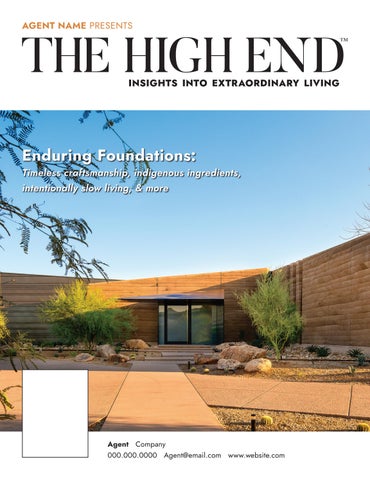
Enduring Foundations:
Timeless craftsmanship, indigenous ingredients, intentionally slow living, & more
Agent Company 000.000.0000 Agent@email.com www.website.com
Welcome to the World of
Extraordinary Living The consummate expression of luxury living may be defined not by what shines the brightest, but by what endures the longest. Timeless craftsmanship, lasting materials, heritage and tradition — all these elements contribute to a lasting foundation. This fall, The High End renews its sense of intentionality. In this issue, we celebrate themes of generational skills, deep history and indigenous knowledge: all principles that lay the groundwork for a foundation that will stand the test of time. In our Food feature, we see how today’s most celebrated chefs are returning to foundational elements of cooking — fire, fermentation, foraging and regional ingredients — to innovate while staying rooted in tradition. This issue’s Architecture story covers how leading architects embrace centuries-old techniques to create sustainable, soulful designs. Tactile surfaces such as sculpted limestone and rammed earth, when combined
Agent Company 000.000.0000 Name@E-mail.com www.website.com Street Address
with artisanal craftsmanship, appeal to luxury homeowners who share a back-to-basics philosophy. Ideas of lasting sustainability are also present in our Green story, which covers the reimagining of iconic furniture designs using eco-friendly materials. Discover how legendary pieces from Herman Miller, Ligne Roset, GUBI, and Poltronova are being reinvented sustainably, without sacrificing the designs that made them classics. Finally, in our Lifestyle piece, we explore themes of slow living — a trend that is being embraced by many who want to rediscover the value of presence, craftsmanship and intentional daily rituals. In an always-on digital world, the growing movement toward analog living is a paring back to our most essential selves. These and other stories explore themes of foundations: lasting principles, experiences that transcend trends, and honored traditions. I hope you enjoy this issue of The High End.
Agents’ first name
COURTESY OF SHUTTERSTOCK
Foundations
THE HIGH END | 1
Theme Image Page.indd 1
8/20/26 10:10 AM
4 ARCHITECTURE Trad Methods in Modern Design
18 FOOD Back to Basics
8 RELAX Back to Nature Catskills Hotel
22 DISCOVERIES Cave at Dunlap Hollow
11 DECOR Wallpaper’s Moment
24 PASSPORT Winery Experiences
14 TRENDING Listening Rooms
28 GREEN Sustainable Upgrades to Iconic Pieces
17 TREASURES Taylor Donsker Furniture
30 LIFESTYLE Analog / Slow Living
IMAGE COURTESY OF ATELIER SCHWIMMER. PHOTO BY PHIL BERNARD
FEATURES
Volume 16, Number 3
2 | THE HIGH END
TOC 002-003_49128_16_3.indd 2
04 8/20/26 1:17 PM
08
MANAGING EDITOR Kelsey Stamey ART DIRECTOR Dimitri Vaughan SENIOR EDITORIAL & ADVERTISING MANAGER Jamie Yoos DIGITAL ADVERTISING & OPERATIONS Nicole Echevarria EDITORIAL OFFICE 609.688.1110 uhproduction@uniquehomes.com ADVERTISING The High End is published by Unique Homes Media, Inc. If you would like to use The High End in your marketing plans, contact one of our representatives.
Emma Gahagan, 704.247.7723 emma@uniquehomes.com Bri Zawada, 704.247.6170 bri@uniquehomes.com PRESIDENT Ramses Meijer, 609.688.1110 ramses@uniquehomes.com
22
24 08
PHOTO COURTESY OF ADRIAN GAUT FOR DWR
IMAGE COURTESY OF DUNLAP HOLLOW
PHOTO COURTESY CASTIGLION DEL BOSCO
Copyright 2026 © Unique Homes Media, Inc. All rights reserved. Reproduction in whole or part without permission is prohibited. THE HIGH END is a trademark owned by Unique Homes Media, Inc. UNIQUE HOMES is a registered trademark of © Chalk Digital, Inc. PRINTED IN THE U.S.A. For more information on THE HIGH END, please contact us at 877.688.1110. THE HIGH END is for entertainment purposes only. This magazine is not intended to solicit other brokers’ listings. If you are currently working with or in contract with another broker, please disregard this information.
THE HIGH END | 3
TOC 002-003_49128_16_3.indd 3
8/20/26 1:17 PM
ARCHITECTURE TIMELESS MATERIALS:
A Rediscovery By Roger Grody
A compelling trend in contemporary residential architecture is the crafting of fluid, modern forms through materials of ancient origin.
IMAGE COURTESY OF ATELIER SCHWIMMER. PHOTO BY PHIL BERNARD
IMAGE COURTESY OF ATELIER SCHWIMMER. PHOTO BY PHIL BERNARD
4 | THE HIGH END
Architecture_4pg- Trad Methods in Modern Design.indd 4
8/25/26 11:43 PM
T
here’s nothing wrong with homes built of steel, glass or concrete — but the use of timeless building materials in residential architecture somehow grounds homeowners in their environments, advances sustainability and adds warmth to contemporary design expression while honoring foundational principles. In the North American homes showcased here, materials time-tested over centuries or millennia elevate modern design. Sculpted Stone Stone, especially when quarried locally or excavated directly from a property’s site, is valued in contemporary architecture for sustainability, durability and a profound connection to the local environment. Mexico’s HW Studio is known for modern residential architecture shaped from raw, unadulterated materials and interiors reflecting unexpected Japanese-inspired aesthetics. For a commission in Guanajuato, for example, the firm designed a small house entirely clad in local limestone. The region has a custom of using stone in all forms of artistic expression, and HW Studio Founder Rogelio Vallejo Bores sought to honor that tradition. “Stone possesses an extraordinary capacity to age with dignity, and time becomes part of its beauty,” says the architect. With the material’s inherent imperfections and unique ability to absorb light and shadows beneath the intense Mexican sun, Vallejo Bores believes this primordial construction material contributes to a genuine sense of place. Advising that stone is embedded in the national culture, he explains, “Entire generations have touched it with their hands, and for Mexicans, there’s something deeply emotional about stone.”
The use of wood — salvaged from felled trees or reclaimed from demolition sites — offers sustainability, intriguing patinas and an ability to create a compelling narrative for a project. The Hamptons, the iconic summertime retreat for celebrities and hedge fund managers, has emerged as a vibrant architectural incubator, and East Hampton-based Bates Masi + Architects uses wood to integrate its homes into the area’s rustic dunes and woodlands. Bates Masi leaves its imprint on local beaches through residential designs informed by the Hamptons’ rich mid-century modern heritage. Co-founder and Principal Paul Masi suggests a variety of wood species effectively complement the oceanfront’s reedy dunes, aging beautifully even without the benefit of staining or painting. “It’s a natural material that’s sustainable and timeless…it never appears dated,” says the architect.
IMAGE COURTESY OF ATELIER SCHWIMMER. PHOTO BY PHIL BERNARD
Modern Grain Natural wood, a construction staple since shelter was first imagined, never goes out of style. Contemporary architects appreciate its versatility and biophilic qualities (i.e., an approach that integrates the natural environment).
THE HIGH END | 5
Architecture_4pg- Trad Methods in Modern Design.indd 5
8/25/26 11:43 PM
SHINNECOCK BY BATES MASI + ARCHITECTS. PHOTO BY MICHAEL MORAN/OTTO
For Shinnecock, an estate in Southampton, Masi’s firm used vertical, live-edge cedar boards to create rhythmic interest and moderate sunlight. In addition to its beauty and sustainability, wood has a unique ability to age with grace, which Masi appreciates. “Colors and grains become more pronounced over time, and patinas evolve that register layers of history,” he explains. With age, the cedar at Shinnecock will acquire an elegant silvery-gray patina to mirror the landscape.
says Krupnick, who has immersed himself into the local architecture and culture for 35 years. The architect, whose firm deftly integrates traditional craftsmanship into contemporary residences, adds, “Adobe creates a genuine connection to the earth and humanity…you can feel it in your soul.” Metallic Magic In Canada’s scenic Laurentian Mountains, Montreal-based Atelier Schwimmer designed a modern, cantilevered villa clad in Corten steel.
As the material’s organic finish morphs over time, the minimalist structure appears increasingly connected to its forested environment. “Materials are selected not for permanence alone, but for their capacity to weather with restraint, reducing maintenance as the house quietly adapts to the passing of seasons,” says Founding Principal Felix Schwimmer, whose firm frequently incorporates richly patinaed finishes. “The steel envelope undergoes gradual mutation; its patina shifts from orange to brown to copper, synchronizing with
New Age Adobe A prehistoric construction technique, adobe is a sun-dried mixture of earthen material (e.g., clay, sand) and water, bound with organic elements like straw, grass or even manure. By its very nature, few materials create a stronger connection to the earth. A rich adobe heritage is shared by various Native American nations in the Southwest, and Santa Fe-based Krupnick Studio Architecture is committed to paying homage to the indigenous cultures that originally shaped the Land of Enchantment. Michael Krupnick, who codesigned a notable adobe renovation in Corrales, New Mexico with partner Kim Ray Krupnick, maintains the technique’s beauty and cultural significance are contributing to a revival of adobe construction. “More than a building material, it’s literally of the earth, and being inside an adobe home creates a sense of spirituality,”
6 | THE HIGH END
Architecture_4pg- Trad Methods in Modern Design.indd 6
8/25/26 11:43 PM
the chromatic cycles of rock, forest and snow,” he explains. “What begins as contrast dissolves, over time, into camouflage.” For the same reasons Bates Masi + Architects appreciates the capacity of wood to age gracefully, the firm incorporates a variety of weathered metals (e.g., copper, bronze, zinc) in its Hamptons projects. For an 8,965-sq-ft residence in Sagaponack, the architects paired cedar siding — treated with a Victorian technique that creates an ebony finish — with Corten steel that requires no maintenance despite constant exposure to ocean wind. “There’s a similarity between woods and metals in how they weather over time, taking on the characteristics of the environment,” says Masi. “The patina that develops allows the home to settle into the landscape, evolving over time.” Layers of History An increasingly popular building material is rammed earth, a prehistoric construction technique rediscovered by contemporary architects. Rammed earth walls consist of compacted soil, clay or stone, and their striated layers result in pleasing organic aesthetics. Because of its thermal mass, rammed
earth is particularly well-suited to arid climates, and Scottsdale, Arizona’s Kendle Design Collaborative specializes in this medium. The firm’s rammed earth walls create interest and depth in modern residences that showcase scenic desert environments. “Rammed earth, which the Hohokam civilization [in Arizona] used 2,500 years ago, has a timelessness and permanence to it, providing an aesthetic similar to the geologic stratification you see in a canyon,” says Founder and President Brent Kendle. In Kendle Design Collaborative’s striking modern residences in Paradise Valley and Scottsdale, Arizona, rammed earth walls provide elegant transitions from surrounding desert landscapes, and the material provides warmth and interest when integrated into interior spaces. “We try to convey the spirit of a place, and creating a rammed earth home — sometimes with soil drawn directly from the building site — infuses the spirit of the land in a very special way,” submits Kendle. His firm also uses patinaed metals, such as naturally weathered copper (echoing the Copper State’s history) to enhance desert homes.
ARCHITECT: KENDLE DESIGN COLLABORATIVE. PHOTO BY ALEXANDER VERTIKOFF PHOTOGRAPHY
IMAGE COURTESY OF HW STUDIO. PHOTO BY CESAR BEJAR
IMAGE COURTESY OF KRUPNICK STUDIO. PHOTO BY MICHAEL KRUPNICK
THE HIGH END | 7
Architecture_4pg- Trad Methods in Modern Design.indd 7
8/25/26 11:44 PM
RELAX MOUNTAIN
Abundance By Jamie Yoos
R
ising above rolling forests and mist-covered peaks, the Catskills have long been a sanctuary for those seeking quiet luxury and an escape from the bustling city life. Piaule Catskill offers an experience that fades the pace of everyday life into the background among towering hardwoods and gentle mountain breezes. Rather than feeling like a conventional hotel, the secluded landscape property invites guests to slow down, reconnect with their surroundings, and embrace a more intentional way of living. Private cabins are spaced out just enough to provide visitors with a sense of peaceful isolation, each with vast windows that frame living portraits of the natural landscape. Cofounders Nolan McHugh and Trevor Briggs opened the modern enclave in 2021, set on 50 sweeping acres of sylvan surroundings. Piaule “puts the landscape at the center of the experience,” says McHugh. “You can’t go from parking to reception, from dinner to your cabin, or from your cabin to the spa without being outside.” A Zen-like Escape That seamless dialogue between architecture and landscape is reflected in every structure across the property. All the buildings, from the cabins to the property’s Main House, spa and
new Oak House, are clad in untreated cedar — a rustic look that makes them appear as if they are an organic part of the forest. The accommodations are thoughtfully designed by Garrison Architects to suit every style of escape, from romantic weekends to multigenerational gatherings. Elevated on stilts four feet above the ground that create the illusion of floating above the woodland floor, the cabins offer uninterrupted views through floor-toceiling glass walls while preserving privacy among the trees. Double cabins provide generous space for families or friends, while the most recent addition, the Oak House, is a private, three-bedroom residence set across its own secluded 20acre landscape. Throughout every accommodation, expansive outdoor terraces encourage guests to spend as much time beneath open skies as they do indoors. The centerpiece of the property is a sweeping cedar-and-glass Main House that serves as a lounge and restaurant where guests can enjoy seasonal food from local farms and purveyors. Inside each structure, locally milled white oak lines the walls while bluestone flooring pays homage to the site’s heritage as a former quarry. Rather than compete with the landscape, every carefully selected material, texture, and sightline quietly
8 | THE HIGH END
008_010_Relax_Back to Nature Catskills Hotel .indd 8
8/20/26 1:07 PM
ALL IMAGES COURTESY OF ADRIAN GAUT FOR DWR.
THE HIGH END | 9
008_010_Relax_Back to Nature Catskills Hotel .indd 9
8/20/26 1:07 PM
ALL IMAGES COURTESY OF ADRIAN GAUT FOR DWR.
reinforces it. “Natural materials give the interiors a sensuousness that synthetic materials cannot,” says McHugh. Organic shapes, traditional craftsmanship, natural textures and modern comforts furnish each space.
away unnecessary flourishes and letting nature be the focus, opening up and modifying apertures to frame views and using a palette of all-natural materials that reflect the house’s surroundings.”
Rooting a New Partnership As of 2025, a series of spaces on the property have been refreshed with interiors from DWR (Design Within Reach), the hotel’s new design partner, to deepen the echoes of the landscape, with a modernist twist. The Oak House, the double cabins and the Main House all received a design update. “Our intention is to give guests an opportunity to form a relationship with nature, and so we aim to connect the architectural/design experience to the landscape,” says McHugh. “For us, that means stripping
Calming Rituals At Piaule, restoration unfolds gradually, beginning with thermal circuits that move guests among heated pools, mineral plunges, steam and sauna before continuing into personalized treatments designed to calm both body and mind, such as yoga, reiki and healing massages. Even in the spa, the forest remains visible through expansive windows that remind guests to pause between each ritual. Beyond individual experiences, professionally guided hiking, group meditations, and nature journaling
classes are also available. At Piaule Catskill, the greatest indulgence is simplicity. The warm morning sun gleaming through the trees, the picturesque mountain views, and the gentle sounds of the surrounding forest become defining amenities. Here, the boundaries between nature and the indoors dissolve, allowing stillness to take precedence. It is a place where slowing down becomes second nature, leaving guests with a renewed appreciation for the restorative power of the natural world.
ALL IMAGES COURTESY OF ADRIAN GAUT FOR DWR.
10 | THE HIGH END
008_010_Relax_Back to Nature Catskills Hotel .indd 10
8/20/26 1:07 PM
DECOR NOT YOUR
Grandmother s’
WALLPAPER By Ellen Paris
I
nterior designers are embracing wallpaper more than ever, now that the materials have changed so much. Advancements in technology and design have contributed to the increasing popularity of wallpaper as a statement-maker for today’s interiors. “Many designers have returned to using wallpaper on their projects,” says interior designer Mark Boone, president of Mark Boone Inc. Interiors and CEO and president of furniture manufacturer Mimi London, Inc. The ability to add layers, color and dimensionality to any space with a simple wallpaper installation appeals to Boone. “My projects tend to be rather contemporary and organic, so I used to harbor the outdated notion that wallpaper was a more traditional route,” Boone says. “Now the options have exploded, and the custom capabilities are only limited by your imagination.” He cites the variety of expressive examples available today, including “saturated colorations, painterly abstracts, murals, tactile textures and eco-sustainable options.”
IMAGE COURTESY OF CHASING PAPER PHOTO CREDIT: ANNA SPALLER
Timeless Textures Elizabeth Rees’ 13-year-old wallpaper and wallcoverings company, Chasing Paper, is well-known in the design industry and has produced collaborations with a number of notable designers, including Ariel Okin and Max Humphrey. Rees has also written a book on the topic: Wall Flowers: A Love Letter to Wallpaper. “When it comes to wallpaper design, block prints have been having a moment,” Rees says. “They strike the perfect balance between timeless charm and modern simplicity, making them super versatile for the home.” Indeed, Rees’ Field Floral block print design is Chasing Paper’s 2026 Pattern of the Year. Field Floral’s combination of new and old elements creates a rich artisanal charm and appeal. According to Rees, “more brands are starting to offer faux
THE HIGH END | 11
Decor-Wallpaper's Moment.indd 11
8/25/26 11:45 PM
Private grasscloth wallpaper, since it has a woven, textured look which easily adds dimension to a space, with the added benefit of durability in high-traffic areas.” Philpotts Interiors in Honolulu has worked on interior design projects ranging from private residences and hotels to resorts. “Wallpaper can transform a room by adding texture and dimension without putting anything additional on the walls or bringing unnecessary clutter into the space,” says a spokesperson for Philpotts Interiors. At Hotel Wailea, for example, a Maui-based adults-only exclusive retreat, banana leaf-themed wallpaper draws inspiration from the native flora of Hawaii. The wallpaper complements the bedding and overall theme of the rooms. For a private residence, the Philpotts Interiors team helped design ocean-inspired kids’ rooms, complete with colorful “Go Fish” wallpaper. According to the Philpotts team, “that (paper selection) added whimsy, personality and a sense of adventure to the space.”
IMAGE C PHOTO C
IMAGE COURTESY OF CHASING PAPER PHOTO CREDIT: ANNA SPALLER
12 | THE HIGH END
Decor-Wallpaper's Moment.indd 12
8/25/26 11:45 PM
Private Hawaii Residence Choices Abound Choosing the right wallpaper is an important decision. Rees offers her expertise: “When looking to incorporate wallpaper into design, I recommend testing out samples first to gauge which prints, colors, patterns and materials match the aesthetic that you’re going for.” When choosing a color and pattern, “focus on which print evokes a strong feeling or emotion,” Rees advises. Consider scale, as some prints can be too small when used extensively. Large prints risk being too distracting and may not flow well throughout a room. “The trick is to look at a room holistically, including the other furniture, wall art and décor, to see how the wallpaper will complement the overall space,” she says. An Instant Transformation “Designers and clients both see the value again in how it can transform a space, be it a small powder room or a large living space,” IMAGE COURTESY OF CHASING PAPER PHOTO CREDIT: ANNA SPALLER
observes designer Dino Vannoni of DV Design. The choices are endless, he says. “It can be as simple as grasscloth that gives a room texture and warmth without overwhelming it. Or it can be a hand-painted silk chinoiserie that instantly transforms and transports you to another world.” Shannon Niehenke, founder of Narrative Design Studio, is another industry pro who is seeing “wallpaper used extensively in interiors lately.” Her studio leans towards “abstract, toneon-tone wallcoverings or scenic designs with ample negative space that allows a room to feel open and balanced.” For a quality installation, expect to pay luxury prices, according to Boone: “This can run the gamut from $100 per roll of printed paper to thousands of dollars per panel for something hand-painted or embroidered.” It’s definitely not your grandmother’s wallpaper. Adaline Fagen, principal of Espace Designs in Santa Monica, sums up why wallpaper is having a moment: “Such depth, color and content to choose from.”
IMAGE COURTESY OF PHILPOTTS INTERIORS PHOTO CREDIT: DAVID FRANZEN
PHOTO CREDIT: TRAVIS ROWAN
IMAGE COURTESY OF CHASING PAPER PHOTO CREDIT: ANNA SPALLER
Hotel Wailea
THE HIGH END | 13
Decor-Wallpaper's Moment.indd 13
8/25/26 11:45 PM
TRENDING LISTENING ROOMS:
Relax and Enjoy By Camilla McLaughlin
Listening room designed by Krystal Reinhard of Old Soul Design Studio.
14 | THE HIGH END
Trending-Listening Rooms.indd 14
8/14/26 12:19 PM
O
nce, home theaters were luxury’s “must-have” amenity. They seemed to morph into media rooms as preferences evolved. Now, media rooms are giving way to listening lounges, dedicated spaces designed around immersive music experiences. Quickly becoming one of 2026’s hottest amenities, listening rooms find their inspiration in the analog world. Turntables and vinyl records are having a moment, underscoring the move away from digital streaming anywhere and everywhere toward tangible, intentional music spaces. Jennifer Bien, principal at Dahlin Architecture and Design, cites a recent project in which an intended media flex room transformed into a listening room, a space she dubs a lo-fi lounge. “We started doing more listening lounges, music lounges about seven or eight years ago, even before COVID. Even then, they were getting a lot of attention and quickly became one of the more popular amenities,” she says. “A listening room isn’t simply about audio equipment; it’s about creating an environment dedicated to immersion, focus and slowing down,” says Kanika Bakshi Khurana, founder and principal designer of Kanika Design in San Mateo, California. “Listening through an
entire album from start to finish has become a rare, luxurious ritual. Dedicated listening rooms enable full musical immersion, just as libraries are suited to support reading,” Building a Listening Escape Listening rooms span a range of price points, from a basic setup comprised of a turntable and speakers to sophisticated, stateof-the-art systems integrating the full array of options, from lounge seating, elevated sound equipment to calm lighting and layered, warm textiles. Rooms are designed so much of the unsightly wiring and technical equipment can be concealed behind walls and in built-ins. The end product is frequently a collaboration among AV experts, designers and homeowners. The acoustic quality remains key, but ways to create the desired environment vary by budget. “It can be as simple as having more soft materials in the room and making sure door seals and windows have some acoustic glazing,” says Bien. From here, owners can add acoustical plaster, perforated wall panels and ceiling treatments. New materials have made acoustic treatment more cost-competitive compared to a few years ago. Strategically placed panels, wall coverings mounted on acoustical backing, and acoustic art can all enhance the sound quality. Bien uses acoustic art in community projects. “It
PHOTO BY JAKE DUNDERDALE PHOTOGRAPHY
THE HIGH END | 15
Trending-Listening Rooms.indd 15
8/14/26 12:19 PM
looks just like a canvas piece, but it has acoustic properties.” Philadelphia designer Krystal Reinhard points to a recent project created by her firm, Old Soul Design Studio, for owners who wanted to use the space for creating music and listening. Floor-to-ceiling custom millwork houses a record collection, instruments, books and collected objects, transforming storage
IMAGE COURTESY OF INTERCONTINENTAL MIAMI
into architecture. “A richly patterned ceiling wallpaper, moody palette, warm wood shelving and comfortable lounge seating create an immersive environment that feels cocooning rather than performative,” Reinhard says. “The room wasn’t designed to display beautiful objects. It was designed around the ritual of selecting an album, lowering the needle onto a record, settling into a chair and experiencing
music without interruption.” The Ahh Test The true test from a neuroaesthetics perspective, according to Genna Jacobs Freeman, founder of Space Design Collective in Atlanta, “isn’t measured by volume or intensity of acoustics; it’s measured in whether your body can actually relax and enjoy the space.”
IMAGE COURTESY OF LEEUPHOTOGRAPHY COLLECTION PHOTO BY JAKE DUNDERDALE
16 | THE HIGH END
Trending-Listening Rooms.indd 16
8/14/26 12:19 PM
TREASURES AGAINST THE
Grain By Roger Grody
Artisan Taylor Donsker creates sculptural furniture that respects the towering organisms that make his work possible.
ALL IMAGES COURTESY OF TAYLOR DONSKER
L
os Angeles-born furniture maker Taylor Donsker found his footing in Northern California wine country, where his home and studio now sit on a fiveacre site. His preferred medium is Paradox walnut hardwood, a hybrid of California’s Claro and English walnuts that possesses high density, intriguing grains and nuanced color variations. Donsker’s passion for woodworking intensified during a trip to Asia, recounting, “It was a revelation to see Japanese craftsmen celebrating wood as fine art.” As a trained architect, he applies a design/build model to the business of furniture making. His collection of high-end products showcases the organic qualities of wood, transforming imperfections into compelling artistic elements. “I’m very detail-oriented, so I spend time designing connections and brackets even when they’ll ultimately be invisible,” explains Donsker, who views his work through the lens of an architect. “Every material has a grain, a strength and a weakness, an origin and an end,” says Donsker of the
ethos that shapes his work. Through local relationships, he acquires the finest salvaged trees, though he never harvests a healthy specimen. Every piece of furniture is one of a kind, and Donsker keeps a written and photographic record of the wood’s origin. Representative of Donsker’s work is the Brunello dining table, with live-edge walnut top and modern blackened steel base. A solid block of walnut with hand-patinaed brass shelf and polished bronze “corsets” (the craftsman’s alternative to butterfly joints) presents an artistic juxtaposition of rustic and refined elements. Donsker’s signature Strike/Slip coffee table features multiple live-edge slabs of Paradox walnut resting upon a pedestal of charred Douglas fir beams reclaimed from abandoned railroad stations or sawmills. Illustrating his sustainable, foundational philosophy, Donsker reports, “Honoring my love of wood and the trees that provide it, I’m now completing the cycle by planting and pruning on my own property. It’s a gift to future generations of woodworkers.”
THE HIGH END | 17
Treasures-Taylor Donsker Furniture.indd 17
8/20/26 1:22 PM
FOOD BACK TO BASICS: LUXURY DINING EMBRACES
Ancestral Techniques Some of the world’s most visionary chefs are looking to the past to define the future.
By Eric Grossman
Island Roots restaurant at Rosewood Kona Village. 18 | THE HIGH END
Food-Ancestral Technique.indd 18
8/20/26 1:02 PM
F
man
IMAGE CREDIT MATTY LEONG
IMAGE COURTESY OF RUBRA-W PUNTA DE MITA
ine dining has long been synonymous with rarity, refinement and innovation. Today, however, some of the world’s most coveted culinary experiences aren’t defined by molecular theatrics or imported extravagance. Instead, these acclaimed destinations are rooted in heritage, humility and an unwavering respect for the land. Across Michelin-starred dining rooms, chefs are rediscovering ancestral ingredients, forgotten techniques and centuries-old traditions that once formed the backbone of regional cuisines. Fire has replaced technology and fermentation is considered an art form, proving that sometimes the most progressive ideas are the oldest ones. This movement toward culinary minimalism is anything but simplistic. Rather, it represents an understanding that extraordinary food begins with exceptional ingredients and patience — qualities no machine or cutting-edge technique can replicate. The Return of Fire Long before induction cooktops and sous-vide circulators, cooking was defined by flame. Live-fire restaurants around the world are embracing open hearths, ember roasting and charcoal grilling, celebrating the nuanced relationship between smoke, heat and ingredient. The process is slower, less
predictable and infinitely more human. In the hills of Sonoma wine country, Chef Roy Ellamar built AYA as a reflection of the elements — fish, farm and fire — that shaped both his cooking and upbringing. Drawing from his Hawaiian and Filipino roots, Ellamar custom-designed a kitchen around the ancestral art of live-fire cooking. (He also built a 40-acre farm on the property to supply hyper-seasonal produce.) This approach yields standout dishes like “fireplace short rib,” smoked for 12 hours; salt-baked snapper prepared in a shiso salt crust; and a calamansi tart with coal-kissed meringue and asin tibuok, a rare, artisanal sea salt from the Philippines known as “dinosaur egg” salt. Named for the Chorotega word for “smoke,” Nemare at Four Seasons Resort Peninsula Papagayo draws its culinary identity from the indigenous Chorotega traditions of Costa Rica’s Guanacaste region, expressed through live-fire technique and dishes like roasted and flame-seared bone marrow. At the helm is Chef Enrique “Kike” Retana, a proud native who grew up eating traditional Chorotega dishes and learned to cook from his mother and grandmother. Beef from a local, family-run ranch takes center stage at the restaurant’s Latin American Asado, a live-fire experience rooted in regional ranching culture.
Garden at Rubra
THE HIGH END | 19
Food-Ancestral Technique.indd 19
8/20/26 1:02 PM
Ancient Ingredients, Modern Plates The rediscovery of heritage ingredients has become equally influential. Rather than importing luxury from halfway around the world, chefs are redefining exclusivity through provenance. A rare heirloom tomato grown by a fifth-generation farmer may hold more culinary significance than imported delicacies once considered indispensable. Every region possesses its own forgotten pantry, waiting to be rediscovered. Inspired by the land’s origins as an ancient fishing village, Kona Village, a Rosewood Resort on the Island of Hawaii, embraces native ingredients and traditional cooking methods throughout its culinary program. The three-Michelin Key property harkens back to its roots in many ways, including an on-site farm where the F&B team harvests a variety of ancestral ingredients including taro (kalo), hulu (breadfruit), sweet potato, banana, sugarcane, coconut and mango. For the ultimate experience, opt for the Island Roots dinner, a communal gathering centered around a massive central imu pit (a traditional Hawaiian underground oven), where chefs prepare fresh ingredients sourced entirely from the island. After a wildly successful stint in New York City — in 2019, at the age of 28, she became the youngest recipient of the title “World’s Best Female Chef” by the World’s 50 Best Restaurants — Daniela Soto-Innes has returned to her native Mexico, lured by the opportunity to build a garden for her new restaurant, Rubra, at W Punta de Mita. The entire restaurant concept is based around the Milpa cooking style — an ancient and sustainable Mesoamerican agricultural system that dates back thousands of years. Soto-Innes and her team spent more than two years cultivating the on-site garden, testing seeds and planting heirloom varieties adapted to the local climate. Fermentation as Fine Art Perhaps no traditional technique has experienced a more dramatic renaissance than fermentation. Once a
necessity for preservation, fermentation has evolved into one of contemporary gastronomy’s most sophisticated tools. These techniques deepen flavor while reducing waste — a marriage of sustainability and complexity that feels contemporary despite being thousands of years old. Ji Hye Kim — the James Beard Award-recognized chef/owner behind Miss Kim and Little Kim in Ann Arbor, Michigan — embraces the back to basics approach. She frequently travels across Asia to study culinary traditions firsthand, using those experiences to inform her menus. Her love of fermentation is exemplified by her kimchi, a food which for centuries has embodied core principles of preservation, seasonality and resourcefulness. Through her work, Kim explores how fermentation preserves harvests and connects communities using seasonal produce from farmers’ markets. She also regularly studies with Buddhist monks and is influenced by their centuriesold practices regarding ingredient sourcing, preservation methods and cooking techniques. At Whiteley’s Kitchen, Bar & Café in the recently opened Six Senses London, Chef Eliano Crespi and his team create bold flavors shaped by house ferments and fire. The commitment to fermentation — a pillar of the brand’s Eat with Six Senses culinary philosophy — is reflected throughout the menu, with elements like kefir and fermented rhubarb jockeying for attention. Guests can further explore the technique through the hotel’s Alchemy for the Senses workshop, where they learn the fundamentals of fermentation and recipes they can recreate at home. Foraging Locally Sourced Flavor Another characteristic of this return to basics is a renewed respect for the act of foraging. After all, the less an ingredient needs to travel before arriving in the kitchen, the more special the experience is for the diner. More chefs are seeking out locally sourced flavors that money cannot Nemare IMAGE COURTESY OF FOUR SEASONS RESORT PENINSULA PAPAGAYO
20 | THE HIGH END
Food-Ancestral Technique.indd 20
8/20/26 1:02 PM
Fireplace Short Rib at AYA
Chef Roy Ellamar at AYA
IMAGE CREDIT: HARDY WILSON
IMAGE CREDIT HARDY WILSON
simply buy from a standard distributor. This farm-to-table evolution transforms menus into an immersive storytelling experience that connects modern diners with nature. Amid the slopes of Northern Italy’s Dolomite Mountains, Chef Matteo Maenza takes the act of local foraging to another level, literally. As executive chef of Lefay Resort & Spa Dolomiti’s Grual restaurant, the Michelin-starred Maenza offers a culinary journey that takes guests up from the valleys and foothills to the crests and peaks of the surrounding mountains. His menus are built on the best ingredients from three different altitudes of the Dolomites — valley floor, alpine pasture, and high mountain. Maenza extensively explores the region’s mountain trails to create his 12-course (“The Peak”) and eightcourse (“The Path”) tasting menus,
which feature local delicacies such as elderberry, roe deer, crayfish, truffles and Dro plums, to name a few. After a decade in London, the Michelin-starred chef Aggi Sverrisson returned to his native Iceland in 2020 with a new perspective on the fundamentals and a desire to return to core culinary principles. He now oversees Moss Restaurant at The Retreat at Blue Lagoon, where his modern Icelandic dishes are complemented by the volcanic surroundings, with a chef’s table made of lava rock that was quarried on-site in addition to a wine cellar carved into a cavern of lava that dates back 800 years. Sverrisson sources ingredients from every corner of the island, using expert foragers to provide an array of fruits and vegetables picked from the rugged terrain.
APAGAYO
THE HIGH END | 21
Food-Ancestral Technique.indd IMAGE COURTESY OF21 CASTIGLION DEL BOSCO
8/20/26 1:03 PM
DISCOVERIES THE CAVE AT
Dunlap Hollow By Jamie Yoos
ALL IMAGES COURTESY OF DUNLAP HOLLOW
Tucked away in Hocking Hills, Ohio, The Cave is an architectural marvel.
22 | THE HIGH END
Discoveries-Cave at Dunlap Hollow.indd 22
8/18/26 2:51 PM
I
n the luxury realm, it takes a truly unique property to leave visitors feeling awe-struck—and The Cave does just that. This ultimate home was constructed in a natural recess cave surrounded by idyllic woods and eco-friendly materials. Bryant and Amy Gingerich, the owners and builders of Dunlap Hollow, credit their shared love for nature and exploring as the inspiration behind The Cave. “After we bought the land, we stumbled upon this cave and immediately saw the potential,” says Bryant Gingerich. “We were eager to see if we could build a real-life fort in one of the coolest spots we had ever seen.” The Cave was simply “too cool to not share.” The 1,500-square-foot home features two bedrooms, a full-service kitchen, a large outdoor patio, a pool table, and easy access to private hiking trails. “There are trailheads leading off the patio that invite guests through the Ohio woods to a beautiful overlook,” says Gingerich. The Cave stands out as both a unique architectural wonder and an ultra-luxurious
getaway outfitted with one-of-a-kind amenities, including vintage chandeliers, an expansive collection of books, antique furniture, fossils on the walls, luxury bedding, high-end appliances, and more. “We want guests to feel like they are having an out-of-this-world experience. We hope The Cave gives our visitors a unique perspective on nature and keeps the spirit of wonder alive,” the team says. Perhaps the most astonishing features of the home are the walls and ceilings, which were left mostly untouched during construction, adding an unmatched earthy feel. “It’s amazing to be inside the cave and see the real rock up close,” says Gingerich. “Guests catch their breath when they first walk in.” Visitors can expect ultimate relaxation during their stay at The Cave. Guests are often surprised by how warm and inviting it is, the owners note. “It doesn’t feel damp or cold as you might imagine.” The sense of luxury is complemented beautifully by the cave’s extraordinary natural setting.
THE HIGH END | 23
Discoveries-Cave at Dunlap Hollow.indd 23
8/18/26 2:51 PM
PASSPORT UNCORKING THE EXTRAORDINARY:
LuxuryVineyard Retreats By Lisa Levi
IMAGE COURTESY OF CASTELLO DI VELONA
IMAGE COURTESY OF CASTELLO DI VELO
24 | THE HIGH END
Passport-Winery Harvest Experiences.indd 24
8/20/26 1:10 PM
F
all may be the most evocative season: just hearing the word brings to mind the aroma of spices and the colors of falling leaves. In wine country, the flurry of activity makes autumn a particularly appealing time to visit, as grapes are harvested and pressed into the next great vintage. It’s the perfect time of year for visitors to revel in nature’s glory. Many resorts go beyond the traditional wine tasting with amenities like indulgent spa treatments and outdoor recreation. But if you want something a little different, consider a winery resort that offers a unique experience you can’t find anywhere else. Castello di Velona In southern Tuscany, just 30 minutes south of Siena, Castello di Velona overlooks the entire Val d’Orcia from its hilltop fortress. Six vineyards grace the slopes around the castle, producing Sangiovese grapes that Castello di Velona’s winery turns into small batches of the area’s famed Brunello di Montalcino. But the resort has an additional resource that sets it apart from all other winery resorts: the hottest thermal spring in Tuscany, which wells up from beneath the same mountain that grows their grapes. “Castello di Velona brings together a historic resort, a working Brunello estate and a natural thermal spa in one place — a rare combination even in Tuscany,” says Dr. Paolo Bruno, spa medical manager and hydrologist at Castello di Velona. “The estate’s vineyards produce Brunello di Montalcino, while its spa features interconnected indoor and outdoor thermal pools.” The resort’s luxury accommodations are housed in a beautifully renovated medieval castle, where both classic and contemporary rooms await
OF CASTELLO DI VELONA
guests of every taste. Half of those rooms have a dedicated tap that can pipe the mountain’s natural thermal waters directly into their own private baths; and all guests have access to the spa’s one-of-a-kind thermal pools. Breathtaking 360-degree views of the Tuscan landscape falling away on every side make floating in the pools feel like floating in the sky. Bruno shared that the water, drawn from deep within the earth, has been heated by volcanic activity and enriched with the minerals it passes through. “As the water rises and gradually cools, its minerals can create subtle variations in clarity and color,” he says. “The pools may therefore look slightly different from one moment of the day to another — a natural characteristic of thermal water rather than an imperfection.” To preserve its natural integrity, Castello di Velona never chemically treats the water, opting instead to empty and refill the pools every night and sanitize the water with UV lamps. The resort’s spa is rounded out by a panoramic sauna, two Turkish baths and an ice waterfall, among other offerings. “Guests can walk among the vines, relax in mineral-rich thermal water and end the day with the estate’s Brunello. More than any claim of exclusivity, it is this close connection between landscape, wine and wellbeing that makes the experience distinctive,” says Bruno. Rosewood Castiglion del Bosco Val d’Orcia is also home to the Rosewood Castiglion del Bosco, a luxury wine resort which boasts a very different draw: the only private golf club in Italy. The resort’s founders, Massimo and Chiara Ferragamo, envisioned a destination that embodied not only the best of the region’s wine
IMAGE COURTESY OF CASTELLO DI VELONA
THE HIGH END | 25
Passport-Winery Harvest Experiences.indd 25
8/20/26 1:10 PM
and hospitality, but also “a global community of friends, brought together by a shared passion for exquisite golf and a love of Tuscany.” Castiglion del Bosco’s winery produces Brunello di Montalcino wine from 62 hectares of organic vineyards. Anna Malvezzi, PR and communication manager for Rosewood Castiglion del Bosco, points out the rolling hills so hospitable to grape vines are equally optimal for golf. “Massimo commissioned legendary golfer and architect Tom Weiskopf to design his only golf course in Continental Europe, carefully integrating the layout into the natural contours of the landscape. The result is a course that feels as though it has
IMAGE COURTESY OF INTERCONTINENTAL MIAMI
always belonged to the estate, while preserving the beauty and character of the surrounding countryside.” The rest of the estate remains similarly connected to its heritage, with medieval farmhouses transformed into luxurious suites and villas, and the former home of the village priest now housing an osteria serving elevated local fare. For an indulgent culinary experience, the on-site Ristorante Campo del Drago offers Tuscan cuisine that recently earned a second Michelin Star, while the Club at Castiglion del Bosco offers members and guests access to the resort’s crown jewel: its private 18-hole golf course. The Club’s twice-yearly events, however, are exclusive to members. The spring Weiskopf Invitational and fall Club Championship and President’s Cup are multi-day golf celebrations, with sumptuous accommodations and exclusive wine dinners in addition to the game
itself. “The philosophy has always been to offer an intimate, highly personalized experience, centered on privacy, family, and a shared appreciation for golf, fine wine and Tuscany,” Malvezzi concludes. Leeu Collection Half a world away in South Africa’s Franschhoek valley, the Leeu Collection’s portfolio of properties includes three five-star hotels. One of these — Leeu Estates — is also home to the boutique Leeu Passant winery, where Mullineux & Leeu Family Wines works viticultural magic with some of the Cape’s oldest vineyards. In addition to award-winning accommodations, the Leeu Collection also features a distinctive attraction: two on-site art
IMAGE COURTESY OF LEEU COLLECTION
26 | THE HIGH END
Passport-Winery Harvest Experiences.indd 26
8/20/26 1:10 PM
LECTION
IMAGE COURTESY OF LEEU COLLECTION
galleries and an integrated sculpture garden. The galleries are the result of a partnership with the venerable Everard Read gallery, which specializes in contemporary South African art. Everard Read Franschhoek is adjacent to Leeu’s Le Quartier Français hotel and cottage; and Everard Read at Leeu Estates focuses on monumental sculpture installed throughout the gardens and vineyards. Nicolette Waterford, group advisor with the Leeu Collection, explains “the partnership with Everard Read Gallery was not a chance encounter or a strategic business move, it grew out of our brand pillars to offer an unrivaled escape for our guests.” Leeu Collection Founder Analjit Singh has said that “art is not only a pillar of the Leeu Collection, it is a passion and as important as food, wine or sense of place. It enhances the aesthetic component that guests
IMAGE COURTESY OF CASTIGLION DEL BOSCO
expect when booking into a fivestar destination property.” Indeed, to ramble through the Leeu Estates grounds is to immerse in a world of inspiration that can rarely be found outside major urban art centers. “At Leeu Collection, we have never seen wine and art as separate pursuits. They come from the same instinct: to notice things closely, and to make something worth noticing in return,” Waterford says. “The gallery and sculpture garden are not an add-on to the wine experience; they’re part of the same conversation.” After all, he says, “wine and art ask the same thing of a person: slow down, look closer, let something reveal itself rather than rushing to judge it.” Whether your heart lies in art, golf, or natural wonders, each of these unique properties issues that same call: slow down, stay a while, and discover something marvelous — with a glass of wine in hand.
IMAGE COURTESY OF CASTIGLION DEL BOSCO
THE HIGH END | 27
Passport-Winery Harvest Experiences.indd 27
8/20/26 1:10 PM
GREEN BUILT TO LAST: ICONIC FURNITURE, SUSTAINABLY
Reimagined By Mikhal Weiner
I
conic decor is about more than what you put in a room; a sofa is not a sofa, it’s an experience. Now, certain icons of luxury decor are making an ecofriendly comeback, returning with a new, sustainable flair. These design houses are replacing legacy materials with sustainable alternatives while leaving the silhouettes (and their unparalleled appeal) fully intact. Herman Miller: A New Eames Lounge Chair This midcentury classic revolutionized lounge chairs in 1956, when it burst onto the scene with bent wood and optimal ergonomics. Since then, it’s been an icon of comfort, known as a chair built to last. Now, Herman Miller has introduced an unprecedented sustainable upgrade to the Eames Lounge Chair, featuring Luce, an Italian Maharam-designed textile made from 75% post-consumer recycled heathered wool. “Climate change is an urgent, global challenge, and at MillerKnoll, we are taking bold steps to drive change,” said Andi Owen, CEO of MillerKnoll, in a recent release. “Our associates are working with our partners, suppliers and customers to further improve the sustainability of our
processes, products and the spaces we design. These new goals build upon our history of environmental stewardship and represent an ongoing commitment to design for the good of humankind.” In the past five years alone, Herman Miller has incorporated oceanbound plastic into office
chairs, introduced bamboo-based textiles and biodegradable polyester into upholstery options, and phased out tropical rosewood from Eames Chair production. The new Eames Classic Lounge chairs in Luce represent the next step, but certainly not the last. Ligne Roset: A New Take on Togo Ligne Roset has taken a similar approach with the Togo, Michel Ducaroy’s endlessly slouchy 1973 sofa. Since late 2025, the foam
Chloé & Poltronova: Natural Tomato Chair
28 | THE HIGH END
Green-Sustainable Icon Upgrades.indd 28
8/20/26 9:48 AM
ALL IMAGES COURTESY OF POLTRONOVA
used in Togo’s structure has been partially manufactured from postconsumer materials, with a sustainable content target of 50%, while the brand’s new (Re) program gives used models a second life by reupholstering them in recycled fabrics. Ligne Roset is committed to ensuring sustainable practices don’t affect product quality. The iconic Togo silhouette — folds for days and soft, cozy anti-structure — is now supported by post-consumer-waste foam. According to the company, this single step will reduce carbon emissions by over 400 tons every year. Ligne Roset will also use sustainably sourced European wood and ensure future design decisions maximize recycling potential. Pierre Paulin & GUBI: Bringing the F300 Into the Future The original F300 chair evoked a feeling of time travel: it nearly beamed us into the future, where chairs are sculptural flowers Alongside its companion, the T877 table, Paulin’s designs invited imagination and intergalactic whimsy. Now, along with GUBI, these two have been reissued with a truly sustainable future focus. Instead of relying on fiberglass and injected polyurethane to achieve their petal-like curves and precise ergonomics, both are crafted with
HiREK, an engineered polymer made from post-consumer industrial plastic waste, molded in Italy. GUBI’s new edition maintains Paulin’s original vision of glossy, futuristic beauty with a lightweight feel. Plus, it’s fully recyclable and UV-resistant. Chloé & Poltronova: Natural Tomato Chairs At Milan Design Week 2026, Chloé unveiled a re-edition of Christian Adam’s 1970 Tomato chair in partnership with Poltronova, the original’s manufacturer. The new version is crafted in soft, naturally tanned leather and offered in cream, cognac, sand and black. The practice of safe-water tanning produces leather with the same buttery softness as ever, but doesn’t result in wastewater full of chemicals. Instead, these organically shaped chairs now result in an organically safe byproduct. Taken together, these four pieces sketch the outline of a larger shift. Sustainability in luxury furniture is no longer a separate category, marketed under its own muted aesthetic — it has become an editing process applied to the objects we already love. The form holds. The materials evolve. The icons aren’t being replaced. They’re simply getting better with age.
THE HIGH END | 29
Green-Sustainable Icon Upgrades.indd 29
8/20/26 9:48 AM
LIFESTYLE A MEASURE OF
Mindfulness By Camilla McLaughlin
A
nalog living. Slow living. Conscious living. All three terms characterize new attitudes emerging as ways to counter the frenetic pace of digital life. The trend? A deliberate scaling back, accompanied by a renewed appreciation for craft, nature and meaningful routines as an antidote to digital frenzy. Slow is a mindset, according to Carl Honoré, a Canadian author lauded as “the godfather of the Slow Movement.” A leading proponent who extols the benefits of slowing down one’s pace in TED talks, books and courses, Honoré self-describes as a former “roadrunner who raced through life instead of living.” The ‘aha’ moment came when he realized he was speed-reading bedtime stories to his child. Following two years devoted to exploring places celebrated for a laid-back pace, his life’s work has become helping others discover their inner tortoise. But slow living doesn’t mean moving at a glacial pace, nor does it mean turning away from screens,
deadlines — all the things that comprise everyone’s day-to-day. Instead, according to Honoré, “it means doing everything at the right speed: quickly, slowly or whatever pace works best. It means being present, living each moment fully, putting quality before quantity.” “Slow living is less about doing less and more about living with greater intention. It prioritizes quality over quantity and craftsmanship over convenience,” says Krystal Reinhard, Philadelphia-based designer and founder of Old Soul Design. “Analog living is an extension of that philosophy; it embraces tactile, physical rituals that encourage us to be fully present. Whether it’s selecting a record from a collection, playing the piano, lighting a candle, reading a well-loved book, or journaling, these moments invite us to engage our senses in ways that digital experiences cannot.” Recent research on children and screen time has brought the value of analog to the forefront, but the concept underlying mindful living is not new.
In fact, it’s been percolating since the pre-pandemic years, as evidenced by a growing desire to blend nature, architecture and design. Strategies for Slowing Down The rationale behind conscious living is compelling, but making the switch can seem overwhelming. In his book, “Slower: 50 Ways to Thrive in a Fast World,” Honoré details the process, suggesting strategies that inject a measure of mindfulness in the day-to-day. Carving out an interval, even a few minutes, to ditch keyboards for pen and ink, whether journaling or simply a daily to-do list, is a suggested first step. “In an era of infinite content and zero friction, there’s real luxury in something that requires and rewards presence,” says Amy Dixon, director of marketing and insights at writing tool company Unibrands. Surprisingly, Gen Z (individuals born between 1997 and 2012) and Millennials (born between 1981 and 1996), drawn to the craft, the ritual, and the aesthetics, are driving this
IMAGES
30 | THE HIGH END
Lifestyle-Analog Living.indd 30
8/18/26 2:56 PM
analog behavior growth in the U.S. “For a generation that grew up entirely digital, there’s something almost countercultural about choosing to write by hand,” says Dixon. “They’re not doing it out of necessity; they’re doing it deliberately. We think it’s a reaction to digital saturation. People are increasingly aware of how fragmented and performative life online can feel, and they’re seeking experiences that feel slower, more embodied and more personal.” Jigsaw puzzles are one of Honore’s favorite ways to slow down. “Spread out the pieces of a giant puzzle on a table anywhere in your home and watch it turn into an oasis of Zen,” he suggests, noting it’s not necessarily a solitary pursuit. Puzzling can also bring people together.
INSPIRENEST/SHUTTERSTOCK.COM
Designing for Analog Living “Modern life has a way of pulling us into the noise of goals and status, and tells us that’s our identity,” says Colby Cox, founder of Convergence Communities, a designer of intentional neighborhoods. “The modern buyer
IMAGES COURTESY OF JENNI YOLO
THE HIGH END | 31
Lifestyle-Analog Living.indd 31
8/18/26 2:56 PM
PEOPLEIMAGES/SHUTTERSTOCK.COM
IMAGE CREDIT: MADELEINE ALLDIS
Carl Honoré
wants more than square footage or flashy amenities; they are seeking resonance. They want a place that nourishes spirit, a sanctuary that invites you to turn off autopilot and return to the present. It’s about finding a place that offers immersion in nature, meaningful connection with others, and is intentionally designed to support your inner journey towards stillness and alignment.” Convergence is developing a new community, The Granary, in Milton, Delaware, offering a vision more aligned with how neighborhoods used to be. “It’s a community built for intention and interconnection. The Granary is designed to answer a simple question: ‘What makes people happy?’ says Cox.
Nature is always present at The Granary. Preserved open space comprises a quarter of the community’s acreage, but what really sets the community apart is the way meadows, trails, parks and small green spaces are woven into paths people take every day. Every home is located within two blocks of a communal green space or shared amenities. The landscape integrates “pause points”: spots to breathe, reflect and reset. The community’s design also integrates a mindfulness garden where people can also tap into the present moment, plus pocket parks, shaded paths, seating areas, and outdoor nooks. It’s not an oxymoron to say slow living seems like it’s rapidly becoming a trend.
32 | THE HIGH END
Lifestyle-Analog Living.indd 32
8/18/26 2:56 PM
insights
into
Agent Name Company Address City, ST Zip
ex tr aordinary
living