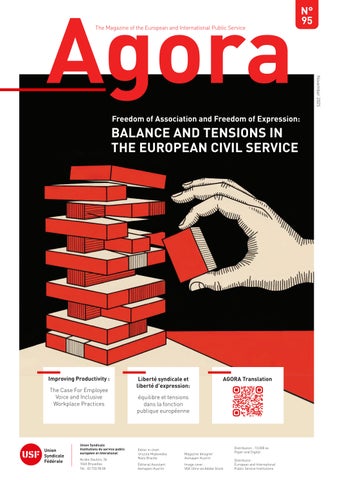
Freedom of Association and Freedom of Expression:
BALANCE AND TENSIONS IN THE EUROPEAN CIVIL SERVICE
Improving Productivity : The Case For Employee Voice and Inclusive Workplace Practices
Union Syndicale Fédérale
Union Syndicale Institutions du service public européen et interational Av.des Gaulois, 36 1040 Bruxelles Tél : 02 733 98 00
Liberté syndicale et liberté d’expression:
AGORA Translation
équilibre et tensions dans la fonction publique européenne
Editor in chief: Urszula Mojkowska Niels Bracke
Magazine designer Asmayani Kusrini
Editorial Assistant: Asmayani Kusrini
Image cover : VGX Ultra via Adobe Stock
Distribution : 10.000 ex Paper and Digital Distributor: European and International Public Service Institutions
November 2025
Agora The Magazine of the European and International Public Service
N° 95
SOMMAIRE 3
Editorial
European Schools in Italy - Ensuring Fair
29 Access to Education for Children of EU Staff
4
Liberté syndicale et liberté d’expression: équilibre et tensions dans la fonction publique européenne
11
Social Dialogue : A Democratic Imperative— But is The European Parliament Walking the Talk? Improving Productivity : The Case For
16 Employee Voice and Inclusive Workplace Practices
Climbing
the
Invisible
Ladder
:
22 Reclassification in EU Agencies—Fairness, Fragmentation, and the Future
Une visite de courtoisie fort peu courtoise.
27 Mais dans quel but ?
34
34 36 38
AI Is Coming But We’re Not Leaving !
From Virtual to Vital – USF Agencies Meeting in Torino La sante mentale, un enjeu de taille
The Union is What You Make Of It
22
Reclassification in EU Agencies—Fairness, Fragmentation, and the Future
From Virtual to Vital
38
2
32
The Union is What You Make Of It
EDITORIAL The Industrial Revolution redefined labour, introducing mechanization that displaced traditional crafts and reshaped economies. In response, trade unions emerged as a counterbalance to unchecked industrial power, securing rights such as collective bargaining, workplace safety, and fair wages. These victories were not merely economic - they were democratic. Today, artificial intelligence is the new disruptive force. It automates tasks, alters job profiles, and challenges the very definition of “worker.” Just as unions once fought for humane conditions in factories, they now confront algorithmic management, opaque data practices, and surveillance risks. The battleground has shifted, but the stakes remain high: dignity, fairness, and voice. Democracy rests on the premise that individuals and groups can speak, organize, assemble, and advocate for change without fear of reprisal. In this context, trade unions’ freedom of expression has become one of democracy’s most embattled front lines. Its preservation is not merely a labour issue - it is a barometer of the health of our political and civic life. Yet too often, institutions that profess a steadfast commitment to democratic principles and participatory governance fall short of embodying these ideals in practice. The European Union, which positions itself as a champion of social dialogue, fundamental rights, and inclusive policymaking, should serve as a model of institutional integrity and responsiveness. But as Nathalie de Montigny - lawyer contributing to this issue - observes: “In my practice, I have often been struck by the contrast between declared principles and actual practices. On the one hand, institutional discourse promotes social dialogue, diversity, and listening; on the other, internal practices quickly perceive criticism as a threat and confine debate to purely formal consultation procedures.” This dissonance between rhetorical affirmation and procedural conduct not only erodes public trust but also
inhibits the emergence of authentic participatory culture. When critique is pathologized and deliberation reduced to symbolic gestures, the democratic promise of the institution is diluted. It is therefore incumbent upon senior leadership particularly those entrusted with safeguarding the legitimacy and credibility of the institution - to confront this gap by starting with a cultural shift: one that embraces constructive criticism as a vital component of institutional resilience rather than a threat to its authority. In this context, trade unions should be recognized not as adversarial entities but as indispensable partners. Their role extends far beyond the articulation of demands; they serve as early-warning systems, capable of identifying latent tensions and facilitating resolution before conflicts escalate. Their contributions - often invisible yet profoundly stabilizing - benefit not only their members but the broader institutional ecosystem. To marginalize or fear such actors is to undermine the very architecture of democratic dialogue. Instead, institutions must cultivate a climate in which unions are engaged proactively, their insights valued, and their presence regarded as a sign of institutional maturity rather than vulnerability.
URSZULA MOJKOWSKA Urszula Mojkowska is the President of Union Syndicale Parlement Européen (USPE). She is a lawyer with experience in civil, labour, criminal and international law. She has been an EU civil servant since 2004.
3
LIBERTÉ SYNDICALE ET LIBERTÉ D’EXPRESSION :
ÉQUILIBRE ET TENSIONS DANS LA FONCTION PUBLIQUE EUROPÉENNE
Par Maître Nathalie de Montigny
« Il n’y a pas de liberté sans responsabilité et sans contrôle. L’absence de responsabilité et de contrôle met autant la liberté en danger que les interdictions et les censures. Une liberté privée de règles n’existe que dans une démocratique anarchie, donc destinée à périr. Le premier effet de cette situation est de provoquer des réactions puritaines et autoritaires. »
4
L’écrivain Jean Daniel affirmait qu’il n’y a pas de liberté sans responsabilité et sans contrôle. Je ferai volontiers écho à cette pensée : il n’y a pas de liberté sans responsabilité, pas de dialogue sans respect, pas de progrès sans contradiction. Ce mantra me revient souvent à l’esprit lorsque je défends un agent ou un représentant syndical confronté aux limites parfois fragiles entre le droit de s’exprimer et le devoir de loyauté. En fonction publique européenne, la liberté syndicale est une réalité juridique reconnue, mais elle demeure un terrain d’équilibre précaire : protégée, certes, mais encadrée ; valorisée, mais parfois redoutée ; essentielle au dialogue social, mais souvent source de tensions institutionnelles. S’exprimer est autorisé, mais retenez-en déjà la règle de base : agir librement, mais avec discernement ; parler franchement, mais avec respect ; contester, mais pour avancer.
Un droit fondamental sous tension La liberté syndicale, telle qu’elle est consacrée à l’article 24 bis du Statut des fonctionnaires de l’Union européenne, est un pilier du dialogue social européen. Ce texte impose aux institutions de « ne rien faire qui puisse entraver l’exercice de la liberté syndicale ». C’est un droit qui se situe au croisement du droit du travail et du droit constitutionnel, puisqu’il découle à la fois des principes généraux du droit de l’Union, de la Charte des droits fondamentaux1 et de la Convention européenne des droits de l’homme.2 L’organisation syndicale constitue, en ce sens, le vecteur légitime de l’expression collective du personnel. Elle
1 Article 12 de la Charte. 2 Article 11 de la Convention.
est le cadre dans lequel la parole syndicale trouve non seulement sa force représentative mais aussi la protection juridique attachée à son mandat. Lorsqu’un représentant s’exprime au nom de l’organisation qu’il incarne, sur la base d’une position adoptée collectivement, il agit en sa qualité de porte-parole du syndicat, et non à titre individuel et personnel. Dans ce contexte, il ne peut en principe lui être reproché de n’avoir pas sollicité d’autorisation préalable au sens de l’article 17 bis du Statut : la publication, la prise de position ou la communication dont il est l’auteur ne relèvent pas de sa sphère personnelle, mais de l’expression syndicale protégée. C’est précisément ce rôle de « véhicule d’expression » que le droit reconnaît à l’organisation syndicale : permettre la circulation de la critique, de l’information et du débat, tout en protégeant ceux qui en assurent la voix. Pourtant, dans la pratique institutionnelle, ce droit est loin d’être univoque. L’équilibre qu’il implique avec d’autres obligations statutaires – en particulier le devoir de loyauté et le devoir de dignité et de réserve – en fait un terrain où se jouent les tensions les plus délicates de la fonction publique européenne : celles entre l’esprit critique et l’obéissance hiérarchique, entre le militantisme et la neutralité, entre la défense d’un collectif et la fidélité à une institution. Si l’article 11 du Statut encadre la loyauté, et l’article 12 la dignité et la réserve, l’article 24 bis en est le contrepoint: il garantit la liberté de représentation, de parole et de contestation au sein du cadre institutionnel. Ces tensions ne sont pas théoriques. Elles traversent la jurisprudence du Tribunal et de la Cour de justice de l’Union européenne depuis les années 1990. Dans certaines affaires, des institutions ont été rappelées à l’ordre pour avoir tenté d’entraver la circulation d’informations syndicales – par exemple en ordonnant à leurs services 5
internes de messagerie de bloquer temporairement la diffusion de bulletins syndicaux.3 Ces arrêts rappellent qu’aucune mesure administrative ne peut viser à limiter ou retarder la communication syndicale sans violer la liberté d’expression collective des agents. Mais inversement, la même jurisprudence souligne que cette liberté n’est pas absolue. Lorsqu’une expression dépasse la critique institutionnelle pour devenir une attaque personnelle ou une atteinte à l’honneur, elle peut justifier une réaction de l’administration. Ce subtil jeu de miroirs entre droits et devoirs est au cœur de la réflexion juridique contemporaine sur la démocratie au travail.4
L’obligation de loyauté : une exigence à replacer dans son contexte La loyauté impose au fonctionnaire d’agir « uniquement dans l’intérêt de l’Union ». Ce devoir est souvent invoqué par les administrations pour encadrer ou critiquer l’expression syndicale. Mais la Cour a rappelé à plusieurs reprises que cette obligation n’est pas absolue : elle doit être appréciée en tenant compte du contexte. Ainsi, lorsque l’expression du fonctionnaire s’inscrit dans un cadre syndical ou militant, elle obéit à une logique différente de celle de l’expression hiérarchique. Le militant n’est pas un agent désobéissant ; il est un acteur du dialogue social, souvent investi d’un mandat représentatif et donc d’une légitimité particulière. C’est précisément ce qu’a reconnu la jurisprudence : l’obligation de réserve et de loyauté doit être interprétée de manière moins stricte lorsqu’il s’agit d’une expression syndicale ou d’une communication en vue d’une assemblée générale du personnel.5 Autrement dit, la critique devient acceptable, même vive, tant qu’elle demeure proportionnée et constructive. La violation du devoir de réserve ne peut être retenue qu’en présence de propos d’une gravité particulière, tels que des expressions gravement injurieuses ou manifestement attentatoires à la dignité des personnes visées. Cet assouplissement est fondamental, car il traduit la reconnaissance d’un fait institutionnel : le syndicalisme repose sur le débat, parfois sur la confrontation, et donc sur une parole libre. Restreindre cette parole au nom
d’une loyauté mal comprise reviendrait à neutraliser toute forme de représentation collective.6 Pourtant, l’histoire de la fonction publique européenne montre que cette évidence n’a pas toujours été admise. Dans certaines affaires, les juridictions de première instance avaient considéré que « les raisons expliquant le comportement du fonctionnaire n’avaient pas d’importance » pour juger s’il avait manqué à son devoir de loyauté. Cette approche formaliste a été corrigée : la loyauté ne se juge pas dans l’absolu, mais à la lumière du contexte. Ce rappel du juge est capital. Il signifie que le militantisme, l’engagement syndical ou le fait d’exprimer un désaccord institutionnel ne constituent pas en soi un manquement disciplinaire. Ce qui importe, c’est la finalité de l’acte : a-t-il pour but de nuire à l’institution ou, au contraire, de contribuer à son amélioration ?
La liberté d’expression syndicale: un droit exigeant, encadré par la proportionnalité La liberté d’expression n’est jamais purement déclarative. Elle vit par l’usage qu’on en fait, et elle se teste dans les moments de tension. Dans le contexte syndical, elle s’exerce souvent à travers des communiqués, des tracts, des messages électroniques ou des interventions lors de réunions du personnel.
6 Je fais ici un clin d’œil à un représentant du personnel qui m’a fait découvrir l’ouvrage de Frédéric Laloux, Reinventing Organizations : Vers des communautés de travail inspirées (Diateino, 2014). Cet essai, devenu une référence mondiale en matière d’évolution des structures managériales, retrace les différents stades de développement des organisations, depuis les modèles hiérarchiques autoritaires jusqu’aux formes plus « opales » ou « évolutives » fondées sur la confiance, l’autonomie et le sens collectif. La lecture de Laloux est précieuse lorsqu’on observe le fonctionnement institutionnel : elle offre une grille de compréhension des comportements organisationnels qui, transposée au secteur public européen, éclaire la nature des tensions que nous rencontrons. Il est fascinant — et souvent troublant — de constater, au fil des dossiers, à quel point le style de management ou d’administration en cause semble correspondre à l’un des paradigmes décrits par l’auteur : structure rigide, méfiance systémique, peur du désordre, contrôle excessif des communications, ou au contraire culture de dialogue et d’apprentissage collectif. Dans bien des affaires disciplinaires ou d’enquêtes administratives, les limites identifiées par Laloux se vérifient : une gouvernance ancrée dans le contrôle plutôt que dans la confiance, un réflexe de protection hiérarchique plutôt que d’écoute, une gestion des conflits qui privilégie la sanction à la compréhension.
3 CJCE, arrêt du 18 janvier 1990, Maurissen et Union syndicale/Cour des comptes, C-193/87 et C-194/87, point 13. 4 Nous avions d’ailleurs contribué au #92 de l’Agora qui en faisait son sujet principal de contributions. 5 TUE, arrêt du 15 décembre 2021, HG v European Commission, T 693/16, EU:T:2021 :895, points 83 et 95-98.
6
Mais l’excès inverse n’est pas exempt de dérives : une culture managériale centrée sur l’inclusion et la recherche permanente d’interaction peut, lorsqu’elle manque de cadre, être perçue comme une faiblesse ou une absence de responsabilisation, voire comme un défaut de conscientisation des enjeux et des limites de chacun. Ces schémas, lorsqu’ils ne sont pas dépassés, conduisent inévitablement à la défiance, à la crispation institutionnelle et, souvent, à la judiciarisation des relations de travail.
Or, cette liberté connaît des limites : la critique ne doit pas se transformer en diffamation, et la dénonciation d’un dysfonctionnement ne doit pas dégénérer en attaque personnelle. C’est dans cette nuance que se joue la frontière entre la liberté et l’abus. La jurisprudence impose ici un principe de proportionnalité : les propos ou actions du syndicat doivent rester nécessaires et adaptés à l’objectif poursuivi. Si le même message pouvait être transmis de manière moins agressive ou moins publique, sans perte d’efficacité, le juge pourra considérer que la communication a dépassé ce qui était « nécessaire ». Cette exigence de modération n’est pas un appel à la tiédeur ; c’est une invitation à la responsabilité. Le syndicat ne perd pas sa voix, mais il doit en maîtriser la portée. La critique des procédures, des politiques de ressources humaines ou des conditions de travail reste légitime. Ce qui est proscrit, c’est la désignation nominative inutile, l’humiliation publique ou l’amalgame entre des manquements institutionnels et des comportements individuels. Le juge, dans ces affaires, ne nie jamais la liberté syndicale ; il la replace simplement dans un cadre de respect mutuel. Il exige du syndicat qu’il reste fidèle à sa mission : défendre les intérêts du personnel et non régler des comptes personnels.
Quand la liberté d’expression rencontre le devoir d’assistance À l’inverse, lorsque l’expression syndicale franchit la ligne et devient potentiellement attentatoire à l’honneur d’un agent, le droit impose à l’administration de réagir. L’article 24 du Statut prévoit en effet un devoir d’assistance : lorsque la dignité ou la réputation d’un agent est mise à mal, l’institution doit intervenir « avec toute l’énergie requise ». Ce devoir n’est pas symbolique. Il oblige l’administration à agir rapidement et efficacement, à la fois pour faire cesser le comportement incriminé et pour indemniser, le cas échéant, la victime. Une simple invitation polie à publier un « corrigendum » n’est parfois pas suffisante : si l’administration reconnaît qu’un agent a été publiquement diffamé, elle sera souvent légitimement amenée à prendre des mesures concrètes à l’encontre de l’agent concerné et par la mise en œuvre d’une enquête administrative, offrira un soutien à l’agent atteint dans son intégrité, par la reconnaissance éventuelle du statut de victime d’un comportement déviant et la remise d’un rapport d’enquête l’établissant. Ce mécanisme illustre parfaitement la logique de l’État de droit au sein même de la fonction publique : chaque liberté
7
s’accompagne d’une responsabilité, et chaque droit trouve sa limite dans le respect des droits d’autrui. Mais ici encore, la proportionnalité est de mise. Une mesure disciplinaire ou judiciaire demandée par une victime ne saurait être considérée comme une atteinte excessive à la liberté syndicale, dès lors qu’elle est nécessaire et adaptée à la gravité de l’abus. L’administration se trouve donc dans une position d’équilibriste : elle doit protéger à la fois la liberté syndicale et la dignité individuelle. Et c’est souvent dans la manière de gérer ces situations – promptement, équitablement, sans partialité – que se révèle la maturité démocratique d’une institution. Il faut toutefois regretter l’ouverture désormais exponentielle de dossiers d’assistance, qu’ils concernent des agents se disant victimes de dérives ou ceux qui se trouvent visés par des allégations. Ce phénomène traduit moins une explosion des comportements fautifs qu’un manque d’investissement structurel dans les ressources humaines et les outils de prévention. Trop souvent, les institutions réagissent a posteriori, alors qu’il serait possible d’agir en amont, par la mise en place de mécanismes de régulation relationnelle ou la dispensation de formations à la communication, à la gestion du conflit et à la bienveillance au travail.
8
Ces démarches, orientées vers la compréhension psychologique et la qualité du dialogue, permettraient de réduire la judiciarisation des tensions et de rétablir des relations professionnelles éthiquement correctes, dans l’esprit même du service public européen.
L’enquête administrative : entre soupçon et présomption Une autre source de tension, fréquente dans la vie syndicale, réside dans la conduite des enquêtes administratives. Lorsqu’un agent – et plus encore un représentant syndical – en fait l’objet, il ressent souvent une forme de stigmatisation, comme si la simple ouverture de l’enquête emportait déjà un jugement implicite. Juridiquement pourtant, la décision d’ouvrir une enquête ne constitue pas un acte faisant grief : elle n’est pas attaquable, car elle ne produit pas encore d’effet juridique définitif. Le droit de l’Union considère ces enquêtes comme de simples mesures préparatoires, destinées à vérifier s’il existe un manquement aux obligations statutaires. L’administration dispose d’un large pouvoir d’appréciation à cet égard, pour autant qu’existe un soupçon raisonnable d’infraction. Cette approche peut sembler frustrante pour ceux qui la subissent, mais elle s’explique : toute procédure disciplinaire exige une phase préalable de vérification.
Cela ne signifie toutefois pas que l’enquête échappe à tout contrôle : son déroulement et ses conclusions peuvent être examinés de manière incidente dans le cadre d’un recours dirigé contre la décision disciplinaire finale. La difficulté, ici encore, réside dans la perception. Une enquête ouverte dans un climat de tension syndicale peut aisément être interprétée comme un acte de représailles. C’est pourquoi les institutions doivent faire preuve d’une vigilance accrue : transparence, impartialité et prudence doivent guider leur action, afin que l’enquête demeure un instrument de vérité et non un outil de dissuasion de la contestation. Dans bien des cas, l’enquête vise à évaluer le fondement factuel de l’expression syndicale : le travail de collecte, de vérification ou de recoupement effectué par le syndicat pour appuyer une publication ou une prise de position publique. Il s’agit de déterminer si cette expression repose sur des éléments tangibles et vérifiés, ou si elle se limite à relayer, sans distance ni analyse, la plainte isolée d’un membre du personnel. Il arrive cependant que l’enquête prenne une tournure plus problématique encore : nous avons pu observer des situations où une seule personne – souvent celle qui a signé ou diffusé un message syndical collectif – se trouve visée isolément, alors même que la publication émane d’un groupe ou d’un organe représentatif. Une
telle approche individualisée, outre qu’elle dénature la communication syndicale-même, porte atteinte à l’équité procédurale. Une réaction véritablement impartiale et équilibrée devrait logiquement impliquer l’ensemble des membres du collectif au nom duquel la publication a été réalisée. À défaut, l’enquête risque d’être perçue, et à juste titre, comme stigmatisante pour le seul agent concerné, créant un sentiment d’injustice et renforçant la défiance envers les mécanismes internes de contrôle. Plus encore, le fait de n’être visé qu’individuellement pour avoir participé à la concrétisation d’une activité syndicale alimente la crainte de représailles personnelles. Ce risque de voir le militant syndical isolé dans la responsabilité d’un acte collectif peut conduire à une forme d’autocensure ou de renoncement à l’exercice même du mandat syndical. À terme, il fragilise la représentation du personnel et prive les agents de la défense collective que ces représentants ont précisément pour mission d’assurer. Lorsqu’une organisation syndicale s’est montrée prudente et rigoureuse, qu’elle a vérifié les faits, signalé les incertitudes et communiqué avec transparence les précautions d’usage quant à ce qui n’était pas établi, il sera difficile de considérer qu’elle a outrepassé ses droits. Ses représentants, agissant dans l’exercice de leur mandat d’information, auront ainsi concrétisé leur liberté d’expression sans violer leur devoir de loyauté.
Liberté syndicale et démocratie au travail : un miroir de la gouvernance institutionnelle Au-delà des textes et des jurisprudences, la question de la liberté syndicale renvoie à une vision plus large de la démocratie au travail. Elle interroge la manière dont les institutions européennes incarnent les valeurs qu’elles promeuvent. Dans ma pratique, j’ai souvent été frappée par le contraste entre les principes affichés et les comportements observés. D’un côté, un discours institutionnel valorisant le dialogue social, la diversité et l’écoute ; de l’autre, des pratiques internes où la critique est vite perçue comme une menace, où le débat est confiné dans des procédures de consultation purement formelles. Or, la démocratie ne se décrète pas ; elle se vit. Elle suppose un espace où la parole syndicale n’est pas seulement tolérée, mais reconnue comme une composante légitime de la vie institutionnelle. Ce n’est pas un hasard si le Statut a voulu que les représentants du personnel bénéficient d’une protection particulière : ils ne défendent pas leurs intérêts personnels, mais ceux d’une collectivité. Et nous veillerons d’ailleurs toujours, en toute franchise, à le leur rappeler si tant est que de besoin. J’aime comparer la liberté syndicale à un thermomètre: elle mesure la capacité d’une institution à accueillir la contradiction sans la percevoir comme une atteinte à 9
construction. Le juge européen, à travers sa jurisprudence, ne dit pas autre chose : il ne bride pas la liberté syndicale, il en rappelle simplement la noblesse. Au terme de cette réflexion, il apparaît que la liberté syndicale et la liberté d’expression ne sont ni des privilèges ni des prétextes : ce sont des instruments d’équilibre. Leur exercice exige de la part des agents et des institutions une conscience aiguë de leurs devoirs réciproques. Les textes européens – du Statut au Traité en passant par la Charte des droits fondamentaux – ne cessent de rappeler que la démocratie interne des institutions doit être à l’image de celle qu’elles promeuvent à l’extérieur. Cela suppose une ouverture au dialogue, une transparence des procédures et une réelle capacité d’autocritique. Le rôle du syndicat, dans ce schéma, est essentiel : il rappelle à l’administration qu’elle n’est pas une forteresse mais une organisation humaine, soumise au droit, et qu’elle ne peut exiger la loyauté sans offrir en retour la confiance. La loyauté, finalement, n’est pas l’obéissance. Elle est un engagement partagé envers une mission commune : celle de servir l’intérêt général européen. Et cet intérêt ne saurait s’accommoder du silence. son autorité. C’est dans la manière dont elle traite ses représentants, dans la qualité du dialogue instauré avec eux, que se lit la vitalité démocratique de son fonctionnement. Les affaires disciplinaires impliquant des syndicalistes, souvent médiatisées ou politisées, en sont un révélateur. Elles montrent combien la frontière est ténue entre l’exercice légitime d’une liberté et son instrumentalisation répressive. Là encore, c’est au juge qu’il revient de tracer la ligne, d’examiner la proportionnalité des mesures, d’évaluer la bonne foi des acteurs. Mais la justice, aussi essentielle soit-elle, ne devrait être qu’un ultime recours.
Nous conclurons en ces termes : dans le dialogue parfois heurté entre agents et hiérarchie, il y a toujours une promesse : celle que la parole, lorsqu’elle est sincère et responsable, reste le meilleur rempart contre l’arbitraire. Et c’est peut-être là, au cœur de cette dialectique exigeante, que réside la véritable démocratie au travail.
Pour une culture de la parole responsable Dans une société démocratique, la liberté d’expression n’est jamais un acquis définitif ; elle doit être sans cesse réapprise, protégée et exercée avec discernement. Dans la fonction publique européenne, cette exigence est d’autant plus forte que les agents incarnent l’Union, ses valeurs mais aussi et surtout ses contradictions. Le syndicalisme, dans ce cadre, n’est pas un contre-pouvoir hostile ; il est une composante du pouvoir de réflexion. Il participe à l’éthique institutionnelle en questionnant les pratiques, en rappelant la cohérence entre les principes affichés et les comportements concrets. Mais cette mission implique aussi une responsabilité : celle de s’exprimer avec rigueur, de distinguer la critique du discrédit, et d’utiliser la parole comme un outil de 10
MAÎTRE NATHALIE DE MONTIGNY Maître Nathalie de Montigny, spécialiste en droit de la fonction publique européenne. Elle conseille et assiste également ses clients en droit économique. En 2018, elle fonde son cabinet d’avocats LEXENTIA. Elle enseigne le droit européen à ses jeunes confrères au Barreau de Bruxelles et organise également différents cycles de conférence en droit national ou européen, au bénéfice du personnel des Institutions européennes.
Social Dialogue: A DEMOCRATIC IMPERATIVE—BUT IS
THE EUROPEAN PARLIAMENT WALKING THE TALK?
By Urszula Mojkowska
Since its founding, the European Parliament has consistently advocated for a more prominent role for social partners in shaping economic governance. MEPs have urged the European Commission and Member States to move beyond symbolic consultation and provide tangible support for authentic, structured social dialogue.
11
In a resolution adopted in December 20211, the Parliament called on all stakeholders—including governments, employers, and trade unions—to commit to achieving 90% collective bargaining coverage across the EU by 2030. This ambitious target underscores the Parliament’s belief that social dialogue is not merely a procedural exercise, but a democratic imperative. Over the years, Members of the European Parliament have stressed that meaningful dialogue between social partners is essential for crafting fair labour policies, managing workplace transitions, and ensuring that citizens have a genuine voice in decisions that shape their economic futures. The Parliament welcomed the Council’s 2023 Recommendation on strengthening social dialogue2, which urges Member States to enhance collective bargaining frameworks, invest in capacity-building for social partners, and embed dialogue into national recovery and resilience strategies.
The Parliament’s position on social dialogue aligns with the European Commission’s 2024 Val Duchesse Declaration3 , which laid the groundwork for the signature in March 2025 of the Pact for European Social Dialogue.4 For the Parliament, social dialogue does not seem to be a box-ticking exercise – but rather a democratic cornerstone, essential for shaping fair labour policies, managing transitions, and ensuring citizen participation in economic governance. Yet this raises a pressing question: How well does the House of European Democracy uphold these principles within its own walls? The answer is as stark as the reality it reflects. Despite its vocal advocacy, the Parliament itself, in its internal labour relations, falls short of the standards it champions. The contrast between rhetoric and practice invites scrutiny, and perhaps, a moment of introspection.
1 European Parliament resolution of 16 December 2021 on Democracy at Work: A European Framework for Employees’ Participation Rights and the Revision of the European Works Council Directive (2021/2005(INI)) 2 Council Recommendation of 12 June 2023 on strengthening social dialogue in the European Union. Published in the Official Journal of the European Union, C/2023/1389, on 6 December 2023
12
3 Council Document ST 5687/24 4 Joint Pact for European Social Dialogue signed on 5 March 2025
Social dialogue in the European Parliament as an employer, in practice, barely exists. And that despite the commendable efforts by the current President Roberta Metsola - who relaunched the negotiations on a new framework agreement between the Institution and its trade unions, which resulted in the signature of a new text in September 2024 (the Framework Agreement) - and her genuine willingness to abide by its provisions. On one hand the Framework Agreement marks a historic shift: for the first time, representative trade unions were granted minimal human resources to support their work, on the other hand, it represents a major setback: it establishes a minimum threshold of a weighted tier for trade union representativity - measured by electoral results - as a prerequisite for initiating the so-called “concertation” process between trade unions and the Institution. Prior to the Agreement’s signature, any single trade union had the right to trigger this process, which allowed for more immediate and inclusive engagement. The implementation of the Framework Agreement has proven even more difficult, raising questions about the administration’s willingness to translate political goodwill into operational change. This is largely due to the substitution in the labour relations within the European Parliament of trade unions with the Staff Committee - a consultative body whose role is fundamentally different. The Staff Committee lacks binding authority, and its statutory functions do not include collective bargaining or formal negotiation.
In practice, proposals to amend the working conditions of European Parliament staff are routinely routed through the Staff Committee for consultation. Yet this process falls short of genuine social dialogue. No structured negotiation takes place, no meaningful exchange with representative trade unions is pursued. What remains is a procedural formality - consultation in name, exclusion in effect. As a result, the mechanisms for meaningful worker representation and structured dialogue are significantly weakened. The bottleneck rests squarely with the multitude of trade unions operating within the European Parliament. Since the entry into force of the Framework Agreement, these fragmented groupings have consistently resisted efforts to initiate collective bargaining. Despite the agreement’s intent to strengthen social dialogue, internal opposition has stalled any meaningful progress - leaving the promise of negotiation unfulfilled. Only Union Syndicale Parlement Européen (USPE) – member of Union Syndicale Fédérale and one other trade union PluraList have so far launched initiatives of collective bargaining under the new Framework Agreement. However, these two organisations fall short of the required weighted tier. All other trade unions are willingly giving up on their own competence by opposing those initiatives. It is, indeed, a perplexing question: why would trade unions accept a weakened role in shaping institutional decisions on staff policy? The answer, though disheartening, is remarkably straightforward. The administration - clearly benefiting from this imbalance - has strategically directed generous resources toward the Staff Committee, while allocating only minimal support to 13
the trade unions. This imbalance has disproportionately benefited the factions that have maintained a dominant alliance within the Staff Committee - an arrangement that has remained virtually unchanged for nearly six years. These groupings have actively withheld resources from the trade unions that are most outspoken on staff-related issues, undermining pluralism in representation. Unlike the European Parliament’s political groups, which operate under clear rules for proportional resource allocation, its Staff Committee remains governed by no such framework. This has allowed smaller factions to band together and sideline larger, more representative trade unions - effectively denying them their fair share of office space, secondments, and mission budgets – the very resources, which make an organisation operational. The result? A skewed system where influence is not earned through representation, but through tactical alliances. Those comfortably seated on the Staff Committee show little appetite for genuine social dialogue. Instead, they settle for a passive, consultative role of the Staff Committee - leaving the core principles of worker representation diluted and diminished. The current arrangement is undeniably convenient for the Parliament’s administration, which can operate with near certainty that its staff-related proposals will not be effectively challenged. By continuing to favour the Staff Committee - both in visibility and resources - the
14
administration ensures a passive consultative process while leaving trade unions sidelined. Yet this situation is in sharp contrast with the letter and spirit of the Council recommendation of 2023 so eagerly welcomed by the Parliament, which requires that “the existence of elected worker representatives is not used to undermine the positions of the trade unions concerned or of their representatives”. The consequences are tangible. Take USPE, the Parliament’s most representative trade union: despite the Framework Agreement having entered into force, we waited nearly a year to be granted office space in Brussels. In the meantime, our union representatives were forced to meet colleagues in corridors and draft documents on coffee tables in public areas - an indignity that speaks volumes about the institutional priorities. The administration of the European Parliament has opted to engage exclusively with a carefully selected group of trade unions - notably excluding the most representative one. This selective approach is evident in the structure of regular meetings between the Staff Committee and the Directorate-General for Personnel (commonly referred to as the comité de contact), which are held only in the presence of trade unions handpicked by the Staff Committee’s Bureau. Curiously - or perhaps not - this same group of unions has consistently obstructed any proposals to initiate the concertation process, effectively stalling meaningful dialogue.
Representatives of the excluded trade unions do not sit on any internal or interinstitutional committees or bodies, and they are systematically denied presence on internal competitions juries, which effectively means that the latter are monopolized by the smaller groupings who have formed the majority at the Staff Committee.
identity and mission. Ensuring fair treatment and genuine engagement with staff representatives is essential to upholding the values the institution so vocally defends.
As the European Parliament seeks to uphold its reputation as a global champion of social dialogue, pressing questions remain about how it can strengthen its credibility and commitment to democratic representation within its own house.
The European Parliament must ensure that its internal practices mirror the values it so vocally defends on the global stage. Its credibility as a champion of social dialogue hinges not only on its external advocacy but on the democratic integrity of its internal practices. If only the newly appointed Secretary General would tackle this pressing issue with the same vigour and resolve he has demonstrated in advancing the institution’s structural reforms…
The groundwork for progress has already been laid. Under the leadership of President Metsola, a new framework agreement was successfully concluded - marking a significant step forward in the formal recognition of trade unions within the Parliament. While the agreement is not without flaws - particularly regarding the high threshold required to initiate a concertation process, a point strongly contested by Union Syndicale Parlement Européen (USPE) during negotiations - it nonetheless represents a meaningful advance.
Employees entering the European Institutions find themselves in a system where they lack any direct negotiating power over their working conditions, both present and future. Changes are implemented unilaterally through internal decrees, leaving staff reliant solely on the collective bargaining strength of trade unions. To deny them this vital mechanism - within the very institution that symbolizes European democracy and promotes social dialogue worldwide - is not only unjust, but deeply contradictory.
Concrete steps must be taken to redress the imbalance between trade unions and the Staff Committee, whose dominance has steadily eroded the unions’ role in institutional dialogue. It is now incumbent upon the administration to move beyond its stance of non-interference in Staff Committee affairs and take active responsibility for addressing undemocratic practices within this body. Concrete rules must be established to ensure that electoral outcomes - on which trade union representativity is based - are accurately reflected in the allocation of responsibilities and resources within the Staff Committee. Only then can trade unions operate with the legitimacy and capacity they require. The persistent imbalance in staff representation and the marginalization of trade unions are not peripheral concerns - they strike at the heart of the Parliament’s
URSZULA MOJKOWSKA Urszula Mojkowska is the President of Union Syndicale Parlement Européen (USPE). She is a lawyer with experience in civil, labour, criminal and international law. She has been an EU civil servant since 2004.
15
IMPROVING PRODUCTIVITY:
THE CASE FOR EMPLOYEE VOICE AND INCLUSIVE WORKPLACE PRACTICES*
By Andreas Kornelakis, Michail Veliziotis and Horen Voskeritsian Foreword Despite the years that have passed, this Policy Brief from 2018 remains strikingly relevant to today’s debates around productivity, competitiveness, and the future of work in Europe. While the policy landscape may have evolved, the fundamental issues raised in this piece, especially the risks of dismantling labour market institutions in the name of flexibility continue to resonate. From a trade union perspective, this brief offers a powerful reminder that socially inclusive and cooperative approaches to workplace reform can drive not only fairness but also productivity.
As calls for structural reforms persist across EU Member States, the evidence presented here challenges the assumption that deregulation leads to economic efficiency. Instead, it underscores how employee representation, coordinated bargaining, and workplace practices rooted in mutual trust are essential to achieving sustainable growth. We believe revisiting this analysis offers valuable context for current discussions and reaffirms the role of trade unions as constructive partners in building productive, future-ready economies.
*This article originally published on ETUI Policy Brief N° 1/2018 European Economic, Employment and Social Policy
16
In recent years, the dismantling of labour market institutions has been promoted as a policy to improve productivity in EU Member States. However, the evidence in favour of a positive relationship between deregulation/decentralisation and productivity is inconclusive. Recent studies suggest that labour market institutions are not associated with worse productivity performance. In fact, evidence suggests that workplace practices that enhance the capability, efficiency, and motivation of the workforce actually improve productivity. Furthermore, these practices yield beneficial effects when trade unions or other employee representation bodies are involved in their formulation and implementation. Therefore, the aim of improving productivity in Europe should rely on socially inclusive and economically sustainable policies that promote the development of trust between the social partners to foster win-win outcomes.
Introduction How effective are the policies that seek to dismantle labour market institutions across the European Union (EU) with the aim of improving productivity? Dismantling labour market institutions includes policies to decentralise collective bargaining, with an increasing focus on company-level bargaining that deviates from the minimum standards set in sectoral agreements. Other policies focus on relaxing employment protection legislation to enable easier hiring and firing. Either way, the evidence about the positive link between deregulation and productivity is, at best, inconclusive. On the other hand, the negative consequences of deregulation, especially regarding the redistribution of power among the social actors, quality of work, and wage and income inequality, cast doubt on the desirability of these policies as tools for the achievement of smart, inclusive and sustainable growth with ‘more and better jobs’ in the labour market. A major problem with these policies is that they perceive improving competitiveness solely as a cost-cutting exercise.
The idea is that decentralising collective bargaining will help adjust wages (usually downwards) to better reflect the conditions of the market. This rationale, however, exposes workers to ‘the full force of global labour market competition, requiring [countries] to compete in low prices alone’ (Crouch 2014: 13). Yet cost reduction is not the only way to improve the alignment of productivity growth with labour costs. This can also take place if companies invest in their human capital, to increase its skills and capabilities, or if they redesign work organisation to better respond to the changing competitive environment. Such considerations imply that policymakers need to perceive productivity improvements more as a ‘value-adding’ exercise rather than a ‘cost-cutting’ one. This brief presents recent evidence on the relationship between deregulation and improvements in productivity. It also discusses the role trade unions and employee representation bodies can have in improving productivity through their intervention in workplace practices that create added value for everyone involved.
17
Dismantling labour market institutions ‘in the name of competitiveness’ Since the launch of the Lisbon Strategy in March 2000, improving the productivity of Europe’s labour markets has been a central concern of European policymakers. This objective was reiterated in the Europe 2020 strategy, which aimed at improving competitiveness through higher productivity as part of the agenda for smart, sustainable and inclusive growth. Although the discourse of the European Commission is cautious, and ‘deregulation’ is not explicitly prescribed, the general policy direction is towards more flexible employment relations in EU Member States. In their country-specific recommendations (CSRs), issued to each Member State, the EU required the reform of national collective bargaining systems to improve competitiveness (Clauwaert 2014). The Eurozone sovereign debt crisis significantly accelerated this process of transformation, and bailed-out countries – such as Greece and Portugal – were obliged to abruptly adapt their labour market institutions ‘in the name of competitiveness’. Even without strict conditionality, other countries, such as Italy, Spain, France and Belgium, had to adjust their labour market institutional frameworks along similar lines (Clauwaert 2014). Various studies examining the relationship between trade unions and productivity (or national/firm performance 18
more generally) have produced mixed evidence, with certain cases pointing to a positive impact of employee representation institutions on productivity. In theory, there are indeed reasons to expect that stronger unions and coordinated bargaining between different unions and employers’ associations can lead to better outcomes than uncoordinated bargaining. One line of this argument emphasises the imperfect nature of labour markets and market failures, and points to the efficiency-enhancing effects of institutions related to pay determination and employee representation. Inefficiencies arising from monopsonistic or oligopsonistic situations (where one or a few firms are the sole employers in a certain local or sectoral labour market), transaction costs, and public goods provision, mean that the monopoly status of trade unions, as well as their different functions of voice and agency, can have a positive impact on firm performance and particularly firm productivity (Bryson et al. 2005). Recent evidence suggests that in national settings where industrial unionism predominates, stronger trade unions are associated with higher productivity growth at the national level (Vernon and Rogers 2013). Moreover, coordinated bargaining systems can also lead to significant productivity gains for individual firms/ workplaces (Braakman and Brandl 2016). In one of our studies (Kornelakis et al. 2017), we did not find evidence of a harmful effect of either employee representation
bodies (trade unions and/or works councils) or collective bargaining on workplace productivity in Europe. Instead, the results indicate that attention needs to be shifted to workplace practices, which can have a greater impact on boosting productivity. This is in line with recent research, which suggests that growth in within-firm productivity seems to be accounting for the largest part of aggregate productivity growth (Martin and Scarpetta 2012). The importance of employee representation institutions in facilitating the adoption, as well as the beneficial effects, of workplace practices also needs to be stressed.
Enhancing inclusive workplace practices to boost productivity Both theory and empirical evidence suggest that certain inclusive workplace practices can have positive effects on productivity because they improve the organisational climate and employee motivation, empowerment, loyalty and commitment, while also reducing turnover rates. These factors are in line with a value-added interpretation of productivity. Instead of focusing solely on cost reduction, through wage cuts or the use of precarious employment contracts for instance, companies could aim to improve working conditions and enhance employee skills and work experience. Here, we focus on three key practices for which we found evidence that they are associated with productivity increases: training, teamwork and groupbased performance-related pay. Training is typically expected to improve productivity. Evidence from the European Company Survey 2013 suggests that around 71% of private sector establishments across the EU-15 provided some paid time off for training activities. This means a substantial proportion of European firms are missing out on a potentially important lever of productivity. Training fills skills gaps or updates skills through formal processes of analysis of training needs. It normally has a positive impact on the development of employees’ knowledge, skills and ability to perform in their jobs. Another way to enhance productivity is through the development of problem-solving skills. Overall, this upgrading in human capital is expected to have a positive impact on productivity. The figures for teamwork are the same, with evidence from the European Company Survey 2013 suggesting that 71% of private sector establishments across the EU-15 incorporated some type of teamwork. Teamwork, and particularly autonomous teamwork, can enhance productivity since employees work more effectively by combining different problem-solving skills. Additionally, self-directed teams can be more efficient as some layers of supervision and middle management are eliminated. Employees are also expected to voluntarily work harder, due to peer-pressure norms. Finally, group-based performance-related pay (PRP) systems are broadly underutilised compared to other practices. Evidence from the European Company
Survey 2013 suggests that only 46% of private sector establishments across the EU-15 included some type of performance-related pay. Group-based PRP can directly increase employees’ productivity by altering their incentive structures and elicit more effort to meet targets; or it can indirectly act as a sorting mechanism and attract the more able employees in these workplaces that have a reputation to reward employees with variable pay, creating a climate of encouragement and greater engagement with the work, which can be rewarding for all parties.
What is the relationship between labour market institutions, workplace practices, and productivity? Interestingly, the aforementioned practices seem to be working better in unionised settings (Bryson et al. 2005). Across the EU, there is a wide range of examples where trade unions work together with employers to develop and facilitate practices that enhance human capital development. In the more structured ‘apprenticeship systems’ of Central Europe (e.g. in Germany, Belgium or the Netherlands), trade unions administer the curriculum of training programmes jointly with employers’ associations. More generally, training programmes can be within the scope of the collective bargaining agenda. For instance, a Spanish transport company employing 140 employees introduced training initiatives that were negotiated as part of a joint commission with management and employees’ representatives and which contributed to higher efficiency (Eurofound 2016: 66). As far as teamwork in work organisation is concerned, Scandinavian trade unions have been a crucial actor in the development and functioning of socio-technical, autonomous teams. Furthermore, works councils can use their information-sharing and consultation powers to improve work organisation towards the re-designing of jobs and tasks so that a teamwork approach is more prominent. Finally, group-based PRP can be part of collective agreements. Trade unions have agreed with employers at higher levels the broad lines of the implementation of such systems (especially group-based schemes), which can then be further customised in individual companies as part of company-level agreements. For example, an Italian energy company employing 600 employees introduced variable pay for all staff based on annual assessment and as part of the sectoral agreement, and this contributed to increased productivity (Eurofound 2016: 64). Survey evidence in favour of the above links is provided in the following two figures, which show that countries with more extensive employee representation institutions (trade unions and/or works councils) are also associated with a more extensive use of training and autonomous team working.
19
Figure 1: Notes: Authors’ analysis of the European Company Survey 2013. ‘Any employee representation’ is defined as the existence of any trade union or works council-type official form of employee representation in the establishment. Both axes measure the percentage of establishments in each country where the relevant characteristic is observed. Greece is excluded due to its ‘outlier’ status. The inclusion of Greece in the figure does not affect the positive relationship observed. The regression line coefficient is 0.26, with an associated t-statistic of 3.18, p<0.01.
Figure 2: Notes: Authors’ analysis of the European Company Survey 2013. ‘Any employee representation’ is defined as the existence of any trade union or works council-type official form of employee representation in the establishment. Both axes measure the percentage of establishments in each country where the relevant characteristic is observed. The regression line coefficient is 0.29, with an associated t-statistic of 2.07, p<0.10.
20
It should also be noted that the beneficial impact of such practices on productivity, described in the previous section, is not automatic. Instead, there is abundant evidence that employee representation institutions facilitate this effect (Black and Lynch 2001, Bryson et al. 2005, Kochan 2012, Rizov and Croucher 2009). Trade unions and works councils can ensure that employees are fairly remunerated, reduce information asymmetries between management and employees, and reduce the occurrence of costly resignations through their voice-enhancing role (Bryson et al. 2005). Obviously, for the above (indirect) effects of employee representation to materialise certain conditions must be in place. Apart from a strong trade union movement able to mobilise the necessary resources, employers (or their associations) need to work together with employees and their representatives to produce mutually beneficial ‘win-win’ outcomes. Since these parameters, however, are not always guaranteed, an institutional setting must be in place that can empower unions to engage in such activities, promote mutual trust, and compel employers to take unions seriously and treat them as legitimate partners in the process. Unfortunately, the wave of deregulation that has taken over Europe in the name of competitiveness seems to have created an infertile ground for the development of such practices. In sum, the policy implications of the above findings are that if firms want to improve their productivity, they should focus, among other things, on upgrading the human capital of their employees, reshaping job design towards more teamwork-oriented work organisation, and incentivise employees through group-based performance-related pay systems. These practices, however, are unlikely to yield any positive results in a policy context of dismantling of labour market institutions, which disempowers unions and provides employers with more opportunities to act unilaterally. The success of these practices largely depends on the effective involvement of employee representation institutions in the decision-making process. Trade unions and works councils have a positive role to play, since they can both facilitate the adoption and help to ensure the success of these inclusive workplace practices.
References Black S. E. and Lynch L. M. (2001) How to compete: the impact of workplace practices and information technology on productivity, Review of Economics and Statistics, 83(3), 434-445. Braakmann N. and Brandl B. (2016) The efficacy of hybrid collective bargaining systems: an analysis of the impact of collective bargaining on company performance in Europe, MPRA Paper 70025, Munich, University Library of Munich. Bryson A., Forth J. and Kirby S. (2005) High-involvement management practices, trade union representation and workplace performance in Britain, Scottish Journal of Political Economy, 52(3), 451-491. Clauwaert S. (2014) The country-specific recommendations (CSRs) in the social field. An overview and comparison update including the CSRs 2014-2015, Background analysis 2014.01, Brussels, ETUI. Crouch C. (2014) Introduction: labour markets and social policy after the crisis, Transfer, 20(1), 7-22. Eurofound (2016) Win–win arrangements: innovative measures through social dialogue at company level, Luxembourg, Publications Office of the European Union. Kochan T. (2012) A jobs compact for America’s future, Harvard Business Review, 90(3), 64-72. Kornelakis A., Veliziotis M. and Voskeritsian H. (2017) How can competitiveness be achieved in post-crisis Europe: deregulating employment relations or enhancing high performance work practices?, The International Journal of Human Resource Management, 28(21), 3089-3108. Martin J.P. and Scarpetta S. (2012) Setting it right: employment protection, labour reallocation and productivity, De Economist, 160(2), 89-116. Rizov M. and Croucher R. (2009) Human resource management and performance in European firms, Cambridge Journal of Economics, 33(1), 253-272. Vernon G. and Rogers M. (2013) Where do unions add value? Predominant organizing principle, union strength and manufacturing productivity growth in the OECD, British Journal of Industrial Relations, 51(1), 1-27.
DR. ANDREAS KORNELAKIS
DR. MICHAIL VELIZIOTIS
DR. HOREN VOSKERITSIAN
Associate Professor at King's College London
Associate Professor at University of Southampton
Associate Professor at Birkbeck, University of London
21
Climbing the Invisible Ladder :
RECLASSIFICATION IN EU AGENCIES—FAIRNESS, FRAGMENTATION, AND THE FUTURE By Isidoros Tsouros
You’ve worked hard all year. Your appraisal was glowing, your responsibilities have grown, and you’ve even taken the initiative to learn a third language. So, you might ask yourself: “Am I eligible for reclassification?” If you’re working in the European Commission, the answer—yes or no—will likely be based on a quite transparent system, somehow defined rules, and shared expectations. But if you're one of the thousands of Temporary or Contract Agents in an EU decentralised agency, the answer might be: “It depends.” And that’s where the problem lies.
22
Why Reclassification Matters Reclassification—the promotion of a Temporary or Contract Agent to a higher grade—may seem like a technicality, but it cuts to the core of how institutions recognise merit, manage talent, and retain expertise. It’s the quiet engine behind career progression. It reflects whether a workplace sees its staff as long-term contributors or merely as rotating cogs in a bureaucratic machine. Yet today, reclassification practices across EU agencies are anything but unified. What determines whether a colleague moves up the ladder? Sometimes it's experience. Sometimes it's performance. And sometimes it's a set of unpublished criteria known only to a handful of HR officials. This inconsistency risks undermining trust, morale, and the EU's commitment to fair employment. So, how do things really work behind the scenes? And what can be done to ensure the ladder is visible, stable, and open to all?
The Commission vs. the Agencies: A Tale of Two Systems Let’s start with the benchmark: the European Commission. There, the reclassification process for Temporary Agents and promotion process for Officials is tightly structured, governed by the Staff Regulations, and implemented with meticulous transparency. Annual exercises are organised with quotas for each grade. Staff appraisal results feed directly into promotion prospects. Comparative merit is assessed by Joint Committees composed of management
and staff representatives. Appeals are possible, and even planned for, through a reserved quota of promotion places. Now let’s look at the agencies. Despite being part of the EU institutional family, many agencies have little in common with the Commission when it comes to reclassification. While a few agencies (like the European Chemicals Agency) have clear rules, quota-based reclassification plans, and staff consultation procedures, others operate in a more ad hoc fashion. For example: • Some agencies do not publish the criteria used to determine which staff are reclassified. • Others omit any reference to comparative merit in their guidelines. • In certain agencies, staff are notified of their promotion after decisions are finalised, with no opportunity to appeal or clarify. • Joint Reclassification Committees may exist on paper but lack any meaningful influence. The result? A fragmented system in which career progression can feel more like a lottery than a merit-based path.
Questions Staff Ask—And Often Can’t Answer • • • •
“Why was my colleague reclassified with only 2 years in grade, while I’m still waiting after 4?” “How many posts were available for my grade this year?” “Can I appeal the decision?” “Did the Committee actually compare the merit of all eligible staff?”
23
These are not abstract concerns—they are real questions, raised each year by hundreds of employees across EU agencies. In a workplace that values fairness, such questions should never be met with silence.
What Works Well and Where Not all is gloom, however. Some agencies are quietly setting good examples. • • •
A handful now publish anonymised results of reclassification exercises—by grade, by location, even by gender—boosting transparency and trust. Some include seniority benchmarks and evaluation grids in their HR policies, offering staff a clearer view of what’s expected. Others give a meaningful role to their staff representatives, inviting them to co-decide on quotas, compare merits, and even participate in appeals.
These examples show that change is not only possible—it’s already underway in some parts of the EU administrative universe. But we must go further. A Blueprint for Fairer Reclassification What would it take for every Temporary and Contract Agent across the EU’s decentralised agencies to say with confidence: “My reclassification was fair, transparent, and based on merit”? Creating such a reality isn’t a utopian vision—it’s a practical roadmap based on practices already working well in some EU institutions. Here’s a closer look at the five pillars that can form the foundation of a stronger, fairer reclassification framework.
24
Transparent Criteria and Clear Communication Would you board a plane without knowing the destination? Why, then, should staff be expected to trust a reclassification system without knowing its rules? Every agency should publicly and proactively share the full framework governing reclassification. This means: • • • •
Eligibility requirements, such as minimum time in grade, contract duration, or language certification. Evaluation criteria, including what counts towards merit (e.g. responsibilities, languages used, learning and development, peer/team feedback). Number of available reclassification slots, so expectations are managed realistically. Precise timelines, including when appraisal reports must be closed, when comparative assessments take place, and when decisions will be communicated.
Moreover, this information should not be buried in internal HR folders or circulated in vague annual emails. Instead, agencies should use dedicated intranet pages, FAQs, and information sessions. Staff should never have to guess what their prospects are or what steps they need to take. Best practice: Some agencies have already begun publishing MB decisions online, including indicative seniority benchmarks. Others hold dedicated info sessions before launching the exercise. All agencies should follow suit. Comparative Merit—Not Just Time Served Seniority is a factor, yes. But should it be the only one? A fair reclassification system must go beyond “time in grade” and ask: What has this staff member achieved during that time?
Agencies must implement a comparative merit assessment of all eligible staff at each grade, considering: • • • • •
Quality and impact of work delivered. Use of additional EU languages beyond the required two. Engagement in learning, development, or interagency collaboration. Leadership in projects or mentoring roles. Contributions to institutional knowledge or culture (e.g. committees, onboarding, voluntary initiatives).
This process should be documented and evidencebased, using standardised forms or grids. It must also be comparative—not conducted in isolation—so that staff are judged fairly against their peers at the same grade, and not arbitrarily. Best practice: Some Commission exercises use weighting systems where merit outweighs seniority, especially in early career grades. Agencies should aim for a similar balance, ensuring those who go above and beyond are recognised. Appeals That Are Accessible, Accountable, and Respected
• • •
Set clear deadlines and grounds for appeals (e.g. procedural irregularities, overlooked merit). Establish a Joint Appeal Panel composed of HR, management, and staff representatives. Provide written decisions with explanations.
The mere existence of an appeal procedure has a preventive effect: it raises the bar for due diligence and fairness in the main process. Best practice: The European Commission reserves ~5% of reclassification quotas for successful appeals. A similar mechanism would allow agency systems to stay flexible while reinforcing staff confidence. Joint Reclassification Committees That Actually Work What’s the role of a Joint Committee if it’s consulted after decisions are already finalised? Reclassification Committees—made up of management and staff representatives—should be empowered to: • • •
Participate in the preparation phase, helping define criteria and quotas. Review comparative assessments and staff lists, not just rubber-stamp HR proposals. Monitor equity, including gender, location, and gradelevel representation. Flag inconsistencies or concerns—before decisions are communicated.
What happens when something goes wrong—or simply appears unfair? A functioning appeals mechanism is essential—not to reopen every decision, but to provide a credible channel when procedures are flawed or unclear.
To be effective, these committees need:
Agencies should:
•
•
• •
Allow staff to formally appeal reclassification decisions.
•
Access to complete data sets (appraisal summaries, quotas, merit scoring). Time to deliberate, not rushed consultations. Respect for their input, with documented outcomes.
25
Best practice: In a few agencies, such committees operate like true co-management bodies. In others, they are symbolic. Strengthening their role is not just about procedure—it’s about ensuring that reclassification decisions are owned and trusted by the community. Publish the Results—Not the Names, but the Numbers Transparency doesn’t mean naming names. But without any published data, how can staff assess fairness? After each reclassification round, agencies should publish anonymised statistical reports including: • • • • •
Total number of eligible staff per grade. Total number of reclassifications granted. Success rates by grade, gender, location, or even directorate. Quotas used and unused, with explanations. Changes or trends compared to previous years.
This doesn’t violate privacy—it empowers oversight, identifies disparities, and builds institutional memory. It also creates a baseline for improvement and public trust.
courtesy rather than a structured right, that pride rings hollow. We risk losing our best staff. We risk eroding trust. We risk sending the message that career growth depends on being in the right agency, not doing the right work. And yet, the solution is not revolutionary. It’s about harmonising rules, investing in transparency, and trusting staff to deserve what they earn. If the Commission can do it—with tens of thousands of officials—so can a network of agencies employing a few hundred each. Reclassification is more than a procedural step—it is a vote of confidence in staff, a recognition of growth, and a promise of opportunity. Let’s not waste the chance to make it what it should be: fair, transparent, and empowering. In the words of a seasoned colleague recently bypassed for reclassification: “I don’t mind waiting my turn. But I do mind not knowing if I ever had one.” That sentiment should not define the experience of EU agency staff. Not in 2025. Not anymore.
Best practice: Some agencies already publish internal reports after the reclassification round. These should become standard, ideally also reviewed by the Staff Committee. A System That Works for Everyone Fairness is not just a principle—it’s a process. It must be visible, accountable, and applied consistently. With these five pillars in place, the reclassification system in EU agencies can move from quiet frustration to shared confidence. From uncertainty to clarity. From fragmentation to fairness. Because when career development is respected, performance rewarded, and transparency guaranteed— everyone wins. Let’s Be Honest: What’s at Stake The EU prides itself on fairness, merit, and excellence. But when some agencies treat reclassification as a managerial 26
ISIDOROS TSOUROS assumed the role of Research Assistant at EUAA in 2019. With over 30 years of experience as a legal professional, he has had a distinguished career, being elected as the President of a Greek Law Bar Association on two occasions. In 2022, he was elected to the USB Executive Committee as a representative from the Agencies Section. He is also member of the AASC Secretariat and Chair of the EUAA Staff Committee. This article reflects his trade-union perspective and is written in that capacity.
UNE VISITE DE COURTOISIE FORT PEU COURTOISE. MAIS DANS QUEL BUT ? La visite de courtoisie de MM Quest et Roques aux 3000 membres des six Agences Exécutives de l’Union européenne a laissé un goût bien amer au personnel qui caressait l’espoir d’un dialogue constructif. Pas tant parce que M. Quest a fortement et clairement rappelé au personnel leur statut d’agents européens de deuxième catégorie. Le personnel des agences est en effet bien au fait de ses conditions de travail, qu’il a acceptées en signant son contrat, comme l’a délicatement rappelé M. Quest, et contrairement à ce que pouvaient laisser penser certaines revendications isolées, notamment salariale, que M. Quest a bien entendu montées en exergue.
27
Le personnel est attaché au principe de réalité et privilégie le pragmatisme et l’ouverture institutionnels aux salamalecs d’une reconnaissance éternelle par les cadres de la Commission pour le rôle essentiel des agences exécutives dans la construction européenne. Mais parce que M. Quest a claqué la porte à tout dialogue. Aux nombreuses préoccupations exprimées sur l’absence de perspectives de carrière, de mobilité, les promotions très lentes, la réponse a été non, on ne va pas en discuter. L’inquiétude quant à la perte de motivation ? Un aléa du statut ! Le rôle unique d’interface des agences exécutives entre la bulle européenne et les acteurs de terrain, un détail ! M. Quest n’a pas pris acte de la qualité de la coopération développée dans le cadre du Mémorandum of Understanding signé le 28 janvier 2020 entre le management des 6 agences, les représentants de leur personnel et les syndicats. Cette coopération enregistre pourtant des avancées significatives, dans les limites du statut et des règles de mise en oeuvre, pour les conditions de recrutement et d’emploi dans les agences exécutives et renforce durablement la relation de confiance et l’engagement mutuel du management et du personnel.
Elle compromet également l’engagement pris auprès des syndicats, dans le cadre de la mobilisation autour du déménagement des agences exécutives dans le quartier Nord de Bruxelles, de porter le dialogue auprès des services centraux dont les politiques impactent directement le personnel des agences et qui doit pouvoir être impliqué en amont. Nous demandons à MM Quest et Roques : •
• •
De s’informer des progrès significatifs réalisés par les 6 Agences Exécutives, dans la limite des règles de mise en œuvre du statut, pour l’amélioration des conditions de recrutement et de carrière ; De favoriser l’ouverture de discussions sur les GIPS afin d’aplanir les obstacles et d’améliorer les opportunités de carrière et de mobilité ; De favoriser ce faisant un dialogue social réel, loyal et équilibré dans l’intérêt des agences comme de la Commission.
Nous nous réjouissons d’une prochaine visite de courtoisie dans ce cadre clarifié.
M. Quest ce faisant démontre un certain mépris à l’égard du personnel des agences, mais également de ses six directeurs exécutifs engagés dans cette coopération. Et que dire du mépris affiché à l’égard des représentants du personnel et des représentants syndicaux qui n’étaient pas invités à s’exprimer en cette qualité. Car M. Quest n’a pas besoin du dialogue social, M. Quest parle directement aux agents ! Or, parler aux agents sans leurs représentants, ce n’est pas dialoguer : c’est monologuer. Sous couvert de “proximité” et d’écoute directe”, M. Quest reproduit une stratégie bien connue : contourner les représentants du personnel pour mieux minimiser le rôle du dialogue social et affaiblir le seul contrepoids existant dans un rapport de force déjà déséquilibré. Cette attitude autoritaire était-elle le vrai but de cette visite de courtoisie ? Rappeler au personnel des agences qu’il ferait mieux de se satisfaire de ces conditions de travail dans un contexte géopolitique instable et un avenir budgétaire incertain ? Que s’il n’est pas satisfait de gérer des programmes à la chaine sans perspective d’évolution de carrière ou de mobilité, il peut choisir de partir ? Cette vision administrative à très courte vue méconnait l’expertise singulière des agences exécutives dans la mise en œuvre des programmes européens et leur rôle clé d’interface entre les politiques et les acteurs de terrain.
28
VALÉRIE BOUR Valérie Bour est vice-présidente de l'Union Syndicale Bruxelles, section Agences.
European Schools in Italy
ENSURING FAIR ACCESS TO EDUCATION FOR CHILDREN OF EU STAFF By Aleksandra Falcone
The European Union, in its commitment to fostering a multilingual, multicultural civil service, rightly upholds education as a key pillar of staff welfare. This is particularly vital for expatriate staff whose children must access education that supports mobility, academic recognition across Member States, and the European ethos. Yet, for those of us working in decentralised agencies the frequent absence of a Category I European School raises important questions about equity and institutional considerations.
29
The Problem of Location Without Infrastructure Category I European Schools deliver a full curriculum culminating in the European Baccalaureate and are considered the gold standard for EU staff children. However, when agencies are located in cities without such schools, staff are implicitly expected to find alternatives. In Turin, ETF staff face a patchwork of international, bilingual, or Italian national schools—none fully aligned with the European School curriculum or ethos. This situation imposes both financial and practical burdens on families.
Current measures To mitigate this gap, ETF introduced a social measure in 2019 that reimburses a portion of school fees for the children of staff, applicable to Temporary and Contract Agents with contracts of at least one year. The measure covers children attending “Schools that provide an international/foreign curriculum that do not lead to an Italian official certificate/diploma”1 as “in the area of the seat of the ETF there is no European School”. ETF reimburses 50% of the residual costs (registration plus tuition exceeding the normal education allowance). Transport, meals, uniforms, books, and school trips are excluded. Reimbursements are subject to budget availability; partial payments may be made and adjusted later.
1 ETF/19/DEC/005 “Measure of social nature on school fees for dependent children of ETF staff”
30
As mentioned above, the measure currently applies only to schools that “do not lead to an Italian official certificate/diploma”, which means some high-quality bilingual or hybrid schools remain ineligible even when their curriculum closely resembles the European Baccalaureate. This limitation has raised concerns among staff who seek more inclusive access to diverse educational options that align with European standards. Given the presence of multiple international organisations and an EU agency focused on education and training, the current situation presents an opportunity to broaden access to diverse, high-quality educational options in a more inclusive and equitable manner.
The Parma Model: An Institutional Precedent A reference often made in discussions on European schooling in Italy is the Scuola per l’Europa di Parma, an Accredited European School established in 2004 to support the educational needs of families working at the European Food Safety Authority (EFSA). It is one of only two Accredited European Schools in Italy (the other being in Brindisi) and delivers a full curriculum from nursery to the European Baccalaureate. While Parma’s case illustrates how a European School can be successfully launched in cooperation with national authorities and an EU agency, it is important to acknowledge its operational limitations. Feedback from some EFSA staff and local families has raised concerns about:
• • •
The limited size of the school, which restricts the breadth of language sections and curricular options. Infrastructure and maintenance issues, reportedly due to funding constraints. A number of families choosing to relocate from Parma to access a broader or more stable educational offering elsewhere.
Concrete Reform Proposals To support equitable educational provision for children of EU agencies staff, the institutions could consider: •
Permit a top-up support for any academically rigorous programme aligned with European School “principles”, irrespective of the diploma issuing body. Prioritise support for lower-grade staff (Contract Agents, AST up to AST5), to ensure equal access for Italian and non-Italian staff alike. Actively pursue accreditation of local schools—such as Liceo Vittoria or Lycée Jean Giono—to European School status, inspired by Parma’s example.
In this light, the Parma model should not be idealised. However, it remains a valuable institutional precedent: the school exists because local and national authorities, in partnership with the European Commission and EFSA, coordinated efforts to respond to the needs of EU staff in a medium-sized Italian city.
•
Turin, home to the ETF and a network of international bodies including UNICRI, ITC-ILO, and the UN System Staff College, could likewise explore the establishment of a European-accredited school, provided there is adequate political will and coordinated advocacy. Notably, within the UN system only staff on internationally recruited “P” contracts are entitled to an 80% reimbursement of international school fees, whereas in the EU system such support is, in principle, available to all staff.
European Schools Are for All Staff
The Case of Florence
Ultimately, and particularly in relation to the attractiveness of Italian duty stations, a coordinated solution at the European Commission level would be preferable—one that proactively ensures equitable access to high-quality, European-style education for all staff families, rather than leaving each agency to devise its own individual measures.
Florence, like Turin, has a limited number of international schools. Notable examples include the International School of Florence (ISF) and the Canadian School of Florence, both of which offer the International Baccalaureate, as well as the Lycée Français Victor Hugo, which provides access to the French Baccalaureate. Similar to the situation in Turin, Parma, and Rome, there are no Category I European Schools in Florence. Financial support to offset the high tuition fees of these international schools is granted on a case-by-case basis, and only for expatriate staff.
•
European Schools exist to uphold the educational rights of all EU staff families, reflecting the Union’s commitment to linguistic diversity and mobility. Education is not a perk—it is a core element of staff welfare and effectiveness. When agencies operate in cities without European Schools, the EU bears responsibility to find appropriate solutions.
Access to such education should be seen as a fundamental right, and addressing this need collectively is essential to maintaining a fair, inclusive, and effective European civil service.
The Varese Paradox: A School Too Far While a Category I European School is located in Varese, approximately 130 km from Turin, the considerable distance and commuting time render this option impractical for ETF staff—particularly those with young children. As a result, despite its formal availability, the Varese school does not offer a viable solution to the schooling needs of ETF families based in Turin.
School Options in Turin Liceo Vittoria offers a four-year programme that includes English-based IGCSEs and A Levels, closely aligning with the European Baccalaureate model. Similarly, the Lycée Français International Jean Giono provides a complete French curriculum and is a strong option, particularly for staff from francophone backgrounds. However, this school may also fall outside the scope of institutions currently eligible for top-up reimbursement under ETF’s existing rules.
ALEKSANDRA FALCONE Aleksandra Falcone is working at the European Training Foundation (ETF) as Planning, Monitoring and Reporting officer. She is a member of USF Federal Committee from Union Syndicale-ETF.
31
AI IS COMING BUT WE’RE NOT LEAVING ! By Niels Bracke
AI must not replace people: Union Syndicale Fédérale (USF) supports European Federation of Public Service Unions (EPSU) call for public ownership and worker involvement to EU Apply AI Strategy As the European Commission prepares to launch its “Apply Artificial Intelligence Strategy,” USF , as an affiliate of EPSU, fully supports the strong message sent by EPSU to the Commission: artificial intelligence must not replace workers — and certainly not without proper consultation, protection, and planning.
32
There is a very real risk that, without a clear and inclusive transition plan, the Commission or other institutions may one day present action plans eliminating 10–20% of positions, citing AI as the justification. This would mirror past situations, for instance, the sudden shift to telework during the COVID-19 crisis, which was once abstract and then rapidly became permanent, leading to major structural decisions such as the sale of EU office buildings. USF warns that we must not be caught off guard again. It would be a dangerous mistake to believe that only lower-grade or technical staff are at risk. The pace of AI development means that no job can be considered completely secure, not lawyers, not economists, not statisticians, not assistants. We urge our colleagues, including AD staff, to understand that this issue concerns us all. AI is not only about automation of routine tasks. It is increasingly affecting complex, intellectual roles as well. Too often, technological change is introduced from the top down, with little or no involvement from the workers who will ultimately be expected to use these tools. We strongly insist that staff must be consulted from the outset. This is not only a matter of democratic workplace practice. It is essential to building the trust, ownership, and cooperation necessary for ethical and effective AI integration in public services. Across public administrations, education, healthcare, and the judiciary, workers continue to report being excluded from decision-making around AI. Systems are introduced without input, and staff are left untrained or uninformed. This undermines both the trust of workers and the effectiveness of the tools themselves. Union Syndicale Fédérale joins EPSU in demanding meaningful consultation with staff and their representatives, and that collective bargaining must play a central role in how AI is deployed across the EU institutions and public services. We are not against technology. AI can, when used responsibly, assist workers, reduce excessive workloads, and improve services. But none of this can happen if staff are left behind. When AI replaces or reduces certain tasks, that must never be used as an excuse to eliminate jobs. Instead, it must trigger investment in reskilling, retraining, and job reorientation. The organisation has a responsibility to ensure that no worker is left without a future. We acknowledge that AI is transforming the world of work. Some roles will inevitably evolve, and certain tasks may become obsolete. However, we firmly reject the idea that people themselves should be considered redundant. While job functions may shift, workers must be retained, retrained, and reoriented within the organisation. That is our core demand, one we share with our EPSU affiliates across Europe. Union Syndicale Fédérale also sees this moment as an opportunity to rethink how we work. If AI is truly capable of reducing workloads, then those benefits must be shared with workers. Instead of replacing people, why not reduce working time? USF supports exploring a four-day work
week or reduced working hours as a just and innovative response to increased productivity. It is time to have this conversation — not after jobs are lost, but before decisions are made. EPSU’s call for public ownership of digital infrastructure and democratically governed cloud services is another crucial point we support. Public sector data must not be handed over to private foreign companies without oversight. We join EPSU in calling for digital sovereignty, public investment, and worker involvement as key pillars of Europe’s AI strategy. Public services must remain public and that includes their digital backbone. Above all, AI must not replace people. It should serve staff, improve services, and reflect our shared European values. This transition must be inclusive, fair, and grounded in social dialogue. That is why Union Syndicale Fédérale stands fully behind EPSU’s letter to the Commission, and why we are calling for immediate and ongoing consultation with staff representatives on any AI initiative affecting jobs, working conditions, or service delivery. This is a collective issue, and it calls for a united front. USF invites all trade unions, staff representatives, and colleagues to come together around these demands and ensure that the AI transition is shaped with, not against, the people who make public services work.
NIELS BRACKE Niels Bracke is the president of Union Syndicale Bruxelles (USB) as well as vicepresident of Union Syndicale Fédérale from EEAS section.
33
FROM VIRTUAL TO VITAL A long-awaited meeting: EU agencies’ unions reunite in Torino. First-ever in-person meeting of EU agencies’ Union Syndicale Fédérale marks a milestone for staff representation
Torino, 3 October 2025 — In a gathering at the European Training Foundation (ETF), representatives from multiple EU agencies met in person for the first time since the creation of the Agencies’ Working group within Union Syndicale Fédérale in 2019. Held in the Sala Europa at the ETF headquarters, the meeting marked a significant step forward in inter-agency cooperation, mutual learning, and advocacy for improved working conditions across the EU institutions.
34
The meeting brought together representatives from the European Union External Action (EEAS), Eurojust, The European Union Agency for Asylum (EUAA), the European Research Council Executive Agency (ERCEA), the European Union Aviation Safety Agency (EASA), Frontex, Eurofound, Fusio For Energy (F4E), and ETF’s own staff union. It opened with welcoming remarks from Jakov Minic, Vice-President of Union Syndicale Federale (USF), and José Manuel Galvin Arribas, President of ETF US, who both underlined the importance of physical presence in building solidarity and shared understanding — something that had been missing since the group’s foundation due to the pandemic and other logistical constraints. At the heart of the day’s discussions was the persistent challenge of career development within agencies, particularly the limited opportunities for Contract Agents (CA) to progress into Temporary Agent (TA) roles. Attendees voiced concern about the lack of fairness in internal recruitment, where staff on different contracts often perform identical roles but face unequal treatment. While the Staff Regulations currently set limits on mobility between categories, the group explored ways agencies might work within existing frameworks to facilitate more equitable career paths — potentially through updates to
the General Implementing Provisions (GIPs). However, participants also acknowledged that such revisions would be a complex and time-consuming process, requiring alignment across institutions. Alongside contract and career issues, pension rights emerged as a major topic. Niels Bracke, President of Union Syndicale Bruxelles as well as Vice-Presidents of USF advised staff to make better use of pension calculation tools, while a dedicated seminar was proposed to address growing uncertainty surrounding pension transfers and entitlements — particularly for CAs in the lower Function Groups. Legal action in such matters, it was noted, would only be viable after the final pension estimates are received, and the pension is already effective. Another key concern resonating across agencies was staff wellbeing. Data from internal surveys suggest that organisational culture, staff fear, and turnover remain unresolved issues in many workplaces. Delegates called for concrete action plans to follow up on survey results, as well as the creation of a confidential, inter-agency pool of counsellors to provide safe spaces for employees experiencing harassment or other professional distress. Union leaders also warned that the “niceness” often displayed in formal settings should not obscure or minimise the serious nature of findings highlighted by staff themselves. Discussions also touched on diversity and inclusion, where it became clear that while policies exist, implementation remains inconsistent. The Unions reaffirmed their commitment to pushing for genuine change — not just in official statements, but in lived workplace experiences. Harassment prevention, fair representation, and stronger communication between staff and management were seen as essential components of a more inclusive organisational culture. José Manuel Galvin Arribas described the event as a milestone in cross-agency union cooperation. He emphasised that the meeting helped consolidate a common agenda, highlighting issues such as staff wellbeing, career mobility, pension rights, and the need to strengthen the role of unions in the broader EU administrative framework. “It was also a unique learning opportunity among unionist peers,” he said, noting
LIIA KAARLOP Liia Kaarlop is working at the European Training Foundation (ETF) as Project Officer. She is a member of Union Syndicale (US-ETF).
that the Agencies group has become a key platform for systematically addressing shared concerns. USF President, Nicolas Mavraganis echoed this sentiment, reminding us that while agencies have become central to the functioning of the EU, their staff too often face precarious contracts and limited prospects. “The staff are the only resource of our institutions,” he said. “This meeting is one more step towards ensuring they are heard and respected.” The visit also included a separate meeting on 2 October between Niels Bracke and Thierry Foubert, an ETF’s senior management. In a constructive exchange with Mr. Foubert, contractual issues were discussed in depth, followed by a wider all-staff meeting where ETF employees raised questions on internal competitions, pension transfer rules, and visa complications for missions. Niels also met with individual staff members, reinforcing the importance of direct, personal dialogue in understanding workplace realities. Reflecting on the event, Niels lauded the quality of the exchanges but noted that the meeting’s duration was too short to fully address the range of topics on the table. “We need to invest more time in sharing the expertise USF has built up over the years. Out of sight is out of mind, especially when it comes to complex topics like Staff Regulations and pension rights. In future, such meetings should last at least two full days.” The meeting concluded with a strong message: social dialogue must be reinforced at all levels. Despite ongoing efforts, neither the current nor the previous European Commission has engaged directly with Union representatives — a gap that, according to attendees, must be addressed if real progress is to be made. As the Agencies’ Union Syndicale group continues to grow in scope and ambition, this first in-person meeting stands as a turning point. More than just a routine gathering, it was a reaffirmation of collective purpose — and a reminder that the voice of agency staff is both vital and long overdue in EU decision-making.
ALEKSANDRA FALCONE Aleksandra Falcone is working at the European Training Foundation (ETF) as Planning, Monitoring and Reporting officer. She is a member of USF Federal Committee from Union Syndicale-ETF.
35
LA SANTE MENTALE, UN ENJEU DE TAILLE Par Juan Pedro Pérez Escanilla
Le service médical de la Commission a présenté les statistiques de l'année 2024 : Il s'agit d'une présentation sommaire, sans analyse et avec des données manquantes, mais qui attire chez nous, en tant que syndicat, l'attention sur certains éléments : L'année 2024 marque une légère baisse de l'absentéisme pour cause médicale par rapport à 2023 et 2022. À première vue, cette évolution pourrait laisser penser à une amélioration du bien-être au travail, pourtant, d'autres éléments peuvent jouer: Surement, l'effet post-pandémie, mais les témoignages recueillis chez nos collègues font aussi état d'une pression accrue de la hiérarchie, de la crainte des contrôles médicaux, peur de perdre des
36
possibilités de promotion ou de fragiliser sa position dans un environnement professionnel tendu. Plus controversé serait le rôle du télétravail qui a fait, de facto, disparaître le caractère invalidant de plusieurs maladies, mais qui a liquidé la frontière entre travail et vie privée et permet une sollicitation même hors horaire de travail des collègues. Un chiffre saute aux yeux : 75 % des absences médicales et des mises en invalidité concernent des femmes. Cette surreprésentation n'est pas nouvelle, mais elle demeure alarmante. Elle peut s'expliquer par la double charge que beaucoup de femmes assument, combinant responsabilités professionnelles et familiales, mais aussi
par le fait que, malgré les progrés réalisés, les femmes continuent à être majoritaires dans les postes les plus bas. Pour l'Union Syndicale, cette réalité impose des mesures concrètes : reconnaissance des risques spécifiques aux collègues femmes, adaptation des postes, sensibilisation des managers à l'égalité, etc. Il ressort clairement de la présentation que l'absentéisme par cause médicale demeure plus marqué dans les catégories les plus précaires, où les contrats courts et les salaires bas dominent. Les conditions instables, les rythmes irréguliers et le manque de perspectives usent les corps et les esprits. Il n'est pas innocent que les deux services avec le plus haut pourcentage d'absentéisme soient le PMO et l'OIB. Mais le phénomène le plus préoccupant est sans doute celui de la santé mentale. Les troubles psychiques et le burnout constituent désormais la moitié des motifs d'absence et des mises en invalidité. Le burnout n'est pas en soi une maladie mentale d'après l'Organisation Mondiale de la Santé, mais constitue un risque important de développer une dépression, est associé à des troubles anxieux et peut provoquer des manifestations somatiques comme la fatigue chronique, des insomnies et migraines. Cette explosion de maladies mentales et burnouts traduit la montée des exigences de performance, la perte de sens et la pression croissante de l'organisation du travail. Pour l'Union Syndicale, cette situation impose un changement d'approche. Il ne suffit plus d'agir ponctuellement, il faut inscrire durablement la prévention des risques psychosociaux dans les politiques des institutions. Cela passe par la formation des managers, une véritable reconnaissance des pathologies psychiques comme maladies professionnelles et un renforcement des dispositifs d'écoute et d'accompagnement. Si l'absentéisme recule légèrement, les causes profondes de la maladie au travail persistent, voire s'aggravent. Loin d'être un signe de rémission, la baisse apparente des arrêts pourrait bien cacher une fatigue silencieuse et une résignation diffuse. Face à cette réalité, l'Union Syndicale plaide pour une politique de santé au travail globale : meilleure prévention, égalité de traitement entre femmes et hommes, sécurisation des parcours professionnels, et reconnaissance pleine de la santé mentale comme enjeu collectif. Protéger la santé de nos collègues, c'est aussi refuser que l’efficacité à court terme prenne le pas sur la dignité. Derrière chaque chiffre d'absentéisme se trouve une personne, et derrière chaque personne, un droit fondamental : celui d'exercer son métier sans y laisser sa santé.
JUAN-PEDRO PÉREZ ESCANILLA Membre du comité executif USB section Commission et membre du comité Fédéral USF
37
INTRODUCTION By Ricardo Da Costa Barata
The article in the next page, although talking about the specific case of a journalist, echoes way beyond the local realities of a Journalists' Union in Portugal. In this clash of arguments lie many questions that trade unionists need to ask themselves. Fumaça (fumaca.pt) is an independent, non-profit investigative Portuguese journalism podcast, which started in 2016. Its focus is on scrutinising systems of oppression. They see themselves as independent, dissident and anti-authoritarian, because it is the journalists who, without administration, management and resisting hierarchies, horizontally decide the publication's destiny, using consensus as the decision-making process. They stand for alternatives to traditional journalistic structures in financing, editorial and labour practices, and organisational models. They aspire to radical editorial and operational transparency and do not believe in the existence of neutral journalism. Instead, they clearly acknowledge their subjectivities and conflicts of interest. On the 16th of June 2025, Ricardo Esteves Ribeiro, one of the founding members, authored the weekly newsletter titled "Union of journalists, crutch of the capital" (“Sindicato de Jornalistas, muleta do capital”, in its original Portuguese). In it he describes the long disillusionment 38
process which led him to quit his membership of the Portuguese Journalists' Union (which he calls the Union of Journalists). He tells how he joined full of willingness to fight for better material conditions for himself and the others, and how, over time, he grew disillusioned with the Union and, after seven years, quit. He lays out a long list, but there is a heavy focus on how the Union failed to support his action as a journalist and afterwards in providing proper legal support, be it in addressing multiple instances of police brutality against journalists or lawsuits by targets of reporting. Upon further reflection, Ricardo also tells how he doesn't think that Unions are the structures to challenge the bossworker dichotomy. The way he sees it, it is a problem with trade unionism because in order for trade unions to fulfil their role of representing workers, then employers must recognise Unions as valid representatives, which means that Unions in turn must recognise the employers' authority and behave within the bounds of proper negotiation. It is in the context of answering the grievances of Ricardo that Nuno Viegas replies one week later. His reply is the piece you'll be able to read here.
THE UNION IS WHAT YOU MAKE OF IT By Nuno Viegas
It never ceases to amaze me how capitalists are able to profit even from the principles of anti-capitalists. To the benefit of employers, workers leave unions for a myriad of reasons. As a follow-up to my comrade Ricardo Esteves Ribeiro's newsletter from last week, I'd like to take a look at one of these paths towards the destruction of workers' movements: the othering of the union, its transformation into an organism external to the class of workers it represents, but with whom it maintains a merely bureaucratic relationship. Effectively, unions turn into service providers through a market-based approach to collective action, in which workers who do not participate in steering the union interact with the organisation in a transactional model to demand answers to individual needs: asking for legal support, communicating about their outrages or organising colloquia about their interests. Some unions just put themselves in such a position. They hold on to rigid hierarchies and remain under the leadership of the same people for years on end. They entangle themselves in pyrrhic struggles from which they draw feeble conquests. They promote membership by giving access to discounts, announcing that quotas are tax deductible, or proclaiming themselves an insurer: “pay every month so that one day you can use our lawyers”. Thus, seeing their labour conditions worsen each year, workers lose hope in the union's ability to achieve even minor improvements, let alone fundamentally reshape the societal model which condemns them to a lifetime of obeying bosses and begging administrators for scant pay raises. Same way we'd stop going to a grocery store selling rotten fruit, if the union does not solve our personal difficulties, we abandon the collective project. But there's a perspective issue when you criticise unions solely for these personal disappointments, even when they are serious failures. In his first paragraph, Ricardo
Esteves Ribeiro states that when he joined the Journalists' Union (SinJor) in 2018, he had "the will to fight for better material conditions" for the class, understanding that "the bare minimum would be to strengthen the union". But the example he puts forward on how he wanted to "help those who already spend their energy fighting for more and better rights for those who work alongside them" is to provide "another trade union membership and the few monthly euros it entails". I would argue that on this matter, unions are akin to gyms. The membership fee alone does not produce results. Change requires effort. The 1% fee of our salaries is a donation, not militancy. It obviously makes a difference. The dues 1,700 journalists paid last year allowed SinJor to provide free legal services to 200 associates, to protect them from unlawful dismissals, get contracts after years as false contractors, and fight illegitimate lawsuits that try to condition their journalistic work. But this is not what a union is. I agree with my comrade's concerns. Do the lawyers fail? Undoubtedly. Does the union take a stand when necessary? Not always. Does it invite the wrong people to speak on its stage? Sometimes. And why would a union that, for a year, ignores a member expect him to remain a member? Understandably, journalists feel disappointed by a union that has struggled to achieve more than slowing the decline. In each newsroom, there are legitimate reasons to be annoyed or disappointed, be it for the past six months or the last twenty years. The collective agreement for radio staff, which is being renegotiated, hasn't guaranteed a salary increase since 2006. There is no collective bargaining for private television stations. Photography sections are dying. The compulsory traineeship to access the mandatory professional accreditation serves as a coercive mechanism to access cheap labour.
39
Trade union action, within a profound crisis in media sustainability, has been demonstrably insufficient. This statement requires no more proof than the wages we're paid and the work we submit ourselves to publishing. It is not the criticism that sets us apart. It's me thinking that what you read last Thursday is a good starting point for a discussion with other members in a general assembly, where flaws are laid bare, solutions are suggested, and consensus to improve the organisation we are part of is sought. And I worry that frustrated apathy will continue to prevail among journalists. Through annoyed indifference, we allow disappointments to accumulate, assuming that the structures that fail us are unchangeable. So we give up influencing them and start framing participation as collaborationism. There will be irreformable structures, which maintain such a distance from their militancy and such a degree of bureaucratisation that democratic intervention is next to impossible. Unions where being a member is no more than being a statistic. However, without showing that we've hit the bottom of that hierarchical well, the call to lower one's arms, even if for clear moral reasons, is nothing more than a favour, a crutch... offered to capital.
40
A criticism never made has no impact Not only I do not think that SinJor has crystallised hopelessly, but it seems clear to me that the criticisms you read here should remind us that unions exist to be taken over by workers. They're political arenas. It's up to each of us to create collective mobilisation mechanisms that serve us. If we believe that a worthy trade union must spring from the autonomous organisation of each newsroom, assembly to assembly, it is our duty to build it. If we expect more ambition and more radical ways of struggle from the existing trade unions, we have an obligation to influence them. If a union does not serve its militancy, it must be refounded. SinJor, I've come to realise, is permeable to its militancy, with some effort. In 2021, I too was threatened by Strong Charon with a lawsuit, and considered leaving due to union inaction. I had my own list of disappointments: insufficient proposals for financing journalism, lack of ambition to fight the oppressive organisation of newsrooms, frail monitoring of repeated violations of the Code of Ethics, and lack of solidarity with other workers' movements. And I found it strange that the union - in what I'd figured would have
"...the criticisms you read here should remind us that unions exist to be taken over by workers. They're political arenas. It's up to each of us to create collective mobilisation mechanisms that serve us."
41
been a desirable practice - never contacted me to learn about my working conditions and explain how I could get involved, even when I was in a major newsroom in 2019 [moved]. I asked the union for little, gave less and received nothing. That didn't change what I think since 2021, though, when, quoting my comrade, we concluded: "the best way to fight this unacceptable conformism and reprehensible lack of solidarity is to remain unionised, to vote in its internal elections and to use my membership to criticise the organisation's actions. 'I will not leave, just so I'm able to make that criticism most effectively.'" Let's look at a critique in the first line of last week's newsletter. There, Ricardo refers to SinJor, "Sindicato dos Jornalistas" as "Sindicato de Jornalistas" (avoiding the gendered form, as in Portuguese "dos" is a male determiner and "de" has been used as gender neutral). Those who disagree with the name of an organisation they are part of can take one of two approaches. To start, they can put energy into getting a consensus. First, you'd find out if this has already been discussed, either by sending an email or calling someone from the steering committee, or going to the headquarters, which, for years, was less than a kilometre from Fumaça's newsroom. Then, talk to other associates to find out if other
42
people agree. If not, figure out how to start the discussion and build a favourable critical mass. This might lead to voting on a motion at the next class congress, perhaps attached to an intervention on gender in newsrooms. At some point, we have to try to vote it in the union's general assembly. If it fails, insist. Another option: as Ricardo Esteves Ribeiro did, a Trumpian unilateral name change. Bothered by the name of the union, we write it differently for a day, keeping reality unchanged and the name gendered. Maybe we don't try to intervene because we assume we'll fail. But I hold failure at changing things more dearly than success at varnishing them. I, for one, failed trying to change the name of our last congress. Back in July of 2022, I went to an extraordinary general assembly at 9.30 p.m. on a Friday to discuss the preparations for the 5th "Congresso dos Jornalistas Portugueses". I suggested focusing on financial sustainability and how newsrooms are organised, allowing students to intervene in debates, and changing the name so it'd be the 5th "Congresso de Jornalistas de Portugal". I didn't ask for a vote. Even though I believed I'd convinced much of the room, when the event started in January 2024, the name remained.
For the actual congress, my interventions focused on transparency and ethics, rather than on nomenclature. Under pressure from another Ricardo (Cabral Fernandes, at the time at the publication Setenta e Quatro), I also proposed a motion calling for the first general strike of journalists since 1982. We gathered dozens of subscribers, and rephrased the text to merge it with two similar proposals – from SinJor itself, and from Ana Luísa Rodrigues, working at RTP. As suggested by the previous president of the union, Sofia Branco, this joint text determined that I join a strike committee with the signatories of the motions, the union leadership, and the president of that congress, Pedro Coelho, a journalist at SIC. It was left up to us to draft the demands and coordinate the strike preparation and mobilisation actions. I will not detail the very short build up to the strike of March 14, 2024, during which, next to people much more generous and knowledgeable than me, I spent weeks participating in assemblies at newsrooms I'd never entered, producing propaganda, open letters and opinion columns, thinking about communication strategies, distributing leaflets on the subway until I was expelled by Carris' employees, and organizing demonstrations. I'm using this whole tangent to reveal that, in the aftermath of the aforementioned strike, the current president of
our union, Luís Filipe Simões, invited me to join a list for the upcoming election. And, precisely because of the annoyances above, I felt it would be disloyal to refuse. Therefore, since May last year, I have been one of 13 people in the union's national leadership, a post I'd like to dismantle. But while it's how we operate, in recent months I've devoted part of my time to promoting a statutory revision, which, besides other major amendments, will include proposing to the general assembly changing the name of this almost century-old organisation to, precisely, Sindicato de Jornalistas. It is a change that will be approved, if not now, later. Like other much larger ones.
Being distant is not the same as being airtight I support the criticism of institutional lethargy. But to say that the mountain does not move without ever trying to push it is a feeble argument. And my comrade, who has stimulating pushes to give, only voted in our internal elections once in eight years, never ran with an alternative list, never appeared in a general assembly, missed the last congress, never spoke to successive union steering committees about their reform or their mistake of inviting politicians and media directors to speak, never volunteered hours to strengthen the existing trade union practice, nor to constructively question it beyond speeches and opinion columns. All of this despite working in a privileged newsroom, with freedom to do so. We control our working hours. We are not afraid of retaliation from bosses. How much more difficult is it in other newsrooms to gain the momentum to intervene in the union? Giving nothing and asking nothing of the SinJor is something more common than I'd like. We are an organisation that lacks funding and has limited militancy. For hundreds of newsrooms, with more than 5,000 journalists, we have 31 acting trade union delegates. In addition to these delegates and the 76 people who make up the governing bodies, there is only a handful of journalists supporting the union daily. It is much less than what it would take to form a living union in each newsroom. We lack journalists who contribute to improving trade union practice. We suffer from constructed disinterest, legitimate disappointment, and fear (we have newsrooms where we're not able to convene plenaries). Much of the fault lies with us, those who've given time without being able to maintain a sufficient daily connection to newsrooms, motivate the consistent mobilisation of working people, properly integrate those who join, bring those who stay into decision-making, and regularly communicate work done. But there is also a general disengagement of the class, which once recognised they were exercising an eminently political profession, dedicating itself to a civic mission, but whose members have been transformed into factory workers of news production, gears of an uncritical, depoliticised system of publishing information.
43
Just look at how few publications have elected newsroom councils. Look at how few publications criticise each other's coverage. At how few journalists disagree with each other publicly.
are incompatible. Being part of both, and not feeling particularly divided, I have to disagree. To begin with, because I am not able to ignore the need to mitigate damage.
To solve the first issue, we could demand greater preparation, rigour, discipline, and dedication from us, those occupying the formal bodies of the union. But for the second, there are no quick fixes. It is because of the limitations imposed upon the class itself that, to me, it seems unreal to propose a self-managed revolution by itself.
Trade unions' gains aren't irrelevant just because they're insufficient. The collective struggle that prevented a 200-person layoff at Global Media Group was real. The support now being provided to the photojournalists that Medialivre is attempting to fire is also real. The (continuous) struggle to integrate precarious workers in RTP, and, by the way, the company agreement that was being negotiated until recently, are also real.
Last week, Ricardo Esteves Ribeiro wrote that SinJor serves only as an "intermediary between the bosses and the workers-journalists", not least because, "besides some weak and sparse proposals for legislative changes to facilitate the creation of journalistic cooperatives", it does not call into question "the employer-employee relationship itself". Given Ricardo's departure from the union, one can deduce that he considers participation in this structure as legitimising a status quo that he despises. So he writes:
"I do not see that the Sindicato de Jornalistas wants anything more than to slightly improve the old working practices." Well, that's exactly what Fumaça has been trying to counter from the beginning. What we want is to participate in a revolution of journalism. No hierarchies, no directors, no bosses, directors or administrators. And the two views 44
Every reclassification process where someone gets back years of the salary stolen from them is real. The increase in wages guaranteed by the collective labour agreement of the press is real (even if disgustingly small). And there is a real need to exercise, in an organised way, influence over the legislative revision promised by [the Government parties] PSD and CDS, by participating in the choice of representatives for the Professional Journalist Accreditation Commission, and intervening in the advisory board of the Media Regulatory Authority. These results cannot be seen as horizons. Indeed, they fall short of any worthy ambition, be it reformist improvement or the refounding of the sector, but I disagree that moderation is such a stain that it justifies disengagement, and, I fear, inaction. I will just quote a 2023 text by Ricardo Esteves Ribeiro: "The division of the world into a set of simplistic dualities
may as well be supportive of its basic understanding. It becomes easier to choose sides if alternatives are limited, if there are lines separating the good from the bad. But Manichaeism was never profitable. Certainly not for the original Manicheans, who have always been persecuted, but neither for an honest reading of the dilemmas of our collective life. The world is not black and white, nor does it have only good and bad. There is nuance, complex understanding of complex problems. There is history, context. But understanding nuance, complexity, history, and context is hard work. And contemporary Manicheans – of those stemming from the religion I know little about – do not want to go through the trouble." I don't even have a particular attachment to institutions, but I allow them nuance.
Revolution does not sprout spontaneously I agree that our basic response to the journalism crisis should be self-management: we need media organisations to be collectively managed through the newsroom councils. But the appropriate course of action doesn't seem to me to be proclaiming "I do not align", constituting an alternative newsroom, and hoping that this inspires others to take action. If what's being proposed
is a revolution of journalism, it is not enough to criticise the sector and create alternative spaces (as Ricardo does with effort and generosity, also by sharing knowledge and seeking to attract philanthropic funding). Even if in Fumaça, and similar projects, a paradise of financial sustainability, editorial strength, and labour dignity is established, it will not be by osmosis that this oasis will change the media. Therefore, the practical result of reducing our intervention by abandoning existing workers' movements is to say to those who today work under unworthy, more precarious conditions than we do: "Good luck, but that doesn't concern me." An "inadmissible conformism and reprehensible lack of solidarity". Even if the transition towards autonomous organisation of newsrooms is urgent, we need to make it possible. We face it daily at Fumaça: there is no legislative framework and no paths to funding. I encourage others to try selfmanagement. But it would be irresponsible to say that all media, particularly large newsrooms doing national daily news, could survive this way at this time, when they now lose money. For the purpose of revolutionising journalism as a whole, our most effective sectoral intervention mechanism remains the SinJor.
45
I see no benefit in abandoning an institution that we can make use of, taking advantage of its memory, the goodwill it maintains and the mobilising force that it can still apply to more than two thousand associates, its institutional relations, and access to newsrooms, in particular those it accompanies in ongoing struggles. It may be weaker than it used to be, but I don't recognise it as mortally wounded, nor do I believe that it's time to give up working on it. If we do not want to push comrades off a cliff, where they will not be able to pay their own salaries, we need concerted work to make creating new newsrooms viable, and force the democratisation of existing ones. In the very least, sectoral legislation needs to be changed, and direct public funding mechanisms need to be established. It is essential to give binding decision-making power to elected newsroom councils, including appointing managers in hierarchical newsrooms. It is necessary to establish conditions that allow journalists to opt for selfmanagement. If for nothing else, so that journalists are willing to participate. Currently, I am not sure that there is a will to undertake the collective, horizontal management of journalism. Even less so for the measures proposed by my comrade to achieve it, as an alternative to my reformist lobbying process. If you want to assess the openness of newsrooms to surpass the "legalised pacific means of struggle", all you need to do is read the coverage that mainstream journalism gives to any recourse to political violence. You can't radicalise a struggle by waging it against the workers. Either you mobilise your class, or you're planning a vanguardist coup. As it stands, that's what a call to direct action is here. There are not enough workers with an interest in taking newsrooms by force, sabotaging media companies, and deposing editorial boards. To have a sustained radical effect, you need collective organisation and class support, to have journalists be with the means and the ends. And you also can't leave behind those in worse working conditions. Can't forget to try to improve the lives of workers. It should be noted that, in recent history, there are journalists who even oppose to striking. To safeguard the credibility of the publications they work for, only now, after a year and a half of late salaries, did the newsrooms of Trust in News choose to stop. When organising the general strike, there were journalists concerned about harming the boss: a person subcontracted by a TV station as a correspondent asked in a plenary whether the producer employing them would be in breach of contract if they did not deliver the ordered daily pieces. Another, with a regular radio program that would be broadcast on the day of the strike, wanted to join the protest, but to pre-record the episode, so as not to fail the listeners. At the congress, approving the strike motion required the assurance that the shutdown would never take place during the upcoming electoral campaign, harming the public interest. 46
Channel your grievances By the way, I don't get Ricardo Esteves Ribeiro's fatalistic futurology. He's certain that SinJor "does not and will not defend, in a systemic and foundational way, the concrete overthrow of the figure of the 'administration', the 'board', the 'leadership'. They will not be inherently against authority through direct action. They are, in essence, capitalist and reformist." Moreover, the trade union "will always be an instrument of power", which "seems to be content to serve as a crutch for the capital", as he argues. This idea has several weaknesses. First and foremost, the fact that multiple union presidents argued for selfmanagement and supported newsrooms in transitioning to cooperatives. Alfredo Maia did it publicly, for example, with Comércio do Porto and A Capital. He even tried, in 2010, to get legislation to give newsrooms the ownership of bankrupt publications by default. The following steering committees supported the same principle: when companies collapse, those who work there attempt to take them over. It emanates from a long tradition of self-regulation and collective resistance of Portuguese journalists, in dictatorship or democracy. But, as Comércio do Porto no longer being published demonstrates, it's not enough to be for it. And for those who've spent their entire career employed by a media company, it isn't an easy leap of faith to take. It is fair to note that this position is not “systemic and fundamental.” The central focus of SinJor has not, in fact, been the construction of non-hierarchical journalism. But that does not mean that this goal is unattainable. One would have to be extremely pessimistic to find it impossible to lead an organization made up of our comrades, real people we know, to defend a just cause. To quote Audre Lorde, in 1981: “Anger is loaded with information and energy. For anger among peers brings about change, not destruction, and the discomfort and sense of loss it often causes are not fatal, but a sign of growth.” I urge you to channel your anger, comrade, to make us grow. Bring your ideas. And if the class doesn't support them immediately, convince them. Propose an education plan for self-management, volunteer to organise workshops on non-hierarchical decision-making models, plan Summer courses on funding for public service journalism, and think about strategies (legal or not) which allow collective management beyond taking over the newsroom. The union is what you make of it. Give us your energy. Trade Union greetings, Nuno Viegas
Note: Ricardo Esteves Ribeiro, who wrote the text that Nuno Viegas criticises here, edited the text that you just read.
" It is not the criticism that sets us apart. It's me thinking that what you read last Thursday is a good starting point for a discussion with other members in a general assembly, where flaws are laid bare, solutions are suggested, and consensus to improve the organisation we are part of is sought. "
NUNO VIEGAS Nuno Viegas is a Portuguese podcaster and investigative journalist, researching policing and the penal system, often through FOI legislation. At the workermanaged, membership-backed publication Fumaça, he also co-leads fundraising. A Pulitzer Centre, Alfred-Toepefler-Stiftung and Rosa Luxemburg grantee, his work has been awarded AMI's Journalism Against Indifference Prize and the National UNESCO Commission's Human Rights & Integration Prize. In 2024, he was elected to the steering committee of the Portuguese Journalists' Union.
47
Union Syndicale Fédérale
Les opinions exprimées et les propos tenus dans les différents articles de ce numéro d’Agora n’engagent que leurs auteurs et ne pourraient refléter la position de l’Union Syndicale Fédérale dans son ensemble. The opinions expressed and comments made in the various articles in this issue of Agora are solely those of their authors and do not reflect the position of Union Syndicale Fédérale as a whole.