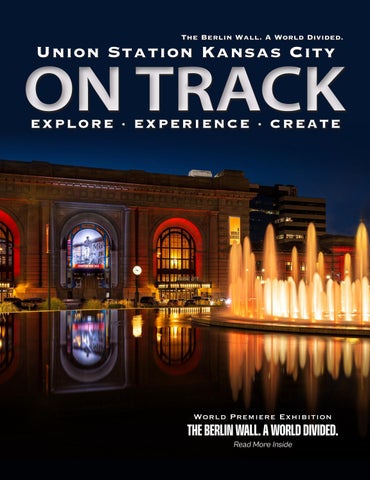
The Berlin Wall. A World Divided.
Union Station Kansas City
EXPLORE . EXPERIENCE . CREATE
World Premiere Exhibition
THE BERLIN WALL. A WORLD DIVIDED. Read More Inside
CONTENTS
The Berlin Wall. A World Divided.
ON TRACK CHIEF MARKETING OFFICER
Michael Tritt
ASSOCIATE VICE PRESIDENT, MARKETING
Lauren Kovarna
MARKETING & EVENTS COORDINATOR
Jon Dudrey
MARKETING & SOCIAL MEDIA COORDINATOR
Ashlynn Smith ON TRACK DESIGNER
Abby Rufkahr SENIOR GRAPHIC DESIGNER
Dalton Liu
UNION STATION KANSAS CITY BOARD OF DIRECTORS
Ray Kowalik, Board Chairman Erin Stucky, Board Vice-Chairman Peggy Dunn, Board Treasurer Jon Cook, Board Secretary Mayor Quinton Lucas, Ex-Officio Dr. Mauli Agrawal Dr. Kimberly Beatty Jamey Bertram Bucky Brooks Michael J. Brown Keith Creel Tom Gerend Mike Haverty Angie Long Ramón Murguía Robert D. Regnier Dr. Thomas Sack
3
Letter from Leadership
4
Why We Tell This Story
5
From Missouri, A Warning to the World
7
Missouri President Who Helped Shape Postwar World
8
Four Presidents. One City. One Promise.
10
No Way Out
11
Escape by the Numbers
12
From Concrete to Canvas
13
The Night the Wall Fell
14
Beyond the Exhibition
16
History Asks Something of Us
COVER: Courtesy: Kent Auf Der Heide Proud to be a
Smithsonian Affiliate
ON TRACK IS AVAILABLE ONLINE: UnionStation.org/OnTrack The information contained in this magazine is for informational purposes only. Union Station Kansas City, Inc. assumes no liability or responsibility for any inaccurate, delayed or incomplete information.
2
Mission Statement Union Station Kansas City is dedicated to preserving its historic monument and its stories, inspiring lifelong learning and creating lasting memories for our community.
A Welcome to History That Still Shapes Our World A
t Union Station Kansas City, we believe history has the power to do more than teach us about the past—it helps us better understand ourselves, our communities and the world we are building together. That belief is why we brought The Berlin Wall. A World Divided. to Kansas City. This exhibition is not simply the story of a wall that once divided a city. It is the story of ordinary people faced with extraordinary choices. It is about families separated overnight, lives forever changed by political ideology, courageous acts of resistance and, ultimately, the triumph of hope over oppression. More than three decades after the Wall fell, these stories continue to resonate because they remind us that freedom, democracy and human dignity should never be taken for granted. That is why bringing this internationally acclaimed exhibition to Kansas City is such an honor. We’ve become a crossroads for global conversations and international visitors, and we believe our community deserves the opportunity to experience history preserved at the highest level. Developed by an international team of historians and researchers, this exhibition brings together more than 200 original artifacts, authentic sections of the Berlin Wall and deeply personal stories that reveal not only how the Wall divided a city, but how its legacy continues to shape the world we live in today. History is rarely black and white. It is personal. It is emotional. It is unforgettable. As you journey through these galleries, we invite you to reflect not only on the history of the Berlin Wall, but on the enduring values of freedom, democracy and human dignity that continue to shape our world. Thank you for joining us.
Ray Kowalik
Board Chairman
George Guastello President & CEO
UnionStation.org
3
WHY WE TELL THIS STORY The Berlin Wall divided a city, separated families and became one of the most recognizable symbols of the Cold War. Yet its story is also one of courage, creativity and the extraordinary power of people to change history. The Berlin Wall. A World Divided. was created to bring that history closer—to move beyond dates and political events and reveal the human experiences behind them. Through authentic objects, personal testimony and multiple perspectives, the exhibition invites us to understand the past while considering the future we are building together. LUIS FERREIRO, Producer, Musealia “With Auschwitz. Not long ago. Not far away., we explored one of history’s darkest chapters. But the end of World War II was not the end of its consequences. This exhibition continues that story, revealing how the war’s aftermath reshaped Europe and divided the world. We tell it because understanding what came next helps us better understand where we are today—and where we might go tomorrow.”
4
Union Station On Track • The Berlin Wall. A World Divided.
DR. AXEL KLAUSMEIER, Director, Berlin Wall Foundation “Preserving the Berlin Wall allows new generations to encounter history in a tangible and deeply human way. Its story reminds us that freedom should never be taken for granted—and that the lessons of the past have meaning only when we apply them to the choices we make today.” DR. CHRISTIAN F. OSTERMANN, Chief Curator “The Cold War was a global conflict, but it was lived personally— in homes, neighborhoods and families. The fall of the Berlin Wall reminds us that even the most permanent divisions can be overcome and that people have the power to change the course of history.” As you turn these pages, you will meet the people, places and defining moments behind the Wall. We hope their stories inspire you to continue the journey—and ultimately experience this remarkable history firsthand.
Photo: Opening Of The Exhibition. From left to right: Dr. Christian F. Ostermann, Dr. Axel Klausmeier, Luis Ferreiro, George Guastello
FROM MISSOURI, A WARNING TO THE WORLD
How a speech delivered in the heart of America changed
history—and why its message still echoes through The Berlin Wall. A World Divided. On March 5, 1946, the eyes of the world turned—not to London, Washington or Moscow—but to the small town of Fulton, Missouri. Less than a year after World War II ended, former British Prime Minister Winston Churchill stepped to a podium inside Westminster College and delivered a speech officially titled "The Sinews of Peace." History, however, remembers it by two words that forever changed the twentieth century:
THE IRON CURTAIN. Those words would become the defining metaphor of the Cold War, describing an ideological, political and physical divide that stretched across Europe for more than four decades. They also foreshadowed the construction of the Berlin Wall fifteen years later—a concrete barrier that became the world's most recognizable symbol of a divided world. Today, visitors to The Berlin Wall. A World Divided. at Union Station Kansas City begin their journey with a story that, in many ways, begins right here in Missouri. WHY FULTON? The question has puzzled historians for generations. Why would one of history's most celebrated leaders travel to a small liberal arts college in rural Missouri to deliver one of the most consequential speeches of the twentieth century? The answer is equal parts determination, timing and presidential support. Westminster College President Francis McCluer dreamed of bringing a world leader to campus. Through Westminster alumnus Major General Harry Vaughan—who happened to be President Harry Truman's military aide—an invitation reached Churchill. Truman personally endorsed the idea, writing a brief note encouraging Churchill to accept: "This is a wonderful school in my home state. I hope you can do it." Churchill recognized the opportunity immediately. What could have been an ordinary college lecture suddenly became an international event.
UnionStation.org
5
TRUMAN'S PRESENCE SPOKE VOLUMES President Harry S. Truman did more than invite Churchill. He traveled nearly 200 miles from Washington to Fulton and personally introduced the former British Prime Minister before thousands gathered inside the Westminster College gymnasium. That gesture mattered. Churchill was no longer Britain's Prime Minister. He had lost the 1945 election only months after leading Britain through World War II. Yet Truman's decision to stand beside him gave the speech extraordinary credibility and signaled that Churchill's views deserved serious consideration. At the time, however, many Americans still viewed the Soviet Union as a wartime ally rather than a future adversary. Churchill's warning was controversial, and Truman's visible support underscored its importance even as many questioned its message. "AN IRON CURTAIN HAS DESCENDED..." Churchill's speech was officially titled "The Sinews of Peace," but history remembers a single passage.
"From Stettin in the Baltic to Trieste in the Adriatic, an iron curtain has descended across the Continent." The phrase was both vivid and prophetic. Churchill wasn't describing a physical wall. The Berlin Wall did not yet exist. Instead, he warned that Europe was being divided by ideology. Behind this "iron curtain," nations in Central and Eastern Europe were increasingly falling under Soviet political influence and control. Freedom of speech, free elections and democratic institutions were giving way to authoritarian rule directed from Moscow. The "Iron Curtain" became shorthand for a continent divided—not only by geography, but by opposing ideas about freedom, government and individual rights. Fifteen years later, on August 13, 1961, those ideological divisions became physical when East Germany began constructing the Berlin Wall. Concrete replaced metaphor. FROM METAPHOR TO WALL When visitors encounter authentic sections of the Berlin Wall inside this exhibition, they are seeing the physical manifestation of the division Churchill described years earlier. The Wall separated neighborhoods, divided families and transformed everyday life into a landscape of checkpoints, barbed wire and armed guards. For nearly three decades, it stood as the world's clearest symbol of a conflict between democracy and communism, freedom and authoritarianism. Yet the exhibition reminds us that history is never simply about governments and politics. It is about people. WHY MISSOURI STILL MATTERS It is fitting that this story begins in Missouri. Churchill's "Iron Curtain" speech did not create the Cold War. It gave the world the language to understand it. Nearly eighty years later, as visitors stand before authentic sections of the Berlin Wall, those words continue to resonate—not simply as a warning from the past, but as a reminder that freedom, democracy and peace require constant vigilance. The wall eventually fell. The lessons it left behind endure.
6
Union Station On Track • The Berlin Wall. A World Divided.
THE MISSOURI PRESIDENT Who Helped Shape the World W
hen Harry S. Truman left Independence, Missouri, for Washington, few could have imagined the decisions he would one day face. Thrust into the presidency during the final months of World War II, Truman quickly found himself leading a nation entering a new kind of conflict. The fighting had ended, but a struggle over freedom, democracy and political ideology was just beginning. For Truman, the challenge wasn't simply rebuilding Europe—it was protecting a fragile peace. As tensions between the United States and the Soviet Union grew, Truman helped define America's response to what would become known as the Cold War. His administration launched bold efforts to rebuild Western Europe, support democratic governments and resist the spread of Soviet influence. Those decisions reshaped the political map of Europe for generations. Perhaps nowhere were those tensions more visible than in Berlin. Long before the Berlin Wall divided the city in 1961, Berlin had already become the front line of a growing ideological conflict. Every decision made by world leaders carried enormous consequences for the people living there—families who would soon find themselves caught between two competing visions of the future. From his hometown of Independence to the Oval Office, Truman's steady leadership helped define America's role during one of history's most uncertain periods. While others often spoke in sweeping rhetoric, Truman was known for practical decisions rooted in a simple belief: freedom was worth defending. His influence can be found throughout The Berlin Wall. A World Divided. As you move through the exhibition, you'll discover how political decisions made in Washington, Moscow, London and Berlin shaped the everyday lives of ordinary people. The artifacts, photographs and personal stories reveal that the Cold War wasn't just a battle between governments—it was a human story experienced one family, one city and one courageous act at a time. For Missourians, Truman's legacy makes this history especially personal. Just a few hours from Kansas City, the Missouri president helped shape the world that ultimately gave rise to the Berlin Wall. Today, that story comes full circle through this internationally acclaimed exhibition, where history is told not through dates alone, but through the voices, objects and experiences of the people who lived it. Because understanding the Berlin Wall begins long before the first concrete panel was ever raised. UnionStation.org
7
FOUR PRESIDENTS. ON How generations of American leaders helped
The Berlin Wall stood for just 28 years. America's commitment to Berlin lasted far longer. From the earliest days of the Cold War to the joyful celebration of November 1989, seven U.S. presidents confronted the growing crisis in Berlin. Each inherited the decisions of the last. Each faced the same question: WOULD FREEDOM ENDURE?
1963 1948 TRUMAN Berlin Airlift His decision to stand by West Berlin during the Berlin Airlift sent a message heard around the world: the United States would not abandon a city surrounded by Soviet control.
8
Union Station On Track • The Berlin Wall. A World Divided.
KENNEDY "Ich bin ein Berliner." With those four words, Kennedy assured the people of West Berlin they were not standing alone. The speech became a defining symbol of America's commitment to freedom at one of the Cold War's most dangerous moments.
NE CITY. ONE PROMISE. shape one of history's greatest stories of freedom.
1987 REAGAN Facing the Brandenburg Gate in 1987, Ronald Reagan issued a challenge that echoed around the world: "Mr. Gorbachev, tear down this wall!"
1989 GEORGE H.W. BUSH Leading Germany's reunification: His steady approach helped guide Europe through one of the most significant geopolitical transformations of the twentieth century.
AN AMERICAN STORY The Berlin Wall stood in Germany. Its meaning reached far beyond Berlin. For nearly half a century, American presidents viewed the city's fate as a test of democracy itself. Their speeches inspired hope. Their decisions shaped history. Their leadership influenced the lives of millions living on both sides of the Wall. Today, visitors to The Berlin Wall. A World Divided. can experience that story through authentic artifacts, personal accounts and powerful moments that reveal not only how the Wall divided a city—but why it mattered to the world. Because the Berlin Wall wasn't simply Europe's story. It became America's story, too. A CHILD’S LETTER HEARD AROUND THE WORLD In 1982, 11-year-old Samantha Smith of Maine wrote to Soviet leader Yuri Andropov with a simple question: Why did the Soviet Union want to go to war with the United States? His response—an invitation for Samantha to visit the Soviet Union—captured international attention. Her journey became a hopeful symbol of citizen diplomacy, reminding the world that even during the Cold War’s most uncertain years, one young voice could reach across political divisions and begin a conversation about peace.
UnionStation.org
9
NO WAY OUT?
Escape, Surveillance and the Everyday Courage of Living Behind the Berlin Wall
For many people, the Berlin Wall was more than concrete, barbed wire and guard towers. It was a prison. When the Wall was erected overnight on August 13, 1961, families awoke to discover they had been separated from loved ones, jobs, schools and familiar neighborhoods. What had once been an ordinary city street suddenly became an international border—and crossing it could cost you your freedom or even your life. For nearly three decades, East Germany became one of the most heavily surveilled societies in modern history. At the center of that system was the Ministry for State Security, better known as the Stasi. Its mission was simple: watch everything. The Stasi built an enormous network of officers and civilian informants who monitored conversations, opened mail, tapped telephones and documented the daily lives of millions of East Germans. Neighbors reported on neighbors. Friends sometimes informed on friends. Even family members could become subjects of government surveillance. In a society built on suspicion, privacy became a luxury. Yet despite the risks, thousands of people refused to accept the Wall as permanent. Some dug tunnels beneath it.
In September 1962, 29 people escaped from East Berlin through a tunnel beneath the Wall—an extraordinary feat of courage remembered as “Tunnel 29.”
10
Union Station On Track • The Berlin Wall. A World Divided.
Others floated across rivers, forged passports, hid inside specially modified vehicles or even flew homemade hot-air balloons over the border. Every escape required extraordinary courage—and every attempt carried tremendous risk. Some made it. Many did not. The Berlin Wall. A World Divided. reveals these stories through the objects people left behind and the ingenious tools they used in their search for freedom. Visitors will encounter authentic artifacts connected to daring escape attempts, personal belongings carried across the border, and items that reveal the extraordinary lengths people were willing to go to in pursuit of a better life. Just as powerful are the stories of everyday life. How do you live when you know your mail may be opened? When your phone might be tapped? When the person standing beside you could be reporting your conversations? These are the deeply personal questions explored throughout the exhibition. Because the story of the Berlin Wall is not only about politics or governments. It is about trust. It is about courage. And it is about ordinary people who never stopped believing there was a way to the other side.
Escape by the Numbers AUGUST 13, 1961 28 YEARS 155 KM (96 MILES) 280 WATCHTOWERS MORE THAN 5,000 MORE THAN 3,200 AT LEAST 140 LIVES
THE BORDER IS SEALED AND CONSTRUCTION OF THE WALL BEGINS.
THE WALL DIVIDED BERLIN UNTIL NOVEMBER 9, 1989. TOTAL LENGTH OF THE BERLIN WALL SURROUNDING WEST BERLIN. STOOD ALONG THE BERLIN WALL DURING ITS FINAL YEARS.
SUCCESSFUL ESCAPES ACROSS THE WALL AND BORDER STRIP.
EAST GERMANS WERE ARRESTED WHILE ATTEMPTING TO ESCAPE ACROSS THE BERLIN WALL. WERE LOST AT THE BERLIN WALL OR IN CONNECTION WITH THE EAST GERMAN BORDER REGIME.
ONE OF THE WORLD'S LARGEST DOMESTIC INTELLIGENCE AGENCIES
MONITORED MILLIONS OF EAST GERMANS THROUGH OFFICERS AND CIVILIAN INFORMANTS.
UnionStation.org
11
FROM CONCRETE TO CANVAS
How the Berlin Wall became one of the world's largest works of public art. Its towering concrete panels, guard towers and barbed wire were meant to separate people—not inspire them. Yet on the western side of the Wall, something unexpected happened. Artists began painting it. Over the years, the Wall transformed into an ever-changing canvas filled with murals, political statements and personal messages of hope, protest and freedom. Every layer of paint became an act of expression against division. While the East German government carefully maintained the Wall's eastern face, the western side evolved into one of the world's largest—and most meaningful—public art galleries. When the Wall fell in 1989, many of those colorful paintings disappeared along with it. Today, fragments displayed in museums around the world preserve not only pieces of concrete, but the voices of countless people who refused to let the Wall have the final word. Inside The Berlin Wall. A World Divided., you'll stand before authentic sections of the Wall and discover how a symbol of oppression became an enduring symbol of creativity, resilience and hope. Every mark tells a story. Every layer of paint reminds us that even in the darkest moments, the human spirit finds a way to be seen. WALL HAD TWO VERY Did You Know? THE DIFFERENT FACES. EAST SIDE: Guarded, inaccessible and largely untouched.
WEST SIDE: Covered with artwork, protest messages and expressions of freedom.
REFLECTING ON WHAT DIVIDES US Created specifically for the North American premiere of The Berlin Wall. A World Divided., Kansas City artist Chris Duh’s The Space Between Us transforms the Wall’s legacy into a modern invitation for reflection. Standing approximately 13 feet tall, the installation combines suspended
12
mirrored fragments, frosted acrylic forms, projected graffiti-inspired imagery and industrial materials. As visitors move around the sculpture, their reflections break apart and reassemble within the work— encouraging each person to consider what divides us, what brings us together and how we can help reduce the space between us.
Union Station On Track • The Berlin Wall. A World Divided.
THE NIGHT THE WALL FELL NOVEMBER 9, 1989 History doesn't always unfold over decades. Sometimes, it changes in a single evening. No one planned a revolution. No one expected history to change that evening. But on November 9, 1989, thousands gathered at Berlin's checkpoints. The guards hesitated. The gates opened. Families embraced. Strangers climbed atop the Wall. Champagne flowed. Hammers struck concrete. By sunrise, a barrier that had divided a city for twenty-eight years was beginning to disappear. Today, pieces of that same Wall stand in Kansas City—inviting visitors to witness one of history's defining moments not through photographs, but face to face.
"No one knew it that morning. By midnight, the world had changed." UnionStation.org
13
Education in Action - Featured Lecture Series
THE CONVERSATION CONTINUES BEYOND THE EXHIBITION The Berlin Wall may have fallen more than three decades ago, but the questions it raises remain as relevant today as they were during the Cold War. How does democracy endure? What happens when freedom is challenged? How do ordinary citizens influence the course of history? Those questions don't end when you leave the galleries. That's why The Berlin Wall. A World Divided. extends beyond the exhibition through an engaging series of
lectures and educational programs presented by nationally recognized historians, museum leaders and subject matter experts. Together, these programs offer new perspectives on the people, decisions and events that shaped the Cold War—inviting visitors to continue exploring the ideas introduced throughout the exhibition.
From Iron Curtain to Fallen Wall: Churchill's Prophecy and the Cold War Timothy Riley, Director and Chief Curator of America's National Churchill Museum SATURDAY, OCTOBER 3 • 10:00 A.M. Just 100 miles from Kansas City, Winston Churchill delivered the speech that introduced the phrase "Iron Curtain" to the world. Join Timothy Riley, Director and Chief Curator of America's National Churchill Museum, as he traces the remarkable connection between Churchill's historic warning in Fulton, Missouri, and the Berlin Wall that became the defining symbol of the Cold War.
The Race to the Moon: The Cold War Space Race
Jim Remar, President & CEO of the Cosmosphere SATURDAY, OCTOBER 17 • 10:00 A.M. The Cold War wasn't fought only through diplomacy and politics—it also fueled one of humanity's greatest scientific achievements. Jim Remar, President & CEO of the Cosmosphere, explores how the competition between the United States and the Soviet Union ultimately carried humanity to the Moon and forever changed technology, exploration and global leadership.
14
Union Station On Track • The Berlin Wall. A World Divided.
Berlin Airlift: Saving a City, Shaping a World
Mark Adams, Director of the Harry S. Truman Presidential Library & Museum SATURDAY, OCTOBER 24 • 10:00 A.M. Mark Adams, Director of the Harry S. Truman Presidential Library & Museum, explores the humanitarian airlift that saved West Berlin and President Truman's decisive leadership during one of the Cold War's earliest crises. Discover how those events laid the foundation for the divided city you'll encounter throughout the exhibition.
Promise and Destruction: The Duality of November 9th in German History
Dr. Shelly Cline, Director of Education at the Midwest Center for Holocaust Education NOVEMBER 9 • 6:30 P.M. Few dates changed Germany more profoundly than November 9. Historian Dr. Shelly Cline, Director of Education at the Midwest Center for Holocaust Education, examines the remarkable contrast between the tragedy of Kristallnacht in 1938 and the celebration surrounding the fall of the Berlin Wall in 1989—two defining moments connected by one unforgettable date. CONTINUE LEARNING For guests who want to dive even deeper, the Midwest Center for Holocaust Education offers a five-part Lunch & Learn series exploring Nazi Germany, the Holocaust and the Cold War through the lens of one of the region's leading historians, Dr. Shelly Cline. Offered in both in-person and virtual formats, the series provides another opportunity to continue the conversation long after your visit to Union Station. Registration is $60 for the complete five-part series.
HISTORY LIVES THROUGH CONVERSATION The exhibition introduces the story. The artifacts make it personal. The lectures provide deeper context. Together, they offer an opportunity not only to understand one of the twentieth century's defining chapters, but to explore why its lessons continue to matter today. Whether your journey begins in the exhibition galleries or continues in one of our lecture halls, we invite you to keep asking questions. Because history isn't simply something we remember. It's something we continue to discover.
SCAN HERE TO REGISTER
UnionStation.org
15
History Asks Something of Us Most Americans will never stand in Berlin. Few will have the opportunity to experience one of history's most significant landmarks where it happened. Today, that opportunity exists in Kansas City. Across 20,000 square feet, The Berlin Wall. A World Divided. transports visitors to the center of one of the twentieth century’s defining stories. Walk past a recreated Checkpoint Charlie. Stand before six authentic sections of the Berlin Wall. Encounter more than 200 original artifacts and the deeply personal stories of those who lived in the shadow of a divided world. This is history experienced—not simply observed.
“Unforgettable! Worth seeing this exhibit!” —Christine F., exhibition guest
16
Union Station On Track • The Berlin Wall. A World Divided.
THE COLD WAR, CLOSER TO HOME The exhibition’s Local Connections Gallery brings this international story home, revealing how the Cold War shaped Kansas City and the Midwest. Dozens of local and regional artifacts, photographs and documents place the optimism of postwar America alongside the growing anxieties of the nuclear age. A jukebox, mid-century fashion, Atomic Age design and nostalgic Kansas City imagery reflect a time of prosperity and possibility. Nearby, fallout shelter signs, Geiger counters, Civil Defense equipment and preparedness manuals reveal another reality—one in which the possibility of nuclear conflict became part of everyday life.
Visitors will also encounter objects connected to Winston Churchill, Harry S. Truman and Dwight D. Eisenhower; Berlin Brigade uniforms and a Cold War-era military jeep; and remarkable Space Race technology, including rocket engines, a Mercury-era Mission Control console and Soviet aerospace artifacts. Made possible through the collaboration of regional museums, libraries, historians, veterans, collectors and community partners, the gallery reminds us that the Cold War was never a distant conflict. Its influence reached our neighborhoods, classrooms, institutions, imaginations and homes.
EXHIBITION NOW OPEN THROUGH DECEMBER 13, 2026 Union Station Kansas City Scan to Purchase tickets at unionstation.org or visit the Union Station Box Office.
“Exceptional and emotional.” —Exhibition guest
HEAR HISTORY FIRSTHAND On select dates, U.S. Army Berlin Brigade veterans join visitors inside the exhibition as special ambassadors. Through their firsthand stories, guests can learn about military life in West Berlin, Cold War readiness and the role of American forces in a divided city at the center of East-West tensions. These personal encounters offer something no textbook can: the opportunity to meet those who experienced this history and hear what it meant to live and serve in the shadow of the Wall. Because some stories deserve more than a chapter in a textbook. They deserve to be experienced. They are meant to challenge us. To inspire us. And to remind us that the decisions made in distant capitals are ultimately lived by individuals, families and communities—including our own. The Berlin Wall stood thousands of miles from Kansas City. Yet its story reached here. It shaped the leaders our region gave the world, the soldiers we sent abroad, the preparations made in our neighborhoods and the hopes carried by an entire generation. Now, pieces of that Wall stand here. Come face to face with the history that divided a city, shaped our community and changed the world. Then carry its most enduring lesson forward:
What unites us is far greater than what divides us.
WITH GENEROUS SUPPORT FROM
MIKE & MARLYS HAVERTY • METROPOLITAN COMMUNITY COLLEGE • ANN BAUM • G. KENNETH AND ANN BAUM PHILANTHROPIC FUND
UnionStation.org
17
COME BACK TO
THE MAGIC SEE THE HOLIDAYS IN A WHOLE NEW LIGHT
AT
UNION STATION Presented by:
NOV 20 thru JAN 4 Supported by:
A Kansas City Holiday Tradition for the Whole Family. TICKETS AVAILABLE NOW. SCAN OR VISIT:
UnionStation.org