un
Union Now The Magazine of Union Theological Seminary | Fall 2012
Through the Lens of 175 Years Reflecting on Union’s Legacy Occupy Wall Street: Protest Chaplains Report Also: Commencement Photos, Interviews, and News
Union Now Fall 2012 | Issue 2
Published by Union Theological Seminary in the City of New York 3041 Broadway at 121st Street New York, NY 10027 online@uts.columbia.edu 212-280-1591
Editor-in-Chief Wade Bennett
Vice President for Institutional Advancement Bob Bomersbach
Managing Editor Jason Wyman
Graphic Design Ron Hester
Class Notes/In Memoriam Leah Rousmaniere
Honor Roll of Donors Kevin McGee Luke Henderson
Writers John Allen Luke Daniel Bauman John Gleim Nathaniel Mahlberg Kevin McGee Derrick McQueen Elijah Prewitt-Davis Thia Reggio Dana Ribeiro Barbara Rice Erica Richmond Daniel Rohrer Andrew Schwartz Rev. Yvette D. Wilson Jason Wyman
Photographers Ben Gabbe Ron Hester Steve McFarland Kevin McGee Erica Richmond Roy Weinstein Tom Zuback Union Theological Seminary Photo Archive
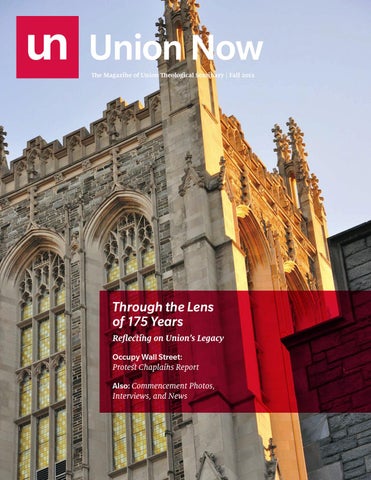
On the Cover: Union Theological Seminary at sunset. Photograph by Roy Weinstein
Visit us online: utsnyc.edu Like us on Facebook: facebook.com/uniontheologicalseminary Follow us on Twitter: twitter.com/unionseminary
2
union now | FALL 2012
Contents Features
Through the Lens of 175 Years
18
Union celebrates its 175th anniversary with a gala and reflections on what Union means; past, present, and future.
Occupy Wall Street
28
Protest Chaplains report on being at Zuccotti Park during the occupation, and what OWS continues to mean for Union and theology.
Departments
175th Gala & Symposium
32
Commencement Photos
34
President’s Message
2
News Briefs
3
Board Report
36
Class Notes
40
In Memoriam
42
2011/12 Annual Giving Report
44
18
28
32
34
President’s Message
Dear Friends,
I
“
Teaching and working in this intersection of individual faith traditions and public life is precisely where Union has stood for 175 years and never has this work bridging democracy and religion been more needed. The time for Union is now.”
2
union now | FALL 2012
t has been a milestone year at Union! We are now officially over 175 years old, and our legacy of celebrating and working toward social justice, interfaith cooperation, and progressive Christianity in America and around the world is indeed alive and very well. This past year we have welcomed countless visionaries and conferences to campus, hosted world-renowned artists and activists, and continued pioneering groundbreaking programming such as the Poverty Initiative, the Institute for Women, Religion, and Globalization, the Institute for Art, Religion, and Social Justice, and the Edible Churchyard. We have also welcomed the Rev. Dr. James A. Forbes to his new position as the Harry Emerson Fosdick Distinguished Professor and are excited for many great collaborations in the coming years. Looking toward this fall and to Election 2012, it is clear that we are a divided nation, indeed a “passionately” divided one. America has always been a country passionate about, obsessed with, and yet completely confused by how we talk about religion and politics. While no one can deny the impact of faith on our individual visions for how we should live our political, civic, and economic lives together, we must also admit that the majority of us receive very little instruction on how faith and politics best meet. Teaching and working in this intersection of individual faith traditions and public life is precisely where Union has stood for 175 years and never has this work bridging democracy and religion been more needed. The time for Union is now. Union’s students and alumni/ae are the heart and soul of this work. This past year, our students found their voices as leaders in the Occupy Wall Street movement as well as through student actions pushing for racial and economic justice here on our own campus. I am proud of our entire community’s intelligence and commitment to standing up wherever injustice is perceived to occur. One of the great things about Union is the Spirit that calls us everyday into the truth and witness that we must profess to this
world, and to each other. Union students—past and present—do this in ways that continue to shake the world and share God’s presence here on earth. This coming year promises to bring with it many new excitements, challenges, and opportunities for all who have spent time in these cloistered halls. We look forward to two professors joining the faculty this coming term: Dr. Cornel West, Professor of Philosophy and Christian Practice, and Dr. Jerusha Lamptey, Assistant Professor of Islam and Ministry. We are currently planning a three-part lecture series with Dr. Eboo Patel to start this September, are excited to welcome Bill Moyers as the 2012 Forrest Church Lecturer, and are hosting Enlightenment and Liberation: Engaged Buddhists and Liberation Theologians in Dialogue this spring. We have solidified our five-year strategic plan, are well on our way toward meeting year one objectives, and our staff, faculty, and Board are excited for the great road ahead. Personally, I will be working with our Institutional Advancement team to secure funding for the Jackson-Mitchell Chair as well as other core fundraising initiatives. Of course, this road ahead will never be straight and will seldom be easy, but it is the path we must trod. Union calls us to do nothing less. I look forward to traveling with you this coming year. Please, be in touch and come for a visit. Grace to you,
The Rev. Dr. Serene Jones President Johnston Family Chair for Religion & Democracy
NEWS BRIEFS
Johnston Family Chair for Religion and Democracy Created by $3 Million Gift
Virginia, Michael, and Mary Johnston at Union’s 175th Anniversary Gala Celebration. On February 10, the Rev. Dr. Serene Jones, President of Union Theological Seminary, announced that Mr. and Mrs. Michael J. Johnston of Gladstone, New Jersey, gave $3 million to create The Johnston Family Chair for Religion and Democracy. The chair, which is fully endowed upon its creation, will support scholars whose work explores the crucial role religion plays in American politics and society. “At Union, our role is to prepare progressive faith leaders committed to keeping our nation’s democratic spirit alive and flourishing. Christian leaders should be our culture’s strongest advocates for democratic practices. At its core, Christianity espouses the most basic democratic principle of all—that people are fundamentally equal in worth and value,” said Dr. Jones. “The Johnstons’ generous gift comes at a particularly auspicious moment, as our nation struggles to reaffirm its collective belief in our fundamental equality. In many circles, people simply no longer believe in our shared human worth, particularly when it comes to economic equality.” Union is in the process of establishing an Institute for Religion and Public Life, and The Johnston Family Chair is the first step toward the full realization of this plan. As the ninth currently endowed chair at Union, the Johnston Family Chair will join others such as the Reinhold Niebuhr Chair in Social Ethics and the Paul Tillich Chair in Theology, World Religions and Culture. Michael Johnston, a retired executive vice president of the Capital Group Companies, said “I remember Mary’s mother, Virginia Bennett, talking about the social gospel, and how she used to study books by Reinhold Niebuhr and Dietrich Bonhoeffer back in the 1940s. This was my first introduction to progressive theology, which is the theology that’s taught at Union. It made a lasting impression on me.” Mr. Johnston continues, “When you look at the current state of governmental dysfunction in America, it seems an important time to remind people that separation of church and state does not mean a separation of values from democracy.”
“Religion can greatly benefit people, but it can be used for harmful purposes, too,” said Mary Johnston. “By funding a faculty position dedicated to teaching at the crossroads of religion and democracy, our hope is that we are helping prepare future faith leaders who will be equipped to heal some of the strife that has been caused in God’s name.” “We are deeply grateful to Mike and Mary Johnston for their generosity and for recognizing Union’s pioneering role in progressive theology,” said Mary H. White, M.D., former Chair of the Board of Trustees for Union Theological Seminary. “At the express stipulation of the Johnstons, the first person to hold the Johnston Family Chair will be Union’s President, the Rev. Dr. Serene Jones. This spotlights the heart and soul of Serene’s presidency, which is making sure that Union’s students learn to be both religious scholars and democratically engaged leaders.”
Mr. Michael J. Johnston is a retired Executive Vice President and former member of the Board of Directors for The Capital Group Companies. He was also a Director and onetime Chair of American Funds Distributors, Inc., a subsidiary of the Capital Group. Prior to joining the Capital Group in 1986, he was president of Paine Webber Capital Markets, and was a director of Paine Webber Group. Mr. Johnston is a member of the Board of Trustees of Union Theological Seminary, as well as the Chair of the Board of Trustees of The New School. He is also a trustee and former chair of the board of Claremont Graduate University, and a member of the board of visitors for the Center for Politics and Economics at Claremont. Mr. Johnston’s other affiliations include trustee and vice president of the Schumann Center for Media and Democracy, and membership on the advisory board of the United Nations Foundation’s Investor Network on Climate Risk. Mr. Johnston is a past chair of the Harvard Business School Club of New York, a past trustee of American Prospect Magazine, and a past advisory board member of the Aspen Institute Initiative on Financial Security for the Poor. He holds an M.B.A. from Harvard Business School and a B.S. from the University of Kansas. Mrs. Mary C. Johnston, who passed away Tuesday June 12, 2012, was a harpist with a degree in music from the University of Kansas. Mrs. Johnston was a past president of The New Jersey Youth Symphony, as well as retired president of First Strings, a harp rental company. Mrs. Johnston’s philanthropic and charitable work extended to service on the boards of several organizations, including Raritan Headwaters Association, The Life Camp, and The Truman Library Institute. Upon her passing, President Dr. Serene Jones wrote “Mary, in all parts of her gracious and loving being, embodies the best of our human aspirations. She is deeply loved at Union. We will miss her warmth and kindness.”
union now | FALL 2012
3
NEWS BRIEFS
Engaging in the World Institutes and Initiatives at Union Foster Vital Dialogue
left: Liz Theoharis, founder of the Poverty Initiative, with Dr. Gary Dorrien and Union Board Member Wolcott B. Dunham, Jr., addressing a symposium on poverty and social justice. Virginia Worden’s remarks were delivered in absentia by Colleen Wessel-Mccoy. right: Leymah Gbowee, Liberian peace and women’s rights activist—and later Nobel laureate—speaking at the inaugural lecture of The Institute for Women, Religion, and Globalization, recently established at Union to highlight the important voice of women in the discussion of religion and global issues. Union has a history of bursting out of its boundaries to engage in the world around it. Since its first alumni project in 1895, known as Settlement House, Union has fostered a level of involvement with social justice issues that cannot be contained in the halls of the academy. Today, Union continues to look outside itself to find relevance for the progressive, pragmatic theological dialogue of its classrooms. Nearly ten years ago, The Poverty Initiative was conceived and founded by then Master of Divinity student Liz Theoharis, a PhD candidate and candidate for ordination in the Presbyterian Church, along with Willie Baptist, a former homeless activist and organizer, now author and instructor. The two of them, along with a group of students, faculty and community leaders, with the support of the Union administration, created an organization “dedicated to raising up religious and community leaders in a movement to end poverty, led by the poor.” The Poverty Initiative is based on the premise that the leaders who are best qualified to effect change are those who understand first hand the challenges that change must address. Grounded in the principles of Martin Luther King, Jr.’s Poor People’s Campaign, The Poverty Initiative seeks to identify and train “many Martins.” These individuals are
4
union now | FALL 2012
collaborative approach. Such is the very real commitment to a living and relevant theology, planted and fed at Union, and intended to reach out and feed the world. Appropriately, founder Liz Theoharis was honored at Union’s 175th Anniversary Gala for the work that embodies Union’s legacy of social justice and continued commitment to innovative perspectives on service. Two more recent “jewels” in Union’s practical theological crown, The Institute for Women, Religion and Union continues to look outside itself to find Globalization, and The Institute relevance for the progressive, pragmatic for Art, Religion and Social Justice theological dialogue of its classrooms.” are also intended to build vital dialogues between the their individual efforts by collaborating and sharing information and techniques. academy and the world beyond its walls. The Institute for Women, Religion and The Poverty Initiative has successfully Globalization, established by the Union cut across boundaries of race, region and administration under current president religion, broken down artificial barriers Serene Jones, has as its mission the between the academy and the streets, establishment of a forum for the voices of and stood with a myriad of communities women around the world who are using as they have pursued justice. This year, their intelligence, intuitive understandThe Poverty Initiative’s methodology ing, and religious and faith practices to has been captured in its newest publicabring about positive change in the global tion, “Pedagogy of the Poor.” Leadership community. The Institute recognizes the from the group, including authors, complexities of a world that is increasWillie Baptist and Jan Rehman, will be ingly interconnected economically, touring to promote the book and raise politically and digitally. It lifts up the awareness about the potential of their often already engaged in meaningful activity in their communities, lacking only the structure and theory of the academy and the resources of institutions of power. Their disparate groups operate in their local venues on particular issues, often unaware of the connective tissue that binds them to people who may look or sound different from them. The Poverty Initiative provides methods and forums that reveal their commonalities and promote their ability to strengthen
“
voices of women, as it is women who are most vulnerable as well as most deeply in tune, in many cases, with the real human concerns of a potentially dehumanized expansion of ideologies from first world to 2/3 world countries. The Judith Moyers Women of Spirit lecture series quite literally provides a platform for women leaders to speak out on issues in which they are engaged. The inaugural lecture in 2010 by Leemah Gbowee raised up the power of prayer and women’s agency around sex in the context of seeking peace. This year’s honoree, Dr. Vandana Shiva, spoke to the life and death issue of food production in a global market, from the perspective of her own experience as a scientist turned organic farmer
and environmental activist. Clearly, The Institute for Women, Religion, and Globalization is dedicated to a worldshaping dialogue with the potential to affect the future of the world that we share and for which we have ultimate responsibility. The Institute for Art, Religion and Social Justice seeks to shine light on the power of the arts to move the hearts and minds of people and enable them to experience the world around them differently. Moving beyond the traditional modes of teaching and learning from texts and lectures, The ARSJ explores the often-untapped power of visual, media, and performative arts to reach beyond words and inspire action. Students as
well as visiting and resident artists provide exhibitions, presentations, and interactive installations that provoke thought, promote reflection, and point toward real substantive responses in a range of arenas including gender equality, environmental stewardship, and interfaith dialogue. Union’s vision opens the doors of the institution to let in the fresh ideas that spring from the vast and ever-changing world outside, with a goal of bringing its pragmatic theological lens to bear and sending out leaders who are betterequipped and energized to meet the challenges and minister to the needs of that diverse and vibrant world and ensure its continued thriving. — Thia Reggio
What’s the Over and Under with Mike Maloney & Facilities
Mike Maloney, the Deputy Vice President of Buildings and Grounds, sat down with me and walked me through several of the capital projects and the day-to-day operations at Union. 2012 marks the 9th year that Mike has been with Union, and he brings considerable skill and acumen to Union, having managed buildings on Wall Street as well as the top 15 floors of 1 World Trade Center. Over the past nine years, Mike’s role in the community has grown beyond facilities to include teaching an SU course on Church Maintenance called ‘How To Get Your Boiler To Testify’ and having preaching at daily chapel.
Maloney took me underground into the boiler systems, underground tunnels, and onto the James Tower roof to see the work being done and parts of the buildings rarely seen by student eyes. The cavernous underground spaces are astonishing in their extensiveness, not to mention the equipment in them that maintains the running of the seminary. Though there is a wish list for capital projects to be completed (like getting air conditioning into both the Refectory and Social Hall), he said ultimately “the building will let you know where to go next.” Reflecting further he said, “though the buildings require restoration, Union has a way of grabbing hold of you. If you have a historical or architectural love, like I do, you want to be here to see the work completed”. Many still remember when one of the James Tower spires fell from the roof in 2008. What was expected to be a twoyear restoration has taken four years due to disputes with the insurance company, vendor negotiations, and complications regarding the landmarked status of the tower. However, the first phase of the reconstruction will be completed in the summer of 2012. The second phase—the securing of loose stones in the lower facade of the tower—will be complete
by the summer of 2013. Each spire has been replaced with a concrete fiberglass composite material; longer living than the original limestone. Maloney and Facilities are always working on a number of very large and small projects. For example, they are currently installing emergency lighting for the Refectory-Social Hall and the recent (and unanticipated) Lampman Chapel asbestos removal as part of a heating upgrade. Facilities has also played an integral role in the work of Union’s Edible Churchyard initiative. The Edible Churchyard is teaching future leaders about food justice and urban agriculture, while serving as an on-campus learning lab transforming parts of campus into spaces to grow vegetables and plants native to New York. The Edible Churchyard, in partnership with Facilities, has built raised beds and instituted composting on the roof of McGiffert Hall. Together, they have also broken ground on a garden of edible native plants on the north end of the Quad—just in front of Knox Hall. The scope of Mike’s role at Union is impressive and it is with anticipation that I look forward to his continued work in and with Union’s campus. — Luke Daniel Bauman
union now | FALL 2012
5
NEWS BRIEFS
Communication is Key An Interview with Wade Bennett and Nina Kalandadze, Union’s Communication and Marketing Team by JA SON W YMAN What are some specific current projects? WB: One of the most important projects we’re working on right now and which will soon be complete is a website redesign. The project is going to change the digital imprint of Union. That project alone has been enormously important for us to deliver. The new design reflects the beauty of this place, and I’m very proud of it. For the first time Union will be able to offer modules like an online application, a completely paperless way of applying to Union; and Student Services online, which will allow current students to engage with each other, to engage with us, to get grades, and to handle bills online. It will also allow students a paperless way to view, select, and enroll in courses online. August is the tentative time for launch.
Wade Bennett
Nina Kalandadze
Tell me a little about your positions at Union and where you were before you came here. Wade Bennett: I am the Director of Communications and Marketing. Prior to that I was an assistant director for Marketing and Advertising at Columbia’s School of Continuing Education. Nina Kalandadze: I am Assistant Director for Web Communications. Prior to this position I worked for Religions for Peace, which is an interfaith NGO within the United Nations. WB: I am primarily responsible for six areas of communications. They are web communications, marketing and advertising, publications, branding and identity awareness, internal communications, and public relations. All of those functions are important as they relate to managing the seminary's profile on the local, national, and global levels. NK: I help with web development and web communication, including website redesign and blog redesign.
How do you try to incorporate the theological and pastoral mission of Union into your work? WB: When I was looking for a position I came across this amazing job description, and when I started reading about economic justice, social justice, equality, liberation theology, and faith and fairness, it lifted me up just reading it. When I realized this amazing place, Union Theological Seminary, was just down the street I had a belief that not only did I want to be there, I needed to be there. I believe so strongly in what our students are doing here. NK: I worked for Religions for Peace, which is an interfaith NGO that works with senior religious leaders, and therefore a lot of my work was with religious leaders. To come to an institution that produces and trains individuals to one day become senior religious leaders was something that was very important to me. Also Union has this non-denominational/interfaith culture, which was also very important to me on a personal level. I come from a family where my mother is Jewish and my father is [Georgian] Orthodox Christian, and so it feels comfortable, and I’m passionate about it. Since you’ve each arrived, have there been any things about Union that were surprising?
What new kinds of communication are you exploring at Union? NK: Social media, prior to Wade coming here, wasn’t [fully] explored. We're trying to be more engaged with social media so that it’s not just us talking at someone but it’s a dialogue. WB: Engagement is the push and the pull of our constituency. Routinely keeping them in tune with what’s happening here. That’s really important and a really big difference with how things were done in the past.
6
union now | FALL 2012
WB: I was aware of the diversity of denominations but not quite to the extent that I discovered when I arrived here. It has only added to the richness of this place knowing that there are over 40 faith traditions, Christian denominations, and other belief systems and worship traditions here. NK: I think what surprised me the most is the openness of the community. You kind of feel like you’re a part of it very easily. I think that’s rare to find in a job.
WB: Being a member of the LGBTQ community, my early upbringing did not include any provision for acceptance, understanding, or even acknowledgment. So being openly gay and understanding that there is a place that not only accepts and acknowledges, but holds up and rejoices and includes people in my community is enormously humbling for me to the point where I can barely believe it. Union doesn’t just talk about it but acts on it. It’s not only manifested in dialogue and discussion but in action, and I really appreciate that, and am proud to be part of it. NK: I feel like there’s often an understanding that going to a service is a super serious thing and it’s stuffy and conservative.
And I think one of the things I’ve learned is that it doesn’t have to be like that, and it’s not like that here. WB: The story of Union to me is one of the greatest stories never told, or not told as well as it could be. We want to leverage technology to make sure that it gets told, to throw open these wonderful wooden doors on this beautiful campus. When you discover something that is beautiful and true and honest and that people can relate to, you want to share it. And that is something that is very important to me professionally and in my personal life. We believe very strongly in the legacy and in the future of Union.
A Stronger, Global Union: A Five-Year Strategy for Growth In the spring of 2010, Union’s leaders embarked on a journey of strategic planning that aims to ready the path for our prestigious institution’s leap into the future. Through a multi-point, five-year plan of action, a committee appointed by the Board of Trustees and coordinated by Executive Vice President Fred Davie will oversee our institutional progress on this ambitious undertaking. With a commitment to motivating forward while keeping our historic tradition and legacy close at heart, the strategic plan hopes to propel Union into a new era of growth by focusing on five areas of opportunity: Academic Excellence, Campus Renewal, Civic Engagement, Congregational Support, and Updated Technological Advancements. When we sat down to draft the planning process, two questions were central to its core: • How should Union interpret its historic Christian mission in the future? •H ow can Union best advance its mission in a manner that is financially and institutionally sustainable? The completed plan reaffirms Union’s educational mission, and ensures a commitment to the seminary’s continuing vitality through a comprehensive strategy based in mission driven growth. In keeping with Union’s long standing commitment to academic excellence, in the next five years Union plans to increase faculty recruitment and retention, revise the core curriculum, restructure/revise the M.A. and M.Div. programs, and launch a D.Min. program. Addressing the goals for campus renewal, we will upgrade classrooms and facilities to state of the art media capacity, renovate necessary parts of the campus, focus on green initiatives, and reduce the overall cost of the facilities operating budget. Continuing in our founders’ legacy of a seminary deeply rooted in the community with which it is located, Union hopes to grow in its commitment to civic engagement through continued development of programs such as The Institute for Women,
Religion and Globalization, The Institute for Art, Religion, and Social Justice, The Edible Churchyard, The Poverty Initiative, and the VERITAS Partnership. Recognizing the changing faces of traditional ministry, and both the new challenges and the new opportunities that come along with shifting religious mores, Union hopes to invest in wide range congregational support measures to offer its students. These include continual expansion of the Field Education program, implementing a mentoring program between alumni/ae and current students, and an ongoing commitment to student spiritual development, exploration, and support. As Union moves further into the future, it must remain a world-class institution with a comprehensive understanding of technological advancements. In addition to updates in technology from a facilities perspective, Union seeks to pursue a partnership with Columbia to create a Center for New Media and Religion within Burke Library, strengthen and expand the work of The New Media project, and ensure all graduates develop basic competency in new media. President Jones, as a visionary of the plan, and a key instrument in its implementation, also reaffirms the institution’s commitment to diversity within its student body, its recruitment efforts, and its academic, entertainment, and worship offerings. A key part in Union’s growth derives from the supportive foundational legacy and strength of our Alumni/ae. Any Alumni/ae interested in becoming more involved in the growth efforts of the Strategic Plan are invited to contact the Office of Alumni/ae Affairs at 212-280-1590. Together, Union can move forward into the next five years a stronger, global institution more necessary than ever. — Dana Ribeiro
union now | FALL 2012
7
NEWS BRIEFS
Dr. Vandana Shiva Delivers the 2nd Annual Judith Davidson Moyers Women of Spirit Lecture “Making Peace with the Earth: A Spiritual Imperative, A Survival Necessity” On March 22, Dr. Vandana Shiva visited Union to teach and lecture on her environmental activism and scholarship. In cooperation with Union’s Institute for Women, Religion, and Globalization, Dr. Shiva delivered the second annual Judith Davidson Moyers Women of Spirit Lecture, entitled “Making Peace with the Earth: A Spiritual Imperative, A Survival Necessity.” Her lecture in James Memorial Chapel focused on the importance of seed sovereignty (freeing crop seeds from corporate patents and ownership), local female farmers, and human nutrition. “Scarcity is the result of greed,” she said, “not of the earth’s ability to provide.” She sees this ecological concern as a religious conviction, since the human race is born indebted to Lakshmi, Hindu goddess of abundance and wealth. Dr. Shiva ties this religious conviction to her activism, especially her legal battles against corporate seed patents that hinder communities’ ability to produce their own food. Dr. Shiva began her activist career in an unlikely place: studying for her doctorate in quantum theory. Gandhi and Einstein are her “deep inspirations” who help her see science and religion as interrelated searches for truth. From Gandhi she learned the virtue of simplicity, which she absorbed through her father who only owned one suit. From Einstein she learned to love science for its “new layers of inspiration.” Although these inspirations come from men, she focuses her research and activism on the betterment of women’s lives, especially of local female farmers. In addition to the lecture and panel, Dr. Shiva visited Dr. Janet Walton’s class “Women’s Experience as a Resource for Worship.” During a question-and-answer session with master’s and doctoral students, Dr. Shiva addressed issues of religion and science, women’s empowerment, and the need for communal ownership of food production. “You don’t have to be a farmer to be involved in issues of food justice and earth justice,” Dr. Shiva said. She called for all people to build local food communities where consumers know the gardeners who produce the food they eat. She views this as a way of preventing
“
Scarcity is the result of greed, not of the earth’s ability to provide.”
destruction, disease, and misery. While she was critical of Union’s use of plastic bottles in the Pit, she praised Edible Churchyard’s McGiffert Rooftop garden as an example of a local food community. As the second person to give the Women of Spirit Lecture, Dr. Shiva exemplifies the qualities that Judith Moyers envisioned when she founded the lectureship. Dr. Shiva addresses the pressing global issues of food justice and environmental justice, encouraging public discussion and education around issues of health and poverty. In 1982 she founded The Research Institute for Science, Technology, and Ecology, which conducts independent research on pressing social and environmental issues. In 1991 she founded Navdanya, an organization dedicated to seed sovereignty, fair trade, and organic farming. Her projects have left to right: Julie Leininger Pycior, Katherine Clark, Judith Moyers, and Aaron Cohen at the reception for the 2nd Annual Judith Davidson Moyers Women of Spirit Lecture.
8
union now | FALL 2012
garnered international recognition: Time Magazine called her an environmental “hero” in 2003, and Asia Weekly listed her as one of the five most powerful women in the world. After the lecture, prominent female environmentalists responded to Dr. Shiva’s ideas. President Jones emphasized the importance of conversation, the “back and forth of shared lives” brought to the evening by Dr. Ellen Davis and Classie Parker. Dr. Davis, Amos Ragan Kearns Professor of Bible and Practical Theology at Duke University Divinity School and former professor at Union, spoke about a biblical theology of land and agrarian ways of reading the Bible. “The Bible does always get it so right,” she said, from the biodiversity portrayed in Genesis 1 to the valorous woman in Proverbs 31. In contrast to the agrarian Israelite writers of these passages, many readers of the Bible today think in terms of “consumption, not production.” For Dr. Davis, connecting with the land provides a way to read the Bible better, one that allows for care of the earth and the building up of women.
Community activist Classie Parker, whom Pres. Jones described as “a legend in this neighborhood,” exemplifies Dr. Shiva’s focus on tending to local crops. Parker described herself as an “urban farmer in a city oasis,” an introduction that was met with rousing applause. Her community garden on 121st Street between 7th and St. Nicholas Avenues serves as a laboratory for nutritious food production, canning, and interpersonal connection. Her garden “proved to be nourishing both physically and spiritually,” transforming the neighborhood, garnering respect and care from the very people who used to throw trash there. It became a communal meeting-space. “When you’re working with the land and connecting to people, your life is gonna change,” she said; “…everything you need to sustain your body, spiritually, emotionally, and physically is in the earth. And that’s why I love the garden.” At the reception after the panel discussion, the presenters and guests enjoyed food and drink sourced from local companies and farmers. — Daniel J. Rohrer
Rev. Dr. LaVonne Althouse ’59 Establishes Scholarship Alumna Funds Need-based Scholarship for Women to Study at Union
Her gentle smile and soft voice are easily remembered. However, the dynamic behind this unassuming personality truly generates awe. The Rev. Dr. LaVonne Althouse ’59, telephoned a while ago to discuss making a gift to Union. The gift was originally destined to be an estate gift, yet discontent with the way her investment was being managed prompted Althouse to consider making the gift sooner rather than later. Our conversations continued for several months and I met
Rev. Althouse at her home in Pennsylvania to finalize her gift designation. It was an afternoon I will not forget. Rev. Althouse is a woman I will not forget. Rev. Althouse spent nine years in New York City and the rest of her life in Pennsylvania, but has travelled extensively throughout the world participating in conferences often relating to women and religion. While she is a retired ELCA pastor, Althouse still edits The Woman’s Pulpit for the international Association of Women Ministers. Our lunch was shared in a lovely sunroom overlooking her backyard. She lives simply yet comfortably and showed me a plaque which read, “Love is a basket with 5 loaves and 2 fishes. It’s never enough until you start to give it away.” The fullness of Rev. Althouse’s basket is learned through her life’s decision to provide a specific portion of her income to others. She believes fervently that we are all children of God and she lives a life of thanksgiving by helping other children of God. The scholarship to Union, The Martin Elwood Fry, Sr. and Kathryn Groff Fry Scholarship, was named after her maternal grandparents and continues Althouse’s legacy of providing for others. This is the fourth scholarship she has established: two at Penn State and one at Palmer Seminary. The only parameter she expressed for the issuance of the scholarship funds was that the funds be given to “a woman in genuine need.” This from a women who, herself, is genuine. —Kevin McGee
union now | FALL 2012
9
NEWS BRIEFS
Admissions & Enrollment to Rise as Union Greets the Next Five Years Over the next five years Union seeks to strengthen and expand student recruitment efforts to increase admissions and enrollment. With the Administrative and Board support of the newly implemented strategic plan behind her, recently appointed Associate Dean of Admissions and Financial Aid, Nichelle Jenkins ’11, seeks to expand Union’s Admissions growth into uncharted territories. Ms. Jenkins, a 2011 graduate of Union, with an extensive background in law and legal services, is an exciting addition to the Union Administrative Team, and has hit the ground running in her attempts to strengthen recruitment efforts in spite of the challenges presented to her. Union has gone against the national trend of declining enrollments in the theological field and has seen a slight increase in applications, and a stable student body size. However, within our institutional history, Union’s level of enrollment has consistently declined from an all time high at our peak in the 1970’s, to an average of 250 students over the course of the last two decades. In addition, the proportion of Union’s currently enrolled full time students seeking ordination in mainline
Protestant churches is shrinking proportionally to the decline of mainline denomination churches in general. Union is also facing an admissions challenge in that, compared to our peer institutions, we admit higher percentages of applicants, and yet enroll a lower percentage of students. In an effort to rectify the overall decline in enrollment rates and bring Union back to the student body numbers of its heyday, Nichelle and her team hope to strategically grow the student body by eight MA/M.Div. students per year for the next five years. Once the D.Min program, currently in development, is approved and instituted by the board, the Admissions Team will seek to enroll at least twenty D.Min students per year for the next five years as well. One of the ways that Union hopes to increase the breadth and scope of their recruitment efforts is through our newly created Alumni/ae Ambassadors program. Alumni/ae, with their extensive knowledge of the Union experience and their passion for the Union community, are a great way to reach prospective students throughout the country, thereby expanding the Admissions Team from a department of three, to a department of over 5000!
10
union now | FALL 2012
The Admissions team has also recently implemented a number of new and exciting initiatives for prospective students. In addition to the full day tours traditionally offered through the Visits Coordinator, the Admissions office now offers Drop-In Tours as well. Drop-In Tours are available during set days/times each semester and allow busy prospective students to see the campus, chat with admissions staff, and be on their way in less than an hour. These brief snapshots of Union allow prospective students to make a more well rounded application decision. Another exciting initiative has been the Prospective Student Admission Information Sessions. These open houses, held three times each semester in the evening, give prospective students currently engaged in other careers and/or commitments, the opportunity to visit campus at a time convenient to their schedules. Framed around the question “Why Union?” and strategically planned to run concurrent with exciting worship and events on campus, the open houses include a Q&A with current students, faculty, alumni/ae, and the Admissions Team, and a tour of Union that concludes with an invitation to join the Union Community at a community event. Perhaps the most exciting development in the world of Admissions is the newly revamped Union Days. In a joint effort between the Office of Admissions and the Office of Student Life, Union recently hosted an “Admitted Students’ Day” where nearly 25 currently accepted incoming students spent a morning on campus. The event, a time of information and celebration, was purposed to help admitted (and a few still deciding) students continue to feel positively about matriculating at Union and begin to integrate them into the Union community. During their time on campus, new students had breakfast with current students, and had the chance to meet Executive Vice President of Operations Fred Davie, Dean Yvette Wilson, and the Office of Student Life Team, various faculty members, as well as get to know their Orientation Team. Admitted students participated in a Q&A and also took a tour of campus, and a tour of campus housing, followed by a chat with Housing Director Michael Orzechowski. This exciting morning of events culminated in community worship in James Chapel where the talents of our worship team were on display, and gave newly admitted students the opportunity to see the diversity that would characterize a day in their life at Union! With fresh and innovative ideas, a commitment to strategic growth, and a dedication and love for Union, the Admissions Team is enthusiastically embracing the future of Union and growing our alumni/ae network in the process! — Dana Ribeiro NOTE: If you are an alum interested in attending recruitment fairs, hosting open houses, and/or e-mailing/phone chatting with prospective students in your immediate area, or if you are a local alum and would like to attend a Prospective Student Admission Information Session, please contact Nichelle Jenkins, Associate Dean of Admissions & Financial Aid, at njenkins@uts.columbia.edu to learn more about becoming an Alumni/ae Ambassador.
Union in the News Union Students and Faculty Maintain High Profile in National News
W
ith its world-class faculty and strong reputation for social leadership, Union has always had a prominent place in national conversations about religion and its role in American politics. This year has been no exception, and with Occupy protests gaining momentum in New York and elsewhere, Union students and professors have appeared frequently in every corner of the media.
he expressed hope for the future of the Happens When a Seminary is Occupied?” movement. In that article President Jones closed In coverage of Occupy beyond the by mentioning another news story that Grey Lady, Judson Church Community has put Union in a national spotlight— Minister and Union student Meredith legendary professor Cornel West’s return Kadet (M.Div. ’13) was quoted in several to Union, where his teaching career publications—most notably The Christian began in 1977. Even though national Post—explaining the theological signifipapers and networks widely reported cance of economic protests. And a piece Dr. West’s departure from Princeton and by Carolyn Klassen (M.A.,’13), on the Union homecoming, Dr. West’s digital intersection of Occupy, queer ethics, and fans and followers also lit up Twitter and Judaism appeared Facebook for days with excitement about in New Voices, a the announcement. Jewish students’ Union’s footprint in digital media, The New York Times – November 11, 2011 publication, in further, is growing in many directions. “ At ‘Occupy’ Protests, Bearing Christian Witness March. Professor David Carr contributed comWithout Preaching” by Mark Oppenheimer Kadet, a theomentary to The Huffington Post this year logical student at on the relationship between Hebrew “ All of us respect the title of chaplain, which inherently Union Theological Bible studies and the birth control suggests we are there for other people,” Ms. Richmond Seminary in New debate, and Professor John Thatamanil said. “No chaplain would ever impose their own beliefs York City as well blogged there on the significance of on someone else who has come for help.” Whether in a as a community trauma theory in a reflection on 9/11. hospital, in the military or at an Occupy event, chapminister at Judson HuffPo’s religion editors also gave lains are not evangelists, Ms. Richmond said. Memorial Church, accolades to Union’s Poverty Initiative— was present at the a clear sign of that institute’s increasing OWS protest Sunday to help counter the profile. Major newspapers cued in quickly perception that Christianity is ideologiThe Poverty Initiative also received to the role of Union students at Occupy cally opposed to helping those hurt by coverage for their role in “The People’s Wall Street, and as these students speak the economic crisis. Bailout,” an organization of church leadto reporters and advocate for their ideAt the heart of Kadet’s religious reaers, laity, and other concerned citizens, als, they have represented Union well soning was a philosophy that believes who protest bank foreclosures by showin their roles as young activists, thinkJesus sides with the poor. ing up at auctions and singing gospel ers, and organizers. Some of the most “I think Jesus considered himself to songs over the proceedings. Key publicainteresting coverage has centered on be part of a long line of prophets who tions including The Village Voice and the a chapter of “Protest Chaplains” made spoke for the poor and rejected,” she Times Ledger continue to report on the up of Union students. Recognizing the said. “That’s why we came here today…He positive impact of these protests. need to integrate their pastoral callwould be here.” Finally, rounding out Union’s influings with their activism, these students ence on the news maintained a visible chaplaincy presthis year, public ence at Occupy Wall Street throughout The Christian Post – October 10, 2011 radio listeners had the fall—which earned them the notice “On Occupy Wall Street” By Ray Downs the chance to hear of The New York Times. Erica Richmond Union Professor (M.Div. ’13) spoke in detail with reporters “ Jesus would have provided the poor with fish and Gary Dorrien on from the Times about the intersection of bread—even if they could not afford to pay back a WNYC’s Leonard faith and action among Union’s studentloan,” Meredith Kadet, 29, told The Christian Post. Lopate Show in chaplains, and also appeared in a PBS March, discussing segment on the topic. progressive politics and the state of the Not only students weighed in on the Union gathered another nod from the Obama administration. Widely published politics of Occupy this year, though. Times when Anton Woronczuk (M.A. ’13) and interviewed, Professor Dorrien’s President Serene Jones led the way for contributed to a New York Times “Room commentary also appeared this year commentary among Union faculty when For Debate” panel on the effectiveness of in America magazine and The Christian Occupy Wall Street’s tactics, also running she published a meditative piece in The Century. — John Gleim Huffington Post titled “Protest 101: What an opinion piece by Woronczuk in which
union now | FALL 2012
11
Q/A
r. Yilu Chen, the Executive Vice President of D Nanjing Union Theological Seminary by JA SON W YMAN Why did you choose to come to Union? What made it a place the delegation wanted to visit, and what did you want to learn here?
On April 18, I spoke with Dr. Yilu Chen, the Executive Vice President of Nanjing Union Theological Seminary. Here with a delegation of Chinese theological scholars on behalf of The Foundation for Theological Education in South East Asia, Dr. Chen and I, through his translator Shi Meiying, discussed the point of their visit, the places they would see, and the similarities and differences between theological education in North America and Southeast Asia. Union was one of several places Dr. Chen and the delegation visited during their time in North America.
12
union now | FALL 2012
We know that UTS is a very old seminary. In China before 1949 there were many Union Seminaries. Those Union Seminaries in China had connections with this school. Now in China we still have 2 seminaries named after Union. One is Quang Tung Union Seminary. In the past many of our faculties were Union graduates. Now I am the president of Quant Tung Union Seminary. So from a long time ago I already knew there was a Union Seminary in New York. Another Union Seminary is Nanjing Union Theological Seminary. The Seminary was founded in 1952. It was a combination of the 13 seminaries in China to that time. They hired a new president for the seminary. The new president was a graduate from this seminary. Later on he became a leader for Chinese churches. He continued his position in seminary. In 2010 he retired. I am his student. Now I am also the Deputy President of Nanjing Union Theological Seminary. I’ve been looking forward to visiting your seminary and also trying to see the possibility for collaboration between our two seminaries. What kind of inter-cultural knowledge or structures or ideas did you hope to learn and exchange in this trip to North America, and specifically to Union? On the one hand we would like to get to know about the basics of theological education in North America; what kinds of issues they [North American seminaries] are worried about; what challenges they encounter. Will these issues and challenges be the future issues and challenges of Chinese seminaries and theological schools? On the other hand we also want to know what their point of view is concerning theology. We want to
know their kinds of theology in the context of the west. We also want to know what we should think in the context of China. Through our visit we’ve gotten to know that seminaries and bible schools in North America are very concerned with justice while the seminaries and bible schools in China are concerned with the role of our seminaries and bible schools in churches in China. Here you emphasize diversity development. But we are concerned with how to do group testimony for Chinese churches. We also try to develop ecumenical theological thoughts. Ecumenical meaning internationally or mostly in China? Both. We need to think about it in our own context, but we must also have conversations with international theologians. In China we are in a postdenominational situation. We are more concerned with the spiritual life than with the liturgy or forms of religion. What are some of the differences between how theology is taught in China and North America? Theological education in China is still in the beginning of being developed. We emphasize explaining the Bible and the church ministry. Our teachers are more likely to express their thoughts. As for theological education in North America, I think many professors tend more to explain theology from the aspect of culture. For example, Asian American professors understand theology from the aspect of Asian culture. So do the African American theologians and feminist theologians. They will more likely raise their
points of view. In this way, I think theology is more diverse. Christianity will tend to be a more individual religion. But in China we teach that by understanding the Bible we can make testimonies for Jesus Christ together. The Christian faith can be a group belief. In China, many people think there is a great need for churches. In the West, many people don’t think they need churches. I think this is the difference between the theology in the two places. What other schools and seminaries were visited? We visited Princeton, Jewish Theological Seminary, and Graduate Theological Seminary in San Francisco. Were there any significant differences between the seminaries you visited in North America? I think most of the schools that we have visited think about theology from similar points-of-view. Is there anything about Nanjing Union Theological Seminary, and how it’s run, that we should know specifically? First, we emphasize biblical studies and Bible research. Recently we started a center called the “Biblical Study Research Center.” We hope that we can collect all the books or archives that refer to biblical studies research. We believe that studying the Bible is the root of studying theology. In quite a number of the seminaries in the U.S. they understand the bible from the point of view of culture, but not the bible. One point from Martin Luther’s reformation is that we have to go back to the Bible. I think this point is still meaningful for many contemporary seminaries and bible schools. Secondly, we emphasize that the personnel we
train should serve the churches in China. On the one hand, it’s because there is a large space developing for Chinese churches. While the church is developing very quickly, it has a huge need for church ministers. The West emphasized missionary work while they neglected services to local churches. Therefore, a lot of local people don’t know what the church means to them. I think these are the two major points we emphasize. Furthermore, we also pay attention to pastoral care and counseling courses and contemporary psychology studies. Mainly based on studies in the west. But China is an Eastern country that has a population of 1.3 billion. China is a very important resource for doing psychology research. So we would like to develop courses in this field. Given that you’re so interested in Biblical studies and theological libraries, were you able to visit Burke on your visit? I’m specifically thinking of Union’s legacy as to biblical studies and the resources at Burke for that. We just paid a visit to the library, but we didn’t get a chance to get to know it deeply. I found out that it is a pretty old library that stores many books. I know that when Union was founded it focused on Biblical Studies, especially back to that [early] period. This seminary introduced biblical critical theories to the west. This issue was pretty controversial then. There was a Chinese Union graduate who couldn’t bear your theory of studying the Bible so he returned to China and became an evangelist. He had a very famous saying. He said that Union Theological is the “Devil’s Seminary.” Many Chinese Christians were impacted by that saying.
Is that still a popular view of UTS? Not really because nowadays there are not many Chinese people who know about UTS. We didn’t have many graduates from your seminary and didn’t get to know much about it. Through this visit we’ve gotten a start on that. We hope we can keep up our communication with the seminary and have collaboration. Are there any programs for student and educational exchanges between Union and China? We haven’t started an exchange program yet, but we have hired many foreign teachers to teach in biblical studies. In the past we only had a small campus so we couldn’t provide qualified facilities for foreign students who stayed. Another reason is that it’s difficult for our teachers to teach in English. Now, as for Nanjing Union Seminary, we have a pretty big campus. We have a single facility that is solely for the accommodation of foreign teachers and in the future it could be a dormitory for foreign students. We do hope that we can have exchange students study at our seminary.
union now | FALL 2012
13
NEWS BRIEFS
The Arts and Worship: A Powerful Union
U
nion Theological Seminary in the City of New York is a seminary on the vanguard of the study and implementation of worship and the arts. The key to Union’s integration of the arts into worship is that the arts are not categorized into divisions like liturgical arts, media arts, musical arts, and dance arts (this is not an exhaustive list by any means). In the context of many modern worshiping communities, the term “ministry” usually follows each of these expressions of art. Union considers all aspects of these arts ministries as integral to the entire worship ritual and not just pieces of worship that are neatly scheduled within a worship service. The understanding of performance is an important pedagogical component of this field of study.
A dance performance by Sandra Rivera, co-leader of the Omega Dance Company, was part of the Union Medal Presentation in 2011.
14
union now | FALL 2012
This holistic approach to building ritual is crucial to this study of worship and the arts. A case in point would be the annual commissioning chapel to bless Union students as they head to Fort Benning in South Carolina to be a part of the annual protest of the School of Americas. In planning those services, it has been customary to include the names of those who have suffered torture, death, or who make up the disappeared; those whose lives have been devastated by the graduates of the School of Americas also known as the School of the Assassins. This school has been a training ground for many of the modern world’s dictators, despots, and military regimes, especially in the countries of Central/South/Latin America. In planning this very emotional worship services and commissioning a key question is always asked: “How do we include those who have suffered at the hands of such violence in this ritual?” In many memorial services there is a reading of the names of those who have suffered or lost their lives. This list becomes the focus of the ritualized event but it is almost as if it is a separate event itself. The reading of the names in memorials does have a very important purpose. It effectively brings the whole human being to mind so that tragedy continues to have a very real human face. It helps us with our resolve to do our best to see that we continue to strive for real peace in a hurting world. In thinking of the reading of the names from an artistic point
of view there is a freedom to think about how to bring the persons behind the names into a space in a very different and real way. The shape of the ritual event forms around this idea of bringing people we don’t know into the space around us. There are elements of consideration that speak to our very real bodies to make this so. What can we do visually that would fill the space? Maybe it is the sound of a plaintive Milonga Tango that will evoke the joy that has been stolen from a community. Or maybe it is smell of the wax on a burning candle that will bring one’s mind to an altar where prayers are placed at the foot of a statue of a saint. It could also be the grasping of a fence to remind us of the prisoners who cannot be reached by their families. These ideas in no way belittle the importance of the name but artistically bring us into the presence of the crowd behind the names in a visceral and real way. At Union, worship and the arts teaches us how to ask these questions and how to creatively fold them into worship so that the ritual has a cohesive arc of progression. Once again, understanding the entire worship experience as one ritual as opposed to a worship event with many small rituals is the foundation of being able to think creatively in regards to worship and the arts. This idea of the arts as part of one ritual also helps to address the question, “How is performing worship?” Performance is a word that causes much tension when used in conjunction with worship. For how
The War Memorial Window, James Memorial Chapel.
authentic can worship be if the artist is performing? The notion that an artist’s spiritual offering is less authentic has much less to do with the idea of performing in worship than it does with the questioning of the spiritual intentions of the artist. That is an argument that cannot be solved in an article. But the idea that performance does not happen in worship is false. A person or persons leading a ritual to create an emotional shift, a new understanding, or simply a moment of reflection is performance. Raising a loaf of bread and tearing it to symbolize the broken body of Christ is a performative act that has developed over the years. There is no proof that this is an actual recreation of what Christ did around the table, and yet in order to be brought into the power of that moment behind closed doors with Christ and the disciples, this performative act has been exaggerated in many worship settings. With this understanding of performance the motive of the artist, in many instances, becomes inconsequential. The motive of the leader of worship can also be
“White Flags” by Aaron Fein was recently on view in James Memorial Chapel. The installation represented the artist’s response to 9/11. inconsequential because it is the action performed that shifts the other participants. This is the mystery of the performed. What is being performed is a spiritual act of devotion, prayer, reflection, and other elements of worship to edify those who come to worship. Union Theological Seminary’s dedication to Worship and the Arts is not just limited to worship. It can be found as a mode of expression throughout the curricula. Just recently, a graduate’s senior thesis consisted of a quilt exhibition in the chapel space. Another’s senior thesis was a graphic novel representation of the Book of Revelation. It is not uncommon to hear monologues, original songs, to see visual artistic representations, films, etc. to express an understanding of the classroom experience and material. Not only is the idea of worship and the arts flourishing at Union, but its
department also avidly supports any student wishing to explore the arts as part of their theological training. An extension of Union’s embrace of the arts is the Institute for Art, Religion and Social Justice. This is a new venture in which art and religion is viewed through the lens of social justice. This is yet another example of Union’s commitment to Worship and the Arts. Multimedia artistry in theological education is an integral component of the Union experience. It has been so for well over half a century. From the introduction of an interdisciplinary Drama and Religion program by Bob Seaver in 1956 to the groundbreaking work of the professors of worship, Dr.’s Troy Messenger and Janet Walton, Worship and the Arts is an ever evolving and growing field within theological education. — By Derrick McQueen
union now | FALL 2012
15
Q/A
Dr. Simanga Kumalo, Director for Research and Post-Graduate Studies at the University of Zulu-Natal by JA SON W YMAN
In May, members of the African National Congress of South Africa visited Union’s campus as part of a relationship building mission and to share some of their research and activities in conversation with professors and students from Union and Norway, who visited along with the members of the ANC. I interviewed Dr. Simanga Kumalo, Director for Research and Post-Graduate studies at the University of Zulu-Natal, who filled me in on the surprising history of Union, the African National Congress, and South Africa’s struggles against apartheid. We also talked about liberation theology and the potential for a strong relationship between Union and South African theological schools.
16
union now | FALL 2012
Can you tell me a little about what the African National Congress is and what your visit is all about? The African National Congress is the ruling party in South Africa, the one that led the country to the defeat of apartheid. It was founded in 1912, so we’re celebrating 100 years. The significance is that its leader John L. Dube did his theological education here at Union. That was in 1897 when he came here. He started at Oberlin in Ohio in 1887 and he left in 1890 to go back to South Africa. He came back to the U.S. in 1897 to come and do his theological studies. He belonged to the Congregational Church which is the Church of Christ here now. He then went back to South Africa to start the first [theological] school for the African people. His hope was that it would not depend on the colonial government for support nor should it depend on missionaries. He wanted it to be run by the beneficiaries, which was the African people. But of course that was an ideal. He needed a lot of support from colleagues. He made a lot of friends.
When he was here he came with his wife. The name of his wife was Nokutuela Dube. She used to go to the different churches with Dube, where she sang. He would address the crowds about Africa and life in Africa. And you can imagine that in the 1800s Africa was still a mystery to a lot of people. So they would talk about life in Africa. And then that led to them collecting enough money for their upkeep and enough money to go back to start a theological school, Ohlange Industrial school. The same man in 1903 started the first Zulu newspaper. He was Zulu. In 1908 he was part of the delegation of African people who went to England to protest to the king about the laws that were oppressing black people. In 1920 he became the founding president of what was then called the South African Native National Congress which in 1921 became the African National Congress because they were then opening it to all other groups in good will. That organization became the organization that waged the campaign to end apartheid. 1994 is the year apartheid was ended. And that was Mandela’s organization. The organization that launched South Africa today. An important point in this, is that the other person that he went with was a man by the name of Pixley ka Isaka Seme. That man is responsible for putting together a number of political and regional organizations to form the South African Native National Congress in 1912 of which Dube became the first president. Now Seme is important because he also came here to study theology. And as he was doing his theological studies he went to Columbia where he did his law degree. And at Columbia University in 1906 he received an Award for delivering an outstanding speech entitled “The Liberation of Africa.” That became the foundation for pan-Africanism. It was used to build African nationalism for African people to fight for their own liberation. Where these people came from, for me, is very
important. They benefited from the New York City community for education and support. They came here by accident. These were poor Africans who didn’t have resources. The missionaries helped them to come here, but they needed to make it by working and being employed to literally pay their way. So Dube was the President of the African National Congress from 1912-1917. Seme was the General Treasurer. But from 1930 to 1937 he was the President of the ANC himself. Dube died in 1946. Seme died in 1952. Those were the giants who built the foundation for the liberation of South Africa. Above and beyond that there are other leaders who continued to come to Union for different reasons. I am mindful of a man named Z.K. Matthews who was a leader of the ANC. He was invited and came here as a guest lecturer and professor for almost a year. This was a man who went back to influence the ANC in the struggle against Apartheid. I am also mindful of one of the highest rated of professors named John de Gruchy who led a group that was very important in the struggle against Apartheid and was also a theologian. He came here several times as a guest professor. He came here and got his theological knowledge here. His son, Steve de Gruchy received his masters degree here at UTS. He did tremendous work to develop theological education and he was an Apartheid activist. He was arrested and participated in the struggle. He died in 2010. Now, for me, coming to Union has not just been for this meeting. It’s been a pilgrimage because I am walking on the footsteps of these great giants of our people. Which I think, therefore, the connection between the University of ZuluNatal and Union Theological Seminary is important and must be strengthened. The collaboration for the future is built on the foundation that was laid by those who went before us. I look at these two places, Union and Columbia University, with great appreciation on behalf of
the people of South Africa. Or even the people of Africa, so to speak. Because this is where people go to get their theological education and to wage the struggle. So this place has contributed immensely to the struggle in South Africa. And to the well-being of South Africa. That’s what I cherish here. In fact, when John Dube finished his degree, he was ordained here at the Louis Avenue Congregational Church in Brooklyn. That’s where he got his education. He got his education and ordination here. He came here without proper qualifications and went back an ordained man with money and partnerships for his school. Tell me a little about yourself specifically and your school. I am the Director for Research and PostGraduate studies at the University of Zulu-Natal. My school is the school of religion, philosophy, and classics. I’m here to learn about theological education. We’re hoping to build a partnership between our schools. What’s the goal of that partnership? Student exchange and staff exchange, and common seminars. But the key thing is research. To promote research. Especially on issues of religion and human liberation. We are also here with the University of Oslo, with whom we have an old partnership. Are you visiting anyplace else on this trip? I’m leaving tomorrow for Jamaica to work on a partnership in Kingston. Then I’m coming back to Nashville to go to Vanderbilt. That’s it. Then to Berlin where we have a partnership with Humboldt University. So, unfortunately we’re only here for a very short time. I would love to visit Brooklyn and Dube’s church. For someone to say the things being said by Dube and Seme in 1906, one can only contribute that to the kind of education he or she received.
How has Union informed prophetic theology in South Africa? The kind of theology that has always been done here has been one that has been radical. Anyone that came to this place got the kind of theology that was not just about business as usual for the Church but was pushing the boundaries and fighting colonization and apartheid. It’s great that South Africa was performing a type of Liberation Theology before it was specifically a thing with a name here at Union. That’s entirely the point. They got liberation theology from places like this one. This room is named after Bonhoeffer. Through people like John de Gruchy, we knew of his work. Are there still students coming to Union from the institutions in South Africa? That’s why I think the partnership is important. So we can revive the connection. And it’s important to have people come to South Africa to experience and see how we’re making life possible. And we’re doing our best to make a theology that is critical and relevant for this world. Since coming to visit have you noted any significant difference in how theology is done here and in South Africa? Not much. The issues are different but I think we all have passion for a liberating theology. One that goes beyond what we are seeing in the practices of the Church and that hopes for a better world that is inclusive of all people and more humane. All people, no matter who they are. Diverse people. That’s what we’re hoping for. Issues of economy and inequalities. So we try to do theology that talks about those issues.
union now | FALL 2012
17
Through the Lens of 175 Years Reflecting on Union’s Legacy
18
union now | FALL 2012
I
to the Upper West Side and Harlem, and in close proximity to n 175 years, Union Theological Seminary has done and Columbia University, Teachers College, and Barnard College. seen much, and even now, given the reputation it has In just over 100 years since it settled in at its current location, earned and the history it has made, it has much to do. Union has become a leader in intellectual theological research, Looking ahead to its next set of theological, ecclesiologactivism, and training in liturgy and practical theology. The ical, and cultural challenges, the community has been seminary, either as an institution, a student body, or both, has taking stock of its past and preparing for its future. Since its fostered progressive and modernist thefoundation in 1836, Union has either inology, engagements with democracy and tentionally become or been prodded into Christianity, economics and theology, being a place of activism, forward-thinkfeminist and womanist theologies, black ing, and rigorous theological education. theology, contextual and identity theoloWhile founded as a Presbyterian semigies of all kinds, LGBTQ theologies, internary, Union has always welcomed stureligious dialogue, and supported every dents from other denominations. After major justice-oriented movement in the the Briggs heresy trial of 1892 over the United States. The demand for justice use of new biblical critical techniques has continued through today, as the stuimported from Germany, Union made dent body, the administration, and everythe fateful decision to become an indeone connected to the seminary engage pendent seminary, free of ties to either in a very Union-spirited discussion over an established denomination or univerlegacy, best-practice, and institutionsity. And, though it currently has an affilal culture. Union has always been able to iation with Columbia University, it still balance being outwardly focused while proudly claims this independent, ecubeing inwardly critical and reimagining. menical identity today. Further, though This is its past, its current strength, and the work of interreligious dialogue has its hope for the future. grown at Union in recent years, it is Union has been the home of Charles pushing forward to become increasingAugustus Briggs, Harry Emerson Fosdick, ly open to the theological contributions, Dietrich Bonhoeffer, Paul Tillich, ethics, and historical teachings of othReinhold Niebuhr, and Dorothy Soelle. er religious traditions. At the same time, Today, it continues to boast of a faculty Union has remained faithful to its comThe demand for justice and community that include some of the mitment to promote justice in the conhas continued through today, most well-known and respected names text of its Christian theological history, in theology, church history, bible, and including racial justice, gender justice, as the student body, the practical theology. The distinguished justice for women, ecumenical justice, alumni of Union are too numerable to economic justice, and social justice administration, and everyone name, and have been, and still are, embroadly. The contributions below each connected to the seminary bedded throughout the United States highlight one of these primary underand the world. They take the vision of a takings in Union’s history, theologicalengage in a very Unionsocially engaged, activist, and academily, socially, and practically. Though each cally rigorous message wherever they is talked about individually, none would spirited discussion over go. The common thread in Union’s hisbe what it is without the others. Justice, legacy, best-practice, tory has always been forward-thinking and Union’s legacy of striving for it, is as and the quest for justice in the light of interconnected and diverse as the issues and institutional culture. God’s, or some analogous idea’s, callings. and disciplines it has engaged. At once Whether training for the ministry or constructive and critical (always espethe academy, most Union students leave cially of itself), the theoretical and pracBY JA SON W YMAN with a drive to positively affect the world tical theology of Union has grown for 175 in whatever way they have been called. years, and is committed to maintaining The contributions below highlight just a its path. few of the major ways in which Union’s What began in the homes of its foundhistory and present feed into this strivers flourished and eventually found its ing for justice, concern for relevancy, way to where Union resides today, at 121st and work for an engaged, critical, but ulStreet and Broadway in the neighborhood timately hopeful future. known as Morningside Heights, adjacent
union now | FALL 2012
19
175 YEARS
Through the Lens of Social Justice
I
n Union’s 175 years, the meaning of Social Justice, or Justice in general, has evolved and taken many forms. What has remained consistent however, is Union’s continued involvement in the evolution of Justice. Indeed, its students and faculty have often been at the cutting edge of how we have come to understand Social Justice and its relation to Christianity, and religion in general. At the height of the Social Gospel movement Harry F. Ward, Professor of Social Ethics at Union from 1918 to 1941, was considered to be too radical for other Social Gospelers—despite the fact that his theology was perfectly in line with theirs. Always controversial, Ward maintained his radical democratic socialist position to the end of his life, well after the movement had waned in no small part due to the critique of another Union social ethicist, Reinhold Niebuhr. Once again, Union found itself at the leading front of Social thought. Realizing the effects of the two World Wars, Niebuhr spurned the idealism and strict belief in progress of the Social Gospelers, all the while depending upon many of their assumptions—specifically, the belief that the Gospel Truth was inherently related to social justice concerns. His writing and activism had a direct effect on Martin Luther King, Jr., who reportedly said that whenever he met with his team to discuss any action, they began the discussion by asking what Reinhold Niebuhr would say. Students, of course, are in no way abstracted from this story. From the early settlement houses started by Union Alumni, to the “Union Eight”—eight students who refused to fight in World War II and subsequently served one year in jail— to President Shriver being arrested with students at a demonstration at the South African consulate in 1985, Union students have always taken what they have learned to the streets, and, in turn, have taken what they have learned on the streets back to the classroom. Riding on the tragic spirit of 1968, in the spring of 1969 students responded to the “Black Manifesto.” Posted on the door
20
union now | FALL 2012
BY ELIJAH PREWIT T–DAVIS
of Riverside Church by James Forman, the manifesto called for equity in recourses for under-represented communities. Students occupied the administrative buildings and meetings in the chapel in protest. Through this pressure, the board eventually allocated one million dollars to be invested in “enterprises that would be reflective of the needs of poor and underserved communities.” It was this student action that brought James Cone to Union—placing Union at the center of the third major movement of Christian Social Justice—liberation theology. Cone spurned “white liberals” who talked about social justice while saying almost nothing about race in America. With this critique, Cone established not only Black Liberation Theology
published landmark texts in the field. Today, Union continues its social justice legacy in a multiplicity of ways. Its current Social Ethicist, Gary Dorrien, lives Union’s justice call by pouring out books and articles on economic democracy, social ethics, and most recently President Obama, all the while maintaining a rigorous speaking schedule of activism. A striking example of how activism and rigorous intellectual work need not, and cannot, be separated, Dorrien spurns the idea that he is the Niebuhr of our generation despite the fact that many of his students can’t help but to think of him in this way. This story is necessarily incomplete. Nevertheless, let me end by saying that it was this commitment and legacy that
“ In our age of fragmentation in which important identities can be so easily ‘deconstructed,’ the idea of Social Justice is once again going through another stage of evolution.” as the major challenge to liberal and progressive Christianity, he also inspired at least three generations of future liberation theologians—helping to populate seminaries throughout the country with black theologians he trained. With Liberation Theology firmly established, new conceptions of God and Jesus began to proliferate rapidly— with Union always at the forefront. An integral voice in feminist Social Ethics, Beverley Harrison—Union Graduate and Professor—published her important book Our Right to Choose: Towards a New Ethic of Abortion. That same year, Katie G. Cannon would become the first African American Woman to graduate from Union with a Ph.D. A founder of the field of Womanist Theo-Ethics, Cannon would come to inspire a whole generation of Womanist scholars and students. Most notably perhaps, Delores Williams and Emily Townes, both of whom received Ph.Ds from Union, taught there, and
brought me to Union. In our age of fragmentation in which important identities can be so easily “deconstructed,” the idea of Social Justice is once again going through another stage of evolution. Occupy Wall Street is taking hold of a new way of protest, as current Union students occupy not only Zuccotti park, but all of New York City. It is perhaps too early to say where this will end up, though I am confident that whatever happens, Union will once again be on that cutting edge of justice. Whatever our internal disagreements of the past have been, or whatever they may be in the future, one thing has remained certain: that the core truth of the Gospel engages social justice. Such a vague statement leaves itself open to many interpretations. But wherever that interpretation is happening, Union will be there, “on the cutting edge,” thinking and acting, acting and thinking. Such is Union’s ever-evolving faith in a God of Justice.
Through the Lens of Democracy
R
einhold Niebuhr once wrote, “Democracy is finding proximate solutions to insoluble problems.” Since its inception, Union Theological Seminary has dedicated itself to finding those “proximate solutions” that may lead, if not to solutions, to assuaging the myriad problems that we face in society today, not least at the seminary. Names such as Niebuhr, Tillich, Townes, Bennett, Cone, and both Tracy and Cornel West, serve as constant reminders to the students at Union that the fight for democracy, the fight for justice, is a long and arduous one. The race for democracy is for the swift but also for the slow; it demands the strong and the weak; it needs struggle. The table needs to be full, it must be inclusive, and those at the table must be willing to get uncomfortable. Welcome to Union. In its 175 years, Union has brought as many people to the table as possible. In the late 30s Dietrich Bonhoeffer became sure of his decision to fight tyranny on the now extinct steps in the quad. Bonhoeffer was deeply influenced by the work of Reinhold Niebuhr, who, in turn, was doubtlessly inspired by Bonhoeffer’s refusal not to take Christ’s message seriously. In the 1970s and 80s—considered the best years of Union by some and the worst by others—Union turned into a veritable powder keg of liberationist ideas that demanded (and continues to demand) equal participation and equal justice for all people in society. Today, we continue to be inspired by professors such as James Cone and Gary Dorrien, who share President Serene Jones’ vision to teach Union students to fight for justice and struggle for democracy. When reflecting on the new Johnston Family Chair for Religion and Democracy, President Jones said, “Christian leaders should be our culture’s strongest advocates for democratic practices.” She continued, “Christianity espouses the most basic democratic principle of all—that people are fundamentally equal in worth and value.” Auspicious words for tumultuous times both inside and outside of the seminary. The Occupy Wall Street movement caught the attention and devotion of many Union students. They were eager to put into effect what they had learned in the classroom. Theory became praxis when the #OWS Protest Chaplains were formed. #Occupy, built on a platform of direct democracy, embraced the intrinsic value that each person possesses. The movement worked hard to ensure that every voice was heard and fought for the rights of the least of these. It was a powerful thing to walk through Zuccotti Park and experience the passion, love, and organic community that developed there. It was even more powerful to witness Union students ministering to the occupiers in the park, helping individuals to process whatever ailed them— whether it be spiritual duress or processing police brutality and the violent clearing of Zuccotti.
BY ANDREW SCHWARTZ
This last spring, the fight for justice and democracy in the streets entered the hallways of Union as students demanded an explanation and restorative actions from the administration after the removal of Dionne Boissière. Like their forbearers who took over the Social Hall to protest the actions of the administration, many Union students of this generation stood (or sat) in protest. The students involved call themselves Union in Praxis. They support the institution, the students, and the faculty. They are committed to keeping Union strong, inclusive, and democratic. They want to ensure that the Union faculty and administration live up to the ethos and rhetoric that they teach and espouse. In the spirit of Niebuhr, Professor Cone constantly reminds his students that justice requires struggle. In short, if you’re comfortable with the status quo then one of two things has happened: 1) the kingdom of God—basilea—has come or, 2) you’re doing it wrong. Union doesn’t require its students to be uncomfortable, but it certainly provides ample opportunities to be so. A seminary that has an ethos of democracy, justice, and equality at its core can expect nothing less than its students to struggle, fight, and demand for a better tomorrow. Union’s students take that call seriously and they pursue it actively. If the status quo is struggle, then Union is definitely doing it right.
union now | FALL 2012
21
175 YEARS
Through the Lens of LGBTQ Issues March 28, 1962
CONFIDENTIAL (not for circulation or publication) HOMOSEXUALITY – “The basic Christian attitude toward anyone involved in or inclined toward homosexual practice must be one of sympathy, not condemnation. Where there is a sincere desire for freedom from such practice or persistent inclination, every assistance, moral and spiritual and, so far as possible, financial, should be given in support. Such persons should certainly not be excluded from the fellowship of the Christian community.” “The Seminary shares the judgment of trusted advisors among psychiatrists as well as church leaders that a person who has not been helped to achieve freedom from homosexual practice or who does not seek such help is not qualified for a professional Christian ministry (pastoral, educational, or musical) and therefore for continuing enrollment in the Seminary.”
22
union now | FALL 2012
T
BY BARBAR A RICE
his is a portion of a memo that each male Union student found in his mailbox on March 28, 1962. Union’s “confidential” announcement about the seminary’s official stance on homosexuality followed on the heels of Rev. Robert Wood speaking at the Monday Noon Forum, on February 5, 1962. Alum Tom Philipp ’62 brought in Rev. Wood to speak on “The Church’s Ministry to the Homosexual.” Rev. Wood, who was pastor of First Congregational Church in Spring Valley, New York, spoke about the Church’s need to “open her eyes.” He supported clergy who ministered to homosexuals, and in his introduction of Rev. Wood, Tom Philipp applauded him for providing a message of “hope and love to those individuals who suffer the pangs of estrangement and aloneness because of who they are.” A closeted gay male Union student committed suicide by jumping off the Riverside tower in 1961, according to alum Daniel Spencer (’83, ’93), currently a professor of environmental ethics at the University of Montana. The Union community was struggling. The information on lesbianism in the Union community during the 60s is difficult to find, or non-existent, and it is not known why the above memo was placed in the mailbox of only male students. By 1970 the atmosphere for gay students was improving, and this paralleled an awakening active lesbian feminist consciousness and women’s movement. Dan Spencer said that following Stonewall, the primacy of gay liberation was a rapidly increasing commitment in the seminary. By 1977 Union had a housing policy that acknowledged and accommodated same sex relationships. Spencer shared that the 1980s brought a lot of conversation between the black caucuses and the gay/lesbian caucus, and that there were tensions between them that lessened towards the latter part of the decade. In the early 1990s more African Americans began coming out, and there was greater cooperation concerning, and support towards, the similarities and differences of the needs of the two groups. He also stated that the 80s saw more communication and understanding between gays and lesbians, which had experienced tensions due to differences between lesbian feminism and gay liberation. In 1980, when Daniel Spencer began his Master of Divinity, Union was known as a gay friendly seminary, though he did not come out until his senior year in 1983. Shortly after he graduated, the H.I.V./A.I.D.S. crisis hit in full force. When he returned in 1989 to pursue his Ph.D., with Professors James Cone and Beverly Harrison, the disease had claimed the lives of many men he had known during his M.Div., both students and staff. He shared that this was, obviously, a very difficult time at Union. And, in true Union spirit, the community rallied to answer the battle cry of the disease, and was very active in A.I.D.S. work, inside and outside of the seminary. Yet, the disease took its toll and left a “vacuum” of gay male alumni from the 80s in its wake.
Dr. Daniel Spencer is currently Professor of Environmental Ethics at the University of Montana. Dr. Spencer led the Gay and Lesbian Caucus while pursuing his doctorate at Union, which he received in 1993. There are so many LGBTQ Union alumni that have done, and are doing, much for queer justice rights around the world— whether from the pulpit in their parishes week after week, writing and teaching with a focus on religion and queer studies in academic settings, or actively fighting to save the lives of queer, and non-queer, people around the world. Alum Malcolm Boyd was a closeted gay student when he completed his Master of Sacred Theology in 1956. Rev. Boyd, an Episcopal priest, officially came out in 1977, and is the author of over 30 books. By some, he is considered to be the most prominent openly gay clergyperson today. Boyd is also known for his participation in the Civil Rights movement, especially his involvement in the Freedom Ride of 1961. Today, the Malcolm Boyd Veritas Award is given to a graduating Union student who shows promise for LGBTQ social justice work. Rev. Dr. Carter Heyward, (’71,’73,’80) put lesbian feminism on the theological map, and continues to write powerfully, even after retiring from academia. Most recently alum Dr. Patrick Cheng ’01, ’10 published Radical Love: An Introduction to Queer Theology, which Dr. Cone used in ST103 this past fall. These are just a very few examples from our proud legacy. It was delightful to hear Spencer tell stories from the late 80s about the Gay and Lesbian Caucus when I talked with him this spring, which he led during the four years of his doctorate. As we talked I felt so grateful for the queer spirit that has been passed down through the generations at Union, and I also had to laugh at some of the similarities between today and 30 years ago. In the late 80s the Gay and Lesbian Caucus sponsored a week of chapel. They built a closet, which was used as a pulpit, during chapel. After preaching, the worship leaders went back into the closet. The second day, this closet/pulpit transformed
into a casket, and they had a mock funeral for all deceased LGBTQ people, whether by A.I.D.S. or as a result of oppression. The third day the closet/pulpit/casket became a Eucharist table, open to all. And, in true queer Union fashion, the final day of chapel, the closet/pulpit, casket/table became a dance floor, and the celebratory atmosphere found students dancing to “It’s Raining Men!” I shared with him a few of the Queer Caucus chapel themes from the last two years—from Lady Gaga, to brokenness and givenness, as well as the work of Fierce Caucus with the House Ball Movement. And this is the thread that I believe keeps us going sometimes, the ability to deal with grave injustice and communal trauma, while finding that flickering spirit that still gets us to the dance floor. We protest and fight for all those that do not have a voice, including ourselves, and we also take that energy, and use it to try to figure out what it means to really love each other well in this perfectly imperfect community that seems to leave its indelible mark. Today I am aware of our growing edges—our inadequacies, especially in understanding race, gender, and sexuality. Certainly, these and other concerns of the community are top on the list of priorities within our queer spaces at this seminary, and in the world. I am grateful we are able to stand on the shoulders of those who have come before us, those who have witnessed growth out of growing pains. Spencer said he has never experienced a more supportive environment, before or after seminary, as he did during his time at Union. While we have our work to do, and are committed to remaining vigilant that our voices will be stronger than ever, I personally could have never dreamed of living and studying in an environment that is, overall, amazingly affirming. Many queer Union ancestors have gone before us, some at great cost, to make this place what it is now. From “It’s Raining Men,” to the House Ball, to Lady Gaga, we soar on ahead, knowing that we come from a proud lineage, just as we add to the foundation and support the generations of queer students that come after us.
“ We protest and fight for all those that do not have a voice, including ourselves, and we also take that energy, and use it to try to figure out what it means to really love each other well in this perfectly imperfect community that seems to leave its indelible mark.”
union now | FALL 2012
23
175 YEARS
Through the Lens of Power & Race
H
istorically, the relationship between power and race has been tenuous in our society, highlighting the lines that divide groups of people based on their racial, ethnic, and cultural attributes as well as their socioeconomic statuses. These divisions are most apparent in census data. The census helped influence racial, social, and economic and political divisions for centuries. As far back as the 1850s, slaves were recorded on the census not by their names but as numbers. And it wasn’t until the late 1800s that Native Americans became part of the census count. In the midst of this data collection, between the 1850s and 1870s, 6.5 million individuals from countries in Europe migrated to the United States (U.S.). These individuals were Italian, Irish, German, English, and Jewish. Although some believed they were of different races, they were counted as one group or racial category: White European. The Chinese who migrated to the U.S. at the same time as those from Europe were counted as a separate group. It was shortly thereafter in the 1880s that the Dawes Act of 1887 (established Native American reservations and the opening up of land once belonging to Native Americans to White European settlers for purchase and profit); Jim Crow Segregation laws (enacted in 1876 until 1965 to segregate African Americans from all public facilities; systematizing racial, social, economic and educational marginalization); and the Chinese Exclusion Act of 1882 (restricted Chinese from entering the U.S. and those already in the U.S. from becoming U.S. citizens) were enacted. These social laws/policies restricted the civil rights and liberties of African Americans, Native Americans, and Chinese Americans. History also reveals that the Immigration Act of 1924, known
BY REV. Y VET TE D. WIL SON
as the Johnson-Reed Act, limited the number of Europeans that could enter the U.S. while completely excluding Asians from entering. Does the census data of our generation influence racial, socio-economic, and political divisions while informing social policies that restrict the civil rights and liberties of groups of people, as in times past, or does it only reveal where the power of influence resides and who holds that power based on racial, socioeconomic, and political lines? Whatever answer you determine, at the center of power and race are stories about who is accessing the inalienable rights of “Life, Liberty and the pursuit of happiness” as coined in the Declaration of Independence and who isn’t. Power and race are about who is deemed of more value in our society than others. It’s measured by the amount of money one has, the political clout one has, and still more often than not the color of one’s skin and the ethnic cultural background to which individuals ascribe. There are more than 314 million people in the U.S. today with approximately 79.6% White, 12.85% African American/ Black, 15.1% Hispanic, 4.43% Asian, 0.97% Amerindian and Alaskan, 0.18% Hawaiian and other Pacific Islander, and 1.61% of two or more races. The racial breakdown of the 265 students at Union in the 2011-12 academic years in some ways mirrors the racial composition of our society: 61% White, 20% African/American/ Black, 7% Hispanic, 4% Asian, 0.3% Native American, 3% of two or more races, 0.3% unknown and 3% as the international student population. Our faculty racial breakdown is also a microcosm of our society’s racial make-up. If we are looking through the lens of power and race, why does this data matter and what does it tell us? It brings awareness to where dominant culture and power resides in our community and highlights the racial disparities that exist within our hallways. It also calls us to explore whether there are systemic barriers to the inclusivity we have identified as an important element of our institutional ethos. The fabric of Union has always been stitched with concerns about equity, justice, diversity, and inclusion in and beyond its walls. Even when the composition of its community members reflected groups still underrepresented, Union was breaking ground in challenging the status quo of the racial, social, and economic divide. Our historical records show Drs. James Cone, Cornel West, and James Forbes at Union’s 175th Anniversary Gala. that Allen Wright, a Native American
24
union now | FALL 2012
Eunice Jackson (left) and Rev. Dr. Ella Mitchell (right), Union’s first two African-American women graduates and namesakes of the Jackson–Mitchell Chair at Union.
who became the Chief of the Choctaw Nation graduated in 1855, when Native Americans were not counted in the census at all. While African Americans were not counted in the census by name, only by numbers, Union graduated its first African American student in 1861, John Bunyan Reeve, who became the dean of an institution we know today as Howard University School of Divinity. During the height of Jim Crow Segregation laws, Union graduated its first African American woman in 1941, Eunice Jackson, followed by Rev. Dr. Ella Mitchell, a distinguished pioneer and mentor for women in ministry and theological education, in 1943. In 1969, four years after Jim Crow Segregation laws ended, Professor James H. Cone, Charles A. Briggs Distinguished Professor of Systematic Theology joined two other African American scholars as the first African American professors at Union. In that same year, students concerned with economic justice organized and advocated for Union to commit to investing $1 million to improve poor and disenfranchised communities. Then in 1983 Union graduated its first African American Ph.D., Katie Cannon, who also became the first African American woman ordained in the Presbyterian Church (USA). In 1989, Rev. Dr. James A. Forbes, Jr., Union’s first Joe R. Engle Professor of Preaching, became the first African American pastor of Riverside Church. Delores S. Williams became the first African American woman to be inaugurated to a chaired professorship at Union in 1996. The late Professor Ana Maria DiazStevens was inaugurated as Union’s first fully tenured Latino/a professor, and in 2010 Professor Daisy L. Machado became Union’s first Latino/a Dean of Academic Affairs.
This fall semester Professor Cornel West, an African American scholar and the author of Race Matters and Democracy Matters, rejoins the faculty of Union as Professor of Philosophy and Christian Practice. These individuals are lifted up to remind the communities from which they came, the Union community, and the worldat-large that, “we’ve come this far by faith.” There are so many more inspirers of life, hope, faith, justice, and action that are held in the memory banks of our history, exist in our present reality, and are being prepared to leave Union to live creative and meaningful lives centered in justice and goodness. The present and future vision of Union must continue to call all of its community members to be ready, willing, able, and risk-taking in ensuring that everyone has a place at the table, feels welcomed at the table, and can partake of the meal that is spread across the table. We, like Jesus, can feed the multitude with a few loaves of bread and fish where no one is left out. If access and value is at the center of power and race then we have to be ever so vigilant, intentional, and committed to equity and inclusion for all at Union now, and for all who are to enter our doors in the future. But equity and inclusion must also permeate the walls of theological institutions everywhere and within our larger society. When we look through the lens of power and race we will always get to see all that we have been, all that we are not, and all that we are still to become: “The Beloved Community.” Rev. Yvette D. Wilson is the Associate Dean for Student Life at Union.
union now | FALL 2012
25
175 YEARS
Through the Lens of Women’s Rights
T
he 2012 headlines are filled with evidence of a political “War on Women.” America’s Catholic Women Religious are being censured by the Vatican in ways that cast new light on the complex and often contradictory stances the Church takes on sexuality and social justice. Meanwhile, at Union, even as seminarians are pushing beyond binary definitions of gender and trying to understand what is meant by these categories—male and female or men and women—in the context of today’s society and in religious contexts and communities throughout history, the seminary’s Catholic women offer brave examples of leadership in worship and scholarship. A quick look at Union’s timeline will show that the seminary is generally a few years ahead of the mainstream social justice curve, graduating its first African American student three years before the end of the Civil War and its first female student before women’s suffrage had been achieved, and decades before the first woman would be ordained. In the recognition of women as theologians,
“Even as the conversation by women, with women, and on behalf of women continues, Union is digging deeper into the underlying gender issues that will become the next ground of human understanding and progress…” —Judith Moyers
26
union now | FALL 2012
BY THIA REGGIO
and the ordination of women, too, Union has led the charge. This trendsetting track record is due in large part to the seminary’s commitment to engage the real issues of the times in which it finds itself. This, despite the fact that mainstream religious institutions generally lag behind society in implementing social justice reforms. As a result, the conversation at Union is always pressing ahead of the social realities surrounding it—and even those within its own walls. In this 175th anniversary year, Union is proud to have a woman as president. At the same time, even the president herself has wondered aloud how Union, of all places, could have waited more than 170 years to place a woman in this role. This is the creative tension that defines the Union spirit, and the topic of women is the perfect example of how beautifully that tension builds and stretches and carries the Union community into groundbreaking work while at the same time maintaining its legacy of past progress. Even as scholars and students are exploring gender and sexuality beyond the binary, Union understands the need to lift up the work of women past and present. In the face of a resurgent conservatism that is threatening the progress made by courageous leaders of the 20th Century’s Women’s Movement, Union is carrying that banner forward. This leading-while-learning approach ensures that the voices that speak for reproductive rights, equal pay for equal work, and access to leadership roles, from the firsthand perspective of having been denied these rights in the past, continue to be heard loudly and clearly. It is clear from the degree of activity seeking to curtail, control, and silence women that the extreme right feels threatened by some aspect of the feminine. Wherever aspects of humanity are threatened, Union engages the dialogue and action to respond to that threat. In its continued exploration and expansion of studies in feminist and womanist
theologies, its Institute for Women, Religion, and Globalization, and in the leadership of its faculty and administration, Union is placing women and women’s issues front and center. The Women of Spirit Lecture series, for example, features women from around the globe who have changed the conversation in their own local settings in ways that reverberate throughout the world. This year’s honoree and speaker, Dr. Vandana Shiva, is a bio-ethicist who has translated her scientific knowledge into political power with an impact that challenges giant corporate interests through her advocacy for seed sovereignty and farmer’s rights. Judith Moyers, Union’s partner in creating and perpetuating the lecture series has this to say about its importance, “Even as the conversation by women, with women, and on behalf of women continues, Union is digging deeper into the underlying gender issues that will become the next ground of human understanding and progress: What do we mean by feminine? What is feminism and in what iteration or on what “wave” does it exist today? What is womanism and how does it relate to other theological perspectives? What are women doing around the globe to preserve life, to change it for the better, and to sustain it for all humanity? What is the role of the feminine in our understanding of the earth itself; and how can that understanding better equip us to be partners with creation? All these questions and more are percolating at Union. We will neither forget the struggles and accomplishments of the many women who have shaped our legacy, nor attempt to box in the feminine energy that will lead to a better future.
Through the Lens of Interfaith
I
n 1963, Paul Tillich wrote that “there are revealing and saving powers in all religions. God has not left himself un-witnessed.” A pioneer in what would come to be called “inter-religious dialogue” “theology of religions” and most recently “comparative theology,” Tillich understood that exclusivist faith claims immediately undercut the possibility of learning from other faiths. And moreover, that an unwillingness to engage the religious other was in contradiction to the Christian Gospel. Union Theological Seminary has not only inherited Tillich’s then prophetic writings, it has also sought to be prophetic in its own way by making comparative theology an essential part of its curriculum and identity. At the World Council of Churches in 1991 Dr. Chung Hyun Kyung ‘89, Professor of Ecumenical Theology, invoked the Hanspirits of the Asian tradition, making a direct tie between these non-western symbols and rituals to the Holy Spirit. She is, perhaps, the first postcolonial theologian, and a pioneer in expanding the definition of ‘ecumenical’ to its radical limits.
BY ELIJAH PREWIT T–DAVIS Ever aware that interfaith dialogue happens in the world and not just in the classroom, Dr. Mary C. Boys, Skinner and McAlpin Professor of Practical Theology, undertakes the important work of Jewish-Christian relations. Her class on this subject is an important part of Union’s curriculum and her prolific writing and nuanced perspectives have led her to be a frequent contributor to various national media outlets. In 2007, Professor Paul Knitter came to Union to fill the Paul Tillich Professor of Theology, World Religions, and Culture. A prolific writer in the field of religious pluralism and interreligious dialogue, Dr. Knitter has inspired a generation of students and future scholars to challenge their own faith through a genuine engagement with a multiplicity of religious traditions. The title of his most recent book, Without Buddha I Could Not Be a Christian sums up succinctly the religious sentiments of many in the world today. This past year, Union took the necessary step of insuring its interfaith legacy by hiring Dr. John Thatamanil. Thatamanil is a leading voice in the next step of interreligious work— comparative theology. His first book, The Immanent Divine, is a constructive comparison of none other than Paul Tillich and the 9th century Hindu Philospher, Sankara. His statement at the beginning of that book perfectly captures the current spirit of Union’s student body: “Religious practices and ideas float across religious boundaries and take root in new soil. Christians do Zen, Buddhists engage in social activism, and everyone does Yoga.” I sometimes jokingly wonder if Union is still a “Christian” seminary. While certainly grounded in that tradition, its students today defy any simple categorization: Christian-Buddhist, Buddhist-Christian, Jewish-Christian, flat out atheist, ‘spiritual but not religious,’… this list could go on indefinitely. This is not to mention those students who reject any simple identity at all, be that gender, sexual, or religiously related. Union, as it has often been, seems to be a microcosm of the religious possibilities within our culture. What sets Union and its students apart and makes it prophetic to that culture is its desire to go deep, to plunge to the depths of what faith really means in our fragmented postmodern world. Such depth often leads students right backed to Christianity, but a Christianity transformed in and through its encounter with a wider religious world; asserting Union’s gospel legacy that Christian faith can only gain from its encounters with religious others. By doing theology in this open and engaged way Union continues to ensure that these religious others can gain something from Christianity as well.
union now | FALL 2012
27
Occupy Wall Street 28
union now | FALL 2012
T
he Occupy Wall Street movement is faith in action. As seminarians and activists we quickly became occupiers. In Zuccotti Park we witnessed the embodiment of our religious principles. It was there in Liberty Square that we saw the spirit of Christ, we saw a recognition of each person’s inherent worth and dignity. The general public may not immediately associate Occupy with spirituality, but occupiers were living out the sort of radical and subversive communal ethic that our religions teach. As the movement continues to evolve occupiers are creating a space of life in the midst of a world of death They are declaring that the logic of empires cannot be tolerated. They are seeking nothing less than the transformation of the world. At its core this movement is about creating an alternative space and holding it open, pregnant with hope and possibility. The lack of specific demands is not a weakness of the Occupy movement, in fact, it was its greatest strength. Vision did not immediately flatten into actionable demands. Instead the movement allowed for possibility, this openness held space
“What improbable task, with which unpredictable results, shall we undertake today?” — Sharon Welch
for people to ask their most important questions, to name their greatest fears, and to imagine an alternative world. As theologians we know this as creating heaven on earth. As Protest Chaplains we discovered what religious leadership looks like on the street. We are experimenting with what ministry might look like in the 21st century. Occupy Wall Street makes demands of theological education—redefining what ministry is, how it is done, and where it is done. It is vital that Union recognize what has happened on Wall Street as not only symptomatic of a broken system but also indicative
of the ethos of this emerging generation. We all must learn from the occupiers. Sharon Welch, a Unitarian Universalist scholar, asks us, “What improbable task, with which unpredictable results, shall we undertake today?” This is an important question, one that we are often taught not to ask. In a world that advertises comfort and routine we are encouraged to take manageable baby steps and not unpredictable giant leaps. Occupiers are taking giant leaps. They are taking risks. What can living with an ethic of risk mean for us personally, politically, and institutionally? Occupy Wall Street demands of Union an expanding definition of the theological enterprise. The occupiers are doing theology not with books or articles, they are doing theology with their bodies, their lived community space is a theological document. Womanist ethicist Emilie Townes reminds us that risk taking requires us to move away from what is predictable. She writes, “This is not a quest for perfection, but what we call in Christian ethics the everydayness of moral acts. It is what we do everyday that shapes us; it is in the everydayness that hope is found.” As Protest Chaplains we see this hope in Occupy camps. This hope informs all of our work, we cannot separate activism from academia, we cannot separate prayer from scholarship, we cannot separate faith from justice. In the spirit of this movement, we bear a vision not easily captured in concrete proposals. But Protest Chaplains are experimenting with these emerging possibilities every day. We invite Union, so often at the crux of religion and society and so often the voice calling the theological academy to relevance, to step out once again and imagine with the occupiers our shared future. As we continue on this sacred task we encourage you to join us. —Erica Richmond & John Allen
union now | FALL 2012
29
Protest Chaplaincy at Occupy Wall Street
A
upright. This is it, we thought. “Any chaplains down there tonight?” “Not that we know of.” We sent out word to the other chaplains, packed up, ran to don our clerical work-clothes, and caught a cab. Our driver: “God bless you guys. You people, you are fighting for everybody.” The riot police had moved swiftly to block access to the park, even to credentialed media and clergy (we later learned that two chaplains were rudely rebuffed as they sought access to minister to those holding the park). The police steadily marched down the sidewalks and streets, buffaloing crowds of people who had raced there to protect the park, wrestling to the ground anyone who impeded the will of their advancement. There was fear in those young officers’ eyes. Nonetheless, the fire of righteous indignation lit those of the protestors. We all were aware that the police were not treating those in Liberty Square with any delicacy. (The stories I heard soon thereafter were scary, but with moments of great beauty such as Occupiers singing out to the police, “We love you. We forgive you.” Much of our work as chaplains for Occupiers post-occupation would involve processing the collective loss and trauma of the raid). Our little band of chaplains was merely a few among many who served as agents of peace that night. Hour blurred into hour as the riot police marched at the heels of the protestors fleeing through the streets illuminated by the cold, eerie spotlights of helicopters. The clergy and supporters of a few allied churches roused themselves throughout the night to open their doors to the occupiers “ As people of faith called to embody radical love, Protest Chaplains – who had been so violently dislocated from their homes. NYC commits to being deeply and intentionally present for people’s In time, we decided that two of movements for justice. We are grieved by the ways religion has been our number would keep going while the rest of us went back misused to support violence, greed, and exploitation of poor and to the homes we were privileged to have for a few hours working class people, people of color, immigrants, women, people sleep before returning in the with disabilities and queer people. We offer a listening ear and a morning when more people from Union would join. ministry of prayer, presence and support to all people engaged in After dawn and a failed attempt to take another space, the difficult task of crying out against injustice and living out their a group marched back to the deepest commitments.” park with a judge’s injunction against the city. I managed to —Mission Statement, Protest Chaplains – NYC, September 2011 come back to join them, along with another of our crew from the previous night. We met group of us were burning the midnight oil writing papers in Union’s social hall on Sunday November 14th, 2011. We had become tightly-knit that fall, supporting each other through a Union education while working as Protest Chaplains with the exquisite explosion of the Occupy Wall Street movement. Together with other religious professionals of various faiths, we had been laboring to faithfully serve as a peaceful presence and witness in marches and actions and, more urgently, to offer daily spiritual support to the Occupy community at Liberty Square, also known as Zuccotti Park. Efforts were taken soon after the beginning of the Occupy Wall Street gatherings at Liberty Square. Members of the Union community had been variously involved through the Poverty Initiative office to discuss coordinated efforts we could take. We decided, among other things, to organize spiritual support for the movement. This was a clear way to live into our vocations on behalf of a movement whose loving motivations, communal means, and transformative ends express the deepest commitments of our faiths. We soon received support from the Union community and other religious institutions. At about 1 in the morning that particular night, we suddenly received word that the police had announced the eviction of the park. We all bolted
30
union now | FALL 2012
The stories I heard soon thereafter were scary, but with moments of great beauty such as Occupiers singing out to the police, “We love you. We forgive you.” with several others from Union. The park had been cleared and cleaned—so strangely naked, echoing with an absence that was not there two months prior when people had first sat down in circles to organize a life together, beginning with discussions of what grievances had led them to want to occupy Wall Street. Police and barricades now ringed that empty space. The crowd was furious, thrumming with pain, crackling with the raw end of the night’s events. There was nowhere for that energy to go but against the barriers, to the heart of their bereft home. As chaplains we knew we should deploy and do endless one-on-one de-escalations of the people who were erupting at the police. But I felt so weary. Then one of my Union colleagues just started singing: “We shall not, we shall not be moved …” We all joined in and began to march around the park. “… Like the tree that’s planted by the water …” Others joined us, smiling. “…Hand in hand together, we shall not be moved.” Singing, we circled the void, weaving through the assembled souls, many spinning their voices into the song. The well of courage tapped by the old civil rights tune gave movement and meaning to the troubled energy of the morning. Several Protest Chaplains would say it was one of the most memorable manifestations of the spirituality we sought to express through this movement. Over what has now become half a year, Protest Chaplains have sought to provide spiritual support for the diverse individuals drawn into Occupy Wall Street by the currents of hope and desperation coursing through the cracks broken open by the crooked values of our economic, political, and military systems. We have born witness to plenty of hardship and brokenness during cold nights in crowded encampments, at marches, and at police precincts. But foremost we have borne witness to the spiritual integrity that comes when people courageously move together in love and dignity for the just world they know is possible. — Nathaniel Mahlberg
union now | FALL 2012
31
Gala & Symposium Celebrate 175th Anniversary As part of Union’s 175th anniversary, a celebrative gala was held April 19th and 20th on Union’s campus and at The Riverside Church next door. The two day program included a celebratory service in James Chapel, a dinner with a program honoring three outstanding workers for social justice, Liz Theoharis, Anna Deavere Smith, and Dr. Eboo Patel. All funds raised by the gala will be designated for student scholarships and financial aid. The celebration on April 19th included several songs, contributions from students, and a sermon delivered by Rev. Dr. James Forbes, newly instated Harry Emerson Fosdick Distinguished Professor, alum of Union, and former pastor of The Riverside Church. The sermon, “Celebrating the Legacy of Lech L’cha,” was accompanied by an aerialist performance by Sarah Novotny, and highlighted the importance of “going forth” in the spirit of God’s call to Abraham in Genesis 12:1-5. Also included in the service were several short dances, spoken proclamations from students, the recognition of prayers for Union, and musical performances by Roger Holland on piano, the Union Seminary Gospel Choir, Anna Garcia, and organist Harry Lyn Huff. President Dr. Serene Jones opened with a warm welcome to all in attendance. Immediately following the gala service, attendees crossed the street for a festive dinner and awards ceremony held at The Riverside Church. Master of Ceremonies Krista Tippett, host and producer of the public radio program “On Being” and writer of several books on religion, gave brief opening remarks. She was followed by Mary White, then chair of Union’s board of trustees, who highlighted the extent of Union’s history and events that happened in its lifespan as a seminary. The main event of the presentation was the honoring of three people who have made contributions to the world in the spirit of Union. The first, Liz Theoharis, founded and continues to lead the Poverty Initiative, an organization housed at Union committed to working against poverty alongside the impoverished. In her acceptance remarks, she recounted an experience in college that led her to pursue a path of helping those in
32
union now | FALL 2012
poverty, and highlighted a few of the many accomplishments of the initiative around the country. Next, Anna Deavere Smith, an actress and playwright, described an encounter with Dr. James Cone that has initiated and inspired much of her work since; she capped off her speech with a flatteringly humorous imitation of Dr. Cone that had the entire crowd laughing. Finally, Dr. Eboo Patel accepted an award for his work on interreligious dialogue, including founding the Interfaith Youth Core, an organization that trains interfaith leaders and encourages action on college campuses. He recalled that every time he tried to engage the history of interfaith theology he would be referred to thinkers, past and present, from Union Theological Seminary, to the point that he no longer needed to ask. All three offered moving words that inspired those gathered. The next day, on April 20th, all three honorees were engaged in conversation at the 175th Anniversary Symposia. Dr. Eboo Patel discussed interreligious work in a theological context with Dr. Mary C. Boys and Rabbi J. Rolando Matalon. Liz Theoharis engaged Rev. Dr. Gary J. Dorrien and Virginia H. Worden, whose remarks were delivered in absentia by Colleen Wessel-Mccoy, over the topic of social movements and theological education. Discussing performance and social justice, Anna Deavere Smith conversed with Dr. Janet R. Walton and Dr. Barbara K. Lundblad. All three discussions were well attended and well received. The day’s discussions were finished with a reception and benediction hosted by President Jones. The 175th Anniversary was a success. The legacy of Union was remembered, embraced, and reaffirmed as everyone looks forward to the next 175 years of the seminary. Attendees were further reminded of Union’s ongoing commitment to justice in its own walls by student group Union in Praxis, who are currently organizing students and engaging the administration and board of trustees over campus issues. The group maintained a presence at several of the events, most notably the gala celebration and dinner, with signs and information summarizing their current activities. The legacy and spirit of Union is strong. The crowd that attended these anniversary events confirmed this fact. Building on its tradition of progressivism, social justice, and commitment to proclaiming the prophetic word of God in many forms, the 175th anniversary gala drew in its supporters and reaffirmed a strong commitment to a vital, dynamic, and engaged future. — Jason Wyman
CLOCKWISE FROM UPPER LEFT: The Union Seminary Gospel Choir performs in James Chapel; Rev. Dr. James Forbes oversees the service in honor of Union’s 175th anniversary; Gala honorees (left to right) Liz Theoharis, Dr. Eboo Patel, and Anna Deavere Smith, each recognized for an outstanding contribution in the spirit of Union; (left to right) Dr. Cornel West, Beverly Hudnut, and William H. Hudnut III at the gala dinner; Dr. Eboo Patel, gala honoree, addressing a group at a symposium; Honoree Anna Deavere Smith with Union professors Dr. Janet Walton and Dr. Barbara Lundblad addressing a symposium; Krista Tippett (right), MC for the gala dinner, with her mother; The 175th Anniversary Gala dinner, held at The Riverside Church.
union now | FALL 2012
33
Commencement!
Union students and their families, faculty, and staff joyously celebrated 2012 graduates May 18 on the quad.
34
union now | FALL 2012
union now | FALL 2012
35
BOARD REPORT
Dr. Mary H. White, Chair of the Board of Trustees of Union Theological Seminary, Steps Down Executive Committee Elects Dr. John D. Maguire as Chair at a july 30, 2012 meeting, the Executive Committee of the Board of Trustees accepted with regret the resignation of Dr. Mary H. White as Chair and expressed tremendous gratitude for her years of service and continuing commitment to the flourishing of Union Theological Seminary. In a statement to the Executive Committee, Dr. White said, “it is with deepest regret that I must resign as Chair of Union’s Board. While this is an agonizing decision for me, I have reached it because both personal and family obligations require more of my time than I would have available to continue as Chair. I fully expected that I could complete my term as Chair, but I came to the conclusion last week that I can no longer do so. I will continue on the Board as a Trustee.” Newly elected Chair Dr. John D. Maguire expressed gratitude to Dr. White on behalf of the entire Board of Trustees. Dr. Maguire said, “Let me thank Mary, from as deep a place as I know, for her heroic leadership of the Board. We look forward to the continued growth of Union pursuing the implementation
of Union’s Strategic Plan, which Mary played such a crucial role in developing.” President Serene Jones also expressed deep appreciation for Dr. White’s leadership. “Mary has been a leader of distinction with respect to both her dedication to the school’s mission and her tireless labor on its behalf. As President, I have learned a great deal from her about leadership, and I will continue to benefit from the fruits of her labor.” The Executive Committee elected Dr. Maguire as Chair of the Board to serve for an interim period with the goal of electing a permanent Chair at the next Board meeting to be held on October 23, 2012.
UNION’S BOARD OF TRUSTEES AS OF JUNE, 2012: (left to right) Sharon M. Davison; The Hon. William H. Hudnut III ’57; Barbara D. Fiorito; William E. Havemeyer; Calvin M. Mew ’73; Helmar Nielsen; Anne Hale Johnson ’56; Michael J. Kelly; Rev. Dr. Serene Jones; James L. Sligar; Mary H. White, M.D.; C. Douglas Ades ’69; Wolcott B. Dunham, Jr.; H. Mitchell Watson, Jr.; Rev. Dr. Emma Jordan-Simpson ’88; Sr. Joan Magnetti ’72; RSCJ Blake T. Franklin ’88; The Very Rev. Petero A.N. Sabune ’81; Marian M. Warden ’98, ’04; H.E. (Gene) Rainbolt; Kevin B. Jennings; David J. Callard ’67; Gina G. MacArthur; Catherine M. George; Dr. Timothy Light ’65; Chang K. Park. not pictured: Michele R. Cameron; Margaret M. Cannella; Michael J. Johnston; Dr. John D. Maguire; Robert A. Milanese; Susan K. Reed; William T. Reiland; Dr. W. Ann Reynolds; and Dr. Catharine Stimpson. 36
union now | FALL 2012
Union Theological Seminary Board of Trustees DR. JOHN D. MAGUIRE President Emeritus, Claremont Graduate University Senior Fellow, Institute for Democratic Renewal Chair of the Board of Trustees, Union Theological Seminary DAVID J. CALLARD ’67 Senior Family Advisor, Eaton Vance Investment Counsel President, Wand Partners Former Chair of the Board of Trustees, Union Theological Seminary MICHELE R. CAMERON Vice President, Client Service Officer, Allianz Global Investors MARGARET M. CANNELLA Adjunct Professor, Columbia University Graduate School of Business, Corporate Board Member SHARON M. DAVISON Counsel, Seward & Kissel, LLP WOLCOTT B. DUNHAM, JR. Of Counsel, Debevoise & Plimpton LLP BLAKE T. FRANKLIN ’88 Director, National Law Center for Inter-American Free Trade Retired Partner, Gibson, Dunn & Crutcher LLP CATHERINE M. GEORGE Director, McKinsey & Company
ANNE HALE JOHNSON ’56 Activist Chair Emerita of the Board of Trustees, Union Theological Seminary MICHAEL J. JOHNSTON Former Executive Vice President, Capital Group Companies THE REV. DR. SERENE JONES President of the Faculty Johnston Family Professor for Religion and Democracy THE REV. DR. EMMA JORDAN-SIMPSON ’88 Associate Pastor, Concord Baptist Church, Brooklyn, NY Executive Director, Children’s Defense Fund New York MICHAEL J. KELLY Member of the Board, former Chair of the Board and Executive Director, National Senior Citizens Law Center DR. TIMOTHY LIGHT ’65 Professor Emeritus of Asian and Middle Eastern Languages and of Comparative Religion, Western Michigan University GINA G. MACARTHUR Chairman, MacArthur Family Charitable Foundation Former Litigator, Legal Aid Society of Harlem
THE HON. WILLIAM H. HUDNUT III ’57 Former Mayor of Indianapolis Faculty, Georgetown University
SR. JOAN MAGNETTI ’72, RSCJ Executive Director, Diocese of Bridgeport Inner City Catholic Schools Former Headmistress, Convent of the Sacred Heart
KEVIN B. JENNINGS Founder, Gay, Lesbian and Straight Education Network (GLSEN) President and CEO, Be the Change
CALVIN M. MEW ’73 Former Executive Vice President and Managing Director, Bozell Worldwide, Inc. ROBERT A. MILANESE President, Barrister Home Construction, Inc.
(as of august 2012) CHANG K. PARK CEO, Universal Remote Control Inc. H.E. (GENE) RAINBOLT Chairman, BancFirst Corp. SUSAN K. REED Director of Strategy, Auburn Media Former Editor in Chief of the U.S. edition of O, The Oprah Magazine WILLIAM T. REILAND Managing Director, Stifel Nicolaus DR. W. ANN REYNOLDS Former President, University of Alabama at Birmingham THE VERY REV. PETERO A.N. SABUNE ’81 Global Partnership Officer, The Episcopal Church Former Pastor and Protestant Chaplain, Sing Sing Correctional Facility JAMES S. SLIGAR Partner, Milbank, Tweed, Hadley & McCloy LLP DR. CATHARINE R. STIMPSON University Professor and Dean Emerita, Graduate School of Arts and Science, The Steinhardt Institute for Higher Education Policy, New York University MARIAN M. WARDEN ’98, ’04 Founding Director, MetroArts Chair of the Board, The Centre @ West-Park H. MITCHELL WATSON, JR. Former President, Sigma Group of America MARY H. WHITE, M.D. Co-Director, Weill Cornell Clinic for Human Rights Former Chair of the Board, Union Theological Seminary
union now | FALL 2012
37
BOARD REPORT
New Board Members Since 2010 New Members Bring Additional Energy and Experience to Union’s Board of Trustees
Wolcott B. Dunham, Jr.
Wolcott B. Dunham, Jr. Wolcott B. Dunham, Jr. (“Dick”) serves as Of Counsel at Debevoise and Plimpton, LLP in New York City. His practice includes state, federal and international regulatory matters, corporate governance, mergers and acquisitions, insurance restructuring and insolvency, capital markets, demutualization, and general corporate counseling. He has published numerous articles in professional journals, and is the editor and co-author of New Appleman New York Insurance Law as well as the Editor-in-Chief of Insurance and Investment Management M&A. Beyond his law practice, Mr. Dunham is President of the Fund for Astrophysical Research, Chancellor and former Senior Warden of St. James' Church, a trustee of the Episcopal Diocese of New York, and a member of the boards of directors of the Neighborhood Coalition for Shelter, Dutchess Land Conservancy and Episcopal Charities of the Diocese of New York. He earned his A.B. from Harvard College and his LL.B. from Harvard Law School. He and his wife Joan Findlay Dunham reside in New York City.
Catherine M. George Dr. Catherine "Katy" George is a Director in McKinsey & Company's New Jersey Office. Dr. George serves pharmaceuticals and medical devices clients on a range of strategic issues, including corporate strategy, commercial effectiveness, supply chain design and post-merger management. She is a co-leader of McKinsey's Pharmaceutical and Medical Products Operations practice. Prior to joining McKinsey, Dr. George was employed by National Economic Research Associates. In addition, Dr. George has been involved in several non-profit initiatives including
38
union now | FALL 2012
Catherine M. George
Gina G. MacArthur
the design of a balanced scorecard for the Abbott districts for the New Jersey Department of Education and development of a new mission statement and strategy for the American Diabetes Association. Dr. George holds a B.A. in economics and government from Oberlin College and a Ph.D. in business economics from Harvard University. She is a member of St. Andrew's Episcopal Church in New Providence, NJ.
Gina G. MacArthur Gina G. MacArthur is a lifelong activist and advocate for human dignity. She is a former civil litigator for the Legal Aid Society of Harlem, and previously practiced law at Milbank, Hadley, Tweed & McCoy. She recently created a family foundation in order to extend her family's multigenerational commitment to Christian spirituality and social justice activism. Inspired by the Second Vatican Council, she is also passionate about interfaith dialogue and ecumenism. She is a parishioner at St. Gregory the Great Church of New York City. She earned her B.A. from Stanford University, her M.A. from the University of California at Los Angeles, and her J.D. from the University of Southern California Gould School of Law. She lives in New York City with her two children.
Robert A. Milanese
Chang K. Park
H.E. (Gene) Rainbolt
The Very Rev. Petero A.N. Sabune ’81
Robert A. Milanese
H.E. (Gene) Rainbolt
Robert Milanese is the Founding President of Barrister Home Construction, Inc., specializing in building residential homes and multi-family townhomes. Before founding his company, Mr. Milanese actively practiced law until the early 1980s. He earned his B.S. from Villanova University and his J.D. from New York Law School. Mr. Milanese has three children and two grandchildren. He and his wife Barbara Nix live on a horse farm in Bedminster, NJ.
H.E. (Gene) Rainbolt is the Chairman of BancFirst Corporation which is an Oklahoma-based financial holding company. In addition to serving as Chairman, Mr. Rainbolt is Director of Sonic Corporation, Partner at Negroni Oil, LLC, and he serves on the governing boards of Communitis Foundation of Oklahoma and Oklahoma Academy for State Goals. He earned his B.B.A. and M.B.A. from the University of Oklahoma, and he also attended the Graduate School of Banking at the University of Wisconsin. He is the recipient of numerous honors and awards, including an Honorary Doctorate in Humane Letters from the University of Oklahoma and an Honorary Doctorate in Law from Oklahoma Baptist University. Mr. Rainbolt currently resides in Oklahoma City, Oklahoma.
Chang K. Park Chang K. Park is President of Universal Remote Control, a leading maker of OEM and consumer handsets. Born and raised in South Korea, Mr. Park came to the United States as a teenager. After earning B.S. degrees from Michigan Technological University and an M.B.A. from the Wharton School at the University of Pennsylvania, he started Universal Remote in his sister’s garage and grew it into a market leader. He chairs the Chang K. Park Foundation, an organization that supports human rights, the elimination of poverty and hunger, political reform, and economic justice. Mr. Park is a member of The Riverside Church in New York City and a resident of Armonk, NY.
The Very Rev. Petero A.N. Sabune ’81 The Very Reverend Petero A.N. Sabune is an ordained priest and is the Global Partnership Officer at The Episcopal Church in New York City. Before joining the Diocese administration, he was Pastor and Protestant Chaplain at Sing Sing Correctional Facility. Reverend Sabune is also the President and Founder of New Jersey Forum for Human Rights as well as The Reconciliation and Forgiveness Project. He is involved in a number of community activities and is the President of Christian Ministry and Service, while also serving on the Board of Directors of Business Technology Institute of Haiti. He earned his B.A. from Vassar College and an M.Div. from Union Theological Seminary. Reverend Sabune resides in Ossining, New York with his wife, Maureen F. Sabune.
note: Additional new Board Members include Michele R. Cameron, Vice President, Client Service Officer, Allianz Global Investors; Margaret M. Cannella, Adjunct Professor, Columbia University Graduate School of Business, Corporate Board Member; and William T. Reiland, Managing Director, Stifel Nicolaus.
union now | FALL 2012
39
Class Notes 1960s Charles A. Amstein, M.Div.’62, celebrated the 50th anniversary of his ordination on June 3, 2012 at Rutgers Presbyterian Church, New York City. His sermon was “Born from Above.” John B. Weaver, S.M.M. ’68, served as guest organist and choir director. Reuben M. Rainey, M.Div. ’63, Ph.D. ’71, was elevated to the American Society of Landscape Architects (ASLA) Council of Fellows for 2011. Fellowship is among the highest honors the ASLA bestows on members and recognizes the contributions of these individuals to their profession and the society at large based on their works, leadership and management, knowledge, and service. Martin C. Lehfeldt, M.Div. ’65, has been elected board chair of Johnson C. Smith Theological Seminary in Atlanta (JCSTS is the Presbyterian constituent of the Interdenominational Theological Center). Lehfeldt, recently-retired President of the Southeastern Council of Foundations, is now a self-employed writer, speaker, and consultant and an Elder at Central Presbyterian Church in Atlanta. Fred L. Horton, Jr., M.Div. ’67, has retired after 41 years on the faculty at Wake Forest University. The university recognized his many roles in the community: Episcopal priest, amateur-radio operator, biblical scholar and teacher, instructor of Hebrew and Aramaic, and mentor. Daniel H. Krichbaum, M.Div. ’67, was appointed Director by the Michigan Civil Rights Commission in July 2010. Previously, Dan served as Governor Jennifer M. Granholm’s Chief Operating Officer. In that position, he championed efforts to aggressively improve the state’s economy, increase access to health care for all people, and ensure a high quality, highly educated workforce. Ronald L. Phillips, M.Div. ’69, has been appointed a Member of the Community Development Advisory Board by
40
union now | FALL 2012
President Obama. Ron is the President and CEO of Coastal Enterprises (CEI), a primarily rural nonprofit community development corporation and community development financial institution he founded in 1977.
1970s David M. Irby, M.Div. ’70, was selected to co-lead the Carnegie Foundation for the Advancement of Teaching’s centennial study, “Educating Physicians: A Call for Reform of Medical School and Residency,” for his 40-year contribution to improving clinical instruction in medical education. Until recently, Dr. Irby served as vice dean for education, director of the office of medical education, and professor of medicine at the University of California, San Francisco (UCSF) School of Medicine, posts he held for 14 years. Barbara A. Gerlach, M.Div. ’71, received the Antoinette Brown Award presented by the United Church of Christ to an outstanding woman in ministry on July 4, 2011. Mark S. Hanson, M.Div. ’72, Presiding Bishop of the Evangelical Lutheran Church in America since 2001, was appointed to the President’s Advisory Council on FaithBased and Neighborhood Partnerships in February 2011. Reginald Tuggle, M.Div. ’72, had a street named after him, “Rev. Reginald Tuggle Avenue,” in Hempstead, NY, to commemorate his retirement. Tuggle was the pastor of Memorial Presbyterian Church for over thirty years, where the congregation grew from just under 50 members in 1973 to over 1,000 members in 2003. Marvin A. McMickle, M.Div. ’73, was appointed the 12th President of Colgate Rochester Crozer Divinity School. He began his full-time service on January 1, 2012. James L. McDonald, M.Div. ’75, was inaugurated as President of San Francisco Theological Seminary on February 10, 2012.
1980s Susan E. Goff, M.Div. ’80, has been elected bishop suffragan for the Episcopal Diocese of Virginia. She has served as canon to the bishop for the diocese since January 2010. She will be consecrated on July 28, 2012 at St. Paul’s Episcopal Church in Richmond, pending agreement of the House of Deputies and the House of Bishops of the General Convention of the Episcopal Church in early July. Dawn McGuire, M.Div. ’82, has published her third volume of poetry, The Aphasia Café. The San Francisco neurologist, who studies aphasia—a general term for language disorders following strokes, brain tumors, degenerative dementias, and AIDS complications—splits her time treating patients with HIV-related aphasias at a clinic she started in San Francisco, and at Morehouse School of Medicine in Atlanta, where she teaches neurology and researches novel gene therapies for diseases such as multiple sclerosis. She is a member of the Academy of Neurology’s Ethics, Law and Humanities Committee, and is researching ways to reduce the high prevalence of neurological disease in African American populations. Suzan Johnson Cook, M.Div. ’83, was confirmed as Ambassador at Large for International Freedom by the U.S. Senate on April 15, 2011. She was sworn in on June 2nd. Pamela K. Brubaker, Ph.D. ’89, retired as Professor Emerita after 17 years at California Lutheran University. She was also given the President’s Award for Teaching Excellence. Mary F. Foskett, M.Div. ’89, has been named the first director of Wake Forest University’s new Humanities Institute. The Institute, which was formally established in October 2010, supports interdisciplinary scholarship, research initiatives, and education in the humanities.
Class Notes 1990s Bernice Powell Jackson, M.Div. ’91, was presented with the 2011 Antoinette Brown Award in July, during a Tampa general synod assembly of representatives from the United Church of Christ. The award is given to ordained women in the UCC ministry who provide outstanding service to their parishes or in other church-related institutions. Richard W. Shindell, M.A. ’91, has released a new album, “13 Songs You May, or May Not Have Heard Before.” The Telegraph calls it “a stunningly good record. Complex, moving and beautiful songs are delivered with attractive singing and Shindell’s melodic, intricate, guitar playing.” For the past 10 years Shindell has lived in Buenos Aires, with his wife, Lila, a college professor who is a native of Argentina, and their two children. Susan A. Moran, M.Div. ’95, is serving as the interim minister of the Unitarian Universalist Society of Rockport, MA. Karen Jones, M.Div. ’97, has been appointed director of pastoral care and education at Winthrop-University Hospital in Mineola, NY. She most recently served as director of field education at Union Theological Seminary in Manhattan overseeing the field education program for the Master of Divinity degree program.
2000s Michael D. Ellick, M.Div. ’00, was recently awarded the Bridge Builder Award by the Rev. Jesse Jackson. Jackson, president of the Rainbow Push Coalition, presented the award at a ceremony in New York City. Ellick was honored for his support of the 15th annual Wall Street Project Summit. He is a minister at Judson Memorial Church. Norris A. Chumley, M.A. ’02, Ph.D. ’08, directed the documentary “Mysteries of the Jesus Prayer,” which he wrote with
John A. McGuckin. The film was released in early 2011. Traveling with cameras and crews to ancient lands of peace and solitude, the Very Rev. Dr. John McGuckin, Ane Marie and Bent Emil Nielsen Professor of Byzantine Christian Studies, Union Theological Seminary/Columbia University, and Dr. Norris J. Chumley, a media producer and columnist for Beliefnet, visited hermits, priests and nuns in caves and monasteries to record their use of this ancient mystical prayer. Chris D. Shelton, M.Div. ’03, became Pastor of the Broadway Presbyterian Church—just a few blocks down the street from Union—in August 2011. David T. Lewicki, M.Div. ’04, and Elizabeth C. Waltemath, M.Div. ’04, were appointed co-pastors of North Decatur Presbyterian Church in Atlanta, GA. Eboni K. Marshall, M.Div. ’05, Ph.D. ’10, married Rossie E. Thurman on January 16, 2011. They were featured in the Vows section of The New York Times. G. Jacob Bolton V, M.Div. ’07, was ordained into the Ministry of Word and Sacrament in the Presbyterian Church (USA) on January 16, 2011 at Huguenot Memorial Church in Pelham, NY. Jason R. Ferris, M.Div. ’07, was ordained in October 2011 as minister in the Presbyterian Church (USA), and was installed as pastor of the Old Pine Street Presbyterian Church in Philadelphia, PA. Claudia De La Cruz, M.Div. ’08, is the founder and executive director of Da Urban Butterflies (DUB), a seven-year-old group which works to empower young women ages 13 to 30 to help them effect change in their community and the world at large.
Paul R. Mowry, M.Div. ’08, was ordained on January 29, 2012 as the first openly-gay pastor of Sausalito Presbyterian Church in Sausalito, CA. Paul’s daughter Ellie, long-time partner Joe Silverman, and sister Judith Mowry attended the ceremony. Sarah W. Wiles, M.Div.’08, became pastor of Bethany Presbyterian Church in Seattle, WA, in May 2011. Marlene W. Smith, M.Div. ’09, has been hired to manage the newly-created Lonestar Cell MTN Foundation in Liberia. The Foundation is keyed to social responsibility, caters to the needs of ordinary Liberians, and will serve as a watchdog group to make sure that Corporate Social Responsibilities Investments (CSRI) will be addressed in more sustainable ways, including Education and Health. Matthew C. Weiner, Ph.D. ’09, who has worked as an interfaith organizer for 20 years, was named associate dean of religious life at Princeton University. His appointment was effective September 1, 2011. Brandon K. Allen, M.Div. ’11, was appointed pastor of Agape African Methodist Episcopal Church in Buffalo, NY. Stephen E. Epps, M.Div. ’11, married Lisa D. Robateau on March 23, 2011. The Rev. Alvin O. Jackson, a Disciples of Christ minister, officiated. Nichelle L. Jenkins, M.Div. ’11, was appointed Associate Dean of Admissions & Financial Aid at Union in July 2012. Heidi Lembke Johnston, M.Div. ’11, was ordained by the Evangelical Lutheran Church of America, and has been called as pastor of Faith Lutheran Church in Quincy, MA.
Melissa P. Lemons, M.Div. ’08, was ordained on June 25, 2011 and installed as pastor at Friedens Lutheran Church in Stony Run, PA.
union now | FALL 2012
41
In Memoriam Alumni/ae J. Edward Gonzalez ’33 Eugene P. Link ’33 Alfred T. Chandler ’36 Alta Deahl Nickel ’36 Milton C. Crawford ’37 John W. Hammons ’37 Tokuko Inagaki ’37 Clyde N. English ’38 J. Graydon Wilson ’39 Herbert H. Stroup ’40 E. John Hamlin ’41 Frank W. Kimper ’41 Austin Cole Lovelace ’41 Edward G. Harris ’42 Charles E. Houston ’42 Eleanor Bustin Mattes ’42 Richard J. Wichlei ’42 William A. Wright, Jr. ’42 Edward K. Trefz ’43 Robert H. Bonthius ’44 Janice Mitchell Forman ’44 Robert W. Haring ’44 Ray Carlton Jones ’44 Edna R. Lemmon Currie ’45 John N. Doggett, Jr. ’45 Caroline Speer Fisher ’45 Robert W. Holmes ’45 Walter Royal Jones, Jr. ’45 Harvey J. Link ’45 Edward L. Nestingen ’45 Hilde Lohans Tuthill ’45 James M. Barr ’46 Dorothy H. Dayton ’46 Richard D. Hunter ’46 Homer L. Jernigan ’46 David J. Maitland ’46 Donald E. Allured ’47 Mildred McKee Coon ’47 Warren A. Firth ’47 Herman Eichorn ’47 Richard Stuckey Williams ’47 Roy F. Alberswerth ’48 William Horosz ’48 William M. Kirkland ’48 Robert B. Lee ’48 Werdie S. Van Arsdale, Jr. ’48 George W. Webber ’48 John E. Williams ’48 Angus McKay Cameron ’49 Kenneth A. Coates ’49 Glenn S. Daun ’49 William H. Hamilton ’49 John Wright Harvey ’49 Lemuel R. Jordan ’49
42
union now | FALL 2012
Stanley M. Taylor ’49 Philip L. Turner, Jr. ’49 Paul D. Clasper ’50 William O. Fennell ’50 Albert C. Ronander ’50 Rodney P. Scoville ’50 Mary Elizabeth Thompson ’50 Lawrence H. Canan, Jr. ’51 Harold A. Durfee ’51 Helmuth Fichtler ’51 Arthur R. Hall, Jr. ’51 Franklyn D. Josselyn ’51 Walter F. Rauh ’51 Betty Kroll Stapleton ’51 George T. Stapleton ’51 Thomas L. Basich ’52 Charles Arthur Leland Bradley ’52 John E. Burkhart ’52 David L. Common ’52 Mark C. Ebersole ’52 Allen V. Eikner ’52 David S. Hachen ’52 Leslie Wilmer Ratzlaff ’52 J. Robert Sandman ’52 James F. Scherfee ’52 Mitsuo Aoki ’53 David Singleton Blackshear ’53 Katherine Ramsay Blyth ’53 Lawrence P. DeBoer, Sr. ’53 Gottfrid G. Grasbeck ’53 William B. Green ’53 Alan G. Gripe ’53 William H. Heater ’53 Charles William Lovitt ’53 Robert A. Olsen, Jr. ’53 T. Guthrie Speers, Jr. ’53 Eduardo Guerra ’54 George B. Laurent ’54 Barbara Holden Potter ’54 Albert Francis Van Houten ’54 Mary Phraner Warren ’54 Yvonne Kuchar Brescia ’55 W. James Erdmann ’55 Converse Peirce Hunter ’55 Richard G. Hutcheson, Jr. ’55 Grace Gingles Morgan ’55 C. Ellis Nelson ’55 Paul E. Koch ’56 James Craig Livingston ’56 Richard J. Tappa ’56 John D. McDowell ’57 J. Bruce Burke ’58 Richard B. Norton ’58 Otto Reimherr ’58 John R. Schroeder ’58
Willis M. Stoesz ’58 Diane Korff Tennis ’58 Keith C. Wright ’58 Wallace A. Shaw ’59 William M. Smith ’59 Walter Wink ’59 James Wesley Bergland ’60 A. David Bos ’60 Tari Lennon ’60 Glenn C. Stone ’60 Roger C. Verdesi ’60 Gerre E. Hancock ’61 Joedd Miller ’61 Leland Woodrow Negaard ’61 Bruce E. Porter ’61 Joseph M. Smith ’61 Naida M. Sutch ’61 Jerry P. Whitten ’61 Donald F. Williams ’61 Malcolm B. Durway ’62 Alexander Alistair Kee ’62 Gustav C. Nelson ’62 John B. Young ’62 David Brian Barrett ’63 William E. Guilford ’63 Doris Hartman ’63 Robert B. Helm ’63 W. Edgar Mullen ’63 Malcolm H. Davis, Jr. ’64 Grace C. Donnald ’64 Jerry F. Fenton ’64 William R. Hargrove ’64 Herluf M. Jensen ’64 Donald L. Westerland ’64 Emilien Lamirande ’65 Charles E. Brewster ’66 Marshall Duane Johnson ’66 Robert D. Kraft ’66 Eliewaha E. Mshana ’66 Richard D. Schwartz ’66 Daniel Day Wee ’66 Colin M. Anderson ’67 Marilyn Jane Ballantine ’67 Harris Hartwell Parker, Jr. ’67 Dennis J. Roth ’67 David A. Porkola ’68 Calvin F. Schmid ’68 Eugenia Toole Glover ’69 Florence Madge Hedwall ’69 Carmine Saginario ’69 Avery Rogers Brooke ’70 Robert Albert Lee ’70 Daniel D. McCracken ’70 Jane D. Schaberg ’70 Claude H. Friesen ’71
Albert B. McPherson ’71 Marvin Y. Whiting ’71 J. Douglas Zeller ’71 Lee Mathers Miller ’72 Bradley E. Rentzel ’73 Joyce K. Stedge-Fowler ’73 Jerrold Cunningham ’75 Bruce Wayne Neely ’75 Eugenia Lee Hancock ’78 Lois E. Koyama ’84 Marti S. Zimmerman ’84 Ada María Isasi-Díaz ’85 David Gordon Griffiths ’90 Ulysses Saintil, Jr. ’99 Lonzo A. Loftin ’06 Faculty, Staff, Trustees, and Friends of Union Martha Anderson Emily P. Aumiller Thomas A. Bland Marion J. Boardman Charles T. Botkin Uvelia S. Adkins Bowen Lucille Brown Beverlee Bruce Chester Burger Mildred Ann Chatterton Bob Cleeland Thomas D. Coe Eva Jane R. Coombe Zula M. Crichton-Brigham Joan P. Dufault Linda Dunn John T. Elson Elsa Ruth Emmons Elizabeth Wright Engle Joe R. Engle Jane Lum Faust Gordon M. Garnett Edward H. P. Gilman Peter J. Gomes Jack C. Greenawalt Grace Haig John Mason Harding Clarence Hardy , Jr. Janet N. Houk Elizabeth M. Jones Nobu Katagiri Carolyn Kent William T. Ketcham , Jr. Robert A. Knox Thomas F. Latzer Elizabeth Guild Loeb Earl Alfred Loomis
Jon Lovelace Caroline Macomber Daniel J. McCarthy Christine Mortlock Betty Mosley Naomi Mulcahy Milo Okkema Jane Blaffer Owen Carol C. Price A. James Reimer Walter C. Righter Grace Godron Roblee
Julia C. Schieffelin Alan Franklin Segal Jessie Welch Peacock Sharpe Carolyn Blair Sheffield James A. Stuckey Oscar Sussman Phillips Talbot Sara F. Terrien Parker R. Tyler, Jr. Katharine Brewster Whipple Constance H. Woodward
Ada María Isasi-Díaz, M.Div. ’85, Ph.D. ’90 march 22, 1943 – may 13, 2012 Ada María Isasi-Díaz, Alumna, passed away Sunday, May 13 after a battle with cancer. Ada María Isasi-Díaz was Professor Emerita of Christian Ethics and Theology at Drew University in Madison, New Jersey. She founded the Hispanic Institute of Theology there in 1992. Born and raised in Havana, Cuba, Isasi-Díaz came to the United States as a political refugee in 1960 and entered the order of St. Ursula. She held a B.A. in European History from the College of New Rochelle, and an M.A. in Medieval History from the State University of New York at Brockport. For some years she was a missionary in Lima, Peru, and a high-school teacher there and in the U.S. Isasi-Díaz was an indefatigable proponent of feminist causes and served in the vanguard of the development of Mujerista Theology (a theology from the U.S. Latina perspective). A leading voice in the application of Mujerista theology to conversations with other liberation theologies, Isasi-Díaz lectured widely in this country and abroad. She published several books, scores of articles and essays, and contributed chapters to a number of important works. In 2005, the Seminary awarded her a Unitas Distinguished Alumni/ae Award; the citation read: “Professor, author, and PARTERA/midwife of MUJERISTA theology, the first Latina to earn the Ph.D. at Union; for her work with women at the grass-roots in New York and beyond - inspiring and affirming their moral agency and voices in the context of LO COTIDIANO/ everyday life; for her passionate engagement of students in the U.S., Cuba, Korea and elsewhere around the world; and for her invaluable articulation and formulation of a feminist theology and ethics of liberation from a U.S. Latina perspective ¡En La Lucha.”
Walter Wink, M.Div. ’59, Ph.D. ’63 may 21, 1935 – may 10, 2012 Union alumnus and former Associate Professor of New Testament Walter Wink passed away on Thursday, May 10, at his home in the Berkshire Mountains of Massachusetts. Born in Dallas, Texas in 1935, he graduated from Southern Methodist University in 1956 and was ordained a United Methodist minister in 1961. He served as Pastor of First United Methodist Church, in Hitchcock, Texas from 1962–67. He earned M.Div. and Ph.D. degrees from Union Theological Seminary in New York City, where he taught until 1976. For many years he attended the South County Friends Meeting in Great Barrington. Wink’s seminal work focused on the biblical “principalities and powers,” the psycho-socio-political structures governing society throughout history, and the Christian response to such powers. Wink wrote about non-violence, lectured on the topic around the world, and coined the phrase “the myth of redemptive violence,” addressing the underlying justification for the use of violence throughout our culture. He was active with nonviolence training throughout the world, including apartheidera South Africa. He also wrote and spoke on topics such as homosexuality and the Bible, psychology and biblical studies, and Jesus as a historical figure. His teaching focused on his pioneering method of Bible study incorporating Jungian interpretation, meditation, artwork, and movement. This method and its rationale were first presented in his controversial book, The Bible in Human Transformation (1973), which has since found wide acceptance. Most of Wink’s workshops were presented jointly with his wife, June Keener-Wink, who specializes in creative movement. He was Professor of Biblical Interpretation at Auburn Theological Seminary in New York City from 1976 until he retired as Professor Emeritus in 2005. Wink was the author of over a dozen books, including the award-winning Naming the Powers (1982), Unmasking the Powers (1986), Engaging the Powers (1992), When the Powers Fall (1998), and The Human Being (2002). He also received numerous awards for his work as a scholar and activist, including the Unitas Award from Union Theological Seminary, The United States Institute for Peace, and the Martin Luther King, Jr. Peace Prize from the Fellowship of Reconciliation. He is survived by his wife June, brother Dick, sons Steve and Chris, daughter Rebecca, stepsons Kim and Kurt, and eight grandchildren.
union now | FALL 2012
43
2011/12 Annual Giving Report
July 1, 2011 – June 30, 2012
U
nion’s 2011/12 fiscal year was a banner year for fundraising at the Seminary. In this period, Union Theological Seminary in the City of New York raised a total of $6,080,447. This represents an increase of 35% over the previous year. The success of this year has been largely driven by two factors. First, Union’s 175th anniversary gala raised over $500,000 toward student scholarships. Not only a success in financial terms, the anniversary also brought many new friends to the Seminary whom we are currently cultivating and stewarding toward deeper involvement. Second, through the generosity of a single gift, Union has created and fully endowed the Johnston Family Chair for Religion and Democracy. The Fiscal 2012 annual fund raised $1,092,951, a $25,551 (2%) increase over the Fiscal 2011 fund. While giving to programmatic restricted funds shows a 13% decrease in funding from the FY11 amount, this is based on Union’s cash accounting and the number of multi-year grants received and pre-paid in FY11 for FY12 activities. Endowment giving at $3,492,268 represents a 66% increase over the previous year.
TOTAL GIVING
Union is particularly grateful to its Board of Trustees, who while giving $354,342 to the annual fund also gave $410,200 to programmatic restricted funds and $3,186,792 to the endowment. In sum, FY12 Board giving totaled $3,951,334 an increase of 77% over the previous year and approximately 65% of all funds raised. Isolating out the endowment funds, Union’s Board of Trustees contributed a total of $764,542 toward the combined annual and programmatic restricted funds in FY12, which represents an increase of $230,754 (30%) over the combined annual and programmatic restricted funds total for FY11. With these many accomplishments achieved, there is still much to do. Presently, the Department of Institutional Advancement is working to further increase annual fund giving in FY13 as well as to secure funds for several endowed and programmatic activities. The JacksonMitchell Chair remains the top major gift fundraising priority and Advancement has created a strategic plan to make progress toward that $3 million goal in this coming year.
FY11
FY12
Annual Fund
$1,067,399
$1,092,951
2%
$25,551
Programmatic Restricted
$1,695,541
$1,495,229
-13%
-$200,312
Endowment
$1,185,597
$3,492,268
66%
$2,306,671
$3,948,537
$6,080,447
35%
$2,131,910
TOTAL
% Change
$ Change
2011/12 Annual Fund Sources: $1,092,950.60 Friends $105,174.87 Alumni/ae $362,759.64 Board $354,342.00 Churches $39,984.59 Corporations $8,564.50 Foundations $201,800.00 Other $20,325.00
44
union now | FALL 2012
Give to the Annual Fund Please continue to be as generous as you can. For further information, please contact: Kevin McGee Annual Fund Director kmcgee@uts.columbia.edu 212-280-1590 Bob Bomersbach Vice President of Institutional Advancement bbomersbach@uts.columbia.edu 212-280-1426
Caritas: The Caregivers of Union Theological Seminary Union Theological Seminary wishes to honor those donors who made gifts of $1,000 and up to the Seminary during the last fiscal year, from July 1, 2011 to June 30, 2012. All gifts to the 2011/12 annual fund are listed online at utsnyc.edu/honorroll. Gifts that are made within the current fiscal year 2012/13 will be listed in the next issue of Union Now. Tower Associates $250,000 and above Anne Hale Johnson 1956 Michael J. and Mary C. Johnston+ Chang Kuk Park $100,000 – $249,999 David J. Callard 1967 and Mary R. Morgan The Ford Foundation The Henry Luce Foundation, Inc. John and Susan Sweetland
$25,000 – $49,999 Estate of Katherine Ramsay Blyth Estate of Charles E. Brewster Estate of Grace C. Donnald Blake T. Franklin 1988 Catherine M. George Hagedorn Fund Mary Lindsay The Rudolph Roell Living Trust The Sister Fund Marian M. Warden 1998
Founders’ Associates $50,000 – $99,999 Armour-Lewis Family Foundation Elizabeth L. Carl 1990 E. Rhodes and Leona B. Carpenter Foundation Wolcott B. Dunham, Jr. and Joan Findlay Dunham Victoria C. Hill MacArthur Family Charitable Foundation Gina G. MacArthur David H. McAlpin, Jr. 1953 and Sally D. McAlpin Charles Stewart Mott Foundation Bill Moyers and Judith Davidson Moyers Francis Asbury Palmer Fund Public Interest Projects, Inc. H.E. (Gene) Rainbolt Susan K. Reed Mary H. White One Anonymous Donor
$15,000 – $24,999 C. Douglas Ades 1969 and Elzbieta Dec Serene Jones Timothy Light 1965 Calvin M. Mew 1973 and Mary F. Crawford William T. Reiland Laurance S. Rockefeller Fund James S. Sligar and Diana M. Sattelberger Jinje Sunim Andy Warhol Foundation H. Mitchell Watson, Jr. and Kate Watson Arthur Williams Charitable Trust $10,000 –$14,999 John M. Ankele 1967 ASG Foundation Community Health Systems Foundation Rosamond A. Dean
First Presbyterian Church in the City of New York Peter R. Kellogg James W. Kuhn New York Community Trust Helmar Nielsen Jessie Smith Noyes Foundation Virginia S. Pacala Keith L. and Rose-Lee S. Reinhard W. Ann Reynolds and Thomas H. Kirschbaum Donald W. Shriver, Jr. and Peggy Leu Shriver Laura B. Sillerman and Robert F.X. Sillerman Arthur E. and Katharine R. Trotman The Darla Dee Turlington Charitable Foundation Darla Dee Turlington 1979 and R. Donald Turlington One Anonymous Donor
Union Associates $5,000 – $9,999 Auburn Theological Seminary Christian Church (Disciples of Christ), Indianapolis, IN The Concord Baptist Church of Christ, Brooklyn, NY Garry N. Drummond Barbara D. Fiorito and Michael W. Shimkin First Presbyterian Church, New Canaan, CT Anne Gartner Interfaith Youth Core
union now | FALL 2012
45
Caritas: The Caregivers of Union Theological Seminary Union Associates (cont.) $5,000 – $9,999 Emma Jordan-Simpson 1988 and Gary V. Simpson 1987 Robert P. Keller Joan Magnetti 1972 John D. and Lillian P. Maguire Craig C. Malbon 2010 Marble Collegiate Church, New York, NY Joseph H. McCann III and Jane Louise Olenchuk New York Theological Seminary O'Connor Davies, LLP Richard S. Parker Irrevocable Trust Presbyterian Church (U.S.A.), Louisville, KY The Riverside Church, New York, NY Steven C. Rockefeller 1963 John W. Sonnenday III 1971 Christopher H. Strayhorn 1983 Cleophus Thomas, Jr. and Carla Newbern Thomas The Charles T. and Marion M. Thompson Foundation Tides Foundation John C. B. Webster 1960 and Penny Lee Stearns Webster David O. Woodyard 1958 and Joanne A. Woodyard Two Anonymous Donors
46
union now | FALL 2012
$2,500 – $4,999 LaVonne Althouse 1959 S. Wyndham Anderson 1964 and Huldah Anderson Helen F. Andrew 1964 Kendall C. Baker 1964 and Sonia E. Baker The Brick Presbyterian Church, New York, NY Ben T. Cowles Charitable Gift Fund Frederick A. Davie John B. Forsyth Trust Marybelle B. Hollister 1991 Edwina Hunter Brenda G. Husson 1983 International Business Machines Corporation Nicole Johnson Mary Ellen Kris 2010 Barbara K. Lundblad Mary Rose Main James H. Miller 1961 and Margaret C. Miller 1966 Daniel E. Pellegrom 1969 and Sara S. Pellegrom 1968 The Phoenix Foundation, Inc. Susan S. Purdy 1978 Sisters of the Holy Names of Jesus and Mary, Marylhurst, OR St. James' Episcopal Church, New York, NY James H. Stentzel 1968 and Catherine F. Stentzel 1968 Catharine R. Stimpson Estate of Herbert Stroup Trinity Episcopal Church, Newtown, CT Trinity Lutheran Church, Brooklyn, NY Estate of John M. Wade Wilshire Charitable Foundation Windels, Marx, Lane and Mittendorf LLP One Anonymous Donor
President's Associates $1,000 – $2,499 Gertrude Phillips Albert 1949 and Alban R. Albert A. Gary Angleberger 1960 Barclays Educational Matching Gift Program Vickie C. Batzka Ellouise Skinner Beatty 1952 Jerry L. Bedford 1963 Bob Bomersbach Michael Gerard Bourgeois 1995 and Marilyn J. Legge 1984 Lindsay Boyer 2001 Brown and Brown of the Lehigh Valley, Inc. Lora Lee Brown 1965 Karyn Carlo 2005 Choctaw Nation of Oklahoma Lynda S. Clements 1974 David D. Coffin The Community Foundation for the National Capital Region Covenant Baptist Church, Washington, DC Ellis B. and Bettsy W. Cowling Joanne C. Meerse 1971 Susan G. De George 1979 Ruth DeBoer Lindley G. DeGarmo 1999 and Sarah J. Finlayson Sabrina S. Donahue Andrew Dufault Eaton Vance Matching Gift Program Carl N. Edwards 1960 Marvin M. Ellison, Jr. 1981 Lewis R. Eloe 1953 H. Dana Fearon III 1957 and Janet A. Fearon First Presbyterian Church of Farmington, Farmington Hills, MI First Presbyterian Church, Durham, NC
John H. Fish 1958 Lois M. Fish 1953 John Paul Frelick 1948 Barbara J. Gaddis 1978 and Paul B. Volker Milton McC. and Ione W. Gatch Barbara and Peter Georgescu Rosalind A. Gnatt Jan F. Golann and Steven W. Golann Dorothy A. Greene 1986 Galen J. Guengerich and Holly Atkinson Dennis W. Haas 1959 and Thomsa Stewart Haas 1958 Alice L. Hageman 1962 Dale C. Harris 1958 William E. and Jane L. Havemeyer Peter G. Heltzel Thomas J. Herin 1974 Garry W. Hesser 1964 Emily C. Hewitt 1969 George Heydweiller Carolyn S. Hopley 1979 Joseph C. Hough, Jr. and Heidi Hough Dorothea R. Hunter Warren and Alice Ilchman Immanuel United Church of Christ, Lafayette, IN David L. K. Jeffrey 1966 Kevin B. Jennings and Jeff Davis Nancy Steeger Jennings 1995 Jewish Theological Seminary Carol Johnston 1978 Bruce W. Jones 1959 David A. Jones 1962 and Nancy B. Jones 1964 Joe R. and Sarah Jones Michael J. and Narindar U. Kelly Frances Kennedy Paul L. Kerlee 1958 Key Restoration Corp.
David Shepherd King 1958 Evelyn A. Kirkley 1985 Betsy F. Koester 1992 Dale A. Kooi 1960 Ernest F. Krug III 1971 Jill W. Lampe and Steven G. Lampe Leacock Presbyterian Church, Paradise, PA David T. Lewicki 2004 and Elizabeth C. Waltemath 2004 Carol S. Lewis and William M. Lewis, Jr. Edward Lewis Marian M. Logan 1956 Edward L. Long, Jr. 1948 John D. Macomber and Caroline Macomber+ Ann Mallouk Paul Marion 1952 and Kathryn Marion Carol E. Matheis-Kraft H. Scott Matheney Beatrice W. McConnell 1955 Constance C. Coles 1970 and William B. McKeown 1971 Lelan D. McReynolds 1964 David T. Nakagawa 1957 and Melahn Murphy Samuel A. Nickols 1967 North Shore Presbyterian Church, Milwaukee, WI Suzanne L. Oliver 2012 Su Yon Pak 1999 and Kathleen T. Talvacchia 1992 Edward D. Pardoe III 2005 Samuel P. Peabody John A. Pecoul, Jr. 1964 and Ellen Rasche Pecoul J. Yorke Peeler 1961 and Lois Ingham Peeler 1960 Karen M. Peters 1995 Rebecca Todd Peters 1996 and Jeffrey Charles Hatcher
Thomas J. Philipp 1962 William M. Polk 1966 and LuAnn S. Polk 1966 Gene R. Preston 1961 Albert Rabil, Jr. 1960 Paul H. Randall 1962 and Margaret W. Randall 1961 Larry L. Rasmussen 1970 and Nyla L. Rasmussen Paul B. Raushenbush 1996 Frank Richardson and Kimba Wood Betsy Johns Roadman 2001 Olgha S. Sandman Roy I. Sano 1957 Jean E. Schmidt Otto Schneider 1956 Elizabeth Jacks Scott 1989 Marilyn Seven 1962 Allen J. Sever 1955 Susan L. Sgarlat 2007 and Charles Fels Colette Shulman Farley W. Snell 1958 Glen H. Stassen 1960 State Farm Companies Foundation SUNY System Administration Anthony J. Tambasco 1979 Alfred W. Tate 1972 Ellis and Bettsy Cowling Donor Advised Fund of the Triangle Community Foundation David R. Trower 1973 Jacquelynn C. Van Vliet 2008 Mary Jo Walters West End Collegiate Church, New York, NY Peter S. Wilson Andrew E. and Karen Wise WJE Engineers & Architects, P.C. Geoffrey F. Worden 1990 and Virginia H. Worden 1991 Three Anonymous Donors
union now | FALL 2012
47
USQR Last fall, Union Seminary Quarterly Review, an academic journal published by doctoral students at Union, launched a website that will make all future issues of the journal available online for free at usqr.utsnyc.edu. Published since 1939, USQR has featured articles by Reinhold Niebuhr, Paul Tillich, Martin Buber, Albert Einstein, and many of Union’s current faculty. Two double issues are currently available on the website with more to come soon. The website is intended to expand the readership and reach of USQR while making the scholarship it contains more readily accessible and usable by students and scholars around the world. Much of the past work published in the journal has focused on the most pressing theological questions and world events of the time, with an emphasis on justice paired with rigorous theological thinking.
48
union now | FALL 2012
USQR also hosted a graduate student conference in February entitled “The Future of Liberation Theology,” which offered a retrospective on one of Union’s most well known specialities in the field of theology, and explored the potential for future projects that will continue and expand upon the legacy of the many varieties of Liberation Theologies. Topics included Black Liberation Theology, Queer Theology, Latin@/Mujerista Theologies, postmodern responses to Liberation Theology’s history, and Liberation Theology’s overlap with other critical disciplines like Disability Studies. The work of the presenters, graduate students from schools around the country and the world, will be published later this year in a special double-issue. The conference also included a plenary panel of top voices in the field such as Andrea Smith, Eboni Marshall, Ivan Petrella, and Patrick Cheng, who responded to the work presented throughout the day and offered their own thoughts on the current state of Liberation Theology and its future. USQR will continue to publish issues in hard copy format, and subscriptions are available to individuals for $21 per year. Back issues can be purchased for $10 per single issue and $18 per double issue. To find out more, please e-mail usqr@uts.columbia.edu. Recent USQR’s have included a festschrift for Dr. John McGuckin celebrating his appointment as the Ane Marie and Bent Emil Nielsen Professor in Late Antique and Byzantine Christian History, and an issue done in collaboration with the Earth Institute at Columbia University on religion, theology, science, and the environment.
uniondays
OCTOBER 11& 12, 2012
Union Days
October 11 and 12, 2012 Union’s Heritage: Justice in Action Union Days is a time for all alumni/ae to reconnect with one another and the Seminary. Special attention is given to the 50th Anniversary Class of 1962 and the 25th Anniversary Class of 1987. Please join all your colleagues in stimulating programming and dialogue, worship, reminiscences, delicious meals and socializing. The keynote address to be presented by Academic Dean Daisy L. Machado ’81, Mother Earth and Her Daughters: Ecocide and Femicide in the Borderlands. Response presented by Dr. Cornel West. Workshops conducted by Union’s Protest Chaplains/Occupy Wall Street, Poverty Initiative, Edible Churchyard, The Alumni/ae Council and more. The 2012 Unitas Distinguished Alumni/ae Awards will be presented to: Thomas J. Philipp ’62 Dennis W. Wiley ’88 Andrea L. Smith ’97 David P. Gushee ’99 Please join us!
Full information, schedule and registration: utsnyc.edu
NON-PROFIT ORG. U.S. POSTAGE PAID NEWARK, NJ PERMIT NO. 6688
Union Theological Seminary in the City of New York 3041 Broadway at 121st Street New York, NY 10027-5792 utsnyc.edu
Upcoming Events September 10 Dr. Eboo Patel: Interfaith Leadership on America’s Sacred Ground: The Dr. Martin Luther King Jr. Lecture September 19 Theology and Economics October 11 & 12 Union Days November 5 New Media Project Conference
For more information about upcoming events: utsnyc.edu/events-calendar Like us on Facebook: facebook.com/uniontheologicalseminary Follow us on Twitter: twitter.com/unionseminary