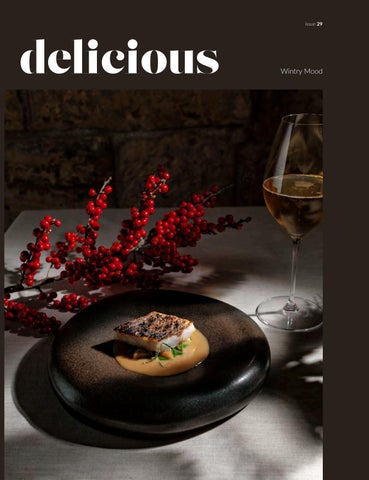
issue 29
Wintry Mood
The Storyteller
Private • Curated • Tailor-made
Introducing the Heritage Malta JONATHAN BRINCAT, NONI Luxury Tours Interview with
Experience Malta’s heritage through intimate, privately guided moments across our most remarkable sites, from the Grand Master’s Palace to Fort St Angelo and our reserve collection. Choose from half-day or full-day experiences, designed for discerning visitors who appreciate depth, authenticity, and exquisite attention to detail. For an elevated touch, you may also add a Taste History dining experience, offering a culinary journey inspired �y �alta�s past�� Inquisitor’s Palace , Birgu
Taste History, Grand Master’s Palace, Valletta
Luxury beyond time.
Learn more: (+356) 22 954 300 luxury@heritagemalta.mt heritagemalta.mt/explore
It was a busy year for the gastronomic world with profound changes which continue to change the industry especially with changing dining habits, and a redefinition of what “value” means to guests today. A changing gastronomic world where whimsy more, waste less is the rule of the day. To combat this, or merely survive, every operator is shaking the couch cushions, looking under every rock for new revenue opportunities, and brainstorming creative ways to lure guests back. From elevated bread service to all-day happy hour, operators are reinventing value, experience and creativity amid a shifting foodservice landscape Their efforts are paying, resulting in truly magical, exciting and delicious offerings that will continue to shape the dining scene next year and also the years to come.
Wintry Mood
issue 29
Publishing Editor Omar Vella | Design Joellson Bezzina Printing & Publishing Union Print Co. Ltd | Proof Reading Ramona Vella Cini COVER Photo Brian Grech | BACK COVER Photo Brian Grech I | Chef Jonathan Brincat - NONI
Disclaimer: Particular attention has been given to ensure that all the content of this magazine is correct and up to date as on date of issue. The views expressed in the articles, interviews and photogrphs are those of the authors and are not neccessarily endorsed by the publisher. While every care has been taking during production, the publisher does not accept any liability for errors that may have occurred. Copyright © 2025.
1
The Storyteller Interview with
JONATHAN BRINCAT, NONI
2
Photography: Brian Grech
Food is a story Chef Jonathan Brincat loves to tell through his work. Every concept, every detail and every ingredient are part of Jonathan’s narrative through which he shares with every guest why food is the only beautiful thing that nourishes. And in his gastronomic narrative, Jonathan constantly seeks to push the boundaries of taste and flavour. A storyteller that keeps on reaching new heights in the gastronomic world. The One Knife for Excellence at The Best Chef Awards is testament of why Jonathan is considered to be one of the best talents. Jonathan shared with Delicious magazine his journey in the world of food, his recent achievements and what’s next for him. 3
IFTAĦ U IXROB
Ilma tal-vit ta’ kwalità, sigur u b’togħma aħjar b'sempliċi filtru Grazzi għall-investiment mill-Korporazzjoni għas-Servizzi tal-Ilma, l-ilma tal-vit illum huwa aktar sigur u b’togħma aħjar minn qatt qabel. Huwa konformi ulkoll mal-istandards tas-saħħa pubblika u tal-UE.
L-istess kwalità ta’ ilma madwar Malta u Għawdex
GĦALIEX GĦANDEK TIXROB MILL-ILMA TAL-VIT? •
Disponibbli 24/7
•
Konvenjenti u ta’ kwalità
•
Tnaqqas il-plastik u l-ħela
•
Għażla sostenibbli u tajba għall-ambjent
GĦAŻLIET TA’ FILTRI: •
Filtri taħt is-sink – diskreti u effettivi
•
Filtri fuq il-counter – prattiċi u portabbli
•
Pitchers/Filter Jugs – affordabbli u sempliċi
•
Filtri fuq il-vit –jitpoġġew direttament fuq il-vit
Irċievi 60% lura sa massimu ta' €100 mall-iskema tar-REWS
Applika fuq: rews.org.mt
Aktar info: waw.com.mt
powered by WSC
You have recently been awarded One Knife for Excellence at The Best Chef Awards 2025. What does it mean for Malta’s culinary industry on the global stage? For Malta, this recognition shows that our island has something meaningful to say in the world of food. Malta is small, but our flavours, our ingredients and our stories are powerful. Being awarded one knife places Maltese cuisine in conversations it was not part of before. It supports the work of every chef, farmer and producer who is trying to raise standards and push our identity forward. It is encouraging to see our country represented among some of the most respected names in the industry. As a reaction to the One Knife for Excellence at The Best Chef Awards, you noted: “this achievement belongs to all of us.” Can you elaborate on that? Nothing at NONI is achieved alone. This award reflects the work of my family, my team, our farmers, our fishermen and our community. Every ingredient we use has a person behind it. Every dish comes from shared effort. I also see it as a moment for Malta. When one of us grows, we all grow. This achievement represents the collective passion of many people who believe in what Maltese cuisine can become. How has your culinary journey evolved over the past years? My journey has become more personal with time. When I was younger, I cooked to prove myself. Today I cook to express where I come from. I look at childhood flavours, family memories, the smells of my hometown, and I reinterpret them with a contemporary voice. At the same time, I have become more connected to our producers. Meeting them regularly shapes the way I cook. I try to honour their work and their land. My food in a weird way has become simpler, but the meaning behind each dish has grown deeper. 5
What do we expect at NONI during the winter season? Guests can expect dishes that feel warm, rooted and thoughtful. We continue exploring our zero waste philosophy, using every part of every ingredient. Winter produce inspires us, from artichokes to preserved citrus and richer broths. There will also be some quiet
evolutions in the space itself. Nothing drastic, but small details that refresh the feeling of home that NONI has always had. What is next for you? My focus remains on Malta. I want to keep strengthening the bridge between our island and the international culinary world by inviting chefs to cook here and by showcasing our producers abroad. I am also committed to education. Through workshops and collaborations, I hope to inspire families and young cooks to look at our ingredients with pride. Long term, I want NONI to continue growing as a place that defines the future of New Maltese cuisine while staying true to its heart, always humble.
“
I want NONI to continue growing as a place that defines the future of New Maltese cuisine while staying true to its heart, always humble.
”
8
Premier Capital Celebrates
10 th 200 th
McDonald’s Restaurant in Malta,
in Europe
10
Premier Capital has officially opened its 10th McDonald’s restaurant in Malta, a milestone that walso marks the group’s 200th restaurant across in Europe. Located in Mrieħel, the new restaurant will serve central, southern and north-western Malta, offering added convenience through its McDrive and McDelivery service for faster, easier access to fan favourites 24/7. Premier Capital is the Developmental Licensee for McDonald’s in six markets, operating 200 restaurants across Malta, Estonia, Latvia, Lithuania, Greece and Romania. 11
12
Since opening its first restaurant in Valletta, McDonald’s has continued to develop in the local market through new concepts, upgrades and expanded services, employing nearly 700 people locally. Peter Hili, Managing Director at Premier Restaurants Malta, said: “Opening our 10th McDonald’s in Malta and marking our 200th restaurant is a special moment for us. This is where our story began 30 years ago, and every new opening reflects the passion and dedication of our team to offer our customers feel-good moments and a consistently great experience.” Premier Capital remains on a strong growth trajectory with total revenue expected to reach over €775 million in 2025, supported by 12,000 employees across its six markets. The company continues to focus on expanding its network, strengthening operations, and investing in its people and infrastructure, with 15 new restaurants planned for 2026. 13
14
Tel: 99424735/99434735 Email: info@mazagafruit.com Website: www.mazagafruit.com
MARTIN ÖFNER
Executive Chef Martin Öfner was born in Innsbruck and raised in the village of Stans in the Karwendel Alpine Park, Austria’s largest nature park located in the stunning region of Tyrol. Immersed in yearround tourism, processions, and festivals, he was surrounded by family and a community with a strong cultural focus on seasonality. Hugely influenced by his grandmother’s traditional nose-totail cooking, Martin knew by the age of 7 he wanted to become a chef. In his mid-teens, he enrolled in a 5-year general tourism management course. After just 12 months, he chose to channel his training into the specialist culinary programme based on traditional Austrian cuisine with the principles of a classic French apprenticeship. For two years, as he learned the basics of his craft, he honed his skills in the region’s 4- and 5- star hotel restaurants. One of his first positions outside of Austria was in Zurich, Switzerland, at Restaurant Parkhuus, located at a five-star Park Hyatt hotel. Focused on local Alpine Swiss produce and freshwater fish, the restaurant is known for their openfire grilling and asado-style approach which has earned them one Michelin star. 16
17
Fuelled now with a passion to learn more from Michelin-accredited restaurants, Martin returned home to the Tyrol and Kirchberg, just outside Kitzbühel, and the two Michelin-starred restaurant Rosengarten under Chef Simon Taxacher. Under Simon, he learned the importance of the region and the part heritage vegetables, fruit and local meat and game played in the location of restaurants. He also began to learn fermentation and preserving techniques.
18
In the year he spent there, 2 months were taken up by a residency just over the border into the Italian Tyrol, at the then two Michelin-starred St Hubertus under Chef Norbert Niederkofler in the Hotel Rosa Alpina in San Cassiano. The two restaurants shared a common philosophy when it came to sourcing and preserving and one that resonated strongly with Martin. Joining as Senior Chef de Partie, by the time he left Rosengarten, he held the position of Sous Chef and then headed to Denmark.
Restaurant Geranium under Chef Rasmus Kofoed in Copenhagen was next. It was now 2017 and Geranium had just gained its 3rd Michelin star in 2016 and currently held the no.19 position on The World’s 50 Best Restaurants list. Martin almost instantly fell in love with its ethos. For the first time, he was immersed in a world of the sea, away from mountains. Fish, shellfish, and herbs that grew on the shore, preserved and fermented – he fully embraced what had now been dubbed the ‘New Nordic’ style. His next move was close, to De Librije in Zwolle in the Netherlands under Chef Jonnie Boer. De Librije has held 3 Michelin stars since 2004, and Martin was assigned to pastry, fermentation and research and development. The hours were long, but the experience he gained was invaluable, and he learned more about the maximum use of ingredients, including kombucha (used to cure seafood), kefir, tepache, koji and jun. A chance opportunity for an internship at Frantzén under Chef Björn Frantzén took Martin from Zwolle to Stockholm at the end of 2018. He felt an immediate connection. Within two weeks, he was offered a permanent position as Chef de Partie and never looked back. The restaurant’s ethos, working environment, strength of the team, and even the city and its people gave him a sense of place and belonging. 19
20
As the years passed, he progressed through the ranks. By 2023, he was Senior Sous Chef at Frantzén, and Björn had set his sights on China. With the prospect of a location in Shanghai, he asked Martin if he would like to lead the team there. He leapt at the opportunity and moved to China for a year-long, pre-opening research and development period. He travelled from province to province, absorbing everything from banqueting and Fujian seafood to Peking duck masters in Beijing. Culturally, it opened a whole new world of technique, flavour and texture, and made him realise how little he knew of its millennia of culinary history. Not only had it humbled him as a chef, but matured him as a person, grateful for opening him up to an exciting chapter in his life. However, as he was revelling in this newfound culinary culture, the Shanghai project had fallen through. He returned to Austria to rethink where and what he wanted to be and do. He mentioned to Björn that SE Asia and China had him hooked, and Björn offered him the opportunity to work in Singapore with Tor Aik Chua (TC), the Executive Chef of three Michelin-starred restaurant, Zén. In early 2024, Martin arrived in Singapore and took up the position of Co- Executive Chef. Now in 2025, Martin is the lead Executive Chef working closely with Bjorn on all things Zén.
NUMBERS
DON’T LIE
Michelle Muscat, ACE President
To date the catering industry employs no less than 30,000 staff members, which amount to 10.2% of Malta’s aggregate employment total of 291,000.
22
It is said that numbers don’t lie. Truly so, because the industry’s figures speak for themselves. There are approximately 3800 catering establishments on the island with a further 450 applications submitted to operate in a sector where it is often said that it is reaching enormous oversaturation. To date the catering industry employs no less than 30,000 staff members, which amount to 10.2% of Malta’s aggregate employment total of 291,000. Moreover, according to MALTA LABOUR MIGRATION POLICY Consultation Document, the wholesale, retail, transport, accommodation, and food sector has registered the largest increase in TCN employment, with 24,570 additional jobs filled by these workers between 2013 and 2023. This accounts for 33.9 per cent of all TCN employment in 2023. Figures that speak for themselves why the local catering industry is often coined as a vibrant sector of the country’s economy. Figures though which also speak volumes on the constant struggle to identify and more importantly, retain human talent. And whilst there is consensus among all players in the industry that local talent should be given priority yet as said earlier, numbers don’t lie and when one keeps in mind that 2,751 Maltese workers left the Wholesale, retail, and hospitality over a decade and that last year alone three hundred students graduated from the Institute for Tourism Studies at different levels, the highest being Masters there is a reality check we all need to undertake on local human talent expectations. A challenge which is further amplified by a negative perception of long hours and low pay. TCNs are here to stay. It is a reality we all have to come to terms with in the context of a fast paced and constantly evolving local catering industry. Emphasis now should be more on a migration policy which should regulate TCNs but at the same time, be realistic, practical and fair with the industry. The emphasis should be on a VISA processing which is diligent yet at the same time, which does not hinder the industry. The emphasis should be a skills pass which ensures the right human talent is integrated within the local catering industry yet which is fair, practical, non-discriminatory and which does not create an unfair playing field for the catering industry. Numbers do not lie also on other recurrent issues including increases in raw material costs, the rise of food
delivery services, the unfair anti-restaurant 1992 WRO as well as the compliance with legal obligations including waste management. Numbers which also highlight the industry’s cry for a VAT reduction to alleviate the daily financial pressure catering establishments are currently experiencing. A proposal not new to the international catering industry. A reality which has successfully been introduced in foreign counterparts including Ireland and Germany. Numbers though that also spell out the fact that the industry would be in much a worse situation without government subsidies on electricity and petrol prices. A state of fact which is often disregarded or taken for granted. But numbers don’t lie on the need for the local catering industry to pull up its socks. It needs to in the light of ACE’s July survey where local customers do not consider dining out as value for money. A clear message to all of us that we are somehow not ticking all the boxes of clients’ expectations. A clear message to all or many of us on the way we operate, on the product we offer and on the service we deliver. Yet the July survey is also an opportunity for the industry to listen, to understand, to act, adapt and change. We must change our mind set, challenge the fear of the unknown and act because the greatest threat to the restaurant industry is to rely on how it’s always been done. The basis for tomorrow’s catering industry are there. The various MICHELIN star restaurants across the island as well as the inclusion of local restaurants in Forbes Travel Guide’s Rating and in the MICHELIN Guide list are testament of the islands excellence in such a cut-throat industry. Achievements which surely offer a good value proposition to the government in its drive to attract quality tourism. Especially in view of direct flights from New York to Malta in June 2026 and the government’s reach-out in new markets such as South America. In this process, a collective effort today is essential for a better and stronger tomorrow. And in this context, the Deputy Prime Minister’s recent call for unity to improve the hospitality sector is timely and opportune in order to implement long-discussed reforms and ultimately ensure a sustainable and forward looking industry. Indeed, the decisions ahead will require the government’s input but most of all, collective courage and unity, where we as operators need to understand that we all need to do our part. 23
MIKAEL SVENSSON
Born and raised in Skåne, Sweden’s southernmost county, Chef Mikael Svensson’s childhood was surrounded by family, food, sport and the great outdoors. The region is renowned for its rich history, diverse farming and fishing industries, extensive forest trails, and pristine beaches. Being immersed in such a diverse and abundant landscape throughout his childhood gave him direct experience of just how an environment sustains a community. Consumed by ice hockey, his school days were bookended with daily practice and the gym. However, a part-time kitchen job at the age of 16 in a hotel in nearby Kristianstad introduced him to the process and magic of transforming raw ingredients. By the age of 18, Mikael realised the path to becoming a hockey player had waned, and cooking became his focus, resulting in a course at Chefs School. Ever ambitious though, he heard through kitchen friends of a vacancy for a commis chef at 1 Michelin-starred Le Canard in Oslo. He applied, was accepted, and in August 2003, he left Sweden and moved to Norway. As with his sports training, he revelled in the discipline and routine, and for 2 years he moved through the ranks, finally attaining the position of Junior Sous. Back to Skåne was next for a year in a small luxury hotel, allowing him time to spend his days off at noma, which had opened 2 years earlier. Noma was the precursor to the ethos established in 2004 by the New Nordic Cuisine movement, which would go on to transform the way a new generation of chefs sourced their ingredients and created their dishes. Then it was north to Restaurant 28+ in Gothenburg for a year, a Michelin stalwart and the country’s longest-serving star holder. 24
25
By now, the world’s gastronomic attention had turned to Spain, and Mikael did the same. His first stagiaire position was at Chef Martín Berasategui’s eponymous 3 Michelin-starred restaurant in San Sebastián before moving south to the equally stellar Quique Dacosta Restaurante in Denia. While there, a contact reached out with an opportunity to be involved with an intriguing new project in Oslo scheduled to open in 2008. Mikael accepted and returned to Norway as assistant head chef of Grims Grenka Hotel and their Asian inspired restaurant named Madu and Tjuvholmen Sjømagasin – part restaurant, seafood deli, wine bar and event space - on the waterfront. By 2011, as he accepted his next position to lead the team at Restaurant Eik, a blueprint was beginning to form for how he envisioned his own restaurant. Growing up with the abundance of the Swedish countryside and melding that with his exemplary culinary experience, had instilled an understanding of the importance that access to quality local produce would play in the success of that restaurant.
26
Scandinavia, with its very distinct and at times extreme seasons, had given him a profound knowledge of the historic craft in preservation, fermentation, distillation, drying and pickling. In addition, experience at all levels of Michelin, as well as more casual-styled restaurants, has given him a greater understanding of guest needs. In March 2013, he left Eik to set up the first iteration of Kontrast, which opened later that year, housed within the eco Hotel Guldsmeden Oslo. Using organic, locally sourced, wild and foraged produce, ingredients were transformed in-house, and the 40-seat Kontrast was celebrated for its continually evolving, creative take on Nordic bistro-styled dishes. In 2014, Kontrast was awarded the ultimate six die throws in Norway’s national newspapers. As the restaurant gained in popularity and Mikael grew in experience and ambition, he knew he would quickly outgrow the space afforded by the hotel.
In Spring 2015, he relocated Kontrast to a dedicated site 2.5 km away in the former industrial district of Vulkan. Now a thriving redevelopment area and a model for green urban living, it reflected Mikael’s growing vision, including pushing the restaurant’s sustainable possibilities even further. The neighbourhood was already defined by its innovative, eco-friendly architecture, which included a local energy centre featuring 300-metre-deep geothermal wells and an office building with an extensive exterior solar water heating system. These surroundings and the new site’s interior space enabled Mikael and the team to push their creativity and experimental techniques further, focusing on extending their waste reduction ethos. Additionally, it helped implement internal policies that ensured a healthier work-life balance for the team. Less than 12 months later, Kontrast was awarded its first Michelin star. Over the following three to four years, Mikael’s cuisine, with its focus on hyper-seasonality and sustainable practices in both ingredients and staff well-being, had garnered both local acclaim and international interest. His continuous development in utilising the excess from different kitchen byproducts had culminated in research incorporating historic and modern techniques from Scandinavia to China and Japan, which brought deeper flavour profiles into his dishes and menus. Such was the commitment to addressing the issue of food waste that in 2020, he joined forces with American-born chef Will Moffat, who was living in Oslo and working on fermentation with restaurateur and microbiologist David Quist. A discussion between Mikael and Will on producing a specific miso led to the development of their joint project, b.culture. Working as locally as possible, b.culture now implements techniques from all over the globe to transform local organic by-products from Kontrast and other sources into unique, premium items, making them accessible to the wider Norwegian market and now exporting to Britain, France, Germany, Switzerland, Sweden and the UAE. In 2024, Kontrast was awarded its second Michelin star alongside a coveted Green Star, an award within the Michelin Guide that recognises restaurants demonstrating exceptional commitment to sustainable gastronomy. For Mikael, Kontrast is more than just a restaurant. It is a tribute to the people who share his values; to the farmers who practice exceptional animal husbandry, delivering the finest meat and poultry, and to the growers who protect the soil, providing a ready supply of nutrient-dense, organic fruit and vegetables. To the fishers who catch the quality shellfish and seafood with sustainable practices that do not destroy the sea floor, nor pollute the ocean. And to the team he leads, which helps create extraordinary dining experiences, proving that culinary excellence and environmental responsibility can go hand in hand. 27
Kontrast is more than just a restaurant. It is a tribute to the people who share his values
29
Outsourcing Company 29, Triq L-Imnara, Naxxar, Malta info@technocleanmalta.com +35699990066
30
Find us on Bolt/Wolt
Nieves Barragán Mohacho
Nieves Barragán Mohacho was born and brought up in the historic coastal town of Santurtzi, near the mouth of the Nervión River, 4 kilometres (8.7 mi) downriver from Bilbao. Forming part of Greater Bilbao on the Bay of Biscay, Santurtzi is famed for its sardineras, women dressed in colourful traditional skirts selling sardines, a sight young Nieves watched frequently. The significance of ingredients in Spanish food culture was embedded in her subconscious long before her thoughts turned to cooking. Her mother was a passionate home cook who played a huge part in engaging Nieves’s curiosity and appreciation of cooking. Breakfasts, lunches, and dinners were discussed and planned, and her mother would create rich, flavorful dishes from locally available ingredients, using every cut from an animal. Full of energy and a love for life and sport, she enthusiastically shadowed her mother at the market and in the kitchen. Leaving school, Nieves naturally turned to a creative future and studied graphic design in Bilbao. It was during this time working in mediocre basic kitchens to finance her studies that she appreciated just how important her mother’s knowledge and understanding of ingredients were in creating the flavours she loved. 32
33
Around the same time, a close friend was moving to London, and Nieves decided to join her. With no job, she arrived in London at 19 years old in 1998. Having experienced working in kitchens in Bilbao, a Spanish sous chef she knew managed to get her an interview at the restaurant where he worked. That restaurant was the famed Simply Nico in Pimlico, run by the legendary, trailblazing chef Nico Ladenis. With no language skills in either English or French, she was assigned the position of Kitchen Porter until she learned the basics. From that vantage point, she absorbed how the professional kitchen operated: each station, its allocated chefs, and the communication between each section. She was fascinated by the diversity and quality of ingredients arriving daily and how they were prepared and laid out for service. She was hooked. Motivated, she acquired a basic understanding of kitchen English and French, and after her first month, her enthusiasm and evident promise saw her promoted from Kitchen Porter to Salads. As her English improved, she worked through the sections, mastering techniques and skills and revelling in the respect for ingredients and the discipline of a professional fine-dining kitchen. She also began a love affair with multi-cultural London and the diversity of its people and restaurants. After two and a half years, she had worked through the ranks to the position of Chef de Partie, but her reputation had caught the attention of the Harts Group, who were looking for a Sous Chef for a new Spanish restaurant they were planning to open in Soho. They reached out to Nieves, offered her the position, and Fino opened in 2003. For the first time in London, Nieves was cooking food from her home country. Instantly a hit with the public, press and industry, Fino - its tapas and main restaurant dishes - took London by storm, and the demand saw queues frequently waiting outside for a table. When the head chef moved on three years later, Nieves took the helm, changing menus and dishes, offering specials and releasing the memories and powerful flavours of her childhood.
34
Such was Fino’s success that in 2007, Harts Group opened a second Spanish restaurant, Barrafina – a no-reservations, fastturnaround tapas concept - in Soho and promoted her to Executive Chef of both. The 2013 Michelin Guide awarded Barrafina a Michelin star, unusual for such an informal dining experience. Two more Barrafina’s were to follow in 2014 & 2015 in Covent Garden, with Nieves now overseeing all four. By 2017, she had firmly established Spanish food at the fore of London’s culinary scene and felt it was now time to open a restaurant of her own. Over the fourteen years she worked for Harts Group, she became professional and personal friends with José Etura, whom she met at the first Barrafina in 2009. José was now the Group General Manager of all the Barrafina restaurants. Joining forces, the pair developed a plan for a restaurant that would celebrate the cuisine of Spain beyond tapas.
A shared vision and professional synergy connected with the restaurant group JKS, and in October 2017, Sabor burst onto London’s dining scene. Located on Heddon Street - a vibrant, traffic-free enclave five minutes walk from Piccadilly Circus, made famous by the backdrop to the cover of David Bowie’s 1972 Ziggy Stardust album - Sabor has become a cherished destination restaurant in its own right and provides a perfect platform for Nieves to showcase some of the food and flavours that resonate so deeply with her. Constantly evolving and building on the foundations of Sabor, Nieves is driven by a need to bring her history and identity to life. She found herself digging even deeper into her past and the cultural identity of Spain through regions, climate, dishes and traditions. Late summer 2025, in Shoreditch, Nieves opened her biggest project yet. Legado (meaning legacy) is her creative playground where all her research, everchanging ideas and discoveries culminate.
35
MIRAGE RIDES THE WAVES OF SUMMER FUN
36
DJ SUNSETS, CHRISTMAS CHEER AND A NEW YEAR’S EVE YOU WON’T FORGET South Africa, Cape Town, 12 November 2025: This summer, Cape Town’s iconic 76-foot catamaran, MIRAGE, is turning up the holiday vibes. From DJ-fuelled sunsets to Christmas day sparkle and a New Year’s bash at sea, MIRAGE is the ultimate floating playground for sun-chasers, music lovers, and festive spirits alike. MIRAGE DJ SUNSETS | 16 DECEMBER TO 11 JANUARY Long days, warm nights and that golden-hour glow - the perfect recipe for MIRAGE’s Sunset DJ Cruises. From 16 December to 11 January, expect live DJ sets, cool cocktails, and Cape Town’s most photogenic sunsets over the Atlantic. Add snacks and pizzas straight from the galley, and you’ve got yourself a summer state of mind. CHRISTMAS CRUISES | 24 TO 26 DECEMBER It’s Christmas, but make it nautical. Over the festive days of 24, 25 and 26 December, MIRAGE becomes Santa’s seaside hangout. Think face-painting elves, holiday beats, bubbles for the grown-ups, and pure joy for all ages - all with the Atlantic sparkling around you.
37
NEW YEAR’S EVE STARLIT SAIL | 31 DECEMBER When it comes to saying adieu to 2025, there’s no better place to do it than sailing along Cape Town’s Atlantic Seaboard. The MIRAGE New Year’s Eve Cruise delivers front-row seats to Cape Town’s midnight fireworks, a dance floor under the stars, and a bar stocked with bubbles. The skyline twinkles, the music plays, and the good times roll well past midnight. Onboard, you’ll find a full-service bar shaking up signature cocktails, pouring premium wines, whiskies and beers on tap - plus piping hot pizzas and snack platters from the galley. MIRAGE sails daily at 11am, 1pm, 3pm; priced at R450 per person (children under 15 sail at R225 per child). The daily sunset sail is priced at R650 per person. The MIRAGE New Year’s Eve cruise is priced at R3000 per person. Bookings are open at www.miragecatamaran.com. Please pre-order food items when booking to ensure smooth sailing. For press and media assistance, contact Ian and Lise Manley of Manley Communications Atelier at premierbrands@publicity.co.za or call +27 (0) 82 826 0456. 38
Beef Wellington Ingredients 2 Beef Fillet Steak x 200g 2 spoons Dijon Mustard 200g finely chopped mushrooms 2 shallots peeled & finely chopped 1 garlic clove Fresh thyme Chopped parsley 1 Tot Brandy 4 Parma Ham Slices 1 Pkt Ready rolled puff pastry 1 beaten egg Poppy or sesame seeds 2 spoons butter Salt & Pepper Method • Season the steaks with salt & pepper, seal in a hot pan with a knob of butter. Remove from heat, brush with the mustard and set aside to rest. • Use the same pan the cook the shallot and garlic with the remaining butter until soft stir n the mushrooms & herbs. Season with salt & pepper, flame with the Brandy. Allow cooling. • Spread 2 slices of Parma Ham on a sheet of cling film and coat with the mushrooms duxelles. • Set the steak in the centre of the mushrooms paste and flip the Parma ham over with the aid of the cling film to cover the steaks. Roll tightly and set in a refrigerator for 1 hour. • Mean while cut 2 small discs of puff pastry slightly larger than the steak and 2 larger ones. • Brush the small disk with the beaten egg, unwrap the steaks and place in the centre of the base. Cover with the second disk, making sure to close edges tightly. Egg wash and sprinkle with your favourite seeds. • Bake in a pre-heated oven at 200°c for approx. 20 minutes for medium temp. steaks. • Serve with fresh vegetables, side of roasted potatoes & reduced beef jus. 39
The
Message Behind the Figures ACE’s Research & Economic Outlook – A Restaurants’ Patrons’ Survey 2025
The ACE’s Research & Economic Outlook – A Restaurants’ Patrons’ Survey 2025, was unveiled during an event held on Wednesday. The survey provides invaluable insight into customer behaviour and expectations, and sheds light on both the strengths and challenges of Malta’s catering and hospitality sectors. Conducted among 500 respondents, 400 local patrons and 100 tourists, the nationwide survey revealed a variety of emerging trends shaping consumer habits which will help the industry’s drive forward. 40
Local Diners’ Trends The survey, conducted by Prof. Zammit Marmarà for ACE shows that 15% dine out twice a week or more, 25% once a week, and nearly 19% dine out at least once a month. A trend which shows that local diner habits seem to be returning to pre-COVID levels when Malta’s ranked third in the EU for household restaurant spending. Yet the survey shows that locals aren’t convinced they’re getting good value. Per capita, the Maltese spend close to 95 euro per month in a restaurant
This is a point of concern because as pointed out by Michelle Muscat, ACE president, “The age-old adage ‘the client is king’ has long been and continues to be the guiding ethos,” she said. “It continues to be so, because at the end of the day with no customer, there is no business. And with no business, there’s no pay cheque for us to take home.” It’s a sentiment she says operators should carry with them — especially in a fast-paced industry, where trends shift quickly, and diners expect more for their money.
The survey shows that price is not the key determinant when choosing where to dine. The most important issue for the Maltese is the food on the plate.
41
Tourist Dining trends Tourists in Malta are dining out once a day on average and spending around €42. It’s a clear sign, according to the report, that many are sticking to fixed budgets. Most likely, they’re staying on bed and breakfast or half-board packages. High-end restaurants? Not on the radar. This aligns with what economists Silvan Mifsud and Alan Arrigo flagged last year — tourist numbers are up, yes, but spending per visitor isn’t. For Muscat, knowing 42
this kind of detail matters. “It is in this customer-centric context that it is the duty of ACE to invest in research and data to offer a clear picture of the state of play of such an important component of what has often been defined as ‘the most important visitor on our premises’.” Tips The survey also looked at tipping. Most respondents — tourists and locals alike — felt that 5% was fair. That lines up with what’s common across Europe. People usually round up the bill in casual settings. In more formal restaurants, a 5–10% tip tends to be the norm.
The message from the survey As highlighted by Michelle Muscat, “This is a dynamic market where customers predominantly expect sustainable solutions, flexibility, personalisation, and a wide range of offerings for every taste – from economical and simple options to high-end restaurant catering,” In this context, it is imperative for the industry to take note of the message from diners and avoid to adopt the ostrich approach. The industry must refrain from being short sighted and look at decisions which ensure sustainability and future growth. In order to do so, quality, consistency and value for money are essential. In order to do so, the industry must ride on its strengths yet also to act on oits weaknesses and shortcomings. Above all, every operator must listen, adjust, and don’t assume things are fine because people are still showing up. Customers are paying attention, and the industry needs to do the same.
43
Rafael Cagali Born in São Paulo to Brazilian and Italian grandparents, Rafael Cagali’s journey as a chef began somewhat unconventionally. His mother and aunt were one of the first to own and open the popular self-service “per kilo” restaurant concepts in Brazil, and this is where he would spend time with his family after school. Unsure of what he wanted to do in life, he studied Economics at the University of São Paulo before leaving Brazil for London, armed with a course to learn English and a desire to travel and explore the world. To fund his studies, he began working part-time in kitchens, developed a love for cooking and began to seriously consider training as a chef. He enrolled in a course at Westminster Kingsway College in Hospitality and Catering, honing classical European techniques while gaining work experience in the city’s diverse restaurants. As he worked his way up, he discovered a natural affinity with the energy and routine of kitchens and was enthralled by cooking and the culture surrounding it. As his confidence grew, his connection to his Italian heritage came to the fore. By now 25 years old, he wanted to explore the culinary side of this and improve his Italian language skills further. He relocated to Verona, where that heritage lay. Not long after, he joined the team under Chef Stefano Baiocco at the Grand Hotel Villa Feltrinelli on Lake Garda. Under Stefano, he was taught the importance of discipline, focus and consistency in setting goals to continue pushing forward. A mantra that has remained with him to this day and where he stayed for three and a half years. 44
45
Rafael’s next move was to Spain: firstly to Martin Berasategui and his stellar restaurant in Donostia-San Sebastián in the country’s Basque Region, before Chef Quique Dacosta’s three Michelin-starred restaurant in Denia on the Mediterranean coast. This was to be the experience that truly cemented his love for cooking. The creativity in marrying great produce with avant-garde techniques captivated him, and as all the younger chefs lived together, there was a real sense of comradery, a mentality that was very ahead of its time. In 2012, England was next to Heston Blumenthal’s three Michelin-starred The Fat Duck in Bray. The restaurant was famed for its flavour encapsulation and multi-sensory cooking, and Heston, being self-taught, resonated deeply with Rafael’s own proactive attitude. He was soon offered a permanent position and remained for two years. It was also where he met his future partner, Charlie Lee.
46
His next move saw him join Simon Rogan and his team for the opening of Fera at Claridge’s in London’s Mayfair. Simon’s style of cooking was detailed without overcomplication, deeply connected to the natural world surrounding his flagship restaurant, L’Enclume, in England’s Lake District. After the experience Rafael had gained to date, most recently at The Fat Duck, he assumed responsibility for Aulis, Fera’s inhouse development kitchen. Such was its popularity when Aulis rebranded to a chef’s table Rafael headed up the kitchen. 47
48
Serendipity was then to step in with a chance encounter in 2018 with the owners of the Town Hall Hotel in Bethnal Green, who were looking for a chef to take over the restaurant space there. With all the experience Rafael had gained to date, he had already begun to pull together ideas of the restaurant he would create should the opportunity ever arise, and the timing of the offer was perfect. In January 2019, Da Terra opened its doors. Taken from the Italian phrase meaning “from the earth”, Da Terra connects ingredients, nature and people, melding Rafael’s international experience working at the pinnacle of fine dining with the nostalgia of his Brazilian roots and Italian heritage. Through Da Terra, he delivers this in a joyful sensory journey, providing one of the most exciting, gastronomic dining experiences in London. 49
A
Gastronomic Delight
Review on Terroir
Terroir is truly a gastronomic gem. The place has that unique vibe which only a traditional Maltese home will offer with a combination of natural stone with soft fresh colours. Every colour is complementary and sets the perfect backdrop for an amazing ambience. Notwithstanding its traditional look the place also boasts a contemporary kick which is visible in the style of specific decor present in the restaurant. Every detail at Terroir sets the tone for a perfect dining experience.
50
Terroir’s food philosophy is pretty much spelt out in its website - “Embracing the distinctive flavours of our region and the inherent beauty of our land, to create an unparalleled experience for our patrons.” In line with this philosophy, Terroir offers an interesting selection of dishes which exalt local produce with a French touch and at times, even a slight dose of oriental flavours. This combination can be envisaged in the detail of a starter or as the core ingredient of a main course. Indeed, the attention to detail is incredible. Every plate is pure art which encapsulates the colours of every season and creates a perfect harmony between sweet, sour, salt, bitter and umami. Every dishes also has a strong sense of precision with no ingredient left unattended.
51
Every item is in sync so as to create a perfect chorus. The local red prawn carpaccio with smoked potato custard and dashi and the cured amberjack with tomato and crème fraîche form part of an interesting prelude to what is next to come. Indeed, the main course selection is impressive and hard to choose from. The choice is based on one’s own preference. In any case, you will not be disappointed. Aged duck with teriyaki, red cabbage and duck jus and Lamb with butternut squash, grilled baby gem and kohlrabi are a few of the dishes you will come across on Terroir’s menu. And what about their selection of desserts? The magical hands of those create magic in the kitchen offer an amazing choice of sweet indulgences which are hard to resist. Every dish is accompanied by vast selection of local and foreign wines and an excellent service. Indeed, Terroir’s is not only about food but also about service delivered by a very good team both in the kitchen and in the restaurant spearheaded by the skilful young co-founders, chef Andre Borg and Nicholas Grima. Terroir is testament of Malta’s gastronomic excellence and worth a try for all food enthusiasts looking for something different, something interesting, something really oh là là
52
53
KRISTIAN BAUMANN Adopted from Korea as a baby, Kristian Baumann spent his formative years growing up in a small city outside Copenhagen, Denmark. His Danish parents had already adopted a girl from Korea before Kristian; they then fell pregnant with Kristian’s younger brother. Loved and happy, Kristian had a very traditional Danish childhood. His parents embraced Kristian and his sister’s heritage from the beginning, and together, the family regularly attended Danish/Korean cultural events and community gatherings, often celebrating food. Naturally, he grew up with mixed emotions of both pride and difference as a Korean/Dane. At school, he developed a passion for sports. Kristian loved all physical activity, from swimming and volleyball to karate and basketball. In 10th grade, his parents enrolled him in a boarding school with a focus on physical education.
54
t was a strict environment teaching pupils the professional priorities of timekeeping and focus and the personal essentials of cooking and cleaning. However, learning in the kitchen became a revelation to him, as he enjoyed this aspect more than any of his classmates. So much so that the dinner ladies often allowed him to cook with them beyond peeling potatoes. Fortuitously, Kristian 1s passion for sport waned, and he continued his final four years at culinary school. During this time, his practical experience as an apprentice was mainly in a small traditional inn near his parent’s house, expanding his knowledge with school trips to Amsterdam and Italy. After school, a few similar jobs working in traditional Danish kitchens followed, but he was restless and constantly searching for a place where he felt he could ‘fit’. He decided to move to Copenhagen and worked in different kitchens. It was here that he had his first introduction as a stagiaire at the new place in town called Noma.
From Copenhagen and keen to broaden his horizons outside of Denmark, he accepted the position in a small hotel cooking breakfast, lunch, and dinner in the south of France. Three months into his role, he was viciously robbed and stabbed. He managed to stumble and find refuge in a hotel, where the receptionist helped and called the police. As his face was obviously that of a stranger, he was left alive but bleeding by the authorities. With help from the receptionist, he was guided into a taxi that took him to his apartment, where his roommate helped bandage him and took him to the hospital. After a week in bed, he returned to work and completed his year before returning to Copenhagen. Happy to be back in Denmark, he spent the next four years working alongside Christian Puglisi, opening his two restaurants, Manfreds and Relce. This was to prove a fundamentally creative period for Kristian. As his career became more established, so did the desire to open up on his own. While trying to find the right path through this, he took a head chef position at a small restaurant that allowed him to pursue his vision.
55
As time progressed, and still without his own establishment, he sought advice over coffee from ex-colleagues and friends Rene Redzepi and Peter Kreiner. This resulted instead in his return to Noma to create something together. He helped firstly with the Noma project in Japan, and when Rene and the Noma team traveled to Australia, he launched Restaurant 108 as a pop-up in 2016 at the original Noma location at Strandgade 93. 108 was a more laid-back dining experience that incorporated the skill and technique of a fine dining kitchen but created a more relaxed, casual eating style for guests - still Danish and hyper-local. Within six and a half months, 108 received a Michelin star. It was here, though, that he began to think about incorporating the different flavours and cooking styles that connected with his Korean DNA. In 2017 he travelled to South Korea for the first of many research trips. THEN CAME COVID 19. Like many, this became a time for reflection. Kristian’s career to date and for almost ten years had been immersed in traditional French and Danish cooking and always cooking someone else’s food. In his soul, none of it had ever genuinely correlated with how he felt inside. His cooking was now of a certain standard and level that gained awards and was technically acclaimed, but it wasn 1t authentic to him. The effects of 2020 impacted and 108 closed in autumn. Kristian invited a few of the team members who had followed him for years to join him with his new venture - not only because they worked well together as a team but also because they had devoted years to his vision already. The pull of his Korean roots was now impossible to ignore, and he began to create the blueprint for a new restaurant project. “We were going to build the aeroplane while flying it.”
56
Kristian, together with his business partner Lasse Peder Nielsen (whom he met at 108), announced a pop-up of their new restaurant concept, KOAN, in collaboration with the distillery at Empirical. The pop-up gave the pair time to hone the project and look for a permanent space to fit their new identity. The KOAN project at Empirical became a huge success. When the second lockdown came, they pivoted to deliver takeaway dishes for their guests. When the city reopened for a second time, Christian Puglisi had closed Relae, and the KOAN team moved their restaurant into the Rela: space for a second pop-up while continuing the search for the perfect location.
Hosting just 23 guests per service, KOAN is open Tuesday to Friday for dinner with one extra Saturday a month. The 17-course tasting menu is a true expression of chef Kristian Baumann1s relationship with his two cultures of Denmark to Korea. In addition, they have produced a creative space for their team to work hours that allow for a life beyond the kitchen and the floor. The result is a group of committed individuals engaged and dedicated to a detailed and tailored service melding two worlds into an authentic dining experience.
United by their collective freedom for the first time in their careers, they wanted to re-imagine a cooking style and the environment for the people who worked there. They began to search for a site in earnest. Right in front of a memorial to the Danish Medical ship Jutlandia that brought doctors and nurses to Korea during the Korean War, they found a permanent home for KOAN and opened in April 2023.
57
Max Cohen
Chef Max Coen was born in Salisbury in Wiltshire, 8 miles from the prehistoric circle of Stonehenge – a UNESCO World Heritage Site. His father worked in the film industry, and at the age of two, his family moved to Los Angeles, returning when Max was eight. Around the age of nine or ten, he began to show symptoms of alopecia, losing the hair on his head and face. As he grew through his school years and with the support of his family, the self-consciousness related to that soon turned to resilience and acceptance. After school, he went to university but quickly realised it was not for him. Within three months, he had returned home near where his parents lived and began working in a local pub. One day, he was asked to cover an absence in the kitchen and never looked back. He immediately loved the focus and energy of the kitchen, the preparation and cooking and decided that was what he wanted to do. He began researching restaurants and chefs and understood his opportunities would be better served in London. He found a room to rent in the south of the city, packed his bags and moved again. With minimal experience, he decided his best plan was to hand his CV into every restaurant that was an easy commute to where he lived. As luck would have it, Chef Ben Waugh from Gordon Ramsay’s steak and sushi concept, Maze Grill in Chelsea, was looking for a Commis Chef, gave him a trial shift and offered him the position. He stayed for two and a half years, learning, absorbing and revelling in the process of service in a busy neighbourhood restaurant. On his days off, he would spend hours in the local bookshop, ploughing through the books of chefs who had attained two and three Michelin stars, studying the recipes and becoming more and more passionate about refining the skills he was beginning to acquire. One of the books he most admired was the Frantzén/Lindberg book, Björn Frantzén’s first cookbook with partner Daniel Lindeberg on the ideology, philosophy and work that led up to the second Michelin star of their restaurant Frantzén/Lindberg in Stockholm. In November 2017, Max sent an email requesting a stagiaire position should one become available, fully expecting never to hear back. However, he did, and at the prearranged date in February 2018, he arrived at the door of Frantzén, which only two weeks earlier had gone from two to the ultimate three Michelin stars in the Michelin Guide Nordic Countries 2018.
58
By this stage, Max had only worked in a good yet very local neighbourhood restaurant for less than three years. Now, he was thrown into a world of technique, precision and skill in a critically acclaimed restaurant under the gastronomic eye of the international dining scene. He felt he had hit Olympic Gold, and where most young chefs would hesitate, he immersed himself in everything going on around him, observing, learning, mastering techniques and skills and gaining confidence in his abilities. He stayed at Frantzén for eight months, and although it was an intense period in his career, it completely changed his outlook and ambition. Returning to London, his friend from Maze Grill, Chef Ben Waugh, reached out and offered him a job. Ben was now the Executive Chef at the Savoy Grill, a historic art deco restaurant within The Savoy Hotel. The food style was beautifully old school and classically French, but after the excitement of Frantzén, nothing that Max wanted to do. He became increasingly restless, and after just six months, Max left to join James Knappett as Chef de Partie at one Michelin-starred Kitchen Table in Fitzrovia. An 18seat, counter-styled restaurant, Kitchen Table had a small team of just four chefs, fully booked every night, serving 22 courses of highly technical dishes over a three-and-a-half-hour period. The ever- changing creativity, fast pace and energy within the team really resonated with him. In October 2018, Michelin announced the restaurant was listed with two Michelin stars in the 2019 UK and Ireland Guide and soon after, Max was promoted to Sous Chef.
59
In March 2020, he went back to Salisbury. The COVID pandemic was about to close everything down. The initial lockdown gave him time to fully reassess his life and what he wanted to achieve from his career. He began to experiment, creating his own dishes. Initially, he found a small market for this locally and as the country moved in and out of lockdowns, he took this one stage further, creating small pop-ups. Such was their success that when restrictions were in part lifted, he travelled back to London, where the pop-ups became a bit more structured and more popular. One supplier he had become friendly with, entrepreneur Chris D’Sylva, who owned The Notting Hill Fish Shop, saw something in Max and employed him to help with the production kitchen for the shop. He, in turn, sourced everything Max requested for his pop-ups and offered him the Fish Shop space in the evenings, transforming it into a mini-restaurant so he could continue with his project. In August 2020, Max gave notice to Kitchen Table and began to focus on his next move. The demand for his pop-up project was going from strength to strength, but as he became busier, Max could feel a gap in his experience, and more importantly, in his management skills. He reached out to Chef Jeremy Chan, who was looking for a Sous Chef. Jeremy, alongside his business partner Iré Hassan-Odukale, co-owned Ikoyi, one of the city’s most progressive and innovative restaurants. In the spring of 2021, he joined the Ikoyi team and began to work sideby-side with Jeremy. The following one and a half years of Max’s career were to prove his most inspiring. Ikoyi was like no other restaurant he had worked in. The super analytical development process in creating each dish and menu, the quiet assurance in leadership and the respect between staff members changed the way he viewed how a restaurant could be managed. For Max, working at Ikoyi felt more akin to a synergy between himself and Jeremy and in February 2022, he was delighted to have been on the team when Ikoyi was awarded two Michelin stars.
60
As he continued to enjoy his time there, Chris D’Sylva contacted him to help him look at a site he had found in Notting Hill. In the past, the pair had briefly touched on perhaps working together in the future, and Chris was now looking for a place to set up a production kitchen for his other businesses. Max agreed the space was perfect for what he wanted to do, and as they considered it further, they began to talk about perhaps doing a restaurant together upstairs. Notting Hill is an upmarket neighbourhood with many fine restaurants and bars, and the site was perfect for a more bistro-styled concept. Chris asked Max to think about coming on board with him.
took shape, he worked tirelessly on the menus. He wanted it to be more than a London pastiche on a Paris bistro. He had access to some of the finest ingredients in the country and beyond and could work with the same Michelin-quality produce he loved. His training and skill set demanded his dishes would have depth and layers of complexity, but he wanted an ease in presentation that would prove both accessible and relatable to the neighbourhood. Over the late summer of 2022, as the restaurant and team began to come together, Max took his interpretation of the classic Paris bistro and reimagined it with a very contemporary take on a refined and relaxed British neighbourhood restaurant.
He was flattered by Chris’s faith but reluctant to leave Ikoyi as he was still enjoying his time there. He also thought, initially, a more casual concept was a step back. However, as the weeks passed, he considered what he would do with a menu if he went ahead: the ingredients he would use, the dishes he could create, the atmosphere, music, cocktails, wine, and the suppliers he would now have access to. He began to come around to the idea and realised what a great opportunity it might be. When he discussed it with Jeremy, he was relieved by how graciously supportive he was, and Max took a leap of faith and resigned. As the building
In October 2022, Dorian opened its doors. An immediate hit, the restaurant was full from day one. Now one of Notting Hill’s most popular venues, in just two short years, Dorian has been lauded by critics, awarded a Michelin star in the UK and Ireland Guide 2024, and sits at No. 21 in the top 100 of The National Restaurant Awards. But most importantly for Chef Max Coen, it has been welcomed to the heart of its community, with many regular guests who are rightly now part of the Dorian family.
61
Chet Sharma Raised in Berkshire, Chef Chet Sharma’s journey into kitchens was far from typical. Immersed in a world of two cultures, his maternal grandmother was from India, his paternal from London, his first food memory was at the age of 6 while on holiday visiting his family’s farm in India, in what is now one of New Delhi’s satellite cities, Gurgaon in Haryana.
He vividly remembers arriving in the middle of the night around 2 a.m. after the long drive from the airport, to be met by his uncle who had freshly prepared a dish of malai kofta. The recipe for this is labourintensive, consisting of crispy fried kofta (dumplings) with a soft chewy mix of potato and paneer inside, dipped in a smooth, lightly spiced sauce. Chet’s uncle had not only made the paneer himself from the farm’s buffalo milk, but also warm rotis to help soak up the extra sauce. The rotis though were made from a heritage wheat variety he grew called paigambari, native to North India, and Chet had never tasted anything as delicious. That feeling of exhaustion and excitement after such a long journey, melded into the warm welcoming textures and tastes of his uncle’s dish and has fondly remained a source of nostalgia for Chet throughout his life. Born with a lung condition, Chet spent the majority of his childhood unable to play outside with his peer group. His treatment dictated that he had to take care not to stress his body and he spent many hours in the kitchen watching and learning from his grandmother’s cooking. She was a resourceful cook and like many of her generation, an advocate of waste management. He also became a voracious reader (he now has a library of over 1200 volumes) using books to learn and discover and ultimately as a form of escapism. Unsurprisingly, he excelled academically at school and with a natural curiosity for science, he secured a place at UCL (University College London) to read Chemistry. At the same time, he threw DJ events to help fund his studies with a latenight residency at the Ministry of Sound in London and working with, among others, Kanye West, 50 Cent and Sean Paul. He also explored his love for cooking and began working initially at Benares under Atul Kochhar in Mayfair, all the while continuing with his degree.
By now, his academic progress had taken him to a MRes in Clinical and Experimental Medicine at UCL. His formal studies were also now running in tandem with an eagerness to experience as much as he could from professional kitchens. He embarked on the first of a total of 16 stagiaires that lasted from 2005-2013, including The Hand & Flowers under Tom Kerridge, Le Manoir aux Quat’ Saisons under Raymond Blanc, The Fat Duck, Ollie Dabbous at Dabbous, Restaurant Tom Aikens and Pied à Terre under Shane Osborn. After graduating from UCL with a completed Master’s, his attention turned to Oxford University and a 2nd Master’s in Physics, followed by a DPhil in Condensed Matter Physics. However, now it was 2008 and the global 2008-9 recession was having an impact on postgraduate funding. Chet had no option but to cram his studies, focussing exclusively on academia. An intense period followed and remarkably, he successfully achieved his doctorate in just over 3 years.
64
Now freed from his formal studies, Chet moved to San Sebastian in Spain where his knowledge of science secured him a position under the tutelage of Chef Andoni Aduriz at Mugaritz. This would be a formative period for him where he learned how to work within and later motivate a team, and manage the finer elements of developing food at this creative level. It was also where he became roommates with chef Santiago Lastra, who would later go on to open KOL in London. On his return to Britain, Chet joined the team at Simon Rogan’s Umbel Restaurant Group as Director of Research and Development overseeing L’Enclume, Roganic, The French, Rogan & Co., Fera and the more casual Mr Coopers House and Garden and Pig & Whistle pub. From there he consulted for various restaurants, including with Brett Graham at The Ledbury, before joining Mark Birchall at Moor Hall in West Lancashire as part of his opening team.
When Giorgio Locatelli released his book, Made in Italy Food and Stories in 2006, Chet inhaled the words, drawing parallels with his own heritage, family and community. He applied for a position at Locanda Locatelli in Marylebone and within days of arriving, Giorgio had recognised not only a willingness to learn but also a skill for considered precision in execution. He commissioned him to the pastry section. During his time working with Giorgio, Chet revelled in the informality of familyoriented dishes, coupled with a dedication to fine dining Chet was then approached by JKS Restaurants to work with them as Group Development Chef. He was already friendly with their co-founder, Karam Sethi, who over the years had become in part a mentor to him and they both shared an outlook for creativity and guest satisfaction. His focus had also now turned to developing his own culinary style and he experimented and began to create dishes in his home kitchen on days and weekends off. He researched single-origin spices, the health benefits of heritage grains and their low- glycemic levels and continued to push his produce-led cooking. He adopted the analytical skills he had learned in academia to drive his recipes forward using a strong ability to think abstractly and creatively. All of which he combined with the craft he had honed over many years working in professional kitchens. In time, Chet hosted a menu tasting of some of his dishes for Karam and JKS CEO Jyotin Sethi and the trio soon began to discuss the possibility of opening a restaurant together. In the summer of 2019, they found and signed a site in Mayfair for a restaurant in North Audley Street. Then the pandemic hit. Like so many others, this was a period of self-reflection and as the country moved in and out of lockdown, the project slowly came together as Chet refined the menus, the concept and the overall identity of the restaurant. In September 2021, BiBi opened its doors to huge critical acclaim. Named after an affectionate term for grandmother in Urdu, Chet’s restaurant is simply an ode to the two women who helped inspire his career and elements of whose influence is now interlaced throughout his menus and the restaurant’s interiors. In October 2025, Phaidon releases Chet’s debut book, BiBi The Cookbook: Stories from my Bibi. Part cookbook and part journal, each chapter features a series of stories describing Sharma’s culinary discoveries and his heritage.
65
SMARTER food waste
households on the frontline against
Food waste is no trifling matter – households can play a key role by planning meals wisely before buying food to reduce surplus food and separate organic waste diligently. Small actions at home can drive the big change Malta needs
food waste reduction target of 10% at processing and manufacturing stage, and 30% per-capita reduction jointly at retail (food services) and consumption (household) stage, by 2030.
Locally ERA launched a public consultation on Food waste is far more than the odd forgotten vegetable its intention to develop a food waste prevention at the back of the fridge – it is a widespread, systemic programme that will have to cover awareness-raising campaigns, supply chain inefficiencies, and measures to issue happening at every stage of the supply chain. encourage food donations and redistribution amongst Across the EU, an estimated 73% of food waste occurs others. within households, restaurants, food service, retail, and distribution, placing everyday families at the heart For example, ERA shares its food waste reduction tips on its social media pages, a handy addition for managing of both the problem and the solution. In Malta, the one’s home better – say, have you ever heard that situation is especially significant: in 2023 households orange peels can be used to make a natural, vinegargenerate 82kg of food waste per capita. citrus cleaning spray? Trust us, it really works! Or how about turning your overripe bananas in delicious Banana Like all EU member states, Malta too is required to develop a food waste prevention programme. European Bread cake? Behind these small household actions, is the thread that Union Member States are to attain a legally binding drives a revolution in how we deal with food waste, tackling both the aspect of thinking wisely what food to purchase in the first place as a preventive measure before buying food and how to use food wisely to reduce waste. After all, that is why Malta created separate collection systems for organic waste, to divert it away from landfills, and instead convert it into renewable energy through the process of anaerobic digestion. With organic waste pick-ups scheduled every Monday, Wednesday, and Friday since 2018, the success of this
66
collection scheme has already been noted with early data suggesting this system is capturing about 38% of food waste generated! Malta’s Waste Prevention Programme will outline extensive measures designed to reshape our culture surrounding food waste. Apart from diverting food waste from landfills, the adopted national waste management plan already contains measures to prevent food waste, such as future initiatives to limit retail outlets from discarding unsold food, and instead encouraging its redistribution to charities. Other plans include removing legal barriers that currently hinder food donation. And community-driven solutions, such as ‘gleaning’ – that is, collecting surplus produce from farms – can be combined with digital apps to redistribute unused food from households, farms, and restaurants. Undoubtedly, education and community engagement form a major pillar of this food waste reduction effort. Through a series of cooking roadshows, community lessons, and campaigns promoting seasonal and local produce, ERA will be supporting this shift towards food waste prevention. In essence, Malta’s food waste strategy will be a three-pronged fork: preventing waste, improving separation, and transforming organic waste into a resource. And households play a pivotal role in this transition. So starting today – plan meals wisely, separate organic waste diligently, and stay informed about emerging national initiatives. Small daily actions at home can drive the big change Malta needs to meet its food waste reduction goals. 67
Peter Dimas In the kitchen, Chef Patron Peter Dimas is the true master of flavor. With dexterity and aesthetics he creates gastronomic ensembles that transcend the limits of imagination and complexity. Unexpected combinations, harmonious contrasts, aromatic notes, different temperatures, unusual and multi-layered textures bring balance to taste and aftertaste. Each dish is a composition of fresh ingredients chosen with sanctity to express the MAKRIS philosophy. The multi-awarded chef, with many years of experience in several Michelin-starred restaurants, is the mastermind behind all the Makris restaurants located in the hotels of the Domes Resorts & Reserves group. At MAKRIS Athens, awarded its first Michelin star in its first year after opening, he creates degustation menus that reflect Greekness, seasonality, sustainability, creative cuisine and theatricality. Petros Dimas, with his dedication to the cultivation and utilization of organic vegetables and herbs, his precision in his preparations and his unexpected cooking techniques, will give you a transformative gastronomic experience. 68
69
MAKRIS takes its name from the ancient name of Corfu, where the restaurant started its culinary journey in 2018, at Domes Miramare, a Luxury Collection Resort. It continued its award-winning journey in other destinations and resorts of Domes and now it has found its place in Athens, in a historic building of Thisio, opposite the ancient market and the Acropolis. Domes, wishing to offer its guests luxury, authenticity and fine dining, has created and invested in a destination that innately highlights the historical heritage and culture of Greece. We welcome you to the Michelin awarded MAKRIS Athens to enjoy a multi-dimensional mosaic of flavors and history.
71
Overseeing Malta's Iconic Fresh Food Markets
• Promoting Quality Local Food & Expanding Access to Markets • Cultivating Partnerships for Sustainable Growth • Empowering Markets with Modern Digital Solutions • Assuring value to local food producers At the Malta Food Agency, we're dedicated to leading Malta's exceptional local food products to new horizons. Join us in our mission to promote quality, strengthen markets, and foster lasting partnerships.
Pixkerija
Pitkalija
Strengthening Labour Migration Governance:
Malta’s Pre-Migration Integration Course and the Evolution of the Skills Pass As Malta’s economy continues to expand—driven in no small part by sustained growth in tourism, hospitality, and other labour-intensive sectors—the country is recalibrating its labour migration framework to ensure that workforce development, worker protection, and economic competitiveness advance in tandem. Central to this recalibration is the formalisation of the Skills Pass as a mandatory national pre-entry requirement for Third Country Nationals (TCNs) applying for their first Single Work Permit, alongside the introduction of a comprehensive Pre-Migration Integration Course. This policy shift marks a strategic evolution in Malta’s approach to labour migration: from post-arrival intervention to pre-departure preparedness, from sector-specific verification to a unified, cross-sector integration and skills assurance framework. Embedding Integration Before Arrival At the heart of the reform is the introduction of a mandatory Pre-Departure Integration Measure, delivered through the upgraded Skills Pass platform. All first-time TCN applicants, regardless of sector, will be required to complete this course prior to entering Malta. By establishing a common baseline for integration and employability, the policy aims to address longstanding challenges related to worker preparedness, rights awareness, and workplace compliance. The course consists of two core online modules—Living and Working in Malta and Rights and Obligations at the Workplace—combined with an English language 74
Pierre Fenech, CEO - ITS
proficiency assessment. These elements are reinforced through a live verification interview, conducted online or at authorised global assessment centres, to validate language competence and ensure understanding of Maltese workplace norms, legal responsibilities, and cultural expectations. By embedding integration training at the premigration stage, the policy seeks to improve early social and professional integration, strengthen compliance with labour standards, and reduce post-arrival vulnerabilities, including the risk of exploitation or abuse. Completion of this course is not only a prerequisite for work permit issuance but also a gateway for progression into further national integration initiatives, such as the iBelong programme. From Sectoral Tool to National Framework Originally developed by the Institute of Tourism Studies (ITS), the Skills Pass was introduced in May 2024 as a certification mechanism for front-facing roles in the tourism and hospitality industry. Its early success demonstrated the value of structured skills verification and worker preparation in a sector critical to Malta’s economy. The new policy expands this concept significantly. The Skills Pass is repositioned as Malta’s official national skills assurance and integration mechanism, aligned with both the National Skills Strategy and the country’s evolving Migration Policy. Under the upgraded Skills Pass Platform 2.0, the system adopts a modular, twophase structure.
Part 1 comprises the mandatory Pre-Departure Integration Course, applicable to all first-time TCN applicants across sectors. Part 2 focuses on sector-specific certification, which may be mandatory or optional depending on whether a sector is “claimed” by a competent regulatory authority under subsidiary legislation. This design allows for flexibility, accommodating both regulated sectors with defined occupational standards and non-claimed sectors that rely primarily on general employability and integration benchmarks. Institutionally, governance of the Skills Pass is consolidated within a dedicated Skills Pass Unit at ITS. Real-time verification is integrated into Identità’s work permit processing systems, while labour market monitoring is supported by Jobsplus, strengthening inter-agency coordination and oversight. Cost Neutrality and Gradual Expansion Importantly, the reforms have been structured to avoid additional financial burden on applicants. The total cost of the Skills Pass remains €475, now divided into two payments: €250 for the Pre-Departure Integration Course and €225 for sector-specific certification where applicable. While tourism and hospitality remain at the forefront, the policy provides for the gradual expansion of the Skills Pass to other sectors. Regulatory authorities will announce sector-specific requirements in due course, following a model that has already proven effective over the past 18 months.
75
Incentivising Retention and Professional Growth Beyond entry requirements, the policy introduces retention-focused incentives designed to reward professionalism and stability. Workers holding the original Skills Pass issued between May 2024 and December 2025 may be eligible for a two-year residence and work permit. Those who upgrade their qualifications to higher Malta Qualifications Framework (MQF) levels and maintain stable employment may qualify for three-year permits, encouraging long-term commitment and continuous skills development. A Preventive, Future-Oriented Approach Collectively, these reforms represent a decisive shift towards preventive, pre-arrival labour market
76
governance. By ensuring that incoming workers arrive with verified skills, language competence, and a clear understanding of their rights and obligations, Malta is strengthening workforce quality while safeguarding its labour market’s integrity. For businesses, the implications are significant: improved workforce preparedness, greater retention, and reduced compliance risks. For workers, the reforms offer clearer pathways to integration, protection, and professional progression. Ultimately, the evolution of the Skills Pass and the introduction of pre-migration integration underscore Malta’s commitment to a fair, resilient, and future-ready labour market—one that aligns economic growth with social responsibility and sustainable workforce development.
The Storyteller Interview with
JONATHAN BRINCAT, NONI