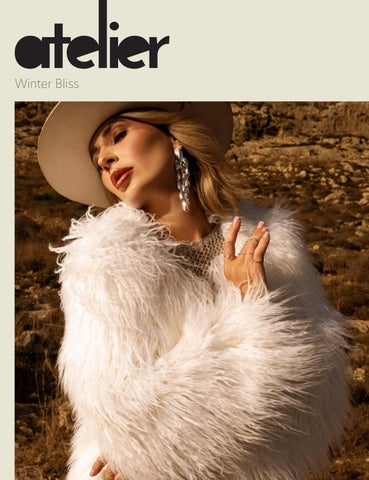
Winter Bliss
Publishing Editor Omar Vella
Design
Joellson Bezzina
Printing & Publishing Union Print Co. Ltd. www.unionprint.com.mt
Proof Reading
Ramona Vella Cini
Photos
Matthew: B Spiteri
Model
Justina Vai
Hair
Annie Morelli
Make up
Nicola Powell
Styling
Rob Walker
“What the new year brings to you will depend a great deal on what you bring to the new year.” Vern McLellan All those who predicted 2025 to be a year of transformations, were right. It truly was. The way people worked, connected, and designed their days shifted more toward intentionality, balance, and creativity. Instead of rushing through tasks, people embraced slower, more meaningful rhythms. And this momentum of lifestyle seems to remain consistent in the year to come. Wellness in 2026 looks more personalised, data-led and quietly pragmatic than the scented-candle era that came before it. Instead of chasing a single miracle solution, consumers are layering habits across sleep, nutrition, movement and mental health, often supported by technology but grounded in daily routine. Analysts point to a shift from “nice to have” to “non‑negotiable”, particularly in areas such as workplace support, hormone health and healthy ageing, as health systems and employers try to keep pace with demographic and economic pressure. At the same time, interest in natural ingredients and plant-based alternatives is rising, not just for ethical reasons but because people say they want fewer additives and more transparency about what they consume. In this context of new trends, new ideas and way of living, fashion, interior design, architecture and also beauty adapts accordingly to work in tandem with what people need, what people want and above all what people prioritise on.
Disclaimer: Particular attention has been given to ensure that all the content of this magazine is correct and up to date as on date of issue. The views expressed in the articles, interviews and photogrphs are those of the authors and are not neccessarily endorsed by the publisher. While every care has been taking during production, the publisher does not accept any liability for errors that may have occurred. Copyright© 2022.
1
2
3
4
5
6
7
8
9
Photos Matthew: B Spiteri Model: Justina Vai Hair: Annie Morelli Make up: Nicola Powell Styling: Rob Walker
10
Marcel Wanders presents
The “BELLA CRYSTAL CUT”
by lighting manufacturer Ramun
11
The lighting brand RAMUN, founded by legendary Italian designer Alessandro Mendini, is launching the “Bella Crystal Cut” in collaboration with Marcel Wanders. This new Bella is an evolution of the original Bella Plissé, which was first introduced in 2019. Compact elegance and versatile design The Bella Crystal Cut retains the iconic bell-shaped silhouette and the enchanting light flow of the original Bella, but has been redesigned in a more compact and smaller format for optimal ease of use. Thanks to its USB-rechargeable and wireless structure, the lamp is perfectly suited for any setting, from bedrooms, children’s rooms, and dining areas to outdoor camping spots.
The collection is available in eight color options, including Clear Gold, Clear Silver, Aurora Green, and Aurora Purple. It also features a limited reissue of four beloved shades previously in production: Yellow, Cyan, Pink, and Blue. This adds not only a new dimension of design, but also the joy of personal color choice. Developed under the guidance of world-renowned ophthalmologists, the Bella Crystal offers “the ideal light for your eyes”, free from UV radiation, infrared rays, and harmful blue light. The lamp operates without flicker or heat emission, ensuring optimal comfort even during extended use.
With Marcel Wanders’ signature cut-crystal design, the lamp transforms tables into sparkling canvases, casting magical light patterns that turn everyday environments into galleries of light and imagination.
Made from non-toxic, eco-friendly materials, it has received RoHS certification and the highest rating in photobiological safety. The lamp features a 20-step brightness adjustment with a simple touch sensor on top, along with new functions such as a lock option (LOCK) and a selection of personalized melodies, enhancing both ease of use and individual experience.
The Bella lamp plays a selection of melodies, featuring timeless masterpieces by Mozart, Chopin, Schubert, Mendelssohn, and Rachmaninoff. As a tribute to Wanders’ Dutch heritage, it opens with a special composition by Johannes Bernardus van Bree. A Swiss version of “Happy Birthday” is also included, making the Bella Crystal not only a charming source of light but also a meaningful gift for special
The original Bella was awarded the title “Best Lighting of the Year” at the 2022 Modern Furniture+ Lighting Awards, organized by the Chicago Athenaeum Museum of Architecture and Design and Global Design News. This prestigious award, established in 1959 by the Museum of Modern Art (MoMA) in New York, honors the world’s most influential designs in furniture and lighting.
The Bella Crystal Cut emits a soft, refined glow that brings warmth and elegance to every space.
12
occasions.
13
Among more than sixty winning designs from twenty-four countries, Bella was praised as a symbol of contemporary design, celebrated for its emotional resonance and technical innovation. Today, Bella remains a global bestseller and a favorite among international celebrities, who frequently showcase the lamp on their social media. But Bella is more than just a design object, it carries symbolic meaning as a “light of happiness,” believed to illuminate the future of its recipient. This makes it a cherished gift for loved ones. 14
€1.5M Investment Empowering Research & Innovation
hpcmt.gov.mt
EMBRACING Minimalism Interview with
Marina Plotnikova
16
Marina is a visual artist with an undisputed talent driven by observation, curiosity, and the freedom to let her style evolve over time. She works with minimalistic forms in clay and mixed media. Her work focuses on simplicity, texture, and how light transforms an object throughout the day. She is drawn to essential shapes — pieces that seem quiet at first but reveal more the longer you look. Marina works from a small, personal studio, which keeps everything hands-on; every piece goes through her own process from start to finish. Her work has also recently been exhibited at the Rudy Buhler Art Gallery. Marina shared with Atelier what craft means to her and how her style has evolved over the years.
17
18
What does craft mean to you? Craft, for me, is where instinct meets discipline. It’s the part of the work where I can’t hide behind ideas — I have to show up, repeat, refine, and be honest with the material. It feels freeing, but that freedom comes because of the discipline. Without craft, everything would stay in my head. Craft is what makes it real. How would you describe your aesthetic and how did you develop your style? My aesthetic is minimalistic, tactile, and focused on form. I’m drawn to essential shapes — the kind that look simple at first but shift depending on the light or the angle. I also see style as something that evolves. If you look at Picasso’s early classical works and compare them with his later cubist or abstract periods, you see how an artist grows out of older versions of themselves. I don’t lock myself into one visual language. I let time and experimentation shift it. Right now, I’m working with minimal forms and clean silhouettes, and I’m curious to see where that goes next. What inspires you? I’m inspired mostly by what I see and how it changes: light, architecture, textures, shadows, sea patterns. I like elements that create a mood without trying too hard — simple things that reveal more when you pay attention. That’s usually where my ideas begin. What is on your mind when you are shaping the object? When I’m shaping a piece, the noise drops. It’s a very immersive state — what Mihaly Csikszentmihalyi described as Flow. Time disappears, and there’s no separation between what I intend and what my hands are doing. I’m not thinking about the piece; I’m inside the process. What’s the best thing about being creative? For me, the best part is the meditative side of it — that moment when you’re fully absorbed and everything else goes quiet. And there’s also a sense of authorship in it: I’m not waiting for meaning, I’m making it with my own hands. Can you describe your workspace? My workspace is small, personal, and a bit improvised — but that actually helps me. It forces me to focus on just a few pieces at a time, which makes each one more intentional. Everything is within reach, everything passes through my hands, and nothing feels detached or industrial. It keeps me close to the material and to the process itself.
19
20
Osho once noted, “To be creative means to be in love with life.” To what extent do you agree? There’s some truth to it. To create, you have to be curious about life — awake, noticing things, willing to play. But at the same time, when I’m actually creating, I’m almost outside of life. It becomes an escape, a place where everything else fades out. So for me, creativity is both engagement and escape. That paradox feels right. What’s next for you? Right now, I’m developing a cohesive collection of minimalistic clay pieces — exploring form, light, and texture in a more focused way. I’m preparing small-scale releases and looking into new exhibition opportunities. My next step is to bring the work into more public spaces and let it meet its audience.
21
Exploring Vulnerability
Susanne’s work concerns people and their feelings. Yet in her search through her photographic lens for inner feelings she does not seek to make a statement, or be judgmental, but show how she is touched by people, and the way they expose their vulnerability. Atelier recently caught up with Diane Middelberg to discuss her search for raw simplicity in her portraits and what’s next for her.
22
Interview with SUSANNE MIDDELBERG
How do you capture vulnerability and beauty through the lens? People who approach me for a photoshoot because they feel drawn to my photography usually want a vulnerable portrait of themselves. That already means there’s a willingness to be seen in a vulnerable way. Even so, people can still find it very frightening. For me, vulnerability and beauty lie in the authenticity of a person. In a photoshoot you can achieve that by overwhelming someone and photographing them at an unexpected moment, or by pulling them out of their comfort zone. In both cases, people lose control for a moment and drop their mask. But I don’t feel comfortable to work with people that way. I prefer to take my time so they can feel at ease. Then I try to sense how far I can let them improvise in a way that feels good to them, yet makes them less focused on being photographed. I consciously avoid directing people in their emotional expression. I’d rather connect with them directly. And I think it helps that I simply stay true to myself. In what way is your approach to visualizing an image influenced by your experience in dance and theatre? I think there’s always a slightly theatrical and staged quality in my photos—an aesthetic I carried with me from my dance and theatre experience. In addition, I’m very physical when I work with people. I invite them to be physical too, in a way that suits them. I mostly give physical instructions. And when I notice that someone enjoys moving or dancing, I work with that. Why do you seek ‘raw simplicity’ in your portraits? In photographic terms, my portraits are allowed to be “boring.” I prefer to remove anything that might distract from the person. That’s why I love working in the studio. I’m always searching for simplicity— the less, the better. I want the focus to be entirely on the person. And it may be raw and honest. I enjoy doing beauty shoots as well, but afterwards those aren’t the images that stay with me as the work that truly touches me. It’s similar to acting: if you only show a polished surface, the portrait becomes one-dimensional. You take away what makes the person human.
23
24
How do you reveal the layers of personality in your subjects? I find it compelling to search for a quality or characteristic that doesn’t lie on the surface. If someone comes into my studio who is very light, open, energetic, and enthusiastic, I find it a challenge to photograph a “hidden” side. For example, a quieter, more contemplative quality that lies underneath. And the more visible side you first notice still shines through. At least, if it works. I recently read that in your work it is crucial that the colours do not distract from the person but draw attention to them. Can you elaborate on that? I think in black and white. When I shoot in colour, I try to work within one or two tones. Sometimes I use two contrasting colours, but preferably no more. I do this to bring as much calm and simplicity into the photo as possible, so all attention rests on the person. In what way are technology and content intertwined in your work? Technology is a tool for telling my story. Everything I use is is simply a means to let my photos speak in my own visual language. But I don’t let technology guide me—it’s the other way around. I use technology to create what I feel. For example, I don’t make work just because AI makes so much possible or because the medium itself inspires me. At least not yet. But I may explore that in the future. How does portrait photography connect us with our own identity? I think that every time you look at a portrait, you’re looking into a mirror, searching for something of yourself—some form of recognition.
25
What’s next for you? At the moment I take many casting photos of actors. That comes my way because I act myself. I love photographing actors. I find them wonderful people. And I understand both their strengths and their insecurities—because acting is an uncertain and very vulnerable profession. For now, I’m very happy to continue this work. But that doesn’t mean I only photograph actors and performing artists. I photograph people. All kinds of people. And the contact I have with people in my studio is very meaningful to me. After spending a day with someone, the photos are only part of what stays with me. What stays with me the longest is the connection I was able to make with that person. I often remember that for years.
26
Private • Curated • Tailor-made
Introducing the Heritage Malta Luxury Tours
Experience Malta’s heritage through intimate, privately guided moments across our most remarkable sites, from the Grand Master’s Palace to Fort St Angelo and our reserve collection. Choose from half-day or full-day experiences, designed for discerning visitors who appreciate depth, authenticity, and exquisite attention to detail. For an elevated touch, you may also add a Taste History dining experience, offering a culinary journey inspired �y �alta�s past�� Inquisitor’s Palace , Birgu
Taste History, Grand Master’s Palace, Valletta
Luxury beyond time.
Learn more: (+356) 22 954 300 luxury@heritagemalta.mt heritagemalta.mt/explore
North of Italy – Destination Turin and Aosta Valley
From Alpine Trails to Grand Boulevards Nearest airport: Turin - offering car rental services. Days: 6 full days in total. Visited time of the year: Early July Our trip began high in the Val d’Aosta, where jagged peaks rise like sentinels above a ribbon of green valley. Courmayeur was our first stop, a lively alpine town at the foot of Mont Blanc, where shop windows displayed sleek ski gear alongside shelves of local honey and cheese. The town itself is charming, with narrow streets lined with cafés and artisan shops and the atmosphere is a blend of alpine coziness and energetic tourism. Following the valley east, we lingered in Cogne, a serene gateway to the Gran Paradiso National Park where savour
30
the best scenic views. Wildflower meadows and larch forests frame quiet paths and the nearby Parc Animalier d’Introd offers a close-up view of ibex, chamois and marmots in their natural setting. It’s the perfect warm-up for exploring the park’s wilder reaches. On another day we went to Pelago Lake (Lago di Pellaud) in Rhêmes-Notre-Dame with its glassy surface mirroring pines and mountaintops. The only sounds were the rustle of wind in the branches and the soft clang of cowbells drifting from the pastures. Not that popular but magnificently beautiful.
Before leaving the mountains, we spent time in the town of Aosta, the valley’s small but storied capital with medieval lanes lined with cafés and shops selling the region’s famed Fontina cheese. The pace here is unhurried and the surrounding mountains feel close enough to touch. Descending into the plains brought a shift in atmosphere as we arrived in Turin by car. We wandered leisurely along the city’s cobbled streets, admiring the architectural grandeur, elegant façades, ornate balconies and the graceful sweep of arcaded streets. A peaceful walk along the lake added another layer of calm, the water reflecting the soft light of the setting sun. On the outskirts of the city, the Turin Outlet Village offered a lively contrast with a mix of high-end shops and charming open-air promenades perfect for browsing and finding local deals.
In the end, the journey felt like two halves of a perfect whole with the quiet majesty of alpine landscapes paired with the refined charm of an Italian city built on art and architecture. From the mirrored waters of Pelago Lake to the elegant streets, cobbled alleys and lakeside paths of Turin, each moment added its own layer to an unforgettable and most affordable experience.
Photos: Sarah Zerafa Lewis
Evenings were made special by a visit to Adelaide! Bottega Bar, a cosy restaurant where local flavors came alive in every bite, was the perfect way to end days spent soaking in the city’s charm. Book ahead of time! Two days passed in this easy rhythm, moving from one stunning building to another, then winding down by the water and savoring Turin’s culinary warmth.
31
Photos credit ‘© Seilaojiong’
Greater Bay
Area Sports Centre to host inaugural events 32
The Greater Bay Area Sports Centre will host its first large-scale events with a series of four sold-out concerts beginning 5th December 2025. The new sports centre serves cities within the Pearl River Delta including Guangzhou, Shenzhen, Hong Kong and Macau which comprise the Greater Bay Area—the world’s largest conurbation, with its population anticipated to reach 100 million by 2030. Situated in the south of Guangzhou’s Nansha District on the western bank of the river delta, the sports centre will anchor a new civic, business and residential quarter at the heart of the Greater Bay Area. Offering its local community sports facilities of the highest standards, the centre has also been designed to host a diverse programme of major national and international sporting events, as well as cultural performances, that can be easily accessed by all residents of the Greater Bay Area via Line 18 of the Guangzhou Metro and the new Shenzhen-Zhongshan Bridge. In addition to providing exceptional facilities for use by Nansha’s local schools and sports clubs, the centre will continue China’s ongoing sports development programmes at regional and national levels. Providing the essential infrastructure for competitive athletes including those participating in all track and field events, the centre’s design optimises Nansha’s warm winters to create the ideal outdoor training facilities and conditions to foster future legacies.
33
The centre’s 70-hectare park gives Nansha’s residents a variety of landscaped spaces on the banks of the river for sports and recreation, and incorporates a 60,000-seat stadium, a 20,000-seat arena for basketball and other indoor events, as well as a 4,000-seat aquatic centre with 50-metre swimming pool and diving well for training and competition. The sports centre also provides extensive supporting facilities including athletes’ accommodation, as well as outdoor training pitches and running tracks that will support local government programmes which encourage increased sports participation in its schools to enhance the well-being of the region’s younger generations. Located within Guangdong’s subtropical monsoon climate, this 70-hectare waterfront park has been designed as an integral element of the district’s flood protection measures and will include wetlands that manage excess water during extreme sea-level fluctuations. The fluid forms of the centre’s architecture echo the tapering geometries evident in the hulls of the region’s traditional sailing ships that were initially designed during the Song Dynasty approximately a thousand years ago. These historic vessels established the Pearl River as China’s gateway to the world. The sports centre also integrates environmental concepts from the local Lingnan vernacular architecture that include generous areas of sheltered spaces cooled with effective natural ventilation techniques during the region’s humid subtropical summer months.
34
35
The stadium’s roof has been designed as a system of layers that shelter the 60,000 spectators from rain and direct sunlight while also enabling rising warm air to be naturally vented outside the building envelope. This distinctive layered roof encircles the stadium, emulating the pleated silk structures of traditional Chinese fans. Located on the primary approach from the north to the Shenzhen-Zhongshan Bridge which connects the Greater Bay Area’s major urban cities, the sports centre’s architecture on the banks of the Pearl River marks the gateway to Guangzhou and the districts of the northern Greater Bay Area.
A network of vertical louvres defines the curvatures of each building within the centre. Informed by detailed data analytics and advanced digital 3D-modelling to optimise shading and natural ventilation within their civic spaces, each building’s composition and orientation has been designed to encourage cooling by the prevailing summer winds that blow inland from the South China Sea. Hosting 60,000 spectators for a variety of different sports, the stadium’s seating bowl can be adjusted to provide ideal spectator conditions for each specific event; ensuring optimal views of the athletes and the most exciting event atmosphere, together with maximum flexibility for differing uses throughout the year. The stadium can also be configured for cultural performances with spectators facing a stage that includes a unique backdrop. The grand arch within the design permits colder sea air from the Pearl River estuary to enter the stadium— cooling athletes and spectators while also giving views of the river during sports and cultural events, establishing a direct connection between spectators and the stadium’s riverside setting. Commissioned by the Nansha District Bureau of Culture & Sports following the 2023 international design competition, the centre has been designed by Zaha Hadid Architects in collaboration with the Guangdong Architectural Design & Research Institute.
36
Untitled-1 1
03/12/2025 15:50
Spearheading the Voluntary Sector Interview with MAURO PACE PARASCANDALO, Chief Executive Officer at Malta Council for the Voluntary Sector
Malta’s voluntary sector is on the rise and has strong traditional roots in the country. Although the number of volunteers in Malta, around 1.5 percent of the population, appears to have remained stable over the past few years, reliable sources suggest that volunteers represent some 14 percent of the Maltese adult population and that the Maltese are at the forefront when it comes to donating money towards different causes. Atelier recently caught up with Mauro Pace Parascandalo, Chief Executive Officer at Malta Council for the Voluntary Sector to discuss the voluntary sector in Malta and the critical role of the Malta Council for the Voluntary Sector in such a constantly evolving sector.
38
“
Malta’s voluntary sector is on the rise and has strong traditional roots in the country.
”
39
Why does volunteering play a key role in any society? Voluntary organisations play a fundamental role by addressing the needs of the nation. Moreover, they play an important role due to their social mission which aims to provide assistance when the state cannot meet demand. They make contributions to our society both through the direct tasks or activities they complete and indirectly by improving health and well-being, increasing skills and confidence, and strengthening trust, cooperation and innovation in communities. In so doing, they are present in all sectors from sports to health up to animal welfare. You have recently noted that the volunteering sector is seeing an evolution. Can you elaborate? The voluntary sector has evolved from a quality point of view. The management and service delivered has improved significantly in order to ensure accountability and a better service to the community. It is also an interesting time where on the one hand you have the revision of the law and simplified procedures for the sector, and on the other hand you have the ever-strengthening funds and services for the organisations.
Social inclusion is one of the pillars of Vision 2050, unveiled by the government earlier this year. How will the Malta Council for the Voluntary Sector ensure the goals set forth in Vision 2050 towards social inclusion be successfully implemented? The aim of Vision 2025 is to promote sustainable development, align national strategies with European and global trends, and ultimately improve the quality of life for all citizens by fostering sustainable economic growth and building resilience for the future. Thus, the role of the Malta Council for the Voluntary Sector is quite vast as the social element touches on all the pillars and areas spelt out in the vision. You have also recently pointed out the realities that voluntary organisations and associations, particularly the smaller ones, have to face. Can you elaborate on that? Small organisations play a key role in tackling complex social challenges. Moreover, they often have greater involvement of people with lived experience, because they are the ones founding, running, volunteering for, and managing the organisations. Yet in a reality where across all charities generally there has been a decrease in donations, and an upsurge in costs while demand for services is increasing, small organisations are those who suffer the most. Small voluntary organisations also face human resources challenges as well as other operational challenges. Thus, it is imperative for us to ensure they are provided with the necessary support so they can operate in a sustainable manner. The recent launch of ProACT is an acknowledgement from our end of the needs of all organisations especially the smaller ones. The local voluntary sector will go where society will go. It can’t predict what needs will develop over a long span of time yet it’s dynamic nature and ability to adapt are key ingredients for the sector to cater for societal needs as they constantly evolve. MCVS will continue to adapt its services accordingly, ensuring it remains present, responsive, and strategically aligned with organisations wherever they are and whenever support is required.
40
MCESD:
Key Meetings and Initiatives 2025 Malta’s national platform for social dialogue, policy discussion, and collaborative reform Throughout 2025, the Malta Council for Economic and Social Development (MCESD) continued to strengthen its role as Malta’s national platform for social dialogue, bringing together social partners, the government, the MCESD sub-committees – including the Civil Society Committee and the Gozo Regional Committee – and various experts. Parliamentary Secretary for Social Dialogue, Hon. Andy Ellul, actively participated in several sessions, highlighting the importance of inclusive dialogue and collaboration in addressing key reforms and emerging priorities shaping Malta’s socioeconomic future. Labour Migration and National Dialogue MCESD began the year with a key meeting on the Malta Labour Migration Policy, a landmark initiative shaping Malta’s labour market and social development. Government
representatives, social partners, and experts discussed the policy’s intended objectives, focusing on labour market stability, protection of workers’ rights, and alignment with national skills and training needs. European Semester, Justice, and Land Registration Reforms The Council hosted the EESC European Semester Group to gather insights on competitiveness, skills, digitalisation, and energy sectors, discussed at EU level. MCESD also examined justice reforms aimed at enhancing institutional efficiency and assessed Malta’s land registration system to ensure secure property titles and streamlined processes. The Council provided valuable input towards the compilation of the Malta Vision 2050 emphasising long-term planning and sustainable economic growth.
41
Transport and National Data Discussions on mobility included presentations on new traffic mitigation measures shaped by extensive public consultation. Discussions on updates to Malta’s Annual Progress Report were also held. The National Statistics Office’s operational resourcing and data planning were also discussed at the Council to ensure evidence-based policymaking. Infrastructure, Innovation, and Youth Engagement MCESD received updates from the Water Services Corporation and Enemalta plc on infrastructure improvements, efficiency gains, and sustainable management initiatives. During this period, the Parliamentary Secretary for Social Dialogue, Hon. Andy Ellul, introduced MCESD’s new CEO, Dr. Brendan Zerafa, and presented the Young Shapers Forum, a new initiative intended on giving young people aged 11–15 an active voice in shaping Malta’s future. Social Policy and Ethical Considerations Social partners examined national priorities related to the drug situation, the auto-enrolment pension framework, and access to the Social Climate Fund. The Council reviewed the role of third-country nationals in Malta from economic, social, and ethical perspectives during its annual meeting with His Grace the Archbishop of Malta, reflecting on the Beyond GDP II initiative. Gozo Vision 2050 was discussed, focusing on connectivity, heritage preservation, sustainable tourism, innovation, and advanced agriculture. Annual Pre-Budget Meeting As part of its ongoing engagement on national economic priorities, MCESD held its annual pre-Budget meeting,
42
presenting 58 proposals to the Minister for Finance, Hon. Clyde Caruana. This meeting allowed social partners and experts to contribute insights and recommendations, ensuring that fiscal planning reflects evidence-based dialogue and addresses Malta’s social and economic needs. EU Context, Ethics, and Technology MCESD addressed Malta’s EU Country Report and Country Specific Recommendations, while also hosting a national debate on voluntary assisted dying, giving consideration to ethical, legal, and social dimensions. Consumer protection and market transparency were covered in an MCCAA outreach session, alongside discussions on the right to disconnect. The impacts of artificial intelligence on the tourism industry and the findings of the Malta Attractiveness Survey were also presented. Housing and Final Reflections MCESD addressed Housing in an Ageing Society, presenting strategic analyses on demographic shifts, long-term housing pressures, and measures to maintain social resilience. Reflections were also shared on the Council’s three-year tenure under Chairperson Perit David Xuereb, highlighting the strengthening of evidence-based social dialogue and ongoing collaboration among social partners. Looking Ahead As 2025 comes to a close, MCESD continues to play an important role in contributing to Malta’s long-term development and well-being through collaboration, dialogue, and evidence-based policy discussions. The Council’s work over the year demonstrates a commitment to addressing key national priorities.
Looking ahead, MCESD will continue to address key national priorities through its committees, social partners, and expert consultations. The newly introduced initiative the Young Shapers Forum will ensure that future generations are actively engaged in national discourse, contributing to evidencebased policy discussions and helping to build a more inclusive, resilient, and forward-looking Malta.
43
Breathing CELLS Invited by Thomas Heatherwick, Director of the 5th Seoul Biennale of Architecture and Urbanism (SBAU) Invited by Thomas Heatherwick, Director of the 5th Seoul Biennale of Architecture and Urbanism (SBAU), MADs’ art installation “Breathing Cells” opened on September 26, 2025, and is on display at Songhyeon Green Plaza in Seoul, South Korea. “Breathing Cells,” standing 4.8 meters tall and 2.4 meters wide, represents MAD’s exploration into the future of building facades, simultaneously responding to the Biennale’s curatorial theme of “Radically More Human.” The work proposes the possibility of an urban interface imbued with a sense of life. Under the control of an intelligent system, the soft, pneumatic membrane of the building skin can sense and adjust light and temperature, providing comfort for people outside the structure. When the control system is on standby, the material and form remain soft and inviting, reminiscent of a giant mattress, exuding warmth and approachability. Through breathable light units and a water mist system, the installation fosters a dialogue between people and the urban environment. The lighting solution, provided by Opple Lighting, illuminates the “cells,” while the ethereal, mist-like water vapor offers cooling relief during hot weather and helps maintain moisture for surrounding vegetation. This explores the potential for architectural skins to interact with their environment, metaphorically suggesting a deeper understanding of “humanization” in future architecture – where buildings are not merely functional containers but become sentient, responsive living.
44
45
“Breathing Cells” also aims to explore new connections between people, architecture, and the urban environment. Each “cell” can be seen as an individual building within the city, representing the independence and harmonious coexistence of each individual within a collective. Ma Yansong says: “‘Breathing Cells’ seeks to explore the subtle relationship between the individual and the urban environment. Each ‘cell’ represents an independent entity within the city, while the rhythmic interplay of light and mist symbolizes the breathing cadence of life and the city itself.”
46
The Skill Card:
A KEY Step FORWARD for the CONSTRUCTION Industry
BUILDING & CONSTRUCTION
AUTHORITY
The construction industry has always been a cornerstone of national development, driving economic growth while shaping the built environment in which we live and work. Over the past few years, significant reforms have been introduced to professionalise and regulate this vital sector, starting with changes to the licensing of masons and contractors. The next milestone in this reform process is now firmly in sight: the regularisation of the Construction Industry Skill Card (CISC), which will become obligatory for all construction workers by 2027.
The mandatory introduction of the Skill Card marks the natural continuation of reforms that began with the licensing of masons and contractors. Those measures targeted the professional standing of firms and tradespeople, ensuring that only qualified individuals and entities could operate legally within the sector. The Skill Card extends this principle to every worker on site, making competence and training a universal standard. No longer will skills be assumed or informally recognised; they will be verified and recorded in an official, portable document.
The CISC is more than just a piece of identification. It is a confirmation that an individual has completed an accredited course in health and safety in construction and is competent in a skill or various skills. The latter is ensured by having formal qualifications and/or a skill validation issued by an accredited educational institution. It represents an official recognition of a worker’s training, competence, and adherence to safety standards. By linking skills to certification, the card ensures that individuals on construction sites are adequately prepared for the tasks they undertake. This in turn enhances quality, reduces risks, and safeguards the welfare of workers, contractors, and clients alike.
For contractors and developers, the Skill Card offers peace of mind. Knowing that every worker is card-carrying certified reduces uncertainty around the quality of workmanship and compliance with health and safety protocols. For workers, the card brings recognition and mobility. It provides formal proof of their abilities, opening doors to new opportunities both locally and abroad. It also helps protect them against exploitation, as their skills are formally recognised and valued. For members of the public hiring contractors or tradespeople, the skill card is proof that they are engaging qualified individuals, reducing the risk of poor workmanship and potential fraud. From a broader perspective, the mandatory Skill Card contributes to raising the overall reputation of the construction industry. It supports the sector’s efforts to attract new talent, improve standards, and reassure clients and the public that safety and quality are non-negotiable. In a field where mistakes can be costly or even life-threatening, this reform represents a crucial step forward.
Previously, the issuance of the Skill Card fell under the remit of the Building Industry Consultative Council (BICC). However, in line with the wider reforms, this responsibility has now been transferred to the Building and Construction Authority (BCA). The BCA, as the central regulator of the sector, is better placed to oversee the entire process, ensuring that training standards, certification, and enforcement are consistent and in line with industry needs. This transition also reflects the government’s commitment to consolidating regulatory functions under one authority, thereby streamlining processes and providing greater clarity for workers and employers.
As the 2027 deadline approaches, it is important that all stakeholders, from workers to contractors and training institutions, prepare for this transition. The BCA will play a central role in guiding and supporting the industry throughout the process. Ultimately, the Skill Card is not just a requirement but an opportunity: a chance to elevate standards, reward competence, and ensure a safer, more professional future for construction.
47
A Progressive Approach to Responsible Reform:
The Evolution of the Authority for the Responsible Use of Cannabis When the Authority for the Responsible Use of Cannabis (ARUC) was established in 2022, few would have imagined that its remit could extend beyond the clear and narrowly defined parameters set out in law, namely to regulate nonprofit associations authorised to cultivate and distribute cannabis to their members in accordance with the legislative framework. In just a few years, the Authority has not only fulfilled its foundational mandate but also cemented itself as a benchmark for sound governance and responsible innovation within this emerging sector. A robust regulatory structure has been implemented, applications are being meticulously reviewed, and operations are proceeding in a transparent and accountable manner. To date, 22 associations have been granted operating permits, while a further seven have received an in-principle licence. One might therefore contend that the Authority has
48
successfully achieved the objectives for which it was established and could now simply settle into a steady rhythm of regulatory oversight. Yet, to do so would overlook the very essence of a dynamic regulatory environment, one that demands agility, foresight, and a readiness to adapt to an evolving societal and legislative landscape. The legislative amendments introduced this year stand as a testament to the Authority’s proactive and visionary approach. These reforms were far-reaching, from refining provisions governing cannabis harm reduction associations to introducing a new legal definition of nuisance related to odour, and empowering the Authority to take a more assertive, forward-looking stance on matters pertaining to cannabis regulation. Perhaps the most widely discussed development was the introduction of odour-related provisions, a pioneering initiative that reflects Malta’s unique context as a small and densely
populated island. This measure exemplifies how thoughtful regulation can balance individual freedoms with communal wellbeing, addressing a nuanced issue through innovative and context-sensitive policymaking. The Authority’s involvement in this reform extended well beyond legislative drafting. Implementing an enforceable and equitable system in a field where evidence is not easily gathered, particularly when it involves something as intangible as scent, required both technical precision and practical wisdom. In response, the Authority designed and launched a dedicated complaints mechanism accessible through a freephone service, enabling members of the public to report odour-related disturbances. Each case is handled methodically, with the primary objective being education rather than punishment. The goal is not to re-criminalise cannabis use, but to cultivate a culture of responsibility and mutual respect. Experience has shown that, in most cases, individuals are unaware that their activities constitute a nuisance and readily cooperate once made aware. As ARUC looks toward the year ahead, its focus is expanding
to address emerging challenges and new opportunities. The cannabis plant possesses a diverse array of applications, many of which extend far beyond recreational use. Unfortunately, certain actors have sought to exploit these legitimate avenues to introduce synthetic or harmful derivatives, undermining public health and consumer trust. In response, the Authority is preparing a new suite of regulations designed to curtail such abuses and ensure that any product derived from the cannabis plant, whether for personal or commercial use, meets the highest standards of safety, transparency, and responsibility. Ultimately, the Authority’s mission remains clear: to maintain a careful equilibrium between individual liberty and collective wellbeing. The responsible use of cannabis is not merely a question of legality, but of cultural maturity, one that requires open dialogue, informed decision-making, and a steadfast commitment to public health and social harmony. Through its work, the Authority continues to position Malta at the forefront of progressive, evidence-based reform, an example of how thoughtful regulation can empower both individuals and communities to thrive responsibly.
49
Restoring Malta’s Heritage,
One Masterpiece at a Time Heritage is not a static thing. It breathes. It gathers dust and stories. It ages, sometimes gracefully, sometimes with wear. And every so often, it calls for care in the form of expert hands, patient work, and a deep belief that what we inherit is worth passing on. Bank of Valletta has become one of the island’s most consistent patrons of art conservation. Through the BOV Foundation, the Bank has supported a series of restoration projects across Malta and Gozo that are not simply about preserving paintings or woodwork. They are about preserving memory, identity, and the cultural texture that binds communities together. Restoration requires passion, expertise, resources and a recognition that heritage, once lost, cannot be reconstructed. For the BOV Foundation, this work is both a responsibility and a privilege, and it has been a privilege for the Bank to have been associated with so many important restoration projects over the past years. In his capacity as Deputy Chair of the BOV Foundation, Ernest Agius shares a perspective that sits at the heart of the Bank’s philosophy: “We invest in restoration because heritage is a living part of community well-being. Art, architecture, and sacred spaces connect people to their roots. They give meaning to places and continuity to identity. As Malta continues to grow and modernise, we believe it is our responsibility to ensure that what shaped us continues to inspire future generations. Preservation is about strengthening the cultural fabric that holds communities together.”
Ernest Agius
50
This past year has been particularly rich, with several projects reaching completion. Each one of these projects tells its own unique story of craftsmanship, devotion, and rebirth. Here are some of the important works that have been returned to their original splendour thanks to the dedication of skilled artisans, the Bank’s partnership and the enduring belief that heritage deserves to shine anew.
Reviving Briffa’s Brilliance in San Ġwann At San Ġwann Parish Church, two works by Giuseppe Briffa were returned to their original splendour. These are The Immaculate Conception and The Annunciation of the Virgin. The restoration addressed weakened paint layers, surface grime, yellowed varnish and structural issues, revealing once again Briffa’s talent for colour, atmosphere, and spiritual narrative. The transformation in San Ġwann is a reminder of how conservation can reconnect a community with art it has looked at for generations but may not have truly seen for a long time.
Sacro Cuor Church, Sliema
Żabbar’s Sottoquadri: Restoring Stories of Faith In Żabbar, three sottoquadri; two by Giovanni Battista Conti and the third featuring Saint Paul, by an unknown artist; were meticulously conserved earlier this year. The expressive Sacred Heart of Jesus, the historical Saint Paul, and the Sacro Cuore all benefitted from an intervention that respected their spiritual significance as much as their artistic value. The Sacred Heart, with the Grand Harbour subtly painted behind Christ, is a striking reminder of how art and place become intertwined. Though executed decades ago, these works remain touchstones of devotion for the local community.
Sacro Cuor Church, Sliema
Breathing New Life into a 17th-Century Pulpit in Żurrieq One of the year’s most evocative restorations took place in Żurrieq, where the 1669 carved walnut pulpit at the Parish Church of St Catherine of Alexandria was returned to its former majesty. The work uncovered original details long hidden beneath layers of dust, coatings, insect damage, and nonoriginal varnishes. The pulpit, the second oldest in Malta, is a masterclass in woodcarving, featuring saints including St Catherine, St Agnes, and St Lucy. Missing elements were carefully hand-carved and reintegrated, while the associated papier-mâché Crucifix received its own conservation treatment.
San Ġwann
San Ġwann
51
Żebbuġ, Gozo
Żebbuġ, Gozo: A Renaissance of the Immaculate Conception Gozo’s artistic heritage was also given new life through the restoration of a 16th-century painting of the Immaculate Conception in the Żebbuġ Parish Church. The work, steeped in local folklore, had suffered from cracks, deformation, and old interventions that obscured its original vibrancy. Painstakingly cleaned and stabilised, the painting’s gilded stars and serene expression now shine again, allowing the community to reconnect with a cherished symbol of identity. With art being a living part of Gozo’s cultural landscape, this project brough together elements of faith, values, identity and folklore. Sliema’s Calì Masterpiece Emerges from the Shadows At Sacro Cuor in Sliema, Giuseppe Calì’s dramatic apsidal painting ‘The Triumph of the Immaculate Conception’ was unveiled following meticulous conservation. Using advanced scientific analysis and careful cleaning, conservators removed layers of wax, dust, and previous overpainting, revealing Calì’s delicate pastel palette and sweeping composition. The Madonna, radiant on her crescent moon, rises at the centre of a heavenly tableau, now once again crisp, balanced, and luminous. For parishioners, the restoration returned the emotional and spiritual focal point of their church, a testament to Calì’s enduring presence in Malta’s cultural story. A Legacy of Care Whether it is the stroke of a brush from a 19th-century master, the carved folds of a wooden pulpit, or the centuries-old glow of sacred imagery, these restored works serve as reminders of Malta’s layered, intricate relationship with beauty, devotion, and craftsmanship. Through its Foundation, Bank of Valletta is safeguarding the stories that give Malta its soul. As these treasures return to their communities, they also return to their role as teachers, protectors, and sources of pride. Heritage, after all, lives only when it is cared for. This year, BOV has once again stepped forward as one of its most dedicated custodians.
52
Pulptu, Żurrieq
Capturing Emotions Interview with Dragana Rankovic – Photographer
53
They say, “let the streets be your muse,” and that is what Dragana Rankovic does through street photography. Her work is thoughtful, intentional and reflects her constant observation of detail she sees in people she comes across, along the way. Indeed, Dragana’s work is deep, containing bursts of love, joy, happiness, pain, sadness, loneliness and other emotions she captures through her photographic lens. Her work touches on all these emotions in a way that doesn’t feel indulgent or dramatic but understated, simple and honest. Dragana shared with Atelier magazine her point of view on photography.
54
How does your personality affect the way you take photos? I am outgoing and comfortable approaching people, and this shapes how I work. I like to speak with the people I photograph and show genuine interest in who they are. The camera gives me a reason to start that contact, and this is one of the things I enjoy most about photography. Because I like to be close, I work with wide lenses. They bring me into the scene and create a more direct exchange with the person I’m photographing.
In what way does street photography offer a unique perspective or point of view? Street photography is rooted in observation. I move through a place, noticing small moments that stand out to me, and each frame becomes a statement: I saw this and felt it was worth recording. It reflects what I find curious or striking in the uncontrolled flow of daily life. I work without staging or direction, which lets the world shape the image. Street photography is a way of seeing and responding to life as it happens. What I choose to frame reveals how I read the world.
What would you define as real and honest portraits? Real portraits appear when the person drops the performance and settles into themselves. I look for signs of tension, calm, hope, worry, or loss. My experience has shown me that the outcome depends on the relationship between the sitter and the photographer. People respond to my energy, tone, and presence. If I am steady and open, they meet me in the same way. I have often been told that I bring out the best in people, and that comes from a reciprocal honesty. When both sides stop pretending, something true settles in. That is when the portrait works. Is it fair to say that you look for silence in somebody through a portrait? If silence means an unguarded moment, then yes. I look for the pause where something unspoken becomes stronger than any clear expression. These moments invite the viewer to slow down and form a closer connection with the portrait. But my process is not silent. When I approach clients or strangers, it usually starts with a conversation. Many people present a “photographic face” at first, whether a stiff smile or a guarded look. I take a few frames, talk with them, and continue once they settle. When I edit, I look for the frame that raises questions about who they are and how they carry themselves. That is where a portrait feels honest to me.
55
Dragan Tapshanov once noted; “Photography is about capturing souls, not smiles.” To what extent do you agree? I don’t entirely agree that photography should focus on “souls, not smiles.” It depends on context. A smile can be part of a genuine moment, and in street photography, the moment is what matters. Gary Winogrand’s work shows this clearly. Many of his photographs include people laughing, and they feel honest because they hold real emotion unfolding in public space. Painters like Frans Hals also depicted soft, natural smiles when they suited the sitter. In my own work, I neither avoid smiles nor seek them. I focus on presence. Some people reveal themselves through a steady expression, others through a small laugh. What matters is whether the moment feels true.
How do you experiment creatively with your photographic lens? I treat the lens as an extension of the camera and work within the limits of its frame. I experiment by pushing my habits rather than adding new gear. I break familiar patterns, change distance, and shift my position to see the scene in new ways. In my recent work, I used a dual-camera method to record two views of the same moment. I followed the main subject with one camera and pointed the other toward the edges and areas outside my usual field of view. This made me question how I look and what I overlook when I rely on a single frame. What’s next for Dragana? I’m preparing an exhibition based on the project I developed during my MFA in Digital Arts. Over the past three years, I’ve photographed and filmed Malta’s boathouse communities using a dual-camera setup and video. I felt it was important to tell their story and document a way of life that is often overlooked. Looking ahead, I plan to continue developing documentary projects that build on storytelling, keeping me working closely with people and places
56
57
VIBRANT NIGHTS OUT
L’Enfant Prodige
Interview with Henry Galea Henry is a true talent with a unique ability to combine originality, boldness and geniality in every work he creates. His mind is a pot of ideas which are often (if not always) original and unconventional. And his views and ideas are nothing less. He is blunt, frank and rarely minces his words on specific issues including the recent TikTok ban. An enfant prodige who’s best is yet to come. Henry shared with Atelier his views on creativity, his values and what’s next for him.
59
What is creativity and why is it important for change? Creativity is the ability to see things differently and to question the “normal.” It’s important for change because nothing ever moves forward by repeating what already exists. Creativity challenges comfort zones, sparks conversation, and allows ideas to evolve into something more meaningful, impactful, and relevant to the time we live in. Is the sky really the limit with creativity? I don’t believe there is a limit. Creativity grows as long as curiosity exists. The moment you convince yourself that something is impossible is when creativity stops. For me, limitation often becomes fuel, not a barrier. Your creativity led you to launch Malta’s first make-up brand. How did you make it happen? It started with a clear gap in the market and a strong belief in my own vision. I combined my experience as an SFX and beauty artist with my online presence and built a brand that reflects who I am as an artist. It wasn’t easy, but consistency, persistence, and backing myself even when it felt risky made it happen. Your creativity keeps social and environmental values in mind. Why is this important when developing commercial products? Because success shouldn’t come at the expense of responsibility. Using vegan and cruelty-free ingredients is a conscious choice. As creators and business owners, we influence people’s choices, and I believe that influence should be used responsibly. Values should never be an afterthought in product development.
60
You’ve been ranked among the top 10 SFX makeup influencers worldwide. What does it take to succeed in such a cut-throat industry? Discipline, originality, and resilience. There’s always someone more talented or better funded, but staying authentic and consistently pushing your creative limits is what truly sets you apart. You have to be prepared to fail, learn, and keep going. You are outspoken on topical issues, such as your reaction to the TikTok ban. Why is it important to speak up? Because platforms like TikTok have changed lives, careers, and entire industries. Staying silent when creative livelihoods are threatened doesn’t feel right to me. If you have a voice and a platform, you also have a responsibility to use it. What message do you want to convey with this year’s National Christmas Tree? That Malta’s heritage, craftsmanship, and creativity deserve the spotlight. This year’s tree celebrates local skill, culture, and artistry in a bold and contemporary way. It’s about reminding people that tradition can be reimagined without losing its soul.
61
62
What’s next for you? I’m focused on expanding my creative projects internationally, growing my brand, and continuing to merge art, culture, and storytelling through large-scale concepts. I want to keep creating work that sparks emotion, conversation, and pride.
Creative direction by Emily Yelverton (@youngthugyelvers) and Henry Galea (@ henrygalea). Photographed by Daisy Owen Van Mechelen (@ waveportfolio) Styled by Emily Yelverton (@ youngthugyelvers). Lead MUA Henry Galea (@ henrygalea). Makeup Assistant Sophia Davison (@ sophiamariedavison). Wig stylist Ash Grist (@ ashgrist_wigmaker). Nail Artist Nathania O (@ nz.nailz) Modelled by Henry Galea (@ henrygalea). Videographer Max Russ (@ maxruss_). Assisted by Azeem Sher (@ azeem.sher_) and Kai Cheena (@cheena.archive)
63
Premju għall-Arti 2025 celebrates excellence and innovation in Malta’s cultural sector Biennial event brought together artists, cultural organisations and stakeholders in one, big celebration The curtains have come down on the 2025 edition of the Premju għall-Arti, which brought together artists, cultural organisations and stakeholders to celebrate the leading achievements in Malta’s cultural and creative sectors. Organised by Arts Council Malta, the biennial awards highlighted work that has defined the past two years across multiple disciplines ranging from theatre and music to projects within different communities and innovative cultural enterprises. Held at Teatru Manoel, the red carpet event reaffirmed the Council’s strategy of strengthening professionalism, inclusion and excellence within the arts, while focusing on cross-collaboration across sectors in line with Envision 2050. This year’s edition featured 14 competitive categories and seven honorary recognitions. Public Cultural Organisations were awarded for the Best artistic programmes or seasons (2023/2024 and 2024/2025) and for national artistic excellence, celebrating their role in strengthening Malta’s cultural ecology. Other categories recognised independent artists and cultural entrepreneurs for their work in theatre, dance, music, visual art, and multidisciplinary production. The awards for Best Work for Young Audiences and Best Project in the Community drew particular attention for highlighting how the arts can connect with younger audiences and foster inclusion at a grassroots level. New creative approaches were also recognised through the Best Creative and Innovative Enterprise award, celebrating those bridging the gap between artistic practice and entrepreneurship. The Best International Achievement award acknowledged Maltese artists whose work reached audiences beyond the islands, strengthening Malta’s presence on the global cultural stage. Individual excellence was marked through the Creative Practitioner and Young Creative Practitioner awards, honouring those who have demonstrated artistic distinction and promise in their fields. Seven non-competitive honours paid tribute to long-term dedication and influence within Malta’s arts landscape. The Lifetime Achievement Award recognised an individual whose creative work has left a lasting imprint on Malta’s cultural identity. The Honour for Cultural Promoters and Honour for Artistic Legacy went to those who have played a vital role in promoting local culture and traditions. The Ambassador of the Arts Award, presented every four years, honoured a leading advocate of Maltese creativity both locally
64
and internationally. Honorary Awards were also given out for community impact, artistic vision, and artistic journey. All nominations were assessed by a jury composed of external experts and representatives from Arts Council Malta. Each application was evaluated against clear criteria focused on artistic quality, innovation, collaboration, and impact. In four categories - Best Work for Young Audiences, Best Project in the Community, Best International Achievement, and Best Creative and Innovative Enterprise - the public also had a direct say through an online voting process, which accounted for 25 per cent of the final score. To qualify, each nominee had to achieve a minimum of 60 marks, ensuring that only work of the highest standard was shortlisted. In the spirit of transparency, all assessments were conducted confidentially, with strict adherence to the Council’s governance and ethics guidelines. Speaking at the event, Premju Għall-Arti project manager and Arts Council Malta Head of Communications Maria-Angela Vassallo emphasised that the evening’s proceedings were not only a celebration of achievement but a reflection of the evolving cultural ecosystem in Malta, which prizes not only excellence but also a thriving, inclusive ecosystem that offers artists a level playing-field. Winners were presented with a specially designed Arts Council Malta trophy by artist Kane Calì.
65
Premju għall-Arti - Competitive Awards L-aqwa xogħol għal tfal u żgħażagħ - Best work for young audiences Peppa Pig bil-Malti – Media Exclusive Limited L-aqwa proġett fil-komunità - Best project in the community Cospicua Short Play Festival – Kunsill Lokali Bormla L-aqwa programm jew staġun artistiku 2023/2024 Best artistic programme or season 2023/2024 ŻiguŻajg Arts Festival for Children and Young People 2023 – Fondazzjoni Kreattività L-aqwa programm jew staġun artistiku 2024/2025 Best artistic programme or season 2024/2025 ŻiguŻajg Arts Festival for Children and Young People 2024 - Fondazzjoni Kreattività L-aqwa produzzjoni: teatru - Best Production: theatre Il-Każin tal-Imqarbin – Saydon Studio L-aqwa produzzjoni: żfin - Best Production: dance Għajn Xtutna – Moveo Dance Company L-aqwa produzzjoni: arti viżiva - Best Production: visual art Siġġu – Austin Camilleri L-aqwa produzzjoni: multidixxiplinarja - Best Production: multidisciplinary Holdfast: Nations At War– Anvil Studios Ltd L-aqwa produzzjoni: mużika - Best Production: music Il-Każin tal-Imqarbin – Saydon Studio L-aqwa intrapriża kreattiva u innovattiva - Best creative and innovative enterprise Mid-Djarju ta’ Student fi Skola tal-Knisja– Jamie Cardona u Vikesh Godhwani Il-prattikant kreattiv żagħżugħ/a - Young creative practitioner Jamie Cardona Premju għall-prattikant kreattiv - Creative practitioner award Vikesh Godhwani Chatlani
66
L-aqwa kisbiet internazzjonali - Best international achievement I WILL FOLLOW THE SHIP – Matthew Attard and Elyse Tonna Premju għat-tisħiħ artistiku nazzjonali - Award for national artistic excellence Mużika Mużika 2025 – Festivals Malta
Premju għall-Arti – Honours Unur għall-Vjaġġ Artistiku Narcy Calamatta Unur għall-Kawża Soċjali Blanket Ban – Davinia Hamilton and Marta Vella Unur għall-Viżjoni Artistika Phyllis Muscat Unur għall-Ambaxxatur fl-Arti Maria Galea Unur għall-Promoturi Kultural Rosetta Debattista Unur għall-Wirt Artistiku Pawlu Camilleri Cauchi Unur għall-Karriera Artistika Trevor Zahra
Opens Jan 2026
Learn more at jobsplus.gov.mt
67
“Ensuring
Quality Care for Older Persons” OPSA’s mission is “Ensuring Quality Care for Older Persons”. How would you describe the “lifestyle” or quality-of-life aspects for older persons that you focus on, beyond basic care? OPSA has the duty to deliver strong emphasis on the overall lifestyle and quality of life experience of older persons. This means supporting the wellbeing, the dignity, a purpose towards life, and safety in later life. We strive to forward messages with our work about the importance that: Older persons should be able to make decisions about their daily lives, routines, and preferences. Respect their autonomy, whether in independent living arrangements, or in residential care homes by preserving their sense of identity and self-worth. The quality of life is closely related to meaningful social relationships. OPSA’s work recognizes the importance of: Reducing loneliness and social isolation Encouraging family and community involvement Promoting participation in cultural and religious activities within the community Emotional support includes the feel to be physically supported and mentally safe. This includes: Addressing loneliness, depression, anxiety, and grief Ensuring older persons feel heard, valued, and respected Access to reporting and support mechanisms Promoting positive aging and self-esteem OPSA’s address towards quality of care goes beyond basic services to embrace the general well-being. It aims to ensure that older persons are not only cared for, but able to live meaningful lives. In a Malta-specific context, what are the biggest lifestyle changes you’ve observed among older persons over the past 5-10 years — and how is OPSA adapting to this?
68
OPSA was established by recent legislation, in November of 2023 and has launched standards to raise quality across the public, the private and the church residential and community services — directly addressing the risks from a growing, more diverse provider market. This targets safety and personcentered practices. Malta, like all the world is experiencing big lifestyle changes for older persons. The country is experiencing a much larger and older population profile — Malta’s share of people 65+ is growing and reached one in every five people and is projected to continue rising. This brings along changes in the dependency and a bigger demand for services. There are more older people living alone / ageingin-place expectations — a stronger preference for staying in the community rather than long-term institutionalization, bringing rise to increase in demand for home and community services. We have just experienced a pandemic that brought about increased loneliness, and mental-health needs. We are still in a recovery stage when it comes to social support. Longer life expectancy means more pushing demands of chronic illness and increases in dementia condition. Bigger demand of home-care providers, live-in carers and private residential options has brought about greater dependence on TCN care workers made regulation and standards more important.
Leisure, social connection and meaningful activities are often key to “living well” at any age. What initiatives does OPSA support or promote that help older persons stay active, socially engaged and fulfilled? While OPSA’s primary mandate is regulation and ensuring safe, high-quality care in residential and
community geriatric services, its mandate also includes transformational goals by signaling a commitment beyond inspection, to shaping a care system that respects meaningful living. OPSA emphasize on reaching out a collaborative platform with its stakeholders, and enhancing training for staff and partners, to improve service delivery — including for communitybased and activity-based care models rather than only institutionalized care. By collaborating with the University of Malta, OPSA helps ensure that care programs evolve with evidence-based understanding. As a regulatory body, OPSA oversees that residential and community providers ensures that when older persons engage in community-living programs, those services meet minimum safety, dignity, and quality standards — which is crucial for meaningful, safe participation in social, creative or recreational activities. OPSA doesn’t just license “beds and care.” By regulating and promoting standards for community-based services, and by publicly supporting arts, social and sporting events — it helps to embed a culture of active and fulfilling ageing into Malta’s care system.
The residential care homes and community environment play a decisive role in whether older persons in Malta can live well, not just be cared for. OPSA does not build houses or run centers, but it plays an important role by setting standards and safeguarding the living environment for older persons. Its standards demand and foresee to: Set environmental and design requirements linked to appropriate safety, and independence Requires spaces that support: Mobility and accessibility Orientation (especially for people with cognitive impairment) Privacy alongside social areas OPSA’s standards ensure these environments are: Safe Inclusive Respectful Person-centered rather than activities being “one-size-fits-all” The home and community environment are vital in the lifestyle quality in older age — they influence independence, social connection, mental well-being, and dignity every day. OPSA’s role is not to replace housing or community performance, but to set standards that protect quality of life.
What role does the home environment, or community environment, play in older persons’ lifestyle quality — and how does OPSA interface with housing providers, community centres or neighbourhood groups in this regard?
69
Wellness in later life often involves mental health, nutrition, mobility, and technology. Could you share one or two innovative or emerging programmes OPSA is championing in Malta in these areas? After its onset OPSA has introduced a food review unit and engaged a knowledgeable person in the catering field and started collaborations with service providers of residential homes for the older persons about presentation and plating of food and nutritional guidance. This is being realized as an interface, particularly as regulator and a standardsetter to ensures that services meet quality and safety standards. OPSA has also very recently championed a public exhibition called ‘Talenti b’Għożża’, showcasing artworks created by older persons — including those residing in elderly-care homes — to highlight their talents, creativity, and continued social contribution. This is meaningful on many levels, mainly it combats the stigma that older persons are seen only as passive recipients of care. This instead showed that the older person can still contribute to our society. Being that many of these programs are recent or evolving, OPSA’s interface with them is still developing, still the foundations are being laid for a more holistic model of elderly wellness in Malta. Ageing strongly also means maintaining dignity, choice and autonomy. How does OPSA encourage older persons to have agency over their lifestyle decisions (for example – choosing activities, socialising, technology use, health & fitness)? OPSA promotes dignity, choice, and autonomy by embedding agency into how services are designed, regulated, and monitored, rather than treating older persons as passive recipients of care. In practice, this means shifting from a “what is provided” model to a “what matters to the person” approach. At the core of OPSA’s standards is the principle that older persons: Are rights-holders, not just service users Retain control over everyday choices unless there is a clear, justified reason otherwise· Older persons should be supported if they wish to use technology No one should be excluded, monitored excessively, or forced into digital solutions Enabling older persons (and families) to raise concerns safely Ageing strongly, in OPSA’s vision, means that older persons remain authors of their own lives, with proper needed support, but with dignity and choice preserved as long as possible. Technology is increasingly part of lifestyle for all ages. How is OPSA helping older persons in Malta embrace digital tools (for communication, health, entertainment) and what barriers do you still see? As an Authority OPSA, embraces digital tools and prepares to embed the technology into quality standards to safeguard ethical use and cultural change, by ensuring that older persons are not the last to benefit from the digital world, but will be active participants in it. OPSA promotes a voluntary, person-led approach to the use of technology as an option, not an obligation. We need to address the element of fear in the older persons of “getting it wrong” so it will promote IT classes to be the necessary confidence when using such tools.
With regards to possible barriers, what immediately comes to mind is the fear of scams, fraud, and vulnerability. Another important aspect is the social isolation condition, that may increase the issue of loneliness versus family support. One will also need to consider the impact on older persons with visual or hearing impairments along with memory and dementia issues.
70
71
MVRDV’S “GRAND BALLROOM”
WINS COMPETITION FOR ARENA COMBINED WITH APARTMENTS AND HOTEL IN TIRANA
72
73
MVRDV has won the competition for the new Asllan Rusi sports palace in Tirana, a mixed-use complex that includes a 6,000-seat arena for basketball and volleyball as well as residential apartments, a hotel, and ground-level retail. Taking the form of a sphere over 100 metres in diameter, MVRDV’s proposal combines these functions into a monumental stadium space that blends sport and community into a cohesive environment. Named The Grand Ballroom, the proposal will become a new addition to the city’s collection of distinctive architectural projects, and a singular destination for the people of the city to gather together. The competition entry was produced with a consortium comprising Trema Tech shpk, Likado BV, Albanian Capital Group shpk, and BCN Investments BV. The design’s distinctive feature, its spherical shape, accomplishes much more than simply creating an iconic structure alongside the road connecting the airport to the city centre. By stacking the hotel and residential functions on top of the arena itself, the design accommodates a significant amount of programme on a relatively small site. By making the building rounded, it avoids creating any “rear” façades that neglect the surrounding neighbourhood. By tapering inwards towards the building’s base, it creates more space for public plazas and outdoor sports facilities that can be used by local children. And by tapering inward at the top, it creates terraces for the building’s residents. The building’s functions are arranged in layers. Where the sphere meets the ground, it imprints the earth, creating a lower-ground floor with steps and tribunes leading downwards to a ring of retail spaces, cafés, and amenities that supports the arena’s events. Above this is the arena itself, accessed by short bridges at ground level, with the main venue flanked by two additional training courts hidden beneath the stands. The hotel occupies two floors above this. With this gesture, the hotel is given a unique feature, allowing the guests to see the matches from the windows of rooms on the lower level of the hotel, and from the amenity spaces on the upper level, which cantilever over the stands to create an oculus in the arena ceiling. The oculus could be closed with a thick layer of glass to form a soundproof barrier while maintaining a visual connection between the
74
upper and lower volumes. Above this level, apartments are contained within the sphere’s double-shell structure, forming a colossal semioutdoor domed space on the interior – almost a mirror of the bowl-shaped arena. This space becomes a courtyard garden for residents, with mature trees and furniture for relaxing. In a number of places, the dome of apartments gives way to three- and four-storey rectangular holes punched through the building’s shell, allowing natural ventilation and creating additional communal green spaces for residences, each with its own theme. The apartments in the sphere’s shell comprise a mixture of outward-facing units and a portion of dual aspect units, which offer spectacular views not only of the city but also of the interior dome, courtyard garden, and a glimpse into the arena through the oculus. As the sphere tapers in at the top, large terraces are created for residents. The external walls of the apartments are set back within the sphere’s shell, ensuring that the apartment interiors are shaded from the sun by the floor above, while accentuating the size of these terraces. The very top of the dome mostly hosts duplex penthouses, each with access to a private rooftop terrace, while one quarter of this upper ring hosts a double-height hotel skybar, with views over the city. A second oculus, that can be closed with glass and opened for ventilation, completes the sphere. “The Grand Ballroom will become a beacon, aiming to inspire and encourage people to play and to watch sport. A place to play, meet, and celebrate! How can we express that?” comments MVRDV founding partner Winy Maas. “The spherical shape is a reference to the round ball used by so many sports. Yet it also recalls enlightenment temples, from Étienne-Louis Boullée’s Cenotaph for Newton to Buckminster Fuller’s tribute to technological optimism, the geodesic dome. A great sphere in the heart of Tirana can similarly become a temple to sport and community. By connecting the different functions, it invites everyone in the building to be part of the action. By providing public spaces complete with sports facilities, it becomes a part of its neighbourhood. By serving as a landmark, it draws people from all over the city and beyond to gather together and celebrate. It thus continues the growing Tirana Collection of new buildings.”
75
76
Animals are not gifts.
They are for life.
Lucas Museumof Narrative Art Today, the Lucas Museum of Narrative Art, co-founded by George Lucas and Mellody Hobson, announced it will open to the public on September 22, 2026. This new cultural institution—architected by Ma Yansong of MAD, with gardens designed by Mia Lehrer of Studio-MLA—is in Los Angeles’s Exposition Park. The Lucas Museum seeks to explore how stories connect people and capture the human experience. “Stories are mythology, and when illustrated, they help humans understand the mysteries of life,” said George Lucas, co-founder of the museum. The museum was built on the belief that illustrated storytelling is a universal language. “This is a museum of the people’s art—the images are illustrations of beliefs we live with every day. For that reason, this art belongs to everyone,” said Lucas Museum co-founder Mellody Hobson. “Our hope is that as people move through the galleries, they will see themselves, and their humanity, reflected back.”
78
The Lucas Museum’s permanent collection holds more than 40,000 works representing one of the most significant collections of narrative art. The building’s thirty-five galleries occupy 100,000 square feet. Galleries are named to reflect the human experience—love, family, community, play, work, sports, childhood, adventure, and more. They will display familiar pieces by beloved illustrators; mural paintings of the 20th and 21st centuries; comic art, of which the museum has deep and extensive holdings; children’s book illustrations; science fiction illustrations; and the fantastic visions captured in 20th-century culture. The museum will also display cinematic artifacts including movie posters and show documentaries featuring artists and filmmakers. About the Lucas Museum
79
Opening in September 2026, the Lucas Museum of Narrative Art is dedicated to illustrated storytelling. Founded by George Lucas and Mellody Hobson, the museum’s collection features works by artists including Norman Rockwell, Kadir Nelson, Jessie Willcox Smith, N. C. Wyeth, Beatrix Potter, Judy Baca, Frida Kahlo, and Maxfield Parrish; as well as comic art legends such as Winsor McCay, Jack Kirby, Frank Frazetta, Alison Bechdel, Chris Ware, and R. Crumb; and photographers Gordon Parks, Henri CartierBresson, and Dorothea Lange. The museum also houses the Lucas Archives, containing models, props, concept art, and costumes from Lucas’s filmmaking career. Designed by Ma Yansong of MAD with a landscape by Mia Lehrer of Studio-MLA and Stantec as executive architect, the museum is in Exposition Park, Los Angeles, on an 11-acre campus that includes new green space and a 300,000-square-foot building with galleries, two theaters, a library, restaurant, café, retail store, and community spaces.
80
A DIGITAL FIRST FOR MALTA
AS HERITAGE MALTA UNVEILS eMUSEUM
Heritage Malta has launched eMuseum, a new online platform granting unprecedented public access to Malta’s national collection. After four years of dedicated work by curators, conservators, and digitisation specialists, eMuseum now makes nearly 3,000 artefacts from Heritage Malta’s museums and reserve collections accessible online, with more being added regularly. The collection features items from MUŻA – The National Community Art Museum, the Malta Maritime Museum, and the Gozo Museum of Archaeology, among others. Users can browse by title, date, exhibition history, or museum location, and curate their own personal collections of favourite items.
Beyond simple access, the platform – accessible on emuseum. heritagemalta.mt – is designed as a dynamic environment for exploration and learning. Developed in line with Europeana – the European Union’s digital cultural heritage platform for which Heritage Malta is the certified National Aggregator – and international digitisation standards, eMuseum enables virtual exhibitions, immersive storytelling, and future integration of virtual and augmented reality experiences. During the launch at the agency’s headquarters in Bighi, Kalkara, Dr Owen Bonnici, Minister for Culture, Lands and Local Government, commented that: “This initiative represents another important step in the digitisation of our cultural
81
82
heritage, putting Malta in the forefront of this sector.” He also stated that: “through eMuseum, the public will not only be able to appreciate better the national collection, but also have the opportunity to explore, study and interact with it in an innovative way, from anywhere in the world.” Noel Zammit, Heritage Malta’s Chief Executive Officer, remarked: “This initiative further strengthens Heritage Malta’s standing as a forward-looking agency, that anticipates future changes, embraces and employs them. The portal opens the doors wide open for education, new partnerships that transcend borders and new cultural diplomacy opportunities, and more transparency in how Heritage Malta safeguards and interprets our country’s cultural assets. This launch is not the end of the road, but the start of new and exciting journeys in Heritage Malta’s adventure in the digitisation sector.” Whilst thanking heartily the staff of the Technology and Experience Development (TED) Unit for their work, dedication and professionalism, Anthony Cassar, who heads the Unit, commented that: “The eMuseum platform is a promise that we will continue to preserve, share and promote our cultural heritage in an inclusive, innovative and sustainable way. This forms part of a larger chain of initiatives, including the Memory Twin concept, a more advanced method of digitising than the Digital Twin, being developed in unison with the UNESCO Chair for Digital Cultural Heritage, which ensures that what we digitally collect represents our cultural heritage fully, not only its visual form.”
83
More than Looks 84
Interview with PAULINA DOMAGALA - Founder of AestheLab Clinic
Paulina Domagala isn’t your typical medical cosmetologist. The founder of AestheLab Clinic, does not beat around the bush. She believes that honesty and frankness with clients is a must because any cosmetic intervention should help them feel confident in their own skin. Above all, Paulina is driven by her pursuit for excellence which led her to complete over 40 advanced courses in aesthetics and cosmetology, continuously expanding her expertise. It is by no coincidence that she was recognised by Forbes Women as a rapidly growing entrepreneur. Paulina recently shared with Atelier magazine what she loves most about working in aesthetics, misconceptions about the industry and what’s next for her.
What does beauty mean to you? I’ve learned that true beauty is not something you create. It’s something you uncover. It appears when you peel away everything that is borrowed: expectations, noise, fear, comparison. What remains is essence. And essence is always beautiful. In my work I touch the skin, but I also observe the soul. I see how self-worth rewrites posture, how clarity softens the face, how peace reorganises the entire physiology. There is no cosmetic procedure that can replace the glow of a person who has healed, evolved, and awakened to their own potential. To me, beauty is a discipline.It’s the daily decision to rise above old patterns, to protect your energy, to speak kindly to yourself, to move through the world with intention. It’s the responsibility to inhabit your own life fully. Not halfway, not in a mask, but in truth.
Human beings do not seek transformations because they are chasing youth. They seek them because they are chasing coherence, the deep, almost spiritual alignment between how one feels internally and how one experiences one’s body in the world. It’s about lifting not only skin, but a weight that has slowly, quietly, been dimming the way a person sees themselves and their surroundings. A straightened septum or opened airway is not a matter of vanity. It is the restoration of perhaps the most primal human function: breath. Likewise, so-called ‘mummy makeover’ procedures are often the reclamation of a body that has performed an act of creation and endured structural trauma in the process. When treatment is done with intention and intelligence, It is about helping people move through time with dignity, coherence, and a profound sense of belonging to their own body.
If I were to define it in a single sentence: beauty is the silent power of a person who has chosen evolution over illusion and allows the world to witness the radiance of that journey. It is said that the goal of Plastic and Aesthetic Surgery is not to completely stop time or to make someone look 20 years younger, but to be the best version of yourself at your current age. To what extent do you agree? The statement touches only a fragment of the truth. Plastic surgery and aesthetics are not a rebellion against time. They are a dialogue with the human condition.
85
Are people more concerned with themselves and their bodies than before? We live in a time where the body is no longer just biology. It has become biography, a living record of stress, lifestyle, identity, trauma, ambition, and emotional history. Modern individuals are not obsessed with perfection; they are craving connection. They want to feel at home in their own skin.They want their physical form to support their mental health, not contradict it. To care about the body today is to care about the entire human experience. Social media has amplified visibility and comparison - but it also democratized knowledge, access, and self-reflection. People analyze their bodies not just to ‘look better,’ but to feel better, function better, live longer and more consciously. It is cultural evolution. It is a sign that we finally understand that the body is not an ornament.It is a system, a storyteller, a compass - and the first home we ever have. What treatments are most in demand? People have shifted from wanting to change their faces to wanting to understand their biology and work in harmony with it.They’re searching for treatments that restore internal coherence rather than impose external alteration. Regenerative medicine stands at the centre of this evolution. Biostimulators, collagen inducers, skin boosters, exosomal therapies - these are no longer niche concepts. They represent a new philosophy of aging: not fighting it, but guiding it intelligently, biologically, respectfully. When I first arrived in Malta, this perspective was almost unheard of. Educating patients was a process, almost a cultural translation. I had to explain that these treatments do not ‘fill’ but rather awaken the skin - that they don’t replace tissue but stimulate the body to rebuild itself.And over time, understanding turned into curiosity, curiosity turned into demand, and demand transformed into a new standard. Parallel to this demand, there is a growing desire for treatments that honour the body’s biological timeline. Longevity-focused protocols, collagen-building technologies, metabolic-informed aesthetic plans - patients now understand that aging is systemic, not segmental. Is plastic and aesthetic surgery no longer taboo among the male audience? The taboo is definitely disappearing mainly because the conversation around self-care and health has changed.” Men today see aesthetic treatments in a much more pragmatic way.They’re not looking for dramatic transformations.They want small, precise improvements that help them look fresher, more confident, and more competitive - especially in professional environments. It is interesting to note that men approach aesthetic medicine very analytically. They ask about mechanisms, longevity, and functionality. For them it’s less about ‘beauty’ and more about performance, presence, and feeling in control of their ageing process.
86
Why is it important to make every patient aware of whether their expectations are realistic or not? Unrealistic expectations can destroy results, trust, and even someone’s relationship with their own identity. Aesthetic medicine isn’t about giving people everything they think they want - it’s about protecting them from decisions that won’t serve them. Patients often come influenced by filters, trends, or unrealistic online images. If I don’t challenge those expectations, I’m not practicing aesthetic medicine - I’m enabling a delusion.My responsibility is to be honest, even when honesty is uncomfortable. When a patient understands what is actually possible, they are happier, more confident, and their result aligns with who they are, not with a fantasy that was never achievable. Is it correct to say that less is more? Less is more’ only if the ‘less’ is strategic.Minimalism without understanding is just as damaging as excess. In aesthetic medicine, the goal isn’t to do less.The goal is to do what makes sense biologically, anatomically, and long-term. Sometimes a patient needs a subtle, almost invisible intervention. Sometimes they need a combination of treatments to restore balance, structure, or function.Both can be right. Both can be wrong. It depends entirely on the individual. Aesthetic medicine is not about quantity - it’s about precision.
What’s next for you? More responsibility, more impact and a much bigger mission than aesthetics alone. I’m still studying medicine and I’m very clear about where I’m heading. My direction is surgery, but not plastic surgery.I want to work in a field where the stakes are life and death, where decisions matter instantly, and where knowledge translates directly into saving lives. Aesthetic medicine will always be a part of what I do, because I’ve built my clinic, trained practitioners, and written two books. But it is not the limit of my potential - it’s one of the platforms I stand on. My next step is expanding beyond aesthetics and stepping fully into medicine at its most essential level.I want to combine clinical precision, emergency decision-making, and human understanding in a way that makes a real difference - not just in appearance, but in survival and quality of life. At the same time, we are scaling AestheLab Academy. Our industry doesn’t need more people who simply follow trends. It needs professionals who think critically, who understand anatomy and responsibility, who have the courage to say ‘no’ when something doesn’t make sense. Internationally, I will continue teaching and speaking but with a stronger voice.
87
SMARTER food waste
households on the frontline against
Food waste is no trifling matter – households can play a key role by planning meals wisely before buying food to reduce surplus food and separate organic waste diligently. Small actions at home can drive the big change Malta needs
food waste reduction target of 10% at processing and manufacturing stage, and 30% per-capita reduction jointly at retail (food services) and consumption (household) stage, by 2030.
Locally ERA launched a public consultation on Food waste is far more than the odd forgotten vegetable its intention to develop a food waste prevention at the back of the fridge – it is a widespread, systemic programme that will have to cover awareness-raising campaigns, supply chain inefficiencies, and measures to issue happening at every stage of the supply chain. encourage food donations and redistribution amongst Across the EU, an estimated 73% of food waste occurs others. within households, restaurants, food service, retail, and distribution, placing everyday families at the heart For example, ERA shares its food waste reduction tips on its social media pages, a handy addition for managing of both the problem and the solution. In Malta, the one’s home better – say, have you ever heard that situation is especially significant: in 2023 households orange peels can be used to make a natural, vinegargenerate 82kg of food waste per capita. citrus cleaning spray? Trust us, it really works! Or how about turning your overripe bananas in delicious Banana Like all EU member states, Malta too is required to develop a food waste prevention programme. European Bread cake? Behind these small household actions, is the thread that Union Member States are to attain a legally binding drives a revolution in how we deal with food waste, tackling both the aspect of thinking wisely what food to purchase in the first place as a preventive measure before buying food and how to use food wisely to reduce waste. After all, that is why Malta created separate collection systems for organic waste, to divert it away from landfills, and instead convert it into renewable energy through the process of anaerobic digestion. With organic waste pick-ups scheduled every Monday, Wednesday, and Friday since 2018, the success of this
88
collection scheme has already been noted with early data suggesting this system is capturing about 38% of food waste generated! Malta’s Waste Prevention Programme will outline extensive measures designed to reshape our culture surrounding food waste. Apart from diverting food waste from landfills, the adopted national waste management plan already contains measures to prevent food waste, such as future initiatives to limit retail outlets from discarding unsold food, and instead encouraging its redistribution to charities. Other plans include removing legal barriers that currently hinder food donation. And community-driven solutions, such as ‘gleaning’ – that is, collecting surplus produce from farms – can be combined with digital apps to redistribute unused food from households, farms, and restaurants. Undoubtedly, education and community engagement form a major pillar of this food waste reduction effort. Through a series of cooking roadshows, community lessons, and campaigns promoting seasonal and local produce, ERA will be supporting this shift towards food waste prevention. In essence, Malta’s food waste strategy will be a three-pronged fork: preventing waste, improving separation, and transforming organic waste into a resource. And households play a pivotal role in this transition. So starting today – plan meals wisely, separate organic waste diligently, and stay informed about emerging national initiatives. Small daily actions at home can drive the big change Malta needs to meet its food waste reduction goals. 89
Families, Domestic Violence & Trauma
Domestic violence is rooted in gender stereotypes and power imbalances between genders in societies. The many forms of domestic violence, including physical, psychological, economical, sexual, or technological abuse, are all patterns of abusive behaviours which are used by one partner against the other to exert power and control. Domestic violence violates human rights and women and girls remain disproportionately affected by abuse in intimate relationships. The consequences of domestic violence involve physical harm, mental health challenges and trauma, and socio-economic impacts where victims may experience isolation and financial instability. The children within families impacted by domestic violence are also deeply affected, even if the abuse is not directed at them. Seeing or hearing abusive behaviour harms children in many ways, including weakening their relationships with parents and friends, experiencing trauma in unsafe environments, and experiencing disruptions in their own development and school performance. Children witnessing domestic violence also face a higher risk of either becoming victims or committing domestic violence in their adulthood. These impacts often surface when children are sidelined in court and their wishes and experiences are overlooked. The voices of children in legal proceedings must be heard. To truly safeguard their best interests, wellbeing and safety, court decisions must reflect on the children’s experiences and perspectives. Victims continue to face difficulties in courts when perpetrators use children and maintenance to continue exerting control by prolonging the abuse through financial and legal manipulation. Not only does this retraumatise and revictimize victims but it also adds emotional strain on children who might feel confused, guilty, and anxious.
90
It is essential to recognise that perpetrators need to take accountability by seeking services which help them realise that abuse is never justifiable. Rehabilitation and intervention programmes help perpetrators in addressing the root causes of abusive behaviour and reduce the risk of recommitting domestic violence. The STOP! The Violence & Abuse service helps those committing violence to understand their actions, take responsibility for their abusive behaviours, and develop skills which value respect, dignity and consent. These elements were discussed during a national conference titled, ‘Families, Domestic Violence and Trauma’ which was organised by the Commission on Gender-Based Violence & Domestic Violence and the Parliamentary Secretariat for Equality & Reforms for the 16 Days of Activism against Gender-Based Violence campaign, ‘We Have a Dream: A Future Without Violence’. In this conference, academics, professionals, service providers, experts and non-governmental organisations participated in exchanging experiences and practices on providing trauma-informed support for victims and children, representing the best interest of the child in legal proceedings of domestic violence cases and working with parents who commit domestic violence. It is crucial that victims receive the support they need to live safely and with dignity, that children grow up learning healthy relationships rather than violent ones, and that perpetrators access effective interventions to break the cycle of violence. This is what the campaign ‘We Have a Dream: A Future Without Violence’, organised by the Commission on Gender-Based Violence & Domestic Violence and the Parliamentary Secretariat for Equality & Reforms, stands for. If you or someone you know are experiencing domestic violence, visit this website to learn more about professional support services: https:// stopviolence.gov.mt/directory/ If you have an abusive behaviour, seek help from the STOP! The Violence & Abuse service on 2295 9000.
91
RIGHT TO DISCONNECT
DISKUSSJONI NAZZJONALI DWAR ID-DRITT TAR-RIGHT TO DISCONNECT
MOTOR LOANS
SKIP TO THE GOOD PART Your Future Ride
Today
bov.com/motorloans
CONTACT US
All loans are subject to normal bank lending criteria and final approval from the Bank. The term of the loan must not go beyond retirement age. Issued by Bank of Valletta p.l.c. 58, Triq San Żakkarija, Il-Belt Valletta VLT 1130. Bank of Valletta p.l.c. is regulated by the MFSA and licensed to carry out the business of banking in terms of the Banking Act (Cap. 371 of the Laws of Malta).