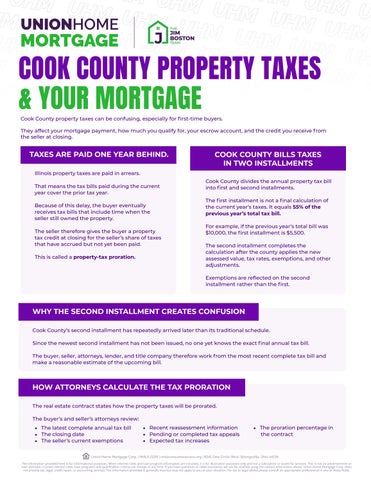

COOK COUNTY PROPERTY TAXES & YOUR MORTGAGE
Cook County property taxes can be confusing, especially for first-time buyers
They affect your mortgage payment, how much you qualify for, your escrow account, and the credit you receive from the seller at closing.
COOK COUNTY BILLS TAXES IN TWO INSTALLMENTS


Illinois property taxes are paid in arrears.
That means the tax bills paid during the current year cover the prior tax year
Because of this delay, the buyer eventually receives tax bills that include time when the seller still owned the property.
The seller therefore gives the buyer a property tax credit at closing for the seller’s share of taxes that have accrued but not yet been paid.
This is called a property-tax proration.
Cook
Cook County divides the annual property tax bill into first and second installments.
The first installment is not a final calculation of the current year’s taxes It equals 55% of the previous year’s total tax bill.
For example, if the previous year’s total bill was $10,000, the first installment is $5,500.
The second installment completes the calculation after the county applies the new assessed value, tax rates, exemptions, and other adjustments.
Exemptions are reflected on the second installment rather than the first
Since the newest second installment has not been issued, no one yet knows the exact final annual tax bill.
The buyer, seller, attorneys, lender, and title company therefore work from the most recent complete tax bill and make a reasonable estimate of the upcoming bill.
The real estate contract states how the property taxes will be prorated.
The buyer’s and seller’s attorneys review:
The latest complete annual tax bill
The closing date
The seller’s current exemptions Recent reassessment information Pending or completed tax appeals Expected tax increases
The proration percentage in the contract
County’s second installment has repeatedly arrived later than its traditional schedule.
HOW ATTORNEYS CALCULATE THE TAX PRORATION
Because the latest final bill is often unavailable, the contract commonly increases, or grosses up, the most recent known tax bill to account for a possible increase
Common proration amounts are:
105% of the latest tax bill
110% of the latest tax bill
Another percentage negotiated by the attorneys
The attorneys take the grossed-up annual figure, calculate the daily tax amount, and multiply it by the number of days the seller owned the property during the unpaid-tax period.
That amount appears as a seller credit on the buyer's closing statement.
A SIMPLE EXAMPLE
Assume the latest complete annual tax bill is $10,000.
The contract requires taxes to be prorated at 110%.
The attorneys use an estimated annual bill of:
$10,000 × 110% = $11,000
They divide $11,000 by 365 days to calculate an estimated daily tax amount:
$11,000 ÷ 365 = approximately $30.14 per day
If the seller is responsible for 200 days of unpaid taxes, the estimated seller credit is:
200 × $30.14 = approximately $6,028
The buyer receives that credit at closing because the buyer will later receive and pay the actual tax bill.
EXEMPTIONS CAN CHANGE THE TAX BILL.
The seller can have exemptions that reduce the taxes, including:
Homeowner Exemption
Senior Exemption
Senior Freeze
THE PRORATION IS AN ESTIMATE.
The buyer and seller do not know the exact final bill when it has not yet been issued.
Grossing up the latest bill by 105% or 110% creates a cushion for an expected increase, but it does not guarantee an exact result.
The final bill can still be higher or lower than the amount used at closing
Some contracts provide for a later reproration once the actual bill is issued. Many transactions treat the closing proration as final the contract and attorney review control.
A buyer should not assume every exemption on the seller’s bill will continue.
If the seller has a Senior Freeze and the buyer does not qualify, the buyer’s future taxes can increase substantially. An eligible buyer can apply for the Homeowner Exemption, but the exemption does not always appear immediately on the first bill received after closing.
PROPERTY-TAX APPEALS
Cook County owners can appeal their assessed value through the Cook County Assessor and the Board of Review.
An appeal challenges the assessed value, not the tax rate
Condo buildings often retain one property-tax attorney to coordinate appeals for multiple units. The HOA board or management company distributes the information, and individual owners authorize the attorney to appeal their unit
A successful appeal can lower the assessed value Buyers should not build their budget around appeal savings until the reduction is approved and reflected on the tax bill.
BOTTOM LINE
HOW TAXES AFFECT YOUR MORTGAGE PAYMENT
When your lender escrows property taxes, part of each monthly mortgage payment goes into an escrow account
The mortgage servicer uses the escrow funds to pay the tax bills.
If the actual tax bill exceeds the amount collected, the escrow account incurs a shortage
The servicer then increases the monthly payment, collects the shortage separately, or does both
For a Cook County purchase, do not copy the tax amount directly from the listing.
Review:
The latest complete annual tax bill
The 55% first installment
Whether the newest second installment is available
The seller’s exemptions
The 105%, 110%, or other contractual proration
Recent reassessment and appeal activity
The realistic tax amount used for mortgage qualification
The seller’s closing credit helps pay the seller’s estimated share It does not guarantee the amount of the buyer’s future tax bill.