parks &leisure AUSTRALAS IAN
Volume 21.1 Autumn 2018 ISSN: 1446-5604
Community & Urban Planning
Creating LIVEABLE CITIES & BETTER PARKS
Can a ‘user-pays’ approach work?
COMMUNITY PROGRAM of the Year
NATURAL CAPITAL
#NATUREFORALL
CONTENTS FEATURES 8 11 14 16 18 20 23 26 28 44 44 46 48 50 53 56 58 65
INTERNATIONAL
Three Capes Track A User-Pays Approach Embedding Cultural Identity Street Tree Threat Parks & Recreation Archive Scott Point Sustainable Sports Park Creating Liveable Cities GIS Tools for Parks Community Passion PLA National Awards Showcase PLA Individual Award Winners Halvorsen Park Playground Community Program of the Year Mapping the Future of Sport Sport & Recreation Spatial Mill’s Park Creating Better Parks Meet the new WUP CEO
31 32 36 37 38 40 42
42
International News The Wild Woman Parks for People at an End Designing Healthy Living Natural Capital The Right to Play #NatureForAll
REGULARS 4 6 60 62 65 66
From the PLA President & CEO From the NZRA Chair & CEO PLA Advisory News Research Connections Courses & Events Join Us on Social Media
58
26
23
8
PRODUCTION EDITOR Nicole Mulloy nmulloy@universalmagazines.com.au
ADVERTISING ART DIRECTOR Martha Rubazewicz ADVERTISING PRODUCTION COORDINATOR Anna Cindric
CREATIVE DIRECTOR Kate Podger EDITORIAL & PRODUCTION MANAGER Anastasia Casey MARKETING & ACQUISITIONS MANAGER Chelsea Peters
CHAIRMAN/CEO Prema Perera PUBLISHER Janice Williams CHIEF FINANCIAL OFFICER Vicky Mahadeva ASSOCIATE PUBLISHER Emma Perera FINANCE & ADMINISTRATION MANAGER James Perera
parks &leisure
EDITORIAL COORDINATOR John Senior 0418 323 863 journal@parksleisure.com.au EDITORIAL & PRODUCTION MANAGER Nicoll Parton marketing@parksleisure.com.au DESIGNER Michaela Primiano PUBLISHER Janice Williams SALES/ACCOUNT MANAGERS Marcus Hucker (NSW) 0410 338 119 Antonia Bewley (QLD & WA) 0418 424 410 Pilar Danlag (VIC & SA) 0414 468 243
AUSTRALAS IAN
Volume 21.1 Autumn 2018 ISSN: 1446-5604
Community & Urban Planning
Creating LIVEABLE CITIES & BETTER PARKS
Can a ‘user-pays’ approach work?
COMMUNITY PROGRAM of the Year
NATURAL CAPITAL
#NATUREFORALL PLA211_OFC_Final.indd 1
8/02/2018 10:28:56 AM
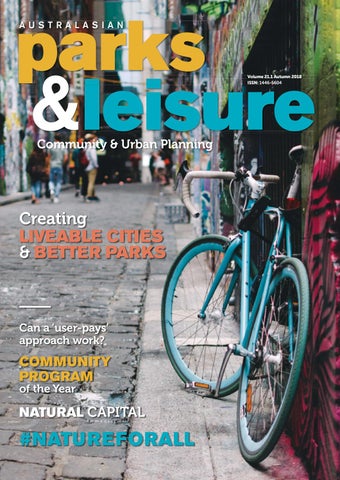
COVER IMAGE Melbourne laneway | Creating Liveable Cities in Australia
Circulation enquiries to our Sydney head office 02 9805 0399. PLA Journal is published by Universal Magazines, Unit 5, 6-8 Byfield Street, North Ryde 2113. Phone: (02) 9805 0399, Fax: (02) 9805 0714. Melbourne office, Suite 4 Level 1, 150 Albert Road, South Melbourne 3205 (03) 9694 6444, Fax: (03) 9699 7890. Printed by KHL Printing Co Pte Ltd, Singapore. This book is copyright. Apart from any fair dealing for the purpose of private study, research, criticism or review as permitted under the Copyright Act, no part may be reproduced by any process without written permission. Enquiries should be addressed to the publishers. The publishers believe all the information supplied in this book to be correct at the time of printing. They are not, however, in a position to make a guarantee to this effect and accept no liability in the event of any information proving inaccurate. Prices, addresses and phone numbers were, after investigation, and to the best of our knowledge and belief, up to date at the time of printing, but the shifting sands of time may change them in some cases. It is not possible for the publishers to ensure that advertisements which appear in this publication comply with the Trade Practices Act, 1974. The responsibility must therefore be on the person, company or advertising agency submitting the advertisements for publication. While every endeavour has been made to ensure complete accuracy, the publishers cannot be held responsible for any errors or omissions. This magazine is printed on paper produced in a mill that meets Environmental Management System ISO14001 * Recommended retail price ISSN 1446-5604 Copyright © Universal Magazines MMXVIII ACN 083 489 463 www.universalmagazines.com.au Please pass on or recycle this magazine.
Autumn 2018 | AUSTRALASIAN PARKS AND LEISURE 3
FROM THE PLA PRESIDENT This year Generate gets into full swing and will
communities to interact. Even when the realisation
young and emerging professionals in the industry.
hits that urban design “fails” have led to sick and
We also have five regional conferences and the State
dysfunctional urban areas, it isn’t too late to address
and National Awards of Excellence. Professional
the structural flaws and start to reclaim the public
development courses in a wide range of core skill
realm to create spaces for communities to live.
areas will be offered throughout the year, along with
The Placemaking Philosophy and its expanding
a number of half-day and full-day events across the
arsenal of tools is a clear example of reaction to
country covering a broad range of topics.
failure but, importantly, it is a reaction that builds on
Greenflags will fly and parks will get magical, not to mention the renewed excitement around Parks Week (10-18 March), where our industry celebrated
MARTY LAMBERT
people that value the public realm and encourages
start a number of programs and initiatives to support
the value and benefits of parks.
the collective capacity of communities to act for themselves to improve neighbourhoods. A theme that emerges from this edition’s exploration of the urban frame is ‘connection’. In
The new membership structure of PLA will
many ways this simple concept is at the core of
elcome to the first journal of
W
be released later this year along with a revamped
everything we strive for in our work as parks and
the year. 2018 promises to be
website; which will greatly improve access to
leisure professionals. We plan for and manage an
a significant year for PLA. The
information and content. PLA Advisory, our research
urban environment where people can connect to
plethora of opportunities to develop
and advocacy group, will be working hard on both
nature, to greenspaces, to the outdoors, connect to
your professional practice occurring throughout the
expanding the research agenda and creating more
each other, connect to their communities, connect
year has many of us excited. Most significantly, our
effective and accessible advocacy tools.
to local expressions of culture and a sense of place
Why not start the year with some great reading
National Conference in mid-October, to be held in
and belonging. We also provide the infrastructure
conjunction with World Urban Parks at the MCG, is
and learning. The Autumn edition of the Journal
that provides the physical connections from
shaping up to be a momentous event.
contains highlights from National award winners, as
homes and shops and community facilities to
well as profiles of projects and thought-provoking
active spaces, greenspaces and people places. The
the Singapore Institute of Parks and Recreation
articles on community and open space planning,
pathways, bikeways, greenways and waterways are
and others in Asia that has initiated an important
the critical importance of cycleways and active
all part of this essential connecting infrastructure.
Asia Pacific event in Singapore, which will run from
transport options, green design, and features on
8-11 March. For any of you who want to see the
emerging trends in public space and play.
We also have an expanding partnership with
diversity of work occurring throughout the country,
It is worth remembering that cities, towns and
Enjoy the Journal. And if anything you read fires up a few words, comments or ideas for new articles, don’t hold back, get writing and join in. We are always looking for thought provoking and
or expand your business and understanding of the
villages will all be worthless and lifeless without the
industry in the region, keep an eye out for the PLA
social, cultural and physical fabric provided by our
informative content.
newsletters for details on this exciting event, the
industry. No one wants to live in a suburb designed
professional opportunities, and the travel packages.
just for houses and cars; they want a suburb built for
Marty Lambert PLA National President
FROM THE PLA CEO
MARK BAND
offer a sylvan setting in an increasingly urbanised
new web platform will soon offer members an
society. With population density increasing, it is
array of opportunities to improve and develop
critical that the parks and planning sectors continue
themselves professionally in order to remain
to address open space management at the local
abreast of modern challenges and demands. The
level. Because, while as a nation we are envied for
new site has been a work in progress, but, when
our abundance of open space, the fact remains
complete, will include PLA endorsed training
that Australia is still one of the most urbanised
courses that align with the continuous professional
countries in the world, and the pressure of
development (CPD) points required for CPLP
servicing the needs of its inhabitants will continue
renewal every three years. If you are interested in
as we double our population in the next 50 years.
going through the process to become a CPLP, visit
As a professional association, PLA has a
parksleisure.com.au/cplp-applynow
s we enter autumn - which is personally
A
responsibility to ensure our members and the
one of my favourite seasons due to the
broader industry is aware of and equipped to
year is going to be a big one for PLA. As we ramp
beautiful colours and visual aspects of
respond to these pressing challenges. Late last
up planning for the 2018 PLA National Conference,
our parks and gardens - I often reflect
year we launched the Australian Certified Parks
which will coincide with the World Urban Parks
on something I once read by the great Victorian/
and Leisure Professional (CPLP) accreditation
Congress (administered by PLA), I encourage you
Edwardian author, philanthropist, poet, artist, and
in conjunction with World Urban Parks and the
all to start planning for the event; which promises
‘social thinker’ John Ruskin, who said:
Eppley Institute in the USA. The process is a self-
to include more international speakers and
evaluation, and I would encourage all members
delegates than ever before. Keep watching this
cities, and a measure of a city’s greatness is to be
to consider applying to become a Certified Parks
space for more information as it comes to hand.
found in the quality of its public spaces, its parks
and Leisure Professional (CPLP); as not only will
In the meantime, enjoy autumn and the wonderful
and its squares.” (circa 1850)
this become an industry recognised benchmark,
parks, gardens and public spaces that highlight our
“The measure of any great civilisation is in its
There’s no better time than autumn to reflect on this sentiment and the great work our industry
As the PLA President has already alluded, this
but gaps in our own skills and knowledge may
great towns and cities.
become evident.
Mark Band PLA Chief Executive Officer
does in this realm, especially in the city parks that
In response to this accreditation process, PLA’s
We thank our national sponsors and partners:
4 AUSTRALASIAN PARKS AND LEISURE | Autumn 2018
TEXTILES YOU CAN RELY ON
For the full range of premium technical textiles to enhance your next project contact ricky today on
02 9735 3333
rickyrichards.com.au
FROM THE NZRA CHAIR
MARK BOWATER elcome to the first edition of 2018! With key themes around open space planning, sustainable design, green infrastructure and future trends and directions, I am going to boldly make a few predictions relating to our realm. Has it been one of the more extreme summers on recent record? Hotter temperatures, heavier rainfalls and storm events, flash flooding? More outbreaks of fire, greater drought conditions, an influx of ecological pest and disease incursions? Prediction number one, climate change is real and we will see more and more of these extreme weather events in coming years. We need to evolve and adapt the way we respond to this. Our parks, open spaces and natural
W
areas play a key role here. If we believe in climate change, we have an open mind, and we are using hindsight to inform foresight, then we are in the right position to influence change. Our cherished greenspaces need to adapt, particularly in our urban environments where over 80 percent of Australasian people - and growing by the day - now choose to live. Our greenspaces will need to be more resilient, to provide for higher intensity of use, to enable multi-functional outcomes, and serve an ever increasing demand across a range of environmental, social and economic values and functions. Here are a few trend predictions for the next 5 years for our urban parks: 1. Environmental sustainability outcomes will drive how we use and develop our parks 2. We will increasingly plant species in our parks that rate highly for carbon sequestration capability 3. Parks will become exemplars of utilising renewable energy sources such as solar and wind 4. Green building designs such as sports pavilions will rapidly become the norm 5. Sustainability rating tools will become
commonplace for embedding sustainability principles in major parks infrastructure projects 6. We will learn to live in balance with the adverse effects of disease incursions like Kauri dieback and Myrtle Rust 7. Parks will increasingly be used for community food production 8. Green-waste-to-energy schemes will flourish 9. The jury will be out on animal-wasteto-energy schemes 10. Parks will increasingly be used to enable social outcomes like local employment opportunities. I have no doubt that the role and value of our precious parks and greenspaces will grow exponentially, and future health outcomes will be heavily influenced by connection with nature. I hope you do too!
Mark Bowater NZRA Chair
FROM THE NZRA CEO
ANDREW LESLIE e are looking forward to an exciting programme of events in 2018 and we’re kicking things off with a focus on the Parks and Open Spaces sector. Parks Week 2017 was a huge success, with hundreds of organisations across Australia and New Zealand holding events to celebrate the vital role parks play in creating liveable cities and thriving communities. The week saw councils and other organisations on both sides of the Tasman running engaging events to raise awareness on the value of parks and open spaces, and to get people out of their living rooms and enjoying the outdoors.
W
This year we want to make Parks Week even bigger and spread the word that: • Visiting parks is good for your physical and mental wellbeing • Healthy parks are an essential ingredient for healthy people • Parks support health and wellbeing, enhance the ability to cope with and recover from illness and injury and help to reduce the risk of chronic disease • Parks build stronger and connected communities by providing places where people come together for leisure • Parks provide environmental benefits to our cities Take a look at the awesome range of events at www.parks-week.org In April we begin our 2018 conference programme with the Cemeteries and Crematoria Conference, and in May the Green Pavlova Conference, both taking place in Christchurch. The Cemeteries and Crematoria Conference presents the opportunity for commercial and corporate partners to engage with the Cemeteries and Crematoria industry
6 AUSTRALASIAN PARKS AND LEISURE | Autumn 2018
and be party to its future direction. It aims to target the decision makers, thought leaders and emerging talent regarding the future of the industry. Green Pavlova is the premier parks and open space event for people working in the recreation and sport industry. The event promotes and encourages best practice by presenting and showcasing developments from within and outside the industry. It will be full of opportunities to network, exchange ideas and learn about what’s happening for parks and open space recreation professionals in New Zealand. The team and I hope to see you at our upcoming events. Andrew Leslie NZRA CEO
A park was created from a former Caltex tank farm. Gabions were filled with demolition material including broken brick.
Ballast Point Park
Permathene specialise in architectural gabion walls for parks and urban spaces. Gabions are versatile, they are not only design elements adding definition to areas of the park but they are also aesthetic features that perform a specific function. By filling with different materials (different types of rocks or recycled materials), landscapers are able to create different effects to blend into surroundings. Permathene offers different welded gabions including Australian made AL-TENTM (coated with 290 grams of 10% aluminium and 90% Zinc), Black PVC coated, and marine grade stainless steel 316L. Photos 1&5: Sydney Park St Peters NSW, 2&6 Jack Ross Park Kingston Foreshore ACT, 3: Gardiner Park, Rockdale NSW, 4: Charlestown Oval, Charlestown NSW
1
2
3
4
5
6
Australia: www.permathene.com.au Ph: 1-800 60 80 95 | New Zealand: www.permathene.co.nz Ph: 09 968 8888
THREE CAPES TRACK THREE CAPES TRACK SHOWCASES SOME OF THE GEOLOGICAL WONDERS OF TASMANIA IN A BREATHTAKING 48KM JOURNEY ALONG AN AWARD-WINNING TRAIL 10 YEARS IN THE MAKING WORDS BEN CLARK, BUSINESS ENTERPRISE COORDINATOR – THREE CAPES TRACK, TASMANIA PARKS AND WILDLIFE SERVICE AND DAVID DONNELLY, DIRECTOR, INSTINCT AND REASON
T
hree Capes Track is the largest track project in the history of the Tasmania Parks and Wildlife Service (PWS), and the single largest investment in an Australian national park for 25 years (since Uluru). Planned, developed and built over a decade, a distinguishing feature has been its intentionally visitor-focused development and design. Since opening in December 2015, the Track has been awarded one international, three national and four state awards in the fields of tourism, architecture, building and planning. The four-day journey (48km) through the Tasman National Park along the Track showcases views to Cape Raoul before leading walkers to Cape Pillar and Cape Hauy. On day
three, walkers stand on the geological wonder of The Blade at Cape Pillar, with its 270m dolerite cliffs (Australia’s highest sea cliffs) dropping to the Southern Ocean on three sides, and astounding views to Tasman Island. Fundamental to the Track’s success was the commitment to market research to inform key aspects of the experience, with four research projects undertaken through the decade from conception to completion. As part of a 2007 Feasibility Study, PWS engaged market research consultancy instinct + reason. Their discrete choice-model research technique helped PWS better understand which elements of the experience would have the greatest influence in the walker’s decision of whether or not to undertake the walk. In many instances, parks agencies
8 AUSTRALASIAN PARKS AND LEISURE | Autumn 2018
have provided bushwalks (and other visitor infrastructure) based on what they think the ‘market’ wants, using analogies from nearby categories, weak market research or extrapolation from the past. PWS had a strong sense of the preferred operational structure, based on the successful
The views never fail to impress
USEFUL LINKS Three Capes Track Feasibility Study | http://parks.tas.gov.au/index.aspx?base=7169 Three Capes Track Experience | www.threecapestrack.com.au Instinct and reason | www.instinctandreason.com
The view speaks for itself. Photo Tasmania Parks and Wildlife Service
Overland Track model it implemented in 2004. Features of this system included a booking system with a daily cap of 60 walkers for the eight months from October to May. Revenue from bookings allows PWS to employ seasonal staff and maintain the facilities at a standard consistent with its world-heritage values, and sustainable management principles. PWS aspired for the Three Capes Track to replicate that success and become an iconic walk in its own right. While many external factors – spectacular coastal scenery and proximity to a major transport node (Hobart Airport) – were in place, PWS had direct control over factors that would ultimately determine the quality of the experience and broaden the appeal beyond traditional bushwalkers. The discrete-choice model research, with a sample of 537 respondents, comprised 427 independent walkers who had recently completed the Overland Track, and 110 who had
recently undertaken a commercial guided walk in Tasmania (of this subset, 73 had also walked independently either in Tasmania or elsewhere). The research tested twelve variables, including number of days walked, price, pack weight, accommodation type, inclusion of interpretive boat journey, with a range of two to six options for each variable (with 37 options in total). In the example of the pack weight variable, four weights were provided – 10kg, 15kg, 20kg, 25kg – as these represented typical weights for similar multi-day walks, depending on the level of facilities provided. Through an online survey, respondents were presented with ten ‘choice cards’. Each card provided three response options; an independent walk, a commercially guided walk, or neither. Based on the respondents’ selections, a complex mathematical model was able to determine which variables had the greatest influence on a walker’s choice
PLAYGROUND EQUIPMENT
Autumn 2018 | AUSTRALASIAN PARKS AND LEISURE 9
The topography offers a truly unique walking experience. Photo Tasmania Parks and Wildlife Service
Wide walking platforms protect the flora and make passage easier for travellers. Photo Tasmania Parks and Wildlife Service
Table 1 INDEPENDENT
COMMERCIALLY GUIDED
Accommodation type
Accommodation type
Price Level of built infrastructure
Hut Hosts Inclusion of a water experience
Options for starting the walk
Average distance walked each day
Inclusion of a water experience
Information packs
whether or not to undertake the walk. The resultant database, termed the “decision support system”, comprised of the collective responses, allowed for variables to be adjusted and demonstrate the influence that would have on the desirability of the walk. The results (Table 1) showed that quality of accommodation was the most significant choice. Specifically, the decision support system showed that if independent walker accommodation had mattresses and gas cooktops (thus reducing the pack weight by ~6kg) there would be virtually no demand for tent-based camping. This gave PWS confidence to pursue a model based purely on cabin accommodation, and amend the Tasman National Park and Reserves Management Plan accordingly1. On the strength of the market research, detailed costing, and preliminary environmental assessments, along with support from political and tourism industry leaders, PWS gained $25.3 million funding through the Australian and Tasmanian governments in 2010. The proposal underwent detailed environmental, social and cultural assessment and was approved at Commonwealth, State and Local Government levels in 2011-12. Construction took place from 20112015 and involved 200 businesses,
providing employment for over 400 individuals, and stimulated a range of new businesses in Tasmania. The track itself was constructed to Australian Standard Class 3, which means it’s a well-formed track of gravel, timber boardwalk or stone of about one metre width. This is believed to be the longest walking track project ever completed to this standard in Australia. During construction, PWS also used discrete-choice modelling to refine aspects of the cabin design, package inclusions and test price elasticity. These studies included people who had not previously done an overnight walk, but were interested, so PWS could gauge what would entice them to undertake Three Capes Track Key to the visitor experience is highquality interpretation, and this has been delivered through Encounters on the Edge – a guidebook featuring 40 stories, with 26 associated ‘story starter’ seats, that interpret the natural and cultural values of the track and surrounds. PWS also partnered with two of Australia’s leading tourism operators – Port Arthur Historic Sites and Pennicott Wilderness Journeys – to provide the services that bookend the walk, namely the checkin, boat and bus journeys. This forms an integrated package that costs $495/ adult or $396/child or concession, with
10 AUSTRALASIAN PARKS AND LEISURE | Autumn 2018
a maximum of 48 independent walkers starting per day2. In its first two years of operation, over 22,000 walkers completed the track, making it Tasmania’s most popular multi-day walk. The track has been popular with female walkers (57%) and walkers in the baby boomer bracket (51% are aged 50 or more). Walkers are predominantly from the eastern seaboard states: NSW/ACT, VIC and QLD (72%), Tasmanians comprising 18 percent, and international visitors only 5 percent. Three Capes Track meets the needs of walkers because the product was built from scratch to do exactly that. Based on walker surveys3, the experience often exceeds expectations and elements identified in the original 2007 research remain indispensable to the decision to book their walk. Key findings include: • A multi-day walk with achievable daily distances (72% were motivated by this); • High-quality accommodation (71% were motivated by this) and USB charging points (77% appreciated); • The opportunity to stand on Australia’s highest sea cliffs (56% were motivated by this); • Developed stunning interpretation (81% ‘loved’ and 17% ‘liked’ the guidebook); • Packaged the walk with an interpretive cruise (83% ‘loved’, 15% ‘liked’) and a cultural experience at Port Arthur – part of the Australian Convict Sites World Heritage Property, and • Walker satisfaction is extremely high, with 96 percent of walkers saying “it was one of the best things I’ve done in my life”, or “in the past 12 months” (target: 90%). These responses reaffirm the market research was correct in identifying that the Three Capes Track visitor experience would be sustainable, viable and eventually become one of Australia’s most iconic walking experiences. REFERENCES 1 This process took two years and included extending the recreation zone to allow for the new track, and five overnight nodes combining independent and commercial guided walker accommodation to be established. 2 A commercially guided walk experience – Three Capes Lodge Walk - will be provided by Tasmanian Walking Company will provide for up to 14 guided walkers per day and is due to open in Sept 2018 3 These statistics are cited from Three Capes Track Walker Survey 2016/17 (unpublished internal report) which had 2286 responses
Indian Char Bagh Garden, Hamilton Gardens
CAN ‘USER-PAYS’ WORK IN PUBLIC PARKS? AN NZ CASE STUDY EXPLORES THE VIABILITY OF GETTING VISITORS TO PAY FOR THE USE OF PUBLIC PARKS WORDS DR ERIC HAYCOCK, TEAM MANAGER, WINTEC HORTICULTURE EDUCATION CENTRE, NEW ZEALAND
B
ooming tourism and demand for affordable family activities is causing a rapid rise in the number of visitors to some of Australasia’s best-known parks and gardens. This is great news for organisations promoting healthy lifestyles and outdoor play but it poses a challenge for councils and parks authorities that are footing growing maintenance and infrastructure bills to ensure visitors can continue to enjoy their parks experience. A solution being explored by some authorities in New Zealand and Australia is the introduction of fee or donation schemes – separate from rates – to help fund development and upkeep at highly trafficked parks. The idea of this type of “user-pays” approach was explored in a recent survey conducted by the Waikato
Institute of Technology (Wintec) at Hamilton Gardens in New Zealand. The survey was commissioned by Hamilton City Council to gauge visitors’ views on the introduction of a fee or donation scheme for entry to the themed gardens area of Hamilton Gardens. The themed gardens won the 2014 International Garden of the Year Award and are recognised as a major tourist drawcard for Hamilton. They include gardens in 12 different styles, ranging from an Italian Renaissance Garden and Japanese Garden of Contemplation to a traditional Māori Garden and Tudor Garden, among many others. Hamilton Gardens has been visited 1.1 million times over the past year and 450,000 of those visits have been to the themed gardens area. This increasing
popularity has resulted in growing demand for upgrades to parking, toilets and other visitor infrastructure. The Council is also in the process of undertaking a $7.2 million upgrade that will see construction of four new themed gardens over four years.
THE SURVEY FINDINGS The Wintec survey polled 285 groups (comprising a total of 830 people) from New Zealand and overseas visiting Hamilton Gardens. It found that three quarters (74%) of those who lived outside of Hamilton said the gardens were either the “only reason” or “a significant reason” for their visit to the city. International visitors were the most likely group to say the gardens were “the only reason” they visited Hamilton, with more than a quarter
Autumn 2018 | AUSTRALASIAN PARKS AND LEISURE 11
A SOLUTION BEING EXPLORED BY SOME AUTHORITIES IN NEW ZEALAND AND AUSTRALIA IS THE INTRODUCTION OF FEE OR DONATION SCHEMES – SEPARATE FROM RATES – TO HELP FUND DEVELOPMENT AND UPKEEP AT HIGHLY TRAFFICKED PARKS. for access to the gardens, rather than a compulsory entry fee. Respondents were more receptive to this, with more than nine out of 10 (93%) saying they would be willing to make a donation to visit the gardens. Seven out of 10 visitors surveyed said they would be willing to donate a gold coin or up to $5. Nineteen percent said they would be willing to donate $6 – $10, less than 1 percent said they would donate $11 – 15, and 4 percent said they would donate $16 – 20. Less than 1 percent said they would be willing to donate more than $20.
A BIG DECISION FOR COUNCIL
(28%) responding as such. But despite the majority view that Hamilton Gardens was among the primary reasons for their visit to Hamilton, the survey revealed mixed feelings about payment of a fee for access to the themed gardens. Nearly two thirds of international visitors (64%) and more than half (58%) of New Zealanders from outside Hamilton or the Waikato region said they would “definitely” or “probably” be willing to pay for entry to the themed gardens if the fee was set at $10. However, just 32 percent of respondents living in Hamilton city and 31 percent from the Waikato region said they would be willing to pay a $10 entry fee at the gate. The survey also asked visitors about their willingness to pay an entry fee if it was set at $15, $20 or $25. At $15, only 32 percent of international visitors and 17 percent of domestic visitors from outside Hamilton or the Waikato region said they would “definitely” or “probably” be willing to pay for entry. That percentage dropped to less than 10 percent for both groups by the time the proposed fees reached $25. Just one in 10 respondents living in Hamilton or in the Waikato region said they would be willing to pay if entry fees were set at $15 or any level above that. Visitors were also polled on their views about paying a voluntary donation
The survey findings pose some interesting questions for Hamilton City Council as it moves into the next phase of its deliberation. It seems any fee imposed on access to the gardens may be met with opposition by some visitors, particularly Hamiltonians who already pay a targeted rate of $10 per annum for development and upkeep of Hamilton Gardens. Yet there is a clear need to fund infrastructure improvements to cope with rapidly growing visitor numbers. Without a solution, parking spaces will become increasingly difficult for visitors to find, queues at the toilets will continue to increase, and the tranquil spaces many of the themed gardens aim to create will become crowded. One option available to administrators may be to charge a fee only to nonresidents – people who don’t already pay rates to Hamilton City Council. The city’s Mayor, Andrew King, proposed this in early 2017, making the point that entry fees were common in overseas locations such as Kew Gardens in London and Versailles outside of Paris. A targeted entry fee of this kind could be applied to all visitors residing outside of the Hamilton City Council area, or just to international visitors. While both approaches may be viable, the survey’s findings suggest international visitors would be the most likely to continue coming if a fee for entry was charged. Charging only international visitors may also be more palatable politically given the recent high-profile debate in the
12 AUSTRALASIAN PARKS AND LEISURE | Autumn 2018
media about how to manage access to New Zealand’s outdoors in the face of rising tourism. Much of that debate has focused on outcry from New Zealanders who are struggling to book beds in huts on well-known multi-day tracks that are becoming overcrowded. As a result, a consensus appears to be emerging that some form of a user-pays system should be applied to international visitors accessing popular tracks in New Zealand’s National Parks, whether through a hut fee or a tax levied at the border. Other options available to generate funds include implementing a fee for parking at the gardens, extending the duration of the targeted rate currently being levied on Hamilton ratepayers for a four-year term ending in June 2018, or making donation boxes more visible at the entrance to the themed gardens. However, the effectiveness of the latter option, in particular, is questionable. While the survey suggests visitors are open to donations, the three donation boxes currently in place at the entrance to the gardens generated just $400-$2000 a month in the latest calendar year. Donation boxes at many other public facilities in New Zealand, including museums, likewise generate very limited funds for local authorities.
WHAT DOES NEW ZEALAND’S LEGISLATION SAY ABOUT USERPAYS SCHEMES IN PUBLIC PARKS? Implementing a user-pays scheme for access to discrete sections of public parkland is certainly possible under New Zealand law. The Reserves Act 1977 and Conservation Act 1987 both include provisions designed to protect public access to publicly owned parks, but they also make allowances for fees to be charged in certain circumstances. Section 53 of the Reserves Act states that the administering body of a reserve may set aside and develop parts of a reserve for gardens or other recreational purposes and “fix reasonable fees” for their use. A good example of this in practice can be found in the way many New Zealand councils administer zoos. Access to some publicly-owned zoos was once free but councils now charge
an entry fee to pay for maintenance, visitor infrastructure, and improvements to animal enclosures. The same is true of some publicly owned sports stadiums in New Zealand. Stadiums such as the Basin Reserve in Wellington are located on publicly owned land, yet the public is charged a fee to access them during events. This approach has been widely accepted by ratepayers, as well as visitors from out of town.
THE WAY AHEAD? There is no doubt councils in New Zealand face financial constraints for maintenance and development of parks and open spaces, and Hamilton City Council’s situation is no different. The survey suggests that while Hamilton ratepayers may not be open to the introduction of a fee for entry to the themed gardens area of Hamilton Gardens, applying an entry fee to nonresidents or just international visitors may be possible. Given the need to manage rising visitor numbers and fund upkeep and development at Hamilton Gardens, a targeted entry fee of this kind may be the best solution to ensure non-residents or international visitors pay their fair share. However, it is by no means an easy decision for Council. A recent report released by
A Zen space in Hamilton Gardens
consulting firm Horwath HTL, quoting the findings of the Wintec survey, suggested the introduction of a fee in the range of $10 per non-resident visitor could reduce international visitor numbers by 20 percent and domestic visitor numbers by 30 percent in the first year it was introduced. The report suggested that the entry fee’s negative impact on visitor numbers would lessen in subsequent years as visitors accepted the fee scheme. A 2013 report from the same consulting firm estimated that Hamilton Gardens would generate around $13 million per year in visitor
/toroaus
/@toroaus
You
spending for the Hamilton economy by 2018. The Wintec survey’s findings also highlighted the importance of the gardens in people’s decision to visit Hamilton, with the vast majority of both international and domestic respondents saying that the gardens were a significant factor. Projections such as these, which highlight the importance of Hamilton Gardens to Hamilton as a tourism attraction and the potential impact an entry fee might have on the city’s economic growth, need to be front of mind throughout the Council’s decision-making process.
/toroaustralia
Autumn 2018 | AUSTRALASIAN PARKS AND LEISURE 13
EMBEDDING CULTURAL IDENTITY THE ROLE OF MATAPOPORE IN ENSURING MANA WHENUA VALUES AND NARRATIVES ARE EMBEDDED WITHIN THE NEW EMERGING CITY OF CHRISTCHURCH WORDS DEBBIE TIKAO, MATAPOPORE GENERAL MANAGER, NZILA REGISTERED LANDSCAPE ARCHITECT
T
he Canterbury earthquakes of 2010 and 2011 ripped through the fabric of Christchurch, destroying many of the buildings that contributed to the Colonial character of the Garden City. For Ngāi Tūāhuriri however, the earthquakes opened a space that wasn’t there before, bringing to the surface stories that had long been buried under layers of Western influence; of Western engineering, planning, aesthetics, and ideals that drained vast swamplands and streams rich in ecological diversity and mahinga kai value to shape an environment to look like the home that had been left behind. The rich, peaty soils of this region have aided a gardening culture that, along with the more deliberate efforts of Council, created a character that Cantabrians strongly identify with the Garden City; architecture, gardens and an urban structure that are all very English. The space that opened in the wake of the earthquakes wasn’t just the knowledge that a number of buildings that contributed to the Colonial aesthetic were gone and needed to be replaced
with something else. It was also a shake up to the minds of many that opened the space for change, and quite possibly the knowledge that whatever that ‘else’ was, it would need to be good! The timing of the shakeup also aligned with a growing trend within local and central government of working more closely with iwi and hapū in the management of natural resources and the shaping of living environments. Although it could be argued that Christchurch was a bit behind other urban centres in this department pre-earthquake, postearthquake tells a very different story. In 2012, the Christchurch Central Recovery Plan was developed and Te Rūnanga o Ngāi Tahu was identified as one of the strategic partners to guide the recovery of central Christchurch. Within the Recovery Plan, Mana Whenua (also known as iwi and hapū) identified their aspirations for Christchurch, which included having a visible identity. Ngāi Tūāhuriri whanau (community) want to be able to walk through the city and see themselves. Ngāi Tūāhuriri is the local Ngāi Tahu
14 AUSTRALASIAN PARKS AND LEISURE | Autumn 2018
Te Papa Ōtākaro: Avon River Precinct
IWI ARE THE LARGEST SOCIAL UNITS IN MĀORI SOCIETY. THE WORD IWI MEANS “PEOPLE” OR “NATION”, AND IS OFTEN TRANSLATED AS “TRIBE”. subtribe (hapū) that holds mana whenua (traditional rights and responsibilities) over the Christchurch CBD. Ngāi Tūāhuriri established the Matapopore Charitable Trust (Matapopore) to work initially with CERA on the delivery of 17 anchor projects, and now Matapopore works with Ōtākaro Ltd, Regenerate Christchurch, Christchurch City Council (CCC) and others to provide cultural design and arts advice on Ngāi Tūāhuriri /Ngāi Tahu
A detail from a 130m-long story arc depicting Ngai Tahu and Pakeha migration
Oi Manawa (The Canterbury Earthquake Memorial)
values, narratives and aspirations, and to weave these into the fabric of the new emerging city. The opportunity created by the rebuild has provided the space for Matapopore to be a part of the team shaping this new emerging city. To begin with, the service Matapopore provided was advisory in nature. Over time we realised that the only way to achieve meaningful outcomes was to be a part of the design team, working closely with architects, landscape architects and other build environment experts from conception to construction. The work we do is becoming increasingly visible and is starting to contribute to an urban character that is truly unique to the location. The stories that are being told throughout the city do not suppress or cover the Colonial narrative, but rather sit alongside in a way that celebrates our dual histories. To date, a number of anchor projects have been completed or are near completion. A number of these projects contribute to a new or revitalised public realm for Christchurch, such as Te Ara Pū Ha (The South Frame), Rauora Park, Oi Manawa (The Canterbury Earthquake Memorial) and Te Papa Ōtākaro (Avon River Precinct), which consists of a number of projects including Tākaro ā Poi (Margaret Mahy Family Playground), Victoria Square Regeneration Project, The Promenade, in-stream ecological enhancement of the river, The Terraces, the Literary Trail and the Art Trail. Completed buildings that contain Ngāi Tahu artworks interfacing with the
This stone ‘Whāriki’ forms part of the Art Trail that follows the Ōtākaro Avon River
MAHINGA KAI PROPERLY REFERS TO NGĀI TAHU INTERESTS IN TRADITIONAL FOOD AND OTHER NATURAL RESOURCES AND THE PLACES WHERE THOSE RESOURCES ARE OBTAINED. public realm include Te Omeka (The Justice Precinct) and Hine Pāka (The Bus Interchange). One of our most significant public realm projects to date is Ngā Whāriki Manaaki by Ngāi Tūāhuriri weavers Reihana Parata (aka Aunty Doe) and Morehu Flutey-Henare, with graphic support from Wayne Youle. Ngā Whāriki Manaaki depicts the progression of a traditional pōwhiri in a series of 13 original whāriki designs. The pōwhiri process welcomes people visiting Christchurch and is an expression of the key founding kaupapa for Matapopore – Kia atawhai ki te iwi (care for your people) – words from Pita Te Hori, Upoko Ngāi Tūāhuriri Rūnanga, 1861. Whāriki are traditionally woven floor mats. Here woven patterns have been translated into stone mats up to 5m x 5m using stone of a variety of shades to form part of the Art Trail that follows the Ōtākaro (Avon River). Three have been installed to date, with two others nearing completion within the Victoria Square project. The mats are a beautiful contribution to creating a city that is warm and welcoming. Each mat tells a different story through different patterns; all the mats combine to create Ngai Whāriki Manaaki. To guide and inform the design of anchor projects, Ngāi Tūāhuriri /
Ngāi Tahu historical narratives have been written by Dr Te Maire Tau and others. The narratives provide project teams with Māori histories and values associated with the area. Matapopore Urban Design Guidelines have also been developed to steer the design process and form a bridge between the historical narratives and design outcomes. The Matapopore Charitable Trust is lead by Chairperson Aroha Reriti-Crofts CBE JP, and with her amazing support together with the support and guidance from our other Trustees, the team at Matapopore have been able to work on embedding a cultural identity into the built environment of Christchurch on a scale that is an absolute world first. Matapopore plan to leave a legacy that will ensure our tamariki (children) are proud of their identity and can see themselves in this city. We also want all children to feel a connection to what we do, and to educate visitors and locals about the stories, natural resources and traditional ways of living and knowledge systems that are unique to New Zealand. Information about the Christchurch rebuild projects to date can be viewed at www.matapopore.co.nz
Autumn 2018 | AUSTRALASIAN PARKS AND LEISURE 15
Swanston Street in Melbourne features a plethora of mature trees
THE TREE THREAT RESEARCH FINDS AUSTRALIA’S LUSH STREET TREES FACE A GRAVE THREAT FROM RISING EMISSIONS WORDS NICOLE HASHAM, THE SYDNEY MORNING HERALD
M
uch-loved leafy streets and shady parks in Sydney and Melbourne are in jeopardy, according to new research that found climate change severely threatens the health of more than onethird of tree species in Australia’s cities. The federally funded study of 1.5 million trees in 29 council areas across Australia found that higher temperatures and urban heat means new tree species may be introduced, existing trees must be given special care, and some trees may disappear in certain locations. More than four in 10 houses in Australia’s capital cities have a street tree. Trees can greatly affect people’s experience of a city - providing shade, places for recreation, and a sense of place and heritage. They also cool the city, capture rain, slow stormwater and provide habitat for birds and other animals. But the study found
24 percent of all public trees, or 35 percent of tree species, were at high risk from increased temperatures under a business-as-usual scenario in which emissions continue to increase to 2070. Some 14 percent of all public trees, or 22 percent of tree species, were at high risk of increased temperatures if emissions were limited, in line with international commitments, in the years to 2040. Trees were deemed at high risk when predicted temperatures were warmer than 97.5 percent of locations where the species is found – making them particularly susceptible to drought, physiological stress, and pest and disease outbreaks. In the City of Sydney, 50 percent of trees were at high risk under a business-as-usual scenario. They included varying species of brush box, rose gums, grey oaks and several eucalypt species. In the Sydney council area formerly
16 AUSTRALASIAN PARKS AND LEISURE | Autumn 2018
known as Marrickville, now part of the Inner West Council, a businessas-usual scenario put 40 percent of trees at high risk, including casuarina she-oaks, black locusts and several eucalyptus species. Some 32 percent of trees were at high risk under business-as-usual in the City of Melbourne. They included rose apples and several species of elms, oaks and eucalypts. Melbourne’s inner north City of Moreland would see 26 percent of trees at high risk under a business-as-usual scenario, such as purple-leafed plums, prairie crabapples and the narrow-leaved ash. Darwin had the highest proportion of trees – 85 percent – most at high risk if emission levels rose to 2070, while Ballarat had just 1 percent at high risk. Risks to trees were posed by both rising global temperatures and the urban “heat island” effect, where
TREES CAN GREATLY AFFECT PEOPLE’S EXPERIENCE OF A CITY - PROVIDING SHADE, PLACES FOR RECREATION AND A SENSE OF PLACE AND HERITAGE. localised warming occurs due to dark-coloured and paved surfaces, buildings and the emission of heat from human activities. The study was conducted by the Clean Air and Urban Landscapes Hub, a consortium of four universities funded by the Department of Environment and Energy. It claimed “changes to the composition and the traits of the urban forest will lead to changes in the sense of place and identity of cities.” “Many cities in south-eastern Australia have a strong European colonial heritage expressed in their many broad-leaved deciduous trees that is likely to change under future climates,” it continued. Conversely, local native trees helped create unique city identities and connections to natural heritage and traditional Indigenous ownership. The report said urban forest managers could adapt to increasing temperatures by providing irrigation or improved pest and disease
Australia’s much-loved street trees could fall victim to rising emissions. Photo Brook Mitchell
The study was conducted by the Clean Air and Urban Landscapes Hub. Photo Brook Mitchell
management, improved tree maintenance and selecting trees that are better adapted to future climates.
Landmark Products offers a complete, professional open structure and furniture service throughout Australia. With over 25 years’ experience, and a team of highly skilled experts in public use infrastructure, Landmark is committed to exceeding the expectations of our clients, whether for a relatively straightforward
Visit landmarkpro.com.au for more info or call 1300 768 230
project or for complex, custom-built urban projects.
Autumn 2018 | AUSTRALASIAN PARKS AND LEISURE 17
The Domain, Sydney NSW
A FOUNTAIN OF KNOWLEDGE THE NEW PARKS AND RECREATION COLLECTION IS SHAPING UP TO BE AN EXCITING PORTAL OF INDUSTRY KNOWLEDGE AND RESOURCES WORDS GEOFF EDWARDS, SECRETARY TO THE TRUSTEES
P
aRC, the Parks and Recreation Collection, is an exciting new project that aims to assemble documented knowledge in the parks and leisure sector. It will be an online, open access repository of documentary materials nested in an accompanying narrative. The portal is expected to be used by practitioners, trainers and educators, students and scholars as a source. The project will differ from a Google search result in that all materials will be validated and classified within a logical framework, their context and status transparent. It will differ from a library search in its explanatory narrative. The project is being funded by the 43-yearold Trust Fund–Education (Fund).
THE BEGINNING When the Australian Institute of Parks and Recreation (predecessor to Parks and Leisure Australia) established the Trust Fund-Education on 8 February 1974, it had no particular project in mind.
The Institute simply wished to make a long-term investment in the future of the parks and recreation professions. The purpose of the Fund was specified as “the furtherance of public educational and scientific or research purposes allied so far as is reasonably practicable with the objects of the Institute”. The relevant “objects” of the Institute include references to “public parks, botanic gardens, zoological gardens, national parks, cemeteries, open spaces, recreation and leisure services, facilities and programs”. Education referred to “courses at trade, technical and professional levels for the training of personnel involved in the profession of parks and recreation management”. The Founders were elder statesman of the Institute, Jack Firth, Frank Keenan, Arthur Wood and Gordon Shearwood, who commissioned three Trustees, Dr David Churchill, Jim Sullivan and Noel Lothian, to develop the Fund in accordance with the Trust Deed. The deed granted to the Trustees
18 AUSTRALASIAN PARKS AND LEISURE | Autumn 2018
absolute discretion to determine how money, property or benefits could be provided from the fund – but subject to the Income Tax Assessment Act 1936-1972. It was and remains a “public ancillary fund”. It could only feed the money to a “Deductible Gift Recipient Type 1”. This category is (for this purpose) confined largely to public research or training institutions. As the Institute was not – and PLA is not – a DGR Type 1, there has been no power to grant the monies to the Institute, even for the defined purposes of the Trust Deed. An attempt in 1981 by the Trustees to devolve their responsibilities to the Institute was rejected by the Australian Taxation Office!
THE PAST The constraint on spending deductible donations was an administrative hurdle, but has not been the real reason for the long delay in achieving a tangible result. Probably, the lack of a high-profile project has dampened the inflow of donations from philanthropists or commercial donors, which in turn has stifled discovery of good projects. By 2017, only about $1200 had been received per year since establishment. After the minimum balance of $10,000 was reached, the Trustees sought to allocate available funds above that sum, but struggled to identify a suitable project that would
have enduring influence in developing the knowledge base of the profession. In 1985 the Chairman wrote, “requests to use the resources of the fund have been minimal, and generally rejected ... on the grounds of being of insufficient value to the Institute or the profession”; and in September 1994, “The AIPR trust fund has been promoted in the AIPR journal a number of times with minimal response from its members. Also, industry contributions have not been forthcoming.” The Trustees recognised that the Fund would need to be aggressively advertised, but projects with a commercial value that might attract matching funding from industry would lie outside the Trust deed. A grant of $600 was made to the University of New England in 1987/1988 to cover part of the costs of doctoral research by Institute member Mrs Elizabeth Beckmann relating to environmental interpretation in Australian national parks and reserves. Then three contributions of $5000 each were paid to the Churchill Trust Fund for special fellowships. The first was awarded to South Australian Ranger Mike Harper “to study methods and developments in the management of wetlands and waterfowl in USA”. The 1990 award went to Queensland Maritime Estate Management Officer Geoff Kelly “to study public education techniques applied in marine reserves to enhance the educational, recreational and inspirational value of those places to the public”. The 1992 award went to New South Wales teacher James Smith “to study the greenways of the USA with a view to assisting in the growth of an Australian greenways network”. The Trustees discontinued the sponsorship because of doubts about the relevance of the projects to advancing the professionalism of the Institute – no reflection on the calibre of the successful fellows. The Treasurer reported in 1994 of the Churchill Trust selection process that “no member was a recipient nor were the subjects selected as closely allied to the park and recreation fields, as was felt desirable by the Trustees.”
By early 2017, the total credit balance amounted to $53,000.
PERSONNEL Dr David Churchill resigned in 1989 and Jim Sullivan in 1992. Trevor Arthur and Ken Trafford were added on 17 September 1987 and David Aldous on 9 May 1996. Ray Steward and Peter Nicholls were added on 9 May 1998 and Dr Anne Binkley in 1999. Noel Lothian passed away in 2004 and David Aldous in 2013. Chairman Trevor Arthur died in November 2009. Given my long-standing relationship with Trevor since 1965, as a friend and colleague in both the National Parks Service and the MMBW Metropolitan Parks Branch, I offered to serve as Hon Secretary for the Trustees.
THE PRESENT The four current Trustees have resolved to wind up the Trust as soon as the monies in the Fund have been expended. They have now selected a project worthy of the vision of the Institute’s founders. The model of the Australian Clearinghouse for Sport is front of mind, as is the Queensland Historical Atlas. Charles Sturt University has agreed to administer the project on behalf of the Trustees. A shorthand label Parks and Recollection has been proposed for marketing purposes. This label captures the idea that the collection will aim to secure for posterity the accumulated knowledge of past generations of parks and leisure people. Work has already commenced, with the part-time appointment of a Project Network Coordinator, John Rush, and a Project Librarian, Ann Huthwaite, who are developing a classification system designed to make it easy for users to search for and find relevant materials in the collection. The Coordinator will build up a network of parks and leisure experts willing to volunteer as members of
Reference Panels in each State to identify suitable documents and write up the accompanying narratives. A Steering Committee has been appointed to guide these two contract officers and advise the Trustees on the conduct of the project. Mark Band, CEO of PLA, and Andrew Smith, representing PLA Advisory, are members. John Wood, Editor of PLA Research Connections, is an adviser on the central Reference Panel. Responsibility for maintaining the collection in the long term remains to be confirmed. Dialogue is under way with a view to eventually using the PLA website as the primary portal into the Parks and Recreation Collection.
THE FUTURE: KEEPING THE VISION ALIVE Tax deductibility expired in 2000. The Fund’s bank account can still receive donations, which will be warmly welcomed, but donors to it will not be able to claim a tax deduction. However, Charles Sturt University has a fund that enjoys tax deductibility. Philanthropists or commercial firms may wish to sponsor a section of the archive – say a section on turf, or documents about a particular park. Those with archives of relevant documents, or who are interested in acting as authors or reviewers, are invited to email John Rush at museman48@gmail.com O’Halloran Hill Recreation Park, Adelaide SA
Accessible lookout at Hawks Head, Kalbarri National Park WA
FINANCES Since its establishment, the monies have been invested securely, in a range of depositories aimed at diversifying risk while attracting favourable returns. All monies have now been aggregated into a secure term deposit with the Commonwealth Bank of Australia. Interest has been continually reinvested in the Fund. Autumn 2018 | AUSTRALASIAN PARKS AND LEISURE 19
USEFUL LINKS Auckland Council | www.aucklandcouncil.govt.nz WSP Opus | www.opus.co.nz ISCA:IS rating tool | www.isca.org.au
VISION To create a cutting-edge, sustainable park at Scott Point that the community is proud of. “The sports park truly embodies the realisation of Auckland Council’s vision of an Auckland that celebrates our diversity and cultural richness, enhances and cares for our outstanding environment, and leverages our innovative nature,” claims Lisa Whyte, Upper Harbour Local Board Chair.
THE PROJECT
Location Map. Image WSP Opus
SCOTT POINT PARK A SUSTAINABLE SPORTS VENTURE WORDS MARK BOWATER, HEAD OF PARKS SERVICES, AUCKLAND COUNCIL (PROJECT CLIENT LEAD), CATHERINE HAMILTON, PRINCIPAL LANDSCAPE ARCHITECT, WSP OPUS (PROJECT DIRECTOR), KRIS BIRD, MANAGER SPORTS PARKS DESIGN AND PROGRAMME, AUCKLAND COUNCIL (PROJECT INVESTIGATION AND DESIGN)
I
n the next few years 20,000 new residents are expected to call Scott Point and neighbouring Hobsonville home. At the heart of the new development will be the Scott Point Sustainable Sports Park, an Auckland Council initiative to build New Zealand’s first fully sustainable sports park.
THE PLACE Scott Point Sustainable Sports Park (SPSSP) occupies part of the Scott Point peninsula in the upper reaches of the Waitematā Harbour, Northwest Auckland. The Scott Point area is transforming from a peri-urban landscape to a new urban settlement. Together with the adjacent Hobsonville Point, it is expected SPSSP will serve upwards of
20,000 residents in the near future. The significance of Scott Point is deeply held in the historic, traditional, cultural and spiritual relationships of mana whenua (Maori authorities) to the area. The land has most recently been used for horticultural and grazing activities. Many of the landscape features relating to this use are still present but will be removed to make way for the park. Opportunities exist to retain and repurpose some elements to provide a trace of past activity, contributing to an enhanced sense of place and sustainable use of resources. As a community facility, the park will be governed by the Upper Harbour Local Board, who is proud to support the development and the benefits it will offer.
20 AUSTRALASIAN PARKS AND LEISURE | Autumn 2018
Scott Point Sustainable Sports Park is a 16.4ha area of land northwest of Auckland that is about to be transformed from a rural landscape to a public park to meet the needs of a new community. Auckland Council engaged WSP Opus (formerly Opus International Consultants) to create a detailed masterplan, working with senior council team members to deliver on the vision. The project began late 2016, with next stage detailed design to be undertaken in 2018 and construction expected to commence in early 2019. Development of this park is no ordinary feat. Scott Point is set to become the first fully sustainable park in New Zealand. Auckland Council is embarking on this project as a flagship for the future sustainable provision of parks. It will help steer the future course of design, development, management and governance of parks across Auckland in a way that responds to the urgent needs of our planet for sustainable custodianship. Auckland Council’s Service Principles have informed the development of the masterplan. These include: resource sustainability; community equity and belonging; re-wilding; team and codesign; and standards and outcomes. The park will comprise three main areas: an area for sports and active recreation, an informal recreation area, and an area of ecological restoration and conservation. Each is defined by the geography of the site. Natural landforms are retained and earthworks minimised. The process of imagining and projecting a flagship sustainable park has involved extensive engagement with mana whenua, key stakeholders and specialists.
COMMUNITY ENGAGEMENT HAS ENABLED THE NEEDS AND ASPIRATIONS OF THE FUTURE USERS OF THE PARK TO BE TAKEN INTO ACCOUNT IN THE DESIGN OF THE PARK. DESIGN LED
STAKEHOLDER ENGAGEMENT
A design-led approach has been employed to guide the project toward robust and integrated outcomes. A design-led ideology ensures that all decisions are motivated by design considerations – whether functional or aesthetic – and places people at the heart of decision-making. With such an approach to master planning, the park will ensure it contributes to a rich and vibrant sense of place and continues to build a legacy for the Scott Point community.
Community engagement has enabled the needs and aspirations of the future users of the park to be taken into account in the design of the park. Elected members and officers of the council have provided the policy framework and scope definition to ensure the park meets the needs of a new community while fulfilling the key objectives of sustainability.
IWI ENGAGEMENT Collaboration with Ngā Maunga Whakahii o Kaipara and Te Kawerau Iwi Tribal Authority has been integral in the concept development to ensure that Māori values and principles are embedded. Involving the community and other key stakeholders has ensured the needs, desires and aspirations of those who will grow to use and love this place are considered in the design outcomes.
INVESTIGATIONS Comprehensive site investigations have been undertaken by experts in order to understand the existing conditions and opportunities for sustainable development.
first time the tool has been used in New Zealand for a park project. ISCA considers performance across six themes: people and place, using resources, emissions pollution and waste, ecology, innovation, and management and governance.
THE MASTERPLAN The masterplan is the first major milestone in the process of delivering SPSSP. Objectives include: • Describe the vision for a sustainable sports park at Scott Point • Identify the process in developing the design of the park • Show how the design is responsive to iwi requirements and community wishes and aspirations • Build an understanding of the potential of the park and its ability to catalyse benefits beyond the site itself • Establish a blueprint to be taken through the phases of the project
INFRASTRUCTURE SUSTAINABILITY RATING
SUSTAINABILITY FEATURES
Auckland Council is using the Infrastructure Sustainability Council of Australia Infrastructure Sustainability rating tool (ISCA:IS tool) to incorporate sustainability across the design and construction of the park. This is the
Scott Point Sustainable Sports Park will embrace sustainable technologies to promote renewable energy, minimise waste, reduce reliance on potable water, minimise carbon emissions and optimise carbon sequestration.
Quality Australian Designed & Manufactured Playground Equipment
willPl y designed by big people for little treasures
Unit 16 / 459 Tufnell Rd, Banyo QLD 4014
Call : 1300 132 047
www.willplay.com.au
Autumn 2018 | AUSTRALASIAN PARKS AND LEISURE 21
ISCA:IS Rating Tool Themes. Image WSP Opus
The park represents a pilot project for Council to roll out across Auckland city and will set a precedent in the development and design of park space in New Zealand. The Council’s aim is to achieve the highest ISCA:IS rating with a ‘leading’ level of accreditation (awarded at the completion of the project). Renewable energy such as solar panels, wind turbines and kinetic energy is harvested and used on the site providing a ‘closed energy loop’. Provision for sustainable transportation to, from and around the site, like public transport, electric vehicles and e-bikes, has been included. Sports fields require a lot of water. As such, best practices and innovative products for stormwater capture, treatment and reuse will minimise maintenance and use of potable water for irrigation. Initiatives include: Stormwater | Captured from sports fields and impermeable surfaces such as rooftops will be cleansed, stored and reused to irrigate turf and planted areas. Solar panels | Rooftop panels to assist in the supply of power to the covered courts, epi-centre and other park services. Kinetic energy generation | To be incorporated into play equipment. E-bike and e-vehicle charging stations | To be located around the park. An e-bike hire concession within the Covered Courts building will facilitate navigation of the park and Sustainability Trail by e-bike. Permeable segmental paving units | Will be installed to allow paving extents to be lifted and reused for future renewal projects. Energy efficient LED lighting | For illuminating sports fields. Wind and solar energy light | For park amenity lighting. Hoggin pathways | The predominant material for the pathway network. The material is permeable and contains
The ‘heart’ of the park sits at the geographic centre of the development. Image WSP Opus
significantly less cement content than concrete, and therefore has less embodied energy. Permeable no-fines concrete | Will be used where hoggin is not feasible and hard paving is required, such as sloped pathways, which will allow for the natural percolation of stormwater into the water table. Runoff from impermeable surfaces will be filtered using raingardens or vegetated swales before being utilised or discharged into stormwater infrastructure. Green roofs, raingardens and vegetated swales | To cleanse runoff, negate the need for irrigation and provide benefits with stormwater retention, evapotransporation, habitat creation, increased biodiversity, and cooling functions. Passive cooling of buildings | Will be achieved through measures such as water rills adjacent to buildings to cool warm air before entering buildings, reducing the need for air-conditioning. Skate park and BMX pump track | This equipment allows spaces to be modified to create new courses, as well
22 AUSTRALASIAN PARKS AND LEISURE | Autumn 2018
as potentially swapped with other sites around Auckland. Partially reuse inert waste | This will be achieved by retaining and ‘upcycling’ existing site features, such as items like the horticultural nursery windbreak posts, to provide for more historical and cultural features. Recycling of building materials | Materials will be salvaged from the site and recycled, as well as recycling building materials salvaged from other sites, to reduce the carbon footprint associated with new building materials. Carbon sequestration will be optimised | As 7.6ha of the 16.4ha site is revegetated, the result is atmospheric carbon dioxide being stored long-term over 46 percent of the park. Ecological outcomes will be enhanced | Through the protection of the nationally critically endangered plant species Epilobium hirtigerum, and restoration of native forest ecosystems. The development of the SPSSP creates an exciting opportunity to showcase how urban parks can play a leading role in environmental sustainability.
CREATING LIVEABLE CITIES CREATING LIVEABLE CITIES IN AUSTRALIA: MAPPING URBAN POLICY IMPLEMENTATION AND EVIDENCEBASED NATIONAL LIVEABILITY INDICATORS WORDS HEALTHY LIVEABLE CITIES GROUP, CENTRE FOR URBAN RESEARCH, RMIT UNIVERSITY; AUSTRALIAN CATHOLIC UNIVERSITY AND CENTRE FOR THE BUILT ENVIRONMENT AND HEALTH, UNIVERSITY OF WESTERN AUSTRALIA
I
n the Executive Summary under How well are Australian cities doing at providing healthy, liveable communities, findings for Public Open Space for Melbourne, Perth, Brisbane, and Sydney revealed: • All four states reviewed have a policy requiring access to public open space within 400m (or a five-minute walk), and three of the four states also have policies requiring access to larger parks of specified sizes within longer walking distances. • More Melbourne dwellings (82%) have access to a park within 400m than cities (39–58%), although Melbourne still falls a little short of its ambitious target of 95 percent. • Sydney is the only city to achieve its target for small proximate parks, which requires ‘most’ (which we interpreted as 50%) dwellings to have access to public open space: 59 percent of residences had access to public open space
greater than 0.5ha within 400m. • Fewer dwellings in Melbourne, Sydney and Brisbane suburbs have proximate access to larger open space, compared with Perth. Overall, 89 percent of Perth residential addresses are within 800m of a public open space larger than 1ha. • Using both policy standard indicators and national liveability indicators, we found that more dwellings have access to larger public open space areas within longer walking distances, but fewer dwellings across the four cities have access to larger parks within 400m. Nevertheless, all dwellings in Sydney and Brisbane have access to larger parks within 2 – 3km. • There is considerable variation between cities in the spatial patterning of public open space access. • Unlike other indicators of urban liveability, outer-suburban areas
appear to have better access to public open space than do some inner-city areas. • Park size appears to be important for encouraging recreational walking. Victorian evidence suggests that parks greater than 1.5ha are needed to encourage recreational walking, and that smaller pocket parks may do little to encourage recreational walking or to improve mental health. Hence, to get the greatest health benefits, it may be preferable to provide fewer, larger, higherquality local public open spaces within closer walking distances of dwellings. Nevertheless, this requires further investigation, taking into account the loss of private space as Australian cities become more compact, the need to protect biodiversity, and the need for heatisland mitigation.
Autumn 2018 | AUSTRALASIAN PARKS AND LEISURE 23
DISCUSSIONS & CONCLUSIONS Melbourne, Perth, Brisbane and Sydney all had state policies requiring access to public open space within 400m – or a five-minute walk – and three of the four states also had policies requiring access to larger parks of specified sizes within longer walking distances. In Sydney and Perth, policy targets were expressed as ‘most’ dwellings having access (interpreted in this study to mean more than 50%), although Perth also required all dwellings to have access to public open space (of any size) within 300m. In Brisbane the target is for 90 percent of residences, in Melbourne it is 95 percent. Overall, 82 percent of dwellings in Melbourne had access to a public open space within 400m, 89 percent of dwellings in Perth had access to a neighbourhood park greater than 1ha within 800m, and 98 percent of dwellings in Sydney had a 2ha park within 2km of dwellings. As New South Wales policies set the targets for access to smaller public open spaces as ‘most’ dwellings (interpreted as 50% or more), it was the only city to achieve the state government’s target, where 59 percent of residences had access to public open space greater than 0.5ha within 400m. Other states had more ambitious targets, in the range of 90–100 percent, and fell short of achieving this level of access. There was a close relationship between the national liveability indicators for public open space and the policies in each state, and, in Victoria, a direct overlap. The national liveability indicators for public open space that allowed direct comparison
of cities focused on access to public open space within 400m, and another focused on proximate access to public open space with an area greater than 1.5ha. The latter indicator was based on (as yet unpublished) research in Melbourne, indicating that only access to larger public open space encouraged recreational walking [106]. These indicators could only be calculated for Melbourne, Perth, Brisbane and Sydney, as similar data for other cities were not readily available. For access to public open space of any size within 400m, Sydney and Melbourne (both 82% of residences) performed better than Perth (78%) and Brisbane City Council (75%). However, when access to public open space over 1.5ha was taken into account, Perth (63%) and Brisbane City Council (52%) performed better than both
24 AUSTRALASIAN PARKS AND LEISURE | Autumn 2018
Melbourne (49%) and Sydney (43%) where parks tended to be smaller. Using the Mesh Block data on parkland, it was possible to compare all capital cities. Suburbs in Perth, Sydney and Canberra on average comprised more than 20 percent parkland, while Melbourne, Brisbane and Adelaide suburbs averaged less than 15 percent parkland. Although these data could not be used to assess the implementation of current Australian POS policies, they provide an indication of the total amount of ‘greenness’ in an area, which has been shown to benefit both physical and mental health. There is growing evidence of a range of health benefits associated with access to larger, proximate public open space, including encouraging recreational walking [46, 108, 109]. However, to bring the greatest health
THERE IS GROWING EVIDENCE OF A RANGE OF HEALTH BENEFITS ASSOCIATED WITH ACCESS TO LARGER, PROXIMATE PUBLIC OPEN SPACE, INCLUDING ENCOURAGING RECREATIONAL WALKING. benefits, it may be preferable to provide access to fewer but larger higherquality local public open spaces within closer walking distances of dwellings [46]. To inform policy standards, more research is required on optimal size and distance to public open space, particularly for different population groups (children through to older adults). This needs to take into account the densification of cites, as well as protecting biodiversity and mitigation against heat island effects.
edu.au/plus/index.php/s/ CJ4t5N3SFCOZTWP#pdfviewer
Published by Centre for Urban Research (CUR) RMIT University, City campus. ISBN 978-0-9872841-9-8 https://cloudstor.aarnet.
GROWING GREAT TREES FOR GENERATIONS TO COME PREMIUM QUALITY LANDSCAPING TREES & SCREENS AWARD WINNING FULLY ACCREDITED NURSERY BEST NURSERY PRACTICES EXPERT ADVICE FORWARD ORDERING CONTRACT GROWING
Street Trees
Trees for urban public spaces
Trees for parks & gardens
Trees for commercial projects
03 9796 8308 www.specialitytrees.com.au
Autumn 2018 | AUSTRALASIAN PARKS AND LEISURE 25
Albury is a regional city with 206 urban parks and reserves
BETTER PARKS FOR PEOPLE USING GEOGRAPHIC INFORMATION SYSTEM TECHNOLOGY TO IMPROVE PARK PLANNING FOR OLDER PEOPLE WORDS RACHEL WHITSED, ROSEMARY BLACK, ALEXANDRA KNIGHT, ROBIN HARVEY, SUSANNE WATKINS AND DEANNA DUFFY, CHARLES STURT UNIVERSITY, ALBURY NSW
P
opulation ageing is one of the most important social and policy challenges we face today. The increase in numbers of older people presents significant policy and planning issues for the provision of health, aged care, housing and infrastructure, as well as social and recreational services. Research shows access to well-planned parks as safe sites for leisure, engagement with nature and community activities improve older people’s health and wellbeing, by supporting two key components of healthy ageing – physical activity and social connections. In the Summer 2016 edition of Australasian Parks and Leisure Journal (Issue 19.4 pp38-39) we introduced our Better Parks for People project, including the development of a tool based on sophisticated spatial modelling, combining data on parks,
amenities, demographic data, travel networks, and indicators of attraction to develop scenarios for current and future parks. In this article, we describe the pilot tool and how it is currently being used by planning staff at the City of Albury (AlburyCity) in New South Wales. Albury is a regional city with a population of 51,076 (2016 census data) and 206 urban parks and reserves. This pilot project used spatial analysis techniques applied using ESRI’s Geographic Information System (GIS) ArcGIS, combined with social science research to understand how and why older people use urban parks, and what barriers might be discouraging park usage. Although the tool was developed to focus on older people, it can readily be adapted to model park usage of other demographics, such as young adults, children or people with disabilities.
26 AUSTRALASIAN PARKS AND LEISURE | Autumn 2018
USING SOCIAL SCIENCE We used focus groups, surveys, park observations and council staff interviews to collect information on how and why older people use parks in the Albury area. We then classified all public open space in Albury, recording size, function and park facilities. Using this data all Albury parks were assigned an “attraction score” indicating how likely older people are to visit each park. This attraction score was then combined with walking networks (roads and tracks) to create catchments around each park relating to walking distance. For example, through the focus groups and surveys we found that older people value features such as flat terrain, plenty of seating, and toilet facilities, but may avoid parks with limited shade or uneven paths. Demographics of people living within each catchment were calculated from
ABS census data. The population within the resulting catchment gives an indication of how many people in the target demographic live close enough to be likely to walk to the park, given perceived attraction. Scenario modelling can also be applied to measure the probable change in catchment size demographics if park features and facilities are changed (eg. with the addition of walking tracks or a playground). Gaps in park provision can be identified by overlaying catchments of all parks in a neighbourhood. The analysis – calculating attraction scores, creating catchments and analysing demographics within catchments – was developed as a toolbox within ArcGIS, and focussed in the pilot stage on assessing attraction measures and demographics for people aged over 65.
ALBURYCITY TESTS THE TOOL David Armstrong, Team Leader Parks and Recreation, Nathan Duncan, Asset Systems Officer, and Ben Van Kesteren, Acting Team Leader Assets at AlburyCity, have been trialling the pilot version of the Better Parks for People tool. We asked them what they thought of the tool. They found the most useful features of the tool to be the ability to create different scenarios by modifying the park attraction values. Being able to demonstrate how certain infrastructure can affect visitation of a park is helpful in their park planning. In addition, the information gathered through the community engagement phase of the project – the focus groups and survey – has changed how they look at park planning. The park attraction values will be considered more in the park master planning process. The team notes, in its current form, the tool requires some level of GIS background knowledge by council staff. If the end user is GIS-savvy then they would recommend it to other park planners. The next stage of development of the tool will include improvements to the end-user interface, which would assist in wider use across other councils in Australia. In addition, AlburyCity would like the ability to analyse and compare additional demographics to allow for a more inclusive or targeted planning approach for each individual park. “The tool will assist in infrastructure inclusion for AlbuyCity’s Play Space Strategy, mainly focusing on the parents, carers and grandparents of the
AT THIS STAGE, WE ARE NOT COMMERCIALISING THE TOOL BUT RATHER LOOKING FOR COUNCILS TO WORK WITH TO FURTHER DEVELOP THE RESEARCH AND TOOL IN OTHER CONTEXTS.
Albury city council twilight markets
park users”, says David Armstrong. “Providing infrastructure for the older community members will mean they are more comfortable at the park and this should lead to longer stays and assist in maintaining an active community”. In addition, David commented that engagement with the older community members provided great information on what infrastructure is important for this age group – for example, types of paths and style of seating. “The tool, developed from this information, will assist in park infrastructure that will increase park usage.” “The information gathered through the initial stages of the project and the subsequent tool development is invaluable in improving our open space areas for the older community members,” claims David.
FUTURE PLANS We now plan to work with AlburyCity to further develop the tool for children and families using playgrounds and other demographic groups, and improve the user interface before expanding to other regional towns and cities. The tool is ideally suited to small to medium councils (population up to around 100,000) who already use GIS and have some existing in-house spatial database of urban parks and road and walking path networks. However, it is certainly feasible to source and develop this data for a smaller town if it is not already available. At this stage, we are not
Nathan Duncan, Ben Van Kesteren and David Armstrong analyse the tool. Image David Armstrong
commercialising the tool but rather looking for councils to work with to further develop the research and tool in other contexts. If you are interested in becoming involved, find more at thinkspace. csu.edu.au/bpfp (including a demo of the tool under the Project Updates tab) or contact Dr Rachel Whitsed at rwhitsed@csu.edu.au
ACKNOWLEDGEMENTS Charles Sturt University researchers received funding from the Department of Family and Community Services, NSW government, as part of their Liveable Communities project to develop this tool for Albury, in conjunction with AlburyCity. Human ethics approval was granted by Charles Sturt University’s Faculty of Science Human Ethics Committee.
Autumn 2018 | AUSTRALASIAN PARKS AND LEISURE 27
Randwick Park helped instil a sense of community pride
COMMUNITY PASSION RANDWICK PARK SERVES AS A STELLAR EXAMPLE OF USING PARKS TO CREATE A SUSTAINABLE WORKFORCE WORDS JIM NICOL, DOWNER
H
ow can we use communities in conjunction with local authorities and contractors to enhance greenspaces and social infrastructure within the areas we live? One example of how this can be successfully achieved is Randwick Park. Established in 2015, the Randwick Park Community initiative has been ground breaking in the parks and recreation sector in New Zealand. It innovatively utilises community passion combined with existing recreation facilities to create a tangible and sustainable community focused social enterprise. Randwick Park (formerly Riverton Reserve) is 7.4 hectares of open space embedded within Manurewa, one of the lowest decile-rated areas of Auckland City. Synonymous with crime and poverty, the community decided that there needed to be changes in order to halt the cycle of deprivation.
With the support of the Manurewa Local Board, four organisations banded together to form the Randwick Park Community Group. • Urban Neighbours of Hope • Randwick Park Sports and Community Trust • Te Awa Ora • Randwick Park Residents’ Association The collective leadership of Randwick Park were keen to engage with the 6000 strong residents to instil pride and ownership in their community. One of the initiatives was to engage local unemployed residents and teach them work ethics and provide some basic skills that would lead to not only maintaining their community assets but also provide a work record that would be attractive to potential employers. The initiative was labelled Stepping Stones and was headed by Dave Tims from Urban Neighbours of Hope. The group approached Downer,
28 AUSTRALASIAN PARKS AND LEISURE | Autumn 2018
the contractor undertaking the Open Spaces Maintenance (OSM) contract on behalf of Auckland Council in the South Auckland region. They wanted to explore the option of local residents undertaking the park maintenance, along with a new community and sports facility. Recognising the passion expressed by the group, Downer proposed that they become a subcontract partner under the head contract, therefore adhering to maintenance specifications and compliance with health, safety and environmental conditions, as well as the legal requirements of the contract. This partnership gave Auckland Council the
AN AUSTRALI MADE
Omnitech Playgrounds is proudly Australian owned & specialises in locally made playground equipment. For new, refurbished, or completely customised play spaces, Omnitech’s design team, in-house fabricators & installation crew have you covered.
www.omnitech.com.au GET IN TOUCH TODAY 1800 812 027
Stepping Stones team members
THE RANDWICK PARK COMMUNITY GROUP INITIATIVE IS A MODEL THAT COULD BE USED AS A CASE STUDY BY OTHER LOCAL AUTHORITIES WISHING TO UTILISE COMMUNITY ASSETS TO PROMOTE COMMUNITY ENGAGEMENT AND SOCIAL ENTERPRISE THROUGH PARK AND RECREATION ASSETS. confidence that the maintenance of their asset was not put at risk. Given that the council budget did not allow for any additional expense, Randwick Park was paid the scheduled rates under the contract for the work that they would undertake. Services included, mowing, edging, and gardening, care of hard surfaces, toilet cleaning, litter and rubbish collection. There were a few areas that the group did not have the skills or experience to cover, such as playground and lighting maintenance. These services were retained by Downer. The Randwick Park operational team needed significant coaching to establish systems and understand the requirements surrounding HSE, contract delivery, competencies and training, contract KPIs, planning and programming work, and social interaction. To assist with this process, Downer assigned an Operations Manager to work closely with the group. Retention of staff was one of the early challenges, with staff either failing to turn up or not passing drug tests. This churn affected both parties by significantly increasing supervisory time on staff training, along with Downer staff needing to intervene to ensure the contract specifications were met. Added to these frustrations, Dave Tims was spending a lot of time operationally on the job. At this point, many community initiatives would have failed and the easy solution would have been for Downer to take the maintenance work back ‘in house’. However, Dave Tims’ passion for the project kept the team engaged and convinced them Stepping Stones would be successful, it just needed time and perseverance. By late 2016, Dave had developed a stable workforce that was reliable and exceeding the contract performance requirements, although they were struggling financially. The original rates were based on productivities across the entire South Auckland Network – not one individual park. Further to this Downer were supplying PPE, equipment (line trimmer and blower), and training, reporting, auditing, and helping out when people were on leave or the plant
had broken down. In short, both entities were running at a loss. It would have been easy to right this off as the cost to make Stepping Stones sustainable, but the purpose was to create a sustainable social enterprise. At the start of the program, Stepping Stones had raised funds to purchase a residential ride-on lawn mower, which was now struggling with the increased workload. Downer provided one of their larger commercial grade upfront mowers for the group to use. This, along with any required repairs and maintenance was provided at no cost to Randwick Park. This helped to improve efficiency and gave the team the capacity to take on any additional work that they could find. It was realised that scale was needed help ease the burden. An additional 5 reserves totalling 2.4ha within driving distance of Randwick Park were added to the program. Additionally, Dave obtained the grounds maintenance of Randwick Park School (0.7ha). The sense of ownership produced by the program has reduced vandalism and graffiti in the park by 80 percent, increased utilisation of the spaces through improved security and levels of service that exceed contractual requirements. The community group also gained national recognition for their work in the transformation of their neighbourhood, winning the New Zealand Community of the Year Award in 2017. The Randwick Park Community Group initiative is a model that could be used as a case study by other local authorities wishing to utilise community assets to promote community engagement and social enterprise through park and recreation assets. The programme has highlighted areas for other agencies to consider: Community Engagement | The program driver needs to come from the community. They need the passion and the commitment to fully participate and own the program. Contractual Protection | Community initiatives are long term commitments, whereas
30 AUSTRALASIAN PARKS AND LEISURE | Autumn 2018
parks maintenance contracts are predominantly tendered every 3 to 5 years. There must be a mechanism in the contract to recognise the importance of such initiatives to ensure the longevity of the project. Financial Viability | Further consideration should be given to the contract rates paid to community groups, given the benefit to the social value and the realisation that programs of this nature have an associated cost. For example, a mechanism could be calculated to allow for cost sharing between all parties. Measure of Success | Downer considers that there would be substantial benefits to all parties in the creation and measurement of a range of Key Performance Indicators (KPIs) to accurately determine success of the program, as well as quickly identifying areas where priority may need to be applied in order to obtain the required outcomes. Relationships | Over the past two years Downer and Randwick Park Partnership have openly shared their views, where once both parties were initially not sharing the same vision. The Downer team have now formed bonds with the workers that will last forever, and have pride in the fact they have contributed to change in the community. The single greatest attribute in obtaining success in such a program is passion; there were many times throughout this initiative where adversity could have easily won over and halted progress. But it was due to the fact that all parties had a singleminded focus on the goal of getting those staff members involved into fulltime employment that kept the program alive. The comradery and relationships formed, without doubt, are what will make the initiative an ongoing success.
INTERNATIONAL NEWS
T
he International News shares examples of what is happening in the wider world of parks and recreation, to assist you to stay in touch with the latest ideas and leading practices. In this edition we join IUCN in celebrating one year of #NatureForAll, we share the Chief Public Health Officer’s Report on the state of public health in Canada, and explore the ‘wilds’ of Britain’s great outdoors with the author of Wild Times: Extraordinary Experiences Connecting with Nature in Britain. And finally, we introduce you to Neil McCarthy, the incoming CEO of World Urban Parks.
John Senior Coordinating Editor
Proudly partnering with PLA to make Australia’s local parks the best in the world. GLG GreenLife Group is an open space facility services specialists. Our services include: UU
GROUNDS PROPERTY MAINTENANCE UU WEED CONTROL UU SLASHING UU SPORTS TURF UU TREES UU LANDSCAPE UU ENVIRONMENTAL UU MANAGEMENT AND OPERATIONAL SUPPORT UU
Learn more about GLG at www.glgcorp.com
Autumn 2018 | AUSTRALASIAN PARKS AND LEISURE 31
South Bay, Shuna in the Inner Hebrides, Scotland. Photo Jini Reddy
THE WILD WOMAN THE WOMAN BRINGING ‘WILD TIMES’ BACK TO BRITAIN’S GREAT OUTDOORS WORDS MEERA DATTANI, UK EDITOR OF ADVENTURE.COM
T
ravel writer Jini Reddy penned Wild Times: Extraordinary Experiences Connecting with Nature in Britain after an unexpected solo trek in the jungle transformed her fear into a newfound connection with nature - especially with the offbeat outdoor adventures close to home. When Jini Reddy found herself unexpectedly trekking alone in remote jungle in Guatemala, a three-hour hike to the next camp, her anxiety and fear slowly transformed into something else; a connection with nature she’d never felt before. From that moment on, she was hooked. This unplanned event ended up marking the start of a new chapter. Fed up of airport hassles, jetlag and carbon footprint guilt, she decided to experience connections closer to home. “I was hungering for more unusual ways to connect with nature, in ways that those of us who aren’t naturalists or wildlife experts might relate to.” It’s what eventually led the travel writer-turned-author to write Wild Times, 26 tried-and-tested nature experiences
across England, Scotland and Wales, which she spent five months researching. Jini describes Wild Times as “partnarrative, part-guidebook.” Descriptive passages about each experience are followed by a practical “nuts and bolts” section on where to stay and how to get there, while “more wild times” suggest other similar experiences. Jini’s book also offers “takeaway tips”, which is her own nifty advice on how to make the most of Jini Reddy after a night of wild camping on a canoe safari in the Norfolk Broads
32 AUSTRALASIAN PARKS AND LEISURE | Autumn 2018
each experience, at the time or at home. It’s honestly written, informative, with a light humorous touch, and both personal and practical. It’s certainly not your typical travel book. “You could call it ‘green travel with soul,’” says Jini. “The experiences straddle nature and slow travel. Some are more offbeat and quirky, others have a more traditional feel.” One of her objectives was to encourage people to try something different, such as the Full Moon Meander, a hike under a full moon in Suffolk. “It’s wonderfully atmospheric,” she says. “Another is the Slow Paddle in Search of Otters, which involves a tranquil paddle on the River Bure and a night of wild camping.”
Jini certainly has a knack of seeking out some of Britain’s most unusual nature encounters. In one chapter, the Ancient Coastal Paint Palette, she walks with a local fisherman along a remote stretch of beach on the North Yorkshire coastline. It’s no ordinary walk – this is where they harvest ochre, a natural pigment, from rocks and cliff caves. “It’s the way our Neolithic ancestors might have done it,” explains Jini. The experience includes meeting an artist who works with natural materials, and creating a natural paint palette with her help. In another chapter, a three-day retreat includes 24 hours of solo camping and fasting. On other trips, Jini learns to build a fire from scratch and how to navigate using the sun, wind and other pointers from nature. But it’s not all about going deep into the countryside. Two chapters focus on urban experiences including one with David Lindo, known as The Urban Birder, an ambassador for the London Wildlife Trust. In the unlikely setting of Wormwood Scrubs, 80 hectares of open land in west London, his is an alternative take on traditional birdwatching. “It was about enjoying the birds, their song, and connecting with nature,” says Jini. She also went foraging in Leeds Country Park near the city of Leeds in northwest England with Kenyan-born wild
Full Moon Meander. Photo Steve Ryan Photography
TREES CAN GREATLY AFFECT PEOPLE’S EXPERIENCE OF A CITY - PROVIDING SHADE, PLACES FOR RECREATION AND A SENSE OF PLACE AND HERITAGE. food specialist and forager Mina SaidAllsop. “Parts of the park were surprisingly rugged and untamed,” says Jini. “The best bit was the feast afterwards. It was wildly creative and reflected Mina’s multicultural culinary influences.” Some experiences surprised her too. “I thought building an earth oven might be a bit ‘dry’,” she says, “but it
turned into a joyful, communal experience. And all the elements were at play: fire, water, earth, air. We can forget that the elements are nature too.” Much is made of the people behind these encounters, and the vast majority work individually or run very small ventures. “Many of them fly under the radar,” says Jini, “but they’re all incredibly
LANDSCAPE SELECTIONS AUSSIE NATIVES
Acacia Mini Cog Lomandra LittleLime
NEW
There is a large variety of species on offer from the Bush Magik range, grown by Bushland Flora and licensed growers. The range is made up of selections of Australian Natives. This includes new and proven varieties suitable for the home gardener & for large commercial landscapes. The newly introduced Lomandra LittleLime is more compact and smaller in height than other tufted varieties. LittleLime is suitable for areas where visibility is a requirement. Acacia Mini Cog as featured is suitable for dry conditions and stays lush all year round as does the LittleLime and both plants are great to use for those areas where it is difficult and tough to grow plants. Bushland Flora - Suppliers of cells, plugs, tubes, 14cm & 20cm pots. 110 Clegg Road, Mt Evelyn 3796 Email: sales@bushlandflora.com.au www.bushlandflora.com.au www.bushmagik.com Australian
Native Plants
Autumn 2018 | AUSTRALASIAN PARKS AND LEISURE 33
Jini and urban-birder David Lindo birdwatching in Wormwood Scrubs, London. Photo Jini Reddy
passionate individuals who live and work close to the land. It’s not about ‘promoting’ an activity for them – it’s about sharing what they love.” One of the author’s favourites was Lynne Allbutt, who guided Jini on a barefoot walk in the Brecon Beacons in Wales. “She’s the only woman to have run barefoot across Wales,” says Jini. “She’s also a gardener, a maker of labyrinths, a beekeeper ... so many talents, but also a reflective soul and wonderful company. Go for a walk – a park will do – find a quiet spot and look at what’s around you. Feel the wind, sun, rain on your skin. Listen to birdsong.” Most people would agree we’re living in a period where climate change, deforestation, loss of species and coral reef erosion – to name a few – threaten the world’s biodiversity, but the statistics can drown out the simple joys and benefits that nature provides. “We face serious ecological challenges,” states Jini, “but it can be hard to connect with facts and figures about climate change and environmental crises. Instead, an immersive experience in nature can inspire love for the living world - and who wants to harm what they love?“ This approach is just one of the ways in which Jini believes reconnecting with nature can be a powerful tool. “We’re suffering from ‘nature deficit disorder’. But time in nature can awaken our senses, lift our spirits, evoke awe and wonder, challenge us or offer solace and wisdom - all of which can make us feel more alive.”
Kayaks onshore at Falmouth, Cornwall Photo Wildwise
Pit-roasted meal by campfire. Photo Jini Reddy
It doesn’t matter where you live either; you certainly don’t need a national park at your doorstep. “I live in a London suburb but there’s woodland ten minutes from my front door,” she says. “I walk there almost every day and sit by the lake or hug a tree!” And that’s the essence of Wild Times. While the book may focus on specific experiences, the message is that anyone can connect with nature at any time, in
34 AUSTRALASIAN PARKS AND LEISURE | Autumn 2018
any way. “Go for a walk - a park will do and find a quiet spot and look at what’s around you,” Jini encourages. “Feel the wind, sun, rain on your skin. Listen to birdsong. Feel the stillness of a lake. Walk barefoot on the grass. Drink from a natural spring. If all else fails, celebrate the sky above you and the earth beneath your feet. Connecting with nature is really about giving our attention to the nature in our midst.”
Designs for perforated metal
Innovation is all about change and understanding that solutions can only come from the ability to recognise that nothing is impossible. Stoddart manufacture perforated metal products combining design creativity with strength, precision, versatility & functionality. These products are extensively used in engineering, building, architecture and landscape situations and have endless applications, including fencing, screening, shades, awnings, seating, outdoor furniture and building facades. Stoddart Perf-Art is created by punching different sized holes into metal to represent the various different shades within the image, and can be created from almost any metal material. Innovation is about the ability to recognise that nothing is impossible or cannot be improved upon.
1300 557 654 www.stoddartinfrastructure.com.au info@stoddartinfrastructure.com.au
Potters Fields Park, London UK
PARKS FOR PEOPLE AT AN END THE HLF HAS ANNOUNCED THE END OF THE PARKS FOR PEOPLE PROGRAM, SIGNALLING A ‘BLACK DAY’ FOR THE PARKS AND LEISURE INDUSTRY IN THE UK WORDS MATTHEW APPLEBY, HORTICULTURE WEEK ARTICLE (EXTRACT) 8 DECEMBER 2017
T
he Heritage Lottery Fund (HLF) has announced it is closing several funding programmes, and states in early 2019 it will begin a new, five-year Strategic Funding Framework that sets out how the organisation will distribute national lottery ‘good-causes’ money to the heritage sector. There has been £800m+ in ‘goodcause’ grants over the last 20 years. In January 2018 HLF will begin a public consultation to determine its priorities and how that will work. The HLF also adds that it needs to adapt to a reduction in its national lottery income. UK Parks Agency director David Lambert said, “It’s a black day for public parks and the end of an era. Although parks will remain eligible for HLF, without a dedicated program, it is inevitable that
fewer [programs] will get funding.” “Part of the problem has been dwindling capacity in local authorities to put the bids together, but any idea that there is no longer a demand is obviously bonkers,” Lambert adds. “Instead we have £1.5m for rethinking parks – rethinking will certainly be needed.” To view the full article visit https:// www.hortweek.com/hlf-ending-parkspeople-programme-a-black-day/parksand-gardens/article/1452469?Bulletin =breakfast-briefing&utm_
36 AUSTRALASIAN PARKS AND LEISURE | Autumn 2018
Potters Fields Park, London UK
DESIGNING HEALTHY LIVING THE CHIEF PUBLIC HEALTH OFFICER’S REPORT ON THE STATE OF PUBLIC HEALTH IN CANADA (2017) WORDS DR THERESA TAM, CHIEF PUBLIC HEALTH OFFICER OF CANADA
W
ithout being aware of it, our neighbourhoods and how they are built influence how healthy we are. I chose designing healthy living as the topic for my first report as Canada’s Chief Public Health Officer because of the tremendous potential that changing our built environment has for helping Canadians live healthier lives.
SUMMARY Chronic diseases like diabetes, cancer and cardiovascular disease are the leading causes of death in Canada. It is alarming that in 2011 almost 2.7 million [1 in 10 Canadians] 20 years and older were living with diabetes. Rising rates of Type II diabetes can be considered a red flag for poor health as they are associated with higher rates of other diseases and conditions and linked to an unhealthy diet, low physical activity and higher rates of overweight and obesity. Rates of Type II diabetes and other chronic diseases in Canada could be reduced by seamlessly integrating
healthy living into our daily lives which can be achieved, in part, by designing and redesigning our communities. Improving public health and preventing disease through changes to our environment is a well-founded concept. For example, infectious disease rates in the last century were reduced not just through scientific innovation and vaccination, but also through infrastructure planning by improving sanitation and addressing overcrowding in residential neighbourhoods. This report answers many questions but also raises several others. We need better information if we are to measure the health impacts of community design to incorporate evidence-based strategies into community planning. This report will raise awareness among Canadians about the unique aspects of their communities that they could take advantage of to improve their health. It will also encourage more dialogue across the many disciplines involved in community planning and health promotion so that neighbourhood design
considers and promotes physical activity, healthy diets and mental wellness. The full report can be accessed at: https://www.canada.ca/content/ dam/phac-aspc/documents/services/ publications/chief-public-health-officerreports-state-public-health-canada/2017designing-healthy-living/2017-designinghealthy-living-eng.pdf
Autumn 2018 | AUSTRALASIAN PARKS AND LEISURE 37
Green Park, London
NATURAL CAPITAL A NATURAL CAPITAL ACCOUNT FOR PUBLIC GREENSPACE IN LONDON DETAILS HOW IT CAN SHAPE FUTURE POLICY AND DECISION MAKING WORDS GREATER LONDON AUTHORITY
T
he Mayor of London, in partnership with the National Trust and Heritage Lottery Fund, has produced a Natural Capital Account for London’s public greenspaces. The account is an assessment that reveals the economic value of public greenspaces. A natural capital account extends traditional financial accounting by identifying the benefits of assets that are generally not recorded in economic terms. The document sets out some of the headline results. It also identifies how the account can inform decisions that will help to secure the long-term funding and investment needed for London’s public greenspaces to help meet the commitment of the Mayor to make London a National Park City.
WHAT IS NATURAL CAPITAL? Natural capital are the elements of
nature (assets) that provide benefits to people, whether directly or indirectly. These assets include ecosystems, species, freshwater, land, minerals, the air and oceans, as well as natural processes and functions. Benefits can include goods (ie. timber and food) and services (ie. clean air and water). In an urban context, these assets are our parks, rivers, trees, and features such as green roofs that collectively form an essential green infrastructure. Designed and managed as green infrastructure, natural capital can: • Promote healthier living • Lessen the increasing impacts of climate change • Improve the quality of air and water quality • Encourage walking and cycling • Store carbon • Improve biodiversity factors and ecological resilience
38 AUSTRALASIAN PARKS AND LEISURE | Autumn 2018
Kings Cross, London
Green Park, London
Greenwich Park, London
WHAT DOES THE NATURAL CAPITAL ACCOUNT TELL US? Reducing funding for parks and greenspaces is a false economy. • London’s public greenspace have a gross asset value in excess of £91 billion, providing services valued at £5 billion per year • For each £1 spent by local authorities and their partners on public greenspace, Londoners enjoy at least £27 in value • Londoners avoid £950 million per year in health costs due to public greenspace • The value of recreational activities is estimated to be £926 million per year • For the average household in London, the monetary value of being in close proximity to a greenspace is over £900 per year Public greenspaces supply other services too, such as temperature regulation and carbon storage. Greenspaces in urban areas counter higher temperatures in summer months
Green Park, London
that can lead to ill health. These are smaller sources of value compared to those described above, but important nonetheless. The economic benefits are not spread equally across or within London boroughs. The account also indicates that there is a fairness and equality agenda that must be addressed in relation to future funding and investment.
EDITOR’S NOTE There are useful findings and ideas that provide a great example for others. To access the full report go to: https:// www.london.gov.uk/what-we-do/ environment/parks-green-spacesand-biodiversity/green-infrastructure/ natural-capital?source=vanityurl
0,000 Over 2 ires in lum a over d in installe
38
AAA-LUX LED floodlights for high mast applications
s
ie countr
TRIPLE A LIGHTING
SMART. FLEXIBLE. LED.
SUPERIOR LIGHT OUTPUT • WIRELESS CONTROLS • SOLID WARRANTY CONDITIONS • LONG TERM BENEFITS Lower energy consumption
• CO2 emissions and maintenance costs • Use of existing infrastructure •
WWW.AREALUX.COM.AU
No additional cabling and no in-rush current
Contact us P: 1300 222 589
Autumn 2018 | AUSTRALASIAN PARKS AND LEISURE 39
Play Ambassadors have a program providing loose materials in public playgrounds
THE RIGHT TO PLAY THE 2017 INTERNATIONAL PLAY ASSOCIATION CONFERENCE PROVIDED AN OPPORTUNITY TO EXPLORE A CHILD’S RIGHT TO PLAY ON A GLOBAL STAGE WORDS CATHY KISS, SENIOR OPEN SPACE PLANNER, URBAN SUSTAINABILITY, CITY OF MELBOURNE AND PLAY AUSTRALIA
O
ver 700 delegates from around the world gathered in Calgary in September 2017 for the International Play Association (IPA) Conference. It was an extremely interesting and well organised conference, exploring and sharing information to support children’s right to play and participate. Keynote speakers set the scene by describing childhood today, how there has been a decline in play and the critical problems this is creating for human health. Keynote speaker Dr Peter Gray, a psychologist and research professor at Boston College, described how for more than 50 years we have been gradually reducing children’s opportunities to play. This gradual but overall dramatic decline in children’s freedom to play with other kids, without adult direction, has a number of serious consequences: • There is a direct correlation between the decline in play and the increase in anxiety and depression in children and young people • A dramatic increase in suicide rates • A decline in empathy and rise in narcissism has been noted • A decline in young people’s sense of control over their lives has been recorded – which leads to instances of depression and anxiety • A marked decline in creativity in children and young people has been noticed There are many complex reasons for the decline of play, including: • The spread of societal fear, especially in the media, talking about danger
• The increased weight of schooling depriving children of natural learning • The view of child development that implies children develop better by being guided by a parent Dr Gray explained how the loss of play is leading to mental health disorders in children and described how we are taking away children’s sense of control over their own lives, which contributes to depression and anxiety disorders. Play is when children are in control, affording them an internal sense of control. At the close of the conference, Dr Gray’s plenary session explored how it is possible to restore children’s play at the individual and family level, at the neighbourhood level, and at the community level. He described how we need to protect children by empowering them not by disempowering them. Following on from the themes introduced by Dr Gray, keynote speaker Dr Roger Hart expanded on the tendency of adults to see children’s socialisation as a one way process of preparing children through education. He presented research reflecting on the value of children playing, and through play self-organising, inventing, and flexibly adapting. The conference presented the opportunity to learn about initiatives being implemented at the community level in other parts of the world. A few examples are highlighted below.
THE CALGARY APPROACH With a decision to host the IPA conference, the City of Calgary determined there would be a legacy to the City from this initiative.
40 AUSTRALASIAN PARKS AND LEISURE | Autumn 2018
Recognising that play involves people from across the organisation, the City established a multi-disciplinary team to examine play in Calgary. Tasks included: 1. Acknowledging the evidence 2. Gathering information about barriers to play in their community 3. The team examined what the City of Calgary could do, developing a plan with a number of approaches that included: - Developing a more strategic approach to playground provision and improvements - Working with 28 agencies to develop a Play Charter. (38 agencies have signed the charter, committing to doing 3 things for play) - Finding new and better ways to engage with children and young people - Introducing a mobile adventure playground scheme - Supporting a Play Ambassador program, with partners from a major community recreation centre. Play Ambassadors use the playwork model to support play in many new locations in the city, including providing loose materials in playgrounds
WALES PLAY SUFFICIENCY DUTY Wales has enacted legislation making a statutory requirement to require play for children. Local authorities are required to conduct an assessment and report every 3 years. The process requires everyone to be involved in play sufficiency – not just people who work with children. An example was provided from Wexham Council detailing how they engaged all staff in the process. This included: • Professional development workshops (pitched at a post graduate level) • Not talking about why play is important. Instead discussing how play emerges. This enables a collective exploration working towards a collective wisdom • Enabling staff to work out what they can do to provide more favourable conditions for play The key principles are rights based, there are no other outcomes prescribed, such as physical activity.
LONDON PLAY QUARTERS – GROWING PLAY STREETS This project by London Play has grown from the successful Play Streets program. The organisation acknowledged, if they could close one street why not close a cluster of streets? The aim was to return
BUILDING REAL THINGS BUILDS REAL SKILLS. some independence to children – making walking with friends to school, the park, the shops or a neighbouring play street a normal, everyday occurrence The pilot study focused on an area with 5 play streets for a period of 6 months. The team aimed to not just involve homes/streets but also local businesses, and local people. With over 100 children involved, the local businesses and activity centres are now more curious about play.
THE LAWSON FOUNDATION The Lawson Foundation has a goal of supporting healthy child development and has been a major supporter of the change in focus to play in Canada. In 2013, the foundation began to explore ways of how to shift children’s behaviour toward healthier lifestyles, and investigated outdoor play as a lever to reverse inactivity. The foundation funded three academic papers on risky play, outdoor time, and active outdoor play. They convened a working group to develop a Position Statement on active outdoor play. Lawson’s also funded projects to help educate communities on how they can increase opportunities for unstructured outdoor play for their children.
The Lawson Foundation is now supporting organisations across Canada to produce resources and training to build practitioner and decision maker capacity, test delivery models for community implementation, and use research to measure the effectiveness of various approaches. Other themes explored at the IPA conference included: • There is no real mandate for play at Federal, State or Local Government levels. One reason for this may be that play does not sit within any one department, and so is easily overlooked • A review of major international policy drivers, such as the UN Sustainable Development Goals, shows little or no reference to children • Places for children’s play have been lost in cities, including places for adventure and physical challenge, secret places, cubby building, dirt play and water play • Neighbourhoods are increasingly designed to be good for the car not for children Many of the presentations I attended gave excellent examples of consultation with children and young people, supervised adventure playgrounds, play
WE CREATE IDEAS THAT ARE IMPOSSIBLE TO IGNORE.
work, Play Rangers and Play Ambassadors. We enjoyed observing creations at the Monster Play Day that was held in a park on the final day of the conference, where over 500 children and their families played with loose materials.
A NEW PRESIDENT Also announced at the IPA international conference was the appointment of Robyn Monro-Miller to the role of President of the International Play Association. Robyn is the first Australian to hold the position in the 56 year history of the IPA. She was elected unanimously by the delegates representing more than 30 countries from around the world. Robyn is the Chief Executive Officer of Network of Community Activities in NSW and current Chairperson of NSW Children’s Week Committee. The conference delegates endorsed a number of resolutions
TO MAKE BRANDS IMPOSSIBLE TO FORGET.
Coopers, RAA and South Australian Tourism Commission, to name but a few. If your business needs outstanding ideas that stand out, call John Baker on 8217 9100.
Autumn 2018 | AUSTRALASIAN PARKS AND LEISURE 41
#NATUREFORALL #NATUREFORALL, A GLOBAL ORGANISATION DEDICATED TO INSPIRING A LOVE OF NATURE, IS CELEBRATING A SUCCESFUL FIRST YEAR
#
NatureForAll is a global movement to inspire a love of nature built on the premise that the more people experience nature the more they appreciate, love and care for it. #NatureForAll was launched at the 2016 IUCN World Conservation Congress in Hawaii. One year later, our global movement to inspire a love of nature has grown to almost 200 partner organisations - positioning us as a global force for transformational change! By bringing together a diversity of players to broaden the reach and impact of our collective work, #NatureForAll is propelling that work to a new level of influence. Rather than applying a “one size fits
all” approach, #NatureForall aim to foster environments to reduce barriers and connect people with nature in different regions, contexts and realities. During the course of its first year, the dedicated cooperative at #NatureforAll have completed a number of remarkable projects, including: • Published the #NatureForAll Playbook - inspired by Canada’s The Nature Playbook and the IUCN Youth Voices Curriculum Sourcebook • Highlighted 35 success stories with partner insights and lessons learned • Created a visually stunning comic, Anna’s Forest, to share our vision • Produced the Imagine #NatureForAll video in more than a dozen languages, with more to come
42 AUSTRALASIAN PARKS AND LEISURE | Autumn 2018
#NATUREFORALL VISION Imagine a world in harmony and in love with nature. In which all are aware of the values of a healthy planet. In which all can experience the earth’s natural wonders. In which all are connected to thriving ecosystems, contributing to them and benefiting from all they have to offer. In which all have conservation in their hearts and minds.
#NATUREFORALL MISSION Working together, we will help create a culture of conservation and a diversity of opportunities enabling new audiences and constituencies to fall in love with nature. #natureforall would like to hear how you are inspiring people to connect with nature and take action to support its conservation. Visit https://natureforall.global/successstories-home#share-success-story and tell us your story
WITH HELP FROM COMICS UNITING NATIONS, #NATUREFORALL AND COMIC CREATORS ARE COMING TOGETHER TO CREATE AND SHARE STORIES ABOUT HOW PEOPLE ARE CONNECTING TO NATURE. THE PROJECT AIMS TO MAKE THE SUSTAINABLE DEVELOPMENT GOALS ACCESSIBLE TO THE CITIZENS OF THE WORLD OF ALL AGES. • Gathered leading communicators to discuss how to communicate “love of nature” at the National Geographic Society in Washington DC • Increased awareness with co-branding at 5 international conferences • Celebrated UN World Environment Day with UN Environment and other partners by launching new products and sharing our love of nature, with over 3.5 million #NatureForAll impressions on social media • Brought together Canadian partners at the Children and Nature Network International Conference in Vancouver to launch our first regional network • Reached 1.3 million social media users in celebration of IUCN Goodwill Ambassador and actress Alison Sudol • Partnered with Peace Pals International Art Exhibition and Awards to celebrate peace and nature through children’s art • Conducted a #NatureForAll Partner Survey, providing valuable insight into the first year of #NatureForAll in action
It doesn’t stop there! In 2018 #NatureForAll intends to launch: • A new initiative to support and scale up outstanding projects that connect people with nature and inspire action • A global evidence synthesis on the link between nature experiences and support and action for conservation – to inform policy and decision making • Several meetings and events taking place in 2018 will be great opportunities to showcase the work of #NatureForAll partners, promote the movement, and inform decisionmaking around conservation and sustainable development Growth of the #NatureForAll movement requires leadership from all sectors, disciplines and levels of decision making. Our network of partners come from 36 countries and all 11 IUCN regions and form a collective from a variety of sectors - NGOs, government, technology, education, the arts, health, tourism, science, and more. It is our belief that this crossfertilisation combined with publicprivate partnerships brings new insights and techniques to the goal of inspiring awareness, experience and connection with nature. To become a partner in this gamechanging conservation movement and support a global effort to invite every person on the planet to fall in love with nature, visit www.natureforall.global to find out how.
ANNA’S FOREST When tragedy strikes, Anna and her family travels to world’s unknown to her and find beauty, magic, and inspiration in the unlikeliest of places. www.comicsunitingnations.org
Autumn 2018 | AUSTRALASIAN PARKS AND LEISURE 43
PLA NATIONAL AWARD WINNERS
T
he winners of the 2017 PLA National Awards - announced at the National Conference on the Gold Coast - are an illustration of the high standards and best practices
of the parks and recreation industry. The Summer 2017 Journal featured articles on the City of Joondalup’s Kaleidoscope Festival (Event of the Year National Award), the City of Kwinana’s Adventure
Park ( National Park of the Year Award & National Playspace Award: >$0.5M). We are now pleased to showcase more award winners and extend our congratulations to all involved!
PENNY DAVIDSON Frank Stewart Distinguished Service Award
P
enny Davidson has worked in the parks and leisure industry for decades and has been an active member of PLA since 1999. For 20+ years Penny has lectured in the field and at Charles Sturt University in the School of Environmental Sciences, across the topics of leisure and tourism, outdoor recreation, communication and group dynamics, and open space planning. She has been heavily involved in research and is now an independent researcher and consultant. Dr Penny Davidson holds a Bachelor of Science (Biochemistry/Zoology), University of NSW, 1981; Associate Diploma of Recreation, University of Technology, Sydney, 1988; Master of Arts, Royal Melbourne Institute of Technology, 1998; and a Doctorate, James Cook University, Townsville, 2005. During her time with PLA, Penny has made an outstanding and extensive contribution to the organisation: • The first female National Board member • Led the National Research Agenda
•
Chair of (then) Nat Consulting from 2011/12 and continued in the role as it transformed to PLA Advisory until 2017 • Regular contributor on the National Journal and long serving member of the editorial committee • Undertaken numerous presentations and workshops at national and state conferences Penny’s standards have always been professional and she has always led by example, inspiring many areas of research, as well as guided PLA as a Board Member. She was influential on the journal committee and in leading PLA Advisory. Through numerous peer reviewed papers, reports and journal contributions, Penny has encouraged research and evidencebased policy. She has promoted the need for research to inform our practices, and, by leading PLA Advisory, has provided a much needed understanding to the board, allowing them to re-establish engagement with universities and industry research; a major
Penny Davidson. Award presented by 2016 winner Andrew Smith
goal of the last 50 point plan. Penny’s naturally calm, inclusive, yet persuasive approach has engendered great contributions from many sources to the benefit of PLA, the industry and the personal development of the individuals involved.
JACKSONE HOLLAND 2017 David Aldous Student Of The Year
I
n October 2016, Jacksone Holland completed a 16 week, student internship with the Recreation and Open Space team at City of Greater Geelong. He made a profound impact on the team and
showcased passion for the community; which lead him to achieving his ultimate goal of gaining fulltime employment in local government as Facilities Officer with the City of Greater Bendigo. While with City of Geelong, Jacksone created and implemented a Sporting Facility Cleanliness and Safety Auditing system based on immediate priorities from City of Greater Geelong Councillors. Jacksone was also the sole coordinator of the City’s National Ride2Work Day event, providing support for and education about the event, as well as garnering prizes and catering for competing organisations. Jacksone prides himself on his ability to communicate proficiently and maintain relationships, both professionally and within the community. While with Council, he demonstrated persistence
44 AUSTRALASIAN PARKS AND LEISURE | Autumn 2018
and commitment to rapport building, establishing a number of longstanding relationships within the sport and recreation industry. During this time, Jacksone also continued to improve his ability to negotiate effectively with an assortment of community stakeholders and maintain strong customer service communication in all dealings using Council’s set procedures and guidelines. He showcases a number of key personality traits that would see him flourish in an ambassador role within the parks and leisure sector. He has shown high social sensitivity in his dealings with colleagues and the community at large. Jacksone will graduate from Federation University, Ballarat, with a double bachelor degree in Sports Management and Business.
JOANNE MASSOUD 2017 National Emerging Leader Of The Year
H
aving completed a double bachelor degree in Sports & Recreation Management and Business Management in 2013, Joanne was appointed to the position of Sport Liaison Officer at the City of Greater Dandenong (CGD). Joanne came into this role during a time of upheaval in the Sport & Leisure Department, with the relationship between Council and Clubs at a low point. Her strong work ethic and interpersonal skills instigated significant improvement in these relationships. While at CGD, Joanne’s commitment to professional development was displayed through the range of training and development opportunities she successfully undertook, including the VicSport Professional Development and Mentor Program and the completion of a Certificate IV in Frontline Management. A reference from her CGD supervisor claimed, “In her time at Greater Dandenong Joanne oversaw a marked difference in the relationship between Council and Clubs from an adversarial to partnershipbased approach, and her commitment
to continuous improvement saw Joanne introduce new streamlined, customerfriendly sports pavilion allocation and inspection processes.” Having achieved a great deal at CGD, Joanne was ready to further progress her career and in 2015 was successfully appointed to the role of Leisure Services Development Office at Nillumbik Shire Council (NSC). In 2016, while with NSC, Joanne successfully began a Diploma of Project Management. This diploma was a significant commitment to her professional career, and was backed up with a range of other internal training opportunities she pursued at Nillumbik. To enable Joanne to implement a behavioural change program with sporting clubs, she undertook extensive Change Management training to further develop her skills and empower volunteers. Joanne’s ambition to continuously learn and acquire skills is witnessed by her eagerness to take on tasks that are beyond her role. She has frequently sought to become involved in challenging projects where she can work
under the mentorship of more senior work colleagues to grow her knowledge and experience. Joanne has always looked for new networking and development opportunities through LGPro Young Professional Network, as well as attending PLA and industry conferences and seminars. She takes it upon herself to incorporate her new learning’s into her day-to-day work and to share what she has learned with the rest of the team. Joanne is a dynamic young leisure professional who demonstrates skills and leadership beyond her years. Her work with sports clubs and the local community is exemplary and her commitment to continuous improvement and learning has set her on a course for ongoing success.
SAVE THE DATE 14-17 OCTOBER 2018 INTERNATIONAL PARKS CONGRESS
Proudly hosted by
Melbourne Cricket Ground Melbourne, Australia parksleisure.com.au
P +61 8 8332 0130
Autumn 2018 | AUSTRALASIAN PARKS AND LEISURE 45
HALVORSEN PARK PLAYGROUND PLAYSPACE OF THE YEAR <$0.5M – FIONA ROBBÈ LANDSCAPE ARCHITECTS, NSW A PROJECT FOR MPROJECTS, SEKISUI HOUSE AND PARRAMATTA CITY COUNCIL , ERMINGTON NSW
EXCEPTIONAL ATTRIBUTES OF THE PROJECT The Halvorsen Park playground is located on land formerly owned by the Department of Defence on the north side of Parramatta River in Ermington, Sydney. The park tells the story of two marine vessels that contributed to Australian war efforts in WW1 and WW2. The HMAS AE2 submarine participated in the Dardanelles Campaign in 1915, where it was damaged by enemy fire before being scuttled by the crew. The stricken vessel’s twin flotation tanks and conning tower are accurately represented within the new Halvorsen Park playground - one third its original size – while two slides convey ‘seamen’ off the boat. The Halvorsens, a prominent family in Australia renowned for boat building, provided 253 boats for use in WW2,
which performed a number of critical tasks both in Australia and abroad. These elegant boats are represented through the shapely sandstone hull of a play structure, modelled on the Halvorsen family cruiser. The extensive Halvorsen family is commemorated in the park through a series of hardwood posts, which feature the family’s names carved into them, and form a balancing challenge for park users. The signature Halvorsen steering wheel is reproduced in a pattern created on softfall rubber around a spinner. Boat-shaped swings round out the nautical theme with a masted rope climbing structure and navigation beacon (for Sydney Ferries).
MEASURE OF SUCCESS Though local in scale, the Halvorsen Park playground aims to serve the occupants of the surrounding
46 AUSTRALASIAN PARKS AND LEISURE | Autumn 2018
community dwelling in medium and high density housing. It offers a good range of physical and imaginative play experiences under the shade of overhead sails. Play challenges include sliding, climbing, balancing, spinning, swinging, clambering, and inventive play. It is also a gathering space for families, with seating included for this purpose. Abundant plantings enrich the sense of naturalness, comfort and imaginative setting of the playground. All materials are of a high quality, contributing to the playground’s success. The playground is usually occupied by families with young children, producing a prevailing atmosphere of contentment and happy play. The playground is also occasionally used for Pilates style exercises; an unintentional but highly valued secondary use!
CHALLENGES OVERCOME The modest budget of $350k for the playground required the creative use of materials and a design pared down to the basics, while still maintaining the essence of the nautical narrative. The design team were very keen to provide sandplay in and around the Halvorsen Boat, however this had to be replaced by rubber to meet Council’s playground standards. The constant salt-laden wind was another challenge, meaning plant choices had to be carefully considered.
socially supportive elements (ie seating). Play equipment is a good mix of off-the-shelf and custom solutions in vibrant colours that blend well with the natural sandstone and plant elements. The story behind the playground is explained on plaques, making visits to the park an interesting and educational experience. It is gratifying to see projects of this calibre being requested by clients and delivered through a collaborative design and construction process.
CONCLUSION It takes skill to provide a small, quality playground within a modest budget. The custom design of this playground was expertly handled by the building contractor and featured a high level of attention to detail. An engaging spirit of collaboration between artists, suppliers, manufacturers, designers and the client was noticeable throughout the duration of the project. The Halvorsen Playground is a good example of narrative design in an imaginative setting using high quality materials. It meets the needs of children and their families by providing diversity of play in natural surroundings with
Autumn 2018 | AUSTRALASIAN PARKS AND LEISURE 47
Valued Community Greening members Peter Dawe, Phil Pettitt, Elizabeth Docking and Brenden Moore
COMMUNITY GREENING THE 2017 COMMUNITY PROGRAM OF THE YEAR IS LOOKING TO CHANGE COMMUNITIES ONE GARDEN AT A TIME WORDS ANTHONY DUNSFORD, DIRECTOR VISITOR EXPERIENCE, BOTANIC GARDENS AND CENTENNIAL PARKLANDS, NSW
V
isitors to the Royal Botanic Garden Sydney, the Australian Botanic Garden Mount Annan and the Blue Mountains Botanic Garden Mount Tomah have only to wander through these world-class sites to enjoy the beauty and craft of their extraordinary horticultural displays and gardens. But one of their most rewarding and life-changing horticultural education projects occurs outside the walls of these prestigious spaces, away from the public gaze. This ‘quiet achiever’ is Community Greening, an award-winning program managed by the Botanic Gardens & Centennial Parklands.
WHAT IS COMMUNITY GREENING? In recent years, research has demonstrated a clear correlation between spending time in greenspaces and physical and mental wellbeing. In 1999, the Royal Botanic Garden Sydney joined with Housing New South Wales to establish a partnership called Community Greening. This visionary program aimed to serve the broader community through innovative outreach programs, and establish and promote the use of community gardens. The program’s purpose is to transform unused and neglected vacant property into community gardens. The benefits are far-reaching for both communities and individuals. They include: • Promoting social cohesion and ownership of public spaces • Encouraging healthy, affordable and sustainable lifestyle choices • Building self-esteem • Developing gardening skills and enhancing broader longer-term employment opportunities • Creating a deeper connection to nature
A GLOBAL MOVEMENT With government, corporate and philanthropic support, the Gardens has worked for 17 years to contribute to the growth of community gardens in NSW. This is now a global movement with significant impacts for public health, social cohesion, environmental education and food security. The program shares the Garden’s horticultural expertise ‘beyond the garden walls’, to empower vulnerable communities while providing a broad range of health, training, economic and social benefits. The Youth Community Greening program provides enriching garden-based learning experiences for disadvantaged, vulnerable and at-risk youth throughout urban and regional NSW. With a small dedicated team of three full-time and one part-time staff, the highly successful program has now reached almost 100,000 participants and established 627 community gardens and youth-led community gardens in NSW. Impressively, 69 percent of the gardens are still going strong today. The demand for Community Greening continues to grow, with the aim to deliver 850 gardens and engage 150,000 participants by 2021. This will only be achieved through additional funding and grants. However, despite their biggest challenge being long-term financial security, the Community Greening team continues to engage with communities and empower others. Recently, the University of Western Sydney has taken a keen interest in the work of Community Greening. One research project has been tracking outcomes for disengaged students participating in the program in South West Sydney. The report detailed benefits of
48 AUSTRALASIAN PARKS AND LEISURE | Autumn 2018
garden-based learning. “Through a hands-on experiential approach, the students developed their cognitive skills, as evidenced through problem-solving and analysing information given to them for constructing the garden beds, herb spiral, and compost bins. The development of personal skills to support a sense of agency and managing one’s behaviour was [also observed] ... Their ability to be self-directed, to stay on task, and to persevere was demonstrated in a variety of ways ... Lastly, the students’ cooperation on the clean-up day was just one example of their positive interactions with one another.” As the profile of Community Gardening has grown, so have opportunities to measure the outcomes for society. The University of Western Sydney is currently conducting deeper research into impacts on participants of Community Greening.
MAKING A DIFFERENCE Throughout Australia there are several concentrated communities that contend with a complex web of issues and ongoing disadvantages. Many of these areas have shown little improvement over the last 15 years. In New South Wales, just 11 postcodes account for 21.4 percent of the most disadvantaged rank positions. Key factors include unemployment, no internet access, criminal convictions, domestic violence, lack of qualifications, and young adults not fully engaged in work or study. Those living in the 3 percent most disadvantaged postcodes in NSW are: • 3.6 times as likely to have been in prison • More than three times as likely to be experiencing long-term unemployment • Nearly three times more likely to have a low education and/or have suffered domestic violence
• Twice as likely to have a disability or significant mental health problem Access to green and open space is linked to both mental and physical health benefits. Specific population groups — urban deprived populations, disadvantaged social groups, minority ethnic groups, those over the age of 65, and disabled people — are all less likely to visit greenspaces. Their reasons include poor maintenance of public spaces, inadequate facilities and fears over safety. Additionally, children in these disadvantaged areas are nine times less likely to have greenspaces in which to play.
WHY IT WORKS Community Greening is not just about establishing gardens. It provides mentoring and support systems for participants, delivers horticulture and indigenous education, generates opportunities for disadvantaged youth, and promotes physical and mental wellbeing and environmental sustainability. The model also delivers “outreach horticulture” through hands-on learning and capacitybuilding with Community Greening horticulturalists and educators through the following streams: • Community gardening, including social housing residents and refugee groups • Gardening with disadvantaged,
vulnerable and at-risk youth • Gardening programs for schools • Free school holiday programs run at Community Greening sites
HOW SUCCESS IS MEASURED The success of the Community Greening program is based on and measured by the number of individuals we reach; adults and children engaged in the program and its growth and demand. Demand is easily measured through requests for gardens from teachers and communities. Primary and secondary schools continue to approach the Youth Community Greening team for assistance with the establishment of habitat, indigenous and productive gardens. Recent funding from the John T Reid Charitable Trusts has allowed its Youth Community Greening program to expand and establish up to 12 habitat gardens in regional schools throughout NSW in 2017-2018, including Albury, Armidale, the Illawarra and Inverell. Success is also measured in leadership. Graduates from the Community Greening’s Master Gardener program, run in conjunction with TAFE, select stewards of community gardens and take them through a free week-long community
leadership program. In June 2017, 40 new people graduated from the program. In terms of food consumption, the program has also given some of the most disadvantaged people in NSW the means to produce their own fresh, nutritious food at very little cost.
WHAT’S NEXT? With the much-valued support of the Department of Family and Community Services, Bloomberg, and more recently from The Foundation & Friends of the Gardens, the Community Greening team is primed to continue its important work in: • Facilitating community relationships and consultation • Mentoring people in managing their community gardens • Providing advice, training and support • Helping establish more gardens in NSW As Community Greening looks to the future, it aims to establish long-term funding for the program, incorporate more volunteer support to aid project sustainability, and create a fulltime Aboriginal position to continue to grow the program in assisting Indigenous communities. To find out more visit rbgsydney.nsw. gov.au
AUSTSWIM
TEACH A SKILL FOR LIFE!
TOLL FREE 1300 885 666
www.austswim.com.au The Australasian Council for the Teaching of Swimming and Water Safety.
Autumn 2018 | AUSTRALASIAN PARKS AND LEISURE 49
MAPPING THE FUTURE OF SPORT SRS USES THE LATEST IN TECHNOLOGICAL ADVANCES TO ENHANCE THE PHYSICAL ACTIVITY OPPORTUNITIES FOR QUEENSLANDERS WORDS PAUL TUDMAN, SENIOR GIS ANALYST, SPORT & RECREATION SERVICES, DEPT HOUSING & PUBLIC WORKS, QUEENSLAND
S
port and Recreation Services (SRS) is the State Government’s lead agency for delivering sporting programs and infrastructure to Queenslanders. Its mission is to ensure that Queenslanders lead active and healthy lifestyles through participation in physical activity. Three years ago, in response to a changing sporting landscape, SRS started a Geographic Information System (GIS) project to improve strategic planning for sport in Queensland. At the time the sporting world had seen very limited use of GIS for planning
purposes. Fast forward three years and the SRS Spatial team have developed an online mapping platform called the Sport Planning Tool. The Sport Planning Tool is a cuttingedge, cloud-based GIS that is freely available to sporting clubs, state sporting organisations, councils and members of the public via the Queensland Government website. Users of the Sport Planning Tool can easily view detailed sporting venue and participation data, along with demographic data to support strategic planning. The development of the Sport Planning
50 AUSTRALASIAN PARKS AND LEISURE | Autumn 2018
Tool was a labour of love for the SRS Spatial team. One of the first questions the team asked when developing the tool was, “where is all the sport infrastructure data that requires mapping located?” The response was short and to the point. There was no data. And so began the arduous journey of trying to collect data over an area as vast and remote as Queensland. Initially, the team approached several of the larger councils to see what sporting data they had available. Although the councils were very helpful, their data had been collected mostly for asset management purposes. The team didn’t just need to know where the sport infrastructure was, they also needed to know how many people were using it. It was crucial that the data could be used for strategic planning, and it became clear that the team would need to work directly with state sporting organisations to collect both venue and participation data. The next big challenge was how to best collect data over an area as large as
Queensland. ESRI Australia, the distributor of the ArcGIS Online software, was asked to collaborate and develop an innovative approach for the data collection. Working together, a series of online mapping applications were developed that each sport could use to populate the missing data. Early trials revealed this approach to be too labour intensive, as the team had to collect and verify the venue location data, then map it in the system and train users on how to update the data. The methodology worked well for smaller sports with less than 50 venues, but for larger sports with 200 plus venues, using the mapping interface to populate data was a challenge. In the end it was decided to revert to Excel spreadsheets for data collection as it was easier to manage large datasets and required less user training. During the early development of the Sport Planning Tool, the team were fortunate to work with Queensland Rugby League, who was in the process of developing its own statewide facilities strategy. The opportunity gave many insights on the data requirements for the project. For example, the idea of using the calculation of players per field as a simple measure of how busy a venue was. This allowed the team to symbolise the sporting venues on the map and
Paul Tudman, Sue Bavin and Andy Barkham at the PLA Awards of Excellence
TREES CAN GREATLY AFFECT PEOPLE’S EXPERIENCE OF A CITY - PROVIDING SHADE, PLACES FOR RECREATION AND A SENSE OF PLACE AND HERITAGE. quickly compare how busy they were relative to each other. This is what makes the GIS such a powerful tool, it extracts data out of a spreadsheet and creates easy to interpret maps that require no special training to understand. Another notable success of the Sport Planning Tool has been the
Transform a PRO-C into a Wi-Fi controller in a matter of seconds
application of the Queensland Government’s open data policy. Early versions of the Sport Planning Tool required users to have a login and password to the system. This approach greatly restricted the ability to share the data, and more importantly it slowed down the data validation process. The
QUICKLY AND EASILY GROW YOUR BUSINESS by upgrading your customers’ Pro-C® controllers to Hydrawise™ Wi-Fi irrigation management — with no reinstallation or rewiring required! Simply swap out the dial face panel on any Pro-C* with the revolutionary new touch-screen HPC, and you have an economical and effective way to boost revenue and offer customers the cutting-edge water-saving tools they demand. *Pro-C modular and fixed station controllers manufactured since March 2014
National Free Call: 1 800 HUNTER Toll Free Fax: 1 800 651 680 www.hrproducts.com.au hrsales@hrproducts.com.au
Tel: 1 300 856 368 Fax: 1 300 856 369 www.nelsonirrigation.com.au info@nelsonirrigation.com.au
Suite 7, 202 Ferntree Gully Road, Notting Hill, Melbourne, Victoria, 3168, Australia Tel: 61 3 9562 9918 Fax: 61 3 9558 6983
Built on Innovation® Learn more. Visit hunterindustries.com RESIDENTIAL & COMMERCIAL IRRIGATION |
Autumn 2018 | AUSTRALASIAN PARKS AND LEISURE 51
BUILDING ON THIS WORK, THE TEAM IS ALSO INVESTIGATING PROCESSES TO UTILISE DATA DRIVEN DECISIONS FOR THE ASSESSMENT OF SPORTING INFRASTRUCTURE FUNDING PROGRAMS. system is now accessible to anybody with an internet connection, and has also been designed to work with mobile devices, which is very handy when you are out in the field or in a meeting. The introduction of a new technology such as GIS was initially met with trepidation by some of the sports. However, after running numerous training workshops, they quickly realised the benefits the system had to offer. This was also the case within Sport and Recreation Services where many staff had not previously been exposed to a GIS. Recognising the need to build internal support, the SRS Spatial team established a training network for internal and regional SRS staff to learn to utilise the Sport Planning Tool in their work. Simplicity of design has been key to the success of the Sport Planning Tool. Realising that many of the people who access the tool do not have a technical background meant it needed to be kept as simple as possible. The resolution was to group the data for each sport into themes and create a separate map for each theme. Therefore, if you have the Sport Planning Tool open and are interested in demographic data, you simply click on the population map and it automatically displays all the data you require. Extensive consultation was undertaken to derive the seven themes in the final Sport Planning Tool, which represent a range of data to support strategic planning. The Sport Planning Tool contains comprehensive data for over 1,000 venues in Queensland. Those venues are matched with data for 1,500 clubs and over 300,000 active memberships. Work is already underway to add a diverse range of sports to the tool, including disciplines such as sailing and equestrian. The first map in the Sport Planning Tool shows the location of clubs and associations and their membership data. It also lists the facilities a club has access to, such as the number of clubs houses and change rooms, and number of playing surfaces (eg. number of fields or courts). The heat map shows the distribution of membership numbers across the state. This map offers a quick statewide snapshot showing hot spots of high participation levels. It is also useful for highlighting areas where a sport has little or no participation.
The venue map shows the use of club facilities via a player-per playing surface analysis. The analysis has been performed for each venue and local government area (LGA) so you can observe venue utilisation at different spatial scales. The SRS Funding map shows the distribution of SRS infrastructure funding from all rounds of the State Government’s Get Playing and Get Playing Plus programs for each sport. The population map shows the projected change in population for Queensland between 2016 and 2026 by local government area and statistical area level 2 (SA2). The SEIFA map shows the Index of Relative Socio-economic Disadvantage, which is part of the Socio-Economic Indexes for Areas (SEIFA) suite of indexes developed by the Australian Bureau of Statistics. Disadvantage has been identified as a factor in social exclusion and is useful for identifying areas that may benefit from the social benefits that sport has to offer. The last map, Schools and Other Info tabs, show Queensland schools and their associated catchment areas. Other datasets such as the SRS regions, state electoral boundaries, local government area boundaries and sport regional boundaries are also shown. The seven maps in the Sport Planning Tool combine to provide a comprehensive suite of data that allow the individual sports to plan more strategically for issues like infrastructure usage and investment, standards of playing surfaces, membership and recruitment, allocation of resources such as development officers, and partnerships with sports at shared facilities. The SRS Spatial team represents the first state sports agency in Australia to deliver a GIS to their clients. As a result of this project, state sporting organisations have vastly improved the way they collect information, because they now appreciate the benefits of quality data. This leads to improved strategic planning and use of resources, with benefits being realised by Queenslanders in financial and health terms. Building on this work, the team is also investigating processes to utilise data driven decisions for the assessment of sporting infrastructure funding programs. This work will ensure that the allocation
52 AUSTRALASIAN PARKS AND LEISURE | Autumn 2018
Graph of 2015 and 2016 membership data for Wanderers Junior Rugby League Football Club at Mt Isa
Heat map of Rugby League membership across QLD
of future funding is delivered on a needs basis, and will actively support the delivery of places and spaces for future generations of Queenslanders to enjoy active and healthy lifestyles. The Sport Planning Tool has also gained attention from interstate and national sporting bodies, most recently the Australian Sports Commission. The Sport Planning Tool is viewed as cuttingedge technology and SRS are leading the way for improved planning for the Queensland sport community. In addition to winning the PLA Best Use of Technology National Award, the Sport Planning Tool was also recently awarded the Innovation Prize at the Department of National Parks, Sport and Racing Excellence Awards. The SRS Spatial team, Paul Tudman, Andy Barkham and Sue Bavin are very proud of their achievements to date and plan to continue their success with further enhancements to the Sport Planning Tool in the near future. To check out the Sports Planning Tool visit http://www.qld.gov.au/recreation/ sports/planning-maps/
SPORT & RECREATION SPATIAL AS WINNER OF THE 2017 PLA RESEARCH PROJECT NATIONAL AWARD, SPORT AND RECREATION SPATIAL IS A NEW DIRECTION FOR RECREATION DATA ANALYSIS WORDS ASSOCIATE PROFESSOR ROCHELLE EIME, FACULTY OF HEALTH, FEDERATION UNIVERSITY &INSTITUTE OF SPORT, EXERCISE AND ACTIVE LIVING, VICTORIA UNIVERSITY
H
istorically, the capacity of the sport and recreation industry to make evidence-based decisions to improve participation has been severely limited by a lack of access to accurate and reliable data and associated analysis capacity. The Sport and Recreation Spatial research team undertake research and analyse data on sport and recreation participation, facilities and health outcomes, to support evidence-based planning and decision making in the sport and recreation sector. The spatial analysis capabilities enable the research team to undertake research focused at geographical scales ranging from local neighbourhoods, through municipalities and states, to the national level. In doing so, they are also influencing
improvements in data quality in the systems of peak organisations in the sport and recreation sector. The Sport and Recreation Spatial program of research investigates sport and recreation participation and facilities and associated health outcomes for evidence-based decision making across the sport and recreation sector. The four key research areas are: Participation Levels and Trends; Influences on Participation; Value of Sport: Health Benefits of Participation; and Places to Play: The nexus between facilities and participation. Although only presently for Victoria, Sport and Recreation Spatial is the largest repository of sport participation data in Australia, with over 4 million sport participant records and over 1
million records integrated annually across the whole of the State. This dataset, together with the associated developed knowledge base and analytic capability, represents a major strategic asset for the sport sector. An important aspect of Sport and Recreation Spatial is the integration and interrogation of data regarding sport and recreation participation, sport and recreation facilities, population demographics and population health from multiple data custodians. This provides sporting organisations, government and industry with a strong evidence base and an increased capacity for research, strategic planning, and development of participation programs and facilities management Sport and Recreation Spatial has developed a unique sport participation research methodology, which for the first time in Australia has integrated sport participation census club participant data across the sports sector for the leading Victorian sports. This includes all registered club-sport participants in the 12 major sports (AFL, basketball, cricket, netball, tennis, hockey, soccer, swimming, golf, bowls, gymnastics and sailing) across the whole of Victoria for ages 4 – 100. This unique dataset and the subsequent research is imperative for evidence planning relating to participation and facilities at all levels of the sector, including local government authorities, state and national sporting organisations, sport and recreation Victoria, VicSport, VicHealth and the Australian Sports Commission. Other unique and innovative aspects include the integration of data from a range of different sources and visually presenting this on a geographical information system (GIS). The GIS allows users within sporting organisations to interrogate their data in a dynamic system for planning purposes at local and state levels. Sport and Recreation Spatial have developed a range of research projects: Sport and Recreation Studies | Analysis of sport and recreation data at a national, state and community level for planning and development purposes by government and the sport and recreation sector. Sport Retention Studies | Analysis of continuing participants and those who have dropped out of major sports. This includes participation trends, demographics, barriers and facilitators, analysed by geographical location. This is vital information to guide recruitment and development
Autumn 2018 | AUSTRALASIAN PARKS AND LEISURE 53
54 AUSTRALASIAN PARKS AND LEISURE | Autumn 2018
OTHER UNIQUE AND INNOVATIVE ASPECTS INCLUDE THE INTEGRATION OF DATA FROM A RANGE OF DIFFERENT SOURCES AND VISUALLY PRESENTING THIS ON A GEOGRAPHICAL INFORMATION SYSTEM (GIS). strategies to gain, maintain and retain players and members. Community Profiles | Analysis and benchmarking of LGAs in relation to a range of indicators including: demographic, health, education, physical activity and sport. This is vital for community strategic planning in sport and recreation. Sports Facility Forecasting | Analysis of sports facility requirements/ provisions, both now and in the future. This is vital for facility infrastructure planning and development, and to maximise participation in sport. Social Return on Investment | Analysis of the economic, health and social benefits of participation in sport and its return on investment value. Consulting Services | Sport and Recreation Spatial is available to take consulting briefs involving sport and recreation, and the interaction of participation and facilities provision with health outcomes. Database Development | Sport
and Recreation Spatial has strength in developing/creating/monitoring database systems in sport and recreation. These assist organisations to quantify their mission and vision and underpin strategic planning and solutions with a strong evidence base. Geographical Information System | Sport and Recreation Spatial provides a national geographical information system (GIS) for presenting spatial data relevant to all levels of the sport and recreation sector. This has a public interface and fee-for-service interfaces. The research team has been the successful winner of a number of awards this year, including: Women in Sport Award | Outstanding contribution for increasing female participation in sport VicHealth Awards | Research into Action category for Sport and Recreation Spatial: Sport Participation Research Project Parks & Leisure Australia National Research Award | Sport and
Recreation Spatial 2016 Victorian Sport Awards | Sport and Recreation Spatial. Sport Development Initial of the Year. Some of the key challenges and learnings during the development of this system have sprung from working in partnership with 12 major sports together with Sport and Recreation Victoria, VicHealth and two Universities. We had to establish clear objectives of the research data analysis and reporting to meet a range of needs. We also needed to understand the capacity of each sport in terms of player data management systems and develop a common core player data template, analysis plan and reporting that is consistent across the sports. We also worked closely with the key partners in helping them to develop their data management systems and to understand the need for good data and then knowledge to inform decision making. For further details on Sport and Recreation Spatial see the documentary https://www.youtube. com/watch?v=CGgmDEkrF5Q or visit the website www. sportandrecreationspatial.com.au
QLD’S LEADERS IN SPECIALIST PAVEMENT SURFACING, HARD COURT SURFACES & DECORATIVE DESIGN
• Concrete Art Engraving • Sports Courts • Tree Pits • Concrete Stencils • Resurfacing 32 Bluestone Circuit, Seventeen Mile Rocks, Queensland 4073 p 07 3376 5088 f 07 3375 5055 e ssouthgate@stsas.com.au
www.safetsurfaces.com.au
Autumn 2018 | AUSTRALASIAN PARKS AND LEISURE 55
MILLS PARK WINNING A SURFEIT OF AWARDS, THE MILLS PARK RECREATION FACILITY STANDS AS A SHINING BEACON OF SUSTAINABILITY FOR THE CITY OF GOSNELLS WORDS IAN COWIE, CEO CITY OF GOSNELLS, WA
M
ills Park, the City of Gosnells’ landmark environmentally sustainable recreation facility, added to its long list of industry accolades when it was named the Australian Leisure Facility of the Year as part of Parks and Leisure Australia’s 2017 National Awards of Excellence. When it was opened in 2016, Mills Park was accredited as Australia’s first 6-star Green Star rated community facility through the Green Building Council of Australia, recognising World Leadership in Sustainable Design and Construction. The redevelopment involved a complex collaborative effort among City staff, as well as extensive consultation with community groups and other stakeholders. The City took an innovative approach to funding the redevelopment of the park through the disposal or partial disposal of underutilised land. Project costs were partly funded by proceeds
from the sale of a nearby City-owned residential subdivision, and State Government funding supported the City’s financial contribution. Mills Park is the only recreation space of any significance in Beckenham, a comparatively disadvantaged suburb that had previously lacked access to good quality leisure facilities. The City overcame numerous challenges to deliver a regional park that creates a true community hub, improving opportunities for residents to participate in affordable physical activity and enjoy high-quality recreational facilities. The redevelopment of disjointed, isolated facilities into one centralised facility was the cornerstone to achieving a community focal point. To overcome the division created by the convergence of two water courses, the City erected a 36m wide turfed land bridge, connecting the Mills Park
56 AUSTRALASIAN PARKS AND LEISURE | Autumn 2018
Centre with the main sporting oval. A cantilevered balcony on the first floor of the community facility has views across the land bridge area to the sporting fields. A piazza at the front of the Mills Park Centre provides capacity to host outdoor community events and provides local groups with a stage for performances and cultural activities. Adjacent wetlands have been upgraded, a nature playspace is connected to the facility, while outdoor exercise equipment and Perth’s first dedicated street skate plaza all provide opportunities for free physical activity. Among sustainability considerations, the City extended the application of the Green Star rating tool to the parkland beyond the community facility site, and more than 80 percent of construction generated waste was recycled. Drought resistant native plantings form the basis for all landscaping, and widespread removal of weed and exotic species from the wetlands restored the area to one capable of supporting threatened and endangered species. Smart building design techniques included low-energy LED lighting, a 300 kilowatt solar panel arrangement and an efficient air conditioning system, to reduce annual building energy consumption by up to 370MWh. CO2 emissions are expected to reduce by 200 tonnes.
AT EVERY STAGE OF ITS DEVELOPMENT, THE AIM HAS BEEN TO ENSURE THAT MILLS PARK IS A FACILITY TO MAKE THE WHOLE COMMUNITY FEEL PROUD, AND ONE THAT WILL BE WELL UTILISED NOW AND FOR MANY YEARS TO COME. Access by public transport is encouraged, and the facility is connected to local walking and cycling networks, with secure bicycle storage. In terms of social sustainability, the development of Mills Park has strengthened social networks as members of the community come together, children play in quality parklands, and parents and neighbours get to know each other. This interaction develops trust, leading to increased support networks and a more supportive community. The facility was also designed to be financially sustainable for the City and for the clubs that use it. Sustainable features save the City up to $145,000 in utility costs per year, in addition to ensuring the environmental attributes of the park are protected and enhanced. Given the complexity, sensitivity and expenditure involved in the Mills Park project, the City recognised early in the planning phase that stakeholder engagement was integral to its success. A Stakeholder Engagement Strategy ensured stakeholders were kept fully informed and involved in making key decisions. Regular meetings with the State Government departments of Planning, Parks and Wildlife, Environment Regulation, Aboriginal Affairs and the Water Corporation created trust between the agencies and the City, and ensured approvals were gained with minimal fuss and delay. Throughout the design process, the City sought input from local clubs, customising the Masterplan to meet their needs. Revisions were presented for comment and meetings were held with individual clubs to ensure all voices were heard and higher profile clubs did not overshadow smaller groups. State and district sporting associations were consulted to encourage awareness, support, growth planning and consideration of Mills Park as a venue for larger scale regional events in the future. From the design stage and throughout development, the community had opportunities to comment on, and provide direction for, the redevelopment, and workshops, newsletters and online commentary were provided. A quarterly project update was sent to all stakeholders during construction, and
the high level of communication with local clubs and residents was critical in obtaining strong support for the project. Local school children were engaged to draw their ideal Mills Park, and this involvement continued with site visits to learn about sustainability, design and to enjoy the new spaces. The City also engaged independent auditors to ensure it was accessible for people of all abilities. Clubs now have the capacity to accommodate growth and the facilities provide increased ability to raise revenue, including kiosk facilities for junior sports clubs, designed in consultation with the clubs. The Mills Park Centre’s flexible spaces cater for numerous community groups, providing a range of multi-generational leisure activities, from toddler ballet to ballroom dancing for seniors. The City also operates a range of leisure programs from the facility. The five spaces available to hire accommodate from 40 people to 400, and catering ranges from tea preparation areas to full commercial kitchens. To create a sense of ownership among the community users, the City provided dedicated storage areas and display cabinets for memorabilia for all of the community groups in the main foyer, to reinforce that this is their home base. Sport was not forgotten. The large unisex change rooms exceed the State Sporting Association standards and a
clubroom with viewing balconies and commercial catering functionality has been provided. At every stage of its development, the aim has been to ensure that Mills Park is a facility to make the whole community feel proud, and one that will be well utilised now and for many years to come. Mayor Glenn Dewhurst said the award reinforced the importance of the $47 million Beckenham facility. “The City of Gosnells is extremely proud of Mills Park, which has become a well-used community hub that excels in every aspect of its operations,” Mayor Dewhurst said. “With top-class sporting grounds and club facilities, a community centre with café overlooking an extensive children’s nature play area, welcoming spaces for residents to gather, a well-used skate plaza and excellent access to wetland areas, Mills Park is a deserving winner of this and many other awards.” Other accolades for Mills Park include the Western Australian Sports Minister’s Award for Industry Excellence, and the Institute of Public Works Engineering Australasia award as Australia and New Zealand’s public works engineering Project of the Year in 2017. Mills Park also won the Civil Contractors Federation Excellence in Civil Construction Award, in addition to recognition as overall Project of the Year and the Sustainable Projects category winner in the Australian Institute of Project Management Achievement Awards. Mayor Dewhurst said such recognition reflected the hard work and extensive collaboration by the City’s project team, parks staff and project partners.
Autumn 2018 | AUSTRALASIAN PARKS AND LEISURE 57
CREATING BETTER PARKS GREEN INFRASTRUCTURE TRANSFORMING LIVEABILITY WORDS ADRIAN GRAY, MANAGER URBAN DESIGN, BRIMBANK CITY COUNCIL, VICTORIA
B
rimbank City Council (Council) adopted the Creating Better Parks Open Space and Playground Policy & Plan in 2008 with a vision and blueprint for transforming the existing park network. It provided a framework to upgrade largely barren and uninviting reserves to attractive, well maintained and inviting spaces that will be celebrated as key features of the municipality. Creating Better Parks made reference to the fact that parks are important places, providing communities with spaces to exercise, socialise and relax. Well-developed parks contribute to the physical and mental health of residents, create better connected communities, make a significant contribution to the character of neighbourhoods and help protect natural environments and cultural heritage. In anticipation of the transformation proposed in Creating Better Parks, Council established an Urban Design Department consisting of a Manager, Public Space Coordinator, and four
Landscape Architects. The 2007/2008 financial year had an allocation of around $0.5m for park upgrades, which was the beginning of a transformation that resulted in 99 park upgrades and around $26.5m spent by June 2018. At that time, all members of the new department were committed to the implementation of Creating Better Parks. Team members were mostly focussed on delivery, not thinking what would unfold over the next 10 years. For Council, this was the beginning of design services that would initially contribute to park transformations, but in time would extend beyond park spaces into streets and activity centres. While Creating Better Parks provided a strategic framework to begin creating quality destinations in parks with typical park infrastructure the framework has evolved and become more dynamic. Creating Better Parks has responded to community sentiment born from seeing and experiencing the possibilities inherent in Council’s transforming park network as more and more parks were upgraded and
58 AUSTRALASIAN PARKS AND LEISURE | Autumn 2018
other strategic drivers sought a resilient 21st century urban landscape to support humans and biodiversity. Strategies that place a high importance on the value of green and blue infrastructure enabling the municipal city to be more liveable and resilient to climatic impacts (such as heatwaves) have influenced this evolution. This includes Greening The West (GTW): A regional approach to greening the western suburbs of Melbourne, and Councils’ Urban Forest Strategy (2016) and Sustainable Water Strategy (2013).
THE BEGINNING In 2008, when members of the Urban Design Department gathered with about 10 community members who lived around Thea Court in Keilor Park, there was a sense of jovial dismissal by the community when it was stated that the park was classified as a Suburban Park and scheduled for an upgrade to the value of $440,000. Notes were taken, a concept developed with a two stage construction program planned
for the upgrade. Upon completion, an opening with around 40 residents and Councillors came together for the first time to celebrate Council’s investment in the park network. There were smiles all around and a palpable sense of trust and partnership formed between Council and the community. At the most recent Brimbank Suburban Park upgrade opening at Delbridge Drive Reserve in Sydenham in July 2017, around three hundred people attended, and the newly elected Councillors shared in the emotion of the community in having a park that is now a place to visit rather than just a space to pass through.
THE COMMUNITY As time passed and the transformation spread to areas where existing park functionality did not engage the local community, a new sentiment developed; as evidenced by the following email in 2011: “Dear Council, I wish to thank you for the great work you have been doing in Sunshine, with revitalising our parks...I have taken my young daughter to the new playground at Kevin Wheelahan Gardens on a couple of occasions since it was revamped and it is fantastic. There are so many children and families using the park now. When I first went there after the revamp and saw all the people there I had a lot of mixed emotion. I was so happy that all these people now have somewhere to go and feel good about. It is infrastructure like this that builds communities and builds self-esteem...The same is true for the magnificent park revamp that has occurred at Matthews Hill (Tom O’Brien). It is fantastic. On cold winter afternoons there have been as many as 40-50 people using the new facilities...“ Council resolved in 2015 to conduct a review of Creating Better Parks in order to clearly capture the community’s sentiment with regard to the transformations completed to date. Council also wanted to understand what gaps existed in Creating Better Parks, from both a community perspective and an organisation perspective. A survey of 12 questions was available to the community for eight weeks during September/ October 2015. Qualitative and quantitative responses were sought through the survey, with the aim to understand how the community felt, what they liked doing, and what they thought was needed for the future. There was a strong response, with 239 surveys completed. The first two questions asked: Have you noticed any changes to
park network since 2008?, and, How have these changes impacted your lifestyle and your neighbourhood? To both of these questions, over 80 percent responded with ‘Yes’, many with accompanying statements similar to the following: “There has been a significant increase in creative play opportunities for children and social interaction for all in Brimbank’s parks over the period mentioned. Recently we attended a social event at Isabella Williams Reserve and were delighted to see hundreds of children and families enjoying the community infrastructure there.” “It’s great to see council investing in the community in the form of parks, it makes me feel proud of where we live, and encourages me to get outdoors more often with the kids.” It is now clearly understood by Council that investing in parks and public spaces is a positive step for the physical and mental wellbeing of the community.
GREEN/BLUE INFRASTRUCTURE Council endorsed Greening the West in 2013 with knowledge that while 170 people died in the 2009 bushfire, 370 died in the heatwave, many of them from the northern and western suburbs of Melbourne. Council immediately started a strategic approach to green Brimbank as follows: • Increased volume of trees in parks (180,000 trees planted since 2014) • Urban Forest Strategy adopted in 2016 • Changes made to planning scheme: requiring two medium trees to be planted in all front yards and one small tree in all backyards for infill unit developments • Creation of a website titled Branchout Brimbank dedicated to promoting the benefits of living with trees
Concurrently, Council established an Integrated Water Management Team to oversee the delivery of Water Sensitive Urban Design (WSUD) outcomes in streets and parks. Council was also successful in obtaining around $3m worth of funding from Melbourne Water’s Living Rivers Funding program to support WSUD outcomes. A new park currently being built in Sunshine called Sunvale Community Parks contains a 100,000 litre underground tank to hold local stormwater treated by rain gardens throughout the park and used for irrigation. This is the first WSUD system in our park network that will result in irrigation for a passive park. More are planned, with funding from Melbourne Water to investigate other sites. This transformation commenced with parks, but is now changing streets and activity centres. Presently the Urban Design Department consists of two teams, Open Space and Urban Design, with thirteen design professionals delivering a design service vital to making Brimbank a liveable municipality into the 21st century.
Autumn 2018 | AUSTRALASIAN PARKS AND LEISURE 59
PLA ADVISORY NEWS WORDS ANDREW SMITH, PLA ADVISORY CHAIR
I
thought I would take this opportunity to remind readers of who PLA Advisory is and what we do, recognising that sometimes (mistakenly) we can assume everyone knows. PLA Advisory is a working committee that has been established to provide the PLA National Board with strategic advice, and to organise and/ or assist with various strategic activities to further the profession and the industry. These activities include the preparation of position and discussion papers on critical issues, the development of industry guidelines on priority topics, initiating key research, facilitating international consultancy opportunities that arise, advocacy on
behalf of the industry, and exploring professional training and development options. Currently the following make up the Committee Executive: Andy Smith (Chair) John Senior Cathy Kiss Wendy Holland Anand Pillay Neal Ames Ben Bainbridge Vacant The Advisory meet monthly via teleconference. We are further supported by Advisory General which consists of approximately 30 (mainly) PLA members from Australia with particular areas of interest, which the Executive draw on for project support. Also reporting to PLA Advisory is the Permanent Research
Resort Style Living
Phone: +61 7 5492 6200 l BEACH SLIM l BEACH SOLO l BEACH QUARTET
www.rainware.com.au 60 AUSTRALASIAN PARKS AND LEISURE | Autumn 2018
Group chaired by John Wood. 2018 is going to be a big year for PLA Advisory with a number of exciting projects beginning to take shape. One of the most important projects has a focus on equity and equality within our industry. PLA Advisory believes there are barriers experienced by women in our industry and have established a special working group to investigate and identify ways to bring about change. At the 2017 Gold Coast National Conference a lot of interest was shown regarding the Smart Park Workshop. The workshop produced a lot of great ideas that will be collated and developed by a PLA Advisory Project Team into what we are hoping will be a How-to Guide. Another outcome of the conference, was confirmation that PLA Advisory’s role will have a significant focus on Advocacy on behalf of the industry. Our meeting agenda now has a standing item titled Advocacy, and over time we will develop our approach to this important role. The primary focus is to ensure the Parks and Leisure Industry is front-ofmind to our Federal MPs. I am keen to rejuvenate Advisory General, and by the time this article goes to print a formal request will have gone out testing current Advisory members’ commitment and seeking PLA members’ interest
in being a part of the Advisory General group. John Wood, Chair of PLA Advisory Research Group, will also be seeking interested people to take an active role within the research group, as there are a number of current vacancies. Having spent over 25 years in local government in a variety of roles, I have seen many changes in how we as an industry operate. One change we have all embraced is the use of social media as a way to communicate with our communities. Social media communication is instantaneous and comments and thoughts are recorded forever in the public forum. What surprises me is how much of the communication is misinformed, critical and angry, even when we are delivering exciting new projects that have had a long history of full community engagement. Even small issues can be blown out of proportion. We need to remind ourselves as an industry that the majority appreciate the work that local governments across the country deliver and how much we as an industry are improving our municipalities on behalf of our residents. To view some of the work Advisory have produced, go to: https://www.parksleisure. com.au/research-advocacy/ position-papers
Proudly supporting
Helping enhance community green spaces
Syngenta helps create world-class Australian outdoor community spaces through world-class science. We look forward to working with PLA members to create appealing green spaces for the community to enjoy. • Season-long weed and insect control with our products ACELEPRYN and BARRICADE that are exempt from poison scheduling • More resilient turf with our product PRIMO MAXX - helping fields last the season and wear well • Reduced mowing frequency and maintenance costs
FLAME_ FL LAME LLAME_ A EE_SYN3 SYN351 SSYN35 SYN YN35 35115_04 55_04/1 _04/1 _04/ 004/1 4///18
For more information go to www.greencast.com.au Syngenta Australia Pty Ltd, Level 1, 2-4 Lyonpark Road, Macquarie Park NSW 2113. ABN 33 002 933 717. ® Registered trademark of Syngenta Group Company. ™ Trademark of a Syngenta Group Company. © Syngenta 2017. All products written in uppercase are registered trademarks of a Syngenta Group Company. AD 17-125
RESEARCH CONNECTIONS
P
LA wishes to thank Penny Davidson for her dedication and commitment to Research Connections since she commenced researching projects for inclusion into this journal in 2015. PLA congratulates Penny on winning PLA’s highest award for service to the industry in 2017, the Frank Stewart Award, and wishes her well in her new endeavours in Northern NSW. John Wood has taken over the role of Research Connections editor and looks forward to sharing with you some of the latest research in the parks, recreation and leisure industry. John welcomes contributions and suggestions regarding current research projects that may be of interest to others. Please forward any suggestions to John at jwcs@bigpond.net.au
AUSTRALIA
PRACTICES OF LITERARY TOURISM: AN AUSTRALIAN CASE STUDY (2013) Authors Susan Carson, Lesley Hawkes, Kari Gislason, Samuel Martin Article Abstract The purpose of this paper is to present the results of tests for the development of literary trails for domestic visitors and tourists in Brisbane, Queensland, and to situate these findings in the context of recent state government policy changes in relation to culture, community engagement and the environment. A gap in tourist and cultural development models exists for the implementation of a network of sustainable literary trails in Brisbane – this model can be extended to regions around the state to meet the demands of the new tourist. The research has produced new software for the use of self-guided walks; the locations for two specific area trails; and the involvement of the State Library of Queensland as a “hub” for the trails. Substantial support exists for further development in advanced locative media and gaming. Published International Journal of Culture, Tourism and Hospitality Research, Vol 7. Issue 1. March 2013. pp 42-50 Download http://www.emeraldinsight. com/doi/full/10.1108/17506181311301345 Price $32
HOW ACTIVE ARE PEOPLE IN METROPOLITAN PARKS? AN OBSERVATIONAL STUDY OF PARK VISITATION IN AUSTRALIA (2015) Authors Jenny Veitch, Alison Carver, Gavin Abbott, Billie Giles-Corti, Anna Timperio and Jo Salmon Article Abstract Parks are generally an under-utilised resource in the community with great potential to enhance levels of physical activity. If parks are to attract more visitors across a broad crosssection of the population and facilitate increased physical activity, research is needed to better understand park visitor characteristics and how visitors spend their time in parks. The Recording and Evaluating Activity in a Modified Park (REVAMP) study is a natural experiment monitoring a park upgrade in a low socioeconomic status (SES) neighbourhood. This study described the observed baseline characteristics of park visitors (age, sex) and characteristics of visitation (weekday or weekend day, period of the day) and explored how these characteristics were associated with observed park-based physical activity in two metropolitan parks located Melbourne, Australia. Parks offer substantial opportunities for people of all ages to engage in physical activity; however, this study showed that a large proportion of the park visitors observed were engaged in sedentary pursuits. Further research on how park design, amenities and programming can optimize park visitation and park-based physical activity is needed. Published BMC Public Health (2015) 15:610. Open Access article. Download https://bmcpublichealth. biomedcentral.com/track/ pdf/10.1186/s12889-015-19606?site=bmcpublichealth.biomedcentral. com Price FREE
THE AUSTRALIAN SPORT INDUSTRY (2017) Authors Ashlee Morgan, Tracy Taylor Extract Australia is a large, relatively isolated, country that is populated by just over 23.7 million people (Australian Bureau
62 AUSTRALASIAN PARKS AND LEISURE | Autumn 2018
of Statistics [ABS], 2015a). Notably, this relatively small and geographically diffused population hosts a vast array of sporting codes, sports events, and professional sport leagues and teams. The Australian sport industry is multifaceted and comprises government, not-for-profit, commercial, and private enterprises. This multi-million dollar industry has a rich historical tradition that has shaped the way in which contemporary sport is played, organised, and consumed. Australians often refer to themselves as a sport-mad nation, a country that sees sport as part of its national identity, with greater per capita athlete and sport team success than its comparable rivals. This chapter provides a brief history of the development of the sport industry in Australia, key federal government sport policies and initiatives, an overview of professional sport leagues, sport’s role in the country’s economy and society, and concludes with contemporary issues and trends. Illustrative case vignettes are integrated into each of these sections. Published Sports Business in Leading Economies. pp 27-64 Download http://www.emeraldinsight. com/doi/abs/10.1108/978-1-78743-563620171002 Price $32
INTERNATIONAL
BENEFITS OF RESTORING ECOSYSTEM SERVICES IN URBAN AREAS (2015) Authors Elmqvist T, Setälä H, Handel S, van der Ploeg S, Aronson J, Blignaut J, GómezBaggethun E, Nowak, Kronenberg J, de Groot R. Article Abstract Cities are a key nexus of the relationship between people and nature and are huge centres of demand for ecosystem services and also generate extremely large environmental impacts. Current projections of rapid expansion of urban areas present fundamental challenges and also opportunities to design more liveable, healthy and resilient cities (eg. adaptation to climate change effects). We present the results of an analysis of benefits of ecosystem services in urban areas. Empirical analyses included estimates of monetary benefits from
urban ecosystem services based on data from 25 urban areas in the USA, Canada, and China. Our results show that investing in ecological infrastructure in cities, and the ecological restoration and rehabilitation of ecosystems such as rivers, lakes, and woodlands occurring in urban areas, may not only be ecologically and socially desirable, but also quite often, economically advantageous, even based on the most traditional economic approaches. Published Current Opinion in Environmental Sustainability, Vol 14. June 2015. pp 101-108 Download http://www.sciencedirect. com/science/article/pii/ S1877343515000433?via%3Dihub Price FREE
THE HEALTH BENEFITS OF URBAN NATURE: HOW MUCH DO WE NEED (2015) Authors Danielle F Shanahan, Richard A Fuller, Robert Bush, Brenda B Lin, Kevin J Gaston Article Abstract Over 30 years of research has shown that urban nature is a promising tool for enhancing the physical, psychological, and social wellbeing of the world’s growing urban population. However, little is known about the type and amount of nature people require in order to receive different health benefits; preventing the development of recommendations for minimum levels of exposure and targeted city planning guidelines for public health outcomes. Dose–response modelling - when a dose of nature is modelled against a health response - could provide a key method for addressing this knowledge gap. In this overview, we explore how “nature dose” and health response have been conceptualised and examine the evidence for different shapes of dose– response curves. We highlight the crucial need to move beyond simplistic measures of nature dose to understand how urban nature can be manipulated to enhance human health. Published BioScience, Vol 65. Issue 5. May 2015. pp 476–485 Download https://academic.oup.com/ bioscience/article/65/5/476/324489 Price FREE
RELEVANT RESEARCH FOR PRACTICE 2017: FOCUS ON CONSERVATION AND RESILIENCY. A SUMMARY OF RECENT RESEARCH ARTICLES WITH A DIRECT APPLICATION
FOR PUBLIC PARKS AND RECREATION AGENCIES (2015) Author National Recreation and Park Association Article Abstract This summary report is intended to help bridge the current research –practice gap for practitioners in the field and their decision makers by identifying 33 peer-reviewed published research articles from 2015 to 2017 that provide an evidence base and/or could have a potential impact on the practice of P&R. Community Resiliency and Capacity Building: Covers research and practices related to how agencies can address natural and human-made disasters and change, including preparation and conservation of natural areas to withstand, protect, and revitalise the communities they serve. Human Restoration from Natural Areas: Includes effects of health impacts, nature “dosing,” park prescriptions, and the potential return on investment from providing natural environments in communities. Measuring and Communicating the Role of Conservation: Includes research related to the development of updated evaluation metrics and measurement tools to help communities determine how their parks and conservation areas are performing and providing service. This includes evaluating and communicating the role of education and stewardship to promote conservation, quality of life, and community capacity building. Published © 2015 National Recreation and Park Association Download http://www. nrpa.org/ contentassets/ fb989eacc0f34a6dbef8ebe 88dfad9c3/relevant-research-practicereport-2017.pdf Price FREE
THE IMPACT OF ENVIRONMENTAL INTERPRETATION IN DEVELOPING A CONNECTION TO NATURE IN PARK VISITORS (2012) Authors Mark E Burbach, Lisa Pennisi, Chelsea D West, Sharon Ziegler-Chong Article Abstract This static group comparison study examined whether participants in nature-based recreation activities featuring environmental interpretation elicited more connection to nature than those that engaged in naturebased recreation activities without environmental interpretation. This result supports the contention that participation in nature-based recreation
activities featuring environmental interpretation can increase a person’s connection to nature. Additionally, frequent park visitors who participated in activities featuring environmental interpretation had a higher connection to nature than frequent park visitors who participated in activities without environmental interpretation. This result supports the contention that frequent park visitors who participate in nature-based recreation activities featuring environmental interpretation can increase their connection to nature. For infrequent park visitors, however, there was no significant difference in connection to nature between participation in activities featuring environmental interpretation and participation in activities without environmental interpretation. Published The Cyber Journal of Applied Leisure and Recreation Research, Vol 15. Issue 4. Fall 2012. pp13-30 Download http://larnet.org/2012-04.pdf Price FREE
OUTCOMES OF AN AFTERSCHOOL SOCCER PROGRAM FOR AT-RISK YOUTH (2010) Authors Nancy Hritz, Danny E Johnson, Candace Ashton-Shaeffer, Kirk W Brown, PhD Article Abstract Children’s use of time after-school is a public concern, particularly for elementary school youth considered “at-risk (Halpern, 2003). In the United States, after-school programs are viewed as a solution for poor academic performance. Lauer, et al (2004) found low academically performing at-risk children improved their reading and math scores after participating in an after school program. In addition, after school programs that focus specifically on recreational sports have the potential to positively enhance self esteem for adolescents (Peterson & Seidman, 2004; Todd & Kent, 2003). This study examined the academic and social outcomes of an after school recreation program for at risk elementary school children. Pre and post participation data revealed significant academic improvement in math and reading scores and improved social skills. Teachers also reported positive improvement in behaviours such as time-management, acceptance of criticism, and cooperation. Students responded favourably stating they felt better about school and making friends. Published The Cyber Journal of Applied Leisure and Recreation Research. July 2010. Download http://larnet.org/2010-01.html Price FREE
Autumn 2018 | AUSTRALASIAN PARKS AND LEISURE 63
parks &leisure re e AUSTRALAS IAN
AUSTRALASIAN
parks &leisure 2018 FEATURES LIST AND PRINT DEADLINES
Volume 21.1 Autumn 2018 ISSN: 1446-5604
Community & Urban Planning
parks &leisure AUSTRALAS IAN
Creating LIVEABLE CITIES & BETTER PARKS
Volume 21.1 Autumn 2018 ISSN: 1446-5604
Community & Urban Planning
Can a ‘user-pays’ approach work?
Creating LIVEABLE CITIES & BETTER PARKS
COMMUNITY PROGRAM of the Year
NATURAL CAPITAL
#NATUREFORALL
Can a ‘user-pays’ approach work?
COMMUNITY PROGRAM of the Year
PLA211_OFC_Final.indd 1
NATURAL CAPITAL
8/02/2018 10:28:56 AM
#NATUREFORALL PLA211_OFC_Final.indd 1
8/02/2018 10:28:56 AM
The Australasian Parks and Leisure Journal is a print and digital medium that gives you a unique opportunity to share with the multiple professions now involved in the development of park and leisure facilities in Australasia. • The print journal is distributed quarterly to core specifiers • The same edition is published digitally and distributed quarterly via an enews medium to a broader range of allied professionals with a stake in project development Reach 10,000 highly engaged industry professionals • This includes all members of Parks and Leisure Australia (PLA) and New Zealand Recreation Association (NZRA) – in short, the “people behind the places” • PLUS, the digital edition is distributed to the 25,000+ subscribers of the Outdoor Design Source network 21.1 Autumn | Community and Urban Planning • Community and Open Space Planning • Sustainable Design • Landscape Design • Parkland Design • Grounds Maintenance
• Cycle Ways/ Walkways • Planning for Play • Vertical Walls and Green Roofs • Trends and Future Directions
Editorial | 8 December 2018 Advertising | 15 December 2018 Publication | 8 March 2018
21.2 Winter | Recreation and Physical Activity • Planning for Sport at all Levels • Health and Well-being Strategies • Facility Management • Integrated Planning • Trends and Future Directions
• Outdoor Recreation • Aquatic Recreation • New Technologies and Asset Management Systems
Editorial | 16 March 2018 Advertising | 23 March 2018 Publication | 7 June 2018
21.3 Spring | Parks, Gardens and Conservation • Parks and Gardens • Horticulture • Arboriculture • Climate Change and the Effect on our Parks • Sustainable Environments
• State and National Parks • Water Efficiency Usage Systems • Cemetery Open Space Management
Editorial | 15 June 2018 Advertising | 22 June 2018 Publication | 6 September 2018
21.4 Summer | Events, Tourism and the Arts • Linking Recreation and Tourism • Economic and Social Impact of Events • Community Engagement • Art Installations
• Cultural Events • Dance Events • Major Events
Editorial | 14 September 2018 Advertising | 21 September 2018 Publication | 6 December 2018
ARTICLE SUBMISSION SPECIFICATIONS 1 Feature articles are restricted to 1200 words in length. 2 Please ensure the article has not been previously published, nor is it before another journal for consideration (or an explanation has been provided to the editor). 3 The submission file must be in Microsoft Word (.doc), or PDF (.pdf) document file format. 4 All images must be captioned and submitted as separate files and in .jpg .png .eps format with a minimum 300 dpi. SUBMISSIONS TO Editorial Coordinator | John Senior E journal@parksleisure.com.au P 0418 323 863
UPCOMING COURSES AND EVENTS AUSTRALIA
2018 PARKS WEEK
23 – 25 May 2018 Redcliffe QLD parksleisure.com.au/events
10 – 18 March 2018 Various locations across Australia and New Zealand parks-week.org.au
SA/NT STATE CONFERENCE & AWARDS GALA
VIC/TAS STATE CONFERENCE & AWARDS GALA 1 – 2 May 2018 Simonds Stadium Geelong VIC parksleisure.com.au/events
NSW/ACT STATE CONFERENCE & AWARDS GALA 10 – 11 May Tamworth NSW parksleisure.com.au/events
QLD STATE CONFERENCE & AWARDS GALA
7 June 2018 Details TBA parksleisure.com.au/events
NEW ZEALAND
INTERNATIONAL
CEMETERIES & CREMATORIA CONFERENCE 11 April 2018 Christchurch nzrecreation.org.nz/events
GREEN PAVLOVA 2018
WA STATE CONFERENCE & AWARDS GALA
1 May 2018 Christchurch nzrecreation.org.nz/events
21 – 22 June 2018 Fremantle Espalande Fremantle, WA parksleisure.com.au/events
WAVES: JUST ADD WATER SEMINAR
2018 INTERNATIONAL PARKS CONGRESS 14 – 17 October 2018 Melbourne Cricket Ground, Melbourne VIC Watch this space for more... parksleisure.com.au
19 – 23 August 2018 Rotorua nzrecreation.org.nz/events
NZRA RECREATION CONFERENCE
7TH INTERNATIONAL WORKING GROUP ON WOMEN & SPORT CONFERENCE 17 – 20 May 2018 Gaborone (Botswana) iwg-gti.org
XXX. INTERNATIONAL HORTICULTURAL CONGRESS 12 – 16 August 2018 Instanbul, Turkey Ihc2018.org.en
NRPA ANNUAL CONFERENCE 25 – 27 September 2018 Indianapolis USA nrpa.org/conference/
24 – 26 October 2018 Auckland nzrecreation.org.nz/events
WORLD URBAN PARKS’ NEW CEO DR DIGBY WHYTE INTRODUCES THE INCOMING CEO OF WORLD URBAN PARKS WORDS DR DIGBY WHITE
I
t is my pleasure to introduce Neil McCarthy as the incoming CEO of World Urban Parks. I first met Neil in 1995 when he visited the Auckland Regional Parks Service from Melbourne Parks & Waterways on a mission to develop best practice and strategic partnerships between parks agencies. Neil now brings these two defining skills to his position at World Urban Parks. From his mission to Auckland, Neil went on to lead, along with others, a number of ‘big ideas’, including: the strategic direction of Parks Victoria; the Healthy Parks Healthy People program; in the position of founding Chair, the creation of Parks Forum as a peak Australasian organisation representing park agencies; the creation of the International Urban Parks and
Green Space Alliance; in the position of President Elect, the review of the International Federation of Parks and Recreation Administration; and, as Vice Chair, the implementation of World Urban Parks. I don’t doubt that Neil will continue with his mission to create a strong and vibrant profession globally, and all that brings to society, the environment and world economies. I know he is already working on taking World Urban Parks to the next level. To give you a little snapshot of his career and skills; Neil held a number of operational, strategic and corporate executive roles in Parks Victoria before becoming the CEO of the North East Catchment Management Authority in Victoria, Australia. He was originally
educated in Forest Science at the University of Melbourne, holds an MBA in Government Policy and Reform from Monash University, and did further Executive study at MIT in the USA. Neil has been recognised for his many contributions and was World Urban Parks’ 2016 Distinguished Individual Award recipient. As World Urban Parks seeks to grow members, value and influence, I have no doubt that Neil, together with the board, chairs and members, will take the organisation from strength to strength.
Autumn 2018 | AUSTRALASIAN PARKS AND LEISURE 65
JOIN US ON SOCIAL MEDIA FACEBOOK
Join our Facebook community to
Follow @ParksLeisureAus to
Follow Parks & Leisure Australia to:
• Get the best bits of the quarterly Australasian Parks & Leisure journal • See photos of regional and national award winners and guests • Read about topical industry news • Stay abreast of national conference activity before, during and after the conference • Discover what seminars and events are going on in your area
• Receive news and live updates from official PLA events • Access quick, up-to-the-minute conference news • Speak one-on-one to managers in your PLA community about your organisation’s projects
• Discover and network with like-minded people in your industry • Unearth industry seminars and events going on in your area • Read hand-picked articles from the quarterly Australasian Parks & Leisure journal that matter to you, your organisation and your industry
SUBSCRIBE Annual subscription (4 issues) delivered to your door and available online AUS$90 ex GST (Australia and New Zealand).
To subscribe or submit an article visit parksleisure.com.au or call +618 8332 0130
twitter.com/ParksLeisureAus
66 AUSTRALASIAN PARKS AND LEISURE | Autumn 2018
facebook.com/parksandleisureaustralia com/parksandleisureaustral
Your Complete Garden Edging Solution 131137
ST EEL GA R DEN EDGI NG
w w w. f o r mb o s s . c o m . au
• Safe, easy and cost efficient Ideal for public spaces that require safe smooth edging that is strong, durable and cost efficient to install. FormBoss is versatile and easy to form into complex shapes that will enhance any design. FormBoss is featured in award winning gardens right around the world.
• Available in ZAM, BlueScope Galvanised and REDCOR® steel We can provide a profile height, gauge, and finish to cater for every edging project large or small.
• Custom made rings and features We offer a custom rolling and shaping service with planter boxes and bespoke garden features made to order.
• Seamless connections & corners
FormBoss™ BlueScope REDCOR® Steel
• Precision made & engineered GUARANTEED for 10 years • Distributed Australia wide For more details and a full list of stockists please visit our website. You will also find instructional installation videos, user galleries and heaps of material to keep you informed and inspired!
• Get those old edges replaced. Call us on 131137. GUARANTEED FOR
~10 YEARS~ ®
greenlines
ST EEL GA R DEN EDGI NG
gardenware
Structural Guarantee See website for T & C’s
Greenlines Gardenware® Pty Ltd. 32 Centre Way, Croydon South Victoria, 3136. Visit our website for easy online quoting and more information about our landscape edging systems.
w w w. for mboss . com . au
CC3-iP Cooktop The world’s first Intelligent Public Barbecue with Contactless Payment Technology
To reduce asset maintenance costs and improve user experience, the CC3-iP Intelligent Cooktop captures live data - including usage and barbecue performance statistics - and publishes it to the Cloud. Wireless connectivity also allows contactless payment via our Tap & Cook™ technology and GoBBQ App.
dachristie.com
TAP
Superior Barbecue Technology