parks &leisure AUSTRALAS IAN
Volume 20.4 Summer 2017 ISSN: 1446-5604
Events, Tourism & the Arts
100% PURE RECREATION
POWERFUL PARTNERSHIPS in Tourism & Recreation
The Changing Face of
PARKS MANAGEMENT
AWARDS OF EXCELLENCE: WHO ARE THE WINNERS
TEXTILES YOU CAN RELY ON
For the full range of premium technical textiles to enhance your next project contact ricky today on 02 9735 3333
rickyrichards.com.au
CONTENTS FEATURES 8 12 14 17 19 22
INTERNATIONAL
2017 PLA Conference Wrap-up Be MIndful of Melanoma Powerful Partnership Connections Kaleidoscope Festival Active Mums Noosa The Changing Face of Parks Management 100% Pure Recreation Kwinana Adventure Park Art Program Giant Gecko Makes a Splash Tragedy Sparks Water Safety Scheme Calling All Young Professionals Management Practices Saving Time & Money Australia’s Largest Botanic Garden An Eventful Future for NZRA PLA Awards of Excellence Winners
25 28 31 34 36 38 40 53 55
43 44 47 48 50 51
25
International News The 2028 Olympics A Natural Health Service The Child in the City UK Parliamentary Report Commuter Sheep Grazing
REGULARS 4 6 60 64 65 66
From the PLA President & CEO From the NZRA Chair & CEO Research Connections PLA Advisory News Courses & Events Join Us on Social Media
14
50
36
48
PRODUCTION EDITOR Nicole Mulloy nmulloy@universalmagazines.com.au
ADVERTISING ART DIRECTOR Martha Rubazewicz ADVERTISING PRODUCTION COORDINATOR Anna Cindric
CREATIVE DIRECTOR Kate Podger EDITORIAL & PRODUCTION MANAGER Anastasia Casey MARKETING & ACQUISITIONS MANAGER Chelsea Peters
CHAIRMAN/CEO Prema Perera PUBLISHER Janice Williams CHIEF FINANCIAL OFFICER Vicky Mahadeva ASSOCIATE PUBLISHER Emma Perera FINANCE & ADMINISTRATION MANAGER James Perera
parks &leisure l i
EDITORIAL COORDINATOR John Senior 0418 323 863 journal@parksleisure.com.au EDITORIAL & PRODUCTION MANAGER Nicoll Parton marketing@parksleisure.com.au DESIGNER Michaela Primiano PUBLISHER Janice Williams SALES/ACCOUNT MANAGERS Antonia Bewley (NSW & QLD) 0418 424 410 Pilar Danlag (NSW & VIC) 0414 468 243 Sandy Shaw (SA) 0418 806 696 Licia Salomone (WA) 0412 080 600 Gloria Karageorge (WA) 0410 505 063
AUSTRALAS IAN
Volume 20.4 Summer 2017 ISSN: 1446-5604
Events, Tourism & the Arts
100% PURE RECREATION
POWERFUL PARTNERSHIPS in Tourism & Recreation
The Changing Face of
PARKS MANAGEMENT
AWARDS OF EXCELLENCE: WHO ARE THE WINNERS
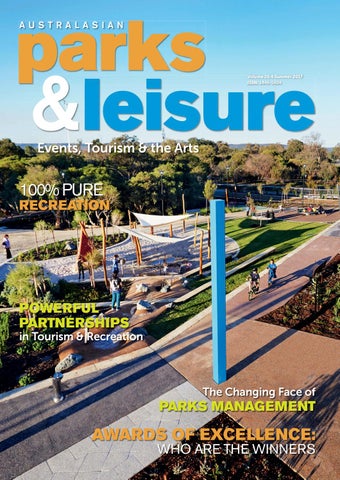
COVER IMAGE Mills Park Leisure Facility, WA Winner | Leisure Facility of the Year
Circulation enquiries to our Sydney head office 02 9805 0399. PLA Journal is published by Universal Magazines, Unit 5, 6-8 Byfield Street, North Ryde 2113. Phone: (02) 9805 0399, Fax: (02) 9805 0714. Melbourne office, Suite 4 Level 1, 150 Albert Road, South Melbourne 3205 (03) 9694 6444, Fax: (03) 9699 7890. Printed by KHL Printing Co Pte Ltd, Singapore. This book is copyright. Apart from any fair dealing for the purpose of private study, research, criticism or review as permitted under the Copyright Act, no part may be reproduced by any process without written permission. Enquiries should be addressed to the publishers. The publishers believe all the information supplied in this book to be correct at the time of printing. They are not, however, in a position to make a guarantee to this effect and accept no liability in the event of any information proving inaccurate. Prices, addresses and phone numbers were, after investigation, and to the best of our knowledge and belief, up to date at the time of printing, but the shifting sands of time may change them in some cases. It is not possible for the publishers to ensure that advertisements which appear in this publication comply with the Trade Practices Act, 1974. The responsibility must therefore be on the person, company or advertising agency submitting the advertisements for publication. While every endeavour has been made to ensure complete accuracy, the publishers cannot be held responsible for any errors or omissions. This magazine is printed on paper produced in a mill that meets Environmental Management System ISO14001 * Recommended retail price ISSN 1446-5604 Copyright © Universal Magazines MMXVII ACN 083 489 463 www.universalmagazines.com.au Please pass on or recycle this magazine.
Summer 2017 | AUSTRALASIAN PARKS AND LEISURE 3
FROM THE PLA PRESIDENT with click bait, thinly disguised opinion pieces, and
reminding us of our humanity and our shared
rants from ideologues and partisan cheerleaders.
values. In myriad ways the Arts can nudge, shock,
We often hear our political leaders talk about
amuse, remind and express, giving us a reminder
the need for “evidenced-based policy”, but in a
of or an insight into the importance of paying
post-truth world the challenge has become the
attention to what’s happening around us.
combating of increasingly “selective evidencedbased policy”. For many of us it’s a bit wearing, and it’s often
Equally, the value of travel - not just for leisure (although that’s the best bit) - lies in its ability to expose us to other places; visible evidence of how
easier to tune out and just let things happen. This is
other cities and countries function and what other
dangerous for us as individuals and as a profession,
communities value and prioritise. Global travel is
because we’re involved in developing strategy
now more prevalent than ever. This is a great gift
and policy that looks toward the type of future we
to us as active members of a community. Travel is
want for our communities. Disengagement means
knowledge and understanding. More importantly,
the community doesn’t get the best outcome,
like the arts, travel can also separate us from the
W
even if sometimes they are ahead of our political
danger of complacent disengagement and inspire us
elcome to our last journal for
representatives in understanding the need for
to start advocating for change at home and abroad.
the year. The theme of the
change and innovation.
MARTY LAMBERT
As an industry, we have a responsibility to
2017 Summer edition is about
When we gather together in large numbers something incredible can happen. Whether it is
remain engaged and to continue to promote good
for sporting or cultural events, celebrations of
evidenced-based policy development. Look at how
community, or even expressions of solidarity or
the arts to help us to see beyond mediocrity and
successful the integrated anti-smoking campaign
protest, we are acting in a collective way that
expand our horizons. There is so much going
has been in combating the health of Australians
speaks to an innate desire to belong and to
on in the world and our region at the moment,
and the economic cost of smoking to Australia.
collaborate. For me, when I see tens of thousands
it is understandable that many feel a little
We now have one of the lowest rates of smoking
coming together to share the love of a team, a
overwhelmed. A typical response to that “I can’t
in the world! Our industry can do the same thing,
sport, a performer or a purpose, it reminds me that
take any more” feeling is to disengage and stop
by helping to create active and healthy urban
our mission is to ensure the future not resist it.
reading or listening to the information stream.
environments, combat mental health issues, and
Tourism, Events and the Arts.
More than ever we need tourism, events and
We are constantly assaulted with an abundance of information by online, mobile, print and TV
Our industry, and each one of us, contributes
make people happier (something we need to hear
to the purpose of creating not just any future but
a lot more about).
one that has clean air, green cities and healthy
media. But it is increasingly hard to get the facts.
So, to come back to the theme of this edition,
The ‘old school’ journalist’s ethic of a balanced,
the role of the arts is to shake us loose from
objective story built around facts has been replaced
our apathy by sounding a dissonant chord or
communities; one that will last.
Marty Lambert PLA National President
FROM THE PLA CEO sincerely thank Council and all the staff at the
missed – so be sure to put the dates in your diary
GCCC and the Queensland Government for
(14 - 17 October 2018).
making the PLA National Conference a great success and being magnificent hosts. I would like to congratulate all the award
Still on the theme of the economic benefits of our sector; as summer is here, our parks, gardens and reserves come alive with thousands
finalists and winners of this year’s Excellence
of local, regional, national and international events
Awards. I think our industry gala awards night just
that make Australia a major tourist destination.
gets bigger and better each year, so well done
As tourists flee the cold climes of the northern
to all involved. The staff and volunteers behind
hemisphere and migrate south to experience parks
the scenes work tirelessly every year, and as one
and leisure in Australia, our key assets enhance
conference draws to a close we get busy planning
both the Australian way of life as well as being a
’d like start with a thank you to everyone
I
for the following event, trying to make it bigger
valuable contributor to the Australian economy.
that made it to this year’s conference, which
and better than ever. Next year’s event is already
As of 30 June 2017, 8.5 million international
had a great turn out and was once again a
shaping up to just that, with PLA partnering with
tourists arrived in Australia - up 9 percent on 2016.
magnificent gathering of professionals from
World Urban Parks to deliver an International Parks
Total international spend is up 7 percent, which
around the globe and an expression of topics that
Congress. The host city for the 2018 Congress is
equates to $40.6 billion dollars injected into the
showcase the economic benefits of the parks
none other than the most liveable city in the
Australian economy. Much of this is attributed to
and leisure sector. And, with the Commonwealth
world - Melbourne.
travel and accommodation; however the main
MARK BAND
Games just around the corner, what a magnificent
The 2018 Internaional Parks Congress will be
reasons for travelling to Australia can be attributed
held at the internationally recognised Melbourne
to our amazing lifestyle, parks, events and open
Cricket Ground (MCG). The event promises to be
spaces. As the people behind those places, keep up
Coast highlights some amazing infrastructure,
the biggest yet, and, with a number of international
the great work in making Australia one of the most
parks and open spaces, along with the importance
speakers already lined up and interest coming
envied places on the planet to live, work and play.
of our sector in delivering economic outcomes
in from across the globe, it promises to be the
for Australia. On behalf of PLA, I would like to
industry event of the year - one that cannot be
Mark Band PLA Chief Executive Officer
host city is the Gold Coast? As a leader in business development, the Gold
We thank our national sponsors and partners:
4 AUSTRALASIAN PARKS AND LEISURE | Summer 2017
N AUSTRALIA MADE
Omnitech Playgrounds is proudly Australian owned & specialises in locally made playground equipment. For new, refurbished, or completely customised play spaces, Omnitech’s design team, in-house fabricators & installation crew have you covered.
www.omnitech.com.au GET IN TOUCH TODAY 1800 812 027
FROM THE NZRA CHAIR
MARK BOWATER
A
t the intersection of recreation, nature, events, and tourism are parks and open spaces. Urban parks, regional parks, national parks, they all play a key role in greening our environment, capturing our imagination, defining a sense of place, and delivering multiple values and benefits that many take for granted as part of the daily fabric of life. Parks are also often a drawcard for tourism, and the challenges of balancing the eco-tourism boom in our part of the world is growing exponentially. So what are we doing to share our collective experiences in Australasia, to progress more sustainable outcomes?
The New Zealand Parks Agencies Manager’s Group (NZPAMG) is a network of parks managers who come together on a regular basis to progress best practice management and advocacy of our parks and open spaces. This group sits under the NZRA umbrella and currently has 24 member organisations. Recently, with a desire to revitalise trans-Tasman parks agency relationships, the group met in Sydney for a seminar, which was generously hosted by Parks Australia and the Sydney Harbour Federation Trust, along with sponsorship from Treescape and TRC Tourism. Over 35 people attended from New Zealand and Australian parks agencies. One of the very memorable highlights for the Kiwi contingent was glamping on Cockatoo Island in the middle of Sydney Harbour. Key theme presentations and discussions of the seminar focused on managing the eco-tourism boom, balancing tourism growth and outdoor recreation, charging mechanisms that are fair and sustainable, innovation
and partnerships, and the role of parks in state and national economies. Recognition of rapid change within the sector was a common theme, and building resilience as a key to the longterm sustainability of parks agencies. Improving staff engagement and providing development opportunities, such as staff exchanges, are also mechanisms that can be implemented. It was agreed that a formal transTasman agreement (ie MOU) between the Parks Managers and TAPAF (the Australian Tourism and Protected Areas Forum) would be beneficial to both countries. These are constructive steps towards strengthening collaboration to meet our growing challenges. We work in such an amazing outcome-based arena, in such a treasured part of the world, sometimes it’s no wonder we become the victims of our own success! Mark Bowater NZRA Chair
FROM THE NZRA CEO
ANDREW LESLIE
2
017 has been a year of growth for the New Zealand Recreation Association. We have grown our small team, welcoming new people and new ideas to the group. This growth has had a positive impact on our events throughout the year, from introducing our new Parks and Open Spaces Programme Manager at Green Pavlova in March, to our new Events Coordinator delivering a hugely successful Recreation Conference in November. At our Aquatics sector conference, JAWS 2017, NZRA trialled an event
mobile app for the first time with great success, finding it added another level of communication at the event. Delegates at the conference were able to network with each other before the conference started, giving real-time feedback on speakers and interaction with sponsors and trade partners. The app provided us with the opportunity to communicate directly with delegates and push notifications to their phones throughout the event – a real advantage for any last-minute changes or instructions. At the 2017 Outdoors Forum, NZRA identified ‘advocacy’ as a hot topic for attendees, especially as the event coincided with the run up to the New Zealand election. As well as a comprehensive update on the advocacy priorities and activities of NZRA, we invited local politicians to form a panel at the forum where they could address questions regarding outdoor recreation. This provided a platform for event delegates to directly connect with the issues that mattered to them.
6 AUSTRALASIAN PARKS AND LEISURE | Summer 2017
This was an incredibly well received segment of the conference, as large numbers of delegates attend this event to gain a more indepth understanding of issues within the New Zealand recreation sector, and the political panel was able to deal with these issues firsthand. The team at NZRA are already working on a programme of events for 2018 and beyond. The range and style of events we offer is constantly evolving to meet future trends and the changing needs of our members and the wider recreation industry. NZRA utilise technology and innovation to improve the experience for our members, and hope that by introducing new ways to share, meet and communicate information, we can ensure that the New Zealand recreation industry is seen as a world leader. Andrew Leslie NZRA CEO
NATIONAL CONFERENCE SUCCESS THE 2017 PLA NATIONAL CONFERENCE PROVIDED PARKS AND LEISURE PROFESSIONALS AN OPPORTUNITY TO COME TOGETHER AND SHARE IN IMPORTANT INDUSTRY INSIGHTS WORDS JOHN SENIOR, CONFERENCE ORGANISING COMMITTEE CHAIR
H
eld at the RACV Royal Pines Resort on the Gold Coast, the 2017 National Conference was a highly successful event. The Delegates were full of praise for the exceptional keynote speakers who provided a good balance of sector specific and professional development insights. PLA was grateful for the support of 14 sponsors and 40 exhibitors booths across the event. The national office team and organising committee deserve congratulations for a well-planned and
expertly staged event, which provided both professional development and networking opportunities for delegates, and a financial injection into PLA resources. Mark Peters, Chief Executive Officer of the Gold Coast 2018 Commonwealth Games Corporation, was the first Keynote Speaker of the Conference. Mark introduced us to the many challenges, innovative solutions and state-of-the-art facilities being finalised for the 2018 Games. The Commonwealth Games legacy
8 AUSTRALASIAN PARKS AND LEISURE | Summer 2017
Keynote speaker New York Commissioner Mitchell Silver inspired the audience
projects presented will frame how we approach and develop major event bids into the future. Also addressing delegates in the first session, Mitchell Silver, the New York Parks Commissioner, showed us why he is so highly regarded and has been successful in making parks and open space a priority, and transforming many declining spaces into attractive and popular destinations. He calls
RACV Royal Pines
it the “Department of Fun, Health & Happiness”, and expects staff to keep that in mind when preparing for or dealing with visitors and focus on equity and reimaging the public realm. The final speaker on the first day’s opening session, Susan Alberti, is a successful businesswoman and former vice president of the Western Bulldogs. Susan charmed and delighted delegates by relating her personal journey of overcoming
/toroaus
/@toroaus
You
family trauma with a determination to “make a difference”, which she is achieving by championing Women’s AFL and chairing the Medical Research Foundation that bears her name in search of a cure for Type 1 Diabetes. The second day’s keynote session included another American, AP Diaz, Chief of Staff for the Los Angeles Department of Recreation and Parks. AP provided a strategic approach to running effective organisations, with a focus on
/toroaustralia
Summer 2017 | AUSTRALASIAN PARKS AND LEISURE 9
Generate colleagues Jenn Halliday and Eve Haskins enjoying a workshop
Conference Chair John Senior with Wendy Holland and Keynote Speaker Susan Alberti
addressing generational differences and competing technologies. Concluding the second keynote session, social commentator Bernard Salt highlighted the fact that our capital cities now have populations of citizens – between 28-39% - who were born outside of Australia, and challenged the notion of whether or not we were responding enough to their cultural needs. Bernard also outlined the impact of the aging population and questioned if we were sufficiently prepared for the growing ‘active retiree’ trend. The final session of the two day conference saw Richie Gibson set out a career approach for team leadership (as opposed to management), which included such blunt advice as GOYA (Get Off Your A@*)and Putting Yourself Last! Riche introduced the audience to the salient Michael Josephson poem, What Will Matter. The overall program had something for everyone. A few observations solicited from delegates included: “The 2017 PLA National Conference was a great success providing thought provoking insights to current and future trends and happenings across the park and leisure sector. The growing recognition of the health and social benefits of parks to the community was a key theme in many presentations, however valuing the economic benefit to better position parks for funding opportunities is now a key challenge to tackle.“ “The use of technology is the main challenge facing park managers and will provide for plenty of discussion and debate in coming years. The different perspectives and case studies provided by international speakers is always a highlight and we look forward to more of those opportunities when the PLA National Conference links with
the World Urban Parks Congress in Melbourne in 2018.” “My highlights were: New York City’s transformation of parks and the public realm to create places for people to be healthy and active and come together to socialise in safer and more attractive places, and Bernard Salt’s uniquely colourful delivery and insights into Australian demography and trends that inspire a conversation about Australia’s future as a lifestyle destination and what that means for our parks and cities.” “Overall a great conference where I was able to network across Australia and share a conversation about Australia-wide issues and learn from other projects, places and ideas.” The Awards Gala Dinner, preceded by drinks on the lawn, proved to be a night of celebration after some intense days. Special mention must go to the well-deserved presentation of the Frank Stewart Award (PLA’s highest honour) to Penny Davidson, long-term member, conference contributor and Chair of the Advisory Committee for the last five years.
10 AUSTRALASIAN PARKS AND LEISURE | Summer 2017
Familiar faces enjoy a pre-awards dinner drink
Susan Alberti being interviewed by MC Brett Phillips
Outdoor Infrastructure Solutions Innovation is all about change, and understanding that solutions can only come from the ability to recognise that nothing is impossible. At Stoddart, we understand that designing great urban spaces is about more than seats and tables. It’s about street and park furniture that is DDA compliant, that compliments it’s environment and provides solutions that are effective and attractive. It’s this philosophy that councils, governments and private customers trust when in need of aesthetically designed BBQ’s, high quality shelters, picnic settings, sitting benches, bins, picnic tables and water fountains.
Stoddart has the knowledge and experience to transform any urban space – whether it’s a park, a playground, street scapes or a major infrastructure project. Innovation is about the ability to recognise that nothing is impossible or cannot be improved upon.
BE MINDFUL OF MELANOMA DON’T MAKE SUNBURN YOUR FAMILY’S SUMMER HOLIDAY SOUVENIR! WORDS JENNIFER DURANTE, HEAD OF COMMUNICATIONS, MELANOMA INSTITUTE AUSTRALIA
A
ussies love the great outdoors, particularly during the balmy summer months with their long days, abundant sunshine and warm nights. It is the great Aussie tradition to pack up the kids and the car and leave the hustle and bustle of the city behind, heading off in search of a coastal or regional getaway. The schoolyard is replaced with the holiday park, and so begins a few weeks of fun, laughter, and much needed family time. It would be fair to say amidst the frivolity and the break from the pressures of everyday life, the possible long-term health implications of the annual summer family holiday are far from parents’ minds. Sadly, it is during the annual summer holidays that much of the sun damage is done that can become a precursor for developing potentially fatal
melanoma later in life. Research shows that intense, intermittent sun exposure leading to sunburn, particularly prior to puberty, increases your risk of developing the deadliest form of skin cancer, melanoma. For Carole Renouf, CEO of Melanoma Institute Australia, it is a warning that parents urgently need to heed. “We now know that sunburn in childhood increases a person’s risk of developing melanoma as an adult,” says Carole. “It is during these summer holidays that kids are most at risk, when everyone relaxes and switches off after a busy year. It is therefore imperative that parents plan ahead to ensure sunburn and its potential longterm health implications are not their children’s summer holiday souvenir.” The statistics paint a clear picture as to why sun-safety needs to be taken seriously. Melanoma kills one
12 AUSTRALASIAN PARKS AND LEISURE | Summer 2017
Australian every five hours and is the most common cancer affecting 15 to 39 year olds. Incidence in the over 60s is also increasing. Ms Renouf says prevention remains the front-line defence against developing melanoma in the first place. “Sunburn is the main risk factor for developing melanoma, and so it is critical that all Australians live a sun-smart life,” she states. “That means applying and reapplying SPF 50+ sunscreen, covering up with long sleeves and pants, wearing sunglasses and a broad-brimmed hat, and staying out of the sun during the heat of the day.” “This is particularly relevant during summer holidays when the usual ‘house rules’ go out the window in the name of rest and relaxation. But it is precisely at this time that parents need to step up their vigilance in terms of keeping the entire family sun-safe,” Carole adds.
Being sun-smart on holidays is not as difficult as it may seem. Many holiday parks are equipped with playgrounds and pools with sunprotective shades. Family outings can easily be scheduled for early morning or later in the afternoon when the UV rating isn’t as high. Ron Gottlieb, Director of Ricky Richards, an Australian-owned and family run business that distributes UV-rated shade cloth, says the tide is turning in terms of the role that tourist park operators are playing in helping protect families from the sun. “We have seen an influx in recent years of tourist park operators installing our UVrated shade cloths over playgrounds, barbeque areas and picnic areas,” says Ron. “It is this social responsibility that will help us win the fight against melanoma, and save future generations from having to battle this disease.” Mr Gottlieb says parents should go so far as to ask about a holiday park’s sun protective measures before they make a booking. “The more people who enquire about what sun-safety is available, the more park owners and operators will be aware of the need to provide what really is a standard safety measure for their guests,” claims Carole. “I would one day like to see shade structures being as common place as pool fences – both ultimately save lives,” she adds. Despite efforts to raise awareness about sun safety to reduce the risk of melanoma, it remains the number one cancer killer of 20 to 39 year-old Australians. Some 14,000 Australians are expected to be diagnosed with melanoma this year. Melanoma Institute Australia is leading the world charge to find a cure for the disease, with scientific advances over the last five years tripling life expectancy for some advanced melanoma patients. There has been progress, but more needs to be done. The ultimate goal is zero deaths from melanoma. “We just can’t do it alone,” says Carole. “We rely on the support from the general public and our generous corporate supporters to continue to fund our ground-breaking research.” More than just a shade cloth provider, Ricky Richards is one of several organisations providing vital financial support for this life-saving research. As a Platinum Partner of Melanoma Institute Australia, Ricky Richards has so far donated more than $200,000 toward research. Every Ricky Richards customer has in effect played a part, as a percentage of sales from
Ricky Richards staff members at the annual Melanoma March campaign to raise money and awareness
The team at Ricky Richards take on the Great Wall of China Trek challenge
various sun protection product lines is donated directly to Melanoma Institute Australia’s research and education programs. What began as a corporate social responsibility partnership has grown into a mission enthusiastically embraced by the staff at Ricky Richards. For two years now, the majority of staff members have participated in MIA’s annual Melanoma March campaign to raise money and awareness. And just recently, General Manager Kathryn Polgar and Business Development Manager for the Print Media Division Michael Smith, took part in the Great Wall of China Trek challenge. Not only did they push themselves to the limits physically to complete the gruelling five-day trek, they also raised vital funds for research. Financial support from Ricky Richards is funding the work of a Medical Oncology Fellow, part of the wider research team that is devoted to finding new and more
effective treatments and saving lives. “The fit for the partnership between Ricky Richards and Melanoma Institute Australia made a lot of sense,” states Ron. “With a large part of our business involved in the promotion of high quality sun protection products, it seemed logical to us to support the wonderful work of Melanoma Institute Australia.” There is no doubt that the key to beating melanoma and protecting future generations is teamwork, with families, tourist park operators, researchers and corporate supporters all playing their part in protecting young Australians from the sun and investing in lifesaving research. “We will get there. We are one organisation that would love to do ourselves out of a job, and future generations of Australians will be the ultimate winners,” says Carole. “So this summer, I urge all holidaymakers and tourist park operators to keep sunprotection top of mind and together, we can end melanoma.”
Summer 2017 | AUSTRALASIAN PARKS AND LEISURE 13
Roys Peak Track is a popular walking track in the Wanaka area of New Zealand’s South island
POWERFUL PARTNERSHIP CONNECTIONS A COLLABORATIVE APPROACH IS CONNECTING TOURISM RESEARCH WITH RECREATION MANAGEMENT TO PROMOTE SOME OF NEW ZEALAND’S BEST WALKING EXPERIENCES WORDS LYNNELL GREER, TECHNICAL ADVISOR, RECREATION, TOURISM AND HERITAGE UNIT, DEPARTMENT OF CONSERVATION
A
n innovative partnership between the Department of Conservation (DOC) and Tourism New Zealand (TNZ) is working together to apply best practice marketing and tourism research to identify and promote some of New Zealand’s best existing short and day walks. Promotion of the network of 14 short walks and 5 day hikes began in October 2017. The main point of difference in this approach was to target visitors before they began their journey and identify the barriers and motivations that influence what activity to undertake, when and where. Recreation research is usually based on the facilities, activity, or a physical location. By adopting a more customer-centric approach we test the interest across a range of experiences, understand the visitor’s decisions for choosing these activities and then provide a considered selection of these types of experiences so they can be promoted and easily found.
WHAT WAS THE CHALLENGE/ OPPORTUNITY? New Zealand’s population of 4.8 million is growing. In 2016, 80 percent of New Zealanders had visited at least one DOC managed site in the last 12 months. This is expected to rise to 4.4 million by 2023. At the same time, 1.4 million international visitors visit public conservation land each year, a number that is expected to increase to 2.7 million by 2025. Tourism delivers significant economic benefit around New Zealand. By 2022, international visitors alone will spend $16 billion per year. The current growth in population and domestic and international visitation challenges New Zealand’s and DOC’s ability to accommodate the growth and realise benefits for conservation and communities from this growth. Alongside this, DOC is working to cater to new demographics in our population to ensure New Zealander’s maintain their strong connection to the natural environment and value its protection.
14 AUSTRALASIAN PARKS AND LEISURE | Summer 2017
The promotion of a small network of ‘flagship’ walks was seen as a cost-effective way of creating a new promotional opportunity. The objectives of the project were to: 1 Be customer-focused in making appropriate experiences easier to find 2 Inspire people to explore places able to accommodate additional visitors 3 Encourage the regional and seasonal spread of visitors 4 Support government’s regional economic objectives The promotion of these walks will also connect more people to our natural and cultural heritage, and deliver economic opportunities for local communities by attracting people to these locations and prolonging their stay. The promotion of the walks will also link people to information on different experiences in the region so they can see what other opportunities are on offer. The partnership between TNZ and DOC will generate a collaboration of knowledge, relationships and skills
between the organisation, with a cross-agency response to tourism industry issues outlined in New Zealand Tourism 2025. The challenges, interventions and logic can be seen in figure 1.
Context: By 2025, an additional 0.7 million New Zealanders and 1.3 million international visitors will be visiting public conservation lands
WHAT DID WE DO AND HOW DID WE APPLY IT? Our process combined the expertise of both organisations. The main steps are: 1 Qualitative research was undertaken to better understand New Zealand as a walking holiday proposition and, if so, what motivations and barriers where part of New Zealanders and international visitors’ decision-making processes to choose a walk. 2 Using the barriers and motivators identified in qualitative research as criteria, DOC reviewed existing walks for a match, using GIS mapping tools for proximity and the walks facilities data based on length, fitness, standards and amenities. As show in Figure 2. 3 Tangata Whenua, stakeholders and field staff were consulted on the likely fit of walks under the criteria of the ability of the facilities to cope with additional visitors and environmental or cultural concerns.
Visitors struggle to find the right experiences out of hundreds available
INTERVENTIONS
DOC manages many underutilised facilities, with a few under pressure
Short walks and day walks promoted domestically and internationally
Need to be more customer-focused Need to spread visitation seasonally and regionally Need to support Government’s regional economic development objectives
CHALLENGES
Link experiences to the right audiences
Visitors are aware of what is available and suitable Easy introduction to the outdoors Easy to find experiences More facilities being used Higher levels of customer satisfaction
Customise messages to specific markets
Regional and seasonal spread of visitors
Reality check with iwi, stakeholders, field staff, and social media
Stronger connection with natural and historic heritage
Research insights into barriers and motivations of people selecting a walk TNZ/DOC partnership sharing capability, knowledge, and skill
Regional economic benefits
BENEFITS
Figure 1 Short walks and day hikes logic
4
Social media analysis was used to see the current ‘reach’ of the walk and the way it was being described. Quantitative research was undertaken with 2250 New Zealanders and 3500 Australians, German, American and Chinese, to: • Assess likely participation of walking as an activity as part of a NZ holiday • Estimate the appeal of certain walking experiences as part of an
active NZ holiday Quantify and prioritise the target audiences’ motivations for choosing walks • Assess appropriate branding, messaging and optimal naming of the walk networks The research, consultation and social media information analysis all went into selecting 14 short walks and 5 day hikes for promotion. •
belgravialeisure.com.au 03 8727 7777 info@belgravialeisure.com.au Partnering with communities Over 40 Local and State Government authorities trust Belgravia Leisure to manage their aquatic and leisure centres. We operate over 100 facilities across Australia and New Zealand.
Creating healthy communities We work together with the community, for the community. Because everyone should have the chance to get active, get healthy or simply get involved.
AQUATIC AND LEISURE CENTRES GOLF COURSES SPORTS STADIUMS SPA AND WELLNESS EVENTS AND HOSPITALITY
Investing in our communities We invest more than $6 million per year in capital upgrades, repairs and refurbishments of government-owned building, plant and equipment.
Summer 2017 | AUSTRALASIAN PARKS AND LEISURE 15
WHAT DID THE RESULTS SHOW? Results showed that New Zealand has a solid reputation as a walking destination with great walking experiences; from all countries involved in the research. Short walks (between 30 minutes and 3 hours) were of interest to 59-71 percent of visitors in three countries and 76 percent of Kiwis preferred this option, while Germans were more interested in day walks (55 percent). Indications are promotion of the short walk experiences would appeal to a wide section of visitors and potentially encourage new users. Research also revealed that potential visitors in selected international markets and New Zealanders have similar considerations when selecting a walking track, which include fitness level required, the scenery on offer and time as important drivers. Based on this research we know the project has a high likelihood of success with both New Zealanders and overseas visitors.
WHAT WILL SUCCESS LOOK LIKE? It is estimated the project will increase the number of visitors to the walks by 5 – 35 percent1 or ~48,800 to ~341,900 across the 19 walks, better utilising facilities and introducing more people to conservation. The average domestic and international visitor spending range is from $73.50/$88 to $147/$1762 for half day and full day respectively. This means the project could increase visitor spend locally by $4.6m to $32.2m, increasing business and employment opportunities. By understanding new or underrepresented demographics in our population through different research
RESEARCH RESULTS
techniques, DOC ensures all New Zealanders have appropriate opportunities to access the great outdoors and connect with the natural environment into the future. These walks also offer health benefits like increased physical activity and social cohesion benefits from enjoying the outdoors with friends and family.
Kura Tawhiti conservation area features grand limestone rock battlements
BY DOING IT THIS WAY, HOW CAN IT HELP AGENCIES? Through this process we have been able to: Better understand what domestic and international visitors want most from walking experiences in nature Test ideas for their likelihood of success with current and potential visitors before committing to funding promotion Take Tangata Whenua, stakeholders and field staff on the journey of identifying the networks Be targeted in encouraging more people to enjoy the outdoors with the right experience Increased use of existing infrastructure without spending capital funds It also provides a structured approach to create a ‘layering’ of national, regional, or district experiences — attracting visitors to the first experience and then engaging them on a second and third walk in the same area. Check out our short walks and day hikes at www.doc.govt.nz The author would like to acknowledge the work of Lucy Alborn, together with
SHORT WALKS
Rene De Monchy, Candice Johanson, Andrew Fraser and the team at Tourism NZ; Dawn Muir and her team, Michael Harbrow, Cher Knights, Mark Beardsley, Chris Bowen, Lizzy Sutcliffe, Tinaka Mearns, Gavin Walker, Heather Peacocke and the wider teams involved at the Department of Conservation.
HOW WERE THE CRITERIA APPLIED?
DAY HIKE
Over 30 minutes, up to 3 hours (optimum 1.5)
3 to 7 hours (optimum 4-6)
Database and/or DOC website
<30min. from a tourist State Highway
<1 hour from bed and food
Short walks <10km from a State Highway (GIS)
Key feature of interest
Diversity more important than one key feature
Social Media analysis
Amenities
Car parking, easy driving, easy to find
Amenities (eg. toilets) easy driving, easy to find
Database/GIS /checked by field staff
Safety
Do visitors feel confident they can safely complete the walk? Is the track and structures to standard?
Database/checked by field staff.
Level of fitness/ Terrain
Is this an easy walk that most people can do?
Is this a walk most averagely Database/analysis, fit people can do? Check by field staff
Time to complete Travel Unique Experiences
Figure 2 Motivation criteria and application to identify the potential list of walks.
REFERENCES 1 Assuming domestic and international visitor numbers will continue 5-10 percent per year for the next five years and a similar response to the Air New Zealand Great Walk campaign (0% to 20%) may result from the short walk and day walk promotion, creating a possible combined total of 5-30 percent increase. 2 Ministry of Business Innovation and Employment, New Zealand, Tourism Spending figures for March 2016.
16 AUSTRALASIAN PARKS AND LEISURE | Summer 2017
Over four nights, the Kaleidoscope Festival attracted over 50,000 visitors
KALEIDOSCOPE FESTIVAL KALEIDOSCOPE REPRESENTS A NEW LEVEL OF ACHIEVEMENT IN PUBLIC FESTIVAL MANAGEMENT FOR THE CITY OF JOONDALUP WORDS DANIEL DAVINI, MEDIA ADVISOR, CITY OF JOONDALUP - KALEIDOSCOPE FESTIVAL
W
hat started as an event concept took more than 12 months of development before finally being realised in November 2016. Over four nights, more than 50,000 people come into the city centre of Joondalup to enjoy the magic of Kaleidoscope. Recently named 2016 Event of the Year at the prestigious Parks and Leisure Australia (PLA) WA Awards of Excellence, Kaleidoscope is a free family-friendly event combining lighting technology, art installations and projection performances. The City of Joondalup intends to be recognised as a bold, creative and prosperous region on the global stage. To assist in achieving this vision, Joondalup wanted to attract and support a significant event unique to the area, with the aim of enhancing its image as a ‘destination city’ to tourists and visitors. As a result, Kaleidoscope was born. The festival provided activities and entertainment suitable for the whole family that began each evening at
5.30pm, with stunning illuminations dazzling and delighting from 7pm until late. The theme for the inaugural festival was City of the Future, which focussed on innovation, architecture, sustainability and futurism; all key themes that align with Joondalup’s long-term strategic vision. City of Joondalup CEO Garry Hunt claims the Kaleidoscope event was like nothing seen before in Western Australia. “We wanted to be looked on as an industry-leader by delivering the first festival of this kind in WA, and the event theme of City of the Future kept with Joondalup’s aspirations to be a liveable, sustainable and progressive local government. Kaleidoscope shone a light on the Joondalup city centre as a vibrant precinct offering unique and innovative entertainment that captures the imagination.” “Some of the strategic objectives that we had for the event included an average attendance of 5000 people per night and 20,000 for the festival overall, an audience satisfaction rating
of 85 percent and above, to engage the local community and arts sector in the festival development and delivery, and to stimulate economic benefits and generate significant media coverage to showcase the Joondalup city centre as a destination,” said Garry. “It was extremely satisfying to have delivered on all of those KPIs in the inaugural year of the event, with an attendance of 50,000 over the four nights, more than two and a half times what we had aimed for, the overall audience satisfaction rating being 87 percent, getting local artists involved with the festival programming, and over $2 million added to the City’s economy.” Some of the many highlights of the Kaleidoscope festival included the stunning Reverse Dreamtime story projected onto the facade of Joondalup Library; City Ark, which was projected onto the City’s administration building; and PALLAS, a dance performance collaboration between highly acclaimed and internationallyrenowned Director and Choreographer
Summer 2017 | AUSTRALASIAN PARKS AND LEISURE 17
Chrissie Parrott and South Australian Animator, Graphic Designer and Visual Effects Producer Stu Nankivell. The Reverse Dreamtime projection left festival-goers in awe, combining the visual art of highly-regarded Nyoongar artist Dennis Kickett (Noongali) and his daughter Michelle (Willura) and directed by Dennis Simmons, a local Aboriginal creative director based in the Joondalup area. Dennis Simmons, founder of cultural group Maar Koodjal, writer, performer and musician, conceived the idea of Reverse Dreamtime as a way of showing how Aboriginal culture will successfully thrive and carry forward into the future. Dennis devised a song and music to convey the telling of this story and worked with local music producer Mason Vellios to create a resonant soundtrack and soundscape to support the animation. The projection continues the dreamtime story into the far future - connecting to the City of the Future theme. “These commissions were created specifically for the City of Joondalup and the Kaleidoscope festival to transform the Joondalup Library and the City’s Administration building with vibrant animation, bringing to life an extraordinary future Dreamtime vision,” said Garry. “With live music featuring throughout the festival site, food trucks and a range of do-it yourself activities, it proved popular with attendees of all ages. Retaining the important community element of the event, each night of the festival one local child flicked on the switch to commence the lighting and projections proceedings, and the reaction from these lucky children was something to behold.” Mr Hunt said that Kaleidoscope was a big part of the City’s placemaking initiatives. “We wanted to enhance vibrancy in the Joondalup city centre and to stimulate local economic activity, while promoting and showcasing Joondalup as the entertainment capital of the northern corridor of Perth. In 2016 it was particularly pleasing to see so many families out and about and enjoying the cultural entertainment on offer in our City Centre.” “Whilst we anticipated that a large majority of those attending Kaleidoscope were from Perth’s northern corridor, feedback indicated that over 20 percent of attendees travelled from the inner city and southern suburbs. We even had people travel from as far as Bunbury, two hours
Kaleidoscope incorporates lighting technology and projection performances
south, and Cervantes, approximately two and a half hours north, which suggested that there was an interest and an appetite in this type of event from across the State,” he added. Events such as Kaleidoscope are very important contributors to local and regional economies and a successful well run event can provide significant value to an area by adding jobs and money to the local economy. The City’s Economic Development Team calculated the direct economic benefits and the flow-on economic benefits of Kaleidoscope using visitor expenditure. The economic impact analysis of the Kaleidoscope festival found the combination of all direct, industrial and consumption effects would result in total estimated rise in output of over $2 million in the City’s economy; an approximate four-fold return on the City’s investment in the event. “Many local businesses benefitted from the increased activity that Kaleidoscope brought to the Joondalup City Centre and I am pleased to say they enjoyed a spike in trade over the four nights of the festival,” claims Garry. “This did not only include restaurants and bars in the city centre, but Lakeside Joondalup Shopping City also reported a seven percent increase in foot traffic across the four days, compared to the same time in 2015.” The overall feedback was incredibly positive, with attendees identifying the atmosphere, variety of food, activities for families and children and the programming and lights being the best aspects of the festival. Over 85 percent of those surveyed said they would definitely attend the event again,
18 AUSTRALASIAN PARKS AND LEISURE | Summer 2017
Reverse Dreamtime
and results indicated over 30 percent attended the festival on more than one night. Mr Hunt said he was confident that Kaleidoscope would be a popular event and part of creating vibrancy in the Joondalup’s city centre. “2016 exceeded expectations in terms of our strategic KPIs, delivered significant economic benefits for local businesses, and was a significant drawcard to attract visitors from around the metropolitan area as part of showcasing the Joondalup city centre as a destination. I can’t wait to see what the festival has in store in 2017 and beyond,” said Garry. The inaugural Kaleidoscope festival was made possible by event sponsors Edith Cowan University, Joondalup Health Campus, NOVA 937, Telstra, Channel Seven and The West Australian.
ACTIVE MUMS NOOSA A PILOT PROGRAMME FROM NOOSA COUNCIL IS ACTIVELY WORKING TO ENCOURAGE COMMUNITY MUMS TO ENGAGE IN PHYSICAL ACTIVITY ON A REGULAR BASIS WORDS AMANDA TIE, COMMUNITY DEVELOPMENT (SPORT AND RECREATION), NOOSA COUNCIL
A
ctive Mums Noosa, a Council subsidised programme, set out to engage 50 mums with children aged 0-5 years in physical activity over a 10 week period. The success of the programme resulted in 390 mums engaged over a 20 week period, and over 200 new mums involved in the programme post subsidisation. While subsidised programmes are not a new concept, Active Mums Noosa employed deliberate and concentrated strategies to engage a target group; significantly impacting on programme development, delivery, evaluation and continuation after the funding period. Funding for the programme was provided by the QLD Government’s Get Out Get Active programme ($20,000) together with Noosa Council ($10,000). The Noosa Shire has a relatively small population (approx 53,000), and while Council does not employ direct programme delivery staff, it does have
a small Community Development team consisting primarily of parttime staff. If the programme was to achieve any level of long term success, the parameters set for any programme intervention needed to be resource efficient and sustainable to accommodate these limitations. The success of the programme can be attributed to three focus areas: • Partnerships | With the target group and organisations that engage with those same groups • Sustainability | Planning for little or no ongoing resourcing from either Council or external government funding sources • Evidenced-based | Ensuring all decisions were made on sound local evidence and data According to research, various life stages negatively impact on female participation in physical activity, including early motherhood. While not a ground-breaking insight for professionals in the field, what is not commonly known is that there are
significant health risks to women who do not return safely to postnatal exercise. Risks can include abdominal separation, poor pelvic floor function, incontinence and prolapse. Furthermore, there is very little accredited training available to personal trainers (PTs) and fitness professionals who conduct group exercise-style programmes that are attractive to women within this target group. Engaging with hospital-based women’s physiotherapists and community child health nurses gave great insights into the needs of women in the proposed target group. Discussions with new-mums groups confirmed these needs, and also provided understanding regarding the barriers women were facing locally, issues surrounding motivation, and how mums received information. Most women consulted were not undertaking any physical activity. An assessment of the current opportunities for new mums revealed that there was one yoga programme
Summer 2017 | AUSTRALASIAN PARKS AND LEISURE 19
for recent mums, however hospital data reported over 700 women who gave birth in the previous year were local to the area. The aims of the programme were clearly defined: 1 Increase the regular physical activity of recent mums (women with children 0-5yrs) 2 Increase the number of opportunities in the community for mums to engage in physical activity Once funding was secured, potential participants were consulted via targeted community health and youth services groups. An online survey was used to collect information - where mums were living, how far they were prepared to travel, what ‘affordable’ meant, activities they would like to participate in, as well as the most suitable times and days. The resulting information formed the foundation for the design, location and timing of the programme. A media release and Facebook post encouraging women to complete the survey was picked up by local media, further facilitating information collection. Early on in the programme, a key factor that was communicated upfront was that although the initial phase of the programme would be free, ongoing activities would not be subsidised and a participation cost would be introduced after the initial funded period. This managed community expectations and clearly related that a free ongoing activity programme was never intended. Once the preferred activities, times, days, and needs were established, local businesses with an interest in partnering with Council for the delivery of activities were sought. An Expression of Interest asked basic procurement details: experience, qualifications, understanding and willingness to accommodate the needs of the target group. There is little to no accredited qualifications for instruction to post-natal women, so advice from the women’s physiotherapist was invaluable in assisting assessing both the suitability of the instructors and activities during early post-partum. An email and Council Facebook post were the only marketing tools used, which saw all eight weekly activities booked out within 24 hours of opening. In less than a week over 150 women were on the waiting list. As part of the registration process, participants were required to complete a preprogramme survey asking about their current level of physical activity. This gave baseline data for later comparison and evaluation.
KEY LEARNINGS Understand the barriers for participants. These can include the absentee rate for mums (approx 40 percent), which is much higher than most other target groups due to the needs of children, work and other family taking precedence over their own needs and impacting on attendance. Acknowledgement of the effort required to show up is required. It is important to engage with professionals already engaging with the target group, even if they are in a different sector. Be clear and communicate restrictions (ie subsidised programme was for a strictly limited time). It is helpful to collect baseline data for future evaluation and comparison. Understand what encourages long-term involvement. Social connections and safe, welcoming spaces are vital. This requires commitment from everyone involved in the programme, from reception staff, to instructors being flexible if mums are running late. Creche periods should be offered for longer than the activity period, allowing participants to socialise (have a coffee) or have a shower before collecting their child/children. Be precise regarding what is being provided and why. During the intial stages, the programme coordinator was approached by several businesses wanting to promote products to the Facebook group that were not aligned with the aims of the programme. Engage only instructors/contractors that align with the philosophies of the programme (ie. awareness of body image issues, restrictions on physical capability, absenteeism). Understand how the target group receives and communicates information and use the tools they are familiar with. Involve participants in the decision-making process. Active Mums ran as two 10 week programmes. Feedback from the first round altered times, days, activites and instructors for the second round. Connect with the target group. The programme coordinator attended each activity session in the first two weeks of the programme to welcome and engage with participants, inviting communication and feedback. Be flexible in response to the needs of the target group. Stand up paddle sessions relied on mums minding each others’ children. Friends were encouraged to enrol in the session together. A play pen was provided to maintain a safe space for children in the outdoor environment. The initial concept was to have two groups of mums – one would paddle for an hour, switch over and then allow the other group to paddle for an hour. What evolved was mums buddying up and taking turns as long or as short as they wanted, which allowed flexibility in meeting the needs of the children (ie feeding times) while still allowing the women to participate in the activity. In some circumstances, older children (18 months plus), would accompany their mums on the board. The contractor seeing this opportunity purchased several infant life jackets to enable this to occur.
20 AUSTRALASIAN PARKS AND LEISURE | Summer 2017
THE SUCCESS OF THE PROGRAMME RESULTED IN 390 MUMS ENGAGED OVER A 20 WEEK PERIOD, AND OVER 200 MUMS INVOLVED IN THE PROGRAMME POST SUBSIDISATION. Results indicated that more than 80 percent of participants were not currently meeting recommended physical activity levels, with approximately 50 percent not undertaking any physical activity more than once per month. Post-programme surveys revealed a complete reversal of these figures, with 97 percent of respondents indicating that they intended to continue with some form of regular physical activity post programme. Eight businesses continued to offer discounts, deals or ‘mum specific’ programmes after the completion of the subsidised programme. One of the contractors, Fitmums, now offers Fitness Australia-accredited face-to-face training courses in post-natal exercise instruction for PTs - one of only two accredited courses. The council-managed Noosa Leisure and Aquatic Centres now offer an affordable Active Mums membership (cost neutral to Council) and provides access to post-natal specific exercise
classes plus a select range of mainstream group fitness classes for mums to safely engage in regular physical activity. Council also offers a free core-function class to all post-natal women as a first step to returning to exercise. This class gradually builds core function and stability that supports a safe return to exercise. The cost of this class is absorbed through Active Mums membership fees. A closed Facebook group was established early in the Active Mums programme, aiding communication between the programme coordinator,
participants and instructors. It became a method of ongoing feedback and a social connection for participants and continues to be a strong communication tool with almost 400 members to date. Ongoing recruitment is managed through community health services, their programmes and relevant word-of-mouth channels (including social media). Council staff also attend mum’s/parent’s groups to promote Active Mums activities. Active Mums Noosa initiative was awarded the PLA Community Programme of the Year Award and continues to run successfully in the Noosa community. For more information on the Active Mums Noosa programme go to www.noosa.qld.gov.au/active-mums
Quality Australian Designed & Manufactured Playground Equipment
willPl y designed by big people for little treasures
Unit 16 / 459 Tufnell Rd, Banyo QLD 4014
Call : 1300 132 047
www.willplay.com.au
Summer 2017 | AUSTRALASIAN PARKS AND LEISURE 21
Courtney has progressed from being a new ranger to hiring them
THE CHANGING FACE OF PARKS MANAGEMENT THE PARKS AND CONSERVATION INDUSTRY IS A BROAD AND INDEPTH INDUSTRY, BUT IS IT A CAREER PATH CONSIDERED BY YOUNG PEOPLE TODAY? WORDS JENN HALLIDAY, COURTNEY POPENHAGEN, ELISE YULE AND AMY SATTERFIELD – GENERATE NETWORK, NEW ZEALAND
T
rends indicate that there has been a dramatic drop in university enrolments in parks and recreation related sectors. There are various reasons that may contribute to this decline, including school career advisors and parents influencing what tomorrow’s leaders choose to study and where. Today, students want a degree not a certificate, and parents generally want their children to study a profession or ‘proper’ subject.
According to university lecturers, the parks and conservation industry isn’t often considered a ‘real’ profession by students or parents. However, we have seen similar trends back in the ‘80s and ‘90s when sport and tourism were not seen as ‘proper’ subjects. Due to globalisation, tourism has now become the world’s biggest industry. Likewise, sport has become a global business, making it acceptable to study and build a career in sport
22 AUSTRALASIAN PARKS AND LEISURE | Summer 2017
today. Therefore, when analysing leisure subjects being offered at universities, recreation, parks and conservation programmes have been left behind because they are largely an intangible social construct. The management of parks and conservation has been going through a transformative shift, with social, economic, ecological and cultural values now factoring in to decision making. No longer does the management of the various aspects of parks (ie species work, recreation options, tourism, cultural significance and well-being of users) fit into a copy and paste mould as it did twenty years ago when parks were preserved for their species and ecological benefits or merely as recreation areas for play. Today the parks and conservation scene is one that has taken on a dynamic systems approach. People now visit parks for recreation that share space with areas in which endangered species live (eg. Rimutaka Forest Park, NZ), or visit places that hold cultural significance, often as part of a ‘bucket list’ journey (eg Tongariro Alpine Crossing, NZ). This dynamic systems approach has also affected a shift in management processes. Focus has transferred from finding managers who are only skilled in infrastructure development in parks to managers who also have a relationship, economic and ecological skill set. Add in the impacts that climate change is having on park assets and infrastructure and the skill set requirements grow bigger. The need for more diversely skilled managers is becoming more apparent as management funds are being reduced - though expectations from society keep rising. Understanding how to balance and prioritise the issues of a dynamic systems approach is a key component that needs to be understood by new employees entering the parks and conservation workforce in order for them to progress as successful managers. Conservation organisations have noted that they are looking for employees with a well-rounded skill set. Organisations are not looking for scientists or specialist ecologists with limited skills but people with an appreciation of how their skill set actually fits in the real world.
THE NEED FOR MORE DIVERSELY SKILLED MANAGERS IS BECOMING MORE APPARENT AS MANAGEMENT FUNDS ARE BEING REDUCED - THOUGH EXPECTATIONS FROM SOCIETY KEEP RISING. Young New Parks Professionals learning about the Christchurch Adventure Park
Amy Satterfield presenting Sharing the Parks
Young people working in parks and conservation need to realise that, as well as strong foundational knowledge in ecology or park management, they also need to have basic people skills – good customer service and contractor management. This message may not be getting back to students. During our research, one parks manager noted, “people apply for our jobs and really talk up how strong their ecological/botany/scientific skills are, but don’t mention at all if they can actually talk to people and achieve a task”. Customer service/local government knowledge and some level of people management skills are essential. Many students who have managerial and customer service skills may not see parks and conservation as an industry that they are able to break into, or they might not even be aware their skill set is needed in conservation. Generate interviewed a few graduates who were just starting out in the industry about their perception of the opportunities within the parks, conservation, outdoor, and environmental sectors. Though there were differing opinions on whether
student interest was declining, the group agreed there is a lack of understanding regarding the range of job opportunities available. In particular, those applying for park ranger roles talked up their strong ecological qualifications, but talked little of public interaction, contract management, asset management or event management. These graduates found it tough to find their first job - while there were plenty of positions, there was little understanding of what the job entailed. Private institutions are now running similar but more industry-aligned programmes. Over the years we have seen rebranding in many of New Zealand’s institutions, including sports, outdoor education, tourism, leisure, conservation, heritage and sustainability, parks, and facilities management. There is the potential to rebrand courses to engage a younger market, for example, Sustainable Sports Facilities Management and Outdoor Wellbeing, or Sustainable Wilderness Protection. Certain courses at Universities in New Zealand suffered from the transition of SPARC to Sport NZ (dropping recreation); many institutional
24 AUSTRALASIAN PARKS AND LEISURE | Summer 2017
professionals believe the focus has defiantly shifted to tourism, sport and sport science, leaving leisure, recreation and conservation behind. Recreation is defined as an activity done for enjoyment when one is not working. Perhaps people do not want a degree in recreation and it is perceived as an industry that does not require a tertiary education. We must also consider the added pressure to pay back a student loan. One issue may be how the parks and conservation industry is perceived by outsiders and young people looking for a career path. The entry level jobs offered are often seasonal roles (trapping pests, maintaining tracks) or maintenance positions (mowing lawns, painting sports field lines). This is what young people see on the ground and as a result often do not understand the complexity of the parks industry at the management/ strategic level and the variety of roles available. For example, opportunities abound for working with volunteers, organising events, liaising with the community, preserving open spaces and places, activating parks together with associated design and development. Generate seeks to start a conversation. How are we responding to trends in Universities that are dropping the words parks, recreation, and leisure out of their degrees? Where are the opportunities for young people or graduates to enter the industry at a management or strategic level and understand all aspects? How can we continue to promote our industry as a profession and continue to encourage and include young people? Who will continue our legacy? There needs to be a considered effort launched to inform students that parks and recreation management is just as diverse, complex and challenging as any management career. Continue the conversation @ GenerateNetwork on all social platforms.
100% PURE RECREATION NZRA EXPLORES THE RELATIONSHIP BETWEEN RECREATION AND TOURISM AND WAYS TO INCREASE THE CONNECTION BETWEEN THE TWO SECTORS FOR THE BENEFIT OF NEW ZEALAND WORDS ANDREW LESLIE, CEO, NEW ZEALAND RECREATION ASSOCIATION (NZRA)
T
ourism or recreation. What’s the difference? A tourist visiting New Zealand is a recreationist when they do activities such as hiking and cycling. A New Zealand recreationist becomes a tourist when they travel to another part of the country to do these same activities. The places and spaces where these activities are undertaken are both tourism and recreation assets, depending on which lens you are looking through. Why does this matter? It doesn’t matter for the tourist or recreationist. They just want to do what they want to do and have an experience that meets their expectations. It does matter though for the industries that facilitate these experiences. While there is a lot in common between tourism and recreation, I believe that the links have never been fully appreciated or leveraged. The purpose of this paper is to identify where the New Zealand recreation industry can benefit from a stronger relationship with tourism.
Tourism is a success story. Visitation and expenditure annual growth is strong and the industry is clearly quantified as a major contributor to the country’s economic health. Over the last 6 years international arrivals into New Zealand have increased by 46 percent. Expenditure by international visitors has increased by 49 percent over that same period. Tourism is now New Zealand’s highest export earner - higher even than the dairy industry. And this growth is not expected to slow any time soon. The Ministry of Business, Innovation & Employment forecasts visitor arrivals to increase to 4.9 million in 2023. That’s nearly 1 visitor for every resident, based on the forecast population for this same point in the future. Recreation in contrast, while clearly integral to our wellbeing and culture, is showing signs of decline. Sport NZ’s Active NZ survey shows participation in sport and recreation has declined by 7.7 percent over a 16 year period from 1998–2014. Despite being able to lay claim to multiple benefits, such as
positive health and social outcomes for New Zealanders, Central Government investment in the recreation industry comes via the same source as what sustains our high performance sport system. Investment via other areas of Government like health or education is difficult to quantify but is certainly not as significant as it could be - or should be. Why is this? The recreation ‘product’ and infrastructure is similar, and in a lot of cases the same as the tourism equivalent. On an individual level, the benefits of participating in recreational activities as a tourist or a recreationalist cannot be separated; fun, social connectedness, physical and mental wellbeing. I boil this down to three key ingredients, which in my opinion the tourism industry does better than recreation: brand, data, and alignment to priority outcomes. In the world of brand marketing, or more specifically country destination brands, our tourism brand 100% Pure New Zealand is a winner. Experts have highlighted its consistency, simplicity, and
Summer 2017 | AUSTRALASIAN PARKS AND LEISURE 25
AN EVOLUTION IS CURRENTLY TAKING PLACE THROUGH SPORT NEW ZEALAND, OUR CROWN ENTITY RESPONSIBLE FOR SPORT AND RECREATION. how it represents people’s assumptions and expectations of the country. The true genius of it in my opinion is the way it easily evolves and morphs to suit different audiences for different reasons. Over the years we have seen 100% Pure Relaxation, 100% Pure Welcome, 100% Pure Adrenaline, and 100% Middle-Earth. The campaign has moved from visually stunning cinematic ads to a savvy suite of digital platforms that cleverly puts a tailored proposition in front of specific target markets at the right time and in the right way. And the proof is certainly in the pudding. International visitor arrivals in 1999 at the inception of the campaign were 1.6 million. 18 years later the country is still marketed as 100% Pure New Zealand and visitor arrivals have risen to 3.6 million in the year ending July 2017. Recreation does not have a brand or a campaign. In fact, extend this out to include all forms of physical activity and there likewise is no brand or campaign. There used to be. Push Play was a social marketing campaign that ran from 1999 until 2009 before being disbanded due to a philosophical shift away from government led social marketing initiatives. The purpose of the campaign was to encourage people to be active; in other words, promoting the ‘product’ of activity in a targeted way to increase participation.
Ongoing evaluations of Push Play during that time showed brand awareness was high and an increasing percentage of the target market were beginning to think and talk about being more active. On a continuum of behaviour change, this equates to more people heading toward a commitment to being more active. Unfortunately the campaign was pulled before evidence could be established regarding how it was influencing participation data. The signs were positive though. High brand awareness and increasing responsiveness to the key messages is a good result. Was it pulled too early? I guess we’ll never know, and there hasn’t been an alternative developed in the 8 years since. Maybe we’re complacent as an industry, expecting people to instinctively want to participate in recreation because it’s good for them. The evidence of declining participation clearly suggests that either expectations aren’t being met, the product isn’t being presented in a way that appeals, or that the barriers to participation are too great. Maybe it’s time for recreation to take a leaf out of tourism’s book and build a brand, with a campaign directed at getting New Zealanders active again. A campaign that is able to target its messages to specific audiences and evolve across multiple platforms. An enduring campaign that utilises insights
26 AUSTRALASIAN PARKS AND LEISURE | Summer 2017
into target audiences as its foundation principle. This leads me to the second area of learning from tourism: data. A New Zealand tourism operator wanting to attract business from the German market can easily source data and insights on visitation, motivation, length of stay and expenditure. What do German visitors like to do when they’re in New Zealand? Where do they find their information before and during their visit? How likely are they to utilise their smart phones while they’re here? How is New Zealand being promoted to them and therefore what expectations need to be met? It’s all there, delivered by the government, upto-date and regularly refreshed. Pleasingly, the recreation industry looks as though it will be better served in the future with the availability of data and insights. An evolution is currently taking place through Sport New Zealand, our crown entity responsible for sport and recreation. On the back of a new strategy where catch cries such as “participant focussed” and “understanding participation” are central to its direction, the research programme is focussed on more regular and richer information. Importantly, information about people who aren’t participating is being prioritised. This will be crucial for understanding how to lift the appreciation of and engagement in recreation, through shaping how the product is presented and delivered. The final area in which tourism can inform recreation lies in how its value proposition has been positioned. The primary tourism outcome of interest to the New Zealand Government is economic. This is based on a robust foundation of evidence that tells us what tourism is worth to the country now, last month or next, and what we can expect in 6 years’ time. The case is so strong that former Prime Minister John Key took tourism on as his sole portfolio, which of course resulted in significant increases in government investment into the industry. The multiple outcomes for an individual, community, or country, derived from recreation are a double edged sword. On one hand it strengthens our importance, but on the other it creates an identity crisis. Exactly what business are we in? Government investment suggests they believe that recreation is in the business of physical activity, which puts us in the unenviable position of fighting for a slice of the pie with the other major form of physical activity, sport.
I’m not suggesting as an industry we put all our eggs in one basket and say we’re in the health business or the social cohesion business. But recreation leaders need to determine how to grow the pie. By taking a leaf out of the tourism book, we need to strengthen our value proposition through rich evidence about our wide ranging benefits to the country now and into the future. Given the similarities between recreation and tourism we can leverage off their economic proposition and focus on substantiating our obvious
yet data-light alignment with health, education and social outcomes. The long term goal for us should be to raise the sustainability of the recreation industry through increased government investment. At NZRA we see ourselves as very much being a part of the solution, and as an organisation and network of recreation professionals we are starting to build the relationship with tourism leaders. Tourism is growing, evidenced, valued by the powers that be. I believe recreation can be too.
REFERENCES 1 International Visitor Arrivals to New Zealand July 2017, Ministry of Statistics 2 International Visitor Survey June 2017, Ministry of Statistics 3 New Zealand Tourism Forecasts 20172023, Ministry of Business, Innovation & Employment 4 Sport and Active Recreation in New Zealand 16-year Adult Participation Trends, Sport New Zealand 5 Evaluation of the national ‘Push Play’ campaign in New Zealand - A. Bauman , Grant McLean, D Hurdle, S Walker, J Boyd, I Van Aalst, Harriette Carr (2003)
Colour with Aussie Natives In parks and gardens where potted colour plants are replaced bi-annually and annually, a good alternative to cut down on maintenance is to use Australian natives as an alternative. There is a large variety of species on offer from the Bush Magik range, grown by Bushland Flora and licensed growers. Featured in this image is Westringia Deeppurple and Brachyscome Magenta Bliss planted out at Hayley Park in the city of Glen Eira.
For more information about the plants from the Bush Magik range this can be accessed through the website.
Suppliers of Cells, Peat Pots, Tubes, 14cm & 20cm Pots 110 Clegg Road, Mt Evelyn 3796 Ph: (03) 9736 4364 Fax: (03) 9736 4716 Email: sales@bushlandflora.com.au www.bushlandflora.com.au | www.bushmagik.com
Summer 2017 | AUSTRALASIAN PARKS AND LEISURE 27
KWINANA ADVENTURE PARK ART PROGRAM THE ADVENTURE PARK ART PROGRAM AFFORDED THE INDIGENOIUS YOUTH OF THE KWINANA REGION THE OPPORTUNITY TO EMBRACE ITS CULTURE AND SHARE IT WITH THE COMMUNITY WORDS FREYA O’BRIEN, MARKETING AND COMMUNICATIONS OFFICER, CITY OF KWINANA, WA
T
he $5.2m Kwinana Adventure Park is a landmark project in the extensive Kwinana City Centre redevelopment. The stateof-the-art park features an enormous 11,000 square meters of play space under a canopy of towering trees. The Adventure Park Art Program was a central part of the project, connecting Kwinana’s culture and rich community spirit with this much-loved space. The Adventure Park Art Program involved local Aboriginal youth working under the guidance of professional artists and Aboriginal elders to create a series of sculptural seats to be enjoyed by visitors to the park. The program provided a unique opportunity to engage local Indigenous youth in cultural awareness, artistic development and life skills. The eight week course involved a series of skill development workshops
that were focused around the creation of the artwork and on areas such as resume writing, money management/ budgeting, goal setting, applying for a tax file number and bank accounts, and communication skills. A series of sculptural seats were carefully crafted from old growth timber logs recovered from the site and other locations within the City of Kwinana boundaries. The unique artworks feature indigenous carvings that celebrate the culture and stories of the region. In their home at the Kwinana Adventure Park, the seats not only provide a functional space for families to sit and enjoy, but offer a memorable talking-point and sense of community pride. A central component of the art project was to encourage a cultural connection and sense of place for the
28 AUSTRALASIAN PARKS AND LEISURE | Summer 2017
young people involved, while embracing the opportunity to develop capacity in the local community. The project aimed to encourage the young people to actively participate in economic, social and cultural life in the City of Kwinana. Engagement with and mentoring by local Aboriginal Elders was a new experience for some of the young participants. The opportunity to listen to and ask questions of Elders, in some instances has provided the young people with their first exposure to the knowledge and experiences of their cultural ancestors. This has started the process of creating connections to their cultural roots and heritage, and sustaining this cultural knowledge though generations. The Adventure Park Art Project achieved the following objectives: • Providing opportunities for local economic growth and sustainability,
A SERIES OF SCULPTURAL SEATS WERE CAREFULLY CRAFTED FROM OLD GROWTH TIMBER LOGS RECOVERED FROM THE SITE AND OTHER LOCATIONS WITHIN THE CITY OF KWINANA BOUNDARIES. specifically by engaging with and supporting at-risk Aboriginal and Torres Strait Islander young people; • Supporting community wellbeing through innovative and imaginative play opportunities while engaging with art; • Fostering local community spirit and developing a local identity through high quality art in public spaces; • Developing a sense of ownership for the Adventure Park among local youth; • Celebrating the City’s local sense of place through art; and • Fostering and supporting ongoing partnerships with local service providers, businesses and educational institutions. As well as providing the opportunity for the City and local service providers to engage with local at risk youth many coming from families suffering from intergenerational unemployment - this project also empowered the
participants to develop important life skills and engage with each other and the project partners. The engagement with professional artists allowed young people to explore their creativity and through a guided process, contribute to the various sculptures created for the Adventure Park. This collaboration also gave the young people some exposure to potential career paths that they may not have previously considered and allowed for the opportunity to ask questions of mentors.
ADVENTURE PARK ART PROJECT PARTNERS •
•
The City of Kwinana | The City facilitated and coordinated the delivery of the program and art pieces and provided resources as required. Local Aboriginal Elder, Lindsay Calyun | Lindsay provided cultural guidance and education to the
Summer 2017 | AUSTRALASIAN PARKS AND LEISURE 29
FEATURES OF THE KWINANA ADVENTURE PARK Tree Maze | The elevated Tree Maze weaves through the natural surroundings, incorporating physical and sensory play activities for all ages and abilities. Discover the giant slide, racing slides, clatter bridge, net tunnels, climbing walls, balancing leaves and musical instruments throughout the impressive play structure. Splash Pad | Discover different movements of water through interactive spouts, showers, sprays and jets while staying cool under the watchful eye of splashing pelicans. Sand Play | Transport sand through a series of conveyor belts, buckets, diggers and pulleys in the Adventure Park’s ‘sand factory’ play area. Junior Area | Suitable for smaller adventurers, this area includes a cup spinner, dry creek, junior swings, musical play, and the Swamp Hen Cubby and Nest. Action Play | This high-energy area includes a giant nest swing, double flying fox, and climbing net structure. Sensory Play | Sensory and musical activities are incorporated throughout the park to engage the senses and inspire imagination. Sensory play helps to develop creativity and motor skills. The Patio | Hire the Patio for your next party or get-together. This sheltered space features a kitchenette with fridge, sink and microwave as well as BBQs and picnic benches. The Patio will comfortably accommodate up to 40 guests. A small hire fee applies. Accessibility | The Adventure Park has been purpose-built to be inclusive and allow children of all ages and abilities to participate. Visit www.kwinana.wa.gov.au/ adventurepark to read more about the accessible play equipment and facilities of the park. Amenities | The Adventure Park is a place for families to comfortably spend the day. The toilet block includes showers, accessible toilets and a fully accessible changing places room with change table and hoist. Plenty of picnic tables, BBQs, drink fountains, bins and sheltered areas are located throughout the park. Free public WiFi is also available. Security | The playspace is fully fenced with double-gated access points to give parents and caregivers peace of mind while children play. CCTV operates throughout the entire facility. Location | The Adventure Park is located at Calista Oval in Kwinana’s recently redeveloped city centre. Shops, cafes and community facilities are all within walking distance.
30 AUSTRALASIAN PARKS AND LEISURE | Summer 2017
young people to enable them to express their cultural identity within the art pieces they created. • Artists Lesley Barrett and Ashley Collard | The artists provided professional and technical guidance to the young people to produce their art pieces. Local service providers who provided support, resource, education and inspiration for the young people participating in the program include: • Bridging the Gap • Red Cross • Medina Aboriginal Cultural Community (MACC) • Ngula Farm Businesses involved in supporting and contributing to the project include: • Josh Burns Landscape Architects | JBA worked collaboratively with the other project partners to integrate the art within the design of the Kwinana Adventure Park. • Beaver Tree Services | Provided help with transporting and shaping the large sculptures. • Gilmore College | The local high school provided support and encouragement for the participants in the program. The $5.2m Adventure Park has become a major drawcard for Kwinana, quickly establishing itself as one of the most popular playgrounds in the region. The park has been inspired by the natural beauty of Kwinana, incorporating elements of the bushland, coastline and wetlands. Featuring a splash pad, tree maze, sand factory, double flying fox, a hireable party space, picnic areas and more, the Adventure Park is now enjoyed by thousands of families every week. The Adventure Park Art Program was awarded the 2017 Community Program of the Year at the Parks and Leisure Australia (WA) Awards of Excellence. The Kwinana Adventure Park was also named 2017 Playspace of the Year (over $500k) and 2017 Park of the Year.
Student involvement in the project instils a sense of pride and ownership in the local community
GIANT GECKO MAKES A SPLASH
The 9m long gecko was colourfully decorated with hand painted pebbles
A COMMUNITY BASED ART PROJECT HAS BROUGHT TOGETHER LOCAL CHILDREN TO CREATE AN ART INSTALLATION AND STAKE A CLAIM IN THEIR LOCAL PARK WORDS SHARON PETERS, RECREATION PLANNER, MANNINGHAM CITY COUNCIL
R
uffey Lake Park in Templestowe, Victoria, is a great place for adventure, and now there is another reason to get down to the park on Victoria Street. This natureinspired playspace is home to a new giant gecko! Decorated with a series of colourful clay pebbles designed by local school children, the new art project provides lots of climbing fun. There is a history of community art being installed at the Victoria Street playspace. Previous installations include a wall mural and three indigenous lizards: Blue Tongue (path); Marbled Gecko (feature entry and garden bed retainer); Skink (retaining wall and path edge). Also installed in the park is a hopscotch game shaped like a snail Escargot – which cleverly incorporates an electrical conduit pit as the snail’s
head. It was therefore only fitting to install a cheeky and playful gecko to add to this family of reptiles. In April 2017, Council began works to improve and create nature-inspired play opportunities within the Templestowe playspace, while retaining the existing play equipment. The construction of the giant gecko was designed as part of the embankment upgrade works. The design was aimed at enriching and expanding the space, instead of just putting in a standard retaining wall and steps. The scope of works included the supply and installation of a 9m long giant gecko sculpture. The gecko was designed to have mosaics embedded across the body in bands of colours, in accordance with drawings created by Council’s Landscape Architect, Stacey Robinson. This public art project was a Summer 2017 | AUSTRALASIAN PARKS AND LEISURE 31
A river of blue pebbles lines the bottom of the manmade waterway
THE STUDENTS INVOLVED [IN THIS PROJECT] HAVE NOT ONLY ENRICHED THEIR OWN CREATIVITY AND LEARNED INVALUABLE LESSONS THROUGH THE CREATIVE PROCESS BUT HAVE ENRICHED THEIR CITY WITH BEAUTIFUL WORKS OF ART, AND MADE VALUABLE CONTRIBUTIONS TO THE PLACE IN WHICH THEY LIVE. collaboration between artists, designers, engineers, landscapers, park officers and recreation planners, who all worked together to make this project a reality, from the initial concept designs through to final construction of the life size gecko. Other features of the playspace include a water pump and river bend channel with water play gates and planting of native shrubs and trees. An additional art project incorporates a river of blue pebbles, which was developed by Council in partnership with local artist and Carey Donvale’s art teacher Jeanette Jennings. Jeanette
worked with students from three local primary schools – Carey Grammar, Doncaster Gardens Primary School and Serpell Primary School – to create the pebble river. Community artist, Jeanette Jennings was approached by Manningham City Council after working on a variety of collaborative community art projects in Manningham over the years. In addition to her teaching role at Carey Donvale, Jeanette also works as a practicing community artist – an experience that she says allows her to enrich the art experience of students beyond the traditional classroom.
32 AUSTRALASIAN PARKS AND LEISURE | Summer 2017
The students involved in the park project were responsible for handpainting the thousands of mosaic pebbles used to create the colourful river bed and the striking bands of colour on the 9m long gecko. The giant gecko is easy to spot, colourfully decorated with red, orange, purple and brown stones, while the pebble river throws hues of blue, teal and aqua that form a channel for water to flow down the rock embankment. Approximately 2000 pebbles and a similar number of mosaics were hand-painted and prepared for the site, allowing students to leave their own unique mark on the installation. “Each stone is as unique as the student who decorated it. As the children helped lay the stones in the playspace you could really see them take pride and ownership of what they had helped create for the community,” said Jeanette. Head of Junior School at Carey Donvale, Steve Wilson says; “When children are given the opportunity to participate in community projects such as this, they learn how art can touch the lives of future generations. Taking their art out into the public arena for perpetuity, students not only enjoy sharing their efforts with a broader audience but they create a sense of history for themselves, and many families revisit these public art spaces over many years.” With her many years of experience, Jeanette believes “community art projects make real connections for students and instil a pride in their local environment. The students involved [in this project] have not only enriched their own creativity and learned invaluable lessons through the creative process, but have enriched their city with beautiful works of art, and made valuable contributions to the place in which they live”. Much of the credit for construction on the project goes to the principal contractors Crafted Landscapes, whose ability, construction techniques and appreciation of community art transformed the work from concept to reality. Throughout the project, students had the opportunity to work closely with the team of landscape architects and landscapers, and also assisted with the actual installation onsite at Ruffey Lake Park. The installation of the tiles was also a team effort between the contractors and Jeanette, who worked closely with the students to ensure each and every pebble was placed correctly and securely. The total project budget for Victoria Street terraces was $105,000.
Proudly partnering with PLA to make Australia’s local parks the best in the world. GLG GreenLife Group is an open space facility services specialist. Our services include:
» GROUNDS » PROPERTY MAINTENANCE » WEED CONTROL » SLASHING » SPORTS TURF
» TREES » LANDSCAPE » ENVIRONMENTAL » MANAGEMENT AND
OPERATIONAL SUPPORT
Learn more about GLG at www.glgcorp.com
BU I L LD D | MA AII NTAI N TA I N | S US S TA I N
TRAGEDY SPARKS WATER SAFETY SCHEME NZRA CONTINUES TO DEVELOP WATER SAFEY MANAGEMENT PROGRAMMES IN A BID TO MINIMISE WATER-BASED ACCIDENTS ACROSS ALL COMMUNITY AQUATIC FACILITIES WORDS TRACEY PRINCE, AQUATICS PROGRAMME MANAGER, NZRA
J
ust over fifteen years ago a tragic incident occurred in a spa pool at a public facility in the Wellington region that resulted in death of a young boy. This needless tragedy could have been prevented if the correct safety procedures had been in place. This incident led the New Zealand Recreation Association (NZRA) and Water Safety New Zealand (WSNZ) to instigate the PoolSafe® Quality Management Scheme (PoolSafe), enabling an independent assessment of public pools to ensure that their operations and facilities are safe. PoolSafe is an industry led, voluntary management system designed by the industry for the industry to peer assess and moderate the delivery of public aquatic facility services, with the direct intent to minimise serious harm to the community. Currently there are 149 PoolSafe
accredited, or working toward accreditation, pools nationwide out of a total of 222 public pools. Over 90 percent of the largest aquatic facilities in New Zealand are members in this scheme. Due to the changes in the Health & Safety at Work Act 2015, an increased number of smaller facilities including school pools and thermal pools are enquiring about PoolSafe accreditation. WorkSafe recognises PoolSafe as the default minimum standard for all pool operations in the event of an incident investigation. The core minimum standards a swimming pool will be assessed for meeting are: • Swimming pool supervision standards • Lifeguard qualification and training • Water quality • Health and safety
34 AUSTRALASIAN PARKS AND LEISURE | Summer 2017
The PoolSafe® Quality Management Scheme is beneficial to the aquatic industry in many ways, including: • Proactive identification of standards that require attention through training or industry assistance. • An ability to ensure that a transfer of learning takes place followed by implementation of processes/ procedures to meet the minimum standards following seminars and training courses. • A way to facilitate ongoing compliance with minimum standards through the selfassessment checklist. • An ability for the PoolSafe® Quality Management Scheme to lead to a national benchmarking exercise, which could be part of a ‘competitive advantage process’ (Local authorities are currently
looking for examples of best practice). • Consistent with the aquatics industry history of mentoring others in the industry. Helping new/underresourced facilities to achieve to a higher standard. The changes to the Health & Safety Act 2015 have brought about a new way of thinking; it’s not just about compliance, it’s about getting people home healthy and safe. HSWA shifts the focus from monitoring and recording health and safety incidents to proactively identifying and managing risks so everyone is safe and healthy. The change in focus has instigated a call to action for operators in the accommodation industry and the education sector to seek out the best practice for the operation of their aquatic environments. These aquatic facilities have been operating with no standards and with operators having only limited knowledge of industry standards and best practice. This shift has created an opportunity to ensure that New Zealanders recreating in aquatic environments within the accommodation and education sector have the same quality experience as those in public aquatic facilities. Currently in New Zealand there are a combined total of 1528 public and private school pools in operation, according to the Sport New Zealand Aquatic Facilities database. There are 285 members of the Holiday Park Association, and we have assumed 50 percent of these holiday parks will have a form of pool available for their guests to use, whether it is a small children’s pool and spa or multiple pools onsite. One holiday park recently opened a 790 square metre pool that holds 1.2 million litres of water and features a swim up bar and café, swim in grotto cave and giant outdoor movie screen, making it larger that many of the public seasonal outdoor aquatic facilities in the country. NZRA estimate that there are 335 hotel pools in New Zealand (90 percent of the hotels with 100+ rooms and half of all other hotels). A huge number of these aquatic environments in New Zealand are operating without an independent assessment of their procedures and practices relevant to aquatics. As part of the NZRA Strategic Plan to ensure that recreation is well-managed and delivered across New Zealand by providing a quality assurance framework for recreation management, we are in the development stage of a Quality Management scheme - Quality Pools.
Quality Pools was an initial concept borne from the funding received from WSNZ in 2015 for the Safer Aquatic Environment’s Project, and included updating the Accommodation Pools Guidelines with the vision of the accommodation sector providing safer aquatic environments for people to recreate in. Getting Your Feet Wet, the 2004 Guidelines for Boards of Trustees for the safe operation and management of a school swimming pool, is currently under review by the Ministry of Education (MOE). Data available from WSNZ indicates that the average preventable-deathsfrom-drowning at public facilities, which includes traditional public pools, accommodation, school and geothermal pool facilities, from 20122016 is two per annum. In 2016 there was one preventable death, and as at 21 July 2017 there were two. In 2013 three people drowned at hotel/ motel pools, and in 2014 two people drowned while recreating in hotel/ motel pools. These figures highlight the opportunity to work with the accommodation industry with the aim of reducing the number of drownings in public pools. The project has delivered key messages and shared information with partner organisations involved with the accommodation sector, focusing on their members that provide aquatic facilities. Motels, hotels and holiday parks now have access to important safety information and key messages on operating aquatic environments via their respective industry organisations. NZRA provided the industry best practice information on supervision guidelines for parents of children, water treatment standards and health and safety, and their industry organisations have endorsed these guidelines. Building on this initial project, and following on from discussions with representatives from both AccommodationNZ and Holiday Parks Association, there is a need for members of these organisations who have pools onsite to have access to a higher-level product to ensure that they are compliant when it comes to their facilities. The Quality Pools scheme would provide them with a product that ticks all the boxes and give them assurance that they are meeting industry best-practice guidelines and current standards. Quality Pools will utilise the knowledge and expertise that has been gleaned from the aquatic industry and PoolSafe over the last 16
years to provide the accommodation and education sector with the tools to minimise serious harm to their communities. NZRA will work with accommodation industry organisations to advocate for recognition of those providers, if they are following the set criteria to provide a safer aquatic environment for their customers. The Quality Pools scheme will be an independent assessment of accommodation pools to ensure that their operations and facilities are safe. The scheme will be an annual assessment of the provider’s documentation covering the operation (NOP), emergency action plan, health and safety and water quality. It is envisaged that once the scheme is established a public awareness campaign will raise the awareness of the Quality Pools Scheme. This campaign will serve to set firmly the expectations of customers when they visit public pools (ie. that the pool water is clean, that there are adequate emergency procedures and health and safety systems in place etc). If you would like further information please contact the Aquatics Programme Manager Tracey Prince on tracey@nzrecreation.org.nz
Summer 2017 | AUSTRALASIAN PARKS AND LEISURE 35
CALLING ALL YOUNG PROFESSIONALS GENERATE GAINS MOMENTUM IN POSITIONING YOUNG PROFESIONALS IN THE PARKS INDUSTRY WORDS JENN HALLIDAY & EVE HASKINS, GENERATE
A
s a young professional, you’ve just come out of university and there are two things going through your mind: 1 I am SO excited to get into my industry, but I’m not sure where to start 2 I have NO IDEA where I’m headed, and I’m not sure where to start The first job is crucial to the retention of new graduates. Often they are completely unaware of the professional development organisations and opportunities that will assist them in their career. Young people are also more flexible – moving cities and states more often. This means the ‘first job search’ happens all over again. Once a job is found, it can feel isolating being the youngest person in the office. There isn’t always a connection to other young people who might also be struggling with the same issues at work or at home. This directly impacts on performance, if the person does not feel supported. This problem is even bigger when Rangers or other similar professionals are required to perform their duties in remote areas. Professional connections at work or industry events can be difficult to negotiate as the etiquette is often unknown. Young professionals may feel they cannot talk to those around them or ask questions for fear of being looked down on for being young. The industry needs to retain these young people and make them feel a part of what is going on in the wider industry. Conferences are great occasions to connect with peers, contribute
to the industry and gain important information on how to achieve the highest standards at work, making them a valuable opportunity. Unfortunately, due to the costs involved, like small professional development budgets, young professionals often miss out on the chance to participate.
WHAT GENERATE HAS BEEN UP TO IN NEW ZEALAND Generate NZ hosts an annual Young Professional Conference every year. This is a great opportunity to provide a cheap option for professional development when sponsorship to larger conferences is not possible. It is a quick two day conference action packed with things young professionals need to get ahead: personal and leadership development, professional upskilling, and career planning. This always attracts amazing feedback and is valuable for our ‘up-and-comers’.
IT’S NOT ALWAYS EASY BEING THE YOUNGEST AT WORK. The breakfast event with its panel of speakers is a favourite among the delegates. We get an expert panel and a young professional up on stage to answer questions on a theme relevant to the industry. Breakfast is provided and we’re all at work by 9am! It’s a great way to start the day and pull back to look at the big picture. We also encourage Parks Professional
36 AUSTRALASIAN PARKS AND LEISURE | Summer 2017
accreditation. This gives young professionals a goal to work toward, and helps them find a spot in front of their colleagues and be recognised for their contribution to the industry. We encourage and support our members to achieve this accreditation. Regular enewsletters highlighting job and volunteer opportunities are sent out to our members - we believe in trying to pass knowledge on. Generate also sponsor young professionals to attend conferences and other professional events. This is one of the best ways we can help support our young professionals to physically travel to learning and development opportunities. And, we encourage our members to speak at local events. In addition, Generate contribute to strategic discussions by lending Generate Members to board discussions, working groups, and strategic discussions to provide the perspective of young professionals.
COMMITTED TO THE DEVELOPMENT OF GENERATE Inspired by the fantastic work of New Zealand, Parks and Leisure Australia has committed to Generate Australia with a continued appointment to the National Board. Further support through the events schedule, marketing support
WHO IS GENERATE? We’re an informal network of sport, park, and recreation young professionals. The aim of Generate Network is to connect, engage and develop the leaders of tomorrow. We will achieve this by offering unique professional development opportunities and creating a likeminded community that fosters information sharing and engagement.
and national advocacy has seen a surge in membership. In Australia, Generate Network is free for young industry professionals who hold a PLA membership. Over the past year, membership surveys and desktop research were conducted to identify the professional development needs of our future and recent industry arrivals – thus shaping the future activities, programs and events of Generate.
3-YEAR SPONSORSHIP WITH OTIUM PLANNING GROUP Generate Network is excited to announce that Otium Planning Group is supporting Generate Network through a 3-year sponsorship agreement.
Otium is a young, contemporary sport, recreation and leisure planning company that provides national expertise through local knowledge. Through Otium’s financial and professional support, an ongoing professional legacy program that will bring about change and support our future industry leaders will be developed. In turn, this process has inspired the development of Generate Network’s inaugural Mentoring Program. Offered across the five PLA regions, the Generate Mentoring Program provides an opportunity for young professionals to be partnered with an Otium Planning Group Director. This exclusive access will provide participants the opportunity to learn from an experienced industry professional, who can provide a tailored development program outside of traditional workplace parameters. The Generate Mentoring Program will launch in early 2018 and will involve an Expression of Interest process to help match young professionals to a suitable mentor.
2018, Generate Network will be seeking to recruit members for the steering committee to lead the charge in running Generate Network across Australia. A formal Expression of Interest process will be released in 2018.
THE PACK IS GROWING. BE A FOUNDING MEMBER! The organisation has gained many Australian members and the regional interest is huge. Get in touch to be a member of the founding Generate Steering Group. Find out more at www.generatenetwork.org Chat to us! #GenerateNZ #GenerateAus on Twitter, Facebook, or LinkedIn
NEW MEMBERS FOR THE STEERING COMMITTEE Generate Network is keen to be facilitated by emerging leaders for emerging leaders. As a result, in early
With no manufacturer affiliations and trainers who actually work in the field we are Australia’s premium independent playground and park inspection training group ... and we can’t wait for next year! Coming in 2018 ... Nationally accredited (RTO 40920) and internationally recognised (RPii) Training Courses in all Australian Capital Cities and Major Regional Centres, plus private in-house training for your specific needs. Starting in Melbourne and Sydney in February we’ll offer 2018 courses covering the latest Australian Standards. Bookings are now open!
AHCPGD206 Conduct visual inspection of park facilities AHCPGD305 Conduct operational inspection of park facilities
RPii Routine Playground Inspection RPii Operational Playground Inspection
RoSPA Playground Design
In 2018 we will also extend our training offering to include comprehensive annual park inspections! PO Box 155, Kenmore QLD 4069 AUSTRALIA P 1300 393 931 F 1800 959 732 E training@playsafety.com.au W www.playsafety.com.au M 0413 154 580
Summer 2017 | AUSTRALASIAN PARKS AND LEISURE 37
MANAGEMENT PRACTICES SAVING TIME AND MONEY WHEN BUDGETS ARE TIGHT AND TIME IS AT A PREMIUM, DEVELOPING AN EFFECTIVE MANAGEMENT PRACTICE IS CRUCIAL FOR KEEPING GREENSPACES IN GOOD SHAPE WORDS MICHAEL DE LUCA, TECHNICAL MANAGER LAWN & GARDEN, SYNGENTA AUSTRALIA
T
he viability of effective management practices is especially true given Turf Managers are increasingly being asked to do more with less: to save on maintenance costs without compromising turf quality. One way to achieve this is by adding consistent turf growth regulation to your management practice.
HOW DOES GROWTH REGULATION WORK? Applying a growth regulator like PRIMO MAXX by Syngenta to a greenspace is a pre-emptive move that pays longterm dividends. It works by temporarily blocking the plant’s ability to produce a growth hormone called gibberellic acid, which suppresses the plant’s vertical growth rate by shortening growth between its nodes. Energy is instead diverted into lateral growth, creating denser, more lush-looking plants. Greater root production is also encouraged, resulting in improved root zone stability and healthier turf.
Using a growth regulator has many practical benefits for green space maintenance.
REDUCED MAINTENANCE COSTS A growth regulator like PRIMO MAXX can lift the standard of a greenspace at a lower overall cost. Healthier and more resilient turf better withstands heavy usage and weather events like drought, which saves on the cost and hassle of repair. A slower growth rate also means less input is required to achieve great looking turf – in particular, less frequent mowing. A significant amount of council maintenance funds is poured into cutting grass on nature strips, sports fields and local parks. By reducing the need to mow, a growth regulator can cut down on clipping yield and save money on labour, machinery wear and tear, fuel usage and traffic management expenses. It also redeems time ordinarily spent on mowing schedules, enabling councils to better service larger areas with fewer
38 AUSTRALASIAN PARKS AND LEISURE | Summer 2017
staff or contractors, to develop a larger portfolio of work. Sports field managers benefit too. As well as creating turf that is more resilient to wear and tear, growth regulators can also halve the time and expense of marking lines on sports fields. Independent trials have shown mixing line-marking paints with PRIMO MAXX can retain visibility for up to 50 percent longer compared to line marking alone.
REDUCE THE RISK OF WORK HEALTH AND SAFETY LIABILITY Minimising the need to mow in inaccessible or potentially dangerous areas reduces the risk of accident and injury to grounds staff. It also reduces any public health and safety issues from maintenance activity (for example, flying debris) in public spaces that can cause damage to property. As a bonus, less mowing also means less noise pollution and disturbance to the public and the surrounding environment.
CONSERVE NATURAL RESOURCES Going green is fast becoming a high priority for councils and greenspace owners, especially as more organisations pledge to go carbon neutral. Using a growth regulator like PRIMO MAXX can help organisations reduce their emissions by increasing spray intervals and minimising input requirements such as mowing and clippings disposal. Research has also shown PRIMO MAXX improves a turf plant’s water management efficiency, leading to reduced watering requirements. According to Sydney Water, council reserves and sports fields in Sydney use over eight million litres of water a day for irrigation. Other capital cities would use comparable amounts. Growth regulation can cut down on water usage by creating plants that thrive on less water, allowing councils to use natural resources more efficiently while caring for their greenspaces.
THE VALUE OF GROWTH REGULATION If growth suppression is currently missing from your maintenance practice, PRIMO MAXX is worth considering as a long-established and trusted growth regulator that is ideal
for use in greenspaces, parks and along road sides. The benefits are numerous; slower growth, less mowing, less workplace health and safety liability, and a maintenance schedule that’s better for the environment and the public. Utilising a growth regulator is a crucial part of an effective management practice that will not only cut down on time and money, but also contribute to providing a safe and enjoyable environment for the community.
®
Australia
Summer 2017 | AUSTRALASIAN PARKS AND LEISURE 39
AUSTRALIA’S LARGEST BOTANIC GARDEN TURNING 30 NEXT YEAR, THE AUSTRALIAN BOTANIC GARDEN IS A MARVEL OF PLANT AND PUBLIC REALM PROGRAMMES PACKED INTO 400 HECTARES OF WELL-TENDED GREENSPACE WORDS VANESSA BARRATT, SCIENCE COMMUNICATOR, BOTANIC GARDENS & CENTENNIAL PARKLANDS
S
tanding on Sundial Hill at the Australian Botanic Garden Mount Annan, the spectacular 360-degree view shows the scale of population growth in the Macarthur region of Western Sydney. Looking east toward Sydney city, cranes, diggers and trucks can be seen busily carving out urban sprawl as new housing developments take shape. The recent influx of residents to the area has already impacted visitation to the Australian Botanic Garden as the need for greenspace grows. More than 400,000 people came to the Garden in 2016 – a record in its 29-year history. Community events like the AnnanROMA Food and Wine Festival and Science in the Wild family day
attracted more than 10,000 people each. Thousands of others attended education, school holiday, cultural, science and recreation programs across the Garden’s 400 hectares. When the NSW Government allocated the land at Mount Annan for a native botanic garden in 1984, they could never have known what a sanctuary it would become for people and nature. Photos of the site’s official opening in 1988 show a mostly unattractive landscape of grass paddocks, garden beds taking shape, and patches of African Olive infestation. A patch of Cumberland Plain Woodland grew onsite as a reminder of the original bush that would have once covered the entire area.
40 AUSTRALASIAN PARKS AND LEISURE | Summer 2017
The land has thrived over 29 years under the guardianship of Garden horticulturalists, and today acts as a refuge for many rare and threatened species, such as the Cumberland Plain land snail, sugar glider and wallaroo. The rest of the Garden has undergone a beautiful transformation into a place for growing and studying native plants, and is today entirely unrecognisable when compared with photos from the 1980s. The Connections Garden, opposite the Melaleuca House restaurant and Visitor Centre, is a favourite of visitors and a magnificent scene for photography in Spring when the Western Australian paper daisies flower en masse.
The Garden features wild collected native plant and tree species that represent Australia’s changing landscape and ecosystems, from rainforests to deserts. An ancient Wollemi pine stands guard at the entrance to the Connections Garden behind beds of colourful native groundcover. Winding paths direct the journey slightly uphill through millions of years of plant evolution. Those who reach the top are rewarded with red dirt, Sturt’s Desert Peas and mighty, swollen boab trees a long way from home. The Australian Botanic Garden Mount Annan is mostly a place for plants and animals, with very few buildings to break the spell of nature. There is thought to be more than 2000 native plants and 160 animal species living within the extensive perimeter fence that separates the Garden from suburbia. One of the few exceptions to this is the Australian PlantBank building, which was architecturally designed and built to house the New South Wales seed vault and blend in with the landscape. Having opened only four years ago, PlantBank is already one of Australia’s most important research and education centres. The seed vault inside PlantBank holds millions of seeds, including 50 percent of New
A Cumberland Land Snail makes his home in the Garden
AUSTSWIM
TEACH A SKILL FOR LIFE!
TOLL FREE 1300 885 666
www.austswim.com.au The Australasian Council for the Teaching of Swimming and Water Safety.
Summer 2017 | AUSTRALASIAN PARKS AND LEISURE 41
South Wales’ threatened species; a storage system protecting plants from extinction or doomsday scenarios. The researchers studying and storing seeds in PlantBank won an award this year at a major plant conference in Geneva for the Greatest Progress in Seed Conservation globally. One area the scientists at PlantBank are well known for is the development of new techniques for storing the seeds of rainforest species. Unlike the small seeds of plants like eucalypts and acacias, rainforest species tend to have larger, fleshier seeds that do not survive the drying process needed for long term storage. The PlantBank team are experimenting with alternative treatments such as cutting off external parts of the seeds and using liquid nitrogen to deep freeze them. The outcome of this work could assist with the protection of many of the world’s precious rainforest flora. In 2018, when the Australian Botanic Garden turns 30, there will be a lot of celebrating by staff and visitors. It will also be a great time to reflect on the foresight, hard work and expertise that has gone into creating an oasis of lakes, forest, grassland, gardens and sweeping vistas; with plenty of room for everyone to relax and enjoy. 42 AUSTRALASIAN PARKS AND LEISURE | Summer 2017
Annan Creek woodland flourishes under the stewardship of the Garden
INTERNATIONAL NEWS
B
ringing you interesting happenings from the global world of parks and recreation, the International News section puts you in touch with the latest developments and leading practices on the world stage. AP Diaz, a keynote speaker at this year’s PLA National Conference, provides some insight into the successful bid by Los Angeles to host the 2028 Olympics. We share an unexpected article on sheep grazing being reintroduced into London’s Royal Parks and an announcement by the Salzburg Global Seminar fellowship on the Child in the City: Health, Parks and Play initiative. The Salzburg Statement contains some great key actions that we can all embrace! Also, last year’s PLA National Conference Keynote Speaker, Kevin Lafferty, provides an update from Scotland on the notion of a ‘natural health’ programme. World Urban Parks, cohosts of the 2018 International Parks Congress to
be held at the MCG in Melbourne, has just awarded its administrative service contract to the Alberta Recreation and Parks Association (ARPA). ARPA has over 60 years of not-for-profit public recreation and parks experience supporting professionals, organisations, corporations, and municipalities. Want to find out more about
recreation initiatives, trends and ideas from around the globe? Have you considered joining World Urban Parks, the global body for individuals and organisations in the parks and recreation sector? Check out WUP on their website www.worldurbanparks.org John Senior, Coordinating Editor
THE MOST COMPLETE WI-FI IRRIGATION SYSTEM ⑤
④
③ ®
PGP
Wireless Rain-Clik®
Pro-HC & HC Flow Meter ①
②
MP Rotator® & Pro-Spray®
PGV Valve
We are committed to designing world-class products that minimise water and energy use. RESIDENTIAL & COMMERCIAL IRRIGATION | Built on Innovation Learn more. Visit hunterindustries.com
National Free Call: 1 800 HUNTER Toll Free Fax: 1 800 651 680 www.hrproducts.com.au hrsales@hrproducts.com.au
®
Tel: 1 300 856 368 Fax: 1 300 856 369 www.nelsonirrigation.com.au info@nelsonirrigation.com.au
Suite 7, 202 Ferntree Gully Road, Notting Hill, Melbourne, Victoria, 3168, Australia Tel: 61 3 9562 9918 Fax: 61 3 9558 6983
Summer 2017 | AUSTRALASIAN PARKS AND LEISURE 43
THE 2028 OLYMPICS HAVING WON THE BID FOR THE 2028 OLYMPICS, GOOD THINGS ARE ON THE WAY FOR THE CITY OF ANGELS AND THE LA DEPARTMENT OF RECREATION AND PARKS WORDS ANTHONY PAUL DIAZ, EXECUTIVE OFFICER, LOS ANGELES DEPARTMENT OF RECREATION AND PARKS
T
he Olympic and Paralympic Summer Games are returning to the City of Los Angeles in 2028! This is an exciting time for LA, having spent the past several years preparing its bid to host the 2024 games. Previously, LA hosted the 1932 and 1984 Summer Games. In 2015, the International Olympic Committee announced five candidate cities that would compete to host the 2024 Games – Los Angeles, Paris, Rome, Budapest and Hamburg. Eventually that field was narrowed to Paris and LA. Although the most recent bid to acquire the 2024 games was between Paris and LA, the IOC made the unprecedented move of awarding a ‘double’ bid to both Paris and Los Angeles. The City of Lights received
the 2024 games and the City of Angels received 2028. The IOC’s selection of LA as the Host City of the 2028 Olympic and Paralympic Games returns the Summer Games to the United States for the first time since Atlanta in 1996, and to LA for the third time in Olympic history. This also gives LA eleven years to prepare for the Games, an unprecedented lead time to create and prepare for an innovative, successful and sustainable Games. The strength of the LA bid highlights our ‘ready’ status as a world-class city with many existing venues able to receive and showcase the various Olympic sports. Key among these strengths is our infrastructure, with little to no need to build a litany of stadiums, housing or villages. Even with that advantage, no
44 AUSTRALASIAN PARKS AND LEISURE | Summer 2017
city in the history of the Games has had more than a decade to prepare and plan for a successful and prosperous Games. As such, the City of LA is committed to creating a “New Games for a New Era” by harnessing LA’s unmatched creative, storytelling assets to deliver and produce the world’s biggest sporting event in a low-risk, fiscally responsible and sustainable way. After the decision, LA Mayor Eric Garcetti said: “This is a momentous day for the people of Los Angeles and the United States. For the first time in a generation, we are bringing the Games back to the City of Angels. LA loves the Olympics because the Games have lifted up our City twice before. But to us the Games have always represented an even brighter future and the chance to harness the power of sport and the Olympic Movement again to inspire the next generation – for the next 11 years and beyond.” Among the various sporting venues necessary to host an Olympic Games, there will be a significant focus on the LA Department of Recreation and Parks. LA28 chose the LA Parks Department to host up to three Olympic sports, and potentially more, in what will be known as the Valley Sports Park: Canoe Slalom and Canoeing,
Equestrian and Indoor Shooting. This is exciting for many reasons. First, it allows the Parks Department to showcase the best of its sites and demonstrate how they can accommodate and host world class athletes playing sports – something we encourage and foster daily through our mandate to provide exceptional recreational opportunities for our residents. Second, it’s the first time that any Games sports will take place in the San Fernando Valley, the northern part of our city, and lastly, it provides the opportunity for Parks Department employees to participate in preparing and cultivating the selected Games sites. Another exciting aspect of our inclusion in the Games are the legacy programmes being prepared for the periods leading up to and after the 2028 Games. Among various highlights will be a concerted effort to promote recreational youth programming throughout LA’s neighbourhoods and communities. With the award of the bid comes a $2 billion contribution from the IOC to be used to redefine how hosting the Games can benefit host communities. Within this contribution will be an investment of approximately $160 million dollars for recreational youth programming, development
and advancement that will allow the Department of Recreation and Parks to increase youth sports access and participation throughout LA communities in the years leading up to the Games and beyond. The new Host City Contract will also provide LA28 with an 80 percent share of any Games surplus and an IOC contribution of $2 billion. This innovative model allows LA to build on the legacy began in 1932 and solidified in 1984, and prepare a new legacy to touch the lives of Angelenos and Americans for decades to come. Another significant aspect of the legacy opportunities the Games brings is business opportunities that affect the city, and potentially the Recreation and Parks Department. One such opportunity lies in the construction of the canoe slalom whitewater course that is to be an integral part of the Valley Sports Park. The proposed 8000 capacity course will feature whitewater rapids that will serve as the slaloms for the Olympic canoeing events. As part of the venue use agreements, LA will need to decide whether to require the parkland to be restored to its original use or whether it will want to keep the course as a permanent park facility. To help make that decision, the
GROWING GREAT TREES FOR GENERATIONS TO COME PREMIUM QUALITY LANDSCAPING TREES & SCREENS AWARD WINNING FULLY ACCREDITED NURSERY BEST NURSERY PRACTICES EXPERT ADVICE FORWARD ORDERING CONTRACT GROWING
Street Trees
Trees for urban public spaces
Trees for parks & gardens
Trees for commercial projects
03 9796 8308 www.specialitytrees.com.au
Summer 2017 | AUSTRALASIAN PARKS AND LEISURE 45
Parks Department is researching various manmade courses throughout the world in order to understand their business models and operations as tourist destinations; sites for swift water rescue and training sites for park and leisure use. Last year, I had the pleasure of visiting the Penrith Whitewater Stadium in New South Wales, Australia to see firsthand the first ever constructed whitewater course, which was used for the kayaking and canoeing events at the 2000 Sydney Olympic Summer Games. Located about an hour outside of Sydney, this manmade course today serves as a recreation destination and site for water rescue training. I also had the pleasure of visiting Vector Wero Whitewater Park in Auckland, New Zealand - a world class tourist destination that engages youths and adults. Vecto Wero is New Zealand’s first whitewater course and among the world’s most advanced facilities, offering communities an artificial river and water course for recreation, sports, emergency services, training, school programs and youth development. These models are exciting snapshots of what a whitewater course and river experience could mean to the City of Los Angeles. Construction of an LA facility could potentially serve countless youths who would not otherwise have an opportunity to experience the sports of kayaking, canoeing or rafting, and provide scores of individuals, tourists and emergency personnel a place to be in nature without leaving the confines of the city. If the proposed Valley Sports
Park Whitewater Course becomes a permanent LA Park fixture it will provide a new prospect for a concession, selfoperation or joint venture. All these potentials are exciting examples of what the Games could mean for LA’s residents, visitors and park patrons. LA is home to some of the world’s most creative, athletic and innovative people. Our city’s diversity is a strength that makes LA perfectly situated to welcome the world with open arms. It is an amazing and defining honour to be caretakers and stewards for our city parklands and to help facilitate the recreational legacy components the Olympic Games embodies and hopes to create. In 2028 thousands of the world’s best athletes will descend upon LA
46 AUSTRALASIAN PARKS AND LEISURE | Summer 2017
to compete and spend a month showcasing their talents and culture. But way before then, staring soon, LA will embark on preparing, equipping and empowering our city’s kids to be actively engaged with opportunities to participate in sports programming at little to no cost. Our goal is to remove barriers and provide equitable access to sports participation. Exposure to sports helps prepare people for the game of life and gives individuals self-confidence, discipline and the drive to imagine and achieve their dreams. Therefore, the best is yet to come for our city, for our youth and for our athletes, and we remain committed and excited to welcome the world to our world class parks! Park Proud LA!
The NHS Greenspace Demonstration Project has helped to provide outdoor places for a range of nature-based interventions for patients, as well as green exercise pportunities for hospital visitors and NHS staff. Photo The Voigt Partnership Limited
A NATURAL HEALTH SERVICE
•
USING A JOINED-UP APPROACH, SCOTLAND IS WORKING TO DEVELOP A PROGRAMME THAT SHOWS HOW THE OUTDOORS CAN BE USED TO TACKLE A VARIETY OF PUBLIC HEALTH INEQUALITIES WORDS KEVIN LAFFERTY, POLICY ADVISOR ACCESS, HEALTH & RECREATION, SCOTLAND
W
ith an aging population, a rise in chronic illness and the increase in complex health conditions, the resources of Scotland’s health sector are under growing pressure. The view that Scotland’s natural environment can play a part in promoting better health is a key factor in a new public health initiative being developed by Scottish Natural Heritage (SNH). As the joined-up policy and practice approach is gaining traction within the Scottish government, SNH is working to connect the environment and health sectors in the development of a natural health service to support a wider spread of health and care services. Under development with the Green Exercise Partnership, our Natural Health Service is a strategic work that is making steady
progress in improving public health and reducing health inequalities. At the core of the new programme are three strategic interventions that will pilot coordinated and up-scaled approaches to the use of nature-based solutions in key segments of the population: •
•
NHS Greenspace for Health Partnerships | To test partnership models that contribute to the management of NHS greenspace and its use by patients, staff, visitors and local community. Local Green Health Partnerships | To develop statewide, coordinated, cross-sectoral action to upscale and mainstream green exercise through improving information, awareness and promotion of green infrastructure, and the provision of
green exercise programmes, such as Branching Out. Green Infrastructure for Wellbeing Partnerships | To maximise the health benefits from planned investment in new green infrastructure through the development of partnerships, to help activate the use of these assets by local communities and groups.
The growing recognition in policy and practice regarding the value of the outdoors in improving public health has led to the development of the concept of Scotland’s outdoors as our Natural Health Service, as a means to help complement and support the National Health Service. Increasing the number of people who regularly use and enjoy the natural environment and associated green infrastructure is a long standing aim. Many environmental organisations target their activities to reach under-represented groups and the disadvantaged, responding to the need to tackle health issues and inequalities through a range of green exercise projects. But to maximise the health benefits these activities provide, more collaboration between health and social care is needed. To view the full our National Health Service programme visit http://www. snh.gov.uk/docs/A2239751.pdf
Summer 2017 | AUSTRALASIAN PARKS AND LEISURE 47
Tangshan National Geopark by Hassell. Photo Hassell
THE CHILD IN THE CITY A CALL TO ACTION HAS BEEN EXTENDED TO ALL WORLD LEADERS TO ENSURE SAFE SPACES FOR CHILDREN TO PLAY AND ENGAGE WITH NATURE IN URBAN ENVIRONMENTS
S
alzburg Global Fellows from the Salzburg Global Seminar – an organisation addressing the principles, values and leadership responsibilities critical for peace and human dignity to flourish - have called on leaders to ensure all children enjoy the right to safe, free play in a naturerich space within a 10-minute walk from home. This call to action was included in a Salzburg Statement published as a result of discussions at Session 574 The Child in the City: Health, Parks and Play - the third session of the Parks for the Planet Forum held in partnership with the International Union for Conservation of Nature (IUCN). During a five-day program held in March 2017, 52 experts in urban planning, childhood development, conservation, environmental policy, and health considered how greenspaces could better meet the needs of and
be accessible to children. Participants considered what the benefits of these spaces were and how they could be maximised, and identified implications for urban planning, design and management. The Salzburg Statement relating to The Child in the City: Health, Parks and Play is based on the premise that “All children should be able to benefit from nature – wherever they live, learn and play”. It recommends several policies, practices and investments, and contains eight actions that can transform cities for children. The participants proposed a new agenda to prioritise children’s needs for their optimal health and development. People across the world share a responsibility to create liveable cities that enhance children’s wellbeing and integrate nature. There are great opportunities to set a new course within continuing urbanisation trends to create a healthy future for all
48 AUSTRALASIAN PARKS AND LEISURE | Summer 2017
children – provided that everyone acts quickly and works togehter to achieve a common goal. Comprehensive actions can expand the role nature plays in children’s health, learning and development, and lay foundations for resilient communities in nature-rich cities. Outdoor play is a social activity where children learn how to get along with other children and in doing so they learn about citizenship. The Salzburg Global Fellows call on leaders and stakeholders to ensure that all children enjoy the right to safe, free play in a nature-rich space within a ten-minute walk of where they live. To achieve this, policies, practices and investments are needed in order to recognise that: • Cities depend on surrounding landscapes and protected areas to provide critical ecosystem services for inhabitants, like clean air, clean water, and biodiversity.
Birrawa Outdoor Youth Space. Photo Proludic
EIGHT ACTIONS FOR TRANSFORMATION 1 Ensure children of all ages, backgrounds, income, and abilities have equitable access to nature and play regularly and in meaningful ways to promote good health and wellbeing. 2 Embed nature in everyday places used by children, such as schools, backyards, parks, playgrounds and city streets, to make the city into a natural outdoor classroom. 3 Involve children in designing and planning natural spaces for recreation, education, inspiration and health, to give them ownership and pride in their local communities, schools and parks. 4 Build curiosity, wonder, and care for nature in children (for example by greening school grounds and involving children with community gardens). 5 Protect natural features across cityscapes and create an equitably distributed network of accessible green and nature-rich spaces that all generations can reach on foot. 6 Connect cities with the broader ecosystems in which they are embedded, creating corridors for people, plants and animals to move safely across the city and into its surroundings. 7 Establish more urban conservation areas to increase access to nature and connect cities to the broader protected area network. 8 Work together through cross sectoral and multi-level partnerships to build an inclusive culture of health in cities.
•
•
•
Nature experiences provide benefits for physical and mental health and wellbeing at all ages. Nature experiences promote children’s short and long-term cognitive and physical development. Nature experiences teach children to respect, care for, and become stewards of the natural world.
•
•
WE CREATE IDEAS THAT ARE IMPOSSIBLE TO IGNORE.
Personalising nature through culture, stories, and art can build and support identity, pride of place, family and community wellbeing, and social cohesion. Parks, playgrounds and public greenspaces play a crucial role in healthy and inclusive cities, providing ready access to nature
•
and also serving as urban gateways to wider nature experiences and neighbouring protected areas. Nature-based solutions are costeffective, high-return investments that provide direct benefits for public health and education, improve living conditions, and build resilience to climate and environmental change.
TO MAKE BRANDS IMPOSSIBLE TO FORGET.
Coopers, RAA and South Australian Tourism Commission, to name but a few. If your business needs outstanding ideas that stand out, call John Baker on 8217 9100.
Summer 2017 | AUSTRALASIAN PARKS AND LEISURE 49
UK PARLIAMENTARY REPORT UPDATE
T
he UK Government has finally published its response to the Select Committee report into public parks – previously outlined in the 2017 Winter Edition of the PLA Journal. The most significant recommendations in the report are reproduced below. RECOMMENDATION SIX The Minister and the crossdepartmental group should identify what action can be taken to improve the provision of parks and greenspaces, for example by accessing funds available under public health strategies such as the Obesity Strategy. The Minister should also monitor the provision and distribution of greenspace across England, and provide Parliament with annual updates, by way of written statements, on whether equality of access is improving. If access to high quality parks and greenspaces does not
improve for deprived communities, the Minister should identify local authorities where provision is inadequate and work with them to improve access. RECOMMENDATION NINE The Minister should work with his colleagues in Defra to ensure that parks, and green infrastructure more widely, are properly recognised in the Government’s forthcoming 25-year Environment Plan. RECOMMENDATION FOURTEEN We recommend that the Minister issues very clear guidance to local authorities that they should work collaboratively with Health and Wellbeing Boards, and other relevant bodies where appropriate, to prepare and publish joint parks and greenspace strategies. The full response can be accessed at: https://www.gov.uk/government/ publications/government-responseto-the-select-committee-report-thefuture-of-public-parks
50 AUSTRALASIAN PARKS AND LEISURE | Summer 2017
The sheep are kept in a fenced area during ‘working hours’
Commuter Sheep are a unique site in London’s Green Park
Shepherd Tom Davis with his sheep
COMMUTER SHEEP GRAZING IN A NOVEL APPROACH TO PROMOTING WILDFLOWER MEADOW GROWTH, LONDON’S GREEN PARK HAS BECOME HOME TO A FLOCK OF WELL TENDED SHEEP WORDS VICTORIA WARD, THE TELEGRAPH, UK
E
ngaging a shepherd on the merits of rare breed sheep was the last thing civil servant Wayne Blair expected to be doing on his lunch break in London’s Green Park. The sight of sheep grazing in the heart of the city was enough to warrant a few questions, not to mention the obligatory mobile phone snap. “It’s a fascinating thing to see,” he said. “It’s hardly the norm in London. I’m intrigued.” In fact, as shepherd Tom Davis revealed, grazing sheep could soon become a common sight in the Royal Parks if a trial project to revive Britain’s wildflower meadows, backed by the Prince of Wales, is successful. “Sheep are kinder to the land than a tractor or mower,” Mr Davis said. “They will graze
on the tougher vegetation and at the same time, push seeds into the ground to promote germination for next year.” As Mr Davis explained to the curious throngs taking pictures, he has six sheep comprising four rare breeds - the Oxford Downs, Southdowns, Whitefaced Woodlands and a Manx Loaghtan. The sheep, he admitted, are “commuter sheep” and will only be in the park from 9am until 5pm. “They work usual office hours, commuting in the London traffic!” It is all a far cry from the 1930s when sheep last grazed in the Royal Parks. The 2017 sheep are herded into a fenced enclosure encompassing two thirds of the park’s two wildflower meadows near Buckingham Palace. The rare breeds have been selected
because, unlike modern commercial breeds, they can survive on the natural vegetation alone and do not rely on supplementary feed. It is hoped this natural conservation method will tame the dominant plants, allowing flowers to flourish and a rich diversity of invertebrates to grow. The initiative is part of the Royal Park’s year-long Mission Invertebrate project, which has received £600,000 from the People’s Postcode Lottery. For the tourists strolling to or from Buckingham Palace and the Londoners enjoying a brief escape from the office, the sheep were a welcome sight. Mr Davis, with his tractor and crook, not to mention Mavis, his Patterdale terrier proved equally fascinating. It will be several months before it
Summer 2017 | AUSTRALASIAN PARKS AND LEISURE 51
is known if the trial is a success, when experts will compare the numbers of invertebrates and plants in the meadow with the part left ungrazed. If deemed worthwhile, shepherds and their sheep could become a regular sight once again, with provisional plans to introduce ocks to Hyde Park, Regent’s Park and Richmond Park. The Prince of Wales is a huge advocate of the project, recently urging every farmer in the country to plant at least one wildower meadow on which cattle or sheep can live. He even helped Mr Davis plant Green Park’s second wildower meadow in the shadow of the Bomber Command Memorial last year. “He’s a farmer himself, he’s very knowledgeable and gets stuck in,“ Mr Davis said. Asked if he was expecting a royal visit this week, Mr Davis gave a wry smile. “What would I know,â€? he said. “I’m just a humble shepherd!â€? Images courtesy The Telegraph, UK
'HVLJQLQJ 6SRUWV´HOGV 1. Investigate ETP Turf Professionals will set out a detailed program for your turf project, prior, during and at completion.
2. Design Services include, feasibility studies and costings, site investigations, GHWDLOHG GHVLJQ DQG VXUYH\ SODQV WHFKQLFDO VSHFL´FDWLRQV documentation, hold point and inspections and information that ensures that there can be no dispute about what is required for a VXFFHVVIXO WXUI VSRUWV´HOG SURMHFW
3. Supervise ETP Turf Professionals are project and construction management specialists providing on-time, on budget and quality workmanship.
Head OfďŹ ce 03 8555 0641 Grant Greenway 0419 527 209 David McGeary 0457 193 387 www.etpturf.com.au
52 AUSTRALASIAN PARKS AND LEISURE | Summer 2017
Green Pavlova provides ample networking opportunities for industry professionals
AN EVENTFUL FUTURE FOR NZRA WITH A YEAR OF SUCCESSFUL EVENTS COMPLETED, NZRA LOOKS TO THE FUTURE TO DEVELOP NEW OPPORTUNITIES FOR MEMBERS AND THE WIDER RECREATION COMMUNITY WORDS SARAH FORD, COMMUNICATIONS & MARKETING, NZRA
T
he New Zealand Recreation Association (NZRA) believes recreation is vital to New Zealand society. It is a major contributor to the physical and mental health of individuals and to the resilience of our communities. A thriving recreation industry can also help our nation prosper socially and economically. The role of NZRA is to champion recreation by raising awareness of the many benefits it provides to individuals and to the nation, and to advocate for ongoing investment in recreation opportunities for New Zealanders. Recreation is not just about enjoyment. It is about being healthy, engaged and stimulated, having fun, and interacting with others, whether through outdoor recreation, community recreation, or aquatic and facility-based recreation. NZRA work at an agency, industry and professional level to build capability, develop partnerships, and equip individuals and organisations with the skills they need to deliver high quality recreation experiences that engage participants.
The vision of NZRA is for New Zealand to have developed a strong recreation industry that meets the needs of current and future participants by 2020. We hope that, through recreation, New Zealanders become more active, healthy, and connected. One of the main ways NZRA supports this vision is through an engaging annual programme of events for our members. A mixture of events is scheduled throughout every year, including conferences, webinars, and chasing dinosaurs in the local park! NZRA kicks things off each year with Parks Week, which in 2017 was a huge success. This event is a joint effort between NZRA and Parks and Leisure Australia. During the month of March, hundreds of organisations across Australia and New Zealand hold events to celebrate the vital role parks play in creating liveable cities and thriving communities. Each year Parks Week sees councils and other organisations on both sides of the Tasman running engaging events to raise awareness of the value of parks and
open spaces, and to get people out of their living rooms and enjoying the outdoors. Raising awareness of the benefits of parks requires a joint effort, with communities, parks bodies and government working together to achieve shared outcomes that will benefit people today and in the future. This year NZRA wanted to focus on how people will be using parks in the near future, so we partnered with Geo AR Games to bring Magical Park to Parks Week. Magical Park turns a normal urban city park into a digital fantasy playground. Utilising a mobile device and the Magical Park app, Councils can transform underutilised spaces or playgrounds into an exciting and engaging world for kids and families to explore, creating a blended virtual world seen through the app once they enter the boundaries of the park area. Kids love playing mobile games outside, because they get to run around and have fun in an even more engaged way. NZRA believe combining outdoor play with technology can motivate kids to get off the couch and be more physically active. We can’t reverse technology or progress, nor should we try, but what we can do is create healthy relationships with technology by using the screen to get kids outdoors and moving around. Parks Week 2017 was a great success, with hundreds of organisations joining in the fun. We can’t wait to build on that achievement in 2018. Green Pavlova was NZRA’s first conference of 2017. Held at the Westpac Stadium in Wellington, the programme covered all areas of parks and open spaces; management, infrastructure, design and engagement. It focused on the future participant experience and their use of New Zealand’s parks in the future. Broken down into four streams to suit the variety of roles and sectors within the industry, there was something for every parks professional to learn. At the aquatics sector conference JAWS (Just Add Water Seminar) 2017, NZRA trialled an event mobile app for the first time with great success. We found it added another level to communication at the event, with delegates able to network with each other before the conference started, give real-time feedback on speakers, and interact with our sponsors and trade partners. It also gave us the opportunity to communicate directly with delegates and push notifications to their phones throughout the event – a real advantage for any last-minute changes or instructions.
Summer 2017 | AUSTRALASIAN PARKS AND LEISURE 53
At the 2017 Outdoors Forum, NZRA identified advocacy as a hot topic for attendees, especially as the event coincided with the run up to the New Zealand election. Together with a comprehensive update on the advocacy priorities and activities of NZRA, we invited local politicians to form a panel where we could put questions to them on outdoor recreation. This provided a platform for the delegates at the event to find out about the issues that mattered to them. This event was an incredibly well received part of the entire conference. A large number of delegates attend this event to gain a better understanding of issues within the outdoor recreation sector in New Zealand, and the political panel dealt with these issues in depth. Delegates also valued the networking time allocated at the conference; 96 percent of the attendees surveyed after the event praised the networking aspect. Enhancing the networking experience for our members is always a goal when organising a conference. At Recreation Conference 2017 we utilised the event app tested at JAWS and used social events and recreation time to create further networking opportunities for our delegates. The NZRA Recreation Conference is the premier event on the professional development and networking calendar for recreation professionals. The 2017 NZRA Recreation Conference was built around the theme of looking to the horizon to understand New Zealanders and their future recreation needs and wants. The programme generated discussion on global and local issues that will impact our future participants and our society. A particular highlight of this conference was the excellent selection of field trips put together by the Regional Committee in New Plymouth. Delegates had the opportunity to visit Pukeiti Rainforest, Splash and Play Facilities and Taranaki Cycle Park, among others. On the Facilities Tour, delegates took in some of the fantastic amenities that regional Taranaki has to offer, including TET, Taumata Park and the TSB Hub. Managers of these facilities delivered fascinating presentations on various projects and the day-to-day operations at each location. Chairperson Wayne Silby greeted delegates at Taranaki Cycle Park and talked everyone through the ongoing operation of the Cycle Park with successful community support and engagement. Around the Mountain was another popular tour choice, which took
Political Panel at the 2017 Outdoors Forum
A PARTICULAR HIGHLIGHT OF THIS CONFERENCE WAS THE EXCELLENT SELECTION OF FIELD TRIPS PUT TOGETHER BY THE REGIONAL COMMITTEE IN NEW PLYMOUTH. delegates to the Opunake Walkway, Denby Road Walkway, Dawson Falls Tourist Lodge, Hollard Gardens and King Edward Park. On the Splash and Play Tour delegates travelled to the Todd Energy Aquatic Centre to hear about the 50’s Forward programme. From there they moved on to the TSB Stadium to hear more about the redevelopment plans for the site. The group also took in Yarrow Stadium and Clifton Park, where the Operations Manager shared the vision for future community programming and what is currently happening. From treehouses to gardens to bike trails, Pukeiti Rainforest has it all, making this tour a popular option with delegates! Following a stroll and morning tea, Taranaki Regional Council showcased their new facilities and talked upgrade strategy and development plans. Delegates then had a garden tour, which included information on the history of the area, plant collection, new visitor services, story panels, kids’ activities and plant care within the 360 hectare property. The group also found out about recreational opportunities in the rainforest as they took a walk to the proposed bike trail and heard from DoC about the Maunga Project and Pouakai Crossing and its relevance to recreational activities. The field trips at the Recreation Conference are such an important aspect of this event. Being able to get outside and hear first-hand from experts within the industry is incredibly valuable, and positive feedback increases year on year.
54 AUSTRALASIAN PARKS AND LEISURE | Summer 2017
In 2017, in a bid to support continuing education, NZRA developed and released a series of free webinars that supported everyone in the industry to stay connected and up-to-date, regardless of location or financial means. Three Health and Safety in Recreation webinars, exploring the impact of the new Health and Safety at Work Act on recreation staff and management, were released. The events, which were attended by an online audience of more than 150 people, helped define and clarify recreation workers’ responsibilities under the new legislation. They also provided opportunities for participants to find answers to questions about the changes to the Act, and to raise relevant issues and concerns. Following the success of these webinars, NZRA has presented further webinars on a variety of different subjects, from the Green Flag Award to creating successful press releases. Members can access recordings of these via the NZRA website. Already hard at work on the programme of events for 2018 and beyond, NZRA is utilising technology and innovation to improve the experience for our members. The range and style of events that we offer is constantly evolving to meet future trends and the changing needs of our members and the wider recreation industry. We hope that by introducing new ways to share, meet and communicate information NZRA can ensure that the New Zealand recreation industry is seen as a world leader.
AND THE WINNER IS... CONGRATULATIONS TO THIS YEAR’S PARKS AND LEISURE AUSTRALIA AWARDS OF EXCELLENCE WINNERS.
W
inners of the 2017 Awards of Excellence were announced at a gala dinner held at the RACV Royal Pines Resort on the Gold Coast, Queensland, as part of the PLA National Conference. Attended by guests from across the country and overseas, the evening was hosted by the hilarious former test cricketer, Kerry O’Keeffe and proudly sponsored by GreenLife Group and Toro Australia. This year PLA received the highest number of nominations in the history of the organisation, making for a fierce competition. Congratulations to the final winners.
Penny Davidson. Award presented by 2016 winner Andrew Smith.
FRANK STEWART DISTINGUISHED SERVICE Penny Davidson Penny has worked in the industry for decades and has been an active member of PLA since 1999. For 20+ years Penny has lectured in the School of Environmental Sciences at Charles Sturt University across the fields of leisure and tourism, outdoor recreation, communication and group dynamics, and open space planning. She has been heavily involved in research and is now an independent researcher and consultant. Penny’s research has crossed gender, emotional links to place, and environmental behaviour in the context of outdoor leisure, natural resource management and household energy use.
EMERGING LEADER OF THE YEAR AWARD DAVID ALDOUS STUDENT OF THE YEAR AWARD Jacksone Holland | VIC/TAS In October 2016, Jacksone completed a 16 week, full-time student internship with the Recreation and Open Space team at City of Greater Geelong. He made a profound impact on the team and showcased passion for the community, which lead him to achieve his ultimate goal, gaining employment in local government. Sponsored by Willplay.
Joanne Massoud | VIC/TAS Joanne is a dynamic young leisure professional who demonstrates skills and leadership beyond her years. Her work with sports clubs and the local community is exemplary and her commitment to continuous improvement and learning has set her on a course for ongoing success. Sponsored by Otium Planning Group.
Summer 2017 | AUSTRALASIAN PARKS AND LEISURE 55
PLAYSPACE AWARD (<$0.5M) Halvorsen Park Playground | NSW/ACT Halvorsen Park Playground is located on the site of the former Nissan huts in Ermington, Sydney. This special playground tells two wartime stories, one of the HMAS AE2 WW1 submarine and one of the Halvorsen family and their legendary timber boats, which played a critical role during WW2.
LEISURE AND/OR OPEN SPACE PLANNING AWARD (JOINT WINNERS) Creating Better Parks | VIC/TAS Creating Better Parks was adopted by Brimbank City Council in 2008 as a blueprint to transform the municipal park network. Since then, Brimbank City Council has upgraded 93 parks, investing around $23 million to ensure that the community has access to quality greenspaces that support physical and mental wellbeing. Sponsored by UMS.
BEST USE OF TECHNOLOGY AWARD LEISURE AND/OR OPEN SPACE PLANNING AWARD (JOINT WINNERS) Activate Ku-ring-gai | NSW/ACT Activate Ku-ring-gai is an ambitious program of urban renewal and transformation. The aim is to revitalise local town centres by leveraging off Council’s land ownership to deliver much needed community infrastructure and open space. Successful delivery of the projects will set a precedent for renewal projects in Greater Sydney. 56 AUSTRALASIAN PARKS AND LEISURE | Summer 2017
SRS Spatial | QLD SRS Spatial is a ground-breaking initiative of the Queensland Government that applies current spatial technology to the sport and recreation industry to assist with planning and evidence-based allocation of funding to keep Queensland “ahead of the game”. Sponsored by Allow Access.
PARK OF THE YEAR AWARD
PLAYSPACE AWARD (>$0.5M+)
Kwinana Adventure Park | WA The Kwinana Adventure Park is a state-ofthe-art regional play and recreational facility that caters for all ages and abilities. This fully inclusive and accessible space was designed with the existing natural environment in mind, combining elements of nature, water and earth to create a unique and inspiring experience. Sponsored by Greenlife Group.
Kwinana Adventure Playspace | WA Hidden among the trees at Calista Oval is Kwinana’s state-of-the-art destination playspace, the Kwinana Adventure Park. The park design was inspired by the natural beauty of Kwinana, incorporating elements of the beautiful bushland, coastline and wetlands. The playspace caters for all ages and abilities. Sponsored by Proludic.
QLD’S LEADERS IN SPECIALIST PAVEMENT SURFACING, HARD COURT SURFACES & DECORATIVE DESIGN
• Concrete Art Engraving • Sports Courts • Tree Pits • Concrete Stencils • Resurfacing 32 Bluestone Circuit, Seventeen Mile Rocks, Queensland 4073 p 07 3376 5088 f 07 3375 5055 e ssouthgate@stsas.com.au
www.safetsurfaces.com.au
Summer 2017 | AUSTRALASIAN PARKS AND LEISURE 57
LEISURE FACILITY OF THE YEAR AWARD
RESEARCH PROJECT AWARD Sport and Recreation Spatial | VIC/TAS Sport and Recreation Spatial is a collaborative program of research with Federation University and Victoria University. The Sport and Recreation Spatial program of research investigates sport and recreation participation and facilities, and associated health outcomes for evidence-based decision making across the sport and recreation sector. Sponsored by ETP Turf.
Mills Park Leisure Facility | WA This project involved the redevelopment of a 24ha park, replacing aged facilities struggling to meet the needs of a growing multicultural community with a low socio-economic status, in order to create a community hub with suitable facilities that will bond the community and attract visitors from surrounding areas. Sponsored by Tennis Australia.
COMMUNITY PROGRAM OF THE YEAR Community Greening | NSW/ACT Community Greening, facilitated by the Royal Botanic Garden Sydney, Australian Botanic Garden Mount Annan and Blue Mountains Botanic Garden Mount Tomah, has for 17 years contributed to the growth of community gardens. It is a global movement with significant impact on public health, social cohesion, environmental education and food security. Sponsored by Telstra.
EVENT OF THE YEAR AWARD Kaleidoscope Festival | WA The Kaleidoscope Festival, a first for Western Australia, is an innovative lighting and illumination cultural arts festival developed by the City of Joondalup. The world class event engaged the local and wider community, enhanced tourism and visitation, stimulated the local economy and enhanced Joondalup’s reputation as a Destination City. Sponsored by City of Gold Coast. 58 AUSTRALASIAN PARKS AND LEISURE | Summer 2017
Proudly supporting
Helping enhance community green spaces
Syngenta helps create world-class Australian outdoor community spaces through world-class science. We look forward to working with PLA members to create appealing green spaces for the community to enjoy. • Season-long weed and insect control with our products ACELEPRYN and BARRICADE that are exempt from poison scheduling • More resilient turf with our product PRIMO MAXX - helping fields last the season and wear well • Reduced mowing frequency and maintenance costs
FLAME_ FL LAME LLAME_ A EE_SYN3 SYN351 SSYN35 SYN YN35 35115_04 55_04/1 _04/1 _04/ 004/1 4///18
For more information go to www.greencast.com.au Syngenta Australia Pty Ltd, Level 1, 2-4 Lyonpark Road, Macquarie Park NSW 2113. ABN 33 002 933 717. ® Registered trademark of Syngenta Group Company. ™ Trademark of a Syngenta Group Company. © Syngenta 2017. All products written in uppercase are registered trademarks of a Syngenta Group Company. AD 17-125
RESEARCH CONNECTIONS AUSTRALIA
ROLE OF TRUST, EMOTIONS AND EVENT ATTACHMENT ON RESIDENTS’ ATTITUDES TOWARD TOURISM (2017) Authors Zhe Ouyang, Dogan Gursoy, Bishnu Sharma Article Abstract This study examines the effects of residents’ trust in government and their emotions toward an event on their perceptions of potential impacts and their support. This study also examines the moderating role of event attachment on the strength of relationships between residents’ trust in government and their impacts perceptions, emotional responses, and as well as their support based on social exchange theory and cognitive appraisal theory. Findings clearly indicate that residents’ support is a function of both cognitive and affective assessment of perceived impacts. Trust in government influences directly residents’ support and indirectly through perceived impacts and experienced emotions toward an event. Findings further suggest that level of event attachment moderates the effects of trust on residents’ perceptions of impacts, their emotions, as well as on their support. Published Tourism Management, Vol 63. December 2017. pp 426-438 Download https://doi.org/10.1016/j. tourman.2017.06.026 Price $19.95
LEISURE AS A HUMAN RIGHT: AN EXPLORATION OF PEOPLE WITH DISABILITIES’ PERCEPTIONS OF LEISURE, ARTS AND RECREATION PARTICIPATION THROUGH AUSTRALIAN COMMUNITY ACCESS SERVICES (2017) Authors Ted Evans, Michelle Bellon and Brian Matthews Article Abstract Community Access Services (CAS) are defined as “services designed to
provide opportunities for people with disability to gain and use their abilities to enjoy their full potential for social independence” (Australian Institute of Health and Welfare. 2015. Disability Services National Minimum Data Set Collection: Data Transmission and Technical Guide. Canberra: AIHW). A notable absence of international research regarding leisure, arts and recreation through CAS exists. This study explores perceptions of people with disabilities on their participation in leisure, arts and recreation through Australian CAS. A constructivist grounded theory approach was used involving: memoing, observations, focus groups, interviews and questionnaires from people with disabilities and their families (n = 114); and a critical discourse analysis of texts (n = 42). Results revealed seven major themes including: transition to leisure, arts and recreation; individualized services; local accessible services; positive organisational culture; community inclusion; innovation and co-production. These findings may contribute to the transformation of CAS as people with disabilities actively engage as equal partners within leisure, arts and recreation as a human right. Published Annals of Leisure Research, Vol 20. 2017. Issue 3. Special Issue: Critical perspectives on physical activity, sport, play and leisure in later life; and Leisure as a human right. Download http://dx.doi.org/10.1080/11 745398.2017.1307120 Price $42.00 (USD)
TRACKING TOURISTS’ TRAVEL WITH SMARTPHONEBASED GPS TECHNOLOGY: A METHODOLOGICAL DISCUSSION (IN PRESS) Authors A Hardy, S Hyslop, K I Booth, B J Robards, J Aryal, U Gretzel, and R Eccleston Article Abstract This methodological paper discusses the implications of differing approaches for tracking tourists’ movement through destinations and then describes an
60 AUSTRALASIAN PARKS AND LEISURE | Summer 2017
innovative new method that utilises smartphone-based Global Positioning Systems (GPS) technology and a mobile app to track tourists through regional destinations and attractions over an extended period. The method was developed by the Tasmanian Sensing Tourist Travel project team and is among the largest tracking studies ever conducted in tourism, both spatially and temporally and in terms of sample size. It tracked the movement of 472 tourists in real time via an app with three integrated surveys and GPS tracking. The research team was faced with multiple challenges given the ambitious nature of the project, including: app design, securing tracking hardware, forging partnerships with providers, participant recruitment, and the ethical and legal dimensions of both the tracking and the provision of mobile data as an incentive to participate. This paper discusses the lessons from the project and a holistic study design model to support continuous methodological progress in this growing research area. Published Information Technology & Tourism pp 1-20 (In Press) Download https://doi.org/10.1007/ s40558-017-0086-3 Price €34.95
SUMMARY REPORT FORECAST SOCIAL RETURN ON INVESTMENT ANALYSIS: STRONG CULTURE, STRONG COMMUNITY PROGRAM (2016) Author Annette Hoskisson (Resourceful Communities) Article Abstract (excerpt) The Forecast Social Return on Investment (SROI) undertaken for Community Arts Network’s (CAN’s) Strong Culture, Strong Community program in Narrogin, Western Australia (WA), was specifically for the youth programs at the Narrogin Senior High School (NSHS) from 2010 to 2015. The objective of the CAN Strong Culture, Strong Community program in the Southern Wheatbelt was to improve wellbeing and resilience
within Aboriginal communities through participation in culture and the arts. The specific objective of involving NSHS students in the program was to find ways of engaging young Noongar people to learn to connect with their language and culture, and to re-engage Noongar students with high school. From 2010 to 2015, CAN has delivered numerous programs to the Narrogin and surrounding Southern Wheatbelt communities, however, the SROI analysis undertaken was for the Strong Culture, Strong Community projects involving NSHS students, particularly those programs delivered in partnership with NSHS including; Noongar Pop Culture and Noongar Pop Fashion (2012 to 2015). Published Report published by Community Arts Network, WA. January 2016 Download http://www.canwa.com. au/wp-content/uploads/2016/05/ CAN-SCSC-SROI-SummaryReport-08012015.pdf Price FREE
THE ART OF POSTING: SOCIAL MEDIA, COPYRIGHT AND ARTIST ATTRIBUTION (2016) Author Clara Edwards Article Abstract This article explores the issue social media presents as an unreconciled tension between freedom of use and protection for rights holders.1 It examines and supports the moral case for artist attribution as well as the practical realities that make enforcement difficult in the private, as opposed to commercial, sphere of social media use. The purpose of this article is to raise awareness of social media use and the effect on artists, and to provide a legal backdrop to the discussion. It is intended for lawyers, commercial clients, artists and arts organisations grappling with these challenges in a digital world that is here to stay. Published Internet Law, Bulletin, 2016 pp326-330 Available Australia Council for the Arts, Publication List. Price FREE
CONNECTING AUSTRALIANS: RESULTS OF THE NATIONAL ARTS PARTICIPATION SURVEY (2017) Author Australia Council For The Arts Article Abstract Connecting Australians reports on the third National Arts Participation Survey
in a series by the Australia Council for the Arts. Focus groups and the survey were conducted by 10 THOUSAND FEET, a Sydney-based research consultancy. An exploration of wider societal attitudes was undertaken by social researcher and commentator Dr Rebecca Huntley (Research Director, ARC Public). Morris Hargreaves McIntyre was engaged to apply their Culture Segments to the survey questionnaire. A separate Culture Segments report will be published. Published Report prepared for Australia Council for the Arts June 2017 Download http://www.australiacouncil. gov.au/workspace/uploads/files/ connecting-australians-natio59520692c614a.pdf Price FREE
ACCESSIBLE TOURISM FUTURES: THE WORLD WE DREAM TO LIVE IN AND THE OPPORTUNITIES WE HOPE TO HAVE (2015) Authors Eleni Michopoulou, Simon Darcy, Ivor Ambrose, Dimitros Huhalis Article Abstract Accessible tourism is evolving as a field of academic research and industry practice, set within a dynamic social context. The field is interdisciplinary, multidisciplinary and transdisciplinary. The purpose of this paper is to examine key concepts and global initiatives that will shape accessible tourism futures. Published Journal of Tourism Futures, Vol 1. Issue 3. 2015 pp179-188 Download https://doi.org/10.1108/JTF08-2015-0043 Price FREE
NEW ZEALAND
STAKEHOLDER PERSPECTIVES OF THE FUTURE OF ACCESSIBLE TOURISM IN NEW ZEALAND (2015) Authors Brielle Gillovic, Alison McIntosh Article Abstract The purpose of this paper is to put forward the argument that New Zealand’s tourism industry generally fails to acknowledge the importance of the access market. Despite anecdotal evidence of the market’s value and strong legislation, New Zealand’s access market arguably remains underserviced and misunderstood. The current research sought to explore social and business rationales to support a future for accessible tourism
in New Zealand, from the perspectives of its key stakeholders. It sought to uncover contemporary issues in the tourism industry, to examine the capacity and context for which issues can be addressed and overcome, to achieve a future for accessible tourism in New Zealand. Published Journal of Tourism Futures, Vol 1. Issue 3. 2015. pp223-239 Download https://doi.org/10.1108/JTF04-2015-0013 Price FREE
INTERNATIONAL
SIMULATED EXCHANGE VALUES AND ECOSYSTEM ACCOUNTING: THEORY AND APPLICATION TO FREE ACCESS RECREATION (2017) Authors Alejandro Caparrós, José L Oviedo, Alejandro Álvarez, Pablo Campos Article Abstract This paper discusses the Simulated Exchange Value method, a practical method to estimate values for goods and services currently outside of the market in a manner consistent with the market-based figures considered in national accounts. The method proposes to simulate, in a partial equilibrium context, the price that would occur if a good or service outside of the market, such as free access recreation in forests, were internalized. The method takes into account the demand, estimated using non-market valuation techniques, the supply and the market structure. The discussion covers the case of a linear demand and the case in which the demand is estimated using discrete choice methods. This paper applies the method to free access recreation in the forests of Andalusia, in the south of Spain, and compares the results to those obtained using Hicksian variations. Published Ecological Economics, Vol 139. September 2017. pp 140-149 Download https://doi.org/10.1016/j. ecolecon.2017.04.011 Price $39.95
UNDERSTANDING PRIMARY STAKEHOLDERS’ MULTIPLE ROLES IN HALLMARK EVENT TOURISM MANAGEMENT (2017) Authors Louise Todd, Anna Leask, John Ensor. Article Abstract This paper contributes insights into stakeholder theory in hallmark event tourism and the implications for
Summer 2017 | AUSTRALASIAN PARKS AND LEISURE 61
engaging primary stakeholders in further tourism management settings. The tangible and symbolic tourism benefits instilled in destinations by hallmark events are well-documented; with destination managers increasingly adopting event portfolio approaches to nurture and develop existing and new hallmark events. Nevertheless, limited understanding exists of how stakeholders engage with hallmark events over time; their lived experiences in event tourism; and consequent management implications. This paper uncovers multiple and shifting roles of primary stakeholders in a long-established hallmark event tourism context (Edinburgh’s Festival Fringe). It presents a typology identifying five primary stakeholder roles. Phenomenological interviews with twenty-one primary stakeholders revealed that most fulfilled multiple roles. Existing concurrently and historically, these differed throughout stakeholders’ lived experiences and engagement. In its findings, this paper extends knowledge of stakeholders’ roles in event tourism and implications in further tourism management settings. Published Tourism Management, Vol 59. April 2017. pp 494-509 Download https://doi.org/10.1016/j. tourman.2016.09.010 Price $19.95
PROGRESS AND PROSPECTS FOR EVENT TOURISM RESEARCH (2016) Authors Donald Getz and Stephen J Page Article Abstract This paper examines event tourism as a field of study and area of professional practice updating the previous review article published in 2008. In this substantially extended review, a deeper analysis of the field’s evolution and development is presented, charting the growth of the literature, focussing both chronologically and thematically A framework for understanding and creating knowledge about events and tourism is presented, forming the basis which signposts established research themes and concepts and outlines future directions for research. In addition, the review article focuses on constraining and propelling forces, ontological advances, contributions from key journals, and emerging themes and issues. It also presents a roadmap for research activity in event tourism. Published Tourism Management, Vol 52. February 2016. pp 593-631
Download https://doi.org/10.1016/j. tourman.2015.03.007 Price FREE
CO-CREATING THE CITY: DIGITAL TECHNOLOGY AND CREATIVE TOURISM (2017) Authors Lénia Marques and Carla Borba Article Abstract Concepts such as the “playable city” provide the basis of concrete projects for cities around the world facing the challenge of reconciling the needs of residents and tourists. By analysing a case study of Recife’s initiative within the playable city concept, “Playtown”, this paper investigates how digital technologies can play a role in the co-creative remaking of a city, revitalising both its material and sociocultural fabric, through the means of co-creation processes involving different stakeholders. These cocreative processes help to democratise citizenship as well as tourism (creative) practices, which are becoming more about participation and engagement. The connection to technology also makes the link between tangible and intangible culture more interactive and playful. This paper presents therefore new insights at the crossroads of urban development and creative tourism, by focusing on co-creation around digital technologies. Published Tourism Management Perspectives, Vol 24. October 2017. pp 86-93 Download https://doi.org/10.1016/j. tmp.2017.07.007 Price $31.50
SUSTAINING PLACES AND PARTICIPATORY SPORT TOURISM EVENTS (2017) Authors Tom Hinch and Nicholas L Holt Article Abstract Participant-based sport events like ultramarathons are becoming increasingly popular but little is known about how they influence key stakeholders’ understandings of place and how these understandings fit into the tourism discourse on sustainability. The purpose of this study was, therefore, to gain insight into the sustainability of this type of active sport tourism event by examining the way that residents and visiting runners understand place (Grande Cache, Canada) in the context of the Canadian Death Race (CDR) ultramarathon. Interviews about place inclusive of a photo elicitation component were
62 AUSTRALASIAN PARKS AND LEISURE | Summer 2017
conducted with 15 residents and 20 visiting runners during the 2014 event. Thematic analysis resulted in the identification of four themes including: identity, dependence, physical setting, and social setting. Although they shared basic understandings of Grande Cache as a place of industry surrounded by nature, residents expressed stronger place identity than runners. Runners identified more with the activity of running but were connected to Grande Cache through place dependence and embodied experience. This discrepancy suggests that the sustainability of the CDR is at risk. Runners currently exhibit a high level of place dependence on Grande Cache, but a growing supply of race options poses a substitution threat. Published Journal of Sustainable Tourism, Vol 25. 2017. Issue 8 Download http://dx.doi.org/10.1080/0 9669582.2016.1253703 Price $42.00 (USD)
RESTRUCTURING PLACE N HAWAI’I: JAIMEY HAMILTON FARIS AND MARGO MACHIDA IN CONVERSATION WITH SEAN CONNELLY AND LYNNE YAMAMOTO (2017) Authors Jaimey Hamilton Faris and Margo Machida Article Abstract The article is edited from an onsite interview and a public dialogue at the University of Hawaii at Mānoa on March 12, 2017. The exchanges were organized by the art historians Jaimey Hamilton Faris and Margo Machida to offer an opportunity for Hawaii-born artists Sean Connelly and Lynne Yamamoto to discuss their new sculptural works for the inaugural Honolulu Biennial 2017, Middle of Now|Here (March 8–May 8, 2017). Both artists installed their work at the Foster Botanical Garden in Honolulu, on the island of Oahu. Published Art Journal Open, Spring (August 3) 2017 Download http://artjournal.collegeart. org/?p=8766 Price FREE
GOLD COAST CONVENTION AND EXHIBITION CENTRE 15–17 NOVEMBER 2017
The Australian Sports Commission (ASC) join with the Committee of Australian Sport and Recreation Officials (CASRO) to deliver Our Sporting Future conference 2017 on the Gold Coast. This conference targets practitioners operating in Sport and Physical Activity; Community and Urban Planning and the private sector. It brings together leaders and influencers from sport and related sectors to discuss Australia’s sporting future and will provide attendees with an opportunity to hear world-class speakers share their experiences and provide practical advice to grow sport. Pre-conference workshop sessions are set to inform and educate on emerging issues that are vital to the sport sector and will provide case studies and practical examples that are of interest to businesses who supply parks and leisure professionals. Another key aspect of this conference is its ability to create and foster relationships with sport professionals, industry leaders and peers. Our event partners Tourism and Events Queensland and Gold Coast Business Events are host sponsors of OSF17 and are set to provide an outstanding venue.
REGISTER NOW AT
OURSPORTINGFUTURE.COM TO ATTEND THIS HALLMARK EVENT
COMMITTEE OF AUSTRALIAN SPORT AND RECREATION OFFICIALS
ausport.gov.au / #OSF17 / queensland.com
PLA ADVISORY NEWS WORDS ANDREW SMITH, PLA ADVISORY CHAIR
•
Andrew Smith, PLA Advisory Chair
S
ince taking the reins from Penny as the Chair of PLA Advisory, I am slowly coming to terms with the broad scope of projects and activities that the Group is involved with. Clearly, the work that Penny has done along with the Executive and Advisory General members over the last few years is now starting to reap benefits, with a number of key projects coming to fruition. A recent addition to the many position papers that PLA Advisory has developed over recent years is the Urban Forest National Position Paper - which can be downloaded from the PLA website. Thank you goes to Graham Prichard, Bryan Sutton and Jason Summers for the great work they have done over the past months in its development. PLA Advisory also recently made comment on the National Sports Plan. Our response to this can also be found on the PLA website. New and existing PLA Advisory projects include: • Community health and wellbeing paper | A National Position • Developer contributions in new developments • The Advisory Research Group • The development of a web based open space respository/archive • The development of a guide to smart parks
Supporting the PLA National Board regarding the Green Flag Award • Development of an infographic for Parks Week If members wish further details on any of the above projects please contact me at pla.advisory@ parksleisure.com.au or call the office. As Penny noted in the Spring edition of Advisory News, PLA is rekindling past relations with ANZALS and the Institute of Parks and Recreation Trust (AIPR). These partnerships are essential as all parties have extensive knowledge and an intimate understanding of the Parks and Leisure industry, and I have always found that while the people in our industry are passionate, the exchange of information is always welcome. Recently at a workshop in Brisbane, as part of the development of the scope for the open space repository, it was brought home to me what a fantastic industry we work in. Surrounded by the PLA QLD Board, some QLD members, AIPR Trustees, and a couple of people who had no
64 AUSTRALASIAN PARKS AND LEISURE | Summer 2017
background in our industry, we all had a robust conversation about; What defines open space? What is recreation? What is leisure? Given that the answer to these questions is perhaps the holy grail of our industry, the discussion was done in a manner where everyone was able to present their point of view and no one was shot down. I felt refreshed and reinvigorated by being a part of that group, and realised that once we have the fundamentals sorted, everything flows from there. As a reminder I would like to thank the PLA Advisory Executive for all the great work they do – especially as we are all volunteers with full-time jobs. As a reminder to the reader, the Executive is made up of: Anand Pillay, QLD; John Senior, VIC/TAS; Wendy Holland, VIC/TAS; Neal Ames, NSW/ ACT; Cathy Kiss, VIC/TAS; and Ben Bainbridge, VIC/TAS. Please note, in 2018 we will be seeking to fill a vacant position on the Advisory Executive Group.
UPCOMING COURSES AND EVENTS AUSTRALIA 2018 PARKS WEEK 10 – 18 March 2018 Australia and New Zealand parks-week.org.au
VIC/TAS STATE CONFERENCE 1 - 2 May 2018 Geelong, VIC parksleisure/events
parksleisure/events
2018 INTERNATIONAL PARKS CONFERENCE 14–17 October 2018 Melbourne Cricket Ground, Melbourne VIC parksleisure/events
30 January - 1 February 2018 Sapporo, Hokkaido, Japan science-techs.org
ACTIVE LIVING RESEARCH CONFERENCE 2018
NEW ZEALAND
11 - 14 February 2018 Banff, Canada alr-conference.com
IGNITE WORKSHOPS NSW/ACT STATE CONFERENCE 10 - 11 May 2018 Tamworth, NSW parksleisure/events
QLD STATE CONFERENCE Details TBA parksleisure/events
2018 INTERNATIONAL CONFERENCE ON HOSPITALITY, LEISURE, SPORTS, AND TOURISM (HLST 2018)
31 December 2017 nzrecreation.org.nz/events
7TH INTERNATIONAL WORKING GROUP ON WOMEN & SPORT CONFERENCE
GREEN PAVLOVA 2018 1 May 2018 Christchurch nzrecreation.org.nz/events
17 - 20 May 2018 Gaborone, Botswana iwg-gti.org
INTERNATIONAL SA/NT STATE CONFERENCE Details TBA parksleisure/events
1ST GLOBAL SYMPOSIUM SPORT: PROBING THE BOUNDARIES
XXX INTERNATIONAL HORTICULTURAL CONGRESS
WA STATE CONFERENCE
2-3 December 2017 Vienna, Austria progressiveconnexions.net
12 - 16 August 2018 Instanbul, Turkey ihc2018.org.en
Details TBA
Summer 2017 | AUSTRALASIAN PARKS AND LEISURE 65
JOIN US ON SOCIAL MEDIA FACEBOOK
Join our Facebook community to
Follow @ParksLeisureAus to
Follow Parks & Leisure Australia to:
• Get the best bits of the quarterly Australasian Parks & Leisure journal • See photos of regional and national award winners and guests • Read about topical industry news • Stay abreast of national conference activity before, during and after the conference • Discover what seminars and events are going on in your area
• Receive news and live updates from official PLA events • Access quick, up-to-the-minute conference news • Speak one-on-one to managers in your PLA community about your organisation’s projects
• Discover and network with like-minded people in your industry • Unearth industry seminars and events going on in your area • Read hand-picked articles from the quarterly Australasian Parks & Leisure journal that matter to you, your organisation and your industry
SUBSCRIBE Annual subscription (4 issues) delivered to your door and available online AUS$90 ex GST (Australia and New Zealand).
parks &leisure AUSTRALAS IAN
Volume V l 20.4 20 4S Summer 2017 ISSN: 1446-5604
Events, Tourism & the Arts
parks &leisure l i AUSTRALAS IAN
100% PURE RECREATION
To subscribe or submit an article visit parksleisure.com.au or call +618 8332 0130
Volume 20.4 Summer 2017 ISSN: 1446-5604
Events, Tourism & the Arts
100% PURE RECREATION
POWERFUL PARTNERSHIPS in Tourism & Recreation
AUSTRALAS IAN
Volume 20.4 Summer 2017 ISSN: 1446-5604
Th Ch The Changing i Fa F Face ace off
PARKS MANAGEMENT MANAGEM M E NT
AWARDS OF EXCELLEN EXCELLENCE: C NCE: WHO ARE RE THE WINNERS WINN N E RS
twitter.com/ParksLeisureAus
66 AUSTRALASIAN PARKS AND LEISURE | Summer 2017
parks &leisure l i
POWERFUL PARTNERSHIPS
Events, Tourism & the Arts
in Tourism & Recreation
100% PURE RECREATION
The Changing Face off
PARKS MANAGEMENT NT T
POWERFUL PARTNERSHIPS in Tourism & Recreation
The Changing Face of
AWARDS OF EXCELLENCE: E::
PARKS MANAGEMENT
WHO ARE THE WINNERS RS
AWARDS OF EXCELLENCE: WHO ARE THE WINNERS
facebook.com/parksandleisureaustralia k.com/parksandleisureaustralia
Your Complete Garden Edging Solution 131137
ST EEL GA R DEN EDGI NG
w w w. f o r mb o s s . c o m . au
• Safe, easy and cost efficient Ideal for public spaces that require safe smooth edging that is strong, durable and cost efficient to install. FormBoss is versatile and easy to form into complex shapes that will enhance any design. FormBoss is featured in award winning gardens right around the world.
• Available in ZAM, BlueScope Galvanised and REDCOR® steel We can provide a profile height, gauge, and finish to cater for every edging project large or small.
• Custom made rings and features We offer a custom rolling and shaping service with planter boxes and bespoke garden features made to order.
• Seamless connections & corners
FormBoss™ BlueScope REDCOR® Steel
• Precision made & engineered GUARANTEED for 10 years • Distributed Australia wide For more details and a full list of stockists please visit our website. You will also find instructional installation videos, user galleries and heaps of material to keep you informed and inspired!
• Get those old edges replaced. Call us on 131137. GUARANTEED FOR
~10 YEARS~ ®
greenlines
ST EEL GA R DEN EDGI NG
gardenware
Structural Guarantee See website for T & C’s
Greenlines Gardenware® Pty Ltd. 32 Centre Way, Croydon South Victoria, 3136. Visit our website for easy online quoting and more information about our landscape edging systems.
w w w. for mboss . com . au
CC3-iP Cooktop The world’s first Intelligent Barbecue
TAP
dachristie.com
The CC3-iP Intelligent Cooktop captures live data, including usage and barbecue performance statistics, and publishes it to the Cloud. Wireless connectivity also allows contactless payment via our Tap & Cook™ technology and GoBBQ App.
Design without compromise