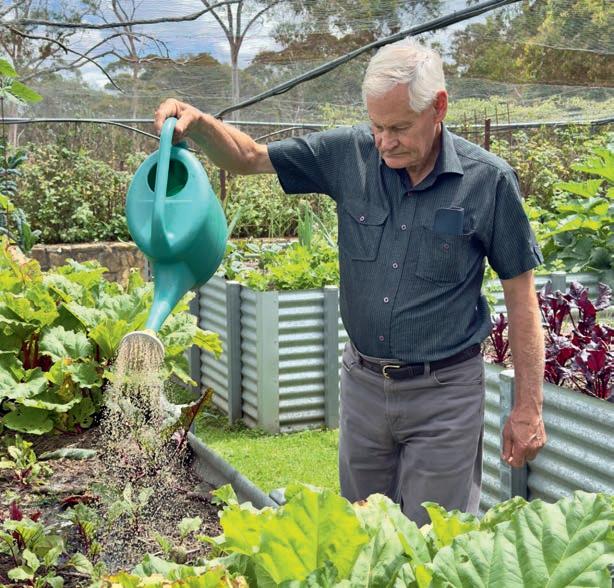
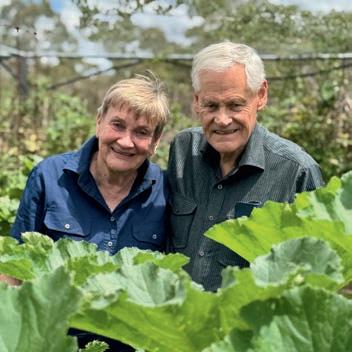
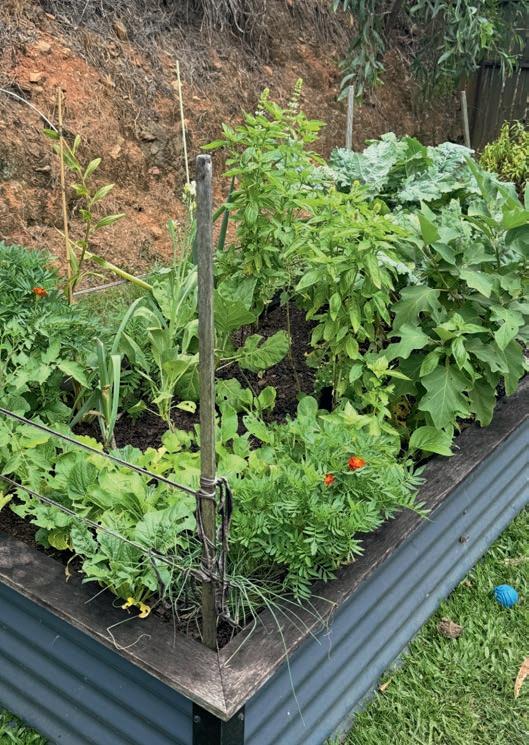
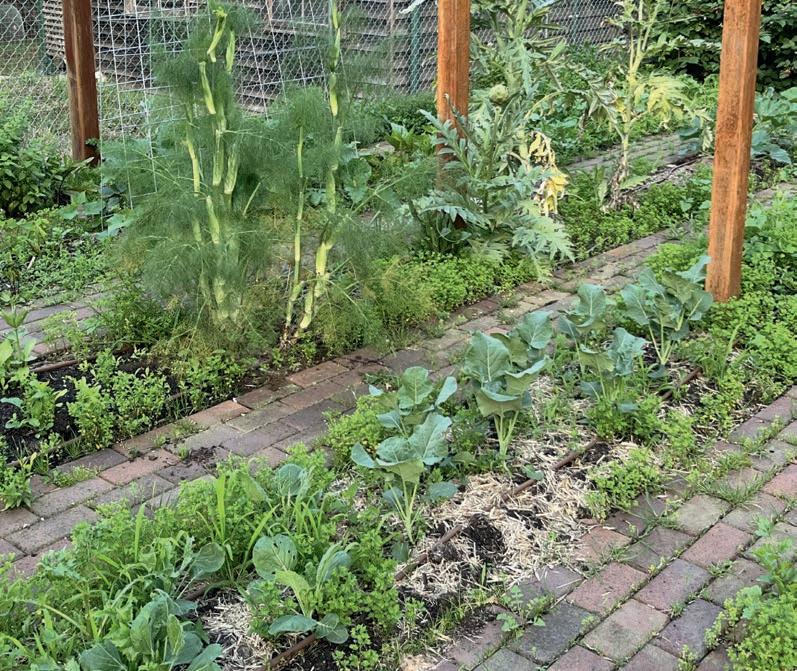
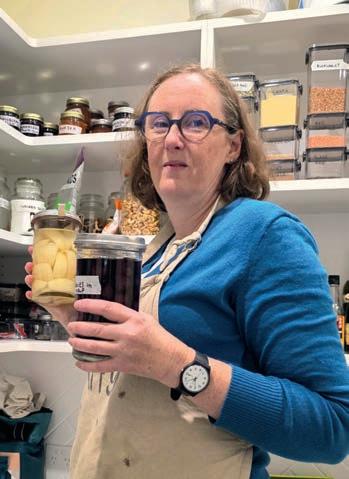
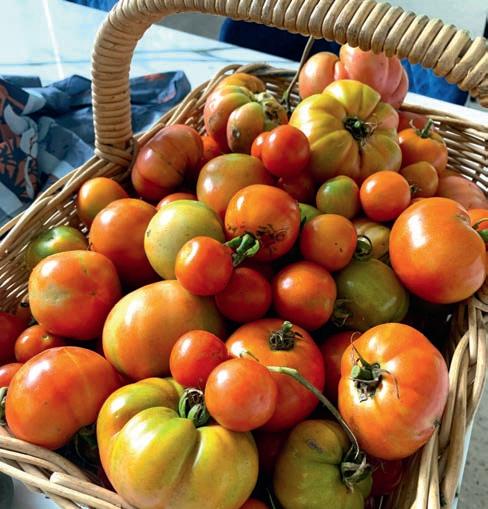
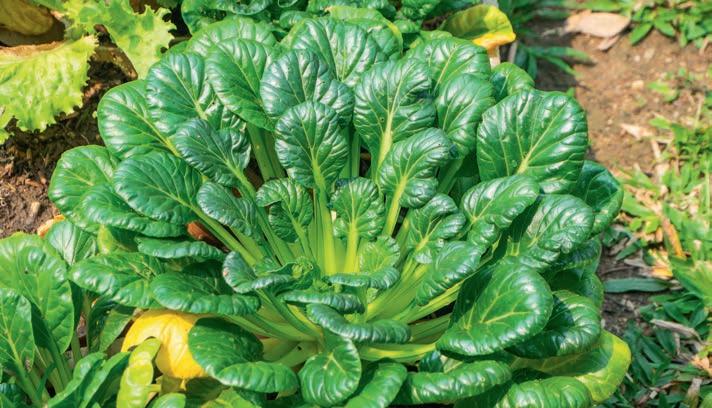
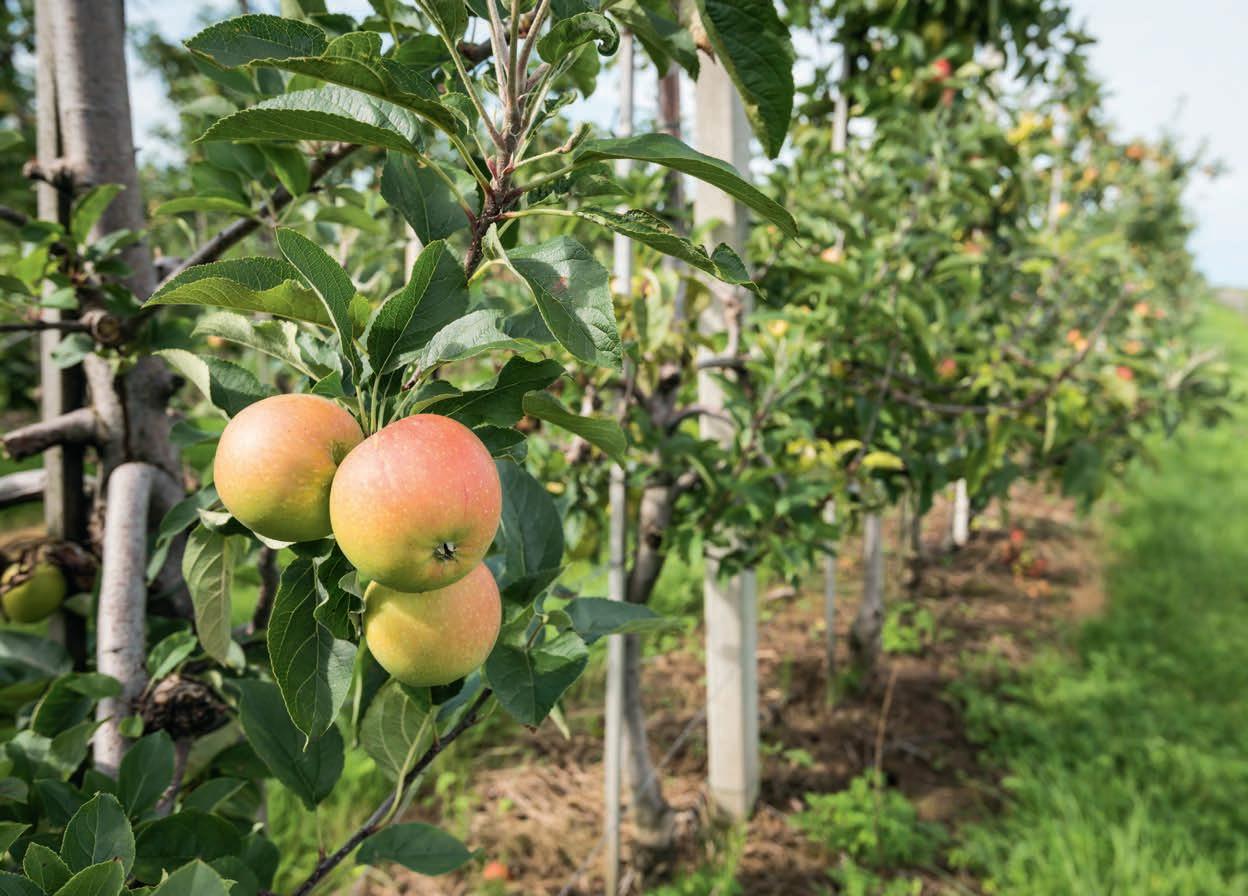
“The vegetables we are growing now are so sweet and delicious!”
Discover in our ENVIRO Range. Use code: GOG20 for 20%(ENVIROdiscount products only)
“My home veggie and citrus garden is disease-free and doing wonderfully”
BOOST YOUR SOIL
GIVE
YOUR SOIL AND PLANTS WHAT THEY NEED IN A FORM THAT WORKS FOR THEM!
There is an intimate relationship between soil and plants, microbes and water, humans and animals: a connective web that we, as gardeners, need to acknowledge before adding anything to our soil.
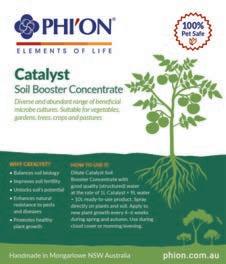
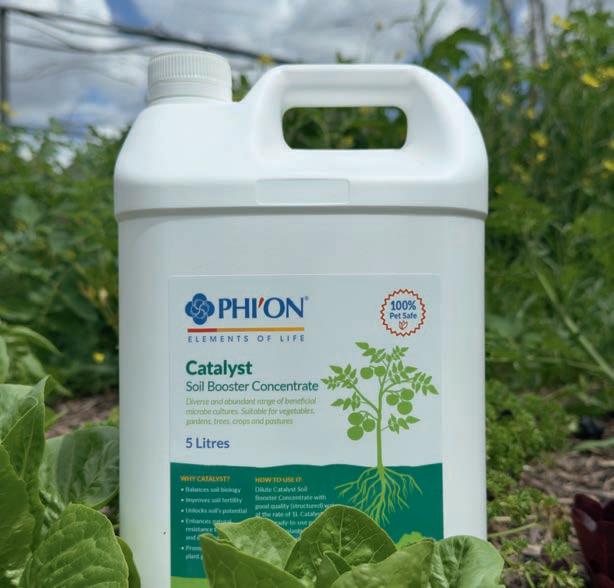
It’s something that Robert and Stephanie Gourlay have thought deeply about and is embodied in their Phi’on range of supplements — in particular, the flagship product, Catalyst Soil Booster Concentrate.
“Our soil conditioner contains just about every mineral needed to support plant growth,” says Robert, “as well as fermented herb extracts and microbial cultures to optimise growth.”
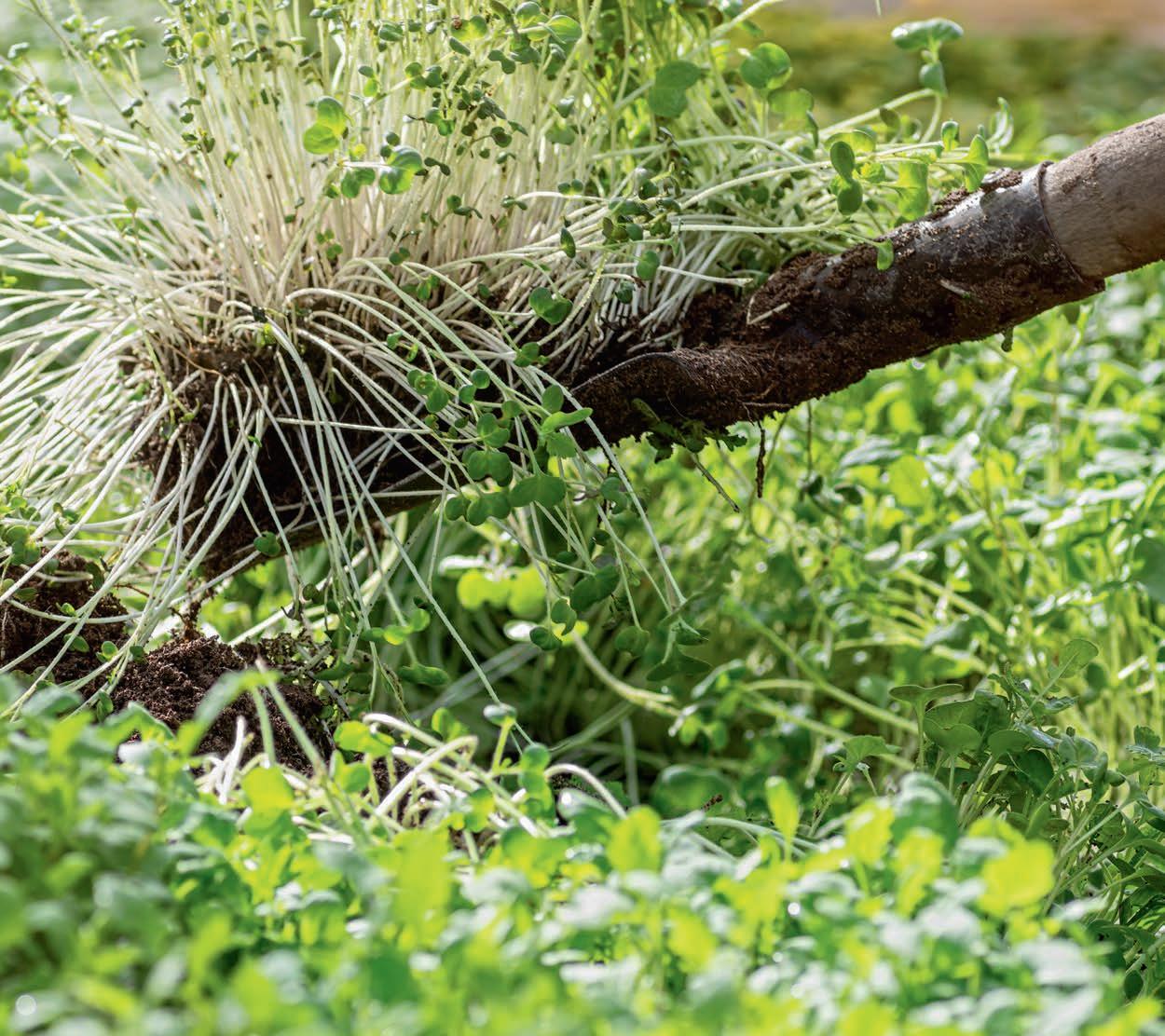
Catalyst Soil Booster Concentrate is a fermented probiotic liquid containing a balanced formulation of beneficial microbes and minerals for optimum soil and plant health.
Whether the subject is human and animal gut flora or a balanced garden soil, beneficial microbes are always crucially important.
These microbes include bacteria, yeasts and fungi abundant in agricultural soils and critical in nutrient uptake and cycling. They promote a sustainable environment by fighting disease, allowing
soil and compost to cycle nutrients, promoting root development and restoring balance to water.
A CLOSER LOOK
Catalyst Soil Booster Concentrate is a living biological fertiliser containing a balanced formulation of microbial inoculants that fix atmospheric nitrogen, make phosphorus soluble, decompose organic material and oxidise sulphur in soils. In short, it:
* balances soil biology
* improves soil fertility
* unlocks soil’s potential
* improves yields
* enhances natural resistance to pests and diseases
* suits seeds, seedlings, pot plants, lawns, vegies, gardens, natives, ferns, hydroponics, crops and pastures
* is safe for pets
* makes application easy
It improves phosphorus availability to plants growing in soil previously fertilised with chemical additives. Conventional fertilisers flood soil with excess phosphorus of which only 10–20 per cent can be absorbed by plants.
Catalyst Soil Booster Concentrate stimulates the plant root system and
the enzymatic activity associated with either acid or alkaline phosphates, which increases the availability of soil nutritional phosphates for plant function.
A BREEZE TO APPLY
“At this stage most of our clients are domestic gardeners,” says Robert, “but the conditioner can just as well be applied to larger-scale farms. You would typically spray at seeding time and at the end of harvest.”
And Catalyst Soil Booster Concentrate is so easy to use: simply dilute with goodquality, ideally structured water at a rate of one litre to nine litres of water.
Structured water can be made using MEA Water Devices, a natural transformation system that restructures and revitalises water by entraining a permanent negative charge to replicate the state of water in nature. For more info, visit meawater.com
Spray the solution directly onto soil and plants under cloud cover or in the morning or evening.
Store Catalyst Soil Booster Concentrate at room temperature out of direct sunlight and use within 18–24 months of opening.
• phion.com.au | YouTube: HOW TO Use Catalyst Soil Booster Concentrate
With Stephanie & Robert Gourlay
THIS ISSUE
One of the best parts of this job is visiting other people’s gardens for our Gardening Folk stories. We get so inspired every time by the love and effort such dedicated gardeners and growers put into producing food.
It was no different this issue when we visited Belinda J’s cool-climate patch in the NSW Blue Mountains. Relatively new to gardening, Belinda decided to go at it in a planned, organised way.
Always very busy with her own small business, BJ, as she is known, got contractors in to build the infrastructure she wanted, including an enclosed food garden, chook house, below-ground water tanks, pathways and retaining walls.
The end result is a beautifully laid out garden that feeds more than BJ — year round thanks to all the preserving she manages to squeeze into her schedule. Check it out on page 34. Exemplary.
We also meet a WA family who grow food from the backyard to the front, including the council verge, and a pair of tropical fruit enthusiasts who farm just about every fruit you never heard of in the hills east of Gympie in Queensland.
As for the rest of the issue, Claire Bickle looks at non-tropical fruit, shining a spotlight on the insect enemies of citrus, from stink bugs to fruit flies, and how to deal with them. Her heirloom for this issue is cauliflower.
Jennifer Stackhouse also covers fruit in the form of apples and kiwis. She gives a seasonal nod to winter weirdos such as tatsoi and salsify, salutes clever crops borage and calendula and celebrates the down-to-earth beauty of the daisy.
Kerrie Anderson is planting broad beans and fennel while Chris Stafford looks at some leafy greens we call spinach. Angus Stewart, meanwhile, goes native with the yellow-flowered eucalypt xanthostemon, or golden penda.
Jo Immig reveals the wonders of plant geometry while Angelo Eliades looks at geometry imposed on plants: the ancient art of espalier. We also discuss green manure and look for solutions to what can go wrong in the winter garden.
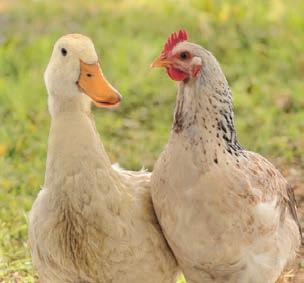
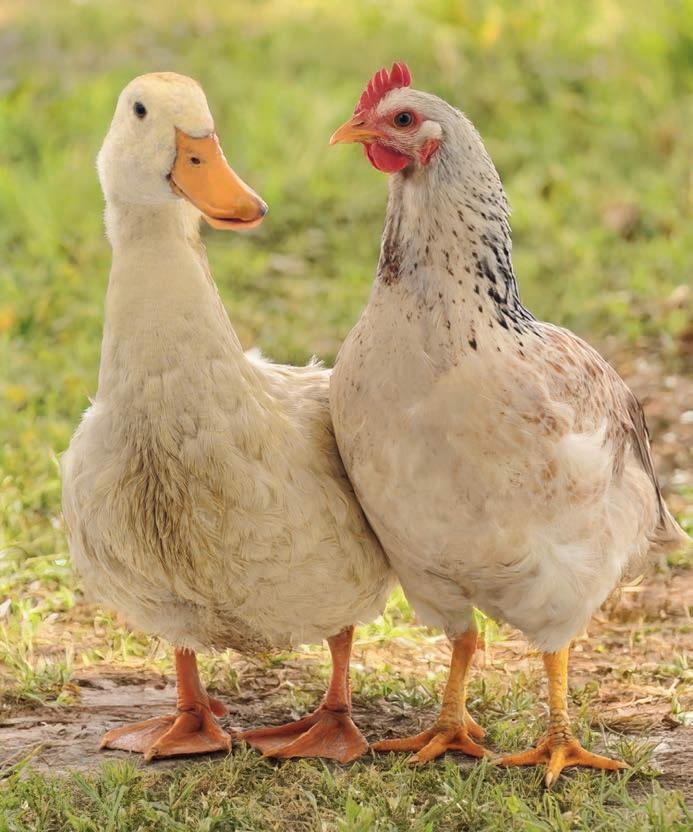
Finally, Megg Miller poses the perennial poultry question: do ducks and chooks belong together?
Now I have a sad announcement: this is the final issue of the magazine that has been my absolute joy to edit for more than a decade.
I want to thank our wonderful contributors; the hard-working behindthe-scenes people who get it into print; our supportive advertising partners whose products make our gardening easier; and, most of all, you, our valued readers. You are the real gardening folk we do it all for. So keep at it! Cheers,
Editor Kerry Boyne Email: kboyne@umco.com.au
Designer Michaela Primiano
Contributors Claire Bickle, Angelo Eliades, Jana Holmer, Jo Immig, Megg Miller, Jennifer Stackhouse,
Chris Stafford, Angus Stewart, Chloe Thomson
National Advertising Manager
Rosemary Wood
Mb: 0404 306 050 Email: rwood@umco.com.au
Advertising Production Co-ordinator Mila Rojano
Cover Photo Getty Images
Chairman/CEO Prema Perera
Publisher Janice Williams
Chief Financial Officer Vicky Mahadeva
Associate Publisher Emma Perera
Circulation Business Development Manager
Mark McTaggart
Website: www.carkitfe.com.
This magazine may have some content that is advertorial or promotional in nature. This book is copyright. Apart from any fair dealing for the purpose of private study, research, criticism or review as permitted under the Copyright Act, no part may be reproduced by any process without written permission. Enquiries should be addressed to the publishers. The publishers believe all the information supplied in this book to be correct at the time of printing. They are not, however, in a position to make a guarantee to this effect and accept no liability in the event of any information proving inaccurate. Prices, addresses and phone numbers were, after investigation and to the best of our knowledge and belief, up to date at the time of printing, but the shifting sands of time may change them in some cases. It is not possible for the publishers to ensure that advertisements which appear in this publication comply with the Competition and Consumer Act 2010 (Cth) and the Australian Consumer Law. The responsibility must therefore be on the person, company or advertising agency submitting the advertisements for publication. While every endeavour has been made to ensure complete accuracy, the publishers cannot be held responsible for any errors or omissions. This magazine is printed
ROCK DUST: HOW IT WORKS ITS MAGIC
EARTHLIFE’S COLIN PURNELL ANSWERS OUR QUESTIONS ABOUT ROCK MINERALS
How do rock minerals like basalt, granite dust, or gypsum affect soil and microbial life over time?
In clay soils, rock minerals help displace sodium and open up the structure, improving drainage and aeration. In sandy soils, the minerals and microbial activity help bind particles together to improve water and nutrient retention.
Unlike many synthetic fertilisers, Earthlife products are designed to provide the building blocks for microorganisms. The minerals feed the microbes, which in turn break down nutrients for the plants.
Rock minerals help stabilise soil pH and provide a broad spectrum of over 60 mineral elements, including silica, which strengthens plant cell walls.
What’s the best way to apply rock minerals so plants can absorb the nutrients effectively?
The products are most effective when spread on the soil and lightly raked or worked in, followed by a thorough watering. Because Earthlife minerals are combined with biology, they only need moisture to activate the microbes that begin the nutrient delivery process.
For new plants, Earthlife recommends adding a specific amount (e.g., a tablespoon of Garden Mate) into the planting hole to reduce transplant shock and encourage fast root development. How long does it take for them to break down and become available?
Improvements in soil and plant health can typically be seen in 2–3 weeks.
With Colin Purnell, Earthlife
However, while the immediate biology works quickly, the rock base acts as a slow-release source of minerals. Earthlife suggests reapplying every 3–4 months. Are there specific crops or plants that benefit more from rock minerals? While the minerals benefit almost all plants by improving soil energy, Earthlife offers specialised blends for different needs. Veggie Mate is for vegetables and herbs; it improves post-harvest shelf life and discourages nematodes. Flower Blend is formulated to enhance colour, flower quality and vase life. Native Blend is safe for Australian natives that are sensitive to high phosphorus. Lawn Blend is targeted at heavy foot-traffic areas to create a more resilient, lowmaintenance turf.
CONTENTS
REGULARS
4 EDITOR’S NOTE
A roundup of what’s in the issue
8 THE GRAPEVINE
Jo Immig reports on troubles with pollinators, mammalian meat allergy and one science journal’s retraction of its defence of glyphosate
10 NEW FOR GARDENERS
A plantable book series, a magenta hellebore, an heirloom red carrot and an Amish heirloom lettuce
12 GREEN NEWS
Courts shut down Trump’s war on windfarms, a frog bounces back from extinction and researchers map genome of killer crop fungus
38 MOON CALENDAR
A basic guide to planting in harmony with moon phases in June, July and August
39 PLANT NOW
What to plant in June, July and August according to your climate zone and moon phases
82 THINGS TO DO
What’s what in your plot and what needs doing right now
86 IN SEASON
The seasonal delights you’ll find in shops and gardens in autumn
92 BOOKS
Leafing through books for gardeners and cooks
93 PICK OF THE CROP
Great products and services from our advertisers PLANTS
16 CLEVER CROPS
Jennifer Stackhouse wants a winter garden full of hardy borage and the colourful calendula
18 PLANT PROFILE
Leafy greens that are called spinach and are not but will do just fine when the real thing’s not around
22 FAMILY HEIRLOOM
Claire Bickle follows up cabbage with yet another classic brassica — this time, cauliflower
40 TIME TO PLANT
Kerrie Anderson is planting broad beans and fennel
44 TIME TO PLANT
Jennifer is all about apples, cunningly named kiwifruit and winter weirdos such as tatsoi and salsify
60 ORNAMENTALS
Jennifer ponders the ubiquity and simple beauty of the daisy, which comprises a surprising 10 per cent of all flowering species
64 GO NATIVE
Angus Stewart celebrates xanthostemon or golden penda, a rainforest myrtle whose origins go back to the Dreamtime
PEOPLE
26 GARDENING FOLK
This garden is so lush and productive it’s burst the property boundaries and colonised the footpath
30 GARDENING FOLK
A southeast Queensland nursery with over 1000 varieties of tropical and subtropical fruit
34 GARDENING FOLK
A newbie gardener turns an unpromising property into a highly productive organic plot
GARDEN LIFE
52 PEST PATROL
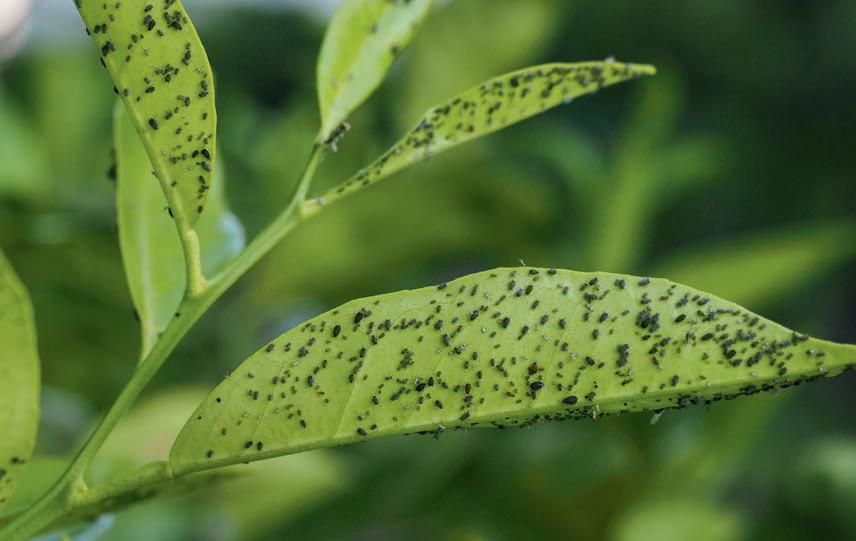
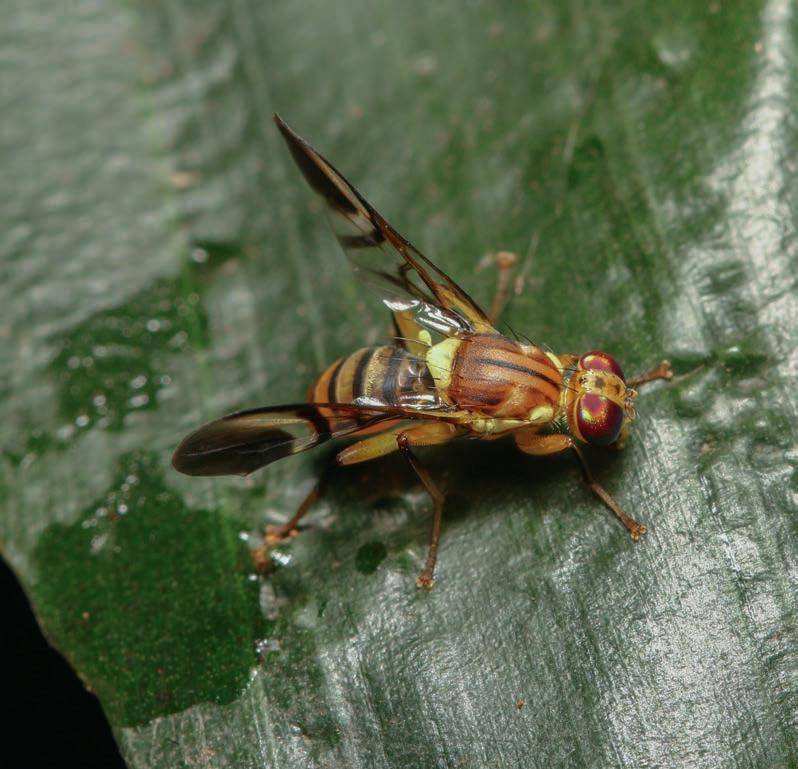
Claire has some hints on getting the best of citrus threats such as scale, aphids and QFFs
56 PLANT GEOMETRY
Once you learn about the golden ratio and the Fibonacci curve you start to see sacred geometry everywhere
76 FEATHERED FRIENDS
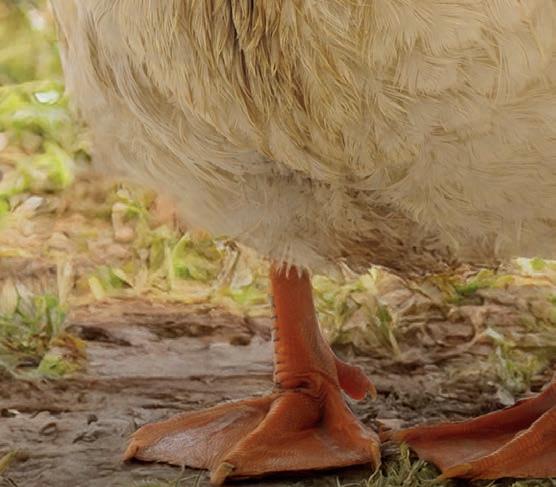
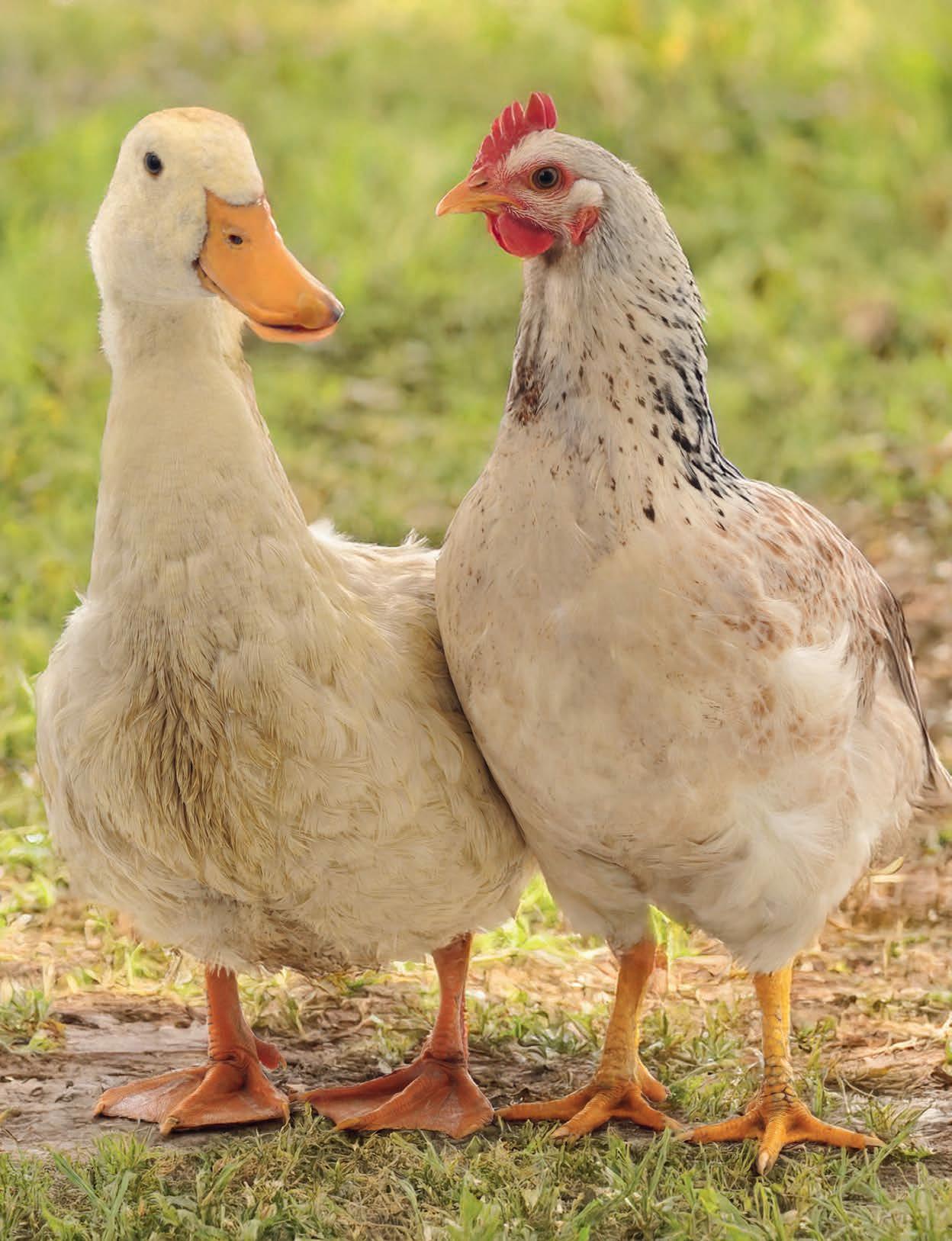
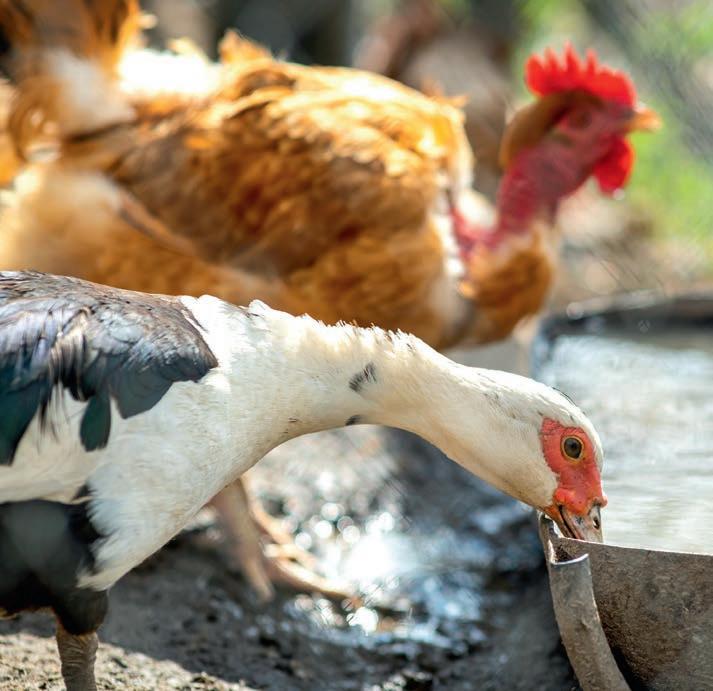
Megg Miller unpacks the perennial poultry preference: ducks or chooks?
FOOD
87 GARDEN TO TABLE Recipes from Aunty Beryl’s Cookbook by bushfood legend Aunty Beryl Van Oploo, OAM
PLOT PROJECTS, PLANNING & MAINTENANCE
68 WEEKEND GARDENING
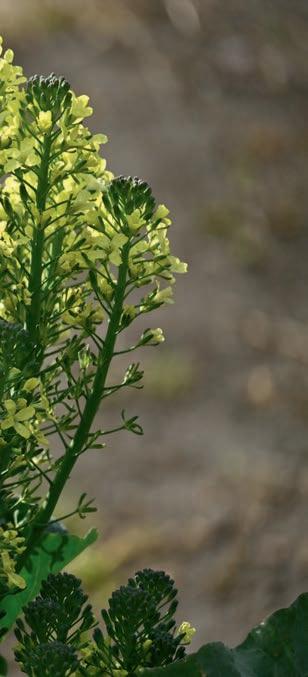
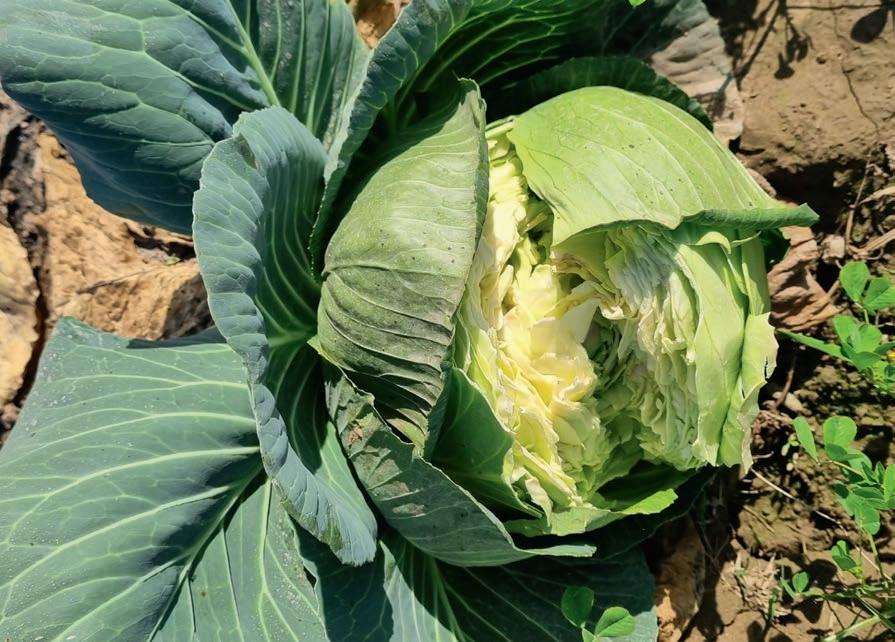
Carrots gone crooked? Broccoli bolting? Sounds like a case of winter wobbles — but there are solutions
72 BACKYARD PERMACULTURE
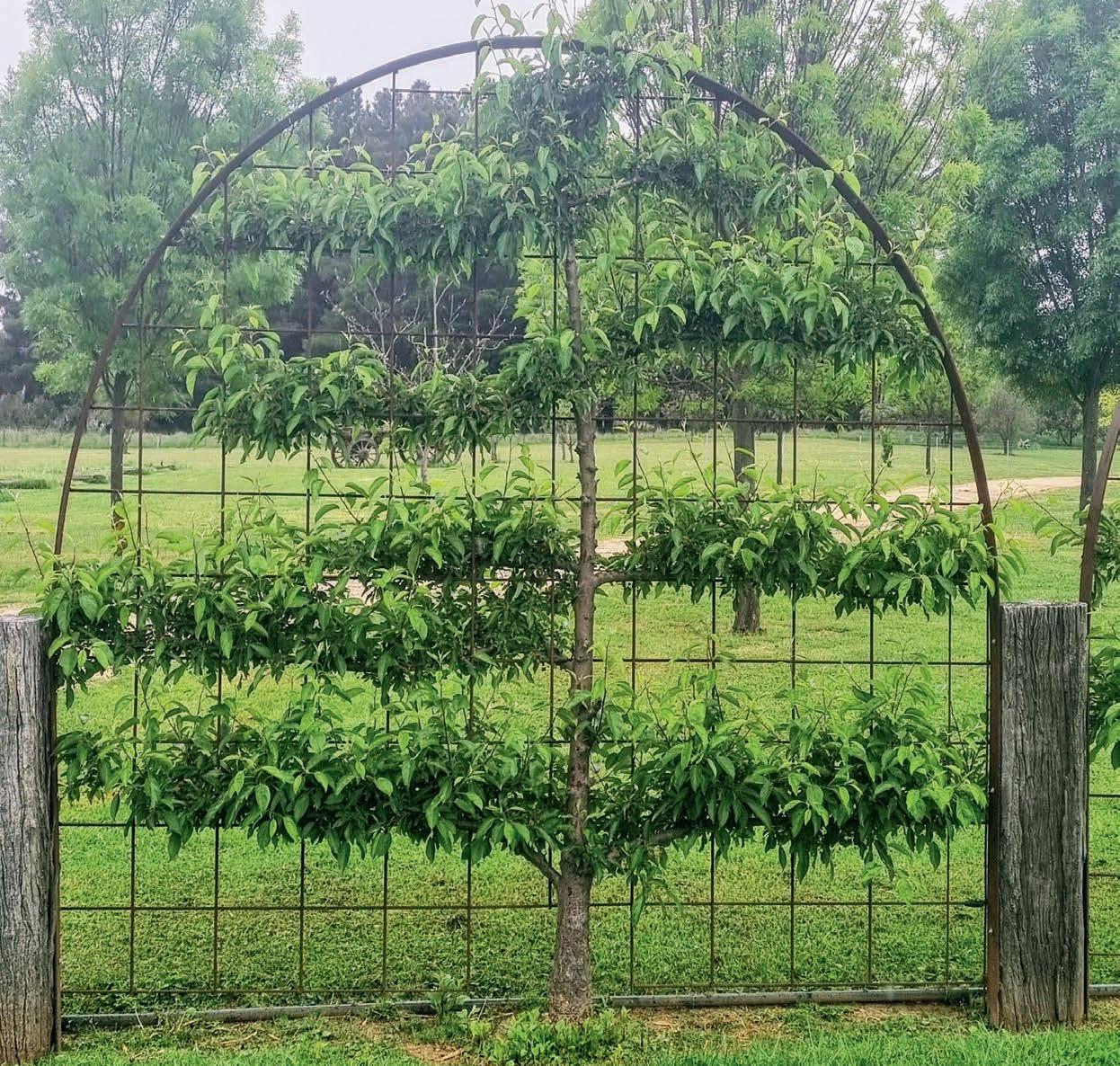
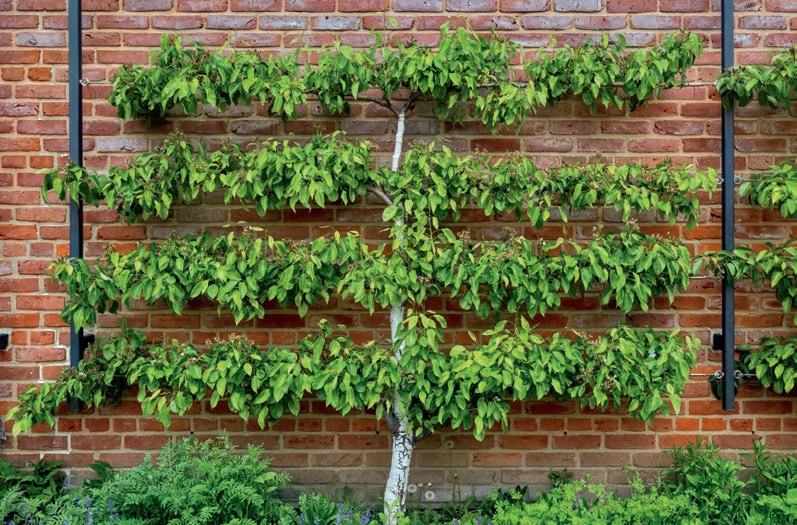
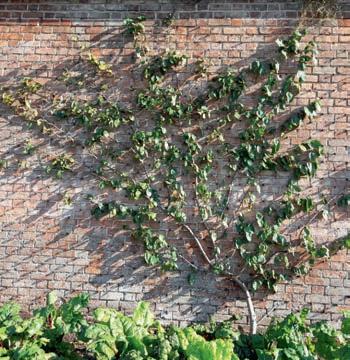
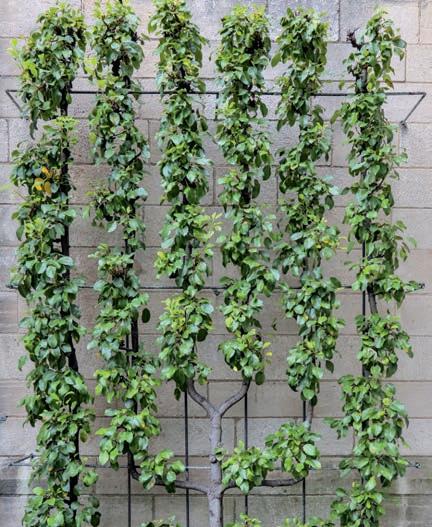
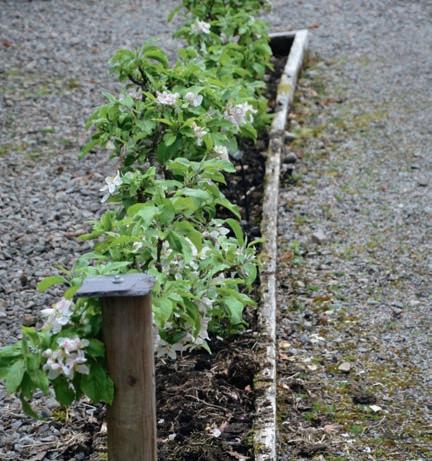
Angelo Eliades follows the twists in the tale of espaliering fruit trees
79 THE UNDERGROUND
Fertiliser doesn’t come fresher than green manure, the crop grown not to feed you but to feed your soil
THE
Grapevine
ENVIRONMENTAL NEWS AND UPDATES COMPILED BY JO IMMIG
JO IMMIG
Jo blends her background in environmental science and activism with her love of organic gardening, art, and writing. She’s passionate about protecting our beautiful planet Earth for future generations. She has written many articles for magazines and is the author of two books: Toxic Playground and Safer Solutions
POLLINATION DEVASTATION
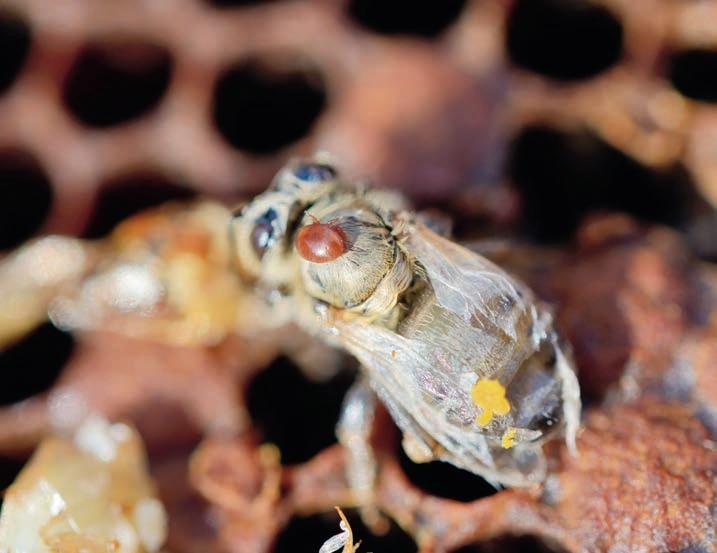
Since the incursion of the Varroa mite into NSW beehives in 2022, Australia has officially given up trying to exclude and eradicate it and has since moved to management strategies.
Varroa mites (Varroa destructor) attack honeybee larvae, reducing populations and even destroying whole colonies. This impacts not only honey supply but also crop pollination, which relies heavily on exotic honeybees.
Thirty-five agricultural industries in Australia rely entirely, or in part, on honeybee pollination, including apples, cherries and almonds.
The spread of Varroa mite and projected loss of non-native honeybees (Apis mellifera) — the mite does not directly affect native bees — has turned the spotlight on the precarious situation with insect pollination in Australia.
Research shows the negative factors affecting pollinators elsewhere are just as prevalent here.
Federal and state governments have
been throwing millions of dollars at exotic honeybees because the pollination services they provide are fundamental to exotic horticultural and agricultural crops.
Meanwhile, they’ve largely ignored nativeplant pollinator interactions that existed before the introduction of honeybees.
Competition from feral honeybees is listed as a key threat to endangered species and biodiversity in Australia. Feral hives inhabit precious tree hollows on which Australian native animals, particularly birds and mammals, rely for shelter and breeding.
Honeybees also compete with Australian pollinators for floral resources such as pollen and nectar. Australia has over 2000 species of native bees and thousands of other species of insect pollinators.
Scientists are encouraging governments to fund research at this critical time to discover how Australia’s native pollinator systems will change in the wake of projected declines in feral honeybee numbers.
Source: theconversation.com
Getty, Bjorn Christian Torrissen CC
A red-brown Varroa mite hitches a ride on a honeybee
TICKS KICK OFF MAMMALIAN MEAT ALLERGY
Preliminary findings from CSIRO research indicate mammalian meat allergy (MMA) is on the increase in Australia.
Nationally, case numbers of MMA have increased by 40 per cent annually since 2020, suggesting this is a growing health concern in parts of Australia.
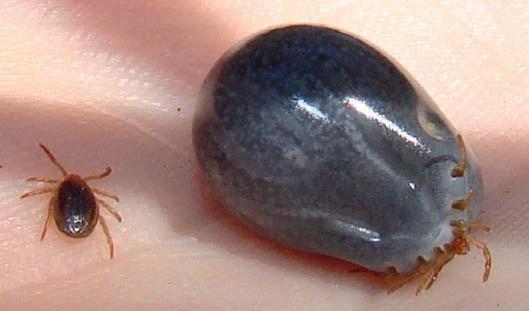
Mammalian meat allergy is one of the few known food allergies caused by an environmental trigger: a tick bite.
Here, the main culprit is the eastern paralysis tick (Ixodes holocyclus), commonly found along the east coast from north Queensland through New South Wales to northern Victoria.
MMA results in an allergic reaction to mammal meat (beef, pork, lamb, venison etc), making it difficult, or sometimes even impossible, for affected individuals to eat meat without experiencing adverse symptoms.
MMA is not a typical food allergy, which generally is a response to proteins in food. MMA is an allergy to a sugar molecule found in most mammals, including cows, pigs and sheep, and known as galactose-α-1,3-galactose, or alpha-Gal.
Alpha-Gal is not found in humans or primates. So, when we are bitten by ticks that have recently fed on mammals, our immune system is reprogrammed to defend against alpha-Gal when we eat meat.
Also unusual is that MMA reactions often take hours to appear. Symptoms typically emerge three to six hours after eating, making it difficult to connect the delayed onset of hives, nausea or breathing difficulties to the earlier meal.
The condition can also extend beyond mammalian meat. Some sufferers report reactions to gelatin, frequently found in stocks, confectionery, desserts and common medications.
In addition, some lifesaving medicines and drugs also contain alpha-Gal, making this allergy a complex health challenge.
CSIRO research is also focusing on the link between MMA and cardiovascular disease. A large Australian study of more than 1000 people found people having heart attacks were 12 times more likely to have alpha-Gal antibodies than healthy people.
Source: csiro.au
JOURNAL RETRACTS POPULAR DEFENCE OF GLYPHOSATE
The scientific journal Regulatory Toxicology and Pharmacology has issued a rare retraction of one of the most commonly cited studies on the safety of the pesticide glyphosate, the main ingredient in the herbicide Roundup.
The study has been cited extensively by regulatory agencies around the world, including Australian Pesticides
and Veterinary Medicine Authority, as evidence that glyphosate poses no cancer risk to humans.
The paper is in the top 0.1 per cent of cited articles on glyphosate in the scientific literature, meaning it is more often cited than 99.9 per cent of papers written on the chemical.
A lawsuit in 2017 uncovered internal emails from chemical giant Monsanto that suggested its employees helped ghostwrite an influential paper that claimed to find no evidence that Roundup, the company’s widely used glyphosate herbicide, was carcinogenic.
Toxicologist Martin van den Berg, co–editor-in-chief of Regulatory Toxicology and Pharmacology, wrote that the paper was withdrawn from the journal because of “serious ethical concerns” and questions about the validity of the research findings.
Source: sciencedirect.com
Tick before and after feeding
The widely debated toxic effects of glyphosate are back in the firing line
Ticks can cause allergies to mammal meats such as sirloin
What’s hot
AN AUSTRALIAN PLANTABLE BOOK SERIES, A RICH MAGENTA HELLEBORE AND, CONTINUING THE RED(ISH) THEME, AN HEIRLOOM RED CARROT VARIETY AND A BURGUNDY SPECKLED AMISH HEIRLOOM LETTUCE
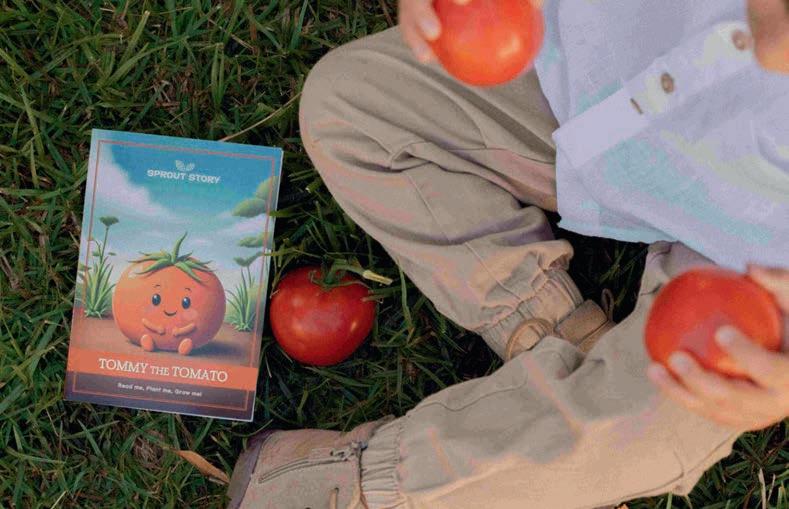
SPROUT STORY
PLANTABLE BOOKS
Sprout Story is Australia’s first locally created plantable children’s book series, developed by South Australian founders Anthony Savas and Elias Anargyros. Each book allows children to read a story, tear out a page, plant it in soil and grow real vegetables. The concept blends storytelling, sustainability and hands-on gardening, helping children understand where food comes from while building patience, responsibility and curiosity about nature. Inspired by the founders’ Greek heritage and their grandparents’ backyard gardens, Sprout Story launched nationally in late 2025. Sprout Story, sproutstory.com.au, Instagram: @sproutstoryau
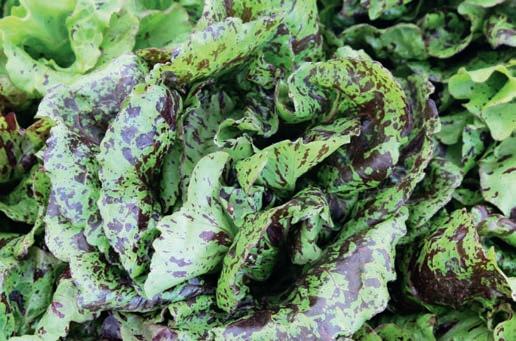
‘LETTUCE BUTTERHEAD SPECKLES’ (LACTUCA SATIVA)
This is an appealing Amish heirloom variety of butterhead-type lettuce with medium-sized, dense heads and pretty burgundy-speckled leaves. Snip off individual leaves as a cut-and-come-again crop or cut whole heads when young or full sized. Grow in part or full sun and keep moist but avoid watering overhead. Protect from slugs and snails. The Seed Collection, theseedcollection.com.au
CARROT ‘KYOTO RED’ (DAUCUS CAROTA)
An heirloom variety from the Kyoto area of Japan, ‘Kyoto Red’ has a gorgeous deep red colour and is sweet and tender but crisp, growing to 20cm in length. Ideal for eating fresh, juicing or adding to salads and cooked dishes. Grow your carrots straight and well formed by planting them in a loose, friable soil that the roots can penetrate easily and evenly.
The Seed Collection, theseedcollection.com.au
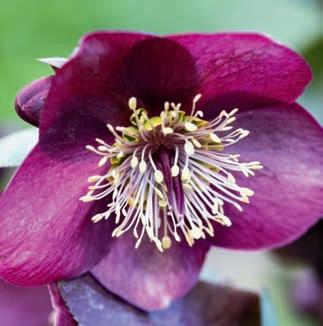
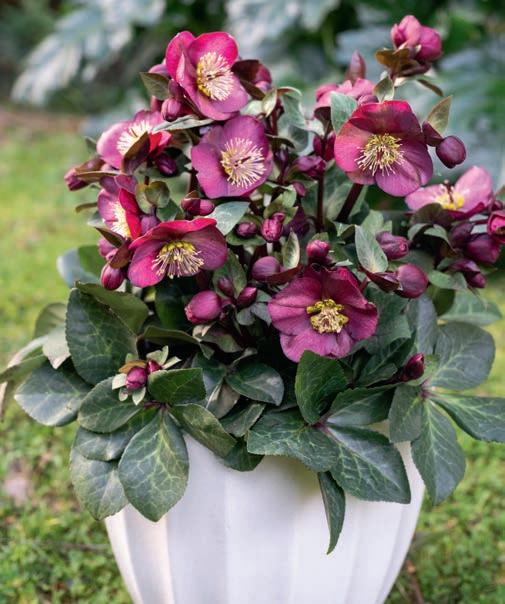
FROSTKISS® HELLEBORE ‘VIBEY VELVET’ PBR
A captivating plant with upright, large, cupped flowers from winter through early spring. The magenta-red flowers sit above marbled foliage and enjoy a long flowering period. Enjoy ‘Vibey Velvet’ indoors for up to three weeks before planting out in your garden. Perfect for container growing in shady nooks, small gardens, patios, courtyards and balconies.
Plant in well-drained soil and tidy after flowering. If growing in full sun, care should be taken not to allow the plant to dry out completely. For best results, feed regularly in late autumn and spring with a slowrelease fertiliser before and after flowering.
Plants Management Australia, pma.com.au
Green news
WHO IS GREENING OUR WORLD AND HOW THEY ARE DOING IT
LEGAL BLOWBACKS AGAINST TRUMP’S WAR ON WIND
A US federal judge has ruled that an offshore wind project in Massachusetts can move forward, overruling a freeze imposed by the Trump administration in 2025.
Judge Brian Murphy of the US District Court in Boston said Vineyard Wind, located 24km off the coast of Martha’s Vineyard, can finish construction. He cited the potential economic losses arising from delays as well as the strong likelihood of success of the developers’ legal claim.
It was the fourth such ruling in a month, directly following US District
Judge Royce Lamberth’s decision to allow construction to move forward on a $5b Danish windfarm off the coast of Rhode Island. Lamberth dismissed the administration’s national security claims as “arbitrary and capricious”.
President Trump has frequently sought to block windfarms, labelling turbines “pathetic and so bad” and claiming they are killing people. He has falsely asserted that wind is “the most expensive form of energy”.
The current administration is embroiled in a number of legal battles on climate funds, including $20b in grants the Biden administration awarded to projects in low-income and
disadvantaged communities, which the Environmental Protection Agency (EPA) halted soon after the 2024 election.
Another judge at the US District Court for the District of Columbia ruled that the administration’s decision to halt billions of dollars in clean energy grants was “unlawful” as it primarily targeted projects in Democratic-led states.
“All the awardees (but one) were based in states whose majority of citizens did not support President Trump in the 2024 election,” said Judge Amit P Mehta. He instructed the administration to restore the grants and cover the plaintiffs’ legal fees. • earth.org
US courts are winding back Trump's efforts to ban windfarms
Bigstock, Getty, CSIRO
BRINGING GREEN BELL FROGS BACK FROM THE BRINK
In a world-first experiment, scientists are trying to reintroduce a frog species to the ACT nearly 50 years after it became extinct there.
The University of Canberra (UC) researchers are using man-made frog “saunas” and saltwater “spas” that could save amphibians all around the world from chytrid fungus.
More than 500 frog species globally have been decimated by the highly infectious disease which attacks parts of the frog’s skin, affecting its ability to breath.
UC professor Simon Clulow said the green and golden bell frog was one of Australia’s most heavily impacted species, its numbers falling 90 per cent since the 1970s.
“The pathogen is basically impossible to eradicate,” said Dr Clulow, explaining how his team was seeking ways for the frogs to co-exist with the fungus.
The green and gold bell frog, famous for its call that sounds like a revving motorbike, hasn’t been seen in the ACT since the 1980s.
Dr Clulow has been working with the species for 20 years. He and his colleagues are reintroducing more than 400 of the threatened species at 15 sites across the ACT, starting with Mawson Ponds in Canberra’s south.
They’re pioneering an “out-of-the-box” solution that was “low tech, accessible and scalable”, he said.
At Mawson Ponds, the so-called saunas consist of plastic pyramids that act as greenhouses, with bricks inside in which the frogs can nestle. Next to each sauna is a man-made spa that’s more saline than natural waterways.
Research suggests frogs can tolerate higher temperatures and higher salinity than the deadly pathogen.
“The frogs climb into the holes in the bricks, bake the chytrid fungus off and heal themselves from the disease,” said researcher Dr Jarrod Sopniewski. “They should be more resistant to getting the disease again.”
The frogs can also wash the pathogen away in the saltier water of the spas, which have fewer predators for the frogs and their eggs and tadpoles.
The researchers have high hopes for the novel technique. “It’s been shown to work in the lab,” Dr Sopniewski said. “If it works here, it should pretty much work anywhere.” • abc.net.au
BOFFINS IDENTIFY DNA CODE OF CROP FUNGUS
CSIRO researchers have unlocked the detailed genetic blueprint of a major soil-borne crop pathogen, paving the way for better disease management.
For the first time, scientists have sequenced a chromosome-level genome for Rhizoctonia solani AG-8, revealing its complex genetic structure.
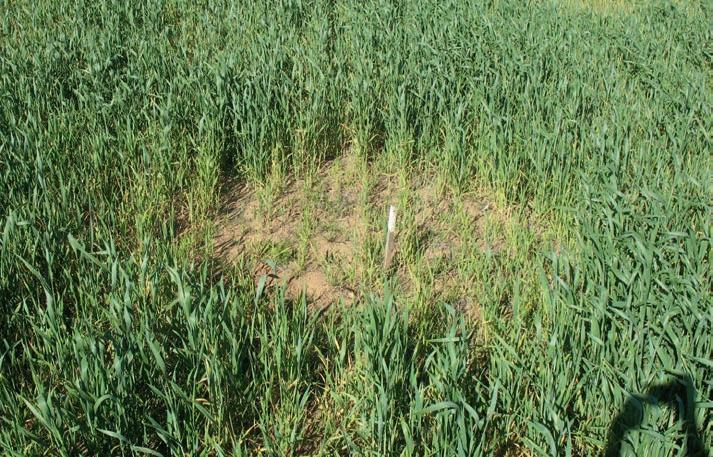
The fungus causes bare-patch disease in wheat, barley and legume crops across Australia, resulting in annual losses of more than $150m.
The CSIRO’s Dr Jonathan Anderson explained why this particular fungus is such a challenge for farmers to control. He found it was dikaryotic, “meaning it carries two separate sets of genetic
a crop affected by bare-patch disease
material, called haplotypes, some of which are highly genetically diverse”.
In other words, the fungus has two distinct genetic sets playing different roles as they attack crops, which could explain why it’s so hard to control.
“This new level of genetic insight into the fungus gives us a powerful foundation to transform how [we] manage the destructive diseases it causes in the paddock,” Dr Anderson said.
The new genetic knowledge supports further research into how the fungus causes bare-patch disease in different crops and points to the development of smarter crop management strategies to reduce its impact.
• csiro.au
A CSIRO photograph of
The endangered green and golden bell frog (Ranoidea aurea)
POOR SOIL? NO SPACE FOR A GARDEN? PERHAPS YOU SHOULD
PUT A RING ON IT
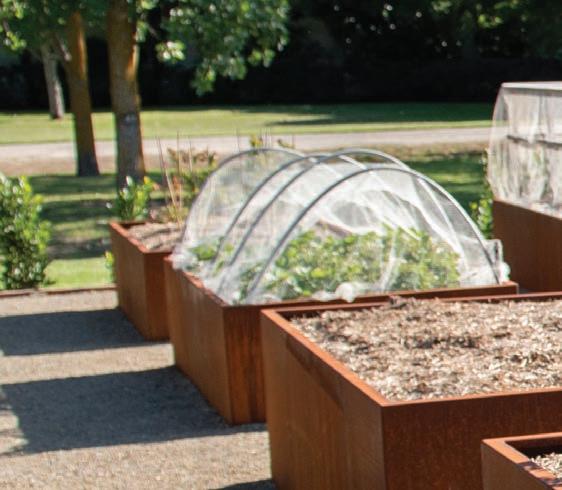
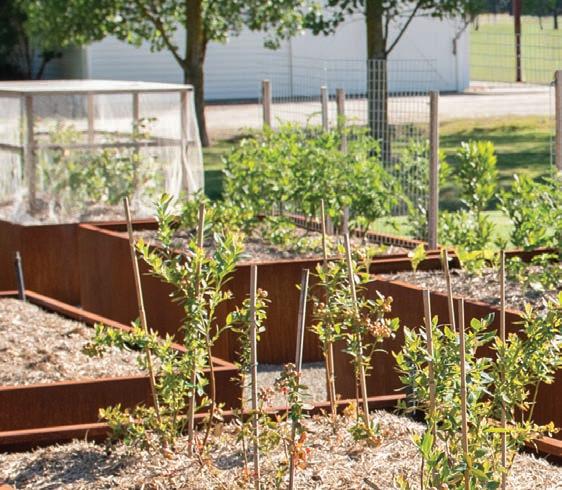
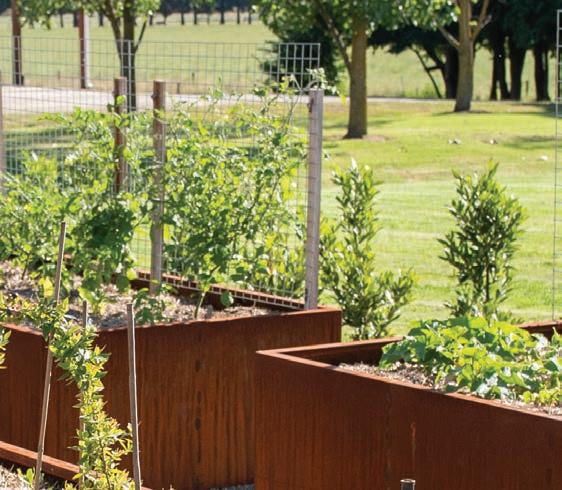
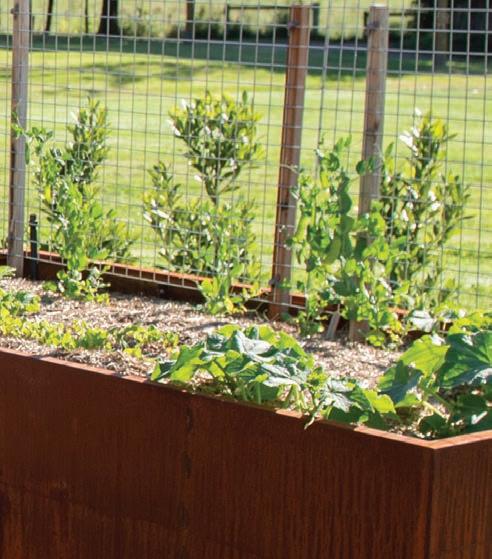
RAISED WEATHERED STEEL PLANTERS ARE THE PERFECT
SOLUTION
How do you start a small vegetable garden when your soil isn’t up to scratch? That’s the conundrum that faced these owners when they moved into a newly built house.
The slightly sloping block was covered in builder’s fill that in turn sat on a layer of sand with near-impenetrable clay just under the surface. The only things that grew in it with any conviction were weeds and feral grass.
Once the hard landscaping was done and two retaining walls had gone in, it was time to address the problem of the vegie garden. The answer turned out to be both practical and decorative.
They bought three ShapeScaper Redcor steel rings in different sizes from the local landscape supplier and had them delivered with a load of
river pebbles and a pile of specialised vegetable mix soil.
Also called weathering steel, Redcor is a steel alloy containing chromium, copper, nickel and phosphorus similar to Corten. When exposed to the elements, it quickly acquires a patina of rust that remains stable and actually prevents deeper corrosion.
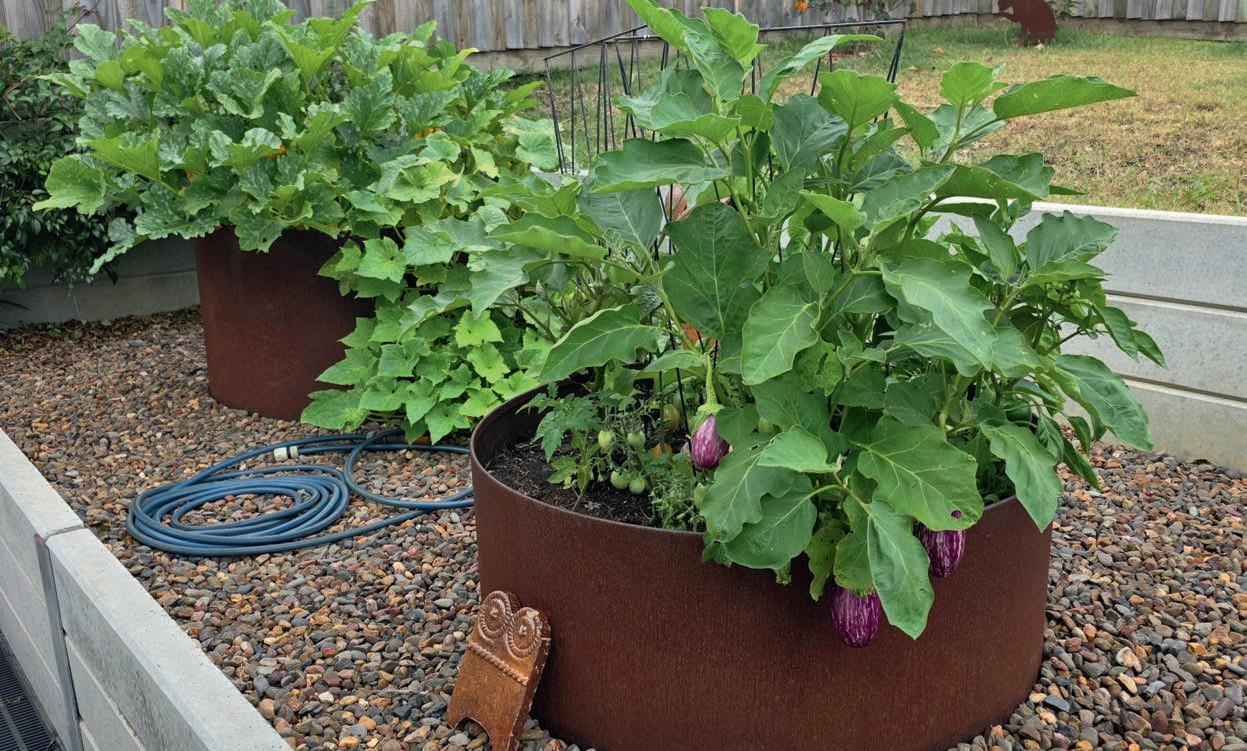
On a 2m-deep shelf formed by the retaining walls, three rings of different heights sit side by side on top of the pebbles. They are filled first with a layer of stones and bricks topped by a good depth of the vegie garden mix.
Each one has an improvised olla in the centre to keep the surrounding soil moist. These are permeable terracotta pots (rather than watertight glazed ones), their drain holes plugged with silicone chair-leg caps and their saucers repurposed as lids. The soil in the rings was then topped off with mulch.
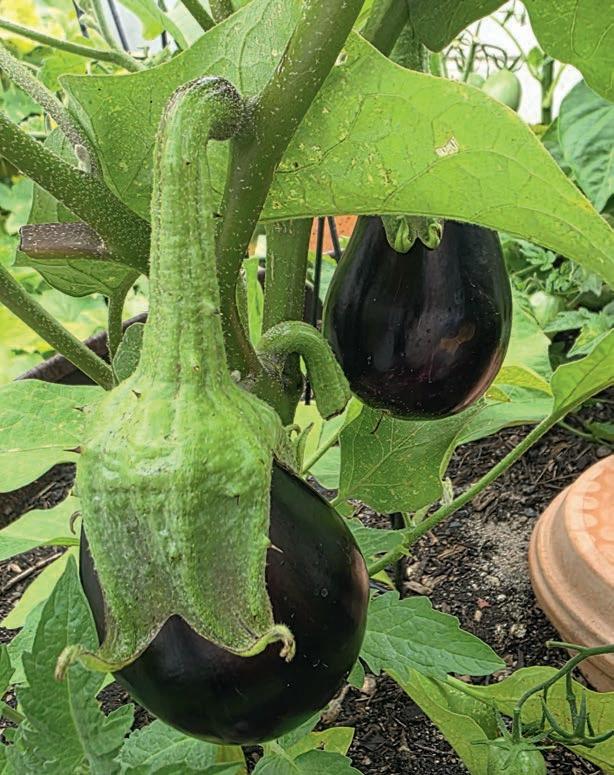
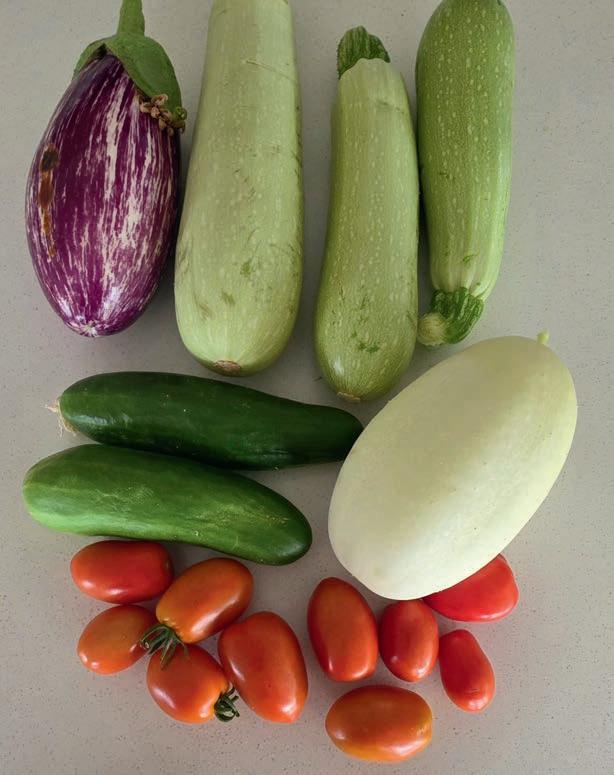
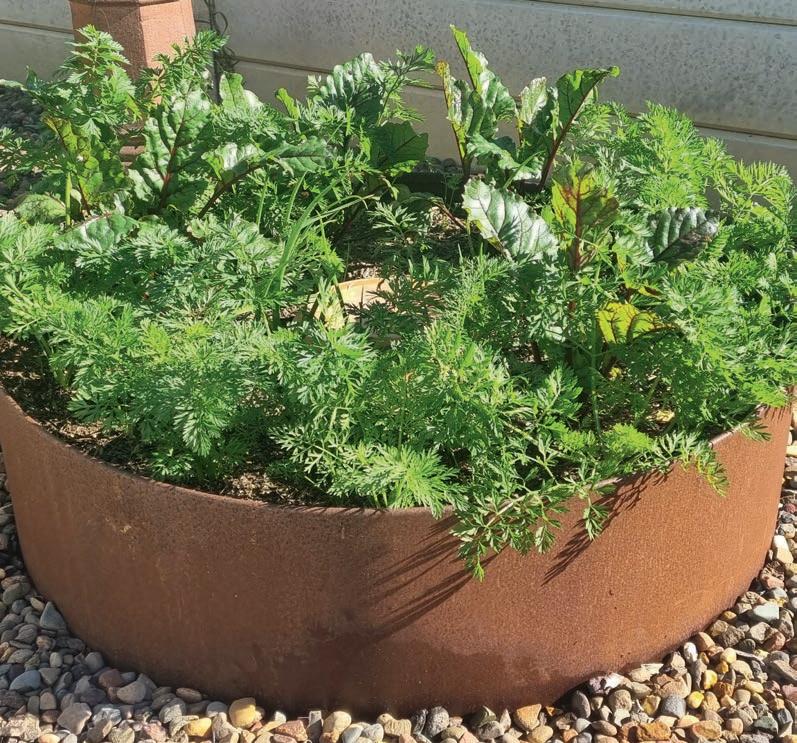
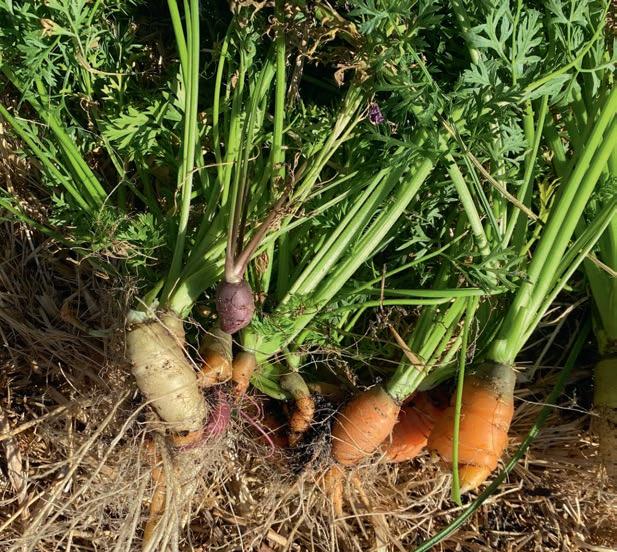
Through spring into summer, the rings produced tomatoes, two kinds of cucumber and two varieties of eggplant, plus zucchini, capsicums, carrots and beetroot. Except for the carrots (they were wonky but tasted great), the veg were all healthy and well formed.
Pollinators found the plants in no time — blue-banded and honeybees, mostly. The home owners contributed regular Seasol and Swift Grow fertiliser to keep things humming along.
This winter they will house peas, brassicas and more root veg. At the other end of the pebbled area, separated by a curved strip of Redcor steel, is a native garden formed by sheet mulching over the builder’s fill.
Tomatoes, eggplant, capsicum, zucchini and cucumbers in their ShapeScaper rings
It is now so full of earthworms it’s getting holes pecked everywhere by magpies and kookaburras.
If your only available space is a paved courtyard or balcony, as is the case for most unit and apartment dwellers, these raised steel planters are the way to go.
Importantly, they don’t deteriorate the way wooden planters do, or crack and fade in the sun like plastic containers. Weathered steel’s rust patina goes on looking good year after year.
Because steel planters are all about the depth of the soil rather than the breadth, you might have to consider balcony load limits. Other factors to take into account are drainage and sun exposure.
A contained system has its advantages: soil can be easily improved and replenished, crops can be rotated easily and maintenance is manageable rather than overwhelming.
And there’s quite a range of plants suited to confined environments, from fast-growing leafy greens and pick-and-come-again herbs to compact vegetable varieties bred specifically for small gardens.
Finally, if you’re renting and you have to move, with a little deconstruction you can even take your rings with you.
The olla in the centre is just visible
The third ShapeScaper ring with carrots and beetroot Harvests like this a few times a week
THE HARDLY PERENNIAL
BORAGE DOESN’T BLOOM ALL YEAR ROUND — IT ONLY SEEMS LIKE IT DOES BECAUSE OF THE WAY IT HAPPILY SELF-SEEDS AND SPREADS
Borage label
Common name: Borage
Botanical name: Borago officinalis
Family: Boraginaceae
Aspect & soil: Full sun to part shade; well-drained soil
Best climate: All
Words Jennifer Stackhouse
Agreat reason to grow herbs is to bring pollinating insects into gardens — but many herbs are spring-to-autumn annuals, leaving a hungry gap in winter.
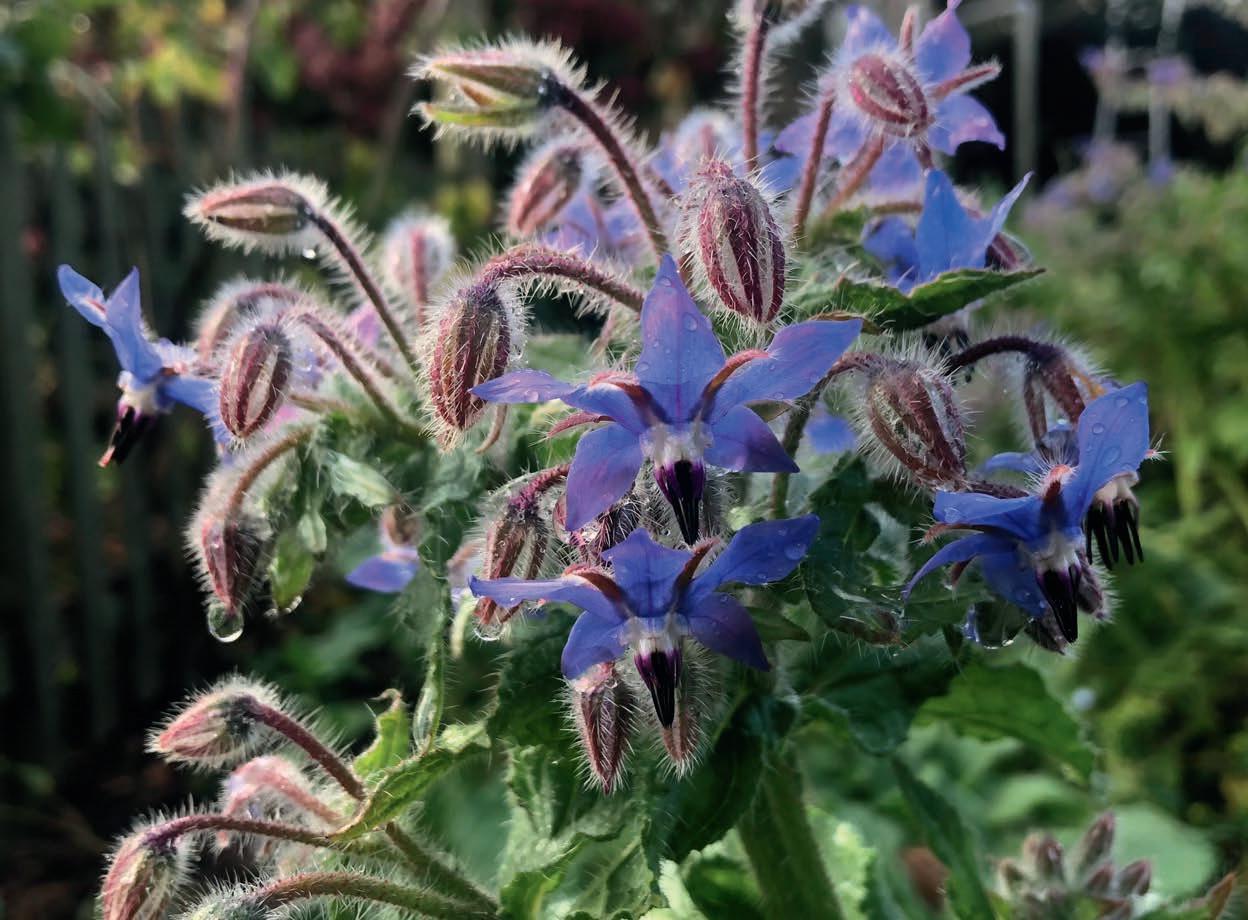
Among all the herbs, borage is both easy to grow and highly attractive to friendly insects. Importantly, it flowers for much of the year, producing open blue (or occasionally white) flowers that draw in bees, wasps and other beneficial insects.
Despite its dainty star-shaped flowers, borage is robust and sizeable with hollow prickly stems and large hairy leaves.
The prickles are soft and not likely to cause an issue with spiking — but do wear gloves if uprooting a mature plant.
Allowed to form seeds, borage happily spreads around the garden ensuring lots of new plants for insects to enjoy. Despite
its self-seeding habit, borage is easy to pull up if it grows where it’s not wanted.
If starting with seeds, sow as the soil warms in a sheltered spot.
USING BORAGE
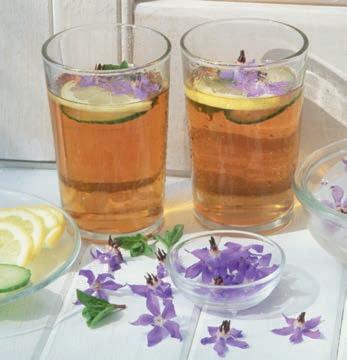
Borage’s blue flowers are highly decorative added to drinks or scattered over salads. Pick and freeze them in ice cubes as a clever way to add colour and interest to a punch or just a jug of water.
A blue-tinged tea can also be made from the dried flowers.
The leaves and stems are also edible with a cucumber to seaweed scent and taste. If the flavour appeals, borage can be shredded to add to salads, blended into soft cheeses or used as a sauce, known in Germany as grüne Sosse or “green sauce”.
This is a herb with a long history.
DESPITE ITS SELF-SEEDING HABIT, BORAGE IS EASY TO PULL UP IF IT GROWS WHERE IT’S NOT WANTED.
Habit: Annual herb
Propagation: Seed, seedling Difficulty: Easy
it is known
Originating in Syria, it is known throughout the Mediterranean and grown around the world.
In ancient Greek and Roman times, borage was associated with courage and is said to have been drunk by soldiers before battle — an association that may have to do with its ease of growth and robust, prickly habit!
Jennifer Stackhouse, Getty
Garnish in Pimm’s Cup cocktail
GOOD AS GOLD
CALENDULA OR MARIGOLD NOT ONLY BRIGHTENS UP THE WINTER GARDEN BUT HAS CULINARY AND OTHER USES AS WELL
Words Jennifer Stackhouse
Agood way to build up beneficial insect numbers in the garden is to include winter-flowering plants for nectar and pollen — the likes of borage (see opposite) and calendula.
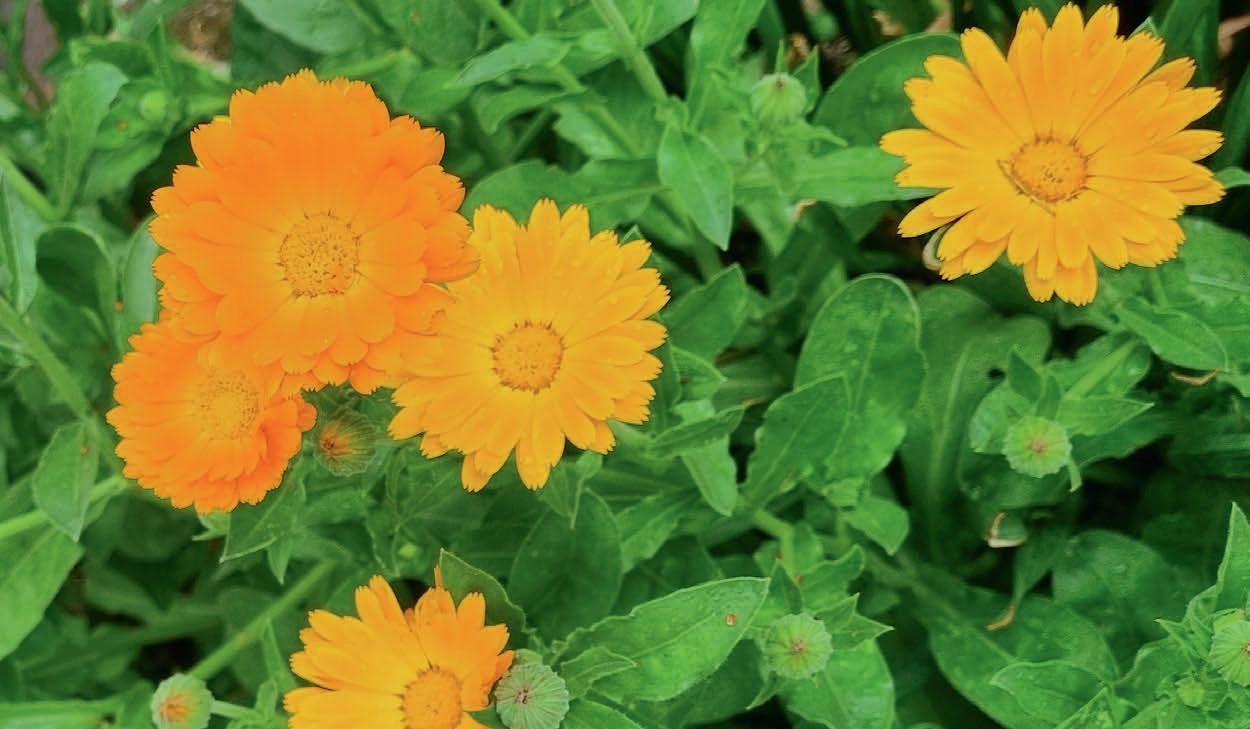
Planted in clumps in warm, sunny spots in the garden, they offer not only food but also places of refuge for beneficial insects. It’s not uncommon to see them resting in the warmth of a calendula flower on a cold winter’s day.
While calendula is grown as an annual to brighten the grey days of winter, its orange, yellow or brown-toned
Calendula label
flowers add bold colour to the garden throughout the year.
As a bonus, calendula — like borage — is a cheap and cheerful herbaceous plant that self-seeds, replanting itself where it needs little care or attention.
EDIBLE FLOWERS AND LEAVES
As well as appealing to nectar-loving insects such as bees and other beneficials including wasps, ladybirds and hoverflies, calendula has other benefits.
Its old common name pot marigold hints at its use in the kitchen in the days when its large, slightly fleshy leaves were added to the cooking pot as a nutritious vegetable.
Popular for use in personal care products
Common name: Calendula, pot marigold
Botanical name: Calendula officinalis
Family: Asteraceae (daisy family)
Aspect & soil: Full sun to part shade; well-drained soil
Best climate: All
Habit: Annual herb
Propagation: Seed, seedling
Difficulty: Easy
The flowers have narrow petals and are held on thick stems. To eat them, harvest the flowers then tear them apart and scatter the colourful petals over salads, or as garnish for a quiche.
The petals can also be used as a substitute for saffron as they add a vibrant yellow-orange colouration to food and impart a slightly peppery flavour to the likes of risotto, soups and rice.
Added to chicken treats, calendula petals increase the vibrancy of the yellow egg yolks. They can also be used as a dye.
A tincture or ointment from the owers is used to treat skin problems from chapped hands (a common winter
ailment) to wounds. It’s also safe to use on animals and birds, including chooks. Keep the plants in bloom by regularly deadheading to remove spent flowers. Liquid feed with an organic fertiliser applied every three to four weeks.
Sometimes calendula is affected by rust, which causes orange pustules to form on the leaves. Control its spread by removing affected leaves — or entire plants.
DID YOU KNOW?
Some of the beneficial wasps and flies that rely on winter nectar also act as pest control in spring when they catch and place other insects such as caterpillars into their nesting chambers as food for their young.
COME IN, SPINACH
THESE LEAFY GREENS ARE ALL CALLED SPINACH AND SOME ARE MISTAKEN FOR IT, BUT ALL MAKE HANDY STAND-INS WHEN THE REAL THING’S NOT AROUND
Words Chris Stafford
Whenever Depression-era cartoon character Popeye found himself in trouble he’d reach for a can of greens — and what pumped up his muscles and helped him fight “to the finich” was nutritious, vitamin-rich spinach.
In fact, his endorsement of the performance-enhancing veg was credited with a 33 per cent sales surge during the 1930s. In a contemporary survey, children listed spinach as their third favourite food.
The Texas town of Crystal City declared itself the spinach capital of the world and, in 1937, erected a statue of Popeye. A decade later, frozen-seafood company Birds Eye chose to market
spinach as its first frozen vegetable.
Thought to be native to Persia, spinach spread to the orient before arriving in Europe with the Arabs around a millennium ago.
In the 16th century, France’s Italianborn queen Catherine de’ Medici was so fond of the stuff that, even today, dishes containing spinach are often tagged à la Florentine in honour of her birthplace.
So it comes as no surprise that there are other leafy greens clamouring to bathe in the reflected glory, to the extent that we’re sometimes confused about which one actually is spinach.
Here, in no particular order, are some of the pretenders — those unrelated plants we sometimes choose to call spinach.
THERE ARE MANY LEAFY GREENS CLAMOURING TO BATHE IN THE REFLECTED GLORY, TO THE EXTENT THAT WE’RE SOMETIES CONFUSED ABOUT WHICH ONE ACTUALLY IS SPINACH.
SPINACH, SPINACIA OLERACEA
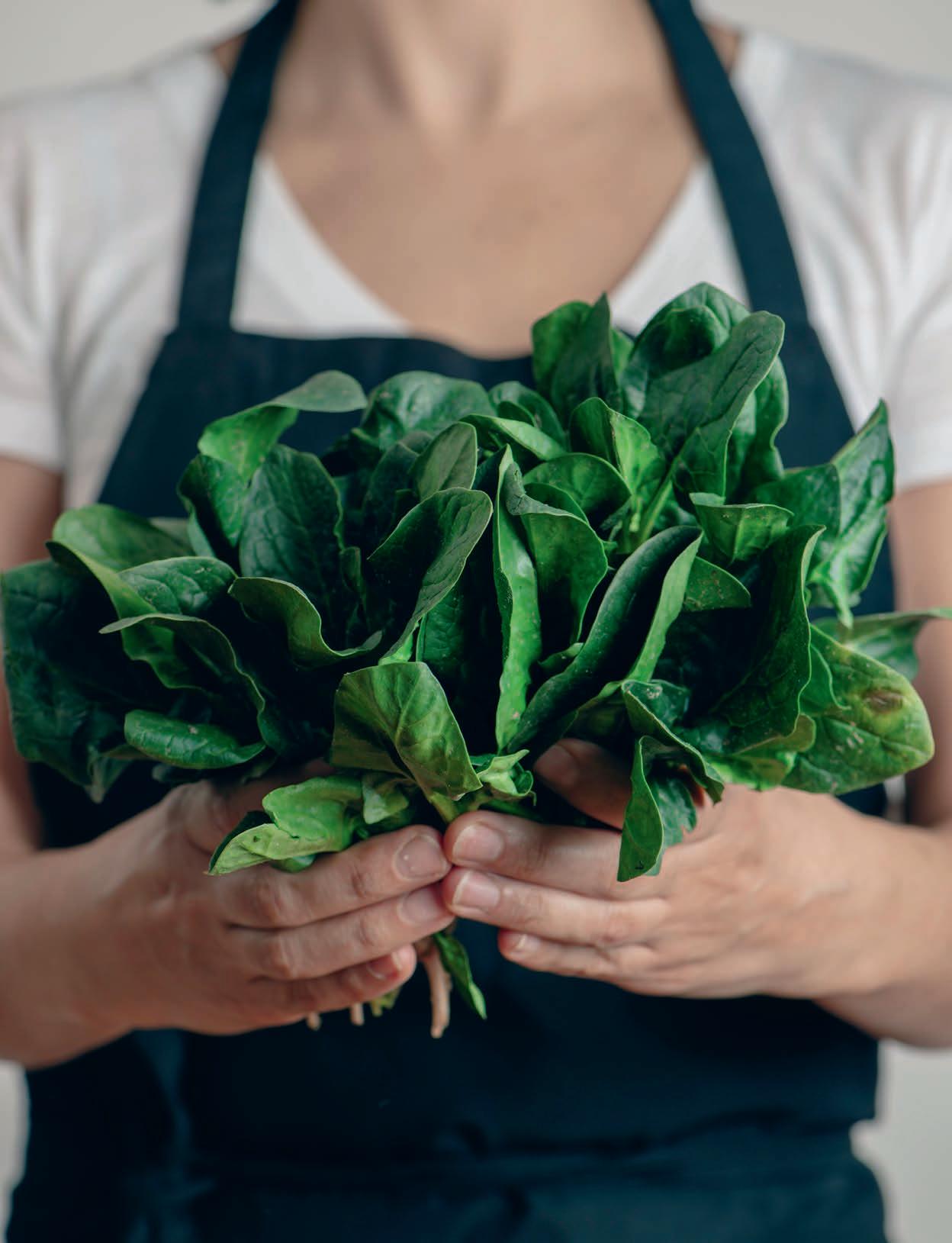
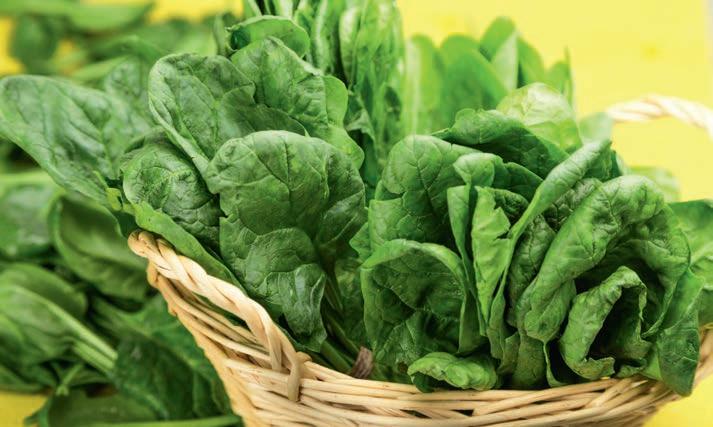
To begin with the original, what we often call English spinach is a hardy, cool-climate vegetable with dark-green triangular leaves of various sizes. An annual that can overwinter to become a biennial, it grows to around 30cm and, left to mature, produces clusters of tiny yellow-green flowers followed by small, hard fruits that contain seeds.
Growing: Spinach is best sown direct in early spring or autumn, avoiding the hotter months. Though it prefers full sun, partial shade may help prevent bolting in warmer regions. Sow seeds 2cm deep and 5cm apart in rows separated by 30cm.
From two months after germination, spinach can be treated as a cut-andcome-again crop, using the thinnings in the kitchen. Try ‘Winter Giant’.
Uses: Spinach can be eaten raw in salads and smoothies or added at the last moment to soups or stir-fries. Though delicious in dishes such as Greek pastry spanakopita, it loses its considerable levels of vitamin C when cooked. Still, even if Popeye’s spin on spinach’s superhuman properties may have been a mite overhyped, eating spinach is infinitely better than not eating spinach.
PERPETUAL SPINACH, BETA VULGARIS
A prolific cut-and-come-again leafy green, perpetual spinach — or leaf beet — is actually a type of chard related to silverbeet and beetroot. It’s a reliable year-round producer of shiny, dark-green leaves with white midribs, making it a good off-season substitute for the real thing, which it closely resembles. Unlike true spinach, however, it’s resistant to bolting even in summer.
Growing: This hardy, frost-tolerant biennial can grow up to 50cm tall and wide anywhere in the garden in welldrained soil without too much shade. Direct-sow, spacing as for spinach. Regular harvesting is good for the plant and encourages new fresh growth.
Uses: Perpetual spinach tastes sweet but earthy, reminiscent of iron or asparagus, and doesn’t get bitter with age. Use leaves fresh as soon as they’re picked: raw to impart bite to a salad or steamed, sautéed or added as a spinach substitute to a quiche or lasagna. Like spinach, it’s rich in vitamins A, C and K, iron, potassium and fibre.
True spinach
Perpetual spinach
EGYPTIAN SPINACH, CORCHORUS OLITORIUS
Also known as mulukhiyah, jute mallow or West African sorrel, Egyptian spinach hails from the Middle East and Africa where its leaves were traditionally used as a nutritious spinach substitute, while its stems produced jute fibre. It earned the name
mulukhiyah or “king’s vegetable” after an ancient Egyptian king was cured of an unspecified illness by eating a soup made from the leaves — a soup also enjoyed, so it’s said, by Cleopatra.
Growing: Egyptian spinach is a hardy annual that thrives in hot, sunny conditions, growing to around 1m and producing small yellow flowers and
edible seed pods as well as edible leaves that can be continually harvested. Like its close relative okra, it can handle both dry and wet conditions but doesn’t like shade or being waterlogged. Mulch to retain moisture.
Uses: As with spinach, the tender, young leaves can be added raw to salads. Cook the older leaves in stews, soups and stirfries, especially with tomatoes and rice. Again like okra, when cooked it has a mucilaginous texture, which is good for thickening dishes. It is rich in vitamin C, iron, calcium and beta-carotene.
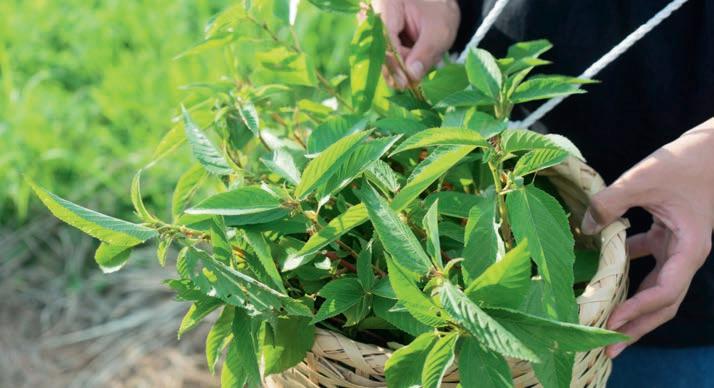
JAPANESE MUSTARD SPINACH, BRASSICA RAPA VAR. PERVIRIDIS
This distant relative of cabbage is a largeleafed green grown commercially in Japan and Taiwan. It’s known as komatsuna in its native Japan after the village of Komatsugawa, where it was traditionally cultivated, though the modern variety has been bred to be sweeter.
Growing: Sensitive to extremes of cold and heat, mustard spinach is mostly grown in spring or autumn — or year round in greenhouses. Its leaves can be eaten at any stage of their growth.
Uses: With a fresh, sweet taste and crisp texture, it can be eaten raw in salads or added to a soup, where it tends to retain its firmness. Also popular pickled, stirfried or boiled, it’s a source of vitamins A, C and K and calcium.
OKINAWA SPINACH, GYNURA BICOLOR OR G. CREPIOIDES
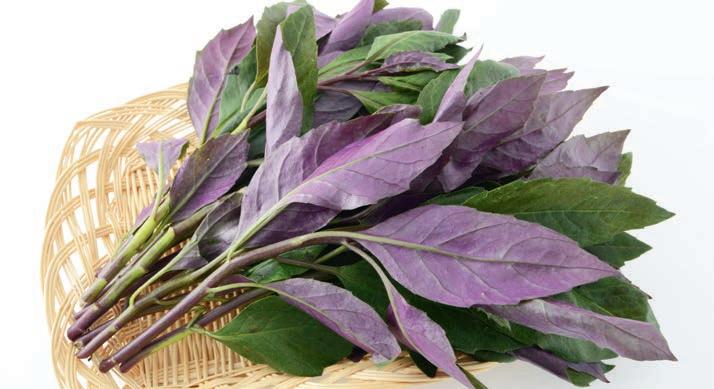
Considered a medicinal herb as well as a leafy green, Okinawa spinach or hong tsoi is a hardy, low-maintenance perennial noted for its shiny green leaves with purple undersides and small orange flowers. Native to Japan and Southeast Asia, it goes by many names including cholesterol spinach and longevity spinach.
Growing: Easily propagated from cuttings, Okinawa spinach thrives as an edible groundcover to 70cm in a warm climate with full sun to partial shade. Though heat tolerant, it has no drought tolerance. Once established, it requires little care but does need ample moisture. Uses: Its crisp, nutty taste with a hint of pine goes well in salads and the twotone leaves look spectacular (the purple goes green when cooked, though). Use as you would spinach. Rich in protein, fibre, calcium and vitamins C and A, Okinawa spinach is believed to help lower blood pressure and cholesterol.
Egyptian spinach
Japanese mustard spinach
Okinawa spinach
NOT JUST ANY SPRINKLER!
YOUR LAWN AND GARDEN DESERVE THE BEST
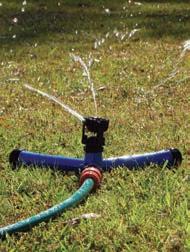
The award-winning Wobble-Tee Sprinkler covers large areas up to a 15m diameter with low to medium pressure requirements and will water your lawn as efficiently as slow, soaking rain.
The consistent large droplets minimise wind drift and evaporation loss. The removable filter allows use with river and dam water. The Wobble-Tee can also operate more than one sprinkler from the same tap, so you can water even larger areas.
On the other hand, if you have a small courtyard, the Clever Drop Sprinkler is for you, watering up to 8m in diameter.
This sprinkler has many clever features. A low angle of trajectory reduces wind drift and confines it to a small area.
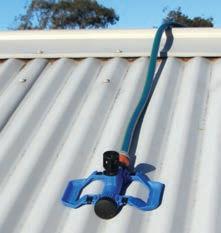
The purpose-built base can be adjusted for uneven surfaces or used on your corrugated iron roof for cooling work sheds and bird aviaries. Run up to eight sprinklers in a row to cover the long, narrow areas in your yard. It operates with 5 to 50psi and pressureregulating discs supplied allow use with high pressure to water a small area.
Our newest sprinkler, the RolaRain covers a similar area to our original
Wobble-Tee Sprinkler. So you may wonder, why would we make a newer model when the Wobble-Tee has been so popular and successful? Well, the Wobble-Tee was designed as a domestic sprinkler for backyard lawns but has been used in so many other situations outside the original design concept.
This new, tougher design is more suited to farming applications, sporting fields and industrial use, though the RolaRain can still be used as a domestic lawn sprinkler while adding additional features to the original Wobble-Tee.
The wheels of the RolaRain allow the central part of the sprinkler base and fittings to rise off the ground slightly when being pulled along, which stops the base scuffing the grass surface and reduces wear on the hose and sprinkler fittings from rubbing against the ground.
Another advantage is that the bright-orange wheels are more visible, especially in longer grass — livestock and people can see them more easily.
The RolaRain Sprinkler is similar to the Wobble-Tee Sprinkler in performance, so they can be operated together on the same hose. More than one RolaRain can be connected to your hose and they
Original Wobble-Tee, RolaRain and Clever Drop
join together in a line via a flow-through connection on each base. The internal filter is also larger than the Wobble-Tee’s filter, allowing water to flow straight through to the next sprinkler.
Each RolaRain sprinkler comes with 12mm and 18mm snap-on hose adaptors for those running multiple sprinklers and needing more flow.
For more information, please visit wobble-tee.com.au
RolaRain
L–R
The flowery cabbage
PUT IT
IN A CLASS OF ITS OWN
THOUGH CLOSELY RELATED TO CABBAGE, KALE AND BROCCOLI, CAULIFLOWER’S APPEARANCE AND TASTE
Words Claire Bickle
Heirloom cauliflowers stand out for their exceptional flavours, vibrant colours and storied history and cultivating these traditional varieties can be deeply satisfying.
Originating in the Mediterranean region and Syria, the cauliflower, according to genomic analysis, evolved from broccoli around 2500 years ago and has since established itself as a staple in cuisines around the world.
Heirloom caulis come in a range of shapes, sizes and colours, including creamy whites, buttery yellow, orange, purple and even green. This diversity adds visual appeal to both the garden and the dinner plate.
The part we eat is actually the head,
MANY HEIRLOOM
a cluster of usually white or off-white immature flowering buds also called the curd.
Many heirloom varieties have a richer, nuttier flavour compared to modern types. Some are even slightly sweeter, which makes them highly prized in the kitchen.
CULTIVATING CAULIS
Cauliflowers have probably the least heat and cold tolerance of all the brassicas, meaning the window for planting in warmer climatic zones is somewhat reduced: generally autumn and early winter months only.
In cooler and arid locations, plant in autumn before the coldest winter temperatures strike and again in spring.
Heirloom cauliflowers can be a bit more demanding than their modern
VARIETIES HAVE A RICHER, NUTTIER FLAVOUR. SOME ARE EVEN SLIGHTLY SWEETER, WHICH MAKES THEM HIGHLY PRIZED IN THE KITCHEN.
cousins, needing steady moisture, cool temperatures and fertile soil.
Soil prep: Rich, well-drained soil with a neutral to slightly alkaline pH (around 6.5–7.5) is ideal. Before planting, work in plenty of aged manure or compost — best done in autumn or early spring, depending on climatic zone.
Sowing seeds: Start seeds indoors in trays from early autumn to late winter and early spring, depending on climate. Check out local growing calendars. Place trays in a cool, well-lit spot such as a window ledge, greenhouse or cold frame. Transplanting: When seedlings develop two proper leaves and look healthy, move them to individual pots. Gradually, over a week, expose young plants to outdoor conditions. Plant out the seedlings from April to June in warmer zones and, in cool and arid zones, in March and again in September. Space about 60cm apart, with rows 60–75cm apart. Water thoroughly with a liquid seaweed solution after planting.
CARE THROUGHOUT SEASON
Watering: Keep the soil moist, especially when weather is dry, but not soggy.
Feeding: Add an all-purpose organic fertiliser at planting time, then again as the heads form. A liquid feed several times through the season will boost growth.
Mulching: Spread sugarcane, lucerne or pea straw around plants to conserve moisture, improve soil structure and suppress weeds.
Blanching: For white and pale varieties, blanching is a key step. As the heads or curds begin to form, gently fold the outer leaves over to shield the heads from sunlight. This prevents the curd from turning yellow or green and helps maintain its delicate texture and flavour. Some varieties, such as ‘Self-Blanching’, do this naturally.
PESTS AND DISEASES
Pests and diseases to look out for are aphids, cabbage white butterfly and clubroot, but you can be forearmed to prevent or treat these issues.
Cabbage white butterfly: This little white nuisance loves to lay eggs on all types of brassicas, especially during the warmer months. Infestation can be somewhat avoided by growing in winter when she
Cauliflower label
Common name: Cauliflower
Botanical name: Brassica oleraceae var. botrytis
Family: Brassicaceae (cabbage family)
Aspect & soil: Sun; well-drained soil
Best climate: Cool to tropical Habit: Biennial vegetable grown as an annual
Propagation: Seed, seedling
Difficulty: Moderate
is least active (if possible). Complete cover with wildlife-safe exclusion netting can also be an effective control. If the caterpillars are already present you can use an organic remedy such as Bt. A spray of molasses over the foliage can also deter the butterfly from laying her eggs on the sticky coating.
Aphids: These tiny sap-sucking insects can be removed by spraying eco-oil or pyrethrum or they can often be deterred by a fine insect exclusion netting. Plant a variety of flowering herbs and annuals around your edible garden to encourage predators such as lady beetles.
Clubroot: This is an infection of the roots by Plasmodiophora brassicae, a soil-dwelling micro-organism related to the slime moulds. It causes massive swellings and distortion of the cauliflower’s roots, leading to constant drooping and severely stunted growth as the roots can no longer take up water and nutrients effectively. There is no complete control method but maintaining the pH at 7-7.5 by applying garden lime can reduce the impact. Also improve drainage by planting in raised beds. As this micro-organism loves wet warm soils, it’s more prevalent during spring and summer.
HARVESTING AND SAVING SEED
Cauliflowers are ready to harvest around 3–5 months after sowing, when the heads are firm, compact and reach their full size: around 15–20cm in diameter, depending on variety.
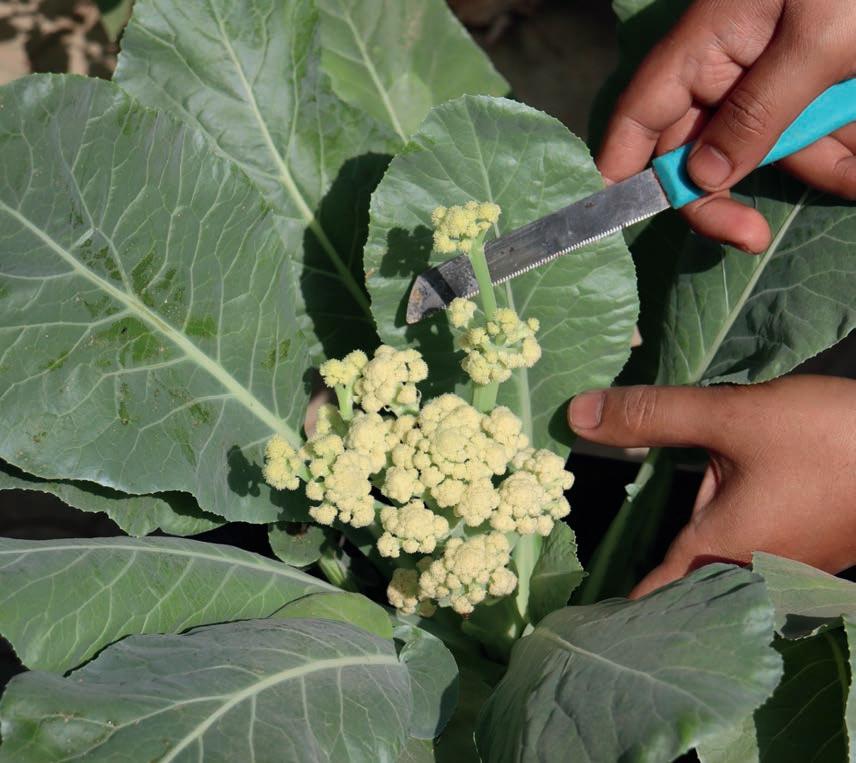
Cut the head from the stem with a sharp knife, leaving a few leaves around it for protection. Cauliflower is best eaten soon after picking but can be kept in the fridge for up to a week. If you have a bumper crop, blanch and freeze heads for longer storage.
To save seed, allow a few heads to flower and form seed pods. Collect seeds from the healthiest individuals once pods have dried naturally. Store seeds in a cool, dry location.
EATING AND NUTRITION:
Cauliflower is rich in vitamins C and K, plus choline, providing antioxidants such as sulforaphane.
It can be enjoyed raw, stir-fried, steamed, in stocks, soups and curries, made into a gratin, boiled, pickled, roasted or used in classic dishes such as cauliflower cheese. Try roasting whole with olive oil and garlic. Aside from the florets, the leaves and stems are also edible and can be used in stocks and stir-fries, reducing waste and stretching your harvest.
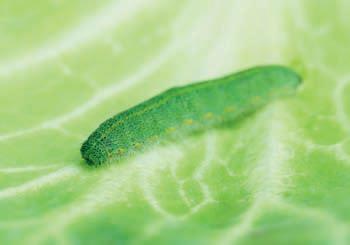
Caterpillar of the cabbage white butterfly
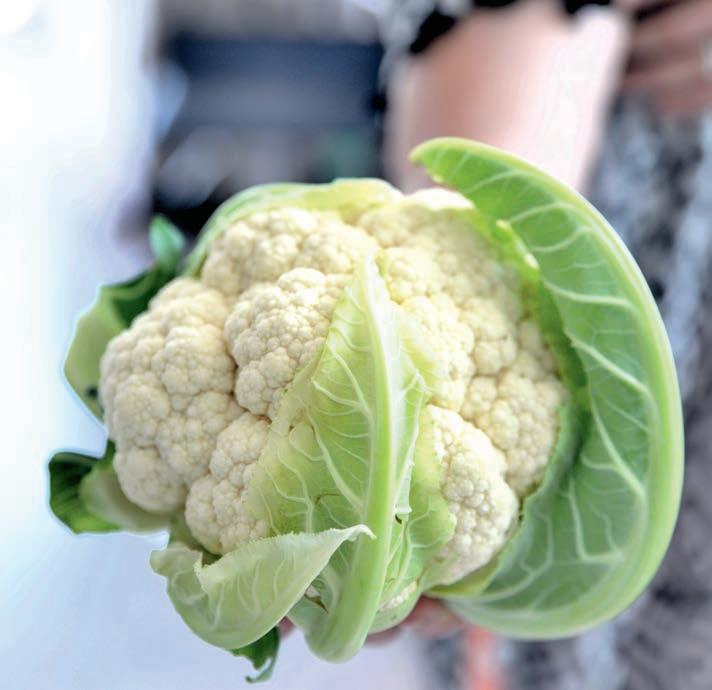
Folding over the outer leaves helps to blanch the white curd
CUT THE HEAD FROM THE STEM WITH A SHARP KNIFE, LEAVING A FEW LEAVES AROUND IT FOR PROTECTION.
10 POPULAR VARIETIES
Variety Description
‘Purple Cape’ An ancient hardy variety with purple flesh and excellent flavour. Note: it turns green when cooked unless you add some vinegar or lemon juice to help hold the colour
1 ‘Cheddar’ Not an heirloom as such but more a hybrid novelty cauliflower with an attractive orange curd. Produces smooth, firm, medium-sized heads
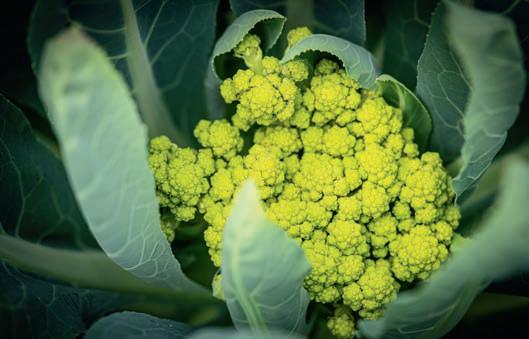
2 ‘Green Macerata’ A southern Italian heirloom with striking lime-green heads and a delicious, earthy pea taste. An early variety with excellent cold tolerance. Steam lightly to maintain colour
‘Snowball’ Tight, solid 15cm heads, crisp and tender, excellent quality, well suited to warmer regions
3 ‘Violet Sicilian’ Italian heirloom with large, deep-purple head to 1.3kg; cooks to green. Sweet, mild taste raw or cooked. Easier to grow than white varieties
‘Self-Blanching’ Has self-wrapping leaves that help protect the white heads from discolouring — hence the name
4 ‘Mini’ The perfect cauliflower for smaller spaces. Harvest in 90 days for compact pure-white heads. Suited to warmer regions. Plant 20cm apart
5 ‘All Year Round’ Excellent-quality standard variety, white heads, tightly packed and well protected on a small plant. Sow in successive plantings from late summer for extended harvest. Best results in cooler months
‘Phenomenal Early’A popular early-maturing and easy-to-grow variety that forms large, firm heads within 4 months
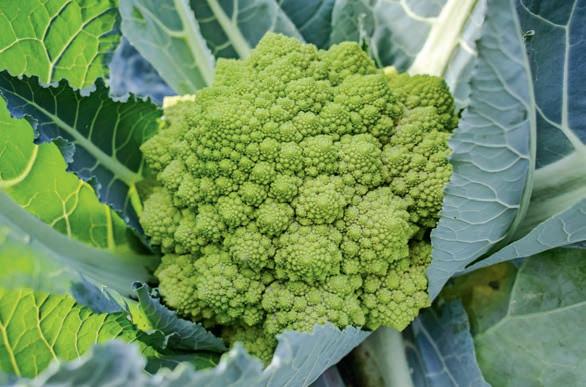
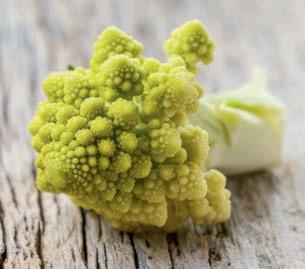
6 ‘Romanesco’ Often called a broccoli, though a cauliflower cultivar, and chartreuse in colour, it has a striking fractal form and a nutty flavour with a firmer texture than white cauliflower
FLORAL ARRANGEMENT
The “flower” part of the cauliflower is its head, or curd. Known as an arrested inflorescence, it’s made up of a tight cluster of undeveloped flower buds or florets, each of them a copy in miniature of the entire cauliflower.
Waters a LARGE area up to 15 metre diameter. Average flow rate of 10 LPM.
Waters a SMALL area up to 8 metre diameter. Average flow rate of 4 LPM. Purpose shaped base for roof cooling.
Large area - low pressure 9 to 14.5m diameter. Average flow rate 7LPM. Designed for domestic, commercial and rural application.
Wobble-Tee, Clever Drop and RolaRain sprinklers
Multiple sprinklers can be run off one tap. UV stabilised for a long life in the harsh Australian sun.
Available from leading hardware stores and rural retailers.
Sprinkler
Sprinkler
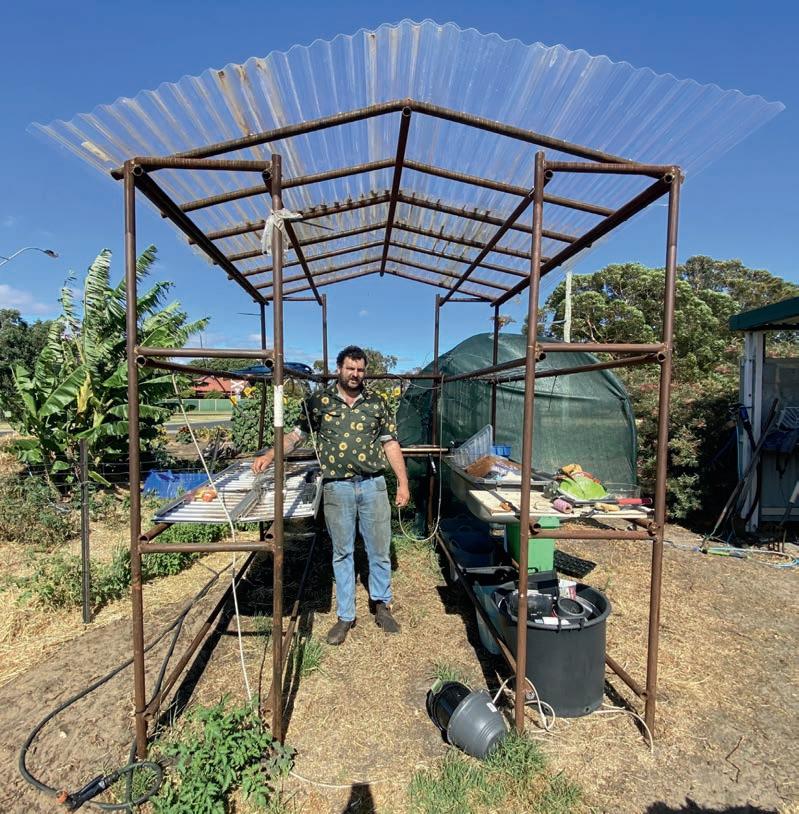
THERE’S A GARDEN UP IN DARDANUP THAT CAN’T BE CONTAINED IN THE FRONT YARD AND IS SPILLING ACROSS THE CORNER
Words & photos Jana Holmer
On Main Street in Dardanup, Western Australia, just down the road from the pub, there’s a corner block that quietly tells its own story about suburban life.
From the street, rather than lawn and hedges you see vegetables in rich soil, fruit trees stretching into the light, ducks waddling with purpose and children who understand where their food really comes from.
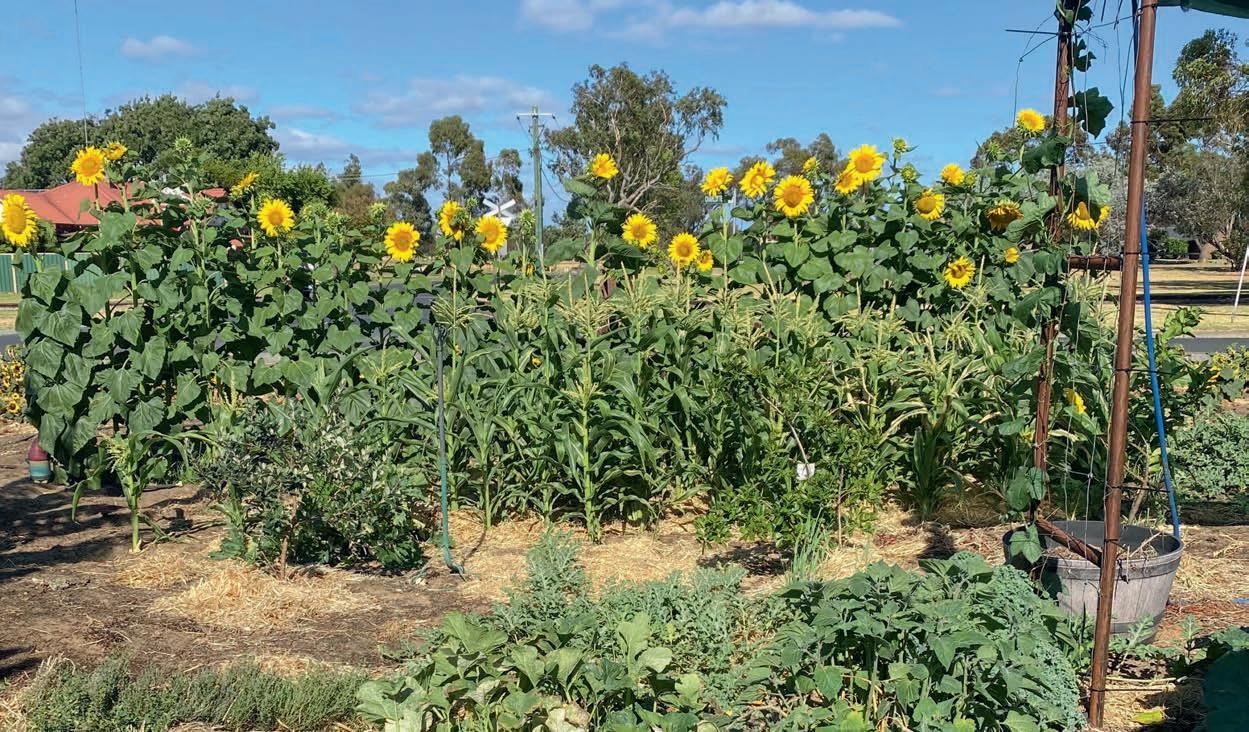
Hartley Bell and Dr Taneta Bell’s garden spills across their 1000m2 block and across a generous 300m2 verge, thriving in the temperate Mediterranean
clockwise from top Sunflowers greet visitors;
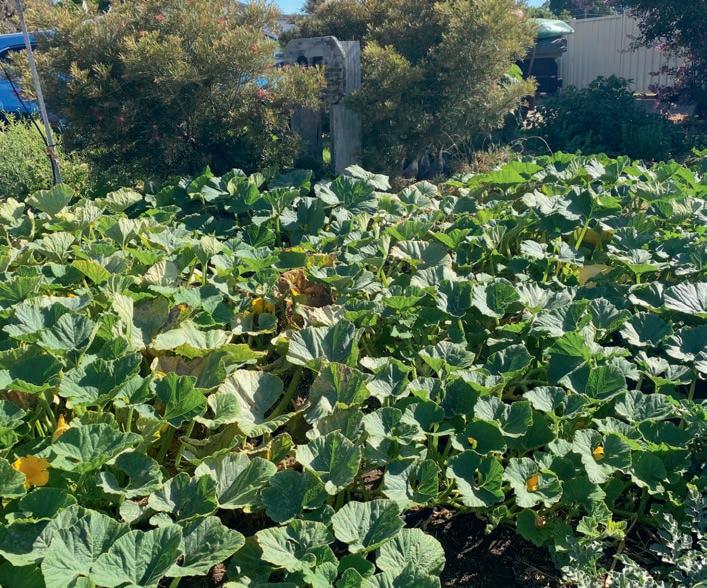
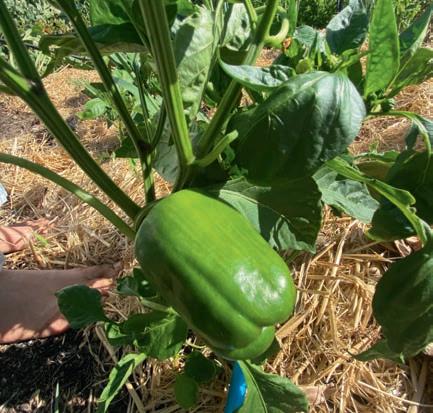
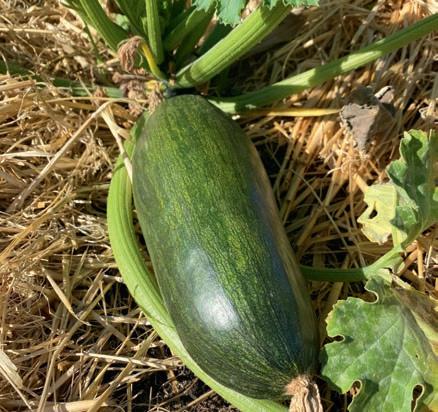
from left Pumpkins, zucchini, melon and capsicum
climate of the Ferguson River valley.
Hartley’s a qualified heavy diesel mechanic and stay-at-home dad, supporting Taneta at the clinic. She has degrees in chiropractic and nutrition and runs a wellness centre, specialising in women’s health.
The memory of soil runs deep in Taneta’s family. Her father, Max Kerr Jr, planted vegetables in the Ferguson Valley, while her great-great uncle Burt Kerr established an orchard that fed both family and community.
She remembers playing in the bean patch, “the magical experience of being among the tall beans. Growing up, I was
TANETA AVOIDS PESTICIDES, GUIDED BY HER BACKGROUND IN CHIROPRACTIC AND NUTRITION ... WHAT LIVES IN THE SOIL, SHE BELIEVES, LIVES IN US.
able to pick plums ripe in the orchard — and gooseberries.”
Waste was never tolerated. Burt would leave ripe fruit on strainer posts for local children rather than have them steal unripe produce. Food, to him, was something to be respected.
Hartley’s childhood looked different. He grew up on a dairy farm in Busselton, where chores were non-negotiable and gardening wasn’t the focus. His education came via firebreaks, cattle feeders, hay rolls and other machines — but those machines mattered.
Four generations ago, his great-great grandfather Ralph Bell bought a disc plough brand new in Waterloo. It still works. When Hartley brought it home and hooked it up to a tractor to slice through the kikuyu, history quite literally turned the soil of the Bell family garden.
Opposite,
heirloom carrots; Hartley and Taneta, Charlie and Wilfred
This page,
MAGPIES PATROL THE BEDS AND PARROTS STRIP SUNFLOWER HEADS BUT FOXES REMAIN A CONSTANT THREAT TO THE DUCKS, ESPECIALLY IN THE EXPOSED FRONT YARD.
TURNING POINT
The turning point came when Taneta, pregnant with second child Wilfred, ordered groceries online and saw corn priced at $1.90 an ear. The moment crystallised something that had always been there: a desire for self-sufficiency, for real food grown in real soil.
Their lawn was pristine, lowmaintenance. It sat atop excellent groundwater but being pregnant she obviously couldn’t dig it up herself.
Hartley solved that. He fired up the old plough and brought home cow manure from a friend’s farm. Then the criticisms started.
People said vegetables wouldn’t grow, dogs would destroy them, locals would walk across the seedlings or steal produce, the water pressure would never be sufficient.
None of that stuck. Taneta installed a pump and ran 4mm and 15mm weeper hoses across the beds — and the garden was begun.
Today, the front yard is the heart of
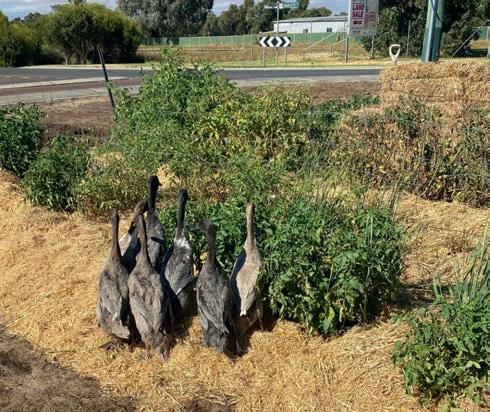
the system. Raised beds are formed inground rather than boxed off, allowing children Charlie and Wilfred to run freely, chooks to forage and Indian Runner ducks to pad by on pest patrol.
Taneta pulls weeds by hand, a task she finds therapeutic rather than tedious. She avoids pesticides, guided by her background in chiropractic and nutrition and her understanding of how soil microbiomes mirror human gut, neurological and hormonal health. What lives in the soil, she believes, lives in us.
ECLECTIC ABUNDANCE
The garden is abundant and eclectic. Yellow zucchinis, heirloom tomatoes and carrots, giant Dill’s Atlantic pumpkins for the children’s wonder, winter meadows of everlastings and towering summer sunflowers.
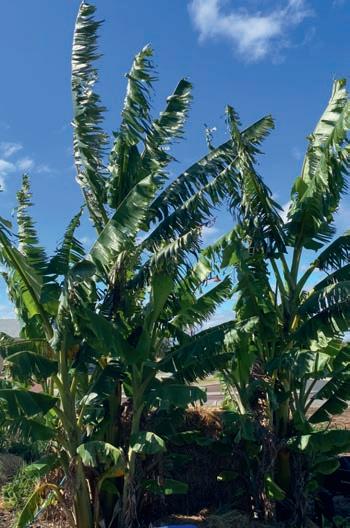
mustard greens, herbs by the dozen — even bananas, which surprised everyone by flowering despite frosts. Next year, they’ll grow wheat.
“I try to work with the seasons and choose appropriate spots,” says Taneta. “Basil and chillies do well out in the open in full sun during the day. I often plant more than I think I’ll need.
“We’re transitioning to a no-till system now that the patches are established and the weed load from the lawn has reduced.”
Fertility comes from cow manure, hay, barley straw, potash, calcium, banana leaves, compost bunkers and time. Two compost systems feed the soil, one tucked near the bananas to protect roots through winter. Worms appear in potato towers and broken beds — small, wriggling proof that life has returned after earlier soil disturbance.
Wildlife is part of the equation, too. Magpies patrol the beds and parrots strip sunflower heads but foxes remain a constant threat to the ducks, especially
in the exposed front yard.
Council policies shape what can be planted on the verge, but Taneta — once an elected member of the Shire of Dardanup — has long advocated for edible and perennial verges as spaces of shared nourishment.
The Bells produce eggs, give away mountains of zucchinis, freeze what they can and source meat locally when they can’t grow it themselves. Food miles matter, as does community. This garden feeds neighbours, friends and passing conversations.
What Taneta is most proud of, though, is less visible: her children’s understanding that food comes from soil, weather, patience and care — not shelves. In a corner block garden down the road from the pub, the past, present and future quietly grow together.
1 Hay surrounds the compost bed 2 Charlie cuddles one of the chickens 3 Profuse kale 4 Giant pumpkin 5 Seedling centre 6 Bananas thrive despite the frosts 7 Indian Runner ducks busy on patrol
FRUIT SALAD
THIS WHOLESALE/RETAIL NURSERY GROWS MORE THAN 1000 VARIETIES OF TROPICAL AND SUBTROPICAL FRUITING TREES AND PLANTS
Words & photos Claire Bickle
It was on their property in idyllic Goomboorian, northwest of the Sunshine Coast and 15 minutes east of Gympie, that Tom and his partner Troy started their fruit nursery Ross Creek Tropicals.
To be fair, Tom is the real tropical fruit addict but Troy is an integral part of the fruitful team.
Their 40-acre property comprises their home, a propagating tunnel, wholesale and retail nursery sectors plus five acres of orchards and growing space. A creek runs through it and its weedy lantana has been replaced with edible bush tucker trees and plants.
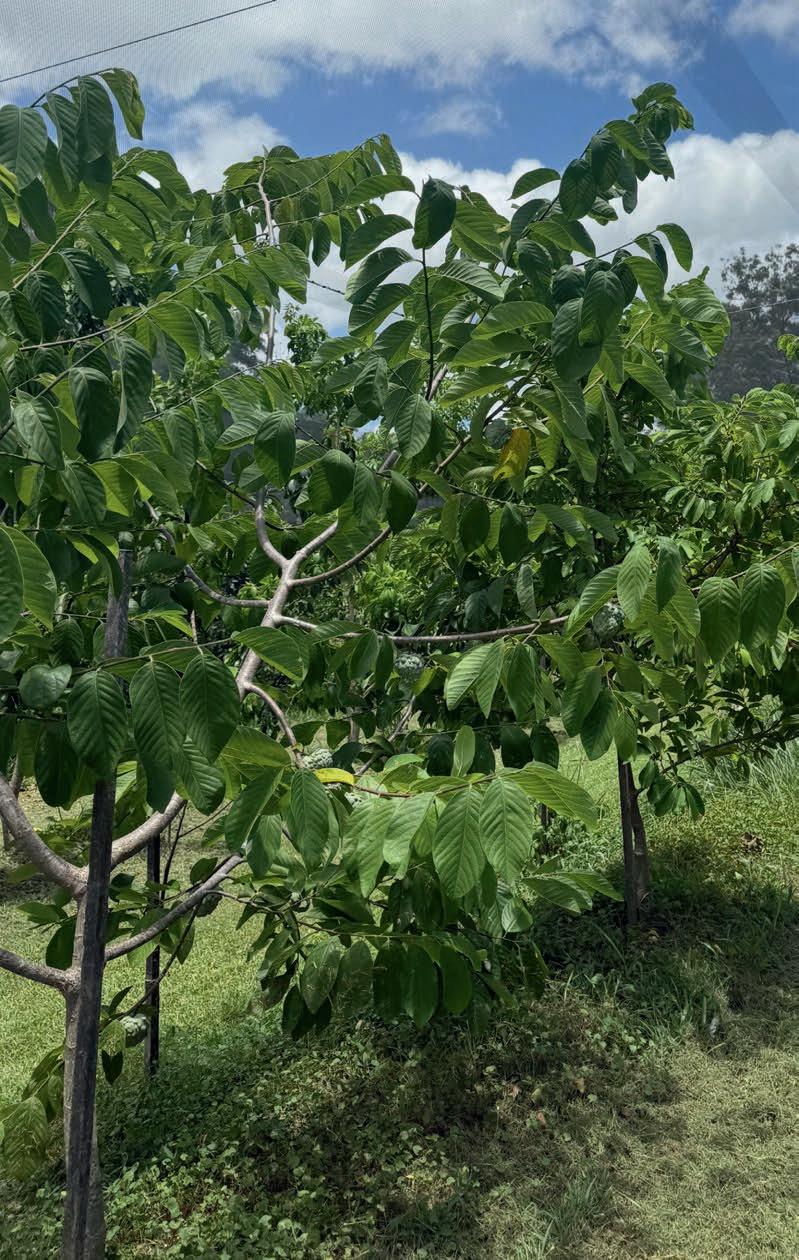
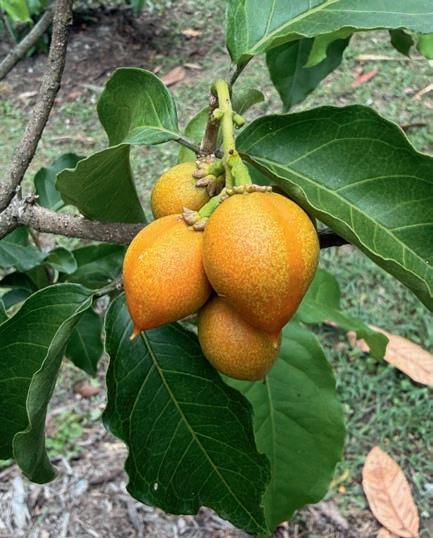
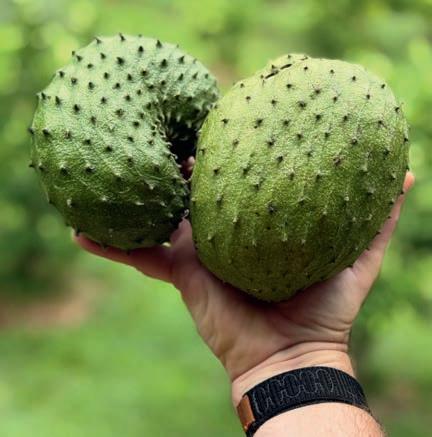
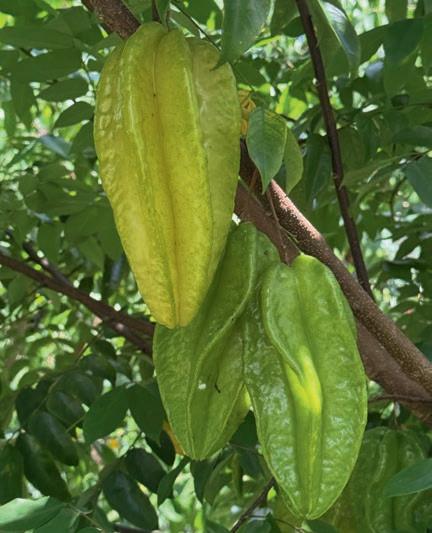
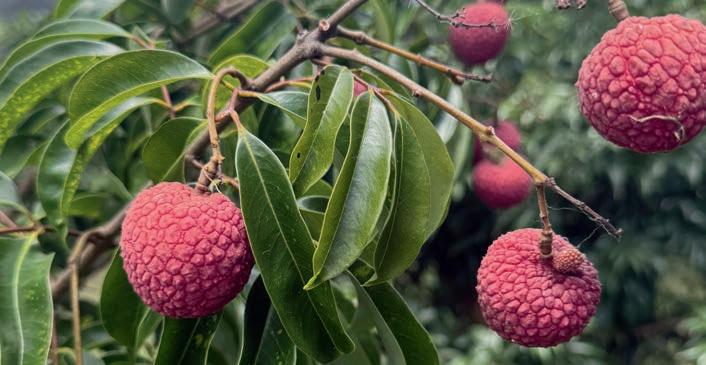
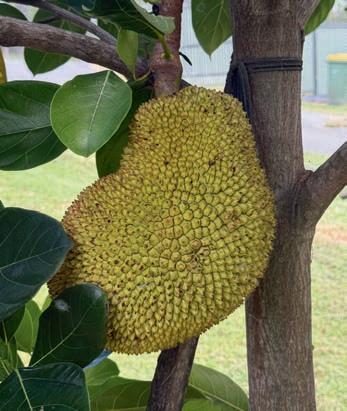
Opposite, clockwise from main A custard apple tree; peanut butter fruit (Bunchosia glandulifera); a fine pair of soursops; carambola (star fruit) This page, from left Tom (right), Troy and ripe jackfruit; they also grow herbs and vegies; oh, and lychees
Along the creek are mature rainforest trees and swathes of native ferns. This is also where, if you’re lucky, you might spot the resident platypus.
The nursery has grown enough, both onsite and through their online mail-order department, for them to employ extra team members including Chris, Alana and Aaron. Tom and Troy’s dogs, Moses and Sophia, are also part of the team.
NUTS ABOUT FRUIT
Tom worked in supermarkets for 20 years and his passion was the fruit and veg section. He loved educating the public on the benefits of fresh food and the challenge of sourcing rare and unusual
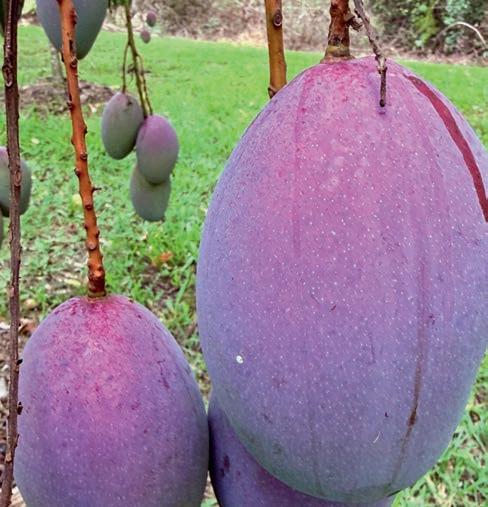
WHEN THE IMPOSSIBLE QUESTION IS POSED DOES HE HAVE A FAVOURITE FRUIT? TOM QUICKLY ANSWERS MANGOES AND TROY AGREES. THEY GROW AROUND 50 NAMED MANGO CULTIVARS IN THE NURSERY’S ORCHARD.
fruits for customers from different cultural backgrounds.
He attributes his love of food gardening to his grandmothers, both avid gardeners, he says. “They both had 10 green fingers and I was always telling my family when I was a child that I wanted to be a farmer one day.”
The obsession with growing fruit trees began around 20 years ago when he started collecting rare and unusual trees and plants. While renting, he grew everything in pots: “Once you’ve picked your first fruits, you’re hooked!”
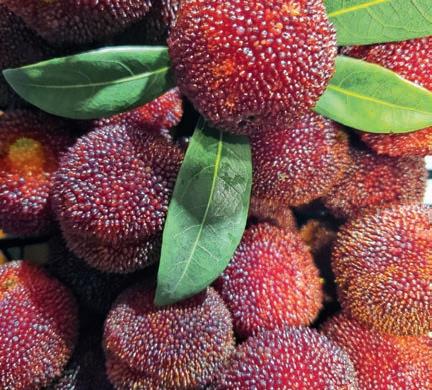
When the impossible question is posed — does he have a favourite fruit? — Tom quickly answers mangoes and Troy agrees. They grow around 50 named mango cultivars in the nursery’s orchard. But the tree Tom’s most excited about is the Chinese bayberry, still relatively new to Australia. “The flavour is like a mixture of cherry, mulberry and strawberry,” he says, adding that once more people taste it its popularity will skyrocket.
Though Goomboorian is blessed with rich red volcanic soil, because of the heavy rainfall most of the trees are planted on raised mounds to keep the roots out of the subsoil — essential in a place that can get a metre of rain in a single week.
The orchard containing their mother stock trees is netted to keep out flying foxes and parrots and reduce fruit spotting bug damage. The propagation tunnel and wholesale nursery areas are also netted.
The wildlife is prolific: goannas, pademelons, pythons, red-bellied black snakes, echidnas, platypus and, as Troy laughingly notes, “spiders, spiders and more spiders”.
There’s also a huge variety of feathered visitors including whipbirds, wompoo doves, kingfishers and fairy wrens. Native beehives are scattered through the property and they hope to add European honeybees in the future.
THE MOST PRODUCTIVE? JABOTICABA, MEYER LEMON, STAR FRUIT, JACKFRUIT, STONE FRUIT, GRUMICHAMA AND MULBERRIES.
CARE AND WATERING
The team caring for the nursery and orchard trees use mostly organic pest and disease control methods, including pruning, pyrethrum and wettable sulphur. Fertilisers are primarily organic as well: rock-dust minerals, the Katek range and seaweed-based products.
Tom and Troy are also working towards going off grid. With no town water supply, the property relies on multiple large rainwater tanks that service both the home and nursery.
Though the land slopes, swales haven’t been included because the high rainfall needs to drain freely from the site and heavier subsoils.
“Most of the nursery is hand watered, reducing waste,” Tom explains. “The system is set up so
excess runoff flows back into reserve tanks and can be recycled.”
Most of the 1500 orchard trees aren’t irrigated, having sent roots deep into the soil during the wet season. That reduces water stress during the dry months, which can last three to six months. The newest orchard has drip irrigation, used only during very dry periods.
“All the trees are grown outside, not in greenhouses,” Tom says. “This makes them tough.”
The nursery team takes pride in walking the talk. Everything sold has been grown on site and they’ve tasted almost every fruit, so they can advise customers on what will thrive in their area and what challenges might arise.
Their best tip is to prune regularly and at the right time. “It keeps trees
productive and at a manageable height,”
Tom says, adding that mangoes, stone fruit, lychees and mulberries are best pruned straight after fruiting.
‘THE LIST’
When asked what fruit trees the nursery grows, Tom laughs. “You mean ‘The List’? We grow over 1000 varieties of fruiting trees and plants.”
During my orchard walk, I spot mamey sapote, carambola, jujube, custard apple, figs, pomegranate, lychees, citrus, guavas, soursop, cinnamon, mangoes, white sapote, sapodilla, Malabar chestnut, star gooseberry, hog plum, low-chill stone fruit, achacha and lemon drop mangosteen — just for starters.
The most productive? Jaboticaba, Meyer lemon, star fruit, jackfruit, stone fruit, grumichama and mulberries.
Avocados were initially a challenge, Tom says. After several failed attempts the team found the perfect free-draining spot.
He chuckles when asked to name just five favourites, but eventually offers Glenn mango (amazing disease resistance, crops every year, smooth silky flesh and 10/10 flavour); Chinese bayberry (fast growing, fruits in 2–3 years from seed, super flavoursome and freezes beautifully); carambola or star fruit (quick to fruit when grafted and incredibly productive, often year round); Meyer lemon (fruits all year with large, juicy lemons); and jackfruit J33 (excellent flavour, large arils, fewer seeds and not too sticky to process).
Tom and Troy love cooking their harvests. Says Tom, “With the current mango glut, we’ve been blitzing them into mango pudding in the Thermomix — it tastes amazing.”
* Ross Creek Tropicals rosscreektopicals.com.au | rosscreektopicals.gmail.com
* 1416 Tin Can Bay Road, Goomboorian, Qld 4570
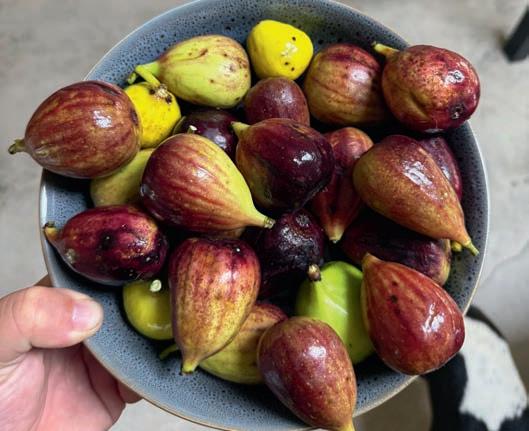
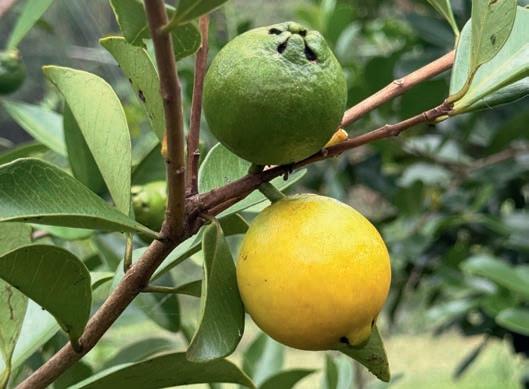
1 Black Genoa figs 2 Business area 3 Yellow cherry guava (Psidium cattleyanum) 4 Home among the fruit trees 5 Jackfruit J33 6 Chinese bayberries; 7 Mango smoothie 8 Just one of their 50-odd named mango cultivars, ‘Mango Osteen’
5
TOP TREE TIPS
1. Dig a planting hole two to three times wider than the pot and to the same depth.
2. Don’t put fertiliser in the hole — apply it around the dripline after planting.
3. Avoid disturbing roots, especially on avocados.
4. Don’t worry about ultimate tree height — pruning keeps them manageable.
5. Plant fruit you’ve tasted and genuinely enjoy.
HILLSIDE
A NEWBIE GARDENER TURNS AN UNPROMISING PROPERTY INTO A HIGHLY PRODUCTIVE ORGANIC PLOT
Words Chris Stafford
Photos BJ & Kerry Boyne
Belinda’s garden takes up around half of her sloping 1000m2 block in Leura, a leafy village high in the Blue Mountains between Katoomba and Wentworth Falls.
She works the plot alone, though her mum helps out when she can. But before Belinda bought the property in 2014 she’d had no gardening experience at all.
Her mother, she recalls, “was always preserving something. Our garden wasn’t big growing up, but being thrifty was a thing.”
Since she acquired her own patch, she and her mum “have photo/crop comparison competitions over the season”.
Belinda, who goes by BJ personally and professionally, runs her own small
“I KNOCKED DOWN MY PINK ASBESTOS COTTAGE AND BUILT A HOUSE WHICH HAS FILTERED AIR, HAS NO HEAT TRANSFER IN-TO-OUT OR OUT-TO-IN AND IS ÜBER-INSULATED.”
business in the insurance industry and describes herself as “time poor”.
That’s why she gardens organically, she says, “because I don’t have time to baby a lot of the plants. It’s sink or swim with some — irregular feeding and no spraying.
“Unless it’s something more persistent that affects my lemon tree, I’m pretty low maintenance.”
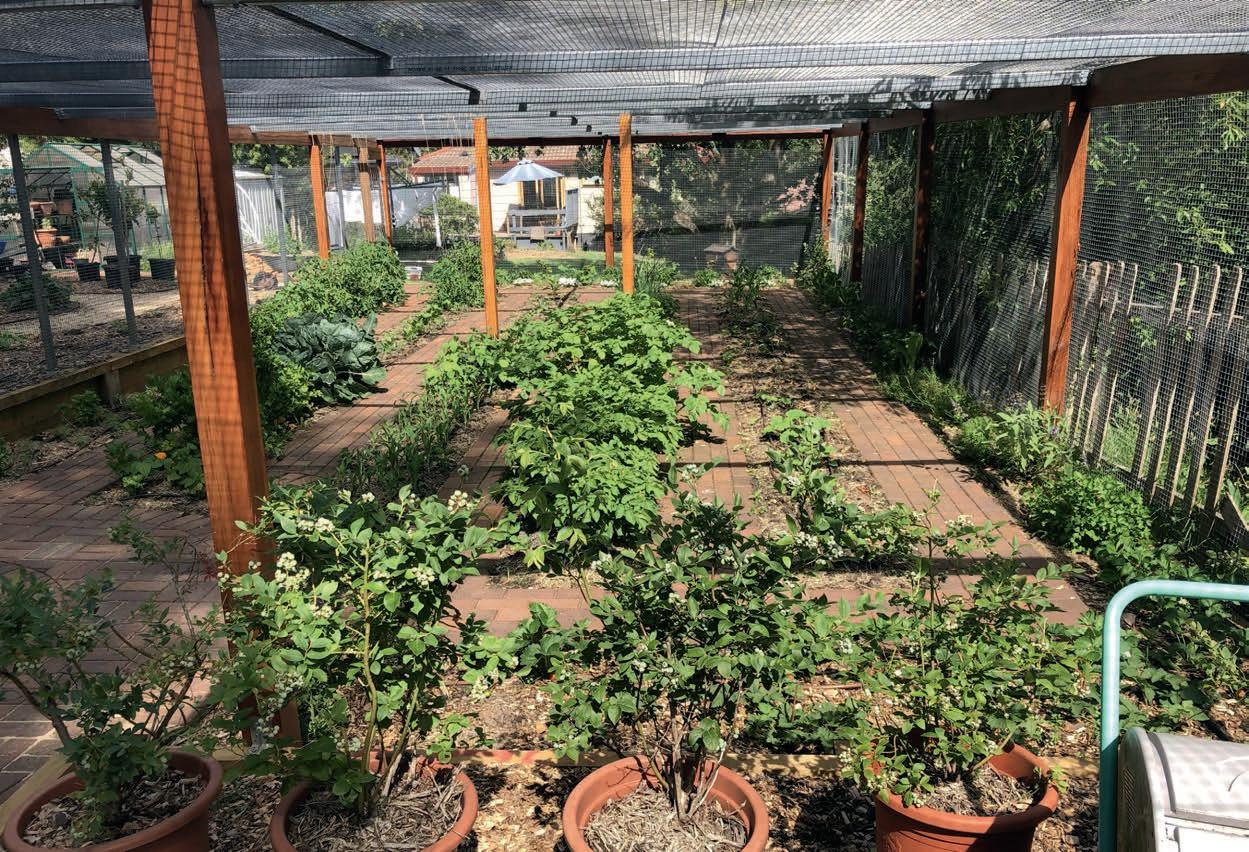
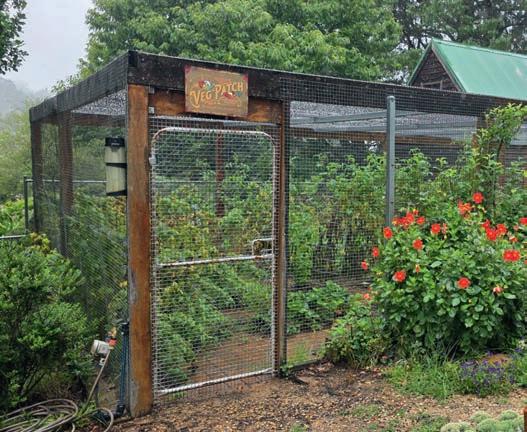
BJ’s plot has changed and expanded over time, from raised vegetable beds to a 7m×20m enclosure with six long, narrow, ground-level beds. She calls it her Vegary (pronounced “vedgery”), a defensive redoubt against the marauding possums, birds and rats from the surrounding bush.
“I hated the amount of bird netting I went through,” she says. “I was lucky enough to be able to build a bomb-proof structure to keep out the animals that want to snack on my crops — aside from slugs, snails and some bugs.
“My neighbours joke that come the zombie apocalypse they’ll be over to live at mine,” she laughs.
MAKING CHANGES
It was another kind of apocalypse that led to more big changes on BJ’s block when, just six years ago, Leura came under serious threat from the Black Summer bushfires that ravaged the upper Blue Mountains.
With severe asthma and “lots of allergies”, BJ was badly affected and her fibro house permeated by smoke. So she decided to build a Passivhaus (“passive house”), an energy-efficient concept pioneered in Germany and Scandinavia.
“I knocked down my pink asbestos cottage and built a house which has filtered air, has no heat transfer in-to-out or out-to-in — or thermal bridges — and is über-insulated.
“This means it needs very little heating and cooling — a fan, mostly in summer — and the temperature is pretty even summer and winter. The house also has solar panels and a battery.”
With the rebuild came the opportunity to make big changes
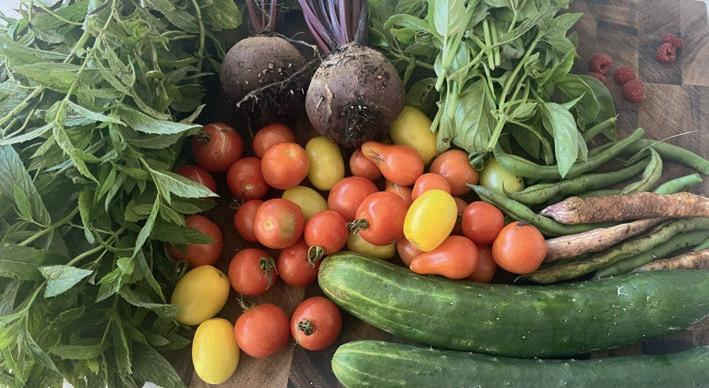
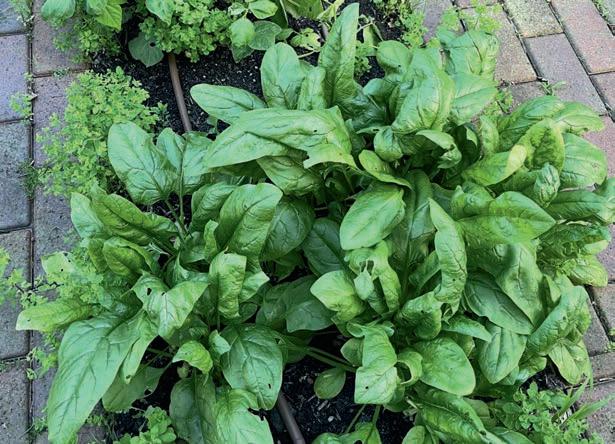
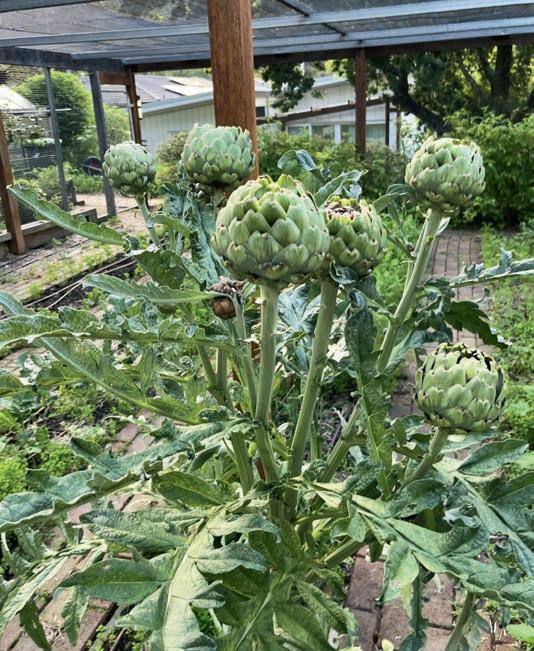
Opposite, clockwise from top The Vegary with the “pink asbestos cottage”; BJ; perfect produce This page, clockwise from top Thriving spinach; artichokes; the Vegary under construction
THE BIGGEST SURPRISE IS THE PROFUSION OF BERRIES: THORNLESS BLACKBERRIES, BOYSENBERRIES, STRAWBERRIES, RASPBERRIES, BLUEBERRIES, RED- AND BLACKCURRANTS.
to the property. Behind the white, clean lines of the new structure, three big rainwater tanks are sunk to ground level behind a sandstone retaining wall that partially encloses the patio.
To be bushfire ready, the council stipulates new builds include 11,000L of water storage. BJ’s tanks are 5000L apiece and now covered with a thriving herb garden.
None of this comes cheaply, of course, but BJ is philosophical about her lack of time and skills to make the massive changes herself.
“I feel I’ve paid a lazy tax in getting people in to make the chicken coop and veg enclosure and landscape the block, but I’m OK with this,” she shrugs. “I couldn’t do it myself.”
Nor does she beat herself up about the untended summer weeds, after spending weeks getting the place ready for the open gardens last spring.
“I have a big block and it’s just me,” says BJ, “so I have to be OK with more weeds than other people would accept in their yard. In summer, it’s all I can do to crop, prepare and preserve my veg and fruit.”
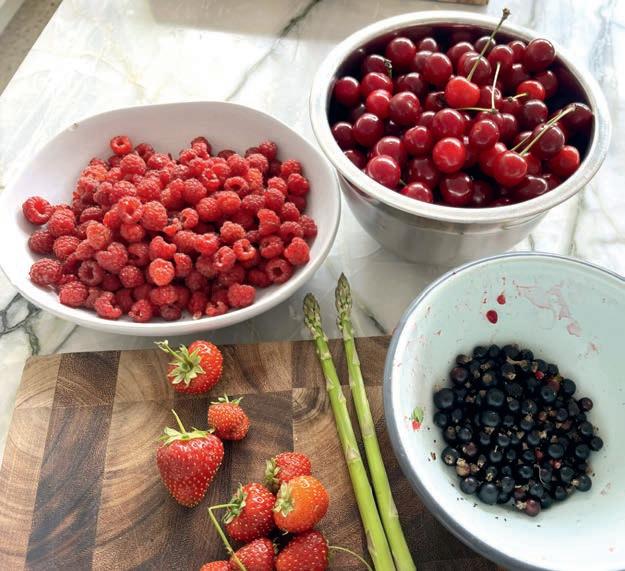
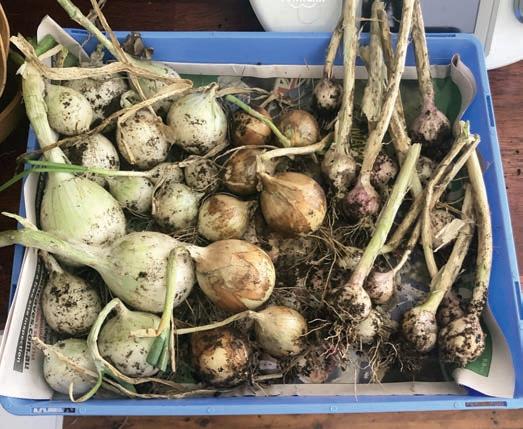
1 Berry bounty 2 Onions and garlic
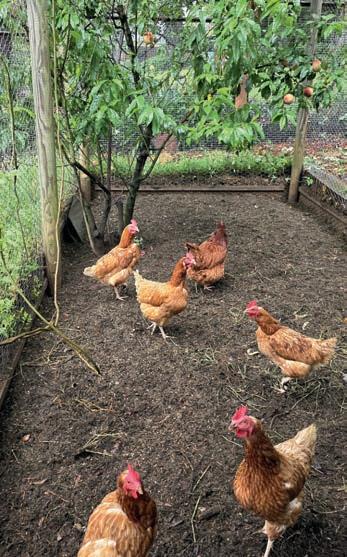
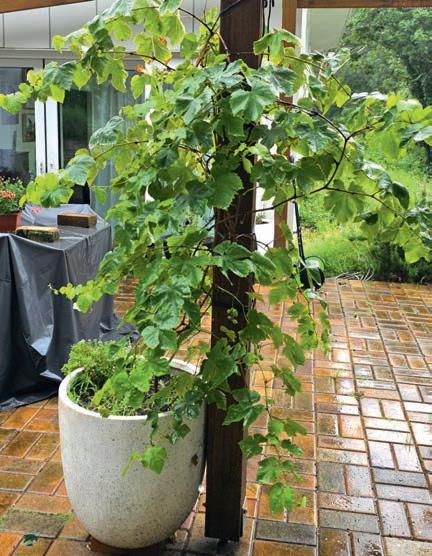
3 Vegary gate 4 BJ’s girls and their scruffy private peach tree 5 Patio grapes 6 Veg beds in the Vegary
7 BJ’s pantry is jam-packed with preserves 8 A triumph of tomatoes
ALL GOOD SO FAR
While BJ says she started out not growing anything that couldn’t be eaten, she admits she’s starting to plant “some pretty things”.
“I like the potager garden type, pretty with edibles intermingled,” she says. Her mum despairs at the sight of the compost bin in the front yard, she laughs, but why barrow stuff from the far end of the block? Put the compost where you’re working.
Leura’s cool climate is ideal for fruit. Besides an old plum tree that was there when she moved in, BJ grows citrus (oranges, mandarins, lemons and finger lime), pears, passionfruit, figs, apples, grapes and cherries.
The biggest surprise — to her, at least — is the profusion of berries: thornless blackberries, boysenberries, strawberries, raspberries, blueberries, red- and blackcurrants.
Vegetables include tomatoes — “inside the enclosure and self-seeded everywhere” — as well as sweet potato, potato, cucumber, zucchini, onion, celery, cabbage, broccolini, salad greens, asparagus, rhubarb, spinaches, pumpkin, beetroot and peas.
Works in progress include Brussels sprouts and beans as well as carrots and
garlic. She feels she’s “cracked” corn and was really good at growing kale — though she doesn’t much like eating it: “The chickens loved that crop!”
There’s no hesitation when it comes to using and preserving her produce: sauces, pickles, chutneys, semi-dried cherry tomatoes, frozen berries, cordials, dehydrated strawberries, preserved lemons — plus “so much jam it’s not funny!”
And she’s not the only beneficiary. “The egg economy is great,” she says. “One of my neighbours mows my lawn and looks after my girls when I need to travel for work, so they get as many eggs and produce as they want.”
Now only seven-and-a-half years into her gardening journey, BJ feels it’s all a matter of patience, of trial and error.
“It’s taken me a while to work out what type of tomatoes to grow here. Cherries work very well but only a few larger varieties, such as ‘Mortgage Lifter’, will grow and colour in our shorter season.
“Fruit trees take years to come on. After three years I’m getting a handful of cherries, enough to give me confidence for the future.
“I’m still waiting for olives and oranges — but it’ll happen eventually.”
BJ’S TOP TIPS
1. Be patient. I work on one or two crops at a time, get them mostly mastered then move on to another crop.
2. Grow what you want to eat.
3. Experiment. I tried growing avocados, which was a fail, but sweet potato was a surprise winner in our climate.
4. Be kind to yourself and don’t try to do too much.
5. Seedlings are OK to start with. Being time poor, I don’t try to save seeds or grow from seed.
MOON PLANTING
Newmoon Firstquarter Fullmoon Lastquarter
When the moon is waxing from new moon to full moon, it is increasing light and drawing sap flow upwards. During the waning from full moon back to new moon, light decreases and sap is drawn downwards. This movement of sap flow has an influence on how well new plants will grow. There are four phases, each lasting seven to eight days. Sowing, planting and taking cuttings should not be done in the 12 hours before and after each phase. If you want to work in the garden at that time, carry out general tasks and improve your soil for planting.
FRUITING ANNUALS
Sow or plant annuals grown for their fruits or seeds. This is best done during the first quarter phase between first quarter and full moon, when sap is being drawn upwards.
ROOT CROPS
Sow or plant crops that produce below the ground, and also perennials. This is best done between full moon and last quarter when sap flow is being drawn downwards.
LEAFY GREENS
Sow or plant crops that are grown for their foliage. This is best done during the new moon phase between new moon and first quarter when sap is being drawn upwards.
AVOID PLANTING
The last quarter to new moon phase is not a good period for sowing or planting, so is best used working on improving soil, weeding, making compost and other general chores.
TIME PLANT
IT’S TIME FOR LOTS OF PEAS, ROOT VEG, BRASSICAS AND LEAFY GREENS — ALL THESE AND SOME QUIRKY CHARACTERS FOLLOW
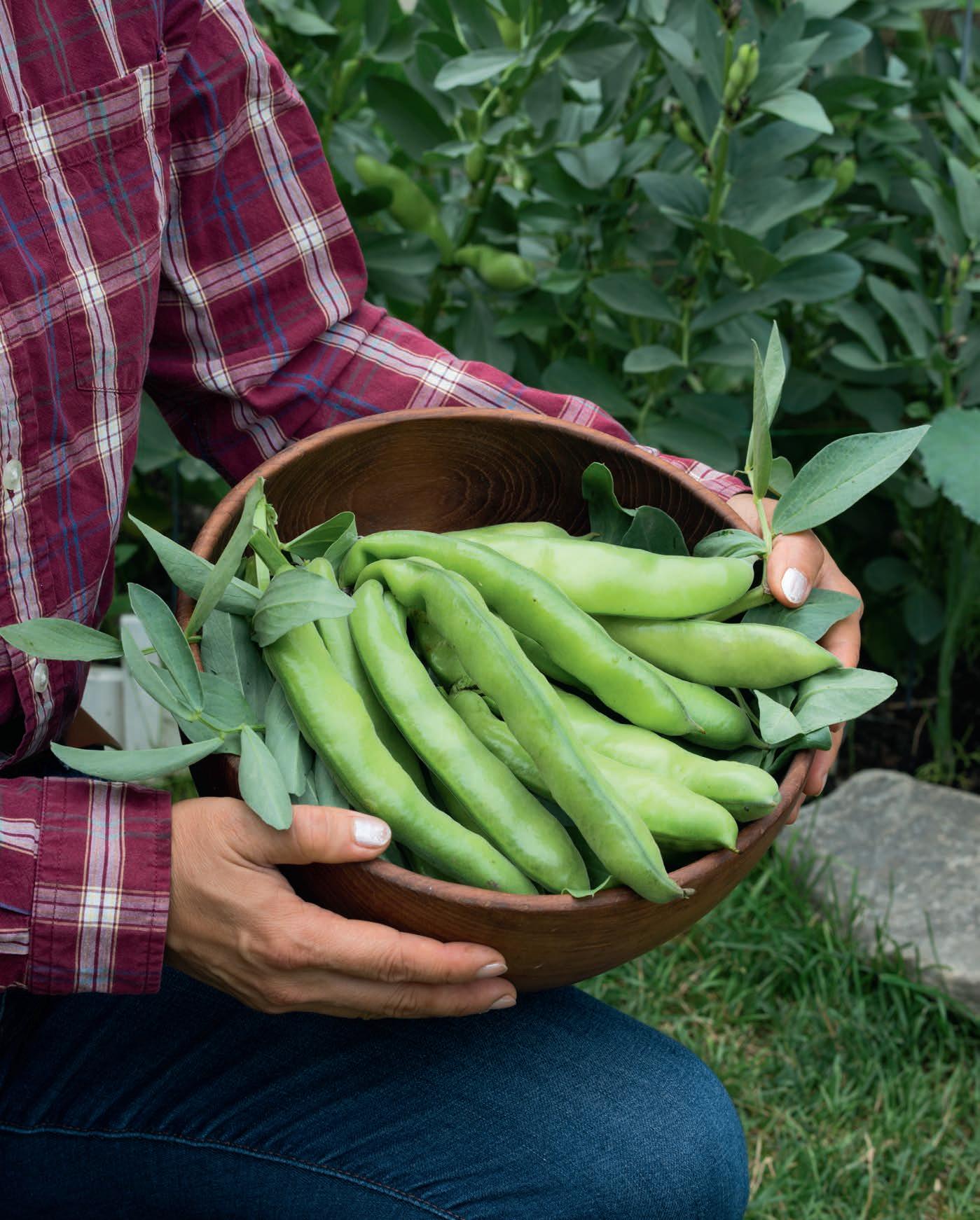
THE BROAD BEAN OR FAVA BEAN ISN’T JUST A FOUNDATIONAL FOOD — AS A NITROGEN-FIXING LEGUME, IT’S GOOD FOR YOUR SOIL AS WELL
Words Kerrie Anderson
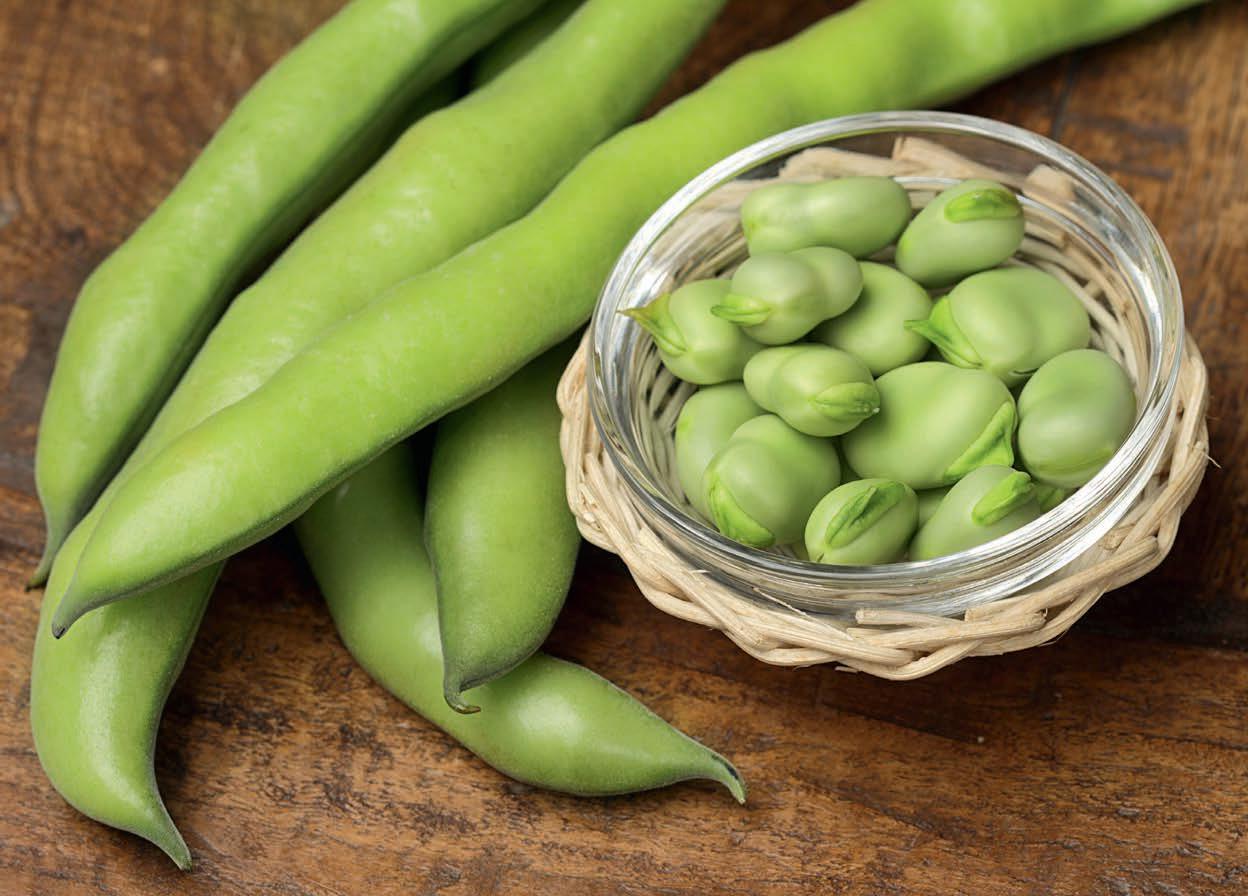
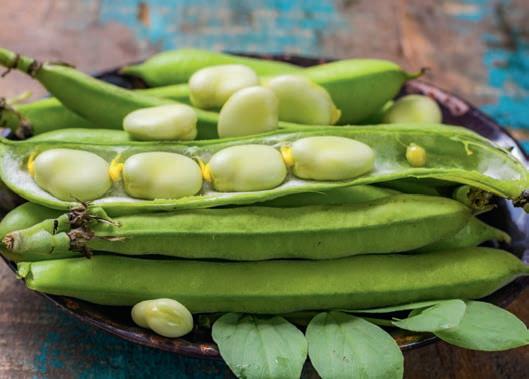
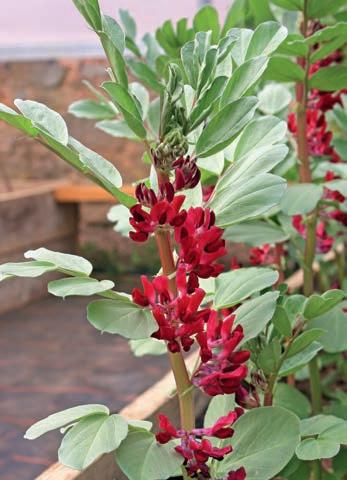
The broad bean, also known as a fava bean, is one of the oldest cultivated beans, dating back to the Bronze Age.
Versatile and high in protein, it can be eaten raw or cooked or dried for storage and long-term use; even the young growth tips and flowers are edible.
As a nitrogen-fixing legume, the broad bean is a great companion plant next to heavy feeders such as the brassica family, including broccoli and cauliflower. A valuable green manure or cover crop, it can be dug back into the soil to enrich it.
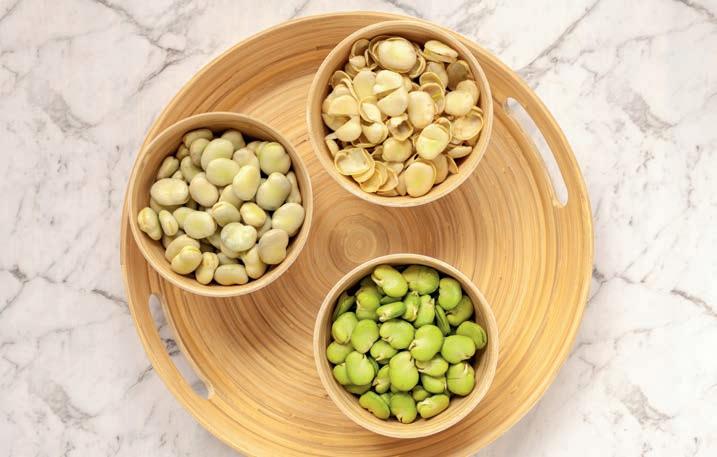
For those who have negative childhood memories of eating broad beans, they probably weren’t prepared properly. More mature beans are best eaten double peeled to ensure the bitter outer coating has been removed.
Even though they do require a bit of preparation, the reward is a nutrientdense, tasty bean, a staple in many famous and traditional cuisines around the world.
PLANTING AND CARE
Plant in autumn for a spring harvest. Sow seed 5cm deep, 25-30cm apart, in rows 60-100cm apart, directly into a moderately rich loam that’s been prepared with aged compost or manures.
Broad bean label
Common names: Broad beans, fava (or faba) beans
Botanical name: Vicia faba
Family: Fabaceae
Aspect & soil: Plant in full sun into moderately enriched, well-drained soil
Too much nitrogen, though, may result in quick, sappy growth and consequent problems with pests and diseases.
To speed up germination, soak seeds overnight in diluted seaweed solution prior to planting. The large seeds may rot once in the soil, so water well when first planted then hold off watering again until after the seeds have germinated, which takes 10–14 days on average.
Some varieties grow very tall and require trellising lest the plants topple under the weight of the pods as they develop. Varieties that are more compact in habit may be a better choice in windy areas or if trellising isn’t possible.
Height variation is between 0.5 and 1.8m tall for different varieties.
Broad beans can self-pollinate, but bees and other insects will increase fruit set. t ot
Best climate: All except tropical Habit: Cool-season annual
Propagation: Seed, direct sown
Difficulty: Easy
HARVESTING AND USE
Broad beans take about four months until harvest. Pinch out the growing tip (which is edible) once a good crop of pods has set. Harvest the lowest pods first.
Small/young beans can be eaten whole. If you leave the pods to fill out with mature beans, their skin will become tough and bitter. Shell the pods then remove the tough outer skin of each bean before cooking (this is called double-podding).
Or, after a short blanching, squeeze the bean from its outer skin, revealing the sweet inner bean.
BROAD BEANS CAN SELF-POLLINATE, BUT BEES AND OTHER INSECTS WILL HELP INCREASE FRUIT SET.
Broad beans are best if cooked only for a few minutes so that they are tender but still have a slight bite to them.
They are rich in nutrients such as protein, fibre, iron and zinc and are also a source of polyphenols, which act as antioxidants and help reduce inflammation.
VARIETIES TO TRY
‘Long Pod’ dwarf bean is a hardy, taller variety, up to 1.5m high, producing largesized pods to 16cm.
‘Broad Bean Coles Dwarf’ Compact, prolific grower to 1m and a good cropper with 20cm pods. Able to withstand more wind than other broad beans varieties, it produces a prolific crop of beans with a great flavour.
‘Tripoli’ Smaller, high-yielding, largeseeded variety with up to 7 seeds per pod. More heat tolerant than other commonly grown varieties, plants grow as compact bushes to 100cm tall and produce pods up to 30cm long.
‘Red Epicure’ Strong, high-yielding heritage variety known for its tall, selfsupporting plants and distinctive crimsonred beans, offering a sweet, creamy flavour that’s great steamed.
TROUBLESHOOTING
Fungal diseases such as rust can affect the plants. They tend to occur when humidity is high and plants are overcrowded and don’t have enough airflow. Some varieties of broad beans are more susceptible than others. Aphid infestations can be severe in warmer weather. Increase companion planting nearby to attract beneficial insects such as lady bugs, which predate on the aphids.
Broad beans in the pod Aphid infestation
Tassie bumblebee busy pollinating
Single peeled (left) vs double peeled (bottom)
Crimson flowers and beans
Words Kerrie Anderson
TTHOUGH RELATED TO CARROT AND CELERY, THIS HARDY PERENNIAL’S UNIQUE FLAVOUR WILL NEVER BE MISTAKEN FOR EITHER
FENNEL AS ANYTHING
here’s no polite way to say it: fennel is polarising. You either love it or hate it and it’s the strong aniseed/licorice flavour that has most people in a spin.
Me, I love it! But let’s just agree it’s a magnificent, multipurpose plant that can be used as a vegetable, a herb and a spice — how versatile is that?
It’s also a fabulous companion plant and attracts beneficial insects once its gorgeous, umbelliferous flowers have formed. Have I swayed your opinion yet?
There are two types: bulbous fennel, also known as Florence fennel, and nonbulbous or common (herb) fennel.
It’s often confused with dill, which belongs to the same family, Apiaceae. Both have feathery leaves, though fennel
leaves are longer and broader with an aniseed aroma, whereas dill has more of a grassy, citrusy scent.
PLANTING AND CARE
While fennel will grow in all climatic regions of Australia, frost can kill it and it may bolt to seed in extreme temperatures or through lack of regular watering.
It can be grown all year round but is best planted in autumn and spring in temperate areas and during winter in the tropics.
Direct-sown seed is the preferred method of propagation for a full, bulbous form. Growing the plants in enriched soil will also promote a bulbous habit.
Plant 30cm apart in in loose soil, enriched with aged compost or manures. It can grow to about 60cm in height.
I like to intersperse fennel with other plants as it makes an ideal companion plant, confusing pests with its strong aroma. If some plants are left to go to flower, it will also attract hoverflies, ladybugs, bees and other beneficial insects.
Fennel is an especially great companion for brassicas as the flowers attract a native wasp that’s a natural predator of the cabbage white butterfly. Some gardeners choose to blanch the bulbous area of the plant to increase both the whiteness and the sweetness. Once the bulb reaches the size of a golf ball, add a collar of newspaper or cardboard around the bulb, mounding up soil around it. Harvest approximately a month later.
If you use this method, ensure the green fronds are open to the air and sunlight.
Fennel label
Common names: Fennel, Florence fennel, finocchio
Botanical name: Foeniculum vulgare
(dulce is the bulbous form)
Family: Apiaceae (carrot family)
Aspect & soil: Full sun in enriched, well-draining soil
Best climate: All
Habit: Biennial, usually grown as an annual Propagation: Seed and seedlings
Difficulty: Easy
FENNEL IS AN ESPECIALLY GREAT COMPANION FOR BRASSICAS AS THE FLOWERS ATTRACT A NATIVE WASP THAT’S A NATURAL PREDATOR OF THE CABBAGE WHITE BUTTERFLY.
HARVESTING AND USE
Ideally, Florence fennel should be harvested when the bulb is about tennis-ball size, as it may become a little woodier in texture if left to grow for too long.
It’s great cut up and used raw for a pop of flavour in salads. It can also be cooked and is especially delicious baked, which creates a scrumptious caramelisation.
Fennel leaves are used in beverages such as teas and for flavour in absinthe.
If left to go to flower, the seeds can be collected for seed saving and also dried for use as a spice in curries, ferments and baked goods such as bread.
In many countries such as India, the seeds are added to a mix offered to guests for consumption after meals as a digestive aid and breath freshener.
Low in calories, fennel is a good source of fibre, potassium, vitamin C and antioxidants. Its medicinal properties include digestive benefits and it’s even said to increase milk production in lactating mothers.
VARIETIES TO TRY
‘Romanesco’ is a late-maturing Italian variety producing large, round, snowwhite bulbs with good resistance to bolting. Very sweet and aromatic.
‘Doux de Florence’ A traditional, highly productive variety with beautiful white bulbs, rounded and firm and enlarged at the base.
‘Di Sarno’ This old variety, resistant to cold and bolting, produces round, compact white bulbs with thick, fleshy leaves.
Bronze fennel, a type of herb fennel with attractive feathery, bronze-coloured foliage, is grown ornamentally as well as for its leaves and seed.
TROUBLESHOOTING
Excess heat, cold, disturbance by transplanting or lack of regular water can cause stress that will lead to bolting.
Issues with pests or diseases are rare, with the exception of snails and slugs that are attracted to the fleshy base of the plant.
Bronze fennel
Vegetable and herb
Also a piquant spice
WINTER WEIRDOS
FOLLOWING LAST ISSUE’S AUTUMN ODDBODS, HERE ARE SOME MORE OFFBEAT EATS TO CONSIDER FOR YOUR WINTER PATCH AND TABLE
HERE ARE SOME MORE OFFBEAT EATS TO CONSIDER
Words Jennifer Stackhouse
There’s more to midyear food gardening than root veg, peas, brassicas and leafy greens.
Some other weird and wonderful vegetables grow well in cool weather, giving extra variety and interest to both the vegie patch and meals.
As a bonus, some of the oddest are harvested in the coldest months of the year. Here are three to tempt your curiosity — and your taste buds.
JAPANESE TURNIP, BRASSICA RAPA VAR. RAPIFERA
One oddbod for cool-season growing is Japanese turnip (pictured above), a small white turnip that matures quickly for a fast harvest. Varieties available include ‘Hakurei’ and ‘Tokyo Cross’ Japanese turnip is part of the cabbage family (Brassicaceae) and grown for its small, tender and sweet tubers. If you’re not a fan of the slightly spicy taste of normal turnips, you’ll love the sweetness of this little fellow.
As the turnips are relatively small and quick growing they can also be grown
in containers such as raised beds, pots or troughs.
Use Japanese turnips raw as a salad veg (they are sometimes called salad turnip) or as a crudité for your favourite dip. They have clean white skin so don’t need to be peeled and can be cooked in lots of ways, including grilled or roasted. Japanese turnips are also great for pickling.
Growing tips
To grow Japanese turnips, locate some seeds (search for mail-order specialists) and sow from autumn to early spring in a spot that gets plenty of sunshine.
They are best direct sown into a prepared spot with moist soil. Sow the seeds around 5mm deep and 10–15cm apart to allow room for the turnip root to develop. If the seeds are too thickly planted, carefully thin out to avoid overcrowding.
Although growing in the cooler months of the year, Japanese turnips
need water regularly, particularly if conditions are dry or windy. If allowed to dry out, they become woody and bitter.
As these oddbods are part of the cabbage family, keep an eye out for both aphids and the green caterpillars of the cabbage white butterfly. Squash aphids and remove caterpillars (or protect with fine white netting).
Insect pests can also be controlled with an organic spray such as pyrethrum or Dipel, which is effective against caterpillars.
The plants mature in 5–7 weeks and are ready when the turnip is about 5cm across. Harvest in winter from lateautumn plantings or spring from latewinter to early-spring plantings. After harvest, remove the leaves before storing the turnip wrapped and in the crisper section of the refrigerator. The young green leaves can be used as a shallot.
For a constant harvest, sow seeds every few weeks.
WHEN FOOD WAS SCARCE, ODDBODS LIKE SALSIFY PROVIDED A SAFE, STARCHY VEGETABLE TO EITHER GROW OR HARVEST WILD IN WINTER TO EARLY SPRING.
SALSIFY, TRAGOPOGON PORRIFOLIUS
Even stranger is the root vegetable salsify, an old-world plant related to the dandelion. It’s a biennial, which means it flowers in its second year of growth.
The long parsnip-like root, eaten as a vegetable, is white with thin skin, making it easy to prepare by scrubbing or peeling. The leafy tops and shoots can be used as a green vegetable.
Salsify is native to the UK and Europe and does best in a mild climate but can be grown in all areas with regular watering and a little shade.
It has an earthy flavour and is high in fibre. It produces a pretty purple daisylike flower, which gives rise to its oldfashioned name of Jack-go-to-bed-atnoon as it closes in the middle of the day.
Other common names for salsify include oyster plant and vegetable oyster (for its oyster flavour) and goat’s beard for the hairy roots on the edible root. Growing tips
The variety ‘Mammoth Sandwich’ (also ‘Mammoth Sandwich Island’) has thick, white roots. The tip for success is to encourage a long thick root with good soil preparation and regular watering. This means preparing a loose deep soil free of clumps and stones by cultivating the soil to around 40–50cm depth. If growing in a container, select a deep trough (at least 40cm). Don’t add fresh manure to the soil as it can lead to forking in the root.
The approach for sowing is the same as for carrots or parsnips. Sow seed into moist, well-prepared soil in a sunny spot. In tropical zones, sow as a dryclimate crop.
Sow seeds around 6mm deep and 10cm apart and thin out overcrowded seedlings. Keep the growing plant well watered as dry conditions can lead to forking or bolting (premature flowering).
The plant reaches around 30cm high. Harvest when the root is mature (usually after 14–21 weeks’ growth) by gently pulling up — or use a fork to dig up the plant to avoid breaking the slender root.
Although they can be stored in the ground, leaving the plants to mature and flower leads to woody roots. Collect seeds for sowing a new crop.
After harvesting, remove the leafy top growth and store wrapped in the crisper section of the fridge. Wash and peel or scrub before cooking. Cook by roasting, steaming or as a gratin or soup.
TATSOI, BRASSICA RAPA
SUBSP. NARINOSA
Tatsoi, also known as Chinese flat cabbage, is a fast-growing Asian green that’s great to have in the garden as a nutritious leafy vegetable to steam or stirfry. It has a slight mustard flavour and is part of the large cabbage family, Brassicaceae.
While this vegetable is a great choice for leafy greens through winter, it can be grown year round. As well as the usual green tatsoi, there is a very robust form with attractive purple-tinged leaves.
In tropical zones, grow as a dry-season crop. It grows in sun to part shade in welldrained soil and is both undemanding and quick. Water well when the weather is dry or windy to ensure it doesn’t bolt. Growing tips
Seeds are readily available. Start sowing in early autumn or during the dry season (March to July) in tropical and subtropical zones. Plant every few weeks to keep a good supply of greens growing through winter and into early spring.
Seeds can be direct sown where they are to grow or started in seedling trays
then transplanted into the garden bed once large enough to handle. Sow seeds at about 5mm depth and space seedlings 20cm apart.
As a member of the cabbage family, tatsoi prefers a slightly alkaline soil, so adding a handful of lime to acidic soils is helpful for good growth. Keep seedlings well watered as they establish. To promote strong growth, feed fortnightly with an organic liquid food or add monthly side dressings of organic fertiliser such as pelletised chicken or blood and bone.
Check leaves regularly for caterpillars (cabbage white butterfly) and aphids. To deter pests, apply an organic spray such as pyrethrum or Dipel (against caterpillars), squash or cover with fine netting.
Pick the spoon–shaped leaves as needed after about 3–4 weeks’ growth or harvest the entire plant at maturity (around 6–8 weeks) when it forms a flat rosette of leaves around 10cm high. While tatsoi is usually steamed or sautéed, excess leaves can also be combined with nuts, garlic and parmesan cheese for a simple pesto.
Salsify’s pretty flower
Salsify root
Tatsoi
WHO DOESN’T LOVE A PINK LADY, A JONATHAN OR A GRANNY SMITH?
Words Jennifer Stackhouse
ATHE APPLE OF OUR EYE
pples crop with such abundance that owning several trees can produce an overwhelming amount of fruit — and as it piles up on the kitchen bench, I turn to my old cookbook, which devotes pages to apple dessert recipes.
Apples can also be used to make other fruit go further — they can be added to tomato sauces, fruit chutneys and even strawberry jam.
A clever way to manage the potential glut is to grow several varieties, selecting ones that are early, mid-season and late-season.
One of the earliest to ripen is the small but very sweet and crisp ‘Lady of the Snow’. This apple has red skin and white flesh and is usually ready to harvest in midsummer.
Extend your harvest with ‘Pink Lady’ — also known as ‘Cripps Pink’ — a late-season red apple harvesting from March to June and now one of the most popular, having overtaken old favourites
‘Jonathan’ and ‘Red Delicious’. ‘Pink Lady’ was bred in Western Australia but is grown around the world. It was developed in 1973 by John Cripps, who crossed a ‘Golden Delicious’ variety with ‘Lady Williams’
Also living up to its name when freshly harvested from the backyard is ‘Golden Delicious’, with its yellow-green skin and white flesh.
Other popular red-skinned varieties include ‘Fuji’, ‘Gala’, ‘Royal Gala’ and ‘Jazz’, all mid-season apples (late summer to autumn).
The green ‘Granny Smith’, another Australian variety developed in the late 19th century in Sydney, is much loved as a tart, green cooking or eating apple harvested in late autumn to winter. It is
also valuable as a cross-pollinator for many other apple varieties.
For something a little different, look for red-fleshed apples including ‘Huonville Crab’ (a cross between a crabapple and an apple discovered in Tasmania) and ‘Eagle Point Star’ (discovered in Victoria).
Many new and very tasty sweet varieties are also in the pipeline as they filter through commercial orchards before becoming available to home gardeners. To try a red-fleshed apple, look for the varieties ‘Kissabel’ and ‘Redlove’ in supermarkets.
Most apples need a cross-pollinator. When buying an apple, always check the label for a recommended pollinator. To save space, select a variety that includes a graft of a pollinator.
WHEN BUYING AN APPLE TREE, ALWAYS CHECK THE LABEL FOR A RECOMMENDED POLLINATOR. TO SAVE SPACE, SELECT A VARIETY THAT INCLUDES A GRAFT OF A POLLINATOR.
Getty, Shutterstock, Kerry Boyne
Apple label
Common name: Apple
Botanical name: Malus domestica
(syn. M. pumila)
Family: Rosaceae (rose family)
Aspect & soil: Full sun; well-drained soil
Climate: Cool, Mediterranean, temperate
Habit: Deciduous tree
Propagation: Grafting
Difficulty: Easy to moderate
GROWING NEEDS
Apple trees can reach 5m or more in height, but nowadays they’re grown on dwarf root stock so the trees rarely grow higher than 2-3m and can be accessible for netting and harvesting.
If even these are too big for your available space, look for dwarf apple trees or grow apples as low hedges, also known as step-overs. Step-over hedges are little fiddly to start with but are an extremely decorative and space-saving way to grow apples.
Plant potted apples at any time (but be sure to avoid extremely hot or cold conditions). In winter, bare-rooted plants are available from garden centres or online fruit tree specialists.
Choose a bright, sunny location with shelter from strong winds. Ideally, plants should have sun from the morning onwards but they’ll tolerate a little afternoon shade, especially in summer.
Apples grow in a wide range of soils but perform best with good drainage in deep, fertile soil. Although most apples are cold-climate plants that require a period of winter chill to flower and fruit, there are low-chill varieties to grow in warm or coastal zones.
Chilling requirements for apples range from 500–1500 hours during winter dormancy (chilling hours are cumulative hours below 7°C). Without the correct chilling, blossoming will be erratic and fruit won’t develop.
This tree has three varieties
Cross pollination is required
Bare root trees are cheaper
‘Pink Lady’
YOUNG TREES SHOULD BE PRUNED AT PLANTING AND IN SUCCESSIVE YEARS TO ESTABLISH AN OPEN VASE SHAPE.
GENERAL CARE
Adequate and regular water is critical for fruit formation and development. Lack of water can lead to loss of flowers or fruit.
Deep water at least weekly, especially when plants are in new growth, flowering or fruiting. Water more frequently if plants are in hot, dry or exposed conditions or growing in containers.
Feed twice a year in spring and early summer with a complete fertiliser for fruiting plants. Plants in containers can be liquid-fed monthly while growing (spring to early autumn).
Protect the area around the base of the tree with a 5-7cm layer of coarse organic mulch to keep the soil evenly moist and weed free. Alternatively, keep grass closely mown.
Young trees should be pruned at planting (avoiding pruning off any pollinator) and in successive years to establish an open vase shape. Apples fruit on fruiting spurs. Prune after harvest in autumn or in winter when dormant.
Winter is the ideal time to do a hard or renovation prune as it encourages strong growth. After pruning in winter and before bud burst, spray with a copperor lime-based spray to reduce fungal infection in foliage and fruit.
In summer as fruit matures, pinch out the smaller fruit from each cluster to encourage fewer but larger fruits to form.
TROUBLESHOOTING
The apple’s main pests are aphids on new growth and codling moth, which may attack fruit. Encouraging chooks to forage among trees can reduce some insect problems but monitor and control codling moth using traps.
Fruit fly is also a potential problem in many parts of mainland Australia, including previously fruit-fly-free zones in Victoria and South Australia.
They can attack ripening fruit, especially early varieties — look for puncture wounds in the skin and any sign of maggots in the fruit.
Pheromone traps can be used to monitor for fruit flies. If they’re around, use mesh bags to protect clusters of ripening fruit. Pick up fallen fruit and sterilise it in a plastic bag in the sun for several days to kill off maggots. Dispose of the fruit by burying it.
Birds peck holes in ripening fruit so trees may need to be netted in late summer and autumn using bird- and animal-safe netting. Fruit that has been damaged by birds may also attract European wasps. Take care when picking up fallen fruit as it may be harbouring wasps, which can sting.
‘Lady Williams’
‘Gala’
Brown rot on fruit
GOOD FOR APPLE-CHEEKED BABIES
Along with pears, apples are one of the earliest fruits offered to babies when they start to eat solids. This is because both fruits are low risk for allergic reactions, are available year round as they store well and are sweet and easy to prepare.
To avoid fungal diseases like brown rot, apply an organic fungicide spray such as lime in late winter before leaf growth. Also practise good hygiene by cleaning up diseased wood and removing diseased fruit. New growth can be damaged by late frosts.
New growth on apples can also be affected by powdery mildew, which causes a white bloom to form on the tips and may distort the leaves. To control, simply pinch out the new growth. Subsequent growth will be clear of the disease.
HARVESTING AND STORAGE
As Isaac Newton noticed, ripe apples fall from the tree — a good sign the fruit is ready to pick.
Pick ripe fruit easily by simply twisting it. Avoid pulling roughly, as this can remove the fruiting spur along with the fruit.
Store undamaged fruit in a cool pantry or the crisper section of the fridge. In the pantry, ensure they’re not touching each other: sit them on a rack or wrap them in newspaper.
Regularly check to remove any that are starting to rot as ethylene emitted from overripe fruit will start a chain reaction leading to others in the store also rotting.
Apples can also be juiced, sliced and dried in a food dehydrator, or preserved by bottling.
AVAILABILITY
Look for bare-rooted apple varieties for sale in garden centres from late autumn to winter or order from specialist growers including Heritage Fruit Trees (heritagefruittrees. com.au) and Maple Grove Nursery (maplegrovenursery.com.au).
Exclusion bags protect the fruit. Note the water bottles that weigh the branches down for easier picking
‘Redlove’
THE ENZED BERRY
KIWIFRUIT STARTED OUT AS A CHINESE GOOSEBERRY BUT WAS SO WELL MARKETED IN THE PAST 50 YEARS EVERYONE THINKS IT’S FROM NEW ZEALAND BUT WAS SO WELL MARKETED IN THE PAST 50 YEARS
Words Jennifer Stackhouse
Akiwifruit vine is a wonderful asset in the late-autumn and winter garden when loaded with vitamin-packed, tasty fruit, but it can spread up to 8m across so it needs lots of room to grow.
If your kiwifruit vine is a mass of tangled stems, rest easy — winter, after harvest, is pruning time and it’s OK to cut them back hard.
Next year, don’t wait till winter to prune the vines and control that twisted growth. Female vines — the ones that produce fruit — can be pruned in summer by cutting off whippy new growth but not fruiting wood.
Male vines can be pruned after flowering (as long as you can clearly identify the branches from the male plant).
All this discussion about female and male plants has let the cat out of the bag
when it comes to kiwifruit. They produce male flowers, which carry pollen, and female flowers that form the fruit; the flowers are borne on separate plants.
This means that to produce fruit, at least two vines are needed: a male and a female. One male plant can provide enough pollen to fertilise several female vines. Plants should fruit three or four years after planting.
To tell the plants apart, female flowers are cream, scented and prolific in spring. The male flowers, which are also cream, are filled with pollen-coated stamens.
As each vine takes up several metres of space and at least two are needed, kiwifruit vines can be too big for a small garden.
Grafted plants are available that have male and female grafted together, which makes them more space efficient. To further save space, train the vine along a sunny fence.
AS THESE VINES TAKE UP LOTS OF HORIZONTAL SPACE, ALLOW AT LEAST
3 –4M BETWEEN EACH PLANT TO AVOID TOO MUCH ENTANGLEMENT.
HEALTH BENEFITS
Kiwifruit is well known for being rich in vitamin C but recently it earned a thumbs up for another health benefit. In 2025, green kiwi became the first fresh fruit ever to receive an “authorised health claim” from the European Commission.
The official wording endorsed by the Commission is that “consumption of green kiwifruit contributes to normal bowel function by increasing stool frequency”, which means eating two green kiwifruit per day makes you regular.
The resulting publicity lifted sales by a reported 20 per cent or more, according to major New Zealand grower Zespri.
HOW TO GROW
Grow kiwifruit in a warm, sheltered, sunny position in rich, well-drained soil with a sturdy support such as a wall, fence or strongly built trellis.
Vines can be planted in winter when they are dormant or in spring as potted plants. Look for a grafted plant with both male and female stems or ensure that you have at least one male vine.
Bigstock. Jennifer Stackhouse
Kiwifruit label
Common names: Kiwifruit, Chinese gooseberry
Botanical name: Actinidia deliciosa
Family: Actinidiaceae (kiwifruit family)
Aspect & soil: Sun to part shade; cool, well-drained soil
Best climate: Cool, temperate, subtropical
Habit: Deciduous climber
Propagation: Cutting, grafting, layering
Difficulty: Medium
WHAT’S IN A NAME?
Kiwifruit is not native to the Land of the Long White Cloud. In fact, it was the New Zealanders who came up with the catchy rebranding of what was known as the Chinese gooseberry, a name that better reflected its origins. This smart marketing move thrust a little-known and visually unappealing fruit — the ugly duckling of the fruit bowl — into the public eye. The name quickly stuck and green-fleshed kiwifruit was soon gracing pavlovas across both New Zealand and Australia (New Zealanders also claim to have created the pav!). As a measure of success, in modern Chinese, the fruit’s name is now the same as it is in the USA: qiyiguo, or “kiwi”.
As these vines take up lots of horizontal space, allow at least 3–4m between each plant to avoid too much entanglement.
Lightly prune after flowering and fruit set in summer to control the spread of the vine and hard prune in winter after harvest to encourage fruiting growth in spring.
Cut the long canes back to a strong framework of branches, leaving at least two or three buds. After flowering in late spring is the best time to prune male vines.
These vigorous plants benefit from feeding twice a year: in spring when new growth begins and in late summer or autumn as fruit forms. Use a complete organic fertiliser.
Also, mulch the soil well around the base of the plant with organic mulch and aged manure to keep the root area cool and deter weeds.
Netting may be needed to protect the plant from birds (and possums). Use bird-safe netting and remove the netting completely after harvest.
CLOSE RELATIVES
While kiwifruit (Actinidia deliciosa) is the best known of the genus Actinidia, there are other species that produces fruit and are grown much like kiwifruit.
The cocktail kiwifruit (A. arguta) produces small, smooth-skinned fruit in summer while the yellow kiwi (A. chinensis) has golden flesh inside hairy brown skin and, like kiwifruit, bears fruit in autumn and winter. Both grow as vines.
Add to your Actinidia collection with the very attractive ornamental species silver vine (A. polygama), which has boldly variegated green and white heart-shaped foliage and attractive white flowers on a scrambling vine. The flowers are followed by orange fruit that’s edible but not particularly palatable.
This species is very attractive to cats. A study of the plant reported that cats are specifically drawn to two chemicals in silver vine: the iridoids nepetalactol and nepetalactone. As the names suggest, these substances are also found in catnip (Nepeta cataria).
For an even more flamboyant vine, look for A. kolomikta, which has large, variegated green, white and pink leaves.
Yellow kiwi
Cocktail kiwifruit
Female flower
Male flower: note stamens
FRUIT THREATS
THE TOP SIX CITRUS PESTS: HOW TO SPOT THEM AND HOW TO STOP THEM — OR AT LEAST MINIMISE THE DAMAGE
Words Claire Bickle
Citruses are probably the most popular fruiting trees of all and oranges, lemons, limes and mandarins are integral to many an Aussie backyard.
That’s not to mention grapefruit, cumquats, tangerines, tangelos, citrons, pomelos, finger limes and more.
However, the productivity of your trees and the quality of their crops can be threatened by a range of pests so recognising them, understanding their impact and having the right management strategies are crucial.
Let’s have a look at the half-dozen most common pests and how they can be prevented or at least treated organically.
BRONZE ORANGE BUG, MUSGRAVEIA SULCIVENTRIS
Description: These pests are commonly known as stink bugs because of the acrid smell they secrete when disturbed. There are five nymph stages with colours varying from green to salmon. As they mature, they turn into large black bugs 25mm long. Both nymphs and adults can cause damage as well as exude offensive-smelling liquid.
Damage: These pests suck sap, causing shoots to die and leaves and flowers to drop prematurely.
Control: No known spray is effective on adults. Best remedy is removal by hand, especially once they form their clusters. Wear long sleeves, gloves and safety goggles. Knock insects off into a bucket of water or vegetable oil. Apply a soap spray in winter to control nymphs. Assassin bugs are natural predators and bronze orange bugs are destroyed by extremely hot or cold weather.
NEGLECTED, STRUGGLING TREES ARE A MAGNET FOR PEST AND DISEASE ISSUES.
CITRUS GALL WASP, BRUCHOPHAGUS FELLIS
Description: The citrus gall wasp is a native Australian pest that primarily affects lemon trees but can infest other citrus varieties as well.
Damage: Adult wasps lay eggs in the young stems of citrus trees, causing galls to form. These galls damage the tree’s
vascular system, reducing fruit yield and overall tree health.
Control: Remove and dispose of gallaffected branches. Or, using a vegetable peeler, slice either side of the gall to expose the developing eggs. This will desiccate them and the tree will natural heal over. There are also natural predators of these wasps.
Bronze orange bugs
Citrus gall wasp
CITRUS LEAFMINER, PHYLLOCNISTIS CITRELLA
Description: The citrus leafminer is a small moth that lays its eggs on citrus foliage. Leafminers are especially active during the warmer months and are found throughout Australia.
Damage: The hatched moth larvae burrow through young citrus leaves, creating distinctive silvery trails and
causing the leaves to curl and distort. This damage can reduce photosynthesis and make trees more susceptible to diseases such as citrus canker.
Control: Applications of a horticultural botanical oil at times of new growth flushes can reduce the incidence. You can also reduce the population with leafminer traps; they attract males who become stuck, thus disrupting breeding.
BLACK CITRUS APHID, TOXOPTERA AURANTII & T. CITRICIDA
Description: Black (and brown) citrus aphids are small sap-sucking insects 1.5mm long that cluster on new growth. There are winged and wingless forms.
Damage: Aphids attack new shoots and young leaves, feeding on plant sap and causing deformation of growth. They also excrete a sticky honeydew that encourages the growth of sooty mould, which will also affect the tree’s health. Aphids can also transmit viruses between plants.
Control: Spraying with a soap spray or eco-oil will work, as will a simple jet blast of the hose or squishing with gloved fingers. Natural predators are ladybeetles, hoverfly and lacewing larvae. These are often available online from integrated pest management companies.
SCALE (MULTIPLE SPECIES)
Description: Scale insects are sapsucking pests that attach themselves to citrus fruit, leaves and stems. The many species include brown, white louse, black, cottony cushion, pink wax, purple, yellow, white wax, Californian red and soft brown.
Damage: Scale will suck all the sap and nutrients out of various areas of the citrus tree. Heavy infestations can cause yellowing of leaves, fruit drop, twig dieback, even tree death. Their sticky honeydew excretions provide sites in
Citrus leafminer
Scale
Bigstock
HEAVY INFESTATIONS OF SCALE CAN CAUSE YELLOWING OF LEAVES, FRUIT DROP, TWIG DIEBACK, EVEN TREE DEATH.
which black sooty mould can develop. Control: Applications of horticultural botanical oil such as eco-oil will smother and suffocate them. Another option is to introduce predatory wasps, which are available online from integrated pest management companies.
QUEENSLAND FRUIT FLY, BACTROCERA TRYONI SYN. DAUCUS TRYONI
Description: Looking more like a wasp than a fly and growing to around 7mm long, this pest is brown in colour with bright yellow markings. It’s fast moving and can travel a fair distance.
Damage: Females lay eggs inside the fruit via a retractable ovipositor. Once the larvae hatch they feed on the pulp, causing fruit to rot inside and drop prematurely. Queensland fruit flies are particularly problematic during the warmer months. If you look closely, green fruit that has been stung will have a small yellow mark at the puncture site. Ripe fruit will generally have a small brown spot at the puncture site.
Control: There is no set control, only preventative measures. Setting up pheromone and bait fruit-fly traps will destabilise the population by killing off the males and reducing mating. These traps are mainly used as indicators of active fruit flies. Covering the tree after fruit set with fruit exclusion netting or individual fruit clusters with fruit-fly exclusion bags can help, as can sticky traps. Removal and destruction of fallen fruit is critical as the larvae in the fruit will pupate in the ground and hatch as new adults, repeating the cycle. (Do not dispose of affected fruit in the compost.)
CULTURAL PRACTICES
When it comes to caring for your citrus, the best measures remedies can be your cultural practices.
Before planting, be sure to choose a full-sun position. Prepare soil well by adding and digging through adequate quantities of organic matter. Ensure good drainage and finish by mulching thickly with lucerne or sugarcane mulch.
Citrus trees are heavy feeders, so feed up to 4 times a year with an organic fruit tree fertiliser plus a side dressing of trace elements once a per year.
Consistent watering is recommended, especially in dry periods and during fruiting. Neglected, struggling trees are a magnet for pest and disease issues.
Queensland fruit fly
Black citrus aphid
THE MATHS OF MATTER
ONCE YOU HEAR ABOUT NATURE’S GEOMETRY AND THE GOLDEN RATIO YOU START TO SEE IT EVERYWHERE — AND NOT JUST IN PLANTS
Opposite page The mesmerising interlocking Fibonacci spirals of a sunflower
Right Efficiently arranged hexagon scales forming sets of interlocking spirals
Below right Romanesco broccoli’s intricate fractal geometry
Words Jo Immig
Have you ever stared into the spirals of a sunflower or the fractals of a Romanesco broccoli, or marvelled at the five-pointed star inside an apple core and wondered: how do these patterns occur?
The short answer is geometry — the mathematics of shapes and space. As visionary 17th-century astronomer and mathematician Johannes Kepler observed, “Where there is matter, there is geometry.”
Geometry describes the physical universe — from planetary orbits to the arrangement of petals on a flower.
GEOMETRY
The geometry of the natural world was recently revealed to me as a participant in an Art of Process workshop, taught by artist and experienced geometer Stephanie June Ellis.
With a piece of paper, pencil, ruler, compass and guidance in geometry, the miraculous patterns of nature emerged. The experience was so enlivening, I rushed home to my garden with a renewed sense of wonder and unity.
As I flitted from flower to flower, counting petals and marvelling at the hexagonal scales and fractal spirals on the pineapples with my newfound appreciation of geometry, poet Dorothy Gurney’s sentiment came to mind: “Never closer to God than in the garden.”
As gardeners, we marvel at the beguiling beauty of plants, but why do we find them beautiful? Beauty, it is said, is “in the eye of the beholder” and, while that’s true subjectively for personal and cultural reasons, something else is also occurring.
When we engage with plants, we resonate with universal principles of beauty such as symmetry, harmony and order expressed in their patterns.
“Humans have an intrinsic understanding and affiliation to symmetry and pattern,” Stephanie says. “So, when we see the world, we are essentially looking at ourselves.
“Drawing geometric patterns offers a unique portal into understanding our imperishable relationship with nature, the cosmos, human creativity and potential.”
NEW LEAVES AND PETALS EMERGE AT AN ANGLE CLOSE TO THE “GOLDEN ANGLE” (APPROXIMATELY 137.5 °) TO ENSURE EACH PART HAS MAXIMAL ACCESS TO SUNLIGHT FOR PHOTOSYNTHESIS AND GROWTH.
Just like the five-pointed star inside an apple core, an okra pod or a star fruit (carambola), the human body is also a pentagram shape with outstretched arms and legs and a head.
Leonardo da Vinci’s iconic drawing Vitruvian Man comes to mind. Reaching through the ages, this sepia image depicts a naked man in two superimposed positions with arms and legs outstretched in harmonious proportions within a square and a circle, symbolising divine proportions and harmony between man and the universe.
The fact that we share a pentagram pattern with an apple core certainly piques one’s curiosity. Where does this universal geometry come from? Ultimately, its origins are a mystery embedded in the physical universe.
Stephanie says, “Humans have created a language called mathematics to describe something of immense complexity,”
Whether you believe there is some kind of “divine blueprint” or not, it doesn’t change the awe-inspiring way geometry describes the mathematical principles and physical processes that underlie plant growth and form through the process of evolution and natural selection.
Some key geometric principles observed in the plant world include the Fibonacci sequence and the golden ratio, or phi (Φ).
THE LIFE SPIRAL
Leonardo of Pisa, known as Fibonacci (“son of Bonacci”), was a 13th-century Italian mathematician who identified the sequence of numbers now named after him — though it was known to Indian scholars more than a millennium earlier. Presented graphically, the sequence describes a golden spiral (or ratio), sometimes called the Fibonacci curve, that is present throughout the natural world and visible in everything from a ram’s horn or seashell to the patterns in an artichoke or pine cone.
THIS SPECIALISED SHAPE GUIDES SPECIFIC POLLINATORS TO DEPOSIT POLLEN
FIBONACCI SEQUENCE
The Fibonacci sequence starts with 0 and 1 and each new number is the sum of the two before it, so the sequence goes 0, 1, 1, 2, 3, 5, 8, 13, 21 etc. The ratio of consecutive Fibonacci numbers approaches the golden ratio (1.618).
These principles are expressed in such things as the number of petals on flowers, the spiral patterns on pineapples and pinecones and the branching points on tree limbs, which often follow a Fibonacci sequence.
The arrangement of seeds in a sunflower or the phyllotaxy of leaves along a stem also follow the Fibonacci sequence. New leaves and petals emerge at an angle close to the “golden angle” (approximately 137.5°) to ensure each part has maximal access to sunlight for photosynthesis and growth.
Plants also have various forms of symmetry. Actinomorphic or star-shaped plants display radial symmetry whereby the parts radiate from a central point to maximise pollination and reproduction options, especially in flowers (eg roses, daisies, marigolds) and leaf structures such as ferns, cacti and bromeliads.
Zygomorphic plants have bilateral symmetry, which means they are split into mirror-image halves along one plane, as in the case of orchids, snapdragons, banksia and grevillea.
This specialised shape guides specific pollinators to deposit pollen precisely and helps prevent self-pollination.
FRACTALS
Fractals are self-similar patterns that occur in plants in the veins in leaves and root systems, the branching on trees, fern fronds with tiny leaflets resembling miniature versions of the whole frond or in broccoli florets, where the smaller parts mirror the whole structure.
This pattern maximises surface area, which is essential for photosynthesis and the movement of fluids and nutrients in the vascular tissues of plants.
Geometry does a miraculous job of creating efficiency, stability and strength in plants as well as maximising opportunities for growth and reproduction. It is fundamental to life and beauty.
A deeper understanding of its principles and expressions makes you fall in love with plants all over again.
• theartofprocess.art
Ups a daisy
DAISIES ARE BEAUTIFUL FLOWERS IN A CLASSIC FORM FOUND IN THOUSANDS OF DIFFERENT GUISES ALL OVER THE WORLD
Daisy label
Common name: Marguerite daisy, Paris daisy
Botanical name: Argyranthemum
frutescens
Family: Asteraceae (daisy family)
Aspect & soil: Sun; well-drained soil
Best climate: Cool, Mediterranean, temperate, subtropical
Habit: Shrub
Propagation: Cutting, potted plant
Difficulty: Easy
Words
Jennifer Stackhouse
AMOST DAISIES FLOWER IN WINTER AND EARLY SPRING.
n easy-to-grow shrub that’s guaranteed to bring cheer and colour in winter is the not-so-humble daisy, a perennial from the Canary Islands now familiar all over the world.
The most widely grown daisy is the single white marguerite daisy but there are many other colours and forms of this popular group of plants.
The daisy flower is viewed and even drawn as a simple symmetrical shape, its golden centre surrounded by a ring of petals.
To the botanist, however, the daisy is far more complex. Technically, it’s known as a ray floret as the true flowers are found in the pollen-filled centre while the petals provide an additional attraction for insects.
As well as the single white daisy bush growing to around 1m high and wide, marguerites come in many colours including yellow, pink and even red and the flowers may be single or double. Even the leaves vary from fine to larger-lobed leaves in colours that range from dark green to blue tinged. For named and colourful varieties, look for any of the Australian-bred Federation daisies.
To get the best from a daisy bush, grow it in full sun with protection from frost. Start with a potted plant or take cuttings from a friend’s garden.
CUTTINGS TAKEN IN SPRING OR AUTUMN STRIKE
EASILY IN A SMALL POT.
Right Magenta marguerite Below right Pink marguerite
STAR QUALITY
The daisy belongs to the vast family of Asteraceae, from the Greek word for “star”, referring to their form. Asteraceae include many thousands of varieties including asters and sunflowers. Found on every continent except Antarctica, they comprise 10 per cent of all flowering plant species.
Most daisies flower in winter and early spring. Lightly prune over the shrub to remove any spent blooms and encourage new growth but don’t cut daisies back hard as they may die.
If the plant has become leggy and unattractive, simply take several cuttings before removing the plant and starting again. Cuttings taken in spring or autumn strike easily in a small pot.
Feed daisies with an organic complete fertiliser in spring.
OTHER DAISIES
For smaller plants and a mass of daisy flowers, look for the Moroccan daisy, Rhodanthemum, a low-growing perennial that reaches around 40cm high and wide.
Smothered in small white flowers from spring to autumn and with soft, silver-green leaves, it’s native to elevated parts of North Africa including the Atlas Mountains so it prefers a cool climate and a spot in full sun with well-drained soil.
This daisy is a good choice for mass planting in a cottage garden, among rocks or gravel or in a container.
Lightly trim over the plant to remove spent blooms to encourage a second flush of flowers. Fertilise in spring. Although it’s drought hardy, water well during hot weather.
Also popular is the African daisy or Osteospermum, ideally grown as low-maintenance groundcovers in sunny locations.
Originally just a simple white daisy flower with a hint of mauve, African daisies are now available in many colours including purple, pink, yellow and orange.
Some have twisted petals or a boss of tiny petals in the centre of the flower adding to their interest and appeal.
Whatever the colour or shape, their best feature is that they are rarely without a flower. Look for named varieties to enjoy a wide range of colours.
BILLY BUTTONS FLOWER OVER MANY MONTHS WHILE ANNUAL PAPER DAISIES ARE GROWN FROM SEED SOWN IN AUTUMN AND PEAK IN GARDENS IN SPRING.
SMALL NATIVE DAISIES
Closer to home is the huge range of everlasting daisies native to Australia, ranging from the perennial billy button to the ephemeral paper daisy (Rhodanthe and Xerochrysum syn. Bracteantha) that carpet much of Western Australia in winter and spring.
These too are easy to grow. Billy buttons flower over many months while annual paper daisies are grown from seed sown in autumn and peak in gardens in spring.
While not fussy about soil, paper daisies do best in full sun. The papery flowers come in pink, white and yellow tones.
Another native is the Swan River daisy (Brachyscome multifida), a perennial groundcover plant that grows in sunny to lightly shaded areas and flowers profusely in spring and summer.
It features attractive blue to mauve single daisy flowers held above green, finely cut leaves, though some varieties have white flowers.
Grow as a groundcover, a low hedge, a feature plant in a native or cottage garden or in a container. Keep well watered when times are dry and encourage dense growth, by light trimming and feeding in spring.
Swan River daisies grow to around 20-30cm high and can spread up to 30cm across.
TROUBLESHOOTING
While daisies are low-care, easygoing plants they can suffer a few problems. One is leafminers which, as their name suggests, burrow through leaves, causing silvery trails.
To control, remove any affected leaves. To reduce the likelihood of attack, select varieties with fine, blue-green leaves, which have less appeal to pests.
Gondwana gold
YELLOW-FLOWERED XANTHOSTEMON, OR GOLDEN PENDA, IS A GLOSSY-LEAFED RAINFOREST MEMBER OF THE EUCALYPT FAMILY
Words & photos Angus Stewart
When we think of the eucalyptus family, Myrtaceae, our thoughts generally turn to trees and shrubs from the dry woodlands and forests that dominate the continent.
Going back millions of years, however, scientists tell us that much of what is now Australia was dominated by rainforest that was home to the ancestral plants of the gumtree family.
As the continent got hotter and drier over the millennia, rainforests shrank to remnants that today harbour lushlooking myrtaceous plants like lily pillies.
beautiful remnant myrtle groups is typified by the stunning golden penda, whose vibrant yellow flowers and glossy green leaves make it a welcome sight in warmer climates.
The genus Xanthostemon contains 13 species native to the rainforests of northern Australia, as well as dozens of other species across the region of Oceania.
Unfortunately, most are not yet readily available in cultivation but specialist native nurseries are increasingly rectifying this situation.
While best suited to tropical and subtropical climates, they have been known to thrive in temperate areas in the south but will grow more slowly and
Another of these fascinating and WHILE BEST SUITED TO TROPICAL AND SUBTROPICAL CLIMATES, XANTHOSTEMONS CAN THRIVE IN TEMPERATE AREAS FURTHER SOUTH.
flower less reliably in cooler climates.
In the wild, various species grow to quite large trees but are a lot smaller in cultivation. There are cultivars of more compact sizes for smaller gardens and patios.
GOLDEN PENDA
The aforementioned golden penda (Xanthostemon chrysanthus) is generally the easiest xanthostemon to find in nurseries, and is native to tropical north Queensland. It’s an attractive tree with a prolific and eye-catching display of large golden yellow flowers from summer to autumn.
The flowers are made up of clusters of stamens, similar to a eucalyptus flower, but unlike eucalypts the stamens are surrounded by yellow petals at the base of the flower.
FULL SUN TO MODERATE SHADE IN A SPOT WITH REASONABLE DRAINAGE, AS WELL AS SOIL ENRICHED WITH WELLROTTED COMPOST AT PLANTING TIME, WILL GIVE BEST RESULTS.
The flowers are rich in nectar, attracting nectar-feeding birds such as lorikeets as well as butterflies and other pollinator insects. The flower clusters are sometimes so dense they weigh down the branches of the tree.
Aside from the spectacular floral display, it’s an attractive foliage plant with deep-green leaves that impart a rainforest atmosphere.
SMALL WITH AN IMPACT
While the golden penda can grow quite large, there are a couple of compact forms available such as the dwarf cultivars ‘Little Goldie’ and ‘Fairhill Gold’
These grow to a much more manageable size of about 3–4m tall by 2m wide and can be kept even more compact with regular pruning after flowering.
The stunning flower display makes them ideal feature plants in the garden; they also make attractive screens or hedges.
Another species showing up more in nurseries is X. verticillatus, which grows along creek beds in the Daintree area of North Queensland. It grows to about 5m tall and has creamy-coloured blooms presented in showy clusters similar to the golden penda.
‘Little Penda’ is a cultivar of this species that’s about 1.2m tall.
All xanthostemons are frost tender, especially when young, but the two species mentioned above will grow well in milder southern climates if given winter protection.
Full sun to moderate shade in a spot with reasonable drainage, as well as soil enriched with well-rotted compost at planting time, will give best results.
Feed with a handful of Australian native plant fertiliser such as Bush Tucker (which yours truly helped formulate) after flowering.
Apart from the beauty of this intriguing group of native rainforest plants, given that many are very limited in their natural distribution, growing them in our gardens helps ensure their survival.
BEYOND YELLOW
If you’re prepared to go looking there are some other colours on offer among this fascinating genus.
The Atherton penda (X. whitei) from the North Queensland tableland of the same name has red blooms but is really only suitable for large properties as it can reach up to 45m in height.
There is also a pink-flowered species from the island countries north of Australia called the mancono tree (X. verdugonianus) — aka mangkono or Philippine ironwood — that’s more manageable at a height up to 10m.
You’ll have to hunt around for these two species but if you’re a collector of rare and interesting plants they can be found.
WINTER WOBBLES
WORRIED ABOUT WONKY PRODUCE? HERE’S HOW TO AVOID THE CLASSIC PITFALLS WITH ROOT VEG AND BRASSICAS AND GROW LIKE A PRO
Words Angie Roach
Winter is the time we grow some of our most nurturing comfort crops such as brassicas, root vegetables, peas, spinach and other leafy greens.
It is, however, often a challenging time for gardeners willing to brave the elements, with fluctuating temperatures — which many vegies grumble about — as well as watering inconsistencies and cold, compacted soil.
Here are a few classic problems that might arise in your winter vegie patch — and how you can go about countering them.
BULBLESS BEETROOT
Beetroot leaves are lovely used in salads or as a leafy green, but if it’s the swollen bulb you are after, as with other root crops, you need to consider your soil and avoid overcrowding.
HOW TO HELP
Too much nitrogen: Beetroot developing lots of foliage but no bulb is often the result of an excess of nitrogen. As with carrots, prepare your soil in advance using well-composted organic materials. If the soil is naturally nitrogen rich, grow nitrogen-loving crops such as leafy greens and brassicas for a season or two before trying a root crop.
Ample water: The best beetroot bulbs form with even, abundant watering. Plenty of water produces larger, sweeter bulbs, whereas a shortage can lead to their being stunted, small or woody.
Overcrowding: Beetroot seed forms in clusters rather than a single seed. If planted too closely they compete for nutrients, space and water, causing them to produce leafy tops but small, distorted bulbs. Ensure you thin out your seedlings to give them plenty of room.
For well-shaped beetroot bulbs, give the plants space and water. But, remember, the foliage is also edible
CROOKED CARROTS
Homegrown carrots often grow full of twists, turns, splits and knobs. They may taste OK and have “personality” but it’s easier to slice straight, uniform carrots.
HOW TO HELP
Improve your soil: Make life easier for your seedlings by preparing your soil carefully before sowing. Carrots like loose, crumbly, friable soil so the roots can push it out of the way as they grow. Enrich the soil with compost, break up any clumps and remove debris such as stones and old roots.
Direct sow your seeds: The delicate roots of a carrot seedling are easily damaged during transplanting, no matter how careful you are. Sowing your carrot seeds directly will eliminate the disruption of transplanting, allowing their roots to grow as they naturally should. Thin them as they grow to achieve the right spacing.
Watch your nutrients: Too much fertiliser or fresh manure will encourage forking and odd shapes. When your soil has been well prepared, there should be no need for additional fertilisers.
Forked carrots are harder to slice than ginger
TOO MUCH FERTILISER OR FRESH MANURE WILL ENCOURAGE FORKING AND ODD SHAPES.
BUTTONING CAULIFLOWER
Buttoning is when heads form as several separate florets rather than one mass. Buttoning is usually a sign that the plants have become stressed and developed heads prematurely.
HOW TO HELP
It starts with seedlings: Always make a good start with healthy seedlings and none that are too old or stressed. Large, root-bound or older seedlings are more likely to button because their leaf growth is already restricted.
Temperature: Cauliflower thrives in cool weather, preferring temperatures of 15–21°C. Exposure to periods of extremes out of this range can trigger buttoning as a survival response.
Watch your watering: Inconsistent moisture stresses young cauliflower plants, leading to premature heading, so water regularly and deeply.
BOLTING BROCCOLI
Bolting is when plants prematurely flower so instead of getting tight green heads of broccoli you get an early spray of yellow flowers. This often happens when the plant feels distressed, prompting a rush to produce seeds before it dies.
HOW TO HELP
Planting time: Broccoli prefers cool, moist conditions, otherwise the plants feel burdened and want to go to seed. Be patient with your planting and wait until the cooler weather arrives before planting out seedlings.
Plenty of mulch: Mulching around your plants keeps the roots cool and moist. Cover your soil with a deep layer of organic mulch to insulate the soil and retain moisture.
Staggering planting: Plant new broccoli seedlings every few weeks instead of all at once. That way, your plants will mature at different times so, if hot weather strikes, you may have some that bolt but others will form nice chunky heads.
The best way to treat bolting broccoli is to plant more broccoli
Cauliflower buttoning to single florets is a condition that cannot be reversed
Wonky vegies like split cabbages are often due to inconsistent watering
BOLTING HAPPENS WHEN THE PLANT FEELS DISTRESSED, PROMPTING A RUSH TO PRODUCE SEEDS BEFORE IT DIES.
WINTER PESTS
• Slugs and snails: Winter is when these guys are at their most destructive. They are stealthy and can devour entire seedlings overnight. Beer traps are enticing for slugs and snails and there are also good organic snail baits that can be used sparingly early in the season to reduce numbers before they breed.
• Cabbage white butterfly: When the weather gets warmer towards the end of the season, these pests come out to wreak havoc on your brassicas. Their larvae devour leaves and can skeletonise plants in a matter of days. Fine netting over rows helps prevent adult butterflies from laying eggs on plants. Consider planting white geraniums or nasturtiums, or use white plastic butterfly shapes threaded throughout the garden to act as decoys.
• Aphids: These sap-sucking insects feast on new growth and cluster on the undersides of leaves. They cause leaves to curl, distort and yellow, stunting plant growth. Encourage natural predators like ladybirds and lacewings, which feed on aphids. Entice them to your garden by planting flowers such as marigolds, yarrow, coriander, dill and alyssum.
SPLITTING CABBAGES
When your cabbages split, they not only look unsightly but also don’t store well so they have to be used quickly. This happens when mature cabbage heads crack open, often because of rapid growth from heavy rain after a dry spell or from the plant wanting to develop a flower stalk.
HOW TO HELP
Feeding time: A boost of nitrogen on planting ensures the plants grow large leaves before they even think about producing heads. However, you don’t want to fertilise the plants once the heads start to form as this can increase pressure and cause splitting.
Soil moisture: Keep the soil evenly moist throughout the growing season. Periods of wet then dry tend to stress the cabbage plants, especially when young. Choose your varieties: There are some varieties that are less prone to splitting. Go for the loose-head Savoys and those that mature late.
If all else fails despite your best efforts and you happen to get misshapen carrots, split cabbage heads or vegetables that aren’t quite right, you can be creative in the kitchen and use them, anyway. They will still taste delicious and may even provide a talking point.
FRAMED AND TAMED
ESPALIER USES A TREE’S NATURAL GROWTH RESPONSES TO GROW IT FLAT AGAINST WALLS OR TRELLISES, CONTROLLING SIZE WITHOUT LOSING PRODUCTIVITY
Words Angelo Eliades
Espalier is an advanced pruning and training technique whereby trees are trained to grow in a flat, two-dimensional form against a wall, fence or free-standing support frame.
Unlike hedging or topiary, espalier doesn’t rely on repeated clipping to create shape. Instead, selective pruning, tying and branch positioning guide the tree’s natural growth into deliberate, often symmetrical forms — in other words, living architecture.
While espalier is commonly associated with ornamental gardens, it’s fundamentally a system designed to maximise fruit production in a restricted space by controlling tree size, managing vigour and promoting fruiting wood. It has been used in vineyards for centuries.
HISTORY AND ORIGINS
Espalier pruning originated in ancient Rome and was refined in medieval and Renaissance Europe.
It developed from the observation that fruit trees near sun-warmed stone walls benefited from the retained heat, which enhanced ripening and extended the fruiting season in cooler climates.
Monasteries, estates and walled gardens used this thermal-mass effect to prolong the growing season.
MONASTERIES, ESTATES AND WALLED GARDENS USED THIS THERMAL-MASS EFFECT TO PROLONG THE GROWING SEASON.
The term is the French adaptation of the Italian spalliera, meaning support for trained plants. In 17th century France, especially at Versailles, espalier reached its peak in both productivity and aesthetics.
WHY ESPALIER FRUIT TREES?
The main benefit of espaliering is to control tree size and shape, enabling fruit trees to grow productively in small spaces where free-standing trees wouldn’t work.
Espaliers take up less space, making them ideal for small gardens, narrow beds, in courtyards and along walls or fences, allowing for higher planting densities or more tree varieties.
They’re easier to prune, net, spray and harvest because all growth is accessible in one plane.
When trained against a north-facing wall, they benefit from the wall’s shelter and absorbed heat, extending the growing season and helping fruit ripen in cooler climates.
They also serve as decorative structures, screening unattractive features and enhancing visual interest.
THE SCIENCE BEHIND IT
The espalier method involves carefully manipulating apical dominance, the hormonal control exerted by the terminal bud of a shoot.
In upright growth, this bud produces the hormone auxin, which travels downward through the stem, inhibiting the growth of lateral buds below it. This keeps those buds dormant at leaf nodes and directs most energy toward vertical, leafy growth.
When a branch is moved from vertical to horizontal, or when the apical bud is pruned away, this hormonal influence is weakened or interrupted.
As auxin’s effect diminishes, lateral buds that were previously suppressed are now free to grow, often forming short shoots rather than long branches and producing flower buds and fruiting spurs.
Summer pruning, the main pruning time for espaliers, enhances this process by removing active shoot tips while they still exert dominance.
Such pruning reduces vegetative regrowth, preserves the trained shape and shifts the tree’s growth focus from size to fruit development.
Espalier hedge at Versailles
1 Classic horizontal espalier 2 Fan 3 Belgian fence
4 Circular espaliered pears 5 Candelabra
6 S is for espalier 7 Stepover 8 Arch
FORMS AND FRUIT FAVOURITES
Horizontal espaliers feature tiered branches trained parallel to the ground from a central trunk, forming fixed horizontal arms at regular intervals. This form suits apples and pears, which have moderate vigour, predictable branching and spur-bearing fruiting habits, producing fruit on short shoots along older wood. European plums and sweet cherries can also be trained this way if vigour is controlled. This structure works because these species retain their fruiting spurs longer without needing to renew fruiting wood as often.
Cordons are single-stem espaliers trained vertically or diagonally. Vertical cordons are spaced 60–90cm apart for high-density apple and pear plantings on dwarfing rootstocks. Diagonal cordons are spaced 75–100cm apart, trained at about 45 degrees to reduce apical dominance, limit vertical growth and offer more effective stem length for fruiting within a given height.
The Belgian fence is a decorative variation of the cordon, using multiple Y-shaped trees trained so their diagonals cross to form a repeating lattice pattern.
Stepovers are very low horizontal cordons trained close to the ground and are commonly used as living borders.
Fan espaliers have multiple branches radiating from a low trunk or framework, suitable for vigorous stonefruit species such as peaches, nectarines, apricots, Japanese plums and sour cherries. These trees produce strong upright growth and extensive branching, and fruit mainly on year-old wood, making horizontal tiers hard to maintain. The fan structure enables renewal of fruiting wood without crowding.
Other designs include candelabra forms and arches, which are used as ornamental features or to frame paths and entrances. Quinces are better suited to arches or fans, which accommodate their branching habit without excessive spur crowding.
Figs respond well to fan forms or training on a lattice, particularly against warm walls.
Using dwarfing or semi-dwarfing rootstocks in all espalier systems — essential for stepover — significantly enhances manageability and long-term success by restricting the potential size of the trees.
ESPALIERS ARE EASIER TO PRUNE, NET, SPRAY AND HARVEST BECAUSE ALL GROWTH IS ACCESSIBLE IN ONE PLANE.
SUPPORTS
Espaliered trees need sturdy, permanent supports installed before planting. Walls, especially masonry walls that offer thermal mass, are ideal.
Supports are generally spaced 15–25cm from the wall to allow proper airflow, preventing overheating and foliage burning in sunlight.
When walls aren’t available, freestanding frames or trellises are used. These supports usually consist of timber posts or metal frames with horizontal or angled wires arranged to shape the tree as desired.
Galvanised wire is preferred for its durability and branches are loosely attached to avoid girdling as they grow thicker.
ESPALIERING EVERGREENS
Evergreen trees such as citrus and olives show a different response to pruning from deciduous fruit trees.
Because evergreens retain foliage year round, the effects of pruning are slower and less dramatic, making them more forgiving for beginners.
These trees are usually trained on wooden lattice frameworks. During pruning, forward- and backward-growing shoots are removed and lateral shoots are carefully tied into their desired positions. Cuts are made just above the leaves to promote controlled branching.
POSITIONING, TIMING AND MAINTENANCE
Espalier trees must be positioned for maximum light. Free-standing trellises are best oriented north–south, allowing sunlight to reach the full length of the structure at midday.
When training against a wall, northfacing walls provide the best exposure.
For deciduous fruit trees, formative pruning during dormancy establishes the framework. Maintenance pruning in late spring and summer controls vigour, maintains shape and renews fruiting wood. Regular tying, inspection and adjustment are vital, especially in the early years.
Espalier is a slow technique but it provides enduring results. When done correctly and regularly maintained, an espaliered tree can stay productive and visually appealing for many decades.
Quackers or cluckers
BOTH DUCKS AND FOWLS CAN BE GOOD FOR THE GARDEN BUT THEIR NEEDS ARE VERY DIFFERENT. SOMETIMES YOU HAVE TO MAKE A CHOICE
BOTH DUCKS AND FOWLS CAN BE GOOD FOR THE SOMETIMES YOU HAVE TO MAKE A CHOICE
Words Megg Miller
Many of us keep poultry because we enjoy their antics and the fresh eggs, but gardeners also appreciate the help with manure and cultivation.
Both fowls and ducks are great garden workers but, because they don’t do well together, you may want to weigh up the pros and cons so you can choose the species more suited to your situation.
Why can’t you run fowls and ducks together? It largely comes down to water quality and health.
Ducks use their water for everything: to satisfy thirst, to keep eyes healthy, to wash with, to moisten food for ease of swallowing and for playing in. After just a few hours it can become a muddy soup.
Having evolved from aquatic ancestors, ducks have a greater tolerance of dirty water than fowls do; they also don’t mind damp and soiled floor litter.
Fowls come from forest dwellers, junglefowl, and prefer dry conditions. Still, dirty water acts like a magnet and, given half a chance, hens will drink it, though it’s likely to upset their gut and can even lead to death.
It’s safer and much less work to keep birds of just one species. There are numerous other differences you may also want to consider before making a final decision.
KEEPING IN WITH NEIGHBOURS
Noise and smell are big issues. Hens make little noise; they cackle at egg lay and protest if startled or upset but are quiet characters.
Not so ducks. The females are very talkative, quacking raucously day or night. The pretty little Call duck, for instance, is likely to drive close neighbours crazy. Only the Muscovy is quiet, whispering rather than quacking.
Ducks are not sound sleepers like fowls but are easily disturbed by the slam of a car door or clouds obscuring the moon. Their quacking attracts foxes and a cacophony may result. Frightened ducks can stampede, even smother.
Hens seek the highest roost when startled or threatened and, while an outcry may result, they are generally less nervous and less likely to panic.
It’s easier to maintain a henhouse with minimal odour than a duck house or shed. Fowl manure rakes up easily and the hens’ scratching activity hastens breakup and drying.
The high water intake and different digestive systems of ducks result in loose, wet droppings. These make litter damp and caked, requiring daily shovelling to stop odours developing.
Ducks are ideal where neither noise nor smell is an irritant to neighbours — say, on five-acre blocks or farms — but are a poor choice for small house blocks.
WATER NEEDS
We’ve mentioned how water plays a multipurpose role with ducks, but it also means they are poor candidates for automatic waterers.
Chooks may be serviced by nipples and cups, which keep water clean, or other automatic drinkers. This can reduce work considerably.
Ducks must be able to immerse their head in water for eye health and to clean residues out of nostrils and bills. Some people set up automatic waterers successfully, but they need to be on a mesh platform and have good drainage as the ducks will be engaging with the water constantly.
Ducks and, especially, ducklings should never run out of water. Their greedy drinking on reintroduction can lead to severe gut cramps and even death.
HAVING EVOLVED FROM AQUATIC ANCESTORS, DUCKS HAVE A GREATER TOLERANCE OF DIRTY WATER THAN FOWLS DO; THEY ALSO DON’T MIND DAMP AND SOILED FLOOR LITTER.
Ducks and fowls can be an uneasy mix
Duck eggs alongside chicken eggs
Above Unlike ducks, chooks are fairly easy to feed Above right While ducks are good farm workers, chickens can do clean-up work, such as fallen fruit
GARDEN WORKERS
Ducks are gentle creatures in the garden, slipping their bills under mulch and leaves for live food. By contrast, chooks scratch and search. They uproot seedlings and turn the soil over, whereas ducks, at worst, trample and squash.
Ducks train easily; they’re being used in vineyards and flower farms to control a range of pests. Gastropods, earwigs and slaters are favourite fare.
Chooks are essentially cultivators. They search soil for weed seed, worms and larvae, including codling moth and fruit fly. They also eat tender greens if given the chance.
If not confined to a garden tractor, they need more supervision than ducks. And, yes, they will eat slugs and snails — but these are vectors for tapeworm, so access is ideally prevented.
FOOD AND FEEDING
Chooks get the tick for economical eating. As well, a wide choice of proprietary feed is available to select from. A layer ration of mixed grain to encourage litter scratching plus fresh greens, and their needs are met.
IF YOU HAVE
A LARGE
Today, most hens have food ad hoc in automatic feeders.
Such feeders are less common with ducks because they are greedy. If there is food available, they will eat it up speedily as they lack the self-regulation of fowls.
A dedicated duck ration can be hard to find, so many owners make do with chook layer pellets and grain.
Ducks, however, have a greater requirement for niacin than fowls, so savvy owners top up the chook rations with a sprinkle of brewer’s yeast to prevent deficiency. Ducklings, in particular, need this or leg disorders result.
If you have a large vegie garden or orchard, ducks will supplement their diet with vegetative matter and live food to a greater extent than fowls can, which is a help with food costs.
HANDLING AND HOUSING
More care is needed in catching and handling ducks; they’re easily stressed and their legs are quite vulnerable. Catching is best done by grasping the neck or wings, never by the legs.
Chooks, too, mustn’t be carried by the legs. Hands should encircle the body and position it on the catcher’s left forearm, the bird’s legs and feet firmly held by the hand. So comfy are fowls in this position, they sometimes nod off!
VEGIE GARDEN
OR ORCHARD, DUCKS WILL SUPPLEMENT THEIR DIET WITH VEGETATIVE MATTER AND LIVE FOOD TO A GREATER EXTENT THAN FOWLS CAN.
With housing, chooks usually rate the nest box as top priority, perches a close second. Neither is relevant to ducks.
Chooks seek a spot for dust bathing to clean feathers but for ducks, plumage care requires lots of water.
Housing is also quite different. Chooks mostly have enclosed housing with netted areas for ventilation, while it’s customary for ducks to have an open fronted shed and yard because they are less affected by cold wind and weather.
Of course, if you’re keeping a bantam duck breed, the yard needs to be netted over as most are agile flyers.
Housing must incorporate predator protection because fresh duck is first choice for foxes. While chooks roost and sleep at night, ducks quack, drink and move around. Absolute protection is required.
DIFFICULT CHOICE
If you’re time poor and have a small urban block, a couple of hens would be perfect. Just keep special garden areas netted off
Of course, you may find hens suit regardless of property size. You can usually set them up and have a weekend away without dire consequences.
Ducks are demanding. There’s more work with litter management (and fly control). Their water needs and use demand regular input and you may need deep pockets to pay the feed bill.
Each species has specific strengths and one may suit better than the other. I like a good pav and find hens’ eggs best for this. But if you prefer a sponge, duck eggs win every time. Easy-peasy decision making.
Gotta love a cover crop
IF YOU’VE EVER WONDERED HOW SOME GARDENERS GROW HEALTHIER PLANTS WITH FEWER FERTILISERS, CHANCES ARE THEY’RE FEEDING THEIR SOIL WITH GREEN MANURE
Despite the unappealing name, green manure is one of the most powerful — and natural — ways to improve soil health.
Simply put, it’s a crop grown not to feed you but to feed your soil.
Green manure, sometimes called a cover crop, is made up of fast-growing plants — often young legumes, grasses or brassicas — that are deliberately grown then cut down while still green.
Instead of harvesting them, the plants are returned to the soil, either by mulching them on the surface or lightly digging them in.
In Australia, green manures are widely used in home gardens, orchards, organic farms and even broadacre cropping systems. They’re also a valuable tool for restoring tired or disturbed soils.
WHY GROW A CROP YOU DON’T EAT?
The answer lies underground. Healthy soil is alive, full of microbes, fungi and tiny organisms that work together to make nutrients available to plants. Green manure feeds this underground ecosystem.
When green plant material is returned to the soil, microbes break it down. In the process, they create organic “glues” that bind soil particles together into stable clumps.
This improves the crumb of the soil (its structure), helping water soak in rather than run off, thereby increasing waterholding capacity and reducing erosion and crusting.
This is especially important for Australian soils, which are often low in organic matter and easily compacted.
NITROGEN — STRAIGHT FROM THE AIR
One of the most impressive benefits of green manure comes from legumes such as peas, beans, clovers and vetch. These plants work with beneficial bacteria called rhizobia, which live in nodules on their roots.
Together, they convert nitrogen from the air into a form plants can use. That nitrogen is stored in the plant’s leaves and stems then slowly released into the soil as the green manure breaks down.
For home gardeners, this often means noticeably greener, more productive leafy crops in the following season. For farmers, it can replace a significant amount of purchased fertiliser — a big advantage
COMPOST ADDS STABLE NUTRIENTS, MULCH PROTECTS
THE SOIL SURFACE, BUT GREEN MANURE ACTIVELY BUILDS SOIL BIOLOGY AND STRUCTURE FROM WITHIN.
when fertiliser prices are high and nitrogen losses are common in sandy soils.
If the soil has never had legumes before, sometimes an inoculant (the specific bacteria powder) is needed to get those nodules forming, though many soils have them naturally.
FEEDING SOIL LIFE, NOT JUST PLANTS
Green manure breaks down more quickly than compost because it’s fresh and still green. This makes it ideal for stimulating soil biology exactly where crops will be growing.
As microbes get to work, nutrients such as nitrogen, phosphorus and trace elements are released back into the soil.
Earthworms, fungi and beneficial bacteria all increase in number, creating a more balanced and resilient soil food web.
TIMING MATTERS
Unlike compost, which is added from outside, green manure works in place, feeding the soil right where the next crop’s roots will grow.
While compost and mulch are always valuable, green manure does something different. Compost adds stable nutrients, mulch protects the soil surface, but green manure actively builds soil biology and structure from within.
It’s not just an input — it’s a process.
WEED CONTROL AND SOIL PROTECTION
While green manure crops are growing, they act as living groundcovers. Their leaves shade the soil, making it harder for weeds to germinate.
As groundcover, they also protect the soil from heavy rain, erosion and temperature extremes.
Matching timing to rainfall is key to success.
Southern Australia (winter rain): Sow in autumn, grow through winter, cut down before flowering in late winter or early spring.
Northern Australia (summer rain): Sow at the start of the wet season, grow quickly, then slash or mulch.
Green manure is also known as siderates
Common beginner mistakesWhy wrong? How to avoid
Letting it flower and set seed
Using only grasses
Expecting instant results
Turns into weeds and tougher material
Can rob nitrogen temporarily
Green manure builds soil over time
Cut early
Always include a legume
Think seasons, not days
Treating it like fertiliserIt’s a soil builder first Fertility comes as a bonus
After the crop is cut down, the remaining mulch continues to suppress weeds. Underground, the roots decay and leave behind tiny channels that improve drainage and make it easier for the next crop’s roots to explore the soil.
DIGGING DEEP
Different green manure plants work at different soil depths. Grasses like oats and rye have fibrous roots that strengthen the topsoil.
Plants with taproots, such as radish, mustard and lupins, push deeper, breaking through compacted layers and improving aeration and drainage.
This makes green manure especially useful in compacted garden beds, duplex soils and areas that have been heavily walked or driven on.
Green manure isn’t about instant results. It’s about building soil that holds water better, resists erosion, feeds plants naturally and becomes more productive over time.
For Australian gardeners and growers working with challenging soils and unpredictable climates, it’s one of the most effective tools available — and all it takes is letting plants do what they do best.
EASY MIXES
Seed companies market green manure seed mixes but you can make up your own to suit the situation.
SLASH OR DIG IN?
Slash and mulch if you’re in a warm or wet climate, you garden is no-dig or minimal-dig and soil life is already active. Cut plants at ground level and leave them on the surface. Let worms and microbes do the work. Better moisture retention and weed suppression.
Dig in if your soil is very poor or sandy, your climate is cool or you need faster nutrient release. Chop plants finely, lightly fork into top 10–15cm, water well and wait 2–3 weeks before replanting the soil.
Note: Never dig in thick, woody or flowering plants as they tie up nutrients.
• Vegie gardens: field peas or vetch (nitrogen); oats (carbon + weed suppression); mustard or forage radish (deep roots)
Legumes feed the soil, oats build structure and brassicas break compaction. Together they balance nutrients and improve soil fast.
Cut just before flowering when plants are knee– to waist-high and still soft.
• Orchards and fruit trees: subterranean or crimson clover; oats or rye; lupins (if space allows)
This mix feeds soil slowly, protects soil year round and doesn’t compete too aggressively with tree roots.
Slash or mow and leave as mulch. Don’t dig in around tree roots.
• Tired or compacted beds: forage radish/daikon; lupins; oats
Taproots punch through hard layers while grasses rebuild topsoil. This is great for old lawns, paths turned into beds or heavily walked areas.
The bees love the mustard flowers but it’s best to cut it down before flowering
WINTER GARDENING ALL CLIMATES
WINTER IN AUSTRALIA VARIES WIDELY BETWEEN CLIMATE ZONES, FROM THE HEAVY FROSTS OF THE SOUTH AND HIGHLANDS TO THE MILD DAYS OF THE WARMER REGIONS, BUT THERE’S ALWAYS WORK TO DO
SOIL AND BED IMPROVEMENT
• Sow green manures in resting beds (see page 80)
• Add compost, aged manure and leaf litter to beds
• Water management: Deep-water infrequently; check drip systems and repair leaks.
INSTALL AN IRRIGATION SYSTEM
Now is a good time to install an irrigation system in anticipation of the spring and summer growing season ahead. If you already have one installed, check for leaks and blockages.
THINGS TO DO IN JULY
WHILE CONTINUING TO PLANT WINTER CROPS, THERE ARE PLANTY OF MAINTENANCE TASKS TO THINK ABOUT AS WELL
TROPICAL
• Harvest and maintain: Continue harvesting dry-season vegetables; remove yellowing or diseased leaves.
• Soil care: Top up compost and keep mulch thick.
• Prune: Tidy fruit trees after harvest for shape and airflow.
• Pests watch: Monitor for aphids, mites and whitefly.
SUBTROPICAL
• Weed and tidy: Keep beds clean to reduce pest habitat.
• Fertilise: Feed citrus and fruit trees with organic fertiliser.
• Frost care: Protect tender plants with covers or cloches.
• Mulch: Maintain mulch to stabilise soil temperature.
TEMPERATE
• Winter maintenance: Clear diseased plant material and tidy beds.
• Soil improvement: Add compost and manure to beds.
• Prune: Prune deciduous fruit trees and roses.
• Protection: Protect from frost and waterlogging.
COOL / MOUNTAIN
• Soil: Avoid working frozen or waterlogged soil.
• Prune: Prune dormant fruit trees and roses on mild days.
• Prepare: Repair raised beds, trellises and supports.
• Mulch: Keep mulch thick to protect roots from hard frost.
ARID / DESERT
• Harvest and tidy: Remove wind-damaged growth.
• Water wisely: Reduce frequency; water deeply in morning.
• Protection: Use mulch and windbreaks against cold nights and drying winds.
• Maintenance: Check irrigation lines and timers.
PLANNING AND PREP
Review what has been working and what has failed by recording it all in a gardening diary. Plan your plantings for the warmer months to come. Restock seeds for your favourite crops. Clean and sharpen gardening tools, including mower and whipper snipper maintenance. Check irrigation systems for leaks and blockages or install a system in anticipation of hotter and hotter summers.
THINGS TO DO IN AUGUST
REFRESHING SOIL, MULCHING, COMPOSTING AND PLANTING SPRING BULBS ARE TASKS THAT WILL PAY OFF DOWN THE TRACK
TROPICAL
• Harvest and maintain: Pick dry-season crops regularly; remove tired or diseased growth.
• Soil care: Refresh beds with compost; keep mulch deep.
• Prune: Lightly prune fruit trees and vines after harvest.
• Pest watch: Watch for aphids and mites as weather warms.
SUBTROPICAL
• Weed and tidy: Keep beds clean to reduce pest and disease.
• Feed: Fertilise citrus, berries, and fruit trees.
• Frost care: Continue protecting tender plants from late frosts.
• Mulch: Maintain mulch to stabilise soil temperature.
TEMPERATE
• Late winter prep: Remove old crops and tidy vegetable beds.
• Bulbs: Finish planting spring-flowering bulbs if not already.
• Prune: Complete pruning of roses and deciduous fruit trees.
• Soil prep: Add compost to beds in readiness for spring.
COOL / MOUNTAIN
• Protect: Keep beds mulched against lingering frosts.
• Prune: Finish winter pruning on mild days.
• Seed prep: Start cool-season seedlings indoors or under cover.
• Maintenance: Check frost cloths and wind protection.
ARID / DESERT
• Harvest and tidy: Clear frost-damaged or spent crops.
• Water management: Gradually increase watering as days lengthen, but avoid overwatering.
• Protection: Mulch heavily and protect young plants.
• Soil care: Add organic matter to improve structure and moisture retention.
GET SPRING READY
Clean out seed trays and pots, refresh potting mix by replacing or topping up with compost. Start hardening off seedlings by putting them outside in a sheltered spot that does not see harsh sun and wind in preparation for spring planting, which will be here before you know it!
FRESH LOCAL
THESE FRUIT AND VEG ARE AT THEIR FRESHEST AND BEST IN OUR SHOPS AND GARDENS DURING AUTUMN
Rinse the olives well. Cut a small slit in each one to let the bitterness escape. Soak them in a clean container covered fully with water. Change the water every day for 7–14 days. Taste after 1 week — if the bitterness is gone or mild, they’re ready. Drain and cover with fresh water + 1 tablespoon salt + 2–3 tablespoons vinegar per litre. Keep refrigerated. Optional flavourings: garlic, chilli flakes, lemon peel, herbs.
Garden to table
88 Sweet Potato Leek & Native
88 Sweet Potato Leek & Native Thyme Soup
89 Crispy Skin Barramundi with Native
89 Crispy Skin Barramundi with Native Parsley
90 Roast Pork with Finger
90 Roast Pork with Honey & Finger Lime
91 Chocolate & Wattleseed Mousse
Images and text from Aunty Beryl’s Cookbook by Beryl Van-Oploo, photography by Cath Muscat. Murdoch Books RRP $49.99.
Gamilaroi Elder, teacher, entrepreneur and dead-set legend Aunty Beryl Van-Oploo, OAM, has somehow found the time to collect her favourite recipes and stories from more than a half-century of cooking. See why the likes of Kylie Kwong (who wrote the foreword), Neil Perry and Noma’s René Redzepi go to Aunty Beryl for advice on the use of bushfoods.
SERVES 4–6
INGREDIENTS
• 1 large leek
• Olive oil, for frying
• 1 brown onion, diced
SWEET POTATO, LEEK & NATIVE THYME SOUP
This is my take on a vichyssoise — a blended soup of potato, leek and cream. Not many people are fans of leek, but I find it adds a lot of flavour here, while the native thyme gives it a bush flavour. Native thyme grows like parsley and many nurseries now sell native thyme plants to grow in your herb garden. You can also buy dried native thyme online.
METHOD
1. Remove and discard the outer green parts of the leek. Wash the leek to remove any dirt, then roughly chop.
• 1.5kg sweet potatoes, peeled & cut into 2cm pieces
• 1 garlic clove, crushed
• 1 tablespoon ground native thyme
• 200mL thickened cream
• Salt & pepper, to taste
• Fresh native thyme leaves, to serve (optional)
2. Heat a drizzle of oil in a saucepan over medium heat, then add the leek, onion, sweet potato, garlic and ground thyme and cook until softened. Add 6 cups (1.5L) of water and bring to the boil.
3. Reduce heat to low and simmer until the sweet potato is tender. Remove from the heat and allow to cool.
4. Blend the soup with a handheld blender or stand blender (see tip) until smooth, then strain through a fine strainer back into the pan. Reheat the soup over low heat. Pour in two-thirds of the cream and season with salt and pepper.
5. Drizzle the remaining cream on top and sprinkle with fresh thyme leaves, if using.
Tip: If using a stand blender, cool the soup mixture slightly before blending to stop hot soup splattering you.
CRISPY SKIN BARRAMUNDI WITH NATIVE PARSLEY & THYME CHAT POTATOES
SERVES 4
Everybody has their own version of roast potatoes. I find this is an easy way to make them without needing to boil them first. Chat potatoes, also known as cocktail or baby potatoes, are small, so they can go straight in the oven. By frying the barramundi skin side down first, you can crisp up the skin nicely. It’s fancy fish and chips, ready quickly!
• Green salad or other vegetables of choice and lemon wedges, to serve
METHOD
1. Preheat the oven to 180°C.
2. Toss the potatoes with a drizzle of oil and the thyme in a roasting tray. Roast for 45 minutes to 1 hour, or until cooked through and crispy. Stir through the parsley.
3. Meanwhile, heat 2 teaspoons oil in a large frying pan over medium–high heat. Cook the barramundi, skin side down, for 3 minutes, or until the skin is crispy, then turn over and cook the other side for 3–4 minutes, or until cooked to your liking. Add a little more oil, if necessary.
4. Transfer to serving plates and serve with the roast potatoes, green salad or vegetables and lemon wedges.
SERVES 6–8
INGREDIENTS
• 2kg boneless pork shoulder, rind on & scored
• Olive oil, for drizzling
ROAST PORK WITH HONEY & FINGER LIME
My family always has pork at Christmas — a hot lunch, even if it’s 40°C outside! Once I got older, I passed on the responsibility of the hot Christmas lunch to my daughter. We enjoy a full spread with meats, a seafood platter and vegetables, then we take the littlies down the beach for a swim. If you’re lucky enough to have any leftovers of this pork, it makes for delicious cold cuts.
METHOD
1. Combine all the stuffing ingredients in a bowl.
• 1 tablespoon sea salt flakes
• Steamed green beans & boiled, mashed or roasted potatoes, to serve
Stuffing
• 2 cups (125g) coarse fresh breadcrumbs
• 1 teaspoon crushed freezedried finger lime
• 2 teaspoons freshly grated ginger
• 2 teaspoons fennel seeds
• 1/4 cup (35g) chopped pistachios
• 1 small coarsely grated apple
• 70g butter, cubed
Stewed apple
• 3 large green apples, peeled, quartered, cored, cubed
• 1/3 cup, lightly packed (60g) soft brown sugar
2. Open the pork shoulder and make a deep cut to open it out flat. Spread the stuffing down the centre. Roll up firmly and tie tightly with kitchen string at regular intervals.
3. Preheat the oven to 220°C. Set a wire rack in a large deep roasting pan.
4. Place the pork, rind side up, on the rack. Drizzle with oil and sprinkle all over with the salt and rub into the rind. Roast for 25–30 minutes, or until the crackling blisters and blackens.
5. Reduce the oven temperature to 180°C. Add 1 cup (250mL) water to the pan. Roast for a further 1 hour 45 minutes, adding more water to the pan halfway through and making sure it doesn’t evaporate. Cover with foil if overbrowning.
6. Once the juices run clear when pierced with a metal skewer in the thickest part of the pork, remove from the oven and set aside for 10 minutes to rest.
7. Meanwhile, make the stewed apple. Place all the ingredients and 1/2 cup (125mL) water in a medium saucepan over medium heat and stir until the sugar dissolves. Bring to a simmer, then cook, covered, for 10 minutes. Uncover and simmer for a further 10 minutes, or until glossy and softened. Remove from the heat.
8. Carve the pork into thick slices. Strain the pan juices into a serving jug, discarding the solids. Serve the pork with beans, potatoes and stewed apple, drizzling the pan juices over the pork to serve.
EASY CHOCOLATE & WATTLESEED MOUSSE
SERVES 4–6
Chocolate mousse is always impressive as a dessert and the wattleseed flavour is enhanced by the chocolate. I’ve been making this recipe since 2006, when I made it for the Yaama Festival. It’s surprisingly easy to bring together. We also sold this mousse regularly at the Eveleigh Markets.
INGREDIENTS
• 300g dark cooking chocolate, broken into pieces
• 1 tablespoon ground wattleseed, plus extra for garnishing
• 600mL thickened cream
• Dollop cream, to serve
• Berries of choice, to serve (optional)
METHOD
1. Place the chocolate in a heatproof bowl set over a saucepan of simmering water and stir until melted. Remove from the heat. Stir through the wattleseed, then allow the mixture to cool completely.
2. Meanwhile, whip the thickened cream in a bowl until firm peaks form.
3. Gently fold the whipped cream through the chocolate mixture. Pour into individual serving bowls, cover and chill until set.
4. Serve the mousse with dollop cream and a sprinkle of extra wattleseed and berries, if using.
TO COVER COVER
Leafing through books for gardeners and cooks
WHY WE GARDEN
By Hannah Moloney, Simon & Schuster, $34.99
Lifelong gardener and part-time philosopher Hannah Moloney has had plenty of years to think about the value of a homegrown tomato. Why spend so much time and effort growing your own when you don’t have to — when you can just visit the supermarket? The same goes for her family’s steep, terraced Hobart property, familiar to viewers of Gardening Australia: “We pour ourselves into this landscape and in ‘realestate speak’ have over-capitalised. But we don’t care about resale value; we care about soil health and soul health.” Through interviews with well-known Australians and a private online survey, Hannah ponders why we garden: to be useful; for physical, mental and spiritual health; to express creativity; to connect with place; to heal, protest and process grief; for food security and a better future; and mostly because it brings us joy. But you knew that.
RICE
By Ping Coombes, Murdoch
Books,
$49.99
Dewi Sri, a goddess of the Indo-Malaysian archipelago, has been known to assume physically the form of rice. Whenever I’m in Bali I worship at her shrine by ordering piquant nasi goring, a signature dish in Malay cuisine and one that naturally takes pride of place in Ping Coombes’ book. In fact there’s a whole chapter on fried rice as well as another on one-pot legends such as baked honey and soy chicken rice, in which the lucky chook is marinated in pineapple, honey, soy sauce, sesame soil and ginger. But I digress. Besides the 100-odd recipes, the UK MasterChef winner offers hints on Chinese-Malaysian etiquette plus invaluable rice advice, including whether you should wash it; different ways to cook it perfectly; how to reheat it safely; and what’s the deal with sticky rice, anyway? Hint: it’s not just overcooked rice.
HOME FOOD
By Elizabeth Hewson, Murdoch Books, $45
It’s a truth universally acknowledged that not every home-cooked meal is handsomely plated, perfectly lit and Instagrammable — or even needs to be. Sometimes you just want to eat, sooner rather than later: comfort beats fancy. That’s where food writer and columnist Elizabeth Hewson comes in, coaxing elegant simplicity and maximum flavour from the simplest of ingredients on those work nights when you just can’t be arsed. With the authority of someone who cooks most days for her own family, she moves from “Throw-Together Meals” where no effort is required to “One and Dones” that will feed a crowd but not your dishwasher. “Linchpins” are those reliable flavour bombs that enhance any meal while “Pottering” is reserved for those days when you might have enough time to get into the rhythm of cooking. And hang the washing up.
THE ALLOTMENT BOOK
By Walter Brett, NewSouth Books, $24.99
First published in 1917, The Allotment Book was aimed at helping British civilians grow vegetables during the Great War. More than a century later, it remains a practical guide to making the most of your patch, whatever its size. Then, as now, an allotment was often a shared block not attached to the gardener’s actual home — what we might call a community garden. The author, Walter Brett (1887–1944), a fellow of the Royal Horticultural Society, covers tools and equipment, digging techniques, composting, hints for novices and a month-by-month guide to what needs doing when. “There is comfort,” he writes, “in the fact that all of us, farmers, allotment-holders and cottagers, are inclined to get all we can from our land during our tenancy, without putting any more into it than we can help.” So dig in, for victory!
UNSUNG HEROES OF POLLINATION
By Peter Bernhardt, CSIRO Publishing, $59.99
As the subtitle reminds us, it’s not just the birds and the bees. New York-born botanist Peter Bernhardt, whose career has included stints in China and Australia, penetrates the secret world of the pollinators, a shadowy cast of thousands that includes flies, moths, wasps, mosquitoes, bats and beetles. He shows how flowers have evolved in structure and function to meet them and how pollination systems have emerged and diversified over time. He discusses the remarkable “fit” between animal senses and floral signals and how flowers both hide and flaunt their rewards. The dance between plants and their pollinators has been going on forever — just look at the stunning colour photo here of the fossil, in amber, of a bee-like crabronid wasp that flew millions of years ago — and it’s a dance that involves both co-operation and deception.
Reviews Chris Stafford
Inspiration room by room COMPLETEHOME
SEE the latest trends, inspiration and projects from the country’s top designs and creatives
DISCOVER the latest products
MEET the leading professionals who can help
BEGIN your renovation, no matter how big or small
Scan
$19.95 EACH
$14.95 EACH
The WellBeing range has something for everyone interested in natural health and living. We write for clever, compassionate, curious people who are seeking an authentic and inspiring way of life.