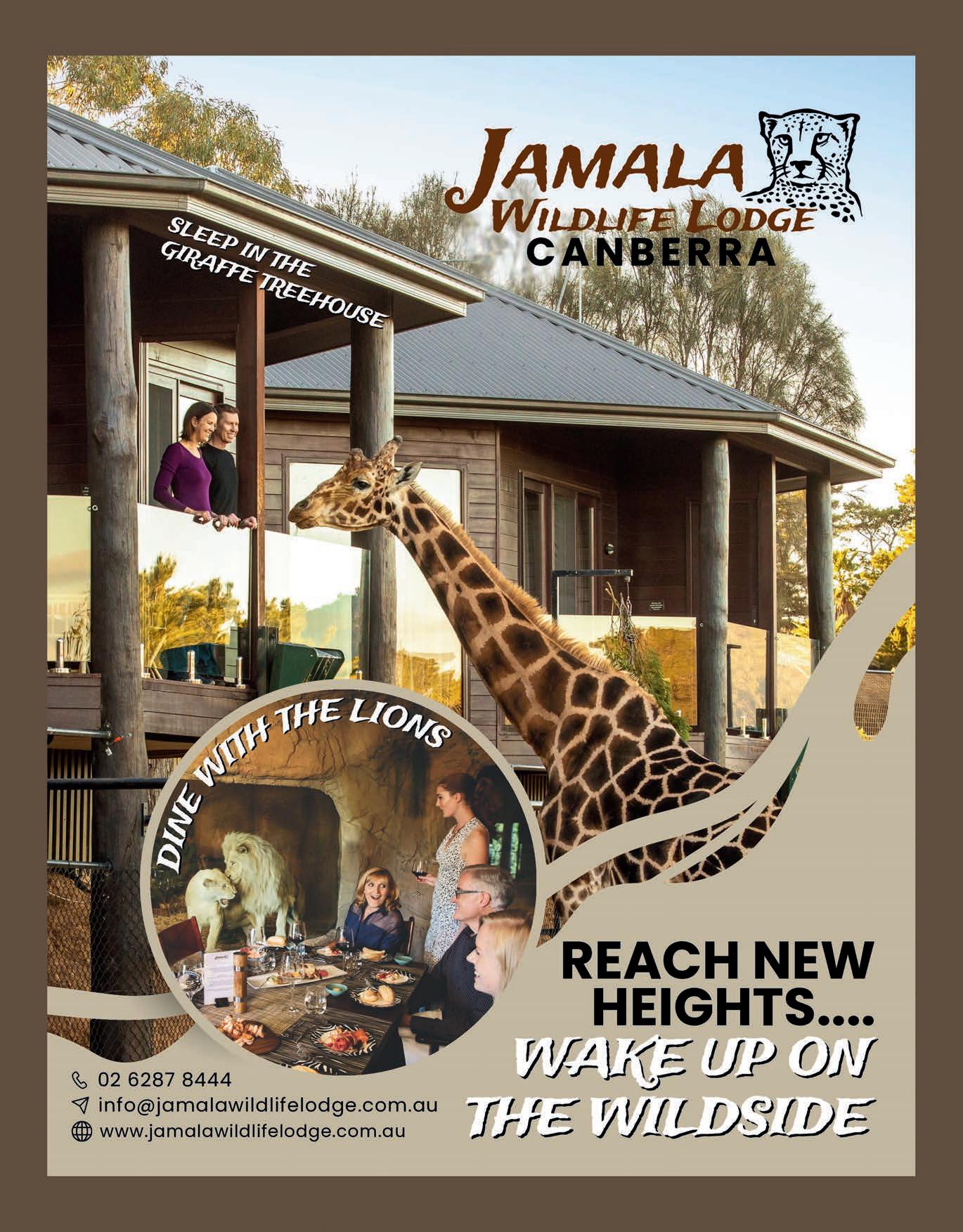

If you’re looking for an exciting yet luxurious adventure, look no further than Jamala Wildlife Lodge.
Blending immersive wildlife encounters with all-inclusive luxury, Jamala is a destination in its own right and is perfect for travellers who value unique experiences, comfort and stories worth retelling long after the journey ends.
Nestled within the grounds of the National Zoo and Aquarium, in the heart of Canberra, Jamala Wildlife Lodge offers a variety of opulent safari-style suites and bungalows that not only boast sublime African art and decor but are also surrounded by some of the world’s most magnificent and endangered animals.
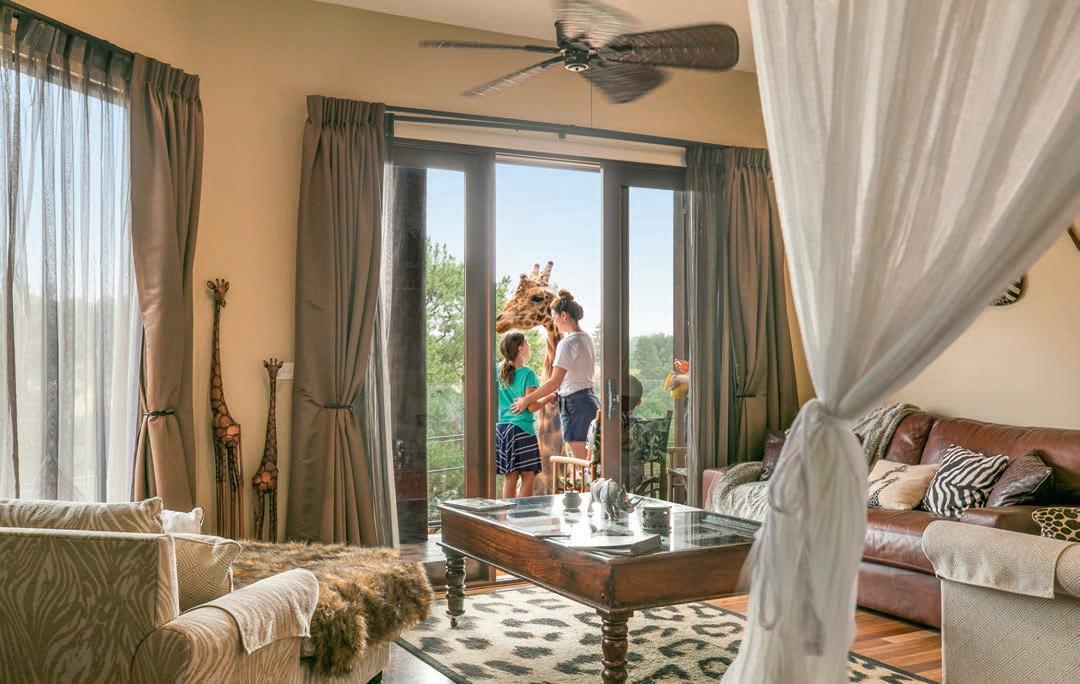
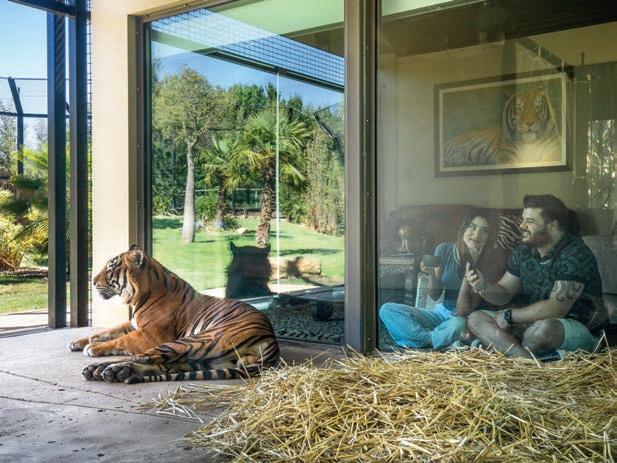
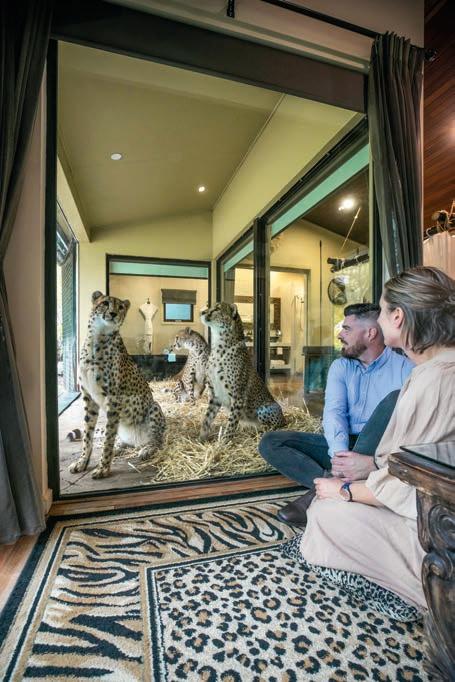
You can choose your adventure from a number of options, including the magnificent Jungle Bungalows. There are just five of these and they are set directly beside the habitats of lions, cheetahs, tigers or sun bears. These private retreats place you just centimetres from some of the world’s most
powerful animals. Floor-to-ceiling glass creates an intimate connection that feels thrilling yet serene, whether you’re waking to the deep roar of a lion or watching a cheetah stretch in the morning sun. Inside, the bungalows deliver premium comfort, which creates an ideal balance of wild and refined. Alternatively (or stay longer and do both), the Giraffe Treehouses are elevated above the giraffe habitat and provide views of the Molonglo River and Black Mountain Tower. These rooms offer guests the rare opportunity to hand-feed giraffes directly from their private balcony. It is a moment that feels both surreal and grounding, creating a lasting connection to wildlife that few experiences can match.
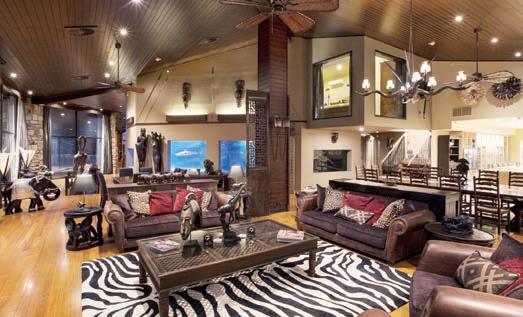
uShaka Lodge is a beautifully appointed African-themed lodge that immerses guests in a vibrant world of wildlife and culture. The grand lounge showcases striking artworks and artefacts from across the African continent, creating an atmosphere that feels both elegant and adventurous. Each suite provides a luxurious stay, with options including sleeping alongside a family of meerkats, ring-tailed lemurs, or a journey under the sea where you will observe shimmering tropical fish from your plush bed. If animal encounters are where your heart lies, you will find the perfect stay in the Shark Grand Suite or Wild Encounter Room. Beyond your bedroom, you have full access
to enjoy the Lodge, which was once the owner’s personal residence. One side of the grand lounge room features a stunning 200,000-litre shark tank, while a playful family of colobus monkeys enlivens the other, offering endless fascination for guests. Step outside to the swimming pool and spa. Beyond the accommodation, Jamala’s all-inclusive stay unfolds at a leisurely pace. Afternoons begin with high tea in uShaka Lodge, enjoyed alongside the gorgeous shark tank and colobus monkeys. This is followed by a guided behind-the-scenes tour, where expert zoo guides share fascinating insights into animal care, conservation efforts and the personalities of Jamala’s residents. It is a rewarding experience for curious travellers.
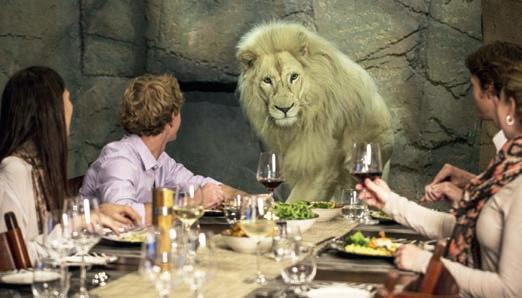
As night falls, dining becomes an experience in itself as guests are treated to a four-course dinner in the Rainforest Cave, accompanied by the presence of white lions or hyenas. Alternatively, or on the second night, dinner may be enjoyed next to the shark tank with fine wines and Moët Champagne included, it is the perfect way to unwind after a day of discovery.
Jamala Wildlife Lodge is more than a stopover. It invites you to slow down, settle in and fully immerse yourself in your surroundings. For road trippers, it stands out as a highlight of the journey and a rare opportunity to combine luxury, wildlife and adventure in a single unforgettable experience.




Jamala Wildlife Lodge
jamalawildlifelodge.com.au











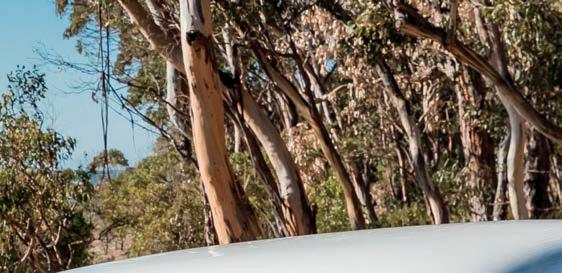
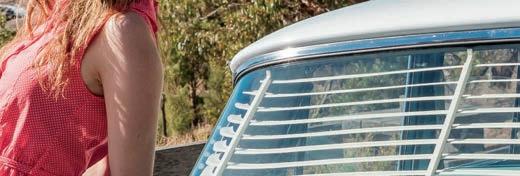
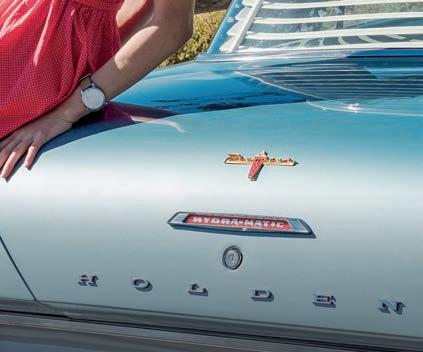




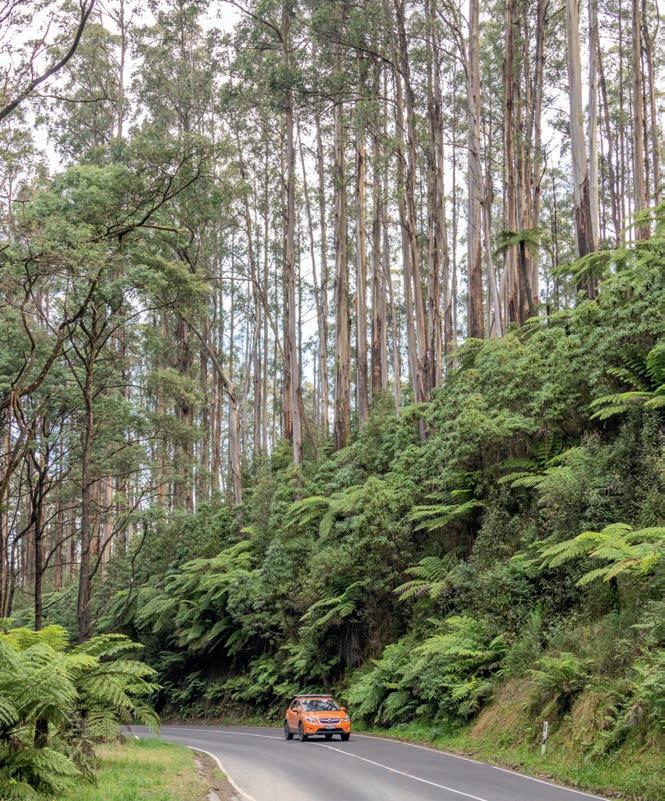
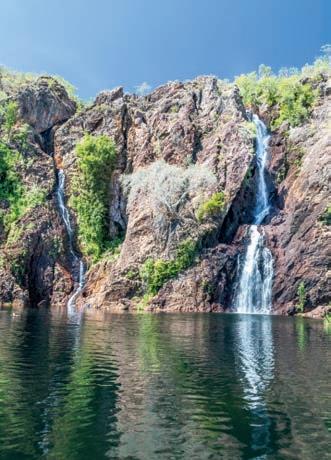









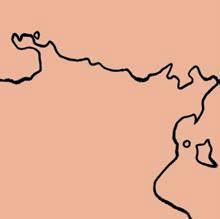

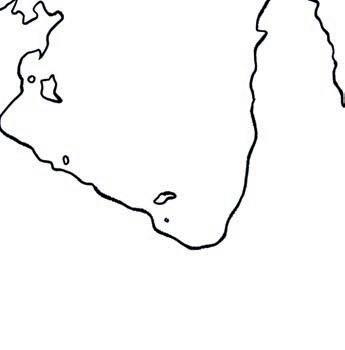


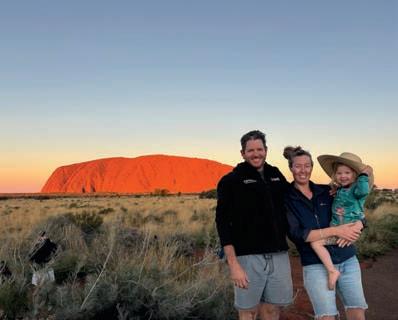
















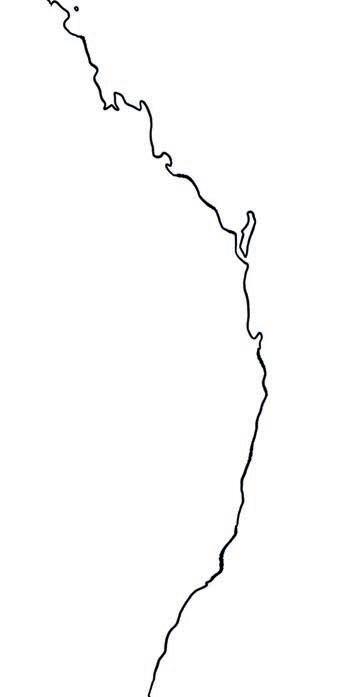







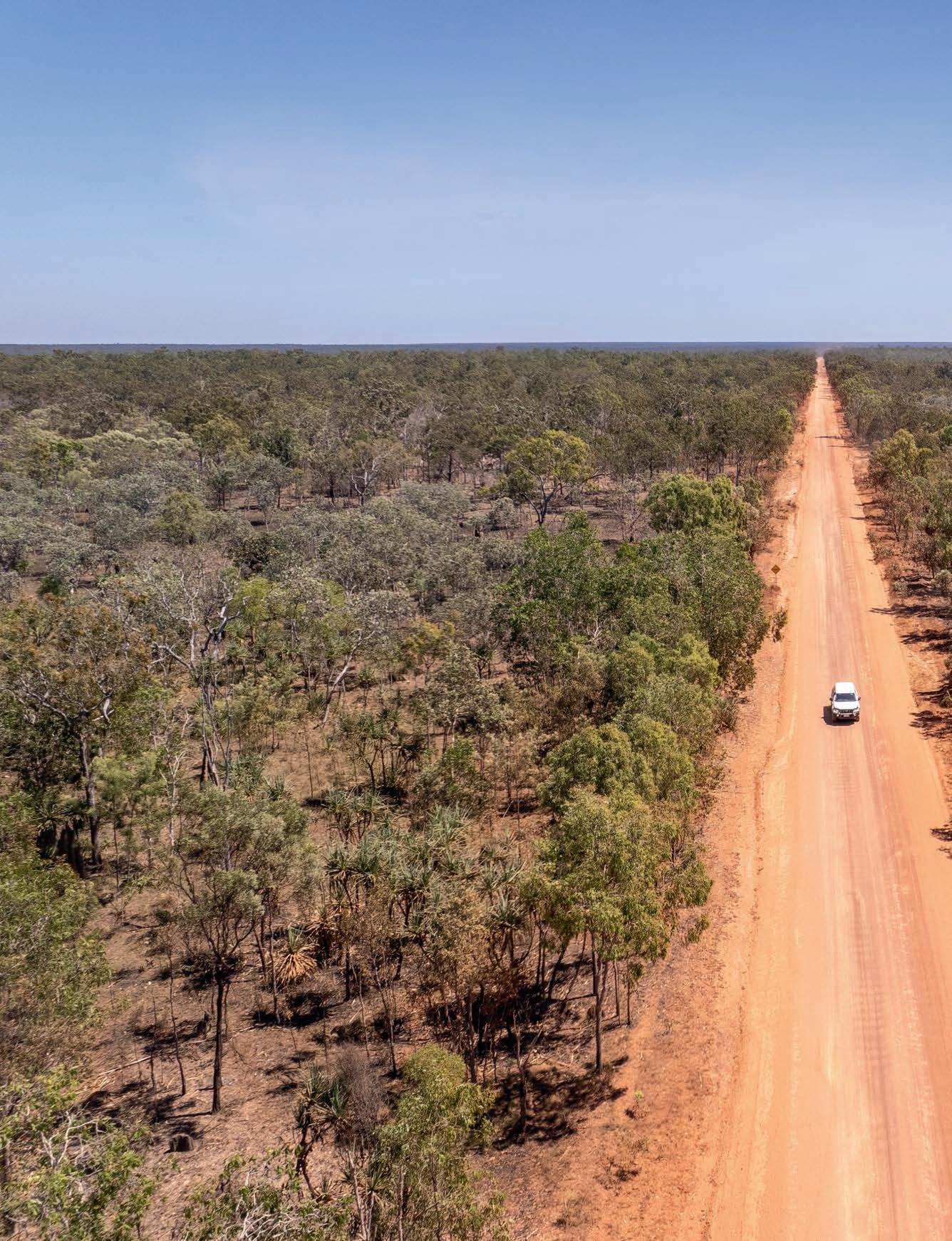
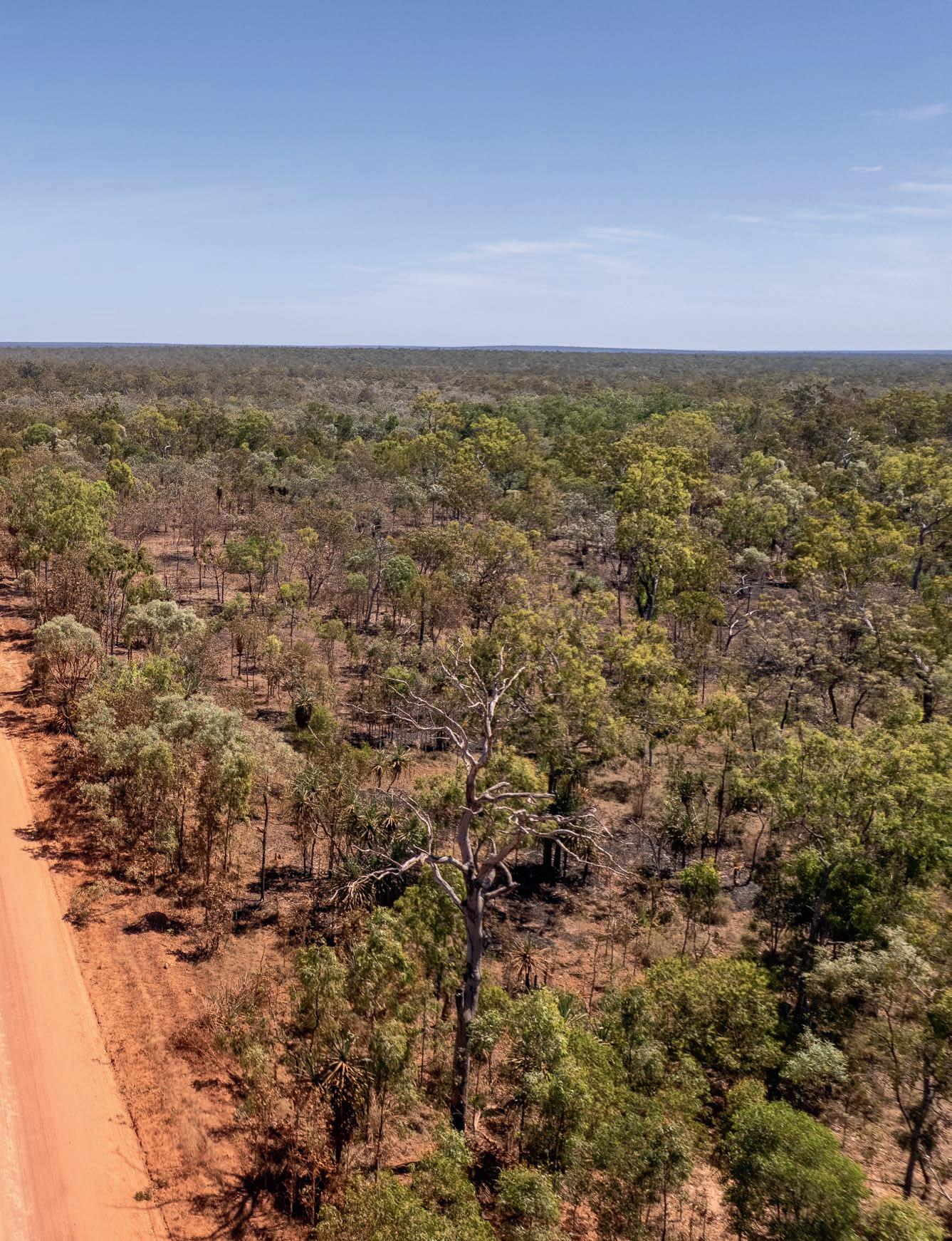
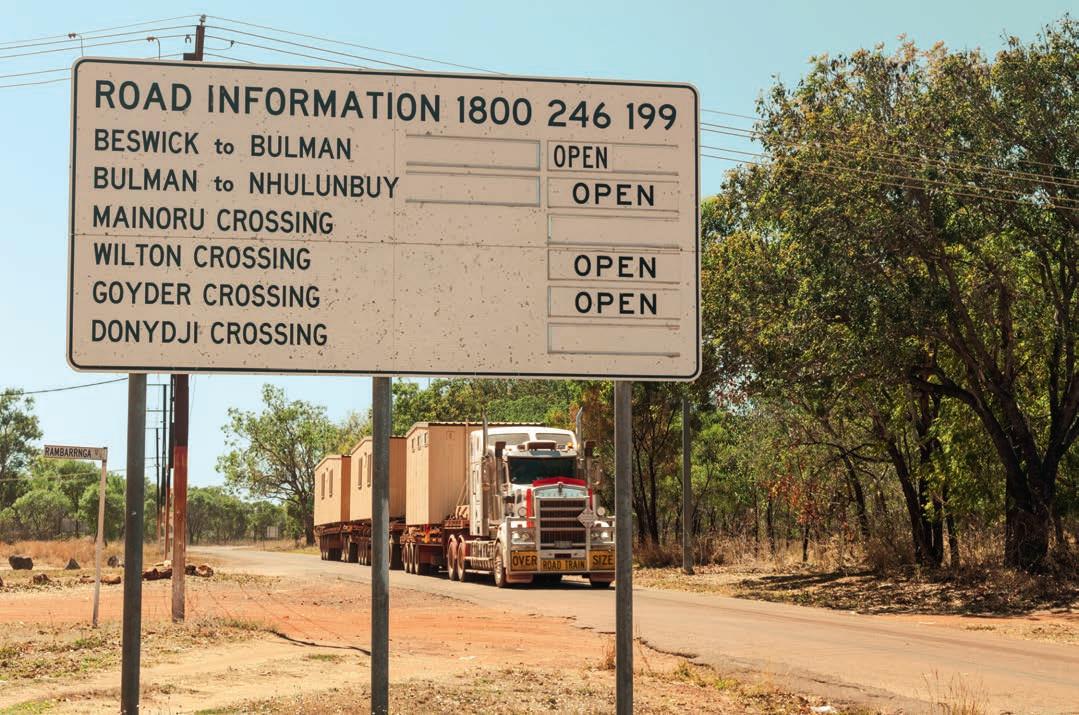
Expect to encounter buffalos and bulldust on the Central Arnhem Road from Katherine to the remote outpost of Nhulunbuy, in the north-east of the Northern Territory.
NORTHERN NT | 10-14 DAYS
BY KIRSTY MCKENZIE, PHOTOGRAPHY KEN BRASS
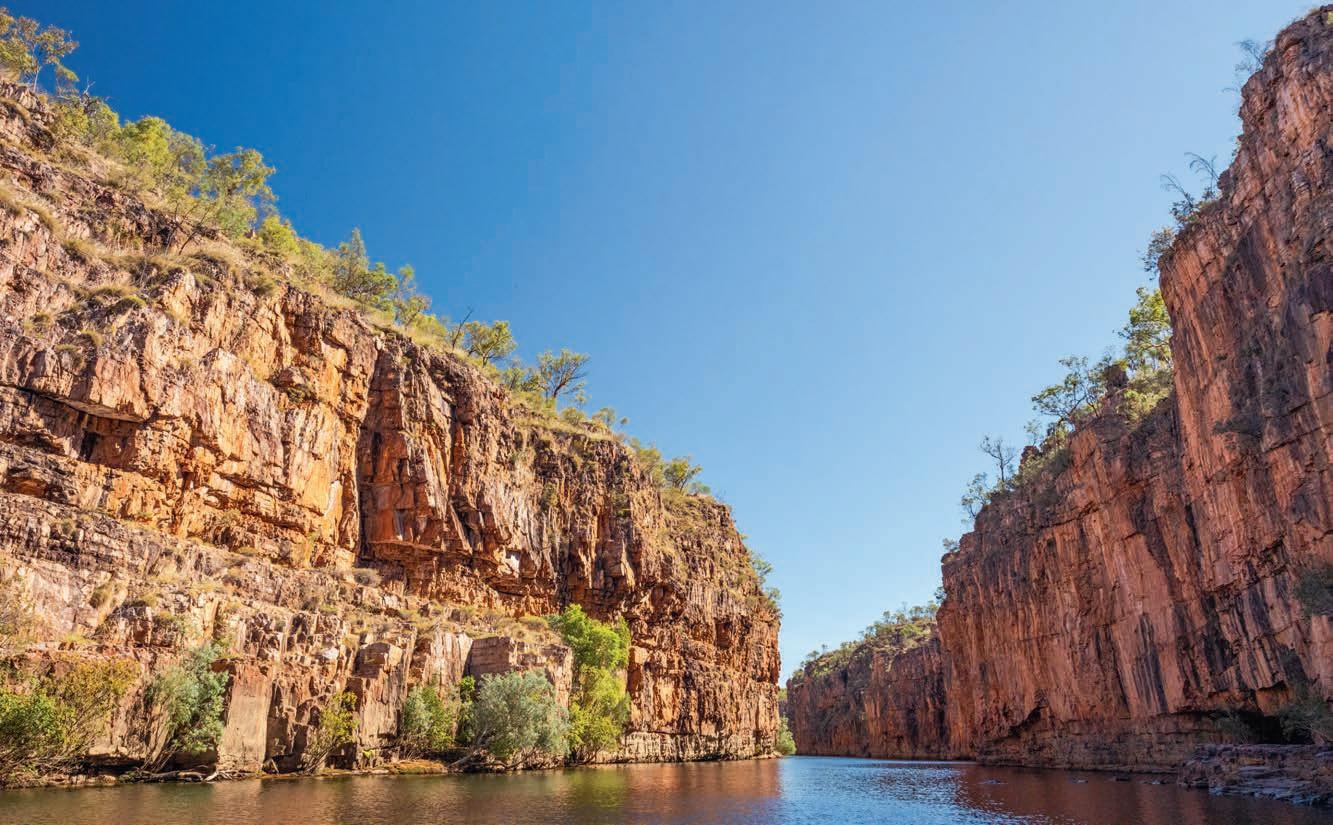
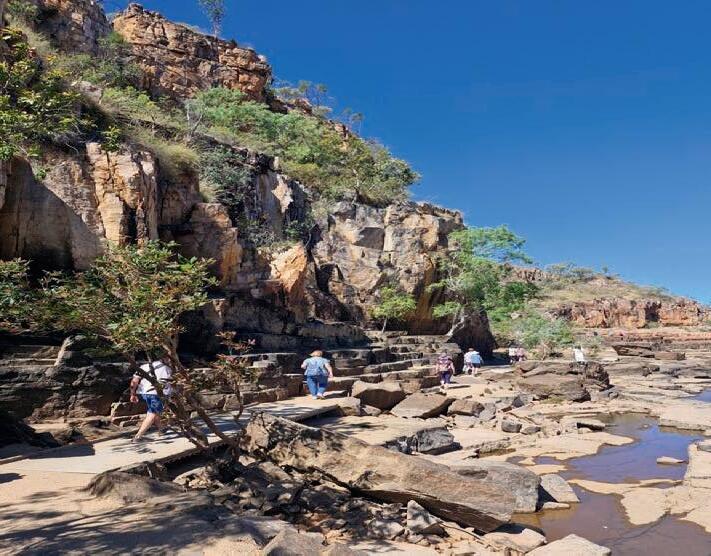
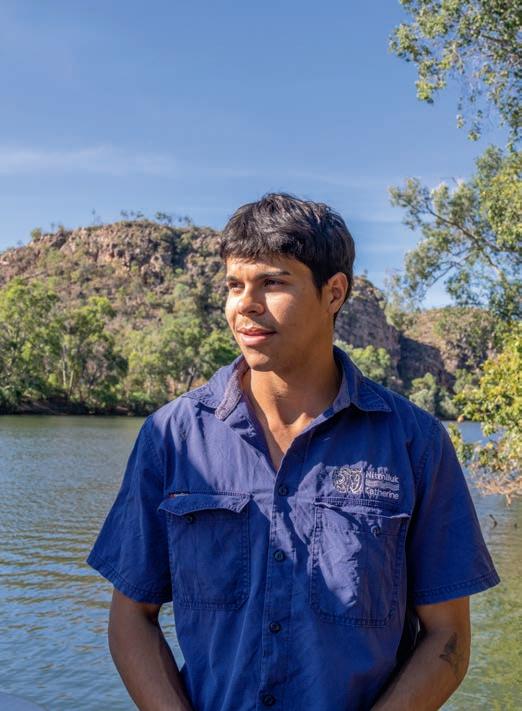
Landon McElhone points to some debris caught in a crevasse high in the cliff face in the first of the 13 gorges that the Katherine River runs through in Nitmiluk National Park. The young Wardaman man from the south-west of Katherine in the Northern Territory’s Top End shares a wealth of knowledge about the region and its natural and social history in his role as a tour guide at Nitmiluk Gorge.
He explains that the park’s name comes from the word “nitmi”, which means the sound of cicadas in the language of the Jawoyn people, the Traditional Owners of the land that’s traversed by the spectacular gorges, management of which was finally returned to its rightful owners in 1989, following an 11-year land rights claim.
“The Katherine River has an average depth of seven metres,” he says. “But during The Wet, we can get up to 1000 millimetres of rain and the river becomes a torrent that can double to a depth of 14m. That’s how broken branches and other debris come to end up so high in the cliffs.”
Landon goes on to explain that when it floods, the river becomes a “croc highway” with saltwater crocodiles being swept down from high on the
THESE PAGES: Waradaman man Landon McElhone is a First Nations guide on Nitmiluk Tours of the spectacular gorges that the Katherine River runs through in Nitmiluk National Park.
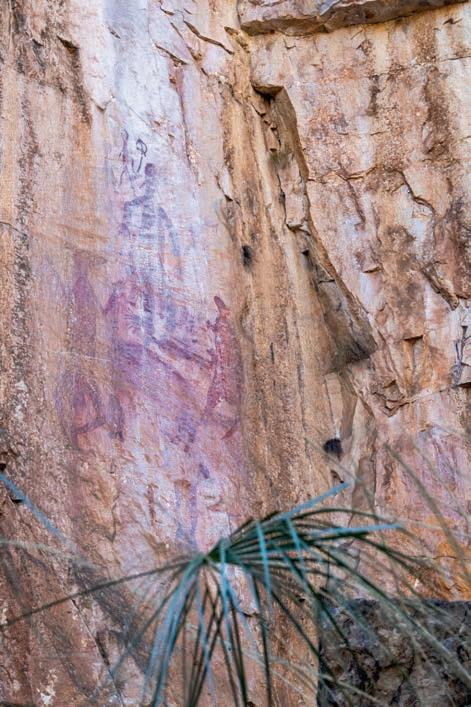
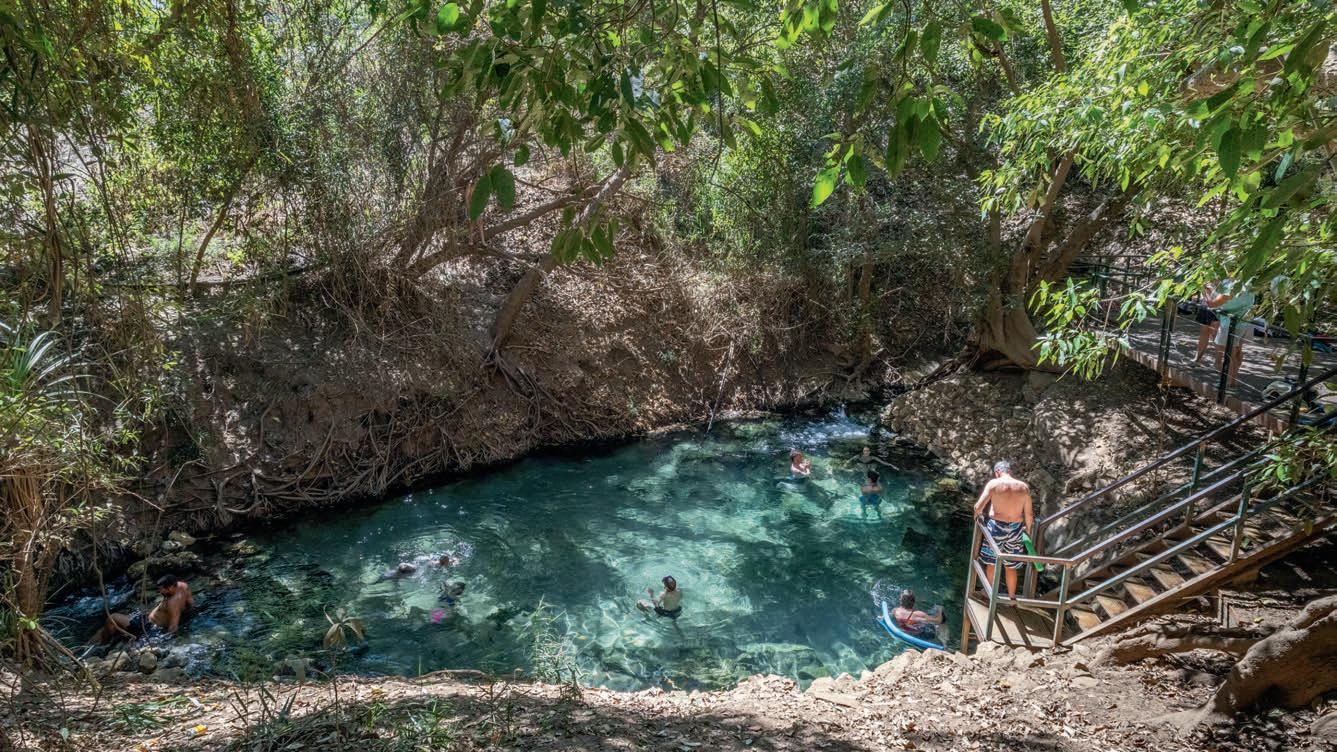
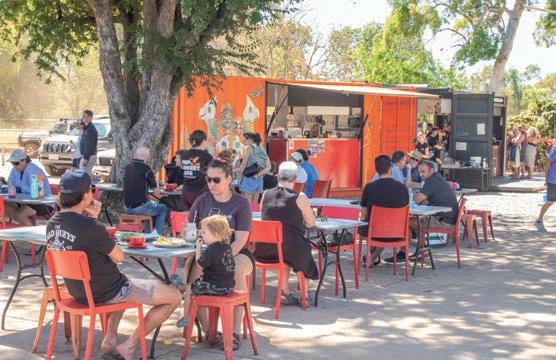
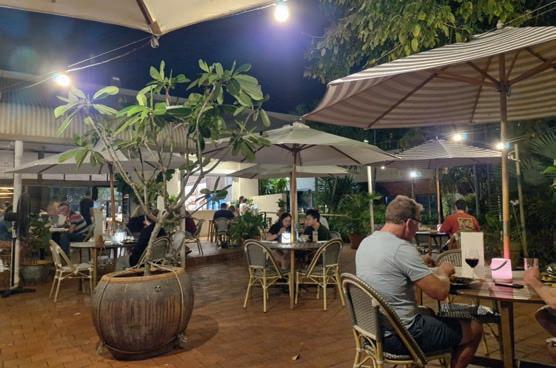
(Clockwise from above) A dip at Katherine Hot
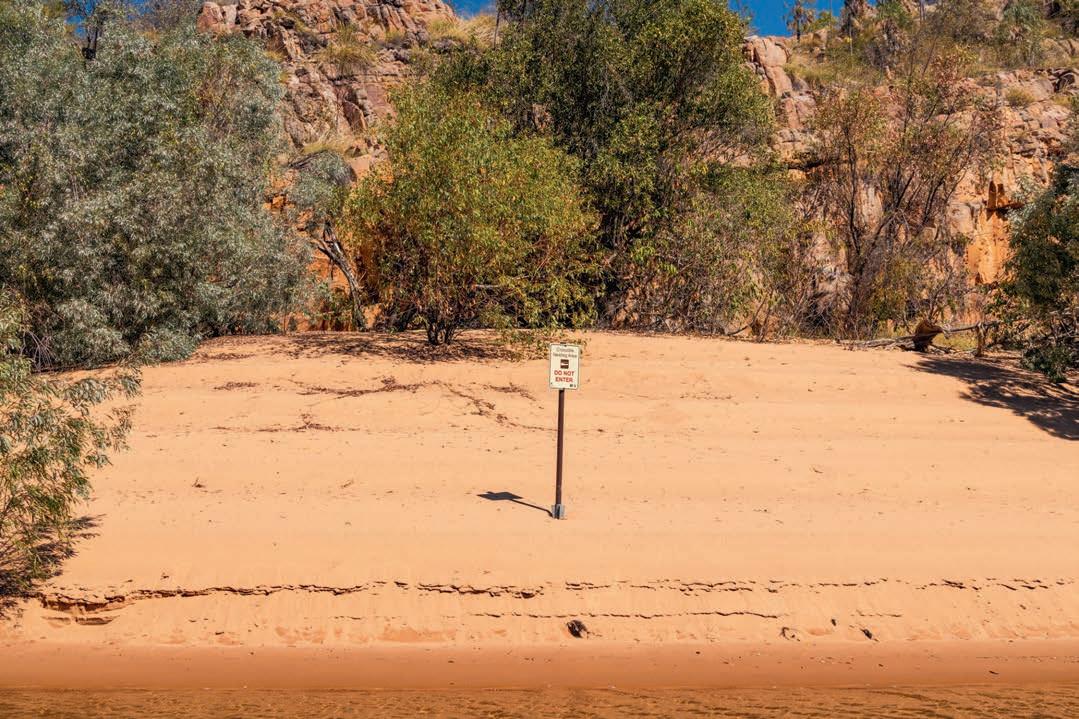
Arnhem escarpment, where they compete with the more docile freshwater crocs that lay their eggs in the sandy stretches lining the riverbank. “Rangers clear the river of salties before the tourist season starts and constantly monitor for them. Only one to two per cent of croc eggs make it to adulthood,” he says, pointing to a sign warning visitors not to walk on these nesting grounds. “But salties are not the only predators — turtles, goannas, water monitors, even big fish and birds will eat hatchlings.”
Cruising up the gorges is a highlight of any visit to Katherine. Nitmiluk Tours offers a fourhour, three-gorge boat tour with walks between each gorge, as well as several shorter cruises. Alternatively, you can experience the spectacle of the soaring sandstone cliffs via walking trails along the escarpment in the western end of the park, or by canoe. With Landon’s croc talk still front of mind, we head back to town for a dip at the thermal pools known as Katherine Hot Springs. Hot is a bit of a misnomer as the temperature is more like a lukewarm bath, but it’s still a pleasant spot to take refuge in the shade of the overhanging trees and cool off on a hot day. Like all the waterways in this part of the world, freshwater crocodiles do enter the springs, which are closed during the wet season when salties
can also be present. Schedule time for lunch or a drink and snack at Pop Rocket Cafe, located near the carpark.
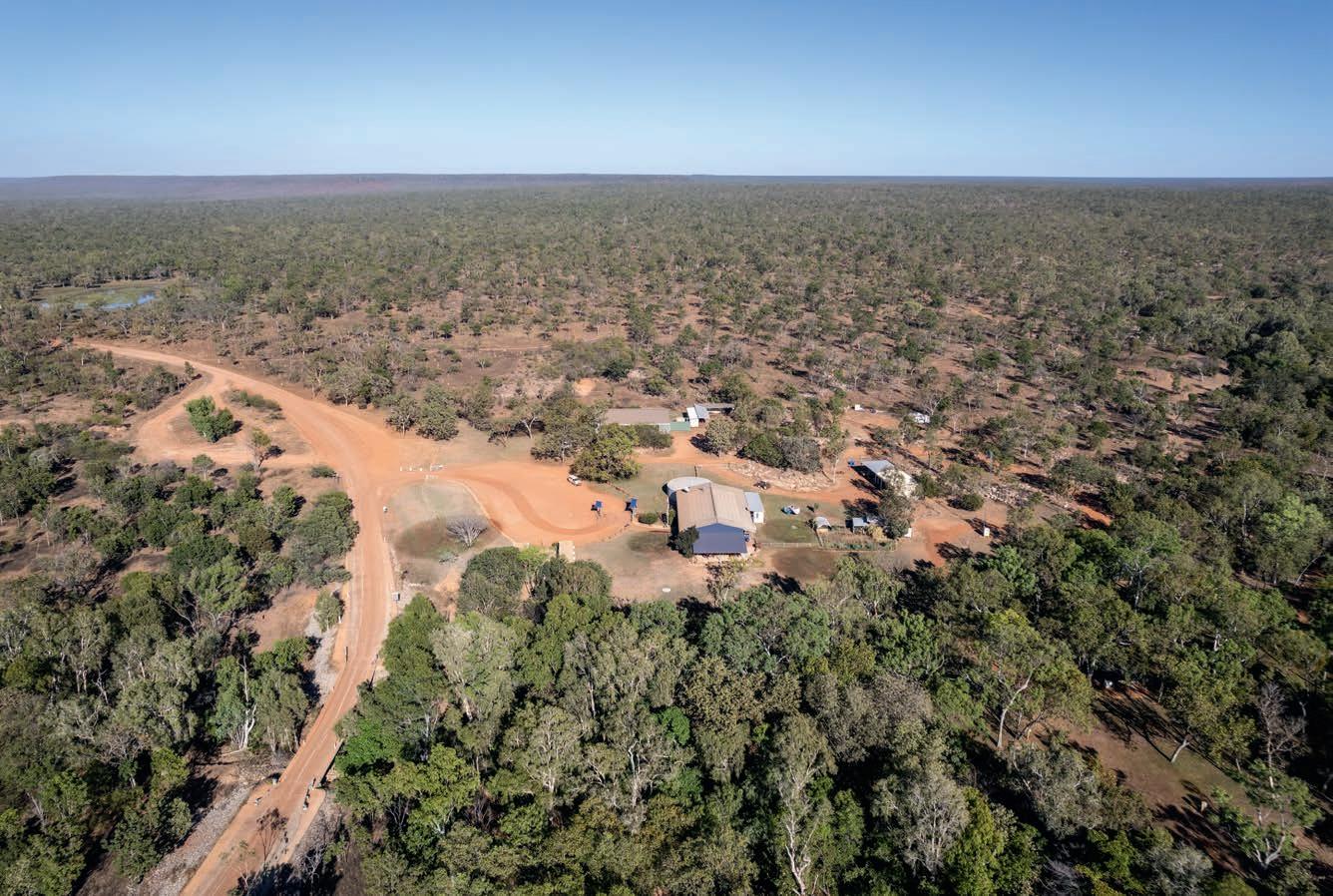
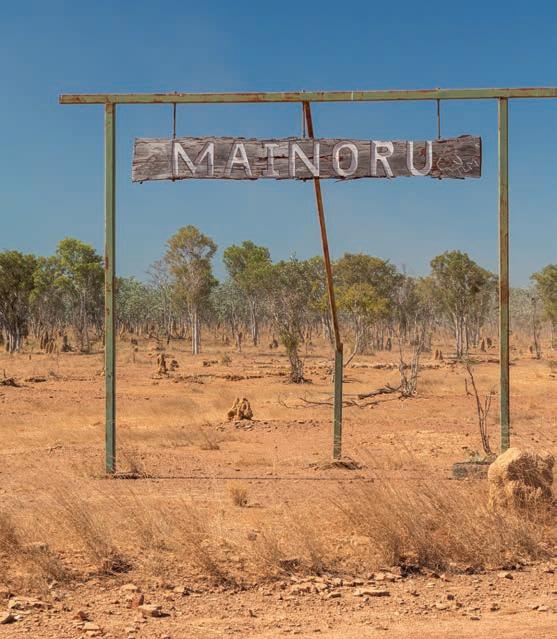
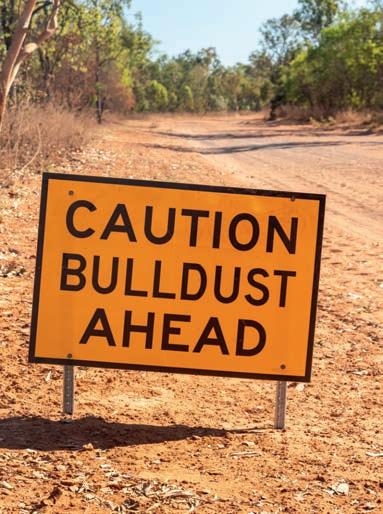
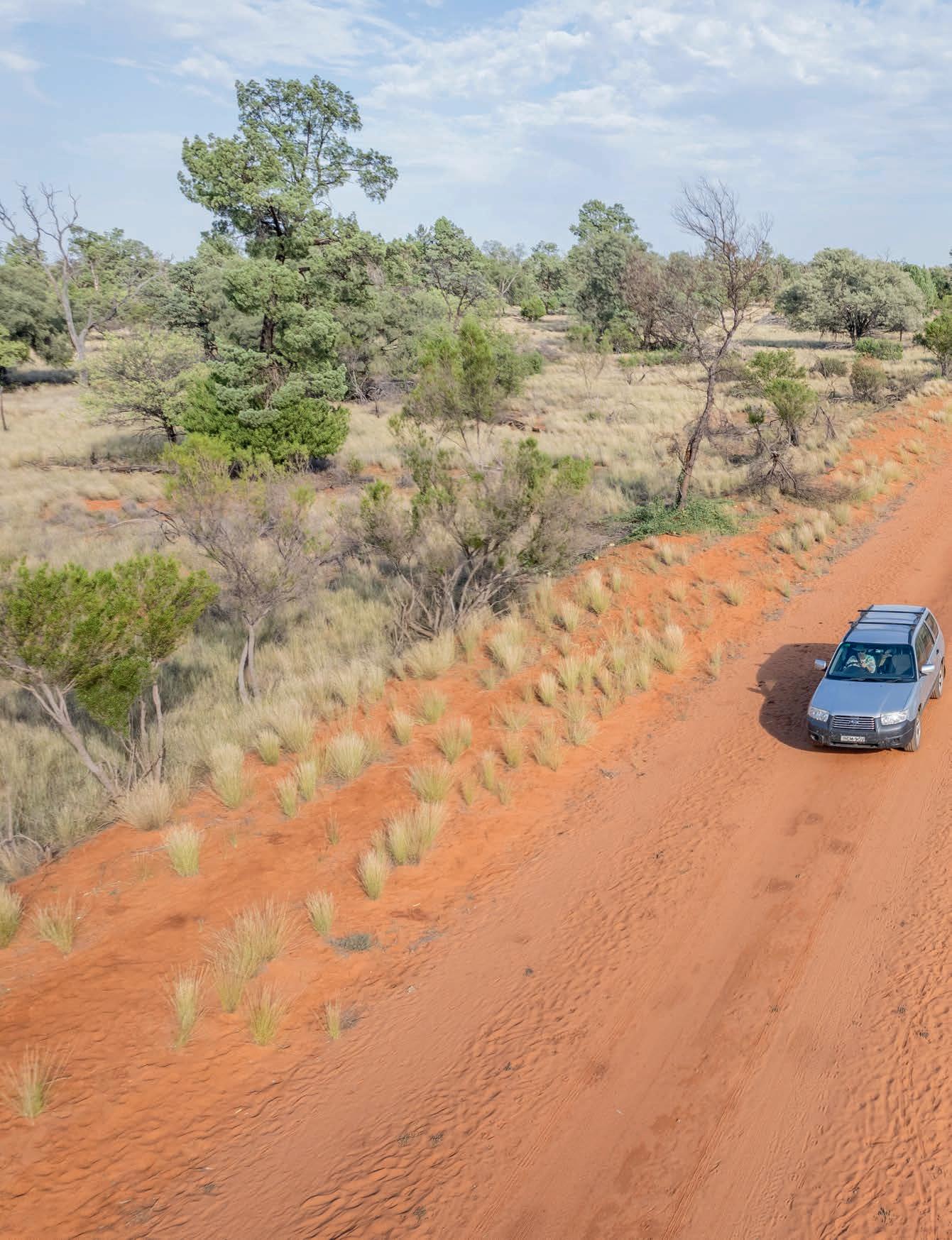
Fed and watered, we stop at the supermarket to stock up for the real purpose of this trip, which is driving the Central Arnhem Road to the remote community of Nhulunbuy in north-east Arnhem Land. This route, which leaves the Stuart Highway 50 kilometres south of Katherine, is not for the faint-hearted, as it’s 675km of mostly dirt road from the turnoff to the bauxite mining town of Nhulunbuy (formerly known as Gove) on the western edge of the Gulf of Carpentaria. The road traverses through cattle stations and Indigenousowned land and travellers must obtain a permit from the Northern Land Council to use it. There’s only one designated place to break the trip, a little riverside oasis with a roadhouse, camping ground and donga accommodation called Mainoru Outstation Store, almost 200km from the highway. Apart from its remoteness, the Central Arnhem Road has a formidable reputation during the dry season for being dusty and rough, often corrugated and with patches of bulldust hiding in potholes that are not kind to vehicles. In The Wet, it’s infamously boggy and occasionally impassable due to washouts and flooding. The road is suf ficiently notorious to warrant its own
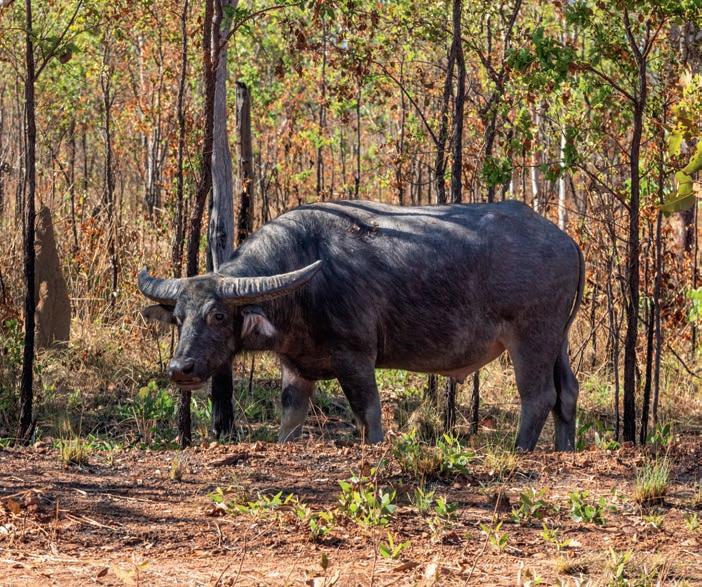
Facebook group, which keeps travellers updated on conditions as they change throughout the year. We were warned to take multiple spare tyres and watch out for livestock including cattle, buffalos and donkeys that appear seemingly out of nowhere. The side of the road is littered with vehicles that didn’t make the distance, so carrying adequate food and water in case you do break down is commonsense.
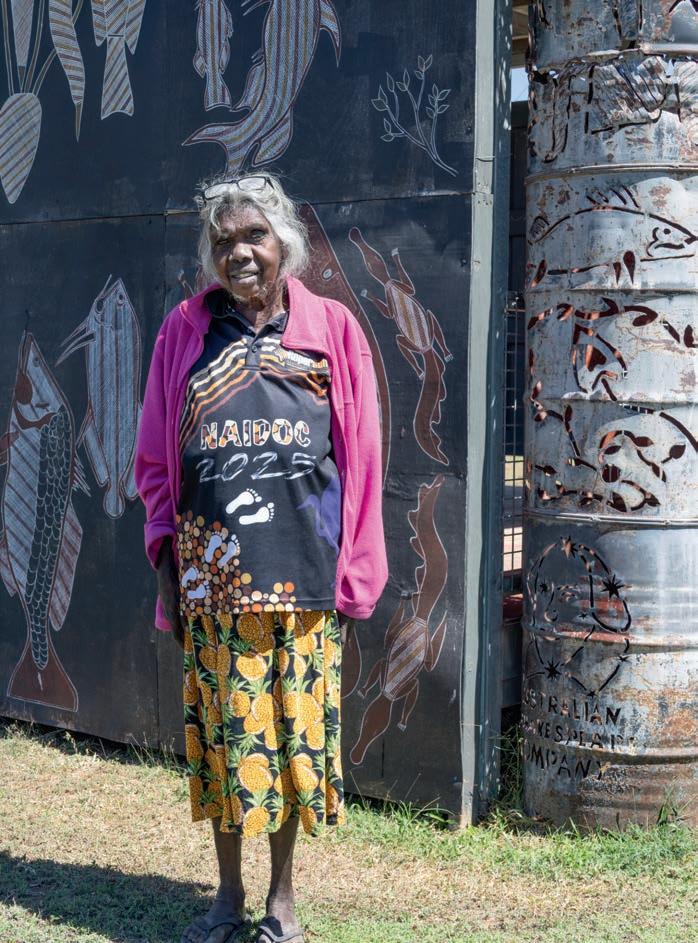
Having said that, Australian Country’s experience was mercifully uneventful and we managed to average a pretty constant 60kph for the journey, without ever needing to engage low ratio. The only misadventure was losing the CB radio aerial, which sheared off from its external mounting in a particularly corrugated section. Our first stop was in Wugularr/Beswick, about 60km from the highway, where Traditional Owner Esther Bulumbarra was waiting to show us round the Djilpin Arts Centre. The centre preserves the treasured Blanasi Collection, a showcase of significant artworks in the West Arnhem painting style curated by the late elder and didjeridu master David Blanasi. It’s also home to works by the late musician, actor and artist Tom E Lewis, who grew up in the region. There’s a retail gallery
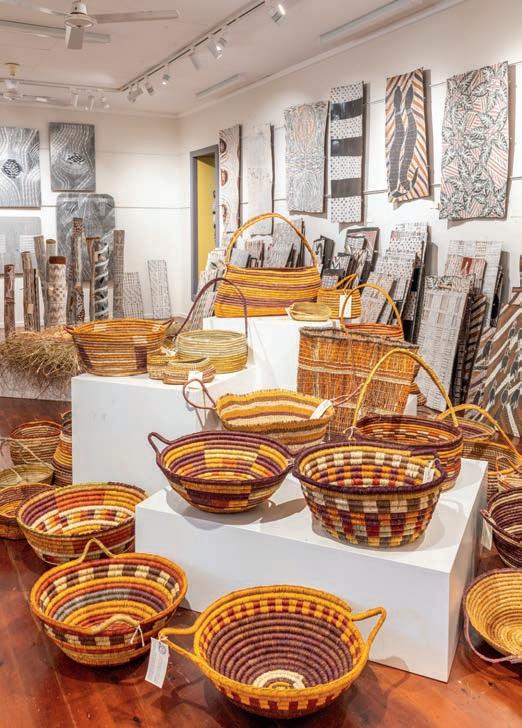
where visitors can purchase local art including prints, didjeridus, carvings, textiles and woven pandanus goods — you haven’t been to the Top End if you don’t come back with a pair of woven gunga earrings.
From there, we headed north through the community of Bulman with a stop at Jurassic Park Lookout for views across a floodplain to the Arnhem escarpment. The road continued to be relatively benign, a benefi t perhaps of the extensive maintenance it had received in preparation for the Garma Fesival, the Yothu Yindi Foundation’s annual celebration of Yolngu life and culture. Nonetheless, it was a welcome break to see the signs for Mainoru Outstation and break for the night. The roadhouse managers turn restaurateurs at night and offer a pub menu for dinner, which included a truly exceptional Mainoru Station steak.
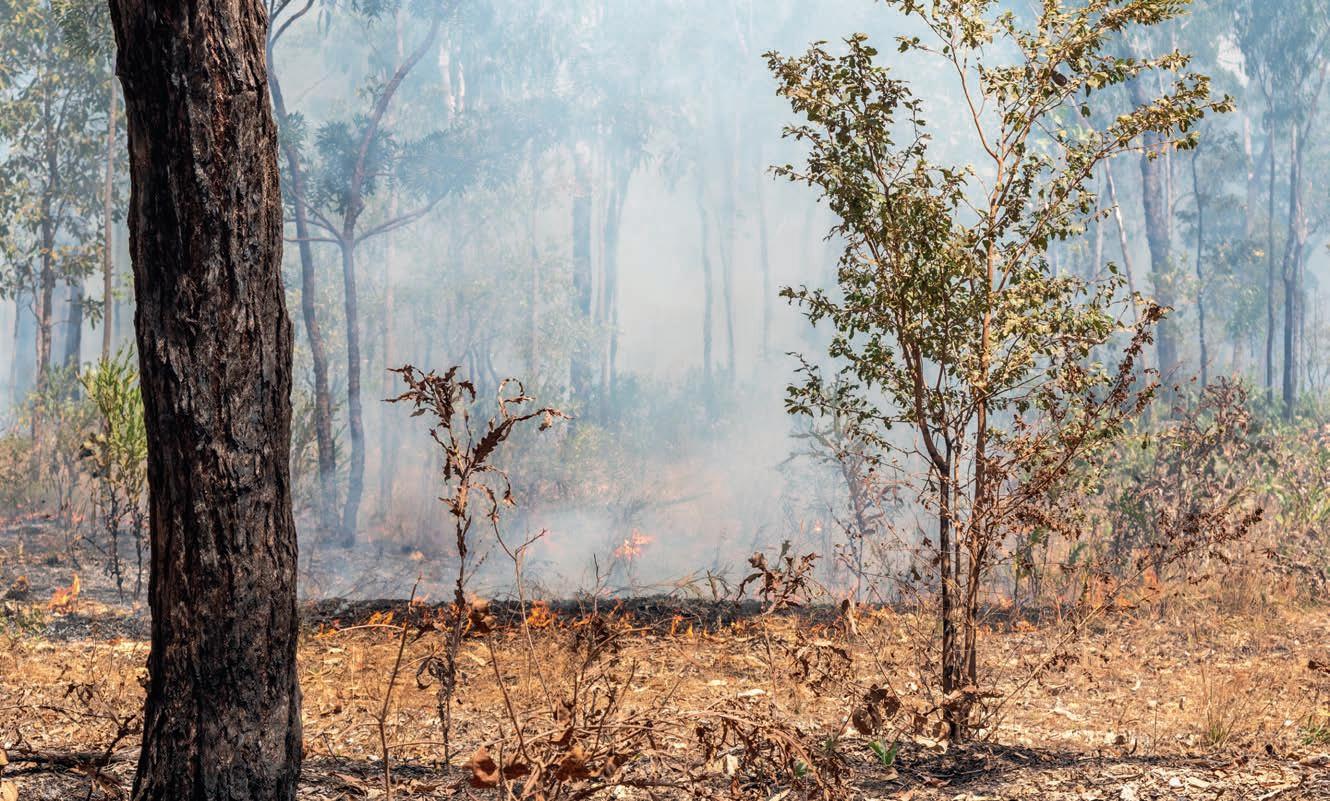
Making an early start in the morning, we completed the remaining 479km to Nhulunbuy by mid-afternoon, with time to check out the town’s beautiful, sparsely populated beaches and visit the Gove Boat Club for dinner and sunset over Melville Bay. As is the case with most of northern Australia’s coastline, it’s an exquisite form of torture to visit the sandy beaches and turquoise waters but not to be able to swim. As the signs warn, if the crocs don’t get you, the stingers will. Fishing from a boat is a safer way to enjoy the ocean and there are any number of charter companies that will take visitors out to
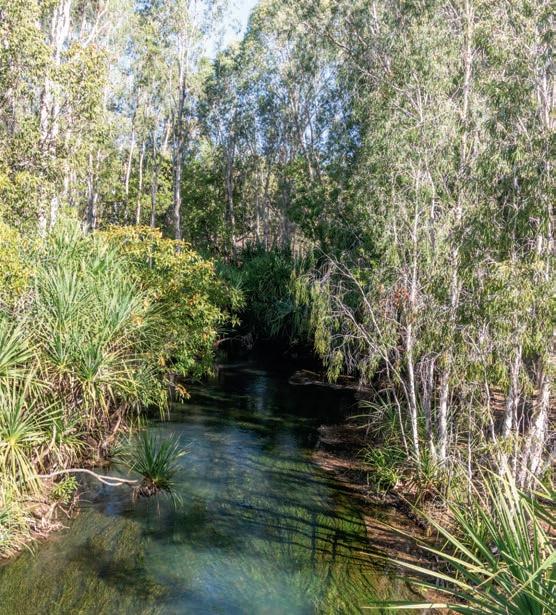
catch everything from Spanish mackerel and barramundi to red emperor. Landlubbers might opt to take the 5km walk around the Gayngaru Wetlands (Town Lagoon). The track winds through paperbark forests and twitchers may be rewarded with sightings of northern fantails, blue-faced honeyeaters, white-bellied cockatoo shrikes and brown falcons.
The Buku-Larrnggay Mulka Art Centre is at Yirrkala, about 18km south of Nhulunbuy. The history of this truly international art centre dates back to 1935 when the township was founded as a mission. Work from Yirrkala was among the earliest commercial Aboriginal art marketed by Methodist Overseas Mission.
There is strong evidence to suggest that the art emerging from Yirrkala in the mid-1950s was a catalyst in the non-Aboriginal art world’s realisation that Indigenous Australian art is a unique and profound independent art tradition — the equal of any other global form.
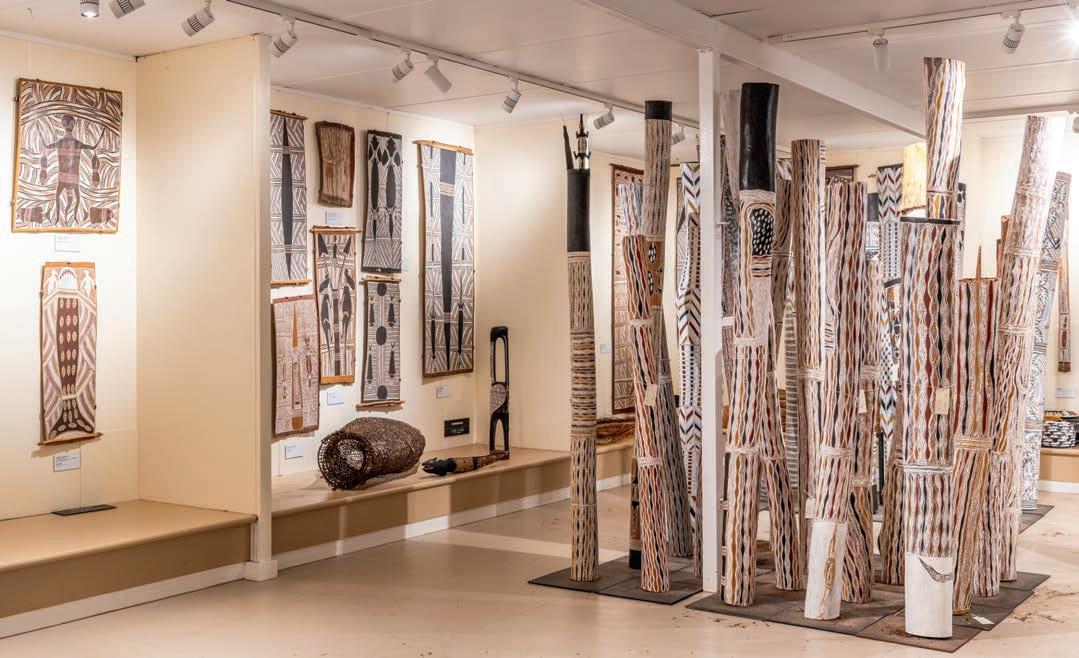
The artists of Yirrkala were among the first Indigenous Australians to recognise the potential use of visual art as a political tool and put this into practice with the now famous Yirrkala Church Panels (on display in the museum) and Yirrkala Bark Petition (on display at Parliament House in Canberra), dating from 1963, as well as the Wukidi Installation in The NT Supreme Court in Darwin. The Saltwater Collection of 80 bark paintings by
47 Yolgnu artists now in the Australian National Maritime Museum played a major role in the High Court’s 2008 determination that the Yolngu were the owners of sea estates covering Aboriginal land. When government policy shifted and selfdetermination came to communities in Arnhem Land, the artists saw the establishment of the community-controlled art centre as critically important to further their economic independence, cultural security over sacred designs and to maintain political and intellectual sovereignty. Yolngu culture is based on a strong sense of connection to land and sea and the Yolngu people traded and intermarried with Macassans from what is now the Indonesian island of Sulawesi for hundreds of years before European settlement. There are many artefacts and drawings in the museum recording these relationships and the centre is also the place to buy paintings, prints, carvings including yidaki (dijeridus) and larrakitj (memorial poles) and woven goods.
If you time your visit for late afternoon, take a detour on the way back to town to visit Banambarrnga/Rainbow Cliff for sunset. For dinner, perhaps head to Latitude 12 in the Walkabout Lodge for a tropical menu with an Asian accent.
Banubanu Beach Resort at the top end of Dhambaliya/Bremer Island is a 40-minute speed
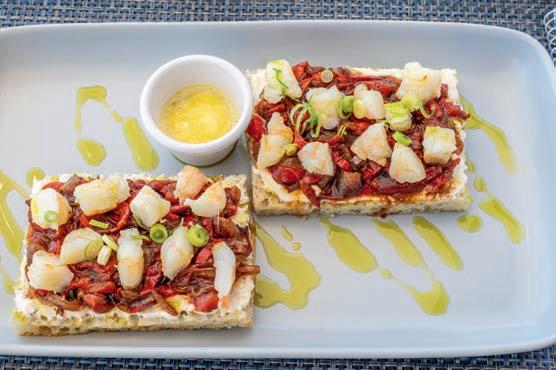
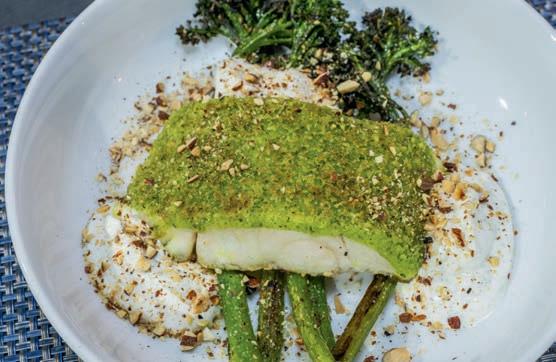
boat trip from Gove Boat Club, an exhilarating ride to what turns out to be paradise. Irish-born Eileen O’Doherty, a former vet nurse, and her Italianborn partner, Fulvio Inserra, an IT manager, took over the resort, which is on the lands of the Rirratjingu clan — the Traditional Owners of the island — at the beginning of 2025. They have big plans for the property, which currently consists of six ensuited beachfront bungalows and a central bar and restaurant hub with a plunge pool for cooling dips. Their not-so-secret weapon is their French chef/front-of-house couple, who turn the freshest of seafood and tropical produce into the kind of fare you’d expect from a fine diner. Guests are welcome to explore the island and there are kayaks and stand-up paddleboards for waterbased entertainment.
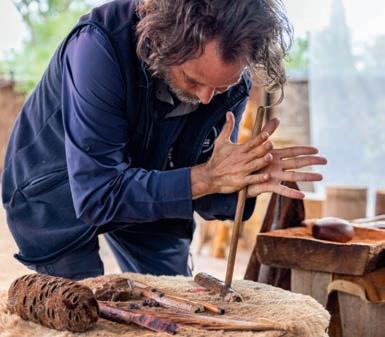
It’s a wrench to leave the island, but there are more cultural experiences beckoning on the mainland, including the opportunity to stay with the Burarrwanga family at their Bawaka Yolgnu Experience for yet more insights into the planet’s oldest living culture. Depending on the season, you could find yourself weaving and dyeing pandanus leaves, crafting fishing spears from hardwood or walking with Traditional Owners to learn about bush foods and traditional medicines. Then there’s the fishing, which is exceptional, and a tour to Ngalarrkpuy (Lonely Beach), which includes a visit to Bungugunglu, a very large, thousands-of-years-old Yolngu fish trap site. To describe it as bucket-list is an understatement, in a trip that is literally packed with privilege.
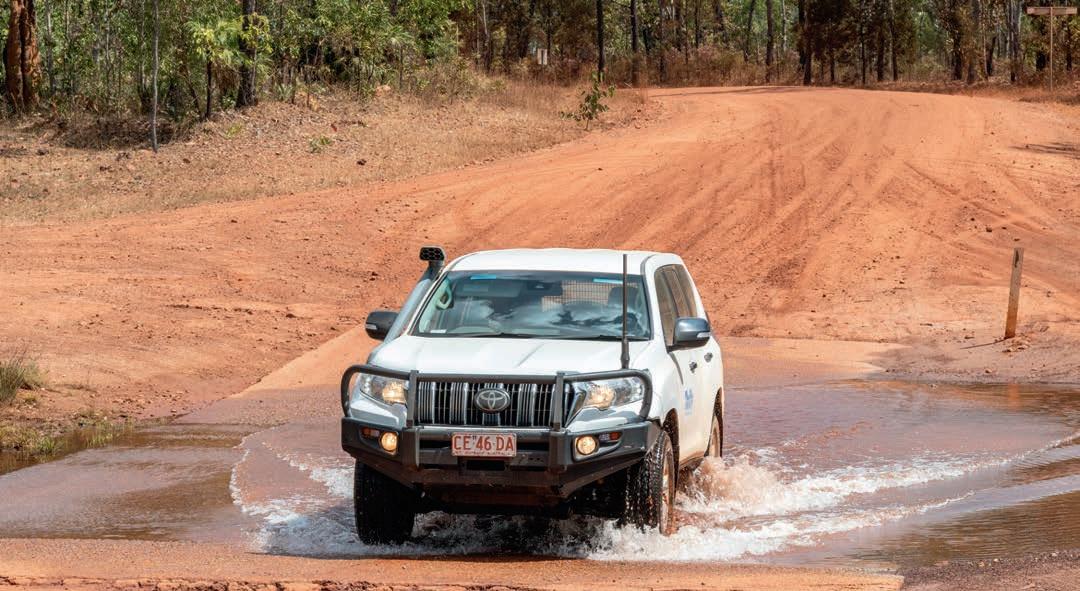
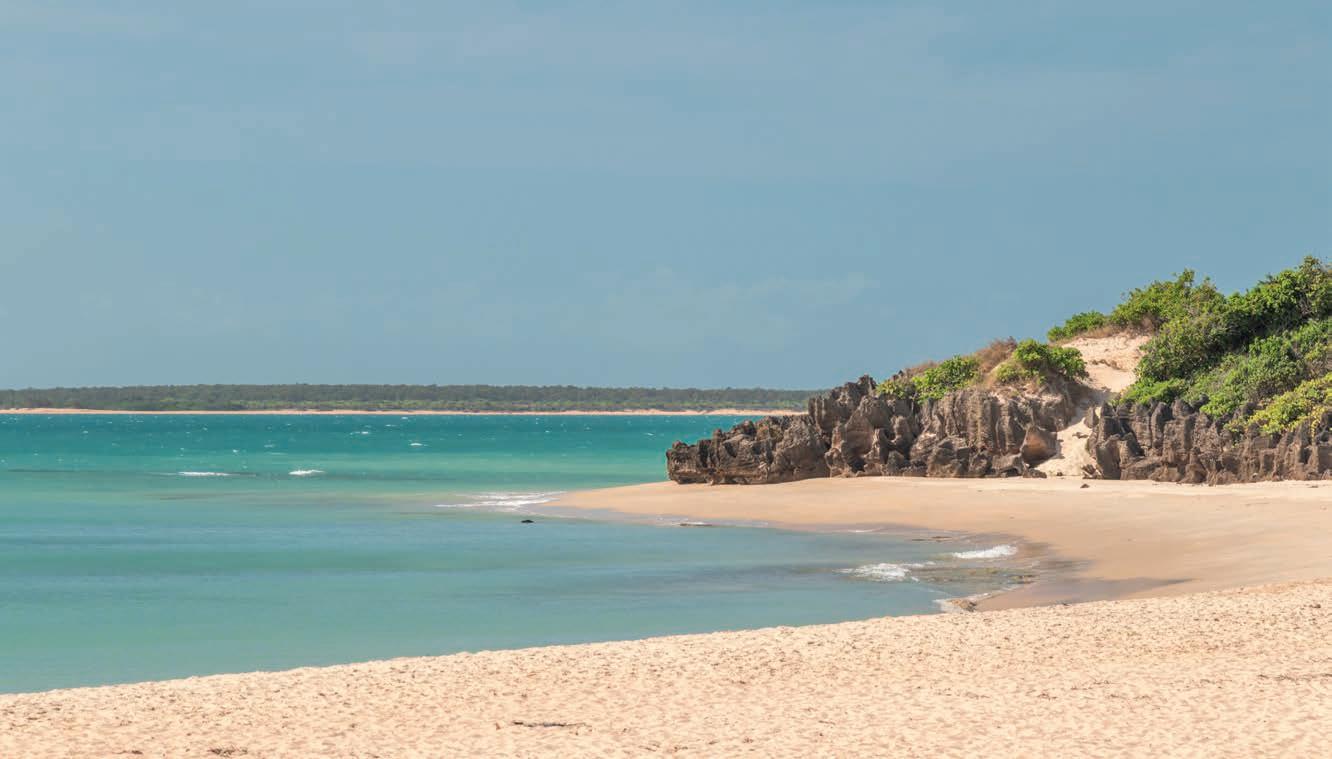
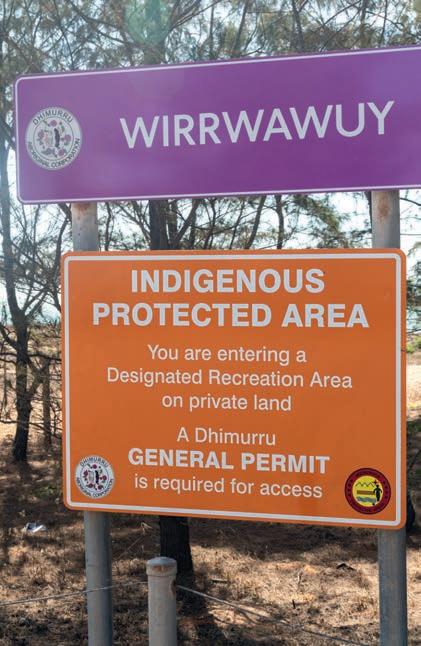
THESE PAGES: (Clockwise from above) Wirrwawuy beach; warning signs at every beach; four-wheel driving through creeks; pistachio-encrusted barramundi and prawn and roasted capsicum bruschetta at Banubanu, Bremer Island.
WHERE TO STAY
Contour Hotel, Katherine contourhotel.com.au
Cicada Lodge, Nitmiluk National Park nitmiluktours.com.au/accommodation/cicada-lodge
Mainoru Outstation Roadhouse, Mainoru Station mainoruoutstationstore.com.au
Walkabout Lodge, Nhulunbuy walkaboutlodge.com.au
Banubanu, Bremer Island/Dhambaliya banubanu.com
Bawaka Experience, Bawaka/Lonely Beach bawakayolnguexperience.com.au
PLACES TO EAT & DRINK
Pop Rocket Café, Katherine ph: 0427 348 915
Maidens Lane, Katherine maidenslane.info
Banjo’s Bar, Contour Hotel, Katherine contourhotel.com.au
Gove Boat Club, Melville Bay eastarnhemland.com.au/gove-boat-club
Rafiki Café, Nhulunbuy ph: 0456 205 142
THINGS TO DO
Nitmiluk Gorge Tours, Katherine nitmiluktours.com.au
Djilpin Arts Centre, Wugularr/Beswick djilpinarts.org.au
Buku-Larrnggay Mulka Centre, Yirrkala yirrkala.com
OBJ Fishing Adventures, Nhulunbuy objadventures.com.au
Gayngaru Wetlands, Nhulunbuy eastarnhemland.com.au/town-lagoon-tours
Northern Land Council for permits, nlc.org.au/permits
More information: northernterritory.com
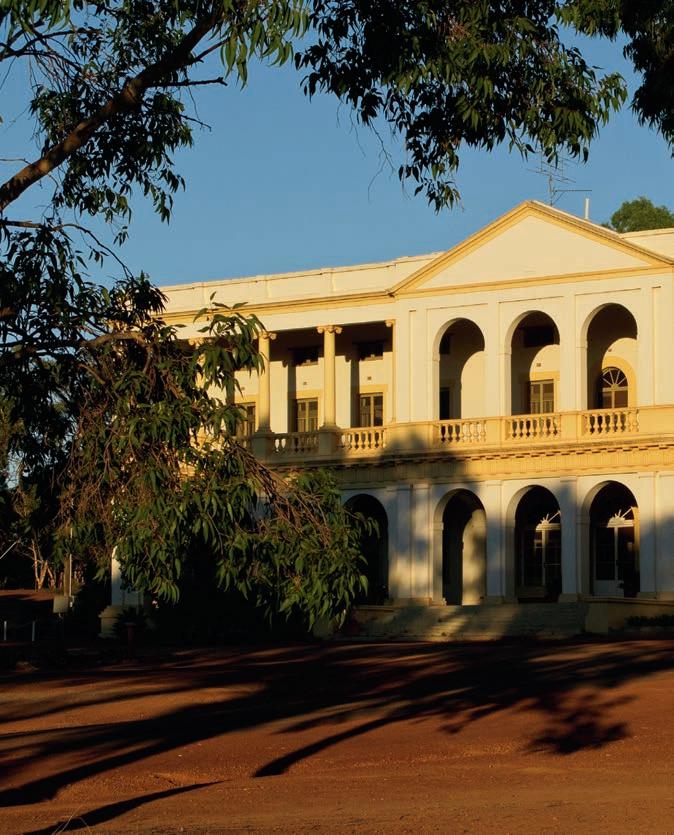
A circuit trip from Perth takes in the Benedictine community of New Norcia and some splendid natural attractions on the coast.
SOUTH-WESTERN WA| 2–3 DAYS
BY KIRSTY MCKENZIE, PHOTOGRAPHY KEN BRASS & TOURISM WESTERN AUSTRALIA
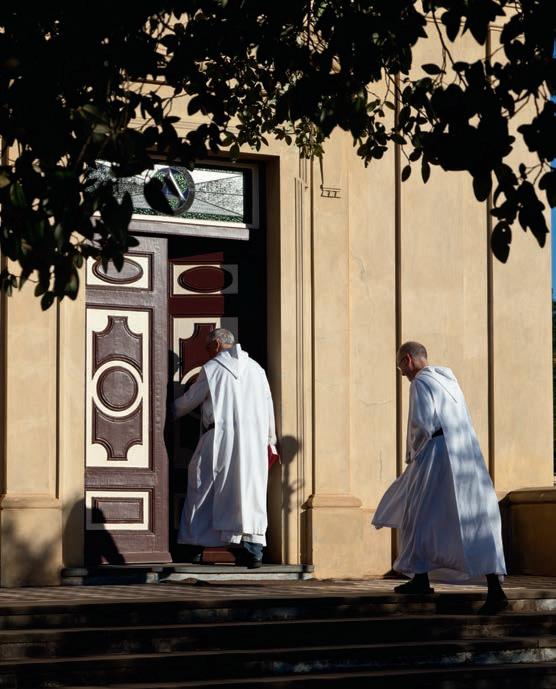
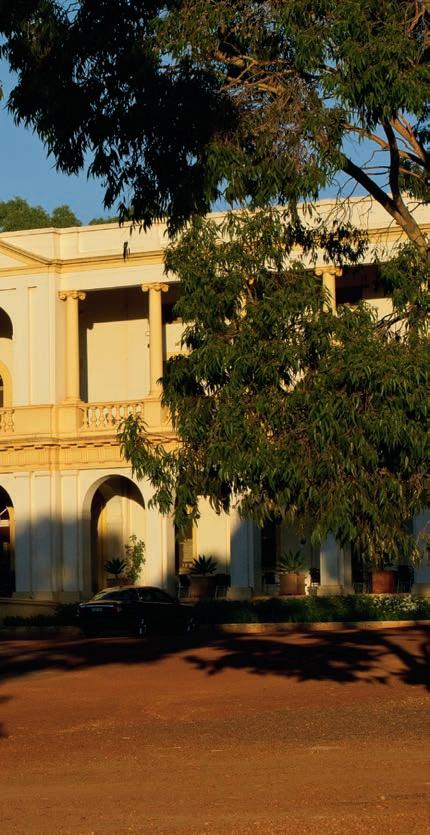
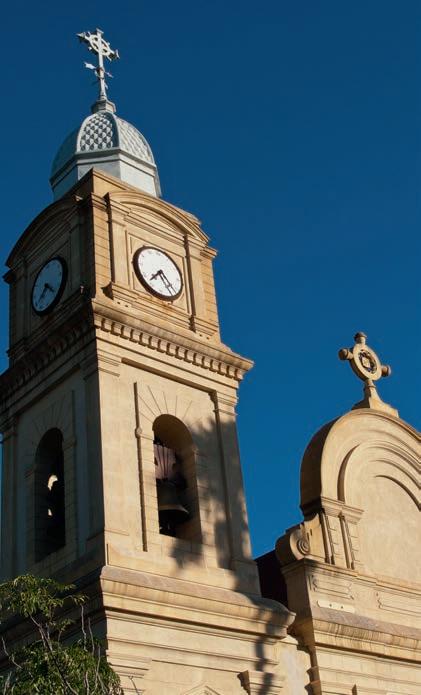
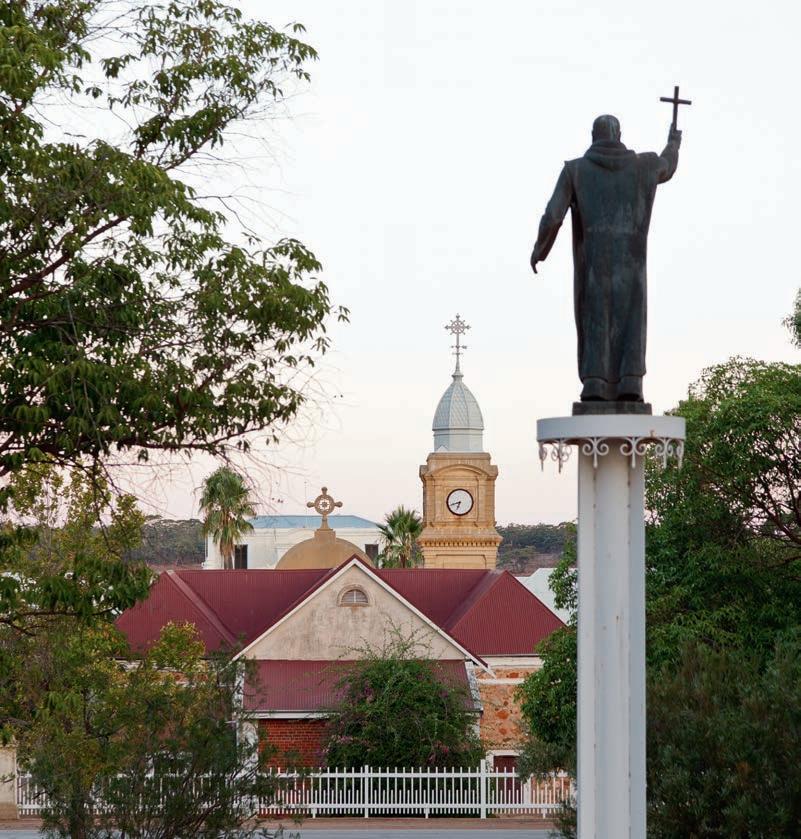
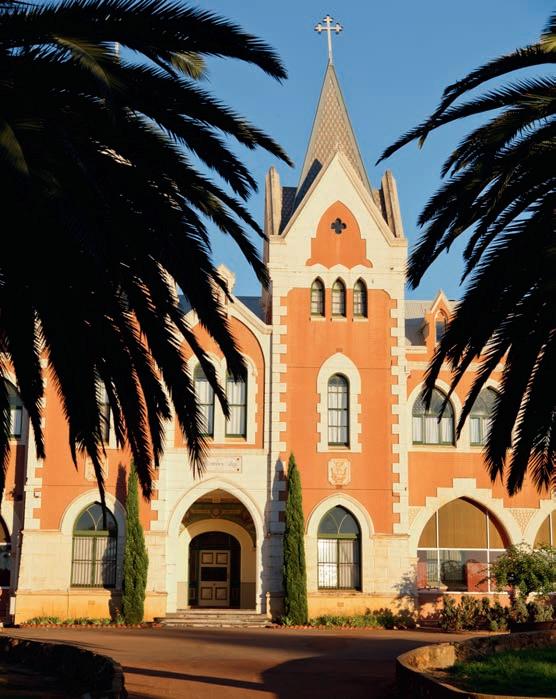
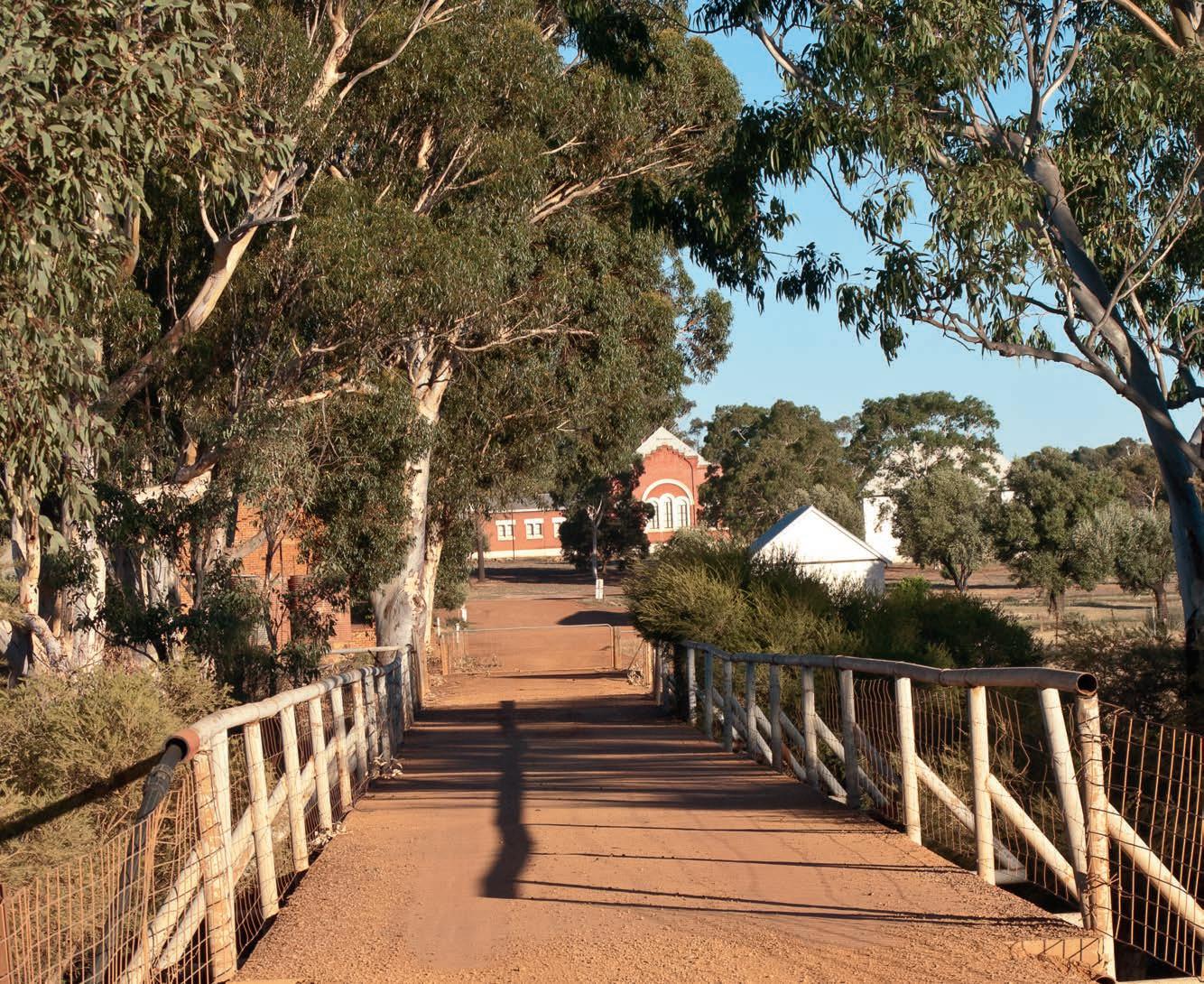
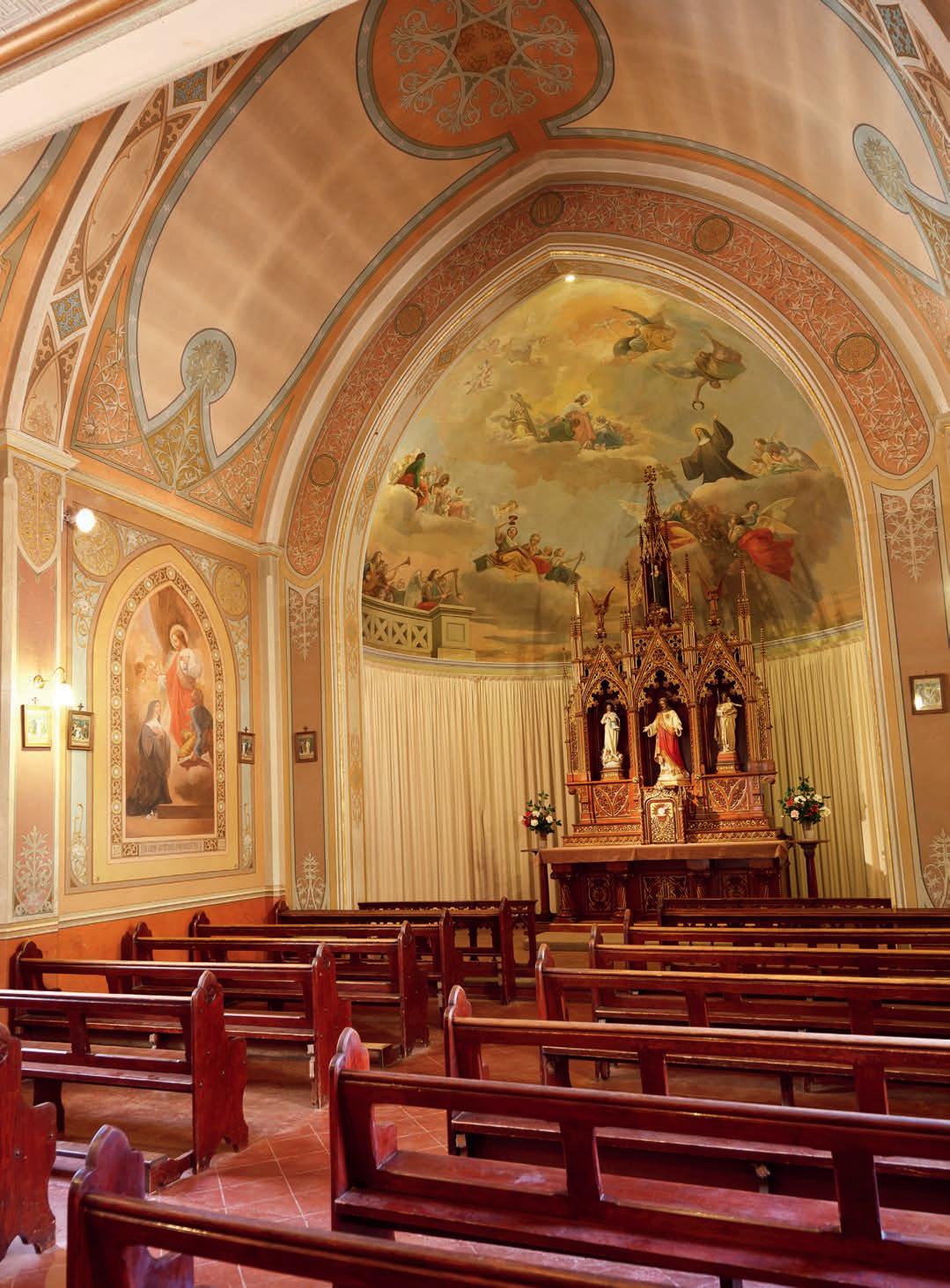
THESE PAGES: Monks go about their daily rituals in the Benedictine community of New Norcia, which is noted for its Spanish Mission-style architecture in peaceful surrounds.
Achef in his former life, Abbot John Herbert is used to rigid discipline. Now he’s the one giving orders and many of them seem to be aimed at bringing the very traditional society of the Benedictine community of New Norcia into the 21st century.
New Norcia is 132 kilometres north of Perth on the Great Northern Highway, a remarkable clutch of Spanish-influenced buildings set among olive groves and Australian bushland that’s home to Roman Catholic monks who have operated the rural monastic outpost since 1847. Since Benedictine monks Dom Rosendo Salvado and Dom Joseph Serra established a mission for local Aboriginal people, the community has not been immune to the issues of sexual abuse and Stolen Generations that have plagued the Catholic Church. However, today it’s a peaceful place to take a wander, admire the architecture, visit the art gallery and museum, have coffee and pastry at the bakery and buy some local honey and olive oil.
The Benedictine community is the first stop on a circuit road trip from Perth, which then tracks 110km west to the Indian Ocean Road at Karakin on the coast and north to the Nambung National Park and the coastal town of Cervantes, before returning south along the coast to Perth. While described as a self-drive tour, Perth-based tour company Australian Pinnacle Tours can also take the hard work of driving out of the trip if you’d prefer to be a passenger for the day.
Today, Abbot John is in charge of New Norcia’s community, which includes monks and priests, staff and visitors to the monastery guesthouse, as well as guests attending retreats, study intensives or school cultural excursions in the former convent and boarding school buildings that are dotted around the town.
The monks live according to the Rule of St Benedict, which has been in existence since the sixth century and governs every aspect of Benedictine life, the hierarchy of the monastery, the balance of prayer and work and details concerning the food, drink and clothing of the monks. In addition to the regular religious vows of poverty, chastity and obedience, the Rule requires the monks to promise stability to their community. In other words, a monk enters for life; if he doesn’t like the climate, the company or the work, transfer is not an option. As well, he vows obedience to the abbot, which includes willingly doing whatever work he allocates and regarding it not as a career but as a job for the present
time. If self-importance takes over, the monk should be removed from his job. Visitors can learn more about this religious life by staying at the community guesthouse.
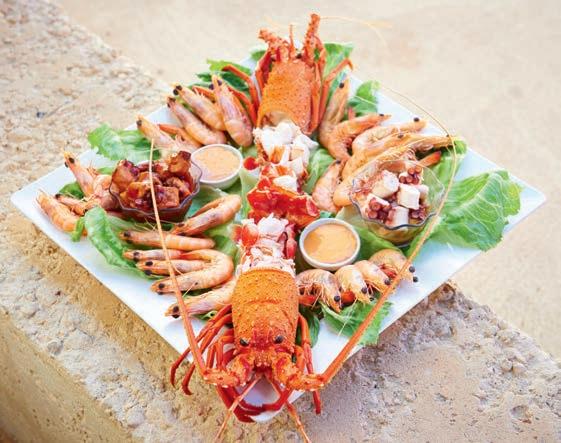
From New Norcia, it’s 169km west and north to the crayfishing town of Cervantes, population 450, give or take, and a great overnight stop before exploring the attractions on the way back south. Apart from the chance to swim, snorkel and dive in the azure waters of the Indian Ocean, Cervantes most famous venue is the Indian Ocean Rock Lobster Factory, which offers a guided behind-the-scenes tour of a live lobsterprocessing plant. After the tour, you can enjoy a
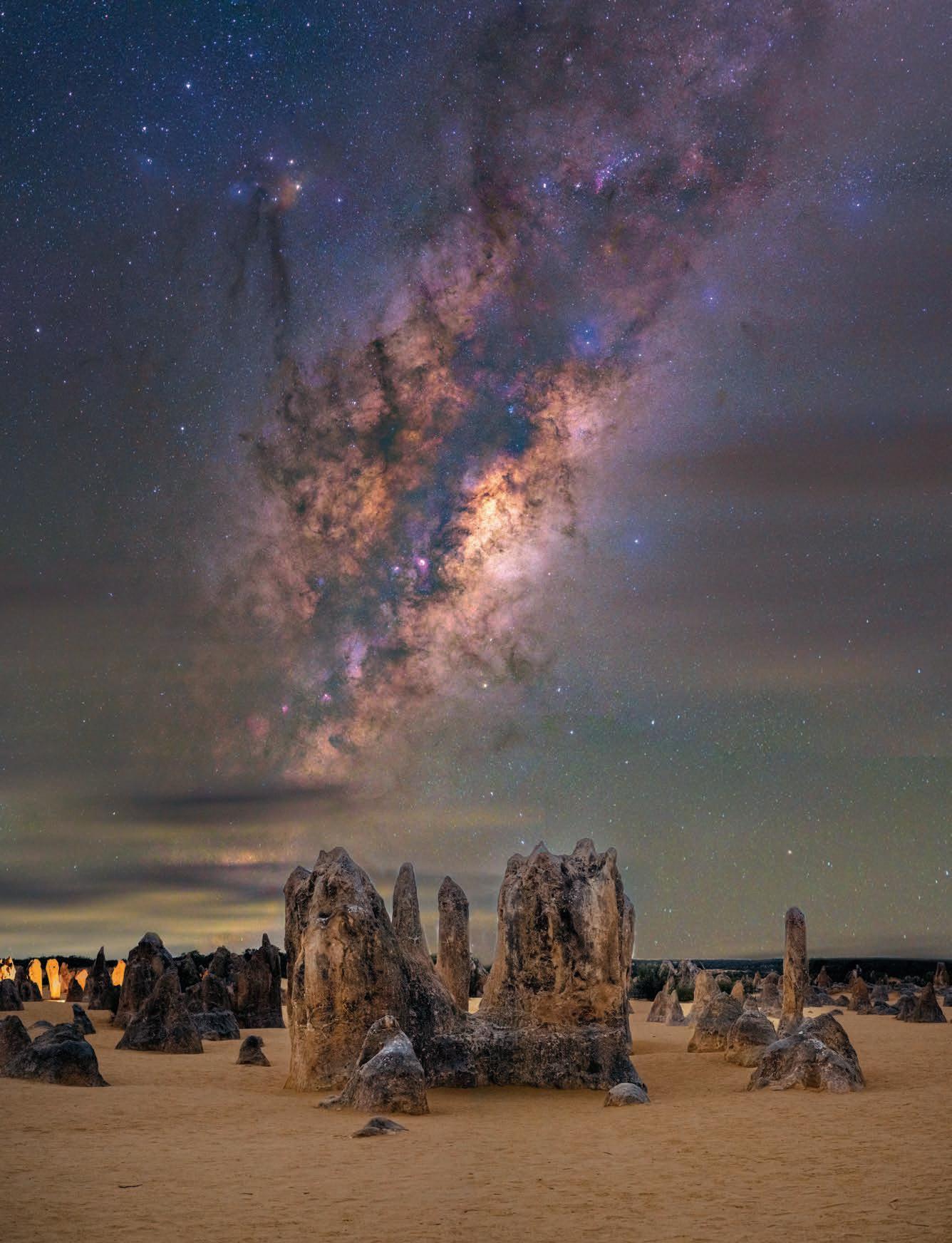
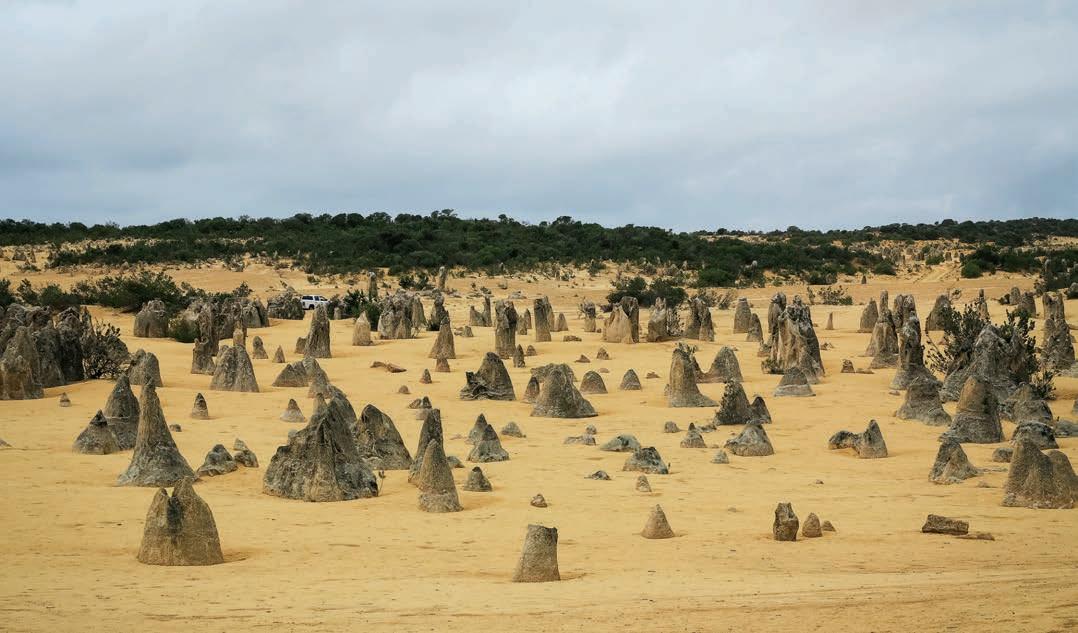
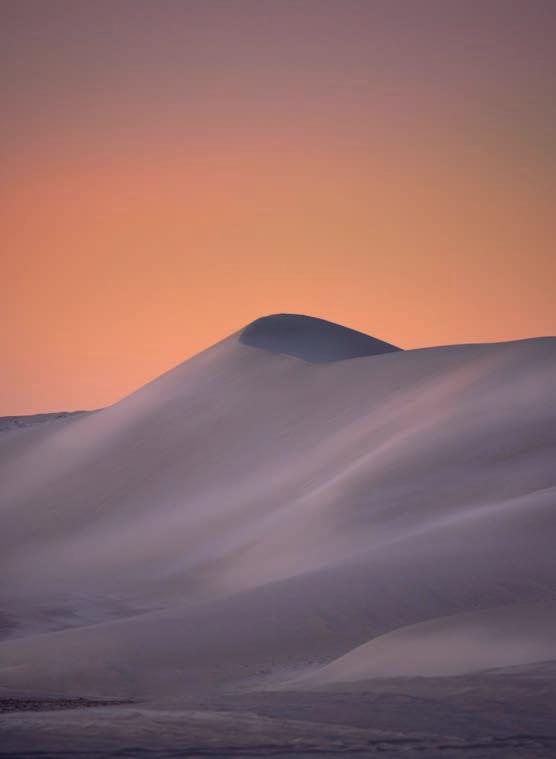
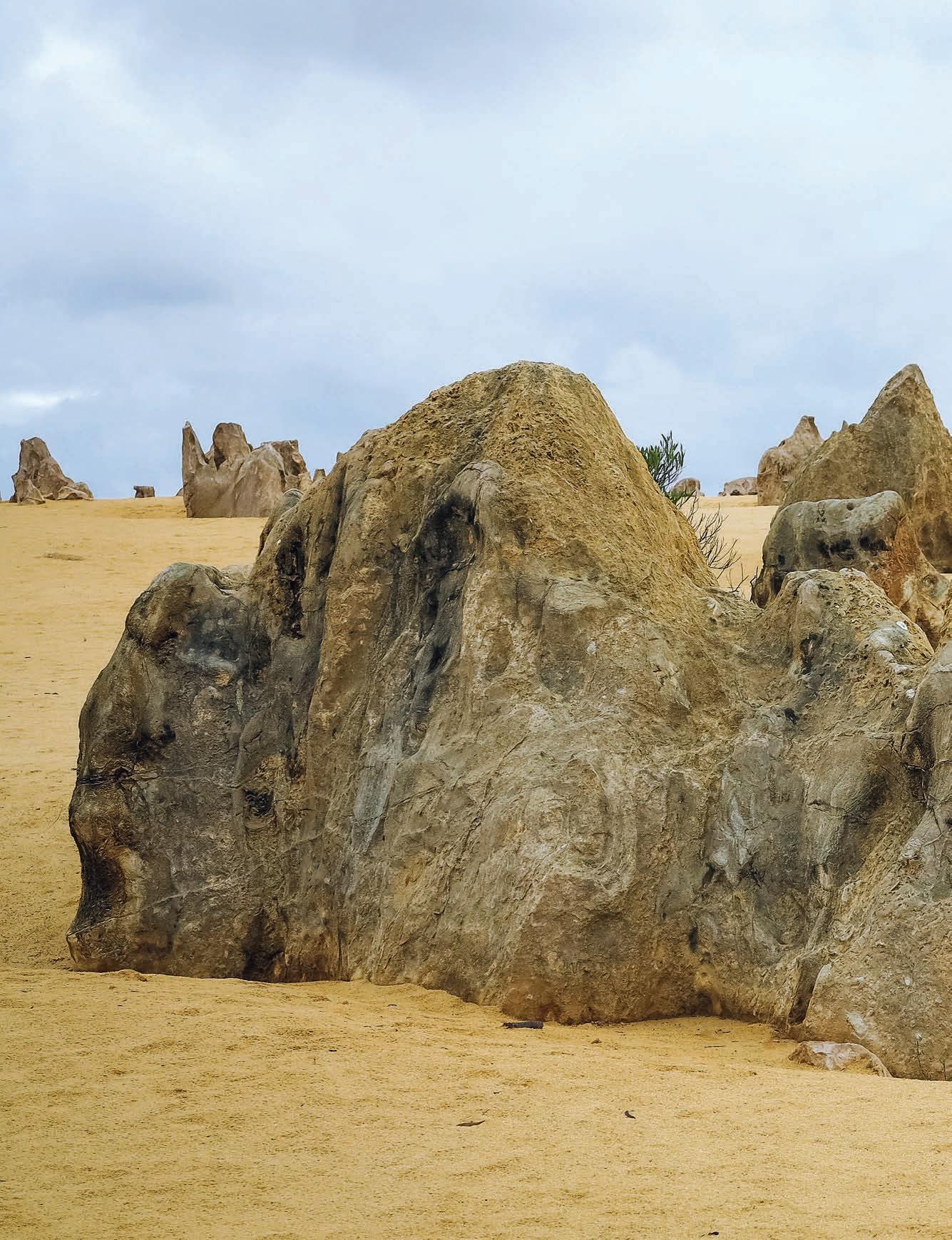
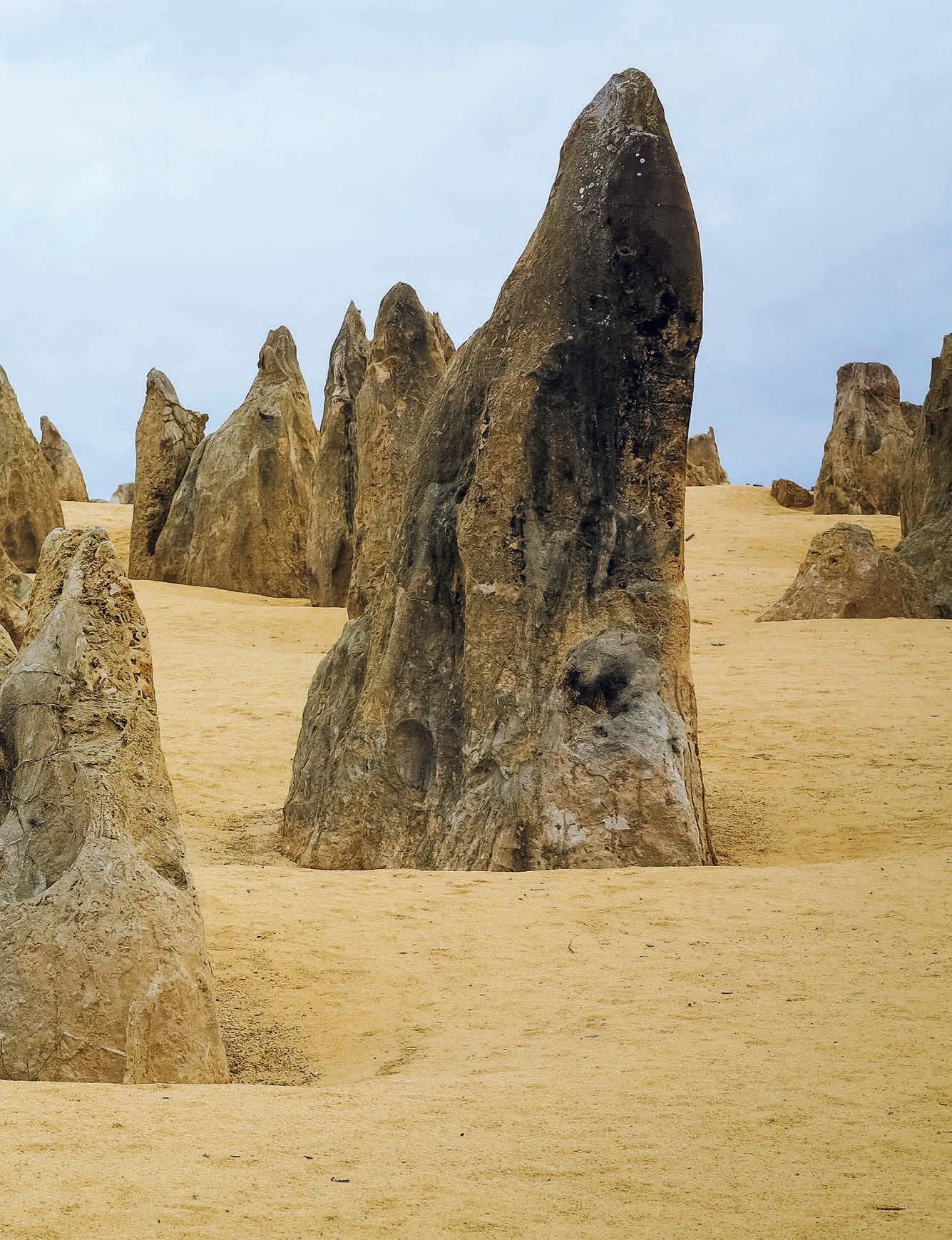
THESE PAGES: (Clockwise from opposite page) The limestone structures of the Pinnacles were formed 25,000 to 30,000 years ago. Some measure 3.5m high; the ethereal vista of the Lancelin sand dunes at sunset.
fresh crayfish lunch overlooking the Indian Ocean at the Lobster Shack. During summer, the Lobster Shack also offers sea lion boat tours, taking passengers to the islands surrounding Cervantes to observe and swim with these playful creatures. Just south of town at Lake Thetis, you can see stromatolites, rock-like structures on the edge of the hyper-saline lake. They were built by microorganisms too small for the human eye to see and are the oldest living things on Earth. Their most important role has been contributing oxygen to the earth’s atmosphere. When stromatolites first appeared on earth about 3.5 billion years ago, there was little or no oxygen in the atmosphere and it’s believed that the bacteria found in the organisms that created the stromatolites are responsible for increasing the level of oxygen in the atmosphere to the present-day level of 21 per cent.
From here, it’s about 20km south to the Pinnacles Desert where thousands of limestone pillars rise from a stark, sandy landscape to form what Dutch sailors in the 17th century thought were the ruins of a lost civilisation. Reaching up to 3.5-metres tall, some are jagged, sharp-edged columns rising to a point, while others resemble tombstones. Many pinnacles display crossbedding structures, where the angle of deposition
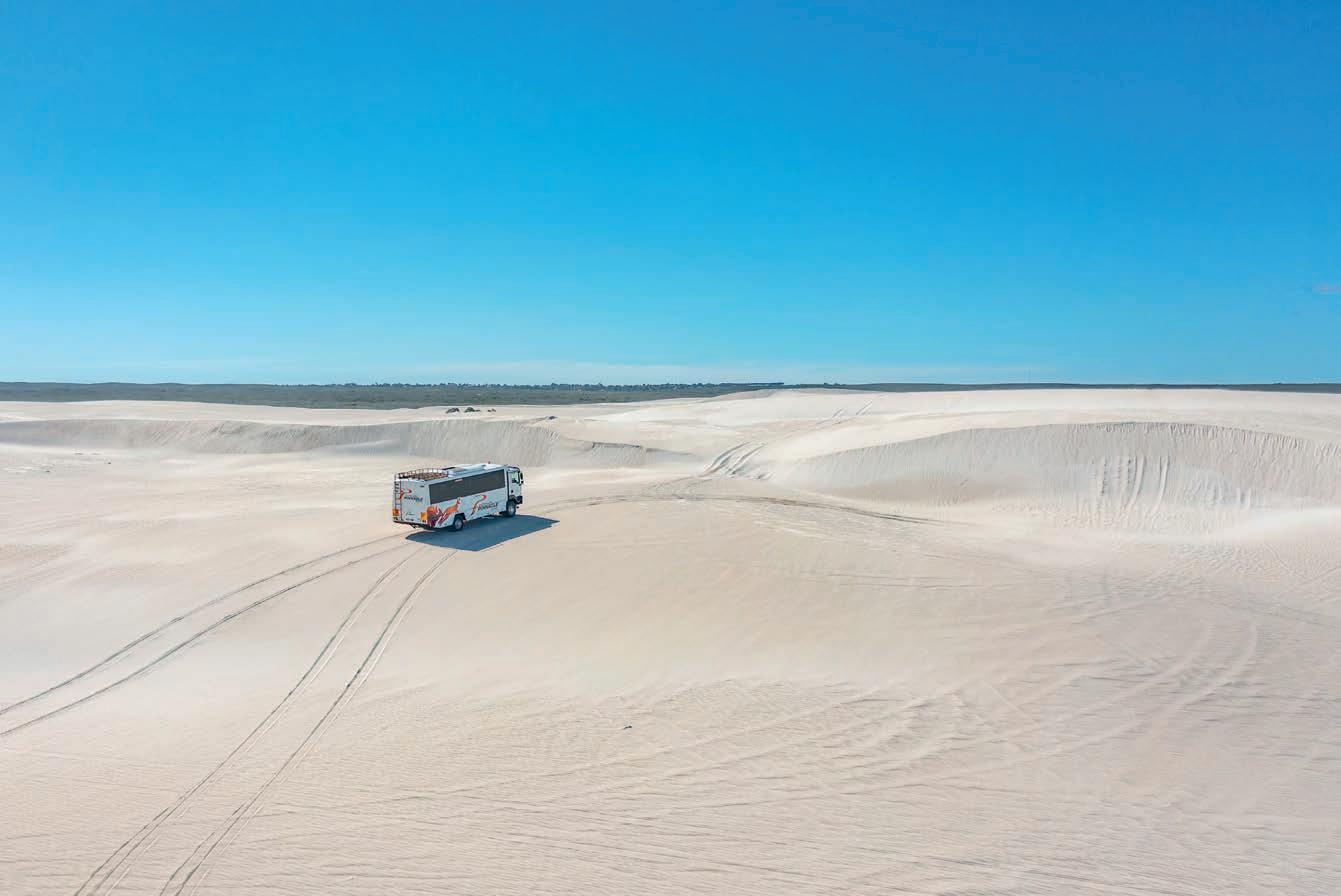
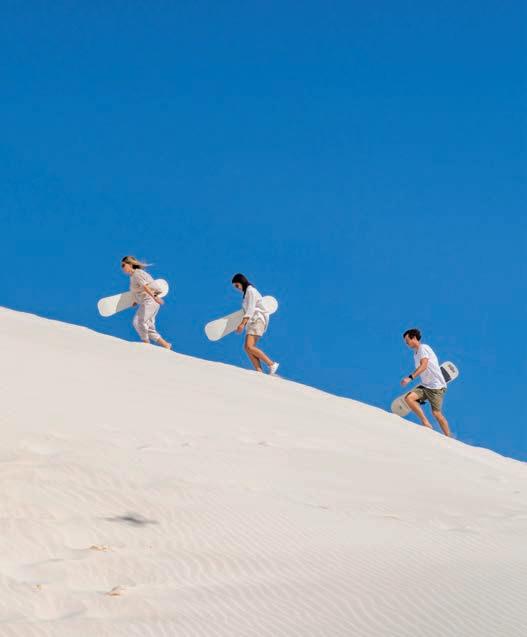
THESE PAGES: (Clockwise from left ) Sandboarding is a great way to experience the Lancelin sand dunes, which rise up to 30m above the surrounding landscape; you can also explore the dunes with Australian Pinnacle Tours as your guide; limestone caves and First Nations cultural tours are highlights of Yanchep National Park.
of the sand changes very abruptly. This indicates that the dunes, from which the limestone bed was formed, were originally laid down by the wind. Some pinnacles have a mushroom-like shape, due to remnants of a calcrete capping. The mushroom shape has formed because the capping is harder than the limestone below it and therefore weathers at a slower rate. These remarkable formations can be explored on a 4.5km-circuit drive with stopovers along the way so you can get out and see them up close.
From the Pinnacles, head south for about 80km to the Lancelin sand dunes, where towering white dunes up to 30m high make the perfect location for sandboarding. You can hire boards at the site or join buggy tours to explore the dunes further.
Continue south for another 80km to Yanchep National Park, home to resident populations of kangaroos and koalas, including new arrival Djiba, the first joey born in the colony since 2010. Take
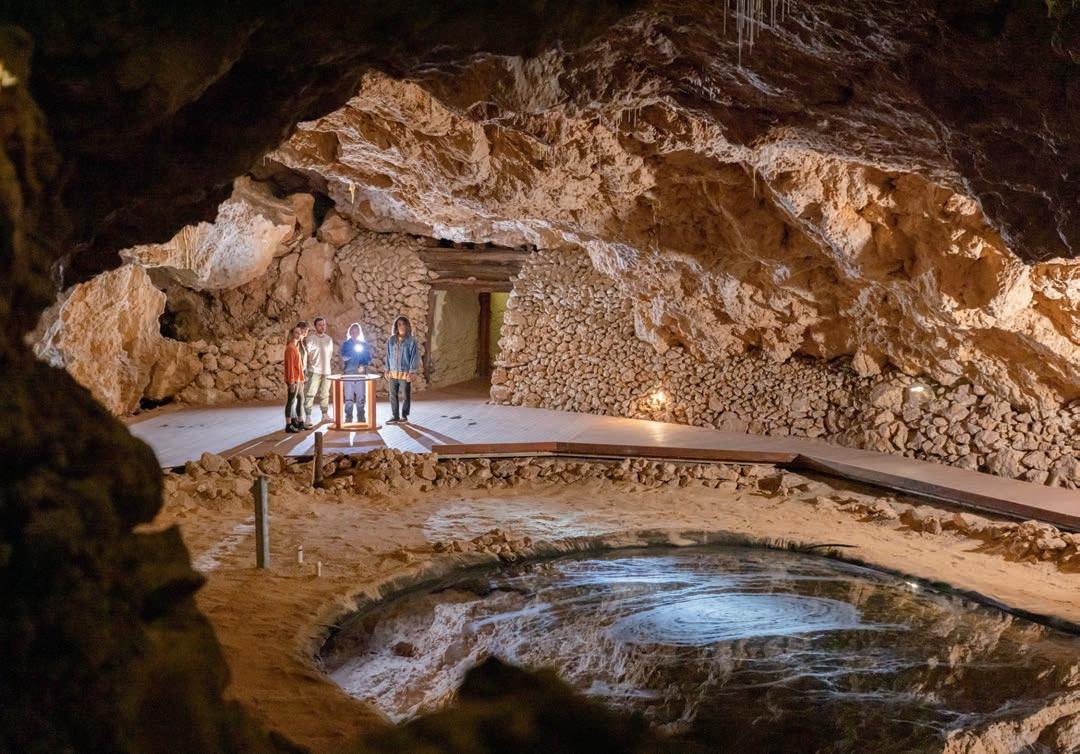
a bush walk or a guided tour of the limestone formations in Crystal Cave and learn about local Noongar culture with an interactive experience that includes a didgeridoo-playing lesson. There’s a golf course, as well as the chance to hang out in the treetops with a high ropes and zipline course. Grab a bite to eat at the Tudor-inspired Yanchep Inn and pick up some Aussie-inspired chocolates at the Chocolate Drops Tea Rooms to enjoy on the final 40km leg of the journey back to Perth.
WHERE TO STAY
Cervantes Lodge, Cervantes cervanteslodge.com.au
Yanchep Inn, Yanchep National Park yanchepinn.com.au
PLACES TO EAT & DRINK
Lobster Shack, Cervantes lobstershack.com.au
Three Emus Restaurant, Lancelin Sands Hotel, Lancelin lancelinsandshotel.com.au
Café 6044, Lancelin cafe6044.com.au
Chocolate Drops Tea Rooms, Yanchep National Park chocolatedrops.com.au
WHAT TO DO
New Norcia Benedictine Community, New Norcia newnorcia.com.au
Lake Thetis stromatolites, Cervantes exploreparks.dbca.wa.gov.au/site/lake-thetis
The Pinnacles Desert, Nambung National Park exploreparks.dbca.wa.gov.au/park/nambung-national-park
Sand dunes, Lancelin perthquad.com.au
Yanchep National Park, Yanchep exploreparks.dbca.wa.gov.au/park/yanchep-national-park
Australian Pinnacle Tours, Perth australianpinnacletours.com.au
A 1000-kilometre circuit through south-western Queensland reveals a host of surprises and level of amenity uncommon in the outback.
QLD | 7 DAYS
BY KIRSTY MCKENZIE, PHOTOGRAPHY KEN BRASS
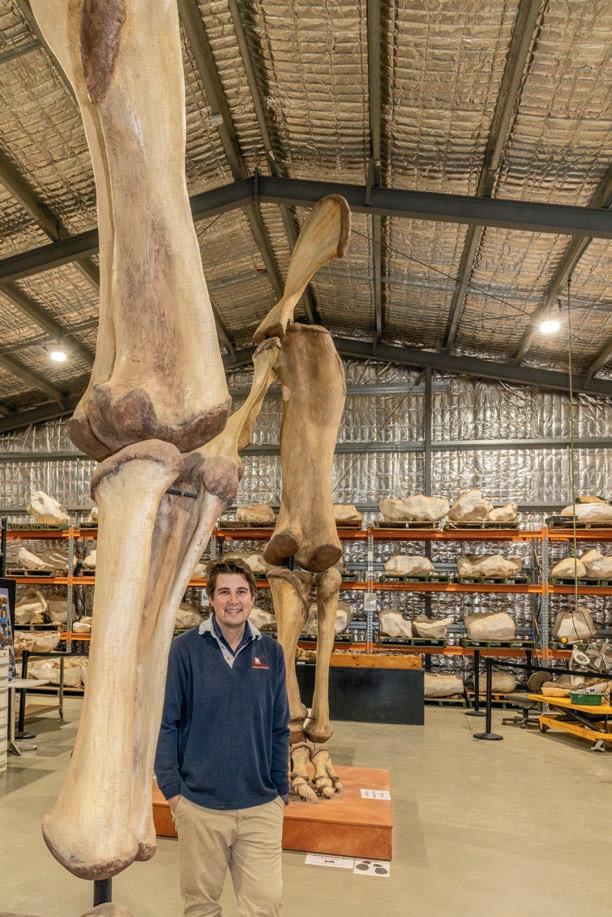
Corey Richards is of average height, but he stands way below knee height beside the replica skeleton of Australia’s largest dinosaur, Australotitan cooperensis. As the operations manager of the Eromanga Natural History Museum, Corey explains that when this giant grass-eating sauropod, nicknamed Cooper, roamed what is now the Channel Country of south-western Queensland in the mid-Cretacious Period some 95 to 98 million years ago, he was the third-largest creature on Earth (Patagotitan and Argentinosaurus from present-day South America just pipped him to top billing).
Weighing about 67 tonnes and measuring 30m long, Cooper and his slightly smaller distant relative, Zac, who is remarkable because he was an articulated fossil (his bones were found in anatomical order), were both discovered on Plevna Downs, an hour to the west of Eromanga. Fourteenyear-old Sandy Mackenzie was riding a bike across the paddocks in 2004 when he noticed an “unusal rock” on the ground. “His parents, Robyn and Stuart, took it with them when they took Sandy back to boarding school,” Corey explains. “They became the driving force behind the museum, and still host twice-yearly digs on the station.”
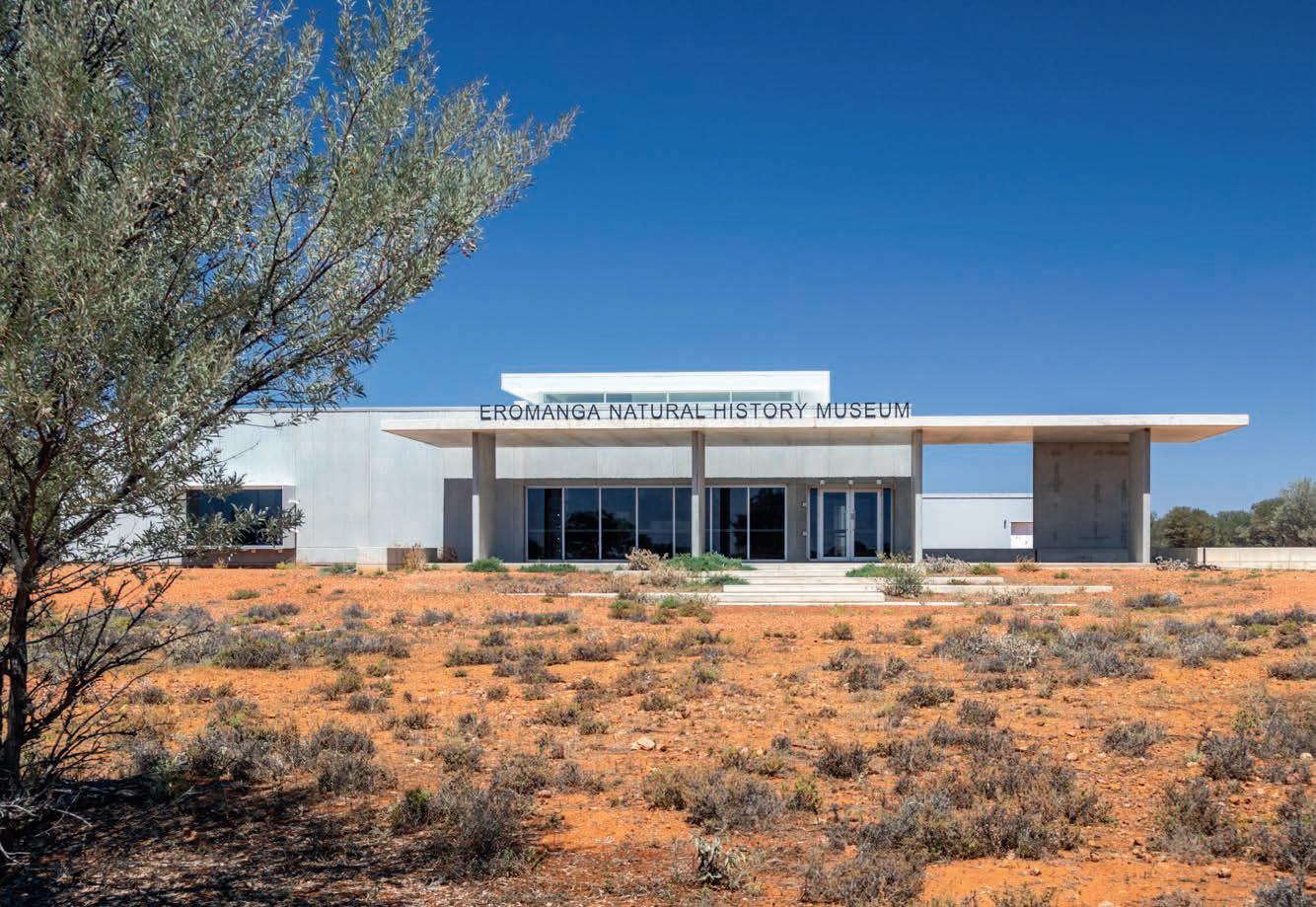
As each dig — which enlists paying volunteers to do the time-consuming work of excavation using brushes and pneumatic drills as fine as dental instruments — uncovers enough material to need 10 years of processing before eventual display, the museum has a huge backlog of bones waiting in its prep rooms. Not to mention a $15 million funding deficit, which its supporters remain ever hopeful a munificent benefactor or government funding will provide to build the second stage so they can display a life-sized replica of Cooper that’s currently stored in sections in a shed.
Even if you weren’t (well, not yet) a dino devotee, it’s worth travelling to the museum for the timeline video that begins each tour. As if the vast western Queensland landscape wasn’t enough to provide perspective, the video uses the road trip from Brisbane, 1060km to the east, to Eromanga, as an illustration of the Earth’s history, starting with the formation of the planet with the Hadean Eon some 4.6 billion years ago, travelling through the earliest form of life with the evolution of single-cell, oxygen-emitting stromatolites in the Archeon Eon,
3.5 billion years ago (at about Roma). Having made it through various ice ages, the age of dinosaurs and extinction, visitors finally arrive at the museum’s carpark. The few-hundred-metre walk to the museum entry becomes the timeline’s equivalent of the brief period that man has been on Earth.
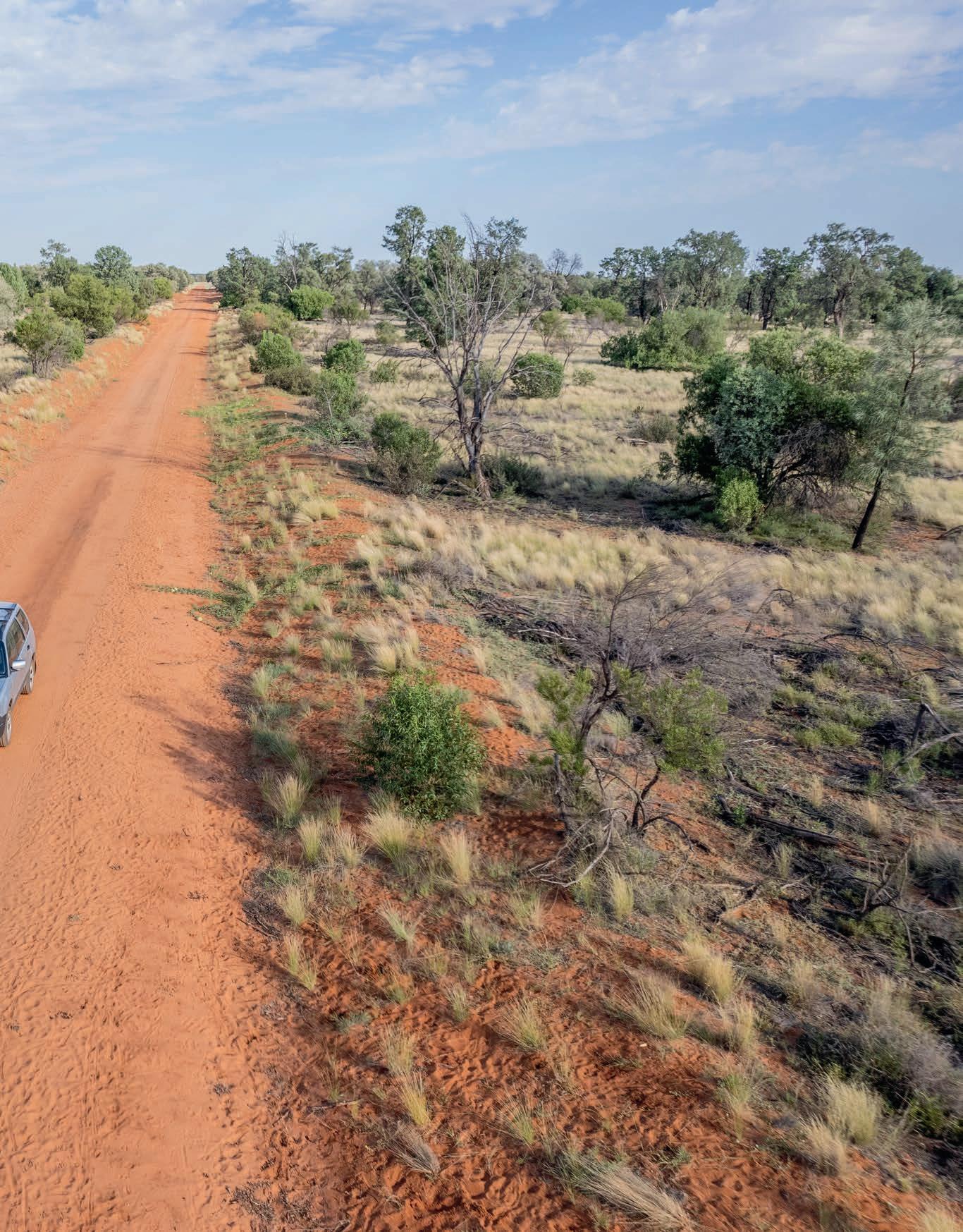
Eromanga, the self-proclaimed most distant town from the sea in Australia, is also home to opal mines and gas and oil fields and is the most western point on this circuit trip, which loosely covers 1000km of the Channel Country from Cunnamulla, which itself is 790km south-west from Brisbane. No matter how you travel, there’s no shortcut to this neck of the woods. The good news is that once you get there, your efforts will be rewarded so many times over, you’ll wonder why you took so long to visit.
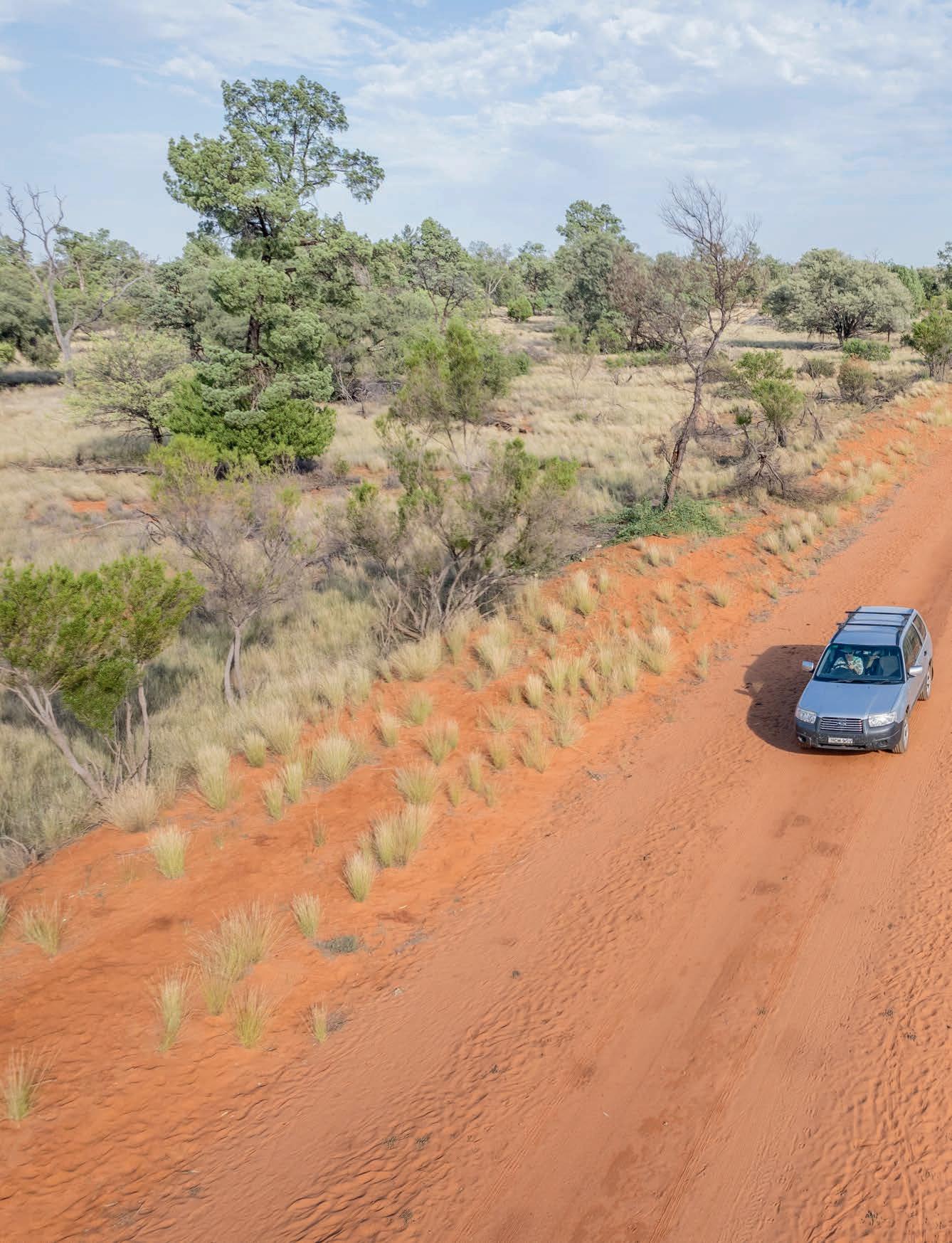
It is possible to fly (thanks to Rex Aviation) to Cunnamulla or Quilpie, 956km due west from Brisbane, but a car is essential for exploring, so it makes sense to make a road trip to the far south-west. Four-wheel drive is not needed as the entire route is sealed. But leave the Porsche at home, because some of the roads are single-track bitumen and you’ll need to put two wheels on
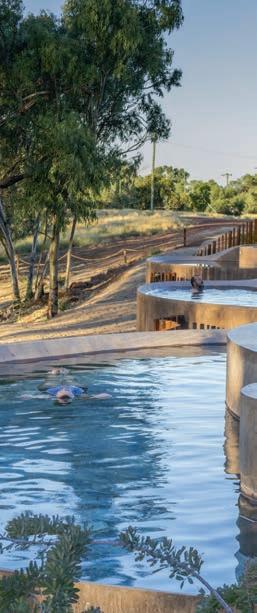
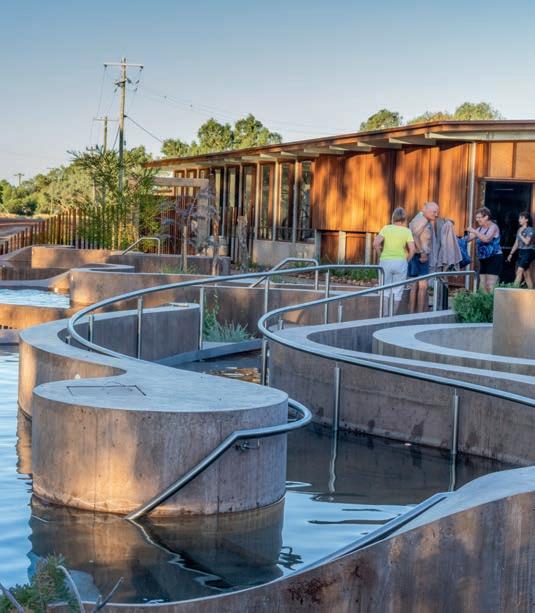
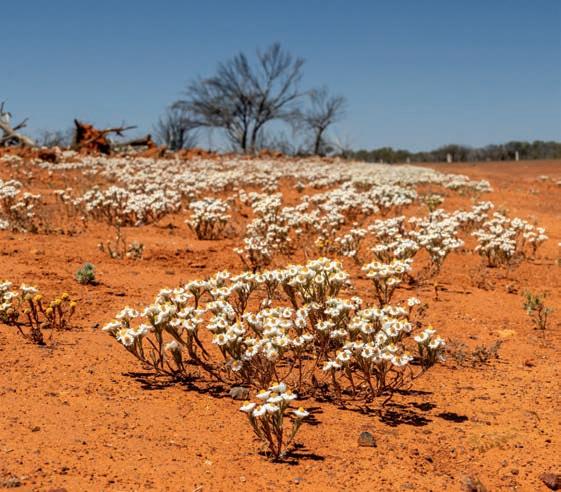
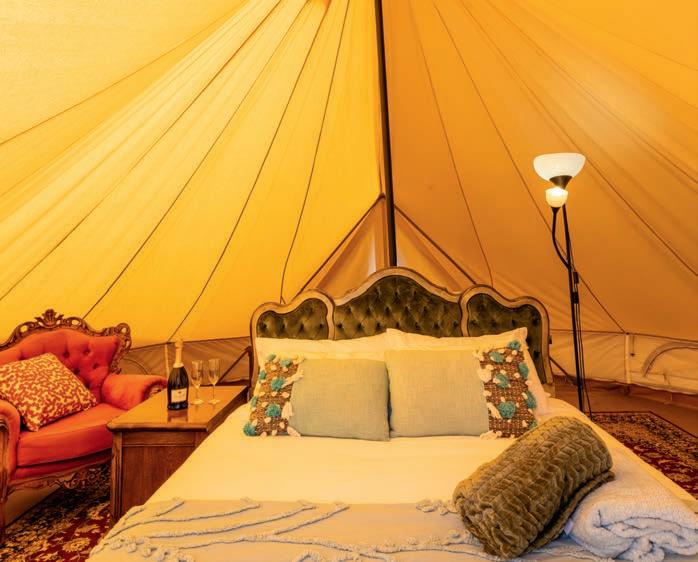
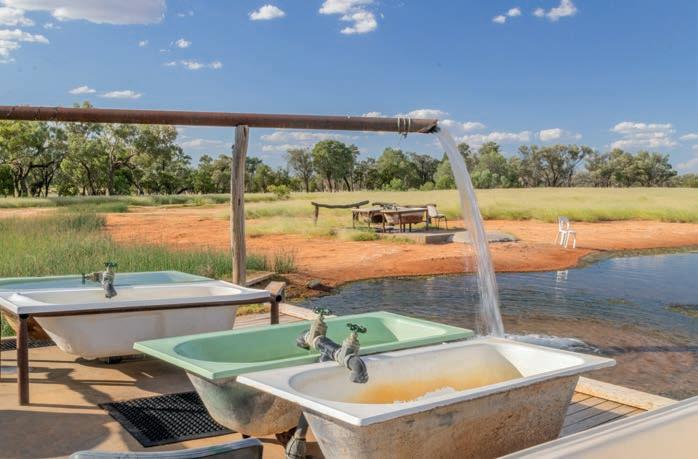
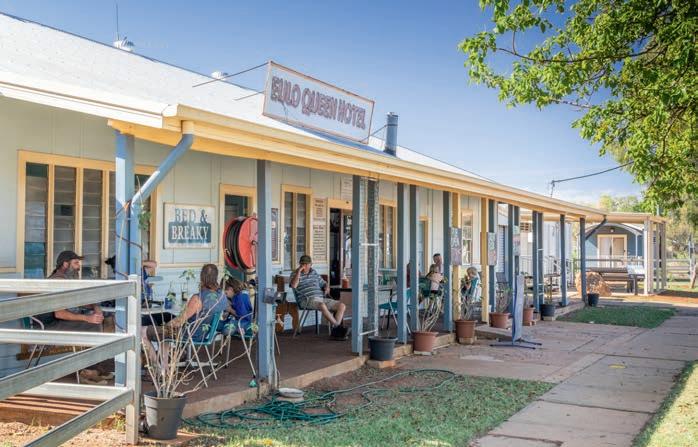
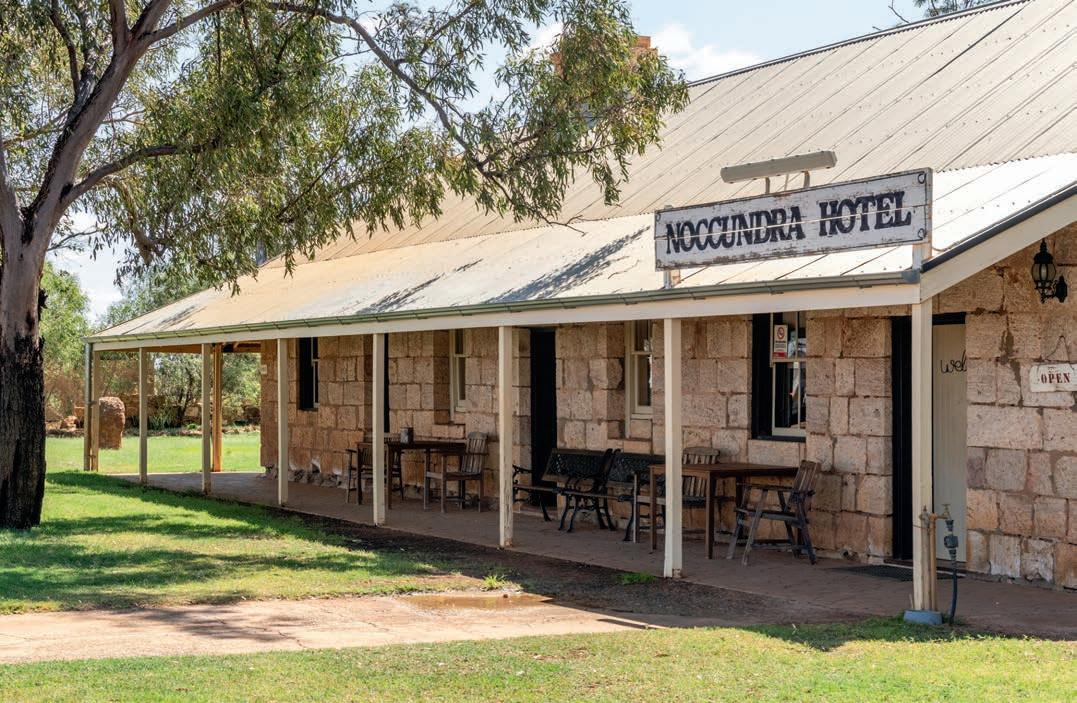
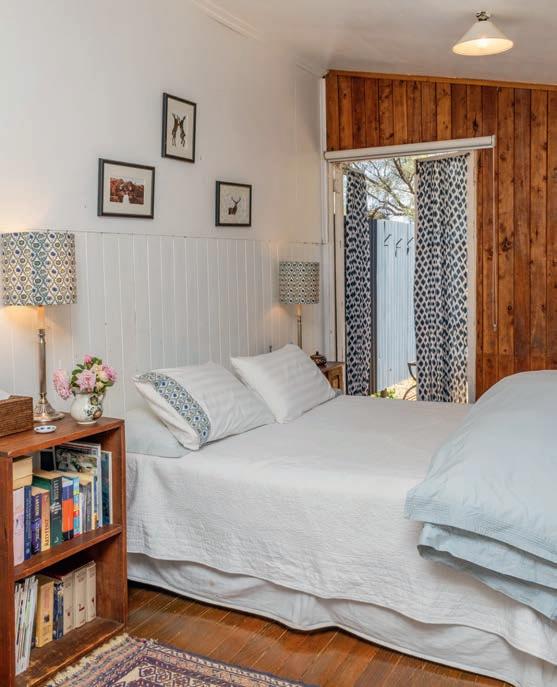
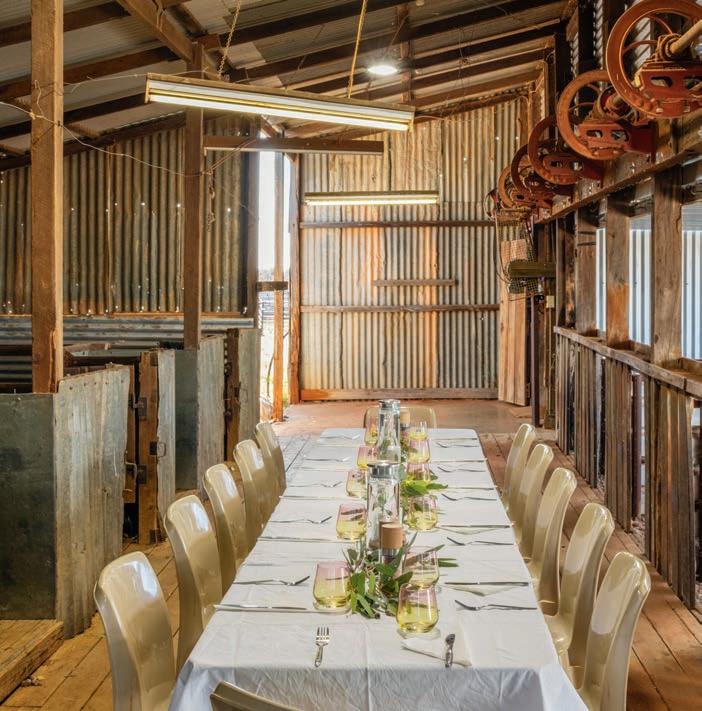
THESE PAGES: (Clockwise from left ) Glamping tent at Cunnamulla’s Club Boutique Hotel; the Noccundra Hotel; guest room at Moble station; it would be unAustralian not to stop at Eulo’s Queen Hotel; hot tubs at Charlotte Plains.
gravel to pass oncoming traf fic. This can include road trains transporting livestock that measure more than 50m long. A bit of clearance will also be welcome when travelling some of the detours along the way.
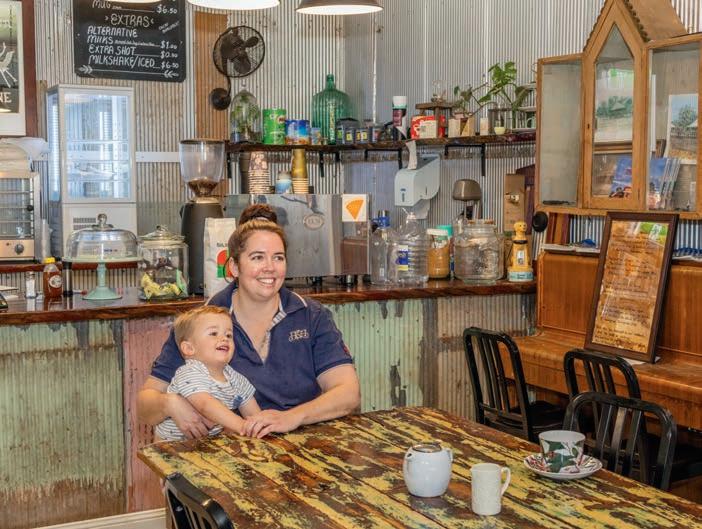
The unexpected treats begin in Cunnamulla, at the Club Boutique Hotel, where Peieta Mills, whose family has lived in the region for generations, has turned the derelict 1936 Club Hotel into an oasis of comfort with ensuited guest rooms and bell tents behind the beer garden for glamping. Her vision has seen the down-at-heel watering hole turn into a social hub of the town with a Boho vibe, antique furnishings, Persian carpets on the floor and roses from her prolific garden on the tables. A tireless advocate for the region’s attractions, Peieta sends guests to the Cunnamulla Hot Springs, a wellness facility, where visitors can soak in the mineralrich waters of the Great Artesian Basin. She’s also introduced paddles of craft beer, all named for Cunnamulla identities, to the bar offerings and there’s nightly live entertainment in the dining room during the tourist season (from Easter to the end of September).
Travellers who prefer a swag, tent or caravan are spoilt for choice at Cunnamulla, where camping opportunities include Charlotte Plains station, which offers 14 bathtubs set around a waterhole created by the bore that releases underground water to the surface at 42°C. Guests can take a bath while they watch for some of the 130 birds that have been recorded on the property or look for constellations in the bedazzling night sky. There’s no lining up for a bath at Francvillers station, where a booking at the four bush camp sites guarantees exclusive access and the outdoor baths that are heated by a wood-fired “donkey” hot water system. Three campsites have water views of a lagoon or creek, while the fourth sits atop a ridge for commanding views of the sunset over the vast plains.
From Cunnamulla, it’s 67km to Eulo, where a sign at the entrance to town declares it’s unAustralian not to have a beer at an outback pub, so a stop at the Eulo Queen is mandatory, along with a visit to the Eulo Mud Baths. This quirky venue is managed by Polish migrant Edyta Brumell. Patrons spend about 90 minutes in the open-air bathrooms, each with claw-footed bathtubs, rustic showers and wood-fired heaters for keeping warm during the cooler months.
There’s a “stretch” tub that fi ts two people comfortably, a room wi th four tubs and a couple’s
space. Guests first soak in muscle-relaxing, magnesium-rich milky clay-enhanced artesian water, then experience an exfoliating mud wrap, followed by another bath and a deep moisturise.
From Eulo, head west for 129km to Thargomindah, a service town for the local sheep and cattle industry and home to Australia’s first hydroelectric power plant, which was run from the Thargomindah bore. From “Thargo”, the road narrows to single-track bitumen as it veers west across stations for 160km to the turnoff to the Noccundra Hotel, built on Nockatunga station in 1882 from sandstone blocks shipped in by camel from Milparinka, 40km south of Tibooburra over the border in South Australia. With permanent water on the Wilson Creek, Noccundra pub was once a strategic watering stop for livestock and stockmen and once bustled with vistors en route from Adelaide and Broken Hill on their way to the Channel Country. These days, it’s mainly tourists who come to Noccundra to camp on the waterhole, fish and kayak, and get to know the town’s population of three — Neil and Marg Turner and their adult daughter, Sarah. As Sarah explains, space is not an issue out here … at 73,720km², the Bulloo Shire is Queensland’s third largest. At the last census, that meant there was 218km² for every person who lives there.
Retracing our route 20km back to the highway, it’s another 160km to Eromanga, a very comfortable night at Cooper’s Country Lodge in the grounds of the Natural History Museum and a counter meal at the Royal Hotel, once a Cobb & Co staging post built in 1885 from mud bricks. After dinosaurs, the other mail attraction in town is opal mining, and you won’t spend too long in the pub before you run into someone who has opal to sell.
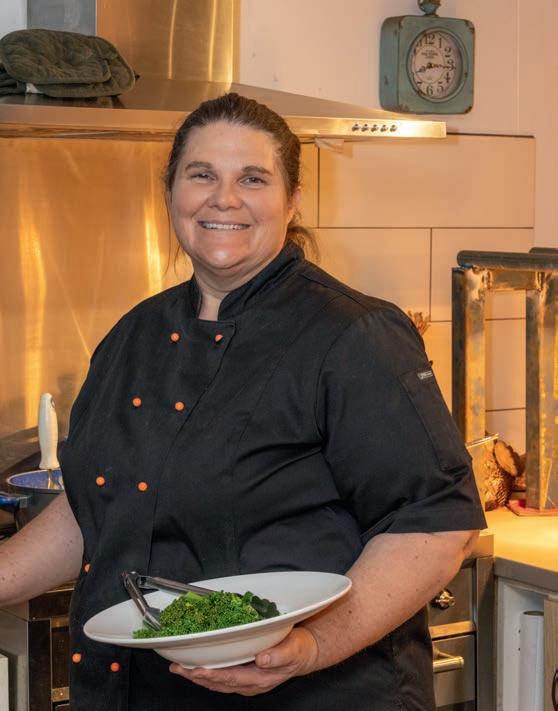
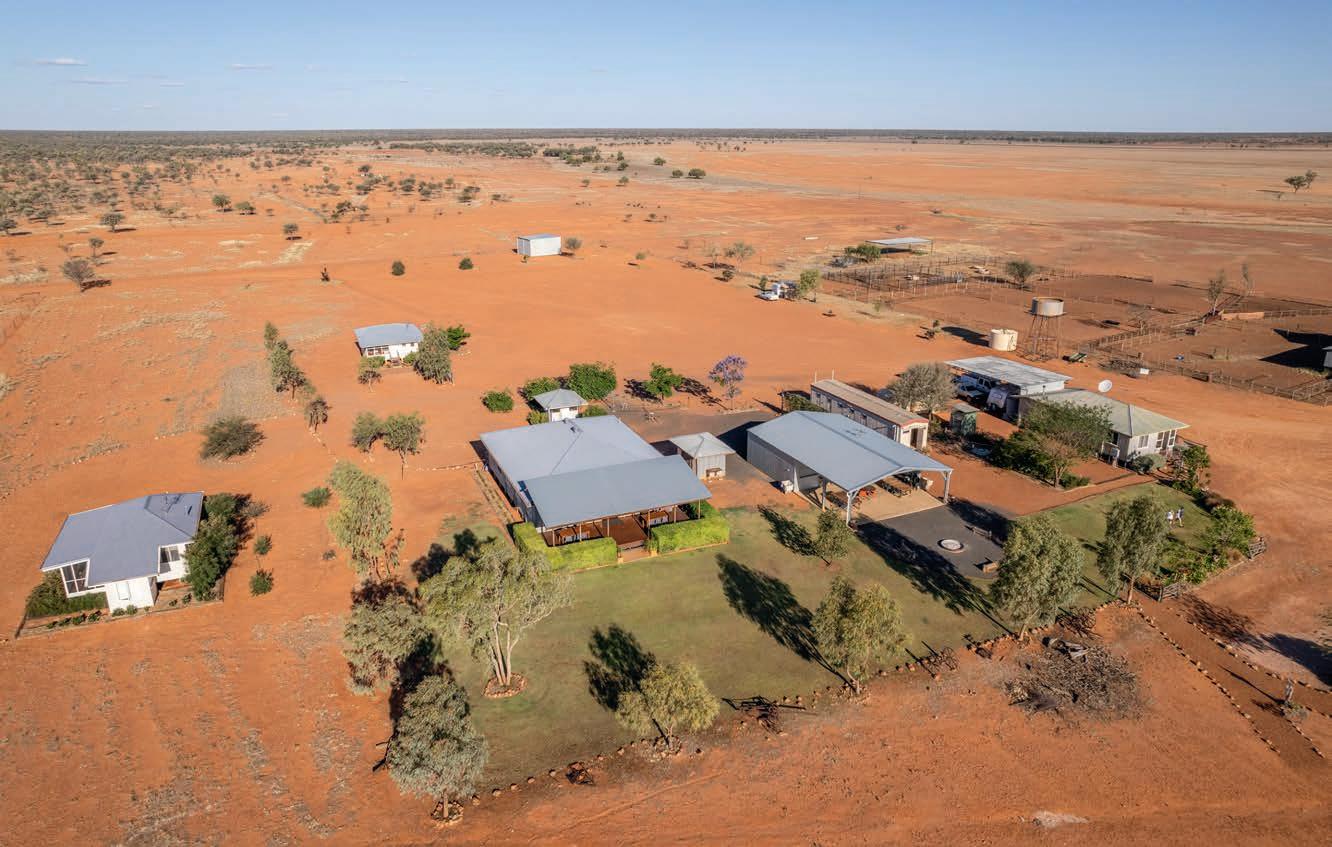
The district’s latest attraction is on the nearby 130,000-acre (52,609-hectare) Belombre station, run by the museum’s Corey Richards’ aunt, Fiona Ferguson, and her partner, Adam Murray. They opened Toogunna Plains station stay in acknowledgement that there wasn’t enough accommodation in Eromanga for the growing visitor numbers and have quickly made the station a destination in its own right. The ensuited accommodation with 16 guest rooms in two wings is partly made from materials repurposed when several major windstorms destroyed the station’s shearers’ quarters and shed. Auxiliary buildings — refurbished railway workers’ huts, a couple of caravans and two outback touring dental vans — have been cleverly made over with recycled iron, hessian lining and Fiona’s artistic eye to create a mini village with a level of amenity uncommon in the bush. While Adam takes visitors on a station tour that includes a visit to the remains of a Cobb & Co changing station, an explanation of exclusion fencing, lunch in the shearing shed and sunset drinks on a sand dune, Fiona is busy in the kitchen. Her CV as a homestead, shearing and mine-camp cook belies the fact that she is a top-notch chef and, frankly, you’d visit the station for her meals alone. In a land of endless steak and schnitty, Fiona’s homestead dinner of beef braised in red wine and blueberry almond cake is such a welcome reprieve, we could have stayed for a month. Tickets to the annual degustation dinner she cooks as a showcase of local produce for a fundraiser for the museum are hotly contested.
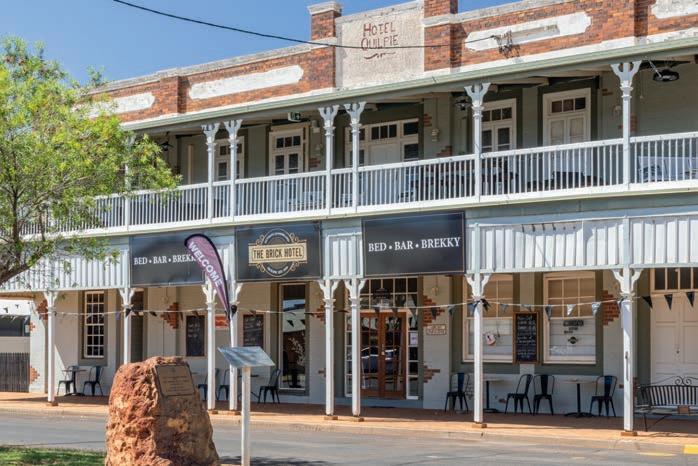
From Eromanga, it’s 106km east to Quilpie, another little town that punches well above its weight. In town, there are landscape artist Lyn Barnes’ gallery, a Catholic church with an opal altar, Country Collections shop and the restored 1926 Brick Hotel with cut-above counter meals to sample. Just 4km out of town, The Lake is a mustvisit for campers and other guests who stay at the bush resort Dan and Louise Hoch have created around Lake Houdraman, a beautiful expanse of water surrounded by shady gums. Self-suf ficent campers stay on the water’s edge, caravaners stay closer to the amenities block and those who prefer a ready-made bed and kitchen have a choice of the remodelled shearers’ quarters or two workers’ cottages on the property. Dan and Louise, who run Merino sheep, cattle and Kalahari goats on the station and several other properties,
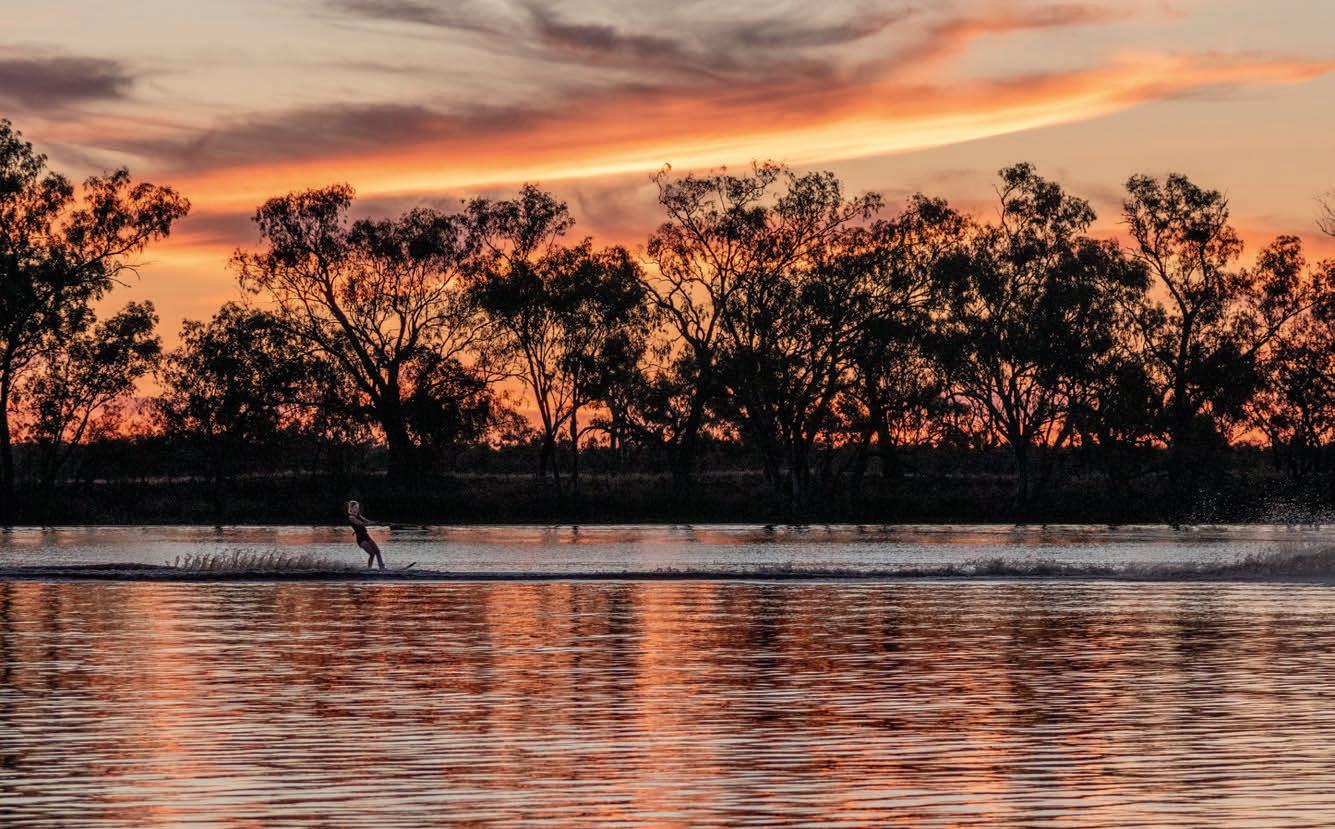
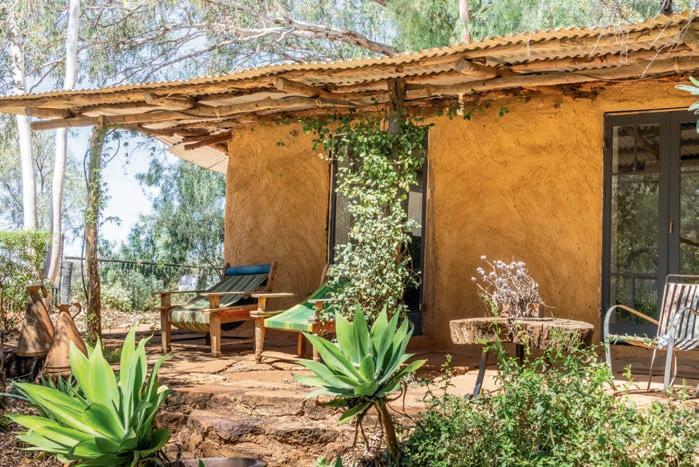
provide station tours, sundowners are served in the bar every evening and many guests book into the lakeside bathhouse for a soak in the artesian water-filled tubs.
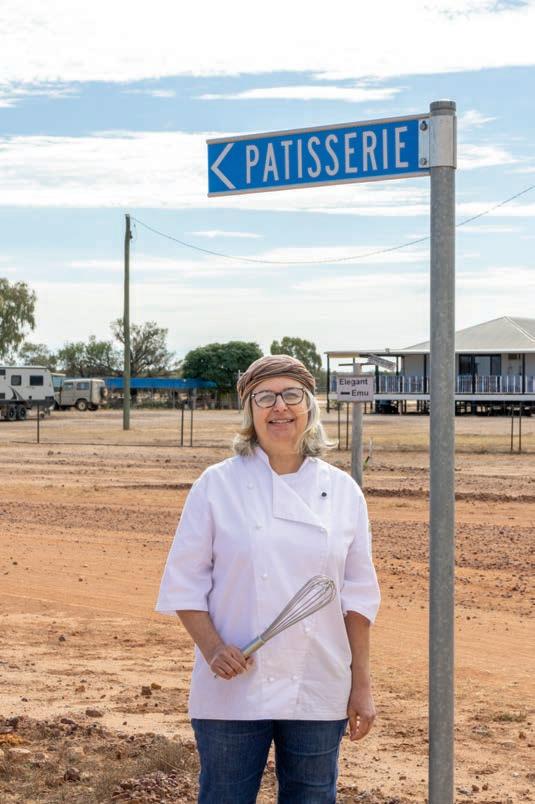
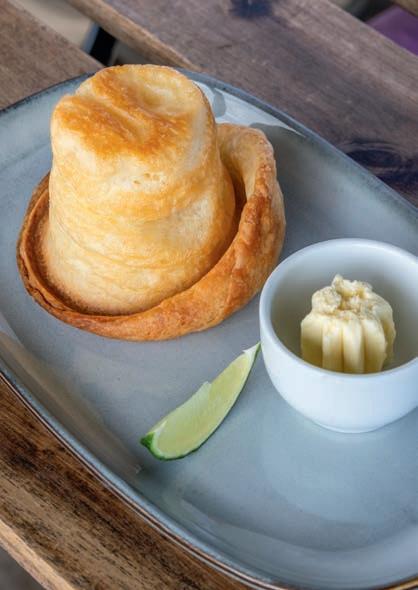
Another don’t-miss station hospitality option is the Rutledge family on 120,000-acre (48,562ha) Moble station. But perhaps the most unexpected treat of the trip, if not the whole of outback Queensland, awaits those who take a 200km round-trip detour north to the town of Adavale, population 25, give or take, and almost as many cows mooching around the sparse landscape. A blue street sign on the approach to town announces pâtissierie. Follow the sign to the “Paris end” of Adavale, an unlikely mauve building in the middle of a paddock where Cristina Zito brings the panache of a high-end pâtissier to town. Entirely self-taught by online videos, Cristina serves exquisite mini gateaux, financiers, pithviers and delicate tartlets during the season. She shuts in summer, when the soaring temperatures make it impossible to laminate butter into pastry. It’s truly worth the detour, as they say in the Michelin guides.
From Quilpie, head south-east for 74km to Toompine, the “pub without a town” where long-term locals Stuart and Kate Bowen and their daughter, Lauren, and her husband, Sean Bond, restored a pub built as a Cobb & Co station in 1893 to replace a former building that was destroyed in a fire. From there, it’s 155km back to Eulo. Or, those who have become besotted by the fiery stone might opt for the 40km-return detour to the opal-mining settlement of Yowah, where there are chances to buy aplenty, yet more opportunities to bathe in artesian waters at the local hot pool or the bath house at the caravan park, and the chance for a round of golf on a course fashioned out of the gibber plain with not much green in sight. From Eulo, it’s a short run back to the trip’s starting point at Cunnamulla.
Back at the Eromanga Natural History Museum, a sign on a door reads Sat cito si sat bene, Latin for “Soon enough, if done well”. It’s a reference to what Corey Richards calls “the ultimate act of delayed gratification” that is the palaeontologist’s lot in life. If you take the time to sift through bucketloads of 500-micron overmatter from a dig, you might just discover a tiny speck that turns out to be a 100,000-year-old remnant of the jaw of an ancient geckonoid. It could just as well be a metaphor for this trip and the most important message from it: it’s a long way to get there, so slow down and enjoy every aspect this extraordinary region has to offer.
Club Boutique Hotel, Cunnamulla clubboutiquehotel.com
Francvillers Station Bush Camping, Cunnamulla outbackescape.com
Charlotte Plains, Cunnamulla charlotteplains.com.au
Cooper’s Country Lodge, Eromanga enhm.com.au/accommodation
Toogunna Plains, Eromanga toogunnaplains.com.au
Artesian Waters Caravan Park, Yowah Ph: (07) 4655 4991
Moble Homestead, Quilpie moblehomestead.com.au
The Lake, Quilpie thelakequilpie.com
Wildflowers, Cunnamulla wildflowerscunnamulla.com.au
Toogunna Plains, Eromanga toogunnaplains.com.au
Eulo Queen Hotel & Caravan Park, Eulo euloqueenhotel.com.au
Noccundra Hotel, Nockatunga Ph: (07) 4655 4317
South Western Hotel, Toompine Ph: (07) 4656 4721
Royal Hotel, Eromanga Ph: (07) 4656 4837
Brick Hotel, Quilpie brickhotel.com.au
Elegant Emu, Adavale elegantemu.com
Cunnamulla Hot Springs, Cunnamulla cunnamullahotsprings.com
Artesian Mud Baths, Eulo artesianmudbathseulo.com.au
Hydro Power Plant, Thargomindah explorebulloo.com.au/attractions/ thargomindah/hydro-power-plant
Eromanga Natural History Museum, Eromanga enhm.com.au
Lyn Barnes Gallery, Quilpie lynbarnes.com
Country Collections, Quilpie Ph: (07) 4656 1271
Close encounters with native animals and spectacular coastal scenery come with a side of fine local produce during a trip up Tasmania’s east coast.
BY KIRSTY MCKENZIE, PHOTOGRAPHY KEN BRASS
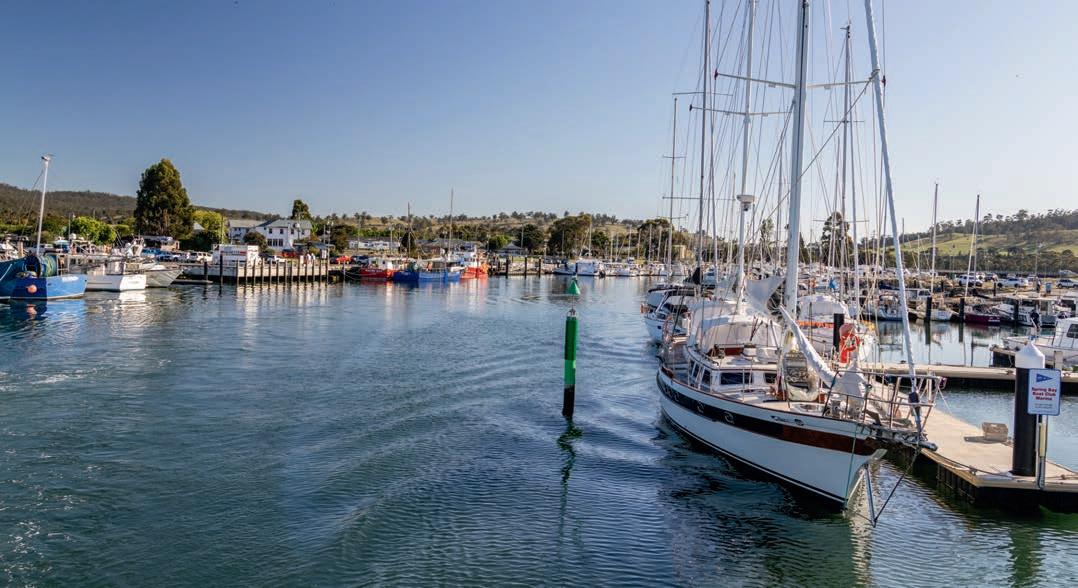
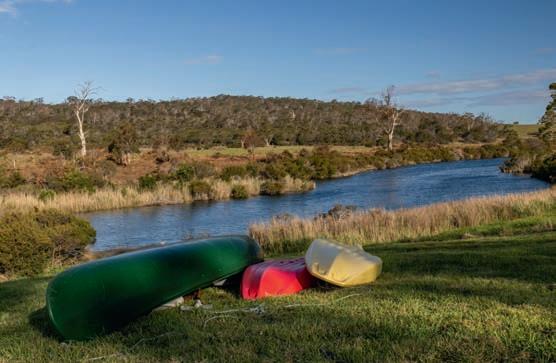
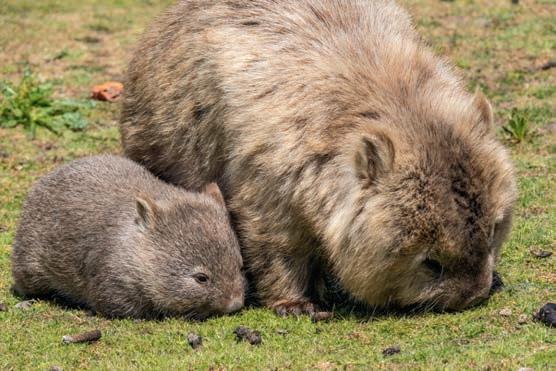
Low tide is approaching when the ferry arrives at Maria Island, so those in the know make a beeline for the Painted Cliffs, a much-photographed landmark on the island national park off the east coast of Tasmania. It’s a 2.5-kilometre-stroll along the gently undulating coastline, so in theory it shouldn’t take much more than half an hour to walk to the site where the sandstone has been eroded into overhangs and ochre-stained and patterned by water percolating through the stone over centuries. But that doesn’t allow for Maria Island’s chief time waster: wombats that nonchalantly graze on the grassy slopes.
On first sighting, the conga line of hikers detours off the path to capture what they imagine must be a once-off encounter with the stout marsupial that moves at a waddle with its legs seemingly impossibly close to the ground. The wombats seem utterly indifferent to the cluster of happy snappers that gathers around them and continue constantly feeding. Turns out the wombats are everywhere and every new sighting pulls a similar posse of paparazzi as it seems no one can get enough shots of the lumbering lumps and occasionally their offspring ... Until one startles and bolts off, demonstrating its celebrated ability to reach speeds of up to 40kph.
Close-up encounters with wombats, Forester kangaroos, Bennett’s wallabies, an insurance population of Tasmanian devils, the odd tiger snake and up to 125 species of birds, including all of Tasmania’s endemics such as the endangered
forty-spotted pardalote, swift parrots and many Cape Barren geese, all contribute to Maria Island’s reputation as Tassie’s Noah’s Ark. In the 1970s, a number of threatened species were released on the island to ensure their survival, and today they form one of Maria’s major attractions, which also include a rare combination of industrial and convict history, alongside spectacular hiking and mountain biking.
The island hosts an upmarket glamping experience, but you don’t have to spend a fortune to sample its charms as you can visit on a day trip. Camping is also welcome and there’s self-catering bunkhouse accommodation in the former penitentiary buildings in the old settlement of Darlington.
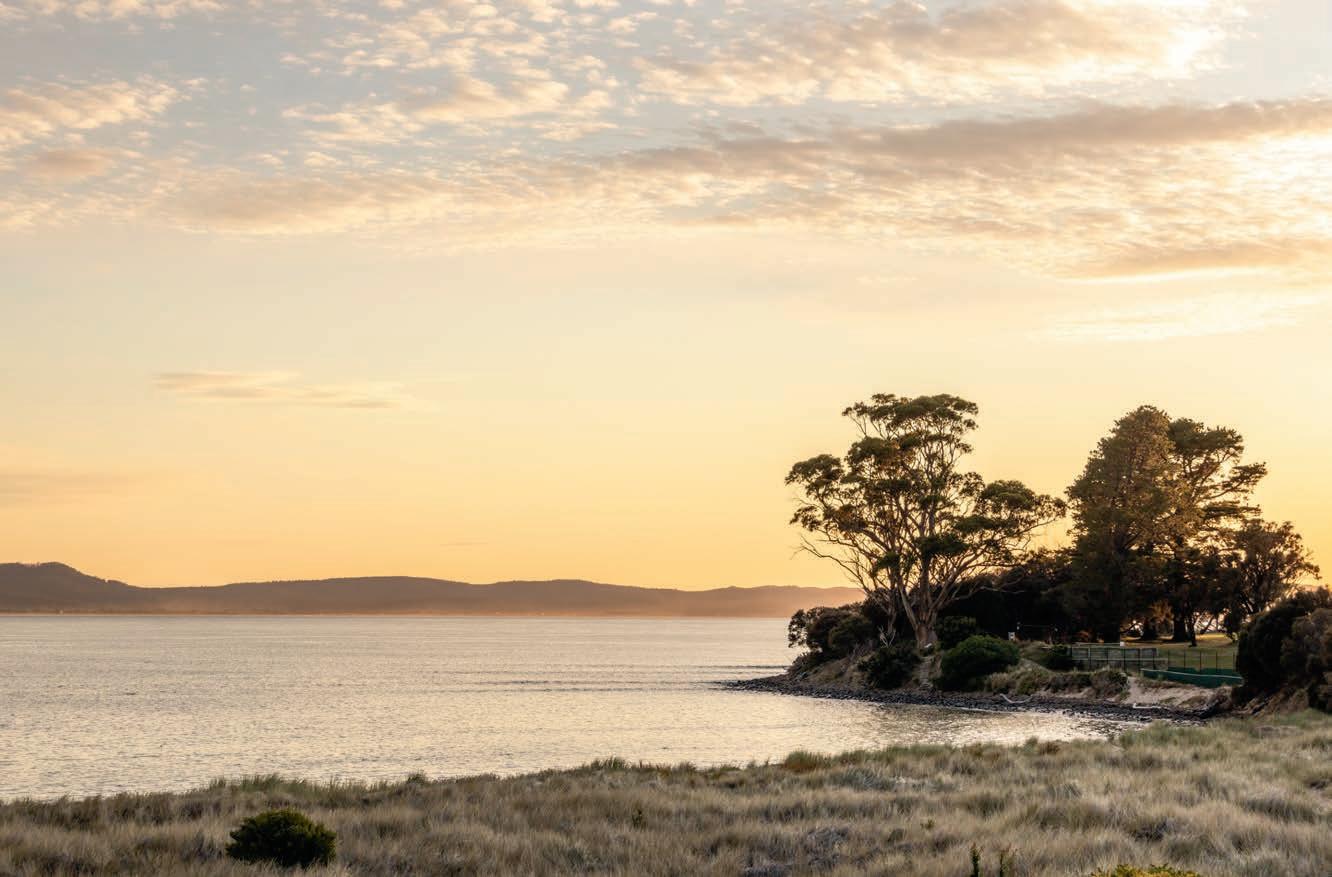
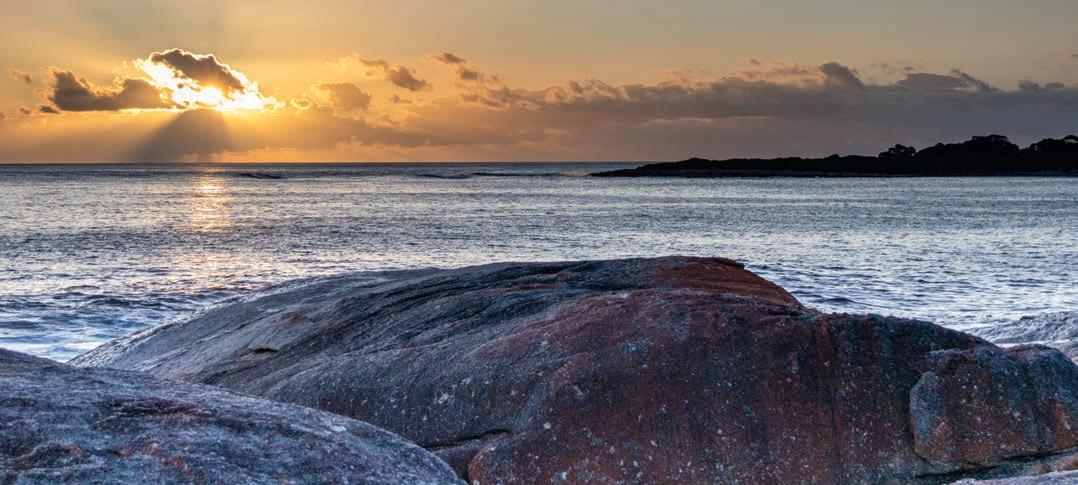
The island is truly remarkable way to start a road trip up Tassie’s eastern seaboard, a scenic 200km journey from the fishing port of Triabunna (about 85km north of Hobart) to the much-photographed orange boulders and turquoise waters of the Bay of Fires in the state’s north. While the navigator might tell you this is a three-hour journey, you’ll need at least a week, or maybe three, to sample the many natural features, wildlife encounters and culinary treats on offer along the way.
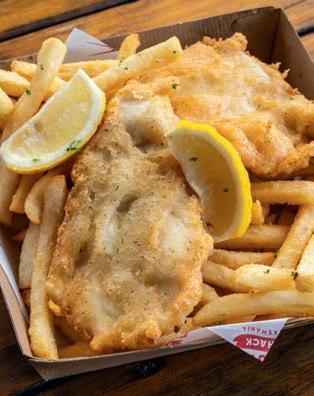
After the half-hour ferry ride back to Triabunna, and a quick stop for fish and chips in a
cone from the Fish Van near the wharf, it’s 50km north past the stunning Kelvedon Beach with its historic boatshed and convict-build Spiky Bridge to Swansea, another village with a beautiful beach and views to the Freycinet Peninsula.
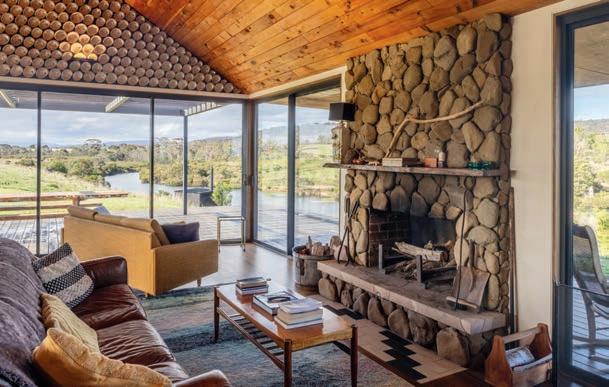
Marketing executive turned hospitality business owner and sustainable cattle farmer and seventh-generation Tasmanian Mathew Routley welcomes guests to his beautiful property, Swan
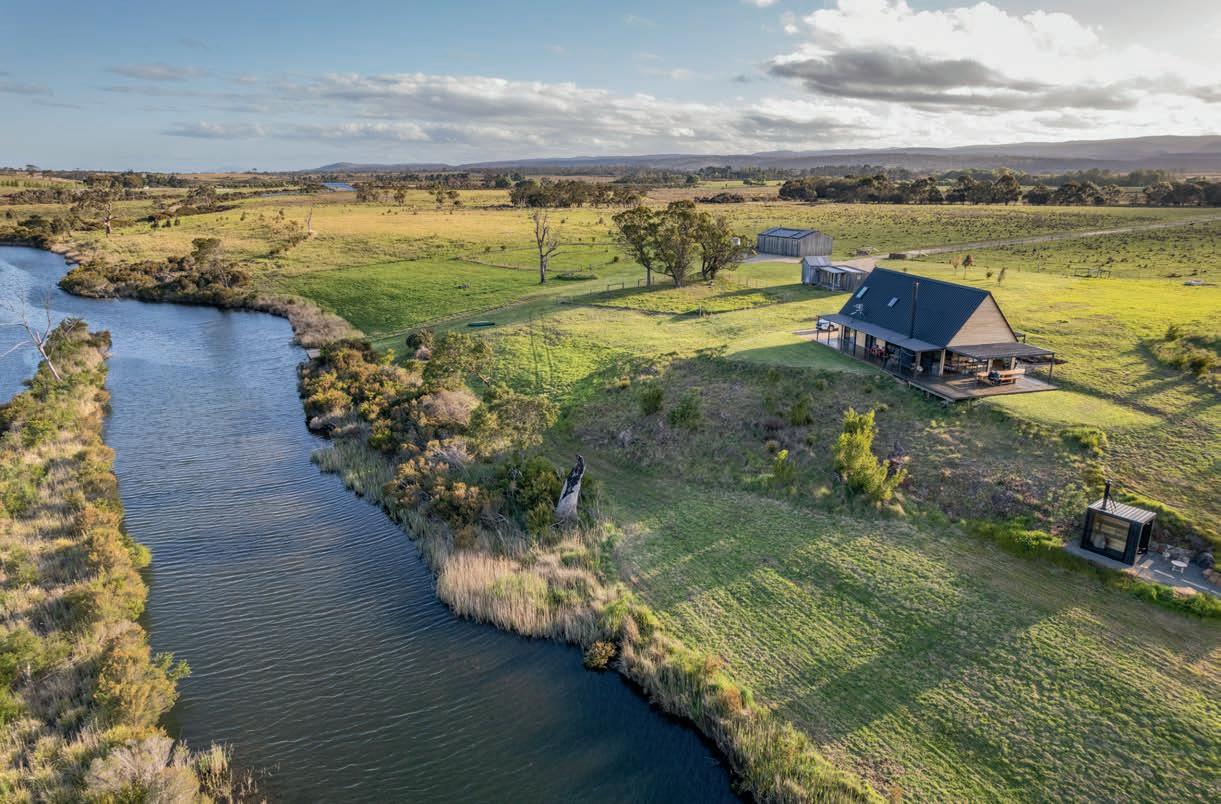
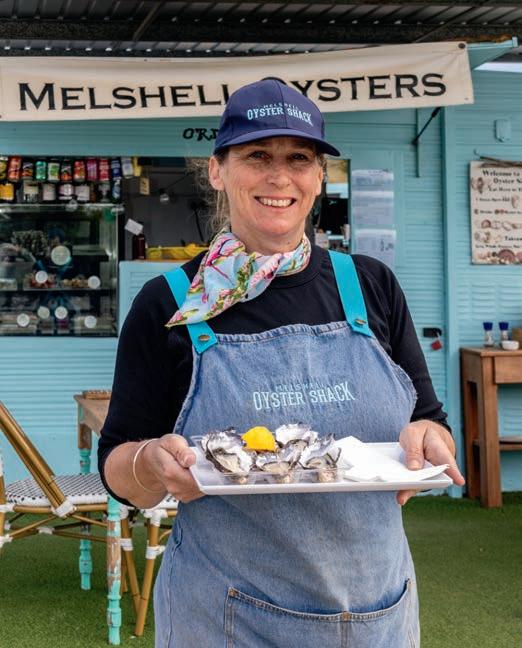
River Sanctuary, just north of Swansea. The threebedroom off-grid homestead is poised above the pristine river, and kayaks are provided for exploring, as well as a sauna conveniently located beside a swimming deck on the bank so guests can jump in for a refreshing cool plunge. There’s also great fishing for black bream, with rods provided, or guests can book in for a boat safari with Mathew at the helm and a dinner of local produce, including, hopefully, the catch of the day and oysters from Melshell Oysters at nearby Dolphin Sands. If you fancy a bite to eat in town, Mathew recommends tapas at The Branch in a former bank building, or coffee, cakes and pintxos from Alimento cafe and deli.
From Swansea, it’s a short (as the eagle flies) distance to Coles Bay, the gateway to the Freycinet National Park, but you’ll need to take a 60km swoop north and then off to the southeast to reach the park, with its crystalline waters and short (2.6km return) but challenging climb (hundreds of steps) to the lookout with views of the celebrated swoop of Wineglass Bay. If you want to put your feet on that squeaky white sand, it’s an 11km circuit down to the beach, across the peninsula to Hazards Beach and back to the carpark. For an accessible taste of the park, the sealed 600m circuit to Cape Tourville provides visitors with great views and, if you’re lucky, the chance to spot whales and dolphins.
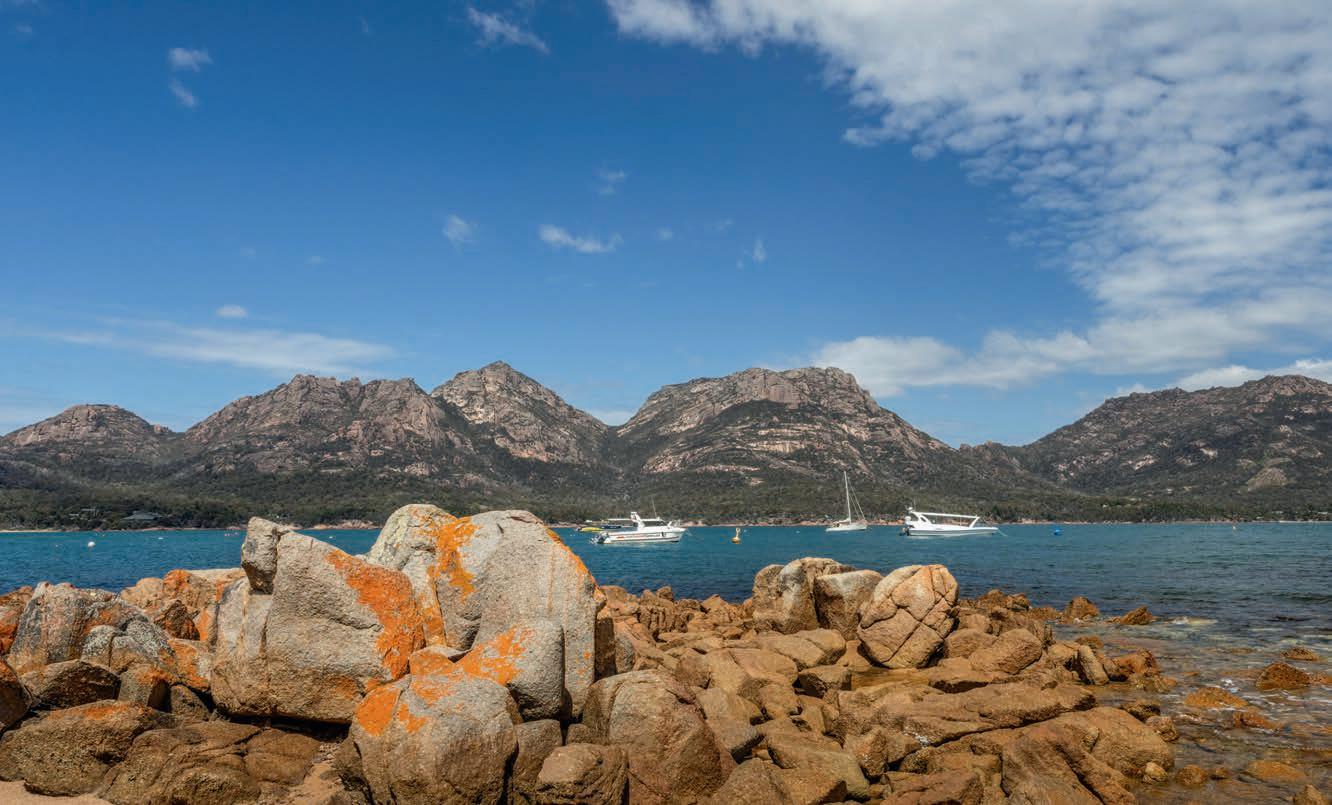
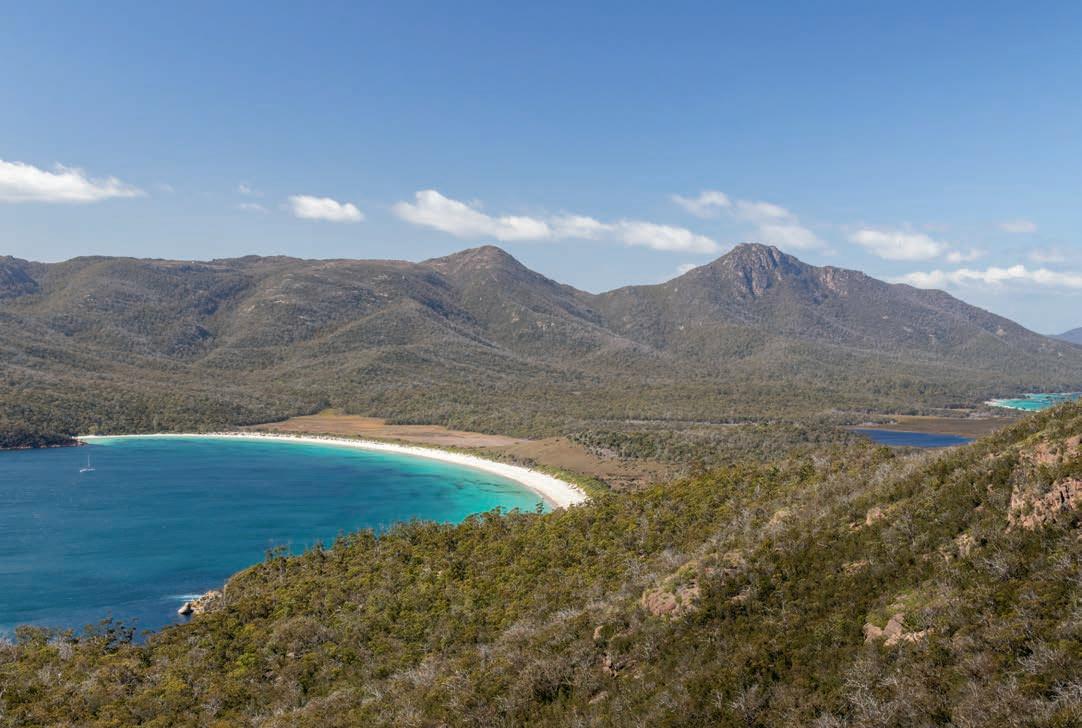
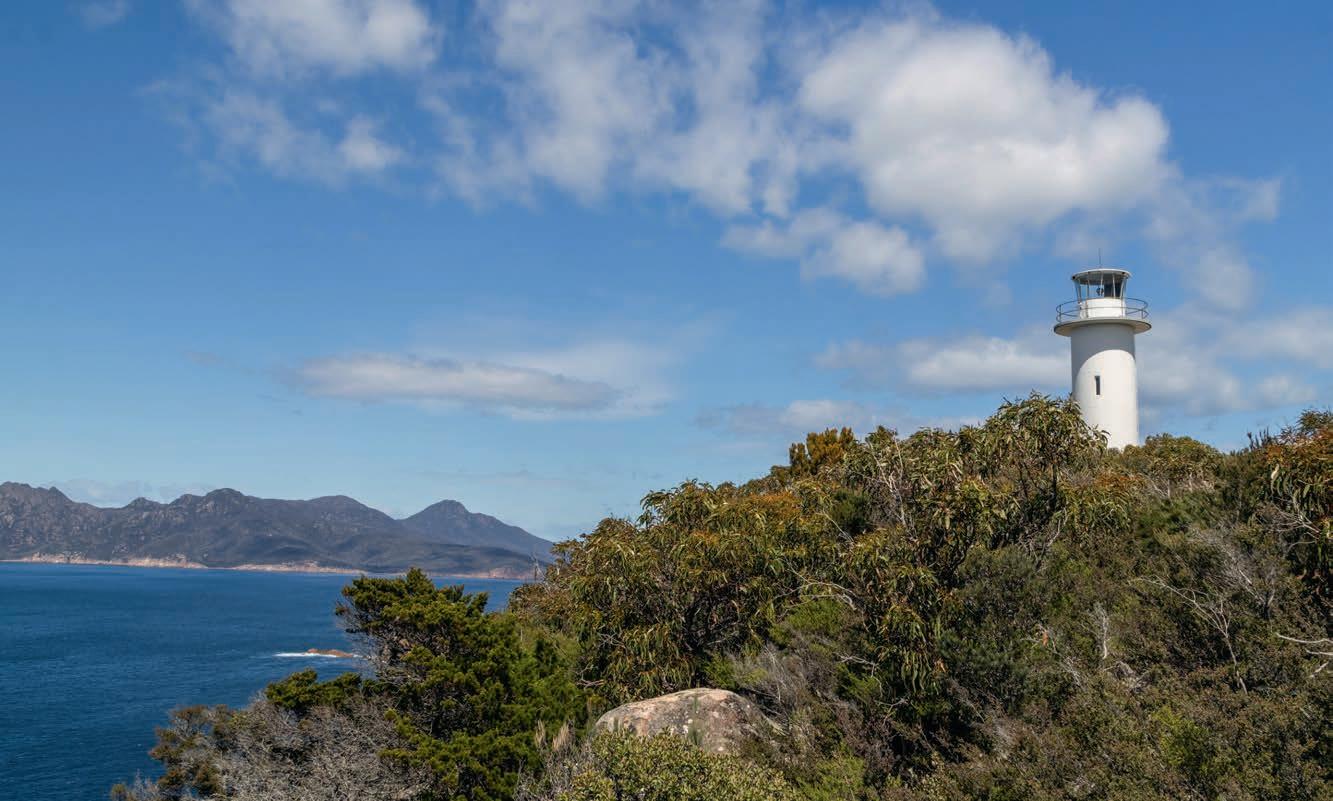
Before leaving the peninsula, a seafood lunch at Freycinet Marine Farm is highly recommended, while oyster lovers should book a tour of the farm proper, where visitors don waders and get to sample the shellfish straight from the estuary.
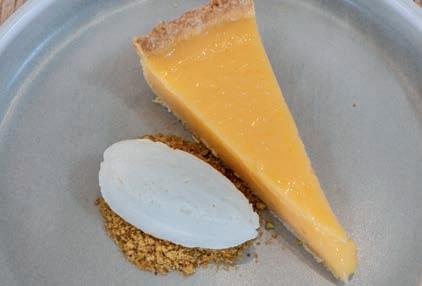
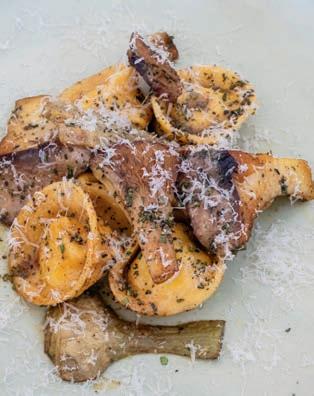
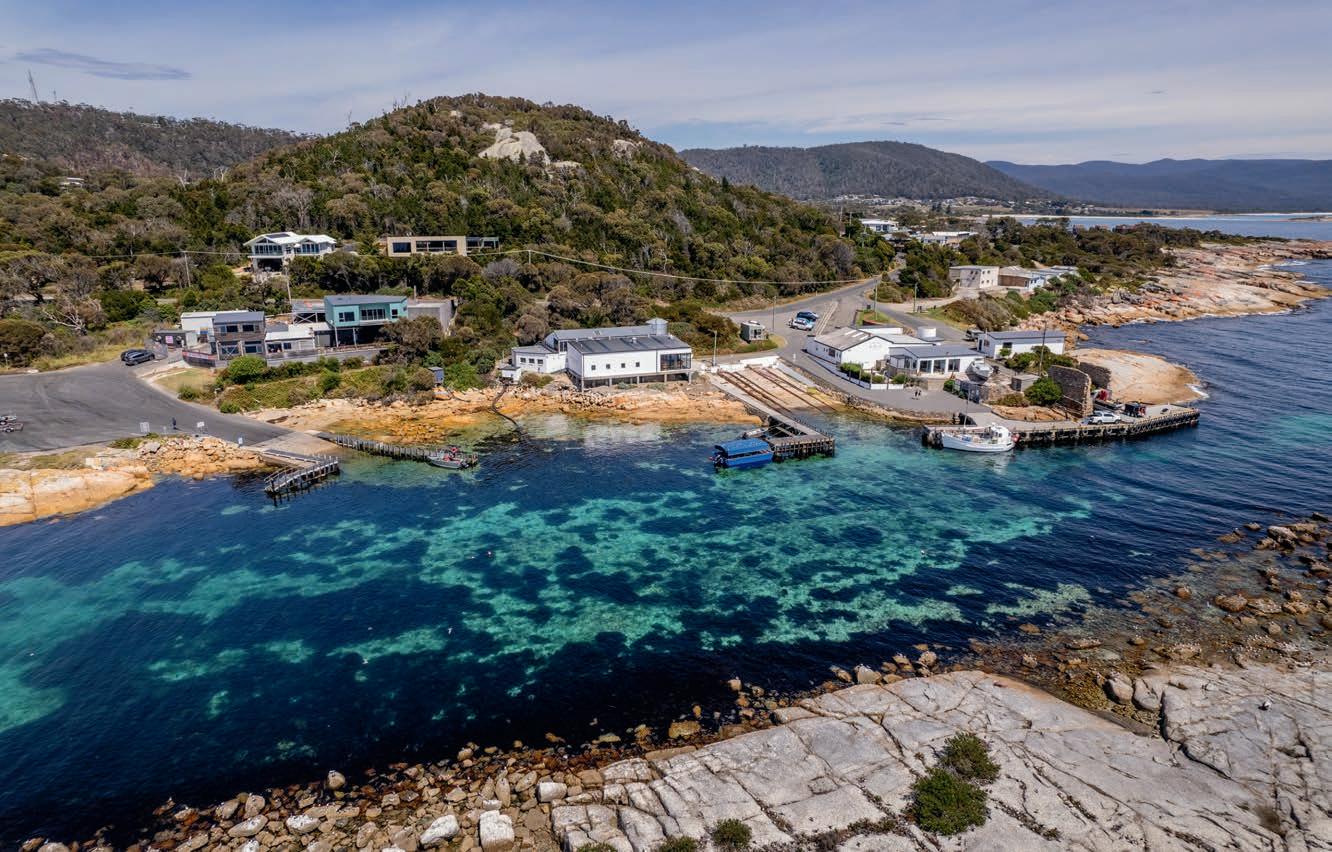
From Coles Bay, it’s back to the highway and half an hour north to Bicheno, a mecca for surfers and home to a blowhole that’s best at high tide, as well as Waubs Harbour Distillery and not one but two boutique breweries in the form of the Bicheno Beer Co and Bicheno Brewery, better known as Bich. Bicheno also boasts the outstanding Little Bay Patisserie and Le Coq bistro, but the best food we sampled in town, if not the entire trip, was at our accommodation at Harveys Farm, a splendid four-bedroom guesthouse set on five acres (two hectares) of absolute ocean frontage a few kilometres south of town. Owners Eliza and Rob di Francesco often rent their holiday house to multigenerational groups celebrating anniversaries, decade birthdays and intimate weddings, so have teamed up with caterer Chris Lucas of What Grows. Chris has a prolific kitchen garden and whatever’s in season will inevitably turn up on his menu. Our lunch of herbed ricotta tortellini with mushrooms, beef fillet with charred shallot and cafe de Paris butter on a bed of mash followed by Myer lemon tart is the kind of indulgence that would put a shine on even the dullest family gathering. Eliza and Rob welcome
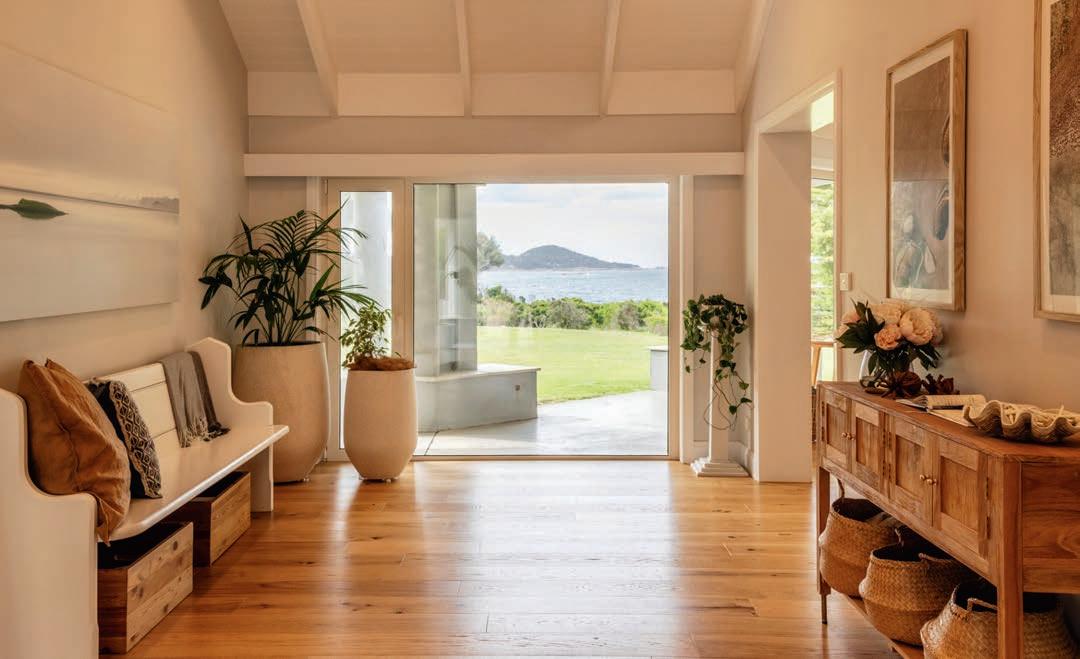
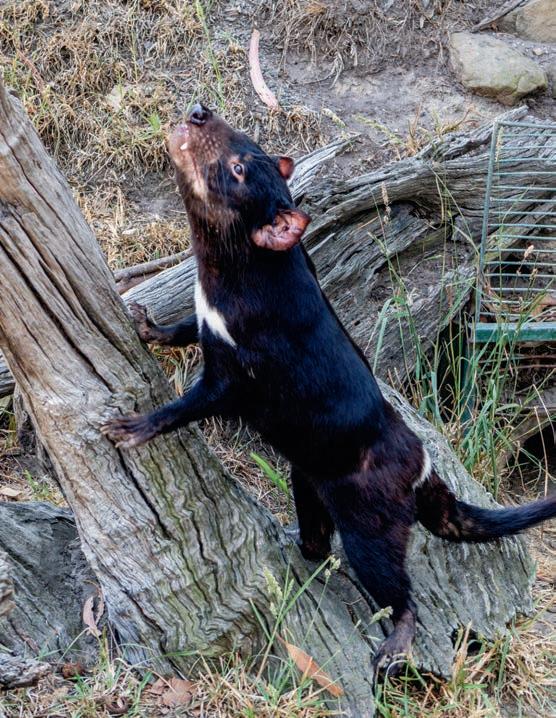
guests as family, with breakfast makings in the fridge, basics in the larder and a bottle of wine on the bench to tide their visitors over until they can get to the supermarket/bottleshop. The firepit in the garden is stacked ready for an evening’s relaxation and there are marshmallows on the pantry shelf. Hardly surprisingly, some of their guests rarely feel the urge to leave. If they do venture out, they’d be well advised to head to East Coast Natureworld, a wildlife sanctuary that provides up-close encounters with kangaroos, wombats, echidnas, quolls and many other native
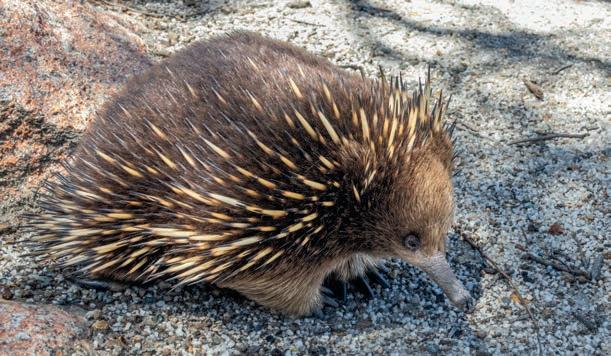
animals and birds. Visit at feeding time to learn lots about Tassie devils, or book in for the afterdark tour, when you’ll see the fierce little animals with jaws powerful enough to crush bones at their most active. Bicheno also has a resident population of fairy penguins, which build their burrows in rookeries just above the high-tide mark on the beach. While you may get lucky and spot them if you walk along the coastline after dark (or even have a pair take up residence in your accommodation’s garden), if you want guaranteed sightings of multiple penguins, it’s a good idea to join an organised outing with Bicheno Penguin Tours. The company’s bus leaves downtown Bicheno at dusk and provides the recommended red-light torches for spotting the little birds with minimal disturbance.
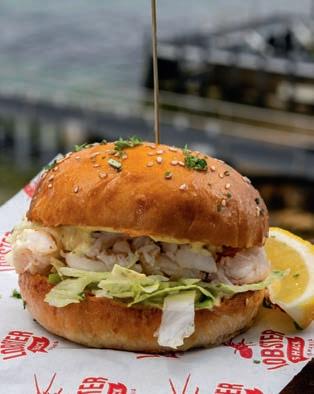
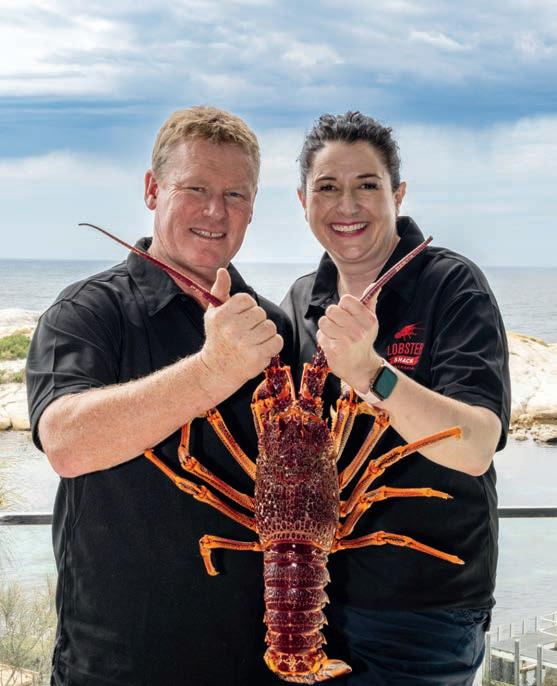
Bicheno is also home to Sara Walkem and her cray fisherman husband Marcus, who own the
Lobster Shack, another top place for seafood. Sara was practically born with saltwater in her veins as she’s the granddaughter of Peter and Una Rockcliff, Tassie’s pioneering ocean trout farmers. She pursued a career in banking before she met Marcus and agreed to come and help him with the business. These days, the Lobster Shack is a fully fledged restaurant offering lobster and other shellfish in various guises and fresh-off-the-boat gummy or blue grenadier with chips. Last year, they sold 24,000 of their signature lobster rolls, literally a taste of traditional Tassie with the prized meat sandwiched in a soft milk bun with crisp lettuce and homemade mayo.
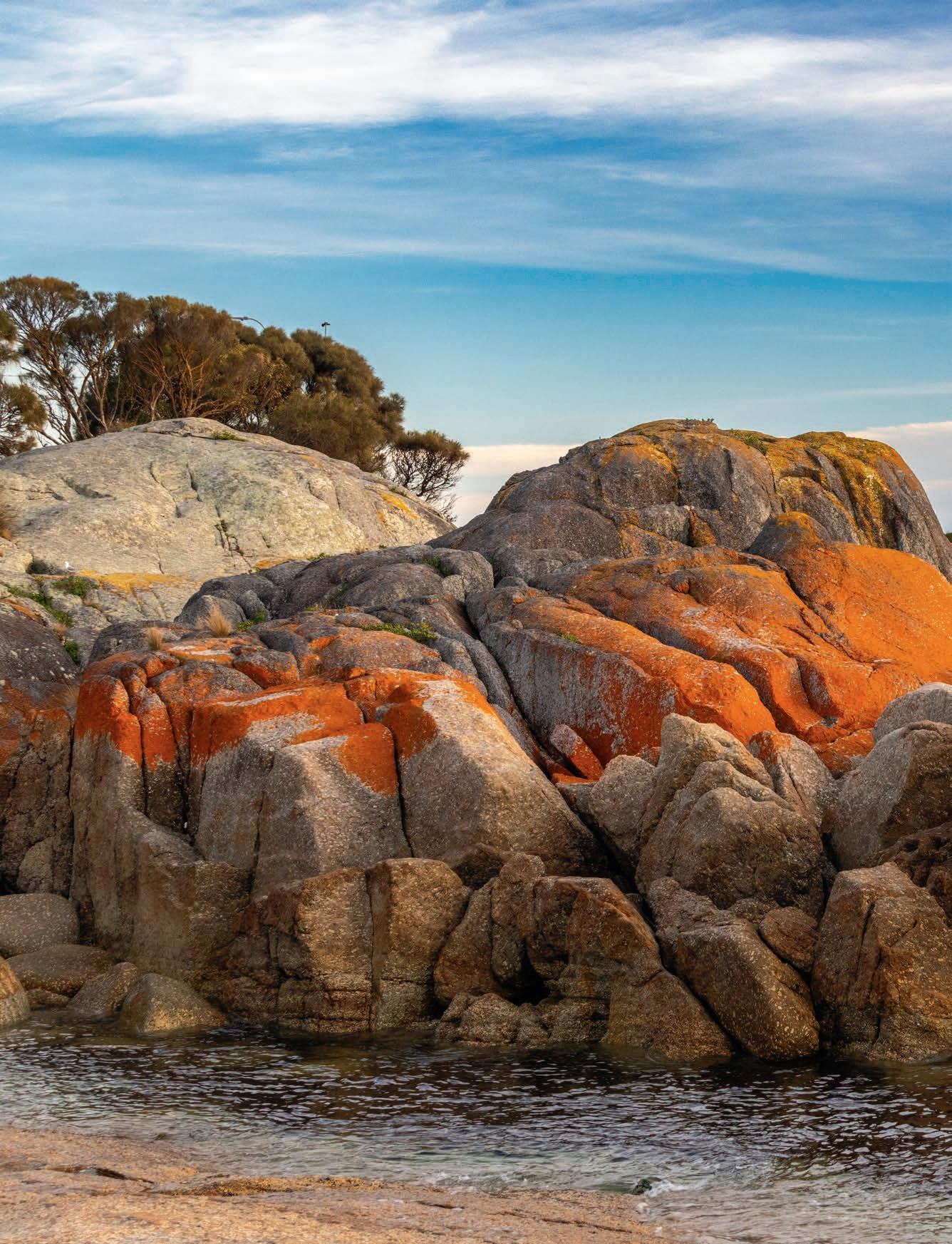
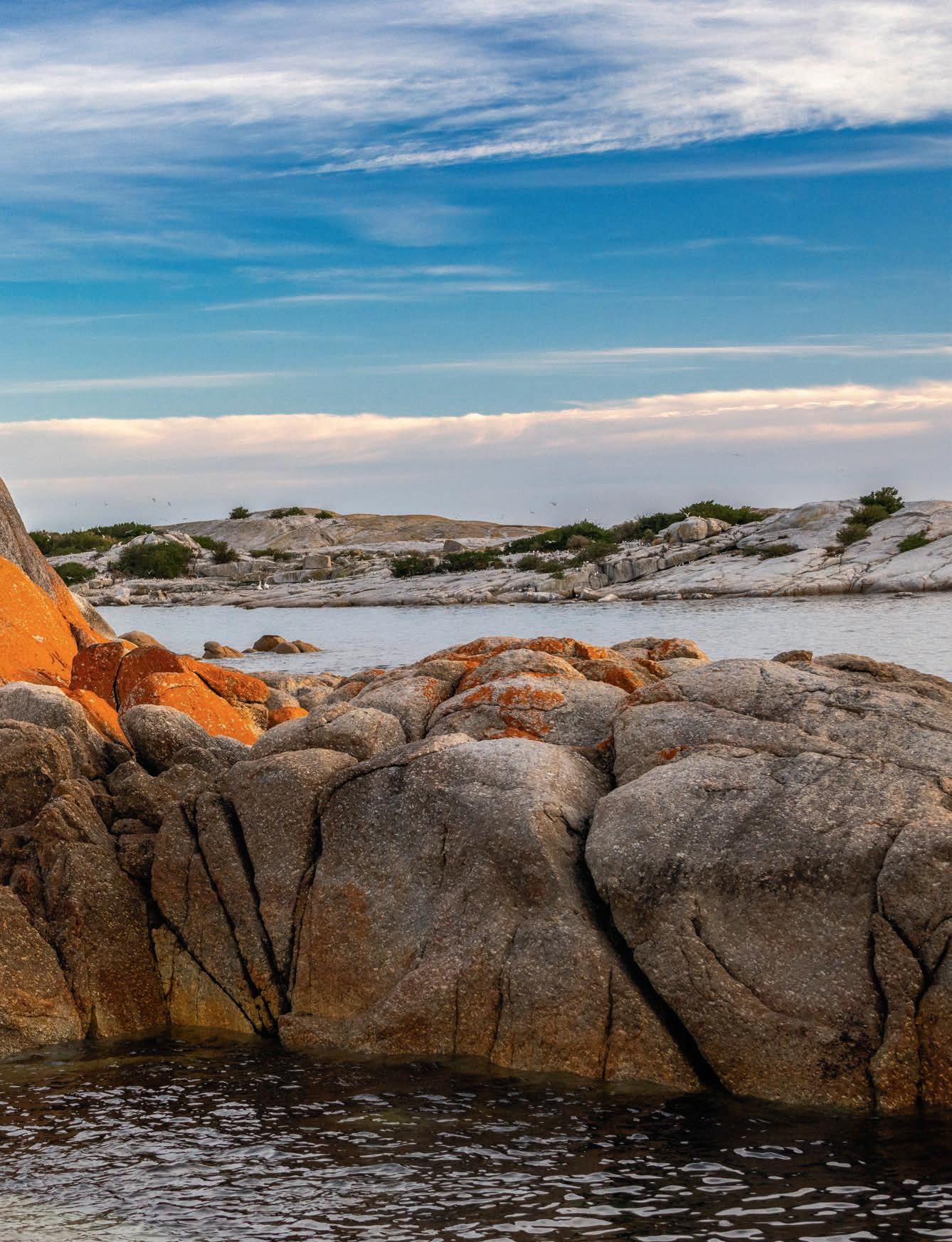
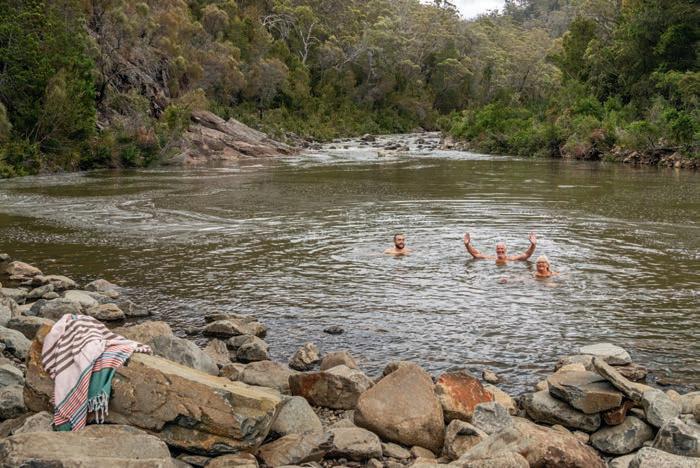
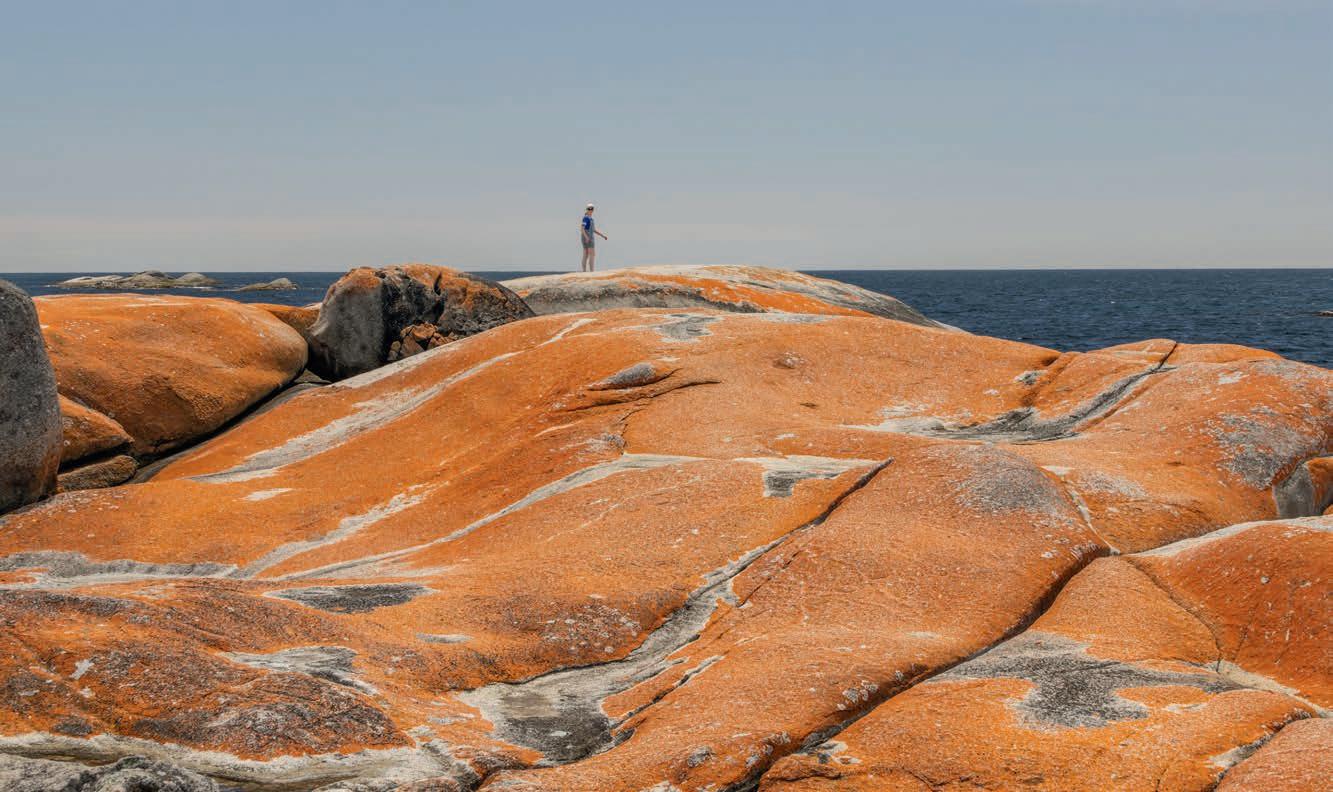
Just a few kays north of Bicheno, there’s a bracing dip to be had at a waterhole on the Apsley River. Head inland for 12km to the DouglasApsley National Park parking area, then it’s a short (1.2km-return walk) to the waterhole or a longer 7km circuit that takes in Apsley Gorge, its waterfalls cascading into another swimming hole. Back on the Tasman Highway, it’s about an hour’s drive north to St Helens, gateway to the pristine coastline of the Bay of Fires, renowned for its white beaches, turquoise water and orange, lichen-encrusted rocks.
Taking a short detour north, there are endless bays and beaches to entice swimmers to roll out
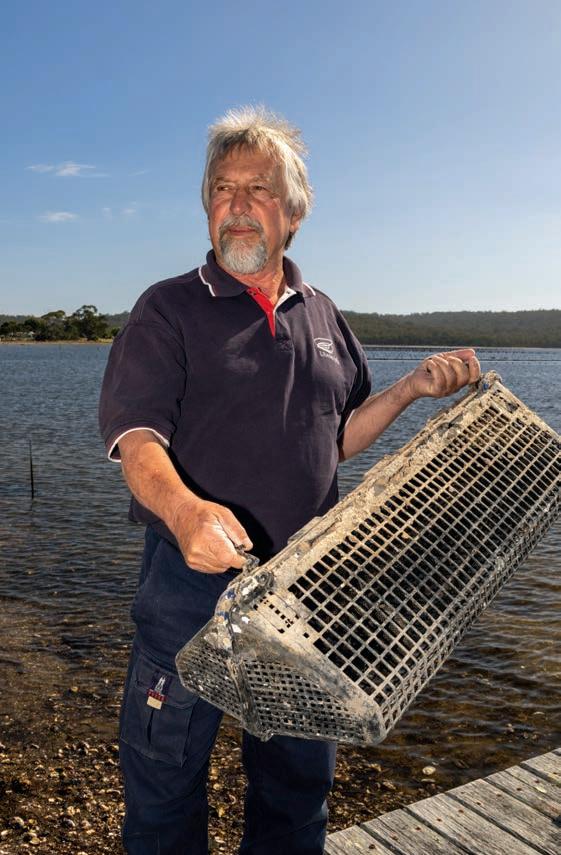
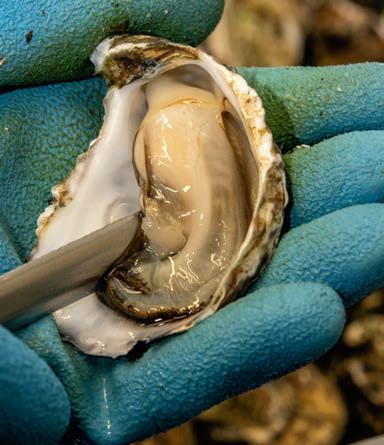
a towel for the day. On the way, however, set the navigator for Lease 65, where oyster farmer Craig Lockwood sells the molluscs he’s just plucked from the estuarine waters of Moulting Bay. Craig grew up on a mixed farm near Sheffield on the Kentish Plains and reckons the secret to his worldrenowned oysters is a combination of tidal flow between deeper channels and detritus from the cool-temperate rainforest in the coastal hinterland that washes into the bay to create the perfect feeding and growing conditions.
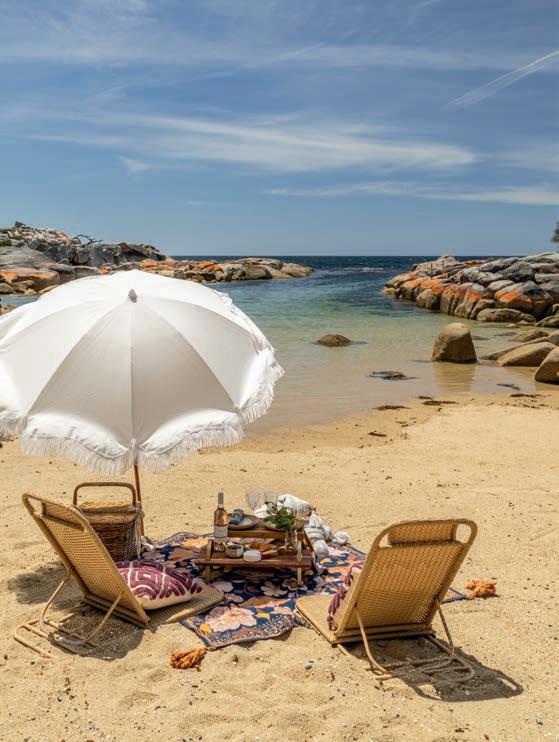
In a sheltered cove at Binalong Bay, former Perth home economics teacher Melissa Harbrow sets up a picture-book picnic spread on the beach for a couple who have arranged for her to cater for their anniversary. Melissa was enticed to Tasmania because her husband Marcus’s family had land near St Helens. They bought a small farm where they run Belted Galloways and sheep, while Marcus works FIFO in his job as a superyacht captain out of Sydney. Melissa took over Pop-up Picnics a few years ago, and is now so busy catering for events, proposals and Airbnb welcome platters showcasing local produce that she reckons a return to the classroom is an unlikely event.
Melissa recommends several spots to search out along the road that dead ends at The Gardens. The first is an Insta-worthy rock pool near Sloops Reef called Mermaids Pool, which only reveals itself at low tide. The next is Honeymoon Bay, another protected arc of frosty white beach close to a tumble of orange lichen-crusted granite boulders strewn along the water’s edge at The Gardens, named by colonial governor’s wife, Lady Jane Franklin, for the wildflowers growing in the fields beside the beach. Once again, we find ourselves in yet another of the coast’s spectacularly wild places. And, in what has become something of a running theme for the trip, we have the place to ourselves.
Swan River Sanctuary, Swansea swanriversanctuary.com.au
Harvey’s Farm, Bicheno harveysfarmbicheno.com.au
Freycinet Lodge, Coles Bay freycinetlodge.com.au
Saf fire Freycinet, Coles Bay saffire-freycinet.com.au
PLACES TO EAT AND DRINK
The Fish Van, Triabunna facebook.com/thefishvan The Branch, Swansea thebranchswansea.com.au
Melshell Oysters, Dolphin Sands melshelloysters.com.au
Alimento, Swansea alimento.au
Lease 65, 444 Binalong Rd, St Helens Ph: (03) 6376 1736 Lobster Shack, Bicheno lobstershacktasmania.com.au
Pop-up Picnic Tasmania, St Helens facebook.com/ PopUpPicnicTasmania
Little Bay Patisserie, Bicheno facebook.com/littlebaypatisserie Devil’s Corner, Apslawn devilscorner.com.au
Mayfield Estate, Little Swanport mayfieldestatetas.com.au
Freycinet Marine Farm, Coles Bay freycinetmarinefarm.com
What Grows Catering, Coles Bay Ph: 0477 071 311
WHAT TO DO
Maria Island National Park, Triabunna parks.tas.gov.au/explore-our-parks/maria-island-national-park Freycinet National Park, Coles Bay parks.tas.gov.au/explore-our-parks/freycinet-national-park Bay of Fires Conservation Area, St Helens parks.tas.gov.au/ explore-our-parks/bay-of-fires-conservation-area Douglas- Apsley National Park, Bicheno parks.tas.gov.au/explore-our-parks/douglas-apsley-nationalpark/apsley-river-waterhole-and-gorge
Eastcoast Natureworld, Bicheno natureworld.com.au
Bicheno Penguin Tours, Bicheno bichenopenguintours.com.au
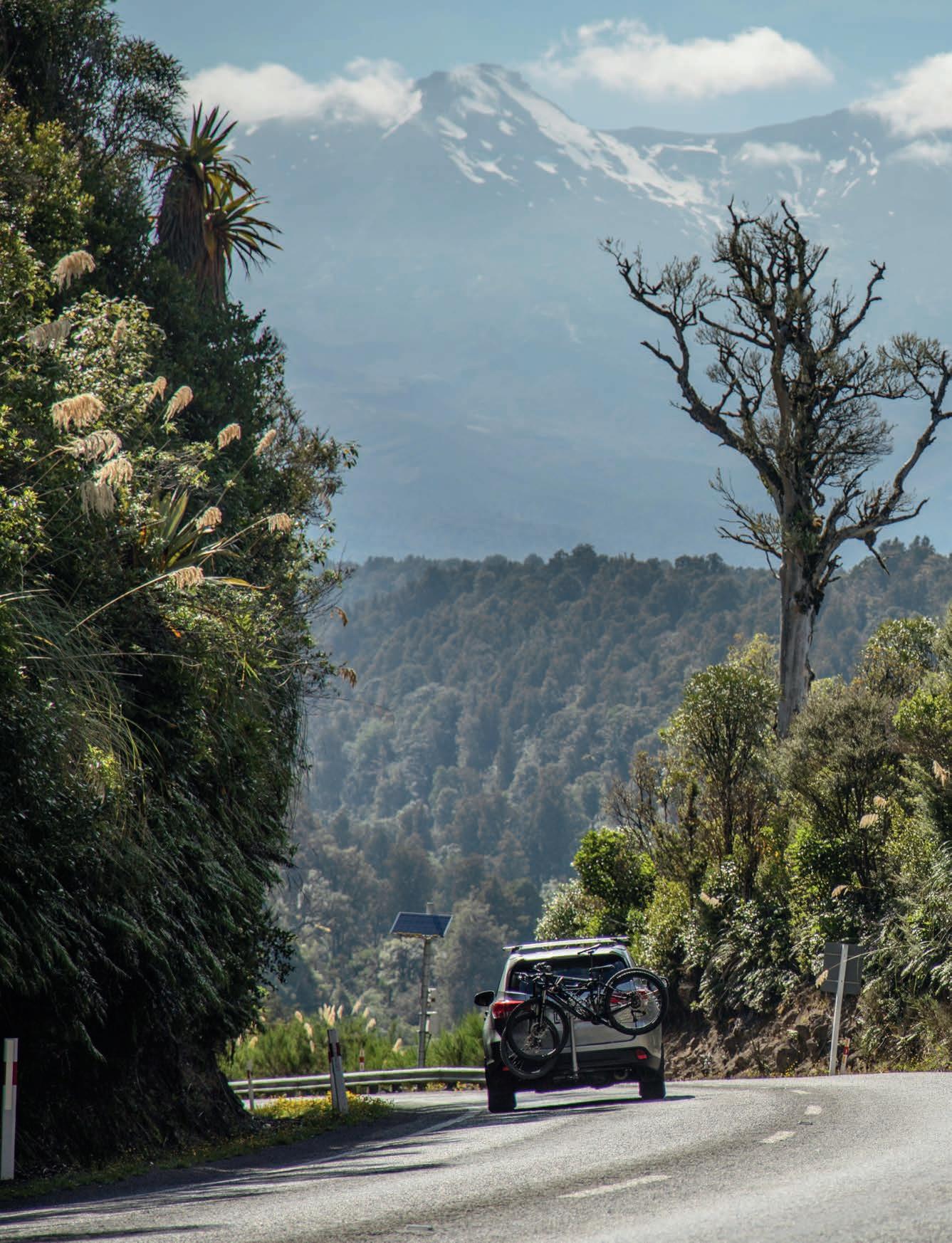
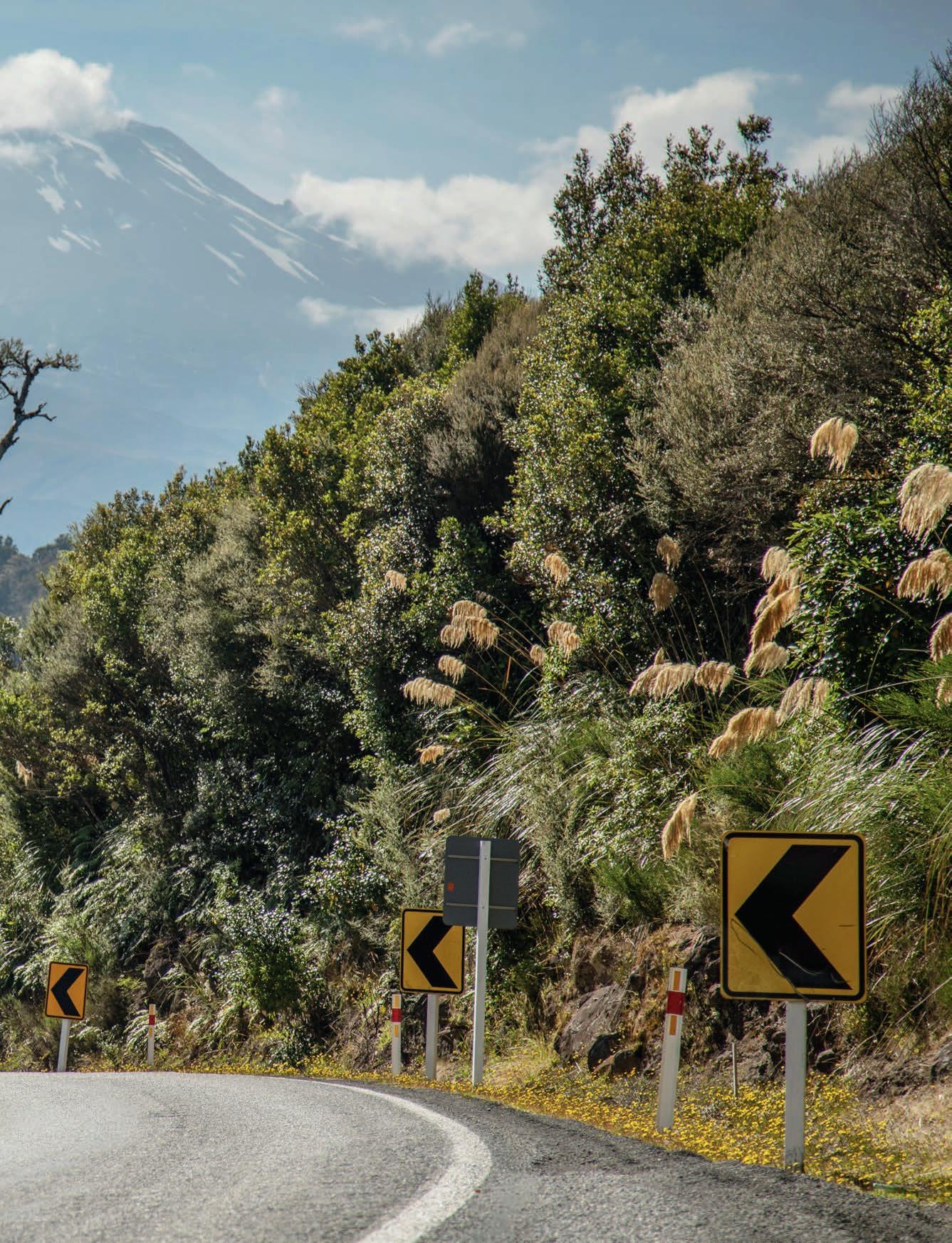
A drive through some of New Zealand’s North Island delivers spectacular natural and man-made wonders.
THESE PAGES: (Clockwise from above)
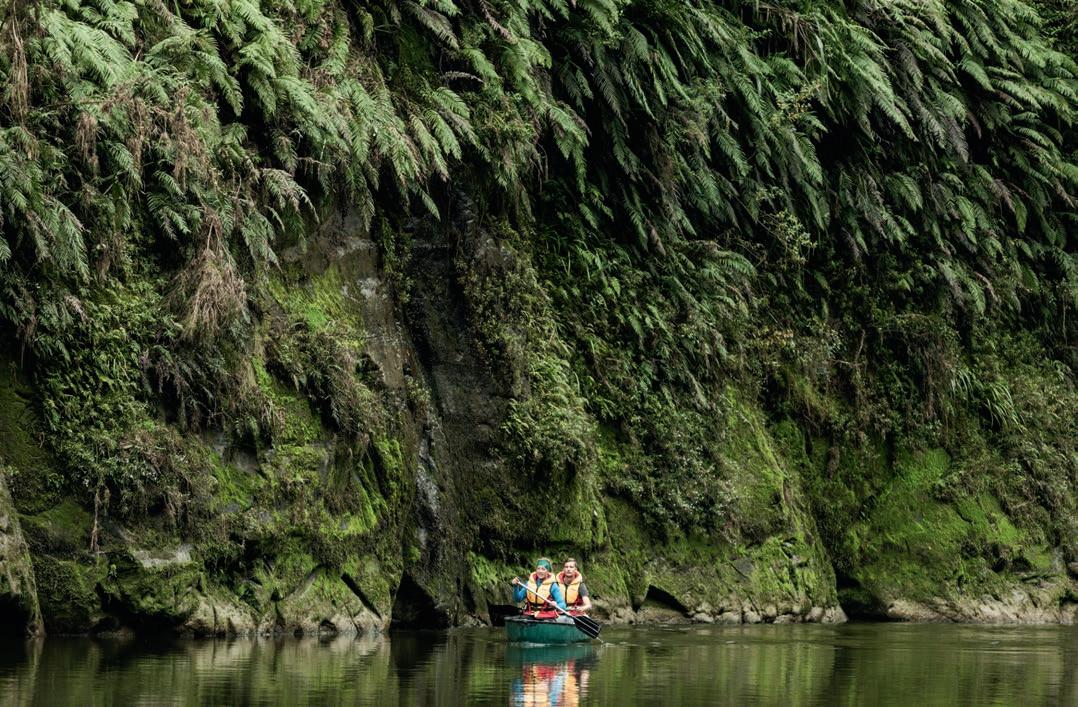
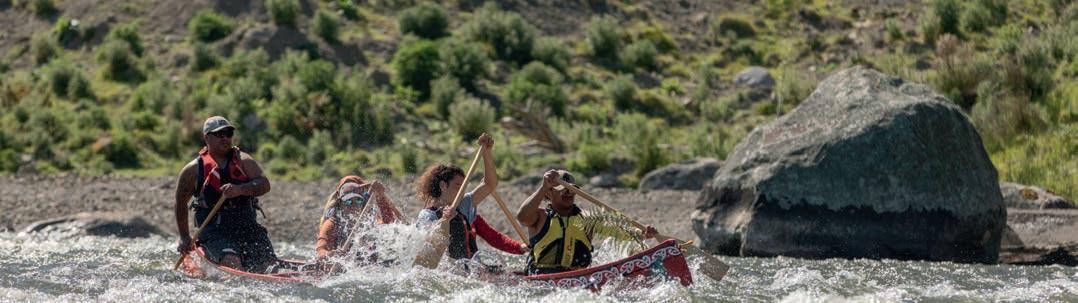
Willie Huch is praying. It’s a lilting song of longing and belonging performed at the edge of the wild river that thunders through the core of the North Island in New Zealand (Aotearoa).
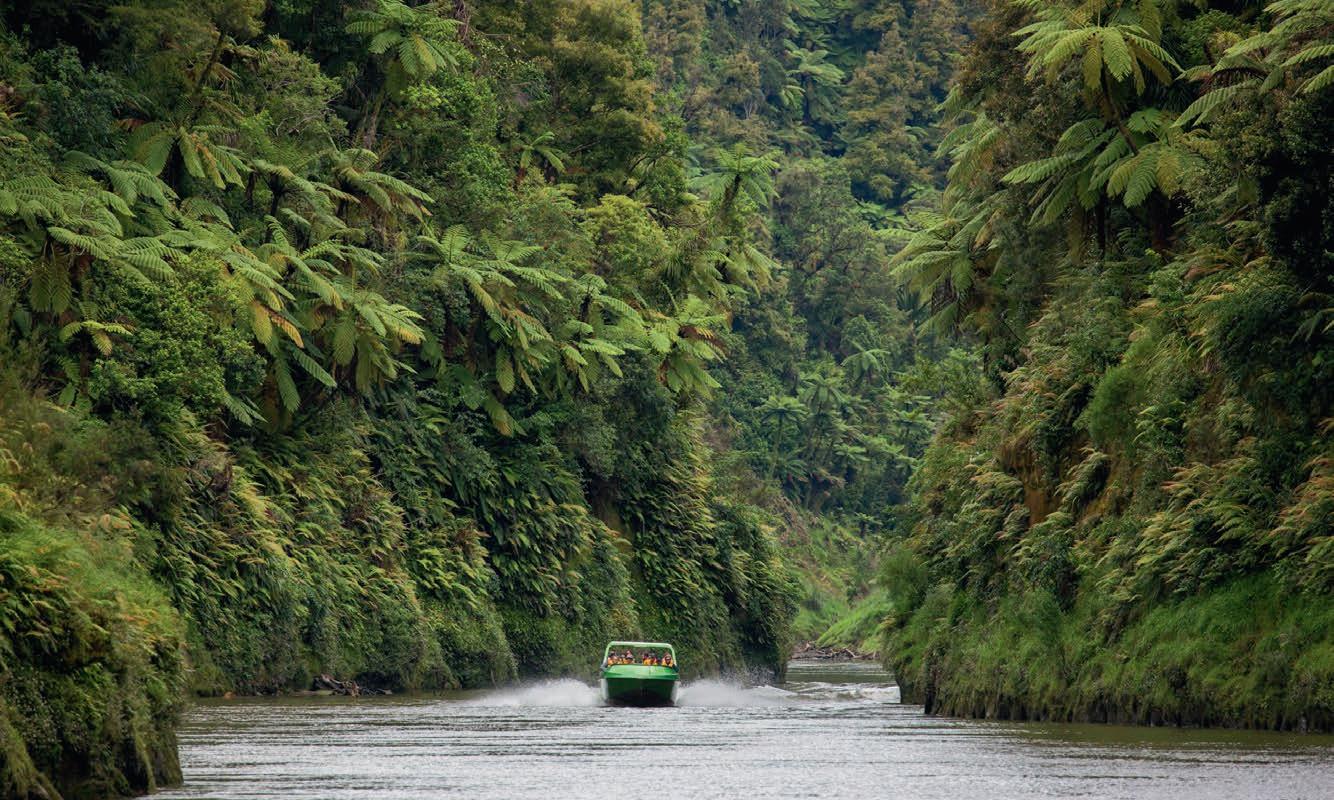
The Whanganui River (known to Māori as Te Awa Tupua) is the longest navigable river in the country, and Willie is a river guardian up to his knees in water. A posse of young kayakers is clinched tightly into bright safety jackets preparing to tackle an 88-kilometre, three-day canoe expedition considered to be one of New Zealand’s Great Walks (albeit on water).
“You only know where you are going by knowing where you have come from,” Willie says. “The song speaks to our ancestors, our connections from mountains to sea, it tells how we are one with the river.” He pauses, waits for the message to sink in, then pushes a wide-bodied canoe into the current. “Away you go, folks,” he cheers. “Don’t tip over but, if you do, I’ll come and rescue you.”
He is laughing and serious at the same time because there will be plenty of spills and thrills on this encounter with the river, which holds deep spiritual significance for Māori people. Layers of cultural history give contour to a voyage
travelling back to a more innocent time, staying at campsites on the riverbank, sleeping in tramping huts with long-drop toilets. This is the first of many sideways diversions on a road trip into a region of extraordinary natural beauty close to Mount Ruapehu and along the Whanganui River.
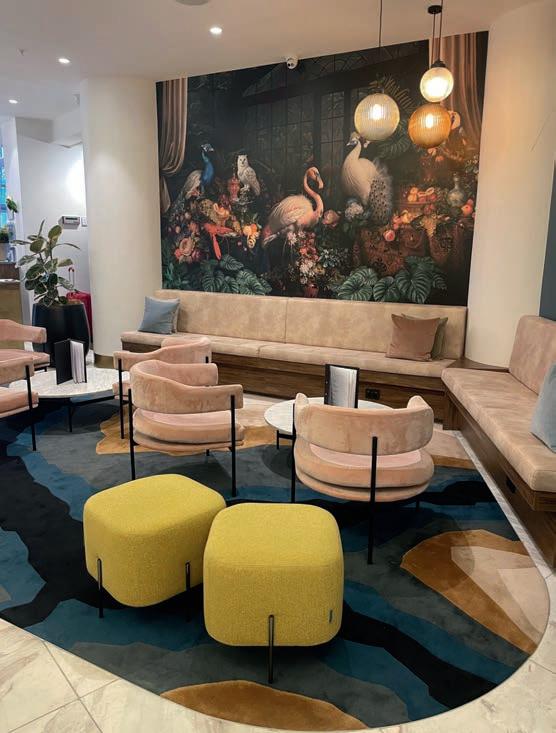
The journey begins a few days earlier in Auckland at the Airedale Boutique Suites on Queen Street. It’s an easy introduction to the city of harbours in a smart urban retreat that immediately reminds of the value in a prime downtown location with short walking distance to the vibrant waterfront.
Auckland sets a high benchmark with good restaurants. Kingi is one of those incidental moments of discovery found in the historic Britomart precinct. It’s a foodie destination and, what luck, there’s a table free, in the beautifully restored building with exposed brick walls under soaring ceilings.
Every dish comes with a story: the name of the boat, the fisherman (or woman), the spot where the catch landed. The raw bar showcases quality New Zealand seafood and the wood fire brings out the best in locally sourced ingredients. Line-caught
snapper, Stewart Island oysters, ethically harvested king fish, you get the idea. Let’s sleep on it.
A road trip through the Ruapehu region via the Adventure Highway starts on State Highway One heading southwards from Auckland towards Hamilton. Roughly two hours into the drive, lives run at a different pace in the small town of Otorohanga, where travellers are welcomed at the Fat Kiwi Cafe, and further on, in the local Bosco Cafe at tiny winy Te Kuiti, the self-proclaimed sheep shearing capital of the world.
These aren’t just pit stops. They’re small-town initiations into New Zealand life where baristas know regulars by name and homemade baking is daily bread. You could keep going for the best cup of coffee at the Blue Hill Cafe in Owhango, but let’s not play favourites, because there’s a cinematic marvel spooling past the car window.
Train enthusiasts will likely pause at the Raurimu Spiral lookout to witness one of New Zealand’s greatest engineering feats. It’s a piece of railway tracking that winds up a steep gradient of curves and loops just after Raurimu. If you’re lucky, you might catch a glimpse of the Northern Explorer making ascent towards Wellington.
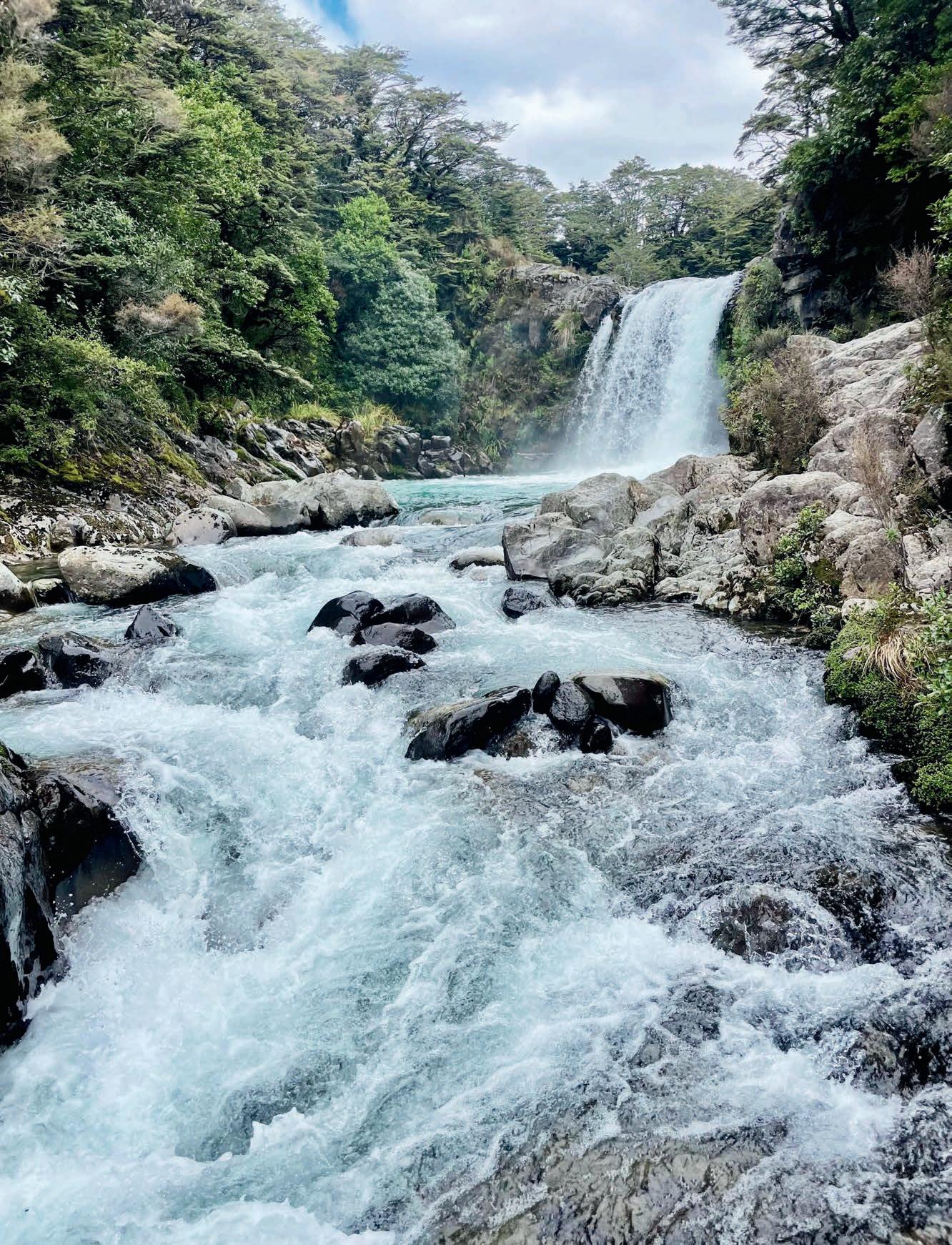
Further on, at the end of a 20-minute walk on a bush track at the edge of the Tongariro National Park, Tawhai Falls feels strangely familiar. This is Middle Earth. It’s a place immortalised as Gollum’s Pool, in The Lord of the Rings, though intrepid day-trippers keen to avoid Insta “I am here” images might keep going to tackle the spectacular 6km Taranaki Falls loop.
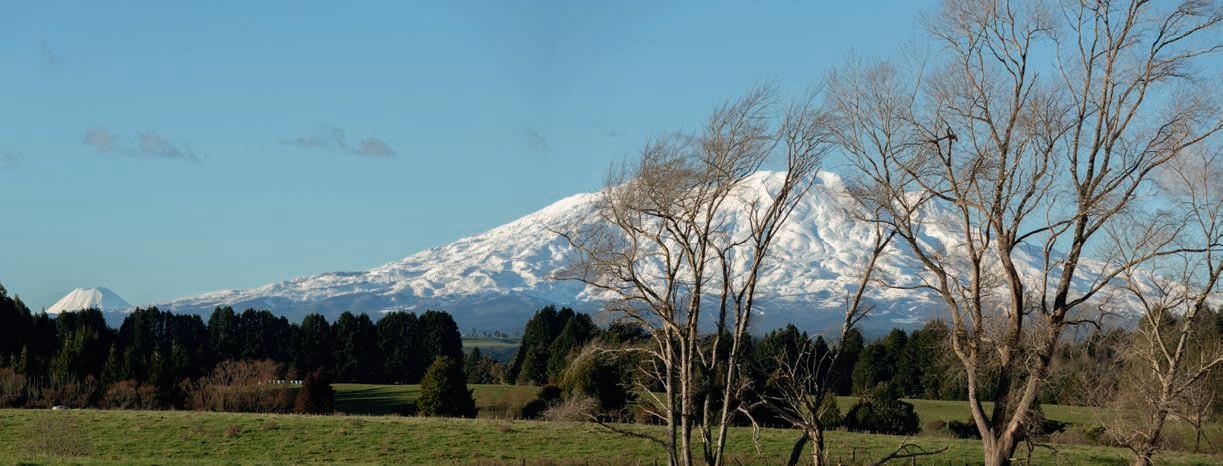
There’s raw beauty in an untouched landscape where good views are guaranteed around just about every bend in the road. Glorious Mount Ruapehu is clutching clouds beside Mount Tongariro and the perfectly conical Mount Ngāuruhoe. For this reason,
if no other, it’s worth visiting the geologically fascinating UNESCO Dual World Heritage Site recognised for its cultural and natural significance.
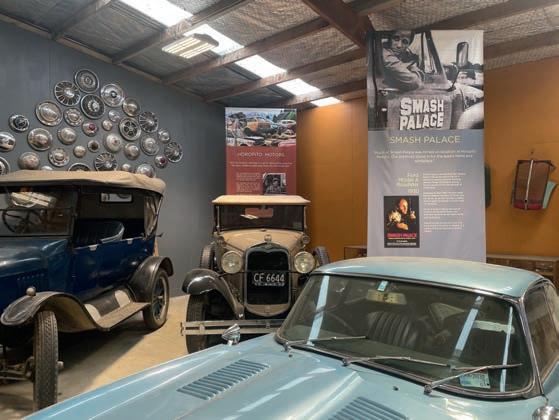
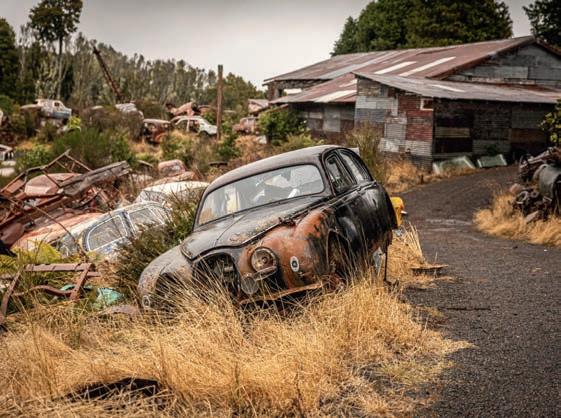
Towards the town of Ohakune, Horopito Motors (trading as Smash Palace) is a sprawling vintage car graveyard, capturing the imagination of filmmakers for decades. The largest vintage car dismantler in Australasia still maintains that lovely feeling of unscripted authenticity so well encapsulated in Kiwi films including Goodbye Pork Pie and Hunt for the Wilderpeople.
Driving into the culture-rich town of Ohakune, there is rare opportunity to experience traditional Māori welcome ceremonies (powhiri) at local marae (meeting grounds), with Ngāti Rangi (one of the local iwi/tribes) who share their heritage through karakia (traditional prayers and songs).
At the Te Pae Tata (Ruapehu Community Hub), visitors are welcomed with prayers and songs invoking protection and guidance, providing insight into spiritual practices shaped over centuries. These are not tourist shows. They’re genuine cultural exchanges that remind of history and meaning. Ancient protocols are observed with grace and generosity by Māori extending an open invitation to experience heartfelt connection with a shared sense of belonging.
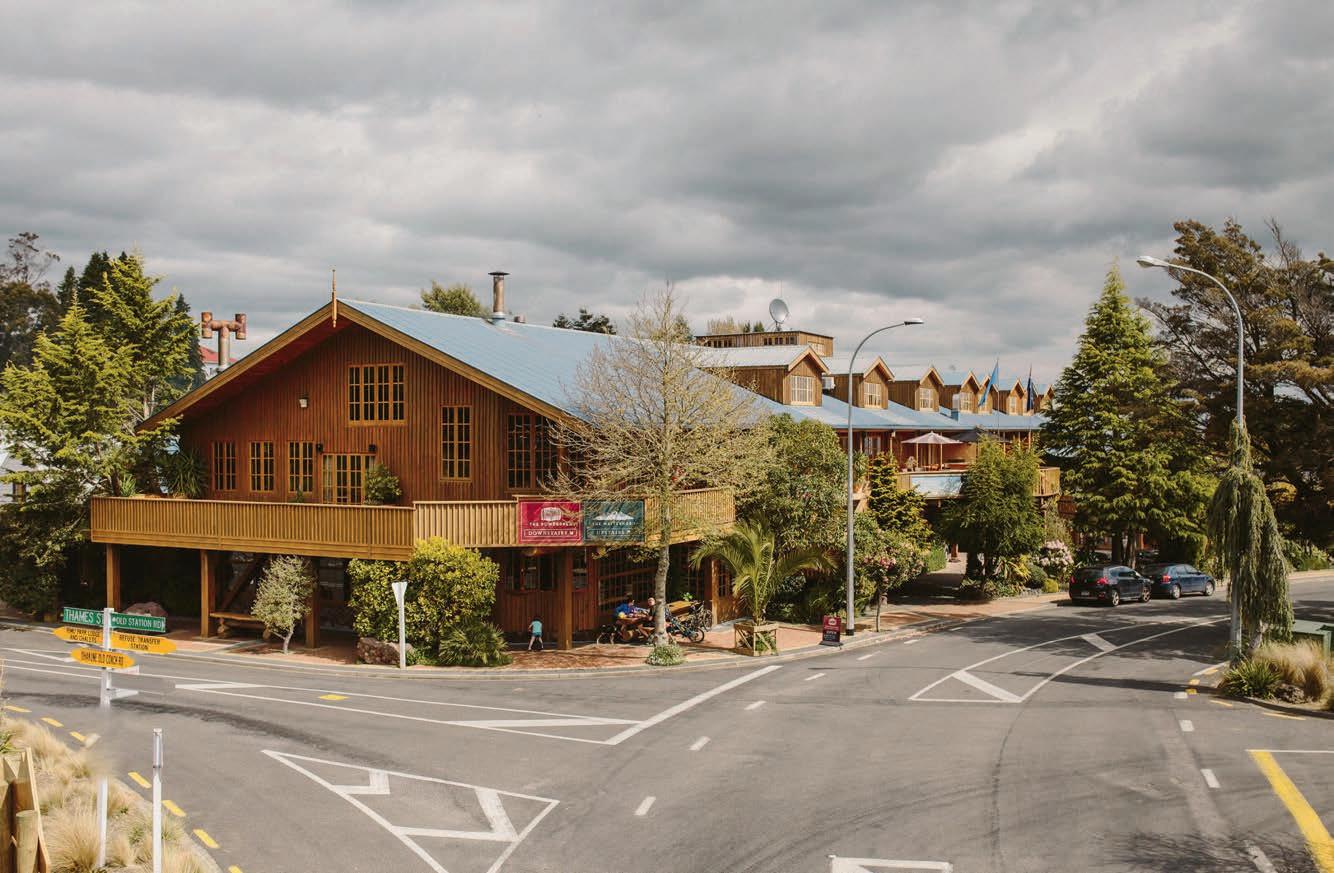
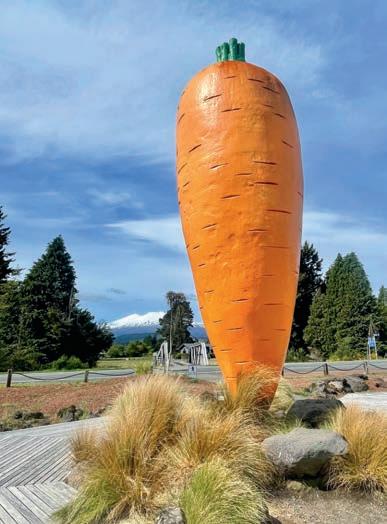
It’s quite a contrast to what follows. In Australia, you can visit a big prawn, a big koala, a big lawnmower. “Generally, these objects are cannily set along a stretch of highway so astoundingly void and dull that you will stop for almost anything,” wrote Bill Bryson in his book Down Under. Not so in New Zealand. The road to Ohakune is never dull. Located on State Highway 49, a massive root vegetable stands as a beacon of beta-carotene, possibly New Zealand’s most ambitious attempt to make vegetables exciting. The Big Carrot would put Ohakune on the map were it not known, just as significantly, for excellent hiking and cycling trails.
There are eight scenic rides connecting across a series of incredible landscapes on the Mountains to Sea (Ngā Ara Tūhono) connected pathways network weaving through Ohakune. Hire a bike and peddle the Ohakune Old Coach Road to the unforgettable Hapuawhenua Viaduct, a long-ago link along New Zealand’s Main Trunk Railway line, an engineering feat spanning a breathtaking ravine.
The newly developed Te Ara Mangawhero follows another path, a bush tramway built on narrow-gauge rails in the early 1900s to transport vast quantities of timber from dense forests surrounding Ohakune. Now, it’s a promise to right the wrongs of the past with
conservation efforts rectifying logging impact, by the replanting of native trees and protection of natural waterways. Days could disappear exploring these trails but it’s back in the car for the drive to Blue Duck Station, a working farm that doubles as a wildlife conservation retreat, about two hours’ drive from Ohakune.
We settle into one of the rustic cottages with a well-equipped kitchen and extensive views of the Whanganui National Park. Bird call is continuous. Night comes with New Zealand’s distinctive native owl, the morepork, and the delightful kiwi. Dawn expands in a melody of tui, bellbird and blackbird, and the prospect of several exhilarating experiences.
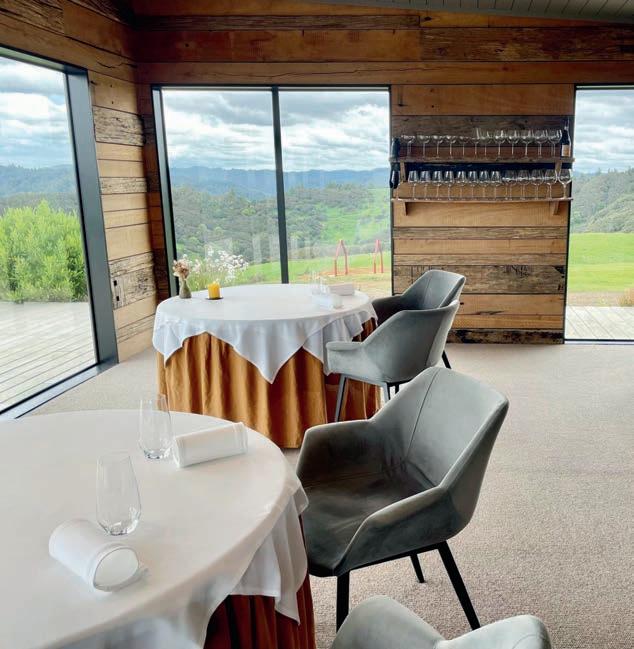
One of the most talked-about Blue Duck Station adventures, other than spotting the elusive, endangered blue duck (whio), is the farmto-table fine-dining experience at The Chef’s Table. Casual meals are available in the Blue Duck Station Cafe, but many guests navigate a rugged two-hour bush safari by an indestructible allterrain vehicle to arrive at the intimate 10-seat restaurant under the ministrations of Englishborn chef Jack Cashmore.
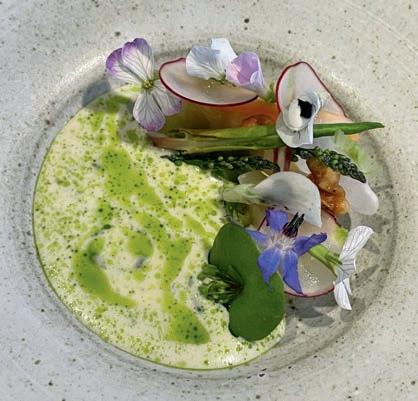
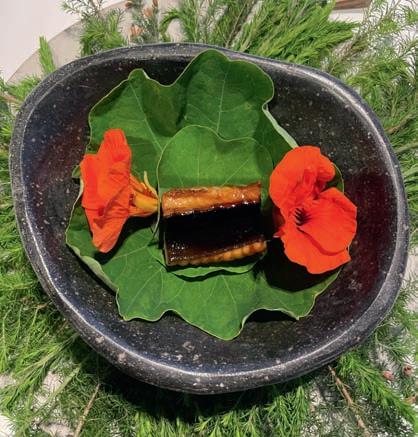
It’s a privilege to witness a choreographic performance in the open kitchen where passion meets perfectionism at what’s, surely, the highest peak in the world? Foraged ingredients are re fi ned, tender and nuanced: wild venison from the hills, fermented mushrooms that whisper of ancient forests, smoked eel with fresh nasturtium, ingredients that almost outshine the panoramic vista.
This is a theatre on the top of the world where every bite-sized bit zings with purity and flavour.
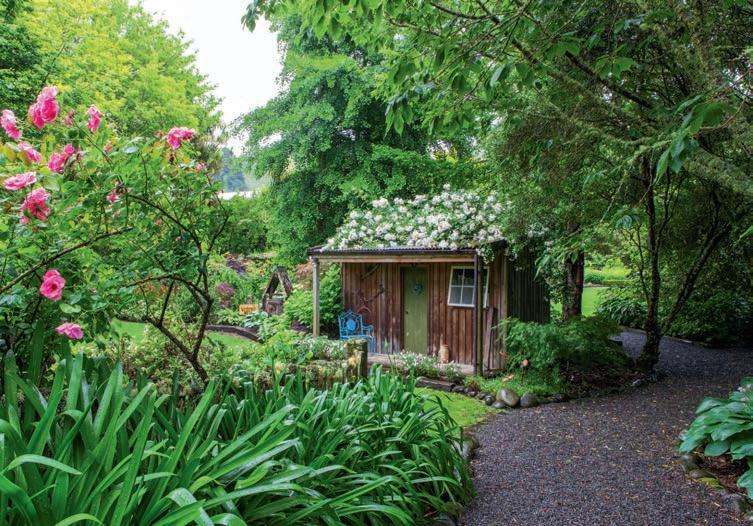
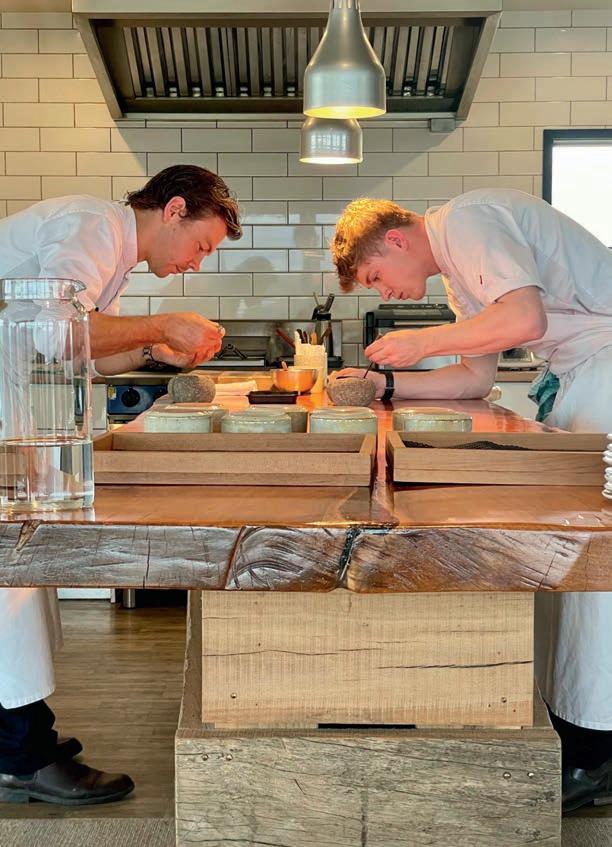
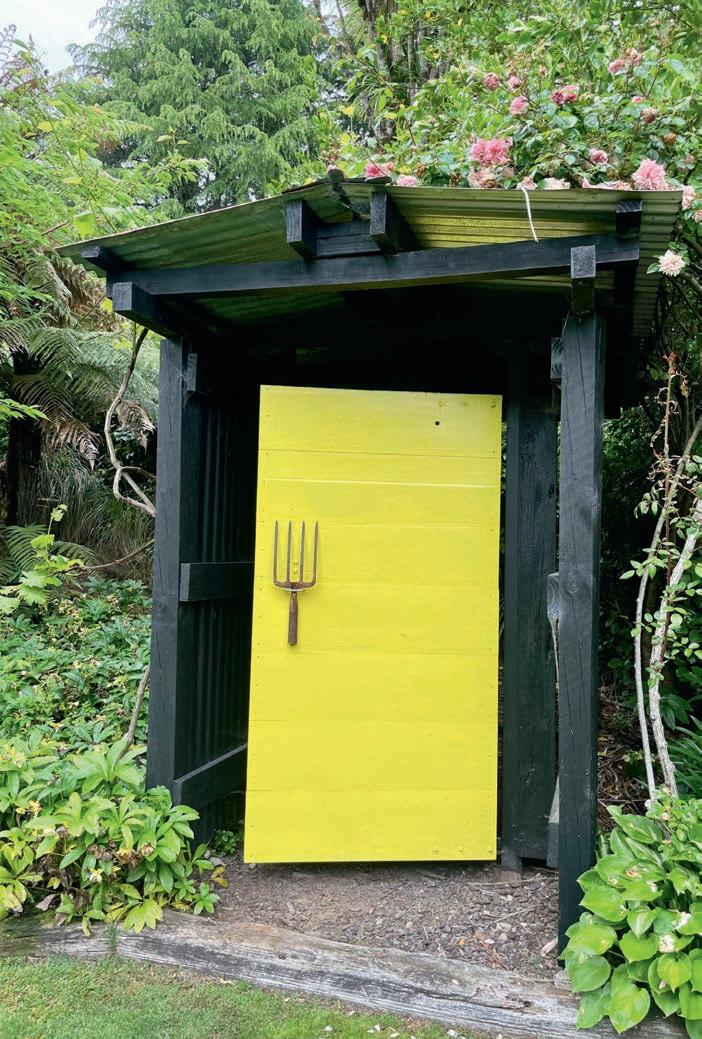
THESE PAGES: (Clockwise from above) A pitchfork doubles as a door handle; edible flowers for garnishes at Blue Duck Station; a landscape to bring a smile; dining with a view at Blue Duck Station; foraged ingredients are redefined on Blue Duck’s menu.
The landscape settles into twilight, then darkness, as the final course concludes. Guests retreat to private cabins with ensuite bathrooms. It’s all part of the experience. The moon rises, stays a while, slides away with dawn. At breakfast, a homemade crumpet encourages reflection upon a piece of New Zealand that hasn’t been overly prettified for tourist consumption.
The sense of peace achieved at Blue Duck Station prevails on the return journey heading back to Auckland. Slowly. Bradley’s Garden is a stopping point in a five-star Garden of National Significance on the Forgotten World Highway. A highly personalised horticultural masterpiece created and maintained by the Bradley family is an endurance test, lovingly tended for decades, and you don’t need to be a gardener to appreciate its charms.
The last interlude is a place of pastoral tranquillity 7km outside the small town of Taumarunui. One night at Omaka Lodge won’t
ever be enough when boutique accommodation crystallises the concept of warm hospitality in a forgotten corner of New Zealand.
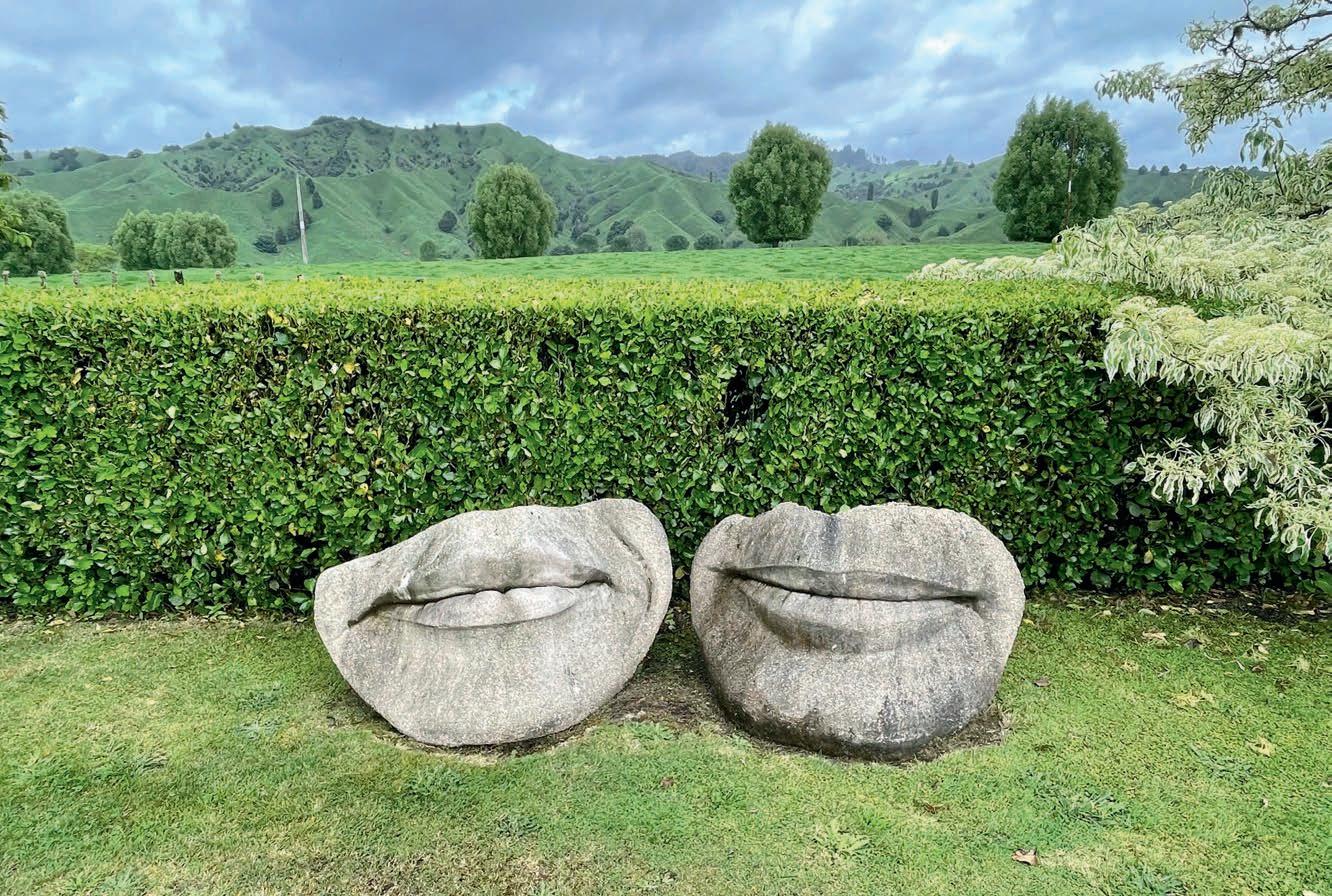
The owners, Scott Riches-McPherson and Christopher Riches, settled here for the sense of “community and generosity”. It’s another garden sanctuary tended for more than 40 years by previous owners, a series of garden rooms demonstrating extraordinary attention to detail in the placement of each plant, according to light and shadow throughout the day. Sculptures by New Zealand artists frame distant views of Herlihy Bluff and Mount Hikurangi but, as is often the case, it’s the home-cooked dinner and the comforts of the elegant Ruapehu Suite that linger in memory.
And for a moment — just a moment — everything makes perfect sense in this journey to Middle Earth bounded by rich Māori culture and the most dramatic landscape on the planet. We know where we have come from and where we are going.
Airedale Boutique Suites, Auckland airedale.co.nz Powderhorn Chateau, Ohakune. powderhorn.co.nz Blue Duck Station, Retaruke blueduckstation.co.nz Omaka Lodge, Taumarunui omakalodge.nz
PLACES TO EAT & DRINK
Kingi, Auckland thehotelbritomart.com/kingi-restaurant Amano, Auckland amano.nz Cassia, Auckland cassiarestaurant.co.nz Café Hanoi, Auckland cafehanoi.co.nz
Soul Bar and Bistro, Auckland soulbar.co.nz
The Chef’s Table experience with Jack Cashmore, Ruapehu thechefstable.co.nz
Whanganui River canoe trips canoewhanganuiriver.com Mountains to Sea (Ngā Ara Tūhono Great Ride) mountainstosea.nz
Bradley’s Garden, Taumarunui bradleysgarden.co.nz
Owhango Adventures, Owhango canoewhanganuiriver.com
FOR MORE INFORMATION
Visit Ruapehu: visitruapehu.com
Air New Zealand: airnewzealand.com.au
Department of Conservation (for track conditions and park info): doc.govt.nz
From a grass-roots sculpture trail initiative to an iconic window on space, a road trip through the NSW Central West is full of quirky attractions.
BY KIRSTY MCKENZIE, PHOTOGRAPHY KEN BRASS
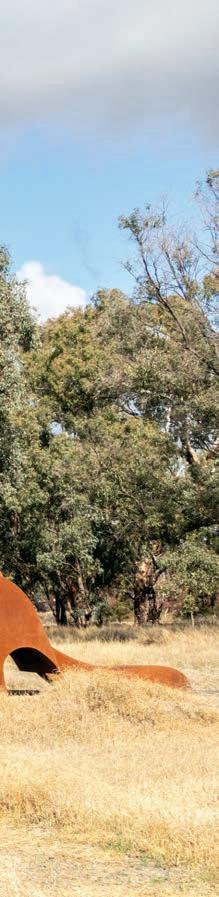
Trudy Mallick stops to check a counter as she enters the site of Varanus (Goanna Gugaa), Glen Star’s giant metal sculpture near the Gum Swamp Wildlife Refuge on the outskirts of Forbes in the NSW Central West. The sculpture acknowledges the importance of the goanna to the Wiradjuri people of the NSW Central West and is either the start or end point of a 100-kilometre trail of giant works, each positioned approximately 10km apart on the Lachlan Valley Way, the road that connects Forbes with Condobolin.
“One hundred and eight thousand, two hundred and ninety-fi ve visitors,” Trudy says, reading the tally. “That’s how many people have been to this site since the sculpture went up in 2019. And it’s 2000 more than when I was here last week, so it’s de fi nitely drawing attention.”
As the president of the Forbes Art Society, Trudy is at the helm of a dynamic group of locals, who are determined to put Forbes on the map with the sculpture trail, improvements to Gum Swamp with four bird hides providing windows on the district as an internationally recognised birdbreeding centre and establishing an art gallery and cafe in a former ambulance station in town.
The trail was the brainchild of local artist Rosie Johnston, who had her “why-not?” moment on the way back from visiting Sydney’s Sculpture by the Sea outdoor exhibition. Numerous creatives including Wendy and Kim Muffet, who run
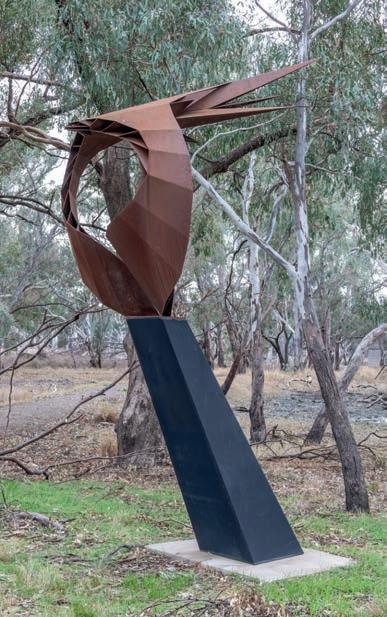
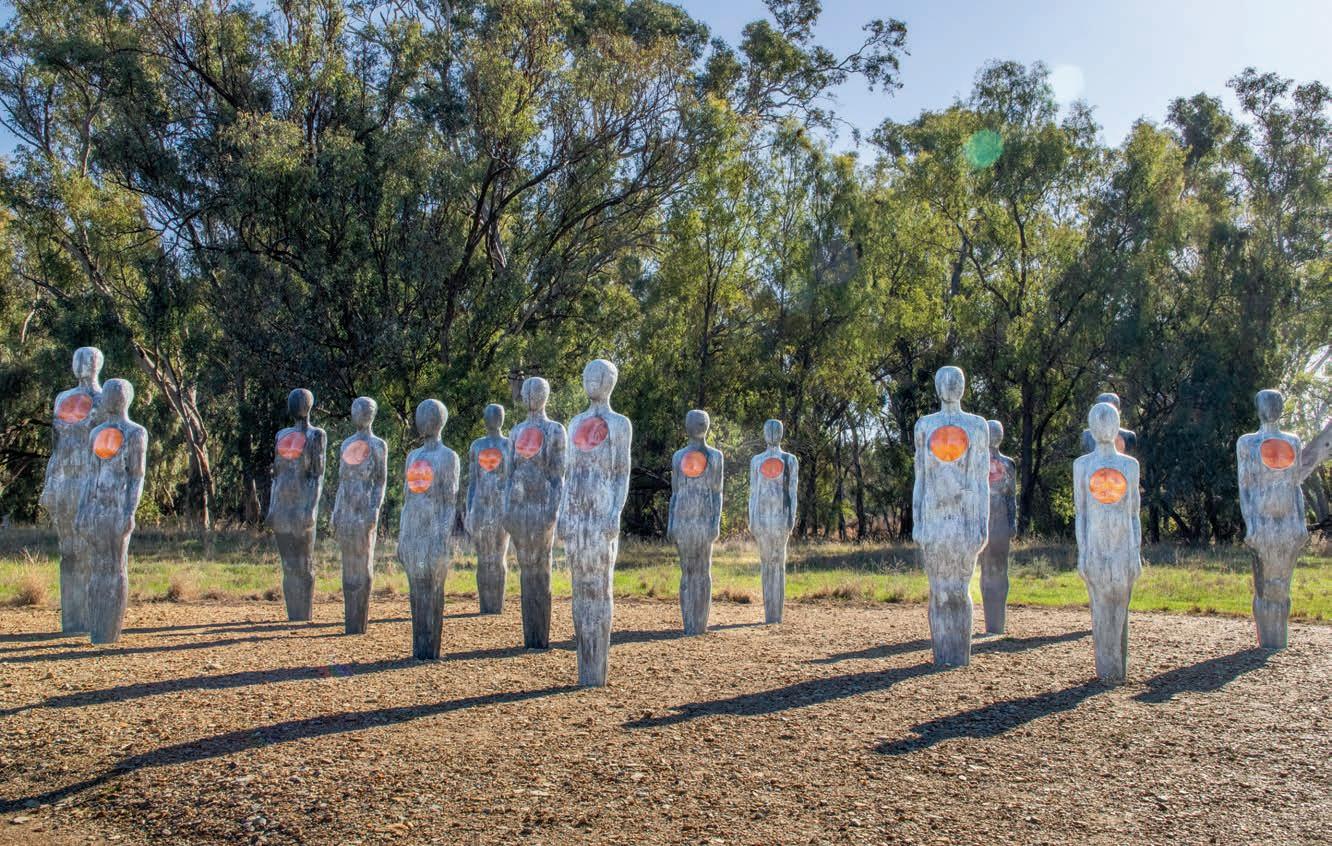
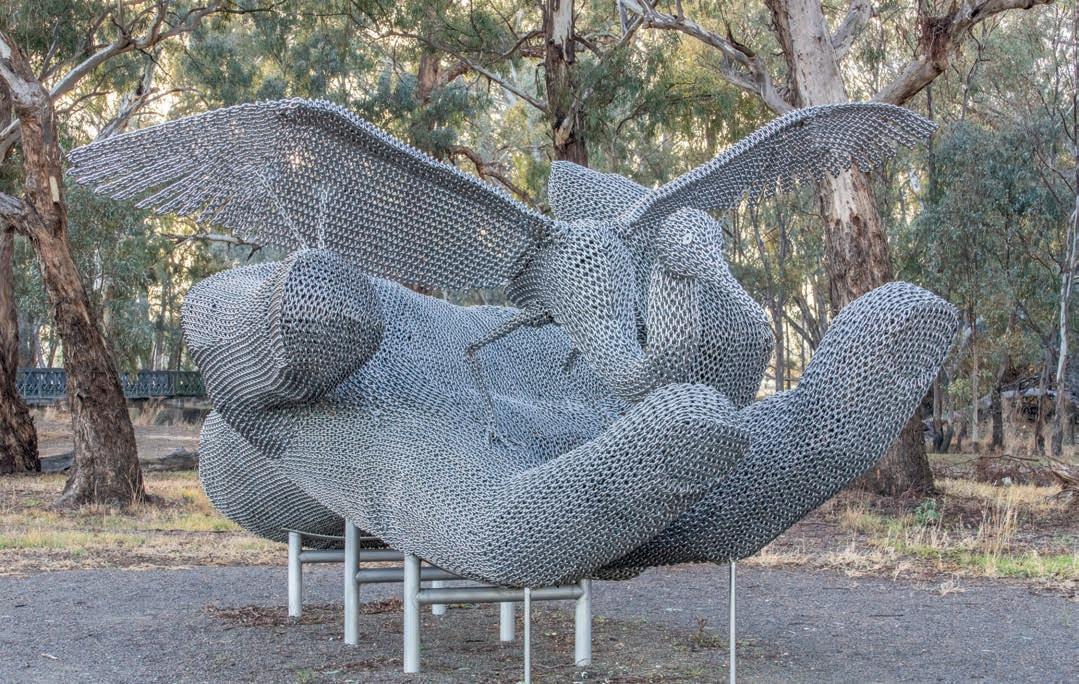
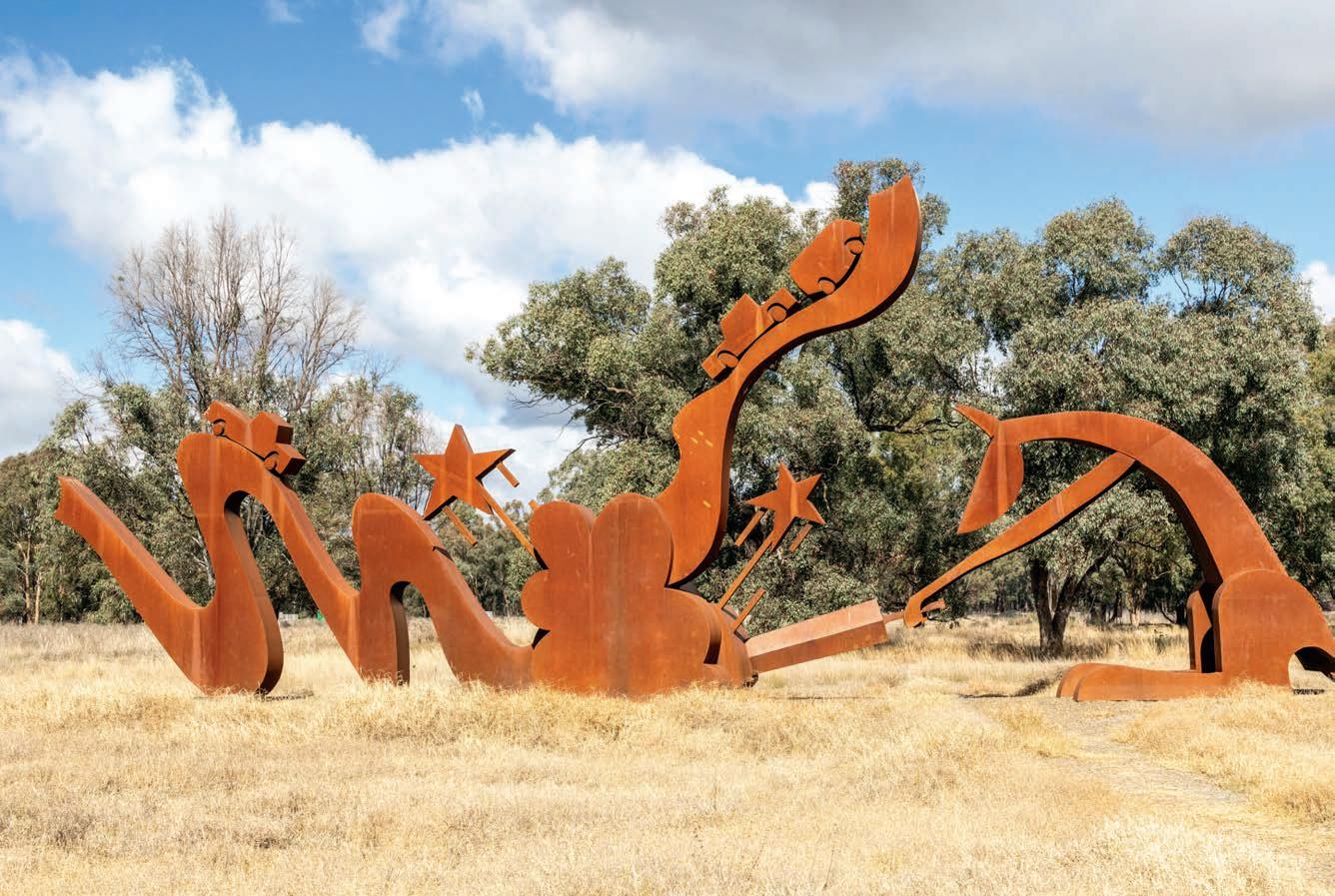
Girragirra Eco Retreat on the outskirts of town, jumped on board and, in 2017, they organised the first Grazing Down the Lachlan lunch as a legacy event. Grazing is now an annual long lunch and has contributed about $300,000 to the Art Society for the sculpture trail. The organisers’ efforts were bolstered by $7 million in government funding that has seen the trail and numerous sculptures around town built, the gallery project almost completed and the upgrade of the Gum Swamp precinct, which now boasts two more sculptures, The Hunter by Damian Vick and Brett Garling’s Gum Swamp Birds
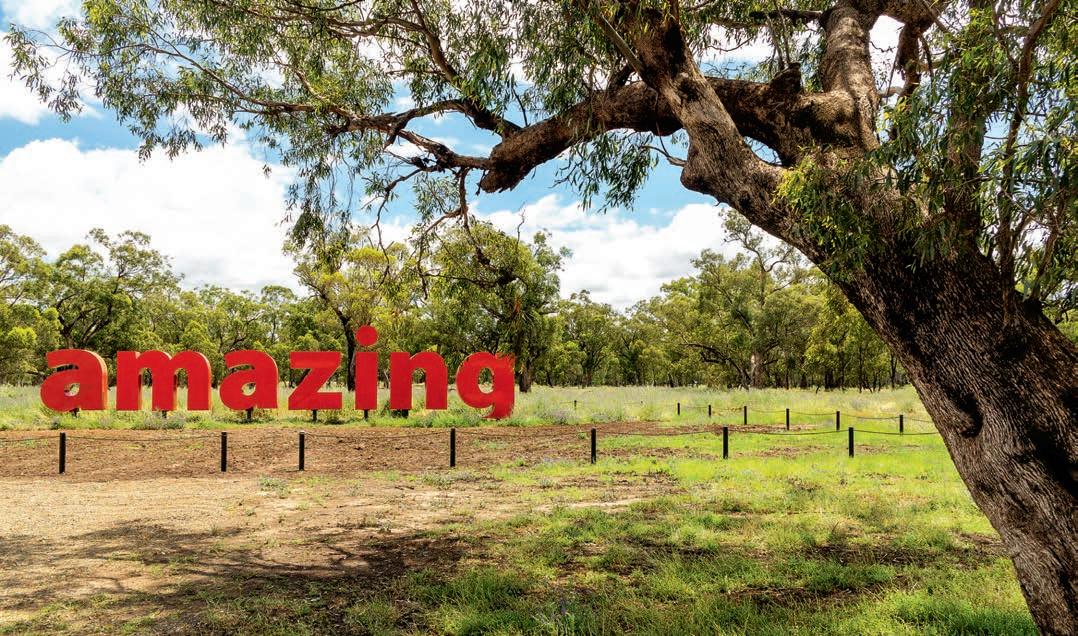
An installation spelling out a.m.a.z.i.n.g in 2.5-metre-high red metal letters was the first sculpture in the community-driven initiative. Designed by Rosie Johnston, it was fabricated and installed at the 9 Mile Reserve by local farmers, tradespeople and engineers who volunteered their time. As one Forbes local observed, it’s thanks to the extraordinary drive of this small bunch of people that Amazing Forbes NSW was
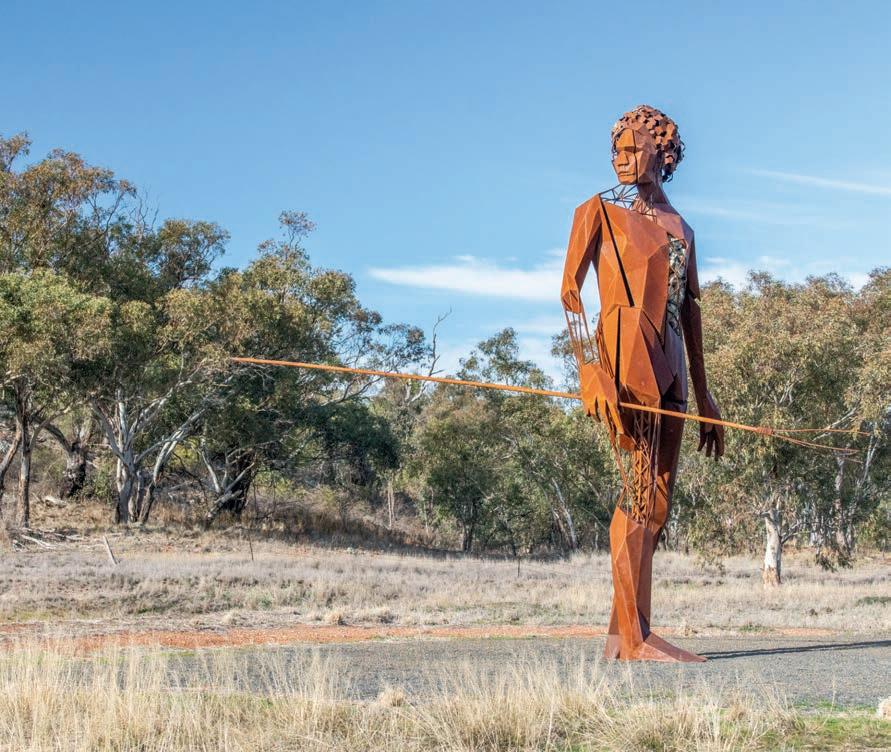
adopted in 2017 as the town’s destination brand. Other sculptures along the way include Mike Van Dam’s Bird in Hand, Suzie Bleach and Andre Townsend’s Sonata and Damian Vick’s 6m-tall Heart of Country, a powerful tribute to the resilience of the Wiradjuri people.
Forbes, with 9000-odd residents, Condobolin, population about 3000, and Parkes, with about 14,000 inhabitants, are the major centres on an elongated triangle of a road trip that includes travelling from Condobolin to Parkes via the Henry Parkes Way and a return leg down the Newell Highway back to Forbes. While the towns’ primary function is as service centres for the surrounding agricultural communities, tourism is booming and there are lots of quirky experiences to be had along the way.
Travelling from Orange to the east, or Canowindra and Cowra to the south, you could begin this road trip just north of Eugowra with a detour to Escort Rock, a big boulder, where in 1862, bushrangers Frank Gardiner and Ben Hall held up a coach carrying £14,000 (roughly $3 million today) worth of gold and money.
The pillaging came to an abrupt halt in 1865, when Ben was betrayed by an informer and was ambushed and killed by police. He’s buried in the Forbes cemetery where, according to local lore, there are always fl owers on his grave.
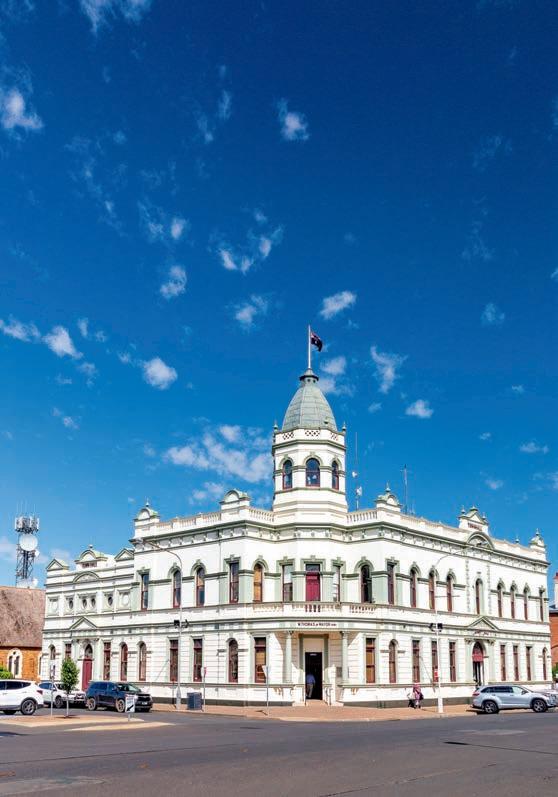
There are reminders of the golden days of Forbes on a heritage trail that takes in many of the colonial buildings and includes the 1881 post of fi ce and 1891 town hall.
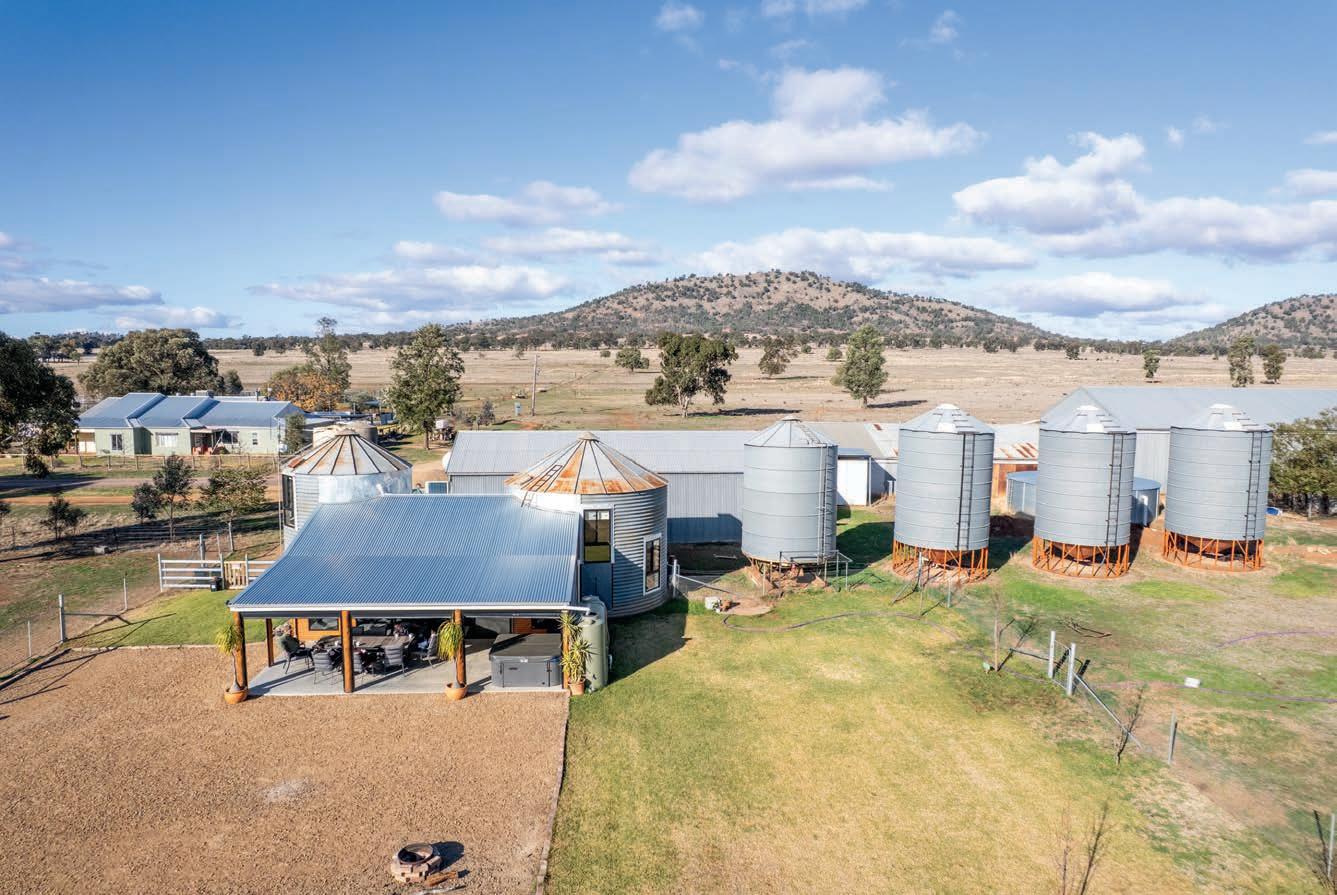
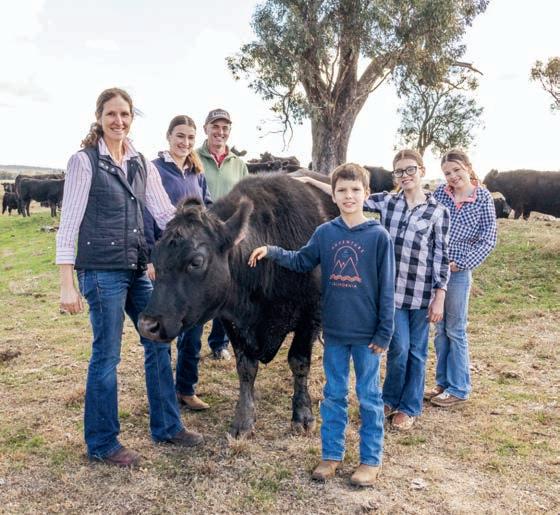
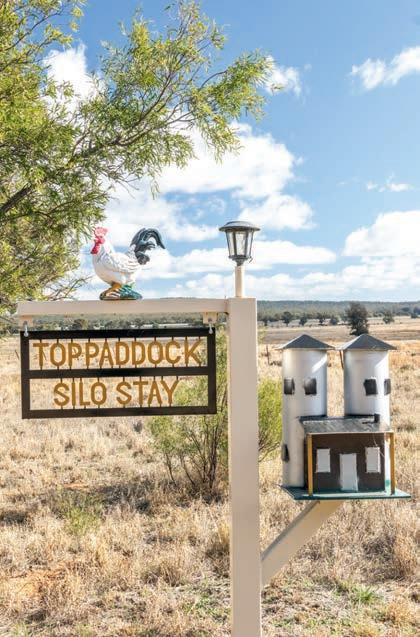
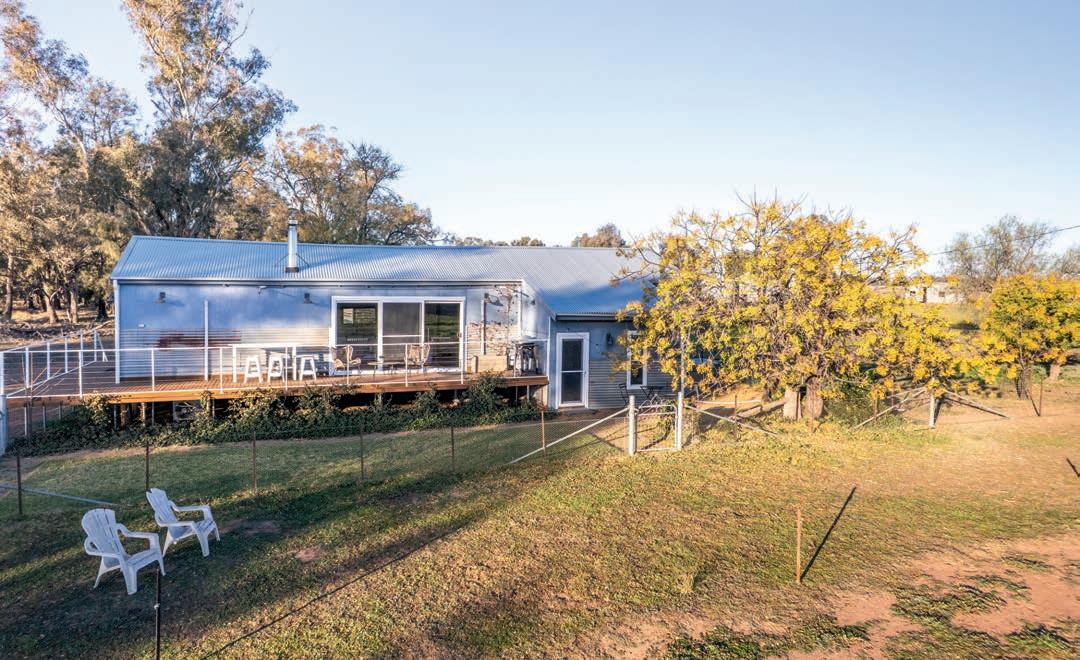
Forbes offers plenty of motel and pub accommodation options but, for something a bit different, head out of town for 38km to Top Paddock Silo Stay. Kylie and Adrian Matthews have created a three-bedroom farmstay accommodating seven guests in repurposed grain silos. The Matthews run Angus cattle on the 1200-acre (485-hectare) farm and their children, Heidi, Tara, Brooke and Brendan, introduce guests to their menagerie of pets, including the former poddy (bottle-fed) calf, Braveheart, who now weighs a massive 500kg and is a walking advertisement for the low-stress stock-handling principles they use on farm.
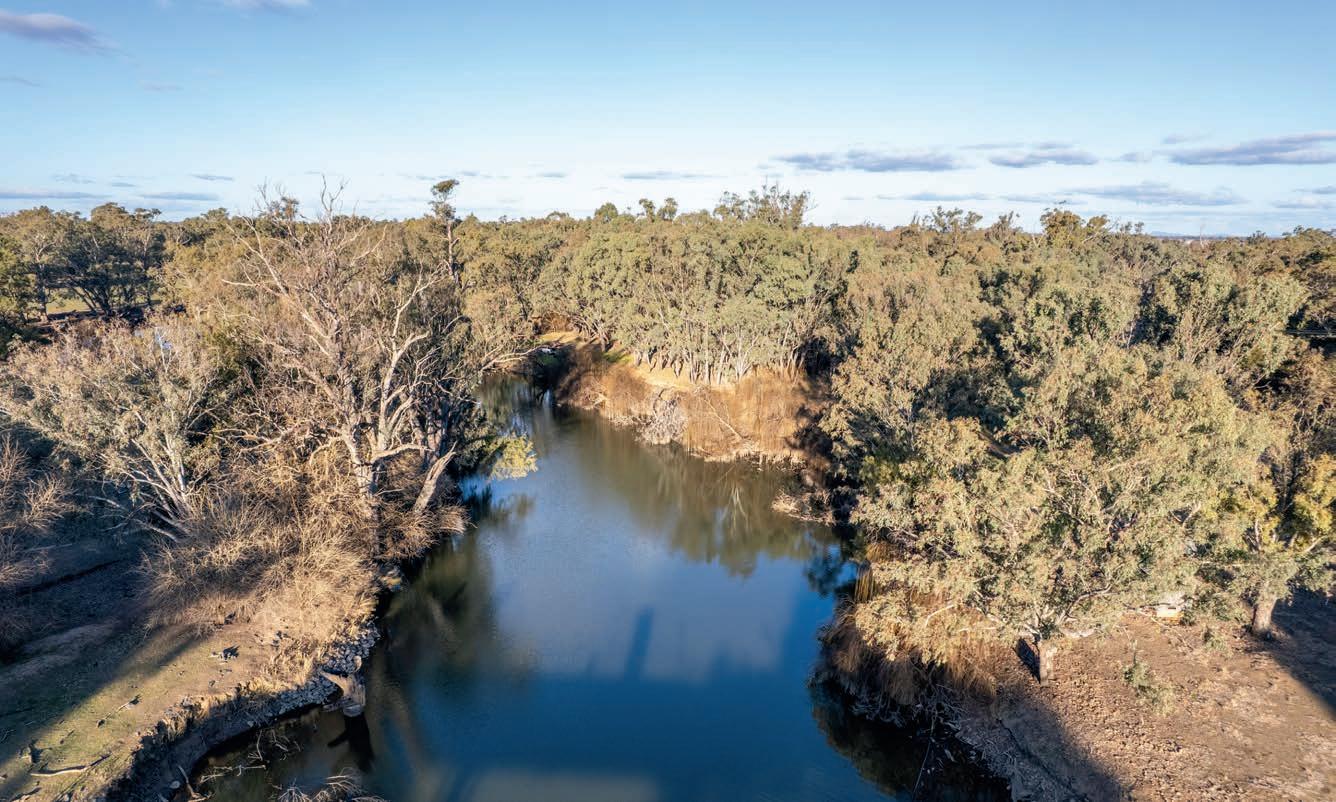
Closer to town at Girragirra, the Muffets welcome guests to their environmentally sustainable, self-catering oasis of calm, overlooking a dam and a splendid stretch of the Lachlan River. Guests are welcome to help themselves to offerings from the organically grown kitchen garden, which provides a larder of fresh produce throughout the year.
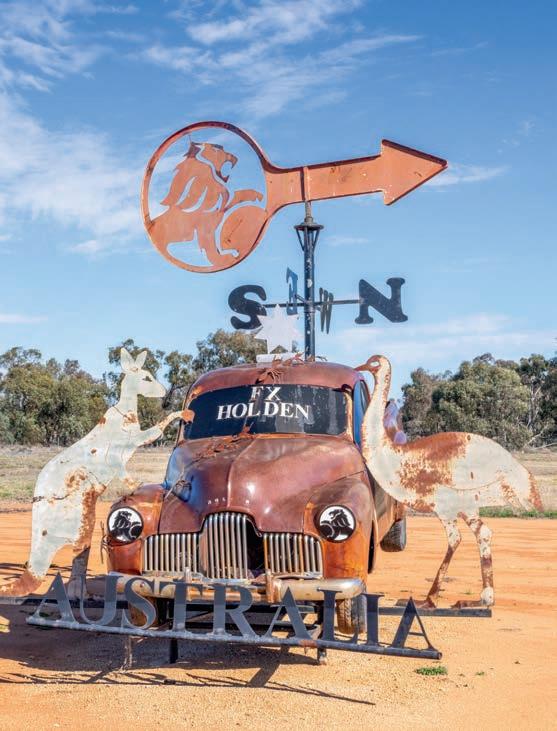
The newly completed Lachlan Visitor Information Centre is on the outskirts of Condobolin at the end of the Sculpture Trail. Stop in for homemade cakes and sandwiches at the cafe and to see the Utes in the Paddock outdoor gallery featuring decorated Holden utes. There’s also a sobering memorial to fallen jockeys in a wall that records the names of the 800 jockeys who
have been killed in accidents since horse racing began in this country.
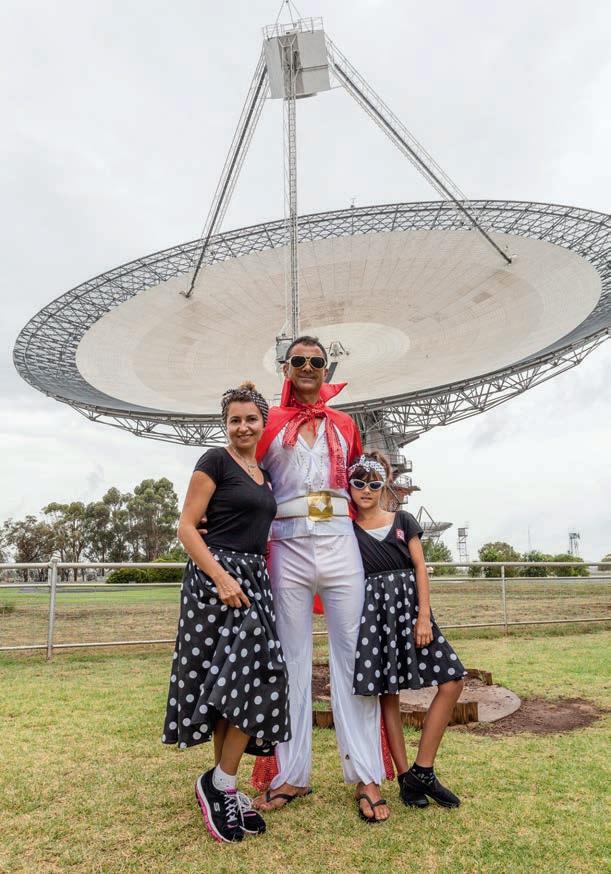
Parkes is 102km east of Condobolin, with a pit stop in the small town of Bogan Gate about midway. Parkes’ population pretty much doubles every year during January, when more than 25,000 fans of Elvis Presley gather to celebrate the late “king’s” birthday. There are Elvis impersonators aplenty, a street parade, busking and art competitions, as well as lots of good, old-fashioned rocking and rolling fun.
If you can’t make it to town for this celebration, head to the tourist information centre in The Henry Parkes Centre where the Parkes Motor Museum, the Henry Parkes Museum & Antique Machinery Collection and The King’s Castle Elvis Museum are located in the one precinct. Greg Page, aka the Yellow Wiggle, is a big Elvis fan and has family connections to the district, so has loaned his extensive collection of Elvis memorabilia to the museum.
Keen foodies will make a reservation at Bella’s Cafe in the centre of town and the Italian theme continues at Cafe Aglio è Olio in the Parkes Hotel where wood-fired pizza and exemplary pasta are the order of the evening. Coffee, breakfast and lunch venues include Roasted Kombi cafe.
(Clockwise
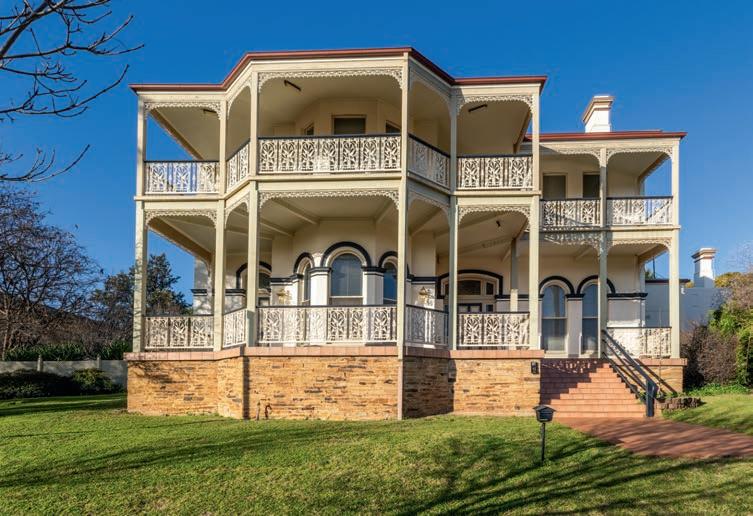
Although the town is well served with hotels and motels, book early if you want to be part of the Elvis Festival. Undoubtedly, the fanciest accommodation in town is The Buchanan 1894, a gracious mansion with sweeping sunset views across town from the upstairs balcony. It’s recently been restored into self-catering suites by Peak Hill farmers Steve Lindsay and Dave Johnstone.
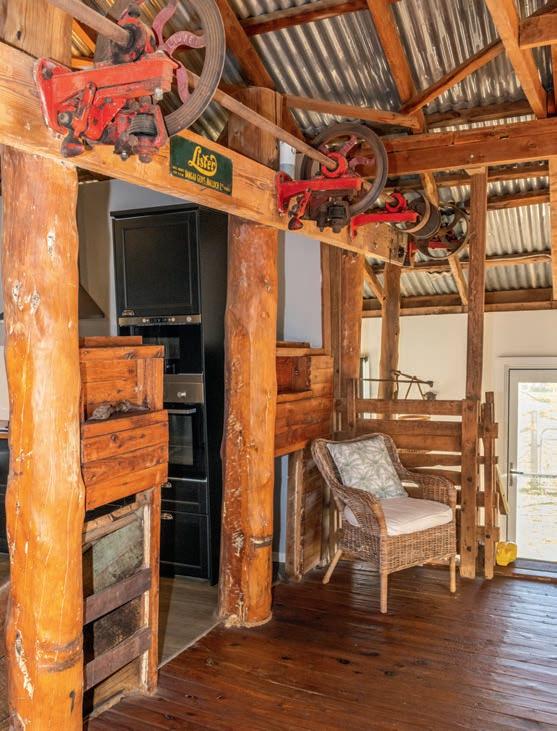
Steve and Dave also run The Fleece in a repurposed shearing shed near their home on Cora Lynn station. The kitchen is ready for cooks to move in and there’s a barbecue on the deck, with views of the landscape made Insta-worthy by Steve’s horses grazing in the foreground. Steve’s former life in hotel management shows in the quality of the fit-out, but there are plenty of nods to the building’s origins with historic photos and stencils on the walls, old wool scales in the bedroom and the shearing chutes and overhead gear preserved between the kitchen and the living areas. There’s no Wi-Fi or TV, so guests are encouraged to enjoy a little digital detox, birdwatch around the lagoon, take early morning strolls through the bush and become reacquainted with their travelling companions and the sounds of silence.
Heading south on the way back, don’t miss a detour to the CSIRO Parkes Observatory including its 64m-high radio telescope. Immortalised as The Dish in the 2000 movie of the same name, it has a diameter of 55m and weighs the equivalent of three fully laden jumbo jets. Although it was only intended to have a 20-year lifespan when it was commissioned in 1961, it has been continuously upgraded ever since and is now more than 10,000 times more sensitive than it was when it was built.
Since 2012, astronomers from all over the world have been able to schedule times to operate the telescope. Anyone with a project can apply for access and it’s free, but it also gives Australian astronomers reciprocal rights to facilities overseas. Only a tiny proportion of the work is related to space missions, but it did play a critical role in the 1969 Apollo 11 landing and relaying the pictures of Neil Armstrong’s moon walk to more than 600 million people around the world.
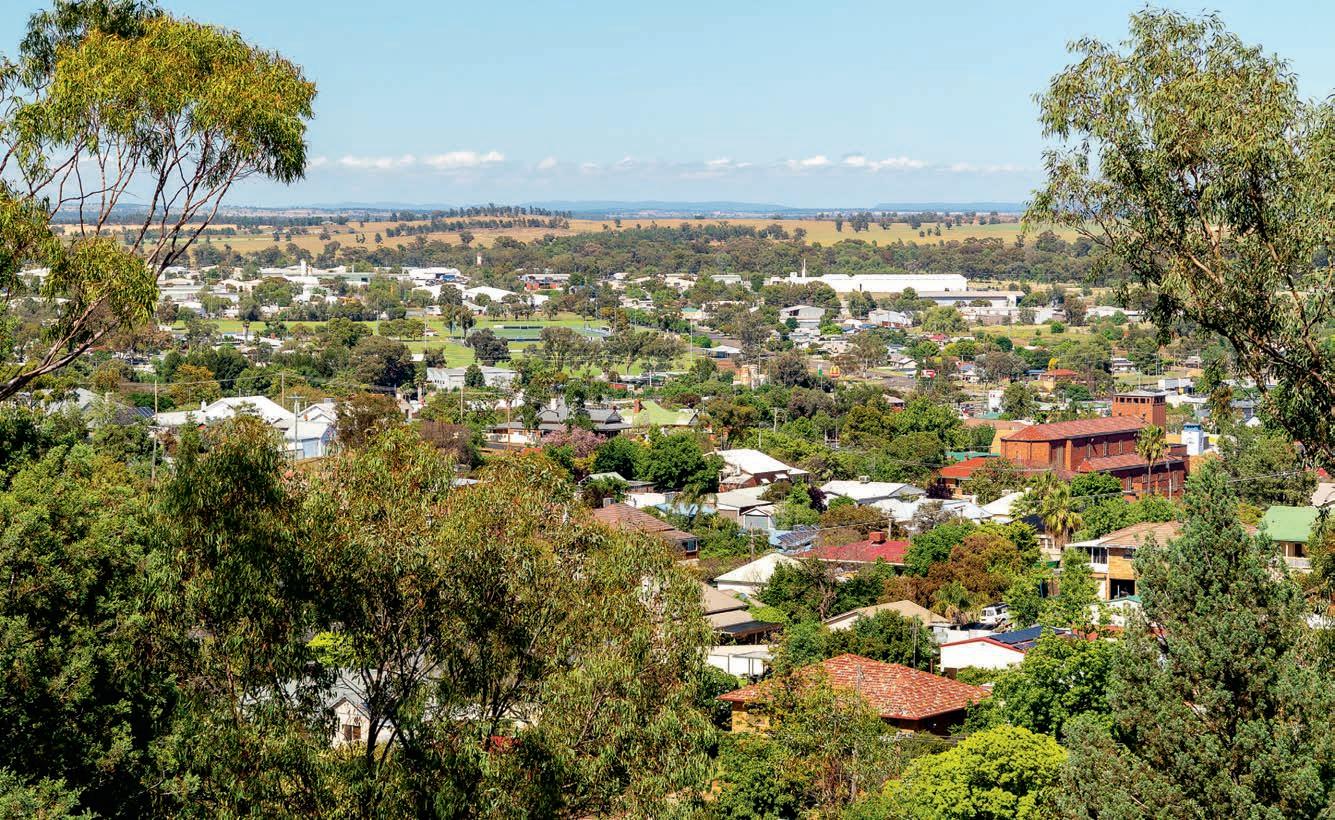
From Parkes, it’s a short 35km hop down the Newell Highway back to Forbes. Before leaving town, grab a coffee and perhaps a slice of homemade orange cake or pistachio tiramisu at the Courthouse Cafe in the Vandenberg Hotel. If you haven’t already, drop into the tourist of fice on the outskirts of town to pick up a map showing sculptures around the town and Lake Forbes. The walk around town makes a neat book-ending to the trail at the beginning of a trip that showcases Australian culture in a truly memorable way.
WHERE TO STAY
The Fleece, Peak Hill thefleece.net
The Buchanan 1894, Parkes thebuchanan1894.com.au
Girragirra Eco Retreat, Forbes girragirra.com
Top Paddock Silo Stay, Forbes toppaddocksilostay.com.au
PLACES TO EAT AND DRINK
Cafe Aglio è Olio, Parkes ph: (02) 6862 2229
Bella’s Cafe & Licensed Italian Restaurant, Parkes bellascafe.com.au
Roasted Kombi, Parkes facebook.com/rkparkes
The Fat Parcel food van, Eugowra facebook.com/thefatparcel
Courthouse Cafe, Vandenberg Hotel, Forbes ph: (02) 6851 1478
WHAT TO DO
Sculpture Down the Lachlan (Forbes to Condobolin) sculpturedownthelachlan.com
CSIRO Parkes Radio Telescope Visitor’s Centre csiro.au/en/Locations/NSW/Parkes
Visit Central NSW visitcentralnsw.com.au
Parkes Visitor Information Centre, Parkes visitparkes.com.au
Lachlan Visitor Information Centre, Condobolin visitlachlanshire.com.au
Grazing Down the Lachlan, Forbes grazingdownthelachlan.com
Every day is a good day during the dry season in the Northern Territory’s Top End.
TOP END, NT | 3–5 DAYS
BY KIRSTY MCKENZIE, PHOTOGRAPHY KEN BRASS
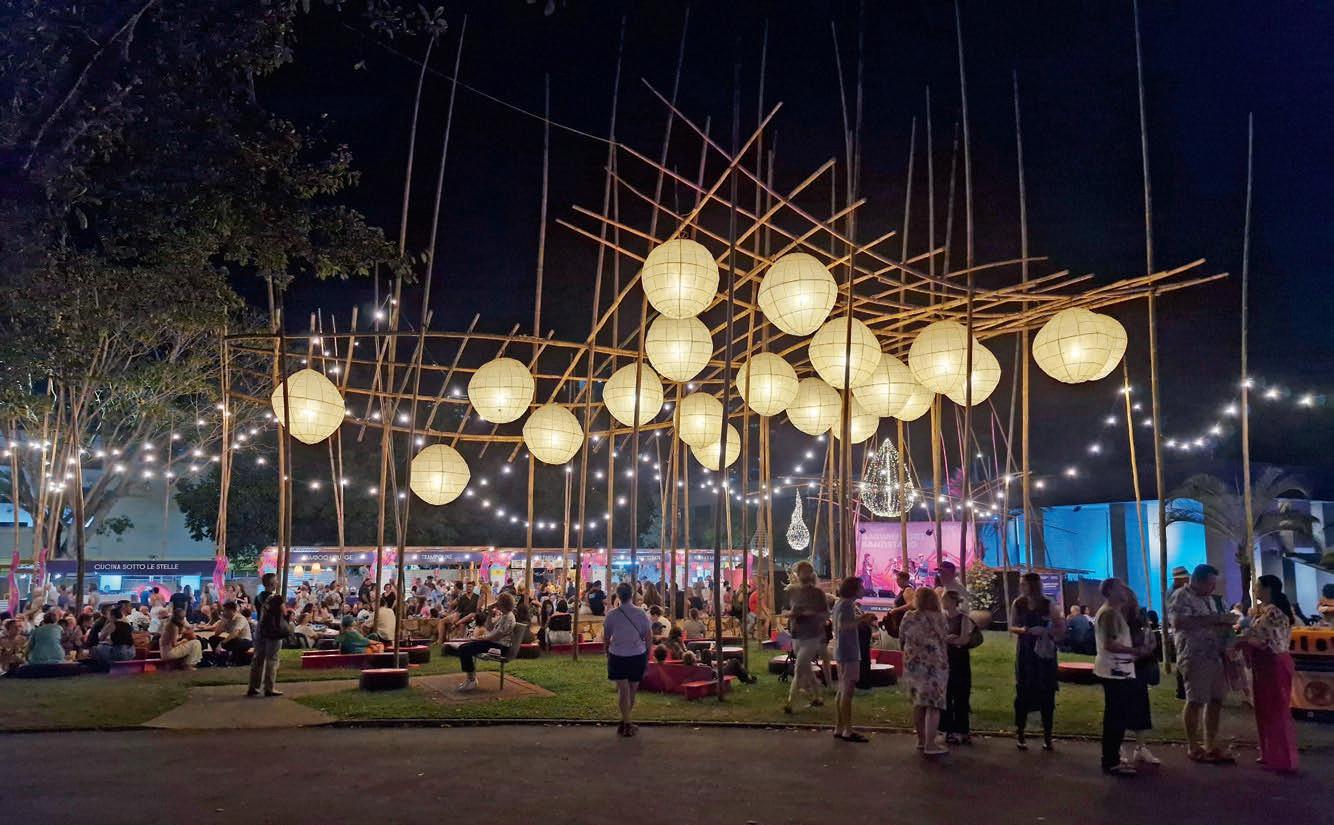
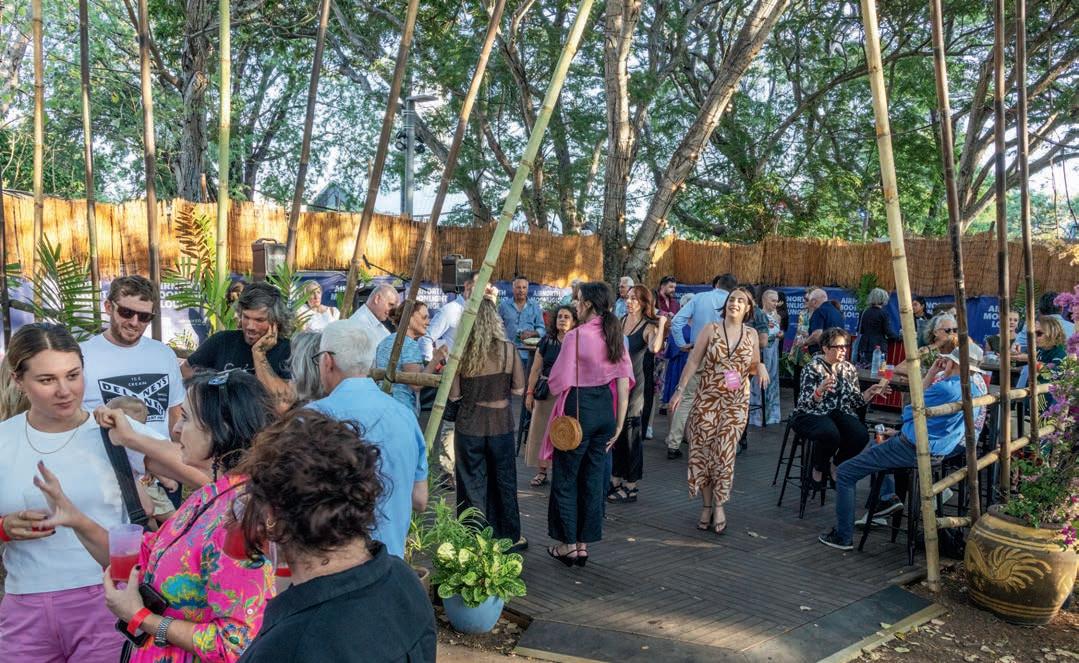
It’s a balmy August evening in the middle of the Top End’s dry season and Darwin’s Festival Park is buzzing with activity.
As the sun sets, a bold-red moon in the form of a giant rice paper lantern by local artist Techy Masero rises amid its bamboo framework. Trumpet flowers sound and a light installation by Amigo & Amigo Studio entertains in the Kolsen Twilight Playground. Meanwhile, free live music on the bandstand provides a backdrop for patrons of the food trucks and stalls set up around the venue.
Other visitors queue for a line-up of performances on the INPEX Sunset Stage, ranging from the soulful premiere of Emma Donovan’s Take Me to the River to Opera Queensland’s Are You Lonesome Tonight and Rhonda Burchmore’s After Party. Nearby on the lawns in front of the Northern Territory’s Parliament House, the Spiegeltent is hosting the caberet circus show La Ronde, while down at Fort Hill Parklands, Australian idol Guy Sebastian and New Zealand’s electrifying L.A.B. are headlining the three-week performing arts feast that is the annual Darwin Festival.
Visitors to the Northern Territory capital soon discover that August delivers a perfect storm of cultural events as the Darwin Aboriginal Art Fair (DAAF) takes over the convention centre for an extraordinary celebration of First Nations art and craft. This annual three-day event presents the work of more than 75 Indigenous art centres from around the country and 100 per cent of all sales, this year more than $5 million, go back to the artists and their centres. The National Indigenous Music Awards are another drawcard event on Darwin’s August calendar, as are the prestigious Telstra National Aboriginal and Torres Strait Island Art Awards (NATSIAA), with the winners and finalists showcased in an exhibition that runs until early new year at the Museum & Art Gallery of the Northern Territory (MAGNT).
The MAGNT is worth a visit year-round for its permanent exhibitions, which include the taxidermied body of Sweetheart, a 5.1-metre-long saltwater crocodile that gained notoriety in the 1970s for attacking the dinghies of fisher folk, and a section devoted to the devastation caused by Cyclone Tracy on Christmas Eve, 1974. Visitors can see the Raggedy Andy doll featured on the cover of The Australian Women’s Weekly, a Christmas tree that was salvaged from Tracy’s wreckage and listen to a terrifying (remastered) noise of the cyclone in a sound booth. Time your visit for mid to late afternoon, then head down the road (during The Dry, from the end of April to the end of October) for the Mindil Beach Sunset Markets, where food stalls sell a world tour of culinary delights to the backdrop of the sun sinking into the waters of Fannie Bay.
First-time witnesses could be forgiven for thinking they’ve jagged the best night of the year,
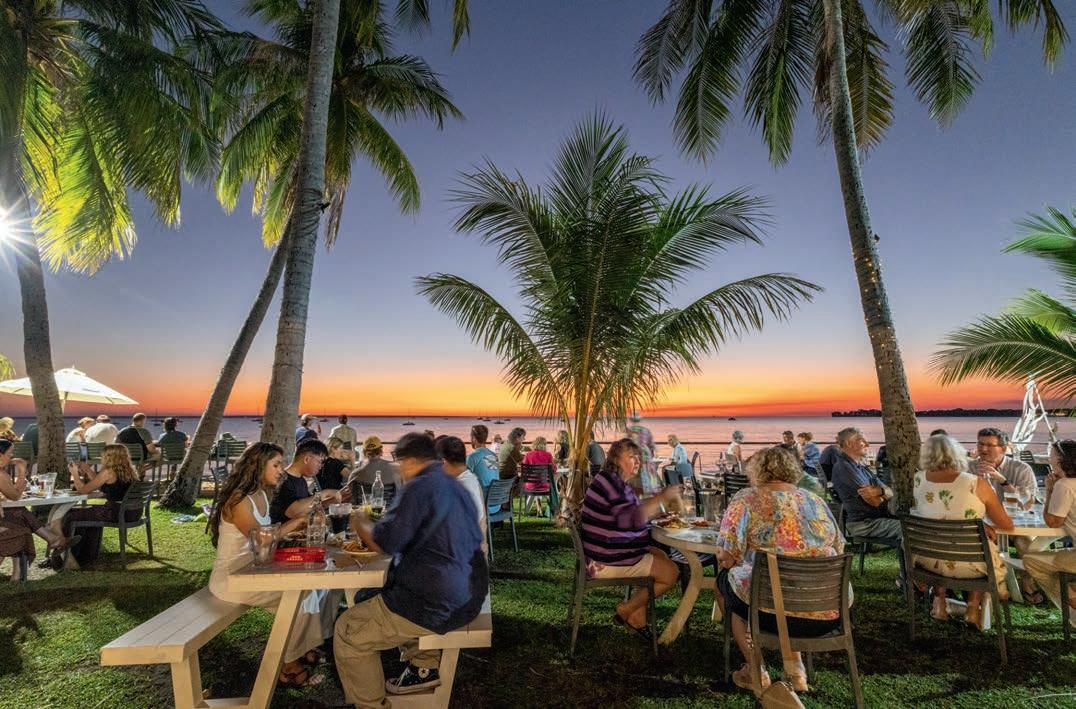
but in fact the spectacle is pretty much a nightly occurrence during the ‘‘winter’’ months. For a ringside seat on sunset, locals and in-the-know tourists make a beeline for the Trailer Boat Club, where cocktails and beers flow and above-average counter meals accompany the ritual in a palmframed waterfront setting.
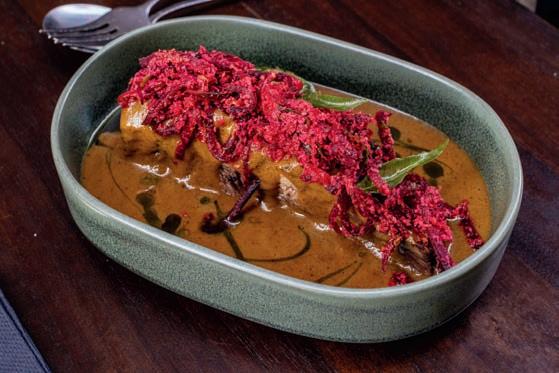
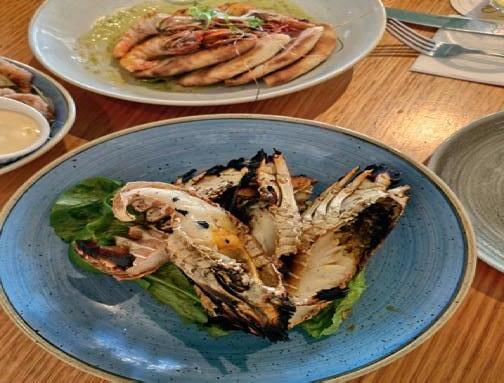
Dining in Darwin is always a delight with the emphasis on local seafood including prawns, barramundi and reef fish fresh from the trawler, as well as lots of Asian influences, given the city’s near neighbours to the north. Jimmy Shu’s Hanuman restaurant is a Darwin institution since the Sri Lankan-born chef moved to the Top End and hung out his shingle in 1992. More recently, he’s been joined by another chef with Sri Lankan heritage, former engineer and MasterChef alumni Minoli De Silva, who serves up contemporary versions of her childhood home country’s cuisine at her laneway diner, Ella by Minoli.
Darwin is also Australia’s self-proclaimed laksa capital and visitors can taste test some of the best at the Saturday Parap Village Markets, which combine food stalls and crafts. Everyone has their favourite laksa vendor and Mary’s and Yati’s stalls frequently come up when the conversation turns to who makes the best. Yet others say bypass them both and make a beeline for the Purple Lady, who serves up the spicy soup at both Parap and the Sunday markets at Rapid Creek. Or head down the road to Stuart Park, where ‘‘Laksa Queen’’ Amye Un serves a version from her West Timorese homeland. Before you leave Parap, however, be sure to drop into the Laundry Gallery and the Northern Territory Centre for Contemporary Art.
The cultural celebration continues downtown at the Outstation Gallery and Readback Books and Aboriginal Art (both for Indigenous art).
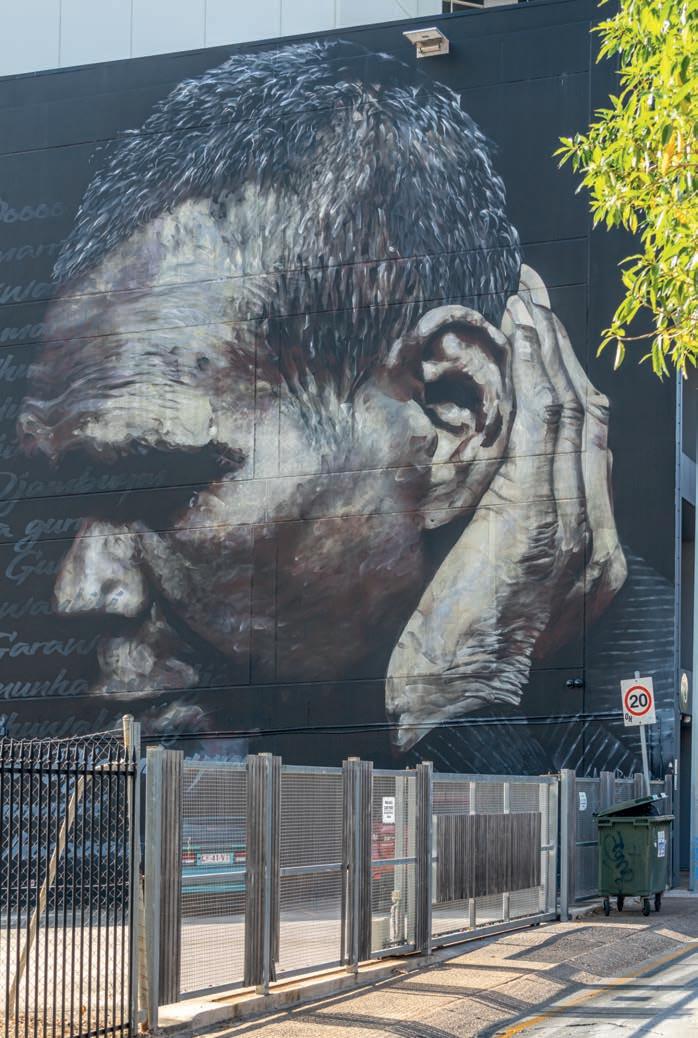
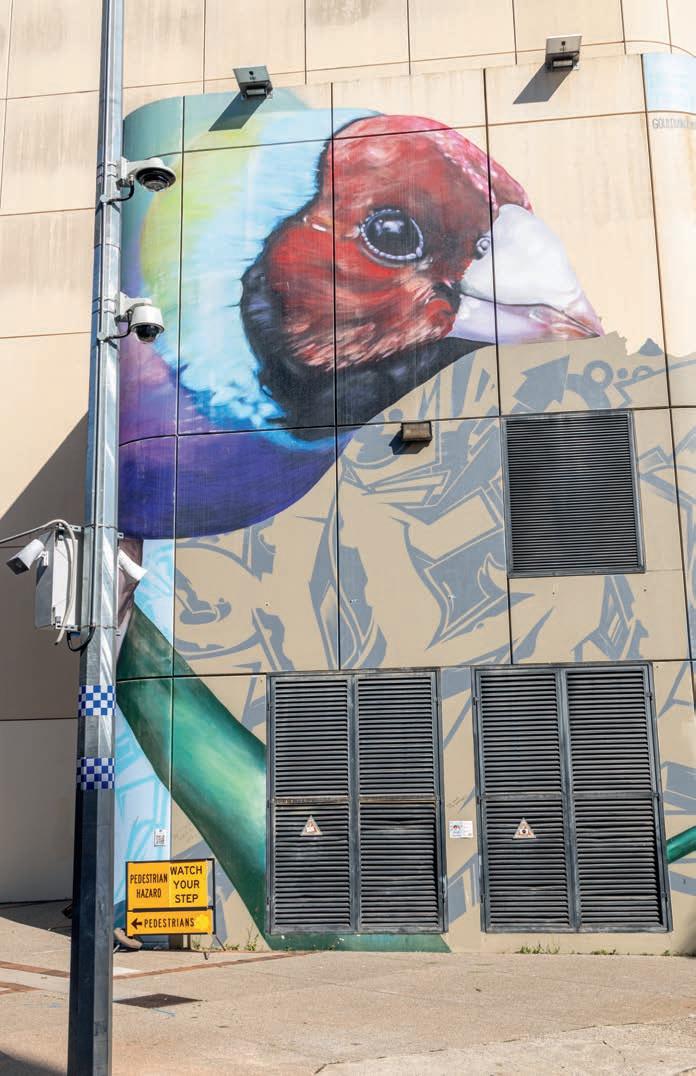
Street art is another drawcard and local and international artists come together every year to add to the city’s growing outdoor art gallery during the Darwin Street Art Festival, which takes place during May and June. Don’t miss a visit to Darwin’s Deckchair Cinema, one of only three outdoor cinemas remaining in this country.
No visit to Darwin is complete without a trip out of town and while Kakadu National Park is an obvious option, you’ll need a couple of days to fully explore the park with its Indigenous rock art galleries, wetland cruises and spectacular landscapes and waterfalls. The 1500 square kilometre Litchfield National Park is closer to the city and it’s possible to visit in a loop-circuit day trip.
Aboriginal people have lived throughout the area for tens of thousands of years and this country is the traditional home of the Koongurrukun, Mak
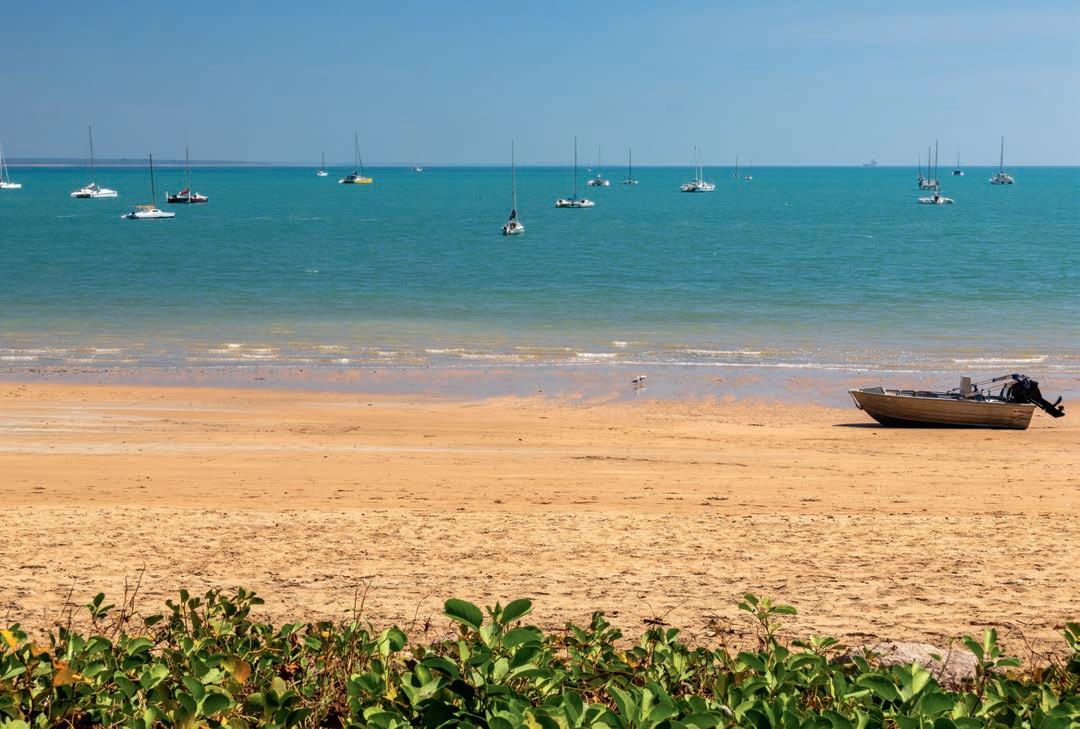
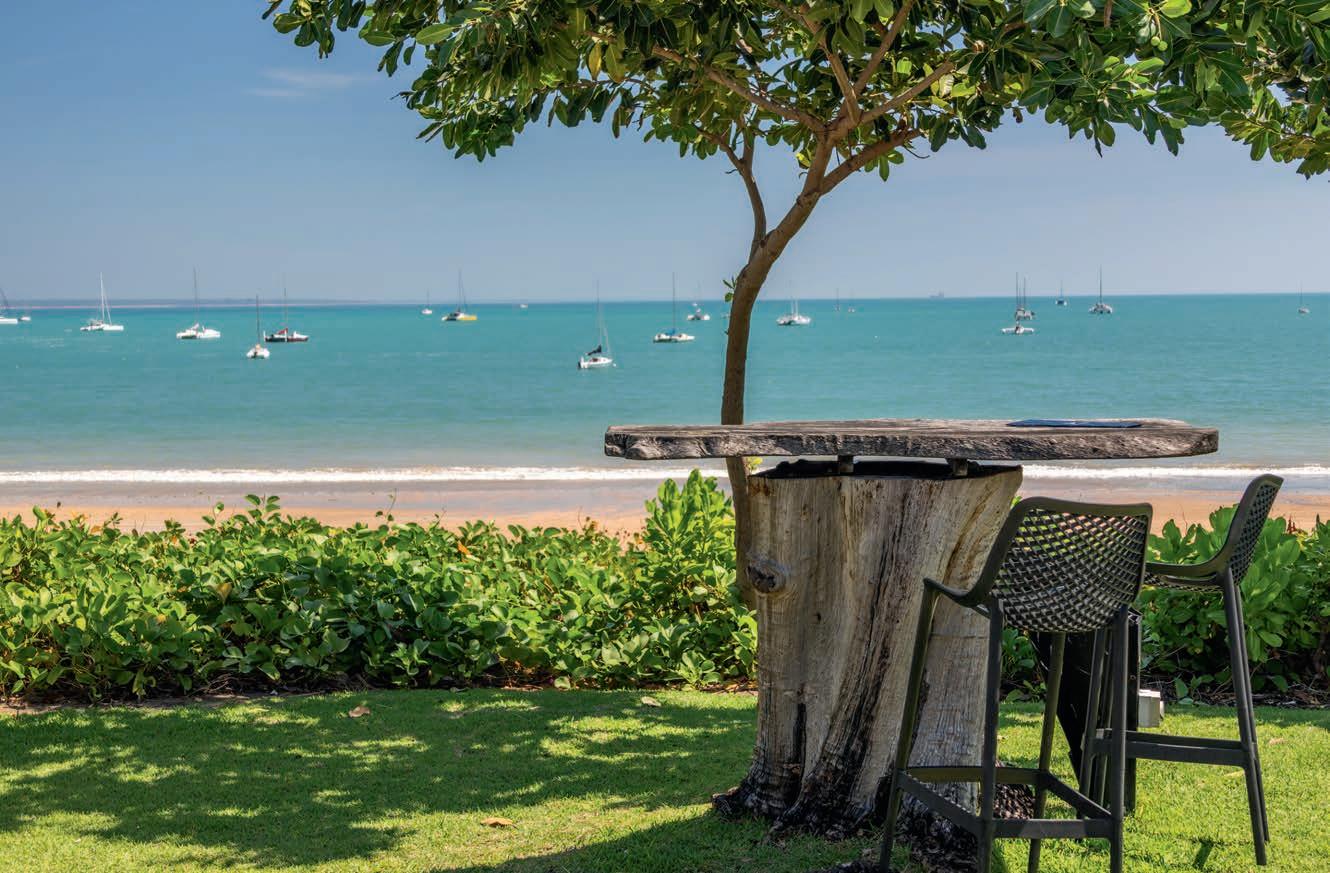
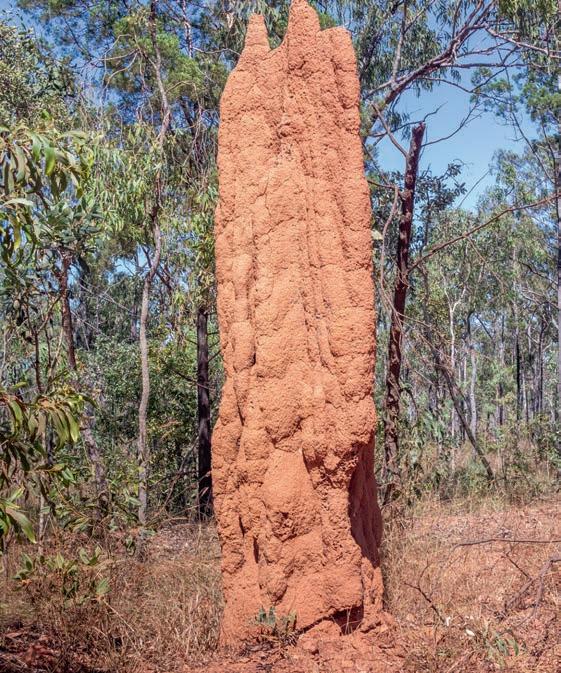
THESE PAGES: (Clockwise from above) Another perfect day by Darwin’s Fannie Bay; towering termite mound; a warm dip at Berry Springs; Ethical Adventures does day trips around Darwin and Litchfield; the turnoff to Litchfield NP.
Mak Marranunggu, Werat and Warray people, who believe their ancestral spirits are still present in the landscape today. While there are still some unsealed roads in the park, most of the major waterfalls, swimming holes and sites can be visited without venturing far off bitumen. There aren’t many dining options available — though Tumbling Waters Holiday Park at Berry Springs and Litchfield Tourist Park near Batchelor both have kiosks — so you’d be advised to bring a picnic, or at least snacks and a good supply of water and drinks to keep fed and watered.
Or you can take the passenger’s seat and join one of many tour companies that offer day trips from Darwin. Australian Country jumped on board with a family-run, small-group tour operated by Ethical Adventures, and left all the navigating, clock watching and catering in the capable hands of tour guide Adam Mattner. A passionate environmentalist, Adam is a fount of information on the landscape, wildlife and fl ora and their management.
Setting out from Darwin, first stop is 50km south at Berry Springs Nature Park, where the water in several pools remains at a very comfortable 26 to 28°C and the little cascades make for a refreshing dip and natural spa massage.
This stop is the first encounter with what turns out to be regular signage around the Top End warning that both saltwater and freshwater crocodiles inhabit the area. While parks management use traps to clear the waterholes of salties during the dry season, there are occasional sightings and the messaging reads that while the risk of attack is low, basically you swim at your own risk. You might celebrate surviving the first dip of the day with an ice block from the kiosk run by local mango farmers Crazy Acres. However, Adam has hot drinks and homemade mango muffins waiting for morning tea, so you better be hungry.
Eighty kilometres south-west at Wangi Falls, the croc reminders don’t deter dozens of people who have hired pool noodles from the kiosk and are enjoying the big pool at the base of the twin falls, which plummet about 40 to 50m over the cliff face. Next stop is 12km further on at Tolmer Falls, where a lookout provides a great view to the falls, another 40m ribbon drop into the vibrant-green valley below. From there, it’s another 20km for a swim at Florence Falls, which drop in segments for a total of about 30m to the waterhole below. If time permits, you might also like to take a short detour to Buley Rockhole, another popular swimming spot on the Florence River.
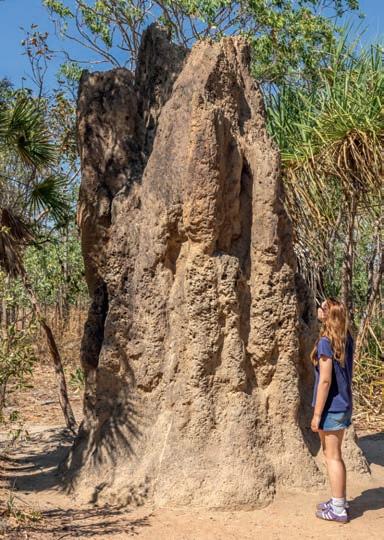
The lunch stop, with a snapping fresh chicken salad, is at Tabletop Swamp, a seasonal billabong with paperbark trees proving a great hang out for wetland birds. From Florence Falls, it’s back to the park road and a further 11km to the magnetic termite mounds. Adam is in his element here as he leads guests along the boardwalk overlooking what looks like a cemetery, with hundreds of termite mounds with their thin edges pointing north-south and broad backs facing east-west on the black soil plains. “There are many different termites in the tropics,” he explains. “Their mounds of mud and saliva can last for decades and house millions of termites. But they never take over an inactive mound. Rather than take over a McMansion, they instinctively start small and grow the mound as their community grows. Arboreal termites make mud nests on tree trunks and branches and because they feed on wood, they also make homes for other creatures by creating hollows in the timber.” Next up is the chance to see cathedral mounds, some of which soar 5m high.
It’s another 35km on to Batchelor, built as the service town for Rum Jungle, Australia’s first uranium mine, which has been closed since the 1970s. If time permits, there’s a local history museum that mainly focuses on World War II. Heading back to the Stuart Highway, those with an interest in military history might take the short detour south to Adelaide River, which, following the bombing of Darwin in 1942, became the HQ for both the Australian and American military. These days, its main attractions are as the home of Australia’s third-largest war cemetery, a ‘‘jumping crocodiles’’ cruise and the 303 Bar at
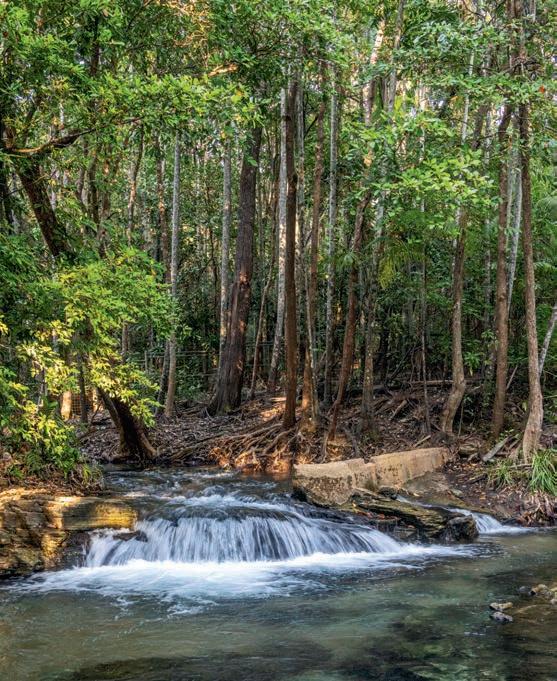
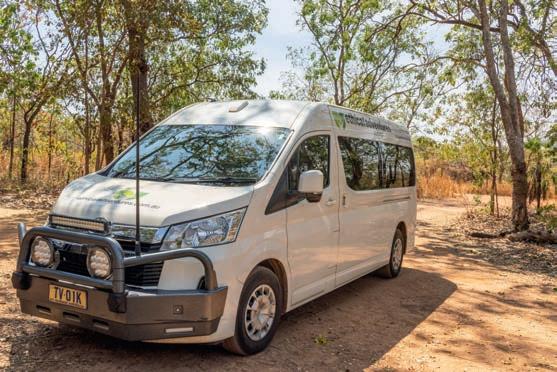
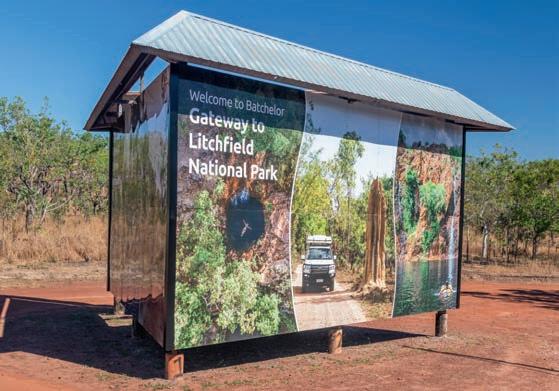
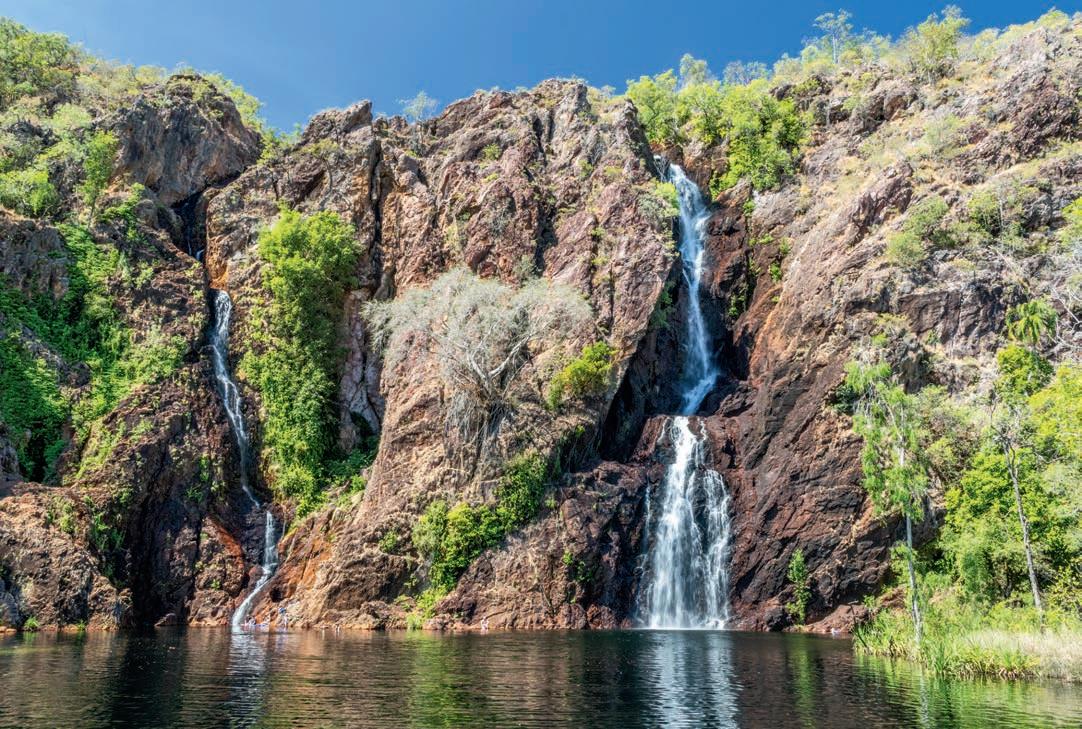
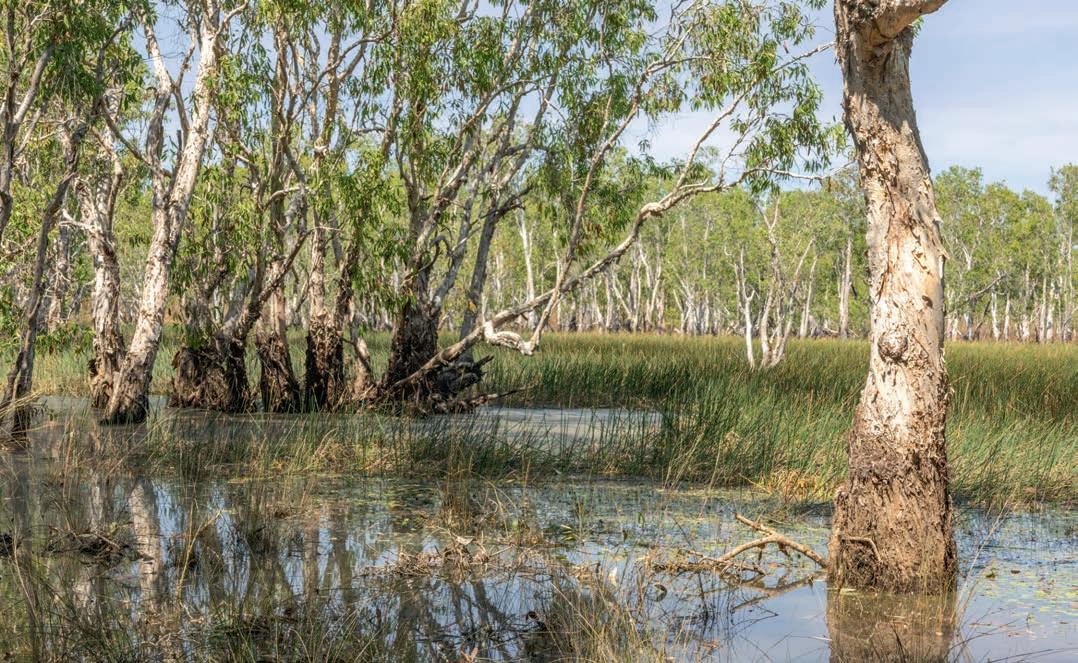
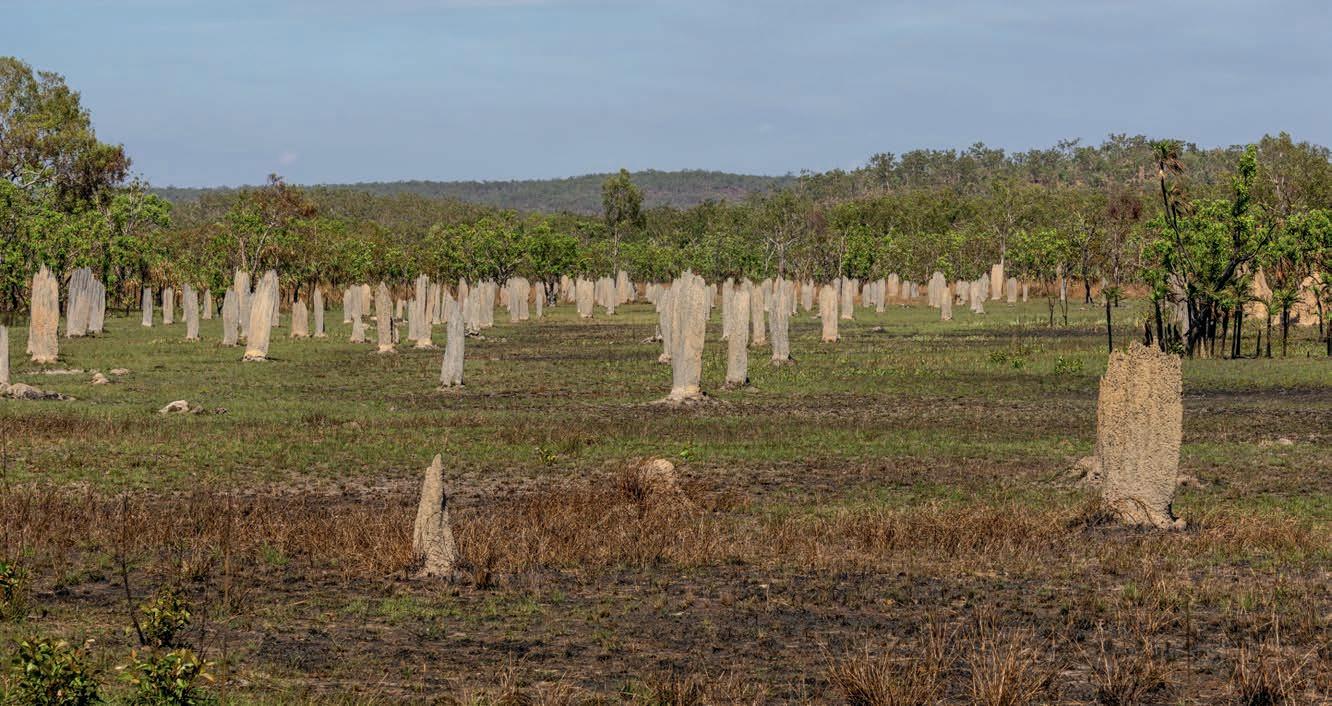
THESE PAGES: (Clockwise from above) Magentic termite mounds; Tabletop Swamp; the waterhole beneath Wangi Falls makes a good place for a cooling swim.
the Adelaide River Inn Tourist Park. While the bar is a reference to the Australian Army’s weapon of choice during WWII, it is full of memorabilia relating to Charlie, the buffalo made famous as the one Mick Dundee (Paul Hogan) hypnotised to the ground in the movie Crocodile Dundee. Charlie was an Adelaide River resident until he died of old age in 2000, and his stuffed remains stand proudly at one end of the bar.
From Adelaide River, it’s a 112km cruise back up the highway to Darwin, completing an approximate 350km circuit that’s guaranteed to leave lasting memories. Those who’ve not timed their visit for the month of August can rest assured there’s no need for FOMO. Whatever month you visit, there’s bound to be something happening in the Top End. In March, it’s the Tiwi Islands’ turn with the Football Grand Final & Art Sale. In May and June, it’s the Street Art Festival and Beer Can Regatta, while come in July and don’t miss the Dinah Beach Cruising Yacht Association’s Viking Funeral celebration and, of course, northern Arnhem Land’s annual celebration of First Nations culture, Garma. September is the MXGP, when motocross enthusiasts hit town and movie buffs head up for the Darwin International Film Festival. In October/ November, it’s the Laksa Festival, then it’s time to relax into Christmas events and take refuge in the air con during the wet season, before the year ramps up again … Whatever time of year, there’s never a shortage of things to see and do.
WHERE TO STAY
Courtyard by Marriott, Darwin marriott.com/en-us/hotels/drwcy-courtyard-darwin
Litchfield Safari Camp, Rakula litchfieldsafaricamp.com.au
Finniss River Lodge, Rakula finnissriverlodge.com.au
PLACES TO EAT AND DRINK
Ella by Minoli, Darwin ellabyminoli.au
Darwin Trailer Boat Club, Darwin dtbc.com.au
Pee Wee’s at the Point, Darwin peewees.com.au
Hanuman, Darwin hanuman.com.au
Charlies of Darwin, Darwin charliesofdarwin.com.au
Beaver Brewery, Darwin beaverbrewery.com.au
The Last Supper Pizzarella, Darwin thelastsupper.com.au
Snapper Rocks, Darwin snapper.rocks
Mindil Beach Sunset Markets, Darwin mindil.com.au
Parap Village Markets, Darwin parapvillage.com.au
WHAT TO DO
Ethical Adventures, Darwin ethicaladventures.com.au
Museum & Art Gallery of the Northern Territory, Darwin magnt.net.au
Deckchair Cinema, Darwin deckchaircinema.com
Berry Springs Nature Park, Berry Springs nt.gov.au/parks/find-a-park/berry-springs-nature-park
Darwin Street Art Tour, Darwin walkdarwin.rezdy.com
Laundry Gallery, Parap, Darwin laundrygallery.com.au
Outstation Gallery, Darwin outstationgallery.com.au
Northern Territory Centre for Contemporary Art, Parap, Darwin nccart.com.au
A quest to find the real outback covers a vast swathe of NSW, from Broken Hill to Lake Mungo and Mutawintji National Park, blink-and-you’ll-miss-them towns and encounters with the colourful characters who live there and in between.

OUTBACK NSW | 12–14 DAYS
BY KEN BRASS, PHOTOGRAPHY HAYDEN WRIGHT, KEN BRASS AND DESTINATION NSW
High in the Border Ranges north of Broken Hill are 12 massive sandstone sculptures roughly arranged in two columns linking this iconic region with distant Bourke, where eye doctor Fred Hollows is buried. One work is dedicated to Hollows. When it was carved in 1993, its creator Lawrence Beck said: “Only Fred and I truly know what the sculpture really is.”
In a land laden with contradictions, Broken Hill, whose main thoroughfare, Argent Street, runs parallel to the line of the copper, lead and zinc lode that made Australia rich, is a standout example. The town with its tough industrial reputation actually has more art galleries than pubs. Like a pariah, it’s on Australian Central, not NSW, time. Broken Hill jeered and stoned the departing volunteers for WWI, then welcomed them home as Anzac heroes. Suburbia in the outback, it’s been called.
But the outback is enigmatic itself. What is this place? Where does it begin or end? Does it even exist? Might the legendary ophthalmologist, whose work in ending avoidable blindness is carried on around the world to this day largely through the Fred Hollows Foundation, have been able to explain that … as well as the meaning of the sculpture on the hill?
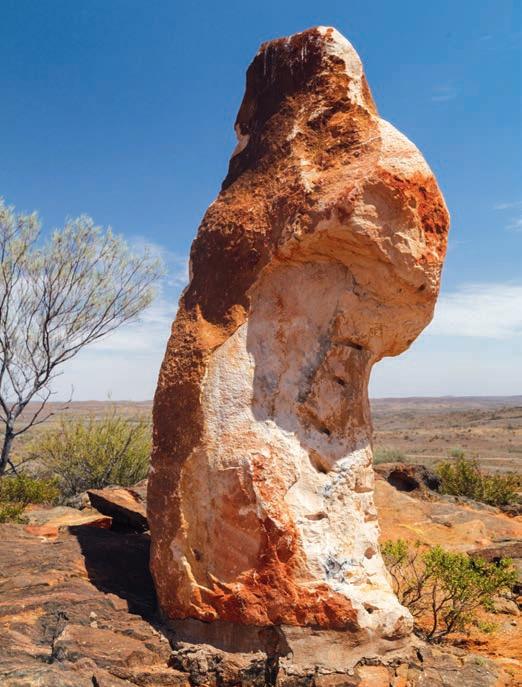
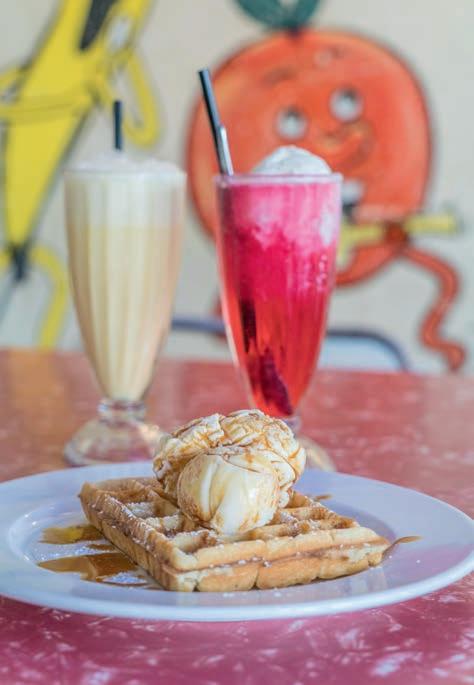
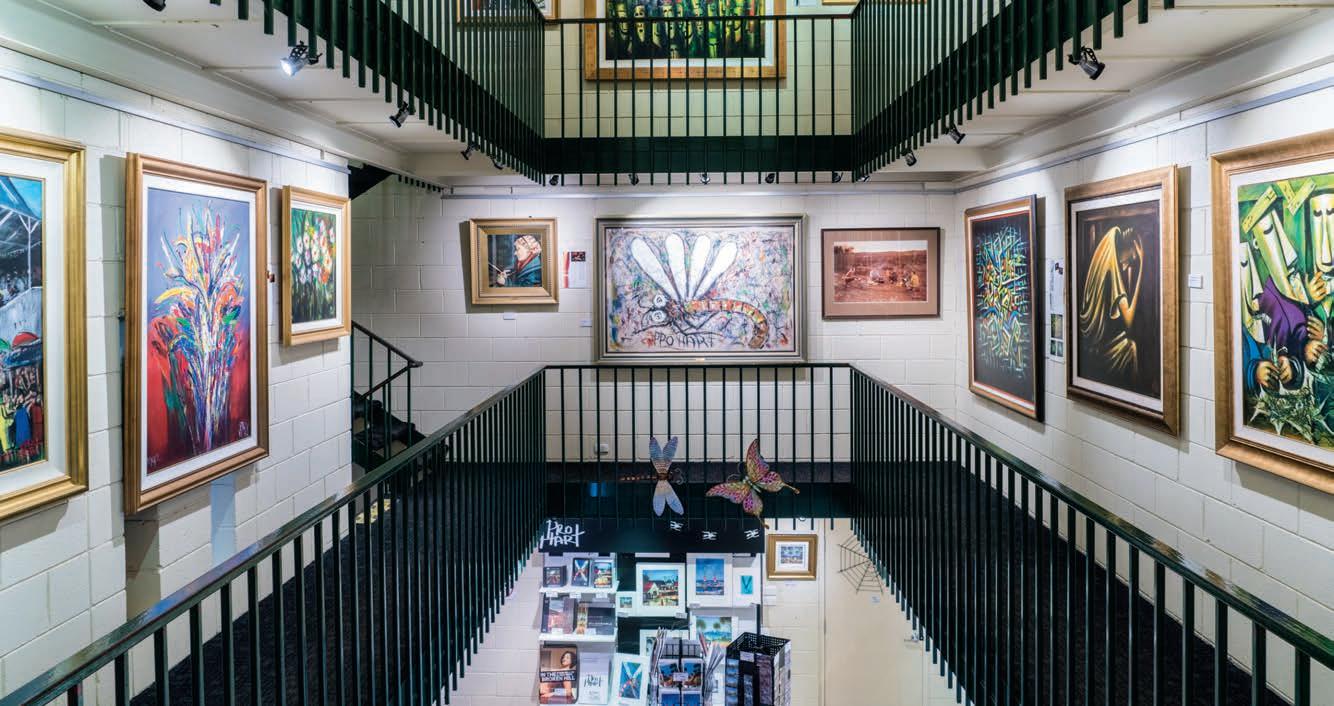
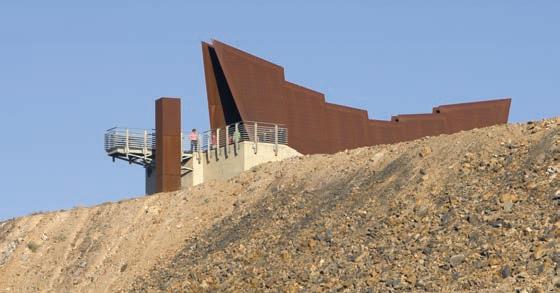
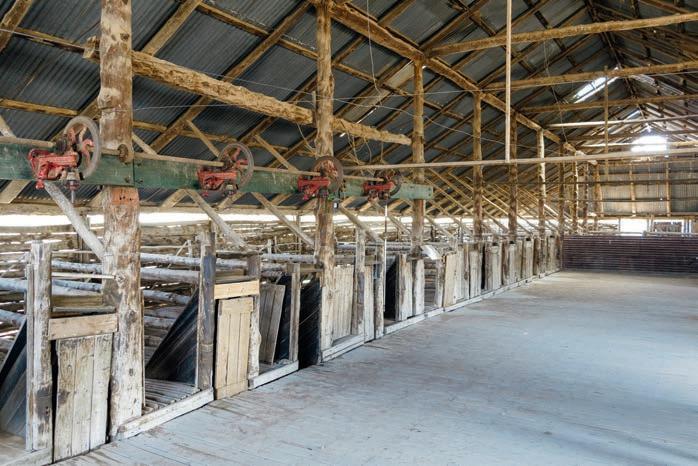
Once, I had asked the provocative Australian historian Manning Clark if there was one outstanding achievement of Europeans in Australia. He replied promptly, as though all Australians should know: “A cold beer west of the Darling.” The outback is as confusing, and as perversely profound, as that. So, camping gear checked, we stock up and set out to stir some red dust, flex some diesel muscle, to try to discover why it’s said that once you’ve crossed the Darling to the land of bloodshot, spilt-ink skies, you’ll never want to leave. There are so many stories out there, stories back to the Dreamtime, too many, too big for any canvas, even for Broken Hill’s 100-metre tourist attraction, The Big Picture.
The jewel in the area’s crown undoubtedly is Mungo National Park with its weathered Walls of China stretching into a hazy infinity. Its Mungo Man and Mungo Woman tracing human occupation back 50,000 years and evidence of the oldest recorded cremation anywhere in the world. We pitch the tent watched by curious kangaroos. We could have stayed in shearers’ quarters here or at Mungo Lodge on the outskirts of the park. The next day, we drive the 70-kilometre discovery circuit on a rocky, unsealed road.
A dreaded heatwave is forecasted over the next three days. The following morning, however, heavily sunscreened and protectively
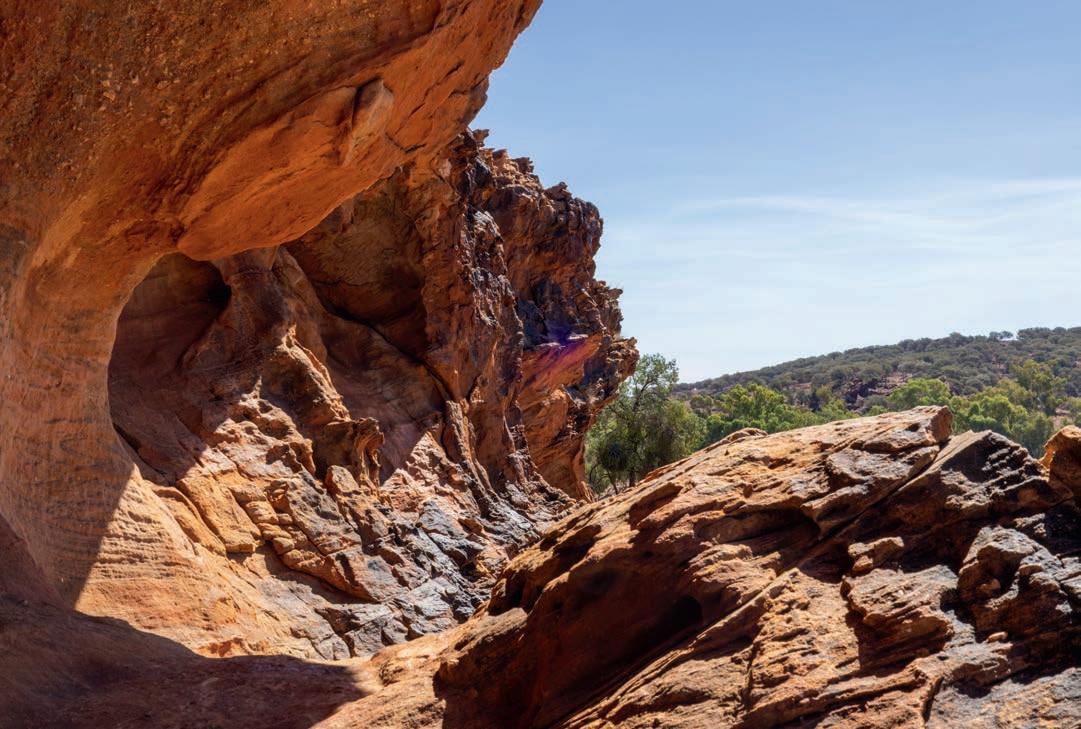
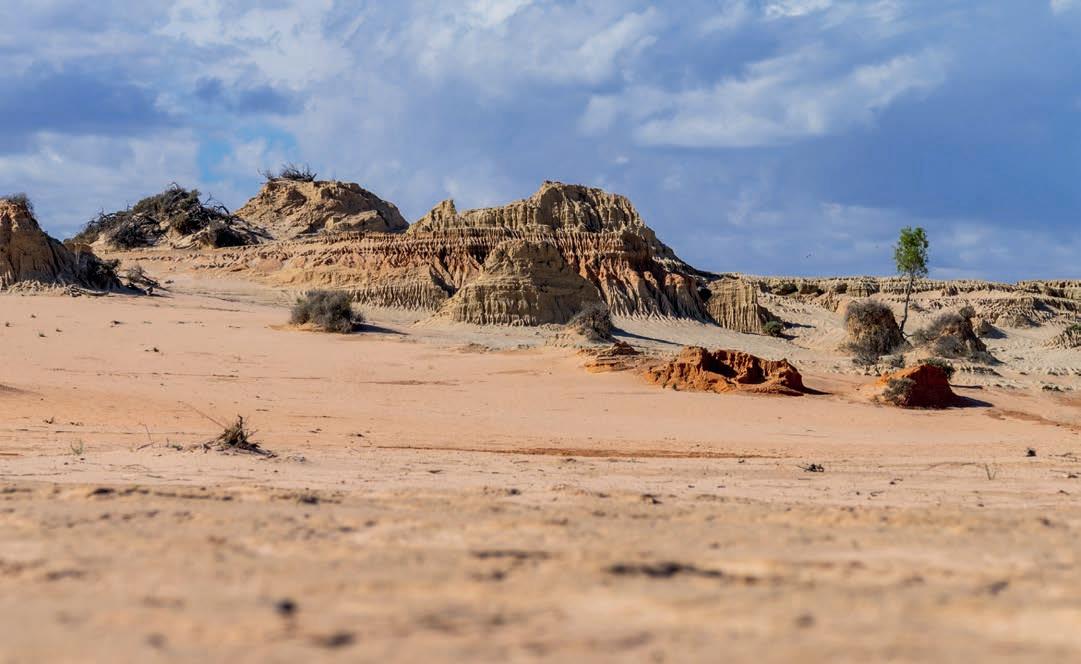
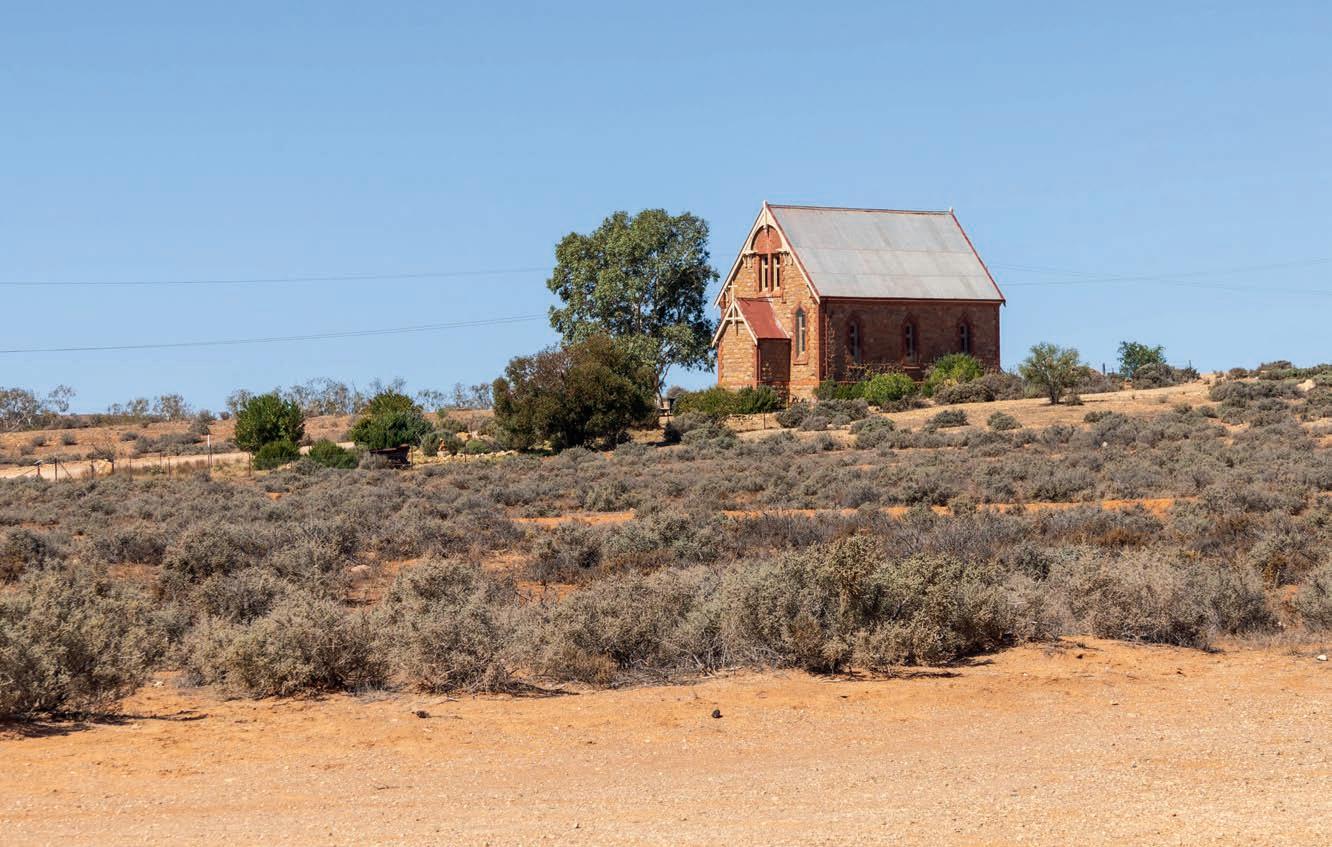
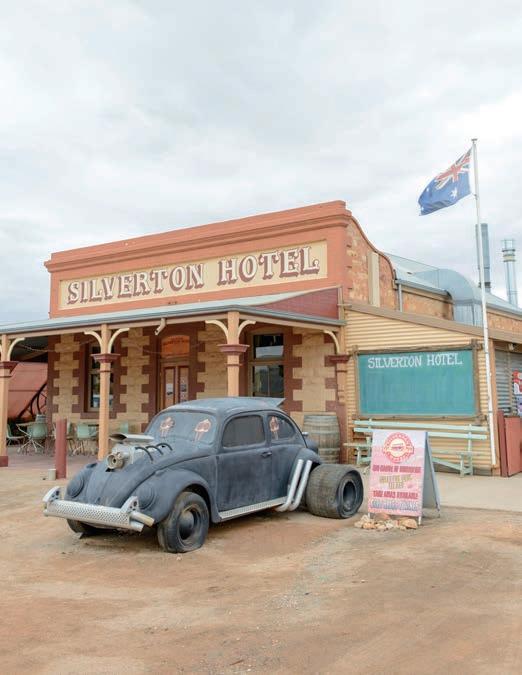
dressed, black clouds threaten ahead. We hear the thunder before the lightning strikes. Soon the rain pummels us. Headlights blazing at high noon, windscreen wipers whir into high-speed outback action. It was supposed to be 45 degrees. Instead it’s 20. Kangaroos shiver suicidally on the warm road.
We shelter from the storm in Broken Hill, dropping to see an exhibition at the Regional Art Gallery and visit Pro Hart’s eccentric legacy. Things have changed in Broken Hill since the days of bitter industrial battles, two-up, grog shanties and larrikins such as Snakejuice. The recipe for the drink from which Charles Carl took this name was revealed by the Barrier Miner of 1892: Decant half a keg of rum, brandy or whisky and replace with water … add two sticks of tobacco, one bottle of Worcestershire sauce and one bottle of Perry Davis Painkiller to give colour and kick.
It’s the day after, and the weather forecasters were finally right. We take that fabled cold beer west of the Darling under the awning of the nearby Silverton Hotel, famous for Mad Max and the other movies made in what was once a ghost
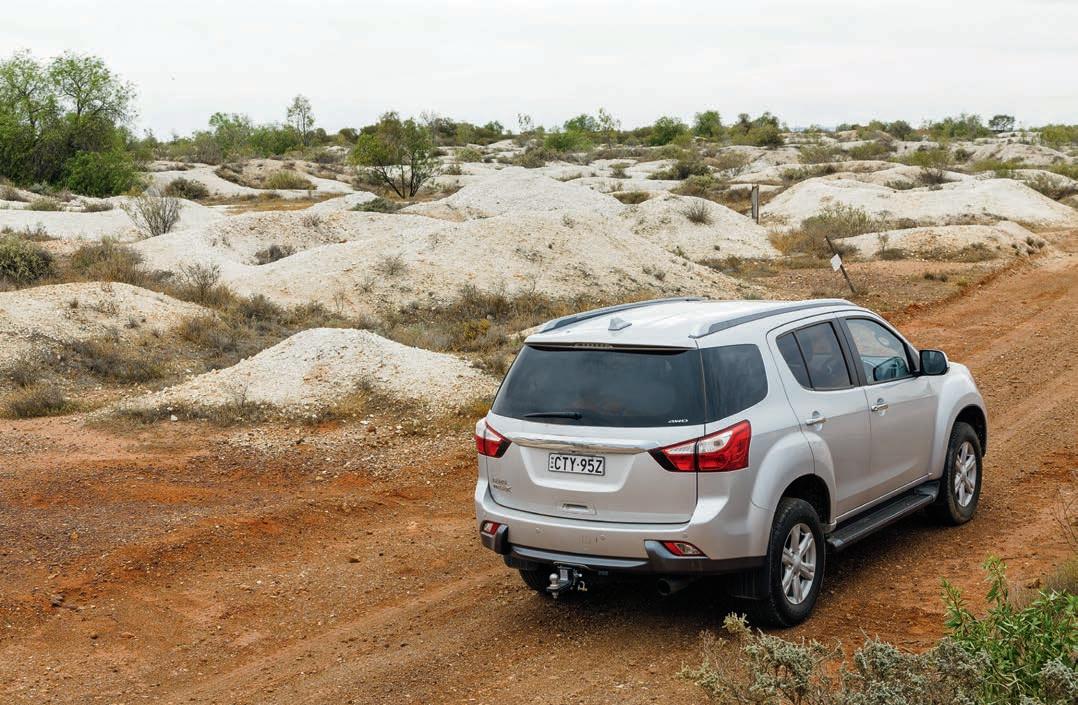
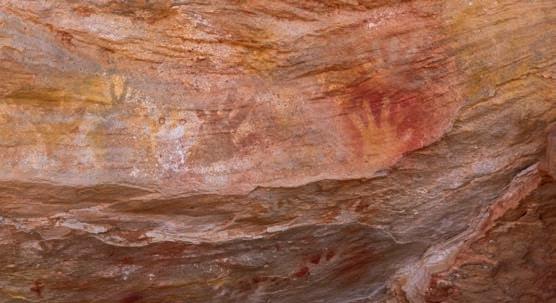
town but now is a thriving artists’ colony. The beer isn’t cold for long. Even our road atlas sheds its spine like a snakeskin at 46 C. For the first time in my life, I find myself setting a car’s climate control to a comfortable, cool 36 degrees.
In that searing heat, I climb to the top of the hill known as Sundowner to the sculptures, which have become the destination for pious pilgrimages to its summit. “My work is an extension of the strata of the hill,” Lawrence Beck once said. “All matter is love, even hard Wilcannia sandstone.”
We soon head north-east from Broken Hill to Mutawintji National Park. Dominated by the Bynguano Ranges, whose vibrant red colour dramatically captures changes in the light, this outback park is home to the famous hand stencil art of local Aboriginal communities, as well as many other important cultural and historic sites.
Stop to gather information from Mutawintji Visitor Centre, pitch your tent at Homestead Creek campground and choose from easy walking tracks such as Thaaklatjika Mingkana track, or more challenging options including the Rockholes Loop track and the Mutawintji Gorge track. Book a cultural tour conducted by a Traditional Owner and visit the Mutawintji Historic Site, which boasts one of the best collections of Aboriginal art in New South Wales.
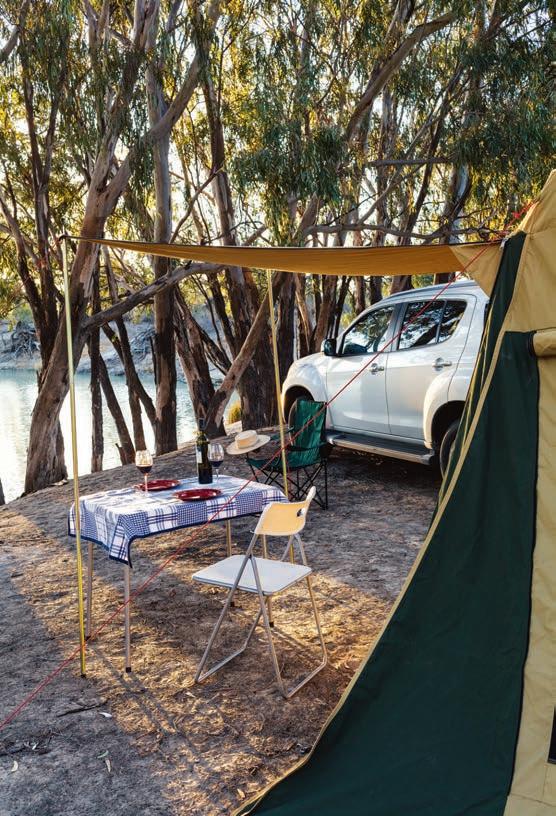
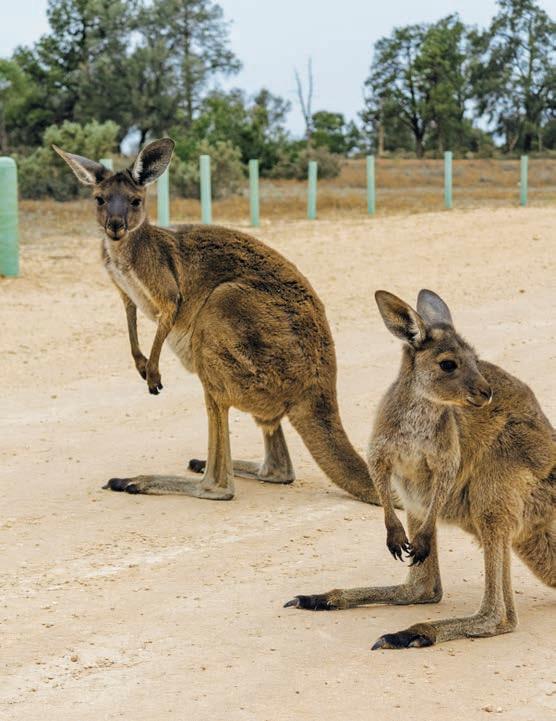
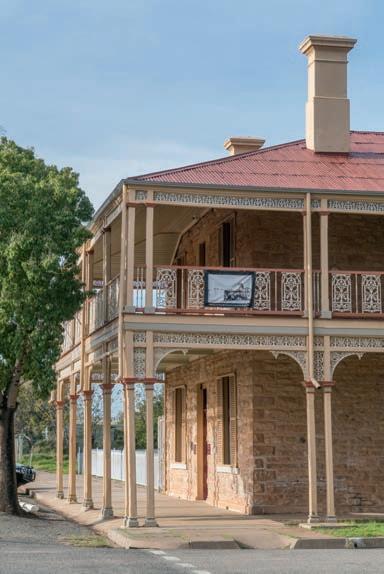
It’s back on dirt roads to get to the opal-mining town of White Cliffs, whose landscape — not unlike a World War 1 battlefield — can be hard to love. It once had a population of more than 5000. Now it’s about 200, more than half of them living in underground dug-outs. Sipping cold beer on the balcony of the dispersed town’s hotel, a local observes that there’s no better opal than what you’ll find round here. “Trouble is,” he adds, “government regulations make it so hard to do any mining, you’d be lucky to find more than four or five blokes working.” Somehow we go onto the subject of the Darling. “Had a wife called that once,” he quips.
The first excavations for what became the Underground Motel were dug into Poor Man’s Hill by a lone miner in the early 1900s. In the monkish white cell, the temperature was a lovely 22 degrees. And there it stays, regardless of dust storms and 50-degree days or below-freezing nights outside.
The lure of the Darling takes us back on a sealed road to Wilcannia, the notoriously barred, no-go town, which visitors usually drive straight through, not stopping even for petrol. Dilapidated colonial buildings vouch for its former grandeur as a river port. As coffee culture invades the nation the way cane toads did before, it’s worth noting that the latte from the Wilcannia Cafe 2836 was the best of the whole road trip.
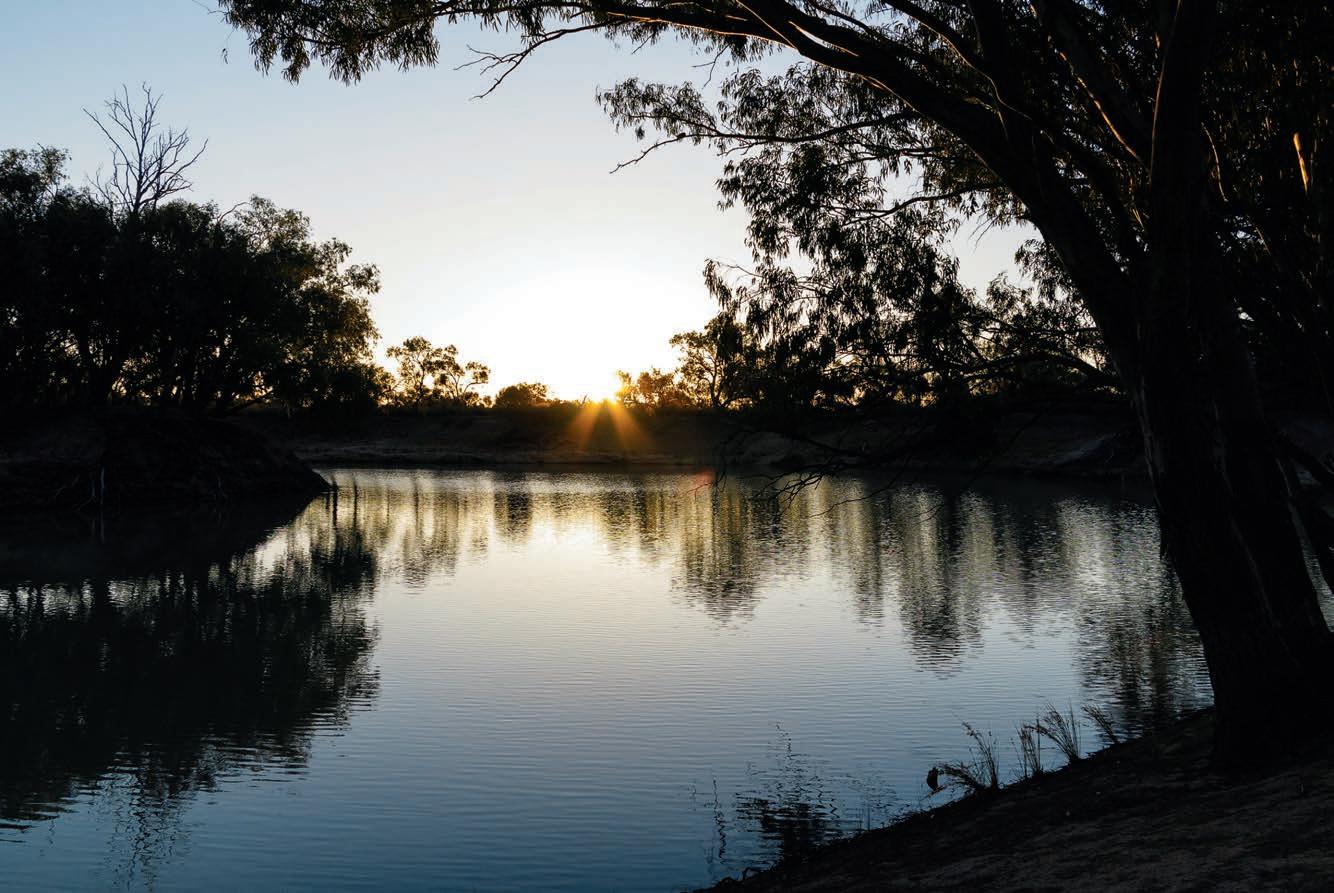
WHERE TO STAY
Broken Hill Outback Church Stay, Broken Hill brokenhilloutbackchurchstay.com
The Imperial Fine Accommodation, Broken Hill imperialfineaccommodation.com White Cliffs Underground Motel, White Cliffs undergroundmotel.com.au Mungo Lodge, Arumpo mungolodge.com.au Warrawong on the Darling, Wilcannia warrawongonthedarling.com.au
PLACES TO EAT & DRINK
Silverton Pub, Silverton silverton.org.au Palace Hotel, Broken Hill thepalacehotelbrokenhill.com.au Bells Milk Bar, Broken Hill bellsmilkbar.com.au
Giddy Goat Cafe, Broken Hill facebook.com/thesillygoatfamily Wilcannia Café 2836, Wilcannia facebook.com/p/Wilcannia-Cafe-2836
THINGS TO DO
Pro Hart Gallery, Broken Hill prohart.com.au
Broken Hill Regional Gallery, Broken Hill bhartgallery.com.au
Royal Flying Doctor Service Outback Experience, Broken Hill brokenhill. experience.fl yingdoctor.org.au
The Living Desert & Sculptures, Broken Hill discoverbrokenhill.com.au/theliving-desert-and-sculptures
Miner’s Memorial, Line Lode, Broken Hill, experiencebrokenhill.com.au/thingsto-do/line-lode-memorial
John Dynon Art Gallery, Silverton johndynon.com.au
Lake Mungo National Park, nationalparks.nsw.gov.au/visit-a-park/parks/ mungo-national-park
Mutawintji National Park nationalparks.nsw.gov.au/visit-a-park/parks/ mutawintji-national-park
Red Earth Mine Tour, White Cliffs redearthopal.com/opalminetour
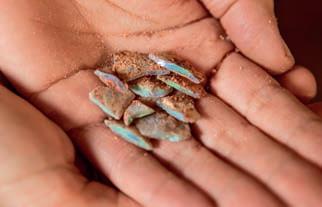
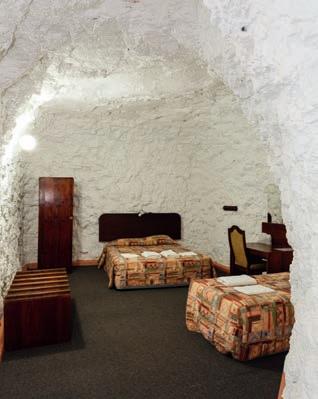
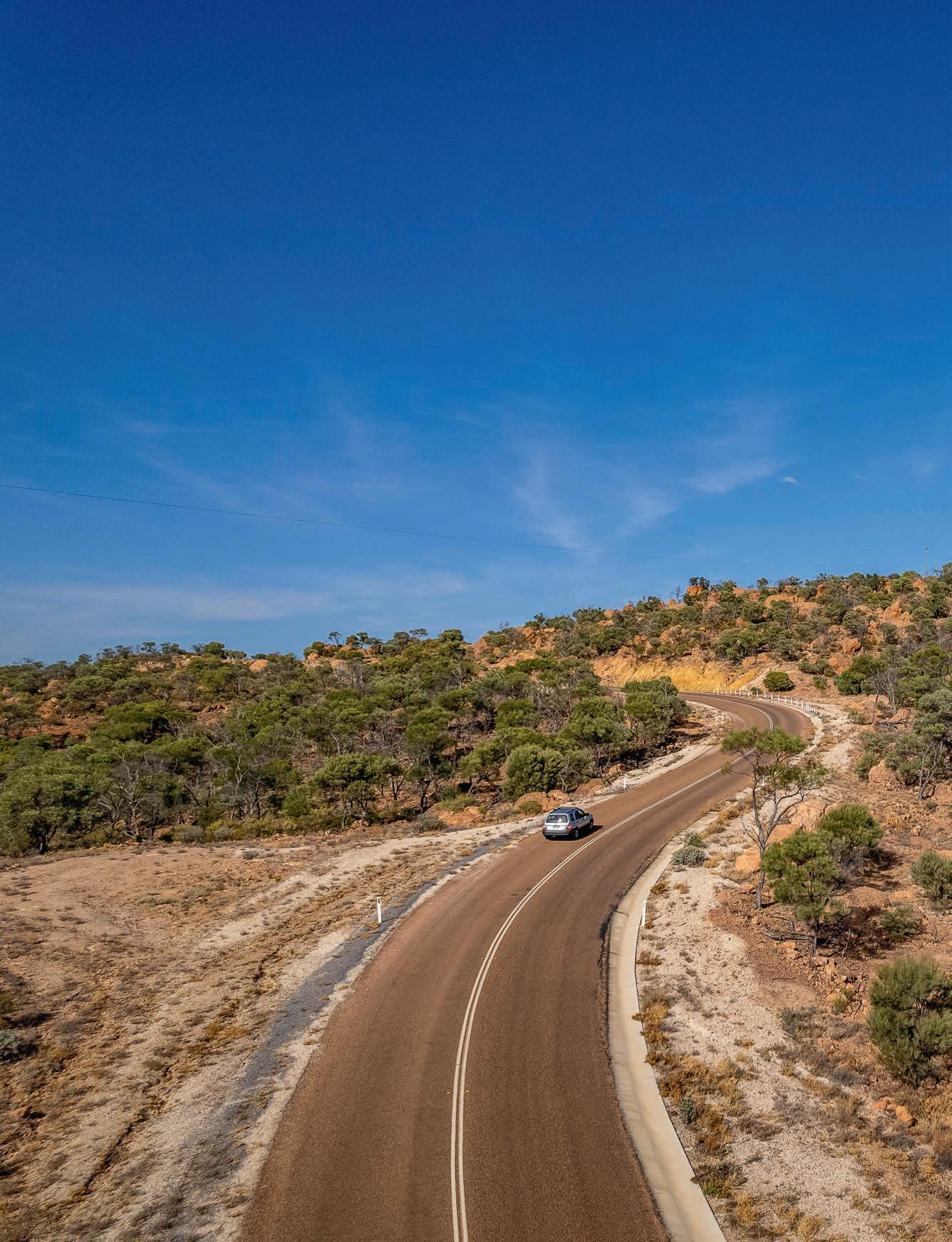
Follow in an early explorer’s footsteps to discover small towns and the people who call them home across outback Queensland.
OUTBACK QUEENSLAND | 10–14 DAYS
BY KIRSTY MCKENZIE, PHOTOGRAPHY KEN BRASS & TOURISM & EVENTS, QUEENSLAND
There’s a most chilling photograph in a gallery in a former railway goods shed in the tiny town of Morven, population 150 or so, in south-western Queensland. It shows a young Janet Glasson kneeling in a field taking aim with a M16 at the height of the Vietnam War in 1967. Like the good bush girl she was, Janet was already capable with guns when she was posted as a civilian RN (registered nurse) to the Long Xuyen hospital in the Mekong Delta of South Vietnam. However, the Americans based at the MACV (Military Assistance Command, Vietnam) hospitals made sure all the civilian surgical team members could handle assault rifles so they could defend themselves. There was always a rifle leaning against the operating theatre wall, just in case.
This photograph is just one of a series of unforgettable images in the Vietnam Nurses Memorial, the only memorial in this country dedicated solely to the 353 Australian nurses who served in Vietnam between 1964 and 1972. It’s part of a complex of buildings that constitutes the Morven Historical Museum, which also includes a remarkable shed made from flattened kerosene tins and buildings containing farm artefacts, photographs and other memorabilia from the early days of European settlement.
The town, located 650 kilometres west of Brisbane, is the starting point for the Landsborough Highway, a 1000km route through outback Queensland to Cloncurry in the state’s north-west, 784km west of Townsville on the coast. The highway is named for Scottish-born explorer, magistrate and later parliamentarian William Landsborough, who travelled across vast swathes of outback Queensland in the 1850s and 1860s. In 1861, Landsborough led one of the parties searching for lost explorers Robert O’Hara Burke and William Wills. Starting from the Gulf of Carpentaria, their search ended on Coongoola Station near Wyandra, where they learnt the fate of the lost party. Landsborough’s team continued south to Melbourne where they were feted as the first people to cross Australia from north to south. It should be noted that rival Scottish explorer John McDouall Stuart completed the return of his expedition from south to north and back again to Adelaide around the same time as Landsborough.
Morven’s white settler history also goes back to the early 1860s, when Captain TJ Sadleir camped on a waterhole on Hamburg Creek near the present-day township and built a homestead there. As other settlers followed, a hotel was established as a Cobb & Co staging post and Sadleir’s name lives on in the signage at the present Morven Hotel and its adjacent Pick a Box Motel, which
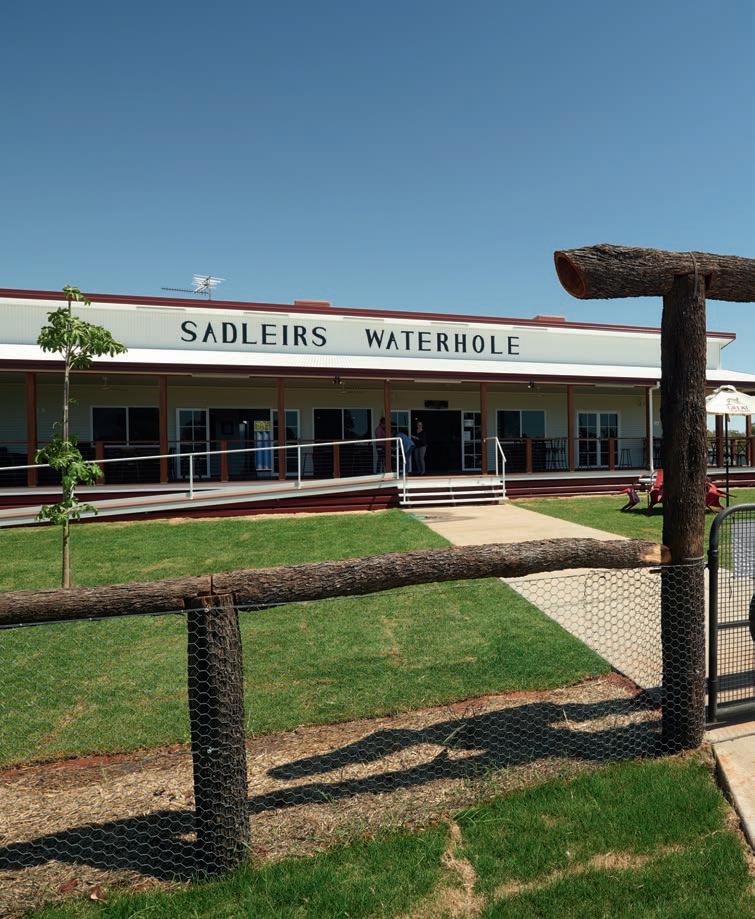
were rebuilt by a group of local families when the existing hotel burnt down in 2016.
From Morven, it’s 92km up the road to Augathella, with good fishing in the Warrego River and murals on the town’s buildings including the water tower recording local characters and wildlife. Augathella is renowned as meat ant country — even the local footy team is named for the pesky insect with a sharp, burning bite — and there’s a giant sculpture of one in the town’s park. Tambo, population 360 odd, provides a good introduction to the reception travellers can expect. Located 118km north of Augathella, the first thing motorists see is a yellow road sign featuring a drawing of a black bear and the words “Caution Teddies Crossing”. Tambo Teddies began in 1992 as a self-help project to inject business into the town, which was suffering from years of drought and decline in the wool industry. The founders hit on the idea of making sheepskin teddy bears to sell, giving tourists a reason to stop in town and, hopefully, spend a few extra dollars on fuel or food while they were at it. Today, with more than 75,000 teddies down the track, the business has expanded its soft toy offerings to
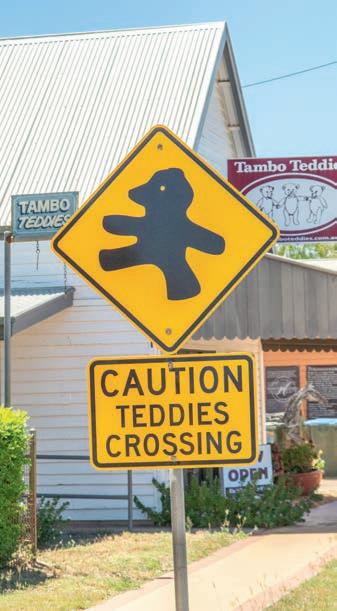

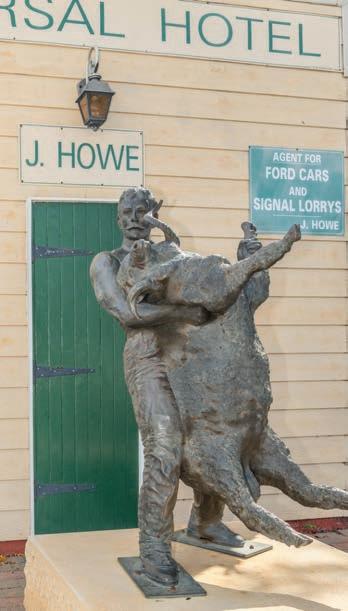
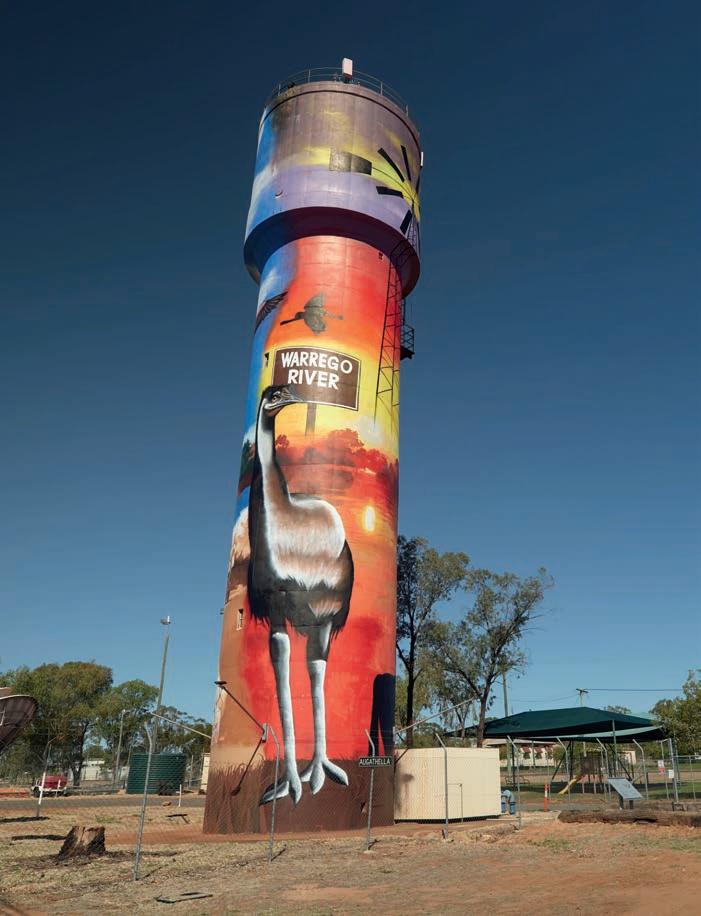
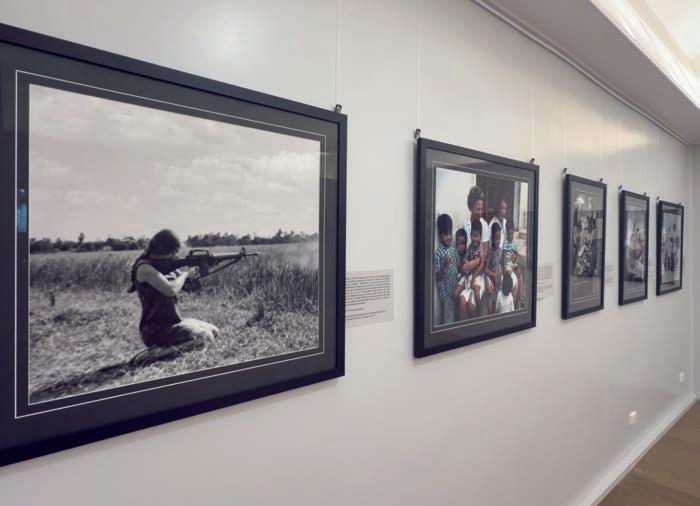
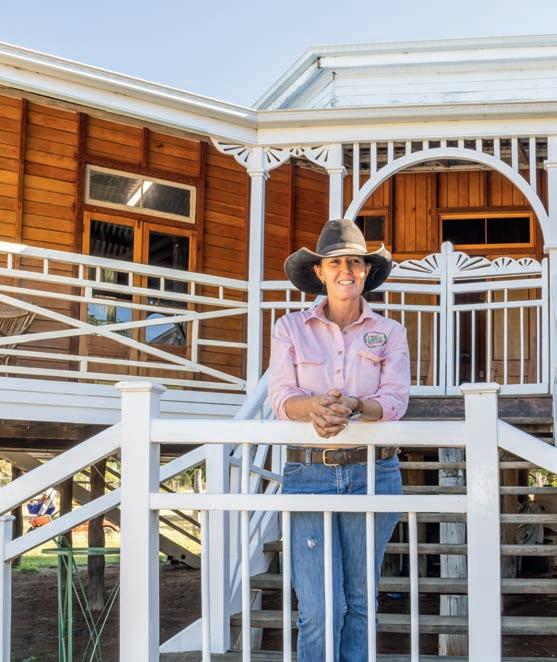
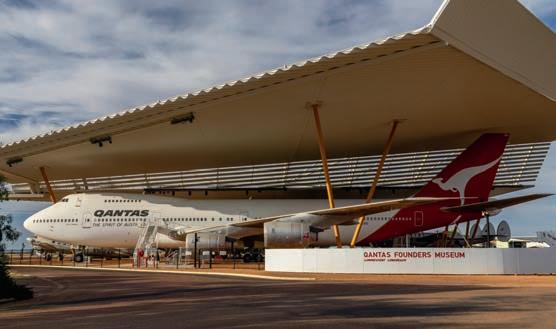
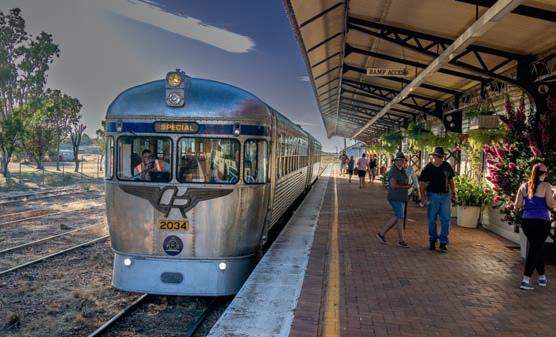
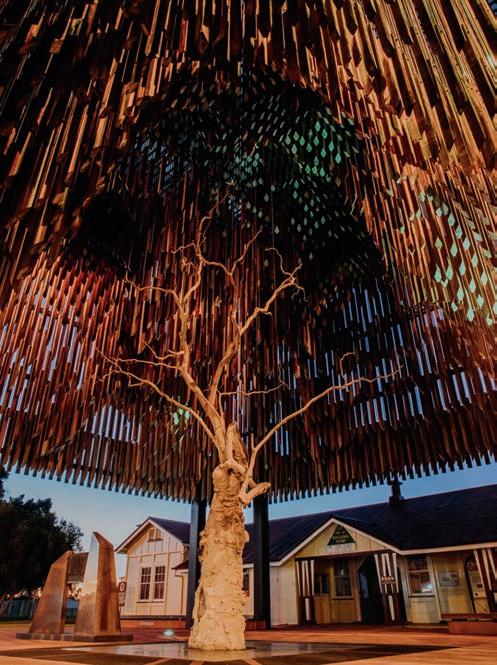
include the Tambo Lambo and Bickie Bear, as well as a koala and echidna, which are popular gifts for sending overseas. If you stay overnight in Tambo, be sure to head to the Royal Carrangarra Hotel, where chicken races are held every night during the tourist season, which extends during the cooler months from Easter until October.
It’s about an hour (101km) up the road to Blackall where, in 1892, blade shearer Jacky Howe set a record for hand shearing 321 sheep in seven hours and 40 minutes. More shearing history is recalled at the Blackall Woolscour on the outskirts of town, where visitors can see the country’s last surviving steam-operated wool washing plant. The facility, which ran from 1908 to 1978, is part of a complex that includes a 20-stand shearing shed and a freeflowing artesian bore (most bores these days are capped). Wool that had dirt, burrs and grass seeds removed by washing not only attracted a premium price, it was also lighter and cheaper to transport, so the woolscour was a great boon to the town. Another landmark to look out for in Blackall, which is now home to about 1400 residents, is the black stump, a giant piece of petrified wood, once used as a distance-measuring marker. Anything west of this prehistoric peg is said to be beyond the black stump.
From Blackall, it’s another 107km to Barcaldine, a service town on the railway line from Rockhampton, with a population of about 1500. But savvy travellers know to turn off 28km before they get to town for a night or two at Lara Wetlands bush camp. There’s ample space to park your van or pitch a tent at the unpowered campground, which is a feature of a 15,000-acre (6070-hectare) cattle station. The wetlands, which contain myriad dead ghost
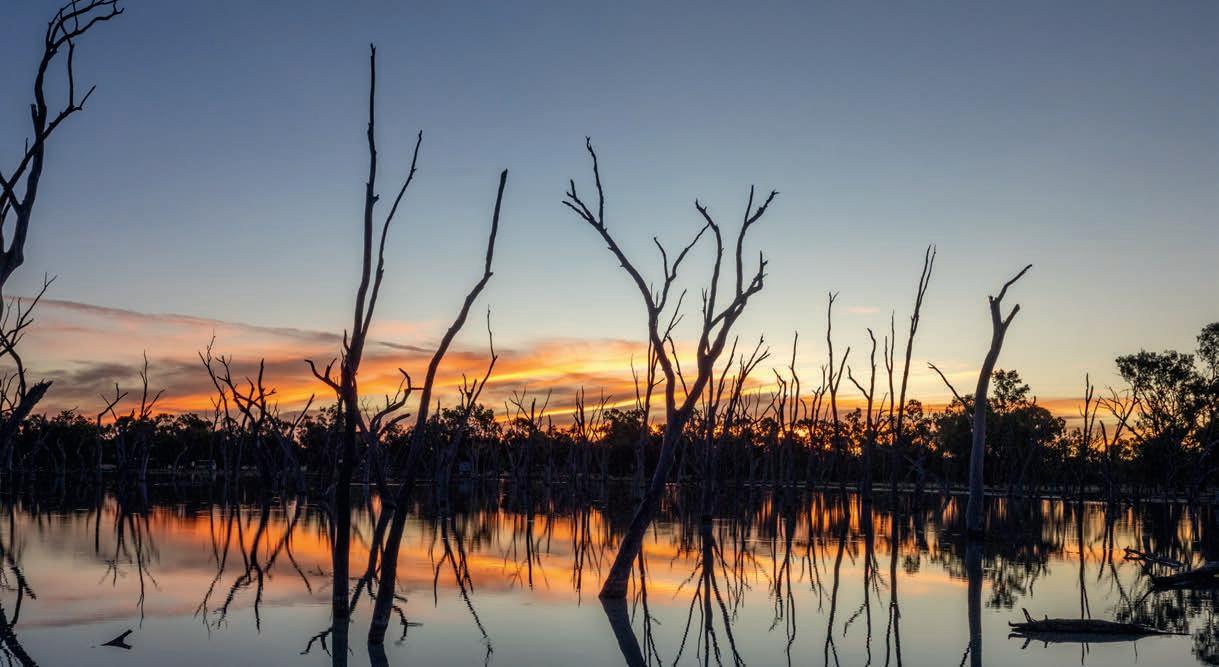
gums, are fed by an artesian bore and attract abundant birdlife — 127 species on the list and still counting. Photographers will be rewarded at sunrise and sunset, and there are tours of the 1906 homestead, canoes for paddling on the lake, fish to be caught in the river, a thermal pool for soaking in and incomparable views of the Milky Way to experience.
On the other side of the highway, at the 65,000-acre (26,305-hectare) Merino sheep and cattle station, Dunraven, the Doneley family hosts tag-along tours several times a week. The experience takes about three hours and includes a visit to an artesian bore, an explanation of the livestock in the paddocks and the wild-dog exclusion fence, as well as wildlife encounters before it concludes at the shearing shed with a splendid smoko.
Barcaldine township earned its place in the history books in the 1890s as the site of Australia’s first labour struggle. A memorial to a ghost gum known as the Tree of Knowledge, where striking shearers met in the 1890s, now looms large over the town’s main street. The towering structure, with timber “leaves” the size of railway sleepers, is an impressive sight during the day that becomes a spectacle when lit up at night.
Whether you fly or drive into Longreach, population 3000 odd, 108km west of Barcaldine, the first thing you’ll see is the mighty jumbo jet parked out the front of the hangar where, in the 1920s, the first aircraft for the fledgling Queensland and Northern Territory Aerial Services were built under licence to the de Havilland company. The Boeing 747 is the jewel in the crown of a fleet of aircraft that form the showcase of
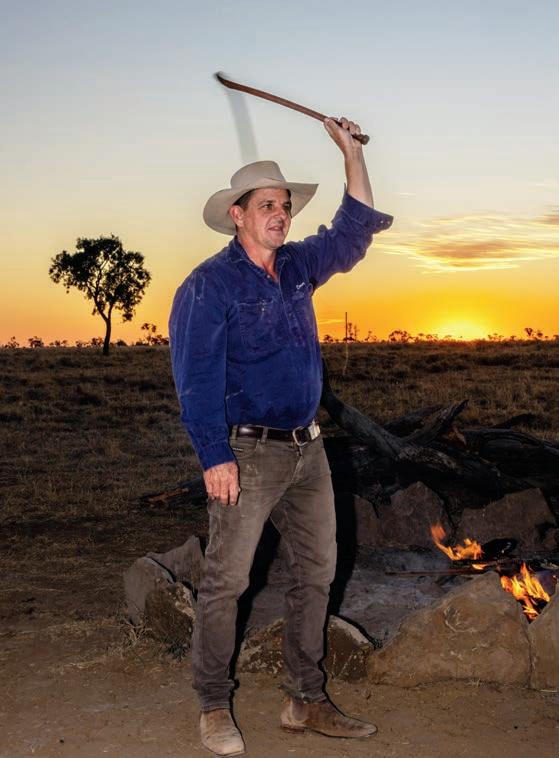
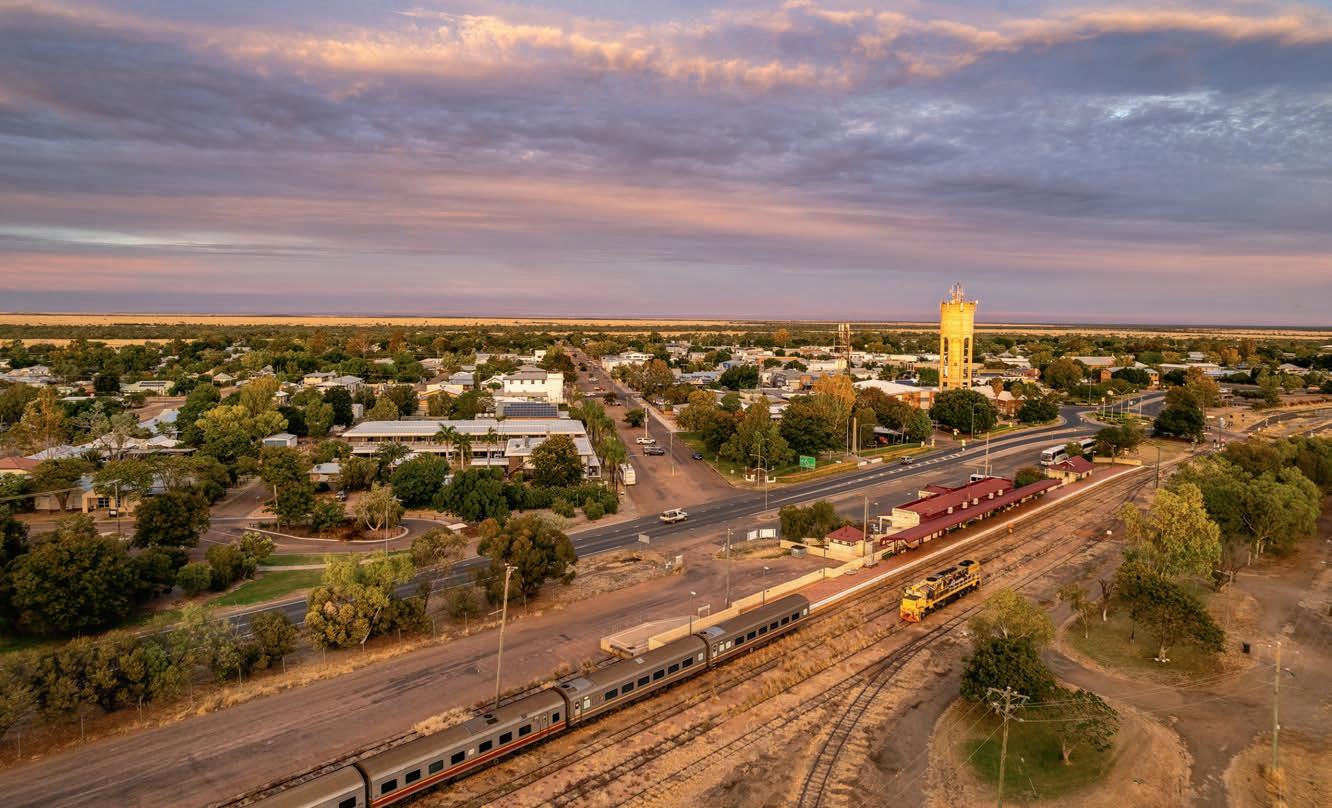
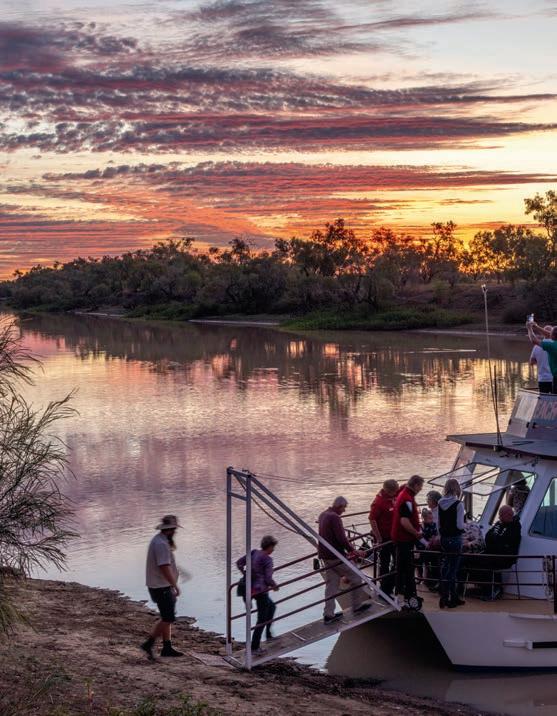
the Qantas Founders Museum and includes a Boeing 707, a DC-3, a Catalina flying boat and a Super Constellation, as well as various replica planes. A sound and light show called Luminescent Longreach documents Qantas’s century of history. Projected on to the belly of the 747, the outdoor experience chronicles how the airline has gone from being registered by two former WWI pilots in 1920 in Winton (which also hosted the first board meeting), and operating the first passenger service from Cloncurry to Charleville in 1922, to becoming Australia’s national carrier.
On the other side of the highway, the curved silhouette of the Australian Stockman’s Hall of Fame stands stark against the flat landscape. Five galleries in the museum honour the pioneering stockmen and women, shearers, blacksmiths, swaggies, fencers, mailmen and other workers who turned the vast plains of central Australia into pastoral country. The Hall of Fame has recently added a new cafe and billabong area for visitors to enjoy lunches and picnics, plus there’s a popular night-time show.
Alan (Smithy) Smith and his wife Sue (Suzan) are practically the grandparents of tourism in the district as Alan bought his first troop carrier and registered Outback Aussie Tours in the late 1980s. In the early days, an old family friend, John Menzies, took him bush and taught him how to make damper in a camp oven, and it’s that damper
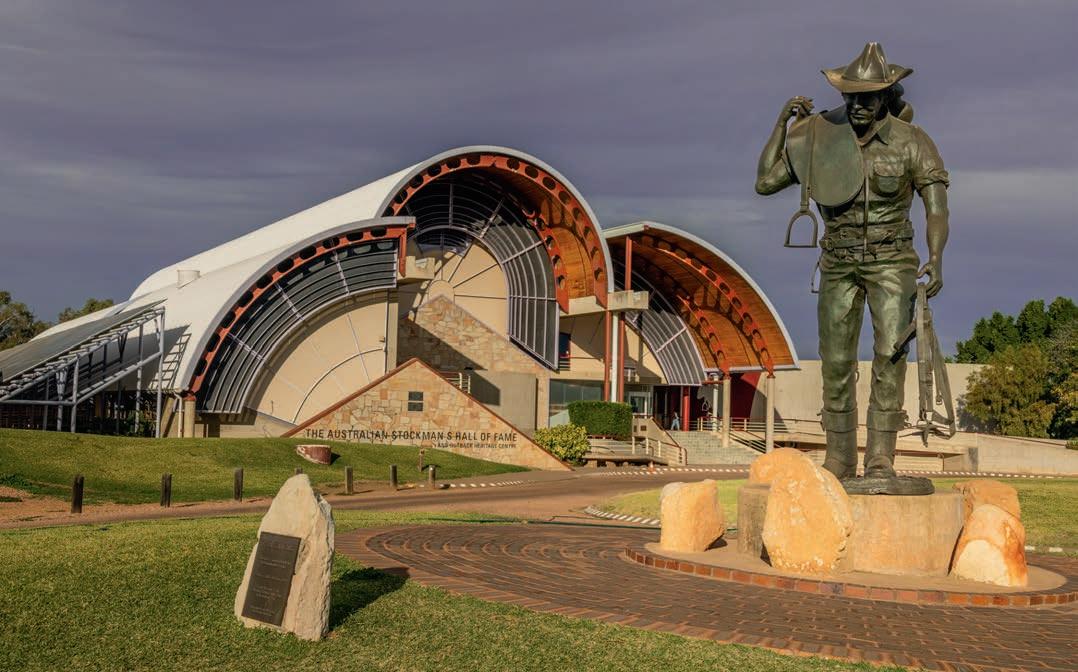
recipe that is still one of the highlights of his signature offering, the Drover’s Sunset Cruise and Smithy’s Outback Dinner and Show. It includes a sunset river cruise on the Thomson River on the Longreach Explorer followed by a camp-oven dinner served with a side of bush entertainment on the riverbank. Alan and Sue also welcome guests for a gourmet experience in the garden of their historic homestead on Rosebank station and offer insights into bush life with property tours to Strathmore and Camden Park, as well as trips to destinations around town in a vintage rail motor.
“People might come to see the museums and chase dinosaurs,” Smithy says. “But it’s the wide open spaces, the landscape, the food it grows and the people who grow it they remember.”
It’s a sentiment Daniel (Outback Dan) Walker echoes from Camden Park, the 18,500-acre (7486-hectare) property he runs with his brother, James. The Walkers are practically royalty in this part of the world as their grandfather, Sir James, served as the chair of the Longreach Shire Council for 35 years and developed a reputation for his community spirit and passion for beef cattle, in particular Santa Gertrudis, genetics. On one occasion in 1970, the family entertained royalty, when Queen Elizabeth II and Prince Phillip came to lunch. Dan’s recollection of this august event is that it was his father’s job to grade the road into the homestead so the Queen’s Rolls Royce
didn’t bottom out on the way in. He shares this and many other tales of the highs and lows of life in the bush when he welcomes visitors to the property with a tour that includes a visit to an old swaggie’s grave, the 1907 shearing shed and the 17.5-megawatt solar farm the station hosts, before concluding with a whip-cracking display and sundowner drinks.
Winton, 179km to the north-west, is home to exponentially more dinosaur bones than its 1300 inhabitants. Local graziers were accustomed to picking up fossils in the paddocks for decades before station manager Glen Seymour discovered the fossilised footprints of a stampede of 150 dinosaurs ranging in size from chickens to emus in the 1960s. Excavation of what is now known as the Lark Quarry Dinosaur National Monument began in the 1970s and dinosaur fever has gripped visitors to Winton ever since.
Local grazier David Elliott grew up in the Winton district and “always had one eye on the ground” when he was out in the paddock on his station, Belmont. In 1999, he found the fossilised femur of what was, at the time, Australia’s largest dinosaur, a Cretaceous sauropod that roamed the area 95 million years ago.
By the time he found the dinosaur that bears his name, Savannasaurus elliottorum, six years later, he reckons he had his eye in. “Elliott was the big one because he was the most complete,” David says.
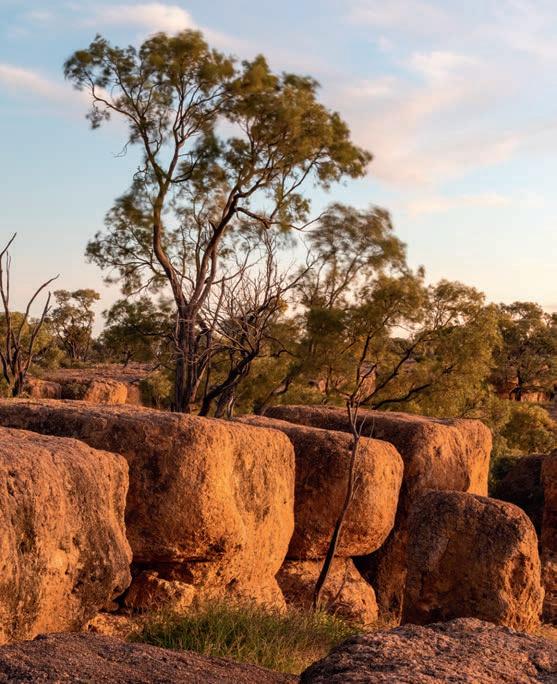
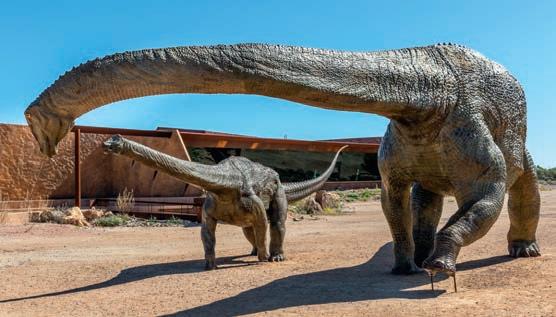
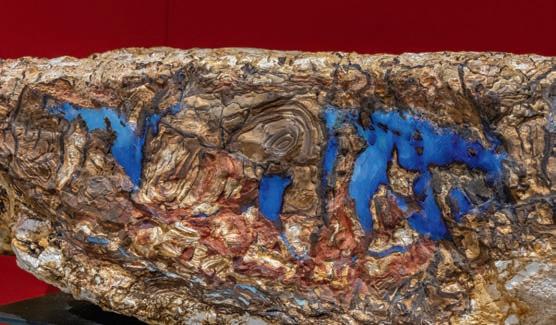
“Once you know what sort of rock you’re looking for and the country you’re most likely to find it in, it’s not all that hard. Elliott was actually my seventh find.” In the same year, two more skeletons, that of a sauropod called Matilda and a theropod nicknamed Banjo, were found on Elderslie station and, by the following year, David and his wife, Judy, had opened a shed on Belmont as a fossil-prep facility. Then the Britton family of Mount Landsborough donated 1400 hectares of mesa or jump-up country as the site for the Australian Age of Dinosaurs Museum, which opened in 2009. Visitors today can visit the facility, which includes the world’s largest collection of Australian dinosaur fossils, a prep lab and the dinosaur canyon, where cast-bronze replicas of the mighty creatures sit in the landscape. The latest attractions include a fossilised trackway with prints of huge sauropods, small to medium ornithopods and tiny theropods, as well as a night-sky viewing experience at Gondwana Stars Observatory.
Winton also lays claim to being the home of Waltzing Matilda, as AB (Banjo) Paterson was staying on Dagworth station near Kynuna in 1895 when he wrote about the swagman who was down on his luck and stole a sheep, which may or may not have led to his demise at Combo Waterhole. The ins and outs of the story behind Australia’s unofficial national anthem are celebrated at the Waltzing Matilda Centre, which opened in a spectacularly sculptural building in 2018 after the original was destroyed by fire three years previously. After a few hours in the museum, visitors can repair across the road for lunch and a beer at the North Gregory Hotel, where Waltzing Matilda is said to have had its first public performance.
Dinosaurs and Waltzing Matilda may be the drawcards for Vicki Jones’ Red Dirt Tours, but she says it’s the spectacular scenery that she most enjoys sharing with visitors. Her tours include access to private properties including Carisbrooke and Rangelands stations, where formations such as the Outback Three Sisters, Merton Gorge and the fissured rocks known as the Rangelands Rifts keep photographers snapping. The rugged rock formations looming over the surrounding plains are a major reason that Winton has been the location for movies including The Proposition, Goldstone and Mystery Road
Winton makes much of its “Hollywood of the Outback” reputation, and this is celebrated in the annual Vision Splendid movie festival, a week-long celebration of Aussie film, which has the open-air Royal Theatre as its HQ. For fabulous family fun, head to the home of local circus performers the Crackup Sisters, for tours of their backyard and shows in the Dustarena.
From Winton, continue 165km to the township of Kynuna, population in the tens, with a pit stop at the Blue Heeler pub, built in 1889 as a Cobb & Co stopover. Folklore has it that Dagworth
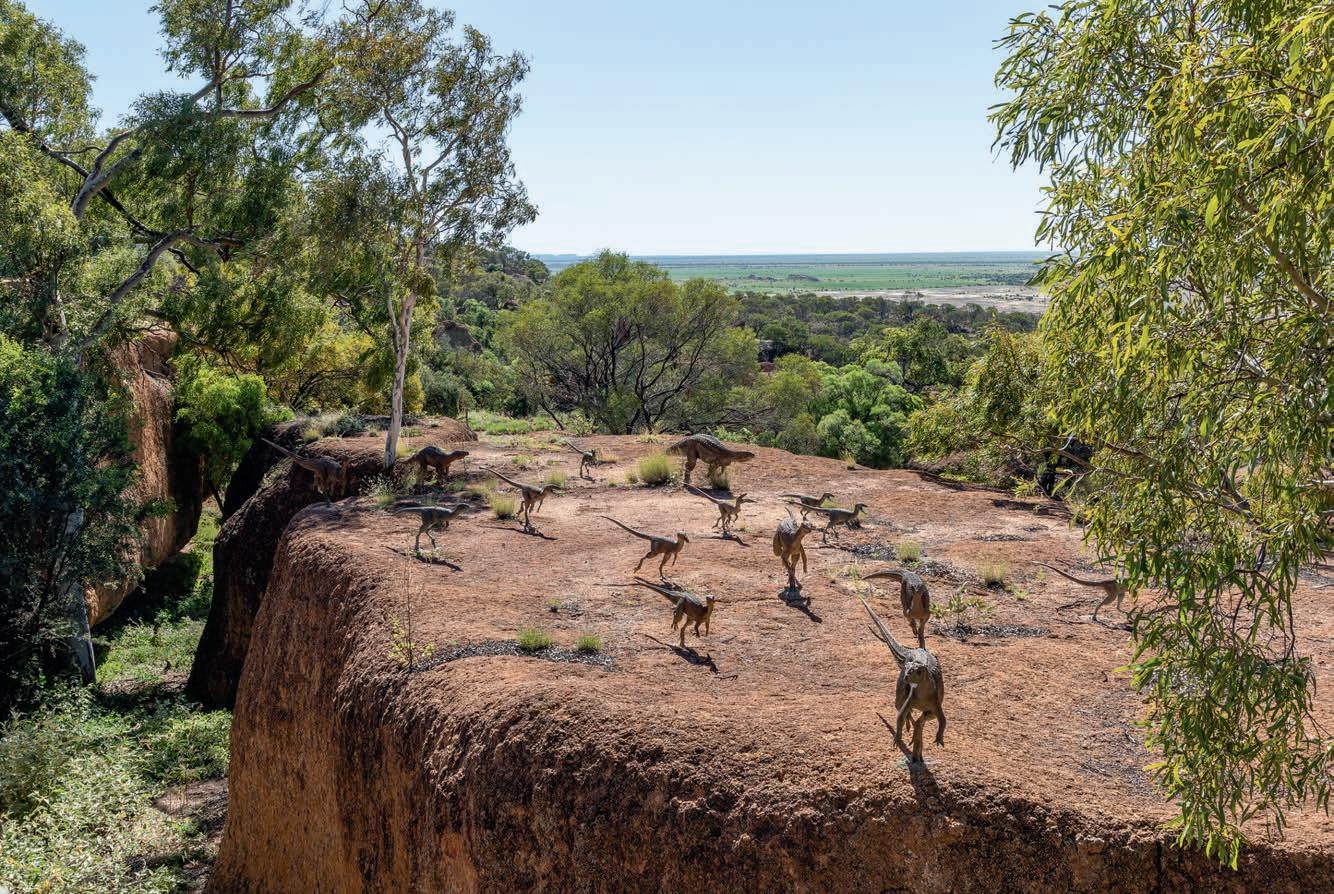
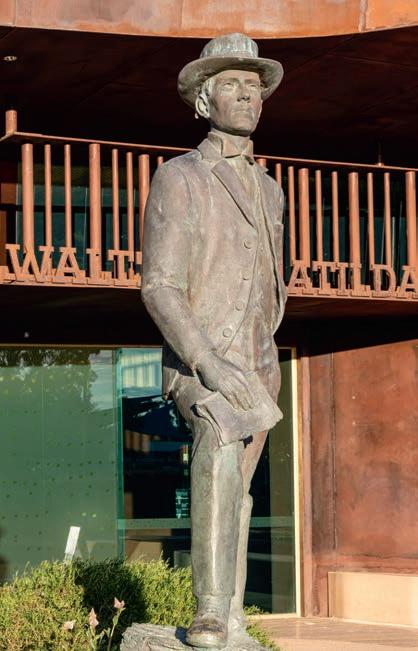
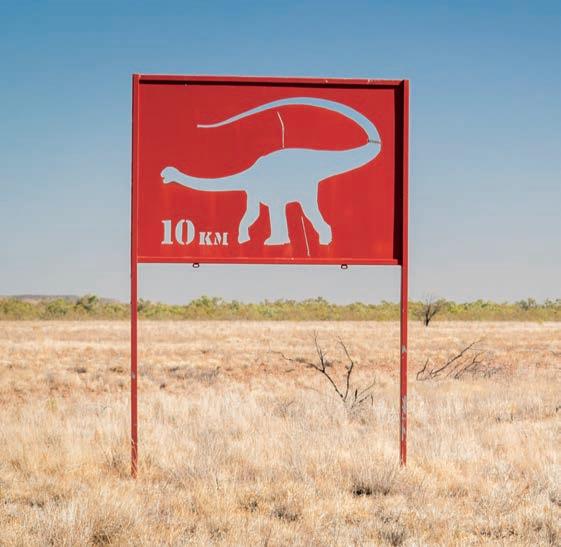
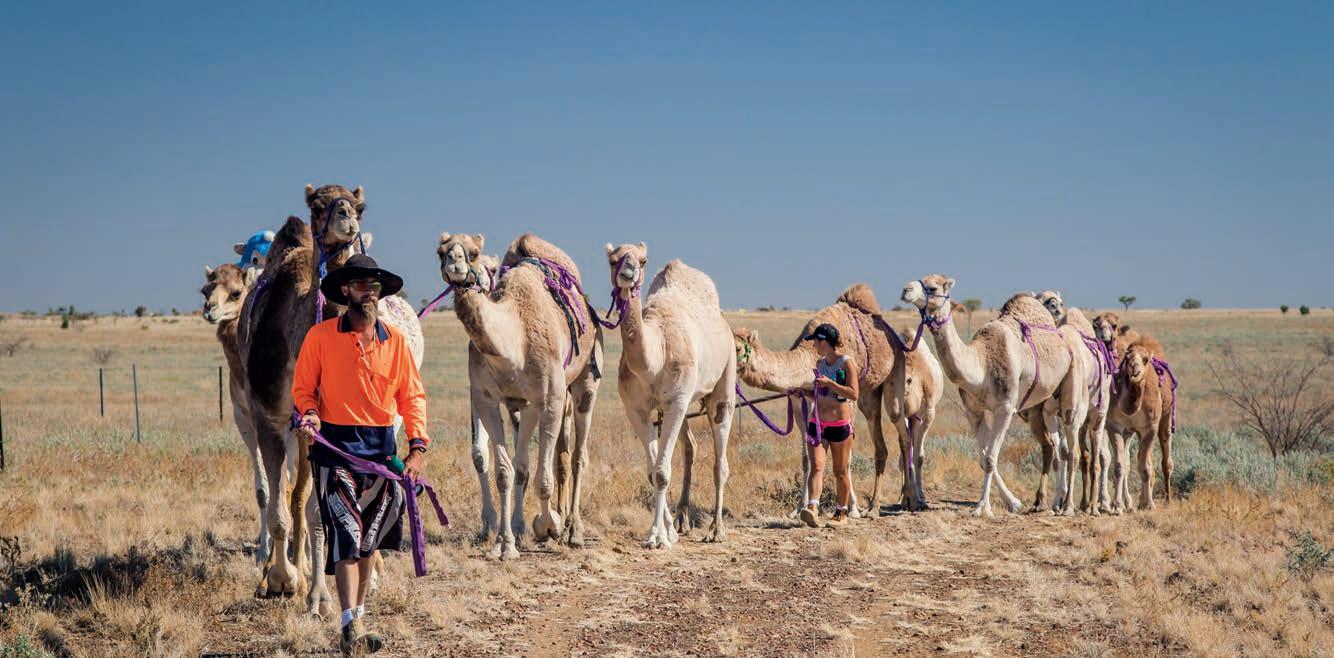
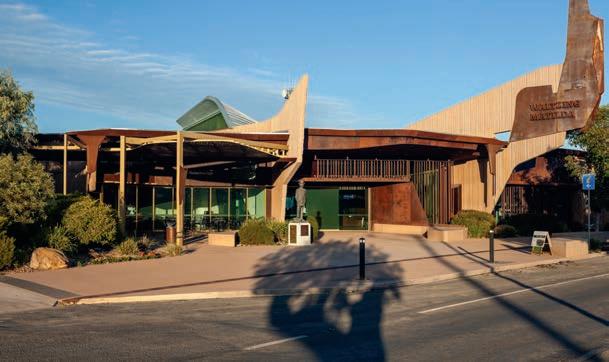
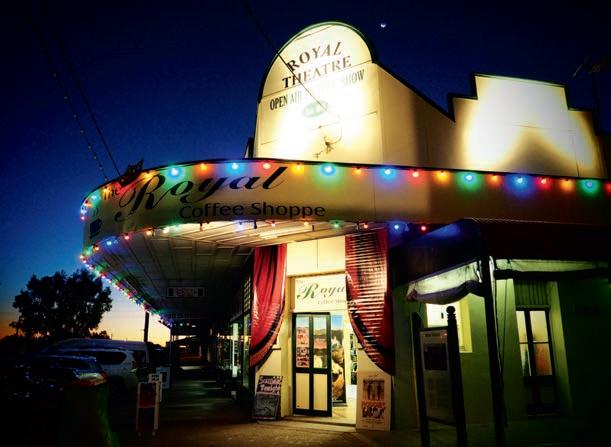
station owner Bob MacPherson told his guest Banjo Paterson the story of the suicide of Samuel Hoffmeister beside the Combo Waterhole. Hoffmeister had been one of the striking shearers involved in the burning down of the Dagworth Woolshed. Combo Waterhole Conservation Park is 16km from Kynuna, a picturesque spot shaded by eucalypts including Coolibah trees and the overshot dams built by Chinese labourers in 1883, which are technical masterpieces.
It’s about two hours’ further drive and 183km up the highway to the journey’s end at Cloncurry, a service town for the surrounding pastoral industry with a population of 2700 odd. The river from which the town takes its moniker was named by explorer Burke for his cousin Lady Elizabeth Cloncurry and the town grew up when copper and gold were discovered in the late 1860s. Visit Cloncurry Unearthed to learn about this history and the site of the former Mary Kathleen uranium mine to the west of town. Head to the John Flynn Place Museum & Fred McKay Art Gallery to learn how the first-ever Royal Flying Doctor Service flight took place from Cloncurry in 1928, using an aircraft hired from the then small airline, Qantas.
Cloncurry is also a great spot to pause after whatever long drive has brought you there. There are good fishing and bird-watching spots along the river and at Chinaman’s Creek Dam near town. Further west, lakeside camping, fishing and water sports can be enjoyed at Clem Walton Park on the lower side of the Corella Dam wall. It would be hard to imagine a better spot to enjoy the sunsets and toast the spectacular night skies as you plan the next leg of your adventures.
Morven Hotel Motel, Morven morven-hotel-motel.com
Gidgee Bush Camp, Morven gidgeesbushcamp.com.au
Oasis Motor Inn, Blackall oasismotorinnblackall.com.au
Lara Wetlands, Barcaldine larawetlands.com.au
Saltbush Retreat, Longreach saltbushretreat.com.au
Mitchell Grass Retreat, Longreach mitchellgrassretreat.com.au
The Coach Inn & The Stables at The Staging Post, Longreach outbackpioneers.com.au
North Gregory Hotel, Winton northgregoryhotel.com
Rangelands Outback Camp, Winton rangelandscamp.com
The Gidgee Inn, Cloncurry southerncrossmotelgroup.com.au/portfolio-item/ cloncurry-accommodation-gidgee-inn
Royal Carrangarra Hotel, Tambo royalcarrangarrahotel.com.au
The Woolshed Baa & Grill, Oasis Motor Inn, Blackall oasismotorinnblackall.com.au
Hotel Shakespeare, Barcaldine hotel-shakespeare.com/dining-bar/ Ridgee Didge Café, Barcaldine ridgeedidgecafe.com.au
Harry’s Restaurant, Longreach Motor Inn, Longreach longreachmotorinn.com.au
Winton Hotel, Winton facebook.com/thewinton
The Lost Poet Café & Bookstore, Winton facebook.com/thelostpoetcoffeebookstore
Blue Heeler Hotel, Kynuna facebook.com/TheBlueHeelerHotel
Buddy Boy Kitchen, Cloncurry buddyboykitchen.com.au
THINGSG TO DO
Morven Historical Museum & Vietnam Nurses Memorial, Morven experiencecharleville.com.au/morven/vietnam-nursesmemorial-morven-historical-museum Tambo Teddies, Tambo tamboteddies.com.au
Blackall Woolscour, Blackall blackallwoolscour.com.au
Dunraven Tagalong Tours, Barcaldine explorethebarcaldineregion.com.au/ExploreExperience/Things-to-Explore/Barcaldine-TagAlong-Tours
Outback Workers Heritage Centre, Barcaldine outbackqueensland.com.au/attractions/australianworkers-heritage-centre
Stockman’s Hall of Fame, Longreach stockmanshalloffame.com.au
Qantas Founders Museum, Longreach qfom.com.au
Outback Aussie Tours, Longreach outbackaussietours.com.au
Crackup Sisters, Winton crackupsisters.com.au
Royal Open Air Theatre, Winton royaltheatrewinton.com.au
Australian Age of Dinosaurs, Winton australianageofdinosaurs.com
Waltzing Matilda Centre, Winton matildacentre.com.au
Red Dirt Tours, Winton reddirttours.com.au
John Flynn Museum & Fred McKay Art Gallery, Cloncurry experiencecloncurry.com
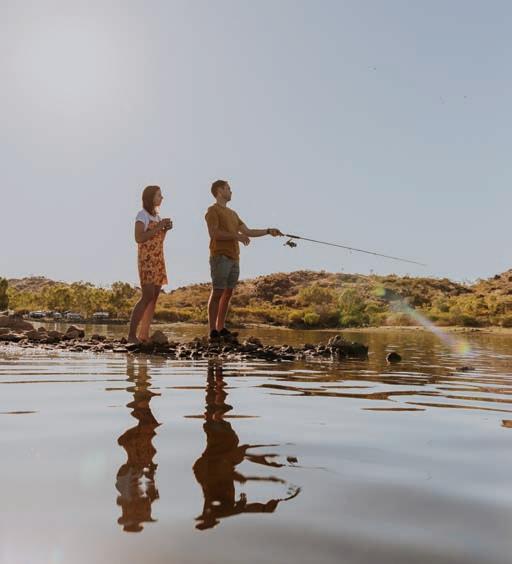
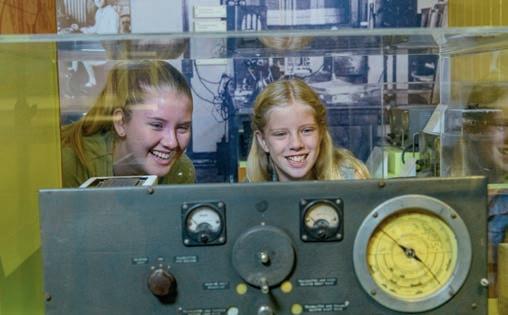
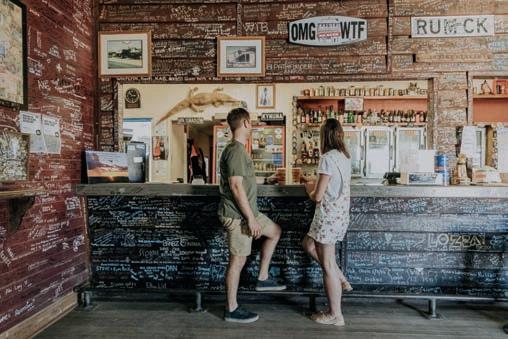
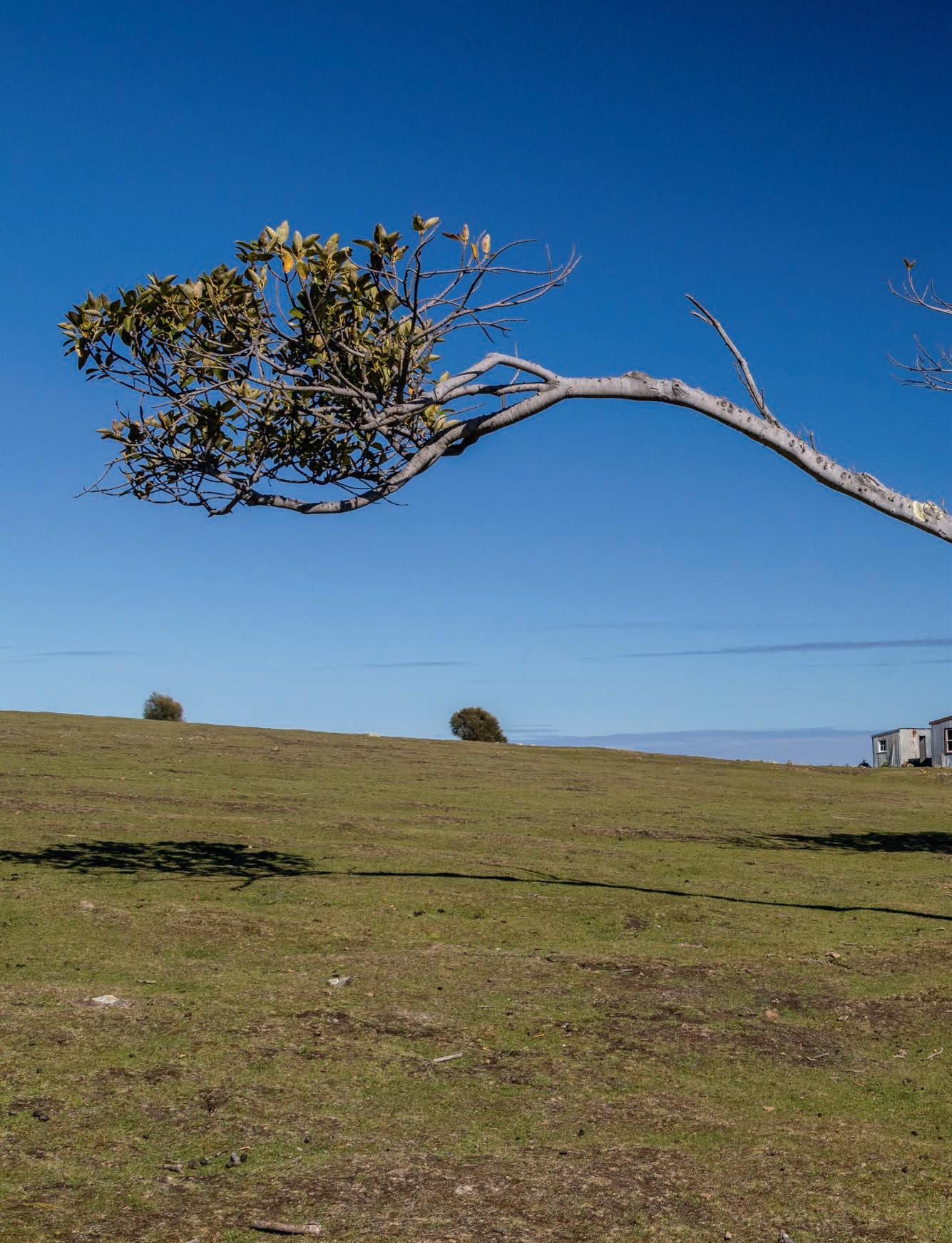
Tasmania’s Maria Island National Park preserves an abundance of natural and colonial history.
EAST COAST, TAS | 1–4 DAYS
BY KIRSTY MCKENZIE, PHOTOGRAPHY KEN BRASS
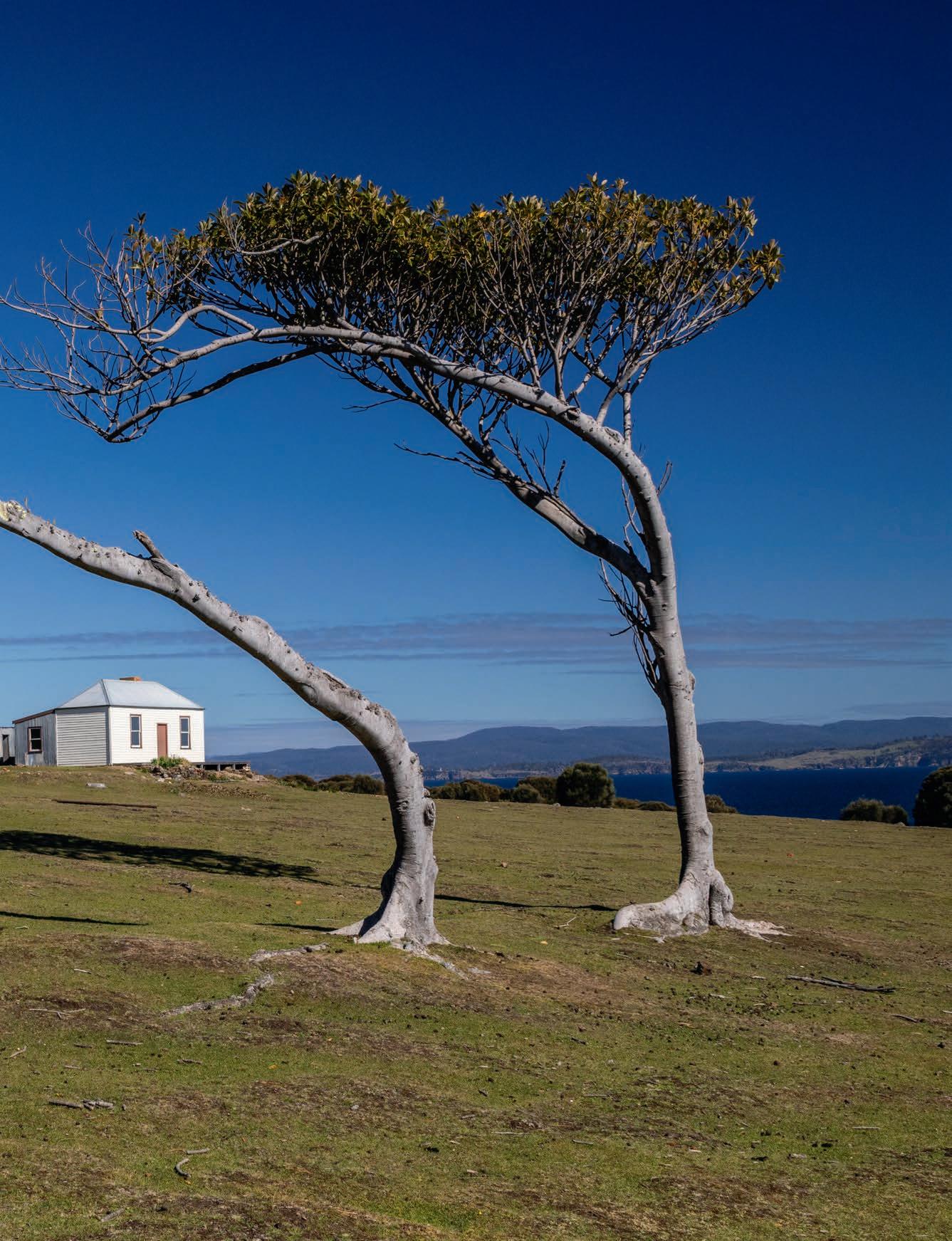
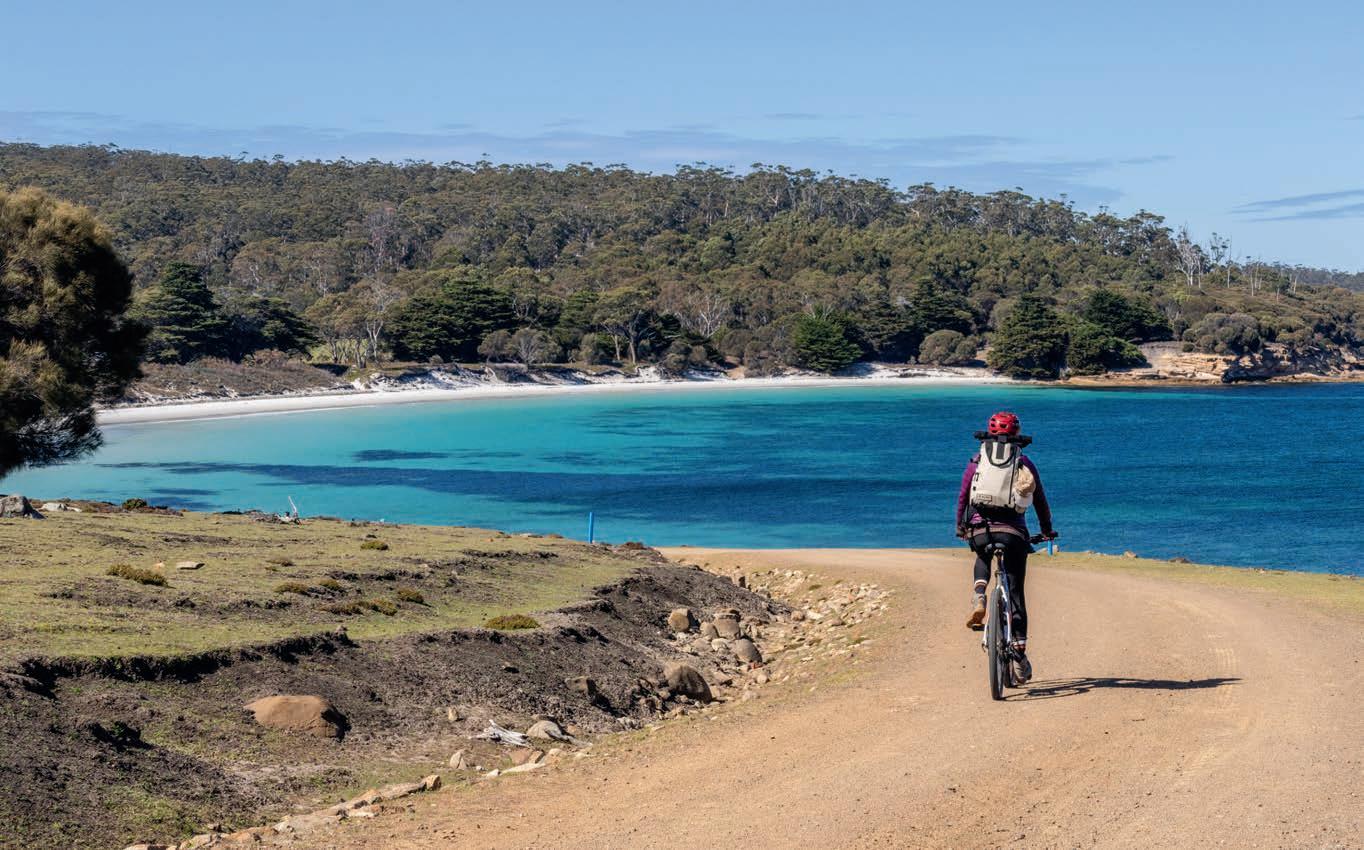
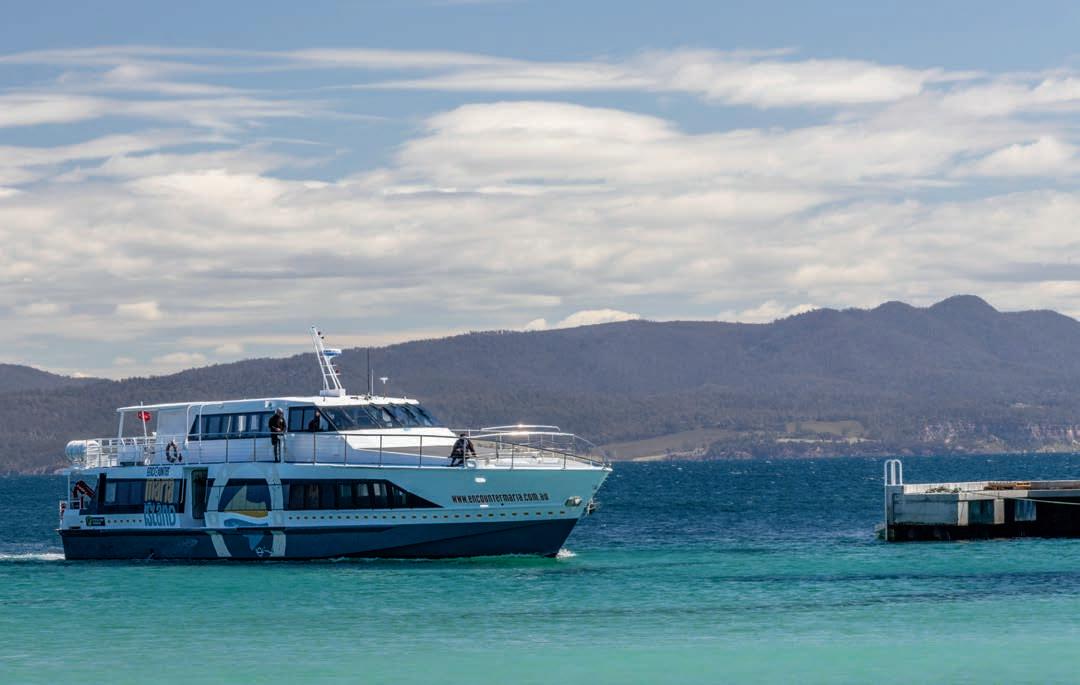
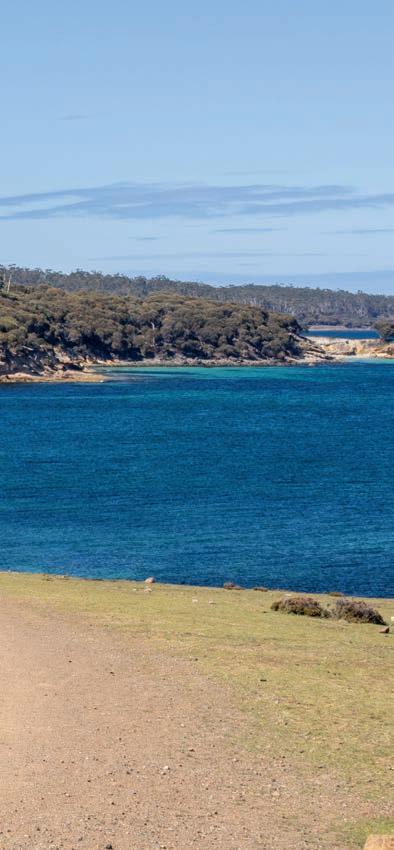
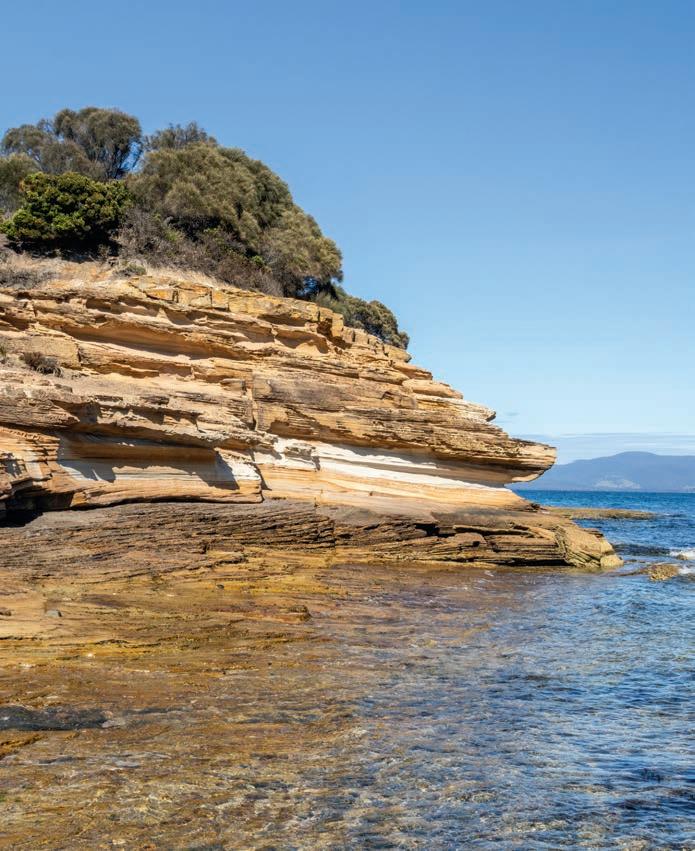
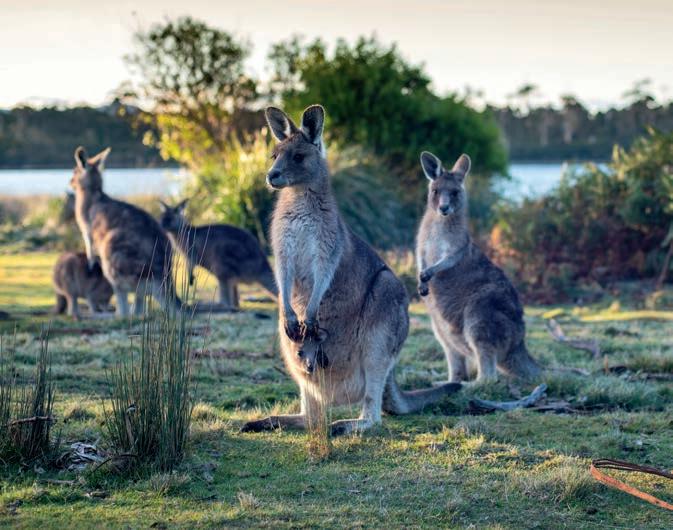
It’s one of those sparkling fresh spring mornings when the sun cracks off the water in shards as the passenger ferry pulls out from Triabunna for the crossing to Maria Island. Half an hour later, the parabolic blue sky blends into the turquoise shallows as the boat pulls into Darlington, the port for the island national park, which preserves an extraordinary blend of colonial history, native wildlife, bush walks and bike rides.
Maria Island, or Wukaluwikiwayna, as it was known to its Traditional Owners, the Oyster Bay people of Tasmania’s east coast, sits just 16 kilometres off the coast. It’s connected to the mainland by multiple ferries daily, so it’s possible to explore with a day trip. Visitors who choose to stay longer have the option of camping at one of three grounds, staying in the National Parksrun bunkhouse in the former penitentiary at Darlington, or joining the upmarket Wild Bush Luxury four-day hosted Maria Island Walk with glamping accommodation and all meals included.
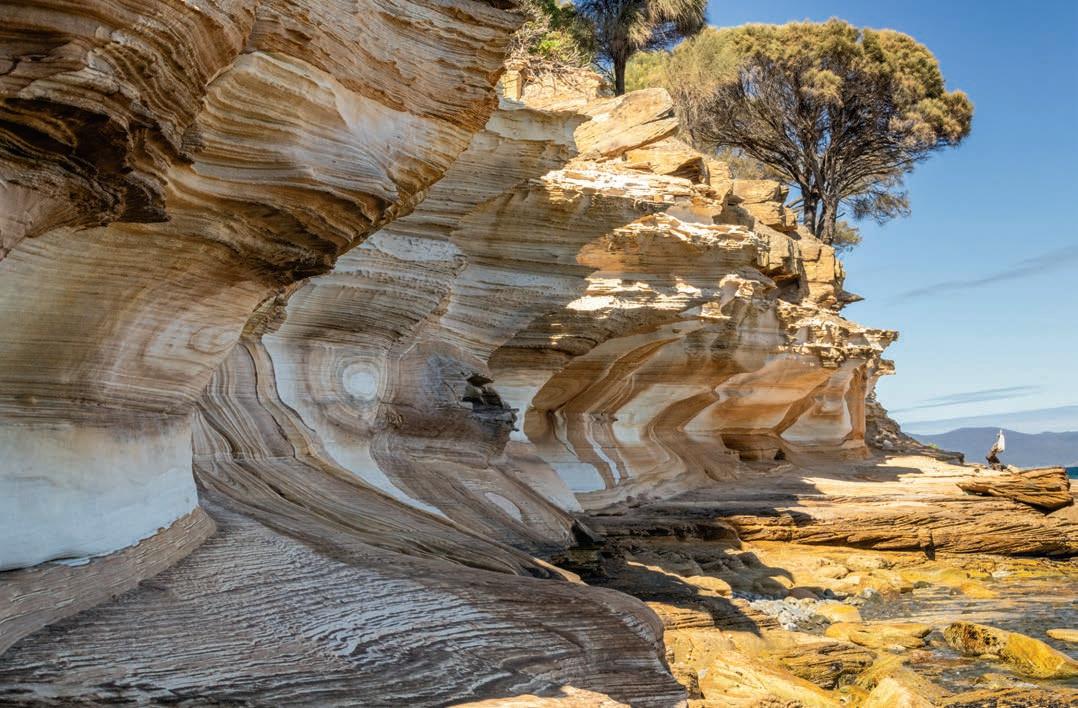
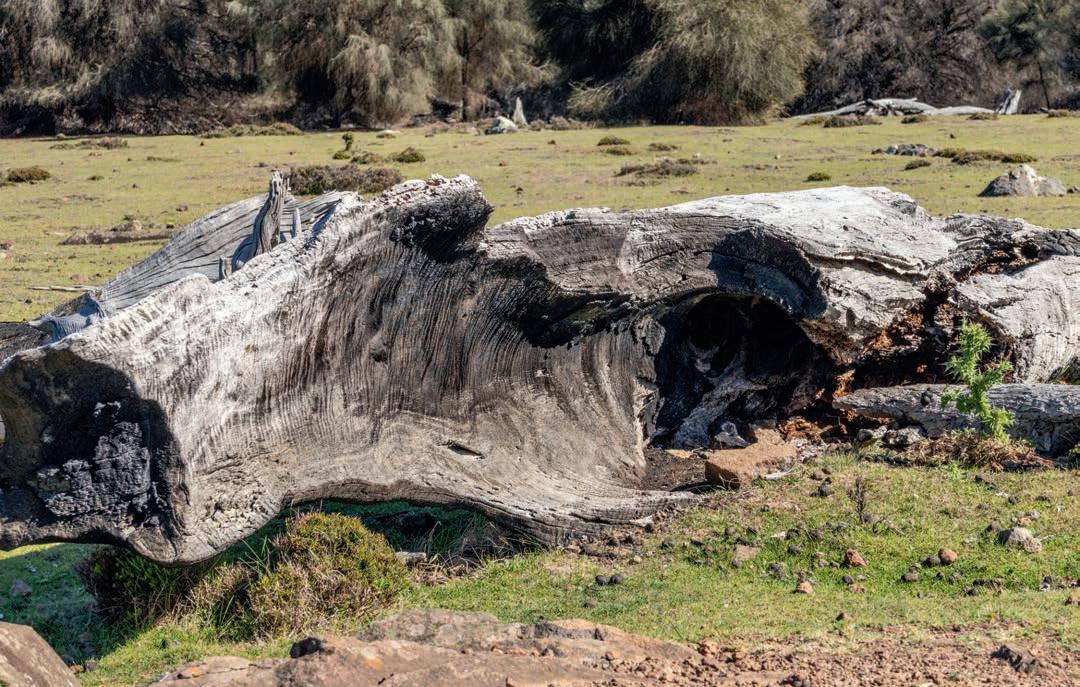
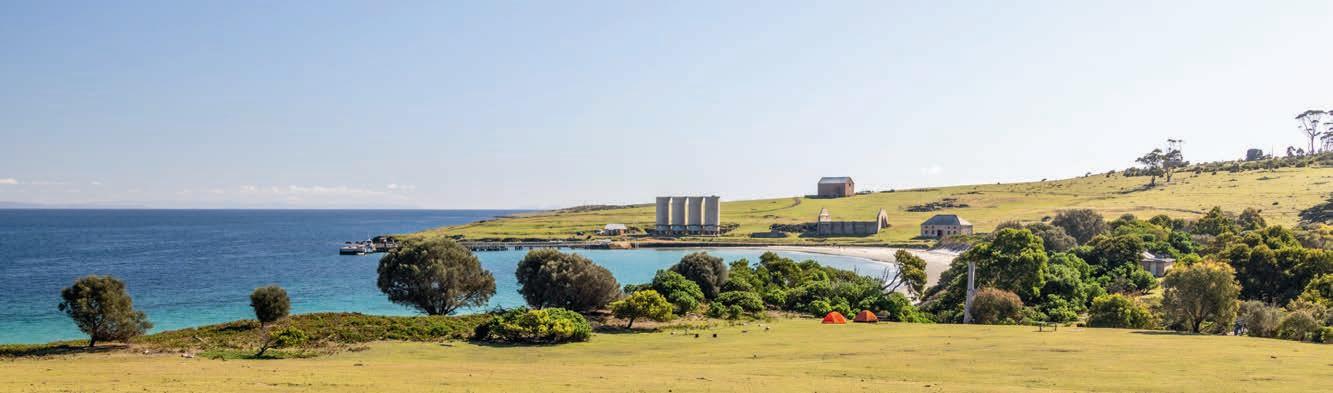
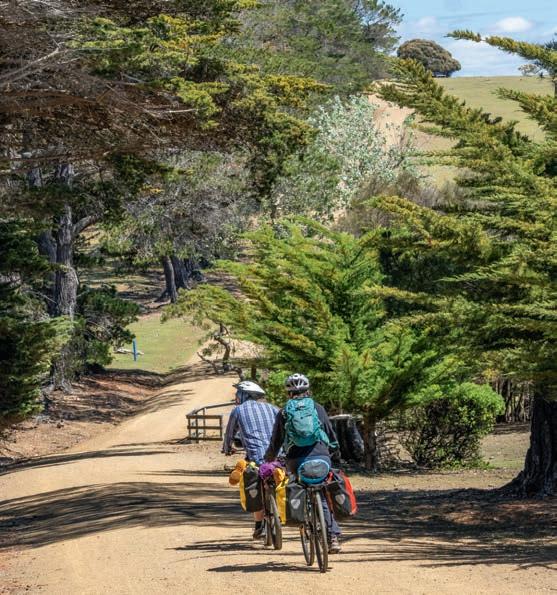
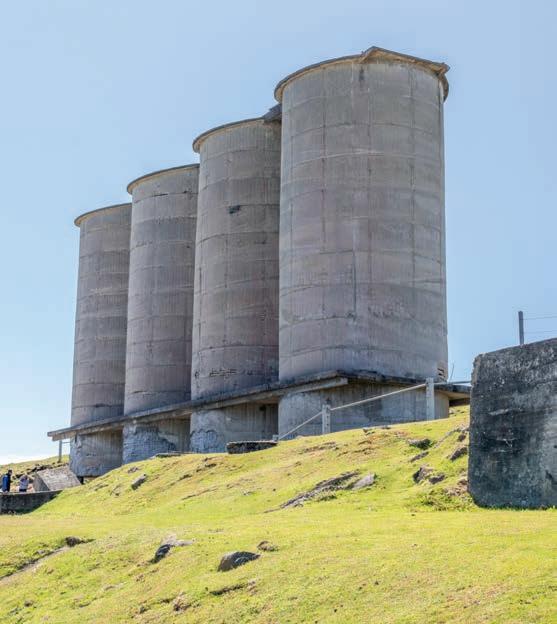
THESE
PAGES: (Clockwise from above) Remants of agricultural and convict settlements at Darlington; you can hire bikes on the island; disused grain silos; hidey holes for wildlife; swirling patterns in the sandstone at Painted Cliff s.
They’ll be rewarded with bush walks ranging from easy strolls along the coastline to more challenging hikes to the peaks of Bishop and Clerk and Mt Maria, or the 40km-return trek to Haunted Bay in the far south of the island. Selfsuf ficient hikers usually opt to make this trek an overnighter, by camping at either Frenchs Farm or Encampment Cove, before heading across McRaes Isthmus to the southern part of the island. The island is a great cycling destination and you can bring your own bike, or hire one from a booth at Darlington to make exploring the island even easier. Bird watchers are in for a treat, with all but one of the state’s 12 endemic birds found on the island. They include the endangered fortyspotted pardalote, green rosellas, wedge-tailed eagles, tiny hooded plovers, sooty and pied oyster catchers, and little and fairy terns on the beaches. Large, mainly terrestrial, Cape Barren Geese and little native hens also call Maria home.
The question “will I see a wombat?” can be answered with a definitive “yes”, as the island is home to many wisdoms (yes, that’s the collective noun) of them. They emerge from their burrows at dawn and dusk to graze nonchalantly on the grassy slopes. But, in fact, they’re so prolific, that you’ll almost become as oblivious to their presence as they appear to be to humans after the initial excitement of seeing them in such numbers wears off. Forester kangaroos, Bennett’s wallabies, possums, pademelons, potaroos and an insurance population of Tassie devils, which moved to the island in 2012 during the height of the facial tumour disease crisis, are also island residents. Visitors should also be aware that it’s not uncommon to see tiger snakes basking on the beaches and rocky outcrops, while lowland copperheads and whitelipped snakes also call the island home.
Spectacular scenery greets those who take the easy circuit walks to Fossil Cliffs, which preserve myriad marine fossils or the Painted Cliffs, famed for the swirling rusty patterns in the sandstone overhangs. This landmark is accessed from
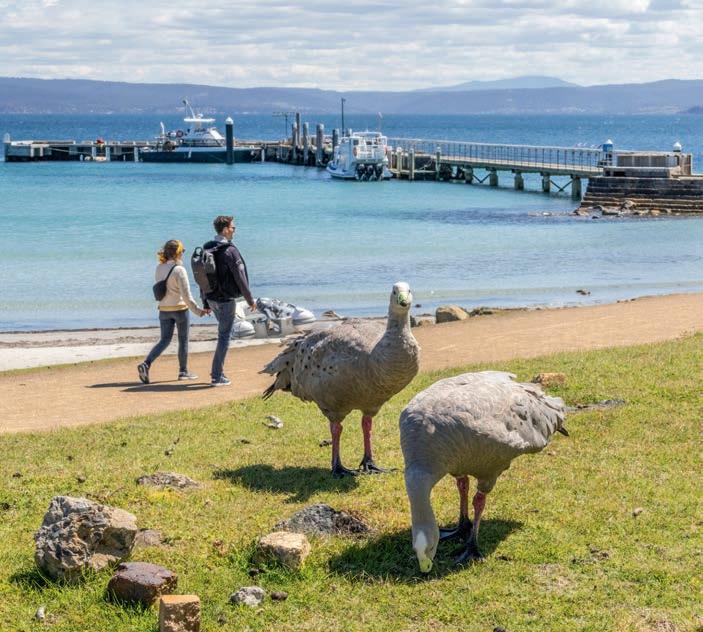
THESE PAGES: (Clockwise from right) The Commissariat Store is now an information centre; beach near the port; warning sign at the Painted Cliff s; former penitentiary building at Darlington; Cape Barren geese.
Hopground Beach, so it’s best to arrive two hours either side of low tide. History buffs are also in for a treat as Maria Island preserves several layers of convict and early settler history.
The island was noted in 1642 by Dutch explorer Abel Tasman who named it for Maria Van Diemen, the wife of Anthony, the governor of Dutch East Indies, who had commissioned his voyage. In 1802, a French expedition led by Captain Nicolas Baudin explored and charted the island extensively. The English settlement of Van Diemen’s Land a year later was hastened by the French interest.
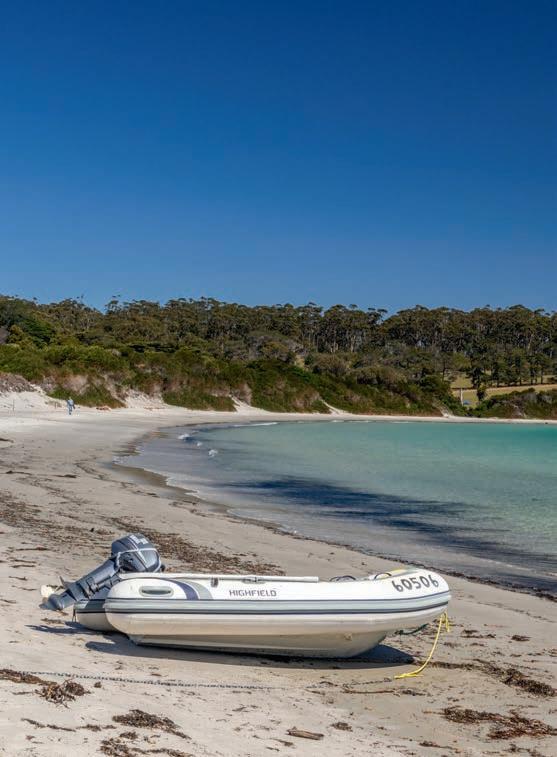
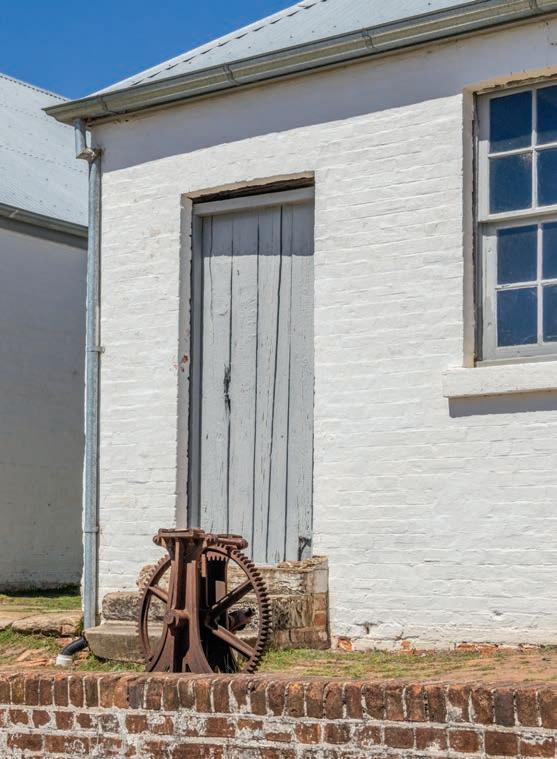
Maria Island’s penal history dates to 1825 when the first convicts were imprisoned on the island. Its proximity to the coast made escape by raft or boat easy and the settlement was abandoned in favour of Port Arthur by 1832. A decade later, it was revived as a low-security probation station for convicts transitioning to freedom. The 14 buildings in the Darlington settlement date from this era and its well-preserved condition has earnt it recognition as one of Australia’s 11 World Heritagelisted convict sites. The two-storey Commissariat Store is located close to the jetty, so provisions could easily be unloaded, while behind that are archaeological remains of the hospital, surgeon’s quarters and religious instructor’s quarters.
Other buildings of significance include three silos, remnant from the grand scheme of Italian entrepreneur Diego Bernacchi, who secured a long-term lease of the island in 1884 and set up a cement works to utilise the island’s limestone deposits. His dreams of wine and silk production, fruit-growing and the development of a European-style spa resort on the island fizzled and he left shortly before his death in 1924. Maria Island continued as a small-time farming and fishing community until the 1960s, when the first moves towards making it a fauna reserve began. It became a national park in 1971.
Apart from the bike hire shop, there is no commerce on Maria Island. Visitors need to stock up on provisions and water before they leave the mainland. There’s also a small kiosk on the boat selling snacks and beverages. However, whatever the island lacks in coffee shops and souvenir outlets, it more than makes up for in natural attractions and most first-time visitors vow to stay longer next time. Those in the know don’t get back in their cars at Triabunna without stopping by the Fish Van, just across the road from the ferry wharf. There you can feast on fish and chips served in the cone, prawns, scallops, oysters or squid, and pick up fresh fish to take back to your accommodation to cook for dinner.
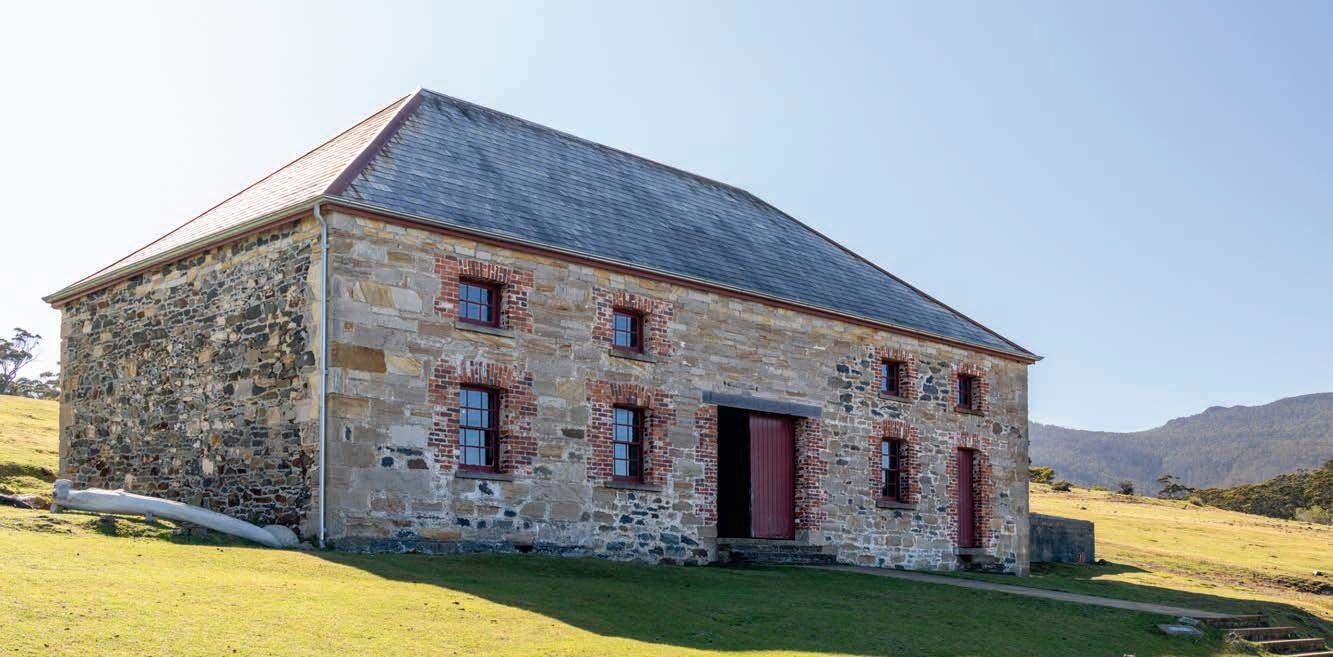
You will need a National Parks pass to visit Maria Island. You need to book accommodation at Darlington before you arrive. For more information, visit parks. tas.gov.au/explore-our-parks/mariaisland-national-park.
The Maria Island Encounter ferry travels to and from the island four times a day from September to April, and three times a day from May to August (except Tuesdays and Thursdays). There is also a daily shuttle bus from Hobart. Book transfers at encountermaria.com.au.
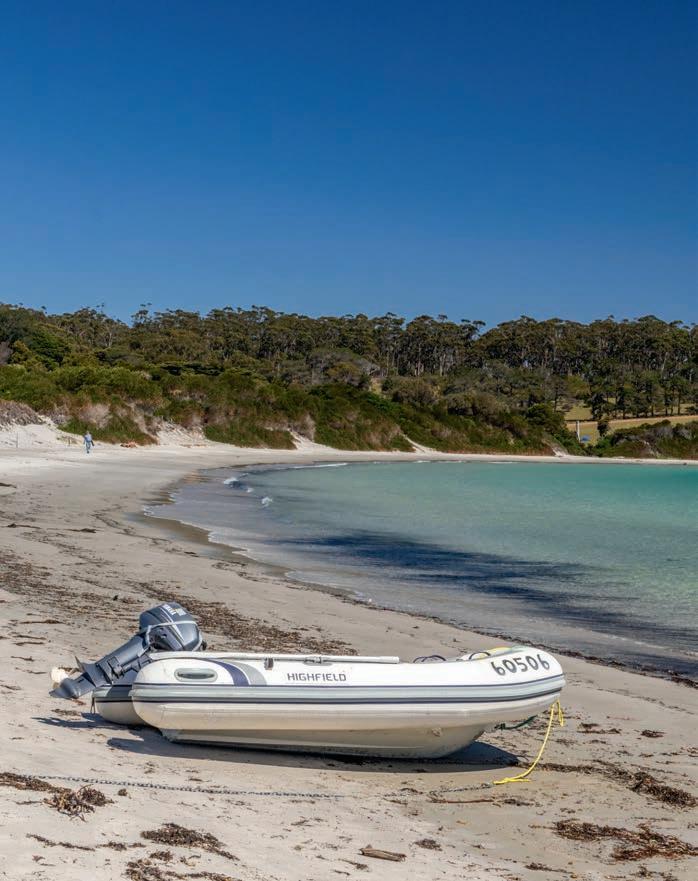
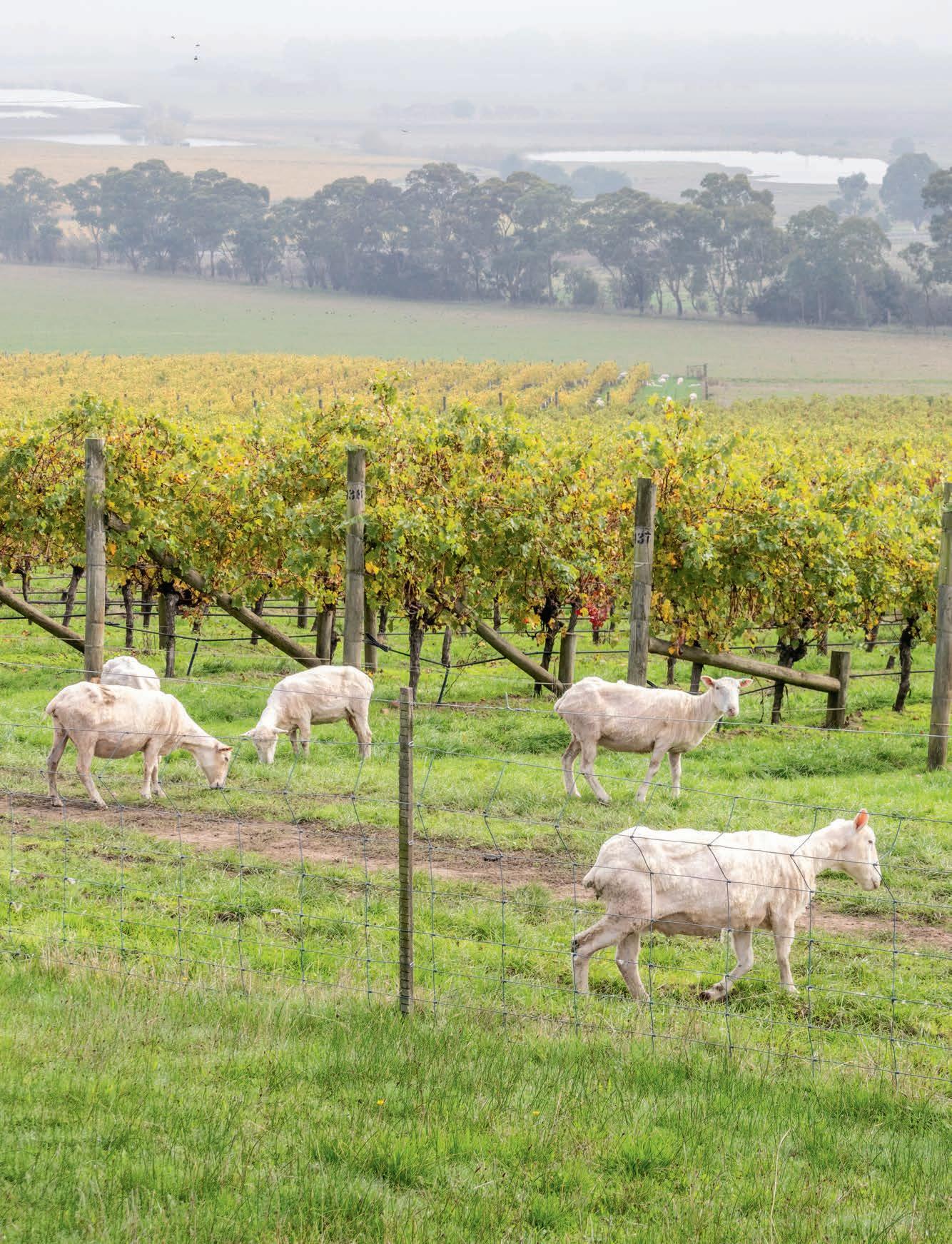
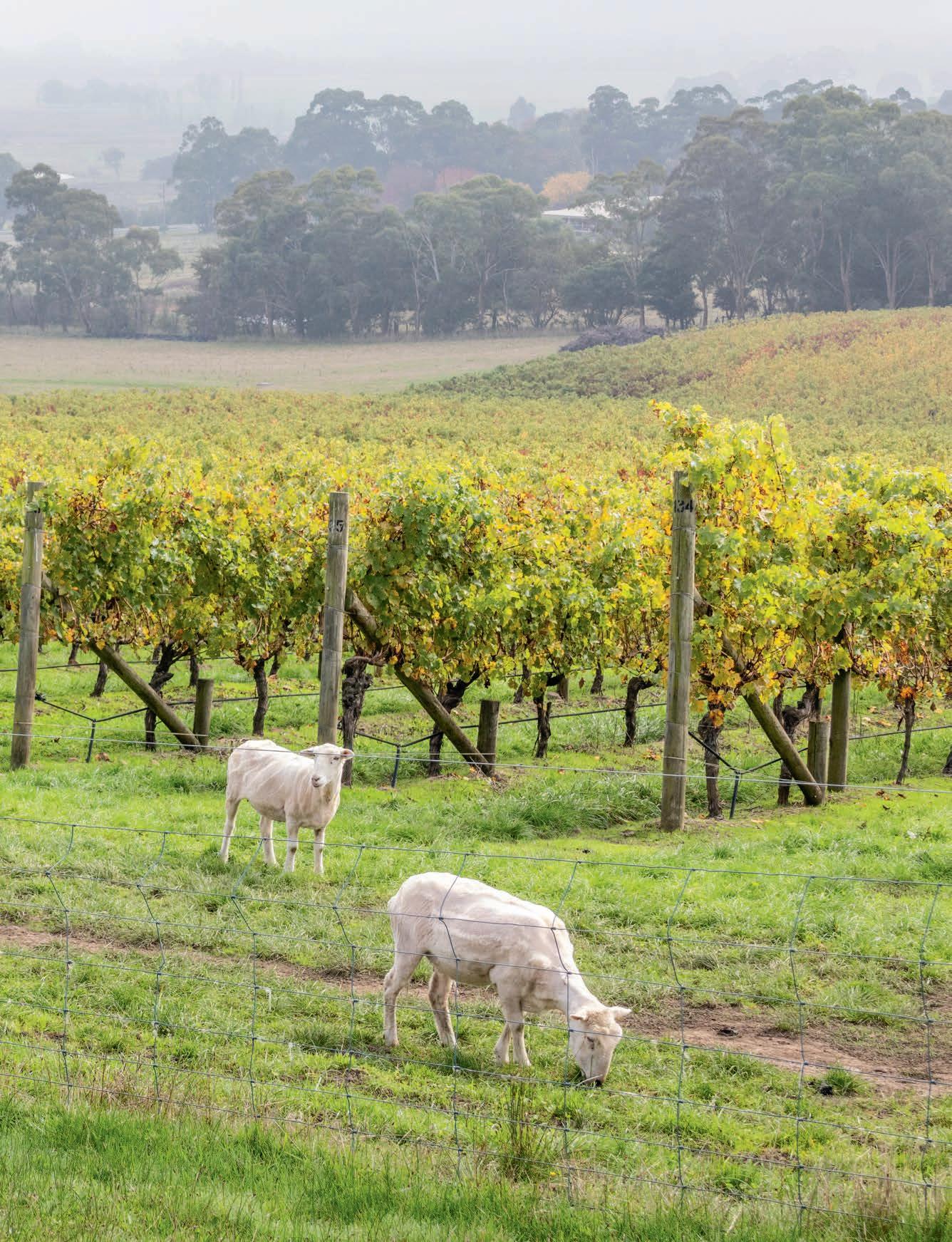
Soak up the serenity along with lots of high-end food and wine experiences and activities just over an hour’s drive from Melbourne.
VIC | 2–3 DAYS
BY KIRSTY MCKENZIE, PHOTOGRAPHY KEN BRASS
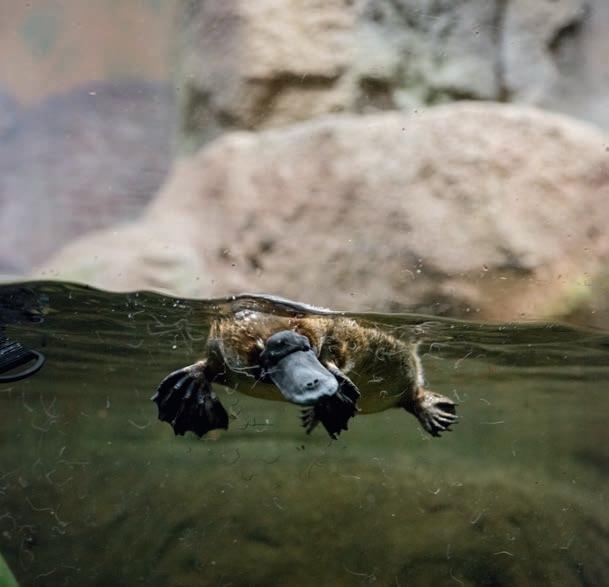
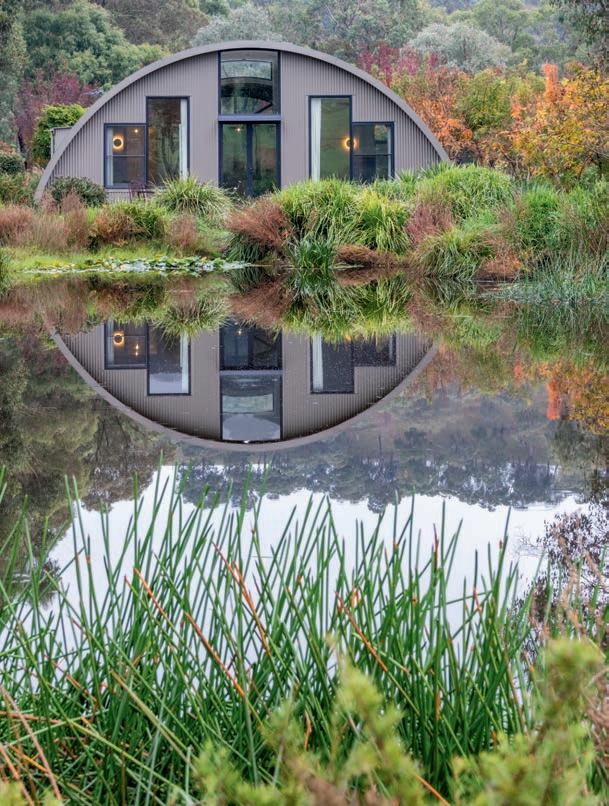
It’s just after sunrise at Glenlowren, an oasis of hospitality in Victoria’s Yarra Valley, and all you can hear is birdsong, the gurgle of frogs in the dams and the occasional gentle mooing from cattle in the distant paddocks. In what becomes one of many pinch-me moments during a stay at the property, it’s truly hard to comprehend that we’re just over an hour’s drive away from Melbourne’s CBD.
Peace and quiet is what Glenlowren specialises in. It accommodates up to 27 guests — room for two in the Settlers Cottage, for four in the Nissen Hut and a total of 21 in the eight-bedroom farmstead. The accommodation venues are distanced from each other, so can be booked individually or collectively, and guests are welcome to do a full exploration of the Yarra Valley’s many wineries, breweries and distilleries, dining venues and attractions, or simply take time to rest and recharge in the grounds and the beautiful gardens.
Topping the list of not-to-be-missed destinations is the Healesville Sanctuary, where various tracks and boardwalks lead visitors to see all manner of Australian native birds and animals. Kangaroos, wallabies, koalas, Tassie devils, emus, dingoes, wombats and platypus all call the sanctuary home, and keeper talks throughout the day provide insight into our fascinating fauna. There are also twice-daily Spirits of the Sky presentations when birds of prey and parrots are showcased. While you’re there, be sure to grab a cup of Zoos Victoria’s Coffee for Wildlife, which raises funds to support wildlife conservation and protect 27 local threatened species.
Leaving the zoo, take time for a detour through the Yarra Ranges up Black Spur Drive towards Narbethong. The road winds through majestic mountain ashes with an understorey of tree ferns and mossy gullies lined with cool-temperate rainforest plants. Heading back to Healesville, there may be time for a picnic at the Maroondah Reservoir Park.
Pick up the makings for your outdoor (or indoor) feast at Cheesemonger Sophie in Healesville’s main strip. An alumna of Melbourne’s late, lamented Richmond Hill Cafe and Larder — she ran the cheese room there for 10 years — and one of only 16 Australian members of the Guilde Internationale des Fromagers, Sophie Classon sells only the best matured and stored cheeses from Australia and overseas. She offers platters for two to eight, as well as charcuterie, wine and quaintly named tracklements (condiments and preserves). If you’re desperate for a cheesy fix, grab a toastie while you wait — the croque monsieur oozes Parisian perfection, while the Reuben and the mushroom and Taleggio are close runners-up.
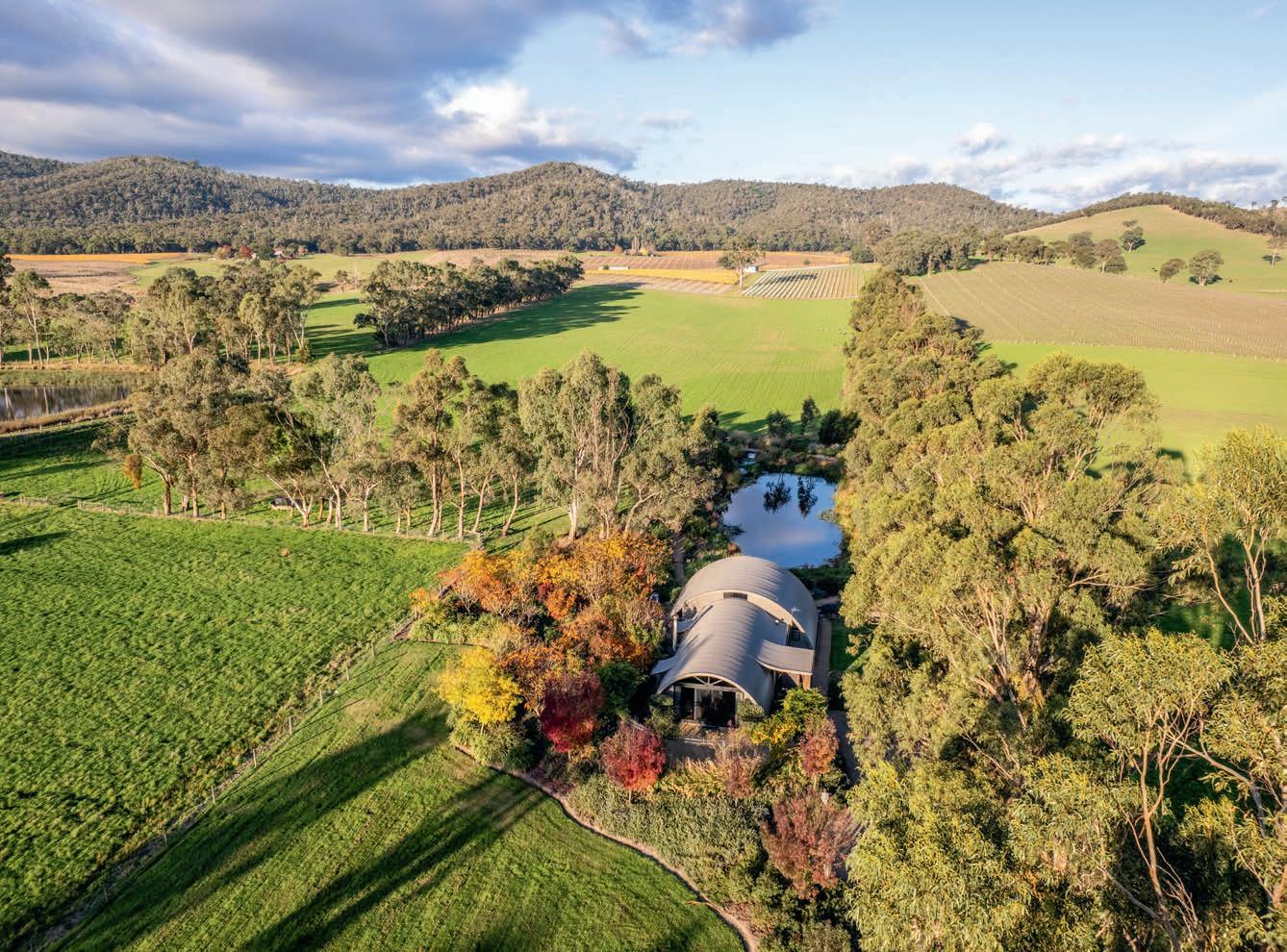
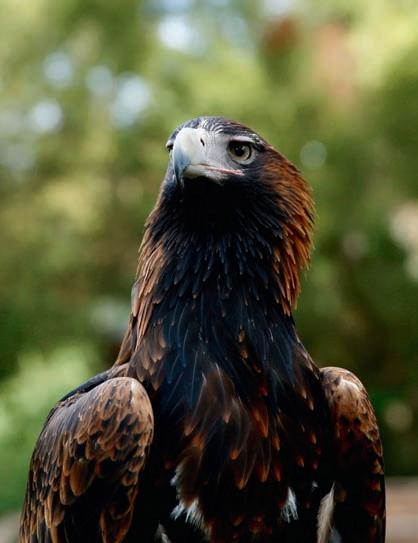
THESE PAGES: (Clockwise from above) Glenlowren offers three accommodation options; Cheesemonger Sophie in Healesville; Healesville Sanctuary wedge-tailed eagle (Zoos Victoria); Glenlowren reflections; platypus at Healesville Sanctuary (Zoos Victoria).
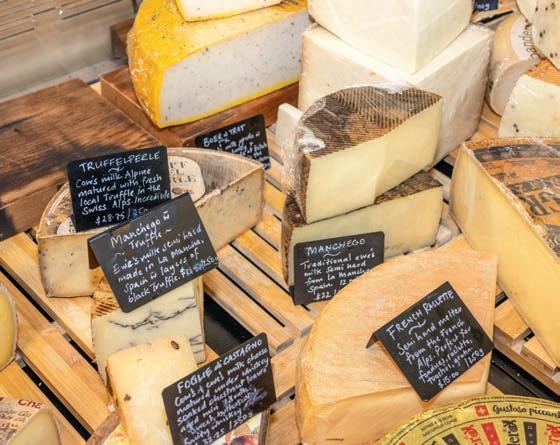
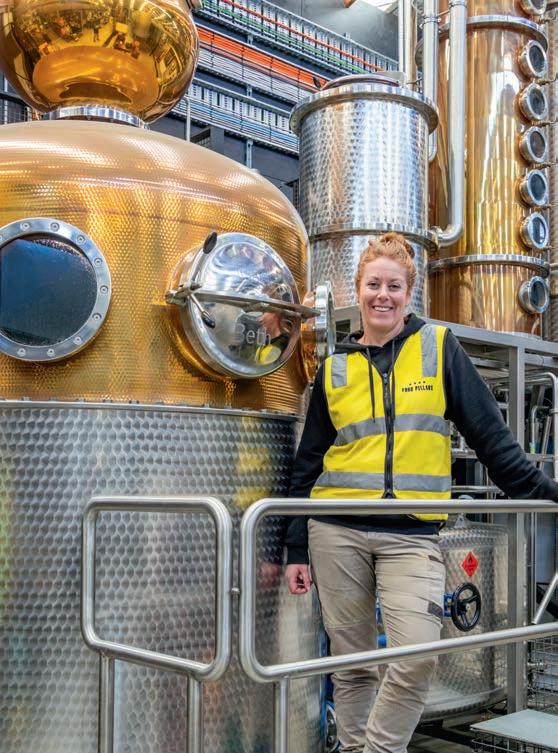
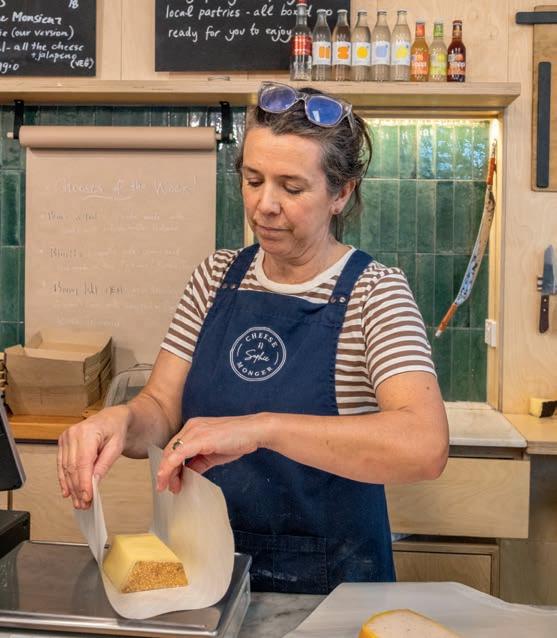
Just down the road from Sophie’s is another Yarra Valley institution, the HQ for Four Pillars Gin. As distiller and head of production Sarah Prowse explains, the Four Pillars story goes back to 2013, when three mates — Matt Jones, Stu Gregor and Cam Mackenzie — bought a still and started making gin at the back of their friend (and legendary Yarra Valley winemaker) Rob Dolan’s recently established winery. “The backyard project grew beyond expectations and in 2015 they moved to the present premises in a former timber yard in Healesville,” Sarah says, as she introduces Australian Country to Beth, one of six copper stills named for long-term employees’ mothers. Four Pillars confirmed what Australian gin aficionados already knew, that their product was the best, in 2019, 2020 and 2023, when the brand was named the world’s leading gin producer by the International Wine and Spirits Competition. In the middle of 2023, Four Pillars was sold to Japanese-owned beverage giant Lion. But the product, and the cellar door experience, remains artisanal, as visitors learn when they join a guided tasting.
Four Pillars also excels on the sustainability front and in 2022 became Australia’s first carbon-neutral gin distillery. Sarah points to a range of initiatives, including piping gin directly to the tasting room to reduce the use of glass, offering a bottle-refilling service, the use of spent botanicals in a salt blend, the repurposing of the distillery’s steamed local organic oranges in a marmalade and breakfast negroni conserve, as well as the copper veil fence at the entrance. On first glance, the fence appears purely decorative, but it’s also a means of reducing energy consumption by running the stills’ contents through the 1650m of copper piping.
Of course, the valley is synonymous with quality wines and there are more than 80 wineries bolstering the region’s reputation for quality. The history of winemaking goes back to 1838 when the Ryrie brothers of Yering Station planted the first vines in the Yarra Valley, thus establishing Victoria’s oldest winemaking region. In 1889, Yering Station became the first and only winery in the southern hemisphere to win a Grand Prix at the Paris exhibition (the Exposition Universelle). Meanwhile, in 1863, Swiss immigrant Hubert de Castella established St Hubert’s Vineyard, while Guillaume de Pury established Yeringberg, which remains in his family to the present day and is occasionally open for tastings. Winemaking blossomed in the valley through to the 1930s, when many vineyards were converted to grazing land in the wake of the Great Depression and poor seasons. It wasn’t until the 1960s that winemaking was revitalised in the valley with wineries
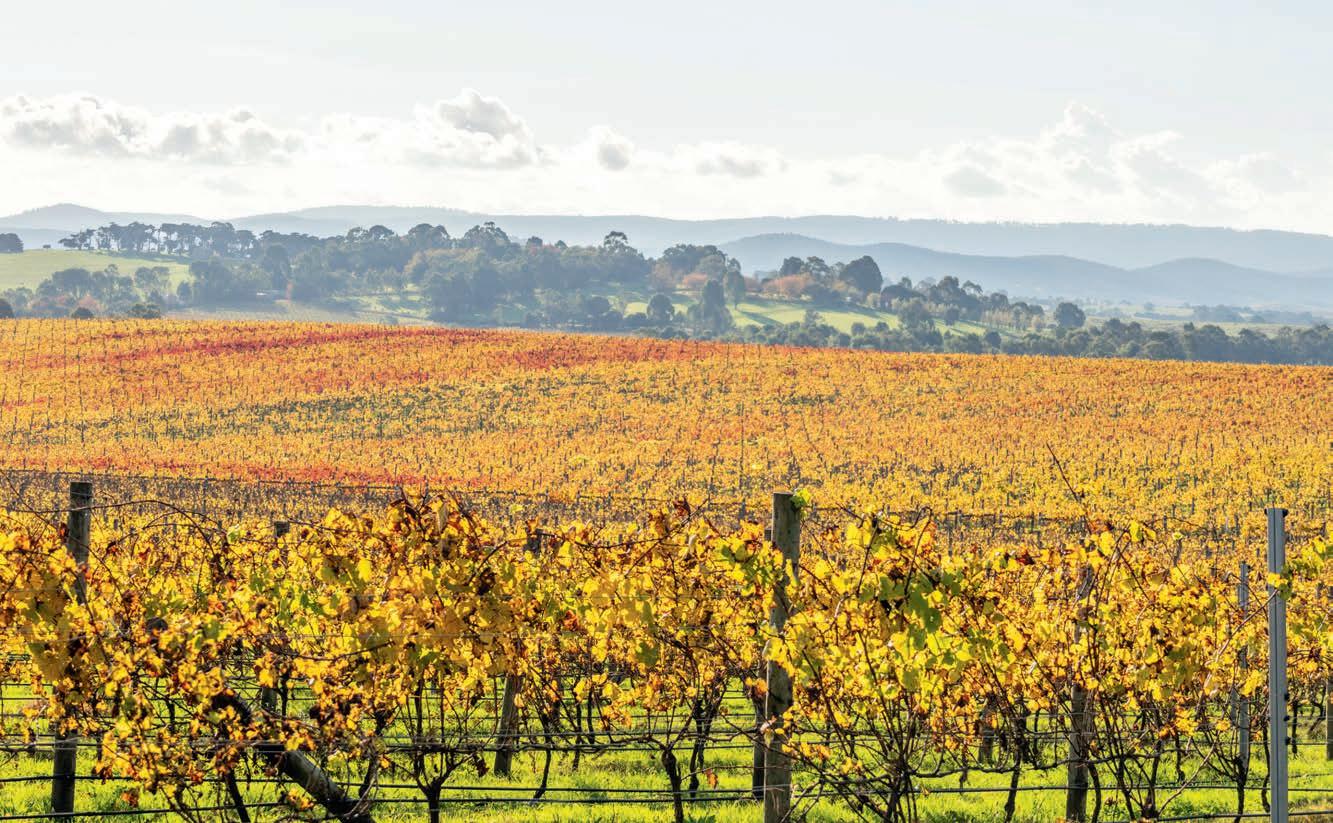
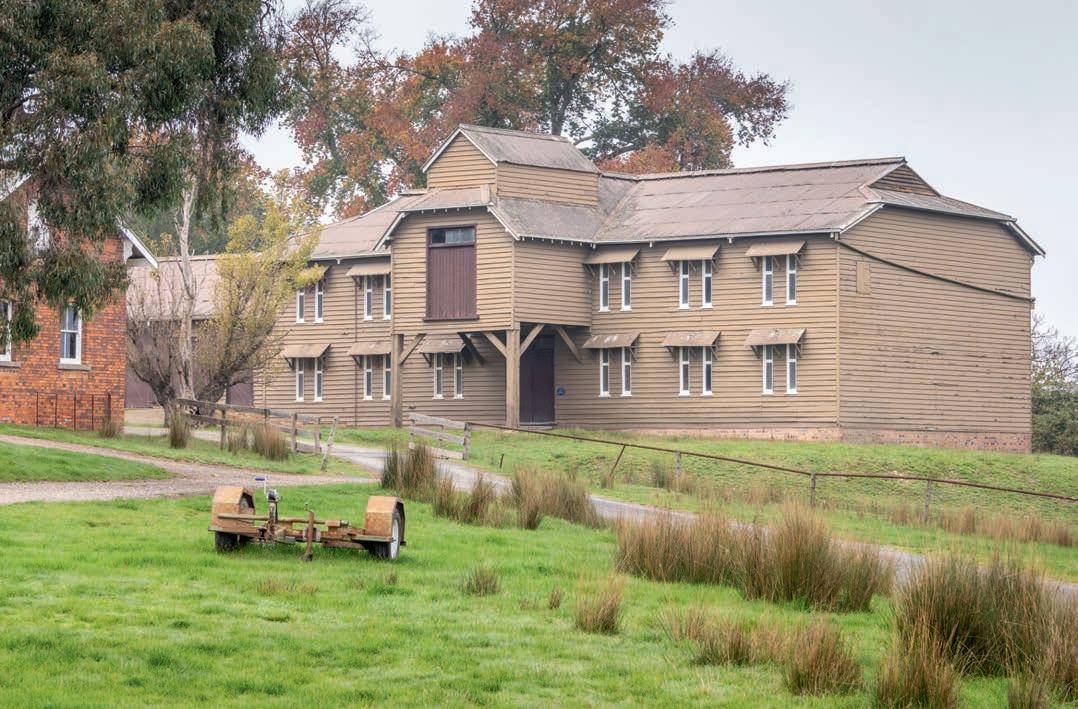
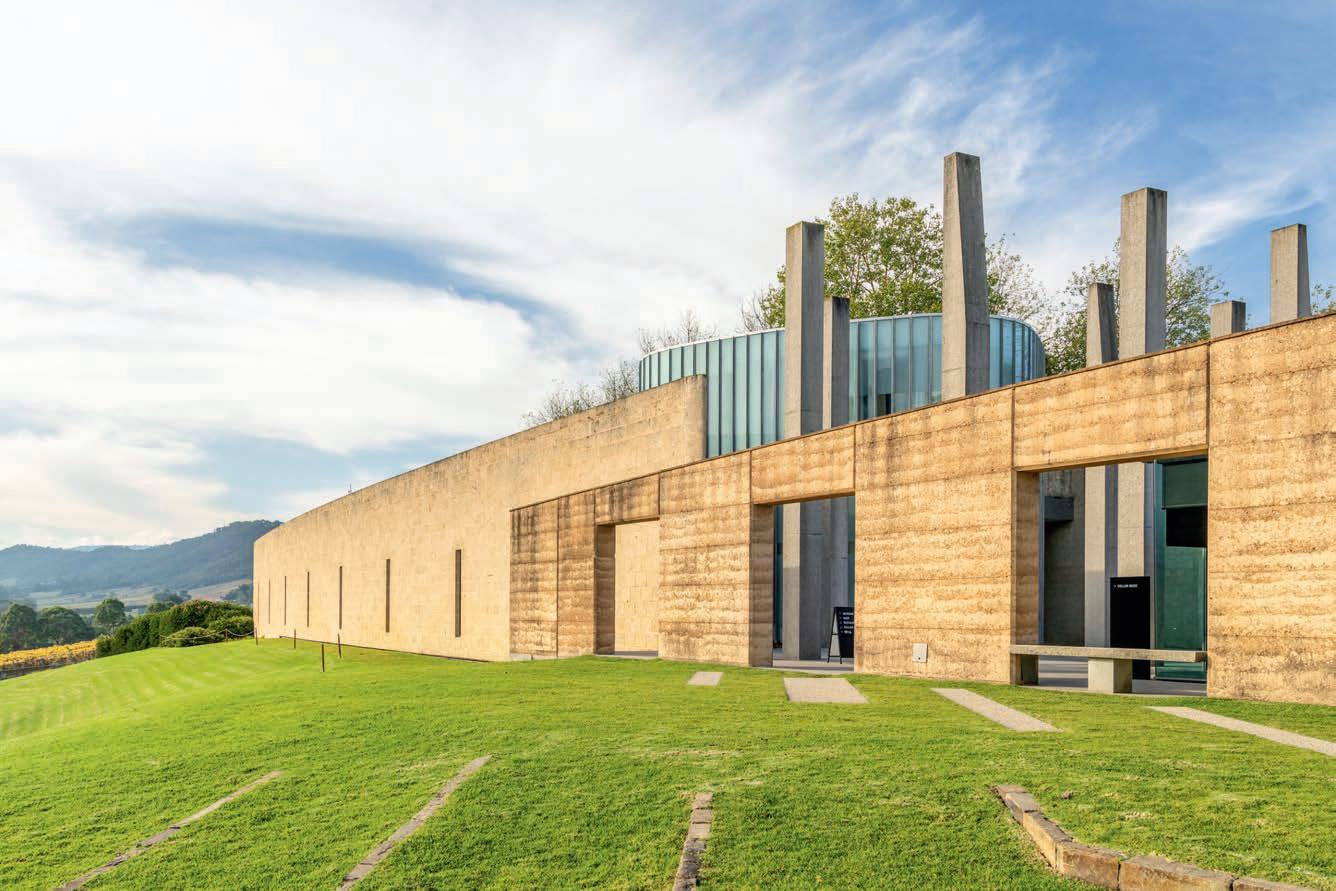
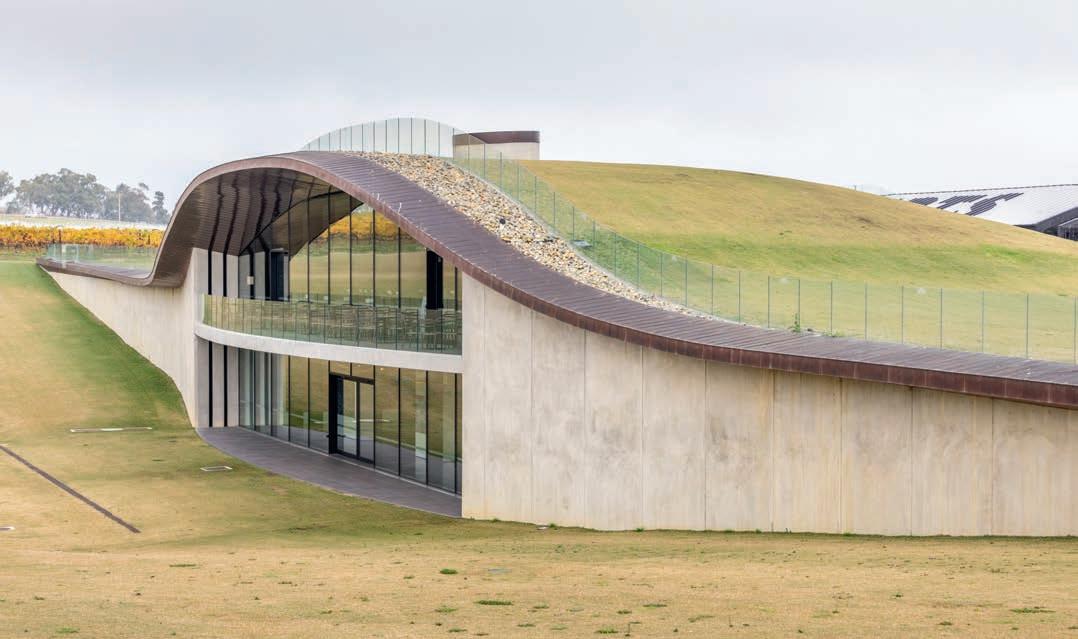
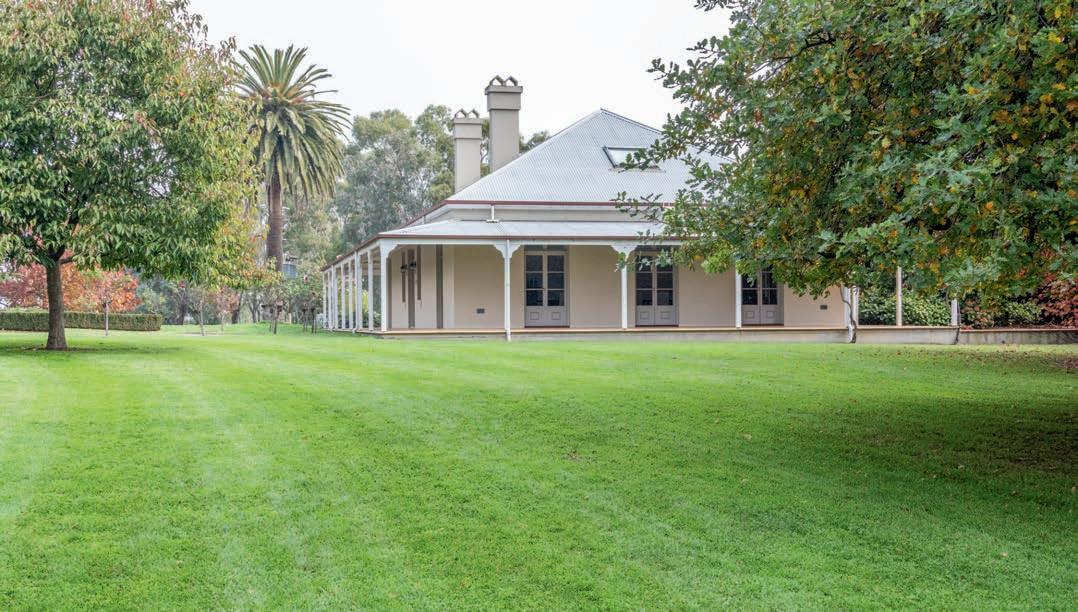
including Seville Estate and Mount Mary joining the pioneers. The growth continued in the 1980s when James and Suzanne Halliday established Coldstream Hills, French Champagne house Moët et Chandon established what’s now Chandon and the de Bortoli family extended their Riverina operations to the Yarra.
Visitors should also head to Punt Road Wines, as much for its Napoleone Cider and DIY picnics of local produce sourced from the onsite pantry as the wine. Hubert Estate, the current iteration of St Hubert’s, offers an architecturally stunning cellar door, Quarters restaurant and art gallery. Another favourite is TarraWarra Estate for top-shelf Pinot Noir and Chardonnay, as well as a hatted restaurant and Museum of Art, the beautiful bequest of the winery’s founders, the late Marc and Eva Bensen. Honourable mentions also go to Yering Station for its fine-dining restaurant and the Yarra Valley Grand Hotel in Yarra Glen for its classy pub bistro, pizza garden and revamped hotel rooms upstairs.
For different perspectives on the valley, try an early morning flight with Go Wild Ballooning and the option of breakfast afterwards at Chateau Yering Hotel, or a walk or cycle along some, or all, of the Lilydale to Warburton Rail Trail. At Leanne and Ian Neeland’s Yarra Valley Chocolaterie, they
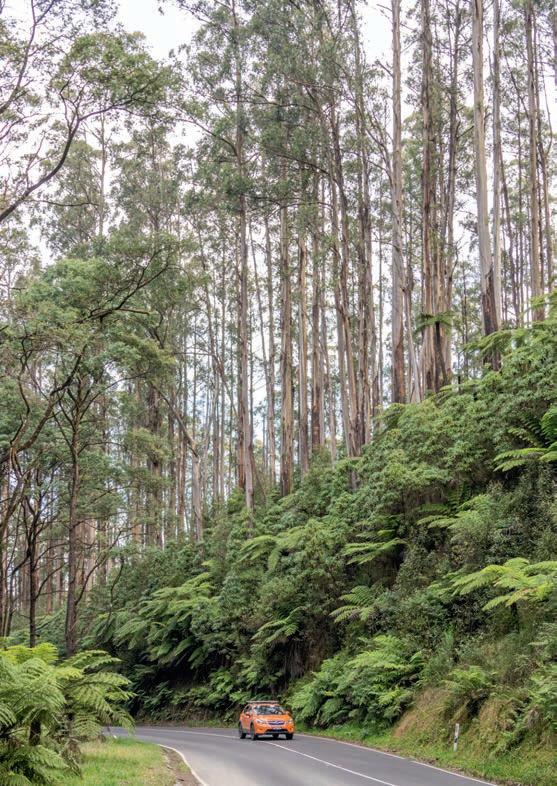
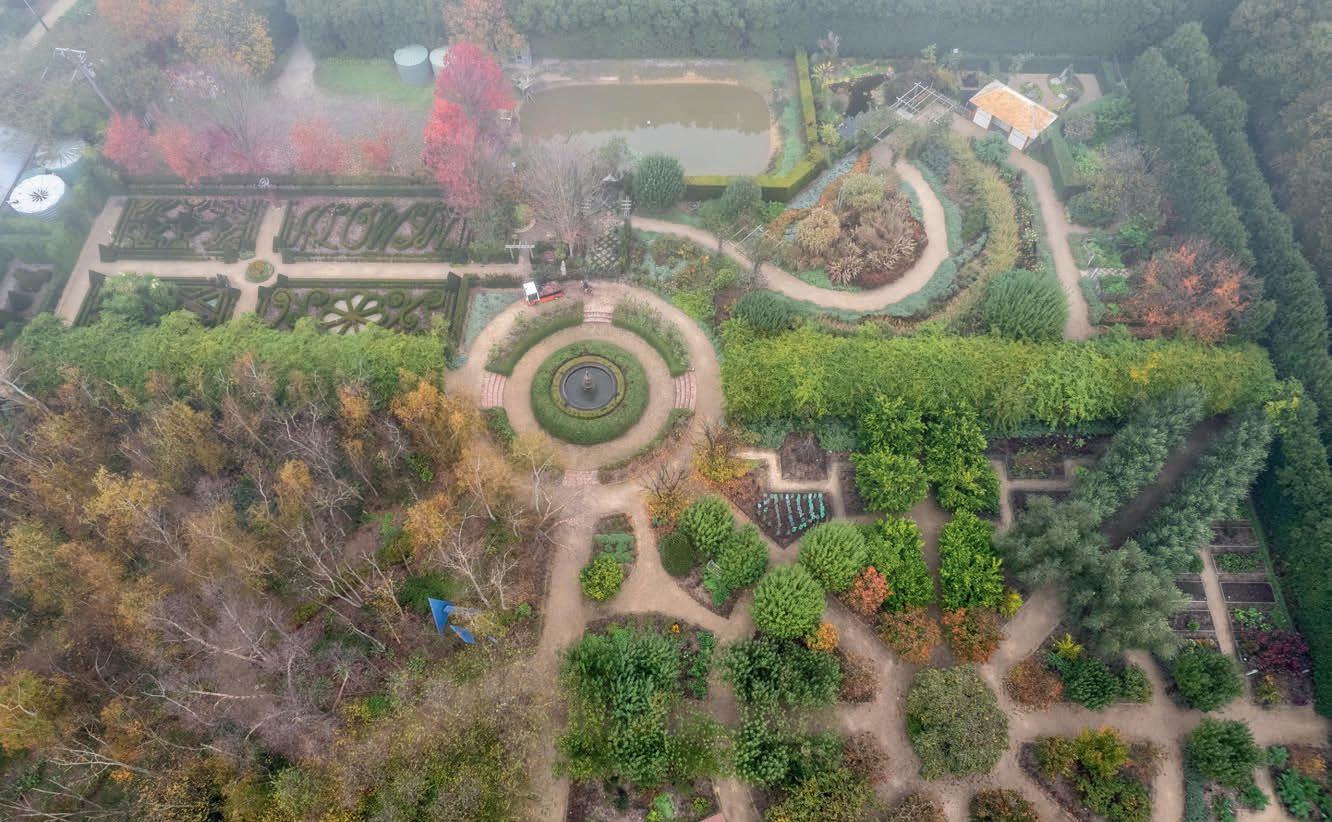
use more than 1000 ingredients and the finest Belgian chocolate to create almost 500 different chocolate-inspired treats. The Neelands attract a constant stream of visitors to the 300-seat cafe and host festivals, tastings and workshops including a make-your-own Rocky Road, with dozens of dried fruit, nut and jelly combinations to mix and match.
Last, but definitely not least, head to John and Prue Van de Linde at Alowyn. John and Prue have devoted more than two decades to creating a wonderful four-hectare display garden, nursery and cafe from a bare paddock. It would be a very world-weary soul indeed who didn’t return from a visit without renewed resolve to make improvements to their own backyard or at least schedule return visits to these soulrestoring spots.
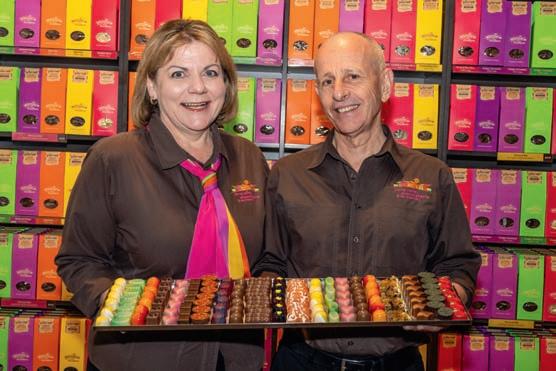
Glenlowren, Dixons Creek, glenlowren.com.au
Chateau Yering Hotel, Yering chateauyering.com.au
Yarra Valley Grand Hotel, Yarra Glen yarravalleygrand.com.au
PLACES TO EAT & DRINK
Cheesemonger Sophie, Healesville cheesemongersophie.com.au No 7, Healesville no7healesville.com
Yering Station, Yering yering.com
Chandon, Coldstream chandon.com.au Hubert Estate, Coldstream hubertestate.com.au
Punt Road Wines, Coldstream puntroadwines.com.au
Four Pillars, Healesville fourpillarsgin.com Tarrawarra Estate, Healesville tarrawarra.com.au
THINGS TO DO
Healesville Sanctuary, Healesville zoo.org.au/healesville
Alowyn Gardens, Yarra Glen alowyngardens.com.au
TarraWarra Museum of Art, Healesville twma.com.au
Yarra Valley Chocolaterie & Ice Creamery, Yarra Glen yvci.com.au
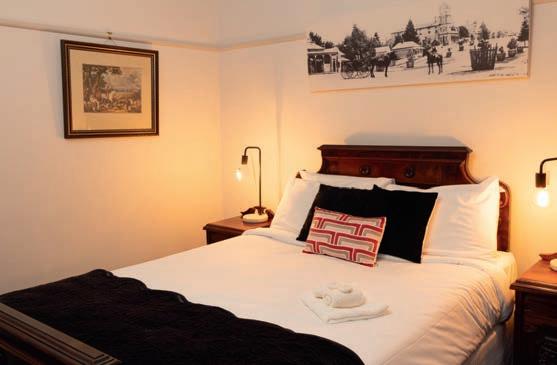
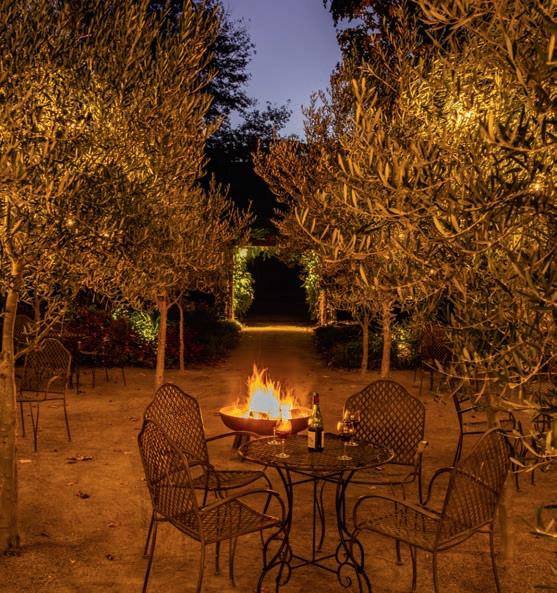
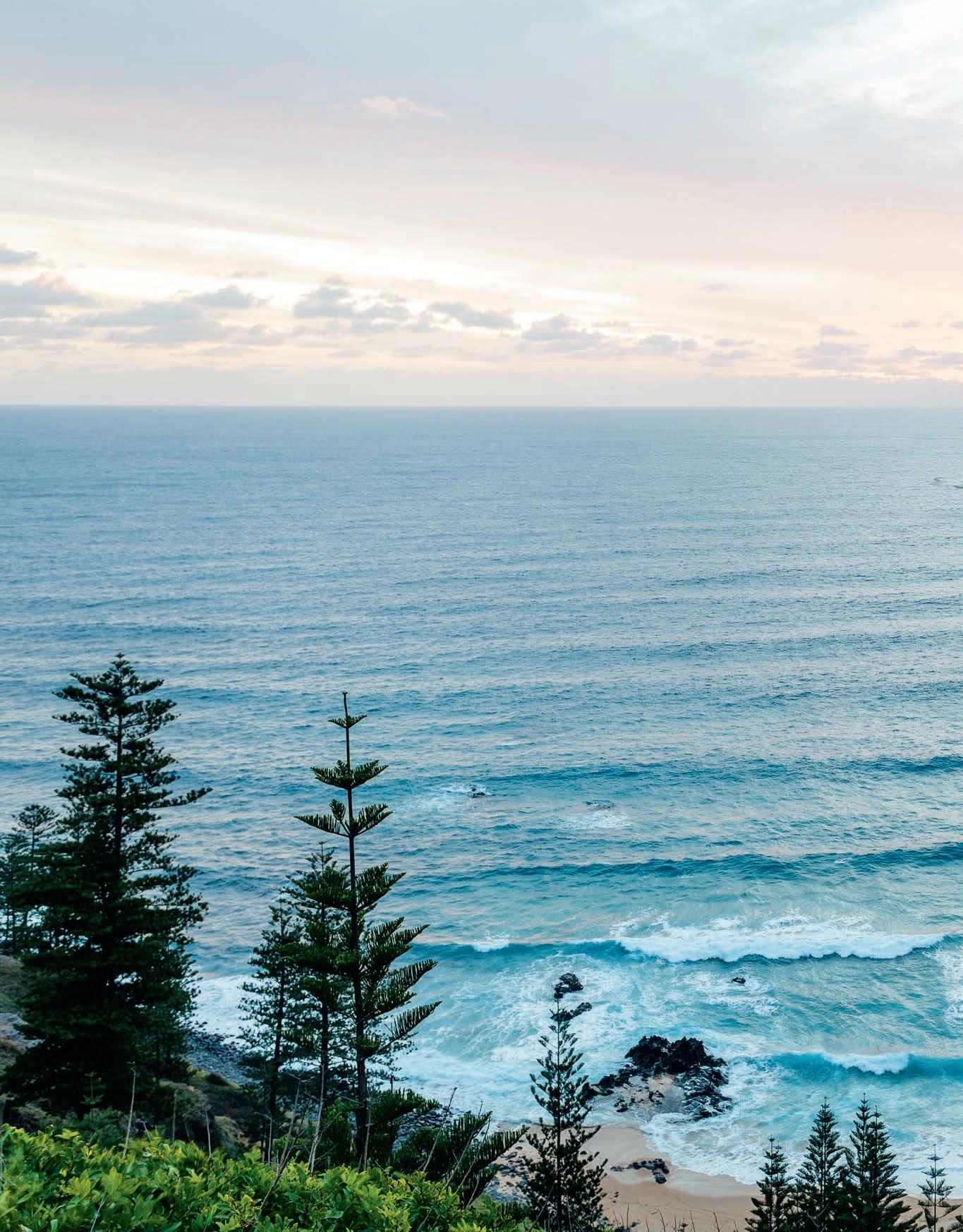
If the essence of a break on Norfolk Island could be bottled, it would be labelled the ultimate tonic.
BY KIRSTY MCKENZIE, PHOTOGRAPHY KEN BRASS
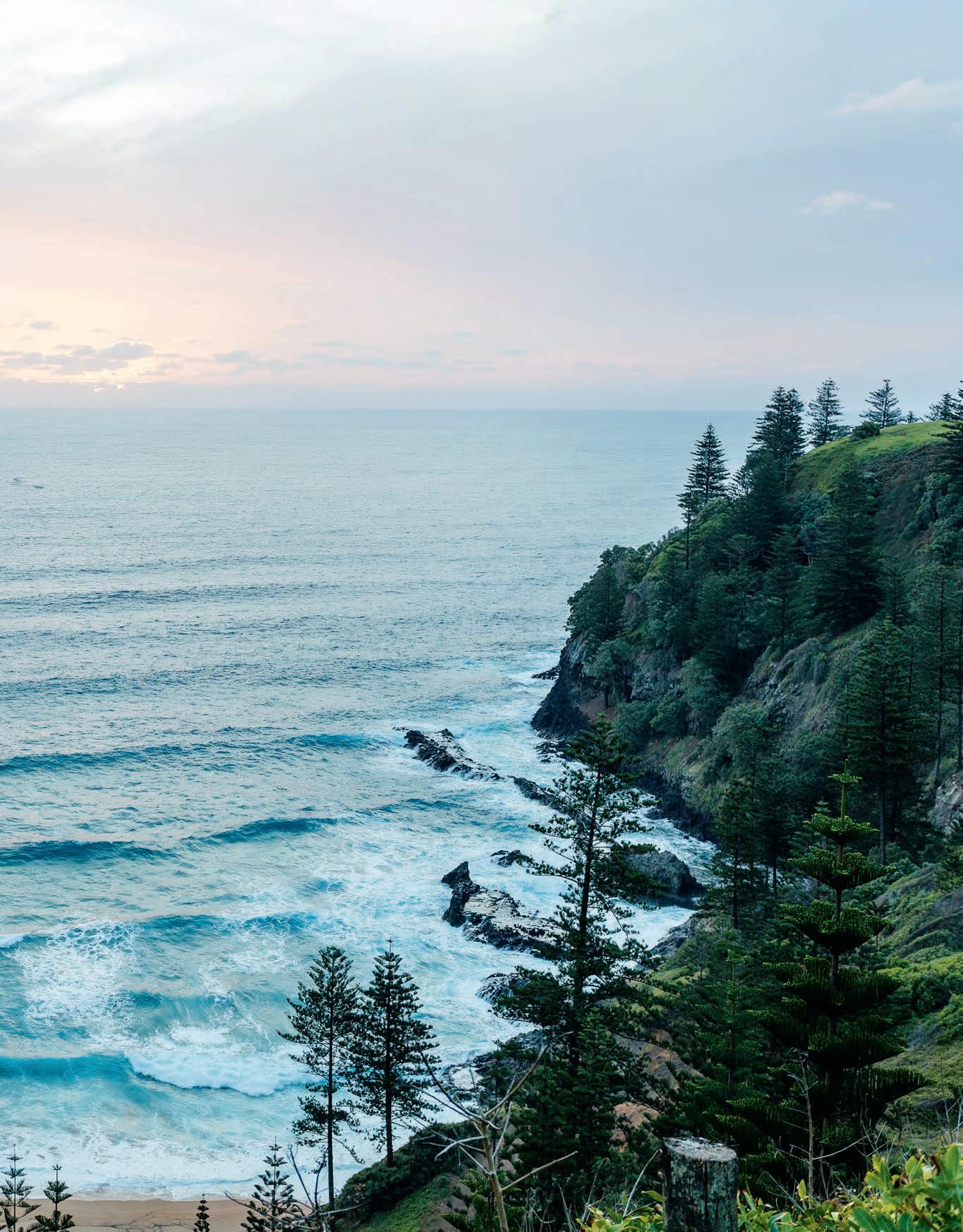
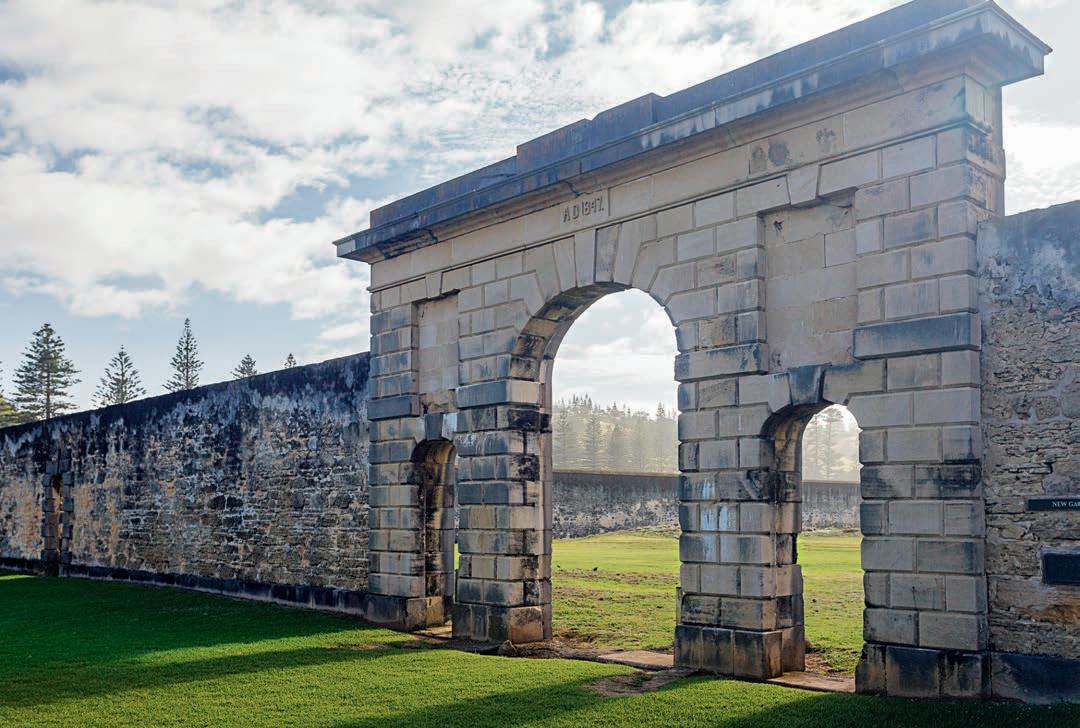
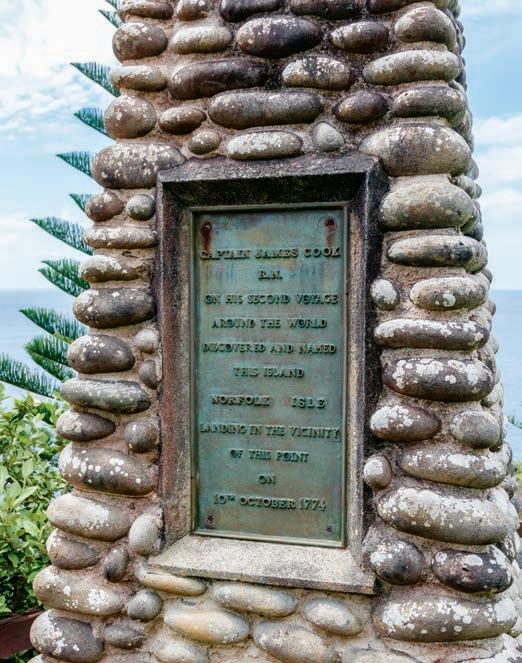
Tell people you are going to Norfolk Island and it seems everyone has an opinion. Significantly, the most vehement are from those who have never been there. “A destination for the newly wed and the nearly dead,” is the common response. Even harsher: “There’s nothing to do.” If your idea of a holiday is theme parks by day and nightclubs by night, then perhaps Norfolk has a deficit. But if a genuine getaway with pristine beaches, great surfing, swimming and snorkeling, not to mention stunning wilderness walks, overlaid with a vibrant food culture in a society that still leaves its doors and hearts open to all appeals, then Norfolk is paradise on earth.
The island is an eight by five-kilometre blip in the Pacific Ocean, loosely midway between New Zealand, New Caledonia and New South Wales. It’s approximately the same latitude as Lismore on the coast of Australia, as the locals somewhat disconcertingly refer to the mainland. Technically, Norfolk is an external territory of the Commonwealth of Australia but, as far as the
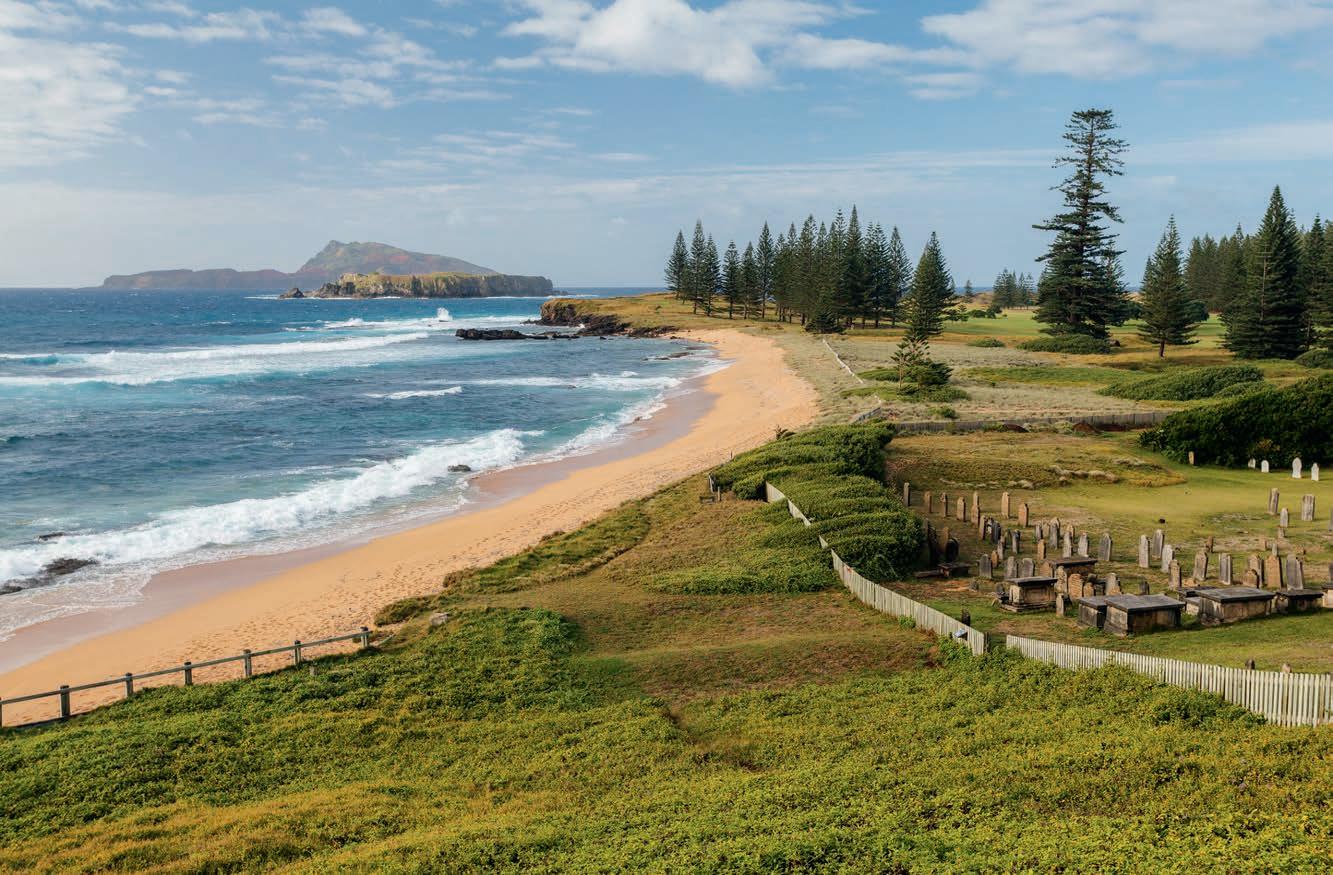
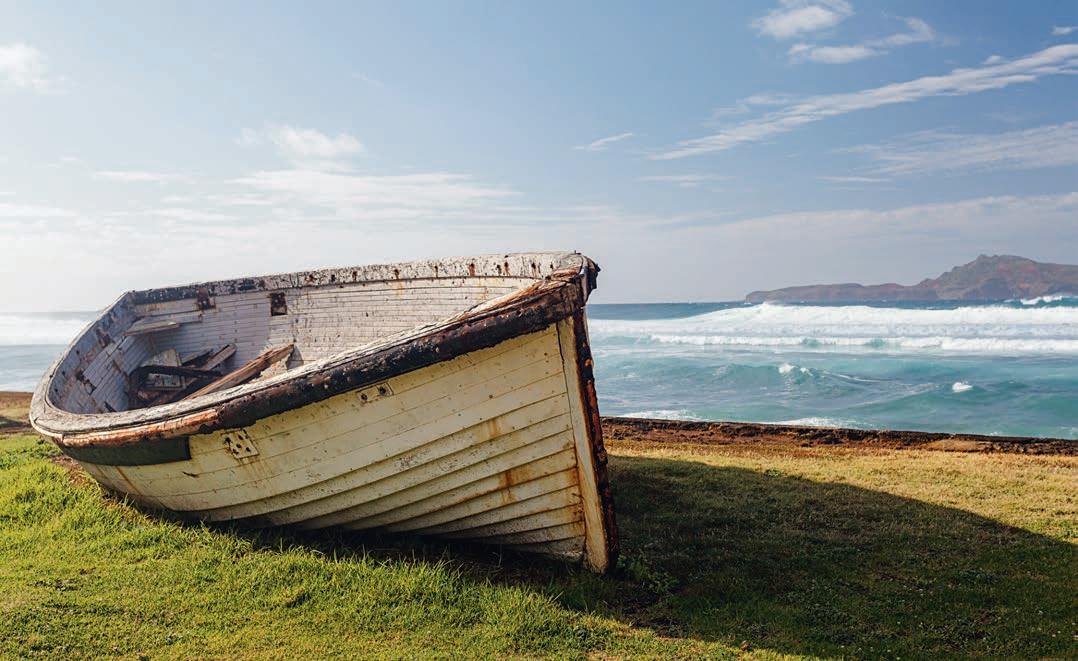
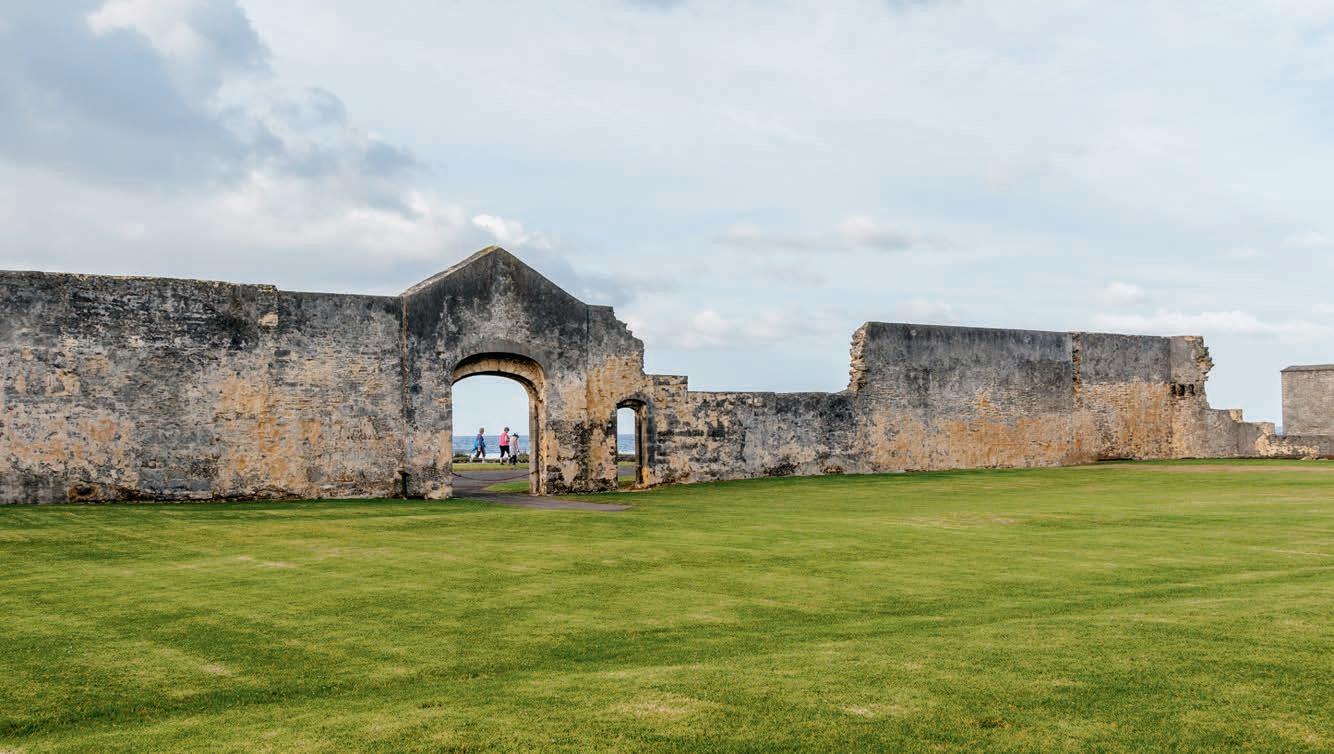
THESE PAGES: (Clockwise from above) Convict relics by the beach at KAVHA; official residences at Kingston; cattle enjoy right of way on the road; sunset from Puppy’s Point.
2100-odd residents and tourists who visit weekly are concerned, it might as well be a world away. This is due in no small part to the rather exotic nature of the population and their rich culture. While there is evidence of Polynesian settlement some 800 years ago, James Cook first mapped the island in 1774, and he noted its native flax and pines, handy for making sails and masts for ships. Shortly after the First Fleet arrived in Sydney, Philip Gidley King was dispatched to Norfolk to establish a convict settlement to shore up the British Empire’s supply of these vital maritime materials, not to mention prevent any other European power from settling the small, but strategically located, Pacific island.
While English is the official language, most islanders speak Norf’lk — a hybrid of the old English spoken by the mutineers from the supply ship, HMS Bounty, who landed on Pitcairn Island in 1790 — and the Tahitian spoken by the women they married. When their descendants had outgrown this drop in the ocean, and the survivors of the Norfolk Island convict colony were being transferred to Tasmania, Queen Victoria graciously gave them the slightly larger puddle that is Norfolk. In 1856, the entire Pitcairn population of 194 relocated and settled on Norfolk, where the stone buildings from the harsh convict days must have looked like mansions to the new arrivals.
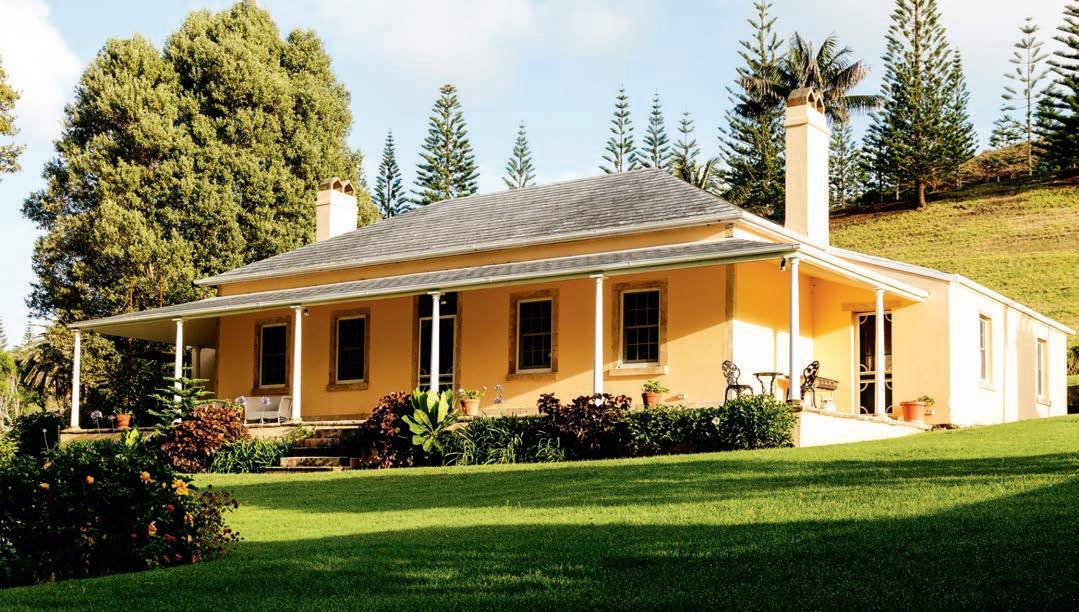
As the oldest of Australia’s 11 UNESCO-listed convict sites, Norfolk Island’s Kingston and Arthur’s Vale Historic Area (KAVHA) offers an unparalleled glimpse into colonial history. Here, the layers of time are tangible — from the stone foundations of penal settlements to the enduring presence of the Pitcairn descendants who reshaped the island’s destiny. Today, almost 40 per cent of the population can trace their heritage back to the Pitcairners, and the surnames, Christian, Buffett, Adams, Young, Evans, McCoy, Nobbs and Quintal, are a source of great pride to the locals who can claim connection.
Our first “watawieh” (hello, how are you) comes before we’ve even left the airport terminal, after the two-and-a half-hour flight from Sydney, when we discover that concept of meet and greet is alive and well on Norfolk. Hire cars are part of most accommodation packages and hosts generally come to the airport in person to welcome new guests, provide directions to the apartments or hotels and help with car pickup.
Our host explains that the island pretty much grows all its own produce and when there’s a surplus, it’s common to sell it from roadside stalls.
“Just take what you fancy and leave what you think it’s worth in the honesty box,” she advises. “Islanders love to share. We know the tranquillity, safety and beauty of the island is precious and we look after it. We look after our people too. If anyone is in trouble, we hold a benefit. We have potluck dinners where everyone brings a plate
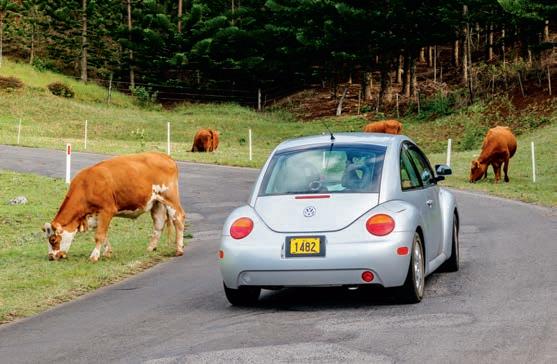
and we raise money for whatever is needed. Norfolk children often have to leave the island for education or employment, but they always want to come back for holidays. And most of them come home to get married.”
Two Chimneys Winery, which combines a three-acre (0.5-hectare) vineyard and tasting facility, is the place to sample locally grown Chardonnay, Semillon, Verdelho, Merlot and Chambourcin. As Rod McAlpine tells the story, he came to the island to work in the bank, met an island girl (Noelene, who is a Buffett) and the rest is history. After a stint back in Australia, they came back to Norfolk because they felt it was
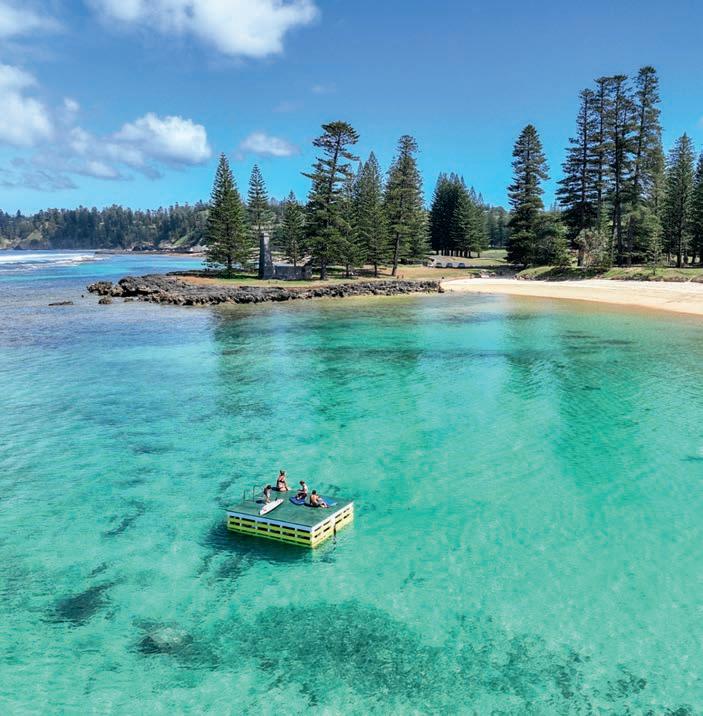
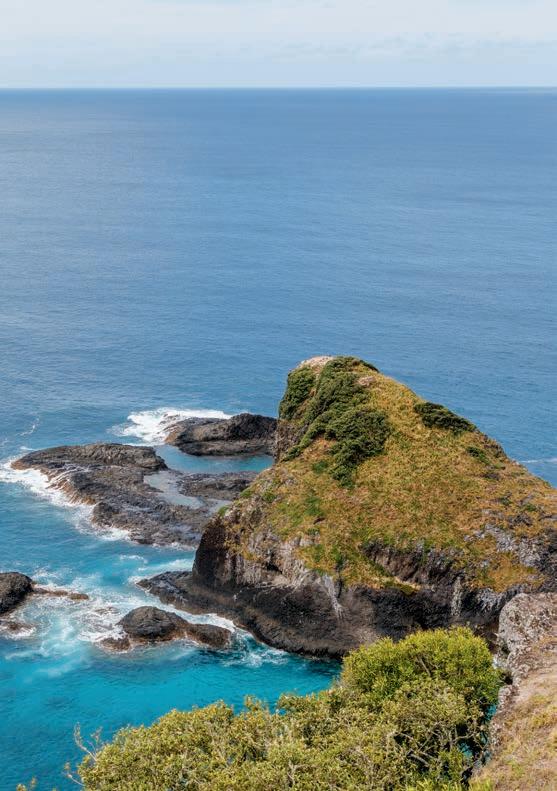
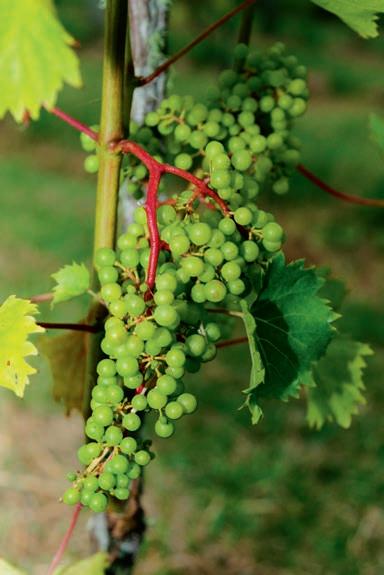
the perfect place for their daughter to grow up. Following a Churchill Fellowship, they planted their first vines in 2002 and celebrated their first vintage in 2006.
Visit Puppys Point, a clifftop vantage point on the north-western side of the island, for spectacular sunset views. Several nights a week, nature’s spectacle is the backdrop for a comeas-you-may event called the Fish Fry, Norfolk’s answer to the Aussie barbecue, at Orn Dar Cliff. This is Norfolk hospitality at its best, crispy fried fish freshly cooked and served with all manner of traditional Polynesian-Norfolk hybrid dishes including lots of kumara, banana and coconutbased accompaniments, all with lashings of “Norfolk gravy”, aka cream. After dinner, the Baunti Byuutis dancing group keeps the traditions of their foremothers alive with Tahitian dance performances and the evening’s rightful conclusion always involves liberal serves of Norfolk’s famous fruit-based pies, which are actually tarts.
The world-renowned author Colleen McCullough called Norfolk Island home for almost 36 years. She and her husband, Norfolk Islander Ric Robinson, created a luxurious hideaway here. They maintained their privacy to ensure Colleen had the perfect environment for her writing. And it worked; she created some of her most powerful titles in their little sanctuary. The escorted tour will take you through her magnificent home, and you will see where Colleen worked on her novels. In addition, you’ll get to view Ric and Colleen’s priceless collection of artefacts gathered on
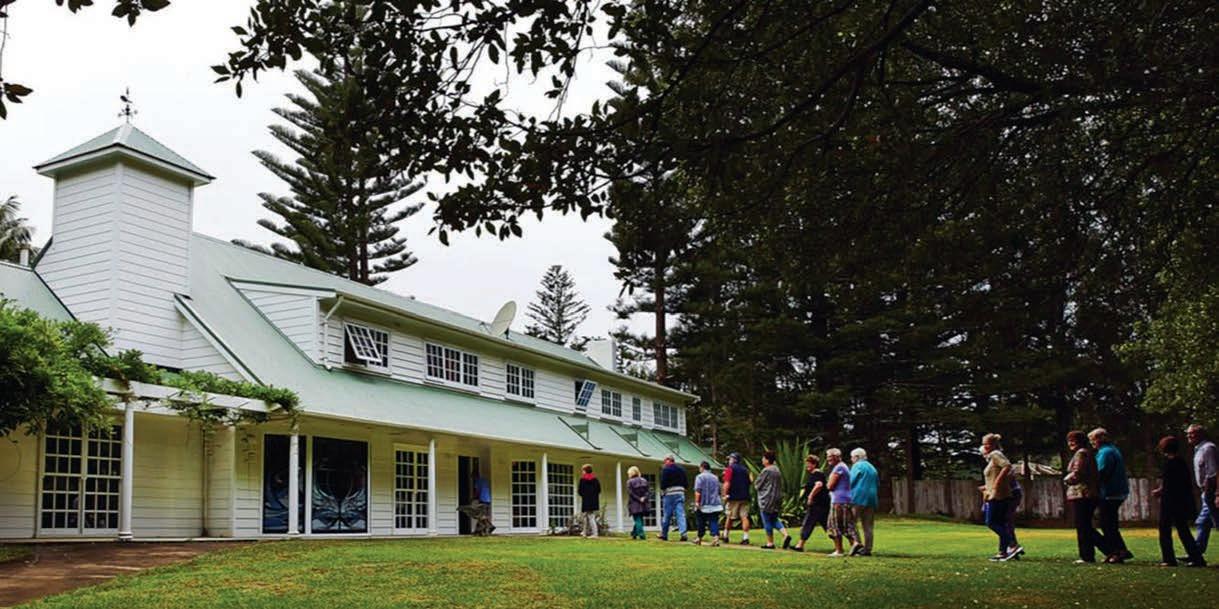
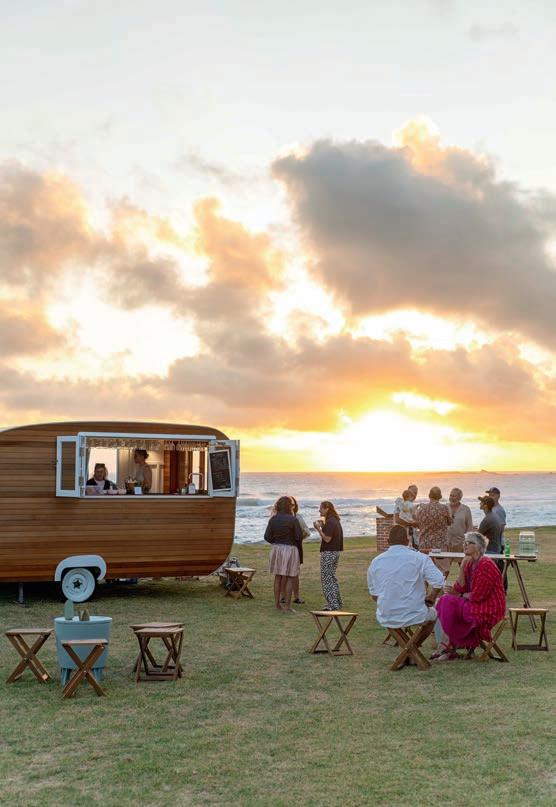
their travels all over the world. Colleen wrote 27 books during her lifetime and was half way through another when she died. Some of the more noteworthy include Tim, The Thornbirds and Morgan’s Run.
In summer, The Wanderer adds a touch of itinerant charm. It’s a mobile cocktail caravan bringing handcrafted drinks and a relaxed island vibe to some of Norfolk’s most scenic locations. Operating only on weekends, this family-run business rotates between six picturesque spots, from clifftop lookouts to beachside backdrops, with locations announced mid-week on social media. Plans can shift with the weather, adding a little spontaneity to your weekend. The menu features cocktails infused with locally inspired ingredients, along with wine, beer, bubbles and light bar snacks.
On the water, Crystal Clear Kayaks offers a different perspective. Glide over the protected waters of Emily Bay in a see-through kayak and watch the underwater world come alive beneath you as the transparent kayaks allow the lagoon and its inhabitants to unfold beneath.
Norfolk’s night skies are officially recognised among the darkest in the world, with Gold Level Dark Sky status. It’s an ideal destination for seasoned stargazers, but also for those who simply want to lie back and take in a sky filled with stars, or head out on a self-guided night of discovery.
Let your eyes adjust: spend 15–20 minutes away from screens or bright lights for the best view. Time it right: aim for a new moon or crescent phase to see fainter stars and galaxies. Pick a prime spot: Mount Pitt and Mount Bates offer 360° views; Emily Bay’s pontoon reflects the stars; Captain Cook Lookout, Anson Bay and Kingston’s foreshore are all spectacular too. Bring a blanket or chair and check the weather for clear skies.
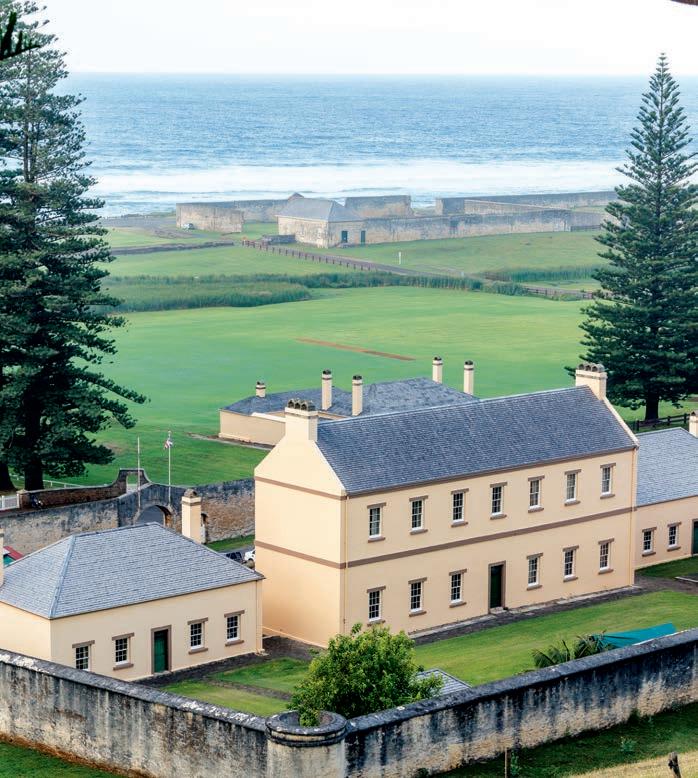
Like most of her fellow islanders, Tania Anderson wears many hats, including that of weekend radio announcer. The island’s tourism marketing coordinator spends her working week directing visitors to the best tours and places for birdwatching, painting, bike riding or swimming, exploring convict heritage and culinary delights, from progressive dinners in people’s homes to the restaurants that celebrate local produce. Another local who’s proud to keep the language of her Adams forebears alive, Tania has a cheerful steering-wheel salute for everyone she passes on the road and is at pains to explain that cows, which graze on the roadsides, have right of way on Norfolk and there are stiff penalties for injuring them. Not that Norfolk’s roads are made for speeding, as the terrain is quite hilly and the roads windy.
While summer is the best time to enjoy the beaches, it seems there’s always an event on the calendar to justify a visit. In March, the locals celebrate Foundation Day with reenactments of the landing of the party from The Supply. Bounty Day acknowledges the arrival of the Pitcairn Islanders in June, Show Day is in August and in November, as a legacy of past visits by American whalers, Thanksgiving is celebrated. There are also a country music festival in May, a golf classic in August, bird week and a food festival in November, jazz festival in December and even a ukulele celebration in September. But it’s Norfolk’s barefoot and fancy-free ambience that gets under your skin. In a world of constant deadlines and pressure to meet targets and KPIs, it is an indescribable relief to find yourself in the slow lane, in a place where it’s common to leave your car unattended with the keys in the ignition and houses unlocked. Visitors are invited to “gut a hill” (take it easy) and embrace the laidback lifestyle that is Norfolk’s default mode.
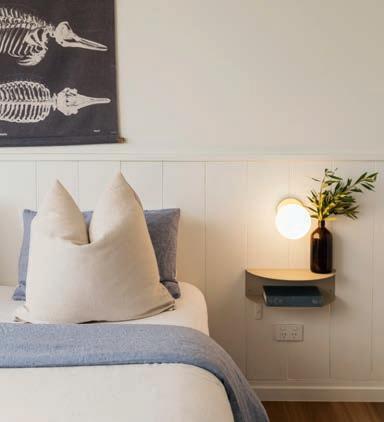
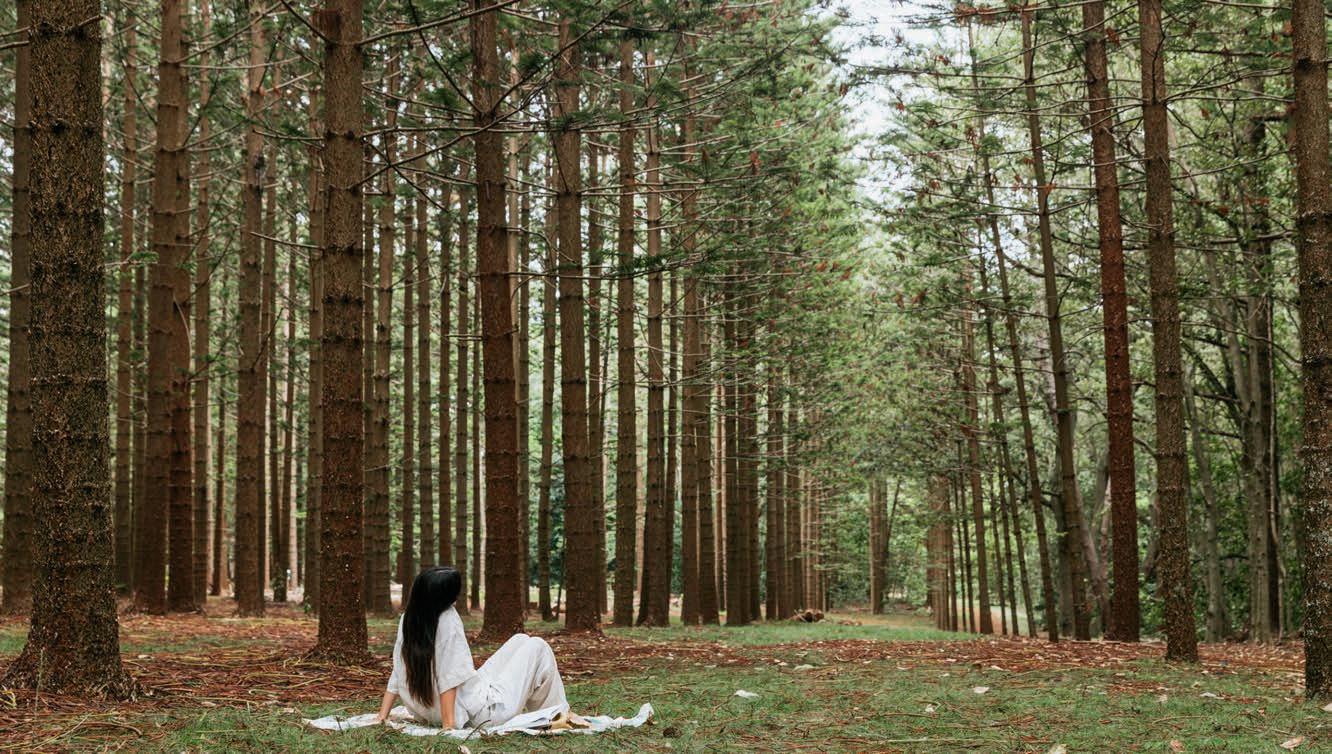
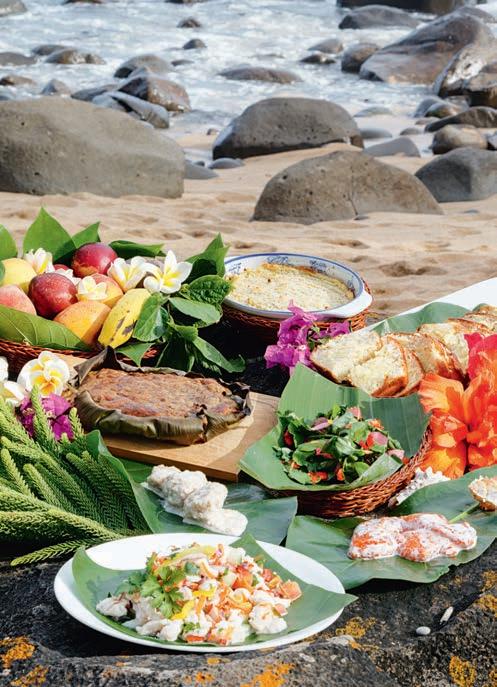
Glencar Villas, Kingston glencarluxuryvillas.com; norfolkisland. com.au/stay/cottages-villas/glencar-luxury-villas
Beefsteak Homestead, Kingston norfolkisland.com.au/stay/ holiday-homes/beefsteak-homestead
The Ridge, Burnt Pine theridgenorfolkisland.com Seascape, Kingston seascapenorfolk.com; norfolkisland.com.au/ stay/holiday-homes/seascape-norfolk-island
Whalers Watch, Burnt Pine norfolkisland.com.au/stay/holidayhomes/whalers-watch
The Homestead Restaurant, 100-acre Farm thehomesteadrestaurant.com.au; norfolkisland.com.au/eat-drink/ cafes-restaurants/the-homestead-restaurant
Salty Beer Garden, Burnt Pine norfolkisland.com.au/eat-drink/ cafes-restaurants/salty-beer-garden
Norfolk Island Brewery, Burnt Pine castawaynorfolkisland.com/ norfolk-island-brewing / La Perouse, Burnt Pine laperouse.nf; norfolkisland.com.au/eatdrink/cafes-restaurants/la-perouse
The Olive, Burnt Pine norfolkisland.com.au/eat-drink/cafesrestaurants/the-olive-cafe
The Wanderer Mobile Cocktail Van, various locations norfolkisland.com.au/eat-drink/bars-brews/the-wanderer
Crystal Clear Kayaks, Emily Bay norfolkisland.com.au/things-todo/adventure/norfolk-island-crystal-clear-kayaks
Fish Fry, Orn Dar Cliff norfolkisland.com.au/things-to-do/tours/ island-fish-fry-pinetree-tour
Colleen McCullough Tour norfolkisland.com.au/things-to-do/ tours/colleen-mccullough-home-tour-baunti-tours
Star Gazing, various locations norfolkisland.com.au/things-todo/nature/stargazing
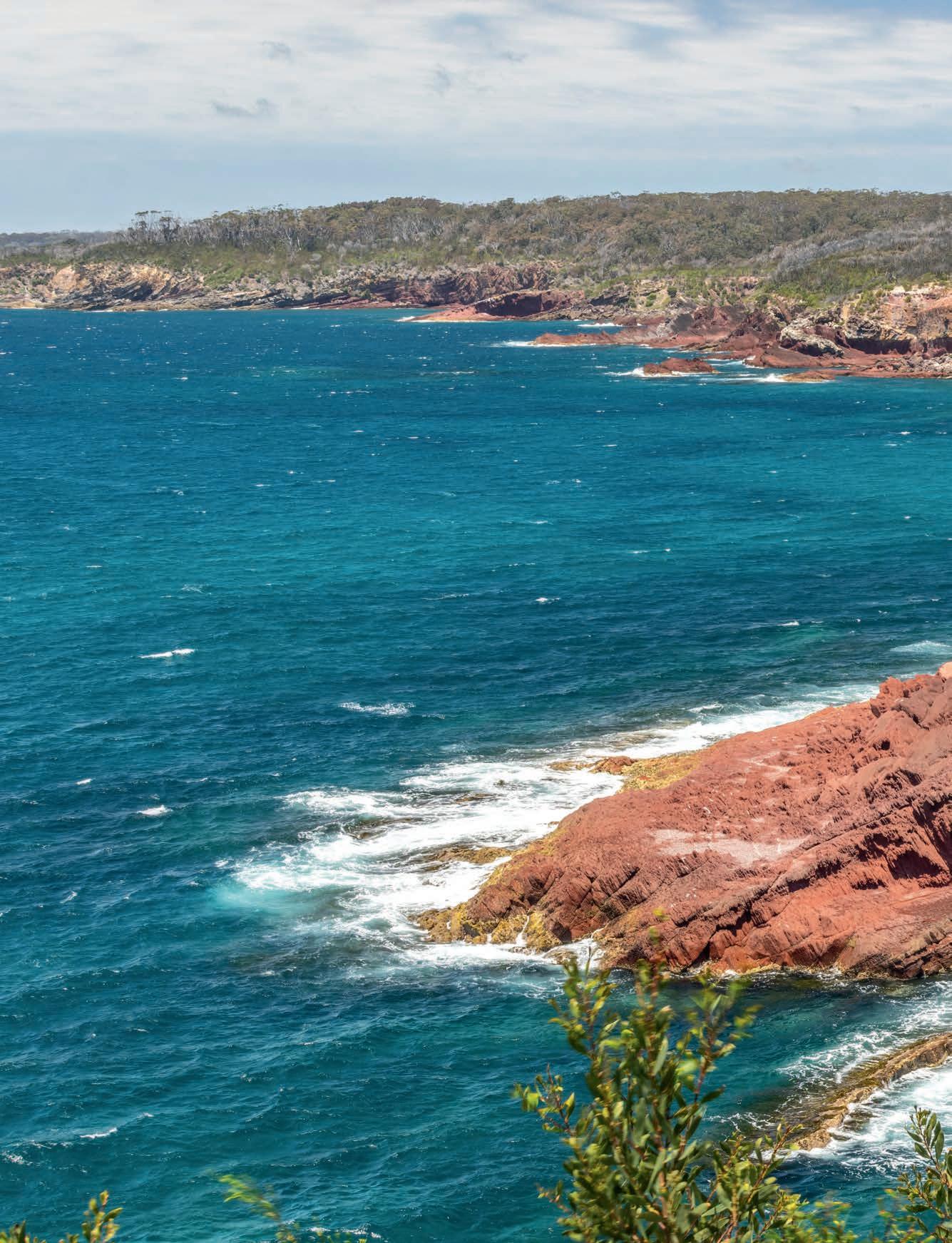
The Sapphire Coast sparkles year-round and rewards visitors with time to explore its beautiful beaches and bounty of local produce.
NSW SOUTH COAST | 2–3 DAYS
BY KIRSTY MCKENZIE, PHOTOGRAPHY KEN BRASS
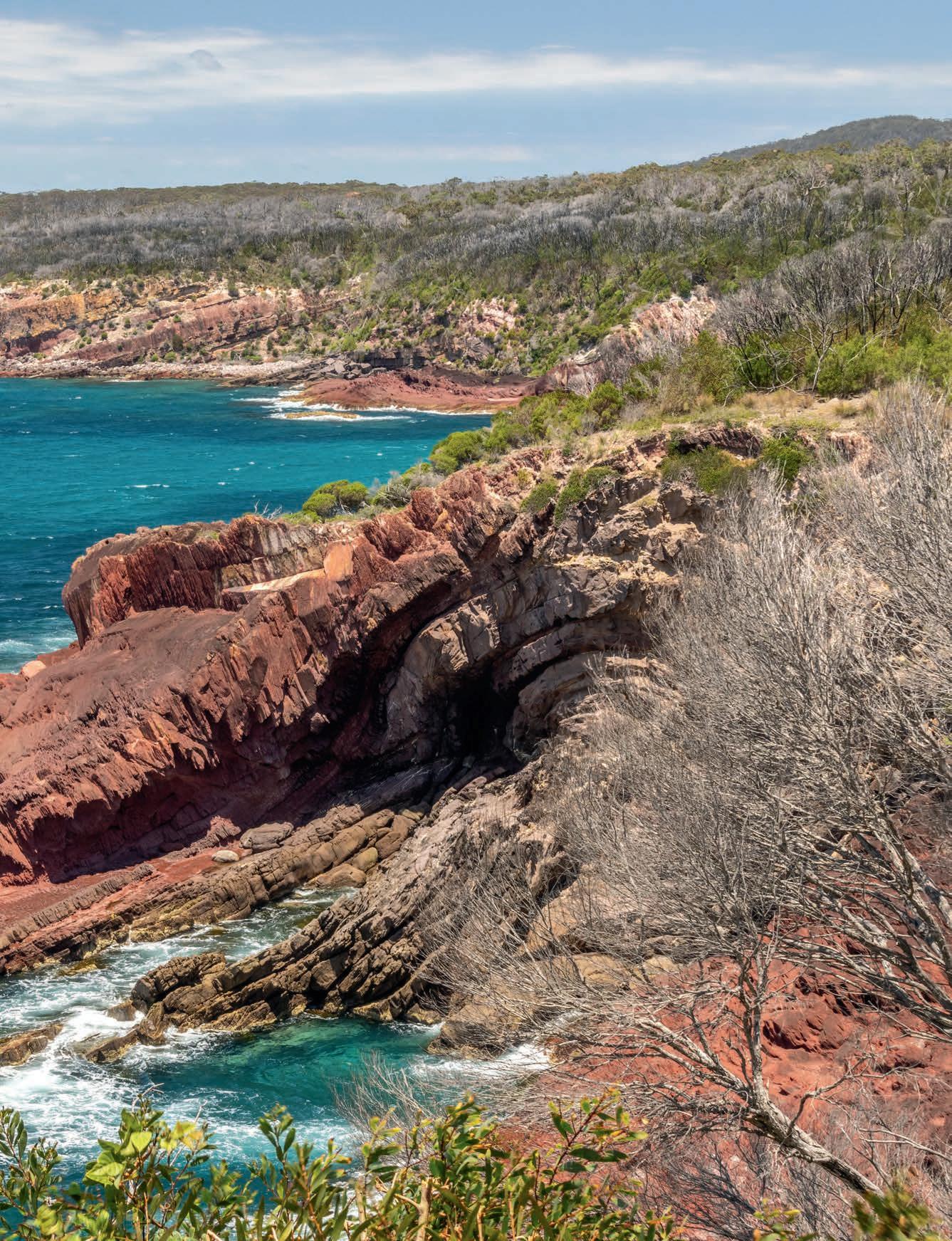
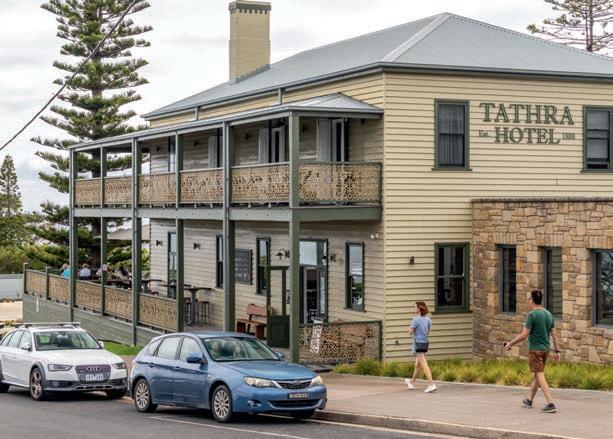
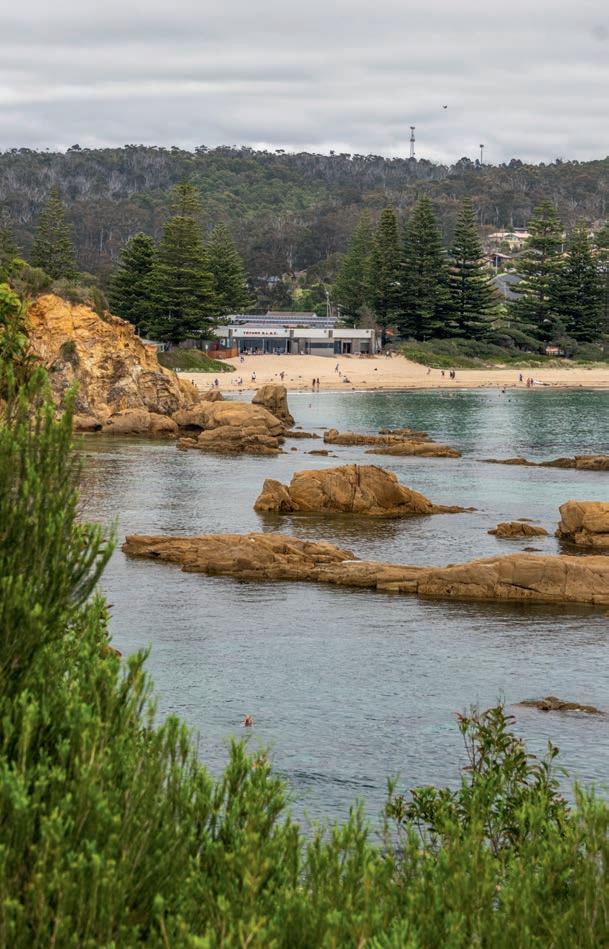
It’s early morning on a public holiday in Tathra, but that doesn’t deter a group of dedicated ocean swimmers, who’ve decided to take the leap from the historic wharf to swim the 600 or so metres to the golden swoop of Tathra Beach. The less adventurous might prefer to complete the swim in the opposite direction and climb the ladder up to the deck rather than jump into the azure waters of the aptly named Sapphire Coast of southern NSW. There’s even an annual 1200m Wharf to Waves event in March, when hardy souls swim from the beach to the wharf and back.
Fainter hearts can still enjoy a visit to the wharf, which has been a landmark on Tathra’s headland since it was first constructed in 1862. It’s been much renovated over the years and is a great spot for whale watching during the migration season (August to November), fishing at any time, catching up on maritime history at the wharf museum and grabbing coffee and a bite at the Wharf Local cafe.
Established around the same time as the wharf, Tathra township’s main purpose was originally as a seaport for the farming community around Bega. In those days, everything was transported by ship. When steamers replaced sailing ships, the voyage to Sydney became safer and more reliable and opened the door to holiday makers, initially fisherfolk who built weekenders and later well-todo farmers and Snowy Mountains Authority staff from Cooma built more substantial beach houses. As car travel became more mainstream, Tathra became a popular camping destination and the town’s population of 1700-odd swells dramatically at Easter and during the summer holidays.
Most visitors to Tathra also find their way to the Heritage-listed Tathra Hotel, perched on the other side of the headland from the wharf. The pub, built in 1888 as the Ocean View Hotel, lives up to its original name, with jaw-dropping views over the Pacific Ocean. These days, you’d visit for the breakfast, lunch and dinner options seven days a week, the heritage rooms upstairs or the adjacent motel rooms, the fact that the boutique Humpback Brewery is also located on site and, mercifully, the lack of pokies. Be sure to take a trip to the loo for the Max Dupain photographs in the corridor and the fascinating insights into war-time society life from the framed pages of The Sun newspaper.
The gateway town to this road trip along the coast is Bega, almost midway between Sydney and Melbourne on the Princes Highway. It would be easy to dismiss Bega, population 5000-ish, as an agricultural service town, but visitors who
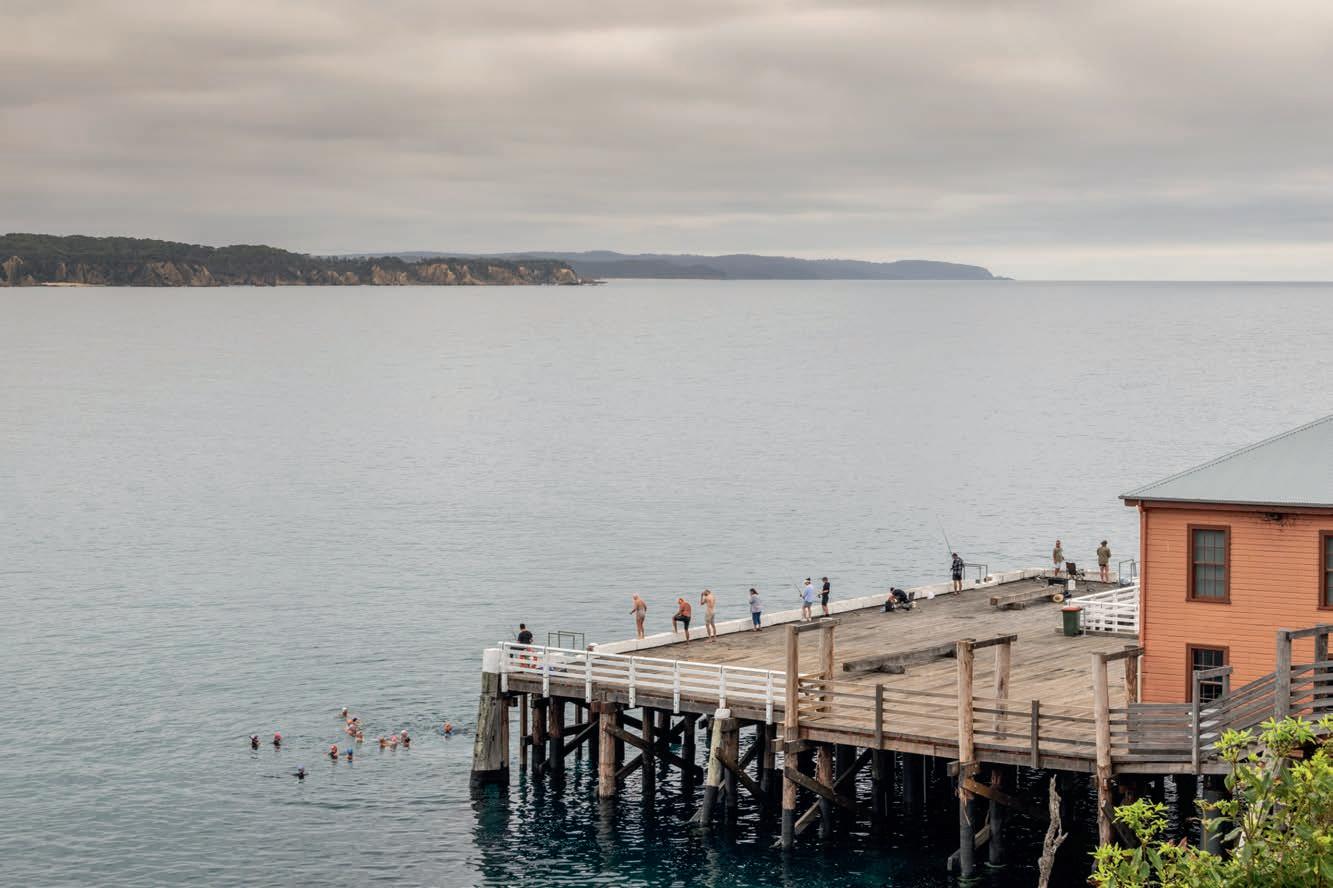
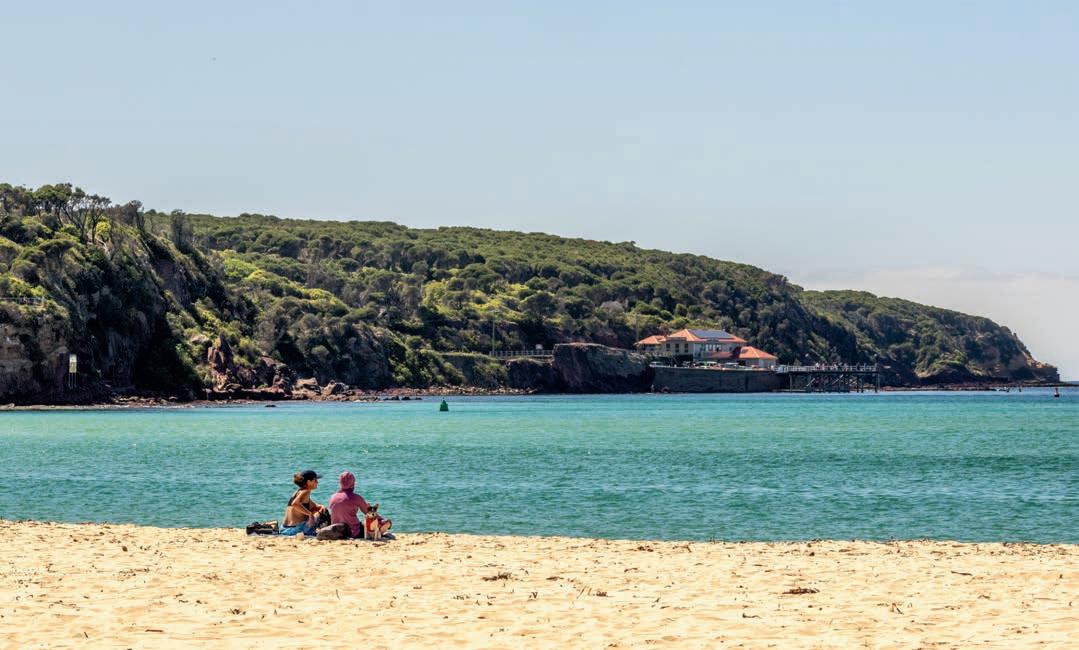
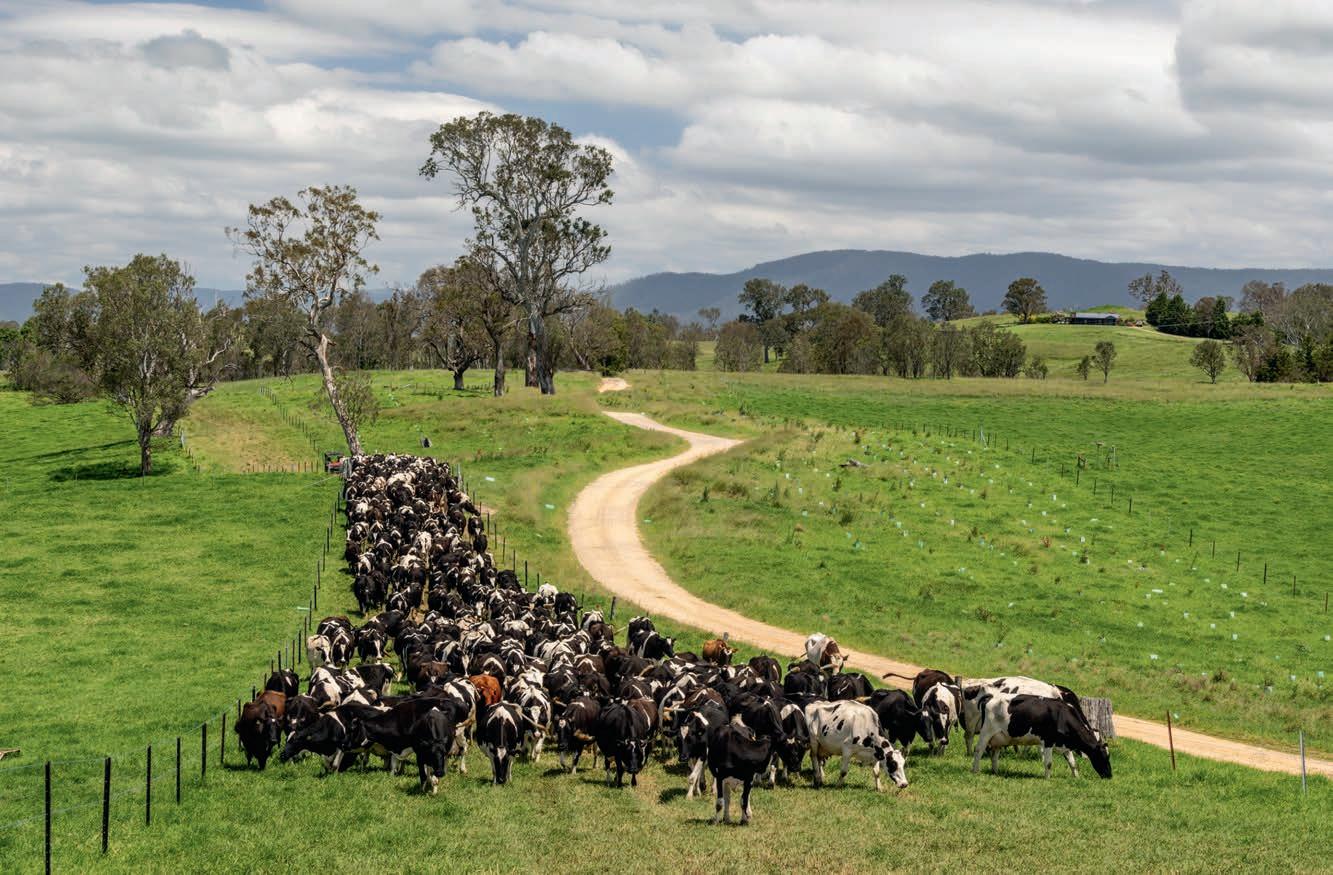
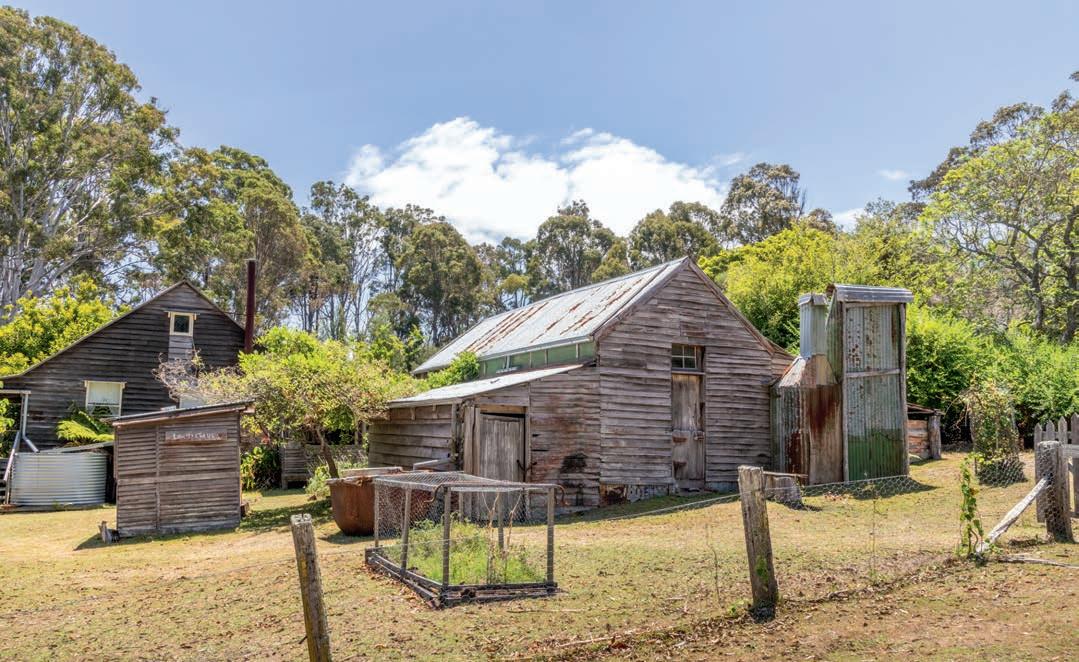
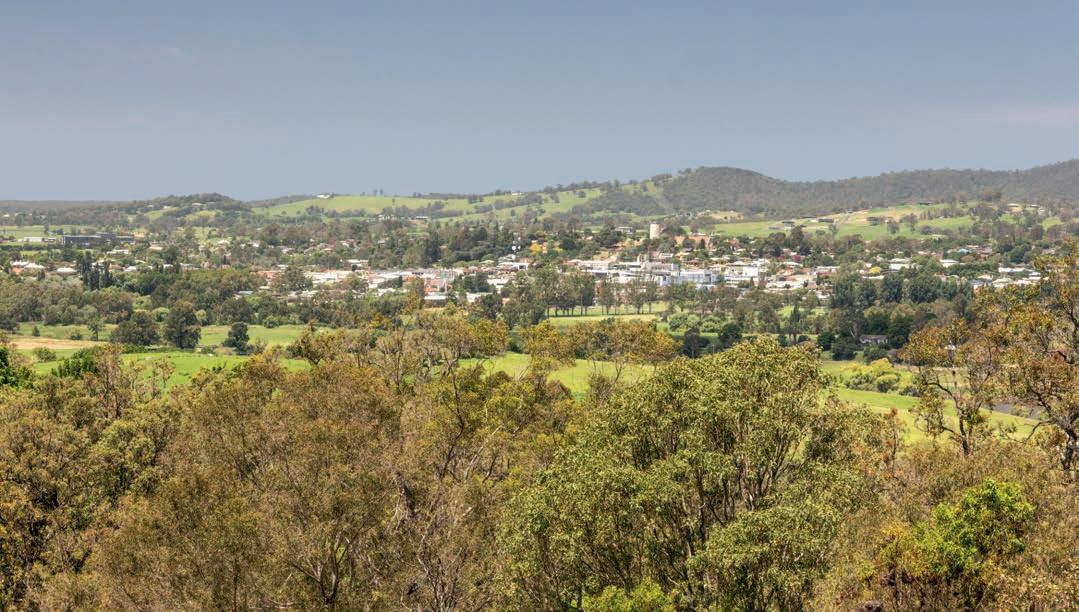
THESE PAGES: (Clockwise from above) Bega sits in a green valley; South East Centre for Contemporary Art; tourist information in a reproduction of Bega’s creamery; homestead at the former Davidson Whaling Station; cows at milking time.
take a closer look are rewarded with insights into the history of dairying in the Bega Valley and tastings of Bega’s famous cheese at the Bega Cheese Heritage Centre in a reproduction of the original creamery building. The Spiral Gallery is a cooperative presenting local artists’ work, while the South East Centre for Contemporary Art (SECCA) has schmick premises in the centre of town and hosts touring and individual artists’ exhibitions, as well as the biennial $50,000 Shirley Hannan National Portrait Award.
It’s an 18-kilometre hop from Bega to Tathra and while a detour to the village is highly recommended, the turnoff for the Sapphire Coast Drive to Merimbula and Pambula is 4km before Tathra. From there, it’s about 20km to Merimbula and a further 11km back to the highway and down to Pambula. Don’t let the distances deceive you, there are pristine beaches and eye-squintingly blue waters tempting swims at Bournda, Tura and Pambula Beaches that are bound to stretch the schedule. There’s also a 10km shared bike and walking pathway from Merimbula to Pambula that hugs the lake’s edge and then Merimbula Beach, before ending at Pambula Beach.
The region is renowned for its seafood in general and Sydney rock oysters in particular
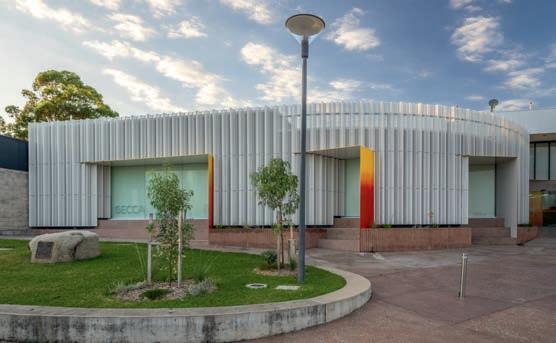
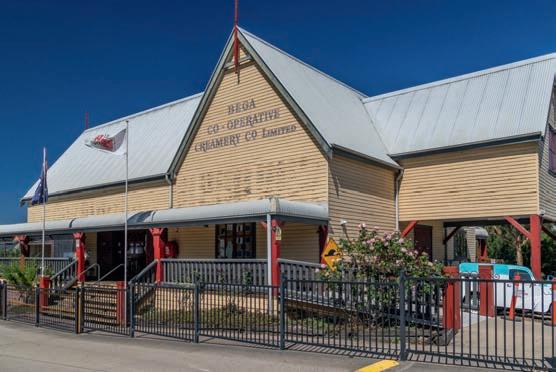
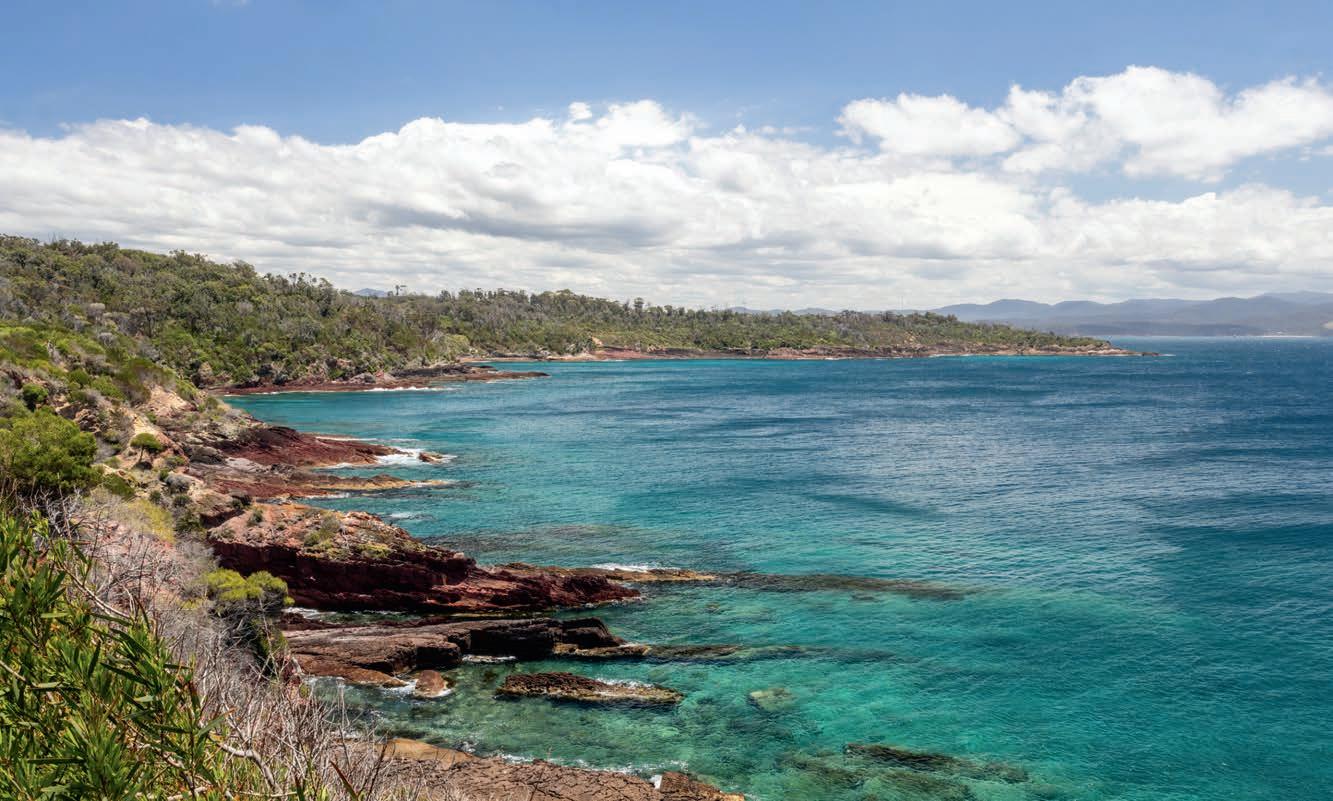
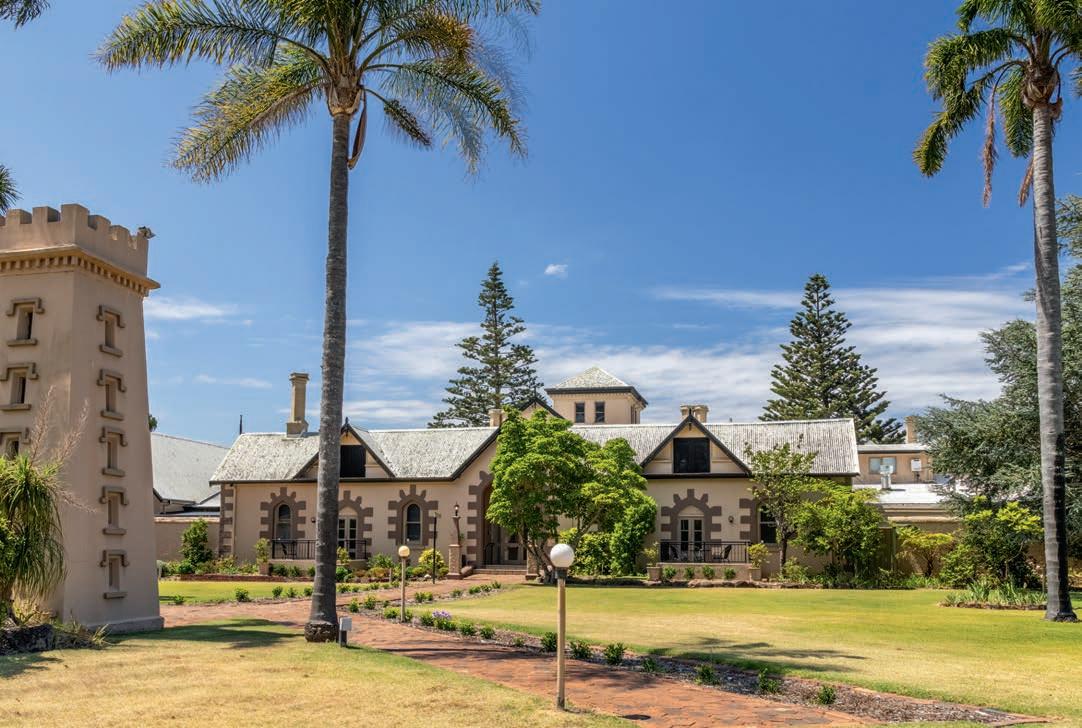
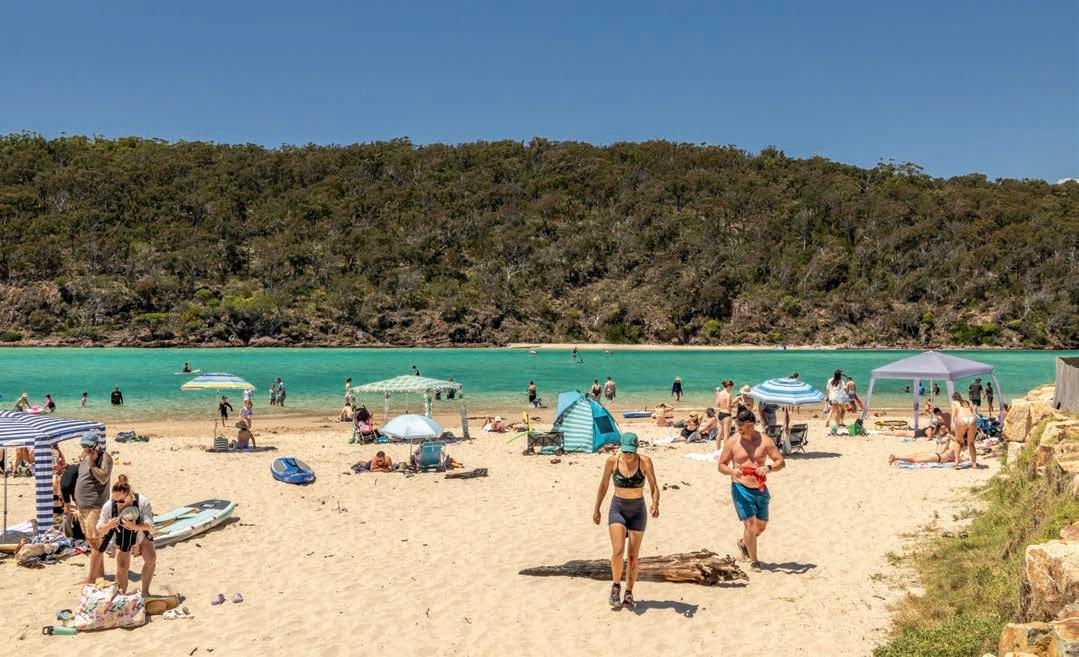
THESE PAGES: (Clockwise from above) The region offers many beaches; pathway from Merimbula to
and, for deeper insight into the realm of oyster farming, visitors can join “Captain Sponges” Brett Weingarth or his offsider Captain Scotty Cowdrey on a two-hour boat tour of their leases they maintain on Merimbula and Pambula Lakes. While you take a crash course in oyster husbandry, you’ll get to taste them at their freshest as the hosts shuck them straight from the water. There’s also a detour to inspect the native Angasi species of oyster, which are also grown on the farm.
There are myriad other opportunities to buy oysters straight from the farms dotted along the coast and one that comes hig hly recommended is Wheelers Oyster Farm, which combines a seafood restaurant and snapping fresh fish and chips and oysters to take away, or enjoy at tables under umbrellas out the back.
In Pambula, grab a pie or pastries and coffee from Wild Rye’s bakery, or drop into Longstocking Brewery for pizza and beer. For more formal dining, the hatted Banksia Restaurant offers set menus featuring local produce in an old bank building. From Pambula, it’s 19km down the Princes Highway to Eden, on the northern end of Twofold Bay and a fishing and whaling port since the earliest days of European settlement.
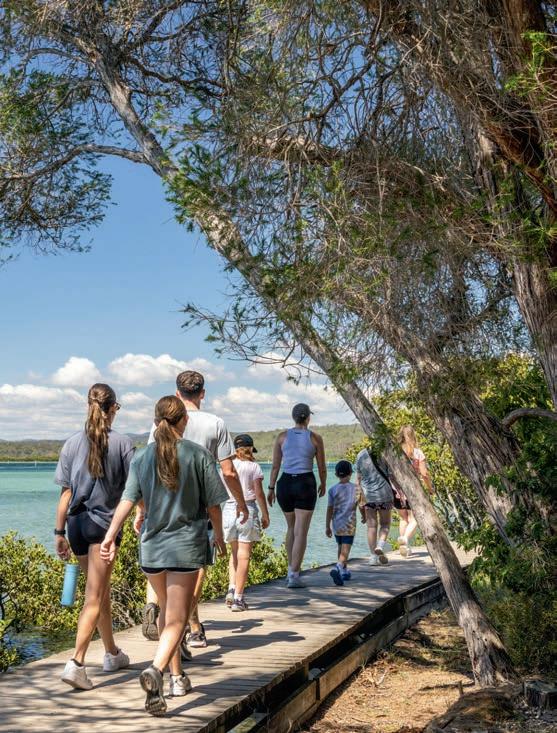
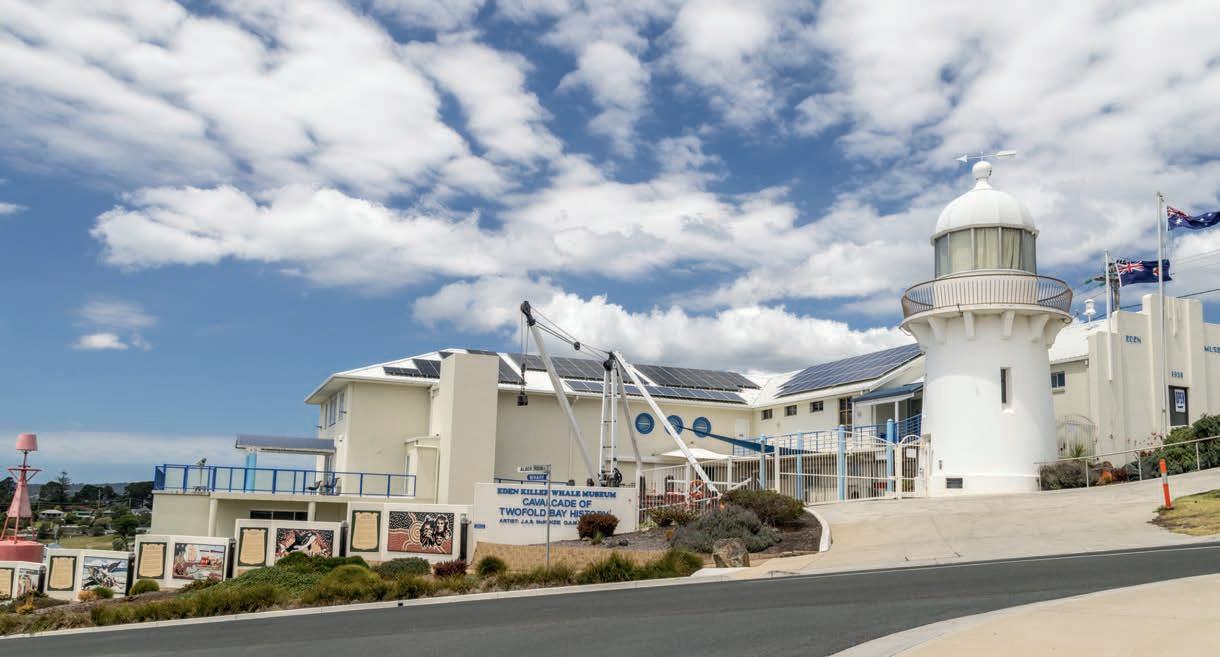
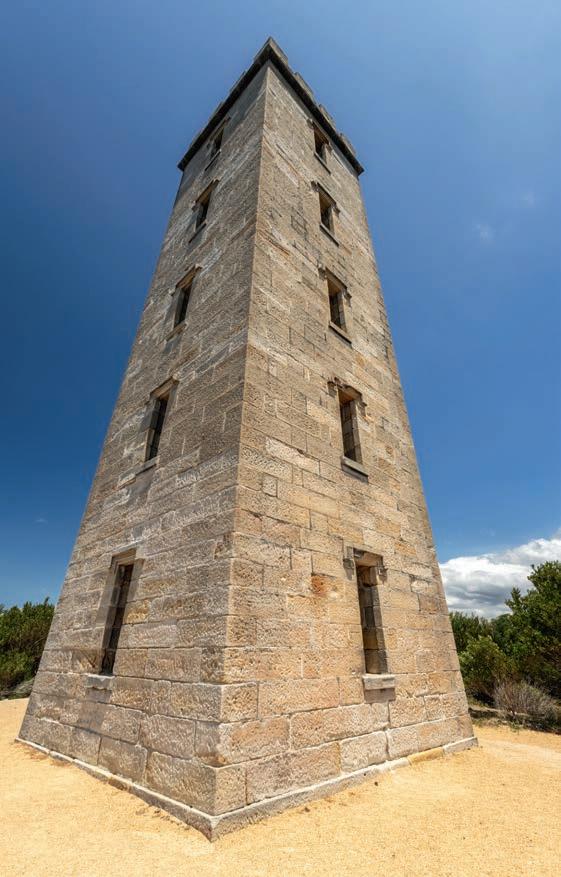
There’s much to learn about the grisly, though fascinating, stories of the whaling industry and the unsuccessful vision of 1840s banker, entrepreneur Benjamin Boyd to build Boydtown, which he ‘modestly’ named for himself as the headquarters of his whaling business. Today, all that is left of his grand dream is the Seahorse Inn, a pleasant spot for a meal with a sea view, and Boyd’s Tower, an imposing sandstone structure that was designed, though never used, as a lighthouse, but did become a key lookout for whalers to spot passing whales.
Drop into Eden’s Killer Whale Museum to learn more about the industry, which in colonial times supplied whale oil for lighting, lubrication and soap manufacture and baleen for women’s corsetry, hooped petticoats, umbrella ribs and riding crops. Fun fact: Although it was known as whalebone, baleen is actually dried tough skin.
The 6.7m-long skeleton of Old Tom is one of many features of the museum, and visitors will gain insight into how the leader of the orca whale pod collaborated with three generations of the Davidson family of whalers, they claimed, for almost 90 years. In fact, the extraordinary hunting partnership of wild animals with man herding baleen whales goes back way before European settlement, as the traditional owners, the Yuin people, also worked with the orcas to capture baleen whales. The orcas, aka “the killers of Eden”, were said to alert whalers to the approach of their prey by tail flopping and then guiding the boats to
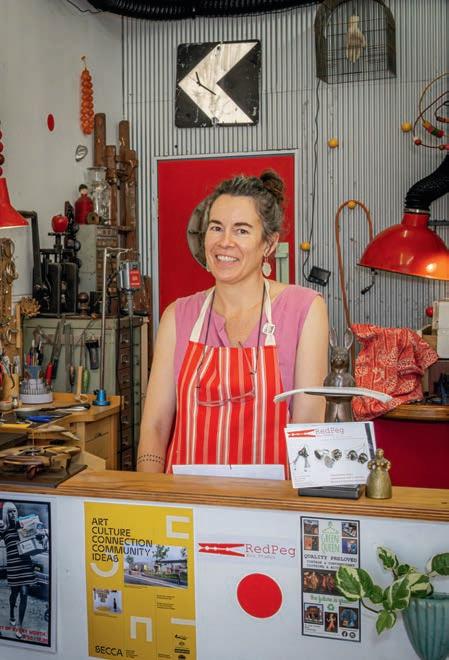
the locations. It’s said Old Tom collaborated with the Davidsons because of the tradition of “the law of the tongue”, which involved anchoring the dead whales close to the shore and leaving them for a couple of days so the orcas could feast on their favourite tid-bits — the tongue, lips and genitals — before dragging it back to their whaling station, which, when it closed in 1929, was the longest operating land-based facility in Australia.
If that gives you a taste for more whaling history, head south around the bay to visit the Seahorse Inn, the remnants of the Davidson Whaling Station and Boyds Tower. Boyds Tower is also the starting point for the 32km Light to Light Walk, which follows the coastline to Green Cape Lighthouse, the most southerly lighthouse in NSW.
Returning to Eden, take a walk around the fishing boats and visitor information centre at Snug Cove, before grabbing a bite at the Australasia Hotel’s Pike’s Bistro. From there, it’s a 54km drive up the highway back to Bega. If you happen to be there on a weekend, be sure to drop into the North of Eden craft gin distillery, a boutique facility run by Gavin Hughes, who can claim to be one of very few distillers in the country using Australian-grown juniper from a farm at Bibbenluke on the Monaro high plains. It would be hard to imagine a more fi tting place to toast the unique character of this region and the people who colour in its details.
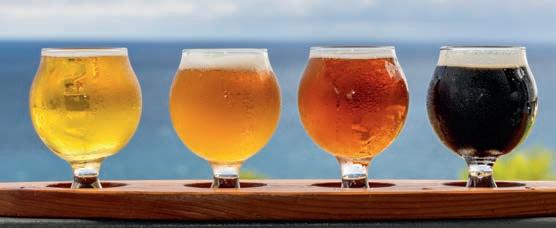
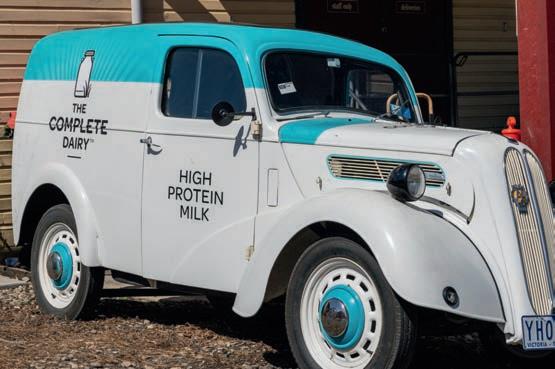
The Homestead, Bega lotteshjem.com
Tanja Lagoon Camp, Tathra tanjalagooncamp.com.au
Tathra Hotel, Tathra tathrahotel.com.au
Lottes Hjem, Pambula lotteshjem.com
Currajong Retreat, Burragate currajongretreat.com
Hotel Australasia, Eden hotelaustralasia.com.au
Seahorse Inn & Villas, Eden seahorseinnhotel.com.au
Tathra Hotel, Tathra tathrahotel.com.au
Wharf Local, Tathra thewharflocal.com.au
Valentina, Merimbula valentinamerimbula.com
Dulcie’s Cottage, Merimbula dulcies.com.au
Wheelers Seafood Restaurant & Oyster Farm, Merimbula wheelersoysters.com.au
Longstocking Brewery, Pambula longstocking.com.au
Wild Rye’s Baking Co Pambula wildryes.com.au
Banksia, Pambula banksiarestaurant.com.au
North of Eden, Stony Creek northofeden.com.au
Bega Cheese Heritage Centre, Bega heritagecentre.com.au
SECCA, Bega secca.com.au
Eden Killer Whale Museum, Eden killerwhalemuseum.com.au
Sapphire Coastal Adventures Whale Watching, Eden sapphirecoastaladventures.com.au
Captain Sponges Oyster Tours, Pambula Lake Jetty & Wharf magicaloystertours.com.au
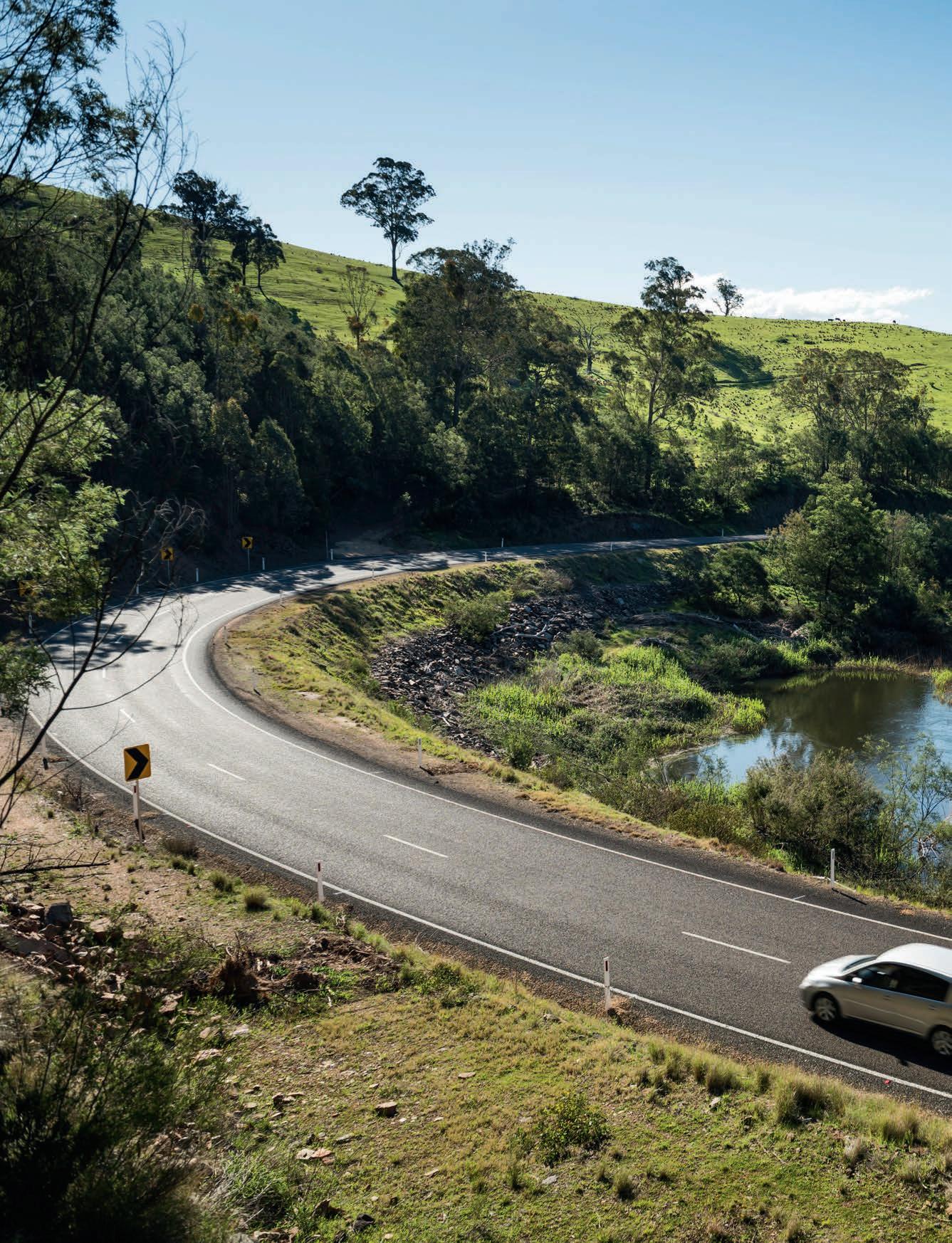
The historic route from Victoria’s Gippsland Lakes to the rural city of Wangaratta is a rolling tapestry of colourful stories and characters.
NORTH-EASTERN VIC | 4 DAYS
BY RODERICK EIME, PHOTOGRAPHY
& RODERICK EIME
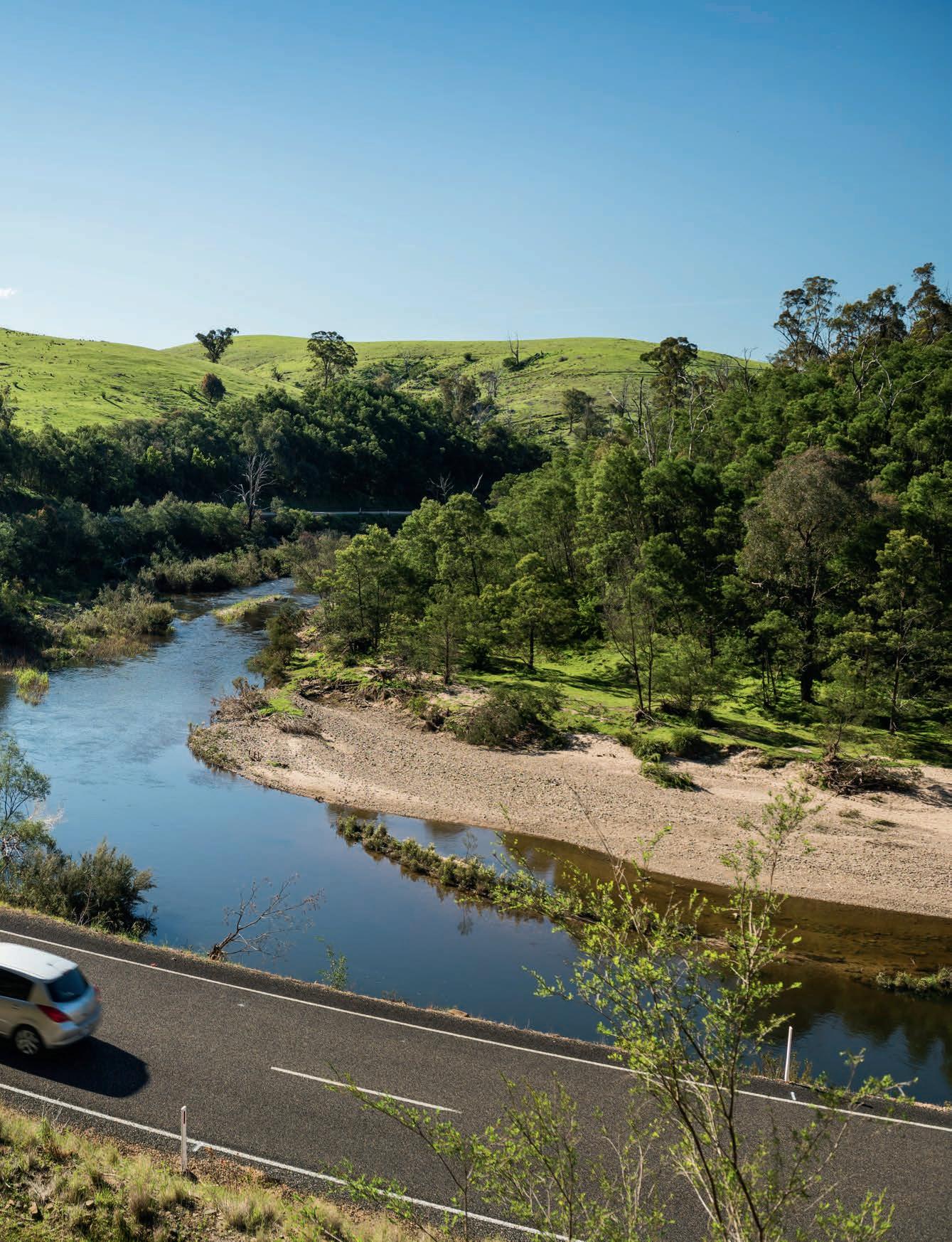
Wasn’t it the overambitious young lad, Icarus, from Greek mythology who flew too close to the sun and melted his waxen wings? But do not fear, your ascent to the clouds is more likely to yield success and fulfilment than our hapless youngster of legend.
Victoria’s iconic Great Alpine Road extends a little more than 300 kilometres from coastal Bairnsdale on the scenic Gippsland Lakes to rural Wangaratta on the northwestern slopes of the Victorian Alps, at the junction of the Ovens and King rivers.
The famous route existed long before it bore the title, as it comprised a series of dirt and gravel switchbacks gradually rising to 1800 metres above sea level near the ski fields of Mount Hotham. It was first gazetted as a highway in 1914, but it wasn’t until 1996 that the title, Great Alpine Road, was finally bestowed, after incorporating the existing Ovens and Omeo Highways. Its total length is 303.7km and it rises to an altitude of 1840m at Mount Hotham. The final sections at Dinner Plain were sealed towards the end of 1998.
The road, now in its best-ever condition, can be tackled in either direction and, for Melbourne residents, makes an ideal circular road trip over several days, or longer. If you start from the ocean, you can break with tradition and set off from Lakes Entrance, one of Australia’s largest fishing ports and a regional tourism hub. Of course, it’s as busy as anything during holiday periods, so choose your time carefully.
That said, some of the best accommodations can be found along the waterfront boulevard, ranging from plush suites such as those at Bellevue on the Lakes or quality motel rooms at the Central Hotel, which, by the way, has some of the best pub meals anywhere in Gippsland or beyond.
Whether you’re starting from Bairnsdale or Lakes Entrance, you’ll converge on the B500 at Bruthen to begin your upward journey. But don’t rush off — little Bruthen is worth a linger, even if it’s just for a coffee at the Blue Bee Cafe. Besides the heritage stores and lush scenery, there’s a vibrant art community as well as the famous Tambo Valley Honey to sample and Bullant Brewery or Heritage Tea Rooms to visit. If you’re staying over, consider the Bruthen Inn Hotel, which is within easy walking distance.
The road starts to show you its adventurous side through Tambo Crossing and the Ash Ranges with gentle sweeping curves as it follows the adjacent, tree-lined river through green pastures and farmland. Cross the Tambo River and slow
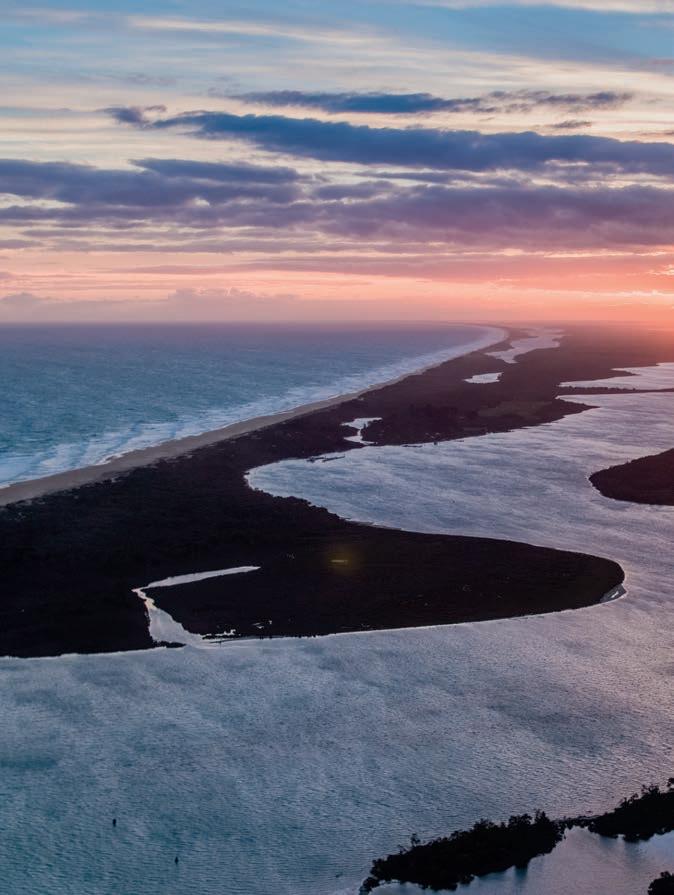
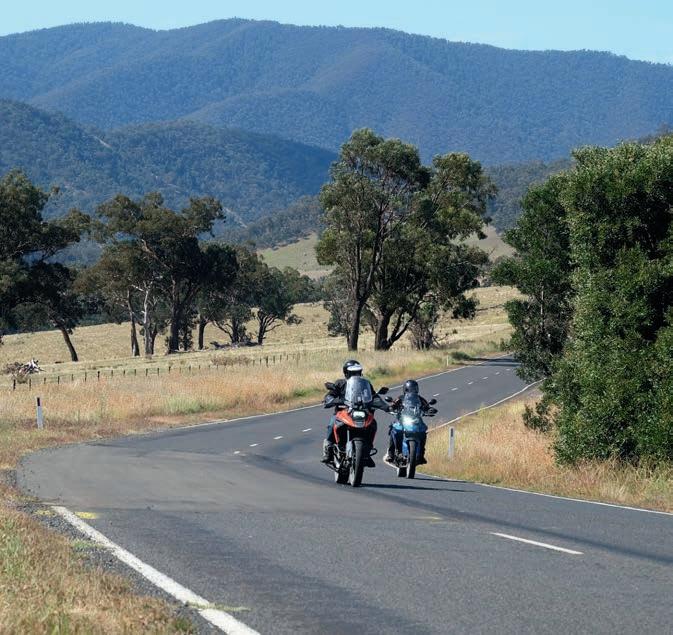
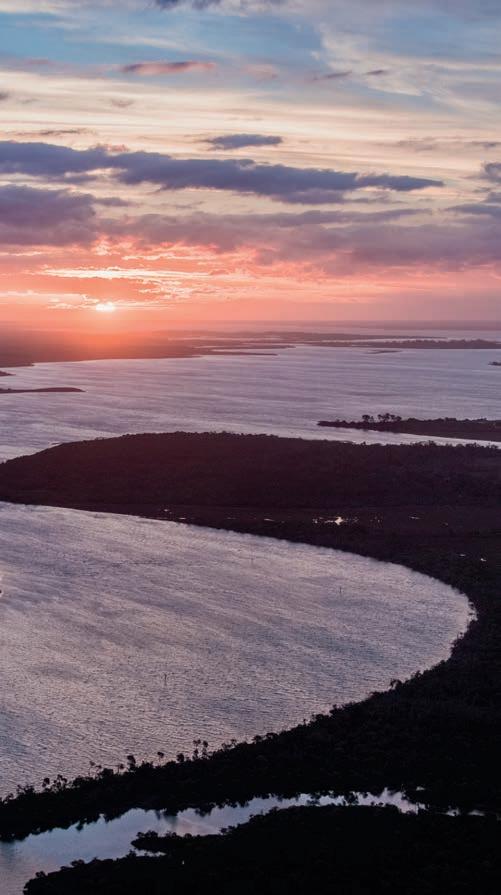
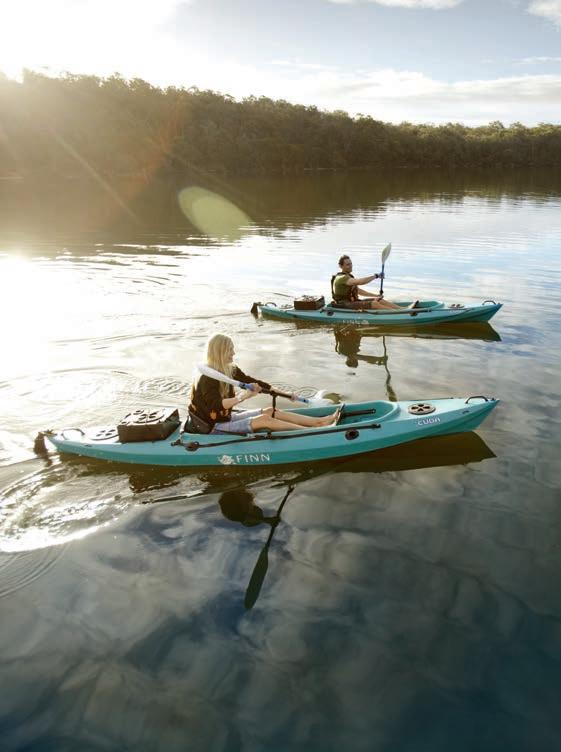
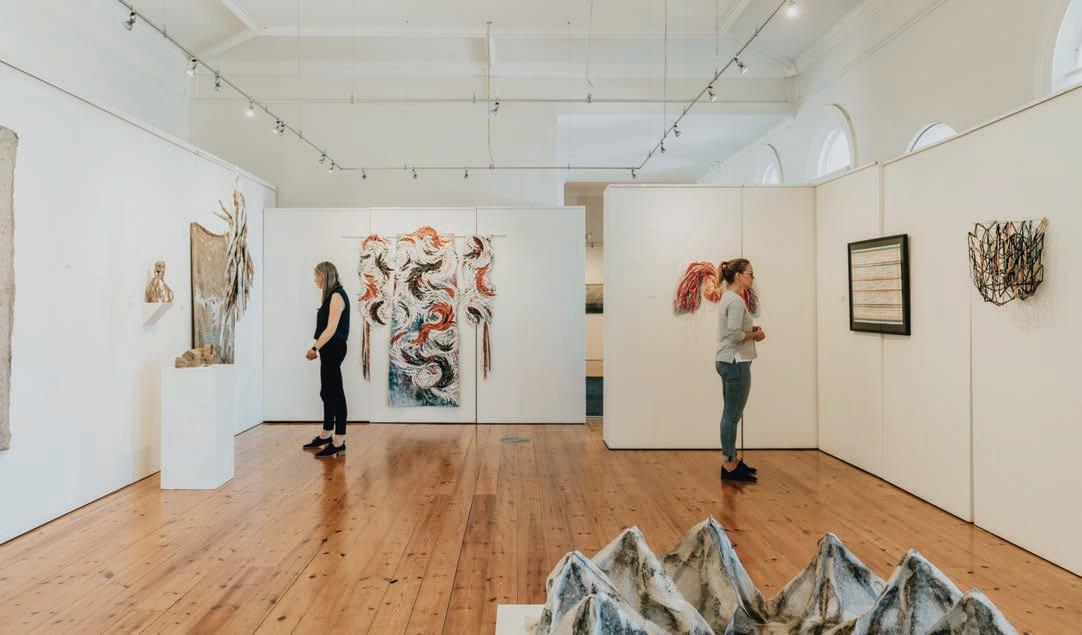
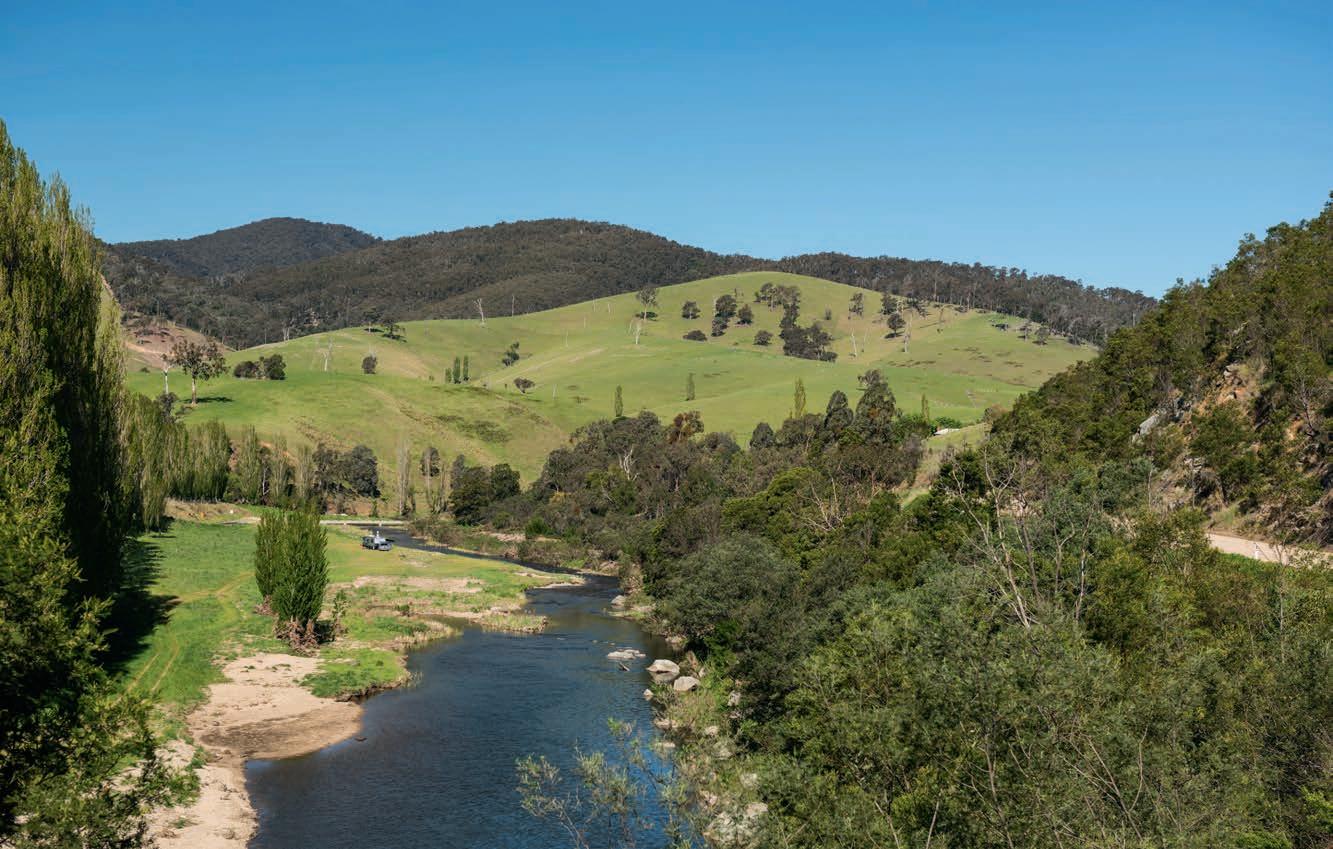
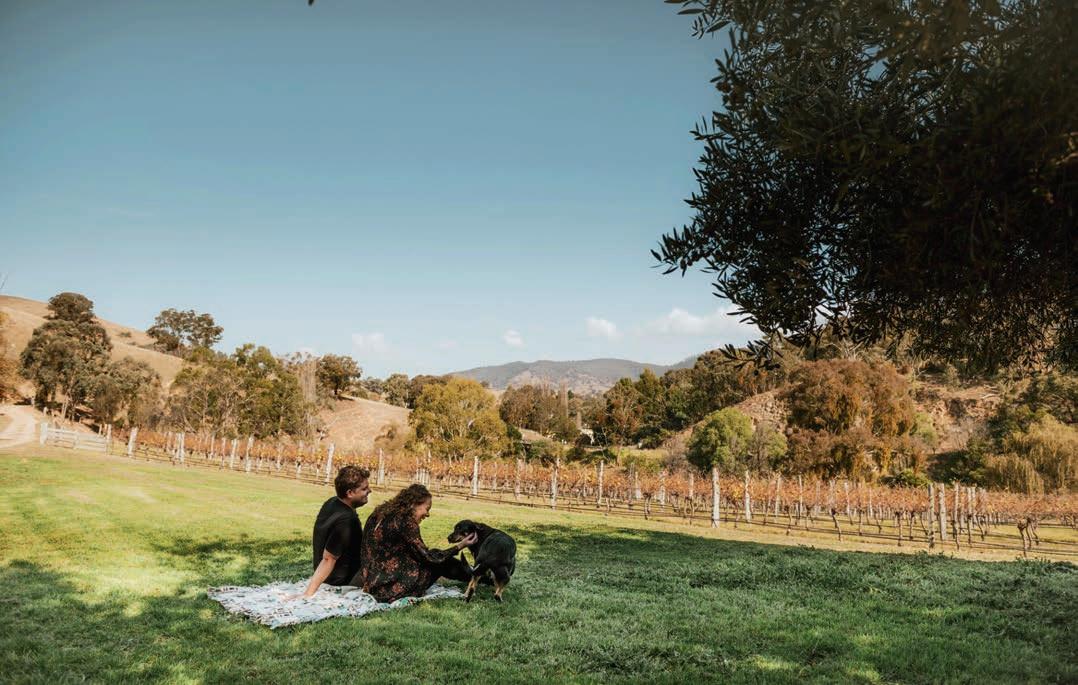
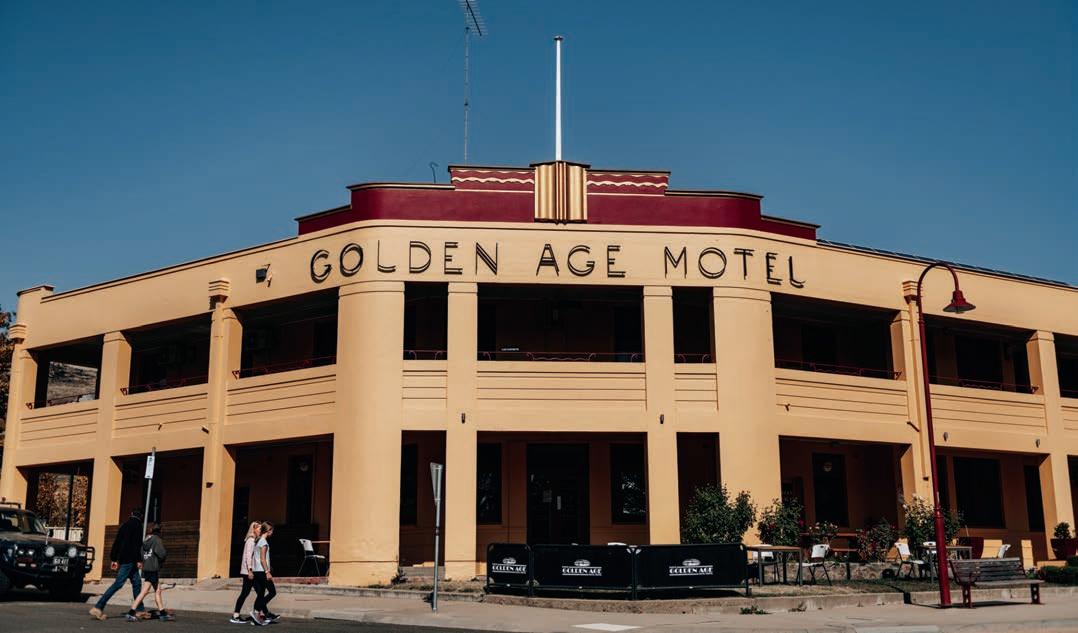
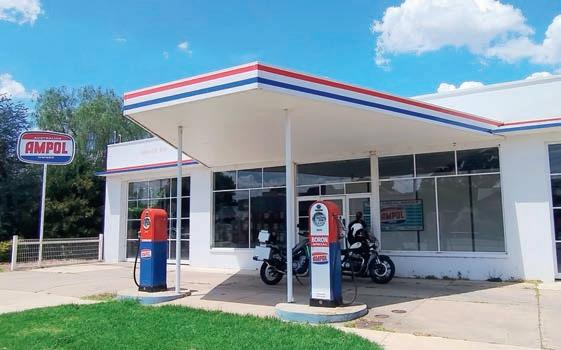
down for Ensay because you don’t want to miss the Ensay Winery. Say gidday to owners David and Jenny Coy who grow and produce every drop of Shiraz, Cabernet Sauvignon, Chardonnay and Pinot Noir right on the property.
Continue on through Swifts Creek and you’ll soon be at the key waypoint of Omeo, a historic cattle and gold town first visited by stockmen in the 1830s. The town grew quickly thanks to the bounty of land, with banks, hotels and emporiums springing up along the main street. By the beginning of the 20th century, the town and the surrounding district could boast more than 10,000 prosperous citizens. As a nod to Omeo’s illustrious past, the aptly named Golden Age Hotel stands proud in the main street. Built in a late Art Deco style in 1940, the current hotel is actually the fifth to stand on the site, all previous structures having been destroyed by fire.
There’s ample fuel and food in Omeo and you might be surprised at the yummy house-made pies and pastries at the High Country Cafe & Takeaway or next door at Pippa’s Bakery. The Crazy Cow tends to be the preferred venue but be assured there is no bad choice. Omeo really is the perfect point to base yourself for a wider exploration of the district. While the official
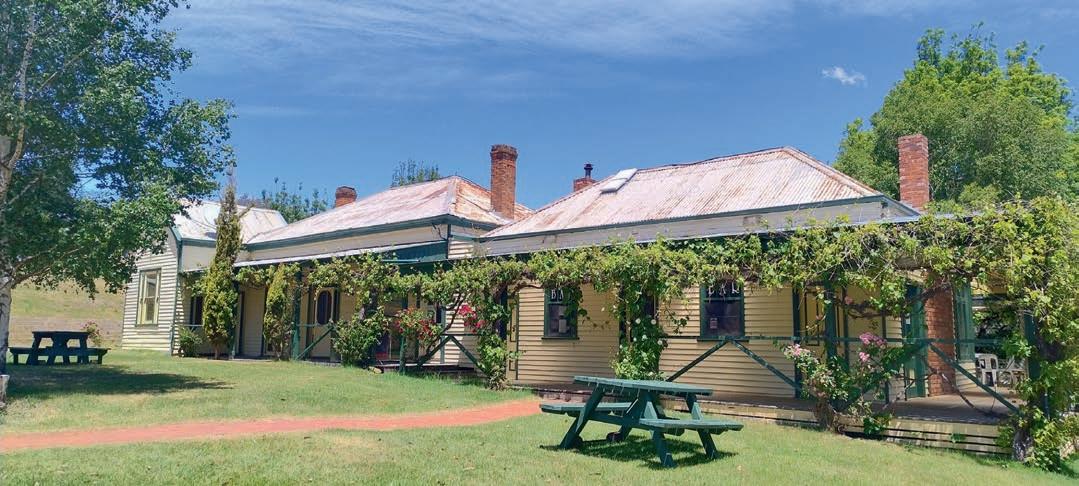
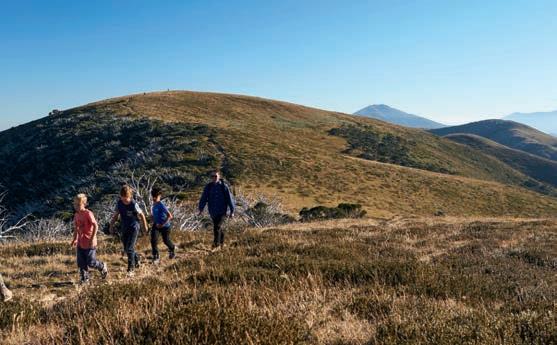
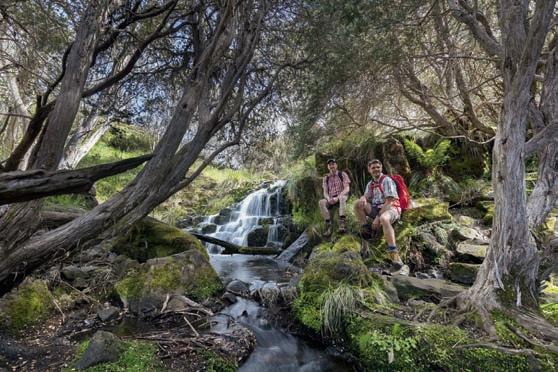
route, the B500, heads southwest out of town to Bright via Mount Hotham and Harrietville, there is an equally satisfying detour, the C531, via Falls Creek and Mount Beauty.
As a further option, the C543 takes you north toward the NSW border through the sleepy hamlet of Benambra, home to the hotel of the same name and run by returning local, Erin Tomkins. And the century-old walls can tell some tall tales. “It started as a sly grog shop and boarding house of sorts, later run by a wily old Irishwoman, Mary ‘Ma’ Murphy catering to the miners and squatters who turned up in the district from the 1830s,” Erin says. “It’s had quite a history since.” Renowned photographer Ken Duncan passed through, shooting a famous scene with a local celebrity, Ken Connley, and his horse at the bar. And regulars still talk about the night Steve Irwin shouted the house. The accommodation is delightfully rustic and the food is definitely worth a stop.
If you’ve decided to continue on the C543, take it easy through the many winding passages. The road is in excellent condition, but don’t let that lead you into complacency, there could be any manner of surprises around the next blind corner. As you arrive on the little bridge across the Cobungra River, you’ll happen upon the delightful Blue Duck Inn. Check ahead for food and accommodation availability. That aside, a beautifully situated campground is an easy underarm-throw away across the river.
Just past Glen Valley at Middle Creek, the Falls Creek turn onto the Bogong High Plains Road (C531) will take you via another network of switchbacks to the famous ski fields. Many of the lodges, cafes and hotels will welcome summer
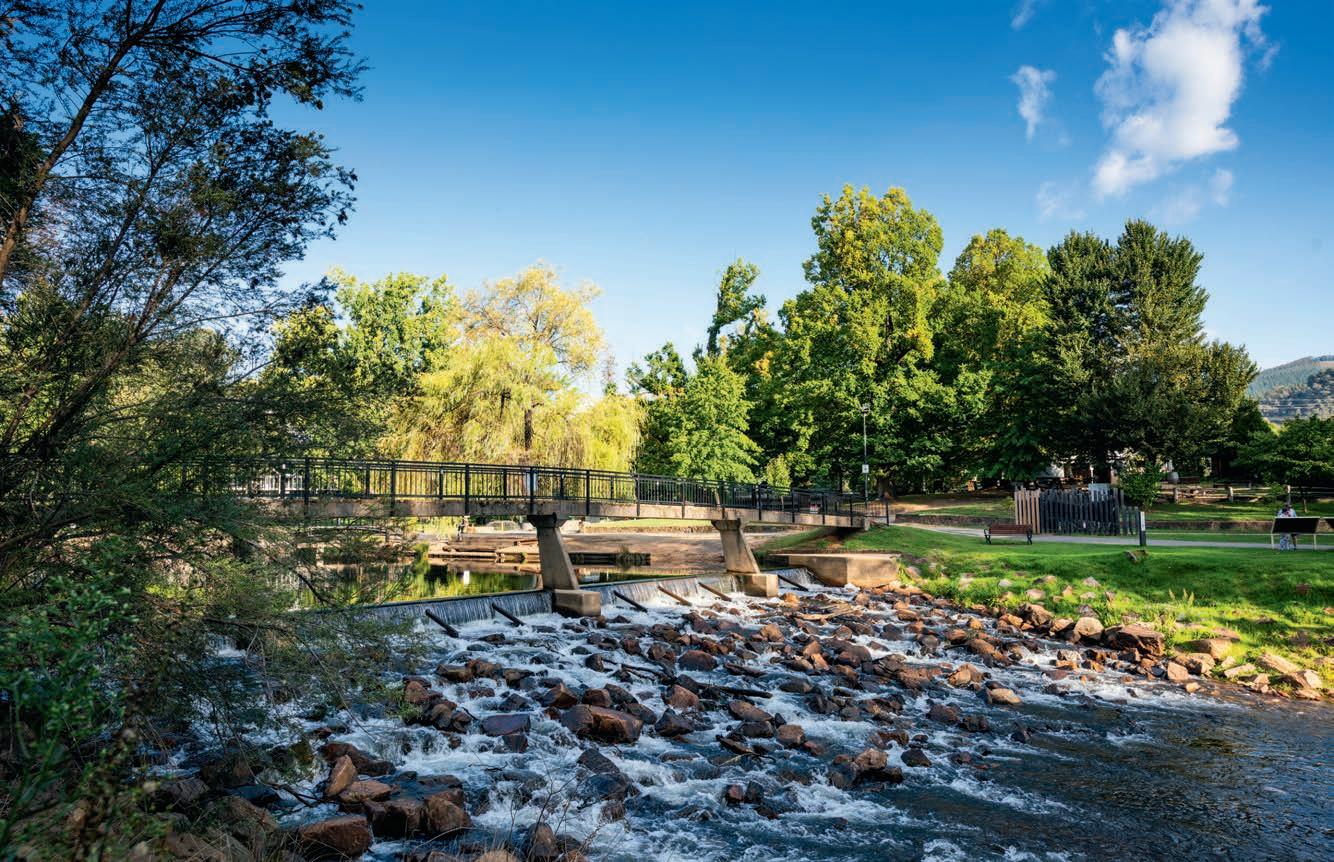
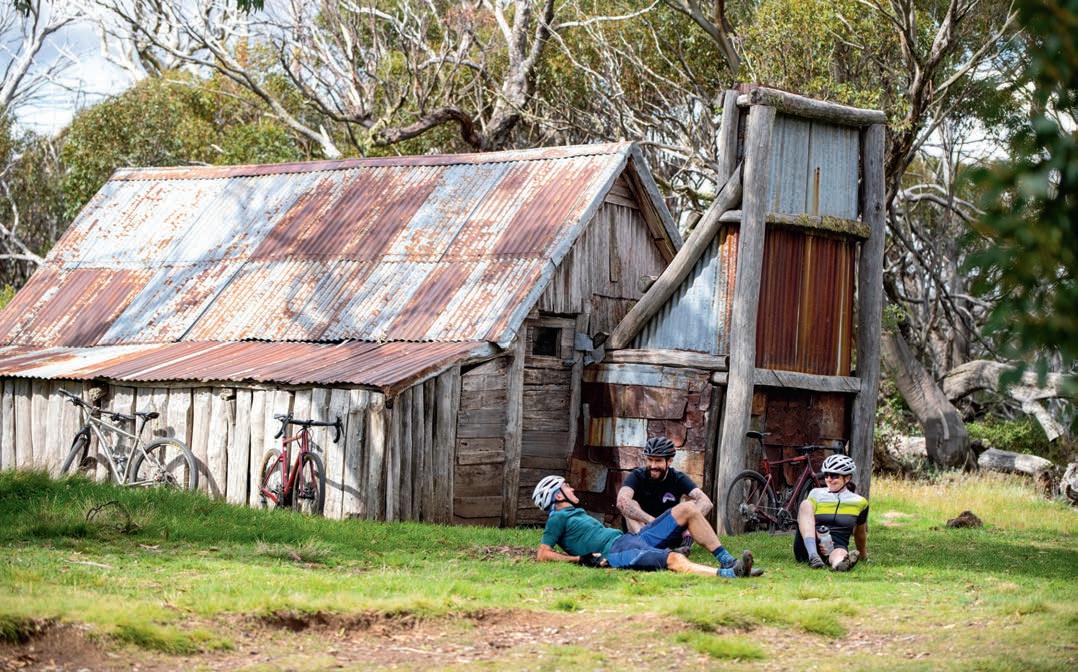
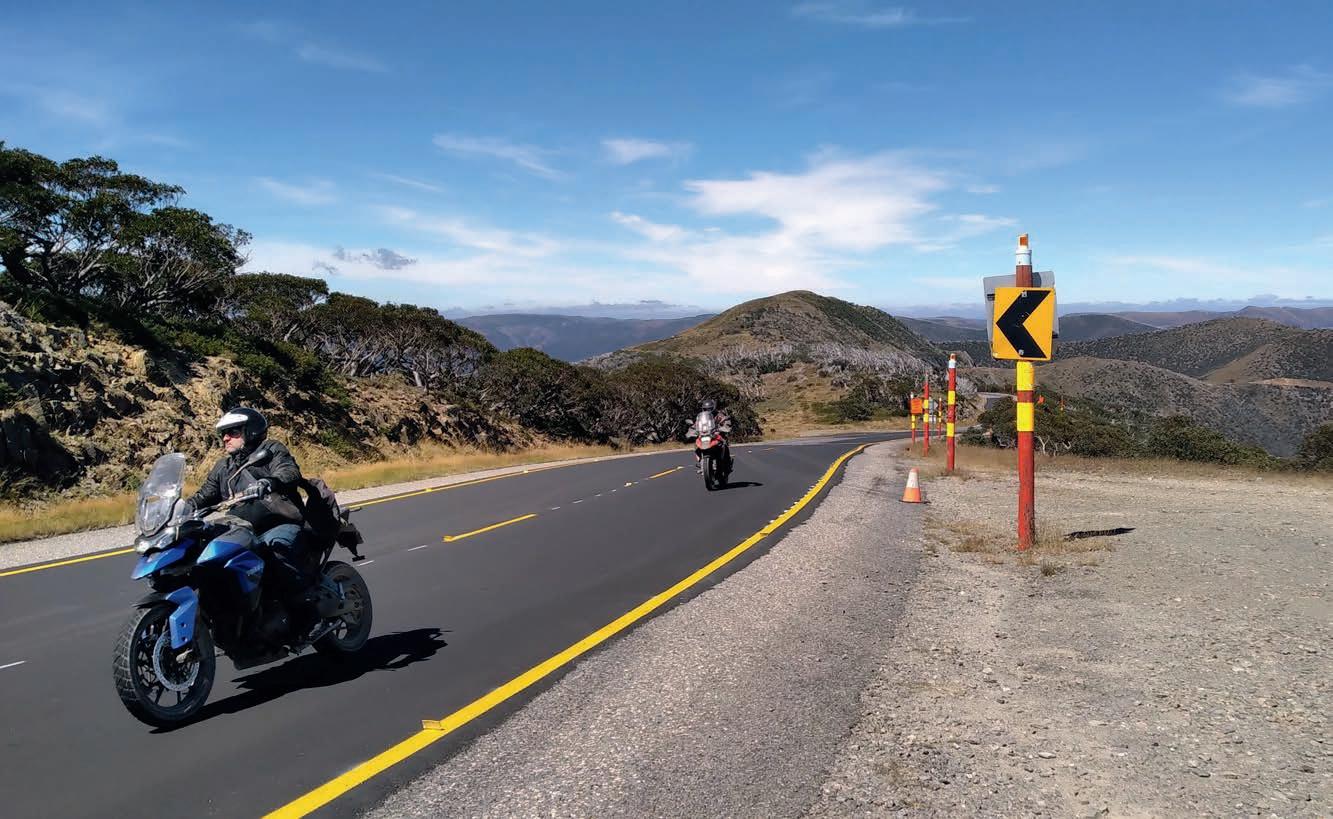
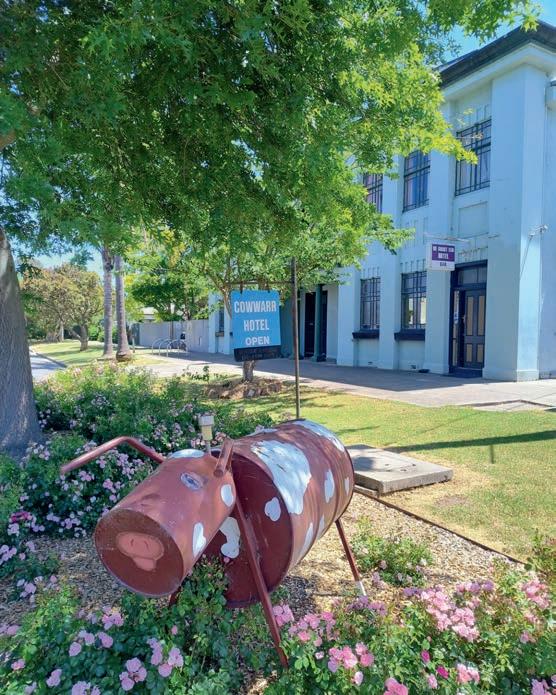
visitors, but check for changes in seasonal opening hours.
Continue through Bogong into the picturesque hamlet of Mount Beauty, a location perfect for a stretch of the legs. The C531 continues to Albury, while you can get to Bright via the Tawonga Gap Road (C536). Stopping at Sullivan’s Lookout for a view of the gorgeous valley is mandatory. At Bright, there is an abundance of quality lodgings and eateries, so it makes sense to set up a base here. Long-time Bright resident and business owner Martyn Paterson was happy to share his tips. “The widely held opinion is that Tigre Vita upstairs in the Alpine Hotel is the current title holder for best restaurant,” he says. “A new restaurant called Basils is another contender. Other good restaurants are Hara House, Elm and Sagunya Thai.”
Quality pub-style meals can be had at the Bright Brewery along with any of their alpine ales or lagers. Friday sunset sessions are a feature of their live music program. Blues and beer sounds like a great combo. In a nod to cyclists’ penchant for the region’s challenging roads, the Bright Velo
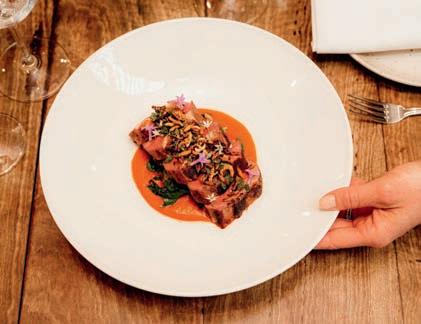
Hotel caters exclusively for two-wheeled, pedalpowered guests with a custom-designed bike storage room with space for 26 bikes. Obviously, road conditions are entirely different mid-year, evidenced by the bright-yellow road markings and vivid-orange snow poles. Unless you’re toting skis and snowboards with chains at the ready, you’ll likely find summer a more pleasant tarmac experience. Swap ski poles for hiking poles and enjoy any of the challenging trails that form a web out of Hotham Heights.
Myrtleford, known for its rich agricultural produce, is another classic High Country town where you can take a break and pay your respects to Sargeant Albert Lowerson VC, whose statue dominates the town square. Numerous eateries line the main street and browsers will love the Red Ramia Trading Store or the Vintage and Salvage Co. The final leg into the major rural centre of Wangaratta is fairly straightforward, although a minor detour onto Snow Road (C522) will take you past the renowned Brown Brothers Winery, where daily tastings and tours take place at 10:30am.
“Wang”, famous for its annual Jazz & Blues Festival in November and numerous historic homes and buildings, is where your upward journey ends at the junction with the Hume Hwy (M31) and now you can rightfully claim your own small part in this historic Australian storyboard.
Art House Townhouses, Bright arthousebright.com.au
Golden Age Hotel (and Motel), Omeo goldenageomeo.com.au
Bellevue on the Lakes, Lakes Entrance bellevuelakes.com.au
Benambra Hotel, Benambra benambrahotel.au
The Blue Duck Inn, Anglers Rest theblueduckinn.com.au
Bright Brewery, Bright brightbrewery.com.au
Tigre Vita, Alpine Hotel Bright alpinehotelbright.com.au
Central Hotel, Lakes Entrance centralhotel.com.au
High Country Cafe, Omeo facebook.com/High Country Cafe
Blue Bee Cafe, Bruthen facebook.com/bluebeecafe
Café Fez, Red Ramia Trading, Myrtleford redramia.com.au
Ensay Winery, Ensay ensaywinery.com.au
Omeo Historical Society Museum, Omeo omeo.org.au
East Gippsland Art Gallery, Bairnsdale eastgippslandartgallery. org.au
Nyerimilang Heritage Park, Nungurner nyerimilang.com.au
Brown Brothers Winery, Milawa brownbrothers.com.au
More information: visiteastgippsland.com.au
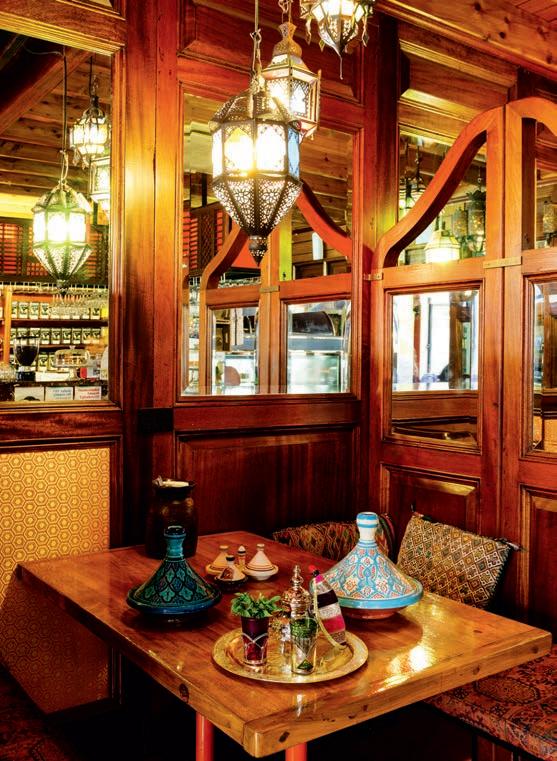
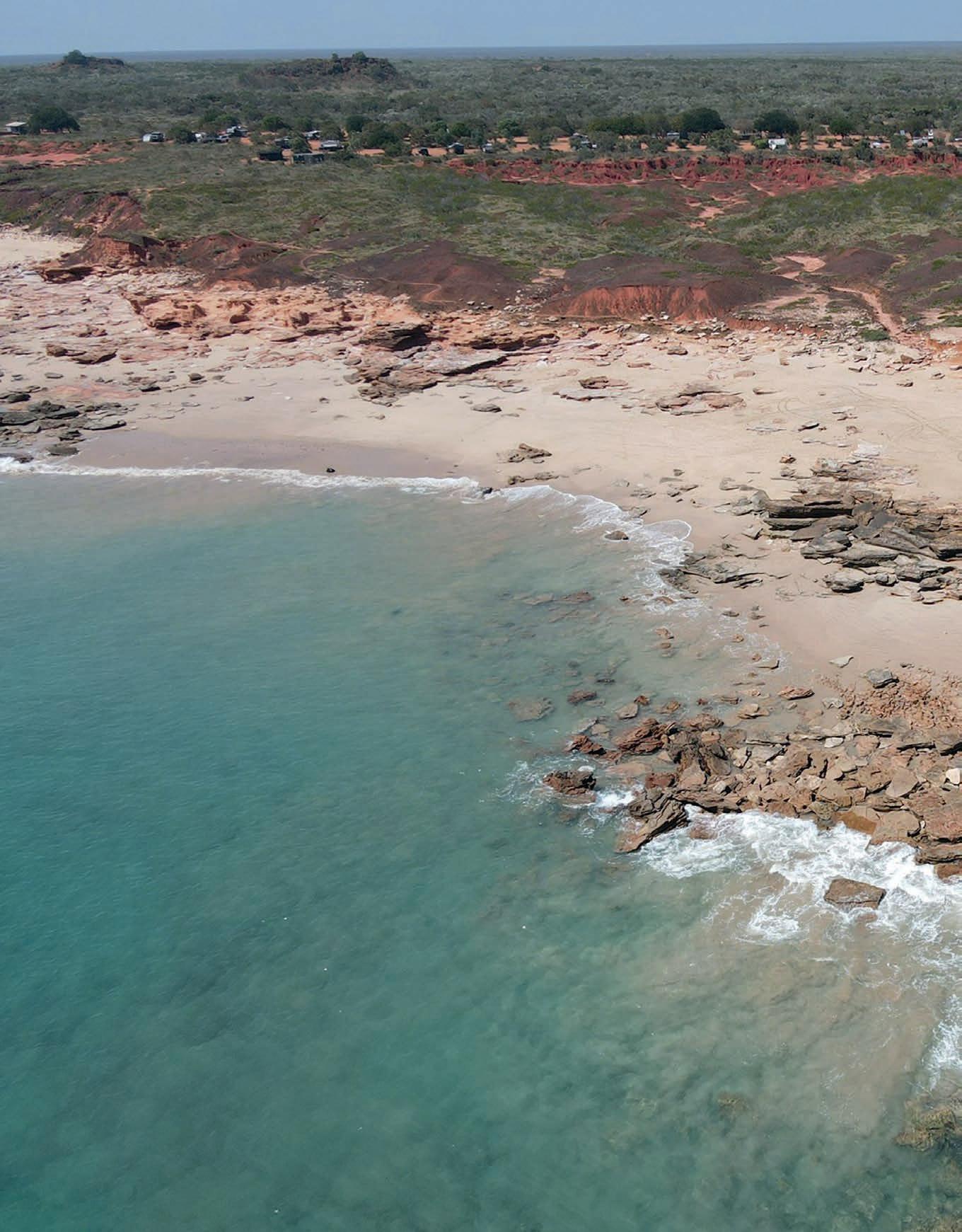
Annabelle and Paul Riley have pressed pause on the workaday world to travel Australia with their daughter, Georgie, and cattle dog, Ellie.
LAP AROUND AUSTRALIA | 3 MONTHS–1 YEAR
BY KIRSTY MCKENZIE, PHOTOGRAPHY PAUL AND ANNABELLE RILEY
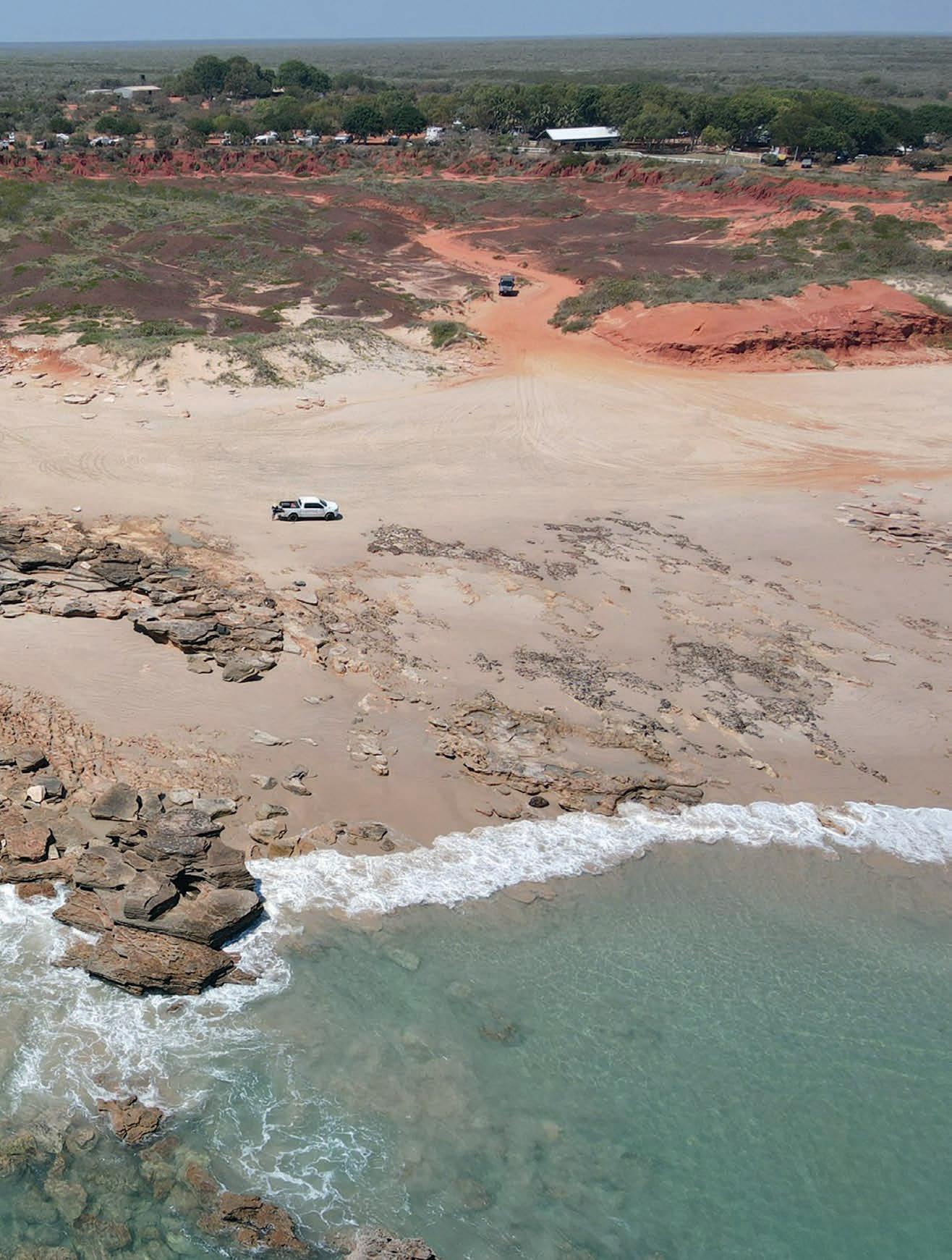
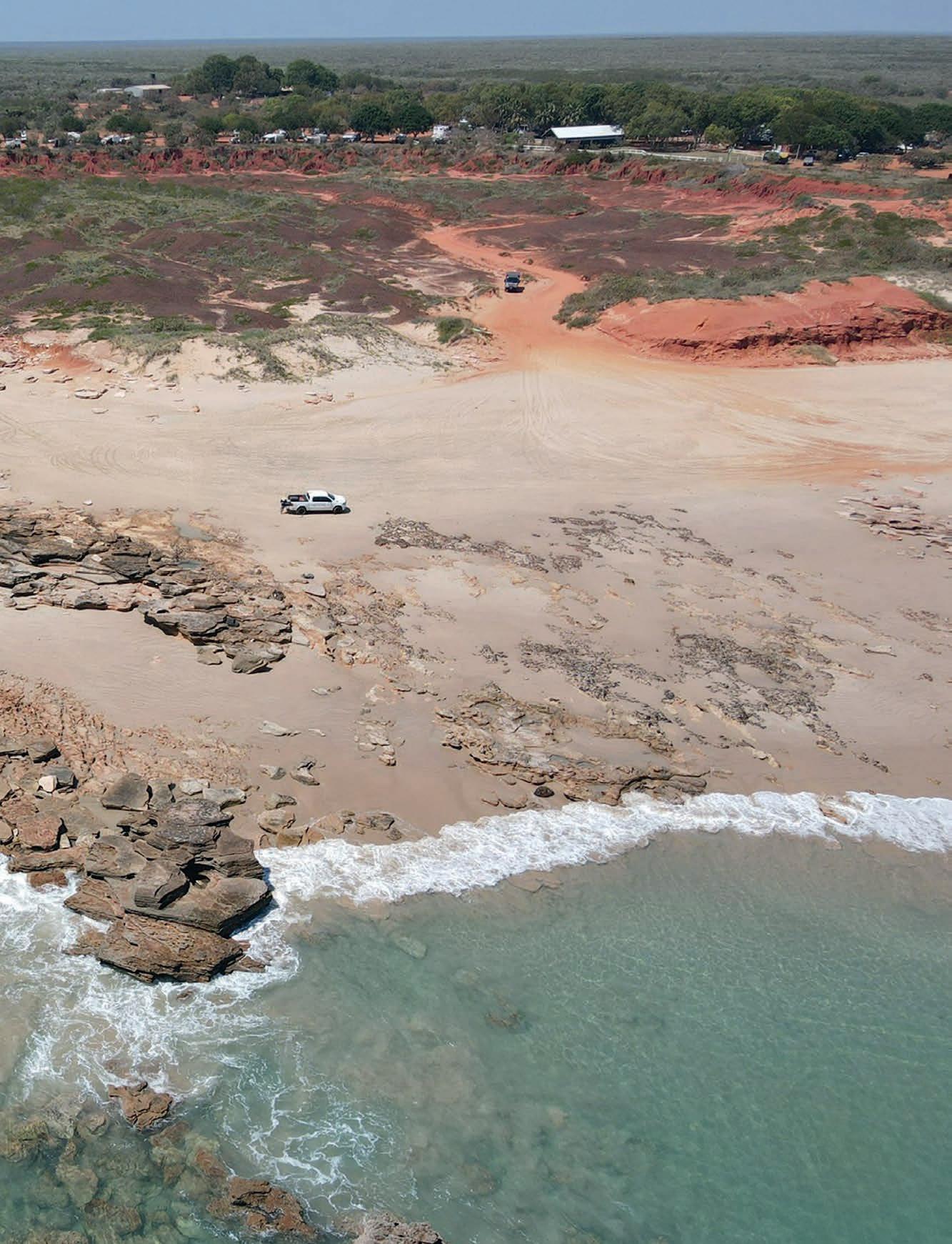
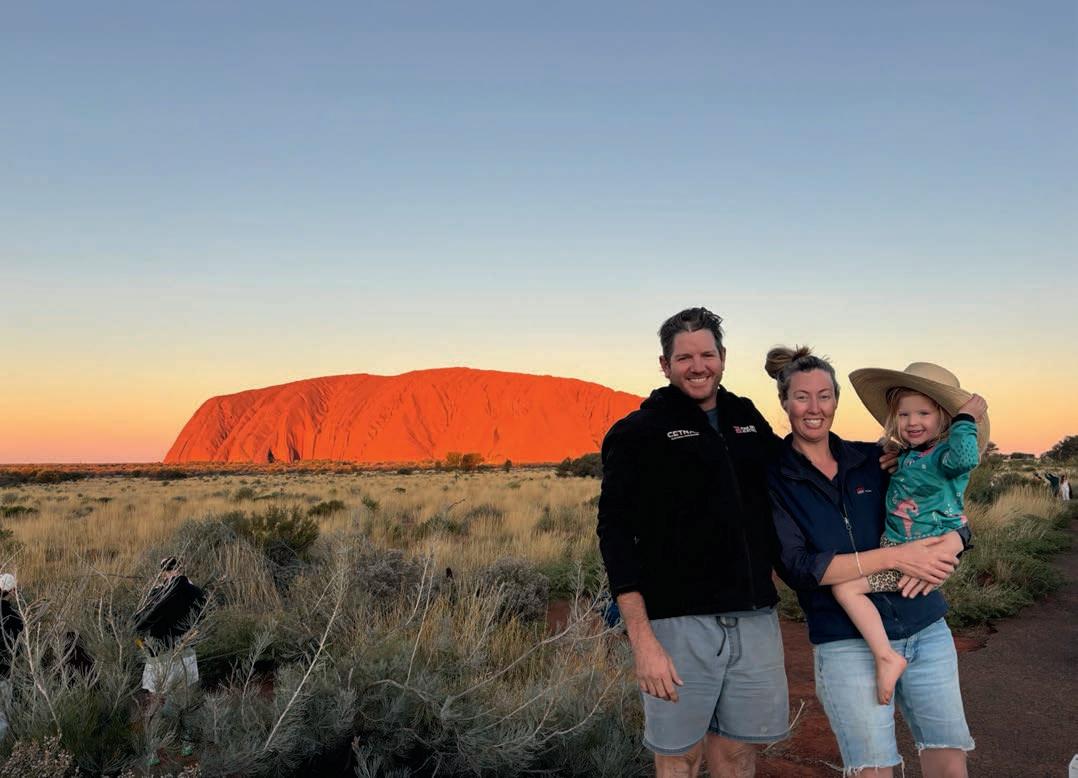
It’s barely midday in the Western Australian Coral Coast town of Kalbarri, but Annabelle and Paul Riley are ready for a nap. They’ve been up since 4.30am and on the water since daybreak, cruising on a lobster pot pull tour along the cliff-lined coast. They’ve been out with a licenced fisherman, checking pots, pulling in dozens of rock lobsters, throwing many back to the ocean and feasting on the catch of the day. Plus, they brought four more rock lobsters back to the 21-foot Wonderland Hornet van they’ve called home for more than a year. So that’s dinner sorted for the next couple of nights.
The Rileys are living the dream with their three-year-old daughter, Georgie, and 13-year-old cattle dog, Ellie. They’ve joined a growing band of young Australian families who are enjoying an extended sabbatical from the workaday world and are travelling around the country, either doing the “big lap” or spending extended periods in places they’ve always dreamt of visiting. Annabelle and Paul hail from the NSW Central West. Paul, who grew up at Condobolin, is an electrician and Annabelle, who also grew up in the region on a farm at Eugowra, is a nurse administrator. They
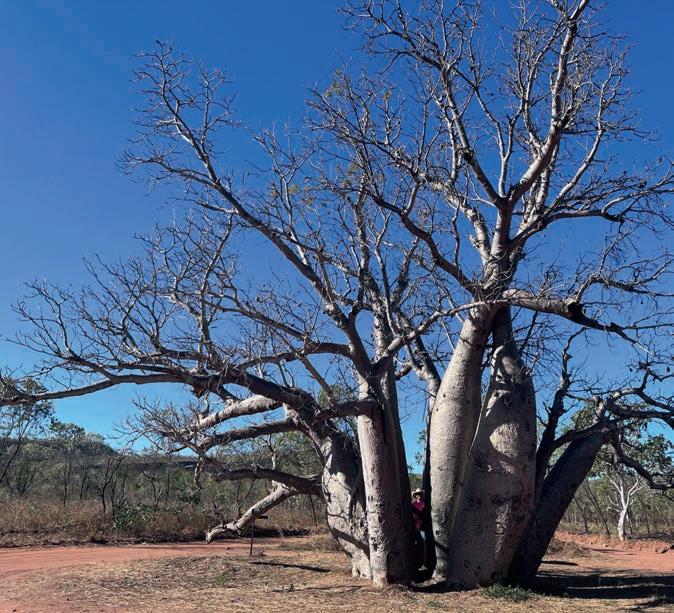
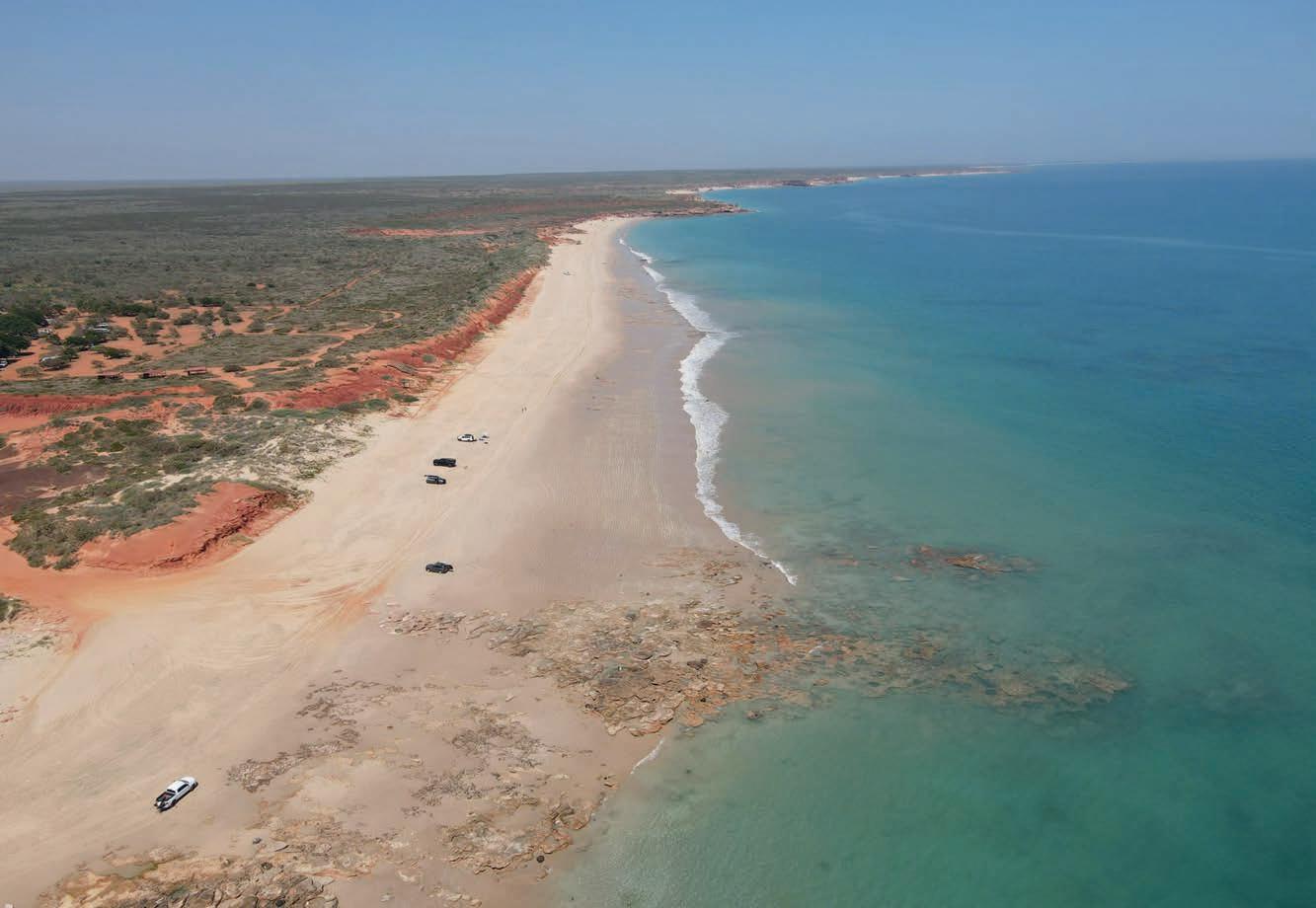

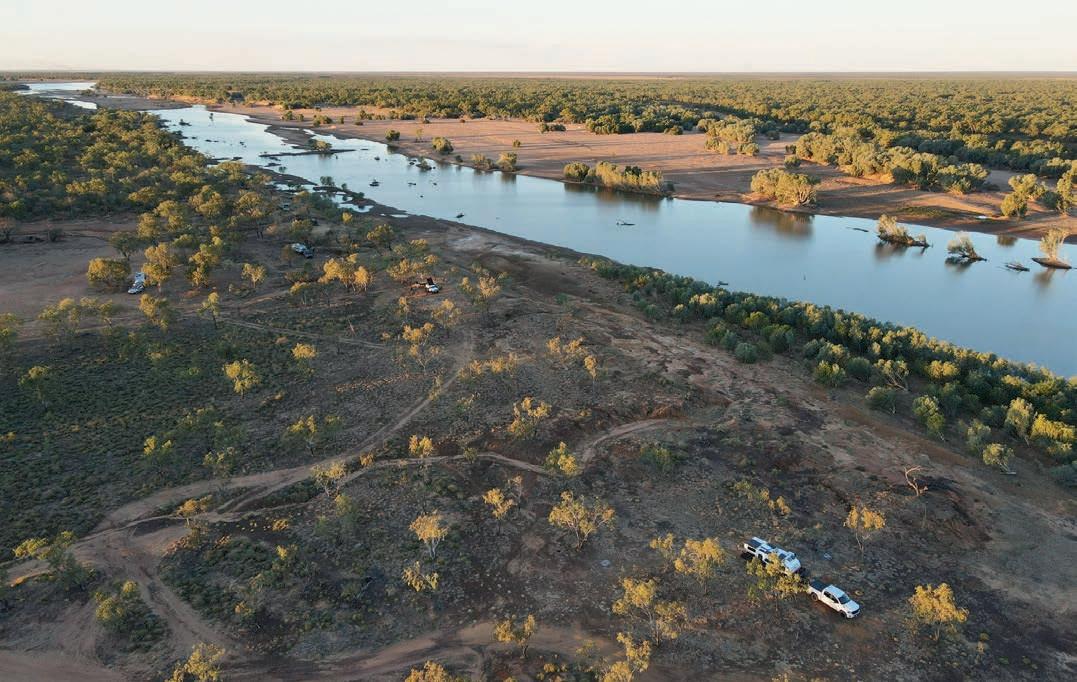
originally lived in Condobolin where they restored a century-old cottage, then moved to Noosa on Queensland’s Sunshine Coast and restored another home.
“We’d initially intended just to do it up and flip it,” Annabelle says. “But we kind of fell in love with it and got married in the yard. It wasn’t until Georgie was born in 2022 that we realised we actually wanted to be closer to our family — somewhere we could easily visit from for a weekend. We sold the house and decided to hit the road and hopefully find somewhere where we’d really like to put down roots.”
Although that will inevitably be in NSW, the Rileys decided to take the long road home with a 4WD and an off-road van to travel for as long as they can afford, and desire, or until Georgie starts school at the beginning of 2028. They eased into van life, visiting friends at Byron Bay for an extended holiday and then catching up with family and more friends as they parked up on a friend’s farm near Forbes for another month. Then they headed west along the Murray River to Mildura and to the Clare Valley before tracking north to Uluru, Kings Canyon, Alice
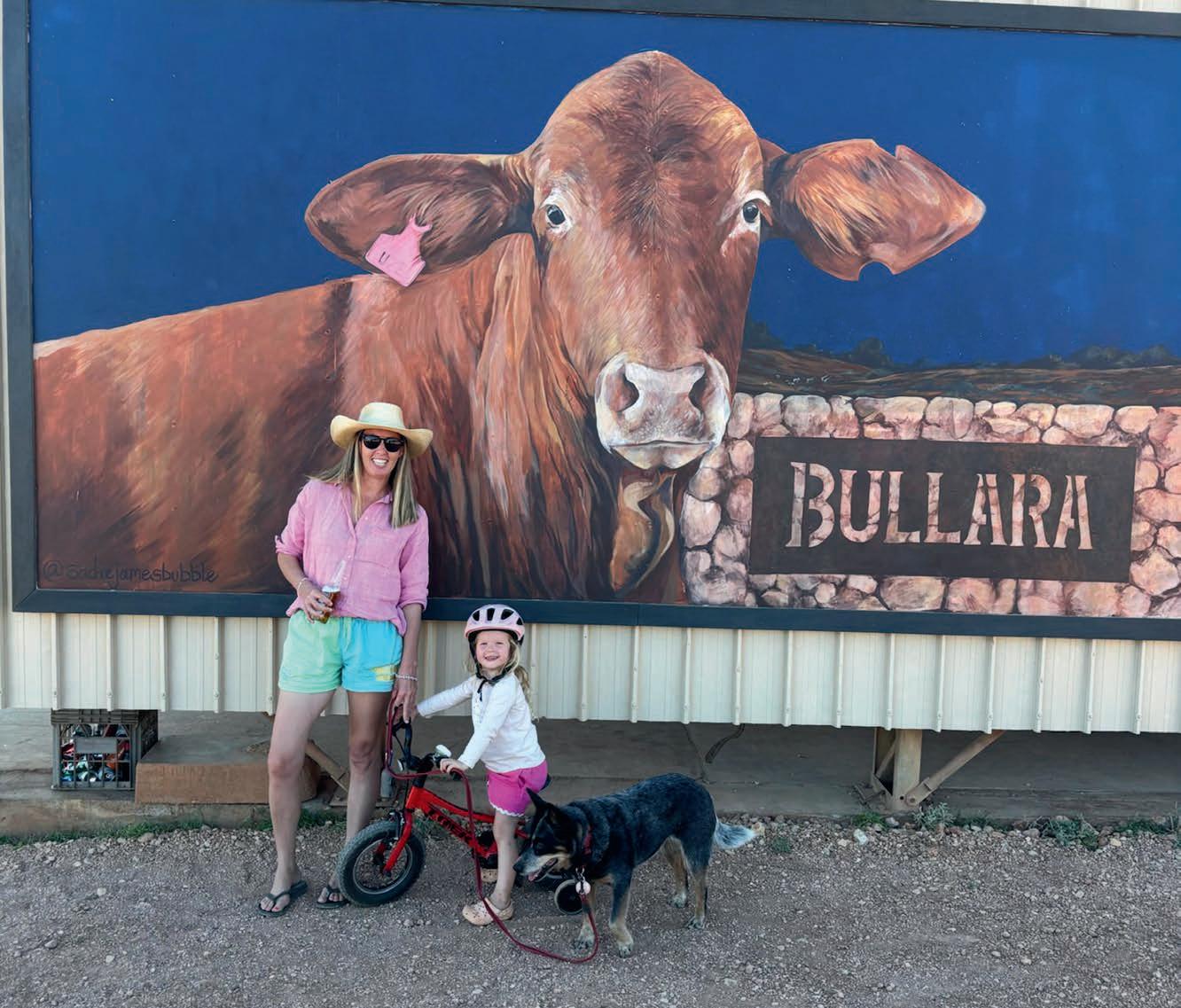
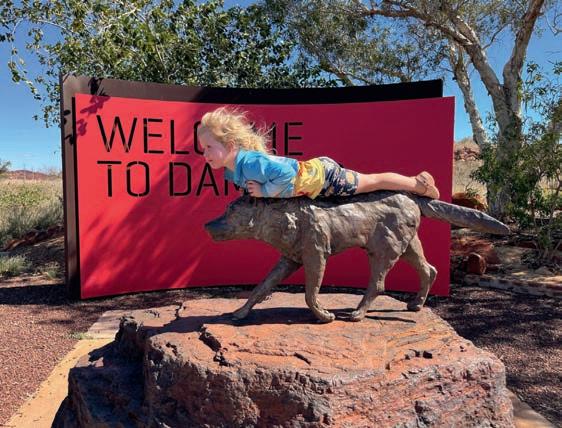
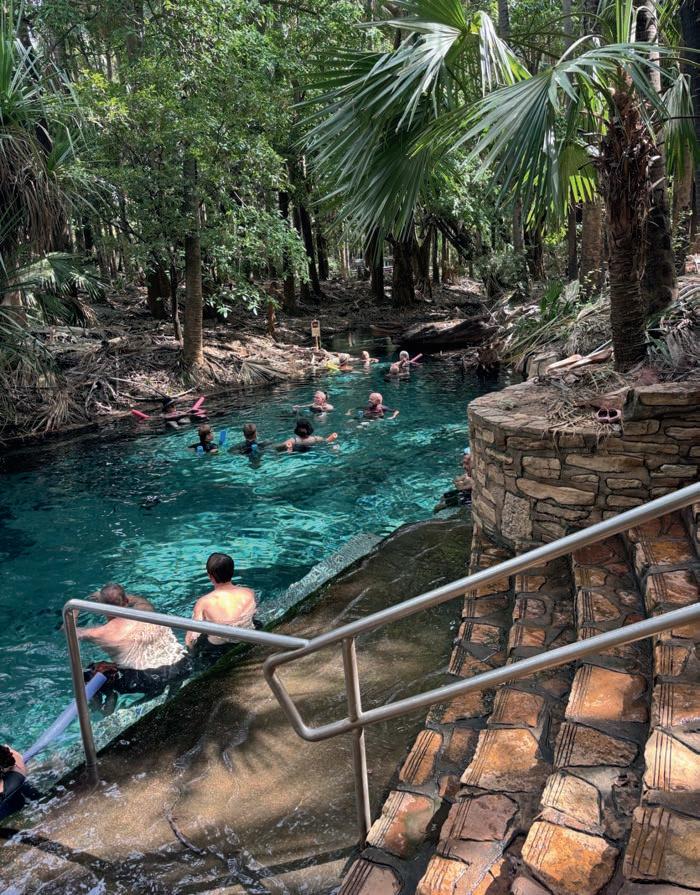
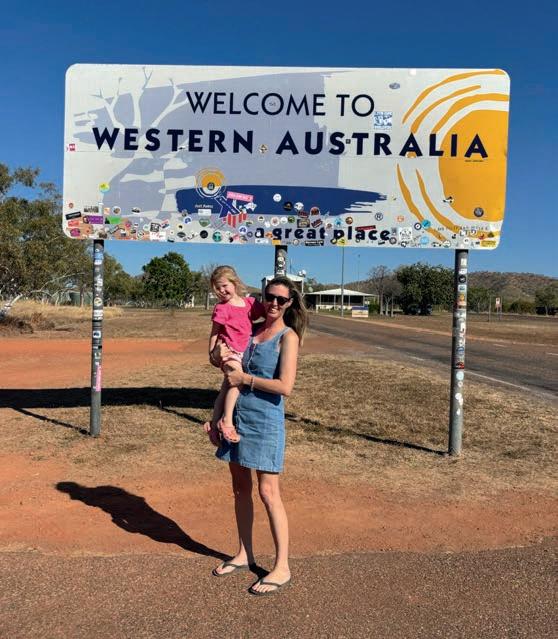
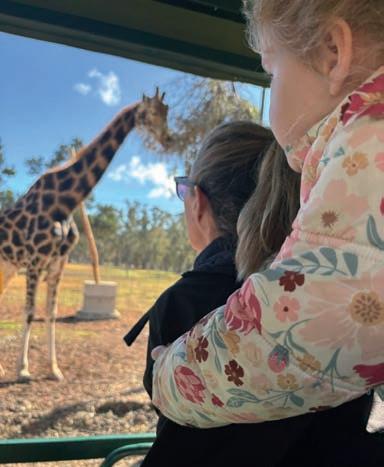
Springs and Katherine. Next extended stop was in Darwin, where Annabelle’s brother is based with his job in the ADF, before heading across to the Kimberley, down the WA coast to Exmouth, Ningaloo and now Kalbarri. When Australian Country caught up with them at the end of 2025, they planned to continue down the coast to Perth, then “duck” home across the Nullarbor for Christmas before heading back through Victoria and South Australia to explore the south-west of WA during 2026.
“It’s just amazing to wake up each morning and realise you’re not on the hamster wheel and don’t have to face the daily grind of work,” Annabelle says. “When you take a career intermission, it’s an opportunity to work out what you really want to do, which, at this stage, is make our investment money work for us, rather than us work for money. That’s assuming interest rates work in our favour and, of course, we don’t look like missing the boat on the property market.”
Unlike many travellers, the Rileys don’t stick to the rule of threes — no more than 300km or three hours driving in a day, always stay for three nights and arrive at your next destination by 3pm. “Apart from school holidays, we don’t book ahead,” Annabelle says. “That means if we like a place, we can stay longer and if we don’t, we can move on.”
She cautions that life on the road is not as cheap as some might imagine. Fuel is expensive — in remote parts, it can cost $450 to fill up their RAM. Campsites vary in price, anywhere from $20 to $50-plus a night. The Rileys balance this out by free-camping when they can and count some beach campsites, albeit with a weather eye out for crocs, as some of their favourite spots.
“Our van is well set up with solar panels and, provided the sun is shining, we can exist very
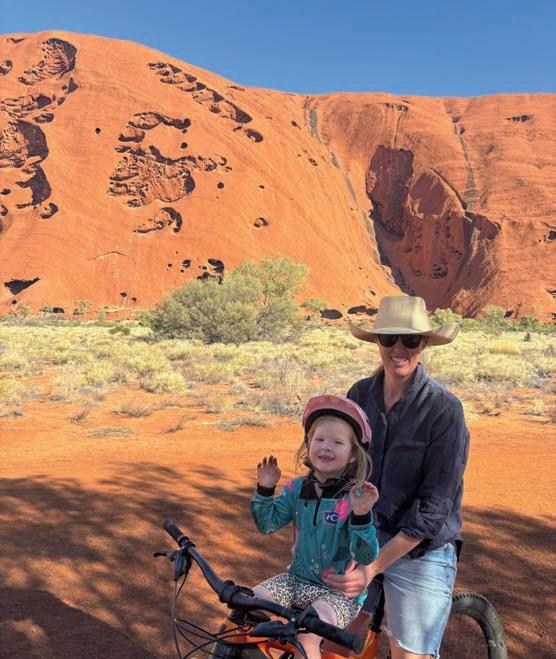
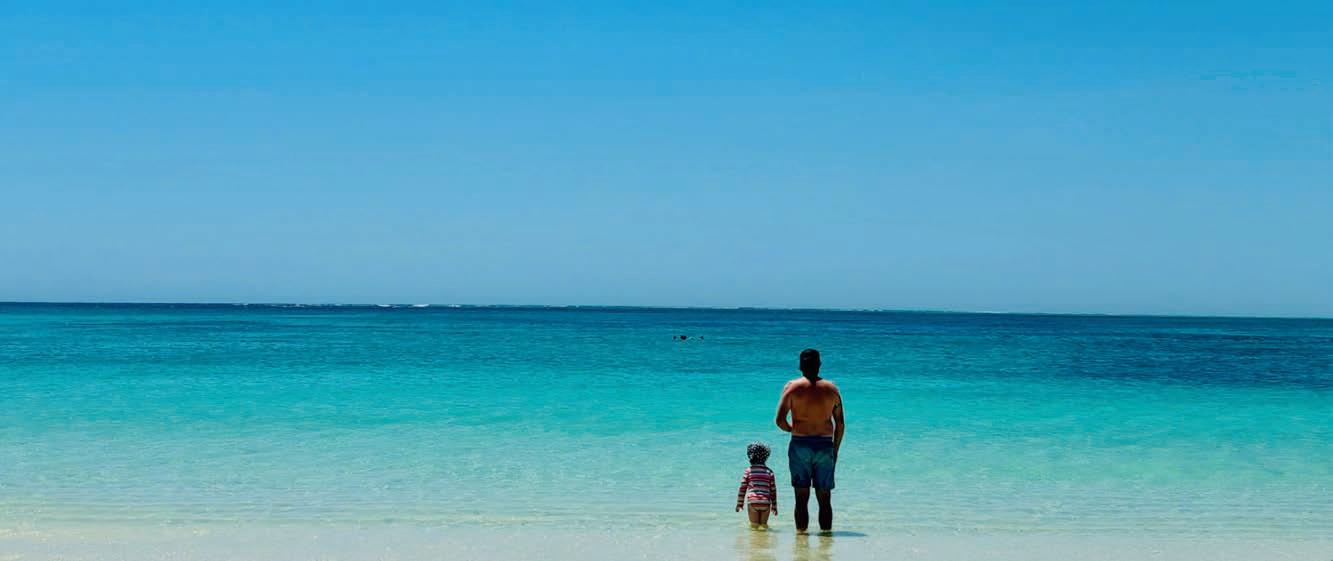
THESE PAGES:
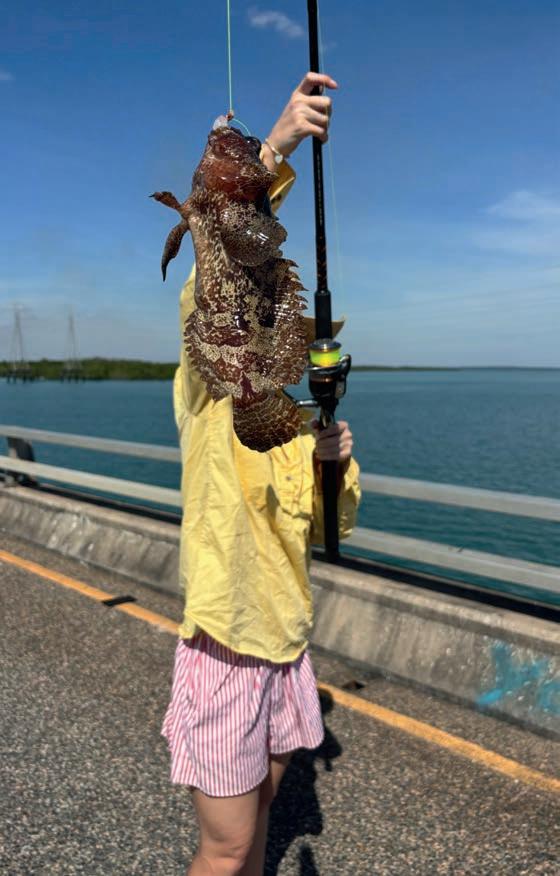
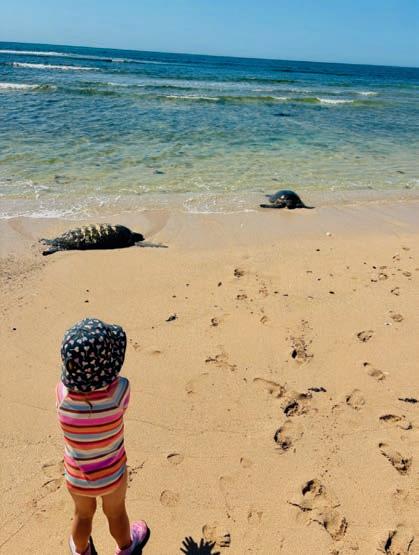
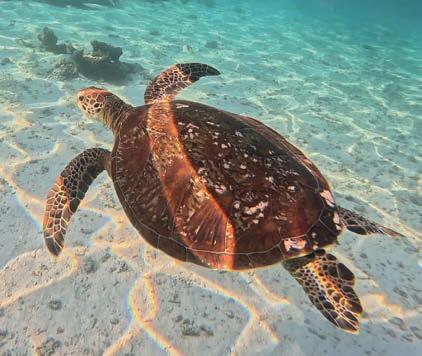
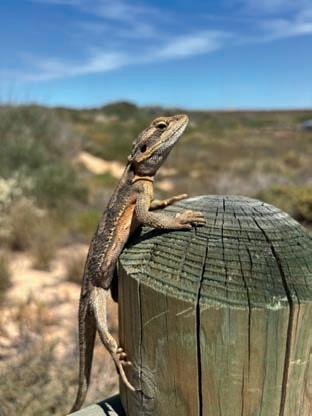
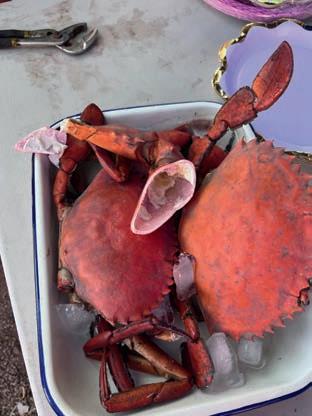

comfortably off-grid,” Annabelle says. “We’ve been grateful we have air conditioning and a diesel heater for when it gets cool. Starlink is also a game changer as it means we can keep in touch with everyone. We have an induction cooktop, an air fryer and a barbecue and, thanks to Paul’s cooking, we eat very well. We’re not big on eating out, but we do enjoy sourcing local produce. Some of the station stays sell their own beef. Pardoo station sold incredible Wagyu and Bullara station’s meat was pretty good too.”
Along with unforgettable scenic natural wonders, Annabelle lists spending concentrated time with Georgie and being able to watch her grow in confidence and sociability with all the new encounters as some of the many positives. Forging new friendships is another. “We’ve met some amazing people on the road,” she says. “If we’re heading in the same direction, we keep running into each other. I’m sure some will become lifelong friends. We keep in touch with each other’s travels via an app called Polarsteps.”
Annabelle is hard pressed to think of negatives with their adventure. “I miss having a dishwasher,” she admits, when pressed. “And access to a regular hairdresser. Because we’ve downsized, we seem to go through clothes more frequently. That’s when Vinnies becomes your best friend. But then I’ve always loved a thrift shop and I can’t help having a look around for things for when I do have a house again.”
Although they’re not sure when that will be, the Rileys say they plan to include Tasmania in their travels and have a “good look around regional NSW” before they set up camp for good. “We’ve got another trip to Darwin for a family event midnext year and in April we’re going to Texas in the US for the wedding of my exchange family’s host brother. For people who have nothing to do, it seems like we have quite a bit going on.”
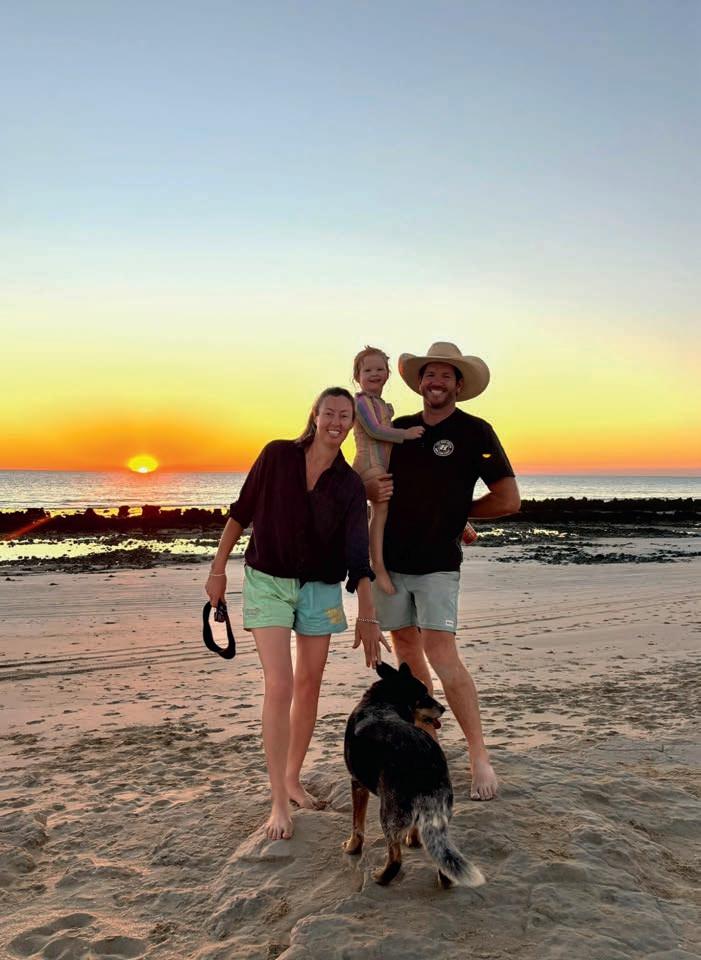
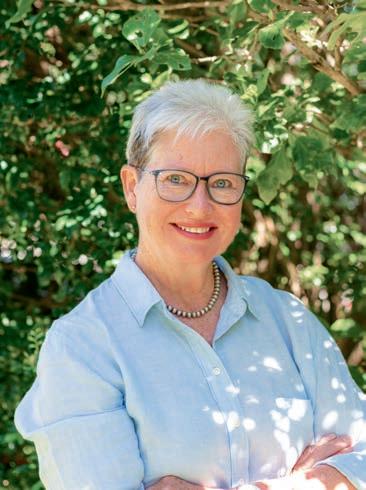
Welcome to the latest volume in our annual Road Trips series. The stories in this issue have all been taken from the amazing travels we undertake on the road for Australian Country magazine. We pride ourselves at the magazine — and in this publication — on covering the whole of Australia, not just the metropolitan fringes, and we hope you enjoy getting off the beaten track as much as we do. Some trips take a day or two, others require a couple of weeks, and for those of you contemplating the “big lap”, you’ll need a minimum of a couple of months. See the story beginning on page 152 to read how Annabelle and Paul Toohey are handling the challenge of towing an off-road van around the country with their young daughter and cattle dog.
Every trip introduces us to amazing parts of this country, but one of my all-time favourites would have to be a recent trip to the Northern Territory, when we were lucky enough to visit the Top End, Darwin in festival mode and drive the Central Arnhem Road from Katherine to Nhulunbuy. A big shout out to Tourism NT for their help with this trip. And to other state and tourism bodies that provide support throughout the year.
I’d like to offer thanks to everyone who helped with this issue, the extraordinary characters we met along the way and particularly my partner in life and on the road, photographer Ken Brass, whose work so beautifully enhances so much of this book and every issue of Australian Country magazine.
Thanks also to you, our readers, because without you, we might as well stay at home. I truly hope I run into you somewhere down the track.
Kirsty McKenzie, editor
Editor Kirsty McKenzie
kmckenzie@umco.com.au
Copy Editor Anastasia Casey
Designer Sarah Bryant
Contribitors
Anabel Dean, Roderick Eime, Kirsty McKenzie
Photographers
Ken Brass, Annabelle & Paul Riley, Hayden Wright
Advertising
Elena Ballantyne
Mobile 0450 195 373
Email eballantyne@umco.com.au
Rob Jordan
Email rjordan@umco.com.au
Mobile 0411 424 196
Advertising Production Co-ordinator
Jacqueline Bardin
Chairman/CEO Prema Perera
Publisher Janice Williams
Chief Financial Officer Vicky Mahadeva
Associate Publisher Emma Perera
Circulation Business Development Manager
Mark McTaggart
Australian Country Road Trips is published by Universal Magazines, Unit 5, 6-8 Byfield Street, North Ryde NSW 2113. Phone: (02) 9805 0399, Fax: (02) 9805 0714. Melbourne office, Suite 4, Level 1, 150 Albert Road, South Melbourne Vic 3205. Phone (03) 9694 6444 Fax: (03) 9699 7890. Printed in Singapore by Times Printers, timesprinters.com. Distributed by Gordon and Gotch, Australia. Singapore — Car Kit Pte Ph 65 6 282 1960 magazines1source.com NZ Distributors: Needlecraft: (06) 356 4793, fax: (06) 355 4594, needlecraft. co.nz. Gordon and Gotch New Zealand, (09) 979 3018. This book is copyright. Apart from any fair dealing for the purpose of private study, research, criticism or review as permitted under the Copyright Act, no part may be reproduced by any process without written permission. Enquiries should be addressed to the publishers. The publisher believes all the information supplied in this book to be correct at the time of printing. They are not, however, in a position to make a guarantee to this effect and accept no liability in the event of any information proving inaccurate. Prices, addresses and phone numbers were, after investigation and to the best of our knowledge and belief, up to date at the time of printing, but the shifting sands of time may change them in some cases. It is not possible for the publishers to ensure that advertisements which appear in this publication comply with the Competition and Consumer Act 2010 (Cth) and the Australian Consumer Law. The responsibility must therefore be on the person, company or advertising agency submitting the advertisements for publication. While every endeavour has been made to ensure complete accuracy, the publishers cannot be held responsible for any errors or omissions.
* Recommended retail price
ISBN 978-1-922510-56-3
Copyright © Universal Magazines MMXXVI
ACN 003 026 944
umco.com.au
This magazine is printed on paper produced in a mill that meets Environmental Management System ISO 9001. Please pass on or recycle this magazine.