A ROOF OVER THEIR HEADS What Listening to Clients Revealed About the Impact of Housing Finance on Children Making up half the population of many low-income countries, children and youth are uniquely important to consider in investments to address the challenges faced by people in poverty — including housing finance. But investors who want to make these potentially innovative and life-changing investments are constrained by a lack of data.
A CHILD LENS: KEY INSIGHTS
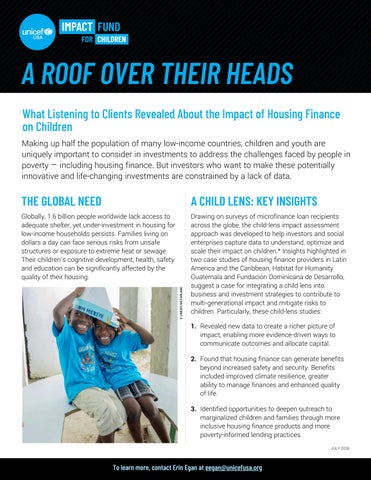
Globally, 1.6 billion people worldwide lack access to adequate shelter, yet under-investment in housing for low-income households persists. Families living on dollars a day can face serious risks from unsafe structures or exposure to extreme heat or sewage. Their children’s cognitive development, health, safety and education can be significantly affected by the quality of their housing.
Drawing on surveys of microfinance loan recipients across the globe, the child-lens impact assessment approach was developed to help investors and social enterprises capture data to understand, optimize and scale their impact on children.* Insights highlighted in two case studies of housing finance providers in Latin America and the Caribbean, Habitat for Humanity Guatemala and Fundación Dominicana de Desarrollo, suggest a case for integrating a child lens into business and investment strategies to contribute to multi-generational impact and mitigate risks to children. Particularly, these child-lens studies:
© UNICEF/MCFARLANE
THE GLOBAL NEED
1. Revealed new data to create a richer picture of impact, enabling more evidence-driven ways to communicate outcomes and allocate capital. 2. Found that housing finance can generate benefits beyond increased safety and security. Benefits included improved climate resilience, greater ability to manage finances and enhanced quality of life. 3. Identified opportunities to deepen outreach to marginalized children and families through more inclusive housing finance products and more poverty-informed lending practices. JULY 2026
To learn more, contact Erin Egan at eegan@unicefusa.org