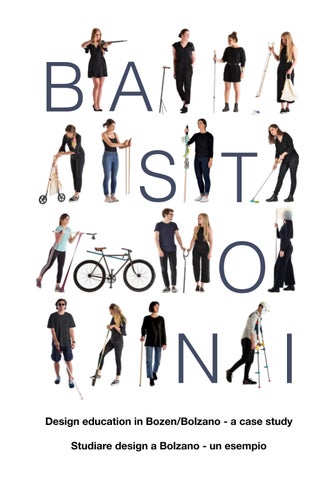
Design education in Bozen/Bolzano - a case study 1
Studiare design a Bolzano - un esempio
2
BASTONI Design education in Bozen/Bolzano - a case study Studiare design a Bolzano - un esempio
Indice/Inhaltsverzeichnis/Contents
4-7
Kuno Prey Das Projektstudium in Bozen am Beispiel BASTONI The project study in Bolzano using the example of BASTONI
8-15
Hans Leo Höger Landschaften des Alltags im Kontext von Studium und Recherche, Experiment und Aktion Landscapes of everyday life in the context of study and research, experiment and action
16-31
Hans Leo Höger im Gespräche mit Kuno Prey Über Ansatz und Ziele der Designausbildung in Bozen On the approach and goals of design education in Bolzano
32-35
Luca Martorano Lavorando sui BASTONI Hands-on BASTONI
36-39
Alvise Mattozzi Studiare bastoni in pratica Studying walking sticks in practice
2
40-43
Alessandro Mariotti
54-57
VELOPODO / DUO 44-45
Anghelina Coslet
KONFA / PLOGGA 58-59
ELASTICK 46-47
Rebecca Toscan
Veronika Vascotto
60-61
Katharina Ennemoser
62-63
Margherita De Alessandri
Chiara Facchini SPASSO
64-65
CLACK 52-53
Anna Maria Zuech PACKESEL
STOCKK 50-51
Jonas Reissinger ROADRUNNER
iSOLATE 48-49
Stefanie Mair
Claudia Martinelli QUO VADO
66-67
WELNES
Leone Ormellese DAREDEVIL
68-71
Miriam Pardeller WEGMOCHER / FØLGESVEND
3
Kuno Prey
Das Projektstudium in Bozen am Beispiel BASTONI Als ein begeisterter Wanderer in den Bergen und als Bewunderer der Spaziergangswissenschaft von Lucius Burckhardt habe ich zusammen mit den Kollegen Alvise Mattozzi und Luca Martorano ein Semesterprojekt den Spazier- und Wanderstöcken gewidmet. Es konnten dabei aber auch Stöcke für andere Bedürfnisse entstehen. Wir begannen das Semester mit einer Reihe von kleinen Tageswanderungen um Bozen, um die Studierenden das Wandern in der Natur erleben zu lassen. Die Studierenden sind aber, wie von uns Projektbetreuern gewünscht und gefördert, darüber hinaus gegangen und haben sich in ihrem Umfeld umgesehen: welche weitere Stockart könnte hilfreich sein, für welche Berufsgruppen, für welchen Anlass, in welcher Situation…. Im interdisziplinär angesetzten Projekt war es natürlich sehr spannend, zusammen mit dem Anthropologen und Soziologen Alvise Mattozzi die Relevanz zu erfahren, die Spazierstöcke in vergangen Gesellschaftsstrukturen hatten. Mit dem Material- und Fertigungsexperten Luca Martorano haben wir alte Stockformen erforscht und dessen Herstellung analysiert, um zu verstehen, wie verschiedene Werkstoffe bearbeitet werden. Für den technischen Beistand konnten wir auch einen kleinen Stockhersteller aus der Val di Non, die Fa. Italbastoni, gewinnen. Italbastoni stellt Stöcke mit verschiedenen Werkstoffen und Techniken her, vom dampfgebogenen, klassischen Spazierstock aus Buchenholz bis hin zum High-Tech Stock aus carbonfaserverstärktem Kunststoff für extreme Sportarten. So ist auch in diesem Semesterprojekt das gewinnbringende
4
Studienmodell Bozen zur vollen Geltung gekommen. Alle Projektteilnehmer, und nicht nur die beteiligten Studierenden, haben viel voneinander gelernt. Wie immer, wenn ich mit guten Ergebnissen von Studierenden konfrontiert werde, bin ich bestrebt, die Arbeiten einem breiten Publikum zu präsentieren. So wurden die Bastoni 2021 im Oktober auf der Grassimesse in Leipzig und im Dezember in der Pop-up Show in der Galleria Sernesi in Bozen und 2022 im Mai in München auf der MCBW und im Juni auf dem Salone Satellite – Salone Internazionale del Mobile in Mailand ausgestellt. Die Krönung eines Projektes ist natürlich ein Designpreis: Bastoni wurden in Tokio „for the outstanding achievement of BASTONI ‒ 16 interventions of modern walking“ von der IAUD- International Association for Universal Design mit dem International Design Award 2021 ausgezeichnet sowie vom IUD – Institut für Universal Design mit dem Gold-Award und dem Expert-Award 2022. Genießen Sie auf den folgenden Seiten die verschiedenen Entwürfe der Studierenden und lassen Sie sich von der Vielfalt der Projektideen überraschen und zum Wandern inspirieren.
5
Kuno Prey
The project study in Bolzano using the example of BASTONI As an avid mountain walker and an admirer of Lucius Burckhardt’s science of walking (“promenadology”), I decided together with my colleagues Alvise Mattozzi and Luca Martorano to dedicate a semester project to walking sticks and hiking poles. Sticks for other needs could nevertheless also be created in the process. We started the semester with a series of small day hikes around Bolzano to allow our students to experience walking in natural surroundings. However, as we as project supervisors had requested and encouraged, the students went further and began to look around in their environment: what other type of stick might be helpful – for which professional groups, for what occasions, in which situations...? Over the course of this interdisciplinary project it was of course fascinating to learn, together with the anthropologist and sociologist Alvise Mattozzi, about the relevance that walking sticks had in past social structures. Along with materials and manufacturing expert Luca Martorano, we researched old forms of sticks and analysed their manufacturing so as to understand how different materials are processed. For technical support we were assisted by a small manufacturer of canes and sticks, the Italbastoni company from the Val di Non. Italbastoni produces sticks using different materials and techniques, ranging from classic steam-bent walking sticks of beechwood through to high-tech poles of carbon fibre-reinforced plastic for use in extreme sports.
6
This semester project thus also permitted the worthwhile Bolzano study model to come into its own. All project participants – not merely the students involved – were able to learn a great deal from each other. As always, when students produce good results, I am eager to present the work to a wider audience. The “Bastoni” were therefore exhibited at the Grassimesse in Leipzig in October 2021, at the MCBW in Munich in May 2022 and at the Salone Satellite – Salone Internazionale del Mobile in Milan in June of the same year. The crowning glory for a project is, of course, a design award: and “Bastoni” was awarded with the 2021 International Design Award in Tokyo by the IAUD (International Association for Universal Design) for “the outstanding achievement of BASTONI – 16 interventions of modern walking”, as well as by the IUD - Institute of Universal Design with the Gold-Award 2022 and the Expert-Award 2022. So I invite all interested people to enjoy the various designs of the students on the following pages: you may be surprised by the variety of project ideas – and subsequently inspired to go walking yourself.
7
Hans Leo Höger
Landschaften des Alltags im Kontext von Studium und Recherche, Experiment und Aktion Gedanken über Lucius Burckhardt und das Spazierengehen Die Wege, Strecken, Entfernungen, die wir Tag für Tag zurücklegen, die Orte, die wir aufsuchen und verlassen, beschreiben immer auch einen Teil unseres Lebens. Sie sind Zeichen und Zeugnisse dessen, was uns passiert, was wir suchen, was uns anzieht, wofür wir uns entschieden haben. Diese auskunftgebende Qualität von Orten und Wegen ist mehr als eine beiläufig zustandekommende Sammlung von Informationen. Man kann diesen Fundus über die subjektive Dimension des Biographischen hinaus als soziologisches Quellenmaterial nutzen und ihn zu einem Instrument der Erkenntnis über die Wirklichkeit werden lassen. Dazu bedarf es freilich Techniken der bewussten Wahrnehmung und Hinwendung - Techniken, sich auf die Eloquenz solcher Landschaften des Lebens einzulassen. Lucius Burckhardt hat in den siebziger Jahren als Teil seiner Untersuchungen zur Gestaltung von Alltag eine Technik dieser Art aus der Taufe gehoben und gemeinsam mit Freunden, Kollegen, Studierenden und Künstlern intensiv gepflegt: die Spaziergangswissenschaft. Unübersehbar sind dabei die Beziehungen zu einer ganzen Reihe von Geistesverwandten, die die Praxis des Spazierengehens ebenfalls als empirische Untersuchung im Hinblick auf Zustand und Erfordernisse von Gesellschaft und Umwelt pflegten. Walter Benjamin wäre hier zu nennen1, die Gruppe der Situationistischen Internationalen (SI)2 oder auch der italienische Architekt und Designer Ugo La Pietra.3 Insbesondere mit La Pietra und den Mitgliedern der SI verbindet Burckhardt, dass er seine Spaziergänge nicht nur als Gelegenheit zu Wahr-
8
nehmung und Erkenntnis nutzte, sondern häufig auch als Medium wahrnehmungsschärfender Intervention im öffentlichen Raum:”Wenn wir”, so Lucius Burckhardt in einem seiner Texte, “in unserem Seminar Spaziergänge machen, dann sollen diese einen eindrücklichen Charakter haben und - den Studierenden wie den Passanten - ein Erlebnis vermitteln. Ein Beispiel hierfür ist eine Aktion, die wir veranstalteten aus Ärger über den in der Innenstadt von parkenden Autos verstellten Raum. Wir gingen hin und stellten am Straßenrand, wo das Parken gestattet ist, Schreibtische auf: zwei, drei Schreibtische füllten jeweils soviel Raum wie ein Auto. Dann setzten wir uns an die Tische und hielten unser Seminar. Natürlich kam es zu einem lauten Gehupe und Geschimpfe darüber, was da für ein unsinniges Hindernis auf der Straße stehe. Über parkende Schreibtische regten sich die Leute auf, aber gegen die Autos, die gleich daneben standen, zeterte niemand. Das ist Schulung der Wahrnehmung unbeachteter gesellschaftlicher Zusammenhänge.”4 Bei einer anderen Aktion von Lucius Burckhardt, die ebenfalls dem Thema automobildominierter Lebensräume gewidmet war, hatten die Spaziergänger tragbare Zebrastreifen dabei, die - der grafischen Struktur echter Zebrafelle nachempfunden - zur Verkehrsberuhigung vielbefahrener Straßen einfach ausgerollt werden konnten. “Von Bank zu Bank” erstreckte sich hingegen ein Spaziergang, den Burckhardt 1988 im niederöster1 Siehe das 1928 erstmals erschienene Buch: Walter BENJAMIN. Einbahnstraße. Suhrkamp, Frankfurt/M. 1955 2 Siehe dazu u.a. Libero ANDREOTTI. Ludic Practices of the Situationist Urbanism. In: Lotus no. 108, Mailand 2001, S. 40-63 3 Siehe u.a. Ugo LA PIETRA. Abitare la città. Florenz 1983 - Hans HÖGER. Still ruhten die Panzerglasportale… in: Das Doppelte und Mehr. Ausstellungskatalog zum deutschen Beitrag auf der XIX. Mailänder Triennale. Verlag Lars Müller, Baden 1996, S.144-154 4 Lucius BURCKHARDT im Gespräch mit Thomas FUCHS, zitiert nach: Hans HÖGER (Hrsg.). Lucius Burckhardt - Design ist unsichtbar. Edition Cantz, Ostfildern 1995, S. 198f.
9
reichischen St.Pölten organisierte. Er war der Werbelandschaft des Ortes gewidmet und ist mit Hilfe von Sponsoren realisiert worden, die der Stadt zehn Bänke für den öffentlichen Raum stifteten. Die Bänke wurden über die Innenstadt verteilt - und zwar so, dass sie stets in der Nähe von Werbetafeln zu stehen kamen. Gemeinsam mit einigen Kasseler Studierenden zog Lucius Burckhardt dann von einer Bank zur nächsten und vertiefte sich in das Panorama der Werbelandschaften. Mit dabei waren jeweils zwei Schauspieler, die aus der Literatur passende Texte vorlasen. In das Terrain der Kunst begab sich Lucius Burckardt mit der Spaziergangswissenschaft u.a. am Furkapass, wo auf Anregung und Initiative des Neuenburger Galeristen Marc Hostettler seit einigen Jahren im Umfeld des von Rem Koolhaas umgebauten Hotels Furkablick künstlerische Interventionen stattfinden. Entdeckt wurde die Furka laut Burckhardt eigentlich von James Lee Byars, mit dem er z.B. 1983 die Aktion “A Drop of Black Perfume” durchführte. “An einem Julitag von zweifelhafter Witterung”, so Burckhardt, “schritt James Lee Byars in goldenem Gewande, mit schwarzem Binder und Zylinder, zielbewusst in das weite, von Felsblöcken übersäte Gelände. Auf einen Stein, den er sich zuvor dafür ausgesucht hatte, ließ er aus einem Fläschchen einen Tropfen schwarzen synthetischen Riechstoffs fallen - eine Geste, die vergeblich und sinnlos zu sein schien in dem Wind, der Schneeschmelze und den Gerüchen aufkeimender Bergpflanzen. Und doch veränderte dieser kleinste Eingriff die Landschaft der Furka in den Köpfen aller Teilnehmer.”5 Faszinierend an Burckhardts Zugang auf (und Umgang mit) Landschaft - egal ob innerhalb oder außerhalb urbaner Lebensräume - sind seine Bereitschaft und Sensibilität für das Beobachten und Aufgreifen spezifischer Merkmale von Ort und Umgebung (man könnte auch genius loci sagen). So beschränkt er sich am Furkapass keineswegs auf das Artifizielle der künstlerischen Intervention:”Im Hotel Furkablick habe ich erstmals begriffen, was die Leute um 1900 anzog und was den heutigen Touristen davon
10
abhält, dort mehr als eine Viertelstunde zu verweilen: Es sind die Wolken. Der moderne Prospekt, die heutige Postkarte versprechen uns blauen Himmel. Die meiste Zeit aber ziehen große Wolken- und Nebelschwaden vom Wallis ins Hospental. Dieses Schauspiel, das zentrale Schauspiel der Malerei von Adrian van de Velde bis Turner und Constable, erlebt wie aus einer Loge, wer sich in dem drei Himmelrichtungen überblickenden Speisesaal des Furkablick häuslich einrichtet. Und noch etwas: die Schneeschmelze. Einem Tiger, einem Zebra gleicht das Gebirge während der vielen Wochen, in welchen sich der Schnee langsam in die Runsen, Tobel und beschatteten Flächen der Bergrücken zurückzieht. Auch die Veränderung dieses perspektivischen Grundmusters der Landschaft war unseren Gebirgsmalern ein Erlebnis.”6 Wer die Spaziergangswissenschaft Lucius Burckhardts persönlich kennenlernen und ausprobieren will, für den sind selbstverständlich auch einige der Spazier- und Wanderstöcke des BASTONI-Projekts, das in dieser Publikation beschrieben und dokumentiert wird, ein ausgezeichneter Einstieg. Die nähere Beschäftigung damit weckt Interesse, Neugier, Motivation – und Lust aufs Rausgehen. Kuno Prey selbst unterstreicht in seiner Einführung die Verbindung des begeisterten Wanderers in den Bergen und des Bewunderers von Lucius Burckhardts Spaziergangswissenschaft. Die mit Studierenden unternommenen Tageswanderungen um Bozen herum gingen Hand in Hand mit der Erkundung jener Aspekte, die beim bloßen Betrachten eines Spazier- oder Wanderstocks zunächst unsichtbar bleiben – weil man ihnen mit Recherche und Analyse erst auf den Grund gehen, auf die Spur kommen muss. Ich bin sicher, Lucius Burckhardt hätte seine Freude daran gehabt, er hätte geschmunzelt, und er wäre sicher selbst mitgewandert auf den Wegen der BASTONI und auf den Kreisen, die dieses Projekt gezogen hat. 5 Lucius BURCKHARDT. Furk‘Art. In: Hans HÖGER (Hrsg.), ebd., S. 171f. 6 Idem, S. 174
11
Hans Leo Höger
Landscapes of everyday life in the context of study and research, experiment and action Thoughts about Lucius Burckhardt and walking The paths, routes and distances that we cover day after day, and the places that we go to and leave, always describe a part of our lives. They are signs and testimonies of what happens to us, what we are looking for, what attracts us, what we have decided to do. This informative quality of places and paths is more than a casual collection of information. We can make use of this fund beyond the subjective dimension of the biographical as sociological source material, turning it into a tool of knowledge about reality. This will admittedly require techniques of conscious perception and attention – techniques for us to engage with the eloquence of such landscapes of life. In the 1970s, as part of his investigations into the design of everyday life, Lucius Burckhardt launched a technique of that kind, intensively cultivating it together with friends, colleagues, students and artists: the science of walking. The relationships to a whole series of kindred spirits who also cultivated the practice of walking as an empirical investigation into the state and requirements of society and the environment cannot be overlooked: mention should be made of Walter Benjamin1, the Situationist International group (SI)2 or the Italian architect and designer Ugo La Pietra3. What Burckhardt has in common with La Pietra and the members of the SI is in particular that he used his walks not only as an opportunity for perception and insight, but often also as a medium for an intervention that would sharpen the perception when in public spaces: “When we go on walks in our seminar,” writes Lucius Burckhardt in one of his texts,
12
“they should have an impactful character and convey an experience – both to the students and to passers-by. An example of this is an action we organised out of annoyance that space in the city centre was being blocked by parked cars. We went and set up desks at the side of the road where parking is permitted: two or three desks each filled as much space as a car. We then sat down at the desks and held our seminar. Of course, there was loud honking and grumbling about the idiotic obstacle on the road. People got upset about parked desks, but no one moaned about the cars parked right next to them. This was training in the perception of unnoticed social contexts.”4 In another action by Burckhardt, also dedicated to the theme of car-dominated habitats, the walkers brought portable zebra crossings with them, which – based upon the graphic structure of real zebra skins – could simply be unrolled to calm traffic on busy streets. On the other hand, Burckhardt organised a walk “from bench to bench” in the Austrian town of St. Pölten in 1988. It was dedicated to the town’s advertising landscape and was realised with the help of sponsors who donated ten benches to the town for use in public spaces. The benches were distributed throughout the centre in such a way that they were always located near advertising hoardings. Together with a number of students from Kassel,
1 See his book, first published in 1928: Walter BENJAMIN. Einbahnstraße. Suhrkamp, Frankfurt/M. 1955 2 See e.g.: Libero ANDREOTTI. Ludic Practices of the Situationist Urbanism. In: Lotus no. 108, Milan 2001, pp. 40-63 3 See e.g.: Ugo LA PIETRA. Abitare la città. Florence 1983 – Hans HÖGER. Still ruhten die Panzerglasportale… in: Das Doppelte und Mehr. Exhibition catalogue for the German contribution to the XIX Milan Triennale. Verlag Lars Müller, Baden 1996, pp.144-154 4 Lucius BURCKHARDT in conversation with Thomas FUCHS, as quoted in Hans HÖGER (ed.). Lucius Burckhardt – Design ist unsichtbar. Edition Cantz, Ostfildern 1995, p. 198f.
13
Lucius Burckhardt then moved from one bench to the next and immersed himself in the panorama of the advertising landscapes. Also present were two actors, who read out appropriate texts from literature. Lucius Burckardt entered the terrain of art with his science of walking, his “promenadology”, at the Furka Pass, among other places, where – at the suggestion and initiative of the Neuchâtel Gallery owner Marc Hostettler – artistic interventions have been taking place for several years in the surroundings of the Furkablick Hotel, converted by Rem Koolhaas. According to Burckhardt, the Furka was actually discovered by James Lee Byars, with whom he for example realised the intervention “A Drop of Black Perfume” in 1983. “On a July day of dubious weather” Burckhardt says, “James Lee Byars, dressed in gold, with a black tie and top hat, strode purposefully out into the wide, boulder-strewn terrain. On a rock that he had previously chosen for the purpose he dripped a drop of black synthetic perfume from a vial – a gesture that seemed futile and pointless in the wind, the melting snow and the scents of the budding mountain plants. And yet this tiny intervention had the effect, in the minds of all the participants, of changing the landscape of the Furka.”5 What is fascinating about Burckhardt’s approach to (and conduct in respect of) the landscape – whether inside or outside urban habitats – is his willingness and sensitivity as regards observing and picking up on specific features of place and environment (we could also say genius loci). On the Furka Pass, for example, he by no means restricts himself to the artificiality of artistic intervention: “At the Hotel Furkablick I for the first time understood what attracted people in the period around 1900, and what prevents today’s tourists from lingering there for more than a quarter of an hour: the clouds. Modern brochures and the postcards of today promise us blue skies. Most of the time, however, large clouds and fog drift from the Canton of Valais into the Hospental area. This spectacle – the central spectacle of painting from Adrian van de Velde to Turner and Constable – is seen as if from a box by those ensconced in the dining
14
room of the Furkablick, which overlooks the sky in three directions. And another thing: the melting of the snow. The mountains resemble a tiger or a zebra during the many weeks in which the snow slowly retreats into the gullies, ravines and shaded areas of the mountain ridges. The change in this basic pattern of the landscape in terms of perspective was also an experience for our mountain painters.”6 For those who personally wish to get to know and try out Lucius Burckhardt’s promenadology, a number of the walking sticks and hiking poles of the BASTONI project, described and documented in this publication, will of course make an excellent introduction. A closer look at them will arouse interest, curiosity, motivation – and a desire to get out and about. In his introduction, Kuno Prey himself emphasises the connection between the enthusiastic mountain hiker and the admirer of Lucius Burckhardt’s science of walking. The day hikes with students around Bolzano went hand in hand with the exploration of aspects that are at first invisible when merely observing a walking stick or hiking pole, as we first have to research and analyse them so as to truly understand and work them out. I am sure that Lucius Burckhardt, smiling benignly, would have enjoyed the BASTONI project and would certainly have walked its paths with us and appreciated the waves it has made.
5 Lucius BURCKHARDT. Furk’Art. In: Hans HÖGER (ed.), ibid., p. 171f. 6 Idem, p. 174
15
Hans Leo Höger im Gespräche mit Kuno Prey
Über Ansatz und Ziele der Designausbildung in Bozen Hans Leo Höger Herr Prey, als Sie 2001 gebeten wurden, an der Freien Universität Bozen eine Fakultät für Design und Künste aufzubauen, hatten Sie bereits zehn Jahre an der Fakultät für Gestaltung der Bauhaus Universität Weimar gelehrt und geforscht. Wie haben sich die dort gemachten Erfahrungen auf das Projekt der neuen Fakultät in Bozen ausgewirkt? Kuno Prey Der Ansatz des interdisziplinären Projektstudiums mit einem hohen Theorieanteil, wie wir es in Weimar zehn Jahre lang ausprobiert und optimiert hatten, war für mich ein wunderbarer Ausgangspunkt dafür, dieses Modell auch in Bozen zugrundezulegen, es weiter zu perfektionieren, den lokalen Gegebenheiten anzupassen sowie – und da kam der große Kulturschock – es in das Korsett des italienischen Hochschulgesetzes einzubauen. Ich sage letzteres vor allem, weil es kein leichtes Unterfangen war, die Offenheit und die flachen Hierarchien, die wir in Weimar jahrelang praktiziert und der Initiative des dortigen Gründungsdekans Lucius Burckhardt zu verdanken hatten, im italienischen Hochschulsystem unterzubringen. HLH Woran lag das? KP Das italienische System basiert sehr stark auf Lehrstühlen, und nicht auf Professuren. Das bedeutet, dass häufig nur die Ableistung eines
16
bestimmten Lehrdeputats, gerechnet in Stunden, im Vordergrund steht. In Bozen hingegen werden in die einzelnen Projekte - geführt von Entwerferinnen und Entwerfern, die als Projektleiter fungieren - weitere Fächer integriert, was aber nur dann funktioniert, wenn jeder der im Projekt involvierten Lehrenden gegenseitigen Respekt, Großzügigkeit und wirkliche Bereitschaft zur Zusammenarbeit mitbringt – egal ob ein Lehrender nun Ordinarius oder “Associato” oder Lehrbeauftragter ist. HLH Es liegt nahe, vor dem Hintergrund solcher inhaltlichen und kulturellen Positionen – auch angesichts der Namensgebung der Weimarer Hochschule – zu fragen, inwieweit das Bauhaus der zwanziger Jahre mit seiner Lehre und seinen Errungenschaften beim Aufbau der Bozener Fakultät für Design und Künste eine Rolle spielte? KP Diese Frage wurde uns auch in Weimar immer wieder gestellt: Seid ihr das neue Bauhaus? Führt ihr diese Tradition weiter? Meine Antwort darauf, wie auch die vieler Kollegen, war: Was wir vom Bauhaus übernehmen, ist der Geist an Innovation, der Drang zur Innovation – aber in ein völlig anderes Zeitalter projiziert, nämlich in jenes der Schnellebigkeit und der schnellen Kommunikation. Als die Bauhausschüler und –lehrenden ihre Entwürfe entwickelten, gab es dazu sicherlich irgendwo auf der Welt auch Parallelen, die aufgrund der geringeren Geschwindigkeit und Reichweite der Kommunikationswege aber isoliert blieben. Heutzutage sind die Kommunikationsflüsse viel dichter und rapider, was z.B. Veränderungen unserer Lebens- und Arbeitsstile mit sich bringt. Hieraus gehen ganz neue Anforderungen an alle Menschen hervor - aber eben gerade auch an Gestalterinnen und Gestalter, die mit ihren Entwürfen in Lebens-, Arbeits- und Kommunikationsprozesse eingreifen.
17
Es kann also nicht darum gehen, das Bauhaus “nachzumachen” – in seiner Formensprache oder in seiner Lehrstruktur. Vielmehr geht es darum, seinen Geist, seine Offenheit und seinen innovativen Schub im Hinblick auf neue Wege der Gestaltung mit adäquaten Mitteln in unsere eigene heutige Zeit hineinzutragen. HLH Was ist aus Ihrer Sicht besonders wichtig bei diesem Vorhaben, den innovativen Geist des Bauhauses auf heutige Realitäten zu übertragen? KP Sicherlich ist besonders wichtig das nicht-lineare Denken; das Querdenken; die Bereitschaft und Fähigkeit, viele vermeintlich gesicherte Erkenntnisse in Frage zu stellen und aus dem Überangebot an Möglichkeiten, die wir haben, die intelligentesten herauszusuchen. Damit meine ich die verträglichsten Vorgehensweisen, die einerseits ökologisch sinnvoll und zukunftsweisend sind, andererseits aber auch gesellschaftspolitisch eine bestimmte Würde in sich tragen, eine Ethik – im Sinne von Respekt der Person, den Menschen gegenüber, und gegenüber der gewachsenen und gebauten Umwelt. HLH Worin besteht, gerade auch vor dem Hintergrund der Suche nach möglichst verträglichen Vorgehensweisen der Gestaltung, die Besonderheit des Projektstudiums? KP Die Besonderheit des Projektstudiums besteht darin, dass die Themen, die dort gestellt werden, absolut offen sind. Es gibt keine vorgefassten Lösungen, die man a priori als Richtwert ansieht. Natürlich liegt darin auch eine Schwierigkeit. Wenn ich ein Thema stelle, das z.B. ein Trinkglas behandelt, und dieses Trinkglas in seiner Herstellung bereits von einer
18
Technik definiert wird – des Mundblasens oder des maschinellen Blasens oder des Glaspressens – und vielleicht auch noch von einer bestimmten Farbe, weil das Unternehmen, auf das ich mich bei der Themenstellung beziehe, nur weißes oder nur grünes Glas verarbeitet – dann reduziert sich das Projektthema auf eine brave Suche nach einer bestimmten Form. Wenn wir hingegen ein Projekt zum Thema “Trinken” anbieten, erweitert sich unmittelbar das Spektrum gestalterischer Reflektion und Herangehensweise um zahlreiche Aspekte – wie etwa die Beziehung zwischen menschlichem Körper und Flüssigkeit, Aufnahme von Flüssigkeit, Transport von Flüssigkeit etc. Am Ende kann ich unter Umständen durchaus ebenfalls bei Entwürfen für ein neues Glas ankommen. Aber genausogut kann z.B. eine Sensibilisierungskampagne aus diesem Projekt hervorgehen, etwa im Hinblick auf unseren Umgang mit Wasser, oder mit Alkohol – je nach den inhaltlichen Schwerpunktsetzungen, die von den einzelnen Studierenden innerhalb des Projekts erarbeitet werden. Das heißt, dass die Recherche als solche viel breiter angelegt ist, dass die Lösungsansätze viel breiter gestreut sind und dass natürlich sowohl zwei- als auch dreidimensionale Entwürfe als Antwort auf ein und dieselbe Projektthemenstellung möglich (und gewünscht) sind. Damit dies alles wirklich passiert, ist es sehr wichtig, innerhalb der Projekte die Experimentierfreude der Beteiligten zu stimulieren – also Studierende wie auch Lehrende über die thematisch gewährleistete Offenheit zum Experimentieren zu veranlassen. Auch dies geschieht im Idealfall wieder auf verschiedenen Ebenen, entsprechend der Art und Weise, wie Designerinnen und Designer eben arbeiten – also z.B. in theoretischer und konzeptioneller Hinsicht, oder bezogen auf die Frage neuartiger Produktionsmöglichkeiten, neuer Materialien oder auch neuer Ideen für Material-, Produktions- und Technologietransfer, bis hin zur Entwicklung neuer Dienstleistungen. Denn das Projektstudium – wie das Berufsbild von Gestaltung insgesamt - ist längst nicht mehr allein produkt- sondern in starkem Maße serviceorientiert.
19
HLH Mit welchen Argumenten würden Sie angehenden Designstudierenden empfehlen, sich bei der Wahl der Hochschule gerade für Bozen zu entscheiden? KP Ein Schlüsselgedanke, der die Arbeit unserer Fakultät prägt und der mir bei dieser Frage sofort in den Sinn kommt, ist: sich spezialisieren im nicht-spezialisiert-Sein. Das heutige Berufsbild des Designers verändert sich sehr rapide. Das konnten wir in den letzten Jahren beobachten, bedingt durch die Digitalisierung, und in den kommenden Jahren wird es nicht anders sein. Dabei geht es nicht nur darum, dass Reissbrett und Zeichentisch durch die Maus, den Bildschirm und verschiedene SoftwareProgramme abgelöst wurden. Ich denke vielmehr an den gesamten Einfluss der Mikroelektronik auf unser Verhalten und unsere Lebensstile. Meines Erachtens ist es – genau vor diesem Hintergrund – irreführend, für eine Schule zu werben, indem man sagt: hier lernen Sie Konsumgüter zu entwerfen. Oder: hier lernen Sie, multimediale Anwendungen zu entwerfen. Oder: hier lernen Sie Modedesign, oder nur Schmuckdesign – die Betonung liegt auf dem “nur”. Gerade angesichts der Splittung zwischen Bachelor und Master ist es meines Erachtens ungeheuer wichtig, vor allem in den ersten Jahren sehr offen, unbelastet, unvoreingenommen, nicht vorkanalisiert an das, was wir Entwurfskultur nennen, heranzugehen, um die Kreativität der jungen Studierenden, ihren Blick auf die Welt und auf das Thema Gestaltung innerhalb dieser Welt, zu fördern. In Bozen legen wir uns nicht auf Schmuckdesign oder Automobildesign oder eine andere Entwurfssparte fest, sondern wir legen uns auf Design fest. Das heisst aber auch, dass, wer nach Bozen kommt, eine Bereitschaft zur Mehrleistung mitbringen muss, eine Bereitschaft zu ziemlich viel Arbeit und eine Bereitschaft zur Neugierde – d.h. Interesse
20
an der Hinterfragung bereits bekannter und an der Erkundung neuer, noch nicht bekannter Themen. Und das wiederum heisst, nicht zu warten, bis sich neue Themen irgendwann auf irgendeinem Wege von selbst bemerkbar machen; die Studierenden, die hierher kommen, müssen sich aktiv auf die Entdeckung begeben nach den neuen, für unsere Zukunft relevanten Themen. HLH Wie sehen Sie die Zukunft des Designerberufes? KP Also ich denke, ganz wichtig – heute und für die Zukunft – sind Neugier und Interesse dafür, was in der Welt vor sich geht; kritischer Geist und Wille zum Hinterfragen (auch der Fragen und Aufgaben, die an Designer und Designerinnen herangetragen werden); Kommunikationsfähigkeit, um sich und die eigenen Ansätze anderen verständlich zu machen, aber auch, um gemeinsam mit anderen in Teams zu arbeiten; persönlich erfahrene oder jedenfalls in die Vorarbeit zu einem Projekt eingeflossene Nähe zur Lebenssituation jener Menschen, für die man etwas entwerfen will; Optimismus, Lebensfreude, Genussfreude; Hartnäckigkeit und Geduld – beides braucht man, um sich mit der erstbesten Lösung nicht zufriedenzugeben; gezielte Vorbereitung darauf, sich zunächst nicht auszukennen (und deshalb trotzdem nicht in Panik zu geraten); Bewusstsein dafür, dass Designer sein kein Achtstundenjob ist: Designer ist man 24 Stunden am Tag, 7 Tage die Woche, 365 Tage im Jahr. Auf dem Boden dieser Voraussetzungen, glaube ich, kann ein guter Gestalter sich herauskristallisieren. Und damit meine ich nicht den braven Ausführer eines Briefings oder den, der z.B. einfach gerne schöne Autos machen würde. Weltverschönerer oder Weltverbesserer, die ihr Ziel rein über Formen erreichen wollen, sind heute passé. Das stand vielleicht, wenn es denn wirklich so war, früher einmal im
21
Vordergrund gestalterischen Schaffens. Aber heute geht es um viel wichtigere Inhalte und Themen, die bearbeitet werden müssen und die ganz andere Gestalterpersönlichkeiten erfordern – Entwerferinnen und Entwerfer, die diesen Wandel innerhalb ihrer Arbeit und unserer äußeren Lebensbedingungen verstehen und bereit sind, sich darauf einzulassen. Nehmen wir, um konkret zu werden, das Thema “Ökobilanz” – wie gehe ich mit Ressourcen um? Diese Frage und die daran geknüpften Erkenntnisse und Erfordernisse sind nicht von heute auf morgen gelöst, sondern erfordern konstantes, langfristiges Denken. Gestalterinnen und Gestaltern kommt dabei eine wichtige Rolle zu, denn sie bereiten mit ihrer Arbeit in ganz wesentlicher Weise jene Funktions- und Verhaltensweisen vor, die darüber entscheiden, an welcher Stelle zu welchem Zweck und mit welcher Art von Anwendung und Einsatz Ressourcen genutzt – oder eben einfach nur verbraucht - werden. Gehen wir weiter zum Bereich “Service Design” – Car Sharing zum Beispiel ist ein sehr gut gelungenes Produkt. Und ich nenne es bewusst Produkt, weil es eine neue Form der Gestaltung von individueller Mobilität darstellt. Oder nehmen wir das Thema “Fahrräder” – hier geht es um Hardware, die so gestaltet sein muss, dass dieses Verkehrsmittel attraktiv ist. Damit meine ich logischerweise nicht nur die schöne farbliche Gestaltung, sondern z.B. die technische Abstimmung auf unterschiedliche Nutzergruppen - wie etwa ältere Menschen, die an Arthrose leiden und nicht mehr so viel Kraft in den Händen haben, eine Bremse sicher zu betätigen, wie junge Leute. Andere Nutzergruppen, auf die jeweils gesondert einzugehen wäre, sind z.B. Mütter, Handwerker, Manager usw. Gleichzeitig stellen diese Fragen natürlich auch ein gesellschaftspolitisches Thema dar. Ökologie ist Gesellschaftspolitik.
22
HLH Welche Bedeutung hat – gerade auch vor diesem Hintergrund das Thema Forschung für die Entwicklung im Design und für die Designausbildung? KP Forschung im Designbereich muss aus meiner Sicht zwei Aufgaben erfüllen: sie muss einerseits darauf achten, praxisbezogen zu sein, und andererseits muss sie Grundlagen und mögliche Zukunftsszenarien neu andenken und auf neue Fundamente stellen. Ich sehe einen großen Spielraum für Hochschulen, sich auf diesem Terrain der Arbeit in zwei Richtungen zu etablieren und zu profilieren. Und insbesondere wir in Bozen haben hier, durch unsere starke Gewichtung einer breit angelegten Theorie, sehr gute Möglichkeiten, Geisteswissenschaftlichkeit und Handwerklichkeit – im Denken wie im Tun – einander näher zu bringen und neue Synergien zu generieren.
23
Hans Leo Höger talks to Kuno Prey
On the approach and goals of design education in Bolzano Hans Leo Höger Mr Prey, when in 2001 you were asked to set up a Faculty of Design and Arts at the Free University of Bozen/Bolzano, you had already spent ten years teaching and researching at the Faculty of Design at the BauhausUniversität Weimar. How did the experience you gained there affect the project for the new faculty in Bolzano? Kuno Prey The approach of interdisciplinary project studies containing a high theoretical element, as tried and optimised in Weimar over ten years, was an excellent starting point for me also to take this model as a basis for use in Bolzano, perfecting it further and adapting it to local conditions and - this is where the major culture shock came in – incorporating it into the corset of Italian university law. I mention the latter in particular because it was no easy task to accommodate into the Italian higher education system the openness and flat hierarchies that we had practised for years in Weimar and that we owed to the initiative of the founding dean there, Lucius Burckhardt. HLH Why was that? KP The Italian system is very much based upon chairs, not professorships. This means that the focus is often simply on the completion of a certain teaching load, which is calculated in hours. In Bolzano, on the other
24
hand, other subjects are integrated into the individual projects – led by designers who act as project leaders – but this only works if all of the teachers involved in the project show a mutual respect, a generosity and a real willingness to cooperate – regardless of whether the teacher is a full professor or an “associato”, namely a lecturer. HLH Against the background of such positions in terms of content and culture – and also in view of the name of the University at Weimar - it seems obvious to ask to what extent the Bauhaus of the 1920s, with its teaching and achievements, played a role in the establishment of the Bolzano Faculty of Design and Arts? KP We were repeatedly asked this question in Weimar: Are you the new Bauhaus? Will you be carrying on this tradition? My answer to this, as well as that of many colleagues, was: What we are taking from the Bauhaus is the spirit of innovation, the urge to innovate – but projected into a completely different age, i.e. one of fast-moving lifestyles and fast communication. When the Bauhaus students and teachers were developing their designs, there certainly existed parallels somewhere in the world, but these remained isolated owing to the slower speed and reach of the communication channels of the time. Nowadays, communication flows are much more dense and rapid, which has brought about changes to our lifestyles and working practices, for example. This places completely new demands on everyone – including on designers, whose designs intervene in our living, working and communication processes. It is therefore not a question of “imitating” the Bauhaus, whether in its formal language or its teaching structure: it is rather a matter of bringing
25
its spirit, its openness and its innovative force as regards new ways of design with adequate means into our own present day. HLH In your view, what is particularly important in this project of transferring the innovative spirit of the historical Bauhaus to today’s realities? KP Certainly, non-linear thinking is particularly important; thinking outside the box; the willingness and ability to question many supposedly reliable findings and to pick out the most intelligent from the surfeit of possibilities we face. By this I mean the most compatible approaches that are on the one hand ecologically sensible and forward-looking, but on the other also possess a certain dignity in socio-political terms, an ethic - in the sense of respect for the person, for people, and for the grown and built environment. HLH What is the special feature of project studies, in particular against the background of the search for the most compatible possible approaches to design? KP The special feature of project studies is that the themes available are absolutely open. There are no preconceived solutions that are to be seen as a priori guidelines. Of course, this is also a difficulty. If I set a theme that deals with a drinking glass, for example, and the production of this drinking glass is already defined by a technique – e.g. mouth-blowing or machine-blowing or glass-pressing - and perhaps also by a certain colour, because the company that I refer to in setting the theme only works with white or green glass - then the project theme is reduced to a straightforward search for a certain shape.
26
If, on the other hand, we offer a project on the theme of “drinking”, the spectrum of creative reflection and approach immediately expands to include numerous aspects - such as the relationship between the human body and the liquid, the consumption of liquid, the transport of liquid, and so on. In the end, I may well arrive at one or more designs for a new glass. But, for example, an awareness-raising campaign can equally emerge from this project, for instance in regard to how we approach water, or alcohol - depending on the content focus that individual students might develop within the project. This means that the research as such is much wider; that the approaches to solutions are much more widely spread; and that of course both twoand three-dimensional designs are possible (and desirable) in response to one particular project theme. In order for all this to really come about, it is very important to stimulate the willingness of those involved to experiment within the projects - in other words, to encourage both students and teachers to experiment via the openness guaranteed by each respective theme. Ideally this will also happen at different levels according to the way designers work - for example, in theoretical and conceptual terms, or in relation to the question of new types of production possibilities, new materials or even new ideas for material, production and technology transfers, all the way up to the development of new services. This is because project studies - like the professional image of design as a whole - has long since ceased to be solely product-oriented, but is instead now strongly service-oriented. HLH What arguments would you use to recommend prospective design students to opt for Bolzano when choosing a university?
27
KP A key idea that characterises the work of our faculty and that immediately comes to mind when I am asked this question is: specialising in being non-specialised. The job profile of a designer is today changing very rapidly. We have seen this in recent years thanks to digitalisation, and it will be no different in the years to come. This is not simply because the drawing board and drawing table have been replaced by the mouse, the screen and various software programs. Rather, I am thinking of the entire influence of microelectronics on our behaviour and lifestyles. In my opinion, it is misleading - precisely against this background – for a school to advertise by saying: here you will learn to design consumer goods, or here you will learn to design multimedia applications, or here you will learn fashion design, or jewellery design only – with the emphasis on the “only”. Especially in view of the split between Bachelor’s and Master’s degrees, I think it is hugely important, particularly in the first years, to approach what we call design culture in a very open, unencumbered, unbiased, non-pre-channelled way so as to promote the creativity of young students, their view of the world and the role of design within this world. In Bolzano, we don’t commit ourselves to jewellery design or to car design or to any other design field, but instead commit ourselves to design. But that also means that anyone coming to Bolzano must bring with them a willingness to go the extra mile, a willingness to do quite a lot of work and a willingness to be curious - i.e. to be interested in questioning themes that are already known to them and exploring new ones that are as yet unknown. And that in turn means not waiting for new themes to make themselves known in some way or other; students who come here must actively set out to discover the new themes that will be relevant to our future.
28
HLH How do you see the future of the design profession? KP Well, I think it is very important - today and for the future - to be curious and interested in what is going on in the world; to have a critical mind and a willingness to question (including those questions and tasks that are put to designers); to be able to communicate so as to make yourself and your approaches comprehensible to others, as well as to work together with others in teams; to have personal experience or at least proximity to the life situation of those people for whom you wish to design something; to possess optimism, joie de vivre, enjoyment; to have persistence and patience - you need both so as not to be satisfied with the first solution that comes along; you need specific preparation should you not at first be on top of your stuff (and therefore avoid panicking); and an awareness that being a designer is not an eight-hour job - you are a designer 24 hours a day, 7 days a week, 365 days a year. Taking these prerequisites as a basis, I believe that a good designer can emerge. And by that I don’t mean a tame producer of a briefing or someone who simply wants to make beautiful cars, for example. Those who merely wish to beautify or improve the world by means of forms are today passé. Perhaps, if that ever was the case, this was once the focus of creative work. But today it is far more a matter of important contents and themes that have to be addressed and that require totally different creative personalities - designers who understand this change, both within their work and in our external living conditions, and are prepared to get involved in it. In concrete terms, let’s take the topic of “eco-balance” - how do I manage resources? This question and the insights and requirements linked to it cannot be solved overnight, but require constant, long-term thinking.
29
Designers have an important role to play here, because with their work they prepare, in a very substantial way, the functional and behavioural patterns that will decide where - and for what purpose, and with what manner of application and effort - resources are to be used, or simply consumed. Let’s go further, to the area of “service design” - car sharing, for example, is a very successful product. And I deliberately call it a product, because it represents a new form in the design of individual mobility. Or let us take the theme of “bicycles” - here we are talking about hardware that has to be designed in a way that will make this means of transport attractive. By this I mean, logically, not only an attractive colour scheme but also, for example, technical adaptation to different user groups - such as older people suffering from arthrosis, who no longer have sufficient strength in their hands to safely operate a brake when compared to young people. Other user groups that would need to be addressed separately and individually are, for example, mothers, craftspeople, managers, etc. At the same time, of course, these questions also represent a socio-political issue. Ecology is social policy. HLH What is the significance - especially against this background - of research as regards development in design and design education? KP In my view, research in the field of design must fulfil two tasks: on the one hand, it must take care to be practice-oriented while, on the other, it must rethink the fundamentals and possible future scenarios and place them on new foundations. I see great scope for universities to establish and distinguish themselves in two directions on that field of work. And we in Bolzano in particular, with our strong emphasis on broad-based theory, have very good possibilities for bringing approaches to the humanities and to craftsmanship – both in terms of thinking and in doing - closer together and thus to generate new synergies.
30
31
Luca Martorano (Tecnologie e sistemi di produzione)
Lavorando sui BASTONI Quando Kuno Prey mi ha parlato dell’idea di voler dedicare un progetto semestrale al tema del bastone da passeggio, ero sorpreso: pensavo allo stupore dei ragazzi e alle mie poche esperienze dirette in merito. Pensavo da un lato a quanto fosse specifico, inconsueto e anticonformista come ambito di ricerca, dall’altro al potenziale dirompente che si creava ponendo dei giovanissimi designers al cospetto di un tema così diverso dal solito e così poco esplorato in ambito accademico. Ma come spesso avviene nei progetti, è solo facendo, che si scopre davvero il potenziale di una indagine; e come già accaduto in passato con Kuno Prey e con il collega Alvise Mattozzi, il clima dell’atelier, il dialogo all’interno del gruppo di progetto, la pratica del fare e la voglia di sperimentare nuove interpretazioni e nuove strade, hanno portato a risultati altrettanto vari e sorprendenti. Il mio ruolo di docente della materia integrata ‘tecnologie e sistemi di produzione’ consisteva essenzialmente nel dare un supporto tecnico, legato alla scelta di materiali e tecnologie per le idee che via via emergevano, e quindi aiutare nel disegno delle forme e nella razionalizzazione delle logiche costruttive degli oggetti stessi. Così fin dalle prime settimane, ci siamo trovati a discutere di molle ed elementi elastici, perni, leveraggi, ruote e cuscinetti, cerniere e incastri, pulsanti e cavalletti. Passeggiavamo per i corridoi dell’ateneo e per la città impugnando prese morbide in gel o in spugna, testando puntali in acciaio e tubi in fibra di carbonio. Schizzavamo dei particolari in cui ipotizzavamo i giusti spessori per la tenuta di un elemento in legno massello, o le forme più adeguate al colaggio della resina;
32
Ragionavamo sui dettagli per ancorare ad un’impugnatura delle cinghie in cuoio, o per celare dei magneti. Lo sviluppo di ciascun oggetto era una storia a sé, con punti di contatto con le altre ricerche, certo, ma con obiettivi, vincoli ed esperimenti tutti diversi tra loro. Due sono state le sfide più grandi nello sviluppo del lavoro. In primis quella di ricondurre ciascun progetto sul terreno della concretezza: idee visionarie e provocazioni erano ben accette e anche incoraggiate, ma ci tenevamo che poi gli oggetti avessero un riscontro pratico e potessero essere usati con immediatezza e costruiti senza richiedere sforzi enormi. Pretendevamo ci fosse una logica solida alla base di ciascun concetto. In secondo luogo volevamo che ogni oggetto utilizzasse le giuste risorse in rapporto all’obiettivo prefissato: ogni intuizione, ogni esigenza doveva passare al vaglia e approdare al giusto livello di complessità. Questo bastone serve davvero? E qual è il modo più semplice realizzarlo? Quasi come in una visione fordista del minimo sforzo per il massimo risultato, si cercava costantemente l’equilibrio tra costi e benefici, tra risorse adoperate e vantaggio offerto, insomma il “quanto basta” che Kuno Prey ci ha insegnato a tenere sempre a mente, e che i ragazzi spesso mormoravano tra sé e sé dopo aver ascoltato gli spunti di una revisione.
33
Luca Martorano (Material science and technologies)
Hands-on BASTONI When Kuno Prey spoke to me about the idea of dedicating a semester project to the theme of the walking stick, I was surprised: I thought of how the young people would be amazed, and of my own limited direct experience in this field. On the one hand, I thought about how specific, unusual and non-conformist this field of research was, while on the other about the disruptive potential that could be created by setting very young designers a theme that was so different from the usual and so little explored in the academic sphere. But, as is often the case with projects, it is only by doing that you really discover the potential of an enquiry; and, as has already happened in the past with Kuno Prey and my colleague Alvise Mattozzi, the atmosphere of the atelier, the dialogue within the project group, the practice of doing and the desire to experiment with new interpretations and new paths, all led to results that were as varied as they were surprising. My role as lecturer in “production technologies and systems”, an integrated subject, essentially consisted of providing technical support linked to the choice of materials and technologies for the ideas that gradually emerged, then helping to design the forms and rationalise the construction logic of the objects themselves. Thus, from the very first weeks, we found ourselves discussing springs and elastic elements, pivots, levers, wheels and bearings, hinges and joints, buttons and stands. We strolled through the corridors of the university and the city, buying grips of soft gel or sponge, testing steel tips and carbon fibre tubes. We sketched out details in which we hypothesised the right thicknesses for holding a solid wood element, or the most
34
appropriate shapes for casting resin; we calculated the details for anchoring leather straps to a handle, or for concealing magnets. The development of every individual object was a story in itself, naturally involving contact with other areas of research, but each with different objectives, constraints and experiments. There were two major challenges in developing the work. First, that of bringing each project down to earth: visionary ideas and provocations were welcome and even encouraged, but we wanted the objects to have a practical aspect as well – they should be for immediate use, while their construction should not require enormous effort. We wanted there to be a solid logic behind each concept. Second, we wanted each object to use the right resources in relation to the objective set: every intuition, every need had to be assessed and assume the right level of complexity. Is this stick really useful? And what is the simplest way to make it? As if in an almost Fordist vision of minimum effort for maximum gain, we constantly sought to balance costs and benefits, resources used and advantages offered, in short, the “enough is enough” that Kuno Prey taught us always to keep in mind – a phrase often muttered among the students upon hearing the suggestions for change.
35
Alvise Mattozzi (Teoria dei consumi culturali)
Studiare bastoni in pratica Nei corsi di progetto, come Bastoni, che Kuno, Luca e io abbiamo tenuto, il mio obiettivo, in quanto scienziato sociale e in quanto docente della materia integrata relativa ai consumi, è sempre stato triplice. Innanzitutto, presentare la prospettiva di utenti e consumatori, in quanto prospettiva complementare a quella introdotta da Kuno e Luca. In secondo luogo, mostrare a studenti e studentesse – e a colleghi e colleghe – che il sapere riguardo il consumo è empirico. Esso implica la pratica della ricerca sociale, che include osservazione, comparazione, descrizione. In terzo luogo, mostrare a studenti e studentesse la connessione tra la configurazione di un prodotto – ciò che loro (ri)progettano – e la configurazione della pratica a cui il prodotto partecipa. Ma come si declina tutto ciò in un progetto come Bastoni? Come dice il nome stesso, i bastoni da passeggio sono componenti della pratica del camminare. Dai bastoni da pastore a quelli dei pellegrini, agli Alpenstock, ai bastoni da passeggio usati in contesto urbano agli odierni bastoncini per la Camminata Nordica – senza scordare le stampelle –, i bastoni hanno preso parte a pratiche del camminare, ma non a tutte le pratiche del camminare. Per questo, una delle questioni è fare capire a studenti e studentesse come i bastoni sono diventati parte di specifiche pratiche del camminare.
36
Casi storici, quali l’uso dei bastoni come accessori eleganti per uomini attraverso i quali il “consumo vistoso” si è manifestato nel corso del XIX sec. e all’inizio del XX, così come il redesign delle racchette da sci in bastoncini da Camminata Nordica alla fine del XX
sec., sono sicuramente buoni esempi attraverso i quali studenti
e studentesse possono riflettere. Questi casi mostrano che un prodotto è sempre parte di una pratica specifica e che (ri)progettare un prodotto vuol sempre dire (ri)progettare una pratica, alla quale il prodotto partecipa. A parte questo, ciò che studenti e studentesse devono imparare è a fare le loro osservazioni delle pratiche che intendono (ri)progettare e a leggere osservazioni effettuate da altre persone. Per questo ho fatto loro leggere alcune etnografie del camminare, oltre a chieder loro di osservare il nostro gruppo, quando siamo andati a camminare insieme. Infine ho chiesto loro di osservare le pratiche che intendevano riarticolare.
37
Alvise Mattozzi (Theories of cultural consumption)
Studying walking sticks in practice Within studio courses, like the one about Bastoni Kuno, Luca and me lead, my aim as social scientist and as teacher of an integrated course about consumption has always been threefold. First, introducing the perspective of users or consumers as a perspective complementary to the one introduced by Kuno and Luca. Secondly, showing students – and colleagues as well – that knowledge about consumption and consumers is empirical. It entails the practice of social research, which comprises observation, comparison, description. Thirdly, showing students the connection between the configuration of a product – what they (re)design – and the configuration of the practice, to which a product takes part. How does such threefold aim gets translated into a project like Bastoni? Walking sticks or canes are, as the name says, components of the practice of walking. From shepherd’s and pilgrim staffs, to Alpenstocks, to urban sticks and canes, to present days poles for Nordic Walking – without forgetting crutches – sticks took part to walking practices, tough not all walking practices. Therefore, one of the issues is to show students how sticks have been able to become part of specific walking practices and make them reflect about how sticks can become part of other practices related to walking.
38
Previous cases, like the use of sticks and canes as elegant accessories for men, through which “conspicuous consumption” manifested itself during the 19th century and at the beginning of the 20th, as well as the redesign of ski poles in Nordic Walking poles at the turn of the 21st century, are certainly good examples students can reflect upon. These cases clearly show how a product is always part of a specific practice and that (re)designing a product means always (re)designing the practice, which the product takes part to. However, what is needed is to have student learn to make their own observations of the practices they can (re)design and to read observations made by others. This is why I made them read some ethnographies of walking, besides asking them to observe our group when going to walk together. Finally, I asked them to observe the practices they intended to rearticulate by design.
39
VELOPODO design: unibz.it | alessandro mariotti
40
Velopodo è un bastone in alluminio che, grazie alle sue forme semplici, può essere agganciato a tutte le tipologie di telaio, fermandolo in sicurezza grazie ad un laccetto in silicone. Velopodo può essere poi facilmente sganciato una volta se ne abbia bisogno quando si scende. Il rivestimento soft-touch dona morbidezza alla superficie e fa sì che il bastone non si rovini a contatto con il telaio della bici e viceversa. Una luce a led caratterizza il manico e permette di illuminare il cammino. Velopodo is an aluminium stick that, thanks to its simple shape, can be attached to all types of frame, held safely in place by a silicone strap. Velopodo can then easily be released once needed when getting off. The soft-touch coating gives the surface a supple feel and ensures that the stick will not get damaged when in contact with the bike frame or vice versa. The handle features a LED light that allows the user to light the way.
41
DUO design: unibz.it | alessandro mariotti
42
Duo è un bastone che può essere utilizzato in coppia, senza che uno dei partner conduca il passo, mentre l’altro si limiti ad usarlo solo per appoggiarvisi. Duo, è in alluminio ed è caratterizzato da linee fluide e pulite che richiamano il classico bastone con manico ad ombrello. Il tubo verticale, però, è centrato rispetto ai due manici, di modo da dare equilibrio al bastone. Un oggetto per alcune persone indispensabile durante la vecchiaia, anziché frapporsi tra la coppia, non fa che unirla. Duo is a stick that can be used in tandem, without one of the two setting the pace while the other is merely used for leaning on. Duo, made of aluminium, has fluid and clean lines that recall the classic walking stick with its umbrella handle. The vertical tube is however centred with respect to the two handles, giving balance to the stick. An indispensable object for some people during old age, as well as between couples, serving to unite them.
43
ELASTICK design: unibz.it | anghelina coslet
44
Elastick è un bastone da passeggio progettato per chi ama l’attività fisica. La sua particolarità sta nel permettere di allenare tutto il corpo, utilizzando il bastone stesso e le fasce elastiche che lo caratterizzano. Elastick è in alluminio, l’impugnatura principale in plastica, quelle secondarie in pelle. A seconda dell’esercizio che si vuole fare, si possono inserire i piedi nelle asole presenti sulle fasce elastiche e spingere il bastone con le mani o viceversa, in piedi o sdraiati. Elastick is a walking stick designed for those who like physical activity. Its special feature is that you can train the whole body, using the stick itself and the elastic straps that characterise it. Elastick is made of aluminium, with the main handle of plastic and the secondary handles of leather. Depending on the desired exercise, you can insert your feet into the loops in the elastic straps and push the stick with your hands or vice versa, either standing or lying down.
45
iSolate è un progetto che ruota intorno all’utilizzo eccessivo dello smartphone e all’isolamento che ne consegue, uno statement che punta a suscitare una riflessione sull’uso odierno della tecnologia. Si tratta di un bastone che, con intento provocatorio, celebra lo smartphone come unico strumento attraverso il quale la realtà viene filtrata. Il cono di polipropilene neutro impedisce a chi utilizza il bastone di visualizzare l’ambiente circostante e di interagirvi, isolandolo dal mondo esterno. iSolate is a project that revolves around the excessive use of the smartphone and the consequent isolation, a statement that aims to provoke a reflection on today’s use of technology. It is a stick that, provocatively, celebrates the smartphone as the only tool through which reality is filtered. The neutral polypropylene cone prevents those using the stick from visualising their surroundings and interacting with them, isolating them from the outside world.
46
iSOLATE design: unibz.it | rebecca toscan
47
STOCKK è un bastone versatile disponibile per diversi tipi di umore o necessità durante la camminata. Esso consiste in due parti che, se tenute unite tramite magneti, creano un unico bastone, mentre se separate divengono dei bastoncini da Nordic Walking. STOCKK è interamente fatto in legno curvato a vapore. Un nastro di cuoio avvolto ad una estremità crea un’impugnatura morbida e resistente. Sull’altra estremità, il puntale è caratterizzato da incisioni per maggiore presa nel terreno. STOCKK is a versatile stick that can match different moods or needs while out walking. It consists of two parts that, when held together by magnets, combine to form a single stick, and when separated become Nordic walking poles. STOCKK is made entirely of steam-curved wood. A leather band wrapped around one end forms a soft, durable handle, while the tip at the other end features incisions to ensure better grip on the ground.
48
STOCKK design: unibz.it | veronika vascotto
49
CLACK design: unibz.it | katharina ennemoser
50
Clack è un bastone che può stare in piedi da sé. È progettato per persone che necessitano di un bastone, ma che vogliono godere anche della libertà di avere le mani libere nei momenti in cui non viene usato, senza la necessità di trovare un punto di appoggio. Il bastone può stare in piedi grazie a due piedini che vengono rilasciati tramite un meccanismo attivato da un pulsante, che si trova sull’impugnatura. I piedini, poi, possono essere ricongiunti al bastone con un veloce movimento della mano. Clack is a stick that can stand by itself. It is designed for people who need a stick, but also want to enjoy the freedom of keeping their hands free when it is not in use without the need to find support for it. The stick can stand thanks to the two feet that are released via a button-activated mechanism in the handle. The feet can then be returned to the stick with a quick hand movement.
51
WELNES design: unibz.it | margherita de alessandri
52
Welnes è un bastone da passeggio che permette di riscoprire l’eleganza del camminare con il bastone, senza rinunciare alla praticità e al comfort. Dotato di due impugnature con anti-shock, Welnes permette di alleggerire lo sforzo nella camminata e di assumere una postura maestosa ed elegante. Welnes intende superare lo stigma oggi associato al bastone da passaggio, visto come un oggetto per anziani con difficoltà deambulatorie. Welnes è realizzato in alluminio, legno e pelle. Welnes is a walking stick that allows you to rediscover the elegance of walking with a stick without sacrificing practicality or comfort. Featuring two anti-shock grips, Welnes allows you to lighten the load while walking and to assume a majestic, elegant posture. Welnes is intended to overcome the stigma currently associated with walking sticks; it is aimed at elderly people who have difficulty walking. It is made of aluminium, wood and leather.
53
Konfa è un bastone per la difesa personale specialmente pensato per le donne: un compagno sempre presente nella vita quotidiana di una donna. La sua forma semplice è ispirata al “tonfa”, un’ arma usata nelle arti marziali orientali. Le estremità sono appuntite per meglio difendersi in situazioni di pericolo. Grazie al pulsante presente sull’ impugnatura è possibile attivare uno spray al pepe, che fuoriesce dalla punta. Il rivestimento può essere cambiato per abbinare il bastone all’abbigliamento. Konfa is a stick for personal defence designed especially for women: an ever-present companion in a woman’s daily life. Its simple shape is inspired by the “tonfa”, a weapon used in oriental martial arts. The ends are pointed to allow users to better defend themselves in dangerous situations. The button on the handle can activate a pepper spray from out of the tip. The coating can be changed to match the stick to the user’s clothing.
54
KONFA design: unibz.it | stefanie mair
55
PLOGGA design: unibz.it | stefanie mair
56
Plogga è un bastone da passeggio per attivisti ambientali o semplicemente per persone che si prendono cura dell’ambiente e vogliono migliorare qualcosa del mondo. Plogga funziona come una pinza: facendo pressione tra le due parti che costituiscono l’impugnatura, è possibile raccogliere i rifiuti che si trovano per terra. La pinza è composta da un bastone di legno e una barra curvata d’alluminio. Plogga incoraggia le persone a praticare attività fisica e, al contempo, a contribuire a trasformare il mondo in un posto più pulito e bello. Plogga is a walking stick for environmental activists or simply for people who care for the environment and wish to make things better in the world. Plogga works like a set of pincers: pressing the two parts of the handle together allows you to pick up litter from the ground. The pincers consist of a wooden stick and a curved aluminium rod. Plogga encourages people to exercise and, at the same time, help turn the world into a cleaner and more beautiful place.
57
ROADRUNNER design: unibz.it | jonas reissinger
58
Roadrunner è una coppia di stampelle modulari che sostengono il corpo da sotto le ascelle. In seguito a un infortunio o a causa di una debolezza fisica, le stampelle ci permettono di compiere nuovamente una delle nostre azioni più naturali: camminare. Tuttavia, in questo movimento non sono coinvolte solo le gambe, bensì anche gli arti superiori: capita di stringere mani, aprire porte, cercare le chiavi o tenere un cellulare. Fissato saldamente alle spalle con una cinghietta, Roadrunner libera le mani e consente una camminata più fluida. Roadrunner is a modular pair of portable crutches supporting the body under the armpits. Inconvenienced by an injury or physical weakness, crutches allow us to participate again in one of our most natural practices: walking. But walking isn’t just a matter of legs. Our arms and hands also take part in it. We shake hands, open doors, search for keys, or hold a phone. Firmly attached to our shoulders with a strap, Roadrunner frees our hands and allows for a fuller walking experience.
59
Packesel è un sistema ideato per trasportare gli effetti personali con il bastone da passeggio. Gli oggetti vengono inseriti in un’imbracatura estensibile che, se incrociata, avvolge il bastone di faggio. Grazie alla sua ottima elasticità, la corda può “contenere” cose di diverse misure, creando un motivo a croce su due lati del bastone e costituendo un’impugnatura nella parte superiore. Questo sistema si è ispirato ad altezza e stile dell’“Alpenstock”, il pistocco degli alpini altoatesini. Packesel può contenere e trasportare qualsiasi oggetto, dalle chiavi al giubbotto. Packesel is a transportation system for walking sticks. It allows you to carry objects inserted in the elastic string which, when crossed, wraps around a beechwood stick. The elastic string has a great elasticity that allows you to carry objects of different sizes. It creates a cross pattern on two sides of the stick and forms a handle at the top. It has the same height and style as the “Alpenstock”, inspired by South Tyrolean shepherds. From a key to a jacket, everything can be stored and transported with Packesel.
60
PACKESEL design: unibz.it | anna maria zuech
61
SPASSO design: unibz.it | chiara facchini
62
Spasso è un sistema di dispostivi che hanno come obiettivo l’attivazione fisica e cognitiva dei malati di Alzheimer nelle prime fasi di sviluppo della malattia. Spasso migliora la loro interazione con altre persone, con il mondo che li circonda e con un oggetto che utilizzano tutti i giorni, ma che spesso si rifiutano di accettare: il bastone. L’impugnatura di quest’ultimo presenta inoltre degli accorgimenti che ne facilitano l’utilizzo e lo rendono interattivo. Spasso is a system of devices that aim at the physical and cognitive activation of Alzheimer’s patients in the early stages of the disease. Spasso improves their interaction with other people, with the world around them, and with an object that they use every day but that they often refuse to accept: the stick. The stick’s handle also possesses smart features that make it both easier to use and interactive.
63
QUO VADO design: unibz.it | claudia martinelli
64
QuoVado è un bastone da passeggio ergonomico, adatto per camminare in modo confortevole sia in montagna che in città. La sua punta gommata lo rende utilizzabile su pavimentazioni lisce; il suo puntale in acciaio temperato lo rende utilizzabile su terreni sconnessi e ghiacciati. Girando il pomello, il puntale in acciaio fuoriesce attraverso il puntale di gomma. Punto d’incontro tra tecnica e tradizione, QuoVado aggiunge al meccanismo nascosto per cambiare il puntale, una morbida impugnatura antishock. QuoVado is an ergonomic walking stick, suitable for comfortable walking both in the mountains and in the city. Its rubberised tip makes it suitable for use on smooth pavements; while its tempered steel tip makes it usable on icy or uneven terrain. Twisting the pommel causes the steel tip to protrude through the rubber tip. Combining technique and tradition, QuoVado features a soft antishock handle as well as a hidden mechanism for altering the tip.
65
DAREDEVIL design: unibz.it | leone ormellese
66
Daredevil è un bastone pensato per aiutare le persone non vedenti negli spostamenti urbani. La funzione principale consiste nel guidare l’utilizzatore, quella secondaria nell’offrire sicurezza di notte. La direzione viene segnalata da una sfera metallica situata sull’impugnatura che si muove all’interno di un apposito vano circolare, sulla base delle indicazioni date da un segnalatore GPS connesso con lo smartphone. La sicurezza è data da a un led situato alla base del bastone. Daredevil is a stick designed to help blind people move through urban environments. It is principally intended to guide the user, with safety at night as a secondary function. The direction is indicated by a metal sphere located on the handle that moves within a special circular compartment based upon the indications given by a GPS signaller connected to the user’s smartphone. Safety is provided by a LED located at the base of the stick.
67
Wegmocher é un bastone da passeggio che permette anche di svolgere la manutenzione di sentieri, piste ciclabili e stradine. Questo bastone é stato realizzato per facilitare il lavoro del Wegmacher, antico mestiere diffuso in ambito germanofono, che consiste nella manutenzione delle strade non asfaltate con una pala e una zappa a ribalta. Wegmocher incorpora questi strumenti. Un solo utensile, il bastone, racchiude tutti gli altri utensili utili all’antico mestiere. Wegmocher is a walking stick that also allows you to maintain trails, cycle paths and narrow roads. This stick was designed to facilitate the work of the Wegmacher, an ancient craft common in the German-speaking world, involving the maintenance of unpaved roads with a shovel and a hoe. Wegmocher includes these tools: a single tool, the stick, incorporates all the other tools necessary for this time-honoured profession.
68
WEGMOCHER design: unibz.it | miriam pardeller
69
FØLGESVEND design: unibz.it | miriam pardeller
70
Følgesvend é un bastone da passeggio a ruote, che viene utilizzato per camminare, ma anche per fare la spesa. Esso aiuta, nelle azioni della vita quotidiana, maggiormente di quanto faccia un bastone tradizionale. Grazie alla presenza di due ruote, di un gancio e di uno sterzo, consente di trasportare una borsa della spesa senza impedire un uso confortevole e sicuro del bastone, dando anche la possibilità di trasportare pesi senza tenerli sollevati con le braccia. Følgesvend is a walking stick with wheels that can be used both for walking and also for shopping. It provides more help in everyday life than a traditional stick: its two wheels, hook and steering device all allow you to carry a shopping bag without preventing the stick’s comfortable and safe use, also allowing the user to carry loads without having to hold them with raised arms.
71
IMPRINT Bastoni Design education in Bozen/Bolzano - a case study Studiare design a Bolzano - un esempio
Editors Hans Leo Höger, Kuno Prey Graphics and Layout Irene Nitz Translation Bonetti & Peroni Printed in the workshops of the Faculty of Design and Art Bozen-Bolzano, May 2022 Paper Munken Pure 120 g/m2, 300 g/m2 (cover) Contact Kuno.Prey@unibz.it ISBN 9791221010381
This work is subject to copyrights. All rights are reserved, wether the whole or part of the materials is concerned, and specifically but not exclusively the rights of translation, reprinting, reuse of illustrations, recitations, broadcasting, reproduction on microfilms or in other ways, and storage in data banks or any other media. For use of any copyrights owner must be obtained.
72
73
74
BASTONI - in mostra / ausgestellt Grassimesse Lipsia/Leipzig, 29.-31.10.2021 Pop-up show, Galleria Sernesi Bozen/Bolzano, 02.-14.12.2021 MCBW - Munich Creative Business Week Monaco/München, 14.-22.05.2022 Salone Satellite – Salone Internazionale del Mobile Milano/Mailand, 07.-12.06.2022
BASTONI - Premi / ausgezeichnet IAUD International Design Award 2021 IAUD - International Association for Universal Design, Tokyo Universal Design GOLD Award 2022 IUD - Institut für Universal Design, München Universal Design EXPERT Award 2022 IUD - Institut für Universal Design, München
75
ku,press
76