Contact the professionals at FORUM COMMUNICATIONS PRINTING to see how our experienced team can help with your PRINT, MAIL, and CROSS
With three locations in the upper-Midwest, we can efficiently print and deliver to your area.
The fully USPS certified mailhouse at FCP provides us the capabilities to print, process, and mail your businesses statements, fulfillment items, mail marketing projects, and more! All in one location.
YOUR NEXT ADVENTURE STARTS AT SEA
In 2027, travel alongside fellow alumni and friends, discover incredible destinations, and make memories the UND way.
New Zealand & Australia Tales
Hosted by Steve & Desilee Brekke
February 21 - March 7
Auckland, New Zealand to Sydney, Australia
A Journey to Remember -
Baltic Capitals & Nordic Shores
Hosted by Mike & Tiffany (Pudenz) Mannausau
July 16 - 26
Stockholm, Sweden to Copenhagen, Denmark
Mysteries of Mediterranean History
Hosted by Sarah & Tom Prout
May 24 - June 2
Rome, Italy to Istanbul, Türkiye
Eastbound Mediterranean Adventure
Hosted by Nancy Pederson
October 18 - 28
Rome, Italy to Istanbul, Türkiye
Scan to explore all 2027 UND on the Sea voyages or visit gonext.com/UND
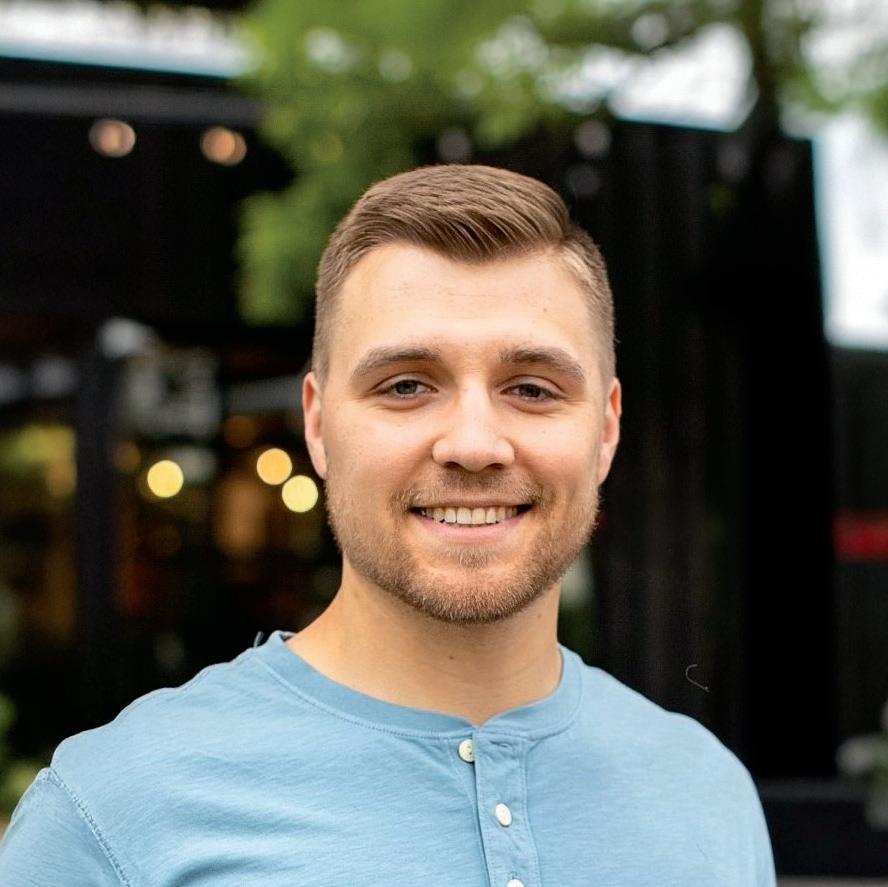
DERRICK KNOWS WHAT IT MEANS TO BE
#UND PROUD
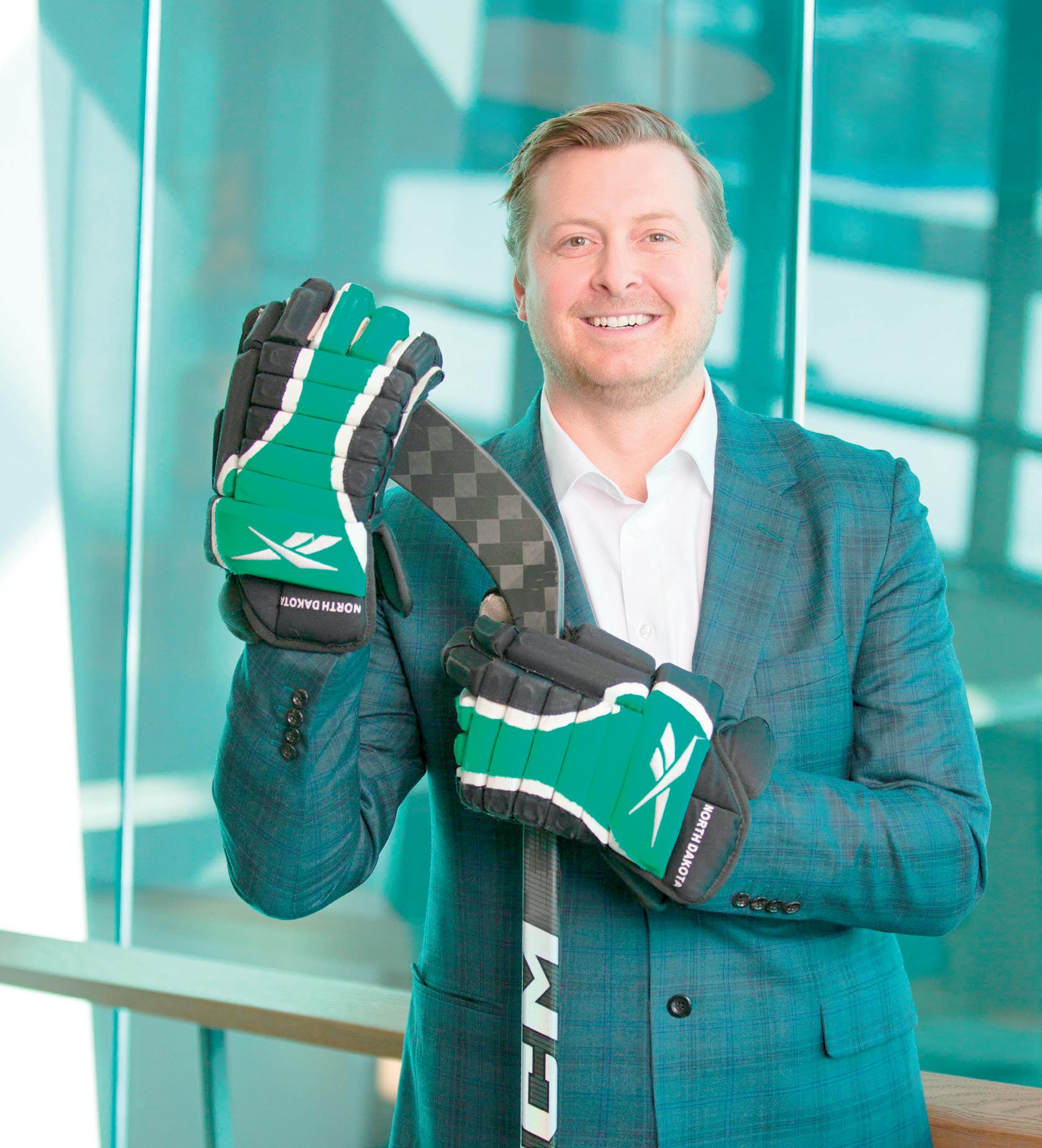
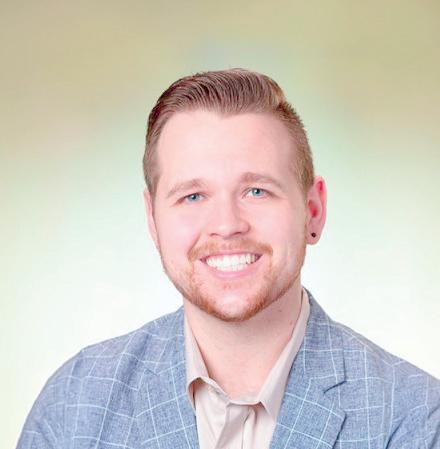
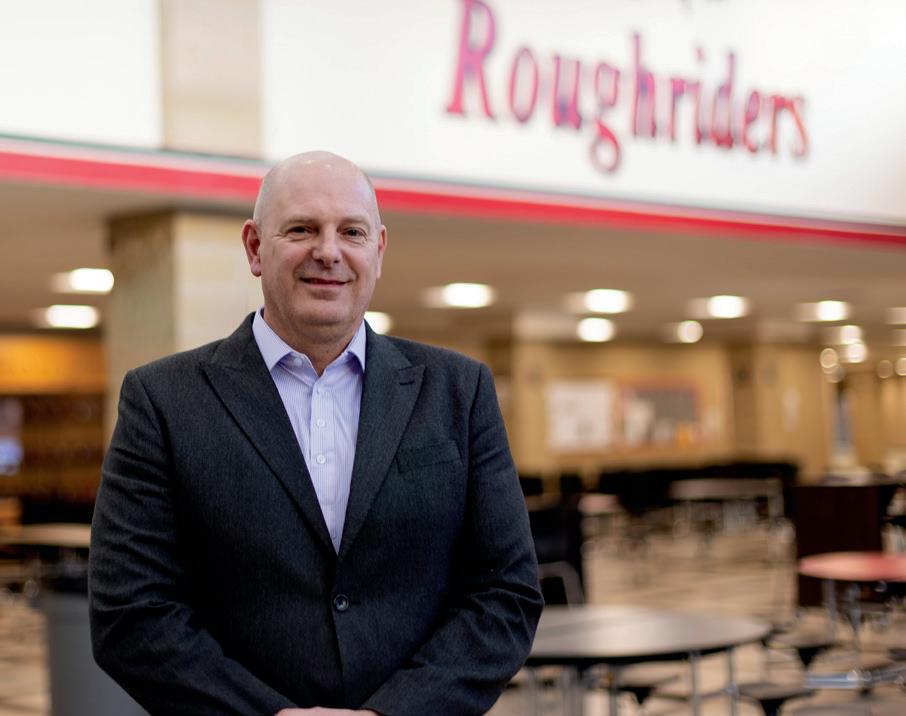
“My time at UND, both in the classroom and on the rink, shaped my values of hard work, accountability, and leadership. I’m grateful for the opportunities I received, and am now proud to serve UND partners with Bell’s public finance team. Whether through community support, financial guidance, or long‑term partnerships, we’re here to help UND students, alumni, and their communities grow and succeed.”
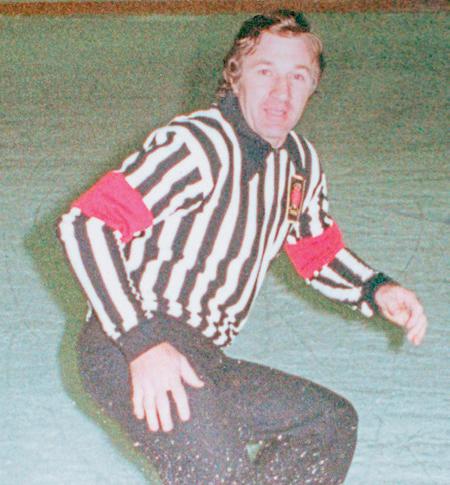
Derrick LaPoint VP/Market Development
EDUCATION BUILT FOR ANYWHERE
The University of North Dakota extends education beyond campus — connecting learners to engineering, nursing, education leadership, space studies, and more. Through flexible programs, strong partnerships, and statewide impact, UND helps students advance their careers while strengthening North Dakota’s workforce.
Forever UND: The Campaign for the University of North Dakota
A Message from the CEO News that Makes us #UNDproud Journey to the Frozen Four
LEARNING WITHOUT BOUNDARIES
Our century-long commitment to access helps fill critical workforce gaps across the state.
HOMEGROWN HEALTHCARE
A new approach prepares more future physicians and P.A.s to care for North Dakota.
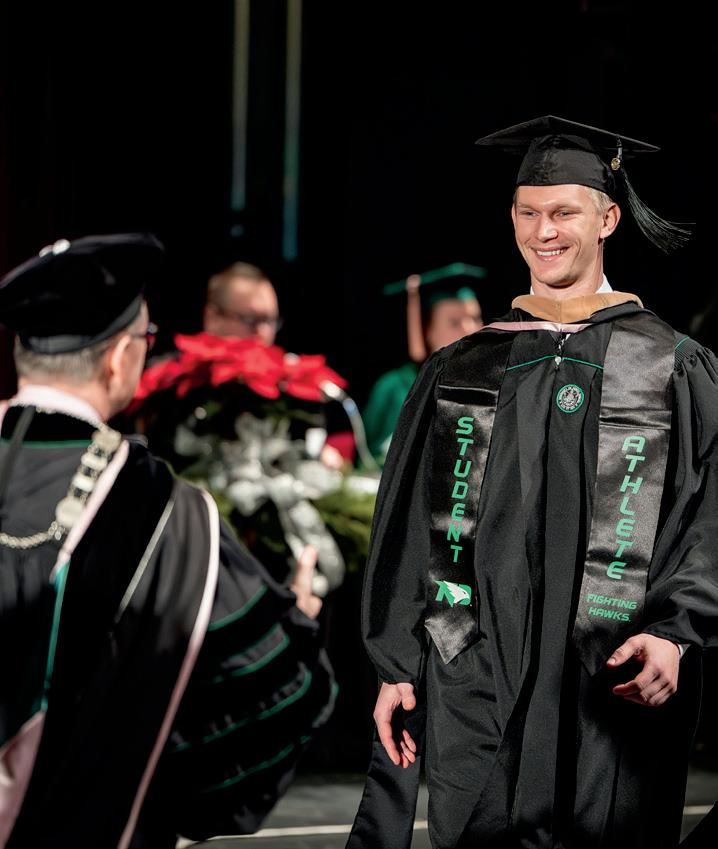
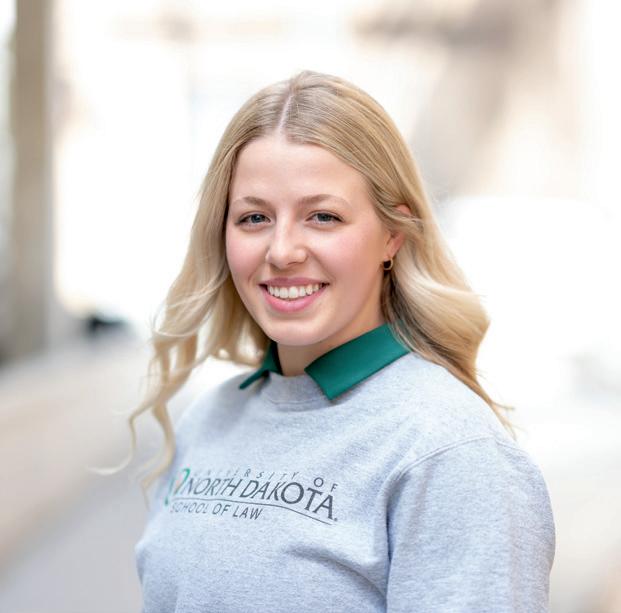
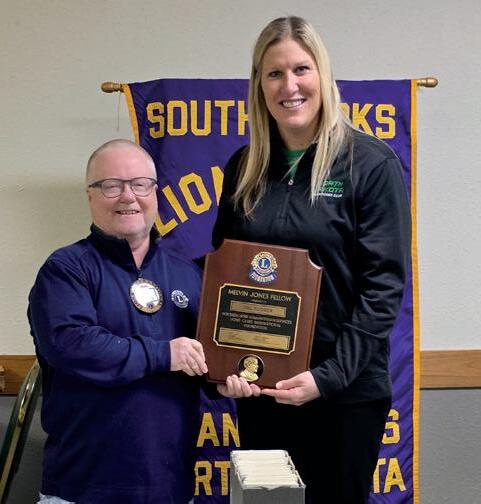
Samantha Ledahl, a first-generation college student, served as president of the UND Law Rural Practice Association for two years, helping to increase the association’s funding and grow the membership from 14 people in 2024 to 64 today. She’s pictured here at the Urban Stampede. Check out Samantha’s story on page 32.
Class Notes
60
Alumni Authors Alumni Photo Share
SPOTLIGHT ON TOMORROW’S WORKFORCE
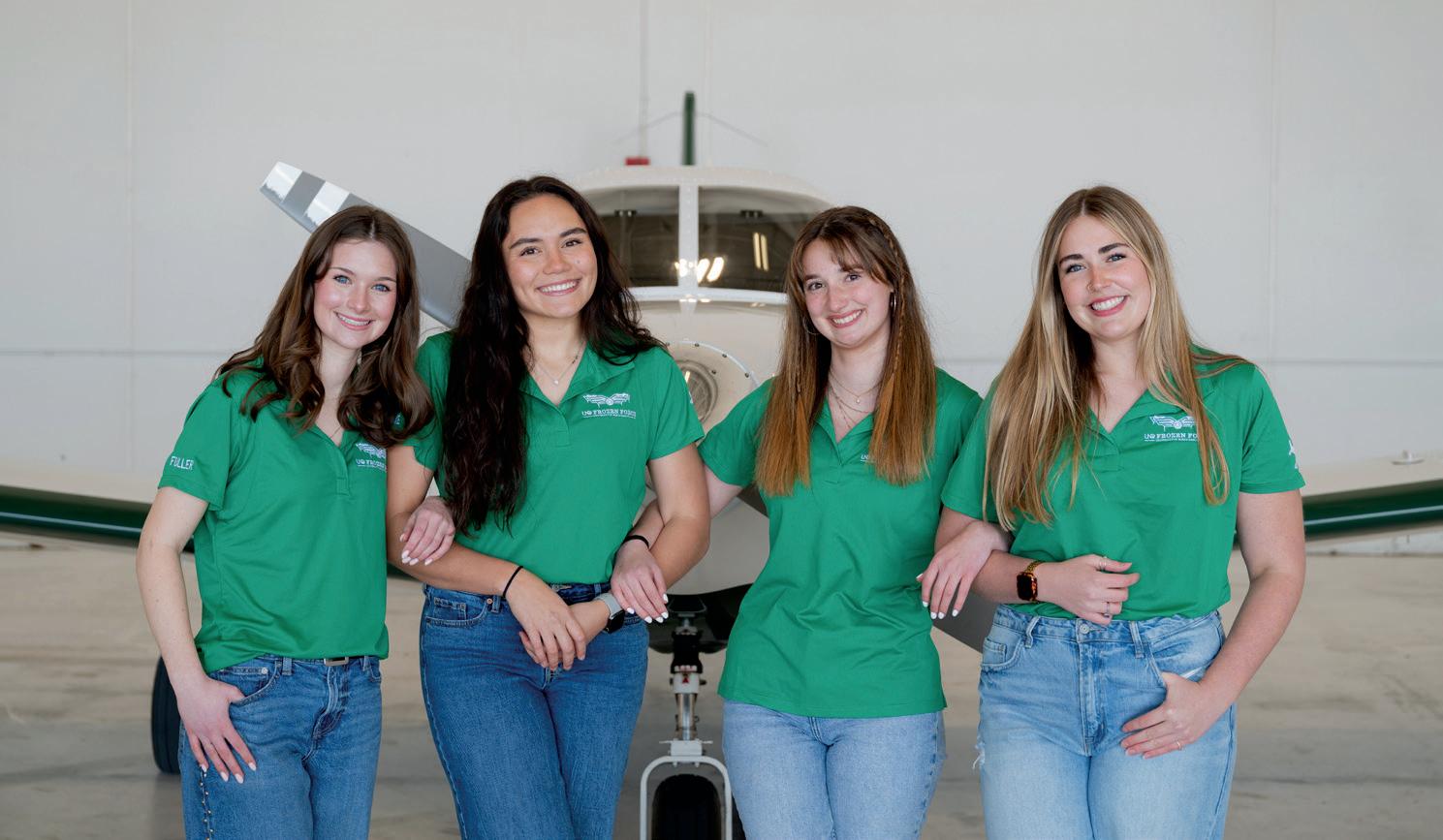
Students and programs shaping the future in media, aviation, law, and business.
62 In Memoriam 28
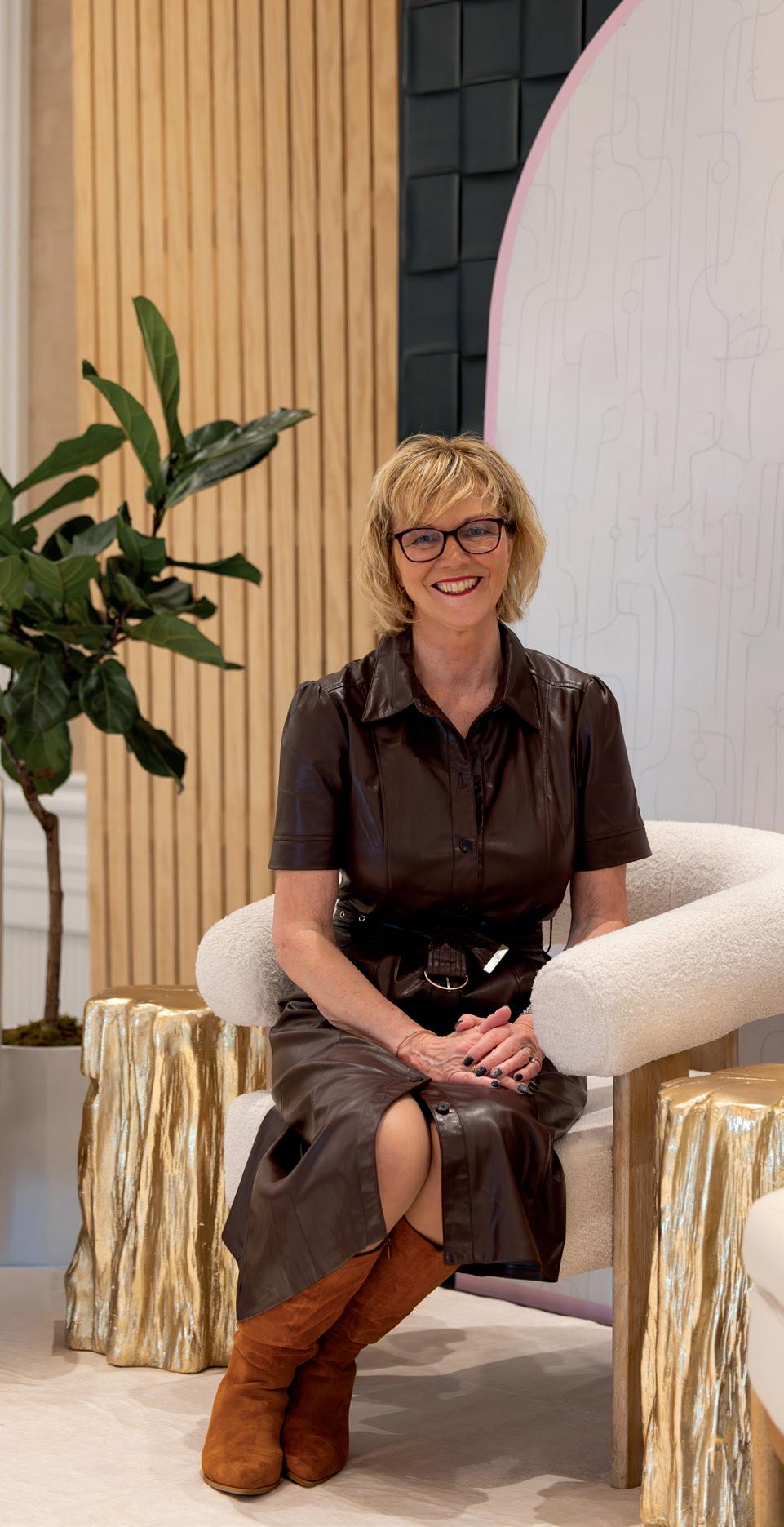
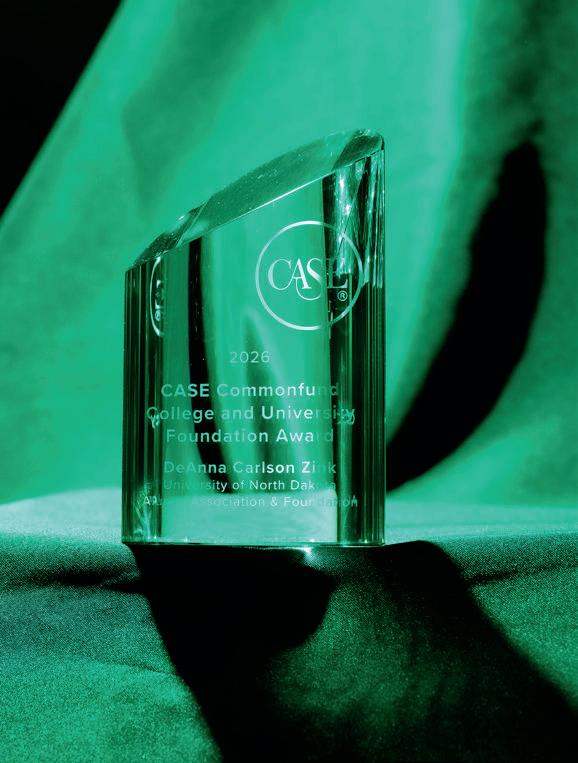
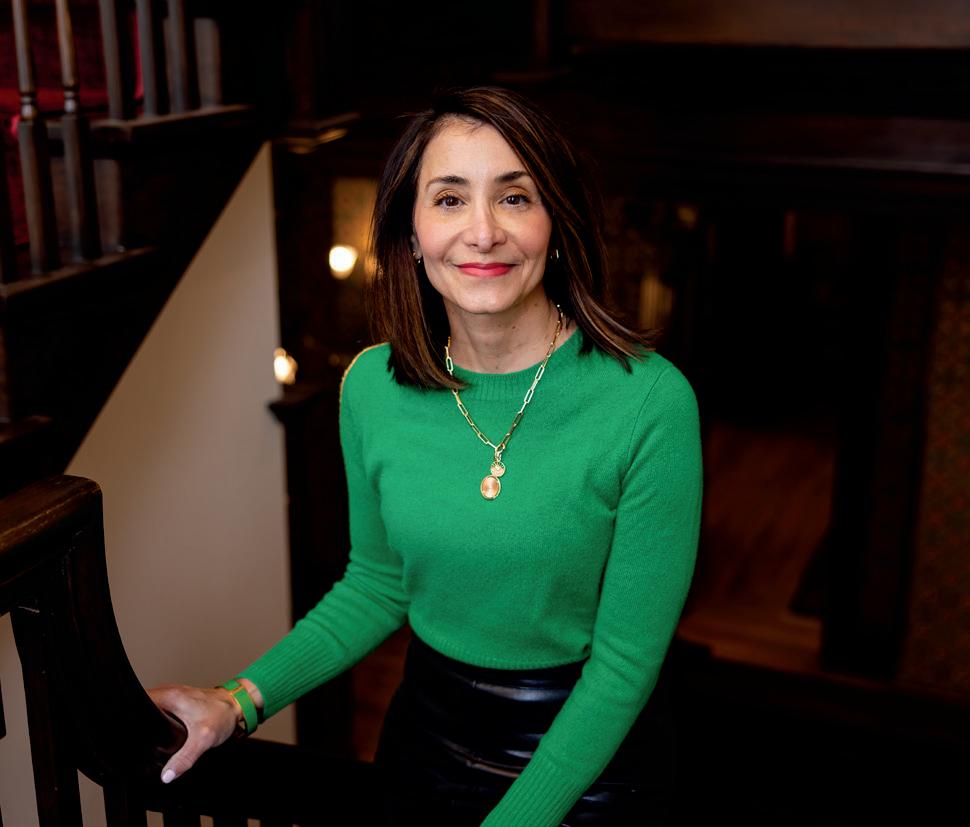
DeAnna Carlson Zink, CEO of the UND Alumni Association & Foundation, has been named a 2026 recipient of the prestigious CASE Commonfund College and University Foundation Award. The international Council for Advancement and Support of Education award recognizes individuals who have made extraordinary contributions to the advancement, quality, and effectiveness of their foundations.
A MESSAGE FROM DEANNA
MEETING STUDENTS WHERE THEY ARE
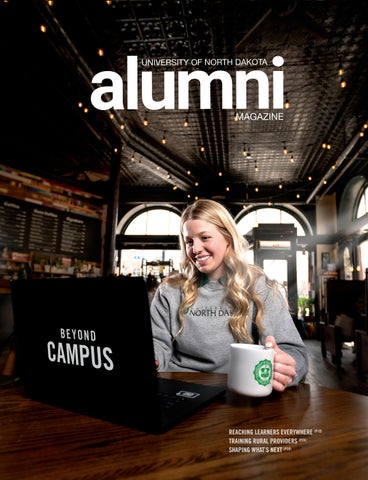
This issue, we are exploring a theme that strikes at the heart of UND’s mission: moving “beyond campus” and meeting students exactly where they are.
This isn’t a new concept for the University of North Dakota — our commitment to distance learning dates all the way back to our first correspondence courses in 1911.
I have a personal connection to this tradition. Back in the 1980s, I took accounting classes through the continuing education program to stay on track for my degree. I would pick up my textbooks and lesson plans at Gustafson Hall and complete my coursework longhand at our kitchen table. I remember being 8 months pregnant, studying with my 3-year-old daughter coloring beside me.
Other alumni from that era might remember the engineering graduate courses delivered via VHS tape. Some tapes were copied and viewed so often that the picture distorted, earning Professor Arnie Johnson the nickname “Fuzzy Arnie.”
Today, we have evolved far beyond the mail system and worn VHS tapes, leveraging the latest technology to be named the “Best Online University in North Dakota” by US News & World Report. Online flexibility allows our incredible student-athletes to maintain top GPAs while traveling for competition. It also allows us to serve our 2,000 military-affiliated students, letting them continue their education wherever they’re stationed.
Our online reach also elevates our globally recognized programs, such as Space Studies. This is thanks in large part to faculty like Dr. Pablo de León, who ensure our distance students receive a world-class education.
You’ll read about the North Dakota 85 initiative on p. 24, which will boost the number of state residents accepted into the School of Medicine & Health Sciences (SMHS) Doctor of Medicine and Physician Assistant programs. Why? Because a North Dakotan is more likely to practice in the state following graduation.
A great example of this is UND SMHS grads Dr. Grant Edland, ’20, and Dr. Kristen Stenehjem, ’20. The couple recently returned from East Coast residencies to practice immunology in Kristen’s hometown of Watford City.
Ultimately, these initiatives are about creating the next generation of professionals for North Dakota.
BOARD TRANSITIONS
I want to thank the UNDAAF Board of Directors who guide our mission to build an extraordinary UND. A heartfelt thank you to our outgoing board members Mike Hamerlik, ’84, ’88; Jodi (Thompson) Rolland, ’92; and Chad Wachter.
We’re thrilled to welcome incoming board members F. John Williams; Ann (Kerian) Fish, ’91; and Sheri Haugen-Hoffart, ’88.
HOMECOMING
You’re invited to come back to campus for Homecoming Week, Sept. 28 – Oct. 3. We’ll celebrate some remarkable individuals at the Alumni Honors Banquet and have a full schedule of events. See p. 66 for that schedule and a list of this year’s Alumni Honors recipients. I look forward to welcoming you home!
UND ALUMNI MAGAZINE
Spring 2026 | Volume 109 | Issue 2
UND ALUMNI ASSOCIATION & FOUNDATION
Chief Executive Officer
DeAnna Carlson Zink, ’86
Vice President of Marketing & Communications
Sarah Prout, ’07
UND ALUMNI MAGAZINE
Editor
Alyssa Konickson, ’06, Associate VP of Marketing & Communications
Designer
Jenny Wolf, ’03, Director of Creative & Brand Strategy
Jasmine Koenig, Digital Media Coordinator & Photographer
Chad O’Shea, ’20, Associate Director of Stewardship Communication
Sam Melquist, Graphic Designer
Milo Smith, Senior Director of Public Relations & Videography
Carly Tate, ’18, Associate Director of Marketing & Communications
Jeannie Tvedt, Senior Database Coordinator
UND Marketing & Communications
BOARD OF DIRECTORS
Chair
Darla (Kleven) Adams, ’84, ’85, ’07
Vice Chair
Troy Bader, ’85
Directors
Andrew Abernathey Lisa (Schmitz) Barnes, ’88
Twylah (Butler) Blotsky, ’93
Chris Cooper, ’05, ’08
Kelly (Keeler) Caruso, ’91
Lucy Dalglish, ’80
Kaleb Dschaak, ’20 Scott Fredericksen, ’74
Angie (Hovland) Freeman, ’91
Randy Gershman, ’84
Mike Hamerlik, ’84, ’88 Dr. Mike LeBeau, ’02
Nathaniel Leben, ’05
Gary Petersen, ’87, ’93
Lara (Olsen) Prozinski, ’90
John Solberg, ’76
Kathryn Uhrich, ’86
Reid Walker
Chuck MacFarlane, ’87
Karen (Borlaug) Phillips, ’77
Jodi Thompson Rolland, ’92
Dave St. Peter, ’89
Chad Wachter
Ex Officio
Andrew Armacost Karla Mongeon-Stewart
Dr. Marjorie Jenkins Eric Link
Nancy Pederson, ’90
DeAnna Carlson Zink, ’86
The UND Alumni Magazine (ISSN 26896753) is published four times a year by the University of North Dakota Alumni Association & Foundation 3501 University Avenue Stop 8157 Grand Forks, ND 58202-8157
Periodical postage paid at Grand Forks, ND 58201 and other offices. POSTMASTER: Send address changes to: UND Alumni Magazine 3501 University Avenue Stop 8157 Grand Forks, ND 58202-8157
For inquiries about advertising, additional copies, submissions, or general comments, contact 800.543.8764, 701.777.2611 or alumnimag@UNDalumni.net.
Leading in the Artemis Era
The University of North Dakota is contributing to NASA’s Artemis Program through research and faculty expertise supporting human spaceflight. Most notably, professor and chair of Space Studies Pablo de León participated in preflight activities for Artemis II at Kennedy Space Center. UND’s work in spacesuit design, lunar surface systems, and habitat research aligns closely with NASA’s goals for sustained human exploration of the Moon. Reflecting UND’s broader impact, de León noted in a PBS interview, “Most of the graduates of our program, they go to work for NASA, they go to work for the Space Force. They go to work for Boeing and Lockheed Martin and Northrop Grumman or other companies.”
De León was honored this year as a Chester Fritz Distinguished Professor, along with Emily Cherry Oliver, professor and chair of the Theatre Arts Department
QUOTABLE
“I like people generally. And I even like stupid people, and I’ve been one myself from time to time.”
GEORGE SAUNDERS AUTHOR
OF “VIGIL”
AND OTHER WORKS SPEAKING AT THE 57TH UND WRITERS CONFERENCE
Forensic Science Breakthrough
UND’s Forensic Science bachelor’s program has earned accreditation from the Forensic Science Education Programs Accreditation Commission (FEPAC), widely considered the gold standard in forensic science education. It is the first FEPACaccredited program in the northwestern U.S.
15
faculty members were named to the 2025 Stanford-Elsevier Top 2% Scientists List, a global ranking of the world’s most influential researchers.
444
years — the age of the Chester Fritz Library’s oldest book. UND acquired one of just 11 copies of “Discorso del S. Guglielmo Choul,” a Renaissanceera text on ancient Greek and Roman military camps and baths.
1st
place achieved by the UND Aerobatic Team at the 2025 International Aerobatic Club Collegiate National Championship
15,155
students enrolled at UND for the spring 2026 semester — a new spring enrollment record and a 3.87% increase over last year.
First in the Nation
North Dakota has launched the country’s first statewide beyond visual line of sight system for unmanned aircraft. The network gives UND expanded opportunities for UAS testing, education, and collaboration with industry.
QUIZ
UND graduate Bob Fransen recently provided a transformational gift to the Nistler College of Business & Public Administration. What department, the first of its kind in North Dakota, will be named in his honor?
A) The Fransen Department of Real Estate, Economics & Finance
B) The Fransen Department of Entrepreneurship & Innovation
C) The Fransen Department of Financial Technology & Analytics
D) The Fransen School of Corporate Leadership & Strategy
Department of Real Estate, Economics & Finance
Undoing Motion Sickness
The
UND’s motion sickness program is earning international attention for its work diagnosing and treating spatial disorientation in pilots. That expertise was highlighted on the global stage when Jennifer Watne presented the team’s findings at the Aerospace Medical Association Conference in Denver.
For more, subscribe to UND Today at UND.edu/today.
A)
Fransen
UND ANYWHERE
As North Dakota employers search for workers, distance learning is helping the University of North Dakota strengthen the state’s talent pipeline.
North Dakota faces a historic workforce shortage, with only 47 workers available for every 100 open jobs. For UND, meeting learners where they are has long been part of the solution — from early correspondence courses to today’s flexible online programs. That century-long commitment is keeping graduates in the state, attracting new talent, and expanding UND’s impact nationwide.
OUR ONLINE STUDENTS
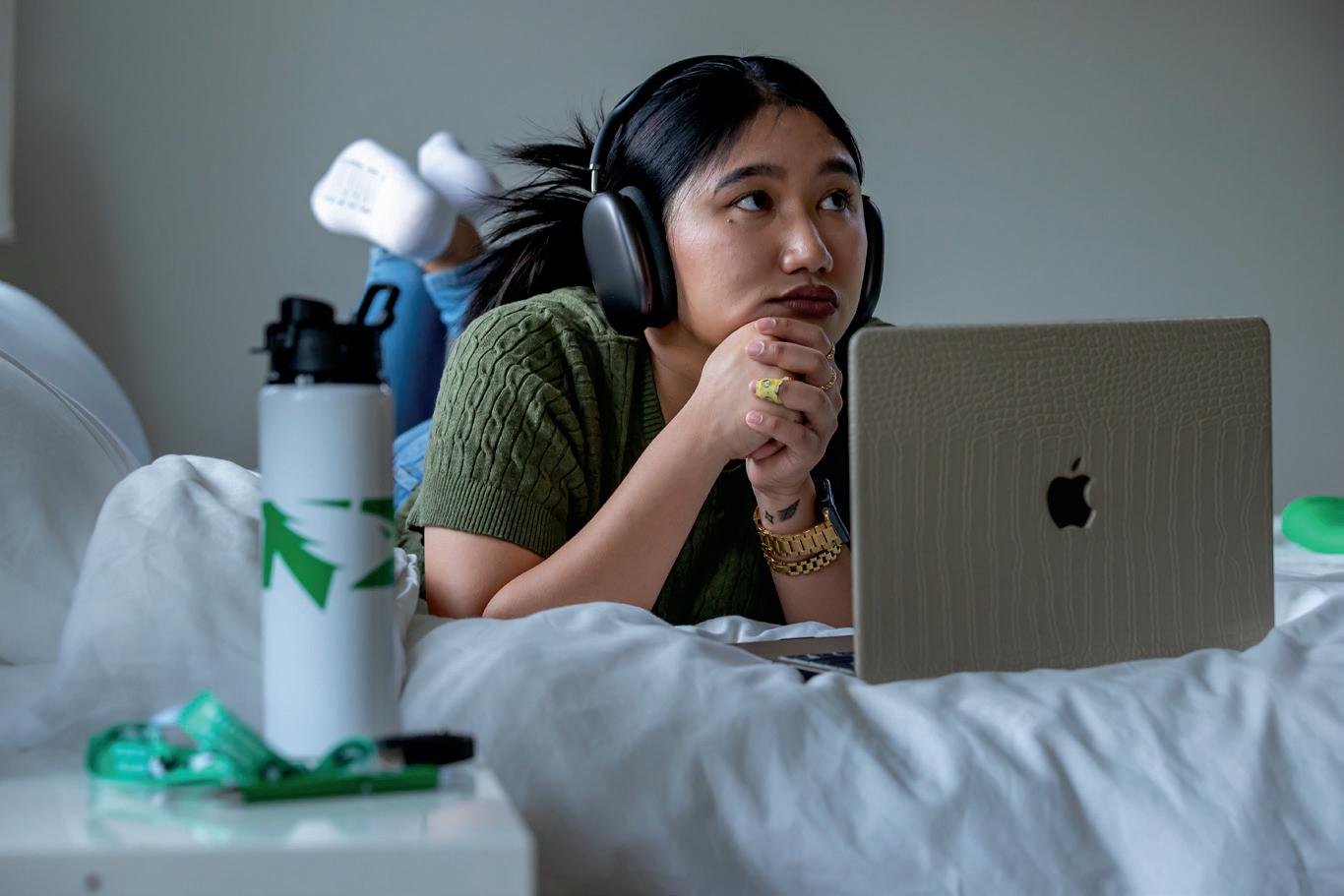
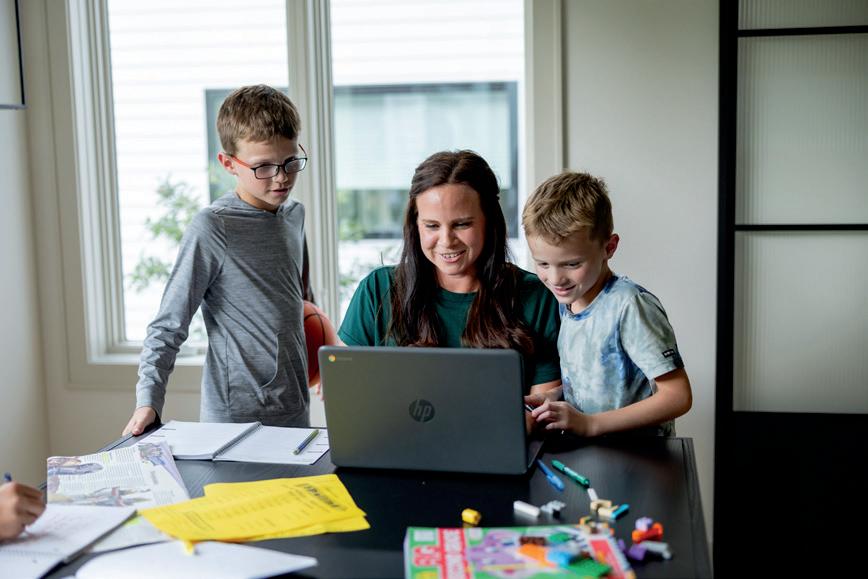
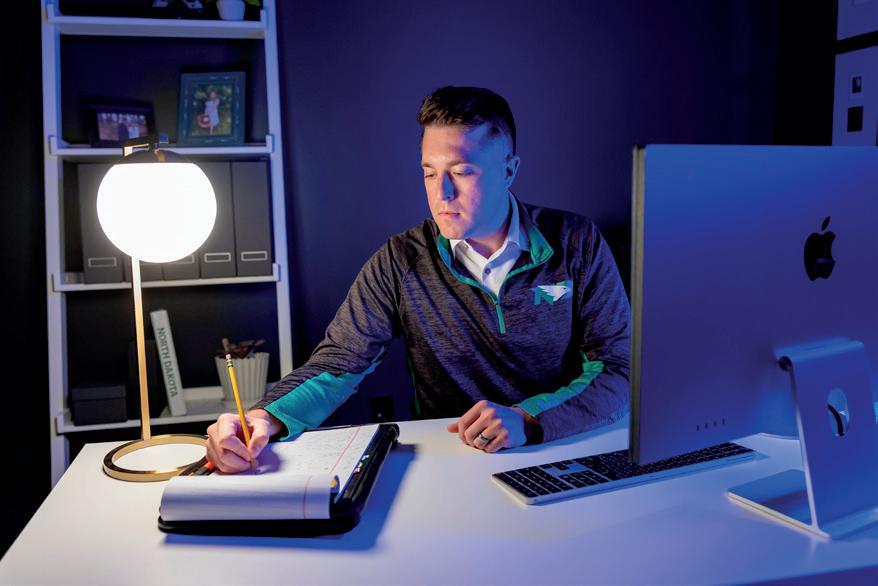
Online students log in from dorm rooms, hospital break rooms, military bases, and homes across the country. Undergraduate online learners resemble their on-campus peers in age and background, choosing online options for the flexibility to balance work, family, and academic demands.
1,000
online courses in 200+ programs
35% of UND students take at least one online class #1
best online college in North Dakota (U.S. News & World Report)
A MISSION THAT TRAVELS
UND’s long history of bringing education beyond Grand Forks.
Long before online courses existed, UND was reaching students who couldn’t come to campus. In 1911, the University launched correspondence courses, allowing learners across North Dakota to mail in assignments and opening access for rural communities.
By the mid-20th century, the program served nearly 1,000 students. Under director Beatrice Johnstone, Class of 1891, UND expanded its reach through traveling speakers, judges, musicians, and community courses, including citizenship preparation. It was an early model of UND’s long-standing commitment to meeting learners where they are.
Taking Education to the Students
Over the decades, delivery methods changed, but the mission stayed the same. Faculty taught in small towns, partnerships brought UND programs to regional colleges, and printed lessons eventually became recorded lectures on video cassettes and DVDs.
“We’re in a big, sparsely populated state,” said Jeff Holm, UND vice provost. “Online education is just the modern version of going to students instead of making them come to us.”
That foundation proved invaluable during the COVID-19 pandemic, when UND already had the infrastructure others were rushing to build. “Even before the pandemic, roughly half our students were online,” then-Dean of the College of Engineering & Mines Brian Tande told a reporter.
Holm noted that this approach aligns with the North Dakota University System’s vision to provide programs where and when people need them. “Online is a natural extension of UND’s mission.”
“Online education introduces a large number of people to North Dakota. It allows people to become familiar with the state without making a major upfront investment.”
JEFF HOLM
1911
UND launches distance education through mailed lessons, bringing university learning to rural communities across North Dakota.
1933
Beatrice Johnstone is appointed director and associate professor of correspondence study. She held that role into the 1950s.
Connecting to North Dakota
North Dakota produces about 7,500 high school graduates each year — not enough to meet workforce demand.
Holm believes online education can help fill that gap. “North Dakota’s long-term economic growth — whether we’re talking 20 years or 50 years from now — can’t happen based solely on our current population,” Holm said. “We have to bring people in. Online education introduces a large number of people to North Dakota.”
UND leads the state in online programs, enrolling students from across the country. Nearly 45% of online graduates work in North Dakota or the surrounding region.
“It doesn’t seem to matter much whether they came to campus or studied online,” Holm said. “There’s a similar return on investment in terms of graduates working in North Dakota, and that surprised the heck out of me.”
Strengthening the University
“Last fall, we offered about 1,000 online courses,” Holm said. “Without online students from out-of-state, we would have had to cut 350 of those courses.”
In other words, UND’s online programs help maintain the breadth of courses available to students on campus and across the state — keeping programs viable and classrooms full.
“We’ve got something that’s built, that’s working, and that’s introducing people to the state right now,” he said. “Shouldn’t we try to use it more fully before deciding it doesn’t work and looking somewhere else?”
1946
Recently named Correspondence Division grows to 990 students taking 1,348 courses.
2020s
More than 1,000 online courses offered; UND earns national rankings for online quality and innovation.
Jeff Holm sees online education as a way to bring people into the state.
CARING FOR COMMUNITIES
Online programs help nurses build new skills while remaining at the bedside.
Hospitals across North Dakota struggle to recruit and retain nurses, but UND’s online programs are helping keep them in the communities that need them most. Fifty-nine percent of online nursing graduates work in North Dakota or the surrounding region, a reflection of programs designed for working professionals who cannot leave their jobs, families or rural communities for advanced training.
While the Bachelor of Science in Nursing remains a campus cornerstone, RN-to-BSN and graduate tracks allow nurses to advance where they practice.
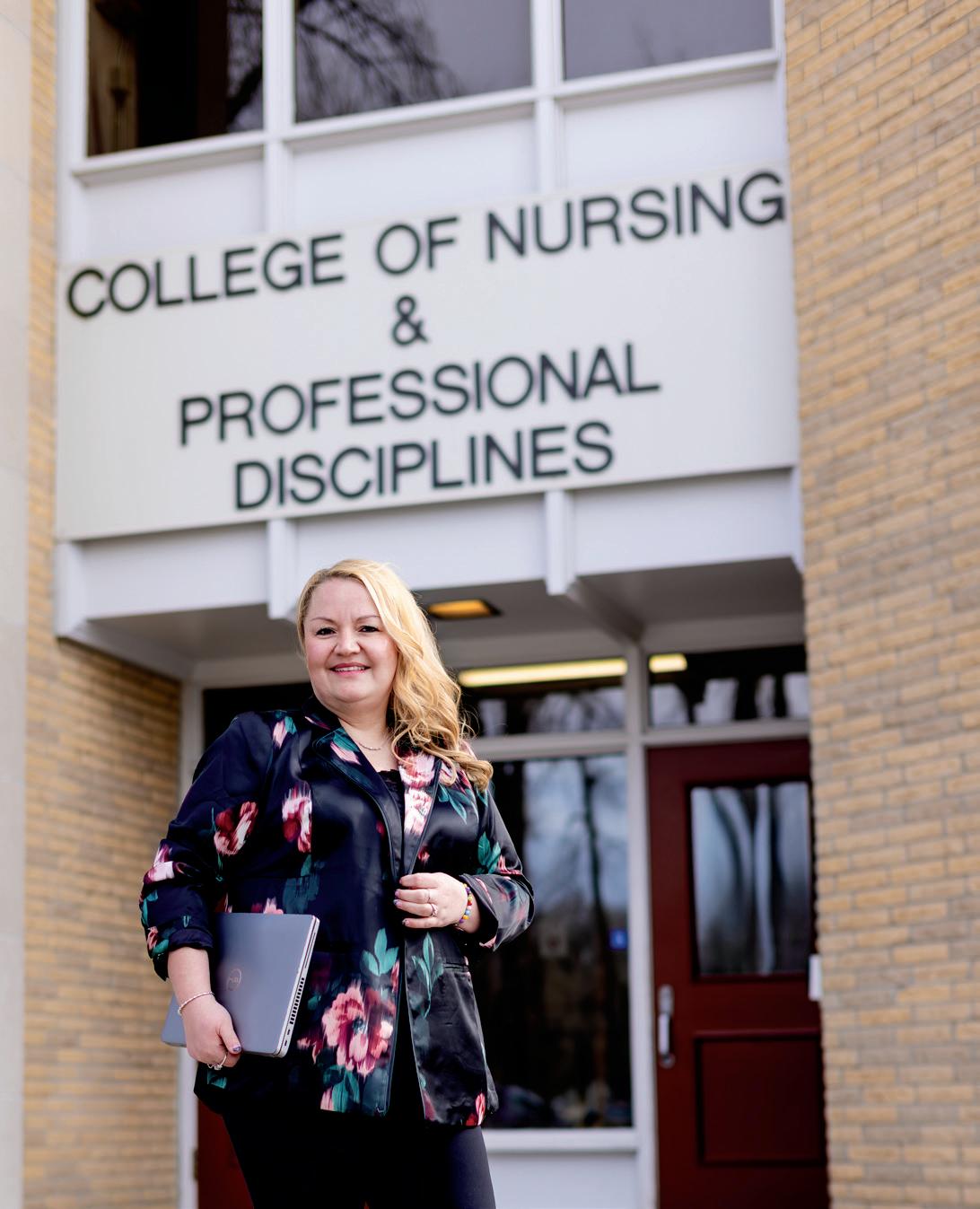
“Where we’ve really thrived in the online space is in our graduate nursing programs,” said College of Nursing & Professional Disciplines
Dean Maridee Shogren, citing nurse practitioner, certificate and doctoral pathways, along with a hybrid nurse anesthesia program.
“We cater to practicing registered nurses in our state who want to come back to school but are not able pick up and move,” Shogren said.
Faculty see the impact of that model daily. Mary Jane Rivard, a clinical assistant professor and director of the post-master’s DNP program, said UND graduates shape the profession statewide — serving on boards and professional organizations, working with legislators and helping create healthcare policy.
Graduate students often take on applied projects that address immediate clinical needs. Kolton Jacobson, ’24, completed his DNP while working as a nurse practitioner, focusing his project on supporting internationally educated nurses in rural healthcare systems. He developed a toolkit to help leaders strengthen transition-topractice programs. “In northern and rural areas of the Midwest, internationally educated nurses help fill a major gap,” he said.
“I really liked that UND gave us chances to connect with professors. The faculty were constantly there, through classes, emails, and weekly announcements. You never really felt like you were just ‘online.’”
KOLTON JACOBSON
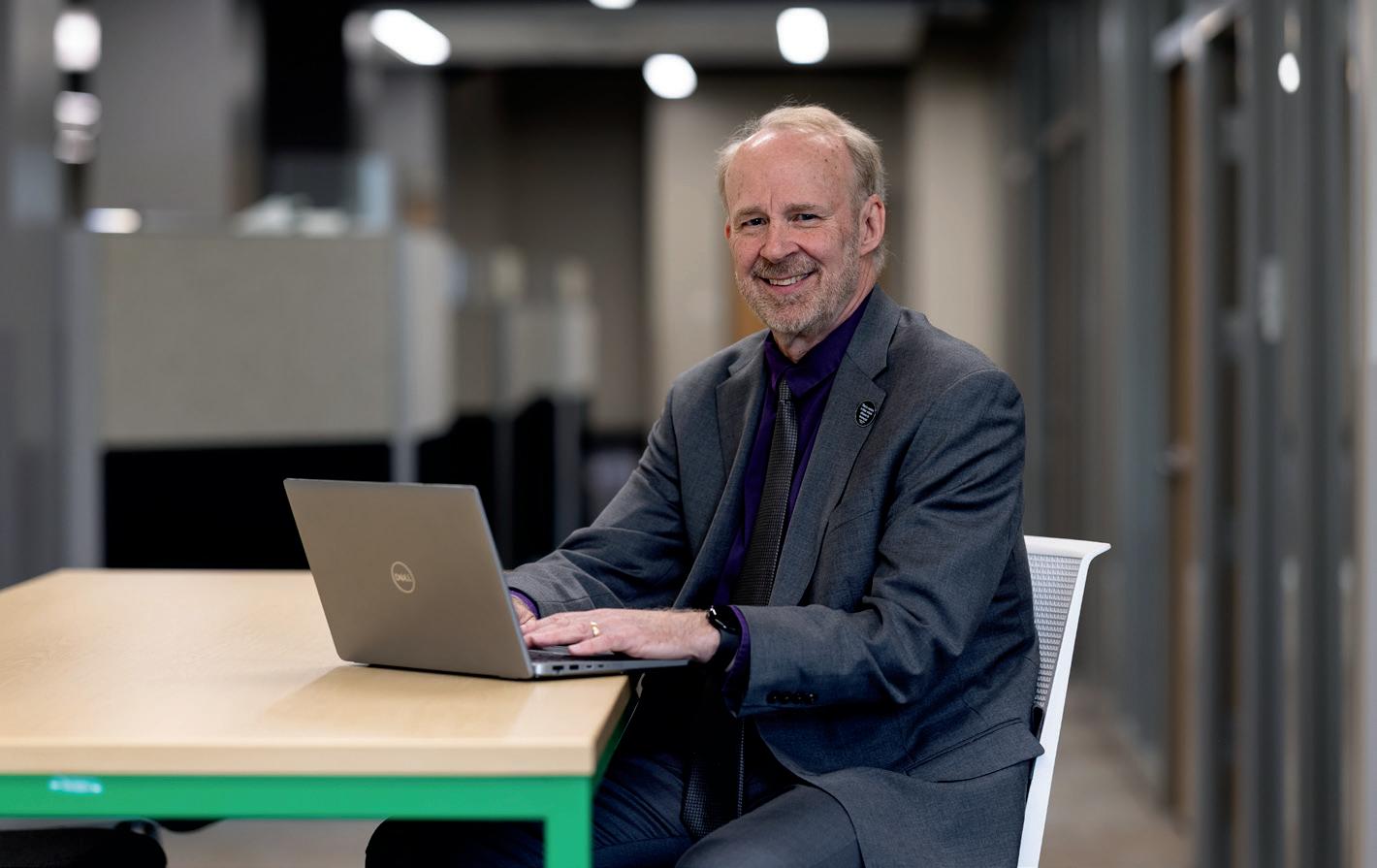
Kolton Jacobson, who lives in Elk River, Minnesota, is manager of medical education at VuMedi.
A Traveling Reputation
Sonya Anderson, ’13, director of the RNto-BSN program, saw that need firsthand while working as a travel nurse in more than 30 facilities across the state.
“Our hospitals need these nurses right where they are,” she said.
Rural nurses often take on wide-ranging responsibilities, experiences that can strengthen their applications to competitive advanced programs.
Anderson has seen how the University’s reputation follows its graduates.
“In many of the facilities where I worked, the first question was, ‘Where did you graduate from?’” she said. “When I tell them UND, the response is often, ‘We don’t have to worry about you.’”
Answering
the Call for Rural Care
Eight nursing students are participating in Gero-STARR, a federally funded program preparing nurses to care for older adults in rural communities. Participants commit to working in North Dakota hospitals or long-term care facilities after completing the program.
“I take this work seriously. We’re educating the people who will care for me and my family, so it matters that they’re well prepared,” Shogren said. “Our students come in with a purpose, a desire to serve rural and underserved communities.”
That preparation is recognized far beyond the state. Tennessee Children’s Hospital allows only two nursing programs nationwide to send students for clinical experiences; UND is one of them.
“It speaks to the level of preparation and professionalism our students bring,” Anderson said. “Our students wear green scrubs. (When they arrive,) the staff will say, ‘Here comes the sea of green.’”
“There is something special about North Dakota, especially when it comes to the people who choose to build their careers in its communities.”
SONYA ANDERSON
Sonya Anderson, ’13, began her education at a local community college with a strong pre-nursing program. A recruiter from UND’s RAIN (Recruitment and Retention of American Indians into Nursing) program encouraged her to continue her studies at UND, where she completed her four-year degree.
ENGINEERS FOR THE FUTURE
Bringing
new people and new partnerships to the state.
Engineering is UND’s largest online discipline. Each year, the University graduates about 500 engineering students — roughly half of them online.
“That’s significant,” said vice provost Jeff Holm. “If you’re a North Dakota company recruiting engineers, you’ve essentially doubled the number of graduates available.”
Most online engineering students are parttime and stay in their programs for four years or more, which Holm sees as an opportunity for employers.
“Students are going to log into our learning platform almost every day,” he said. “If a company partnered with a program, its activities could be used as examples of how course concepts are applied in the field. When that company needed workers, it would already have a connection for those students.”
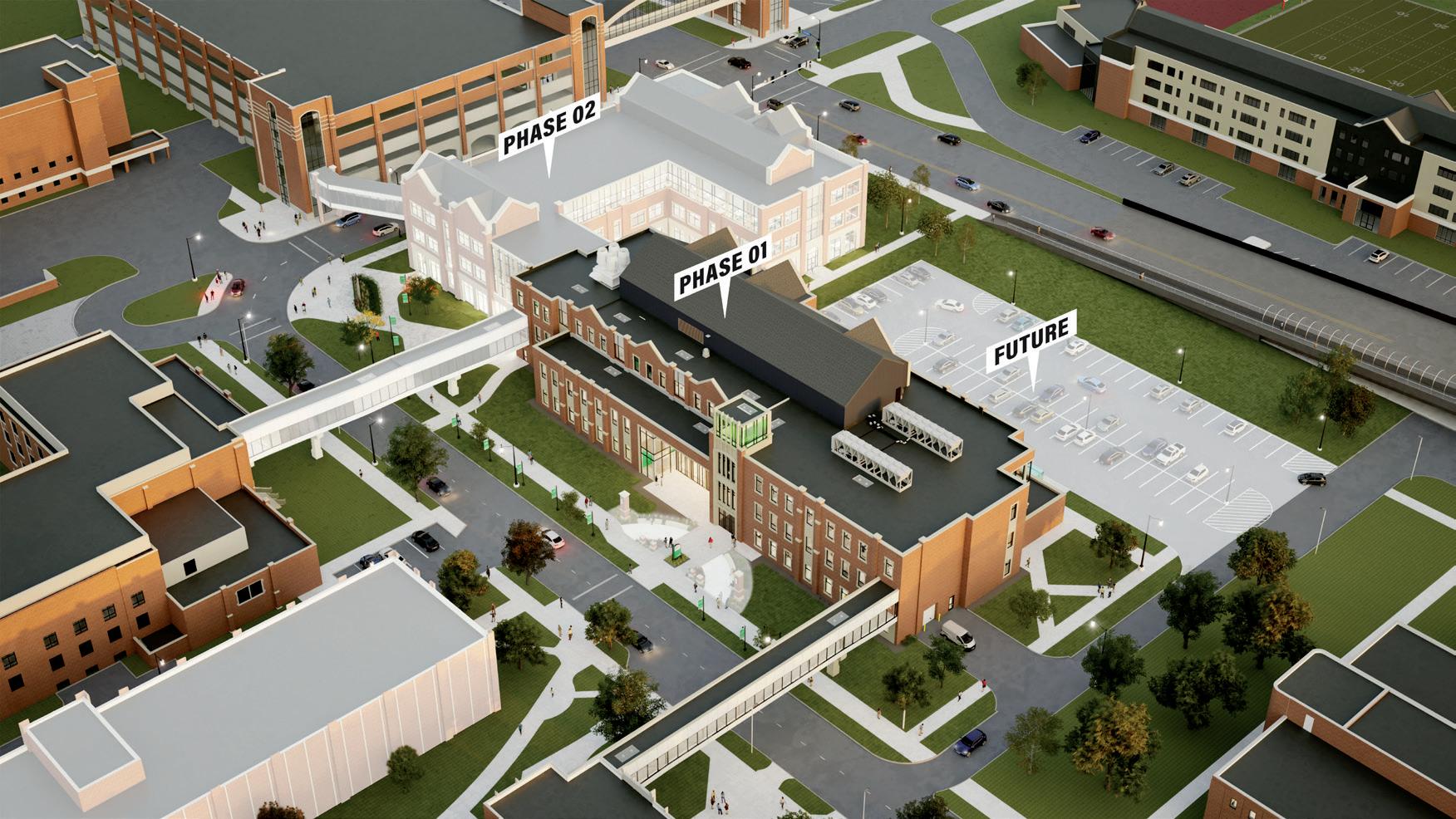
The new UND STEM Complex will further strengthen that pipeline, giving students spaces to build and test designs in makerspaces, innovation labs, and collaborative environments.
“Students — even online students — want to be connected to a university with a physical presence,” Holm said. “The new STEM building will probably help us online as much as it helps us on campus.”
A Closer Look at Collaboration College of Engineering & Mines Dean Ryan Adams said UND’s online engineering programs stand out nationally for three reasons:
• Decades of experience delivering distance courses since the late 1980s.
• An entrepreneurial approach to building systems and training faculty.
• Full integration with the on-campus degree.
“About 90% of engineering colleges that offer online programs operate them separately from their campus programs,” he said. “Here, the diploma looks the same because they meet all the same requirements.”
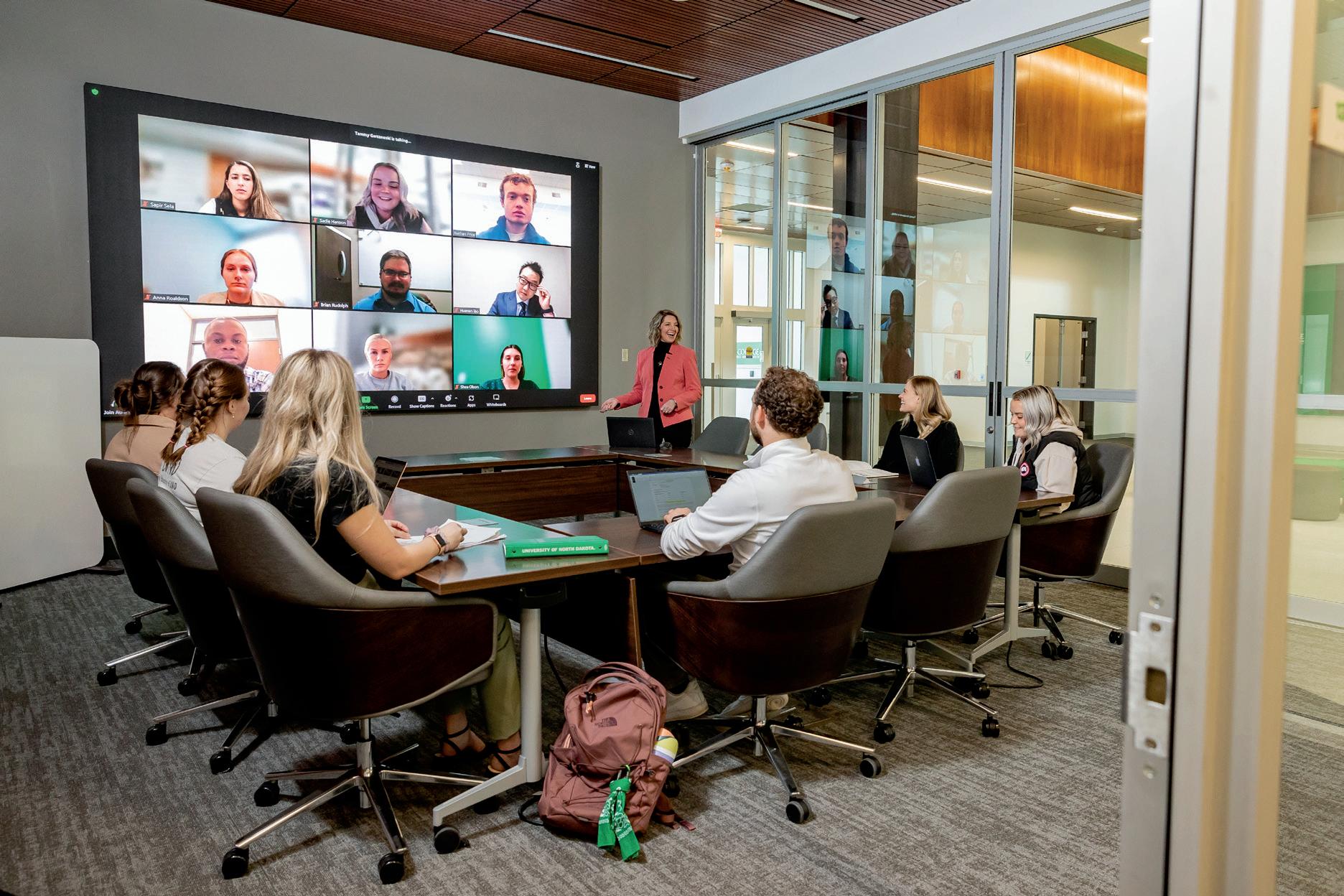
UND engineering classes are recorded directly from on-campus classrooms, allowing online students to join live or watch later.
“You can certainly feel the difference,” said Ph.D. student Tyler Midas, ’24, a Senior R&D Engineer at Boston Scientific in Minneapolis.
“Even if you can’t watch them at 11 a.m. because you’re working, you still get the live experience later. You can see the professors read the room and adjust their content. You still hear the in-class questions, and those are helpful.”
Adams said his college is intentional about assigning a mix of students to project teams, reflecting how engineers work today.
Ryan Adams said UND Engineering integrates online and oncampus courses, encouraging collaboration similar to real-world engineering practices.
“My job is purely research work. This type of position in the industry is hard to find; they are few and far between, and they’re hard to land when you do find them.”
TYLER MIDAS
“The vast majority of engineers meet the way we’re meeting right now. They collaborate with people all around the world. Being able to bring all those disciplines together is extremely important.”
Most online students are required to travel to Grand Forks for lab experiences, which introduces out-of-state students to UND, and sometimes North Dakota itself.
Adams recalled one online student from Iowa. “When he came to campus for the lab, he had such a great experience that he moved to Grand Forks and transitioned to an on-campus student,” he said. “We see those kinds of examples very often.”
Expanding UND’s Reach
A Ph.D. student working at the Naval Surface Warfare Center in Maryland helped open doors for UND — leading to Office of Naval Research funding and stronger ties with federal partners, from the Air Force and National Guard to the unmanned aircraft systems industry.
“We end up getting partners, neighbors, friends that want to come here because of the capabilities that we have,” Adams said.
Midas agreed. “Being able to make these connections advances the science. And in my field, advancing science means advancing the quality of people’s lives.”
Tyler Midas is a Senior R&D Engineer in the Exploratory Interventional Heart Failure group at Boston Scientific.
Phase I of the UND STEM Complex will be completed during the summer of 2028 and will be open for classes in Fall 2028. (Architect rendering)
THE PRINCIPAL PIPELINE
Preparing educators to lead schools across North Dakota.
North Dakota’s annual principal turnover rate is nearly 40 percent — a sign of the growing demands placed on school leaders, especially in rural communities.
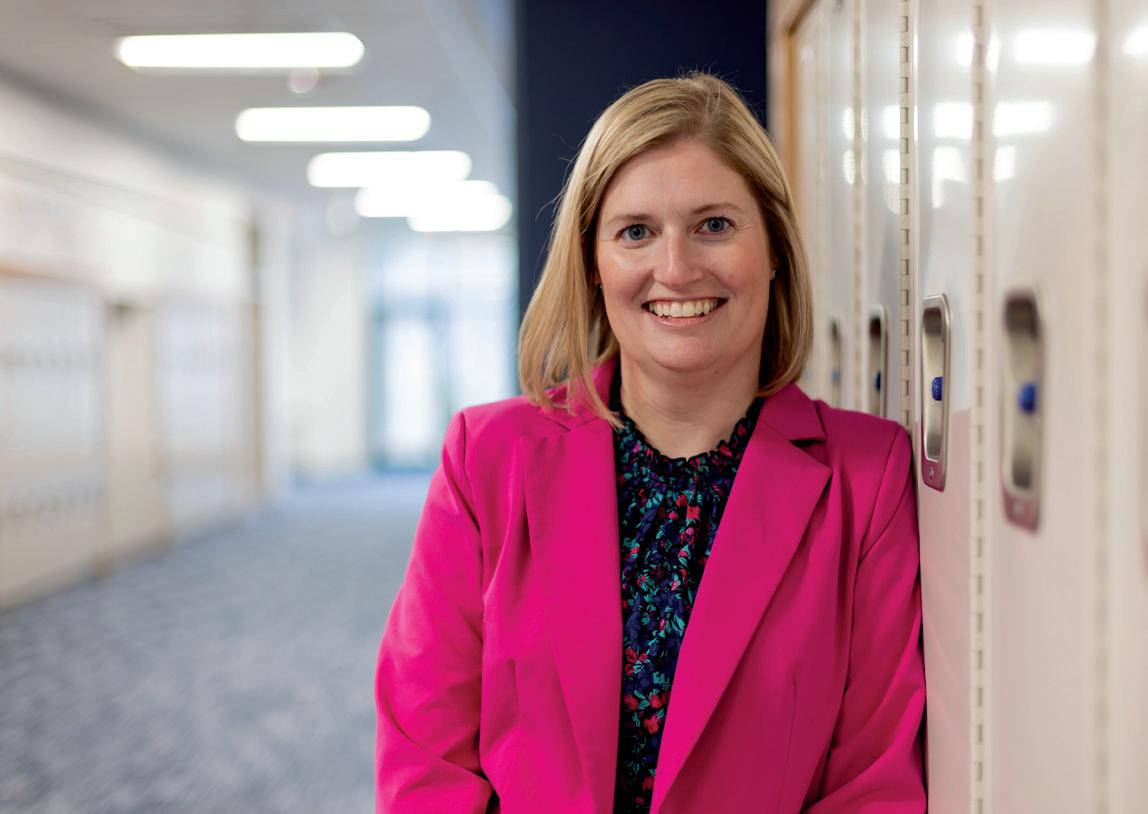
“There is an implicit connection between the effectiveness of the principal and student learning outcomes,” said Laura Link, associate professor of Teaching & Leadership and director of UND’s Master of Science in Teaching & Leadership program. “When principals are supported and effective, teacher success rises and student learning rises with it.”
Link helped design UND’s Aspiring Principals Pipeline, an online-plus-residency master’s program built to prepare and retain school leaders across the state.
Coursework is delivered online so educators can remain in their districts. A three-semester residency places them alongside practicing principals five days a week.
“The breadth of experiences is wider than a student teaching experience,” Link said. “It’s more like a medical residency.”
Mentors Matter
Mentorship is central to the program. In addition to academic advisors and principal mentors, students work with residency coaches — experienced principals who provide guidance from outside the students’ home schools.
One of those mentors is longtime Grand Forks Red River High School Principal Kris Arason, ’92, ’01, ’17, who was recently named assistant superintendent of secondary education for Grand Forks Public Schools.
“You don’t realize how many unique situations you’ll face,” Arason said. “Families, counselors, social workers — you’re part of a close team supporting students. They may want to talk through things they don’t feel comfortable bringing to their direct supervisor. That’s where mentorship really matters.”
All 10 participants completed the 30-credit program while serving full time in North Dakota schools. Eight moved directly into principal or assistant principal roles the following academic year.
“Growing leadership talent from within gives us a greater likelihood of retention, because they’re already part of the community.”
LAURA LINK
Laura Link helped design UND’s Aspiring Principals Pipeline.
COHORT CONNECTIONS
Dave Muhonen, ’25, and Heather Robideaux, ’25, entered UND’s Aspiring Principals Pipeline as teachers in Grafton. They now work together in Pembina: Dave serves as the PK-12 principal, and Heather as assistant principal.
“They had already built a working relationship through the program,” said Laura Link. “It’s something we didn’t expect, but we’re seeing graduates turn to their cohort peers because they recognize the value of those relationships.”
From Classroom to Leadership
For Valley Middle School associate principal Amber Basting, ’25, the residency revealed the full scope of the job she was preparing to take on.
A 14-year veteran of the Grand Forks Public School District, she spent a decade as a special education teacher and three years as a coordinator before entering the pipeline.
“Knowing the ins and outs of how our district operates gives us a leg up when we move into leadership roles,” she said. She expected difficult parent conversations and challenging student situations. What surprised her were the bigger picture responsibilities. The yearlong residency allowed her to experience the full cycle of a school year, from August hiring decisions to February morale challenges and master scheduling. It prepared her to help lead through a transition into a new building during her first year as associate principal.
“In our partner districts, we now have wellequipped aspiring principals ready for the role — not someday, but now,” Link said.
“That’s how we turn a 40 percent turnover rate into something North Dakota’s students can count on: stable, prepared leaders who know their schools, know their families, and aren’t going anywhere.”
Amber Basting became associate principal at Valley Middle School after completing the Aspiring Principals Pipeline. “I felt like I could reach out with anything — no matter how random,” she said.
Kris Arason, a program mentor, said he serves as a “trusted sounding board.”
WE SERVE THOSE WHO SERVE
Educating students from mission control to military bases.
From mission control in Houston to military bases overseas, UND students are earning degrees while working in some of the world’s most demanding environments.
That reach is especially visible in two communities long connected to the University: the space industry and the U.S. military.
A Space Education Pioneer
UND’s Space Studies program introduced distance education in 1996.
“We have been pioneers in something that many started with COVID,” said Pablo de León, director of Space Studies. “When others had to transition, for us it was business as usual.”
Today, about 90% of UND’s Space Studies students study remotely. Many already have a bachelor’s degree but want to specialize in space. Family commitments, full-time jobs, and military deployment prevent them from coming to campus.
“We try to make it possible for them to finish their master’s or Ph.D. We work with them, maintaining all the academic rigor while being online.”
Coursework in Mission Control
Many Space Studies graduates work across the space industry — training as astronauts, developing spacesuits and lunar landers, contributing to the first commercial space station, and more. Current Ph.D. student Jeremy Raush understands that balance.
Raush serves as the Guidance, Navigation and Control lead for NASA’s Artemis II mission in Houston.
As the mission grew closer, he temporarily stepped away from coursework.
“I have taken several courses at UND that directly relate to work I have been doing for Artemis II,” he said. “Being able to apply what I’ve been learning at UND to my work has been invaluable.”
“We have been pioneers in something that many started with COVID. When others had to transition, for us it was business as usual.”
PABLO DE LEÓN
Jeremy Raush, a current Space Studies student, paused his coursework to focus on the Artemis II mission.
Serving While Studying
Many students continue their education while serving in the military.
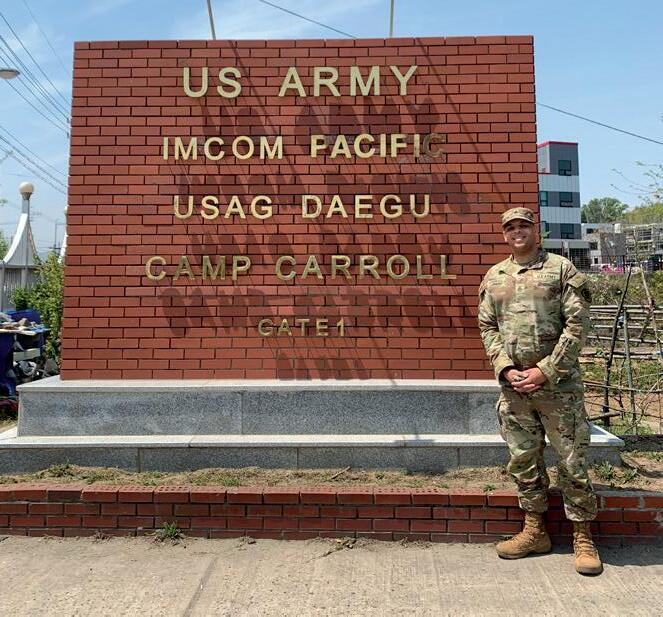
When Russia invaded Ukraine in 2022, Staff Sgt. Walter Carroll, ’25, was deployed to Poland just months after being admitted to UND’s online Ph.D. program in Communication. Unable to complete coursework, his GPA fell below the required 3.0.
Soojung Kim, dean of the School of Graduate Studies and former chair of the Department of Communication, petitioned for his reinstatement. “We saw potential for him to be a successful Ph.D. student and admitted him to the program,” she said. “It’s our responsibility to honor that promise.”
She supported Carroll throughout his degree journey and was emotional after his dissertation defense. “I know how difficult it was … But he never gave up.”
A Military-Connected Campus
Carroll’s experience reflects UND’s broader military community.
Last semester, 2,001 military-affiliated students — including 108 on active duty and veterans — were enrolled at UND, roughly one in seven students. About 34% study online, including active duty service members, veterans working full time, and families navigating frequent relocations.
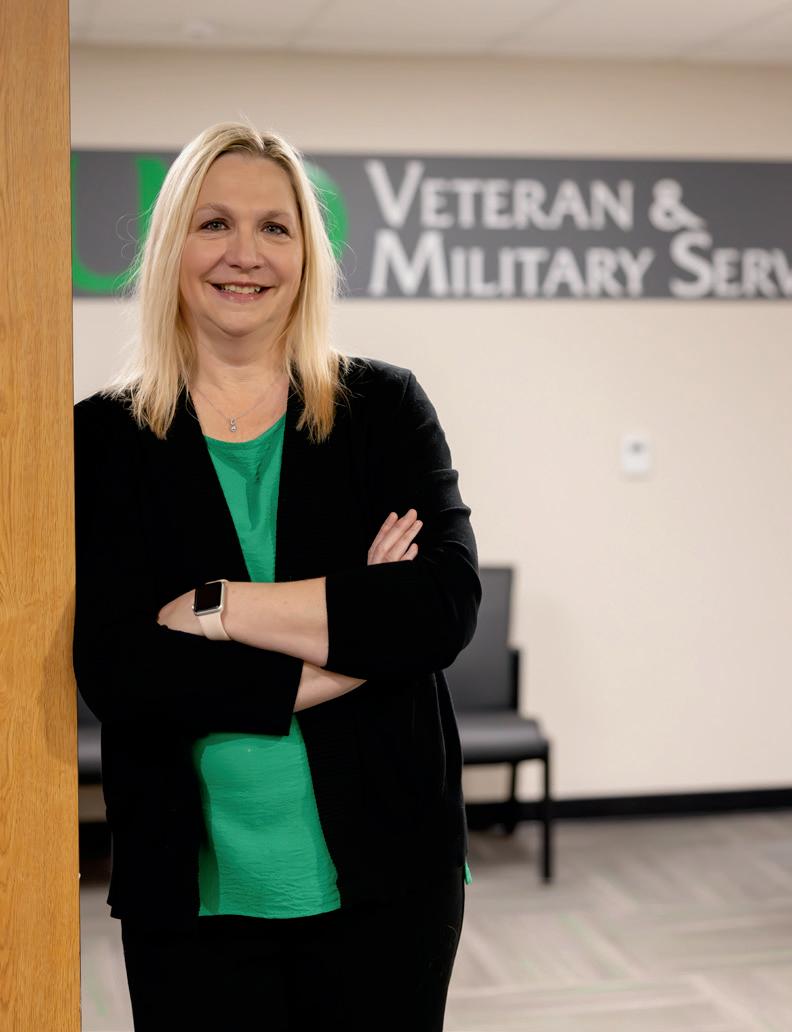
“Walter is a success story of how wellconnected our internal network for military support is,” said Angie Carpenter, director of the Office of Veteran & Military Affairs. “Students aren’t working in silos. No matter where they reach out for help on campus, the goal is for everyone to recognize that we do have support.”
Online education is central to that support. “We often have students serving in North Dakota who get orders to serve elsewhere,” Carpenter said. “Rather than disrupting their education, they can shift to an online option, which supports both their military obligation and their education.
“And wherever they go, they represent UND,” she said.
GOLD STANDARD
Since establishing the Office of Veteran & Military Affairs in 2020, UND’s military-affiliated student population has grown by 41%, and the University has earned national recognition for its work. UND was named the 2026 recipient of the Colleagues’ Choice Innovation Award from the Western Academic Leadership Forum and received Gold recognition as a 2025-26 Military Friendly® School, placing it among the top 10% of institutions nationwide.
Angie Carpenter said that wherever UND’s online military students are, they highlight the quality of the education in North Dakota.
Staff Sgt. Walter Carroll, who earned a Ph.D. in Communication, chose UND for its online format.
THE FLAGSHIP SERVES THE PEOPLE
For more than a century, the University of North Dakota has practiced distance education — bringing learning to students wherever they are.
Today, online courses help students fit classes around internships, labs, clinicals, and demanding schedules. Beyond Grand Forks, they allow professionals to advance their education while remaining in the communities that depend on them. The tools have changed. The mission has not.
TOP PROGRAMS
Engineering, data science, AI, business, nursing and advance practice programs lead UND’s online growth.
STUDENT-ATHLETES ONLINE
Online courses give student-athletes the flexibility to balance practices, travel, and competition without falling behind academically.
“I’ve noticed that once some athletes get a taste of online learning, they realize they can manage their time differently,” said academic advisor Andres Freeman.
That support shows in the numbers: UND Athletics holds a combined GPA of 3.45, marking 35 consecutive semesters above 3.0. Online options also help athletes from warmer climates adjust to North Dakota winters — sometimes by simply avoiding a long walk across campus in the cold.
“Online education is a major part of the modern delivery and availability of education. I think the state has to continue to invest in online education.”
JEFF HOLM
CARING FOR NORTH DAKOTA
UND is advancing rural care through the ND85 initiative and a new partnership in health education.
You can.
Those two words may be the most important message a student can hear, said Marjorie Jenkins, Dean of the UND School of Medicine & Health Sciences (SMHS) and Vice President for Health Affairs. She believes that encouragement will help recruit more health professionals to North Dakota.
The state currently faces a shortage of more than 200 physicians, according to the SMHS’s 2025 Report on Health Issues for the State of North Dakota. One strategy for closing that gap is the ND85 initiative. Launched in 2025, the program aims to have 85% of students in UND’s medical doctor (M.D.) and physician assistant (P.A.) classes come from North Dakota by 2030 — a goal supported by research showing that providers are most likely to practice near their hometowns. Language in the North Dakota Legislature’s most recent higher education funding bill (SB2003) reinforces that goal.
As one of eight children raised by a widowed mother in Appalachia, Marjorie Jenkins often heard the words, “You can’t.” Now, after serving as a professor of internal medicine and dean of the University of South Carolina School of Medicine Greenville, she leads UND’s medical school with a different message for students: “You can.”
200+ physician shortage in North Dakota
85%
target for in-state M.D. and P.A. students by 2030 (ND85 initiative)
82%
incoming Class of 2028 P.A. students are from North Dakota
83%
incoming Class of 2030 M.D. students are from North Dakota
2025 launch year of the ND85 initiative
“The real heart of the ND85 program is the fact that students out there are going to hear, ‘You can be a doctor. You can be a physician assistant. We’ll help you; we’ll guide you to get there. Once you’re here, we’re going to wrap around you and help you get to graduation,’” Jenkins said. “I’m so proud that North Dakotans will now hear ‘you can.’”
To spread that message, Jenkins and her team have taken a grassroots approach to raising awareness of healthcare careers, with the goal of reaching every high school in North Dakota. The medical school has also benefited from UND’s record enrollment, which has expanded the pool of local students interested in health careers.
Jenkins emphasized that ND85 is an expectation rather than a mandate — a shared commitment across the school rather than a requirement placed on applicants. The initiative has already created a ripple effect, prompting the SMHS to examine its learning environment and student support systems to ensure all students have the resources they need to succeed.
A Faster Path to Practice
The SMHS is making initial plans to launch the Primary Care Accelerated Track (PCAT) in 2028. The goal is for students in the program — initially focused on family medicine and internal medicine — to complete medical school in three years instead of four. Students would then enter a primary care residency in North Dakota and commit to practicing in the state for at least five years.
Jenkins said students who succeed in accelerated tracks often have health-related experience. “Many are second-career students who already know where they’re headed,” she said. “Others come from rural communities and want to return to serve those areas. They typically have a strong foundation in science and math and have already succeeded in rigorous coursework.”
After refining the initial program, SMHS plans to scale the PCAT model to other high-need fields, such as pediatrics and psychiatry. Together with ND85, the PCAT program would be part of a broader effort to strengthen North Dakota’s healthcare workforce through earlier support, faster pathways, and more collaborative training.
PRIMARY CARE ACCELERATED TRACK (PCAT) pending program approval
2028 planned program launch
3 years to complete medical school
5 years in-state practice commitment after residency
Building a Collaborative Culture
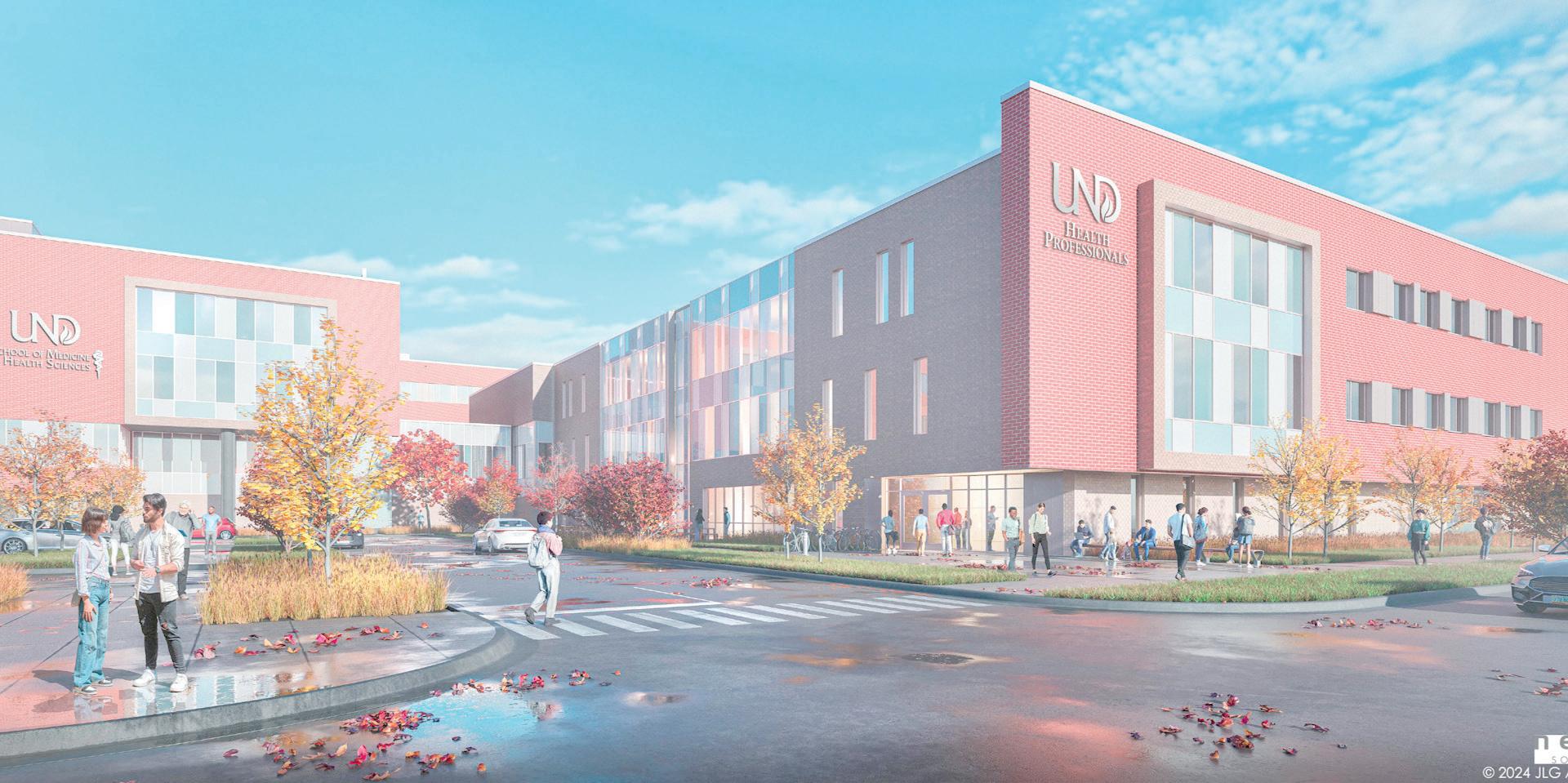
Beyond curriculum, student success is shaped by the environment in which they train. The proposed Health Professions Collaborative Facility is a 95,000-square-foot addition to the SMHS building that would house College of Nursing & Professional Disciplines (CNPD) programs as well as biomedical research facilities. The project also includes much-needed clinic and research spaces.
“This is an opportunity to co-locate our programs,” said Maridee Shogren, CNPD Dean. “The proximity will allow our students to build professional relationships before they are out practicing.”
Jenkins emphasized that a building alone won’t change culture. “It is going to be great to be connected but I think it’s more the mindset of the conversations we are having — determining how we come together as multiple health profession disciplines to create that learning environment and then disseminate it across the state.”
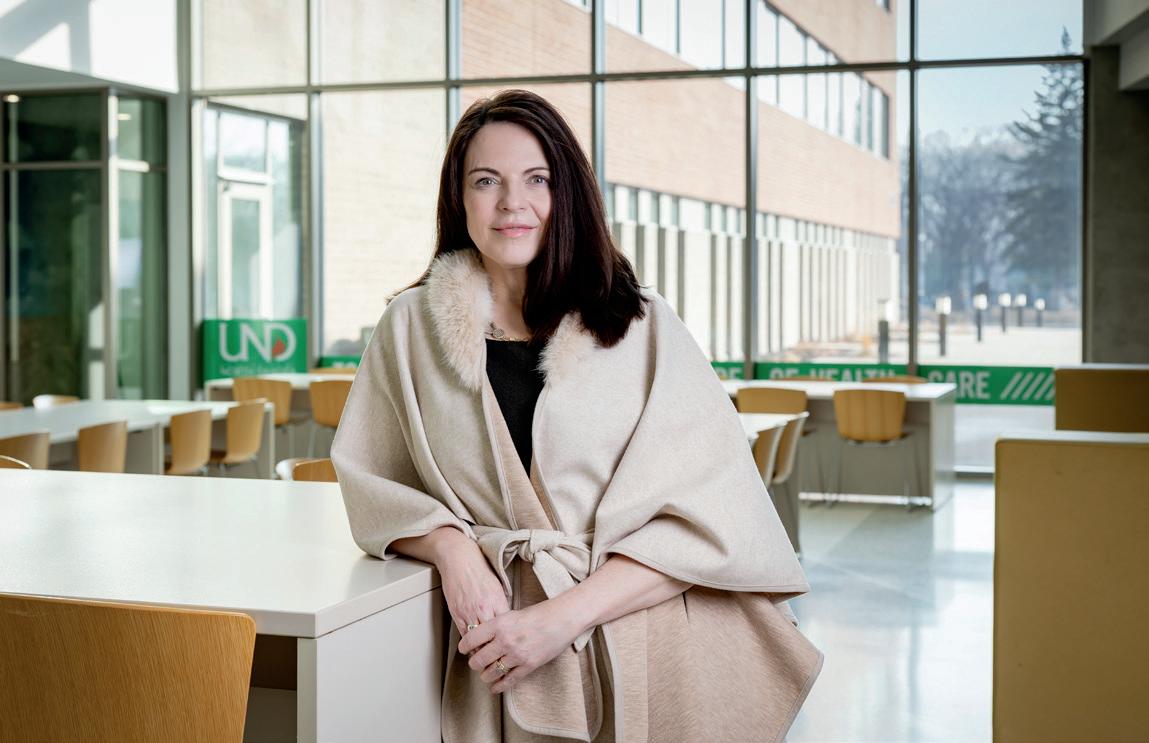
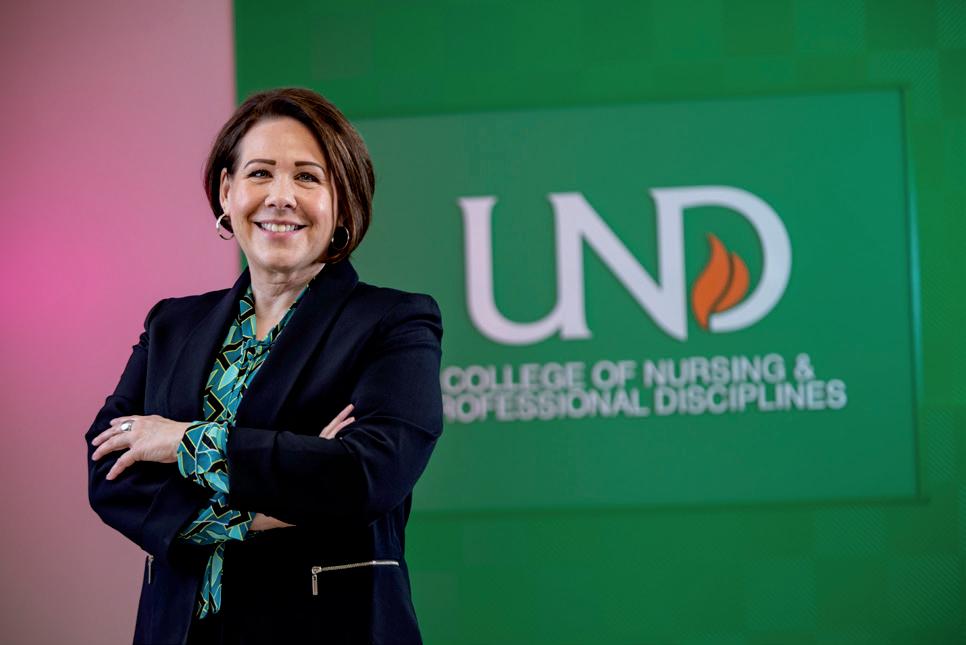
CNPD Dean Maridee Shogren, ’91, recalled a much tougher job market for new nurses. “When I graduated, there was hardly a job to be found,” she said. Shogren credits her UND co-op experience for her first position — a cardiac ICU role in Minneapolis. “I 100% believe I would not have gotten that job had I not been a graduate of this University.”
Rendering: Health Professions Collaborative Facility
8 disciplines will be housed in Health Professions Collaborative Facility
78 current medical students per class
100 target medical students per class
95,000 square feet in proposed facility
“I think the game-changer is going to be how we do more with digital health and technology, how we do it better, and how we teach the next generation to use it.”
MARJORIE
JENKINS
A Simulated Hospital
The proposed facility will house North Dakota’s first fully simulated hospital environment, where students across disciplines — including nursing, nutrition, and social work alongside medicine, P.A., and occupational and physical therapy — will work side by side.
“We can simulate the entire continuum of care,” Shogren said. “Whether it’s an emergency room admission or discharge planning to a long-term care facility, we can replicate it all. Since our state’s critical access hospitals often house clinics, ERs, and acute care inpatient beds under one roof, our students will train in that environment.”
The Digital Frontier Jenkins sees this collaborative space and digital medicine as a “game-changer,” noting that students will be trained to use telehealth and AI as “force multipliers” to help rural clinicians manage specialized care locally. The ultimate goals remain practical. “We are looking at improved health outcomes for North Dakotans,” Shogren said. “We want to graduate practice-ready professionals who have been immersed in interprofessional work.”
Both deans appreciate the forward-thinking approach of the initiative. “Being at the cusp of this transformation is something people might not expect when they think of North Dakota,” Jenkins said. “But they don’t know us.”
For UND, that transformation begins with telling every future provider, “You can.”
JOURNALISM
BACK ON THE BEAT
UND reintroduces Journalism degree.
A two-year Future of Local News Initiative found that original reporting from local newspapers remains the most trusted news source. It ranks higher than local television and far above social media or radio.
Those findings by the Rural Development Finance Corp. reflect a challenge across North Dakota: a shrinking pipeline of trained journalists.
In 2024, UND reintroduced its journalism degree, enrolling 14 majors in its first year back. The next year, that number grew to 32.
At the time, Soojung Kim, recently named dean of the School of Graduate Studies, was leading UND’s Department of Communication. She said conversations about restarting the degree gained momentum during the COVID-19 pandemic.
“Journalists are the first responders of information,” Kim said. “During the pandemic — especially with health-related misinformation — people were confused about what to believe. That made the role of journalism more visible.
9/10
adults say having a local newspaper is important
80%
say losing their local newspaper would have a negative impact
source: Future of Local News Initiative
Soojung Kim said UND’s reintroduced journalism degree places a strong emphasis on ethics.
“Even the smallest towns have firefighters and police officers. Journalists serve a similar role,” she said. “We need well-prepared journalists in every corner of North Dakota.”
The Department of Communication celebrated 100 years in 2024. “We have a passionate alumni network and a proven history of leadership in journalism education,” she said. The Program Takes Shape
When deciding what to call the program, stakeholders considered more contemporary names, such as digital storytelling. They stayed true to UND’s past, calling it a Bachelor of Arts in Journalism.
The program focuses on core reporting skills while incorporating modern media applications. UND hired three tenure-track assistant professors and built what Kim described as “small but mighty” studios for video, podcasting, and visual journalism.
Newsroom leaders and professional organizations across the state emphasized the importance of ethics, Kim said. “They told me, ‘We need traditionally trained journalists — people who can write, ask good questions, and operate ethically. We can’t even hire general assignment reporters right now.’”
UND’s first journalism graduate, Madi Dame, ’25, said every class covered the Society of Professional Journalists’ Code of Ethics. “Professors would give us scenarios and ask how we would respond — not saying there was one right answer, but helping us think through the ethical implications.”
Learning the Craft
Dame’s favorite class was Social Media & Online Reporting. “We had assignments where we went out and talked to people, did person-on-the-street interviews, and wrote full stories.”
She applied that experience to her internship at the Grand Forks Herald. “On my first day, they had me calling people,” she said. “Just picking up the phone and calling someone was really outside my comfort zone.”
In two months, Dame wrote nearly 40 stories, significantly honing her reporting skills and gaining an appreciation for local news. “Things happening around the world are important, but people also want to know what’s happening in their own communities,” she said. “Local news helps you understand what’s going on right where you live.”
“We need well-prepared journalists in every corner of North Dakota.”
SOOJUNG KIM
The Future of Journalism
Kim challenges the belief that journalism is dying and that students will struggle to find jobs. “Journalistic training prepares students for a wide range of roles we can’t even fully imagine yet,” she said.
Those roles will include the use of artificial intelligence. “If we look 10 or 20 years from now, AI’s going to be a core part of every industry,” she said. “How do we teach our students to adapt, but keep that ethical?”
As the only occupation protected by the Constitution, serving the public through journalism will require new ideas.
“We have to innovate,” she said. “I don’t know what it will look like, but I trust the faculty we hired. They will do it.”
pursuing a master’s degree in communication, working at UND Today, and is a career mentor
A FASTER FLIGHT PATH
UND is one of 11 universities approved for air traffic controller fast-track program.
Air traffic control facilities nationwide face staffing shortages; a recent federal report found that 77% of critical sites operate below recommended levels. Hiring — slowed by government shutdowns, the pandemic, and budget cuts — has not kept pace with demand.
One response is the Federal Aviation Administration (FAA)’s Enhanced Air Traffic-Collegiate Training Initiative (AT-CTI), designed to move controllers into the workforce more quickly. UND was approved for the pathway in 2024. In December 2025, Anthony “A.J.” Lake became the University’s first graduate.
“For me, it was about saving time and getting into the field faster,” Lake said. “I’m saving three or four months, for sure. It feels like a real accomplishment.”
Lake earned his bachelor’s degree in Air Traffic Management while completing the FAA’s enhanced requirements, allowing him to bypass the traditional FAA Academy in Oklahoma City and move directly into on-the-job training at an air traffic control tower.
“This achievement places UND among the earliest institutions in the country to successfully graduate a student from this pathway,” said Dean of Aerospace Sciences Robert Kraus.
“We have two more (accelerated ATC grads) coming up in this May graduation. Then it’s going to be exponential after that.”
ROBERT KRAUS DEAN, ODEGARD SCHOOL OF AEROSPACE SCIENCES
AIR TRAFFIC CONTROL
77% of U.S. air traffic control facilities are understaffed
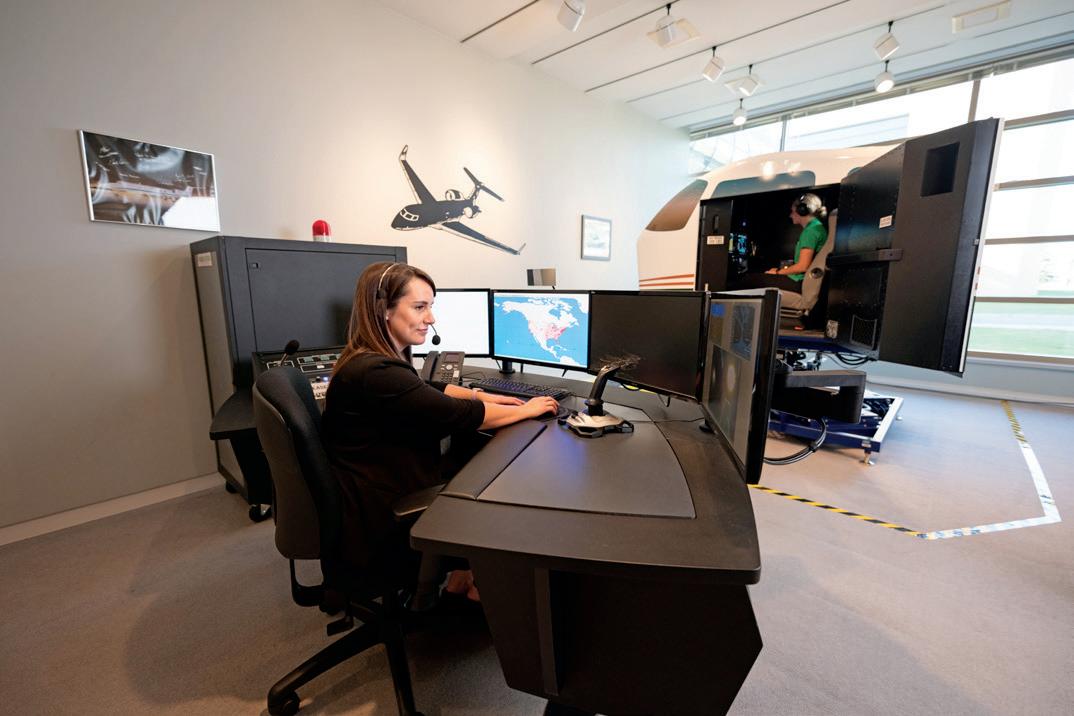
120 air traffic control majors at UND
11
FAA-designated enhanced AT-CTI schools
16 weeks
FAA Academy training time bypassed through the enhanced AT-CTI pathway
According to associate professor of aviation Craig Carlson, the program demands commitment. “This program is for highly motivated individuals willing to put in significant extra time. A.J. wanted to be the first, and he put in the work.”
Lake enrolled after friends compared the work to a video game. “It was just dots on a screen — don’t let them crash,” Lake said. “After a year of it, I realized it was actually really fun and it just kept getting more interesting.”
He describes terminal operations as “an art,” a balance between efficiency and safety. “You’re trying to get aircraft as close as you safely can without messing up. If you mess up, you create more work for yourself, because the airplanes don’t stop coming.”
To complete the enhanced program, an FAA evaluator from Oklahoma City came to campus to administer four high-stakes simulations. Passing the twoday exam is the equivalent of graduating from the FAA Academy.
After completing the program, Lake entered the final stage of the hiring process: medical clearance. Once cleared, he will receive a firm offer letter with a list of towers to choose from and begin his on-the-job training.
A.J. Lake, UND’s first graduate of the air traffic controller fast-track program, compared the work to a video game.
JUSTICE IN SHORT SUPPLY
Program introduces law students to rural practice.
Six North Dakota counties have no lawyers. Fourteen have only one.
Like much of the country, North Dakota faces what the American Bar Association calls “legal deserts”: counties with fewer than one lawyer for every 1,000 residents. Nationally, the average is nearly four.
Bradley Myers, interim dean of the UND School of Law, said North Dakota is experiencing what he called a “demographic trough,” a gap between incoming workers and retiring professionals.
“A 2024 American Bar Association survey found 18% of North Dakota’s lawyers intended to retire in the next two to five years, and another 8% were considering leaving the profession,” he said. “That’s a quarter of our attorneys. If our state has 1,600 lawyers, that’s 400 lawyers to replace. We don’t have that many graduates.”
UND will graduate 90 students during the 2025-26 academic year.
Without local attorneys, rural residents may need to travel long distances for basic legal services such as drafting a will, resolving a custody dispute, or navigating a divorce. Some rural counties lack prosecutors, defense lawyers, and judges.
N.D. counties with no lawyers, and 14 with only one lawyer
18% of N.D. lawyers plan to retire within 2–5 years
80% of Rural Justice Program participants remain in state after graduation
Bradley Myers said the Rural Justice Program gives students firsthand exposure to practicing law in rural communities.
The Rural Justice Program
To help address the shortage, the law school partnered with the State Bar Association of North Dakota and the North Dakota Court System to launch the Rural Justice Program in 2015. A grant from the Edson and Margaret Larson Foundation supports the program by helping students cover summer living expenses while working in rural law firms, state’s attorney offices, or indigent defense services.
What began with four students now places 10-12 each year.
“We’re subsidizing that experience so we can give students a chance to experience life in rural practice firsthand,” Myers said.
The effort comes as the UND School of Law prepares for new leadership.
Retired Vice Admiral Darse E. “Del” Crandall Jr., former Judge Advocate General of the Navy, has been named dean following a national search and will begin July 1.
University leaders say his background in public service and legal leadership positions him to help advance the school’s mission — including strengthening the pipeline of attorneys serving North Dakota’s rural communities.
A Path to Rural Law
Samantha Ledahl, ’24, ’26, spent two summers in the program, gaining firsthand experience in two very different rural settings.
She began in Rolla, North Dakota, in the small private practice of Rachael Mickelson Hendrickson, ’14, ’18, ’20. There, she saw the breadth and demand of rural legal work.
“Those rural counties need people so bad,” Ledahl said. “You can get exposure to so many different things that you otherwise would have to wait years, if not decades, to see.”
She also appreciated the flexibility. Hendrickson worked from a home office while maintaining a steady client base. “You don’t necessarily have to have a brick-and-mortar office,” she said. “People will come to you because they’re so grateful for your service.”
The next summer, Ledahl moved to Stanley, North Dakota, to work in the Mountrail County State’s Attorney’s Office — just 75 minutes from where she grew up. The experience was fast-paced and wide-ranging. “In just one summer, I got to see a sentencing hearing for a murder, search warrants, child pornography, and domestic violence cases,” she said. “It was a perfect fit.”
After graduation, Ledahl will return to Mountrail County as an assistant state’s attorney. Her long-term goal is to open her own rural practice.
Myers said Ledahl’s outcome reflects the program’s goal — for students to build relationships with the community and the work, making them more likely to return.
So far, it’s working: nearly 80% of Rural Justice Program participants have stayed in North Dakota.
“One reason I was motivated to go to law school was just the lack of attorneys that I saw where I grew up. I want to eventually go back to my community and contribute.”
SAMANTHA LEDAHL, ’24, ’26
BUILDING THE PIPELINE
Supporting North Dakota’s workforce: from training to startup to small business
When UND President Andrew Armacost announced a “moonshot” goal to launch four new companies based on UND research in a single year, he underscored a larger truth: North Dakota’s workforce depends on a steady pipeline of skilled workers, entrepreneurs, and small business owners. Across Grand Forks, UND graduates are helping build that pipeline — from hands-on career training to startup support to Main Street business advising.
493
students enrolled in the Career Impact Academy’s first year
700+ students expected next fall
8,000+
jobs supported through the Center for Innovation
$1.6B
statewide economic impact generated by the ND SBDC and partners in 2025
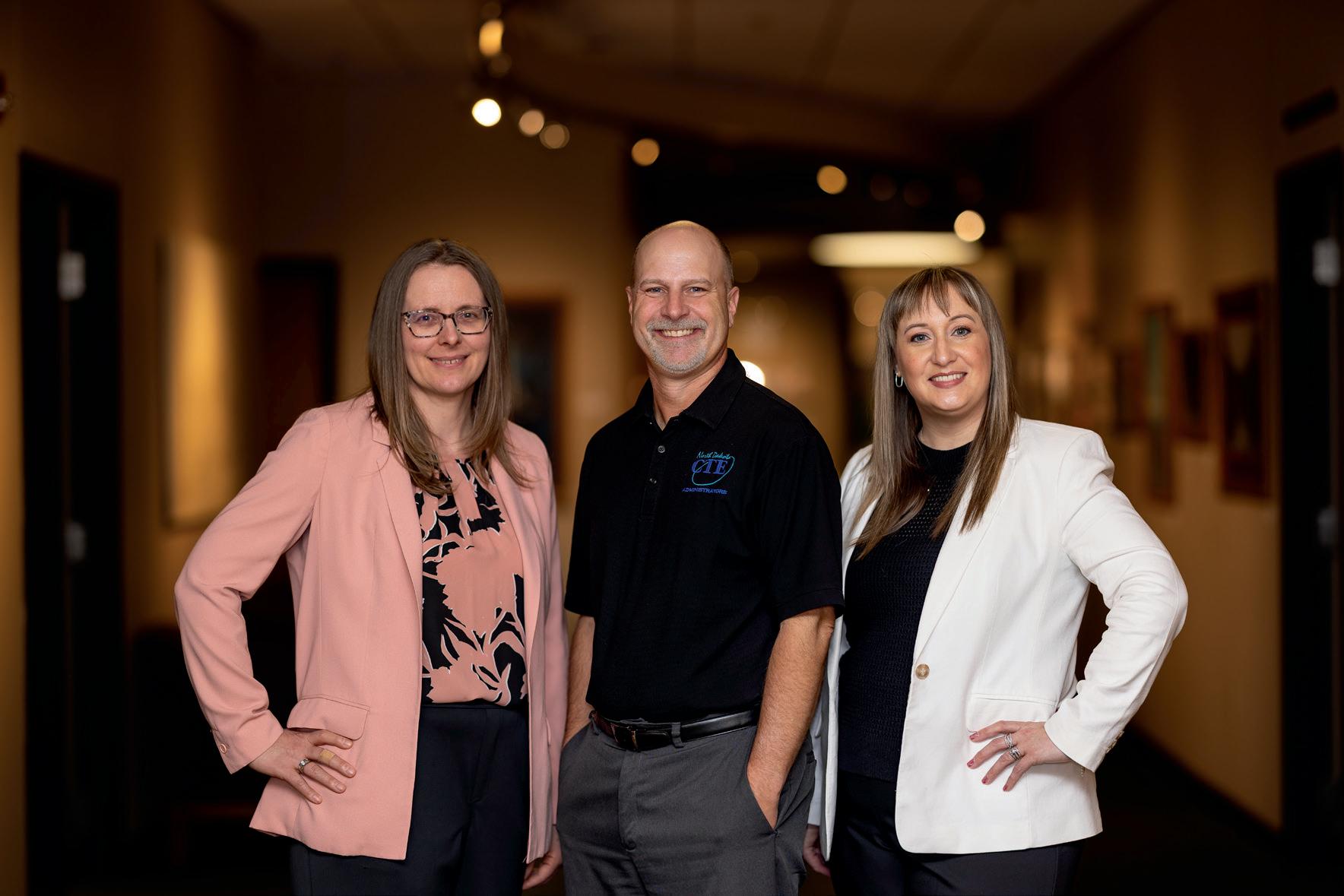
Amy Whitney, Eric Ripley, and Tiffany Ford lead efforts to meet workforce needs across North Dakota.
“We are looking for alumni who want to be engaged as mentors who could help us launch the startups. Our amazing faculty need to keep being inventors.”
AMY WHITNEY
Career Impact Academy: Ready for the Next Step
The Grand Forks Career Impact Academy opened in 2025 through a partnership with UND, local school districts, and regional employers to strengthen North Dakota’s workforce. The academy offers hands-on classes and work-based learning for students from Grand Forks and 10 surrounding districts, with pathways in building trades, precision agriculture, advanced manufacturing, health services, and culinary arts.
“The Career Impact Academy offers elective courses for high school students in career pathways that align with their interests and future goals,” said Executive Director Eric Ripley, ’99, ’05. “The hope is for students to make an educated decision about their next step after high school.”
CIA emphasizes “transferable skills” — communication, ethical judgment, punctuality — reinforced through work-based learning tied to students’ interests. Programs like the Certified Nursing Assistant (CNA) track allow students to earn an industry-recognized credential as early as age 16.
Enrollment is expected to grow from 493 students in its first year to more than 700 next fall, with new offerings for adult learners seeking upskilling and industry training.
Center for Innovation: From Idea to Impact
For more than 40 years, UND’s Center for Innovation (CFI) has helped move ideas from the lab into the marketplace. Director Amy Whitney describes the center’s role as “de-risking” early concepts and helping founders understand their customers long before they launch.
“We focus on helping UND translate its research into realworld applications through supporting tech transfer and commercialization,” said CFI Director Amy Whitney. “We work with you one-on-one and deeply understand what a viable path forward looks like.”
The model is working. While more than 90% of startups fail, 78% of companies that began their journey with CFI are still operating. The center has helped launch about 770 businesses, supported more than 8,000 jobs, and become a hub for high-growth sectors like autonomous systems.
This summer, CFI will launch UND’s first intellectual property accelerator to help meet the University’s moonshot goal. Ten promising ideas will move through an intensive process to determine whether they should become startups or licensed technologies.
ND SBDC:
The Backbone of Main Street
Once ideas move beyond campus — or when a community needs a new service provider — the North Dakota Small Business Development Center (SBDC) steps in. Headquartered at UND’s Nistler Hall, the SBDC works with about 2,000 entrepreneurs each year across all 53 North Dakota counties.
“Small communities rely on their small businesses,” said Director Tiffany Ford, ’05, ’18. “That doesn’t just mean the gas station or the grocery store. It also means service providers like plumbers, electricians, and childcare providers — businesses people need to live their everyday lives.”
The ND SBDC helps entrepreneurs test ideas, identify markets, secure financing, and plan for growth.
“When a large employer comes to a community, their employees expect certain things,” Ford said. “Places to grab lunch. Somewhere to meet for coffee. A sense that this is a place where people want to live.”
Those amenities, she said, are almost always created by small businesses and they play a major role in community growth.
Forever UND
A FAMILY’S GIFT, A STATEWIDE IMPACT
Transformational gift establishes dermatology at UND and expands access to specialty care.
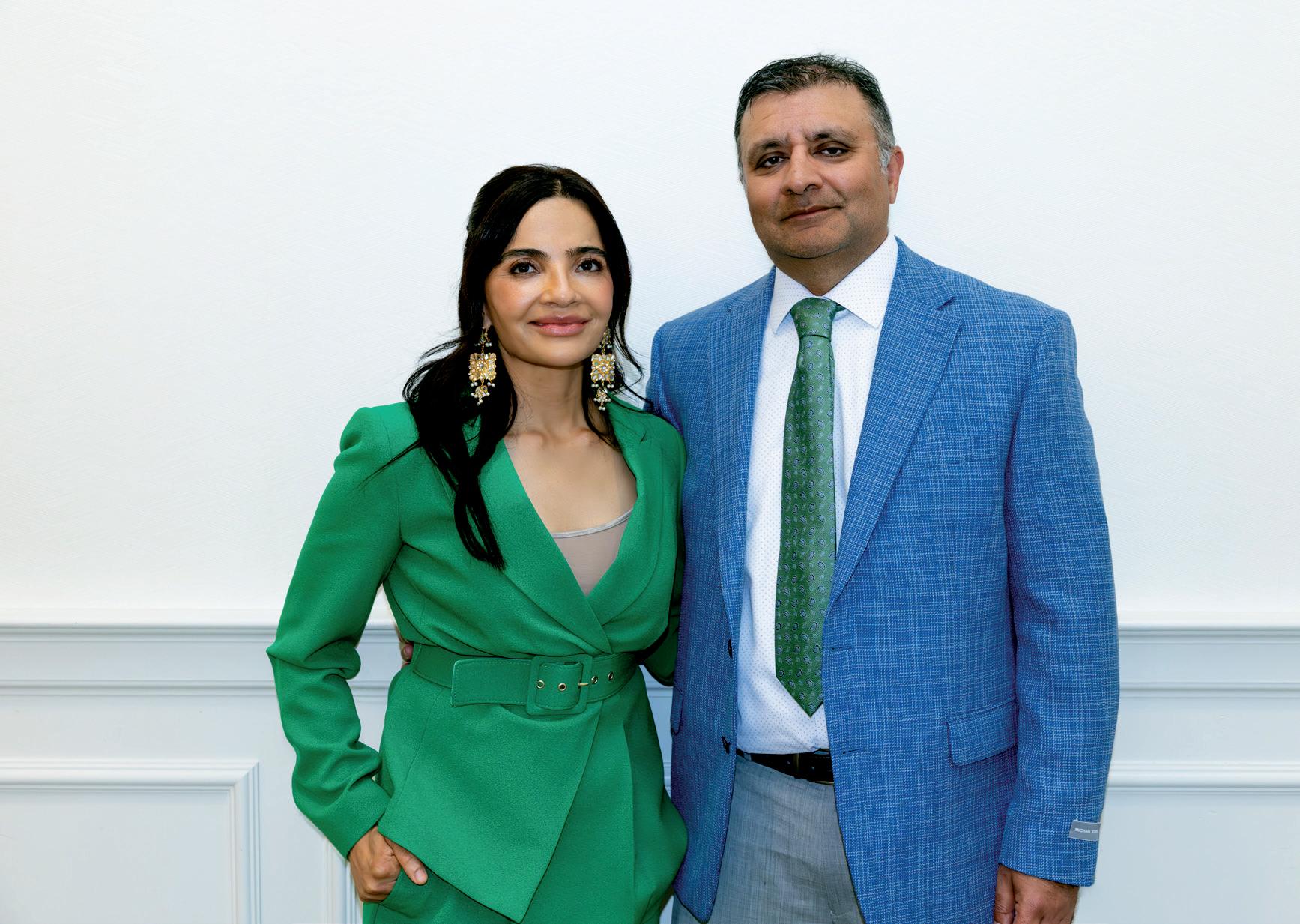
The University of North Dakota is celebrating a monumental $5 million commitment from the Mohiba and Basir Tareen family. The gift will establish the Department of Dermatology at the UND School of Medicine & Health Sciences and endow the Tareen Family Chair of Dermatology.
For Basir, a 2002 UND graduate and practicing urologist in the Twin Cities and CEO of Tareen Development Partners, the University holds deep personal significance.
“UND has and will always hold a special place for me and my family,” Basir said. “This gift honors the legacy of physicians who dedicate their lives to rural communities and helps ensure the next generation of doctors continues that tradition.”
The family’s connection to rural medicine started well before his own education. Basir’s father, Dr. Jamil Tareen, dedicated 35 years of his life as the only surgeon in Pembina County in northeastern North Dakota.
“This gift honors the legacy of physicians who dedicate their lives to rural communities and helps ensure the next generation of doctors continues that tradition.”
BASIR TAREEN
Jamil was a true general surgeon, handling everything from urology to gynecology for the rural community, and mentoring UND medical students throughout his career.
Growing up as the children of immigrant parents, both Basir and his wife, Mohiba, viewed medicine not merely as a profession, but as a calling and a way of life. Dr. Mohiba Tareen’s parents were also dedicated physicians; her father was a practicing medical oncologist, and her mother ran a successful internal medicine practice. Today, Mohiba is a board-certified dermatologist who founded Tareen Dermatology in Roseville, Minnesota, in 2011. To her, this endowment represents an opportunity to advance both dermatology education and patient care across the state.
“Dermatology is my passion, and to be able to bring dermatology and specialty care to better serve North Dakota is a lifelong dream,” Mohiba shared. “We are honored to help the University and excited for what is to come.”
The Tareen family’s gift specifically addresses the growing need for dermatology specialists in rural and underserved communities while strengthening UND’s ability to train future physicians.
$5M
commitment from Mohiba & Basir Tareen family
University leaders echoed the profound impact of this investment. Dr. Marjorie Jenkins, Dean of the UND School of Medicine & Health Sciences and Vice President for Health Affairs, noted that the gift will position UND as a regional leader in dermatology education. “Your investment is not simply in a department, it is in people,” Jenkins remarked at an April Twin Cities event to celebrate the gift. “You are helping us shape a future where high quality, accessible care is a reality, not a dream.”
UND President Andrew Armacost highlighted how the Tareen family’s generosity perfectly aligns with the University’s annual themes of gratitude, connection, momentum, and community. He emphasized that the gift builds a collective sense of togetherness and support for one another.
Basir turned 50 this spring and said he wanted to celebrate by making a difference. “As we get older, what is it that we want to leave behind? What good do we want to leave in the world after we’re not here and even while we are here? And so that’s what this gift is about. This was a chance for us to combine two things that we love — Mohiba’s love of dermatology and my love and reverence for UND.”
Only department of dermatology between Minneapolis and Seattle
1st
Tareen Family Chair of Dermatology will be created
Forever UND ROOTED IN LOVE & LOYALTY
For Jeff and Kim Vigen, UND is more than their alma mater; it’s the foundation of their family, careers, and enduring generosity.
Jeff, ’86, and Kim, ’88, Vigen met while participating in Greek Life at UND. Jeff was a member of Kappa Sigma as a civil engineering major, while Kim was in Kappa Alpha Theta and studying business administration. Their bond began at a sorority dance and has continued to strengthen as they graduated and built a foundation of success together.
Jeff took over his family’s construction business, Vigen Construction, Inc., after many years of doing nearly every job imaginable under his father, uncle, and brother. The business has grown to become a respected leader in agricultural construction, strengthened by a loyal team of dedicated employees and the shared commitment of the Vigen family. In every stage of their lives, Kim has devoted herself to her family, supporting Jeff in his work and raising their sons as a stay-athome mother.
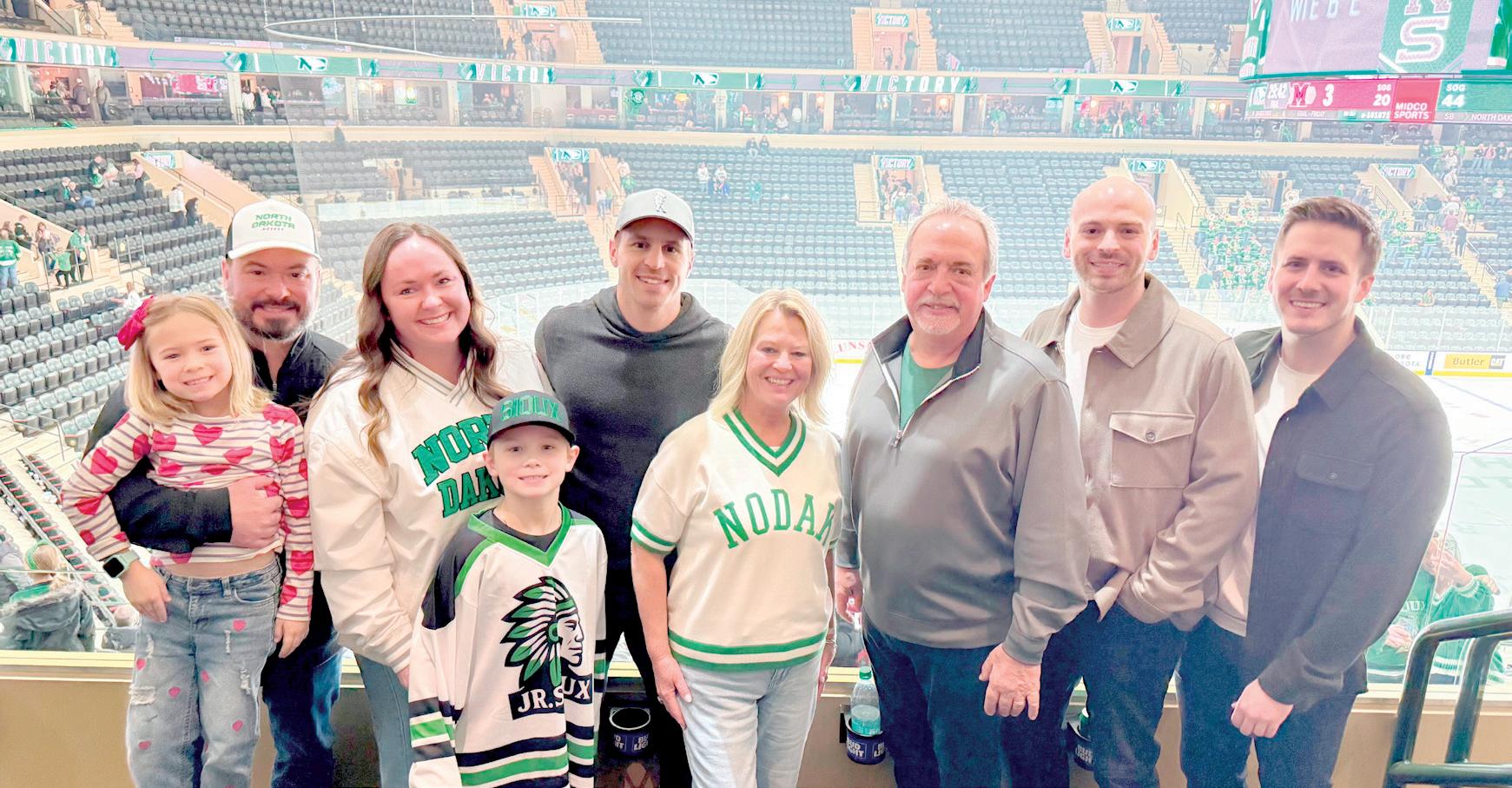
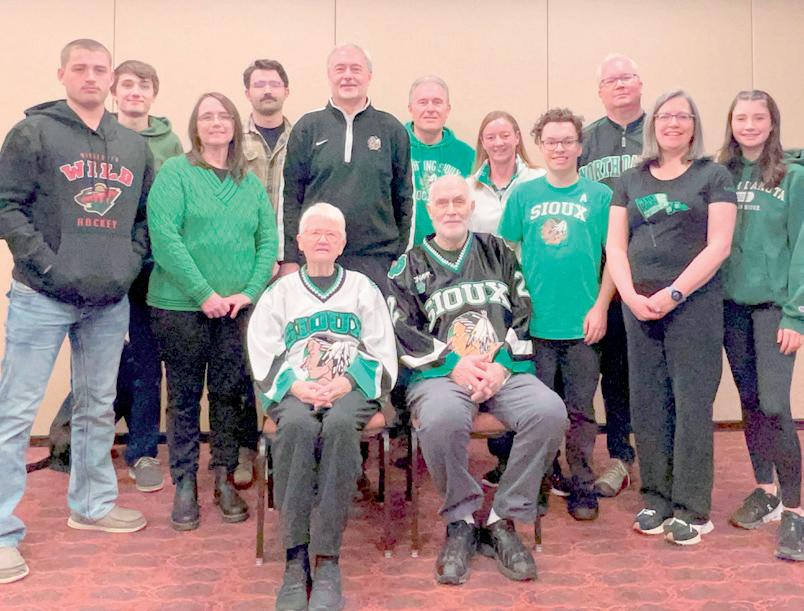
The Vigen family is pictured with UND hockey alum and former Minnesota Wild star Zach Parise at a game at the Ralph Engelstad Arena in February. From left, they are: Freya, Andrew, Kimberlee, and Thor Vigen; Parise; Kim, Jeff, and Jared Vigen; and Aaron Eggert.
Both of their sons followed in their parents’ footsteps at UND and now contribute to the family business— Andrew as a project manager with a civil engineering degree, and Jared as the comptroller with an accounting degree.
Their success has allowed Jeff and Kim to give back to UND, and their philanthropy spans decades while touching many areas of campus. From scholarship and priority needs support in the College of Engineering & Mines to named spaces in Upson Hall and the Nistler College of Business & Public Administration, their impact is visible and lasting. They have also been members of the Champions Club since 1997 while supporting several UND Athletics programs along the way.
Jeff and Kim credit UND for shaping their success. “Every instructor taught you something valuable, not only about your education, but also about life,” Jeff said.
“A college education is about more than the degree. It’s about the experience and the lessons you learn along the way,” Kim added.
Their memories of UND come back to them when they receive thank-you notes from scholarship recipients. “We want to help out however we can, and it’s always nice to hear from the students we have supported,” Jeff said.
“With us and our kids being UND graduates, there’s no doubt where our passion lies.”
“A college education is about more than the degree. It’s about the experience and the lessons you learn along the way.”
KIM VIGEN
Eternal Flame Society
The UND Alumni Association & Foundation thanks all alumni and friends who have made gifts and commitments to support students, faculty, programs, and places at UND.
The following donors reached a new giving circle in the Eternal Flame Society between October 1, 2025 and March 31, 2026.
ADELPHI CIRCLE
$5,000,000+
Steve L. Burian
Kevin & Courtney Ritterman
Craig & Dolly Tweten
WILLIAM BUDGE CIRCLE
$1,000,000 - $4,999,999
Bell Bank
Centurion Foundation
John & Jayne Lassen
Memorial Village, LLC
Jack & Kristen Paris
Brian Petersen & Nancy Krogh
Kevin D. Pifer
Scott* & Susan Sayer
Everett A. Schmeichel*
Keith & Jo Streyle
Drs. Basir & Mohiba Tareen
Dr. Hudson & Christine Washburn
DR. CORA SMITH CIRCLE
$500,000 - $999,999
Elizabeth & Alden* Abraham
Rich & Joanne Becker
Nancy R. Bushnell
in Memory of Victor Rose
Jeff & Cathy Gendreau
MaryDale & James Hansen
Dean & Leslie Little
Margaret A. Cargill Philantropies
Greg & Susan Opp
THOMAS CLIFFORD CIRCLE
$100,000 - $499,999
Dr. Darla & Steve Adams
Ronald & Jacquelyn* Belschner
Forrest & Susan Bjerkaas
Gerald & Jan Brorby
Jim & Dolly Bunke
Brooks & Taylor Burgum
CK Commercial LLC
Curt Kriedeman Foundation, Inc.
Dr. John & Carlyn Dalness
Adam & Quinn Driscoll
Lance T. Freier
James Fritz & Beth Adamoli
Drs. Cassie Gerhardt & Brad Parrish
Wayne & Dr. Tammy Gerszewski
Joe & Joyann Guzek
Christopher & Marilyn Johnson
Steven L. Karpenko
Terry & Janet Klebe
Duane & LaVonne Kraft
Nick & Heidi Lee
McGough Construction
Dr. Marian E. McKechnie*
Dr. Lynn C. Miller
Dr. Bruce & Lois Nelson
Northern Plains Rail Services
Oxford Apartments, LLP
Lt. Col. A. Paul* & Ruth* Pederson
Bob & Teri Robb
Edith Henderson Ruby & Michael Ruby*
Russell Schmitt & Sally Holbrook
Mike J. Skiple*
Marvin* & Luella* Snyder
Michael & Charleen Solberg
David & Tonya Stende
Dr. Ronald & Joyce Tello
Dr. Loren Wold
Paul & Claudia Zimmer
Delore & Sonia Zimmerman
PRESIDENT’S CIRCLE
$10,000 - $99,999
Vince & Tracy Abentroth
Dr. Thomas & Jane Ahlin
Alaska Airlines
Thomas & Stephanie Astrup
Christina & Brandon Bass
Vickie J. Batroot
Jonathon & Laurie Berg
Ross Berntson
Dr. Paul & Natalie Bilstad
Susan Stewart Bland & Jeffrey Bland
Laurie A. Boerboom
Scott Branvold & Lynda Davidson
David M. Brubakken
Kiersten & Eric Brutger
Dr. Mary P. Bryngelson
Darrell & Nancy* Burkland
Matt Christian
Timothy & Sandy Christian
Dena & James Cunningham
Gary & Diana Davidson
Andrea Dillenburg
Jane L. Dynes
Phyllis (Nistler) Fuller & Brian Harvey
Amy J. Glicken
Dr. D. Michael & Karen Goebel
Rachel Gornowicz
Vernon Gornowicz*
Julie C. Hall-den Boer
Thomas C. Hauge, Jr.
Timothy J. Heng
Scott Hennen
Dr. Tyson & Kenzie Holm
Patricia & Leslie Howard
Ruth A. Huebner*
James Johnson & Jauneth Skinner
Sean A. Johnson
Tiffany S Johnson
John & Gina Joyce
Dr. Kelly & Dale Kadlec
Thomas T. Kallock
Karl M. Johnson Foundation
Joshua & Susan Kendrick
Amanda Klostreich
Seth Klostreich
Mark Kuntz
& Kimberly Lloyd Wright
Robert L. Lamp
Nathaniel & Laura Leben
Drs. Bernadette & Dionisio Libi
Steve & Laurie Lunseth
Lydia A. P. Martin
Nathan & Allison Martindale
Frank & Lucille Matejcek
Robert, Jr. & Leah May
Dr. Peggy & Todd Mickelson
Brad I. Miller
Janet J. Miller
Jonathan R. Miskavige
Larry & Margaret Muehlberg
Angela Mund Heldt
Ervin E. Mund
John & Suzanne Nelson
Olson Oil
Dick & Jan Olson
Oxford Realty
Alan* & Peggy Palmer
Noren Pan & Kimiko Suzue-Pan
Drs. Richard & Sandra Paur
James & Lori Pearson
Patti & Doug Peterson
Hunter J. Pinke
The Priebe Family
Red River Softball LLC
“Grand Forks Spitfires”
Trisha & Rick Sather
Eric & Tiffany Schmidt
Brad C. Secrist
Society of Petroleum EngineersWilliston Basin
Andrew & Kayla Sorbo
John Stevens
Richard Stevens
The Honourable Company of Air Pilots Aerospace
Scholarship Foundation
David W. Tobelmann
Triad Bank
Beverly Hanson Tucker
Dr. Frank & Paulette Vasey
Jill M. Wass
Dan & Carol Weber
Western Area Power Administration
Jennifer G. Williams
John & Megan Williams
Dr. Susan Zelewski
Ronda M. Zupi
1889 LEGACY SOCIETY
The 1889 Legacy Society honors alumni and friends who have made a commitment for the future support of the University of North Dakota with estate, planned, or deferred gifts through the UND Foundation.
Lt. Col. Louis & Linda DiDonato
Carol D. & Glenn R. Gustafson
Janet S. Jedlicka
Kent & Caron Keys
Tom & Shannon Matson
Dr. Lynn C. Miller
Mary B. Quandt
Everett A. Schmeichel*
Carol A. Sipsock
DeWayne* & Mona Streyle
For more information about the Eternal Flame Society, visit UNDalumni.org/giving-impact/donor-recognition. *indicates deceased
vegas takeover vegas takeover
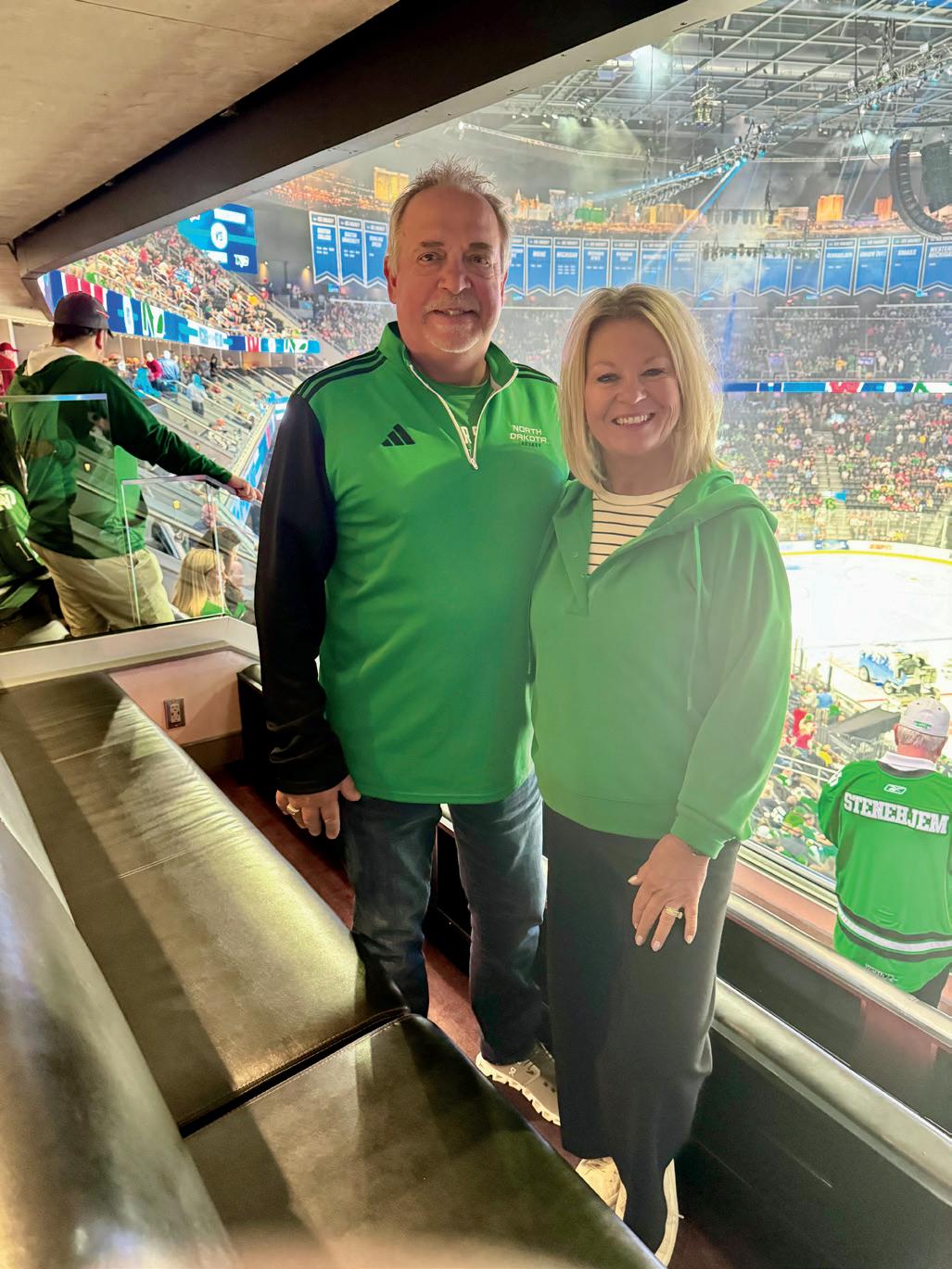
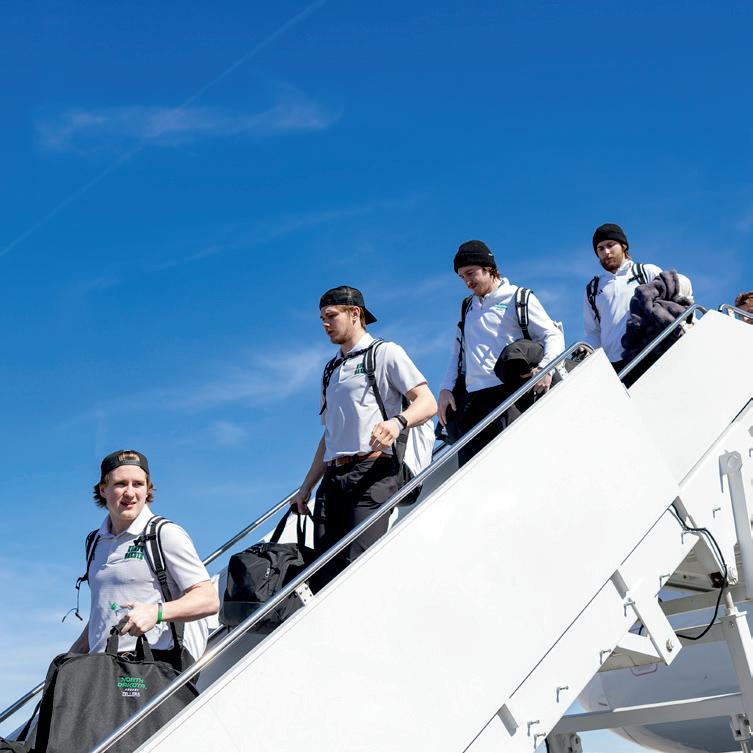
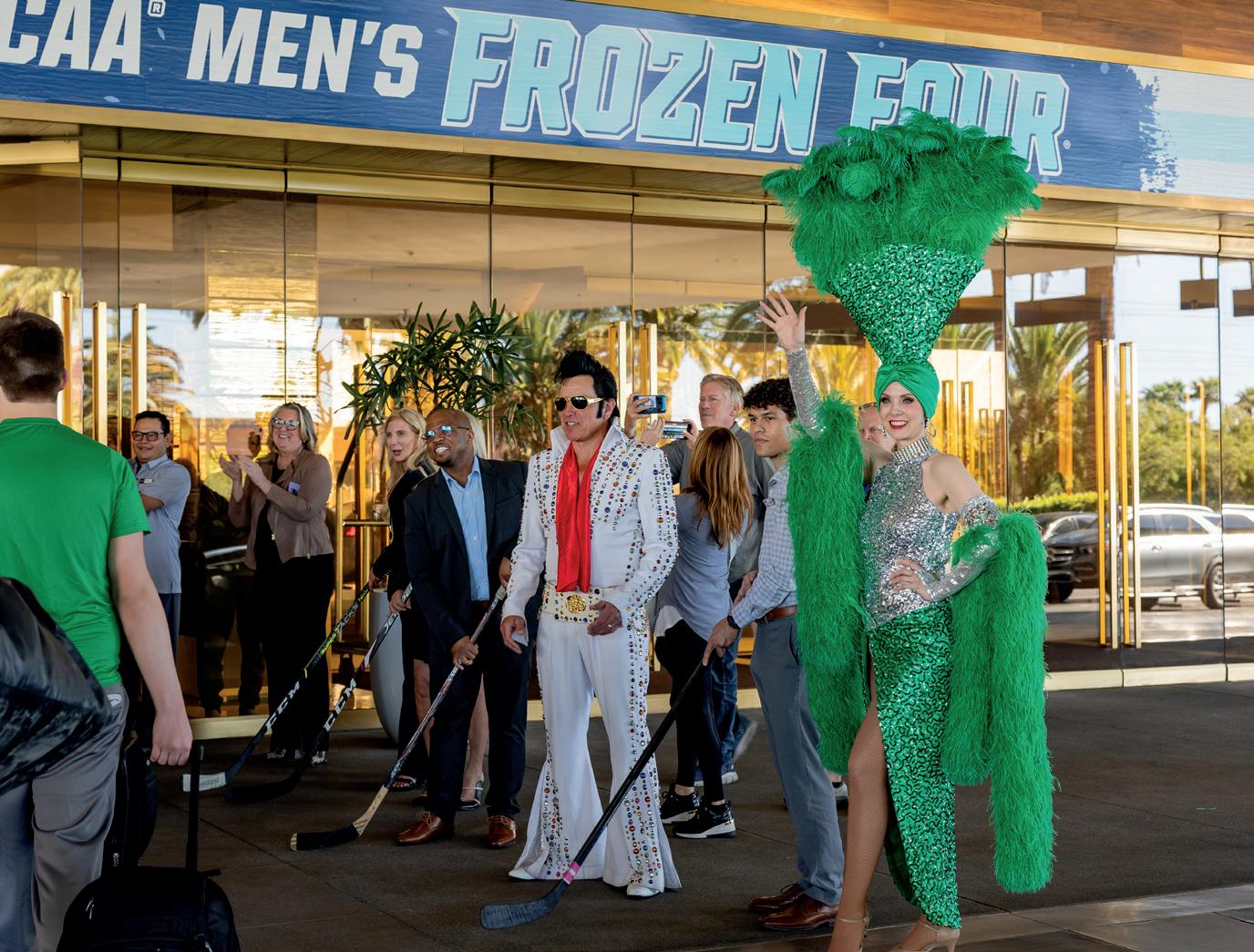
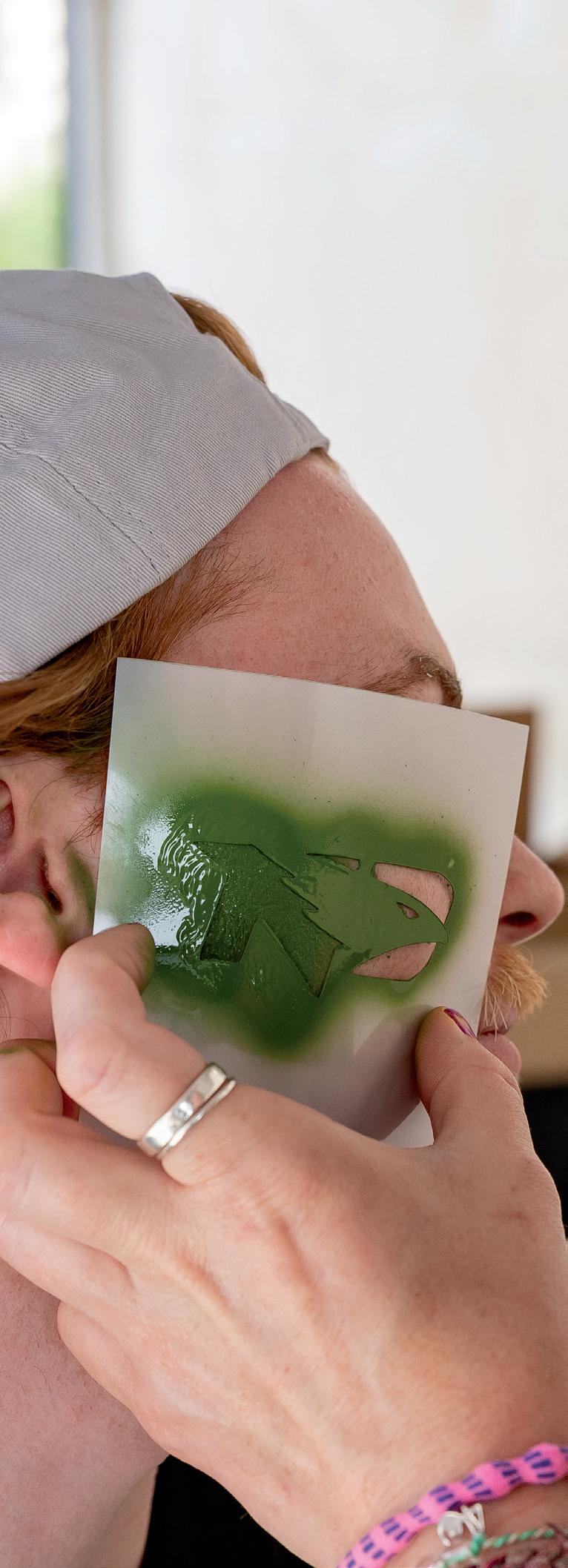
From airport gates to arena seats, UND fans turned Las Vegas into a sea of green at the Frozen Four.
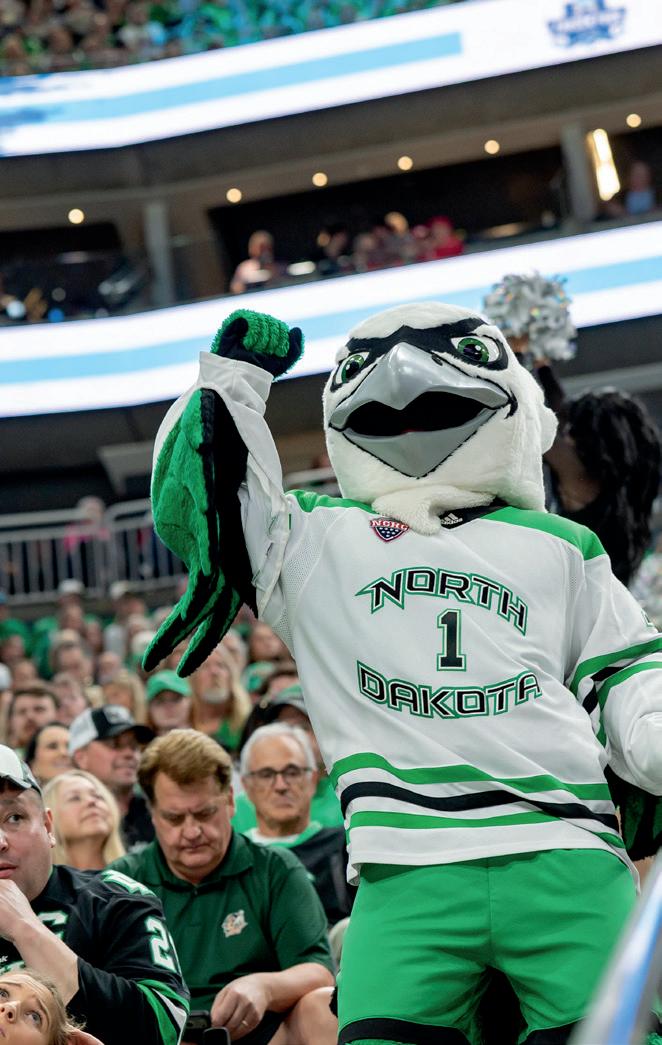
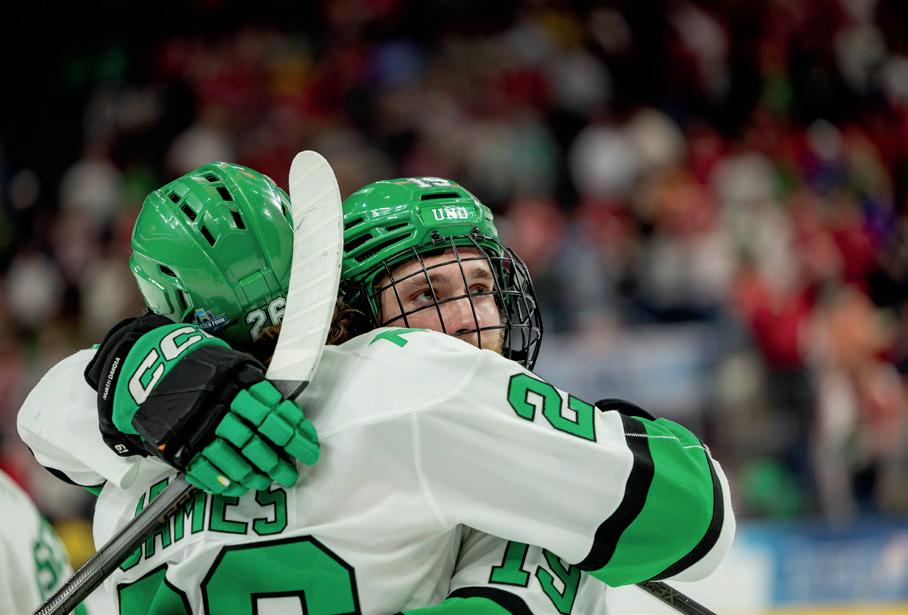
For the first Frozen Four ever held in Las Vegas, thousands of UND alumni, fans and superfans packed flights, hotels and T-Mobile Arena, creating a sea of green far from Grand Forks. UND’s season ended in a 2–1 semifinal loss to Wisconsin, but the scenes surrounding the game told the fuller story: wherever the Fighting Hawks go, their people follow.
The Sound of North Dakota
Wherever UND goes, the music follows. The Pride of the North band brought the soundtrack of North Dakota Hockey to Las Vegas.
Road Legends
UND’s most dedicated followers once again crossed state lines and time zones, building spring travel plans around the Frozen Four.
Green Lineage
Generations of fans have grown up in green and white, passing down jerseys, rituals and rinkside memories that stretch from childhood to adulthood.
Campus Crowd
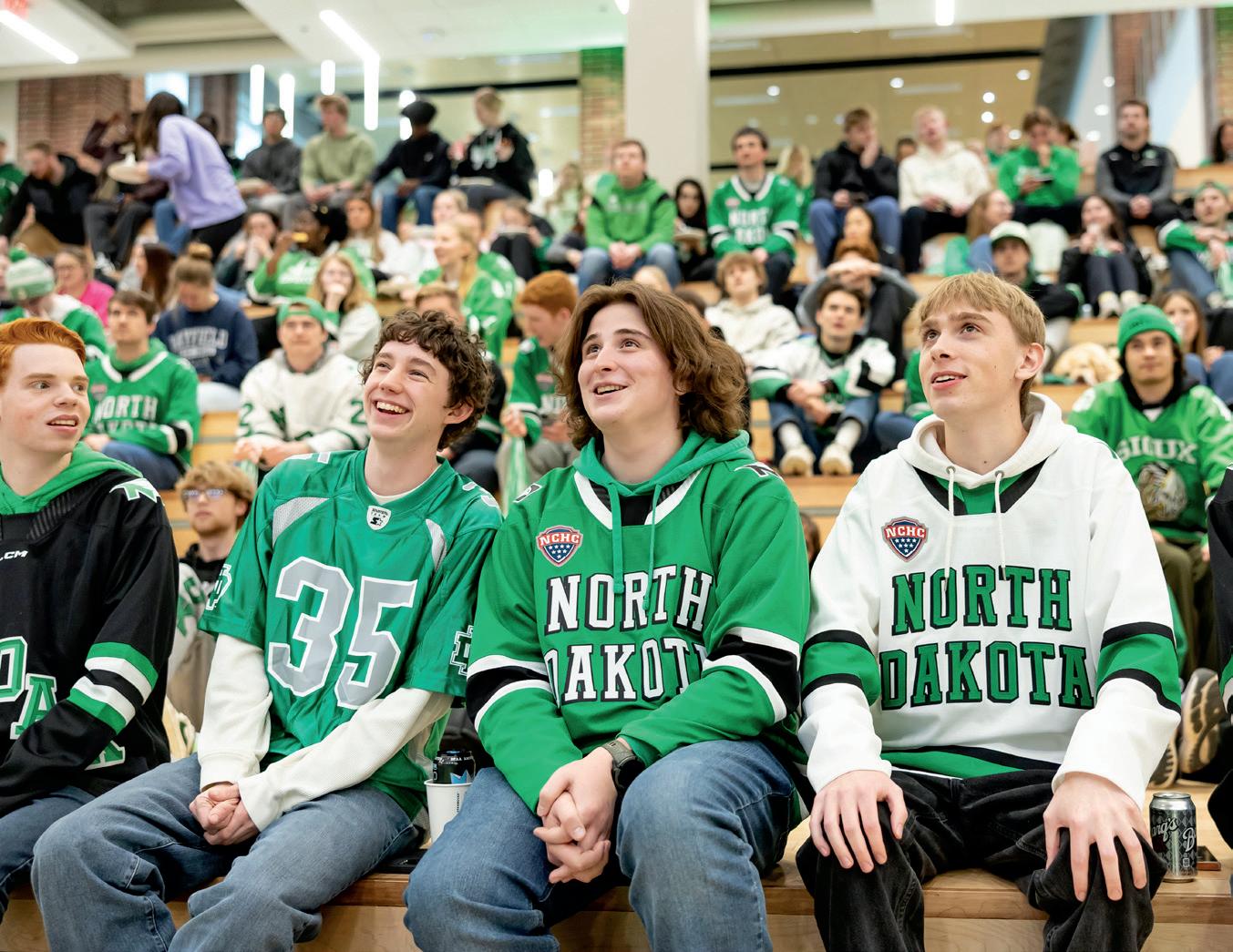
Back in Grand Forks, students filled the Memorial Union Social Stairs as they watched UND’s semifinal run unfold in real time.
Two Hats
While the Fighting Hawks battled on the ice, UND staff helped stage the Frozen Four behind the scenes, shaping the experience across the city.
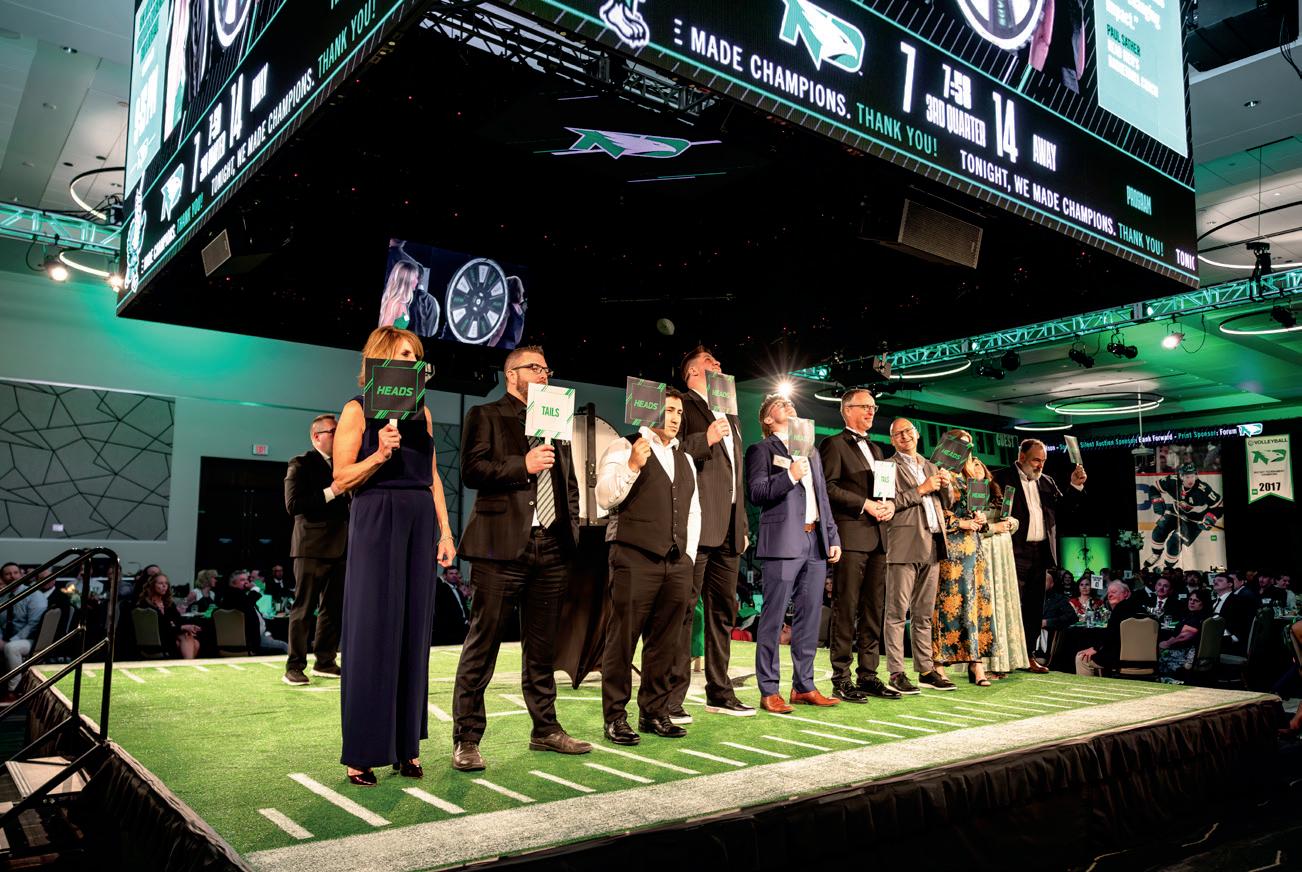
848 attendees RAISED FOR UND ATHLETICS
205 auction items
1,984 bids
Student-Athlete Spotlight
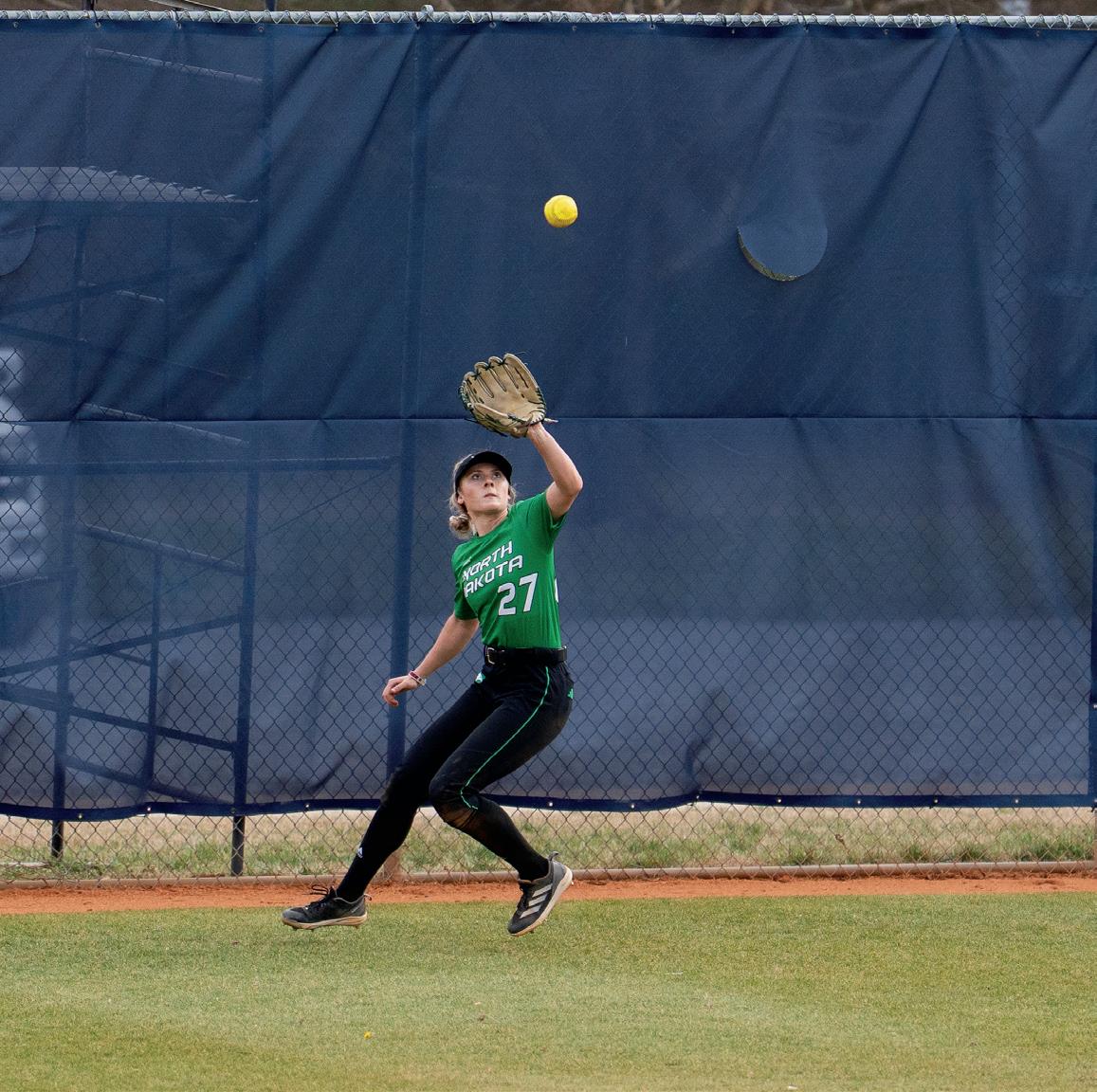
FINDING HER FIELD BROOKLYN MORRIS
Hometown: Bismarck, North Dakota
Area of Study: Psychology & Pre-Med, focus on Endocrinology
“To be able to see a stadium full of fans and community members was pretty amazing.”
Athletic Program & Position: Women’s Softball, center fielder
Why UND? I grew up in North Dakota, so UND felt like the perfect place to begin my academic journey and stay connected to my home state.
Academic Highlight: I started as a business major. During my freshman year, I took an introductory psychology course that sparked a new passion and led me to pursue a psychology and pre-med pathway. More recently, I worked with psychology professor Dr. (Utkarsh) Gupta on a research publication exploring the use of transcranial magnetic stimulation combined with electroencephalography, which further solidified my interest in psychology and research-focused medicine.
Favorite Athletic Highlight: The home opener at the new Albrecht Field is one of my favorite memories, especially after watching the stadium develop during my entire UND Softball career.
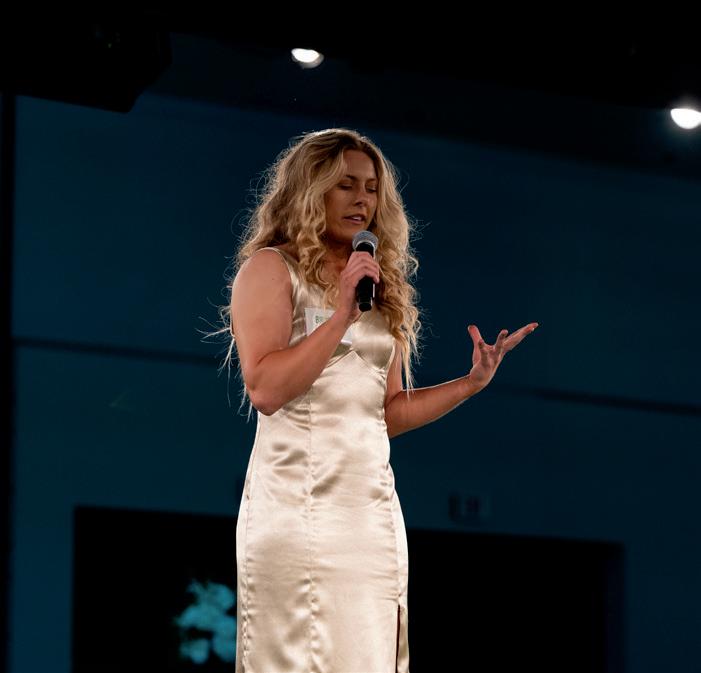
Community Involvement: I have been involved with Special Olympics of North Dakota, the Hope Church Food Pantry, and after school mentorship with Grand Forks Public Schools. As a devoted Christian, the opportunity to present the invocation to more than 800 attendees at the North Dakota Champions Ball this past spring was especially meaningful.
Alumni Authors
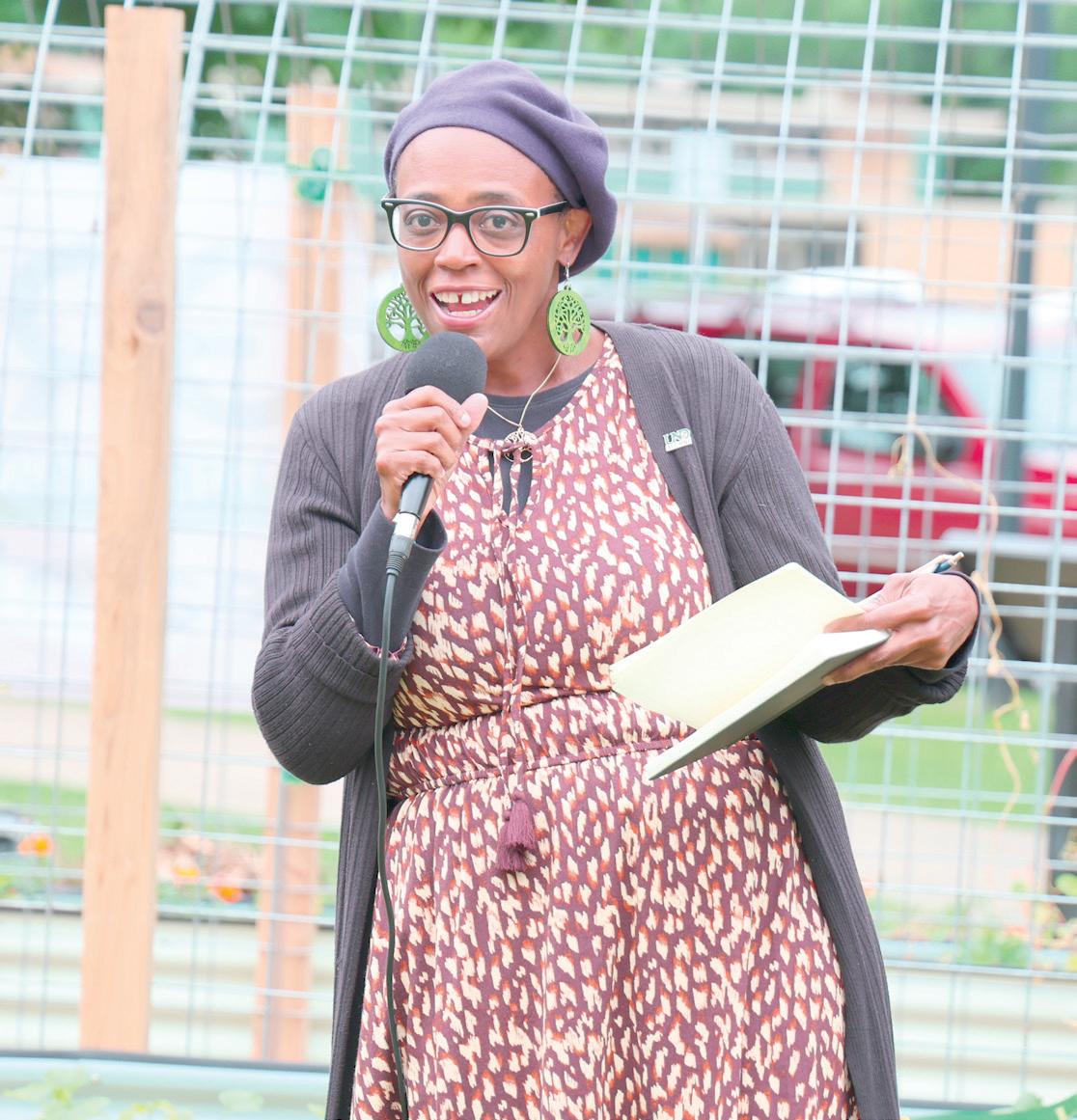
Salaam Green, ’13, published “The Other Revival: Poems & Reckonings.”
Green, the inaugural poet laureate of historic Birmingham, Ala., from 2024-2026, drew on interviews with descendants of both the enslaved and enslavers of a former plantation.
The collection reflects on Green’s experience as a Black woman working at the site and gives voice to the story of an enslaved woman. It also includes poems about the History House, the first Black-owned home in Shelby County, Ala.
Green is the founder of Literary Healing Arts and is a certified Listener Poet and Artist in Residence with the University of Alabama at Birmingham Arts in Medicine program and Wallace Center for the Arts.
Robert Paletz, ’63, published “Streaming Love: A Poetic Quest,” a collection of poems. Paletz previously published “Streaming Life: A Poetic Journey.”
Gary Eller, ’65, published “True North.” Spanning the 1930s-60s, three Great Plains farm families living near the Turtle Mountain Reservation struggle to survive and find their way.
Jerald Lucas, ’72, published “Reflections from a Twisted Mind,” a collection of poems and artwork that explores the complexities of the human experience.
Phyllis (Uppman) Florin, ’73, published “Mette Hansdatter,” a fictionalized account of her great-grandmother’s tragic life in Norway in the late 19th and early 20th century.
Fabrice Moussus, ’73, published “Grab the Moment,” a behind-the-scenes look at his 30 years in video journalism for ABC News.
Robert Seyda, ’75, published “New Testament Contextual Commentary: The Apostle John’s First Epistle to His Congregation, Volumes I, II, and III.”
Gail (Budzeak) Bergan, ’76, published “Art and Artifice: A Memoir – A Story of Love, Deception, and Healing on the Texas Gulf Coast.” Bergan shares her experience in a narcissistic relationship and tells how therapy helped her break patterns of control and find healing.
Paula Enyeart, ’82, published “Squished Potatoes,” chronicling her Peace Corps experience as a young, newly graduated nurse serving a Quechua community in the high Andes mountains of Ecuador.
Mark Hanson, ’82, published “Tarryall Gold: From Rush to Hush.” In 1859, 14 men discovered gold along Tarryall Creek, sparking the first stampede to Colorado’s Front Range. The book features more than 220 photographs, maps, letters, and telegrams, tracing a century-long search for the elusive mother lode.
Mark Phillips, ’83, is the author of “My Father’s Cabin,” a novel set in the 1960s Rust Belt that explores the complicated relationship between a father from the Greatest Generation and his son, a product of the Me Decade.
Ron Vossler, ’87, published “Hitler’s Basement: My Search for Truth, Light, and the Forgotten Executioners of Ukraine’s Kingdom of Death.” The book traces a labyrinth of guilt and memory, uncovering connections between 1930s Soviet terror and the Holocaust in a remote region of Ukraine that the author’s grandparents once called home.
Scott Jagodzinski, ’87, published “Harder to Kill: How to Stay Healthy, Strong, and Unstoppable after 50.” Jagodzinski, founder of Argent Alpha, helps men over 50 reclaim their strength, energy, and purpose.
James Scoles, ’91, published “The Trailer,” a collection of poems that explores life lived on the edge of a city — and on the fringe of society.
Steve Hoffbeck, ’92, published “Colvill Smiled: The Legend of the 1st Minnesota Volunteer Regiment at Gettysburg.” A retired history professor, Hoffbeck has written four books.
Juliet (Rehrig) Cutler, ’96, published “Lessons in Hope: A New Era for Maasai Women in Tanzania,” a collection of interviews and portraits with Maasai women who share how education has transformed their lives. The book is a follow-up to her award-winning memoir “Among the Maasai.” Both draw on Cutler’s connection with the first school for Maasai girls in East Africa.
Angelique (Wambdi Was’teWinyan) EagleWoman, ’98, published “Native American Law: Tribal Nations and the United States, Cases and Materials.” The book provides a legal framework and chronology of the relationship between Tribal Nations and the United States, placing judicial, statutory, and policy interpretations in historical context while examining tensions in perspectives.
Naomi Yaeger, ’98, published “Blooming Hollyhocks: Tales of Joy During Hard Times,” a combination of memoir and biography about Yaeger’s mother, Janette Minehart, growing up during the Great Depression and World War II.
Yahya Frederickson, ’99, published “Khumásíyát: Poems from the Moroccan Desert,” inspired by the landscapes and rhythms of the Moroccan desert. This is Frederickson’s seventh collection of poems.
Brian Samson, ’06, published “Through Our Lens,” a narrative of the Dakota Territory. Witness the region through an officer’s perspective, along with police and historical files, to get a view of life, romance, drugs, and scandalous activities in the region.
Christopher Price, ’13, published “Big Pandemic on the Prairie: The Spanish Flu in North Dakota,” which examines North Dakota’s experience during one of the deadliest pandemics in history. The book explores the flu’s impact on soldiers abroad, the 1918 election, and public gatherings across the state.
Allee Mead, ’13, ’16, authored “Isaac,” a futuristic story set in a world where robots care for those requiring 24-hour care. After her father’s death, Eleanor brings home his care-bot to help ease her loneliness. Her story is interwoven with the story of how her fathers met and fell in love.
Geoff Peck, ’16, published “City of Clans,” which follows Jeremy Starcevic, a community college student struggling with his identity and sexuality, on a journey of healing and self-reflection.
Anthony Underwood, ’19, published “True Diversification: A Basic Guide to Real Diversified Investing,” which outlines the benefits of investing across a range of asset types beyond the stock market and highlights how true diversification can help individuals create generational wealth.
Class Notes
1954
Wesley Waage, ’54, the first president of Fergus Falls Junior College (now Minnesota State Fergus Falls), received a posthumous Torchbearer Award for his transformational leadership in higher education.
1955
Gerald VandeWalle, ’55, ’58, HON ’15, former North Dakota Supreme Court Chief Justice, received the inaugural Distinguished Alumni Award from the UND Law Review.
1961
Bernard “Bernie” Haley, ’61, was inducted into the Alberta Sports Hall of Fame. He is also in the UND Letterwinners Athletic Hall of Fame as a member of the 1958-59 hockey team. After retiring from playing hockey, Haley was a professional hockey referee.
1967
Spencer Peterson, ’67, ’71, coauthored the feature article in the August 2024 issue of the technical journal Fisheries. Peterson retired in 2010 as a senior research ecologist at the EPA after 39 years.
1969
Marilyn (Walter) Guy, ’69, ’71, ’76, was named the 2026 Legacy Leader by the Fargo/Moorhead/ West Fargo Chamber. For more than 50 years, she served as a professor and held leadership roles at Concordia College.
1972
Tom Seymour, ’72, was re-elected to the North Dakota Association of Rural Electric Cooperatives. He also serves on the Board of Directors of Cass County Electric Cooperative. Seymour was a Professor Emeritus at Minot State University from 1985 to 2016.
1973
George Eidsness, ’73, was named 2026 Citizen of the West. Eidsness is the owner of Transwest, a full-service vehicle retailer and fleetservices company based in Brighton, Colo. In his honor, the National Western Scholarship Trust awarded two $5,000 scholarships to UND students.
John Sanderson, ’73, retired after 48 years of dentistry. He has practiced in Elgin, N.D., since 1981.
1974
Doug Mowbray, ’74, recently retired from a 40-year career in teaching and coaching. He also fully retired from serving as CEO of his family farm in southern Manitoba.
1975
Brian Bjella, ’75, ’79, was elected as honorary trustee of the Foundation for Natural Resources and Energy Law for his years of service to the Denverbased organization. Bjella lives in Bozeman, Mont.
1976
John Botsford, ’76, is retiring after 40 years with the Myra Foundation. He served as president for the past 25 years.
1977
Allan Peterson, ’77, retired after serving as an advisor for the Washington State University Small Business Development Center since 2004.
1979
Daniel Crothers, ’79, ’82, retired in February after serving more than 20 years as a North Dakota Supreme Court justice.
1980
Mary Farrington-Lorch, ’80, ’83, is an attorney specializing in bankruptcy and creditor rights law at the Law Office of Mary K. Farrington-Lorch in Phoenix. She was recently featured on the the networking platform, Influential Women.
Robert Harms, ’80, was named to the board of the North Dakota News Cooperative. Harms is a retired lawyer and former government affairs consultant.
Allen Koppy, ’80, ’84, retired from his job as Morton County state’s attorney after working there for nearly 40 years.
1981
Kathleen Gershman, ’81, a retired UND professor and department chair, received the Community Impact Award from Fontbonne, The Early College of Boston, where she attended high school.
Cynthia Lindquist, ’81, ’06, is chief strategy officer for the American Indian College Fund in Denver. Lindquist stepped down as chair of the North Dakota Ethics Commission, on which she served since 2019.
1983
Ruth (Indergaard) Braaten, ’83, ’89, retired as director of the child development center at the Lutheran Home of the Good Shepherd in New Rockford, N.D. She has served in that position since 2005.
Chuck Schultz, ’83, ’86, an energy lawyer, will retire in September after 23 years with NextEra Energy Resources in West Palm Beach, Fla.
1985
Peter Schmit, ’85, ’89, received the 2025 Minnesota ICON Award. He has more than 35 years of trial experience and serves as chair of Robins Kaplan LLP’s National Personal Injury, Medical Malpractice, and Civil Rights Group.
1986
Jean (Trenbeath) Johnson, ’86, is chief information officer of United Valley Bank in Cavalier, N.D., where she has worked for 40 years.
1987
Dan Kadrmas, ’87, president of TrueNorth Steel in West Fargo, N.D., was elected vice chair of the board of the American Institute of Steel Construction.
1988
Bruce Cook, ’88, founded SponsorLab, an online performance analysis company serving the sponsorship market. Cook has worked on numerous commercial sports partnerships, including seven years on the leadership team at YouGov Sport. He has lived in Scotland since 2001.
1989
Steven Allen, ’89, retired U.S. Army Brigadier General, was named COO at Almonty, a global producer of tungsten critical to the defense and technology sectors.
Liz (Schutt) Auch, ’89, retired after 26 years as director of Countryside Public Health, which serves five counties of the Upper Minnesota River Valley.
John Odegard, ’89, partner and co-founder of 5x5 Trading, was named chair of the International Aircraft Dealers Association. Odegard brings over 30 years of aviation industry experience, including 18 years with NetJets.
1990
Bob McWilliams, ’90, retired as president and CEO of the Altru Family YMCA in Grand Forks after more than 30 years.
1991
Shawn Mechelke, ’91, is general manager of weather & climate at Spire Global, a provider of spacebased data, analytics and space services. He most recently served as president of the aviation vertical at AFV Partners.
Staci (Hartman) Satterwhite, ’91, a guest instructor at the London School of Economics, was named one of the Top 50 Women Leaders of Houston for 2026. Satterwhite was CEO for ABS Wavesight.
Shannon Schell, ’91, is president of Spectrum Aeromed. He most recently was president and CEO of REVA, Inc., one of the largest fixed-wing air ambulance companies in the Americas.
1992
Russell Carignan, ’92, is vice president commercial/ ag banker and crop insurance agent at First United Bank in Grafton, N.D.
Amy (Rademacher) Cox, ’92, ’97, is an advanced practice registered nurse and certified nurse practitioner in family medicine at the Essentia HealthOsgood Clinic in Fargo.
Steve Erhardt, ’92, global manufacturing director of Kynar at Arkema Inc., was honored as a Hero of Chemistry by the American Chemical Society for his role in developing Kynar® HSV 900, a binder used in electric vehicle batteries that advances sustainability.
Dane Jackson, ’92, UND Men’s Hockey coach, was named the National Collegiate Hockey Conference Herb Brooks Coach of the Year.
Arleigh (Hunchak) Trainor, ’92, ’03, is an emergency room doctor at Brandon Regional Health Centre in Manitoba. She is also assistant dean at the University of Manitoba’s Max Rady College of Medicine satellite program in Brandon.
1993
Tony Herbert, ’93, retired as acting chief data officer with the Office of Policy Development and Research after a 25-year career with the U.S. Department of Housing and Urban Development. He cofounded and is managing partner of Punch House, a premium bottled cocktail brand based in Atlanta.
Jason Karsky, ’93, is a professor of criminal justice at Wayne State University in Detroit.
Lisa Fair McEvers, ’93, ’97, is North Dakota’s first female chief justice. She has served on the court since 2014.
Shaun Riffe, ’93, director of development for the Minnesota Assistance Council for Veterans, won his second Emmy Award as a producer for WCCO’s annual “Home for the Holidays” broadcast.
1994
Bill Dolny, ’94, CEO of MedAire, was elected vice chair of the International Business Aviation Council Industry Advisory Forum.
Scott Johnson, ’94, retired as the deputy state court administrator for the North Dakota Supreme Court. He served more than 30 years as a trial court administrator in several jurisdictions including North Dakota, Minnesota, Wisconsin, Oregon, and with the federal court system in Iowa.
Chris Kennelly, ’94, and Nan (Spooner) Kennelly, ’92, ’94, recently made a philanthropic gift to the Gonzaga University School of Law in Spokane, Washington. Recognizing their generosity, the school renamed its Center for Law, Ethics & Commerce the Kennelly Center for Law, Ethics & Commerce.
Rob Landis, ’94, is program officer for NASA’s Planetary Defense Coordination Office. Landis works at the Johnson Space Center in Houston.
1995
Karen (MacFarlane) Basbaum, ’95, is chief business officer at MBX Biosciences, a clinicalstage biopharmaceutical company in Carmel, Ind.
1996
Peter Buffington, ’96, released the aviation-themed album “737 Red Eye” by Speed Brake Armed.
Susan (Arvik) Gallo, ’96, a family medicine physician at Clinic Miles City (Mont.), was honored on National Rural Health Day by WWAMI, the University of Washington School of Medicine’s multi-state medical education program serving Washington, Wyoming, Alaska, Montana, and Idaho. Gallo has served as a WWAMI preceptor for 15 years.
Jeremy Roesler, ’96, ’06, director of flight operations at UND’s Odegard School of Aerospace Sciences, received the 2026 Aviation Accreditation Board International Chairperson’s Award.
1997
Carol Anson, ’97, retired from her job as an advisor to UND’s Veteran & Military Affairs programs. Throughout her 35-year UND career, she has served as an advocate for veterans and military affiliated students.
Jennifer (Klemetsrud) Puhl, ’97, ’00, was named The Forum’s 2025 Area Person of the Year. She served as the acting U.S. Attorney in the trial of Ray Holmberg.
1998
Marcia Larson, ’98, joined the Bemidji State Alumni & Foundation after a 17year career with Bemidji Parks and Recreation.
Leander “Russ” McDonald, ’98, president of United Tribes Technical College in Bismarck, was named the 2025-26 Tribal College and University President Honoree of the Year by the American Indian College Fund.
Dustin Mitzel, ’98, CEO of Happy Harry’s Bottle Shops, was named president of the Wine and Spirits Guild of America. Mitzel began his career at Happy Harry’s as a part-time summer employee in 1996.
1999
Dan Grieser, ’99, serves as solicitor for Bucks County, Pa., where he leads the Bucks County Law Department.
Lindsey Haugen, ’99, ’02, joined O’Keeffe O’Brien Lyson Attorneys in Fargo.
2000
Kelly Armstrong, ’00, ’03, governor of North Dakota, received the Andy Mork Riverman Award. The award recognizes individuals or organizations for lifetime leadership in resource management and water development within the Missouri River corridor.
Damon Feltman, ’00, retired U.S. Air Force Brigadier General, is CEO of the Space Force Association (SFA). With three decades of experience in defense and space operations, he guides the organization’s mission to support the U.S. Space Force and its Guardians while strengthening collaboration across government, industry, and allied partners.
Mark Friese, ’00, was named a North Dakota Supreme Court Justice. Friese was a shareholder with Vogel Law Firm in Fargo, with 25 years of criminal defense experience.
Angela (Luther) Lee, ’00, ’15, an advanced practice registered nurse and certified nurse practitioner, joined Essentia Health32nd Avenue Clinic in Fargo. She will practice gastroenterology.
2001
Scott Diamond, ’98, ’01, was appointed to a judgeship in North Dakota’s East Central Judicial District. He brings 24 years of legal experience to the role, most recently serving as a judicial referee in the district.
Michael Kreun, ’01, joined the Minneapolis office of DeWitt LLP. He has more than 20 years’ experience handling real estate litigation and complex commercial disputes. Kreun is a state senator and is assistant minority leader of the Minnesota Legislature.
Mandy (Volk) Sorlie, ’01, ’08, serves as president on the Board of the North Dakota Academy of Family Physicians.
Bill Trew, ’01, was inducted into the University of Minnesota Crookston Athletic Hall of Fame. Trew led the university to backto-back NJCAA National Hockey Championships in 1993 and 1994, and was named a 1993-94 NJCAA All-American.
2003
Dave Relling, ’93, ’01, was named senior associate dean for health science at UND’s School of Medicine & Health Sciences. Relling was formerly the chair of UND’s Department of Physical Therapy.
2004
John “Laddie” Bata, ’04, is a captain in the Moorhead (Minn.) Police Department, where he has worked since 2015.
Kristina (Grzadzieleski) Hokenson, ’04, a registered dietitian nutritionist and yoga teacher, is owner of Haven of Health in Minot, N.D. She combines yoga and meditation to help people make peace with food and their bodies.
Dustin Leigh, ’04, ’10, is an emergency medicine physician at Essentia Health-Fargo.
Ashley (Helle) Samuelson, ’04, ’07, was appointed to a judgeship in North Dakota’s Northeast Judicial District.
2005
John Lyng, ’05, received the National Association of EMS Physicians President’s Award. The physician serves as the group’s editor-in-chief.
Chris Swenson, ’05, ’14, will begin serving as superintendent of the Monticello (Minn.) School District on July 1, after serving in the same role for Holdingford Public Schools for 11 years.
HAWKS GO FOR GOLD
UND athletes shine on the world stage at the 2026 Olympic Winter Games.
Across the country, fans were up early on Feb. 22 to watch the gold-medal men’s hockey game of the 2026 Olympic Winter Games. In overtime, Team USA defeated Canada 2-1 to claim the gold medal. The victory was a significant moment for the University of North Dakota community: alumni Brock Nelson, ’..12, and Jake Sanderson, ’22, were teammates on the championship roster.
For Nelson, the gold medal represents a family legacy as the third-generation Olympian skated into the history books. His uncle, UND star Dave Christian, ’..79, played on the 1980 “Miracle on Ice” team. Nelson’s grandfather Bill Christian and great-uncle Roger Christian were members of the first U.S. men’s hockey team to win Olympic gold in 1960.
Nelson recorded two goals and one assist during the tournament and played a key role on Team USA’s penalty kill, which went a perfect 18 for 18. Sanderson added two assists.
Success in the Air
On the slopes, current online student and Team USA ski jumper Paige Jones finished 23rd in the women’s normal hill event and helped the U.S. team place seventh in the mixed team competition.
Jones is pursuing a biomedical engineering degree with an anticipated graduation date of 2027. “I always think of school as a balance to my life as an athlete,” she said. “It gives me something to think about when I’m not on the hill. I don’t want to be ruminating about ski jumping all the time — it’s so easy to get in your head, especially when the jump only lasts about five seconds.”
Global Representation
The UND connection extended beyond the American roster, with three additional athletes representing the University on the world stage.
Three former UND women’s hockey players competed for Finland in Milan. Michelle Karvinen, ’15, served as Finland’s captain. Competing in her fifth Winter Games, she matched the all-time women’s Olympic hockey appearance record. She was joined by Susanna Tapani, ’..14, competing in her fourth Winter Games, and former student Emma Nuutinen made her second Olympic appearance.
Jocelyne Lamoureux-Davidson, ’12, ’13, and Monique Lamoureux-Morando, ’12, ’15, were part of the U.S. presidential delegation at the Olympics. The twins were chosen for the honor after being a part of the USA ice hockey teams that won Olympic gold in 2018, six world championships and two Olympic silver medals.
T.J. Oshie, ..’08, the 2014 Sochi Olympics hero, was an NBC hockey analyst.
Featuring UND senior Ava Leifur and our Gershman Graduate Center on the cover of the Winter 2025 UND Alumni Magazine made for a challenging round of flame finding.
Many answered correctly — some after a clue — and we randomly selected three winners to receive a UND prize pack.
Brittny Zavala, ’11, wrote, “Great job hiding it in the beautiful wallpaper of the Gershman Graduate Center!” (It is in the wallpaper below the table on the right side of the cover.) Prize pack winner, Terry Bailey, ’70, said he thought the flame had to be orange. (It doesn’t.) The final prize pack recipient, Alec Redmann, ’15, wrote, “This was a good one.”
There’s another flame hidden on the cover of this issue. Think you’ve spotted it? Email us at AlumniMag@UNDalumni.net with its location for a chance to win your own UND prize pack.
2006
Cory Hilliard, ’06, was named chief financial officer of USA Swimming. Hilliard previously spent 18 years at the University of Colorado in Boulder, most recently as senior associate athletic director for business operations/CFO.
Ashley (Hagan) Kremer, ’06, ’11, is a family medicine specialist at the Sanford Northwest Clinic in Minot, N.D.
Chris Kuper, ’06, is the Philadelphia Eagles offensive line coach.
Matt Lange, ’06, was promoted to regional operations director at KLJ Engineering, where he has more than 17 years of experience in transportation project design.
2007
Carol Wright Becker, ’07, a board-certified emergency physician and assistant professor of emergency medicine at the West Virginia University School of Medicine in Morgantown, W.V., was recognized in America’s Best in Medicine.
David Rasmussen, ’07, was reelected to the board of directors for Full Circle Ag Cooperative. He and his wife, Jessica (Kuster), ’07, run the Rasmussen family farm in Cogswell, N.D.
Jenna (Kruger) Sandman, ’07, an advanced practice nurse and certified nurse practitioner, has joined the staff at the Essentia Health45th Street Clinic in Fargo.
Joy (Bingham) Vega, ’07, is division chief of the energy and natural resources division of the Idaho Office of the Attorney General. She has served as lead deputy attorney general in the division since 2017.
Mark Western, ’07, was appointed to a one-year term on the North Dakota Ethics Commission.
2008
Danny Freund, ’08, ’13, is offensive coordinator for UND Football.
Justin Reisenauer, ’08, Sanford Bismarck’s chief medical officer, was named to Becker’s Healthcare 2026 list of hospital and health system chief medical officers to know.
Jon Rentz, ’08, is assistant vice president of business strategy & corporate development at Northern Plains Rail Services in Grand Forks.
Val Sussex, ’08, ’11, director of the North Dakota Champions Club, received the Melvin Jones Fellow Award — the highest recognition from Lions Clubs International.
2009
Jessamy (Olsen) Forsnell, ’09, is chief financial and operating officer at SRT, North Dakota’s largest telecommunications cooperative. She has served as CFO since May 2025.
Tara Mertz-Hack, ’09, was selected as the 2025 North Dakota Academy of Family Physicians Family Physician of the Year. She was honored for her role as a rural family physician and her dedication as a hospital and clinic medical director, EMS medical director, four-county public health medical officer, and nursing home medical officer.
Karna (Plaine) Nixon, ’09, was inducted into the University of Minnesota Crookston Athletic Hall of Fame. Nixon, a standout basketball player, scored 1,642 career points, which ranks third all-time in scoring in UMC’s NCAA era.
Nick Nupdal, ’09, ’17, is a senior credit analyst at KodaBank in Fargo.
2010
Tony Schanilec, ’10, is the facility manager of the Cargill Corn Milling plant in Wahpeton, N.D.
Jeffry Tescher, ’10, is head football coach at Bismarck St. Mary’s High School. He served as assistant coach in 2025.
2011
Emily (Burkland) Montgomery, ’11, ’20, is president of the Myra Foundation in Grand Forks. She has served as a Foundation trustee for five years.
Erica (Wondrasek) Thunder, ’11, ’14, is head of tribal health equity and experience for Sanford Health Enterprise. A longtime advocate for Indigenous communities, she previously served as North Dakota’s first Native American labor commissioner.
2012
Meena Kalyanasundaram, ’12, was selected for inclusion in Marquis Who’s Who. She is president, CEO, and co-founder of WeEMBRACE, a nonprofit dedicated to empowering individuals who are neurodiverse and those with developmental disabilities. She lives in Sacramento, Calif.
Peter Olenjniczak, ’12, co-founded a construction financial management software called “Controllr.” Olejniczak is a UND graduate in air traffic control.
Erin (Schoenrock) Roesler, ’12, ’19, deputy executive director of the Northern Plains UAS Test Site, received the UAS Sky Pioneer Award.
Elaina (Bialke) Wickman, ’12, ’24, was named executive director of the Northlands Rescue Mission in Grand Forks.
Lori Wolff, ’12, a certified physician assistant, practices walk-in care at Essentia Health-Mid Dakota Bismarck 9th Street Clinic.
2013
Sydnie (Smith) Bahl, ’13, finished in 25th place at the Iditarod, with a total race time of 12 days and just under five hours.
Alex Johnson, ’13, is a factory manager at American Crystal Sugar Company’s Drayton, N.D., factory.
Crystal (Glaser) Koski, ’13, who has worked for Whitefish Lodge & Suites and Manhattan Beach Lodge for 18 years, was named the 2025 Crosslake (Minn.) Employee of the Year. She currently serves as director of sales for both properties, and director of operations for Manhattan Beach Lodge.
Justin Rosenau, ’13, serves as chairman of the Board of the North Dakota Academy of Family Physicians.
2014
Johnathan Gajdos, ’14, is provost at the U.S. Merchant Marine Academy, located at King’s Point in Nassau County, N.Y. Gajdos has decades of experience in public administration, military leadership and education.
Dixie Holland, ’14, ’23, is chief deputy clerk of the North Dakota Supreme Court.
2015
Quinn (Hochhalter) Askew, ’15, joined the Vogel Law Firm’s Bismarck office.
Joshua Hensrud, ’15, a U.S. Air Force Major based at Wright-Patterson Air Force Base, Ohio, won the 2025 Warfighting Acquisition Award for his work in international security cooperation.
Samantha (Stegman) Simley, ’15, ’21, a certified physician assistant, practices palliative care at Essentia Health-Fargo.
Lisa Yonker, ’15, opened Revive and Thrive Physical Occupational Therapy in Perham, Minn.
2016
Stephanie Waldref, ’16, is a freelance meteorologist on the StormTracker 4 Weather team in Tucson, Ariz. She has worked as a meteorologist in Minot, N.D., and Wilmington, N.C.
2017
Jeffrey Diemert, ’17, a staff attorney with North Dakota Legal Services under the Federal Veterans Homelessness Grant, was named manager of the Ellendale American Legion. Diemert has served 17 years in the North Dakota National Guard and was recently promoted to staff sergeant.
Rhea Goulet, ’17, was named Company Grade Officer of the Year by the Army National Guard. Capt. Goulet is an operations officer for the Headquarters and Support Company, 141st Maneuver Enhancement Brigade in Fargo.
Erik Langerud, ’17, is a project manager at AE2S. He manages civil engineering projects across the upper Midwest and Rocky Mountain regions.
2018
Kelsey (Daley) Luce, ’18, a certified physician assistant, was recognized by America’s Best in Medicine for advancing pediatric care at Sanford West Dickinson (N.D.) Clinic.
Deland Weyrauch, ’18, Montana’s deputy medical examiner, received two major honors from the National Association of Medical Examiners: the Eckert Award and the 2025 Edward J. Barbieri Forensic Toxicology Award.
2019
Morgan Schmitz, ’19, an advanced practice registered nurse and certified nurse practitioner, joined Essentia Health-32nd Avenue Clinic in Fargo. She practices neurology.
Megan (Danelski) Schneider, ’19, is an advanced practice registered nurse and certified nurse practitioner in family medicine at Essentia Hermantown and Proctor clinics in Minnesota.
2020
Se Kwon, ’20, a reporter and news anchor, joined FOX 32’s morning team in Chicago after three years at FOX 9 in Minneapolis.
Faith Schaefer, ’20, is a Moorhead Police Department officer. She spent four years as a patrol officer with the New York Mills (Minn.) Police.
2021
Kendra Bohm, ’21, is a certified physician assistant at the Essentia HealthValley City (N.D.) Clinic.
Kyle Finseth, ’21, ’24, earned the Accredited Airport Executive (A.A.E.) designation from the American Association of Airport Executives. He lives in Denver.
Kelly Hutton, ’21, is deputy state court administrator for the North Dakota Court System. She has served in various roles with the courts for 19 years.
Bella Kumagai, ’21, is a piano instructor in Augustana University’s School of Music in Sioux Falls, S.D.
Chris Patullo, ’21, was promoted to director of operations at American Crystal Sugar Company. Patullo, a 22-year company veteran, leads production and maintenance operations across the Moorhead, Crookston, and East Grand Forks plants.
Shannon Silverman, ’21, an astrophysicist, is planetarium and science educator at the Clay Center for the Arts & Sciences in Charleston, W.Va.
2022
Caitlyn Fussy, ’22, ’24, an occupational therapist, joined the rehab services team of RiverView Health in Crookston, Minn.
Robert “Robby” Greicar, ’22, ’25, is an associate attorney at Gjesdahl Law. He lives in Fargo.
Sierra Link, ’22, an advanced practice registered nurse and certified nurse practitioner, joined the Essentia Health-South University Clinic in Fargo. She practices pulmonology.
Betsy Seaver, ’22, is an engineer-in-training at AE2S in Grand Forks.
2023
Petros Alex, ’23, is the assistant women’s tennis coach at the University of Southern California.
Isaac Hildenbrand, ’23, is a commercial banker at National Bank of Commerce in Hibbing, Minn.
Christina Torgerson, ’23, a board-certified nurse practitioner, is a family medicine provider at the Sanford Halstad (Minn.) Clinic.
2024
Jack Blotsky, ’24, is an associate attorney at Conmy Feste Law Firm in Fargo. He previously served as law clerk to Justice Lisa Fair McEvers at the North Dakota Supreme Court.
Philip Buque, ’24, joined the Minneapolis office of DeWitt LLP. His practice focus is real estate litigation and general civil litigation.
Justine Fosle, ’24, an advanced practice registered nurse and certified nurse practitioner, practices physiatry at the Essentia HealthDuluth (Minn.) Clinic.
Hassan Kargbo, ’24, is an engineering technician for KLJ Engineering’s construction group in Williston, N.D.
Alex Morse, ’24, is a maintenance engineer at American Crystal Sugar Company’s Hillsboro, N.D., factory. 2025
Caleb Babcok, ’25, is a staff engineer at Interstate Engineering in Williston, N.D.
Jaimee (Cariveau) Berg, ’25, an advanced practice registered nurse and certified nurse practitioner, joined Essentia Health-South University Clinic in Fargo to practice dermatology.
Heather Chatham, ’25, is founder and CEO of Chatty Learners LLC. Chatham lives in Grand Forks.
Melissa Evans, ’25, an advanced practice registered nurse and certified nurse practitioner, joined Essentia Health-West Acres Clinic in Fargo to practice family medicine.
Riley Gerhardt, ’25, a financial representative at Northwestern Mutual, received the Pacesetter First 40 Award, given to representatives who guide 40 clients toward financial success in their first six months in the business.
Ashly Hall, ’25, is an engineering assistant at Burian & Associates in Grand Forks.
Miah Lee, ’25, a certified physician assistant, is practicing internal medicine at Essentia Health-Wahpeton, N.D.
Abby Olson, ’25, is a member of The Forum of Fargo Moorhead’s Readers Board, a group of community members who provide feedback on coverage and share perspectives of local readers.
Andrea (Asp) Samuelson, ’25, is an associate attorney at Gjesdahl Law. She lives in Moorhead, Minn.
WHAT RAIN MADE POSSIBLE
Alumna celebrates 35 years of program that brought her mentorship and belonging.
Teresa Brockie, ’99, credits UND’s Recruitment & Retention of American Indians into Nursing (RAIN) program with shaping her career. “It was here that I first became a nurse and received support through the RAIN program,” she said.
For Teresa, RAIN offered more than academic assistance. Its advising, counseling and community helped make the transition into nursing possible while providing the belonging many students describe as a “home away from home.”
That foundation launched a career far beyond campus.
After earning her degree from UND, Teresa went on to earn advanced degrees from Johns Hopkins University and build a nationally recognized research career focused on suicide prevention, trauma, adverse childhood experiences, and Indigenous health.
Her interest in nursing began much earlier.
When her grandmother was diagnosed with cancer, public health nurses came to help care for her at home. Teresa saw nursing as a way to respond to needs she recognized in her own community, which often went unmet.
“When we think about addressing health disparities, or anything related to health care, there should be a nurse at the table,” she said.
That belief continues to shape her work.
Teresa emphasizes that research should not be done to communities, but with them — addressing “their needs, not what we think their needs are.”
Much of her work has centered on communitydriven efforts to prevent suicide, trauma and adverse childhood experiences in Indigenous and underserved communities through long-term partnerships with tribal communities in Montana, including Fort Peck and Fort Belknap.
“We’re here today to celebrate excellence, because that’s what RAIN is.”
“Data isn’t the endpoint, she said. “You use that data to start developing interventions.”
Just as important is helping prepare future leaders.
Young Medicine, a program for Native high school students at Fort Belknap, introduces students to nursing, public health, science, mental health and cultural learning while asking them to imagine healthier communities 100 years from now.
“They start very reluctant, very quiet, and they end up very powerful and strong,” Teresa said. “I have hope in my heart for the work that we’re doing, but also for the work that they’re going to do.”
For Teresa, that work traces back to RAIN. The support she found there helped shape her path, and today she is helping create that same path for others.
TAKING FLIGHT
From early pioneers to today’s students, women push forward in aviation
The history of women in the aviation industry has been marked by resilience and grit. And no women embody those traits better than those from the University of North Dakota.
Last fall, the aerospace community gathered to celebrate Jill Newby, ’83, recipient of the Sioux Award for Distinguished Achievement & Leadership, sparking a reflection on the program’s evolution.
Jill Newby: Opening Cockpit Doors
After transferring to UND’s aerospace program, Jill Newby quickly immersed herself in campus life — joining clubs, completing internships, and working as a flight instructor. She worked in the Dean’s Office, gave tours to prospective students, and was a member of the Flying Team.
As graduation approached in 1983, Newby wrote to airlines, seeking advice on becoming a pilot. They sent her applications to become a flight attendant.
She eventually landed an interview with United, where her UND connections proved critical. “During the interview, they asked me about John Odegard. I said, ‘Great, call him!’ I knew they loved the UND program.”
As one of the first 30 women hired by United, Newby faced significant prejudice. ““I got told by one guy, ‘You know, you’re taking my son’s job. You should be home.”
By 1989, she became the first woman on United’s 767 fleet — an experience she describes as an “eye-opener.” Though the industry has progressed, she remains committed to mentoring future pilots. Her message to the next generation: “Kick the door open.”
Newby retired this year after 40 years with United. She said having the right attitude was key. “Have fun. Laugh. That kind of sounds superficial, but it’s true. Everybody’s so serious now.”
Building a Network
When Elizabeth Bjerke arrived at UND in 1996, she joined a small student organization for female pilots. She later served as president, and in 1998 the group became a chapter of Women in Aviation International (WAI).
The UND club — one of the first collegiate chapters of the international organization — expanded opportunities for underclassmen, highlighted women across the industry — including maintenance and management—and offered access to an annual conference for networking and career growth.
Bjerke, now associate dean of Aerospace and faculty advisor to the UND WAI chapter, said the aerospace program was “pretty small: at that time. “We had probably 7 to 8% female students on top of a much smaller student population.
Jill Newby, a member of the UND flying team, in 1981.
“I remember begging Kent Lovelace, who was chair of the Aviation department, to be our faculty advisor for this new Women in Aviation chapter. As soon as I graduated and joined the faculty, Kent was very happy to give me that faculty advisor role.”
The chapter has grown significantly. “We used to struggle to fill officer roles. Now we have four or five nominations for each position,” she said.
Today, the organization sends more than 30 students to the conference each year and has awarded a scholarship for more than 20 years.
“For women, it’s up to us to be the ones to do that stuff, to open the door for the next generation.”
A New Generation Takes Flight
UND Aerospace recently welcomed its largest class, with more than 25% women, well above the industry average of 10.8%. The UND chapter of Women in Aviation International has grown as well, with about 150 members.“When I joined WAI my freshman year, our biggest meetings had 20 girls, and we could fit comfortably into one of the small classrooms,” said Kaelyn Wiltse, UND WAI vice president. “Now, we’ve had to get creative and move our meeting locations outside of the aviation halls because of how big our group has grown!”
Wiltse said the growth reflects what drew her to the organization: “to be a part of something bigger than myself and a community of girls who support one another and want to help each other succeed.”
Members of the organization have gone on to work in a variety of aviation roles, many becoming leaders in their fields.
“That is probably one of the neatest things to see as a faculty member,” said Bjerke. “We’ve had military pilots and F-35 pilots. Some have gone into aircraft sales, some are working within the FAA, some are going into academia as well.”
Jill Newby took note. In her award acceptance speech last September, she directly addressed UND WAI chapter members: “You should do what you want the way you want to do it,” she said. “Don’t let anyone tell you anything different.”
The 2026 Air Race Classic team: pilot Alisha Maake, copilot Aubrey Baril, navigator Lila Knapp and ground coordinator Delsey Fuller.
1. Grace (Gaustad), ’23, and Judd Caulfield, ’23, were married in July in Grand Forks.
2. UND Assistant Athletics Director Alec Stocker Johnson, ’17, and his wife Signey enjoy the view from the press box, but not as much as their daughter, Margaret Dolores, at her first Fighting Hawks hockey game.
3. Michelle (Midstokke) Brislin, ’99, officiated the wedding of her nephew, Matthew Hjelmstad, ’23, and Leecia (Flaten), ’24. Leecia works in human resources and Matthew is a firefighter in Grand Forks.
4. Helena and Cody Sampson, ’15, were married in August, and celebrated with a “great looking group of UND grads!”
5. The Yagla family gathered for the holiday; many are UND grads, including: Phil, ’66, ’82, Daniel, ’91, Steve, ’92, ’95, Kimberly (Kuntz), ’93, and David Yagla, ’97, — and hopefully more among the young! Picture in memory of Joyce (Yagla) Corey ’60.
6. Ethel Thompson, ’64, celebrated her 100th birthday in September 2025. Ethel taught business education in Minnesota, North Dakota, and Montana for over 40 years.
7. UND Women’s Field Hockey and Men’s Lacrosse players met on a Wisconsin lake in summer 2025. Those attending included Steve Funk, ’87, Jerry Porter, ’87, Bill Rogina, ’90, Craig Lervick, ’87, Brian McBride, ’86, Jim Tich, and Joan (Downey) Johnson, ’87.
8. Lu (Lucke), ..’56, and Dr. Gene Cotton, ’57, ’58, celebrated their 69th wedding anniversary. They were married on May 27, 1957, at the Saint Thomas Aquinas Newman Center on UND’s campus
9. Alixandria (Brumitt), ’20, and Evan Most, ’..26, were married in St. Paul last fall. UND Concert Choir friends in attendance were treated to a performance from former UND Choir Director Dean Jilek.
10. The Daucsavages attended Family Weekend with their freshman son and 15-year-old quadruplets (hopefully class of ’32). Pictured left to right are Oliver, Trevor, Disa (Hillstrom), ’99, ’00, Taylor (UND freshman), Addilyn, Micah, and Seth Daucsavage, and Wallace the Labradoodle.
11. The next generation of UND Hockey players attended a Fighting Hawks Hockey game with their parents. Left to right: Abe and Sully Klabo, sons of Michelle (Burns), ’14, and Zach Klabo, ’15; Miller and Wells Birdsall, sons of Kelsey (Lafond), ’17 and Tyler Birdsall, ’14; and James McNelis, son of Sheila (Cassidy), ’14, and Joey McNelis, ’14
12. Eunice Renee (Lizakowski), ’65, and Peter Kuhn, ’65, celebrated their 60th wedding anniversary on June 26, 2025.
13. Lauren (Oseland), ’11, and Peter Ray welcomed Chloe Grace in February 2025. The family lives in Fort Worth, Texas.
14. Katie Elliott-Fenelon, ’23, and Sean Fenelon, ’23, were married at the Hopper Danley on the UND campus during Homecoming 2025. President Armacost shared his congratulations!
15. Cassidy Johnson, ’19, and Trent Meyer, ’18, were married at UND on Oct. 4, 2025.
16. Farruzah Hutchison, ’20, and Marcus Christianson, ’19, welcomed baby Mabel on Nov. 12, 2025.
17. UND graduates Melissa (Mortinson) Hibbard, ’07, Elisabeth Bender, ’17, Kim Anvinson, ’89, and Kendall Brekken, ’21 are all NDSU Bookstore employees, proudly showing their UND spirit.
18. Members of the 2000 UND Hockey team reunited at the Bully Pulpit Golf Course in Medora, N.D., to reminisce about their 1997 and 2000 championship seasons.
Susan (Wright) Julsrud, ’09 Barnesville, Minn. 2010s
Lavon (Foster) Schmidt, ’10 Minneapolis
Youlonda Loechler, ’11 Plainview, Minn.
Robert Grams, ’15 Aurora, Ill.
Chad Dahlen, ’18 Halliday, N.D.
Dr. Marnie (Hampton) Wetzstein, ’18 Rochester, Minn.
Kaitlin Abell, ’19 Minneapolis
Hannah Kocher, ’22 Watford City, N.D.
Tyler Hutchinson, ..’25 Pekin, Ill.
Bailey (Devin) Turner, ’25 Grand Forks
Former Faculty & Staff
Sharon (Brodal) Aaker Drayton, N.D.
Dr. Kendall Baker Windsor, Colo.
Jeffrey Bellmore
Puposky, Minn.
Evelyn (Sivertson) Boushee Larimore, N.D.
Brent Bruderer, MD West Fargo
Inez (Kjelsberg) Drake Grand Forks
John Droke Vienna, Va.
Brian Higgerson Sioux Falls, S.D.
Arthur Jones
Poughkeepsie, N.Y.
Kimberly (Waters) Kleesattel Concord, Calif.
Larry Klein Grand Forks
Alfred Langer Grand Forks
David Readout Montrose, Colo.
O. Don Richard Franklin, Wis.
Cleo (Legg) Rowe Queen Creek, Ariz.
Dr. Virgil Stenberg Bemidji, Minn.
Wayne Swisher Grand Forks
Dr. Sharon (Carlson) Wilsnack Falcon Heights, Minn.
Alice (Kouba) Wosick Grand Forks
SEPT. 29
Blood Drive
Wellness Center
OCT. 1
Alumni Honors Banquet
Alerus Center
Honoring recipients of the: Sioux Award for Distinguished Achievement & Leadership:
Randy Hatzenbuhler, ’85
Tom, ’72, & Konnie (Peach) Middleton, ’75
Sam Anderson, ’69, ’71
Dr. Stacie Bell, ’91
Young Alumni Achievement Award
Chuck Black, ’10
Mickayla Rosard, ’11
OCT. 2
UND Athletics
Hall of Fame Banquet
Alerus Center
Hawks Hour
Bonzer’s Sandwich Pub
OCT. 3
Homecoming Parade
University Avenue
Tailgate & Celebrate Alerus Center
Football vs. Murray State
Alerus Center
Hockey vs. Augustana
Ralph Engelstad Arena
MAY 20
Hawks Hour
Hosted by Bank Forward & Suite Shots Fargo
JUNE 4
Champions Golf Tour presented by
Advanced Business Methods
Park River, N.D.
JUNE 20
UND in California
hosted by Nathaniel, ‘05, and Laura Leben Santa Clarita, Calif.
JUNE 24
Champions Golf Tour presented by Advanced Business Methods Fargo
JUNE 26
UND in Devils Lake
hosted by Lara (Olsen) Prozinski, ’90; Kyle Blanchfield; Milt Gowan; Barb (Jury), ’94, & Steve Britsch, ’92; Rick Tronson, ’77; and Kale Stromme, ’08 Devils Lake, N.D.
JULY 6
Hawks Hour
Hosted by Chad & Stacy Wachter Bismarck
JULY 7
Champions Golf Tour presented by Advanced Business Methods Bismarck
JULY 16
Champions Golf Tour presented by Advanced Business Methods