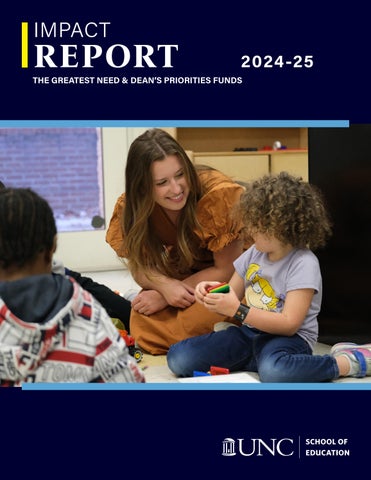
IMPACT
REPORT
2024-25
THE GREATEST NEED & DEAN’S PRIORITIES FUNDS
At the UNC School of Education, we build people’s minds, spirits, and resolve to make the world a better place through education. Our community of scholars, students, staff, and alumni propel the world. We work to solve pressing problems, to better understand learning, to improve teaching, to redefine what it means to educate lifelong and lifewide. We innovate. We ask and answer tough questions — to ensure that every learner has the opportunity to reach their maximum potential. Our work is guided by four pillars: Educating the Whole We recognize that learning is dependent on the well-being of children, their families, and their communities. With a focus on underprivileged and underserved communities, we collaborate with educators, parents, schools, communities, and more — in partnership with other schools and units at Carolina — to empower learners and communities to thrive. Empowering the Leaders of Tomorrow We empower educators and scholars to lead; to think creatively, act with passion, and strive for excellence for all. Equipped to succeed in their professions, our graduates also emerge as leaders in their institutions and communities, and mindfully contribute toward continually improving and transforming them. Collaborating for the Greater Good We foster productive and meaningful partnerships across disciplinary and institutional boundaries, working with all stakeholders within and beyond formal institutions of education. A well-educated, diverse, and empowered public is key to addressing social disparities and injustices; promoting and supporting the health and well-being of all; and ensuring the competitiveness and prosperity of our state and nation. Advancing Knowledge, Driving Innovation We produce cutting-edge knowledge and pursue innovative, research-based solutions to the most pressing problems of educational theory, practice, programs, and policy in North Carolina, the nation, and beyond.
a message of gratitude from
DEAN JILL V. HAMM
Dear Donor Community, I am truly grateful for your continued support of the UNC School of Education. Your generosity helps our students succeed, our faculty lead, and our community grow stronger — you are an essential part of our success. As the new dean of the UNC School of Education, I am writing to you with deep gratitude and tremendous excitement. Stepping into this role during a time of challenge and opportunity, I am inspired by our community’s resilience, commitment, and vision for what education can be in North Carolina and beyond. Thanks to your generous unrestricted support, we have made significant strides in addressing some of the most pressing issues facing education today. Private philanthropy continues to enable the School community to serve as a powerful force multiplier for the greater good — enabling us to extend our reach, deepen our impact, and remain agile as we prepare educators and leaders to meet tomorrow’s needs. Highlights from this past school year include: •
Welcoming Five New Faculty Members: We strengthened our academic community by adding five dynamic scholars and practitioners whose work spans mental health, rural education, literacy, and teacher preparation — expanding our capacity to respond to the evolving needs of schools and students.
•
Advancing Mental Health in Rural Schools: Private gifts enabled us to grow our school counseling programs and place high-caliber counselors in rural and underserved communities. The School recently secured funding to continue yearlong internships for school counselors participating in the Helping Heels training grant, ensuring their vital work can benefit students and families in rural communities.
•
Preparing Highly Impactful Educators for Classrooms: We again trained top-tier teachers and school leaders through rigorous, research-centered programs. Our graduates are entering classrooms ready to lead, inspire, and create dynamic and effective learning environments across the state.
•
Promoting Literacy, Workforce Readiness, and Social Mobility: From early reading interventions to workforce development initiatives, we are addressing the full spectrum of educational opportunity — ensuring North Carolinians have the tools to thrive in school and life.
Looking at this list, I am filled with optimism — and I hope you are too — because these successes reflect what’s possible when we work together. Your investment in the School is more than a gift — it is a partnership in shaping a healthier, more hopeful future for all North Carolinians. Thank you for believing in our mission and fueling the future of education. Together, we Propel the World. With gratitude,
Jill V. Hamm Dean and William C. Friday Distinguished Professor of Education
IMPACT
REPORT
THE GREATEST NEED & DEAN’S PRIORITIES FUNDS
Thank you for generously supporting the School of Education’s unresticted funds! Each year, unrestricted support of the Greatest Need Fund and the Dean’s Priorities Fund is essential to meeting the evolving needs of our students and faculty, enabling them to thrive in their studies, research, and service to the field of education. •
The Greatest Need Fund provides crucial resources that allow us to leverage emerging opportunities and respond to urgent challenges. Your support makes a real and immediate difference, sustaining the operations of the School, investing in the well-being of our community, and helping us build a stronger future for education.
•
The Dean’s Priorities Fund supports the Dean’s strategic vision, offering the flexibility to respond to emerging needs and invest in forward-thinking initiatives—such as advancing the use of new technologies like AI, supporting groundbreaking research, and strengthening programs that position the School as an innovator and leader in education.
Your generosity this past academic year made a meaningful and lasting difference in the lives of our students, faculty, and broader community. Thank you for your continued dedication and trust in the School. The progress we’ve made—and the impact we continue to have—is possible because of your partnership. We hope you find joy in the stories and successes detailed below, highlighting just a few of the powerful ways the Greatest Need and Dean’s Priorities Funds helped us Propel the World.
THE GREATEST NEED FUND Expanded teaching assistant opportunities With the help of donors like you, the UNC School of Education has expanded its support for both undergraduate and graduate students by investing in teaching assistants. Over the past academic year, the Master of Arts in Teaching program gained a TA, and the Human and Organizational Leadership Development and Human Development and Family Science programs continued to benefit from TA support. This initiative aims to bolster program coordinators’ capacity to fully support undergraduates and to help graduate students pursue their aspirations of becoming university faculty. The TA role serves multiple purposes that elevate the classroom experience and benefit the entire student body. TA positions alleviate financial hardship for graduate students by providing them with income through a paid position, and these roles provide hands-on experience that fosters their professional development. TAs facilitate peer learning and mentorship, enabling students to learn not only from faculty but also from one another, strengthening campus-wide cohort connections. Additionally, by assisting with grading and facilitating classroom activities, TAs free up faculty time to devote to developing richer course content and to providing deeper one-on-one interactions with students.
JEMILIA DAVIS
Jemilia Davis, director of the HOLD program, reflects on the meaningful impact of teaching assistants: “Working with graduate teaching assistants in the classroom has been a true delight that provides mutual benefits. I often start the semester by discussing their goals and the support I need in the class that ensures a seamless learning experience for our larger classes. For some TAs, their goals involve teaching a class and receiving feedback on their teaching style, while others contribute by revising readings and assignments to reflect current events. In return, especially in larger classes, they can assist with getting grades back promptly or coaching students one-on-one in creating a plan that helps them meet or exceed expectations. I value TAs most for being partners in the classroom.”
IMPACT
REPORT
THE GREATEST NEED & DEAN’S PRIORITIES FUNDS
Thanks to generous donor support, the School can invest in its graduate students’ development while simultaneously enhancing undergraduate learning experiences. The ripple effect is clear — TAs cultivate an interconnected learning community and help ensure the School’s programs can adapt to evolving student and curricular needs.
Continued investing in students’ mental health & well-being The School of Education is sustaining funding and its commitment to the Sources of Strength program with the help of donors’ unrestricted support. This funding ensures the program’s growth and longevity, enabling broader student engagement and deeper impact on campus well-being — underscoring Carolina’s dedication to mental health advocacy and suicide prevention.
DOR OTHY E SPEL AGE WI TH SOU R CE S OF STR ENGTH ST U DEN T S
Sources of Strength is an innovative undergraduate course led by Dorothy Espelage, William C. Friday Distinguished Professor of Education. Using research-backed, peer-network strategies from the Sources of Strength model, the class focuses on eight protective factors — including mentorship, generosity, and healthy activities — to empower students and cultivate a culture of resilience.
Complementing the course is the Sources of Strength Club, a university‑recognized student group that advocates for mental health on campus. Club members reach out to students at various events and plan initiatives designed to foster connection and awareness. Autumn Gray ’24, former Sources of Strength president, describes the program as “a movement that helps normalize talking about mental health and encourages peers to support one another.” With the support of the School of Education’s donor community, UNC-Chapel Hill is scaling both the class and club — expanding educational opportunities and enabling more campus-wide wellness initiatives. This strategic investment anchors Carolina’s proactive approach to mental health — helping students draw on their abilities and peers to thrive. By prioritizing mental well-being, Carolina is also equipping students with the tools they need to manage the rigorous demands of academic life and reach their full potential. Supporting students’ mental health is essential to fostering a safe, responsive, and successful learning environment. By creating strong peer networks, Carolina can ensure students know where to turn in moments of crisis—providing not just access to resources, but a sense of belonging and trust. Sources of Strength helps cultivate an empathetic campus culture where students are equipped to recognize when a peer is struggling, respond with care, and guide them to appropriate support—ultimately reducing isolation and building a community grounded in connection and well-being.
THE DEAN’S PRIORITIES FUND Advanced work on emerging technologies
MAT T BER NACK I & JEF F GR EENE
Matt Bernacki, associate professor and Kinnard White Faculty Scholar, and Jeff Greene, associate dean for research and faculty development and McMichael Professor, have been pioneering a learning analytics system designed to boost student success. Grounded in the science of learning, their platform tracks how students interact with online course materials and within the first two weeks of class can predict academic outcomes with 80% accuracy. As an early-warning system, their platform enables timely, tailored interventions to help students — especially ones in large introductory science and math classes — adopt
IMPACT
REPORT
THE GREATEST NEED & DEAN’S PRIORITIES FUNDS
evidence-based study strategies before their grades begin to decline. Their work spans two complementary areas: Greene’s focus on self‑regulated learning and digital literacy helps students learn how to learn effectively, and Bernacki leads the UNC Center for Learning Analytics, which aggregates and enriches learning data for predictive modeling and tailored interventions that improve student success. Collectively, their efforts are not only transforming undergraduate outcomes at UNC-Chapel Hill but are also informing best practices in higher education. Because of the continued support of the School’s donor community, Carolina is now expanding these initiatives beyond Chapel Hill. The program is scaling up to include partner universities and community colleges across North Carolina, with the broader aim of also serving K–12 education. This expansion underscores our commitment to leveraging emerging technologies to support student success across education.
Supported early literacy efforts through seed grants During the 2024–25 academic year, generous support of the Dean’s Priorities Fund helped select School of Education faculty members carry out seed grant research projects. Among these initiatives, two focused on literacy—a key area of investment reflecting the School’s ongoing commitment to strengthening early literacy and improving outcomes for young learners: Implementing North Carolina’s Science of Reading Legislative Mandate: A Pilot Study Led by Courtney Hattan and Lauren Sartain, this pilot study examined how school districts and educators implemented North Carolina’s Science of Reading (SoR) law, which mandates evidence-based reading instruction. The project explored perceived benefits and drawbacks of the legislative mandate, including which components of reading instruction have been prioritized since the legislation went into effect (e.g., phonics, comprehension). School personnel shared their experiences with required professional learning, shifts in curricula and assessments, and the ways teachers support students’ motivation and relevance for reading. Through interviews with educators and decision-makers in both rural and urban districts and charter schools, the team investigated how the legislation influenced perceptions of classroom practice. Preliminary results indicate an emphasis on phonics and other foundational skills instruction in both lower and upper elementary classrooms as a means to improve literacy outcomes. Teachers shared that mandated professional learning was helpful, but also time consuming, especially for beginning teachers. Understandings and interpretations of the SoR legislation varied among educators and school leaders, as well. The findings from this study will help Hattan and Sartain continue to elevate teacher voices and ensure all students—regardless of location or learning needs—have access to effective, research-informed reading instruction. Exploring the Possibility and Potential of a School-based Center Focused on Reading and Writing Kathryn Leech, Courtney Hattan, and Annemarie Hindman led an exploratory project to assess the feasibility of establishing a literacy-focused center within the School of Education. The center would serve as a hub for the translation of reading and writing research into effective classroom practices and policy recommendations, particularly around early literacy. To understand how a center could best serve the state and the field more broadly, the faculty team conducted a series of interviews with local and national stakeholders in education, including teachers, families, policymakers, and researchers. They also reviewed how literacy-focused centers at other universities structured their work and contributed to the field. The faculty team found that as North Carolina and other states implement new reading instruction legislation, educators, families, and policymakers need support to apply these changes effectively. Key needs include developing instructional materials grounded in research, building efficient classroom routines, supporting exceptional learners, and evaluating the effectiveness of new approaches. The team also recognized that the UNC School of Education is uniquely positioned to lead these efforts, offering interdisciplinary expertise across education, psychology, public health, neuroscience, and more—enabling collaborative, researchdriven solutions to improve literacy outcomes statewide and beyond.
CONTACT: Alena Brown Director of Donor Relations and Annual Giving Alena.Brown@unc.edu (919) 962-5816