Cars | Fashion | Farming | Dogs | Design & Tech | Horses | Vintage | Good Food & Healthy Living
La Dolce Vespa Autumn 2026
THE THE NEW NEW FRAGRANCE FRAGRANCE
002_GW.indd 2 Goodwood Magazine-460x310+3mm - RL_FA26 RiverOfDreams_UK - SEPT.indd 1-2
18/08/2026 14:16
002_GW.indd 3
18/08/2026 14:16 23/07/2026 17:49
NigelNigel Mansell, Mansell, photographed photographed by Greg by Greg Williams. Williams. The name The name ‘Bentley’ ‘Bentley’ and the and ‘B’the in wings ‘B’ in wings devicedevice are registered are registered trademarks. trademarks. © 2026 © 2026 Bentley Bentley Motors Motors Limited. Limited.
BENVENUTI!
AS THIS HOTTEST OF SUMMERS DRAWS TO A CLOSE, we are putting
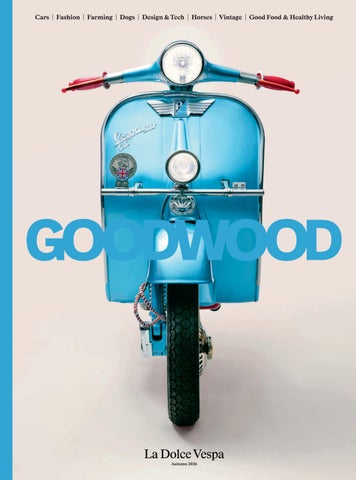
the final touches on our preparations for Goodwood Revival presented by Dunlop – three days in September when we celebrate the very best of historic motorsport and vintage style. This year, our theme is La Dolce Vita – that eternally chic post-war era when all things Italian became beloved across the world. From the stars and stories of the legendary Cinecittà film studios in Rome (p48) and the brilliance of the Maserati brothers (p70) to the early espresso bars of Soho (p21) and Gina Lollobrigida’s second career behind the camera (p24) – not to mention our Vespa cover star – we salute the men, women and superstylish machines that Italy has gifted to the world. Elsewhere in the issue we talk to costume designer and vintage fashion collector Henry Wilkinson about how he has turned his teenage passion for couture into a brilliant career; we take a look at the dog’s role in art; we celebrate the seminal role in Goodwood’s history of Spitfire pilot-turned-amateur racer Dickie Stoop; and we explain why fermented food can be a magic ingredient in a healthy diet (p28). Legendary designer and founder of the Fashion and Textile Museum, Dame Zandra Rhodes, invites us inside a life lived in full colour (p34). And our modern heirloom fashion photoshoot at Hound Lodge (p60) features the vintage collectibles of the future – beautifully designed and detailed classics to hand down the generations. Here at Goodwood we are lucky to have many fine portraits in our Collection: on p76 we take a look at how a new generation of portrait painters is reviving the genre. And lastly, we are thrilled to share some images and stories from a wonderful new book, The Art of Racing. It features striking helmet designs from the early days of motorsport to today, many of which have played a part in Goodwood racing history, that some of us would consider works of art in their own right. We very much hope you will enjoy the stories in this issue – and I look forward to welcoming you to Goodwood very soon.
8
008_GW.indd 8
LETTER FROM THE DUKE OF RICHMOND AND GORDON
18/08/2026 10:59
009_GW.indd 9
18/08/2026 14:27
CONTRIBUTORS The team UNCOMMONLY Editor Sophy Grimshaw Design director Vanessa Arnaud
Ella Alexander
Stuart Codling
Florrie Thomas
Ella is the fashion features director of Citizen Femme and a contributing editor at Harper’s Bazaar. Together with Dame Zandra Rhodes, she is the author of the acclaimed British fashion and textile designer’s autobiography, Iconic: My Life in Fashion in 50 Objects. Ella sat down with Rhodes for The Goodwood Interview in this issue.
A motorsport journalist and author, Stuart is Grand Prix editor of Autosport and the author of 14 books, including The Story of Maserati. As this year’s Goodwood Revival presented by Dunlop prepares to celebrate Maserati, ahead of a major movie that will recreate the history of the marque, Stuart traces the extraordinary story of the Maserati brothers.
For this issue, stylist Florrie Thomas headed to Hound Lodge at Goodwood for our original fashion shoot. Florrie is a London-based fashion and celebrity stylist and creative consultant, and was previously fashion editor at Harper’s Bazaar and Condé Nast Traveller. Her work includes styling for luxury brands, private clients and leading editorial titles.
Editorial directors James Collard Gill Morgan Creative director Sara Redhead Sub-editor Damon Syson Picture editor Sharon Martins Project director Sarah Glyde
GOODWOOD Managing editor Jennie Gott Editorial director Will Kinsman Consulting editor Grace Timothy Picture editor Max Carter
Christina Newland
Sabrena Khadija
Shawn Levy
Christina is a film and culture writer for the i Newspaper, The Atlantic and Rolling Stone, and she speaks on film history for BBC Radio 4’s Front Row and Sky Arts. Her latest book, Sofia Coppola, is a celebration of the director’s work. For this issue, she turns her attention to Gina Lollobrigida, the 1950s Italian “bombshell” actress who went on to become a photojournalist.
Sabrena is a Sierra LeoneanAmerican artist based in Maryland, USA. Sabrena, who is non-binary, aims to create bold work that inspires others. They created the illustration for our interview with breathwork expert and bestselling author James Nestor, who is the keynote speaker at this year’s Goodwood Health Summit presented by Randox Health.
Shawn Levy is an author, critic and podcaster who has written about film and culture for the New York Times, the LA Times and Hollywood Reporter. For Goodwood Magazine, he tells the story of Cinecittà, the vast film studio established in Rome in 1937 that went on to rival 1950s Hollywood with productions that attracted many of the major directors and stars of the age.
For all advertising and editorial queries, please contact Goodwood via magazine@goodwood.com
Goodwood Magazine is published on behalf of The Goodwood Estate Company Ltd, Chichester, West Sussex PO18 0PX, by Uncommonly Ltd, 30-32 Tabard Street, London SE1 4JU. For enquiries regarding Uncommonly, contact Sarah Glyde: sarah@uncommonly.co.uk
10
010_GW.indd 10
© Copyright 2026 Uncommonly Ltd. All rights reserved. No part of this publication may be reproduced without prior permission from the publisher. While every effort has been made to ensure the accuracy of the information contained in this publication, the publisher cannot accept responsibility for any errors it may contain.
18/08/2026 11:06
Driving change together:
Mastercard is proud to champion women in motorsport, celebrating the heroes of today and inspiring the trailblazers of tomorrow.
011_GW.indd 11 P_1618913_MCD_LDN_GOODWOOD_2026_310X230MM_MA4
18/08/2026 14:28
Path:/Users/robbie.maynard/Library/CloudStorage/Egnyte-craftww/Shared/Global_Production/Mastercard_Europe_Sa_30013822/WIP/2026/P_1618913_OMNICOM_LDN_MCD_GOODWOOD/01_Working_Files/P_1618913_MCD_LDN_GOODWOOD_2026_310X230MM_MA4.indd
CONTENTS Shorts
PART 1
B RIA N K ENT J OSCELY NE; K ATHRIN MA KOWSK I
Contacts..............................................18 Eve Arnold, Joan Crawford, 1959 A shot of energy............................. 21 How an Italian salesman brought espresso bars to 1950s London The power of the dog................... 22 An art expert muses on canine cameos in Old Master paintings More than a bombshell............. 24 The story of Gina Lollobrigida’s surprising career change Frock star.......................................... 26 Meet Henry Wilkinson, aka “the Givenchy Boy” Super food......................................... 28 They’ve been around for centuries, but fermented foods like kimchi and kefir are having a moment Stoop to conquer........................... 30 Remembering Goodwood legend Dickie Stoop, who swapped Spitfires for Porsches The finer things p60
Dickie Stoop p30
Stories
PART 2
“You have to believe in yourself – that what you’re doing is worthwhile, even if other people don’t like it”
12
012_GW.indd 12
The Goodwood Interview Dame Zandra Rhodes p34
ILLUSTRATI ON BY SABR ENA KHAD IJA
The Goodwood Interview In conversation with fashion designer Zandra Rhodes.................................................... 34 Head first How a collector’s passion for F1 helmets became a fabulous book................................................................ 42 Hollywood on the Tiber The post-war glory days of Rome’s Cinecittà film studios....................................................48 Rubber soul The surprising origins of Dunlop, one of motorsport’s biggest brands................................................... 56 The finer things Our fashion shoot at Hound Lodge picks out modern heirlooms.....................................................60 Band of brothers How the marvellous Maserati boys left their mark on motorsport.................................................70 Face time Portraiture is staging a comeback; meet some of its finest practitioners.................................................... 76
Breathtaking p92
Good life
PART 3
Women’s style Today’s trouser suits look the business............................. 84 Men’s style Why are Italian men so naturally stylish?............................... 88 Wellbeing Breathing well is the key to good health.................................... 92 Food and drink In praise of the humble potato........................................... 94 Land How modern florists are going back to nature................................... 96 PLUS Cover story: the Vespa p14, Calendar p99, Photo finish: Dorothy Patten and Betty Haig, Goodwood Motor Circuit, 1948 p104
20/08/2026 15:09
EVERY CURVE AN INVITATION. EVERY STRAIGHT A PROMISE. DUNLOP transforms success on the racetrack into innovation for everyday life. True performance, guaranteeing control and safety in all weather conditions. With a precision that doesn’t just move, but inspires.
dunloptyres.com
013_GW.indd 13 28613_DUN_AZ_Goodwood_230x310_EN_RZ.indd 1
18/08/2026 14:30 29.07.26 13:47
COVER STORY
OUR STRIKING COVER STAR IS A 1961 VESPA GS 150, which belongs to the personal collection of Merlin McCormack. As the founder of Duke of London, McCormack specialises in buying, selling and sourcing classic cars and supercars, but he’s also a long-time Vespa devotee. His metallic-blue Vespa will be among those present at Goodwood Revival presented by Dunlop this September. It will be bittersweet for McCormack, as the Vespa in question originally belonged to his friend, car-expert and Mod-culture enthusiast Bernie Walsh. “Unfortunately, Bernie lost his life to COVID during lockdown, shortly after finally getting the scooter on the road,” says McCormack. “Thankfully he’d already been able to fulfil his ambition of taking his prized Vespa with him on his annual London-to-Brighton pilgrimage with a load of mates, myself included. He’d always dreamed of an exacting spec for his scooter – and eventually it came to fruition. It has a bored-out P200 engine and gearbox, with lots of racy bits. It’s quick!” As for how this rarity came into McCormack’s hands, he says: “Bernie’s widow Lisa very kindly offered to sell me the bike. I’ve done a couple of thousand kilometres on it since – including London to Brighton, in his memory, where the scooter received an emotional and overwhelming welcome as I pulled onto Madeira Drive.” To celebrate 80 years since the launch of the iconic Vespa, Goodwood Revival’s trackopening parade will feature more than 300 pre-1967 scooters – including this one
PHOTOGRAP HY BY MITC H PAYNE
The Vespa
14 014_GW.indd 14
20/08/2026 16:09
15
014_GW.indd 15
18/08/2026 11:25
info@lanzante.com +44 (0) 1730 887277 lanzante.com
016_GW.indd 16
18/08/2026 14:31
Shorts PART 1
Noted: people, objects, news and ideas, from canine cameos in fine art to the rise of London’s espresso bars – and Gina Lollobrigida’s surprising career change
17—30
017_GW.indd 17
20/08/2026 15:46
Eve Arnold, Joan Crawford, 1959 WORDS BY DAMON SYSON
EVE AR NOLD / MAGNUM PHOTOS
The photographer’s no-holds-barred shoot for LIFE magazine provided a profoundly intimate portrait of one of Hollywood’s most controversial stars
“The first time I met Joan Crawford she took off her clothes, stood in front of me nude and insisted I photograph her,” wrote Eve Arnold of her introduction to the Hollywood diva, adding for good measure: “It was obvious that she had been drinking.” Arnold, who, in 1957, was the first woman to join the celebrated Magnum Photo Agency, chose not to use the photographs she took that day. Instead, she sent the negatives to Crawford, a gesture that was rewarded three years later when they worked together again. “Because I had been generous,” Arnold recalled, “she gave me the most explicit kind of pictures.” The resulting 1959 story, for LIFE magazine, was an intimate study of the hours of dedication required to become Joan Crawford, the icon. Nothing was off-limits. For eight weeks, Arnold was granted access not only to Crawford’s dressing room on the set of the film The Best of Everything, but also to her Bel-Air home: “Those would be her days for having her nails done, her hair coloured, her legs waxed, her eyebrows dyed; all of which she wanted me to record on film, to show her devotion to her public.” The year of the shoot was an unhappy one for Crawford. Her fourth husband, Alfred Steele – chairman of the Pepsi-Cola Company – had just died of a heart attack, leaving her nearly penniless. A strange time, perhaps, to invite a photographer’s lens into your life.
18
018_GW.indd 18
Or perhaps not. Crawford was one of the last true stars of Hollywood’s golden age, but today she is remembered as much for her capricious and unpredictable behaviour as she is for her movies. In an explosive memoir, Mommie Dearest, published a year after Crawford’s death in 1977, her adopted daughter Christina accused the screen siren of alcoholism, abusive treatment of her children and – memorably – a violent hatred of wire coat hangers. Equally memorable was the decades-long feud she pursued with fellow actress Bette Davis, which reached its zenith when the two grandes dames were cast as sisters in Whatever Happened to Baby Jane (1962), the Gothic tale of a former child star living in a decaying Hollywood mansion with her wheelchair-bound sister. Davis’s remarkable performance earned her an Oscar nomination, much to Crawford’s chagrin. Arnold later observed that Crawford’s “whole professional life has been one of great concern with her person. It is a commodity which she sells not only to the public, but also to herself.” For this reason, perhaps, the fading pin-up was unperturbed by the up-close and revelatory nature of their 1959 collaboration. “When the LIFE story appeared,” Arnold later revealed, “she cabled me and said, ‘Love and eternal trust always.’ It was a tough, intimate story, but she wanted it that way.”
SHORTS – CONTACTS
18/08/2026 11:32
Above: Crawford allowed Arnold to record her elaborate beauty regimens in minute detail
19
018_GW.indd 19
18/08/2026 11:32
BORN IN A PUB
C
M
Y
CM
MY
CY
CMY
K
The CO₂ emission (Diesel - 276-319g/km, Petrol - 325-336g/km) and fuel consumption (Diesel - 23.1-26.9mpg, Petrol - 18.9-19.6mpg) figures quoted by INEOS are WLTP Combined Cycle estimates. 020_GW.indd 20
18/08/2026 14:33
A shot of energy WORDS BY PETER WATTS
When they arrived on our shores in the 1950s, Italian espresso bars offered just the hit of caffeine – and continental culture – that post-war Britain needed When you next enjoy a flat white served with a splutter and hiss from a stylish espresso machine, take a moment to thank Pino Riservato. Pino was an Italian travelling salesman who, despairing at the standard of British coffee in the 1950s, imported one of the first espresso machines to the UK. London’s existing cafés weren’t interested, so Pino opened the Moka in Soho in 1953, with glamorous Italian actress Gina Lollobrigida cutting the ribbon. The Moka was a vision in chrome and Formica, and its grand Gaggia machine was soon serving thousands of coffees a day. The Moka wasn’t the first espresso-serving café in London – it appears that honour had already gone to Bar Italia a few years earlier – but thanks to Pino’s flair for publicity, it made the biggest splash. The Moka was rapidly followed by the Coffee Inn on Park Lane, the Mocambo in Knightsbridge and the Chalet on Grosvenor Street. Soon London, and particularly Soho, was crammed with spots catering to people who wanted to watch the world go by while sipping an espresso or cappuccino.
These 500 or so cafés survived by appealing to different clientele: bohemians at the Nucleus on Monmouth Street or intellectuals at Carlisle Street’s the Partisan. Le Macabre on Soho’s Meard Street was for 1950s horror fans; every day was Halloween, with drinks served in plastic skulls, and coffins for tables. Heaven And Hell on Old Compton Street was split over two floors, one like paradise and the other inferno. It was next-door to the 2i’s, a coffee shop owned by an Australian wrestler called Doctor Death, who built a stage for acts like Tommy Steele and Adam Faith, introducing rock ’n’ roll to London. A glimpse of this Soho is found in 1959’s Expresso Bongo, starring Cliff Richard, a film so evocative you can almost smell the roasting beans. Even better, visit Bar Italia at 22 Frith Street, a Soho institution that’s open for over 20 hours a day and still has a vintage Gaggia behind the counter – coffeemaker and time-machine, transporting patrons back to the Soho of our black-and-white dreams. An Italian-style espresso bar will be part of the La Dolce Vita theme at this year’s Goodwood Revival presented by Dunlop, 18-20 September
GRAP HIC HO US E / GET TY
Below: coffee central – Soho’s Old Compton Street in the early 1960s
SHORTS
021_GW.indd 21
21
18/08/2026 11:35
DENNIS HA LLINA N / A L A MY
The power of the dog WORDS BY THOMAS W LAQUEUR
The author of an acclaimed recent book considers the image of canines in paintings and how they enrich the way we experience an artwork Dogs in great numbers, more than any other species, have been ubiquitous in the world-making of visual artists since the Palaeolithic age. In the broadest sense, this is because art is about us – and we have been living with dogs for at least 17,000 years. They have been our hunting partners and friends, the guardians of our sheep and imagined guardians of the dead. We believe they mourn us, and they have even shared our graves. Dogs – our social fellow-travellers and companions in looking and seeing – are deeply embedded in our culture. In art, the dog’s presence – and particularly the dog’s gaze – provides narrative coherence. They mediate between elements in a picture; they show us where to look inside it; they look out at us; they look on the artist’s behalf. Cézanne once said: “Like a dog, that’s how a painter must see.” In all of this, they help create the formal as well as the emotional content of a work. Think of the dog in Caillebotte’s The Europe Bridge, walking a few feet from where the artist stands, its gaze steady on the perspective line.
The dog is there at the rebirth of Western art in Giotto’s epochal 14th-century Life of the Virgin fresco cycle, looking up at a dejected St Joachim, paws almost on his cloak. The saint’s and the dog’s eyes meet while the humans avert theirs. (In the next frame, the dog will stand guard on a rock as an angel comes down from the heavens to tell Joachim that his wife Anna has conceived a child who will grow up to be Mary.) There are five dogs in Veronese’s The Wedding at Cana, the largest painting in the Louvre. One looks down from the balustrade on the left; another comes in from the same side as we are entering this wild feast; two great white dogs hold down the floor in the centre foreground and serve the role in the composition of taking our eyes up to Jesus. A fifth small one is on the table looking for scraps. In life and in art, the dog is a kind of alter ego – us, yet not quite us. Evolution gave us an animal that lives companionably in our midst; we took it in, literally and symbolically. “The Dog’s Gaze” by Thomas W Laqueur (Penguin), is out now
Above: Diego Velázquez’s iconic Las Meninas (1656) has a Spanish mastiff in the foreground
22
022_GW.indd 22
SHORTS
18/08/2026 11:45
The Original Parcel of Joy.
FORTNUMANDMASON.COM
023_GW.indd 23
18/08/2026 14:35
More than a bombshell WORDS BY CHRISTINA NEWLAND
Gina Lollobrigida, one of the original Italian icons of the silver screen, was known in her native country as the “maggiorata fisica” (which literally means “physically augmented”). This later ubiquitous term for a voluptuous bombshell type was coined by critics describing the impact of Lollobrigida’s on-screen presence as a fortune teller in the 1952 film Fanfan la Tulipe. Lollobrigida would set the template for every bosomy Italian actress who came after her. Earthy, sensual, and seen by some at the time as authentic in a way that more artificial American stars were not, Lollobrigida soon won fans on both sides of the Atlantic. In her time on the screen in the 1950s and ’60s, “La Lollo” was an international star who played opposite male leads such as Humphrey Bogart, Rock Hudson and Frank Sinatra. Bogart memorably said that “she made Marilyn Monroe look like Shirley Temple”. A beauty pageant winner and model, Lollobrigida was studying sculpture when she was sought out for stardom by Italian talent scouts. A screen-test at a Hollywood studio, RKO, secured her a contract, but she would largely focus on European movie ventures, working with major filmmakers including Italy’s celebrated Luigi Comencini and The Third Man director Carol Reed. After decades spent in front of the camera’s lusty gaze, in the 1970s Lollobrigida pivoted her career to photojournalism. She disguised herself on the streets to capture candid pictures, but also cleverly parlayed her stardom to secure rare access to powerful public figures whom she wanted to interview and photograph. In 1974, this even got her 12 days with reclusive Cuban leader Fidel Castro, but she would also shoot the likes of Salvador Dalí and Paul Newman. Lollobrigida proved in later life that she’d always had more to offer than the sexy stereotype. She worked for Unicef and the United Nations, and ran unsuccessfully for a seat in both the European Parliament and the Italian Senate. In early 2026, Gina Lollobrigida: Diva Contesa, the first Italian-made HBO Max docuseries, aired in Italy and Spain, with wider streaming dates still to be confirmed. The three-episode series focuses on the difficult final chapter of her life, the legal battle that erupted over the alleged theft, during her old age, of the former actress’s multi-million-dollar fortune. In the words of Lollobrigida herself, who died in 2023 at the age of 95, there was more to life than being a bombshell: “Beauty fades. But courage stays in the face.” HBO Max’s “Gina Lollobrigida: Diva Contesa” was released in Italy and Spain in 2026 and is awaiting a UK streaming date. Revel in the style and substance of the La Dolce Vita years at Goodwood Revival presented by Dunlop, 18-20 September
P IE RLU IGI PRATUR LON / RE PORT ER S ASS OC IAT I & ARCHI VI /MONDADORI PORTFOLIO / GET TY
Gina Lollobrigida enchanted audiences as an icon of 1950s Italian cinema. Less well-known is her later success as a photojournalist. The subject of a new HBO Max series, is “La Lollo’s” legacy now being reappraised?
Right: Gina Lollobrigida in the late 1960s, shortly before she pivoted from acting to photojournalism
24
024_GW.indd 24
SHORTS
18/08/2026 11:50
GINA LOLLOBRIGIDA
024_GW.indd 25
25
18/08/2026 11:50
26
026_GW.indd 26
SHORTS
18/08/2026 11:53
Frock star WORDS BY MIA AIMARO OGDEN
P HOTO GRAPHY BY MARC SETHI
Nicknamed “the Givenchy Boy”, Henry Wilkinson began collecting vintage fashion as a teenager, when he bought a dress owned by Audrey Hepburn “It all started with a glass jar,” says fashion historian Henry Wilkinson of his collection of couturier Hubert de Givenchy’s designs for the films of Audrey Hepburn. Wilkinson, who is currently working as a costume designer on the Emmy award-winning team for Netflix’s Bridgerton, was 10 years old when his mother introduced him to Hepburn’s work – and advised him to start saving if he was ever going to buy one of those Givenchy frocks. “I thought they were the most beautiful designs I’d ever seen,” says Wilkinson, 28, “and the only way I could fully understand the secret to Audrey’s style would be to own one of those Givenchy pieces. I had a jar in my bedroom that I put all my spare change into, but my mum tried to keep me realistic: maybe I wouldn’t be able to get a dress; maybe it would be something small, like a glove.” When Wilkinson was 19 and studying costume design at London’s Royal Central School of Speech and Drama, a dress appeared on eBay that looked familiar. “I recognised it from photographs of Audrey: it was something she had worn to the premiere of The Longest Day in 1962 and then again to present the Oscar for best costume design in 1963.” Wilkinson’s budget did, by then, stretch to £1,000 – “the most money I’d ever spent” – for the short-sleeved evening dress made from rose pink silk, embroidered from neck to knee with silver thread, pink bugle beads, rose montée crystals and clustered seed beads. The enterprising teenager also managed to contact Hubert de Givenchy, who confirmed that the dress was the only one in existence (he would sometimes make multiple versions for film use). “It meant that mine was the one owned by Audrey, so it was a bit of a miracle,” Wilkinson says. That was the start of his collecting career and his relationship with the house, whose team nicknamed him “the Givenchy Boy” and invited him to France to work in the archives. Wilkinson has since built up a significant private collection of Givenchy haute couture – and maintains an archive of original photographs, publications and primary source material. “I have an office in my apartment, and it’s all in there. That’s really why I feel the urge to own them. I can just go and study a piece and learn from it.” As a fashion expert, Wilkinson is naturally excited to be heading to Goodwood this autumn to be a speaker at Revival, for which he’ll want to choose his own vintage look. “I love any opportunity to wear vintage pieces – day to day, or at events like Revival. There’s something very singular and special about vintage clothes, and I always appreciate how Revival celebrates that.” Hear about the art of collecting from Henry Wilkinson, in conversation with compere Dandy Wellington, on Saturday 19 September at Goodwood Revival presented by Dunlop, 18-20 September
Left: couture collector Henry Wilkinson, aka “the Givenchy Boy”
HENRY WILKINSON
026_GW.indd 27
27
20/08/2026 10:28
TA RAS G REB INETS / A L A MY
Super food WORDS BY TABITHA JOYCE
Fermented foods are having a moment – and the more we learn about the gut microbiome, the more relevant this ancient preservation method seems to be for modern diets The gut microbiome – the trillions of bacteria and other microbes that live in our digestive system – has entered the mainstream. Growing research into fermented foods and gut health has fuelled renewed interest. And books such as Professor Tim Spector’s Ferment highlight evidence that fermented foods support microbial diversity, reduce inflammation, and may influence the gut-brain axis. The science will continue to evolve, but most people are now familiar with fermented favourites such as kefir, kombucha and kimchi. There is even a UK trade organisation dedicated to supporting food and drink professionals who work with fermentation: the Fermenters Guild. The guild educates its members (including food producers and chefs) on practical techniques, as well as advising on food safety and legislation. This renewed enthusiasm has transformed the way chefs think about flavour. At London’s plant-based Holy Carrot, fermentation builds depth. “It allows us to develop acidity, umami and texture naturally,” says head chef Daniel Watkins. “Beyond flavour, it reflects a more thoughtful approach to food, allowing us to extend the life of seasonal produce.” On the menu are pizzettas made with a five-day fermented koji and a gilda – a small snack served on a toothpick – featuring an olive, soy shiitake and lacto-fermented celery and carrots.
In Somerset, sustainability is also central to chef Merlin LabronJohnson’s Michelin-starred tasting menu at Osip. Here, gooseberries from the allotment become house vinegar, while a recurring starter features fermented potato brioche with labneh and tomato jelly. Fermentation isn’t a new wellness phenomenon. It’s one of the world’s oldest food preservation methods. Long before gut health became a focus, people relied on fermentation to preserve ingredients and build flavour, from Japanese miso and German sauerkraut to Korean kimchi. At Bristol’s Dongnae, chefs Kyu Jeong Jeon and Duncan Robertson produce their own jang – fermented soybean sauces made with organic wheat straw. The result is a distinctly British expression of traditional Korean fermentation, creating deep umami flavours throughout the menu, from kimchi to fermented-chilli gochujang. “My favourite is Dongchimi, a water kimchi made with Korean radish whose brine is sweetened with pear,” says Robertson. Whether embraced for its potential health benefits or the depth of flavour it brings, the increasing adoption of fermentation is proving that some of the oldest kitchen techniques remain the most relevant. The Goodwood Health Summit 2026 has the theme of “Breathing and the Microbiome”; see more on page 92
Above: pickling cucumbers in brine with dill and garlic creates a delicious fermented snack
28
028_GW.indd 28
SHORTS
18/08/2026 11:55
029_GW.indd 29
18/08/2026 14:36
Stoop to conquer WORDS BY JAMES ELSON
Goodwood Motor Circuit owes its existence in part to former Spitfire pilot Richard “Dickie” Stoop, who went on to become a regular fixture on the track It is hard to think of a more quintessentially Goodwood figure than Dickie Stoop – the Sussex-born Spitfire ace-turned-gentleman racer. Yet despite the key role he played in the early days of Goodwood motorsport, he remains relatively unknown, with only a few esoteric motor-racing books giving him the credit he deserves. Stoop’s life embodied a spirit of derring-do, style and panache. In his early twenties, while he was stationed at RAF Westhampnett during World War II, the fighter pilot liked to unwind from Battle of Britain dogfights by pelting round the airbase’s perimeter road in a chain-driven Frazer Nash. Stoop was one of the people, alongside Squadron Leader Tony Gaze, who lobbied the 9th Duke of Richmond to turn this rough track into Goodwood Motor Circuit. The venue was duly launched in 1948, and the young racer took part in his first official race there in 1950. Stoop was the archetypal upper-class British eccentric, soon grounding his post-WWII career as a flying instructor to pursue driving full-time. He did so on his family’s oil business money, but while he spent weekdays in the city making careful investments, on weekends he threw caution to the wind as motorsport surged into its golden age. He made his club racing debut at Silverstone in 1948, piloting Gerald Spink’s GS1 “Squanderbug” to eighth place in a Formula 3 race, before taking his beloved Frazer Nash marque
to a 1950 Le Mans 2-litre class win, shared with Taso Mathieson. Stoop became a regular fixture at Goodwood, competing in its Nine Hour endurance classics, Lavant Cup Formula 2 and Tourist Trophy races. Having raced, and crashed, a number of Frazer Nashes, the brand’s AFN garage turned him on to its imported Porsches; he bought 356s, 911s and 904s, his cars famously carrying YOU 4 and HOT 5 registration plates. Stoop took the UK’s first 904 GTS to second place in a support race at the 1964 Tourist Trophy meeting at Goodwood and was a frequent club championship and classwinner elsewhere, right up to the end of his career. You’d be forgiven for thinking Stoop, considered a playboy racer, was as extravagant away from the track as he was on it. Apparently not, according to feted Motor Sport journalist Denis Jenkinson: “Dickie was very thrifty by nature, often referred to by his friends as ‘a bit tight’.” His favourite meal was egg and chips – and it was over this humble dish that Stoop once mused on his own mortality. According to his mechanic, Alan Giddins, just a few weeks before the racer’s death he announced that he wanted to be at the wheel of his beloved silver Porsche 911S when he drew his final breath. And so it was: Stoop suffered a fatal heart attack while competing at Croft on 19 May 1968, the car barrel-rolling off the circuit. He was 47. He died as he lived: at full throttle.
BRI AN KE NT JOSC ELYNE
Below: Dickie Stoop (left) with his Porsche 356 at Rouen-Les-Essarts in the 1960s
30
030_GW.indd 30
SHORTS
18/08/2026 12:03
031_GW.indd 31
18/08/2026 14:37
Celebrating 220 years of Henry Poole & Co. – from authentic British tweeds to the invention of the dinner suit, our tradition of craftsmanship and innovation continues to define Savile Row. www.henrypoole.com | office@henrypoole.com | +44 (0)20 7734 5985
Goodwood May.indd 1 032_GW.indd 32
29/07/2026 12:34:28 18/08/2026 14:39
Stories PART 2
Tales worth telling, from the revival of portraiture to the golden era of Cinecittà, Rome’s “Hollywood on the Tiber”. Plus: The Goodwood Interview with Zandra Rhodes
033_GW.indd 33
33 81
20/08/2026 15:48
034_GW.indd 34
18/08/2026 12:16
THE GOODWOOD INTERVIEW N09
P HOTO GRAPHY BY ALUN CALLE NDE R
WITH DAME ZANDRA RHODES WORDS BY ELL A ALEX ANDER
“You have to believe in yourself – that what you’re doing is worthwhile, even if other people don’t like it” 35
034_GW.indd 35
18/08/2026 12:16
D
ame Zandra Rhodes is entertaining the idea of wearing a full-time wig. The iconic fashion designer, who is instantly recognisable for her luminous pink bob, wants to up the ante. “I was out with a friend the other day and her hair looked fabulous, and I thought, ‘Hang on a minute, that’s a wig.’ My hair looks so thin in comparison – a bit 85-ish,” she says, alluding to her age. “It needs volume.” A wig, I suggest, would save her the job of dyeing her real hair – which she does using an “ugly plastic hat” and a bottle of Crazy Color Pinkissimo. She is horrified. “No, no, no. I wouldn’t want to take my wig off and for people to say, ‘Oh, you really are a grey-haired old lady.’ Absolutely not.” Rhodes kept up the maintenance of her pink hair even during chemotherapy for bile duct cancer, which she was treated for during the pandemic. She bought a few wigs, but never really needed to wear one. Today, she is in remission. “It comes down to luck and all that, but the doctor said during one of my early appointments, ‘Zandra, there is one question you haven’t asked: will you lose your hair?’ I replied, ‘I’m not worried about that. I have plenty of fabulous pink wigs.’” Colour is more than an aesthetic to Rhodes, it’s a life philosophy. She has immersed herself in vivid brights since she began her career in the late 1960s. Her home is a gloriously trippy, rainbow-streaked penthouse that sits above the Fashion and Textile Museum, which she founded in 2003; even the ground-floor lobby has a wiggly terrazzo with sparkling stones. Her collections and wardrobe (she only wears clothes that she has designed),
are infused with colour, right down to her sparkly pink trainers. The Daily Mail once asked her to wear black for a week for an article, and she found it “completely depressing”. Her decision to sleep in full make-up at night has also been widely documented. “I wouldn’t want to be caught even putting out the dustbins without my make-up,” she says. “What we wear is important – it’s how you present yourself to the world – and colour has a lovely way of cheering things up. It prevents me from feeling too ordinary.” Rhodes is one of British fashion’s most influential figures. She rose up alongside Ossie Clark and Vivienne Westwood, and went to college with the late David Hockney. She created a new way of printing, designing handpainted statement prints that dictated the garment silhouette. The result was, and still is, confident, bohemian clothes that move with the body, attracting fans in Diana Ross, Freddie Mercury, Suki Waterhouse, Sarah Jessica Parker and a handful of royals, including Princess Diana and Princess Margaret. “She was very grand,” she says of the latter, recalling one incident where the two had tea together. The designer had come to the princess’s Kensington Palace apartment for a dress fitting, where she noticed a cushion with an embroidered message that read: “It’s not easy being a princess.” “I still think about who might have given it to her,” Rhodes laughs. After the fitting, Margaret ordered tea for two and when the teapot and teacups arrived, Rhodes’s cup was initially empty – presumably because the drink was still brewing. But the princess’s cup, Rhodes observed, was already full to the brim. “I’m sure there was alcohol in that teacup,” she says smiling. “I didn’t think about it at the time, but logically it seems very strange that the maid would have poured one tea and not the other.” Diana, she says, was a very different type of royal. The princess started wearing Rhodes’s clothes in the mid-1980s. “When I first met her, she was terribly shy, with bitten nails,” she explains. A decade later, with a divorce behind her, the royal seemed much changed. “She was more confident. You’d either collapse in that job or grow into it. It must have been difficult for her.” Rhodes’s personal backstory is very distant from the royal circles in which she would later mix. She grew up in a working-class family in Chatham, Kent, having been born during an air raid in World War II. Her father was a lorry driver, her flamboyant mother a seamstress and senior fashion lecturer at Medway College of Art. Unusually for 1950s Britain, her mother was the
PHOTOGRAPHY BY A LUN CA LLENDER; TIM G RA HA M / G ET TY
One of British fashion’s best-loved and most influential designers, Dame Zandra Rhodes began her career in the 1960s and shows no signs of slowing down. She talks to Ella Alexander about colour, self-expression, her friend David Hockney and “tea” with Princess Margaret
Previous pages, and right: Dame Zandra Rhodes, photographed by Alun Callender at Gainsborough Silk Mill. Left: with Princess Diana in New York in 1997
36
034_GW.indd 36
STORIES
18/08/2026 12:16
THE GOODWOOD INTERVIEW — ZANDRA RHODES
034_GW.indd 37
37
18/08/2026 12:16
38
034_GW.indd 38
STORIES
18/08/2026 12:17
ROBYN BEECH E; DAFY H AGAI
Even in the midst of Swinging London, Rhodes’s prints were too bold and experimental
Clockwise from top left: pattern cutting in the 1960s; Vogue, 2018; exploring her love of colour during the 1980s
breadwinner and did most of the decision-making. She dressed theatrically, often wearing towering wedges and glittering dresses, which Rhodes hated at the time. Subconsciously, however, it left a big impression: standing out was not to be feared, nor was working incredibly hard. If she was somewhat in awe of her mother, she was embarrassed by her father, a man of few words who, she felt, should have “bettered himself ”. Rhodes’s opinion of him changed when she and I wrote her recent memoir, Iconic: My Life in Fashion in 50 Objects. We discovered that his mother had been brutally murdered by a jealous lover. Rose, as she was called, had several affairs while her husband was at war, and one of the men had become angry when he found out his paramour’s romantic affections were spread out. He lethally attacked her with a razor, and Zandra’s father was forced to live with his alcoholic aunt and uncle. “You could say he was a sort of survivor,” she said. “I see him differently now. My mother influenced me in such a big way, but my dad did too, just more quietly. I love gardening, and he knew a lot about plants. I recently repotted a camellia I’ve had for 25 years. You’ve got to live life to the full, to look out the window at beautiful things.” After deciding she wanted to be a textile designer, Rhodes studied at the Royal College of Art from 1961 to 1964, quickly switching to fashion design. Hockney was two years above her, and – as she says in her book – was regarded as “God” and “you didn’t talk to God personally”. The two only got to know each other much later when they both found themselves working in LA. “He never lost his Yorkshire accent, and he always smoked like a chimney,” she says of her friend, who died on 11 June this year. “He was wonderfully attached to his mother. I remember him telling me how once he took her up to the Hollywood Hills to a smart film director’s house with gorgeous views, and she said, ‘It’s such a lovely day – why’s there no washing out?’ If you’re in the north of England and it’s a lovely day, what are you going to do? Put the washing out.” In the 1960s, even in the midst of Swinging London, Rhodes’s prints were too bold and experimental for the UK market. Her big break came in 1969 when she flew to New York to meet US Vogue editor Diana Vreeland, who
THE GOODWOOD INTERVIEW — ZANDRA RHODES
034_GW.indd 39
39
18/08/2026 12:17
“I love seeing the way guests put vintage or second-hand clothes together; it’s a celebration of self-expression” became her fashion fairy godmother. Vreeland was impressed by Rhodes’s originality; she set her up with US stockists in major department stores and ensured her clothes appeared on the cover of the magazine. Soon she was dressing a mix of socialites, actresses and musicians, including a then littleknown band called Queen. Her white, caped design for Freddie Mercury has become one of music history’s most famous stage costumes. “Freddie was someone who could transform himself into something else for an audience and then, when he was offstage, he just went back to being himself,” she says. “When he came to see me, he was very nice. I just said, ‘Why don’t you try this on?’ He didn’t come in all overconfident, if you know what I mean.” Fashion’s constant demand for novelty means that a brand can rarely stay in favour for long. The 1990s began a new age of grunge and minimalism, the antithesis to Rhodes’s bold prints, and business quietened. It wasn’t an easy period, but she kept going with help from her friends. To know Rhodes is to understand the importance of friendship. She still hosts weekly dinner parties at her penthouse – her own colourful version of a salon, but with apple crumble for pudding. “The luck of the draw is that you’re surrounded by people who believe in you, but you also have to believe in yourself – that what you’re doing is worthwhile, even if other people don’t particularly like it,” she says, pausing briefly. “I once went to a Matisse exhibition in America, and I read a quote of his that said: ‘The only thing I’m good at is gardening and painting.’ I like that. You thank God that you found a niche that you love doing and others like too, but it doesn’t mean you’ll always be at the front.” Today, Rhodes is as busy as ever. Since the pandemic she has been archiving 8,000 original designs, ensuring that they are donated to various institutions around the world, from the Victoria and Albert Museum in London to the Metropolitan Museum of Art in New York. In September 2026, she launches a new collaboration with jewellery brand Tatty Devine,
40
034_GW.indd 40
and opens a major exhibition at De Montfort University, where her back catalogue, from the originals to more recent collaborations, will be displayed across multiple campus sites. Actor-turned-documentarian Sadie Frost is also working with her on a feature-length project that will spotlight her life and legacy. “I’m a workaholic,” Rhodes admits. We talk about whether a work-life balance is important. “I think everyone has to come to terms with whatever suits them,” she says thoughtfully. “It just so happened that I never fell in love with the right person at the right time to have a child. If that happens, your values and priorities change.” “I was very lucky that late in life I met someone who admired me and put me on a pedestal, but he was a workaholic as well,” she says, of her late life-partner, Warner Brothers boss Salah Hassanein. “This work ethic has taken me on so many wonderful adventures all over the world.” Her studio, where our interview takes place, is still lively and buzzy, a tangle of fabric rolls, paints and sketches. The phone rings constantly and her team work busily around us. “All my girls buy incredible things either vintage or on Vinted,” she says admiringly. “They come in looking fantastic in lovely printed things, with signs of another era. We don’t need to buy new things constantly. It’s about wearing what you already own with panache.” It’s for exactly this reason that she’s a repeat visitor at Goodwood Revival presented by Dunlop, having judged the Best Dressed competition in 2024. “I love seeing the way guests put vintage or second-hand clothes together; it’s a celebration of self-expression,” she says. “It’s important to preserve beautiful clothes, and being there gave me the chance to wear one of my originals from the 1970s. Also, it’s just a really fun day out.” Rhodes will never retire: creativity, colour and beauty are her lifeblood. She may be “85-ish”, but she presents a very different version of old age. “The minute you start thinking you can’t do something, then you can’t do it,” she says defiantly. “I couldn’t run for a bus now, but I still get on the tube and the bus. As soon as you give in to ‘just getting an Uber’, or staying at home, that’s when you get old, because you don’t see or know what’s going on.” And with that, one of her assistants calls her over. She has work to do. Dame Zandra Rhodes will be appearing in conversation with Dandy Wellington on the Revival Style Stage on Sunday 20 September at Goodwood Revival presented by Dunlop, 18-20 September
JONATHAN JAME S WILSON
Left: Rhodes at Goodwood Revival 2024 with Dandy Wellington and the winners of the Best Dressed competition
STORIES
18/08/2026 12:17
MCL_A
P E R F O R M A N C E A M P L I F I E D T H E
N E X T
G E N E R A T I O N
S U P E R C A R
Uncompromised power and performance. Unfiltered elemental thrills. Every sound, every sense, is amplified. Each moment more exhilarating than the last. The ferocious racing heart of a McLaren. A breathtaking breadth of ability. And an advanced Retractable Hard Top to enhance driving spirit.
McLaren Hatfield
McLaren Glasgow
McLaren Birmingham
McLaren Ascot 01344 292000
01564 787180
01698 303390
01707 682700
info@ascot.mclaren.com
info@birmingham.mclaren.com
info@glasgow.mclaren.com
info@hatfield.mclaren.com
McLaren New Forest
McLaren Leeds
McLaren Manchester
01134 879710
01625 324931
02380 082160
info@leeds.mclaren.com
info@manchester.mclaren.com
info@newforest.mclaren.com
WLTP Fuel consumption combined: 4.8l/100km | WLTP CO2 emissions combined: 108g/km
THE GOODWOOD INTERVIEW — ZANDRA RHODES
MCL_Artura Spider 034_GW.indd 41 Goodwood Press ad 230x310mm.indd 1
41
23/02/2026 12:17 15:17 18/08/2026
Lovingly photographed and filled with fascinating motorsport minutiae, The Art of Racing focuses on notable racing helmets, many with connections to Goodwood, writes James Collard “Crash helmets have always been a passion for me,” says Joe Twyman, author of The Art of Racing, an elegantly designed, painstakingly produced two-volume exploration of what we might call the canon of crash helmets from the early 1900s to today. “At first, they grab by their visual appeal,” he continues. “Then they enamour by the unique history that each one represents.” This publication is certainly a passion project – and one for which Twyman joined forces with noted collector Ronald Stern and subject authority Mike Fairholme, while also enlisting the support of owners and museums who loaned rare items for photography. But alongside the helmets – which, as Fairholme points out in his introduction, were worn by “every Formula 1 World Champion… with over 250 helmets from more than 100 drivers” – the star of this book is arguably the photography, by Rick Guest of Legacy+Art. In documentary detail, Guest’s lens captures the significance and resonance of these artefacts, each a relic of automotive history, redolent of racing valour, the urge to compete and the quest for speed – with the stories of the helmets and their owners captioned alongside Guest’s still lifes. As Stern puts it, “The book shows, year by year, how the sport has developed into what it is today: sophisticated commerciality, cutting-edge technology, thrusting forward with athletes at the wheel rather than gentleman drivers. The early cars could achieve 100mph; today, 200mph-plus is the norm.” Indeed, the first exhibit we see – as worn in the early 1910s by Percy Lambert, the first man to drive an automobile for an hour at an average speed of 100mph – isn’t really a helmet at all, but a gold silk cap that would have been tied around the chin, teamed with goggles and which, as Twyman points out, “would have provided little protection against anything other than flies and dirt”. If this represents the starting point, the contrast with the finish is extraordinary – the final image being of Sebastian Vettel’s helmet from 2022, when he retired from F1 – both state-of-the-art in terms of the protection it offered that champion, and artful in its extraordinary design, as painted by specialists JMD. Between those, expect everything from the Argentinian maestro Juan Manuel Fangio’s headgear from the 1950s – which looks like it was designed for playing polo on the Pampas – to Nigel Mansell’s helmets from the 1990s featuring since-banned logos for Marlboro and Camel cigarettes. All of these helmets have their stories to tell. Here we focus on those with powerful connections to Goodwood, from its racing era to marquee moments at Festival of Speed and Revival.
“The Art of Racing: Helmets, 1910-2024” is available as a limited-edition two-volume edition from the Magneto Magazine store (magnetomagazine.com)
HEAD FIRST 042_GW.indd 42
José Froilán González 1950-1960 Formula 1 26 races, 2 wins, 15 podiums Le Mans 24 Hours 1 win (1954)
José Froilán González only had this one helmet throughout his career, which lasted from 1950 to 1960. Wearing this, he won the first World Championship Grand Prix for Ferrari at Silverstone in 1951, a year before helmets were made mandatory in F1, and again in 1954, as well as the 1954 Le Mans 24 Hours. The helmet started off in a standard brown finish, and later gained its yellow colour scheme and hand-drilled ventilation holes. González competed frequently at Goodwood, where he famously won the 1952 Goodwood Trophy driving a BRM Type 15. In 1996, he returned for the Festival of Speed, once again driving a BRM. Following the event, this helmet was presented to motorsport legend Tom Wheatcroft and became part of the Donington Grand Prix Collection.
42 18/08/2026 12:26
43 042_GW.indd 43
18/08/2026 12:27
Stirling Moss 1952-1957 Formula 1 66 races, 16 wins, 24 podiums Mille Miglia 1 win (1955) Targa Florio 1 win (1955)
Stirling Moss – later “Sir” – was perhaps the greatest driver never to have won the Formula 1 World Championship. With 16 Grand Prix wins to his name, he sits ahead of 17 drivers who did win a Championship in the list of all-time winners. Manufactured by London hatter Herbert Johnson, this helmet was the first of only four supplied to him during his frontline career. It was produced in late 1952 following the death of King George, and its interior
carries a Royal Warrant relating to the interim period ahead of the Coronation of Queen Elizabeth II. With a hard shell and cork interior, the helmet was used in a period when Moss scored his most meteoric early wins. It was supplied in a brown finish – its white paint was Stirling’s design and one by which he was instantly recognised. It shows drips of paint, which would have been where Moss or one of his team painted the shell as part of ongoing maintenance. Following the end of its active use, Moss signed “My first white Johnson helmet” on the underside of the peak. It was publicly auctioned by Brooks in the late 1990s. Moss would have used this helmet extensively in the countless races he competed in at Goodwood Motor Circuit. He also won his first six Grands Prix wearing it (GB in 1955 and ’57, Italy in 1956 and ’57, Monaco ’56 and Pescara ’57), and it was also on his head during his legendary victory in the 1955 Mille Miglia.
44
042_GW.indd 44
20/08/2026 10:30
Graham Hill 1960-1962 Formula 1 176 races, 14 wins, 36 podiums, 2 Championships (1962, 1968) Le Mans 24 Hours 1 win (1972) Indianapolis 500 1 win (1966)
Graham Hill won two Formula 1 World Championships, 14 Grands Prix and 36 podiums in a career that spanned two decades. He remains the only driver to secure the coveted Triple Crown of Motorsport, with wins at the Monaco Grand Prix, Indianapolis 500 and Le Mans 24 Hours. In a period when the world of helmets was just starting to embrace design, Hill arguably had one of the most recognisable of all time. As a keen rower, he used the cap colours of the
London Rowing Club, where he was a member. With a dark blue background and white tab-shaped blades from the end of the oars, the design’s simplicity gives it the distinguishable contrast you see when looking at period images. This early helmet was a factory-delivered Everoak Racemaster supplied by Everitt W Vero and Co Ltd in early 1960. Unique, bespoke modifications include a double chin strap with extra studs for security, and an
THE ART OF RACING
042_GW.indd 45
additional rear press stud to locate the strap for goggles. With its distinctive appearance, this helmet can be matched to countless events from 1960 through to Hill’s first Championship year in 1962. He used it at Goodwood in 1960 and ’61, where he finished on the podium in the 1961 Glover Trophy driving the BRM P48 and took a class win in the Tourist Trophy, alongside Dan Gurney, in a works Porsche-Abarth 356B GTL. He would also have been wearing it when he scored his first F1 victory, in the Glover Trophy at Goodwood on Easter Monday 1962, and when he went on to win four Grands Prix and the 1962 World Championship. The helmet was subsequently given to Hill’s manager Lister Welch, before being sold at a 1996 Brooks auction.
45
18/08/2026 12:28
Jackie Stewart 1963 Formula 1 99 races, 27 wins, 43 podiums, 3 Championships (1969, 1971, 1973)
46
042_GW.indd 46
Jackie Stewart had one of the most iconic helmets in motorsport. Using the Royal Stewart tartan to form a band around the middle created one of the greatest designs ever to have graced racing circuits. This particular helmet was the first iteration, and amazingly it features a silk ribbon that was simply stuck on (reputedly by Stewart’s wife, Helen). The helmet was used in 1963, early in Jackie’s career, and he later gave it to the venerable Guild of Motoring Writers. For
a long period it was on display at the Steering Wheel Club’s Mayfair headquarters. These days it resides in the National Motor Museum in Beaulieu. Stewart would have worn this helmet at Goodwood in 1963 when he took a notable victory driving an Ecurie Ecosse Cooper Monaco, breaking the sports car lap record in the process. Circuit manager Robin Mackay was watching the race and suggested to Ken Tyrrell that he should “have a look at this Jackie Stewart”. And the rest, as they say, is history.
STORIES
18/08/2026 12:28
Lando Norris 2019 Formula 1 163 races 12 wins 47 podiums 1 Championship (2025)
Following a glittering junior career in which he won at virtually every level, from karting upwards, Lando Norris came through into Formula 1 in 2019 driving for McLaren. Now Britain’s 11th world champion, he is one of the most popular drivers of his generation – and one who shows an acute understanding of the power of his own brand. This Bell HP77 was created by Jens Munser with a mixture
THE ART OF RACING
042_GW.indd 47
of paint and carbon-look vinyl and was worn by Norris when he scored his first World Championship points at the 2019 Bahrain Grand Prix. Modern drivers regularly change the design of their helmets, but this one was kept in circulation by his McLaren team – and it was last used at the 2019 Goodwood Festival of Speed, in which Norris drove a variety of cars from the marque.
47
18/08/2026 12:28
048_GW.indd 48
18/08/2026 12:35
HOLLYWOOD ON THE TIBER
The fabled imagery of Italian cinema’s La Dolce Vita years was forged at Cinecittà, the film studio where Fellini and Pasolini honed their craft. Shawn Levy recounts how this vast site on the outskirts of Rome launched a new era for the silver screen
048_GW.indd 49
49 18/08/2026 12:35
UMBERTO CICCONI / GET TY; LOUIS G OLDMA N / G ET TY
50
048_GW.indd 50
RE PORTER S ASS OC IAT I & ARC HIVI / GET TY
W
e all know that in Rome, one should do as Romans do. But what, exactly, is it that Romans do? Easy: they go big. The Colosseum. St Peter’s Basilica. Traffic. Hills. Cinecittà. Cinecittà – literally “cinema city” – is the largest film studio in Europe (and, when it opened in 1937, the largest anywhere outside Southern California). Most vividly, during a remarkable spell in the 1950s, it was the epicentre of a chic and thrilling cultural tumult, the fabled Dolce Vita, when international movie stars, fashion models, louche nobles, crafty producers and risk-taking photographers turned the streets of Rome into a global spectacle of luxury, licence and sensation. If you want to understand movies, fashion, celebrity, pop culture and Rome itself, you need to understand Cinecittà. The studio was the brainchild of Benito Mussolini, Italy’s dictator from 1922, and a fanatical movie buff. He was partial to Laurel and Hardy films, Westerns, and Hollywood actress Anita Page, to whom he proposed marriage by mail. Even before Cinecittà was built, Italy was known for historical epics: big casts, sets and costumes. But Mussolini envisioned more. He sent his son to Hollywood to learn the business and designated 145 acres of countryside 10km south of the city centre for a studio. This enormous facility, with thousands of employees, some living in its grounds, began producing melodramas, comedies, musicals, crime stories. Overnight, Italy was a movie factory. Of course, Mussolini had some other ideas, too. As the world’s first fascist dictator, his ideology and methods provided a blueprint for Adolf Hitler and the Nazi party. As World War II engulfed Europe, Cinecittà was not only shuttered but nearly destroyed. Looted by the Germans, bombed by the Allies, and finally serving as a refugee camp, it might well have reverted
STORIES
18/08/2026 12:35
REPORTERS ASSOCIATI & A RCHIV I / G ET TY
Rome became almost like a suburb of Los Angeles, teeming with American actors, producers, agents, models and journalists
Previous pages: the making of Cleopatra at Cinecittà in 1963. These pages, clockwise from left: Anita Ekberg and Marcello Mastroianni in La Dolce Vita; Federico Fellini; Janette Scott at the entrance of Cinecittà,1950
to farmland. But movies are a funny business, and, within another few years, Cinecittà was once again one of the world’s busiest studios. The reason was, ironically, Hollywood. As part of the effort to help Europe recover from the war, American film companies were obliged to spend the profits they earned in Europe on making movies there. In 1948, MGM discovered that Cinecittà was a viable facility, and it poured its European profits into shooting a Biblical epic, Quo Vadis, at the studio. It was a huge hit, and Cinecittà became the go-to location for two decades of Hollywood blockbusters: Helen of Troy, Ben-Hur, Cleopatra, The Fall of the Roman Empire and more. It wasn’t just epics. Hollywood respected Italian filmcraft – and the way exchange rates stretched its budgets – and it returned again and again. Dozens of American movies were made at Cinecittà in the 1950s, of all sorts, some of which were hugely successful: Roman Holiday, The Barefoot Contessa, Three Coins in the Fountain. Rome became almost like a suburb of Los Angeles, “Hollywood on the Tiber”, teeming with American actors, producers, agents, models and journalists. And their presence occasioned a wild social scene amid the cafés and night spots on Via Veneto, a street near the Spanish Steps that was suddenly the hippest, most glamorous thoroughfare in the world. Naturally, Italian moviemaking revived. Hollywood meant jobs: Quo Vadis, for example, gave early work to an extra named Sophia Loren and an aspiring director named Sergio Leone. And the props, costumes and sets that Hollywood paid for and abandoned proved a boon: Italian companies began to make low-budget sword-and-sandals films with that same gear, creating yet more money and work.
CINECITTÀ
048_GW.indd 51
51
18/08/2026 12:35
JOHN KOBAL FO UNDATION / GET TY
In 1959, at the height of Rome’s mad heyday, Fellini made a film about the moment, right while it was happening: La Dolce Vita
But something new was happening as well. For the first time, Italian cinema became known for its art. In films shot on city streets, often with non-professional actors, and with film stock and other materials“borrowed” from Cinecittà, directors Roberto Rossellini (Rome, Open City and Paisan) and Vittorio De Sica (Shoeshine, Bicycle Thieves) created what became known as Neorealist cinema: simple, gritty movies about the daily struggles of ordinary people. The world took notice. Italian movies weren’t only cheap and plentiful; they changed hearts and won Oscars. By the late 1950s, Cinecittà had sparked a full-blown cultural renaissance that Italians began to call “Il Boom”: American money and movie stars; masterworks of Italian cinema; jet-setters, fashion models, schemers and bohemians mixing on Via Veneto; brilliant Italian clothing, cars and scooters; and a seemingly endless stream of new filmmakers worthy of the global stage – including the likes of Michelangelo Antonioni, Pier Paolo Pasolini, and the man who is more associated with Cinecittà than even Mussolini, Federico Fellini. Fellini first came to Cinecittà before the war as a journalist and fell in love with the place. In 1959, at the height of Rome’s mad heyday, he made a staggeringly great film about the moment, right while it was happening: La Dolce Vita (released in 1960). He rebuilt Via Veneto on a Cinecittà sound stage and invited some of the actual participants in the nightly bacchanal
Above: a fleet of vehicles en route to a party in a scene from Fellini’s La Dolce Vita (1960)
52
048_GW.indd 52
STORIES
18/08/2026 12:35
The Ultimate Driving Machine
Official fuel economy figures for the BMW M5 Saloon: Mpg (l/100km) (weighted combined): 54.3 to 61.4 CO₂ emissions (weighted): 118–105 g/km. Electric energy consumption (weighted combined): 16.8 to 17.7 kWh/100km (N.Comp). Equivalent all-electric range: 38 to 42 miles. These figures were obtained using a combination of battery power and fuel. The BMW M5 Saloon is a plug-in hybrid vehicle requiring mains electricity for charging. Figures shown are for comparability purposes only. Only compare fuel consumption, CO₂ and electric range figures with other cars tested to the same technical procedures. These figures may not reflect real-life driving results, which will depend upon a number of factors including accessories fitted (post-registration), variations in weather, driving styles, fuel type and vehicle load.
048_GW.indd 53
18/08/2026 12:36
The first telephoto lens ever used in Italy would capture images of Elizabeth Taylor and her co-star, Richard Burton, both married to other people at the time
Clockwise from above: Taylor and Burton on the set of Cleopatra,1963; statues being built for Quo Vadis; Sophia Loren in 1955; Bicycle Thieves stamp
54
048_GW.indd 54
Step into La Dolce Vita at Goodwood Revival presented by Dunlop, 18-20 September, and enjoy an unforgettable weekend imbued, for this year only, with Italian style
AL AMY
to play themselves, more or less, in an indictment of their decadent lives. Notable among these was a particularly brazen group of Roman schemers: street photographers who swarmed celebrities, snapped shots of them (with or without their permission), and sold the results to magazines. As a species, they had no name until La Dolce Vita included a character based on them, an omnipresent pest whom Fellini dubbed “Paparazzo”. Paparazzi would in time, of course, conquer the world. The first telephoto lens ever used in Italy would capture images of Elizabeth Taylor and her Cleopatra co-star, Richard Burton, both married to other people at the time, in flagrante, setting off a global sensation. Some snappers even blagged roles as Cinecittà extras in order to get closer to their prey. But the world eventually tired of Rome and its Boom and began to seek vicarious thrills elsewhere: London, Greenwich Village, California. Cinecittà didn’t die: it still produced feature films, TV series, commercials. It was still immense. But its name no longer dazzled. Indeed, decades later it almost seemed as much a movie museum as a movie studio. Consider Teatro #5, the giant sound stage where that Dolce Vita moment was captured in one of the greatest films ever made. Today, it bears a solemn plaque dedicating it to Fellini, the ringmaster, poet and high priest of Cinecittà’s greatest era. Which is perfect, because that’s another thing Romans do: Romans remember.
STORIES
18/08/2026 12:36
FORD_
FORD_UK_Q3_July_2026_Ranger_press_Goodwood_230x310.indd 1 048_GW.indd 55
23.07.2026 12:36 16:11 18/08/2026
RUBBER SOUL
56 056_GW.indd 56
STORIES
18/08/2026 12:47
JAGUAR DAIML ER H ERI TAGE TR UST / AL AMY
AUTOCAR / L AT IMAGES / GET TY
It shouldn’t happen to a vet, yet for more than a century, the name of a Scottish vet has been among the most recognisable in motorsport. Not to mention tennis. Or golf. In 1887, Ayrshire-born John Boyd Dunlop was running a veterinary practice in Belfast. When his young son was afflicted with headaches after riding a bone-shaking tricycle, he experimented with air-filled rubber tyres to soften the ride. Observing that they rolled farther than solid wheels, he developed the concept for full-size bicycles. The results were startling: just two years after Dunlop began to test his invention, Willie Hume, captain of the Belfast Cruisers Cycling Club, won a series of races in Belfast and Liverpool on a bicycle fitted with Dunlop’s pneumatic tyres. The president of the Irish Cyclists’ Association, Harvey Du Cros, spotted a business opportunity and began working with Dunlop to manufacture the tyres, unaware that their patent was invalid – a Scottish engineer and serial inventor called RW Thompson had conceived the idea more than 40 years previously, but had never found a market for it. Undeterred, Du Cros and Dunlop acquired a Dublin firm and renamed it the Pneumatic Tyre and Booth’s Cycle Agency to supply the booming bicycle industry. Dunlop retired in 1895, and the following year Du Cros sold the business to Ernest Terah Hooley (later notorious as a fraudster), who quickly resold it as the Dunlop Pneumatic Tyre Company, making a £1.7 million profit for himself and his associates, including Du Cros. That company went bust in 1912, but would resurface under the name of a subsidiary, Dunlop Rubber, with Du Cros remaining in charge until his death in 1918. John Boyd Dunlop died in 1921, having made little money from the enterprise that bore his name, even though it was becoming one of the world’s first multinationals, with its own rubber mills and subsidiaries in more than a dozen countries. The history of the company over the following decades could fill several volumes, as acquisitions, mergers and divestments complicated the corporate structure. As well as producing tyres for bicycles, motorcycles, cars, tractors and aircraft, Dunlop diversified into golf and tennis balls, racquets, clothing, footwear, fighter aircraft joysticks, diving equipment, hoses and Dunlopillo – latex foam products found everywhere from the Houses of Parliament to the cockpit of Donald Campbell’s Bluebird. Notable advances included disc brakes and peg-drive wheels used by Jaguar to win Le Mans, self-sealing tyres and Maxaret, an anti-lock braking system used on aircraft including the Avro Vulcan and Concorde. There were missteps, too – among them quality control issues, ill-fated speculation on the rubber futures market, the slow adoption of steel-belted radial tyres and, in 1971, a debt-laden merger with Pirelli of Italy. The decline of Britain’s car industry and the 1973 oil crisis didn’t help, and in 1983, Dunlop’s European business was sold to its former Japanese subsidiary, Sumitomo Rubber Industries. Two years later Dunlop was acquired by BTR, a British conglomerate. BTR immediately sold the US operation and in the 1990s disposed of everything else, while Sumitomo entered a joint venture with American manufacturer Goodyear. That was dissolved in 2015, and Sumitomo now controls the Dunlop brand for tyres and sportswear. Despite all these corporate shenanigans, the Dunlop name remains familiar to millions, not least thanks to its involvement in more than a century of motorsport competition, and to the brand’s promotional presence at circuits around the world (along with its distinctive “Flying D” logo, launched in 1957). Racing tyres produced at the Fort Dunlop factory in Birmingham – still a landmark for drivers on the M6 motorway – were fitted to machines in almost every formula, with countless victories in motorcycling (particularly at the Isle of Man TT), Formula 1 (83 Grand Prix wins and eight world championships), sports, GT, touring, rally, endurance and Land Speed Record competitions. And of course, Dunlop’s branding
IMPRESS / A L A MY
From Le Mans and Goodwood to Donald Campbell’s Bluebird, Dunlop tyres hold a uniquely influential place in automotive history – and it all began with a child’s tricycle, writes Peter Hall
Clockwise from opposite: a Jaguar E-type convertible at the Le Mans race circuit in front of the iconic Dunlop Bridge; vintage 1890s French Dunlop poster; Dunlop Jubilee International Car Race at Brooklands, September 1938
DUNLOP
056_GW.indd 57
57 18/08/2026 12:47
J IMMY W ILDS / G ET TY
Goodwood Revival presented by Dunlop takes place on 18-20 September
58
056_GW.indd 58
GP L IBRARY L IMIT ED / AL AMY
at circuits was ultimately a reference to the more meaningful financial support the tyre manufacturer offered to motorsport, in a time before commercial sponsorship at the multi-million-pound levels we see today. Among the most effective marketing efforts was the tyre-shaped bridge installed at Le Mans in 1932, six years after Dunlop’s first win in the 24 Hours race. More than a dozen such landmarks would be built at circuits around the world, not to mention many more erected on livingroom carpets; in 1960, the “MM/A220 Le Mans Dunlop Bridge” – made of rubber, naturally – was offered in the accessories section of the first Scalextric catalogue, later succeeded by a plastic version of the bridge that graced Donington from 1977 until 2009. Race-goers may mourn the fact that the Le Mans bridge has recently been rebuilt with Goodyear branding. However, as one historic landmark is lost, others are being recreated. When Goodwood Motor Circuit was opened by the 9th Duke of Richmond in 1948, Dunlop was among its earliest supporters. Dunlop branding was in place around the circuit throughout the circuit’s active life. The Dunlop grandstand was built on the approach to Woodcote corner in 1952, and the company funded the Brooklands Memorial Garden, which was unveiled in 1953, including a square of original concrete from the Brooklands banking (and which now features memorials to a number of Goodwood legends, including Bruce McLaren, Sir Jack Brabham and Squadron Leader Tony Gaze). Through the 1950s and ’60s, so many of the competitors used Dunlop tyres that a permanent tyre-changing facility was built in the paddock. Since 1998, all cars racing at Goodwood have done so on Dunlop tyres. It’s entirely fitting, therefore, that the partnership will be re-established in 2026, as Dunlop becomes presenting partner of Goodwood Revival. As well as presenting the blue riband Royal Automobile Club TT Celebration race, the branding will be restored to the Dunlop grandstand roof – a physical reminder of a partnership 78 years in the making.
From top: Ninian Sanderson’s Jaguar D-type leads Ken McAlpine’s Connaught ALSR and Stirling Moss’s Porsche 550 past the Dunlop grandstand during the Goodwood Nine Hour race, August 1955; the Dunlop Service Area at Goodwood Motor Circuit, 1960s
STORIES
20/08/2026 15:11
059_GW.indd 59
18/08/2026 12:44
Autumn is the perfect season to invest in updated classics for the perfect country weekend. Exquisitely crafted in the best tweed, cashmere, silk and leather, the new fashion heirlooms are made to treasure PHOTOGRAPHY BY KATHRIN MAKOWSKI
STYLING BY FLORRIE THOMAS
THE FINER THINGS
60 060_GW.indd 60
18/08/2026 12:52
060_GW.indd 61
18/08/2026 12:52
P.61: wool bouclé black and white jacket, £1,730, Emilia Wickstead; black and white check dress, £2,100, Emilia Wickstead; black heeled boots, POA, Hermès; Serpentine earrings, £280, Sonia Petroff P.62-63: blouson jacket in checked khaki wool, £6,875, Chanel; grey virgin wool cardigan, £2,785, Chanel; light pale blue cashmere shirt, £4,310, Chanel; skirt in checked khaki wool, £5,050, Chanel; earrings in silver metal, black resin, white glass beads and strass, £960, Chanel; Giverny wellington boots in cherry red, £160, Le Chameau P.64-65: embellished skirt, £1,700, Zimmermann; turtleneck in merino silk, £695, Knatchbull; Hazel tweed blazer, £345, Fairfax & Favor; printed python Parisa shoe, £445, Joseph; black belt, £450, Sonia Petroff
62
060_GW.indd 62
STORIES
18/08/2026 12:52
FASHION X X XX X
060_GW.indd 63
63
18/08/2026 12:53
64
060_GW.indd 64
STORIES
18/08/2026 12:53
FASHION X X XX X
060_GW.indd 65
65
18/08/2026 12:53
P.66: olive green cape, £1,995, Purdey; women’s moleskin breeks, £160, Schöffel; ruffle-front blouse in cotton silk, £550, Knatchbull; Vierzon wellington boots in Chameau green, £180, Le Chameau; earrings, £370, Sonia Petroff; leather gloves in bordeaux, £562, Paula Rowan P.67: quilted equestrian coat in racing green lacquered fine lambskin, POA, Hermès; second-skin funnel-neck base layer in malachite green micro-jacquard wool and silk knit, POA, Hermès; jodhpurs with braces in celadon Scottish cashmere and silk double-face ribbed knit, POA, Hermès; calfskin boots, POA, Hermès
66
060_GW.indd 66
STORIES
18/08/2026 12:53
67
060_GW.indd 67
18/08/2026 12:53
P.68: lace panelled gown, £2,600, Zimmermann; Alessio wool twill coat, £1,275, Joseph; Giverny wellington boots in cherry red, £160, Le Chameau Team: photographer: Kathrin Makowski; photographer’s assistant: Lawrence Randall; stylist: Florrie Thomas; stylist’s assistant: Alice Dench; hair & make-up: Julie Read; model: Sofie Theobold, c/o Sophie @ The Hive
68
060_GW.indd 68
STORIES
20/08/2026 14:58
A New Expression of Contemporary Sportiness Sleek, elegant and minimalist. The Ferrari Amalfi blends refined design with everyday versatility and unmistakable Ferrari performance. Inside, a contemporary cockpit integrates the latest technology further refining the iconic connection between driver and machine. Up front, Ferrari’s award-winning twin-turbo V8 delivers performance that is precise, responsive and exhilarating in equal measure. Discover the Ferrari Amalfi at your Official Ferrari Dealer.
Fuel economy and CO2 results for the Ferrari Amalfi in l/100km: 9.2 to 19.7 CO2 emissions: 209 to 448 g/km. Figures shown are for comparability purposes; only compare fuel consumption and CO2 figures with other cars tested to the same technical procedures. These figures may not reflect real life driving results, which will depend upon a number of factors including the accessories fitted (post-registration), variations in weather, driving styles and vehicle load.
21903 Goodwood Magazine Magazine Advert 230x310.indd 1 069_GW.indd 69
Ferrari.com
22/07/2026 12:50 18/08/2026 12:56
070_GW.indd 70
20/08/2026 16:20
BAND OF BROTHERS A century on from its first sporting triumph – a class victory at the 1926 Targa Florio – Maserati has passed through several different owners. But the marque’s early competition history, which will be celebrated at this year’s Goodwood Revival, sprang from the racing passion of the brothers who founded it, writes Stuart Codling MASERATI
070_GW.indd 71
71 18/08/2026 13:16
These pages, clockwise from above: Bindo, Ettore, Ernesto and Mario in Via de’ Pepoli, 1934; the first Maserati (chassis no 11); Alfieri in his Isotta Fraschini at the 1908 Grand Prix des Voiturettes
HI STORI C COLLECTIO N / AL AMY
Opening pages, clockwise from top left: Bindo Maserati, left, with a Maserati 6CM, 1937; Ernesto Maserati in a Tipo 4, with brother Alfieri on the left, 1930; Alfieri at the start of the 1922 Italian Grand Prix
DR. F ERRUCCIO TESTI / THE SPITZLEY ZAG A RI A RCHIV E
M
agical but deadly, the Targa Florio became an obsession for those who coveted victory in this perilous high-speed tour around the rugged Madonie region of Sicily. The wild beauty of the scenery was matched only by the cruelty it wrought upon the competitors who came to test themselves against it and each other. Among the 34 entrants for the 17th running of the event in 1926 was 38-year-old Alfieri Maserati, racing for the first time in a car bearing his name. The Maserati Tipo 26, a simple, ladder-framed two-seater, powered by a supercharged 1.5-litre inline-eight engine, was outgunned by the likes of the Bugatti Type 35Ts piloted by the star drivers of the day – but on rocky, sun-bleached, ungraded roads with around 1,400 corners per lap, anything could happen. Maserati completed the 336-mile course eighth overall, winning the 1.5-litre class, and opening a new chapter for a company founded 12 years earlier as a car-repair workshop. Anthony Hopkins and Al Pacino are the big-name stars in an upcoming biopic of the Maserati brothers due for release this October. It’s easy to see why the company’s origin story proved so appealing to moviemakers: of the seven brothers, only six survived to adulthood, and they were born into the ferment of a newly united Italy, ambitious yet riven with divisions. Rodolfo, their father, worked on the country’s rapidly expanding railway network. Like their British near-contemporary WO Bentley, as children the brothers were captivated by the noise and spectacle of the steam locomotives powering Italy’s industrial growth. They were a generation whose lives were punctuated by World War I, hence the protracted gestation of the Maserati company from its foundation in 1914 to that first race outing in 1926. Personal tragedy and financial hardship also dictated the narrative rhythm of Maserati’s early years; it was a hand-to-mouth operation despite much success on the racetrack. Eldest brother Carlo, born in 1881, demonstrated his mechanical aptitude at an early age by building a four-stroke, single-cylinder engine to power his bicycle via a leather belt. Racing motorised bicycles led to a connection with Vincenzo Lancia, chief test driver for the recently founded Fiat company. He, too, was a self-taught engineer with an urge to race. Lancia found his new friend a job with Fiat but Carlo was a restless soul, soon moving on to Milanese luxury car manufacturer Isotta Fraschini as a mechanic and test
72
070_GW.indd 72
STORIES
18/08/2026 13:17
This formed the basis of the Tipo 26, but for its first race outing on the Targa Florio, the car would have no badge. That would come later, the work of another Maserati brother – Mario, an artist by trade – who adapted the trident symbol from the Fountain of Neptune in Bologna’s Piazza Maggiore. The scale of Alfieri’s ambition well exceeded the scope of his resources, but he didn’t let that stop him trying to pit the products of his humble workshop against established giants of the motor racing scene such as Bugatti and Alfa Romeo. During the mid-1920s the forerunner of the FIA, the network of national car clubs which governs motor racing, tried to establish a world championship for manufacturers of Grand Prix cars. It was undone by frequent rule changes, but the Maserati brothers had the agile mindset to adapt their product while many larger manufacturers walked away. In the 1926 Italian Grand Prix at Monza, Bugatti’s line-up included Jules Goux, the first European driver to win the Indy 500; Maserati had Ernesto, along with Alfieri’s friend Emilio Materassi, a former bus driver. It was an unequal contest on all fronts, but the Maserati drivers fought the Bugattis doggedly before their Tipo 26s broke down. Heroic failures like this proved as vital to Maserati’s growing reputation as victories. Other teams and manufacturers might quietly withdraw race entries if they thought the opposition too strong; not Maserati. Tragedy struck the family again as Alfieri died of complications following kidney surgery in 1932, the legacy of an accident in another Sicilian road race five years earlier. The city of Bologna came to a halt as the funeral cortege passed through. Enzo Ferrari, by now running Alfa Romeo’s racing programme, and Tazio Nuvolari, Italy’s pre-eminent racer, were among those who came to pay their respects. Indeed, Ferrari’s new-found success owed something to Maserati: it was at a gala dinner held by the Bolognese
THE MASERATI BROTHERS FIZZED WITH CREATIVE ENERGY… THEIR 1929 TIPO V4 IS BELIEVED TO HAVE BEEN THE FIRST V16-ENGINED RACE CAR
C OURTESY OF MASERATI
driver. Younger brothers Alfieri, Bindo and Ettore joined him there before Carlo moved on to Bianchi, hoping for an opportunity to race their cars and bikes rather than just test them. Tuberculosis was rife among the urban working class at the turn of the 20th century, and Carlo succumbed to it in 1910 at the age of 29. Alfieri stepped up as the alpha male of the engineering-minded brothers. Though as passionate about motor racing as Carlo, he was less given to acting on impulse. Remaining with Isotta Fraschini while Carlo moved from job to job had enabled Alfieri to move through the ranks of the company and build a broader base of business skills, with duties that included overseas marketing missions to South America. On his return to Europe in 1913, Alfieri was sent to Bologna to establish a new Isotta Fraschini sales and service garage. By now, aged 26, he felt ready to go into business on his own, and persuaded Ettore and youngest sibling Ernesto to join him. In December 2014 he filed the official paperwork establishing Società Anonima Officine Alfieri Maserati in a small garage in an alleyway off Bologna’s Piazza Santo Stefano. The onset of war led to 16-year-old Ernesto being left in charge of the workshop when Alfieri and Ettore were conscripted, though their talents meant they were put to work in factories building aircraft engines rather than being sent to the front line. The experience led to Alfieri designing and patenting a new type of spark plug, the manufacture of which proved lucrative enough for the company to move to new premises and for Alfieri to move his parents into an apartment above the workshop. In peacetime the brothers began their journey towards becoming race car manufacturers. Alfieri acquired a second-hand 3-litre SCAT for racing, where a young Enzo Ferrari was among his rivals. Deeming the car not competitive enough, he built his own “Tipo Speciale”, shoehorning the SCAT’s gearbox and a Hispano-Suiza engine into an Isotta Fraschini chassis. Alfieri and Ernesto performed well enough for Diatto, Italy’s secondbiggest car manufacturer, to offer them engineering consultancy roles, as well as opportunities to race. When financial trouble prompted the company to abandon motor racing in 1925, a prominent customer, the Abruzzo aristocrat Marquis Diego de Sterlich, offered to buy its inventory – including a supercharged 2-litre engine designed by Alfieri and Ernesto for Grand Prix racing – and transfer it to the Maseratis.
MASERATI
070_GW.indd 73
73
18/08/2026 13:17
FERRARI WAS FURIOUS – AND MASERATI WOULD CONTINUE TO BE A NUISANCE TO HIM FOR THE REST OF THE DECADE AND BEYOND
A collection of racing Maseratis will help to tell the story of the Italian marque at Goodwood Revival presented by Dunlop, 18-20 September
74
070_GW.indd 74
KLEMANTASKI COLLECTIO N / GET TY
From top: a sketch of the Maserati logo, inspired by the trident of Neptune in Bologna’s Piazza Maggiore; Juan Manuel Fangio drives a 250F to victory in the 1957 Monaco Grand Prix
automobile club – to celebrate a speed record set by a Maserati prototype – that Enzo met wealthy amateur competitors Alfredo Caniato and Mario Tadini, who would become key investors in Scuderia Ferrari. Bindo joined the firm as manager but, as a small manufacturer, Maserati lacked economies of scale and remained dependent on the generosity of wealthy customers such as Diego de Sterlich to remain afloat. In the movie, Hopkins and Pacino will play fictionalised versions of these men. They might not have enjoyed the kind of state backing lavished upon the Mercedes and Auto Unions that began to dominate at Grand Prix level during the 1930s, but the Maserati brothers fizzed with creative energy. The 1929 Tipo V4 is believed to have been the first V16-engined race car. In the “Voiturette” sub-class for 1.5-litre supercharged cars, Maseratis such as the 4CM and 4CL – now favourites at Goodwood historic events – embraced aggressively narrow body profiles to minimise aerodynamic drag. Even before the German makes asserted themselves in the prestige races, Maserati had emerged as an underdog rival to Alfa Romeo for Italian national honours, scoring a notable coup in 1933 when Nuvolari “crossed the floor” to Maserati and won the Belgian Grand Prix. Ferrari was furious, and Maserati would continue to be a nuisance to him for the rest of the decade and beyond, after Ferrari set up as a manufacturer in his own right. Financial salvation arrived from nearby Modena in 1937 via a sale of the company to the industrialist Adolfo Orsi, with the brothers remaining as employees on 10-year contracts. Giving up control entailed a move to new premises in Modena but it secured the financial backing that enabled the family to pursue its dream of building a genuine competitor to the likes of Mercedes and Auto Union. Ernesto’s 8CTF, powered by a 3-litre supercharged inline-8, didn’t quite topple the German supremacy, but it did deliver two consecutive Indy 500 victories in 1939 and 1940. World War II forced a hiatus in competition but, once racing resumed, Maserati was at the forefront. Luigi Villoresi won what was believed to be the first post-war Grand Prix, on a street circuit in Nice, in a 4CL in 1946. Voiturettes became the category of choice for Formula A, later to become Formula 1, in the late 1940s, and Ernesto evolved the 4CL into the 4CLT, in which Reg Parnell won the first F1 race on British soil, the Goodwood Trophy, on 18 September 1948. A fortnight later Villoresi and Alberto Ascari claimed a one-two for Maserati in the first British Grand Prix held at Silverstone. By then the brothers had reached the end of their contracts. While Orsi wanted to expand the company into road car manufacture, they chose to go back to their low-volume racing roots, setting up the OSCA marque in Bologna. Orsi didn’t share the brothers’ passion for racing but he understood its value to the business, and continued to invest in top-level competition. The 4CLT concept evolved into the A6GCM Formula 2 car in which Juan Manuel Fangio claimed Maserati’s first World Championship race win after two seasons of dominance by Ferrari. This provided the basis for the 250F, one of the seminal Grand Prix cars of the 1950s: Fangio won on its first outing in Argentina in 1954, then again in Belgium, while Ferrari’s new car struggled for competitiveness and didn’t win a championship round until the end of the year. Two seasons later, Fangio won his fourth world title for Ferrari, but disliked the experience of racing for the Scuderia so intensely that he returned to Maserati in 1957, defeating the finest men and machines Ferrari could throw at him to claim a fifth championship. The company had realised its founders’ dreams – and would continue to lock horns with Ferrari on track in sportscar racing until the early 1960s with the likes of the lightweight Tipo 61 “Birdcage”. But while the cars were quick, luck had abandoned ship. Take, for example, the 1960 Le Mans 24 Hours, where American driver Masten Gregory built a four-minute lead, only to lose an hour when his engine refused to fire up again after a pitstop. Financial difficulties and internal strife in the Orsi family led to Maserati stepping back from racing and an eventual sale to Citroën in 1968. Several owners later, Maserati is now the luxury brand of the Stellantis empire. The name might remain absent from contemporary racing formulae, but what you’ll see at Revival this year is a testament to the brothers’ vision: competitive, cleverly engineered cars built to succeed against the odds.
STORIES
18/08/2026 13:17
[DEALER LOCATION] WLTP: Power consumption: 2.9–3.1 mi/kWh / 21.7–20.2 kWh/100km. Electric range: 390–362 mi / 628–582 km. CO₂ emissions 0 g/km. Pass-By Noise: 65 dB(A). © Copyright Rolls-Royce Motor Cars Limited 2026. The Rolls-Royce name and logo are registered trademarks.
075_GW.indd 75
18/08/2026 13:19
RIKI AUTON FOR ARTIQ
Face time The word portraiture may conjure images of solemn 18th-century dignitaries in ermine, but today’s artists are bringing a fresh and compelling approach to the centuries-old craft of depicting people. Which is why, as Hannah Betts reports, the portrait is now staging a comeback
76 076_GW.indd 76
20/08/2026 16:23
076_GW.indd 77
20/08/2026 16:23
L
ondon-based portrait painter Samira Addo, 34, whose work hangs in Scotland’s National Portrait Gallery, is telling me about her painting, Jujuu’s Aqaba, which depicts a subject who meets the viewer’s gaze with assertive poise. “I’m half-Ghanaian, a quarter English, and a quarter Zanzibari,” Addo explains. “My background is multireligious, multicultural. This means that if I’m painting a Muslim woman, I can look beyond her hijab to say: ‘Where’s the human here? What’s the moment that has been captured, or the expression?’” When people think about portraiture, the focus is typically on the past. Its sitters will be remote figures in ermine with a tendency toward the male, pale and stale. The stories that spiral around these depictions enforce the feel of a bygone age. We have Henry VIII beguiled by Holbein’s Anne of Cleves depiction, but disappointed in the flesh. Or Graham Sutherland’s 80th birthday image of Churchill, so unflinchingly realistic, the statesman raged that it rendered him “a down-and-out drunk”. Goodwood House is home to a collection of rather less contentious examples of the craft, in addition to its showstopping Canalettos. As its curator, Clementine de la Poer Beresford, notes: “A large proportion of the 300-plus paintings at Goodwood are portraits, predominantly dating from the 17th and 18th centuries. These are mostly of family members, designed to articulate the position and rank of the sitter, and royal portraits that, if not inherited, were collected to demonstrate the family’s lineage and loyalty, as descendants of Charles II and his favourite mistress, Louise de Kéroualle.” Highlights include Van Dyck, Lely, Reynolds and Kauffman, as well as some notable Stubbs sporting scenes. However, the Richmonds are forever looking forward in their tastes. The 10th Duke and Duchess were captured by Paul Brason, who has painted not only Prince Philip, but garage proprietors
PREVIOUS PAGES (L-R) Samira Addo, winner of Sky Arts’ Portrait Artist of the Year 2018 competition; Addo’s painting Jujuu’s Aqaba (oil on canvas) ABOVE London-based artist Charlie Gosling, whose work has been compared with that of Lucien Freud RIGHT Gosling’s Huddie, 2025 (oil on wood), one of the portraits from his acclaimed Good Luck With Me Here exhibition at the Incubator gallery
78
076_GW.indd 78
STORIES
C OURTE SY OF CHARLI E GOSL ING AND I NCU BATOR
OPPOSITE Emily Rogers, a graduate of Florence’s Charles H Cecil Studios, employs the traditional sight-size method of portraiture
20/08/2026 16:26
ELLEN YO O
and teachers. The current Duke and Duchess have sat for Paul Benney, painter of chefs, podcast presenters and graphic designers, among others. For portraiture has changed, as have the people it immortalises, and with this has come a revived interest in the craft. During the 20th century, the belief took hold that photography had made the painted portrait redundant. Establishment figures began to be perceived with suspicion rather than awe. At art schools, figurative art was considered less modish than abstract or conceptual work. This was compounded by an art market in which Charles Saatchi made stars of the heavily conceptual Young British Artists. The result: art began to feel unpeopled, with portraiture missing in action. Today, however, the portrait is staging a comeback. The Royal Society of Portrait Painters (RP) reports that commissions were up 25 per cent in 2026, and the same in 2025. Its spring exhibition – an open competition requiring £22 for a submission (£14.50 for those aged 35 or under) – attracts thousands every year. The Contemporary British Portrait Painters collective also hosts popular annual shows. At Florence’s Charles H Cecil Studios – which teaches the old-master technique of sight-size, observing the sitter from a distance and painting from life, to scale, under natural light – places are hotly in demand, with courses filling months in advance. Emily Rogers, 30, an alumna who now teaches at the institution, tells me: “All kinds of people are commissioning – it’s no longer only aristocratic families or military figures – meaning there are more portrait painters. London is a highly saturated market, yet somehow we all have enough commissions to support ourselves, pay substantial studio rents and sustain a life.” Indeed, many, like Rogers, have to deploy waiting lists. Competitions have played a part. The National Portrait Gallery (NPG) Herbert Smith Freehills Kramer Portrait Award (formerly the BP Portrait Award) has attracted more than 40,000 entries, its winners seen by over 6 million people since its inception in 1980. More recently, Sky’s Portrait Artist of the Year TV show has also helped to popularise the genre, this year
“All kinds of people are commissioning – it’s no longer only aristocratic families or military figures – meaning there are more portrait painters” entering its 13th series. And in the age of AI – in which reality is increasingly contested – we are regaining our interest in the human. As Rogers puts it: “Our glut of digital images has increased the appeal of something slower, more personal, and uniquely made by hand.” Martina Merelli-Stevens, commissions manager at the RP, agrees: “People want something unique that’s also an experience. Sitting for a portrait is a personal journey, to mark a milestone. There’s an idea of legacy behind it. You preserve this portrait for a long time and actually put it on your wall, unlike those pictures you never print. More and more people are going back to the portrait for a pause. If you do it from life, it forces you to be present, in the moment – something we so rarely are.” In the process of being looked at, sitters are forced to be still, turn inward, and question. As a consequence, a bright new generation of young portrait painters is reinventing the form in its own image. Whether it’s with paint, sketching, collage or some multimedia combination, these artists are freed from preconceptions about what portraiture is and who – or what – it depicts. One thinks of Joshua Donkor, a Ghanaian-British painter born in 1997, who uses layers of paint and print to “embed” his sitters’ histories into each piece. There is collagist Kudzanai-Violet Hwami, 33, a Zimbabwean
PORTRAITURE
076_GW.indd 79
79
18/08/2026 13:30
NOBODY DOES IT BETTER™ Spaciously Intimate All-Suite, All-Balcony Ships — With No More Than 411 Suites — Nearly One Dedicated Crew Member Per Guest — Exquisite Fine Dining, Wines and Spirits — Sailing the World with Over 3,400 Included Excursions — One All-Inclusive Fare
CRUISE IN ALL-INCLUSIVE, UNRIVALLED LUXURY
TM
VISIT RSSC.COM | CALL 023 8082 1373 | CONTACT YOUR TRAVEL ADVISOR
076_GW.indd 80
18/08/2026 13:30
The work of Chloe Cox caught the eye of the King, who commissioned her to paint members of the Windrush generation for the Royal Collection
MAXI ZE E
FROM TOP Chloe Cox, who was commissioned to paint members of the Windrush generation for the Royal Collection; Cox’s 2025 portrait of the University of Oxford’s Professor Patricia Daley
Londoner whose depictions combine fragments from myriad sources, including online and archival images, plus personal photographs, collapsing past and present. Tracey Emin protégé Brogan Bertie, born in 1995, worked in illustration, animation, then leatherwork before going on to win the Sky Arts Portrait Artist of the Year competition in 2024. Celebrated for his loosebrushed, visceral likenesses, he now operates out of Emin’s Margate studios. The work of 29-year-old Manchester-based Chloe Cox, meanwhile, has even caught the eye of the King, who commissioned her to paint members of the Windrush generation for the Royal Collection. Her hyper-realist style helped secure her Second Prize in the prestigious Herbert Smith Freehills Kramer Portrait Award (showing at the NPG until 7 October). Emily Rogers is a traditionalist, regarding the sight-size approach as “less a measuring technique, more a way of seeing. I stand several metres back to observe, then walk forward to make a mark on the canvas, before stepping back again to assess it from a distance. This process is repeated, resulting in thousands of steps walked over the course of a commission. Because I’m constantly observing and painting from different distances, the finished portrait is designed to work both from across the room and at close range.” To produce a portrait, Rogers requires five sessions of three hours, broken down into 20-minute blocks. Her sitters find phone-free stillness a challenge, so she allows them to listen to music and podcasts – but not true crime because it results in gruesome facial contortions. Where Rogers spent four years at art school and four training at Charles H Cecil, contemporary realist Samira Addo takes a more instinctive approach. She is self-taught – her master’s from UCL was in civil engineering – and her process owes much to her background in dance, alongside interests in psychology, intuition and chance, becoming “a spiritual or energetic connection”. As with Rogers, her work is in great demand. “A portrait reveals its character to me,” she adds, “and I move with what it’s giving me. I’m abstracted in the representation of the face, not superdescriptive in the application of paint. I enjoy playing with how much is seen, how much I have to represent for it to hold a likeness. I like playing with that boundary, leaving the viewer to fill in the gaps, and the fact that I don’t have to cover all the face for you to see that it’s this person. I find that magical.” A third Londoner, Charlie Gosling, extends this elusiveness further in the way he subverts the form: in some of his depictions, the face is missing, an item of clothing in its place. A 2023 graduate of Camberwell College of Arts, his portraiture has been compared to that of Auerbach, de Kooning and Freud. Gosling acknowledges that portraiture has gained traction with young artists. Although he doesn’t feel he is part of a movement as such, he concedes that the genre in 2026 “feels contemporary rather than traditional”. Although Gosling accepts commissions – and having recently had a show at London’s Incubator gallery, has enjoyed a rush of interest – his subjects tend to emerge organically. “I find my sitters come very naturally. They just appear in my life. I need to have some kind of attraction; it’s usually a friendship that I may nurture to get to know the person better before I paint them, but sometimes it’s as instant as a memorable conversation.” Bella Freud is a patron, seeing the similarity with her father’s creations while admiring something entirely Gosling’s own. She invited him to host a portraiture session at the NPG to coincide with its recent Freud exhibition. Gosling says of the experience: “I don’t consider myself a teacher, as I’m not the best draughtsman, but to me it’s not about technical skills, it’s about being the one to stand up and say, ‘Let’s just try this out and see how it goes.’” The notion that this 25,000-year form might be open to experimentation returns portraiture to a state of excitement not witnessed for over a century; taking something perceived as reactionary and recasting it as revolutionary. As Emily Rogers enthuses: “Ours is a community of people who share a love for a centuries-old craft and a desire to create authentic work through what is often a very slow process. There is something appealing about dedicating yourself to observation and craftsmanship without feeling pressured by the pace of the outside world, or the demand for immediate results.” Indeed, in making oneself immortal, one will also be asserting oneself as alive, now, human and very much in the present. The Herbert Smith Freehills Kramer Portrait Award 2026 is at the National Portrait Gallery until 7 October, npg.org.uk
PORTRAITURE
076_GW.indd 81
81
20/08/2026 15:42
V2 THEOFENNELL_GW_JULY26.indd 1 082_GW.indd 82
22/07/2026 11:57 18/08/2026 13:32
Goodlife PART 3
Living well, Goodwood-style: vintage looks, ways to wellbeing, news from the farm and why “garden to vase” modern floristry is going back to nature
083_GW.indd 83
83 97
20/08/2026 15:49
WOMEN’S STYLE
WHO WEARS THE TROUSERS?
84
084_GW.indd 84
Like any good trailblazer, Coco Chanel’s defiance of societal and gender norms early in her career baffled some and inspired others. We have Coco to thank for the enduring popularity of the trouser suit and for revolutionising women’s fashion in the 1920s. Inspired by menswear, she introduced comfortable wide-leg “beach” pyjamas and tailored yachting pants. Her designs liberated women from the tyranny of the corset. Here were clothes that didn’t impede mobility or comfort. She broke down sartorial codes by borrowing from the boys, adding pockets – so handy! – and introducing the durability and practicality of tweed. She erased restrictive waistlines and bustlines to create cleaner, more androgynous silhouettes. Where would we be without the trouser suit, which she popularised, a sartorial stalwart that has endured for decades and is returning once again to the top of the style agenda. Nothing else quite matches its rakishness: the reassuring slouch of trousers cut just so, judiciously sitting on the hips, along with the cinched-in waist of a blazer and upturned lapels. Trouser suits are effortless yet statement-making. They are flattering, elegant, and only require the barest ornamentation. What other outfit packs as much of a punch? Little wonder other pioneering women took on the mantle, transforming trouser suits from a symbol of rebellion to a timeless wardrobe staple. Marlene Dietrich and Greta Garbo challenged Hollywood by donning tailored suits and cementing androgynous glamour, while Katherine Hepburn became known for her signature high-waisted, wide-leg, pleated trousers. Rumour has it she used to have them confiscated from her dressing room by studio execs when she was on set, until she began walking around in her knickers. Back in 1951, she also opted to use the staff entrance at Claridge’s rather than abide by the hotel’s rule forbidding women from wearing slacks in the lobby. In 1966, Yves Saint Laurent pushed things further with his “Le Smoking” tuxedo suit, offering a modern, slicker alternative to formalwear. Patti Smith, Annie Lennox and Jodie Foster are just a few who have worn it with panache. As more women entered the workforce in the 1970s and ’80s, the trouser suit evolved, with Giorgio Armani adding broader, padded shoulders that projected authority in male-dominated boardrooms. In 2026, Trouser Suit Energy has transcended office environments to become a fashion-forward staple – from Louise Trotter at Bottega Veneta’s slouchy slacks to Erdem’s striped version and Victoria Beckham’s wide-leg offering. Trousers are also getting the boudoir treatment, with silk styles sashaying down the catwalks of Ferragamo, Carven and Schiaparelli, typically in neutral tones of brown, cream or black. It was Ferragamo in particular that captured the spirit of the season with a Jazz Age-style collection that featured satin smoking jackets styled with matching trousers and befringed, drop-waist cummerbunds. And for the more daring among us, balloon-shape trousers popped up at Louis Vuitton and Michael Kors – and in decadent, buttery-soft suede versions at Gabriela Hearst. The ne plus ultra of 24/7 dressing, trouser suits nail it in a board meeting, balancing structural authority with everyday comfort. Fashion Institute of Technology director Valerie Steele summed it up best: “A trouser suit provides a sharp, cohesive and intentional silhouette without feeling over-decorated.” And frankly, who isn’t in the market for such stylish – and comfortable – armour?
ALFR ED EI SEN STAEDT / TH E LI FE PI CTURE CO LL ECT ION / SHU T TE RSTOCK
FROM VICTORIA BECKHAM’S WIDE-LEG STYLES TO ERDEM’S STRIPED ENSEMBLES, TROUSER SUITS ARE BACK – AND THEY LOOK THE BUSINESS. CAROLYN ASOME TRACES THE PERENNIAL ALLURE OF THIS VERSATILE FASHION STALWART
Above: Katherine Hepburn, in a signature trouser suit, photographed for LIFE magazine in 1938
18/08/2026 13:36
85
084_GW.indd 85
18/08/2026 13:36
OPINIONATED
DRESSING UP BY SCARLETT CONLON
The inimitable sprezzatura of the impeccably dressed Milanese woman, the effortless swagger of the suited Neapolitan man, the practicality of the Puglian nonna, the bohemian chic of the teenager from Bologna: it’s easy to fall into clichés when thinking about Italian fashion, mainly because that’s the image that has bounced around the world for the past 70 years on everything from the silver screen to social media. For me, its allure is far more nuanced. Much like the country’s cuisine, architecture, transport and topography, I’ve found Italian fashion to be a fascinating kinship of contrasts – simultaneously elusive and obvious, beguiling and bold, chaotic and calm. Take two of its most famous fashion exports, Giorgio Armani and Dolce & Gabbana. While the former Milan-based brand established by the late designer in 1975 has built a billion-pound business founded on effortless understatement, the latter proudly parades its “molto sexy” MO with pride while wearing its Sicilian sequins on its sleeve. Look to younger brands and the same juxtaposition applies. At Brioni, Massimo Alba and Umit Benan, creative directors are finding their footing in relaxed yet precision-cut elegance, while at the other end of the spectrum, Magliano, Marni and LaDoubleJ have made their mark with quirky conceptualism and modern maximalism.
THE ITALIANS HAVE A WAY OF APPRECIATING AND DRESSING FOR EVERY OCCASION It’s been the same ever since the godfather of Italian fashion, Giovanni Battista Giorgini, put Italy on the map in the 1950s, starting Fashion Week as we know it by inviting buyers from all over the world to Florence to discover the exceptional quality of Italian fabrics and artisanal skill. While Simonetta Visconti and the Fontana Sisters were presenting sweeping A-lines and cocktail dresses, Missoni was blazing a trail with its iconic zigzag knitwear. The thing that ties them all together is not something you can see but something you have to feel to understand: the much-romanticised Dolce Vita. In literal terms, the La Dolce Vita look of Audrey, Anita, Sophia and co might seem like cosplay these days, but the aspirational lifestyle it represents continues to be very real. Naturally its fashion DNA is linked to that. From the appreciation of materials and ingredients tied to rituals and traditions to the work-hard-to-rest-hard mentality that still dictates the day-to-day, the Italians have a way of appreciating and dressing for every occasion – from the fabulous to the functional – while their unwavering devotion to seasonal dressing also serves up a particular kind of sartorial romance. Sometimes effortless, sometimes OTT, it’s a melting pot that celebrates the everyday and the extraordinary, imbuing a charm that’s the most distinctive detail of all – and transcends every collection, closet and cliché.
IL LUST R AT IO N BY K AT H Y K IM
86
086_GW.indd 86
20/08/2026 10:41
ai17732332249_VP_print_00_230x310mm-HD.pdf 1 11/03/2026 13:47:07
C
M
J
CM
MJ
CJ
CMJ
N
087_GW.indd 87
18/08/2026 13:40
MALE ORDER
A CUT ABOVE SAVILE ROW BESPOKE TAILORING HOUSE HENRY POOLE & CO HAS A TRACK RECORD OF INNOVATION AS WELL AS TRADITION GOING BACK SEVERAL GENERATIONS – AND AN ENDURING RELATIONSHIP WITH GOODWOOD. JAMES COLLARD TALKS TO ITS CURRENT CUSTODIAN, SIMON CUNDEY
“Poole’s is very much a cut that has stood the test of time,” says Simon Cundey – who, as the seventh generation of his family to run the Savile Row tailoring house Henry Poole & Co, should know. “Henry Poole was always about the balance of the body. You turned up and we measured you and evaluated your shape, and took that balance of the right width of lapel, the right height of gorge, right length of coat… to make it something where it’s a long-term investment for you. And the comfort came in the cut.” You can chart the course of men’s tailoring in Britain as the back and forth between various opposites. Dandified excess versus sober elegance, for example – an argument settled fairly decisively by Beau Brummell, who, in the Regency era, steered fashionable men away from silk and colour, and towards quietly elegant, beautifully cut tailoring in the now classic, sober masculine palette of navy, black, grey and brown. Since his intervention, flashes of bolder hues have largely been confined to linings and ties – apart, that is, from the odd loud or eccentric dresser, tapping into an honourable but raffish earlier dandy tradition (which resurfaces from time to time, most notably during the 1960s).
EDWARD VII COMBINED NATTY DRESSING WITH AN INSTINCT FOR COMFORT
Then there’s the struggle between the smart and the casual, the stiff and the easy-going – one that is arguably yet to be decided, as it is played out between generations, between individuals, and perhaps even within many individuals. For even those of us who enjoy being suited and booted can surely understand the appeal of shrugging off a jacket, kicking off formal shoes and slipping into something more comfortable, such as the soft, slipper-like feel of a pair of car shoes. That there might sometimes be a compromise between these two states of mind is very much part of the history of Henry Poole & Co, and of Goodwood, where Henry Poole’s illustrious client, leader of fashion, house-guest and race-goer Edward, Prince of Wales – later Edward VII – combined natty dressing with an instinct for comfort.
88
088_GW.indd 88
20/08/2026 16:33
MEN’S STYLE
At your service:
SNEAKER PIMPS
Thus Henry Poole’s bold innovation – the invention of the tuxedo or dinner jacket, designed in 1865 when Edward requested a kind of sawn-off, tail-less tail coat to be worn to low-key dinners. The same desire for comfort inspired the prince’s adoption of linen suits (still very much a Poole signature) for the Glorious Goodwood race meetings he attended pretty much every year for decades. Edward also made the five-plus-one waistcoat fashionable (“frankly, couldn’t do up the button”). Interestingly, the long rollcall of women the house has dressed includes Edward’s sometime mistress, Lillie Langtry, who, as a successful businesswoman and racehorse owner, was also a regular at Glorious. All of the above is the kind of backstory that continues to exert contemporary cachet in a business such as a bespoke tailors on “the Row”, as does its status as an independent family business (Henry Poole was succeeded 1876 by his cousin, Samuel Cundey, and five subsequent generations of Cundeys). The American word “storied” could have been coined for Henry Poole & Co, which dressed statesmen from Disraeli to de Gaulle as well as Gilded Age magnates like the Vanderbilts. Among its first royal clients were Napoleon III and the unfortunate Emperor Maximilian, who would later be executed by a Mexican firing squad. A true child of the Row, Cundey was raised in this tradition and recalls his father, Angus, heading off on trunk shows to measure up clients in Paris and Brussels. Simon started out in the shop as a teenager, packing and delivering to the firm’s clients. “These were extraordinary customers,” he recalls. “People from television, politicians, high-profile figures – and yet the conversations my father and the cutters had with them were completely down to earth.” Cundey learned his craft on the Row, as well as “in the mills in the north” of England and at London College of Fashion. He found the latter’s schooling in the culture of modern readyto-wear apparel fascinating, but not enough to make him shift the family business beyond its pure adherence to bespoke. Learning that some customers ordered winter suits from Poole and summer ones in Italy did, however, inspire experimentation with lighter fabrics, with a view to matching the wearability of Italian summer tailoring while maintaining a classic Savile Row shape. It’s that back-and-forth with comfort again, and responding to the needs of clients, many of whom Cundey sees at Goodwood’s races and festivals, from F1 drivers to racehorse owners – not to mention the Gordon Lennox family, customers since the 1890s. Something else that has stood the test of time, then.
SNEA K ER REHA B
Below: Simon Cundey, managing director of Henry Poole & Co
WITH HIGH-END TRAINERS REPLACING TRADITIONAL SHOES IN SOME MEN’S WARDROBES, A NEW GENERATION OF ARTISANS IS APPLYING COBBLER-LIKE CRAFTS TO THEIR MAINTENANCE, REPORTS JOSH SIMS
“Some people are just very particular about their trainers,” says Miles Holding. “Or they just want the feeling they get from opening up a box with a brand-new pair. Clean trainers make them feel good about themselves”. Holding can help. He’s the founder of Snkrehab, one of a growing number of trainer refurbishment services. And for up to £100 – the price of a pair of new trainers for some, but worth it for the designer and rare styles he deals with – Holding will make your pair pristine again. Services cover everything from colour matching dyes to filling in deep scuffs, fixing loose stitching, pressure-washing mesh to steam-cleaning suedes, even using UV light to deoxidise any pesky yellowing in that mid-sole. And therein lies the problem. “If dress shoes tend to be relatively simple, smooth and made of stronger leathers, trainers are designed to be soft, and are made of technical materials that will trap dirt,” explains Nick Clifton, co-founder, with his wife Sarah, of Sneakers Prep. “Add in the fact that trainers tend to be worn a lot now – and that some people will spend a lot on a pair – and the demand is there.” It’s serious demand, too: The Sneaker Hut will even source a “donor” pair for a full sole transplant. “We all dress more casually now, but there are always those trainer collectors who are just obsessed with them,” notes co-founder Suzanne Sassa. “And they really like to look after their shoes.” Indeed, if cleaning your shoes was once something every child was taught to do, these sneakerheads are unlikely to risk applying kitchen spray to their treasured Nikes. Nick Clifton learnt the hard way. “I once tried to clean my favourite pair of Air Max 97s in the washing machine,” he laughs. “That didn’t go too well.” Above: a Dior sneaker after cleaning and refurbishment by Snkrehab
89
088_GW.indd 89
20/08/2026 16:33
EV ERET T COLLECTION / A L A MY
THE PEACOCK
Why men love… ITALIAN STYLE WORDS BY CHARLIE THOMAS
T
here is something beguiling about Italian menswear. Of course the country is forever linked to fashion with a big F – thanks to the big-name houses that have helped to define luxury. But it is away from the catwalk that Italians really shine, with a certain sartorial brio that comes naturally. You may have heard the word “sprezzatura”, first penned by Baldassare Castiglione in his 1528 volume, The Book of the Courtier. The author defined the term (which translates roughly as “studied carelessness”) as a “certain nonchalance, so as to conceal all art and make whatever one does or says appear to be without effort”. This is often found not necessarily in the clothes themselves, although they are important, but in the way they are worn. Sprezzatura means dressing well without looking like you’ve tried too hard. It can be found in details like a rolled shirt cuff or an unstructured jacket worn unbuttoned like a cardigan. It’s the older, grey-haired, suited gentleman, strolling the streets of Milan. You know it when you see it. Italian style has been well documented on screen, particularly in three projects all based on the same book, Patricia Highsmith’s The Talented Mr Ripley. The original adaptation, Plein Soleil (1960), might feature the best example of sprezzatura captured on film – a young Alain Delon sauntering through a fish market in Naples, jacket slung over his shoulder, nonchalantly smoking a cigarette. He wears a simple flat-front trouser and white shirt combination, but it’s the way he wears them, with little care in the world, that makes it memorable. Similarly, in The Talented Mr Ripley (1999), Jude Law’s Dickie Greenleaf, a patrician American infused with Italian style, walks through Ischia and Rome like he owns the place in a series of knitted
90
090_GW.indd 90
polos that perfectly embody mid-century elegance. “The film fuses two different worlds and heritages,” says Scott Fraser, whose eponymous brand is known for its period-correct knits, some of which are based on those worn in the film. “You’ve got Tom Ripley [played by Matt Damon], who’s the stiffer, Ivy League American in chinos. Then you’ve got this free spirit in Dickie Greenleaf. There’s so much variety there to attach to each character.” Lastly, Ripley, the 2024 Netflix series, bathes its own Italian style in black and white, with a pair of leather loafers, the definitive relaxed Italian shoe, playing a major role in the plot, as the characters flit between Atrani, Palermo and Naples. Italy has a rich tailoring tradition, with Naples in particular having exerted a global influence on men’s style. Smart but effortless, the classic Neapolitan suit is a far cry from the more militaristic tailoring of London’s Savile Row. Typically unstructured to better accommodate the heat, it comes with spalla camicia shoulders, where the jacket sleeve is attached to the armhole in the same manner as a dress shirt. This creates gathered pleats at the seam, forming a natural shoulder line that’s comfier than a traditional English padded, roped shoulder. The Neapolitan suit is designed for comfort and ease, whether worn with a shirt and tie or a knitted polo and loafers, but Italian style has also been expressed through a number of luxury ready-to-wear brands such as Loro Piana, Ermenegildo Zegna, Canali and Corneliani, as famed for their tailoring as they are for their casualwear, while Brunello Cucinelli built an entire brand around relaxed elegance, proving that tailoring could be as comfortable as knitwear. For anyone seeking to inject a bit of Italian style into their own wardrobe, there are a couple of things to consider. The first is to pay attention to cut and fabric. Think soft, unstructured jackets, relaxed open-collar shirts and textured knitted polos. The second is mindset. Mastering the Italian art of sprezzatura might not be possible overnight, but if you choose your clothes well and wear them with confidence, you’ll be halfway there. Celebrate the best of Italian La Dolce Vita-era style at Goodwood Revival presented by Dunlop, 18-20 September Above: Jude Law’s Dickie Greenleaf is infused with Italian style in The Talented Mr Ripley (1999)
20/08/2026 16:42
Health
Intelligence Simplified
Low
High
Cardiovascular Risk Score
Predictive Insights Into 200+ Disease Conditions
Low
High
Iron Deficiency
Spot imbalances in your body early, helping you make informed decisions to support your long-term health and wellbeing.
Low
High
Diabetes Risk
NOW OPEN AT
GOODWOOD HEALTH CLUB
200
Disease risks monitored
Goodwood_Magazine_JUL26.indd 1 091_GW.indd 91
200+
Data points analysed
6 months Track. Compare. Take action.
22/07/2026 14:04 18/08/2026 13:47
I LLUSTRATION BY SABREN A KH ADI JA
BREATHWORK
92
092_GW.indd 92
18/08/2026 13:50
WELLBEING
Breathtaking JAMES NESTOR HAS POPULARISED THE IDEA THAT BREATHING ISN’T JUST AUTOMATIC, BUT SOMETHING TO IMPROVE AND PERFECT – WITH TRANSFORMATIVE RESULTS FOR HEALTH, HE TELLS EMINE SANER
E
ach of us was almost certainly born a “perfect breather”. Picture a sleeping baby, her tummy rising and falling smoothly and rhythmically with each breath. “It’s a beautiful thing,” says James Nestor. “They don’t need any instruction.” Nestor’s 2020 book Breath: The New Science of a Lost Art, popularised the idea of healthy breathing as an area of life we could all actively seek to improve, selling more than 3m copies worldwide. But, he smiles, “this isn’t like some new theory I’ve discovered. It’s just returning to the way we were supposed to have been breathing in the first place.” Nestor, a US journalist now based in Europe, became interested in breathing after suffering bronchitis and pneumonia every year. Since regularly practising breathwork, his health has improved significantly. As we grow up, we acquire bad habits and lose the ability to take truly nourishing breaths, Nestor explains. Not all of it is within our control – we might live in polluted environments, for example, and many people might never be aware that breathing is anything but an automatic bodily process. He even argues that our skulls no longer develop in the same way those of our ancestors did, and that an industrialised diet over the past few hundred years, with softer food, is partly responsible for our underdeveloped jaws and small mouths, affecting our airways. Not breathing properly, says Nestor – the keynote speaker at this October’s 2026 Goodwood Health Summit, presented by Randox Health – can have a huge and varied impact on us. He describes breathing as the “missing pillar of health”. Established and emerging research has linked poor breathing with inflammation and a detrimental impact on the oral and gut microbiomes, with implications for our immune system. The problem with shallow or improper breathing is that “it’s affecting your brain’s ability to think clearly – your decision-making ability. It’s dictating your physical levels of endurance. Probably the most important thing is that it’s disrupting your sleep; if you aren’t sleeping properly, you will never be healthy. [Consistently poor] sleep will take everything down with it, from [type 2] diabetes to heart disease to neurological conditions.” Breathwork has taken off – many yoga studios now offer sessions dedicated to it, Nestor points out – but in many ways, this has just boosted its “alternative” image, which he feels isn’t always helpful. “People feel great for half an hour, and then go back to mouthbreathing and snoring. So few of these [practitioners] are mentioning biomechanics – they’re not mentioning breathing at night, not
mentioning what proper breathing is.” Meanwhile, he thinks some modern medical and health advice also lags behind – often by simply not acknowledging breathing habits at all. It’s frustrating to Nestor that the impact of poor breathing on sleep is still not widely discussed, especially with children. “It’s going to impact everything – not only the growth and development of their brain, but their physical growth.” So, how do you actually know if you’re breathing well? Put simply, Nestor’s advice is to breathe through your nose, not your mouth. “Place one hand below your belly button and, as you breathe in,” he instructs, “you want to feel a slight expansion in your hand. As you breathe out, you want to feel your belly lightly contract. You’d be surprised how few people can do this. They’re so wound up and stressed that they’re only able to breathe into the chest.” Many people can retrain themselves to become better breathers with relatively minor interventions, he adds, like setting reminders to check on your breathing throughout the day or, if possible, reducing stress. Mouth-breathing at night can be harder to fix. For a start, you may not even know you’re doing it. If you sleep next to someone, they can tell you if you’re snoring, which is one clue. Nestor also suggests wearing a small piece of easily removed tape vertically over the centre of your lips at night (to get used to this, try it during the day first). “If it’s not comfortable, don’t keep wearing it,” he says. “That’s a sign that you breathe through your mouth at night.” Nestor wears tape every night, because the structure of his face means he will revert to mouthbreathing. He points out that this won’t be the same for everyone: “A lot of people, after a couple of months, just don’t need it any more.” Nestor retrained himself to breathe well and his calm articulacy as we speak does appear to be a great example of the benefits. Breathing correctly is not about obsessing, he says, or about breath becoming yet another thing to track and optimise. “Once you create a good habit, you don’t have to think about it. I was a mouth-breather my whole life, and once you switch over, you realise how simple it is, but what an incredible impact it can make.” James Nestor is the keynote speaker at the Goodwood Health Summit, presented by Randox Health, on 1 October. The 2026 theme is “Breathing and the Microbiome”, which explores the way respiration influences human health. Tickets are available to watch the summit online. For more information visit goodwood.com
93
092_GW.indd 93
18/08/2026 13:50
FOOD & DRINK
YOU SAY POTATO…
T
he potato, or so the story goes, was introduced to the UK by Sir Walter Raleigh – and it’s tempting to imagine him reaching under his velvet cloak, then whisking out a grubby tuber to press into Elizabeth’s pale hand. Tempting, but not true: the potato made its way here in the late 16th century, most likely via Spanish sailors, and in doing so started its remarkable journey from a crop known only in the Andes to a global culinary staple. Like other Andean superfoods, it’s pretty extraordinary. Solanum tuberosum isn’t a fussy crop: it adapts to different climates, has a high yield, and stores exceptionally well (though not in supermarket plastic, as many of us have discovered). It’s also a nutritional powerhouse, providing fibre, vitamin C and more potassium than a banana, and is widely considered the single food a human can survive on for the longest, especially if you eat the skins and add a modicum of dairy. What’s more, potatoes are shape-shifters, served in multiple incarnations, be it Bombay or boulangère, röstis or roasties. (Even served as a side, it should be noted, potatoes often steal the show.) “They’re one of the most versatile ingredients, and the most universal,” says Mike Watts, Goodwood’s executive chef. “Most people, especially in Western culture, have grown up eating them, often every day.” And as Samwise Gamgee observed in The Lord of the Rings, “taters” are also filling, providing “rare good ballast for an empty belly”. Science backs him up: plain boiled potatoes rank number one on the Satiety Index, easily outranking every other food, from steak to wholemeal bread. Which specific spuds the Gamgees grew is – alas – a mystery. According to Kew Gardens, there are around 5,000 recorded varieties, running from familiar names (Charlottes, say, or Maris Pipers) to their lesser-known relations, like Peru’s saffronyellow Papa Amarilla or Scotland’s blue-ringed Shetland Blacks. At their farm north of Dundee, Amy and Andrew Skea of Potato House grow around 75 varieties in any given year. “We
don’t have space for more,” says Amy, wistfully. “And that’s the thing about potatoes: they grow from existing tubers, which means that if no one plants them, the varietal will die out.” The Skeas’ crop includes floury Fortyfolds, which were first grown in the 1830s, knobbly Pink Fir Apples, jewel-hued Edzell Blues and more. Many are sold solely as seed potatoes, for other gardeners to plant and grow – something Amy highly recommends. “Freshly dug potatoes have a richer flavour, a natural sweetness and an earthy freshness that doesn’t survive weeks in storage and transport.” The texture, she says, is the real surprise: “Tender and creamy, with skins so delicate they barely need peeling.” Mike Watts, who grew up with the family allotment, wholeheartedly concurs, and potatoes are one of the key crops at Goodwood’s new market garden: Casablancas, Charlottes, Maris Pipers and pink-streaked Heidi Reds. Familiar as the potato is, it can still be a revelation. Think of Joël Robuchon’s pommes purée, famously one-third butter; Heston Blumenthal’s game-changing triple-cooked chips; or Thomas Keller’s 1,000-layer potato pavé (which requires a mandoline and a lot of patience). Two-Michelin-starred chef Isaac McHale, meanwhile, takes a different tack, inspired by an old Michel Bras recipe for potato jam. At his East London restaurant, The Clove Club, he sometimes serves potatoes as dessert: a warm potato mousse with caramel ice cream, coffee meringues and potato jam. It’s not that odd, he says. “These days, we think of potatoes purely as savoury – but when they first arrived as a curiosity from the New World, they were often served sweet as well.” When all’s said and done, though, most of us revert to the pleasure of the familiar: an irresistible cone of salty, vinegardredged chips, the crunch of a stolen roastie, or the pleasure of a blackened, foil-wrapped potato, baked in a bonfire’s embers: “rare good ballast” indeed.
YELE NAYEMC HUK / ISTOCK
FROM PRIZED HERITAGE VARIETIES TO FRESHLY DUG GARDEN SPUDS, THE HUMBLE POTATO HAS EARNED ITS PLACE ON BRITISH PLATES, WRITES ELIZABETH WINDING
94
094_GW.indd 94
18/08/2026 13:52
95
094_GW.indd 95
18/08/2026 13:52
PICK OF THE BUNCH NATURALISTIC FLORISTRY, WITH ITS “GARDEN TO VASE” APPROACH, USES SEASONAL, LOCALLY GROWN PLANTS – AND EVEN WEEDS, DISCOVERS RICHARD MELLOR
96
096_GW.indd 96
20 2 6 AE SME ST UD I O
LAND
“It’s fun to have a bit of decay, a bit of funk,” says Ally Lister. “It makes beauty far more interesting.” She’s discussing naturalistic floristry, her occupation and passion. Echoing the slow food movement, this school of floral design champions local, seasonal plants, and determinedly displays them as they come. “We don’t use stems mass-produced to be a uniform length, or anything like that,” explains Lister. “Instead, it’s about really looking at plants and how they behave together, then trying to evoke that in a realistic way.” As indicated by trend forecasters and social media, naturalistic floristry is very much in vogue. One of its leading names is Aesme, the Londonbased events florist that Ally and her sister Jess Lister founded in 2016 alongside a Hampshire cutting garden. It has since expanded to offer a range of courses outlining the naturalistic approach, and today the Aesme Studio & School of Flowers has more than 100,000 Instagram followers. While linking its success to a wider, prevailing yen for things like provenance, seasonal food and family-run businesses, Lister believes Aesme to be, in a sense, a throwback. “Before the internet and air travel,” she says, “people sourced almost everything locally. We’re just harking back to that.” Her own approach has been greatly influenced by Constance Spry, the noted flower arranger of the 1930s-1950s. Sustainability is also a key principle. “The whole ethos involves using materials that are thoughtfully garden-grown,” says Lister. “Not ones that have been imported from the other side of the world or are covered in chemicals.”
18/08/2026 13:55
Bedstraws, brambles and starworts are just as praiseworthy as roses, hydrangeas or hyacinths As their studio turns ten, Ally and Jess have published a first book. Naturalistic Flowers: A Year of Plants, Places and People recounts their visits to 13 notable gardens, from the walled wonderland adjoining Barbara Hepworth’s studio in St Ives to tropical terraces by Kenya’s hippo-filled Lake Naivasha. Each location involves a wonder-filled summary of the greenery, gardeners, history and seasons encountered, plus Jess’s evocative images and recipe-like run-throughs of Ally’s arrangements. Not that the idea is for you to reproduce these, exactly. Instead, as a love letter to flower arranging’s meditative pleasures, the book is more spirit guide than “how-to” guide. “It’s about inspiration,” confirms Lister. “We hope people will put down their phones, go outside and connect with nature.” One of Aesme’s most noteworthy tenets is Ally and Jess’s celebration of less obviously handsome plants. Bedstraws, brambles and starworts are just as praiseworthy as roses, hydrangeas or hyacinths. “Wildflowers and weeds can be incredibly attractive,” Lister says. “It comes down to this misperception that beauty must involve perfection.” Not only are yellowing leaves or papery seedpods captivating, she continues, but they represent the natural world’s lifecycle. “In the end, you can’t realistically reference seasonality without demonstrating flux.” Autumn is evoked with special ardour, not least when the sisters visit Vita Sackville-West’s Sissinghurst Castle Garden (and Ally thrills at “the last roses clinging to naked stems like shreds of ragged silk”). “It’s my favourite time to arrange flowers,” she says. “Without the abundance of summer, you have to be more creative. It’s also highly textural: there’s a lot of fluff, a lot of feathers, a lot of crispiness. All of that is so much fun to play with.” Her autumnal displays consciously include lighter elements – masterwort, silver-grey mullein – to balance the darkening season’s duskier tones. The key precept of Naturalistic Flowers, however, is the value of instinctive experimentation. Lister’s most important message to any would-be naturalistic flower arranger? Be spontaneous. Give it a whirl. “In the end, it’s just so enjoyable to go out, pick a few things and put them together in a vase,” she urges. “Anyone can do that.” “Naturalistic Flowers: A Year of Plants, Places and People” is on sale now, published by Thames & Hudson (thamesandhudson.com)
Above: Ally Lister picks wildflowers accompanied by Doundoun the English setter
096_GW.indd 97
ILLUSTRATION BY SA M K ERR
LAND
Field notes HARRY HOLT, FARM MANAGER AT GOODWOOD, ON HOW AUTUMN BRINGS A CHANGE OF PACE IN THE RUN-UP TO WINTER
Come autumn, the harvest at Goodwood Home Farm has been taken care of so there’s a sense of relief, of a job well done. By then, hopefully, the barns are stuffed full of hay and straw to be used as feed and bedding for the animals in the winter. From September onwards, when you feel the air cooling and the leaves start to turn, we’re tempted to think: “We’ve done it! Well done, everybody – let’s go to the pub!” But there are other jobs to do, of course, like planting the next crops. We begin ploughing, putting the winter wheat in the ground, and we even start bringing the younger animals into the sheds before the weather turns. Autumn tends to feel like a time when there’s naturally a better worklife balance, but that’s something I’m looking to improve for all year round. Our Lely robotic selfmilking machines in the dairy already mean that none of our staff has to come into work at 3.30am to start the milking procedure any more, which has been a total game-changer. The type of grains we grow are heritage wheat, which goes to Gail’s Bakery to make high-end products, and spring barley, which is used for malting our Goodwood beer. We also grow oats – for human consumption; they’re a great source of protein. Summer 2026 was very dry, but we were lucky – we had rain earlier in the year and at the right time for our crops to soak it up just in time before going to seed. So we’ve had respectable yields, despite the later dry spell. The lack of rain did mean the pastures suffered and stopped growing. To counter this, we plan ahead by “shutting up fields” before it gets too dry and using these as a buffer to get us through until the rain comes again – a bit like stocking the larder. In the autumn and winter, we’re really just battening down hatches and reaping the reward of everything we did in the summer. When all the cows are in, and the grass is dormant, we can still feed them really goodquality hay and silage that we’ve made. The hard work of summer pays dividends. It’s about making hay while the sun shines, quite literally. 97
18/08/2026 13:55
Driven by Speed. Defined by Service. Insurance and Reinsurance
Aerospace & Aviation Equine, Livestock & Aquaculture Fine Art & Specie Accident & Health Crisis Management & Contingency Property Specialty Marine Energy Political Risk & Credit Casualty & Financial Lines Security Risks & Crisis Response
Bermuda – London – Luxembourg – Guernsey – Princeton convexin.com
098_GW.indd 98
18/08/2026 14:06
DIARY DATES AUTUMN/WINTER 2026
CALENDAR
SEPTEMBER TO MARCH
GOODWOOD REVIVAL RACING EXPERIENCE Step back in time and behind the wheel of beautifully restored 1950s and 1960s saloons and GTs at the legendary Motor Circuit. Perfect your driving skills while enjoying a truly unforgettable experience. GOODWOOD OFF-ROAD EXPERIENCE To truly understand the world’s enduring love affair with Land Rover, you have to drive one, especially a classic. These beautifully preserved 50-year-old icons take you beyond the tarmac to explore the wider Estate, tackling muddy tracks, steep descents and challenging terrain. 26–27 SEPTEMBER & 22–23 OCTOBER
COLD EXPOSURE & BREATHWORK RETREAT Learn the three pillars of the Wim Hof technique and become happier, healthier and stronger.
TOBY ADAMSO N
1 OCTOBER
098_GW.indd 99
GOODWOOD HEALTH SUMMIT 2026: BREATHING AND THE MICROBIOME The Goodwood Health Summit, presented by Randox Health will host a world-leading panel of experts to explore one of the most overlooked influences on human health: the way we breathe.
7 OCTOBER
ESTATE FORAGING WITH NIK WESTACOTT Join restaurateur, chef, caterer and mushroom expert, Nik Westacott for this exclusive event, as he guides you through the fascinating world of foraging, here on the Goodwood Estate. 11–16 OCTOBER & 22–26 NOVEMBER
ACTIVE LONGEVITY RETREAT A five-day wellness retreat to explore the link between a healthy gut and longevity to maximise your healthy years. 18 –23 OCTOBER & 29 NOVEMBER – 4 DECEMBER
MOOD FOOD RETREAT A powerful five-day reset for those looking to restore emotional balance while blending nutrition, mindful movement and targeted therapies. 1–6 NOVEMBER & 15–20 NOVEMBER
GUT HEALTH RETREAT A five-day transformative gut health overhaul, expertly designed to have a restorative effect on both body and mind.
8 NOVEMBER & 24 JANUARY
JUNIOR DRIVING EXPERIENCE There’s no better place to experience the thrill of driving for the very first time without a licence than at the iconic Motor Circuit. Behind the wheel of a classic Land Rover or modern BMW, build confidence, develop essential driving skills and discover a lifelong love of driving, with expert instruction every step of the way. Minimum height requirement is 1.5m. 27 NOVEMBER
WINTER EXHIBITION: RAGNAR KJARTANSSON Goodwood Art Foundation’s winter exhibition showcases the breadth of Icelandic artist Ragnar Kjartansson’s multidisciplinary practice. It includes new, site-specific outdoor sculpture, paintings, ceramics, and a large multiscreen installation featuring music, song and dance. The exhibition is presented across the two galleries and 70-acre wooded landscape, bringing the artist’s blend of humour, melancholy and political reflection to the South Downs this winter. .
5, 6 & 7 NOVEMBER
BONFIRE NIGHT AT THE KENNELS Gather friends and family and wonder at our awe-inspiring bonfire before we light up the night sky with an unspoilt view of our famous fireworks display.
99 18/08/2026 14:06
Find your element. The right kit transforms your time outdoors into moments you’ll never want to forget. Tried and tested by guides who live for the elements, choosing good-quality kit is an investment in yourself. For yourself.
098_GW.indd 100
18/08/2026 14:06
DIARY DATES AUTUMN/WINTER 2026
MIKE CALDWELL
CALENDAR
098_GW.indd 101
CHRISTMAS PARTIES TAILORED TO YOU Make this year’s Christmas party one to remember with unforgettable experiences across the Goodwood Estate. Celebrate beneath the chandeliers of Goodwood House at a spectacular Christmas Ball, gather colleagues and friends for seasonal dining overlooking the Racecourse, or embrace the spirit of the slopes with cocktails and dancing in an alpine-inspired ski lodge. For those seeking something truly exclusive, Hound Lodge offers the ultimate Christmas escape, combining luxurious accommodation with a private overnight celebration in one of the Estate’s most distinctive settings. Whether you’re rewarding your team, entertaining clients or bringing loved ones together, Goodwood’s unique spaces, exceptional hospitality and enchanting surroundings provide the perfect backdrop for a memorable celebration. To find out more, visit goodwood.com/ christmas-parties or contact the team via events@goodwood.com
3, 4 & 5 DECEMBER
GOODWOOD MEMBERS’ CHRISTMAS BALL Hosted by the GRRC but open to all members, celebrate the start of the festive season with an evening of exquisite dining, spectacular fireworks and dancing within the magnificent surroundings of Goodwood House. 8 DECEMBER
GRRC CHRISTMAS LUNCH Gather your guests and join us for the GRRC Christmas Lunch at The Kennels. Enjoy a sparkling reception, a delicious three-course lunch and relaxed seasonal cheer in great company. 11 & 12 DECEMBER
APRÈS SKI PARTY AT THE KENNELS Our annual Après Ski Parties bring the magic of mountains to The Kennels, with seasonal street food, flowing champagne and a live DJ to keep you dancing late into the night.
23 JANUARY 2027
BURNS NIGHT AT THE KENNELS Chase away the winter blues with an evening of Robert Burns poetry, whisky, haggis, bagpipes and a traditional Ceilidh band to get you in the mood as we celebrate Burns Night. 31 JANUARY 2027
RACE THE TRACK Follow in the slipstream of legends as you run 5km or 10km around Goodwood Motor Circuit. Chase personal bests along this flat and fast route. 29 MARCH 2027
SPRING SPRINT Celebrate a legendary Goodwood tradition at the GRRC Spring Sprint. From first-timers to seasoned competitors, and spectators who simply love great motorsport, it’s a thrilling and enjoyable way to spend Easter Monday at the Motor Circuit.
31 DECEMBER
NEW YEAR’S EVE BRUNCH AT THE KENNELS New to The Kennels in 2026, our New Year’s Eve Brunch is an invitation to gather your favourite people for a celebratory brunch, marking the end of the year and setting the tone for the year ahead.
101 20/08/2026 10:43
Experiences On the Track & Street Drive Unique Vehicles Engage with Notable Automotive Figures
Expert Consulting Services Storage & Maintenance Consultation Worldwide Collaborative Events
A CAREFULLY CURATED ASSORTMENT OF IMMERSIVE AUTOMOTIVE EXPERIENCES FOR THE ENTHUSIAST. AudrainMotorsport.com | @AudrainMotorsport For more information or to inquire about a membership, contact us at info@audrainmotorsport.com 100_GW.indd 102 100 098_GW.indd 098_GW.indd 100
16/03/2026 14:07 10:56 18/08/2026 10/06/2025 14:02
CALENDAR 18–20 SEPTEMBER
REVIVAL
n
26 10:56 2025 14:02
JAYSON FONG
m
E
098_GW.indd 103
ach September, Goodwood Revival transports visitors back to the historic Motor Circuit’s heyday, recreating the atmosphere of motor racing between 1948 and 1966. This year’s event takes its cue from La Dolce Vita, with touches of Italian style, culture and design woven throughout the weekend. While the racing remains the main attraction, there is plenty to discover away from the track including vintage fashion, live music and entertainment. At the centre of this year’s programme is a tribute to Maserati as the marque celebrates its centenary. Throughout the paddocks and on the circuit, a remarkable collection of cars will chart the manufacturer’s role in shaping Grand Prix and sports car racing during the 1930s, ’40s and ’50s. Special displays and demonstrations will honour one of motorsport’s most influential figures, Sir Jack Brabham, the three-time Formula 1 World Champion who remains the only driver to win the title in a car bearing his own name. On-track action will also bring together two Formula 1 World Champions with Jenson Button and Jacques Villeneuve set to compete in the RAC TT Celebration, driving Jaguar E-types in one of the weekend’s most anticipated races. Italian flair arrives before the racing begins each day with over 300 pre-1967 scooters, including Lambrettas and Italjets, taking part in the track opening parade to mark Vespa’s 80th anniversary. Revival’s “Revive & Thrive” initiative continues to champion repair, restoration and creative reuse. The Revival Style Village remains a must for fashion enthusiasts and includes a glorious hub of shopping and crafting exhibits. Throughout the weekend, there will also be a series of inspiring talks from leading voices within the industry including Sonnet Stanfill, senior curator of the V&A’s Schiaparelli exhibition; fashion historian Henry Wilkinson; and fashion designer Dame Zandra Rhodes, who will be in conversation with Dandy Wellington. Beyond the paddocks, Revival’s bustling Over the Road area offers further shopping, the Bonhams vintage car auction, the Revival Cinema presented by Le Shuttle, a vintage funfair, live music and dancing throughout the weekend. New for this year, all ticket holders are invited to keep the celebrations in full swing as the sun sets at the closing party. After the final race, head to the grid to rub shoulders with legendary drivers and riders, soak up the excitement of prize-giving and be part of the few special surprises planned for that evening.
103 18/08/2026 14:07
PHOTO FINISH
S MITH ARC HIVE / AL AMY
Every picture tells a Goodwood story
DOROTHY PATTEN AND BETTY HAIG, GOODWOOD, SEPTEMBER 1948. Captured here in conversation, Patten and Haig were two of the most celebrated female drivers of the pre- and post-war era. Patten, seen here in her Peugeot 402 Darl’mat Special Sport Roadster, came to the automotive world’s attention at the gruelling Alpine Trials of 1933 and 1934. She overcame humble origins to join the high-rolling racing set, and married a German aristocrat after meeting him at the Monte Carlo Rally in 1935. She became an unofficial test driver for the British marque Salmson, but by the time this photograph was taken, was at the point of retirement. Haig came from more exalted stock: a scion of the whisky dynasty, she traded horse-riding for a Douglas motorcycle at the age of 14 and attended the inaugural British Grand Prix at Brooklands on August 7, 1926. Highlights of her racing career included a gold medal at the 1936 Olympic Rally and, with Yvonne Simon, a creditable 15th place at Le Mans in 1951, driving a Ferrari 166 MM. Haig was also a regular at Goodwood, competing in six race meetings between1948 and 1957; her legacy lives on in the Historic Sports Car Club, which she co-founded in 1966.
104 104_GW.indd 104
18/08/2026 14:10
RELAX. REWIND. REJUVENATE. SILVER FOX, 72m, SANLORENZO, 16 GUESTS Days unfold without expectation, guided only by how you feel. From calming wellness spaces to quiet moments on deck, every element is designed to restore a sense of balance, at your own pace. Begin your wellness journey with Edmiston. LONDON MONTE CARLO NEW YORK MIAMI
104_GW.indd 203
NEWPORT MEXICO CITY SAN JOSÉ DEL CABO EDMISTON.COM
18/08/2026 14:10