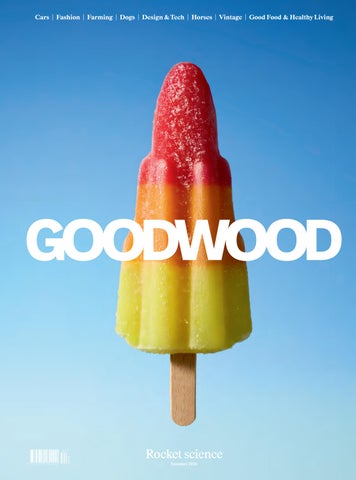
Cars | Fashion | Farming | Dogs | Design & Tech | Horses | Vintage | Good Food & Healthy Living
Rocket science Summer 2026
COLLECTION N°5 CHANEL High Jewellery has created the 55.55 necklace, a creative gesture that combines the audacity of a technical feat and the freedom of an unparalleled approach. A necklace whose design recaptures all the codes of the N°5 perfume bottle, composed of more than 700 diamonds arranged around a centre diamond specially cut to weigh 55.55 carats. This is an unprecedented method: starting with a rough diamond, aiming not for the greatest weight, but for the perfection of the stone, cut to the precise dimensions of an idea. This exceptional piece will now remain within the House’s patrimony, reaffirming that for CHANEL, creation is eternal.
202_GW.indd 202
Job No: 67291-1 Publication: Goodwood Size: 460x310 Ins Date: Summer 26
Proof no: 1
Tel: 020 7291 4700
15/06/2026 10:51
THE 55.55 NECKLACE IN WHITE GOLD, DIAMONDS AND A 55.55-CARAT EMERALD-CUT DFL TYPE IIA DIAMOND.
202_GW.indd 1
15/06/2026 10:52
002_GW.indd 2 GOODWOOD 460x310+3mm-RL_SPRING2026_UK-JULY.indd Toutes les pages
15/06/2026 10:51
002_GW.indd 3
15/06/2026 10:51 19/05/2026 14:46
Nigel Mansell, photographed by Greg Williams. The name ‘Bentley’ and the ‘B’ in wings device are registered trademarks. © 2026 Bentley Motors Limited.
004_GW.indd 4
15/06/2026 10:54
004_GW.indd 5
15/06/2026 10:54
006_GW.indd 6
15/06/2026 10:58
006_GW.indd 7
15/06/2026 10:58
REVOLUTIONARY SPIRIT
WELCOME TO OUR SUMMER EDITION. The rocket ice lolly on the cover hints at
some of the things we hold dear here at Goodwood. Speed, of course. A hint of retro style. And an unabashed enjoyment of life’s playful pleasures. July sees the crowds arrive for the Goodwood Festival of Speed presented by Mastercard, our annual celebration of the human daring and technical brilliance that makes so many of us such devoted motorsport fans. In this issue, we pay homage to Lancia’s contribution to grand touring. We also talk to Gerhard Berger, the ten-time Formula 1 Grand Prix-winning Austrian, who will attend his first-ever Festival of Speed this summer, behind the wheel of his legendary Ferrari 640 F1 car. We preview some of the technological breakthroughs on the horizon (and in space) at FoS Future Lab presented by Randox. And on p54, design writer and NASCAR enthusiast Stephen Bayley writes in praise of the never knowingly understated style of this most American form of motorsport, which we will celebrate at the Festival of Speed this year. The summer months are also the pinnacle of our horseracing season. One of the highlights of the upcoming Qatar Goodwood Festival presented by Visit Qatar is the all-female charity race, the Markel Magnolia Cup. One of our Magnolia competitors this year is Gemma Owen, interviewed on p22. Also in the issue we meet the young riders and teaching team at the remarkable Ebony Horse Club in Brixton, where a previous Magnolia Cup winner, Khadijah Mellah, first learned to ride (p68). The school turns 30 this year and is an inspiring example of how sporting passion can transform lives. Elsewhere, American academic Danielle Allen and Goodwood curator Clementine de la Poer Beresford write in praise of the “Radical Duke” – the 3rd Duke of Richmond, whose revolutionary spirit helps to explain how an important historical document of the American Revolution made its way to Chichester (p48). We profile the legendary Japanese artist Yayoi Kusama, whose colourful work is on show this summer at Goodwood Art Foundation (p32). And we talk to acclaimed novelist (and Goodwoof regular) Michael Morpurgo and his wife, Clare, about their long-established Farms for City Children charity (p42). This mission to help as many children as possible to experience and learn about the countryside is one that we wholeheartedly share here at Goodwood with our own Education Trust, which celebrates its 50th anniversary this year (p96). It’s going to be an action-packed summer. We very much hope you will join us here to enjoy it.
8
008_GW.indd 8
LETTER FROM THE DUKE OF RICHMOND AND GORDON
18/06/2026 10:40
009_GW.indd 9
15/06/2026 11:01
CONTRIBUTORS The team UNCOMMONLY Editor Sophy Grimshaw Design director Vanessa Arnaud
Scarlett Conlon
Danielle Allen
Marc Sethi
Based in Italy, fashion journalist Scarlett also writes about interiors, design and travel. She is a contributor to titles including Vogue and The Guardian. For this issue, Scarlett interviews fashion designer Gabriela Hearst about Hearst’s racing silk designs for the Markel Magnolia Cup at Qatar Goodwood Festival presented by Visit Qatar.
The author of a new book, The Radical Duke, that uncovers lost connections between The 3rd Duke of Richmond and the US Declaration of Independence, Danielle is a leading political scientist and is the James Bryant Conant University Professor at Harvard University. On p48 she recalls how a discovery she made in Sussex shed new light on this chapter of history.
Marc is a photographer whose work has appeared in titles including National Geographic and Vanity Fair as well as for brands and organisations such as Nike, the BRIT Awards and the BBC. For Goodwood Magazine, he travelled to South London to capture portraits of the horses and riders of Brixton’s remarkable riding school, Ebony Horse Club.
Editorial directors James Collard Gill Morgan Creative director Sara Redhead Sub-editor Damon Syson Picture editor Sharon Martins Project director Sarah Glyde
GOODWOOD Managing editor Jennie Gott Editorial director Will Kinsman Head of fashion & lifestyle Grace Timothy Picture editor Max Carter
Lisa O’Kelly
Stephen Bayley
Rebecca Seal
Lisa is a journalist with more than 30 years’ experience writing and editing on culture and the arts. Having spent much of her career at The Observer, most recently as literary editor, she is now a contributing writer at The Nerve. A lifelong lover of books, Lisa was thrilled to talk to author Michael Morpurgo and his wife Clare about their charity, Farms for City Children.
Stephen is a writer, curator and critic who, together with Sir Terence Conran, co-created a major British cultural institution, the Design Museum. For this issue, he turns his attention to Americana and a strand of motorsport of which he has long been a perhaps unlikely follower, as he reflects on the distinctive aesthetic of NASCAR drivers and their fans.
A cookery book author and magazine journalist for titles such as Observer Food Monthly, Rebecca also writes non-fiction books. Her most recent publication is Irritated: The Allergy Epidemic and What We Can Do About It. For this issue of Goodwood, she looks back at the long and sometimes surprising history of that favourite British picnic food, the Scotch egg.
For all advertising and editorial queries, please contact Goodwood via magazine@goodwood.com
Goodwood Magazine is published on behalf of The Goodwood Estate Company Ltd, Chichester, West Sussex PO18 0PX, by Uncommonly Ltd, 30-32 Tabard Street, London SE1 4JU. For enquiries regarding Uncommonly, contact Sarah Glyde: sarah@uncommonly.co.uk
10
010_GW.indd 10
© Copyright 2026 Uncommonly Ltd. All rights reserved. No part of this publication may be reproduced without prior permission from the publisher. While every effort has been made to ensure the accuracy of the information contained in this publication, the publisher cannot accept responsibility for any errors it may contain.
12/06/2026 11:43
PROJECT
NIGHTINGALE A COACHBUILD COLLECTION
011_GW.indd 11
17/06/2026 10:12
CONTENTS Shorts
PART 1
B ET TMA NN / G ET TY; MA RC SETHI
Contacts..............................................18 Muhammad Ali in 1966 Sweet dreams.................................. 20 Growing popularity: sweet peas Family goals..................................... 22 Starter’s orders for Gemma Owen Hidden wonders............................ 25 Factum Foundation’s tech Art project......................................... 26 Singer’s sublime Porsche 911s The homecoming.......................... 28 DJ Riordan at Goodwood Three of the best............................ 30 Who really won Le Mans ’66? Joining the dots............................. 32 Artist Yayoi Kusama How crochet got cool...................35 Why “granny crafts” are back Seeing red.......................................... 36 Driving legend Gerhard Berger The original GT............................. 38 In praise of Lancia’s archetypal grand tourer, the Aurelia B20 Ebony Horse Club p68
Three of the best p30
Stories
PART 2
“I don’t think there’s much point in simply telling children how important nature is. They have to go there, experience it and love it for themselves”
12
012_GW.indd 12
The Goodwood Interview Michael Morpurgo p42
ILLUSTR ATI ON BY S ÖR EN S ELLES L AGH
The Goodwood Interview In conversation with War Horse author Michael Morpurgo........................................... 42 The radical duke The 3rd Duke of Richmond’s surprising link with US independence............................................ 48 American idols A journey through the weird and wonderful style of NASCAR........................................................... 54 Into the woods Dan Pearson on transforming the grounds of Goodwood Art Foundation....................................60 Horse and heart A visit to Brixton’s remarkable riding school, Ebony Horse Club.....................................................68 Forza Ferrari How the marque’s F1 legend began with victory in the 1951 British Grand Prix.............................. 74
Social wellness p92
Good life
PART 3
Women’s style Acclaimed fashion designer Gabriela Hearst.................82 Men’s style The age-old search for the perfect T-shirt begins.................88 Wellbeing How “social wellness” is transforming fitness..........................92 Food and drink Charting the fall and rise of the Scotch egg..................94 Land Fifty glorious years of the Goodwood Education Trust..................96 PLUS Cover story: the Rocket Lolly p14, Calendar p99, Photo finish: filming Checkpoint at Goodwood Motor Circuit, 1956 p104
12/06/2026 11:50
THE NEW BMW M2. NOW WITH ALL-WHEEL DRIVE.
The Ultimate Driving Machine
Fuel economy figures and CO₂ results for the new BMW M2 M xDrive: Mpg (combined): 27.2 - 28 mpg (10.4-10.1 l/100km). CO₂ emissions: 235 – 230 g/km. WLTP fuel consumption and CO₂ figures shown for comparability purposes with other cars tested to the same technical procedures. These figures may not reflect real-life driving results, which will depend upon a number of factors including the accessories fitted (post-registration), variations in weather, driving styles, fuel type and vehicle load.
013_GW.indd 13 2440-004938_WP07_BMW_UK_IE_CFX_Q4_310x230.indd 1
17/06/2026 10:12 27.05.26 17:32
COVER STORY
P HOTOGRAPHY BY AARON TILLEY
The Rocket Lolly
HOW AERODYNAMIC IS YOUR ICE LOLLY OF CHOICE? If the weather is hot enough to warrant cooling off with a tri-coloured Rocket Lolly, also known as a Zoom in these isles, it’s a sure sign that British summertime is truly here. British ice cream purveyors Lyons Maid created and sold the first of these spacecraft-inspired treats in1963. At the time, both the popular children’s science fiction TV series Fireball XL5 and the international space race that would culminate in the 1969 moon landing made a space-adjacent lolly an exciting prospect. The Rocket Lolly’s red, orange and yellow bands then transitioned perfectly into the Ray-Ban-filtered palette of the coming 1970s. The more flat-topped American Bomb Pop, which dates from 1955, is a close cousin, in red, white and blue, and this patriotic colourway would later appear on Rocket Lollies on both sides of the pond. Space travel has had its peaks and troughs over the decades since its inception, but the humble Rocket Lolly has been a reassuringly steady presence throughout.
14 014_GW.indd 14
12/06/2026 12:10
15
014_GW.indd 15
12/06/2026 12:11
016_GW.indd 16
15/06/2026 11:06
Shorts PART 1
Noted: people, objects, news and ideas, from Lancia’s game-changing Aurelia B20 GT to Yayoi Kusama’s enchanting art – and the surprising return of crochet
17—38
017_GW.indd 17
12/06/2026 11:55
18
018_GW.indd 18
12/06/2026 12:13
Right: Hoepker spent several weeks with Ali in London and Chicago, where he took this iconic photograph of the boxer’s fearsome right fist
Thomas Hoepker, Muhammad Ali, 1966 WORDS BY MATTHEW DAVIS
THOMAS HOEP KE R / MAGNUM PH OTOS
The young photographer’s candid, behind-the-scenes portraits captured boxing’s most charismatic star at the height of his powers In 1966, Muhammad Ali was in his boxing prime, showcasing his unrivalled speed, accuracy and punching power – and his exceptional talent for trash-talking his opponents – in no fewer than five successful heavyweight championship defences. As a recent convert to Islam, the former Cassius Clay had also embarked on a political journey that, the following year, would see him barred from the ring for his conscientious objection to serving in Vietnam. At the third of his title bouts in 1966, staged in London, Ali was photographed by Thomas Hoepker, a young staff photographer for the German magazine Stern. Over a weekend spent at the gym, or watching the Champ being measured for his first bespoke suit on Savile Row, Hoepker became fascinated by Ali’s unusual blend of witty charisma and introversion. Back in Hamburg, he persuaded his editors to send him to Chicago, where he captured this iconic image – it’s as close to Ali’s fabled right fist as anyone would want to be. Hoepker, who died in 2024, recalled that the boxer “loved to saunter down the streets, to banter with real people”. He also had a puzzling
penchant for a South Side bakery, buying doughnuts in defiance of his strict training diet. Eventually, the penny dropped: “The Champ was not so much interested in the doughnuts, but obviously in the daughter of the baker. The two flirted heavily and had a great time. I took a few quick snaps of the doughnut lovers. Four years later, we visited Muhammad in his new, opulent home in Philadelphia. And there she was again, Belinda Boyd, the baker’s pretty daughter and now Muhammad’s second wife and mother of – then – three girls.” Ali, of course, achieved immortal status as “the Greatest” in the boxing world. Hoepker, too, became eminent in his field: the first German photographer to become a full member of the famous Magnum Photos agency, he served as its president between 2003 and 2006. But it is for his images of Ali, alternately intimidating and intimate, that he is best remembered – photojournalism at its punchiest. Purchase a print of Thomas Hoepker’s portrait of Muhammad Ali, or the contact sheet for the shoot, at store.magnumphotos.com/products/ contact-sheet-print-muhammad-ali
SHORTS – CONTACTS
018_GW.indd 19
19
12/06/2026 12:13
F LORIA N ROSER
Art project WORDS BY ALEX MOORE
Set for a starring role at this year’s Festival of Speed, Singer produces highly covetable restorations of Porsche 911s that the company’s founder describes as “works of art” Rob Dickinson vividly remembers the first time he set eyes on a Porsche 911. It was the summer of 1970, and he was five years old and on holiday in the south of France, when his father, a fan of all things four-wheeled, pointed out the shiny green widowmaker as it raced by. “I think it was the contrast between the front and the back of the car that I found so riveting,” says Dickinson from his home in Los Angeles. “The front had these big, round, friendly eyes, and the back had this kind of knock-kneed, cross-eyed ferocity. And then of course there was this incredible sound as it buzzed past.” To say it left an impression would be an understatement. Forty years and a handful of Porsches later, the Englishman decided to start a company with the sole intention of creating the perfect 911. Founded in 2009 and based in California, with a second facility in Northampton, Singer Vehicle Design has become the world’s foremost restorer of Porsche 911s, adding “scalpel-sharp” modifications such as highly tuned flat-six engines, carbon-fibre bodywork and all manner of hot-rod-
inspired signature touches. Dickinson likens his creations to 1960s café racer motorcycles – a “stripped-out race car vibe, clean in its execution” – and refers to them as works of art. At this year’s Goodwood Festival of Speed presented by Mastercard, Singer will return for its 11th consecutive appearance, this time as the featured marque, with a fabulous Central Feature outside Goodwood House. “The relationship we’ve built with Goodwood, and indeed His Grace [The Duke of Richmond], has really focused us as a company,” says Dickinson, who, like his cousin (Iron Maiden’s Bruce Dickinson), has devoted much of his life to making music. “To be chosen as the featured marque in 2026 is startling, humbling and oddly appropriate all at once. We’re a Californian company but we’re also a very British one, and to be celebrated in such company and surroundings is an absolute honour.” Singer will be celebrated with the Central Feature display at the Goodwood Festival of Speed presented by Mastercard, 9-12 July 2026
Above: Rob Dickinson in one of Singer’s restored Porsche 911s
20
020_GW.indd 20
SHORTS
12/06/2026 12:18
021_GW.indd 21
17/06/2026 10:12
22
022_GW.indd 22
SHORTS
17/06/2026 12:16
Family goals WORDS BY KIM PARKER
OLI KEARON, TAT LE R © C ON DÉ NAST
When TV personality and dressage rider Gemma Owen competes in ladies-only charity race the Markel Magnolia Cup this July, she’ll be making her dad, Michael, proud “Everything you do with your body in racing is so different to dressage. It’s taken some getting used to, but I’m fully invested because I want to do the best I can,” says Gemma Owen of taking part in this year’s Markel Magnolia Cup. The charity race for non-professional female jockeys is a highlight of Ladies Day at Qatar Goodwood Festival presented by Visit Qatar. The TV personality is no stranger to life in the saddle. A talented rider, she entered her first dressage competition aged just ten and has represented Great Britain at the Junior European Championships. It certainly helps that she comes from sporty stock: her father is retired England striker Michael Owen, the last English football player to win the Ballon d’Or and a famous horseracing enthusiast, while her mother, Louise Bonsall, is a former dressage trainer and a passionate equestrian. In 2006, the couple founded Manor House Stables in Cheshire, a state-of-the-art facility where the celebrated race trainer Hugo Palmer is now based, and it’s here that Gemma has been training for race day. “I’ve been visiting Manor House since I was little, but the first time I sat on a racehorse was last winter. Now, I’ll ride out two or three mornings a week – I’m trying lots of different horses at the moment – and then go and exercise my dressage horse. I’m basically living in breeches,” she reveals of her new regime. “Later, I’ll hit the gym. I had a decent level of fitness beforehand, but entering this race has been so humbling. I’ve absolutely got a new respect for jockeys. And having an amazing cause like Education Above All to support is very motivating when everything feels challenging.” The Qatar-based charity works to improve access to education for vulnerable children and young people internationally. Alongside receiving “plenty of helpful pointers” on her technique from veteran jockey Franny Norton, whom she describes as “a mentor figure”, Gemma has also been getting advice from her family. “My dad is supercompetitive; I definitely get my drive from him. He’s very enthusiastic and wants to know all the details to make sure I do well,” she explains, adding that her mother has also been unfailingly supportive. “She just wants to make sure I enjoy the whole experience.” Whatever the result of the Markel Magnolia Cup, Gemma is certain of one thing: she has caught the racing bug. “When you dedicate so much effort to something, and it’s over in a minute, you have to think, ‘Well, what next?’” she reflects. “My dad would love for me to carry on racing. I’ll keep riding out and see how it goes.” Gemma Owen rides in the Markel Magnolia Cup at Qatar Goodwood Festival presented by Visit Qatar on Thursday 30 July 2026 to support Education Above All. Read how designer Gabriela Hearst created this year’s racing silks on page 82
Left: Gemma Owen takes a rare break from wearing breeches
MAGNOLIA CUP
022_GW.indd 23
23
17/06/2026 12:16
024_GW.indd 24
17/06/2026 10:13
Hidden wonders WORDS BY JAMES DAY
This summer at Goodwood’s FoS Future Lab presented by Randox, new technology will reveal the previously invisible craftsmanship crowning one of Oxford University’s most remarkable rooms For more than 500 years, 455 intricately carved stone bosses have lined the vaulted ceiling of Oxford University’s Divinity School, and almost nobody has really seen them. Perched high overhead in one of the institution’s oldest teaching spaces, the carvings depict everything from religious figures or coats of arms to a fox clamping its jaws around a goose’s head. From the ground, they’re little more than shadows. Now, thanks to a collaboration between the Factum Foundation and the Bodleian Libraries, these hidden details are being revealed in unprecedented detail. Using the Selene Photometric Stereo System, a portable imaging technology that captures surface topography with a depth resolution of up to 0.025mm, researchers have digitally recorded a number of the bosses, creating high-resolution 3D models that can be relit and physically reproduced as tactile facsimiles. “What these systems reveal is not simply more detail,” says Adam Lowe OBE, founder of the Factum Foundation. “They reveal a different order of information, new layers of knowledge. It does not replace the expert eye, it extends it.” The vault was begun in 1423 and took 60 years to complete – a medieval feat of craftsmanship paid for partly through an early form of crowdfunding, with donors’ monograms carved into the stone. The building later found fame as the Hogwarts infirmary in the Harry Potter films, and one boss depicting an eagle and child echoes the name of
the Oxford pub where JRR Tolkien and the Inklings famously gathered. “What has surprised us most is how much meaning sits in the surface,” says Lowe. “Once this data is captured properly, it becomes possible to study an object in ways that were previously inaccessible, and to share that knowledge far beyond the museum or archive.” That ambition underpins the Factum Foundation’s work, which ranges from the recording of Tutankhamun’s burial chamber to the digital reunification of a Renaissance altarpiece. But the Divinity School project, being exhibited for the first time outside the university at FoS Future Lab presented by Randox, may be the most immediate way to grasp what this technology does. Visitors to the “Unseen Worlds” area of Future Lab – the immersive exhibition of new technology and innovation that returns to the Festival of Speed presented by Mastercard this summer – will be able to study objects normally out of reach to the public. This will include interactive digital models allowing you to relight and rotate each carving, revealing details no one standing on the Divinity School floor has ever seen before. The Factum Foundation is one of the exhibitors showcasing transformative technologies, ranging from spacecraft propulsion to underwater human habitats, at FoS Future Lab presented by Randox, 9-12 July 2026
Below: the ceiling of Oxford University’s Divinity School houses 455 stone bosses that almost no one has seen – until now
FACTUM FOUNDATION
025_GW.indd 25
25
18/06/2026 10:38
Sweet dreams WORDS BY GILL MORGAN
“I don’t know what it is, but once people have encountered sweet peas, they feel very strongly about them. They bring back enormous memories,” says Professor Alison Shreeve, chairman of committees of the Sweet Pea Historical Society. And she’s right: most of us first experienced this quintessentially English cottage garden flower in childhood, perhaps in our grandparents’ garden or at a local village show (“a vase of sweet peas” is a staple category, alongside all the vegetable patch produce and sponge cakes). “Perhaps it’s the fact that they’re no longer as widely grown that makes them seem so special. There’s something very joyful about them – the scent, obviously, which is just unbelievable, but also the delicateness and the shape, especially when you have a big mass in front of you.” Professor Shreeve’s sweet pea passion is shared by her fellow members of the Society, which was set up in 1901 by a group of growers and enthusiasts to educate and support amateur gardeners across the country. Alongside growing tips and information about different species, stockists and exhibitions, the Society’s website boasts some splendid photographs of its Edwardian members, with their impressive moustaches, serious expressions and smart attire. In the early 20th century, Britain was in the grip of a sweet pea craze. The flower had originated in Sicily and was first discovered in 1695 by a monk, Franciscus Cupani, who began sending seeds to other parts of Europe. But it was in the late 1800s that the story of the sweet pea changed for ever, when a breeder, Henry Eckford, produced a range of new varieties with much larger, frilly petals. In 1901 the hugely popular Spencer variety was introduced, sparking a fashion for growing the flowers everywhere from the cutting gardens
of great country houses to more modest plots in the fast-growing suburbs. The Society organised shows for people to exhibit their blooms, with growers travelling by train to transport their floral wares. The flower underwent a similar boom in America and New Zealand. After World War II, the sweet pea became more of a rarity in English gardens, something the Sweet Pea Historical Society is keen to change: “Our aim is to provide growing guidance and advice, information about different varieties and, of course, our shows – at RHS Wisley and RHS Bridgewater.” With a new interest in cutting gardens and a trend towards more naturalistic floral displays, Shreeve detects an upturn of interest. She mentions that Phil Johnson of English Sweet Peas had a dedicated stand showing new varieties at Chelsea Flower Show for the first time last year. Meanwhile, florists are using the flower in a different way, incorporating more of the green and those beguiling tendrils. Fittingly for someone whose career was in art and design education, Shreeve is a particular fan of the wonderful rainbow of colours that sweet peas come in. “Everything apart from yellow,” she says, “which is fine, because I don’t like yellow.” When I tell her I’ve had mixed results with my own attempts at growing them, she is a font of wisdom: good soil is essential (which is why many people put their sweet peas in a vegetable bed, where the soil tends to get most attention). Her top tip when planting from seed is to sow in the autumn rather than in January, so that the seedlings develop really strong roots by the time they’re planted out. And then, if the sweet pea gods are smiling, you’ll enjoy a cornucopia of cut-and-cut-again flowers all summer long. Sweet dreams really are made of this.
COURTESY OF THE NATIONA L SW EET PEA SOCIETY; A L A MY
As English as a village fete, sweet peas fell out of favour in the post-war years, but now there is renewed interest in these gloriously colourful blooms
Left: an image from Thomas Stevenson’s The Modern Culture of Sweet Peas (1910). Opposite: sweet peas come in every colour except yellow, and can grow to 2m in height
26
026_GW.indd 26
SHORTS
12/06/2026 12:38
SHORTS
026_GW.indd 27
27
12/06/2026 12:38
BL AZEJ ZALEWSK I
The homecoming WORDS BY ALEX MOORE
Riordan is a fresh talent and a celebrated international DJ. He tells us why Goodwood has been key to his story “I went to Three Friday Nights at Goodwood every year from the age of 15. It was, and still is, just head and shoulders above anything else in the area,” says the DJ and producer known as Riordan. “Everyone I knew would go – and we’d get dressed up. Because where else were we going to see people like Carl Cox, Rudimental and Steve Aoki?” says the Chichester native, now 23, who was born Riordan Kelly. Since 2011, the unique summer event series at Goodwood’s famed racecourse has combined late-afternoon horseracing with live DJ sets from major international acts like Hot Chip and Groove Armada, and UK garage stars including DJ Luck & MC Neat. In a “pinch me” moment, Riordan found himself among 2026 headliners this June. He has quickly risen to prominence as a DJ on the international house music scene, having performed for huge dance-festival crowds at events like Coachella and Project Glow in the States, as well as paying his dues with countless European club gigs, which helped him hone his skills and grow his fanbase. It was after watching British electronic music duo Gorgon City perform live on a Friday night at Goodwood in 2015 that Riordan decided to take
up DJing. It didn’t take the teenager long to find his sound – a euphoric, garage-infused variety of house music – or to get noticed. Working at a music marketing agency that operated mainly through social media, he soon learned the tricks of the trade, and began filming himself DJing on an ironing board atop the Trundle, overlooking the Goodwood racecourse, and posting it on TikTok. He says the ironing board was originally a practical decision – he needed something the right size and shape to hold his decks during lockdown – but he’s had some fun with it since. Riordan’s high-profile shows in 2026 have included a repeat appearance at Coachella in the spring – and he also has gigs coming up in Montreal, Budapest and Barcelona. But for this Sussex native, Goodwood is the highlight of the summer. “Ever since that first year, it’s been my dream to headline Goodwood,” Riordan declares. “To be in the company of some of the legends of electronic music will feel like a real ‘made it’ moment. And to have my family, friends, teachers, literally everyone I know there is going to be a really magical, nostalgic thing.” See Riordan’s live dates at riordanmusic.co.uk
Above: Riordan has performed throughout the US and Europe
28
028_GW.indd 28
SHORTS
12/06/2026 12:48
029_GW.indd 29
17/06/2026 10:14
Three of the best WORDS BY ANDREW FRANKEL
Many people think they know the story of Le Mans ’66 because they have seen the movie of the same name. The 2019 James Mangold film, starring Matt Damon as Carroll Shelby and Christian Bale as Ken Miles, chronicles how Ford tried to engineer the race’s first ever dead-heat finish, the 7-litre Ford GT MkIIs of Ken Miles and Bruce McLaren crossing the line side by side, and how the officials deemed McLaren to be the actual winner because, 24 hours previously, his car had started further back on the grid and therefore covered the greater distance. All of which is absolutely fine as a movie plot, save one small detail: that’s not what happened. Motorsport fans will argue for all time the rights and wrongs of it, particularly whether Miles was cruelly denied the chance to become the first person to do the sports car triple – win the Daytona 24 Hours, Sebring 12 Hours and Le Mans in the same year. The first two were in the bag, and no one disputes the fact that the car he shared with future F1 World Champion Denny Hulme was leading the race in the closing stages and slowed under team orders to line up with the McLaren car. Some say Miles and Hulme were only leading because the car McLaren shared with Chris Amon had already backed off and been overtaken by their team-mates. Others, notably Motor Sport magazine’s famed continental correspondent Denis Jenkinson, argued that none of it mattered because the clue was in the title: this was a 24-hour race and results should therefore be determined by time, not distance. The problem was that when 24 hours had elapsed, the cars had yet to complete their final lap and were so close it was not technically possible – at least, not in 1966 – to determine who precisely was leading. The real red herring was the dead heat, because it was nothing of the sort. Whether by accident or design, McLaren’s car was clearly ahead when they crossed the line, perhaps by as much as a car length. There is therefore no question that Bruce McLaren and Chris Amon won the 1966 Le Mans 24 Hours and there was never any need to take grid positions at the start into account. There are no moral victors in motor racing and whether they deserved to win or not is entirely academic, surely. That said, this is one race that continues to fascinate. The three Ford GT MkIIs that graced the podium at Le Mans ’66 will be reunited at the Goodwood Festival of Speed presented by Mastercard, 9-12 July 2026, and again at the Goodwood Revival, 18-20 September
BET TMANN / GET TY
This summer, Goodwood welcomes the Ford GT MkIIs that came first, second and third at Le Mans ’66, including the car driven by victors Bruce McLaren and Chris Amon. But did they really win?
Right: drivers run to their cars at the start of Le Mans ’66, which saw numbers 2 and 1 finish first and second
30
030_GW.indd 30
SHORTS
17/06/2026 11:31
LE MANS 66
030_GW.indd 31
31
17/06/2026 11:31
32
032_GW.indd 32
SHORTS
12/06/2026 13:18
Joining the dots WORDS BY SKYE SHERWIN
YUS UKE MIYAZAKI © YAYOI KU SAMA . CO URTESY OF THE ARTI ST, DAVID ZWI RNER AND OTA FINE ARTS
Yayoi Kusama is globally renowned for her playful works featuring polka dots. This summer, Goodwood Art Foundation welcomes one of the artist’s new pumpkin-inspired sculptures The nonagenarian Japanese art star Yayoi Kusama has been fascinated by pumpkins ever since she was a child, when she hallucinated that one of them spoke to her in a field. “I was enchanted by their charming and winsome form,” she has written of the gourd’s allure. “What appealed to me most was the pumpkin’s generous unpretentiousness.” Down-to-earth these winter squash may be, but Kusama’s sculptures inspired by them possess an otherworldly glamour. Her pumpkin at Goodwood Art Foundation, one of a number of new artworks that arrived for the summer 2026 season, appears in a corner of a wildflower meadow, where there are views across the fields to the Channel. The work is typical of the high-gloss, polkadot-patterned alien creations that she’s had installed in surprising locations since the 1990s. It’s also one of contemporary art’s most recognisable signature motifs. “We’re delighted to be able to offer our visitors a rare opportunity to experience one of Yayoi Kusama’s largest-scale works,” says Richard Grindy, director of Goodwood Art Foundation, who adds that the piece “is visible through the trees from the terrace of our restaurant, 24. We are committed to showing the most significant international artists, and there are few better known than Kusama, with her recognisable polka-dot motif.” To be known and seen everywhere is a key motivation for Kusama’s art-making. Like her peer Andy Warhol, in 1960s New York she cannily used mass media’s channels to deliver her work to the general public, whether by creating polka-dot fashion collections, making TV appearances or staging attention-grabbing groovy naked happenings. It’s not unusual to desire fame, but in the case of Kusama, what has fuelled her quest for visibility is far from the norm. She claims that the hallucinations she has suffered from since the age of ten, in which endlessly replicating patterns threaten to obliterate her, are the powerful drive behind her need to impose herself back on the world. Today, her polka-dot and netpatterned paintings and sculptures and dizzying “infinity rooms”, where mirrors reflect her psychedelic vision seemingly forever, are beloved by millions (the infinity rooms, in particular, are frequently shared via selfies on social media). Though she has lived, voluntarily, in a Tokyo psychiatric hospital since 1977, Kusama continues to send out artistic emissaries into the wider world, of which her stout pumpkins are surely the friendliest. Unlike other works that recreate elements of the visions that frighten her, she has described them as nothing less than “a celebration of humanity”, one that makes her “feel at peace”. See “Aspiring to Pumpkin’s Love, the Love in My Heart” (2003) by Yayoi Kusama in the grounds of Goodwood Art Foundation, until 1 November 2026
Left: artist Yayoi Kusama with some of her signature dots
YAYOI KUSAMA
032_GW.indd 33
33
12/06/2026 13:18
BORN IN A PUB
C
M
Y
CM
MY
CY
CMY
K
034_GW.indd 34
15/06/2026 11:15
Right: crochet specialist Nyala Rowe at Goodwood Revival 2025, with one of her creations
How crochet got cool WORDS BY MIA AIMARO OGDEN
C OURTESY OF NYAL A ROWE
Once the preserve of 1970s bohemians, crochet is all the rage on catwalks. But is the renewed popularity of “granny crafts” just a sign of the times? When Taylor Swift wore a “granny-stitch” crochet dress paired with Gucci heels on a night out in London back in June 2024, the internet exploded – but it wasn’t the yellow Horsebit chunky mules that caught the world’s attention. Views of YouTube crochet tutorials and pattern downloads went through the roof, bringing to global notice a trend that started during Covid and continues to grow, according to crochet creator Nyala Rowe. Unlike knitting, crochet uses a single hook to interlock loops of yarn, a simple way of creating textiles. It’s another in a long line of “granny crafts” that are becoming increasingly cool, says Rowe, who will lead a crochet Revive & Thrive workshop at this year’s Goodwood Revival. “There’s been a shift in people’s attitudes towards having an analogue sort of life, finding hobbies and interests that take us away from our screens,” she says. “For me, it was a longing to do something else that wasn’t just rotting my brain. Today you get people young and old wearing garments made from granny squares – and it’s seen as cool.”
Now crochet is moving beyond the catwalk – with Chemena Kamali at Chloé, Daniel Lee at Burberry, Stella McCartney, Simon Porte Jacquemus and Ann Demeulemeester all featuring the look for 2026 – and onto gallery walls, with the work of textile creators such as Ferren Gipson featured in Hauser & Worth’s The New Bend show in LA and Sarabi Hawke collaborating with the Barbican in London. It’s a sign of just how political crochet can be. “It’s not your grandma’s craft anymore,” says Nerrisa Pratt, a crochet expert and “maker of all things”. “Craft in general is such a huge recession indicator. The second we don’t have money, or we’re feeling that the world is on fire, we go back to our happy place. I can sit on my sofa and it’s just me, this hook and this yarn against the world. I’ve seen all these amazing women going to charity shops and unravelling jumpers and steaming the yarn and recrocheting things. It’s such a down and dirty craft. I love that about it.” Learn the craft of crochet at the Revive & Thrive workshops at Goodwood Revival, 18-20 September 2026
CROCHET
035_GW.indd 35
35
12/06/2026 13:23
PHOTO4 / XPB IMAG ES
Seeing red WORDS BY ROB WIDDOWS
Ahead of his first visit to Festival of Speed, where he will tackle the hill in his 1989 F1 Ferrari, Gerhard Berger looks back on a remarkable career both on and off the track When the motorsport legend that is Gerhard Berger – winner of ten F1 Grands Prix between 1986 and 1997, driving for Benetton, Ferrari and McLaren – arrives at Goodwood in July 2026, it will be his first ever visit to the Festival of Speed. He’s no stranger to the Goodwood Estate, however, having raced several times at the Revival and Members’ Meeting, on both two wheels and four. He was last in West Sussex in 2024, for the 81st Members’ Meeting, where he was reunited with his 1989 Ferrari 640 F1 car, which he will also be driving at this year’s Festival of Speed. “I love Goodwood, Charles [The Duke of Richmond] and his family, the way they put on such high-quality events,” says Berger. “But I have never been to the Festival of Speed. It’s a great chance for me to meet the fans. When I was racing, I always took time with them, signing autographs, and enjoyed being close to them; they are an important part of the sport. I will take the Ferrari 640 up the hill, but I did tell Charles that I’d rather ride up in an open-top Rolls-Royce, waving to the fans.” The popular Austrian’s time in Formula 1 saw him develop close friendships with many of his fellow drivers, most notably Ayrton Senna, before the Brazilian’s untimely death in 1994. “I was Ayrton’s team-mate at McLaren, and we had a lot of fun,” he says. “He was very smart, and so focused. He worked harder than anyone else on the details.”
36
036_GW.indd 36
Whereas Senna’s career was tragically cut short, Berger went on to a second chapter in the sport, as an executive. “When I stopped driving, I had a new life on the other side of the fence, if you like,” he says. “I was a part-owner of the Toro Rosso F1 team. When Sebastian Vettel won his first Grand Prix, at Monza [in 2008], we all realised that this was a very special young driver, a potential World Champion.” When Berger himself was a new, young driver, he benefited from the support of Dietrich Mateschitz, the co-founder of Red Bull. “Dietrich was my first ever sponsor, before the [Red Bull] company was successful. He came to me in 1985, had never sponsored any sportsman before, and told me his plans for Red Bull. At the time he didn’t have much money, but he was a fan of mine. We did a deal and look at Red Bull now – incredible.” He adds with a chuckle: “I remember he talked about a drink he wanted to make. I thought he was mad.” Gerhard Berger will appear with his Ferrari 640 F1 car at the Goodwood Festival of Speed presented by Mastercard, 9-12 July 2026
Above: Gerhard Berger celebrates victory in the 1989 Portuguese Grand Prix, which he won driving the Ferrari 640
SHORTS
12/06/2026 13:38
P E R F O R M A N C E A M P L I F I E D T H E
N E X T
G E N E R A T I O N
S U P E R C A R
Uncompromised power and performance. Unfiltered elemental thrills. Every sound, every sense, is amplified. Each moment more exhilarating than the last. The ferocious racing heart of a McLaren. A breathtaking breadth of ability. And an advanced Retractable Hard Top to enhance driving spirit.
McLaren Hatfield
McLaren Glasgow
McLaren Birmingham
McLaren Ascot 01344 292000
01564 787180
01698 303390
01707 682700
info@ascot.mclaren.com
info@birmingham.mclaren.com
info@glasgow.mclaren.com
info@hatfield.mclaren.com
McLaren New Forest
McLaren Leeds
McLaren Manchester
01134 879710
01625 324931
02380 082160
info@leeds.mclaren.com
info@manchester.mclaren.com
info@newforest.mclaren.com
WLTP Fuel consumption combined: 4.8l/100km | WLTP CO2 emissions combined: 108g/km
MCL_Artura Spider 037_GW.indd 37 Goodwood Press ad 230x310mm.indd 1
23/02/2026 10:15 15:17 17/06/2026
The original GT WORDS BY PETER HALL
It’s now 75 years since the launch of the Lancia Aurelia B20, an enduring archetype of the perfect vehicle for fans of grand tour driving
Below: blending performance and comfort, the Lancia Aurelia B20 was ideal for grand tour driving
DAVI D L EES / GET TY
The prospect of a long drive isn’t everyone’s idea of a treat, but for many of us, motoring along some of Europe’s most spectacular roads, on winding corniches and exhilarating switchbacks, can be one of life’s great pleasures. And tellingly, by the 1950s this kind of journey was so synonymous with the spirit of the age that it had acquired the same name – “grand tour” – as the dashing European travels conducted by upper-class young bloods two centuries earlier. The vehicle being driven is a key part of the glamour, of course, and for “grand tour driving”, perhaps the ultimate dream car remains the Lancia Aurelia B20 – although latter-day models, from the Ferrari Amalfi to the Bentley Continental, will have their own advocates. The 2.0 (later 2.5) litre, short-wheelbase development of the Aurelia saloon made its debut 75 years ago at the 1951 Turin Motor Show, and within months took second place at the Mille Miglia and a class win at Le Mans. It went on to win the Targa Florio and the Monte Carlo Rally. Yet the B20 wasn’t a racer, nor even a sports car. It was more sophisticated than that – the archetypal Gran Turismo, or Grand Tourer, designed to cover long distances in both comfort and style. Although not the first to be so called (its designer, Vittorio Jano, had seen the term applied to another of his creations, the Alfa Romeo 6C, in the 1930s) it set the standard for any future GT worthy of the badge – a stylish coupé body with a torquey engine up front for effortless progress and a 2+2-seat cabin luxuriously appointed for long-distance ease. The B20 GT was a masterpiece of innovative engineering, boasting the world’s first production V6 engine, a rear-mounted transaxle, independent suspension and inboard brakes, all dressed in a monocoque shell styled by Ghia and mostly built by Pinin Farina. Its elegant appearance was complemented by exquisite interior details such as a push-key starter, foldaway window winders and engraved ashtrays. In 1957 The Autocar magazine declared it the most desirable car of the decade, and with auction prices currently averaging £100,000, it is no less sought-after today, a sign of the enduring appeal of gran turismo driving. To find out about Goodwood Road Racing Club driving tours around the UK and Europe, visit goodwood.com/motorsport/grrc-membership
38
038_GW.indd 38
SHORTS
12/06/2026 13:35
Celebrating 220 years of Henry Poole & Co., from military uniforms in 1806 to the modern dinner suit, a lasting legacy of craftsmanship, patronage and innovation that continues to define Savile Row. henrypoole.com | @henrypooleco | +44 (0)20 7734 5985
039_GW.indd 39
17/06/2026 10:15
040_GW.indd 40
15/06/2026 11:22
Stories PART 2
Tales worth telling, from Ferrari’s first Grand Prix win to the urban riding school changing lives in south London. Plus: The Goodwood Interview with Michael Morpurgo
041_GW.indd 41
41 78
12/06/2026 13:38
THE GOODWOOD INTERVIEW N08
“I don’t think there’s much point in simply telling children how important nature is. They have to go there, experience it and love it for themselves”
P HOTOGRAPH Y BY JI M WILEMAN
WITH MICHAEL MORPURGO WORDS BY LISA O’KELLY
42 042_GW.indd 42
12/06/2026 13:58
THE GOODWOOD INTERVIEW — MICHAEL MORPURGO
042_GW.indd 43
43
12/06/2026 13:58
44
042_GW.indd 44
I
t is 10am on a sunny morning in May. Bang on time for our Zoom call, Michael and Clare Morpurgo’s names appear on my screen – but not their faces. All I can see is the tops of their heads. “Oh dear, you’d have thought we’d be used to doing this by now,” says Morpurgo’s disembodied voice as he wrestles with his laptop. Moments later his head appears, closely followed by his wife’s. He beams approvingly, not so much at me as at the shelves behind me. “You’re surrounded by books,” he says delightedly. “You’re clearly the right person for this.” Books and storytelling are in both Morpurgos’ DNA. The much-loved children’s author has written and published more than 150 titles and sold more than 35 million books worldwide, acquiring numerous awards along the way, not to mention a knighthood. Many of his books have been adapted for stage and screen, including the mighty War Horse. First published in 1982, the story of a young boy and his horse, set against the backdrop of World War I, is perhaps Morpurgo’s best-known book. It became a hugely acclaimed National Theatre play in 2007 (with innovative, visible puppetry), then transferred to the West End and now tours internationally. In 2011, Steven Spielberg turned the book into a major movie. Morpurgo is a passionate advocate for reading and storytelling. Currently president of the Book Trust, the UK’s largest children’s reading charity, he served as Children’s Laureate from 2003 to 2005. “It’s impossible to overstate the importance of children reading, loving books, engaging with ideas,” he says. “That is what is going to give their life a sense of purpose.” Clare, meanwhile, comes from literary royalty: her father was Allen Lane, the founder of Penguin Books, and her uncle, John Lane, founded the publishing company Bodley Head. It was a bequest from her father that allowed Clare to establish the charity that became – and remains – the couple’s other lifelong passion: Farms for City Children, which gives urban
P HOTOGR APH Y BY JIM WILEMAN
He’s one of Britain’s most successful children’s authors, and was mentored by the poet Ted Hughes, but Sir Michael Morpurgo’s life’s work – and that of his wife, Clare – has also been the fight to provide more children with access to nature. Lisa O’Kelly spoke to the couple about their lifelong passion
STORIES
12/06/2026 13:59
kids the opportunity to spend a week on a farm, working with animals, planting vegetables and getting to “understand where their food really comes from”, as Morpurgo puts it. From small beginnings in 1976 at the property Clare bought with her legacy, Nethercott House in Devon, the charity expanded to farms in Pembrokeshire and Gloucestershire. More than 105,000 children have now clattered through the wooden gates to experience “getting properly muddy for the first time”, says Clare. How does it feel for the couple, in the charity’s 50th anniversary year, looking back on everything they have achieved? “It’s all gone very quickly – which is what happens to life, isn’t it?” says Morpurgo. “We’re both on the wrong side of 80 now, and this all began in our early 30s. It seems like another age, because the world has moved on so fast and so far. But the work is more relevant now than it was even then. It seems ever more important that awareness of our environment, of food production, is there for everyone. If you have no experience of the countryside, why should you bother to care about it? I don’t think there’s much point in simply telling children how important nature is. They have to go there, experience it for themselves, love it for themselves.” Equally important is the leap forward in wellbeing, confidence and ability to connect displayed by young people who have been on a week’s residency. “Experiencing nature is integral to being happy,” he says. “It is as important as literature.” Part of the Morpurgos’ connection to the Goodwood Estate is their affinity with the Goodwood Education Trust: another long-standing charity that helps children from underprivileged backgrounds to connect meaningfully with nature and food production, and which also turns 50 in 2026 (see page 96).
NI CK T UR NER / FARMS FOR C ITY CHI LD REN
“Experiencing nature is integral to being happy. It is as important as literature”
Michael Morpurgo was born 83 years ago in St Albans, Hertfordshire, the second child of actor Tony Van Bridge and actress Kippe Cammaerts. His parents’ marriage ended while his father was away at war and his mother met the American literature professor, Jack Morpurgo. “That’s what war does, it knocks down buildings and destroys homes. And in my case, it also destroyed my family,” says Morpurgo, who did not find out that Van Bridge was his biological father was until he was 19 years old. It was around the same time that he first met Clare, on holiday in Corfu, through his stepfather, Jack Morpurgo, who was working at Penguin as an editor. “She was wearing an amazing green bathing costume with a very low back and I was bowled over by her,” he says. His wife rolls her eyes. At the time, Morpurgo was at Sandhurst as an officer-cadet, but the smitten couple stayed in touch through daily letter-writing. He realised after nine months that the army was not for him, so he quit and they secretly got engaged. Clare was soon pregnant and, aged just 19 and 21, they decided to marry, against their families’ wishes. “We knew we wanted to be together for the rest of our lives,” says Morpurgo, “but we were having a child slightly too soon for propriety. Both sets of parents were, shall we say, disappointed. Our wedding was probably the least joyful occasion I’ve ever attended. There was Clare’s sister, my brother, four parents, a Fuller’s walnut cake and one bottle of champagne. Though I did pass my driving test on the same day, so that was something.” After the birth of their son, Sebastian (all three of their children are named after Shakespearean characters), Morpurgo “started over” by taking a degree in French, English and Philosophy at King’s College London. He and Clare both became schoolteachers. “But we soon began to ask ourselves: are we actually changing anything by being teachers?” Morpurgo says. “In any class, roughly half the children came from homes where parents encouraged them to read, go to the theatre, go on cycle rides – and they were all going to do fine with or without us. The other half came from homes where, really, what happened was, they watched television and that was about it. They were the ones who needed something more.” On a driving holiday through France in the 1970s, the couple stumbled upon a colonie de vacances: a crumbling château with towels and blankets hanging out of the windows. “Most French children get packed off to
These pages, from far left: Sir Michael Morpurgo with his wife, Lady Clare Morpurgo, co-founder of Farms for City Children; since 1976, the charity has given 105,000 children the opportunity to spend a week living on a working farm, encountering animals and gaining an understanding of food production
THE GOODWOOD INTERVIEW — MICHAEL MORPURGO
042_GW.indd 45
45
12/06/2026 13:59
PHOTOG RA PHY BY J IM W ILEMA N
“I stood there and listened to [the boy] telling the horse about everything he’d done on the farm that day, talking to her like a best friend. It moved me deeply”
AL AMY
places like this for a fortnight over the summer to paddle canoes, stomp up mountains, walk in the woods,” Morpurgo says. “It’s a deeply embedded part of French cultural life, subsidised by the government, and Clare and I both thought it was rather wonderful. It made us realise how little the countryside is used in terms of education in this country, and it sowed the seed in our minds for Farms for City Children.” As well as being the charity’s HQ, the couple’s Devon home is also where Morpurgo became a writer, after he forged one of the most important friendships of his life, with the poet Ted Hughes. “He was a neighbour,” says Morpurgo. “I first met him very shortly after we arrived to set up the [Farms for City Children] project. I was walking along the river when he appeared – as poets tend to – in a sort of magical way. He rose up from beneath the bank, dressed all in green, carrying his fishing rod, and said, ‘Hello.’” Hughes became the charity’s first president – he often read aloud to the children – and his widow, Carol, remains a vice president. He mentored Morpurgo through his early years as a writer. And it was together with Hughes, then the Poet Laureate, that Morpurgo conceived the idea of the Children’s Laureateship, inaugurated in 1999, the year after the poet’s death.
“Down Burrow Lane: Life and Love on the Farm” by Michael Morpurgo will be published in September 2026. The special limited edition is at morpurgo1976.com Discover more about Michael and Clare’s charity at farmsforcitychildren.org
From top: Morpurgo photographed near his Devon home; a scene from the movie adaptation of his 1982 novel War Horse
46
042_GW.indd 46
Being at Nethercott House, observing and talking to the children, inspired many of Morpurgo’s books. He tells a story about a boy from Birmingham: “I used to go up to read to the children on a Thursday night. This particular night, as I walked into the stable yard, I heard a voice. I saw a boy in his pyjamas, standing in the rain beneath the stable door. His name was Billy. I recognised him but he never [usually] spoke. The horse had her head over the door, and the boy was stroking her neck and talking to her. Words were simply flowing out of him, no stammer or stutter, and I stood there and listened to him telling the horse about everything he’d done on the farm that day, talking to her like a best friend. It moved me deeply.” The incident inspired War Horse. Morpurgo has now written a memoir of life on the farm over the past five decades. Down Burrow Lane: Life and Love on the Farm will be in bookshops in September 2026, but a special limited edition, numbered and signed by Michael and Clare, was launched at Goodwood House in June at an event to raise funds for Farms for City Children. A lifelong dog lover – “mainly lurchers and whippets” – Morpurgo is a regular speaker at the Literary Corner at Goodwoof, the annual celebration of dogs held at Goodwood each spring. And it was at a special event at Goodwood that he launched the paperback of Cobweb, his 2024 novel about a Pembroke Welsh corgi, which reminds him: “Let me tell you one more story, because Clare thinks I should,” he says. Clare smiles. “I had an operation two years ago [a triple heart bypass]. Before I went under, the anaesthetist came in and did her best to put me at ease. She asked what I did and when I said I wrote children’s books she asked if I had anything out recently. I said yes, a book about a dog. What sort of dog? A corgi. What sort of corgi? It was the last thing I heard before everything went black. When I came to, it turned out she had a Pembroke Welsh corgi herself, named Ruffus. She was so delighted, she came to the book launch. And when I was later invited to Goodwoof, she came to that too, with Ruffus in tow. She told me something so beautiful: she and a group of fellow Pembroke Welsh corgi enthusiasts gather every year on the anniversary of the late Queen’s death and parade – 100 corgis and their owners – along the front of Buckingham Palace and into St James’s Park. I just think that’s wonderful. These are the stories that come out of stories.”
STORIES
12/06/2026 13:59
047_GW.indd 47
15/06/2026 11:23
THE RADICAL DUKE
CO URTESY OF GOO DWOOD
Her discovery of a rare copy of the US Declaration of Independence in a Sussex archive inspired Harvard professor Danielle Allen to delve into the 3rd Duke of Richmond’s papers. Here she writes about what she uncovered – from his progressive politics to his secret links with the English revolutionary turned American Founding Father, Thomas Paine
48 048_GW.indd 48
12/06/2026 14:02
048_GW.indd 49
12/06/2026 14:02
C
harles Lennox, 3rd Duke of Richmond (1735–1806), was tall, rich and beautiful. Anton Mengs’s portrait of the Duke as a young man while on his Grand Tour – and in period dress from the era of his great-grandfather Charles II – shows a graceful young man in his prime. Joshua Reynolds described his “superb eyes” as a “fine and uncommon” dark blue. As a senior peer, he was unlikely to turn out a radical, but so he did – the aristocrat most committed to the political empowerment of British citizens during the Age of Revolution. As Lord Lieutenant of Sussex, Richmond built a new prison on principles of rehabilitation. In the House of Lords, he tore into the ministry for letting contractors enrich themselves during the American war. In 1780, he introduced the first bill to extend the vote to all adult men in Britain. The proposal died quickly but laid the foundation for a century of reform – and if these were the Duke’s public acts, my research into his private correspondence reveals both his passionate belief in liberty and his involvement with the radical intellectual Thomas Paine. It is easy to think of the American Revolution as a fire lit at the margins of empire. But that leaves out an earlier chapter, centred in London – where memories of Charles I, beheaded by Parliament in 1649, and of the Glorious Revolution which deposed James II, had staying power. The theory of revolution, the calls for popular sovereignty, the very idea of “the rights of man” – all developed earlier in London than in the colonies. For every drumbeat toward revolution in America, something similar had already occurred in Britain. The colonists rioted against the Stamp Act in 1765; two years earlier, the British had rioted against a cider tax. The Boston Tea Party followed a sustained Spitalfields weavers’ protest in London. The Boston Massacre in 1770 came two years after British troops fired into a crowd at St George’s Field, killing six demonstrators protesting the imprisonment of the radical MP John Wilkes. The Wilkes affair sparked some of the most ferocious political writing of the age: the Letters of Junius, published pseudonymously from 1768 to 1772. They rocked Britain, took down a prime minister and articulated a right to revolution well before the American Declaration of Independence. As has only recently become known, the 3rd Duke of Richmond was at the centre of all this. In all likelihood, he was the guiding hand behind Junius. He was certainly the first patron of one of the Junius writers, the radical intellectual Thomas Paine, who emigrated to America in 1774, publishing Common Sense in 1776 – the essay widely recognised as the match that lit the fire of revolution. In August 2015, my Harvard University research team made a startling discovery in the small West Sussex Record Office: a large-scale, handwritten ceremonial parchment of the Declaration of Independence. Until then, only one such parchment was thought to exist – the one tourists can see in the National Archives in Washington, DC. The Sussex Declaration, we determined, had most probably been produced in advance of May 1787, when lawyer James Wilson read the Declaration aloud at the Constitutional Convention. We hypothesised that this copy had belonged to the Duke of Richmond. But how had it reached him? To find out, I spent several summers working at Goodwood – still the family home of the 3rd Duke’s descendants, the Gordon Lennox family, and The 11th Duke of Richmond. The butler, Monty, in shirtsleeves, tie, waistcoat and pinstripe trousers, would bring me sparkling water, tea and cookies as I read. The south-facing wing contains two libraries linked by a jib door disguised as a bookcase. In the 18th century, the walls of the Small Library were hung with scarlet paper and the windows framed by black velvet drapes trimmed in gold silk. It was an unlikely workshop for radicalism, yet here, amid the velvet and gilt, a man at the summit of the British aristocracy devised a plan for Universal Manhood Suffrage. On the shelves you can still find first editions of Hobbes’s Leviathan, of Voltaire and Rousseau,
and the 1775 and 1776 Journals of the Continental Congress. Richmond’s set of Montesquieu’s The Spirit of the Laws, acquired in 1764, is well thumbed. Among the 9,000 volumes, I found a 1771 pamphlet called The Juryman’s Touchstone, defending the rights of jurors in the trial of Junius’s publisher. A few pages carry corrections in the Duke’s own hand – and on the flyleaf, an inscription: “To the Duke of Richmond as A Tribute due to him for His Strenuous Efforts & unwearied perseverance in the Defence of Constitutional Liberty this Pamphlet is presented by the Author.” But who was the author? On three visits, I studied the pamphlet before wondering whether the handwriting belonged to Paine. The editors of Thomas Paine: Collected Writings confirmed the match, and computer-assisted analysis went further: about half of The Juryman’s Touchstone was written by Paine, about half by the American Benjamin Franklin, with one paragraph by Richmond himself. This, not Common Sense, was Paine’s first book – and it placed him squarely inside the Duke’s circle. Paine had always claimed Common Sense was his first publication; the tale was a ruse to cover the tracks of his earlier seditious writing – and to cover for the Duke. Paine, the son of a Quaker corset-maker, worked as an excise collector before leaving for America. In 1768 he was posted to Lewes, a day’s ride from Goodwood – and within Richmond’s jurisdiction. Excise jobs were controlled by local patronage; the assignment was no accident. The evidence that Richmond was behind Junius is substantial. Junius had personal acquaintance with the King and cabinet, detailed knowledge of the House of Lords, access to books nearly all found in Richmond’s library, and memory of the 1747 elections in which Richmond had taken part. Junius’s most incendiary piece, the 1769 letter addressed directly to King George III, invoked the fate of the Stuarts: a crown “acquired by one revolution may be lost by another”. Within weeks, the government collapsed. As conflict with the colonies intensified, Richmond’s sympathies grew clearer. In December 1775, debating the American Prohibitory Act, he angrily called it “a formal denunciation of war against the colonies”. Just a month later, Paine, now in Philadelphia, published Common Sense, which sold around 150,000 copies in a population of just over two million free people. When France entered the war in 1778, Richmond proposed sending peace commissioners “with powers to declare America independent, if they chose it”, becoming the first peer to urge acknowledging American sovereignty. Paine and Richmond would ultimately diverge. Richmond remained loyal to the monarchy but promoted popular sovereignty. Paine became a secular republican and embraced the French Revolution, from which Richmond recoiled. Years later, by now living quietly in retirement, and both portly and balding, Richmond sat in his library reading a rebuttal of Paine’s radically deistic book, The Age of Reason. He left notes on 138 of its 385 pages. When he reached the passage saying of Paine, “It would have been fortunate for the Christian world, had your life been terminated before you had fulfilled your intention,” the Duke marked the margin with a vigorous tick of agreement — the rage of a once-deep friendship betrayed. But in 1787, relations were not yet ruptured. Paine was in Philadelphia working with Wilson as the latter prepared for the Constitutional Convention. Then Paine sailed for Europe. It seems likely he carried the parchment Declaration with him as a gift to his earliest patron. The gesture would have been in character. In March 1790 Lafayette gave Paine the key to the Bastille to pass on to George Washington. Paine, in other words, was a courier of revolutionary talismans. This is the most likely explanation for how the Sussex Declaration reached West Sussex – and of why the Duke might have quietly buried it in his papers.
We hypothesised that this copy of the Declaration of Independence had belonged to the 3rd Duke of Richmond. But how had it reached him?
50
048_GW.indd 50
“Radical Duke: How One Aristocrat – and the American Revolution – Transformed Britain” by Danielle Allen is published in August 2026
STORIES
12/06/2026 14:02
REPRODUCED WITH THE PERMISSION OF W EST SUSSEX RECORD OF F ICE (MSS 8981)
Artefacts of a radical life
Previous pages: Anton Mengs’s portrait of Richmond as a young man. Above: the Sussex Declaration
From Sèvres porcelain to political pamphlets, Goodwood’s upcoming exhibition explores the aristocratic tastes and democratic instincts of Charles Lennox, 3rd Duke of Richmond, explains curator Clementine de la Poer Beresford One of the most fascinating men of the Age of Enlightenment, Charles Lennox, 3rd Duke of Richmond, was a radical, revolutionary and reformer – an aristocratic politician who argued that all men over the age of 21 should have the vote and who supported American independence. Until recently, however, much of his life and legacy remained largely obscured. This was what he wanted when, late in life, he ordered the destruction of his correspondence to hide his youthful radicalism and what he perceived as a life of failure, despite his considerable achievements as an administrator, statesman, military reformer and patron of arts and science. Yet Danielle Allen’s recent discovery that he owned a manuscript copy of the Declaration of Independence, now known as the Sussex Declaration, has placed a spotlight on his
THE RADICAL DUKE
048_GW.indd 51
political role amid the tumults of 18-century Britain. And in the Collection at Goodwood, where the Duke lived, we can still piece together his fascinating life, his passions and political development through the books he spent hours reading, the portraits he sat for, the artistic wonders he commissioned – and the few letters he left behind. Even if he might begrudge us doing so. The Duke had an innately rebellious spirit, as the earliest of these reveals. Aged 12, Charles wrote apologetically to his mother about his “ill behaviour” at dinner, of which he was “extremely ashamed”, pleading that she keep it from his “papa” and forgive her “most penitent, dutiful & obedient son”. At Westminster School he preferred sports, reading up on military affairs and playing pranks to his studies – on one occasion setting his Latin master’s hair on fire. To deal with his rebellious nature, Richmond was sent in 1750, aged 15, on a Grand Tour of Europe. He had just succeeded to the dukedom and his guardians – who were responsible for him until he came of age at 21 – hoped the experience would ready him for a life of aristocratic leadership. Richmond’s time abroad, stopping in
51
12/06/2026 14:02
52
048_GW.indd 52
Although as a wealthy, senior peer he enjoyed both privilege and a seat in the House of Lords, the Duke believed passionately that the political system was corrupt and that constitutional reform was essential. As a politician he sought to advance specific policy ideas, rather than simply his career, and in the margins of a small book at Goodwood, he energetically set out his radical vision – in red ink. In 1780 he would put forward in Parliament a motion of Universal Manhood Suffrage, the notion that every man over the age of 21 should have the right to vote – the first ever in Britain – but it was met with rejection. The Duke’s public life centred on politics and military affairs – in which he was also a moderniser, proving an effective and innovative Master of Ordnance – but his passionate interest in both art and the natural world would be singularly fruitful. Arriving in Paris in 1765 as British Ambassador, he ordered from the porcelain factory at Sèvres the celebrated tea and coffee service – exquisitely decorated with birds from a book by the naturalist George Edwards – which is one of Goodwood’s most loved treasures. At the French Court he also acquired Gobelins tapestries, while back in England
CO URTESY OF GOODWOOD
Geneva and Paris, studying at the University of Leiden, then travelling through Bohemia and Moravia, Vienna and, of course, Italy, would be formative – although not perhaps in the way his guardians had hoped. For the intellectuals he met and the art and artists he encountered turned him into a radical. In particular, from Montesquieu, the French political philosopher, he gained a lifelong commitment to constitutional reform that would prove one of the great driving forces of his life. And in Colonel Wolfe, the reform-minded soldier who would go on to lead the British to victory over the French at the Battle of Quebec in 1759, he found someone with whom he could share his passion for military matters, and discuss Britain’s decay and corruption. He also gained an appreciation of art, quickly emerging as a serious patron. In 1755, towards the end of his Grand Tour, the Duke was in Rome, modelling for Anton Raphael Mengs. In the finished work he dons a blue satin silk ensemble in the Van Dyck style that recalls his Stuart ancestry. With one hand casually on his hip, he exudes the swagger of youth. Accompanied by wise Minerva, he presents himself as a rationally enlightened young man; his education was complete, and it was time for him to return home.
he commissioned portraits from Joshua Reynolds and George Romney, and effectively launched George Stubbs’s career. For the Duke, art and science were two sides of the same coin; he imported the first moose into Britain from Canada – which Stubbs painted. Inspired by his father’s menagerie at Goodwood, which housed lions, tigers, ostriches and wolves, among other creatures, he purchased from Stubbs a painting of a lion and lioness that still hangs at the House . At the Kennels, which he built for his hounds in 1787, neoclassical ideals of harmony and proportion came together with technological advances, including central heating and an air-flow system. As this brief sketch illustrates, Richmond’s life was a fascinating one, full of artistic, military and political achievements. But looking back on it aged 71 in 1806, the year he died, he was dogged by a feeling of disappointment and a sense of failure. Writing to his nephew and heir, he wrote that ambition only led to vexation; he urged him to take up a “domestic life”, as this would be “the happiest and the most creditable”. The Duke’s own family life was complicated, with several illegitimate children whom he acknowledged and who seemed to have been cherished, accepted family members to a degree that would have scandalised the Victorians. With the advantage of hindsight, Richmond may have been less harsh on himself. Although his motion for Universal Manhood Suffrage was not implemented, this was not his failure but a failure of his time. It would be nearly 140 years before his vision came into being, yet Richmond’s ideas helped lay the foundation of the political system we have today in Britain – so perhaps it is time the Radical Duke came out of hiding. The Radical Duke is the subject of this year’s summer exhibition at Goodwood, running from 3 August to 26 October on all House Open Days
Top left: a letter written by the future 3rd Duke, aged 12, apologising to his mother. Above: part of the Collection’s Sèvres tea service
STORIES
12/06/2026 14:02
053_GW.indd 53
17/06/2026 10:17
54
054_GW.indd 54
STORIES
12/06/2026 16:03
054_GW.indd 55
17/06/2026 12:20
SP ORTS IL LUST RAT ED / GET TY
Previous pages, clockwise from bottom left: “King” Richard Petty; Bobby Isaac and Cale Yarborough in the Daytona 500; Pete Hamilton celebrates victory in the 1970 Talladega 500; Richard Petty leads the 1977 Daytona 500; 1970 Martinsville Old Dominion 500. Above, left to right: Junior Johnson in1965; Union 76 Girls at Charlotte Motor Speedway, 1969
56
054_GW.indd 56
ASCAR is arguably the one form of American pop culture that has never been successfully exported. Many Americans used to find Grands Prix too European, too aristocratic and refined. Maybe drivers called Prince Birabongse Bhanudej (a member of the Thai royal family who drove for Maserati, among others) and Baron Emmanuel Leo Ludwig de Graffenried (the Swiss driver who competed in 23 World Championship Grands Prix) gave them this impression. You could argue that NASCAR had its own aristocracy: “King” Richard Petty is the series’ most successful driver. And he has been joined by some other wonderful names in its Almanach de Gotha: Dale Earnhardt, Cale Yarborough and Darrell Waltrip. To confirm the blue-collar culture of NASCAR, the driver and teamowner Parnelli Jones once described an incident when his car flipped onto its roof at, say, 200mph and careened around an oval speedway inverted and backwards with sparks and smoke and flames. “Gee. It was like arc-welding with your shirt off.” Today, one of the most successful contemporary teams is sponsored by Roto-Rooter, a plumbing supply business. Imagine Ferrari being sponsored by Dyno-Rod. The origins of NASCAR were in the Prohibition years, when souped-up cars ran moonshine through the Appalachians. Prohibition ended in 1933, but the drivers found evading the authorities in brutally powerful stock cars so much fun that it became a professional racing series in 1948. An early hero was Junior Johnson, who paid tribute to this history by creating his own brand of hooch: Midnight Moonshine was launched
HE INZ KLUETMEIER / RAC INGONE / D OZIER MOBL EY / GET TY; OLEG KONI N / AL AMY
Fast cars, big hair, crazy outfits… racetracks like Daytona and Talladega are a glorious riot of sound, colour and even sartorial style, says NASCAR aficionado Stephen Bayley
STORIES
17/06/2026 12:21
I SC ARCHI VES / GET TY
in 2007. In 1985, President Reagan pardoned Johnson for the offence of maintaining an illegal still, a vocation for which he had earned a year in jail. Always looking for authentic American heroes – astronauts, for example – and mindful of how mainstream media ran “totem” stories looking down on working-class automotive enthusiasts as “lower-class creeps and nutballs with dermatitic skin and ratty hair”, Tom Wolfe (author of The Right Stuff) already lionised Johnson. Wolfe arrived at the Wilkesboro Speedway in North Carolina – wearing a madly incongruous tailored green tweed suit and Borsalino fedora – and found himself mightily impressed by Junior Johnson’s personal style. Johnson, who owned a road-grading business and ran a fully automated chicken farm accommodating 42,000 chooks, wore a red and white candy-striped shirt, white ducks and penny-loafers. He was accessorised with rimless sunglasses and a gold Timex. At Wilkesboro, “electric with regional animosity” as Kurt Vonnegut described it, Wolfe found men wearing Lacoste tennis shirts, Slim Jim pants and windbreakers with the collars turned up. The entire NASCAR scene illustrated the abundance and limitations of American pop culture: in the Wilkesboro car park, Wolfe noted the hues of the spectators’ Oldsmobiles, Chevys, Chryslers and Fords: Aqua Green, Aqua Blue, Aqua Beige, Aqua Buff, Aqua Dawn, Aqua Dusk, Malacca, Cloud Lavender, Assassin Pink, Nude Strand Coral, Baby Fawn Lust Crème and Honest Thrill Orange. And then there was the racing. NASCAR, then and now, offered an intemperate visual and acoustic explosion of mighty V8s providing a sublime spectacle of noise, danger and colour unique in all sport. Additionally, Johnson was famous for aggressive driving: “Ah’m gonna root you outta the groove, hog jaw, mother dog”, he seemed to be saying to his competitors around the terrifying banked speedways.
Today, NASCAR spectators wear less couth uniforms. I have seen an adult onesie made of Old Glory. Jackets with all-over logos are popular, ones whose sesquipedalian declarations of brand loyalty – Busch Light Beer, Sunoco – make classic college letterman jackets look illiterate. Women have been spotted in high-waisted leather or denim shorts, vintage T-shirts, bucket hats and cowboy boots. Layering is evidently mandatory, facilitated by the spacious over-sized varsity jackets. There are only two consonants separating NASA and NASCAR. The super-heavy-lift Space Launch System of Artemis transported one kind of American hero, while 600hp V8s from Ford, Chevrolet and (sign of the times) Toyota transport another. In a nod to the levelling principle of e pluribus unum, the American ideal, NASCAR rules demand parity on engine size, transmission type and minimum weight. The cars also have a weird commonality in livery and graphics: these are blink-and-you-miss-it composite advertisements with an outrageous palette of colours. Racing numbers are forward- or backwardsloping, often in drop-shadow style. Of course, it’s not a college boy thing. It’s the Deep South. At Daytona, Talladega, Martinsville or Pocono, you find a real America. “Varoom! Varoom!” Tom Wolfe wrote 60 years ago. Mother dog, he was right. Watch out! Listen up! Here comes Brendan McSwain in the Busch Beer Trackhouse Racing Chevy. How simply thrilling that seems in a muddled and conflicted world. I mean, what style. At Goodwood Festival of Speed presented by Mastercard 2026, the Americana Celebration presented by Bank of America will tell the story of US automotive culture with a display of 50 cars and bikes
NASCAR STYLE
054_GW.indd 57
57
12/06/2026 16:04
58
054_GW.indd 58
R ACI NGO NE / GET TY
Clockwise from top left: Richard Petty wins the 1967 Southern 500 at Darlington Raceway; his father, Lee Petty, in the mid-1950s; Buddy Baker makes a pit stop, 1970; the 1968 Daytona 500; Buddy Baker and his Dodge Charger Daytona, 1970; Bobby Allison and Dick Brooks go head to head in the 1973 Talladega 500
STORIES
12/06/2026 16:04
059_GW.indd 59
17/06/2026 10:17
INTO THE WOODS 060_GW.indd 60
12/06/2026 13:49
One of Britain’s most esteemed horticulturists – and winner of multiple awards at Chelsea Flower Show – Dan Pearson’s latest triumph is a subtle but powerful reimagining of the woodland and meadows of Goodwood Art Foundation. He takes Damon Syson on a walking tour of the new art destination’s grounds, where art and nature work in perfect harmony. Photography by Thierry Bal
060_GW.indd 61
61 12/06/2026 13:49
W
hen landscape designer Dan Pearson OBE first visited what is now Goodwood Art Foundation in 2021, the site had been “resting” for some time. “It felt a little forlorn,” he recalls, “almost like it was waiting for something to happen.” Five years on, that something has happened. This corner of the Goodwood Estate has been reimagined and revitalised, transformed to encompass a world-class contemporary art centre. And a major part of that transformation is the work of Pearson’s team on the Foundation’s outdoor spaces, which have been renamed Schwarzman Gardens in recognition of the generosity of the Stephen A Schwarzman Foundation. The change is apparent from the moment you arrive, entering through a wrought-iron gate in the monumental flint wall that forms the site’s northwestern perimeter. The car park, previously a gravelly expanse adjacent to the main exhibition building, has been relocated to a less intrusive position. In its place are a sleek new restaurant designed by Studio Downie Architects, a small amphitheatre for open-air presentations, and an oval lawn that’s begging to be spilled out onto. Now, on leaving their vehicles, visitors are encouraged to follow a slender, curving path through (on the day of our visit) sun-dappled woodland. By the time they arrive at The Gallery, they’ve already passed through a variety of environments. Some possess a shady, forest-like feel, with dark-leaved ivy snaking up the tree-trunks; others are bright and airy. “Even just walking through the woods from the car park to here, you’ve already been on a little journey,” says Pearson. “The path takes you through an open glade with a meadow and white magnolias for the spring; and then back into the woodland, where we go into ground coverage of ferns and textural perennials; and then you come out into light again, with a repeat of the white magnolias.” Strolling around the gardens, Pearson, 62, is a calm, thoughtful presence. What shines through in everything he says, however, is a profound passion for his work. One of the cornerstones of his practice is to enhance a site’s inherent sense of place. At Goodwood Art Foundation, this genius loci is largely provided by the trees. “We always try to identify what the different moods are that drive a place, and then see how we can tap into that, or heighten it,” he explains. “Here, it’s very much to do with the trees; there’s some wonderful ancient woodland.”
62
060_GW.indd 62
Top left: Dan Pearson at Goodwood Art Foundation. Above: a clearing with a curved seating wall and the site’s Napoleonic-era flint wall in the background. Right: the entrance to the Foundation’s restaurant, 24
STORIES
12/06/2026 13:50
“We wanted people to come here and be transported by the landscape to somewhere that allows them to be more contemplative”
Pearson, a recipient of the Society of Garden and Landscape Designers Lifetime Achievement Award, is no stranger to trees. He has spent the past 25 years working on the Tokachi Millennium Forest, a 400-hectare park in Hokkaido, Japan. Spending time in Japan has also helped him refine one of his overarching philosophies, abandoning the European horticulturist’s traditional seasons – spring, summer, autumn, winter – in favour of shorter periods that more accurately reflect the behaviour of most plant species. In Japan, the year is divided into 24 solar terms, or sekki, and 72 microseasons (kō), each lasting five days. Pearson had already formulated a similar philosophy when he first visited the islands 30 years ago. “I came to it naturally, but it was wonderful to go to Japan and discover that it was a discipline there. I’m looking at plants all the time, so I’ve always been interested in those seasonal micro-changes that happen in them.” In the case of Schwarzman Gardens, Pearson chose to simplify the sekki principles by introducing 24 seasonal “moments”. This means, in essence,
that approximately every fortnight, different areas of the site come to the fore and capture our attention, with certain plants “lighting up and then dimming again”, allowing another plant or zone to take centre stage. It’s no accident that Pearson uses terms like “light up” when describing his planting scheme. He imagines a kind of natural spotlight moving from area to area in the gardens as the year progresses. “If you think about the theatre,” he elaborates, “a good lighting designer will take you through a whole journey. It’s still the same room, but its character changes depending on the way it’s lit. The same applies with what we’re doing with the planting here. It’s the same space, but it’s constantly changing because of the way the plants react to their seasons.” The idea for Goodwood Art Foundation came about when the Cass Sculpture Foundation, which had leased 23 acres of land on the Goodwood Estate since 1992, closed its doors in 2019. When formulating his master plan, Pearson looked at the whole site – which now spans 70 acres – and tried to envisage how visitors could be subtly guided through different environments without being told where to go. “We wanted to introduce a natural sense of flow,” he says, “because the idea is that you should ‘discover’ the artworks in the woodland, rather than following a prescribed route.” He hopes that introducing a symphony of seasonal moments throughout the gardens will synergise the natural environment with the Foundation’s main event – the art – and usher in a more mindful experience for visitors. “Planting that helps to highlight a moment will root you in the present,” he explains. “If that happens, when you discover an artwork in the landscape, you’re in a much better frame of mind to appreciate it.” One aspect a landscape designer can never fully predict is how their creation will look and feel with the addition of human beings. Thankfully, the signs are good. “The opening was amazing,” he says, “because we suddenly had 500 guests here. That’s always thrilling. You’re dealing with the earth and the trees and the mud and the plants, and then, when you suddenly see the place occupied by people, the whole thing comes together.” As mentioned previously, one of the aims of the Foundation is to create a space where people of all ages can enjoy immersion in nature. Pearson was gratified to hear the same comment coming back from guests: that the gardens instil a “sense of calm” on all those who visit. “That was definitely intentional,” he nods. “We wanted people to come here and be transported by the landscape to somewhere that allows them to be more contemplative.” While Pearson – who was awarded an OBE in 2022 for services to horticulture – has made his name with a series of high-profile projects, there was a subtle but crucial difference in his approach to Schwarzman Gardens. Here, his remit was first and foremost to create a place that artists can connect with. Instead of saying, “This is where you’ll be displaying your art,” the idea was to establish a series of environments – “rooms without walls”, as he calls them – that artists may choose to engage with. Or they may not. Take the Foundation’s old chalk quarry. On first sight, with its bright white walls, it seems to be the perfect spot for a sculpture. But as Pearson recalls, “When we showed it to Rachel Whiteread [the first artist
GOODWOOD ART FOUNDATION
060_GW.indd 63
63
12/06/2026 13:50
to be given a headline show when the Foundation opened last summer], she said, ‘I’m not interested in this place.’ It just didn’t speak to her. Whereas she felt very drawn to the open meadow as somewhere to display her staircase [Down and Up, 2024-25].” The artists won’t be short of options. As you make your way through the gardens, there are dramatic changes in mood. Some areas feel wild, others formal; some enclosed, others expansive. Sound, too, plays an important role in creating atmosphere. In the deepest areas of woodland, away from the buildings, the silence is broken only by birdsong, the cooing of wood pigeons and the drumming of a woodpecker, with leaves gently rustled by whispering sea breezes (the English Channel can be seen shimmering in the distance, a few miles to the south). None of Pearson’s planting screams for attention. It’s subtle, understated, though perhaps less so in the spring when the magnolias have unfurled their blooms and the cherry blossom is in its pomp. There’s a definite focus on native species, such as ferns, hellebores and sweet woodruff, plus a few familiar naturalised plants like red valerian. In the woodland, pools of bulbs have been planted that bloom in the spring, while in the summer months, the meadow areas become a sea of native wildflowers such as wild carrot and yarrow. Native species also dominated when it came to planting new trees, with limes, hornbeams, hawthorn, yew, holly and rowan underpinning the existing forestry. A few non-native trees were introduced, but only in the area close to the buildings. These include the katsura, a Japanese tree that smells of burning sugar when its leaves fall in the autumn, and the Judas tree, which displays its vivid violet flowers in March and April. One of the most dramatic arboreal additions is a grove of 150 Himalayan birch trees, whose ghostly white trunks provide what Pearson calls “a wonderful winter moment”. They form a stunning backdrop to a newly introduced clearing, set some distance from the main buildings, which provides a quiet, reflective space with views to the sea. This area has a simple lawn and a gently curving seating wall that echoes the property’s historic flint wall. “It’s such an amazing thing, the wall,” Pearson enthuses. “Nobody knows exactly why it’s here. We do know it was built by prisoners
during the Napoleonic wars – it may just have been something to keep them occupied. Either way, they did an incredible job, and it gives the site a beautiful boundary on one side.” The clearing also features some denuded tree trunks that resemble twisted totem poles. “When we were doing the tree-felling [to thin out some overcrowded areas of forestry], we left some of these monoliths,” Pearson says of the sculptural columns. “The trees were only partially taken down, so they can then become habitats for woodpeckers and wood-boring beetles.” Using native plants where possible and encouraging biodiversity are key elements of Pearson’s work. To audit the impact of Schwarzman Gardens’ transformation, the Goodwood Estate has commissioned a series of biodiversity studies to monitor this new chapter in the life of the landscape. And while some tree-felling was required, it was done in close consultation with the Estate’s forestry manager, with respect for the environment prioritised. The felled wood was chopped and stacked to make long log walls, which now serve as boundaries between one environment and another. “This meant that almost everything stayed on site,” says Pearson. “Over time, those logs will rot down and become another habitat.” The same circular approach was used with the site’s woodland paths, which were created using woodchip, a byproduct of the felling. Like the Tokachi Millennium Forest, Pearson has approached this project with decades in mind, rather than seasons: “We’re planting trees, so you’re thinking about what it will look like in 30-50 years, while also making educated guesses about what’s going to happen in terms of climate.” As the gardens evolve and mature, does he hope people will visit them to experience a meaningful interaction with the great outdoors as much as with art? “I do think people are becoming more attuned to the importance of spending time in natural environments,” he muses. “We live in an increasingly fast and, to some degree, superficial world. A place like this serves almost as an antidote to modern life. It’s mysterious, intriguing, delightful, contemplative – and it’s all those things without seeming like it’s telling you so.” To plan your visit and book tickets, visit goodwoodartfoundation.org
Visitors are encouraged to “discover” artworks within the landscape, including this one, Nihil Novi Sub Sole (2019-21) by Solange Pessoa
64
060_GW.indd 64
STORIES
12/06/2026 13:50
Discover the finest selection of Ferrari Approved, the official pre-owned certification programme. An extraordinary Ferrari doesn’t just move you – it stirs the soul. With Ferrari Approved, you're not just choosing a certified pre-owned Ferrari - you’re embracing a legacy. The programme offers a perfect entry point for those who aspire to become part of the Ferrari world. Designed for models registered within the past 14 years, each vehicle undergoes a comprehensive inspection by Ferrari-trained technicians, including full provenance and maintenance history verification, ensuring total peace of mind for owners. Each vehicle benefits from a meticulous interior and exterior preparation, complemented by up to 24 months of Ferrari warranty and 24 months of Ferrari roadside assistance across Europe. Step into a world where performance, design and craftsmanship are elevated to their purest expression.
Ferrari.com
21903 Goodwood Magazine Ad 230x310.indd 1 065_GW.indd 65
14/05/2026 17:07 15/06/2026 11:29
SUMMER AT GOODWOOD ART FOUNDATION
THE GALLERY
IN THE LANDSCAPE
Nancy Holt The first major UK presentation of American land artist Nancy Holt – best known for her Sun Tunnels (1973-76) in the Utah desert – invites visitors to explore art shaped by light, language and space. Works include her early Concrete Poetry, photography, film and two landmark installations that extend into the landscape. Among them is Hydra’s Head (1974), a series of water-filled pools that bear witness to their environment.
Yayoi Kusama One of the world’s most prominent contemporary artists, Yayoi Kusama brings her singular vision to the South Downs with an iconic example of her large-scale pumpkin sculptures – a reflection of her lifelong exploration of infinity through repetition and her signature polka dots.
THE PIGOTT GALLERY
Eva Rothschild Describing her work as “magic minimalism”, Eva Rothschild combines handmade processes with industrial fabrication to disrupt expectations. Presented across the Pigott Gallery and the landscape, her exhibition includes sculptural works alongside two new tapestries woven locally at West Dean’s Tapestry Studio. IN THE LANDSCAPE
Main picture: Yayoi Kusama, Aspiring to Pumpkin’s Love, the Love in My Heart (2023). From left: Nancy Holt, MoonSunStarEarthSkyWater (2026); Eva Rothschild, Cosmos (2018); Lee Ufan, Relatum – She and He (2010/2023)
66
060_GW.indd 66
Hélio Oiticica Magic Square #3 is the first European outdoor installation by Brazilian artist Hélio Oiticica (1937-1980), a pioneer of the Tropicália movement. Visitors will walk through a sequence of vivid colour planes, where shifting angles, light and views of the surrounding landscape activate an evolving spatial experience.
IN THE LANDSCAPE
Lee Ufan South Korean artist Lee Ufan emerged in the 1960s as a central figure in the Tokyobased Mono-ha movement. Installed within the Foundation’s landscape, a large-scale sculpture from his Relatum series will invite visitors to experience a heightened awareness of space, material and presence – challenging how we perceive matter, place and ourselves. To plan your visit and book tickets, visit goodwoodartfoundation.org
© EVA ROTH SC HILD / MO DERN ART; © HOLT/S MITHS ON FOU NDATI ON / LI CE NSE D BY ARTI STS RIGHTS SOCI ET Y, NEW YORK . PH OTOS: MARIA BELL / LUCY DAWKI NS / C OURT ESY GOODWOOD ART FO UNDATIO N
The Foundation’s summer programme includes sculpture, tapestry, ceramics and large-scale outdoor installations
STORIES
12/06/2026 13:53
Driving change together:
Mastercard is proud to champion women in motorsport, celebrating the heroes of today and inspiring the trailblazers of tomorrow.
011_GW.indd 11 067_GW.indd 67 P_1618913_MCD_LDN_GOODWOOD_2026_310X230MM_MA4
17/03/2026 10:18 11:37 17/06/2026
Path:/Users/robbie.maynard/Library/CloudStorage/Egnyte-craftww/Shared/Global_Production/Mastercard_Europe_Sa_30013822/WIP/2026/P_1618913_OMNICOM_LDN_MCD_GOODWOOD/01_Working_Files/P_1618913_MCD_LDN_GOODWOOD_2026_310X230MM_MA4.indd
068_GW.indd 68
12/06/2026 13:29
For the past 30 years, an inner-city riding school in south London has been introducing young people who might never have discovered horses to these remarkable creatures – and everything they can teach us. Alex Moore dropped in to see first-hand why Ebony Horse Club is riding high. Photography by Marc Sethi
HORSE AND HEART
69 068_GW.indd 69
12/06/2026 13:30
I
t’s 3pm on a Wednesday, not long before school kicks out – the calm before the stampede. At Ebony Horse Club in the heart of Brixton, a handful of volunteers are preparing for the evening’s lessons, sorting tack, sweeping straw and muttering affectionately to the horses. In due course, they’ll be joined by a group of young people aged between eight and 19. The riders bound into the yard, pull on their riding helmets and make a beeline for their favourite ponies. “Honestly, this place is like a second home for me,” says 15-year-old Isaiah, who has been riding here since he was eight, and whose older sister also attended Ebony. “What I love is the sense of community here.” Isaiah is one of the club’s most accomplished riders; a few weeks after we speak, he will compete at the Badminton Horse Trials, and he hopes eventually to gain a place at the British Racing School to train as a professional jockey. He’s already 6ft tall but has the slender build – and the dedication – to suggest he could achieve that ambition. “My first thought was, ‘Oh my goddess, who has left their horses in Brixton?’” says Sidony Holdsworth of the day in 2022 when she chanced upon Ebony Horse Club, housed in a leafy park, Wyck Gardens, that feels hidden away but is only around ten minutes’ walk from Brixton tube station. Holdsworth was working for the Red Cross at the time but has since become COO of the equine charity. Ebony Horse Club was founded in 1996 by Ros Spearing, a Londoner of rural Welsh descent who wanted to offer young people growing up in the inner city the chance to experience horse riding. Initially, this involved minibus trips to stables in Kent. “The demand and enthusiasm from young people to try riding soon became clear,” says Holdsworth. “By 2011, working with Lambeth Council, the charity was finally able to open its permanent riding school.”
“Learning how to take care of your horse, having structure and responsibility – I think those are the things that really shape a child’s perspective” Many of the young people who ride at Ebony come from under-resourced backgrounds. Some have special educational or behavioural needs, or they have experienced adverse childhood events. Many are in households with a combined income that lies below the poverty line, including children who live in the tower blocks of the Loughborough Estate, overlooking the riding school. Riders’ circumstances vary, but from tweens to teens to staffmembers, what everyone shares is an intense enthusiasm about being here. For the next few hours, everything beyond the gates is forgotten. Ebony Horse Club has nine resident horses, carefully selected for their temperament and suitability to be matched with a variety of young people, and it serves 190 children every week. “Our ponies are worth their weight in gold,” says Holdsworth, while gently fixing the bridle of one of her favourites, a horse called Tom. “We try to pair our riders with horses whose personalities complement them. If someone is very nervous, it makes sense to put them on a horse that is extremely calm and confident. We see some amazing bonds being formed.” The club’s most notable success story is Khadijah Mellah, the Ebony alumna who captured international press attention when she became the first hijab-wearing jockey to compete in – and win – a competitive British horse race in 2019. That race was the Markel Magnolia Cup, the ladies-only charity race at the Qatar Goodwood Festival presented by Visit Qatar. “Khadijah’s an incredible person,” says Holdsworth. “The way she’s carved out this space within the industry – her media work, presenting, commentating, racing – she really is an inspiration. And she still comes to
Previous pages: schoolchildren get to know one of the ponies at Ebony Horse Club. These pages, clockwise from top left: Sidony Holdsworth, the charity’s COO; Sheneka Reid, who, with her twin sister, Shanice, first joined Ebony in 2004 – both now work there full-time; Liezl, one of the school’s students, showing the bond that develops with the horses; young rider Ammar learns to groom a horse
70
068_GW.indd 70
STORIES
12/06/2026 13:30
068_GW.indd 71
12/06/2026 13:30
068_GW.indd 72
12/06/2026 13:30
“My first thought was, ‘Oh my goodness, who has left their horses in Brixton?’”
Ebony at least every couple of weeks.” In late 2025, it was announced that Ashley Walters will be the director for a forthcoming British film, Kadijah, telling her life story. It’s by no means only young women whose lives are changed by their time here. A guiding principle behind the charity is that horses are “like mirrors”, says Holdsworth, and will give back to you what you show to them. “For children who need love and need to be seen, that’s incredibly important, particularly for boys and young men,” says Holdsworth. “In the local community, there are often cultural expectations that boys should act ‘tough’, or act ‘like men’. Developing softer social skills – learning to be kind, empathetic, gentle – can be really difficult if you’re in an environment where those things are all perceived as weaknesses. At Ebony, boys can just ‘be’.” As we’re talking, an eight-year-old boy in a Sonic the Hedgehog tracksuit appears, desperate to know if he can put his boots on now. His guardian, Rachel, a local vicar, tells us that he won’t stop wearing her Chelsea boots at home, as he thinks they look like riding boots. “He wants to come here every day,” she says. “Since he started coming [five weeks ago], he’s been so much calmer. And he won’t stop asking what Tom has had for breakfast.” Ebony Horse Club offers an exciting way to spend time after school, but its proven benefits to young people extend far beyond that. Over the past 30 years, the club has helped to transform the lives of thousands of young people, who typically attend regularly for a decade, caring for and getting to know the same horse or horses during that time. The animals can play a formative role in young lives that might in other ways be turbulent, providing an anchor. “Riding is a lot of fun, it’s positive risk-taking and it teaches you a lot,” says Holdsworth. “But learning how to take care of your horse, having structure and responsibility – I think those are the meaty things, actually, that really shape a child’s perspective.” Twin sisters Sheneka and Shanice Reid can attest to that. They joined Ebony in 2004, years before the club’s permanent physical site was secured. After 10 years of riding with Ebony, they both studied equine management at Plumpton College in East Sussex and gained experience training horses at yards around the country. Eventually, they both came back to the riding club in Brixton, where they now work full time. Asked what she thinks she’d be doing professionally if it weren’t for Ebony, Sheneka says, “What most people do: nails [working in a nail salon]. I feel like I’m so much more confident around the horses than I am with people. I used to be very shut off, and I think the horses helped me to express myself. They’ve been a huge part of my journey.” “If a child wants to work in finance or HR or media or PR or whatever, those jobs also exist in the equine world, and we’ll do everything in our power to help them get work experience, apprenticeships, further education or, better yet, meaningful employment,” says Holdsworth. “Mobility is not just about opening doors – it means having someone on the other side to welcome you through.” Of the current intake of young riders, one teenage girl has an offer for a place at Cambridge. The merits of Ebony Horse Club to the local community, and beyond, seem abundantly clear. Whether or not its future is secure will depend on continued funding. “The majority of our fundraising comes from grants and foundations, which are closing left, right and centre, so we’ve got to be smart,” says Holdsworth. “We organise events and community days to fundraise. With the cost of living skyrocketing, charitable giving is often the first thing to go.” But as long as Ebony Riding School can continue to reach young people, says Holdsworth, “We know that we change lives.” The Markel Magnolia Cup takes place at Goodwood racecourse on 30 July 2026. Find out more about Ebony Horse Club at ebonyhorseclub.org.uk
Opposite: Ebony Horse Club staff member Theo. This page, from top: Theo and volunteer Tyler with some of the school’s students; Shanice Reid
EBONY HORSE CLUB
068_GW.indd 73
73
12/06/2026 13:30
074_GW.indd 74
12/06/2026 13:06
FORZA
FERRARI L AT I MAGES / GET TY
When a Ferrari driven by Argentinian José Froilán González won the 1951 British Grand Prix – the marque’s first Grand Prix triumph – it marked a turning point in motorsport history. Beating rival Alfa Romeo by nearly a minute, the victorious 375 F1 ushered in a golden era for the prancing horse, writes Richard Williams
074_GW.indd 75
FERRARI IN F1
75 12/06/2026 13:06
A
“MY TEARS OF HAPPINESS WERE BLENDED WITH TEARS OF SADNESS, FOR I THOUGHT THAT DAY: ‘I HAVE KILLED MY MOTHER’”
76
074_GW.indd 76
s one empire crumbles, another arises from its rubble. That’s how it works, and that’s how it was at Silverstone on 14 July 1951, when a scarlet Ferrari finished the British Grand Prix just under a minute ahead of a crimson Alfa Romeo, and the earth shook. From the cockpit of the winning car, into which he had squeezed his ample girth almost three hours earlier, José Froilán González emerged to embrace his friend and fellow Argentinian, Juan Manuel Fangio, whom he had just beaten. They were not to know that this victory for the Scuderia Ferrari would be the first of more than 200 in the F1 World Championship over the ensuing 75 years, or that there would be only one more win for the hitherto all-conquering Alfa Romeo team. Breaking off from the celebrations in the paddock, the Scuderia’s team manager, Federico Giberti, placed a call to the house in Modena where Enzo Ferrari was waiting for news. As he listened to Giberti announcing their success, the son of a Modenese manufacturer of ironwork for the railways thought of the day in 1920 when he started work at Alfa Romeo as a driver in their racing team, aged 22. He thought of the subsequent years of success running the company’s racing programme with drivers such as Tazio Nuvolari and Achille Varzi. And he remembered the bitterness of his sacking in 1939, the victim – as he saw it – of internal politics. He had left the company determined, in his own words, to show them what he was made of. Although the terms of his pay-off included a four-year embargo on making cars under his own name, he promptly assembled a bunch of colleagues and set to work on building a two-seater sports prototype for the 1940 Mille Miglia. He called it the 815 – eight cylinders, 1.5 litres – and saw it perform satisfactorily on its debut in the hands of a young driving ace named Alberto Ascari. But the war intervened, forcing him to concentrate on the machine-tool business he had also been building, and it was not until 1947, when racing resumed and the terms of the severance deal had expired, that the first car bearing the name of Ferrari roared out of the factory gates in Maranello. Early victories with his sports cars in the Targa Florio, the Mille Miglia and the 24 Hours of Le Mans had established the new manufacturer’s reputation by the time the 1940s ended. Already there was the beginning of what would become an endless queue of eminent customers – princes, film stars, playboys – for the powerful and exotic road cars that in his mind existed only to subsidise his racing activities. The burning desire to knock Alfa Romeo off its throne at the pinnacle of motorsport had been the real ambition. Yet now, receiving the news that a car with the Ferrari badge on its nose had finally beaten the all-conquering Alfas in a World Championship Grand Prix, his reaction was confused. “I wept with joy,” he said. “But my tears of happiness were blended with tears of sadness, for I thought that day: ‘I have killed my mother.’” The act of matricide was witnessed by a crowd estimated by Motor Sport magazine at 50,000 – rather a disappointing turnout, barely a third of the number who had thronged the converted Northamptonshire airfield a year earlier to join King George VI and his family in welcoming the inaugural round of the new World Championship series. That afternoon the Alfas finished first, second and third, proclaiming the superiority that would carry Giuseppe Farina to the first drivers’ title. By the time they returned to Silverstone a year later, the Milanese team had won every round of the series to date except the Indianapolis 500, run to a different formula but included to justify the status of a world championship. That meant nine wins in a row for the car known as the Alfetta, designed before the war – under Enzo Ferrari’s supervision in Modena, ironically – with a 1.5-litre supercharged straight-eight engine. Now Ferrari, having failed to make an impact in the first post-war F1 seasons with an engine of similar capacity, put his faith in designer Aurelio Lampredi, who chose the other option available under the regulations and came up with a 4.5-litre unsupercharged V12 engine, mounted in a rugged but well-balanced chassis. In the opening three races of the 1951 series, the Alfas continued their winning streak, but the Scuderia’s cars finished second every time. They were knocking on the door, and at Silverstone they broke it down. González, rather unpleasantly described by one English journalist as “a fat, dark little man”, was 28 years old, the son of Argentina’s chief importer of Chevrolets and Cadillacs. He had begun racing in 1946 and showed such promise that four years later he accompanied Fangio to Europe,
HULTON ARC HIVE / GET TY; SHAWS HOTS / AL AMY
Opening pages: José Froilán González in action in the 1951 British Grand Prix. This page, from top: Enzo Ferrari drives an Alfa Romeo 20/30 ES in the 1921 Targa Florio; Ferrari, left, with Alberto Ascari in 1950
STORIES
12/06/2026 13:06
Driven by Speed. Defined by Service. Insurance and Reinsurance
Aerospace & Aviation Equine, Livestock & Aquaculture Fine Art & Specie Accident & Health Crisis Management & Contingency Property Specialty Marine Energy Political Risk & Credit Casualty & Financial Lines Security Risks & Crisis Response
Bermuda – London – Luxembourg – Guernsey – Princeton convexin.com
077_GW.indd 77
15/06/2026 11:32
THE 375 F1 WAS “A FANTASTIC CAR – THE BEST I EVER DROVE, I THINK. NOT ONLY POWERFUL BUT ALSO RELIABLE, WITH EXCEPTIONAL ROADHOLDING”
where their racing activities were subsidised by the government of Juan Perón, who awarded them the status of delegados obreros, the equivalent of roving ambassadors. While the older and more experienced Fangio was establishing himself among the elite, González made such good progress that in 1951 he received an offer from Ferrari to join the team for the races at Reims and Silverstone. In the first of those races, the French Grand Prix, he shared the points for second place, as the rules then allowed, having surrendered his car during a pit stop to Ascari, the team’s number one, whose own car had retired with a broken gearbox. Back at Maranello after the race, he had a meeting with Ferrari, who told him: “I think we’re going to win at Silverstone.” Once at the Northamptonshire circuit, González turned heads – including that of his new wife, Amalia – by posting the fastest practice time with the first-ever lap of the track at an average of more than 100mph. The British press soon gave him a nickname: the Pampas Bull. He tipped the scales at more than 100kg, 20 or even 30 more than most of his rivals, and seemed to overflow the cockpit sides. In Formula 1, that might have been thought a serious handicap. Nor could his Ferrari’s engine, with 380 brake horsepower, match the 420 of the Alfa. But the most vital penalty was the one inflicted on the Alfas by their thirsty supercharged engines, which required not only bigger petrol tanks (and thus extra weight) but more frequent mid-race stops for refuelling. To González, the 375 F1 was “a fantastic car – the best I ever drove, I think. Not only powerful but also reliable, with exceptional roadholding.” Starting the 90-lap race from pole position, he saw the Alfa of Felice Bonetto grab a short-lived lead. But soon González and Fangio were disputing first place, the younger Argentinian taking his Ferrari through the corners on opposite lock with an elbows-out brio that delighted the spectators. Despite the lack of serious British contenders, the 20-car field gave the crowd much to enjoy, even towards the rear. Duncan Hamilton, an Irish-born garage owner who had flown Lysanders with the Fleet Air Arm, downed a couple of glasses of beer while waiting for the oil tank of his Talbot-Lago to be refilled in the pits. Suitably refreshed, he set off to finish 12th of the 13 survivors. Two years later he and his friend Tony Rolt would win at Le Mans for Jaguar while recovering from serious hangovers. When the British Grand Prix settled down, there was little to choose in performance between González’s Ferrari and Fangio’s Alfa: at the end of the 45th lap, half-distance, they crossed the line four tenths of a second apart. But when the need for refuelling and fresh tyres came into play, Fangio’s two stops to his compatriot’s one made the difference, although González could point to the winning margin, 51 seconds, being more than a single Alfa pit stop. During his only visit to the pits, late in the race, González was said to have offered his car to Ascari, who had again retired with transmission problems. While some accounts say that Ascari instructed his teammate to keep going, Motor Sport reported that the race organisers, the RAC, had imposed a ban on driver changes. The fatal blow to Alfa’s dominance might have been delivered by a different hand. Stirling Moss, 21 years old, had won that day’s Formula 3 support race in his Kieft-Norton, but a few weeks earlier he had been the one to receive Enzo Ferrari’s offer of a drive in the 375 F1 at Reims and Silverstone. Since the French race coincided with a previous commitment to compete in an HWM in Berlin, he decided to decline, at which point Ferrari turned to González. Had Moss not refused to renege on his obligation, an English crowd might have seen an English driver giving the team from Maranello its day of supreme glory. But the future would not be denied. Ferrari had its foot firmly on the ladder of the F1 World Championship. And as González celebrated his triumph in the paddock, a young Scottish boy was pushing through the throng to secure the winner’s autograph. Forty-five years later, during the Argentinian Grand Prix weekend at the Autódromo Oscar y Juan Gálvez in Buenos Aires, a three-times world champion approached the guest of honour. “That young boy,” Sir Jackie Stewart told González, “was me.” Look back at the extraordinary story of Ferrari in F1 at the Goodwood Festival of Speed presented by Mastercard, 9-12 July 2026
78
074_GW.indd 78
D OUGL AS MILLER / AUTOCAR / L AT / GET TY
This page, from top: Juan Manuel Fangio’s Alfa Romeo 159B leads González’s Ferrari 375 F1 in the 1951 British Grand Prix; González is kissed by his new wife, Amalia, after his history-making triumph at Silverstone
STORIES
12/06/2026 13:06
In Optimal Level - <5.2nmol/l In Optimal Level - 191 nmol/l
DEC 25
MAY 26
DEC 25
DEC 25
MAY 26
MAY 26
Use code GW15 for 15% off all in-clinic tests
079_GW.indd 79
15/06/2026 11:34
THE ATLAS RING, ONE OF OUR MINIATURE MASTERWORKS MADE IN LONDON AT 2 GARRISON SQUARE, CHELSEA BARRACKS, SW1W 8BG
THEOFENNELL_GW_MAY26.indd 1 080_GW.indd 80
13/05/2026 11:39 15/06/2026 11:35
Goodlife PART 3
Living well, Goodwood-style: vintage looks, ways to wellbeing, news from the farm, and how fashion star Gabriela Hearst was inspired to design silks for the Markel Magnolia Cup
081_GW.indd 81
81 97
12/06/2026 12:45
WOMEN’S STYLE
AHEAD OF THE FIELD
82
082_GW.indd 82
Gabriela Hearst may be well versed in designing clothes for the red carpet and the catwalks of New York and Paris Fashion Weeks, but her most recent assignment involved applying her talents to a completely different type of runway: the Goodwood Racecourse. This summer, the Qatar Goodwood Festival presented by Visit Qatar welcomes the New York-based creative director as guest designer of the silks for the Markel Magnolia Cup, the annual charity race that sees 12 female amateur jockeys competing on the famous home straight. The 2026 line-up includes reconstructive microsurgeon Joanna Bovis, veterinary technology worker Ilona Wells, and TV presenter Gemma Owen, selected for their “resilience that extends beyond the saddle”. The competitors are all trailblazers in their respective fields, so it’s apt that Hearst should be designing their silks. Since establishing her eponymous womenswear brand in the US in 2015, and later taking the reins at storied Paris fashion house Chloé between 2020 and 2023, Hearst is widely regarded as a leading changemaker thanks to her championing of sustainable materials and methods. Her laudable business ethics have been recognised with a number of prestigious awards, and it was under her leadership that Chloé became the first European luxury fashion house to receive B Corp Certification. “If there’s one common denominator with everything I do, it’s that it has to [stand] the test of time, and be timeless, no matter what budget I’m working [within],” says Hearst, 49, over Zoom from her home in New York, which she shares with her publishing executive husband, Austin, and their three children (twins Olivia and Mia, 17, and son Jack, 11). The designer’s broad demographic of famous fans – from Catherine, Princess of Wales and Oprah Winfrey to Emma Watson and Jennifer Lawrence – serves as proof of concept. “I really, truly believe inside of me that we’re building something to last, something that will maintain its integrity.” Hearst says that she first visited Goodwood in September 2025 to attend Revival, which she enjoyed as “a real spectacle for the eye. I was so impressed by The Duke of Richmond’s vision when I experienced it first-hand and saw how happy people were of all ages, spending their weekend [at Goodwood], enjoying life away from technology,” she smiles. “He has an ability to think outside the box and to use his position and his heritage to expand and evolve, which is what brings longevity. He’s a bit like a creative director.” When The Duke invited Hearst back to design the silks, her (selfconfessed) insatiable curiosity made her say yes. “Sometimes we [work] in silos in our worlds so much that we only look at what we’re doing, and we don’t expand ourselves out of our scope,” she says. “A project like this is an opportunity to learn.”
C OURTE SY OF GABR IEL A HEAR ST
CELEBRATED FASHION DESIGNER GABRIELA HEARST’S LATEST VENTURE IS A CAREER FIRST: DESIGNING RACING SILKS FOR THE FEMALE JOCKEYS IN THIS YEAR’S MARKEL MAGNOLIA CUP. SHE TELLS SCARLETT CONLON ABOUT HER EQUESTRIAN INSPIRATION
12/06/2026 12:24
83
082_GW.indd 83
12/06/2026 12:24
That the race will raise money for the global non-profit Education Above All Foundation (the Markel Magnolia Cup has raised £3.5m for children and female-focused charities since its launch in 2011), sealed the deal. “Anything that is for the empowerment of women, whatever it is, I’m always there,” says Hearst. “When countries empower women, they lift communities.” Through her own philanthropic initiatives, Hearst has raised hundreds of thousands of pounds for Save the Children, for which she serves as a brand ambassador. To create the 2026 riders’ silks, Hearst chose prints sourced directly from her rich archive of past collections. “It’s a full-on situation!” she says, talking through the designs. They include a newspaper print inspired by her mother-in-law, the journalist Austine McDonnell Hearst; flowers drawn by her daughter when she was 12; an ode to the patterns of French artist Sonia Delaunay; a herringbone based, indirectly, on a picture of Keith Richards; and – appropriately – one of her very early prints of a horse parade. “We had to really narrow it down [from the archive] but every single one has a special meaning, and we were completely free to choose whatever we wanted,” she says. “It has been a very nice experience to see prints from the past put together for the race – and actually we’re interested to see which print is going to win!” The commission is far from Hearst’s first brush with the equestrian world. The Uruguay-born designer grew up surrounded by horses on her family’s 17,000-acre ranch, Santa Isabel in Paysandú, where she took over managing operations in 2011. “I grew up around horses and horse competitions, very much in the Gaucho tradition,” she says fondly, reaching for a framed photo of her mother, aged 18, taking
part in a rodeo, and proudly holding it up to the camera. Being raised in nature and developing an early appreciation of her home nation’s energy self-sufficiency and progressive political landscape informed her approach to life and business. “The same values, the same things, move me. The humanity of this company makes me feel very proud.” Her approach, naturally, consists of “quite a lot” of non-negotiables, she admits, but one thing stands out. “The moment somebody asks me to sell a $5,000 dress that is made of polyester or viscose, I’ll walk out. Never have I shortchanged a woman, and I like to go to bed knowing that I have not added to the crap in the world. I can’t do product to just do product… this supermarket mentality.” As the head of a well-respected fashion brand – but ultimately still a small company – Hearst’s resources for creating new work are sometimes more limited than she would like. “You can’t do this job if you don’t like problems,” she laughs. “We’re in the true luxury space and we’re competing with huge brands that have gazillions of dollars for marketing. So we need to be busy bees and think of other ways.” It does, however, have its benefits. “You find people who truly get motivated to do excellent work, that are not seduced by power and size but more by quality and integrity,” she says – also pointing to the total autonomy that has led her to West Sussex this summer. “I only take on projects that I feel truly enthusiastic about, because it has to [come] from my heart – then I get really excited.” Gabriela Hearst has designed the silks worn by riders in the Markel Magnolia Cup at Qatar Goodwood Festival presented by Visit Qatar, which takes place on Thursday 30 July 2026
C OURTESY OF GABR IEL A H EARST
Previous page and above: Gabriela Hearst photographed at her ranch in Uruguay. Right: three of Hearst’s designs for the Markel Magnolia Cup racing silks
84
082_GW.indd 84
12/06/2026 12:24
ai17732332249_VP_print_00_230x310mm-HD.pdf 1 11/03/2026 13:47:07
C
M
J
CM
MJ
CJ
CMJ
N
085_GW.indd 85
15/06/2026 11:37
OPINIONATED
DRESSING UP BY ANNA MURPHY
Ours is a dress-down world, so it is hardly surprising that the idea of dressing up can be discombobulating. Yet that’s also the thrill of it. Part of what makes an occasion that calls for it so enjoyable – from a day at the races to a glam summer wedding – is that it’s the opposite of quotidian, and this applies to what you wear as well as everything else. Dressing up should be about augmenting your enjoyment rather than adding pressure – about “easy elegance”, not sartorial stress. It’s about looking contemporary rather than old hat – which, incidentally, means that hats themselves are a choice, not a diktat. What does all this add up to? The kind of specialness that comes across as relaxed rather than try-hard. It’s far more flattering than the trussed-up variety, and more modern looking. Straight-down-theline classic can appear dated, with the marked exception of a great trouser suit. Stiff fabrics and/or an entirely fitted silhouette can also present as retro in a bad way. In contrast, subtly on-trend detailing such as asymmetry, print placement and an interesting silhouette will immediately make you look what we fashion types like to call “relevant”. If you fancy a hat, go for something low-key, such as London milliner Rachel Trevor-Morgan’s range of straw styles. Add in some
DRESSING UP SHOULD BE ABOUT AUGMENTING ENJOYMENT RATHER THAN ADDING PRESSURE lawn or paddock-friendly shoes, like Dear Frances’s heavenly flats or Nomasei’s chic platforms, and it’s job done. For suiting, pick an awayday fabric and hue. You don’t want to look as if you’re going to the office. Choose either a mannish blazer for your top half, or the exact opposite: a curvaceous offering with an exaggeratedly nipped-in waist. For trousers, a slouchy wide-leg – think Katharine Hepburn – or soft balloon cut looks most up to date. Linen semaphores summer like nothing else, and brands such as Gabriela Hearst and Blazé Milano have some great examples. For a more relaxed vibe, you could go the safari suit route – as per Savile Row-based Knatchbull’s white one. Co-ords, or even just a beautiful shirt or top with contrasting trousers, would also work. (Try Palmer Harding, another London brand, for sculptural shirts.) If you’re in the market for a dress, there are two approaches. On the one hand, there’s minimalist and – that word again – sculptural, perhaps in white or, better still, in a shade that ravishes. (Roksanda, another London-based label, is the ultimate colourist.) Asymmetry and/or an interesting silhouette are great for those who want to push the envelope. (Abadia is good at this.) A summery print dress still has my heart, though. The key to making this look current is to seek out shadow florals, unusual colour combinations and, best of all, so-called print placement, in which, as the name suggests, the pattern of the fabric is laid out so as best to flatter the style of the dress and its wearer. Saloni, one more British label, is the best in the business at this.
IL LUST R AT IO N BY JAC K DALY
86
086_GW.indd 86
17/06/2026 11:28
THE ACCESSORY
THE ADORNMENT
In praise of the ponytail
E NT E RTA I N M E N T P I CTU R E S / P I CTO R I AL P R E S S LTD / AL AM Y
Girlish and cutely curled, as worn by (pre-makeover) Sandy in Grease, or low-slung, sleek and soignée, as styled by 1990s icon Carolyn Bessette, the ponytail is a “do” for all seasons. Dating back to Greek antiquity, it is depicted in frescoes and paintings from the era. Men got in on the action during the 18th century, with wig “tails” becoming ultra-fashionable. But it was really Barbie who popularised the ponytail for the modern era, with her high, swishing tresses, a style everyone from Madonna to our (current) Princess of Wales has adopted. It’s a look that can communicate whatever the wearer wants it to: girlish charm, understated chic, sporty energy. Pony up.
Sartorial history lesson – N08
THE SUNDRESS WORDS BY GILL MORGAN
The
SEAMSTRESS The sundress reached its zenith in those golden days of the 1950s and ’60s. The image of Brigitte Bardot tripping around Saint-Tropez in cotton broderie anglaise and gingham numbers, bare-legged, wicker basket in hand, has left an indelible mark on our collective sartorial imaginations. For many of us, this look is the very definition of summer. But the sundress can trace its origins back to the 1920s and ’30s. This is when hemlines began to rise, corsets were thrown off and a relaxed form of warm-weather dressing emerged. For the first time, these dresses were bareshouldered and loosely cut. By the 1930s, inspired by Coco Chanel’s bronzed new look during her stays on the Riviera, sunbathing became fashionable: the sundress is, after all, designed to show off a tanned summertime body. By the 1940s, the influential American sportswear designer Claire McCardell was making an impact on a new type of women’s leisurewear. Working with cotton, jersey and denim, her draped, halterneck dresses became the perfect beachwear for the modern American woman. By the ’50s, Dior’s New Look was in full flow, and so a world of full-skirted summer frocks emerged, à la Bardot. But the sundress didn’t stand still: by the late ’60s it had morphed into a shorter cotton shift, by the ’70s to longer, strappy boho styles and halternecks. By the ’90s, the summer slip dress had rocked the world, turning up at music festivals teamed with bare legs and DMs. And today? Sun worshippers can take their pick from all of the above. So long as a summer frock is easy, airy, looks good with flats and shows off tanned limbs, its place in our wardrobes – and our hearts – is assured.
086_GW.indd 87
Above: Elizabeth Taylor in Suddenly Last Summer (1959)
HOW TO CARE FOR VINTAGE SHOES “I don’t wear vintage shoes any more,” Dita Von Teese told Goodwood Magazine in 2025, “because I can’t tell you how many pairs of beautiful 1930s shoes I’ve ruined, swing-dancing.” If even Von Teese finds it a challenge, maintaining the appearance of vintage shoes is not for the faint-hearted. Caring for their material correctly is key. To gently remove minor smudges on leather shoes, use baby wipes. Need something a little stronger? Saddle soap – which combines mild soap, glycerine, beeswax and lanolin – helps to remove dirt and preserve and soften leather without causing damage. For suede shoes, blue or otherwise, white vinegar is the recommended gentle cleaner of choice.
12/06/2026 12:16
SWEET TEE
STILL SEARCHING FOR THE PERFECT T-SHIRT? IT’S THE SUMMER DRESSING OBSESSION WE NEVER TIRE OF, SAYS JOSH SIMS
T
he T-shirt has won its reputation for rebelliousness in no small part because it’s the perfect blank canvas. Whether an expression of political statement, rock-band fandom or, less tastefully, of allegiance to a brand, this chest-enveloping real estate has typically proven too valuable as a wearable advertising hoarding to be left empty. Yet it’s the more quietly spoken plain T-shirt that has managed to find a place in most men’s wardrobes. Where “I’m With Stupid” or “I Heart New York” speak their mind, the plain T-shirt is more the strong, silent type. Of course, from James Dean to Marlon Brando, the cinema of the 1950s would give even the plain T-shirt its countercultural moments, making it a totem of reckless youth or of unbridled, blue-collar masculinity – the everyman garment that every man wants a part of, and one that would go on to become a cinematic trope, from John Travolta’s in Grease to, more recently, Jeremy Allen White’s in The Bear (showing on Disney+ in the UK). Maybe there was always a touch of fantasy involved: the oh-so-fitted T-shirts Brando wore in A Streetcar Named Desire had to be repeatedly shrunk and re-sewn by the costume designer to get that pec-hugging effect. The fitted T-shirt had yet to be invented in 1951. That a touch of yeah-I-work-out-and-what-about-it machismo clings to the plain T-shirt is perhaps inevitable given its military origins. It was around 1913 that the US Navy allowed seamen to wear what was then considered to be a cropped-sleeve undershirt, ideal for doing those deck chores. White ones went with the rest of the navy uniform, were cheap to make – since they required no dyeing – and encouraged cleanliness on board. Not long after, the US Army adopted the garment, while clothing manufacturers would soon introduce the idea to civilian life, with Jacob Goldfarb’s Fruit of the Loom brand and the Hanes “Beefy T” setting the standard. The term T-shirt (so called because of the shape) was becoming established by 1920, when F Scott Fitzgerald described a character packing some in his luggage. But the appeal of the plain T-shirt – in dependable, bestselling white, perhaps navy or black year-round, sometimes a bit of colour for the summer – goes beyond its backstory. It’s also about its inherent simplicity. Few garments in menswear are so adaptable – fine at any age, as correct to wear with jeans as with tailoring (albeit maybe with a hint of Miami Vice), while a breakdown in formal dress codes and the rise of remote working made it more wearable than ever. There’s an unanswerable, no-brainer quality to the plain T-shirt – it’s why the late, great Giorgio Armani wore a navy T-shirt almost every day, while Michael Kors does the same in black. Who knows what they wear in Alpha Centauri, but as Issey Miyake once put it, the T-shirt is “universal”. Not that simplicity isn’t often deceptive. The plain T-shirt is as diverse as those made by, to cite just a few decent choices from around the globe, Merz b. Schwanen and Lady White Co, Velva Sheen and Jackman, The Real McCoy’s and Allevol. Or, at the more budget but no less dependable end of the spectrum, Bronson, Gildan Hammer, Arket and Uniqlo. The options are endless. Certainly, many a man has spent a small fortune in the bid to find “the perfect T-shirt”. Perfect not just in terms of fitting the way they like it – whether that’s Marlon-tight or Chicano-style outsized, wide-sleeved or cap-sleeved – but in weight and details, from neckline to stitching to fabric; twin-needle or no, side-seam or no, classic pure cotton or a functional, shape-maintaining blend. For such an ostensibly effortless piece of clothing, the plain old plain T-shirt is remarkably complicated. And that’s before it’s gone through the wash a few times. Therein often lies a tale of disappointment, and the bitter discovery that a hefty price is no guarantee of pulling off what few T-shirts do: not just looking good fresh out of the packet but still looking good after multiple wears. And so the hunt begins again.
FRAN K OC KEN FELS /FX
MEN’S STYLE
Opposite: Jeremy Allen White displays his strong T-shirt game as Chicago-based chef-patron Carmy in TV series The Bear
88
088_GW.indd 88
17/06/2026 12:28
89
088_GW.indd 89
17/06/2026 12:27
THE PEACOCK
Why men love… dressing for the races
T
here was a time, before Edward VII had his way, when dressing for the races meant morning coats, waistcoats and striped trousers. But Goodwood has spent the past century or so turning that formality into something easier, less rigid and better suited to an English summer. In 1906, the King himself arrived in a linen suit and Panama hat rather than the expected morning dress, setting a tone that still holds today. But in today’s era of casual dressing, part of the appeal of a day at the races – especially a meeting deserving of the epithet “Glorious” – is the prospect of raising one’s sartorial game for the occasion. The rules here are a joy to follow, largely because of Goodwood’s long-standing inclination towards elegance rather than strict formality. Edward VII described it as “a garden party with racing tacked on”, and that spirit still defines the meeting today. “Goodwood has developed its own identity,” says Simon Cundey of Savile Row institution Henry Poole. “People dress one way for Glorious Goodwood, another for Ascot – and that’s part of the appeal.” The principle is simple: smart daywear that works for the setting. “These days the most flattering looks are often pure linen or linen suiting,” says Cundey, set off with a complimentary tie. “Then a subtle pocket square is always very nice to have.”
At Goodwood especially, though, pure linen still feels entirely right. The designer Oliver Spencer, who oversees formalwear brand Favourbrook as well as his own label, points to fuller trousers, softer tailoring and jackets that sit more naturally on the body. “At something like Goodwood, you want to be able to move,” he says. “You’re outside all day, walking, sitting, standing; so the clothes have to work with that.” Stone, olive, cream and washed navy are all good options. The effect is elegant without feeling overdressed. Once you have the foundation, you’ll need a crisp shirt and a tie that works with the suit. Accessories should add “something extra” without shouting for attention. Dressing properly at Goodwood shows you understand the setting and the people in it. Not formality for its own sake, but a shared standard that makes the day feel like an occasion rather than just another afternoon outside. Putting on a suit that fits well, tying a tie, wearing clothes chosen with a bit of thought and intention: it changes the rhythm of the day. Then you can get on with the most important part: enjoying a day at the races.
JON AT HAN JAME S WILSON
THE RULES HERE ARE A JOY TO FOLLOW… ELEGANCE RATHER THAN STRICT FORMALITY
Above: Lord William Gordon Lennox wearing a linen suit to the racing at Goodwood
90
090_GW.indd 90
12/06/2026 11:47
MALE ORDER
GROOMING
Details on display – N08
TURN-UPS
THE V INTAG E SHOW ROOM / LOV ISA RA NTA ; A L A MY
WORDS BY JAMES COLLARD
At your service:
Jean genius SOURCING RARE DENIM, WITH THE PERFECT LOOK, FEEL AND BACKSTORY, HAS BECOME A FASHION VOCATION ALL OF ITS OWN, SAYS JOSH SIMS
When a stylist needed to find the perfect jeans for Harry Styles to wear on his recent album cover, they turned to a man with a very particular set of skills. Doug Gunn, co-founder of The Vintage Showroom, has been the UK’s leading vintage denim dealer for decades, supplying film productions and collectors alike. “The first thing I ever bought second-hand was a pair of Levi’s 501s,” he enthuses. “Denim is a daily part of my life.” And increasingly, he says, of other people’s lives too. The vintage market may have experienced fashion-led bubbles but the price of good vintage denim – determined by age, brand and condition – has remained steady and even crept up. While a solid pair of pre-1970s jeans (“Back when jeans were done differently, from the manufacturing to the dyes to the hand-feel,” says Gunn) might be purchased for £200, something “truly special” could cost upwards of £2,000. Of course, he adds, some pairs are too precious to wear. What Gunn calls the “mine finds” – often very battered examples pulled from disused mines or found in derelict barns – are considered of such historic importance, they invariably end up in brand archives. Three years ago, US-based dealer Brit Eaton, sometimes dubbed “the Indiana Jones of jeans”, sold what is believed to be the oldest existing pair of Levi’s, dating back to 1873, for $100,000 at auction. “You need a sense of what very poor people would once have done with their clothes when they were finished with them – and they didn’t often throw them away,” says Eaton of his searching methods. “I’ve found old denim stuffed into sofas, used as padding inside a boxing bag, inside mannequins, scarecrows. But the earliest stuff, that’s harder and harder to find.” Ultimately, argues Gunn, people develop an emotional attachment to a pair of jeans like no other garment: “They take on the life of the owner; every scuff and fade tells a story.” And even if the jeans you’re wearing were worn in by someone else first, he adds, “There’s something so satisfying about the hunt – about finding the perfect pair for you.”
090_GW.indd 91
Roll-ups and turn-ups are just about as old as “straight-fit” trousers, first appearing in the mid-19th century, when everyone from working men to sporting gents discovered the merits of rolling up their trouser cuffs to keep the hems free of mud and dust. That this ad hoc style soon migrated to the crisply ironed and tailored statement that is the turn-up is generally ascribed to one man – the Prince of Wales, later Edward VII, who pioneered countless innovations that made men’s fashion both more elegant and more wearable. Two generations later, Edward, The Duke of Windsor, dearly loved a turn-up. They give trousers better “drape”, in tailors’ parlance. But the look appeals to rebels as well as royals: think France’s war-time dandies, the zazous, American zoot-suiters or the young Brando, turning up his jeans to reveal his biker boots – just as today, wearers of rare Japanese denim deploy turn-ups to signal their fancy provenance by flashing a bit of selvedge. Meanwhile, Gen Z types have adopted the more improvised vibe of the roll-up – one of those casual-seeming details upon which much care must be taken.
Above, from left: vintage denim; Fred Astaire’s crisp turn-ups
91
12/06/2026 15:13
WELLBEING
Is social wellness the future of fitness? WORKING OUT ALONE WITH YOUR HEADPHONES ON COULD BE A THING OF THE PAST. TODAY, GYM-GOERS AND RUNNERS ARE DISCOVERING THAT CONNECTION AND COMMUNITY CAN PLAY A VITAL ROLE IN OPTIMISING YOUR WELLBEING. DAMON SYSON REPORTS ON THIS GROWING TREND
A
ccording to Mintel’s 2026 New World of Wellness report, young people in the UK increasingly view fitness clubs not simply as a place to get fit, but as somewhere to build community and make personal connections, often replacing alcohol-based socialising. The Gym Group, one of the country’s largest chains, reported last year that 44% of Gen Zs said they worked out to spend time with friends, compared with 37% the previous year, while Virgin Active no longer has “gyms” but rather “social wellness clubs”. “Social wellness is definitely a growing area,” confirms Joanna Train, a sports psychologist with Optimise Potential, a consultancy that helps people of all ages build confidence and establish healthier relationships with exercise and performance. “I’ve seen it in running clubs and gyms, but also with outdoor pursuits such as open water swimming, and in saunas. People are no longer separating wellness time from social time.” Train believes this trend is partly driven by time efficiency. Combining socialising with exercise is simply more practical. “And ironically,” she adds, “in this digital, hyper-connected world, people feel physically disconnected. Group exercise is filling that gap, recreating the sense of being part of a tribe. That’s something we instinctively seek out.” Does exercising with others yield better results? Sports psychologists believe it can be a very powerful motivator. “People are more likely to stick to something when others expect them to show up,” says Train. “There’s a heightened level of accountability. But people also want to be there rather than just feeling like they should. They gain more enjoyment when there’s social interaction involved. Research suggests that exercising in groups can feel easier; it can reduce stress and perceived effort. And adopting one healthy behaviour increases the likelihood of a person adopting others, such as better nutrition, reduced alcohol consumption, improved sleep. This is called ‘behavioural clustering’.” There may even be added incentives. According to Vogue, “Run clubs have become the new dating apps, with fit singles pulling on their Align leggings to work up a sweat together – while getting to know each other.” While the social side of run clubs is certainly a factor, for the majority of regular attendees, the running comes first. Many are training for marathons, and the distances run typically range from 15km to 35km, so they’re not just there to chat. Indeed, for April Fools’ Day this year, Strava, the fitness app, poked fun at the social wellness/singles club notion with a prank campaign featuring a mock “Strava Dating” feature, proposing to connect singles via pace, routes, and shared hobbies. Nonetheless, attitudes to exercise are undoubtedly shifting. Ten years ago, the idea of allowing yourself to be seen in a dating scenario wearing sports attire and getting sweaty would have seemed outlandish. But today there is a growing acceptance – even celebration – of showing effort. 92
092_GW.indd 92
There may be a temptation to view this shift as something concocted by fitness influencers, but Train believes the social wellness phenomenon was part of the zeitgeist before influencers got on board. “They may be amplifying it, but they’re not creating it,” she says. “Platforms like Instagram and TikTok have been good for increasing the visibility of group workouts. They’re making fitness communities look more accessible and appealing, and normalising going for a run instead of going to a bar. However, the underlying drivers – connection, belonging, health – are deeply human, and pre-date social media.” When it comes to unabashed sweating, some are taking it a step further. Saunas have surged in popularity; a 2026 study by the British Sauna Society claims that shared sauna rituals can significantly boost wellbeing and lower cortisol levels. Clubs like Cloud Twelve in London’s Notting Hill, meanwhile, are offering “Wellness After Dark” events “designed to nurture community, meaningful connection, and wholebody healing”, with access to its Bio-Hacking Lounge and Thermal Suite. For Jen Evans-Brewer, Goodwood’s head of Health & Wellbeing, fostering a sense of community brings a host of benefits: “When we recently created a new gym space at Goodwood, we intentionally designed a floor plan that encouraged connection and conversation,” she says. “We now see less time spent on phones and more camaraderie than ever before. The open layout and flexible zoning provide a space that’s adaptable and welcoming, ideal for both private, focused workouts and shared moments. It has created an amazing atmosphere.” Feeling that you’re in a safe environment, where the new, more open etiquette is understood, is a vital component of social fitness. “Our job,” says Evans-Brewer, “is to facilitate, nurture and create the ideal conditions for emerging communities to grow. This might take the form of a run club, a walking book group, or simply staying on for a coffee after a class. Because going to the gym is about more than just a workout. We believe health and wellbeing is a place to connect, a place to be inspired, to learn, to try new things together. It’s a social space too – a place to laugh until your abs ache.” If there’s one downside to all of this, it’s the worry that if a person’s primary motivation in taking up a sport is to meet people, once they’ve achieved that goal they may give it up. “That’s a valid concern,” Joanna Train concedes, “but in my experience, they usually end up enjoying the activity itself, or valuing how it makes them feel. Overall, combining exercise with social connection is a powerful thing, because you’re meeting two fundamental human needs – movement and belonging. That combination is one that’s going to stick.” To find out more, visit goodwood.com/visit-eat-stay/health-wellbeing/ health-club/membership
12/06/2026 11:04
I L LUST RATI ON BY SÖ REN SEL L ESL AGH
SOCIAL WELLNESS
93
092_GW.indd 93
12/06/2026 11:04
94
094_GW.indd 94
12/06/2026 15:10
FOOD & DRINK
SIMPLE PLEASURES FROM FORECOURT FAVOURITE TO GASTROPUB BAR SNACK, THE HUMBLE SCOTCH EGG HAS GONE UP IN THE WORLD OVER THE PAST THREE DECADES. REBECCA SEAL TRACES THE ENDURING APPEAL OF THIS MEATY TREAT, THE ORIGINS OF WHICH REMAIN SHROUDED IN MYSTERY
C HLOE STUART- BEN NET T @R ITHM_ AND _LIGHT
T
094_GW.indd 95
he first Scotch egg I ever ate was an abomination. When I was growing up, during the 1980s, fist-sized Scotch eggs sat in pyramids on butcher’s counters and in supermarket delis, gently shedding dusty orange breadcrumbs. The eggs inside were cooked to oblivion, with rock-hard whites and powdery yolks. When cut in half, the egg would roll loosely in its cold, grey sausage shell. I liked eggs, and sausages, and breadcrumbs. What didn’t make any sense to me was why anyone craved this assemblage of all three. It would be 20 years before I could be bothered to try another. Fortnum & Mason claims its chefs invented the Scotch egg in 1738 as a snack for travellers stocking their food hampers for long journeys out of London. Flavoured with mace, salt and pepper, it was apparently called a “scotched” egg because the meat was mixed with anchovies. Fortnum’s has made Scotch eggs more or less continuously – even when they were desperately unfashionable – ever since. While the Fortnum’s story is charming, not everyone concurs. One school of thought maintains that Scotch eggs are descended from nargisi kofta, a Mughlai dish in which hard-boiled eggs are wrapped in minced and spiced mutton, lamb or goat, then fried and served with a rich tomato and onion curry. The Mughal empire was in power from the 16th to the 19th centuries, and Mughlai cuisine absorbed influences from right across India and into Persia, so it’s certainly possible that British colonialists, or their cooks, brought the recipe to London, losing the spices and swapping lamb for pork along the way. Alternatively, Scotch eggs might well have started life as “Scotties”, boiled eggs wrapped in minced fish and then fried, as served originally by a café in Whitby, Yorkshire, called William J Scott & Sons, in the 1800s. This version of the Scotch-egg story is less well evidenced, but Whitby’s historians assert that the two dishes are directly related and that the move from fish to sausage meat was because it was more convenient when Scotch eggs started to be sold in bulk in bigger shops. Yet another theory is that they were invented so that Scottish farmers and shepherds had something portable to eat during the day – much like Cornish pasties were made to be kept in tin miners’ pockets until lunch.
By the second half of the 20th century, Scotch eggs were deeply uncool – not helped by their ubiquity in service station diners and petrol station fridges. But in the early 2000s, gastropub chefs started reviving British dishes, and it was suddenly possible to get a much better Scotch egg than those of my childhood: a crisp shell of golden panko breadcrumbs, juicy sausage meat and an egg with a jammy, just runny, yolk, served warm as a bar snack. Whether Scotch eggs should be classed as a snack or a meal was a debate that came to a head in 2020, when Covid rules dictated that pubs could only serve drinks if they also served a “substantial” meal; landlords at pubs without kitchens realised they could serve Scotch eggs as dinner – and wholesale orders for these meaty treats increased tenfold. This, notably, was the first time the phrase “Scotch egg” had ever appeared in Hansard. “The best moment to eat a Scotch egg is just a few minutes after it comes out of the fryer,” says Tim Wilson, founder of the high-end London butchery The Ginger Pig, whose chefs hand-make 1,000 of them every week. (Their Scotch eggs are in this year’s match-day picnic hamper at Lord’s Cricket Ground). “Not too soon, when they are red hot, but when they’re still warm – then they’re the best thing in the whole world.” Wilson insists that traditional Scotch eggs are always available, but he also allows his team to play around with flavours. “We’ve done them with chorizo, black pudding, chicken-sausage, apricot and thyme – all delicious.” Fortnum & Mason is still experimenting with the 25,000 Scotch eggs it sells each year, too. “Game works particularly well, as does the addition of black pudding for extra depth,” says Antonio Zoccola, Fortnum’s buyer for Fresh, Deli and Bakery. “We’ve focused on subtle flavour layering: gentle smokiness from chipotle, herb-led profiles or different crumb textures. We recently launched a recipe with lamb and mint. Few foods balance comfort and craft quite like a Scotch egg.” Indeed, the staple’s enduring success is largely down to its relatively simple ingredients which, when skilfully combined, taste just right together. “If it’s made properly,” says Zoccola, “the contrast of well-seasoned meat, a soft yolk and crisp crumb really is hard to beat.”
95
12/06/2026 15:10
JOHNATHAN SWAN N
LAND
NATURAL CONNECTION FOR 50 YEARS, THE GOODWOOD EDUCATION TRUST HAS HELPED YOUNG PEOPLE CONNECT WITH THE COUNTRYSIDE AND GET A DEEPER UNDERSTANDING OF WHERE THEIR FOOD COMES FROM. RICHARD MELLOR OUTLINES THE WORK THIS REMARKABLE CHARITY DOES TO SUPPORT CHILDREN FROM ALL WALKS OF LIFE
096_GW.indd 96
“It was ahead of its time and incredibly far-sighted,” says Goodwood Education Trust manager Catherine Cannon, discussing the charity’s founding in 1976. The Trust, which celebrates its 50th anniversary in 2026, was established by The 10th Duke of Richmond and Gordon (the late father of the current Duke) with goals that included connecting young people with the countryside and with the origin of much of their food. If those aspirations spoke to gaps in the lived experience of many children in 1976, “what The 10th Duke was trying to do then seems more relevant than ever now”, says Cannon. Although the Trust operates on the Goodwood Estate, it’s an independent charity with the autonomy to secure grant funding and to work with schools where it identifies the greatest need. These are predominantly in the local West Sussex and Hampshire area, across urban centres, coastal communities or in small, rural villages. “You might assume that anyone raised in the countryside already has a meaningful connection with nature, but it’s not always that straightforward,” says Cannon. That’s typically due to a lack of opportunity, not interest, and this dictates one of the Trust’s key pillars. “From the beginning, the Trust has been about supporting all young people, but with a particular focus on increasing accessibility
12/06/2026 10:51
for those who face significant challenges.” That includes boys or girls from under-resourced backgrounds or who attend underserved schools; those with lifelong health conditions, learning disabilities and other additional needs; or those navigating a tricky home life, such as having family members in prison. Starting at the purpose-built Goodwood Education Centre, sessions with the charity’s teams are offered year-round to both primary and secondary schools. Some of these focus on Goodwood Home Farm, one of Britain’s largest lowland organic farms, where youngsters discover the origins of food, make butter and meet animals. For many, this might be the first time they’ve experienced agriculture or even seen a cow. Other groups head to the 20-acre Seeley Copse, an expanse of semi-ancient woodland, for activities that range from wildlife tracking and den-building to fire-lighting, using hand-tools and cooking over a campfire.
MAX CART ER
For many, this might be the first time they’ve experienced agriculture or even seen a cow
There are distinct offerings: Farm Visits, including those provided free to some schools; weekly Forest Schools, for children struggling to engage with mainstream schooling; and a community partnerships scheme making funding the Trust’s facilities available to groups supporting children from underprivileged backgrounds. The Trust’s offering is typically co-designed and tailored to specific learning or curricular needs for each group of children. While the children who attend might try leaf-printing or watch robots in action milking a cow, Cannon believes they also, subconsciously, absorb far more crucial skills. “What they’re also doing is learning to engage with others, to listen and to make positive decisions,” she says. “They can enjoy the physical and mental health benefits of time outdoors, as well as simply having novel experiences and meeting new people doing different jobs.” That final element can prove valuable in revealing potential career paths. “We hope to widen horizons,” says Cannon. “It’s like that phrase [coined by US activist Marian Wright Edelman], ‘You can’t be what you can’t see.’ If the children who visit us didn’t already know there are jobs driving tractors or looking after trees, we open their eyes to that.” During its 50 years in existence, Cannon estimates that the Trust has hosted 100,000 children “at an absolute minimum”. What could the next decades hold? “Lots of charities state that they hope one day not to be necessary,” she says, “but for us there’s no reason to ever want to stop. There will always be a need to help connect children with nature.” To find out more, visit goodwood.com/estate/goodwood-education-trust
096_GW.indd 97
ILLUSTRATION BY SA M K ERR
LAND
Field notes HARRY HOLT, FARM MANAGER AT GOODWOOD, ON THE EXTRAORDINARY SUCCESS OF SELF-MILKING MACHINES FOR COWS
At Goodwood Home Farm, we embrace “heritage-led innovation”. That’s our go-to phrase, because we value and honour our past yet we’re always looking forward. We utilise new technology rather than shunning it. We want to embrace modernisation while at the same time staying true to our tried-and-tested methods. We’ve got all these lovely traditional breeds of farm animal, but we’re also making the most of technical advances to improve our performance – and their welfare. With our new robotic milking machines, cows at our dairy can come in for milking as and when they want to. When the cow walks through the parlour, she can take herself to be milked if she has the urge to release the pressure of the milk. Since we installed that system, all our indicators showing animal health have gone through the roof; everything’s really positive. Our cows have taken to the machines really well and milk yield is up. It’s one of those situations where you wish you’d done it sooner. Mastitis levels are down, while Somatic Cell Count, or SCC [a measure of the number of white blood cells present in milk] is really low. So, too, are the results from our BactoScan, which is a measure of the bacteria in the milk; it’s at a record low. That speaks to how clean the environment is that we’re producing milk in. We’ve been blown away by the results. We also don’t believe in people working unnecessarily; we understand that people want their home life balanced with their work life. Some of the best new tech can benefit animals and help to free up people’s time. With our improved self-milking machine system, the guys on the farm working with cows don’t have to get up at 3am any more, which is another win.
97
12/06/2026 10:57
NOBODY DOES IT BETTER™ Spaciously Intimate All-Suite, All-Balcony Ships — Welcoming No More Than 822 Guests — Nearly One Dedicated Crew Member Per Guest — Exquisite Fine Dining, Wines and Spirits — Sailing the World with Over 3,400 Included Excursions — One All-Inclusive Fare
CRUISE IN ALL-INCLUSIVE, UNRIVALLED LUXURY
TM
VISIT RSSC.COM | CALL 023 8082 1373 | CONTACT YOUR TRAVEL ADVISOR
098_GW.indd 98
17/06/2026 10:20
DIARY DATES SUMMER 2026
CALENDAR
UNTIL OCTOBER
AFTERNOON TEA & TOUR Take a guided tour of the State Apartments of Goodwood House to discover its exceptional art collection, which includes significant works by Stubbs and Canaletto, followed by afternoon tea in the ballroom. 23 JULY & 13 AUGUST
THE KENNELS SUMMER SUPPER CLUBS Don’t miss the return of The Kennels Summer Supper Clubs, with a new and seasonal menu for members to enjoy. 25 TO 26 JULY
THE GRRC WEEKEND Bringing together the incredible community of members at the Motor Circuit for an exclusive showcase of everything that makes Goodwood so extraordinary. The weekend will also include Breakfast Club on the Sunday. 2 AUGUST
CLASSIC SUNDAY BREAKFAST CLUB Classic Sunday returns to Goodwood Breakfast Club, celebrating iconic cars from the 1950s to the 1980s alongside legendary motorbikes in the pit lane.
STEP HEN HAYWARD
3 AUGUST TO 26 OCTOBER
099_GW.indd 99
GOODWOOD HOUSE EXHIBITION: THE RADICAL DUKE Discover the life and legacy of Charles Lennox, The 3rd Duke of Richmond – radical, revolutionary and reformer. A man ahead of his time, he supported American independence and advocated for Universal Manhood Suffrage.
15 AUGUST
10 MILE HILL CLIMB RUN Race in the echoes of engines as you run the historic 16km Hill Climb set against the backdrop of Goodwood House. 20 AUGUST
BOOK TALK: SECRETS OF A RADICAL DUKE An evening with author Danielle Allen. She will reveal how her discovery of a lost copy of the Declaration of Independence in West Sussex unlocked a historical mystery, shedding light on just how close 18th-century Britain came to revolution. The man at the heart of it? Charles Lennox, 3rd Duke of Richmond. 22 AUGUST
THE KENNELS VINTAGE MARKET Getting you style-ready for Goodwood Revival, The Kennels Vintage Market will showcase beautiful vintage clothing and accessories from bygone eras. 23 TO 28 AUGUST
GUT HEALTH PROGRAMME Our five-day transformative gut health overhaul combines targeted therapies, mindful movement and nutrition to help you understand your body better and make lasting changes from the inside out. 28 TO 30 AUGUST
BANK HOLIDAY RACING The three-day festival begins with the annual Friday night fireworks. Saturday and Sunday deliver a nostalgic summer atmosphere with a traditional fairground, live music and top‑class racing.
AUGUST AND SEPTEMBER
GRRC UK TOURS AND EVENTS Drives and motorsport experiences curated exclusively for GRRC members… 8 AUGUST
SCOTLAND REGIONAL DRIVE
GRRC Regional Drives aim to bring the club together to enjoy some of the most beautiful routes in the UK. Trips will be bookended by our Regional Social evenings where you can meet other members from your local area. 14 AUGUST
GO KARTING
Experience the thrill of endurance racing on Silverstone’s brand-new Karting Grand Prix track. Whether you’re a karting veteran or first-time fan, this GRRC event promises excitement from start to finish. 23 AUGUST
PRE-TAX CAR DISPLAY AT KENT RAILWAY
Goodwood is delighted to be working with Kent & East Sussex Railway to offer GRRC members an opportunity to showcase their pre-tax vehicles beside charming Tenterden Town Station. 25 TO 26 SEPTEMBER
PEMBROKESHIRE TASTER TOUR
Taster Tours are the ideal way to extend your Regional Drive and explore some of the UK’s most beautiful landscapes. Enjoy exceptional accommodation, a three‑course dinner and the chance to connect with fellow GRRC members before setting off on the next day’s scenic drive.
99 12/06/2026 10:48
Experiences On the Track & Street Drive Unique Vehicles Engage with Notable Automotive Figures
Expert Consulting Services Storage & Maintenance Consultation Worldwide Collaborative Events
A CAREFULLY CURATED ASSORTMENT OF IMMERSIVE AUTOMOTIVE EXPERIENCES FOR THE ENTHUSIAST. AudrainMotorsport.com | @AudrainMotorsport For more information or to inquire about a membership, contact us at info@audrainmotorsport.com 100_GW.indd 100 098_GW.indd 100
16/03/2026 11:40 10:56 15/06/2026 10/06/2025 14:02
CALENDAR 9–12 JULY
FESTIVAL OF SPEED
JORDAN BUT TE RS
M
099_GW.indd 101
otorsport’s most eagerly awaited gathering of incredible machines and not-to-be missed celebrations, the Goodwood Festival of Speed presented by Mastercard returns for 2026 with a thrilling theme: “The Rivals – Epic Racing Duels”. This highlight of the motorsport calendar combines spectacular full-throttle action with the chance to get up close to legendary racing heroes and their amazing machines. This year sees three Ford GT MkIIs – victors at the 1966 Le Mans 24 Hours – brought together for an extraordinary reunion. Battling it out as part of the Rivals theme will be Porsche vs Ferrari, Mercedes vs Auto Union, Lancia vs Audi and, most anticipated of all, Hunt vs Lauda. Damon Hill, the 1996 F1 World Champion, and Barry Sheene – motorcycle legend and much-missed friend of Goodwood – will also be celebrated. Favourites such as the Supercar Paddock, FoS Future Lab presented by Randox, the Central Feature (this year celebrating Singer Vehicle Design), First Glance, the Forest Rally Stage presented by Subaru, and the always exceptional Cartier “Style et Luxe” will be back. New for 2026 is the FoS Fan Zone presented by Pirelli, a chance to see a fabulous line-up of motorsport luminaries on stage and share their love of the world’s most extraordinary cars. With the chance to get hands-on with new cars in the exhibition areas, experience the noise and excitement of F1 cars, spot today’s drivers and greats from yesteryear, as well as enjoying a range of shopping, food, dining, music and photo opportunities, the Festival of Speed is once more set to thrill all ages. goodwood.com/motorsport/festival-of-speed/
101 12/06/2026 15:14
Find your element.
The right kit transforms your time outdoors into moments you’ll never want to forget. Tried and tested by guides who live for the elements, choosing good-quality kit is an investment in yourself. For yourself.
102_GW.indd 102
17/06/2026 10:21
CALENDAR 28 JULY–1 AUGUST
QATAR GOODWOOD FESTIVAL
MAX CARTE R
G
099_GW.indd 103
oodwood’s headline racing fixture, the Qatar Goodwood Festival presented by Visit Qatar, will feature three highly competitive Group 1 races – Al Shaqab Goodwood Cup, Visit Qatar Sussex Stakes and Qatar Nassau Stakes – attracting some of the highest rated and most in-form horses from the UK and around the world. Anticipation builds throughout the week, with a standout moment on Thursday as Ladies Day opens with the Markel Magnolia Cup. The prestigious all-female charity race sees 12 inspirational women become jockeys for the day, sprinting down Goodwood’s home straight in support of the Education Above All Foundation. Among this year’s competitors are TV personality and international dressage rider Gemma Owen, creative director Zoey Schorsch and racehorse trainer and broadcaster Charlotte Littlefield. A social occasion like no other, Goodwood’s classic and quintessentially British style invites racegoers to embrace the signature garden party ambience while enjoying stunning views across the South Downs. goodwood.com/horseracing/qatar-goodwood-festival
103 12/06/2026 10:49
PHOTO FINISH
R EP ROD UC E D WITH T HE PERMISSION OF WEST SUSSEX RECORD OF F ICE (CPS 602/4)
Every picture tells a Goodwood story
ANTHONY STEEL FILMING CHECKPOINT AT THE GOODWOOD MOTOR CIRCUIT, JUNE 1956… Industrial espionage, kidnap, murder, a convoluted escape plot – Checkpoint was boilerplate hokum, but while it barely troubled the box office (except, bizarrely, in Japan), this British crime drama deserves to be far better known among automotive aficionados. The movie, which centres on a race from Italy to Switzerland, uses glorious footage from the 1956 Mille Miglia and was shot in part at Goodwood. Here, lead actor Anthony Steel, playing ace racing driver Bill Fraser, stands next to an experimental V12 Aston Martin Lagonda DP115, only three of which were ever made. Fresh of face, cleft of chin and stiff of upper lip, Steel had maximised his limited acting talent in a string of war movies. His rugged good looks and easy charm won the heart of one of the era’s most celebrated screen sirens – in the late 1950s, he was married for three tempestuous years to La Dolce Vita star Anita Ekberg, providing the requisite dash of Italian glamour for this year’s Goodwood Revival.
104 104_GW.indd 104
12/06/2026 10:32
OWN the HORIZON.
PELORUS | 115m | 2003 (2025) Yachting offers the ultimate luxury: freedom. The freedom to be exactly where you want, when you choose. Edmiston’s fleet of the world’s finest sailing and motor yachts provides entry to one of the greatest lifestyles there is, one lived at sea. Begin your journey into yacht ownership today.
203_IBC_GW.indd 203
15/06/2026 11:44
cartier.com - 020 3147 4850