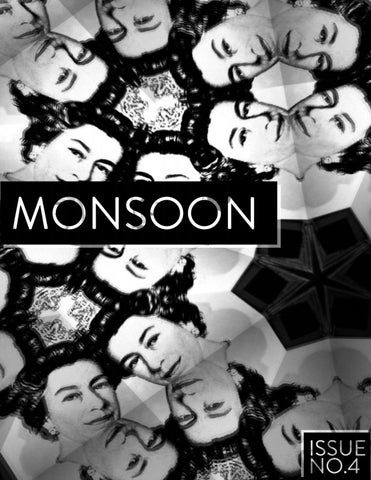
REPARATIONS 1
5.
Demanding an Apology By Shilpa Kancharla
7. 11.
Reparations: a “Matter of Principle”? By Rosa Simonet
The Case of the Koh-i-Noor By Sara A. Khan
15. 17.
Hindustani Heterotopia By Kishan Rana
Robbery or Preservation? By Sharath Rama
Letter from the Chairs
19.
Beyond the Case for Reparations By Chiraayu Gosrani
23. 27.
Race & Bollywood By Afroz Taj
The Personal, The Political, and The Academy By Anisha Padma 2 3
Letter from the Co-Chairs What do you think of when you hear the word “reparations”? For me, it immediately evokes Ta-Nehisi Coates’s seminal work, “The Case For Reparations,” which was arguably one of the most important pieces of texts in awakening my political consciousness. For Sara, the term means the retribution of violence and extraction of resources that have systematically dismantled the infrastructure, culture, and geographies of colonies. For our writers, the theme of reparations inspired range of responses that we explore in this issue. Sara’s piece “The Case of the Koh-i-Noor” explores the history of the mysterious jewel and the coercive circumstances through which it was acquired by the British empire. Sharath’s “Robbery or Preservation?” similarly examines stolen sculptures from a community in Tamil Nadu. One of these sculptures is locked away in an Australian museum where it can be gawked at by Western eyes rather than being venerated by its worshippers. Can artifacts be shared ethically? Kishan takes this in an interesting direction in “Hindustani
Heterotopia” and asks how art can be shared in a global society and how it can be modified without damaging the culture it came from.
The call for colonial reparations was renewed when Indian MP, Shashi Tharoor, of Thiruvananthapuram, presented a speech in favor of reparations at the Oxford Union this past summer. Rosa’s “Reparations: A Matter of Principle?” and Chiraayu’s “Beyond the Case for Reparations” address this speech in different manners. Rosa’s “Reparations: A Matter of Principle?” asks from whom reparations must come from and how they will be distributed. In
Chiraayu states that we must be critical of reparations as an end-result if we still operate in systems that promote oppression. Reparations also refers to a process of remedying injustice. In “Demanding an Apology,” Shilpa recalls personal memories of being shamed for her cultural identity and quite literally, demands an apology from her bullies. Meanwhile, Professor Afroz Taj identifies the tokenization of racial minorities in Bollywood cinema in “Race Bollywood” as a problem that we must fix in India’s entertainment industry. Finally, in my piece, “The Personal, the Political, and the Academy,” I explore the themes of citizenship and belonging as not only appearing in my life but also in her political and academic interests. This issue of Monsoon aims to construct and deconstruct reparations. The battle for reparations requires recognizing the violence of colonization; however, who stands to gain from the monetary or political compensation that reparations provide? How can reparations impact the lives of the victims and survivors of colonization? And, how can we even begin the process of moving beyond reparations if so many colonial powers refuse to grant reparations in the first place? These are the questions that we ask and we can only attempt to answer. Sincerely,
Anisha Padma and Sara A. Khan
DEMANDING AN APOLOGY BY
SHILPA KANCHARLA
I
find myself awake late at night wondering why I was subjected to certain situations. I never know where to begin, so I just ramble profusely until I become one with my bleeding soul. How can I make amends to myself? Am I the only one that owes myself reparations, or is it mainly those who have been the cause of my pain...or was every experience simply due to circumstance? I’ll begin from my earlier phase of life, when I let others define standards of beauty. I was always told that I was of darker skin for a South Asian. This is not wrong. I agree with it. Anyone with eyes can see that I am saturated with a certain degree of melanin. I was comfortable with my melanin concentration. What I was not at ease with, and still am not at ease with, is the connotation that came with it. I was restricted from going outside and playing in the sun not for the fear that it may be too hot or I may faint because of long time heat exposure...rather, the concern was in the fact that my skin would absorb the rays of the burning star. All the energy I wanted as a child was never mine.
5
I do not appreciate the years of smearing skin lightening cream on to myself in hopes that I would one day hatch from my chrysalis to become some beautiful creature whose beauty everyone coveted. I do not appreciate the scalding showers I took subsequently after swimming outdoors and using the questionably manufactured soaps and gels that would somehow erase the sin of being dark. Did my existence depend on being light skinned? Was I a sinner because I was not born with light skin? I suppose that the color of my skin was a part of my fate, and it is something I cannot control.
“Am I the only one that owes myself reparations, or is it mainly those who have been the cause of my pain?” In second grade, a girl told me that she did not like the fact that I was Indian. I should try to be more American...in fact, I live in
America. She let me know that because perhaps she thought the pink matter in my six by six cranium could not process that. She informed me that I should have been conforming to Eurocentric standards of beauty the entire time.
I have vines of black hair growing from the deepest follicles. I was called an animal and constantly taunted for something that was so natural and organic. I did not choose to grow this hair. No one chooses to grow body hair. I would dream that when I came to age twenty, I would have a laser hair removal procedure done. Is that what a second grader should be thinking about? Dreaming about looking aesthetically pleasing to white America? Instead of treating my body like a temple and a garden I would look in the mirror at myself with such great contempt that I wanted to punch the glass. I wanted to punch the very image of myself, hoping that it was just some horrible mirage...and maybe one day, I would look in the mirror and smile instead of raise my eyebrows in anger. I began to shave my body when I was only ten years old. I never knew that within the first decade of my life I was going to experience such extreme ridicule of self-shaming and body-hating. Jumping forward to seventh grade, I purposefully bruised my nose, just to try to stop it from looking so jagged and crooked. My
4 Continued on Page 31
6
7
REPARATIONS: A‘MATTEROF PRINCIPLE?’
THE QUESTIONS WE NEED TO ASK ABOUT REPARATIONS BY
ROSA SIMONET
8
S
hashi Tharoor claimed reparations as a matter of principle, dismissing the questions ‘how much?’ or ‘who to?’ But these issues are far too important to ignore. The demand for reparations should be making us inquire beyond the debt owed and to the remnants of colonial and secretive rule. In May 2015, the Oxford Union held a debate on the motion ”This house believes Britain owes reparations to her former colonies,” in which Shashi Tharoor (member of the Indian National Congress) provided a powerful defence, sparking international debate, as well as support from the Indian state. In his speech, which gained over three million views on Youtube, Mr Tharoor provides examples of the exploitation of Indian peoples and economy for the gain of British colonialists during two hundred year long period of colonialism. He argues the demand for reparations is not a matter of vast amounts of money being given to the Indian government but a matter of ‘principle,’ and that the admittance of a debt owed is far more significant than a percentage in GDP. There is no doubt of the monstrosities committed by the British during the mission of the ‘Great’ empire. As well as those committed in India, the ‘wrongs,’ Mr Tharoor refers to include the slaughter of over 25,000 (22,000 being children under the age of 16) in the Boar concentration camps, the torture of 3000 Cypriots between 1955-1959, the million who died during the Irish potato famine (exacerbated by England’s long-running political hegemony over Ireland) and countless instances of theft both of land and property. Mass genocide, in addition to the economical draining of many of the former colonies, is rightly noted as the cause of the racial and religious tensions in the former colonies still seen today. Shashi Tharoor, following such a justification for reparations, explains how a symbolic admittance to such wrongs would suffice as contemporary Britons have little to do with the crimes committed during colonialism. This should not be the case. Yes, the majority of Britons, both now and during the colonial era, being apart from the ruling elite did not have a say in the methods of Britain’s development and stood to gain very little from the crimes of colonialism. In fact,
9
The Funeral of Mahatma Gandhi
colonial narratives of gender and masculinity which ‘justified’ the brutal mistreatment of many Indians were a reflection of the ongoing class war in England. In 2016, British political rule is still dominated by the elites, who have been found to use unlawful and immoral methods to protect their wealth. There remains vast inequality and exploitation of the working class. If Britain were to pay reparations, where would the money come from? The money should come from the richest in society. From those whose families gained wealth and status as a direct result of colonialism. These families still control or influence a vast amount of British institutions and one in particular consists of the Head of state. The monarchy. The mere existence of the royal family in modern day Britain is representative of the elite’s incapability to tarnish the ‘glory of empire.’ In fact, a key factor of the debates which followed Mr Tharoor’s
Is a symbolic admittance enough? Symbolism is certainly important but is it relevant? If symbolic gestures directly contribute to the dismantling of discriminatory forces, both within Britain and the former colonies and between the two, then yes. But, if, relating to my previous question, they stand as a alliance elite to elite, then no. Should a demand for information come before reparations?
Wikimedia Commons
speech concerned the Koh-i-Noor. The centrepiece of the royal crown ended up in the hands of queen Victoria following the conquest of Punjab in 1849 and is now being demanded back. If Shashi Tharoor is concerned with symbolic gestures, surely the most significant would be the dismantling of the monarchy and the greater elite as a form of reparation. Who would the money be going to? If we were to provide reparations for the former colonies, would the money and land returned be given straight to those society’s elites? The formation of the elites in many of these countries were tangled with the influence of colonialist notions and exercise power through the maintenance of hierarchies dependent on power gained through wealth. Reparations should be symbolic of movement away from the products of colonialism and not part of their funding.
Lack of information or mis-documentation is still a significant issue. Britain’s Freedom of Information Act introduced by Tony Blair in 2000, originally met with widespread enthusiasm, includes 27 exemptions (which implies the act itself half-hearted). Despite this, facts revealed by the act include: - Ministers and MPs claimed thousands of pounds on taxis as part of £5.9 million in expenses for travel. - Seventy-four police officers serving with the Metropolitan Police have criminal records. - A clandestine British torture programme existed in post-war Germany, “reminiscent of the concentration camps.” On an international level the Black Lives Matter movement is fuelled by, not only the lack of concern for the lives of black people, but also the lack of information regarding the deaths of several African American people supposedly at the hands of, often white, American police officers. In many cases what stands in the way of reparations (or compensation) is the lack of information.The ‘right to know,’ (and on a broader level the right to education) should stand above the protection of government policy, government institutions and big business. Without information, the lines of accountability are blurred. If, for instance, the names of the families who gained the most from colonialism and the exploits of colonised peoples, we would have a clear indication as to who should pay for reparations. <
10
11
7
THE CASE FOR THE
KOH-I-NOOR T BY
SARA A. KHAN
he Koh-i-Noor is a recurring item in the long list of demands for colonial reparations. As it currently sits within the Tower of London, amongst the other crown jewels, the Koh-i-noor remains famous not for its perfection, but its controversy and symbolism. Currently, it has multiple claimants (Afghanistan, Pakistan, and India to name a few), but as the British Prime Minister David Cameron stated in 2013, the diamond and other artifacts confiscated during the colonial era will not be returned to any of these countries. Cameron stated that he does not believe in “returnism” and “reach(ing) back” into the past1. Davidji may have some anxiety over this hot button issue, and he fails to recognize in what circumstances the diamond was taken. While the Koh-iNoor’s true history and ownership has yet to be unraveled, it can be concluded that the diamond lives as a metaphor for the coercive and exploitative civilizing mission of British Colonialism in the East2. The
story of the Koh-i-Noor starts at it’s original discovery at the Kollur Mine in Andhra Pradesh in the 13th century. Measuring 793 carats uncut and owned originally by the Kakatiya dynasty, it changed hands multiple times amongst Persianate rulers before transferring to the Mughals. The uncut diamond was placed above the Mughal’s peacock throne until it was improperly cut by a Venetian jeweler. Eventually,
“...the diamond lives as a metaphor for the coercive and exploitative civilizing mission of British Colonialism in the East.” it came into the possession of the Sikh kingdom and remained within their treasury in Lahore until the arrival of the British. The diamond became a symbol
of political power and prestige through its history as a item fought after between South Asian rulers. It is possible to conclude that whomever owned it reigned supreme in the land. However, the repetitive cycle of conquest and acquisition of the Koh-i-noor took an interesting turn during its possession by the British. The narratives about its subsequent delivery and placement onto Queen Victoria’s crown have been a site of contestation not only in South Asia, but also within the British circles. The British maintain that the diamond was rightfully and legally after the First Anglo-Sikh War through the 1949 Treaty of Lahore. A key figure in the British annexation of Punjab was Lord Dalhousie, the governor general of India and governor of Bengal, in January 1848. However, while Dalhousie maintains that this was an “unprovoked” war, many postcolonial historians have suggested that in fact the British had been steadily encroaching on the Punjabi borders after the death of the maharaja Ranjit Singh. Moreover, this treaty was signed by the tenyear old maharaja, Duleep Singh, in a coercive, strategic political move that delivered the diamond to the queen. After the signing, the young maharaja was spirited away to be baptized and anglicanized in Britain, never seeing his mother again. After the treaty, the British had to defend their recent acquisition of the Koh-i-noor from their own British subjects. If 4
12
Britain wanted to maintain its “moral empire” persona, the narrative of Singh “gifting” the diamond to the Queen had to be maintained. Thus, Dalhousie staged a ceremonial meeting where Duleep Singh gave the diamond to the Queen as symbol of his submission. While, due to the rights of war, Singh no longer had access to his treasury or inheritance, it was essential that it seemed like he was willingly giving the famed jewel to its rightful owner, Queen Victoria. The myth of the gift enabled the Company and colonial administration to hide the violence and true destruction of colonial expansion, by showing how willing and submissive the natives were to their enlightened rule. Dalhousie believed that the Koh-i-noor belonged to the British, for he claimed that the the Queen of England was the only one with “so just a title” to possess it and that it would shine until it’s “death” while possessed by the British. Like its previous owner Duleep Singh, the diamond was also “civilized” by the Western sensibilities and removed its “Oriental cut.” The subsequent cutting reduced the Koh-i-noor by 40 percent. The scholar Danielle Kinsey makes the point that this “civilizing” of the diamond changed the symbolic meaning of its possession, removing it from its association with “an outdated imperialism of plunder” it had experienced with the native South Asian empires. Instead, the Koh-i-noor entered the realm of the enlightened. It is these historical myths that are stalling the discussion of colonial reparations. If we are to truly understand the importance of reparations, we must recognize the violence inherent within colonial expansion and administration. While David Cameron may not want to “reach” into the past, we must not make it easy for the Western colonial powers to brush their skeletons under the rug. We must move past the idea that the Koh-i-noor was a gift- when in fact it remains a symbol of the civilizing mission of the British involvement in South Asia. <
13
“However, how can the British
promote their idea of a “moral” and enlightened empire when they pushed a child into3signing a treaty to their benefit ? If all is fair in love and war, why did Dalhousie and others not just admit that the Koh-i-noor was a materialistic spoil of warobtained through bloodshed and coercion?”
10 14
15
11
H
e t e r o t o p i a 1. A term that is usually used to describe the misplacement or displacement of bodily organ1.What must India have felt like when her organs were shuffled around by European powers?
HINDUSTANI HETEROTOPIA
In the 18th century, India contributed to 23% of the world economy, but by the time the British left in the 20th century, it dropped to just around 4%2. With all the resources that were drained to the West, India could not get back to her former state. Even after the colonial powers left India, her wealth has been shuffled around in the form of culture and traditions. For decades, these have been imported into the Western hemisphere — sometimes respectfully, other times damagingly. One great example is Hindustani music. This art form skyrocketed amongst the general public of the West are the Beatles after they released songs such as “Within You Without You” and “Norwegian Wood,” by employing raagas and Indian instruments such as the sitar, tabla and dilruba. George Harrison, the lead guitarist of the Beatles, was personally trained by Ravi Shankar, whom he called “the Godfather of World Music” 3. Harrison also stayed at an ashram in India in order to immerse himself in spirituality and to connect more
BY
with Indian culture and music. Not everyone can have such an opportunity though so does that make the Beatles more valid importers of Hindustani music as opposed to other artists? Well...It depends. Sometimes even with proper training from gurus, artists make a faux pas. The hypnotic and chiming sounds of the sitar appealed to many different music genres such as rock and jazz, which have a history associated with psychedelics in the Sixties. This was never the case in India, as Hindustani music has a lot of ties to spirituality. Only in
“Am I the only one that owes myself reparations, or is it mainly those who have been the cause of my pain?” the West is spirituality equated to drugs. For example, Hindugrass, an amazing fusion band originating in North Carolina, has musicians that
KISHAN RANA
were classically trained in India, but the name of their band is very misleading. Hindu — denoting a follower of Hinduism, and grass — which may allude to drugs such as marijuana, are two completely misfitting terms. With the already growing trend of mysticism in the West, ideas like these and fusion creations, Indian imports risk of being being invalidated. Unlike physical goods, can culture and tradition be repaid? The simple answer is no, but some local Indian-American artists provided some feedback pertaining to the dynamics of their music scenes, which will better help us understand this situation. Viswas Chitnis, a professional Hindustani musician based in Raleigh and New York, was raised in America by immigrant parents. A lot of Indian families that initially moved to America were powerhouse families. These kinds of families often had artistic dynasties due to wealth. For example, the Kabra family in Rajasthan had lots of patronage, which attracted new talents and even non-artists due to their entrepreneurial
4 Continued on Page 31
16
ROBBERY OR PRESERVATION? THE CASE OF THE NATARAJA OF SRIPURANTHAN BY
SHARATH RAMA
W
ith his arms and legs twisting and contorting beneath a ring of fire, there are few Indian symbols as instantly recognizable as Nataraja, or Shiva as the lord of dance. For hundred of years, sculptures of Nataraja have been placed in homes and shrines across south India to represent the destruction of the universe that precedes its eventual rebirth in the cyclical Hindu concept of time.
Courtesy of Idol Wing, Tamil Nadu Police
Missing Idol of Deivanai
17
One day in 2008, the residents of Sripuranthan village in Tamil Nadu were shocked to discover an empty alcove inside a temple where a bronze Nataraja had resided for nine hundred years. Investigators soon found the statue—but thousands of miles away on display at the National Gallery of Australia. The Australians, who had paid over $5 million for the piece, rejected the investigators’ evidence and stubbornly refused to return the statue. The stolen artifact was traced back to Subhash Kapoor, a Manhattan art dealer who is now believed to have run a multimillion-dollar antiquities smuggling ring that involved
hundreds of pieces going back decades. While Kapoor’s investigation by the FBI and subsequent trial brought worldwide attention to the problem of art smuggling, this sort of theft is really nothing new. In the 19th and 20th centuries, European colonialists regularly looted artifacts from around the world to stock institutions such as the British Museum, often under flimsy pretenses. In 1860, French and British troops burned down the Summer Palace in Beijing and took its prized zodiac heads as spoils of war, a humiliating act that stings many in China even today. And in an 1897 “punitive expedition,” the British stole modern-day Nigeria’s Benin bronzes, considered some of the finest examples of African metalwork. But few regions had so much removed as India, which was dominated by colonial powers for almost two hundred years. The British Museum boasts of holding “the most comprehensive collection of sculpture from the Indian subcontinent in the world,” and
they aren’t lying. The museum’s massive London building are packed with Jain, Buddhist, and Hindu images spanning thousands of years, some cut right off the rock faces onto which they were originally carved. Occasionally a visitor bored of Egyptian mummies and Greek friezes will make a quick detour into the South Asian gallery, glancing briefly at ancient sculpture without a second thought as to what they’re looking at or where it came from. And the information placards hardly ever explain the true circumstances behind the object’s provenance. For camera-toting tourists, these statues are little more than “Eastern art,” antiques made of metal or stone that are worth little more than their ornamental value. For the people who inhabit the areas from which these pieces were stolen, however, these objects’ value extends beyond the prettiness of their intricate carvings. Instead, they often hold deep sacred significance and are prized reminders of a cultural heritage that is strongly connected to a specific people and place. The British Museum and its peer institutions argue they are dedicated preserving the heritage of all of humanity and that repatriating any one object sets a precedent that would clear out their collections. But it is impossible to divorce a culture’s tangible heritage from its geographical context. People from a village in rural Tamil Nadu shouldn’t be expected to buy a plane ticket to London or Canberra to see the works of their own ancestors. In 2014, the National Gallery of Australia buckled under
Courtesy of Idol Wing, Tamil Nadu Police
Siva, Uma, and Skanda as a Child, Somaskanda Bronze
11
Courtesy of Idol Wing, Tamil Nadu Police
Missing Idol of Nataraja
international pressure and the Australian prime minister formally returned the Nataraja in New Delhi. Later that year, the statue was triumphantly paraded down the streets of its original home, Sripuranthan. Much, however, remains to be done. It is up to museums across the west to take moral responsibility for the damage done by looting both in the colonial era and today and repatriate stolen artifacts to the countries where they belong. <
14 18
BY
CHIRA AYU GOSRANI
BEYOND THE CASE FOR REPARATIONS 19
“It’s a bit rich to oppress, enslave, kill, torture, maim people for 200 years and then celebrate the fact that they are democratic at the end of it. We were denied democracy, so we had to snatch it, seize it from you.” - Shashi Tharoor, Member of Parliament of India
colonial experience. Colonialism gave rise to racial, religious, ethnic authorities from Hindu nationalism in South Asia to brutal dictatorships in the Middle East and Africa. Advocatesfor remuneration speak of reparations as a moral debt. They serve a dual purpose of atonement for the oppressors and remediation for the oppressed. As Tharoor expressed in his speech, reparations are “a tool for you [the British public] to atone for the wrongs that you have done.”
I
n his July 2015 speech before Oxford Union, Indian MP Shashi Tharoor made a compelling case for British reparations for colonialism. Britain’s rise was financed by its depredations in India, argued Tharoor. Its industrialization was premised upon the deindustrialization of South Asia and the extraction of its labor and capital. Under British colonialism, India went from holding 23 percent of the world trade to less than 4 percent. Today, many of the problems facing ‘post-colonial’ societies have arisen from the
C
ritics of reparations often emphasize the difficulty in identifying the victim and quantifying the intergenerational damage that oppressive institutions have exacted. Who is the oppressor? Who is the oppressed? How do we quantify the moral wrong that has been committed? The shortcomings of reparations, however, run far deeper than the shallow predicament of who and how much. Such discourse in fact obscures the reality at hand: That reparations still operate within a social order framed by the colonial experience. Rather than reconciling moral wrongs, reparations only legitimize the social malaises resulting
from colonialism and global capitalism. Take the example of German reparations for the Nazi genocide, which famed Black author Ta-Nehisi Coates exalted in his case for reparations. The compensation itself was not directed to the Jewish victims of the Holocaust, but rather to Israel, the nationstate whose origins itself can be traced to the violent seizure and extraction of Palestinian land under the British colonial project. Setting aside the false and ahistorical conflation of Zionism with Jewish victimhood, the billions that Germany gave to the Israeli state were invested in its military, the state’s arm of colonial expansion, invasion and occupation of Palestinian land and people. As journalist Max Blumenthal writes, “The cash flow from Germany went directly to the Israeli occupation machine that has made Palestinians indirect victims of the Holocaust.” This flow of material wealth arose from a moral reckoning, yet facilitated a moral reckoning of its own. In this conceptualization of reparations as moral debt, India can at once demand reparations from Britain while also owing a debt to the Dalits and Adivasis who have been systematically oppressed under the caste system and development alike for centuries. Today, Dalits not only face systematic discrimination in the forms of casteism, but also through the pervasiveness of
4
20
social practices. Although untouchability is illegal in India, casteist attitudes such as refusing to share the same utensils and objecting to walk on the same sides of the road as Dalits are still prevalent. Adivasis, individuals who identify as indigenous or tribal, are violently displaced by India’s various development projects. Because Adivasi regions coincide with Maoist strongholds, the Indian government has swiftly displaced Adivasi communities under the guise of national security. As a result of the Armed Forces Special Powers Act, many Adivasis were and continue to be massacred and raped — stripped not only of their bodily autonomy, but also of their land, property, and labor. When Dalits and Adivasis disrupt the social order, the state does not hesitate to show them their structural place. The case of India exposes the moral duplicity of reparations. Much like the state of Israel, the government of India claims to be the victim of
colonialism, while its authority is undergirded by caste capitalism. How can we guarantee that the reparations granted to India for centuries of British colonialism will not be repurposed towards ongoing state-sanctioned terrorism against Dalit and Adivasi communities? Beyond this moral duplicity, it is this transacting of oppression in its material forms that should really give us pause. Reparations are minted in the same currency as exploitative capitalist systems and thereby sanction the oppressive ordering of society that necessitates reparations in the first place. Whether reparations take the form of a symbolic moral reconciliation or material empowerment for the oppressed, their transactive nature renders marginalized people as monetary, their bodies as commodities and their subjugation as debts to be paid. Wikimedia Commons
21
The question should not be how much is owed or to whom, but whether or not reparations are the correct means of atoning for injustice, remedying wrongs and recognizing how systemic oppression permeates our past, present and future. The question should really be whether reparations radically reconfigure the ways in which we conceptualize our society. The answer must be that they do not. The monetization of violence, destruction and displacement resulting from racial capitalism and white supremacy rejects the nuances of marginalized experiences such that atonement becomes shallow and remediation obsolete.
Reparations exist in a colonial past without foray into the colonial present. Perhaps this radical imagining is not occurring through the transacting of reparations, but instead through the discourse surrounding the concept itself. In these forums, we seek to identify the ordering of society that gave birth to our being and reconcile our present with our past. We give meaning to our oppression and name its origins under the fabric of colonialism and racial capitalism. Our pursuit then should not be to remediate, but rather to disassemble. <
Wikimedia Commons
Shashi Tharoor recently spoke at the Oxford Union advocating in favor for reparations.
22 18
RACE &
BOLLYWOOD PORTRAYALS OF ADIVASIS AND AFRICANAMERICANS IN INDIAN CINEMA BY
AFROZ TAJ
The concept of “race” in the Indian imaginaire has rarely been addressed in the scholarly literature because other societal rifts and tensions, particularly caste, religion, and gender, have demanded more attention. Race plays a significant role, however, both in the ongoing projects of Indian national integration and decolonization, and as India’s film and literary products engage with the process of cultural globalization. The Hindi-Urdu cinema includes a long tradition of portraying race in stereotyping and essentializing terms, especially in its othering of tribal peoples in the film-song sequences that are a trademark of mainstream popular film. This essay explores examples of racist portrayals of tribal peoples in Bollywood films songs.
23
The social construction of race, particularly with respect to India’s Adivasis or tribal peoples, emerged in the colonial period: the cataloging of racial differences between colonizers and colonized was eventually applied to the classification of ethnic diversity within India. One of the most unfortunate features of this undertaking was the European notion that human races are distinct and that they can be arranged into a vertical hierarchy according to some index of cultural superiority.
been challenged, interrogated, and in some cases rejected outright by recent century scholarship, but in this paper we are concerned primarily with its stubborn persistence in the visual and aural imagery of Indian cinema. The most common manifestation of this notion is the portrayal of Adivasis, tribal peoples living in the remote forests and hills of the Indian subcontinent. This stereotypical presentation assumes that all Adivasis are racially different, primitive, sublingual, and culturally isolated. Further, often tribal peoples are conflated with gypsies, nomads, and other marginalized peoples.
What are the underpinnings of “race” in Indian creative culture? The most fundamental is the notion of the Aryan-Dravidian divide, which itself becomes a trope for the historical process of racial encounter in South Physically, the “film-Adivasis” Asia. This fraught notion has are portrayed as having thick
features, curly hair, and dark complexions, often appearing stereotypically “African.” They wear minimal clothing, but are adorned extravagantly with bones, beads, feathers, and other accouterments marking them as “tribal” peoples. These characteristics, in addition to being demeaning and reductive, link these “film-Adivasis” to racial stereotypes found in other world cultures, for example of Native Americans and especially Africans. Complexion, especially, becomes a key determinant of racial difference1. In Bollywood film-Adivasis are in many cases literally painted black to mark them as racially distinct.
“Black-face” as a performance convention is familiar from the American theater where white and sometimes black actors painted their faces in order to create stereotypical AfricanAmerican characters on stage. An analogous phenomenon occurs whenever tribal peoples are portrayed in a Bollywood film, almost always as members of the chorus line, the exotic backdrop for a song-sequence. FILM-ADIVASIS Let us look more closely at some examples of the tribal song genre in popular film. A classic instance is found in the song “Hum bewafa hargiz na the” from the film Shalimar (Krishna
Shah, 1978). Musically, the song is not without its charms. The song is structured around the artful counterpoint between the over-arching main melody sung by Kishore Kumar, with lyrics in Urdu, and the sub-lingual vocalizations of the “tribe.” There are numerous points of contrast between the hero’s song and the tribal accompaniment both sonically and visually. The song is picturized at night, with the hero, Dharmendra, in a lighted, second-story room of a house overlooking the sea. The tribe is moving along the beach, carrying burning torches, so their individual features are obscured by darkness and by motion. We can see, 4
24
however, that they are wearing uniform costumes of red or blue: both men and women have short, dhoti-like lower garments while the women have narrow bodices as well. All are bedecked with what seem to be cowrie shells and feathered head-dresses. Although Dharmendra is initially shirtless, he picks up a shirt from the bed and by the time he begins to sing, he is fully dressed. This action distances him from the half-naked “savages” of the tribe, highlighting the visual contrast between the hero and the chorus line. Another point of contrast is the vertical distance between hero and tribe as he looks down on them from his second-story perch. Before the main melody begins we hear low male voices singing open vowels over a syncopated drum beat. This is presumably the voice of the tribe approaching along the beach. In response to the approaching sounds, Dharmendra gets up and moves toward a large window. The tribe sings nonsense syllables: “jhingalala hoo” punctuated by more aggressive, emphatic vocalizations, “hurrr, hurr!” These vocal gestures are accompanied by thrusting motions of torches, hands, and
25 21
heads. Kishore’s melody consists of long phrases with every fourth note prolonged for at least three beats, while the tribe’s interjections are brusque and imitative of animal sounds. Between asthayi (refrain) and antara (verse), the tribe’s vocalizations recommence. The tribe is picturized throughout as walking in single file or “marching formation” along the beach. Their gestures are cryptic: one particular gesture, the rhythmic beating of head and chest with both hands, seems to be a mourning gesture, but there is no additional evidence to support this interpretation so
it may be merely an example of exoticization. In another short clip, the tribe is seen kneeling on the sand, raising its hands in a gesture of what might be interpreted as adoration. This pose-gesture combination is surprisingly common in the tribal song genre: we might read this as a symbol of tribal capitulation before a superior culture. After the antara, when the asthayi returns, the tribe’s vocalizations continue as rhythmic and melodic counterpoint to Kishore’s soaring lines. Visually, the constant motion of the tribe is contrasted with Dharmendra’s
complete lack of motion: his pose at the window remains static throughout the song. He is shown in tight close-up when singing (i.e. lip-synching) and in slow zooms from a camera positioned on the beach below to re-establish his position within the scene.
tribal stereotyping is found in the film Love in Bombay (Joy Mukherjee, 1971). This film is unusual in that although it was made in 1971, Joy Mukherjee chose not to release it; it was only released in 2013. The film contains the song “Na main boli” sung by Asha Bhosle and picturized on Waheeda Rehman. The song begins with a frightened Waheeda Rehman seated in the foreground with a tribe dancing around her. The tribe’s gestures and vocalizations are threatening and the chief laughs maniacally. They are wearing red grass skirts, and the requisite cowrie shells and beaded necklaces. Although the scene here too is at night, the actors’ skin has obviously been darkened with black paint. Waheeda’s fair complexion stands out starkly against the dark skins of the tribe, although she too wears a red grass skirt and red blouse decorated with white flowers.
“Hum bewafa” contains several typical elements in the portrayal of film-Adivasis. It provides examples of simple techniques by which tribal peoples are exoticized and otherized in Bollywood. The tribe’s costumes, ornaments, gestures, and vocalizations mark it as primitive and uncivilized, while the picturization removes any possibility of individuality and familiarity. The tribe dresses, speaks, and moves as one. The positioning of the tribe within the sequence is significant as well: they are in the background, in the interstices of the miseen-scene. If a non-tribal character is present, he/she is spatially above or in front of the The first 1:25 minutes of the tribe at all times, foregrounded song consist solely of rhythmic by the cinematography. nonsense chanting and animalistic exclamations of the The tribe produces diegetic tribe to a frenzied drum beat. sounds which may be musical, The tribe’s faces are painted but are mainly included for with white “war-paint” to make purposes of rhythmic contrast, them even more frightening punctuation, or interlude. If they and they sport frizzy afros. are given lyrics at all, the lyrics They approach the heroine are nonsense, exclamations, threateningly, while she cringes gibberish, or some artificial, and cowers in fear. They pull counterfeit tribal language. Waheeda’s arms and throw her to the ground as they dance in a A second, egregious example of semicircle around her.
At 1:26 she catches sight of the hero (Joy Mukherjee) hiding in a thatched hut. At this point a string orchestra enters dramatically and plays the musical introduction to the song. Waheeda’s fear is instantly transformed into joy; she smiles broadly, gets up and starts dancing. The tribe falls to its knees and kowtows to the heroine as she spins and leaps triumphantly before them. Only the chief continues to laugh uproariously as before. Then just before Asha begins to sing, pairs of tribals shout “hoo-haa” into the camera, with wide-open mouths and slavering tongues. The same sonic stereotypes are invoked: the gibberish, the roars and screams, the percussive rhythms, the violent exclamations. It must be remarked that Love in Bombay, like most Bollywood films, makes no pretensions toward realistic depiction of its subjects. It is neither set in any identifiable geographical region, nor does it convey any ethnographic information. The film-maker has created a fantasy; why would audiences expect a portrayal of reality? But this is precisely the insidious and harmful nature of stereotypes: by presenting caricatures of tribal peoples we dehumanize and marginalize them. The production and consumption of these exaggerated images in the popular media obviates the possibility of actual 4 Continued on Page 32
22 26
THE PERSONAL, THE POLITICAL, AND THE ACADEMY BY
D
uring this year’s presidential election, I am not voting for Bernie Sanders or Hillary Clinton or even Jill Stein. This is not some radical political statement. I am not voting because I am unable to. I am not a citizen, despite having lived in the United States since 2001. The exclusionary immigration policies of the U.S. government formed a large part of my identity and whether I called myself an Indian or an American. Experiencing disenfranchisement is a constant reminder that while it is a privilege to live in America, it does not equate to the privilege of belonging in America. And so, this dichotomous feeling of not belonging yet also being privileged made me really consider what I wanted to do for the rest
27 23
of my life. I’m still not sure, but as I travel the memories that have gotten me to this point, I recognize the recurring personal themes of citizenship and belonging inhabiting my future academic and political work. I was born in Hyderabad, India to two medical doctors from the Padmashali community, which falls under the Other Backward Class category, a “distinction” used by the Government of India to identify socially and economically disadvantaged communities. However, it should also be noted that the most historically disadvantaged groups and communities fall under the Scheduled Castes and Scheduled Tribes categories. My parents saw their profession as the catalyst for upward mobility. In
ANISHA PADMA
fact, they attribute the ability to immigrate to the United States to their professional careers. Despite spending most of my life in America, I still speak with my parents in Telugu. I thought that by keeping some semblance of my “roots” it would mean I was culturally grounded. However, it was not until I arrived to college that I was given the opportunity to explore my cultural background as a field worthy of academic study. Pressures connected to selective U.S. immigration policy, racialization, and my family’s class position initially compelled me to pursue the sciences. After all, as the daughter of two Indian medical doctors, I was always expected to pursue the path of my parents. But the sciences 4
24 28
left me feeling incomplete, and halfway through my studies and through difficult conversations with my parents, I convinced them to let me navigate a field that was both uncharted and yet familiar: the study of my cultural origins. My exposure to scholarship in the history of India began with the Partition. In addition to short stories by Manto, I read pieces by Ayesha Jalal, Gyanendra Pandey, and Urvashi Butalia. I was particularly shocked to find rhetoric that manipulated women’s bodies for the preservation of national honor in the speeches that Gandhi delivered a year before his death. This pushed me to evaluate the nation in gendered and sexualized terms. It was also during this time that I understood the concept of marginalization as well as the process of “Othering.” Reading Benedict Anderson’s Imagined Communities challenged how I defined the nation as well as the home. I realized that nationalism requires an imagination of what we signify as shared characteristics belonging to a particular community, and it also necessitates the creation and exclusion of “Others.” My frustration with Othering and with the discourses in modern South Asia being dominated by Gandhi, Jinnah, and Nehru brought me to consider subaltern studies. But after a cursory reading of Spivak, which led me to her conclusion that the subaltern cannot speak, I felt pessimistic about any possible contributions to History. If I truly want to work to “empower” the most marginalized communities, how do I go about doing this? The communities that I really hope to learn more about are the Siddis, who in some scholarly works are also referred to as Habshis, and are of African descent. They are categorized as a Scheduled Tribe and face extreme racism and poverty. Having engaged with anti-Blackness in the context of the United States, I wanted to bring this discussion to India to grant more rights to these communities. I desire to further research this area so that I can add to the body of conscientious scholarship on Siddi communities, promote discussion on their marginalization, and support pre-existing political work around the self-determination and autonomy of these communities in the future.
29 25
Deviating from the medical school path certainly resulted in strong outcries from my family, who initially failed to see history as a subject worthy of further study. “What’s the use of something that happened a long time ago?”, they challenged. To me, this displayed the tremendous lack of understanding of the connection between historical events and current political processes and systems, something that I hope to ameliorate. One vivid example of this lack of public consciousness includes the relationship between the enumeration of religious identities in the colonial period and the contemporary challenges that exist in India today. Being a Hindu originally denoted a geographic indicator; however, after the colonial period, the label referred to a diverse collection of faith traditions as specific to one religious practice. Hinduism was amalgamated into a monolithic structure, defined by the texts and practices of the elite Brahmins. the current political realities in India such as “beef bans” demonstrate how history can be revised and deployed to maintain the power structures that benefit the privileged and elite. While my pursuit of History is deeply rooted in my dedication to contribute knowledge that benefits communities affected by structural violence, it is also personal. As someone who experiences disenfranchisement in one context yet privilege in another, I feel a moral obligation to remedy these injustices. Although I’m aware that I may not be able to topple capitalism or eradicate white supremacy, I can demonstrate intellectual resistance to normative frameworks in my future contributions to academia. I hope to discover transformative ways to imagine our histories as well as the histories of those we have erased. <
26 30
Demanding an Apology
Continued from Page 5 nose bled and bled and I sat there and cried on the bathroom floor. I cried tears of joy because finally, I had a straight noise. One that made a sixty degree angle from the indentation of my brow bone from where my nose would start to take its shape and raise. Finally, I controlled an iota of my fate. I was able to rewrite it by breaking it. After I got contact lens and my braces off, people approached me and told how much more pretty I FINALLY became. I was apparently “easy on the eyes” without my glasses or braces. In fact, I was so pretty that this one girl was almost jealous of me. Just almost. This is the closest I had ever made it to feeling good about my appearance in life. I was slowly climbing up the social hierarchy. I was still at the bottom because my non-Eurocentric qualities still stood out. Black hair, brown skin. I still was not good enough. Now...I have changed. I apologize to myself for all these events. I apologize for letting years of internal misogyny, colorism, racism, and words nest and brood within me. I apologize to myself for not taking care of myself and realizing my self-worth. I apologize to myself for denying my South Asian identity. I should have been dreaming about my future, my goals, and how I could become a better individual instead of
31 27
tearing down the individual that already existed. I should have been watering myself with love, growing chrysanthemums instead of poison ivy on my organs. I should have been the starry-eyed girl that I had always dreamed of being floating around in this vast, navy and silver universe. Beyond the melancholic romanticism that has germinated from years of self-loathing, I demand an apology from those who have caused me heartache for years. Moreover, that apology is not for me. I want it to manifest itself not in simplistic, shallow words, but rather in complex, progressive actions. I ask that you not make fun of anymore South Asians for their features, factors we cannot control. Teach your children the same. Perhaps this way, we can foster generations that do not breed hate, but rather acceptance and tolerance to pave a way to eliminate bias based on appearance. I suppose that this one of the only reparations I could possibly ask for. <
Hindustani Heterotopia
Continued from Page 16 status. Today immigration has opened up to a more diverse population with people like Chitnis, but availability of cultural knowledge is not equal. Hindustani music is not limited to Indians, just as jiu-jitsu, which started in Japan, has moved its capital to Brazil. It’s foolish to limit artistic ideas. According to Chitnis, “some
people have lots of talent, but intent trumps talent. Hindustani artists that survived, survived by having the social skills to teach or by being savvy to go on tour. You can make money off of fusion music, but that’s just artists being musicians. It has to have a name even though the name fusion is so generic.” Contrasting the Hindustani scene, Kevin Venom is an IndianAmerican rapper based in South Carolina, who faces a different kind of challenge in his music scene. Growing up in a Indian family, his parents displayed anti-Black sentiments subconsciously, and would disapprove of his passion for music and rap due to its association with Black culture. Rap is a major component of hip hop music, which originated among the African American community largely as a response to oppression and slavery. Many critics say that rap is reserved for the oppressed, and it should be - but does this stop at African Americans or does it extend to other groups as well? From Macklemore winning a Grammy for rap over his Black contesters, to Iggy Azalea making it big with her appropriative rap, Venom does feel like an outsider in his scene sometimes, but he is mindful not to “over-step or steal the style.” He uses rap as vehicle to cope with mental health, spirituality, and personal experiences, since “it’s all about getting the message out there.” The long answer for whether
culture and tradition can repaid for is that artistic expression transcends material possessions. It is a systematic way to express creativity and emotion amongst the creators and admirers alike. If the West is able to popularize underground and fusion Hindustani music, then the Indian counterparts should also be recognized for their talents. The radio needs to play less world music and more music. I am sure that India would be happy to know that her music was not misplaced, but rather simply displaced with proper entitlement. <
Race & Bollywood
Continued from Page 23
communication or interaction with the Other that in turn might serve as a precursor to progressive social integration and justice. The images become clichés, tropes that reduplicate themselves; the intent of the film-maker may not be to dehumanize tribal peoples, but the effect is produced nonetheless. Whether we take the tribe in “Na main boli” to be African, Polynesian, or Indian, it is positioned it in an inferior relation with respect to the faircomplexioned heroine and hero. The tribe’s actions underline its subjection to the dominant race: at first threatening, it is quickly subdued and subsequently
duped by the lone heroine. A more recent example may be found in the 2013 film Gippi, produced by Karan Johar and directed by Sonam Nair. This film contains an unpleasant sequence re-evoking the worst racist stereotypes of Bollywood. Gippi is set in India, in a boarding school. The titular protagonist and her little brother Booboo present a surprise dance item in the context of the school elections. They appear in grass skirts and leaf garlands, and Booboo is in black-face with an afro wig; they dance to the song “Yahoo! Chahe koi mujhe junglee kahe” from the 1961 film Junglee. Although in the 1961 film song there are no visual or aural references to the Adivasis, the word “junglee” evokes a semantic field including “wild” and “ill-mannered” as well as “forest-dweller.” The latter meaning is visually evoked by Gippi and Booboo’s costumes and dancing styles. In this reversion to the black-face, afro-sporting stereotypes of Adivasis in Bollywood we find evidence that these negative portrayals are embedded deeply in Indian culture and extremely difficult to eradicate.
out of India’s colonialist past, but persist into the present. The representations operate on many levels and permeate both the visual and musical textures of the sequences in which they appear. Indian commercial films thus continue to deny members of Scheduled Tribes agency and the ability to speak for/represent themselves. By performing tribal-ness in reductive and patronizing ways, these films indulge in an act of violent co-optation that must be interrogated and ultimately rejected. <
CONCLUSION In our brief survey of race in Bollywood, we have discovered that representations of Adivasis in Indian films are racially charged, stereotypical, and often offensive. They emerge
28 32
References: The Case of the Koh-i-Noor 1. “Britain to India: Diamond in the royal crown is ours.” Reuters, Feb 20, 2013. Accessed 13 April 2016. < http://www.reuters.com/article/ us-britain-india-diamondidUSBRE91K00J20130221>. 2. Kinsey, Danielle. 2009. “Koh-i-Noor: Empire, Diamonds, and the Performance of British Materia Culture.” The Journal of British Studies, 48 (2). 391-419. 3. Kinsey, 2009. Hindustani Heterotopia 1. “Heterotopia.” Dictionary. com. N.p., n.d. Web. 21 Mar. 2016. 2. “Viewpoint: Britain Must Pay Reparations to India.” BBC News. N.p., n.d. Web. 03 Mar. 2016. 3. Nye, James. “Ravi Shankar, Legendary Sitar Player Whose Music Inspired The Beatles Dies Aged 92 .” Daily Mail. N.p., 13 Dec. 2012. Web. 21 Mar. 2016. Robbery or Preservation Ilangovan, R. “The Great Indian Idol Robbery.” Frontline, January 24, 2014. Accessed 13 April 2016. < https://docs. google.com/document/d/17HN mzuyyPPdy5jlUCtPV494Evg9 JqscRdFsH2Fhafpk/edit>.
Beyond the Case for Reparations 1. Feroz, Emran. “Germany made Palestinians ‘indirect victims of Holocause,’ says author Max Blumenthal.” The Electronic Intifada, November 14, 2014. Accessed 13 April 2016. < https:// electronicintifada.net/ content/germany-madepalestinians-indirect-victimsholocaust-says-author-maxblumenthal/14030>. 2. Feroz, 2014.
In This Issue: 1. “Queen” Design Element Courtesy of Pixabay 2. Letter from the Editor: Photography by Kishan Rana, Graphic Design by Kishan Rana and Hamza Butler 3. Demanding an Apology: Photography by Sara Khan, Graphic Illustration and Graphic Design by Kishan Rana 4. Beyond a “Matter of Principle”?: Images Courtesy of Wikimedia Commons 5. The Case of the Koh-i-Noor: “Queen” Design Element Courtesy of Pixabay 6. Hindustani Heterotopia: Photography and Graphic Illustration by Kishan Rana
7. Robbery or Preservation: Images Courtesy of Idol Wing, Tamil Nadu Police 8. Beyond the Case for Reparations: Images Courtesy of Wikimedia Commons 9. Race & Bollywood: Images from Google Images, Graphic Illustration by Kishan Rana 10. The Personal, the political and the Academy: Images of Gayatri Spivak and William Muir, Courtesy of Wikimedia Commons, Illustrations by Kishan Rana, Graphic Design by Sara Khan
CONTRIBUTORS
Writers
Editors
Shilpa Kancharla Rosa Simonet Sara A. Khan Kishan Rana Sharath Rama Chiraayu Gosrani Anisha Padma Afroz Taj
Anisha Padma
Chiraayu Gosrani
Artists
Kishan Rana
Faculty Advisor Afroz Taj
Art DirectOrs Sara A. Khan Hamza Butler Kishan Rana
Sponsors
Carolina Asia Center, Carolina Center for Global Initiatives, Carolina Creates, Title VI Grant from the Department of Education, Cholanad, Mediterranean Deli