WOVEN THREADS The Shared Translations of
Judith Kornett & Virginia Sperry
WOVEN THREADS The Shared Translations of
Judith Kornett &Virginia Sperry UNIVERSITY OF MARYLAND GLOBAL CAMPUS ARTS PROGRAM
1
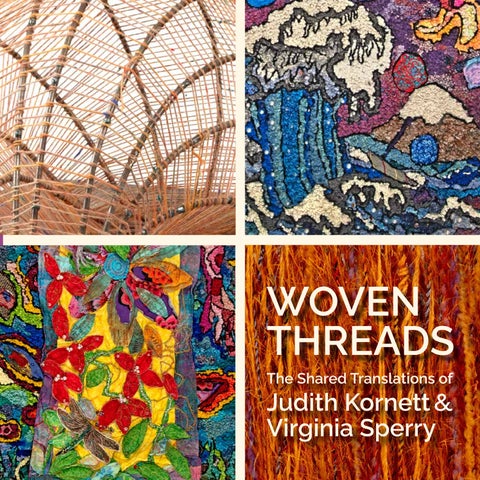
Cover Artwork: (clockwise from top left) Virginia Sperry, Very Tired (detail) Judith Kornett, Hokusai, I Love You (detail) Virginia Sperry, Life Forms (detail) Judith Kornett, Madonna and Child (detail of Madonna) Inside Cover: Virginia Sperry, Life Forms (detail) Title Page: Judith Kornett, And Her Not Glass Slipper
2
KATHERINE LAMBERT
President’s Statement On behalf of University of Maryland Global Campus (UMGC) and the learners we serve in Maryland and around the world, I am pleased to introduce Woven Threads: The Shared Translations of Judith Kornett and Virginia Sperry. Kornett and Sperry are masters of textile art, and—as is often the case with masterful work—their pieces are constantly poised to surprise us, introducing materials, objects, and stories in new and novel ways.
TRACEY BROWN
Working with fiber and a range of other materials, these two Maryland artists transform the familiar into the unexpected, inviting us to pause, examine each piece more closely, and— through the interplay of color, shape, and texture—discover new perspectives.
At UMGC, we believe learning is a lifelong journey, shaped by curiosity, discovery, and growth. Art is part of that journey, and exhibitions like this one extend learning beyond traditional settings and create opportunities for connection and insight. We are grateful to the Friends of the Arts Program, the Maryland State Arts Council, and the Wolpoff Family Foundation for making this exhibition possible, and to our own UMGC Arts Program for continuing to bring the vision and perspective of artists like Judith Kornett and Virginia Sperry to our community. I invite you to spend time with Woven Threads and to discover, thread by thread, the stories these artists have to tell. Gregory W. Fowler, PhD President University of Maryland Global Campus
Director’s Statement Who are Judith Kornett and Virginia Sperry? Both are Maryland-based artists who have woven their way into the art world through fiber. Both employ color and texture in their works. And both use their artistic creations as a form of expression to relay messages to the viewer. Like most artists today, Kornett works in various media, which have become vehicles for her artistic journey and her political and social ideas. Each colorful work of art embraces texture and expresses a story, much like story quilts do. Kornett begins the creative process with a concept of what she wants to make. Sometimes the idea is vivid in her mind. Sometimes the finished product is quite different from the original concept. But the act of spinning her own yarn and hooking it into a tapestry to create an expression of her vision has given Kornett a sense of fulfillment as an artist.
Also creating art from fiber and other media, Sperry has crafted three-dimensional works that combine fiber, steel, and ceramics. Throughout her artistic journey, she has explored a variety of media, including polymer clay, wood, and paper. Delighting in learning the peculiarities of different media, Sperry focuses her approach on the material itself, exploring limits, discovering strengths, and testing boundaries. Her pieces tend toward the abstract and complement Kornett’s more figurative work. The UMGC Arts Program is proud to present this body of works by Judith Kornett and Virginia Sperry. Eric Key Director, Arts Program University of Maryland Global Campus
3
COURTESY OF THE ARTIST
Judith Kornett
Judith Kornett
Virginia Sperry
4 Virginia Sperry MICHAEL MASON STUDIOS
MICHAEL MASON STUDIOS
From the Curator
THREAD, PAPER, AND FIBER are used in nearly every aspect of daily life, but how often does one explore the range of forms these materials make together? The lines between identifiable forms and abstractions can be blurred; techniques such as tufting, fastening, weaving, and welding all challenge the divide between making fine art and model crafting. Judith Kornett and Virginia Sperry prefer to use process to manifest their messages. They both introduce a conversation-provoking thought that evolves into an eccentric puzzle. The challenge is to unravel the riddle. Much of Kornett’s textile production follows a somewhat traditional approach that spans the entire process, from spinning fibers into yarn and making that same yarn into finished tapestries, clothing, and sculptural characters. These creative expressions broaden the narrative of how environment-building shapes artistic interpretation. Kornett’s creations are informed by the shape of the struggles of her subjects. She takes her inspiration from the freedom fighting of the 1960s and ’70s. Blending whimsical environment-building with fine art to communicate observations of social and political frameworks, she uses contour and texture to create visceral conclusions. To accomplish this, she incorporates space availability, sizing or stature, patterns, and texture and movement into contextual forms. Kornett is comfortable holding a subject or subject matter until she understands it, as well as working within organizational systems. She begins with a concept and builds one strand at a time. Her works compare, contrast, and reassemble new or redirected stories. For example, in Centaur and Angel (2025), she introduces two subjects that exist in different ideologies and therefore normally do not interact. The hooked rugs Madonna (2025) and And Child (2025) and the mixed-media piece Child’s Rocking Chair (2025) are all vehicles for a reimagining of the Madonna and Child. The whimsical energy Kornett’s works produce is difficult to match or assign to a genre. The complement to these pieces is the duplicity of Sperry’s works. The dichotomies that are analyzed and discussed are juxtaposed
against social issues and uncommon imagery that at first glance do not match. However, the harsh subject matter is made more palatable by the soft, sometimes frilled, outer nature of the animals and objects she portrays. Sperry tests limits, experimenting with the literal thresholds of her working media. She welds, she builds a frame, and she softens her surfaces. The appearance of these pieces often deceives. The viewer sees vibrant, fluffy yarns, not the works’ rigid inner framework. Some sculptures have a pillowlike look that in reality is sharp and rigid. One of the largest pieces in this exhibition is Sperry’s Redlining (previously exhibited as Un/Familiar Territory; dimensions vary based on custom installation), a site-specific artwork that exemplifies environment-building with a bold statement. The work’s expansive size and placement choice reflect Sperry’s societal observations. This installation—teamed with highly detailed, satirical, caricature-like sculptures; textile-anchored mixed-media works; and paper manipulations—transforms the viewer’s brisk pace to slow, thoughtful examinations. The complexities and challenges Kornett accepts are fleshed out in fabrication or fiber. Sperry takes on social responsibilities and visceral material perceptions. They both dig deeply into their processes and are genuinely interested in what the viewers have to say. The choice to render fiber as well as research its varying behaviors is again mutual. The softness of the media is the foundation for the connection between these two artists, both in physical application and in interpretation of their works. The shared translations that hard can be soft and that malleability can be used to define fixed problems or issues are present in both creators’ works. With their art, Kornett and Sperry give viewers an opportunity to examine common perceptions through a new lens. The benefits of these lenses expand the longer the viewers study each work. Treston Sanders Curator, Arts Program University of Maryland Global Campus 5
6
JUDITH KORNETT
PEOPLE SEEING MY ART FOR THE FIRST TIME often comment that color must be my most important artistic identifier. While I deeply love what color can make happen in a work and spend a great deal of time finding the color most suitable for an image, it is, for me, a means to an end. Color is never my purpose. It is instead a tool that allows me to pursue my true artistic goal, the exploration of my own very personal archetypes, both new and old, as they have developed throughout my artistic career. The various media I use to create serve much the same purpose in my creative process. The final product is meaningless if it cannot be viewed in an appropriate grouping that demonstrates how it correlates to other related pieces. Most people are familiar with the theory of archetypes defined by the Swiss psychiatrist Carl Jung. Jung’s theory states that the human psyche is a product of a collective consciousness defined by consistent universal and specifically defined symbols and motifs. The archetypes and symbols in my art, however, are not intended to be universal, nor do they have predefined or consistent meaning. Instead, they are tools for opening a conversation between the viewer and the art itself. My archetypes have personal meanings and historic implications, but these can and do change at any given moment, under any given personal circumstance. As an artist, I typically create three to five pieces in different media—such as printmaking, collage, and fiber—at the same time, using the same or similar archetypes and symbols in both similar and vastly different ways. These separate pieces are, together, part of one encompassing piece. Indeed, this is part of my conversation with myself throughout the creative process.
“
My archetypes have personal meanings and historic implications, but these can and do change at any given moment, under any given personal circumstance. —JUDITH KORNETT
Jung’s archetypes included concepts such as the hero, the shadow, and the caregiver, among others. My own are different in that they are recognizable as physical images or pieces of images, such as the bird we know as a raven, steampunk elements, specific self-portrait images, or repetitive shapes and patterns. To meaningfully exhibit my work in an approachable and understandable manner, I believe it is necessary to display related pieces (which I refer to as suites) together, allowing the viewer to identify and translate my imagery across the various media I employ. Whether this leads to a conversation limited to the viewer and my art; between the art, the viewer, and me; or any other permutation is irrelevant. If a meaningful conversation or reaction of any manner is elicited, my work has accomplished my most desired goal.
Left: Hokusai, I Love You 2025, hand-spun fiber 50 x 37 in. 7
Centaur and Angel ca. 2024 block print on paper, ed. 15/15 24 × 18 in. 8
The Water ca. 2026 mixed media on paper 31 × 22 in.
9
Poseidon and Pets ca. 2024 block print, ed. 2/10 19½ × 25 in.
10
Three More Ravens ca. 2025 mixed media on paper, ed. 6/6 25½ × 19½ in. 11
The Naked Truth n.d. mixed media on paper 30 × 22½ in. 12
And That’s the Truth ca. 2025 block print on paper 30 × 23 in. 13
Judith Had a Little Raven ca. 2023 mixed media on paper 22 × 30 in.
14
Let There Be Birds ca. 2023 mixed media on paper 28 × 18 in. 15
Not His Fault ca. 2025 collagraph on paper, artist’s proof 26 × 20 in. 16
Drawn and Quartered ca. 2024 mixed media on paper, ed. 10/10 12 × 9 in. 17
18
Eyes Left, The Middle, and Eyes Right, ca. 2024, mixed media on paper, three parts, 8½ × 20 in. overall
19
The Elephant in the Room ca. 2024 mixed media on paper 24 × 17 in. 20
Endangered ca. 2025 block print on paper, ed. 4/5 24 × 18 in. 21
The Gorgon Sisters and Their Friend 2023 hand-spun fiber 24 × 22 in.
22
Beaded Sky with Trees 2026 textile and hand-spun fiber 39 × 33½ in. 23
Alfred in the Sky, 2023, hand-spun fiber, 24 × 18 in. 24
Kiss the Sun, 2025, hand-spun fiber, 64 × 32 in. 25
CinderElephant 2024 hand-spun fiber 48 × 29 in.
26
And Her Not Glass Slipper 2024 needle-felted, dyed fiber 13 × 14 × 7 in.
27
Forest Primeval 2026 hand-spun fiber 50 × 36 in.
28
And God Said 2023 hand-spun fiber 28 × 19 in.
29
30
Faces (1 of 2) 2026 textile and hand-spun fiber 12½ × 33 in.
31
Centaur and Angel 2025 hand-spun fiber 27 × 22 in.
32
Queen and King 2025 hand-spun fiber 41 × 27 in.
33
Madonna and Child Madonna 2025 hand-spun fiber 64 × 32 in.
34
Madonna and Child And Child 2025 hand-spun fiber 18 × 13 × 4 in. Madonna and Child Child’s Rocking Chair 2025 wood and handmade paper 19 × 13 × 25 in.
35
Faces (2 of 2) 2026 textile and hand-spun fiber 28 × 44 in.
36
Front Porch, General’s Highway, 2023, hand-spun fiber, 20 × 17 in.
37
38
MICHAEL MASON STUDIOS
Artist Biography
JUDITH KORNETT Judith Kornett is a Maryland artist currently living and working in Frederick, Maryland. She received a Bachelor of Arts in art education and art in 1972 and a Master of Fine Arts in printmaking in 1979, both from University of Maryland, College Park. An art teacher in the Anne Arundel County Public Schools for 40 years, she continues to teach privately and at the Frederick Book Arts Center, the community artist space Artspiration Frederick, and Lines and Form boutique and studio in Frederick, as well as at the Greenbelt Arts Center in Greenbelt, Maryland. Although she works primarily as a printmaker, Kornett also explores various approaches to imagery through collage and fiber. She has exhibited throughout the United States and locally in
Frederick, including at Frederick Community College and the NOMA Gallery. Recent exhibitions include Cross Pollination (2025); Duality: FBAC + NOMA (2025), featuring artists from the Frederick Book Arts Center and NOMA Gallery; Iterations: Archetypes and Continuums (2024); and Synonyms: Judith Kornett and Julia Schrecengost (2023). Kornett has works in collections around the country, such as those of the Spencer Museum of Art at the University of Kansas, Georgia Polytechnic Institute, and the Southern Graphics Council International Print Collection at Kennesaw State University in Georgia. She is represented by the NOMA Gallery and the Frederick Book Arts Center.
Left: Dotted Swiss, 2023 hand-spun fiber 18½ × 16½ in. 39
40
VIRGINIA SPERRY
MY WORK AS AN ARTIST can’t be pinned down to one medium or concept. I tend to follow the freewheeling muses wherever they may take me. To start with, it’s all about the material, whatever that might be. Steel, polymer clay, fiber, photography, watercolor, rust, paper—I love exploring what they can all do. I am fascinated by contrast and juxtaposition, and I love to explore and manipulate disparate elements. I challenge materials to become what they are not: steel becomes fluid and graceful, rust becomes beautiful, and paper becomes a story of a growing awareness of racial inequity. Throughout my artistic career, I have jumped from two to three dimensions and back again. From the physical movements of dance to the textures of watercolor, from the forms of polymer clay, steel, and fiber to otherworldly photographs of rust, I create physical and sensorial experiences for the viewer. Although I spent my early years making objects primarily for decoration, it was not long before I started to wonder how I could create a physical translation of how I see life and all its complexities. Born into a family devoted to the arts and social awareness, I was always encouraged to see a world that’s bigger than myself. My mother’s stroke at the age of 49 and my own diagnosis of fibromyalgia made me ponder aging and impermanence in a new way. I am inspired and influenced by a variety of different artists, including Martha Graham, Richard Serra, Joan Mitchell, Tanaka Yū, Nancy Crow, Piotr Uklanski, Cornelia Parker, and many others. I remember the first time I walked through Richard Serra’s installa-
“
I challenge materials to become what they are not: steel becomes fluid and graceful, rust becomes beautiful, and paper becomes a story of a growing awareness of racial inequity. —VIRGINIA SPERRY
tion Torqued Ellipses at Dia Beacon (New York). It blew my mind to realize that art could be something to experience on a visceral, emotional, and proprioceptive level. It would be a few years before I could adapt this concept by covering an entire gallery with walls of hanging yarn. That installation allowed me to use the elements of color, space, movement, light, and sound to create a nonverbal, emotional dialogue about race in America. Currently I am exploring the ancient and amazingly rewarding medium of ceramic clay. Clay actually entered my life early on, but being a lover of instant gratification, I turned away and concentrated on other media. Now that I am older, I have more patience and enjoy taking the time to really listen to the clay. I love transforming it—and all the other media I work with— into a tangible, touchable form for the rest of the world to enjoy and ponder.
Left: Turquoise Spiral 2016, steel and fiber 29½ × 29½ × 4½ in. 41
Dementia 2018 steel and zip ties 77½ × 36 in.
42
Forced Migration 2019 wood and steel 68 × 80 in.
43
Fuzzy Orange/Fuzzy Brown 2026 ceramic two pieces: approx. 8 × 9¼ × 28 in., 3¼ × 6 × 19 in.
44
Pods and Quilts 2026 ceramic four pieces: approx. 6½ × 4 × 14½ in., 10 × 4½ × 13½ in., 4 × 5¼ × 16 in., 4¾ × 5 × 14 in.
45
Slugs 2020–2026 steel and yarn smallest: 8 × 6 × 38 in., largest: 9 × 13 × 90 in.
46
47
Knotted Concepts 2006 ceramic three pieces: approx. 7 × 12 × 13 in., 6¼ × 8 × 17 in., 6 × 6½ × 17½ in.
48
Gourds 2026 ceramic five pieces: approx. 9 × 4 × 11 in., 10½ × 4 × 12½ in., 9½ × 3½ × 10 in., 8 × 5 × 10 in., 6 × 5½ × 10 in.
49
Forest Floor 2018 steel and fiber 25 × 22 in. (diam.)
50
White Dress 2024 mixed media and yarn 50½ × 15 × 15 in.
51
52
Man-Made City 2019 wood and hand-made paper 8½ × 29 × 4 in.
53
Life Forms (seven parts) 2018 steel and yarn dimensions variable
54
Life Forms (13 parts)
Artist Virginia Sperry with Life Forms installation, 2022 55
Untitled (Inspired by Quilts) 2026 ceramic two pieces: approx. 11½ × 4 × 12 in., 5½ × 5 × 15 in.
56
You Don’t Know What I’m Feeling 2026 ceramic three pieces: approx. 8 × 4 × 12 in., 6 × 7½ × 21 in., 7¼ × 5 × 12 in.
57
Un/Familiar Territory installation, 2022, Hodson Gallery at Hood College, Frederick, Maryland
58
Top and bottom: Un/Familiar Territory installation, 2022, Hodson Gallery at Hood College, Frederick, Maryland
59
When the Bottom Fell Out 2019 steel and hand-made paper 27½ × 27½ × 3 in.
60
Very Tired 2018 steel and yarn 25 × 18 × 16½ in.
61
62
COURTESY OF THE ARTIST
Artist Biography
VIRGINIA SPERRY A bachelor’s degree in theater, a year dancing at the Martha Graham School in New York City, and a master’s degree in dance therapy preceded Virginia Sperry’s visual arts career. Her first foray into sculpture started with polymer clay in 1990. She taught herself to take advantage of the malleability of the medium, using the clay to weave colorful baskets and make miniature furniture and animal sculptures. From 1990 to 2003, she also owned and operated Winter Moon Designs, a contemporary craft and art gallery located in Ellicott City, Maryland. In 2003, Sperry learned to weld in a metal fabrication class at the Maryland Institute College of Art. Trained in observing the movement of living creatures and feeling a deep connection with the animal world, she created amazingly lifelike bears, giraffes, and other beasts. These sculptures were installed in several locations, including Sioux Falls, South Dakota; Eau Claire, Wisconsin; Castlegar, British Columbia, Canada; and Eldersburg, Maryland.
Sperry has experimented with using rust as a medium, making woven forms from rusty metal and fibers, as well as taking abstract photographs of steel, rust, and paint. She also created paper collages and mixed-media sculpture installations as she reeducated herself on the brutal history of racial inequality in America. Her site-specific fiber installation was adapted several times for different locations, including the Hodson Gallery at Hood College in Frederick, Maryland. Sperry lives and works on a six-acre farm outside Baltimore, Maryland, with her husband and one very large dog. Many of her larger steel sculptures are scattered around this property.
Left: Life Forms (detail) 63
Exhibition List
JUDITH KORNETT Alfred in the Sky 2023 hand-spun fiber 24 × 18 in. And God Said 2023 hand-spun fiber 28 × 19 in. And Her Not Glass Slipper 2024 needle-felted, dyed fiber 13 × 14 × 7 in. And That’s the Truth ca. 2025 block print on paper 30 × 23 in. Beaded Sky with Trees 2026 textile and hand-spun fiber 39 × 33½ in. Centaur and Angel ca. 2024 block print on paper, ed. 15/15 24 × 18 in. Centaur and Angel 2025 hand-spun fiber 27 × 22 in.
64
CinderElephant 2024 hand-spun fiber 48 × 29 in.
Front Porch, General’s Highway 2023 hand-spun fiber 20 × 17 in.
Dotted Swiss 2023 hand-spun fiber 18½ × 16½ in.
The Gorgon Sisters and Their Friend 2023 hand-spun fiber 24 × 22 in.
Drawn and Quartered ca. 2024 mixed media on paper, ed. 10/10 12 × 9 in.
Hokusai, I Love You 2025 hand-spun fiber 50 × 37 in.
The Elephant in the Room ca. 2024 mixed media on paper 24 × 17 in.
Judith Had a Little Raven ca. 2023 mixed media on paper 22 × 30 in.
Endangered ca. 2025 block print on paper, ed. 4/5 24 × 18 in.
Kiss the Sun 2025 hand-spun fiber 64 × 32 in.
Eyes Left, The Middle, and Eyes Right ca. 2024 mixed media on paper three parts, 8½ × 20 in. overall
Let There Be Birds ca. 2023 mixed media on paper 28 × 18 in.
Faces (1 of 2) 2026 textile and hand-spun fiber 12½ × 33 in.
Madonna and Child (three parts) And Child, 2025, hand-spun fiber, 18 × 13 × 4 in.; Child’s Rocking Chair, 2025, wood and handmade paper, 19 × 13 × 25 in.; Madonna, 2025, hand-spun fiber, 64 × 32 in.
Faces (2 of 2) 2026 textile and hand-spun fiber 28 × 44 in. Forest Primeval 2026 hand-spun fiber 50 × 36 in.
The Naked Truth n.d. mixed media on paper 30 × 22½ in. Not His Fault ca. 2025 collagraph on paper, artist’s proof 26 × 20 in.
Poseidon and Pets ca. 2024 block print, ed. 2/10 19½ × 25 in. Queen and King 2025 hand-spun fiber 41 × 27 in. Three More Ravens ca. 2025 mixed media on paper, ed. 6/6 25½ × 19½ in. The Water ca. 2026 mixed media on paper 31 × 22 in.
VIRGINIA SPERRY Dementia 2018 steel and zip ties 77½ × 36 in. Forced Migration 2019 wood and steel 68 × 80 in. Forest Floor 2018 steel and fiber 25 × 22 in. (diam.) Fuzzy Orange/Fuzzy Brown 2026 ceramic two pieces: approx. 8 × 9¼ × 28 in., 3¼ × 6 × 19 in.
Gourds 2026 ceramic five pieces: approx. 9 × 4 × 11 in., 10½ × 4 × 12½ in., 9½ × 3½ × 10 in., 8 × 5 × 10 in., 6 × 5½ × 10 in. Knotted Concepts 2006 ceramic three pieces: approx. 7 × 12 × 13 in., 6¼ × 8 × 17 in., 6 × 6½ × 17½ in. Life Forms 2018 steel and yarn dimensions variable Man-Made City 2019 wood and hand-made paper 8½ × 29 × 4 in. Pods and Quilts 2026 ceramic four pieces: approx. 6½ × 4 × 14½ in., 10 × 4½ × 13½ in., 6 × 5¼ × 16 in., 4¾ × 5 × 14 in. Redlining 2026 yarn dimensions variable
Turquoise Spiral 2016 steel and fiber 29½ × 29½ × 4½ in. Untitled (Inspired by Quilts) 2026 ceramic two pieces: approx. 11½ × 4 × 12 in., 5½ × 5 × 15 in. Very Tired 2018 steel and yarn 25 × 18 × 16½ in. When the Bottom Fell Out 2019 steel and hand-made paper 27½ × 27½ × 3 in. White Dress 2024 mixed media and yarn 50½ × 15 × 15 in. You Don’t Know What I’m Feeling 2026 ceramic three pieces: approx. 8 × 4 × 12 in., 6 × 7½ × 21 in., 7¼ × 5 × 12 in.
Slugs 2020–2026 steel and yarn smallest: 8 × 6 × 38 in., largest: 9 × 13 × 90 in.
Dimensions are in inches; height precedes width precedes depth.
65
UMGC ARTS PROGRAM MISSION STATEMENT
CONTRIBUTORS
The UMGC Arts Program is dedicated to furthering the university’s objectives by creating a dynamic environment in which our diverse constituents, including students and the general public, can study and learn from direct exposure to our art collections, exhibitions, and educational programs.
Eric Key Treston Sanders Curator
Sandy Bernstein
ABOUT UMGC University of Maryland Global Campus was founded more than 75 years ago specifically to serve the higher education needs of working adults and military servicemembers. Today, UMGC is the largest provider of postsecondary education in Maryland and continues its global tradition with online and hybrid courses, more than 175 classroom and service locations worldwide, and more than 100 degrees and certificates backed by the reputation of a state university and the University System of Maryland. For more information, visit umgc.edu.
Senior Writer/Editorial Director
Barbara Reed Senior Editor
Olya Kalatsei Senior Web and Graphic Design Manager
Jennifer Norris Senior Web and Graphic Designer
Laurie Bushkoff
ABOUT THE ARTS PROGRAM AT UMGC Since 1978, UMGC has proudly shown works from a large collection of international and Maryland artists at its headquarters in Adelphi, Maryland, a few miles from the nation’s capital. Through its Arts Program, the university provides a prestigious and wide-ranging forum for emerging and established artists and brings art to the community through special exhibitions and its own collections, which have grown to include more than 3,000 pieces of art.
Senior Account Manager
Artworks are on display throughout the College Park Marriott Hotel & Conference Center and the Administration Building in Adelphi. The main, lower-level gallery in Adelphi is open to the public from 9 a.m. to 9 p.m. seven days a week, and the Leroy Merritt Center for the Art of Joseph Sheppard is open to the public from 9 a.m. to 7 p.m. seven days a week. More than 75,000 students, scholars, and visitors come to the Adelphi facilities each year.
Tawanna Manago
Catalog published in conjunction with the exhibition Woven Threads: The Shared Translations of Judith Kornett and Virginia Sperry UMGC Arts Program Gallery August 23–November 1, 2026
66
Director, Arts Program
Scott Eury Print Production and Vendor Relations Manager
René A. Sanjines Fine Arts Technician Administrative Assistant Artwork photography by Greg Staley unless noted otherwise.
© 2026 University of Maryland Global Campus. All rights reserved. Copyright credits and attribution for certain illustrations are cited internally proximate to the illustrations. ISBN: 979-8-9932665-4-1 26-ARTS-013 (8/26)
67
3501 University Boulevard East Adelphi, MD 20783-8000 USA umgc.edu/art